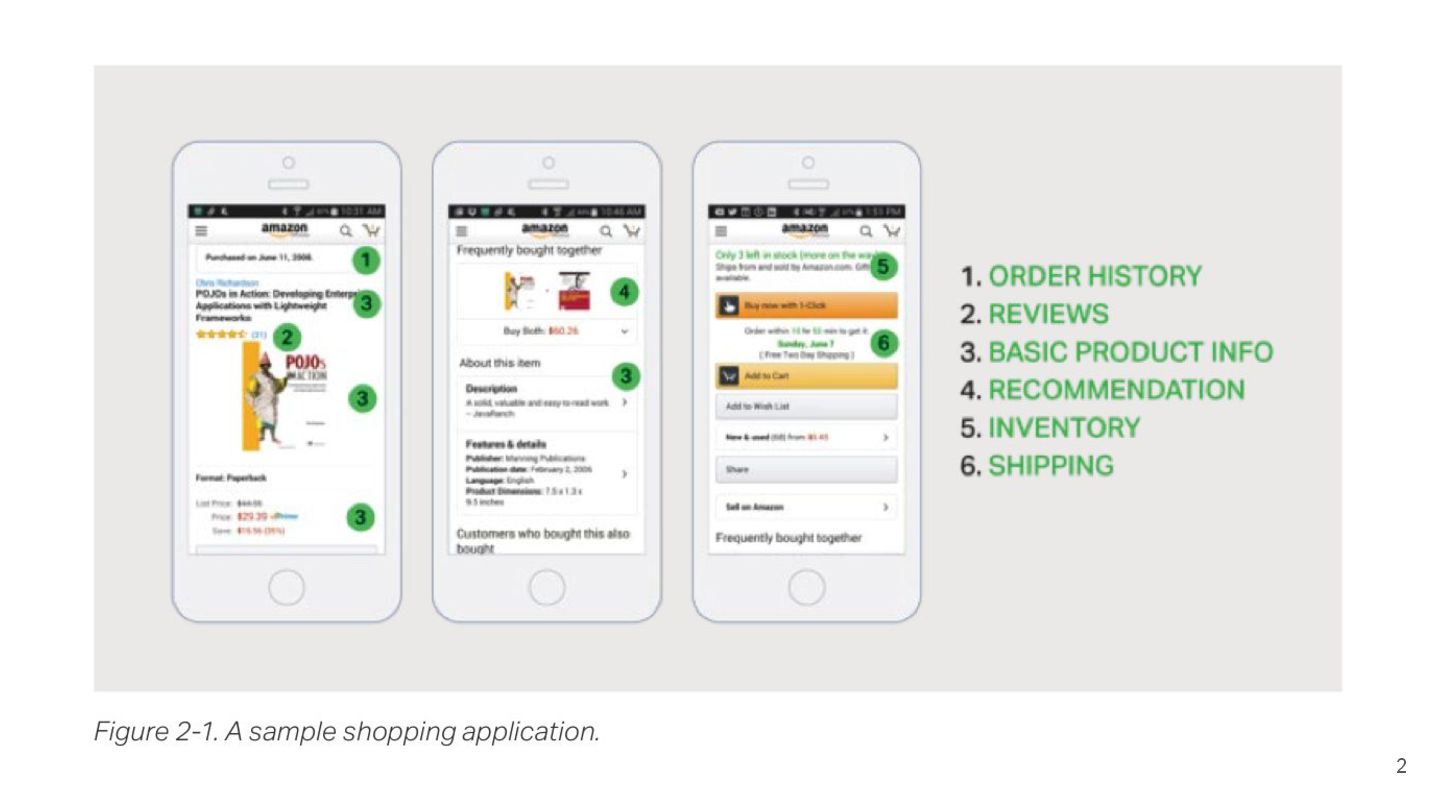
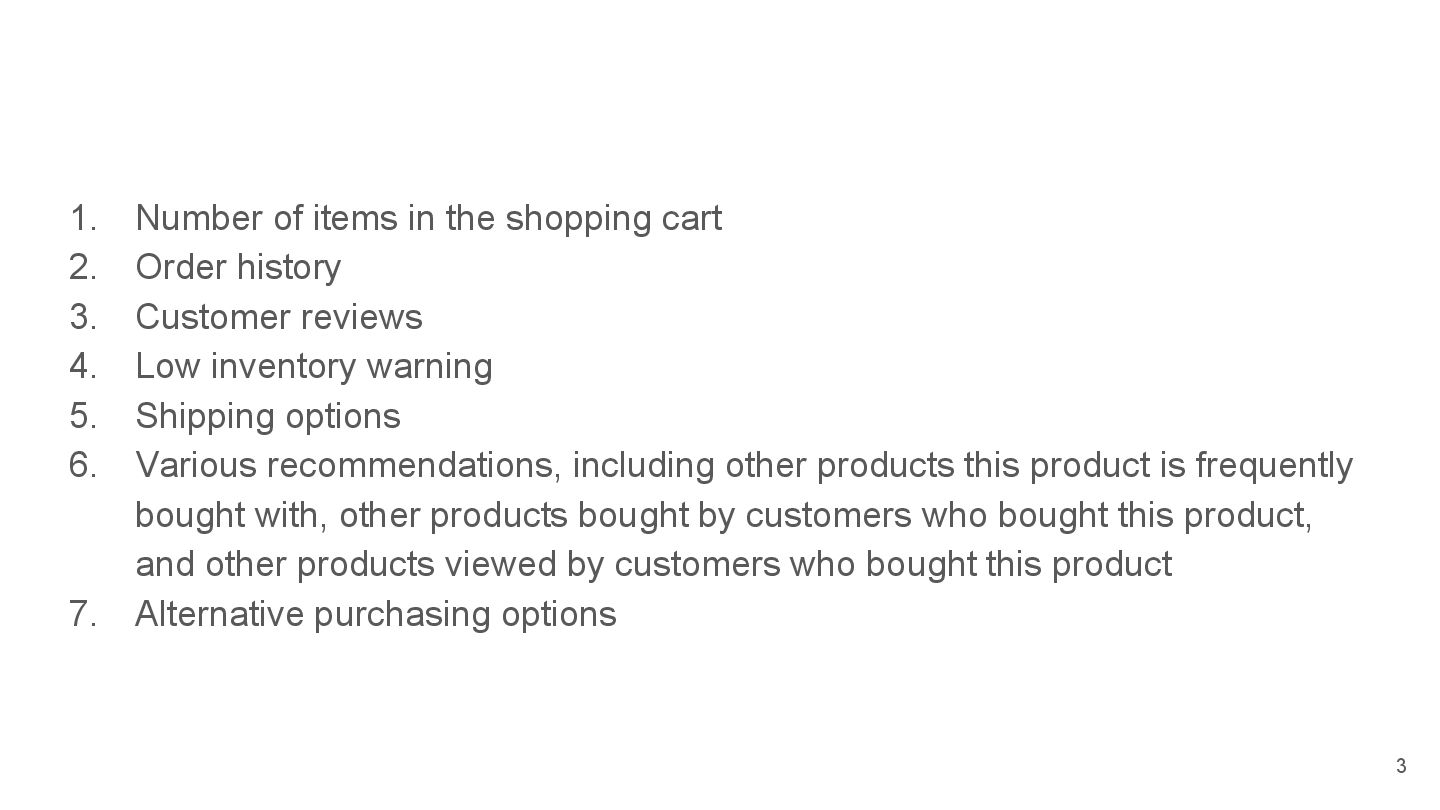
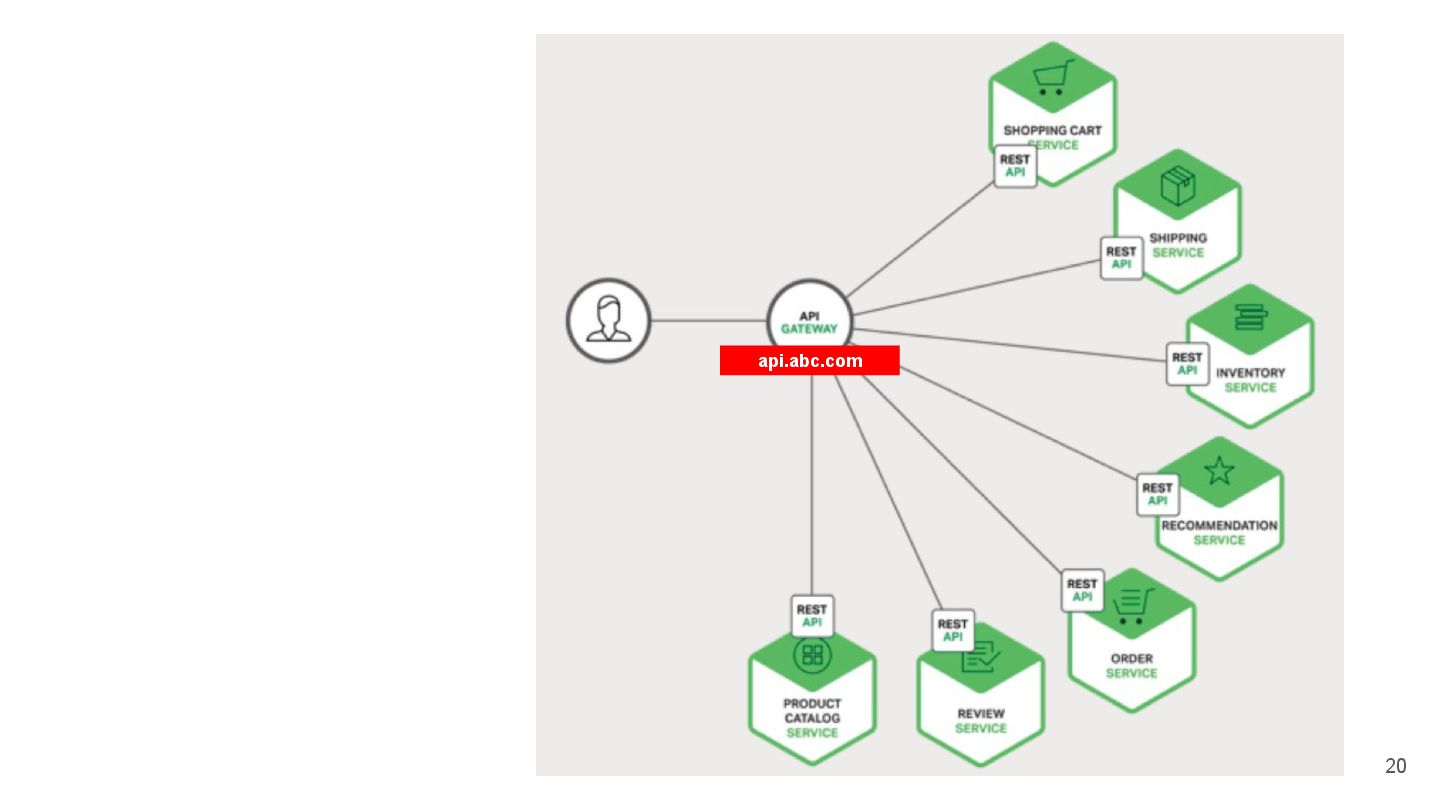
history 3. Customer reviews 4. Low inventory warning 5. Shipping options 6. Various recommendations, including other products this product is frequently bought with, other products bought by customers who bought this product, and other products viewed by customers who bought this product 7. Alternative purchasing options 3
request to one of several identical application instances. The application then queries various database tables and return the response to the client 4
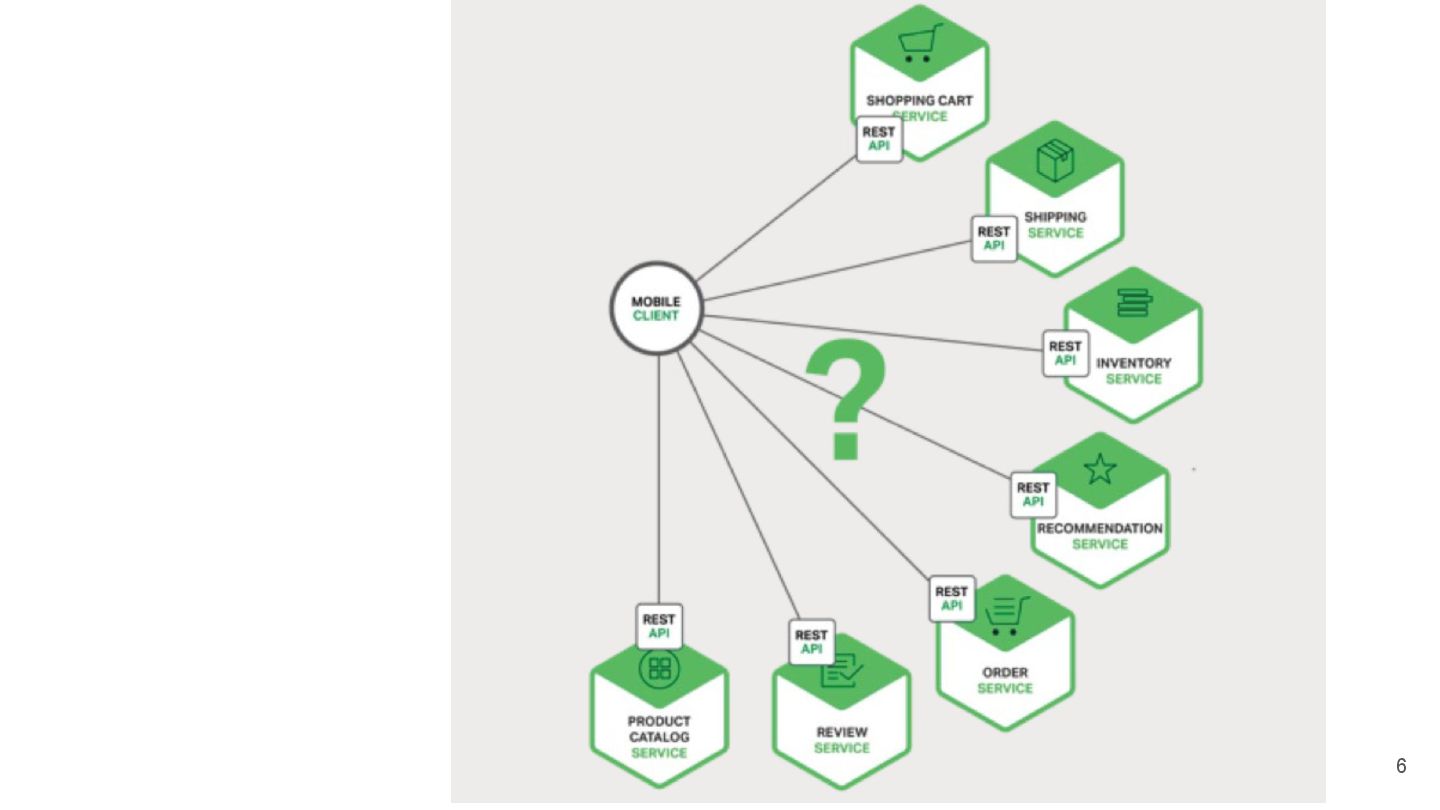
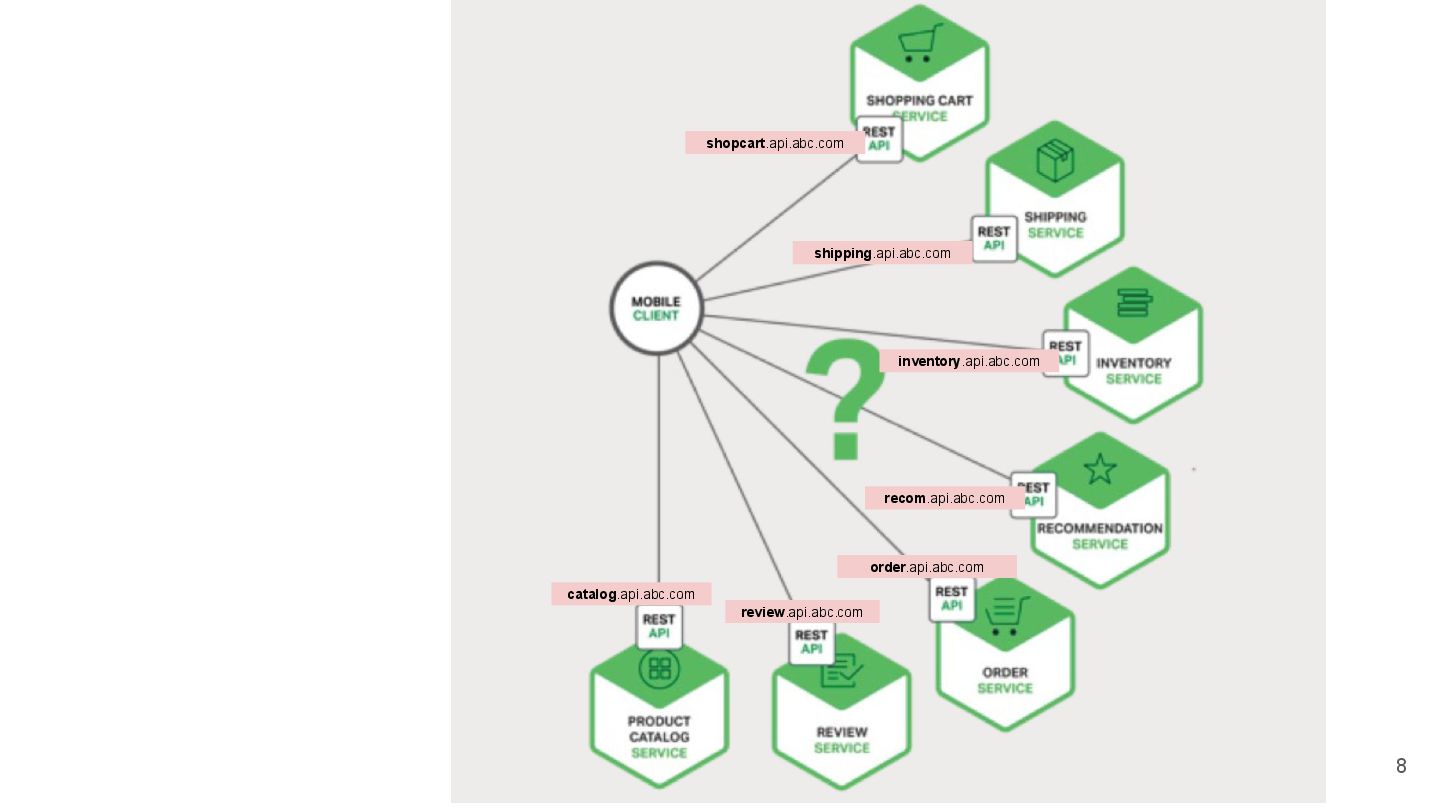
in the shopping cart • Order Service – Order history • Catalog Service – Basic product information, such as product name, image, and price • Review Service – Customer reviews • Inventory Service – Low inventory warning • Shipping Service – Shipping options, deadlines, and costs, drawn separately from the shipping provider’s API • Recommendation Service(s) – Suggested items 5
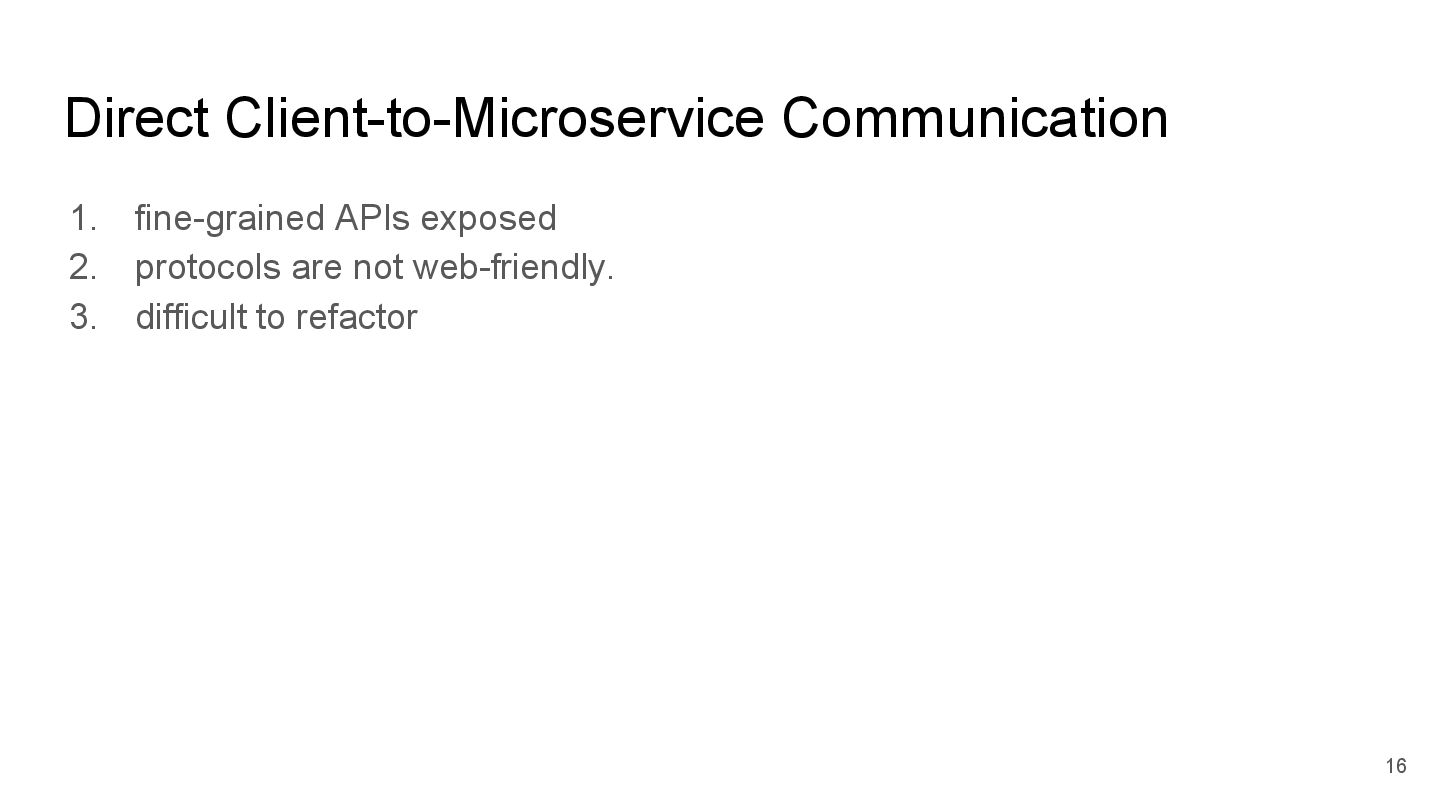
to make seven separate requests. ◦ For example, Amazon describes how hundreds of services are involved in rendering their product page. 2. Too inefficient over the public Internet 11 一個頁面要七個請求 一個頁面要二十個請求 一個頁面要一百個請求
service might use the AMQP messaging protocol. 2. An application should use protocols such as HTTP and WebSocket outside of the firewall. The Second Problem Apache Thrift 13
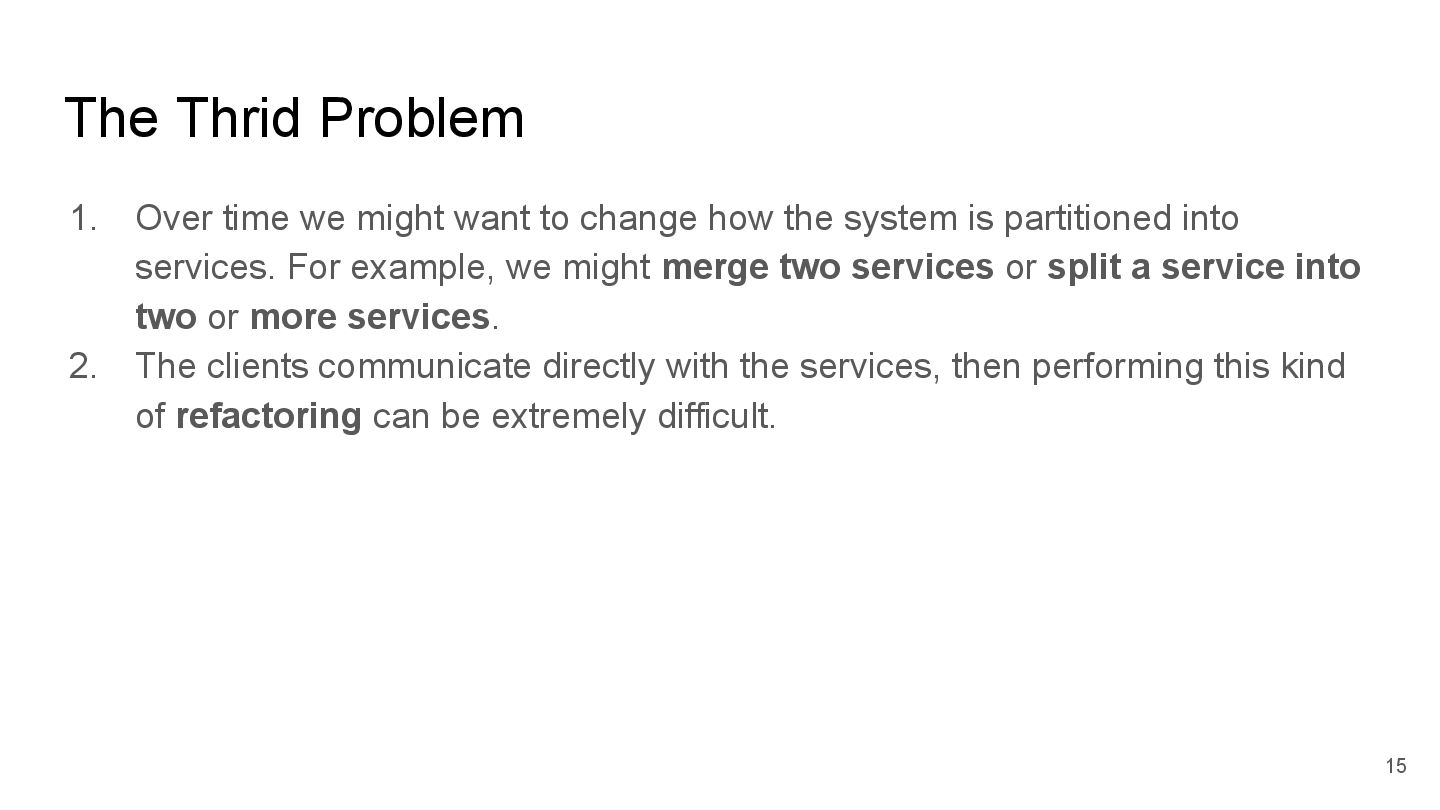
change how the system is partitioned into services. For example, we might merge two services or split a service into two or more services. 2. The clients communicate directly with the services, then performing this kind of refactoring can be extremely difficult. 15
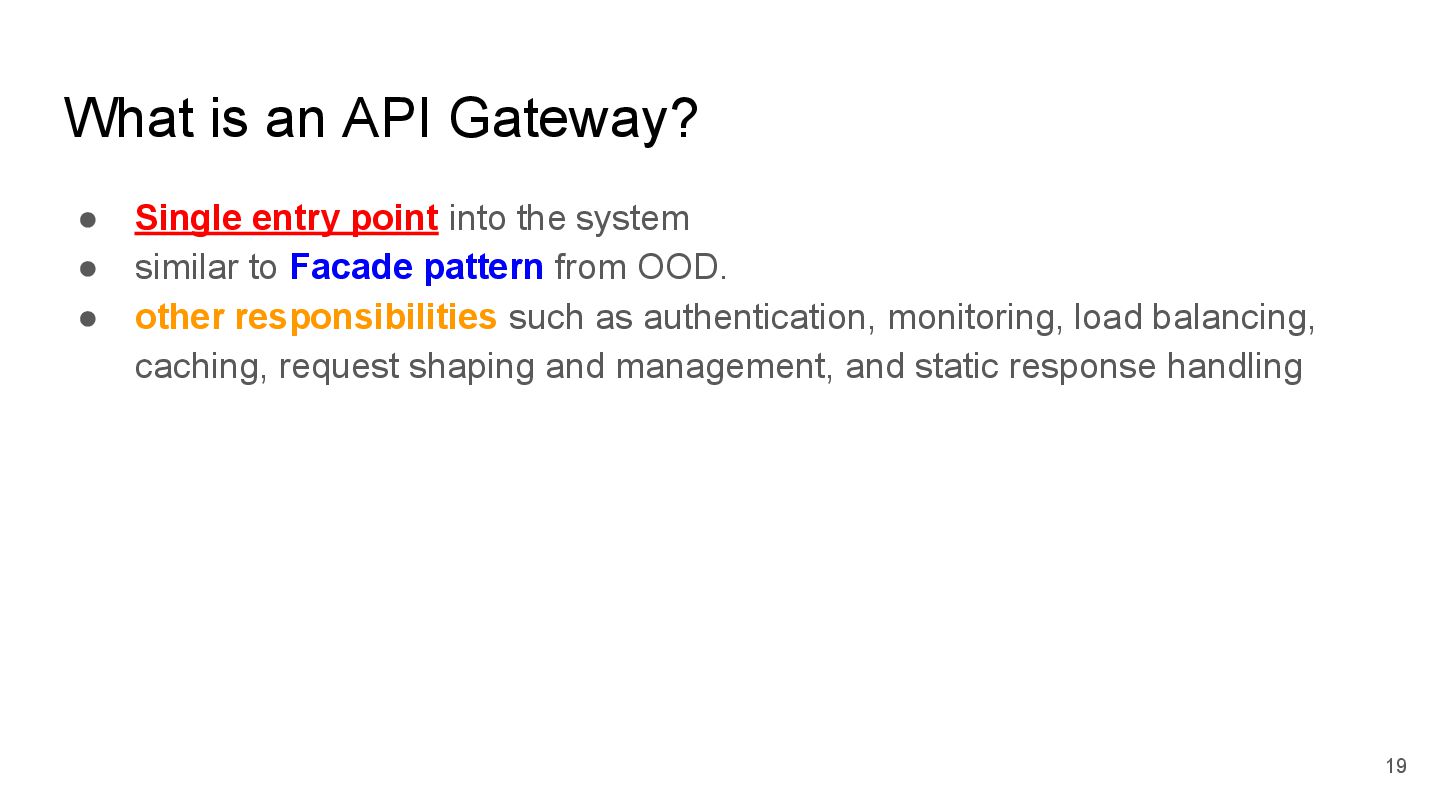
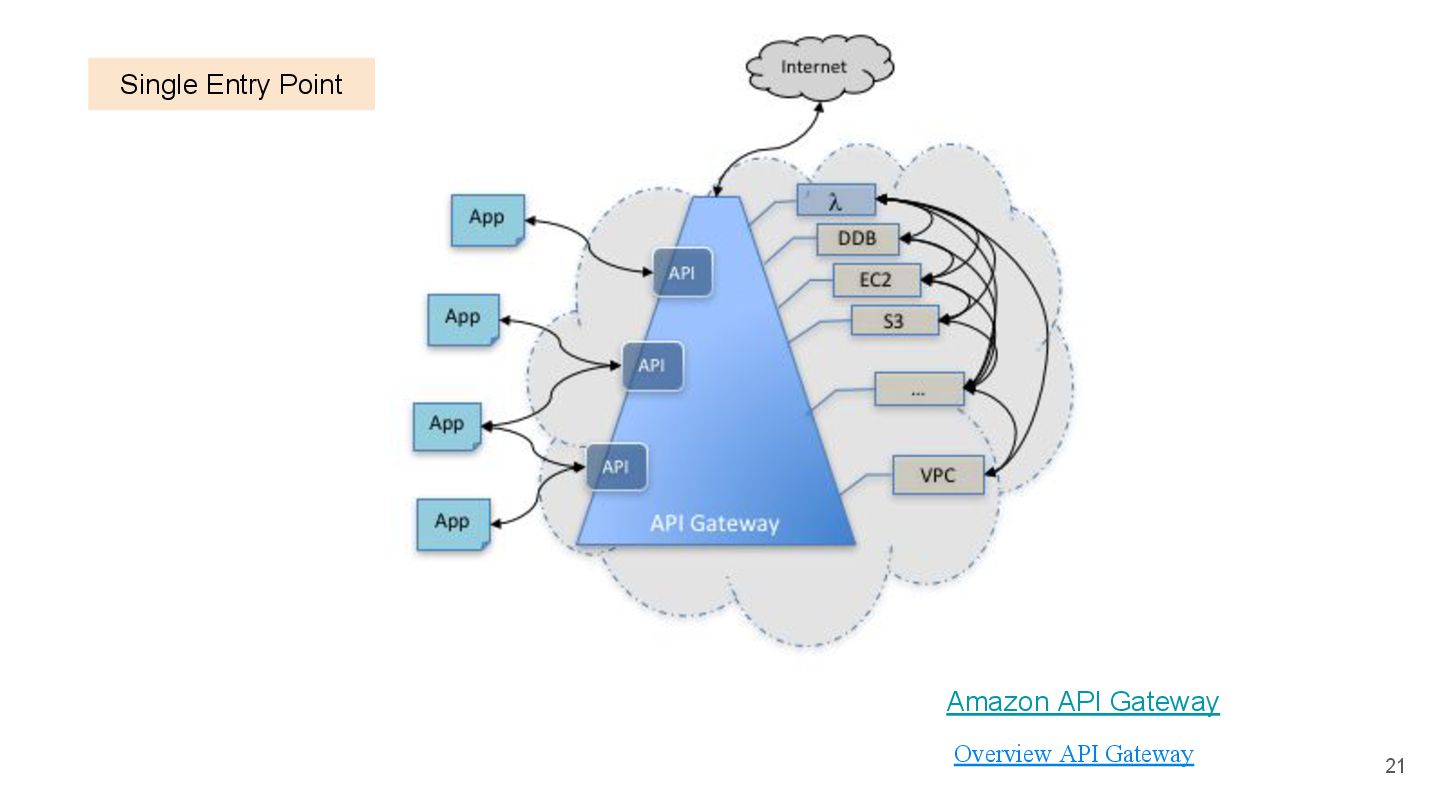
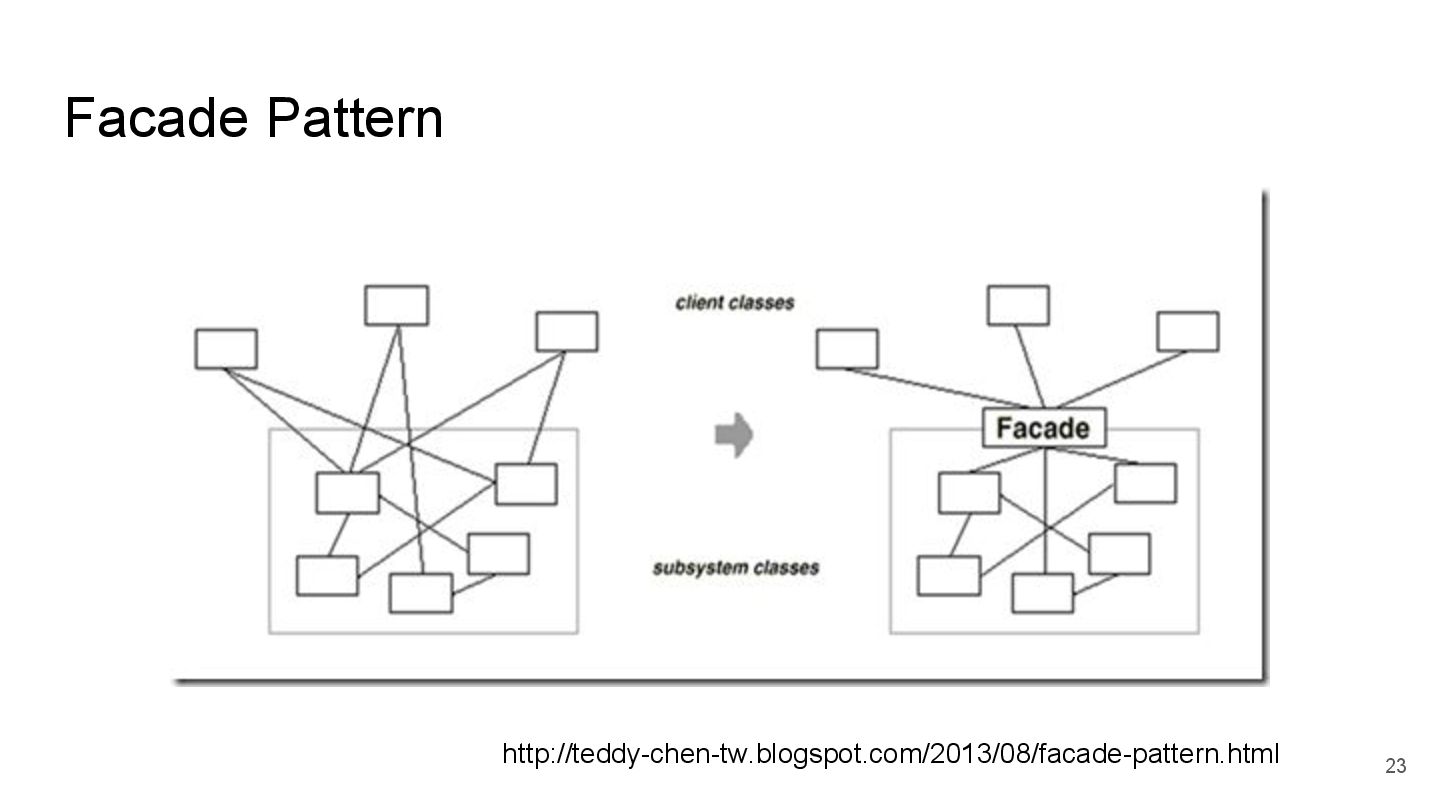
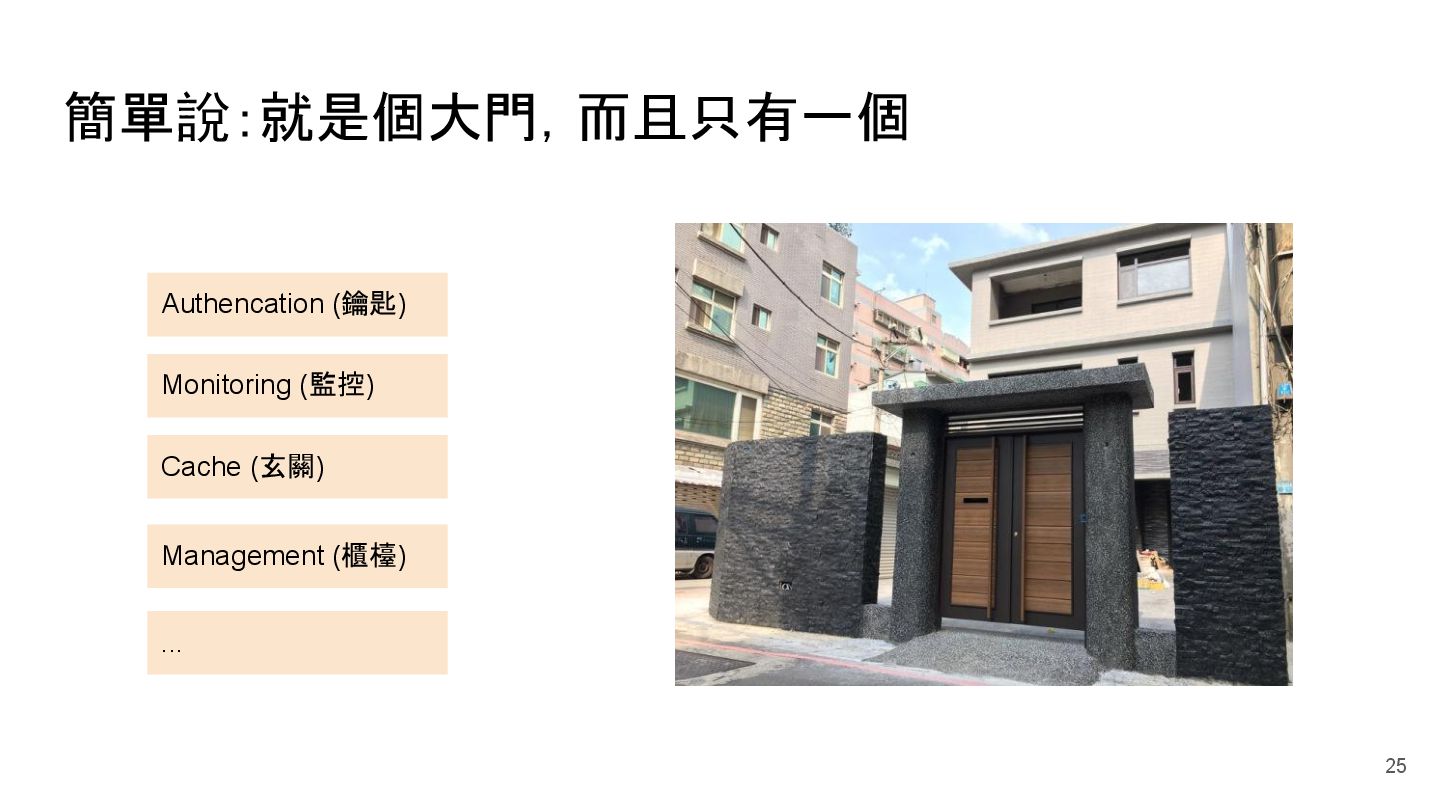
the system • similar to Facade pattern from OOD. • other responsibilities such as authentication, monitoring, load balancing, caching, request shaping and management, and static response handling 19
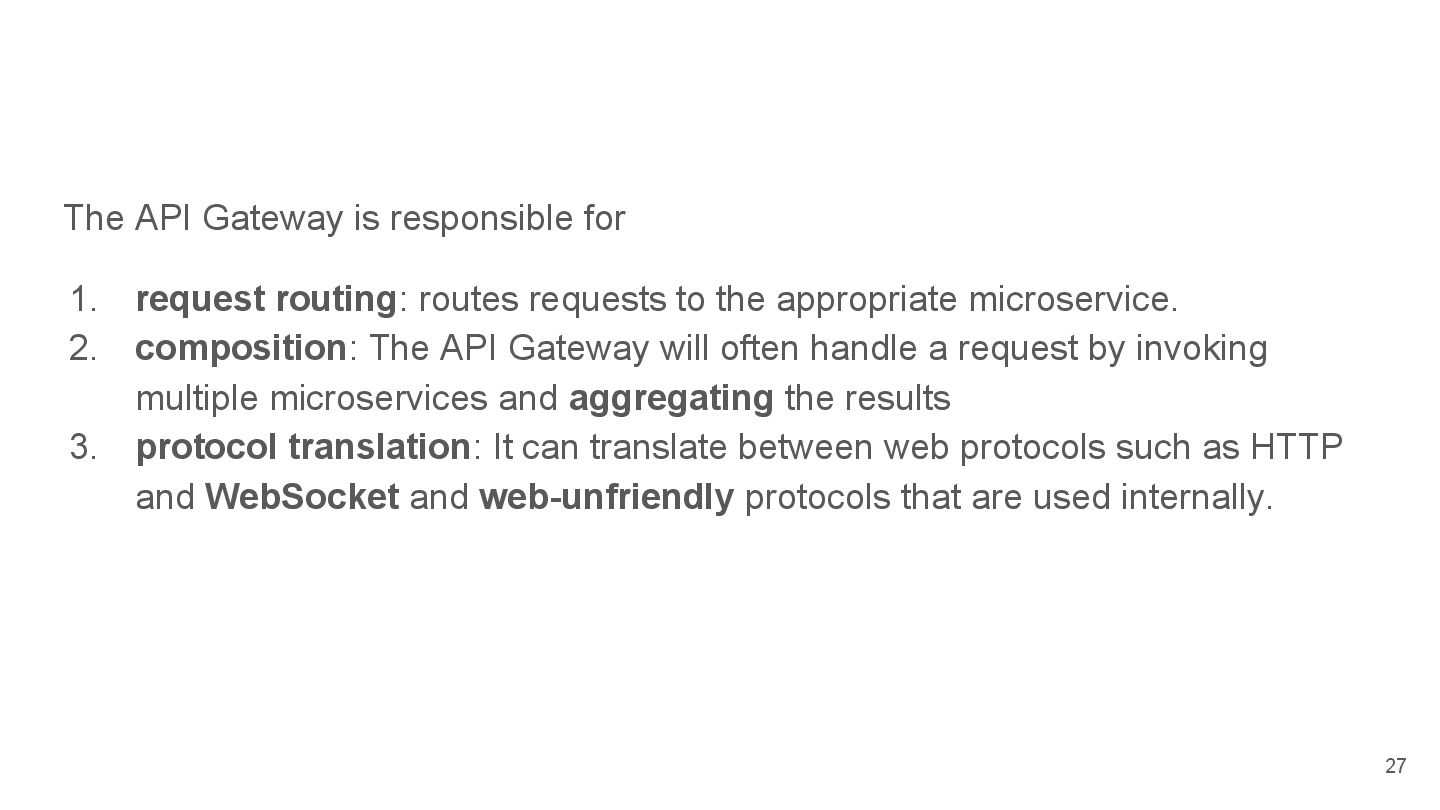
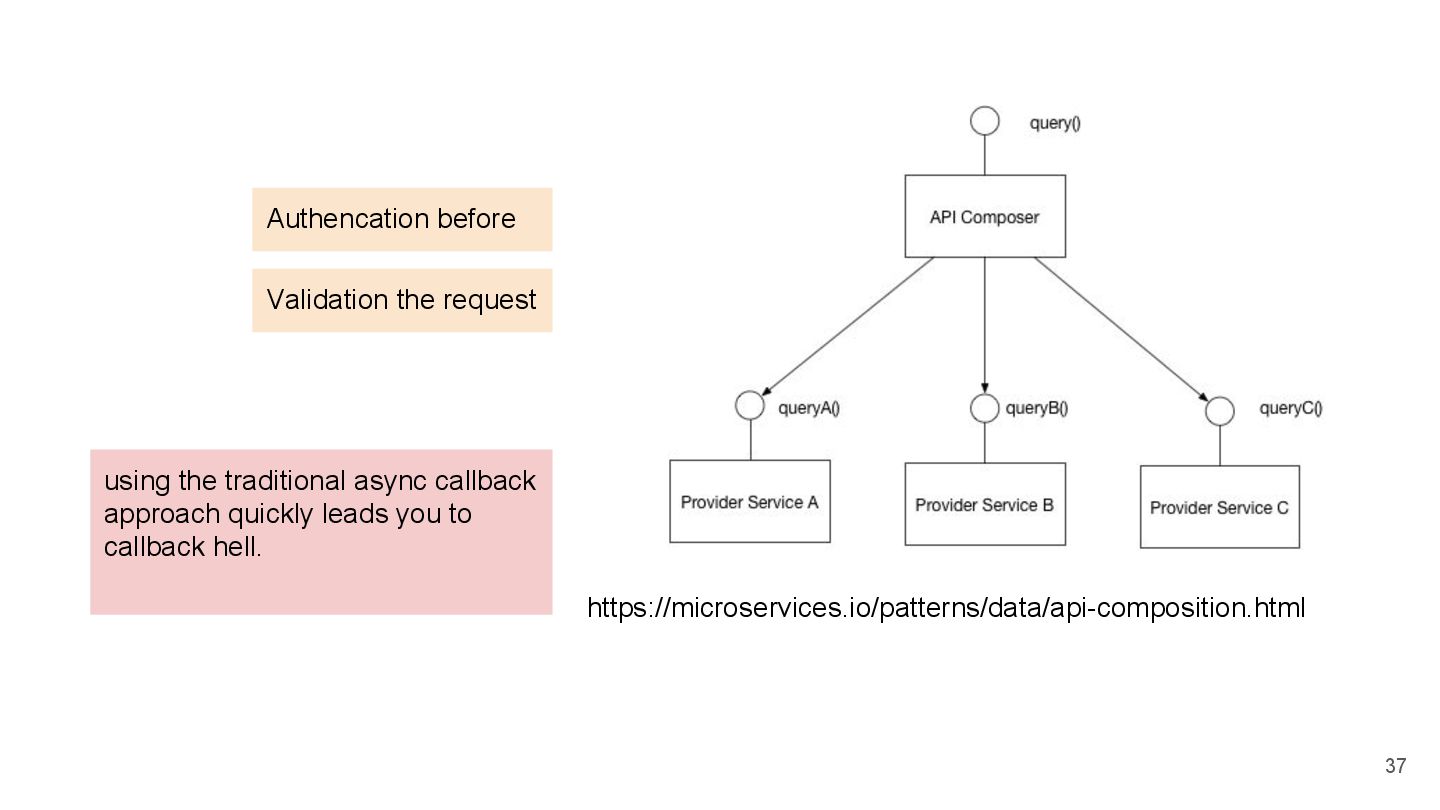
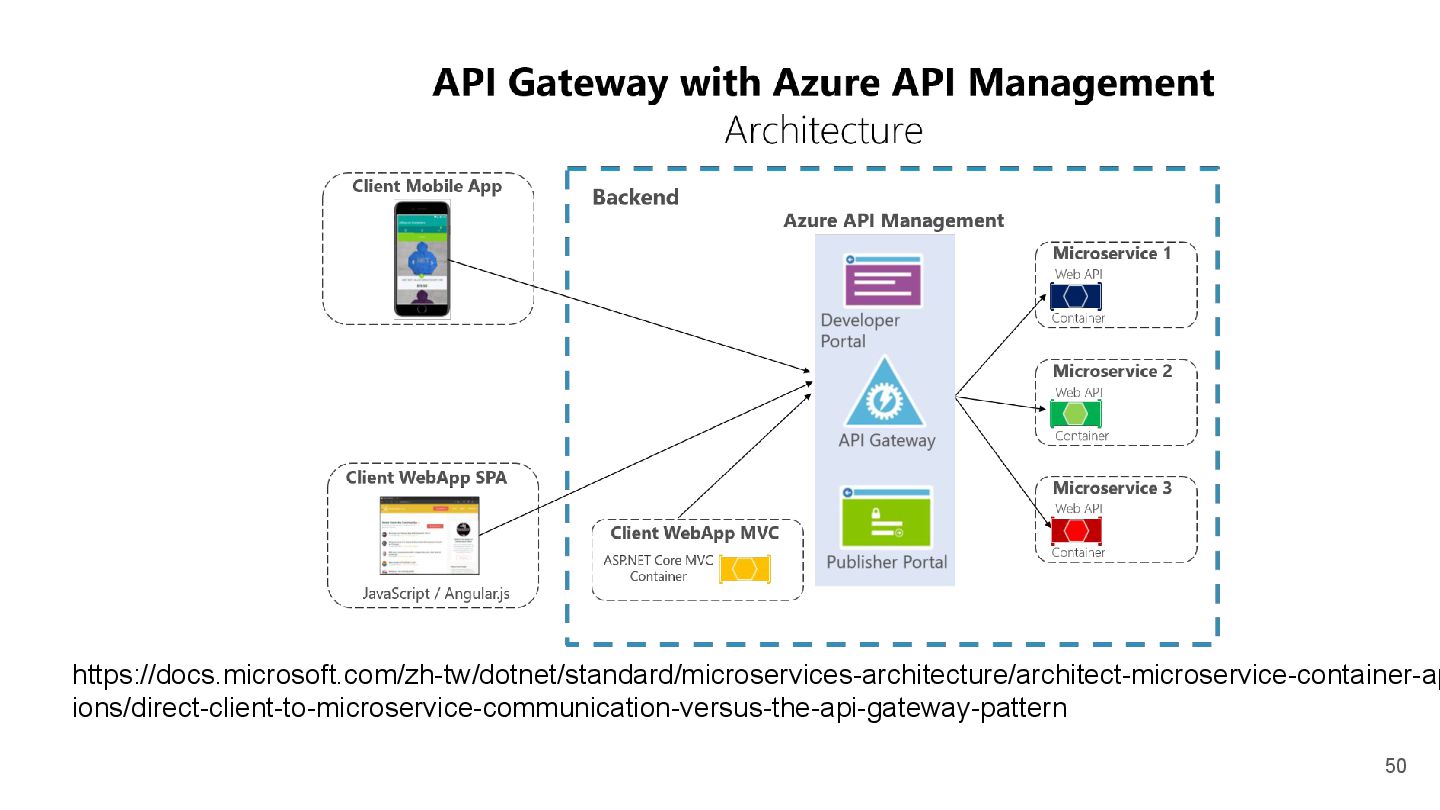
requests to the appropriate microservice. 2. composition: The API Gateway will often handle a request by invoking multiple microservices and aggregating the results 3. protocol translation: It can translate between web protocols such as HTTP and WebSocket and web-unfriendly protocols that are used internally. 27
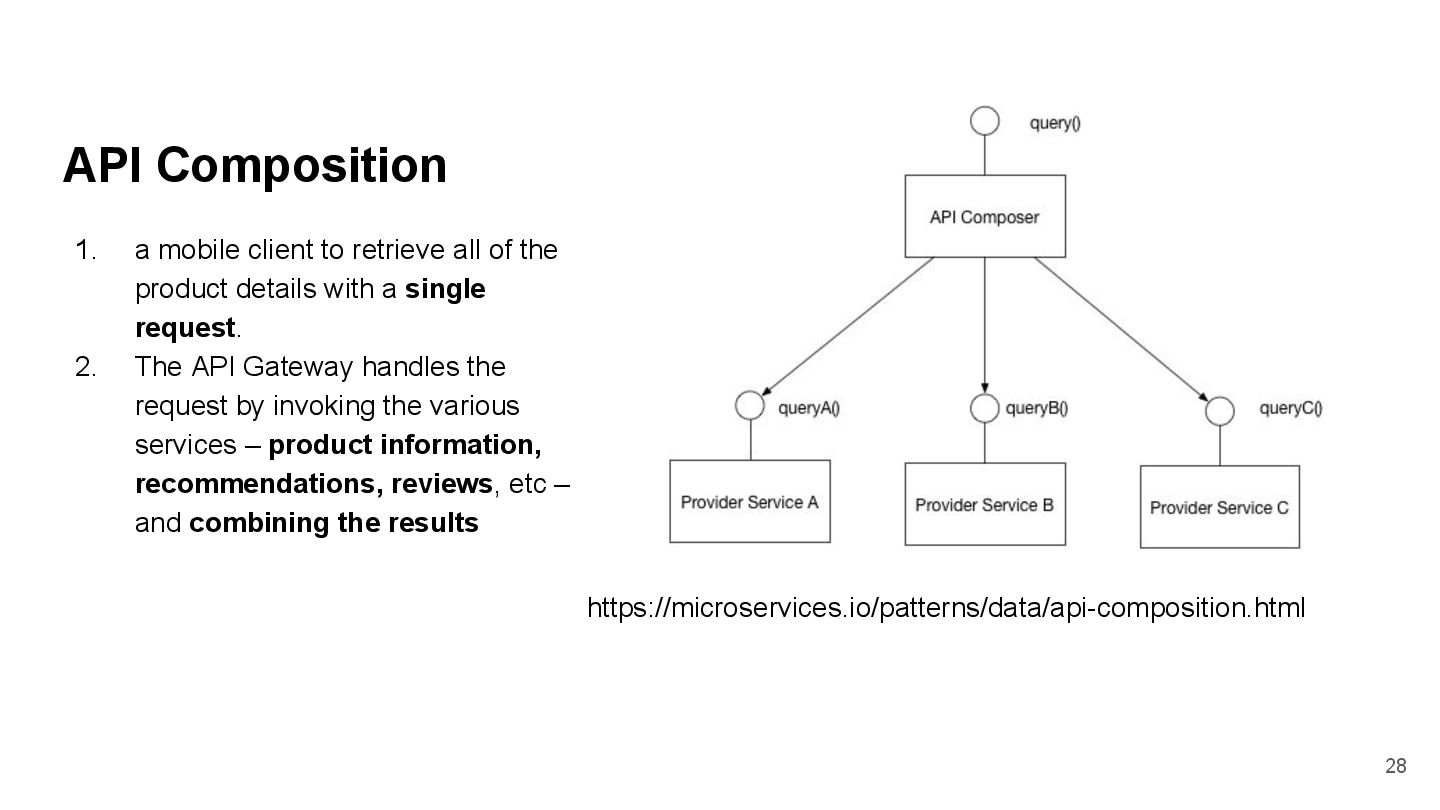
all of the product details with a single request. 2. The API Gateway handles the request by invoking the various services – product information, recommendations, reviews, etc – and combining the results
different kinds of devices including televisions, set-top boxes, smartphones, gaming systems, tablets, etc. 2. provide a one-size-fits-all API for their streaming service. 3. they use an API Gateway that provides an API tailored for each device by running device-specific adapter code. An adapter typically handles each request by invoking, on average, six to seven backend services. Example: Nextflix API Gateway 29
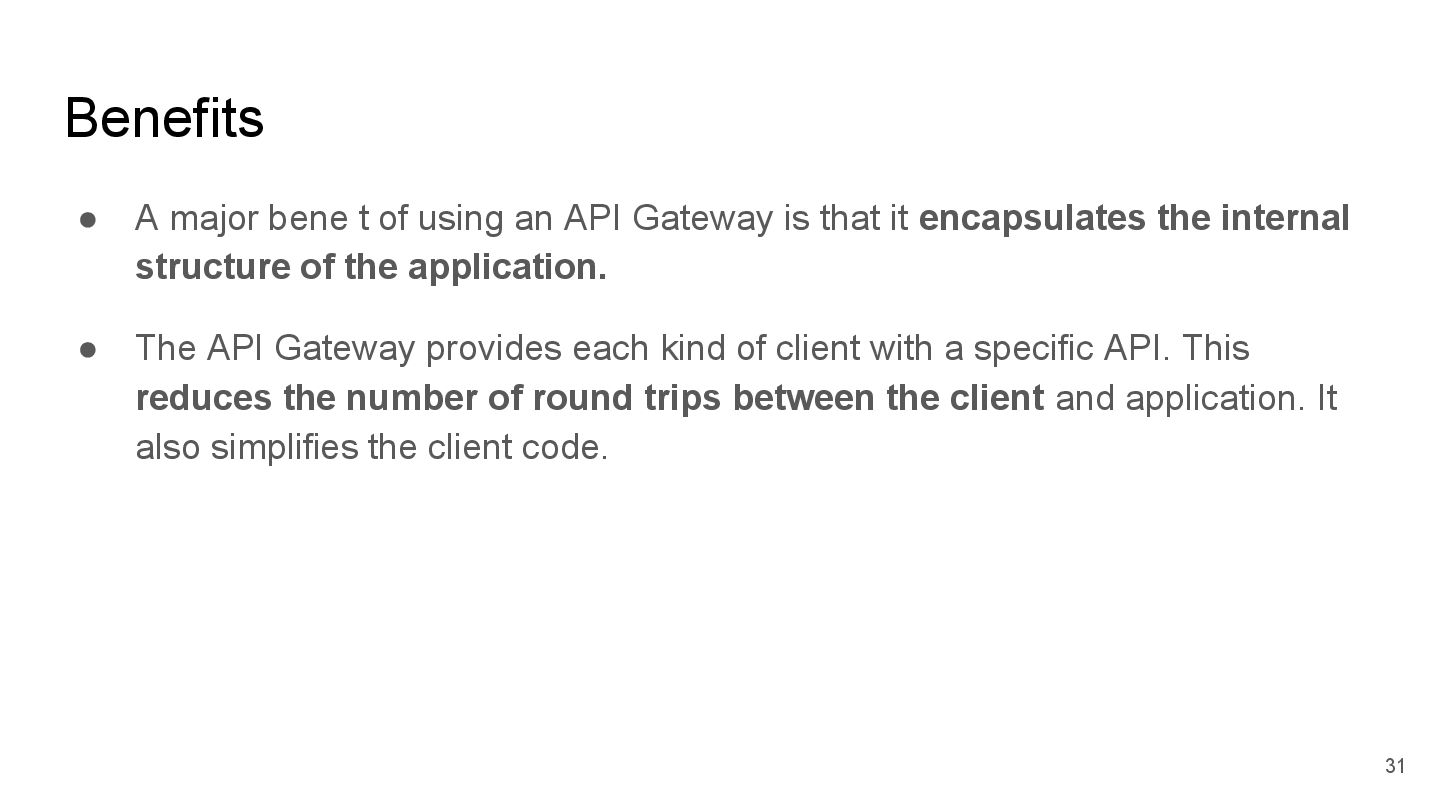
Gateway is that it encapsulates the internal structure of the application. • The API Gateway provides each kind of client with a specific API. This reduces the number of round trips between the client and application. It also simplifies the client code. 31
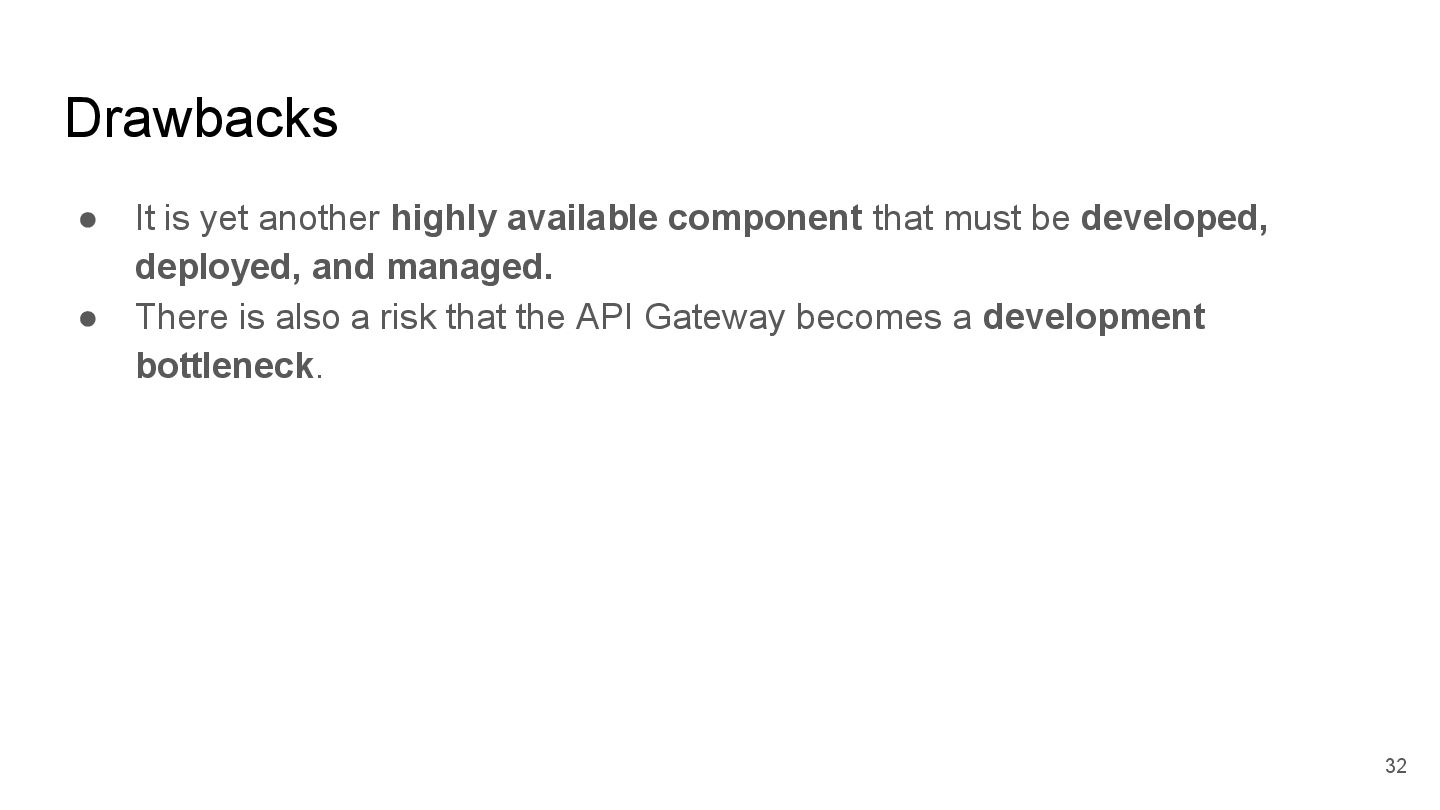
the API Gateway be as lightweight as possible. (Deployment and Operational) • Despite these drawbacks, however, for most real-world applications it makes sense to use an API Gateway. 33
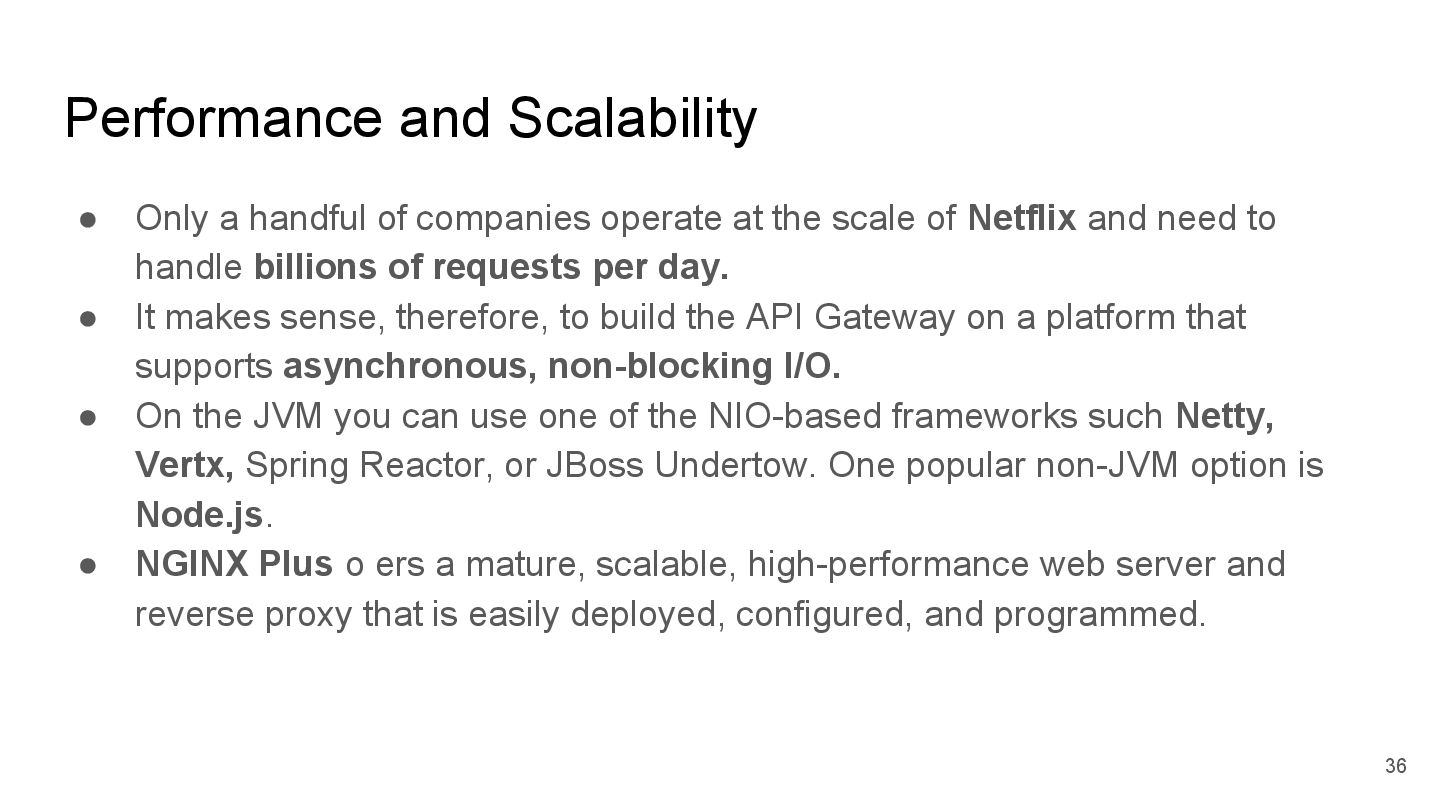
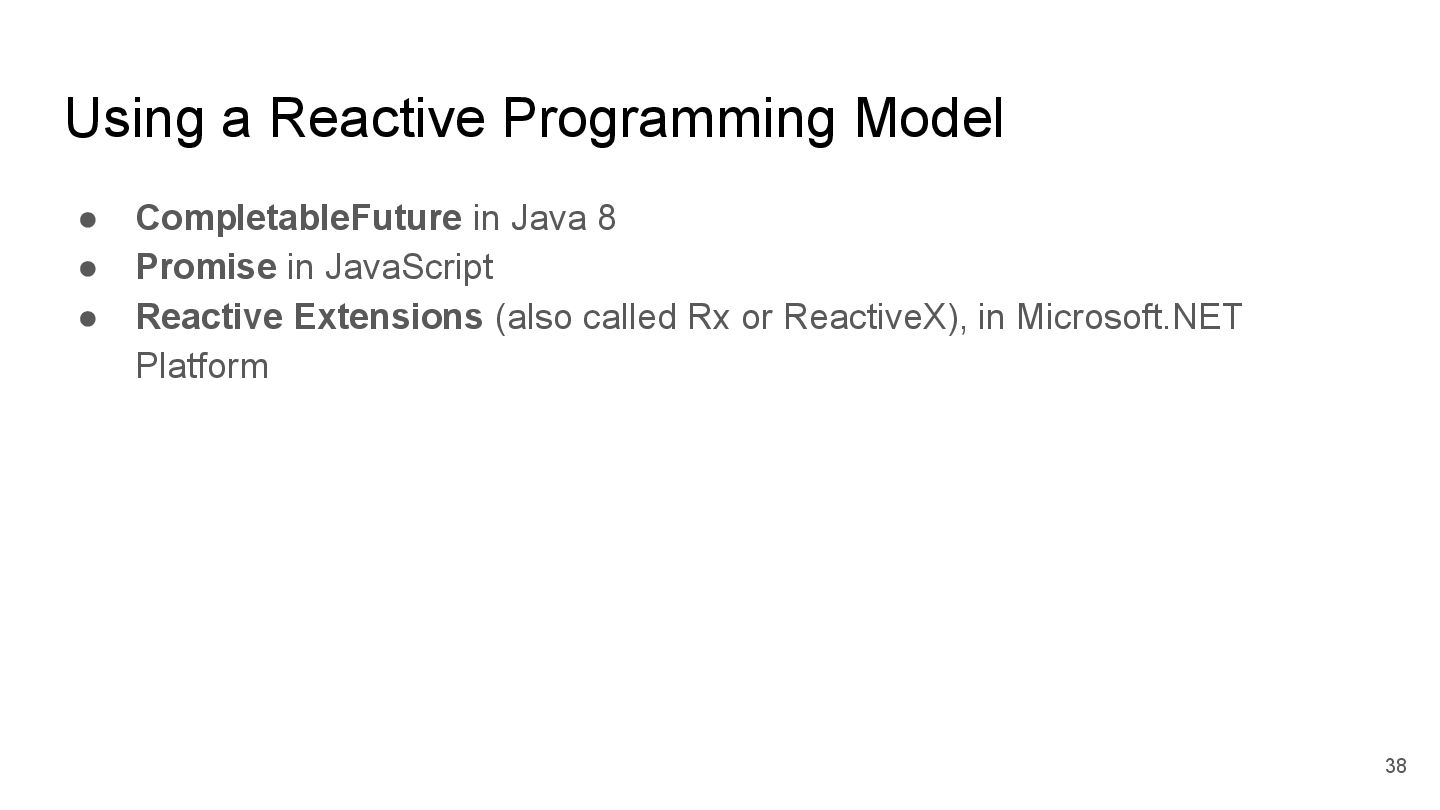
at the scale of Netflix and need to handle billions of requests per day. • It makes sense, therefore, to build the API Gateway on a platform that supports asynchronous, non-blocking I/O. • On the JVM you can use one of the NIO-based frameworks such Netty, Vertx, Spring Reactor, or JBoss Undertow. One popular non-JVM option is Node.js. • NGINX Plus o ers a mature, scalable, high-performance web server and reverse proxy that is easily deployed, configured, and programmed. 36
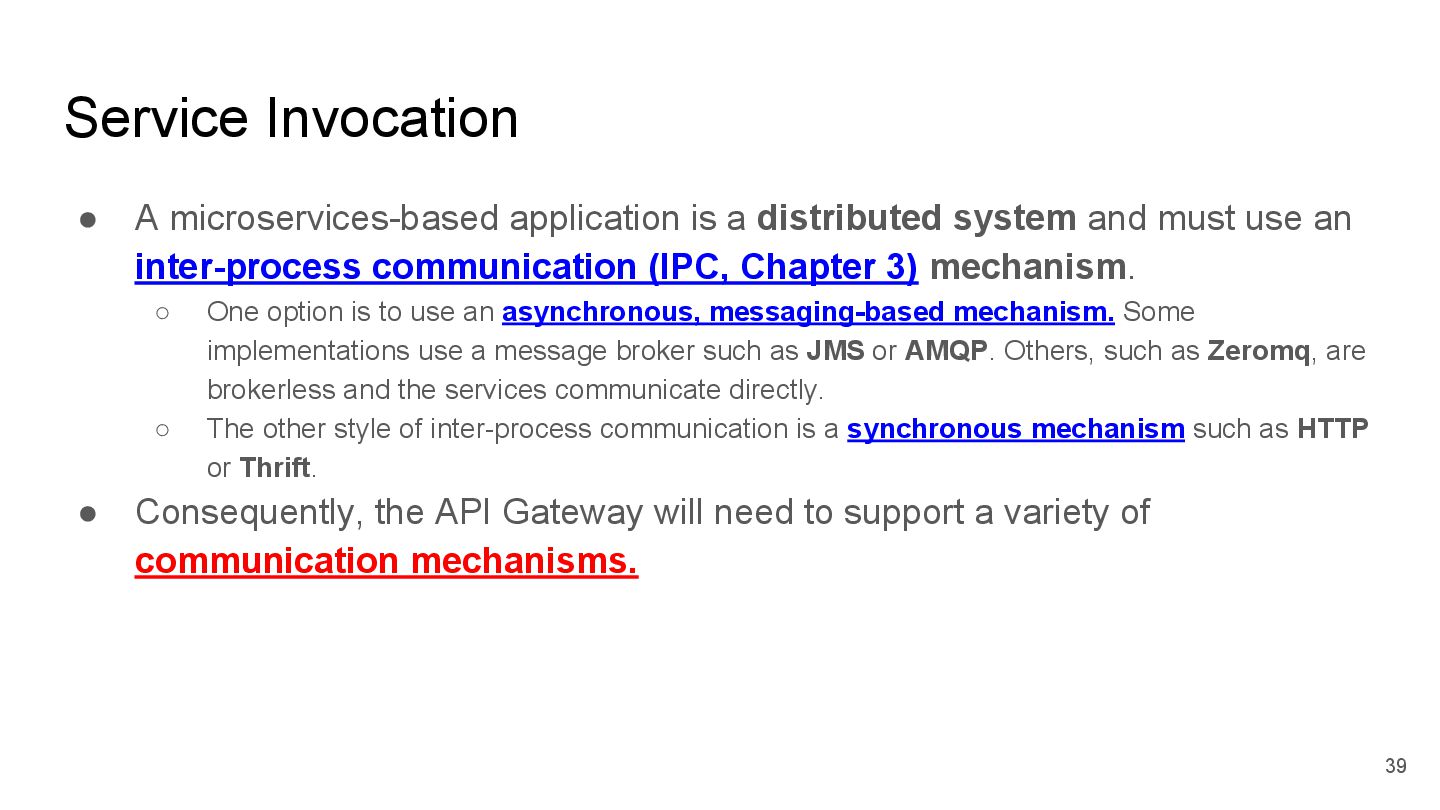
and must use an inter-process communication (IPC, Chapter 3) mechanism. ◦ One option is to use an asynchronous, messaging-based mechanism. Some implementations use a message broker such as JMS or AMQP. Others, such as Zeromq, are brokerless and the services communicate directly. ◦ The other style of inter-process communication is a synchronous mechanism such as HTTP or Thrift. • Consequently, the API Gateway will need to support a variety of communication mechanisms. 39
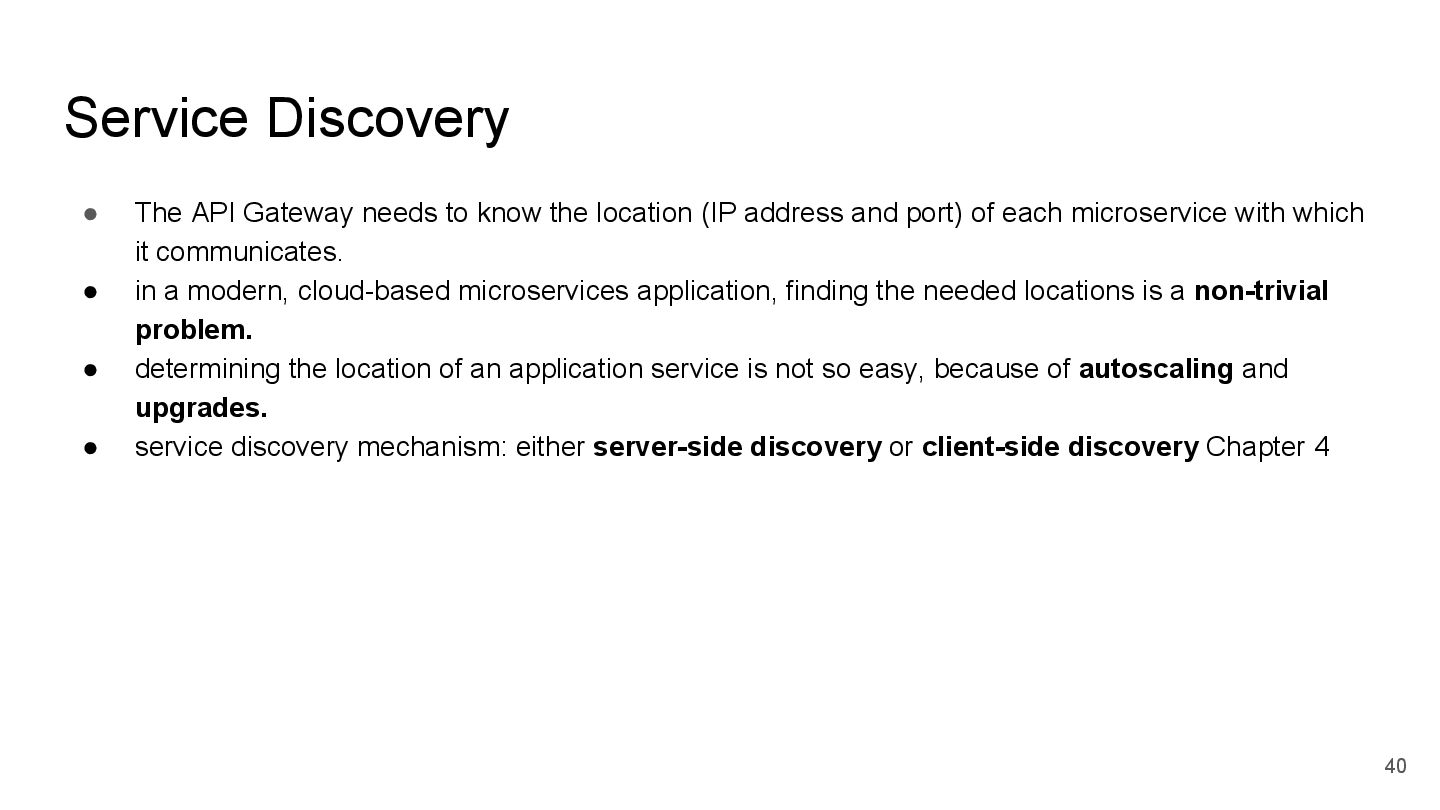
location (IP address and port) of each microservice with which it communicates. • in a modern, cloud-based microservices application, finding the needed locations is a non-trivial problem. • determining the location of an application service is not so easy, because of autoscaling and upgrades. • service discovery mechanism: either server-side discovery or client-side discovery Chapter 4 40
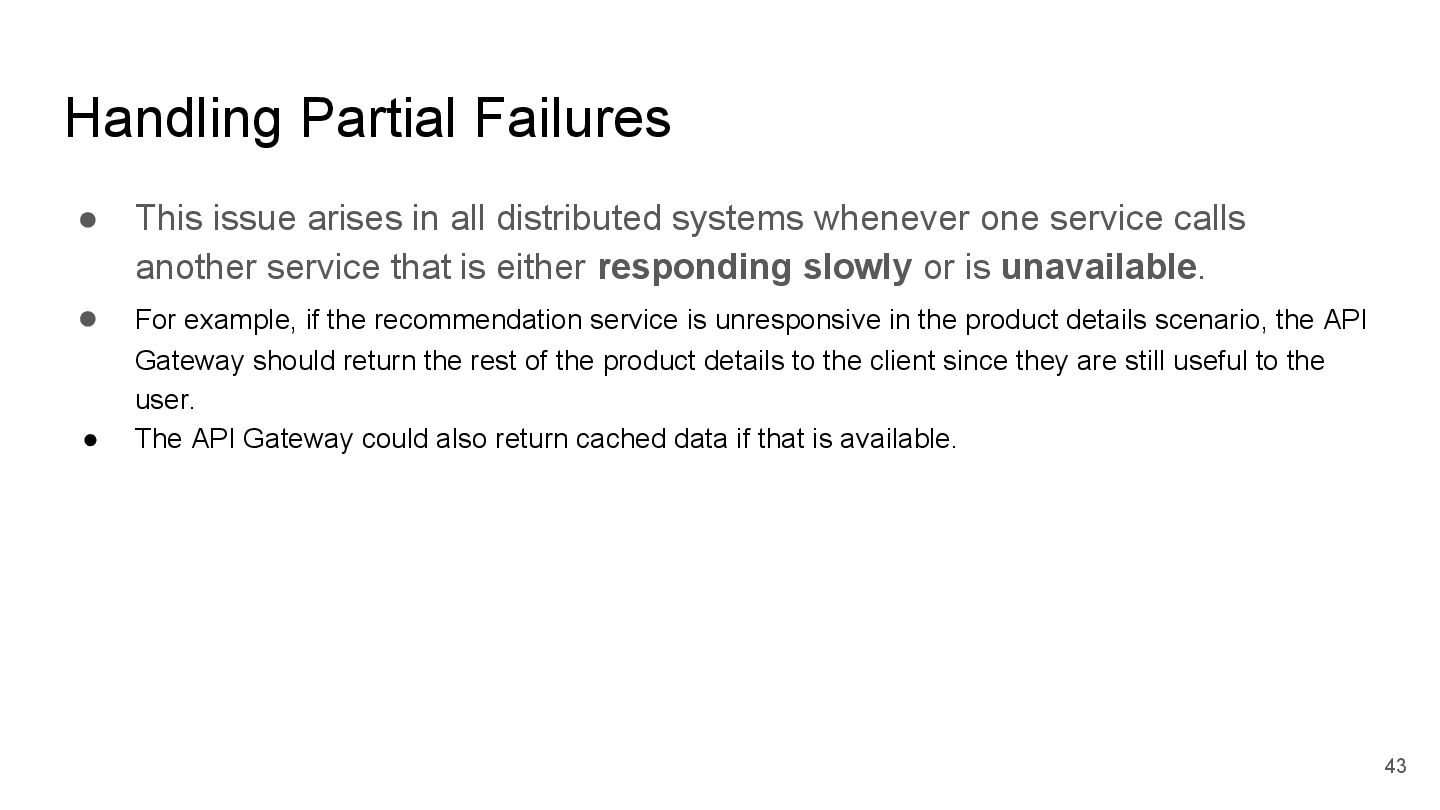
systems whenever one service calls another service that is either responding slowly or is unavailable. • For example, if the recommendation service is unresponsive in the product details scenario, the API Gateway should return the rest of the product details to the client since they are still useful to the user. • The API Gateway could also return cached data if that is available. 43
tolerance library designed to isolate points of access to remote systems, services and 3rd party libraries, stop cascading failure and enable resilience in complex distributed systems where failure is inevitable. • implement circuit breaker pattern • If the error rate for a service exceeds a specified threshold, Hystrix trips the circuit breaker and all requests will fail immediately for a specified period of time. (service 的 error rate 超過指定的臨界 值,Hystrix 跳開斷路器,在一段時間之 內立即中短所有的請求。 ) • JVM base. 44
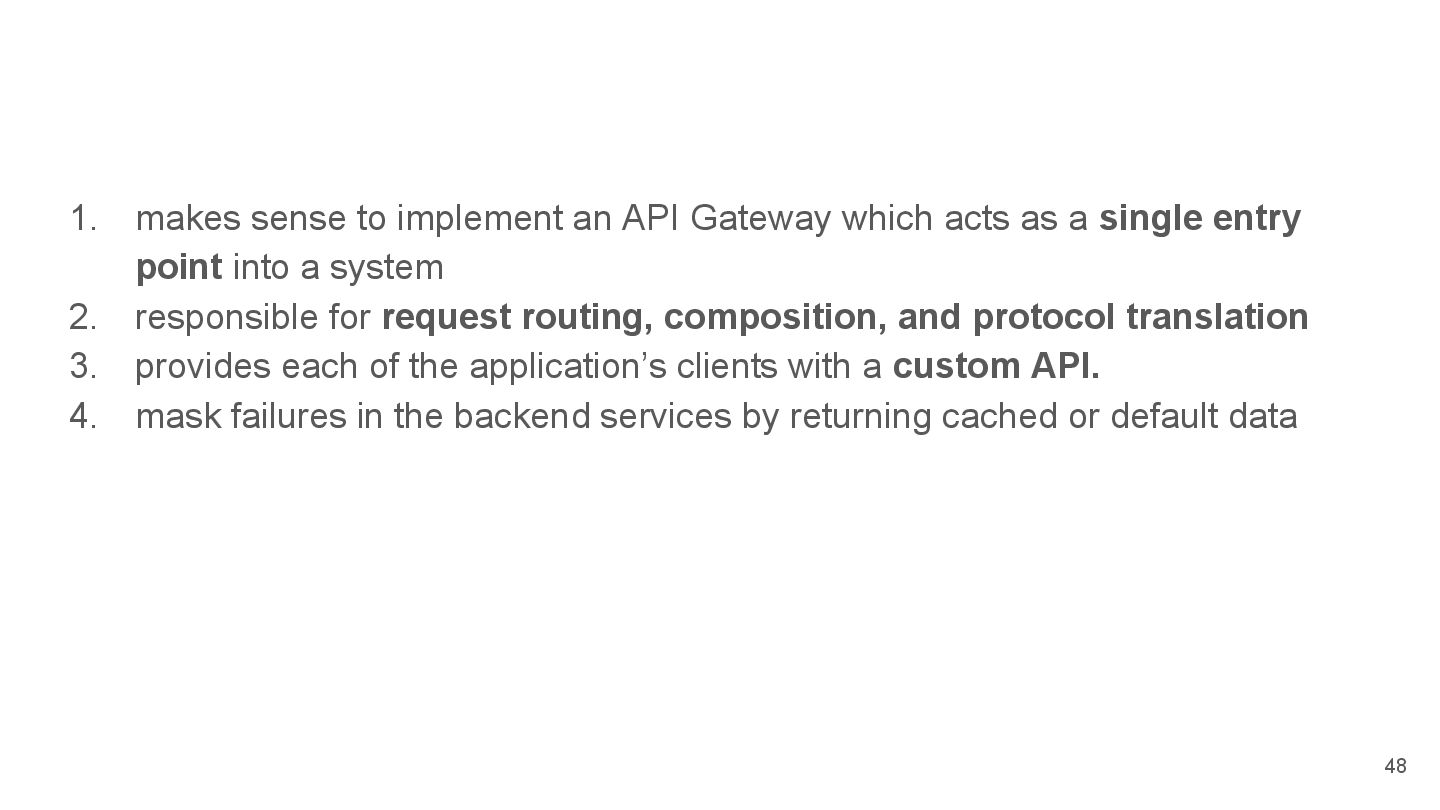
acts as a single entry point into a system 2. responsible for request routing, composition, and protocol translation 3. provides each of the application’s clients with a custom API. 4. mask failures in the backend services by returning cached or default data


 rickhwang
 mariooc
 pawan_pharm
 cbtlibrary
 aokiplayer
 bvr7352
 soudai
 tomit3
 terazawa
 yatabe
 danielanewman
 stephaniewalter
 bermonpainter
 codingconduct
 sonatard
 shlominoach
 addyosmani
 aleyda
 tammyeverts
 bryan
bryan