Upgrade to Pro — share decks privately, control downloads, hide ads and more …

Top Class IB Tutors for all subjects IA Extende...

Top Class IB Tutors for all subjects IA Extended Essay and TOK

One of the most renowned and experienced IB tutors across the world is Top Class IB Tutors. With the assistance of our experienced IB online tutors, who have all finished their studies at some of the best universities in the world, achieved stellar grades, and have years of tutoring experience, you can achieve better results. On a fun and secure online platform, your teacher will teach you something new every lesson. Sometimes, students don't have time to write their ia, extended essay, and tok because they are busy with some other work. So, we can also complete their tasks and send them soft copy. Excellent IB private tutoring services from certified teachers are offered by Top IB Tutors. We have IB tutors online who are knowledgeable about the IB curriculum and are committed to helping students achieve academic success. Teachers and students can use the Internet to learn at their own pace with the assistance of the IB tutors online. Discover the fascinating world of IA and extended essays for all IB subjects with the assistance of our knowledgeable Top Class ib tutor. We help with the analysis of different points of view, provide helpful research and writing skills, and provide thorough explanations of extended essay research questions and topics. Our instructors offer useful resources, essay help, and test strategies to help you succeed in IB math physics chemistry bio English tok design technology computer science itgs ess business management economics and all other subjects. Our IB online tutors are committed to providing students with in-depth knowledge while enhancing the enjoyment and engagement of the classes. Our help is available for every country; instructors, first, encourage students to do their ia extended essay tok themselves but if they fall short of time, we do their work and send soft copies. For more information, please feel free to contact us: https://www.topclassibtutors.com

Avatar for Ram Parihar

Ram Parihar

May 03, 2025
Tweet

Other Decks in Education

Transcript

  1. Table of Contents Introduction 3 Aim 3 Mathematical Concepts used

    4 Data 4 Methodology 5 Graphing the data 5 Analysis of the Graphs 8 Stochastic Calculus and Brownian Motion 13 Stock Returns 14 Processing Data 15 Normal Distribution 17 Area under Normal Distribution 17 Conclusion 19 Predicted prices v/s Actual Prices 19 T-test 20 Reflection and Further Improvements 22 Works Cited 23 2
  2. Introduction The stock market is a very dynamic place, where

    several investors and buyers come together to carry out the process of the buying and selling of stocks. Everyday, billions of Rupees flow in and out of the Indian stock market. Some make huge profits from their investments whereas the others face huge losses. The prices of these stocks are largely determined by the forces of demand and supply. It is extremely difficult to predict change in stock prices as firstly the future is unpredictable and secondly as the prices of stocks change every day and are not just determined by a single factor. There are various factors other than demand and supply that influence stock prices such as; the announcement of dividends, anticipated firm changeover/ merger, type of market, industry performance and other economic factors such as interest rates, inflation etc. I watched the movie, ‘The Wolf of Wall Street’ back in 2015 and that is where my interest in the financial industry stems from. I became highly fascinated by the fast paced and dynamic stock market and started reading more about this same. Ever since, I have always wanted to invest in stocks to get more exposure to the stock market, which is a potential career prospect for me. However, I unfortunately could not open a DEMAT account, an account required to hold shares and financial securities in an electronic form, as the minimum age requirement was 18 years. However, I started using my dad’s DEMAT account in order to start investing small amounts into a few stocks. From this experience, I learnt that stock prices are very volatile. While the stock prices of one firm may skyrocket, the prices for another may plunge down. Hence, I decided to do extensive research about the trends of one firm's stock prices, to be able to invest successfully and make impressive gains. This is the reason why I have chosen the modelling of the future stock prices of VODAFONE IDEA as the topic of my Maths investigation. The aim of this exploration is to build a successful model that predicts and derives the probability of daily returns of the stock prices of VODAFONE IDEA. The stock prices of Vodafone Idea have been chosen as they are extremely volatile in the market currently and are subject to large price fluctuation. 3
  3. Mathematical concepts used - 1. Calculus - Stochastic Calculus and

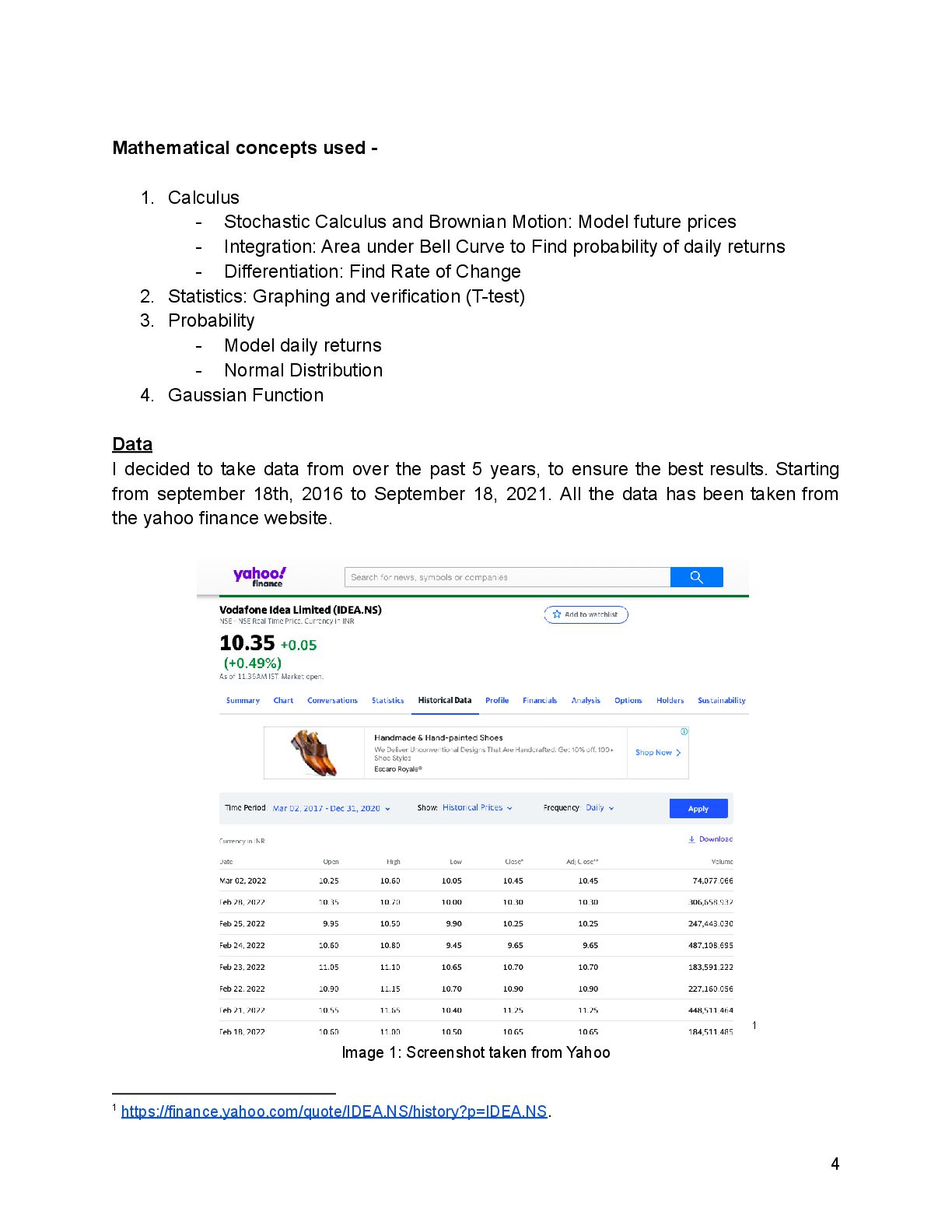
    Brownian Motion: Model future prices - Integration: Area under Bell Curve to Find probability of daily returns - Differentiation: Find Rate of Change 2. Statistics: Graphing and verification (T-test) 3. Probability - Model daily returns - Normal Distribution 4. Gaussian Function Data I decided to take data from over the past 5 years, to ensure the best results. Starting from september 18th, 2016 to September 18, 2021. All the data has been taken from the yahoo finance website. 1 Image 1: Screenshot taken from Yahoo 1 https://finance.yahoo.com/quote/IDEA.NS/history?p=IDEA.NS. 4
  4. Method 1. The data of the past 4 years will

    be plotted. A total of 988 data points will be taken. 2. A weekly average will be calculated for these data points. This would give us a total of 142 data points to plot. 3. The weeks will be assigned numerical values ranging from 1-142. Sep 18, 2017 being number 1. 4. A consolidated graph of price v/s time (in weeks) will be plotted for all the data. 5. Trends will be identified in the consolidated graph and each trend will be modelled separately for piecewise function. 6. To calculate the average rate of change, given the increase of the stock price on each day, the first derivative of the function will be calculated. 7. The Local maxima and Local minima of the function will be found by equating the first derivative to 0. This will help determine the best day to buy a particular stock and the best day to sell it. 8. Through the use of piecewise modelling and analysis of different trends, an equation for the future prices will be modelled. 9. Stock market being highly dynamic, Stochastic Calculus and Brownian Motion will be used to model the stock prices for the future. 10.The percentage change in daily returns will be calculated for a sample data of 30 days. 11. The mean and standard deviation of this data will be calculated. 12.The processed data will be entered into the gaussian function and a Normal Distribution curve will be plotted. 13.The area under the bell curve will be calculated using integration, in order to find the probability of a fixed percentage of daily returns on an investment. 14.The prediction made by our model will be compared to the actual stock prices of VODAFONE IDEA to determine the accuracy and reliability of the model. Graphing the data A graph of the closing price of the stocks of VODA IDEA was plotted. I decided to divide the data into four parts based on different trends that were being followed. This will help me get an average of the duration of how long each trend lasts for and allow me to model a graph for the future trend. Average duration of each trend will be found out by taking a mean of the sum of the duration of all 4 trends (in terms of weeks). 5
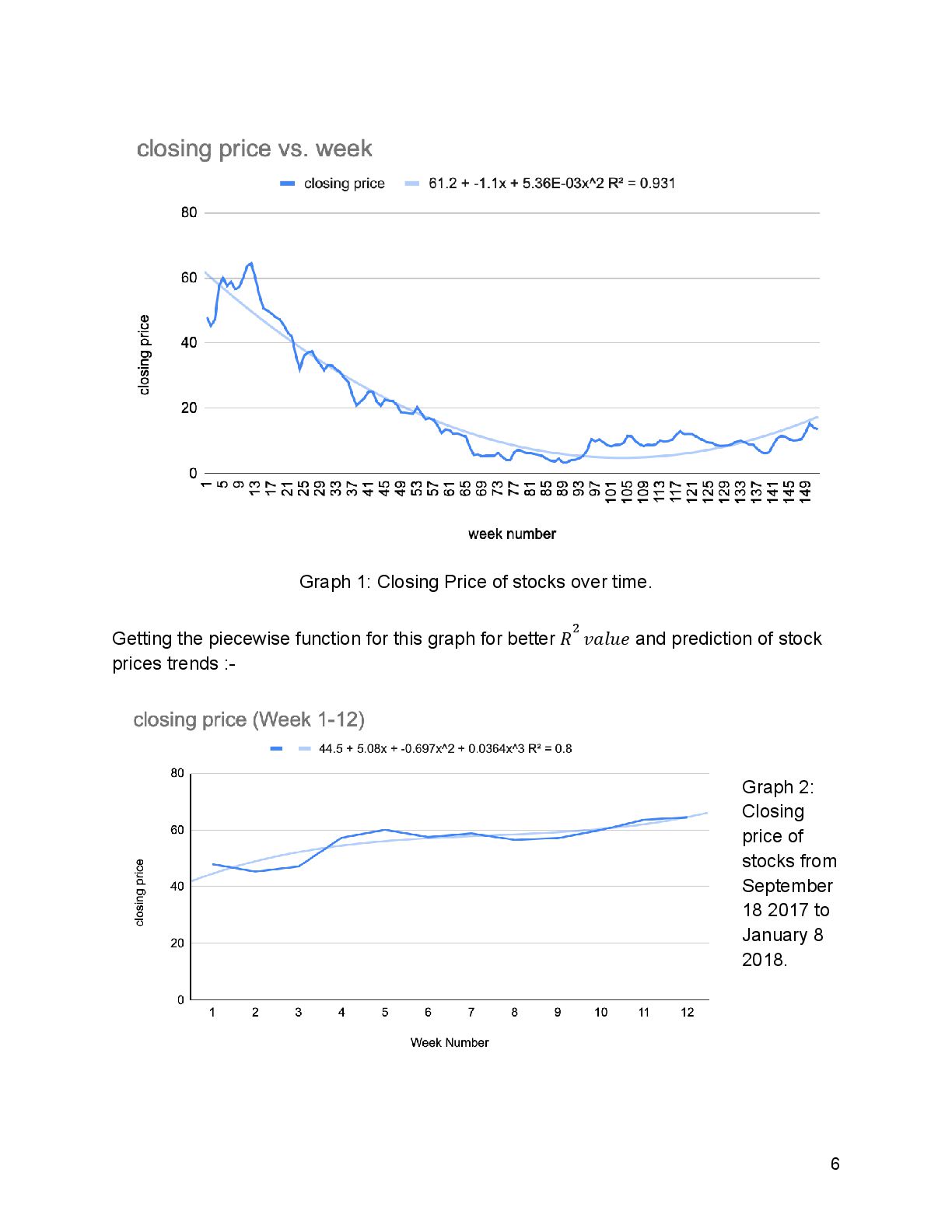
  5. Graph 1: Closing Price of stocks over time. Getting the

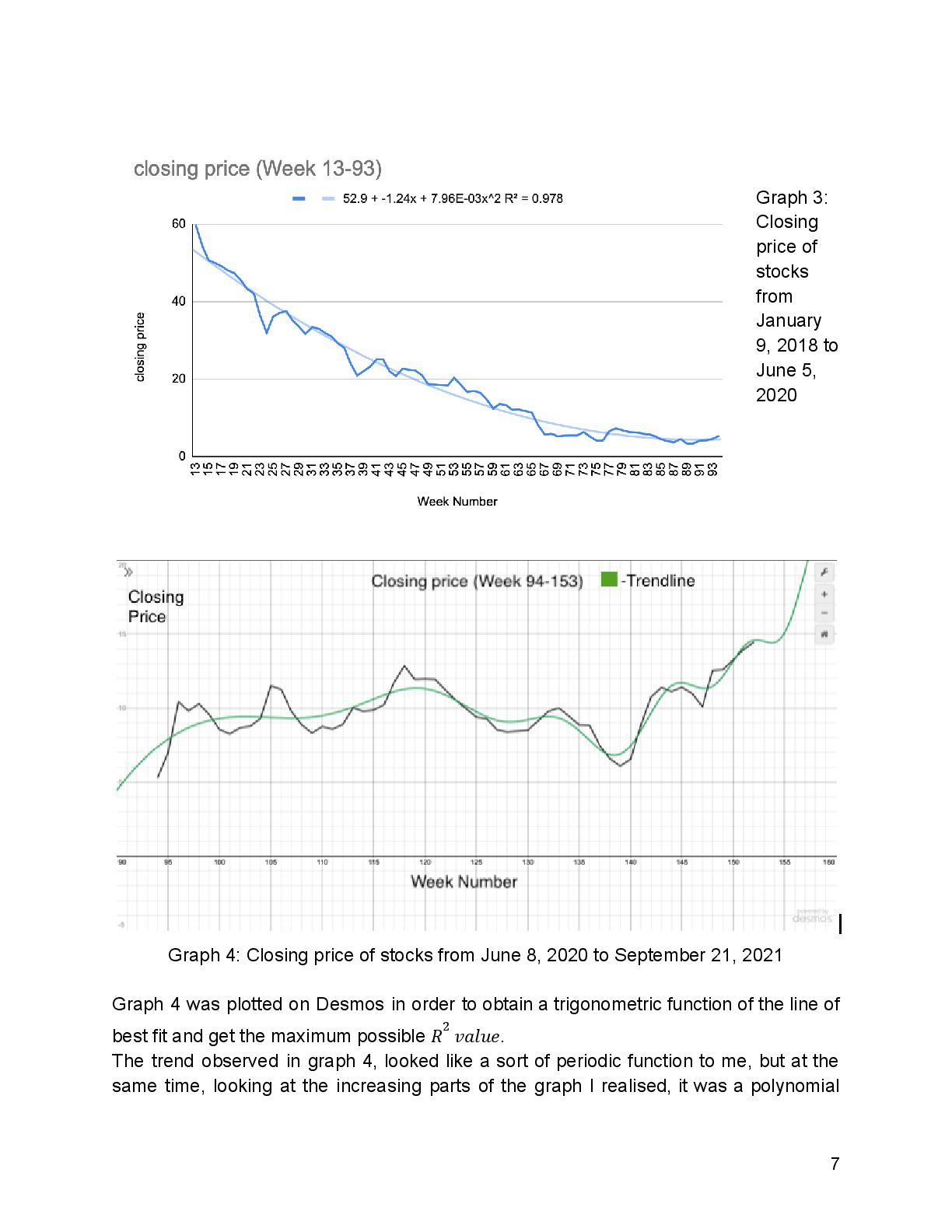
    piecewise function for this graph for better and prediction of stock 𝑅2 𝑣𝑎𝑙𝑢𝑒 prices trends :- Graph 2: Closing price of stocks from September 18 2017 to January 8 2018. 6
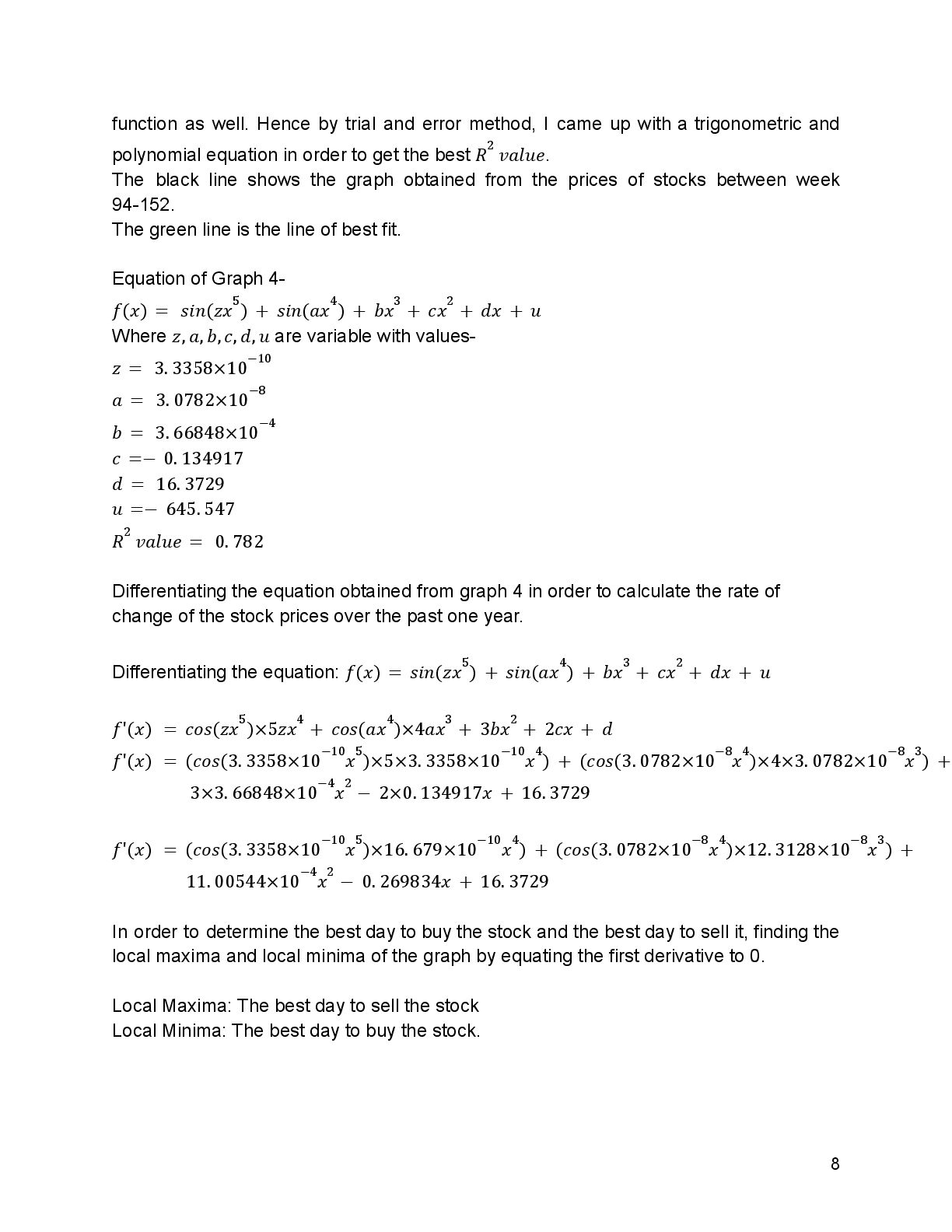
  6. Graph 3: Closing price of stocks from January 9, 2018

    to June 5, 2020 Graph 4: Closing price of stocks from June 8, 2020 to September 21, 2021 Graph 4 was plotted on Desmos in order to obtain a trigonometric function of the line of best fit and get the maximum possible . 𝑅2 𝑣𝑎𝑙𝑢𝑒 The trend observed in graph 4, looked like a sort of periodic function to me, but at the same time, looking at the increasing parts of the graph I realised, it was a polynomial 7
  7. function as well. Hence by trial and error method, I

    came up with a trigonometric and polynomial equation in order to get the best . 𝑅2 𝑣𝑎𝑙𝑢𝑒 The black line shows the graph obtained from the prices of stocks between week 94-152. The green line is the line of best fit. Equation of Graph 4- 𝑓(𝑥) = 𝑠𝑖𝑛(𝑧𝑥5 ) + 𝑠𝑖𝑛(𝑎𝑥4 ) + 𝑏𝑥3 + 𝑐𝑥2 + 𝑑𝑥 + 𝑢 Where are variable with values- 𝑧, 𝑎, 𝑏, 𝑐, 𝑑, 𝑢 𝑧 = 3. 3358×10−10 𝑎 = 3. 0782×10−8 𝑏 = 3. 66848×10−4 𝑐 =− 0. 134917 𝑑 = 16. 3729 𝑢 =− 645. 547 𝑅2 𝑣𝑎𝑙𝑢𝑒 = 0. 782 Differentiating the equation obtained from graph 4 in order to calculate the rate of change of the stock prices over the past one year. Differentiating the equation: 𝑓(𝑥) = 𝑠𝑖𝑛(𝑧𝑥5 ) + 𝑠𝑖𝑛(𝑎𝑥4 ) + 𝑏𝑥3 + 𝑐𝑥2 + 𝑑𝑥 + 𝑢 𝑓'(𝑥) = 𝑐𝑜𝑠(𝑧𝑥5 )×5𝑧𝑥4 + 𝑐𝑜𝑠(𝑎𝑥4 )×4𝑎𝑥3 + 3𝑏𝑥2 + 2𝑐𝑥 + 𝑑 𝑓'(𝑥) = (𝑐𝑜𝑠(3. 3358×10−10 𝑥5 )×5×3. 3358×10−10 𝑥4 ) + (𝑐𝑜𝑠(3. 0782×10−8 𝑥4 )×4×3. 0782×10−8 𝑥3 ) + 3×3. 66848×10−4 𝑥2 − 2×0. 134917𝑥 + 16. 3729 𝑓'(𝑥) = (𝑐𝑜𝑠(3. 3358×10−10 𝑥5 )×16. 679×10−10 𝑥4 ) + (𝑐𝑜𝑠(3. 0782×10−8 𝑥4 )×12. 3128×10−8 𝑥3 ) + 11. 00544×10−4 𝑥2 − 0. 269834𝑥 + 16. 3729 In order to determine the best day to buy the stock and the best day to sell it, finding the local maxima and local minima of the graph by equating the first derivative to 0. Local Maxima: The best day to sell the stock Local Minima: The best day to buy the stock. 8
  8. = (𝑐𝑜𝑠(3. 3358×10−10 𝑥5 )×16. 679×10−10 𝑥4 ) + (𝑐𝑜𝑠(3.

    0782×10−8 𝑥4 )×12. 3128×10−8 𝑥3 ) + 11. 00544×10−4 𝑥2 − 0. 269834𝑥 + 16. 3729 = 0 = [{𝑐𝑜𝑠(3. 3358×10−10 𝑥5 )×16. 679×10−10 𝑥4 } + {𝑐𝑜𝑠(3. 0782×10−8 𝑥4 )×12. 3128×10−8 𝑥3 } + 11. 00544×10−4 𝑥2 − 0. 269834𝑥] = − 16. 3729 Solving by Graphic Display Calculator , = 102. 526, 107. 040, 119. 163, 128. 276, 132. 003, 138. 400 144. 929, 147. 207, 152. 278, 153. 744 Rounding off- weeks = 103, 107, 119, 128, 132, 138, 145, 147, 152, 154 154 will get rejected as it is an outlier in graph 4. (consists of week 94-152) According to Graph 4, the best weeks to sell the stock between the weeks 94-152 will be around week 105, 118 and 152. Therefore from our answers in the previous part we can take the values 107, 119 and 152 to be the local and global maxima respectively and call these three weeks the best weeks to sell stocks. On the other hand the best week to buy these stock prices would be on the local minima. According to graph 4, the best week to buy stocks between weeks 94-152 are around week 139. Hence we can take the value of 138 obtained from the answers in the previous part and name week 138 as the best week to buy stocks on VODA IDEA. Corresponding price values on Maxima and Minima - Maxima - 1. 105 week - 11.51428571 2. 118 week - 11.72142857 3. 152 week - 14.45 Minima - 1. 138 week - 6.578571429 9
  9. Taking the data for the past 154 days or 22

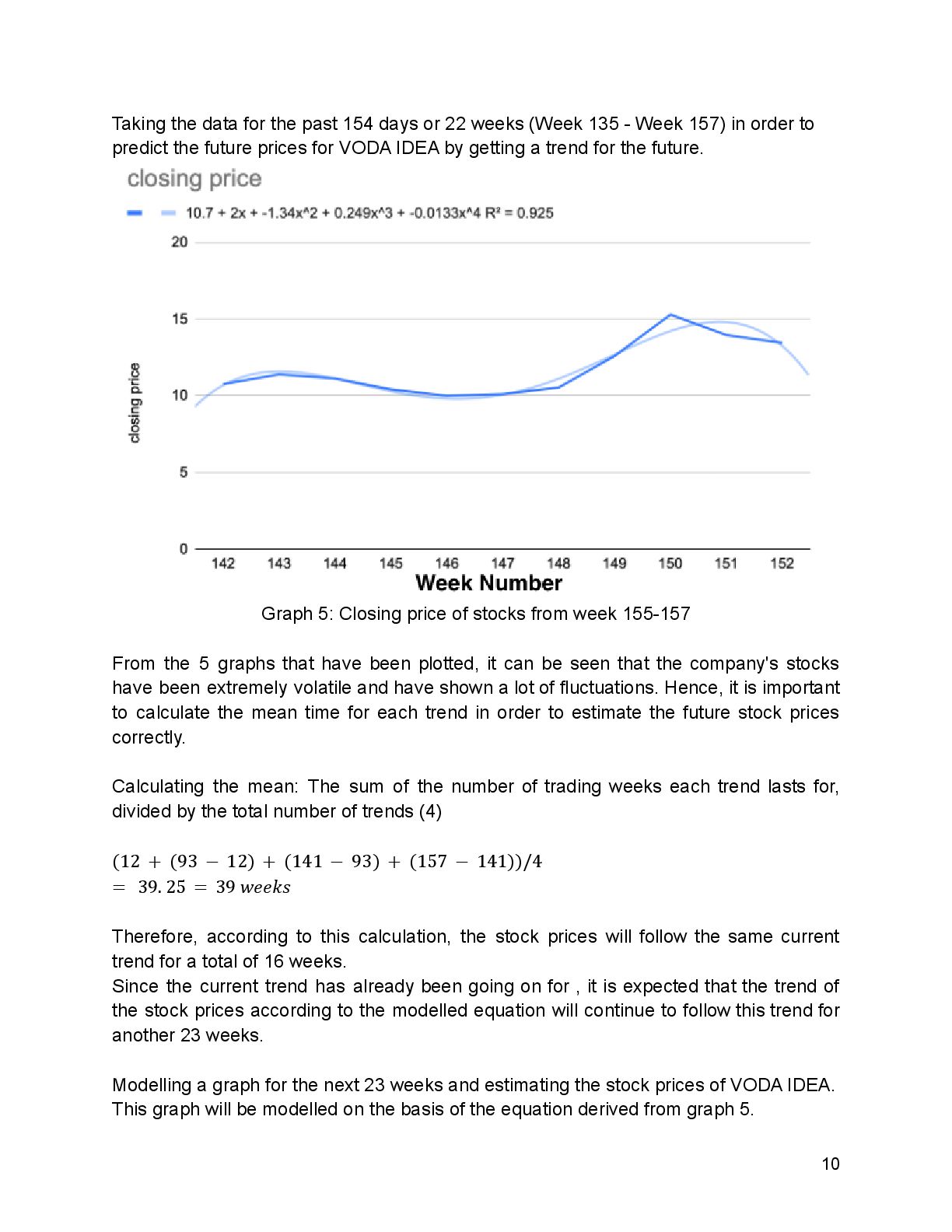
    weeks (Week 135 - Week 157) in order to predict the future prices for VODA IDEA by getting a trend for the future. Graph 5: Closing price of stocks from week 155-157 From the 5 graphs that have been plotted, it can be seen that the company's stocks have been extremely volatile and have shown a lot of fluctuations. Hence, it is important to calculate the mean time for each trend in order to estimate the future stock prices correctly. Calculating the mean: The sum of the number of trading weeks each trend lasts for, divided by the total number of trends (4) (12 + (93 − 12) + (141 − 93) + (157 − 141))/4 = 39. 25 = 39 𝑤𝑒𝑒𝑘𝑠 Therefore, according to this calculation, the stock prices will follow the same current trend for a total of 16 weeks. Since the current trend has already been going on for , it is expected that the trend of the stock prices according to the modelled equation will continue to follow this trend for another 23 weeks. Modelling a graph for the next 23 weeks and estimating the stock prices of VODA IDEA. This graph will be modelled on the basis of the equation derived from graph 5. 10
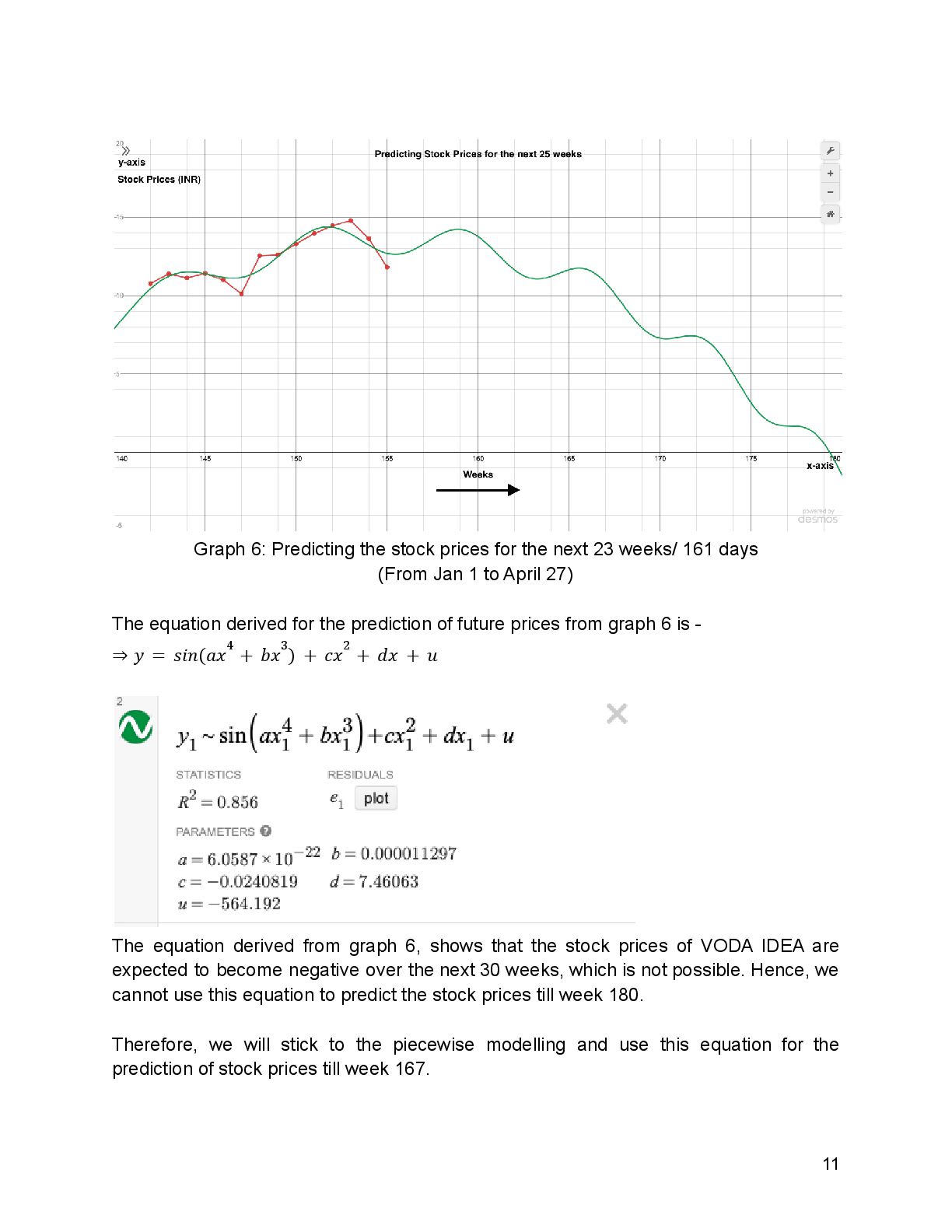
  10. Graph 6: Predicting the stock prices for the next 23

    weeks/ 161 days (From Jan 1 to April 27) The equation derived for the prediction of future prices from graph 6 is - ⇒ 𝑦 = 𝑠𝑖𝑛(𝑎𝑥4 + 𝑏𝑥3 ) + 𝑐𝑥2 + 𝑑𝑥 + 𝑢 The equation derived from graph 6, shows that the stock prices of VODA IDEA are expected to become negative over the next 30 weeks, which is not possible. Hence, we cannot use this equation to predict the stock prices till week 180. Therefore, we will stick to the piecewise modelling and use this equation for the prediction of stock prices till week 167. 11
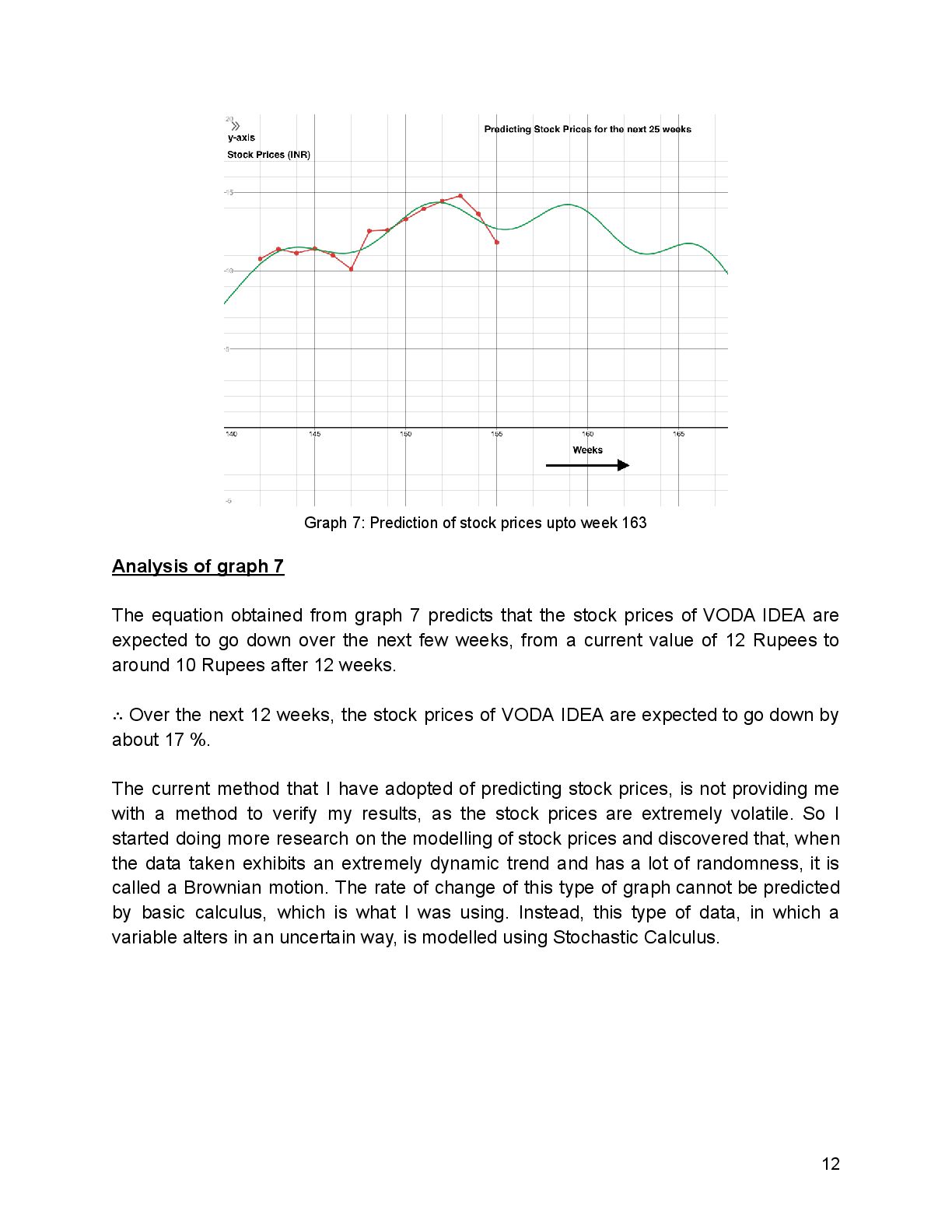
  11. Graph 7: Prediction of stock prices upto week 163 Analysis

    of graph 7 The equation obtained from graph 7 predicts that the stock prices of VODA IDEA are expected to go down over the next few weeks, from a current value of 12 Rupees to around 10 Rupees after 12 weeks. Over the next 12 weeks, the stock prices of VODA IDEA are expected to go down by ∴ about 17 %. The current method that I have adopted of predicting stock prices, is not providing me with a method to verify my results, as the stock prices are extremely volatile. So I started doing more research on the modelling of stock prices and discovered that, when the data taken exhibits an extremely dynamic trend and has a lot of randomness, it is called a Brownian motion. The rate of change of this type of graph cannot be predicted by basic calculus, which is what I was using. Instead, this type of data, in which a variable alters in an uncertain way, is modelled using Stochastic Calculus. 12
  12. The Brownian motion is used to model the uncertainty in

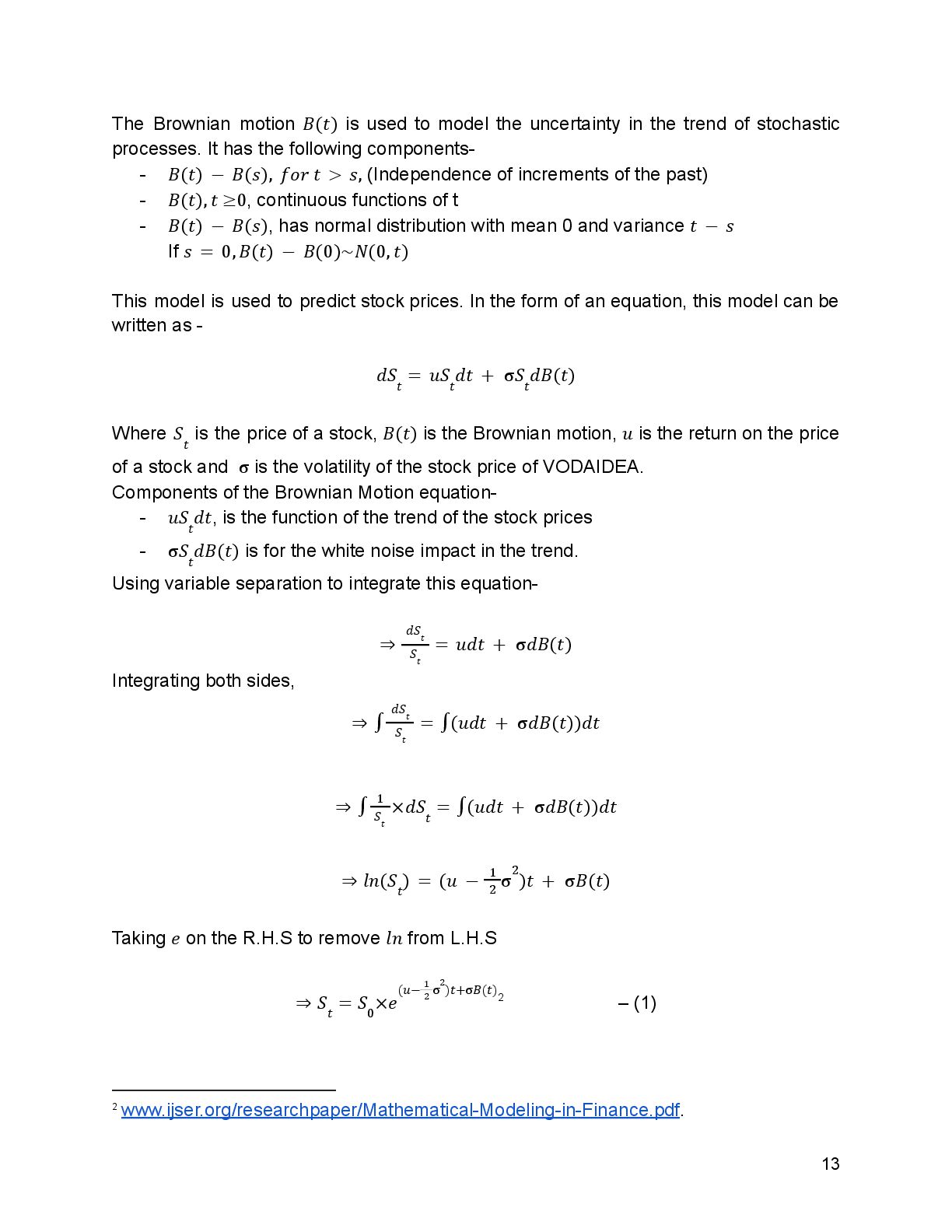
    the trend of stochastic 𝐵(𝑡) processes. It has the following components- - (Independence of increments of the past) 𝐵(𝑡) − 𝐵(𝑠), 𝑓𝑜𝑟 𝑡 > 𝑠, - , continuous functions of t 𝐵(𝑡), 𝑡 ≥0 - , has normal distribution with mean 0 and variance 𝐵(𝑡) − 𝐵(𝑠) 𝑡 − 𝑠 If 𝑠 = 0, 𝐵(𝑡) − 𝐵(0)~𝑁(0, 𝑡) This model is used to predict stock prices. In the form of an equation, this model can be written as - 𝑑𝑆 𝑡 = 𝑢𝑆 𝑡 𝑑𝑡 + σ𝑆 𝑡 𝑑𝐵(𝑡) Where is the price of a stock, is the Brownian motion, is the return on the price 𝑆 𝑡 𝐵(𝑡) 𝑢 of a stock and is the volatility of the stock price of VODAIDEA. σ Components of the Brownian Motion equation- - , is the function of the trend of the stock prices 𝑢𝑆 𝑡 𝑑𝑡 - is for the white noise impact in the trend. σ𝑆 𝑡 𝑑𝐵(𝑡) Using variable separation to integrate this equation- ⇒ 𝑑𝑆 𝑡 𝑆 𝑡 = 𝑢𝑑𝑡 + σ𝑑𝐵(𝑡) Integrating both sides, ⇒ ∫ 𝑑𝑆 𝑡 𝑆 𝑡 = ∫(𝑢𝑑𝑡 + σ𝑑𝐵(𝑡))𝑑𝑡 ⇒ ∫ 1 𝑆 𝑡 ×𝑑𝑆 𝑡 = ∫(𝑢𝑑𝑡 + σ𝑑𝐵(𝑡))𝑑𝑡 ⇒ 𝑙𝑛(𝑆 𝑡 ) = (𝑢 − 1 2 σ2 )𝑡 + σ𝐵(𝑡) Taking on the R.H.S to remove from L.H.S 𝑒 𝑙𝑛 2 – (1) ⇒ 𝑆 𝑡 = 𝑆 0 ×𝑒 (𝑢− 1 2 σ2 )𝑡+σ𝐵(𝑡) 2 www.ijser.org/researchpaper/Mathematical-Modeling-in-Finance.pdf. 13
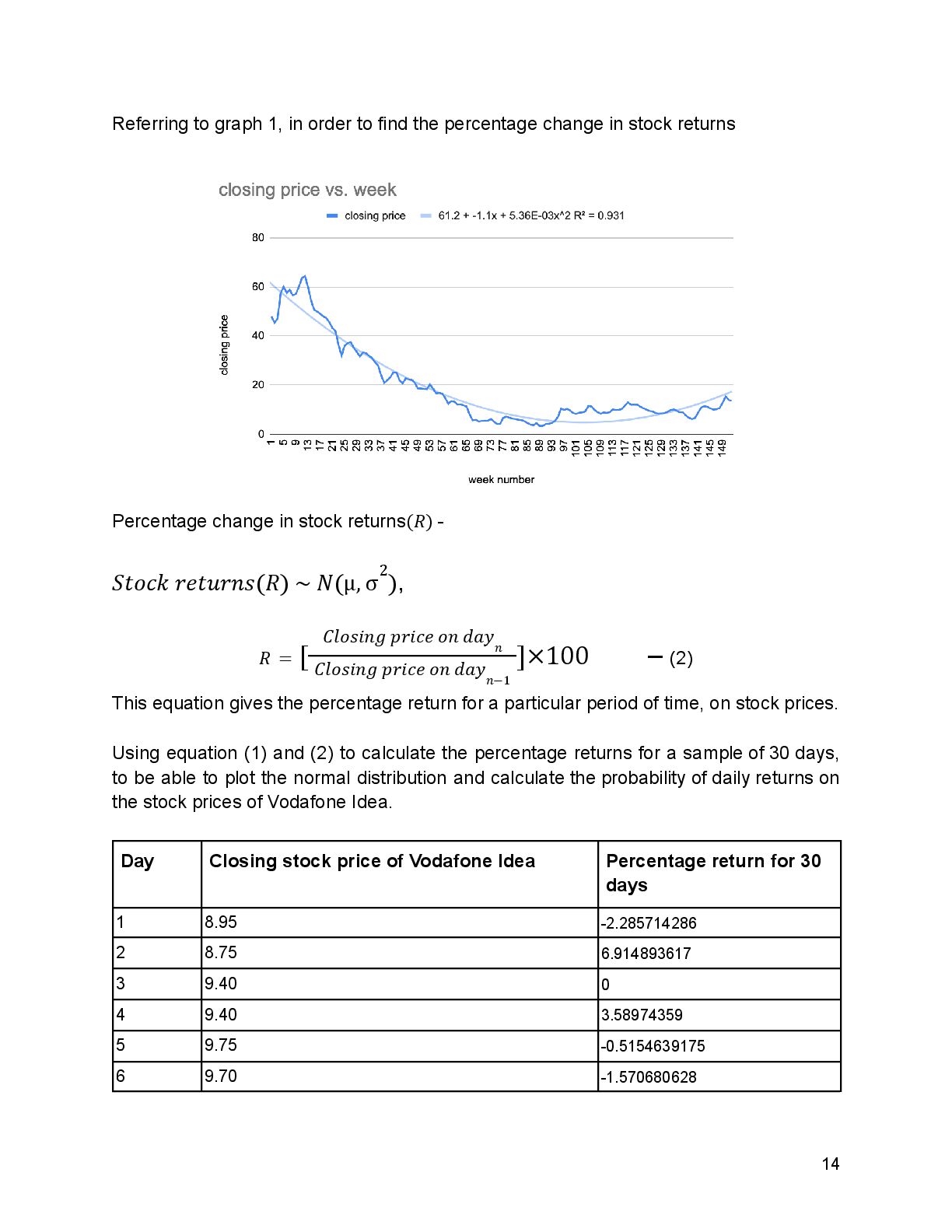
  13. Referring to graph 1, in order to find the percentage

    change in stock returns Percentage change in stock returns - (𝑅) , 𝑆𝑡𝑜𝑐𝑘 𝑟𝑒𝑡𝑢𝑟𝑛𝑠(𝑅) ~ 𝑁(µ, σ2 ) – (2) 𝑅 = [ 𝐶𝑙𝑜𝑠𝑖𝑛𝑔 𝑝𝑟𝑖𝑐𝑒 𝑜𝑛 𝑑𝑎𝑦 𝑛 𝐶𝑙𝑜𝑠𝑖𝑛𝑔 𝑝𝑟𝑖𝑐𝑒 𝑜𝑛 𝑑𝑎𝑦 𝑛−1 ]×100 This equation gives the percentage return for a particular period of time, on stock prices. Using equation (1) and (2) to calculate the percentage returns for a sample of 30 days, to be able to plot the normal distribution and calculate the probability of daily returns on the stock prices of Vodafone Idea. Day Closing stock price of Vodafone Idea Percentage return for 30 days 1 8.95 -2.285714286 2 8.75 6.914893617 3 9.40 0 4 9.40 3.58974359 5 9.75 -0.5154639175 6 9.70 -1.570680628 14
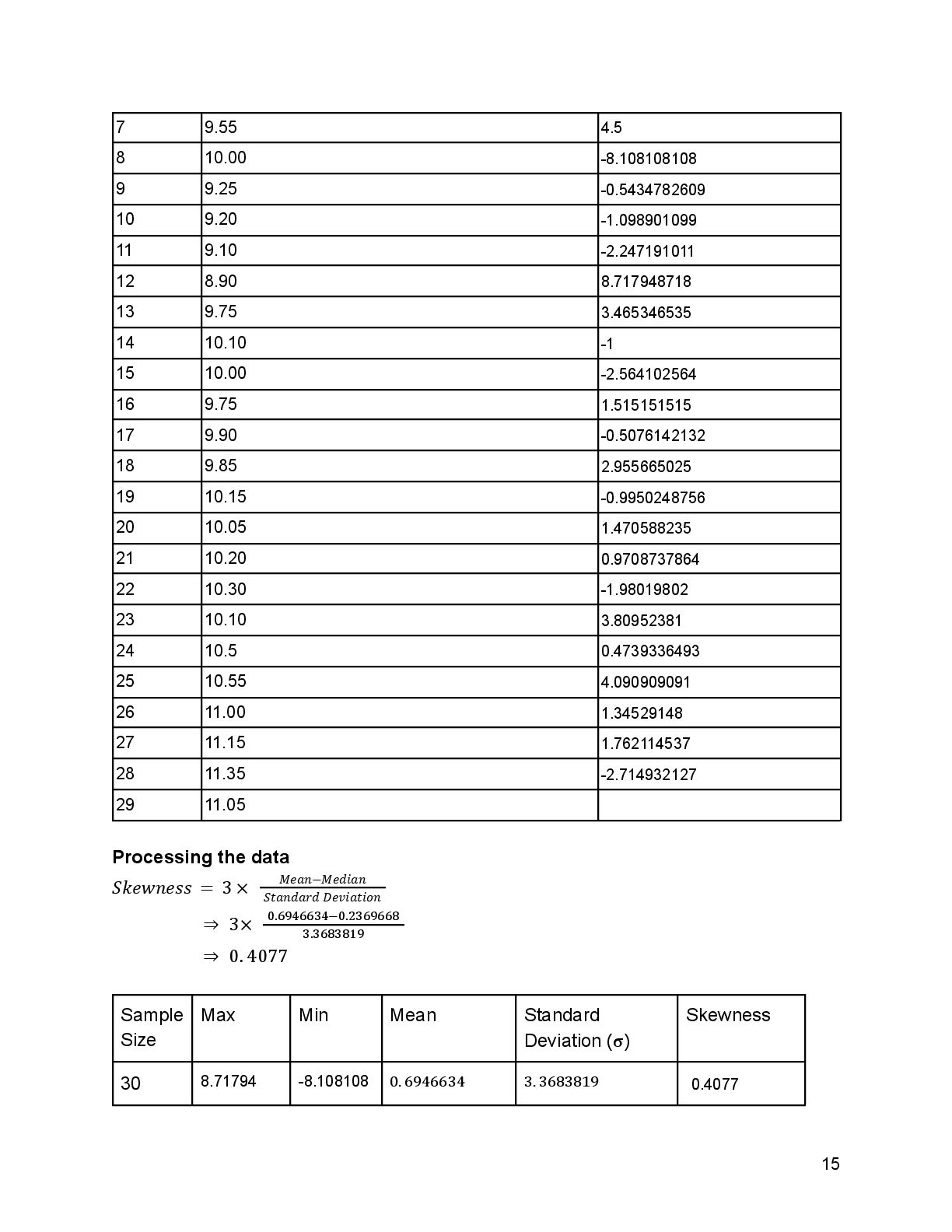
  14. 7 9.55 4.5 8 10.00 -8.108108108 9 9.25 -0.5434782609 10

    9.20 -1.098901099 11 9.10 -2.247191011 12 8.90 8.717948718 13 9.75 3.465346535 14 10.10 -1 15 10.00 -2.564102564 16 9.75 1.515151515 17 9.90 -0.5076142132 18 9.85 2.955665025 19 10.15 -0.9950248756 20 10.05 1.470588235 21 10.20 0.9708737864 22 10.30 -1.98019802 23 10.10 3.80952381 24 10.5 0.4739336493 25 10.55 4.090909091 26 11.00 1.34529148 27 11.15 1.762114537 28 11.35 -2.714932127 29 11.05 Processing the data 𝑆𝑘𝑒𝑤𝑛𝑒𝑠𝑠 = 3 × 𝑀𝑒𝑎𝑛−𝑀𝑒𝑑𝑖𝑎𝑛 𝑆𝑡𝑎𝑛𝑑𝑎𝑟𝑑 𝐷𝑒𝑣𝑖𝑎𝑡𝑖𝑜𝑛 ⇒ 3× 0.6946634−0.2369668 3.3683819 ⇒ 0. 4077 Sample Size Max Min Mean Standard Deviation ( ) σ Skewness 30 8.71794 -8.108108 0. 6946634 3. 3683819 0.4077 15
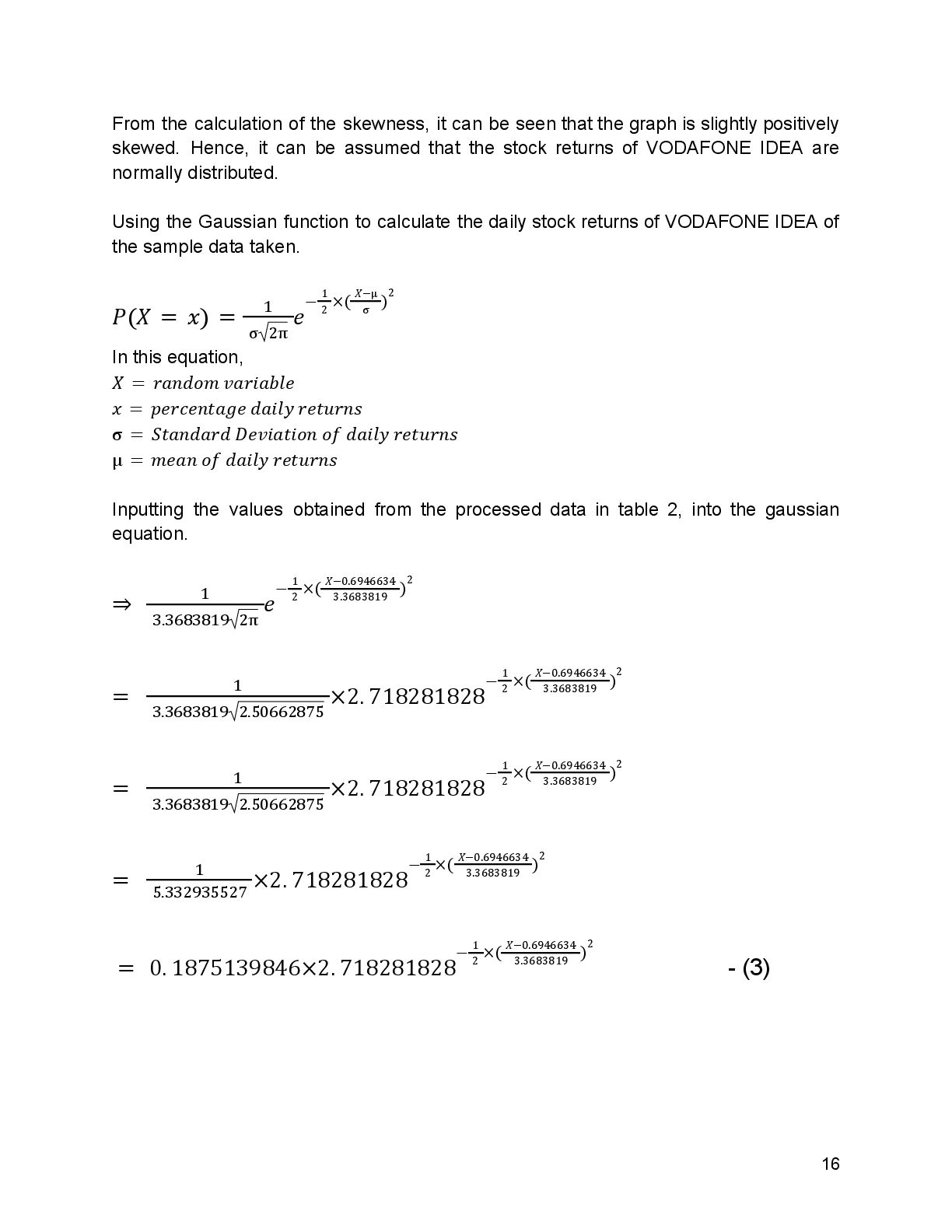
  15. From the calculation of the skewness, it can be seen

    that the graph is slightly positively skewed. Hence, it can be assumed that the stock returns of VODAFONE IDEA are normally distributed. Using the Gaussian function to calculate the daily stock returns of VODAFONE IDEA of the sample data taken. 𝑃(𝑋 = 𝑥) = 1 σ 2π 𝑒 − 1 2 ×( 𝑋−µ σ )2 In this equation, 𝑋 = 𝑟𝑎𝑛𝑑𝑜𝑚 𝑣𝑎𝑟𝑖𝑎𝑏𝑙𝑒 𝑥 = 𝑝𝑒𝑟𝑐𝑒𝑛𝑡𝑎𝑔𝑒 𝑑𝑎𝑖𝑙𝑦 𝑟𝑒𝑡𝑢𝑟𝑛𝑠 σ = 𝑆𝑡𝑎𝑛𝑑𝑎𝑟𝑑 𝐷𝑒𝑣𝑖𝑎𝑡𝑖𝑜𝑛 𝑜𝑓 𝑑𝑎𝑖𝑙𝑦 𝑟𝑒𝑡𝑢𝑟𝑛𝑠 µ = 𝑚𝑒𝑎𝑛 𝑜𝑓 𝑑𝑎𝑖𝑙𝑦 𝑟𝑒𝑡𝑢𝑟𝑛𝑠 Inputting the values obtained from the processed data in table 2, into the gaussian equation. ⇒ 1 3.3683819 2π 𝑒 − 1 2 ×( 𝑋−0.6946634 3.3683819 )2 = 1 3.3683819 2.50662875 ×2. 718281828 − 1 2 ×( 𝑋−0.6946634 3.3683819 )2 = 1 3.3683819 2.50662875 ×2. 718281828 − 1 2 ×( 𝑋−0.6946634 3.3683819 )2 = 1 5.332935527 ×2. 718281828 − 1 2 ×( 𝑋−0.6946634 3.3683819 )2 - (3) = 0. 1875139846×2. 718281828 − 1 2 ×( 𝑋−0.6946634 3.3683819 )2 16
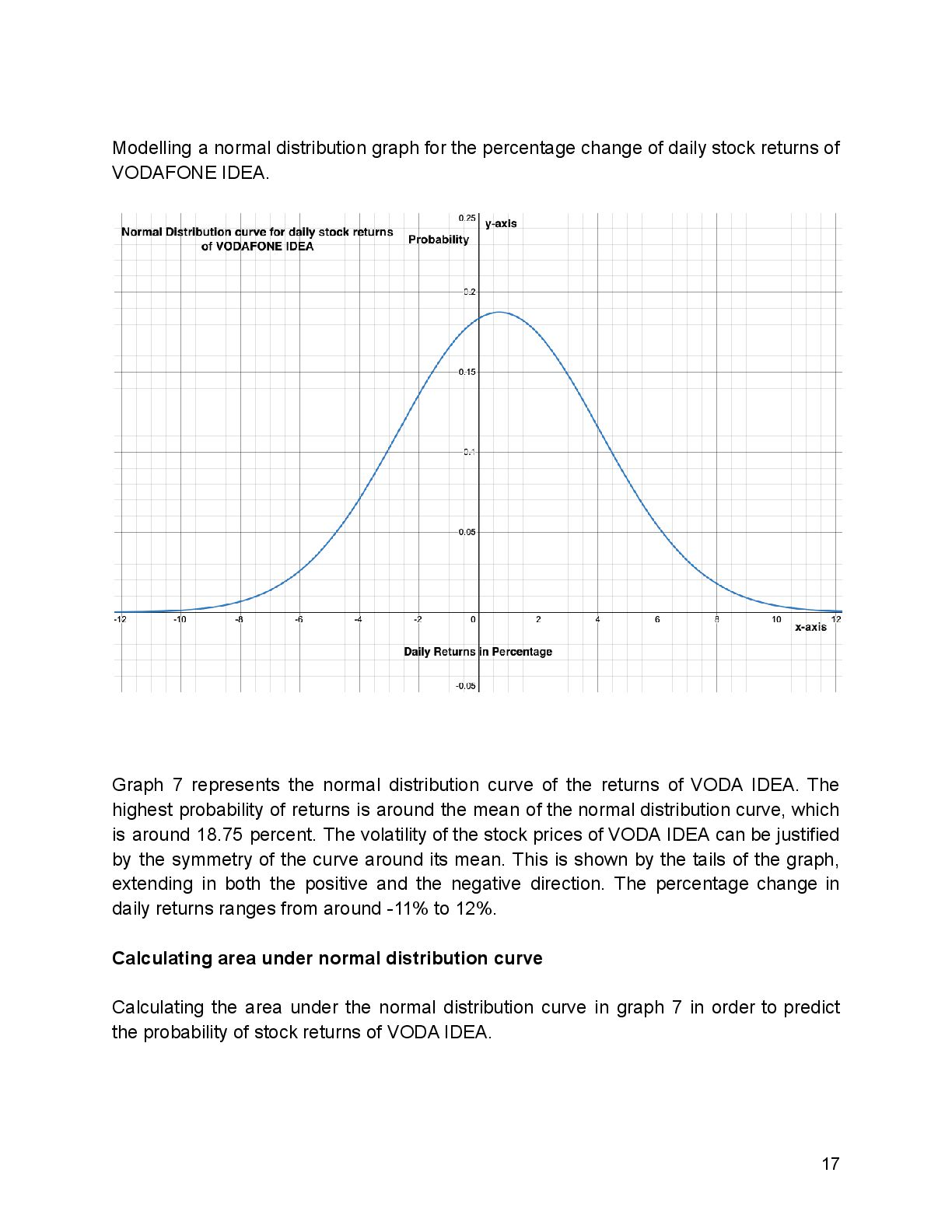
  16. Modelling a normal distribution graph for the percentage change of

    daily stock returns of VODAFONE IDEA. Graph 7 represents the normal distribution curve of the returns of VODA IDEA. The highest probability of returns is around the mean of the normal distribution curve, which is around 18.75 percent. The volatility of the stock prices of VODA IDEA can be justified by the symmetry of the curve around its mean. This is shown by the tails of the graph, extending in both the positive and the negative direction. The percentage change in daily returns ranges from around -11% to 12%. Calculating area under normal distribution curve Calculating the area under the normal distribution curve in graph 7 in order to predict the probability of stock returns of VODA IDEA. 17
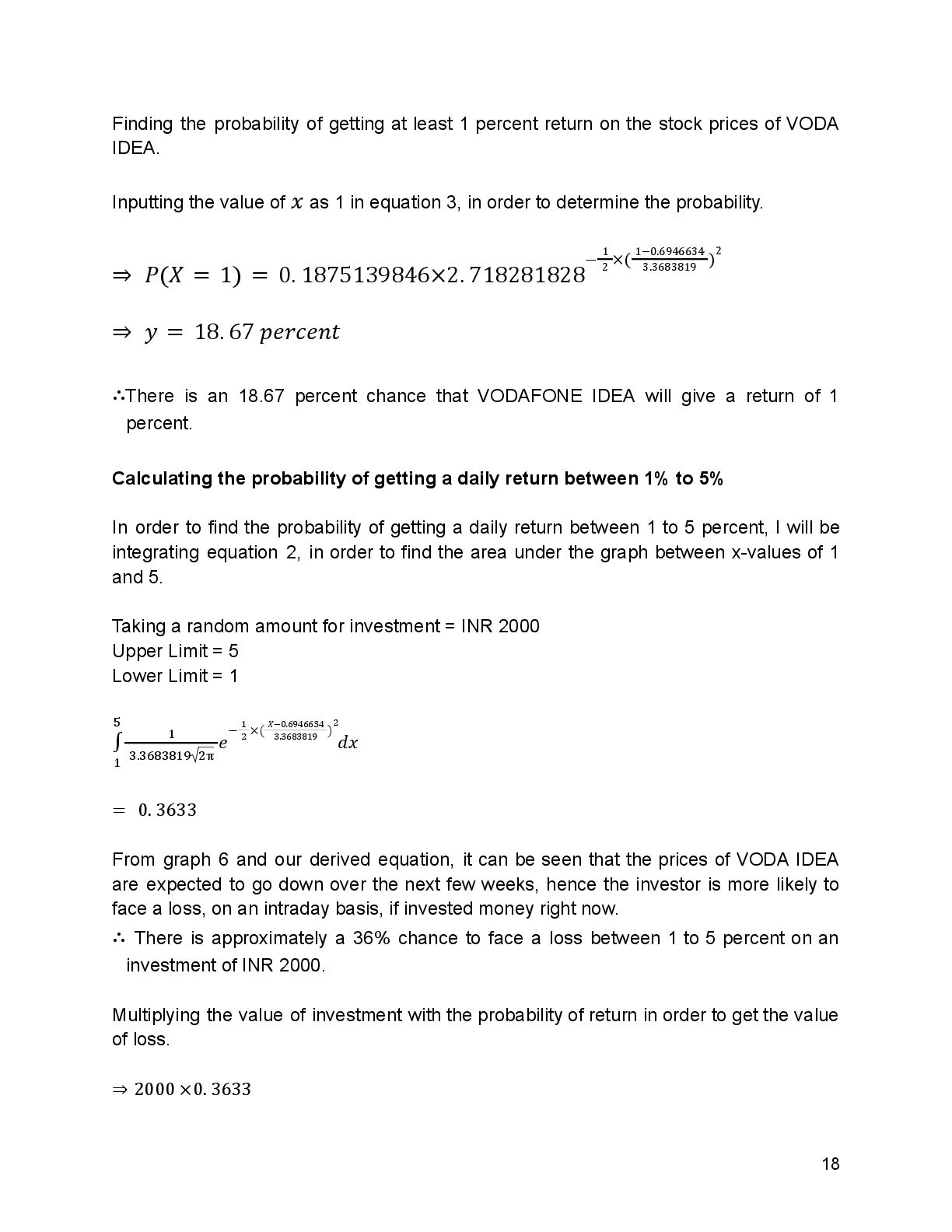
  17. Finding the probability of getting at least 1 percent return

    on the stock prices of VODA IDEA. Inputting the value of as 1 in equation 3, in order to determine the probability. 𝑥 ⇒ 𝑃(𝑋 = 1) = 0. 1875139846×2. 718281828 − 1 2 ×( 1−0.6946634 3.3683819 )2 ⇒ 𝑦 = 18. 67 𝑝𝑒𝑟𝑐𝑒𝑛𝑡 There is an 18.67 percent chance that VODAFONE IDEA will give a return of 1 ∴ percent. Calculating the probability of getting a daily return between 1% to 5% In order to find the probability of getting a daily return between 1 to 5 percent, I will be integrating equation 2, in order to find the area under the graph between x-values of 1 and 5. Taking a random amount for investment = INR 2000 Upper Limit = 5 Lower Limit = 1 1 5 ∫ 1 3.3683819 2π 𝑒 − 1 2 ×( 𝑋−0.6946634 3.3683819 )2 𝑑𝑥 = 0. 3633 From graph 6 and our derived equation, it can be seen that the prices of VODA IDEA are expected to go down over the next few weeks, hence the investor is more likely to face a loss, on an intraday basis, if invested money right now. There is approximately a 36% chance to face a loss between 1 to 5 percent on an ∴ investment of INR 2000. Multiplying the value of investment with the probability of return in order to get the value of loss. ⇒ 2000 ×0. 3633 18
  18. ⇒ 2000 ×0. 3633 = 𝐼𝑁𝑅 726. 6 Conclusion According

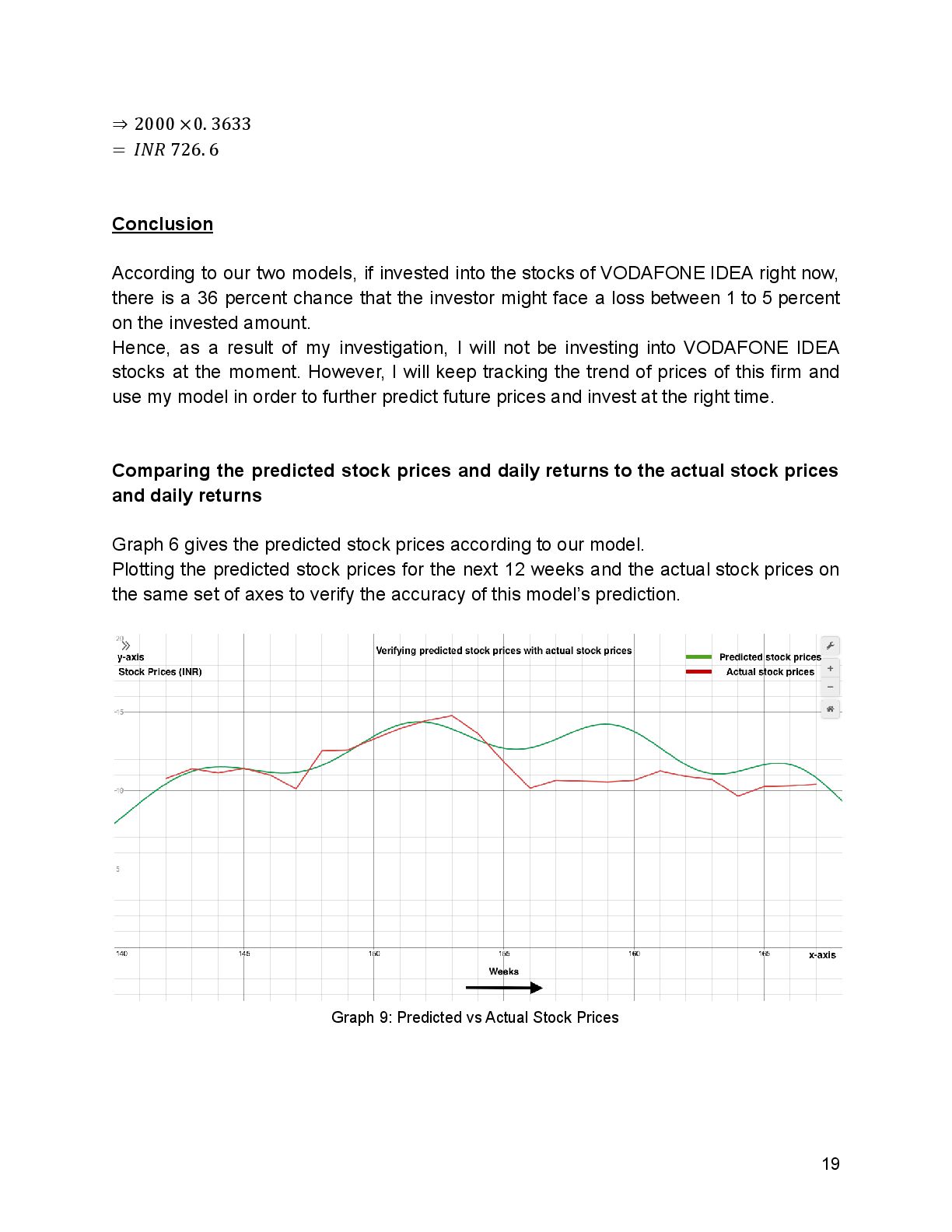
    to our two models, if invested into the stocks of VODAFONE IDEA right now, there is a 36 percent chance that the investor might face a loss between 1 to 5 percent on the invested amount. Hence, as a result of my investigation, I will not be investing into VODAFONE IDEA stocks at the moment. However, I will keep tracking the trend of prices of this firm and use my model in order to further predict future prices and invest at the right time. Comparing the predicted stock prices and daily returns to the actual stock prices and daily returns Graph 6 gives the predicted stock prices according to our model. Plotting the predicted stock prices for the next 12 weeks and the actual stock prices on the same set of axes to verify the accuracy of this model’s prediction. Graph 9: Predicted vs Actual Stock Prices 19
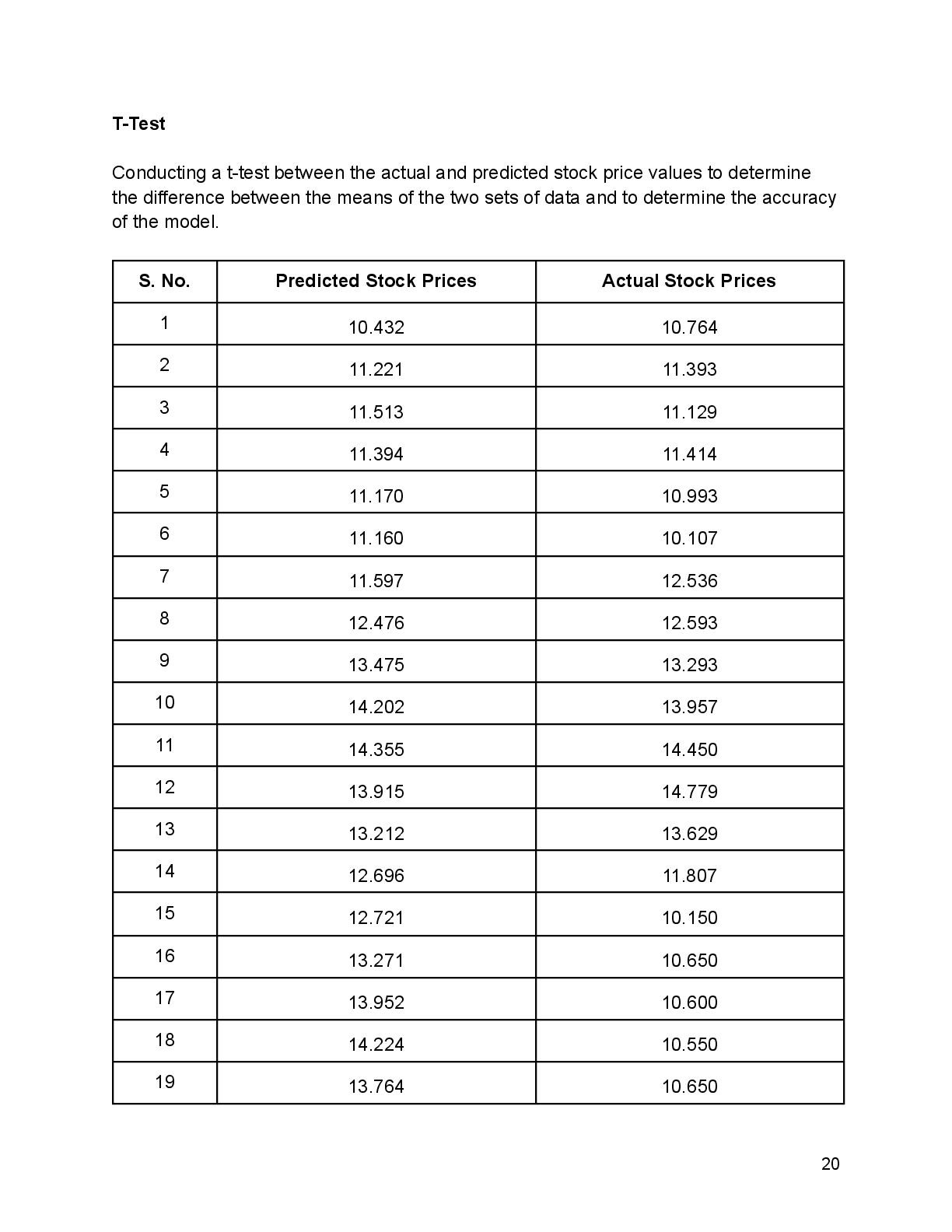
  19. T-Test Conducting a t-test between the actual and predicted stock

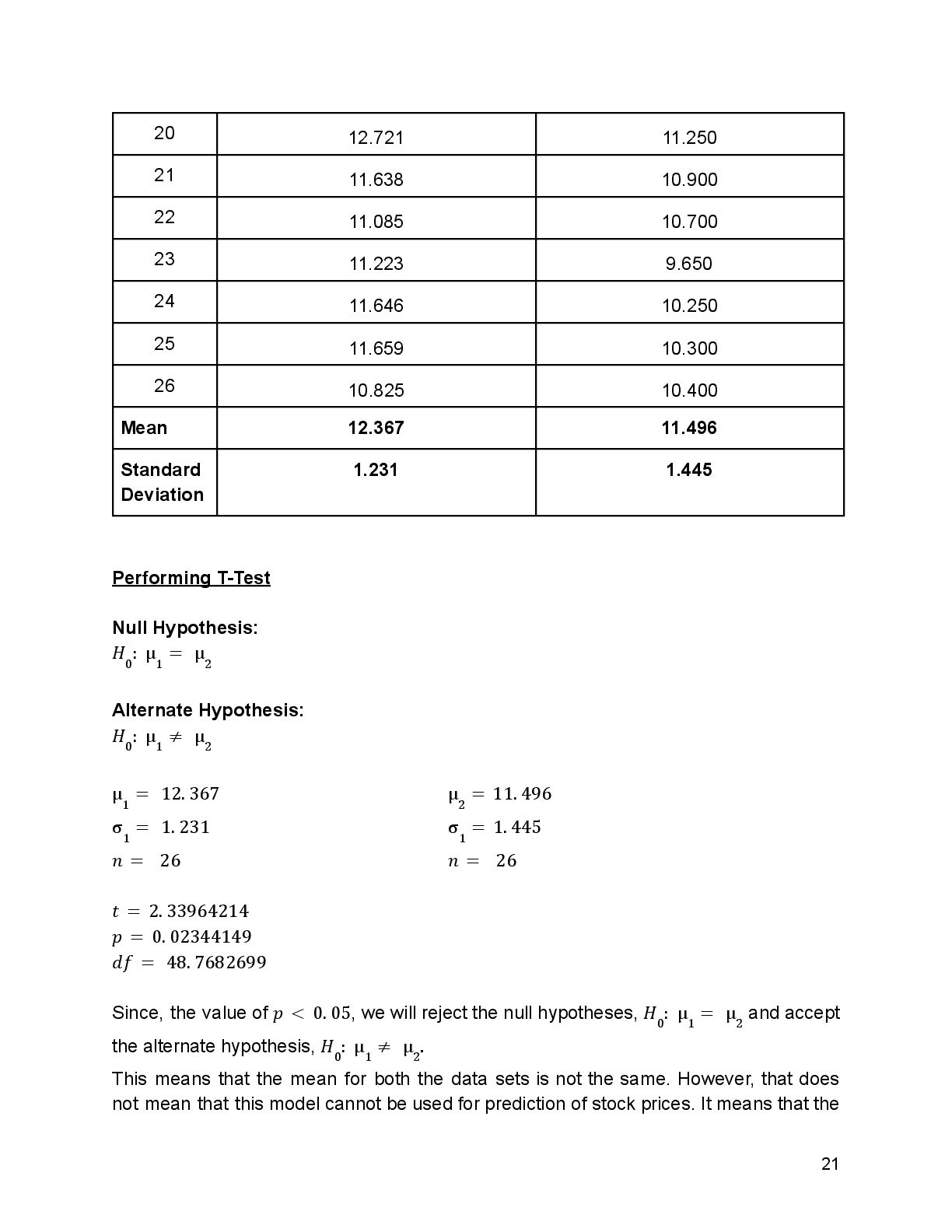
    price values to determine the difference between the means of the two sets of data and to determine the accuracy of the model. S. No. Predicted Stock Prices Actual Stock Prices 1 10.432 10.764 2 11.221 11.393 3 11.513 11.129 4 11.394 11.414 5 11.170 10.993 6 11.160 10.107 7 11.597 12.536 8 12.476 12.593 9 13.475 13.293 10 14.202 13.957 11 14.355 14.450 12 13.915 14.779 13 13.212 13.629 14 12.696 11.807 15 12.721 10.150 16 13.271 10.650 17 13.952 10.600 18 14.224 10.550 19 13.764 10.650 20
  20. 20 12.721 11.250 21 11.638 10.900 22 11.085 10.700 23

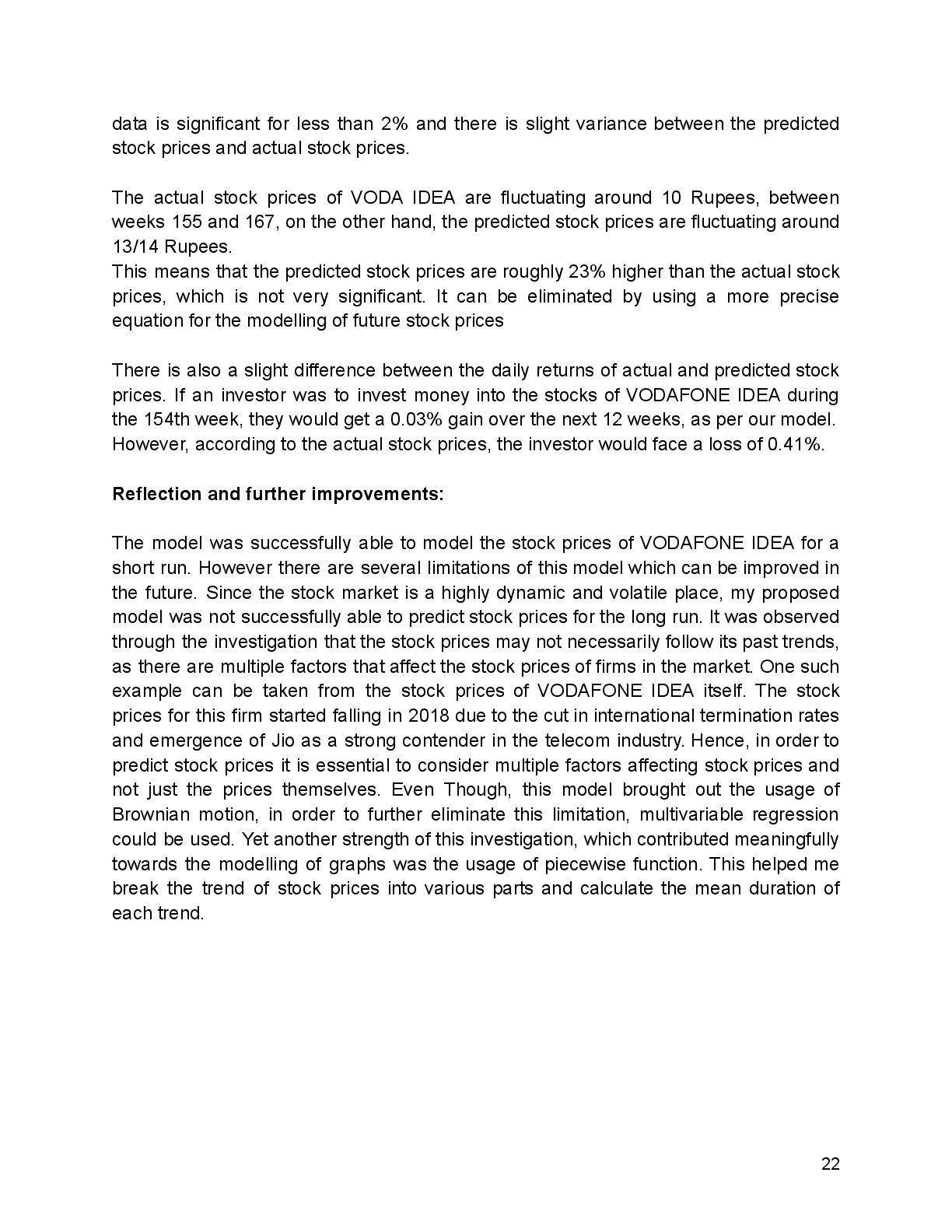
    11.223 9.650 24 11.646 10.250 25 11.659 10.300 26 10.825 10.400 Mean 12.367 11.496 Standard Deviation 1.231 1.445 Performing T-Test Null Hypothesis: 𝐻 0 : µ 1 = µ 2 Alternate Hypothesis: 𝐻 0 : µ 1 ≠ µ 2 µ 1 = 12. 367 µ 2 = 11. 496 σ 1 = 1. 231 σ 1 = 1. 445 𝑛 = 26 𝑛 = 26 𝑡 = 2. 33964214 𝑝 = 0. 02344149 𝑑𝑓 = 48. 7682699 Since, the value of , we will reject the null hypotheses, and accept 𝑝 < 0. 05 𝐻 0 : µ 1 = µ 2 the alternate hypothesis, . 𝐻 0 : µ 1 ≠ µ 2 This means that the mean for both the data sets is not the same. However, that does not mean that this model cannot be used for prediction of stock prices. It means that the 21
  21. data is significant for less than 2% and there is

    slight variance between the predicted stock prices and actual stock prices. The actual stock prices of VODA IDEA are fluctuating around 10 Rupees, between weeks 155 and 167, on the other hand, the predicted stock prices are fluctuating around 13/14 Rupees. This means that the predicted stock prices are roughly 23% higher than the actual stock prices, which is not very significant. It can be eliminated by using a more precise equation for the modelling of future stock prices There is also a slight difference between the daily returns of actual and predicted stock prices. If an investor was to invest money into the stocks of VODAFONE IDEA during the 154th week, they would get a 0.03% gain over the next 12 weeks, as per our model. However, according to the actual stock prices, the investor would face a loss of 0.41%. Reflection and further improvements: The model was successfully able to model the stock prices of VODAFONE IDEA for a short run. However there are several limitations of this model which can be improved in the future. Since the stock market is a highly dynamic and volatile place, my proposed model was not successfully able to predict stock prices for the long run. It was observed through the investigation that the stock prices may not necessarily follow its past trends, as there are multiple factors that affect the stock prices of firms in the market. One such example can be taken from the stock prices of VODAFONE IDEA itself. The stock prices for this firm started falling in 2018 due to the cut in international termination rates and emergence of Jio as a strong contender in the telecom industry. Hence, in order to predict stock prices it is essential to consider multiple factors affecting stock prices and not just the prices themselves. Even Though, this model brought out the usage of Brownian motion, in order to further eliminate this limitation, multivariable regression could be used. Yet another strength of this investigation, which contributed meaningfully towards the modelling of graphs was the usage of piecewise function. This helped me break the trend of stock prices into various parts and calculate the mean duration of each trend. 22
  22. Works Cited: -, Prashanth, et al. “Auto Serial Numbering in

    Google Sheets with Row Function.” InfoInspired, 17 Jan. 2020, infoinspired.com/google-docs/spreadsheet/auto-serial-numbering-in-google-sheets /. Bevans, Rebecca. “An Introduction to T-Tests.” Scribbr, 14 Dec. 2020, www.scribbr.com/statistics/t-test/. “Brownian Motion and Stochastic Di Erential Equations.” Math Tamu, www.math.tamu.edu/~stecher/425/Sp12/brownianMotion.pdf. “Let's Learn Together.” Desmos, www.desmos.com/. Mathematical Modeling in Finance - IJSER. www.ijser.org/researchpaper/Mathematical-Modeling-in-Finance.pdf. “Measure of Shape: Skewness and Kurtosis.” Measures of Shape: Skewness and Kurtosis, brownmath.com/stat/shape.htm#Kurtosis. “Most Volatile Stocks - India - Tradingview - India.” TradingView, in.tradingview.com/markets/stocks-india/market-movers-most-volatile/. “Nominal, Ordinal, Interval, Ratio Scales with Examples.” QuestionPro, 4 Oct. 2021, www.questionpro.com/blog/nominal-ordinal-interval-ratio/. “Normal Distribution.” Normal Distribution, onlinestatbook.com/2/calculators/normal_dist.html. Ranginwala, Umar. “Predicting Stock Price Using Excel (IB Maths IA).” Medium, Medium, 24 Apr. 2020, medium.com/@umarranginwala3/earning-money-in-indian-stock-market-using-exc el-ib-maths-ia-33e78205da33. Reporter, SI. “Idea Cellular Hits 52-Week Low; Stock Falls 35% in 2018.” Business Standard, Business-Standard, 19 Apr. 2018, www.business-standard.com/article/markets/idea-cellular-hits-52-week-low-stock-f alls-35-in-2018-118041900561_1.html. 23
  23. “Stochastic Calculus Simplified.” AlgoTrading101 Wiki, 28 Jan. 2020, algotrading101.com/wiki/stochastic-calculus/. “Test

    Calculator for 2 Independent Means.” T, www.socscistatistics.com/tests/studentttest/default.aspx. “Vodafone Idea Limited (IDEA.NS) Stock Historical Prices & Data.” Yahoo! Finance, Yahoo!, 2 Mar. 2022, finance.yahoo.com/quote/IDEA.NS/history?period1=1474329600&period2=163209 6000&interval=1d&filter=history&frequency=1d&includeAdjustedClose=true. “Vodafone Idea Limited (IDEA.NS) Stock Historical Prices & Data.” Yahoo! Finance, Yahoo!, 2 Mar. 2022, finance.yahoo.com/quote/IDEA.NS/history?period1=1474329600&period2=163209 6000&interval=1d&filter=history&frequency=1d&includeAdjustedClose=true. 24