Upgrade to Pro
— share decks privately, control downloads, hide ads and more …
Speaker Deck
Sign up for free
Menu
Search
Features
All features
Private URLs
Password Protection
Custom URLS
Scheduled publishing
Remove Branding
Restrict embedding
Deck Collections
Notes
Features
All features
Private URLs
Password Protection
Custom URLS
Scheduled publishing
Remove Branding
Restrict embedding
Deck Collections
Notes
Explore
Featured decks
Featured speakers
Programming
Technology
Storyboards
Explore
Featured decks
Featured speakers
Programming
Technology
Storyboards
Pricing
Search
Sign in
Sign up for free
2023_Experimental Evaluation of LDoS Attacks on...
Search
Sponsored
·
Your Podcast. Everywhere. Effortlessly.
Share. Educate. Inspire. Entertain. You do you. We'll handle the rest.
→
Hisa
November 29, 2023
7
0
Share
Embed
Copy iframe code
Copy JS code
Copy link
Start on current slide
2023_Experimental Evaluation of LDoS Attacks on QUIC
Hisa
November 29, 2023
More Decks by Hisa
See All by Hisa
2025_PBI-based AI Driven Developmentの試み
ryuku_hisa
0
110
2025_10分交代のモブプロがコンテキストと集中を高める
ryuku_hisa
0
14
2023_A New Low-rate DoS Attack Method Robust to Timing Skew for Short Transfers
ryuku_hisa
0
15
2022_大学院生しながら組織ハンドブックを作っているお話し
ryuku_hisa
0
12
2021_1か月という短期間開発におけるスクラムの有用性
ryuku_hisa
0
8
2021_良いチームを形成する方法〜リーダーのいない組織を大学生が挑戦〜
ryuku_hisa
0
13
Featured
See All Featured
Bioeconomy Workshop: Dr. Julius Ecuru, Opportunities for a Bioeconomy in West Africa
akademiya2063
PRO
1
410
A Soul's Torment
seathinner
8
3.8k
Everyday Curiosity
cassininazir
0
360
Imperfection Machines: The Place of Print at Facebook
scottboms
270
14k
[RailsConf 2023] Rails as a piece of cake
palkan
59
7.1k
10 Git Anti Patterns You Should be Aware of
lemiorhan
PRO
659
62k
Raft: Consensus for Rubyists
vanstee
142
7.8k
Faster Mobile Websites
deanohume
310
32k
A brief & incomplete history of UX Design for the World Wide Web: 1989–2019
jct
2
530
Context Engineering - Making Every Token Count
addyosmani
9
1.2k
Improving Core Web Vitals using Speculation Rules API
sergeychernyshev
21
1.7k
Technical Leadership for Architectural Decision Making
baasie
3
600
Transcript
Experimental Evaluation of LDoS Attacks on QUIC †Future University Hakodate,
Japan Ryuku Hisasue†,Akito Kawauchiya †, Hiroshi Inamura†, Shigemi Ishida† The 14th International Conference on Mobile Computing and Ubiquitous Networking 2023 November 29, 2023 (Wed) © 2023 Future University Hakodate, Ryuku Hisasue.
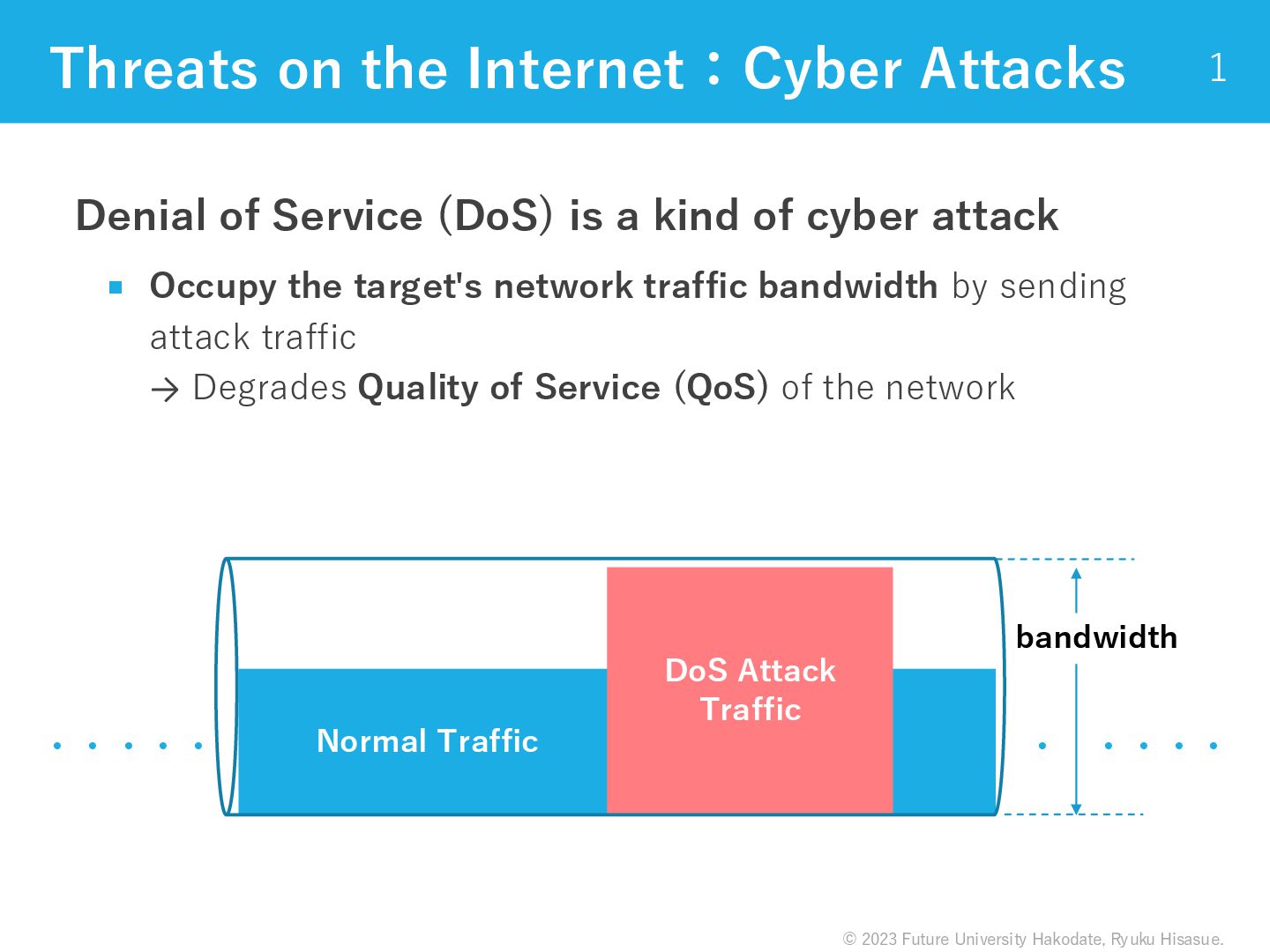
Denial of Service (DoS) is a kind of cyber attack
Occupy the target's network traffic bandwidth by sending attack traffic → Degrades Quality of Service (QoS) of the network Threats on the Internet:Cyber Attacks Normal Traffic DoS Attack Traffic ・・・・・ ・ ・・・・ bandwidth © 2023 Future University Hakodate, Ryuku Hisasue. 1
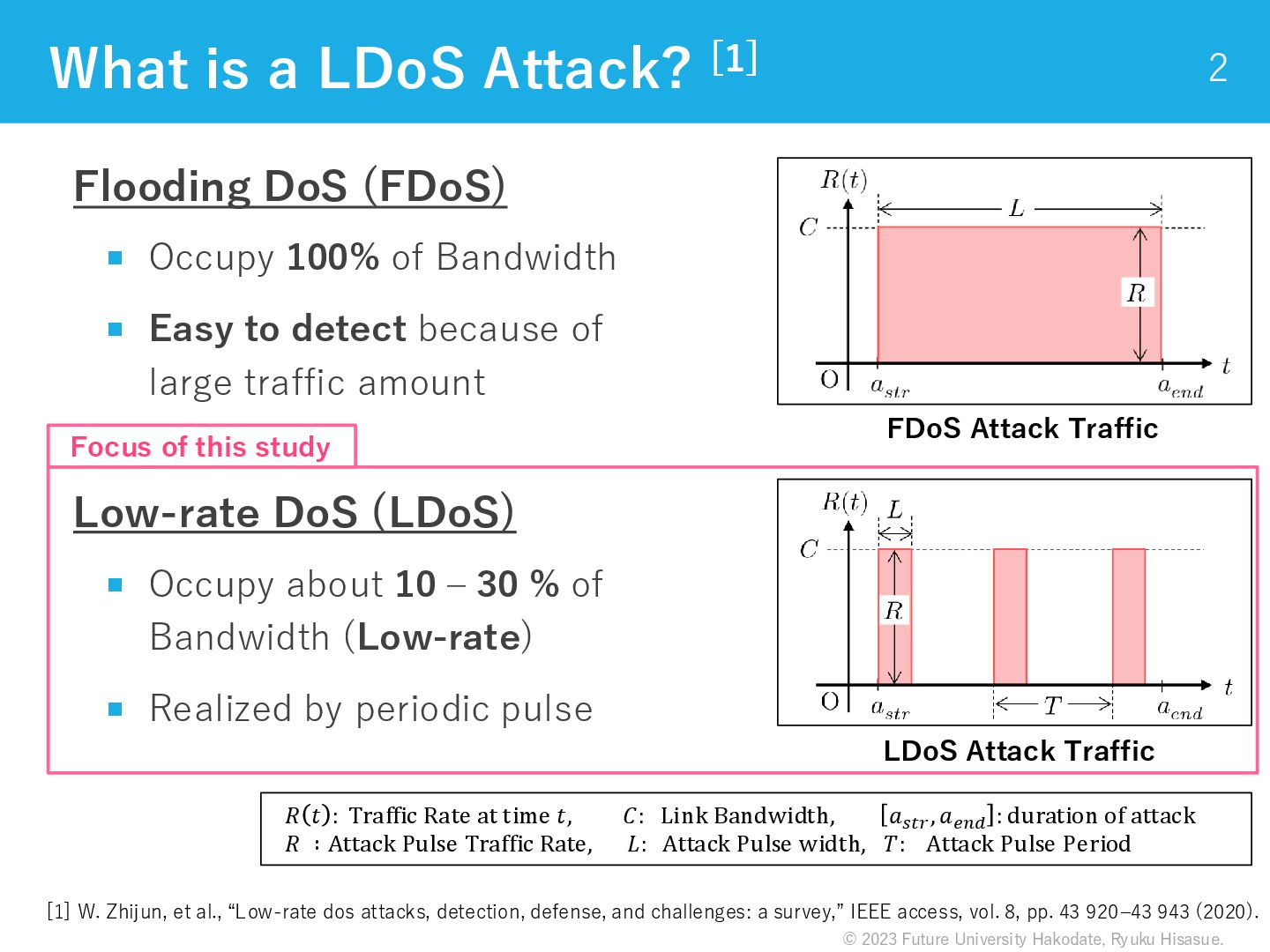
Flooding DoS (FDoS) Occupy 100% of Bandwidth Easy
to detect because of large traffic amount Low-rate DoS (LDoS) Occupy about 10 – 30 % of Bandwidth (Low-rate) Realized by periodic pulse What is a LDoS Attack? [1] FDoS Attack Traffic LDoS Attack Traffic Focus of this study [1] W. Zhijun, et al., “Low-rate dos attacks, detection, defense, and challenges: a survey,” IEEE access, vol. 8, pp. 43 920–43 943 (2020). 𝑅 𝑡 : Traffic Rate at time 𝑡, 𝐶: Link Bandwidth, 𝑎𝑠𝑡𝑟 , 𝑎𝑒𝑛𝑑 : duration of attack 𝑅 ∶ Attack Pulse Traffic Rate, 𝐿: Attack Pulse width, 𝑇: Attack Pulse Period © 2023 Future University Hakodate, Ryuku Hisasue. 2
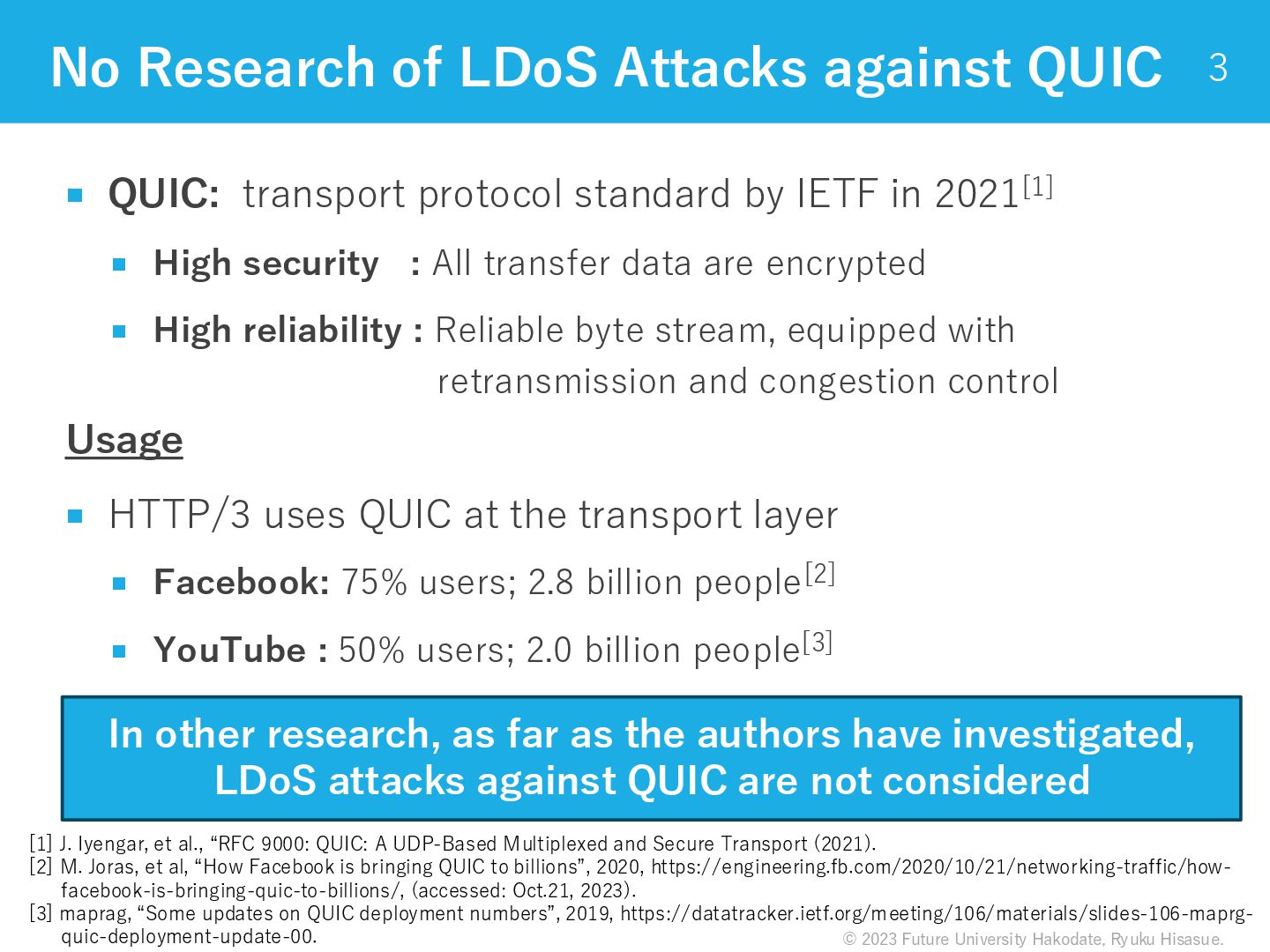
QUIC: transport protocol standard by IETF in 2021[1]
High security : All transfer data are encrypted High reliability : Reliable byte stream, equipped with retransmission and congestion control Usage HTTP/3 uses QUIC at the transport layer Facebook: 75% users; 2.8 billion people[2] YouTube : 50% users; 2.0 billion people[3] No Research of LDoS Attacks against QUIC 3 © 2023 Future University Hakodate, Ryuku Hisasue. In other research, as far as the authors have investigated, LDoS attacks against QUIC are not considered [1] J. Iyengar, et al., “RFC 9000: QUIC: A UDP-Based Multiplexed and Secure Transport (2021). [2] M. Joras, et al, “How Facebook is bringing QUIC to billions”, 2020, https://engineering.fb.com/2020/10/21/networking-traffic/how- facebook-is-bringing-quic-to-billions/, (accessed: Oct.21, 2023). [3] maprag, “Some updates on QUIC deployment numbers”, 2019, https://datatracker.ietf.org/meeting/106/materials/slides-106-maprg- quic-deployment-update-00.
Purpose 4 © 2023 Future University Hakodate, Ryuku Hisasue. Propose
a LDoS Attack method against QUIC
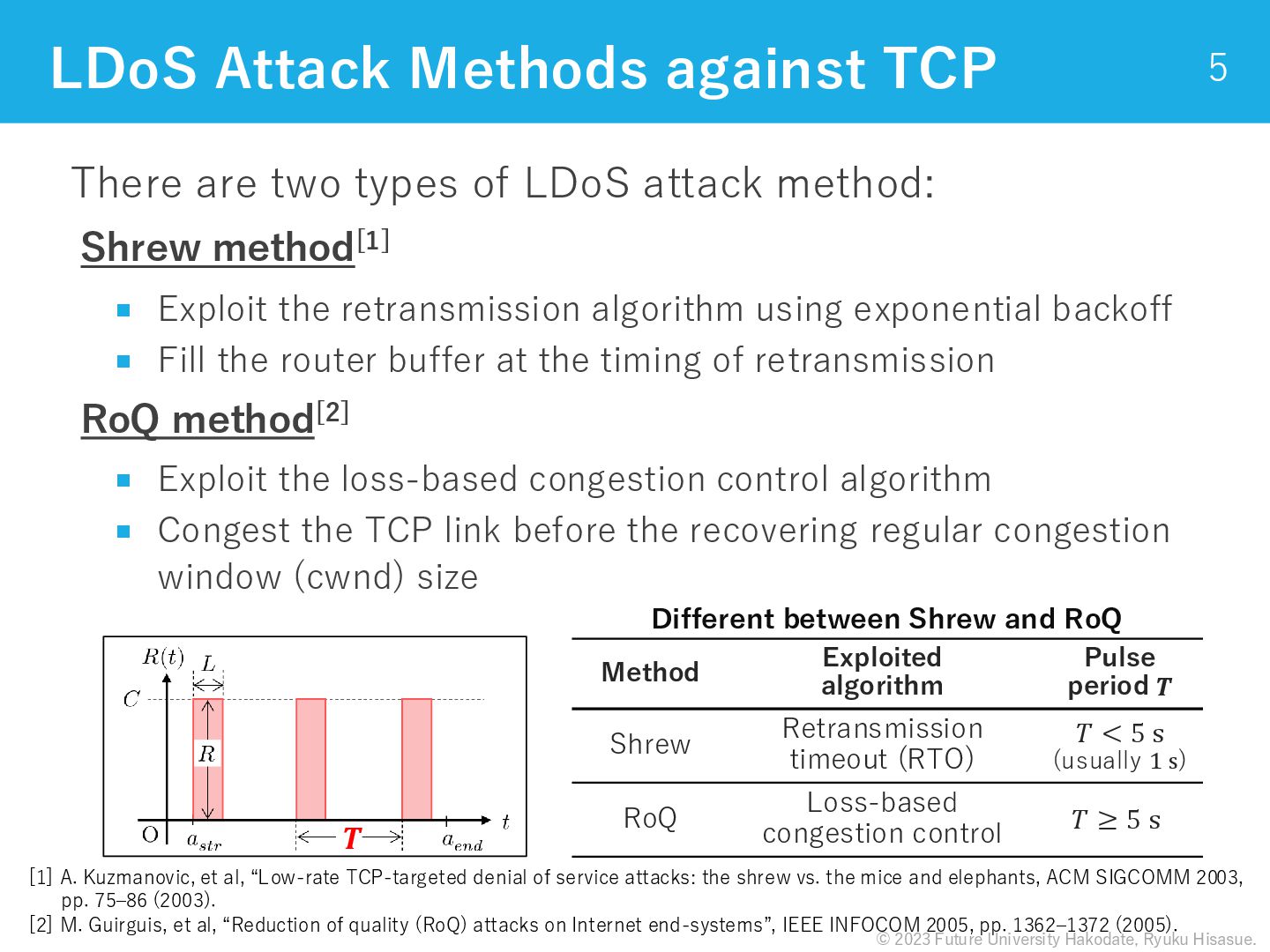
There are two types of LDoS attack method: Shrew method[1]
Exploit the retransmission algorithm using exponential backoff Fill the router buffer at the timing of retransmission RoQ method[2] Exploit the loss-based congestion control algorithm Congest the TCP link before the recovering regular congestion window (cwnd) size LDoS Attack Methods against TCP 5 Different between Shrew and RoQ [1] A. Kuzmanovic, et al, “Low-rate TCP-targeted denial of service attacks: the shrew vs. the mice and elephants, ACM SIGCOMM 2003, pp. 75–86 (2003). [2] M. Guirguis, et al, “Reduction of quality (RoQ) attacks on Internet end-systems”, IEEE INFOCOM 2005, pp. 1362–1372 (2005). © 2023 Future University Hakodate, Ryuku Hisasue. 𝑻 Method Exploited algorithm Pulse period 𝑻 Shrew Retransmission timeout (RTO) 𝑇 < 5 s (usually 1 s) RoQ Loss-based congestion control 𝑇 ≥ 5 s
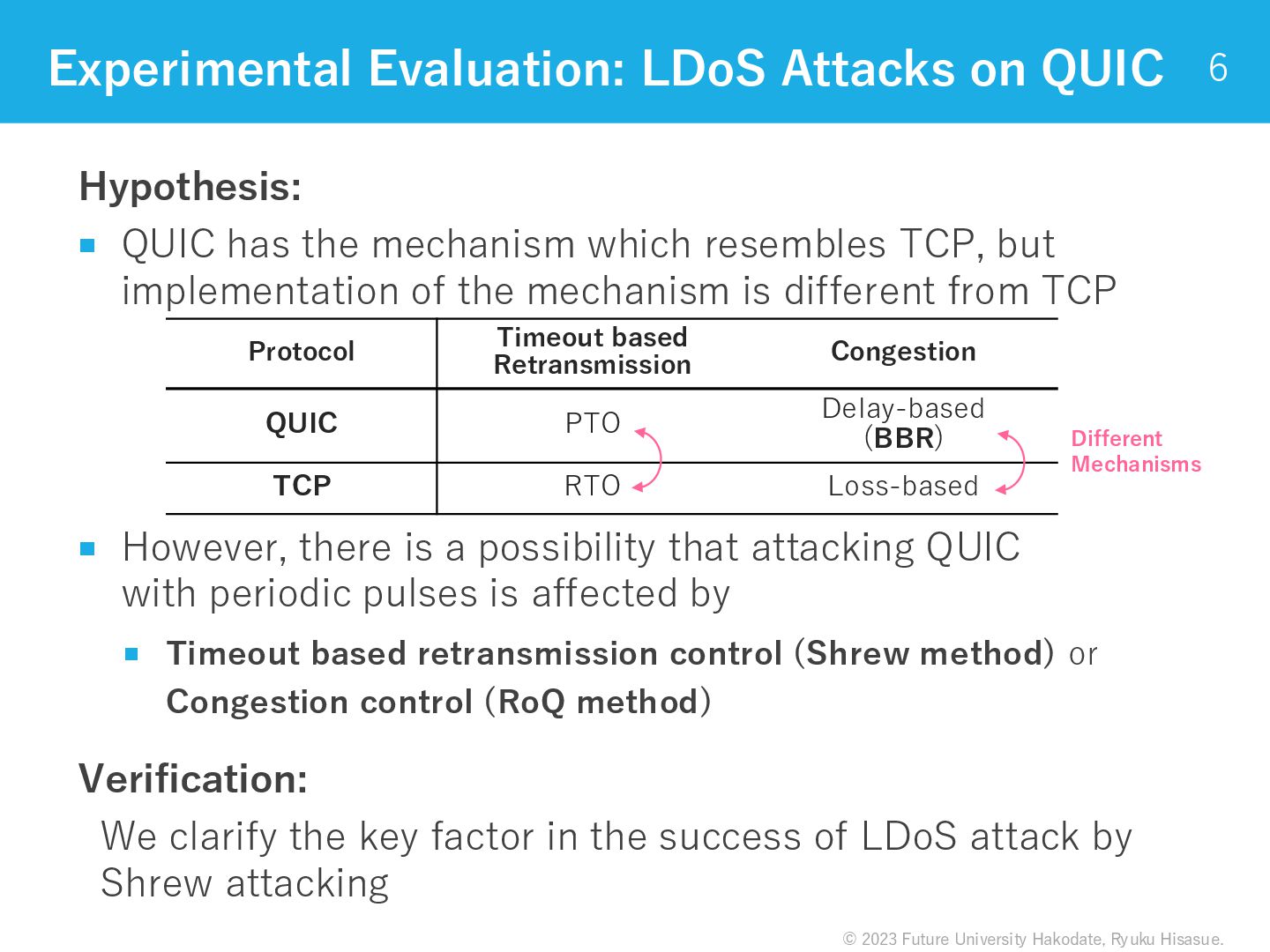
Hypothesis: QUIC has the mechanism which resembles TCP, but
implementation of the mechanism is different from TCP However, there is a possibility that attacking QUIC with periodic pulses is affected by Timeout based retransmission control (Shrew method) or Congestion control (RoQ method) Verification: We clarify the key factor in the success of LDoS attack by Shrew attacking Experimental Evaluation: LDoS Attacks on QUIC 6 © 2023 Future University Hakodate, Ryuku Hisasue. Protocol Timeout based Retransmission Congestion QUIC PTO Delay-based (BBR) TCP RTO Loss-based Different Mechanisms
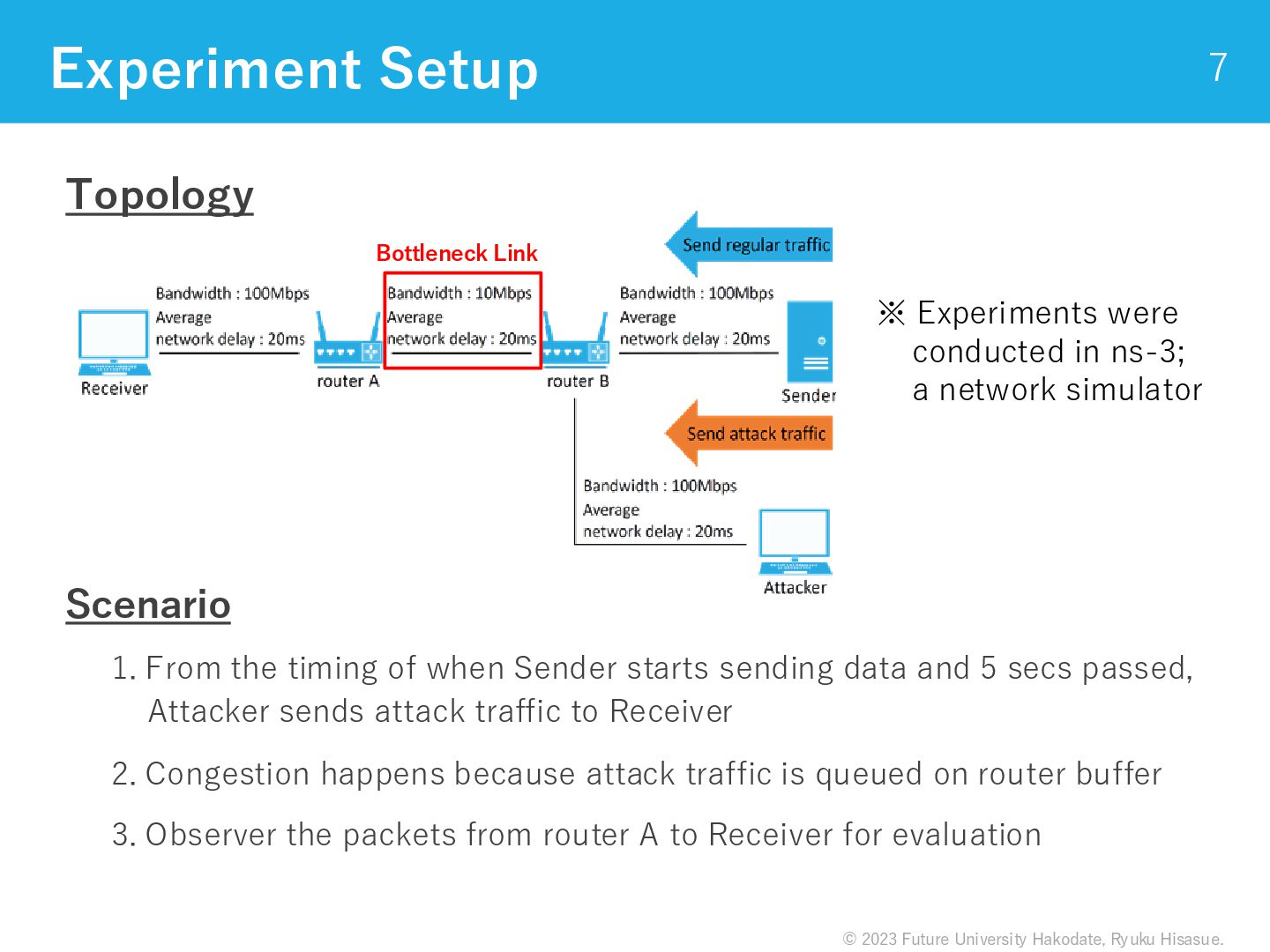
Topology Scenario 1. From the timing of when Sender starts
sending data and 5 secs passed, Attacker sends attack traffic to Receiver 2. Congestion happens because attack traffic is queued on router buffer 3. Observer the packets from router A to Receiver for evaluation Experiment Setup 7 © 2023 Future University Hakodate, Ryuku Hisasue. ※ Experiments were conducted in ns-3; a network simulator Bottleneck Link
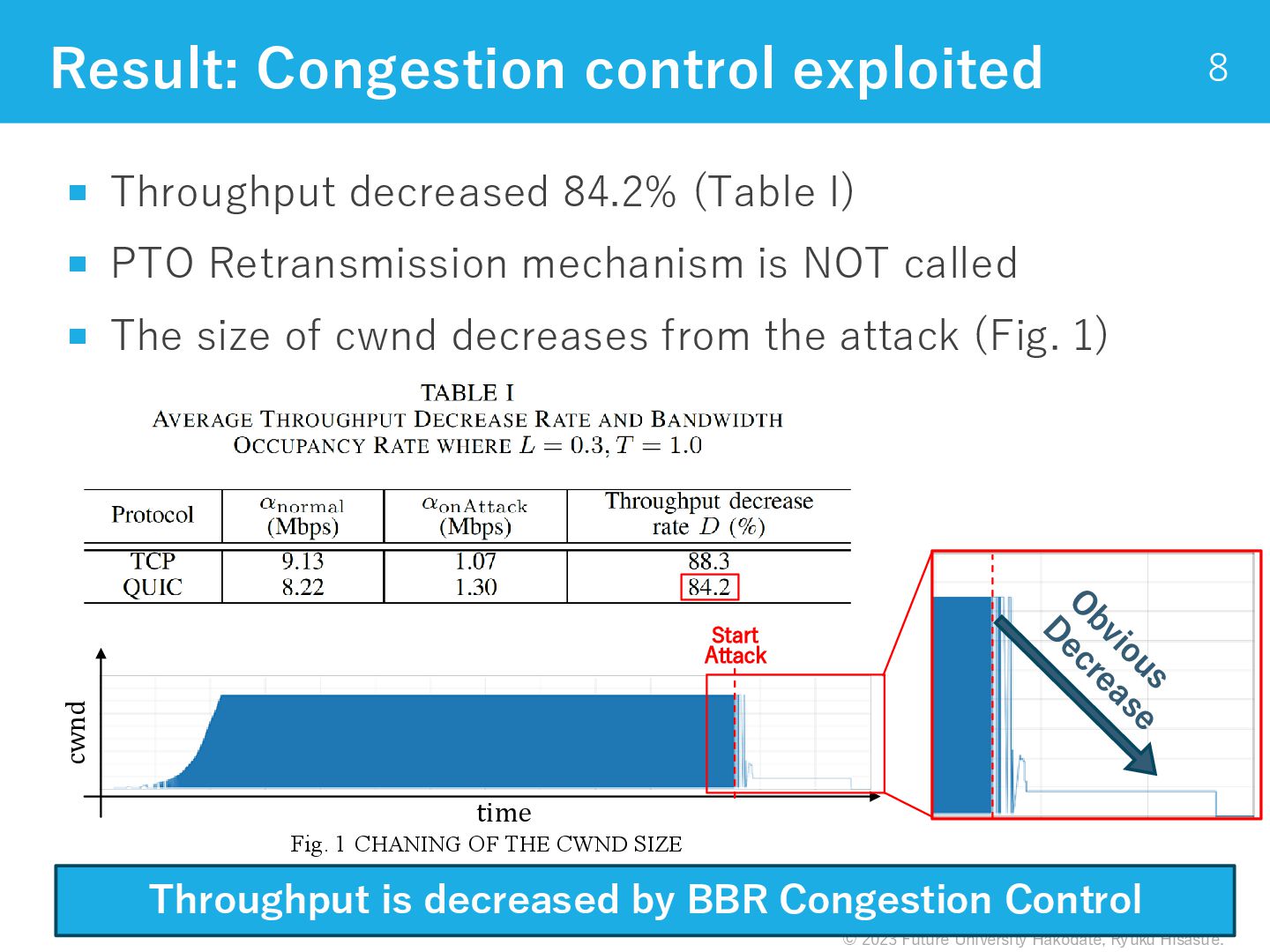
Throughput decreased 84.2% (Table I) PTO Retransmission mechanism
is NOT called The size of cwnd decreases from the attack (Fig. 1) Result: Congestion control exploited 8 © 2023 Future University Hakodate, Ryuku Hisasue. cwnd time Start Attack Throughput is decreased by BBR Congestion Control Fig. 1 CHANING OF THE CWND SIZE
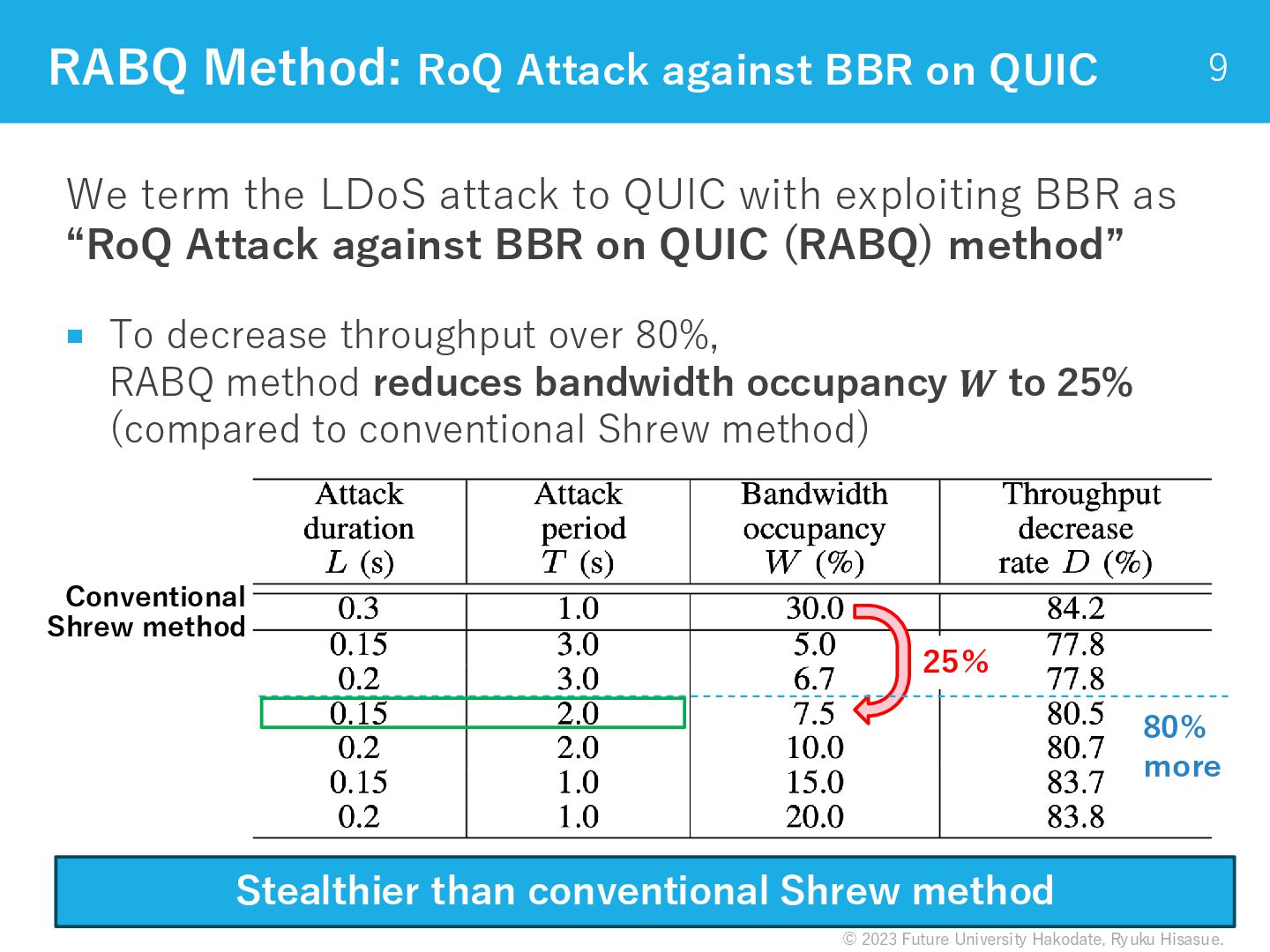
We term the LDoS attack to QUIC with exploiting BBR
as “RoQ Attack against BBR on QUIC (RABQ) method” To decrease throughput over 80%, RABQ method reduces bandwidth occupancy 𝑾 to 25% (compared to conventional Shrew method) RABQ Method: RoQ Attack against BBR on QUIC 9 © 2023 Future University Hakodate, Ryuku Hisasue. Conventional Shrew method 25% 80% more Stealthier than conventional Shrew method
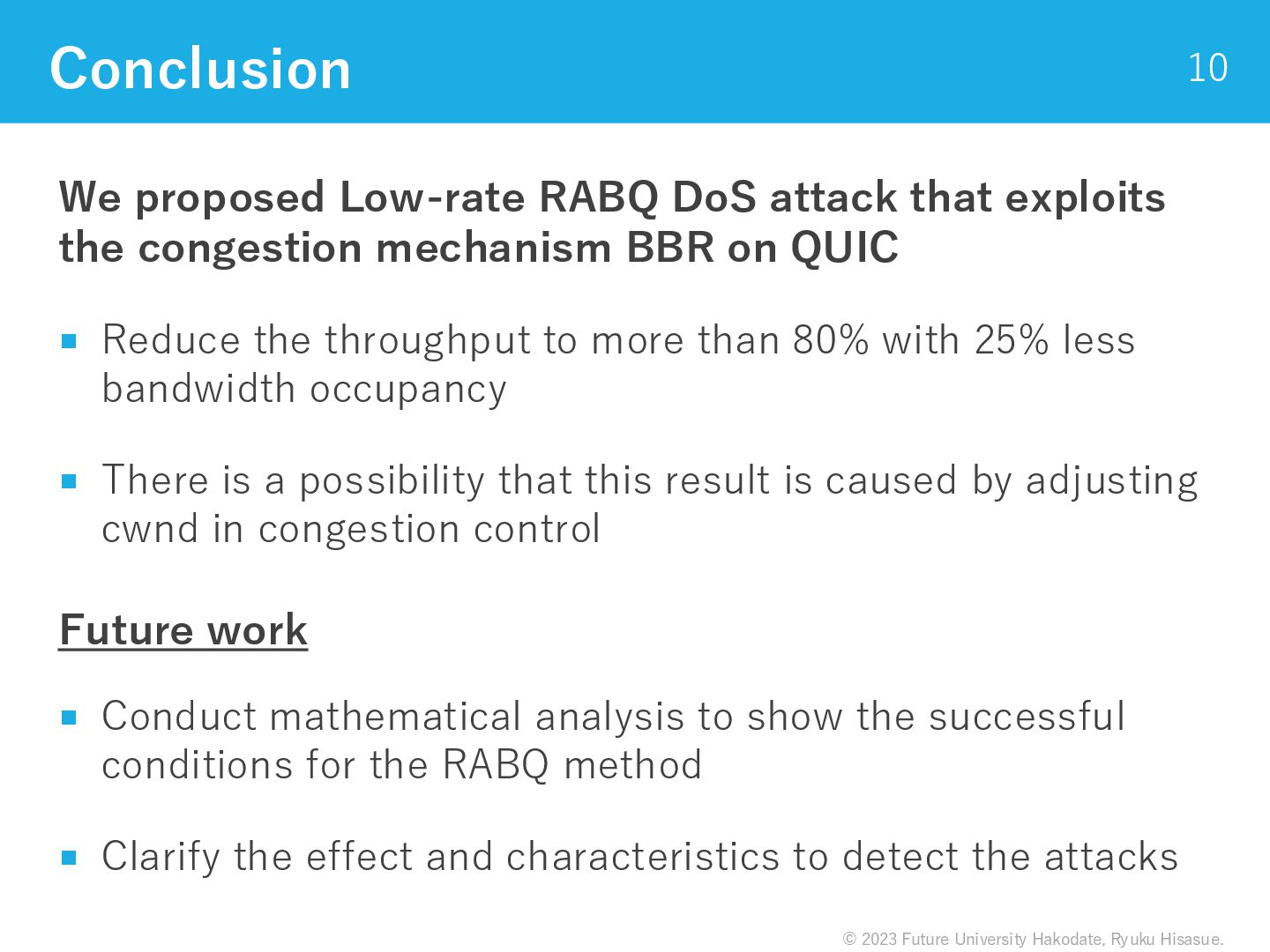
We proposed Low-rate RABQ DoS attack that exploits the congestion
mechanism BBR on QUIC Reduce the throughput to more than 80% with 25% less bandwidth occupancy There is a possibility that this result is caused by adjusting cwnd in congestion control Future work Conduct mathematical analysis to show the successful conditions for the RABQ method Clarify the effect and characteristics to detect the attacks Conclusion 10 © 2023 Future University Hakodate, Ryuku Hisasue.
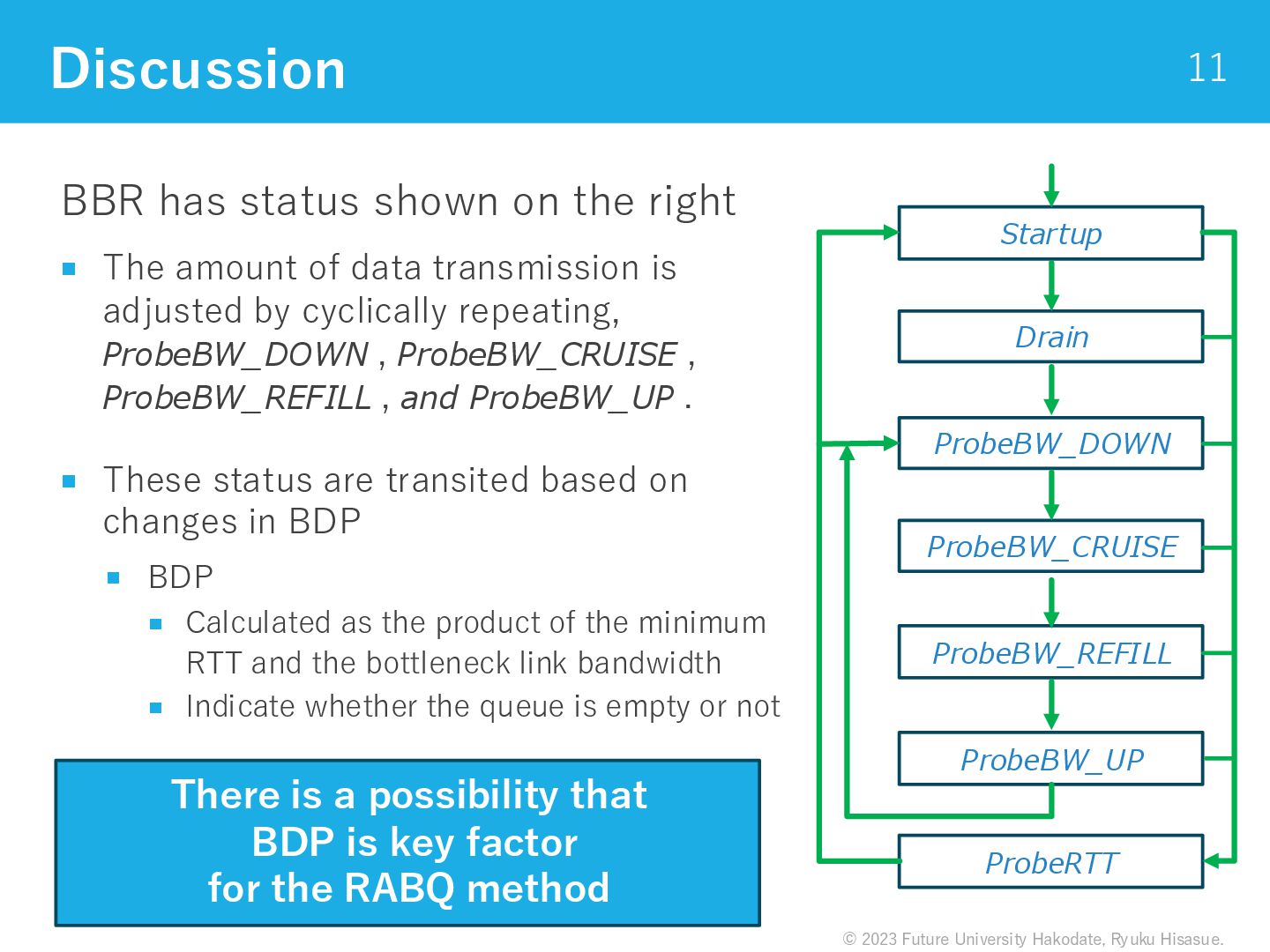
BBR has status shown on the right The amount
of data transmission is adjusted by cyclically repeating, ProbeBW_DOWN , ProbeBW_CRUISE , ProbeBW_REFILL , and ProbeBW_UP . These status are transited based on changes in BDP BDP Calculated as the product of the minimum RTT and the bottleneck link bandwidth Indicate whether the queue is empty or not Discussion 11 © 2023 Future University Hakodate, Ryuku Hisasue. Startup Drain ProbeBW_DOWN ProbeBW_CRUISE ProbeBW_REFILL ProbeBW_UP ProbeRTT There is a possibility that BDP is key factor for the RABQ method

 Your Podcast. Everywhere. Effortlessly.


 ryuku_hisa
 akademiya2063
 seathinner
 cassininazir
 scottboms
 palkan
 lemiorhan
 vanstee
 deanohume
 jct
 addyosmani
 sergeychernyshev
 baasie