through simple rules, resul0ng in flocking behavior • Emergent behavior – complex behavior arising from simple rules • Eventual basis for some of the more impressive cinematographic anima0on – Lord of the Rings, Batman Returns, Lion King etc
• Autonomous agents interac0ng with each other and the environment • Used in analysing supply chain op0miza0on, traffic paRerns, economic models, spread of epidemics • Influenced by John Conway’s Game of Life • Heavily influenced by Epstein and Axtell’s Sugarscape simula0ons
an energy level (randomly assigned) • At every 0ck, roids lose 1 energy • If energy level reaches 0, it will die • To prevent this, it will ac0vely seek out food and consume it • Consuming food replenishes energy level • (But roids are s0ll immortal)
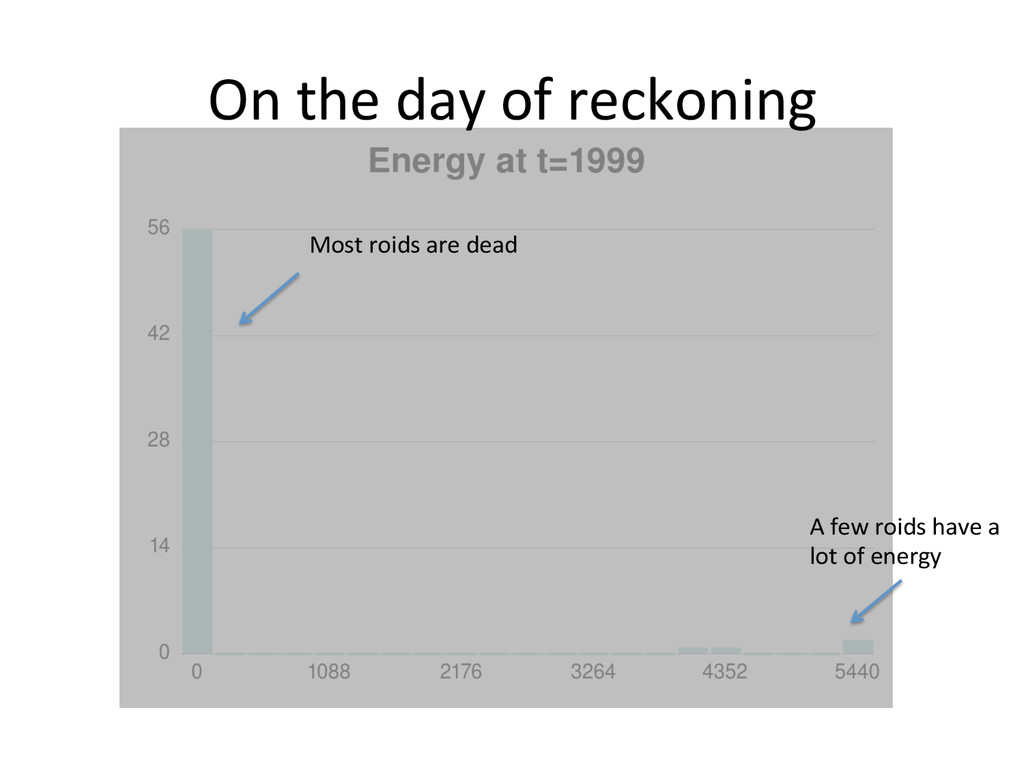
is a measure of the inequality of a distribu0on, 0 is perfect equality and 1 is perfect inequality • Defined mathema0cally based on the Lorenz curve Area is the amount of inequality
• Back to where we started – emergent behavior • Small changes ripple down to large effects over a period of 0me • Simple local rules brings complex global changes
now – male and female • Males are blue, females are red, underaged are • If female is within childbearing age (25 to 50 0cks) and if it has enough energy, it will look for a nearby male • If male is also within childbearing age and have enough energy, they will procreate and produce a baby roid • Both male and female loses energy each 0me they procreate
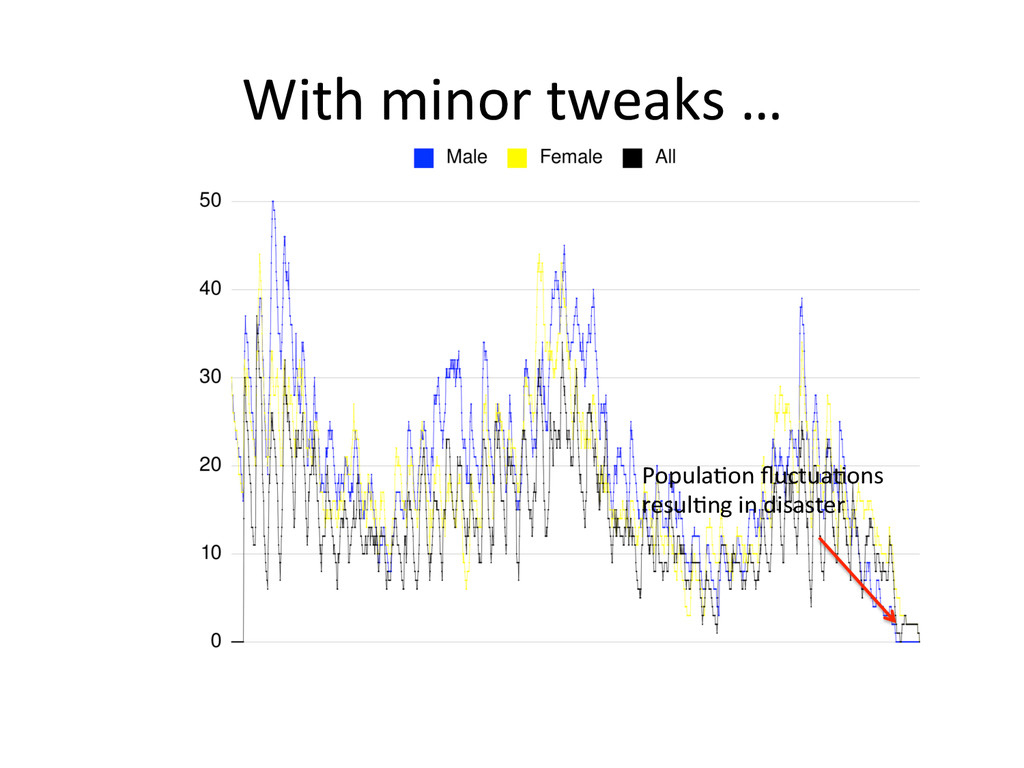
popula0on changes once we introduce sex and death • At every 0ck we collect the popula0on of the en0re world, as well as popula0on of males and females
• “Survival of the fiRest” • Organisms with more suitable aRributes are more likely to reproduce and pass these aRributes to the next genera0on • Over 0me these aRributes become more prominent
the same aRributes, only difference is maximum lifespan and energy level • In this simula0on, we add 2 new aRributes – Metabolism How well the roid converts the food it eats into energy (higher number beRer) – Vision range How far away it can see food (higher number beRer) • Roid babies inherit these 2 aRributes from their parents
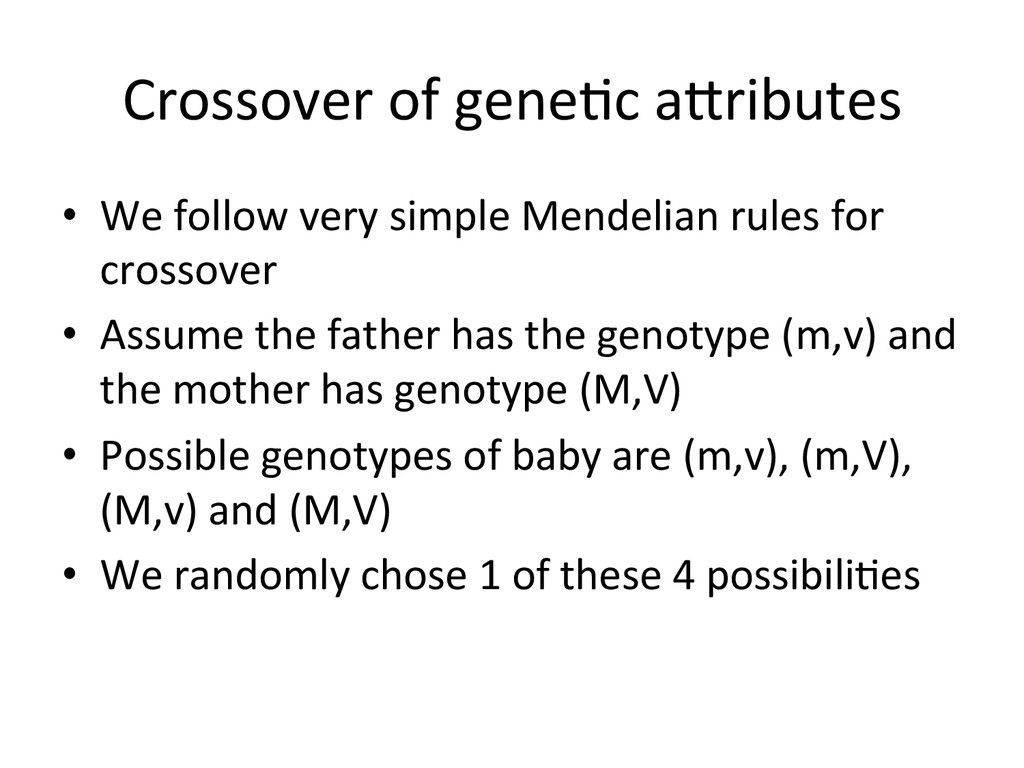
Mendelian rules for crossover • Assume the father has the genotype (m,v) and the mother has genotype (M,V) • Possible genotypes of baby are (m,v), (m,V), (M,v) and (M,V) • We randomly chose 1 of these 4 possibili0es
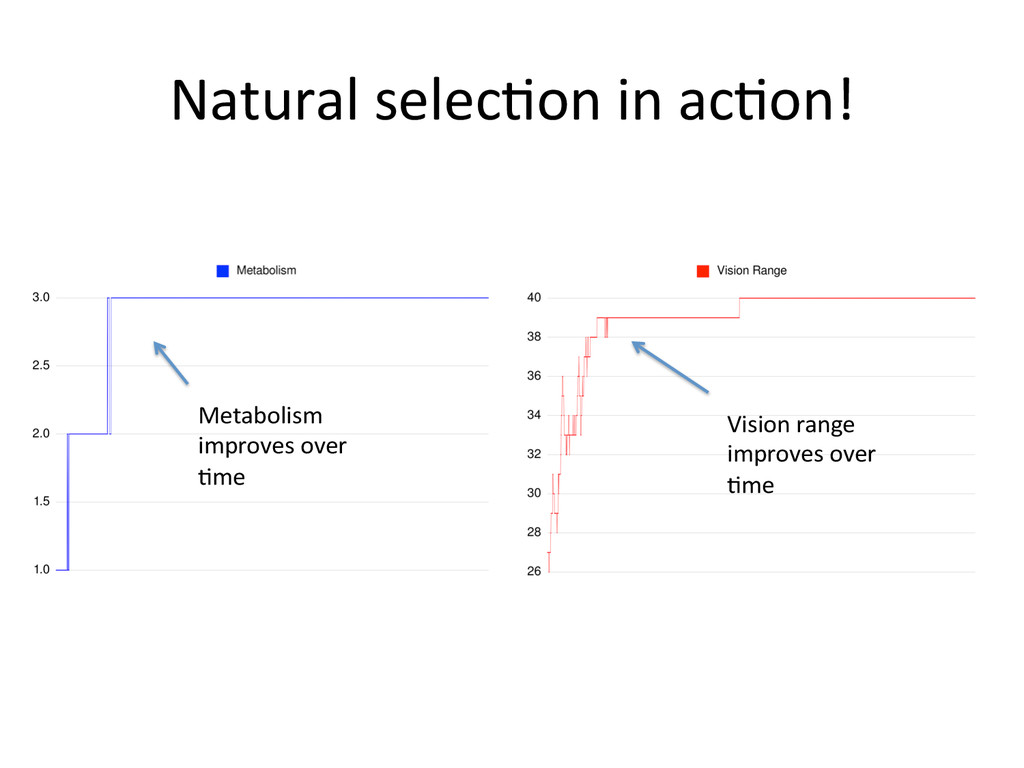
the metabolism and vision range aRributes of the popula0on changes over 0me • At every 0ck, we calculate the average metabolism and vision range of all roids that are alive
the roids with the beRer aRributes are able to survive longer and reproduce with similar aRributes • Natural selec0on is not necessarily a straight line (vision range meanders for a while)


 sausheong
 kubell_hr
 everpeace
 masspeaks
 visional_engineering_and_design
 atalie2m
 inariku
 masasuzu
 oidfj
 munenick
 minorun365
 yappli_developers
 wadayusuke
 ammeep
 aarron
 aleyda
 inesmontani
 csswizardry
 cassininazir
 bryan
 andyhume
 codingconduct
 brad_frost
 mkilby
 rkendrick25