Upgrade to Pro — share decks privately, control downloads, hide ads and more …

Hacking Physics at 300 KPH - Securing the Cyber...

Sponsored · Your Podcast. Everywhere. Effortlessly. Share. Educate. Inspire. Entertain. You do you. We'll handle the rest.

Hacking Physics at 300 KPH - Securing the Cyber-Physical Edge in F1

Formula 1's 2026 technical regulations introduced a 50:50 hybrid power unit architecture that created an attack surface spanning thermal, electrical, and software interdependencies simultaneously. Project Apex addresses the resulting integrity gap: a real-time, physics-aware validation layer that classifies every telemetry event against MCL40's physical envelope, assigns a deterministic severity level, and surfaces anomalies to engineers in under 10 milliseconds - before a sensor fault, software bug, or adversarial input can propagate into a safety-critical decision.

Avatar for Timothy Harmon

Timothy Harmon PRO

April 12, 2026

Resources

BSides San Diego 2026 - Full Talk Page

https://www.securitycybergeek.com/bsides-san-diego-2026-conference-talk

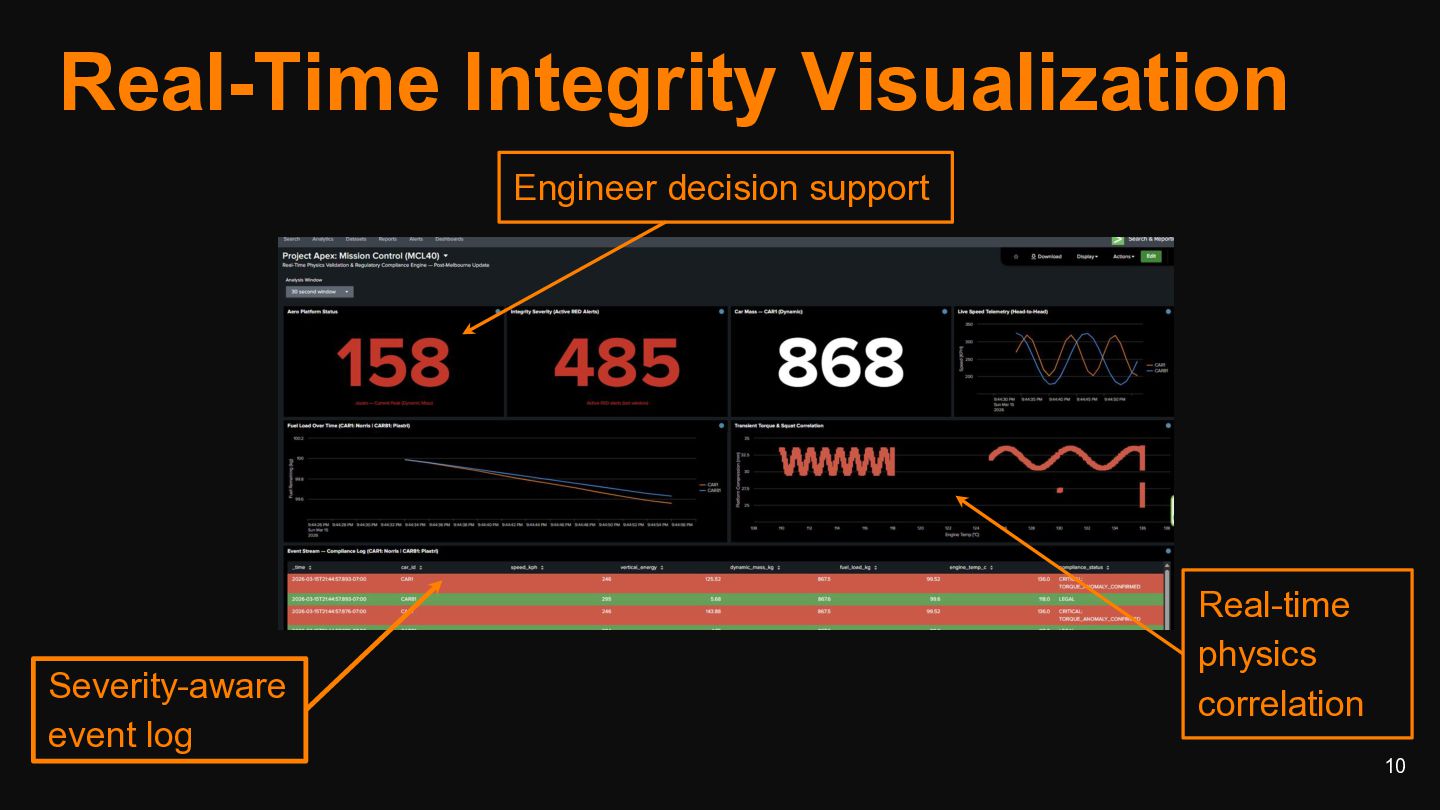
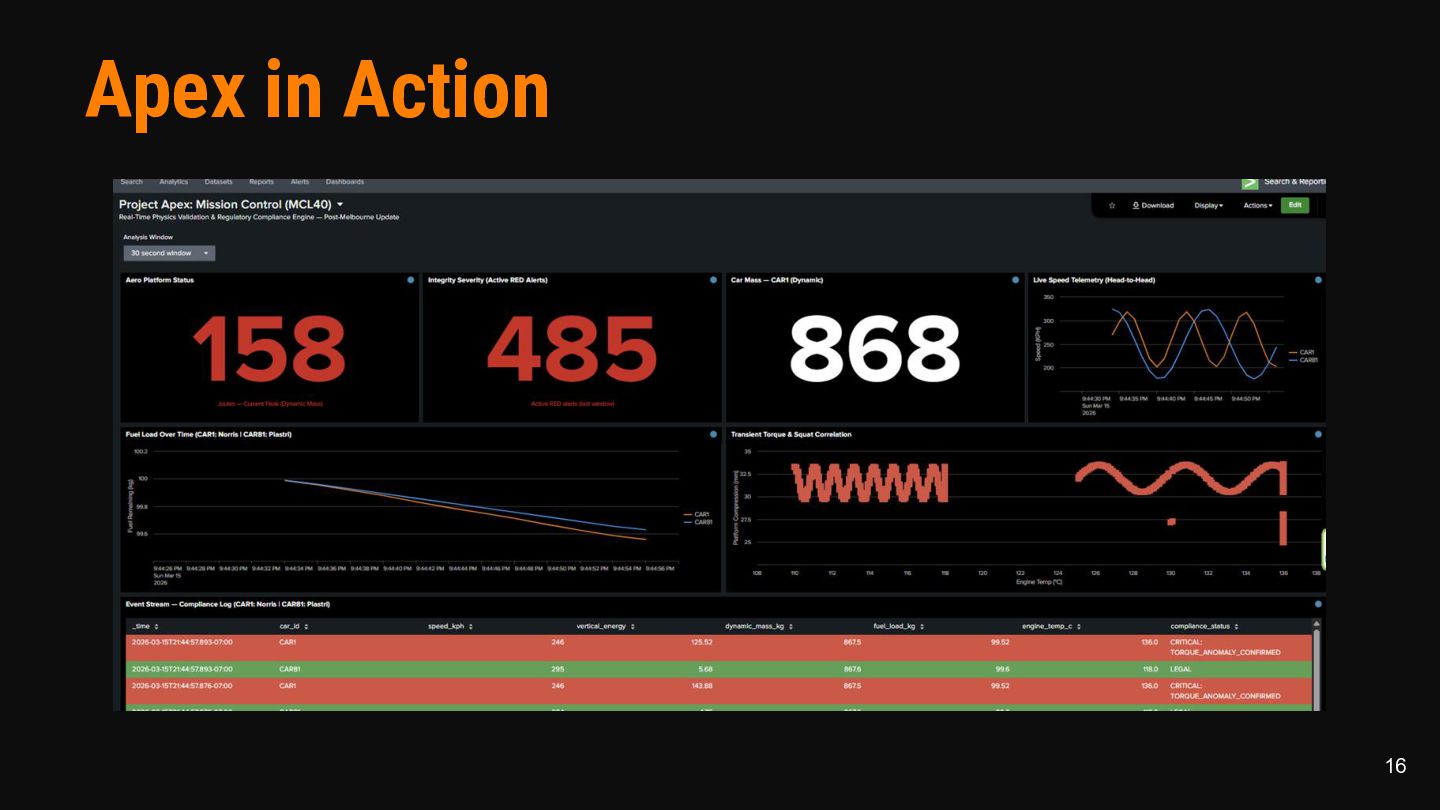
Full conference talk page including slide deck download, Project Apex GitHub repository, architecture overview, and Splunk Mission Control dashboard.

Suzuka to Miami: What the Japanese GP Tells Us About F1's 2026 Data Gap

https://www.securitycybergeek.com/post/suzuka-to-miami-what-the-japanese-gp-tells-us-about-f1-s-2026-data-gap

Pre-conference article connecting the Bearman crash at Suzuka to the physics-layer integrity gap Project Apex was built to address.

Project Apex — GitHub Repository

https://github.com/SecurityCyberGeek/project-apex-telemetry

Python validator service, Cisco IOx bridge, and Splunk Mission Control dashboard JSON. Physics-validated telemetry architecture for F1 edge deployments.

Zenodo Citable Record — DOI

https://doi.org/10.5281/zenodo.19549562

Permanent citable record of the conference presentation, registered with Zenodo and indexed through ORCID.

Other Decks in Technology

Transcript

  1. HACKING PHYSICS AT 300 KPH: Securing the Cyber-Physical Edge in

    F1 How Project Apex Validates Telemetry Integrity in Real- Time Racing Timothy D. Harmon, CISSP | Lead Enterprise Architect | Cisco Insider Champion BSides San Diego 2026 | April 4, 2026 Motorsport UK · BMMC · SMMC · SCCA San Diego 1
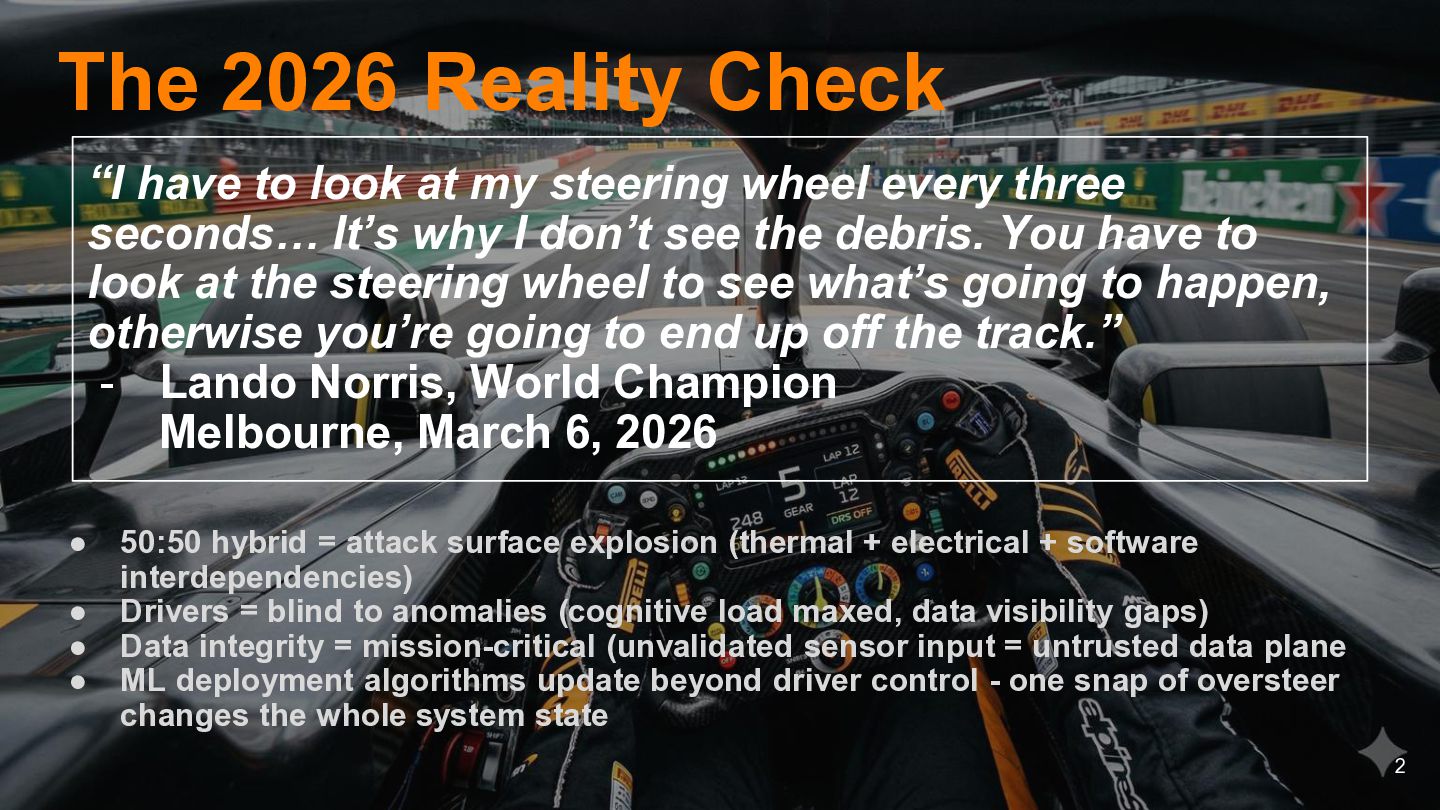
  2. “I have to look at my steering wheel every three

    seconds… It’s why I don’t see the debris. You have to look at the steering wheel to see what’s going to happen, otherwise you’re going to end up off the track.” - Lando Norris, World Champion Melbourne, March 6, 2026 The 2026 Reality Check • 50:50 hybrid = attack surface explosion (thermal + electrical + software interdependencies) • Drivers = blind to anomalies (cognitive load maxed, data visibility gaps) • Data integrity = mission-critical (unvalidated sensor input = untrusted data plane • ML deployment algorithms update beyond driver control - one snap of oversteer changes the whole system state 2
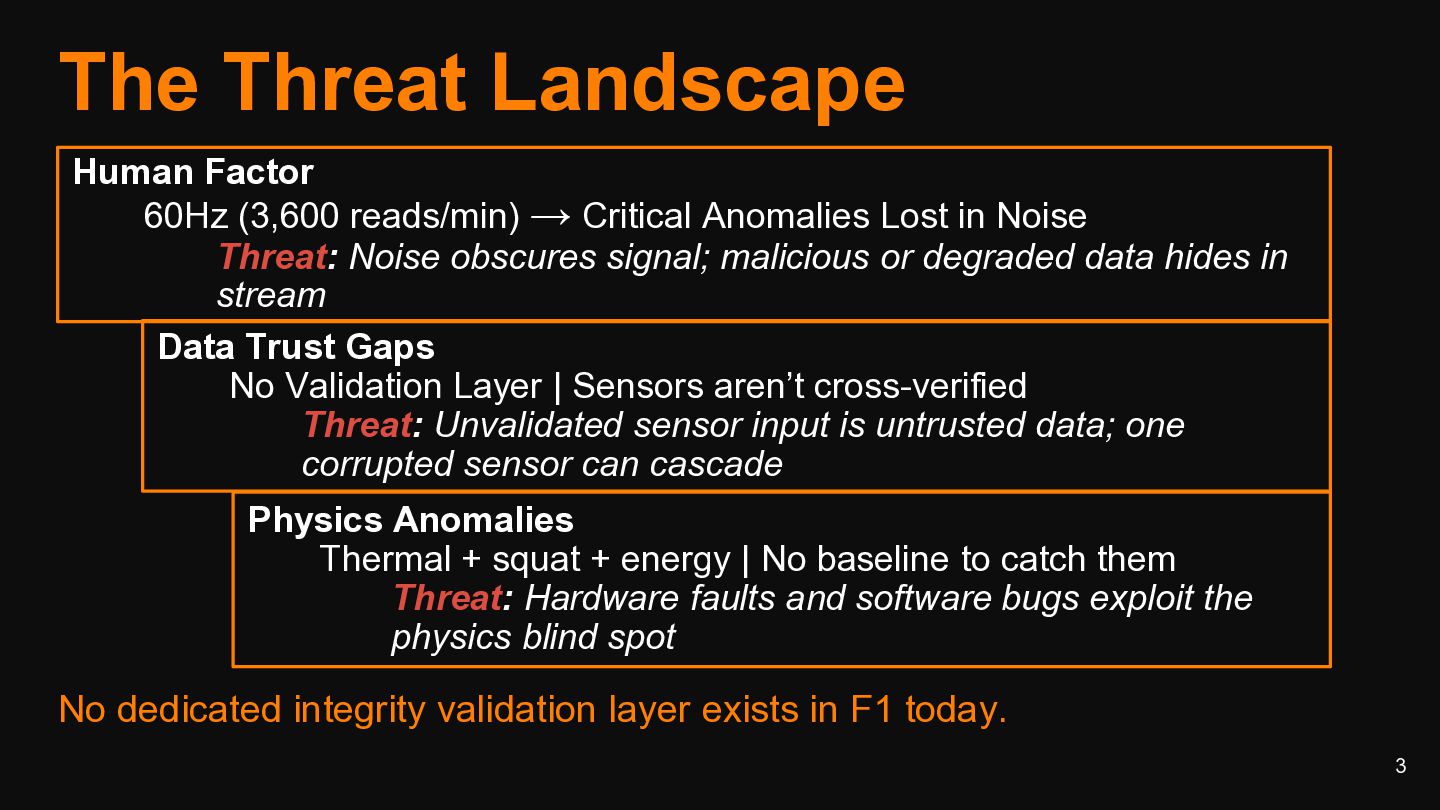
  3. The Threat Landscape Human Factor 60Hz (3,600 reads/min) → Critical

    Anomalies Lost in Noise Threat: Noise obscures signal; malicious or degraded data hides in stream Data Trust Gaps No Validation Layer | Sensors aren’t cross-verified Threat: Unvalidated sensor input is untrusted data; one corrupted sensor can cascade Physics Anomalies Thermal + squat + energy | No baseline to catch them Threat: Hardware faults and software bugs exploit the physics blind spot No dedicated integrity validation layer exists in F1 today. 3
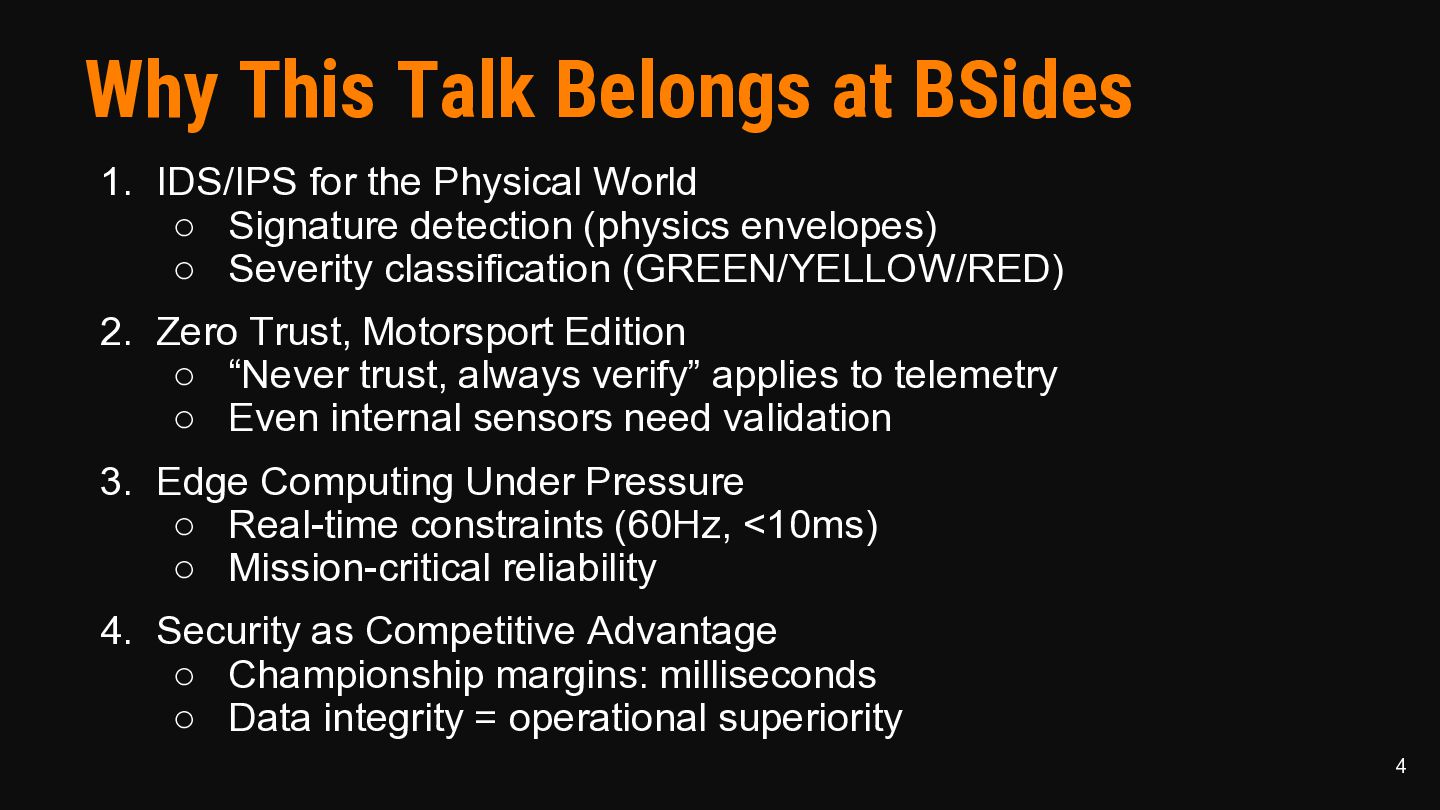
  4. Why This Talk Belongs at BSides 1. IDS/IPS for the

    Physical World ◦ Signature detection (physics envelopes) ◦ Severity classification (GREEN/YELLOW/RED) 2. Zero Trust, Motorsport Edition ◦ “Never trust, always verify” applies to telemetry ◦ Even internal sensors need validation 3. Edge Computing Under Pressure ◦ Real-time constraints (60Hz, <10ms) ◦ Mission-critical reliability 4. Security as Competitive Advantage ◦ Championship margins: milliseconds ◦ Data integrity = operational superiority 4
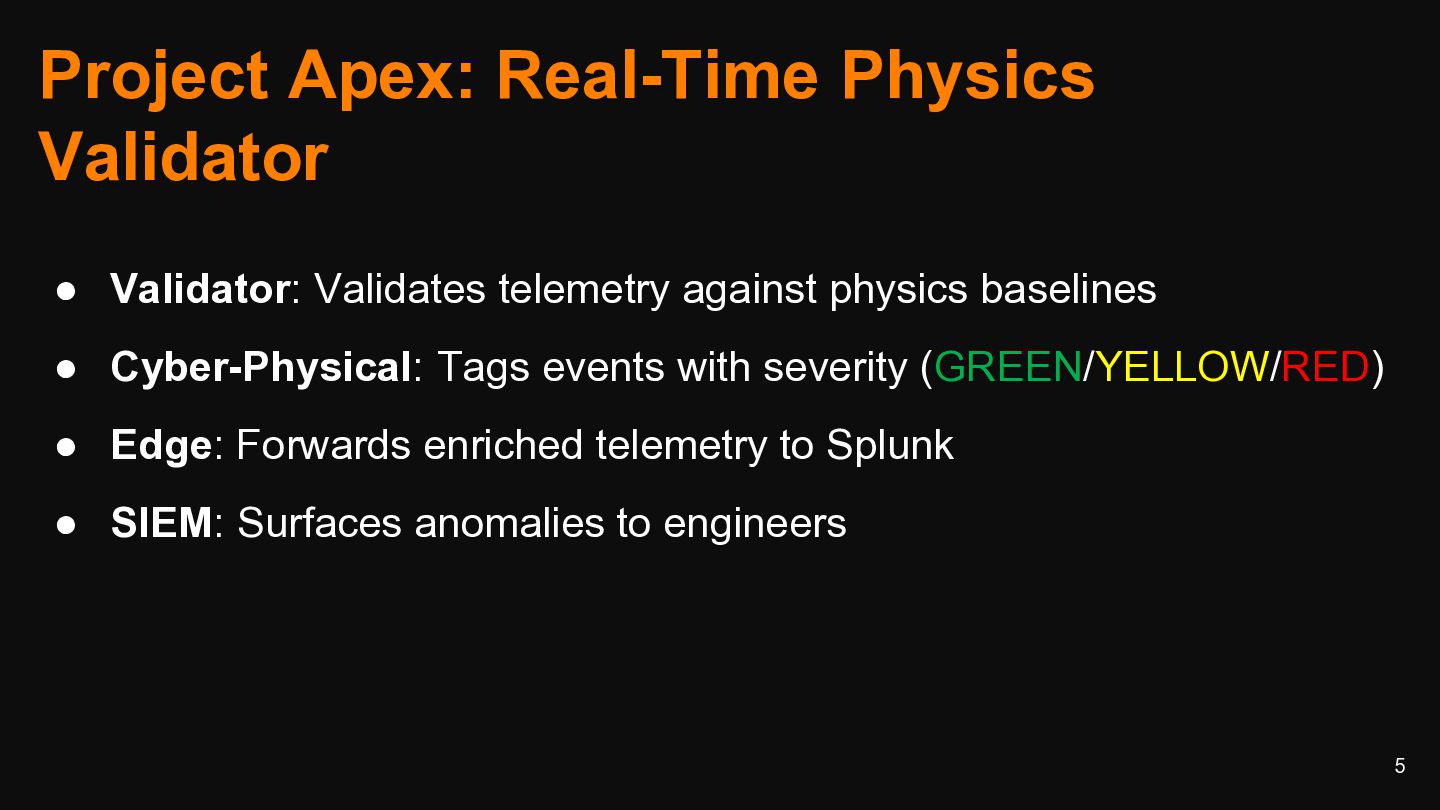
  5. Project Apex: Real-Time Physics Validator • Validator: Validates telemetry against

    physics baselines • Cyber-Physical: Tags events with severity (GREEN/YELLOW/RED) • Edge: Forwards enriched telemetry to Splunk • SIEM: Surfaces anomalies to engineers 5
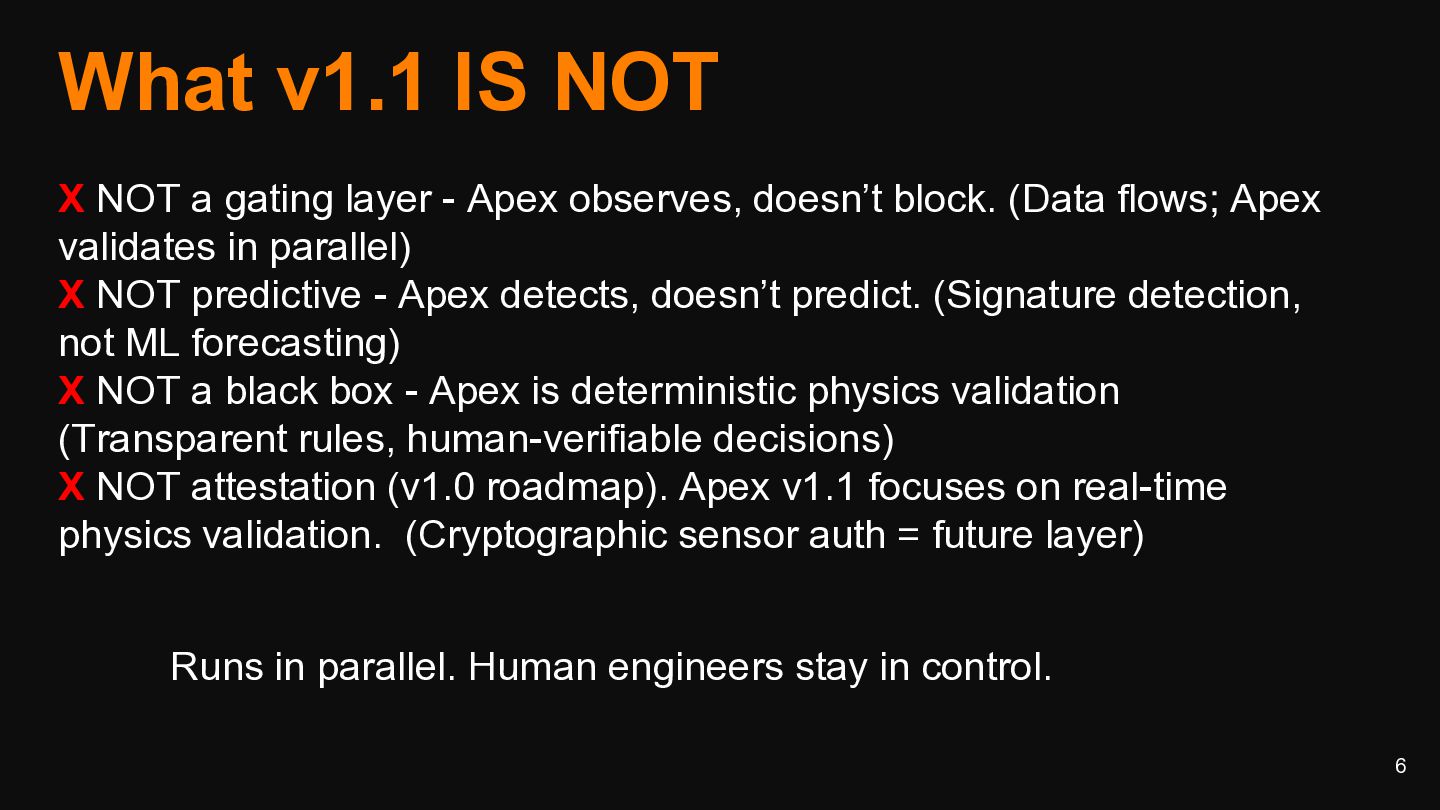
  6. What v1.1 IS NOT Runs in parallel. Human engineers stay

    in control. X NOT a gating layer - Apex observes, doesn’t block. (Data flows; Apex validates in parallel) X NOT predictive - Apex detects, doesn’t predict. (Signature detection, not ML forecasting) X NOT a black box - Apex is deterministic physics validation (Transparent rules, human-verifiable decisions) X NOT attestation (v1.0 roadmap). Apex v1.1 focuses on real-time physics validation. (Cryptographic sensor auth = future layer) 6
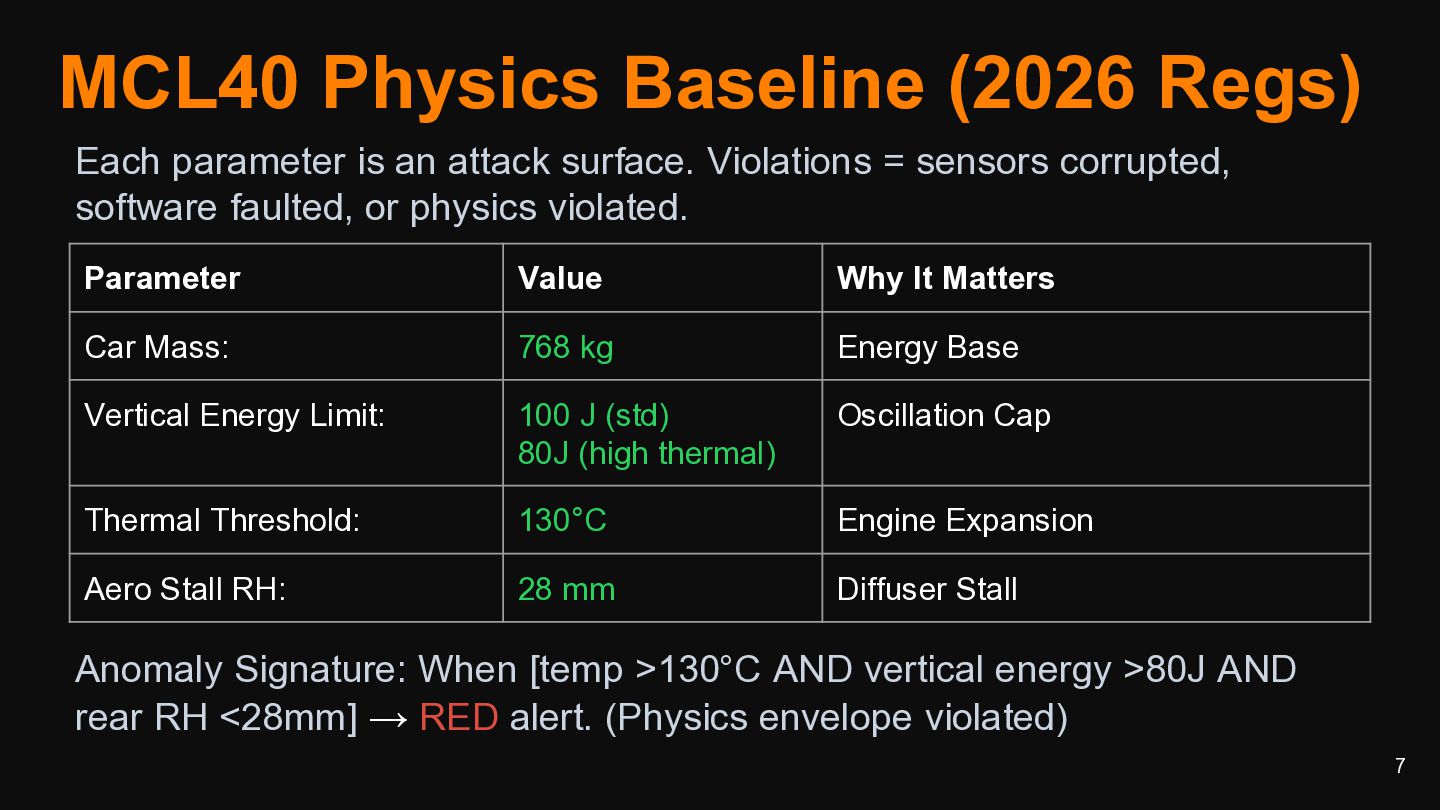
  7. MCL40 Physics Baseline (2026 Regs) Parameter Value Why It Matters

    Car Mass: 768 kg Energy Base Vertical Energy Limit: 100 J (std) 80J (high thermal) Oscillation Cap Thermal Threshold: 130°C Engine Expansion Aero Stall RH: 28 mm Diffuser Stall Anomaly Signature: When [temp >130°C AND vertical energy >80J AND rear RH <28mm] → RED alert. (Physics envelope violated) Each parameter is an attack surface. Violations = sensors corrupted, software faulted, or physics violated. 7
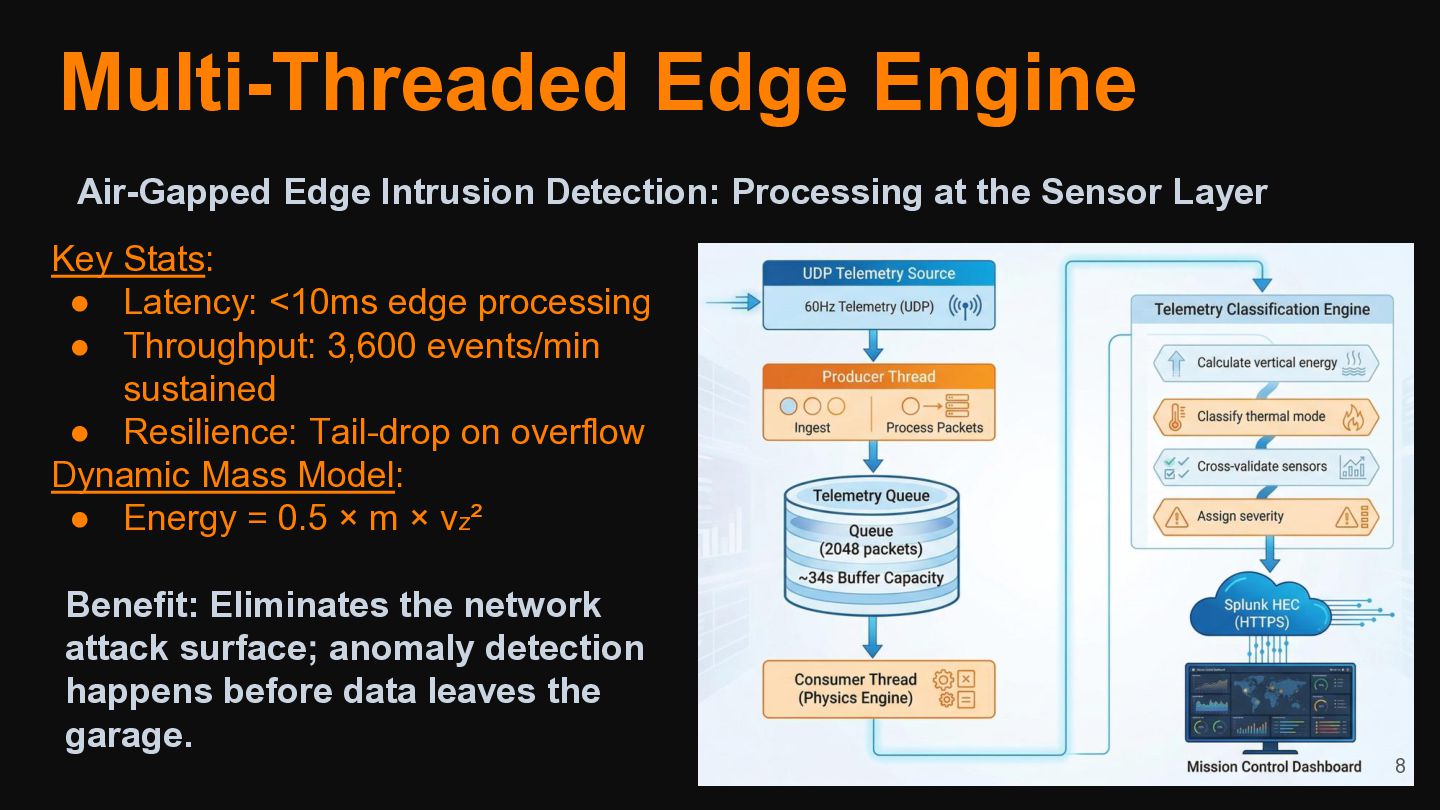
  8. Multi-Threaded Edge Engine Key Stats: • Latency: <10ms edge processing

    • Throughput: 3,600 events/min sustained • Resilience: Tail-drop on overflow Dynamic Mass Model: • Energy = 0.5 × m × vz² Air-Gapped Edge Intrusion Detection: Processing at the Sensor Layer Benefit: Eliminates the network attack surface; anomaly detection happens before data leaves the garage. 8
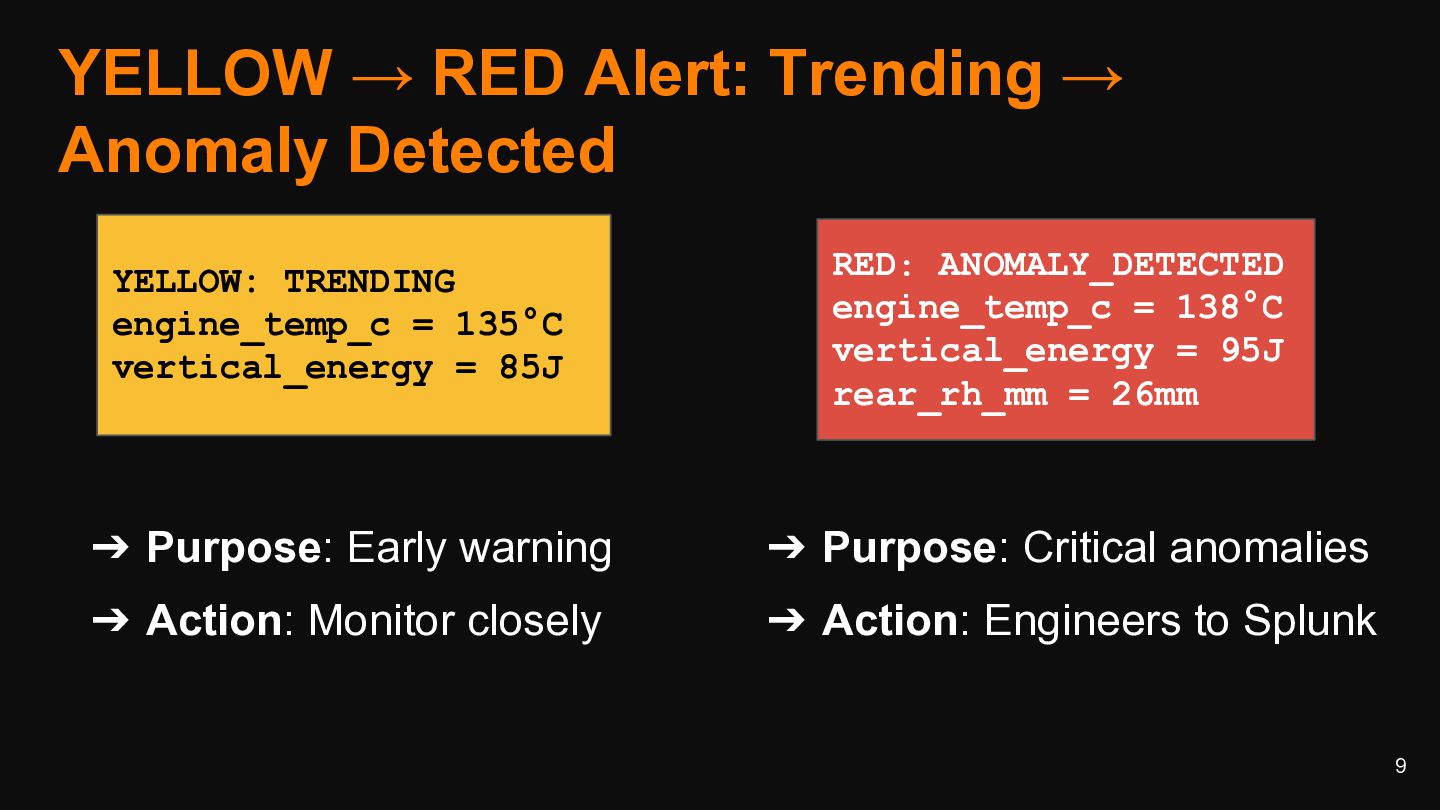
  9. YELLOW → RED Alert: Trending → Anomaly Detected YELLOW: TRENDING

    engine_temp_c = 135°C vertical_energy = 85J ➔ Purpose: Early warning ➔ Action: Monitor closely 9 RED: ANOMALY_DETECTED engine_temp_c = 138°C vertical_energy = 95J rear_rh_mm = 26mm ➔ Purpose: Critical anomalies ➔ Action: Engineers to Splunk
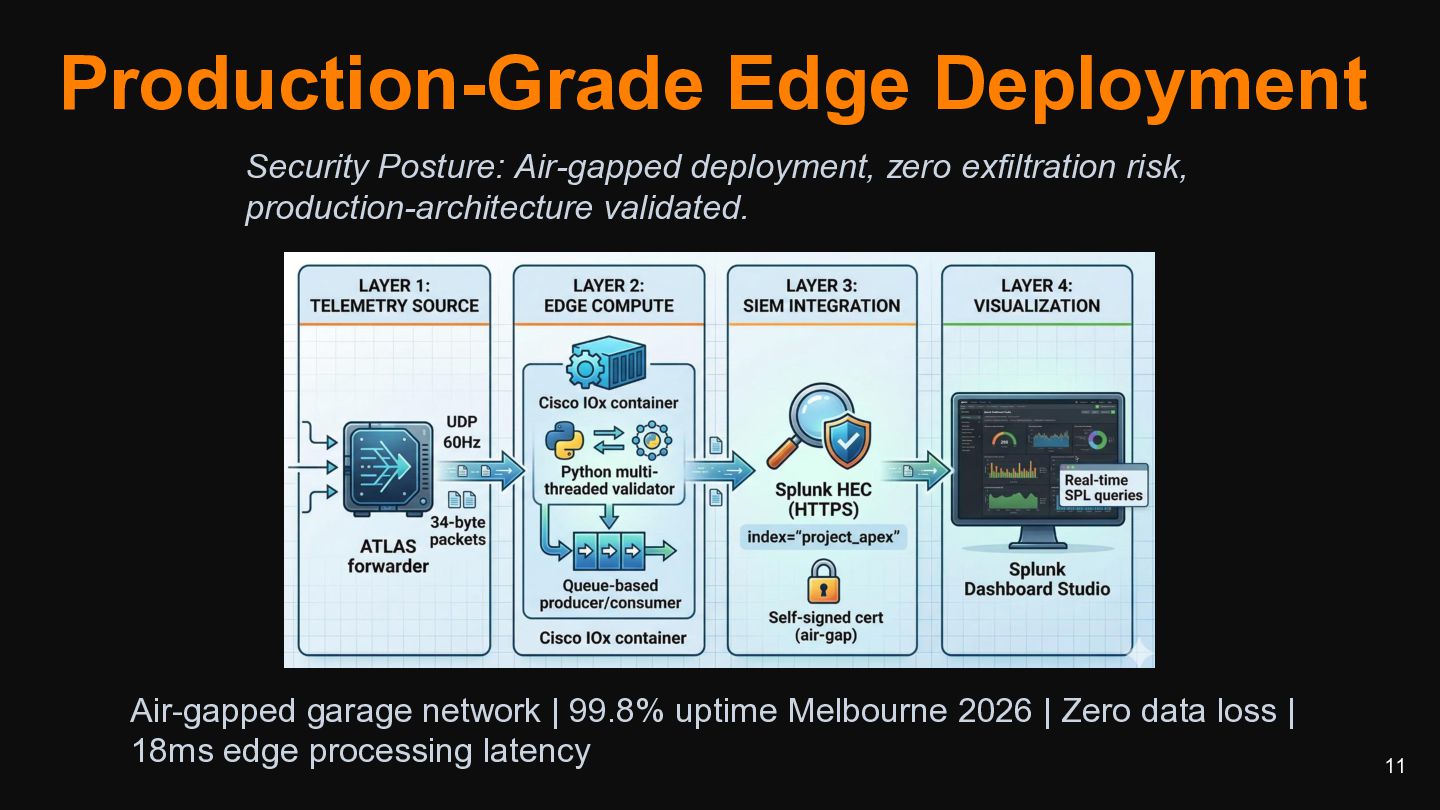
  10. Production-Grade Edge Deployment Air-gapped garage network | 99.8% uptime Melbourne

    2026 | Zero data loss | 18ms edge processing latency Security Posture: Air-gapped deployment, zero exfiltration risk, production-architecture validated. 11
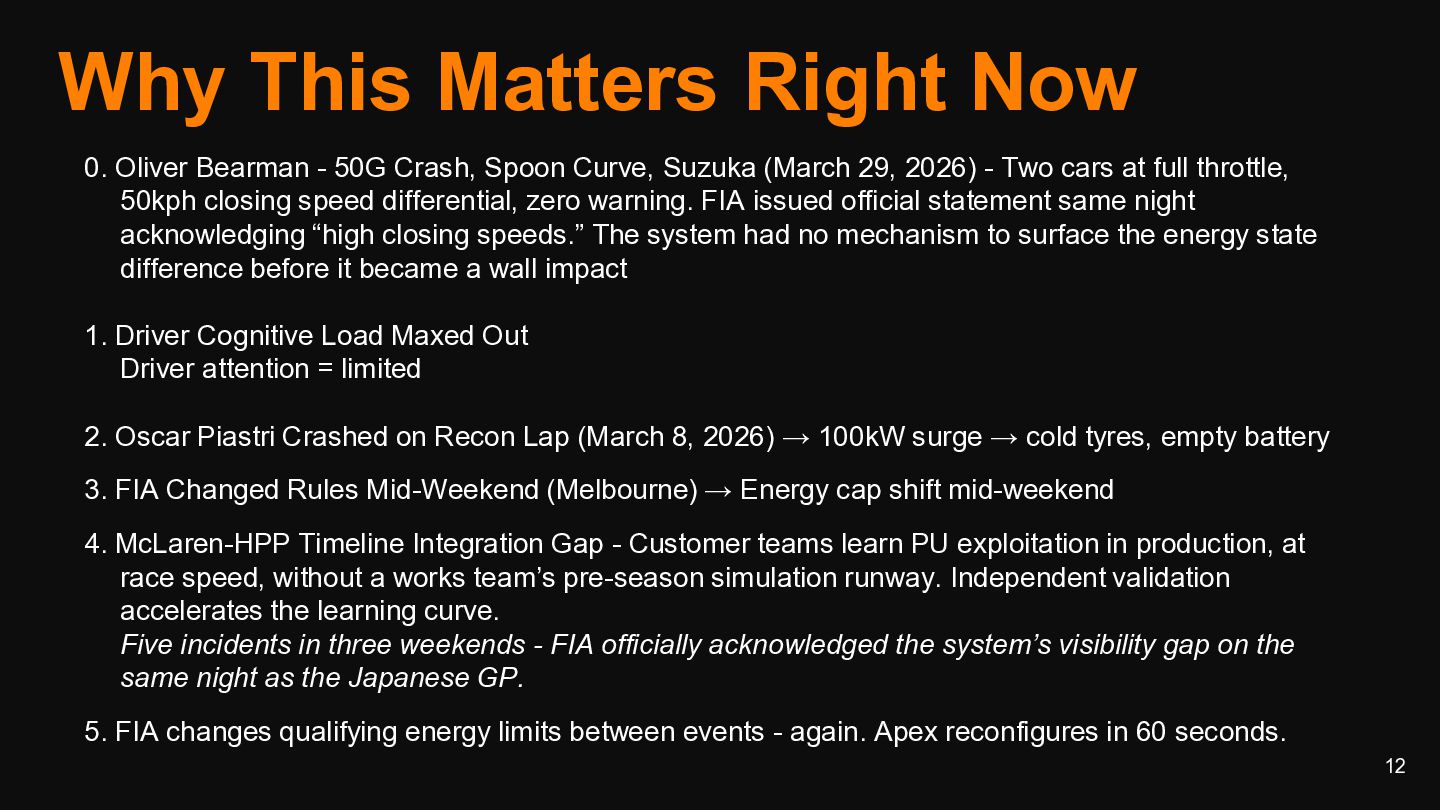
  11. Why This Matters Right Now 0. Oliver Bearman - 50G

    Crash, Spoon Curve, Suzuka (March 29, 2026) - Two cars at full throttle, 50kph closing speed differential, zero warning. FIA issued official statement same night acknowledging “high closing speeds.” The system had no mechanism to surface the energy state difference before it became a wall impact 1. Driver Cognitive Load Maxed Out Driver attention = limited 2. Oscar Piastri Crashed on Recon Lap (March 8, 2026) → 100kW surge → cold tyres, empty battery 3. FIA Changed Rules Mid-Weekend (Melbourne) → Energy cap shift mid-weekend 4. McLaren-HPP Timeline Integration Gap - Customer teams learn PU exploitation in production, at race speed, without a works team’s pre-season simulation runway. Independent validation accelerates the learning curve. Five incidents in three weekends - FIA officially acknowledged the system’s visibility gap on the same night as the Japanese GP. 5. FIA changes qualifying energy limits between events - again. Apex reconfigures in 60 seconds. 12
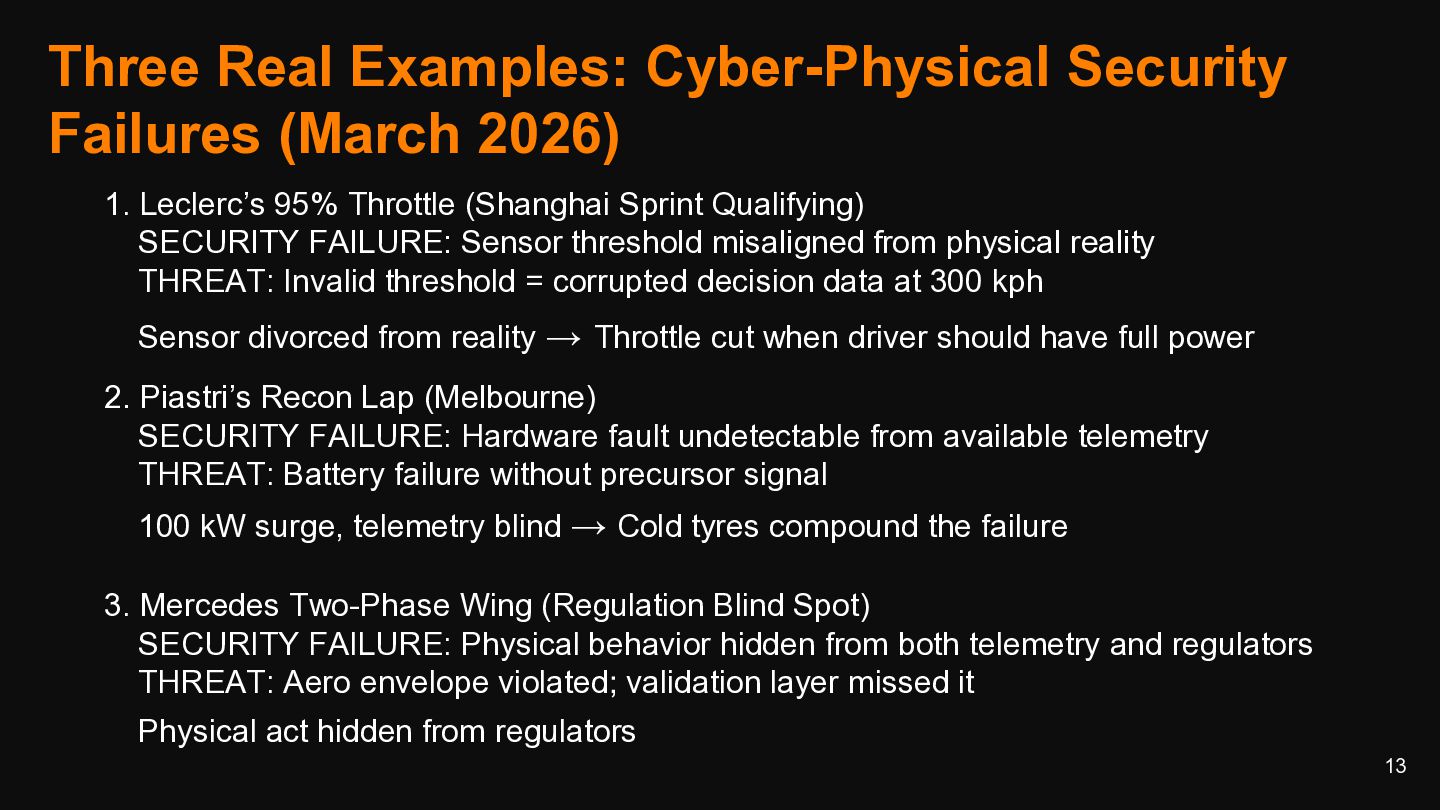
  12. Three Real Examples: Cyber-Physical Security Failures (March 2026) 1. Leclerc’s

    95% Throttle (Shanghai Sprint Qualifying) SECURITY FAILURE: Sensor threshold misaligned from physical reality THREAT: Invalid threshold = corrupted decision data at 300 kph Sensor divorced from reality → Throttle cut when driver should have full power 2. Piastri’s Recon Lap (Melbourne) SECURITY FAILURE: Hardware fault undetectable from available telemetry THREAT: Battery failure without precursor signal 100 kW surge, telemetry blind → Cold tyres compound the failure 3. Mercedes Two-Phase Wing (Regulation Blind Spot) SECURITY FAILURE: Physical behavior hidden from both telemetry and regulators THREAT: Aero envelope violated; validation layer missed it Physical act hidden from regulators 13
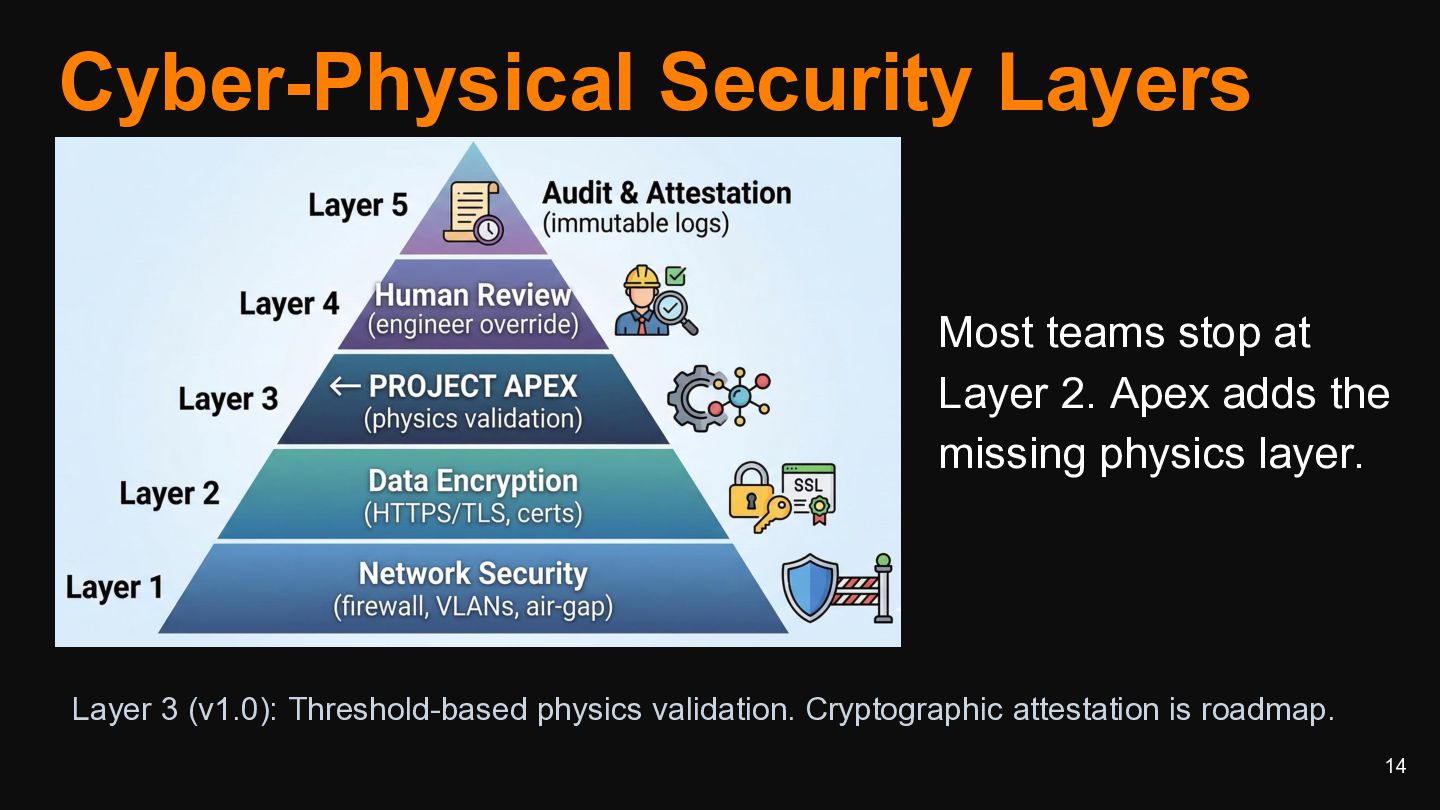
  13. Cyber-Physical Security Layers Most teams stop at Layer 2. Apex

    adds the missing physics layer. Layer 3 (v1.0): Threshold-based physics validation. Cryptographic attestation is roadmap. 14
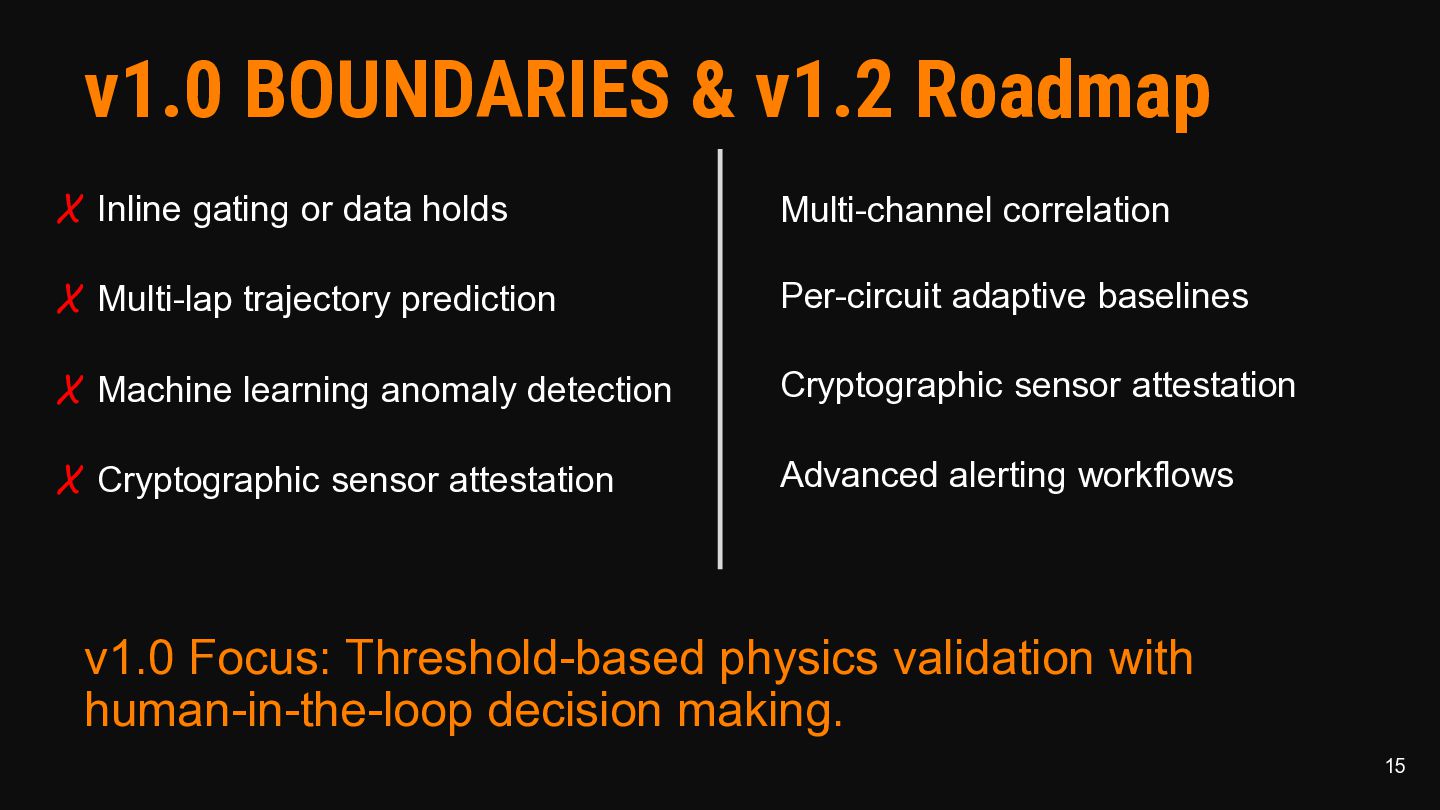
  14. v1.0 BOUNDARIES & v1.2 Roadmap X Inline gating or data

    holds X Multi-lap trajectory prediction X Machine learning anomaly detection X Cryptographic sensor attestation v1.0 Focus: Threshold-based physics validation with human-in-the-loop decision making. 15 Multi-channel correlation Per-circuit adaptive baselines Cryptographic sensor attestation Advanced alerting workflows
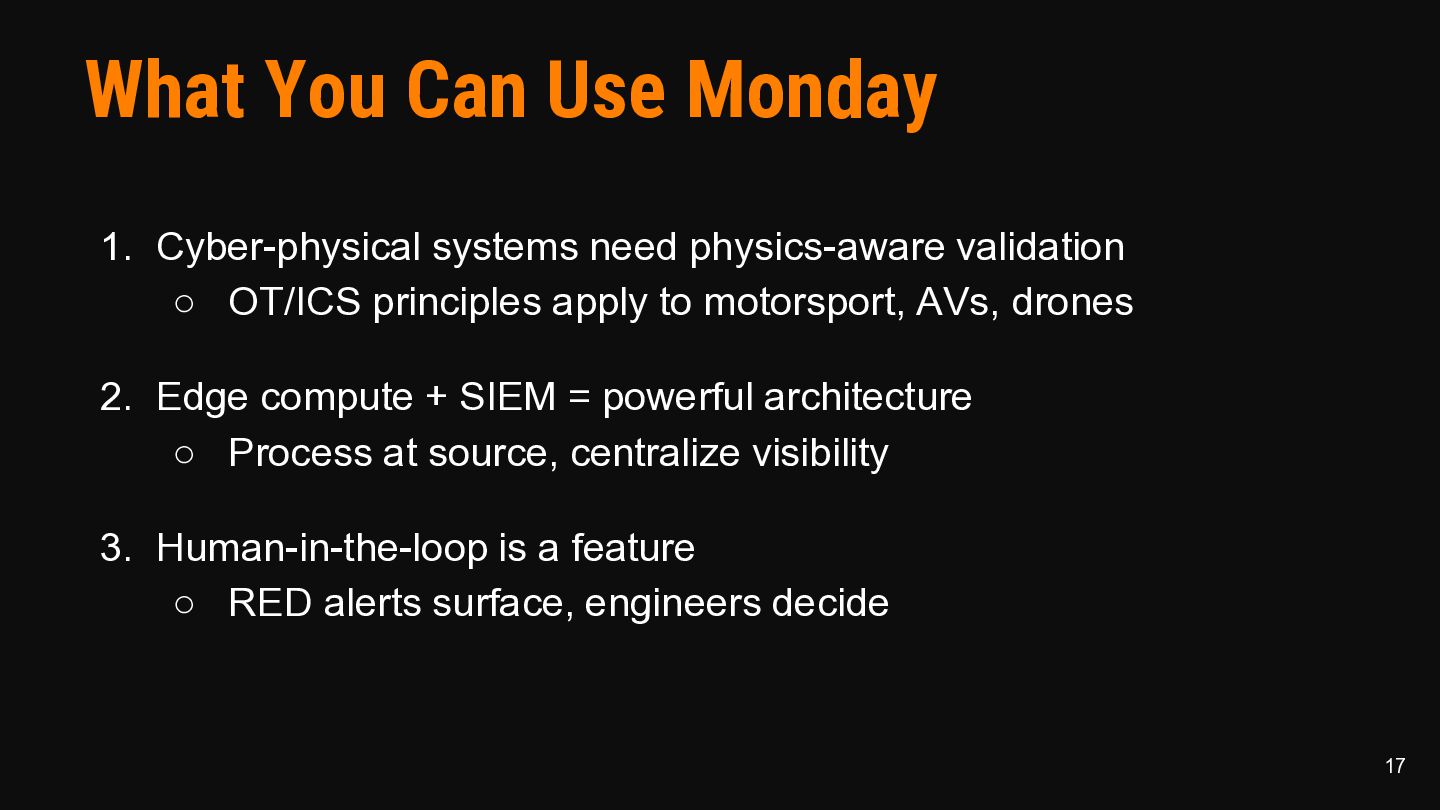
  15. What You Can Use Monday 1. Cyber-physical systems need physics-aware

    validation ◦ OT/ICS principles apply to motorsport, AVs, drones 2. Edge compute + SIEM = powerful architecture ◦ Process at source, centralize visibility 3. Human-in-the-loop is a feature ◦ RED alerts surface, engineers decide 17
  16. Let’s Talk Cyber-Physical Security • LinkedIn: /in/timharmon • GitHub: github.com/SecurityCyberGeek/project-apex-

    telemetry • Medium: Formula One Forever publication #BSidesSanDiego2026 #ProjectApex #CyberPhysical 18
  17. Thank You! 19 This work began with a simple question

    watching Formula 1: how do we make the fastest cars on earth safer through better data? Grateful for everyone who helped turn that question into Project Apex. • McLaren Racing - operational excellence • FIA University - motorsport technical education • Motorsport UK - marshal and safety training • Cisco IOx Team - edge compute platform • Splunk Community - SIEM best practices • BSides San Diego - platform to share