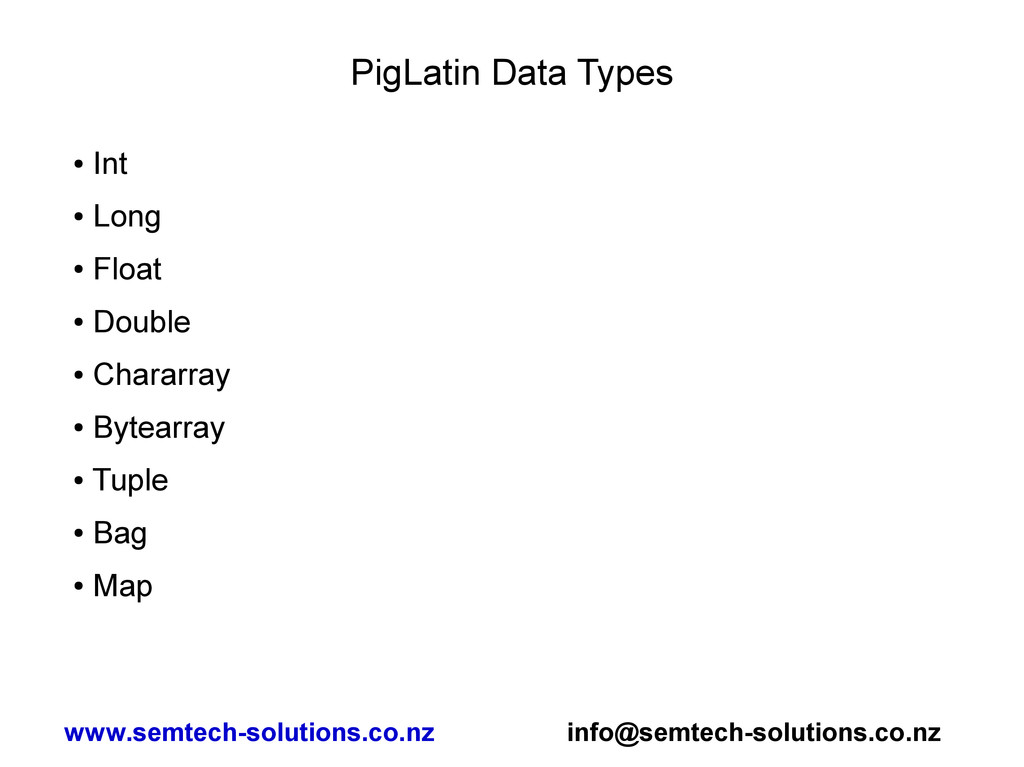
language • Used to analyse large data sets • Used to create MapReduce jobs • Abstracts definition of jobs • Uses Pig Latin to define jobs • Less code needed • Compiles to MapReduce code www.semtech-solutions.co.nz [email protected]
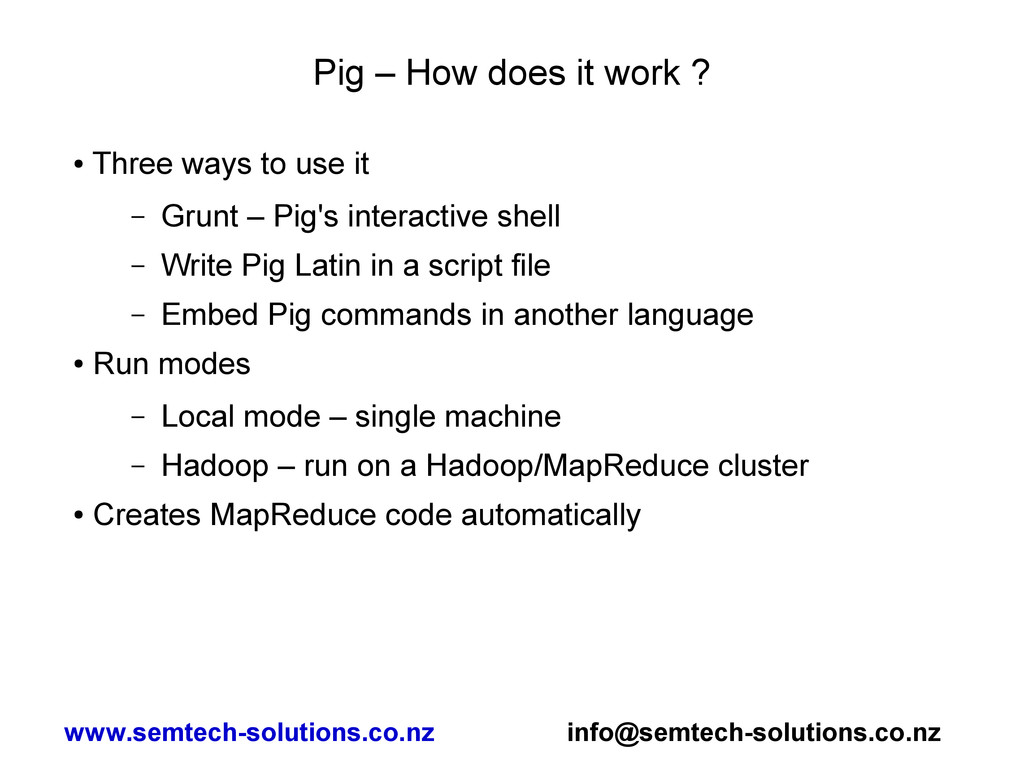
to use it – Grunt – Pig's interactive shell – Write Pig Latin in a script file – Embed Pig commands in another language • Run modes – Local mode – single machine – Hadoop – run on a Hadoop/MapReduce cluster • Creates MapReduce code automatically www.semtech-solutions.co.nz [email protected]
• It is data omnivorous • It is easy to learn • It is widely used • Minor performance loss – Compared to native code • It can be extended via user defined functions ( UDF ) www.semtech-solutions.co.nz [email protected]
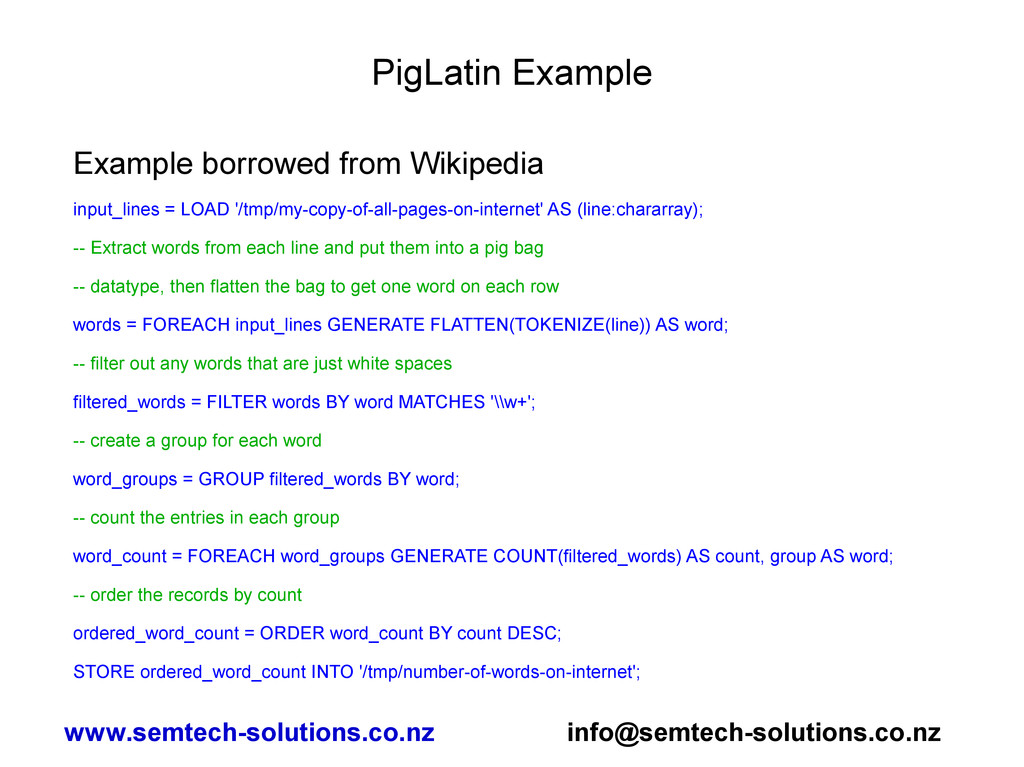
AS (line:chararray); -- Extract words from each line and put them into a pig bag -- datatype, then flatten the bag to get one word on each row words = FOREACH input_lines GENERATE FLATTEN(TOKENIZE(line)) AS word; -- filter out any words that are just white spaces filtered_words = FILTER words BY word MATCHES '\\w+'; -- create a group for each word word_groups = GROUP filtered_words BY word; -- count the entries in each group word_count = FOREACH word_groups GENERATE COUNT(filtered_words) AS count, group AS word; -- order the records by count ordered_word_count = ORDER word_count BY count DESC; STORE ordered_word_count INTO '/tmp/number-of-words-on-internet'; www.semtech-solutions.co.nz [email protected]
www.semtech-solutions.co.nz – [email protected] • We offer IT project consultancy • We are happy to hear about your problems • You can just pay for those hours that you need • To solve your problems

 SiteGround - Reliable hosting with speed, security, and support you can count on.


 semtechs
 rfdnxbro
 takahashim
 y0hgi
y0hgi
 ykanoh
 camiha
 onk
onk
 satoshi7
 tokuty
 kentarofujii
 akhino
 tetsuya28
 mohab1
 palkan
 jakevdp
 ivargrimstad
 codingconduct
 chikuwait
 dougneiner
 paigeccino
 tomoyanonymous
 nikkihalliwell
 rkendrick25
 aarron