Upgrade to Pro — share decks privately, control downloads, hide ads and more …

Ethics in AL

Ethics in AL

An AI code of ethics, also called an AI value platform, is a policy statement that formally defines the role of artificial intelligence as it applies to the continued development of the human race. The purpose of an AI code of ethics is to provide stakeholders with guidance when faced with an ethical decision regarding the use of artificial intelligence.

Avatar for ShivaniSharma1MAECO

ShivaniSharma1MAECO

April 15, 2022

Other Decks in Education

Transcript

  1. What are Ethics in AI? AI ethics is a system

    of moral principles and techniques intended to inform the development and responsible use of arti fi cial intelligence technology. As AI has become integral to products and services, organizations are starting to develop AI codes of ethics. An AI code of ethics, also called an AI value platform, is a policy statement that formally de fi nes the role of arti fi cial intelligence as it applies to the continued development of the human race. The purpose of an AI code of ethics is to provide stakeholders with guidance when faced with an ethical decision regarding the use of arti fi cial intelligence. The rapid advancement of AI in the past fi ve to 10 years has spurred groups of experts to develop safeguards for protecting against the risk of AI to humans. One such group is the nonpro fi t institute founded by MIT cosmologist Max Tegmark, Skype co-founder Jaan Tallinn and DeepMind research scientist Victoria Krakovna. The institute worked with AI researchers and developers as well as scholars from many disciplines to create the 23 guidelines now referred to as the Asilomar AI Principles.
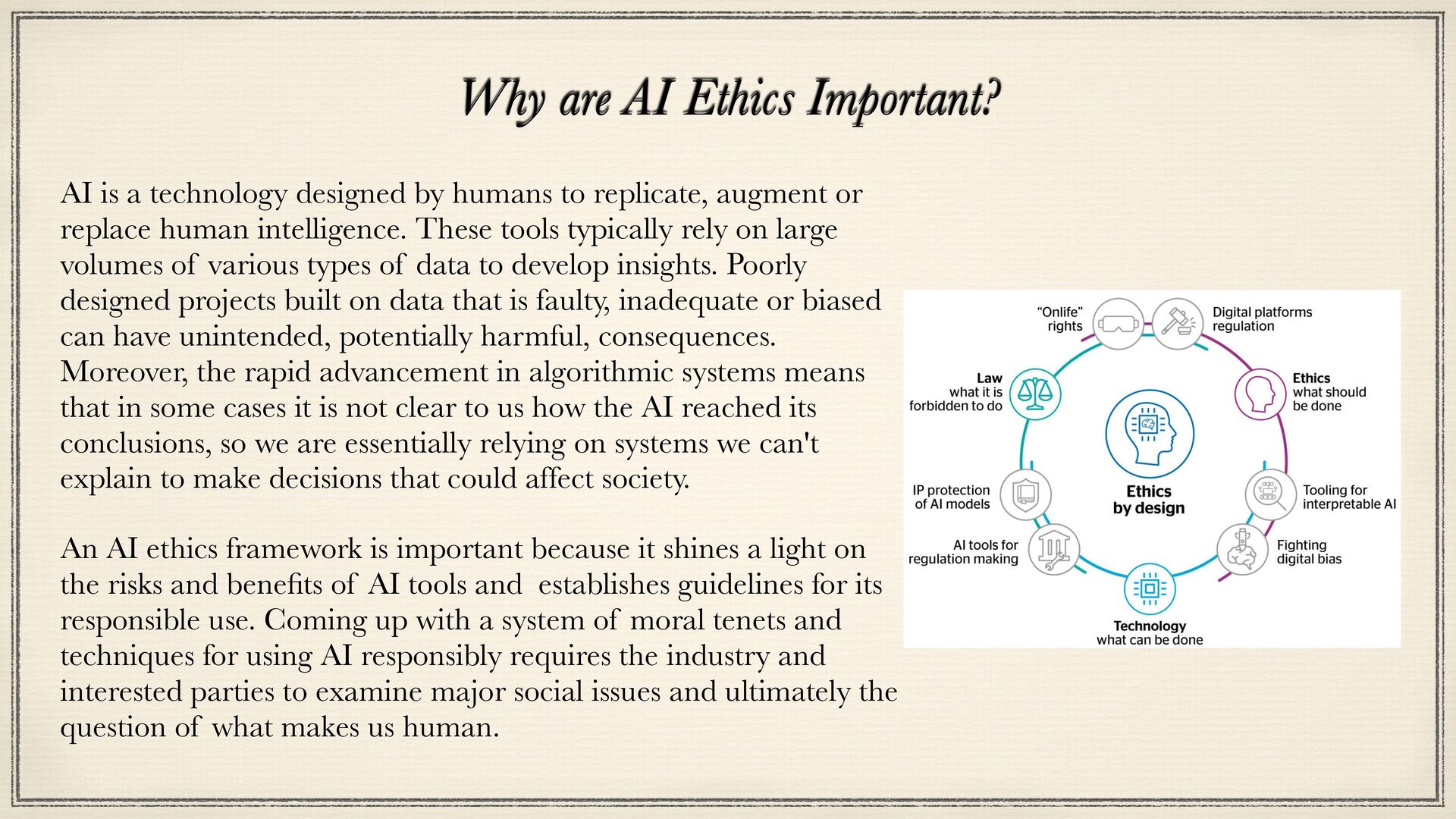
  2. Why are AI Ethics Important? AI is a technology designed

    by humans to replicate, augment or replace human intelligence. These tools typically rely on large volumes of various types of data to develop insights. Poorly designed projects built on data that is faulty, inadequate or biased can have unintended, potentially harmful, consequences. Moreover, the rapid advancement in algorithmic systems means that in some cases it is not clear to us how the AI reached its conclusions, so we are essentially relying on systems we can't explain to make decisions that could affect society. An AI ethics framework is important because it shines a light on the risks and bene fi ts of AI tools and establishes guidelines for its responsible use. Coming up with a system of moral tenets and techniques for using AI responsibly requires the industry and interested parties to examine major social issues and ultimately the question of what makes us human.
  3. What are the ethical challenges of AI? Explainability : When

    AI systems go awry, teams need to be able to trace through a complex chain of algorithmic systems and data processes to fi nd out why. Organizations using AI should be able to explain the source data, resulting data, what their algorithms do and why they are doing that. "AI needs to have a strong degree of traceability to ensure that if harms arise, they can be traced back to the cause," said Adam Wisniewski, CTO and co-founder of AI Clearing. Responsibility : Society is still sorting out responsibility when decisions made by AI systems have catastrophic consequences, including loss of capital, health or life. Responsibility for the consequences of AI-based decisions needs to be sorted out in a process that includes lawyers, regulators and citizens. One challenge is fi nding the appropriate balance in cases where an AI system may be safer than the human activity it is duplicating but still causes problems, such as weighing the merits of autonomous driving systems that cause fatalities but far fewer than people do.
  4. Fairness : In data sets involving personally identi fi able

    information, it is extremely important to ensure that there are no biases in terms of race, gender or ethnicity. Misuse : AI algorithms may be used for purposes other than those for which they were created. Wisniewski said these scenarios should be analyzed at the design stage to minimize the risks and introduce safety measures to reduce the adverse effects in such cases
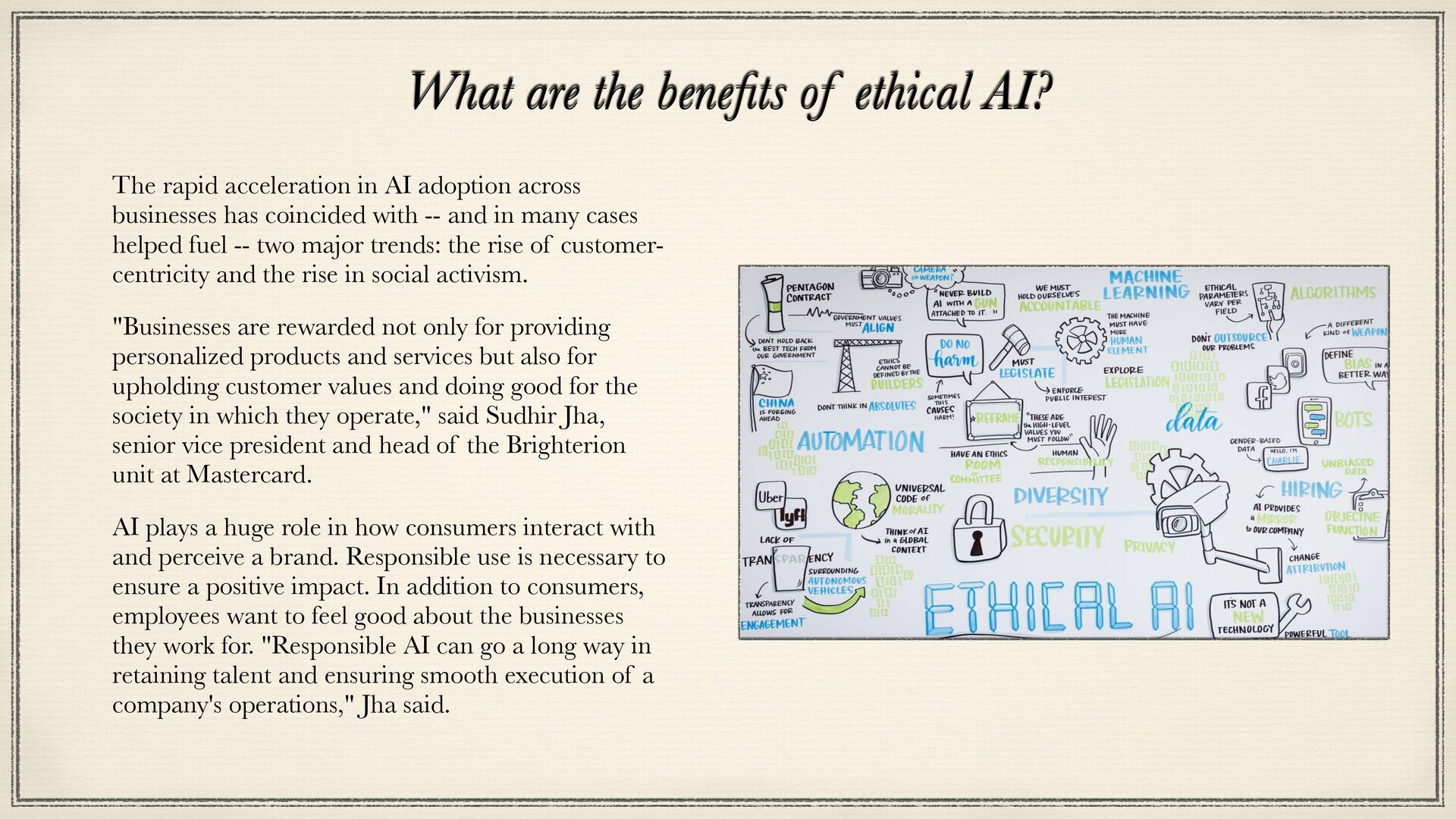
  5. What are the bene fi ts of ethical AI? The

    rapid acceleration in AI adoption across businesses has coincided with -- and in many cases helped fuel -- two major trends: the rise of customer- centricity and the rise in social activism. "Businesses are rewarded not only for providing personalized products and services but also for upholding customer values and doing good for the society in which they operate," said Sudhir Jha, senior vice president and head of the Brighterion unit at Mastercard. AI plays a huge role in how consumers interact with and perceive a brand. Responsible use is necessary to ensure a positive impact. In addition to consumers, employees want to feel good about the businesses they work for. "Responsible AI can go a long way in retaining talent and ensuring smooth execution of a company's operations," Jha said.
  6. What is an AI code of ethics? A proactive approach

    to ensuring ethical AI requires addressing three key areas, according to Jason Shepherd, vice president of ecosystem at Zededa, an edge AI tools provider Policy This includes developing the appropriate framework for driving standardization and establishing regulations. Efforts like the Asilomar AI Principles are essential to start the conversation, and there are several efforts spinning up around policy in Europe, the U.S. and elsewhere. Ethical AI policies also need to address how to deal with legal issues when something goes wrong. Companies may incorporate AI policies into their own code of conduct. But effectiveness will depend on employees following the rules, which may not always be realistic when money or prestige are on the line.
  7. Education : Executives, data scientists, front-line employees and consumers all

    need to understand policies, key considerations and potential negative impacts of unethical AI and fake data. One big concern is the tradeoff between ease of use around data sharing and AI automation and the potential negative repercussions of oversharing or adverse automations. "Ultimately, consumers' willingness to proactively take control of their data and pay attention to potential threats enabled by AI is a complex equation based on a combination of instant grati fi cation, value, perception and risk," Shepherd said. Technology : Executives also need to architect AI systems to automatically detect fake data and unethical behavior. This requires not just looking at a company's own AI but vetting suppliers and partners for the malicious use of AI. Examples include the deployment of deep fake videos and text to undermine a competitor, or the use of AI to launch sophisticated cyberattacks. This will become more of an issue as AI tools become commoditized. To combat this potential snowball effect, organizations need to invest in defensive measures rooted in open, transparent and trusted AI infrastructure. Shepherd believes this will give rise to the adoption of trust fabrics that provide a system-level approach to automating privacy assurance, ensuring data con fi dence and detecting unethical use of AI.
  8. Examples of AI codes of ethics An AI code of

    ethics can spell out the principles and provide the motivation that drives appropriate behavior. For example, Mastercard's Jha said he is currently working with the following tenets to help develop the company's current AI code of ethics: An ethical AI system must be inclusive, explainable, have a positive purpose and use data responsibly. An inclusive AI system is unbiased and works equally well across all spectra of society. This requires full knowledge of each data source used to train the AI models in order to ensure no inherent bias in the data set. It also requires a careful audit of the trained model to fi lter any problematic attributes learned in the process. And the models need to be closely monitored to ensure no corruption occurs in the future as well. An explainable AI system supports the governance required of companies to ensure the ethical use of AI. It is hard to be con fi dent in the actions of a system that cannot be explained. Attaining con fi dence might entail a tradeoff in which a small compromise in model performance is made in order to select an algorithm that can be explained.
  9. An AI system endowed with a positive purpose aims to,

    for example, reduce fraud, eliminate waste, reward people, slow climate change, cure disease, etc. Any technology can be used for doing harm, but it is imperative that we think of ways to safeguard AI from being exploited for bad purposes. This will be a tough challenge, but given the wide scope and scale of AI, the risk of not addressing this challenge and misusing this technology is far greater than ever before. An AI system that uses data responsibly observes data privacy rights. Data is key to an AI system, and often more data results in better models. However, it is critical that in the race to collect more and more data, people's right to privacy and transparency isn't sacri fi ced. Responsible collection, management and use of data is essential to creating an AI system that can be trusted. In an ideal world, data should only be collected when needed, not continuously, and the granularity of data should be as narrow as possible. For example, if an application only needs zip code-level geolocation data to provide weather prediction, it shouldn't collect the exact location of the consumer. And the system should routinely delete data that is no longer required.
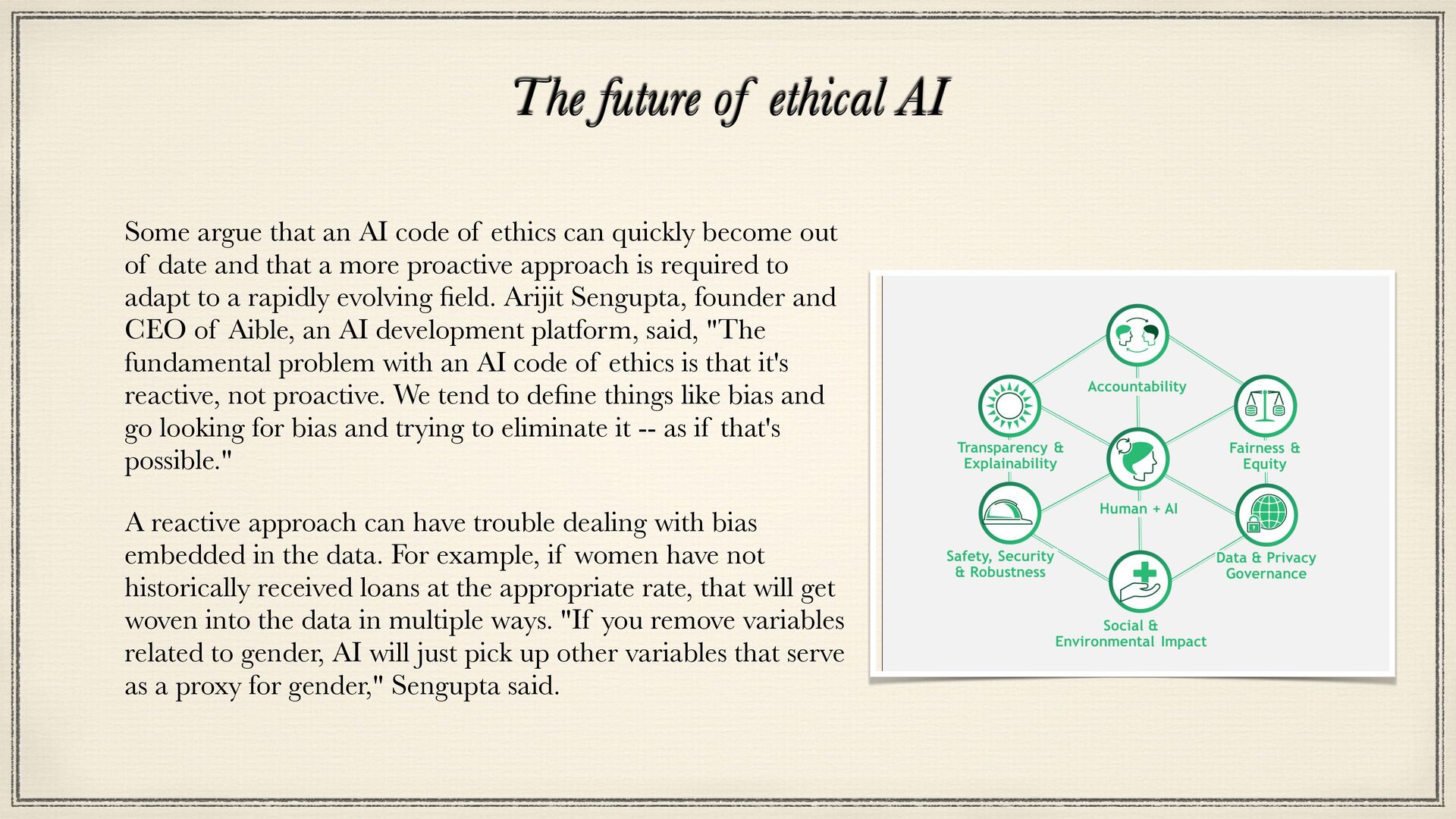
  10. The future of ethical AI Some argue that an AI

    code of ethics can quickly become out of date and that a more proactive approach is required to adapt to a rapidly evolving fi eld. Arijit Sengupta, founder and CEO of Aible, an AI development platform, said, "The fundamental problem with an AI code of ethics is that it's reactive, not proactive. We tend to de fi ne things like bias and go looking for bias and trying to eliminate it -- as if that's possible." A reactive approach can have trouble dealing with bias embedded in the data. For example, if women have not historically received loans at the appropriate rate, that will get woven into the data in multiple ways. "If you remove variables related to gender, AI will just pick up other variables that serve as a proxy for gender," Sengupta said.