Upgrade to Pro — share decks privately, control downloads, hide ads and more …

Solo iOS Growth Diary — Vol. 13: Year One in Nu...

Solo iOS Growth Diary — Vol. 13: Year One in Numbers (Solo iOS Retrospective)

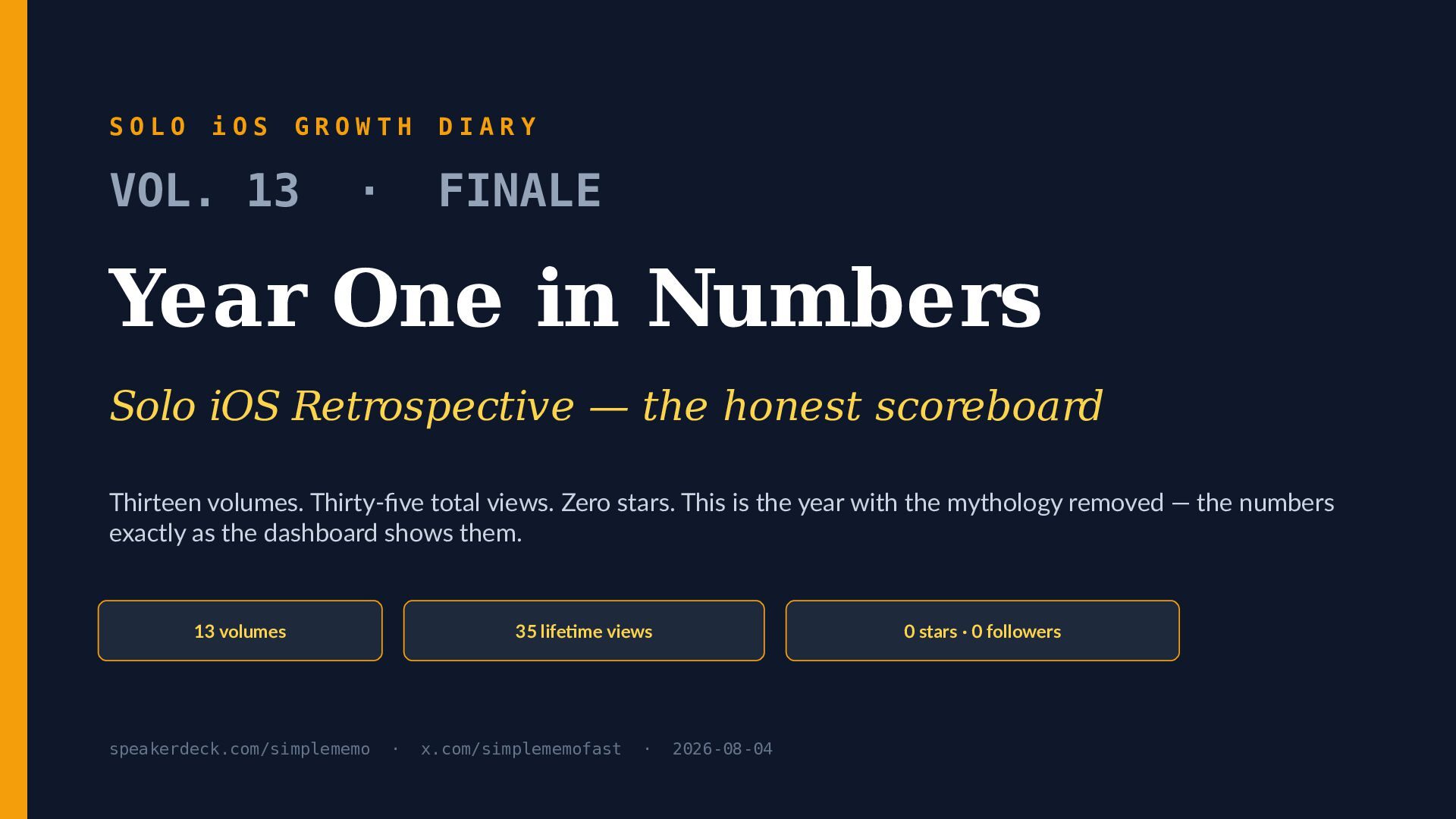
Year One in Numbers is the finale of Solo iOS Growth Diary — a solo iOS developer's honest one-year retrospective, told through the scoreboard most "build in public" write-ups quietly delete. The unrounded totals, measured on the live profile: 13 volumes published, 35 lifetime views across every deck, 0 stars, 0 followers, and 0 off-platform shares in 52 weeks.

And, at the same time, a product that got better: four features shipped in 2026 — on-device voice input (Apple SpeechAnalyzer), Apple Watch support, AI tags, and an Obsidian integration — plus a 4.4/5 App Store rating, a ~1-second median cold start, and 0 servers to run.

The deck keeps those two scoreboards apart — reach vs. product, vanity vs. real — and asks why the writing never compounded on Speaker Deck: no feed, no comments, no way for a reader to reply or share. It answers four hard questions in the open: isn't a solo retrospective just survivorship bias? if it failed, why publish the numbers? don't 35 views mean the content was bad? should you have quit at Vol. 5? Then it lays out what changes next — native distribution over a silent archive, monthly cadence over weekly volume, one named reader over "search" — with a reusable retrospective template and a 10-point honesty checklist.

Topics: solo dev retrospective, indie iOS numbers, build in public, iOS solo founder, honest metrics. Solo iOS Growth Diary, Vol. 1–13 — complete.

Archive: speakerdeck.com/simplememo · Conversation: x.com/simplememofast · The app: simplememofast.com

Avatar for SimpleMemo

SimpleMemo

August 04, 2026

More Decks by SimpleMemo

Other Decks in Programming

Transcript

  1. SOLO iOS GROWTH VOL. 13 · DIARY FINALE Year One

    in Numbers Solo iOS Retrospective — the honest scoreboard Thirteen volumes. Thirty-five total views. Zero stars. This is the year with the mythology removed — the numbers exactly as the dashboard shows them. 13 volumes speakerdeck.com/simplememo 35 lifetime views · x.com/simplememofast · 0 stars · 0 followers 2026-08-04
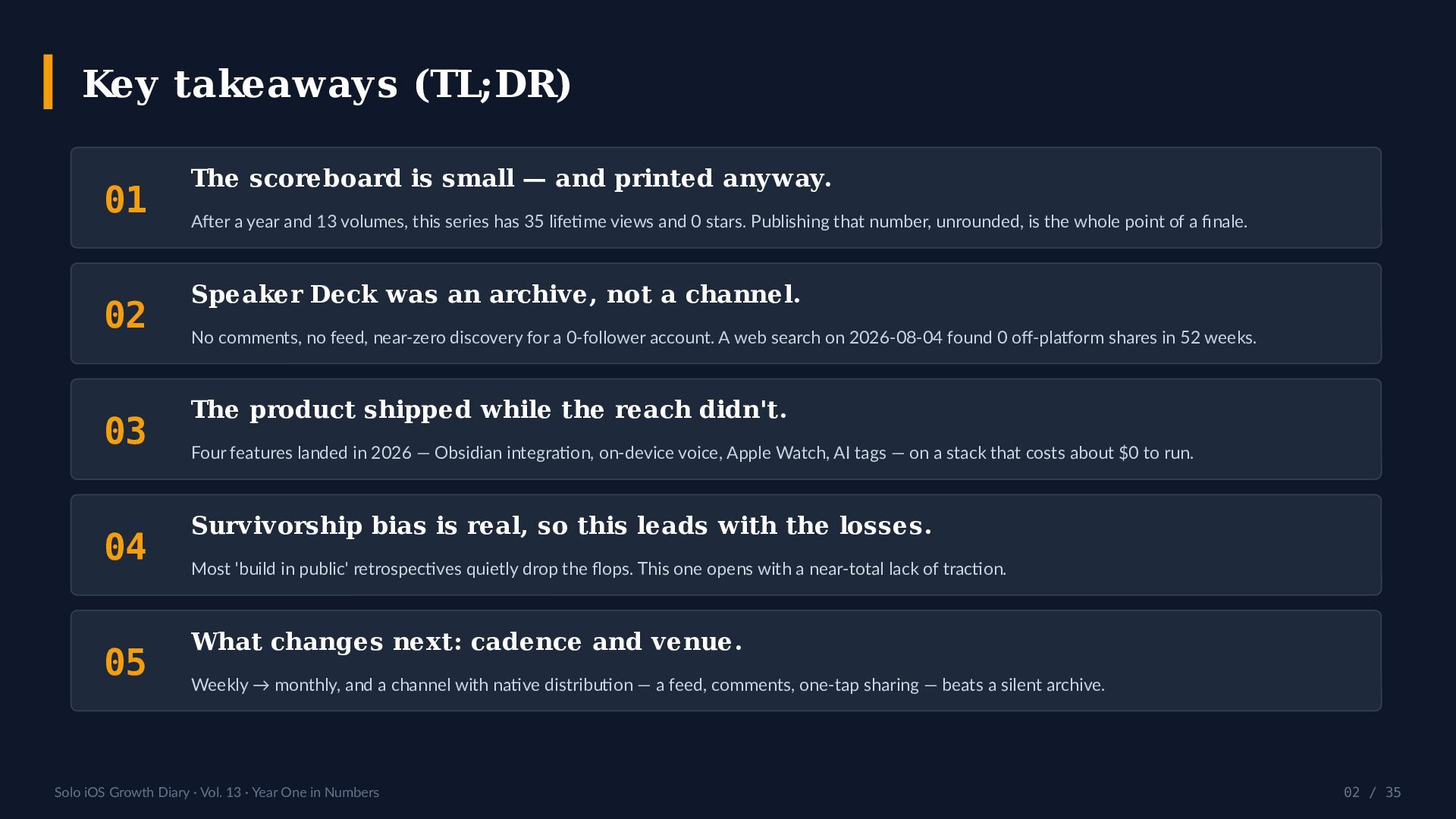
  2. Key takeaways (TL;DR) 01 02 03 04 05 The scoreboard

    is small — and printed anyway. After a year and 13 volumes, this series has 35 lifetime views and 0 stars. Publishing that number, unrounded, is the whole point of a finale. Speaker Deck was an archive, not a channel. No comments, no feed, near-zero discovery for a 0-follower account. A web search on 2026-08-04 found 0 off-platform shares in 52 weeks. The product shipped while the reach didn't. Four features landed in 2026 — Obsidian integration, on-device voice, Apple Watch, AI tags — on a stack that costs about $0 to run. Survivorship bias is real, so this leads with the losses. Most 'build in public' retrospectives quietly drop the flops. This one opens with a near-total lack of traction. What changes next: cadence and venue. Weekly → monthly, and a channel with native distribution — a feed, comments, one-tap sharing — beats a silent archive. Solo iOS Growth Diary · Vol. 13 · Year One in Numbers 02 / 35
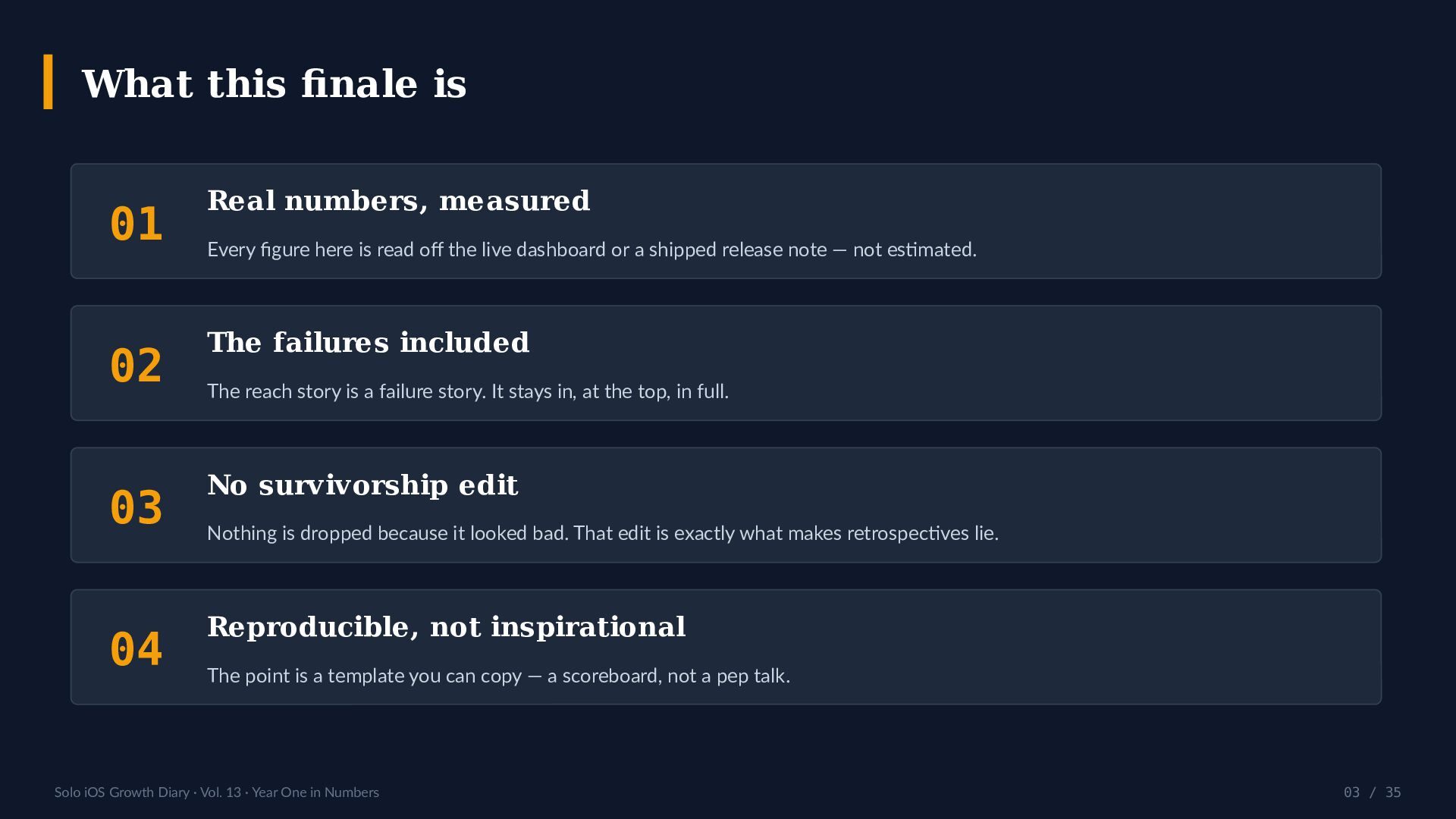
  3. What this finale is 01 Real numbers, measured 02 The

    failures included 03 No survivorship edit 04 Reproducible, not inspirational Every figure here is read off the live dashboard or a shipped release note — not estimated. The reach story is a failure story. It stays in, at the top, in full. Nothing is dropped because it looked bad. That edit is exactly what makes retrospectives lie. The point is a template you can copy — a scoreboard, not a pep talk. Solo iOS Growth Diary · Vol. 13 · Year One in Numbers 03 / 35
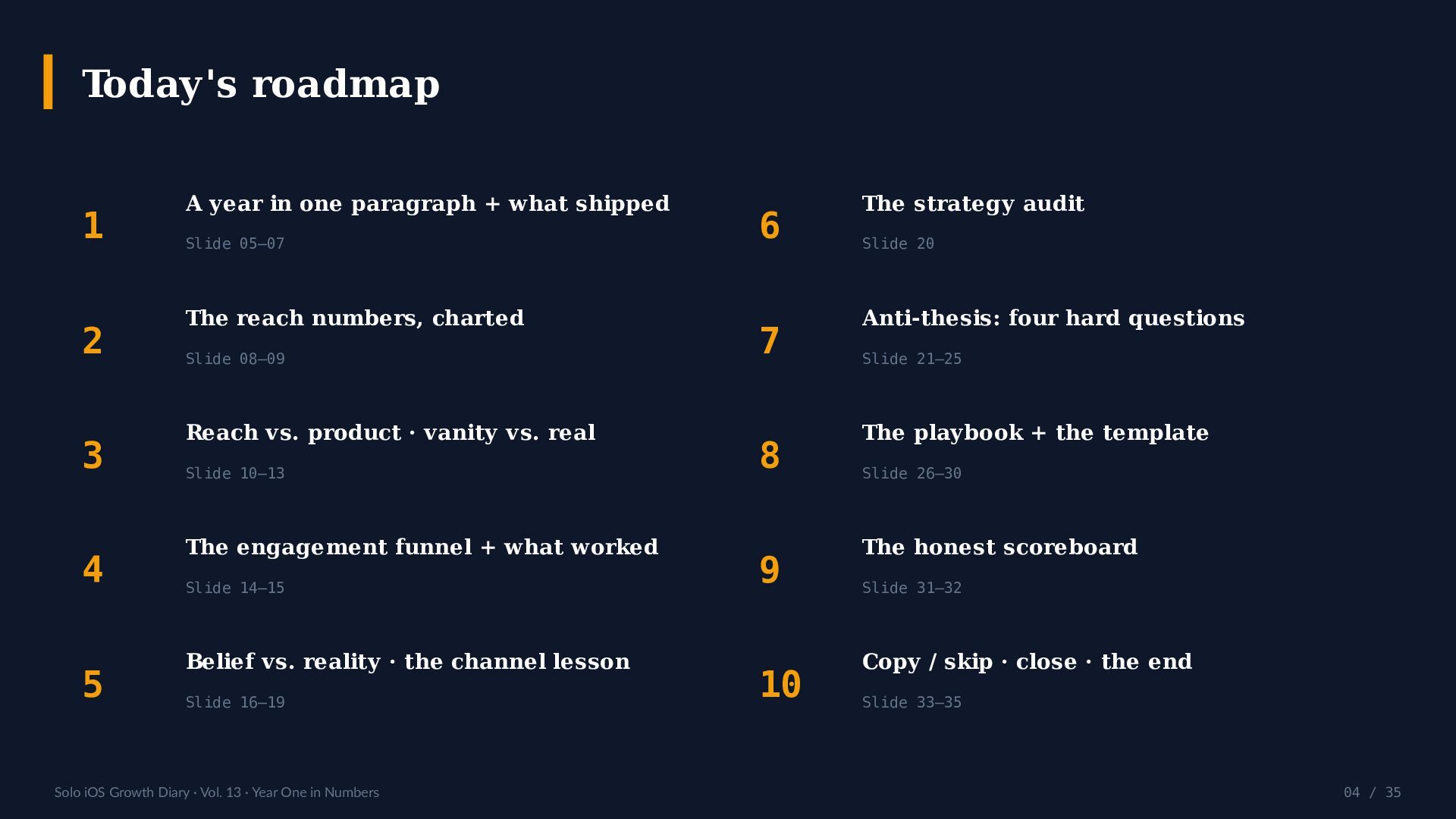
  4. Today's roadmap 1 2 3 4 5 A year in

    one paragraph + what shipped Slide 05–07 The reach numbers, charted Slide 08–09 Reach vs. product · vanity vs. real Slide 10–13 The engagement funnel + what worked Slide 14–15 Belief vs. reality · the channel lesson Slide 16–19 Solo iOS Growth Diary · Vol. 13 · Year One in Numbers 6 7 8 9 10 The strategy audit Slide 20 Anti-thesis: four hard questions Slide 21–25 The playbook + the template Slide 26–30 The honest scoreboard Slide 31–32 Copy / skip · close · the end Slide 33–35 04 / 35
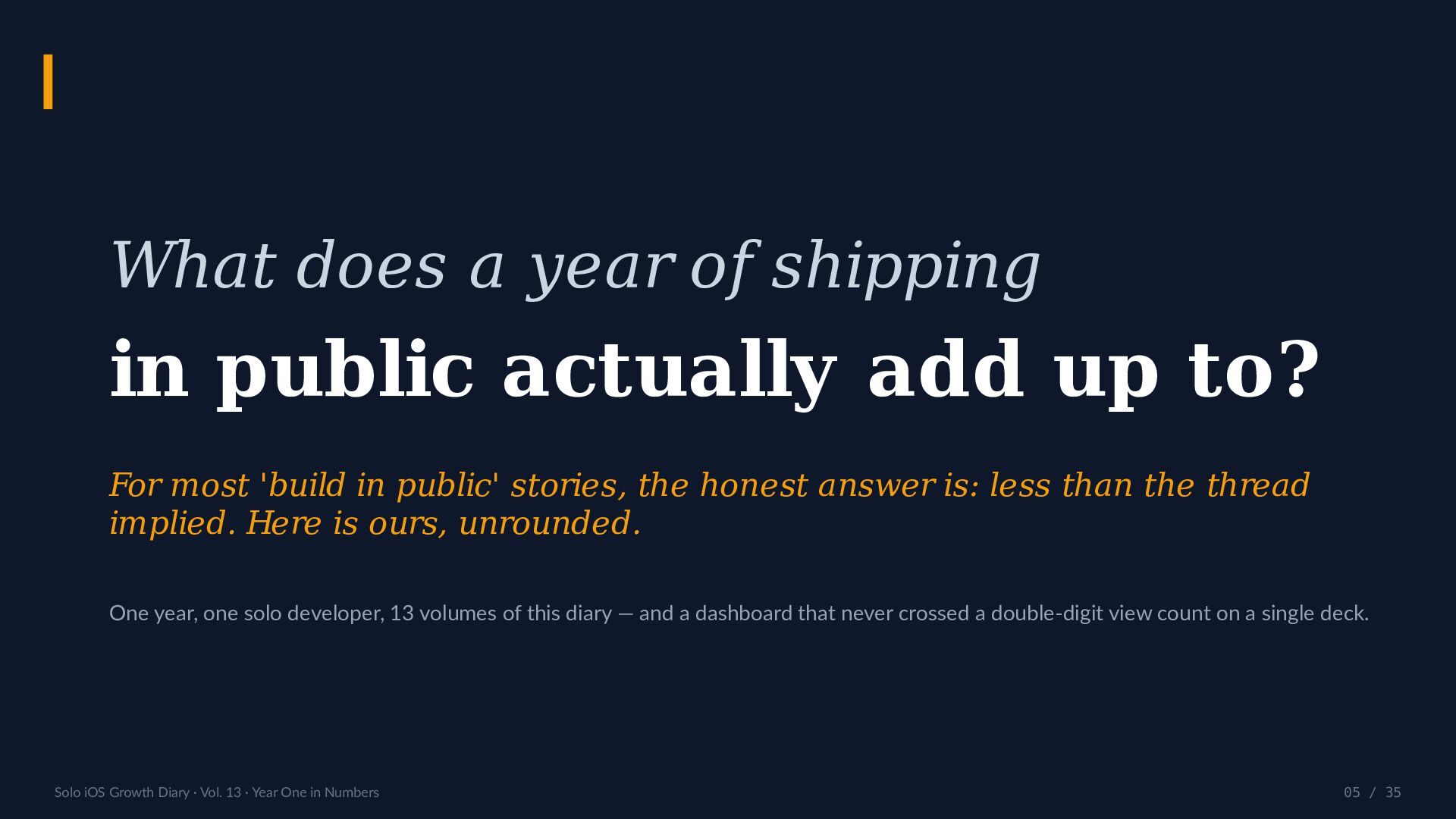
  5. What does a year of shipping in public actually add

    up to? For most 'build in public' stories, the honest answer is: less than the thread implied. Here is ours, unrounded. One year, one solo developer, 13 volumes of this diary — and a dashboard that never crossed a double-digit view count on a single deck. Solo iOS Growth Diary · Vol. 13 · Year One in Numbers 05 / 35
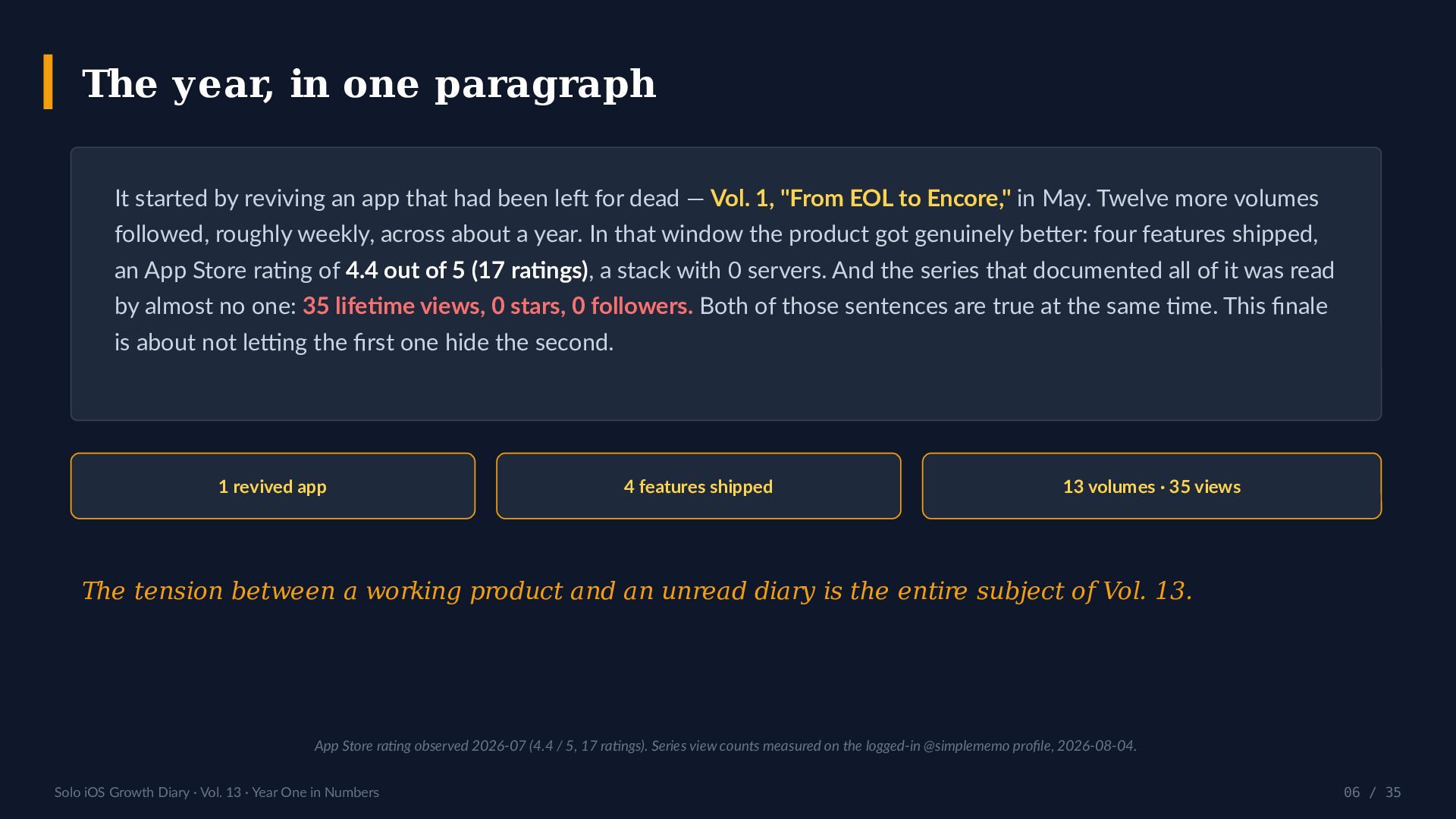
  6. The year, in one paragraph It started by reviving an

    app that had been left for dead — Vol. 1, "From EOL to Encore," in May. Twelve more volumes followed, roughly weekly, across about a year. In that window the product got genuinely better: four features shipped, an App Store rating of 4.4 out of 5 (17 ratings), a stack with 0 servers. And the series that documented all of it was read by almost no one: 35 lifetime views, 0 stars, 0 followers. Both of those sentences are true at the same time. This finale is about not letting the first one hide the second. 1 revived app 4 features shipped 13 volumes · 35 views The tension between a working product and an unread diary is the entire subject of Vol. 13. App Store rating observed 2026-07 (4.4 / 5, 17 ratings). Series view counts measured on the logged-in @simplememo profile, 2026-08-04. Solo iOS Growth Diary · Vol. 13 · Year One in Numbers 06 / 35
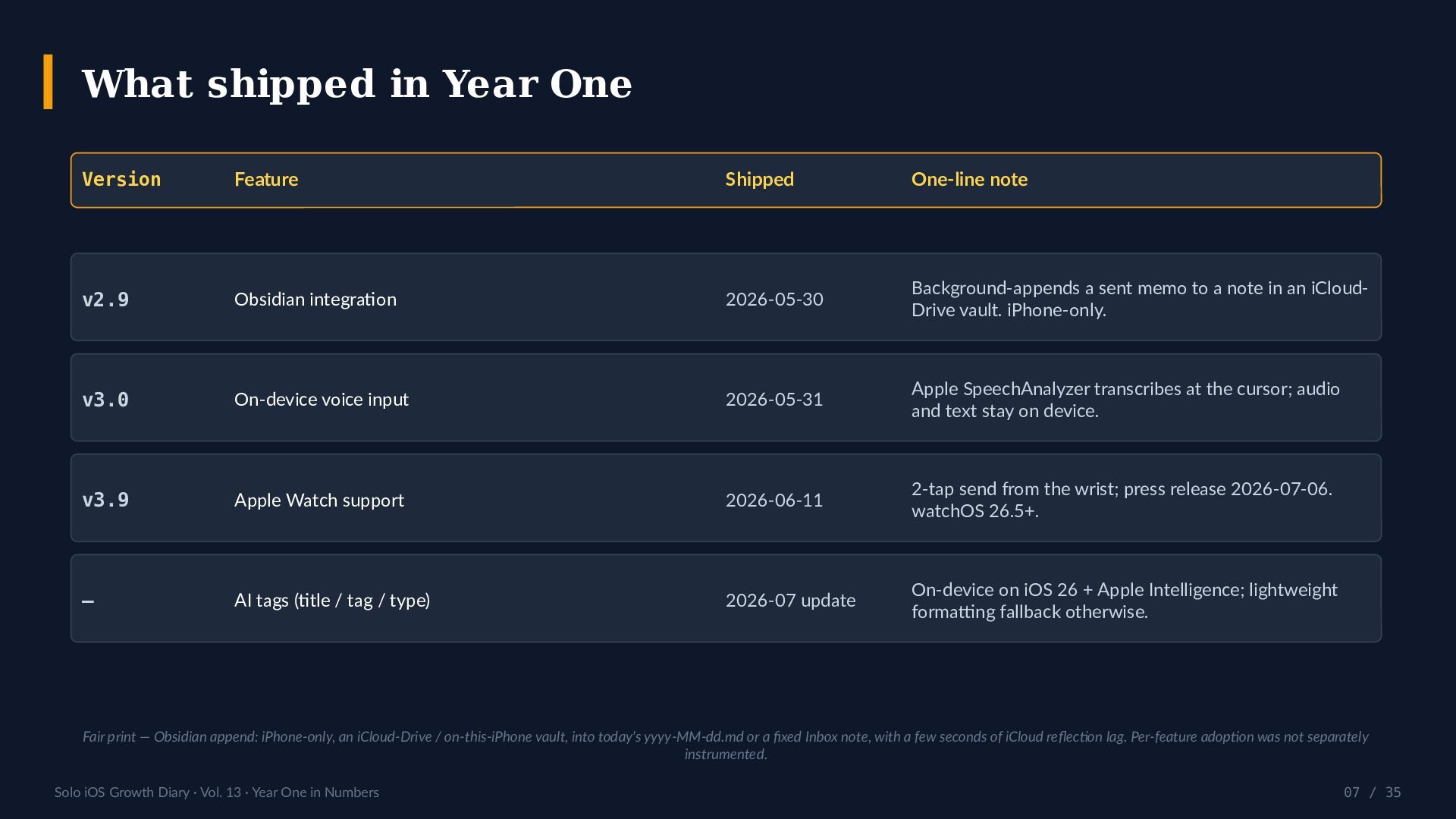
  7. What shipped in Year One Version Feature Shipped One-line note

    v2.9 Obsidian integration 2026-05-30 Background-appends a sent memo to a note in an iCloudDrive vault. iPhone-only. v3.0 On-device voice input 2026-05-31 Apple SpeechAnalyzer transcribes at the cursor; audio and text stay on device. v3.9 Apple Watch support 2026-06-11 2-tap send from the wrist; press release 2026-07-06. watchOS 26.5+. — AI tags (title / tag / type) 2026-07 update On-device on iOS 26 + Apple Intelligence; lightweight formatting fallback otherwise. Fair print — Obsidian append: iPhone-only, an iCloud-Drive / on-this-iPhone vault, into today's yyyy-MM-dd.md or a fixed Inbox note, with a few seconds of iCloud reflection lag. Per-feature adoption was not separately instrumented. Solo iOS Growth Diary · Vol. 13 · Year One in Numbers 07 / 35
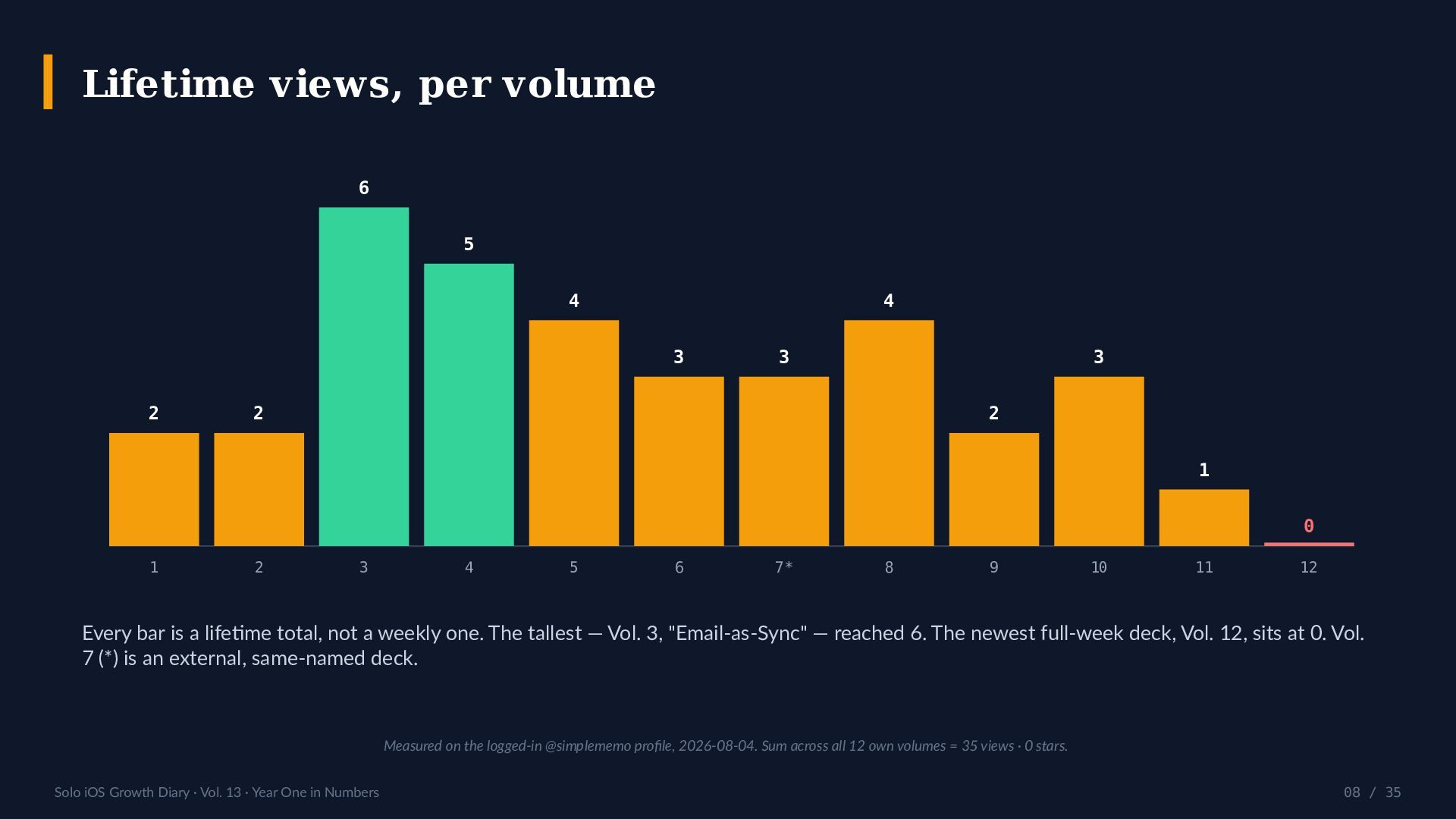
  8. Lifetime views, per volume 6 5 4 4 3 2

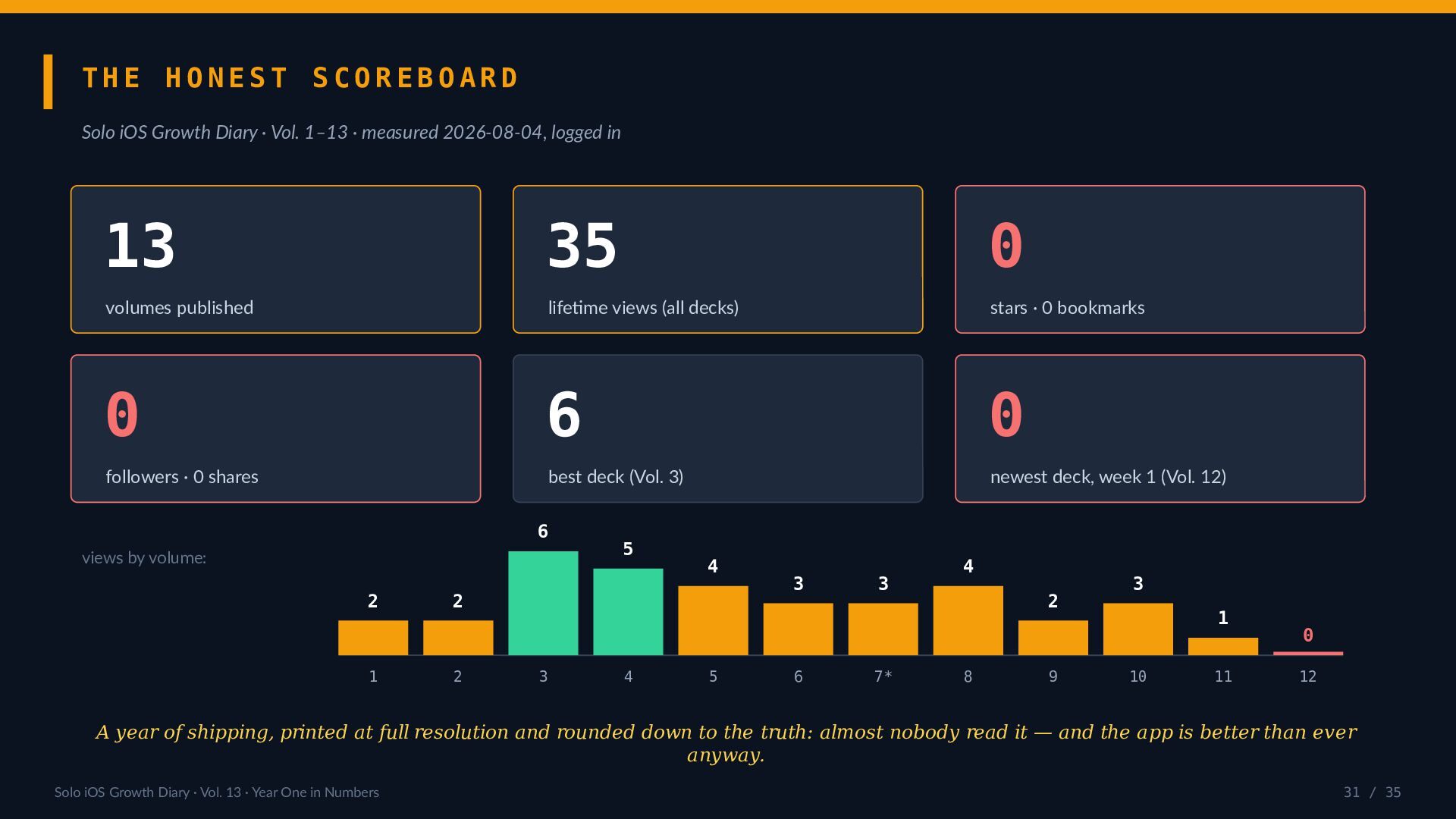
    3 3 2 2 1 0 1 2 3 4 5 6 7* 8 9 10 11 12 Every bar is a lifetime total, not a weekly one. The tallest — Vol. 3, "Email-as-Sync" — reached 6. The newest full-week deck, Vol. 12, sits at 0. Vol. 7 (*) is an external, same-named deck. Measured on the logged-in @simplememo profile, 2026-08-04. Sum across all 12 own volumes = 35 views · 0 stars. Solo iOS Growth Diary · Vol. 13 · Year One in Numbers 08 / 35
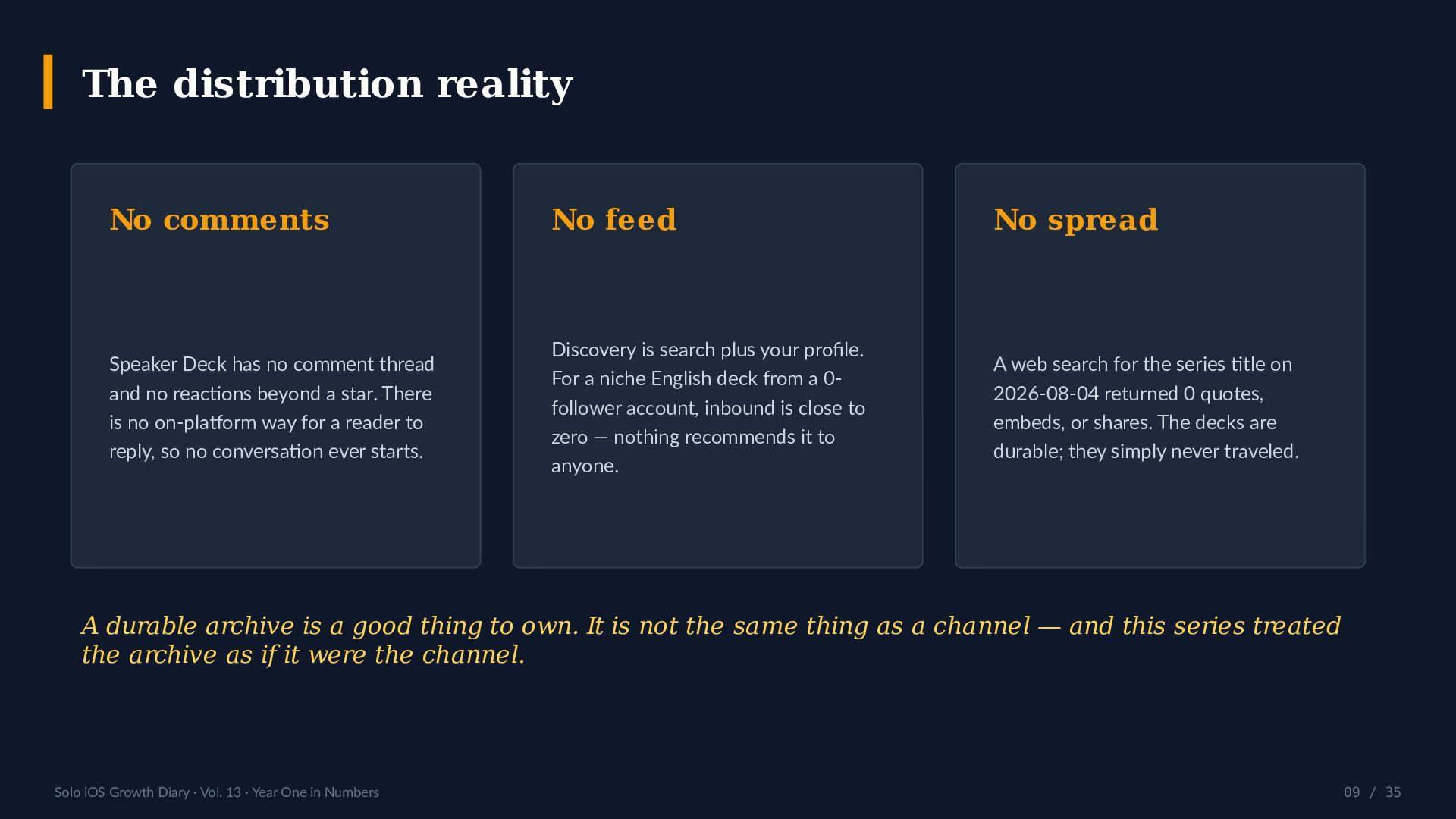
  9. The distribution reality No comments No feed No spread Speaker

    Deck has no comment thread and no reactions beyond a star. There is no on-platform way for a reader to reply, so no conversation ever starts. Discovery is search plus your profile. For a niche English deck from a 0follower account, inbound is close to zero — nothing recommends it to anyone. A web search for the series title on 2026-08-04 returned 0 quotes, embeds, or shares. The decks are durable; they simply never traveled. A durable archive is a good thing to own. It is not the same thing as a channel — and this series treated the archive as if it were the channel. Solo iOS Growth Diary · Vol. 13 · Year One in Numbers 09 / 35
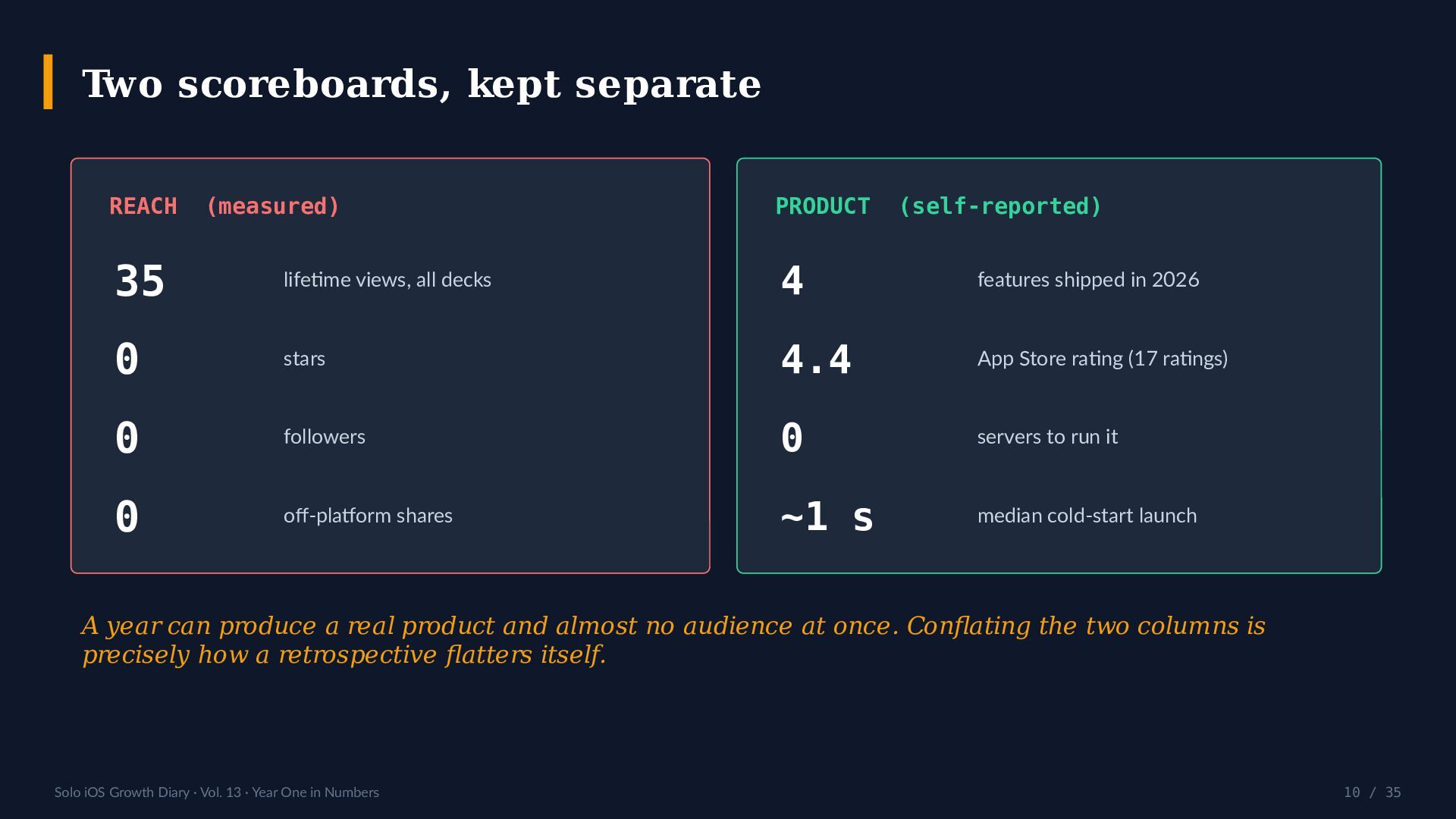
  10. Two scoreboards, kept separate REACH (measured) PRODUCT (self-reported) 35 lifetime

    views, all decks 4 features shipped in 2026 0 stars 4.4 App Store rating (17 ratings) 0 followers 0 servers to run it 0 off-platform shares ~1 s median cold-start launch A year can produce a real product and almost no audience at once. Conflating the two columns is precisely how a retrospective flatters itself. Solo iOS Growth Diary · Vol. 13 · Year One in Numbers 10 / 35
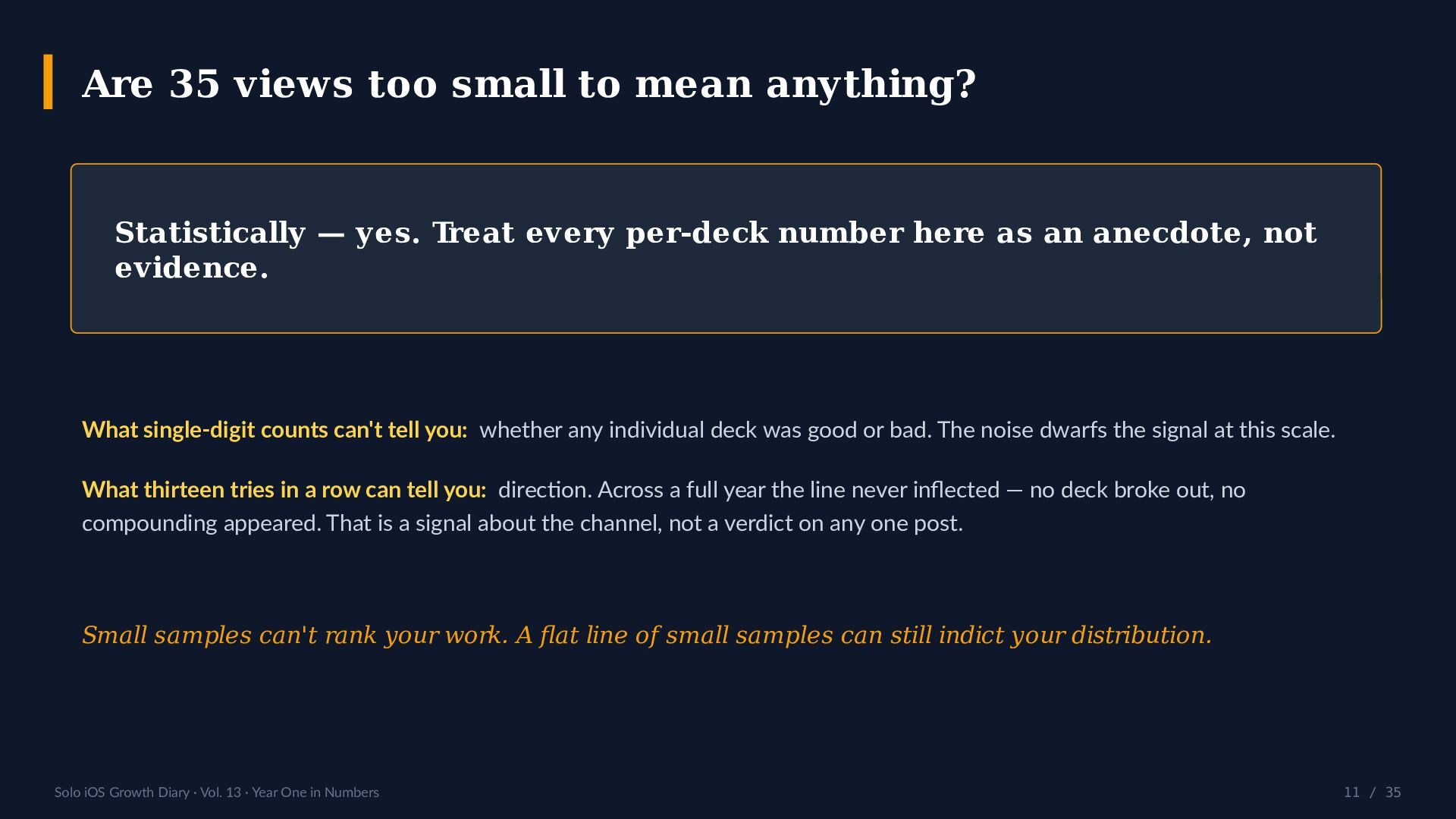
  11. Are 35 views too small to mean anything? Statistically —

    yes. Treat every per-deck number here as an anecdote, not evidence. What single-digit counts can't tell you: whether any individual deck was good or bad. The noise dwarfs the signal at this scale. What thirteen tries in a row can tell you: direction. Across a full year the line never inflected — no deck broke out, no compounding appeared. That is a signal about the channel, not a verdict on any one post. Small samples can't rank your work. A flat line of small samples can still indict your distribution. Solo iOS Growth Diary · Vol. 13 · Year One in Numbers 11 / 35
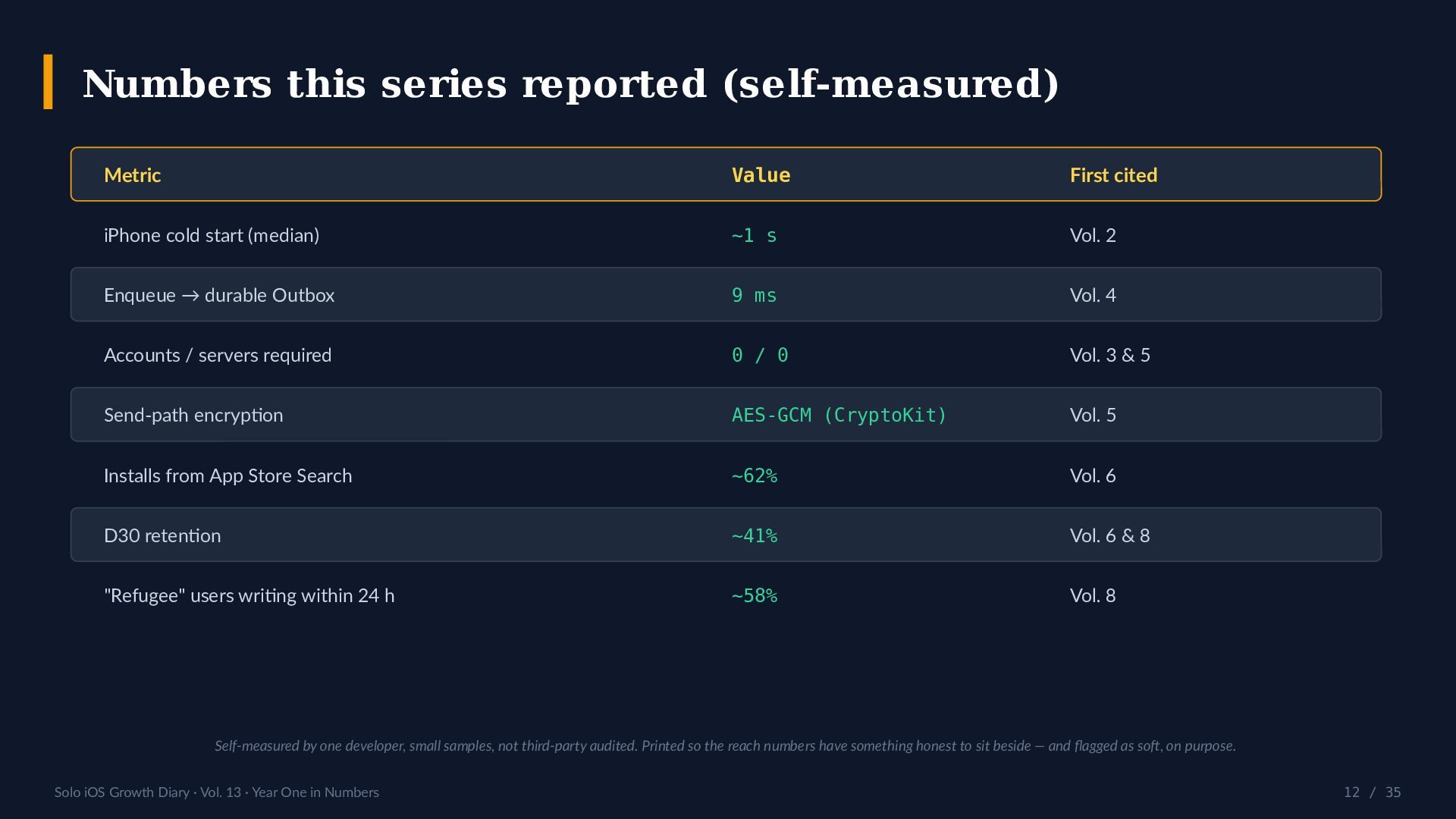
  12. Numbers this series reported (self-measured) Metric Value First cited iPhone

    cold start (median) ~1 s Vol. 2 Enqueue → durable Outbox 9 ms Vol. 4 Accounts / servers required 0 / 0 Vol. 3 & 5 Send-path encryption AES-GCM (CryptoKit) Vol. 5 Installs from App Store Search ~62% Vol. 6 D30 retention ~41% Vol. 6 & 8 "Refugee" users writing within 24 h ~58% Vol. 8 Self-measured by one developer, small samples, not third-party audited. Printed so the reach numbers have something honest to sit beside — and flagged as soft, on purpose. Solo iOS Growth Diary · Vol. 13 · Year One in Numbers 12 / 35
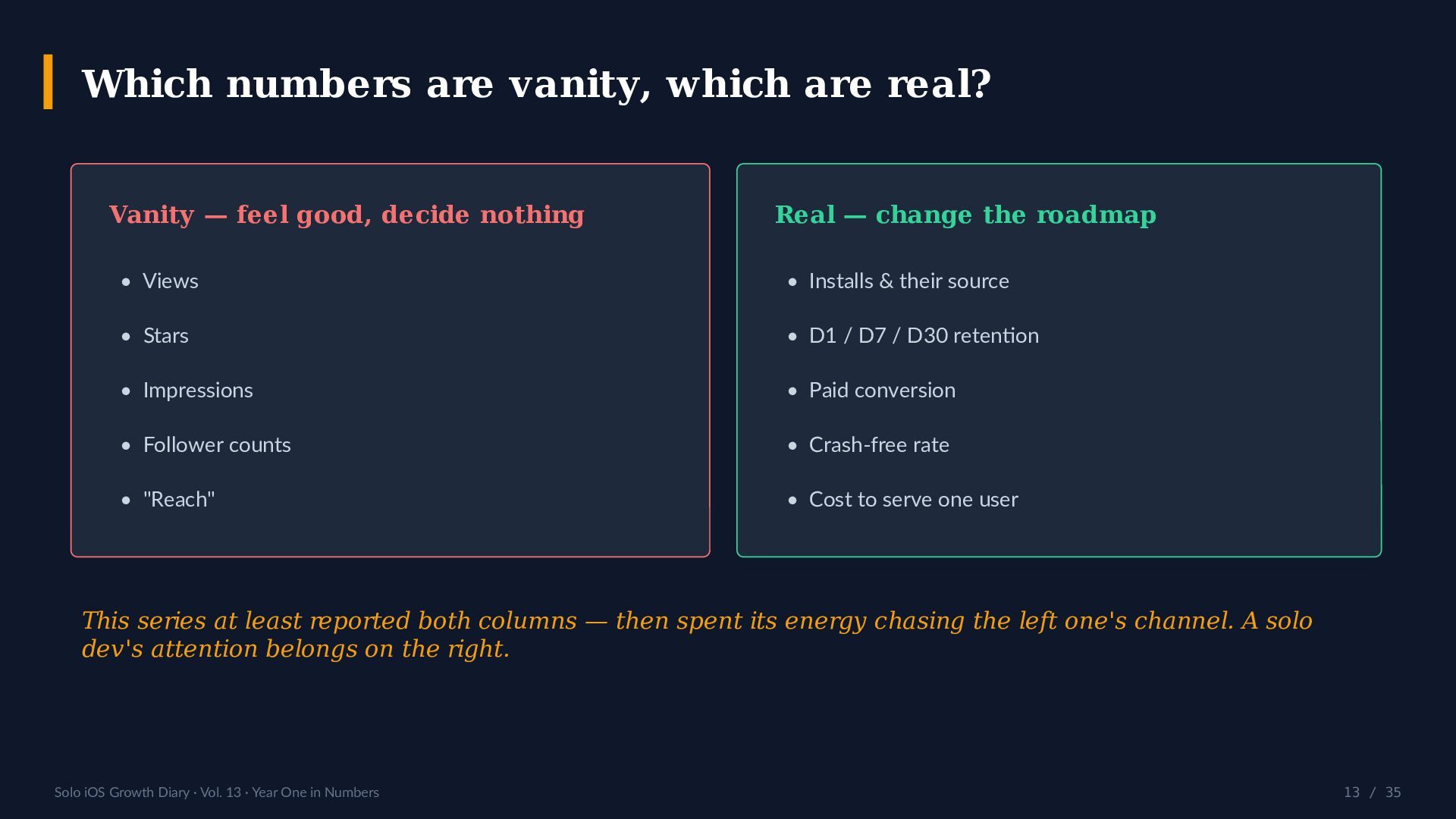
  13. Which numbers are vanity, which are real? Vanity — feel

    good, decide nothing Real — change the roadmap • Views • Installs & their source • Stars • D1 / D7 / D30 retention • Impressions • Paid conversion • Follower counts • Crash-free rate • "Reach" • Cost to serve one user This series at least reported both columns — then spent its energy chasing the left one's channel. A solo dev's attention belongs on the right. Solo iOS Growth Diary · Vol. 13 · Year One in Numbers 13 / 35
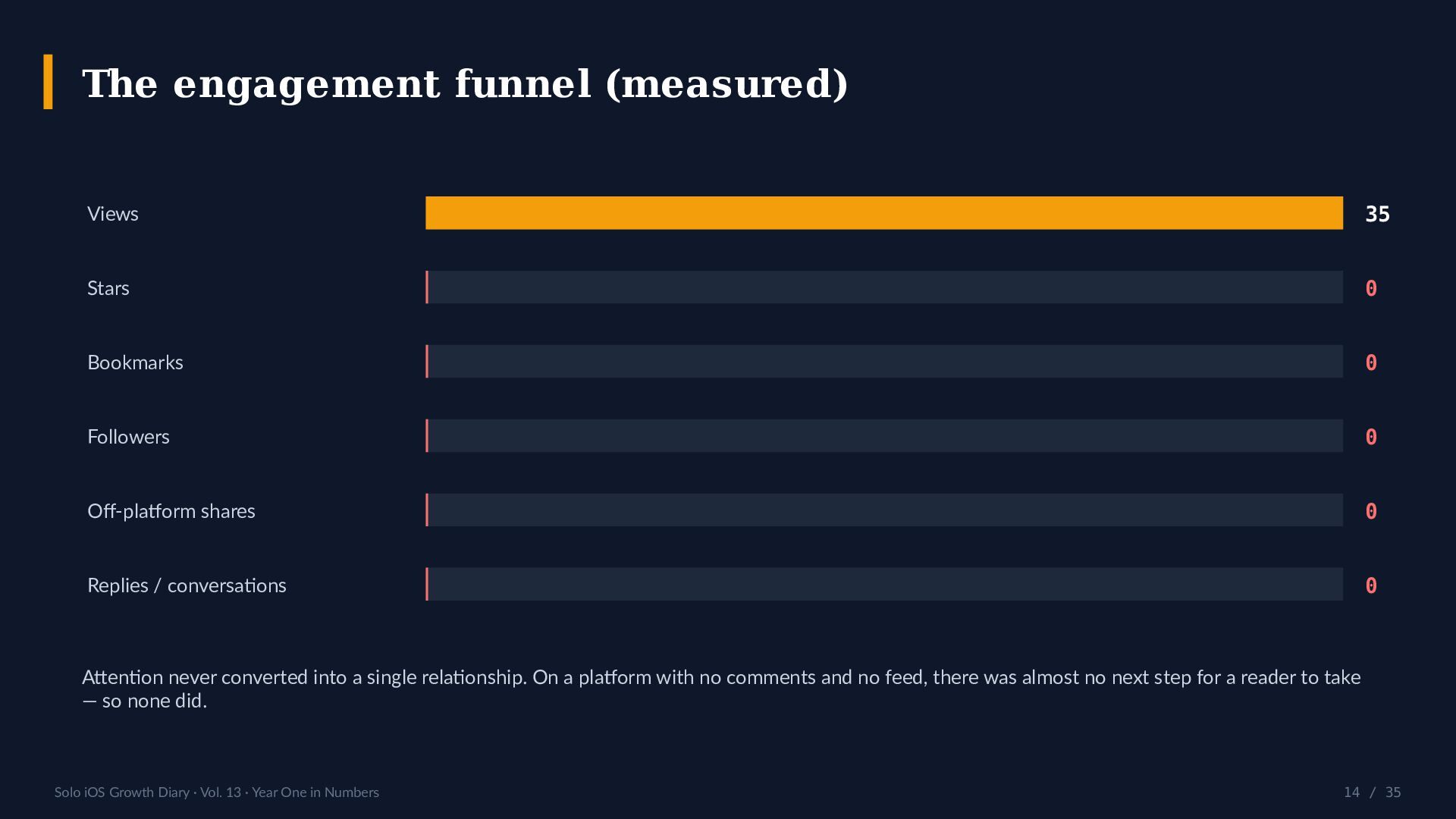
  14. The engagement funnel (measured) Views 35 Stars 0 Bookmarks 0

    Followers 0 Off-platform shares 0 Replies / conversations 0 Attention never converted into a single relationship. On a platform with no comments and no feed, there was almost no next step for a reader to take — so none did. Solo iOS Growth Diary · Vol. 13 · Year One in Numbers 14 / 35
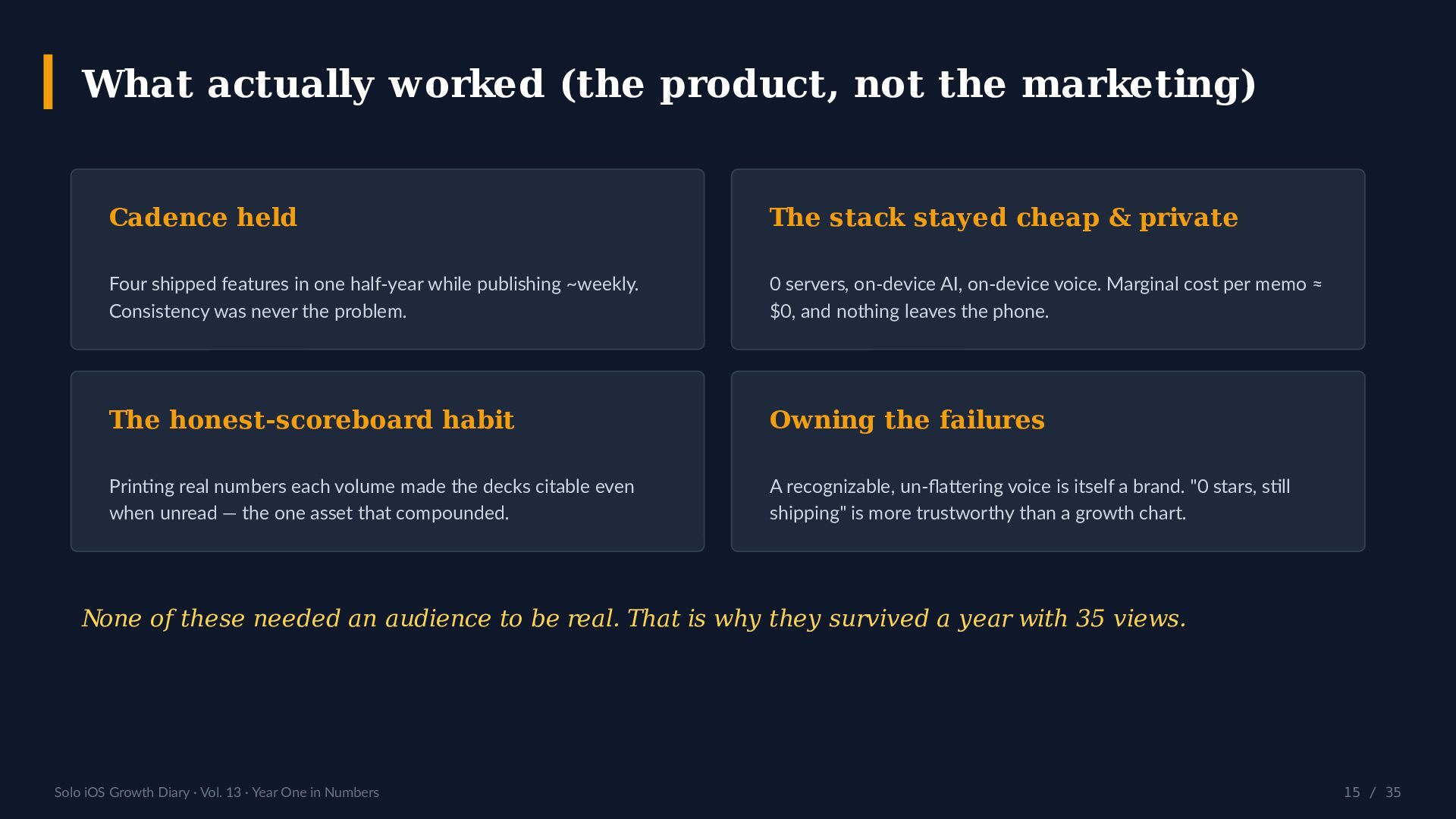
  15. What actually worked (the product, not the marketing) Cadence held

    The stack stayed cheap & private Four shipped features in one half-year while publishing ~weekly. Consistency was never the problem. 0 servers, on-device AI, on-device voice. Marginal cost per memo ≈ $0, and nothing leaves the phone. The honest-scoreboard habit Owning the failures Printing real numbers each volume made the decks citable even when unread — the one asset that compounded. A recognizable, un-flattering voice is itself a brand. "0 stars, still shipping" is more trustworthy than a growth chart. None of these needed an audience to be real. That is why they survived a year with 35 views. Solo iOS Growth Diary · Vol. 13 · Year One in Numbers 15 / 35
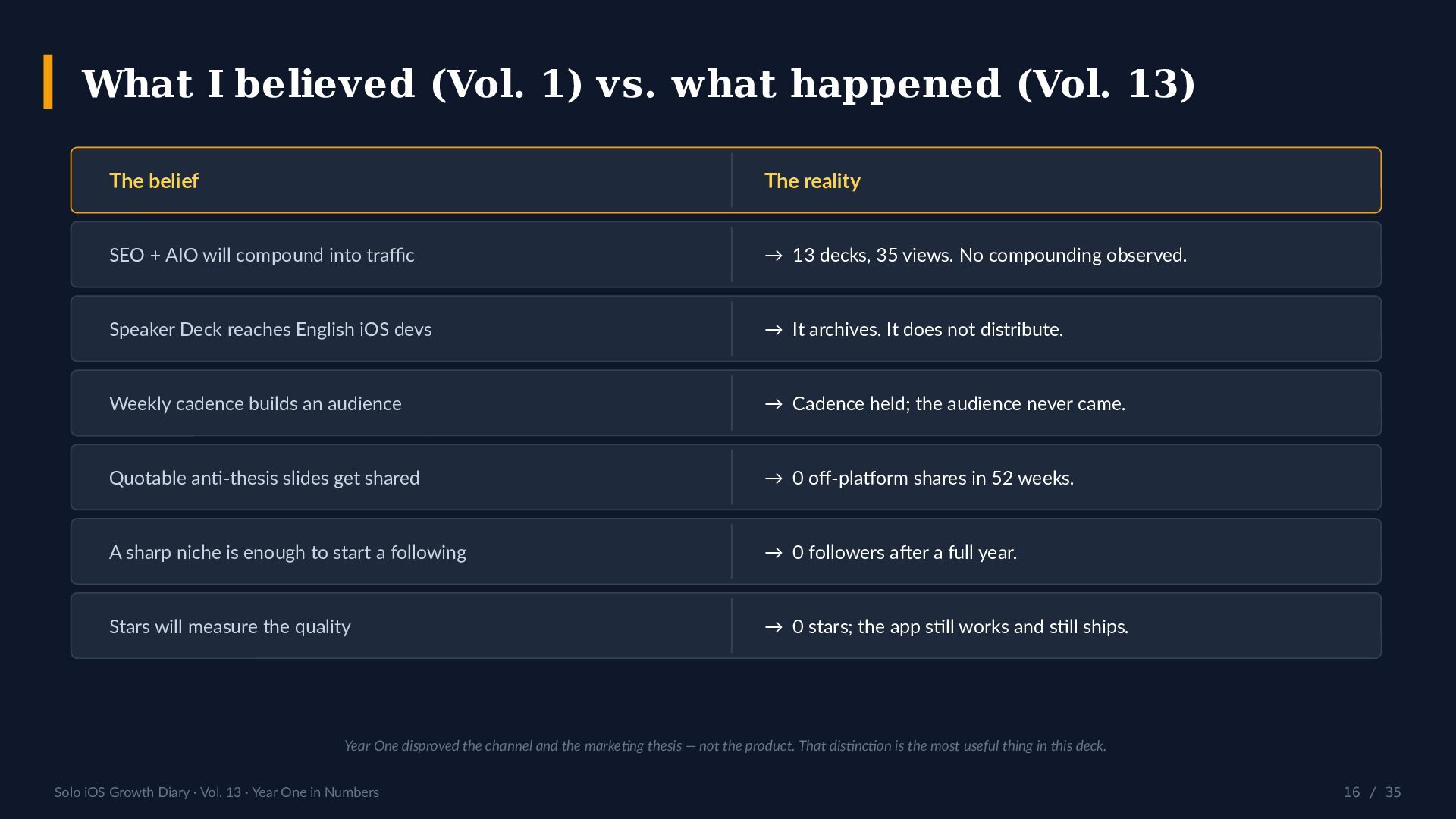
  16. What I believed (Vol. 1) vs. what happened (Vol. 13)

    The belief The reality SEO + AIO will compound into traffic → 13 decks, 35 views. No compounding observed. Speaker Deck reaches English iOS devs → It archives. It does not distribute. Weekly cadence builds an audience → Cadence held; the audience never came. Quotable anti-thesis slides get shared → 0 off-platform shares in 52 weeks. A sharp niche is enough to start a following → 0 followers after a full year. Stars will measure the quality → 0 stars; the app still works and still ships. Year One disproved the channel and the marketing thesis — not the product. That distinction is the most useful thing in this deck. Solo iOS Growth Diary · Vol. 13 · Year One in Numbers 16 / 35
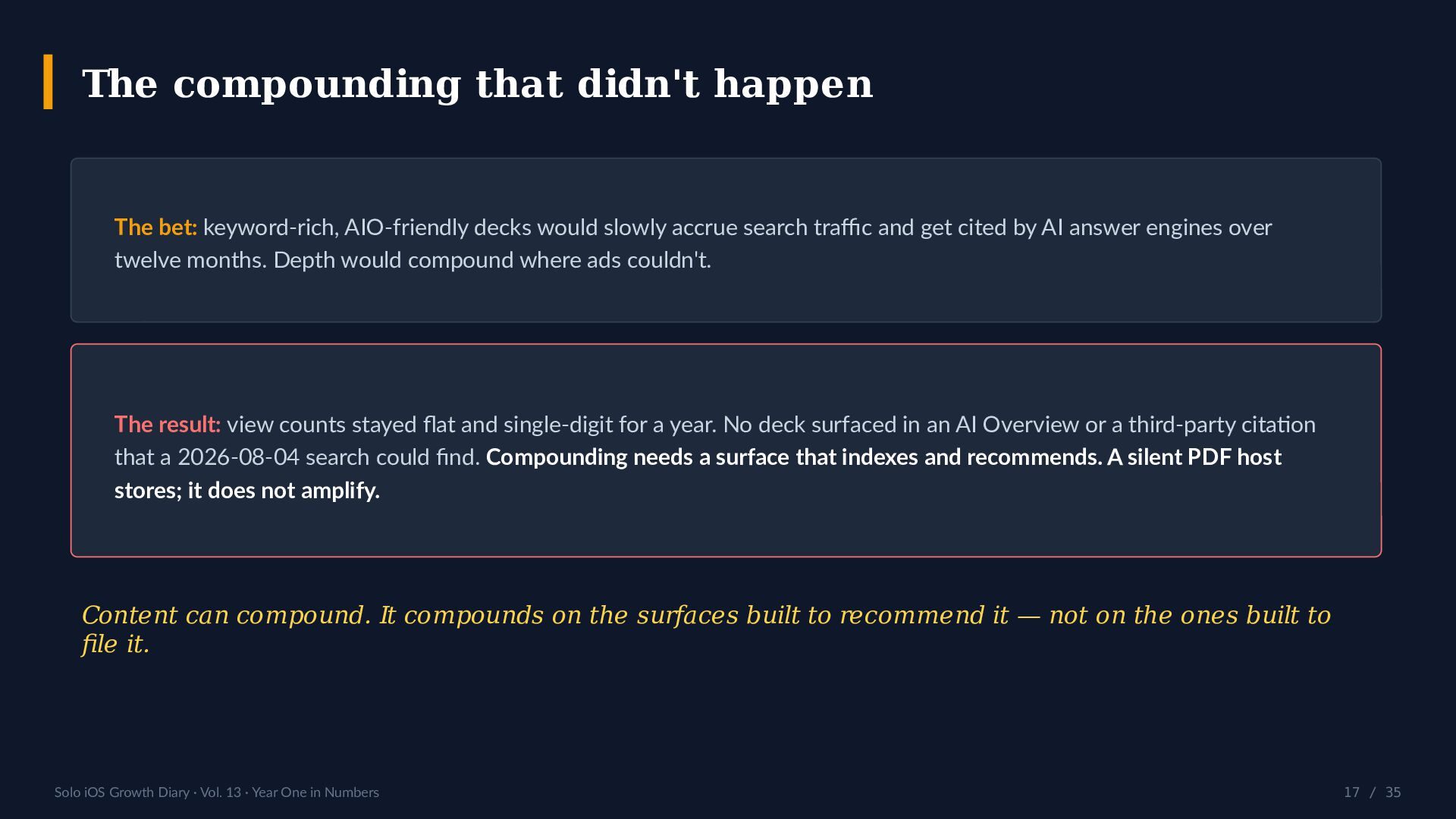
  17. The compounding that didn't happen The bet: keyword-rich, AIO-friendly decks

    would slowly accrue search traffic and get cited by AI answer engines over twelve months. Depth would compound where ads couldn't. The result: view counts stayed flat and single-digit for a year. No deck surfaced in an AI Overview or a third-party citation that a 2026-08-04 search could find. Compounding needs a surface that indexes and recommends. A silent PDF host stores; it does not amplify. Content can compound. It compounds on the surfaces built to recommend it — not on the ones built to file it. Solo iOS Growth Diary · Vol. 13 · Year One in Numbers 17 / 35
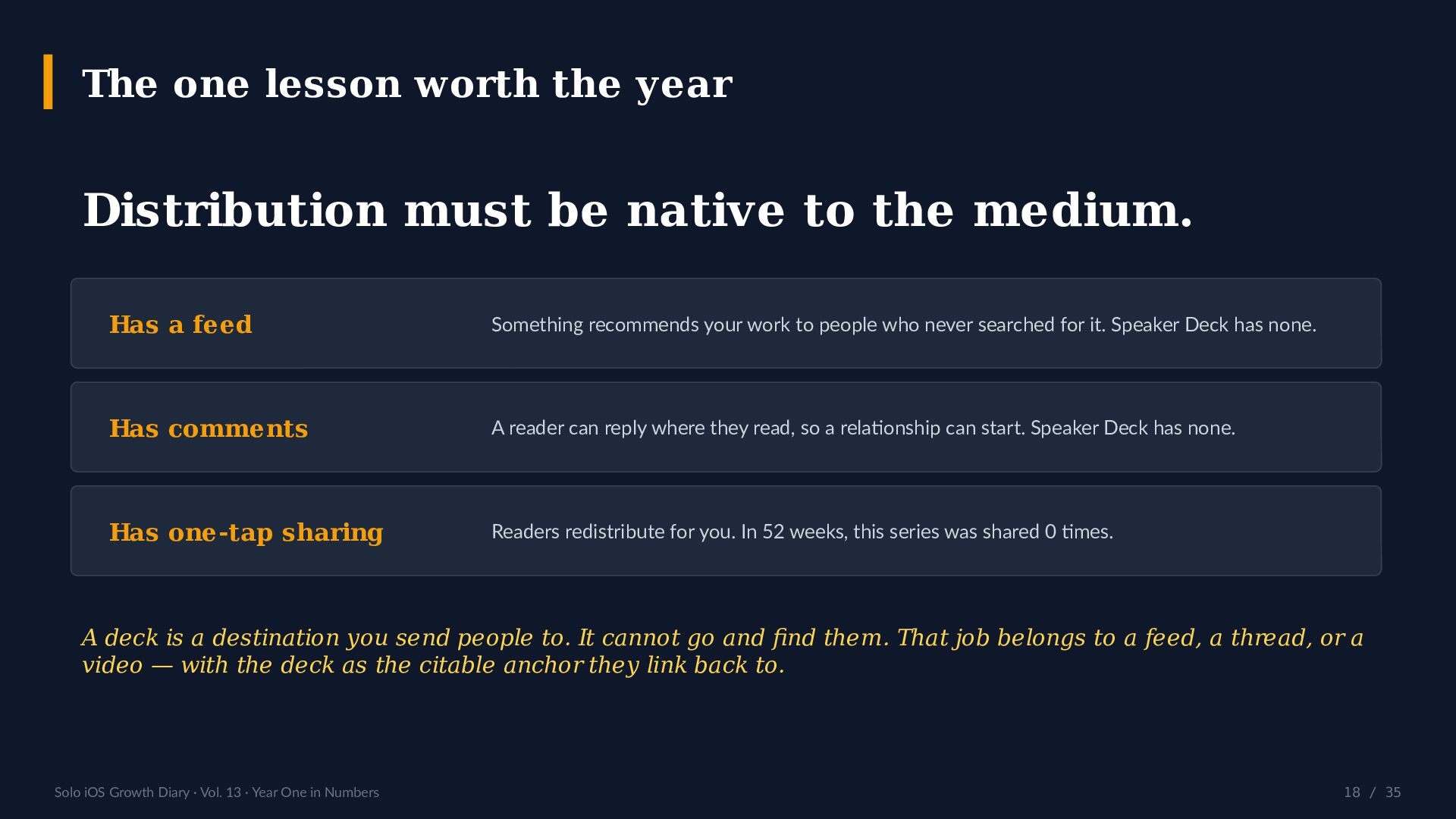
  18. The one lesson worth the year Distribution must be native

    to the medium. Has a feed Something recommends your work to people who never searched for it. Speaker Deck has none. Has comments A reader can reply where they read, so a relationship can start. Speaker Deck has none. Has one-tap sharing Readers redistribute for you. In 52 weeks, this series was shared 0 times. A deck is a destination you send people to. It cannot go and find them. That job belongs to a feed, a thread, or a video — with the deck as the citable anchor they link back to. Solo iOS Growth Diary · Vol. 13 · Year One in Numbers 18 / 35
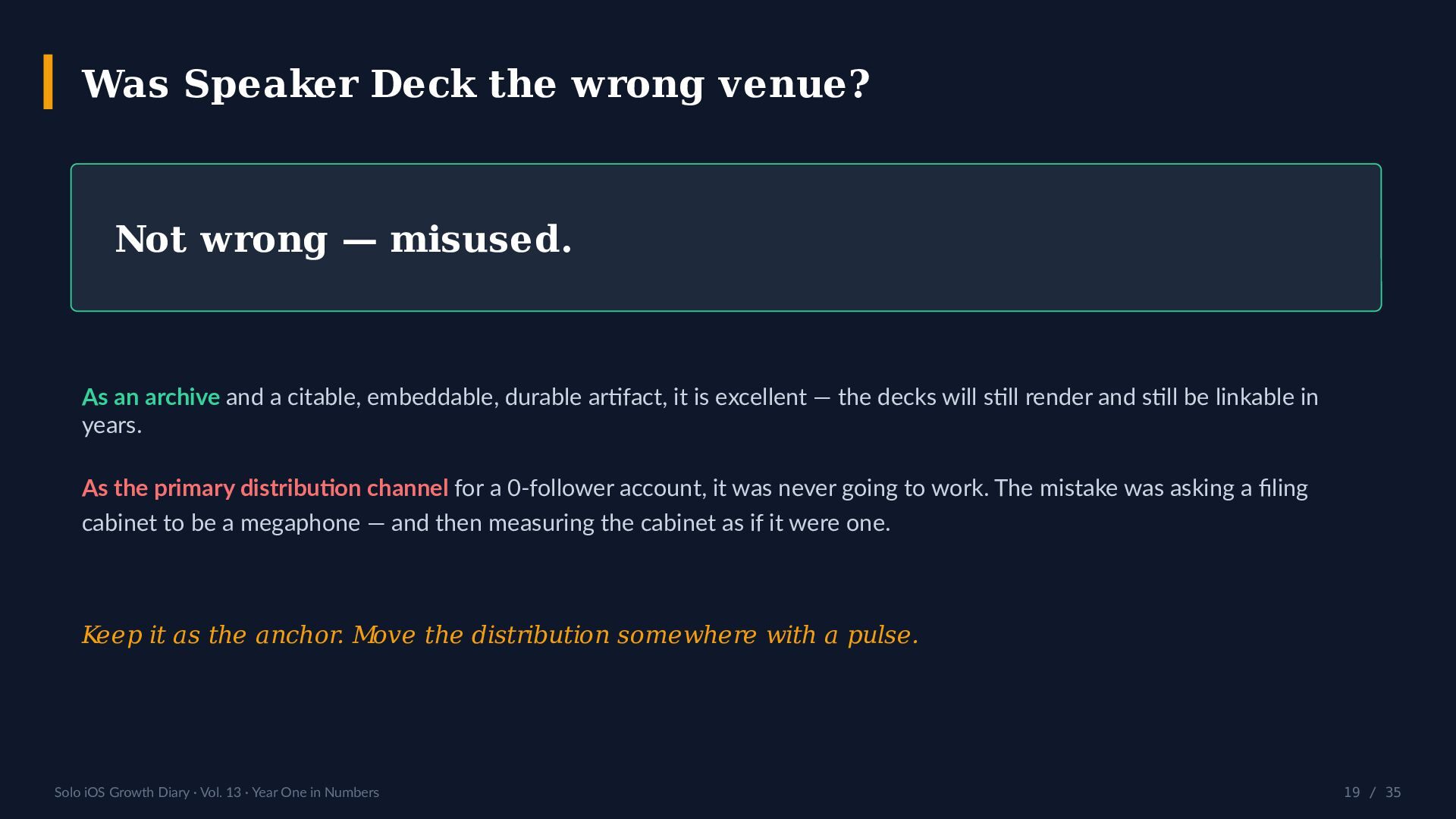
  19. Was Speaker Deck the wrong venue? Not wrong — misused.

    As an archive and a citable, embeddable, durable artifact, it is excellent — the decks will still render and still be linkable in years. As the primary distribution channel for a 0-follower account, it was never going to work. The mistake was asking a filing cabinet to be a megaphone — and then measuring the cabinet as if it were one. Keep it as the anchor. Move the distribution somewhere with a pulse. Solo iOS Growth Diary · Vol. 13 · Year One in Numbers 19 / 35
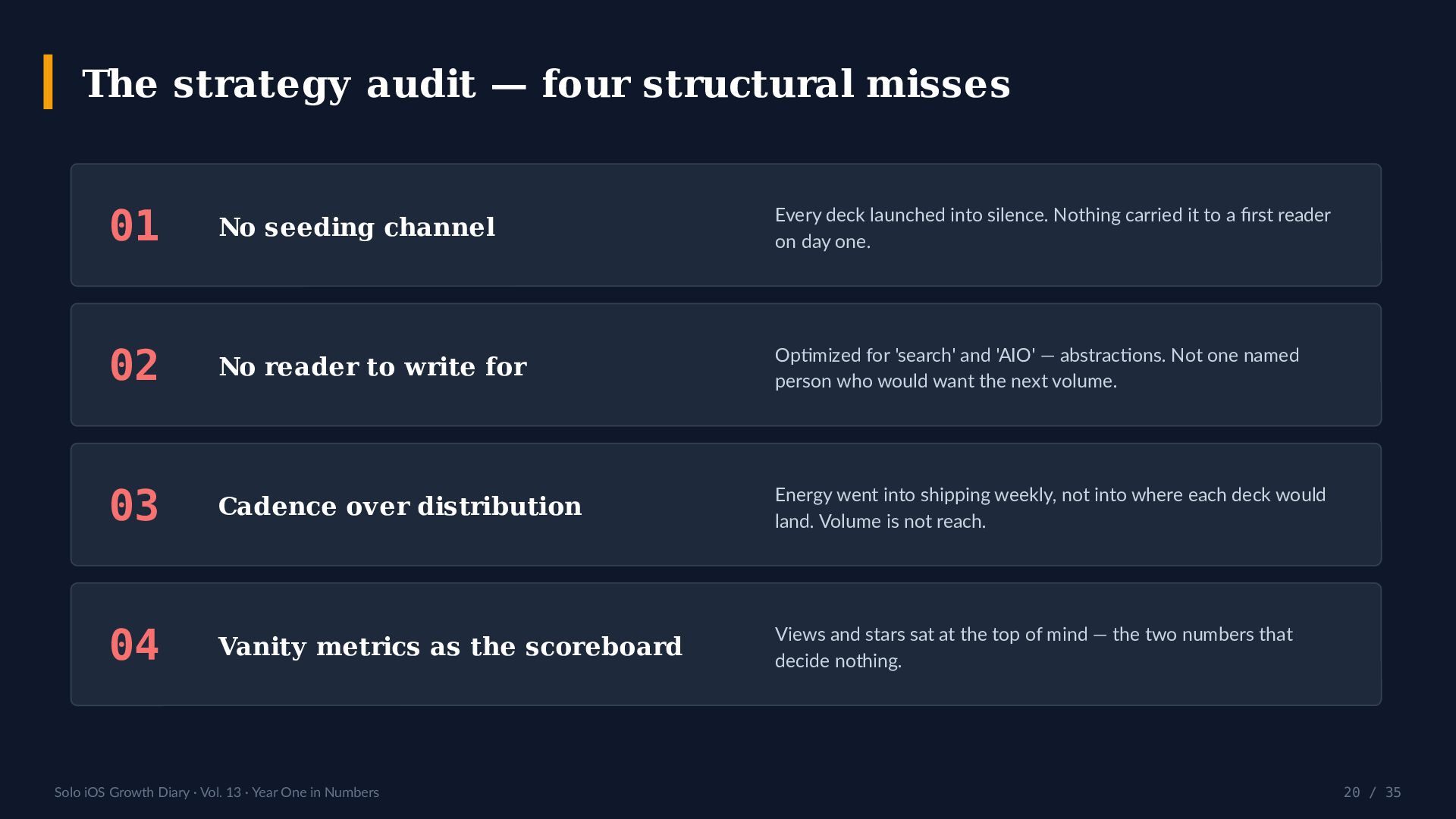
  20. The strategy audit — four structural misses 01 No seeding

    channel Every deck launched into silence. Nothing carried it to a first reader on day one. 02 No reader to write for Optimized for 'search' and 'AIO' — abstractions. Not one named person who would want the next volume. 03 Cadence over distribution Energy went into shipping weekly, not into where each deck would land. Volume is not reach. 04 Vanity metrics as the scoreboard Views and stars sat at the top of mind — the two numbers that decide nothing. Solo iOS Growth Diary · Vol. 13 · Year One in Numbers 20 / 35
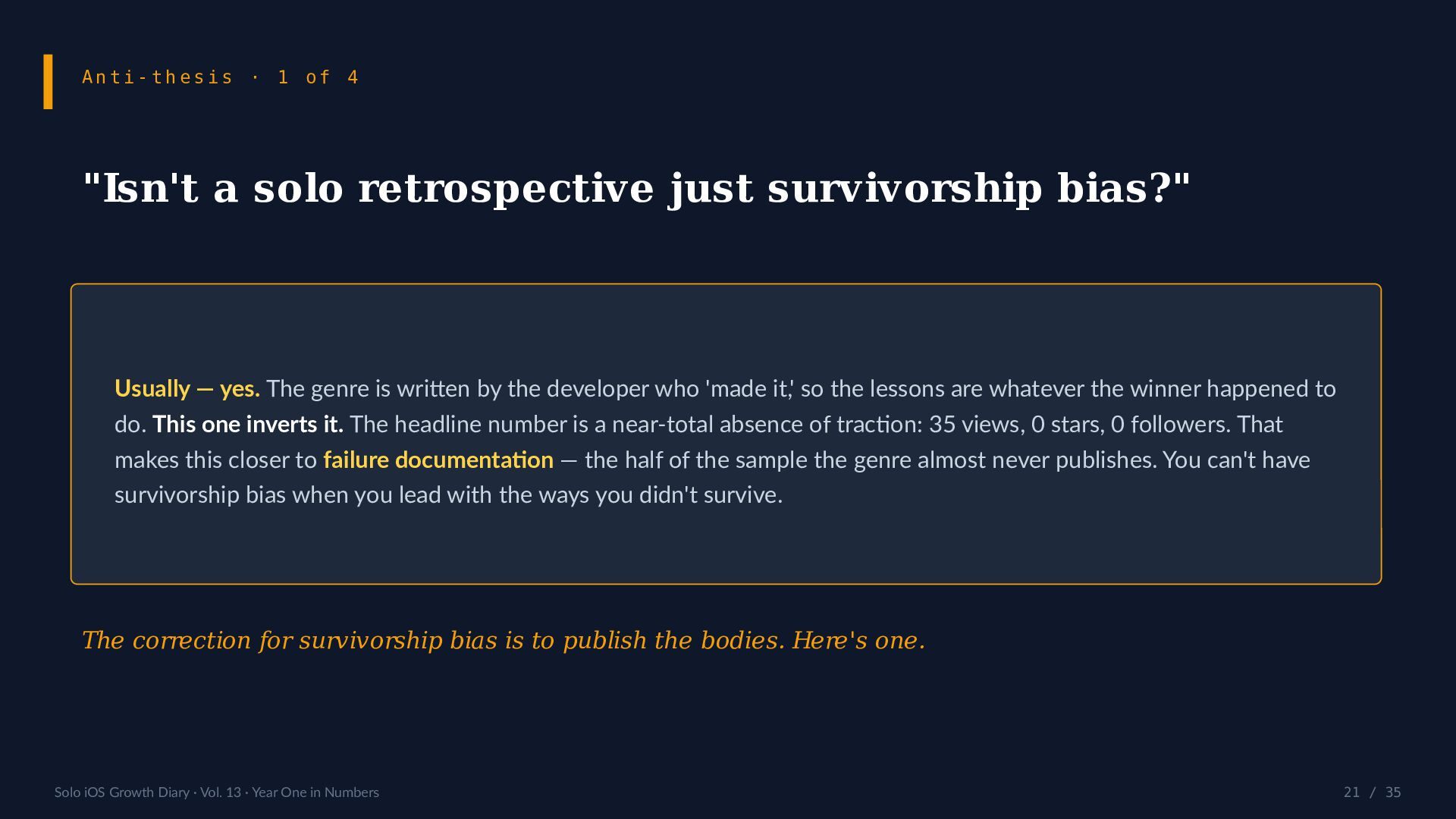
  21. Anti-thesis · 1 of 4 "Isn't a solo retrospective just

    survivorship bias?" Usually — yes. The genre is written by the developer who 'made it,' so the lessons are whatever the winner happened to do. This one inverts it. The headline number is a near-total absence of traction: 35 views, 0 stars, 0 followers. That makes this closer to failure documentation — the half of the sample the genre almost never publishes. You can't have survivorship bias when you lead with the ways you didn't survive. The correction for survivorship bias is to publish the bodies. Here's one. Solo iOS Growth Diary · Vol. 13 · Year One in Numbers 21 / 35
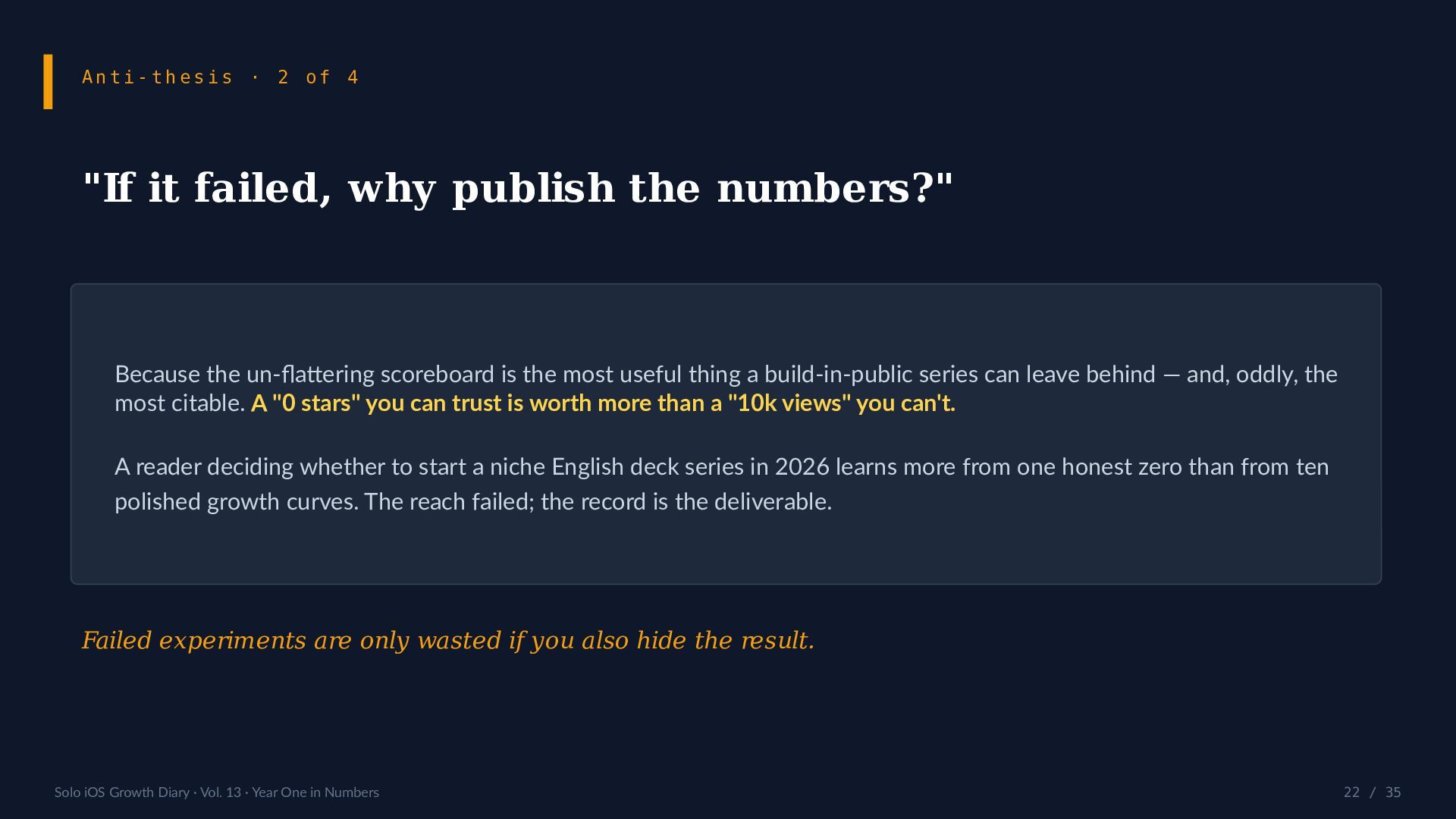
  22. Anti-thesis · 2 of 4 "If it failed, why publish

    the numbers?" Because the un-flattering scoreboard is the most useful thing a build-in-public series can leave behind — and, oddly, the most citable. A "0 stars" you can trust is worth more than a "10k views" you can't. A reader deciding whether to start a niche English deck series in 2026 learns more from one honest zero than from ten polished growth curves. The reach failed; the record is the deliverable. Failed experiments are only wasted if you also hide the result. Solo iOS Growth Diary · Vol. 13 · Year One in Numbers 22 / 35
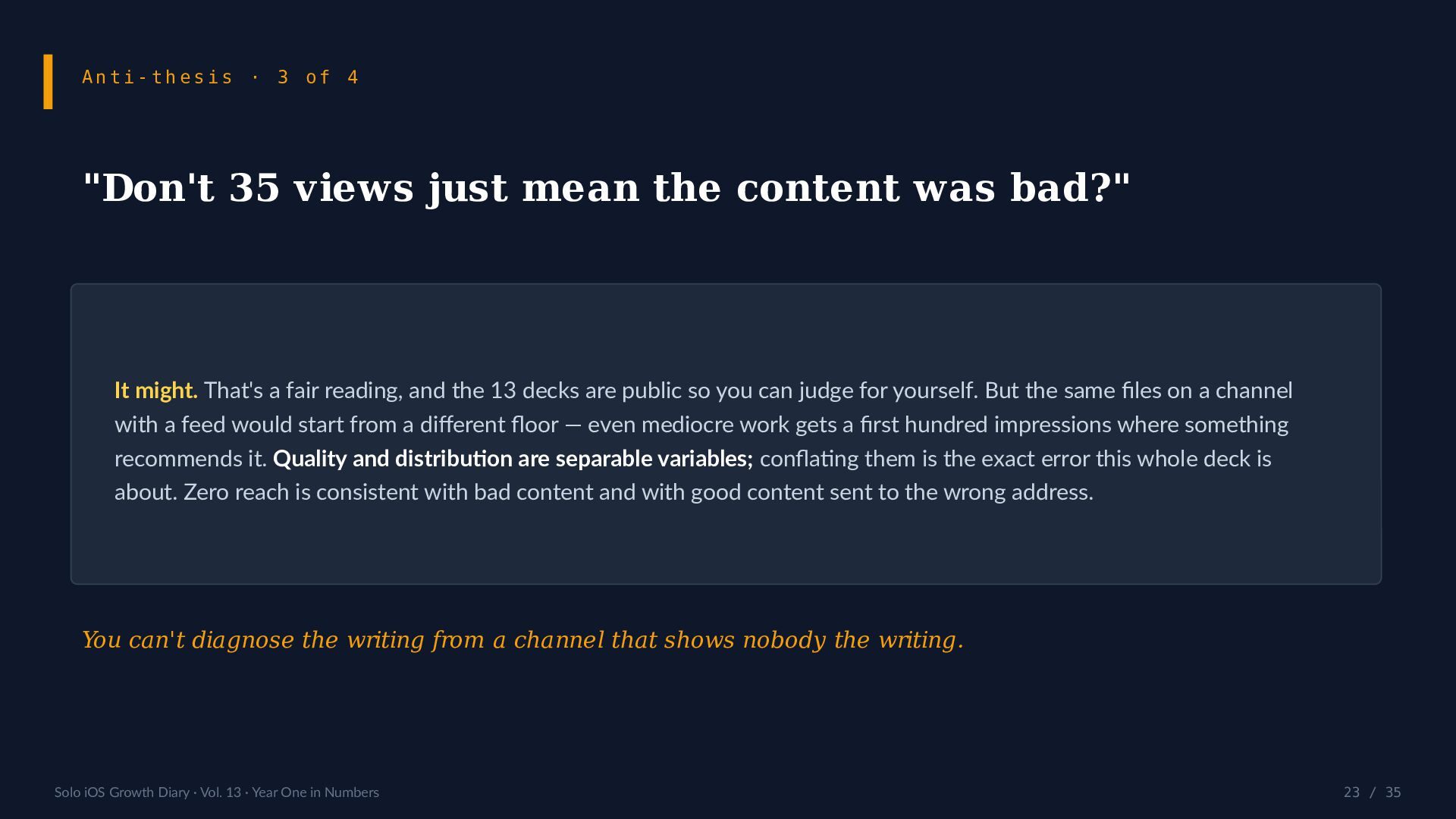
  23. Anti-thesis · 3 of 4 "Don't 35 views just mean

    the content was bad?" It might. That's a fair reading, and the 13 decks are public so you can judge for yourself. But the same files on a channel with a feed would start from a different floor — even mediocre work gets a first hundred impressions where something recommends it. Quality and distribution are separable variables; conflating them is the exact error this whole deck is about. Zero reach is consistent with bad content and with good content sent to the wrong address. You can't diagnose the writing from a channel that shows nobody the writing. Solo iOS Growth Diary · Vol. 13 · Year One in Numbers 23 / 35
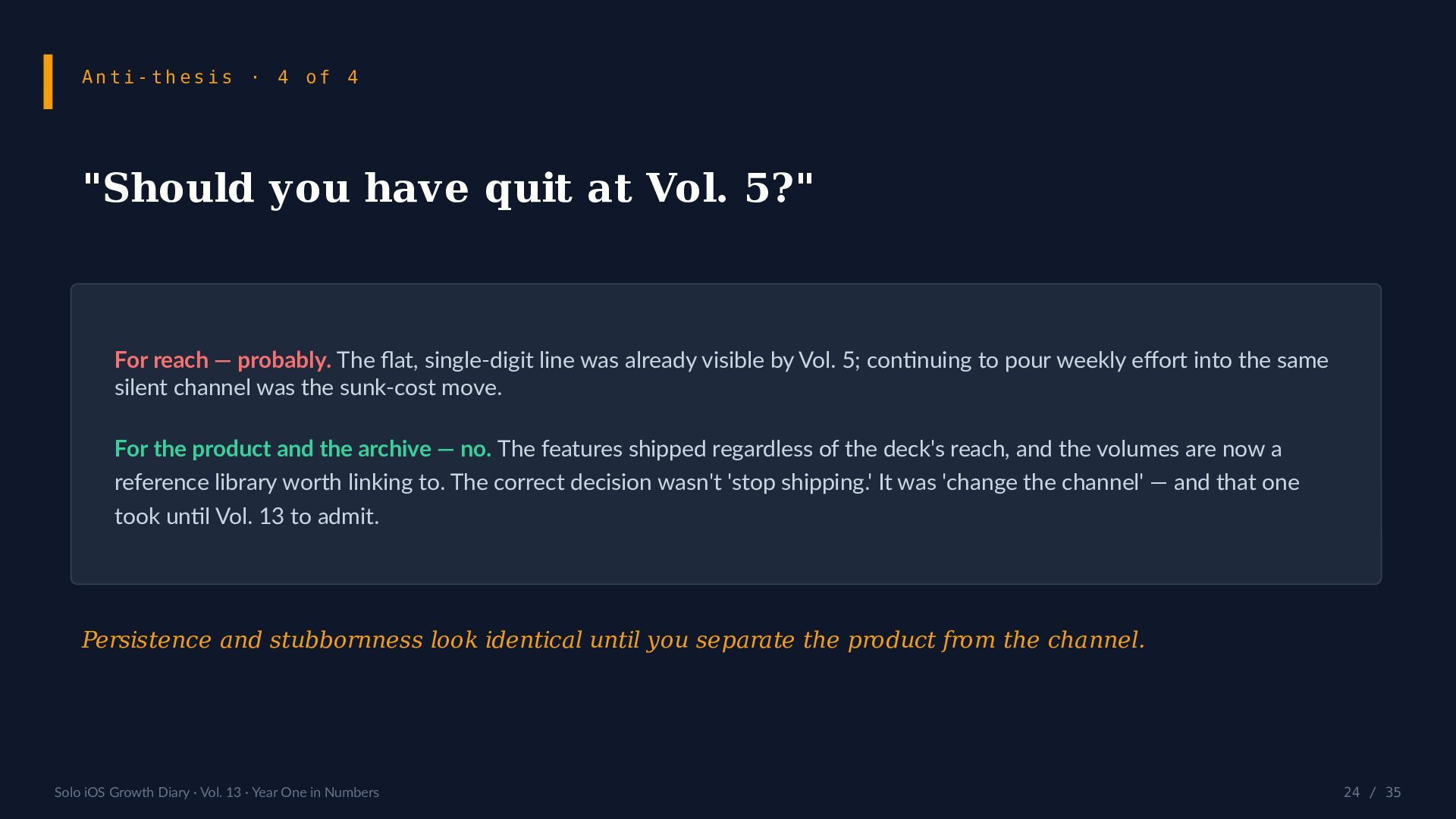
  24. Anti-thesis · 4 of 4 "Should you have quit at

    Vol. 5?" For reach — probably. The flat, single-digit line was already visible by Vol. 5; continuing to pour weekly effort into the same silent channel was the sunk-cost move. For the product and the archive — no. The features shipped regardless of the deck's reach, and the volumes are now a reference library worth linking to. The correct decision wasn't 'stop shipping.' It was 'change the channel' — and that one took until Vol. 13 to admit. Persistence and stubbornness look identical until you separate the product from the channel. Solo iOS Growth Diary · Vol. 13 · Year One in Numbers 24 / 35
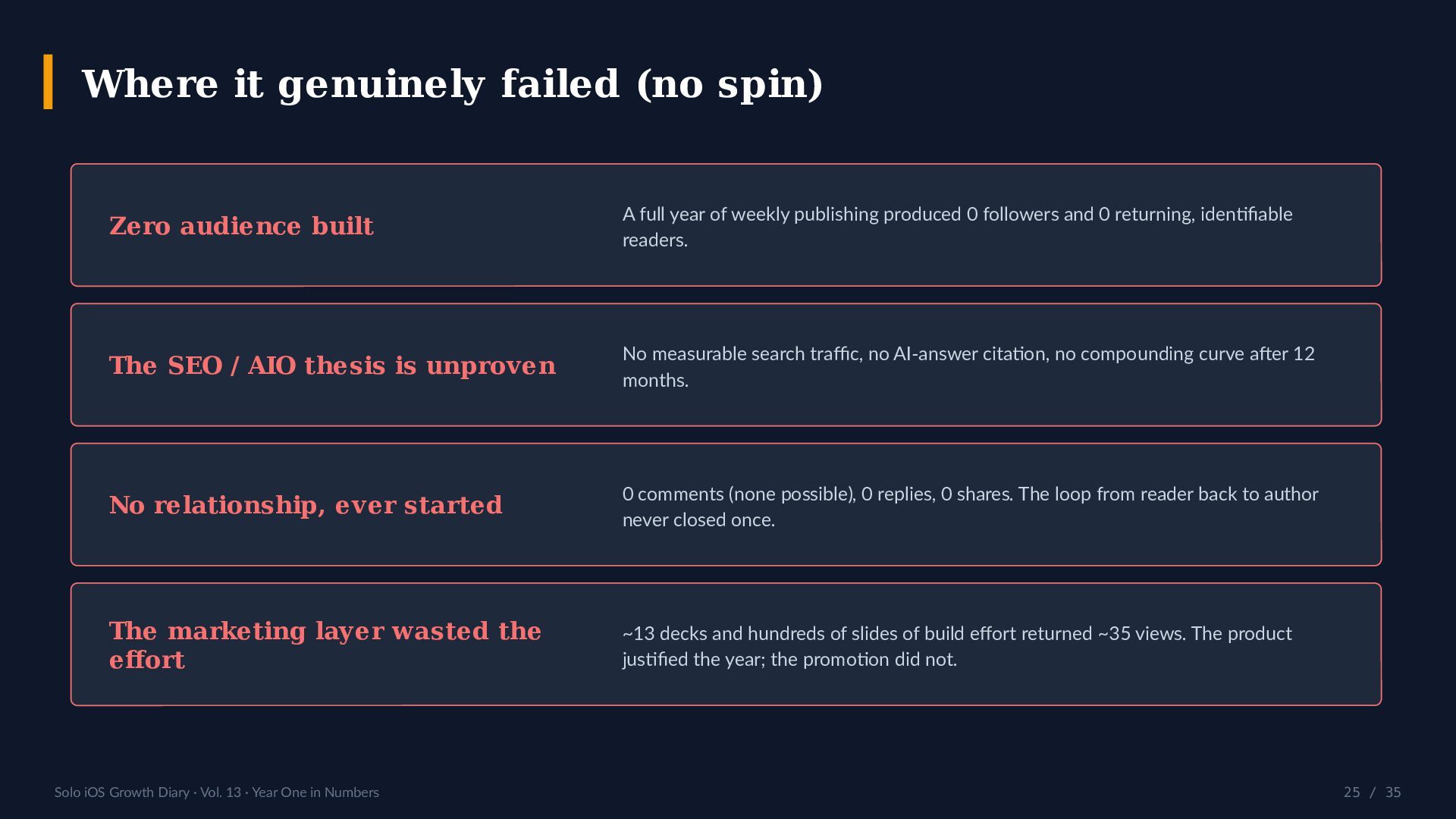
  25. Where it genuinely failed (no spin) Zero audience built A

    full year of weekly publishing produced 0 followers and 0 returning, identifiable readers. The SEO / AIO thesis is unproven No measurable search traffic, no AI-answer citation, no compounding curve after 12 months. No relationship, ever started 0 comments (none possible), 0 replies, 0 shares. The loop from reader back to author never closed once. The marketing layer wasted the effort ~13 decks and hundreds of slides of build effort returned ~35 views. The product justified the year; the promotion did not. Solo iOS Growth Diary · Vol. 13 · Year One in Numbers 25 / 35
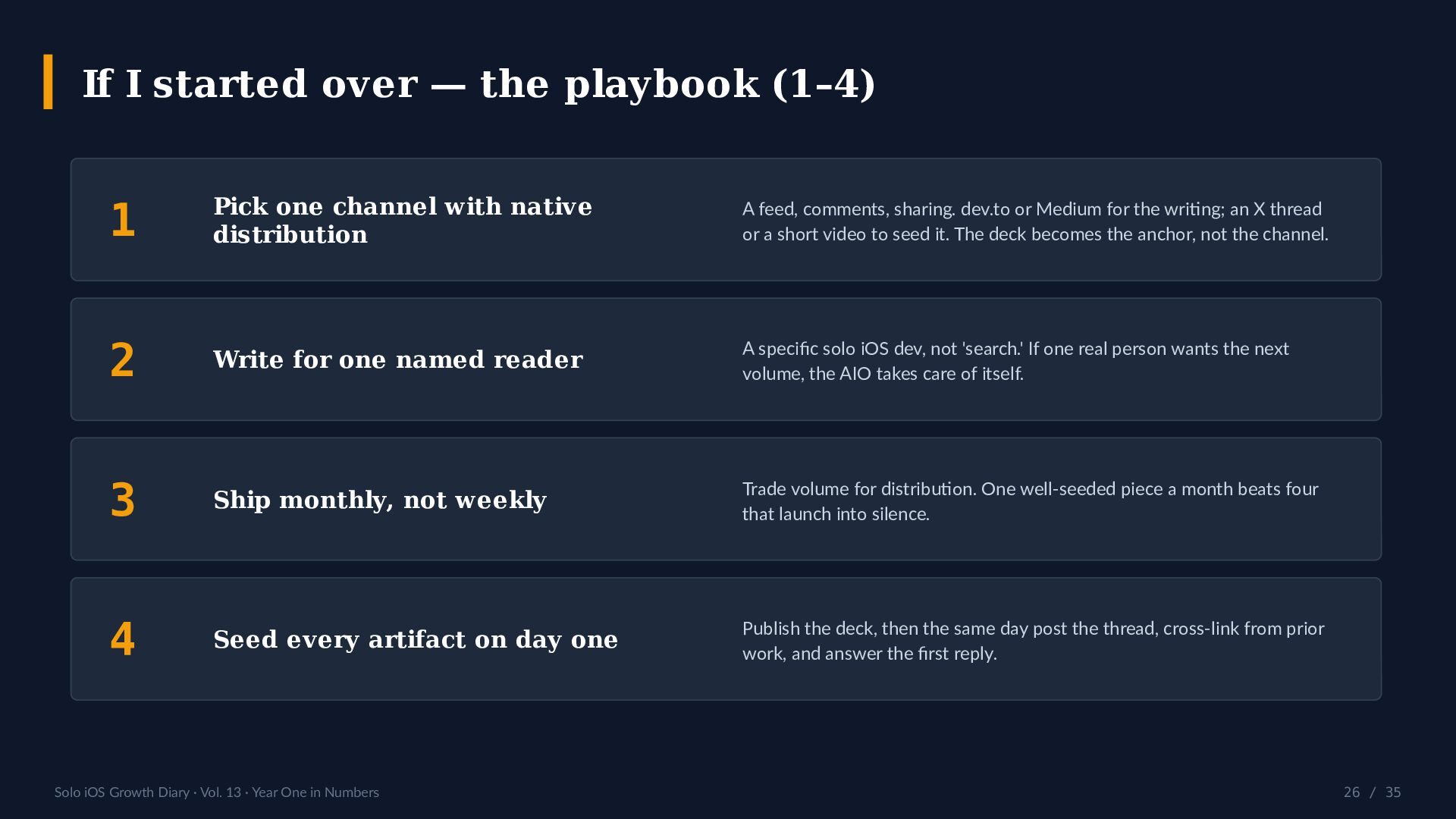
  26. If I started over — the playbook (1–4) 1 Pick

    one channel with native distribution A feed, comments, sharing. dev.to or Medium for the writing; an X thread or a short video to seed it. The deck becomes the anchor, not the channel. 2 Write for one named reader A specific solo iOS dev, not 'search.' If one real person wants the next volume, the AIO takes care of itself. 3 Ship monthly, not weekly Trade volume for distribution. One well-seeded piece a month beats four that launch into silence. 4 Seed every artifact on day one Publish the deck, then the same day post the thread, cross-link from prior work, and answer the first reply. Solo iOS Growth Diary · Vol. 13 · Year One in Numbers 26 / 35
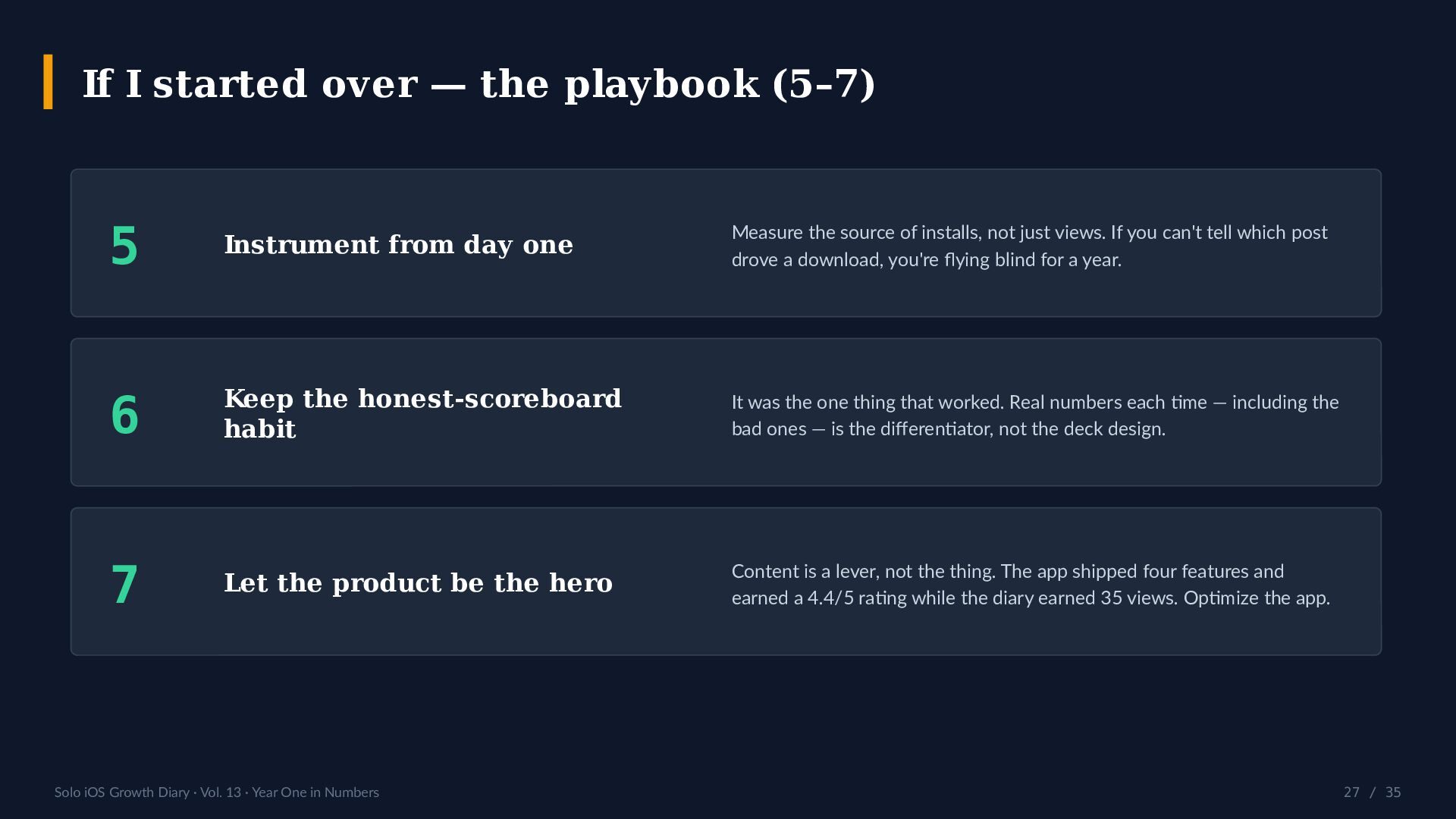
  27. If I started over — the playbook (5–7) 5 Instrument

    from day one Measure the source of installs, not just views. If you can't tell which post drove a download, you're flying blind for a year. 6 Keep the honest-scoreboard habit It was the one thing that worked. Real numbers each time — including the bad ones — is the differentiator, not the deck design. 7 Let the product be the hero Content is a lever, not the thing. The app shipped four features and earned a 4.4/5 rating while the diary earned 35 views. Optimize the app. Solo iOS Growth Diary · Vol. 13 · Year One in Numbers 27 / 35
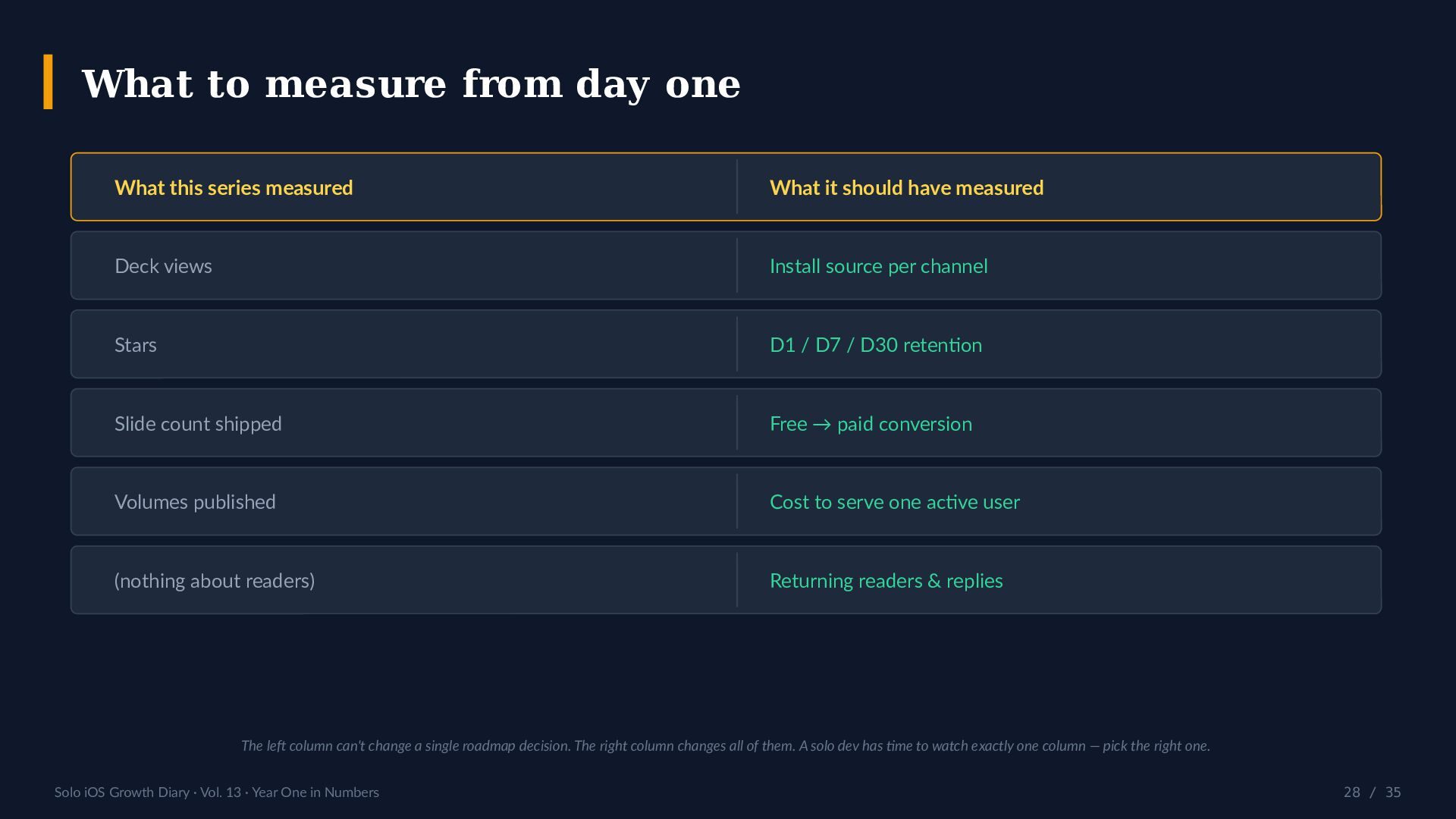
  28. What to measure from day one What this series measured

    What it should have measured Deck views Install source per channel Stars D1 / D7 / D30 retention Slide count shipped Free → paid conversion Volumes published Cost to serve one active user (nothing about readers) Returning readers & replies The left column can't change a single roadmap decision. The right column changes all of them. A solo dev has time to watch exactly one column — pick the right one. Solo iOS Growth Diary · Vol. 13 · Year One in Numbers 28 / 35
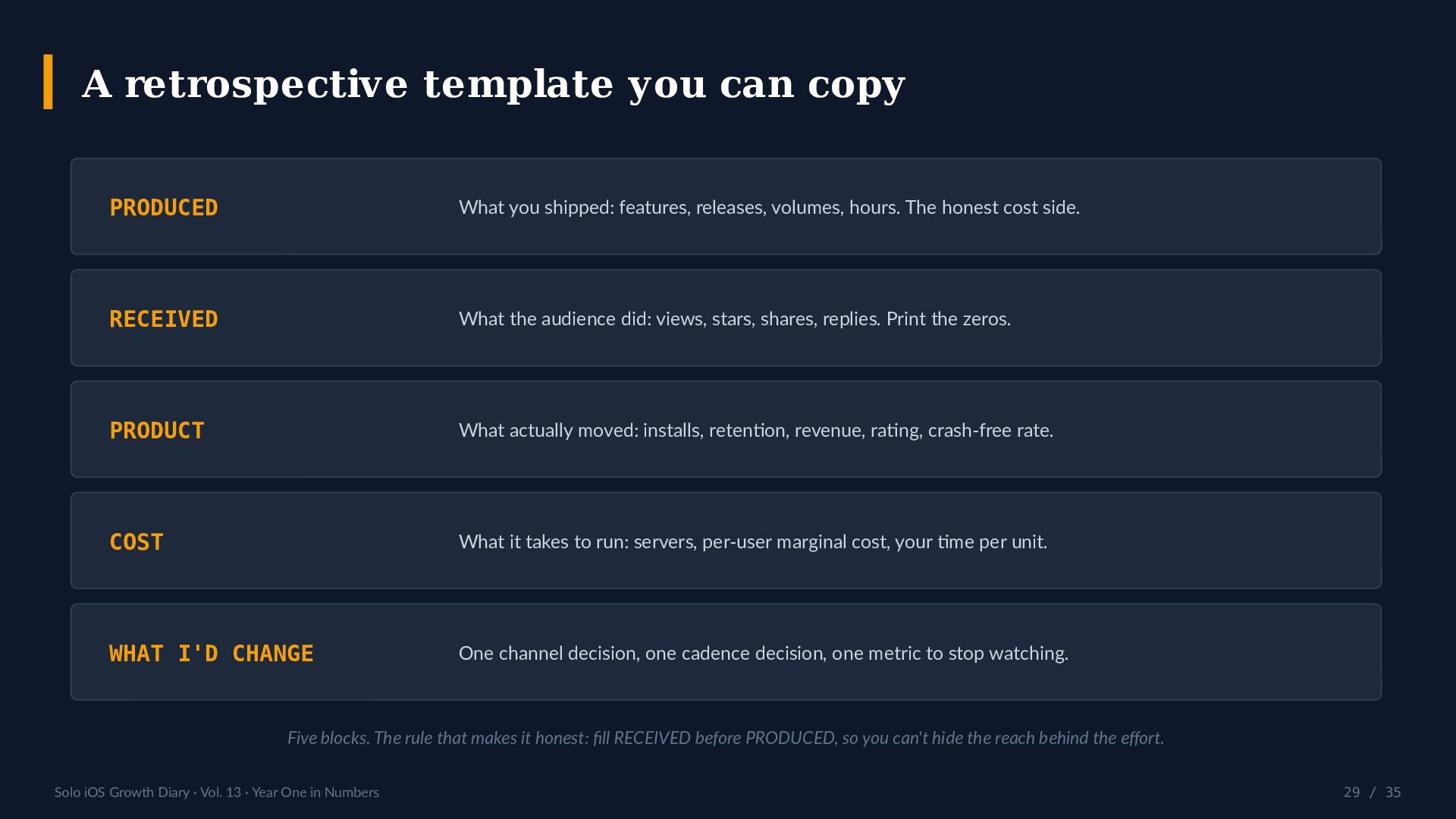
  29. A retrospective template you can copy PRODUCED What you shipped:

    features, releases, volumes, hours. The honest cost side. RECEIVED What the audience did: views, stars, shares, replies. Print the zeros. PRODUCT What actually moved: installs, retention, revenue, rating, crash-free rate. COST What it takes to run: servers, per-user marginal cost, your time per unit. WHAT I'D CHANGE One channel decision, one cadence decision, one metric to stop watching. Five blocks. The rule that makes it honest: fill RECEIVED before PRODUCED, so you can't hide the reach behind the effort. Solo iOS Growth Diary · Vol. 13 · Year One in Numbers 29 / 35
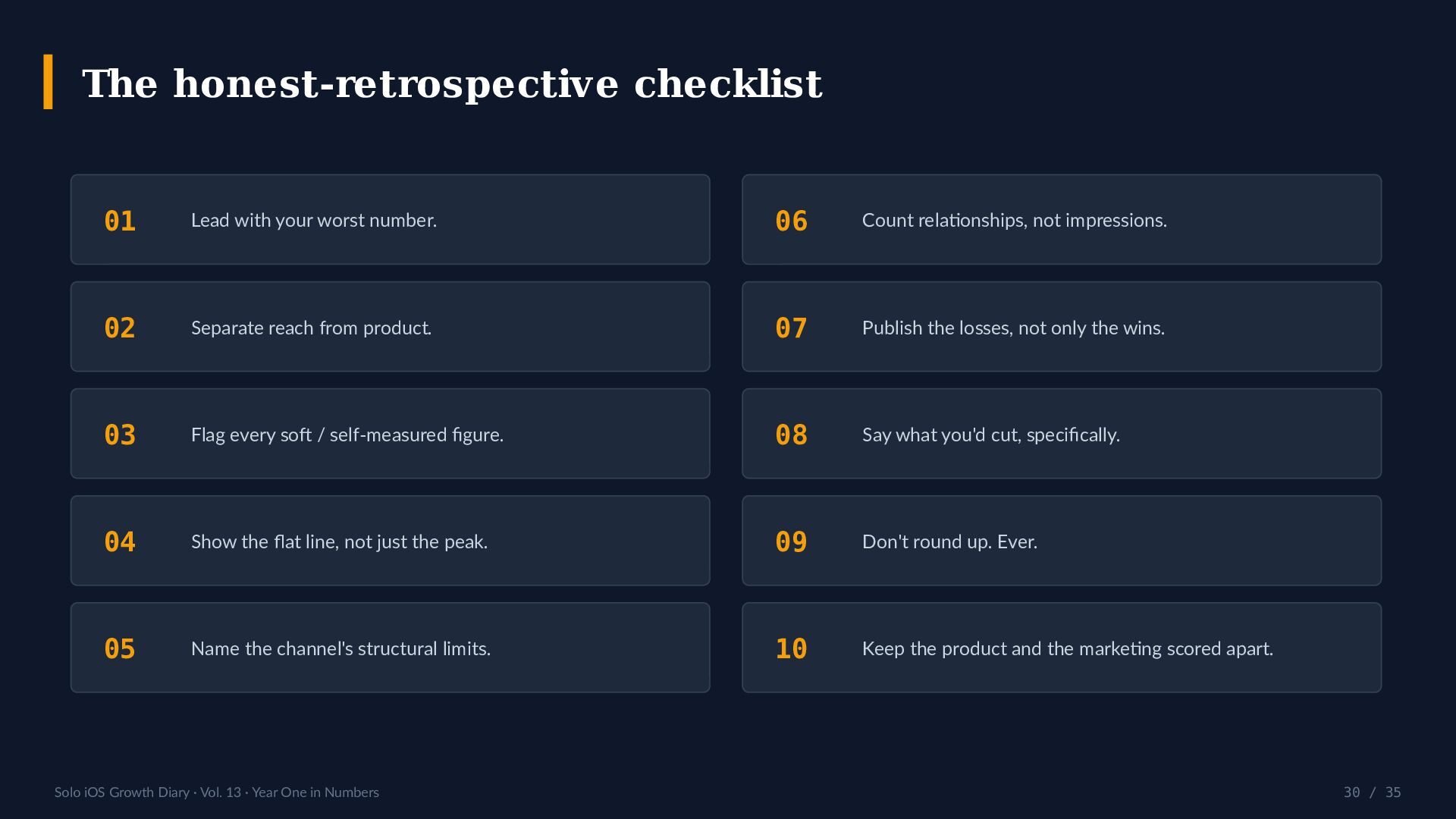
  30. The honest-retrospective checklist 01 Lead with your worst number. 06

    Count relationships, not impressions. 02 Separate reach from product. 07 Publish the losses, not only the wins. 03 Flag every soft / self-measured figure. 08 Say what you'd cut, specifically. 04 Show the flat line, not just the peak. 09 Don't round up. Ever. 05 Name the channel's structural limits. 10 Keep the product and the marketing scored apart. Solo iOS Growth Diary · Vol. 13 · Year One in Numbers 30 / 35
  31. THE HONEST SCOREBOARD Solo iOS Growth Diary · Vol. 1–13

    · measured 2026-08-04, logged in 13 35 0 volumes published lifetime views (all decks) stars · 0 bookmarks 0 6 0 followers · 0 shares best deck (Vol. 3) newest deck, week 1 (Vol. 12) 6 views by volume: 2 1 5 4 2 2 3 4 5 3 6 3 7* 4 2 8 9 3 1 10 11 0 12 A year of shipping, printed at full resolution and rounded down to the truth: almost nobody read it — and the app is better than ever anyway. Solo iOS Growth Diary · Vol. 13 · Year One in Numbers 31 / 35
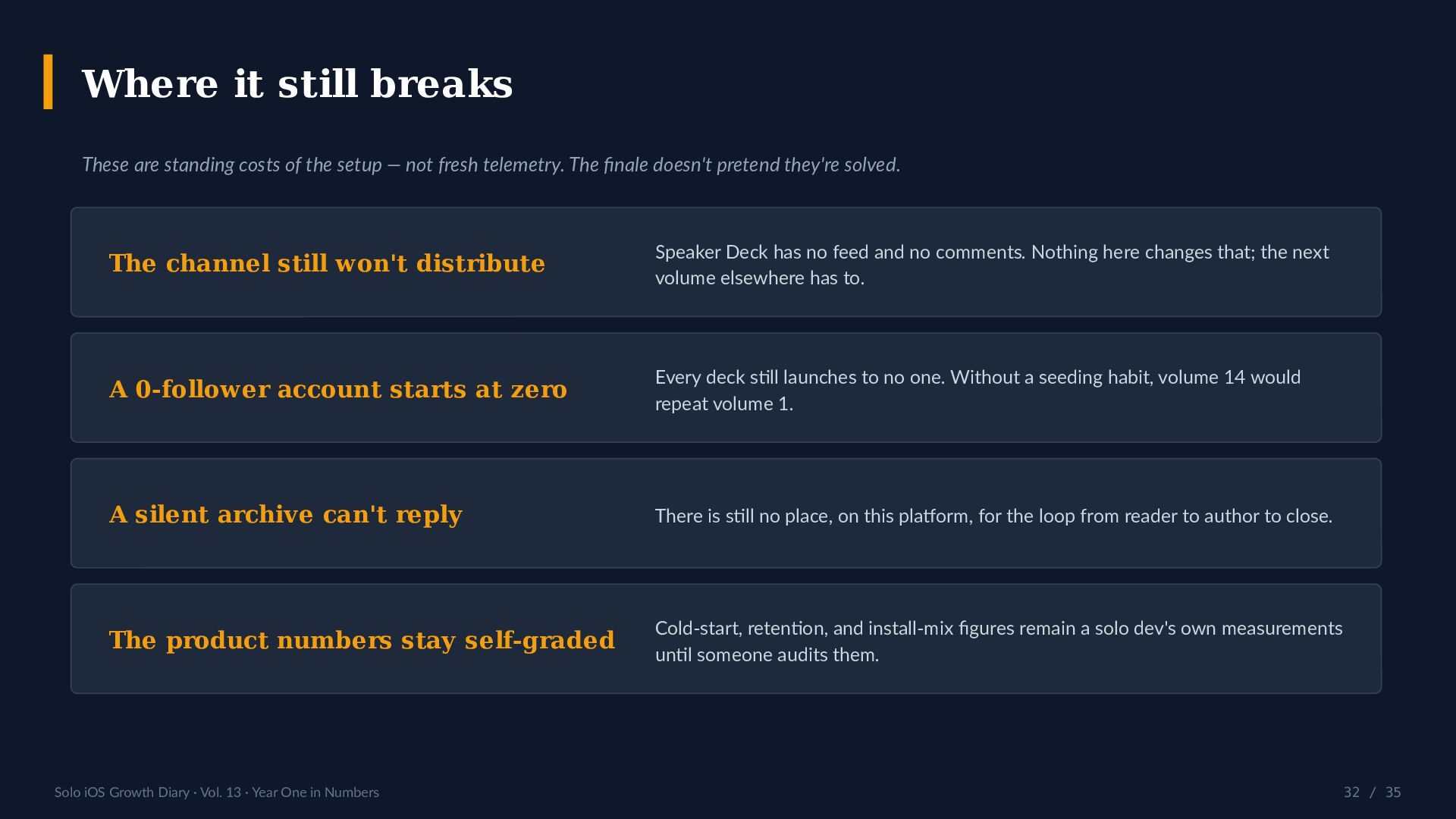
  32. Where it still breaks These are standing costs of the

    setup — not fresh telemetry. The finale doesn't pretend they're solved. The channel still won't distribute Speaker Deck has no feed and no comments. Nothing here changes that; the next volume elsewhere has to. A 0-follower account starts at zero Every deck still launches to no one. Without a seeding habit, volume 14 would repeat volume 1. A silent archive can't reply There is still no place, on this platform, for the loop from reader to author to close. The product numbers stay self-graded Cold-start, retention, and install-mix figures remain a solo dev's own measurements until someone audits them. Solo iOS Growth Diary · Vol. 13 · Year One in Numbers 32 / 35
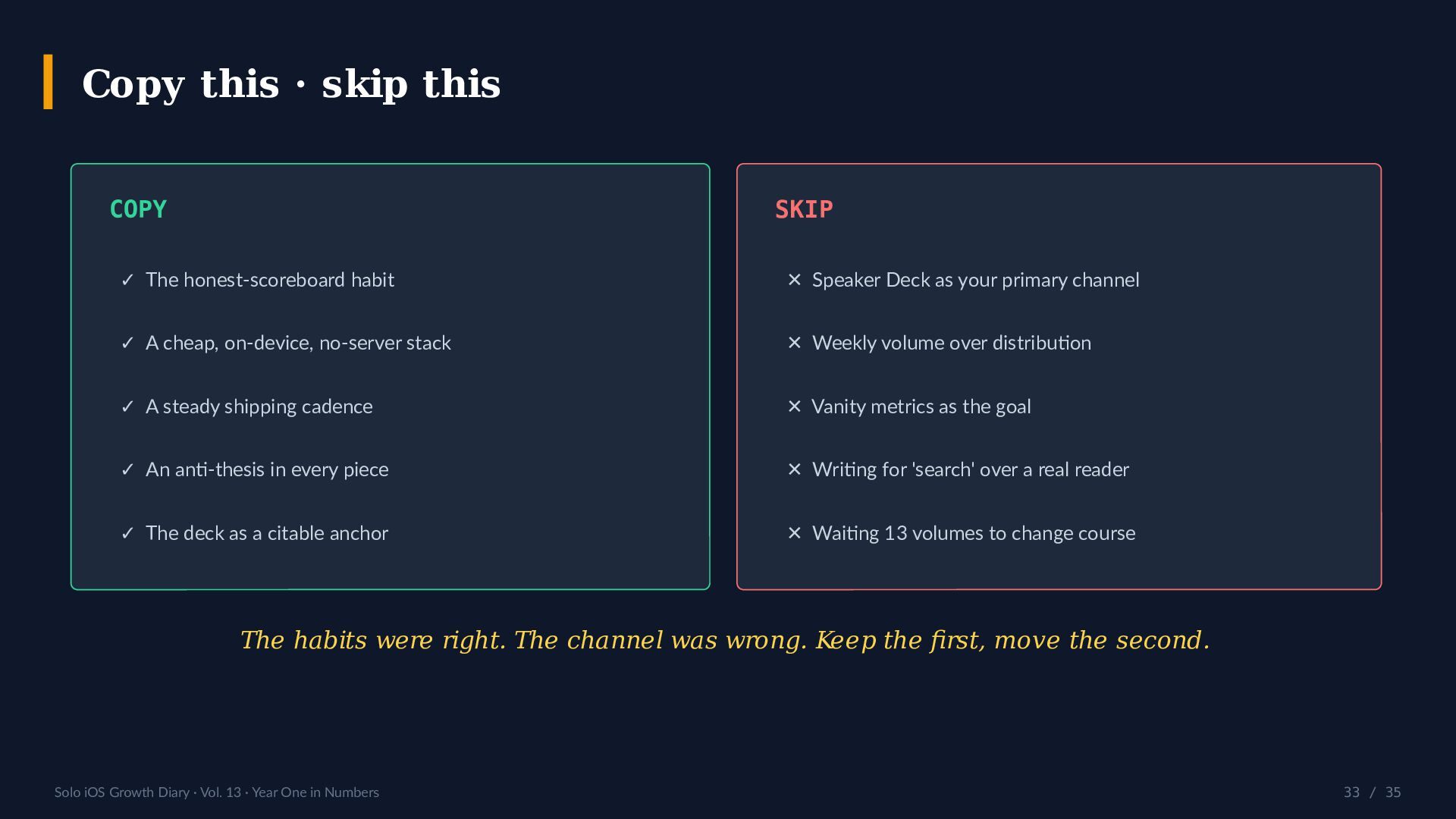
  33. Copy this · skip this COPY SKIP ✓ The honest-scoreboard

    habit ✕ Speaker Deck as your primary channel ✓ A cheap, on-device, no-server stack ✕ Weekly volume over distribution ✓ A steady shipping cadence ✕ Vanity metrics as the goal ✓ An anti-thesis in every piece ✕ Writing for 'search' over a real reader ✓ The deck as a citable anchor ✕ Waiting 13 volumes to change course The habits were right. The channel was wrong. Keep the first, move the second. Solo iOS Growth Diary · Vol. 13 · Year One in Numbers 33 / 35
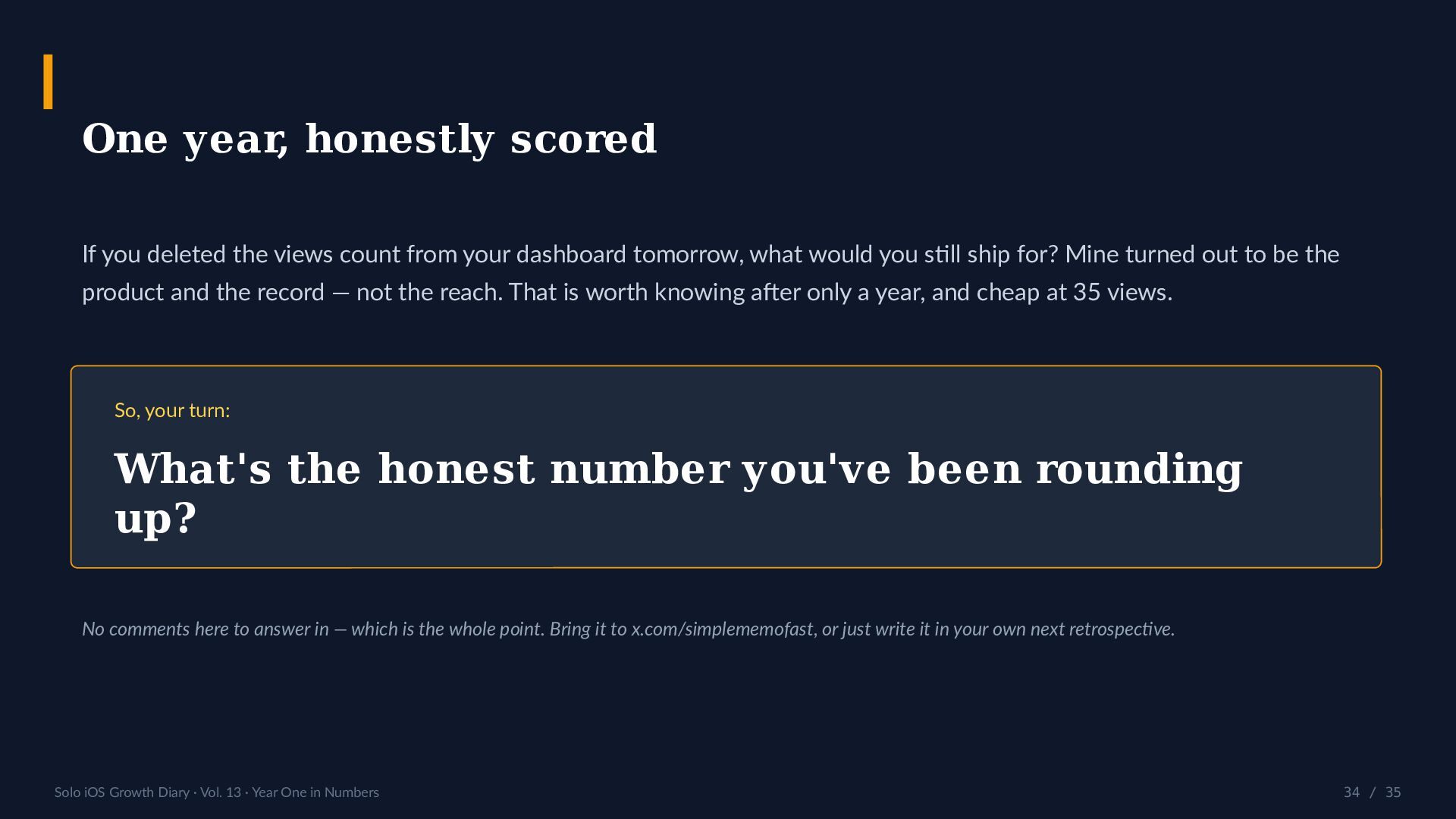
  34. One year, honestly scored If you deleted the views count

    from your dashboard tomorrow, what would you still ship for? Mine turned out to be the product and the record — not the reach. That is worth knowing after only a year, and cheap at 35 views. So, your turn: What's the honest number you've been rounding up? No comments here to answer in — which is the whole point. Bring it to x.com/simplememofast, or just write it in your own next retrospective. Solo iOS Growth Diary · Vol. 13 · Year One in Numbers 34 / 35
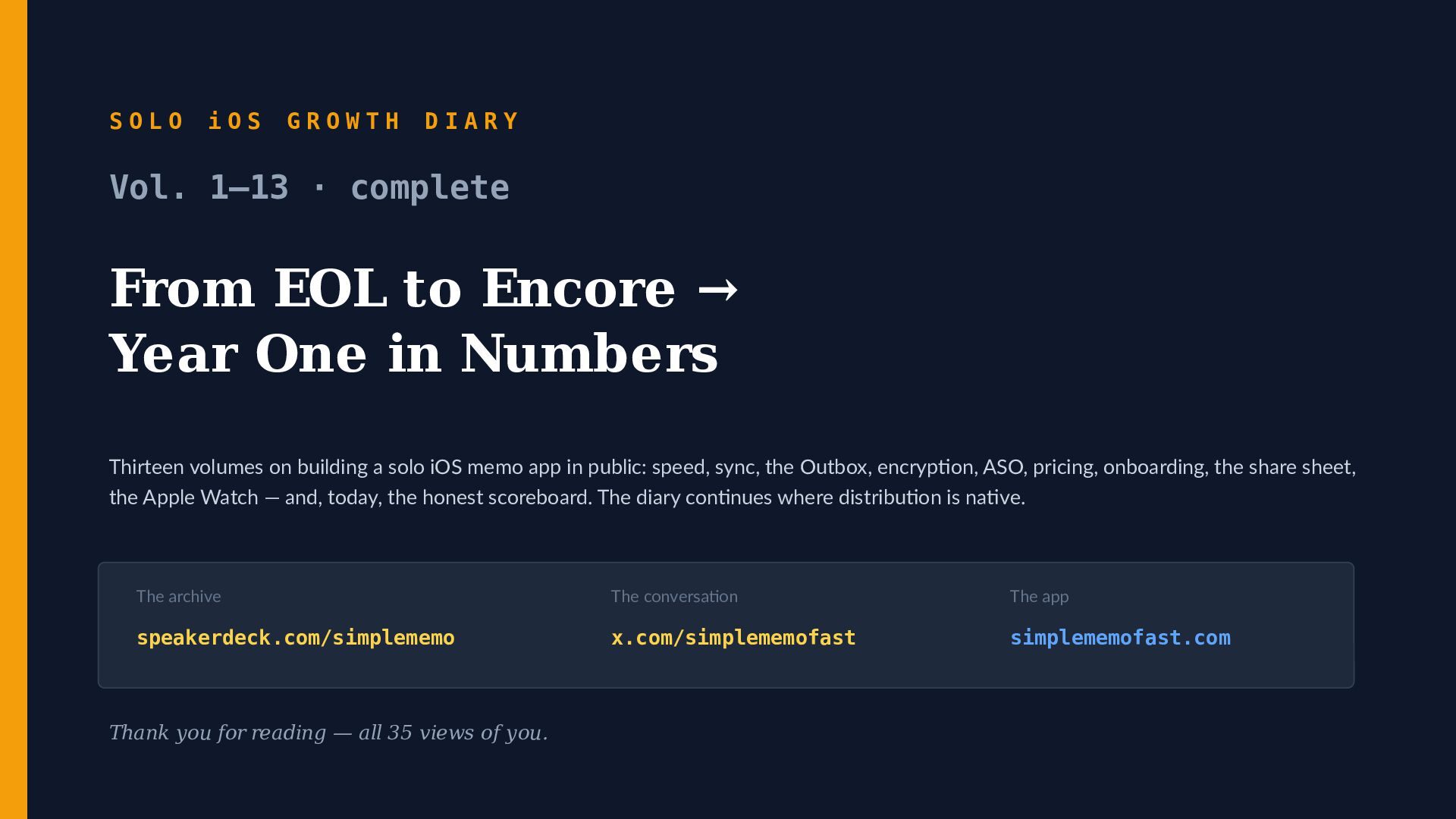
  35. SOLO iOS GROWTH DIARY Vol. 1–13 · complete From EOL

    to Encore → Year One in Numbers Thirteen volumes on building a solo iOS memo app in public: speed, sync, the Outbox, encryption, ASO, pricing, onboarding, the share sheet, the Apple Watch — and, today, the honest scoreboard. The diary continues where distribution is native. The archive The conversation The app speakerdeck.com/simplememo x.com/simplememofast simplememofast.com Thank you for reading — all 35 views of you.