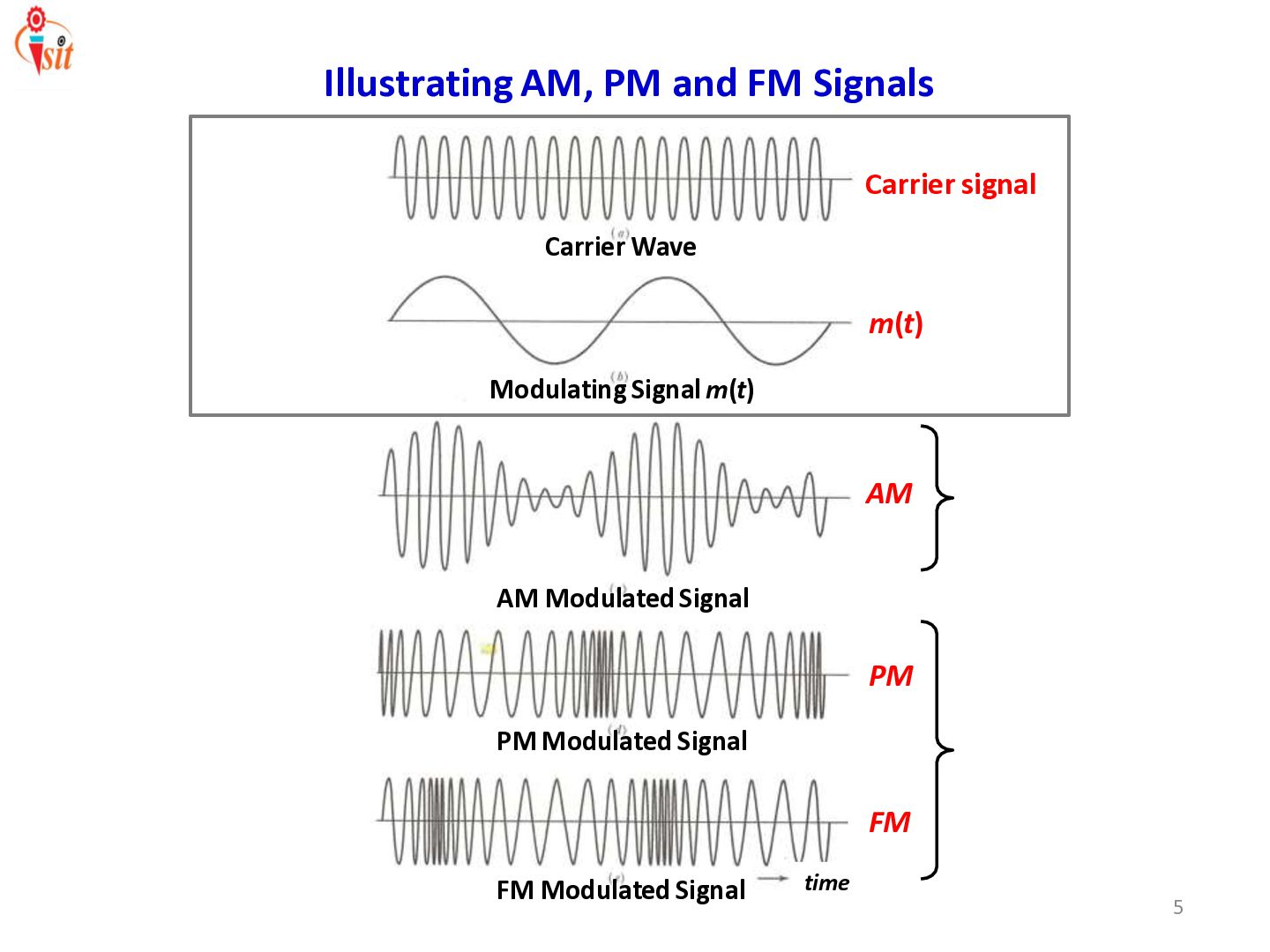
two reasons: (1) To reduce the wavelength for efficient transmission and reception (the optimum antenna size is ¼ of a wavelength). A typical audio frequency of 3000 Hz has a wavelength of 100 km and would need an effective antenna length of 25 km! By comparison, a typical FM carrier is 100 MHz, with a wavelength of 3 meters, and would have an 80 cm long antenna (that is 31.5 inches long). (2) To allow simultaneous use of the same channel, called multiplexing. Each unique message signal has a different assigned carrier frequency (e.g., radio stations) and share the same channel. The telephone company invented modulation to allow phone conversations to be transmitted over common phone lines. Mandated by the FCC. 4
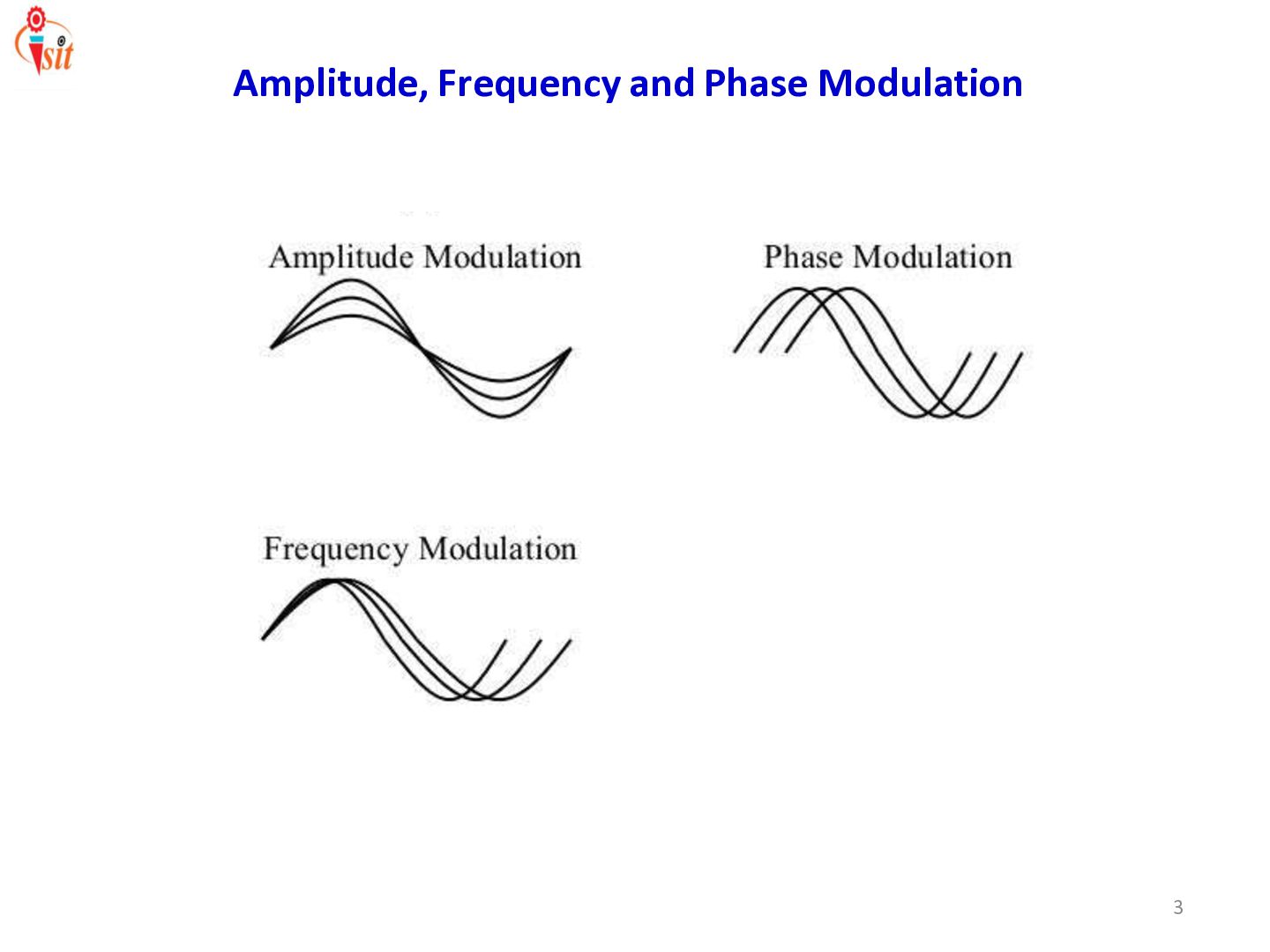
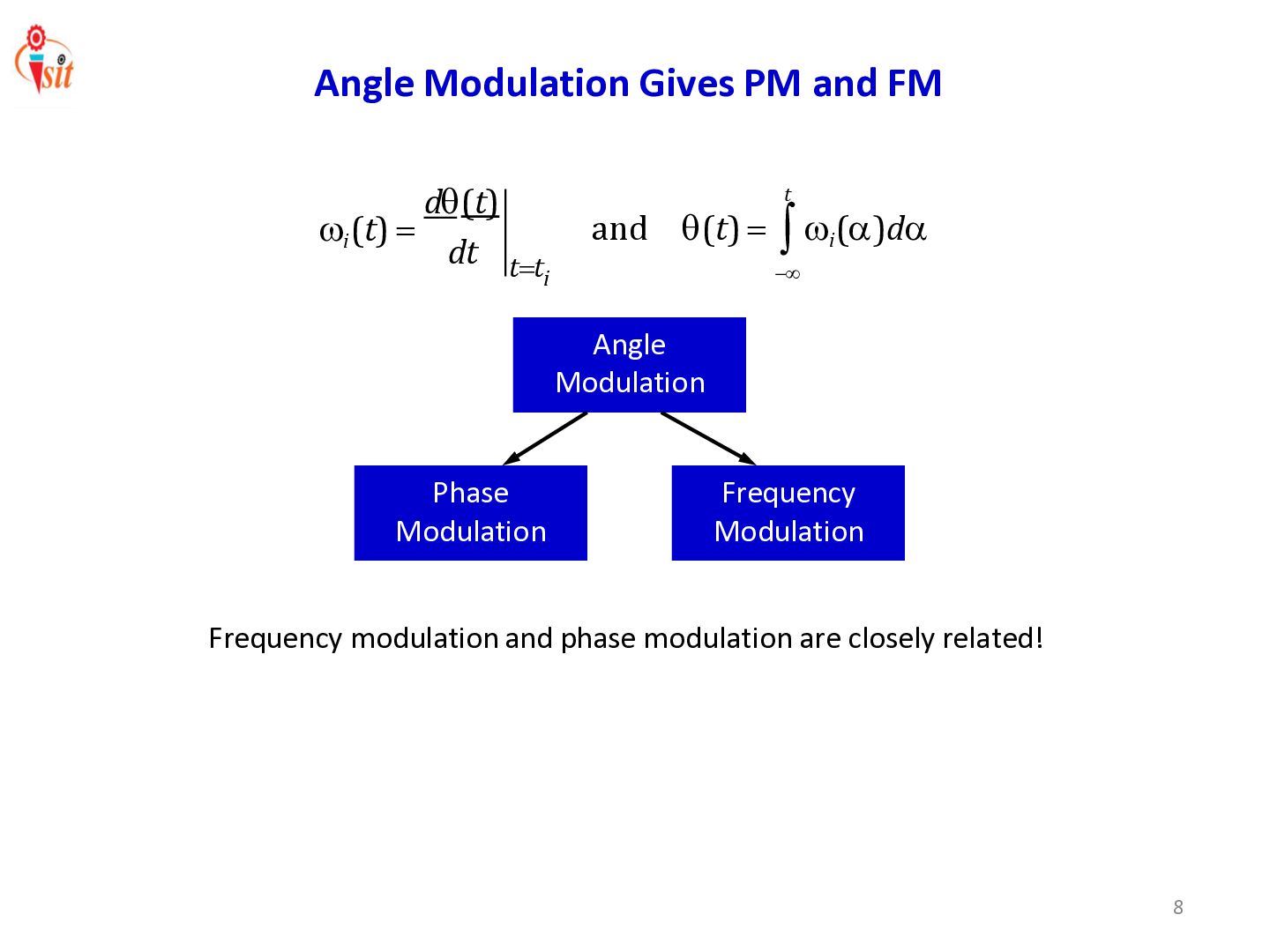
dt tt t and (t) i ( )d i Angle Modulation Phase Modulation Frequency Modulation Frequency modulation and phase modulation are closely related! 8
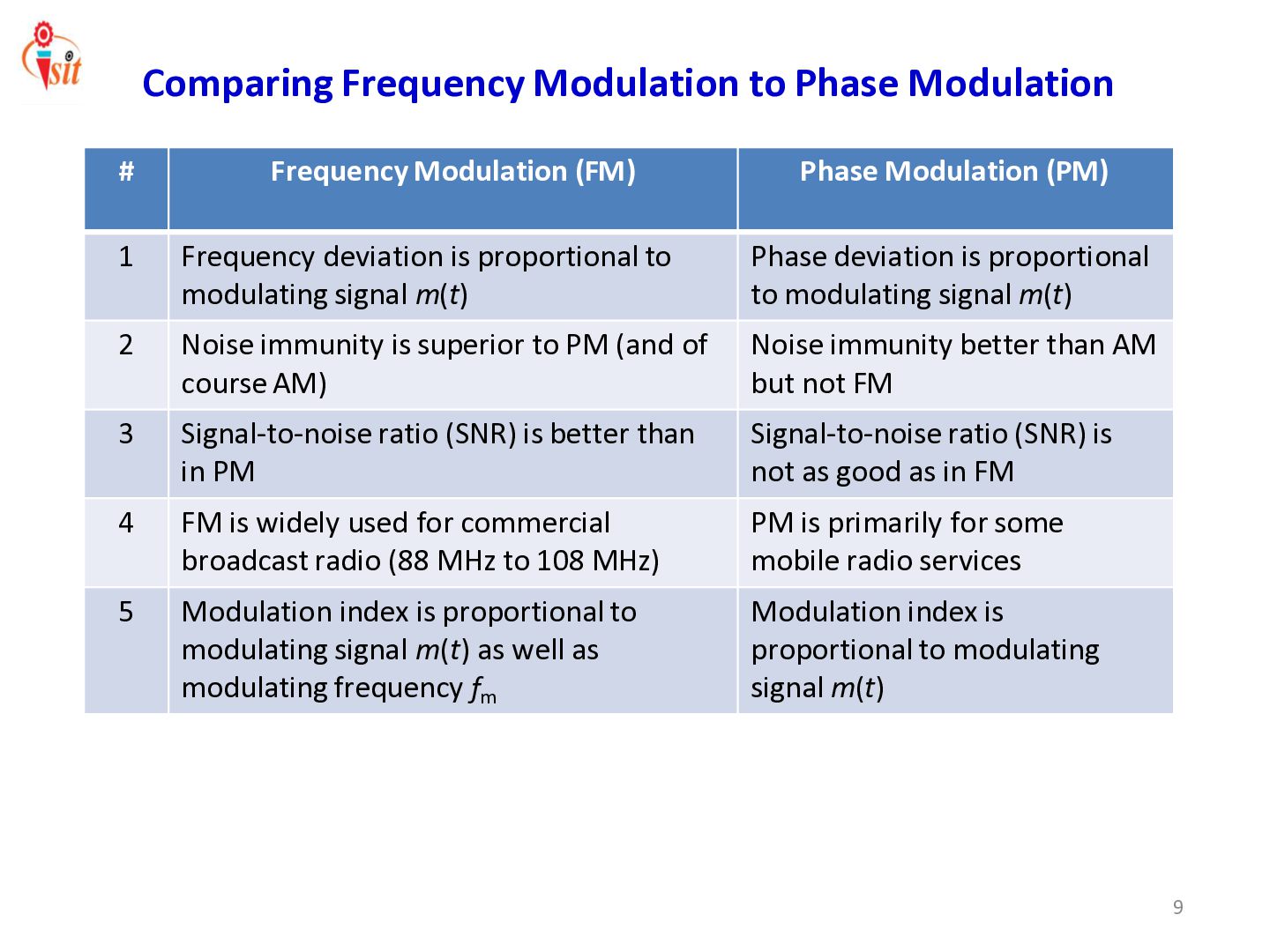
Phase Modulation (PM) 1 Frequency deviation is proportional to modulating signal m(t) Phase deviation is proportional to modulating signal m(t) 2 Noise immunity is superior to PM (and of course AM) Noise immunity better than AM but not FM 3 Signal-to-noise ratio (SNR) is better than in PM Signal-to-noise ratio (SNR) is not as good as in FM 4 FM is widely used for commercial broadcast radio (88 MHz to 108 MHz) PM is primarily for some mobile radio services 5 Modulation index is proportional to modulating signal m(t) as well as modulating frequency fm Modulation index is proportional to modulating signal m(t) 9
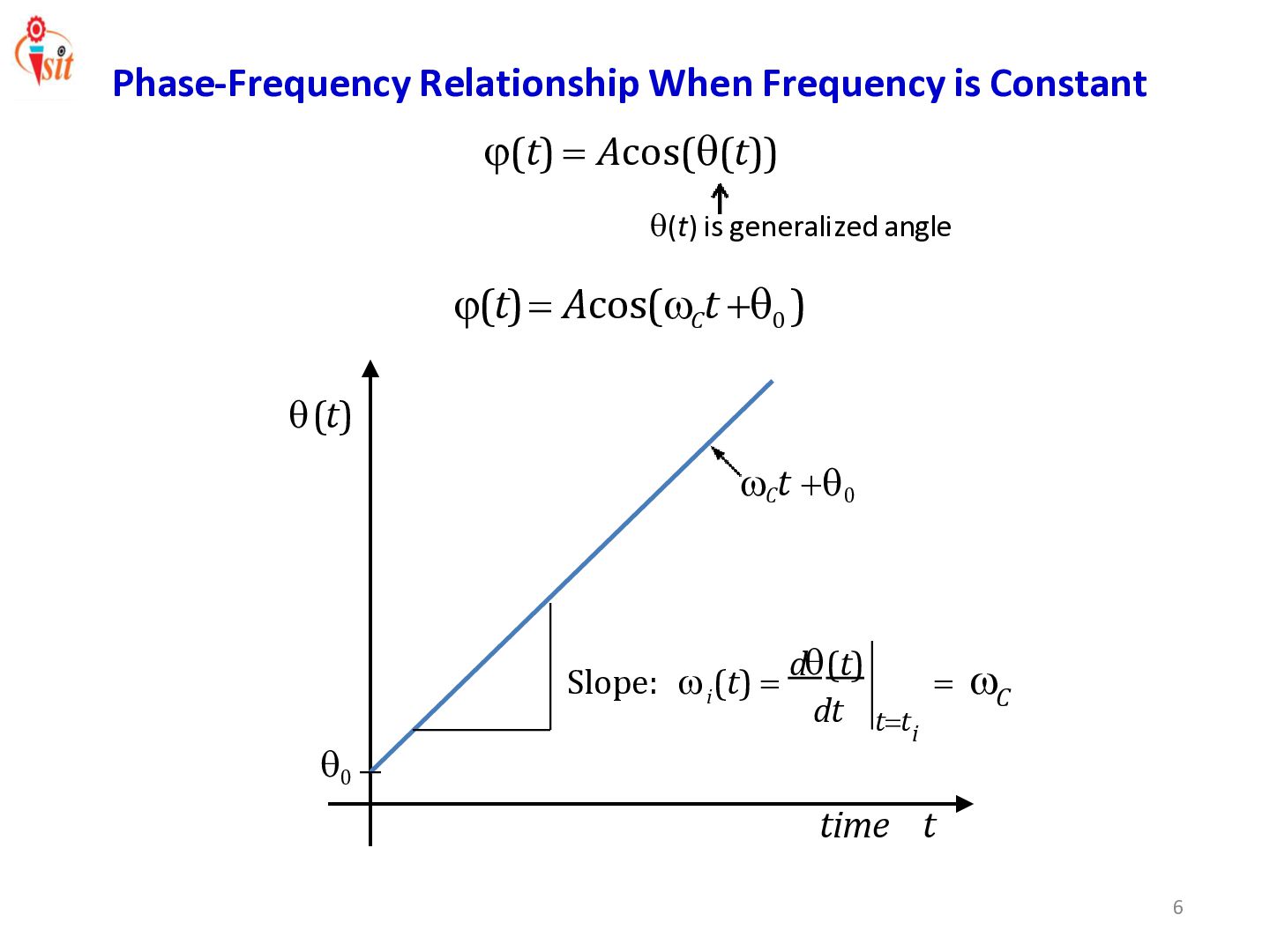
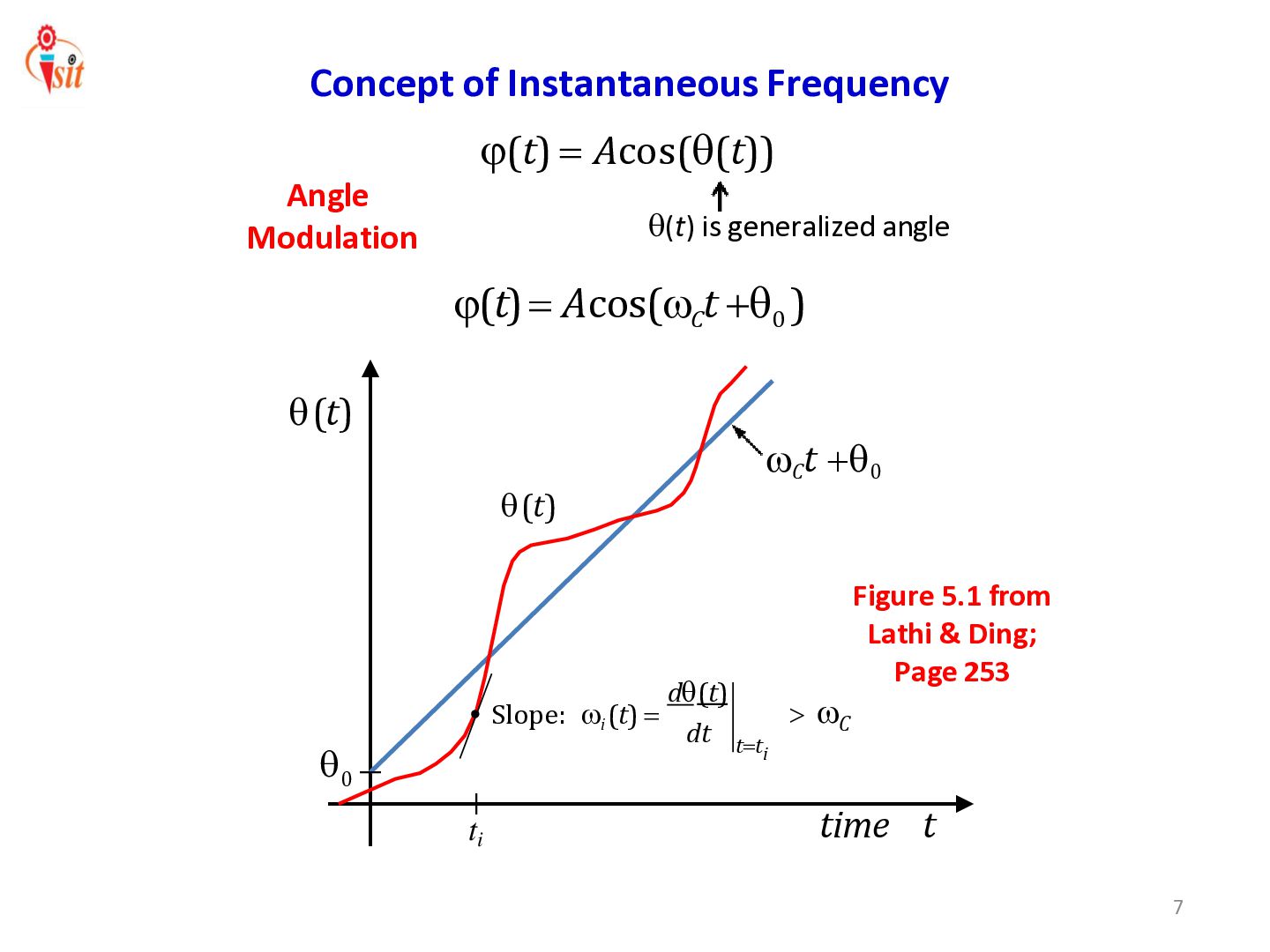
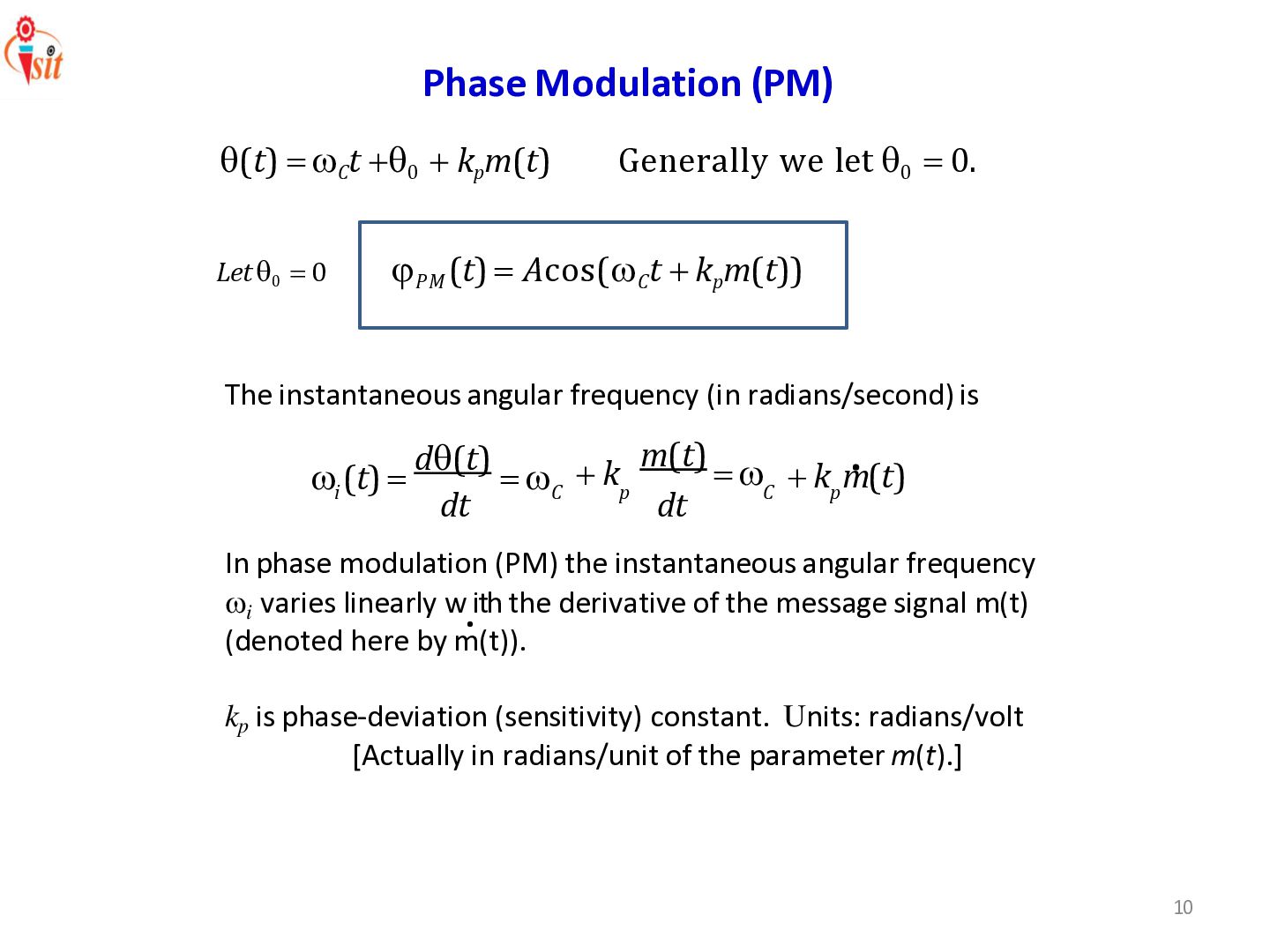
0 0 Generally we let 0 0. PM (t) Acos(Ct kpm(t)) The instantaneous angular frequency (in radians/second) is i (t) m(t) . (t) d(t) C kp m C kp dt dt In phase modulation (PM) the instantaneous angular frequency i varies linearly w.ith the derivative of the message signal m(t) (denoted here by m(t)). kp is phase-deviation (sensitivity) constant. Units: radians/volt [Actually in radians/unit of the parameter m(t).] 10
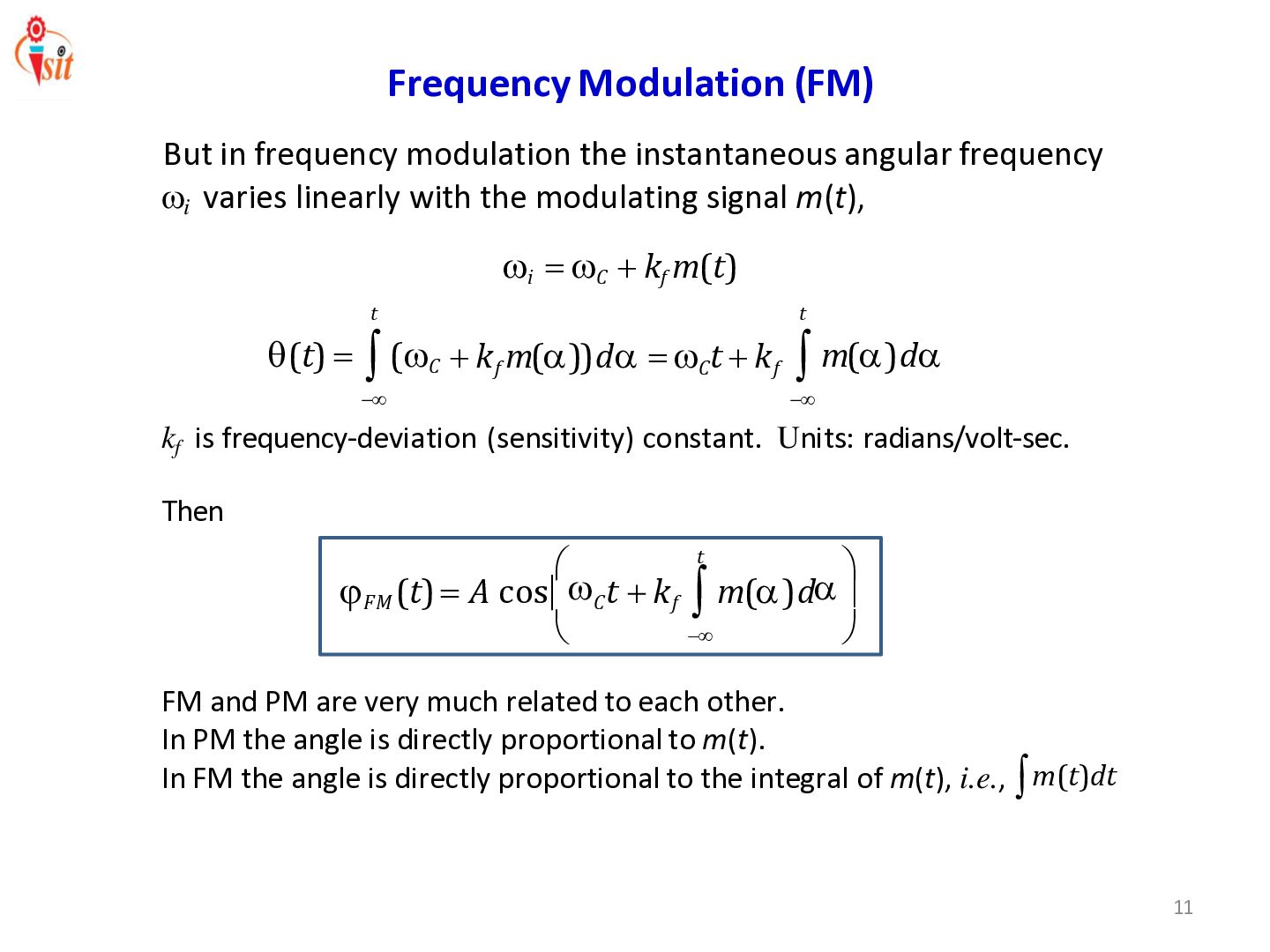
frequency i varies linearly with the modulating signal m(t), i C kf m(t) t t (t) (C k f m( ))d Ct k f m( )d kf is frequency-deviation (sensitivity) constant. Units: radians/volt-sec. Then t FM (t) A cos C t k f m( )d FM and PM are very much related to each other. In PM the angle is directly proportional to m(t). In FM the angle is directly proportional to the integral of m(t), i.e., m(t)dt 11
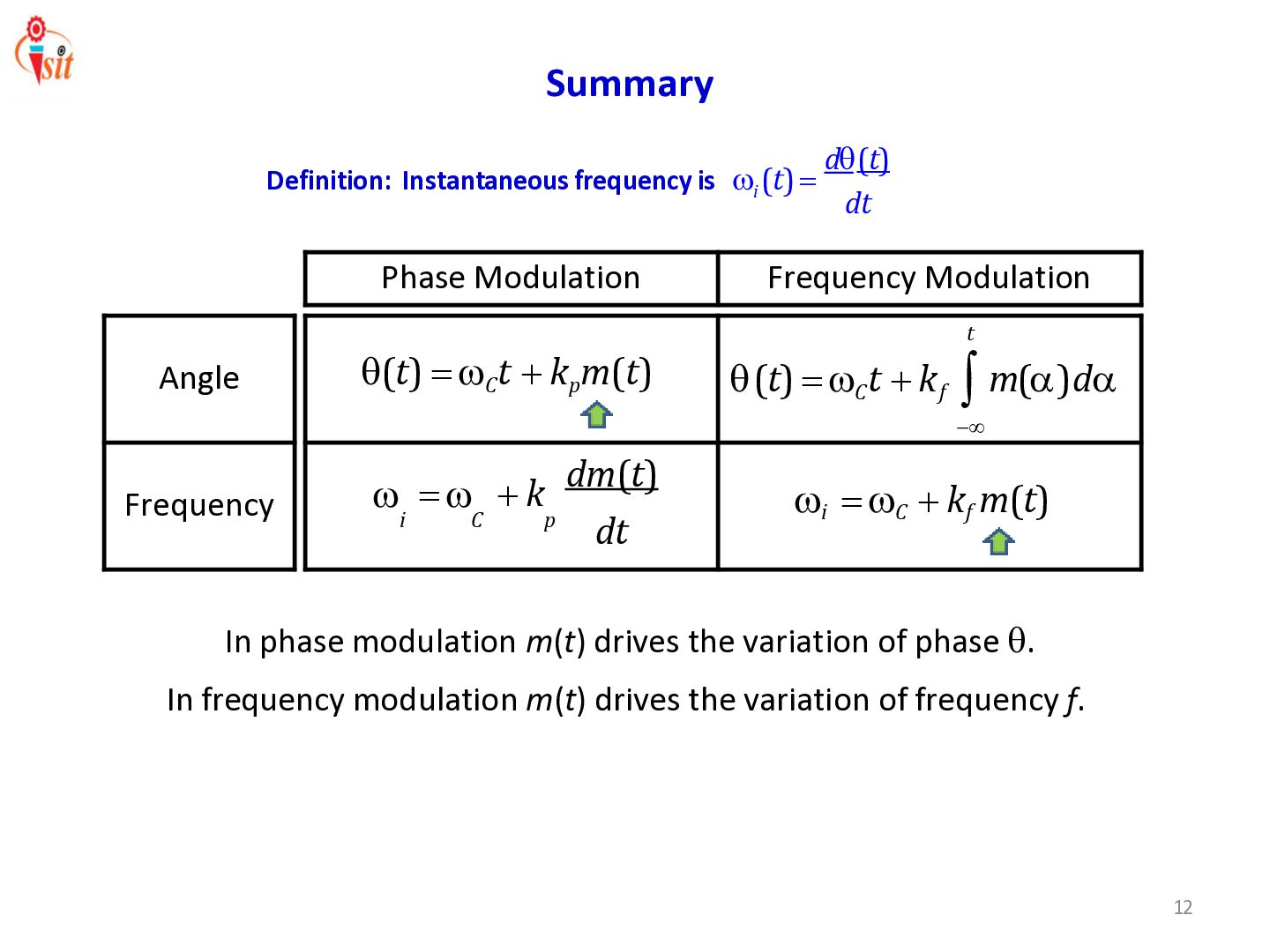
Angle (t) Ct kpm(t) d (t) dt Frequency Modulation t (t) Ct k f m( )d Frequency k i C p dm(t) dt i C kf m(t) In phase modulation m(t) drives the variation of phase . In frequency modulation m(t) drives the variation of frequency f. 12
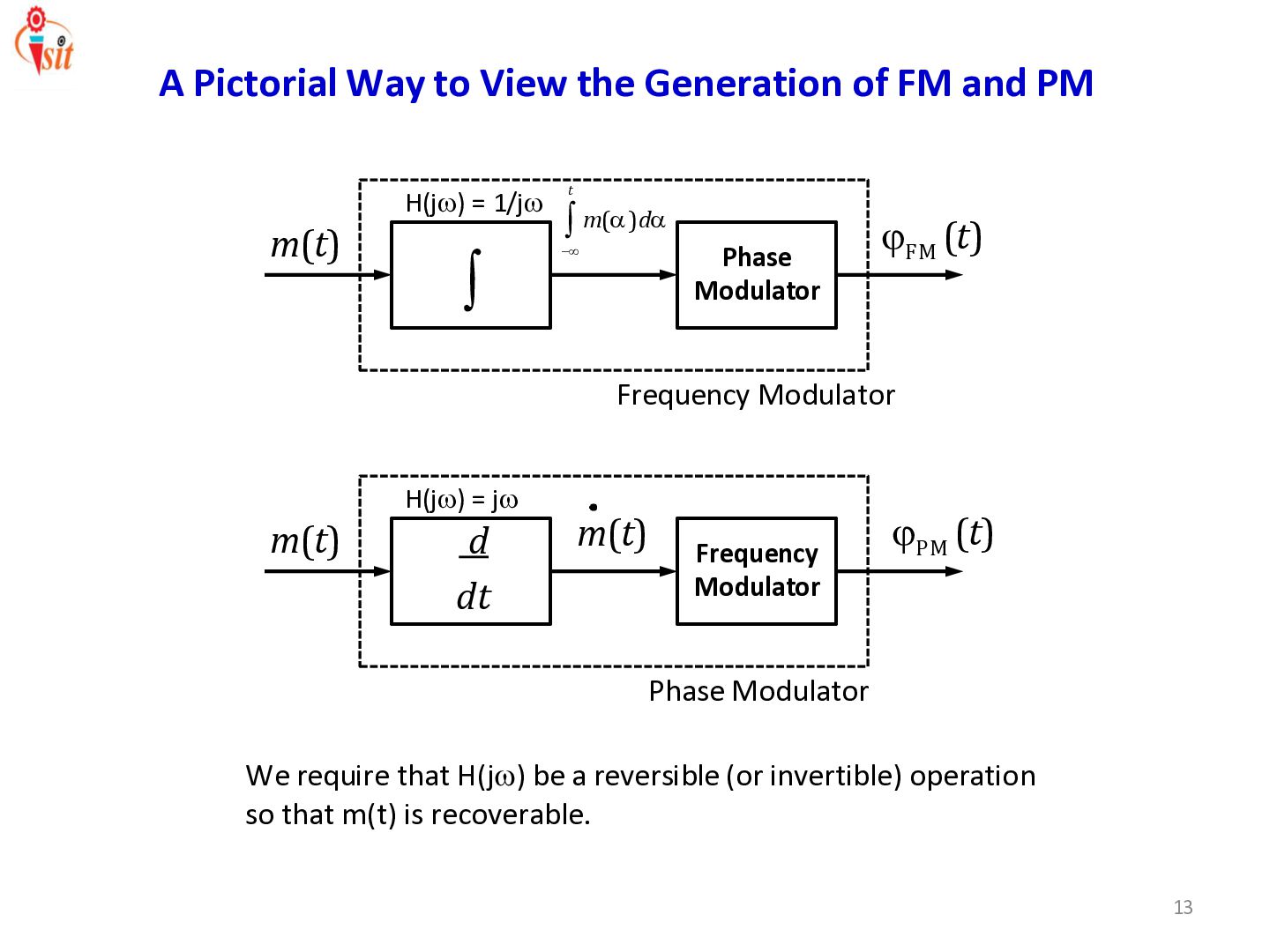
PM H(j) = 1/j m(t) t m( )d Phase Modulator FM (t) Frequency Modulator H(j) = j m(t) d dt . . m(t) Frequency Modulator PM (t) Phase Modulator We require that H(j) be a reversible (or invertible) operation so that m(t) is recoverable. 13
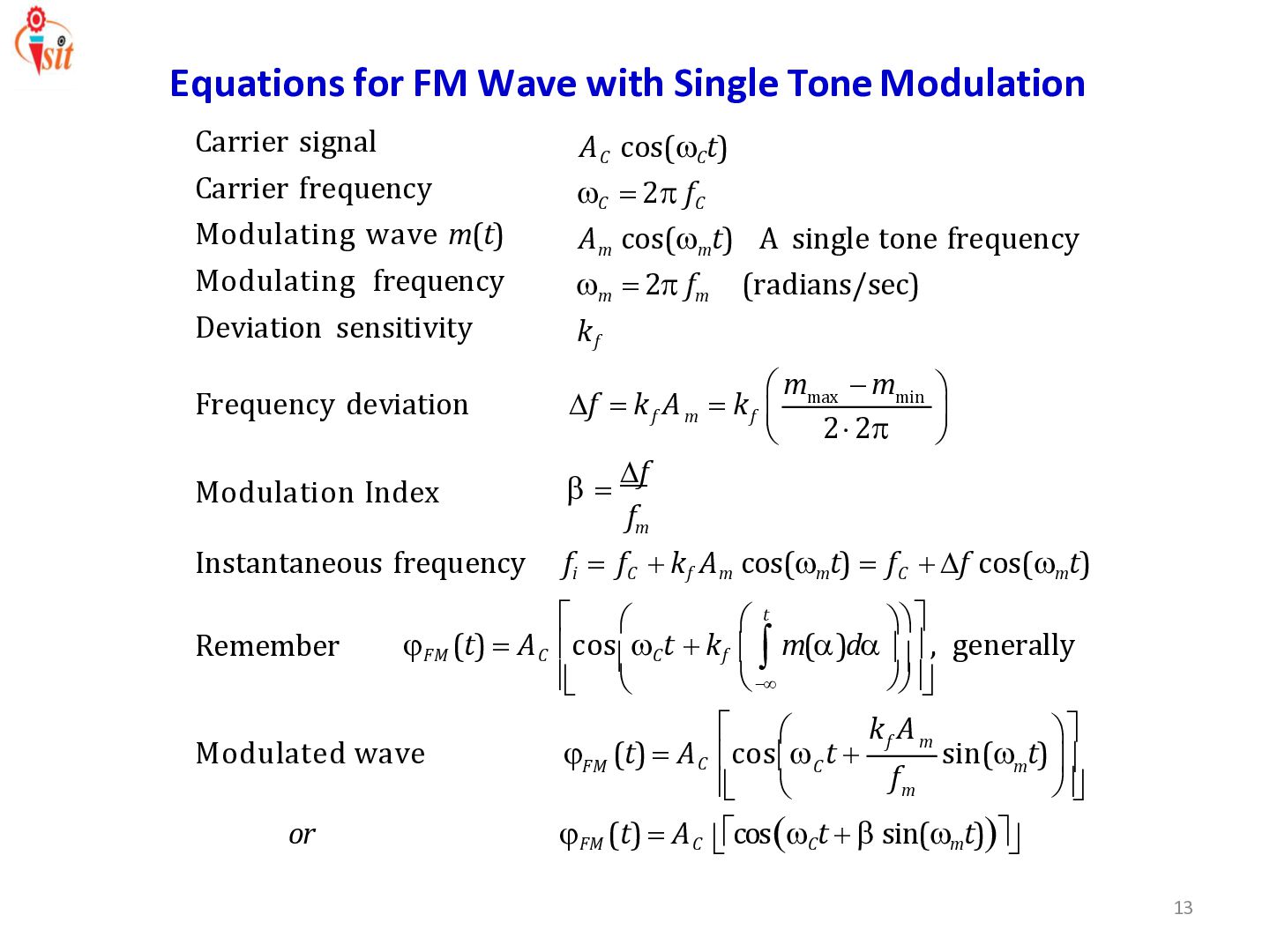
Carrier frequency A C cos(Ct) C 2 fC Modulating wave m(t) Modulating frequency A m cos(mt) A single tone frequency m 2 fm (radians/sec) Deviation sensitivity kf Frequency deviation Modulation Index Instantaneous frequency Remember t FM (t) A C cosC t k f m( )d , generally Modulated wave or m mmin f k f A m k f max 2 2 f fm fi f C k f A m cos(mt) f C f cos(mt) kf A m FM (t) A C cos C t sin(mt) f m FM (t) A C cosCt sin(mt) 13
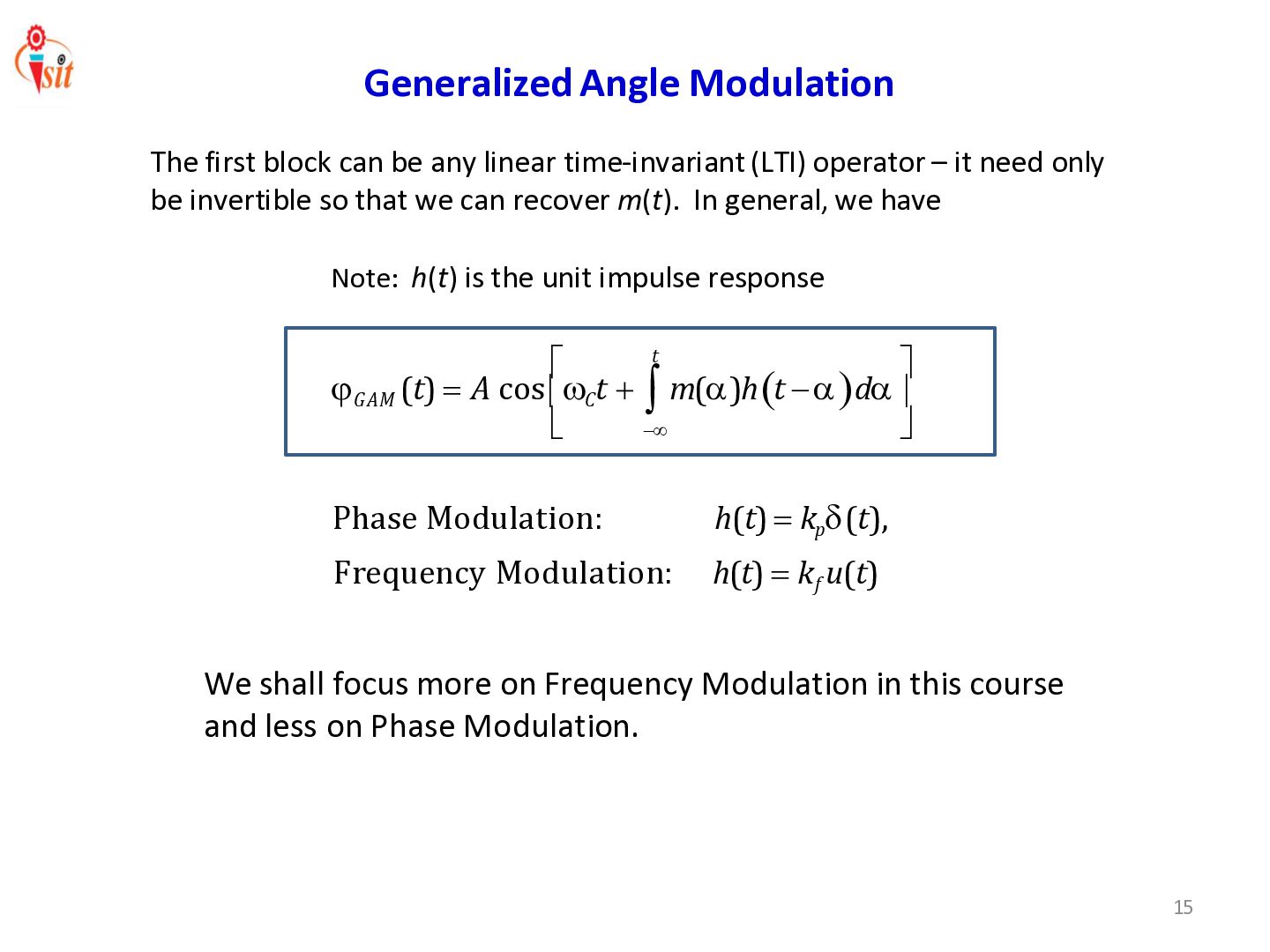
time-invariant (LTI) operator – it need only be invertible so that we can recover m(t). In general, we have Note: h(t) is the unit impulse response t GAM (t) A cos Ct m( )h t d Phase Modulation: h(t) kp (t), Frequency Modulation: h(t) k f u(t) We shall focus more on Frequency Modulation in this course and less on Phase Modulation. 15
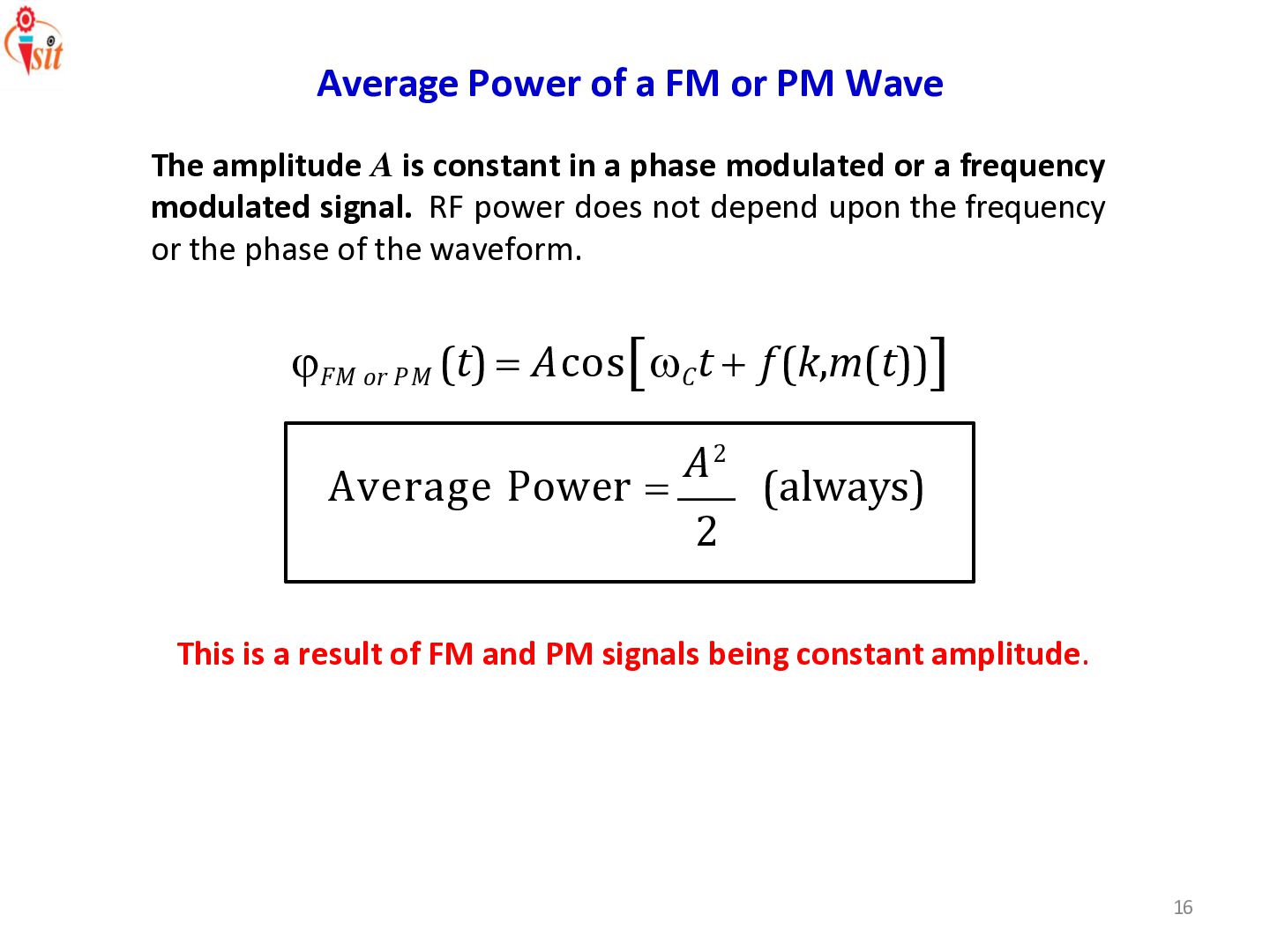
A is constant in a phase modulated or a frequency modulated signal. RF power does not depend upon the frequency or the phase of the waveform. FM or P M (t) Acos C t f (k,m(t)) Average Power A2 2 (always) This is a result of FM and PM signals being constant amplitude. 16
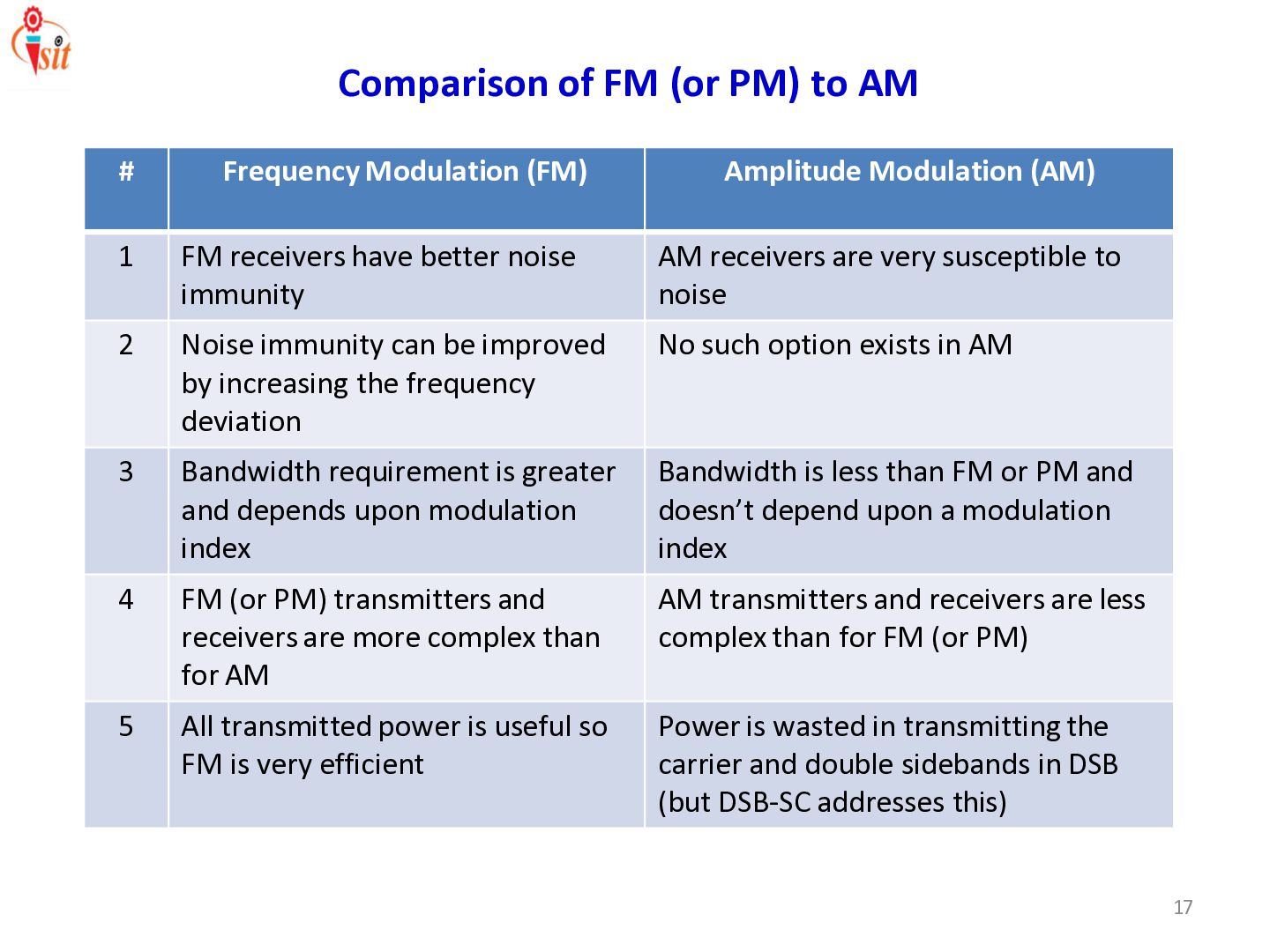
(FM) Amplitude Modulation (AM) 1 FM receivers have better noise immunity AM receivers are very susceptible to noise 2 Noise immunity can be improved by increasing the frequency deviation No such option exists in AM 3 Bandwidth requirement is greater and depends upon modulation index Bandwidth is less than FM or PM and doesn’t depend upon a modulation index 4 FM (or PM) transmitters and receivers are more complex than for AM AM transmitters and receivers are less complex than for FM (or PM) 5 All transmitted power is useful so FM is very efficient Power is wasted in transmitting the carrier and double sidebands in DSB (but DSB-SC addresses this) 17


 sit12345
 robintux
 kaityo256
 eller86
 hiola
 cbtlibrary
 bunnchinn3
 terasawat
 pawan_pharm
 signer
 juanmartin2026
 yoshimura_datam
 aleyda
 orderedlist
 trishagee
 panda_program
 chriscoyier
 baasie
 lauravandoore
 stephaniewalter
 marcoroth
 retrage
 letsgokoyo
 davidcarrasco