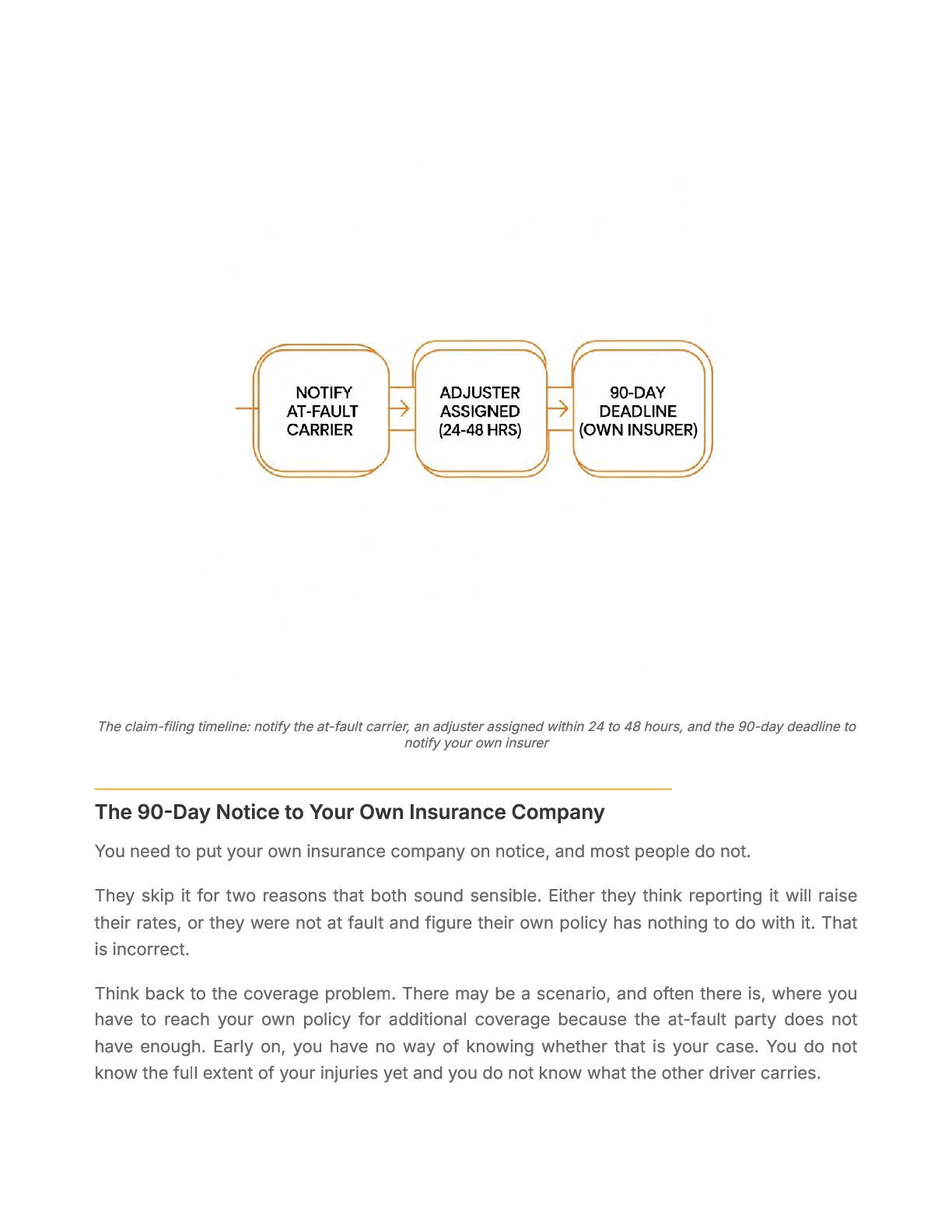
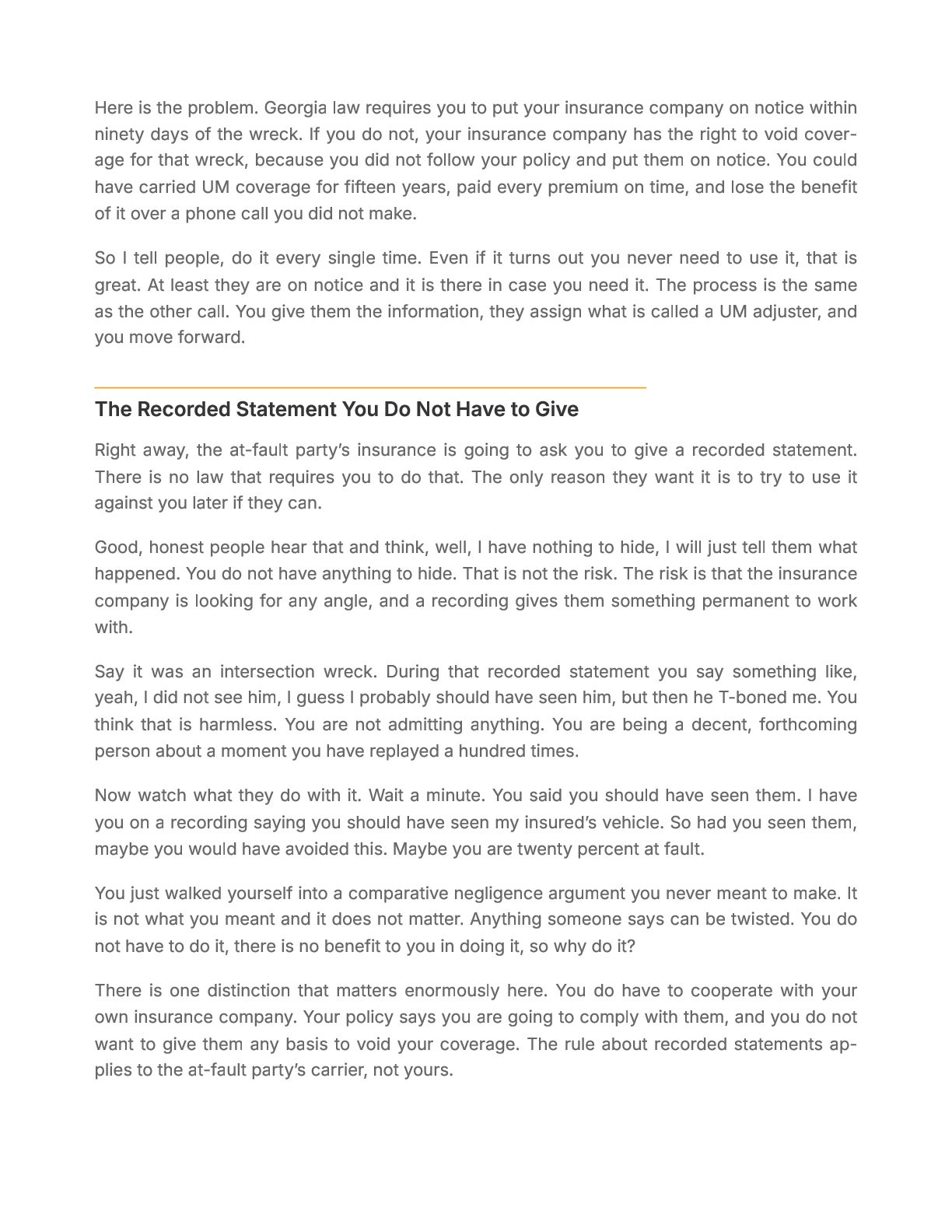
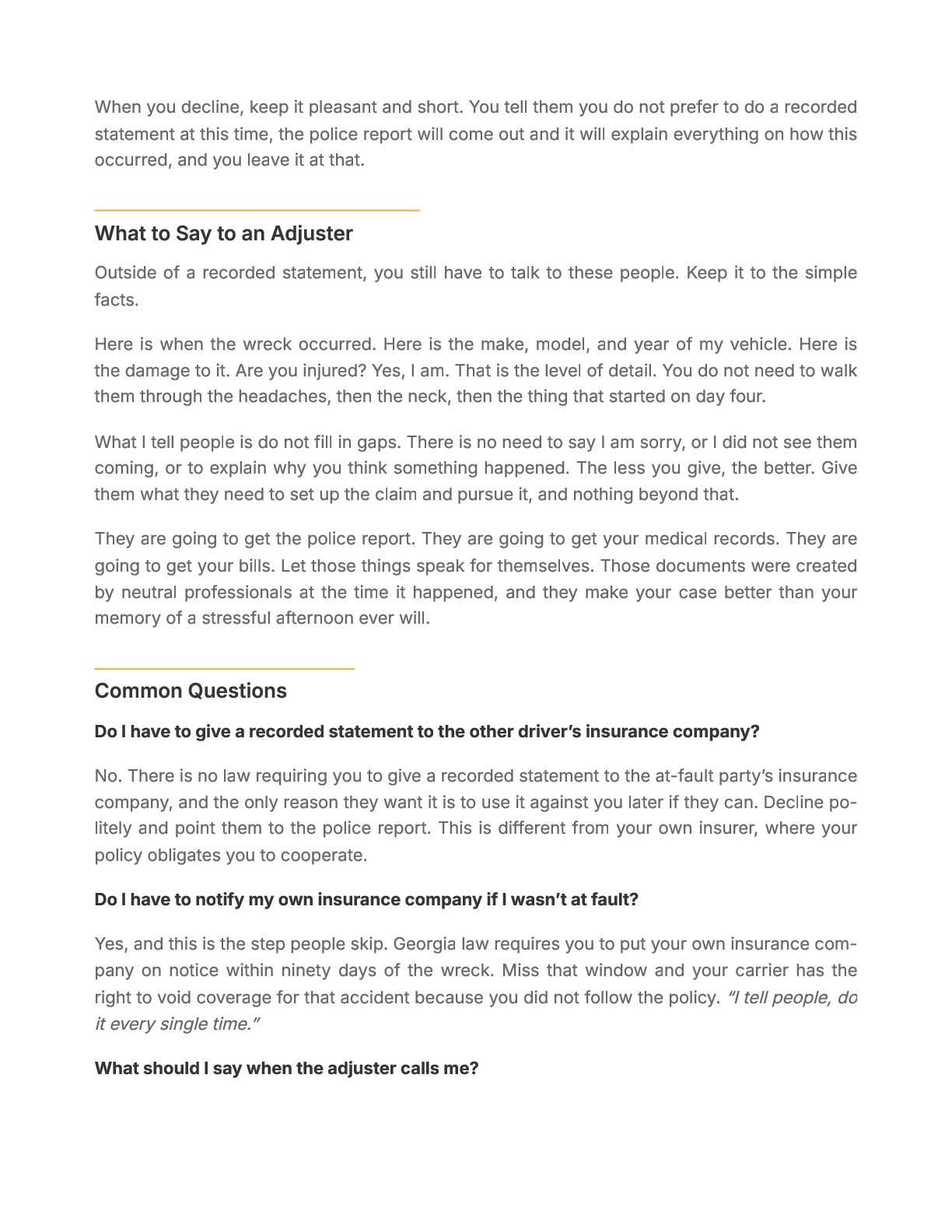
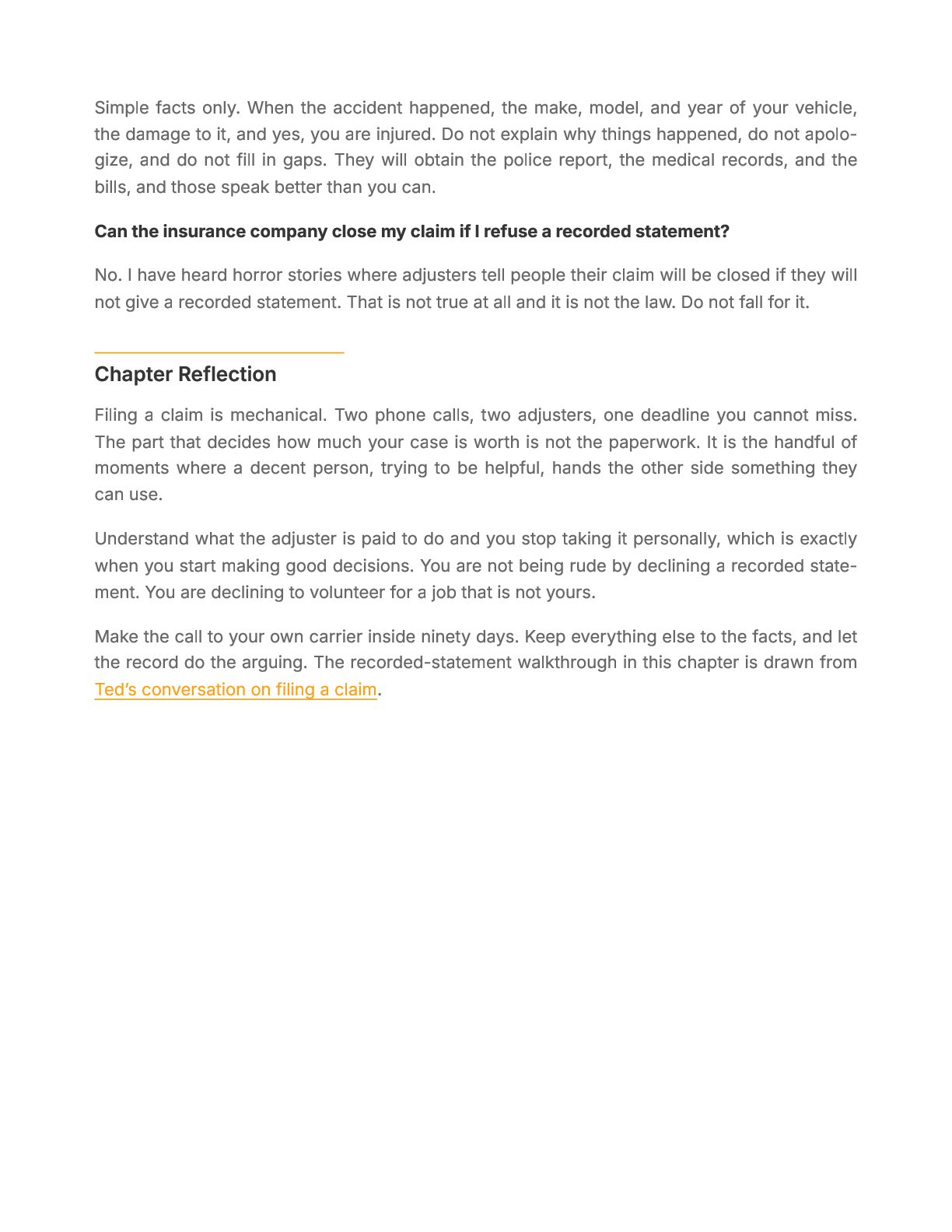
Upgrade to Pro — share decks privately, control downloads, hide ads and more …

The Atlanta Car Accident Claim Handbook

Avatar for Ted Spaulding Ted Spaulding
September 08, 2026

The Atlanta Car Accident Claim Handbook

A Georgia trial attorney's field guide to what the law requires, what insurers actually do, and the mistakes that quietly kill claims.

Avatar for Ted Spaulding

Ted Spaulding

September 08, 2026

Other Decks in Research

Transcript

  1. A G E O R G I A T R

    I A L AT T O R N E Y ' S F I E L D G U I D E The Atlanta Car Accident Claim Handbook What Georgia Law Requires, What Insurance Companies Actually Do, and the Mistakes That Quietly Kill Claims Ted Spaulding Founder and Trial Attorney SPAULDING INJURY LAW
  2. Table of Contents ▪ Foreword ▪ Introduction ▪ Chapter 1:

    The First Ten Minutes: What to Do at the Scene of an Atlanta Car Accident ▪ Chapter 2: Call the Police Every Single Time, Even for a Scratch ▪ Chapter 3: Evidence Disappears: Video, Witnesses, and the Preservation Letter ▪ Chapter 4: Get Checked Out the Same Day: The Treatment Hierarchy Insurers Grade You On ▪ Chapter 5: Georgia Is a Fault State: What You Actually Have to Prove ▪ Chapter 6: The 51 Percent Rule: How Comparative Negligence Decides What You Recover ▪ Chapter 7: $25,000 Is All Georgia Requires: The Coverage Gap Nobody Warns You About ▪ Chapter 8: Who Decides Fault: The Police Report, the Jury, and the Evidence Between Them ▪ Chapter 9: Filing the Claim: Adjusters, the 90-Day Notice, and the Recorded Statement ▪ Chapter 10: The Insurance Playbook: How Carriers Argue Your Injuries Away ▪ Chapter 11: Medical Records, Liens, and the Black Box: The Evidence That Sets Value ▪ Chapter 12: Two Years and Counting: Georgia’s Deadlines and the Ante Litem Trap ▪ Chapter 13: What Your Claim Is Actually Worth: The Damages Buckets ▪ Chapter 14: Settle or Sue: Risk, Litigation, and the Decision Only You Can Make ▪ Chapter 15: When to Call a Lawyer, and What Happens If the Other Driver Has No Insurance ▪ Frequently Asked Questions ▪ Conclusion ▪ Final Takeaways ▪ About the Author ▪ Appendix: Georgia Law and Official Resources
  3. Foreword A Georgia car accident claim is a legal and

    evidentiary process that requires an injured person to prove another driver’s fault, prove that their injuries came from the accident, and prove what those injuries cost, all within deadlines that begin running the moment the accident ends. The Atlanta Car Accident Claim Handbook is organized around that process. It is not a book about accidents. It is a book about the decisions made in the hours and days afterward that determine whether a claim survives at all. The working parts of a Georgia car accident claim are concrete, and this book names each one with its actual value. Fault is not shared credit, it is a threshold: the other driver has to car‐ ry 51 percent or more of the blame before an injured person recovers a dollar, and at 50 per‐ cent the recovery is zero. Coverage is not unlimited, it is a number set by statute: Georgia re‐ quires only $25,000 in liability insurance, and that figure has to absorb medical bills, lost wages, and pain and suffering together. Evidence is not permanent, it has a shelf life: sur‐ veillance footage from a business near the scene is typically overwritten in about 30 days, sometimes in 10. Deadlines are not uniform, they branch: two years for most claims, but six months to notify a city and one year to notify a county or the State of Georgia. These are the components of a claim, and the book treats them as components rather than as themes. Ted Spaulding is positioned to explain those components because his background supplies the historical record a reader needs in order to trust a guide like this. He is the founder of Spaulding Injury Law, a Georgia plaintiff’s personal injury firm serving Atlanta, Lawrenceville, Alpharetta, and Cumming, and he has spent more than two decades trying these cases rather than referring them out. The conversations this book was adapted from were recorded for the Atlanta Car Accident Attorneys podcast, where the same questions arrive in every episode: what to do at the scene, whether to talk to the adjuster, how much time is left, and what a claim is actually worth. Those recordings are published on Apple Podcasts and Spotify, and the episode this book was adapted from is the second in the series. The book’s core section is the reader’s first map. The opening chapters cover the first ten minutes at the scene, why the police get called even for a scratch, how quickly the evidence disappears, and where to go for treatment on the day of the accident. These chapters define the primary attributes of a Georgia car accident claim, and they are written for a reader who is not researching a topic but reacting to something that has already happened. That reader is not asking what the law says in the abstract. They are asking what to do this afternoon, and what not to say when the phone rings tomorrow.
  4. The outer section extends the claim into the systems that

    decide how it resolves. Georgia’s fault requirement, the 51 percent threshold and the arithmetic behind it, minimum coverage limits and uninsured motorist protection, how fault actually gets assigned, the mechanics of filing, the arguments carriers run against injury claims, the records and data that set value, the statutory deadlines, the damages categories, the settle-or-sue decision, and the litigation timeline in Fulton County. A claim never stays sealed inside the facts of the accident. It moves outward into coverage limits, notice requirements, treatment records, and the credibility of the injured person’s own documentation. Three chapters carry more weight than the rest. The chapter on Georgia’s 51 percent rule an‐ swers the question of eligibility, because a reader who was partly at fault usually assumes they have no claim and is frequently wrong. The chapter on the $25,000 minimum answers the question of recovery, because the most common reason a serious Georgia injury goes un‐ compensated is not a weak case but an empty policy. The chapter on Georgia’s deadlines an‐ swers the question of time, because the ante litem notice that applies when a government ve‐ hicle is involved expires long before the two-year statute most people have heard of. These are the questions readers are actually searching for, and the book meets them there. What distinguishes this handbook is its candor about the parts of the process that do not favor the firm writing it. It says plainly that calling a lawyer is not the same as hiring one, that most people can handle a small claim themselves if they get advice first, that no lawyer can prom‐ ise a better result at trial than the offer on the table, and that a settlement is worth more to the person who cannot stomach litigation than to the person who can. Advice that only ever points toward retaining counsel is marketing. Advice that occasionally points away from it is worth reading. Read this before the insurance process starts to feel routine, because the earliest decisions are the ones made with the least information and the largest consequences. In a system built to move faster than the people inside it, knowing the sequence is the first form of protection.
  5. Introduction Most people reading this were in an accident recently.

    Maybe yesterday. Maybe an hour ago, in a parking lot off Peachtree with a bumper that does not look that bad, while somebody sug‐ gests you skip the police and let insurance sort it out. I wrote this book for that moment. Here is what I have learned in over twenty years of doing this in Georgia. The cases that fall apart almost never fall apart because somebody did something reckless. They fall apart be‐ cause a reasonable person made a reasonable decision at a moment when they did not have the information they needed. They did not call the police because the damage looked minor. They did not go to the doctor because they felt fine. They gave a recorded statement because they had nothing to hide. Every one of those choices makes sense standing there in the road. Every one of them can end a claim. So this is not a book about the law in the abstract. It is a sequence. What happens first, what happens next, and what the insurance company on the other side is doing while you are figur‐ ing it out. A few things I want to be straight with you about before you start. I am a plaintiff’s lawyer. I represent injured people against insurance companies, and I am not going to pretend I am neutral about that. But I have tried to write this so it is useful to you whether you ever call my firm or not. There are places in here where the honest advice is that you probably do not need a lawyer yet, and I say so, because that is what I tell people on the phone. The insurance company is not your enemy, and it is not your friend either. The adjuster as‐ signed to your file is usually a decent person doing a job, and that job is to close your claim as quickly as possible for as little money as possible. Once you stop taking that personally, you start making better decisions. Nothing in here is a promise about your case. I cannot tell you what a jury will do, because af‐ ter two decades I still cannot tell you what a jury will do. What I can tell you is which decisions consistently protect a claim and which ones consistently damage one, and that is what these chapters cover.
  6. The book runs roughly in the order a claim does.

    It starts at the scene, moves through medical treatment, then into Georgia’s fault rules and coverage limits, then into filing and dealing with adjusters, then into evidence, deadlines, and damages, and it ends with the decision about whether to settle or sue. You can read it front to back, or you can go straight to the chapter that matches where you are right now. If you are somewhere in the first few days after an accident, read the first four chapters today. The rest will keep.
  7. 01 CHAPTER ONE The First Ten Minutes: What to Do

    at the Scene of an Atlanta Car Accident
  8. Most people freeze after a crash. Your hands are shaking,

    your ears are ringing a little, some‐ body is honking behind you, and the part of your brain that handles decisions has gone quiet. That is normal, and nobody should feel bad about it. The problem is that the first ten minutes at the scene are the only ten minutes you get. Everything that happens after, the claim, the ad‐ juster, the fight over who did what, gets built out of whatever you managed to capture while you were standing there in traffic. Some of what I am about to tell you, you already know. Call the police. Take pictures of the damage. Get looked at by a doctor. Those are the basics, and most people at least know they are supposed to do them. But there are two or three things in here that almost nobody thinks about in the moment, and those are the ones that separate a clean claim from a claim we spend the next year fighting over. Here is the frame I want you to keep in your head for this entire chapter. If you are not at fault, the police are your best friend. Not an inconvenience, not a hassle, not somebody who is go‐ ing to make this take longer than it needs to. Your best friend. Everything at the scene should be organized around making the officer’s job easier and making sure their investigation cap‐ tures what actually happened. “ “When you’re doing that, don’t narrate. So people don’t think about that. I get the video and then you’re saying a bunch of stuff. The other side’s gonna hear all of that, and you don’t want that. Just remain quiet, let the video speak for itself.” — T E D S PA U L D I N G , O N R E C O R D I N G T H E S C E N E W I T H O U T TA L K I N G OV E R I T Call the Police Every Single Time This is number one for a reason. In my opinion you call the police every single time, no matter what kind of accident you were in and no matter how small it looks standing there in the road.
  9. Chapter 2 is entirely about why, because it is the

    single easiest mistake to make and one of the most expensive, and I have a case I want to walk you through. For right now, just take it as the first move. You are in an accident in Atlanta, you call the police. The officer who shows up is trained to investigate. They talk to the drivers, they talk to the witnesses, they look at the road, and they determine right then who they believe is at fault and why. That determination becomes documented proof. It does not just help you argue your case, it becomes the case, and if this thing ever gets in front of a jury, that officer is the expert you get to put on the stand. Keep the Vehicles Where They Are, and Shoot the Video Before You Move Anything The default is that you leave the cars exactly where they came to rest, you get yourself off to the side of the road, and you wait for the police. Let the officer be the one who tells you to move the vehicles to the shoulder or into a parking lot. Now, safety wins over everything I just said. If you are sitting in a live lane on the highway, get off the highway. If you are on a two lane road with cars stacking up behind you and it feels dangerous, pull over. I am not asking anyone to stand in traffic to preserve a claim. But here is the piece people miss. Before you move anything, if you can do it safely, take a quick video of the scene exactly the way it sits. The cars where they stopped, the angles, the debris, the intersection, the traffic lights or the stop signs, the whole view. Because when that officer rolls up eight minutes later, the scene is not the scene anymore. The cars are on the shoulder, the debris has been kicked around, and they are reconstructing something they nev‐ er saw. You can hand them your phone and show them what it looked like at the moment of impact. It will help them with their investigation, and their investigation is what you are going to be living with.
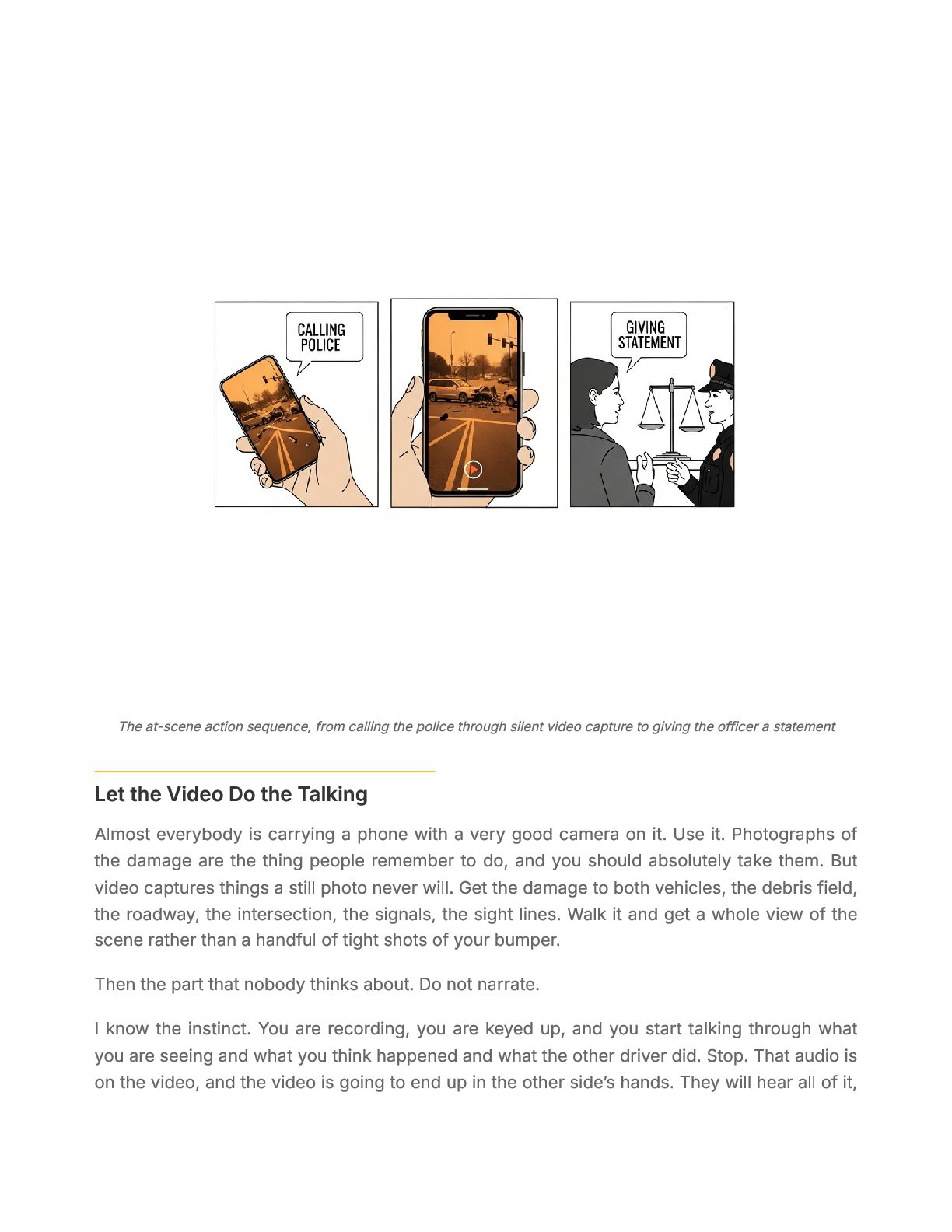
  10. The at-scene action sequence, from calling the police through silent

    video capture to giving the officer a statement Let the Video Do the Talking Almost everybody is carrying a phone with a very good camera on it. Use it. Photographs of the damage are the thing people remember to do, and you should absolutely take them. But video captures things a still photo never will. Get the damage to both vehicles, the debris field, the roadway, the intersection, the signals, the sight lines. Walk it and get a whole view of the scene rather than a handful of tight shots of your bumper. Then the part that nobody thinks about. Do not narrate. I know the instinct. You are recording, you are keyed up, and you start talking through what you are seeing and what you think happened and what the other driver did. Stop. That audio is on the video, and the video is going to end up in the other side’s hands. They will hear all of it,
  11. including the sentence you did not think twice about, and

    they will build an argument out of it. Just stay quiet and let the video speak for itself. Make Sure the Officer Actually Hears From You You would think this one is obvious. Of course you are going to talk to the police. But I talk to people constantly who tell me the officer never came over and got their side of the story, that they only spoke to the other driver. Sometimes there is a good reason for it. You were in the back of an ambulance getting checked out by EMS while the officer was writing up the other guy’s version. Sometimes there is no reason at all. Either way, do not assume the officer got your account. If they have not come to you and they are still on scene, go to them. Walk over and give them your side. You have to give them your side of the story, because their report is being written from whatever they were told, and if the only version they heard belongs to the other driver, that is the version the report reflects. Get Checked Out as Soon as You Can The last of the basics, and the one people talk themselves out of most often. Go get treatment as soon as you can, same day if there is any way to do it, even if you feel more or less fine standing there in the parking lot. Adrenaline is doing a lot of work in the first hour after an ac‐ cident, and what you feel at the scene is not a reliable read on what you are actually dealing with. There is a whole chapter on this later, including the hierarchy of where you should go and why insurance companies grade you on it. For now, just go. Common Questions What should you do first after a car accident in Atlanta? Call the police. That is the first move every single time, no matter how minor it looks. After that, keep the vehicles where they are if it is safe, video the scene before anything gets moved, photograph the damage, make sure the officer personally takes your side of the story, and get medical treatment as soon as you can. Those are the basics, in that order. Should you move your car after an accident in Georgia? Not unless safety requires it. The default is to leave the vehicles where they stopped and let the officer tell you when to move them. Obviously, safety comes first. If you are on a highway
  12. or a two lane road where sitting there is dangerous,

    pull over. Just take video of the scene the way it sits before you do, so the officer can see what you saw. Should you talk while you are recording video at the scene? No. Record silently. Whatever you say on that video, the other side is going to hear, and an offhand comment made while your adrenaline is up can be turned into an argument that you were partly at fault. The images are what you want. As I tell people, just remain quiet and let the video speak for itself. What if the police only talked to the other driver? Go over and talk to them yourself before they leave. It happens more than you would think, sometimes because you were being evaluated by EMS while the officer was taking state‐ ments. The report gets written from what the officer was told. If your version never reached them, it does not exist in the document that every adjuster and every jury is eventually going to read. Chapter Reflection Almost everything in this chapter costs you a few minutes and nothing else. Waiting on an of‐ ficer, holding your position until you are told to move, thirty seconds of silent video, one con‐ versation you make sure to have before anyone drives away. None of it feels urgent while you are standing in the road wanting to be anywhere else. The reason it matters is that an accident claim is decided by people who were not there. An adjuster, and sometimes twelve jurors, are going to reconstruct your ten minutes out of a re‐ port, some photographs, and whatever else survived. You are the only person at the scene with the ability to make that record accurate. The next chapter takes the very first item on the list and pulls it apart, because “it is minor, let’s just exchange information” is the moment where most of the damage gets done. The scene checklist in this chapter comes from the original conversation this book was adapted from.
  13. There is a version of this that happens every day

    in Atlanta. Two cars tap. Everybody gets out, everybody is walking and talking, the damage is a scrape and a scuffed bumper. And one dri‐ ver says some version of, look, let’s not make this a whole thing. Insurance will handle it. Here is my number. It sounds reasonable. It sounds like two adults being efficient about a small problem. And it is the single easiest mistake to make after an accident, and one of the most expensive ones I see. My position is that you call every single time. I do not care if it is a scratch. This is not a rule about the severity of the damage, and that is the part people get backwards. It is a rule about proof, and you do not know yet what you are going to have to prove. “ “Injuries can come days and weeks later. You may be feeling perfectly fine right now. 3 days later, you’re not. Now all of a sudden, it’s a big deal. Well, but you didn’t call the police.” — T E D S PA U L D I N G , O N W H Y “ I T ’ S M I N O R ” I S N OT A D E C I S I O N YO U C A N M A K E AT T H E S C E N E The Officer Is the One Thing You Cannot Recreate Later Go back to the frame from Chapter 1. If you are truly not at fault, the police are your best friend. Here is the mechanical reason why. The officer who comes out is the trained expert. They are required to investigate and to deter‐ mine who they believe is at fault and why. That is their job, and it is a job nobody else on that road is qualified to do. When they write it down, it becomes documented proof, and now you have an independent third party saying this person is at fault and I am not. It goes further than the report. If your case ever reaches a courtroom, that officer becomes your expert. You call them, and the jury hears it from someone in a uniform with no stake in the outcome. I found this driver fully at fault, and here is why. They ran the red light. They did
  14. not have a blinker on when they turned. That is

    testimony you cannot manufacture after the fact, and there is no substitute for it. When you skip the call, you are not just skipping a piece of paper. You are giving up your only neutral witness. And even when nobody is hurt, you are not off the hook. You still have a property damage claim, and you still have to prove the other driver was at fault to collect on it. The Case That Came Down to What Day It Happened We recently spent about seven months fighting a case that started as one of these. Two vehi‐ cles going the same direction on a road with two lanes each way. One of them merges over into the other. My client is the one who got merged into, so fault is not complicated here. It was not a big accident. Some scrape damage. They pull into a parking lot to sort it out, and the at-fault driver starts working on her. Please, let’s don’t call the police. Not a big deal. Insurance will deal with it. And she thought about it and it made sense to her. She was not badly injured, she did not need EMS, the damage was minor. So they exchanged information and everybody went home. He took advantage of that. When she went to file the claim, it came down to a dispute over what day the accident happened. Not who merged into who. What day. Why did the day matter? Because he had insurance coverage on one day and did not have it two days later. So his story is that the accident happened two days after the day she says it happened. She reported it three days later, and here is the thing about a report filed after the fact. The police can only write down what people tell them. Nobody from that department stood in that parking lot and saw two cars with fresh damage. So now we have a he said, she said fight over something as silly as the date. It got worse. This gentleman refused to cooperate with his own insurance company. We spent seven months pushing every piece of proof we could assemble that the accident happened on the day she said it did. He never worked with his carrier. The insurance company denied cov‐ erage. No coverage means no case. She has no personal injury claim now. She has no property damage claim she can pursue. She is completely out of luck, and all of it traces back to a decision that felt polite and efficient in a parking lot. People understandably do not think something like this is going to happen. Nobody stands there imagining that the other driver is going to lie about the calendar. Waiting on an officer feels inconvenient. What people do not realize is how inconvenient the other road can get, and how devastating.
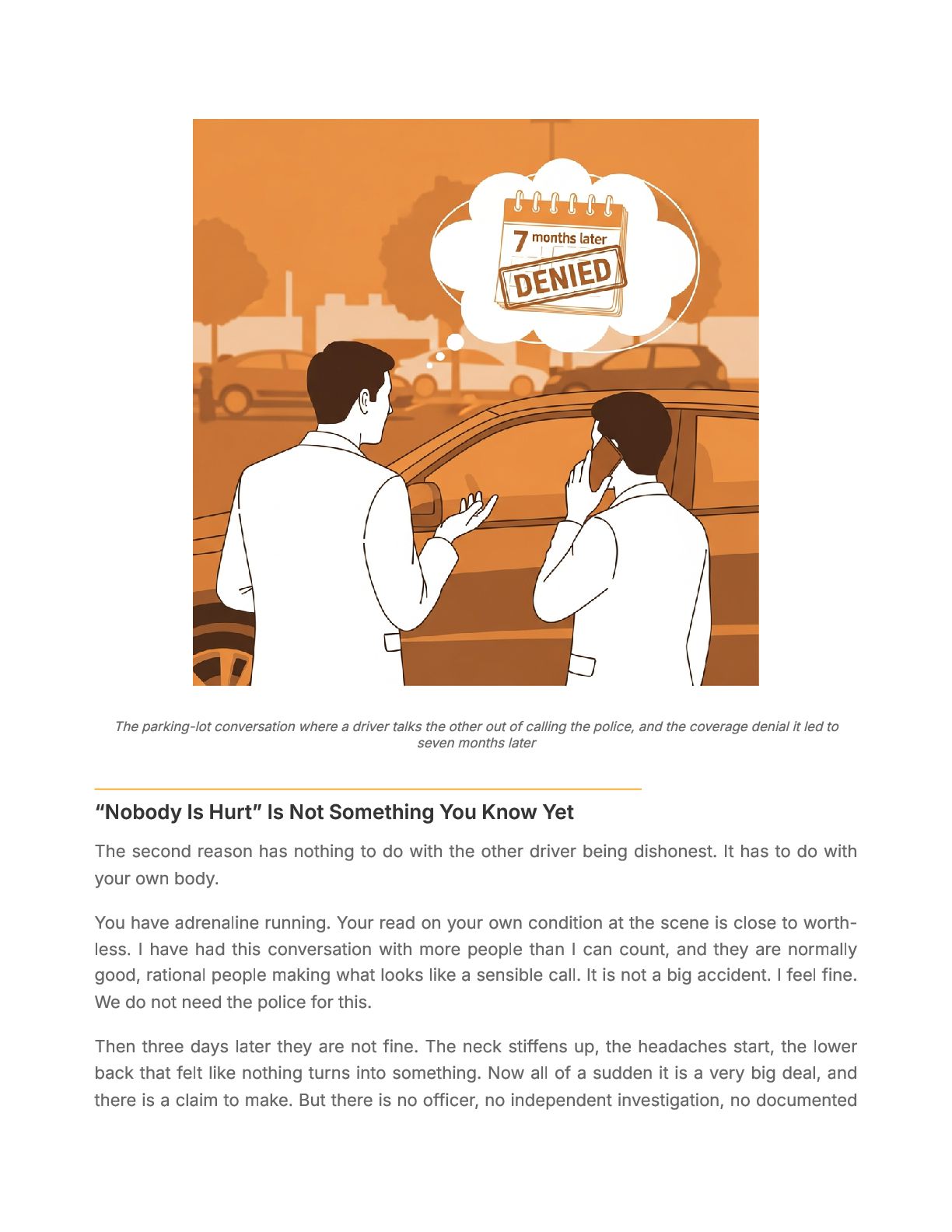
  15. The parking-lot conversation where a driver talks the other out

    of calling the police, and the coverage denial it led to seven months later “Nobody Is Hurt” Is Not Something You Know Yet The second reason has nothing to do with the other driver being dishonest. It has to do with your own body. You have adrenaline running. Your read on your own condition at the scene is close to worth‐ less. I have had this conversation with more people than I can count, and they are normally good, rational people making what looks like a sensible call. It is not a big accident. I feel fine. We do not need the police for this. Then three days later they are not fine. The neck stiffens up, the headaches start, the lower back that felt like nothing turns into something. Now all of a sudden it is a very big deal, and there is a claim to make. But there is no officer, no independent investigation, no documented
  16. fault determination. You made a permanent decision about your claim

    at the one moment you had the least information. Look, that is the whole argument. You are not deciding whether this accident is minor. You are deciding whether to keep the option open, and the option is free. What Georgia Actually Requires, and What the SR-13 Is For There is a legal layer here, and I will give it to you straight, including the part that is less flat‐ tering to my own advice. Under Georgia law, if an accident involves injury or property damage over five hundred dol‐ lars, you are technically required to report it to the police. That is the rule. Now, in practice, there is not a lot of teeth to it. People are not getting ticketed for failing to report. I have seen plenty of situations like the one I just described, and the real consequence was never a cita‐ tion. The real consequence was that she could not prove fault and had no independent third party to point to. Then there is the SR-13. That is the form a citizen fills out to report an accident when the po‐ lice do not come to the scene. It is not legally required either, in the sense that nobody is writ‐ ing you a ticket for skipping it. But you had better do it if you are going to pursue a claim and you are not at fault, because you need some kind of official report of this thing existing. It matters more now than it used to. There are jurisdictions around here where police will not come out for certain accidents at all. Atlanta Police Department will not come out to an acci‐ dent where there are no injuries. So what do you do when you did everything right, you called, and nobody is coming? You pull the form and you report it yourself. Common Questions Should you call the police for a minor car accident in Georgia? Yes, every single time, even for a scratch. The severity of the damage is not what the decision should turn on. The officer’s fault determination is documented proof you cannot recreate lat‐ er, you still have to prove fault on a property damage claim even with no injuries, and injuries routinely surface days after the accident once the adrenaline drops. Are you legally required to report a car accident in Georgia? Technically yes, if the accident involved an injury or property damage over five hundred dol‐ lars. Being candid, there is not much enforcement behind it. People are not getting ticketed for
  17. failing to report. The real penalty is practical rather than

    legal. Without a report you have no independent third party, and proving the other driver was at fault gets much harder. What is the SR-13 form and do you have to file it? The SR-13 is the form a citizen fills out to report an accident when the police do not come to the scene. It is not legally required. But as I tell people, you better do it if you are going to pur‐ sue a claim and you are not at fault. It gives your accident an official record when no officer produced one. What if the police will not come to your accident? Some jurisdictions have stopped responding to certain accidents. Atlanta Police Department will not come out where there are no injuries. If that happens, you report it yourself with an SR-13, and you get even more aggressive about your own documentation at the scene, mean‐ ing video, photographs, and full contact information for every witness before anyone leaves. Can you still file a claim if you did not call the police? You can, but you are in a much weaker position, and sometimes there is no position at all. Without an officer you are in a he said, she said on fault, and the other driver’s story can shift. In the case I described, the dispute was over what day the accident happened, and the cover‐ age denial that followed left my client with nothing to pursue. Chapter Reflection The uncomfortable part of that seven month case is that my client did nothing unreasonable. She was standing in a parking lot with minor damage, being agreeable to a stranger who sounded agreeable back. Anyone reading this would have understood the decision. That is exactly why I say call every time. The rule has to be automatic, because the moment you are making the judgment call is the moment you know the least about how this ends. You do not know how you will feel Thursday. You do not know what the other driver’s insurance situation looks like. You do not know that the fight is going to be about the calendar. The next chapter is about the evidence that is already disappearing while you are standing there, and the clock most people do not realize has started. Spaulding Injury Law handles these claims across Gwinnett County from the firm’s Lawrenceville team.
  18. The clock starts the second the accident ends. That is

    the part nobody tells you. You are thinking about your car, your kid in the back seat, whether your neck is going to be all right, how you are getting to work tomorrow. Meanwhile the best evidence in your case is sitting on a hard drive at a gas station a hundred feet away, and it has a delete date on it. Nobody is going to call you about it. It just quietly goes away, and thirty days later it is like it never existed. I have had cases won outright by a piece of video, and I have had nearly identical cases turn into a coin flip because we got involved a few weeks too late. Same facts. Same injuries. Wildly different outcomes. The variable was how fast somebody moved. So this chapter is about the evidence with an expiration date, and what you can do about it in the first day or two. Look Around Before You Leave While you are at the scene, take thirty seconds and actually look at your surroundings. What businesses are here? Who has a camera, and where is it pointed? Your adrenaline is going, you are focused on the police and EMS and your phone and the oth‐ er driver, and looking at the buildings around you is the last thing on your mind. But this is the highest value thirty seconds you will spend. If you are anywhere near a gas station or a bank, you can pretty much count on there being security camera footage pointed out into the park‐ ing lot. That camera does not know it is a traffic camera. It may well have caught your acci‐ dent in the background of the frame. It is rare, and I will not oversell it. Most accidents are not on video. But when it happens, it is the absolute best evidence in the case, for more reasons than one. It proves fault, obviously. It also shows the jury how violent the impact actually was, which photographs of a bumper nev‐ er quite manage. You get to see it and hear it. Now, the clock. That footage typically gets written over or deleted by the business within about 30 days. That is the outside norm from what I see. Sometimes it is 10 or 15 days. So identifying it three weeks in is not the same as identifying it on day one, and there is no ver‐ sion of this where waiting helps you. Witnesses Become Ghosts The other category is people, and people evaporate faster than video does.
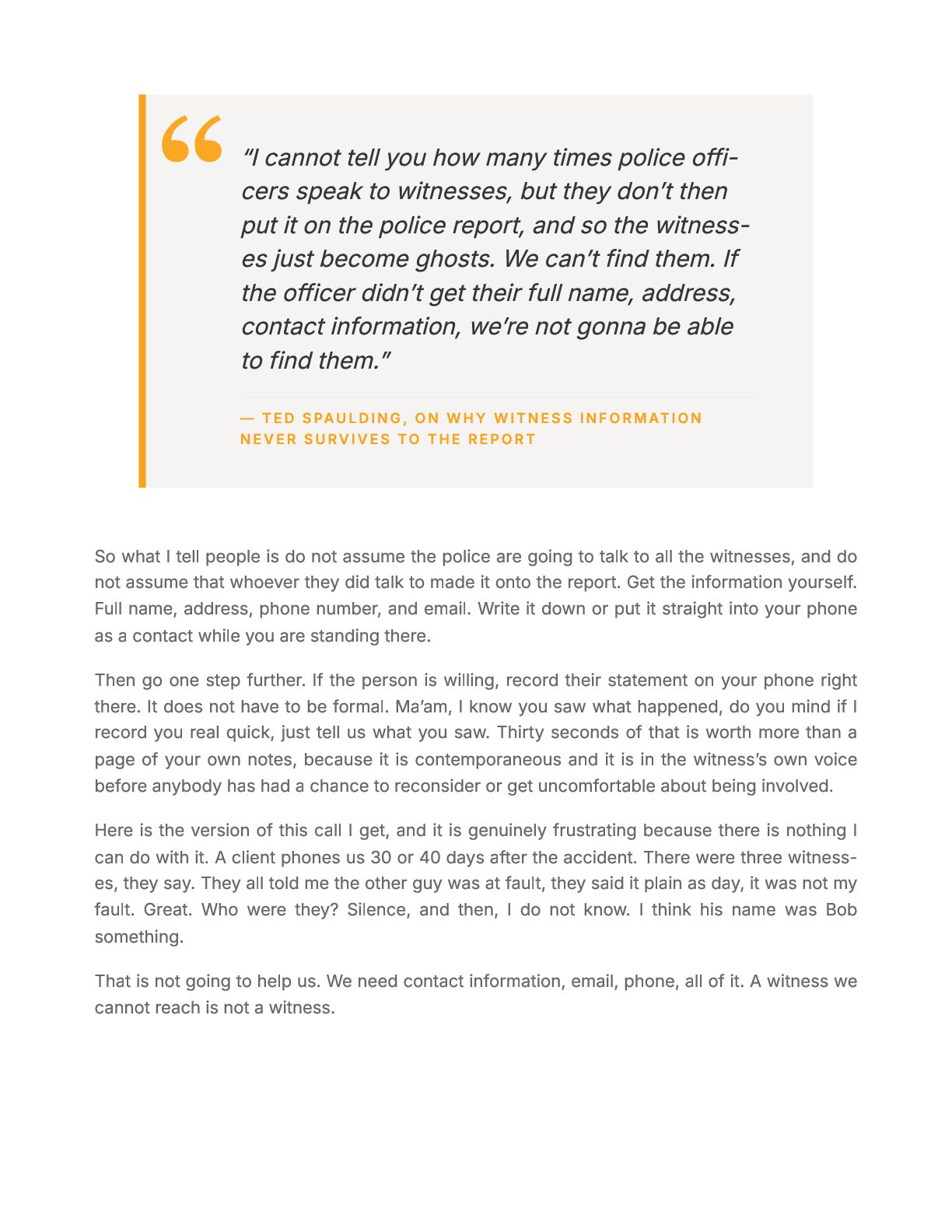
  19. “ “I cannot tell you how many times police offi‐

    cers speak to witnesses, but they don’t then put it on the police report, and so the witness‐ es just become ghosts. We can’t find them. If the officer didn’t get their full name, address, contact information, we’re not gonna be able to find them.” — T E D S PA U L D I N G , O N W H Y W I T N E S S I N F O R M AT I O N N E V E R S U R V I V E S TO T H E R E P O R T So what I tell people is do not assume the police are going to talk to all the witnesses, and do not assume that whoever they did talk to made it onto the report. Get the information yourself. Full name, address, phone number, and email. Write it down or put it straight into your phone as a contact while you are standing there. Then go one step further. If the person is willing, record their statement on your phone right there. It does not have to be formal. Ma’am, I know you saw what happened, do you mind if I record you real quick, just tell us what you saw. Thirty seconds of that is worth more than a page of your own notes, because it is contemporaneous and it is in the witness’s own voice before anybody has had a chance to reconsider or get uncomfortable about being involved. Here is the version of this call I get, and it is genuinely frustrating because there is nothing I can do with it. A client phones us 30 or 40 days after the accident. There were three witness‐ es, they say. They all told me the other guy was at fault, they said it plain as day, it was not my fault. Great. Who were they? Silence, and then, I do not know. I think his name was Bob something. That is not going to help us. We need contact information, email, phone, all of it. A witness we cannot reach is not a witness.
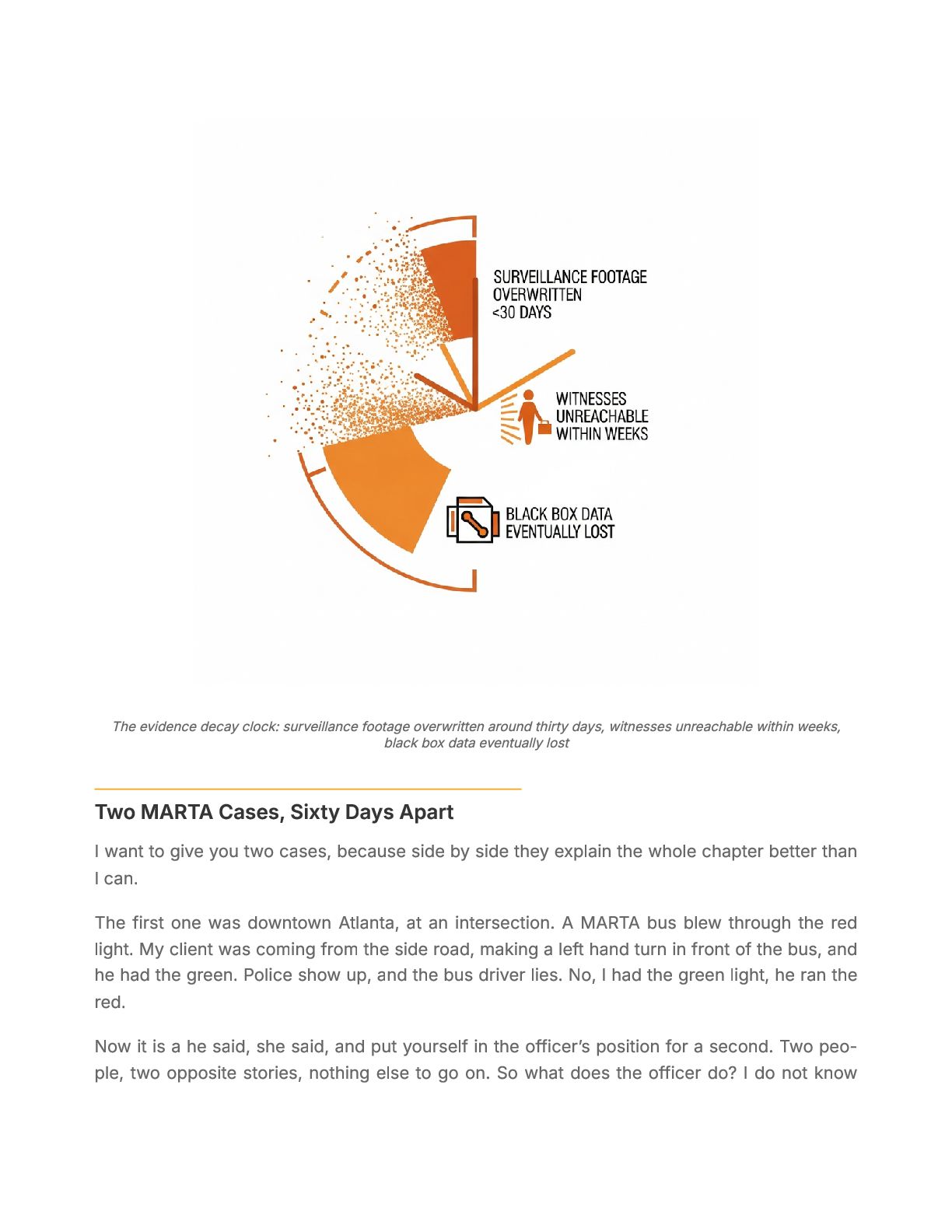
  20. The evidence decay clock: surveillance footage overwritten around thirty days,

    witnesses unreachable within weeks, black box data eventually lost Two MARTA Cases, Sixty Days Apart I want to give you two cases, because side by side they explain the whole chapter better than I can. The first one was downtown Atlanta, at an intersection. A MARTA bus blew through the red light. My client was coming from the side road, making a left hand turn in front of the bus, and he had the green. Police show up, and the bus driver lies. No, I had the green light, he ran the red. Now it is a he said, she said, and put yourself in the officer’s position for a second. Two peo‐ ple, two opposite stories, nothing else to go on. So what does the officer do? I do not know
  21. who did or did not. I am going to write

    you both at fault, and y’all can go fight it out in court. They both got tickets. Here is what saved it. He called right away. And what a lawyer can do at that point is send what is called a preservation of evidence letter, in this case to MARTA. That letter puts them on formal notice to preserve the video. Because MARTA buses carry 16 to 17 different camera views, inside the vehicle and out. The footage exists. The only question is whether it still exists 30, 40, 50, 60 days from now, and whether anybody ever told them in writing not to let it go. We got the video. And the video showed the light red, and it showed her literally looking off sideways and driving straight through it. End of story. His ticket got dismissed, and we had full liability on MARTA in a very good case, because we had it on tape. Second case, similar facts. But this client did not call us for 60 days. We get involved, and we immediately do the letter, hoping it is all still there. What came back from MARTA was this: yes, there was video, but when we went to download it, it was damaged. Three or four days after our letter. So there is no video. We are back to he said, she said, fighting about fault we never should have had to fight about. And the difference between those two cases is not a small difference in value. It is a com‐ pletely different case. In the first one, nobody could argue about the red light. In the second one, we spend the life of the file arguing about it, and every dollar of that case gets discount‐ ed for the risk that a jury splits fault down the middle. There is a second effect to the letter that people miss. Once that letter is in their hands, they lose the ability to shrug about missing footage. You got our letter. We told you to preserve it. You did not do it. That is suspicious, and now you can use it against them. Without the letter, you have no right to stand up and say they are hiding something. Call a Lawyer Even If You Never Hire One This is where I land, and I understand how it sounds coming from a lawyer, so let me be clear about what I am actually saying. Call a lawyer. You do not have to sign up with them if you do not want to. The consultation is free. With our firm there is no fee and no obligation for that initial call, and most other firms will tell you the same. The reason is not that you need representation on day two. Often you do not, and I tell people that directly. I am regularly on the phone with someone two or three days after an accident telling them I am not sure you need me yet, but here are the things you need to know. The rea‐
  22. son to call is that you have no way of

    knowing whether yours is one of the cases where some‐ body has to move right now to secure evidence. That is not a judgment a person can make about their own accident, because it requires knowing what to look for. Is this a MARTA case? Is there a camera on that building? Is there a commercial vehicle in‐ volved with a system that overwrites on a schedule? A lawyer can tell you in ten minutes whether the answer is, you are fine, take your time, or, I hate to tell you this, but you need to hire someone right away, and here is exactly what happens if you do not. Either way you walk away armed, and the decision about whether to hire anybody stays yours. Common Questions How long do businesses keep security camera footage of a car accident? Typically about 30 days before it gets written over or deleted, and sometimes as little as 10 or 15. That is the outside norm from what I see. Gas stations and banks nearly always have cam‐ eras pointed out into the parking lot that may have caught your accident in the frame. The window to identify and request it is short. What information should you get from a witness at the scene? Full name, address, phone number, and email, collected by you rather than left to the officer. Write it down or put it in your phone as a contact. Then, if they are willing, record a short statement on your phone about what they saw. Officers frequently speak to witnesses without putting their information on the report, and after that we cannot find them. What is a preservation of evidence letter? It is a letter a lawyer sends putting a company or agency on formal notice to preserve specific evidence, most often video. It does two things. It gets the footage secured before the system overwrites it, and if the evidence disappears anyway, the letter is proof they were warned, which you can then use against them. Do you have to hire a lawyer just to get evidence preserved? No. As I tell people, just call a lawyer, you don’t have to sign up with them if you don’t want to, the consultation’s free. The point of the call is to find out whether your case has a piece of ev‐ idence on a deadline. Often the answer is that you have time and can decide later. Sometimes it is not, and you need to know which one you are.
  23. Chapter Reflection The two MARTA clients had roughly the same

    accident. One of them has a dismissed ticket and a clean liability case. The other spent his case arguing about a red light that a camera al‐ ready answered, on footage that got damaged three days after we asked for it. Nothing separated them except sixty days. That is really the whole point of this chapter, and it is why I push people so hard on making one phone call early. Not because you need to hire anybody, and not because every case has a ticking piece of evidence in it. Most do not. But you cannot tell from the inside which kind you have, and the cost of finding out is a free conversation. Once the evidence is gone, no amount of good lawyering later puts it back. Ted walks through both MARTA cases in Episode 2 of the Atlanta Car Accident Attorneys podcast.
  24. 04 CHAPTER FOUR Get Checked Out the Same Day: The

    Treatment Hierarchy Insurers Grade You On
  25. A lot of people walk away from a minor accident

    in Lawrenceville or Alpharetta feeling com‐ pletely fine and decide the doctor is not worth the rest of their afternoon. Adrenaline is run‐ ning. The damage is a scrape and a cracked taillight. Nothing hurts yet. I understand that log‐ ic, and I tell every one of those people the same thing anyway, which is go get checked out. The reason is not only medical. It is that the insurance company on the other side of your claim is already grading you on what you did in the first few hours after the accident. There is an order to medical care after a wreck, and where you land in that order turns into an argu‐ ment about how badly you were really hurt. I tell people it is a damned if you do, damned if you don’t kind of a thing. That sounds cynical until you see it run the same way in case after case. So here is the hierarchy the way I give it to clients, and then the part almost nobody gets told, which is that the exact same hierarchy is sitting inside the adjuster’s playbook. “ “This isn’t about faking things and, oh, I’m go‐ ing to go by EMS and, oh, my back’s killing me when it’s really not. I mean, you want to do it when there is something, at least soreness. Maybe you’ve got a headache that’s starting or something like that. But again, what you’re protecting is it’s the initial record of how you’re feeling at that point. Because what typically happens is the pain’s going to be worse days and weeks later than it is the day of.” — T E D S PA U L D I N G , O N W H Y T H E S A M E - DAY V I S I T M AT T E R S
  26. The Order I Give Every Client Number one, EMS from

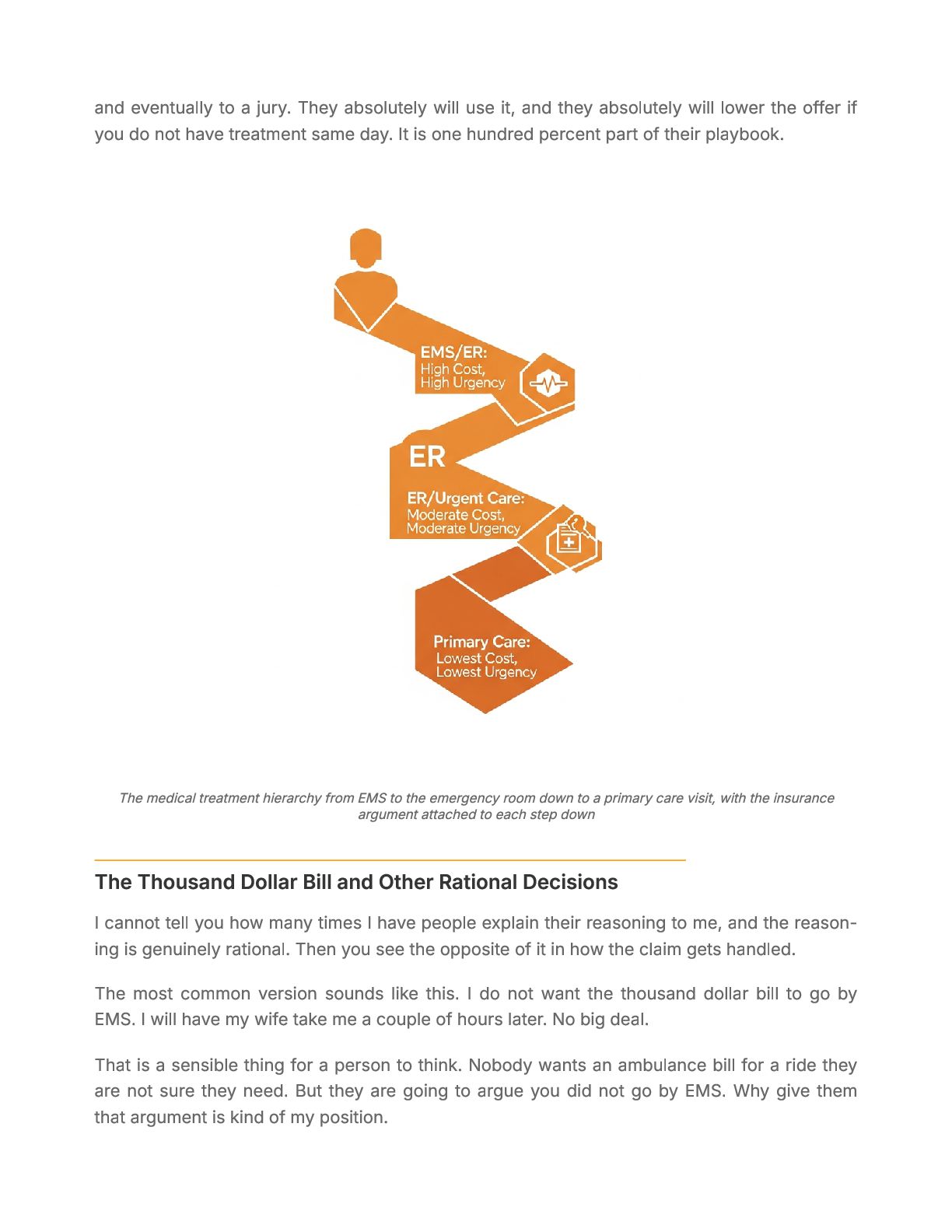
    the scene to the emergency room is always the best thing. You are transported by professionals, you are evaluated immediately, and the record starts at the scene rather than in your memory. If not EMS to the emergency room, then take yourself or have a family member take you to the emergency room the same day. Same day is doing a lot of work in that sentence. It is the part people drop. If neither of those, urgent care is a fine place to go, again same day. And below that, if you can walk into your primary care physician, that is a good thing to do. Notice that the destination changes down the list, but the timing does not. Every level says same day. That is deliberate. What separates a strong record from a weak one is usually not which building you walked into. It is what day you walked in. Some of that is personal. Injuries, timing, whether you want to do it what I would call the Cadillac way or whether you would rather not worry about that. Look, I get that not everyone is going to pick the top of the list. But you should at least know what you are trading away when you move down it. The Same Hierarchy Is Their Playbook Here is the part that changes how people hear all of this. The hierarchy I just gave you is ex‐ actly the playbook the insurance company goes by. It is not my ranking that they happen to agree with. It is their ranking, and I am handing it to you before they use it. Watch how each step down buys them an argument. You do not go by EMS, but you go to the emergency room a few hours later, or you have a family member drive you. Then the argument is, well, Ted, they did not go by EMS. So? Well, they must not have been that injured. You still went to the emergency room, and you still get that argument. Now move down one more. No EMS, and no emergency room either. You waited and then you went to urgent care. The argument shifts to this: if they were really hurt, they would have gone to the emergency room. So it is damned if you do, damned if you don’t, if you do not do ambulance to the emergency room. Every rung you step down gives them a sentence to say to an adjuster, to a mediator,
  27. and eventually to a jury. They absolutely will use it,

    and they absolutely will lower the offer if you do not have treatment same day. It is one hundred percent part of their playbook. The medical treatment hierarchy from EMS to the emergency room down to a primary care visit, with the insurance argument attached to each step down The Thousand Dollar Bill and Other Rational Decisions I cannot tell you how many times I have people explain their reasoning to me, and the reason‐ ing is genuinely rational. Then you see the opposite of it in how the claim gets handled. The most common version sounds like this. I do not want the thousand dollar bill to go by EMS. I will have my wife take me a couple of hours later. No big deal. That is a sensible thing for a person to think. Nobody wants an ambulance bill for a ride they are not sure they need. But they are going to argue you did not go by EMS. Why give them that argument is kind of my position.
  28. I would say this is the single widest gap I

    see between what a normal, careful person decides in the moment and what that decision is worth six months later when somebody is putting a number on your file. You are not making a medical choice at that moment. You are making an evidentiary one, and you do not know it yet. This Is Not About Faking Anything I want to be clear about the guardrail, because this advice gets misread. You do not want to go if there is nothing there. This is not about faking. You want to go when there is something, at least soreness. Maybe you have a headache that is starting, or some‐ thing like that. That is the standard, and it is a low bar on purpose, because the low bar is where real injuries actually live in the first hour. What you are protecting is the initial record of how you were feeling at that point. That matters because of what typically happens next. The pain is going to be worse days and weeks later than it is the day of. If the only record of your condition starts at week two, there is no docu‐ ment anywhere showing what you felt on day one, and the day one gap becomes the fight. And if you never go at all, guess what the argument is. Well, Ted, he waited a week to go. Well, yes, he waited a week because he thought it was just soreness and it would go away. That is rational, and honestly I can still work with that. I have worked with worse. But why give the in‐ surance company the argument in the first place. Worst case, you went to the ER, got checked out, you get reimbursed for that visit, and you are fine. That is the outcome you actually want. What I tell people is that being fine is the goal. But what if you are not. Common Questions Should you go to the emergency room after a minor car accident even if you feel fine? Yes. Adrenaline masks a lot, and injuries commonly show up days and weeks later. The visit does two things at once: it catches something real early, and it creates the same-day record of how you felt. Worst case, you went to ER, got checked out, you’ll get reimbursed for that visit, and you’re fine, and that’s great. If you are not fine, you now have proof that day one hurt. Is urgent care good enough after a car accident in Georgia?
  29. Urgent care the same day is a fine place to

    go, and it sits above walking into your primary care physician. But it is below the emergency room in the order, and the insurance company knows that. Expect the argument that if you were really hurt, you would have gone to the emergency room. Urgent care is a real option. Just go in knowing what it costs you in the file. What if I already waited a week before seeing a doctor? You still have a case worth looking at. Waiting is a problem, not a disqualifier. The argument becomes that you waited a week, and the answer is usually that you thought it was soreness and expected it to pass, which is rational. I can still work with that. Get treated now, stay con‐ sistent from here, and do not add a second gap on top of the first. Does going by ambulance really change what my claim is worth? It changes the arguments available to the other side, and those arguments change offers. Adjusters read the treatment path first. EMS from the scene to the emergency room closes off the whole line of attack about how hurt you actually were. Skip it and you should expect that line of attack, because same-day treatment is part of how they grade the file. Chapter Reflection Nothing in this chapter is about being dramatic. It is about understanding that the medical de‐ cision you make in the first few hours is also a documentation decision, and only one of those two is obvious at the time. Get checked out when there is something there. Do it the same day. Go as high up the ladder as you reasonably can, and know what you are handing over every rung you step down. That covers what you do with your body in the first day. The next question is the one that de‐ cides whether any of it turns into a recovery, which is who has to prove what under Georgia law. More of Ted’s guidance on treatment and documentation is collected in his legal insights library.
  30. Plenty of people move to Atlanta from somewhere else and

    bring their assumptions about car insurance with them. If you came from a no-fault state, those assumptions are going to fail you here, and you will usually find out at the worst possible moment, which is after you have already been hit. The difference between the two systems is not a technicality. It changes who has the burden, what evidence matters, and whether you have a claim at all. Everything in a Georgia car acci‐ dent claim is built on top of this one requirement, and if you do not know it exists, you will make decisions at the scene that quietly work against you. Now, I know people’s minds are going, oh God, here we go with all the legal. I get it. This is the part of the conversation where eyes glaze. It still matters, and there are a couple of very prac‐ tical reasons it matters, so stay with me for a few pages. “ “You gotta prove fault. Naturally, you wanna prove 100% fault. Georgia is what is called a comparative fault state because technically you don’t have zero claim, meaning no claim you can pursue just because you can’t pursue 100% fault on the other party. So what that means is you can be at fault and so can the other party, and you may be able to recover in Georgia.” — T E D S PA U L D I N G , O N H O W G E O R G I A H A N D L E S S H A R E D FA U LT What a No Fault State Actually Gives You Start with the easy part, which is what the other system does.
  31. No fault is beautiful, and I say that as a

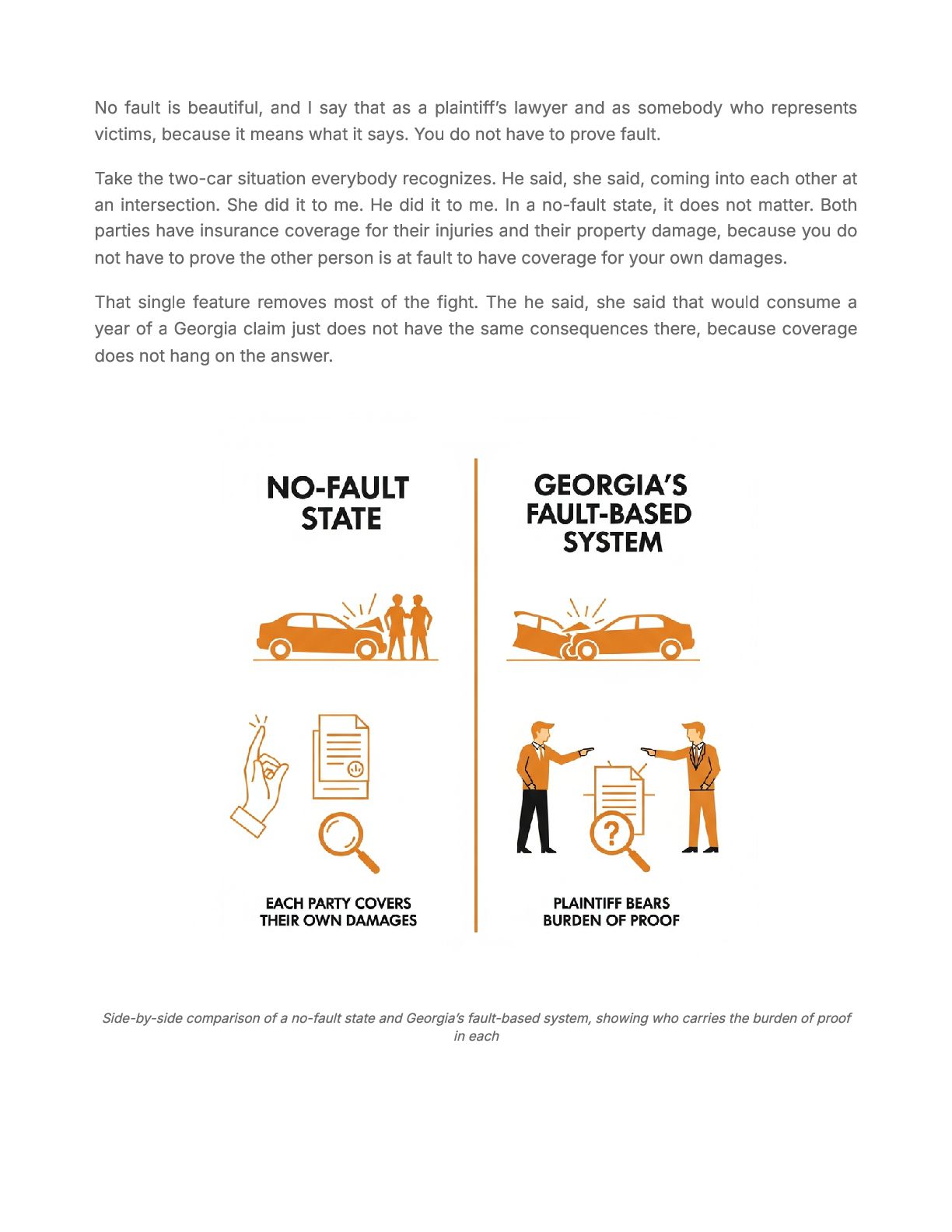
    plaintiff’s lawyer and as somebody who represents victims, because it means what it says. You do not have to prove fault. Take the two-car situation everybody recognizes. He said, she said, coming into each other at an intersection. She did it to me. He did it to me. In a no-fault state, it does not matter. Both parties have insurance coverage for their injuries and their property damage, because you do not have to prove the other person is at fault to have coverage for your own damages. That single feature removes most of the fight. The he said, she said that would consume a year of a Georgia claim just does not have the same consequences there, because coverage does not hang on the answer. Side-by-side comparison of a no-fault state and Georgia’s fault-based system, showing who carries the burden of proof in each
  32. Georgia Puts the Proof on You We are not a

    no-fault state. What that means simply is you have to prove the other party is at fault. That sentence is short and its consequences are not. It means the police report matters. It means witnesses matter. It means video from the gas station on the corner matters. It means the statement you give an adjuster three days later matters, because every one of those things is either evidence of fault or ammunition against you. It also means the other side has a reason to fight. If proving fault is the gate you have to get through, then their most efficient move is to stand in that gate. In a no-fault state there is no gate to stand in. Look, this is why I tell people to call the police every single time, no matter how minor it seems. If you are truly not at fault, the police are your best friend. They are the experts who come out. They are required to investigate and determine who they believe is at fault and why, and that becomes documented proof. In a state where you carry the burden, having a trained third party write down what happened is not a formality. It is the foundation. Why This Applies Even to a Scratch People assume the fault requirement only kicks in for serious injury claims. It does not. Even if you are not injured at all, you still have a property damage claim, and you still have to prove fault. Somebody has to be shown responsible before anybody’s insurance pays to fix your car. A bumper scrape in a parking lot in Gwinnett County runs through the same gate as a hospital case, just with smaller numbers attached. That is why the minor accident is where I see the most damage done. The stakes feel low, so people skip the police, skip the photos, and agree to sort it out with insurance. Then the in‐ juries surface a week later, or the other driver’s story changes, and now there is a real claim resting on nothing. Comparative Fault Is What Saves People Here is the part that keeps the fault requirement from being brutal. Georgia is what is called a comparative fault state. Technically you do not have zero claim, meaning no claim you can pursue, just because you cannot pin one hundred percent of the
  33. fault on the other party. You can be at fault,

    and so can the other party, and you may still be able to recover. So you do not have to prove one hundred percent. You want to, obviously. Full fault on the other driver is the cleanest version of every claim, and it is what we are always trying to build toward. But it is not the requirement. What that means practically is this: a lot of people talk themselves out of a legitimate claim because they know they did something wrong too. They were a little over the line. They were looking at the radio. They think that ends it. It does not automatically end it. It changes what you are fighting about, from whether you recover to how much. There is a minimum amount of fault you have to be able to put on the other driver before any of that applies, and that threshold is the single number that decides whether a Georgia claim is worth everything or worth nothing. It gets its own chapter, because the arithmetic behind it deserves more than a paragraph. Common Questions Is Georgia a no-fault state? No. Georgia is a fault-based state, which is a meaningful difference if you moved here from a no-fault state. In a no-fault state, both parties have insurance coverage for their injuries and the property damage because you don’t have to prove the other person’s at fault. In Georgia, coverage for your damages depends on establishing that the other driver caused the wreck. What does it mean that Georgia is a fault state? It means you carry the burden of proving the other party is at fault before you recover any‐ thing. That is why evidence gathered at the scene matters so much here: the police report, witness contact information, video from nearby businesses. Everything else in your claim, from the property damage to the injury side, sits on top of that one requirement. Do I have to prove the other driver was one hundred percent at fault in Georgia? No. Georgia is a comparative fault state, so you do not need one hundred percent to have a case. You want to obviously, but you don’t have to. You can share some of the fault and still recover, though there is a minimum amount of fault that has to land on the other driver first. Chapter 6 walks through exactly where that line sits. If the accident was minor and nobody was hurt, do I still have to prove fault?
  34. Yes. Even with no injury at all, you still have

    a property damage claim, and fault still has to be established for it. That is one of the main reasons I would call the police on a scratch. Without a report, a minor accident becomes one person’s word against another’s, and the property damage claim stalls out on the same question a big case would. Chapter Reflection The whole system here rests on one requirement, and once you see it, the rest of the advice in this book stops looking like lawyer fussiness. Call the police. Get the witnesses. Look for video. All of that exists because in Georgia, you are the one who has to prove what happened. Comparative fault is the mercy built into that system. It means being partly responsible does not automatically send you home empty-handed. But mercy has a line, and the line is a number. That number is where we go next. Ted explains Georgia’s fault requirement at length in the recorded discussion behind this chapter.
  35. There is one number in Georgia car accident law that

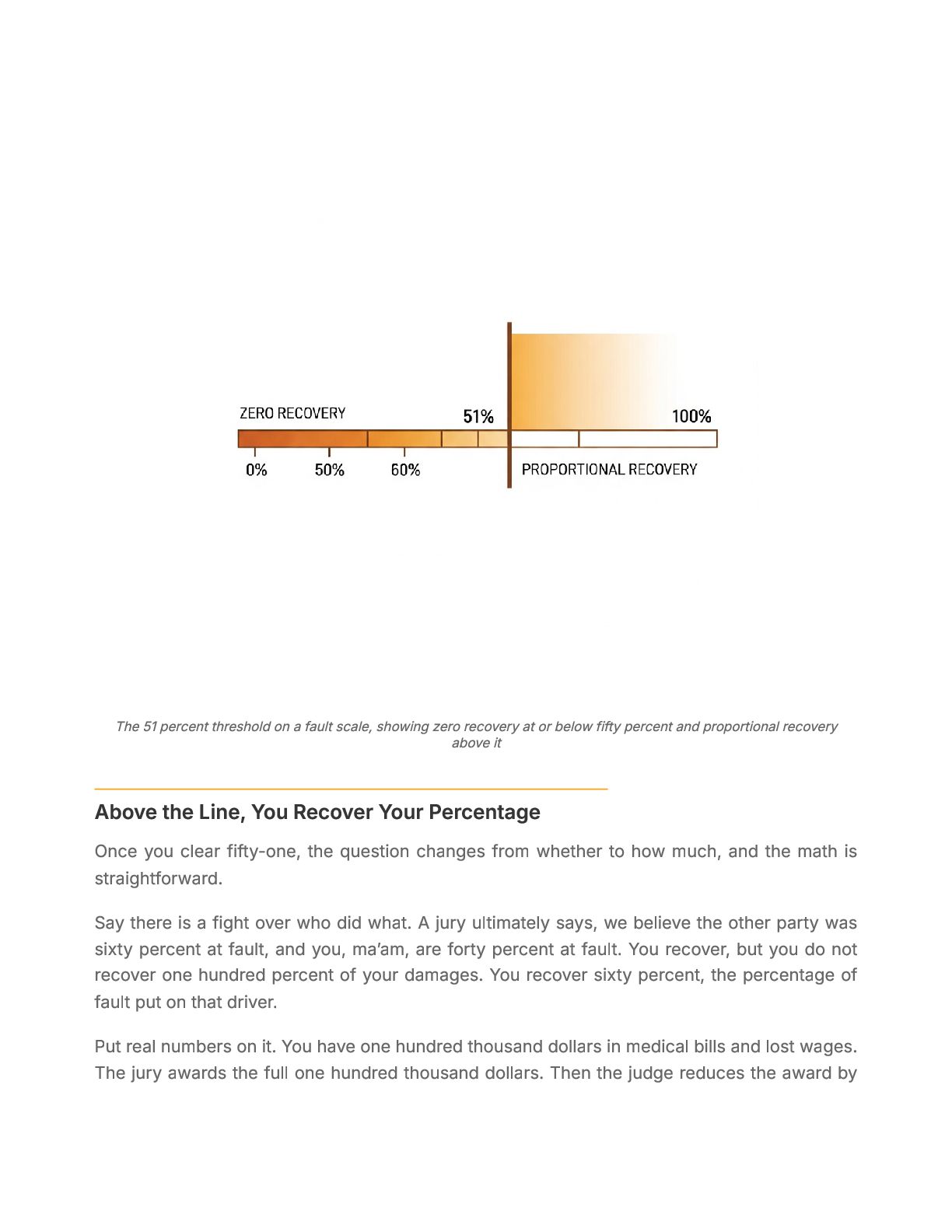
    decides whether a claim is worth every‐ thing or worth absolutely nothing. Not less. Nothing. Most people have some fuzzy sense that being partly at fault reduces what they get. That is half right, and the half that is missing is the part that ends cases. Georgia’s rule has a floor built into it, and below that floor the reduction is not a discount. It is a zero. This chapter does the arithmetic, walks through a case out of Cumming where my client got the ticket and still recovered, and corrects something almost everyone believes about what a police officer at the scene is actually deciding. The Threshold That Decides Whether You Have a Claim Two things are happening in Georgia’s comparative negligence rule, and they run in order. First, you have to hit the minimum threshold to have a case at all, meaning to get any recovery. That threshold is fifty-one percent. The at-fault driver has to be fifty-one percent or more at fault for you to recover something. Second, once you are above that threshold, you recover the percentage of fault placed on that other party. Now, where it gets scary is the first part, because it does not work in the alternative. If you cannot prove fifty-one percent, you get zero. Prove they were forty-five percent at fault and you get nothing. Prove twenty percent, nothing. There is no partial credit below the line. And this is not a theoretical risk. Oftentimes it is fifty-fifty. It is he said, she said, and a jury looks at it and goes, I cannot figure out who is at fault, so I am just going to throw a fifty on each party. That feels like a fair, splitting-the-difference outcome to twelve people in a jury box. It means zero for the plaintiff. You recover nothing at fifty percent or below.
  36. The 51 percent threshold on a fault scale, showing zero

    recovery at or below fifty percent and proportional recovery above it Above the Line, You Recover Your Percentage Once you clear fifty-one, the question changes from whether to how much, and the math is straightforward. Say there is a fight over who did what. A jury ultimately says, we believe the other party was sixty percent at fault, and you, ma’am, are forty percent at fault. You recover, but you do not recover one hundred percent of your damages. You recover sixty percent, the percentage of fault put on that driver. Put real numbers on it. You have one hundred thousand dollars in medical bills and lost wages. The jury awards the full one hundred thousand dollars. Then the judge reduces the award by
  37. the percentage of fault assigned to you. You collect sixty

    thousand dollars. The other forty thousand is your fault, and you carry it. You always want to try to prove they are one hundred percent at fault, so you get full recovery of all your damages. If you cannot, you get whatever percentage you can establish above the line, whether that is sixty-five, seventy-five, eighty-five, or ninety-five. “ “We were able to prove that speed, and that was a factor, and our argument was, ‘Yeah, we get it. Our client’s not zero at fault. She was over the line, and she shouldn’t have been.’ But had the driver not been going 70 miles an hour, they would have seen that and been able to easily avoid it. There was no other reason to run into this woman.” — T E D S PA U L D I N G , O N A R G U I N G A C A S E W H E R E H I S O W N C L I E N T WA S T I C K E T E D A Case in Cumming That Started With My Client Getting the Ticket I had a client in Cumming, Georgia. She was ticketed and found at fault by the officer at the scene, which by itself is where most people would have stopped. Here is what happened. She was waiting in line at a red light, and her tires were over the yel‐ low line. A car came in the opposite direction and hit her head-on. The officer looked at it and said, well, you are over the yellow line, you are at fault. He marked her at fault and gave her a ticket. She came to us anyway, and what she told me was that this car came up over a hill in the oth‐ er direction, in a thirty-five mile an hour zone, doing something like seventy miles an hour. And it was crazy, Ted. So we looked into it, and my first reaction was the honest one, which is that they found her at fault.
  38. We were able to prove that speed. That was the

    factor that changed the case. Our argument was never that she was blameless. We got it. Our client was not zero at fault. She was over the line, and she should not have been. But had the driver not been going sev‐ enty miles an hour, they would have seen that and been able to easily avoid it. There was no other reason to run into this woman. You cannot see the cars sitting right there and hit them, unless you are coming up over a hill going far too fast to react. We resolved that case before trial, because the other side did the same math I was doing. They saw it as, Ted might be able to prove fifty-one percent fault for speed. A jury is going to put something on Ted’s client, but what if it is not fifty percent or more? If a jury put fifty per‐ cent or more on her, my client got zero. They saw the risk, my client rightly pursued it, and she recovered some of her damages. She needed it. She had been in the hospital for a couple of months, with hundreds of thou‐ sands of dollars in damages. She was really, really hurt. If she had accepted the ticket as the final word, she would have collected nothing at all. What the Officer Is Actually Deciding This is the piece people get wrong, and it is worth being precise about. The officer’s duty is not to compare fault. It is not their job to say, I believe they are sixty per‐ cent and you are forty. They do not do percentages, and no percentage exists on that report. They figure out who is at fault, meaning who is the majority at fault, and they write that down. So a citation is one trained person’s read on who was mostly responsible. It is real evidence and I never wave it off. But it is not the apportionment that decides your recovery, because apportionment happens later, in front of a jury, with everything the officer did not have at the scene. In Cumming, what the officer did not have was the other driver’s speed. Just because you are found at fault by the officer does not mean you do not have a case. I want to be careful here, though, because I have seen people run too far with that. There has got to be some real stuff there. It is rare that a police officer says you are at fault and you are then able to find something that puts fifty-one percent on the other party. But it can happen. If you are severely injured, it is worth letting a lawyer look at it and tell you honestly whether they think they can prove it.
  39. Common Questions What is Georgia’s 51 percent rule? It is

    the minimum fault threshold for recovering anything. The other driver has to be fifty-one percent or more at fault before you collect a dollar. Above that line, you recover the percent‐ age of fault assigned to them. Below it, you recover nothing at all, which is why the number matters more than any other figure in a Georgia claim. What happens if a jury finds both drivers 50 percent at fault? The plaintiff gets nothing. This happens more than people expect in a he said, she said case, because a jury that cannot sort out the story often splits it evenly. A jury looks at it and goes, I can’t figure out who’s at fault, so I’m just gonna throw a fifty on each party. That feels bal‐ anced in the jury room and functions as a total loss for the injured driver. Can you still recover if you were partly at fault for the accident? Yes, as long as you can put fifty-one percent or more on the other driver. Sharing some fault reduces your recovery by your percentage rather than eliminating it. If a jury finds them sixty percent responsible on a hundred thousand dollar award, you collect sixty thousand and ab‐ sorb the rest. The threshold is what you are aiming at, not perfection. Does getting a ticket mean you lose your car accident claim? Not necessarily. An officer determines who is the majority at fault, not what percentage each driver carries, so a citation does not settle apportionment. That said, overcoming one is rare and it takes real evidence, like proving the other driver’s speed. If you were seriously hurt and got the ticket, have a lawyer look at it before you assume it is over. Chapter Reflection Comparative negligence is the reason a Georgia claim is never a simple yes or no. It is a scale, and there is a trapdoor at the middle of it. What that means for you is worth stating plainly. Being partly responsible does not end your claim, and being blamed at the scene does not end it either. What ends it is landing at fifty percent or below when the fault finally gets assigned, which is exactly why the evidence work in the first days matters as much as it does. My client in Cumming had a ticket in her hand and a couple of months in a hospital bed. The difference between zero and a real recovery was a speed we could prove. That is usually what
  40. the difference is. For claims in north Fulton, the firm’s

    Alpharetta attorneys handle comparative fault disputes like this one.
  41. Ask me which part of Georgia car accident law puts

    me up on a soapbox, and this is it. People get annoyed with me when I start in on this one. I keep going anyway, because in over twenty years of practice I have watched this single gap do more damage to more families than any le‐ gal technicality I could name. Here is what almost nobody knows until the worst day of their life. Georgia requires a driver to carry $25,000 in liability coverage. That is the whole requirement. Liability coverage is the coverage that pays out when that driver is the one at fault, so it is the money that becomes available to you when they hit you. Past that, the law asks for nothing. No medical payments coverage. No uninsured or underinsured motorist coverage. A driver in Lawrenceville can go an entire lifetime carrying the bare minimum and be legal every mile of it. Now, $25,000 sounds like a real number right up until you set it beside a hospital bill. I tell people it is like Russian roulette out there. You do not know who is going to hit you, and you have no way of knowing how much coverage that person carries when they pull out in front of you on the way to work. “ “UM coverage, get as much as you can be‐ cause it comes into play. You don’t have to have it in Georgia, and for some reason, agents oftentimes don’t explain this to people. They’re all about, ‘Oh, protect your assets,’ and all of this. When really what they should be pushing is you need as much UM coverage as possible because it comes in, and it’s not just when people have no insurance that are at fault, it’s also underinsured.” — T E D S PA U L D I N G , O N W H Y N O B O DY E X P L A I N S U N I N S U R E D M OTO R I S T C OV E R AG E
  42. A Number Set in the 1970s, Measured Against Bills From

    Today They have not raised that minimum since, I believe, the 1970s. At the time it went to $25,000, that was plenty of coverage. It genuinely was. A serious injury case in that era could resolve inside that number and everyone walked away whole. Look at what $25,000 buys now. You can barely get out of an emergency room without having ten, fifteen, twenty thousand dollars in medical costs. One ambulance ride, one round of imaging, one night of observation, and a large share of that policy is already spoken for. And here is the part people misread. That $25,000 is not the medical bucket with more money waiting behind it. It is everything in your entire case. Your medical bills come out of it. Your lost wages come out of it. Your pain and suffering comes out of it. If that is all the at-fault dri‐ ver has, that is it, and the number does not grow to match how badly you were hurt. What drives me crazy in my practice is the mismatch. I get cases where the injuries are mini‐ mal and a tractor-trailer was at fault, and that trucking company is sitting on a million dollars of coverage the case will never come close to needing. Then I get the horrific ones, the cases where somebody’s life changed permanently, and the available coverage is $25,000. Nobody assigns it fairly. It lands where it lands. The Motorcycle Client on I-85 I had a client who was on a motorcycle on I-85. A car did not see him and swerved into him. He was in the hospital for four months and nearly died. His medical bills ran somewhere in the range of four to five hundred thousand dollars. The dri‐ ver who hit him had $25,000 in coverage. He was a blue-collar worker. He did not have the money. So now there is a bill in the hundreds of thousands sitting against his mortgage, his house, everything he owns, and he has nothing else he can pursue against the other party. That driver had no meaningful personal assets to go after, which is almost always the case. It is all about insurance. When the insurance runs out, the case runs out, no matter how catastrophic the injuries are or how clearly the other dri‐ ver was at fault. That is the story I carry into every conversation I have about coverage.
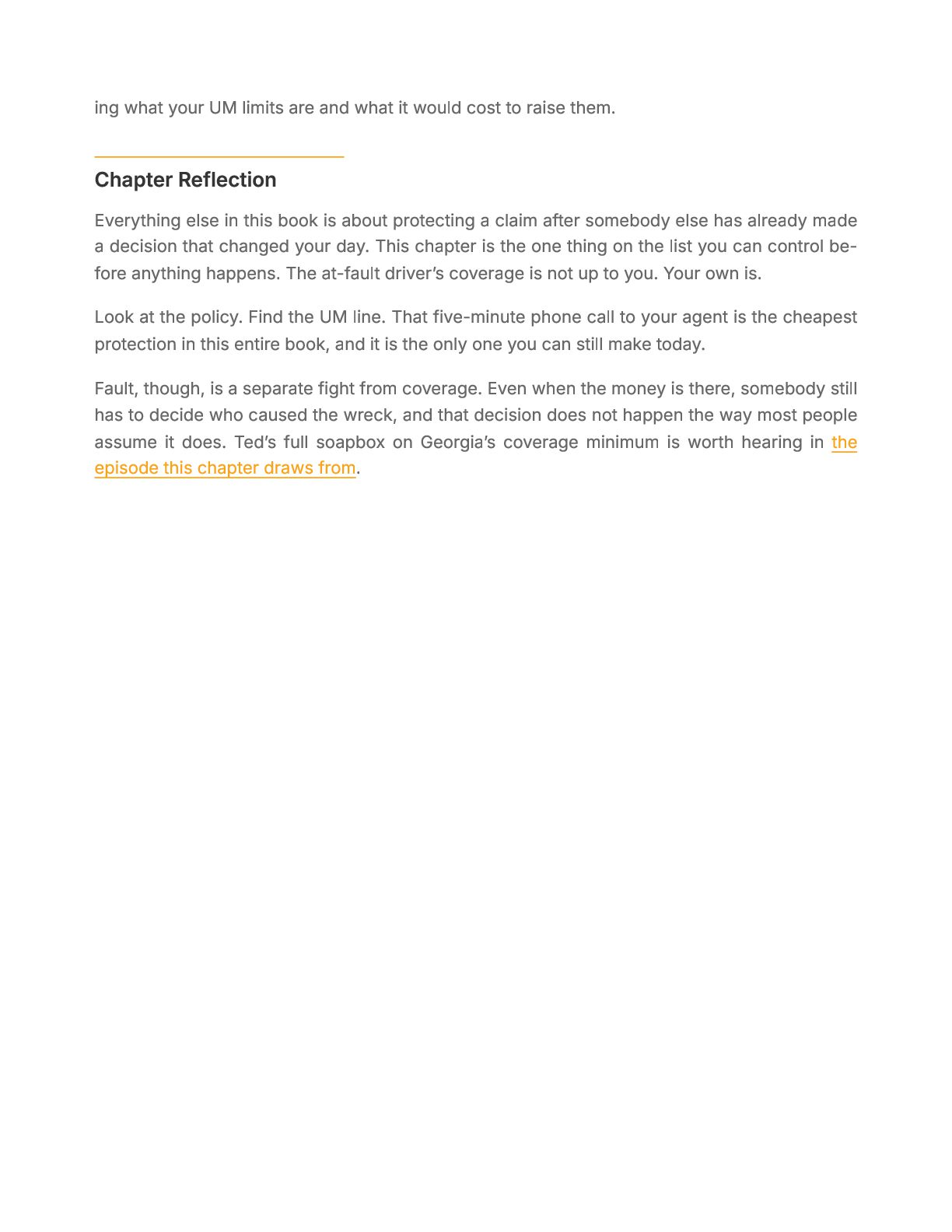
  43. Georgia’s $25,000 liability minimum set against a catastrophic medical bill,

    with uninsured motorist coverage stacking on top to close the gap The Line on Your Policy Called UM So here is the actual advice, and it is the reason this chapter exists at all. Go pull out your auto insurance policy. Look under the line for UM, which stands for uninsured or underinsured mo‐ torist coverage. That is coverage you purchase on your own auto policy. It is there to protect you and your family for this exact scenario. You do not know who is going to hit you, and you do not know how badly you are going to be injured, and UM is the only thing standing between those two unknowns and a bill you cannot pay. For some reason, agents often do not explain this to people. They are focused on protecting your assets, which is a real concern and not a wrong thing to sell. But it is the wrong empha‐
  44. sis. What they should be pushing is UM, because UM

    is the coverage that shows up when the person who hit you does not carry enough. It is not only for drivers with no insurance at all. It covers underinsured drivers too, which is the far more common situation on Atlanta roads. Run the math on my motorcycle client. If he had carried at least $100,000 of the good type of UM, it would have sat right on top of the at-fault driver’s $25,000. That is $125,000 of avail‐ able coverage instead of $25,000. It does not make him whole against four hundred thousand in bills. It is a different life than the one he ended up with. There are two different types of UM, and I am not going to get too far into the weeds on that here because there is a lot to it. What I tell people is simpler than the weeds. Get as much as you can afford. It is cheap compared to liability, and it is there to protect you and your family. Common Questions Does Georgia require uninsured motorist coverage? No. Georgia requires liability coverage only, and the minimum is $25,000. You do not have to carry medical payments coverage and you do not have to carry UM. “You don’t have to have it in Georgia, and for some reason, agents oftentimes don’t explain this to people.” That means the coverage protecting you from an underinsured driver is entirely your decision to buy. What happens if the at-fault driver only carries the state minimum and my medical bills are higher? You are limited to what is available unless you have UM coverage of your own. The $25,000 covers your entire case, not just the medical side, so pain and suffering and lost wages come out of the same policy. If there is nothing else to pursue, you can be left holding the rest of the bill yourself. That is exactly what happened to my motorcycle client. How much UM coverage should I buy? Get as much as you can afford. I am not going to hand you a number, because what you can carry depends on your budget and your family. What I will say is that UM is cheap compared to liability coverage, and the amount that feels like plenty on a normal Tuesday is not the amount you will wish you had bought after a four-month hospital stay. Why didn’t my insurance agent explain UM coverage to me? I wish I had a satisfying answer. In my experience, agents lead with protecting your assets, and UM gets mentioned in passing or not at all. It is worth calling your agent directly and ask‐
  45. ing what your UM limits are and what it would

    cost to raise them. Chapter Reflection Everything else in this book is about protecting a claim after somebody else has already made a decision that changed your day. This chapter is the one thing on the list you can control be‐ fore anything happens. The at-fault driver’s coverage is not up to you. Your own is. Look at the policy. Find the UM line. That five-minute phone call to your agent is the cheapest protection in this entire book, and it is the only one you can still make today. Fault, though, is a separate fight from coverage. Even when the money is there, somebody still has to decide who caused the wreck, and that decision does not happen the way most people assume it does. Ted’s full soapbox on Georgia’s coverage minimum is worth hearing in the episode this chapter draws from.
  46. Most people walk away from a wreck believing the officer

    settled it. He wrote the other driver at fault, so the other driver is at fault, and that is the end of the discussion. That is not how it works in Georgia, and understanding why changes how you behave at the scene and in the months after. Fault is ultimately determined by the jury. Twelve people from your community sit in a box, look at the evidence that gets presented to them, and decide who they believe caused this. That is the real decision-maker in your case, and everything else is material you hand them so they can make it. Now, because Georgia is a comparative negligence state, that jury is answering two questions instead of one. They decide who is liable, and they decide at what percentage. The defense is always working the second question. They want that percentage moved off their driver and onto you, all the way up to one hundred percent on one side and zero on the other if they can get it. “ “So you got to have the officer out. They’re your best friend. They are trained to investi‐ gate the wreck, talk to all the witnesses, and determine right then and there who they be‐ lieve is at fault and why. They then become your expert you call to trial and let the jury hear from the officer.” — T E D S PA U L D I N G , O N W H Y T H E R E S P O N D I N G O F F I C E R M AT T E R S AT T R I A L Video Is First and Best How do you prove fault to twelve strangers? The first and absolute best way is video. That is why I say video, video, video until people are tired of hearing it from me.
  47. If you get video of the entire wreck, the video

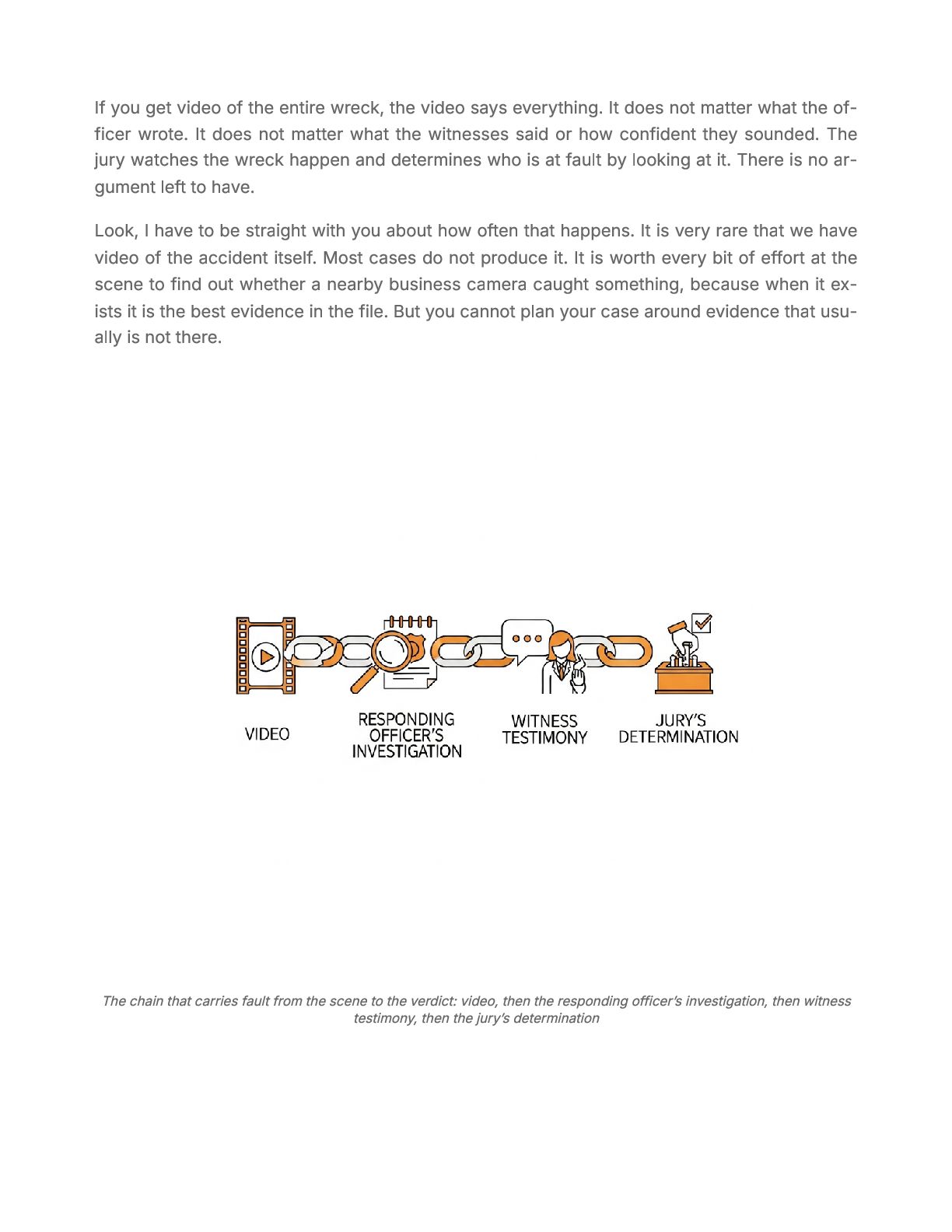
    says everything. It does not matter what the of‐ ficer wrote. It does not matter what the witnesses said or how confident they sounded. The jury watches the wreck happen and determines who is at fault by looking at it. There is no ar‐ gument left to have. Look, I have to be straight with you about how often that happens. It is very rare that we have video of the accident itself. Most cases do not produce it. It is worth every bit of effort at the scene to find out whether a nearby business camera caught something, because when it ex‐ ists it is the best evidence in the file. But you cannot plan your case around evidence that usu‐ ally is not there. The chain that carries fault from the scene to the verdict: video, then the responding officer’s investigation, then witness testimony, then the jury’s determination
  48. The Officer Is the Expert You Call to Trial So

    normally, fault comes down to the officer. That is the whole reason I tell people to call the police every single time, even for a scratch. They are trained to investigate the wreck. They talk to the witnesses. They look at where the vehicles are, what the damage pattern shows, what each driver says, and they determine right then and there who they believe is at fault and why. That determination gets documented while everything is fresh, by someone with no stake in the outcome. That officer then becomes your expert at trial. You call them, and the jury hears it from the person who was actually standing in the road that day. I found this driver fully at fault, and here is why. They ran the red light. They did not have their blinker on when they turned. It was a rear-end collision. That testimony carries weight that no amount of argument from me car‐ ries, because it comes from a neutral professional whose job was to figure out what happened. There is one thing to keep straight about what the officer is doing. Their duty is not to com‐ pare fault. They are not out there deciding that one driver is sixty percent responsible and the other is forty. They figure out who is at fault, meaning who is the majority at fault, and they write it that way. The percentage work belongs to the jury, and it happens much later, under the threshold rules covered earlier in this book. That distinction matters in both directions. A driver marked at fault at the scene has not been assigned a number, and a driver cleared at the scene has not been guaranteed one either. What Happens When There Is No Officer If you do not have the officer, you are in he-said-she-said. Two drivers, two versions, no neu‐ tral third party who wrote anything down while it was fresh. That case is not automatically lost. It is a much harder case. You had better have witnesses, and you had better have their full contact information rather than a first name and a guess. You had better have video. And you had better have a good way to explain to a jury why you are not at fault and the other party is. I would say that is the position nobody wants to be in, and it is the most avoidable one in this entire book. The officer showing up costs you thirty or forty minutes at the scene. Not having the officer can cost you the case.
  49. Common Questions Does the police report decide who is at

    fault in Georgia? No. Fault is ultimately determined by the jury, twelve people from your community looking at the evidence presented to them. The police report is powerful evidence and the officer is the expert you put in front of that jury, but the report itself is not the final ruling. Insurance compa‐ nies treat it as close to final in most claims, which is why it carries so much practical weight. Can I still have a case if the officer found me at fault? Possibly, but I want to be careful here. The officer’s job is to identify who is the majority at fault, not to assign percentages, so their finding is not the last word. It is rare to have an offi‐ cer find you at fault and still be able to shift enough fault onto the other driver. If you are se‐ verely injured, it is worth having a lawyer look at whether the evidence supports it. What is the best evidence for proving fault in a car accident? Video of the wreck itself, without question. “If you get video of the entire wreck, video speaks everything.” When it exists, it ends the fault argument outright, because the jury can watch what happened instead of choosing between two stories. It is rare, which is why the respond‐ ing officer is the evidence most cases actually run on. What if no officer came to the scene? Then you are relying on witnesses, video, and your own ability to explain the wreck to a jury. Get every witness’s full name, phone number, and email before anyone leaves. Some jurisdic‐ tions in the Atlanta area no longer send officers to wrecks without injuries, so this scenario is more common than it used to be. Chapter Reflection The thread running through all of this is that fault is not a fact somebody hands you at the scene. It is a conclusion that twelve people reach, months or years later, from whatever evi‐ dence made it into the file. Everything you do in the first hour is really about what those twelve people will eventually get to see. The video you take. The witness whose number you wrote down. The officer you made sure spoke to you and not just the other driver. None of it feels consequential standing on the shoulder of the road. All of it is the case.
  50. Proving fault is one half of the work. Opening the

    claim and dealing with the people on the other end of the phone is the other half, and that is where good, honest people give away ground they never meant to give. Ted covers evidence and police reports further across the firm’s accident law blog.
  51. You have been in the wreck. The police came. You

    went and got checked out. Now what? This is the stretch where most people are operating on instinct, and instinct works against you here. The steps themselves are not complicated. You make some phone calls, claims get opened, adjusters get assigned. What matters is the order you do it in, the one call almost everybody skips, and the one thing you can politely decline that protects your case more than anything else on the list. Now, before the mechanics, understand who you are talking to. The insurance company is not your friend. Neither is yours. That does not mean the adjuster is going to be rude or difficult to work with. Most of them are not. They have a job to do, and that job is to resolve your claim as quickly as possible for as little money as possible. It is understandable and it is not personal. But you have to know it, because it explains why you do some things and why you refuse others. “ “Now, this doesn’t mean they’re gonna be mean and super rude and difficult to work with. They may not. They have a job to do. Their job is to resolve your claim as quickly as possible for as little money as possible. That’s their job, and it’s understandable, and you just have to understand that and not get frustrated by it.” — T E D S PA U L D I N G , O N W H Y T H E I N S U R A N C E C O M PA N Y I S N OT YO U R F R I E N D Call a Lawyer First, Which Does Not Mean Hire One Who do you contact first? My answer is always a lawyer, and I know exactly how that sounds coming from a lawyer.
  52. Hear the whole answer. Calling does not mean hiring. The

    consultation is free and there is no obligation, certainly with us and with most other firms. If you fully intend to handle this claim yourself, call anyway, and get free advice on how to handle it the right way before you start making calls that cannot be unmade. The reason is simple. You do not know yet whether yours is the kind of case where something has to happen immediately. You will not know that from reading about it online. A twentyminute phone call tells you, and then the decision is yours with real information behind it. Opening the Claim With the At-Fault Carrier The claim you file is with the at-fault party’s insurance company. Everybody knows that part. You call them up and you give them the information they need to open a file. They are going to want your contact information. Where the wreck occurred and how it oc‐ curred. Your own insurance information. Any witnesses you have. They take all of that, they set up a claim, and within twenty-four to forty-eight hours an adjuster for the at-fault party’s insurance is assigned to it. From that point forward, that adjuster is your point of contact on their side. That is the straightforward half. The next call is the one people skip.
  53. The claim-filing timeline: notify the at-fault carrier, an adjuster assigned

    within 24 to 48 hours, and the 90-day deadline to notify your own insurer The 90-Day Notice to Your Own Insurance Company You need to put your own insurance company on notice, and most people do not. They skip it for two reasons that both sound sensible. Either they think reporting it will raise their rates, or they were not at fault and figure their own policy has nothing to do with it. That is incorrect. Think back to the coverage problem. There may be a scenario, and often there is, where you have to reach your own policy for additional coverage because the at-fault party does not have enough. Early on, you have no way of knowing whether that is your case. You do not know the full extent of your injuries yet and you do not know what the other driver carries.
  54. Here is the problem. Georgia law requires you to put

    your insurance company on notice within ninety days of the wreck. If you do not, your insurance company has the right to void cover‐ age for that wreck, because you did not follow your policy and put them on notice. You could have carried UM coverage for fifteen years, paid every premium on time, and lose the benefit of it over a phone call you did not make. So I tell people, do it every single time. Even if it turns out you never need to use it, that is great. At least they are on notice and it is there in case you need it. The process is the same as the other call. You give them the information, they assign what is called a UM adjuster, and you move forward. The Recorded Statement You Do Not Have to Give Right away, the at-fault party’s insurance is going to ask you to give a recorded statement. There is no law that requires you to do that. The only reason they want it is to try to use it against you later if they can. Good, honest people hear that and think, well, I have nothing to hide, I will just tell them what happened. You do not have anything to hide. That is not the risk. The risk is that the insurance company is looking for any angle, and a recording gives them something permanent to work with. Say it was an intersection wreck. During that recorded statement you say something like, yeah, I did not see him, I guess I probably should have seen him, but then he T-boned me. You think that is harmless. You are not admitting anything. You are being a decent, forthcoming person about a moment you have replayed a hundred times. Now watch what they do with it. Wait a minute. You said you should have seen them. I have you on a recording saying you should have seen my insured’s vehicle. So had you seen them, maybe you would have avoided this. Maybe you are twenty percent at fault. You just walked yourself into a comparative negligence argument you never meant to make. It is not what you meant and it does not matter. Anything someone says can be twisted. You do not have to do it, there is no benefit to you in doing it, so why do it? There is one distinction that matters enormously here. You do have to cooperate with your own insurance company. Your policy says you are going to comply with them, and you do not want to give them any basis to void your coverage. The rule about recorded statements ap‐ plies to the at-fault party’s carrier, not yours.
  55. When you decline, keep it pleasant and short. You tell

    them you do not prefer to do a recorded statement at this time, the police report will come out and it will explain everything on how this occurred, and you leave it at that. What to Say to an Adjuster Outside of a recorded statement, you still have to talk to these people. Keep it to the simple facts. Here is when the wreck occurred. Here is the make, model, and year of my vehicle. Here is the damage to it. Are you injured? Yes, I am. That is the level of detail. You do not need to walk them through the headaches, then the neck, then the thing that started on day four. What I tell people is do not fill in gaps. There is no need to say I am sorry, or I did not see them coming, or to explain why you think something happened. The less you give, the better. Give them what they need to set up the claim and pursue it, and nothing beyond that. They are going to get the police report. They are going to get your medical records. They are going to get your bills. Let those things speak for themselves. Those documents were created by neutral professionals at the time it happened, and they make your case better than your memory of a stressful afternoon ever will. Common Questions Do I have to give a recorded statement to the other driver’s insurance company? No. There is no law requiring you to give a recorded statement to the at-fault party’s insurance company, and the only reason they want it is to use it against you later if they can. Decline po‐ litely and point them to the police report. This is different from your own insurer, where your policy obligates you to cooperate. Do I have to notify my own insurance company if I wasn’t at fault? Yes, and this is the step people skip. Georgia law requires you to put your own insurance com‐ pany on notice within ninety days of the wreck. Miss that window and your carrier has the right to void coverage for that accident because you did not follow the policy. “I tell people, do it every single time.” What should I say when the adjuster calls me?
  56. Simple facts only. When the accident happened, the make, model,

    and year of your vehicle, the damage to it, and yes, you are injured. Do not explain why things happened, do not apolo‐ gize, and do not fill in gaps. They will obtain the police report, the medical records, and the bills, and those speak better than you can. Can the insurance company close my claim if I refuse a recorded statement? No. I have heard horror stories where adjusters tell people their claim will be closed if they will not give a recorded statement. That is not true at all and it is not the law. Do not fall for it. Chapter Reflection Filing a claim is mechanical. Two phone calls, two adjusters, one deadline you cannot miss. The part that decides how much your case is worth is not the paperwork. It is the handful of moments where a decent person, trying to be helpful, hands the other side something they can use. Understand what the adjuster is paid to do and you stop taking it personally, which is exactly when you start making good decisions. You are not being rude by declining a recorded state‐ ment. You are declining to volunteer for a job that is not yours. Make the call to your own carrier inside ninety days. Keep everything else to the facts, and let the record do the arguing. The recorded-statement walkthrough in this chapter is drawn from Ted’s conversation on filing a claim.
  57. There is very little improvisation in how an insurance company

    handles your claim. The ad‐ juster assigned to your file has a set of arguments, and they run them in roughly the same or‐ der every time. After more than twenty years of this, I can usually tell you what the letter is go‐ ing to say before it shows up. I want to walk you through those arguments in the order carriers actually use them, because most people brace for the wrong fight. They assume the whole case is going to be a brawl over who caused the accident. That is almost never where these cases are won or lost. The fight is about your injuries. Whether you have them, whether this wreck caused them, and whether the treatment you received was legitimate. Nearly everything an adjuster does is a variation on those three questions. “ “They love preexisting conditions. They will create it out of thin air in some cases. What does that mean? If you’ve got a history of back pain, even if it was years before and you hadn’t had back pain for years, they’re gonna bring that up.” — T E D S PA U L D I N G , O N H O W C A R R I E R S M A N U FAC T U R E A PREEXISTING CONDITION ARGUMENT They Start With Fault, and Usually Come Up Empty The first thing an adjuster looks for is any percentage of fault they can put on you. Obviously they would love to say you are 100 percent at fault. That is not normally what these cases are about. Here is why. If you have called a lawyer, you typically already have a police report that says the other driver caused the wreck. The officer came out, investigated, and made a finding. That is documented proof, and the carrier knows it.
  58. So they go hunting instead. They are looking for anything,

    whether it is a recorded statement, something you said at the scene, an offhand comment to the adjuster, that lets them argue you contributed. “I know they found my guy at fault, but I think you did this, and you could have done that, and we are going to put a percentage of fault on you.” Now, I want to be straight with you about how often that works, because the calibrated version is more useful than the scary version. It does not come up often. I would say 90 percent plus of our cases at Spaulding Injury Law have no real argument on those points. That is the good news. The bad news is what comes next. The Real Fight Is Damages What most of these cases actually come down to is damages. Are you injured? Are those in‐ juries because of this wreck? And was the treatment legitimate? I tell people that 95 plus percent of these cases are really just damages cases. You are usually not arguing over who is at fault. You are arguing over how hurt you are, whether this accident is the reason, and how severe it is from a pain and suffering standpoint. Once you understand that, the rest of the playbook makes sense. Every argument below ex‐ ists to break the link between the wreck and your injuries, or to make your treatment look optional.
  59. The insurance carrier’s argument stack: comparative fault first, then gaps

    in treatment, then non-compliance with the doctor, then preexisting conditions Gaps in Treatment The first damages argument is gaps, and there are two kinds. The first kind is the gap at the front. You did not go by EMS. You did not go for days, or in some cases weeks, before your first visit. I covered earlier in this book why that opening record matters so much, and this is the reason. The adjuster is going to point at that empty stretch of calendar and tell you it means you were not really hurt. The second kind is the gap in the middle, and people underestimate this one. You went to physical therapy for a couple of months. Then you did nothing for several months. Then you came back into treatment. The carrier’s position is simple. Something happened in between,
  60. and they are not paying for anything after that gap,

    because in their telling it came from some‐ where else. They do not have to prove what happened during those months. They only have to make the gap look suspicious enough that a jury wonders about it. When People Play Doctor With Their Own Case The next argument is non-compliance, meaning you did not do what your doctor told you to do. The doctor recommended injections and you declined. The doctor wanted more physical ther‐ apy and you decided you had enough. You stopped treating on your own. That is a big one I get, and I understand why it happens. Nobody wants shots. Nobody wants to keep driving to appointments. But people play doctor. They say, “No, I’m fine, I’m not going to do shots, I’m not going to do more physical therapy even though the doctor thinks I should. I’m done.” Then later they want to argue they are still injured and still in pain. Look, here is what that decision means on the other side of the table. If you stop treating, to the insurance company that means you are better. That is the whole argument, and it is a clean one for them. You told them you were healed by walking away. The way I explain it to people is that you do not want to do any more treatment or any less treatment than you actually need. Follow the plan your doctor set. If you disagree with it, take that up with your doctor, not by disappearing. Preexisting Conditions and the Injury They Pull Forward The last one, and one of the biggest arguments they make, is preexisting conditions. Say you have a history of back pain. Maybe you saw an orthopedist two years before this wreck. You have been fine since. It never comes up in your life anymore. The carrier is going to pull that visit forward and attribute your current back pain to it. That back pain now is that back pain then, not this accident, so it is not their responsibility. And God forbid you were treating right up to the time of the wreck. That one is genuinely diffi‐ cult. They have a much better preexisting injury argument, and I am not going to tell you otherwise.
  61. Underneath all of it is the same strategy. Your injuries

    clearly exist, because you are getting treatment for them and the records show it. So they cannot argue you are fine. What they can do is find any excuse to say those injuries came from somewhere else or happened some‐ where else, and therefore are not related to this wreck, and therefore they are not paying. Common Questions Can the insurance company still blame me if the police report says the other driver was at fault? They can try, and they will look for a way. A police report finding the other driver at fault is strong documented proof, which is why fault arguments fail in most of our cases. I would say 90 percent plus have no real argument on those points. Their opening is usually something you said, which is one more reason to be careful with recorded statements. What is a gap in treatment and why does it lower my settlement? A gap is any stretch where you were not being treated, either before your first visit or in the middle of your care. The carrier’s position is that something happened in between and they are not paying for treatment after the gap. Gaps do not prove anything, but they hand the oth‐ er side a story about where your injuries really came from. What happens if I turn down injections or stop physical therapy early? The insurance company treats that as evidence you recovered. As Ted puts it, if you stop treating to the insurance company, that means you are better. People play doctor and quit when they start feeling somewhat better, then find out later they were not done. Do not do more treatment or less treatment than you need. Follow what your doctor actually recommends. Can they use an old back injury against me? Yes, and they will reach a long way back to do it. A visit to an orthopedist two years before the accident is enough for them to argue your current pain belongs to that history instead of this wreck. It is a harder fight if you were still treating for the same body part right up to the acci‐ dent. That does not end your claim, but it changes how the case has to be built. Chapter Reflection Every argument in this chapter is really the same argument wearing different clothes. Your in‐ juries exist. The adjuster cannot make them disappear, so instead they try to reassign them to
  62. a gap, a decision you made, or something in your

    past. The defense against all of it is boring and it is entirely within your control. Get treated early, follow the plan, and do not create empty calendar space. That is most of it. What decides the value of that treatment, though, is the paper it generates. That is where we go next. If a carrier is running these arguments on your file, more of Ted’s answers on carrier tactics sit in the firm’s learning center.
  63. Most people think about evidence for about a week after

    the accident and then stop. They take pictures of the bumper, they get a copy of the police report, and they figure the file is built. The evidence that actually sets the value of your case tends to arrive later, and some of it dis‐ appears if nobody goes and gets it. That includes footage sitting on a hard drive in the back office of a gas station, data sitting inside the car that hit you, and a stack of medical records that will eventually have to speak for a doctor who cannot remember you. This chapter is about that second layer. It is the documentation almost nobody thinks about until it is the thing deciding what the case is worth. “ “It’s a recording device, and it records a lot of things that you don’t even realize. It records whether you’re wearing a seatbelt. It records how fast you were going in the half-second, one-second, 2-second, 3-second, 5-second interval from a wreck. It records that data ’cause it’s constantly monitoring it, but it doesn’t save it unless there’s an event, and then it goes backward.” — T E D S PA U L D I N G , O N T H E V E H I C L E B L AC K B OX The Two Things Nobody Collects There are two pieces of evidence people almost never think to go after. The first is video from businesses around the scene. I covered this in detail earlier in the book, so I will not repeat all of it here. The short version is that it is rare, but when it lands it can be the best evidence in the entire case, and it typically gets written over within about 30 days.
  64. Sometimes 10 or 15. If you take one habit from

    this book, make it looking around at the build‐ ings after a wreck. The second one is more unique, and it is the reason for this chapter. The Black Box in the Vehicle That Hit You Every vehicle nowadays has what is called a black box. It is an event data recorder, and it captures more than most drivers realize. It records whether you were wearing a seatbelt. It records how fast the vehicle was going in the half second, one second, two second, three second, and five second intervals before the wreck. It records airbag deployment. It records steering input, the shifting of the wheel. It is crazy what it can capture. The mechanics matter here. The box is constantly monitoring that data, but it does not save it. It only writes it down when there is an event, and then it goes backward and preserves the seconds leading up to the impact. That is why it works as evidence. Nobody had to decide to record anything. We used this in the Cumming case I described earlier, the one where our client was ticketed for having her tires over the yellow line and the other driver came over a hill at a speed she swore was far above the 35 mile per hour limit. We pulled his black box. We could say, down to five seconds and three seconds before impact, look at him speeding up. He went from 50 to 60 to 65 coming up over that hill. That is not an argument anymore. That is a readout. Now, I want to be straight with you about the limits. It is more expensive than the rest of what we do. You do not need it in a lot of simple accidents, especially when fault is not really in dis‐ pute. And that data does not last forever. That last part is the trap. If you do not know you have the kind of case where the black box matters, you do not know to ask for it. By the time you get to a lawyer, it could be gone. Which is one more reason the free phone call early is worth making even if you never hire anybody.
  65. A vehicle event data recorder capturing speed, seatbelt use, airbag

    deployment and steering input across the five seconds before impact Why Your Medical Records Become the Bible Medical records matter for an obvious reason and a reason almost nobody thinks about. The obvious reason first. Your records are the record of your injuries, your treatment, and your history. They document what you complained of on a given day, what treatment you received, and what the doctor recommended. Sometimes the doctor’s opinions are sitting right there in the chart. Remember what I said in the last chapter, that 95 plus percent of these cases are really just damages cases. Your medical records and your billing records are the evidence in that fight. Here is the part people miss. If you need your treating provider to testify, and often you do, they are not going to remember you a year or two later. They see so many patients. Your case
  66. is enormous to you and it is one chart among

    thousands to them. So what do they use? The medical record becomes the Bible. It walks the doctor through the treatment, the diagnoses, and the procedures. “She came in on this date. She was complain‐ ing of this. This is what we did.” And then comes the question the whole case turns on. Doctor, do you believe these injuries were caused by this wreck? “Well, yes, I do, and here is why.” That is what lawyers call causa‐ tion, meaning the injuries are related to this accident and not something else. It is the real typi‐ cal fight in these cases, and your records are how it gets proven. That is why we care so much about what your chart says on day one. It is not paperwork. It is the script your doctor reads from on the stand. Three Different Things People Call a Medical Lien Liens confuse almost everybody, partly because people use one phrase for three different things. Keep them separate. The traditional medical lien is the simple one. You have no health insurance. You have a bill. The provider files a lien, which ties up your settlement or verdict so that they get paid back out of it. The non-traditional version comes up when you have no health insurance and you need longterm treatment. Certain groups will come in and treat you anyway, running it like a bar tab. They are not asking you to pay anything up front. In exchange, they take a lien against your case with a right to be reimbursed out of the settlement or verdict at the end. Then there is the subrogation lien, which is a separate thing that people commonly call a med‐ ical lien too. That is your own health insurance. In Georgia, when your health insurer pays your bills, it has a right to reimbursement once you get a recovery. Different source, different mechanism, same effect on your net check. None of this means you should avoid treatment. It means you should know before settlement day who has a claim on the money, because those numbers come off the top. Common Questions What is a car’s black box and what does it record?
  67. It is an event data recorder built into every modern

    vehicle. It captures seatbelt use, speed in the half second, one, two, three, and five second intervals before impact, airbag deployment, and steering input. It monitors constantly but only saves when there is an event, then goes backward to preserve those seconds. In one of our cases it showed the other driver going from 50 to 60 to 65 coming up over the hill. Do I need to pull the black box in every car accident case? No. It is more expensive than standard evidence gathering, and you do not need it in a lot of simple accidents where fault is not really contested. It matters when speed or seatbelt use is genuinely in dispute. The catch is that the data does not last forever, so the decision has to get made early, before anyone knows for certain how the case will develop. Why do medical records matter so much in a Georgia injury claim? Because most of these cases are damages cases, and your records are the evidence of dam‐ ages. They document your complaints, your treatment, and your doctor’s recommendations. They also carry your testimony for you later, since a treating provider is not going to remem‐ ber a year or two later. The chart is how causation gets proven, meaning the injuries are tied to this wreck. What is the difference between a medical lien and a subrogation lien? A traditional medical lien is filed by a provider you owe when you had no health insurance, and it ties up your settlement until they are paid. A subrogation lien is your own health insurer’s right to reimbursement in Georgia for what it paid on your bills once you recover. People use the phrase medical lien for both, but they come from different places. Chapter Reflection The theme running through all of this is that the strongest evidence in your case is usually created by someone other than you, and it has a shelf life. Store video gets overwritten. Black box data gets lost. Memories of the people treating you fade into a chart. What survives is whatever somebody thought to preserve while it still existed. That is most of what a lawyer does early in a case, and it is why the timing of that first call matters more than the decision to hire anyone. Which brings us to the timing that ends cases outright. Ted discusses black box data and medical records in the source episode for this chapter.
  68. 12 C H A P T E R T W

    E LV E Two Years and Counting: Georgia’s Deadlines and the Ante Litem Trap
  69. Deadlines are the one part of a car accident claim

    with no gray area. Everything else in this book involves judgment, negotiation, or a fight over percentages. A deadline either got met or it did not. Most people know there is a two year window in Georgia. Far fewer know that in certain cases there is an earlier deadline that sits in front of it, and that missing that one shuts the door be‐ fore you ever get to the two years. Those are usually the cases where somebody handled it themselves, looked it up online, and felt fine right up until they were not. I also want to cover the situations where the clock starts later than you would expect, because they come up more than people think, especially with kids. “ “If you’re dealing with a victim who’s a minor, technically the 2-year statute doesn’t begin to run, doesn’t start on the anniversary of the wreck. It starts on the anniversary of the minor becoming 18. So 7-year-old literally has 11 years where the statute’s not running. They then turn 18, then the 2 years runs.” — T E D S PA U L D I N G , O N H O W T H E C L O C K W O R K S F O R INJURED CHILDREN The Base Rule Is Two Years From the Accident For personal injury in Georgia, the deadline is typically two years. That is your standard. It runs from the date the wreck occurred, so your marker is the two year anniversary. By that anniversary, your lawsuit is filed or you forever lose your rights. Not reduced, not weakened. Gone. There is no version of this where you get it back because you did not know, because you were still treating, or because you were still talking to an adjuster who kept say‐ ing they were reviewing it.
  70. There are exceptions that can push it out past two

    years, and I will get to those. They are not typical, and this is one of the main reasons to have a lawyer looking at your case even if the rest of it seems simple. Somebody should be able to tell you with certainty whether two years is your number. What I tell people is to just assume it is two years. Do not miss the two year deadline, and do not go anywhere near it. The Deadline That Comes Before the Deadline Now, there is a category where the timeline gets shorter, and it is the one that ends the most claims. That is when a government entity is involved. Think about how often that happens on Georgia roads. School buses. Police vehicles. We han‐ dle a lot of those. Any city, county, or state vehicle puts you here. It is still a two year statute of limitation. But there is an extra limitation that comes in earlier, and if you miss it, it automatically cuts off your ability to file at all within those two years. What is driving that is sovereign immunity. The government gets notice before it gets sued. The mechanism is called an ante litem notice, and it is your first step, not your second. Which deadline applies depends on which entity you are going after. It is six months if it is a city or municipality. It is one year if it is a county or the State of Georgia. You also have to follow the specifics on how that notice gets filed, because doing it late and doing it wrong land in the same place. Look, this is where people get hurt. A lot of people who try to handle claims on their own do not realize any of this exists. They look it up on the internet, they see two years, and they think they are good. So if you are technically going after the city because it was a city vehicle or a police officer, and you did not get that ante litem notice in within six months, the two year statute does not matter anymore. You miss it, case over. You cannot even start.
  71. Georgia’s deadline branches: the two-year base rule, the six-month city

    ante litem notice, the one-year county and state notice, and the minor’s clock starting at eighteen When the Clock Starts Later There are two more typical extensions in car wreck cases, plus one that comes from the crim‐ inal side. The first is minors. If the victim is a child, the two year clock does not begin on the anniver‐ sary of the accident. It begins when that minor turns 18. So a seven year old has eleven years where the statute is not running at all. Then they turn 18, and then the two years starts. They can still pursue the claim at any point during that whole stretch, which is worth knowing if you are a parent trying to figure out whether you have already lost something. The second is legal incapacity. If someone has a legitimate legal incapacity, it works similarly to the minor situation. The clock starts when their capacity comes back.
  72. The third is the criminal case. In a wreck, that

    usually means the ticket issued to the at fault driver. Until that ticket is disposed of, either by the driver paying it or fighting it in court and being found guilty, the two years does not start to run. From a technical standpoint that can buy you anywhere from a couple of additional months to as much as a year. Shorter Deadlines in Other Kinds of Cases There are personal injury categories with shorter deadlines than two years. Medical malprac‐ tice is the one people ask about most. That is not really a car accident issue, so I am not going to spend time on it here. For car wrecks in Georgia, the shortened deadline that should be on your radar is the government en‐ tity situation and the ante litem notice that comes with it. Common Questions How long do I have to file a car accident lawsuit in Georgia? Typically two years, running from the date of the accident. By that two year anniversary your lawsuit is filed or you forever lose your rights. A few situations extend it and one common situ‐ ation shortens the practical deadline, so the safe approach is to treat two years as firm and get a lawyer to confirm your specific date well before you are close to it. What is an ante litem notice and when is it due? It is the notice you have to give a government entity before you can sue it, and sovereign im‐ munity is what drives it. The deadline is six months if it is a city or municipality, and one year if it is a county or the State of Georgia. There are specifics you have to follow on how it gets filed. Miss it and the two year statute becomes irrelevant. Does the two year deadline apply to a child who was injured? No, the clock works differently for minors. It does not start on the accident anniversary. It starts when the child turns 18, and the two years runs from there. A seven year old has eleven years where the statute is not running at all. The claim can still be pursued during that entire time, so nothing is lost by waiting, though the evidence gets harder to hold onto. Does a traffic ticket against the other driver affect my deadline? It can. Until the ticket is disposed of, either by the at fault driver paying it or fighting it and be‐ ing found guilty, the two years does not start to run. That can add a couple of months to as
  73. much as a year. It is real, but I would

    not build a plan around it. Chapter Reflection I will tell you my own posture on all of this, because it is more conservative than the rules re‐ quire. I am kind of a worrywart. I would rather not have to argue with anybody over whether an extension applies, because arguing about it means the deadline is already close enough to be a problem. So I tell people to just go by the two years. By two years you should be ready anyway. Your treatment has run its course, the records are in, and you know what the case is. If it is not re‐ solving by then, let us get it filed and pursue it rather than playing around with extensions. Deadlines are the one place in this process where being early costs you nothing at all. Anyone unsure which deadline applies can raise it with Ted Spaulding directly.
  74. Ask most people what their car accident claim is worth

    and they will add two numbers togeth‐ er. What the body shop quoted, and what the hospital billed. That is the entire calculation in their head, and it is usually off by more than those two numbers combined. A Georgia personal injury claim is built out of separate categories that get added together at the end. Property damage runs on its own track. Medical costs are their own bucket. Lost wages are their own bucket. Pain and suffering is its own bucket, and in most cases it should be the biggest number on the page. Every once in a while there is a fourth category on the in‐ jury side, punitive damages, and that one is not about your damages at all. Why does this matter so much? Because you cannot recover what you never counted. The adjuster handling your file is not going to walk you back through the categories you forgot. Their job is to resolve your claim as quickly as possible for as little money as possible. A claimant who asks only for repair costs and medical bills has already done half of that job for them. So let me go through the buckets the way I go through them with a client sitting across the ta‐ ble at our Lawrenceville office. “ “Then you have what’s called pain and suffer‐ ing, which in my opinion, in most cases should be the biggest part of your damages. It is the loss of enjoyment of life, having to go through the physical pain, emotional pain, and again, it’s past, present, and potentially future. In very severe cases, you’re gonna have pain and suffering currently and for the rest of your life. More minor cases, it’s all past.” — T E D S PA U L D I N G , O N H O W PA I N A N D S U F F E R I N G I S MEASURED
  75. Property Damage Has Two Halves, and Most People Only Claim

    One Start with the car, because it is the part everybody understands first and still gets wrong. If the vehicle is totaled, your property damage claim is the fair market value of that vehicle. Not what you paid for it. Not what you still owe on it. What it was worth the instant before the wreck happened. What I tell people is to picture a second before impact, in the condition the car was actually in, with the mileage it actually had. If you walked it over to your neighbor and sold it to them that afternoon, what would you sell it for? What would they hand you for it? That number is your claim. Now, if the car is repairable, something changes, and this is where money quietly disappears. You do not have one property damage claim. You have two. The first is the repair cost. That is the easy one. The estimate comes in, the shop does the work, the insurer pays the invoice, and most people believe the property side is finished at that point. The second one is called diminished value, and a lot of people forget it entirely. Your car now has a Carfax showing it was in a wreck and was repaired. Go try to sell that car a year from now. Nobody is paying you what they would have paid for the same car with a clean Carfax. That gap, the lost value of the vehicle caused by the fact that it was hit, is real, and you have a right to recover it. It is not a bonus and it is not a favor. It is the second half of a claim you al‐ ready have. Medical Costs Run Past, Present, and Future On the injury side, the first bucket is medical costs, and the word people skip is future. Medical bills are past, present, and future medical costs. Some people only have past. You treated, you finished, you are better, and the file is closed. Some people are sitting right in the middle of treatment, still trying to resolve the injury, which means past and present and possi‐ bly future. And then there is the situation people never think to account for. You may be done treating for now and still be carrying a surgical recommendation. The doctor says let us give it a year, and then in a year I want you in for the surgery. You are not in pain management today. You are not in physical therapy today. You still have a future medical cost sitting out there with a doctor’s name attached to it, and it belongs in the bucket.
  76. All of that, everything already billed and everything credibly ahead

    of you, goes into medical costs. Lost Wages, and What Your Injuries Cost You for the Rest of Your Career Lost wages work the same way, and the structure is worth memorizing because it repeats across every category. You may have no lost wages at all. You may have only past lost wages, the two weeks you missed right after the wreck. You may have past and present, because you are still out or still on reduced hours. And you may have past, present, and future. At the far end of that, for the rest of your life, you may have lost wages because you now have a loss of earning capacity given your injuries. That is a different thing from missed paychecks. That is the difference between the career you had and the career your body will now allow. If the injury took away work you can no longer physically do, the cost of that does not stop when you go back on payroll. All of it goes into the lost wages bucket.
  77. The damages categories stacked as buckets: property damage with diminished

    value, medical costs, lost wages, pain and suffering, and the rare punitive category Pain and Suffering Should Usually Be the Biggest Number Here is where I part ways with how most people picture a claim. In my opinion, in most cases, pain and suffering should be the largest part of your damages. It covers the loss of enjoyment of life. It covers having to physically go through the pain. It cov‐ ers the emotional pain that comes with it. And like the other categories, it runs past, present, and potentially future. In very severe cases, a client has pain and suffering right now and will have it for the rest of their life. That is what a permanent injury actually means in dollars. In more minor cases, it is all past. And I want to be clear about how to read that, because it sounds like bad news and it is not. If your pain and suffering is entirely in the past, that means
  78. you are one hundred percent better and you have no

    pain going forward. That is perfect. That is the outcome you want. You only have past. Add up the buckets you actually have, and that total is your personal injury claim. Punitive Damages, the Rare Fourth Category Every once in a while there is a fourth category, and it sits apart from everything above. Punitive damages are a separate category for punishment. Civil punishment, for conduct by the at fault party that rises to that level. In a car accident, it is typically a DUI situation. Were they drinking? Were they on drugs? That is the fact pattern that opens the door. Think of Tiger Woods here recently. He flipped his vehicle, hit somebody, and allegedly it was because he was on opiates. That is a DUI, and you would have a punitive damage claim against Tiger Woods at that point. Understand what the category is for. Punitive damages are not there to compensate you for your physical damages. Those are already covered by the buckets above. Punitive damages exist to encourage people not to behave that way in the future. It is rare, but in the right sce‐ nario, it is there. Common Questions Is diminished value a separate claim from the repair cost in Georgia? Yes. If your car is repairable, you have two property damage claims, not one. The repair cost is the straightforward one. Diminished value is the second, and it exists because your vehicle now carries a Carfax showing it was wrecked and repaired. You go to sell it a year from now, someone’s not gonna pay you the same amount if it had a clean Carfax. That lost value is yours to recover. Can I recover future medical costs if the surgery has not happened yet? Yes, and this is a common gap. Future medical costs belong in your claim when there is a real recommendation behind them. You might be done with treatment, but you’ve got a surgical recommendation that the doc says, “Let’s give it a year, but then in a year I want you in for X surgery.” That puts past and future medical costs in the bucket even though you are not treat‐ ing right now. What is pain and suffering actually worth in a car accident claim?
  79. There is no formula I can hand you, because it

    moves with the severity and the duration of what you went through. What I can tell you is that in most cases it should be the biggest part of your damages, not an afterthought added to the bills. It covers loss of enjoyment of life, physical pain, and emotional pain, and it runs past, present, and potentially future. Are punitive damages available in a normal car accident case? Rarely. Punitive damages require conduct that rises to that level, and in car accidents that typ‐ ically means a DUI, so drinking or drugs. They are civil punishment aimed at deterring the be‐ havior, not compensation for your injuries. Most claims never involve them at all. Chapter Reflection The number in your head after a wreck is almost always too small, and it is too small for a bor‐ ing reason. You counted the two things you got paperwork for. Everything else in your claim is real, and most of it comes with less paperwork attached. The second half of the property damage. The surgery a year out. The career you can no longer physically do. The part of your life the injury took, which should usually be the largest figure on the page. Once you know what the claim is made of, a harder question shows up. Somebody is going to put a number on the table, and you are going to have to decide whether to take it. Ted walks the damages categories in order in the conversation this chapter was adapted from.
  80. There are two questions I get more than any others,

    and they usually arrive together. Should I take this offer or file a lawsuit? And if I file, how long is this going to take? I will give you the honest answer to both, starting with the one clients like least. Whether to settle or file is ultimately a personal decision. People do not want to hear that. I understand why. You are the victim, you did nothing wrong, and you want somebody with twenty years of experience to just tell you the answer. But it is a personal decision because it is a business decision first and an emotional one sec‐ ond, and I am not the one who has to live inside either of those. My job is to make sure you know every piece of what you are choosing between, give you my honest read, and then ad‐ vocate as hard as I can for whichever road you pick. “ “Because you can always, no matter what that number is, in my opinion, unless it’s the full amount of the policy limit, you can always do better. You can always do worse, right? There are no guarantees on either side.” — T E D S PA U L D I N G , O N T H E R I S K I N E V E R Y S E T T L E M E N T DECISION The Business Side: Is the Offer High Enough to Avoid the Cost of a Lawsuit? Start with the arithmetic, because it is the part you can actually see. Filing a lawsuit costs money, and that money comes out of the settlement or the verdict. Court fees. Deposition costs. If the case goes all the way, trial expenses to get the thing in front of a jury. None of that exists while you are still in a pre-suit claim, and all of it exists the day you file. So the first question is simple to state. Based on your lawyer’s advice, is that settlement high enough to avoid the additional costs of filing and pursuing a lawsuit? Sometimes the answer is
  81. obviously yes, the offer is strong and litigation would spend

    a chunk of it chasing a marginal improvement. Sometimes the answer is obviously no, the offer barely covers what you already owe. That is the clean part of the decision. It is also the smaller part. The Personal Side, and Why I Will Not Pretend It Is Painless Going through litigation is not fun. They do that on purpose. It is financial and emotional war‐ fare, and anyone who tells you otherwise is selling you something. If we drag this out for years in litigation, are you going to get frustrated and sick of the process? Are you going to sit for a deposition and answer questions from a defense lawyer whose entire job that day is to find the sentence he can use against you? Are you going to get up on the stand in front of twelve people and a judge to try to win your own case? Some people can. Some people cannot. Both answers are fine, and neither one makes you a bad person. Here is the part that surprises clients. If you are the type of person who genuinely cannot go through that, then that same settlement is worth more to you than it would be to the next per‐ son. The number on the page did not change. What changed is the price you would pay to chase a bigger one. I have had people tell me flatly, Ted, I will never file a lawsuit, I just cannot do it. Fine. Then we go get the maximum settlement offer we can, and we take it, because at that point you do not have any pressure to apply. The only real pressure a claimant has is the credible willingness to file and, if it still does not get better, to try the case to a jury. After Two Decades, Here Is What I Can and Cannot Promise You Now the risk, and I am going to be blunt because it is the single most important thing in this chapter. Unless the offer is the full amount of the policy limit, you can always do better. You can also always do worse. There are no guarantees on either side of that line, and any lawyer who guarantees you one is guessing. I have taken cases to trial thinking there was no way I could beat the last offer, and we came back with two, three, four times that number. I have also gone in certain we were going to
  82. multiply an offer, and the verdict landed right at it,

    or below it. Both of those things have hap‐ pened to me, and I have been doing this for over twenty years. So it also comes down to a question about you. Are you a risk taker? I am one, because that is what I do for a living. I am here to advocate for you. If you tell me you want to file and try the case, and it makes rational sense that you could do better, let us go do it. But you have to be comfortable with who you are, because you are the one carrying it. The $550,000 Offer and the Four Day Trial Let me give you a real one. Nothing good was offered pre-suit. So we put it into suit. We litigated that case for several years, mainly because the client was still treating and had some big injuries, and I was not go‐ ing to try it before we knew what those injuries actually were. Two days before trial, the offer came in at $550,000. My advice to him was straightforward. Look, we are ready to try this case. It took them this long to even offer you that, and it barely pays your medical bills and your expenses. Functionally it is a zero offer to you. I do not see why you would take it. But it is your decision, and if you are terrified of trying this case and you want the $550,000, I can never promise you it gets better. I felt real confident we could do better than $550,000. That is not the same as knowing. He said no. He wanted to try the case. Four day trial. The jury came back at $3.28 million. That verdict and others like it are published among the firm’s car accident case results. That client had past, present, and future across all of the categories in the last chapter. Permanent surgery with hardware in his neck. Lost wages. Permanent impairments. No puni‐ tive damages claim in that case, just the standard buckets, built correctly and presented to twelve people. And it was life changing for him. What actually happened there? The insurance company simply thought they had a better case than they did. And my client was willing to take the risk. I know some lawyers run this differently. They work purely off the number and they will tell a client when they are settling. I completely get it, and it is a legitimate strategy. I am more of a personal person about it, because after doing this as long as I have, I genuinely care about my
  83. clients, and I do not want to put anybody through

    something they cannot go through or do not want to go through. You have to be willing to fight. If you are not, that is okay. You just have to know it about yourself before you file. The settle-or-sue decision point, showing the $550,000 offer two days before trial against the $3.28 million verdict that followed a four-day trial What Litigation Actually Takes in Fulton County I tell every client the same thing before we file. Do not file a lawsuit unless you are willing to take it all the way. In Fulton County, from the day you file, best case scenario is about a year to try your case to a jury. More likely, two plus years. What drives that? The biggest factor is which judge you draw. There are a number of judges across the state and superior courts, and what matters is what that judge’s docket looks like
  84. when you file and what it looks like over the

    life of the case, because it changes. Their biggest areas are criminal and divorce, and those take precedence. Civil cases are kind of the red headed stepchildren. We come last. Before any of that, you have at least six months of automatic discovery in most courts. That is where depositions get taken and written questions go to each side so everybody learns the case and the evidence. Six months sounds like plenty. In the legal profession it is not. Defense lawyers carry hundreds of cases, and it is close to impossible to get anything scheduled. On our side we would love to run straight through it, close discovery, get on the trial calendar and try the case. What actually happens is extensions and the deposition that cannot get set, and six months quietly becomes eight months to a year. There is one more thing that stretches the timeline, and it is not the lawyers’ fault. I will not try a case before the client’s big ticket treatment is finished. If you are heading toward surgery and still working through physical therapy first, I have to have that surgery in the can before we go in front of a jury. Jurors do not like being told a surgery is coming in the next month, because the other side stands up and says, well, what if he never gets it? I have two clients in exactly that position right now, with doctors trying everything else first, and all of us knowing where it ends up. I am ready to try those cases the day the treatment is done. Common Questions Should I settle my car accident claim or file a lawsuit? Ultimately it is a personal decision, and clients rarely like hearing that. It is a business deci‐ sion, because court fees, deposition costs, and trial expenses all come out of a settlement or verdict. It is also an emotional one, because litigation is financial and emotional warfare by de‐ sign. If you’re the type of person that can’t, well then maybe that settlement is more worth it than it would be to the next person. Can my lawyer guarantee I will do better at trial than the offer on the table? No, and be careful with anyone who says otherwise. Unless the offer is the full policy limit, you can always do better and you can always do worse. I have multiplied offers I did not think I could beat, and I have watched verdicts land at or below offers I was sure we would beat. There is always risk on both sides of that decision. How long does a car accident lawsuit take in Fulton County? From the day you file, best case is about a year to get to a jury, and more likely two plus years. The biggest variable is which judge you draw and what their docket looks like. Criminal and
  85. divorce cases take precedence over civil, so we tend to

    come last. Plan for a long fight, not a short one. Why does discovery take longer than six months? Because scheduling is the bottleneck, not the work. You get at least six months of automatic discovery for depositions and written questions to each side. Defense lawyers carry hundreds of cases, so getting anything on a calendar is difficult, and extensions pile up. Oftentimes, 6 months becomes 8 months to a year of just that. Why won’t my attorney set the case for trial before my surgery? Because a jury needs to see finished treatment, not planned treatment. If I tell twelve people a surgery is coming next month, the other side stands up and argues it may never happen at all. I need the surgery done and the bills in hand before we try the case. That is often what stretches a timeline, and it is worth the wait. Chapter Reflection Nobody can hand you this decision. The best I can do is make sure you are choosing with a full picture, which means the offer, the litigation costs that come out of it, the years, the depo‐ sition, the stand, and the honest truth that it can go up or down from here. The client who turned down $550,000 was not braver than anyone else. He knew what he was made of, and he was willing to carry the risk that came with it. Somebody else in that same chair takes the $550,000 and sleeps fine, and that is a legitimate answer too. What is not legitimate is making that call without advice. Which brings us to the last question in this book, and the one people wait too long to ask. The $550,000 offer and the verdict that followed are discussed in Ted’s own account of the case.
  86. 15 CHAPTER FIFTEEN When to Call a Lawyer, and What

    Happens If the Other Driver Has No Insurance
  87. The short answer to when you should call a lawyer

    is day one. Now, let me draw a line that gets blurred constantly, because it is the reason people wait. Calling is not hiring. When I say call from day one, I do not mean go find someone and sign a contract this afternoon. I mean reach out, because the consultation is free and there is no obligation attached to it. I talk to people two and three days after a wreck all the time and tell them, honestly, I do not know if you need me yet, but here are some things I want to give you. Then they make the de‐ cision. That is how it should work. You should be armed with information before you decide anything, including whether you want a lawyer at all. This chapter covers that, the mistakes I watch people make over and over, and the one sce‐ nario where there is no good answer available. “ “Talk to a good lawyer. I like to think I’m the best, but I know there’s other really good lawyers out there. Talk to someone who’s gonna give you real honest advice. Are you ready for a lawyer at this point? You might not be.” — T E D S PA U L D I N G , O N W H AT TO L O O K F O R I N T H AT F I R S T PHONE CALL Call on Day One, Decide Later The reason for the early call has nothing to do with signing anybody up. It is that you do not know what kind of case you have yet. You do not know whether yours is one of the files where a lawyer has to say, I hate to tell you this, but you need to hire us right away, because here is what could happen if you wait. There may be video on a nearby building that gets written over. There may be a defendant who
  88. needs to be put on notice to preserve evidence today,

    not next month. You cannot evaluate that from your kitchen table, because you do not know what the small components are. So call. Talk to a good lawyer. I like to think I am the best, but I know there are other really good lawyers out there, and what you want is somebody who will give you real honest advice about whether you are even ready for a lawyer at this point. You might not be. And here is my genuine bottom line, which I will give you even though it costs me business. Yes, most people are better off with a lawyer than without one. That does not mean you can‐ not handle it on your own if you really want to. You just need to get all the advice so you know what your options are. Then it is a personal decision, and it is yours to make. The Two Mistakes That Do the Most Damage If I ranked the mistakes I see, two of them sit far above everything else. Number one, and this is the easiest one to avoid, is not calling the police. Everything in this book about proving fault, about the officer being your best friend, about documented evi‐ dence and dates and the third party who has no stake in your claim, runs through that one phone call. It is the cheapest protection available and people skip it because the wreck looked small. Number two is not getting immediate treatment, day of, or worst case day after, and then not following up and continuing treatment when you actually need it. The way I explain it is this. You do not want to do any more or any less treatment than you need. Not more, because that is a different problem. Not less, because the insurance company reads a stopped treatment as a healed person. Not getting that first documented treatment early on can be a disaster for your claim in certain cases, and you have no way of knowing whether you are one of those cases. So go get checked out. Think about what happens on the other path. You feel fine, so you wait. Five, six, seven days go by and now you are not fine. You go in, and you have handed the other side a ready made argument. You never went immediately. There is no documentation that you had neck pain or back pain the day of or the day after. It was not until seven days later, and how do we know you did not go do something else in between that caused it? Why create that fight? Now look at the worst case on the other side. You went to the ER, you got checked out, you get reimbursed for that visit, and you are fine. That is what I actually want for people. I want
  89. you to be fine. But if you are not, you

    now have the proof that on day one you were already having these pains, and everything after it makes sense. The mistakes that most often damage a Georgia car accident claim, ranked, with the uninsured-driver scenario and UM coverage as the final fallback No Insurance, a Hit and Run, and Why It All Comes Down to Coverage There are two versions of this and they end up in the same place. Version one, the at fault driver has no insurance at all, and we know that for a fact. Version two, they fled the scene and were never found. On the hit and runs, I would put the odds of them ever getting caught at one or two percent. I have had so many of them, and it is nearly impossible unless you have video with a readable license plate that somebody can track. Either way, you are dealing with an uninsured motorist situation.
  90. Now, legally, you still have a right to sue the

    at fault party. In the scenario where you know ex‐ actly who hit you, you can absolutely file against them. But understand what you are going af‐ ter at that point, which is personal assets. I have made this joke since long before he became president, and it still lands. Unless it is Donald Trump who hits you, they are not going to have personal assets. So congratulations, you get to sue them, and you are not going to recover anything. The only real answer is UM coverage, uninsured and underinsured motorist coverage, and you want as much of it as you can get, because in that scenario it is the only available insurance in the entire case. Georgia does not require you to carry it, and for whatever reason a lot of peo‐ ple do not have it. If you do not have it, you pretty much have no case. Zero, because there is no insurance to reach. It is all about insurance. That is what I tell people, and it is the hardest truth in this book. If there is no coverage on the at fault side, and you have nothing on your own policy to protect you and your family, you are out of luck no matter how badly you were hurt or how clearly it was not your fault. The Two Things I Want You to Remember If somebody has just been in a wreck in Atlanta and I only get to leave them with something short, it is two things. First, call a lawyer. I know that sounds like a marketing ploy, and I promise you it is not. Just call. There is no obligation, certainly not with our firm and not with most others either. Get some advice so you can make some decisions. That is the whole point. Whether you hire any‐ body is a separate question you can answer later, with better information than you have right now. Second, do not give a recorded statement to the at fault party’s insurance company. It is too early, and there is no benefit to you in it. They are good at convincing people otherwise. I have heard horror stories where adjusters flatly tell someone that the claim will be closed if they refuse to give a recorded statement. That is not true at all. That is not the law. Do not fall for it. Common Questions Do I have to hire a lawyer if I call one after a car accident?
  91. No. The consultation is free and there is no obligation,

    and calling early is about information, not commitment. I tell people who call two or three days out that I do not know if they need me yet, but here are some things I want to give them. Then you decide. You can then make that decision, right? ’Cause you’re armed with things. What is the most common mistake people make after a car accident in Georgia? Not calling the police. It is number one and it is the easiest one to avoid. Without an officer at the scene, you lose the independent investigator, the documented determination of fault, and the record of basic facts like what day the wreck happened. Everything downstream in your claim gets harder without it. How soon after a car accident do I need to see a doctor? Day of if you can, worst case day after. Waiting five, six, or seven days gives the other side the argument that there is no documentation of your neck or back pain at the time, and lets them ask how they know you did not do something else in between. Worst case, you went to ER, got checked out, you’ll get reimbursed for that visit, and you’re fine, and that’s great. What happens if the driver who hit me has no insurance or takes off? Both are uninsured motorist situations. You keep the legal right to sue the at fault driver, but you are chasing personal assets, and most people do not have any. Your uninsured and un‐ derinsured motorist coverage is the only real source of recovery there, which is why you want as much of it as you can afford before you ever need it. Can an insurance adjuster close my claim if I refuse a recorded statement? No. There is no law requiring you to give a recorded statement to the at fault party’s insurance company, and threatening to close your claim over it is a pressure tactic, not a legal position. I have heard adjusters tell people exactly that. It is not true and it is not the law. Decline politely and let the police report speak for itself. Chapter Reflection Everything in this book comes down to a handful of moments where the cost of doing the right thing is small and the cost of skipping it is enormous. Calling the police at a scene that looked minor. Getting checked out the same day when you felt fine. Looking around for a camera before the video gets written over. Getting a witness’s full name instead of Bob something. Putting your own insurer on notice even when you are
  92. certain you will never need them. Buying more uninsured motorist

    coverage than you think you will ever use. Reading the offer on the table for what it actually is before you sign it. None of those are hard. Every one of them is the difference between a claim that stands up and a claim that quietly dies. And most of them have to happen in the first days, before you know whether any of this is going to matter. That is really why I say call from day one. Not because you need to hire anybody. Because the decisions that determine what your claim is worth are the ones you make before you know enough to make them well. For a fuller answer on when representation actually helps, see what a car accident lawyer does and Ted’s closing advice in the source episode.
  93. Frequently Asked Questions How long do I have to file

    a car accident lawsuit in Georgia? Two years from the date of the accident in most personal injury cases, under Georgia’s statute of limitations. Miss it and you lose the claim permanently. If a government vehicle was in‐ volved, an earlier ante litem notice applies, six months for a city and one year for a county or the State of Georgia, and missing that one ends the case before the two years ever matters. Do I have to give the other driver’s insurance company a recorded statement? No. There is no law requiring you to give a recorded statement to the at-fault party’s insurer, and the only reason they want it is to use it against you. Decline politely and point them to the police report. Your own insurance company is different, because your policy obligates you to cooperate with them. What is the minimum car insurance required in Georgia? Georgia requires $25,000 in liability coverage per person, which is the coverage that pays when that driver is at fault. The state does not require uninsured motorist coverage, medical payments coverage, or anything beyond that liability minimum. That $25,000 has to cover your entire claim, not just your medical bills. Can I still recover if the accident was partly my fault? Yes, as long as the other driver is 51 percent or more at fault. Georgia applies a modified com‐ parative negligence rule, which reduces your recovery by your share of fault. At 50 percent or below, you recover nothing at all, which is why the threshold matters more than any other number in a Georgia claim. How much is my car accident claim worth? It depends on the categories you actually have. Property damage runs separately from the in‐ jury side and includes diminished value if the car was repaired rather than totaled. On the in‐ jury side you have medical costs, lost wages, and pain and suffering, each of which can run past, present, and future. Pain and suffering should usually be the largest of those. Comparable outcomes are published on the firm’s case results page. Do I need to tell my own insurance company if I was not at fault?
  94. Yes, and within 90 days. Georgia law requires you to

    put your own carrier on notice, and if you do not, they have the right to void coverage for that accident. You may need your own unin‐ sured motorist coverage if the at-fault driver does not carry enough, and early on you have no way of knowing whether that is your case. What if the driver who hit me has no insurance or fled the scene? Both are uninsured motorist situations. You keep the legal right to sue the driver, but you are chasing personal assets, and most people do not have any. Your own UM coverage is realisti‐ cally the only source of recovery, which is why it is worth buying more of it than you think you will need. Do I have to hire a lawyer to get advice about my accident? No. Consultations are free and carry no obligation. Calling early is about finding out whether your case has evidence on a deadline, like surveillance video or vehicle black box data, both of which disappear. If the answer is that you can handle it yourself, a good lawyer will tell you that. What a car accident lawyer actually does is worth understanding before you decide.
  95. Conclusion If you take nothing else from this book, take

    the sequence. Call the police, every time, even when the damage is a scratch and the other driver is being pleasant about it. Get checked out the same day, even when you feel fine, because what you feel at the scene is adrenaline and not information. Look around for a camera before you leave. Get the witness’s full name instead of a first name and a guess. Put your own insurance company on notice inside 90 days. Do not give a recorded statement to the other driver’s car‐ rier. And call a lawyer early, whether or not you ever hire one. None of that is difficult. All of it has to happen before you know whether it matters. That is the part I want to leave you with, because it is the thing people find hardest to accept. The decisions that determine what a Georgia car accident claim is worth get made in the first few days, by someone who does not yet know they are making them. By the time the value of those decisions is obvious, the window has closed. The video is overwritten. The witness is gone. The gap in your medical record is already sitting there in black and white, waiting for an adjuster to point at it. I would rather you never need any of this. What I actually want is for you to get checked out, be fine, get your car fixed, and go back to your life. Most people do. But if you are not fine, and if this turns into something, I want you standing in a better position than the people I talk to who did everything reasonably and lost anyway. If you were hurt in an accident in Atlanta, Lawrenceville, Alpharetta, or anywhere in Georgia, and you are not sure what to do next, contact our firm. The consultation is free, there is no obligation, and you will get your questions answered whether you hire us or not. If you want a sense of how the firm works before you call, read what past clients have said.
  96. Final Takeaways The police report is the one thing you

    cannot recreate later. Call every time. The officer is a trained, neutral investigator whose determination becomes documented proof and who can testify at trial. Without one, you are in a he-said-she-said, and the other driver’s story is free to change. Evidence has an expiration date. Business surveillance footage is typically overwritten in about 30 days, sometimes 10 or 15. Vehicle black box data does not last forever. Witnesses become unreachable within weeks. Anything worth preserving has to be identified in the first days. Same-day treatment protects the claim, not just the body. The hierarchy runs EMS to the emergency room, then self-transport to the emergency room, then urgent care, then your pri‐ mary care physician. Every step down that ladder hands the insurance company an argument about how hurt you really were. Georgia puts the burden of proving fault on you. This is not a no-fault state. Coverage for your damages depends on establishing that the other driver caused the accident, which is why everything gathered at the scene matters as much as it does. Fifty-one percent is the number that decides everything. The other driver must carry 51 per‐ cent or more of the fault before you recover anything. Above that line you collect their per‐ centage of your damages. At 50 percent or below you collect nothing. A ticket is not a verdict. An officer determines who is the majority at fault. They do not assign percentages. Being cited at the scene does not automatically end a claim, though overcoming one takes real evidence. Georgia requires only $25,000 in liability coverage, and it has not moved since the 1970s. That figure has to cover medical bills, lost wages, and pain and suffering combined. Uninsured and underinsured motorist coverage on your own policy is the only protection against a driver who carries the minimum, and Georgia does not require you to buy it. Never give a recorded statement to the at-fault carrier. There is no legal obligation and no benefit to you. A single agreeable sentence can be turned into a comparative negligence ar‐ gument you never intended to make. You do have to cooperate with your own insurer.
  97. Notify your own insurance company within 90 days. Georgia law

    requires it, and failing to do it gives your carrier the right to void coverage for that accident, including UM coverage you have paid for over years. The fight is almost always about damages, not fault. Carriers argue gaps in treatment, noncompliance with your doctor, and preexisting conditions. Treating consistently and following the plan your doctor set is the defense against all three. Your medical records carry your case. The treating provider will not remember you a year later. The chart is what proves causation, and causation is the real battleground in most claims. Deadlines branch, and the shorter one is the trap. Two years is the base rule. When a gov‐ ernment vehicle is involved, an ante litem notice is due in six months for a city and one year for a county or the State of Georgia. For an injured child, the two-year clock does not start un‐ til they turn 18. Count every damages bucket. Property damage includes diminished value on a repaired ve‐ hicle, not just the repair cost. Medical costs and lost wages run past, present, and future. Pain and suffering should usually be the largest number on the page. No one can promise you a better result at trial. Unless the offer is the policy limit, you can al‐ ways do better and you can always do worse. The settle-or-sue decision is a business deci‐ sion and a personal one, and it belongs to you. Calling a lawyer is not hiring one. The consultation is free. Most people are better off with representation, but not everyone needs it, and you should get the advice before you decide either way. Ask who will actually handle the file, and meet the attorneys who would work on it before you sign anything.
  98. About the Author Ted Spaulding, Founder and Trial Attorney at

    Spaulding Injury Law Ted Spaulding is a Georgia plaintiff’s trial attorney who represents injured people against in‐ surance companies in car accident, premises liability, and wrongful death claims across the Atlanta metro. He founded Spaulding Injury Law in 2005 and has practiced Georgia personal
  99. injury law for more than two decades, handling car accident

    claims from the first phone call through verdict rather than referring litigation out. He studied at the University of Georgia, where he double-majored in criminal justice and soci‐ ology, and earned his law degree at Georgia State College of Law. He was admitted to the State Bar of Georgia in November 2005, and is also admitted before the United States District Court for the Northern District of Georgia and the United States Court of Appeals for the Eleventh Circuit. During law school he clerked for a Superior Court judge in Fulton County and interned in the Atlanta enforcement division of the Securities and Exchange Commission, work that pointed him toward the civil plaintiff’s side. Ted built the firm around the Atlanta metro rather than a single address. The practice serves Atlanta out of its downtown location, operates the firm’s Lawrenceville office in Gwinnett County, maintains an Alpharetta location in north Fulton, and covers Forsyth County from Cumming. Nearly all of that work is plaintiff-side personal injury, with car accident claims the largest share. The result Ted points to first is a case where the insurance company offered $550,000 two days before trial, an amount that barely covered his client’s medical bills and expenses. He told the client it was functionally a zero offer, that he was ready to try the case, and that the decision belonged to the client. They tried it. After a four-day trial the jury returned a verdict of $3.28 million for a client who had undergone permanent surgery with hardware in his neck and carried lost wages and permanent impairments. What Ted takes from it is not the number. It is that the client understood the risk on both sides before he chose, which is the only way he thinks that decision should ever get made. His attorney profile sets out the rest of his recognitions and memberships. That case is also why this book exists. A Georgia car accident claim rewards people who un‐ derstand the sequence and quietly punishes people who do not, and almost everything Ted has spent twenty years explaining on the phone is in these chapters. He hosts the Atlanta Car Accident Attorneys podcast, which the conversations in this book were adapted from, main‐ tains a professional presence on LinkedIn and Instagram, and is licensed and in good standing with the State Bar of Georgia. The motto he settled on a long time ago is real lawyers helping real people, and he means both halves of it literally. Real lawyers, because clients talk to him directly rather than being handed to a case manager, and because the firm tries cases instead of stopping at the pre-lit‐ igation stage. Real people, because a client is a person going through something and not a file number. If you were injured in an accident in Georgia and you are not sure what your options are, you can schedule a free consultation with no obligation.
  100. Appendix: Georgia Law and Official Resources Every legal principle in

    this book comes from Ted Spaulding’s own explanation of how these claims work in practice. The sources below are the official texts and agencies behind those principles, provided so readers can verify the underlying rules directly. Nothing here is legal advice, and none of it substitutes for a conversation about the facts of your own case. Fault and liability ▪ Georgia’s modified comparative negligence and apportionment rule, the source of the 51 percent threshold, appears at O.C.G.A. § 51-12-33. Cornell’s Legal Information Institute maintains a plain-language explainer on comparative negligence generally. Deadlines ▪ The two-year personal injury limitations period is codified at O.C.G.A. § 9-3-33; Cornell’s overview of a statute of limitations explains the general doctrine. ▪ Ante litem notice against a municipality is governed by O.C.G.A. § 36-33-5, and notice against the State of Georgia by O.C.G.A. § 50-21-26. Insurance and coverage ▪ Georgia’s minimum auto liability limits are published by the Georgia Office of Commissioner of Insurance and Safety Fire. ▪ Uninsured and underinsured motorist coverage is governed by O.C.G.A. § 33-7-11. ▪ Health insurer reimbursement rights, commonly called subrogation liens, are explained generally in Cornell’s entry on subrogation. Reporting and evidence ▪ The duty to report an accident is set out at O.C.G.A. § 40-6-273. ▪ Vehicle event data recorders, the devices commonly called black boxes, are described by the National Highway Traffic Safety Administration. ▪ Georgia crash reporting and statewide crash data are published by the Georgia Department of Transportation and the Governor’s Office of Highway Safety. Damages
  101. ▪ Punitive damages, the separate category that can apply in

    DUI cases, are explained generally by Cornell’s entry on punitive damages. Courts and transit ▪ Civil cases in Fulton County are heard in the State Court of Fulton County and the county’s Superior Court. ▪ MARTA operates the bus and rail system referenced in Chapter 3. The information in this book is for general informational purposes only and is not legal advice. Use of this content does not create an attorney-client relationship. Past results do not guaran‐ tee future outcomes. Every case is evaluated on its individual facts. © 2026 Spaulding Injury Law. All rights reserved.