Upgrade to Pro — share decks privately, control downloads, hide ads and more …

Introduction to Site Reliability Engineering

Introduction to Site Reliability Engineering

Avatar for Sven Johann

Sven Johann

April 01, 2020
Tweet

Other Decks in Technology

Transcript

  1. Site Reliability Engineering Sven Johann 2 0 2 0 -

    0 4 - 0 1 R e m o t e Te c h N i g h t 1
  2. Sven Johann Senior Consultant bei INNOQ Deutschland GmbH Run the

    systems I develop for 10+ years Community guy (GOTOcon, TechDebtConf, CaSE Podcast) 2
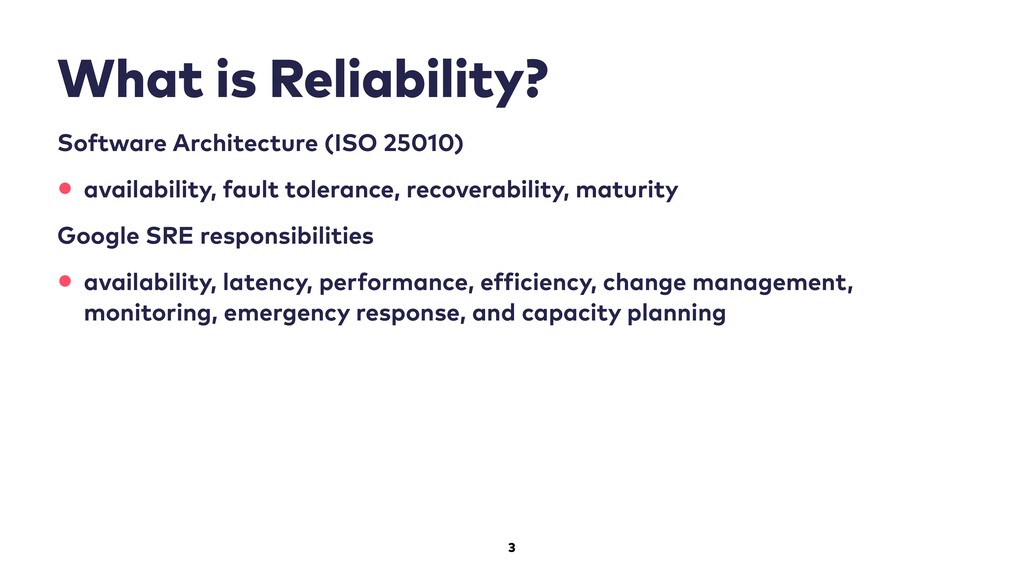
  3. 3 What is Reliability? Software Architecture (ISO 25010) • availability,

    fault tolerance, recoverability, maturity Google SRE responsibilities • availability, latency, performance, efficiency, change management, monitoring, emergency response, and capacity planning
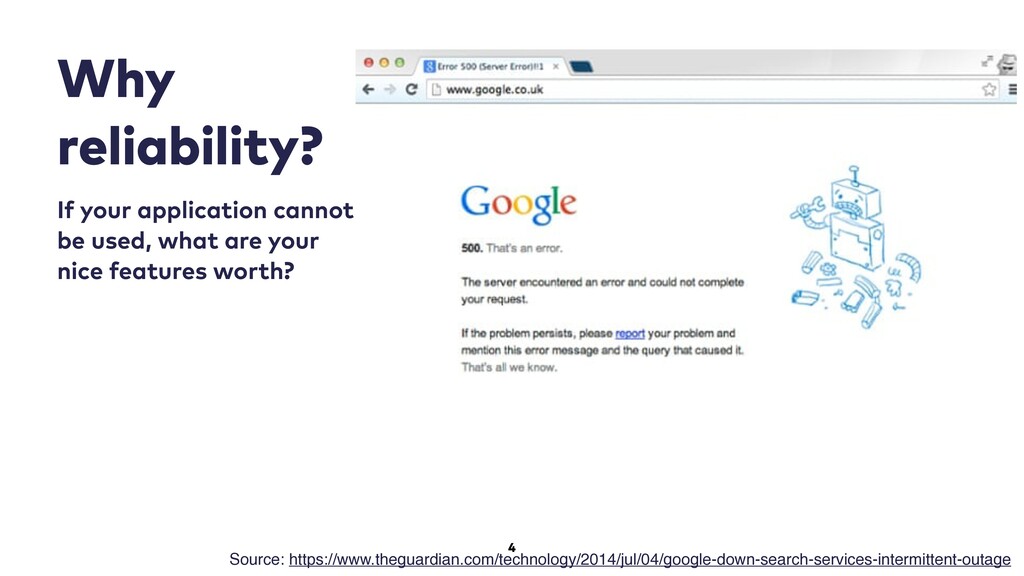
  4. 4 Why reliability? If your application cannot be used, what

    are your nice features worth? Source: https://www.theguardian.com/technology/2014/jul/04/google-down-search-services-intermittent-outage
  5. 6 How much reliability? Google Ads makes 4000 USD per

    second amazon.com retail makes 5000 USD per second
  6. 7 How much reliability? Finance: usually “medium” SaaS usually “high”

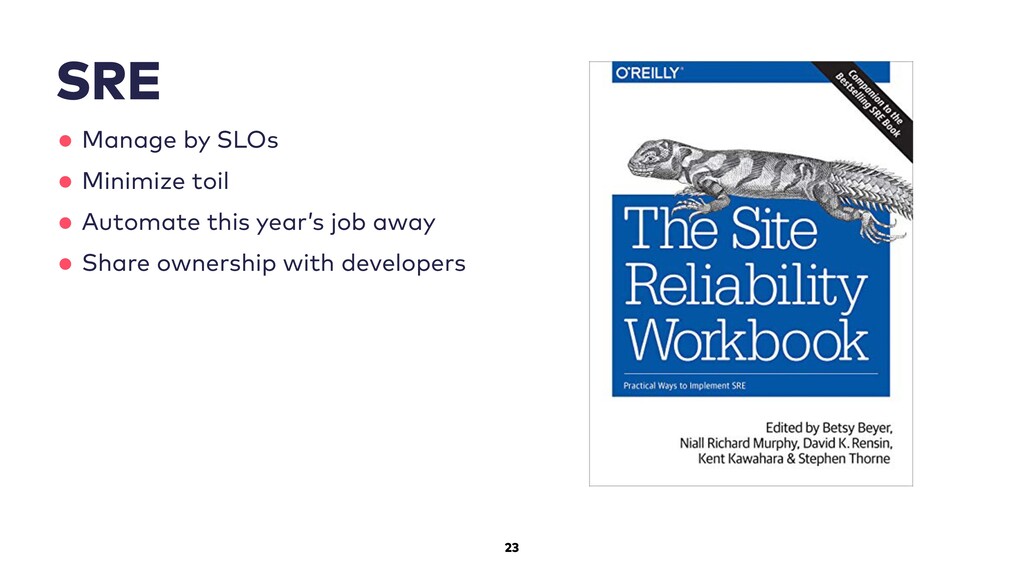
    Retail usually “high” Websites not generating much revenue usually “low” Platforms and developer
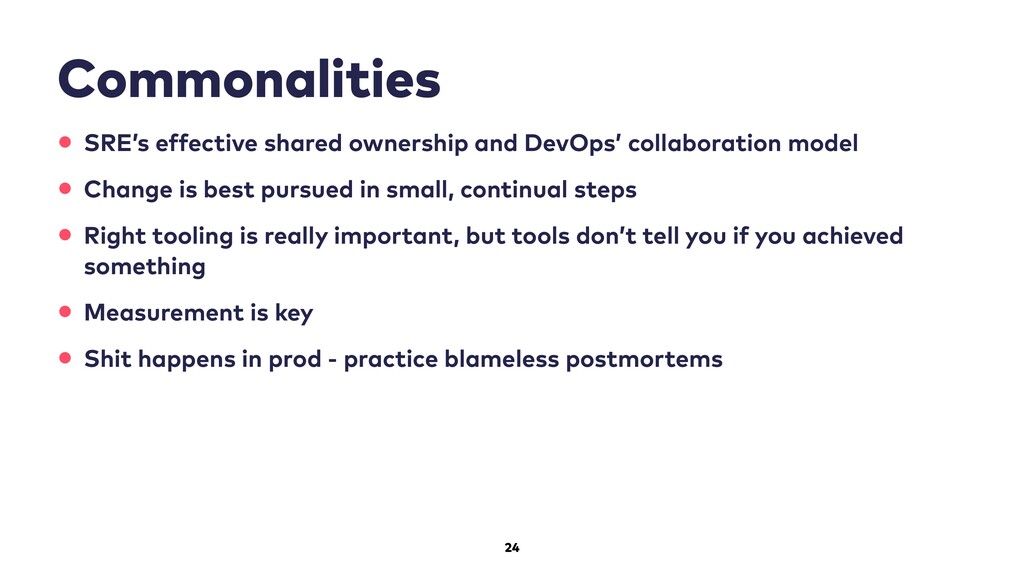
  7. 8 Reliability is often not well understood • People expect

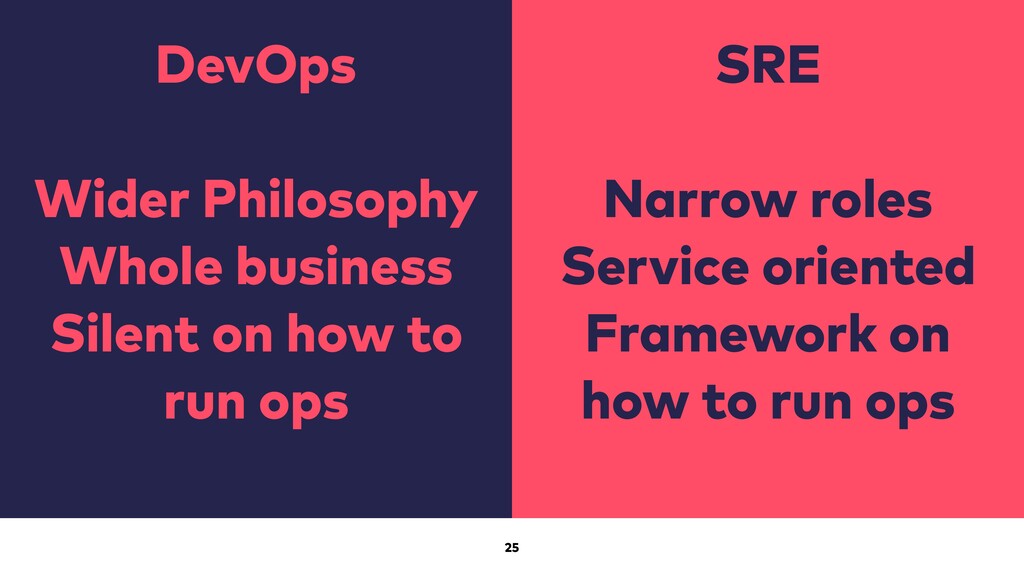
    systems be available 100% of the time or “as much as possible” • Availability comes with a cost. You need to make cost/benefit trade-offs • Invisible: the absence of errors • If your system is unreliable, it is already too late. Fix is often hard • It is continuous work and not fire fighting
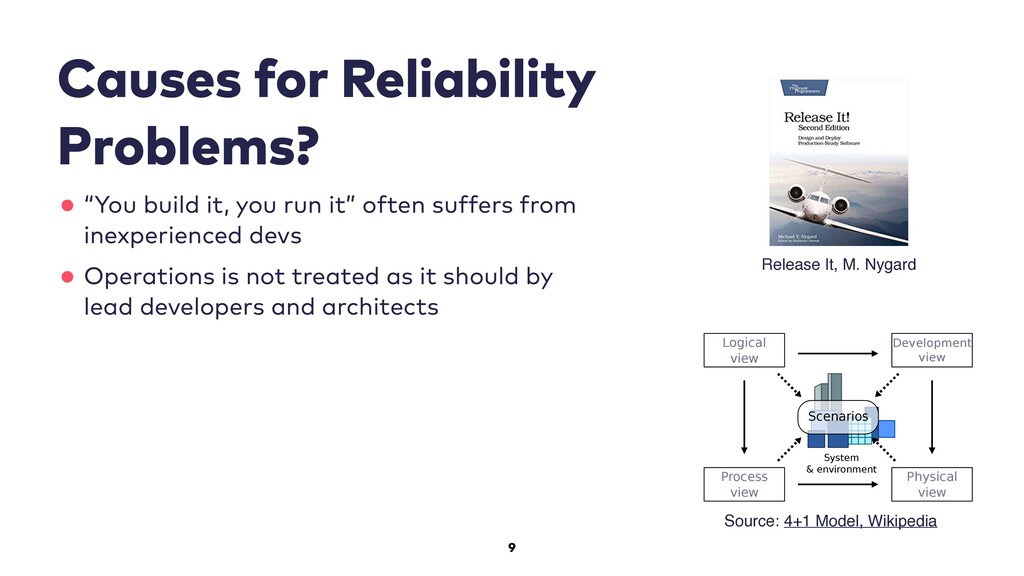
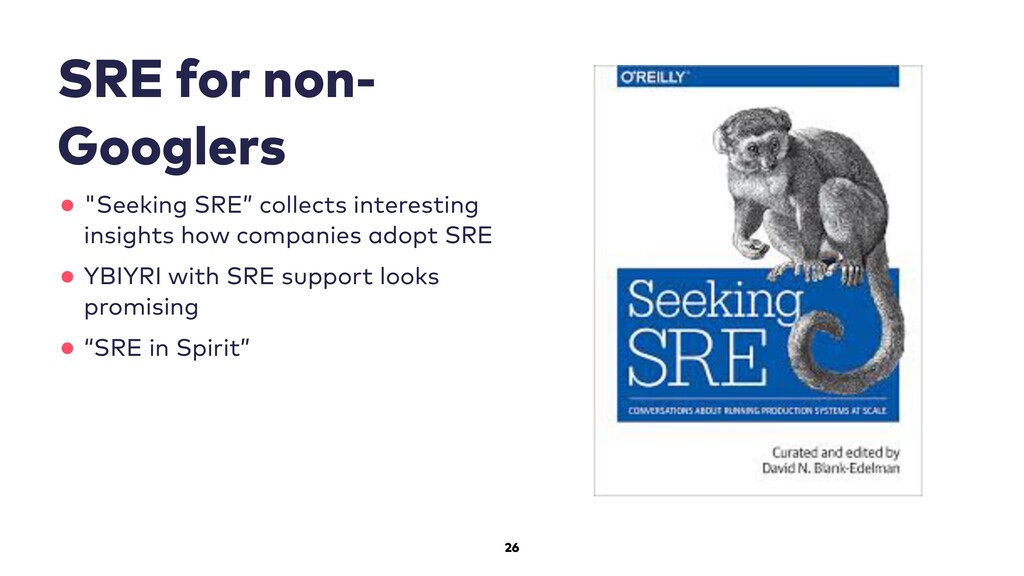
  8. 9 Causes for Reliability Problems? •“You build it, you run

    it” often suffers from inexperienced devs •Operations is not treated as it should by lead developers and architects Source: 4+1 Model, Wikipedia Release It, M. Nygard
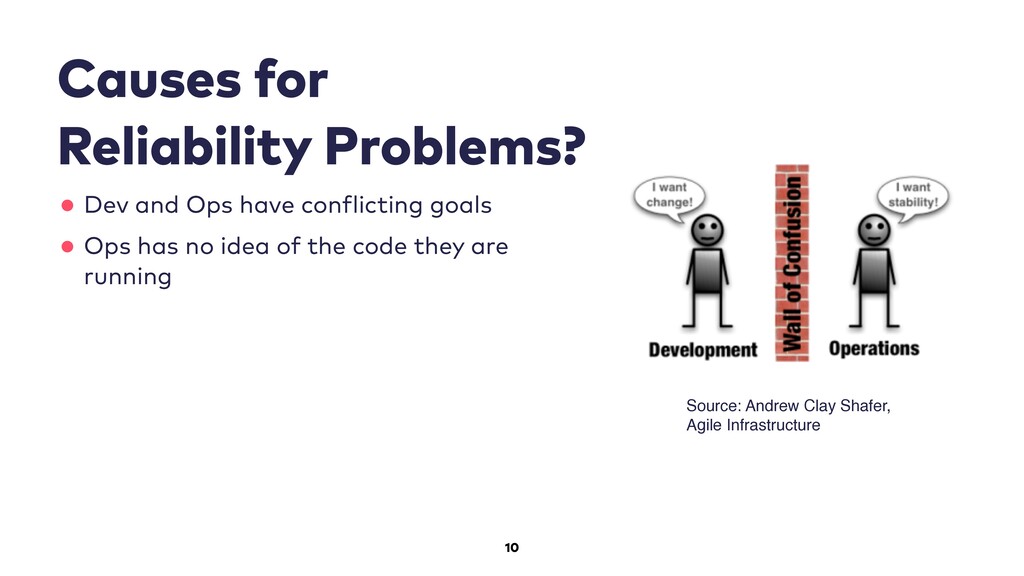
  9. 10 Causes for Reliability Problems? •Dev and Ops have conflicting

    goals •Ops has no idea of the code they are running Source: Andrew Clay Shafer, Agile Infrastructure
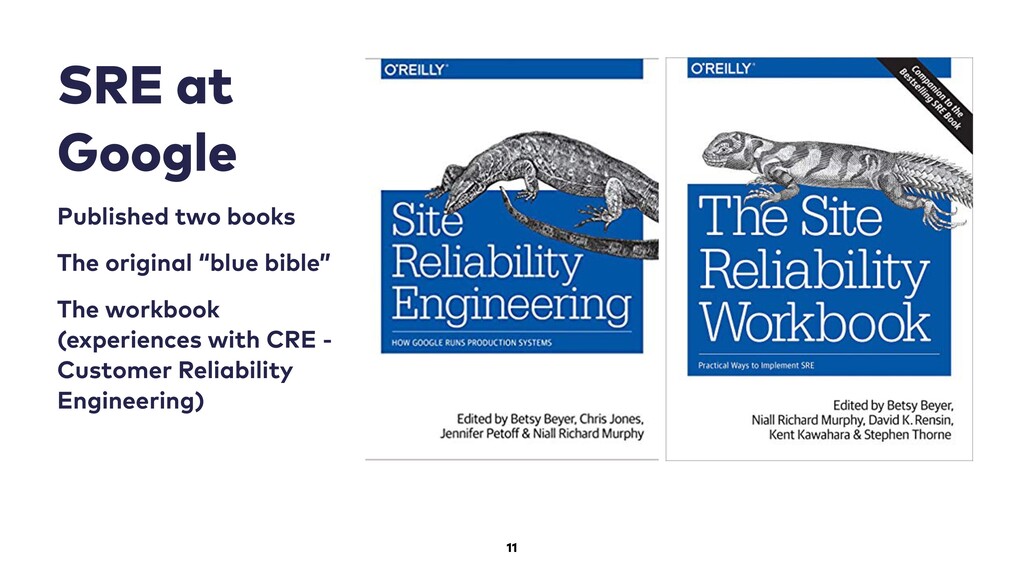
  10. 11 SRE at Google Published two books The original “blue

    bible” The workbook (experiences with CRE - Customer Reliability Engineering)
  11. 13 SRE at Google • Google has an SRE and

    a DEV organisation. • SREs are embedded in DEV teams • SREs have SLIs/SLOs, can push back and make tomorrow better than today
  12. 14 Service Level .* • Service Level Indicator (SLI): sensor,

    gauge • Service Level Objective (SLO): expectation • Service Level Agreement (SLA): contract
  13. 15 Service Level .* Consequences • SLIs require monitoring •

    Client side instrumentation / EUM • Server side request logs/metrics • Front end infrastructure metrics • SLOs require understanding the customer needs • Hard question • Incremental approach • Meaningful, e.g. what means availability in a Microservices architecture?
  14. 16 Error Budget • Error Budget = 1 - SLO

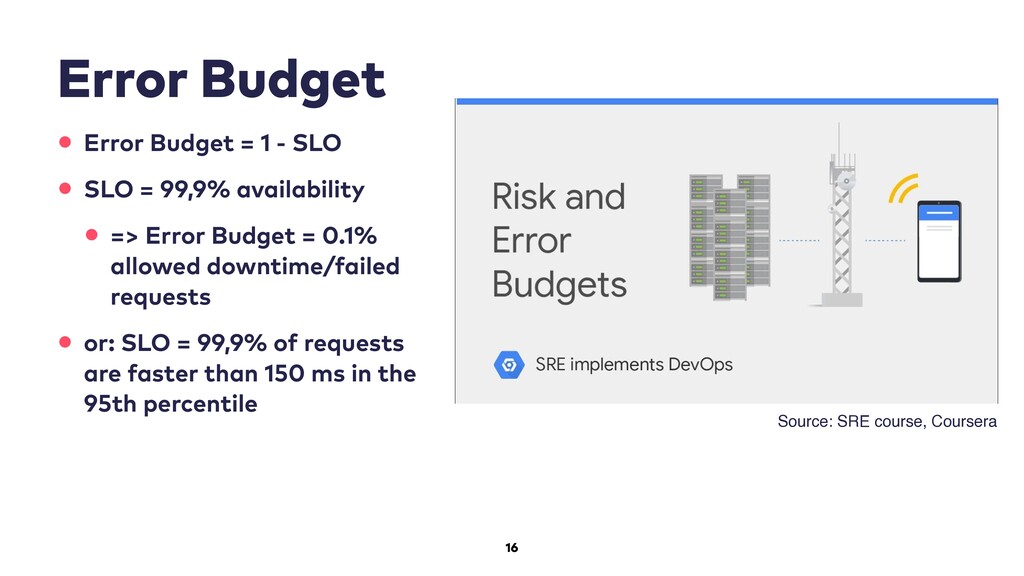
    • SLO = 99,9% availability • => Error Budget = 0.1% allowed downtime/failed requests • or: SLO = 99,9% of requests are faster than 150 ms in the 95th percentile Source: SRE course, Coursera
  15. 17 SREs can say “no” • Error Budget spent: no

    launches until issues are fixed • SREs can return the pager to the DEV team • SREs can leave a DEV team without consequences • Ability to create back pressure makes a self-regulating loop • —> Removes major conflict between DEV and OPS
  16. 18 Make tomorrow better than today • SREs are coders

    • 50% cap on ops work • Ops work above those 50% will be assigned to DEV team • Self-regulating, DEV team sees system in action • 50% dev work: write software to reduce “toil”
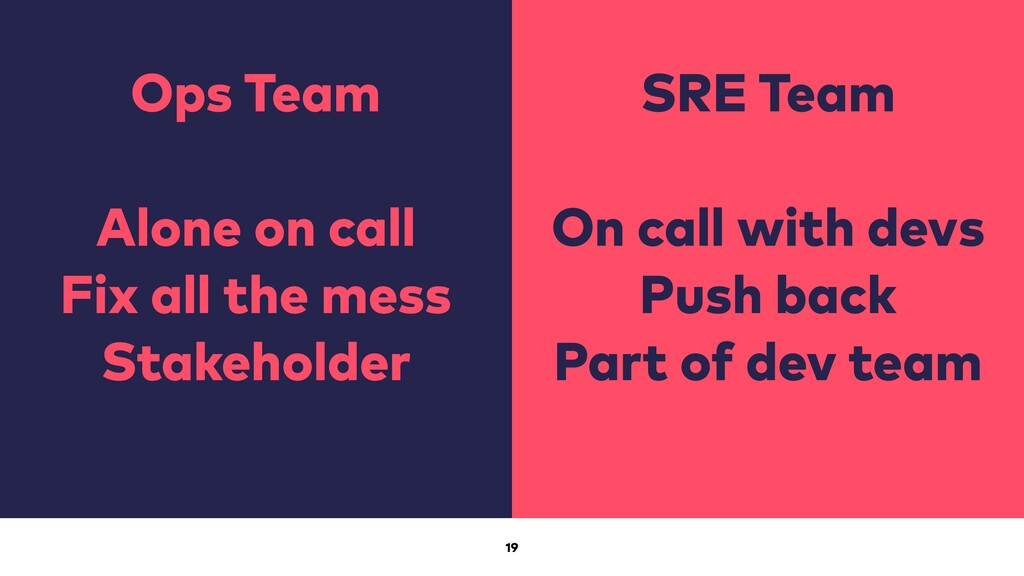
  17. Ops Team Alone on call Fix all the mess Stakeholder

    SRE Team On call with devs Push back Part of dev team 19
  18. 20 Is SRE an Ops Replacement? • SRE balances feature

    velocity and stability • Systems without feature velocity likely do not need SRE practices • On premise data center • Packaged software
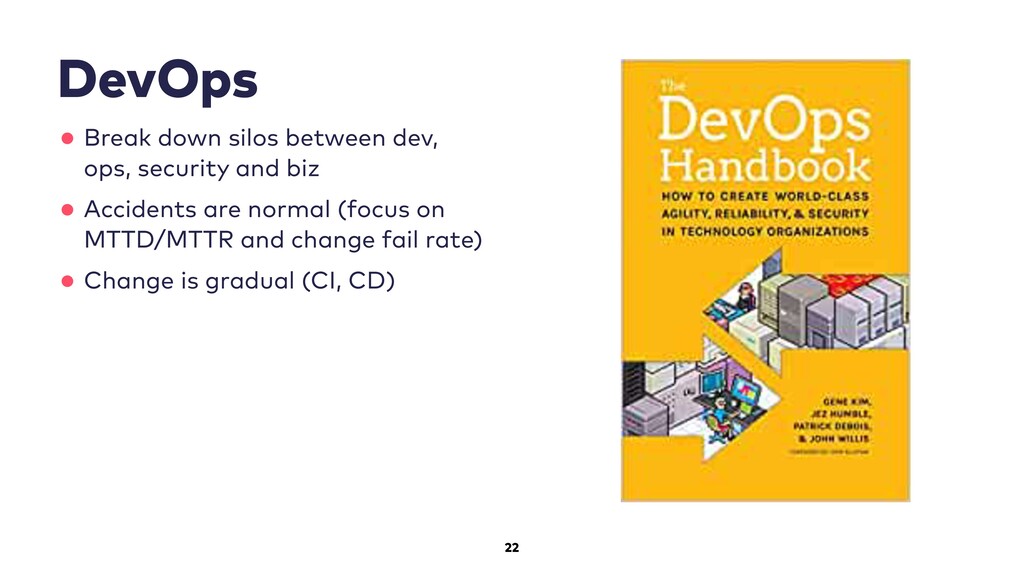
  19. 22 DevOps •Break down silos between dev, ops, security and

    biz •Accidents are normal (focus on MTTD/MTTR and change fail rate) •Change is gradual (CI, CD)
  20. 23 SRE •Manage by SLOs •Minimize toil •Automate this year’s

    job away •Share ownership with developers
  21. 24 Commonalities • SRE’s effective shared ownership and DevOps’ collaboration

    model • Change is best pursued in small, continual steps • Right tooling is really important, but tools don’t tell you if you achieved something • Measurement is key • Shit happens in prod - practice blameless postmortems
  22. DevOps Wider Philosophy Whole business Silent on how to run

    ops SRE Narrow roles Service oriented Framework on how to run ops 25
  23. 26 SRE for non- Googlers •"Seeking SRE” collects interesting insights

    how companies adopt SRE •YBIYRI with SRE support looks promising •“SRE in Spirit”
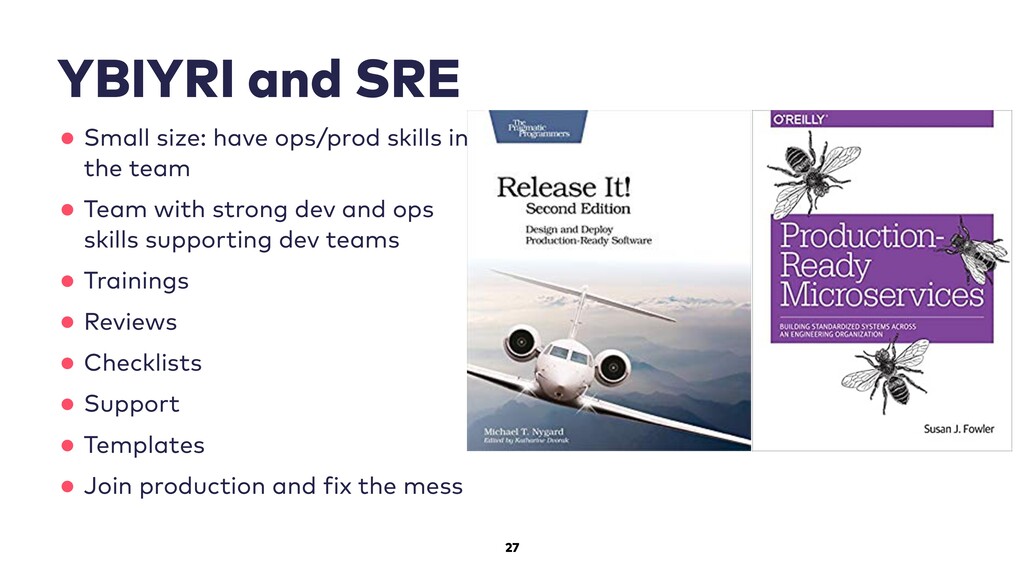
  24. 27 YBIYRI and SRE •Small size: have ops/prod skills in

    the team •Team with strong dev and ops skills supporting dev teams •Trainings •Reviews •Checklists •Support •Templates •Join production and fix the mess