Upgrade to Pro — share decks privately, control downloads, hide ads and more …

Can the Fastest-Growing Company in History Be t...

Sponsored · Your Podcast. Everywhere. Effortlessly. Share. Educate. Inspire. Entertain. You do you. We'll handle the rest. →

Can the Fastest-Growing Company in History Be the Best Investment?

Anthropic grew faster than any company before it, but it is closer to a compute wholesaler: compute purchases are fixed costs under take-or-pay contracts, while 79% of revenue is usage-based and contracted backlog is thin. Buy in stages as backlog coverage rises.

Avatar for Takuya Shimano

Takuya Shimano

November 05, 2026

More Decks by Takuya Shimano

Other Decks in Research

Transcript

  1. THE THESIS 01 | ANTHROPIC Can the Fastest-Growing Company in

    History Be the Best Investment? Anthropic grew faster than any company before it, but it is closer to a compute wholesaler: compute purchases are fixed costs under take-or-pay contracts, while 79% of revenue is usage-based and contracted backlog is thin. Buy in stages as backlog coverage rises.
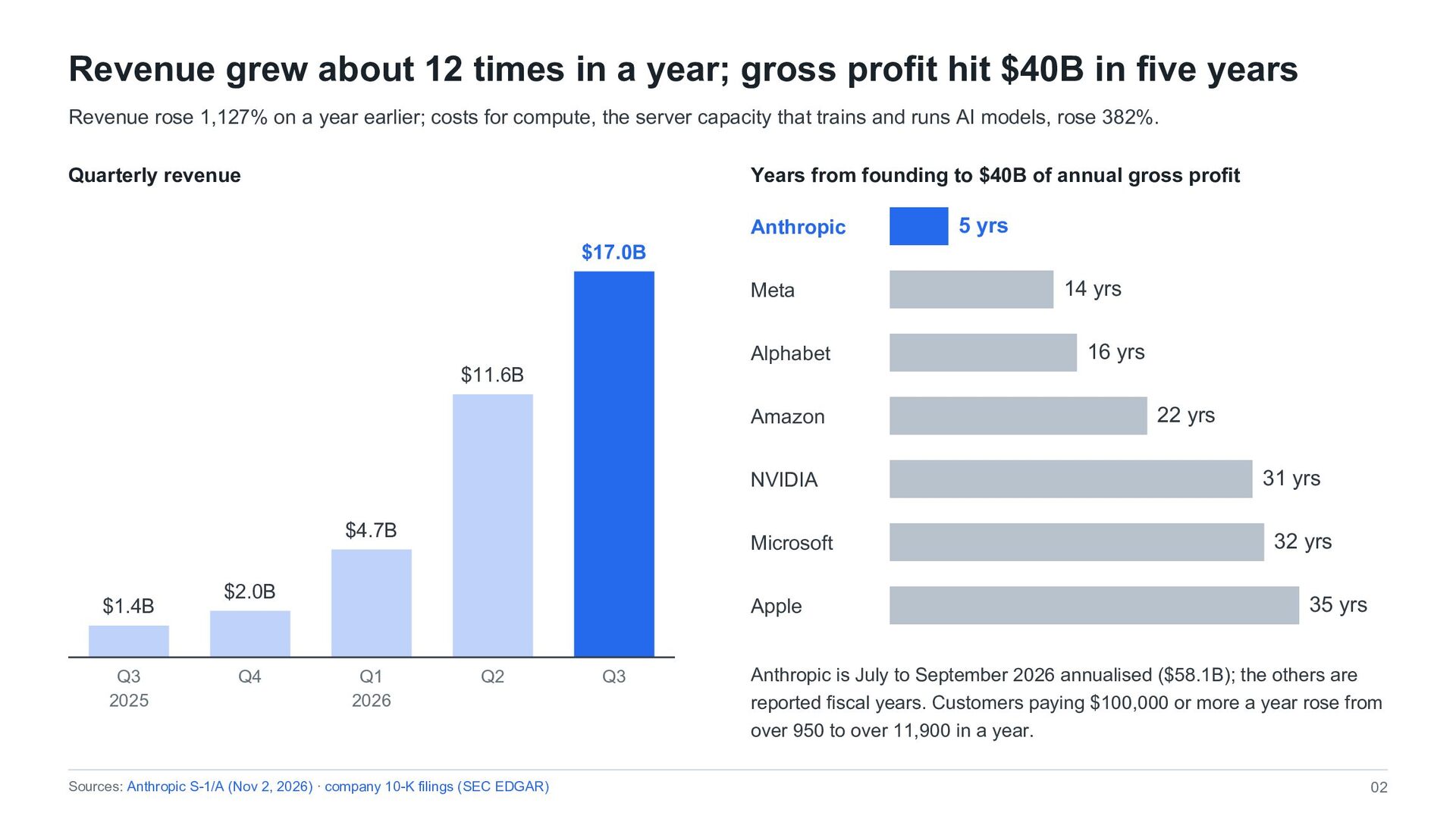
  2. Revenue grew about 12 times in a year; gross profit

    hit $40B in five years Revenue rose 1,127% on a year earlier; costs for compute, the server capacity that trains and runs AI models, rose 382%. Quarterly revenue Years from founding to $40B of annual gross profit Anthropic 5 yrs $17.0B Meta Alphabet 14 yrs 16 yrs $11.6B Amazon $4.7B $1.4B Q3 2025 $2.0B Q4 NVIDIA 31 yrs Microsoft 32 yrs Apple Q1 2026 Q2 Sources: Anthropic S-1/A (Nov 2, 2026) · company 10-K filings (SEC EDGAR) Q3 22 yrs 35 yrs Anthropic is July to September 2026 annualised ($58.1B); the others are reported fiscal years. Customers paying $100,000 or more a year rose from over 950 to over 11,900 in a year. 02
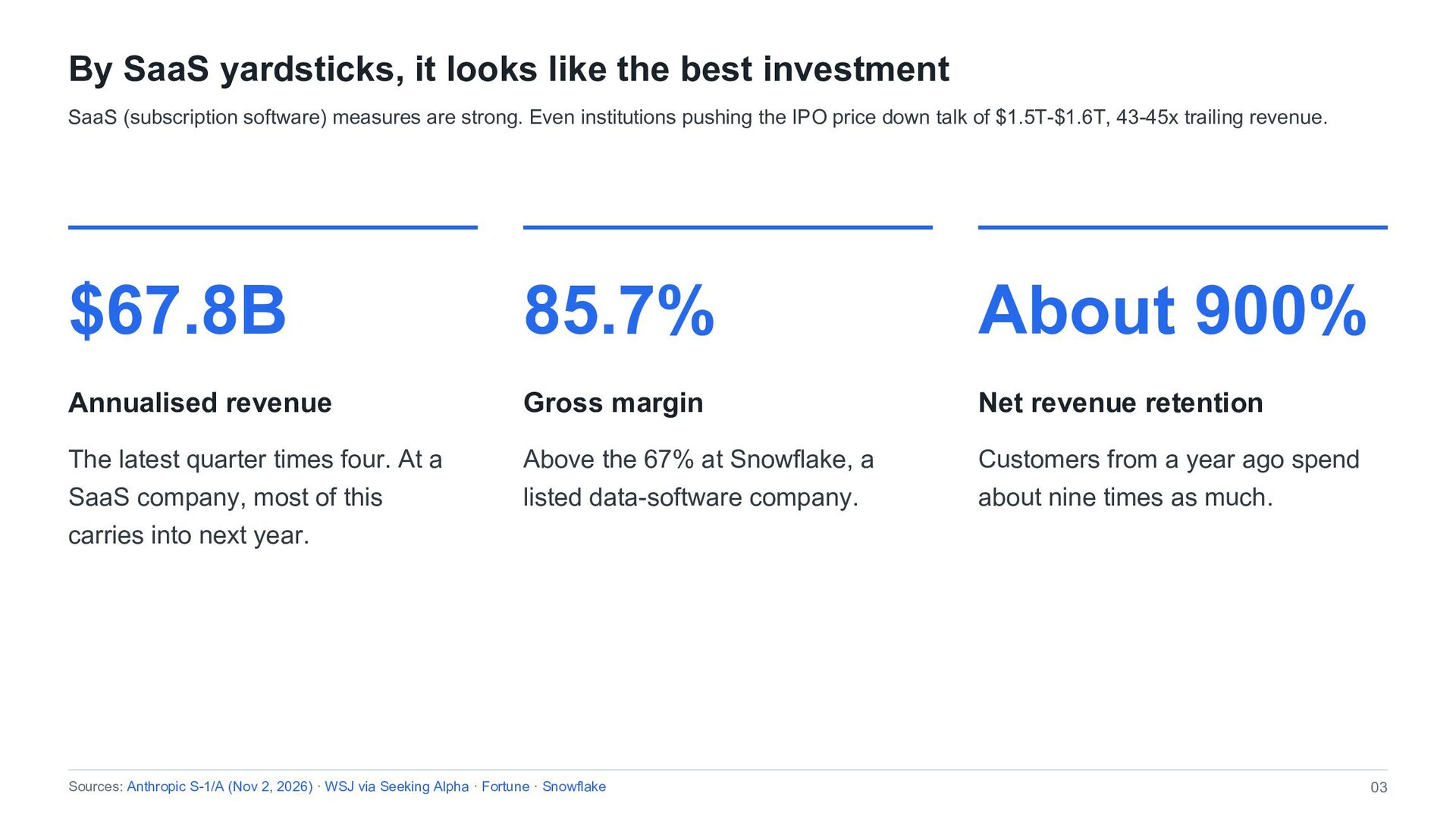
  3. By SaaS yardsticks, it looks like the best investment SaaS

    (subscription software) measures are strong. Even institutions pushing the IPO price down talk of $1.5T-$1.6T, 43-45x trailing revenue. $67.8B 85.7% About 900% Annualised revenue Gross margin Net revenue retention The latest quarter times four. At a SaaS company, most of this carries into next year. Above the 67% at Snowflake, a listed data-software company. Customers from a year ago spend about nine times as much. Sources: Anthropic S-1/A (Nov 2, 2026) · WSJ via Seeking Alpha · Fortune · Snowflake 03
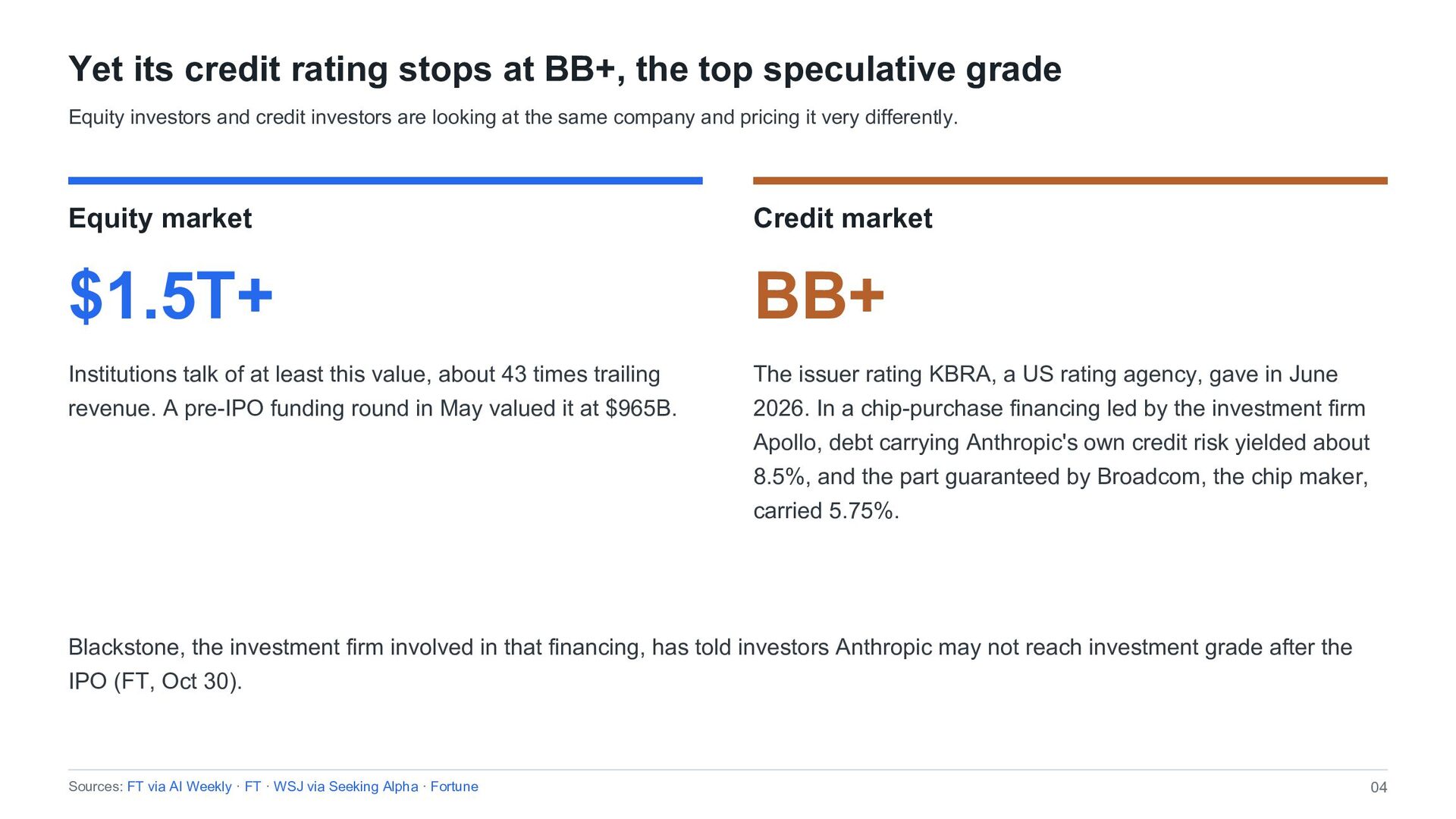
  4. Yet its credit rating stops at BB+, the top speculative

    grade Equity investors and credit investors are looking at the same company and pricing it very differently. Equity market Credit market $1.5T+ BB+ Institutions talk of at least this value, about 43 times trailing revenue. A pre-IPO funding round in May valued it at $965B. The issuer rating KBRA, a US rating agency, gave in June 2026. In a chip-purchase financing led by the investment firm Apollo, debt carrying Anthropic's own credit risk yielded about 8.5%, and the part guaranteed by Broadcom, the chip maker, carried 5.75%. Blackstone, the investment firm involved in that financing, has told investors Anthropic may not reach investment grade after the IPO (FT, Oct 30). Sources: FT via AI Weekly · FT · WSJ via Seeking Alpha · Fortune 04
  5. Why the gap: Anthropic is closer to a compute wholesaler

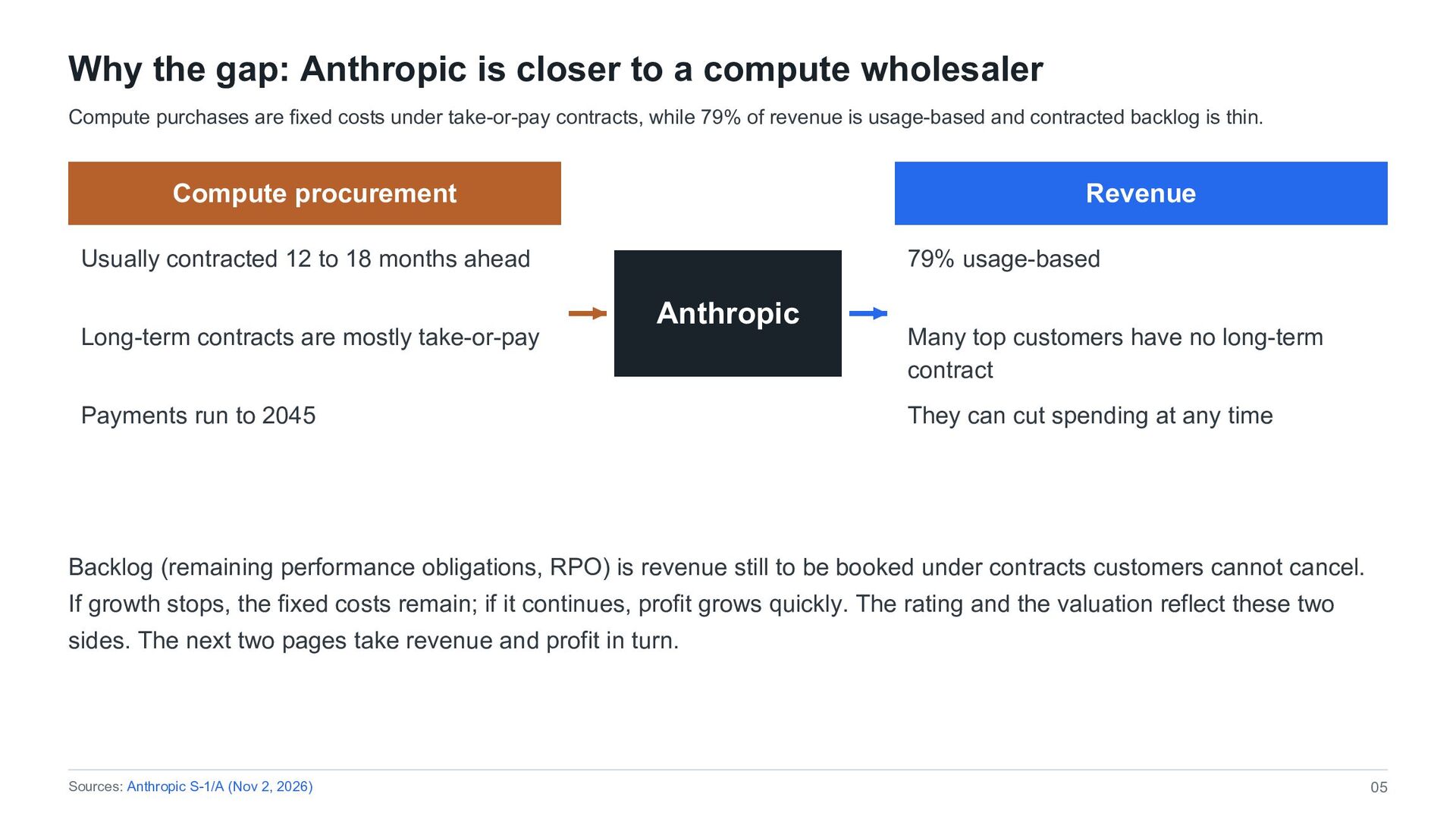
    Compute purchases are fixed costs under take-or-pay contracts, while 79% of revenue is usage-based and contracted backlog is thin. Compute procurement Revenue Usually contracted 12 to 18 months ahead Long-term contracts are mostly take-or-pay 79% usage-based Anthropic Payments run to 2045 Many top customers have no long-term contract They can cut spending at any time Backlog (remaining performance obligations, RPO) is revenue still to be booked under contracts customers cannot cancel. If growth stops, the fixed costs remain; if it continues, profit grows quickly. The rating and the valuation reflect these two sides. The next two pages take revenue and profit in turn. Sources: Anthropic S-1/A (Nov 2, 2026) 05
  6. Gap 1, revenue: 12-month backlog is about 15% of annualised

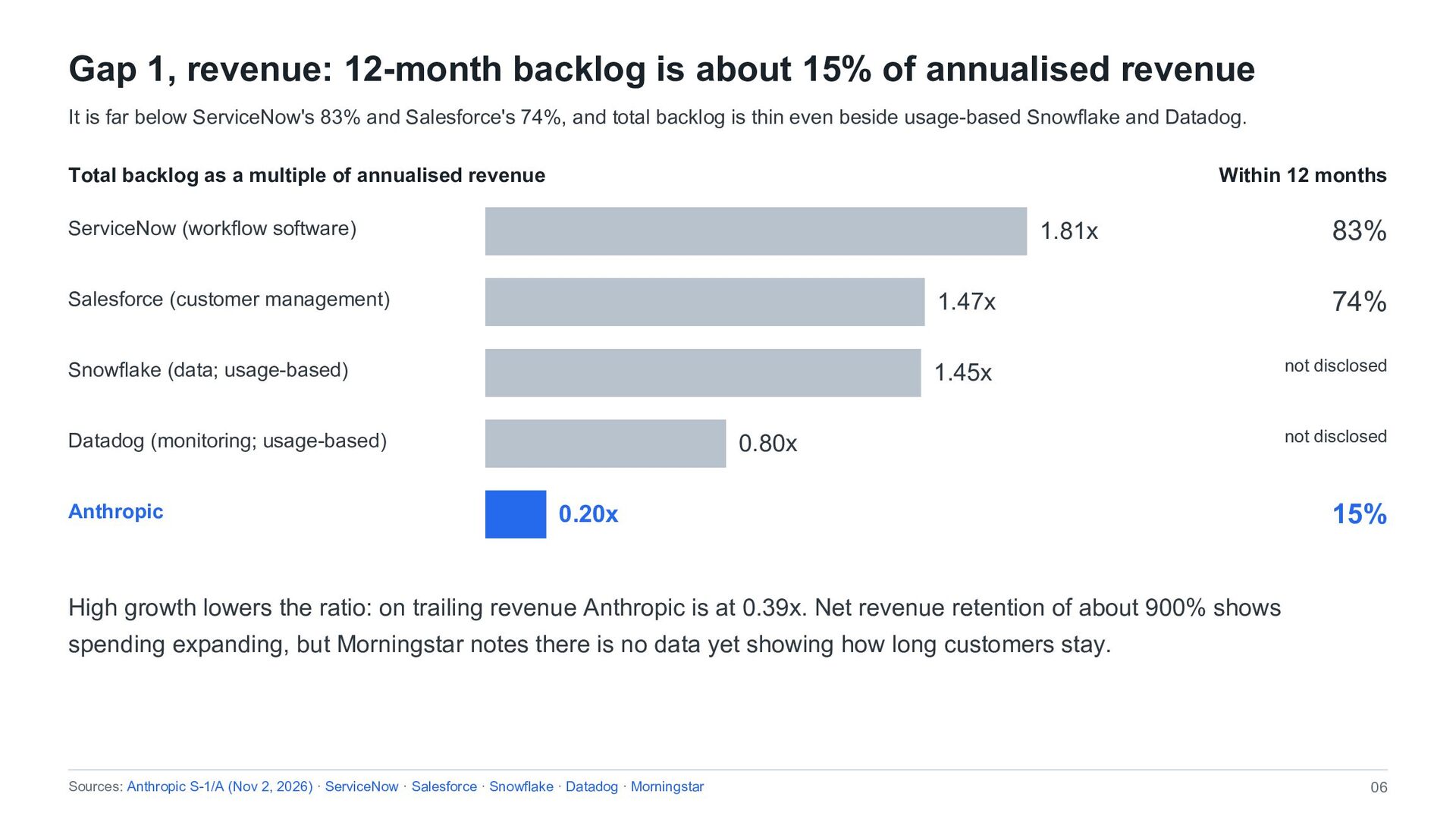
    revenue It is far below ServiceNow's 83% and Salesforce's 74%, and total backlog is thin even beside usage-based Snowflake and Datadog. Total backlog as a multiple of annualised revenue Within 12 months ServiceNow (workflow software) 1.81x 83% Salesforce (customer management) 1.47x 74% Snowflake (data; usage-based) 1.45x not disclosed Datadog (monitoring; usage-based) Anthropic 0.80x 0.20x not disclosed 15% High growth lowers the ratio: on trailing revenue Anthropic is at 0.39x. Net revenue retention of about 900% shows spending expanding, but Morningstar notes there is no data yet showing how long customers stay. Sources: Anthropic S-1/A (Nov 2, 2026) · ServiceNow · Salesforce · Snowflake · Datadog · Morningstar 06
  7. Gap 2, profit: after all compute costs, 42% of revenue

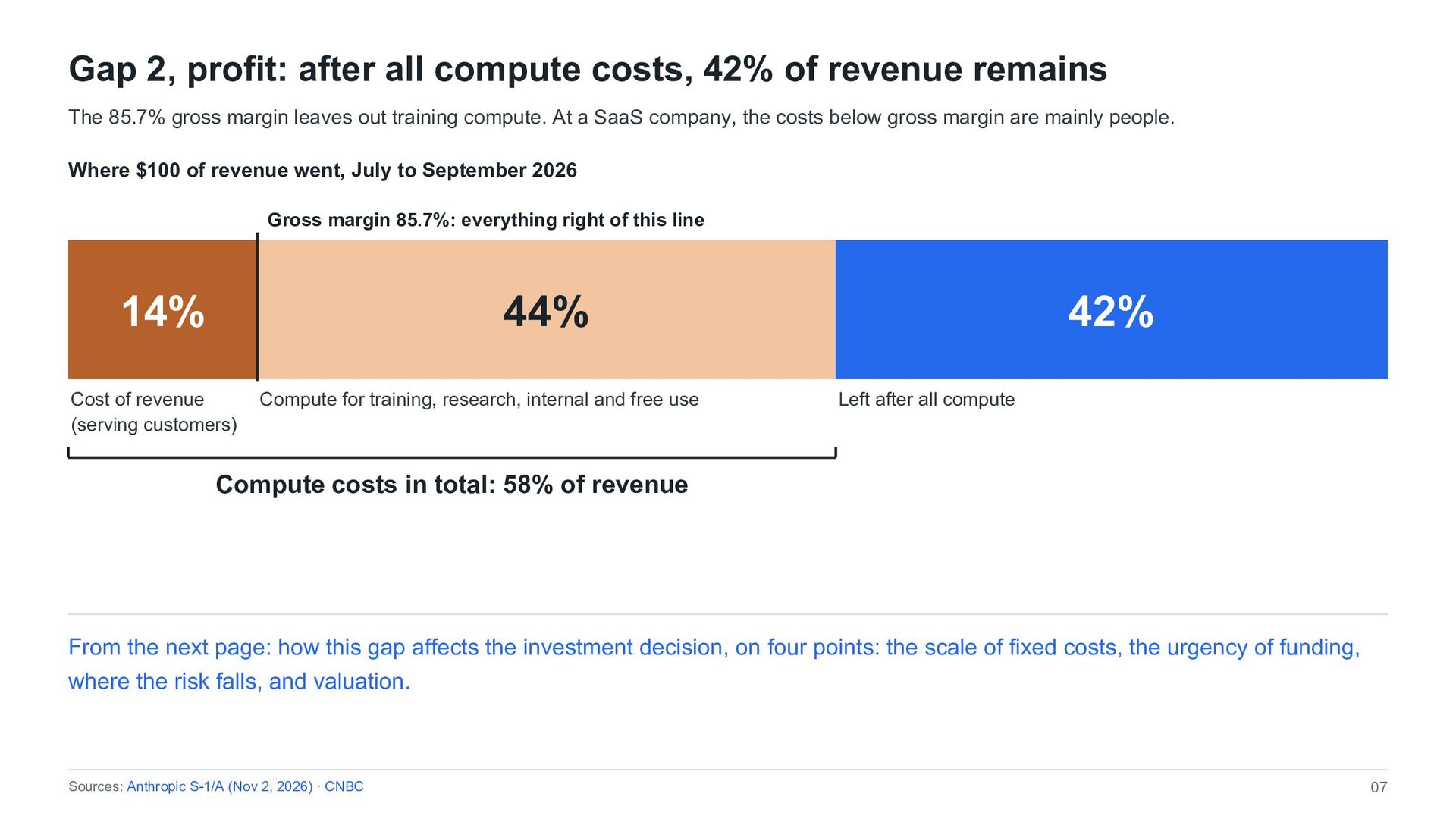
    remains The 85.7% gross margin leaves out training compute. At a SaaS company, the costs below gross margin are mainly people. Where $100 of revenue went, July to September 2026 Gross margin 85.7%: everything right of this line 14% 44% Cost of revenue (serving customers) Compute for training, research, internal and free use 42% Left after all compute Compute costs in total: 58% of revenue From the next page: how this gap affects the investment decision, on four points: the scale of fixed costs, the urgency of funding, where the risk falls, and valuation. Sources: Anthropic S-1/A (Nov 2, 2026) · CNBC 07
  8. Scale of fixed costs: next year's payments are 6.7x 12-month

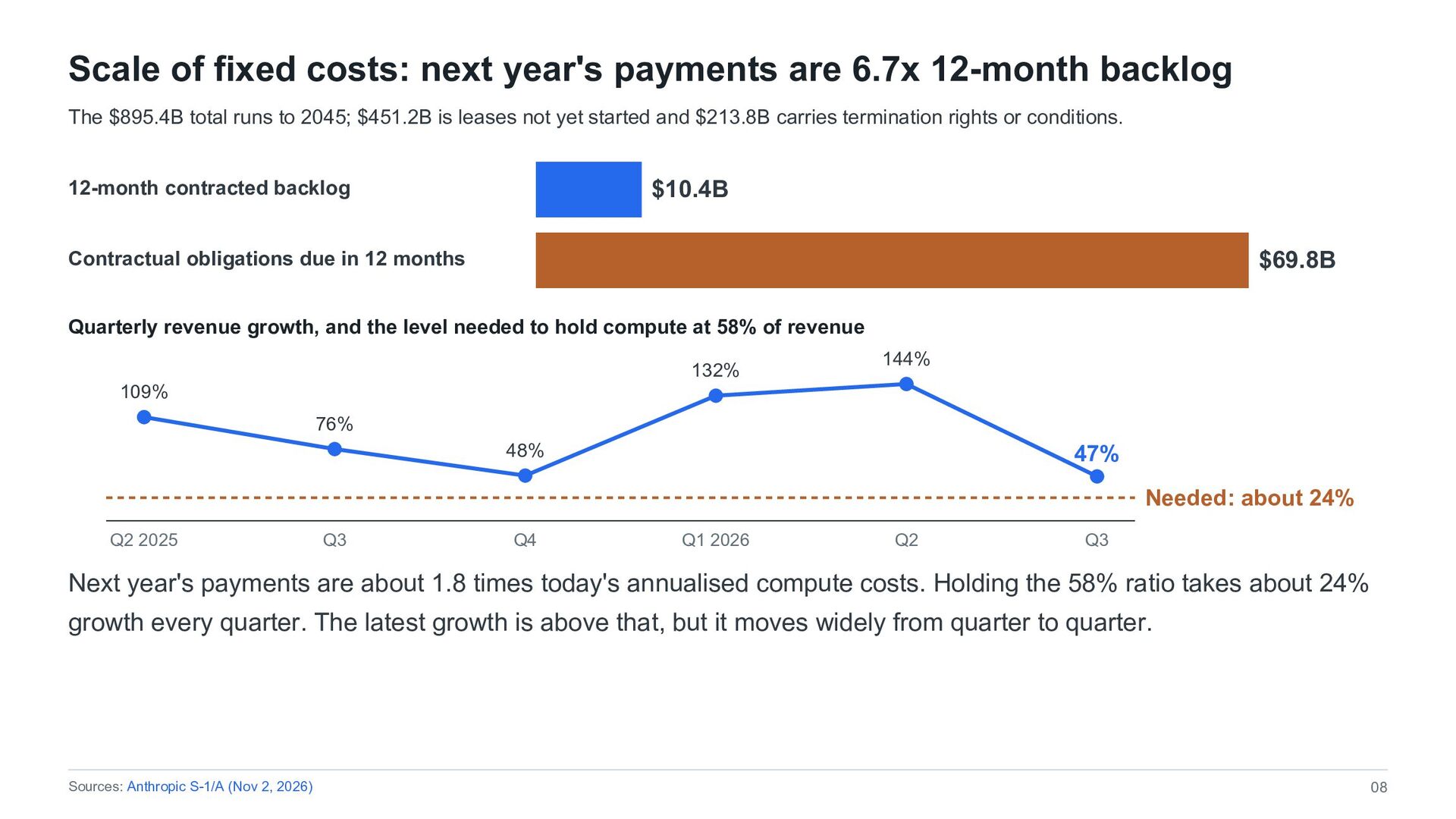
    backlog The $895.4B total runs to 2045; $451.2B is leases not yet started and $213.8B carries termination rights or conditions. $10.4B 12-month contracted backlog $69.8B Contractual obligations due in 12 months Quarterly revenue growth, and the level needed to hold compute at 58% of revenue 132% 144% 109% 76% 48% 47% Needed: about 24% Q2 2025 Q3 Q4 Q1 2026 Q2 Q3 Next year's payments are about 1.8 times today's annualised compute costs. Holding the 58% ratio takes about 24% growth every quarter. The latest growth is above that, but it moves widely from quarter to quarter. Sources: Anthropic S-1/A (Nov 2, 2026) 08
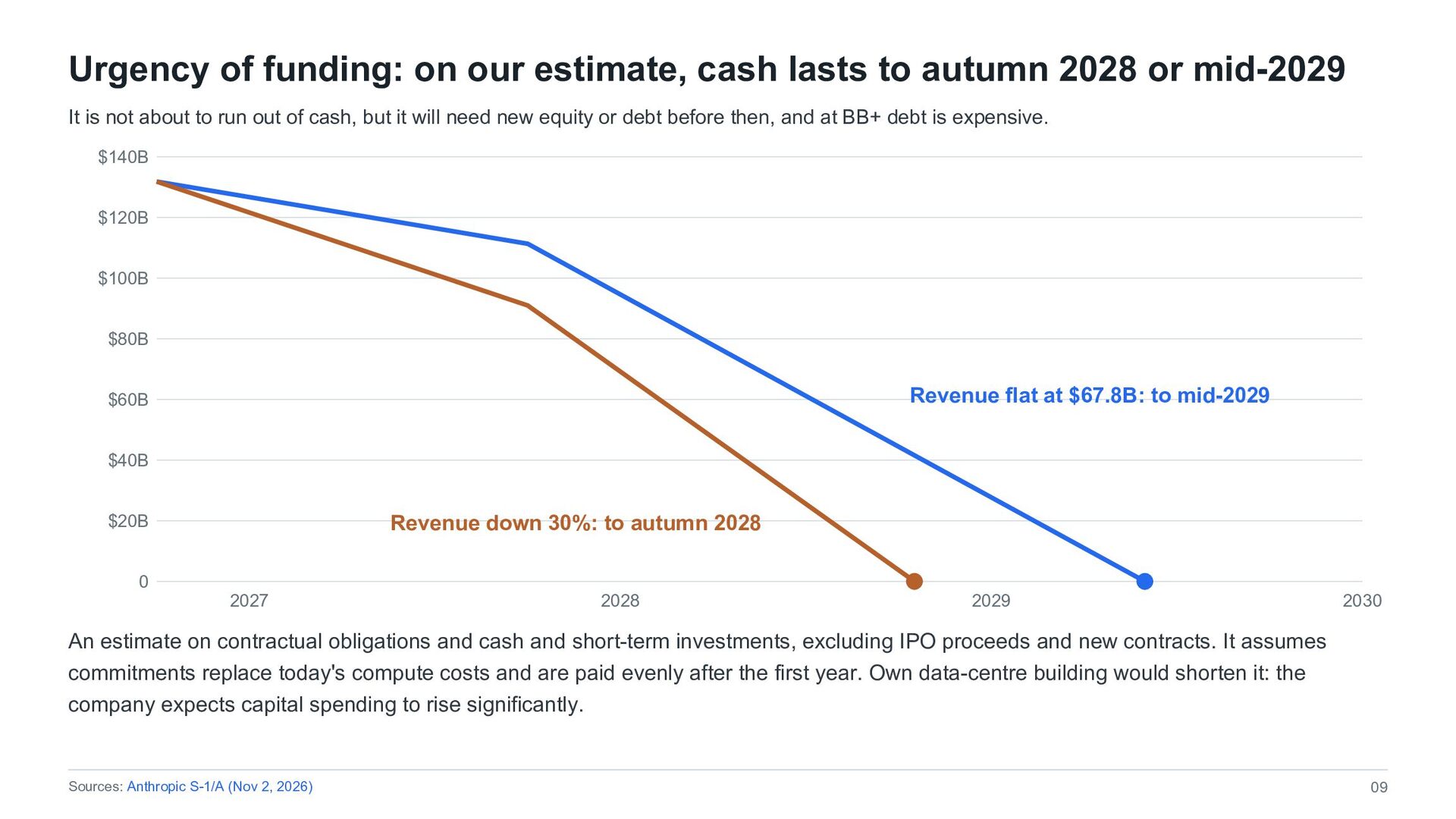
  9. Urgency of funding: on our estimate, cash lasts to autumn

    2028 or mid-2029 It is not about to run out of cash, but it will need new equity or debt before then, and at BB+ debt is expensive. $140B $120B $100B $80B Revenue flat at $67.8B: to mid-2029 $60B $40B $20B Revenue down 30%: to autumn 2028 0 2027 2028 2029 2030 An estimate on contractual obligations and cash and short-term investments, excluding IPO proceeds and new contracts. It assumes commitments replace today's compute costs and are paid evenly after the first year. Own data-centre building would shorten it: the company expects capital spending to rise significantly. Sources: Anthropic S-1/A (Nov 2, 2026) 09
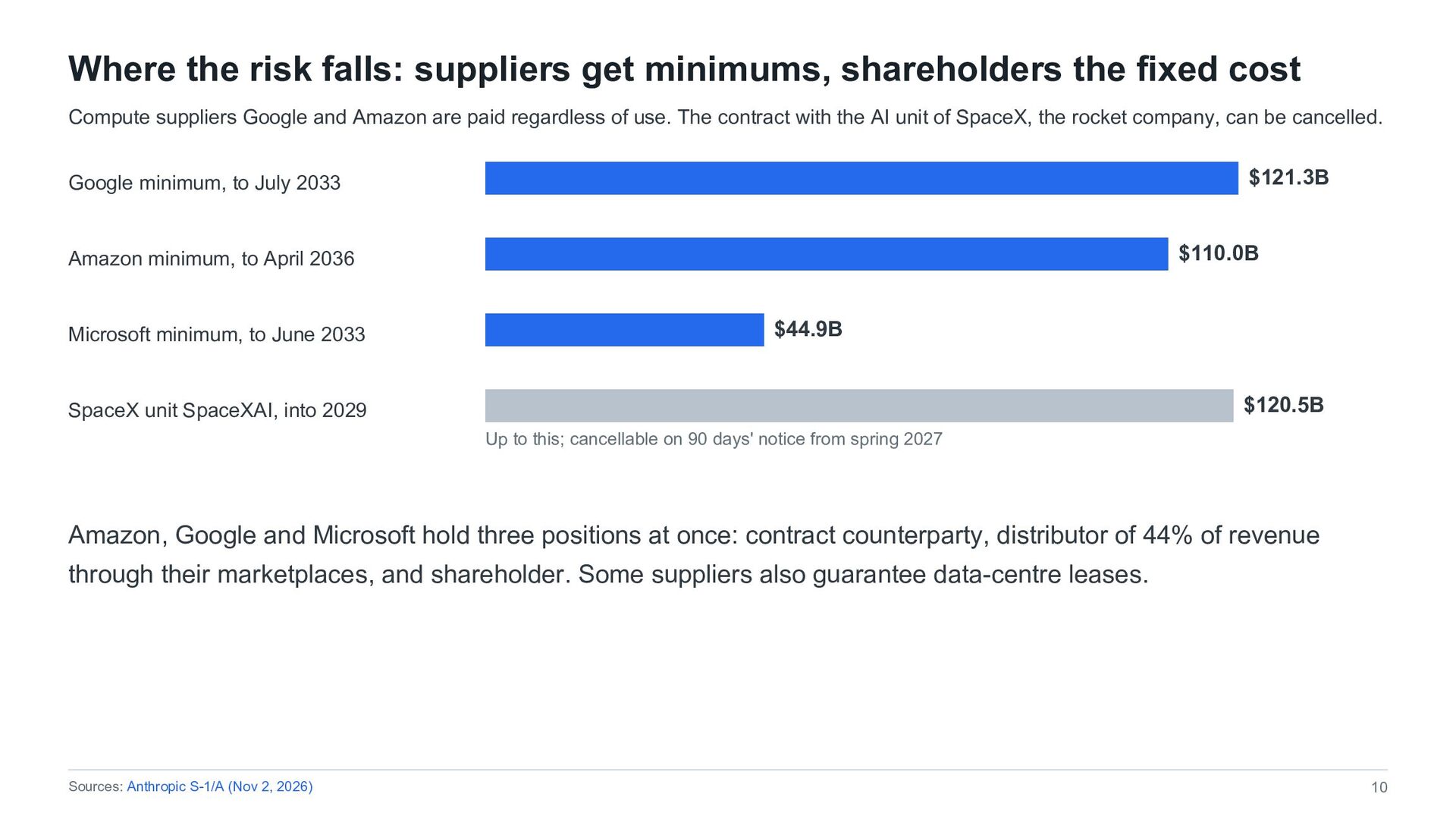
  10. Where the risk falls: suppliers get minimums, shareholders the fixed

    cost Compute suppliers Google and Amazon are paid regardless of use. The contract with the AI unit of SpaceX, the rocket company, can be cancelled. $121.3B Google minimum, to July 2033 $110.0B Amazon minimum, to April 2036 Microsoft minimum, to June 2033 $44.9B $120.5B SpaceX unit SpaceXAI, into 2029 Up to this; cancellable on 90 days' notice from spring 2027 Amazon, Google and Microsoft hold three positions at once: contract counterparty, distributor of 44% of revenue through their marketplaces, and shareholder. Some suppliers also guarantee data-centre leases. Sources: Anthropic S-1/A (Nov 2, 2026) 10
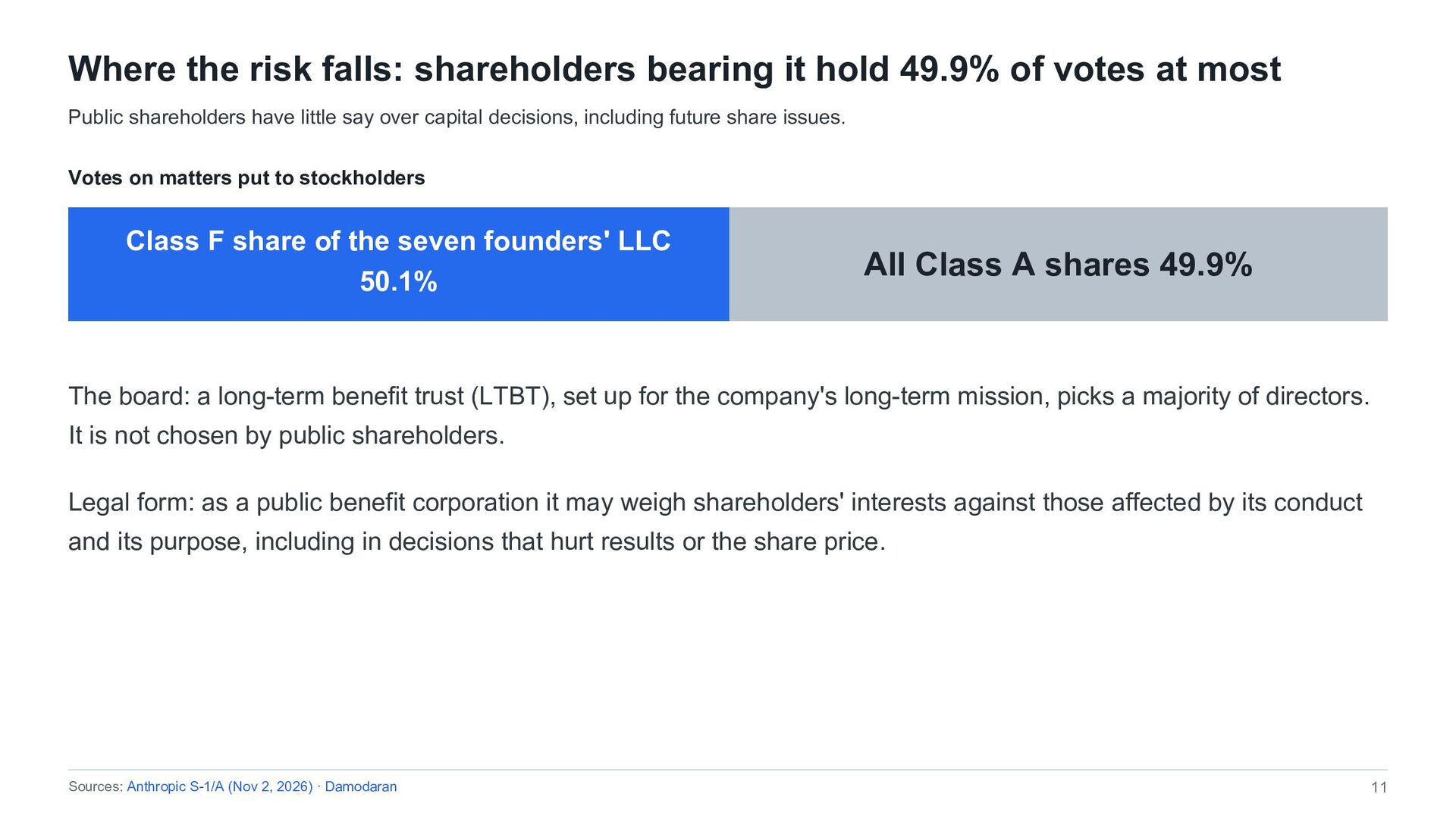
  11. Where the risk falls: shareholders bearing it hold 49.9% of

    votes at most Public shareholders have little say over capital decisions, including future share issues. Votes on matters put to stockholders Class F share of the seven founders' LLC 50.1% All Class A shares 49.9% The board: a long-term benefit trust (LTBT), set up for the company's long-term mission, picks a majority of directors. It is not chosen by public shareholders. Legal form: as a public benefit corporation it may weigh shareholders' interests against those affected by its conduct and its purpose, including in decisions that hurt results or the share price. Sources: Anthropic S-1/A (Nov 2, 2026) · Damodaran 11
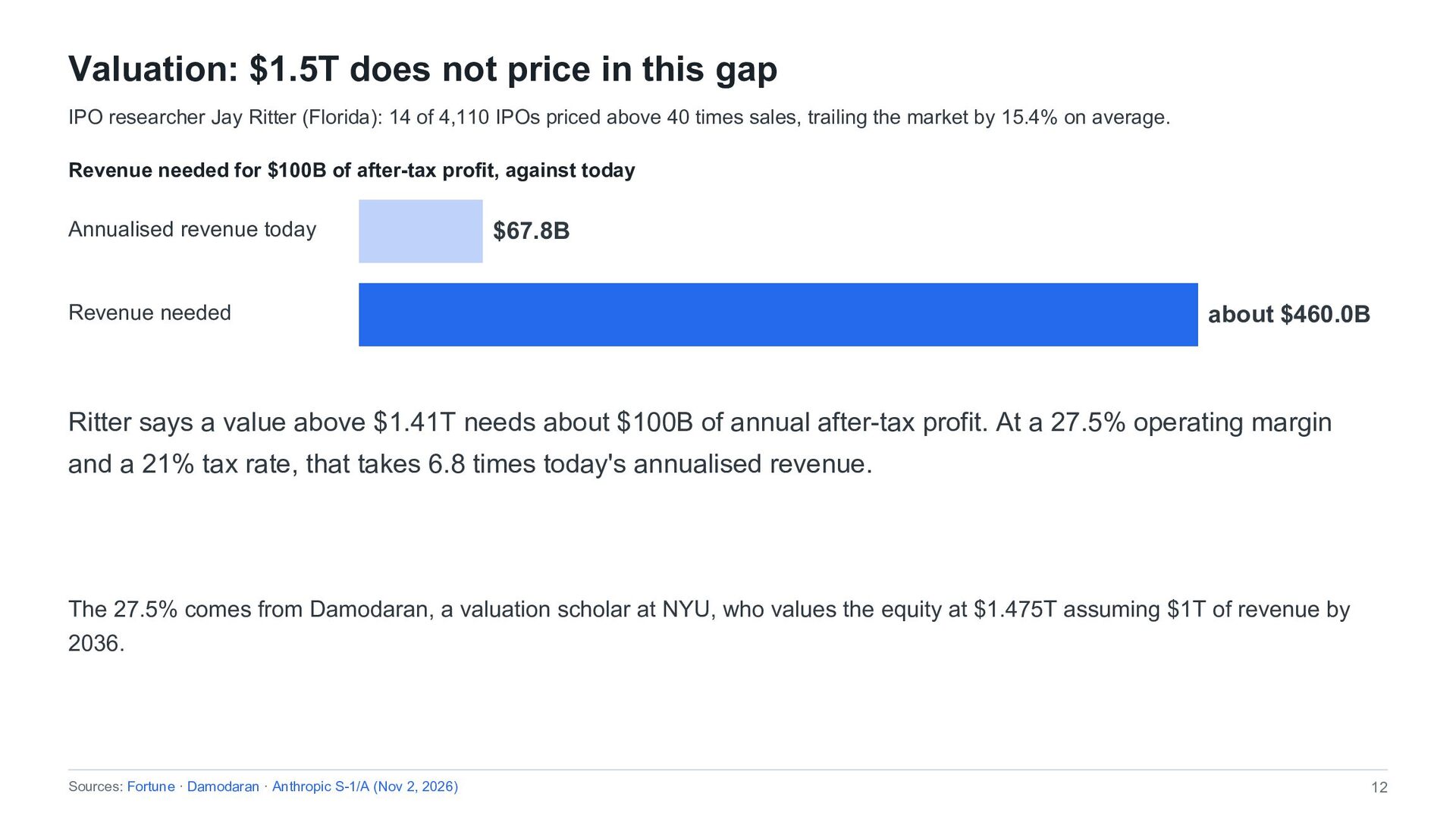
  12. Valuation: $1.5T does not price in this gap IPO researcher

    Jay Ritter (Florida): 14 of 4,110 IPOs priced above 40 times sales, trailing the market by 15.4% on average. Revenue needed for $100B of after-tax profit, against today Annualised revenue today $67.8B Revenue needed about $460.0B Ritter says a value above $1.41T needs about $100B of annual after-tax profit. At a 27.5% operating margin and a 21% tax rate, that takes 6.8 times today's annualised revenue. The 27.5% comes from Damodaran, a valuation scholar at NYU, who values the equity at $1.475T assuming $1T of revenue by 2036. Sources: Fortune · Damodaran · Anthropic S-1/A (Nov 2, 2026) 12
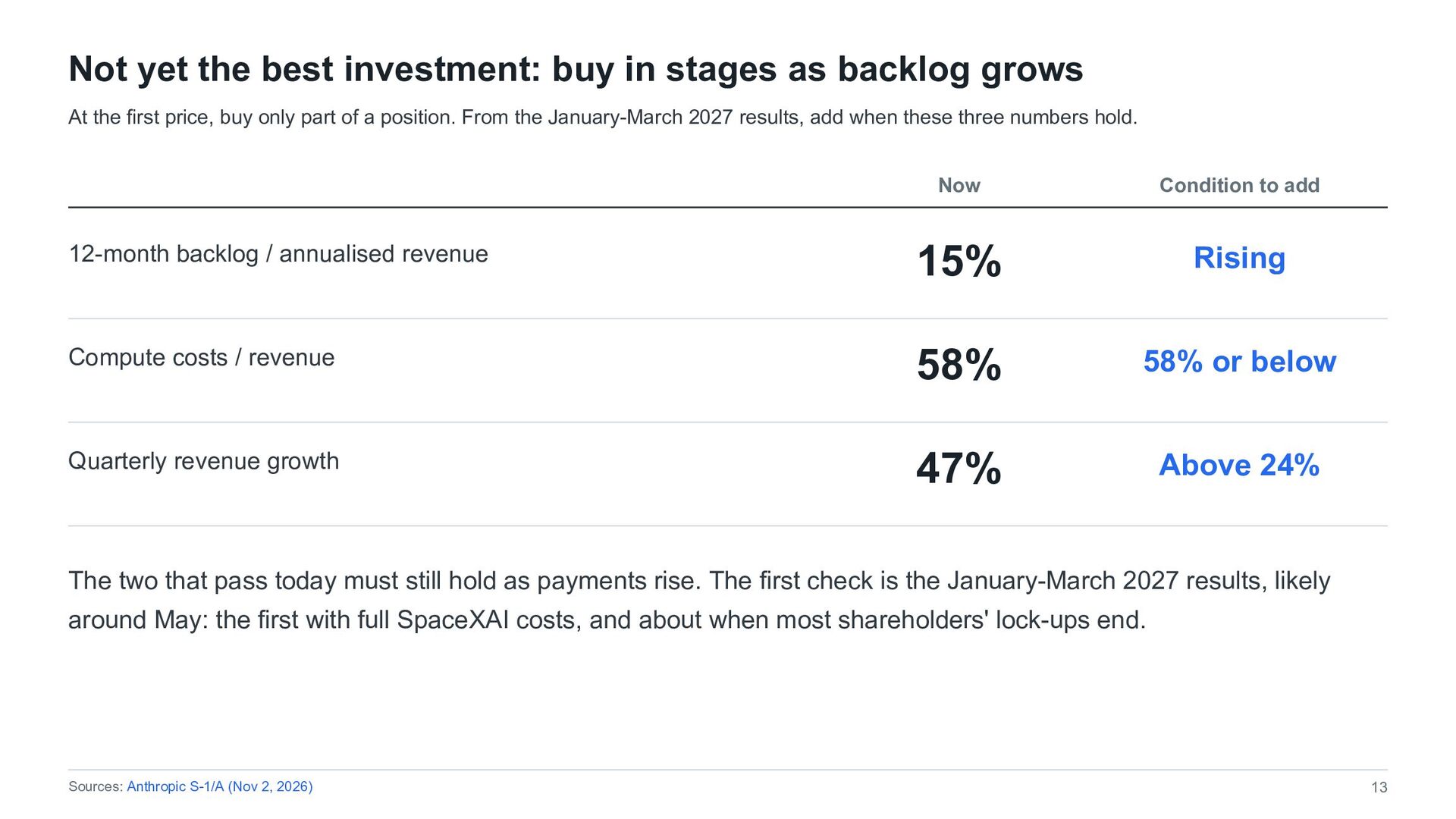
  13. Not yet the best investment: buy in stages as backlog

    grows At the first price, buy only part of a position. From the January-March 2027 results, add when these three numbers hold. Now Condition to add 12-month backlog / annualised revenue 15% Rising Compute costs / revenue 58% 58% or below Quarterly revenue growth 47% Above 24% The two that pass today must still hold as payments rise. The first check is the January-March 2027 results, likely around May: the first with full SpaceXAI costs, and about when most shareholders' lock-ups end. Sources: Anthropic S-1/A (Nov 2, 2026) 13
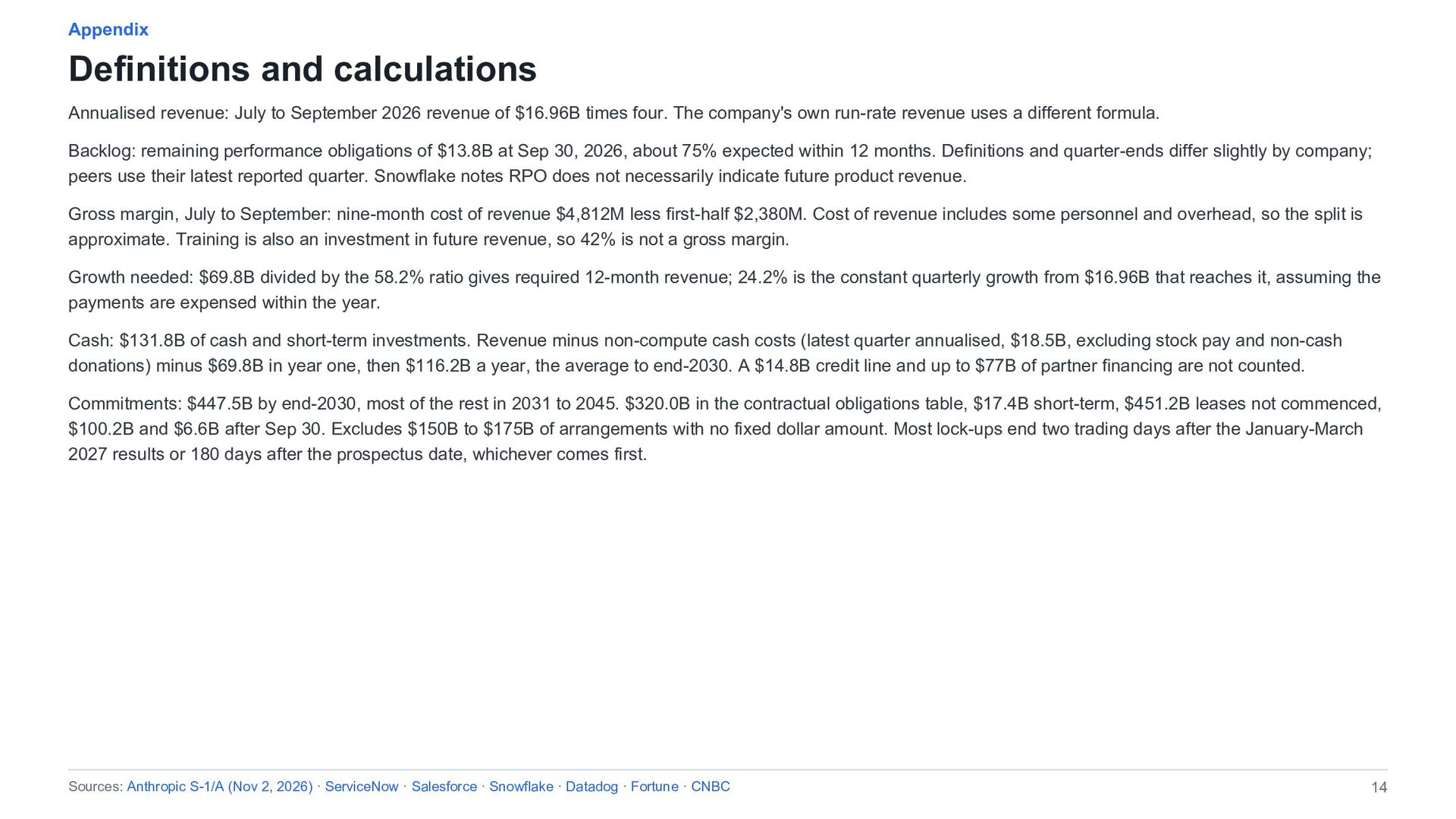
  14. Appendix Definitions and calculations Annualised revenue: July to September 2026

    revenue of $16.96B times four. The company's own run-rate revenue uses a different formula. Backlog: remaining performance obligations of $13.8B at Sep 30, 2026, about 75% expected within 12 months. Definitions and quarter-ends differ slightly by company; peers use their latest reported quarter. Snowflake notes RPO does not necessarily indicate future product revenue. Gross margin, July to September: nine-month cost of revenue $4,812M less first-half $2,380M. Cost of revenue includes some personnel and overhead, so the split is approximate. Training is also an investment in future revenue, so 42% is not a gross margin. Growth needed: $69.8B divided by the 58.2% ratio gives required 12-month revenue; 24.2% is the constant quarterly growth from $16.96B that reaches it, assuming the payments are expensed within the year. Cash: $131.8B of cash and short-term investments. Revenue minus non-compute cash costs (latest quarter annualised, $18.5B, excluding stock pay and non-cash donations) minus $69.8B in year one, then $116.2B a year, the average to end-2030. A $14.8B credit line and up to $77B of partner financing are not counted. Commitments: $447.5B by end-2030, most of the rest in 2031 to 2045. $320.0B in the contractual obligations table, $17.4B short-term, $451.2B leases not commenced, $100.2B and $6.6B after Sep 30. Excludes $150B to $175B of arrangements with no fixed dollar amount. Most lock-ups end two trading days after the January-March 2027 results or 180 days after the prospectus date, whichever comes first. Sources: Anthropic S-1/A (Nov 2, 2026) · ServiceNow · Salesforce · Snowflake · Datadog · Fortune · CNBC 14