Upgrade to Pro — share decks privately, control downloads, hide ads and more …

Ethereum’s High Fees Spark Debate as BSC Gains ...

Ethereum’s High Fees Spark Debate as BSC Gains Traction

Ethereum’s skyrocketing gas fees have frustrated users, pushing many to explore alternatives like Binance Smart Chain (BSC). With transactions costing pennies on BSC compared to ETH’s unpredictable rates, the shift is noticeable in booming sectors like DeFi and NFTs. Ethereum counters with its unmatched security and decentralization, arguing that quality comes at a price. Yet, BSC’s growing popularity—backed by Binance’s infrastructure—suggests cost matters more to the masses. As ETH works on upgrades like Ethereum 2.0 to address these issues, the debate rages: will users stick with the original or flock to BSC’s budget-friendly embrace?
For more deeper insights visit here: https://blog.deploytokens.com/blog/ethereum-vs-binance-smart-chain/

Avatar for Tamannaa

Tamannaa

March 28, 2025

Other Decks in Technology

Transcript

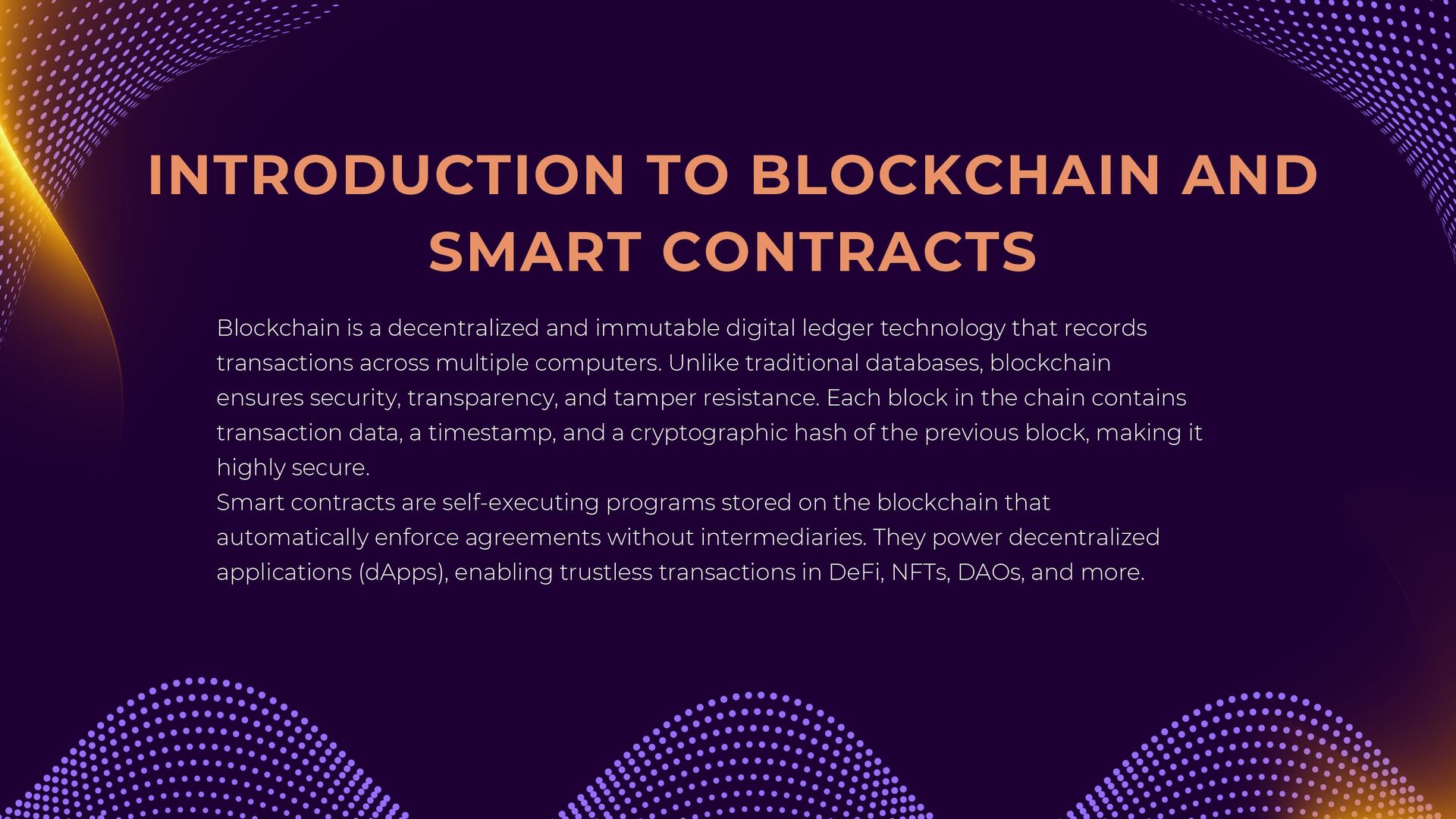
  1. INTRODUCTION TO BLOCKCHAIN AND SMART CONTRACTS Blockchain is a decentralized

    and immutable digital ledger technology that records transactions across multiple computers. Unlike traditional databases, blockchain ensures security, transparency, and tamper resistance. Each block in the chain contains transaction data, a timestamp, and a cryptographic hash of the previous block, making it highly secure. Smart contracts are self-executing programs stored on the blockchain that automatically enforce agreements without intermediaries. They power decentralized applications (dApps), enabling trustless transactions in DeFi, NFTs, DAOs, and more.
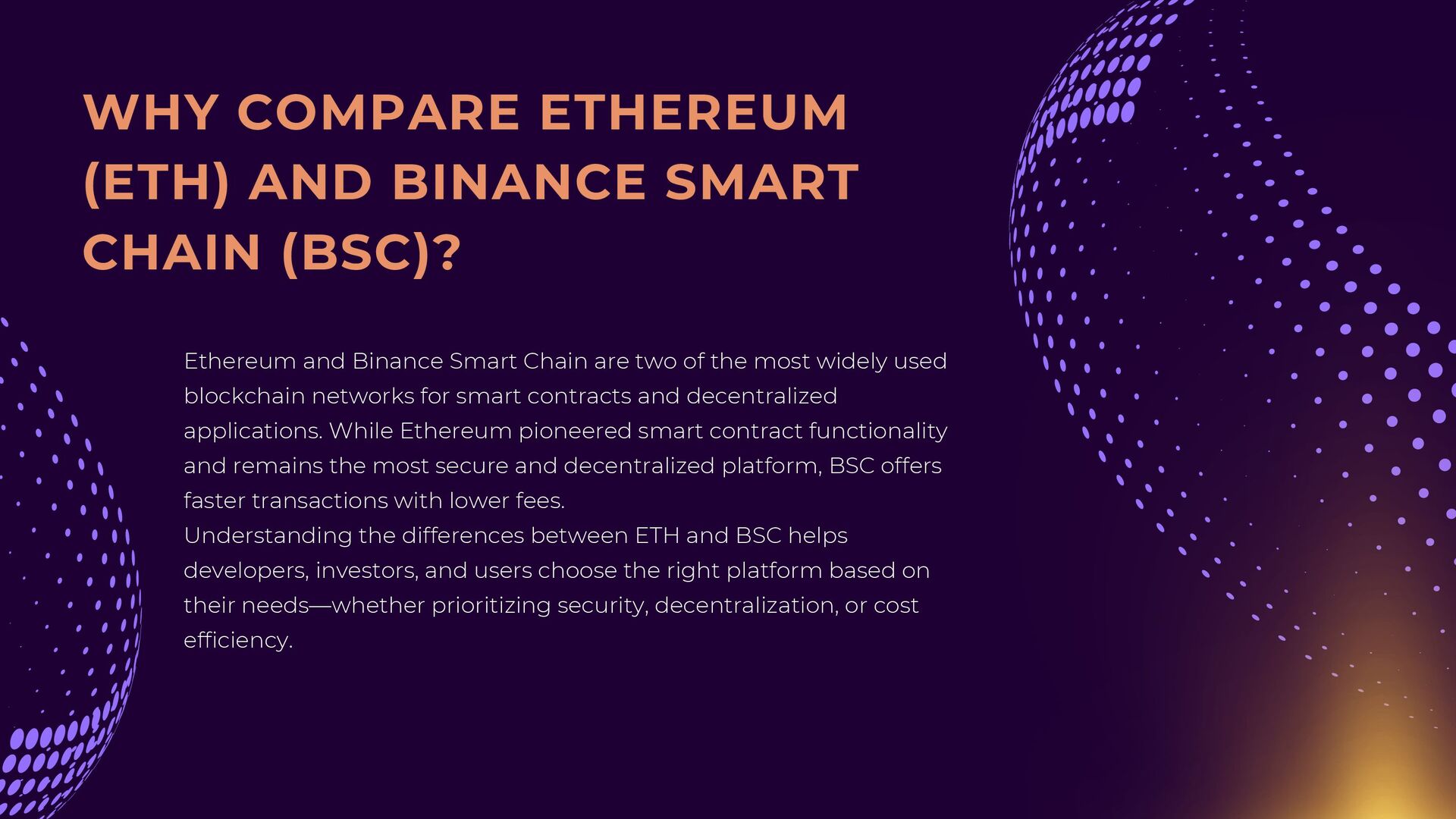
  2. WHY COMPARE ETHEREUM (ETH) AND BINANCE SMART CHAIN (BSC)? Ethereum

    and Binance Smart Chain are two of the most widely used blockchain networks for smart contracts and decentralized applications. While Ethereum pioneered smart contract functionality and remains the most secure and decentralized platform, BSC offers faster transactions with lower fees. Understanding the differences between ETH and BSC helps developers, investors, and users choose the right platform based on their needs—whether prioritizing security, decentralization, or cost efficiency.
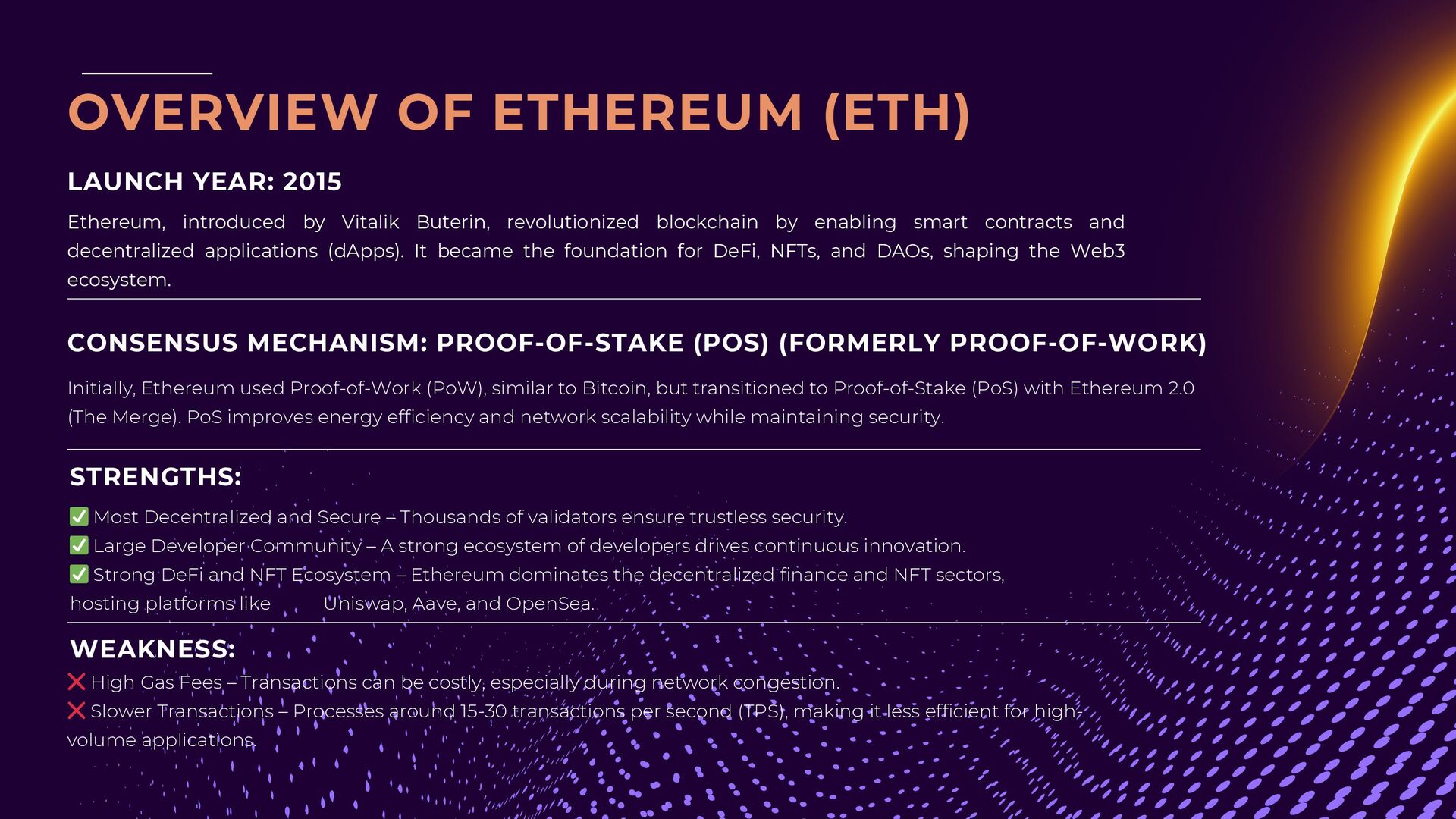
  3. OVERVIEW OF ETHEREUM (ETH) Ethereum, introduced by Vitalik Buterin, revolutionized

    blockchain by enabling smart contracts and decentralized applications (dApps). It became the foundation for DeFi, NFTs, and DAOs, shaping the Web3 ecosystem. Initially, Ethereum used Proof-of-Work (PoW), similar to Bitcoin, but transitioned to Proof-of-Stake (PoS) with Ethereum 2.0 (The Merge). PoS improves energy efficiency and network scalability while maintaining security. ✅ Most Decentralized and Secure – Thousands of validators ensure trustless security. ✅ Large Developer Community – A strong ecosystem of developers drives continuous innovation. ✅ Strong DeFi and NFT Ecosystem – Ethereum dominates the decentralized finance and NFT sectors, hosting platforms like Uniswap, Aave, and OpenSea. ❌ High Gas Fees – Transactions can be costly, especially during network congestion. ❌ Slower Transactions – Processes around 15-30 transactions per second (TPS), making it less efficient for high- volume applications. LAUNCH YEAR: 2015 CONSENSUS MECHANISM: PROOF-OF-STAKE (POS) (FORMERLY PROOF-OF-WORK) STRENGTHS: WEAKNESS:
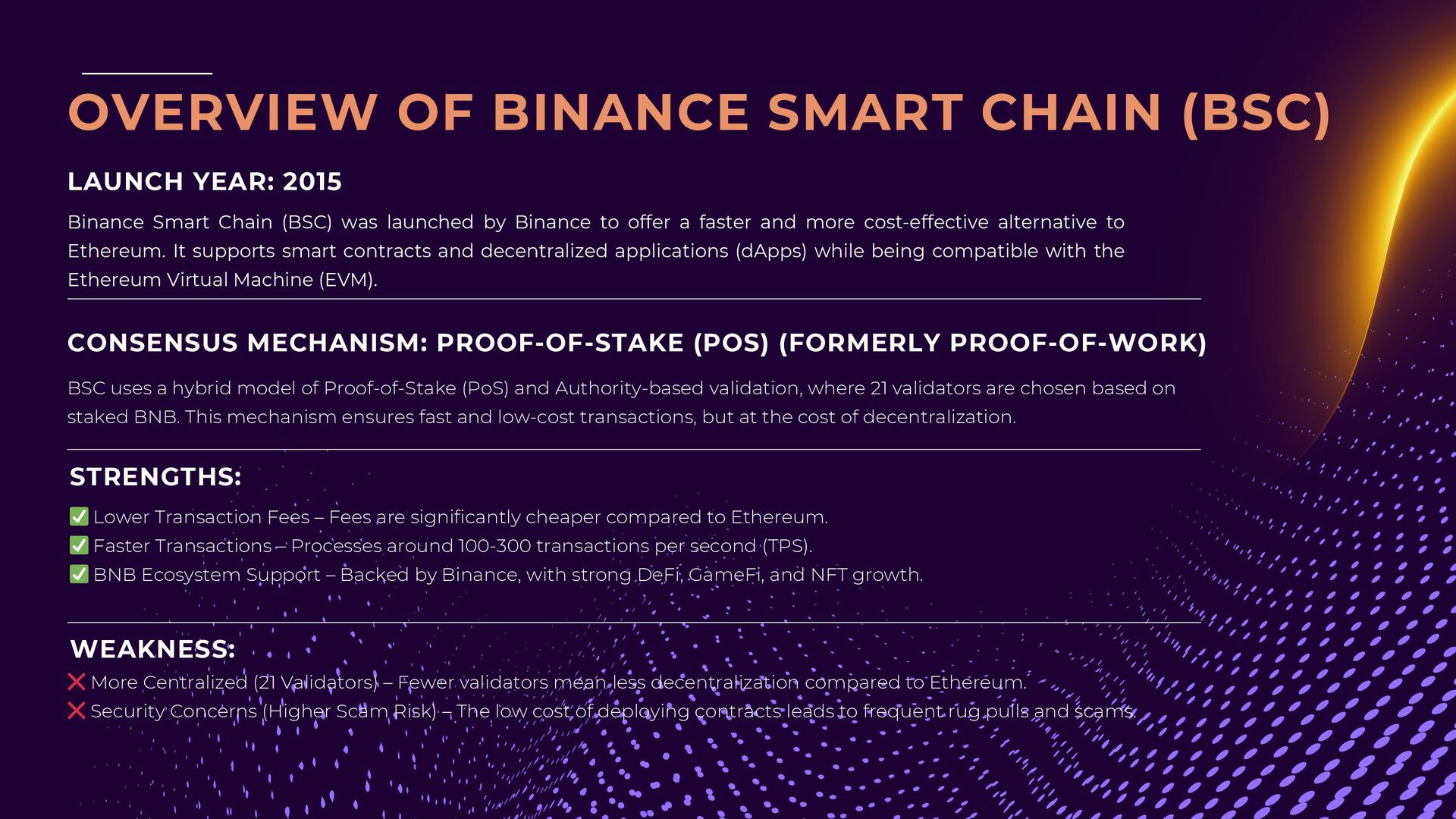
  4. OVERVIEW OF BINANCE SMART CHAIN (BSC) Binance Smart Chain (BSC)

    was launched by Binance to offer a faster and more cost-effective alternative to Ethereum. It supports smart contracts and decentralized applications (dApps) while being compatible with the Ethereum Virtual Machine (EVM). BSC uses a hybrid model of Proof-of-Stake (PoS) and Authority-based validation, where 21 validators are chosen based on staked BNB. This mechanism ensures fast and low-cost transactions, but at the cost of decentralization. ✅ Lower Transaction Fees – Fees are significantly cheaper compared to Ethereum. ✅ Faster Transactions – Processes around 100-300 transactions per second (TPS). ✅ BNB Ecosystem Support – Backed by Binance, with strong DeFi, GameFi, and NFT growth. ❌ More Centralized (21 Validators) – Fewer validators mean less decentralization compared to Ethereum. ❌ Security Concerns (Higher Scam Risk) – The low cost of deploying contracts leads to frequent rug pulls and scams. LAUNCH YEAR: 2015 CONSENSUS MECHANISM: PROOF-OF-STAKE (POS) (FORMERLY PROOF-OF-WORK) STRENGTHS: WEAKNESS:
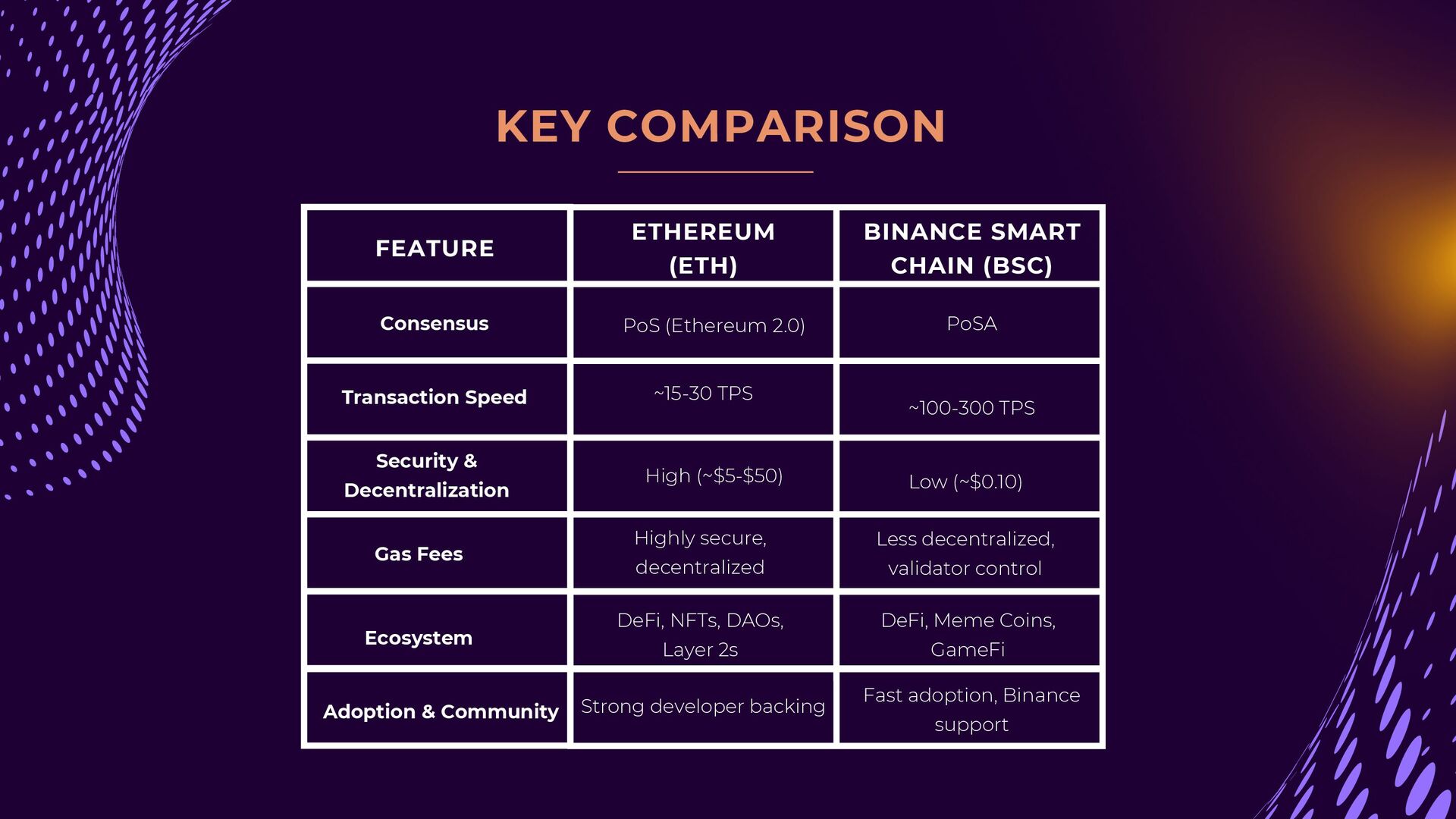
  5. KEY COMPARISON Consensus Transaction Speed Security & Decentralization Gas Fees

    Ecosystem Adoption & Community FEATURE PoS (Ethereum 2.0) PoSA ~100-300 TPS Low (~$0.10) Less decentralized, validator control DeFi, Meme Coins, GameFi Fast adoption, Binance support ~15-30 TPS High (~$5-$50) Highly secure, decentralized DeFi, NFTs, DAOs, Layer 2s Strong developer backing ETHEREUM (ETH) BINANCE SMART CHAIN (BSC)
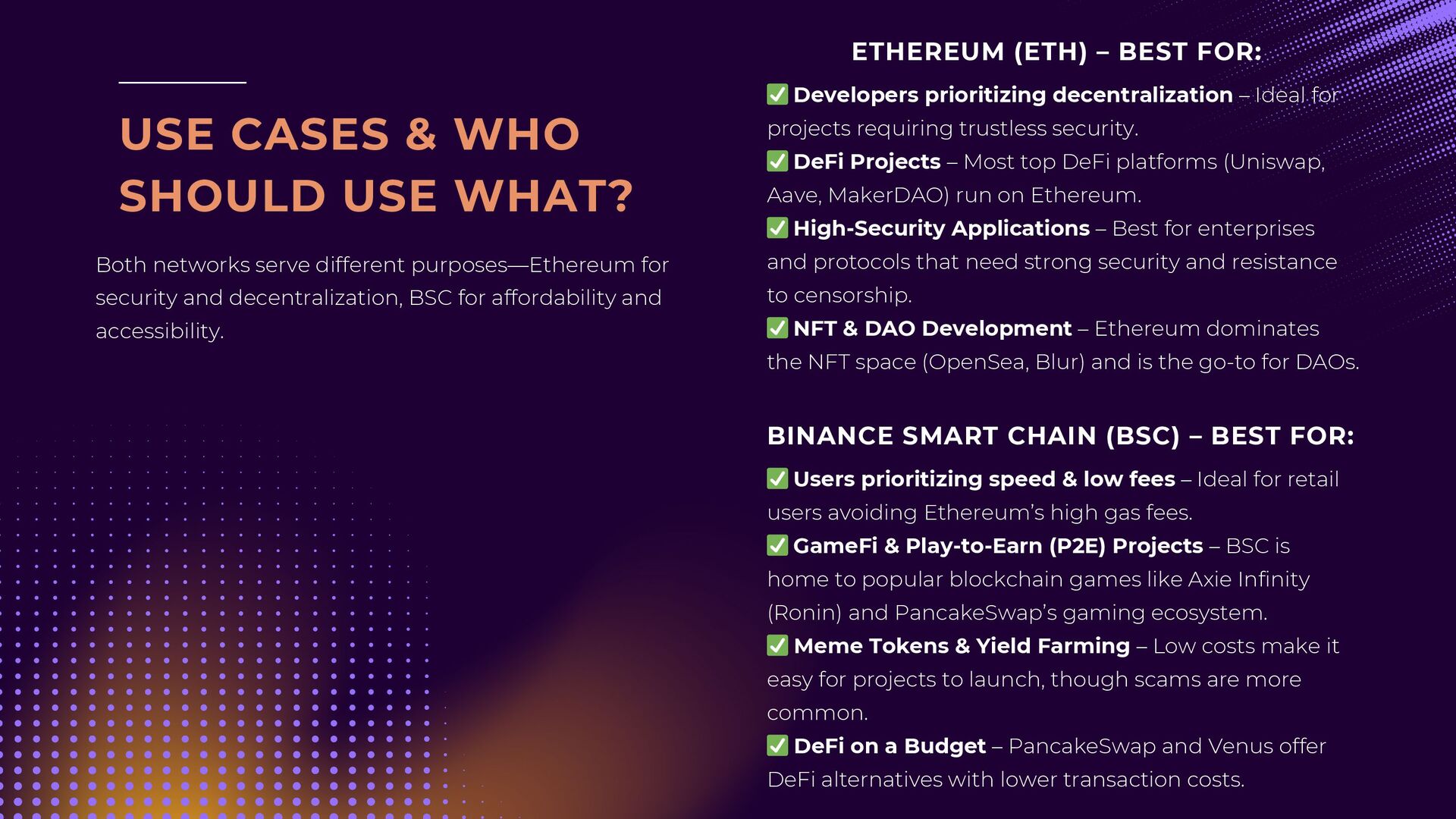
  6. USE CASES & WHO SHOULD USE WHAT? Both networks serve

    different purposes—Ethereum for security and decentralization, BSC for affordability and accessibility. ✅ Developers prioritizing decentralization – Ideal for projects requiring trustless security. ✅ DeFi Projects – Most top DeFi platforms (Uniswap, Aave, MakerDAO) run on Ethereum. ✅ High-Security Applications – Best for enterprises and protocols that need strong security and resistance to censorship. ✅ NFT & DAO Development – Ethereum dominates the NFT space (OpenSea, Blur) and is the go-to for DAOs. ✅ Users prioritizing speed & low fees – Ideal for retail users avoiding Ethereum’s high gas fees. ✅ GameFi & Play-to-Earn (P2E) Projects – BSC is home to popular blockchain games like Axie Infinity (Ronin) and PancakeSwap’s gaming ecosystem. ✅ Meme Tokens & Yield Farming – Low costs make it easy for projects to launch, though scams are more common. ✅ DeFi on a Budget – PancakeSwap and Venus offer DeFi alternatives with lower transaction costs. ETHEREUM (ETH) – BEST FOR: BINANCE SMART CHAIN (BSC) – BEST FOR:
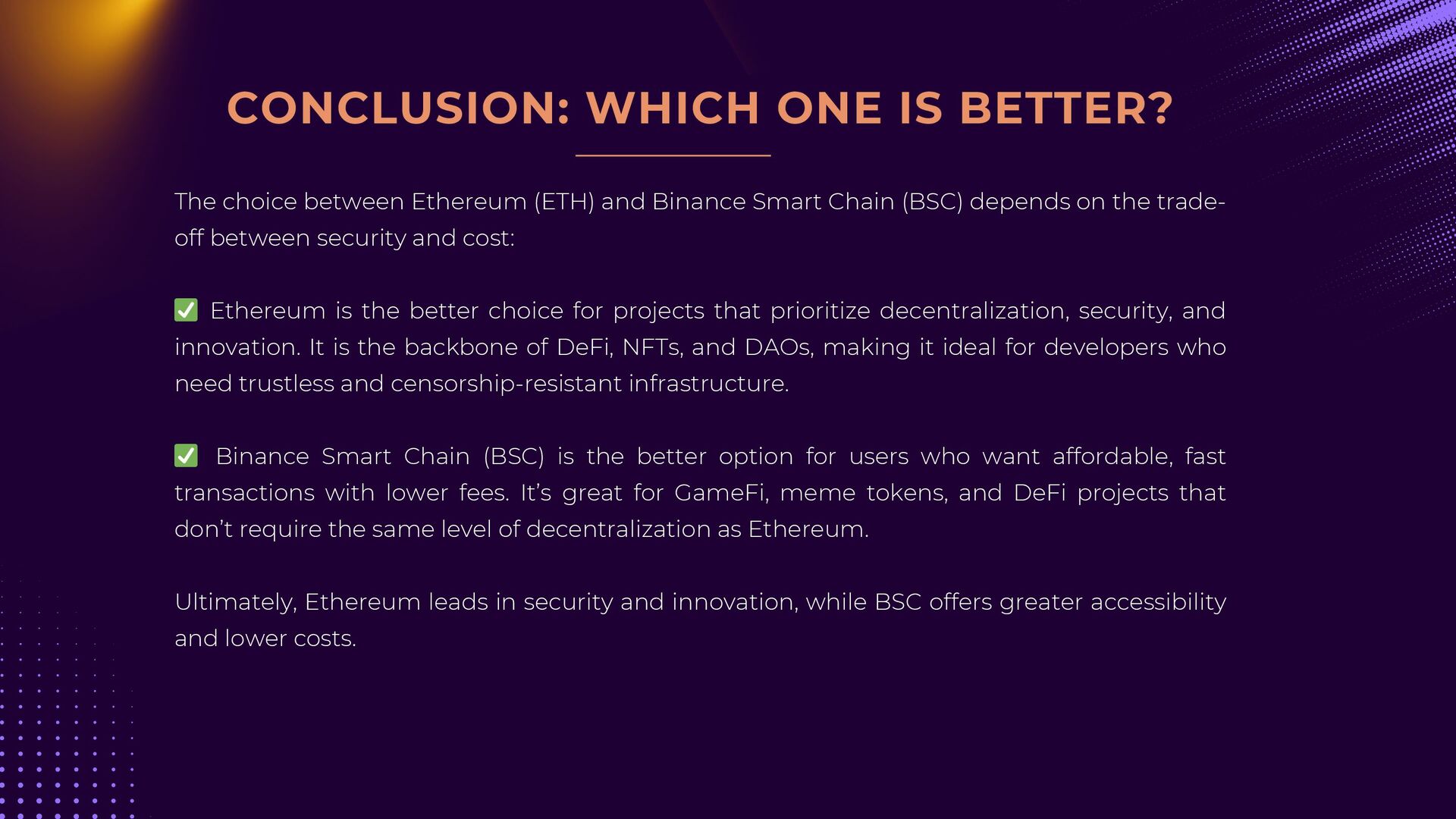
  7. CONCLUSION: WHICH ONE IS BETTER? The choice between Ethereum (ETH)

    and Binance Smart Chain (BSC) depends on the trade- off between security and cost: ✅ Ethereum is the better choice for projects that prioritize decentralization, security, and innovation. It is the backbone of DeFi, NFTs, and DAOs, making it ideal for developers who need trustless and censorship-resistant infrastructure. ✅ Binance Smart Chain (BSC) is the better option for users who want affordable, fast transactions with lower fees. It’s great for GameFi, meme tokens, and DeFi projects that don’t require the same level of decentralization as Ethereum. Ultimately, Ethereum leads in security and innovation, while BSC offers greater accessibility and lower costs.