Upgrade to PRO for Only $50/Year—Limited-Time Offer! 🔥

What motivates the open source communities

What motivates the open source communities

A talk about what motivates open source technical contributors based on qualitative and survey research in 2016/2017
For full report go to mzl.la/whyopensource

And for recording of talk see Fossdem 2017: http://ftp.fau.de/fosdem/2017/UD2.218A/mozilla_what_motivates_open_source_community.mp4

Avatar for Rina Tambo Jensen

Rina Tambo Jensen

May 04, 2017
Tweet

Other Decks in Technology

Transcript

  1. WHAT MOTIVATES OPEN SOURCE CONTRIBUTORS? What motivates contributors to give

    their time & skills to open source projects? February 2016 Image Source
  2. The goal How we can create a a better experience

    for contributors who want to help with Mozilla’s mission.
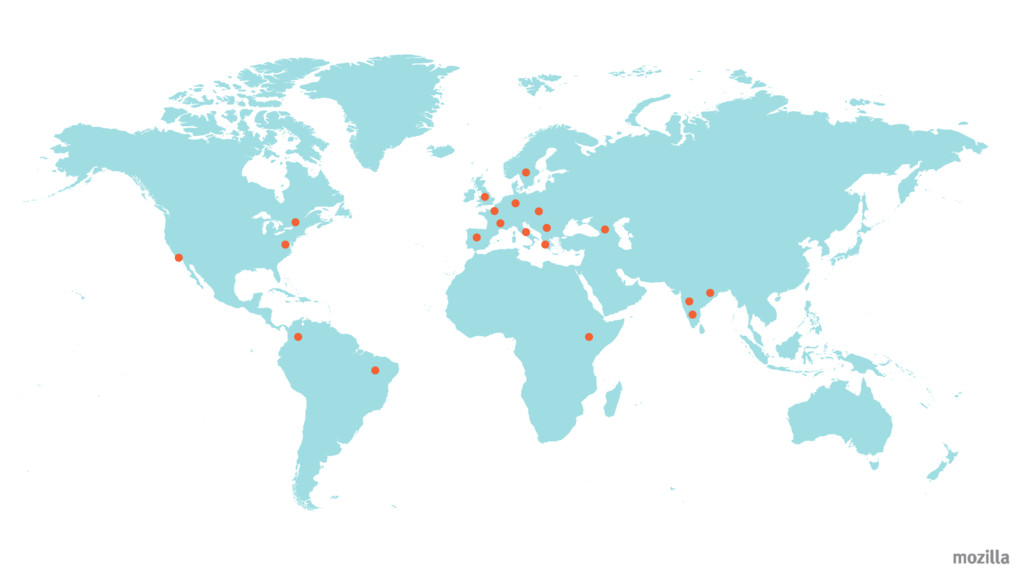
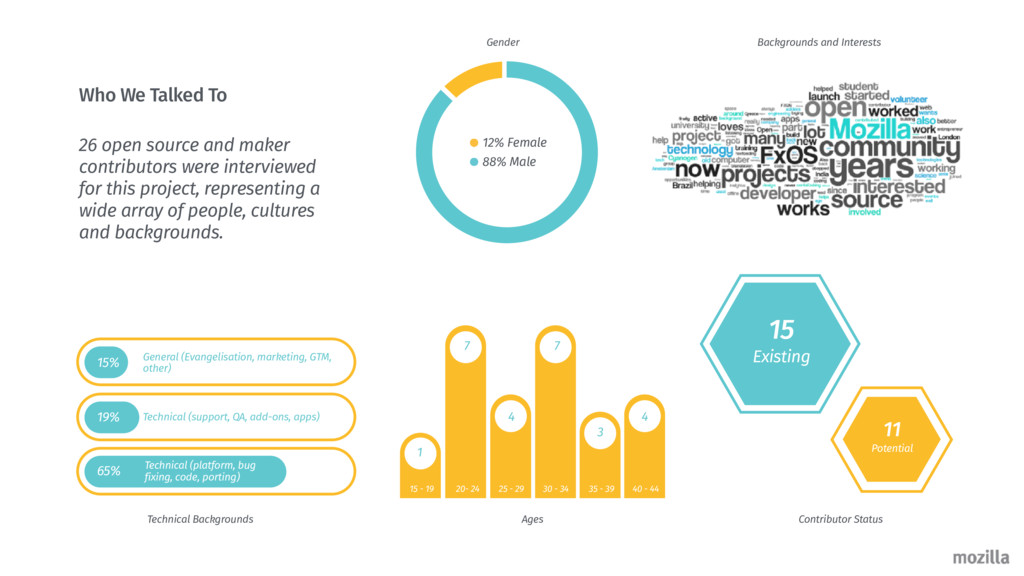
  3. Who We Talked To 26 open source and maker contributors

    were interviewed for this project, representing a wide array of people, cultures and backgrounds. 12% Female 88% Male 15 Existing 11 Potential 7 7 4 4 3 1 15 - 19 20- 24 25 - 29 30 - 34 35 - 39 40 - 44 15% 19% 65% Technical (support, QA, add-ons, apps) General (Evangelisation, marketing, GTM, other) Technical Backgrounds Contributor Status Ages Gender Backgrounds and Interests Technical (platform, bug fixing, code, porting)
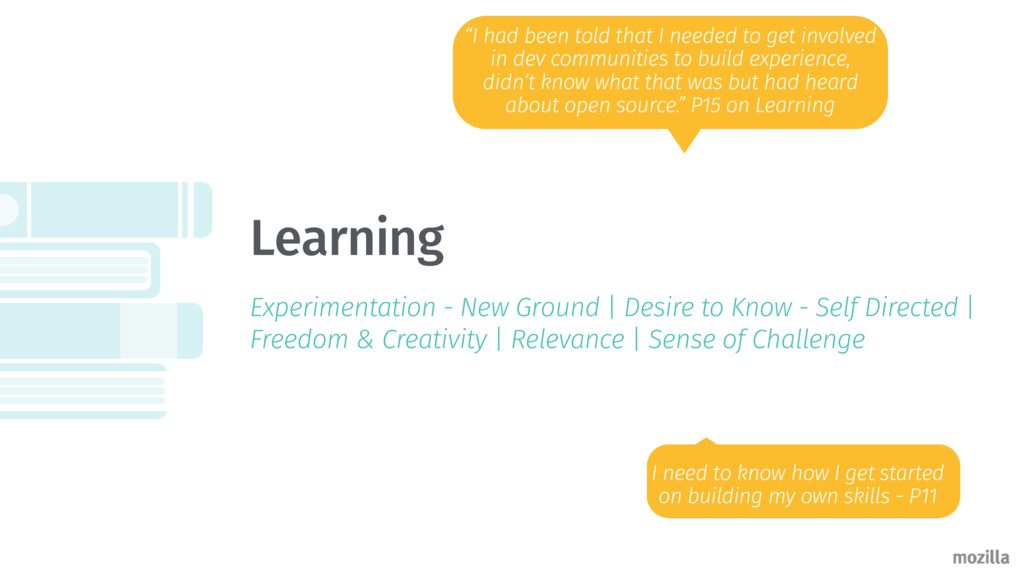
  4. Learning Experimentation - New Ground | Desire to Know -

    Self Directed | Freedom & Creativity | Relevance | Sense of Challenge I need to know how I get started on building my own skills - P11 “I had been told that I needed to get involved in dev communities to build experience, didn’t know what that was but had heard about open source.” P15 on Learning
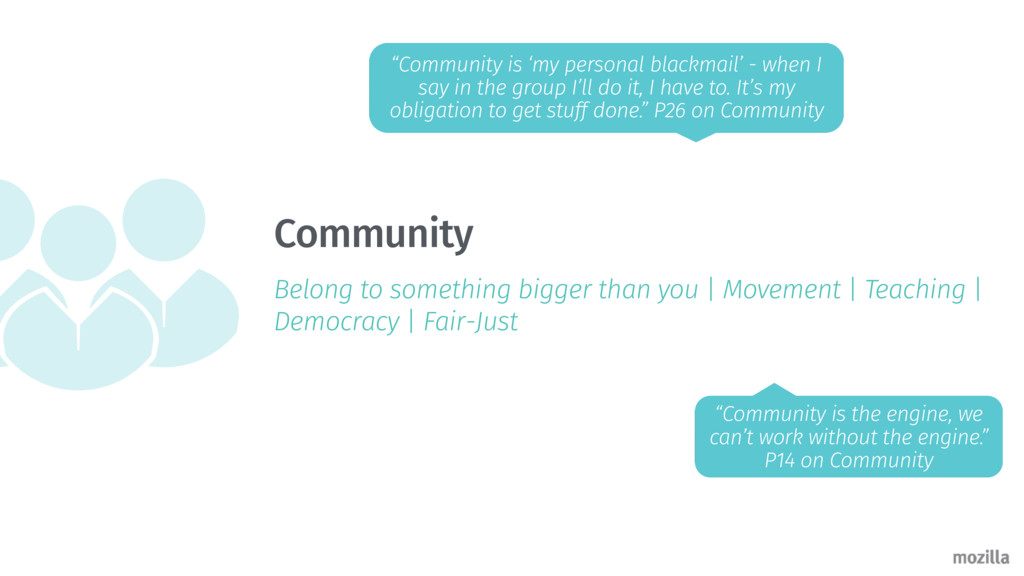
  5. Community Belong to something bigger than you | Movement |

    Teaching | Democracy | Fair-Just “Community is ‘my personal blackmail’ - when I say in the group I’ll do it, I have to. It’s my obligation to get stuff done.” P26 on Community “Community is the engine, we can’t work without the engine.” P14 on Community
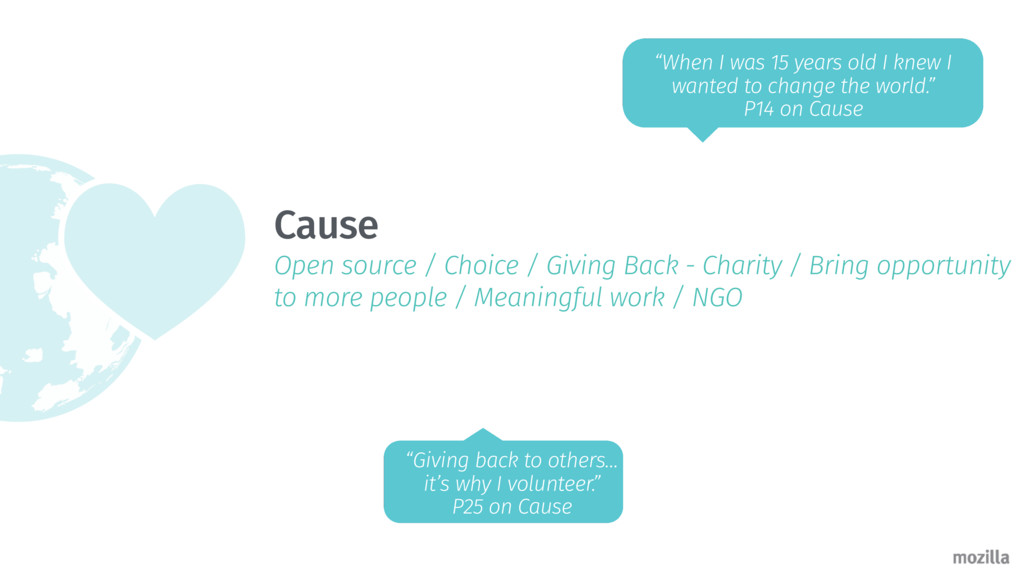
  6. Cause Open source / Choice / Giving Back - Charity

    / Bring opportunity to more people / Meaningful work / NGO “Giving back to others… it’s why I volunteer.” 
 P25 on Cause “When I was 15 years old I knew I wanted to change the world.” P14 on Cause
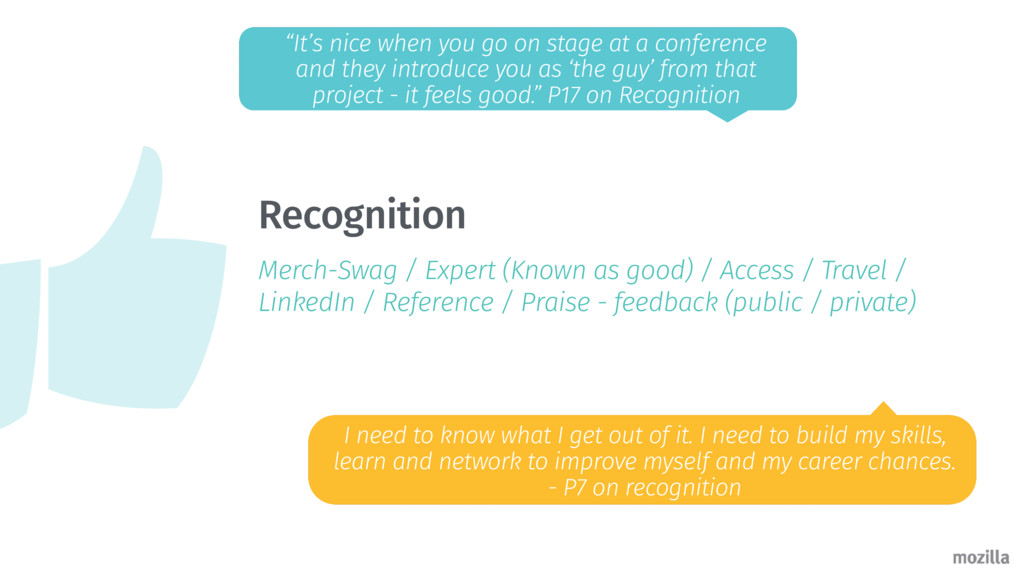
  7. Recognition Merch-Swag / Expert (Known as good) / Access /

    Travel / LinkedIn / Reference / Praise - feedback (public / private) I need to know what I get out of it. I need to build my skills, learn and network to improve myself and my career chances. - P7 on recognition “It’s nice when you go on stage at a conference and they introduce you as ‘the guy’ from that project - it feels good.” P17 on Recognition
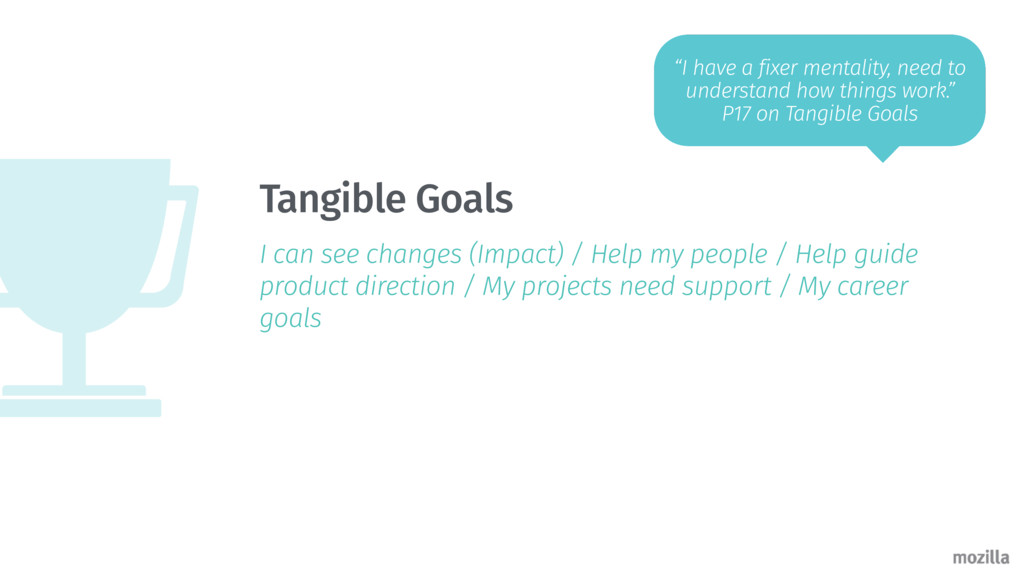
  8. Tangible Goals I can see changes (Impact) / Help my

    people / Help guide product direction / My projects need support / My career goals “I have a fixer mentality, need to understand how things work.” P17 on Tangible Goals
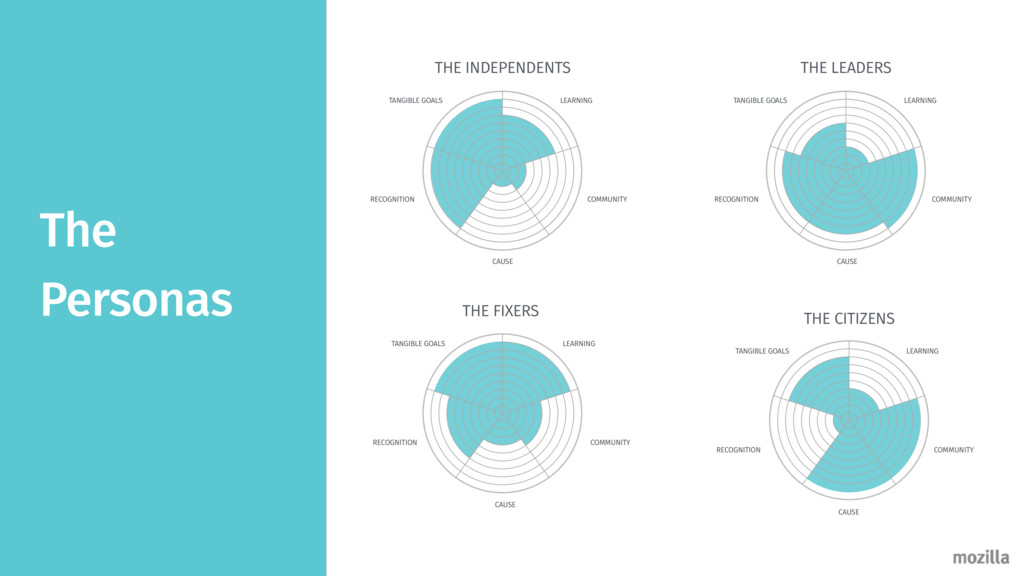
  9. The Personas TANGIBLE GOALS RECOGNITION CAUSE COMMUNITY LEARNING THE INDEPENDENTS

    THE LEADERS THE FIXERS THE CITIZENS TANGIBLE GOALS RECOGNITION CAUSE COMMUNITY LEARNING TANGIBLE GOALS RECOGNITION CAUSE COMMUNITY LEARNING TANGIBLE GOALS RECOGNITION CAUSE COMMUNITY LEARNING
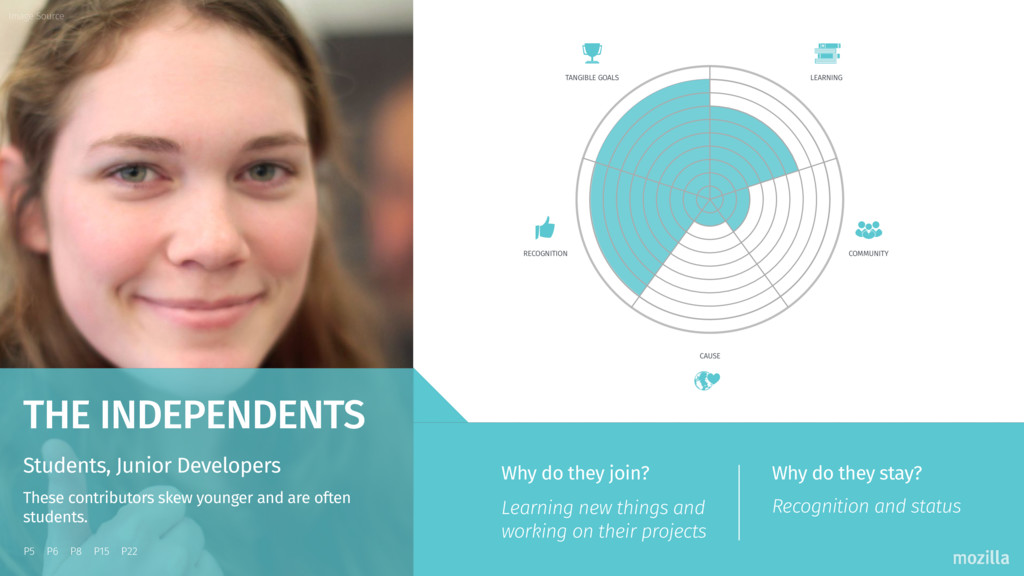
  10. THE INDEPENDENTS Students, Junior Developers These contributors skew younger and

    are often students. Why do they stay? Why do they join? Recognition and status Learning new things and working on their projects TANGIBLE GOALS RECOGNITION CAUSE COMMUNITY LEARNING P5 P6 P8 P15 P22 Image Source
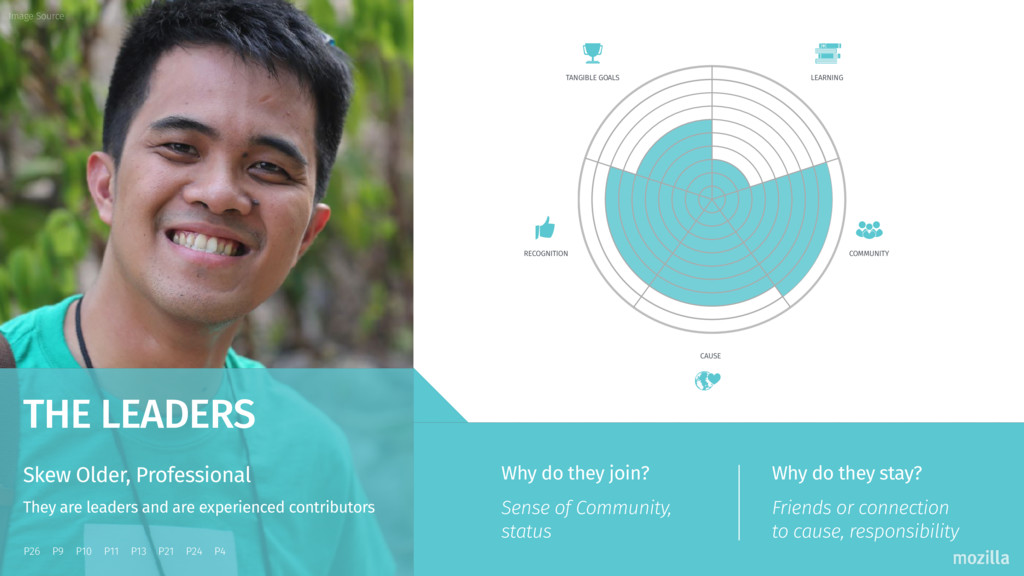
  11. THE LEADERS Skew Older, Professional They are leaders and are

    experienced contributors Why do they stay? Why do they join? Friends or connection to cause, responsibility Sense of Community, status P26 P9 P10 P11 P13 P21 P24 P4 TANGIBLE GOALS RECOGNITION CAUSE COMMUNITY LEARNING Image Source
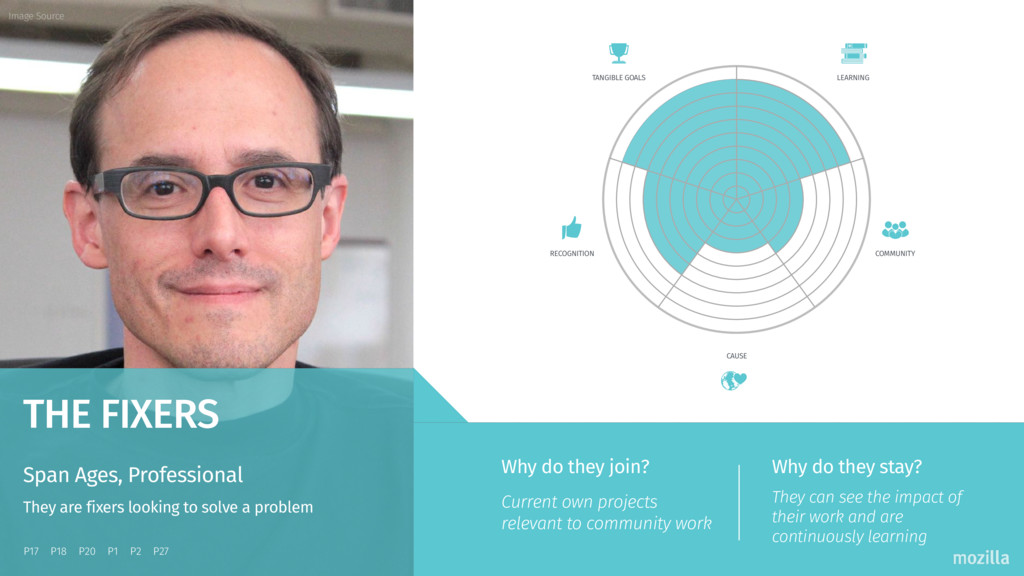
  12. THE FIXERS Span Ages, Professional They are fixers looking to

    solve a problem Why do they stay? Why do they join? They can see the impact of their work and are continuously learning Current own projects relevant to community work P17 P18 P20 P1 P2 P27 TANGIBLE GOALS RECOGNITION CAUSE COMMUNITY LEARNING Image Source
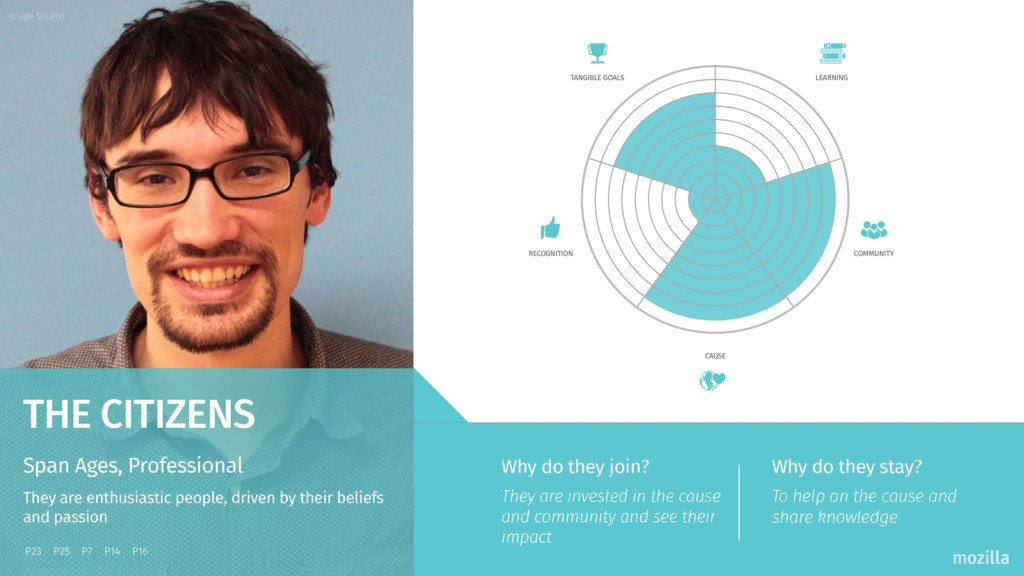
  13. THE CITIZENS Span Ages, Professional They are enthusiastic people, driven

    by their beliefs and passion Why do they stay? Why do they join? To help on the cause and share knowledge They are invested in the cause and community and see their impact P23 P25 P7 P14 P16 TANGIBLE GOALS RECOGNITION CAUSE COMMUNITY LEARNING Image Source
  14. • Present a tailored Value Proposition (VP) based on needs

    • Ensure the benefits are presented throughout early participation. Reiteration is key. Recommendation: 
 Remember to showcase the value exchange
  15. • Communicate/visualise an onboarding process that gives them a sense

    of where they are in the journey and helps sets their expectation. • Visuallise Mozilla and what it is about: Present Mozilla, its projects, interest and organizational structure in a way that is easy to understand • Create a ‘contact map’ of Mozilla: Ensure people can quickly and easily find the code/people/support they need Recommendation: 
 Reinforcing and frequent communication on how to get involved
  16. • Highlight the opportunities Mozilla can present for helping their

    cause • Make people feel secure in where their skills can fit and how they can help. • Create easy to start activities for how they can get started immediately to make a difference for the mission. Recommendation: 
 Show how to make a difference for the mission
  17. • Every action deserves an appropriate bit of recognition •

    Recognition over time, can be given through increased access and platform to make contributors feel valued • (Tacit) Recognition is about making a change; on the mission, the project or for them personally. Recommendation: 
 Build a culture of positive recognition
  18. • Direct 1:1 human interaction is more valuable than digital

    interaction. • Connect them to local community and events as early as possible to foster a feeling of belonging. • Community is a source of growth and inspiration Recommendation: 
 Connect to community early
  19. • Foster co-ownership to provide a sense of responsibility •

    Allow for increased access by giving input on communication and programs. • Encourage to engage with increasingly harder problems • Give them a platform by helping them share their expertise and wisdom to the rest of the community and Mozilla. Recommendation: 
 Foster co-ownership
  20. • Define and present a pragmatic guide of how they

    get started fixing projects for Mozilla. • Frequent and reinforcing communication to foster understanding and expectation setting. Especially on mission and product visions. • Make the mission a foundational piece of every project and communication. • Allow for layered information and access for those more involved and invested. Recommendation: 
 Be transparent
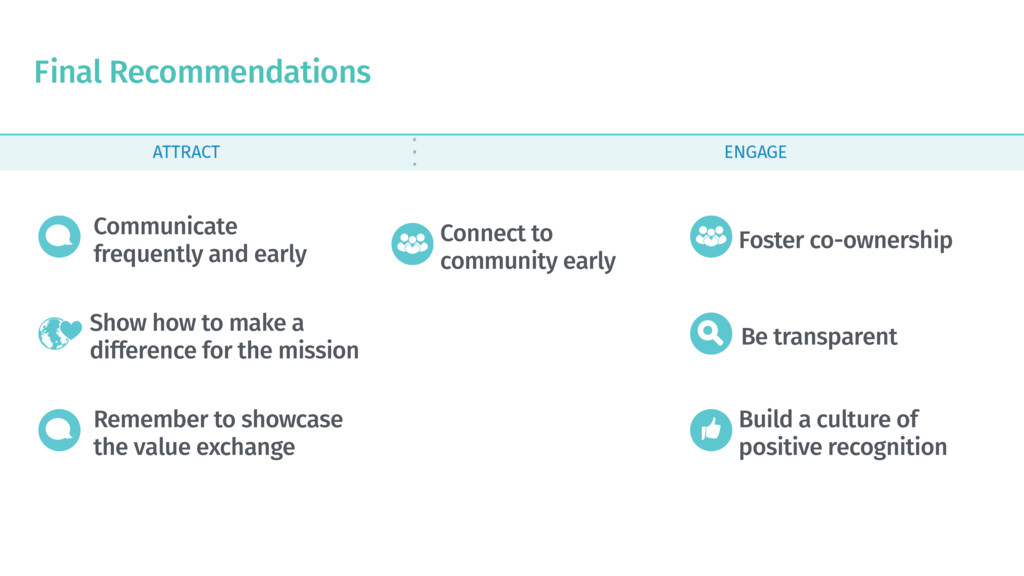
  21. Be transparent Foster co-ownership Connect to community early Build a

    culture of positive recognition Show how to make a difference for the mission Communicate frequently and early Final Recommendations Remember to showcase the value exchange
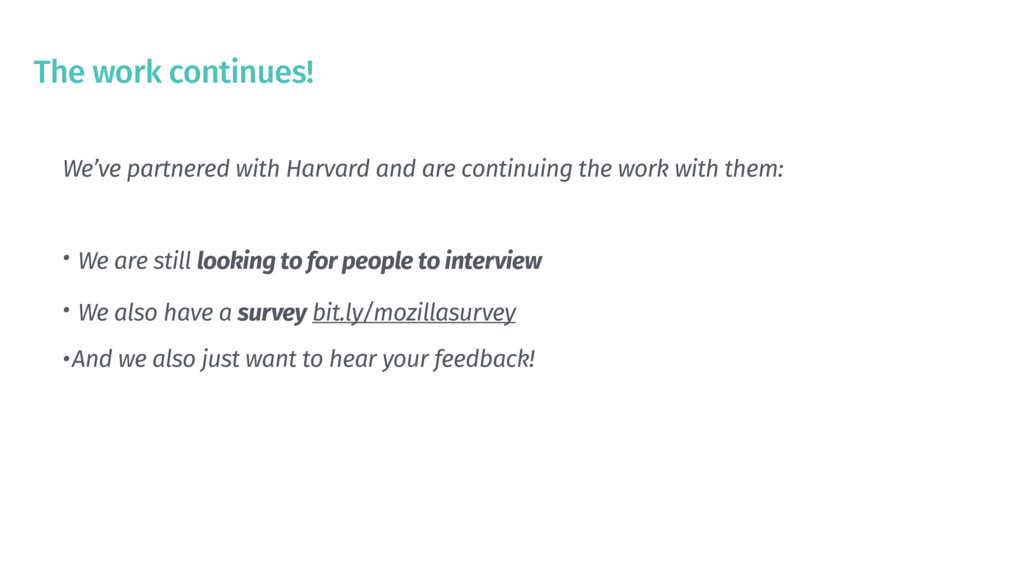
  22. We’ve partnered with Harvard and are continuing the work with

    them: • We are still looking to for people to interview • We also have a survey bit.ly/mozillasurvey •And we also just want to hear your feedback! The work continues!
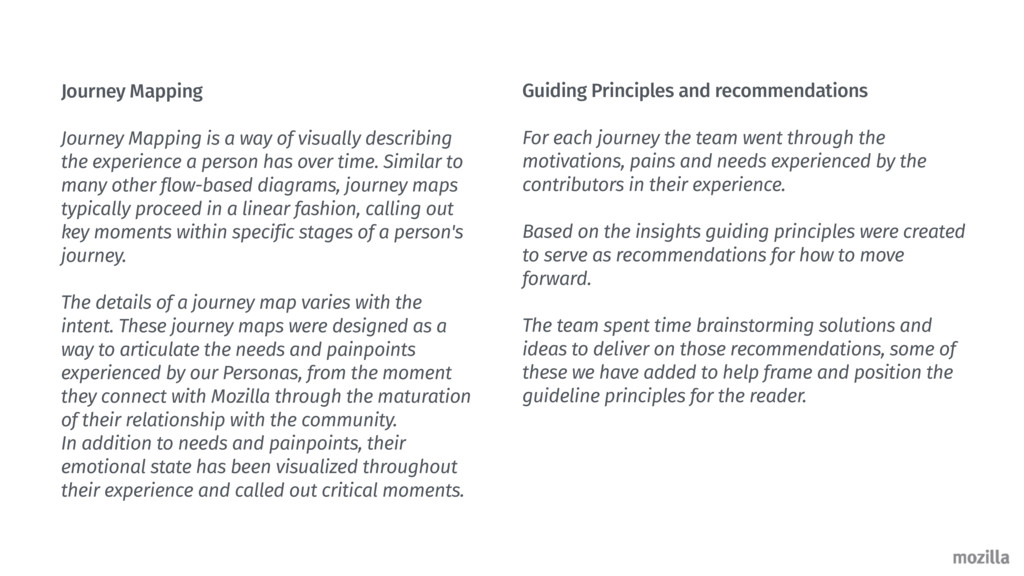
  23. Journey Mapping Journey Mapping is a way of visually describing

    the experience a person has over time. Similar to many other flow-based diagrams, journey maps typically proceed in a linear fashion, calling out key moments within specific stages of a person's journey. The details of a journey map varies with the intent. These journey maps were designed as a way to articulate the needs and painpoints experienced by our Personas, from the moment they connect with Mozilla through the maturation of their relationship with the community. In addition to needs and painpoints, their emotional state has been visualized throughout their experience and called out critical moments. Guiding Principles and recommendations For each journey the team went through the motivations, pains and needs experienced by the contributors in their experience. Based on the insights guiding principles were created to serve as recommendations for how to move forward. The team spent time brainstorming solutions and ideas to deliver on those recommendations, some of these we have added to help frame and position the guideline principles for the reader.
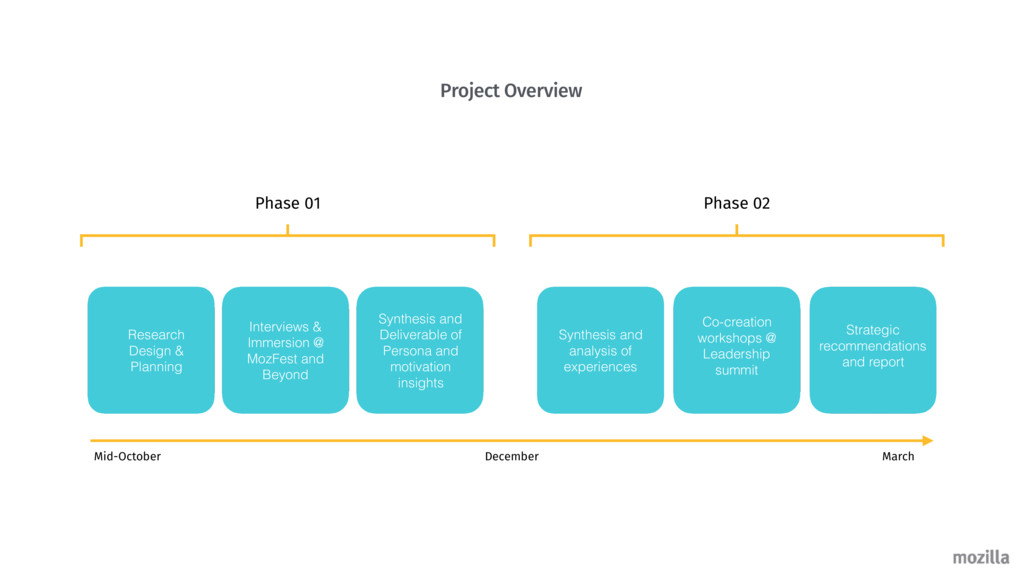
  24. Project Overview Mid-October December March Research Design & Planning Interviews

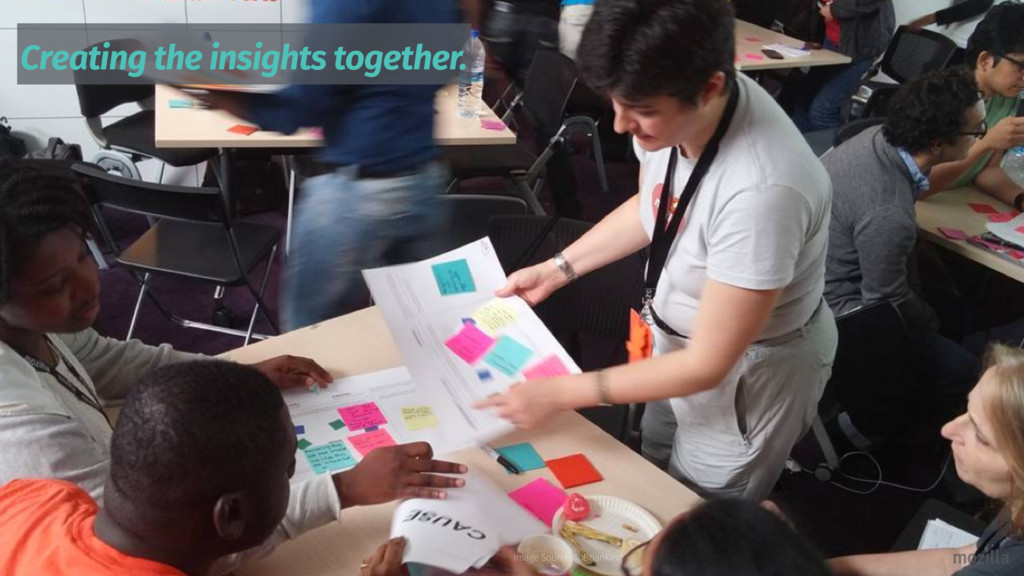
    & Immersion @ MozFest and Beyond Synthesis and Deliverable of Persona and motivation insights Synthesis and analysis of experiences Co-creation workshops @ Leadership summit Strategic recommendations and report Phase 01 Phase 02
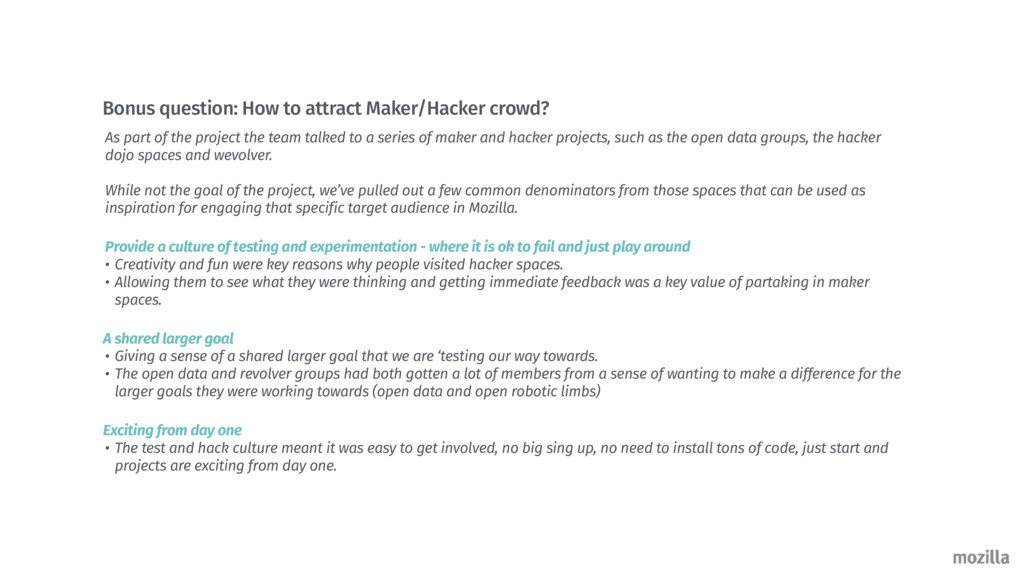
  25. Bonus question: How to attract Maker/Hacker crowd? As part of

    the project the team talked to a series of maker and hacker projects, such as the open data groups, the hacker dojo spaces and wevolver. While not the goal of the project, we’ve pulled out a few common denominators from those spaces that can be used as inspiration for engaging that specific target audience in Mozilla. Provide a culture of testing and experimentation - where it is ok to fail and just play around • Creativity and fun were key reasons why people visited hacker spaces. • Allowing them to see what they were thinking and getting immediate feedback was a key value of partaking in maker spaces. A shared larger goal • Giving a sense of a shared larger goal that we are ‘testing our way towards. • The open data and revolver groups had both gotten a lot of members from a sense of wanting to make a difference for the larger goals they were working towards (open data and open robotic limbs) Exciting from day one • The test and hack culture meant it was easy to get involved, no big sing up, no need to install tons of code, just start and projects are exciting from day one.