Upgrade to Pro — share decks privately, control downloads, hide ads and more …

MISINFORMED OR MISTRUSTFUL? HOW THE HEALTH INF...

Avatar for TDP TDP
October 23, 2026

MISINFORMED OR MISTRUSTFUL? HOW THE HEALTH INFORMATION ENVIRONMENT SHAPES PATIENTS’ DECISIONS

Talk to Baylor College of Medicine Grand Rounds on how information environment impacts health beliefs and decisions.

Avatar for TDP

TDP

October 23, 2026

Other Decks in Science

Transcript

  1. MISINFORMED OR MISTRUSTFUL? HOW THE HEALTH INFORMATION ENVIRONMENT SHAPES PATIENTS’

    DECISIONS TINA D PURNAT, MSc DrPH candidate, Harvard Chan School of Public Health Affiliate Visiting Researcher, WHO Collaborating Centre for Health Literacy, Technical University of Munich, Germany Visiting Researcher, Laboratory for Infodemiology and Infodemic Management, University of Belgrade, Serbia Cochair, Working group for Global Health Equity and Digital Transformation, World Federation of Public Health Associations Vice - President, Global Health Section, European Public Health Association OB/GYN Grand Rounds, Baylor College of Medicine, 21 October, 2026
  2. How you can use this slide deck Thanks for your

    interest in this topic. I developed this deck to support public health efforts and have made it available for others to use it as well. I’ve made full effort to acknowledge sources of information and adaptation of slides from other people. You are welcome to adapt the slide deck as per the license below. Please make an effort to properly credit the efforts of others that you use. This presentation © 2026 by Tina D Purnat is licensed under Attribution-NonCommercialShareAlike 4.0 International Creator: https://www.linkedin.com/in/tinadpurnat/ Work is published at: https://tinapurnat.com You are free to: 1.Share — copy and redistribute the material in any medium or format 2.Adapt — remix, transform, and build upon the material 3.The licensor cannot revoke these freedoms as long as you follow the license terms. Under the following terms: 1.Attribution - You must give appropriate credit , provide a link to the license, and indicate if changes were made . You may do so in any reasonable manner, but not in any way that suggests the licensor endorses you or your use. 2.NonCommercial - You may not use the material for commercial purposes . 3.ShareAlike - If you remix, transform, or build upon the material, you must distribute your contributions under the same license as the original. 4.No additional restrictions - You may not apply legal terms or technological measures that legally restrict others from doing anything the license permits.
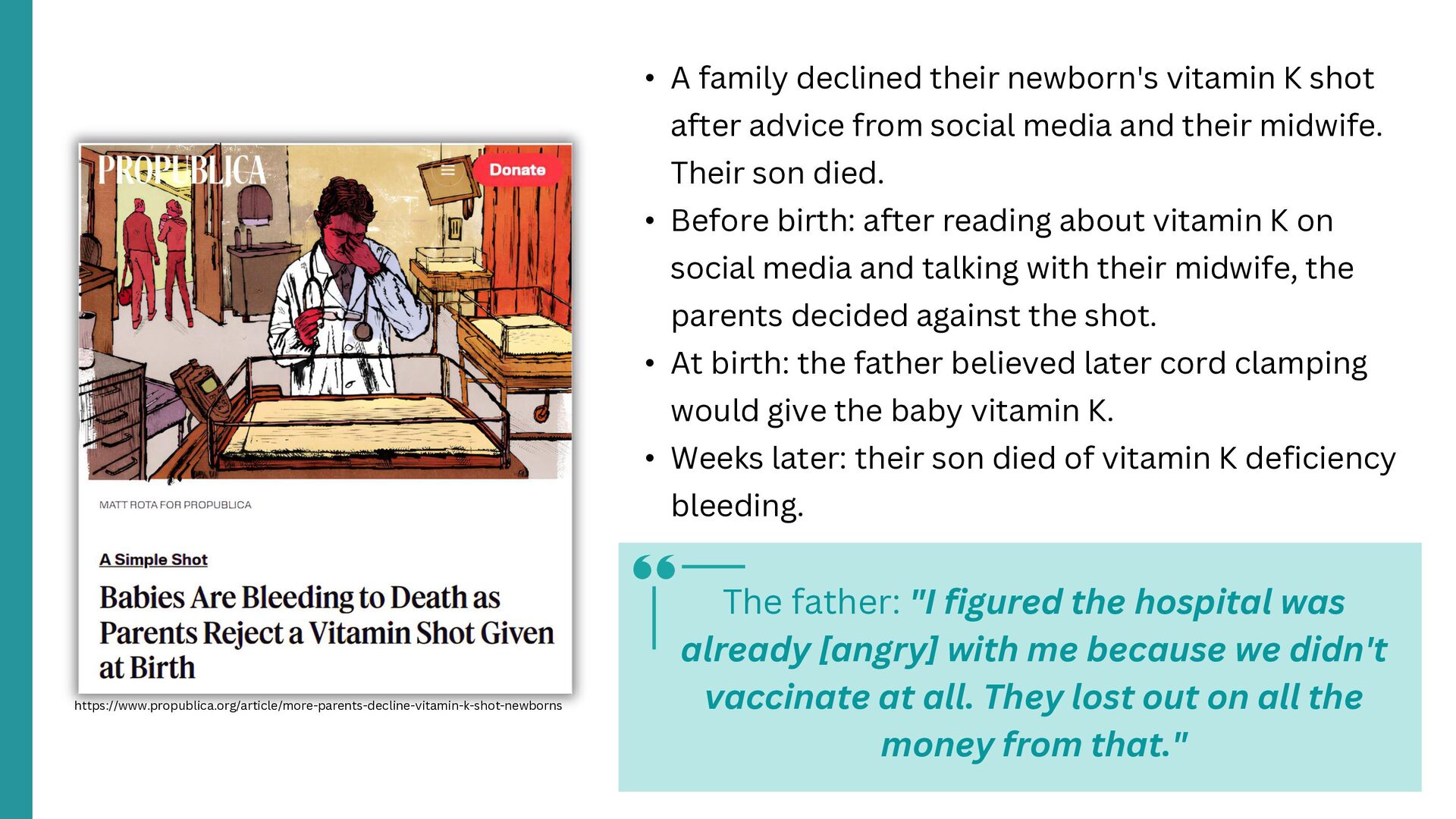
  3. • A family declined their newborn's vitamin K shot after

    advice from social media and their midwife. Their son died. • Before birth: after reading about vitamin K on social media and talking with their midwife, the parents decided against the shot. • At birth: the father believed later cord clamping would give the baby vitamin K. • Weeks later: their son died of vitamin K deficiency bleeding. https://www.propublica.org/article/more-parents-decline-vitamin-k-shot-newborns The father: "I figured the hospital was already [angry] with me because we didn't vaccinate at all. They lost out on all the money from that."
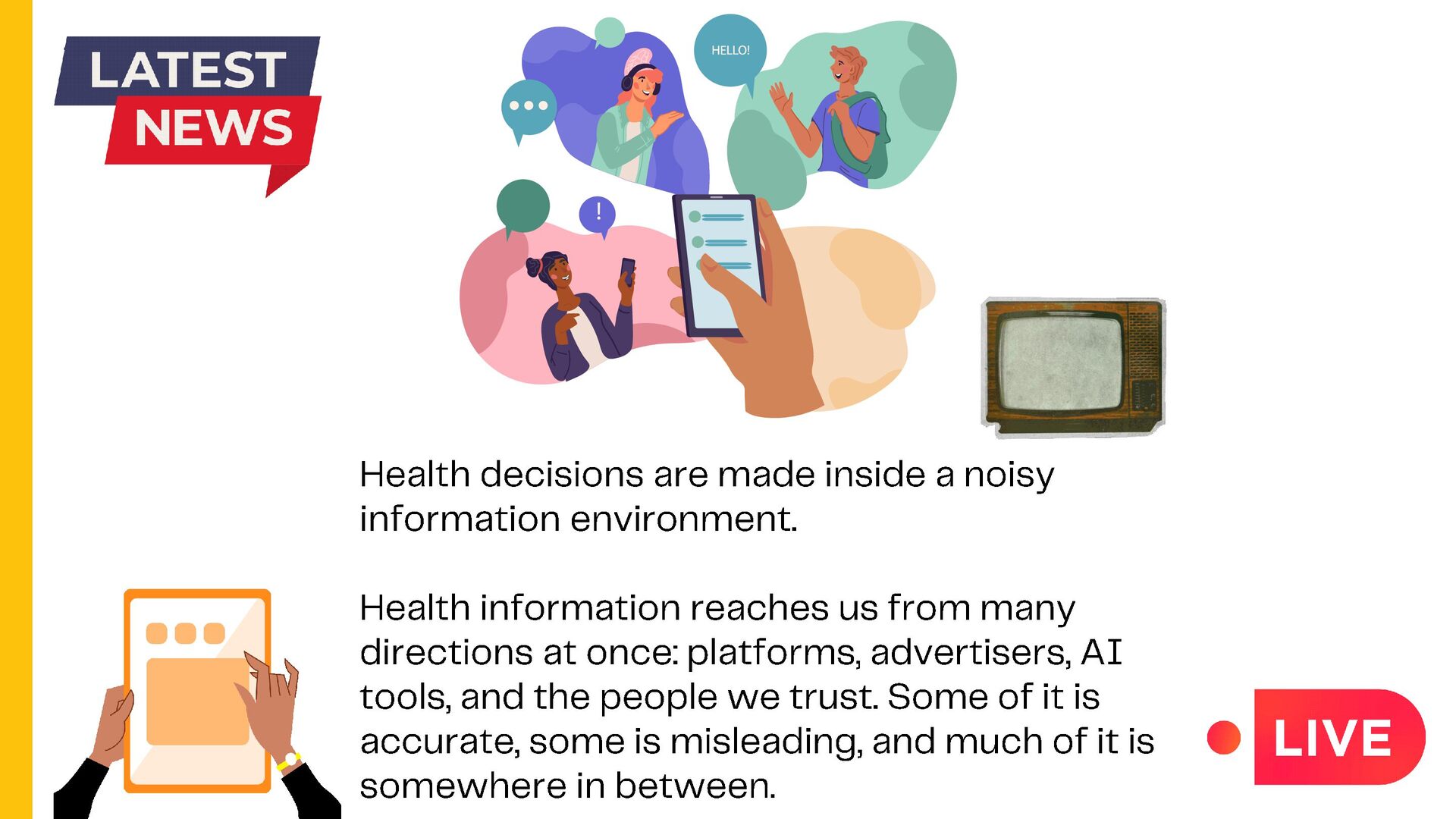
  4. Health decisions are made inside a noisy information environment. Health

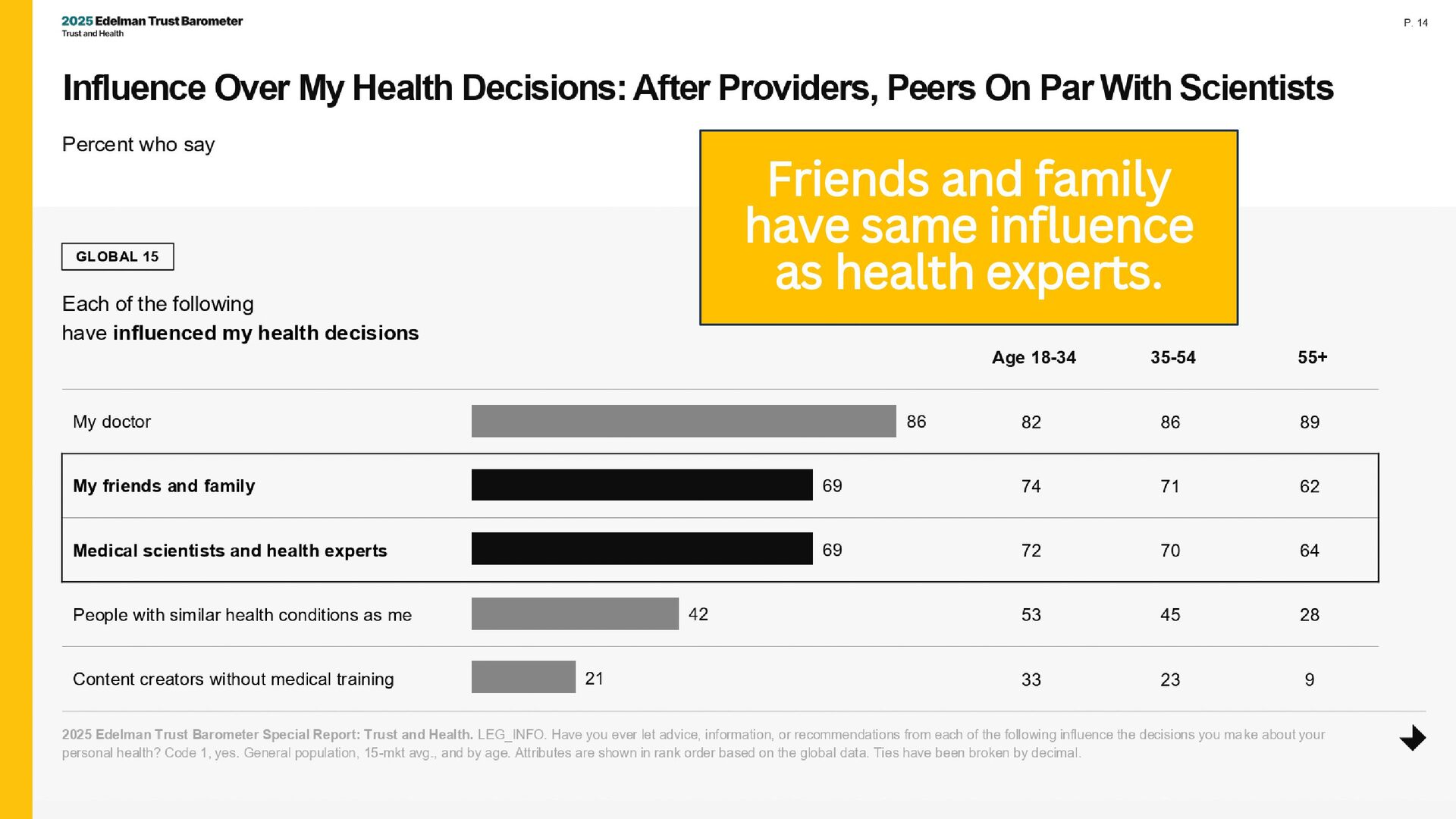
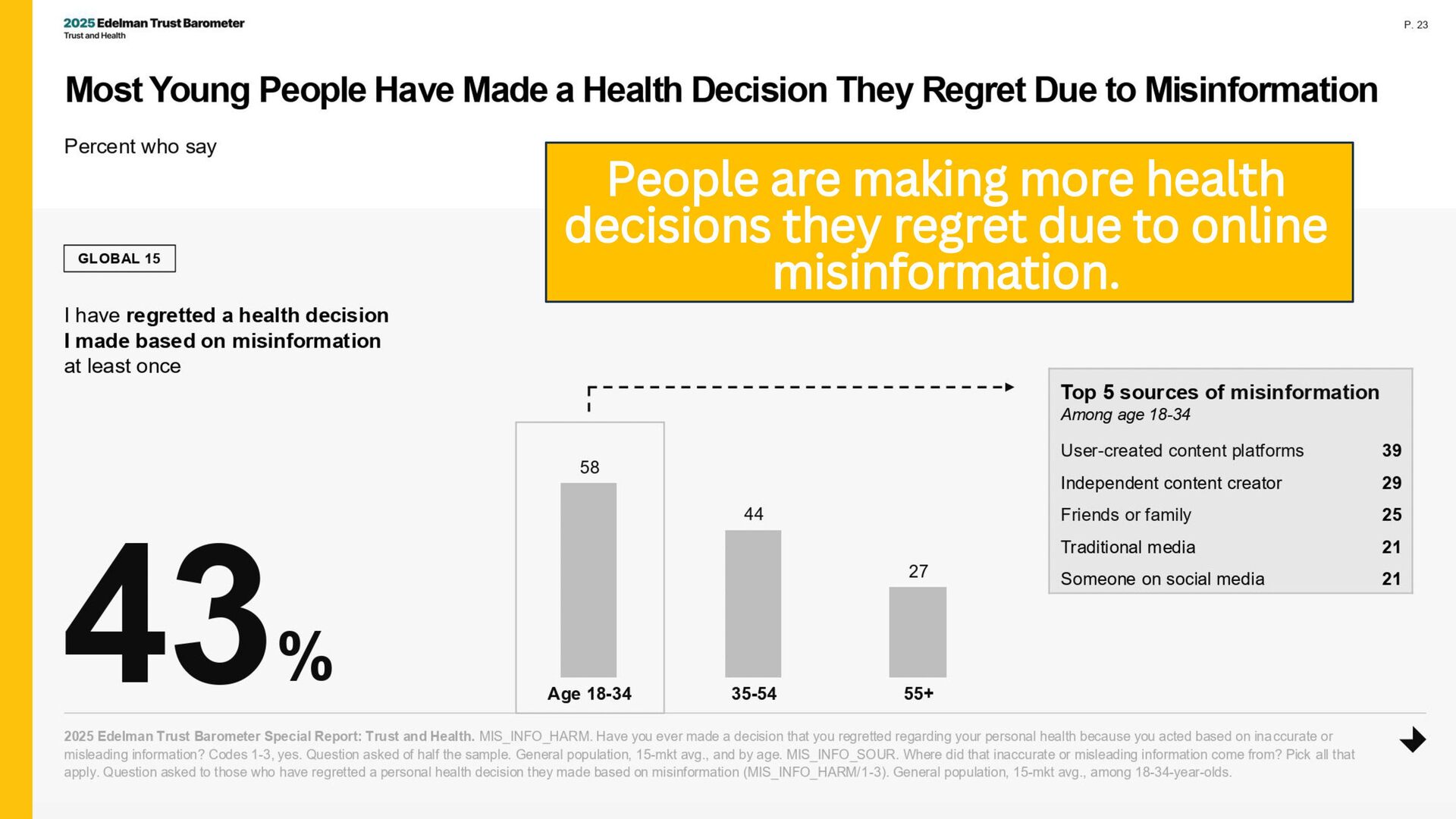
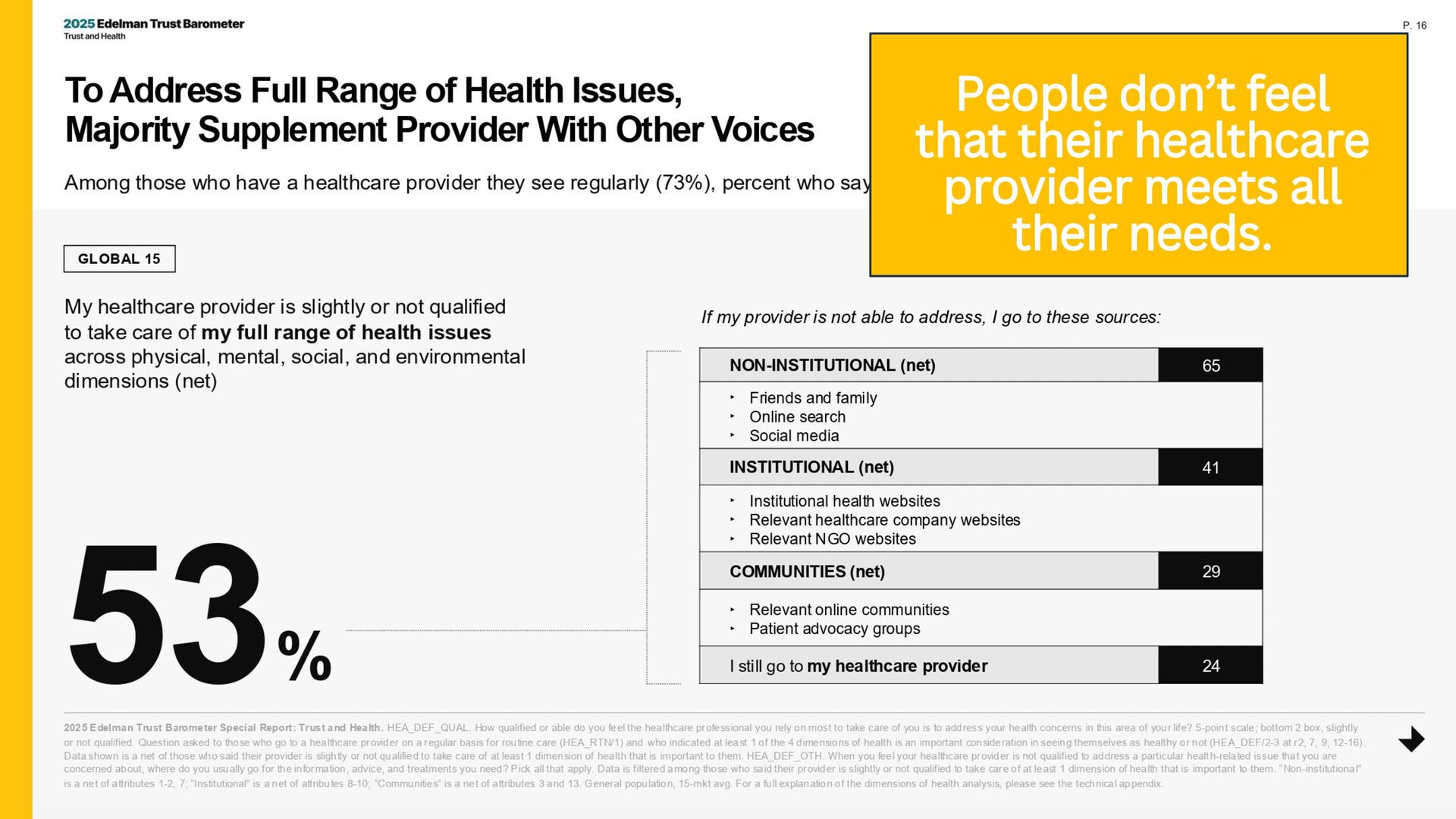
    information reaches us from many directions at once: platforms, advertisers, AI tools, and the people we trust. Some of it is accurate, some is misleading, and much of it is somewhere in between.
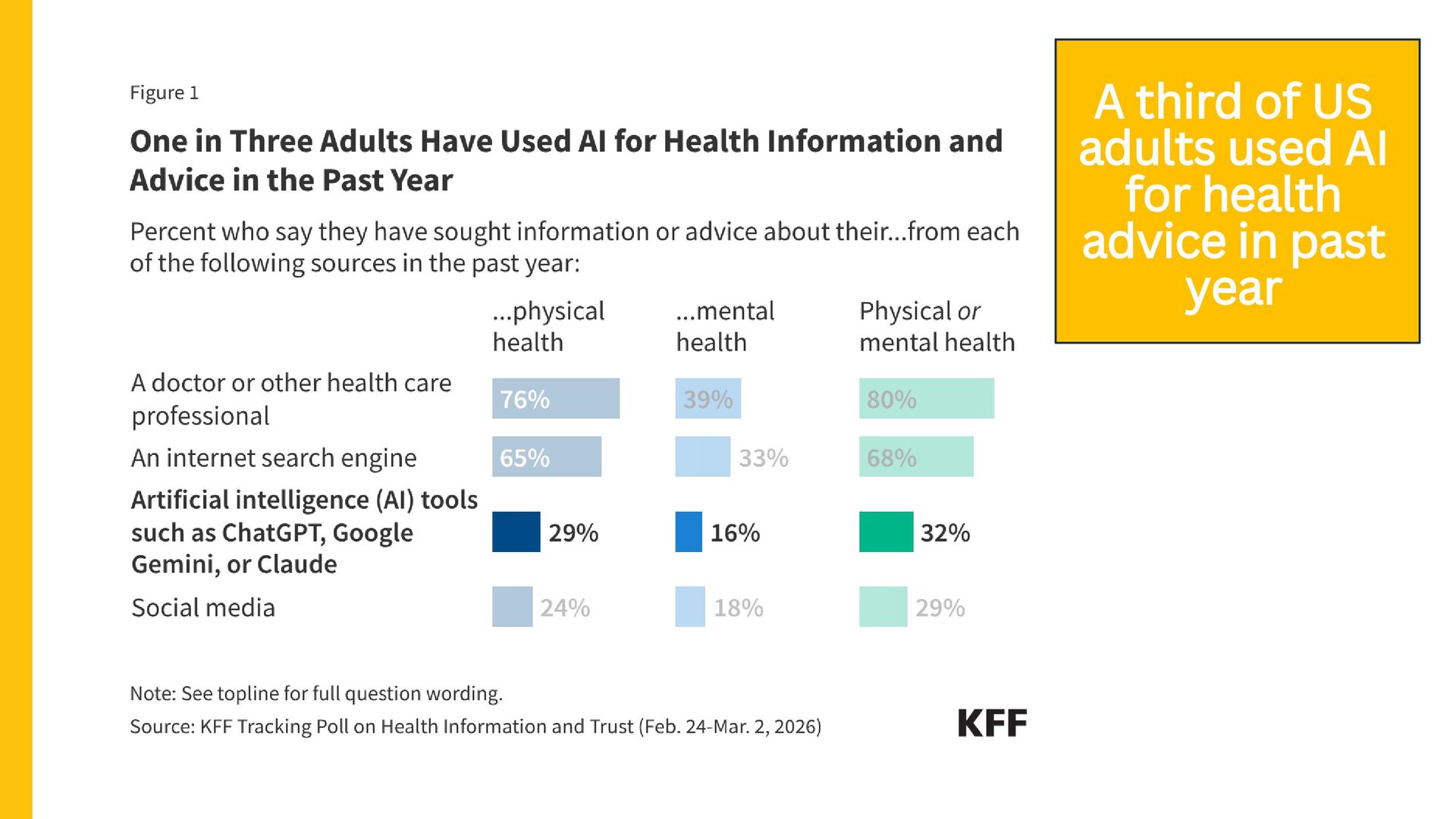
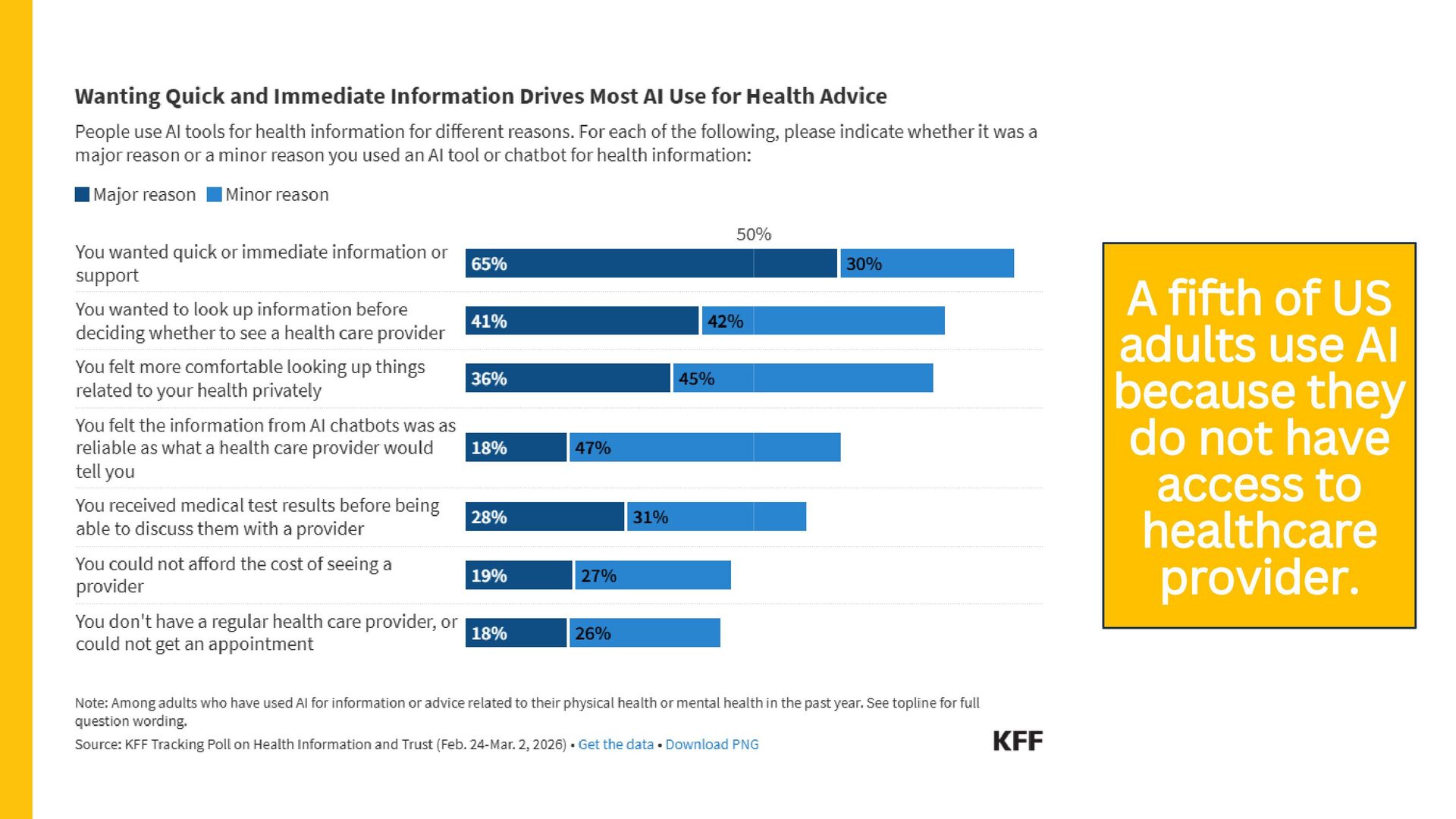
  5. A fifth of US adults use AI because they do

    not have access to healthcare provider.
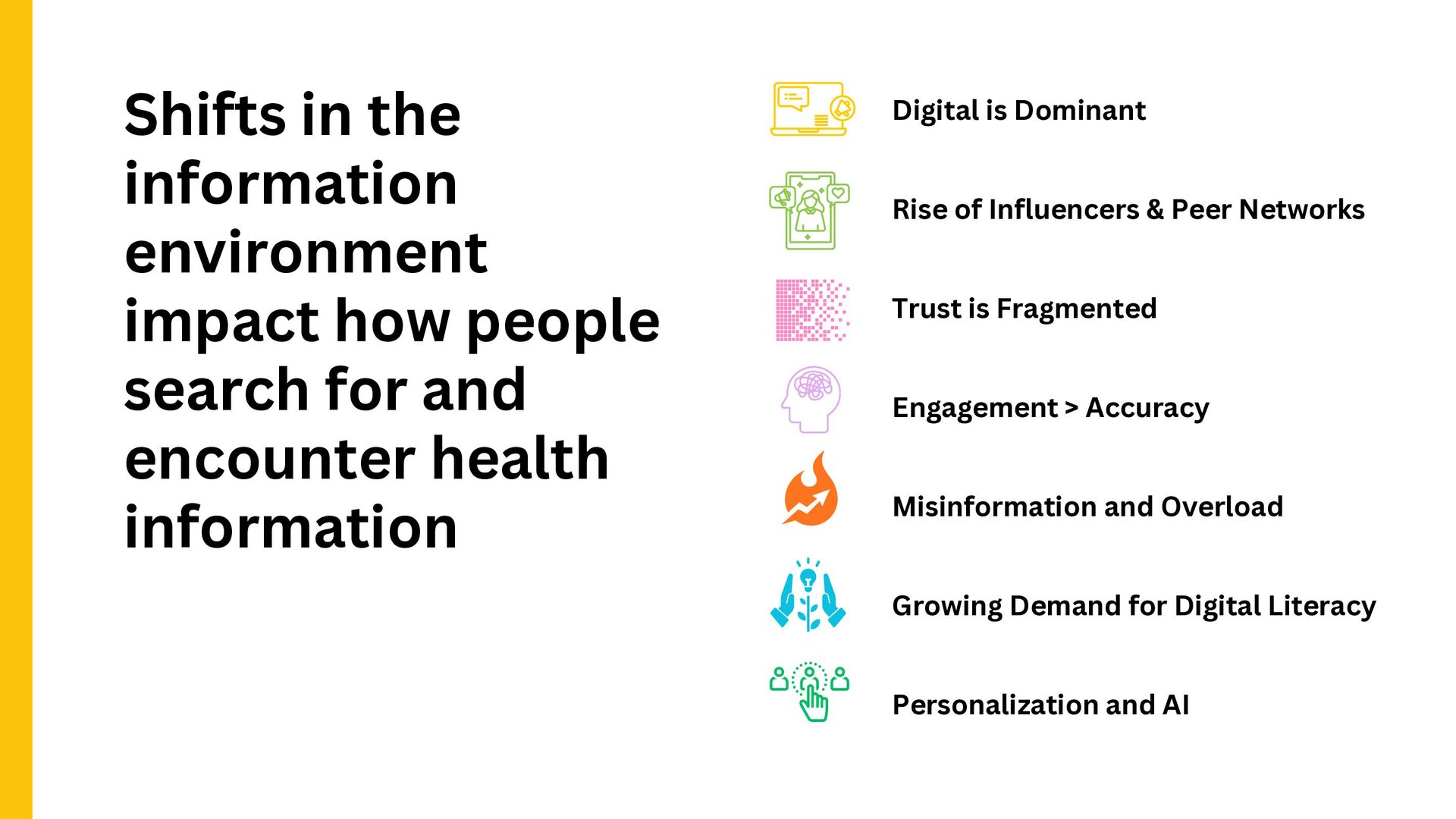
  6. Shifts in the information environment impact how people search for

    and encounter health information Digital is Dominant Rise of Influencers & Peer Networks Trust is Fragmented Engagement > Accuracy Misinformation and Overload Growing Demand for Digital Literacy Personalization and AI
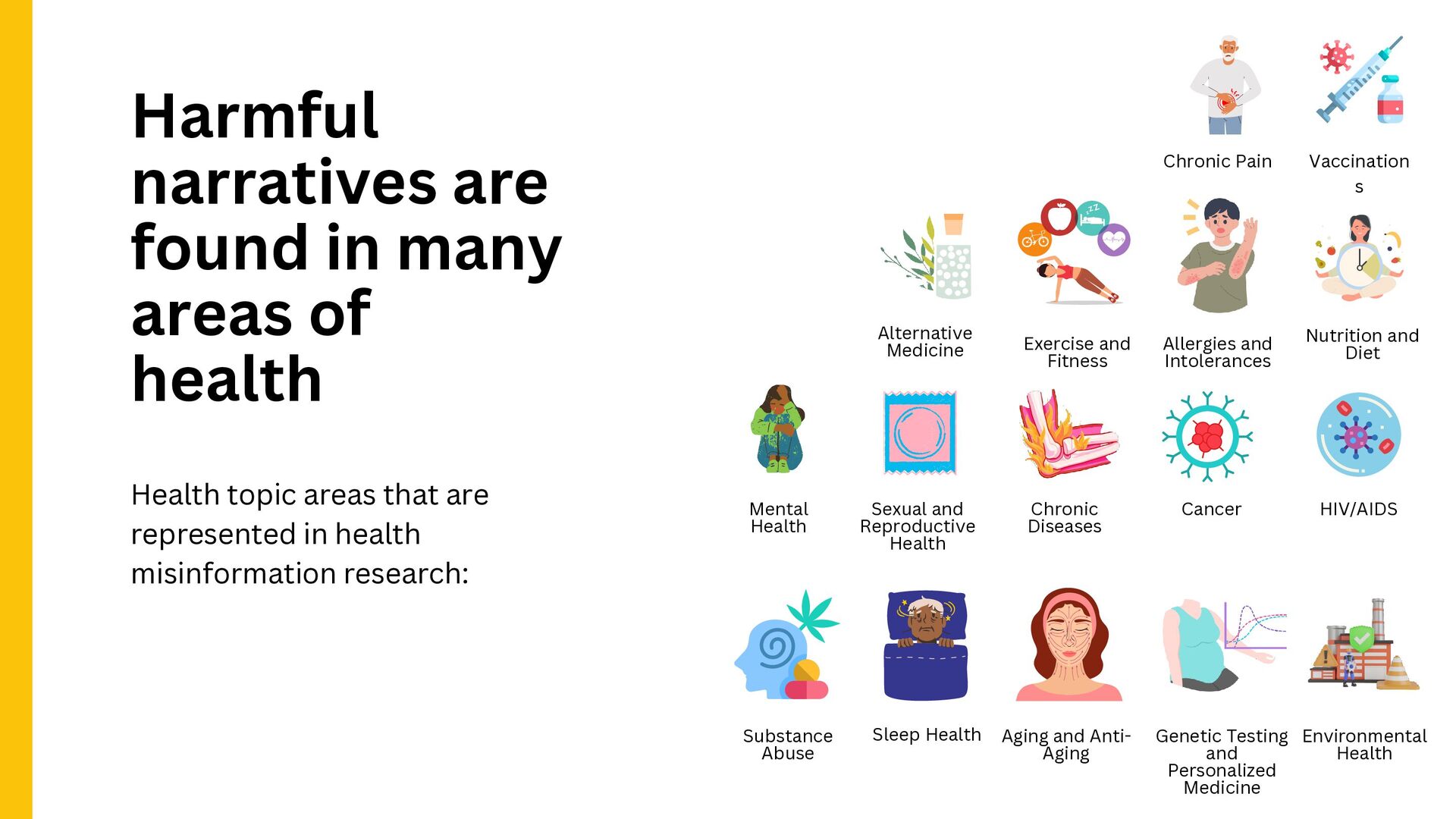
  7. Harmful narratives are found in many areas of health Health

    topic areas that are represented in health misinformation research: Alternative Medicine Exercise and Fitness Mental Health Sexual and Reproductive Health Chronic Diseases Substance Abuse Sleep Health Aging and AntiAging Chronic Pain Vaccination s Allergies and Intolerances Nutrition and Diet Cancer HIV/AIDS Genetic Testing Environmental and Health Personalized Medicine
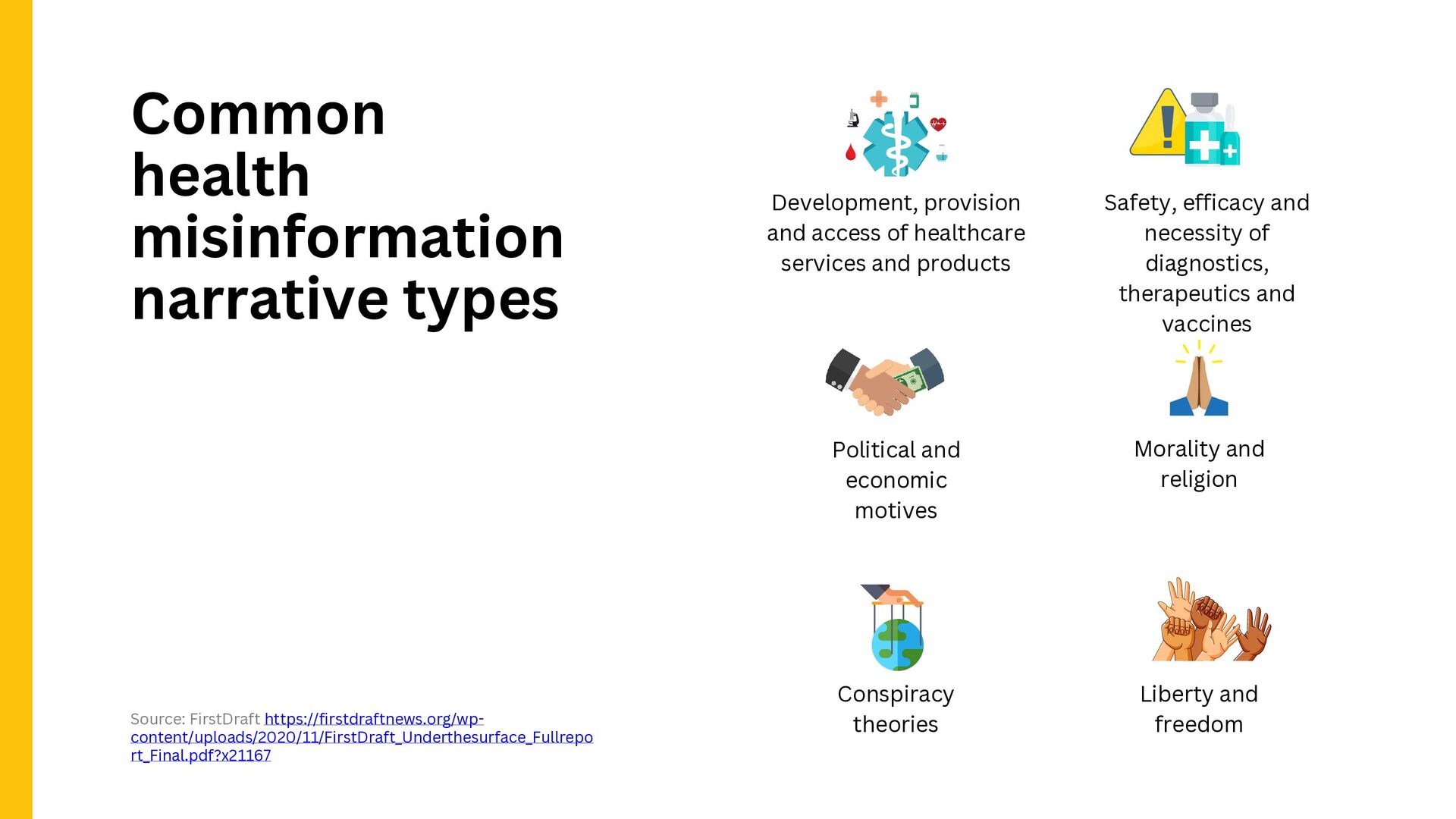
  8. Common health misinformation narrative types Source: FirstDraft https://firstdraftnews.org/wpcontent/uploads/2020/11/FirstDraft_Underthesurface_Fullrepo rt_Final.pdf?x21167 Development,

    provision and access of healthcare services and products Safety, efficacy and necessity of diagnostics, therapeutics and vaccines Political and economic motives Morality and religion Conspiracy theories Liberty and freedom
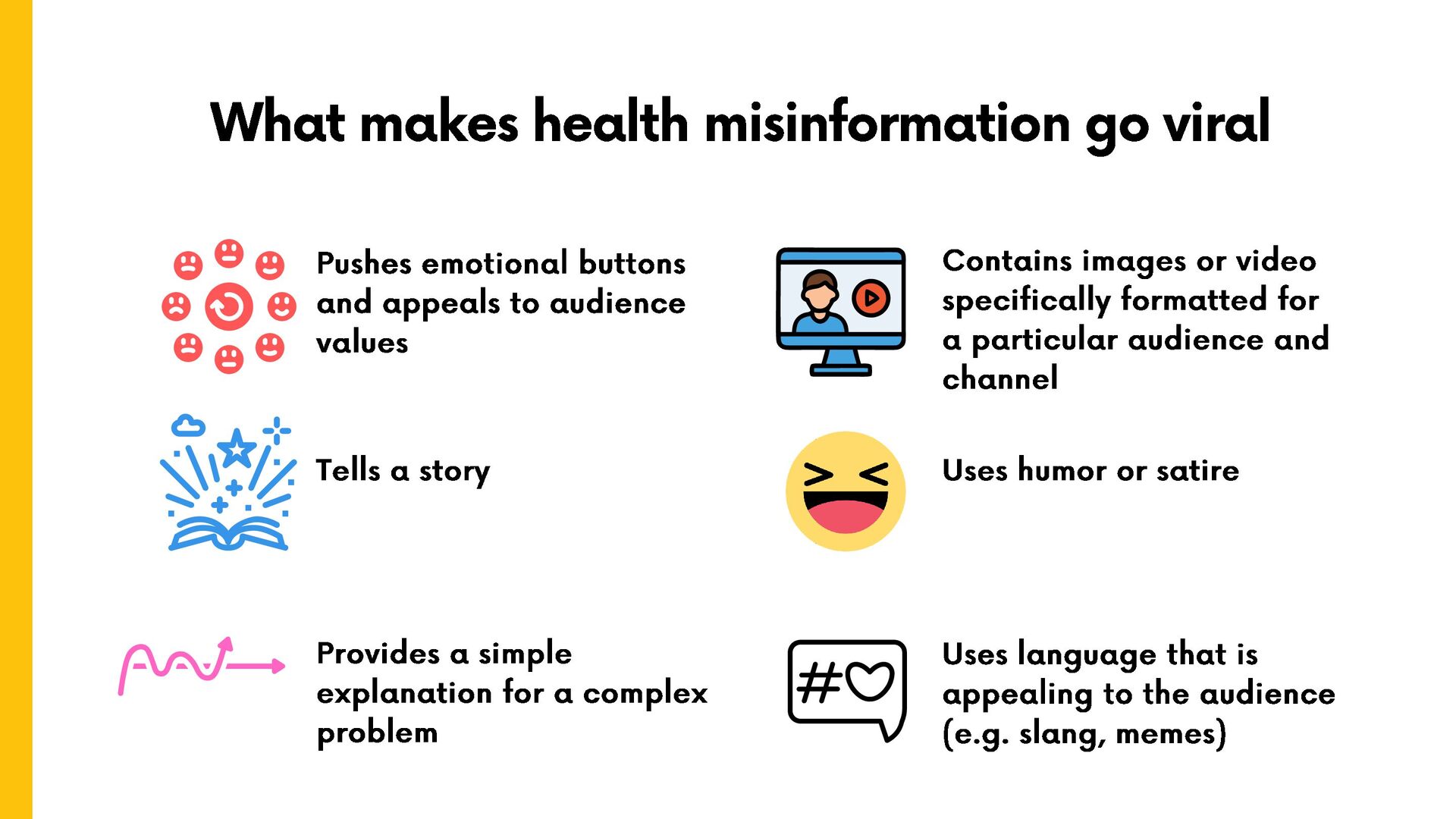
  9. What makes health misinformation go viral A “viral” narrative: Pushes

    emotional buttons and appeals to audience values Contains images or video specifically formatted for a particular audience and channel Tells a story Uses humor or satire Provides a simple explanation for a complex problem Uses language that is appealing to the audience (e.g. slang, memes)
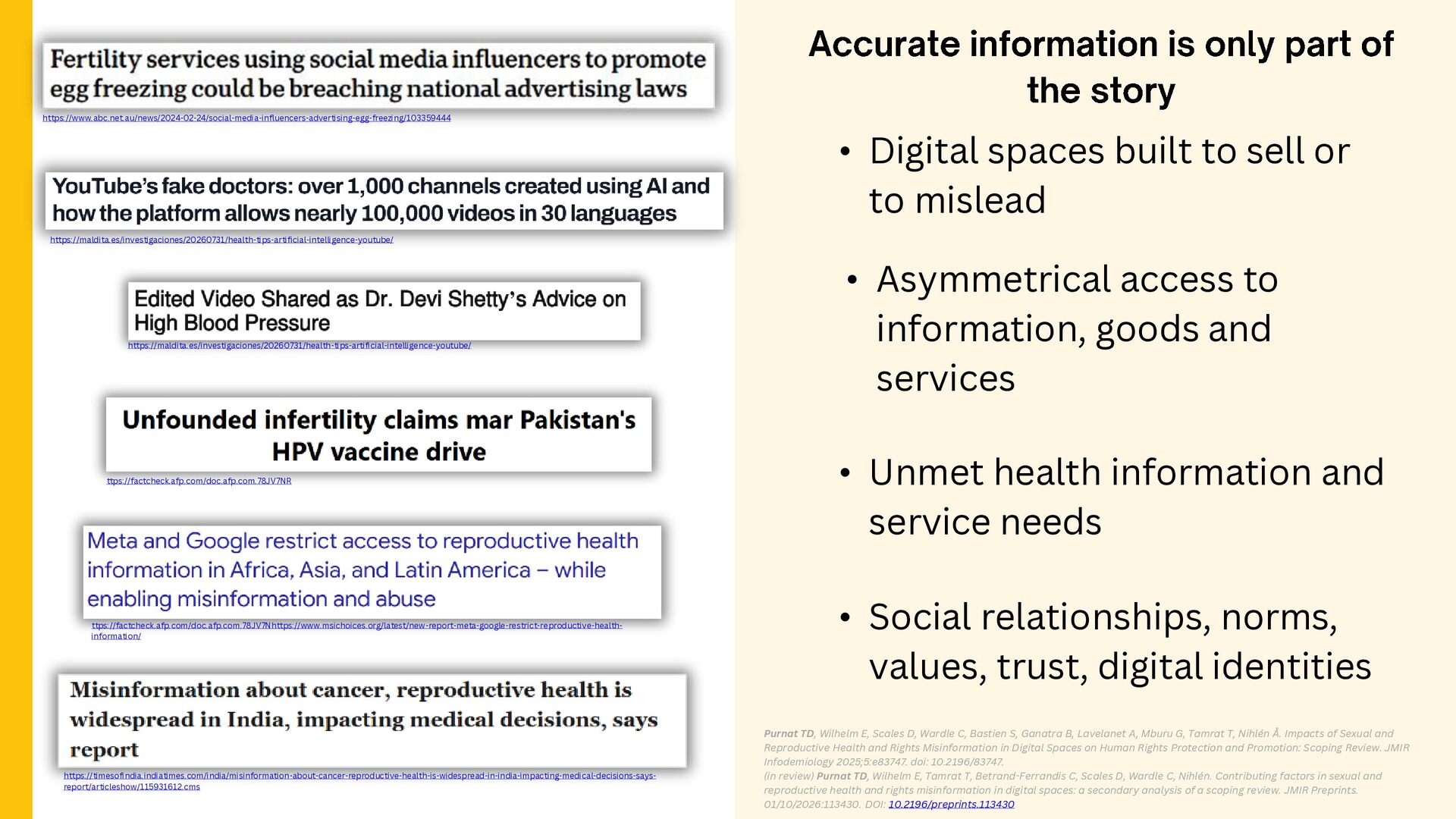
  10. Accurate information is only part of the story https://www.abc.net.au/news/2024-02-24/social-media-influencers-advertising-egg-freezing/103359444 •

    Digital spaces built to sell or to mislead https://maldita.es/investigaciones/20260731/health-tips-artificial-intelligence-youtube/ https://maldita.es/investigaciones/20260731/health-tips-artificial-intelligence-youtube/ ttps://factcheck.afp.com/doc.afp.com.78JV7NR ttps://factcheck.afp.com/doc.afp.com.78JV7Nhttps://www.msichoices.org/latest/new-report-meta-google-restrict-reproductive-healthinformation/ https://timesofindia.indiatimes.com/india/misinformation-about-cancer-reproductive-health-is-widespread-in-india-impacting-medical-decisions-saysreport/articleshow/115931612.cms • Asymmetrical access to information, goods and services • Unmet health information and service needs • Social relationships, norms, values, trust, digital identities Purnat TD, Wilhelm E, Scales D, Wardle C, Bastien S, Ganatra B, Lavelanet A, Mburu G, Tamrat T, Nihlén Å. Impacts of Sexual and Reproductive Health and Rights Misinformation in Digital Spaces on Human Rights Protection and Promotion: Scoping Review. JMIR Infodemiology 2025;5:e83747. doi: 10.2196/83747. (in review) Purnat TD, Wilhelm E, Tamrat T, Betrand-Ferrandis C, Scales D, Wardle C, Nihlén. Contributing factors in sexual and reproductive health and rights misinformation in digital spaces: a secondary analysis of a scoping review. JMIR Preprints. 01/10/2026:113430. DOI: 10.2196/preprints.113430
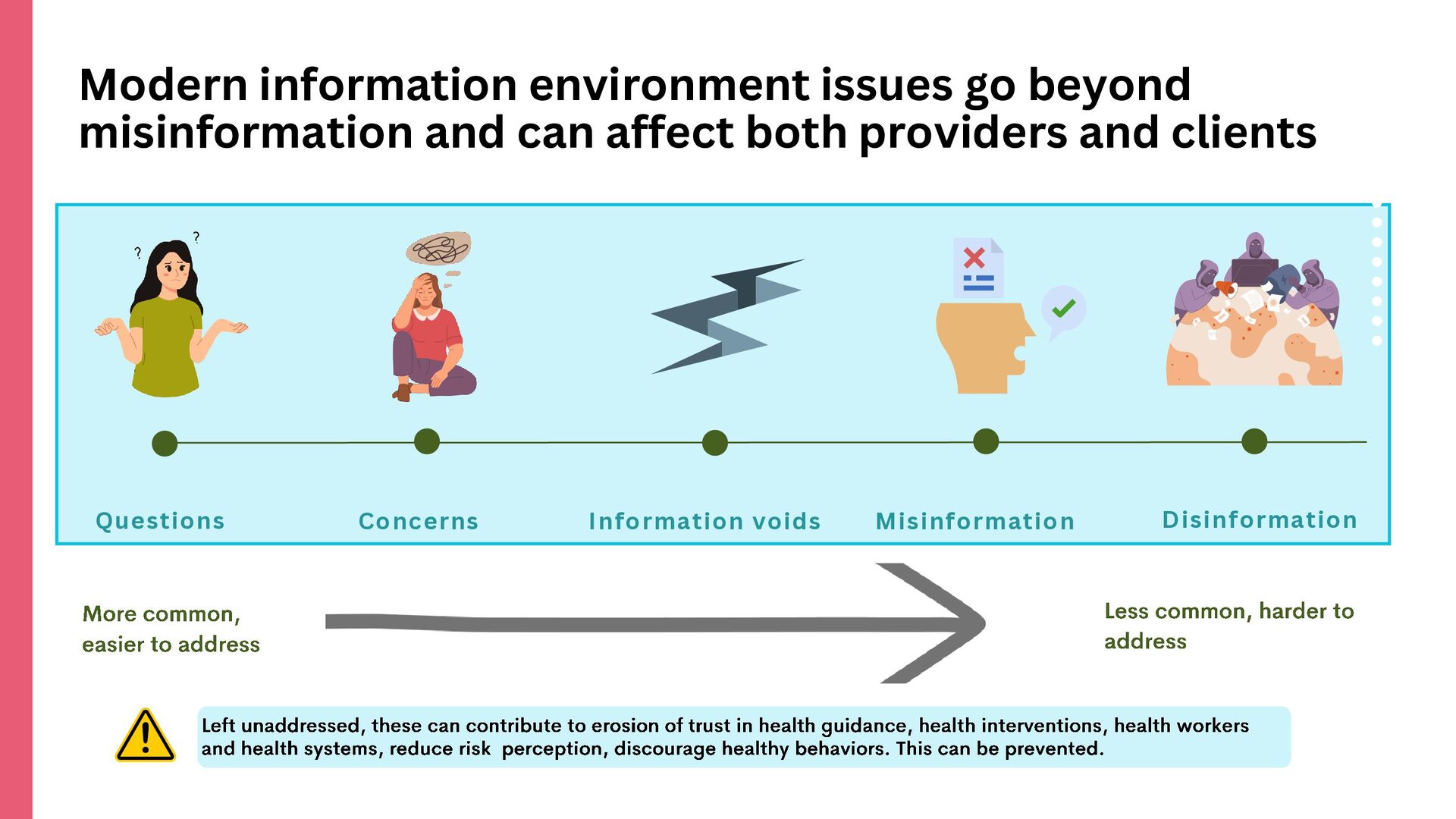
  11. Modern information environment issues go beyond misinformation and can affect

    both providers and clients Questions More common, easier to address Concerns Information voids Disinformation Misinformation Less common, harder to address Left unaddressed, these can contribute to erosion of trust in health guidance, health interventions, health workers and health systems, reduce risk perception, discourage healthy behaviors. This can be prevented.
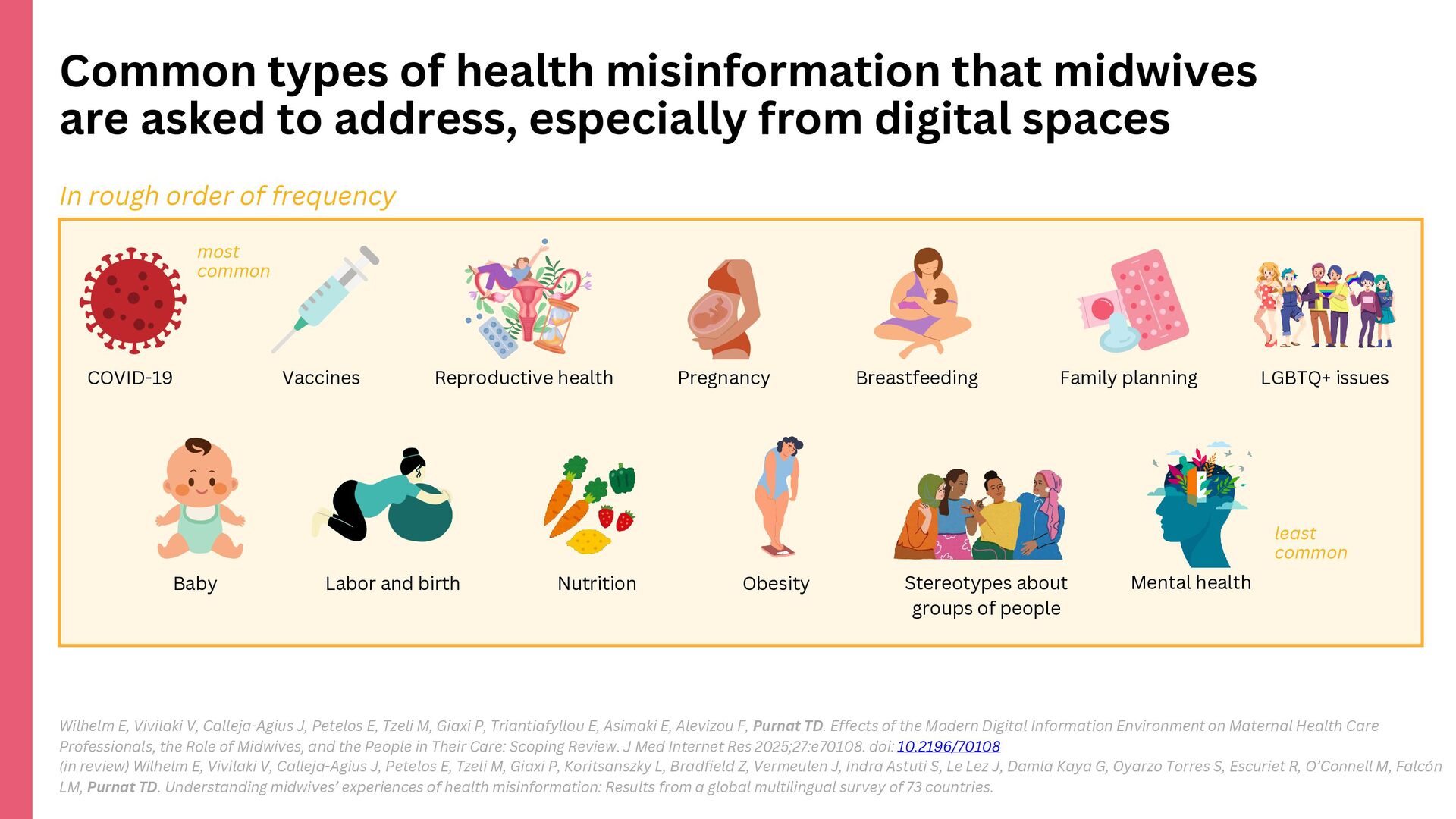
  12. Common types of health misinformation that midwives are asked to

    address, especially from digital spaces In rough order of frequency most common COVID-19 Vaccines Reproductive health Pregnancy Breastfeeding Family planning LGBTQ+ issues least common Baby Labor and birth Nutrition Obesity Stereotypes about groups of people Mental health Wilhelm E, Vivilaki V, Calleja-Agius J, Petelos E, Tzeli M, Giaxi P, Triantiafyllou E, Asimaki E, Alevizou F, Purnat TD. Effects of the Modern Digital Information Environment on Maternal Health Care Professionals, the Role of Midwives, and the People in Their Care: Scoping Review. J Med Internet Res 2025;27:e70108. doi: 10.2196/70108 (in review) Wilhelm E, Vivilaki V, Calleja-Agius J, Petelos E, Tzeli M, Giaxi P, Koritsanszky L, Bradfield Z, Vermeulen J, Indra Astuti S, Le Lez J, Damla Kaya G, Oyarzo Torres S, Escuriet R, O’Connell M, Falcón LM, Purnat TD. Understanding midwives’ experiences of health misinformation: Results from a global multilingual survey of 73 countries.
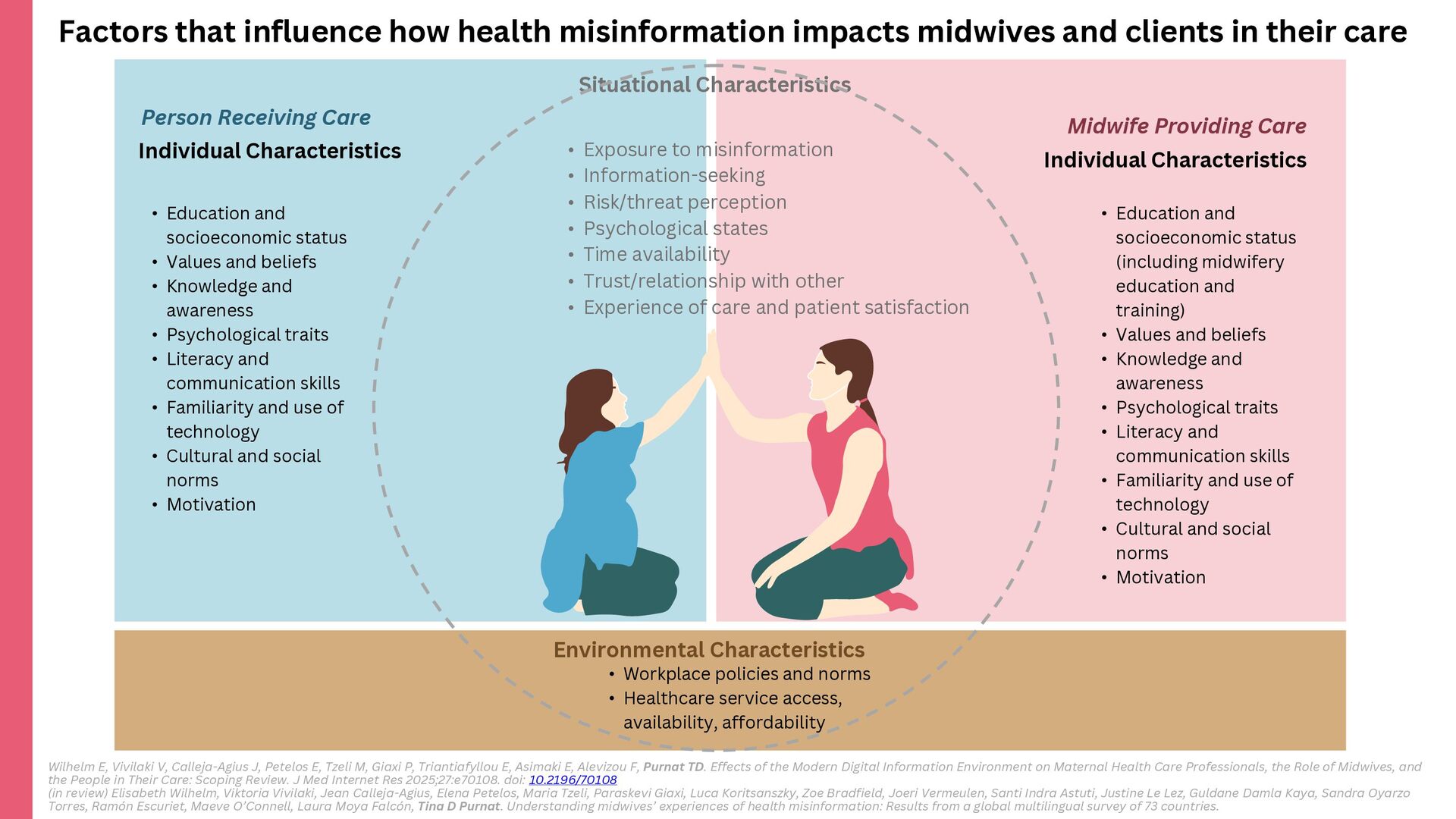
  13. Factors that influence how health misinformation impacts midwives and clients

    in their care Situational Characteristics Person Receiving Care Individual Characteristics • Education and socioeconomic status • Values and beliefs • Knowledge and awareness • Psychological traits • Literacy and communication skills • Familiarity and use of technology • Cultural and social norms • Motivation • Exposure to misinformation • Information-seeking • Risk/threat perception • Psychological states • Time availability • Trust/relationship with other • Experience of care and patient satisfaction Midwife Providing Care Individual Characteristics • Education and socioeconomic status (including midwifery education and training) • Values and beliefs • Knowledge and awareness • Psychological traits • Literacy and communication skills • Familiarity and use of technology • Cultural and social norms • Motivation Environmental Characteristics • Workplace policies and norms • Healthcare service access, availability, affordability Wilhelm E, Vivilaki V, Calleja-Agius J, Petelos E, Tzeli M, Giaxi P, Triantiafyllou E, Asimaki E, Alevizou F, Purnat TD. Effects of the Modern Digital Information Environment on Maternal Health Care Professionals, the Role of Midwives, and the People in Their Care: Scoping Review. J Med Internet Res 2025;27:e70108. doi: 10.2196/70108 (in review) Elisabeth Wilhelm, Viktoria Vivilaki, Jean Calleja-Agius, Elena Petelos, Maria Tzeli, Paraskevi Giaxi, Luca Koritsanszky, Zoe Bradfield, Joeri Vermeulen, Santi Indra Astuti, Justine Le Lez, Guldane Damla Kaya, Sandra Oyarzo Torres, Ramón Escuriet, Maeve O’Connell, Laura Moya Falcón, Tina D Purnat. Understanding midwives’ experiences of health misinformation: Results from a global multilingual survey of 73 countries.
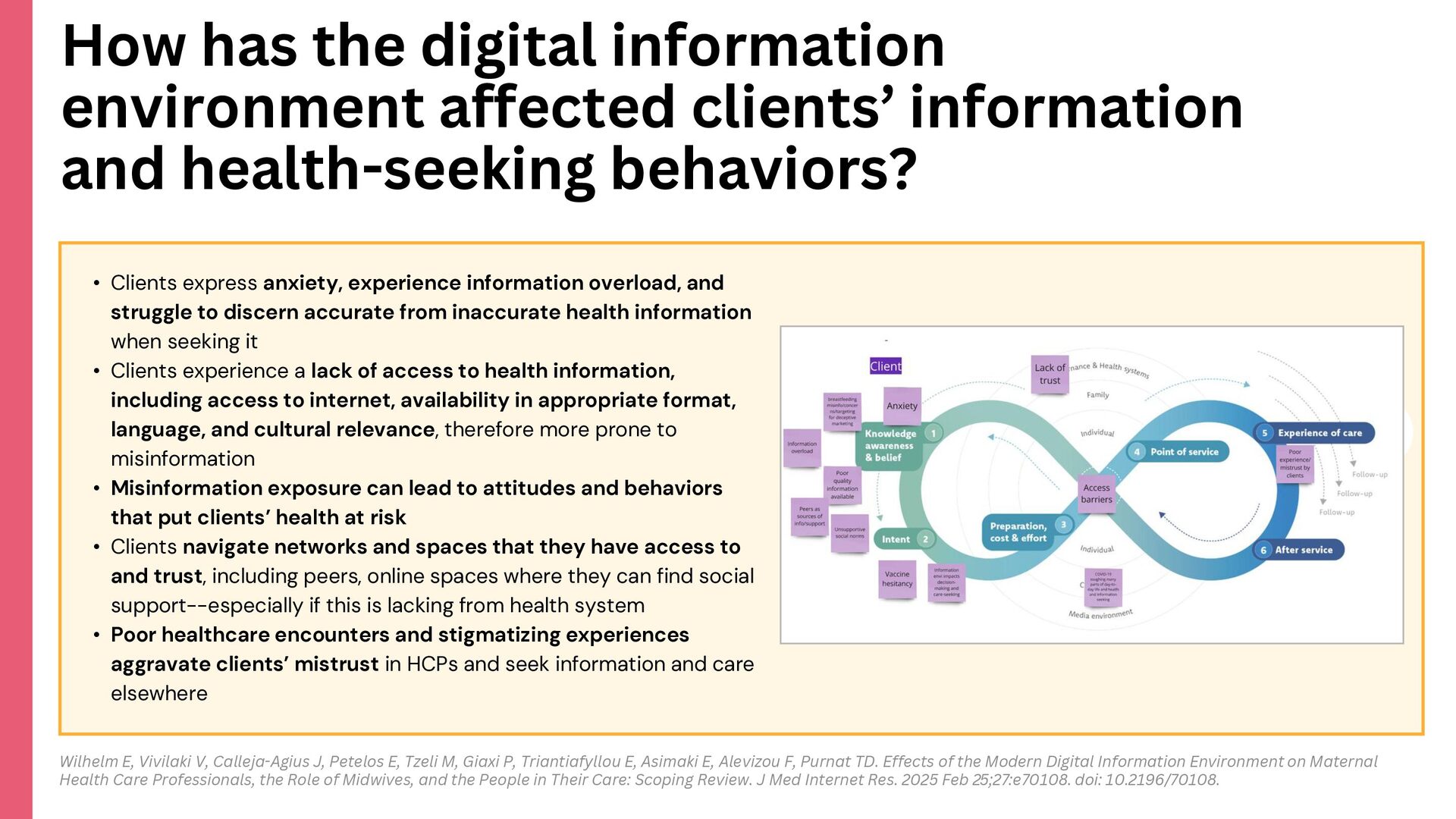
  14. How has the digital information environment affected clients’ information and

    health-seeking behaviors? • Clients express anxiety, experience information overload, and struggle to discern accurate from inaccurate health information when seeking it • Clients experience a lack of access to health information, including access to internet, availability in appropriate format, language, and cultural relevance, therefore more prone to misinformation • Misinformation exposure can lead to attitudes and behaviors that put clients’ health at risk • Clients navigate networks and spaces that they have access to and trust, including peers, online spaces where they can find social support--especially if this is lacking from health system • Poor healthcare encounters and stigmatizing experiences aggravate clients’ mistrust in HCPs and seek information and care elsewhere Wilhelm E, Vivilaki V, Calleja-Agius J, Petelos E, Tzeli M, Giaxi P, Triantiafyllou E, Asimaki E, Alevizou F, Purnat TD. Effects of the Modern Digital Information Environment on Maternal Health Care Professionals, the Role of Midwives, and the People in Their Care: Scoping Review. J Med Internet Res. 2025 Feb 25;27:e70108. doi: 10.2196/70108.
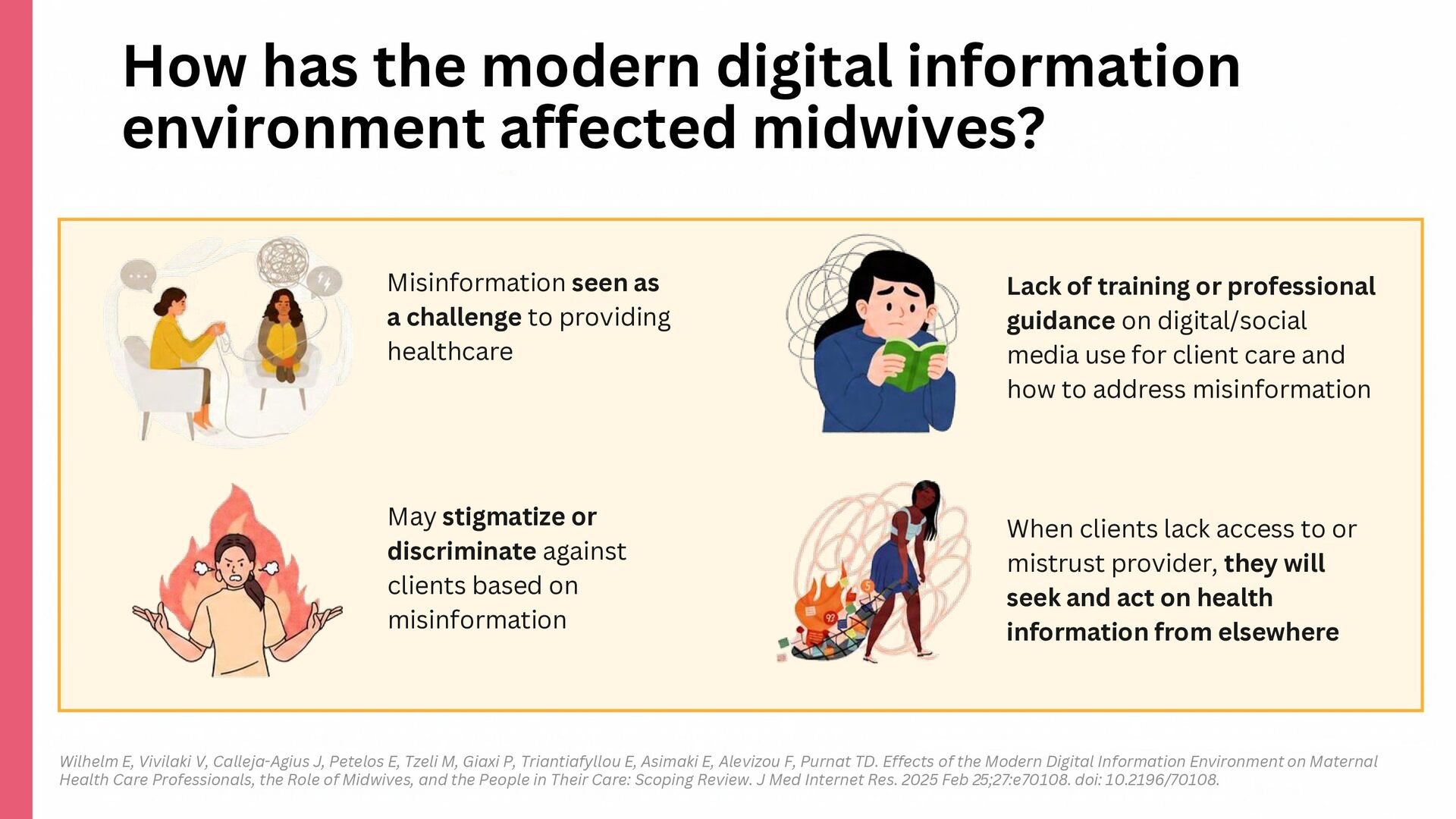
  15. How has the modern digital information environment affected midwives? Misinformation

    seen as a challenge to providing healthcare Lack of training or professional guidance on digital/social media use for client care and how to address misinformation May stigmatize or discriminate against clients based on misinformation When clients lack access to or mistrust provider, they will seek and act on health information from elsewhere Wilhelm E, Vivilaki V, Calleja-Agius J, Petelos E, Tzeli M, Giaxi P, Triantiafyllou E, Asimaki E, Alevizou F, Purnat TD. Effects of the Modern Digital Information Environment on Maternal Health Care Professionals, the Role of Midwives, and the People in Their Care: Scoping Review. J Med Internet Res. 2025 Feb 25;27:e70108. doi: 10.2196/70108.
  16. “Mistrust is the outgrowth of the perception that promises were

    broken and values were violated .” -- Dr. Barbara Reynolds
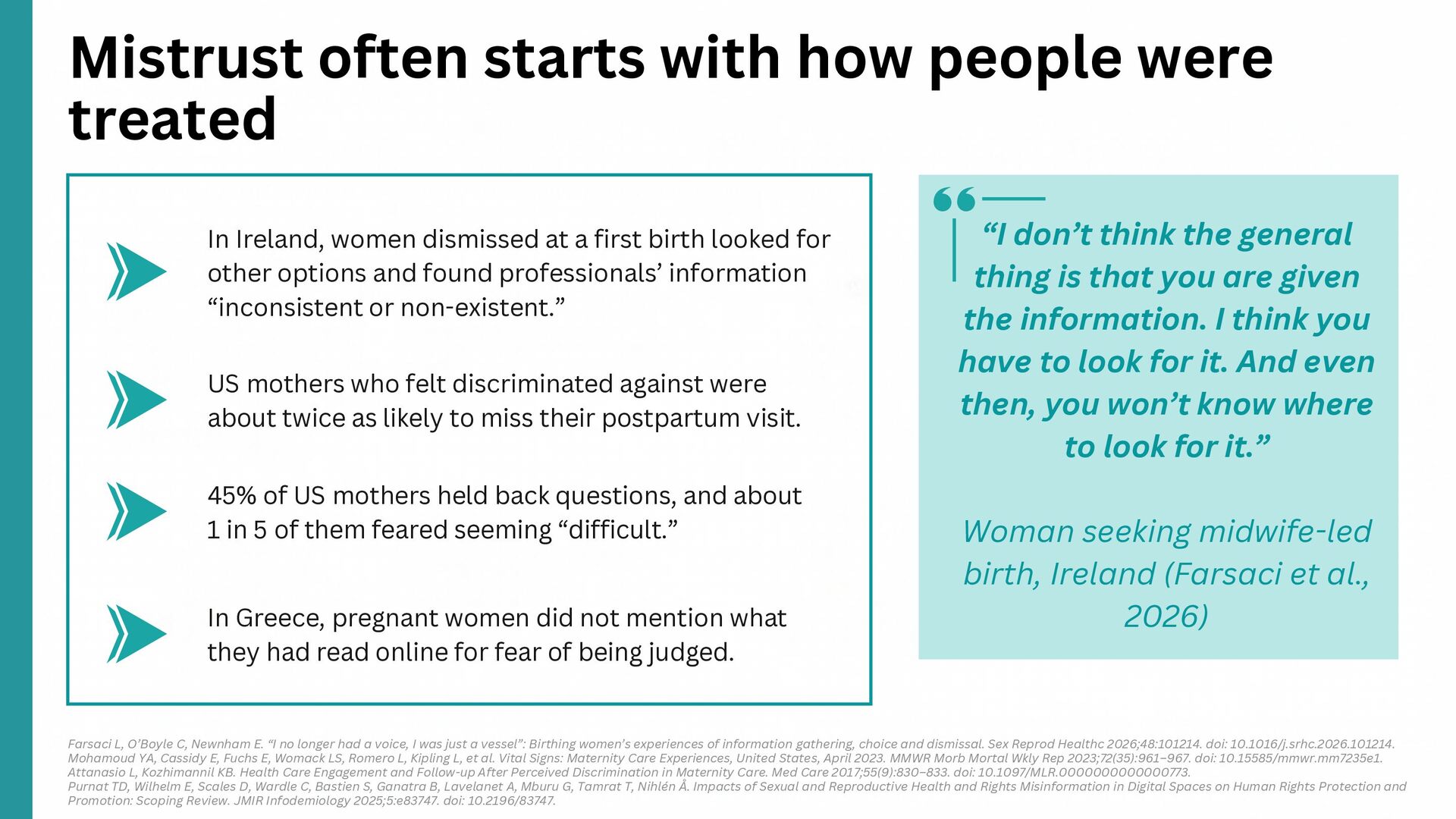
  17. Mistrust often starts with how people were treated In Ireland,

    women dismissed at a first birth looked for other options and found professionals’ information “inconsistent or non-existent.” US mothers who felt discriminated against were about twice as likely to miss their postpartum visit. 45% of US mothers held back questions, and about 1 in 5 of them feared seeming “difficult.” In Greece, pregnant women did not mention what they had read online for fear of being judged. “I don’t think the general thing is that you are given the information. I think you have to look for it. And even then, you won’t know where to look for it.” Woman seeking midwife-led birth, Ireland (Farsaci et al., 2026) Farsaci L, O’Boyle C, Newnham E. “I no longer had a voice, I was just a vessel”: Birthing women’s experiences of information gathering, choice and dismissal. Sex Reprod Healthc 2026;48:101214. doi: 10.1016/j.srhc.2026.101214. Mohamoud YA, Cassidy E, Fuchs E, Womack LS, Romero L, Kipling L, et al. Vital Signs: Maternity Care Experiences, United States, April 2023. MMWR Morb Mortal Wkly Rep 2023;72(35):961–967. doi: 10.15585/mmwr.mm7235e1. Attanasio L, Kozhimannil KB. Health Care Engagement and Follow-up After Perceived Discrimination in Maternity Care. Med Care 2017;55(9):830–833. doi: 10.1097/MLR.0000000000000773. Purnat TD, Wilhelm E, Scales D, Wardle C, Bastien S, Ganatra B, Lavelanet A, Mburu G, Tamrat T, Nihlén Å. Impacts of Sexual and Reproductive Health and Rights Misinformation in Digital Spaces on Human Rights Protection and Promotion: Scoping Review. JMIR Infodemiology 2025;5:e83747. doi: 10.2196/83747.
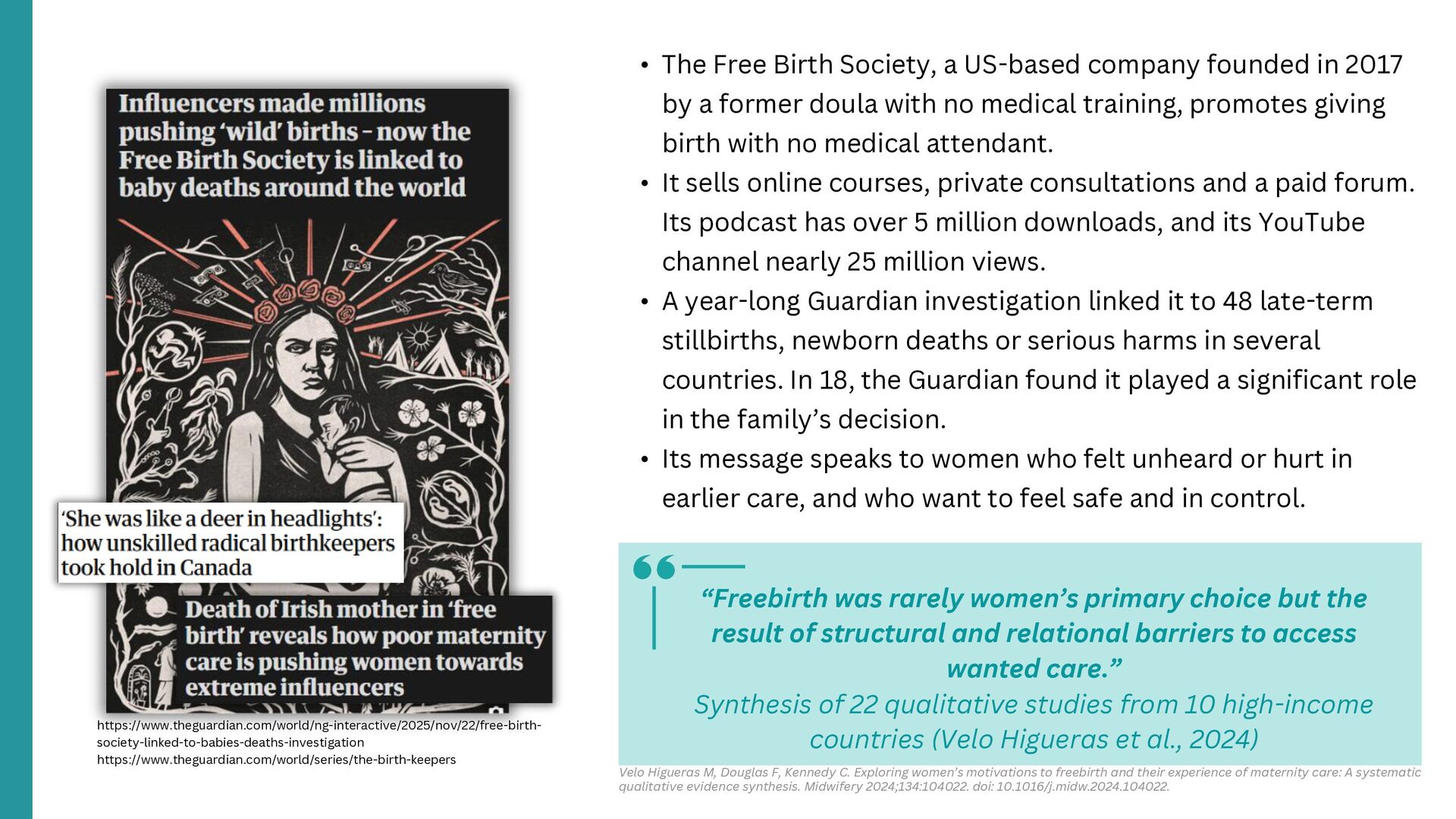
  18. • The Free Birth Society, a US-based company founded in

    2017 by a former doula with no medical training, promotes giving birth with no medical attendant. • It sells online courses, private consultations and a paid forum. Its podcast has over 5 million downloads, and its YouTube channel nearly 25 million views. • A year-long Guardian investigation linked it to 48 late-term stillbirths, newborn deaths or serious harms in several countries. In 18, the Guardian found it played a significant role in the family’s decision. • Its message speaks to women who felt unheard or hurt in earlier care, and who want to feel safe and in control. https://www.theguardian.com/world/ng-interactive/2025/nov/22/free-birthsociety-linked-to-babies-deaths-investigation https://www.theguardian.com/world/series/the-birth-keepers “Freebirth was rarely women’s primary choice but the result of structural and relational barriers to access wanted care.” Synthesis of 22 qualitative studies from 10 high-income countries (Velo Higueras et al., 2024) Velo Higueras M, Douglas F, Kennedy C. Exploring women’s motivations to freebirth and their experience of maternity care: A systematic qualitative evidence synthesis. Midwifery 2024;134:104022. doi: 10.1016/j.midw.2024.104022.
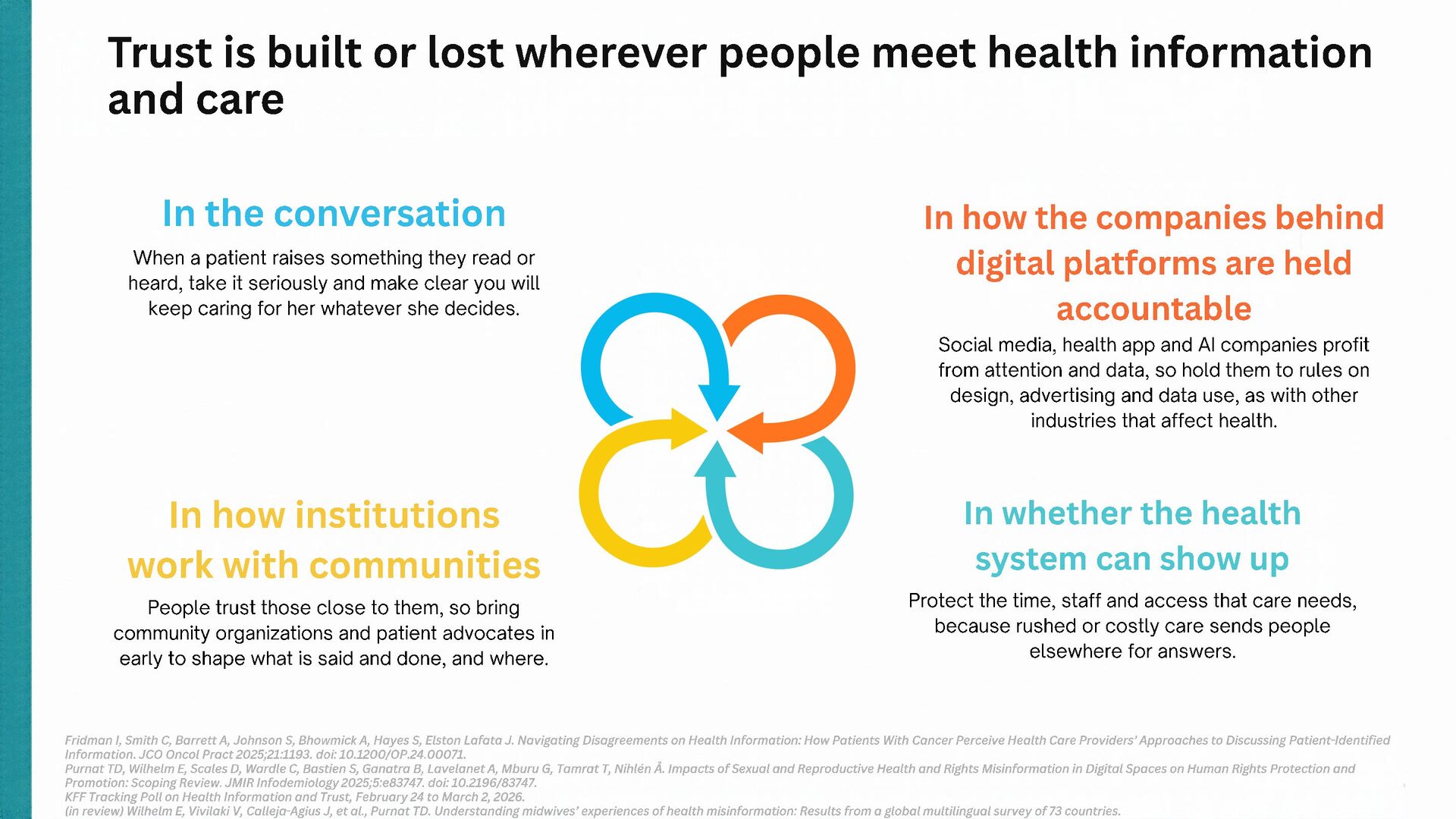
  19. Trust is built or lost wherever people meet health information

    and care In the conversation When a patient raises something they read or heard, take it seriously and make clear you will keep caring for her whatever she decides. In how the companies behind digital platforms are held accountable Social media, health app and AI companies profit from attention and data, so hold them to rules on design, advertising and data use, as with other industries that affect health. In how institutions work with communities People trust those close to them, so bring community organizations and patient advocates in early to shape what is said and done, and where. Fridman I, Smith C, Barrett A, Johnson S, Bhowmick A, Hayes S, Elston Lafata J. Navigating Disagreements on Health Informatio Information. JCO Oncol Pract 2025;21:1193. doi: 10.1200/OP.24.00071. Purnat TD, Wilhelm E, Scales D, Wardle C, Bastien S, Ganatra B, Lavelanet A, Mburu G, Tamrat T, Nihlén Å. Impacts of Sexual a Promotion: Scoping Review. JMIR Infodemiology 2025;5:e83747. doi: 10.2196/83747. KFF Tracking Poll on Health Information and Trust, February 24 to March 2, 2026. (in review) Wilhelm E, Vivilaki V, Calleja -Agius J, et al., Purnat TD. Understanding midwives’ experiences of health misinformat In whether the health system can show up Protect the time, staff and access that care needs, because rushed or costly care sends people elsewhere for answers. n: How Patients With Cancer Perceive Health Care Providers’ Approaches to Discussing Patient nd Reproductive Health and Rights Misinformation in Digital Spaces on Human Rights Protection and ion: Results from a global multilingual survey of 73 countries. -Identified
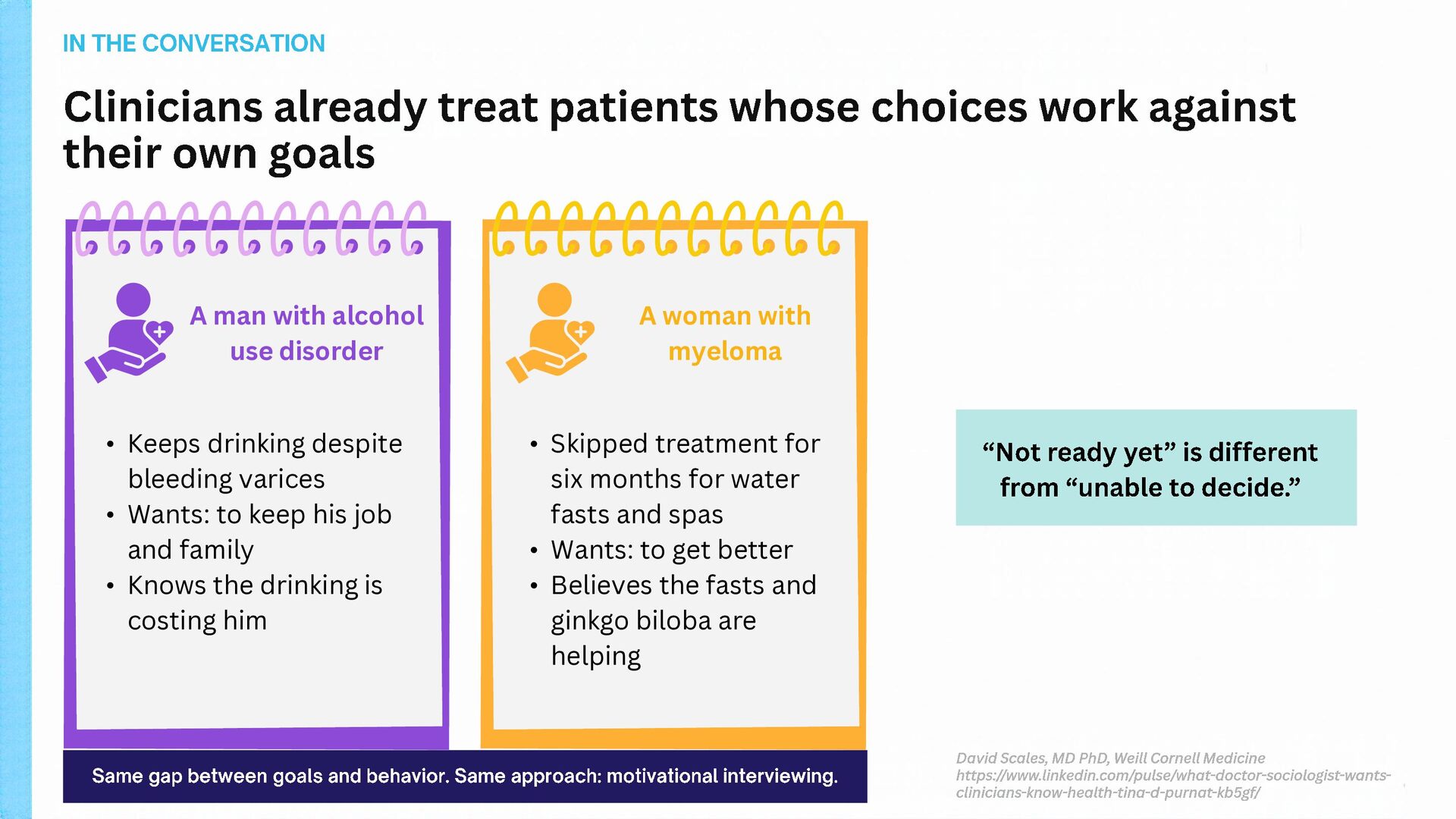
  20. IN THE CONVERSATION Clinicians already treat patients whose choices work

    against their own goals A man with alcohol use disorder • Keeps drinking despite bleeding varices • Wants: to keep his job and family • Knows the drinking is costing him A woman with myeloma • Skipped treatment for six months for water fasts and spas • Wants: to get better • Believes the fasts and ginkgo biloba are helping Same gap between goals and behavior. Same approach: motivational interviewing. “Not ready yet” is different from “unable to decide.” David Scales, MD PhD, Weill Cornell Medicine https://www.linkedin.com/pulse/what -doctor -sociologist -wants clinicians -know -health -tina -d -purnat -kb5gf/
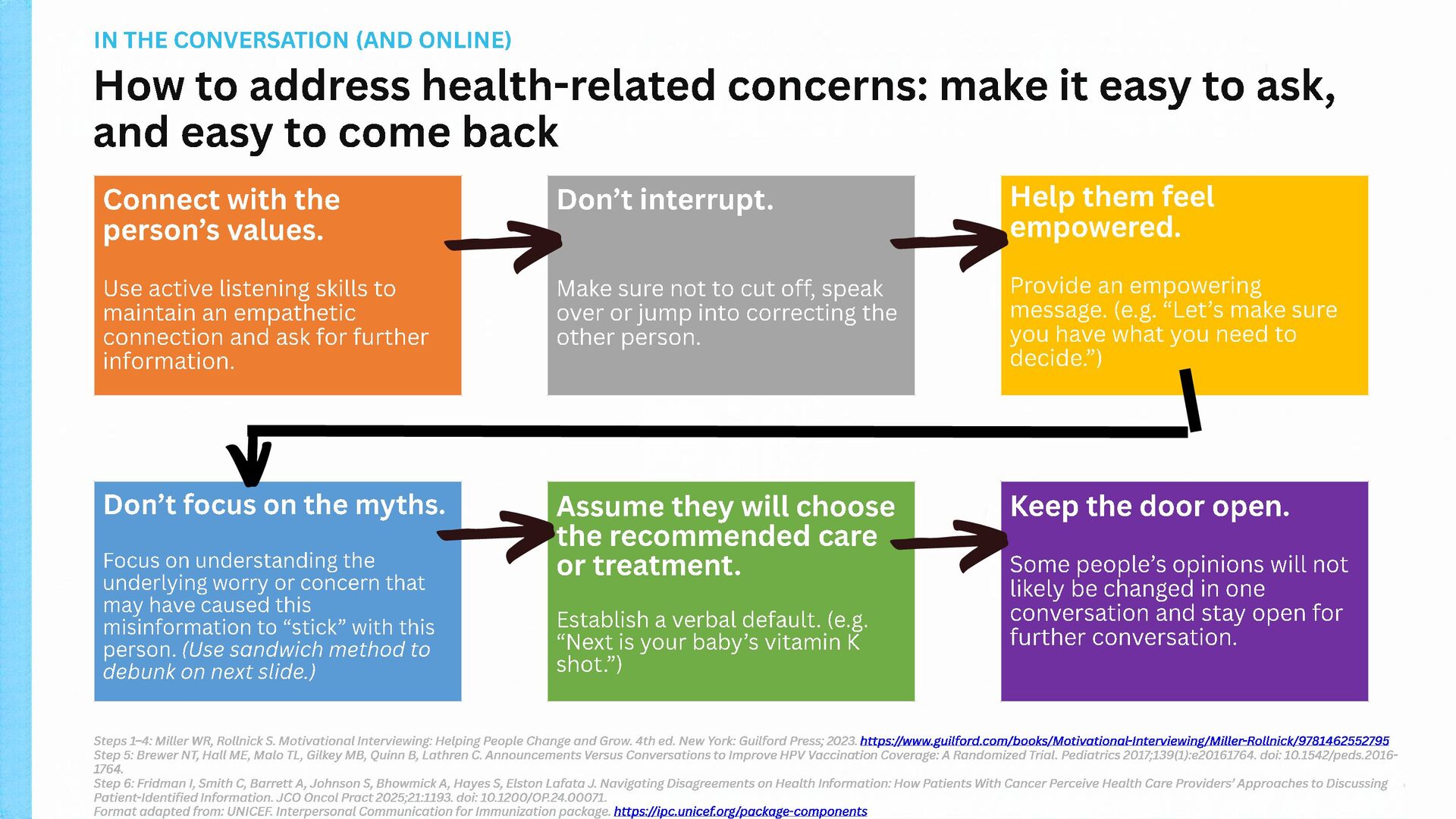
  21. IN THE CONVERSATION (AND ONLINE) How to address health and

    easy to come back -related concerns: make it easy to ask, Connect with the person’s values. Don’t interrupt. Help them feel empowered. Use active listening skills to maintain an empathetic connection and ask for further information. Make sure not to cut off, speak over or jump into correcting the other person. Provide an empowering message. (e.g. “Let’s make sure you have what you need to decide.”) Don’t focus on the myths. Assume they will choose the recommended care or treatment. Keep the door open. Focus on understanding the underlying worry or concern that may have caused this misinformation to “stick” with this person. (Use sandwich method to debunk on next slide.) Establish a verbal default. (e.g. “Next is your baby’s vitamin K shot.”) Steps 1 –4: Miller WR, Rollnick S. Motivational Interviewing: Helping People Change and Grow. 4th ed. New York: Guilford Press; 2 Step 5: Brewer NT, Hall ME, Malo TL, Gilkey MB, Quinn B, Lathren C. Announcements Versus Conversations to Improve HPV Vaccina 1764. Step 6: Fridman I, Smith C, Barrett A, Johnson S, Bhowmick A, Hayes S, Elston Lafata J. Navigating Disagreements on Health In Patient -Identified Information. JCO Oncol Pract 2025;21:1193. doi: 10.1200/OP.24.00071. Format adapted from: UNICEF. Interpersonal Communication for Immunization package. https://ipc.unicef.org/package Some people’s opinions will not likely be changed in one conversation and stay open for further conversation. 023. https://www.guilford.com/books/Motivational -Interviewing/Miller -Rollnick/9781462552795 tio n Coverage: A Randomized Trial. Pediatrics 2017;139(1):e20161764. doi: 10.1542/peds.2016 for mation: How Patients With Cancer Perceive Health Care Providers’ Approaches to Discussing -components -
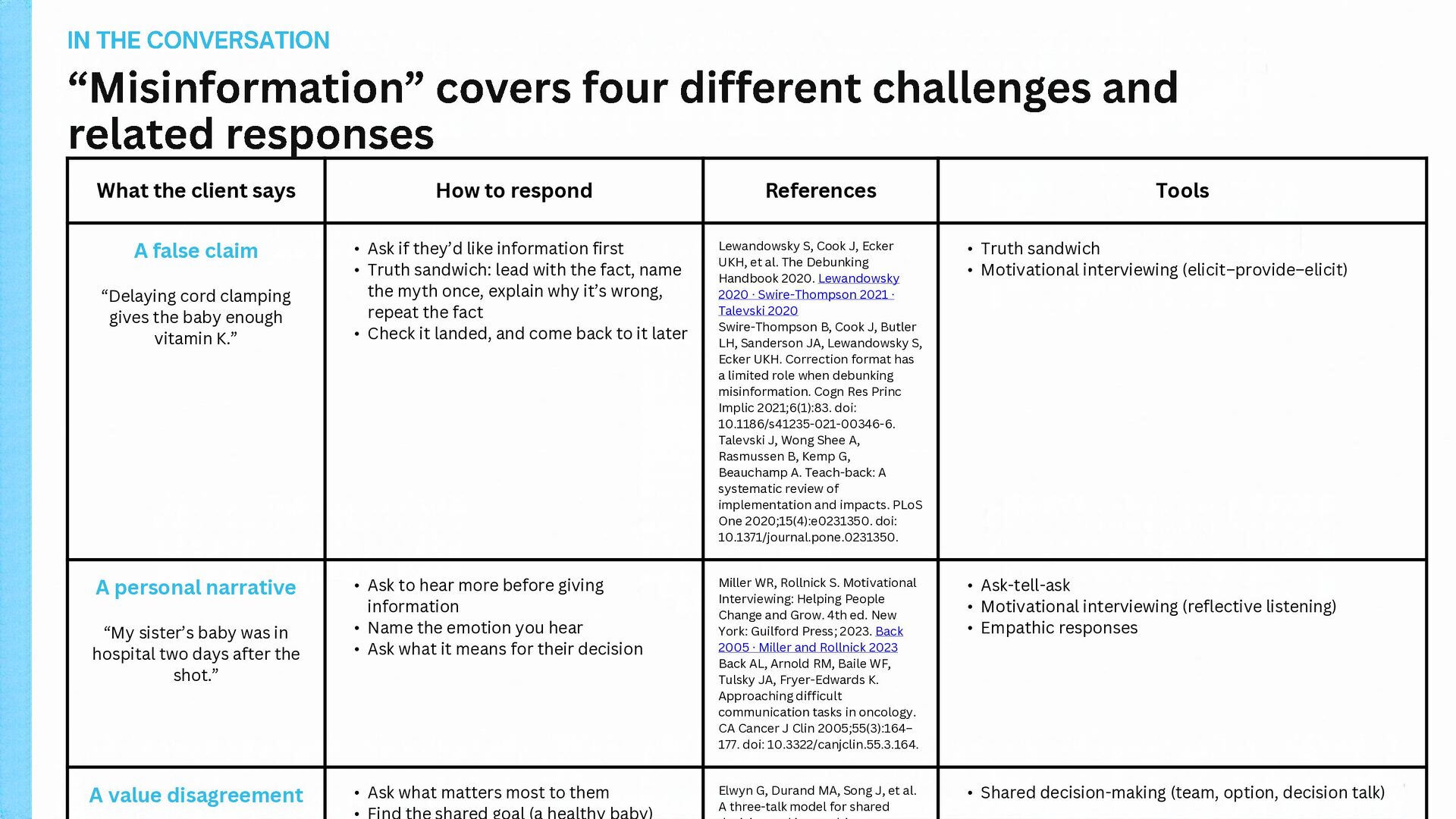
  22. IN THE CONVERSATION “Misinformation” covers four different challenges and related

    responses What the client says How to respond References A false claim • Ask if they’d like information first • Truth sandwich: lead with the fact, name the myth once, explain why it’s wrong, repeat the fact • Check it landed, and come back to it later Lewandowsky S, Cook J, Ecker UKH, et al. The Debunking Handbook 2020. Lewandowsky 2020 · Swire-Thompson 2021 · Talevski 2020 Swire-Thompson B, Cook J, Butler LH, Sanderson JA, Lewandowsky S, Ecker UKH. Correction format has a limited role when debunking misinformation. Cogn Res Princ Implic 2021;6(1):83. doi: 10.1186/s41235-021-00346-6. Talevski J, Wong Shee A, Rasmussen B, Kemp G, Beauchamp A. Teach-back: A systematic review of implementation and impacts. PLoS One 2020;15(4):e0231350. doi: 10.1371/journal.pone.0231350. • Truth sandwich • Motivational interviewing (elicit–provide–elicit) • Ask to hear more before giving information • Name the emotion you hear • Ask what it means for their decision Miller WR, Rollnick S. Motivational Interviewing: Helping People Change and Grow. 4th ed. New York: Guilford Press; 2023. Back 2005 · Miller and Rollnick 2023 Back AL, Arnold RM, Baile WF, Tulsky JA, Fryer-Edwards K. Approaching difficult communication tasks in oncology. CA Cancer J Clin 2005;55(3):164– 177. doi: 10.3322/canjclin.55.3.164. • Ask-tell-ask • Motivational interviewing (reflective listening) • Empathic responses • Ask what matters most to them Elwyn G, Durand MA, Song J, et al. A three-talk model for shared • Shared decision-making (team, option, decision talk) “Delaying cord clamping gives the baby enough vitamin K.” A personal narrative “My sister’s baby was in hospital two days after the shot.” A value disagreement Tools
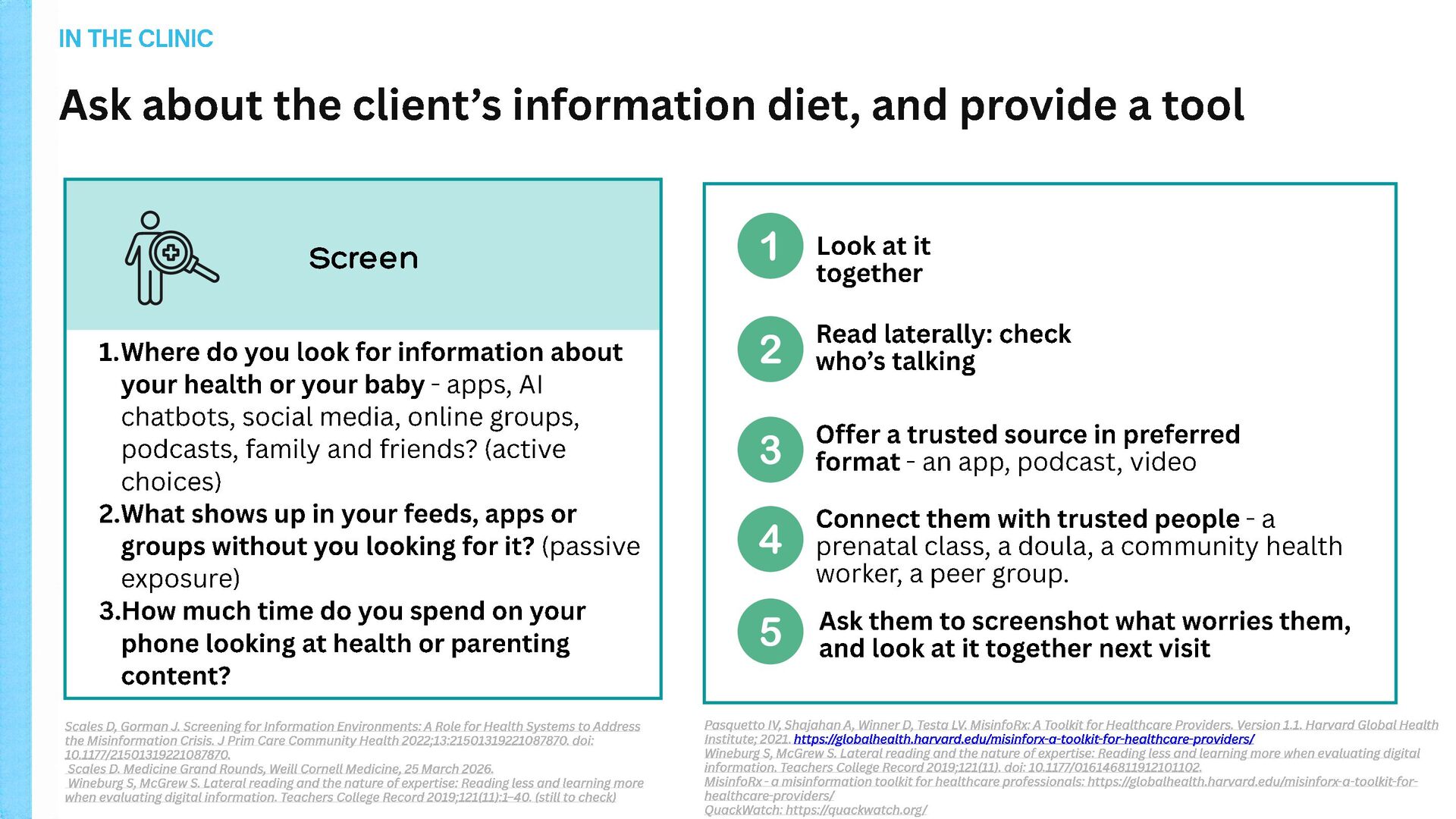
  23. IN THE CLINIC Ask about the client’s information diet, and

    provide a tool Screen 1.Where do you look for information about your health or your baby - apps, AI chatbots, social media, online groups, podcasts, family and friends? (active choices) 2.What shows up in your feeds, apps or groups without you looking for it? (passive exposure) 3.How much time do you spend on your phone looking at health or parenting content? Scales D, Gorman J. Screening for Information Environments: A Role for Health Systems to Address the Misinformation Crisis. J Prim Care Community Health 2022;13:21501319221087870. doi: 10.1177/21501319221087870. Scales D. Medicine Grand Rounds, Weill Cornell Medicine, 25 March 2026. Wineburg S, McGrew S. Lateral reading and the nature of expertise: Reading less and learning more when evaluating digital information. Teachers College Record 2019;121(11):1 –40. (still to check) Look at it together Read laterally: check who’s talking Offer a trusted source in preferred format - an app, podcast, video Connect them with trusted people -a prenatal class, a doula, a community health worker, a peer group. Ask them to screenshot what worries them, and look at it together next visit Pasquetto IV, Shajahan A, Winner D, Testa LV. MisinfoRx: A Toolkit for Healthcare Providers. Version 1.1. Harvard Global Heal th Institute; 2021. https://globalhealth.harvard.edu/misinforx -a -toolkit -for -healthcare -providers/ Wineburg S, McGrew S. Lateral reading and the nature of expertise: Reading less and learning more when evaluating digital information. Teachers College Record 2019;121(11). doi: 10.1177/016146811912101102. MisinfoRx - a misinformation toolkit for healthcare professionals: https://globalhealth.harvard.edu/misinforx -a -toolkit -for healthcare -providers/ QuackWatch: https://quackwatch.org/
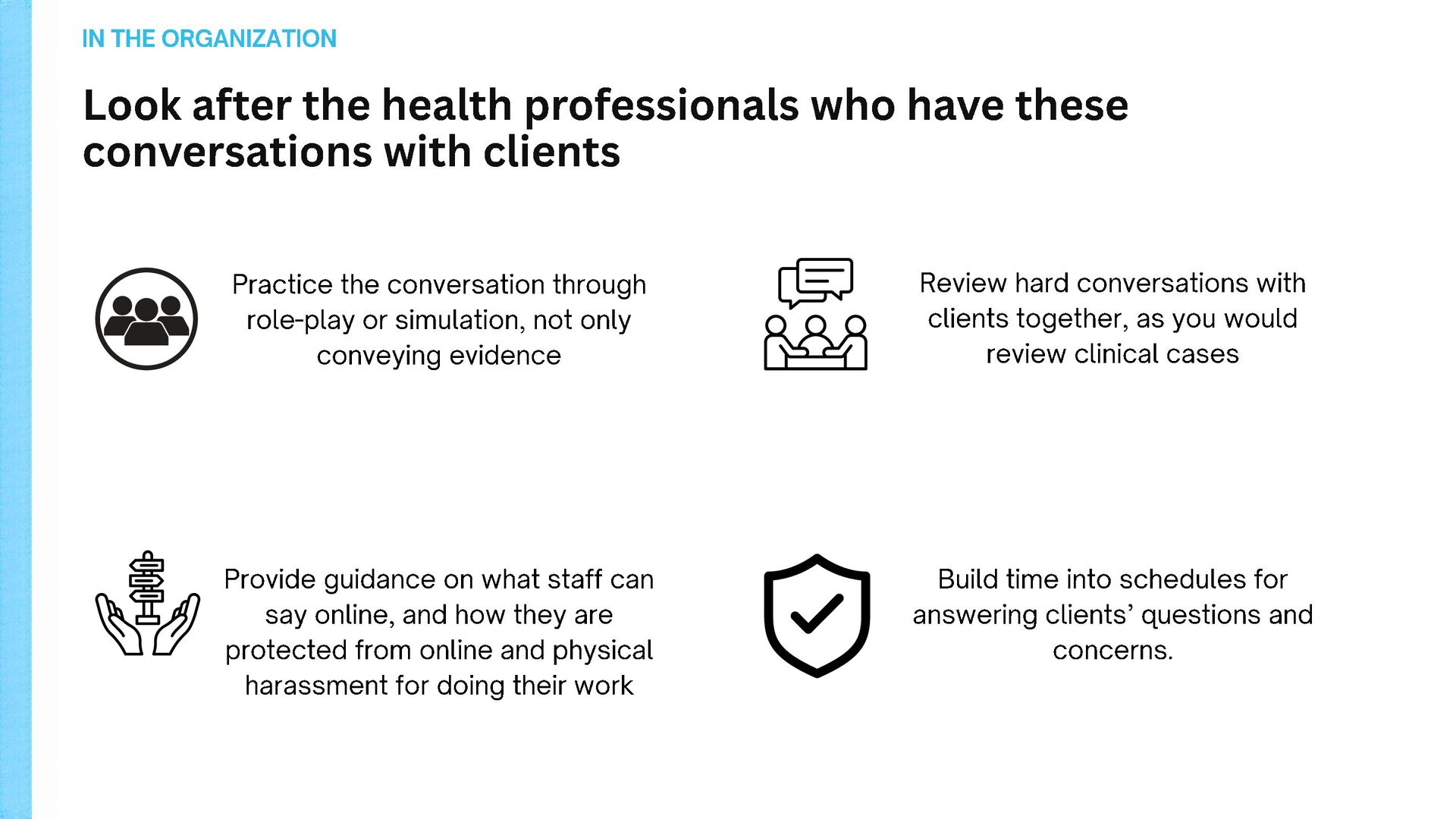
  24. IN THE ORGANIZATION Loo k after the health professionals who

    have these conversations with clients Practice the conversation through role -play or simulation, not only conveying evidence Review hard conversations with clients together, as you would review clinical cases Provide guidance on what staff can say online, and how they are protected from online and physical harassment for doing their work Build time into schedules for answering clients’ questions and concerns.
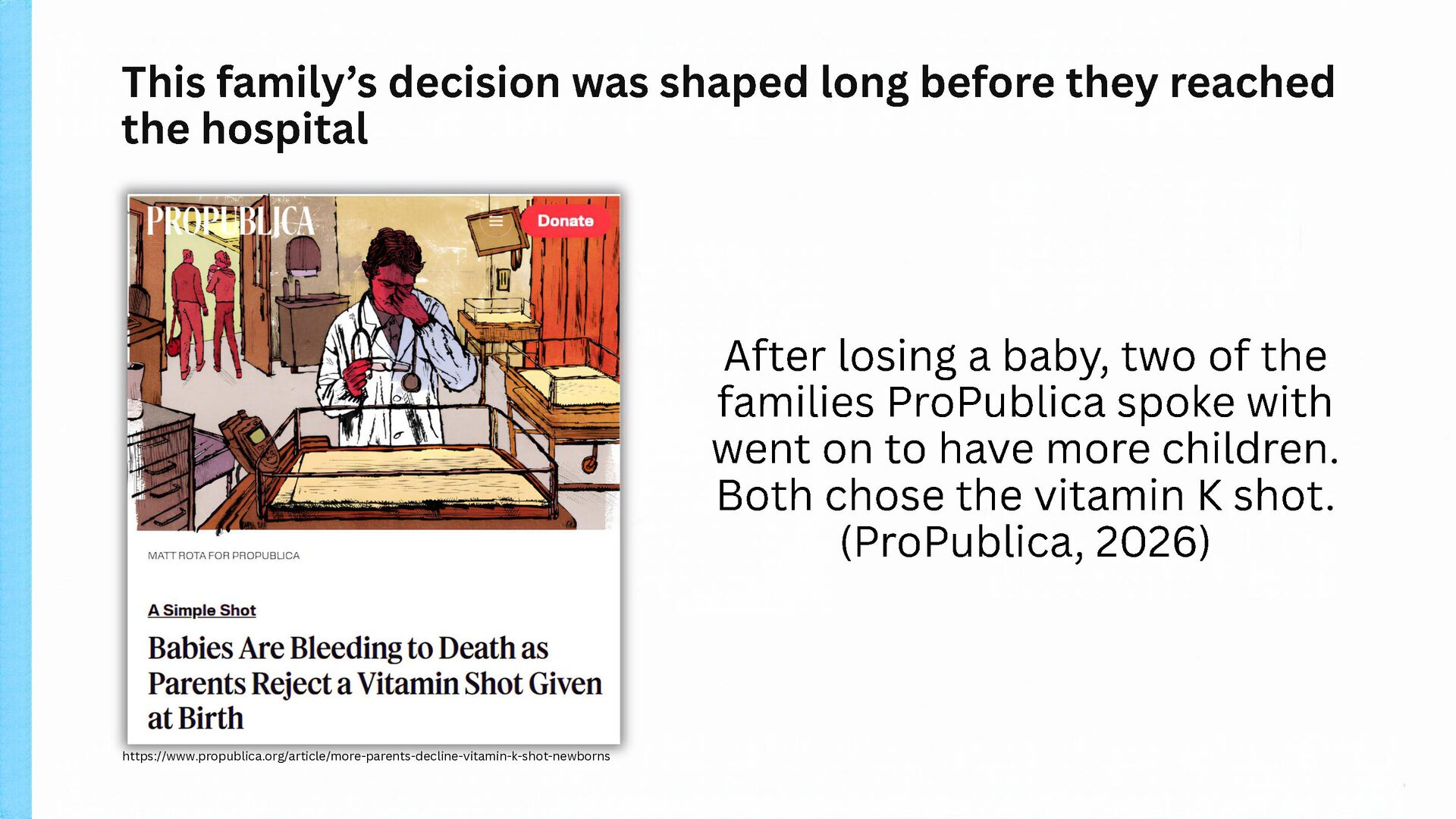
  25. Th is family’s decision was shaped long before they reached

    the hospital After losing a baby, two of the families ProPublica spoke with went on to have more children. Both chose the vitamin K shot. (ProPublica, 2026) https://www.propublica.org/article/more-parents-decline-vitamin-k-shot-newborns
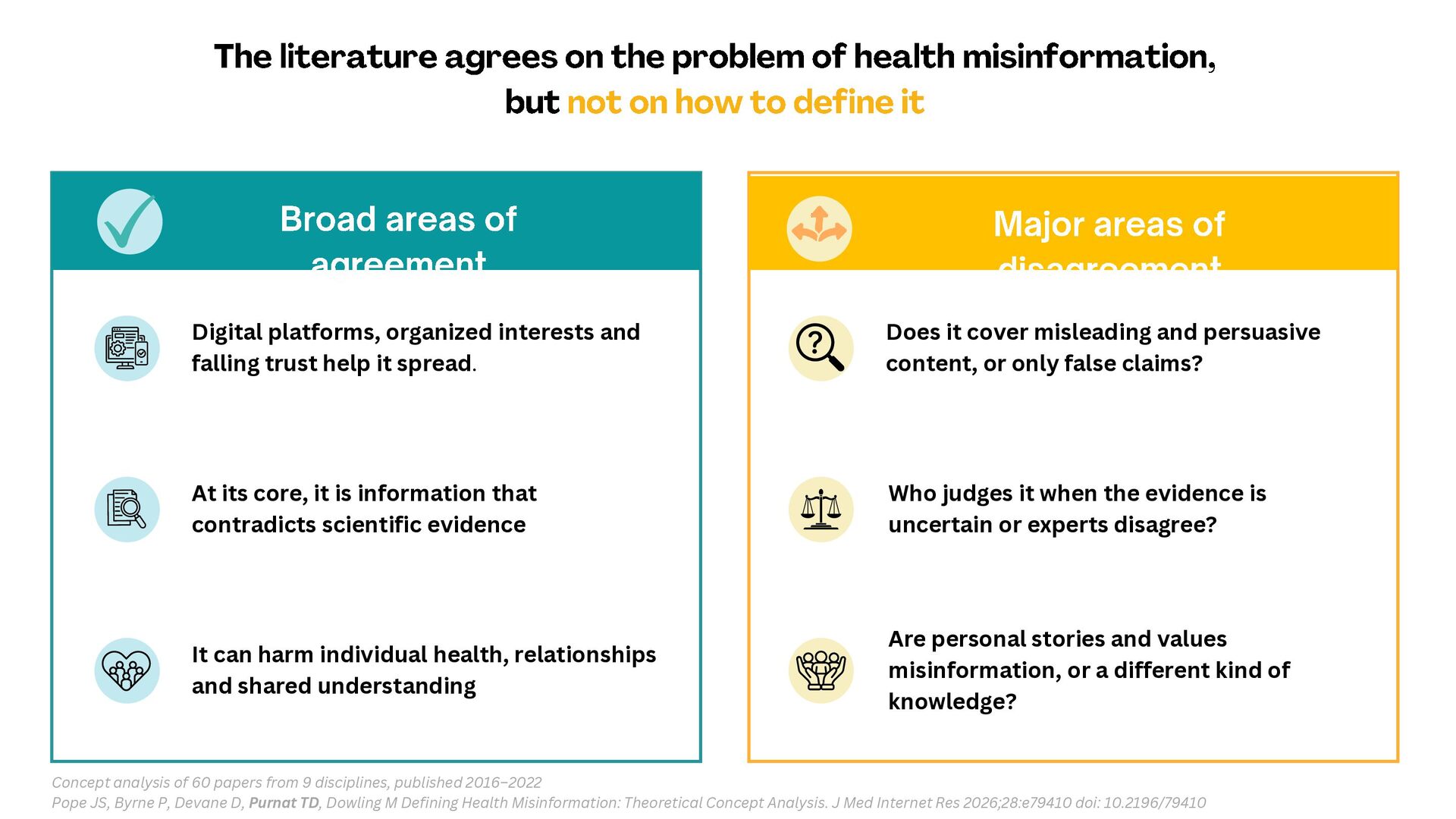
  26. The literature agrees on the problem of health misinformation, but

    not on how to define it Broad areas of agreement Major areas of disagreement Digital platforms, organized interests and falling trust help it spread. Does it cover misleading and persuasive content, or only false claims? At its core, it is information that contradicts scientific evidence Who judges it when the evidence is uncertain or experts disagree? It can harm individual health, relationships and shared understanding Are personal stories and values misinformation, or a different kind of knowledge? Concept analysis of 60 papers from 9 disciplines, published 2016–2022 Pope JS, Byrne P, Devane D, Purnat TD, Dowling M Defining Health Misinformation: Theoretical Concept Analysis. J Med Internet Res 2026;28:e79410 doi: 10.2196/79410
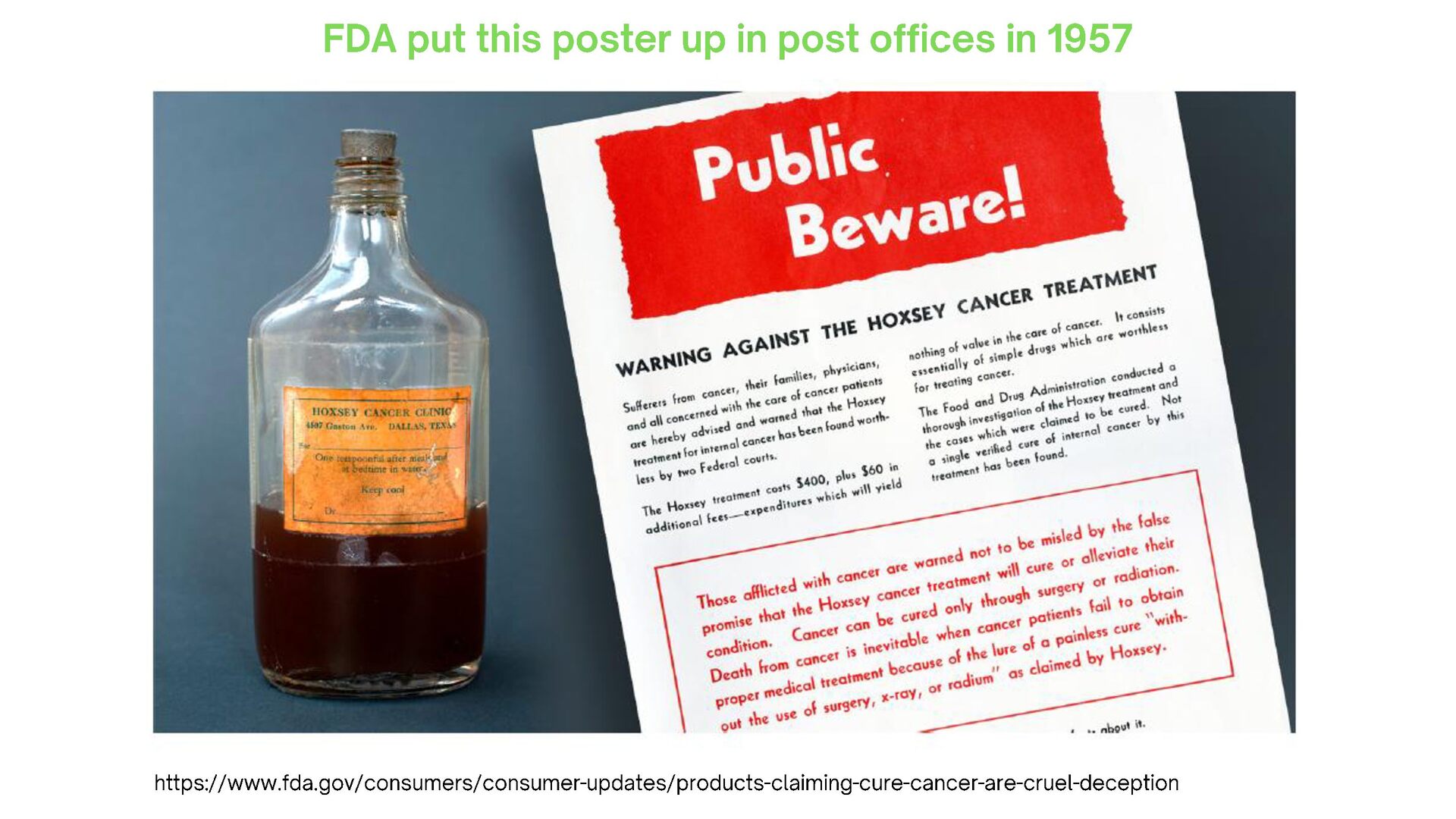
  27. FDA put this poster up in post offices in 1957

    https://www.fda.gov/consumers/consumer -updates/products -claiming -cure -cancer -are -cruel -deception
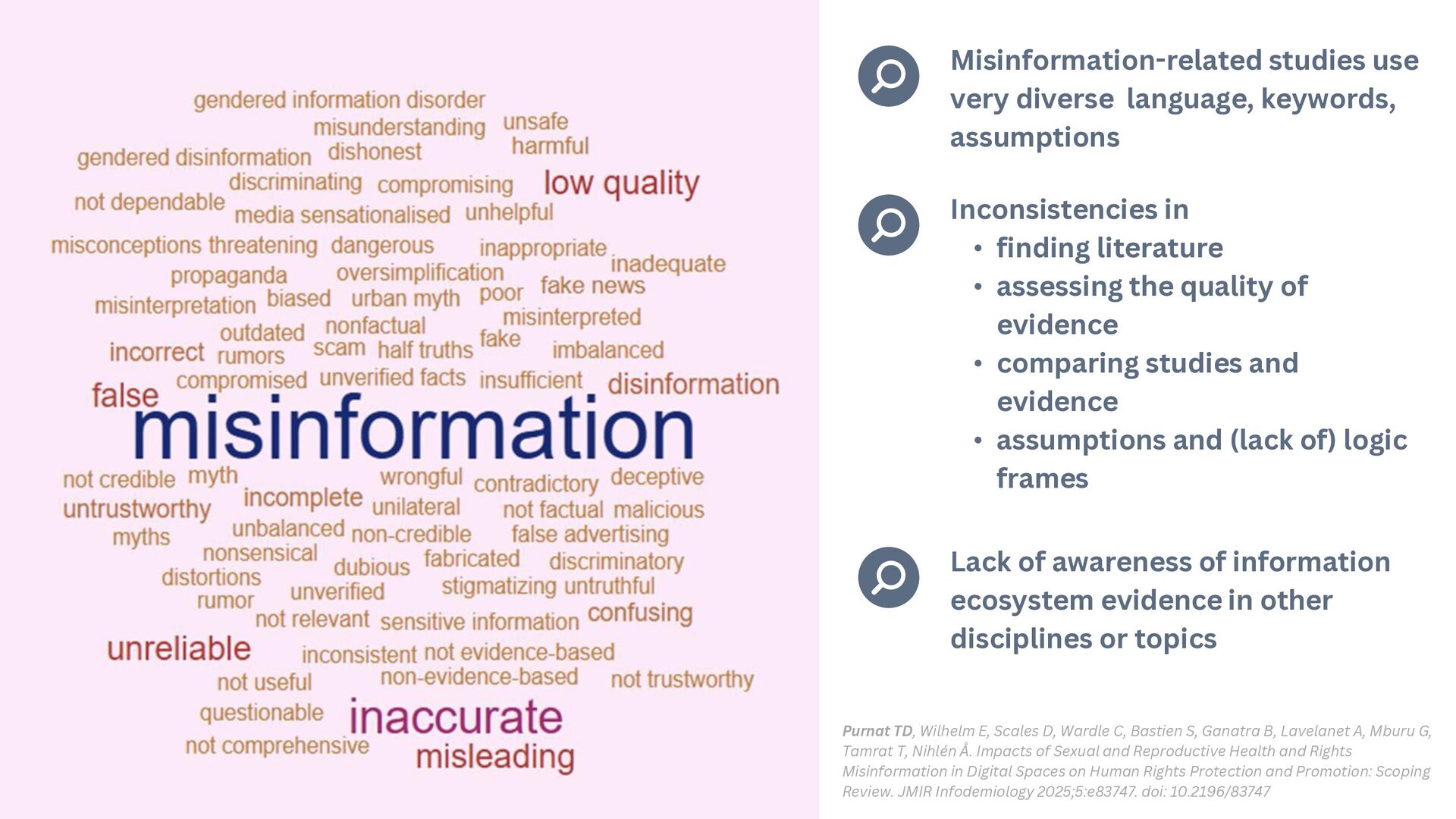
  28. Misinformation-related studies use very diverse language, keywords, assumptions Inconsistencies in

    • finding literature • assessing the quality of evidence • comparing studies and evidence • assumptions and (lack of) logic frames Lack of awareness of information ecosystem evidence in other disciplines or topics Purnat TD, Wilhelm E, Scales D, Wardle C, Bastien S, Ganatra B, Lavelanet A, Mburu G, Tamrat T, Nihlén Å. Impacts of Sexual and Reproductive Health and Rights Misinformation in Digital Spaces on Human Rights Protection and Promotion: Scoping Review. JMIR Infodemiology 2025;5:e83747. doi: 10.2196/83747