Upgrade to PRO for Only $50/Year—Limited-Time Offer! 🔥

Tyler Gargula - Decision Intelligence for Ente...

Tyler Gargula - Decision Intelligence for Enterprise SEO

Avatar for Tech SEO Connect

Tech SEO Connect PRO

December 12, 2025
Tweet

More Decks by Tech SEO Connect

Other Decks in Marketing & SEO

Transcript

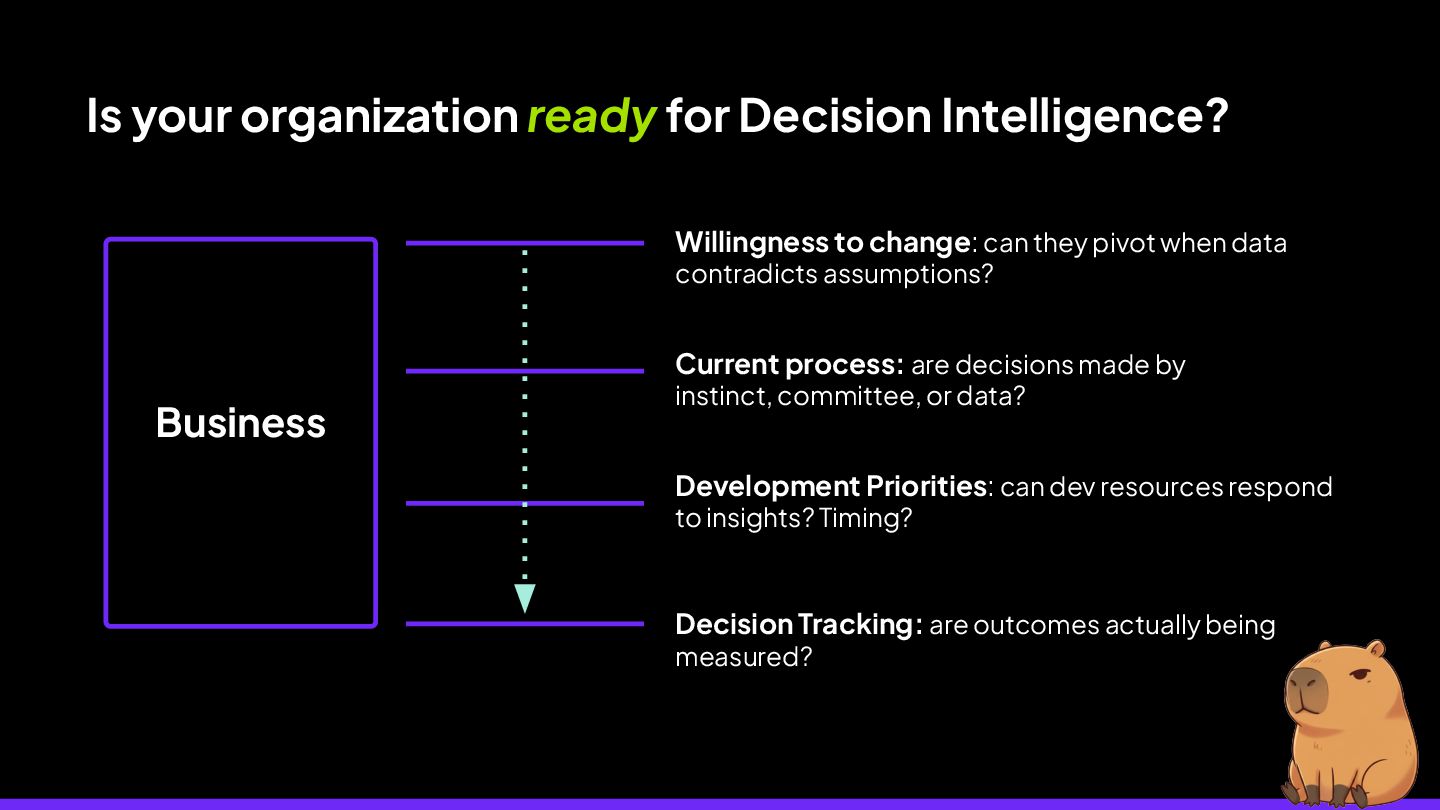
  1. Is your organization ready for Decision Intelligence? Business Willingness to

    change: can they pivot when data contradicts assumptions? Current process: are decisions made by instinct, committee, or data? Decision Tracking: are outcomes actually being measured? Development Priorities: can dev resources respond to insights? Timing?
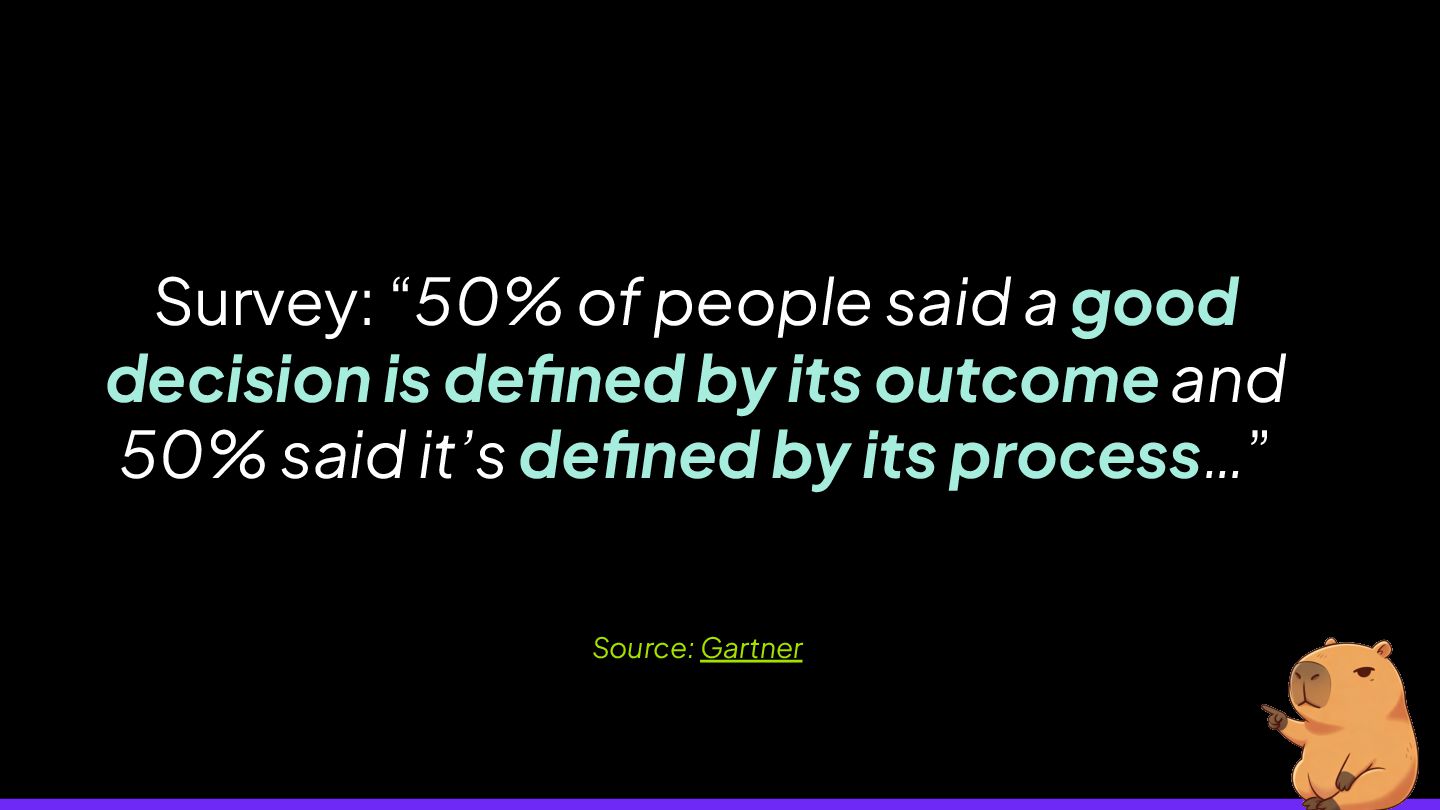
  2. Survey: “50% of people said a good decision is defined

    by its outcome and 50% said it’s defined by its process…” Source: Gartner
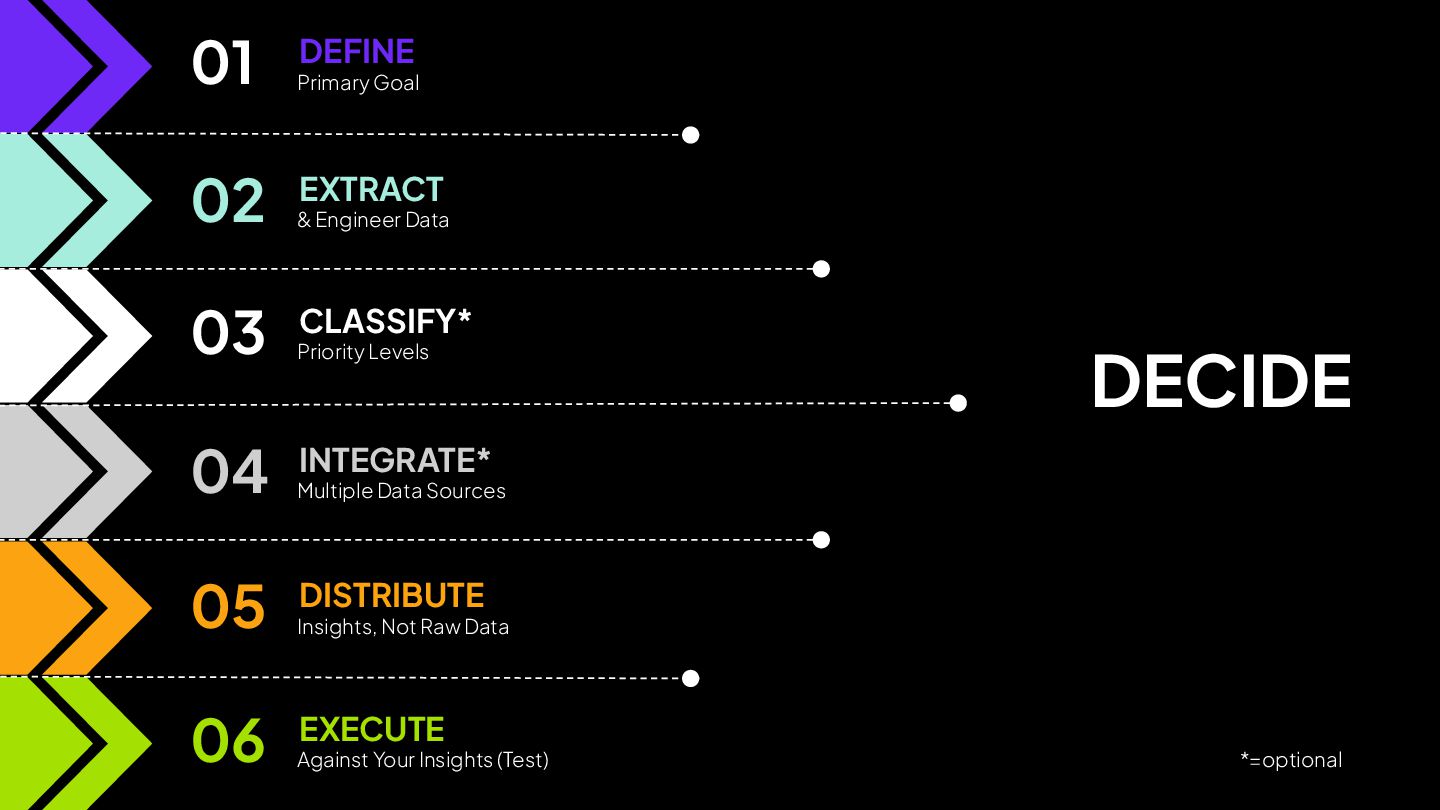
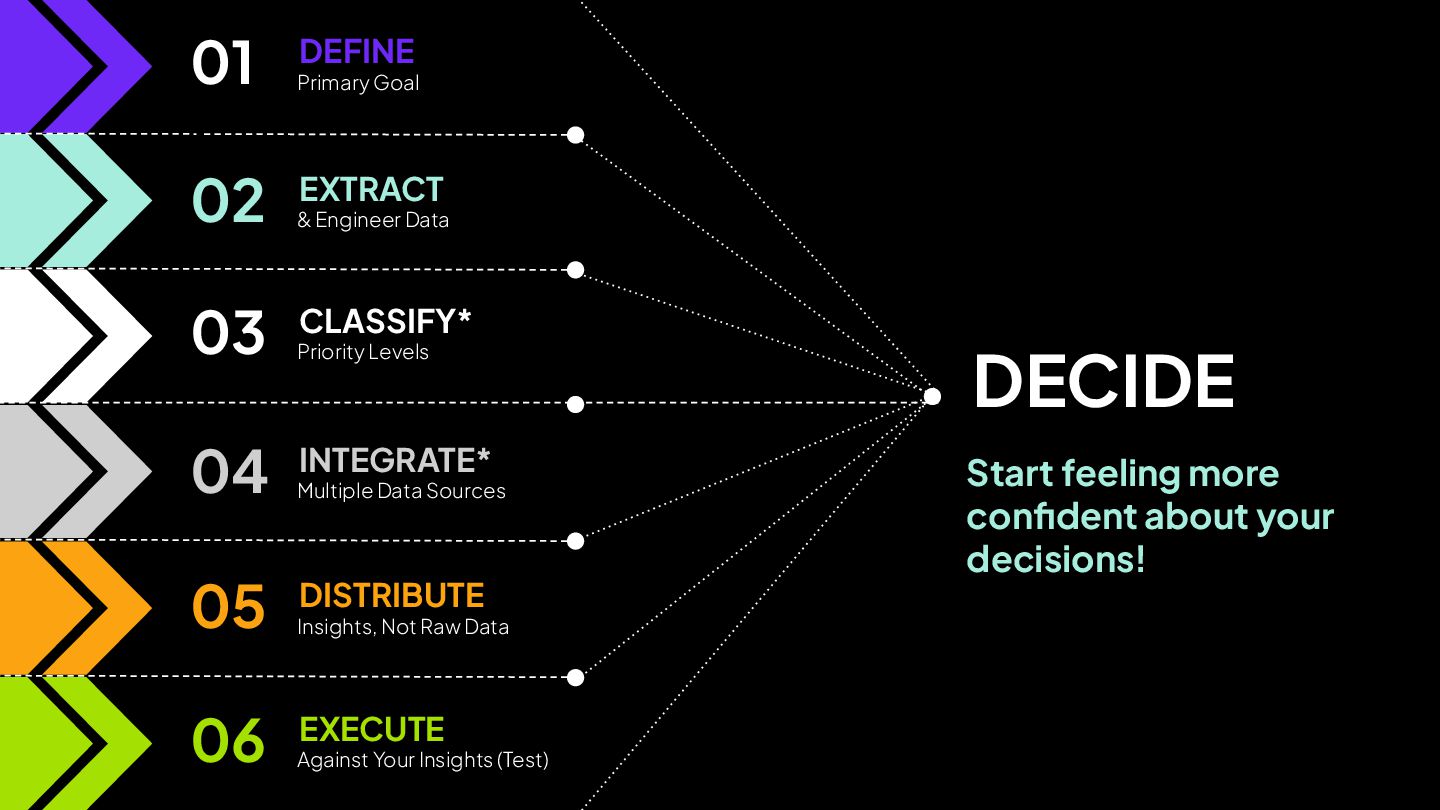
  3. DECIDE 01 | DEFINE Primary Goal 02 EXTRACT & Engineer

    Data 03 CLASSIFY* Priority Levels 04 INTEGRATE* Multiple Data Sources 05 DISTRIBUTE Insights, Not Raw Data 06 EXECUTE Against Your Insights (Test) *=optional
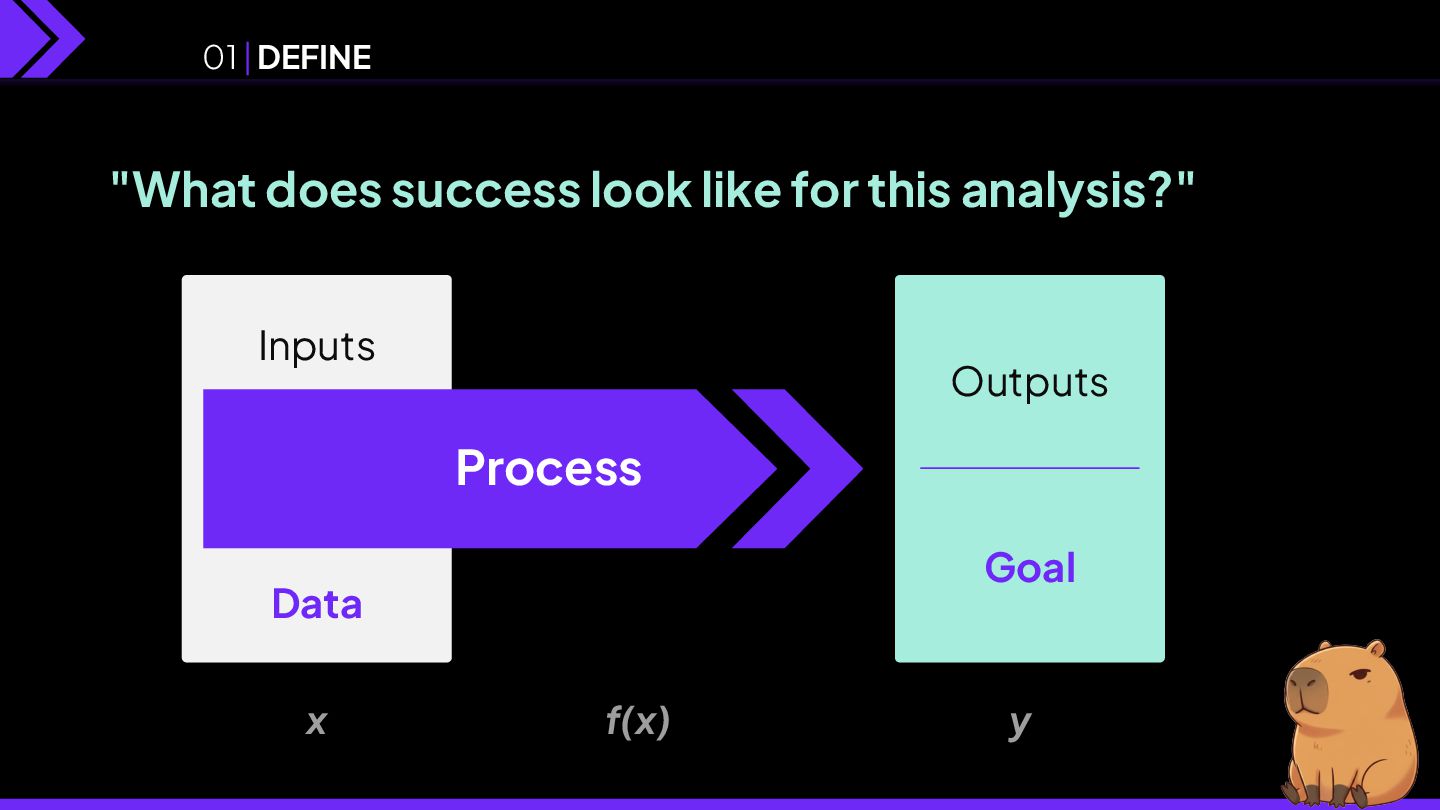
  4. 01 | DEFINE "What does success look like for this

    analysis?" Process Inputs Data Outputs Goal x f(x) y
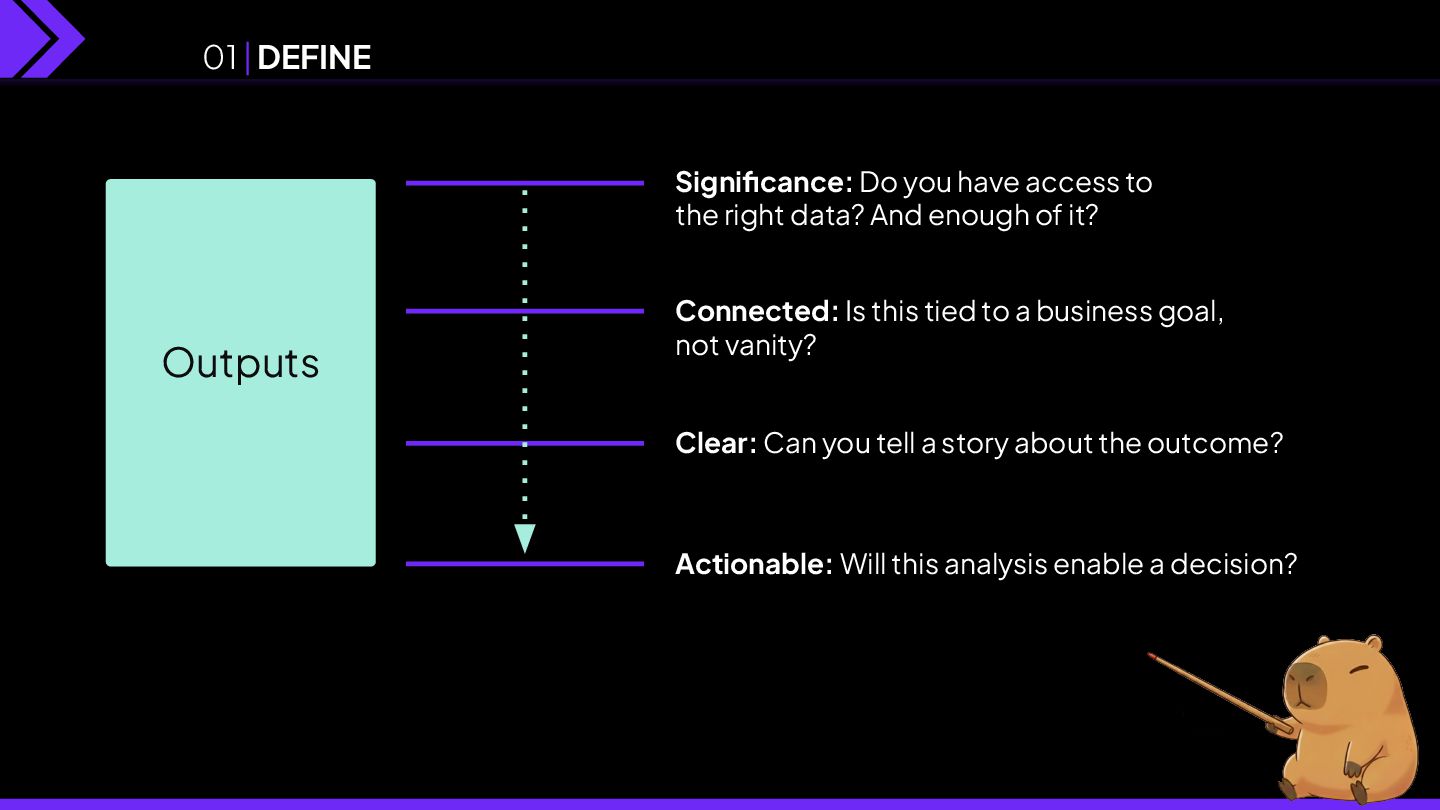
  5. Outputs Significance: Do you have access to the right data?

    And enough of it? Connected: Is this tied to a business goal, not vanity? Clear: Can you tell a story about the outcome? Actionable: Will this analysis enable a decision? 01 | DEFINE
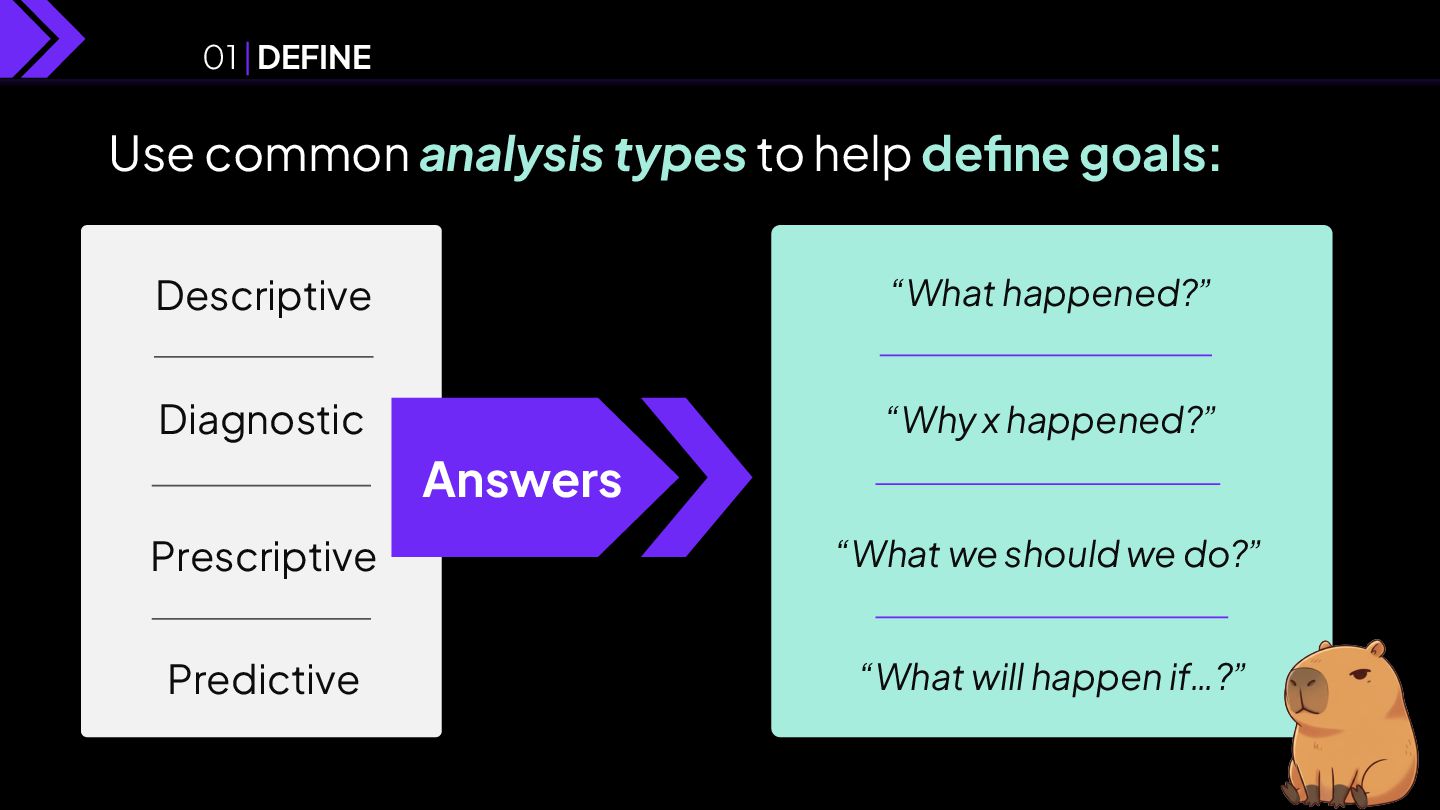
  6. 01 | DEFINE Use common analysis types to help define

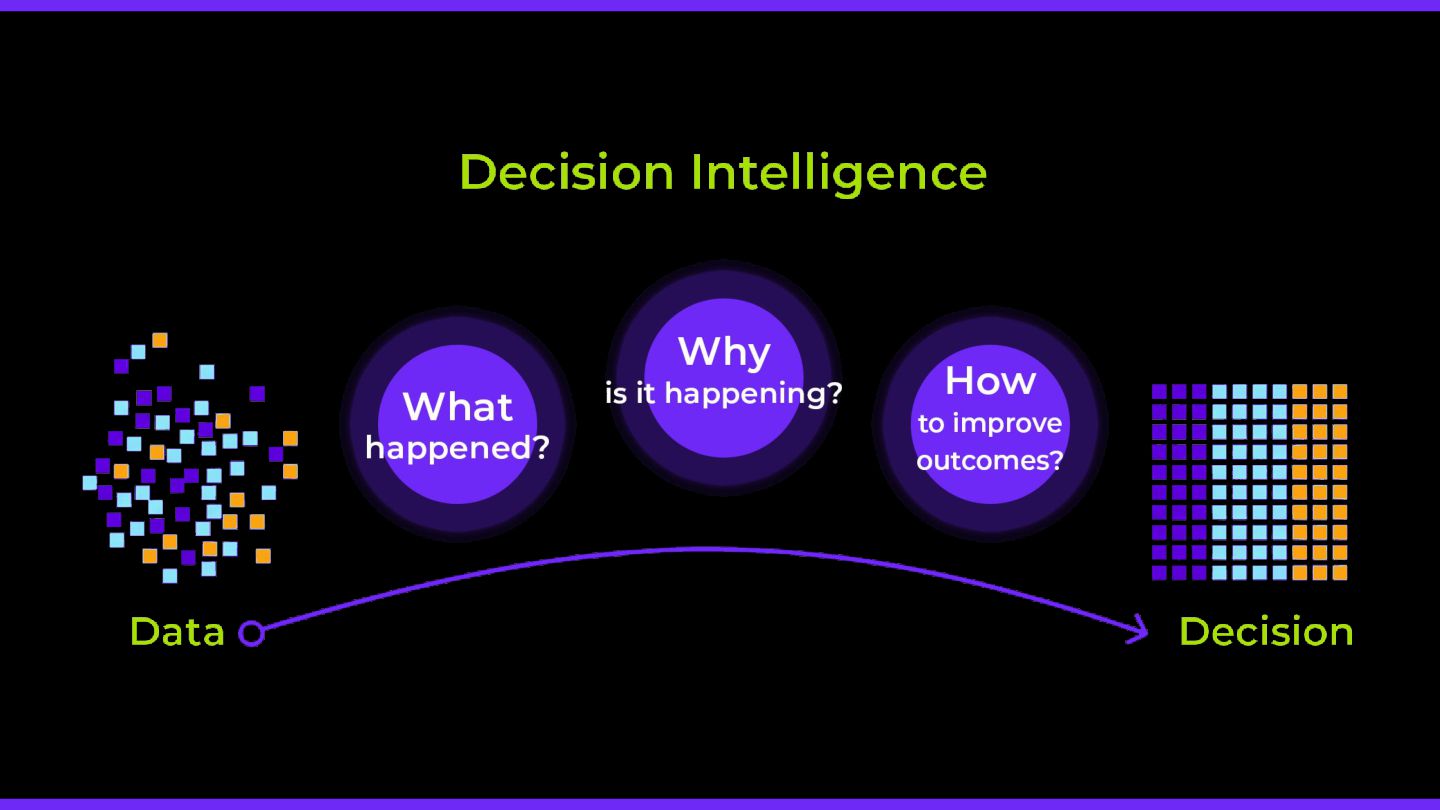
    goals: Answers Descriptive Diagnostic Prescriptive Predictive “What happened?” “Why x happened?” “What we should we do?” “What will happen if…?”
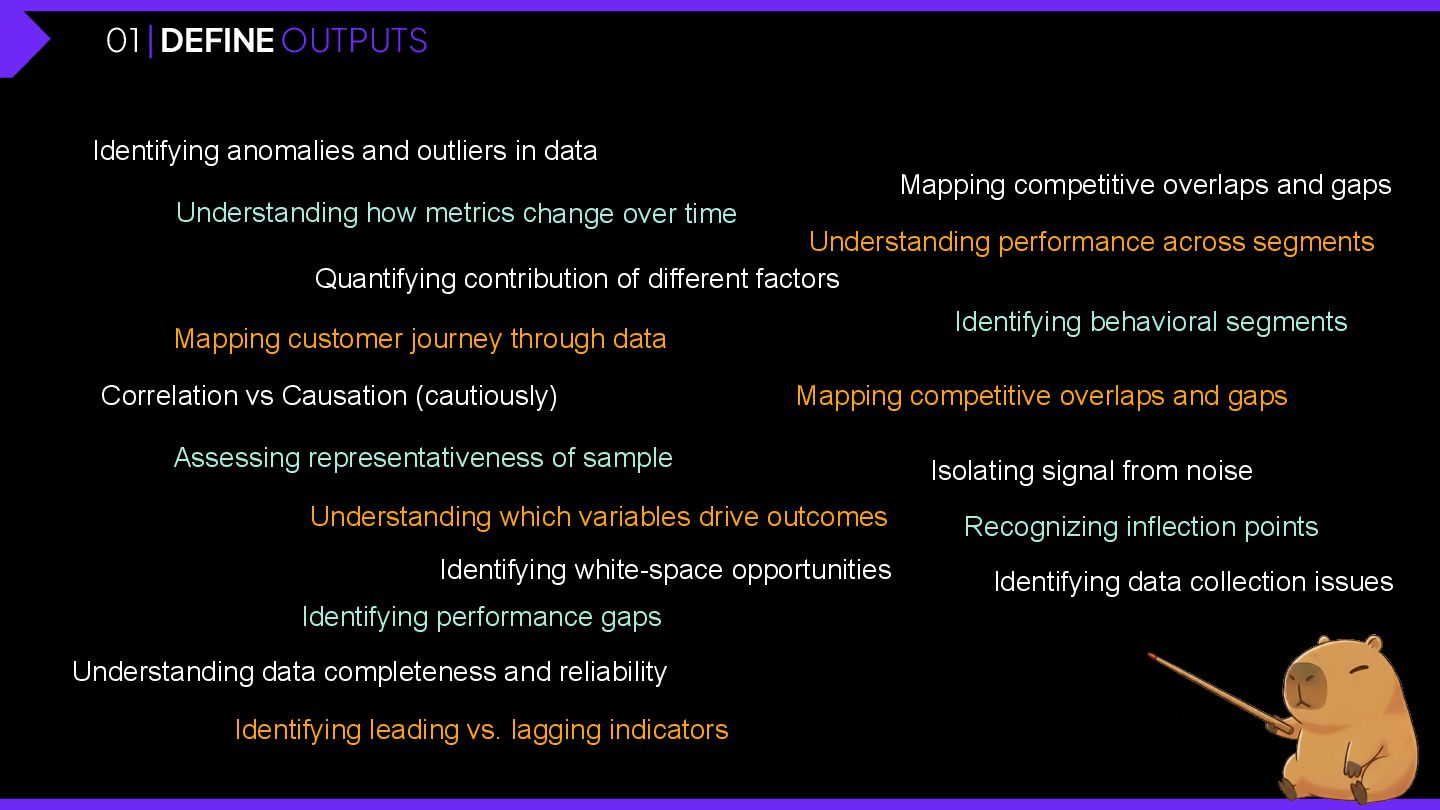
  7. Identifying anomalies and outliers in data Correlation vs Causation (cautiously)

    Understanding performance across segments Identifying performance gaps Isolating signal from noise Quantifying contribution of different factors Identifying white-space opportunities Mapping competitive overlaps and gaps Understanding how metrics change over time Identifying leading vs. lagging indicators Mapping customer journey through data Identifying behavioral segments Understanding which variables drive outcomes • Mapping competitive overlaps and gaps Understanding data completeness and reliability Assessing representativeness of sample Recognizing inflection points • Identifying data collection issues 01 | DEFINE OUTPUTS
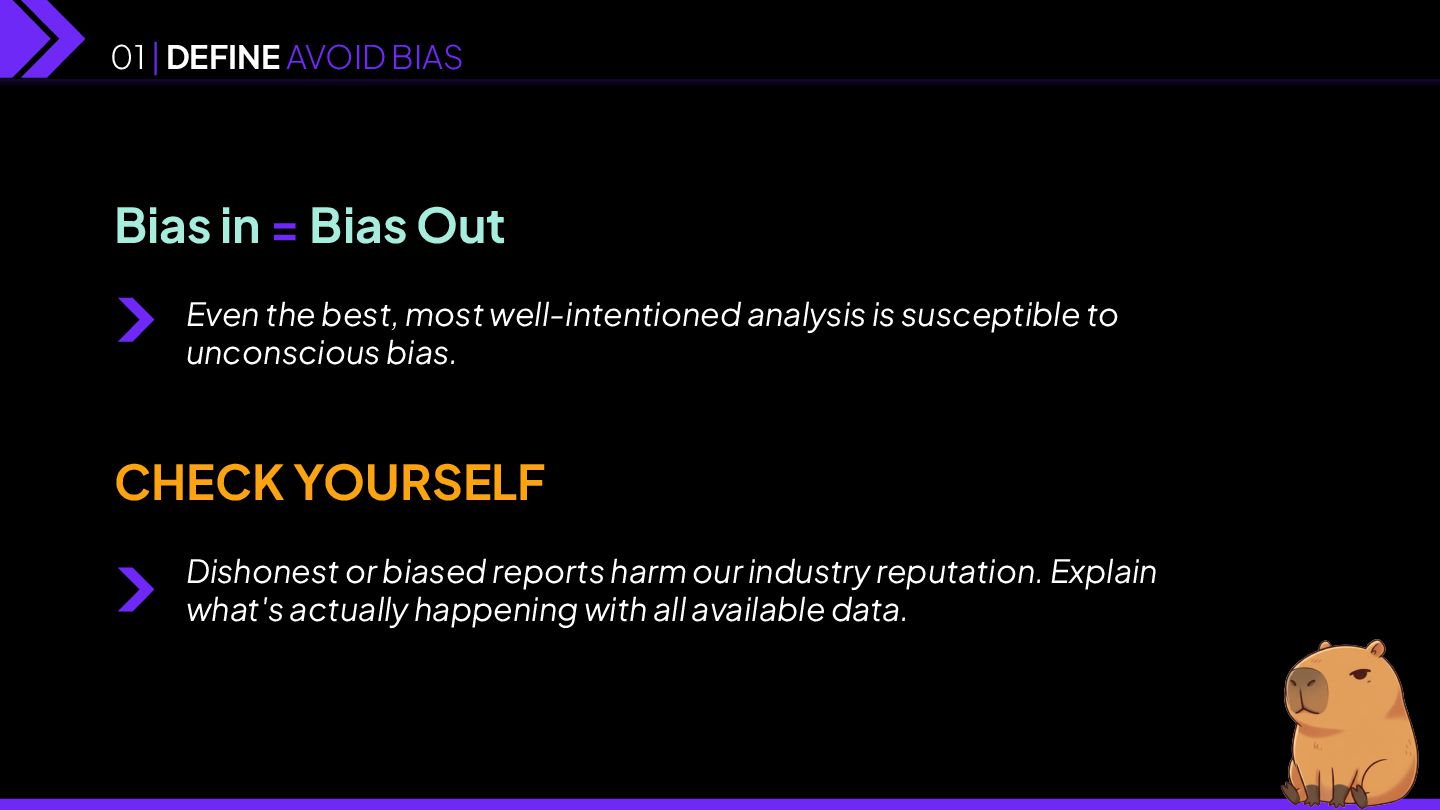
  8. Bias in = Bias Out Even the best, most well-intentioned

    analysis is susceptible to unconscious bias. CHECK YOURSELF Dishonest or biased reports harm our industry reputation. Explain what's actually happening with all available data. 01 | DEFINE AVOID BIAS
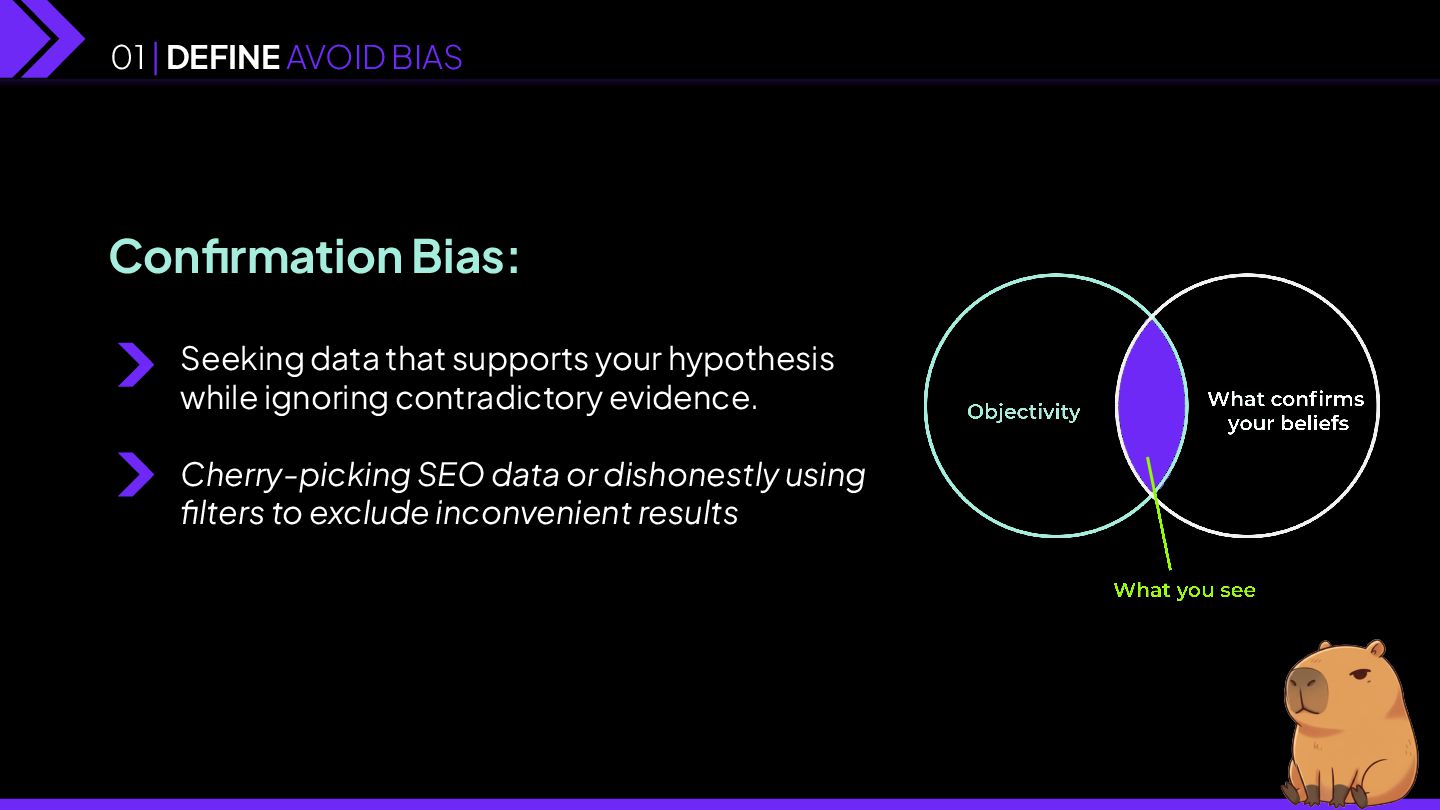
  9. Confirmation Bias: Seeking data that supports your hypothesis while ignoring

    contradictory evidence. Cherry-picking SEO data or dishonestly using filters to exclude inconvenient results 01 | DEFINE AVOID BIAS
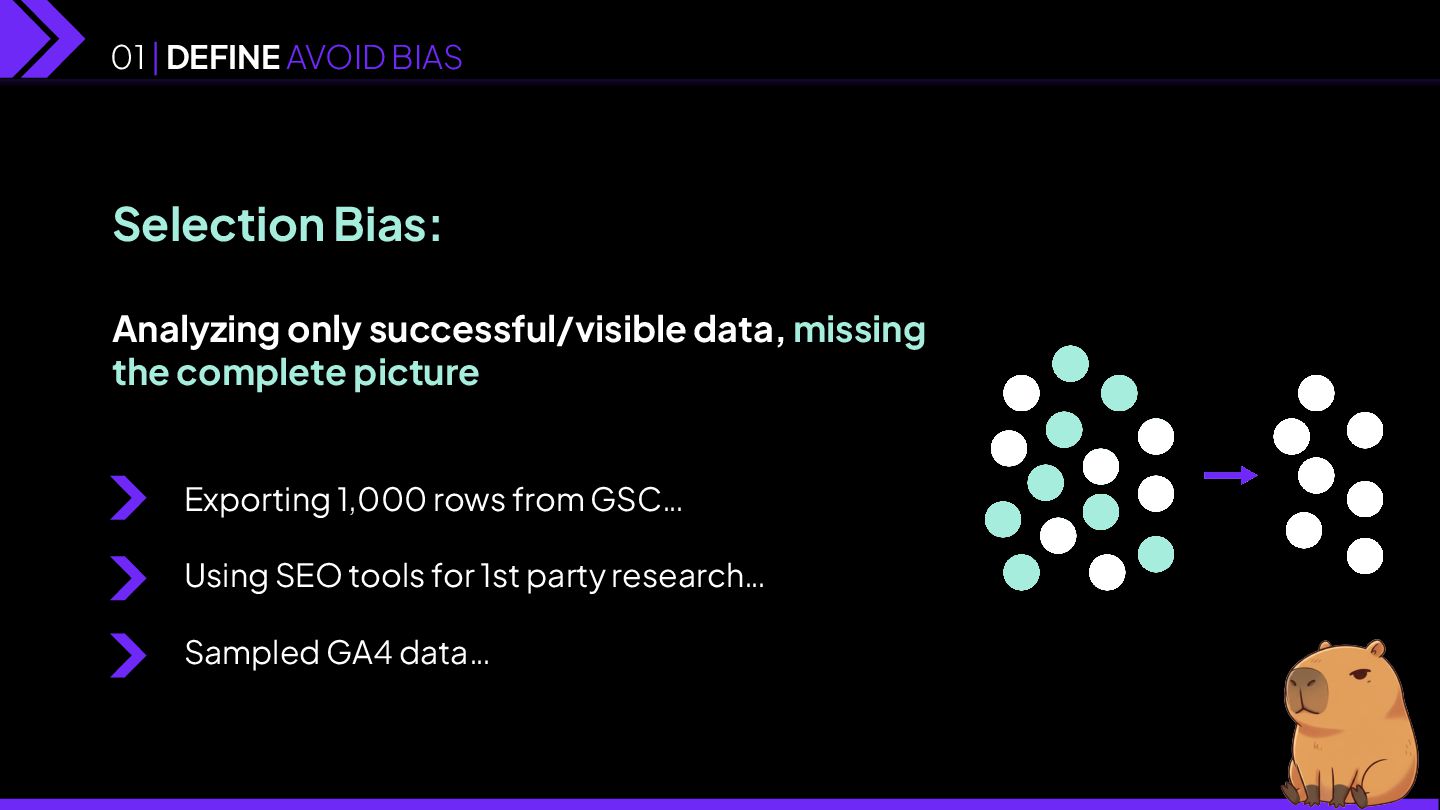
  10. Selection Bias: Analyzing only successful/visible data, missing the complete picture

    Exporting 1,000 rows from GSC… Using SEO tools for 1st party research… Sampled GA4 data… 01 | DEFINE AVOID BIAS
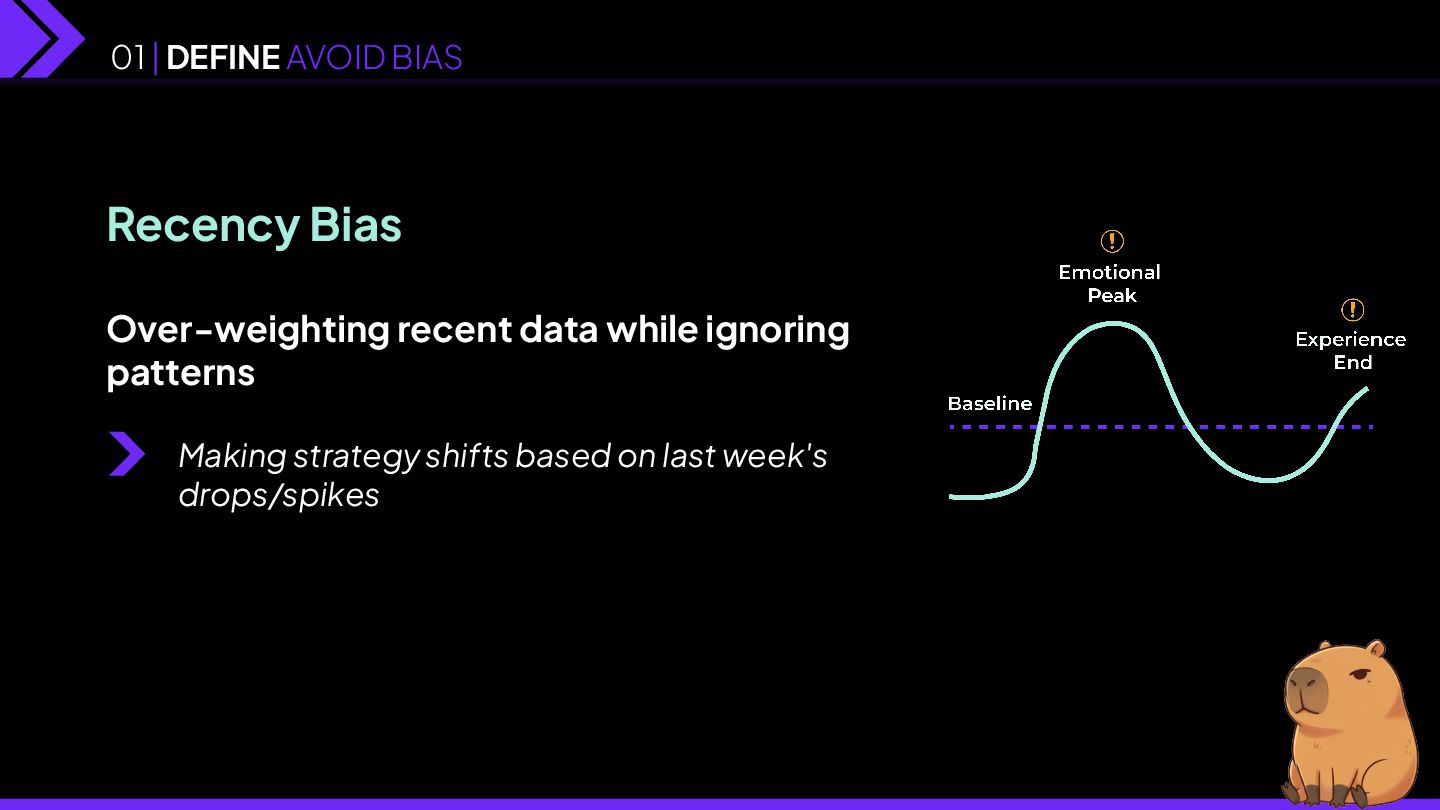
  11. Recency Bias Over-weighting recent data while ignoring patterns Making strategy

    shifts based on last week's drops/spikes 01 | DEFINE AVOID BIAS
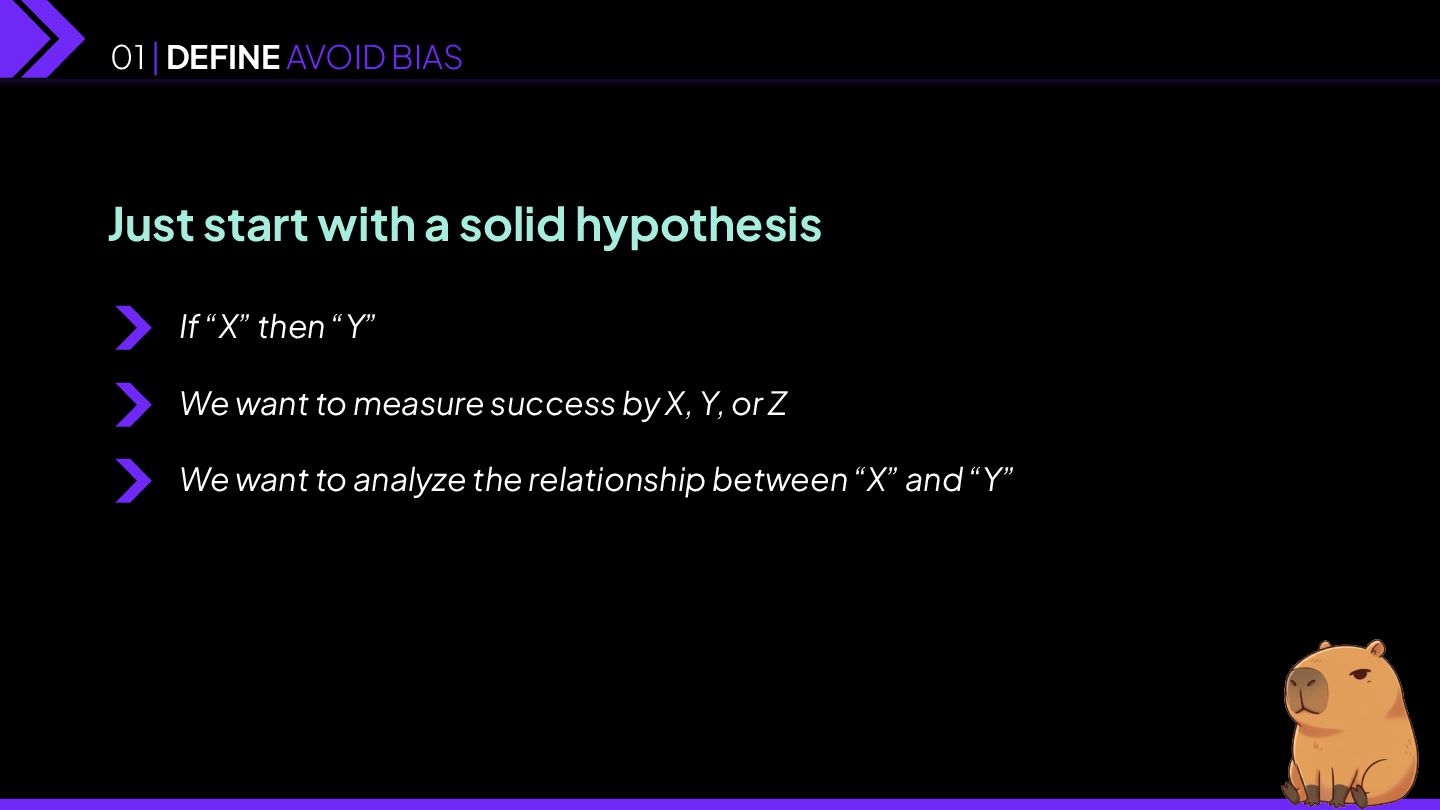
  12. Just start with a solid hypothesis If “X” then “Y”

    We want to measure success by X, Y, or Z We want to analyze the relationship between “X” and “Y” 01 | DEFINE AVOID BIAS
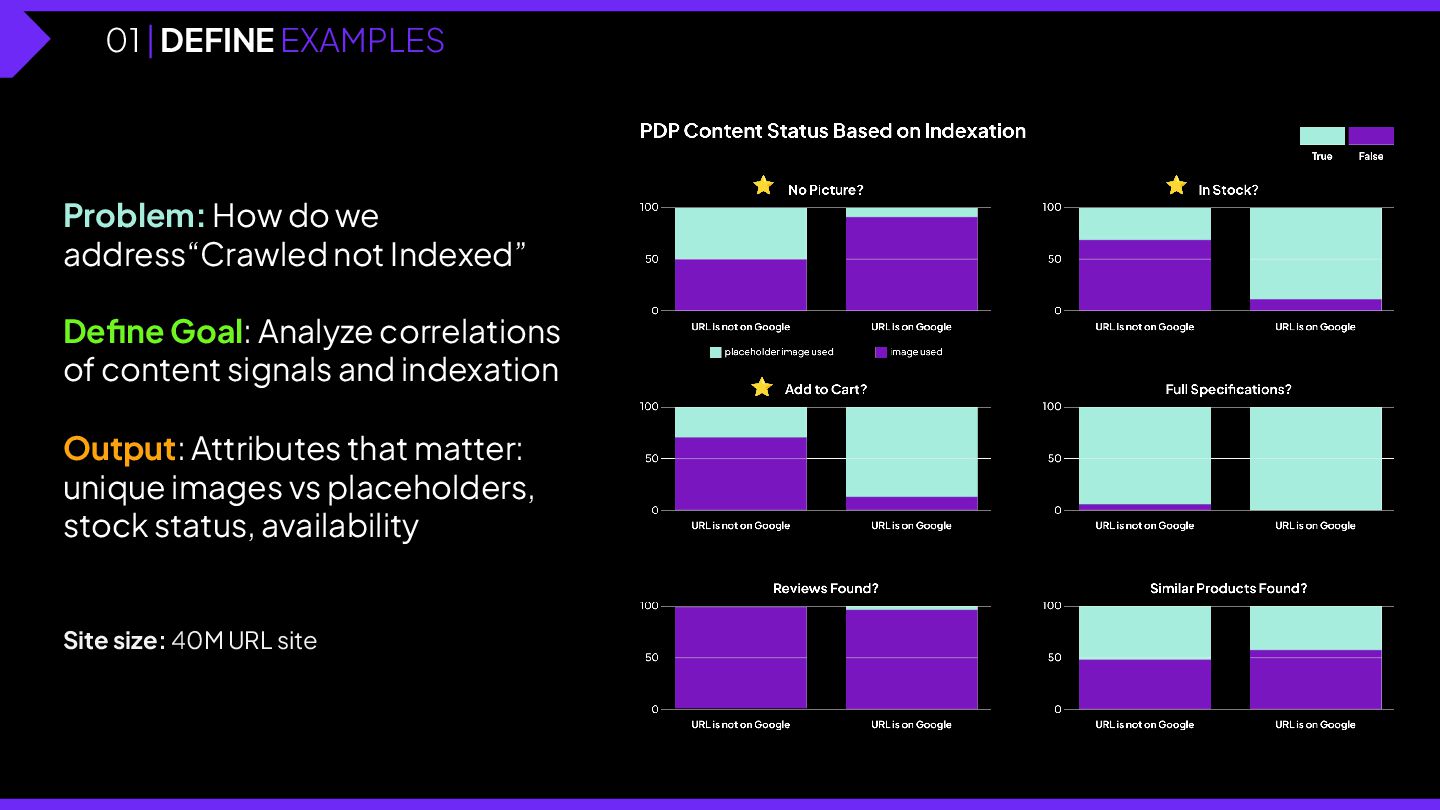
  13. Problem: How do we address“Crawled not Indexed” Define Goal: Analyze

    correlations of content signals and indexation Output: Attributes that matter: unique images vs placeholders, stock status, availability Site size: 40M URL site ⭐ ⭐ ⭐ 01 | DEFINE EXAMPLES
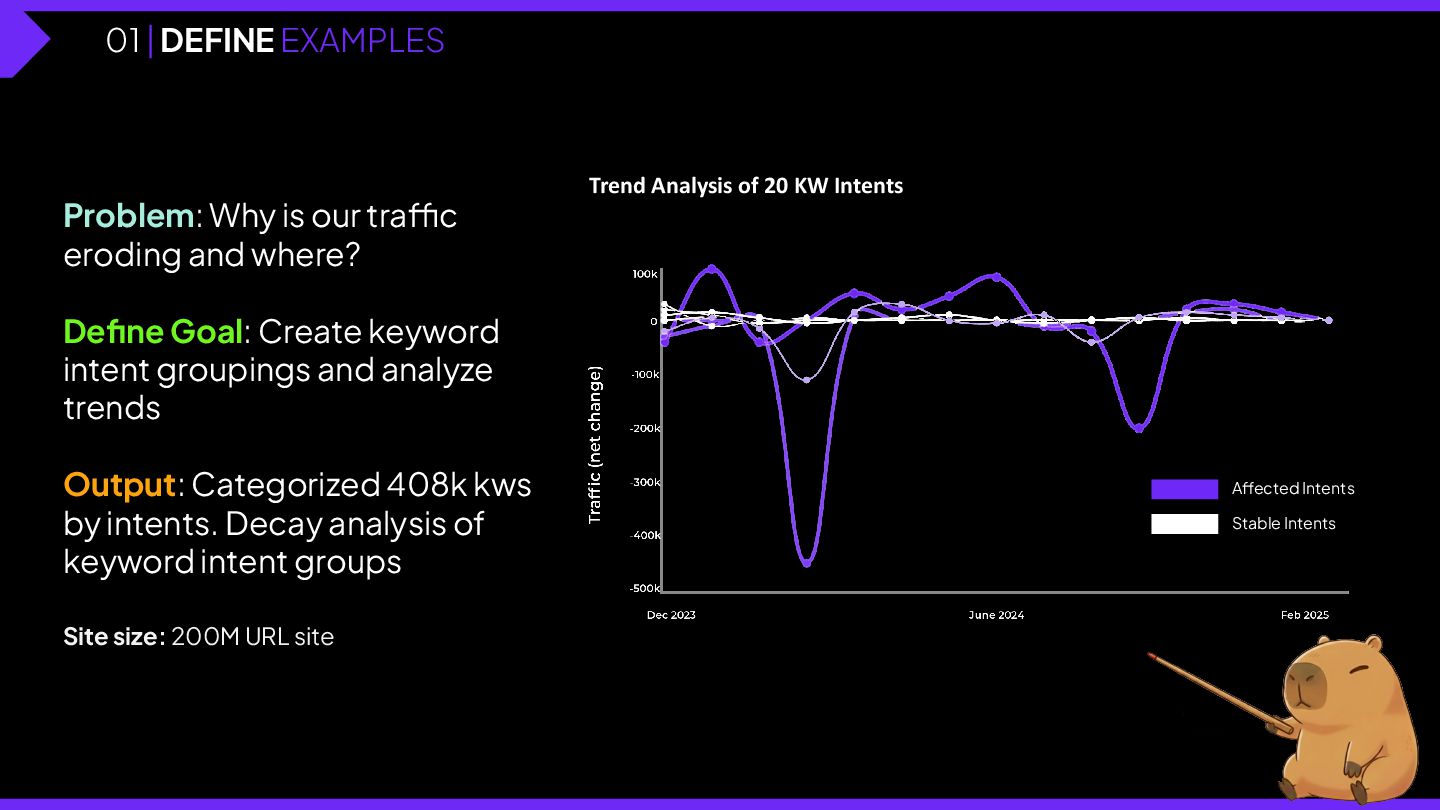
  14. Problem: Why is our traffic eroding and where? Define Goal:

    Create keyword intent groupings and analyze trends Output: Categorized 408k kws by intents. Decay analysis of keyword intent groups Site size: 200M URL site 01 | DEFINE EXAMPLES Affected Intents Stable Intents Trend Analysis of 20 KW Intents
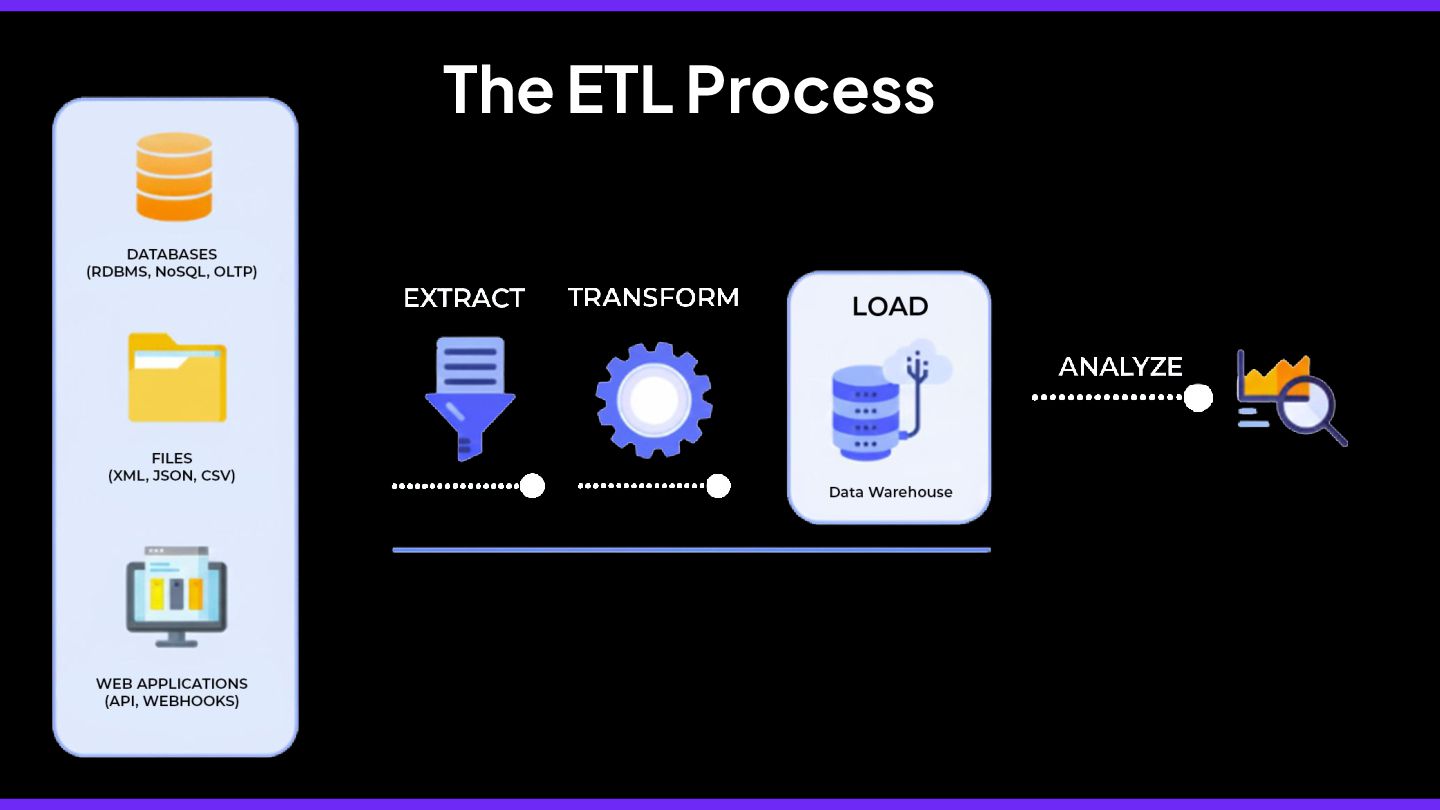
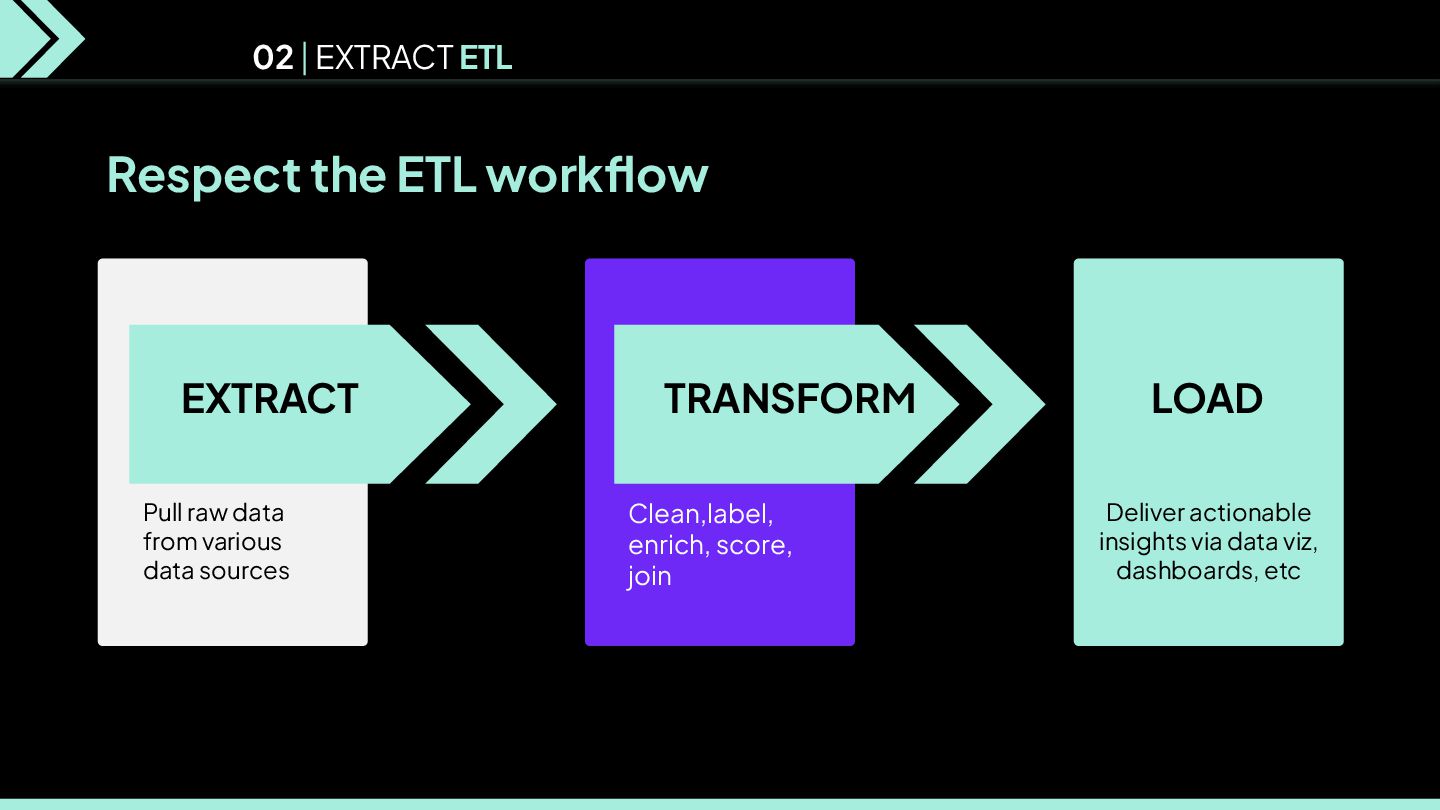
  15. Respect the ETL workflow EXTRACT TRANSFORM LOAD Pull raw data

    from various data sources Clean,label, enrich, score, join Deliver actionable insights via data viz, dashboards, etc 02 | EXTRACT ETL
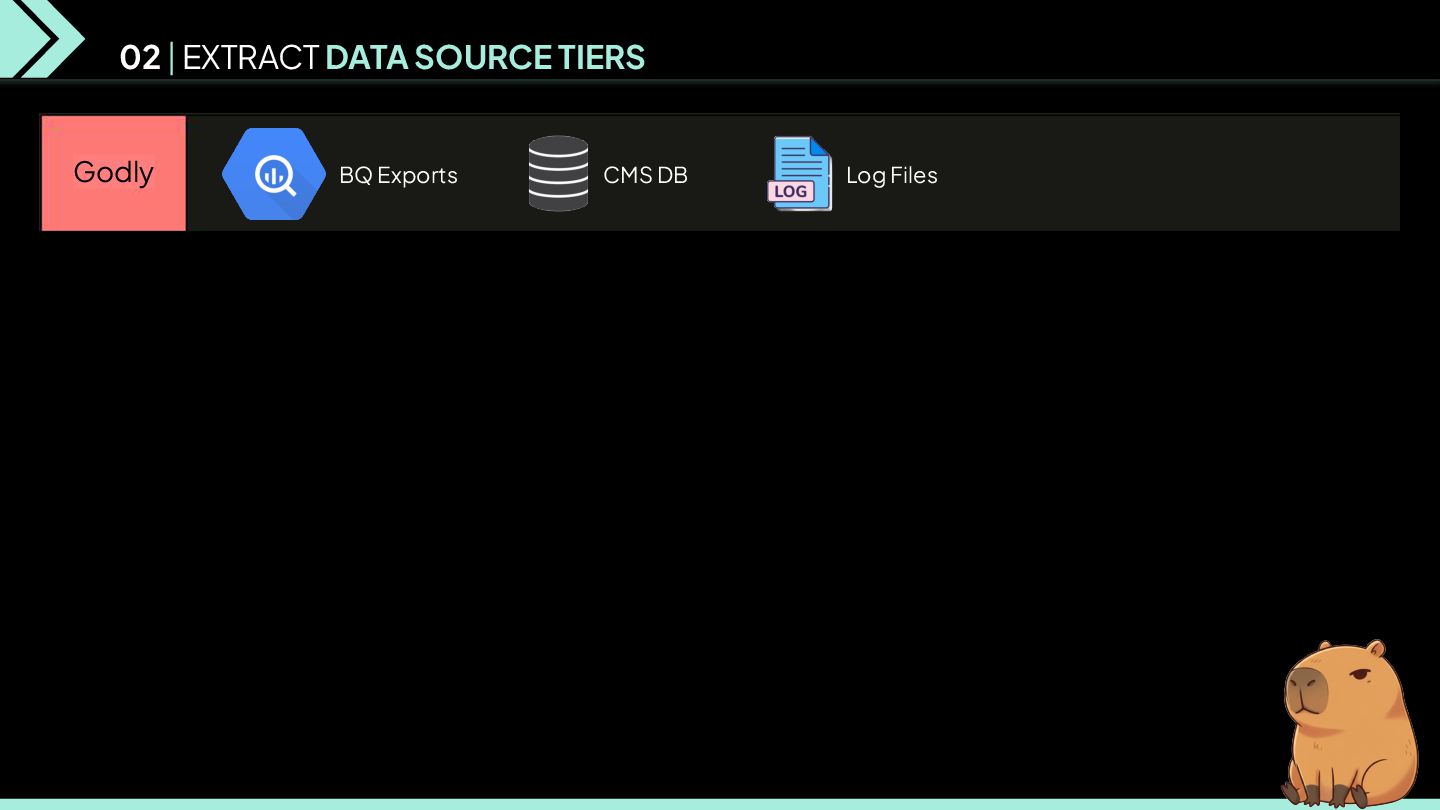
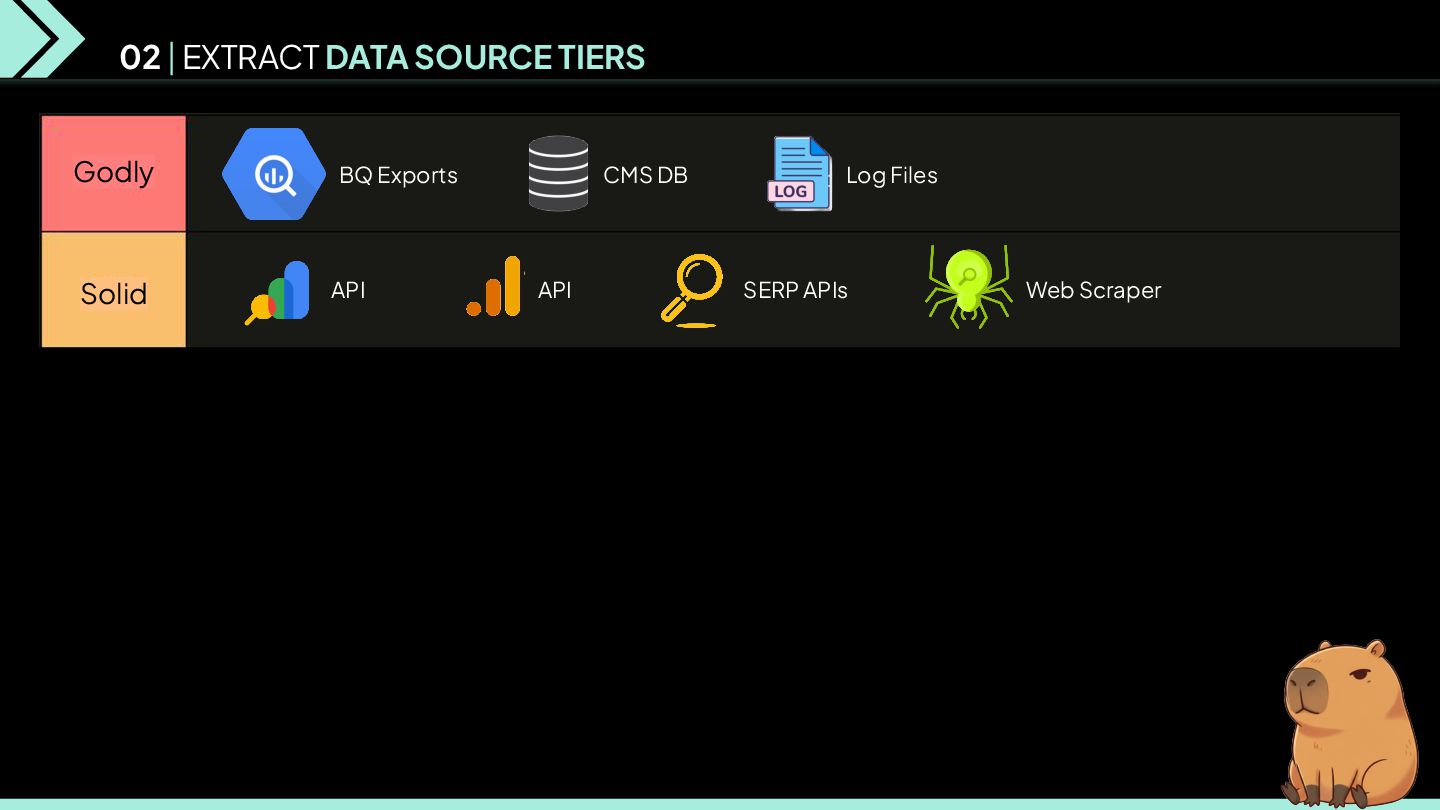
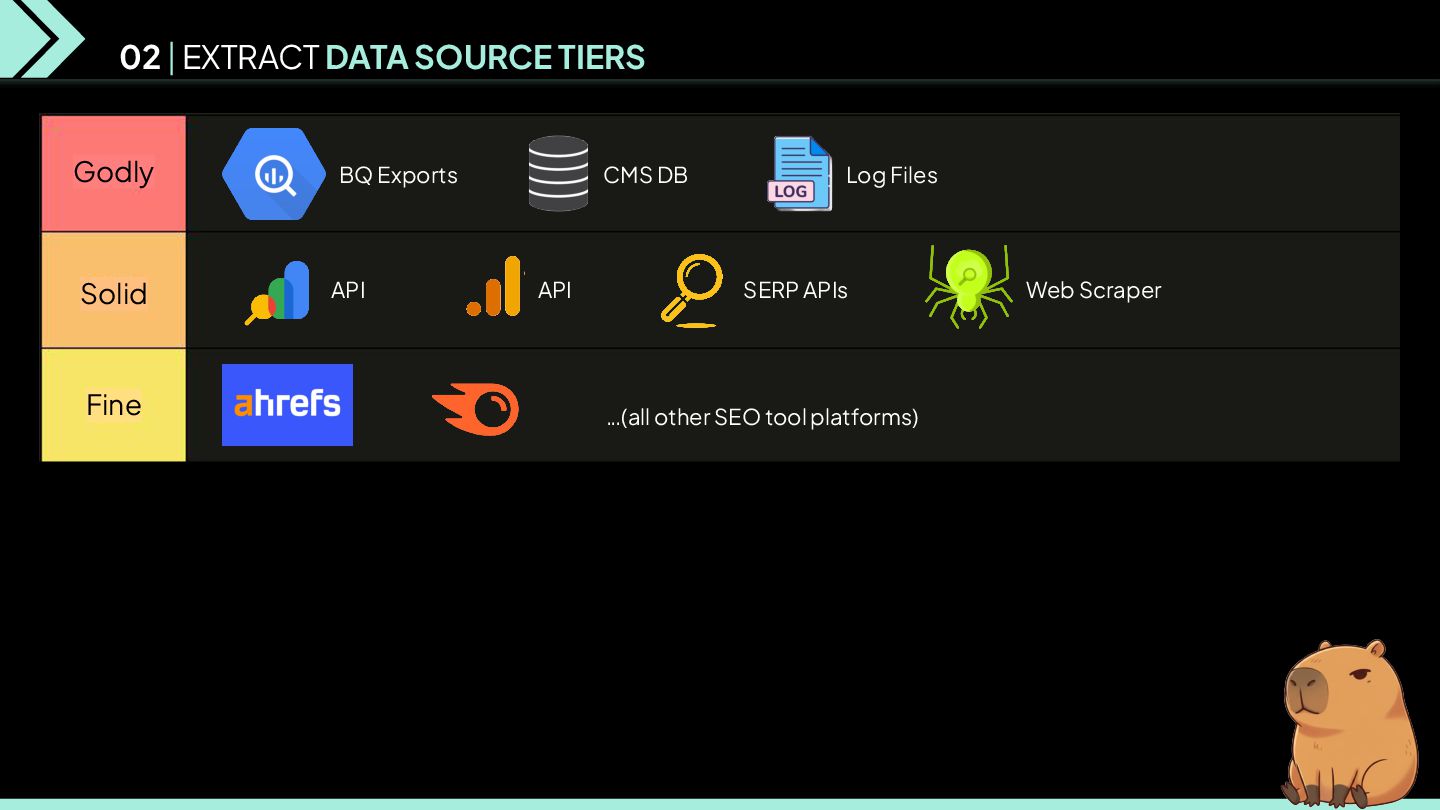
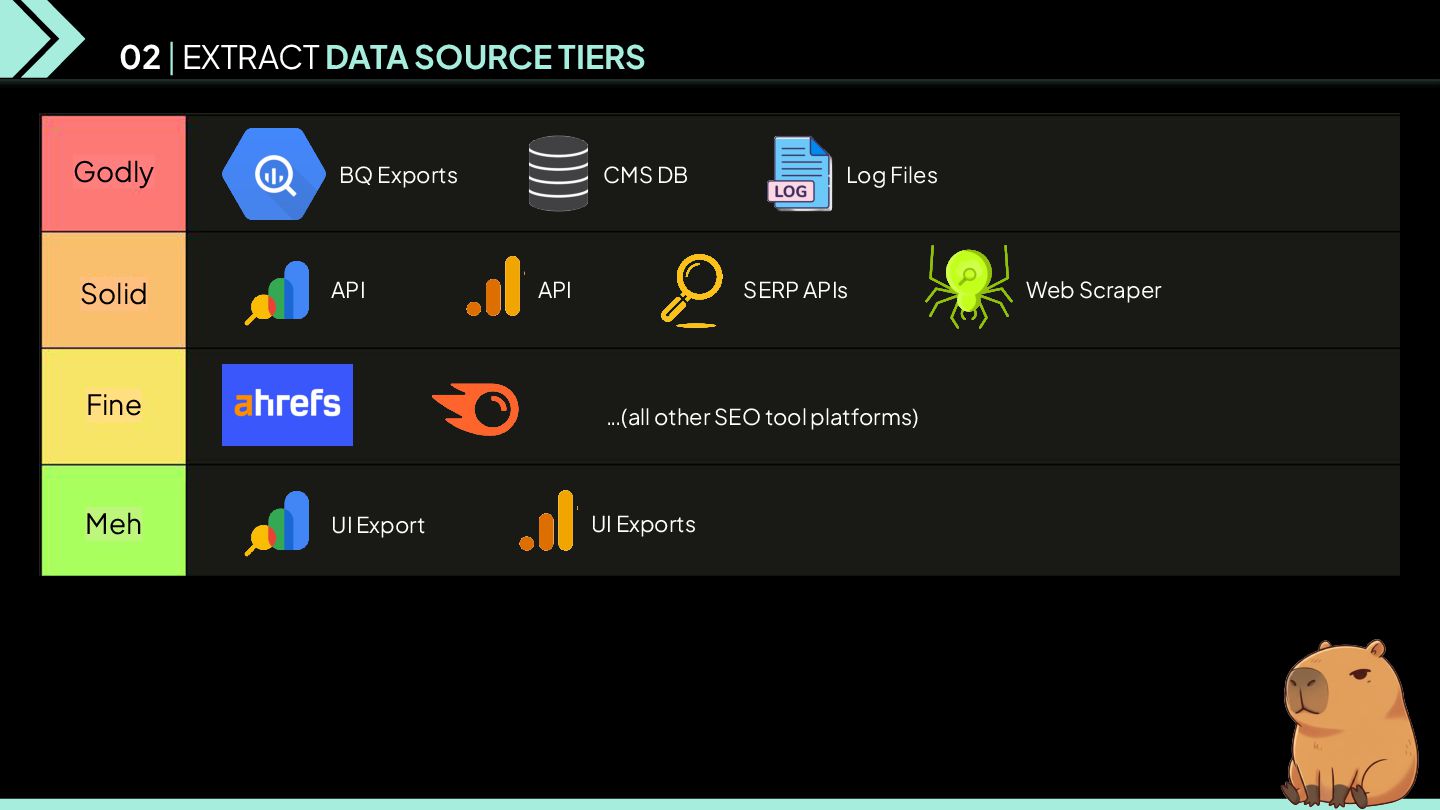
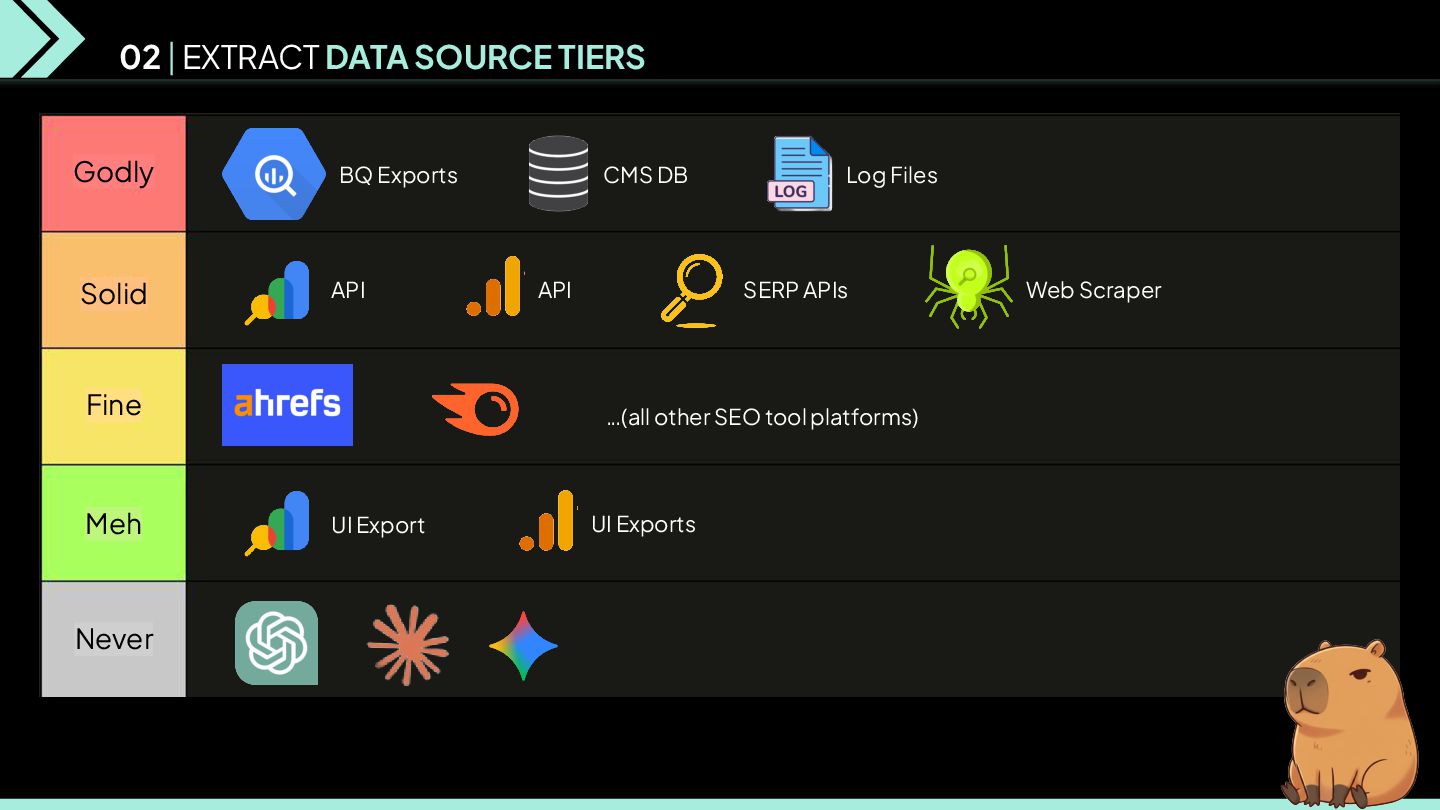
  16. Godly Solid Fine Meh Never API API BQ Exports CMS

    DB UI Export UI Exports Log Files SERP APIs Web Scraper …(all other SEO tool platforms) 02 | EXTRACT DATA SOURCE TIERS
  17. Godly Solid Fine Meh Never API API BQ Exports CMS

    DB UI Export UI Exports Log Files SERP APIs Web Scraper …(all other SEO tool platforms) 02 | EXTRACT DATA SOURCE TIERS
  18. Godly Solid Fine Meh Never API API BQ Exports CMS

    DB UI Export UI Exports Log Files SERP APIs Web Scraper …(all other SEO tool platforms) 02 | EXTRACT DATA SOURCE TIERS
  19. Godly Solid Fine Meh Never API API BQ Exports CMS

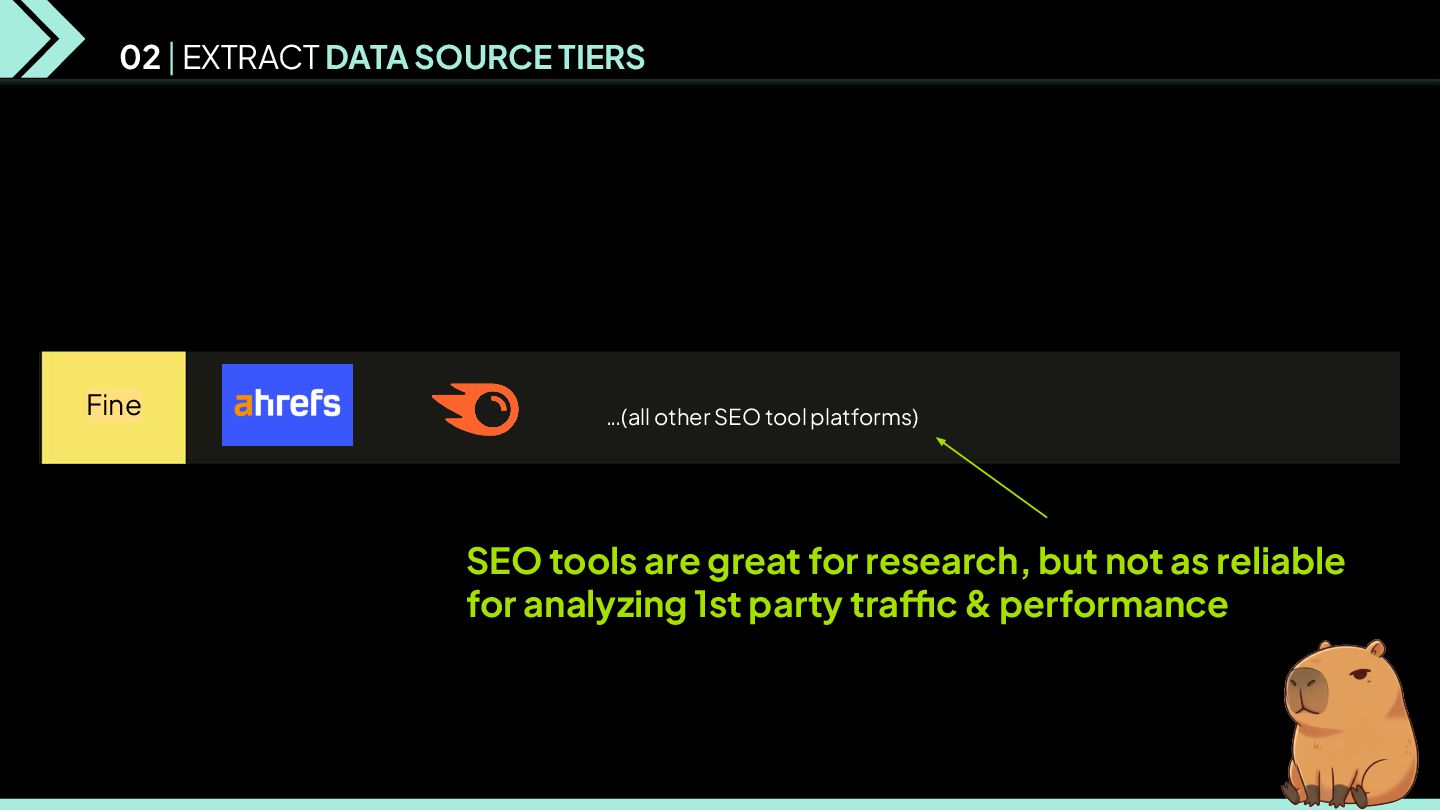
    DB UI Export UI Exports Log Files SERP APIs Web Scraper …(all other SEO tool platforms) SEO tools are great for research, but not as reliable for analyzing 1st party traffic & performance 02 | EXTRACT DATA SOURCE TIERS
  20. Godly Solid Fine Meh Never API API BQ Exports CMS

    DB UI Export UI Exports Log Files SERP APIs Web Scraper …(all other SEO tool platforms) 02 | EXTRACT DATA SOURCE TIERS
  21. Godly Solid Meh Never API API BQ Exports CMS DB

    UI Export UI Exports Log Files SERP APIs Web Scraper …(all other SEO tool platforms) 02 | EXTRACT DATA SOURCE TIERS Fine
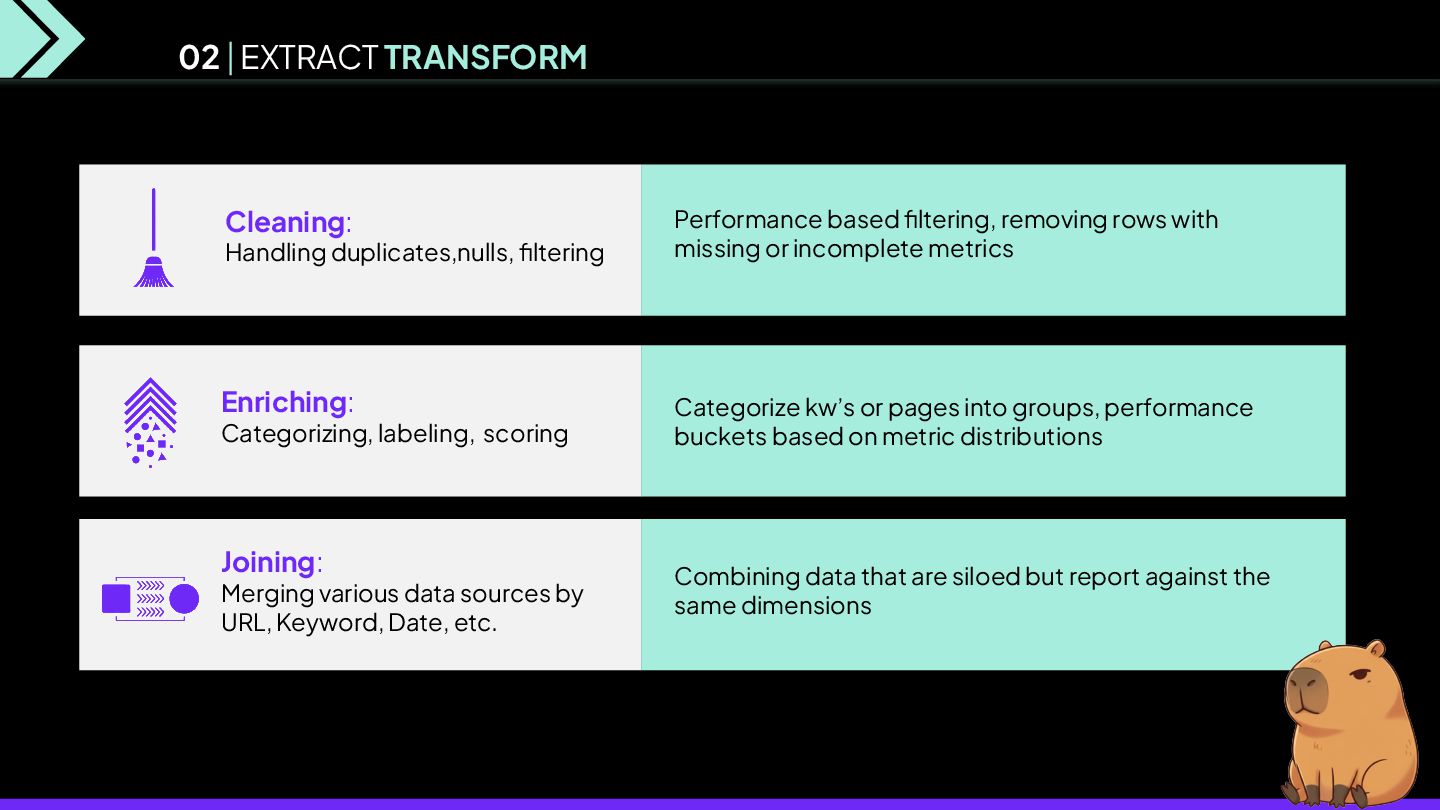
  22. Cleaning: Handling duplicates,nulls, filtering Enriching: Categorizing, labeling, scoring Joining: Merging

    various data sources by URL, Keyword, Date, etc. Performance based filtering, removing rows with missing or incomplete metrics Categorize kw’s or pages into groups, performance buckets based on metric distributions Combining data that are siloed but report against the same dimensions 02 | EXTRACT TRANSFORM
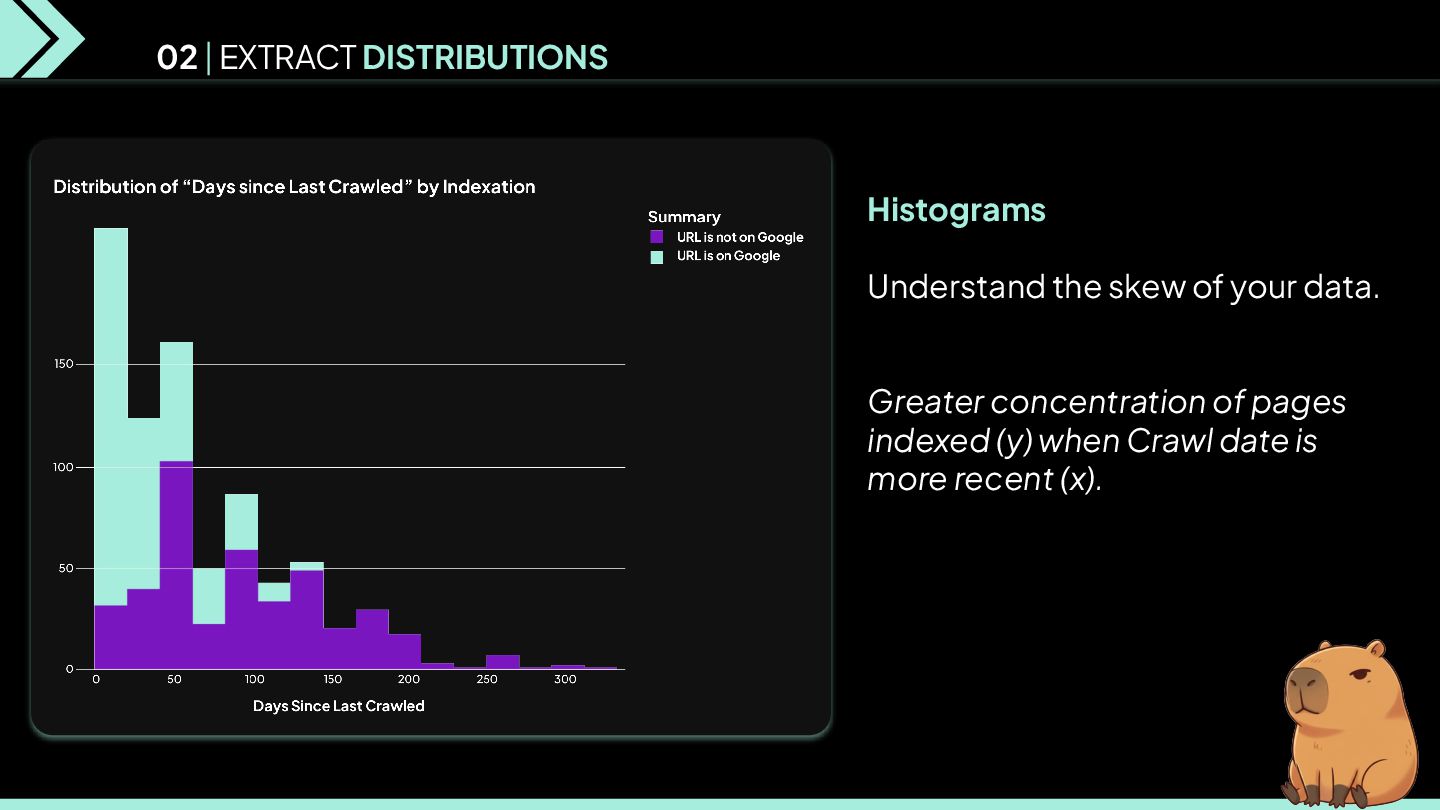
  23. Histograms Understand the skew of your data. Greater concentration of

    pages indexed (y) when Crawl date is more recent (x). 02 | EXTRACT DISTRIBUTIONS
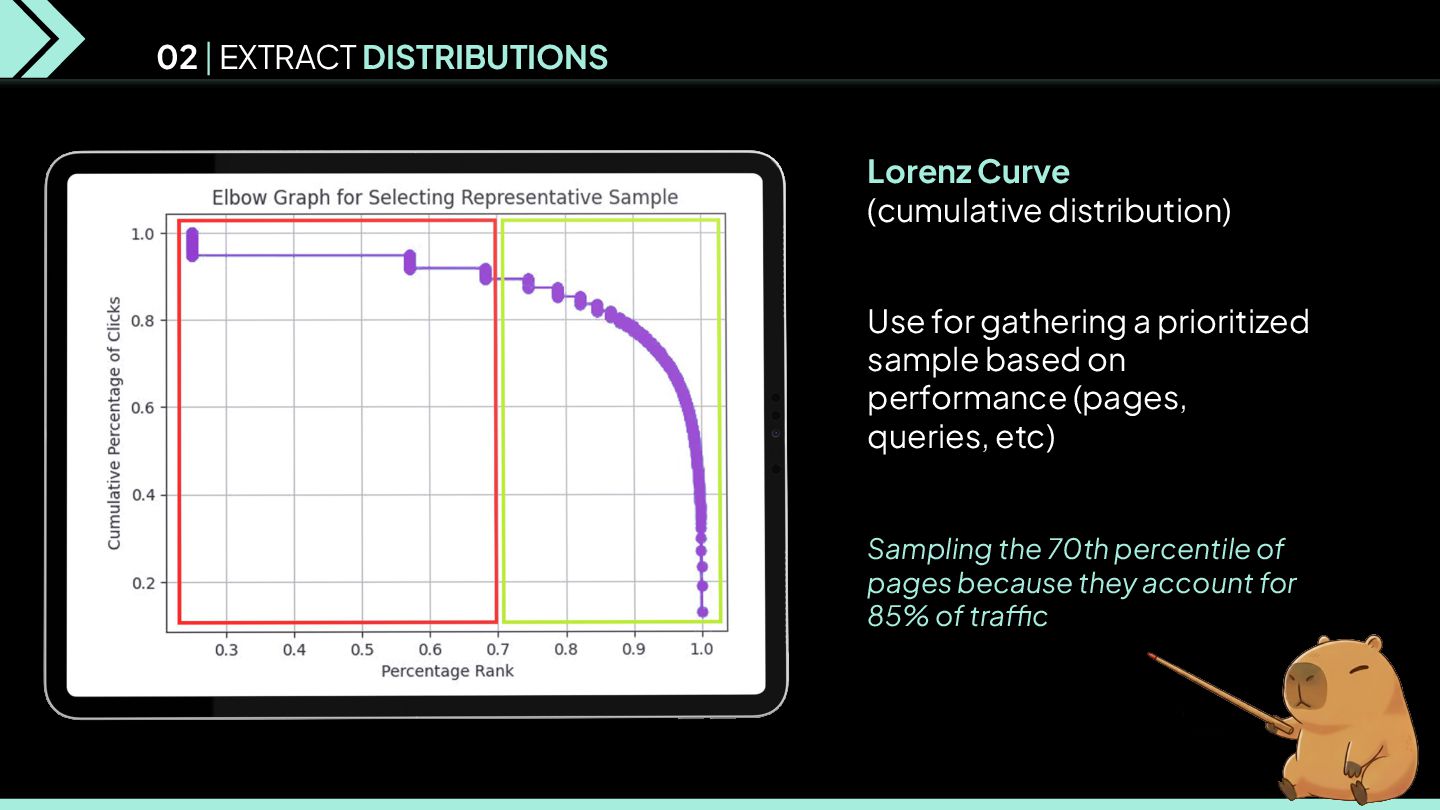
  24. Lorenz Curve (cumulative distribution) Use for gathering a prioritized sample

    based on performance (pages, queries, etc) Sampling the 70th percentile of pages because they account for 85% of traffic 02 | EXTRACT DISTRIBUTIONS
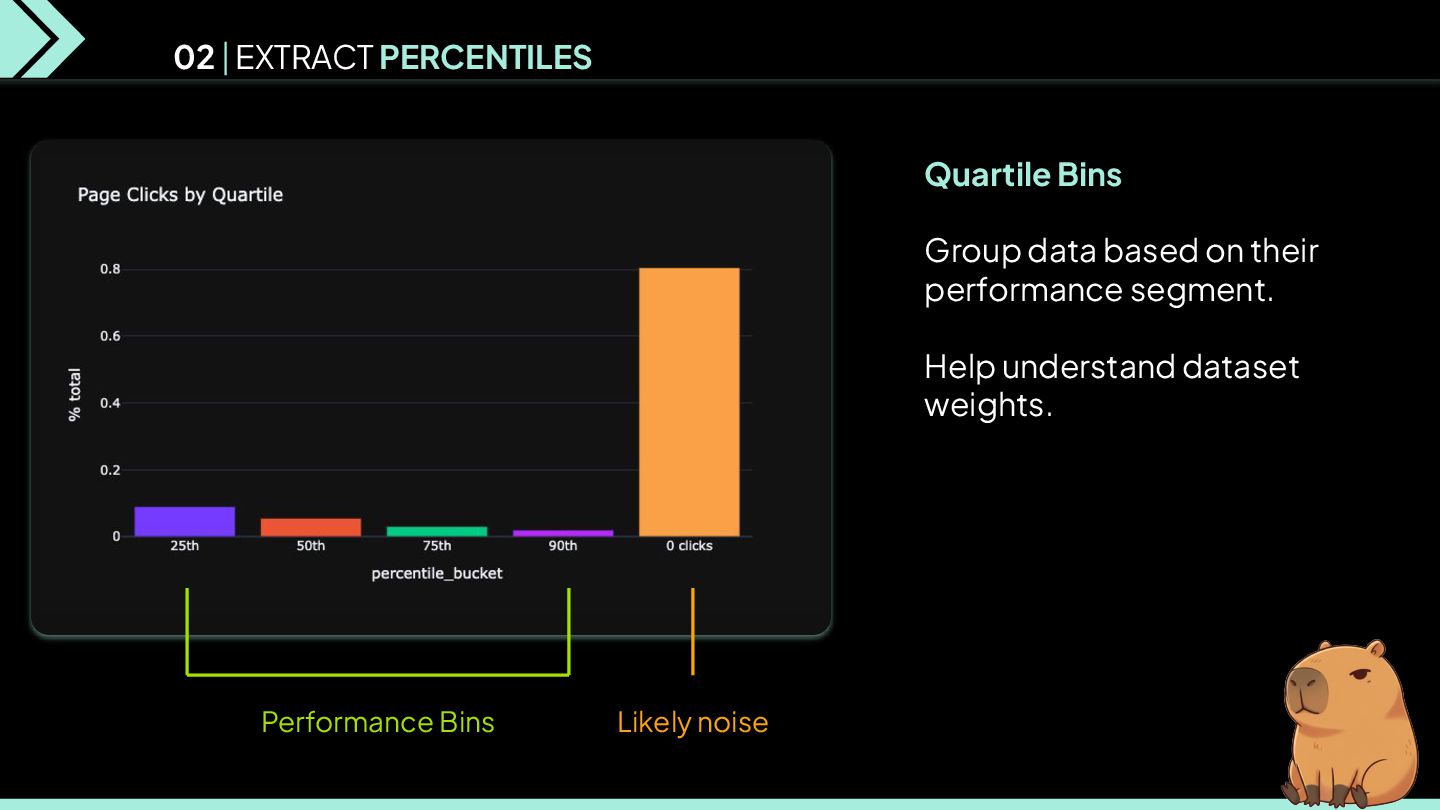
  25. Quartile Bins Group data based on their performance segment. Help

    understand dataset weights. Performance Bins Likely noise 02 | EXTRACT PERCENTILES
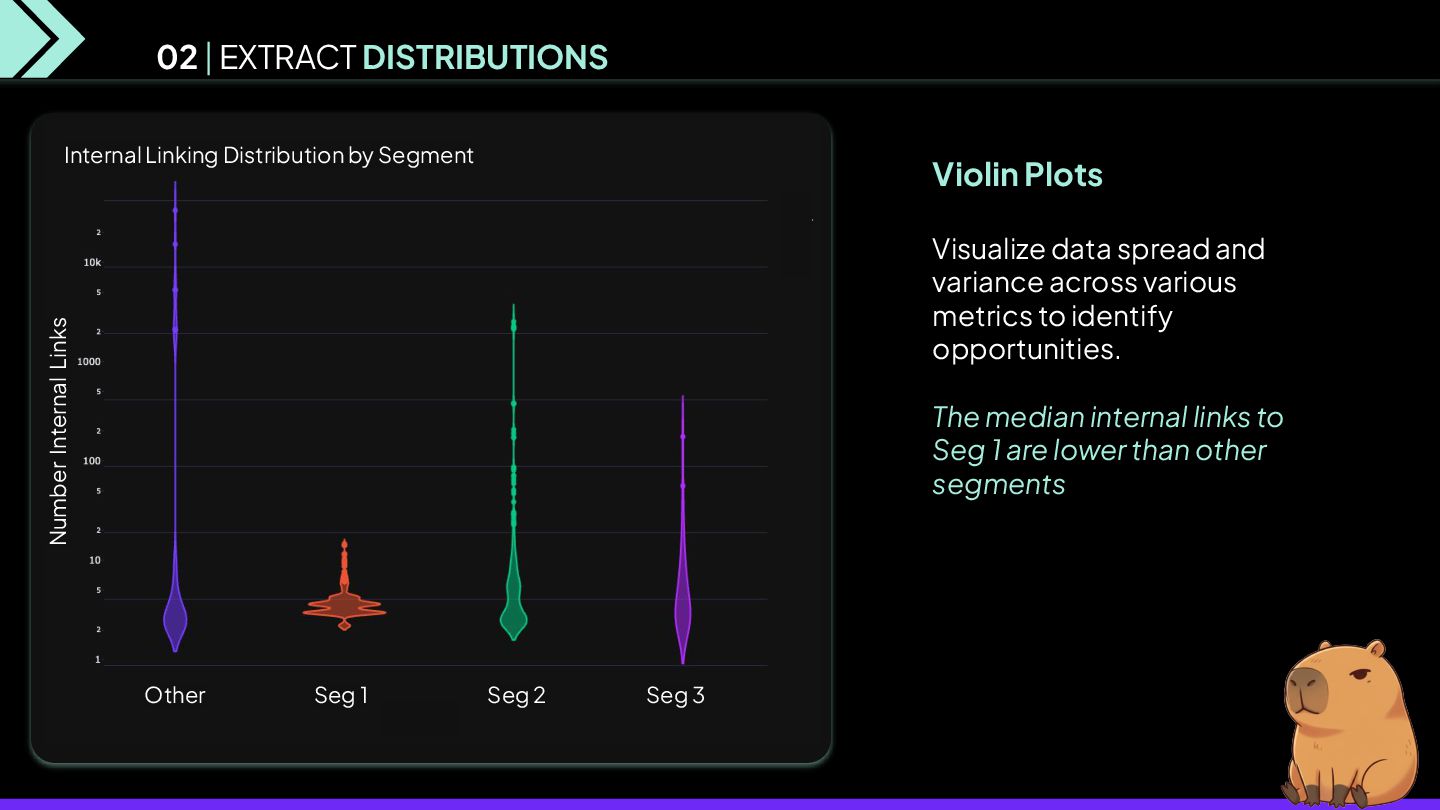
  26. Violin Plots Visualize data spread and variance across various metrics

    to identify opportunities. The median internal links to Seg 1 are lower than other segments 02 | EXTRACT DISTRIBUTIONS Other Seg 1 Seg 2 Seg 3 Number Internal Links Internal Linking Distribution by Segment
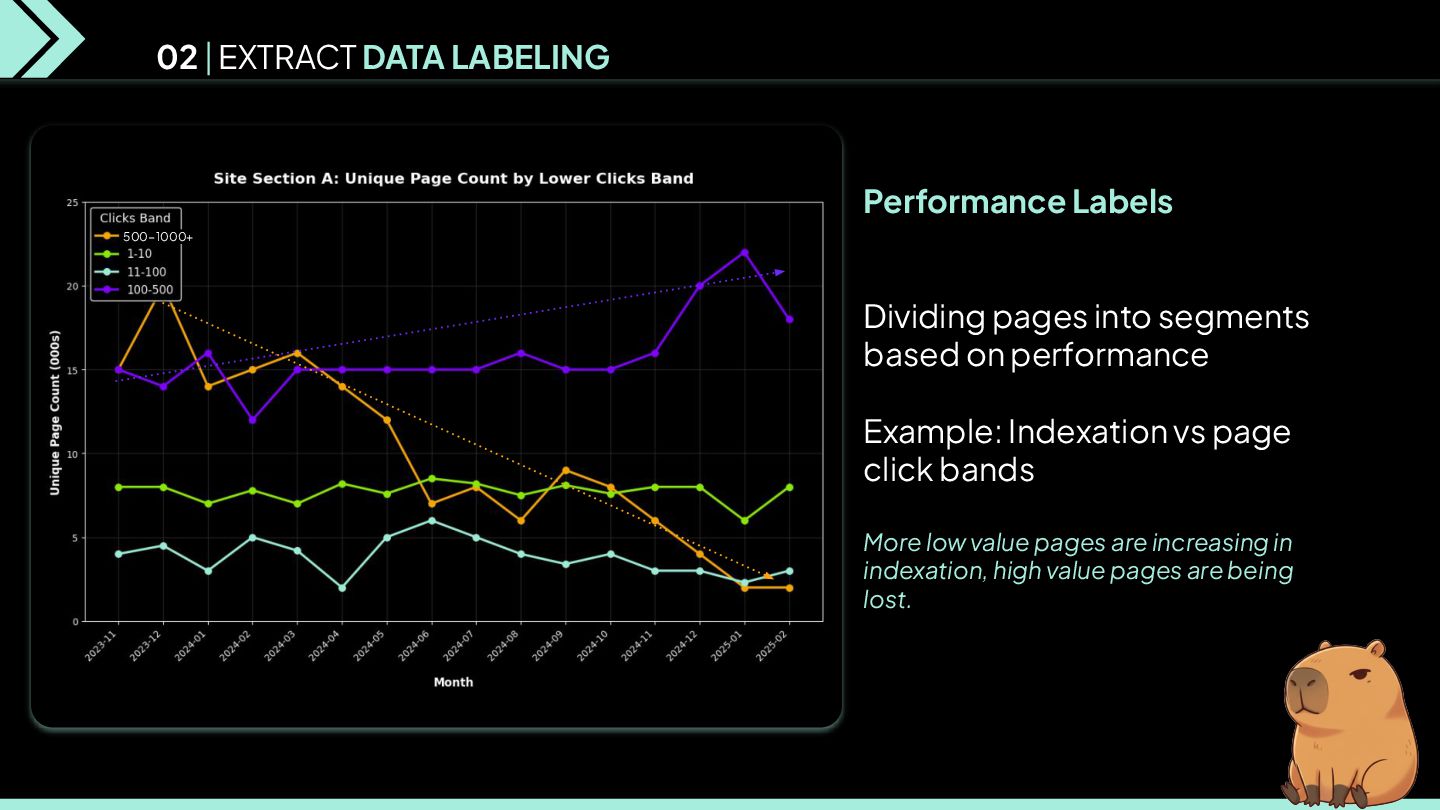
  27. Performance Labels Dividing pages into segments based on performance Example:

    Indexation vs page click bands More low value pages are increasing in indexation, high value pages are being lost. 02 | EXTRACT DATA LABELING 500−1000+
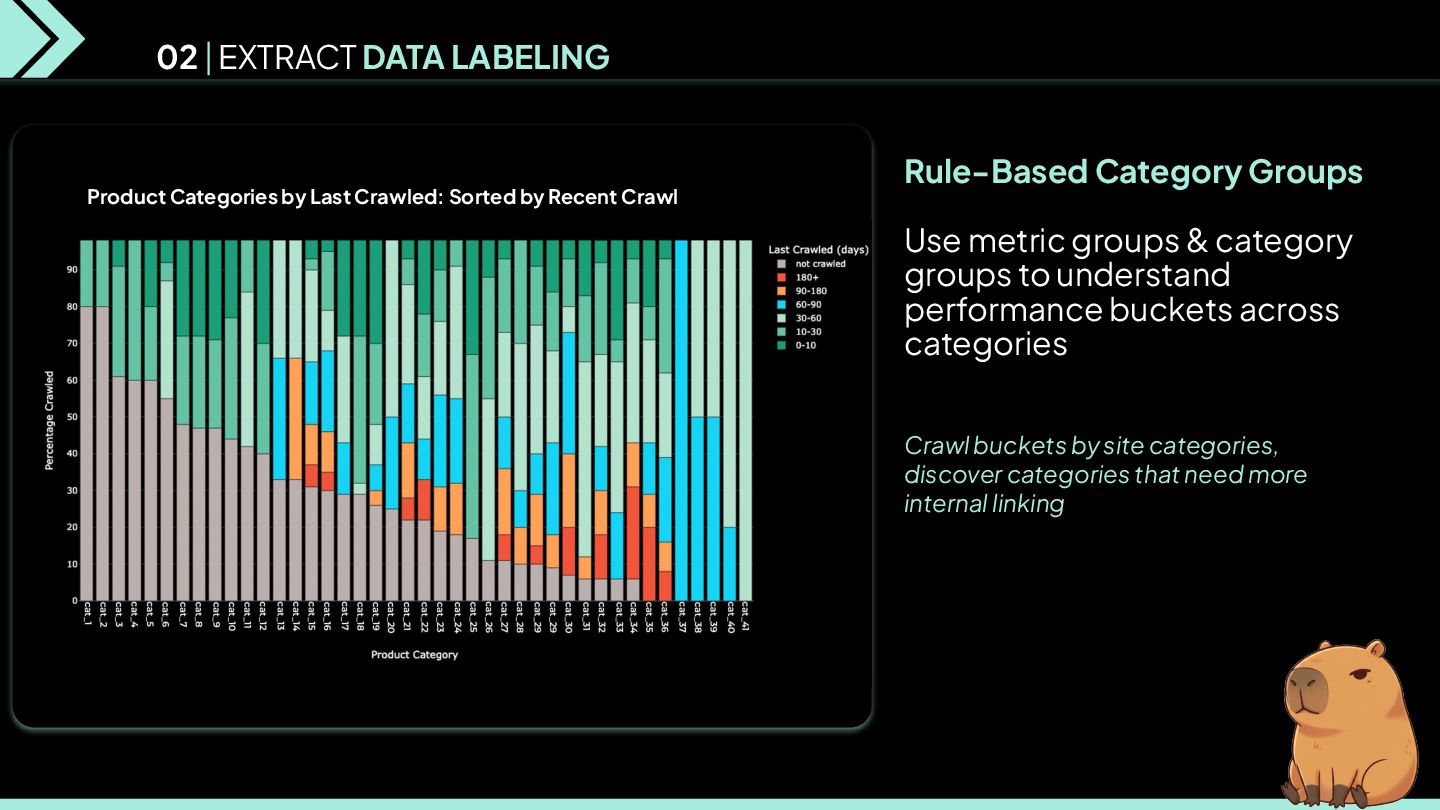
  28. Rule-Based Category Groups Use metric groups & category groups to

    understand performance buckets across categories Crawl buckets by site categories, discover categories that need more internal linking 02 | EXTRACT DATA LABELING Product Categories by Last Crawled: Sorted by Recent Crawl
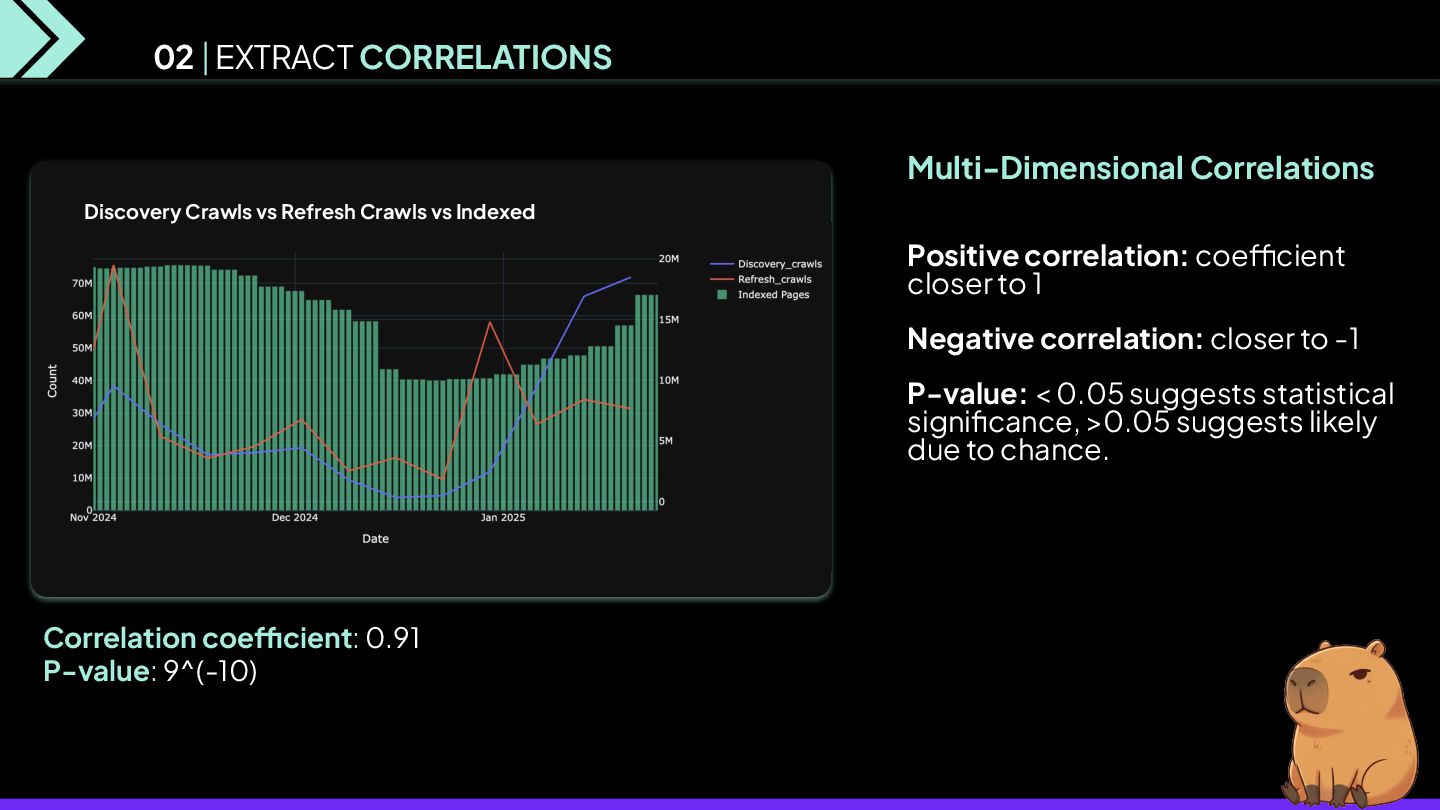
  29. Multi-Dimensional Correlations Positive correlation: coefficient closer to 1 Negative correlation:

    closer to -1 P-value: < 0.05 suggests statistical significance, >0.05 suggests likely due to chance. Correlation coefficient: 0.91 P-value: 9^(-10) 02 | EXTRACT CORRELATIONS Discovery Crawls vs Refresh Crawls vs Indexed
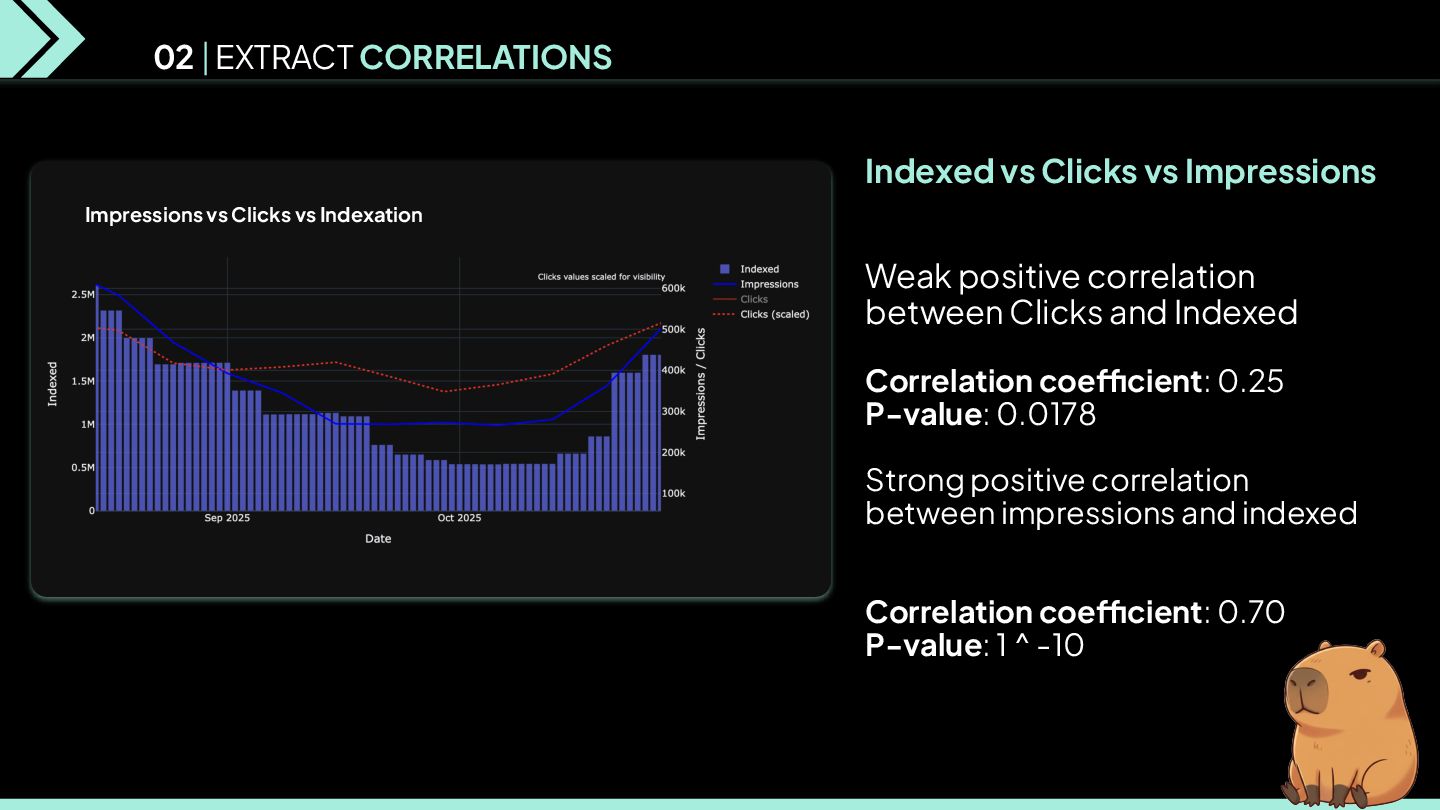
  30. Indexed vs Clicks vs Impressions Weak positive correlation between Clicks
    and Indexed Correlation coefficient: 0.25 P-value: 0.0178 Strong positive correlation between impressions and indexed Correlation coefficient: 0.70 P-value: 1 ^ -10 02 | EXTRACT CORRELATIONS Impressions vs Clicks vs Indexation
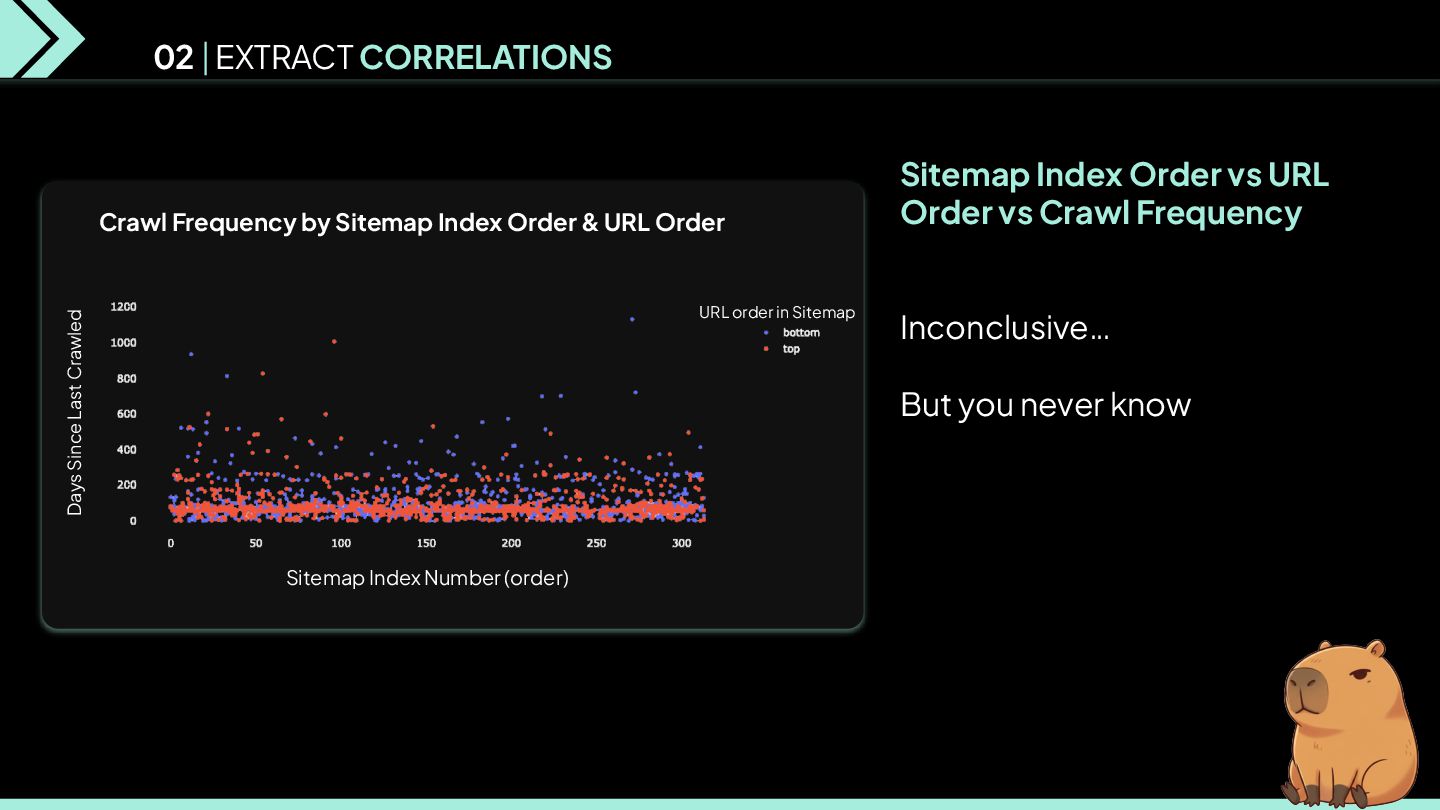
  31. Sitemap Index Order vs URL Order vs Crawl Frequency Inconclusive…

    But you never know 02 | EXTRACT CORRELATIONS Crawl Frequency by Sitemap Index Order & URL Order Sitemap Index Number (order) Days Since Last Crawled URL order in Sitemap
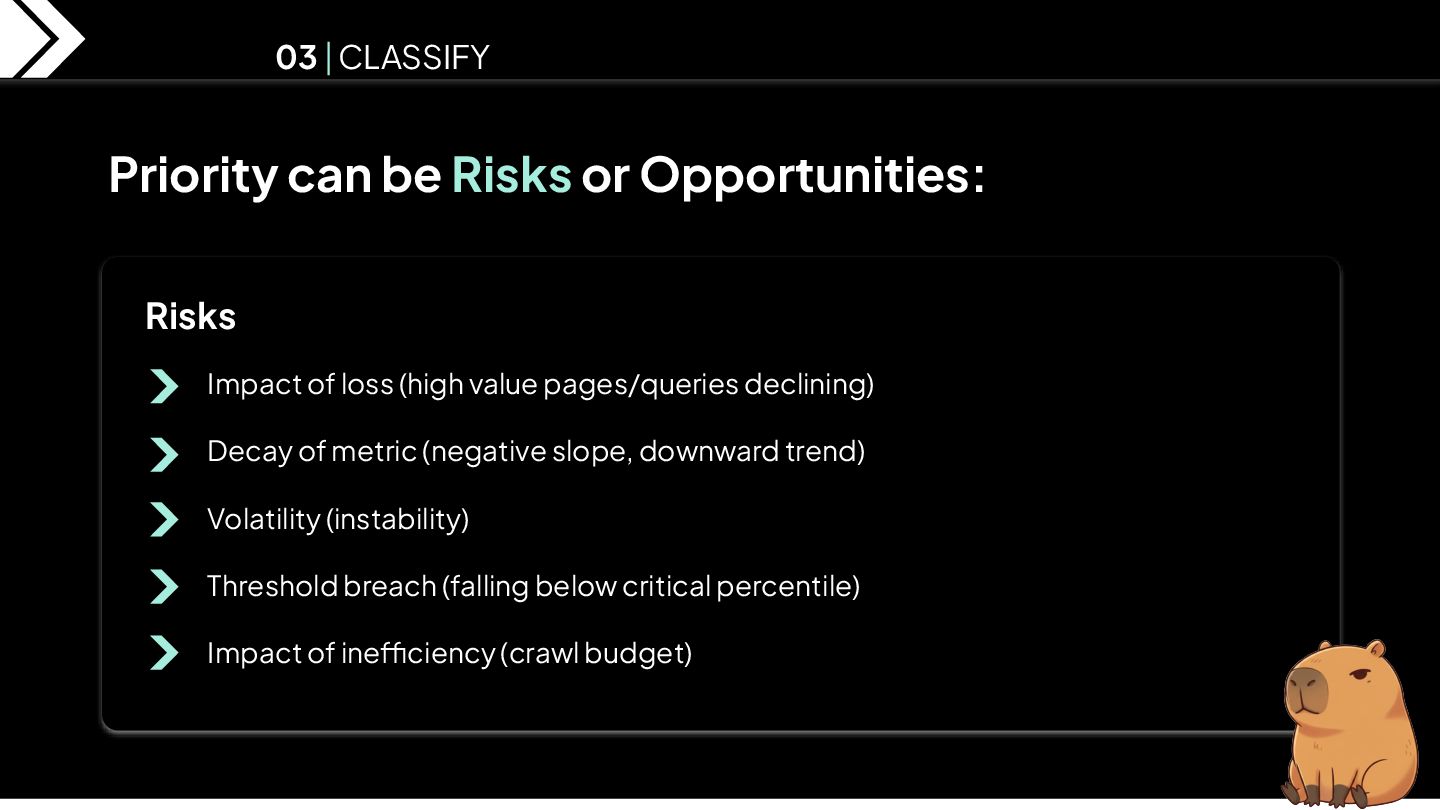
  32. Priority can be Risks or Opportunities: Risks Impact of loss

    (high value pages/queries declining) Decay of metric (negative slope, downward trend) Volatility (instability) Threshold breach (falling below critical percentile) Impact of inefficiency (crawl budget) 03 | CLASSIFY
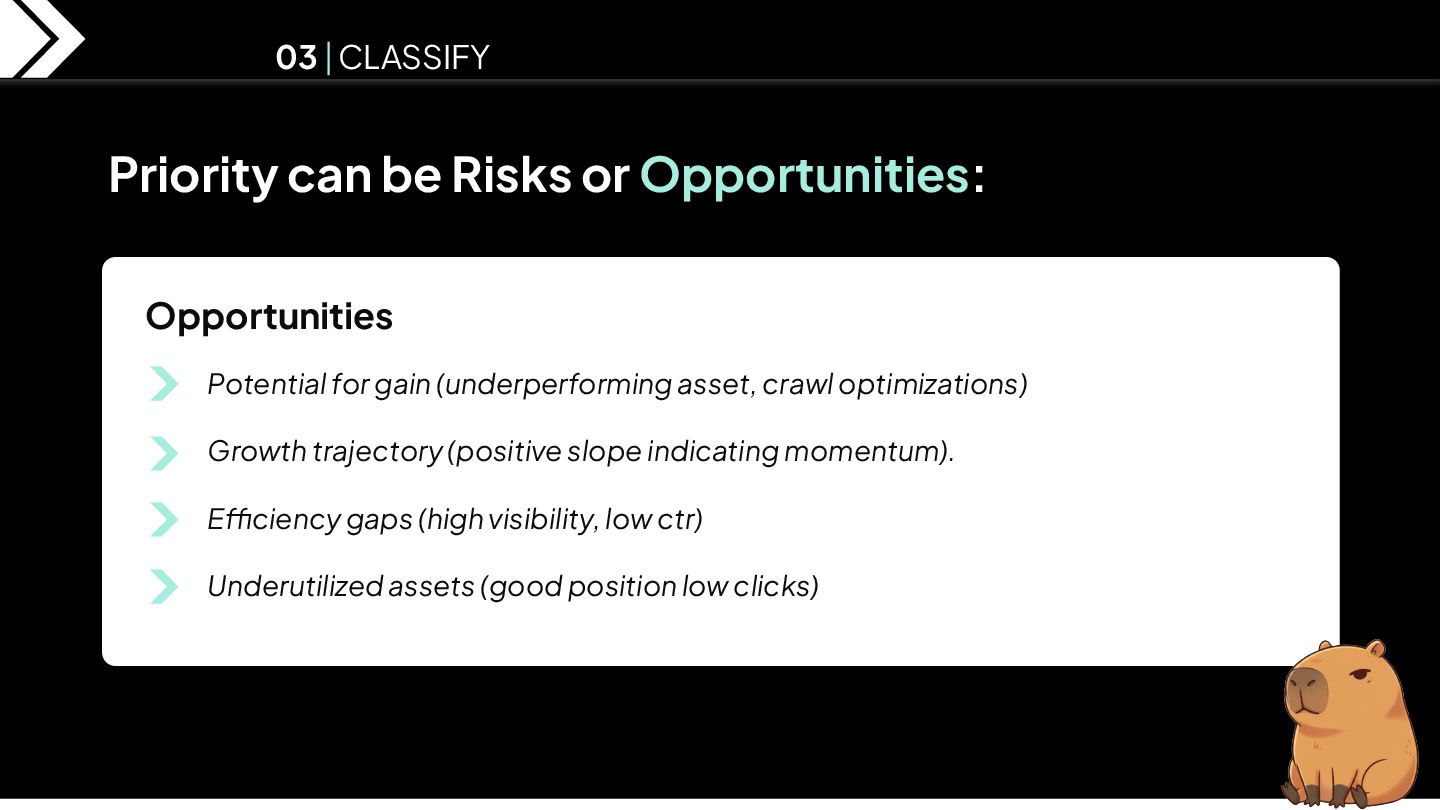
  33. Priority can be Risks or Opportunities: Opportunities Potential for gain

    (underperforming asset, crawl optimizations) Growth trajectory (positive slope indicating momentum). Efficiency gaps (high visibility, low ctr) Underutilized assets (good position low clicks) 03 | CLASSIFY
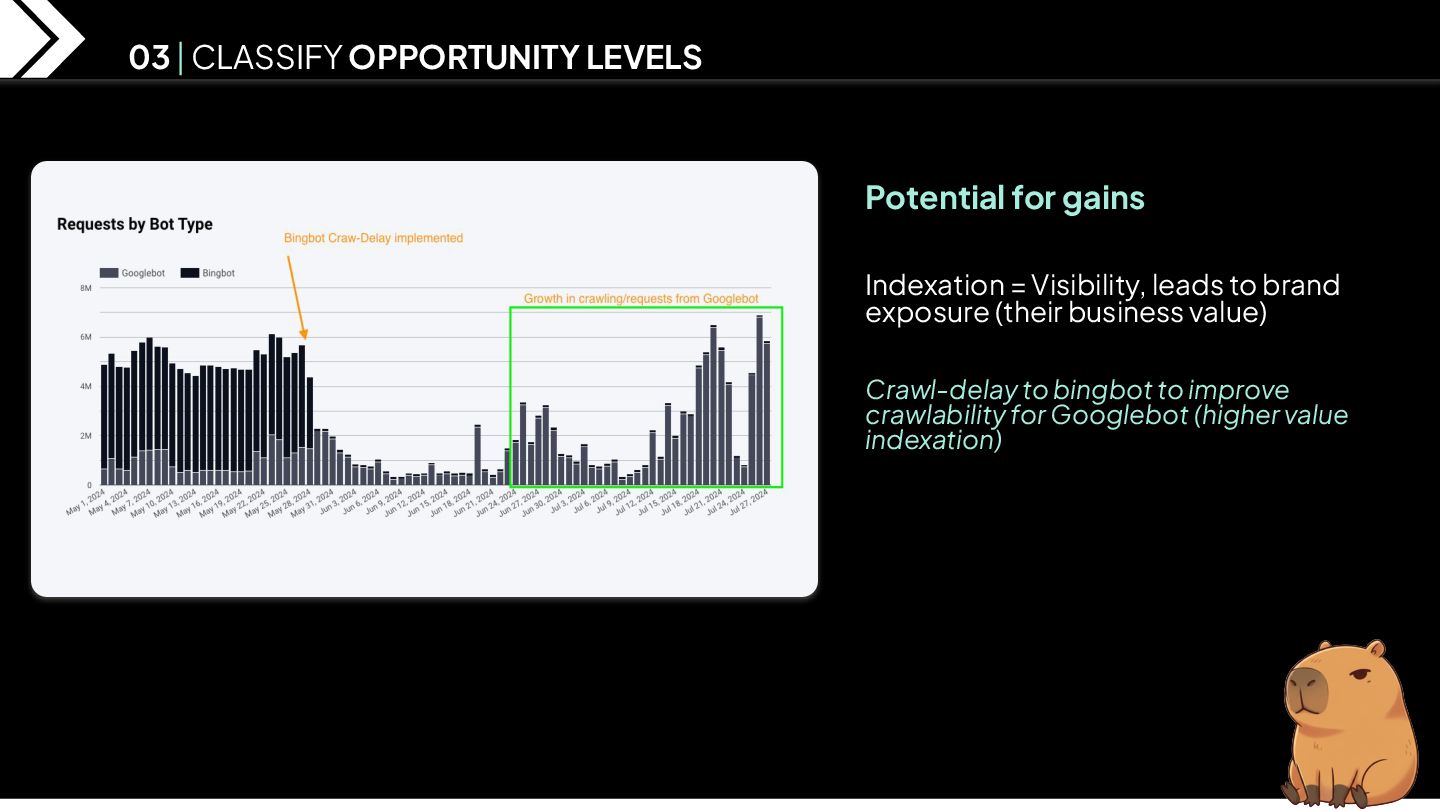
  34. Potential for gains Indexation = Visibility, leads to brand exposure

    (their business value) Crawl-delay to bingbot to improve crawlability for Googlebot (higher value indexation) 03 | CLASSIFY OPPORTUNITY LEVELS
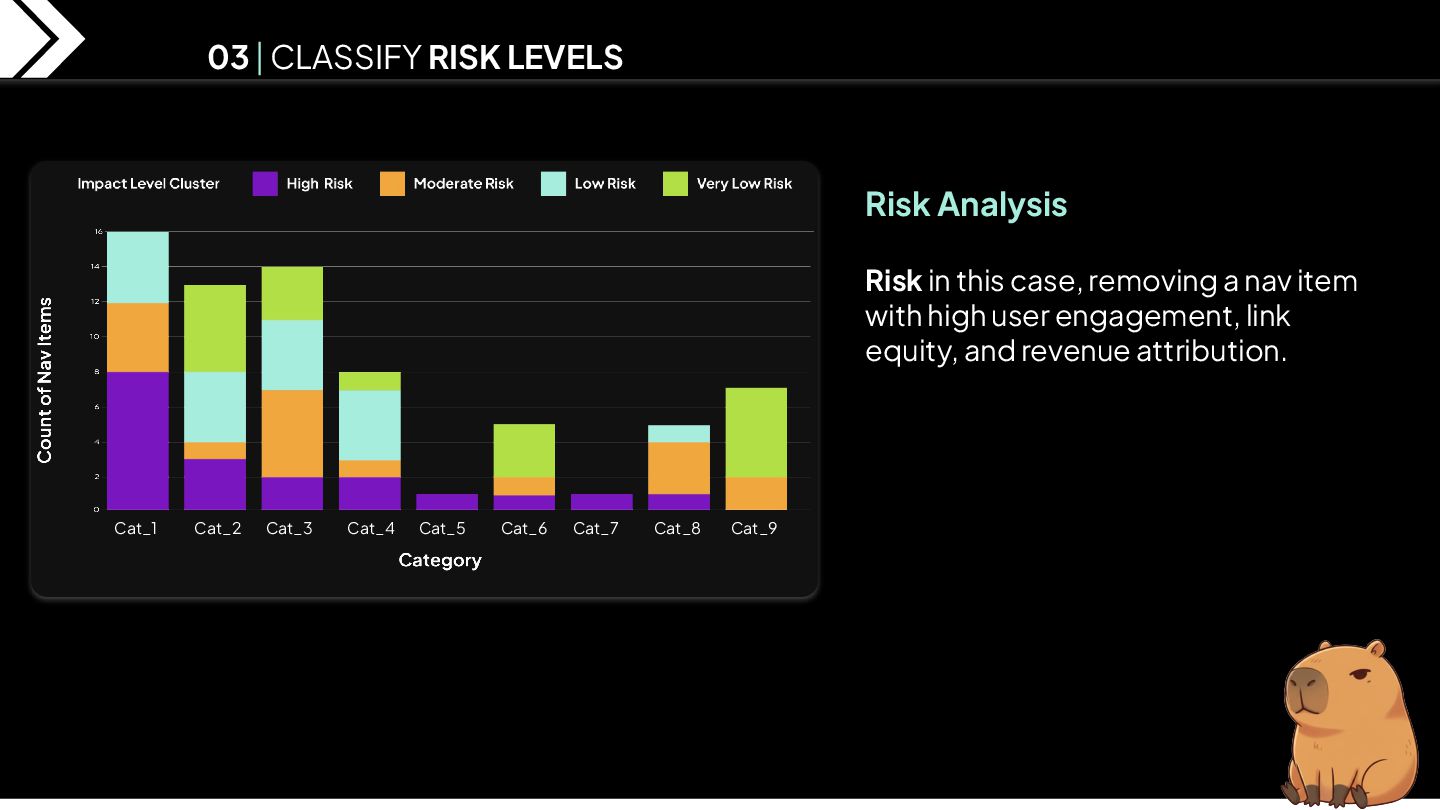
  35. Risk Analysis Risk in this case, removing a nav item
    with high user engagement, link equity, and revenue attribution. 03 | CLASSIFY RISK LEVELS Cat_1 Cat_2 Cat_3 Cat_4 Cat_5 Cat_6 Cat_7 Cat_8 Cat_9
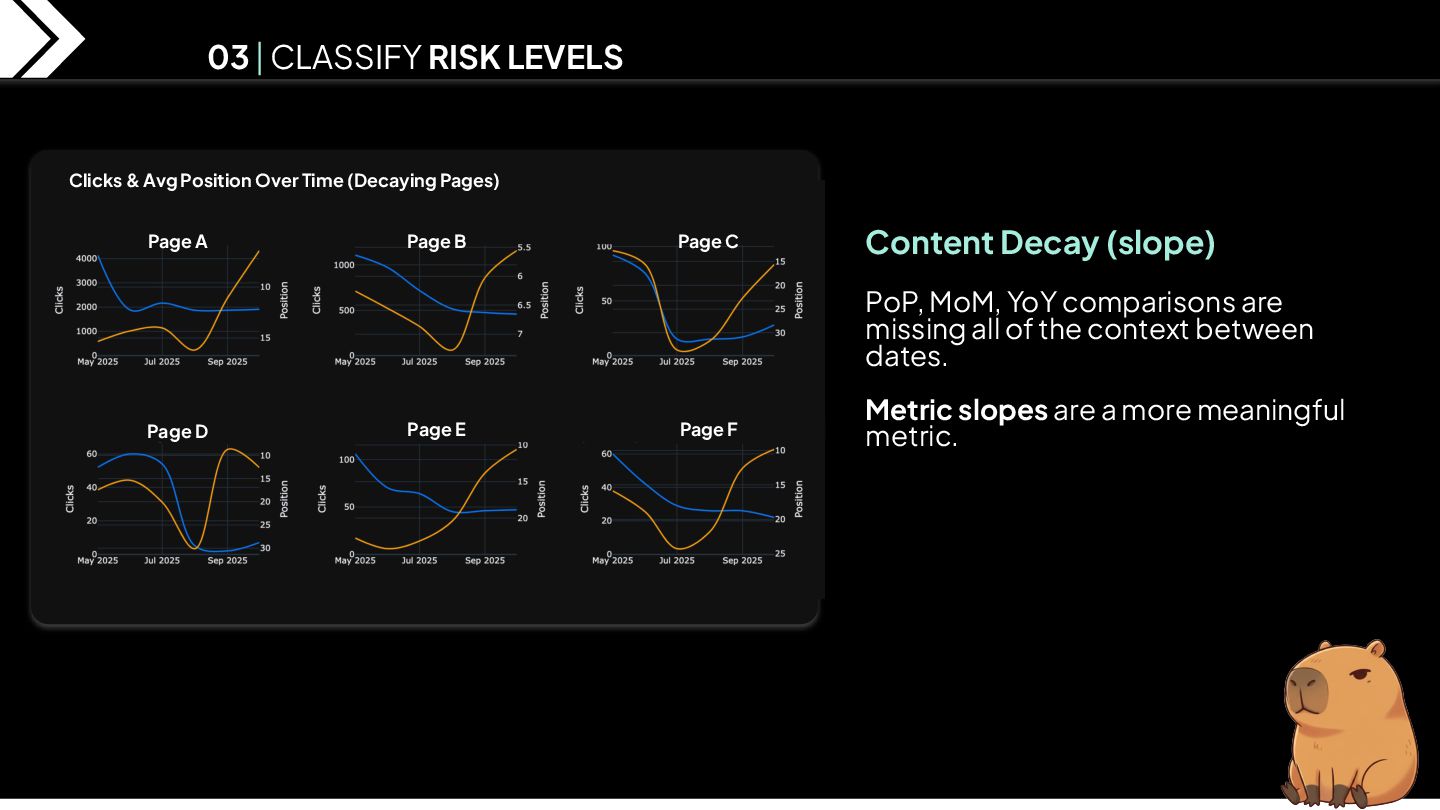
  36. Content Decay (slope) PoP, MoM, YoY comparisons are missing all

    of the context between dates. Metric slopes are a more meaningful metric. 03 | CLASSIFY RISK LEVELS Page B Page A Page C Page D Page E Page F Clicks & Avg Position Over Time (Decaying Pages)
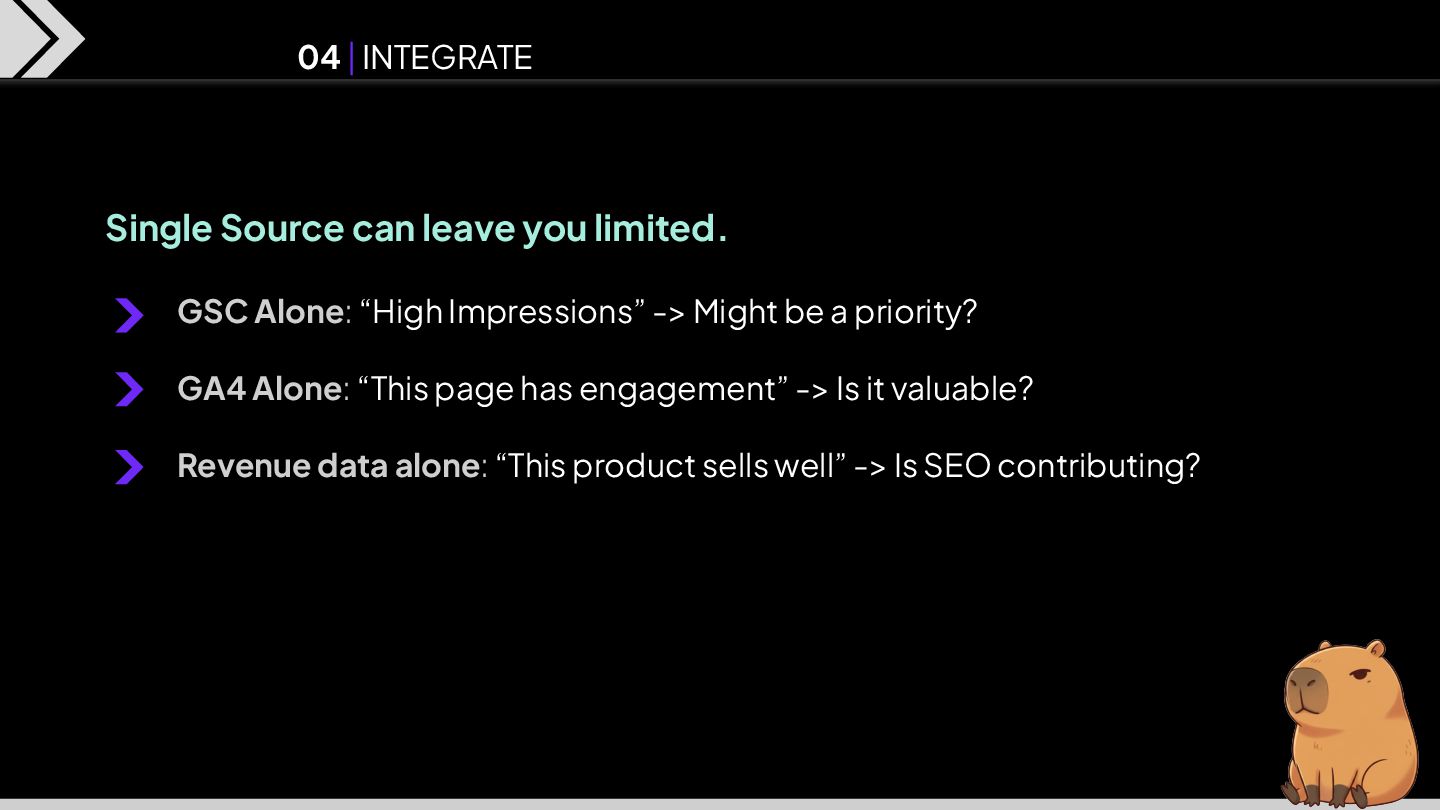
  37. Single Source can leave you limited. GSC Alone: “High Impressions”

    -> Might be a priority? GA4 Alone: “This page has engagement” -> Is it valuable? Revenue data alone: “This product sells well” -> Is SEO contributing? 04 | INTEGRATE
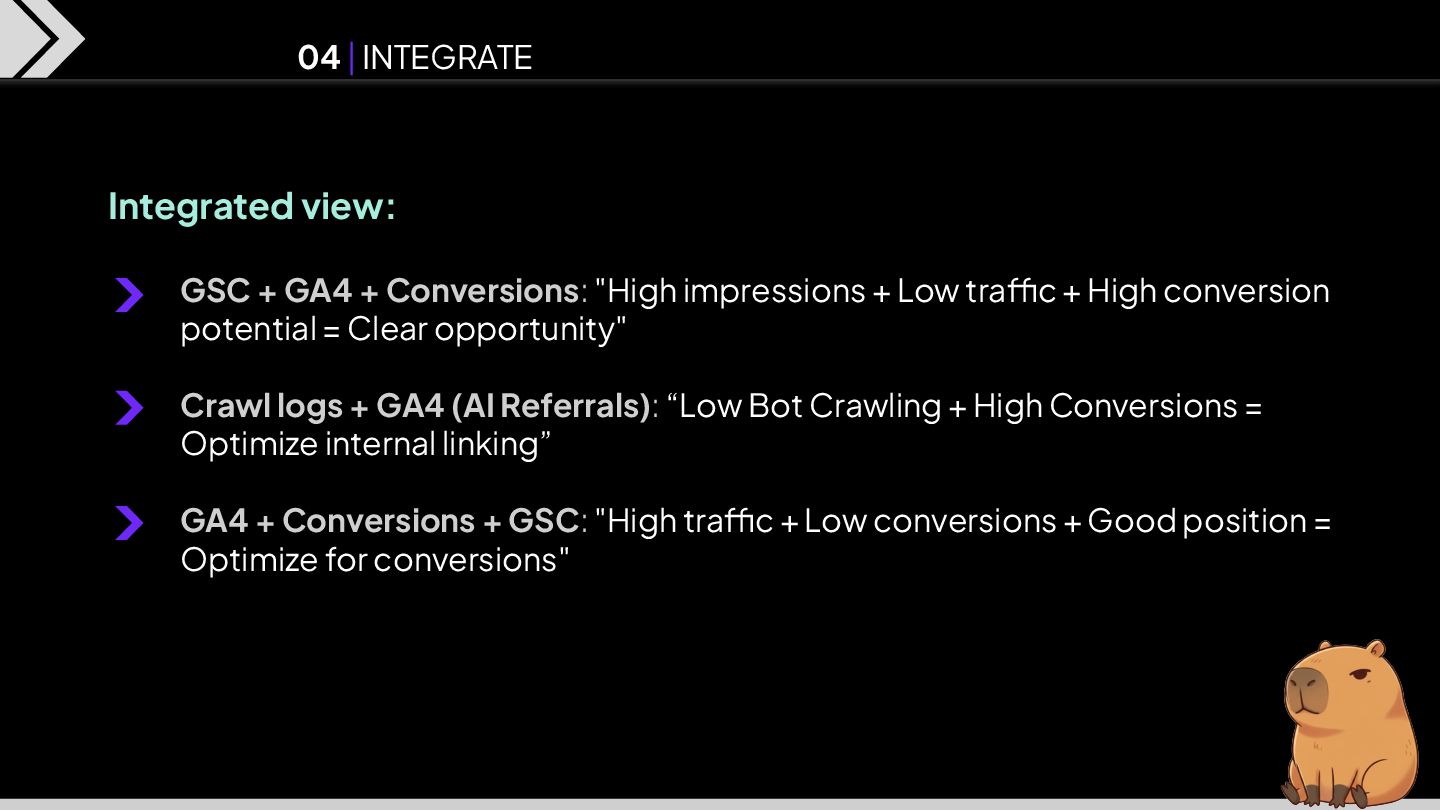
  38. Integrated view: GSC + GA4 + Conversions: "High impressions +

    Low traffic + High conversion potential = Clear opportunity" Crawl logs + GA4 (AI Referrals): “Low Bot Crawling + High Conversions = Optimize internal linking” GA4 + Conversions + GSC: "High traffic + Low conversions + Good position = Optimize for conversions" 04 | INTEGRATE
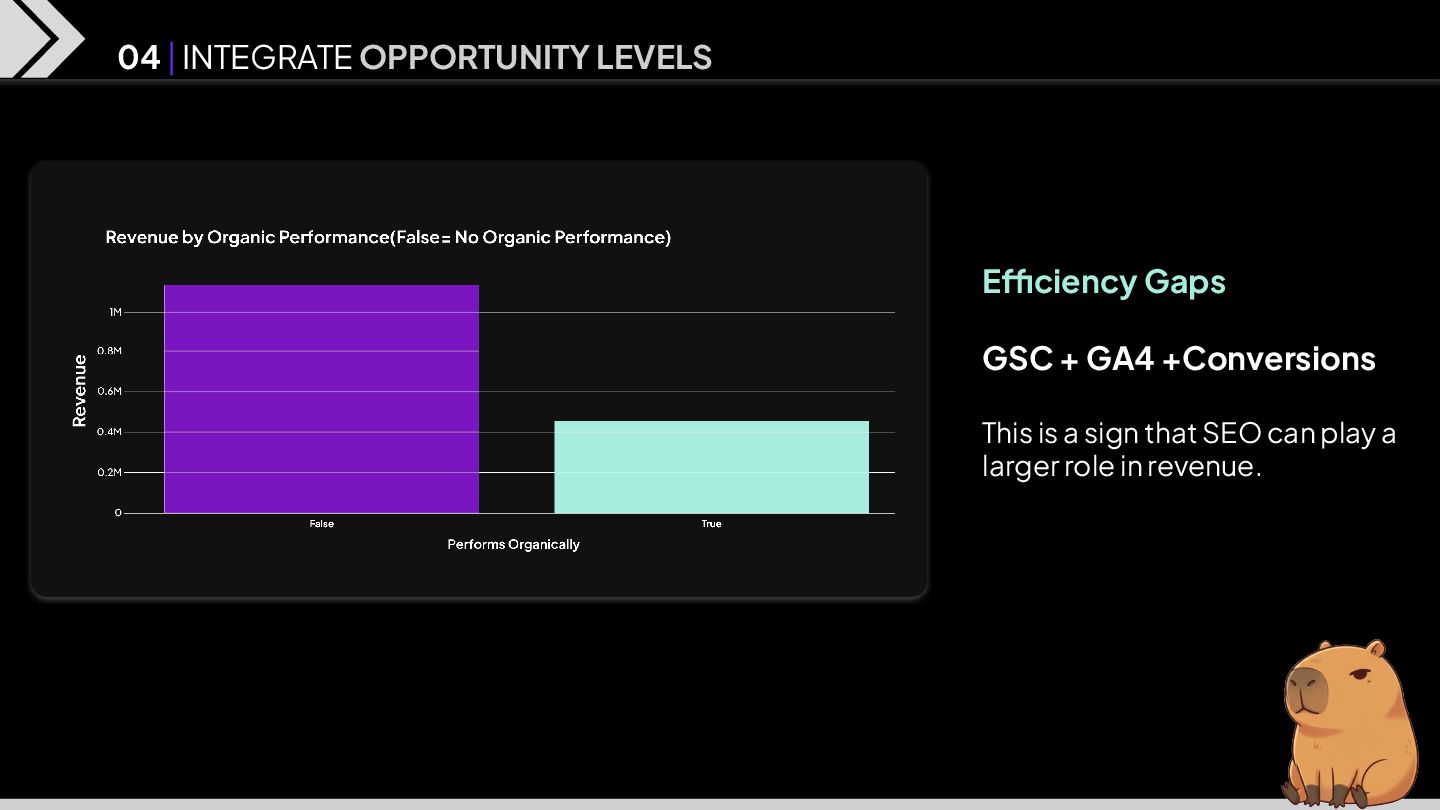
  39. Efficiency Gaps GSC + GA4 +Conversions This is a sign

    that SEO can play a larger role in revenue. 04 | INTEGRATE OPPORTUNITY LEVELS
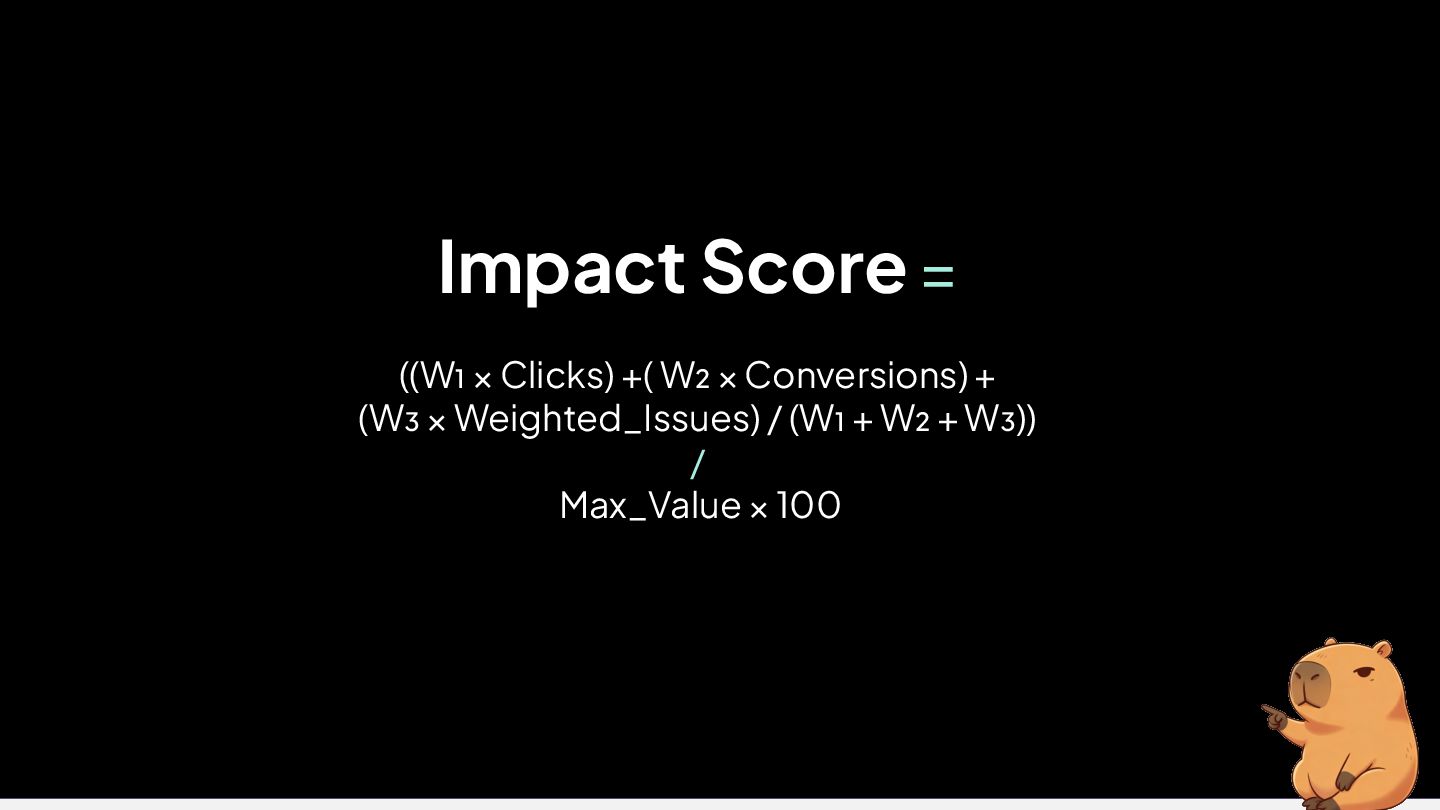
  40. Impact Score = ((W₁ × Clicks) +( W₂ × Conversions)

    + (W₃ × Weighted_Issues) / (W₁ + W₂ + W₃)) / Max_Value × 100
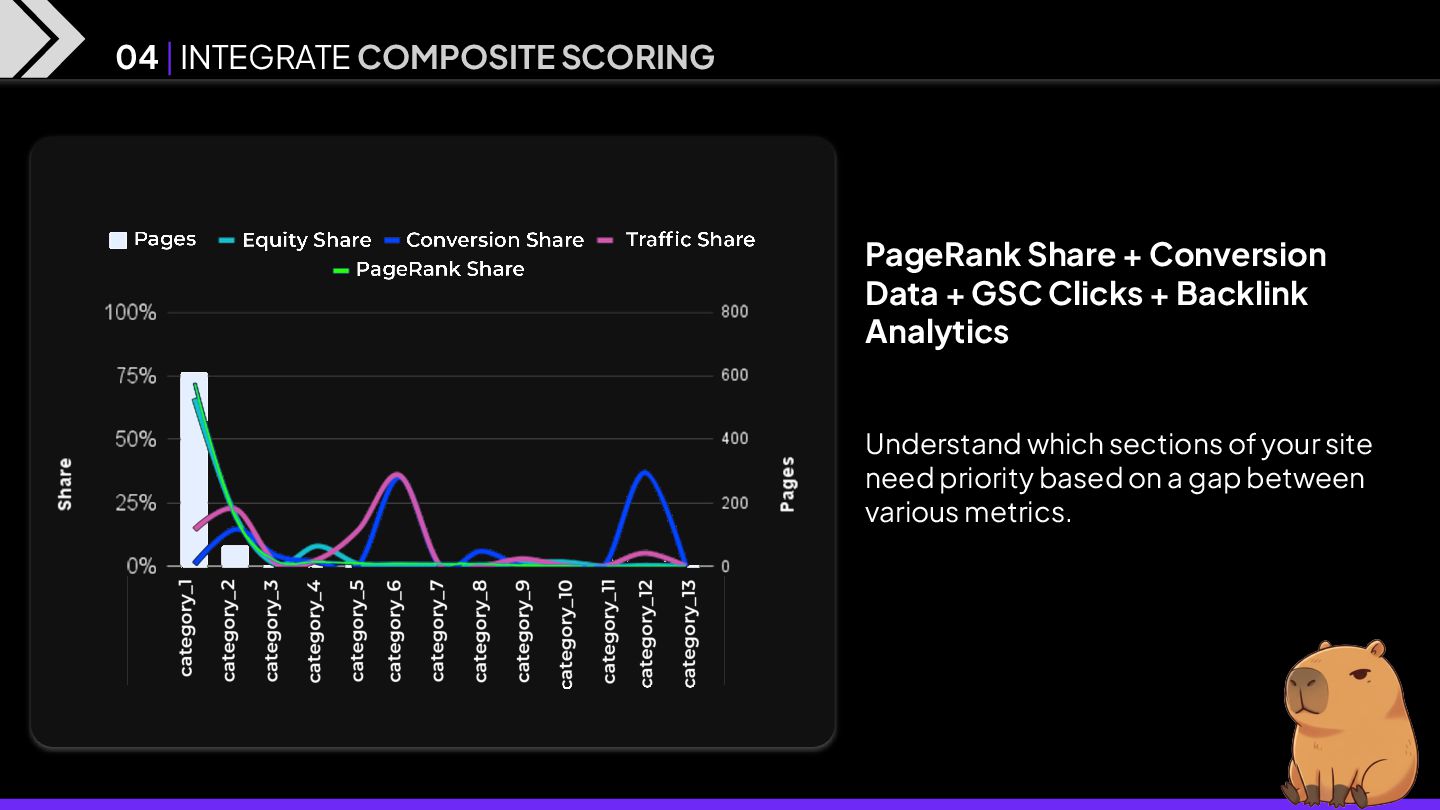
  41. PageRank Share + Conversion Data + GSC Clicks + Backlink

    Analytics Understand which sections of your site need priority based on a gap between various metrics. 04 | INTEGRATE COMPOSITE SCORING
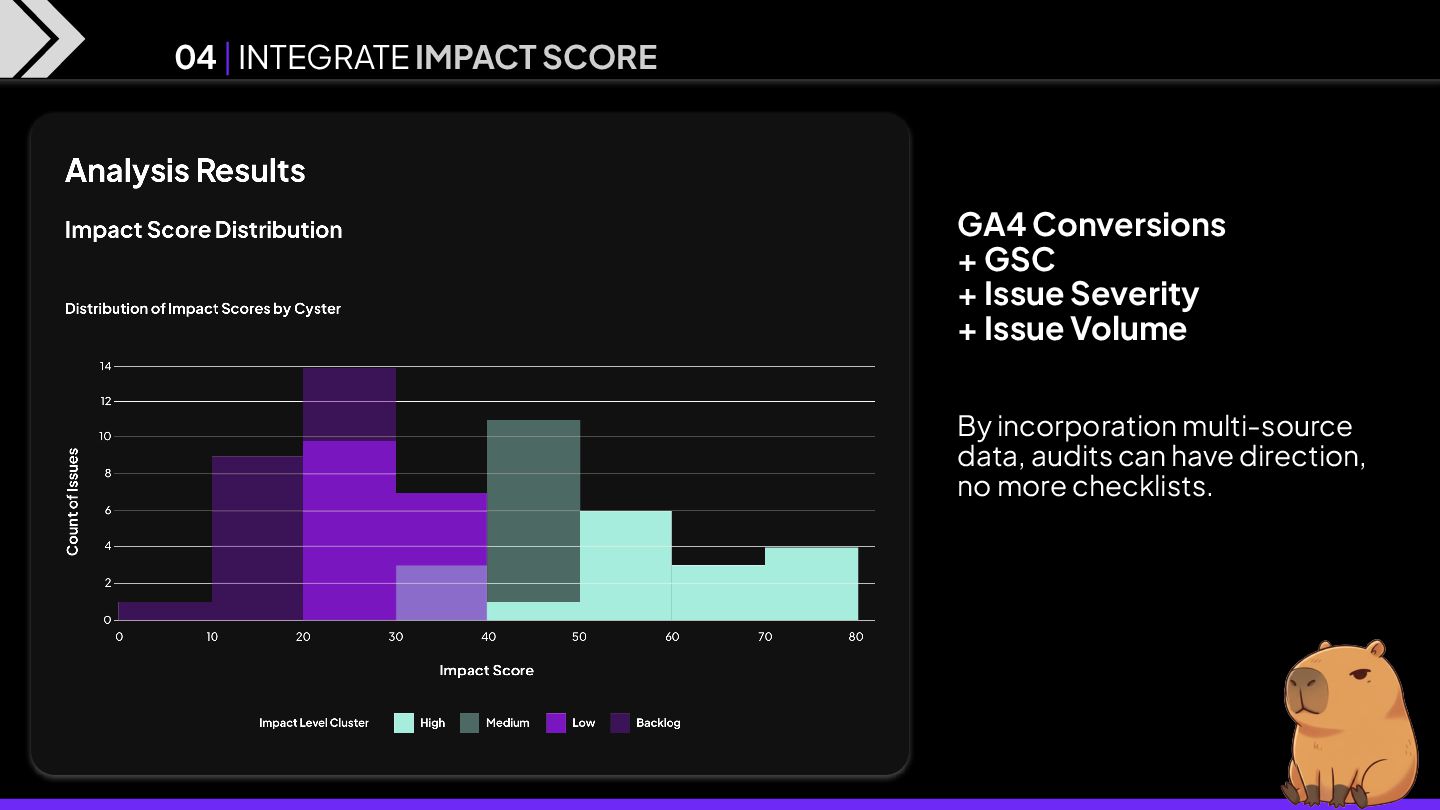
  42. GA4 Conversions + GSC + Issue Severity + Issue Volume

    By incorporation multi-source data, audits can have direction, no more checklists. 04 | INTEGRATE IMPACT SCORE
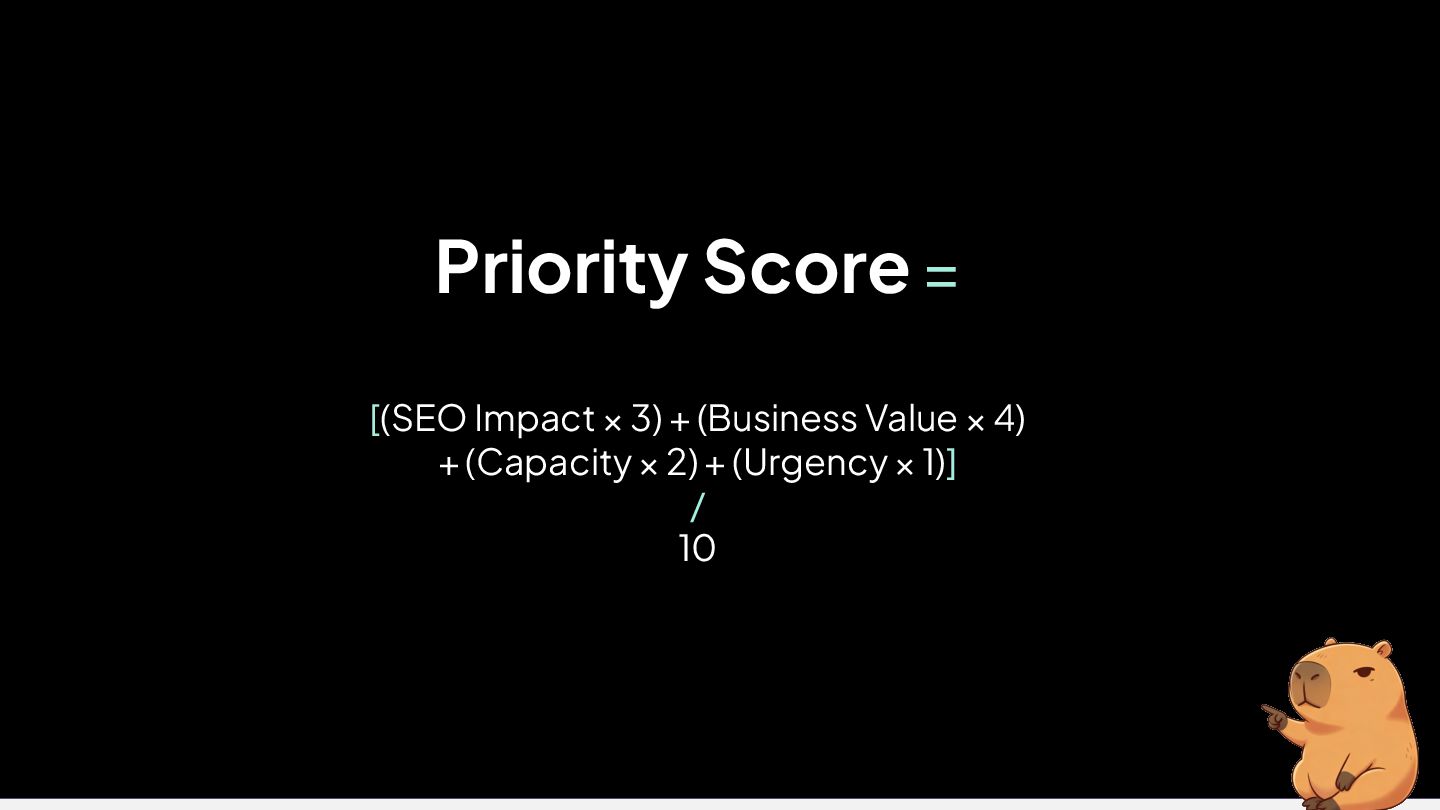
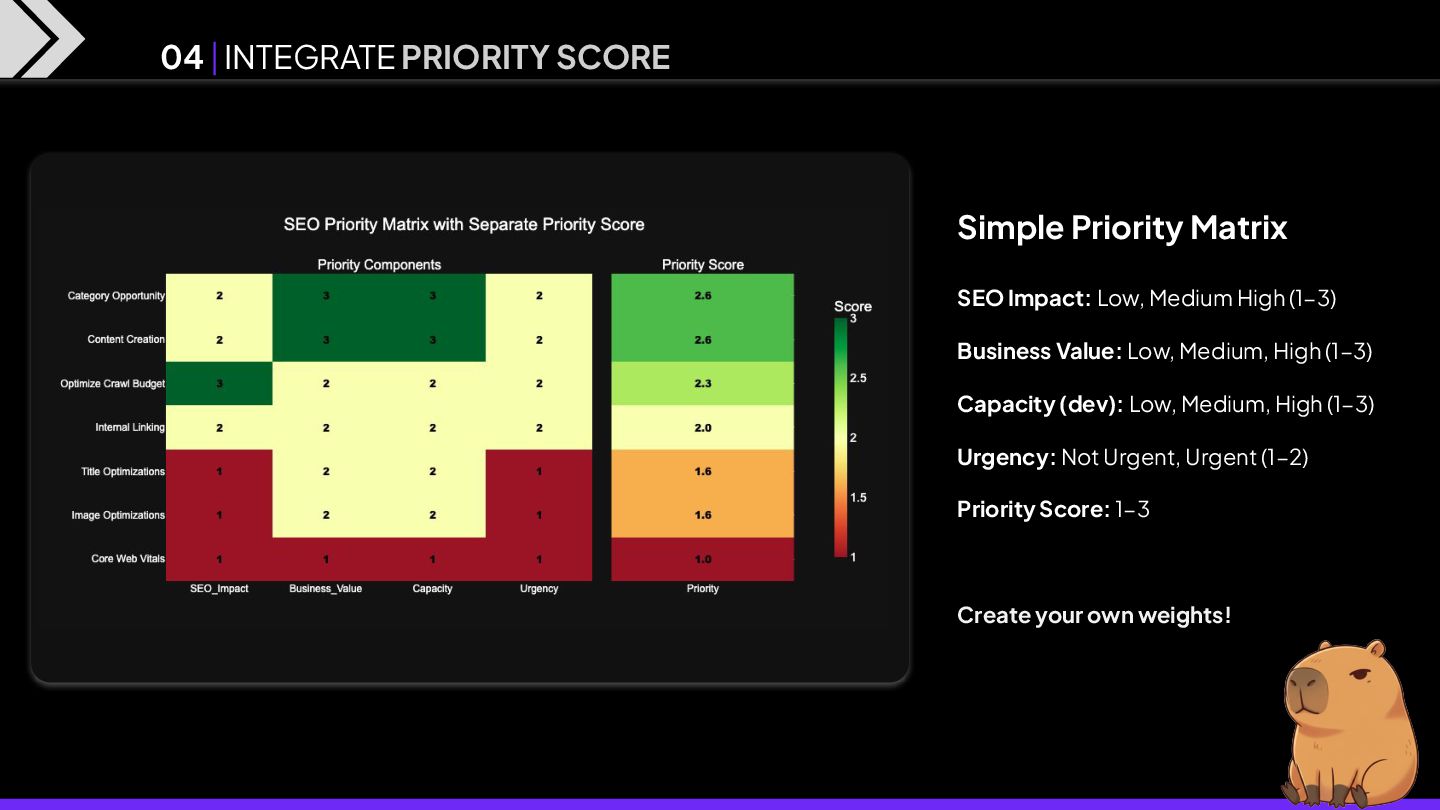
  43. Priority Score = [(SEO Impact × 3) + (Business Value

    × 4) + (Capacity × 2) + (Urgency × 1)] / 10
  44. ç Simple Priority Matrix SEO Impact: Low, Medium High (1−3)

    Business Value: Low, Medium, High (1−3) Capacity (dev): Low, Medium, High (1−3) Urgency: Not Urgent, Urgent (1−2) Priority Score: 1−3 Create your own weights! 04 | INTEGRATE PRIORITY SCORE
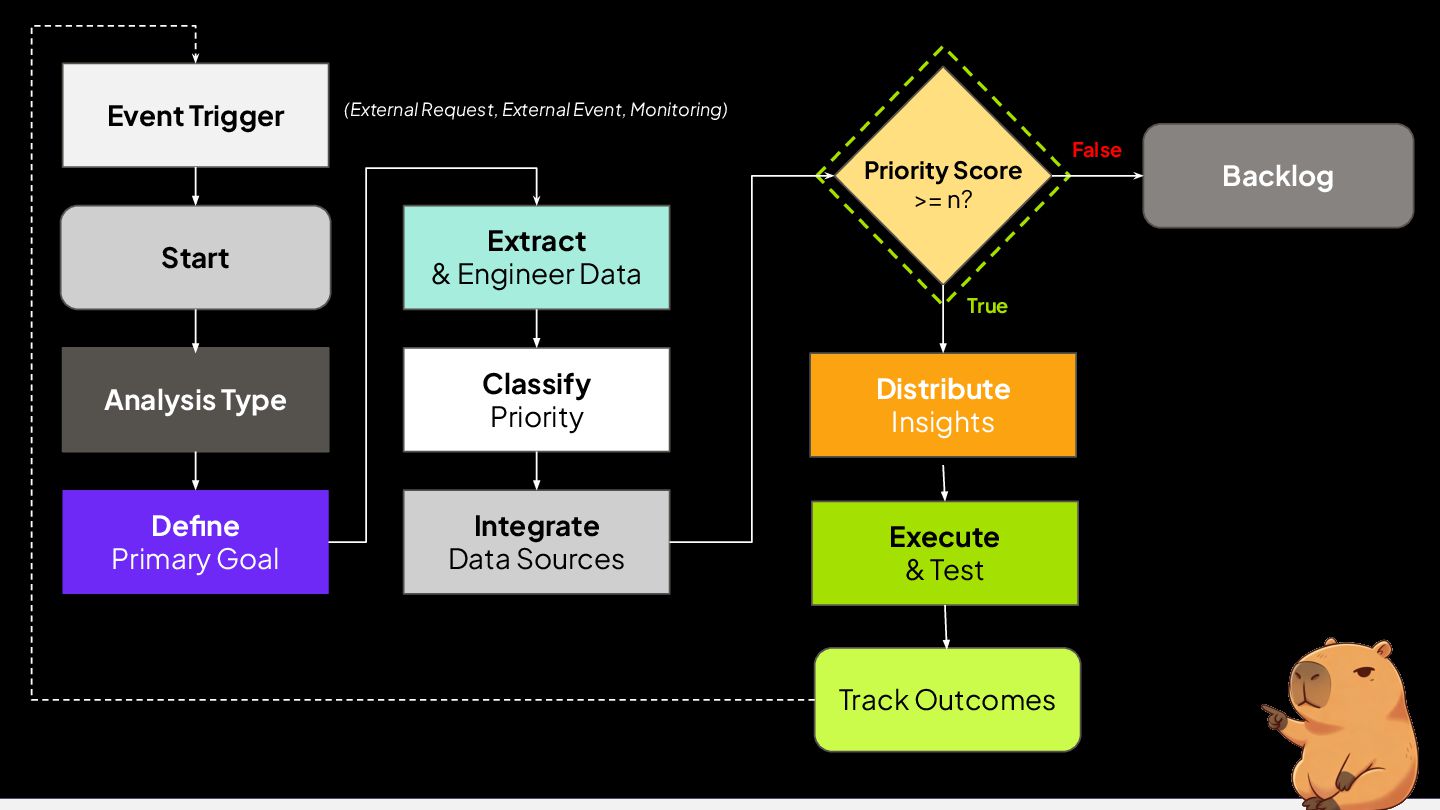
  45. Track Outcomes Start Event Trigger Analysis Type Define Primary Goal

    Extract & Engineer Data Classify Priority Integrate Data Sources Distribute Insights Execute & Test Backlog False True (External Request, External Event, Monitoring) Priority Score >= n?
  46. Stakeholders likely don’t want to draw conclusions from raw data

    they may misinterpret your data, give up, or have biases.
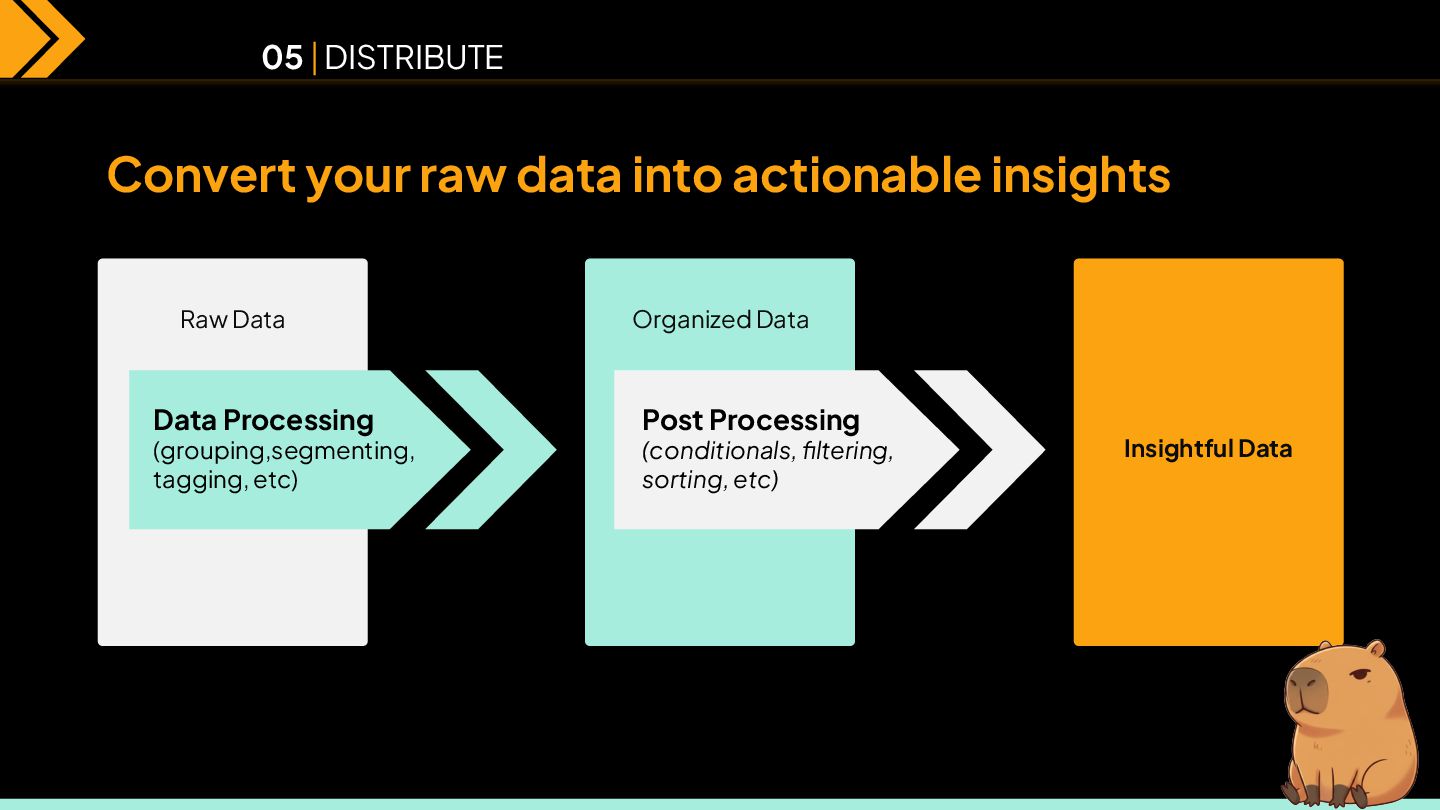
  47. Convert your raw data into actionable insights Data Processing (grouping,segmenting,

    tagging, etc) Raw Data Insightful Data 05 | DISTRIBUTE Organized Data Post Processing (conditionals, filtering, sorting, etc)
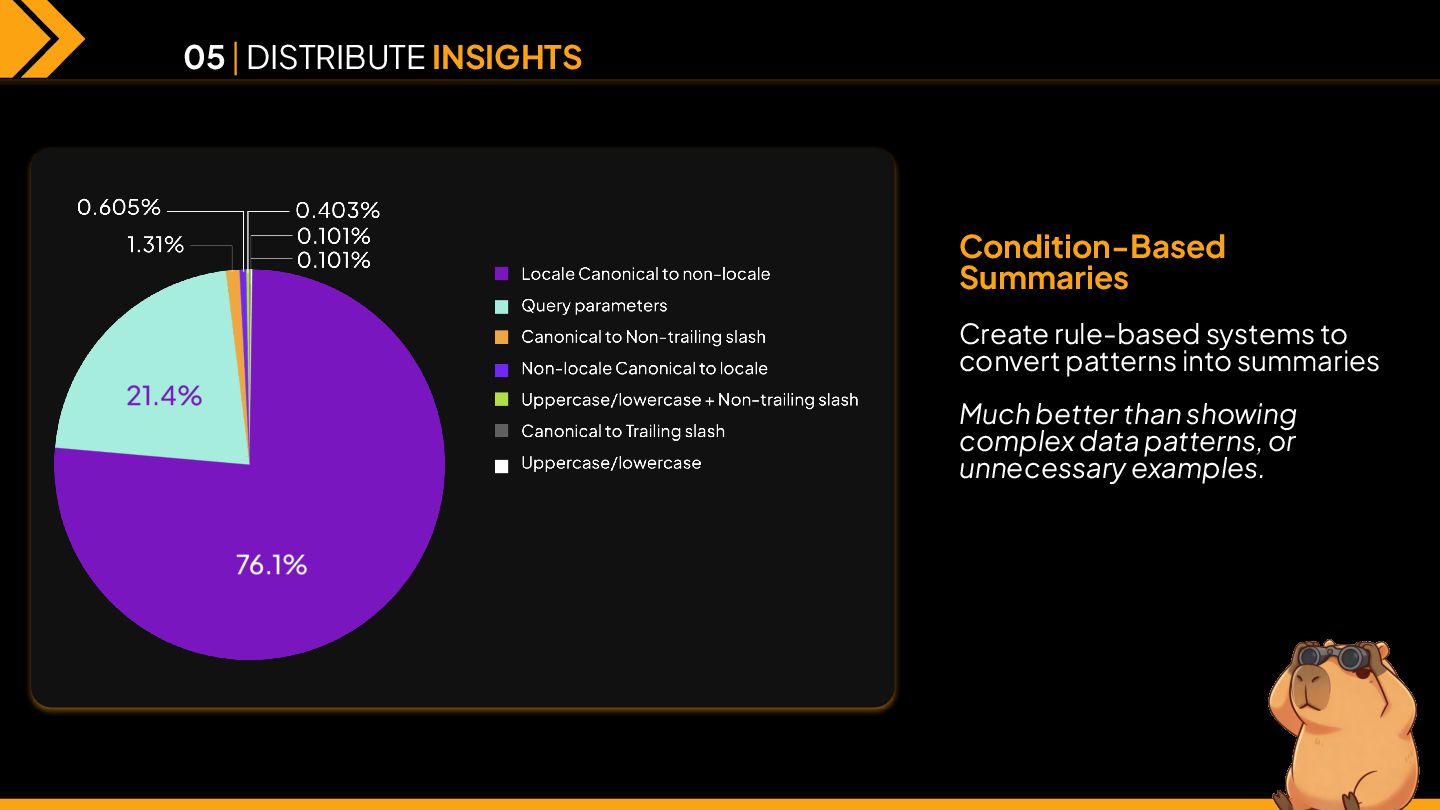
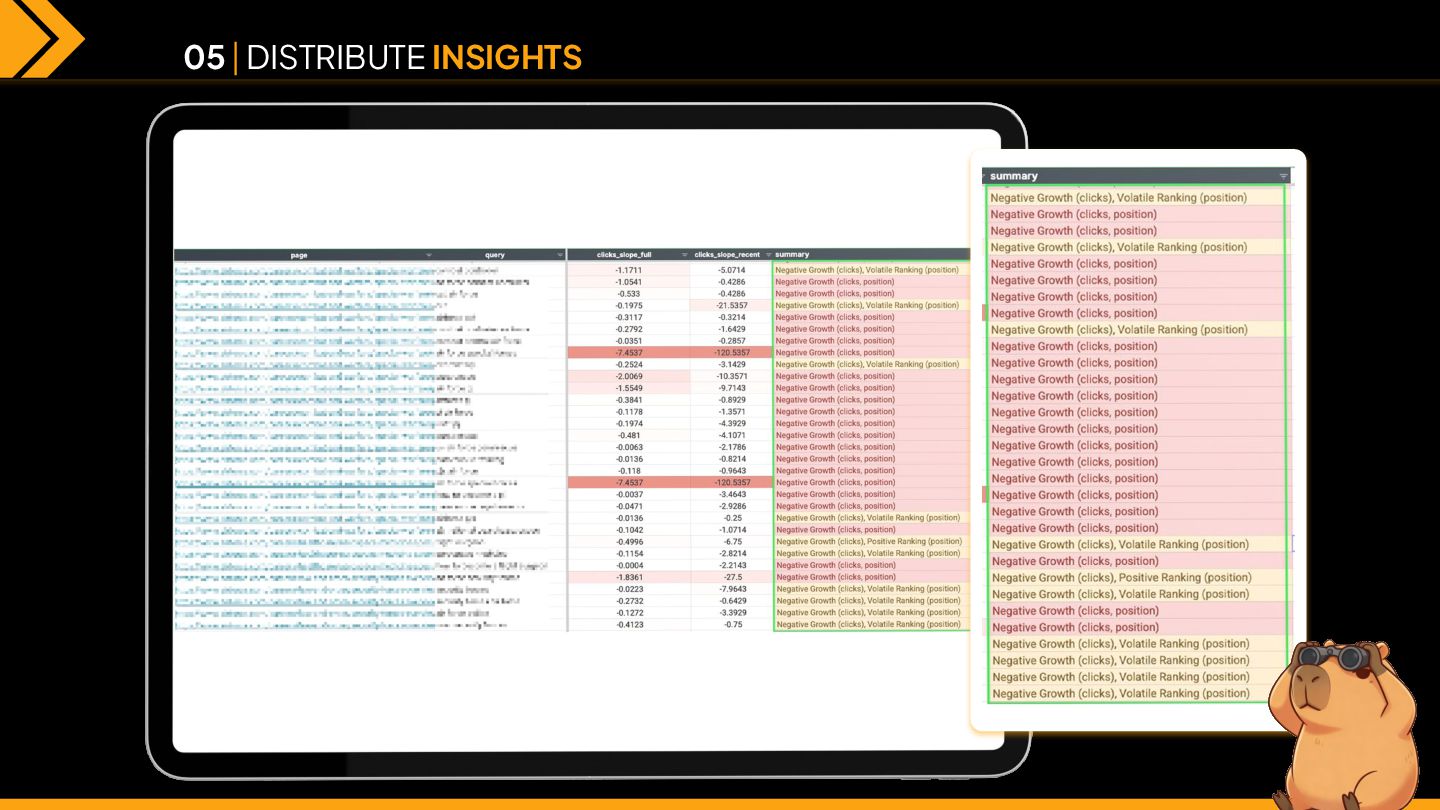
  48. Condition-Based Summaries Create rule-based systems to convert patterns into summaries

    Much better than showing complex data patterns, or unnecessary examples. 05 | DISTRIBUTE INSIGHTS
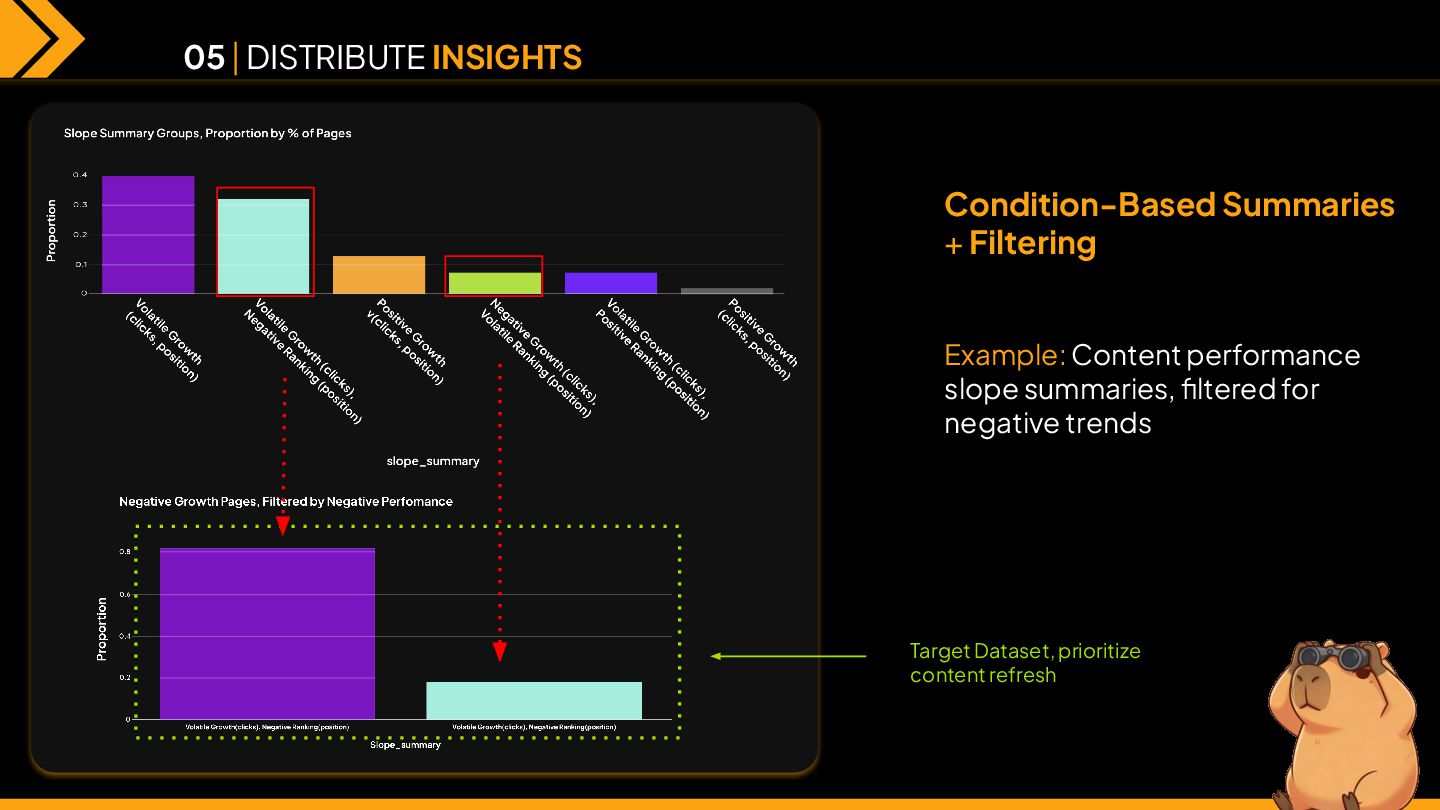
  49. Condition-Based Summaries + Filtering Example: Content performance slope summaries, filtered

    for negative trends Target Dataset, prioritize content refresh 05 | DISTRIBUTE INSIGHTS
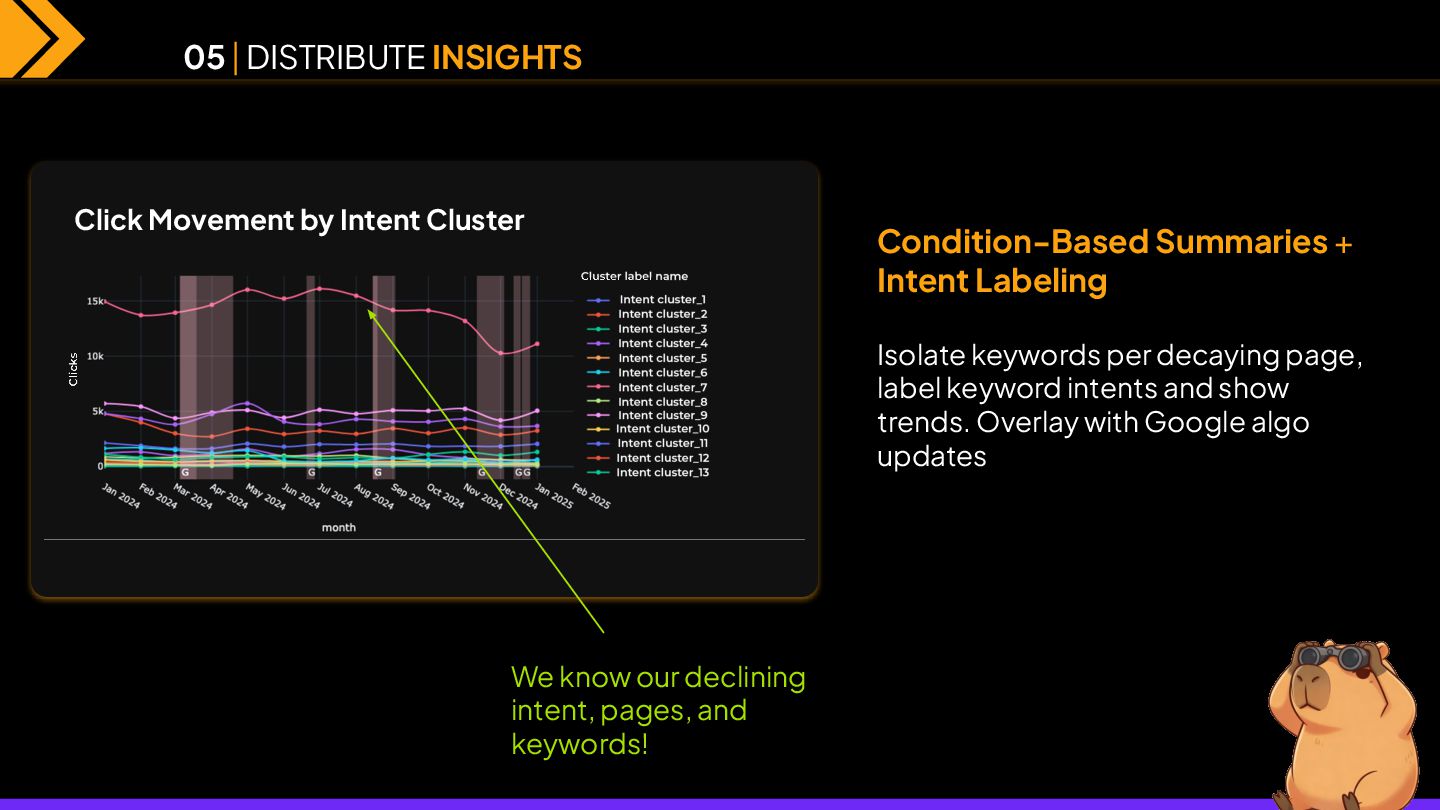
  50. Condition-Based Summaries + Intent Labeling Isolate keywords per decaying page,

    label keyword intents and show trends. Overlay with Google algo updates We know our declining intent, pages, and keywords! 05 | DISTRIBUTE INSIGHTS Click Movement by Intent Cluster
  51. Speak towards the interests of stakeholders as best you can
    Data + Analytics knowhow + Storytelling + Domain Expertise
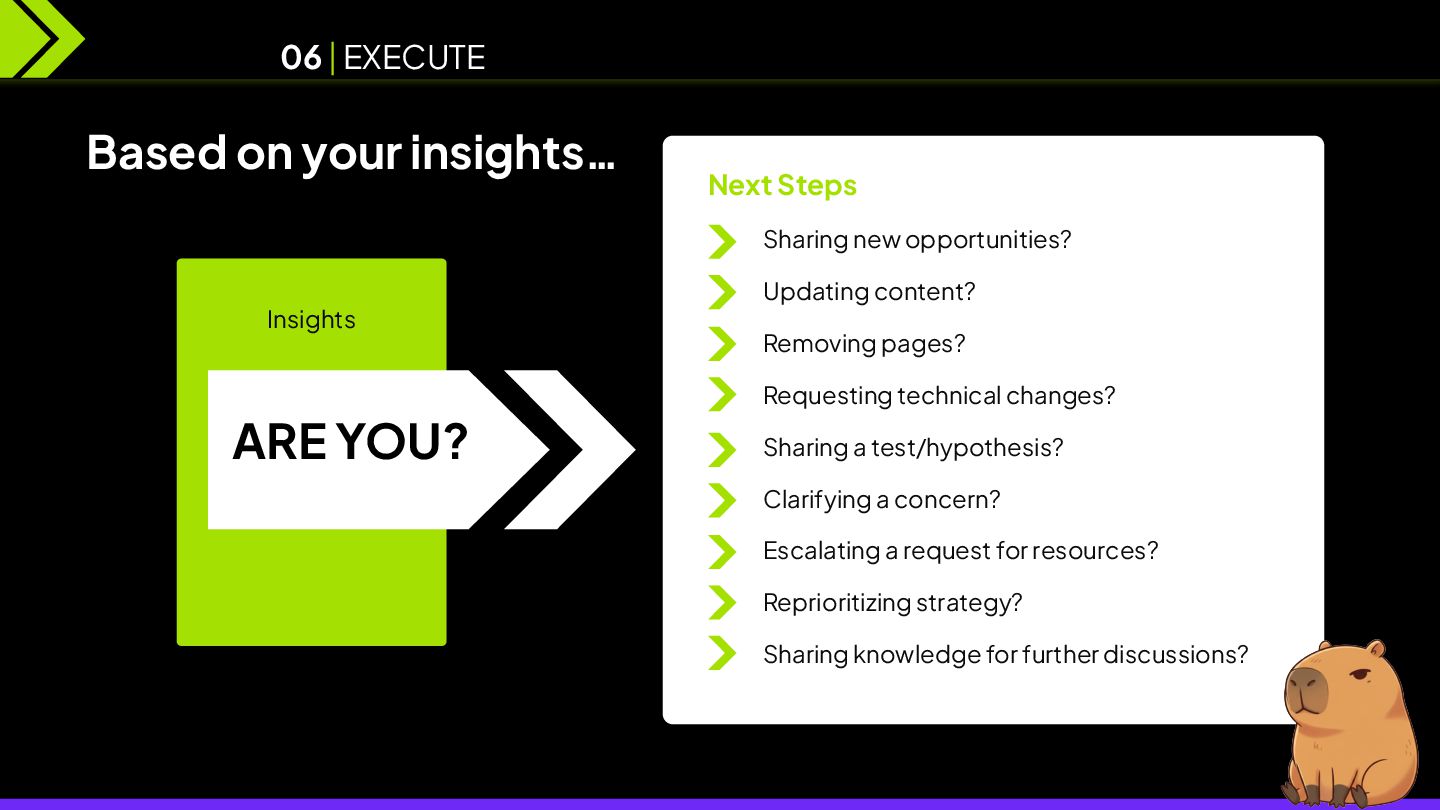
  52. Sharing new opportunities? Updating content? Removing pages? Requesting technical changes?

    Sharing a test/hypothesis? Clarifying a concern? Escalating a request for resources? Reprioritizing strategy? Sharing knowledge for further discussions? Based on your insights… Next Steps 06 | EXECUTE ARE YOU? Insights
  53. Execution Establish your benchmark & expected outcome (estimate) Implement, or
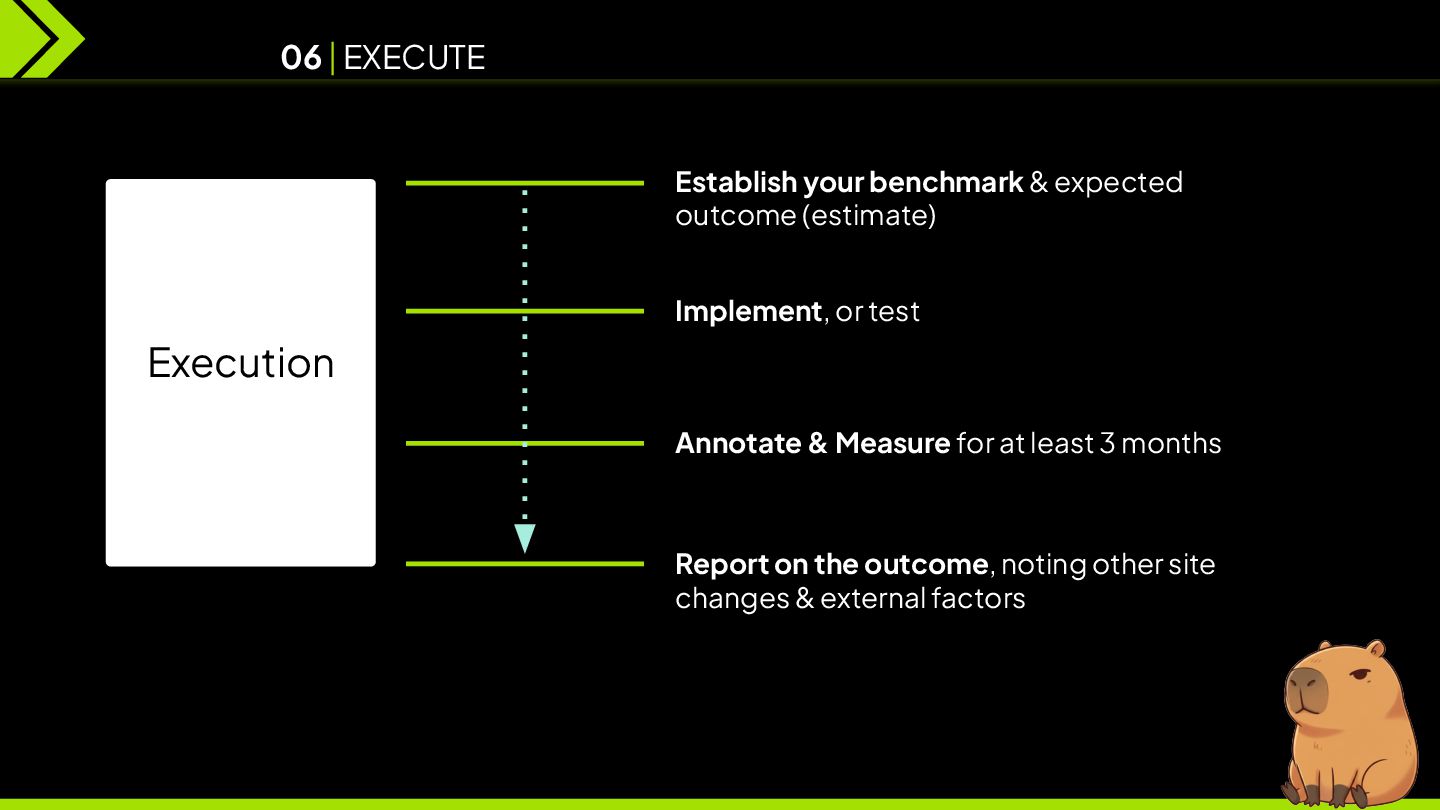
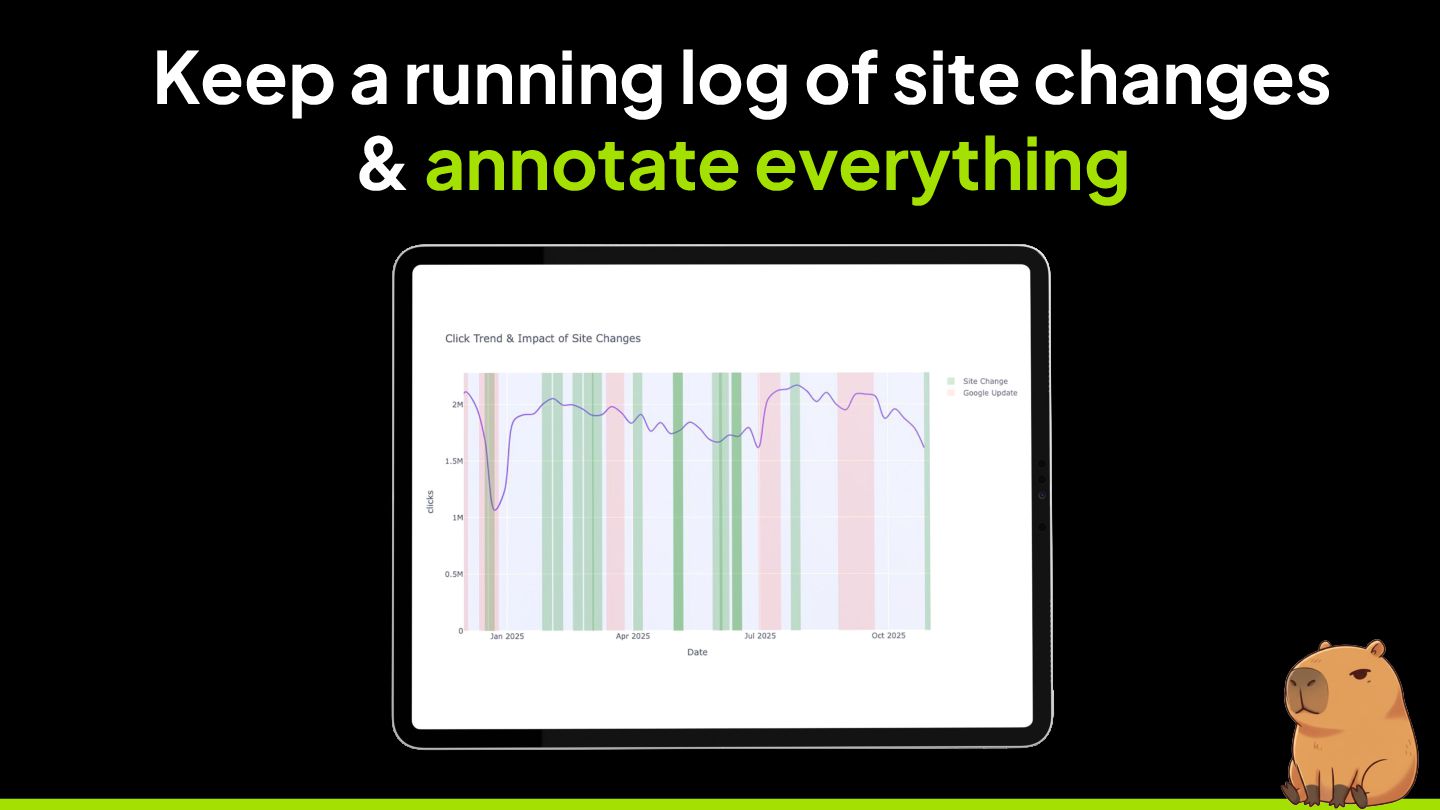
    test Annotate & Measure for at least 3 months Report on the outcome, noting other site changes & external factors 06 | EXECUTE
  54. Start feeling more confident about your decisions! DECIDE 01 |

    DEFINE Primary Goal 02 EXTRACT & Engineer Data 03 CLASSIFY* Priority Levels 04 INTEGRATE* Multiple Data Sources 05 DISTRIBUTE Insights, Not Raw Data 06 EXECUTE Against Your Insights (Test)