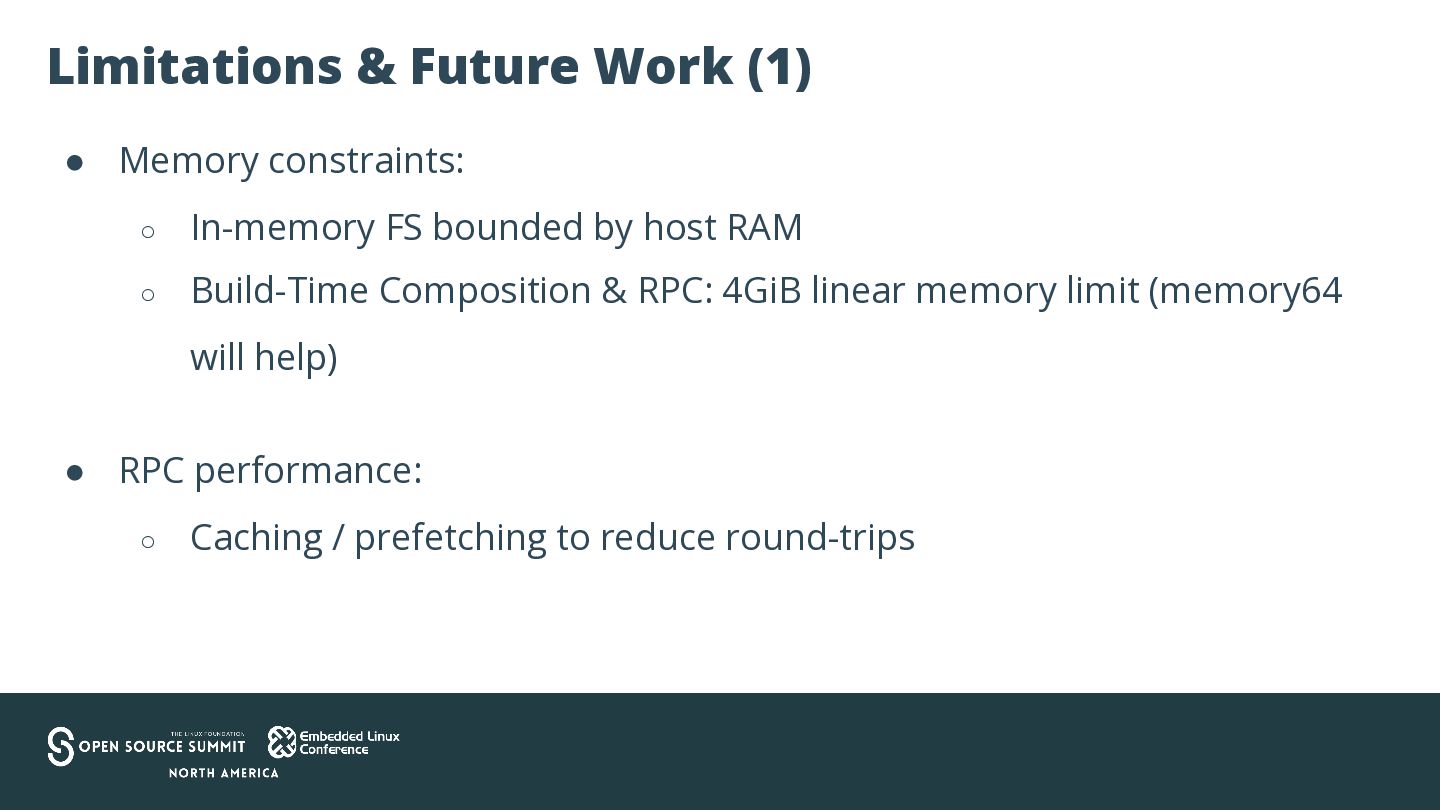
in Japan ◦ Web backend engineering • Personal OSS project ◦ kontainer-runtime: low-level container runtime written in Kotlin/Native ◦ MonakaFS: host-independent virtual filesystem for WebAssembly @ternbusty
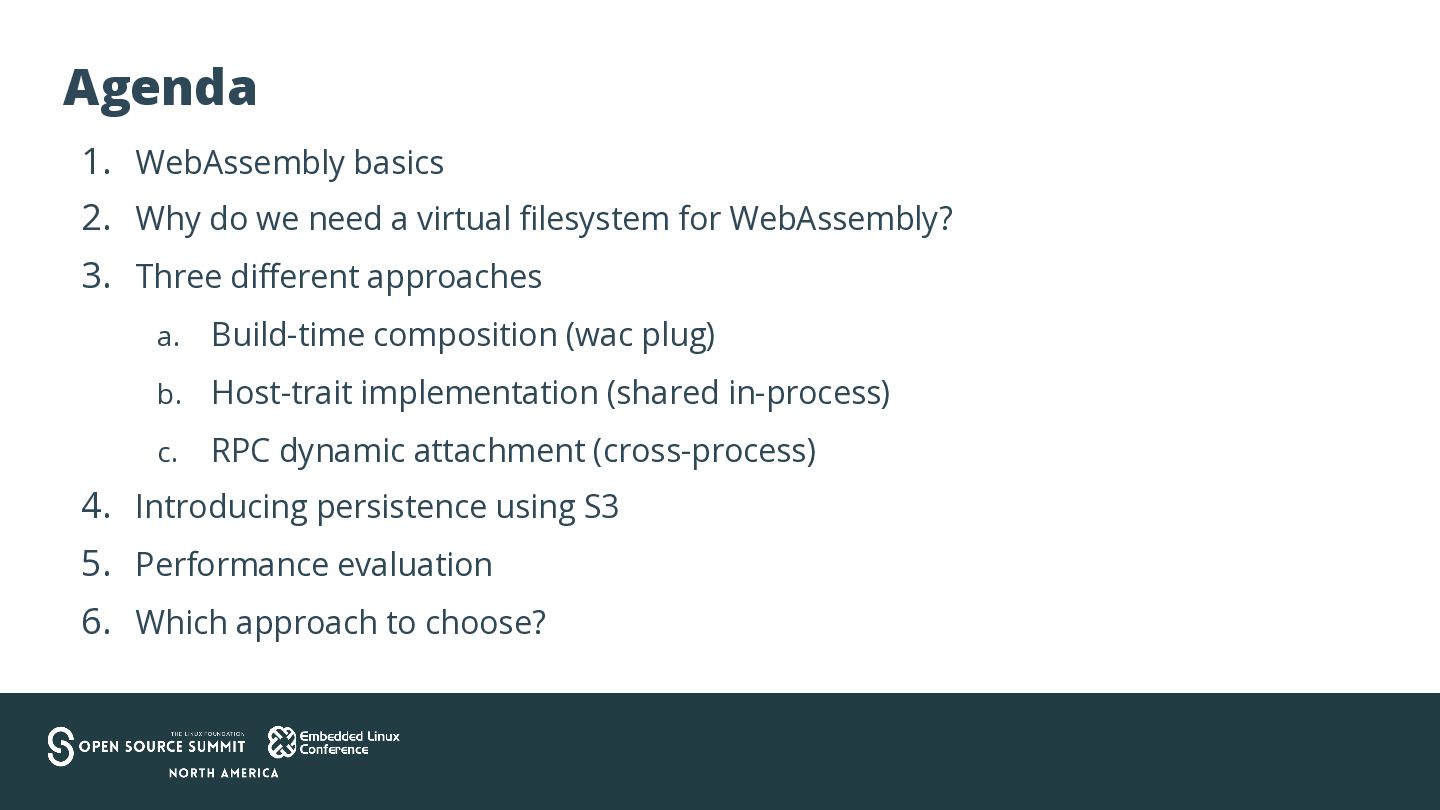
virtual filesystem for WebAssembly? 3. Three different approaches a. Build-time composition (wac plug) b. Host-trait implementation (shared in-process) c. RPC dynamic attachment (cross-process) 4. Introducing persistence using S3 5. Performance evaluation 6. Which approach to choose?
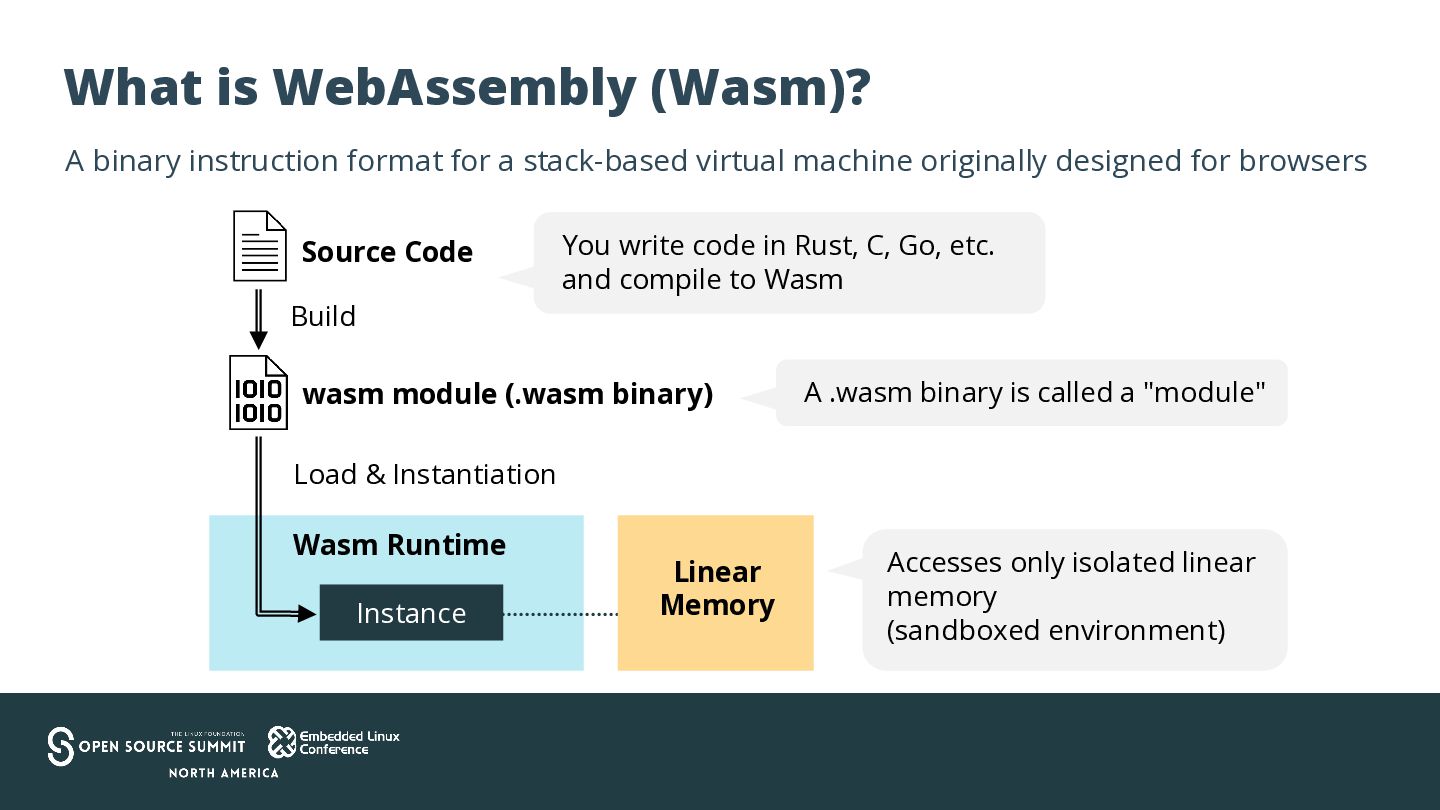
stack-based virtual machine originally designed for browsers Source Code wasm module (.wasm binary) Build Load & Instantiation Wasm Runtime Instance Linear Memory You write code in Rust, C, Go, etc. and compile to Wasm Accesses only isolated linear memory (sandboxed environment) A .wasm binary is called a "module"
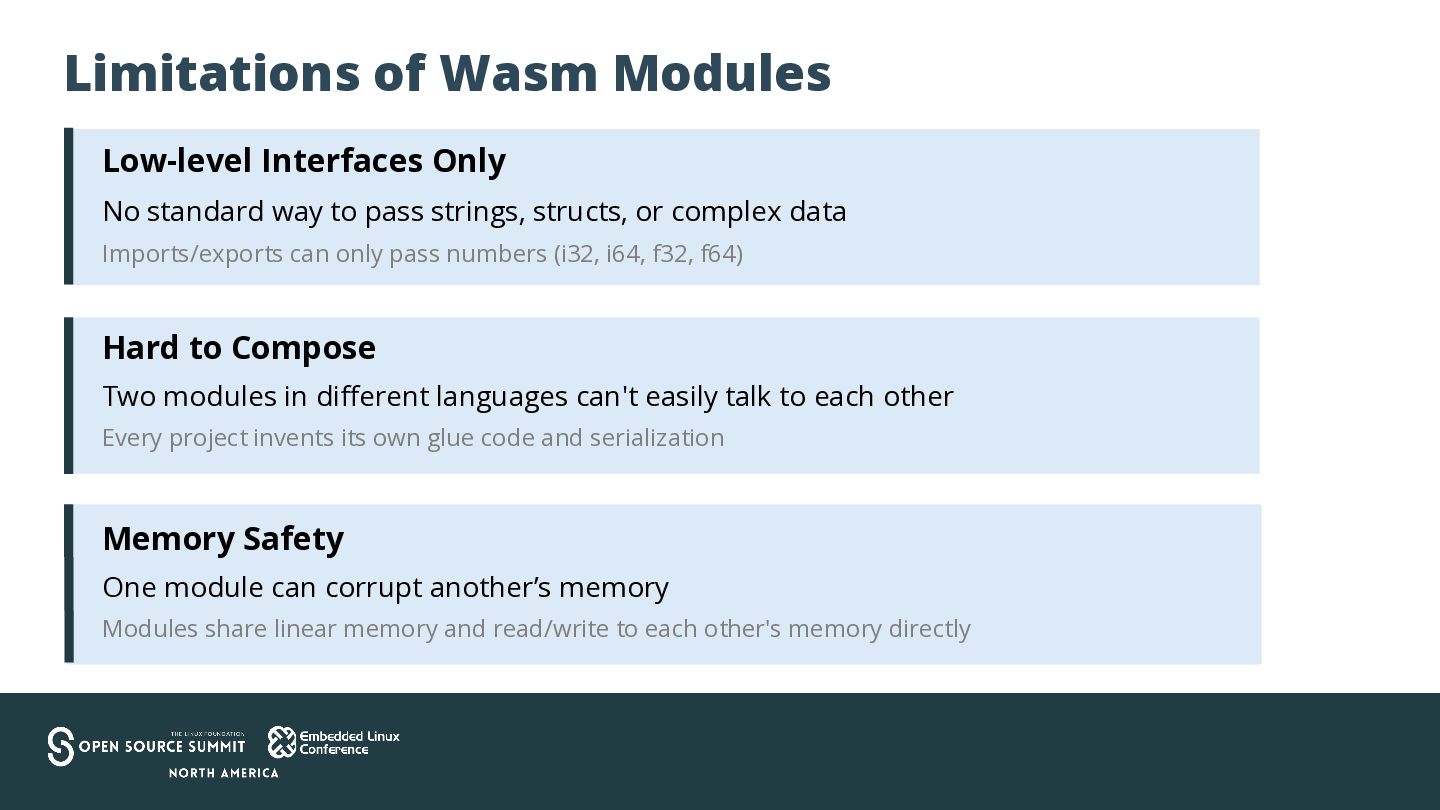
to pass strings, structs, or complex data Imports/exports can only pass numbers (i32, i64, f32, f64) Hard to Compose Two modules in different languages can't easily talk to each other Every project invents its own glue code and serialization Memory Safety One module can corrupt another’s memory Modules share linear memory and read/write to each other's memory directly
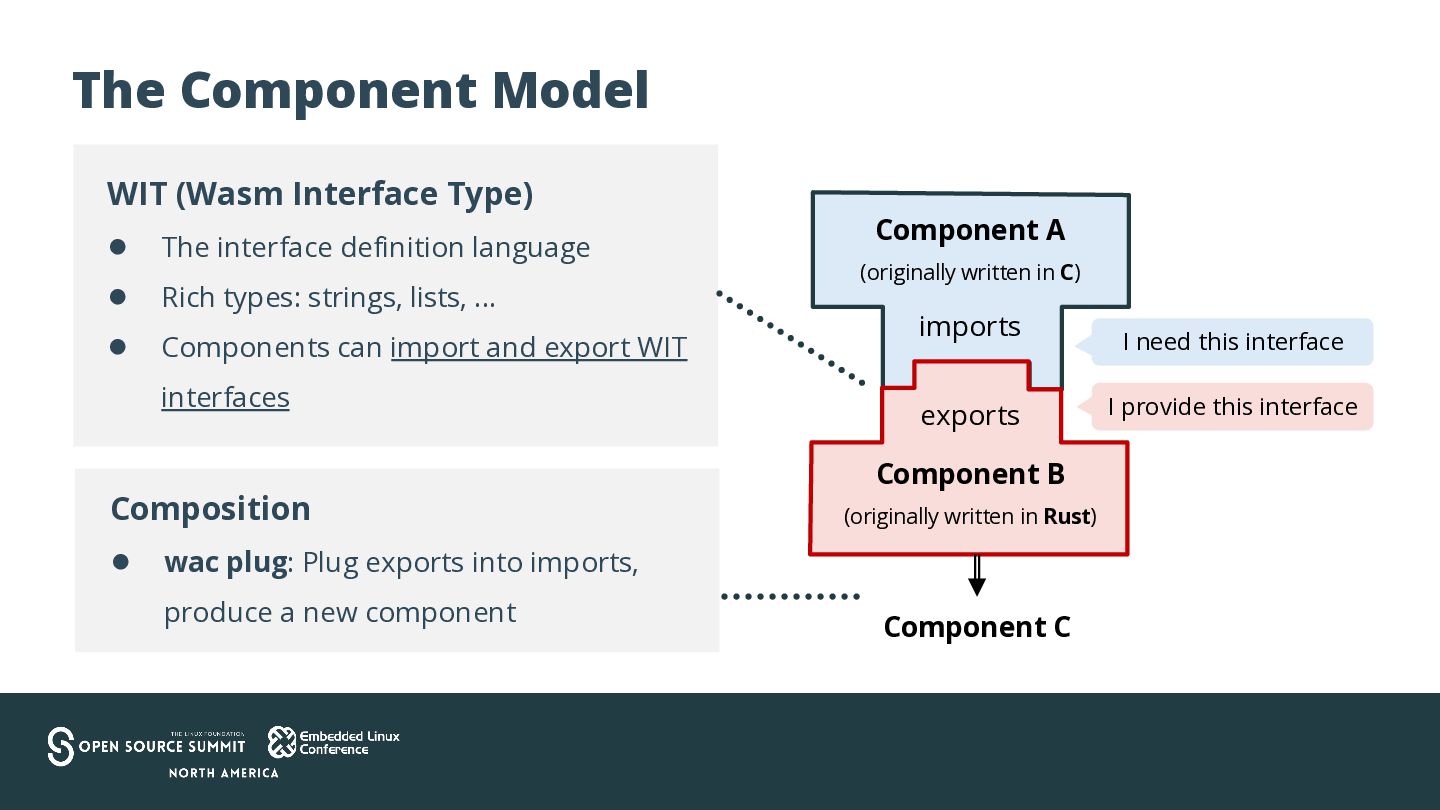
definition language • Rich types: strings, lists, ... • Components can import and export WIT interfaces exports Component B (originally written in Rust) Component A (originally written in C) I need this interface I provide this interface imports Component C Composition • wac plug: Plug exports into imports, produce a new component
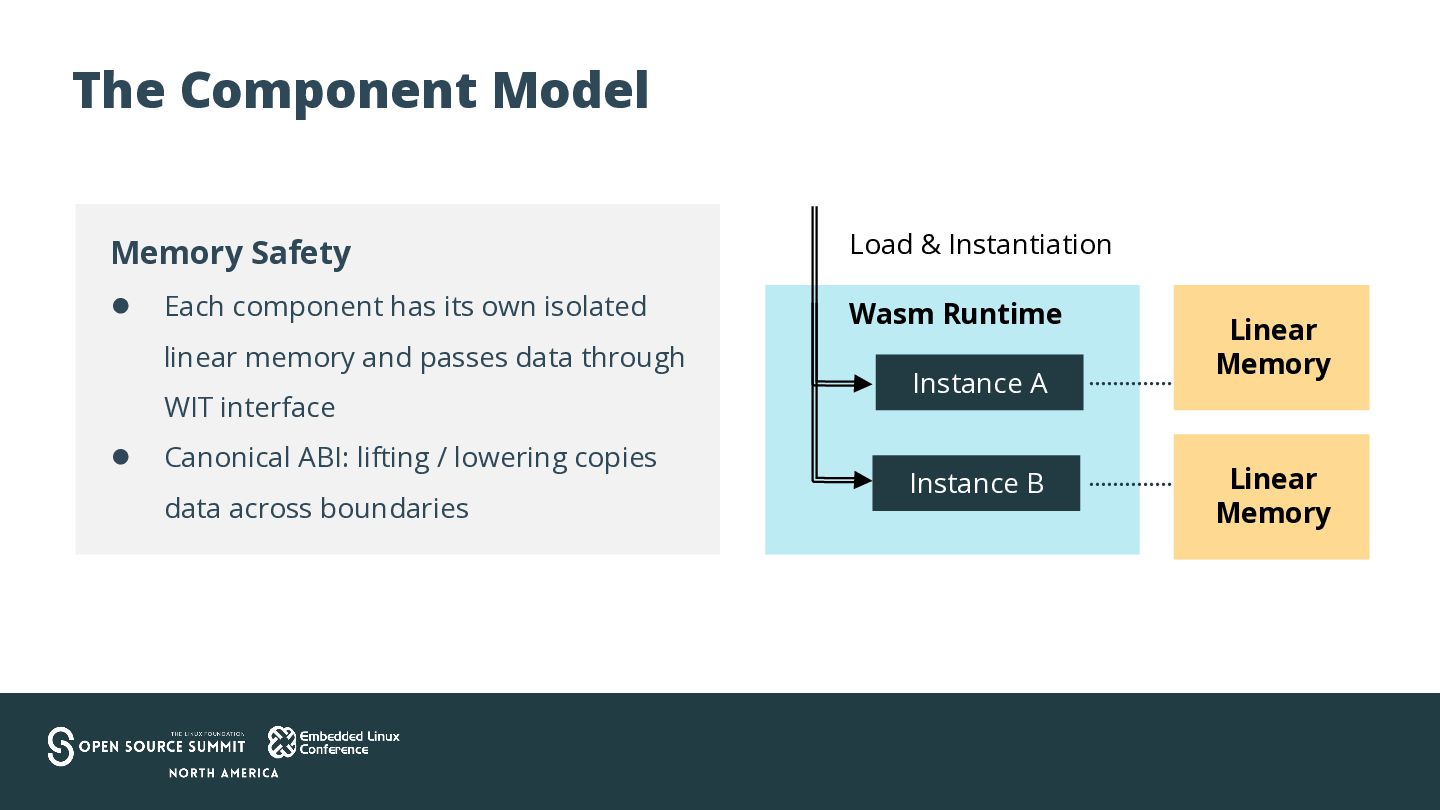
own isolated linear memory and passes data through WIT interface • Canonical ABI: lifting / lowering copies data across boundaries Load & Instantiation Wasm Runtime Instance A Linear Memory Instance B Linear Memory
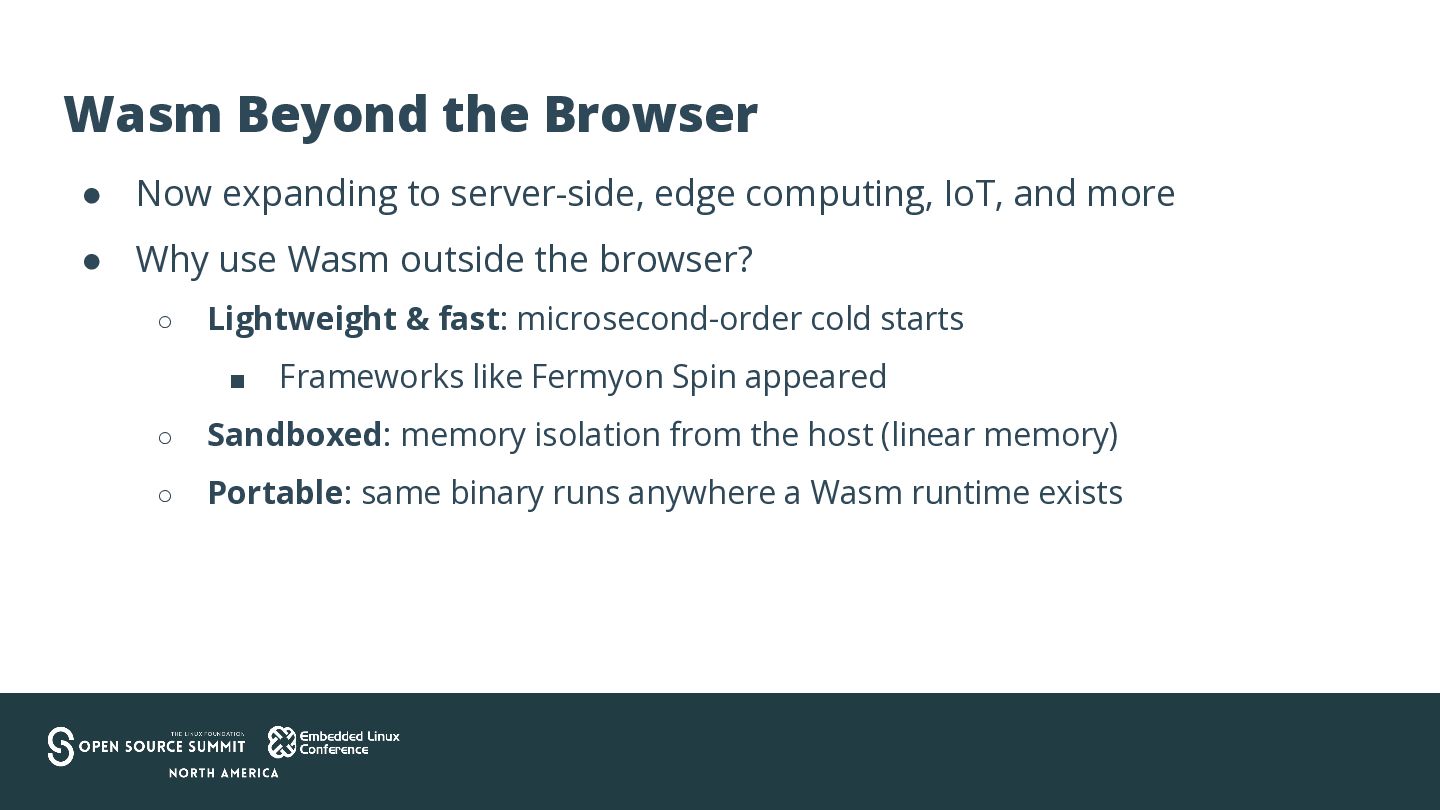
computing, IoT, and more • Why use Wasm outside the browser? ◦ Lightweight & fast: microsecond-order cold starts ▪ Frameworks like Fermyon Spin appeared ◦ Sandboxed: memory isolation from the host (linear memory) ◦ Portable: same binary runs anywhere a Wasm runtime exists
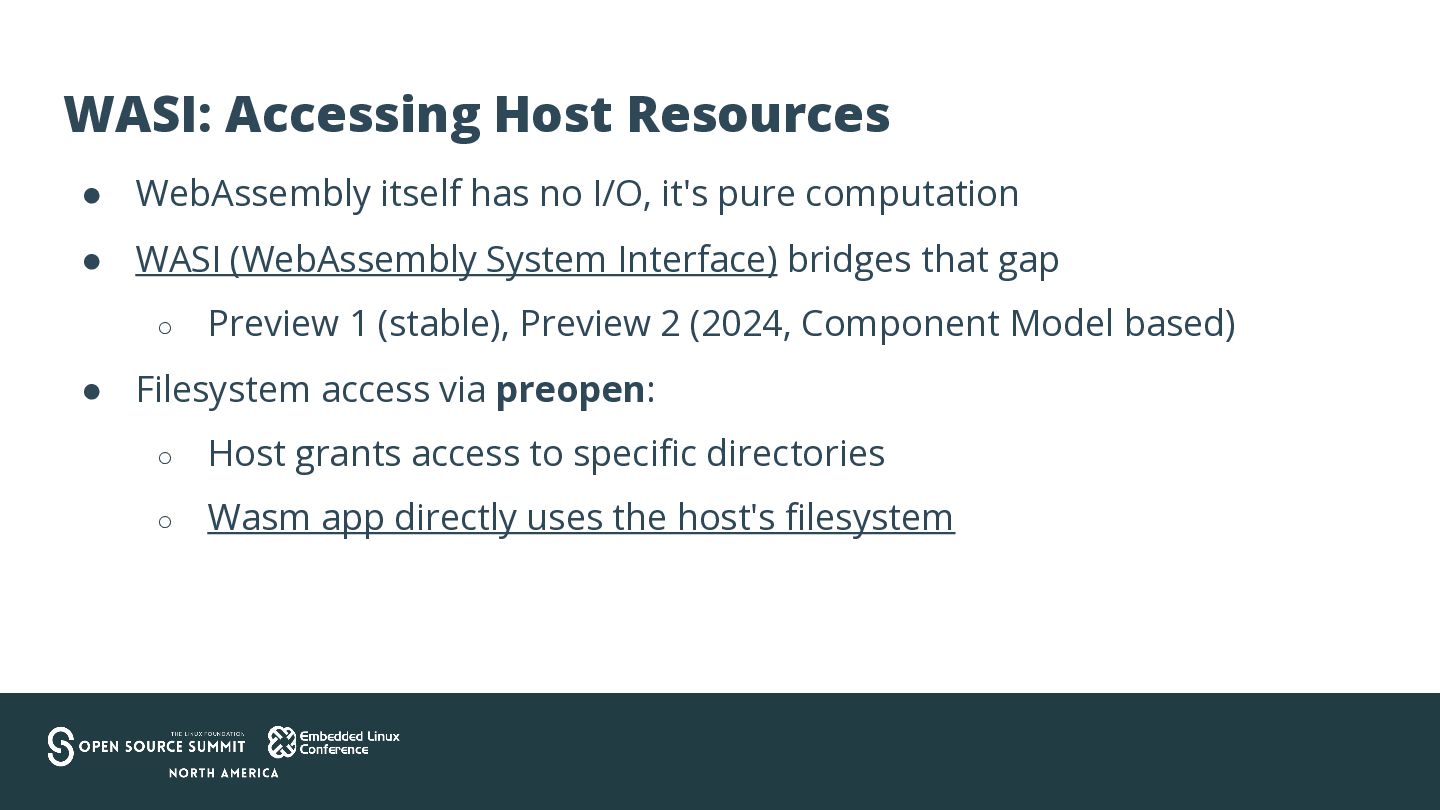
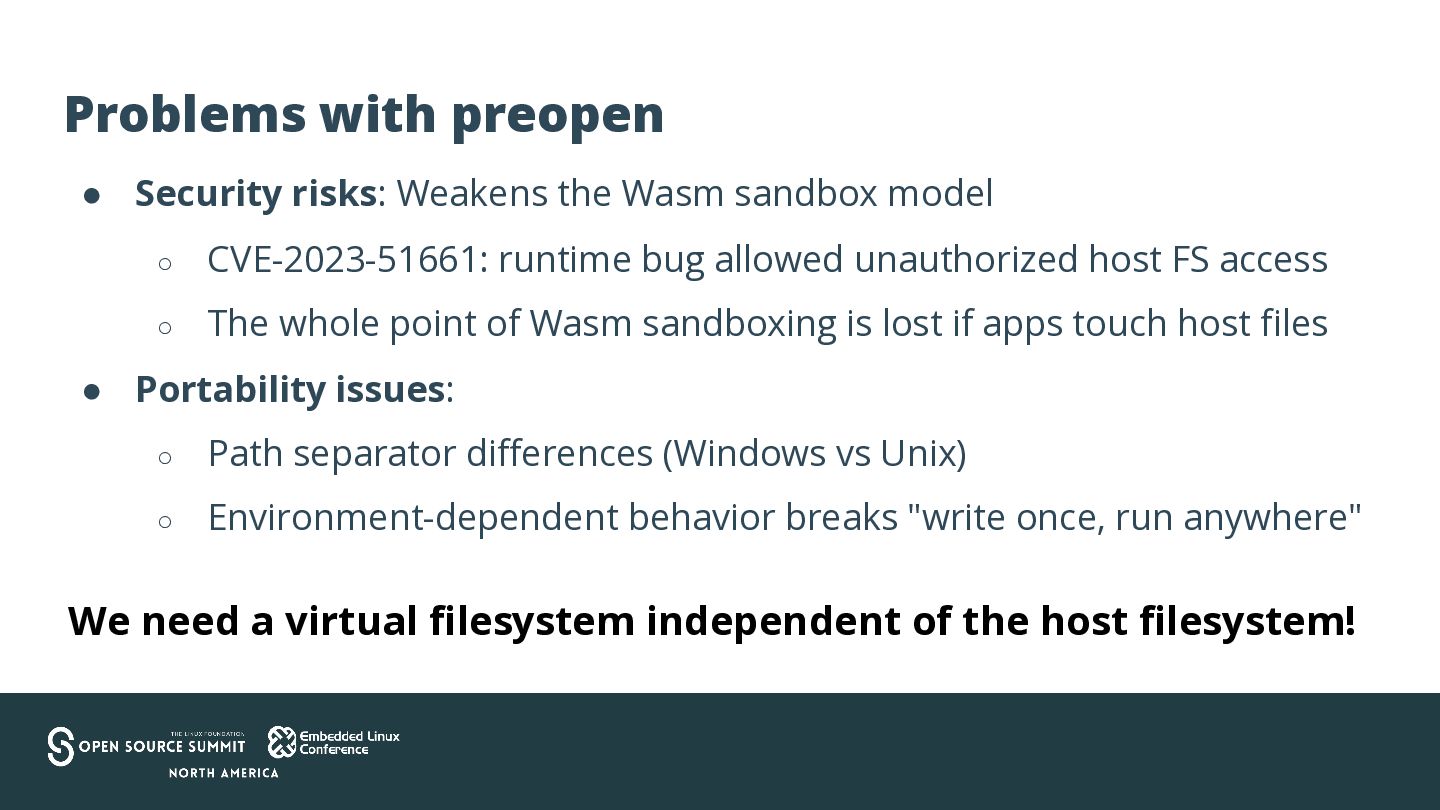
it's pure computation • WASI (WebAssembly System Interface) bridges that gap ◦ Preview 1 (stable), Preview 2 (2024, Component Model based) • Filesystem access via preopen: ◦ Host grants access to specific directories ◦ Wasm app directly uses the host's filesystem
model ◦ CVE-2023-51661: runtime bug allowed unauthorized host FS access ◦ The whole point of Wasm sandboxing is lost if apps touch host files • Portability issues: ◦ Path separator differences (Windows vs Unix) ◦ Environment-dependent behavior breaks "write once, run anywhere" We need a virtual filesystem independent of the host filesystem!
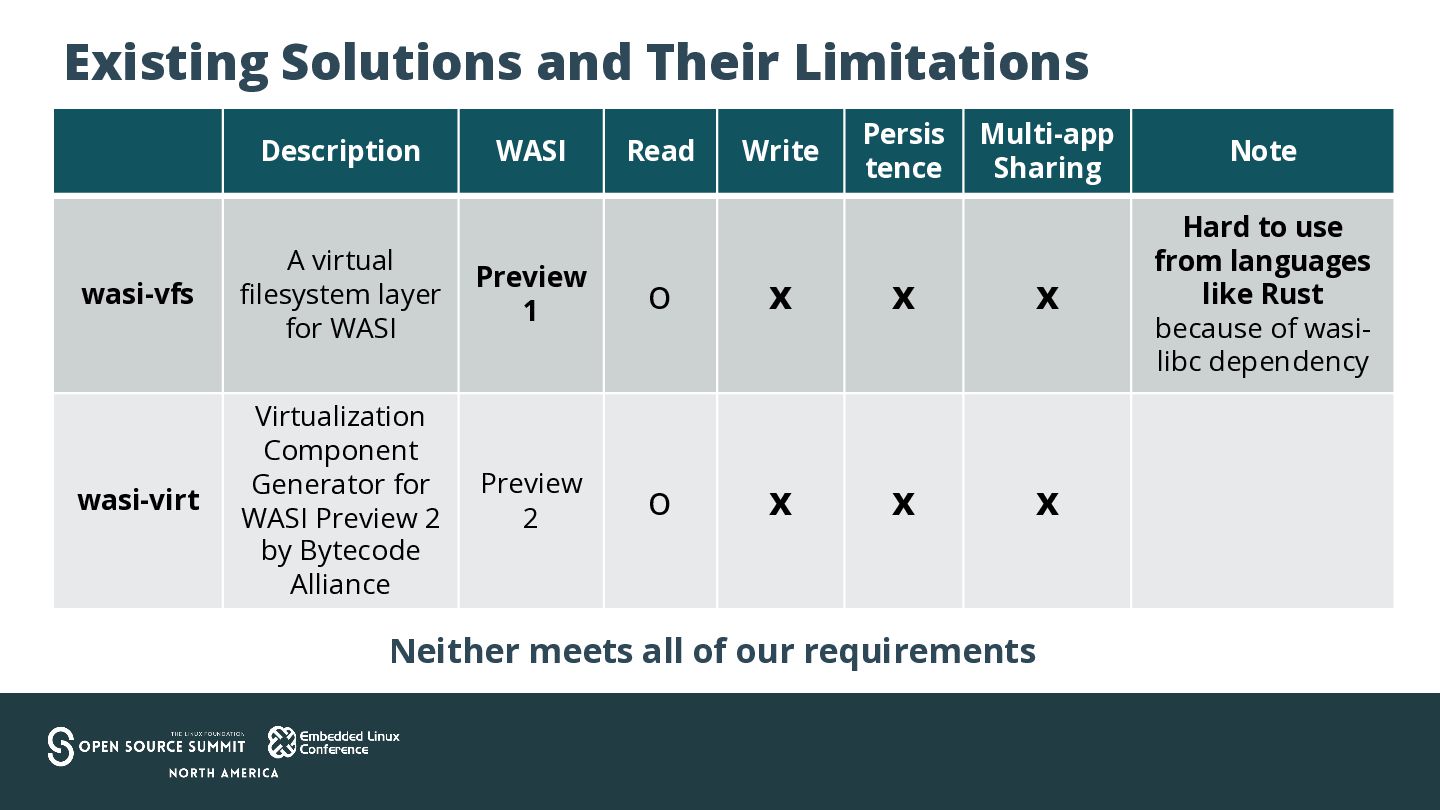
tence Multi-app Sharing Note wasi-vfs A virtual filesystem layer for WASI Preview 1 o x x x Hard to use from languages like Rust because of wasi- libc dependency wasi-virt Virtualization Component Generator for WASI Preview 2 by Bytecode Alliance Preview 2 o x x x Neither meets all of our requirements
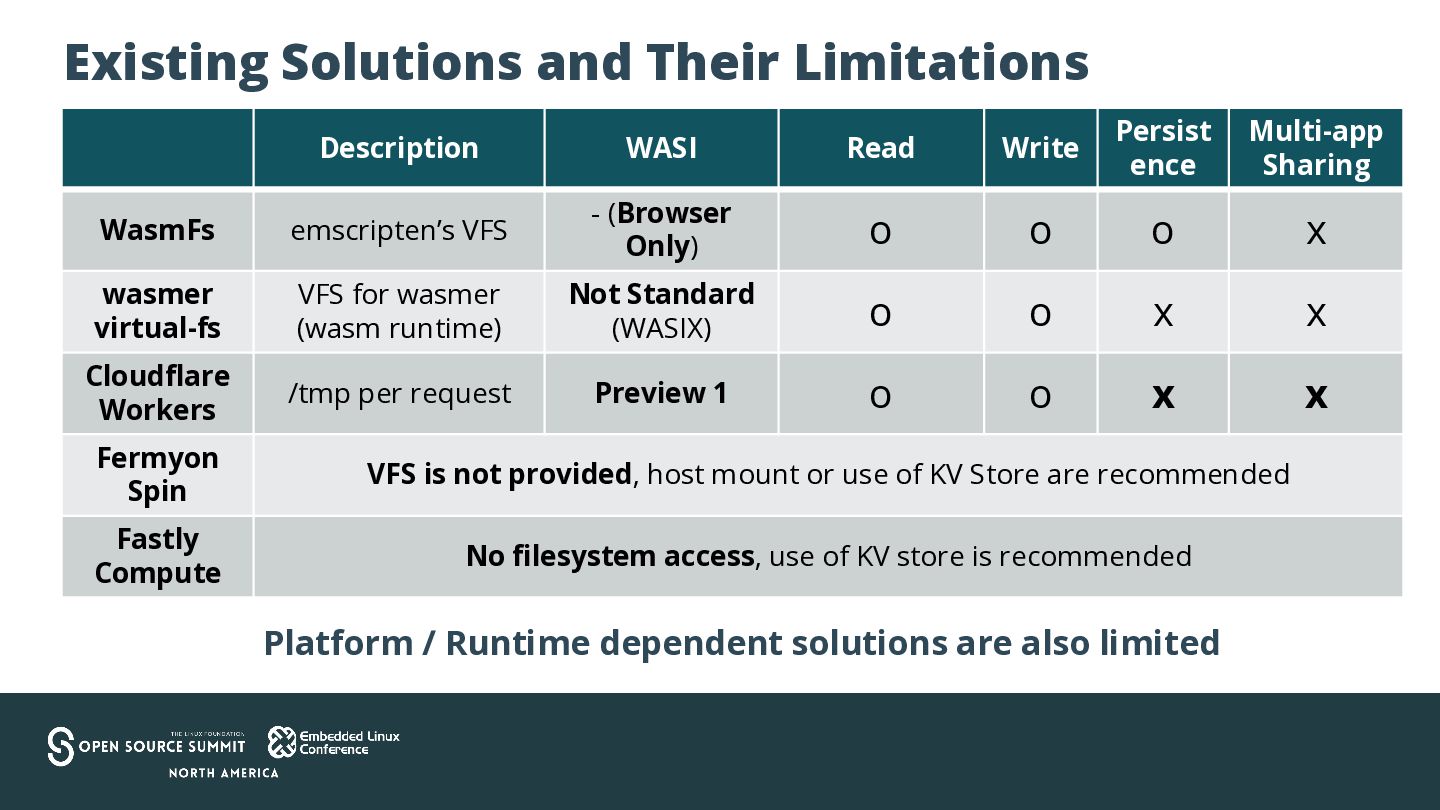
ence Multi-app Sharing WasmFs emscripten’s VFS - (Browser Only) o o o x wasmer virtual-fs VFS for wasmer (wasm runtime) Not Standard (WASIX) o o x x Cloudflare Workers /tmp per request Preview 1 o o x x Fermyon Spin VFS is not provided, host mount or use of KV Store are recommended Fastly Compute No filesystem access, use of KV store is recommended Platform / Runtime dependent solutions are also limited
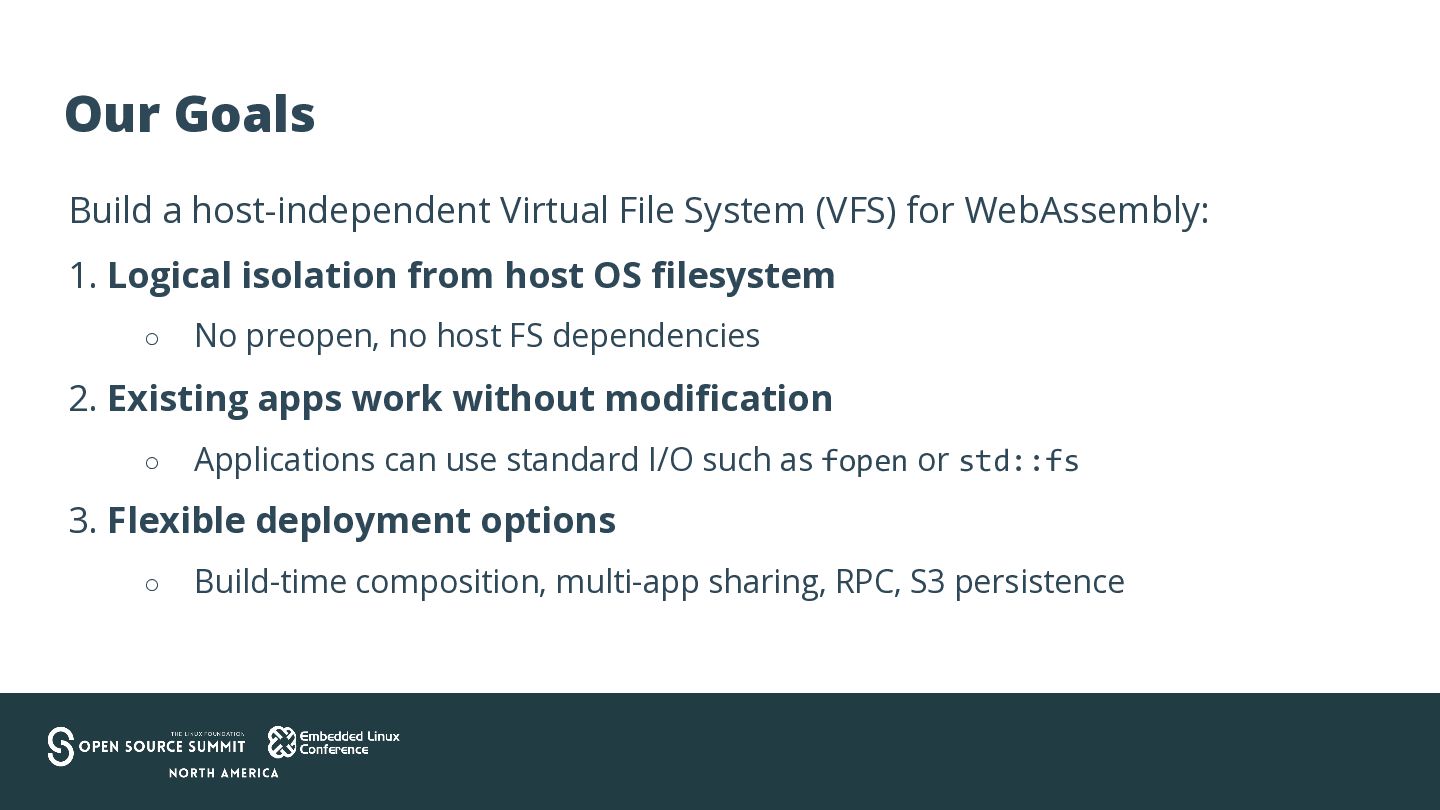
WebAssembly: 1. Logical isolation from host OS filesystem ◦ No preopen, no host FS dependencies 2. Existing apps work without modification ◦ Applications can use standard I/O such as fopen or std::fs 3. Flexible deployment options ◦ Build-time composition, multi-app sharing, RPC, S3 persistence
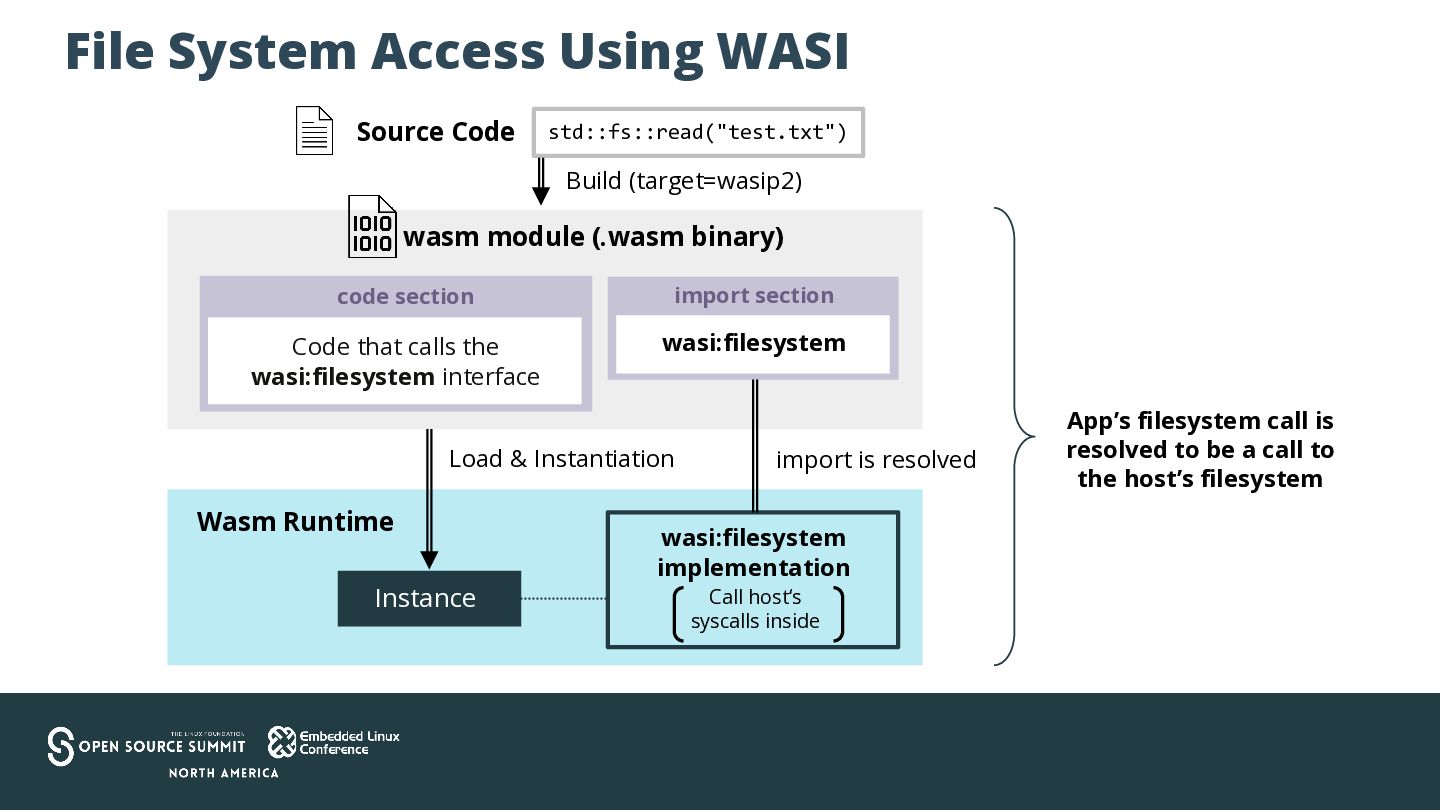
(.wasm binary) Build (target=wasip2) import section code section Wasm Runtime Load & Instantiation Instance wasi:filesystem Code that calls the wasi:filesystem interface wasi:filesystem implementation import is resolved Call host‘s syscalls inside App’s filesystem call is resolved to be a call to the host’s filesystem
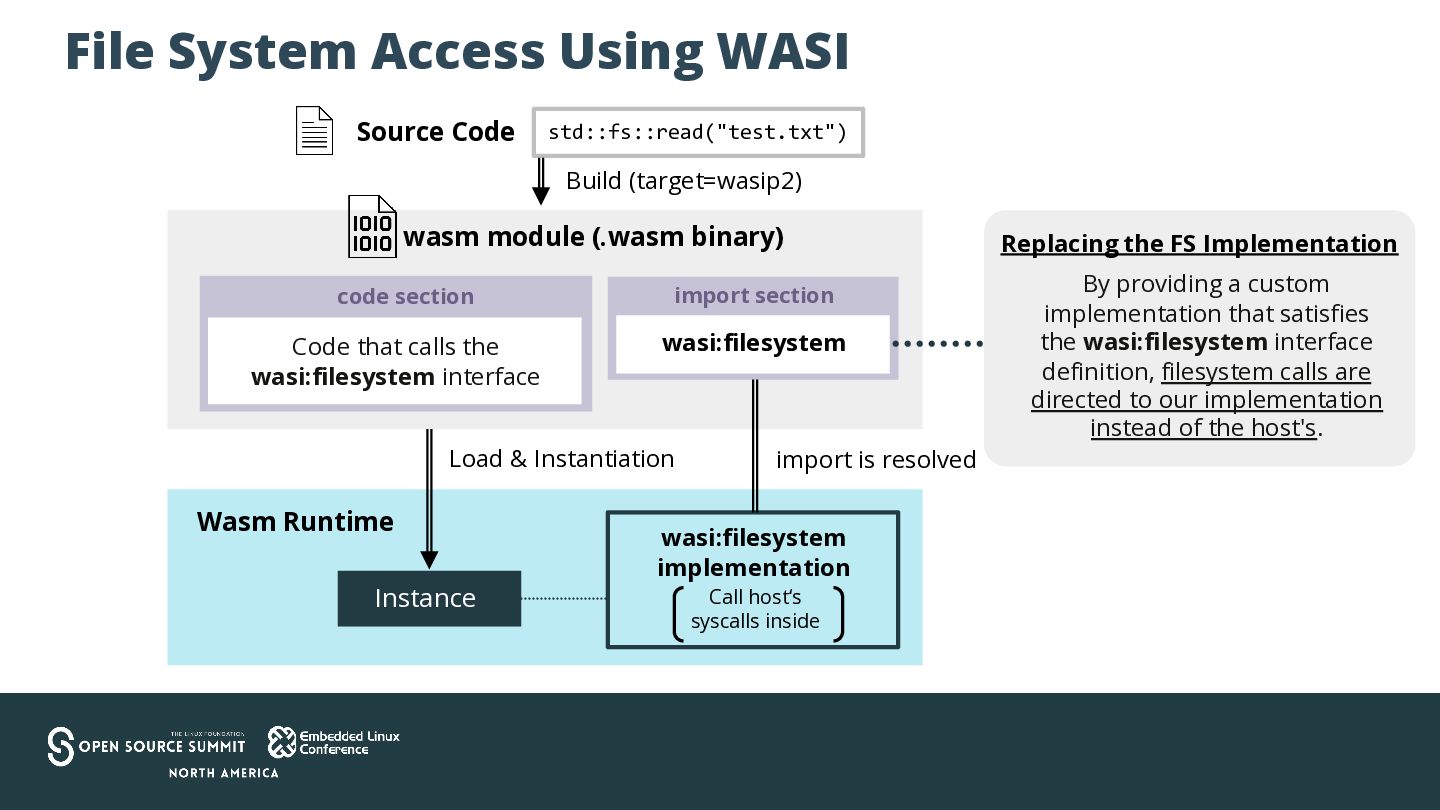
(.wasm binary) Build (target=wasip2) import section code section Wasm Runtime Load & Instantiation Instance wasi:filesystem Code that calls the wasi:filesystem interface wasi:filesystem implementation import is resolved Call host‘s syscalls inside By providing a custom implementation that satisfies the wasi:filesystem interface definition, filesystem calls are directed to our implementation instead of the host's. Replacing the FS Implementation
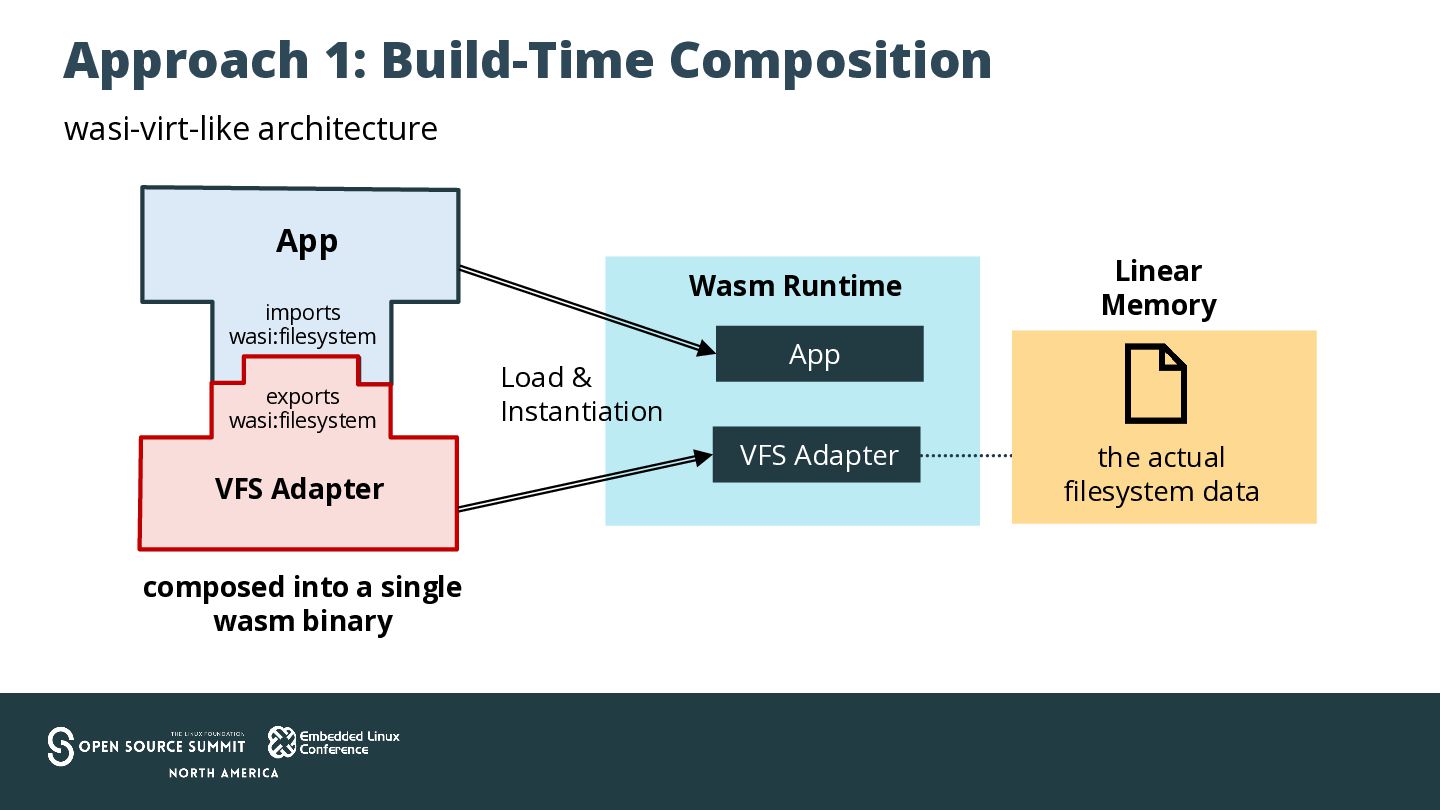
App VFS Adapter the actual filesystem data imports wasi:filesystem App Load & Instantiation Linear Memory composed into a single wasm binary wasi-virt-like architecture
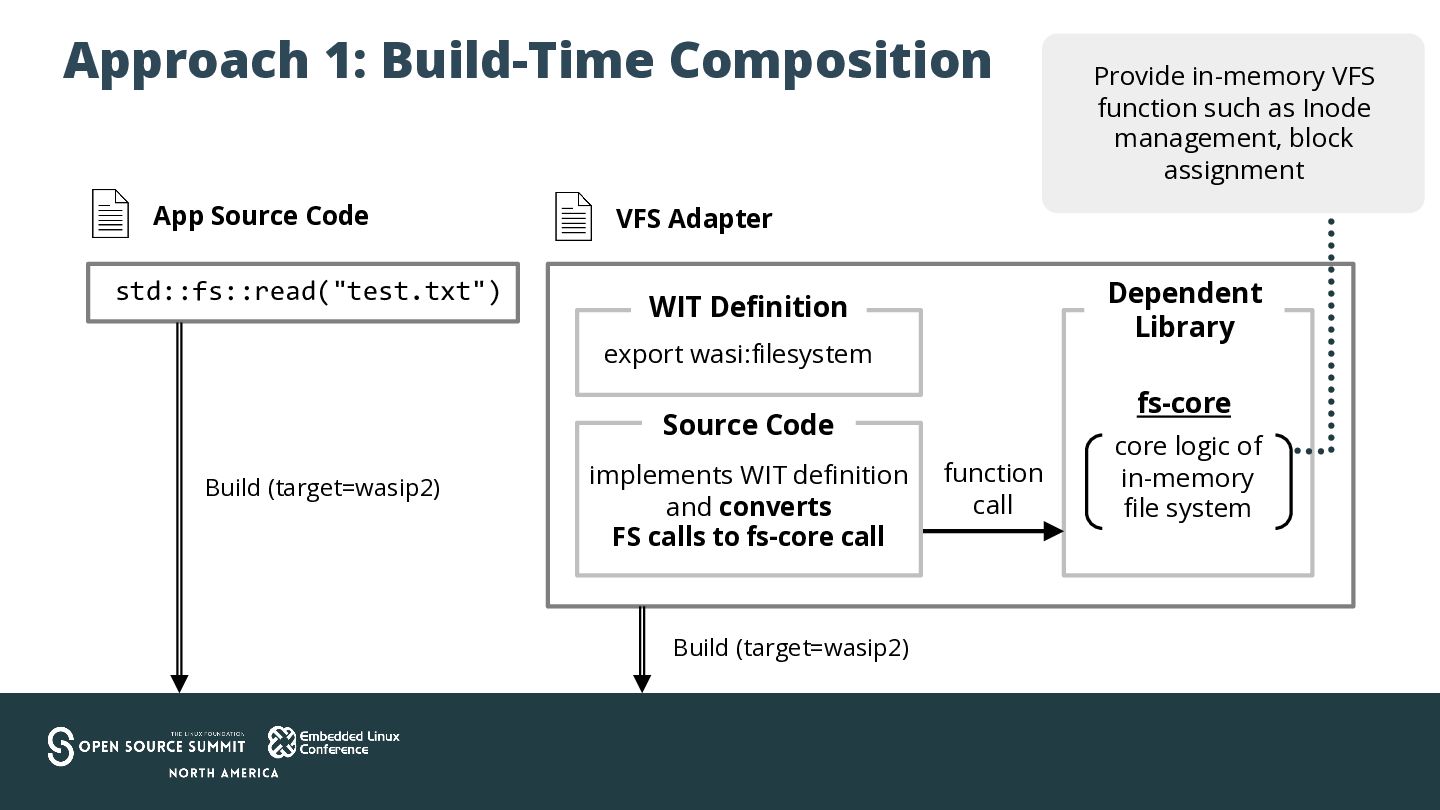
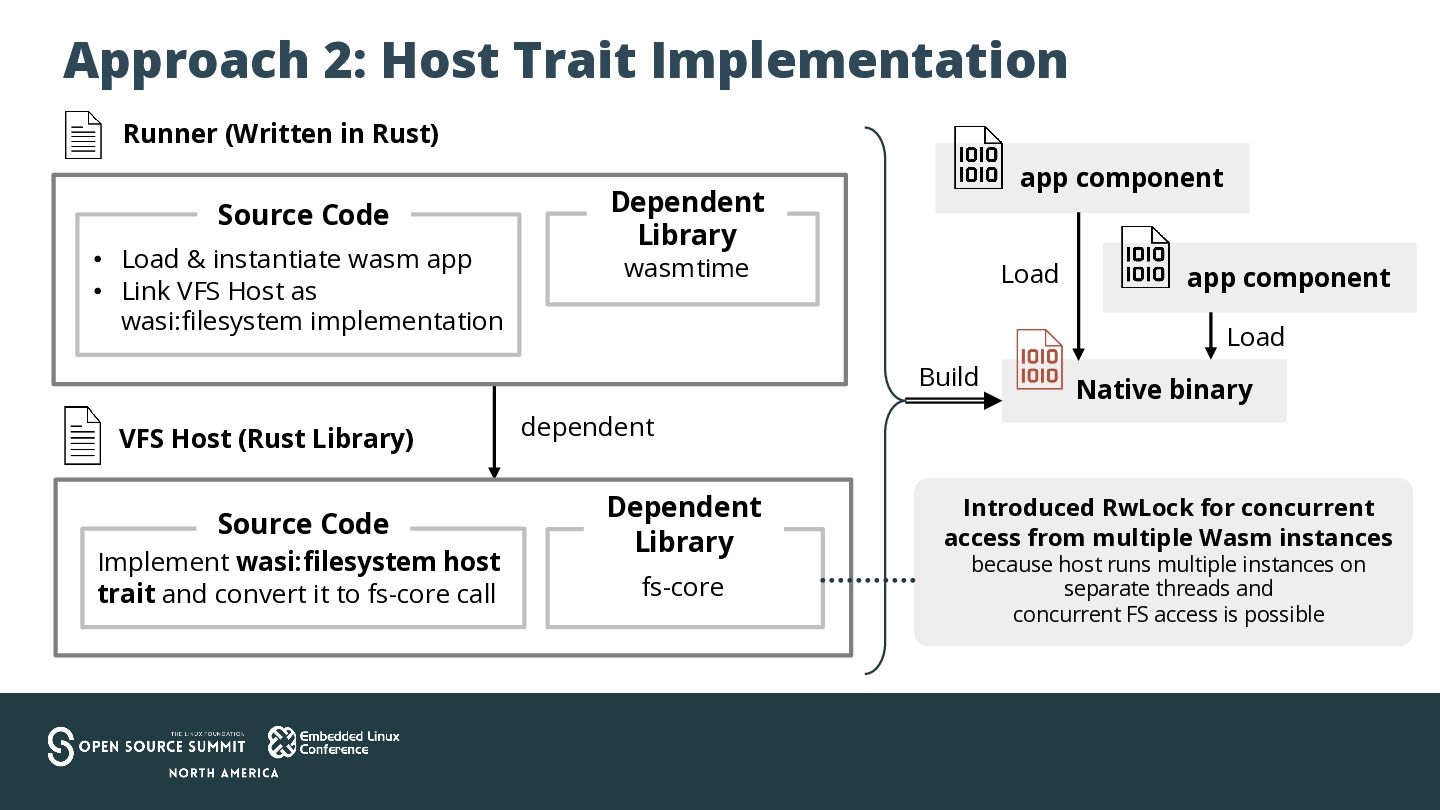
Source Code implements WIT definition and converts FS calls to fs-core call Dependent Library fs-core core logic of in-memory file system function call App Source Code std::fs::read("test.txt") Provide in-memory VFS function such as Inode management, block assignment Build (target=wasip2) Build (target=wasip2)
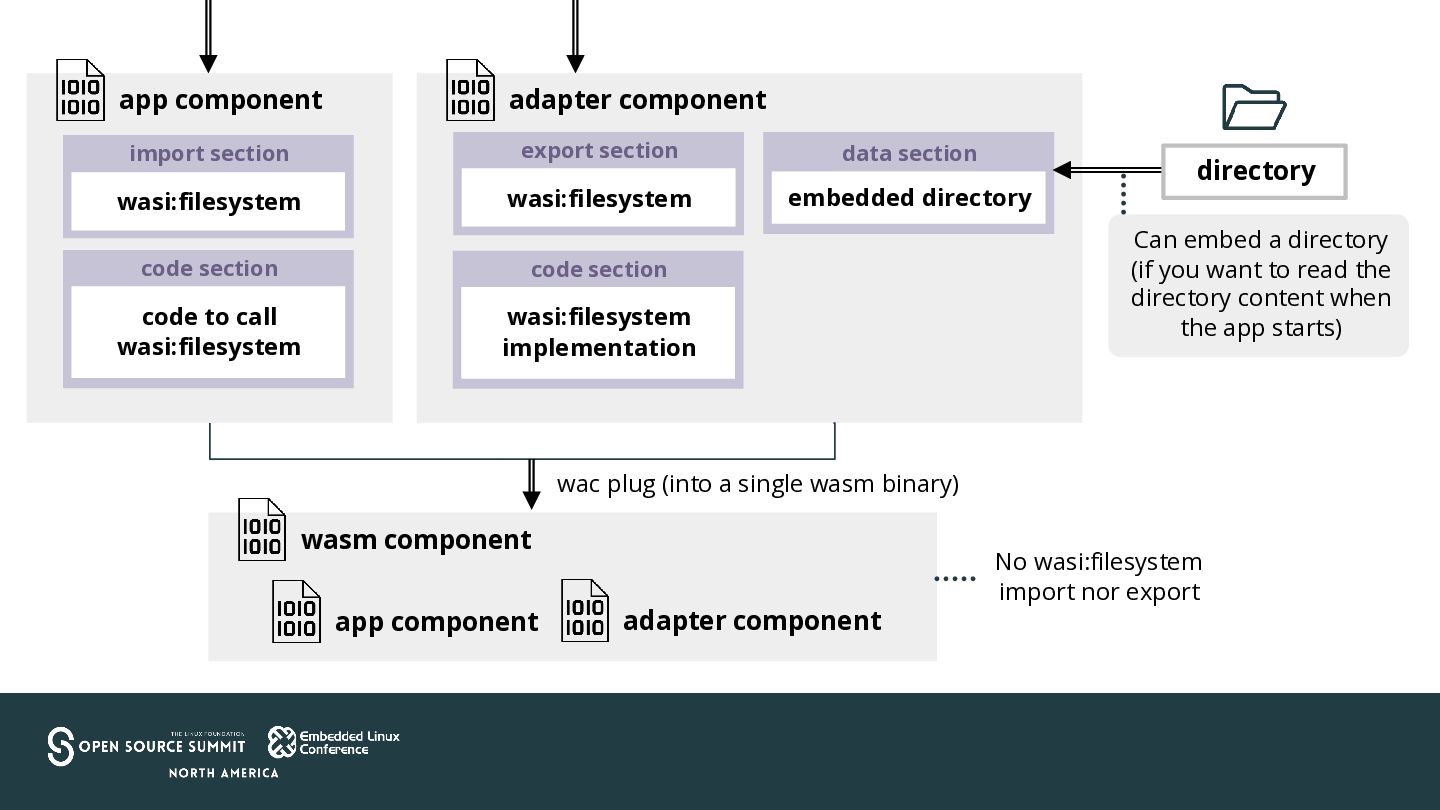
code section wasi:filesystem implementation code section code to call wasi:filesystem data section embedded directory directory Can embed a directory (if you want to read the directory content when the app starts) wac plug (into a single wasm binary) wasm component app component adapter component No wasi:filesystem import nor export
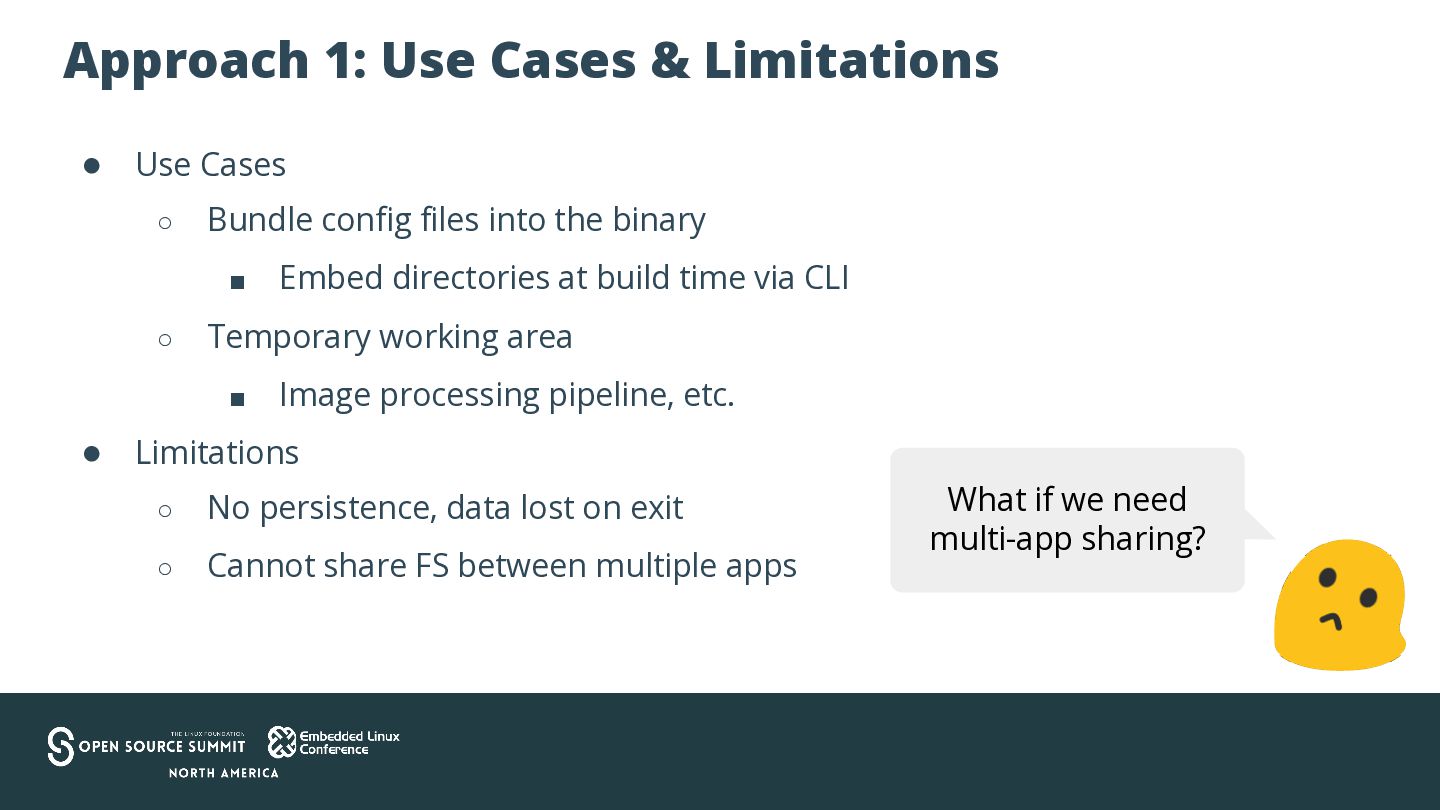
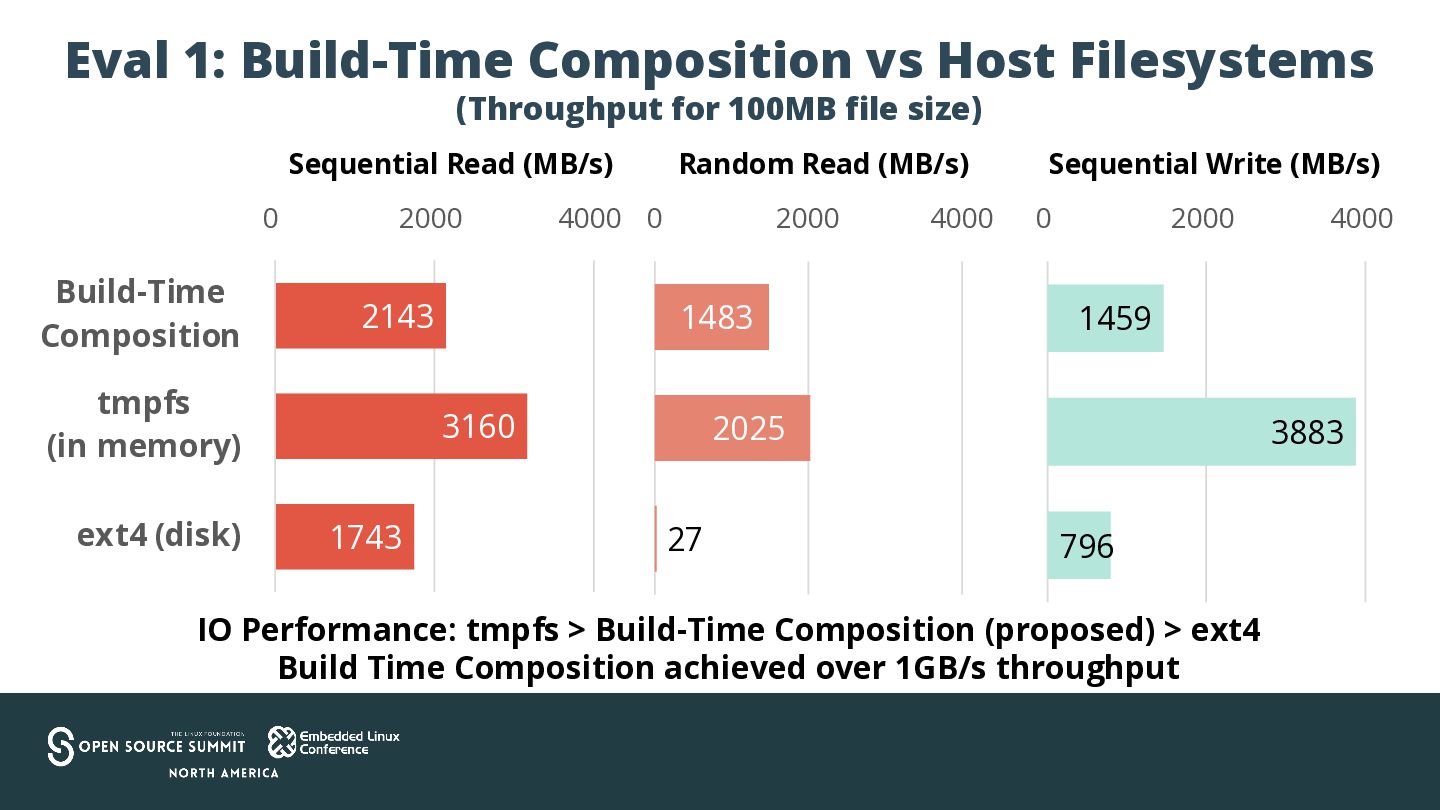
Bundle config files into the binary ▪ Embed directories at build time via CLI ◦ Temporary working area ▪ Image processing pipeline, etc. • Limitations ◦ No persistence, data lost on exit ◦ Cannot share FS between multiple apps What if we need multi-app sharing?
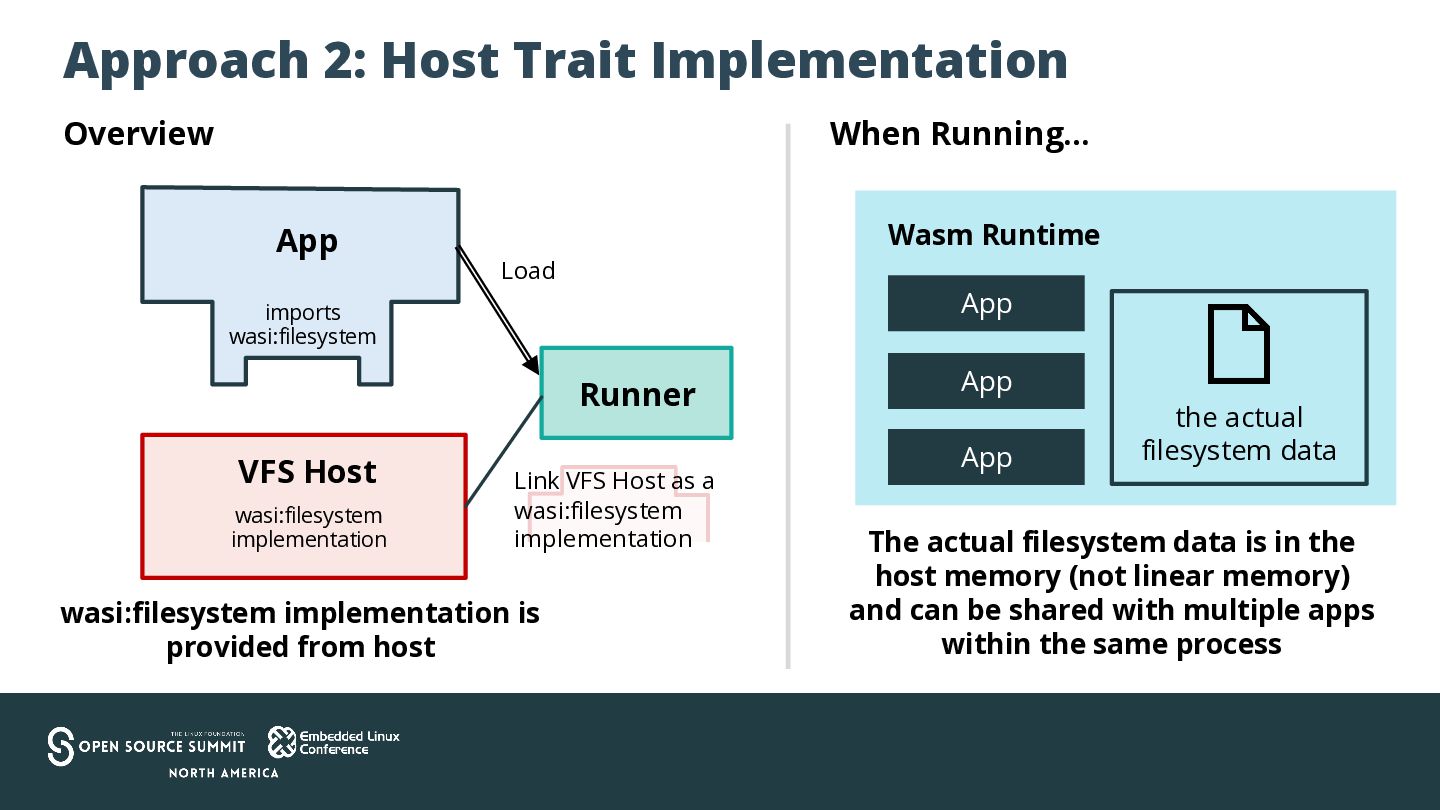
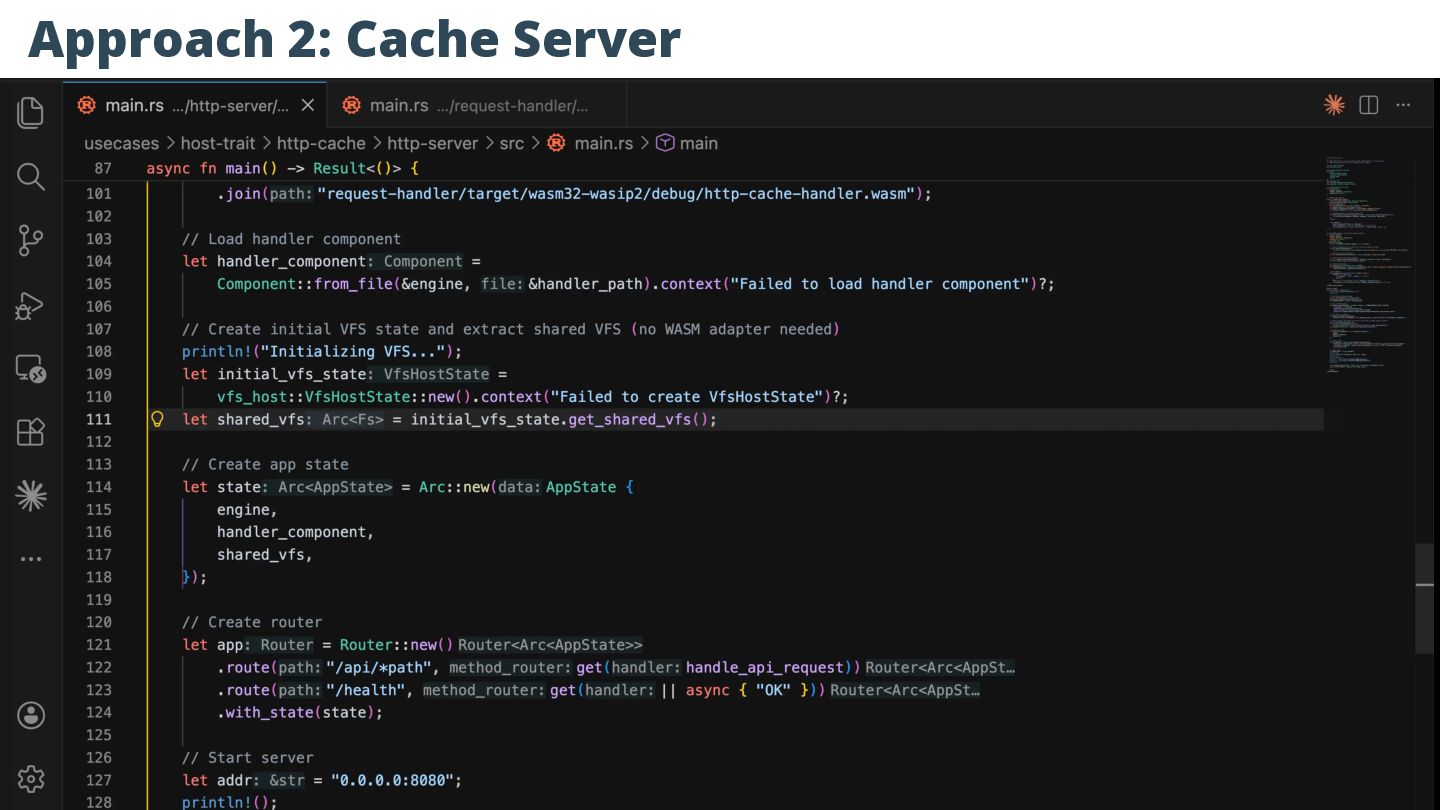
actual filesystem data imports wasi:filesystem App wasi:filesystem implementation is provided from host Runner VFS Host wasi:filesystem implementation Load Overview When Running… The actual filesystem data is in the host memory (not linear memory) and can be shared with multiple apps within the same process Link VFS Host as a wasi:filesystem implementation App
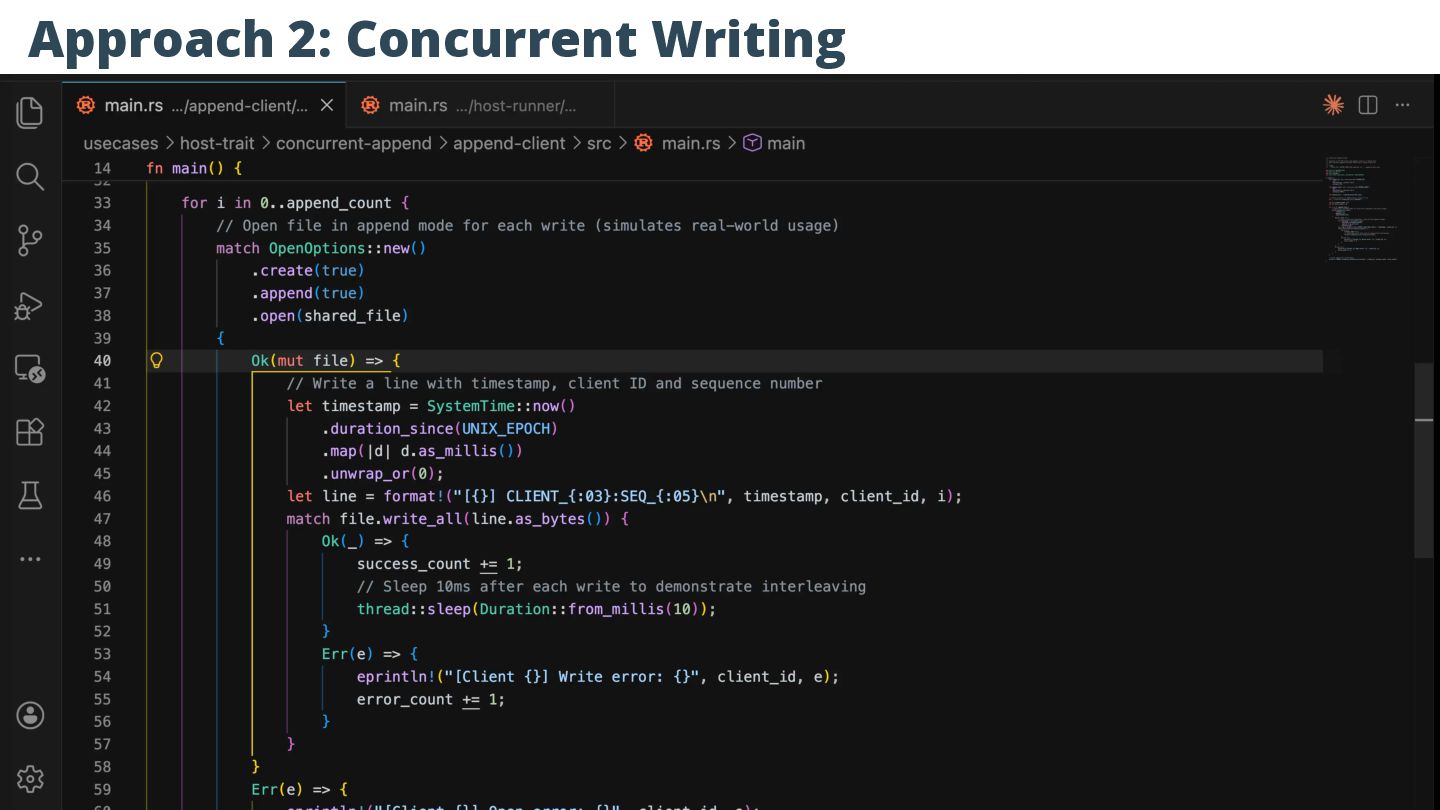
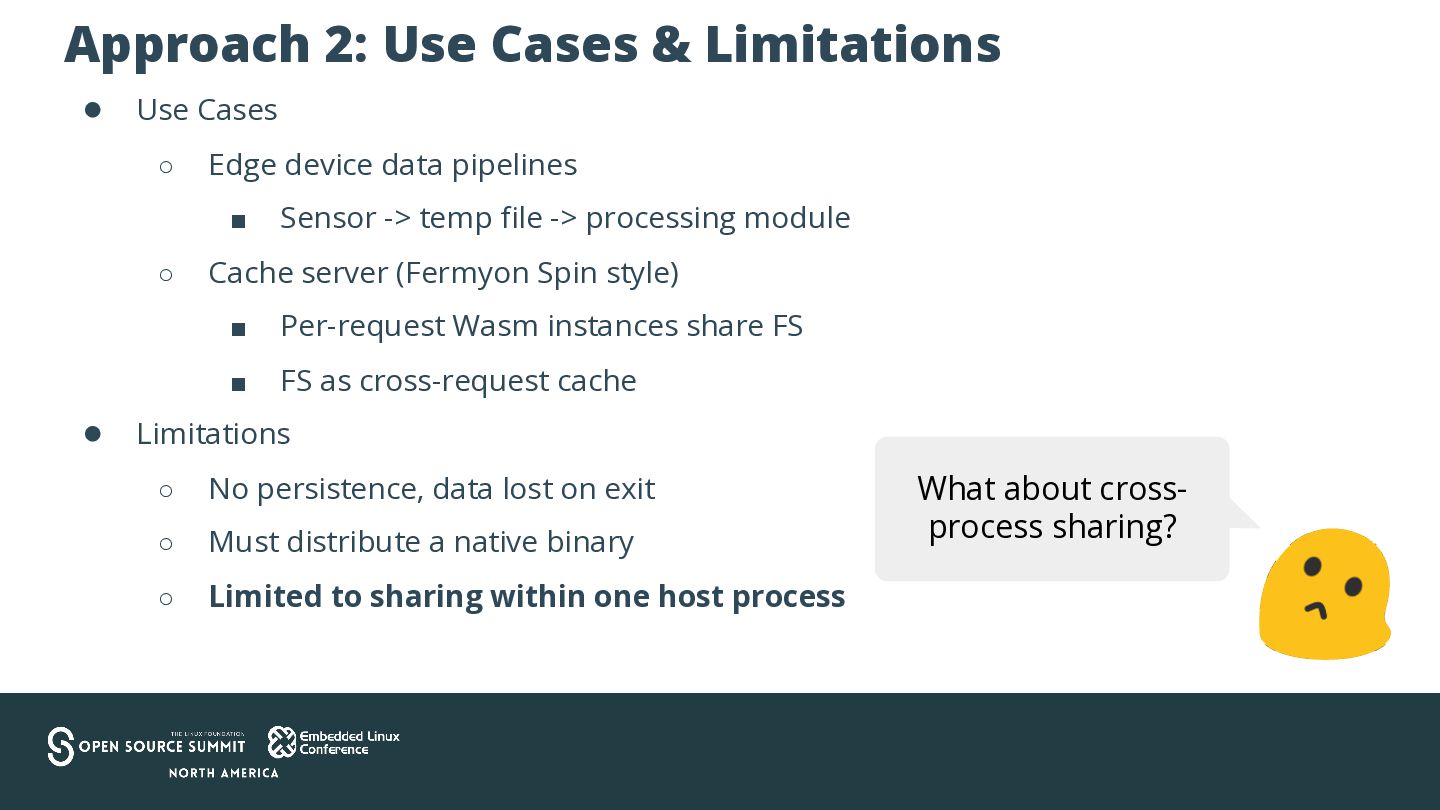
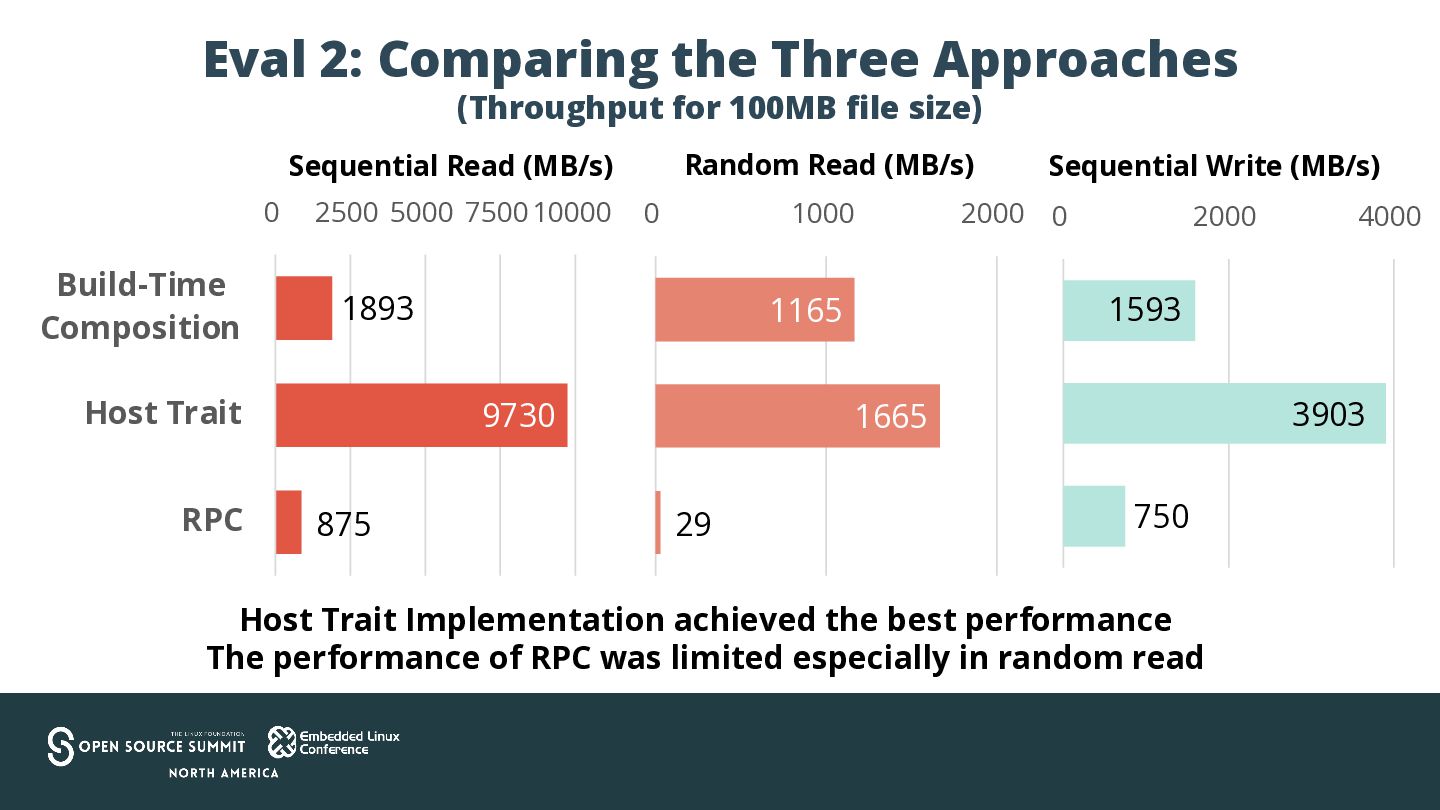
Edge device data pipelines ▪ Sensor -> temp file -> processing module ◦ Cache server (Fermyon Spin style) ▪ Per-request Wasm instances share FS ▪ FS as cross-request cache • Limitations ◦ No persistence, data lost on exit ◦ Must distribute a native binary ◦ Limited to sharing within one host process What about cross- process sharing?
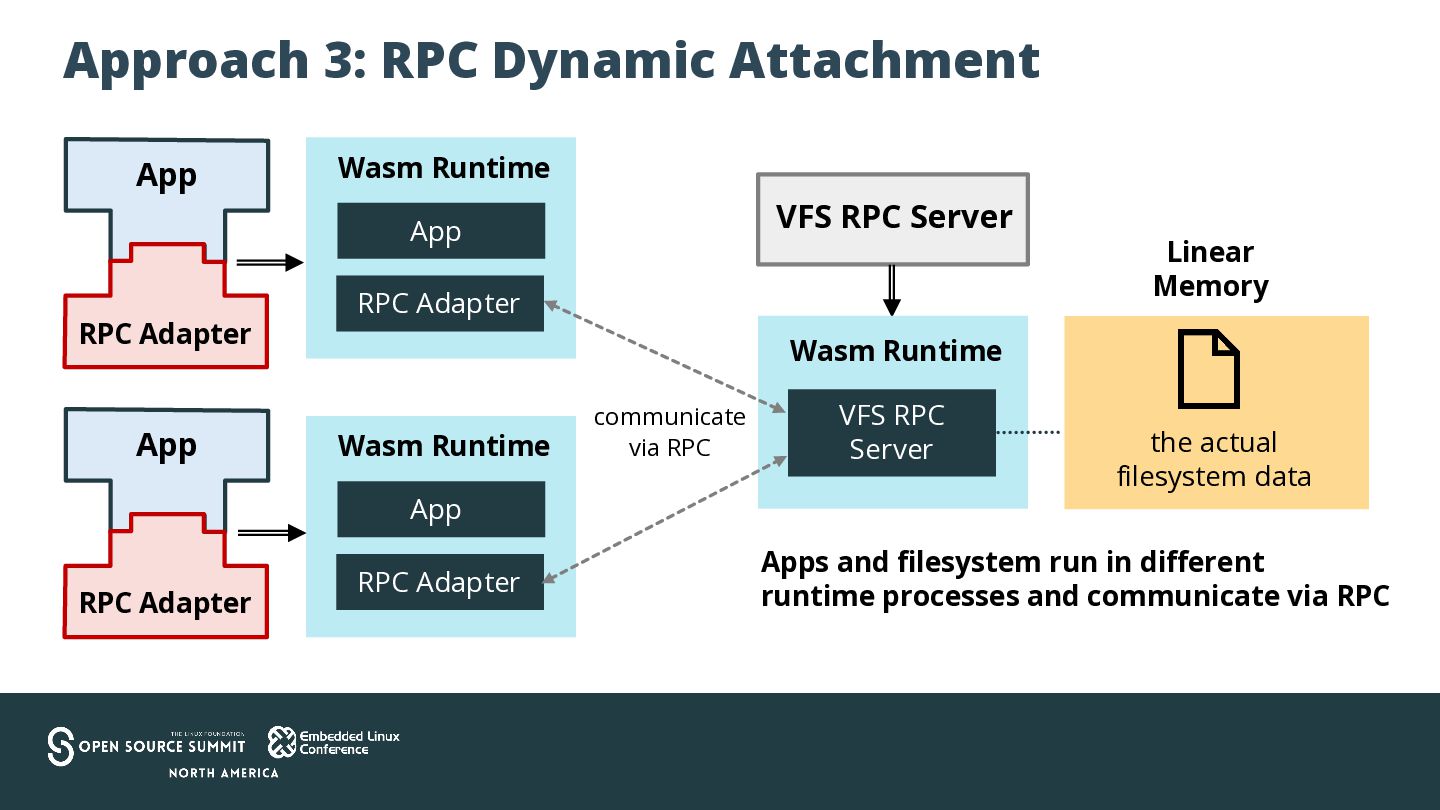
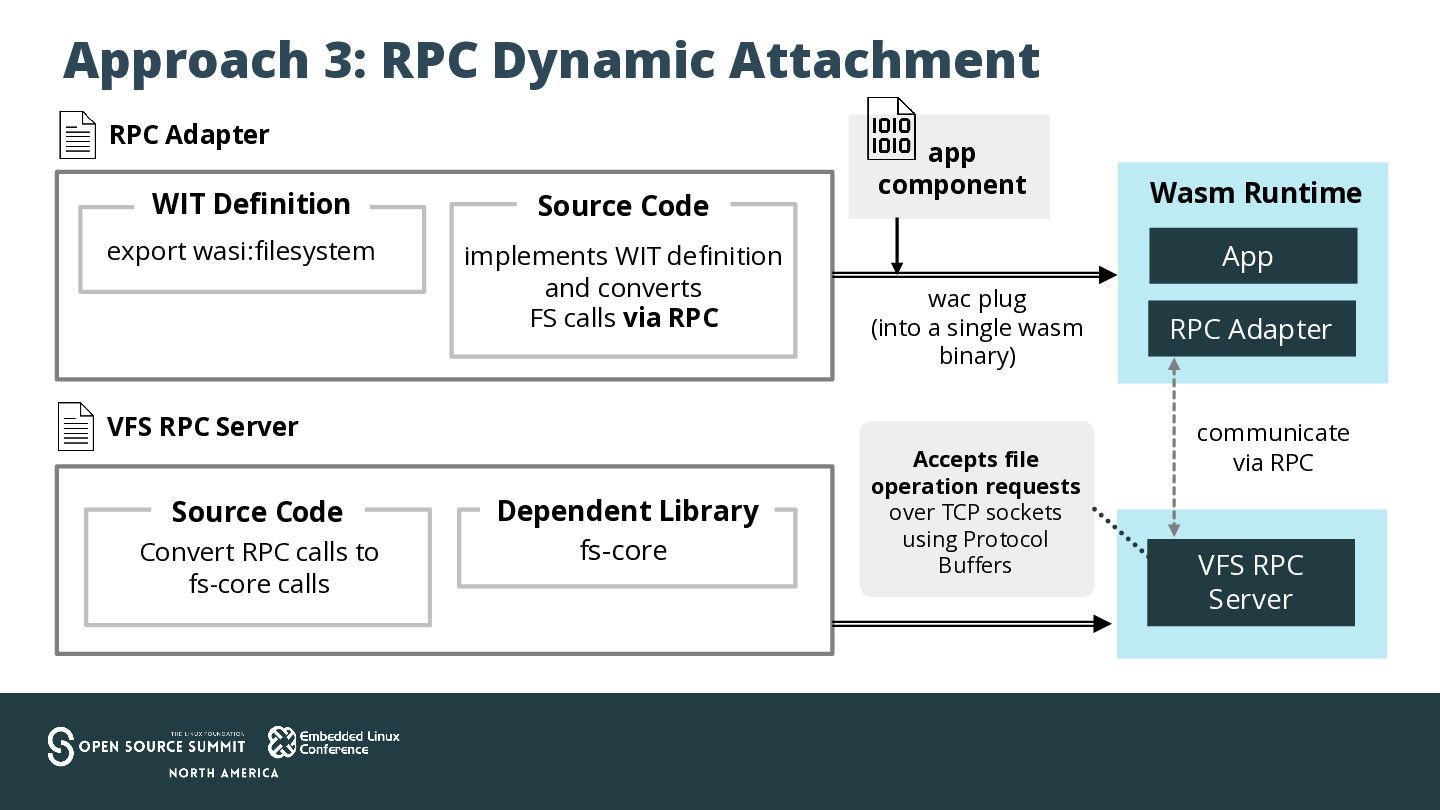
App VFS RPC Server the actual filesystem data Linear Memory Wasm Runtime App RPC Adapter Wasm Runtime App RPC Adapter Wasm Runtime VFS RPC Server communicate via RPC Apps and filesystem run in different runtime processes and communicate via RPC
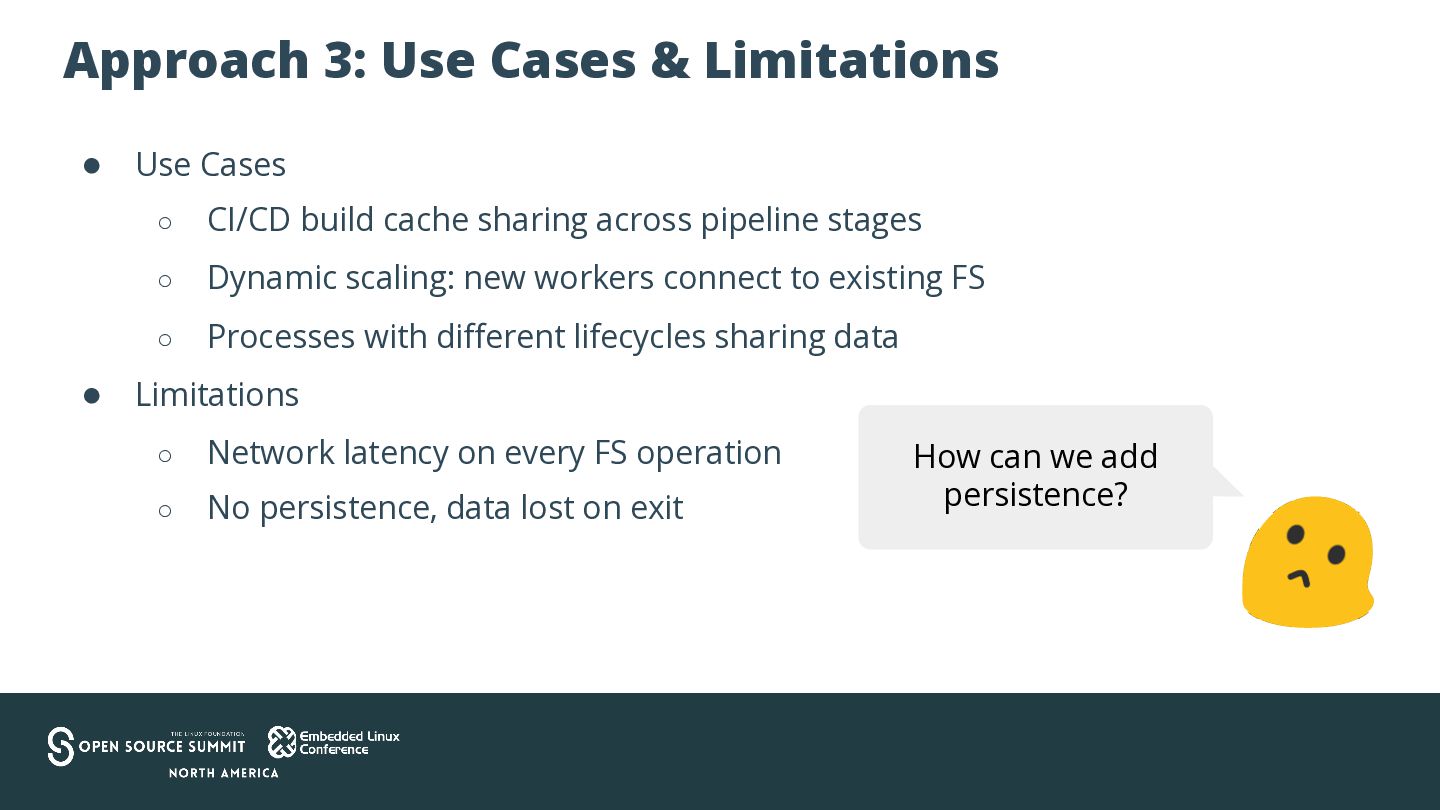
CI/CD build cache sharing across pipeline stages ◦ Dynamic scaling: new workers connect to existing FS ◦ Processes with different lifecycles sharing data • Limitations ◦ Network latency on every FS operation ◦ No persistence, data lost on exit How can we add persistence?
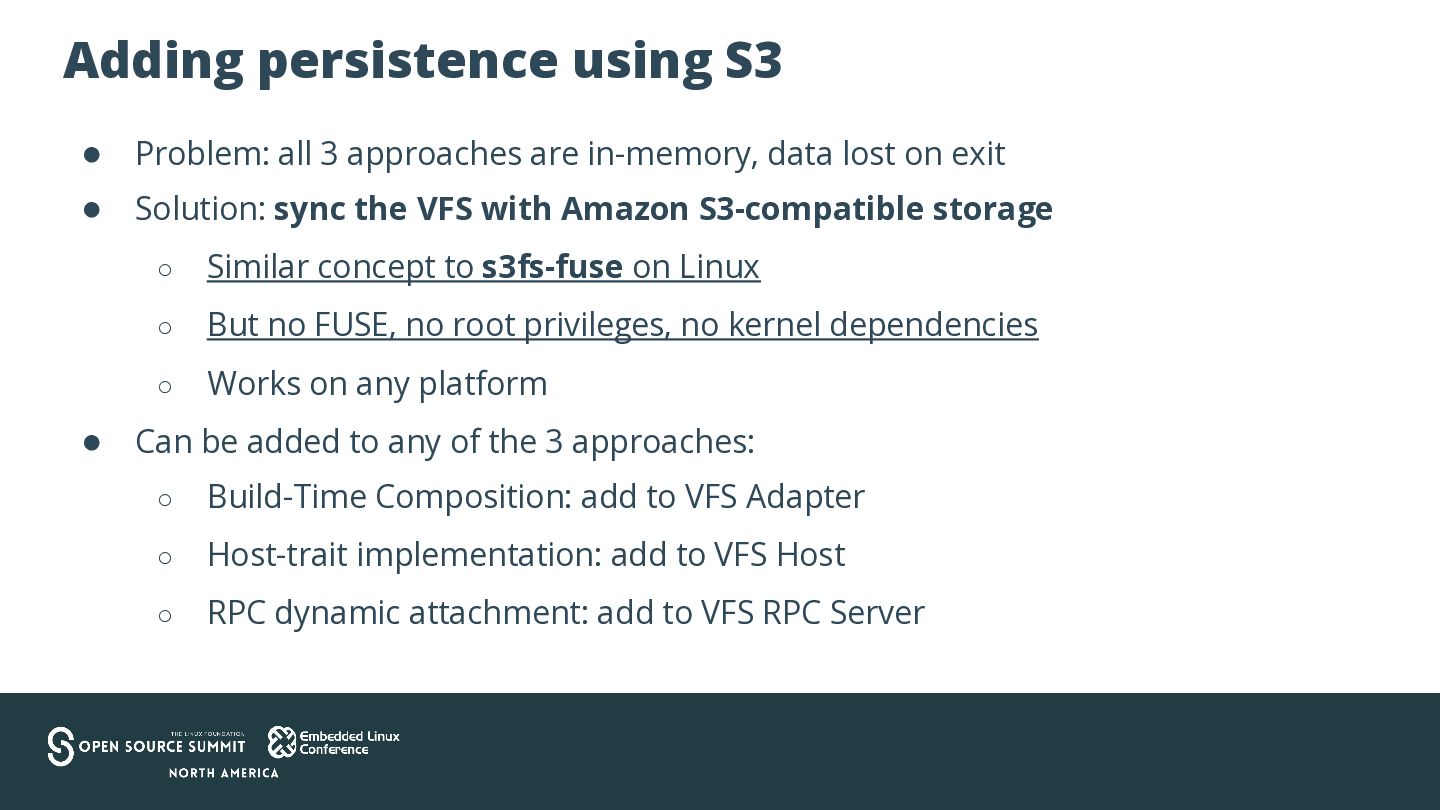
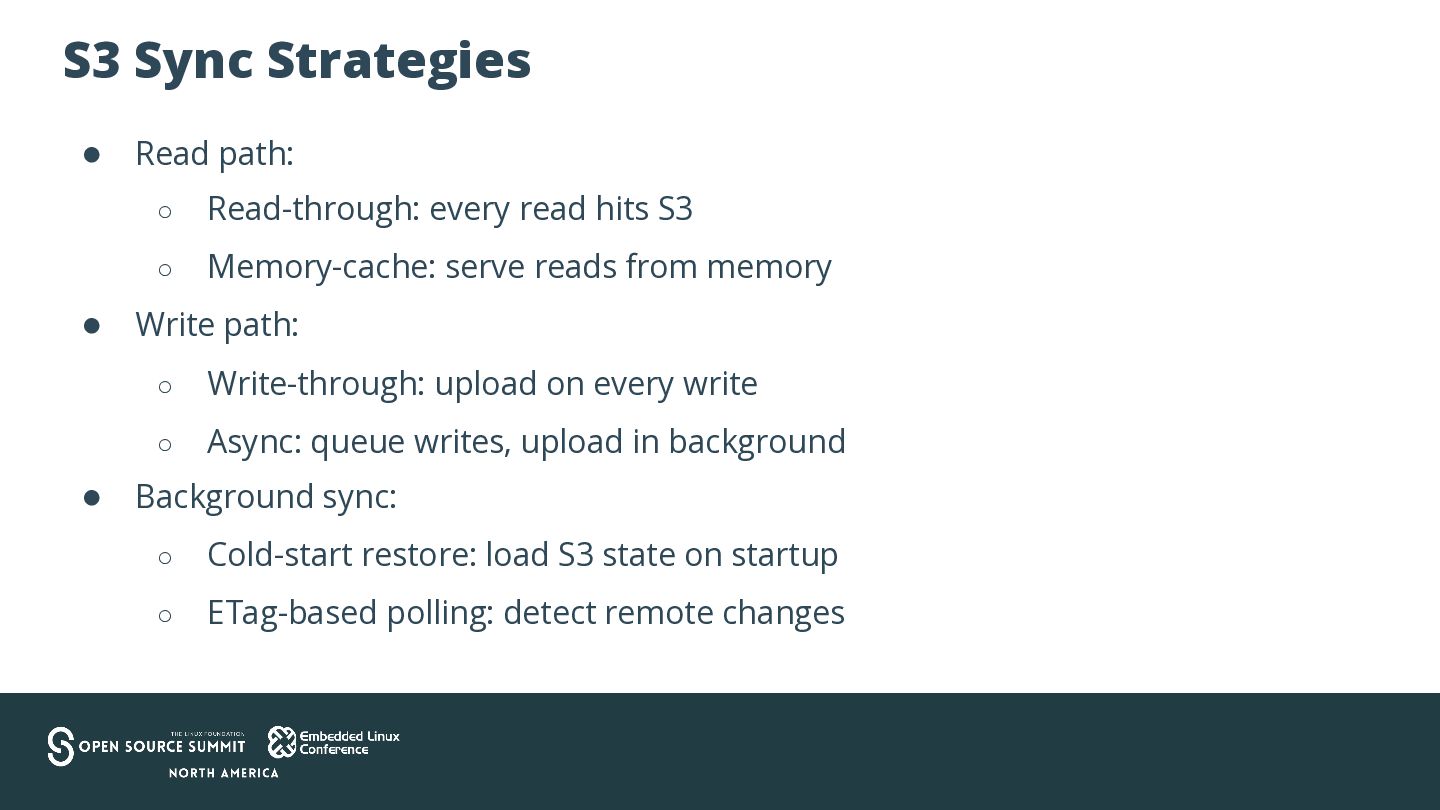
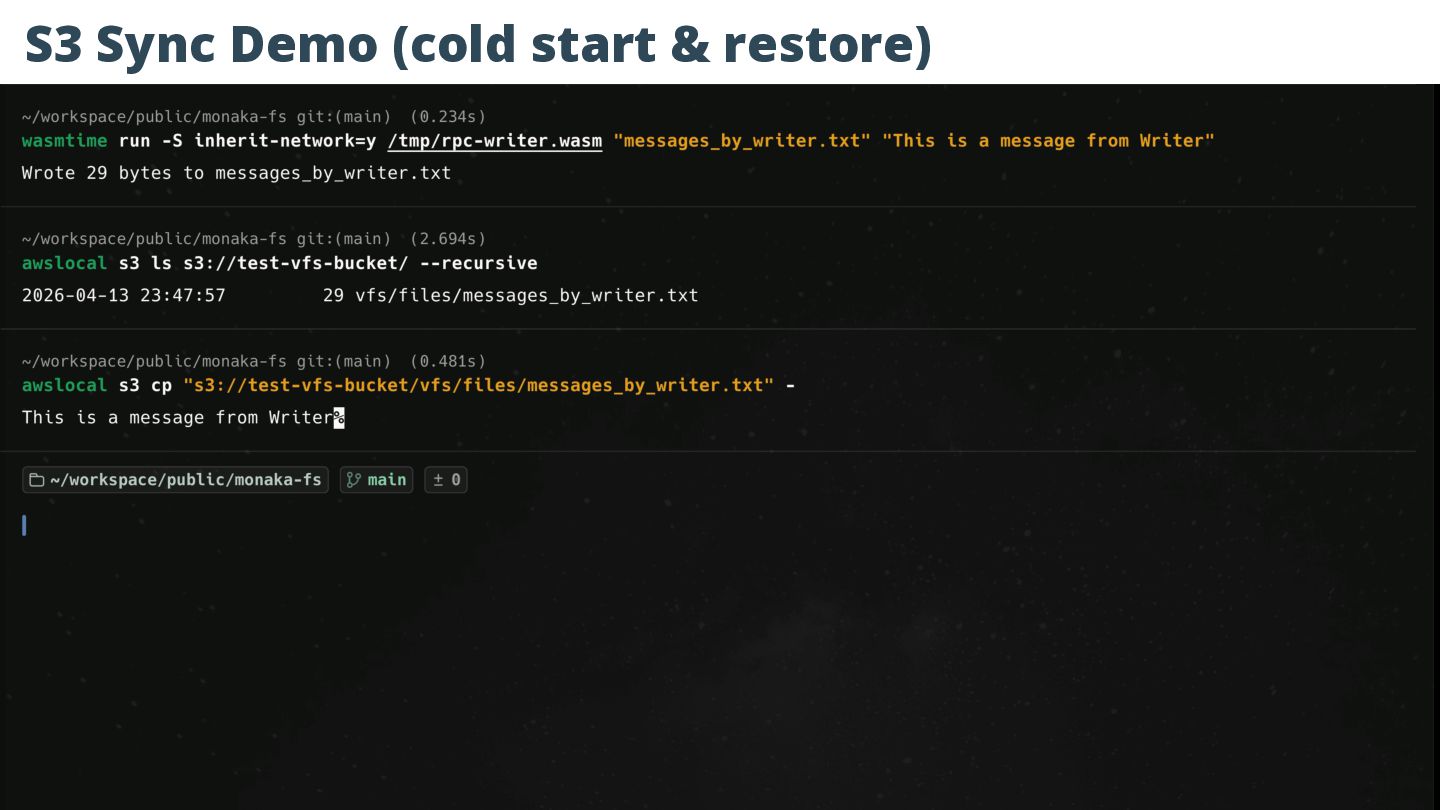
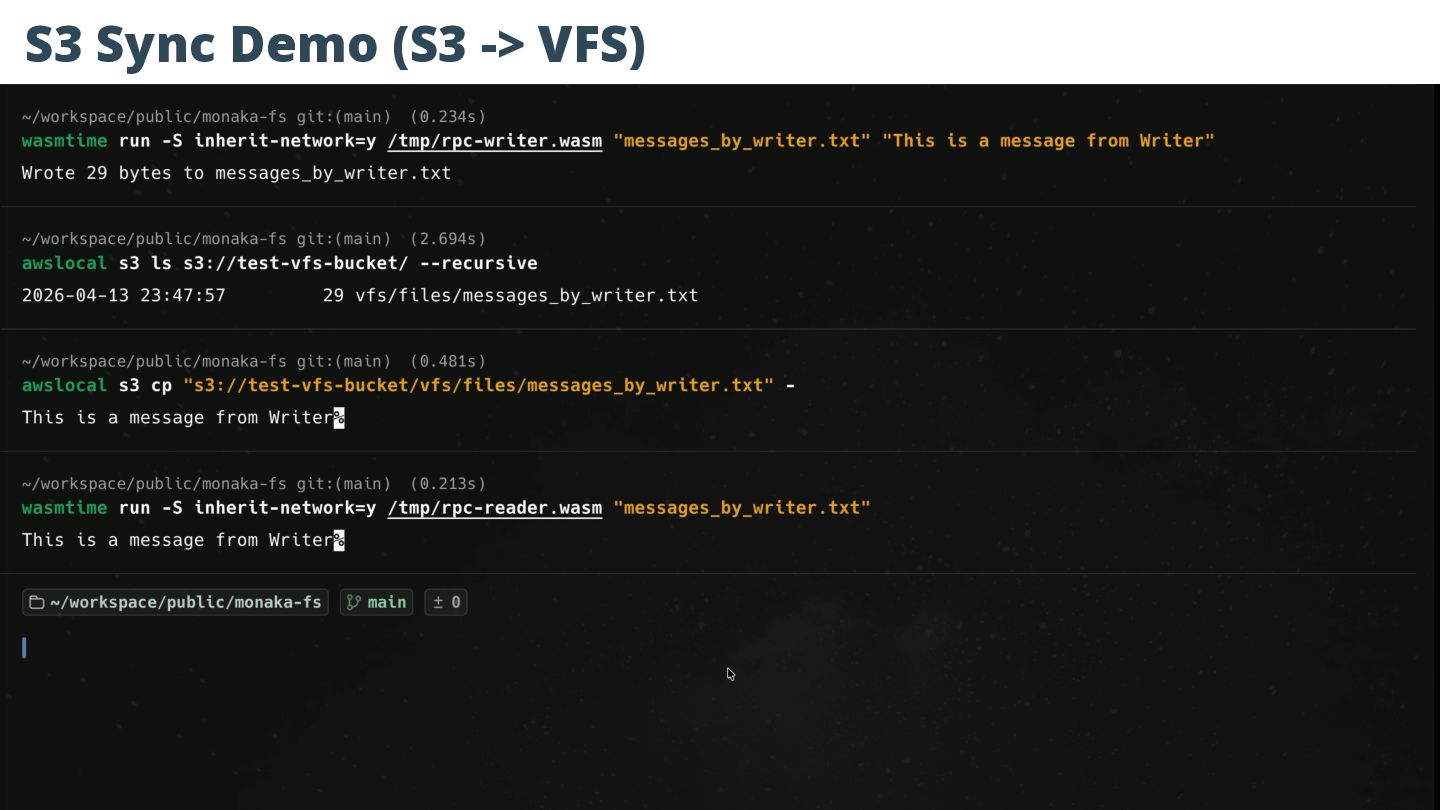
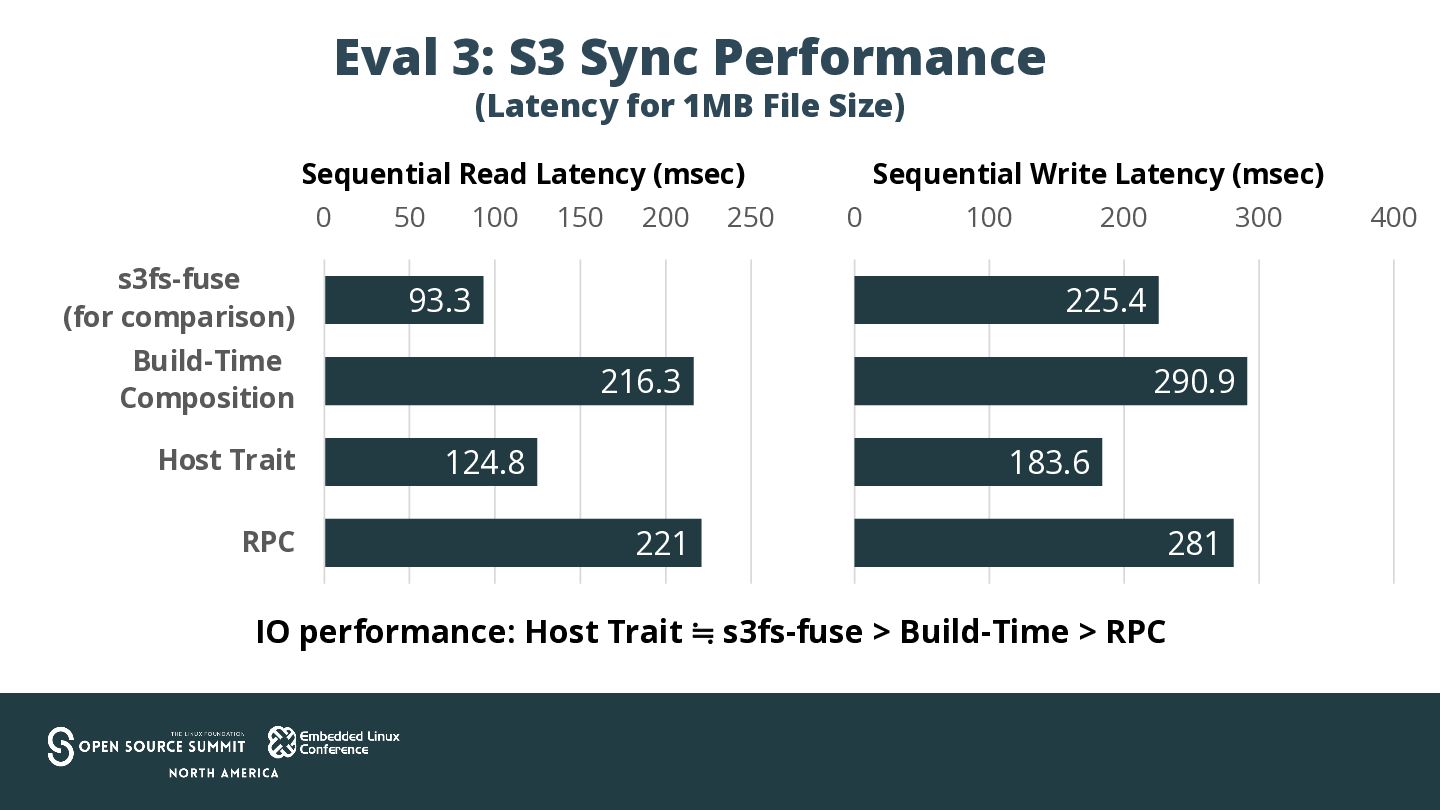
in-memory, data lost on exit • Solution: sync the VFS with Amazon S3-compatible storage ◦ Similar concept to s3fs-fuse on Linux ◦ But no FUSE, no root privileges, no kernel dependencies ◦ Works on any platform • Can be added to any of the 3 approaches: ◦ Build-Time Composition: add to VFS Adapter ◦ Host-trait implementation: add to VFS Host ◦ RPC dynamic attachment: add to VFS RPC Server
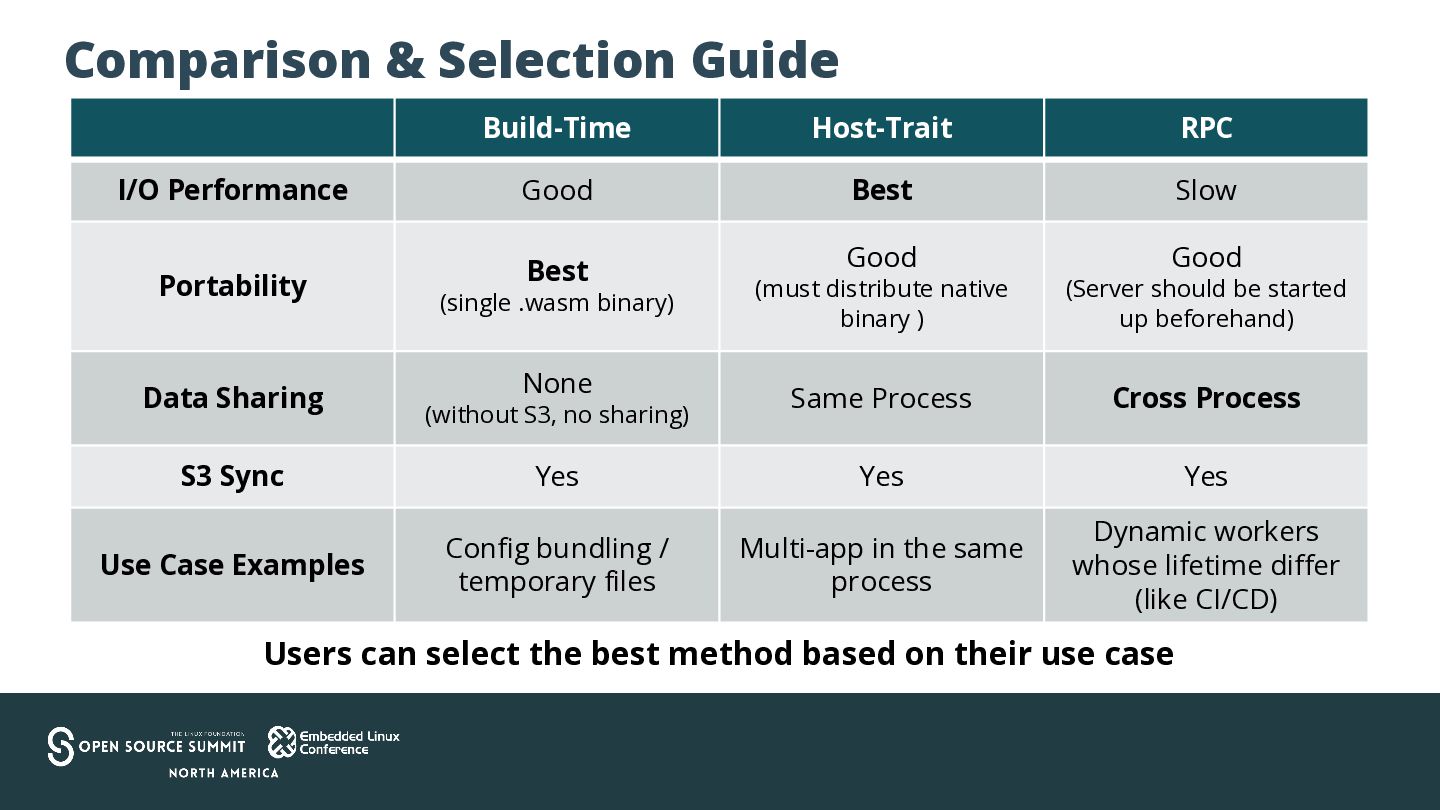
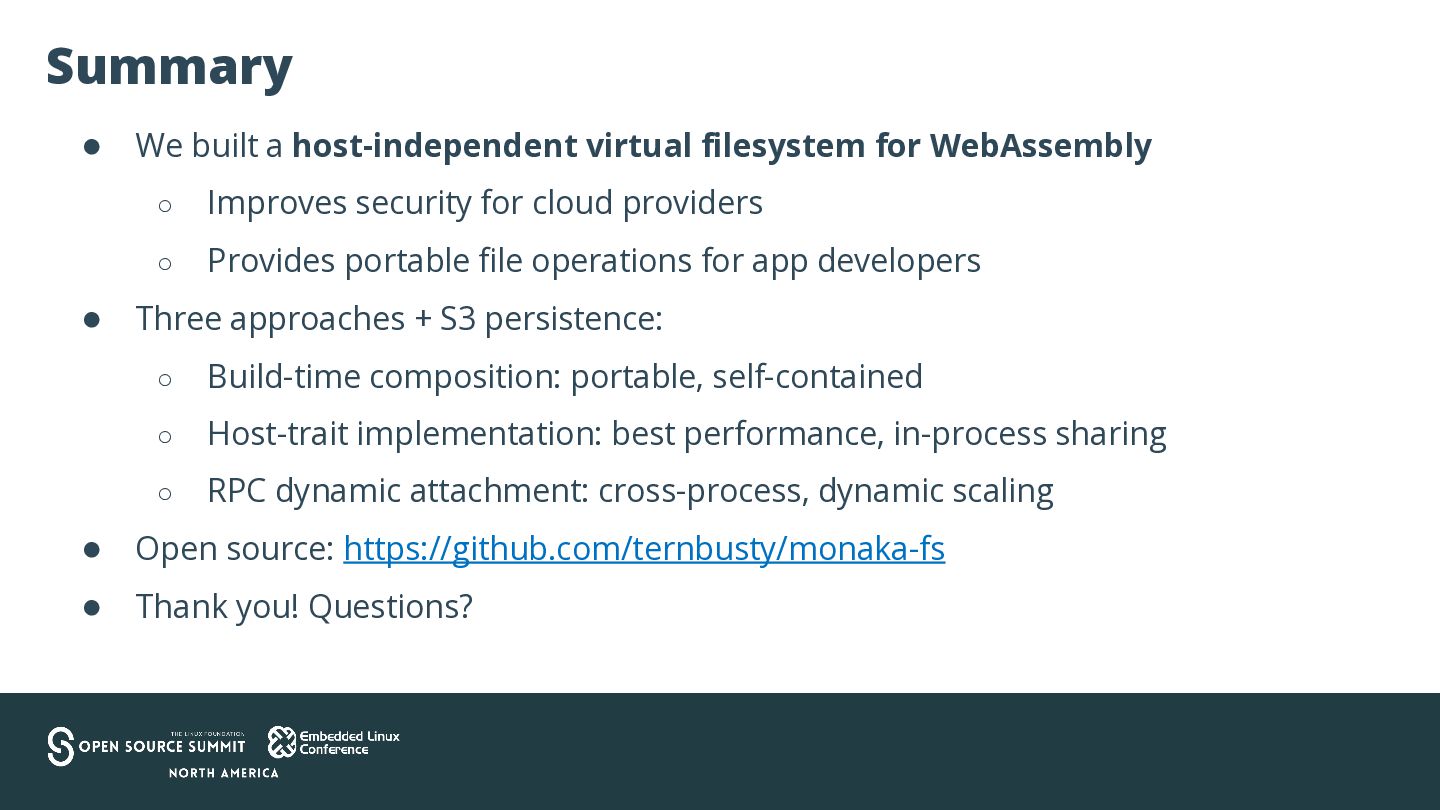
Best Slow Portability Best (single .wasm binary) Good (must distribute native binary ) Good (Server should be started up beforehand) Data Sharing None (without S3, no sharing) Same Process Cross Process S3 Sync Yes Yes Yes Use Case Examples Config bundling / temporary files Multi-app in the same process Dynamic workers whose lifetime differ (like CI/CD) Users can select the best method based on their use case
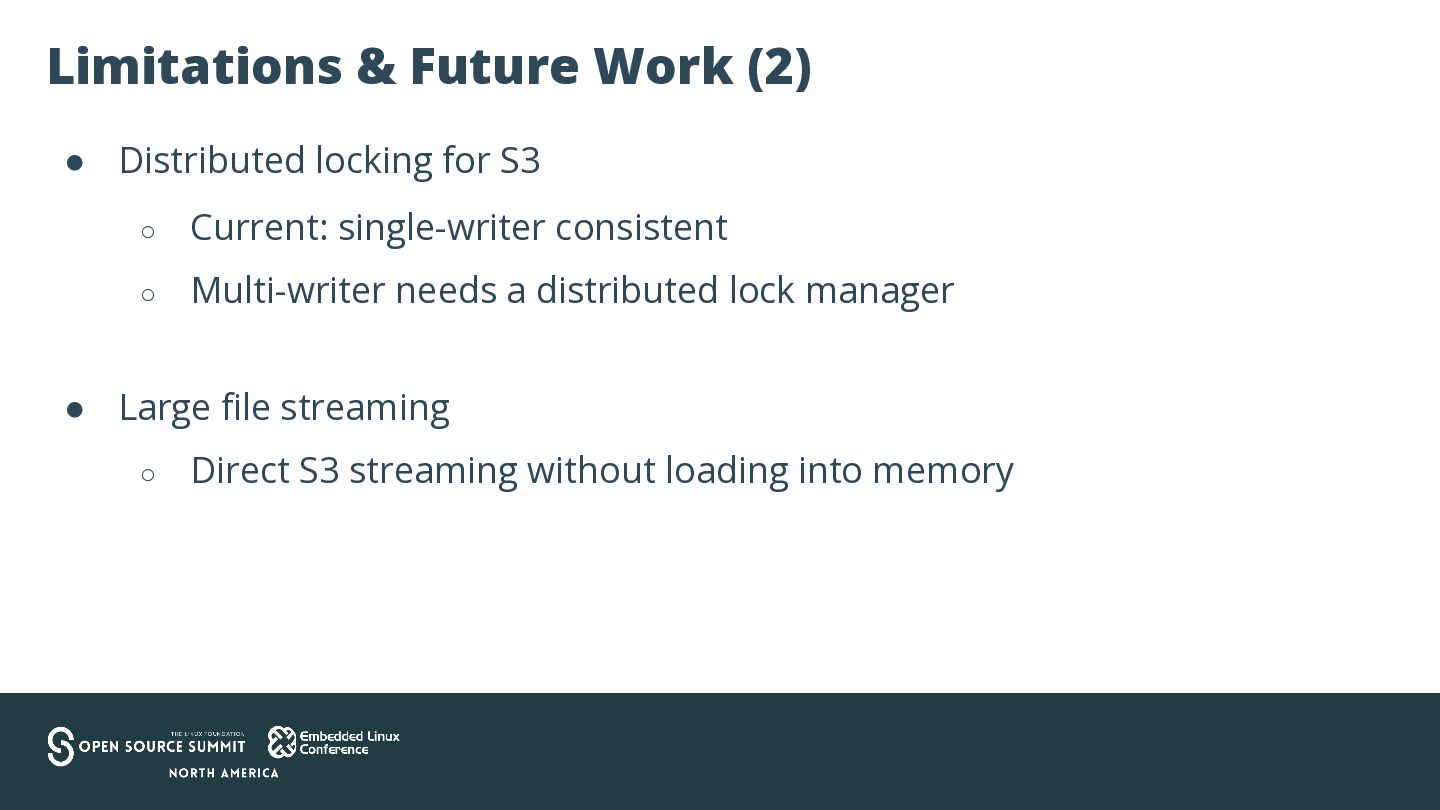
◦ Current: single-writer consistent ◦ Multi-writer needs a distributed lock manager • Large file streaming ◦ Direct S3 streaming without loading into memory


 ternbusty
 utakaha
 kasacchiful
 armondando
 panda728
 chobishiba
 florets1
 lynnswap
 moro
moro
 koic
koic
 minodriven
 naokihaba
 oku053
 reverentgeek
 panda_program
 sabderemane
 inesmontani
 nmsamuel
 axbom
axbom
 mfonobong
 yeseniaperezcruz
 tenderlove
 lemiorhan
 pedronauck