Upgrade to Pro — share decks privately, control downloads, hide ads and more …

The story of RefactoringMiner. Slow research, l...

The story of RefactoringMiner. Slow research, long-term impact

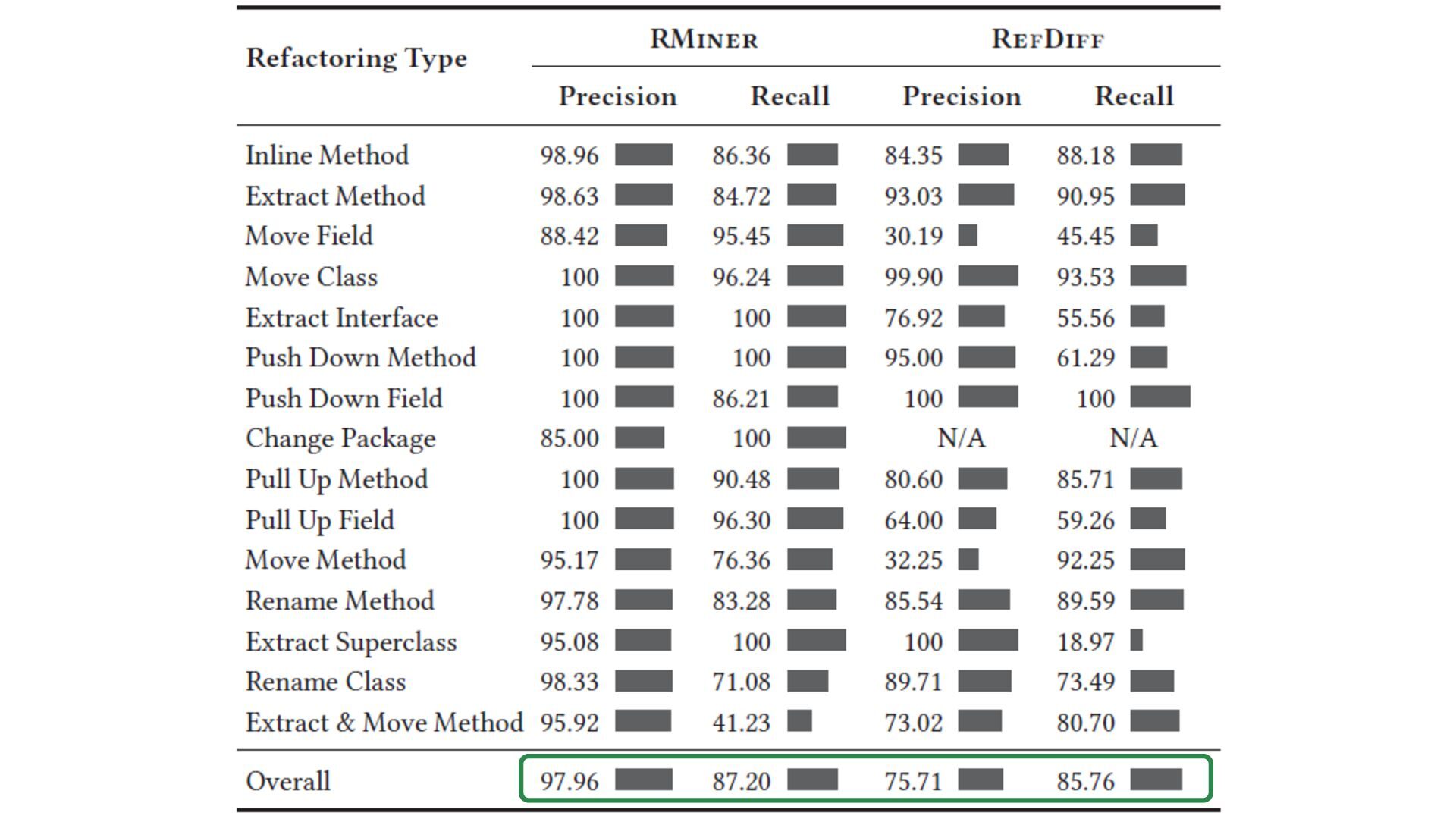
LATECE Seminar @UQAM
In this seminar, I cover over 10 years of research on the RefactoringMiner project by presenting how the state-of-the-art in Refactoring detection evolved over time and the important lessons learned in my career both research-wise and engineering-wise.
I conclude the seminar with the next big challenging problems that need to be addressed by the Refactoring detection research community.

Avatar for Nikolaos Tsantalis

Nikolaos Tsantalis

May 13, 2026

More Decks by Nikolaos Tsantalis

Other Decks in Research

Transcript

  1. “Grok” was first used in this novel a Martian term

    meaning to understand something by becoming one with it.
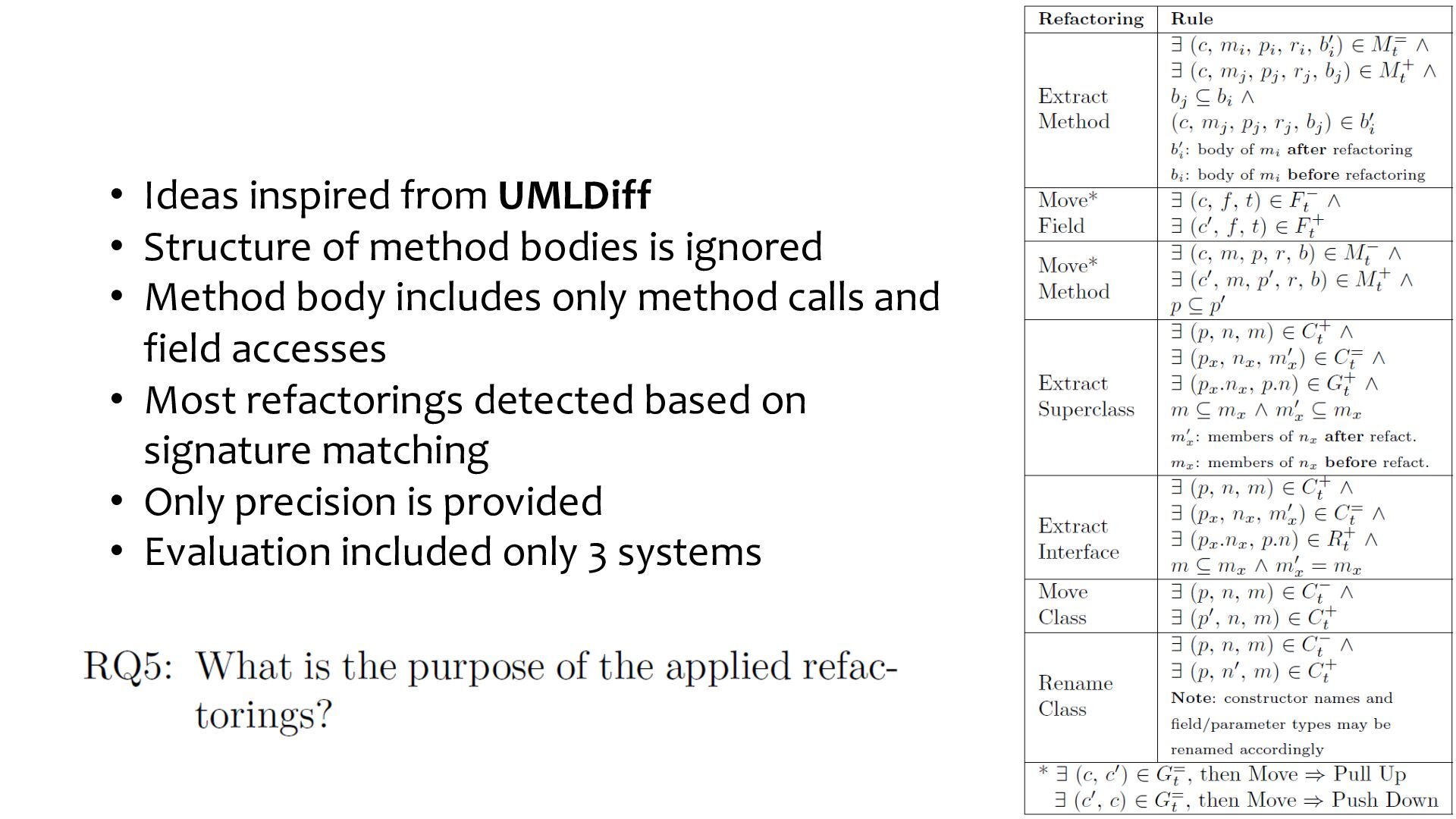
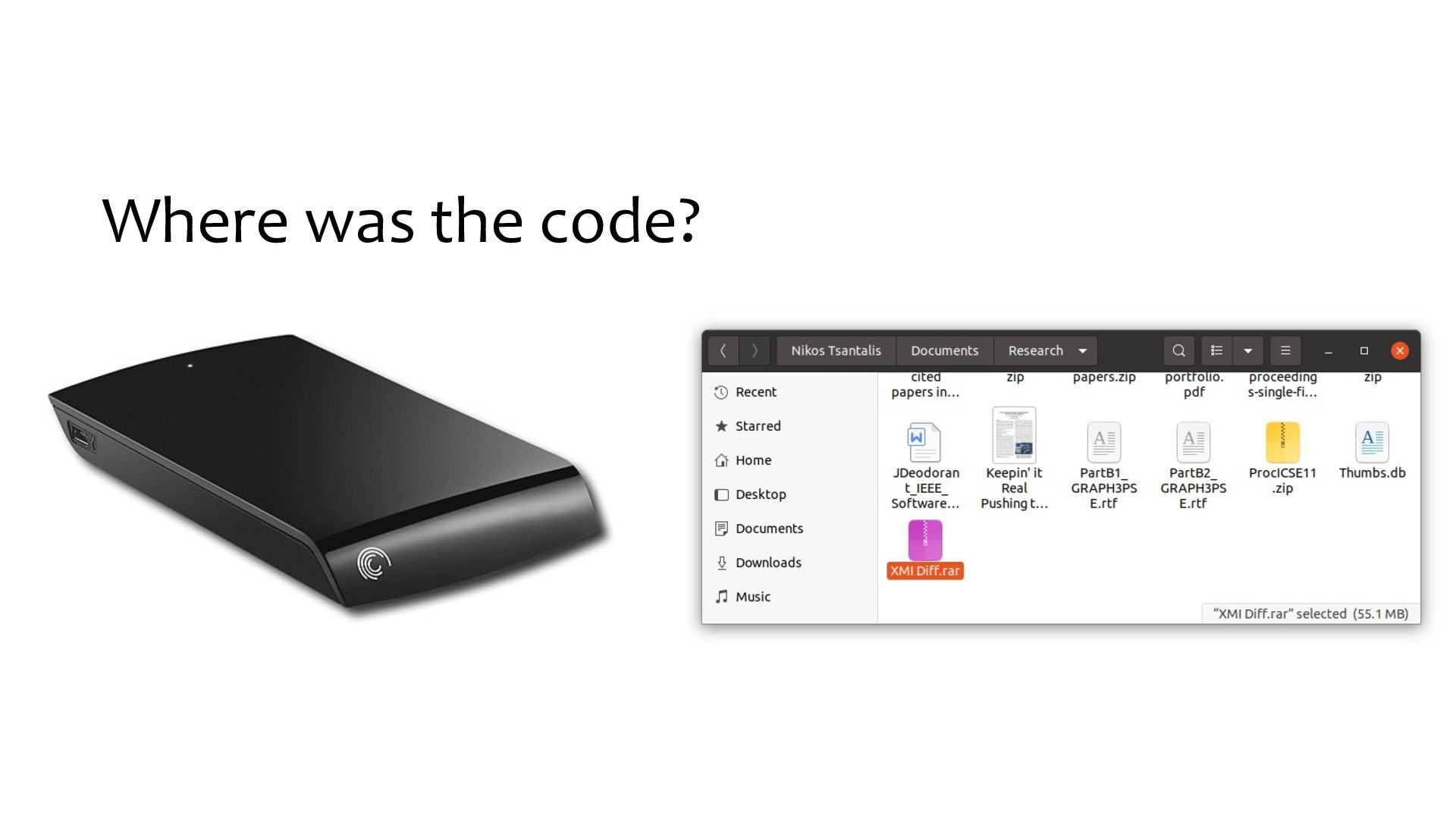
  2. • Ideas inspired from UMLDiff • Structure of method bodies

    is ignored • Method body includes only method calls and field accesses • Most refactorings detected based on signature matching • Only precision is provided • Evaluation included only 3 systems
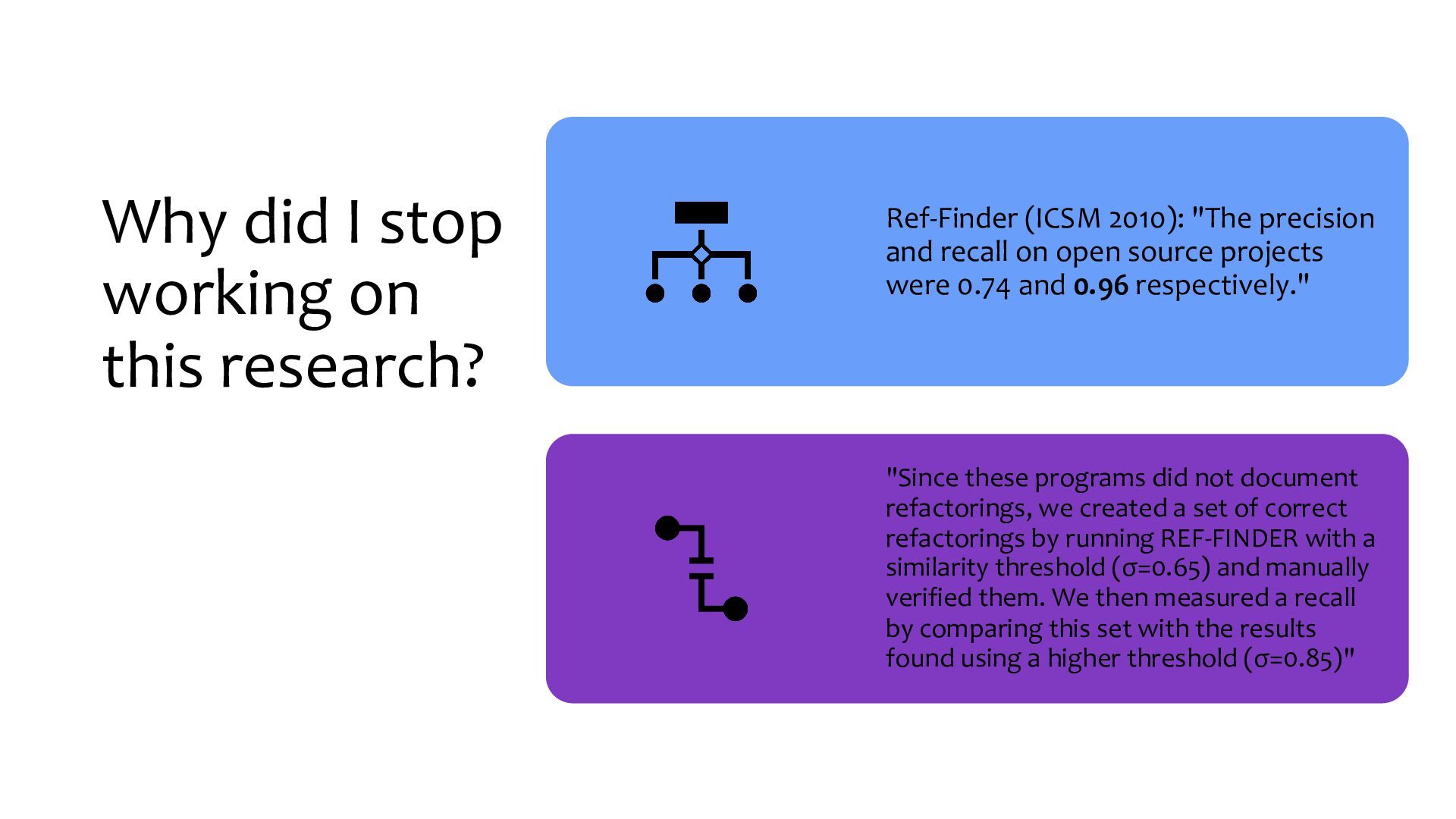
  3. Why did I stop working on this research? Ref-Finder (ICSM

    2010): "The precision and recall on open source projects were 0.74 and 0.96 respectively." "Since these programs did not document refactorings, we created a set of correct refactorings by running REF-FINDER with a similarity threshold (σ=0.65) and manually verified them. We then measured a recall by comparing this set with the results found using a higher threshold (σ=0.85)"
  4. Lesson #2 Always make your code & data available in

    a repository You never know what it can enable in the future
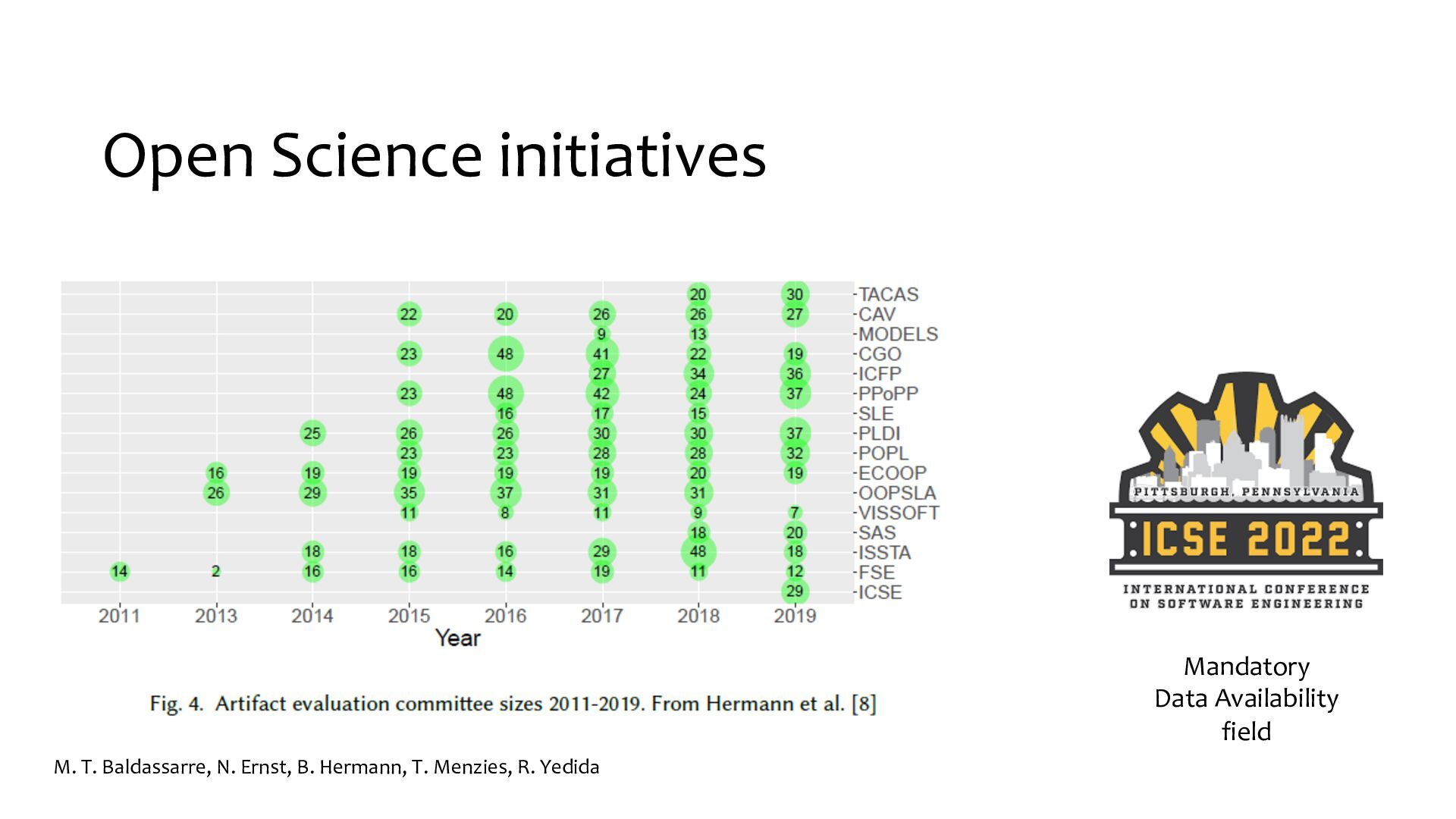
  5. Open Science initiatives M. T. Baldassarre, N. Ernst, B. Hermann,

    T. Menzies, R. Yedida Mandatory Data Availability field
  6. • Danilo developed the API of RefactoringMiner • Tooling for

    checking out and parsing Git commits • Infrastructure for monitoring GitHub projects • Automatic generation of emails to contact developers • A web app for thematic analysis
  7. Firehouse interview • Monitored 124 GitHub projects between June 8th

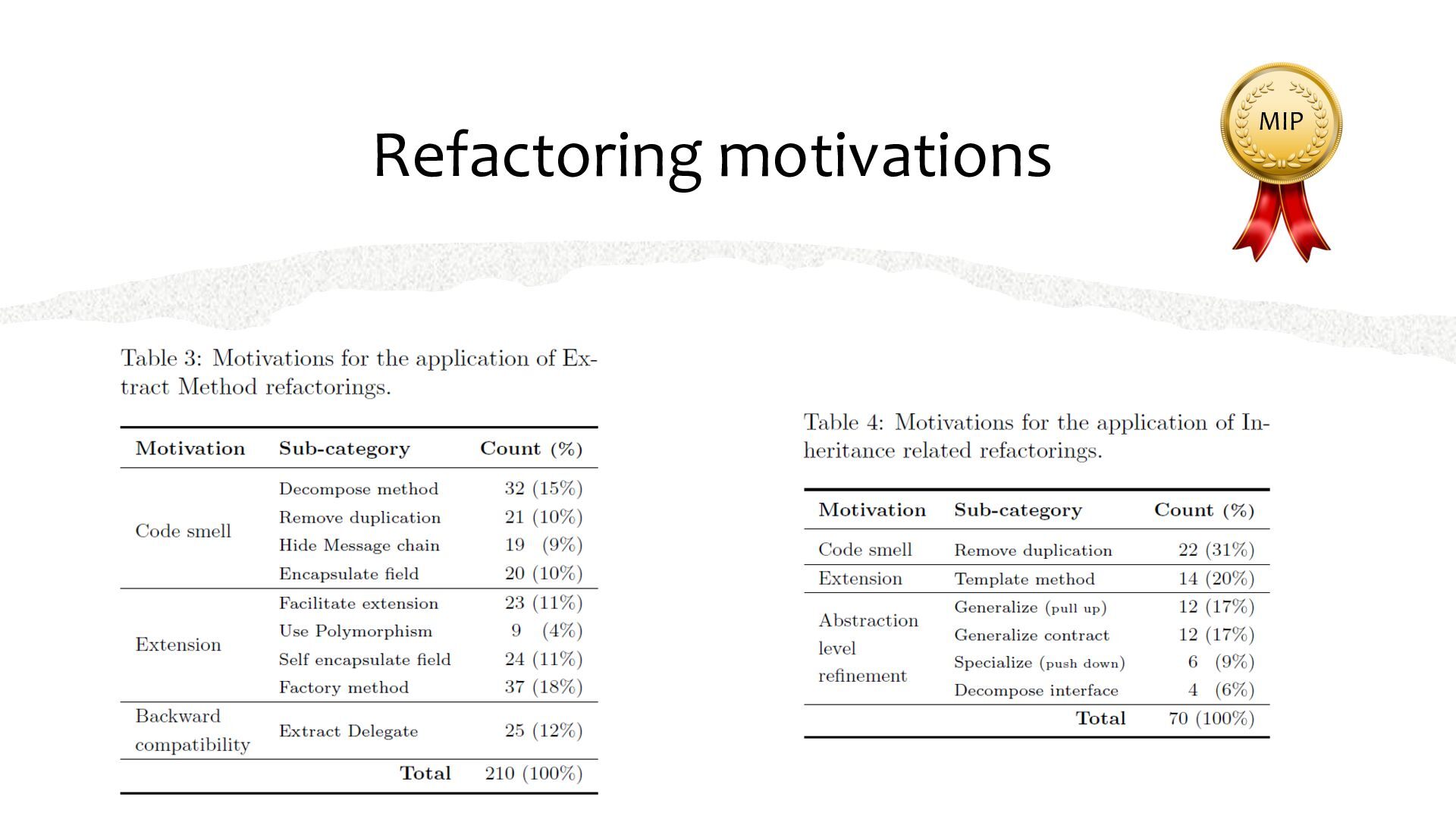
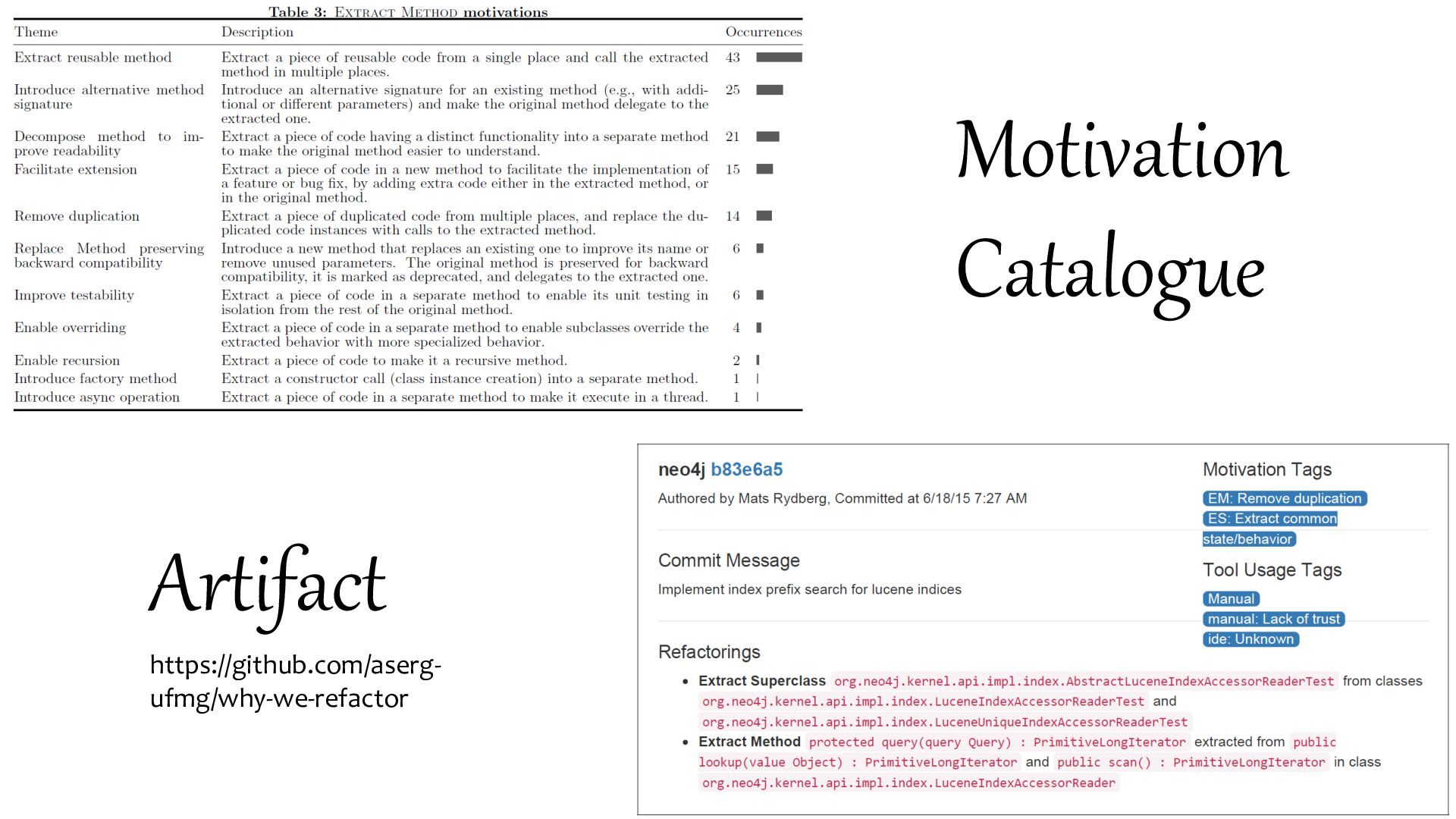
    and August 7th, 2015 • Sent 465 emails and received 195 responses (42%) • +27 commits with a description explaining the reasons • Compiled a catalogue of 44 distinct motivations for 12 well-known refactoring types
  8. ICSE'16 rejection Reviewer #1: "A major threat to the research

    is not discussed or considered, that RefFinder has poor recall (0.24 [31]). The authors did a good job of combating the low-precision by manually inspecting results, the low recall is not discussed or dealt with."
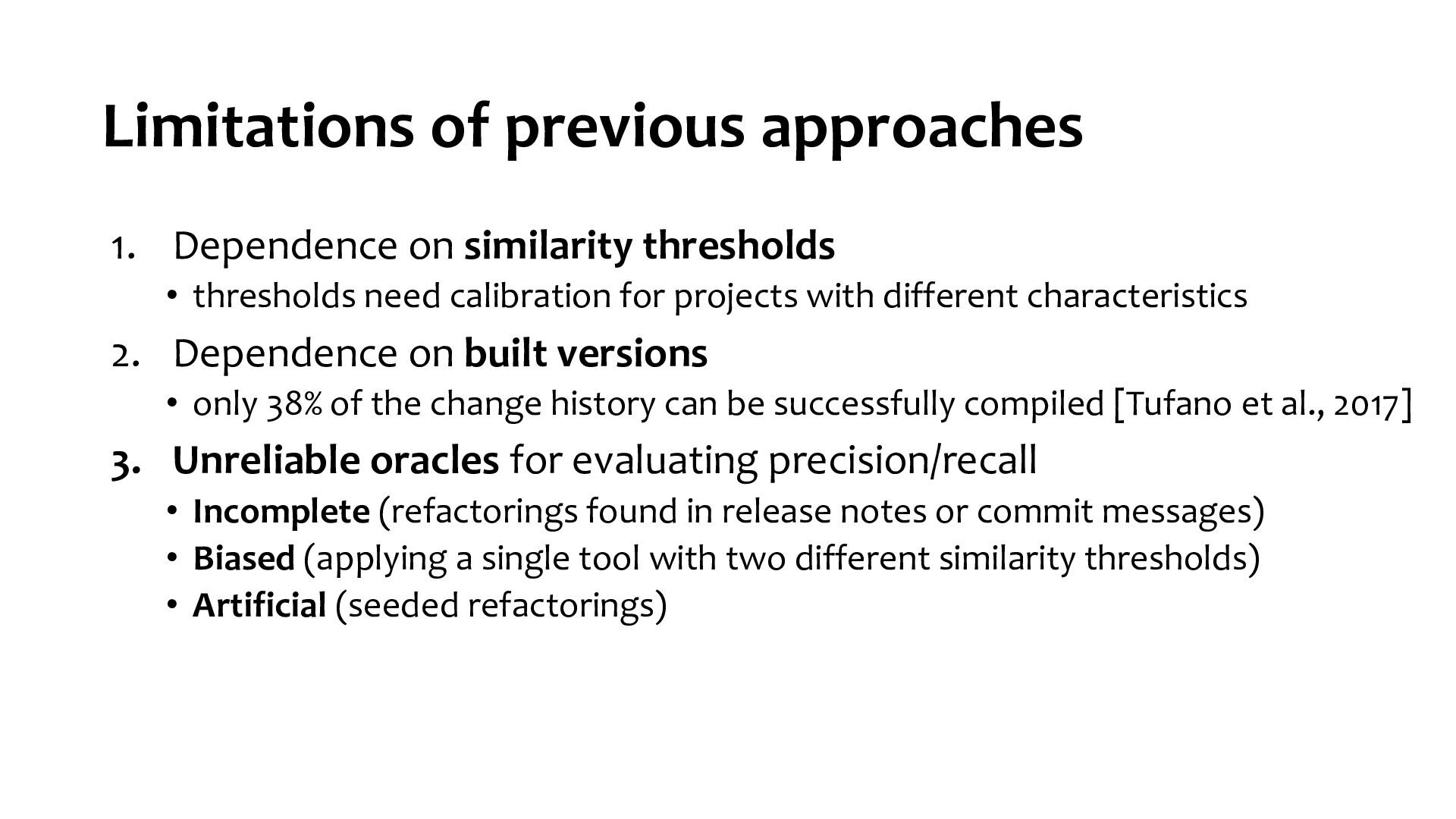
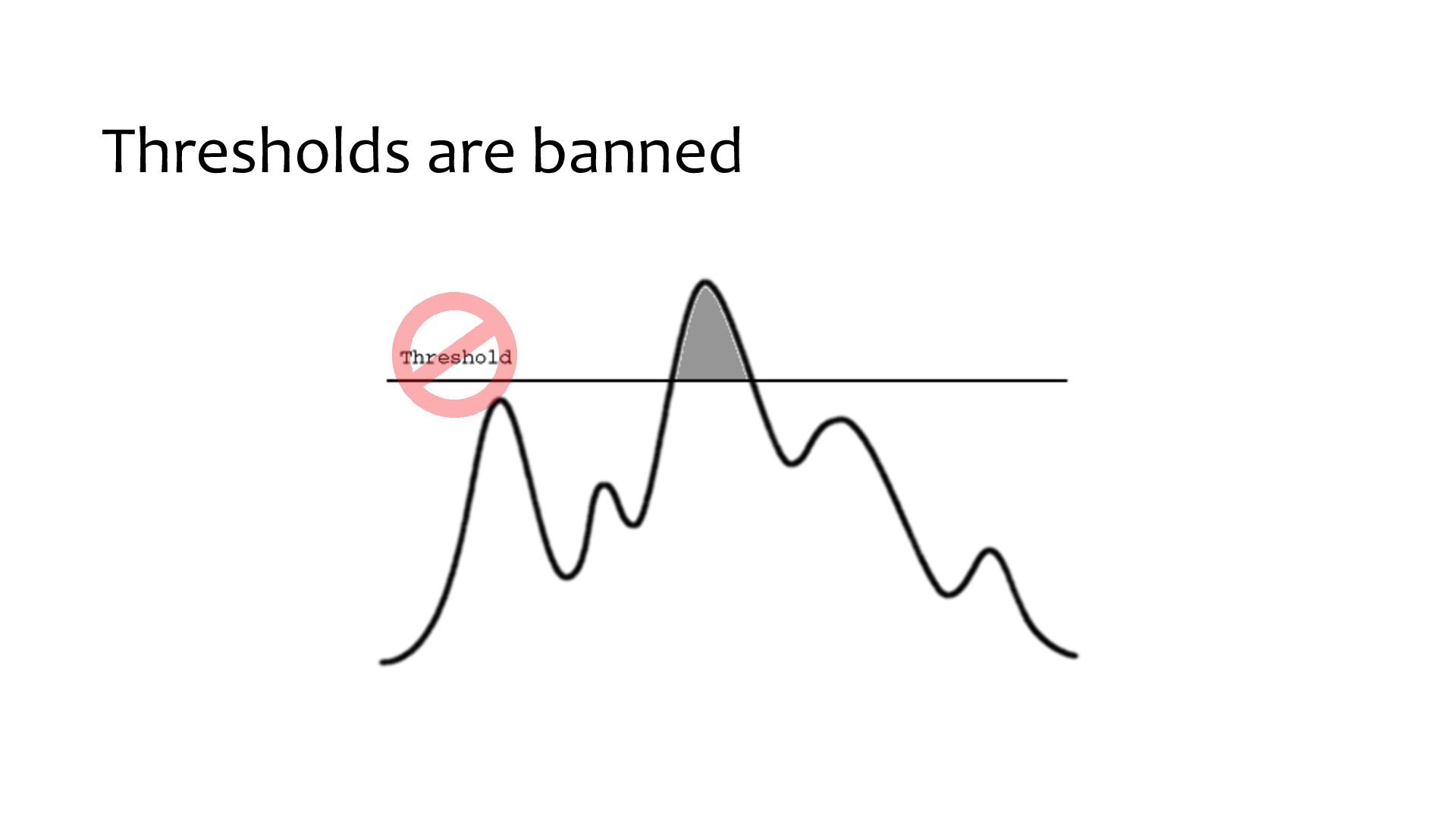
  9. Limitations of previous approaches 1. Dependence on similarity thresholds •

    thresholds need calibration for projects with different characteristics 2. Dependence on built versions • only 38% of the change history can be successfully compiled [Tufano et al., 2017] 3. Unreliable oracles for evaluating precision/recall • Incomplete (refactorings found in release notes or commit messages) • Biased (applying a single tool with two different similarity thresholds) • Artificial (seeded refactorings)
  10. private static Address[] createAddresses(int count) { Address[] addresses = new

    Address[count]; for (int i = 0; i < count; i++) { try { addresses[i] = new Address("127.0.0.1", PORTS.incrementAndGet()); } catch (UnknownHostException e) { e.printStackTrace(); } } return addresses; } private static Address[] createAddresses(int count) { Address[] addresses = new Address[count]; for (int i = 0; i < count; i++) { try { addresses[i] = new Address("127.0.0.1", PORTS.incrementAndGet()); } catch (UnknownHostException e) { e.printStackTrace(); } } return addresses; } After Before
  11. private static Address[] createAddresses(int count) { Address[] addresses = new

    Address[count]; for (int i = 0; i < count; i++) { try { addresses[i] = new Address("127.0.0.1", PORTS.incrementAndGet()); } catch (UnknownHostException e) { e.printStackTrace(); } } return addresses; } private static List<Address> createAddresses(int count) { List<Address> addresses = new ArrayList<Address>(count); for (int i = 0; i < count; i++) { try { addresses[i] = new Address("127.0.0.1", PORTS.incrementAndGet()); } catch (UnknownHostException e) { e.printStackTrace(); } } return addresses; } After Before
  12. private static Address[] createAddresses(int count) { Address[] addresses = new

    Address[count]; for (int i = 0; i < count; i++) { try { addresses[i] = new Address("127.0.0.1", PORTS.incrementAndGet()); } catch (UnknownHostException e) { e.printStackTrace(); } } return addresses; } After Before private static List<Address> createAddresses(AtomicInteger ports, int count){ List<Address> addresses = new ArrayList<Address>(count); for (int i = 0; i < count; i++) { try { addresses[i] = new Address("127.0.0.1", ports.incrementAndGet()); } catch (UnknownHostException e) { e.printStackTrace(); } } return addresses; }
  13. private static Address[] createAddresses(int count) { Address[] addresses = new

    Address[count]; for (int i = 0; i < count; i++) { try { addresses[i] = new Address("127.0.0.1", PORTS.incrementAndGet()); } catch (UnknownHostException e) { e.printStackTrace(); } } return addresses; } After Before private static List<Address> createAddresses(AtomicInteger ports, int count){ List<Address> addresses = new ArrayList<Address>(count); for (int i = 0; i < count; i++) { try { addresses[i] = new Address("127.0.0.1", ports.incrementAndGet()); } catch (UnknownHostException e) { e.printStackTrace(); } } return addresses; }
  14. private static Address[] createAddresses(int count) { Address[] addresses = new

    Address[count]; for (int i = 0; i < count; i++) { try { addresses[i] = new Address("127.0.0.1", PORTS.incrementAndGet()); } catch (UnknownHostException e) { e.printStackTrace(); } } return addresses; } private static List<Address> createAddresses(AtomicInteger ports, int count){ List<Address> addresses = new ArrayList<Address>(count); for (int i = 0; i < count; i++) { } return addresses; } try { addresses[i] = new Address("127.0.0.1", ports.incrementAndGet()); } catch (UnknownHostException e) { e.printStackTrace(); } After Before
  15. private static Address[] createAddresses(int count) { Address[] addresses = new

    Address[count]; for (int i = 0; i < count; i++) { try { addresses[i] = new Address("127.0.0.1", PORTS.incrementAndGet()); } catch (UnknownHostException e) { e.printStackTrace(); } } return addresses; } private static List<Address> createAddresses(AtomicInteger ports, int count){ List<Address> addresses = new ArrayList<Address>(count); for (int i = 0; i < count; i++) { addresses.add(createAddress("127.0.0.1", ports.incrementAndGet())); } return addresses; } protected static Address createAddress(String host, int port) { try { return new Address(host, port); } catch (UnknownHostException e) { e.printStackTrace(); } return null; } After Before
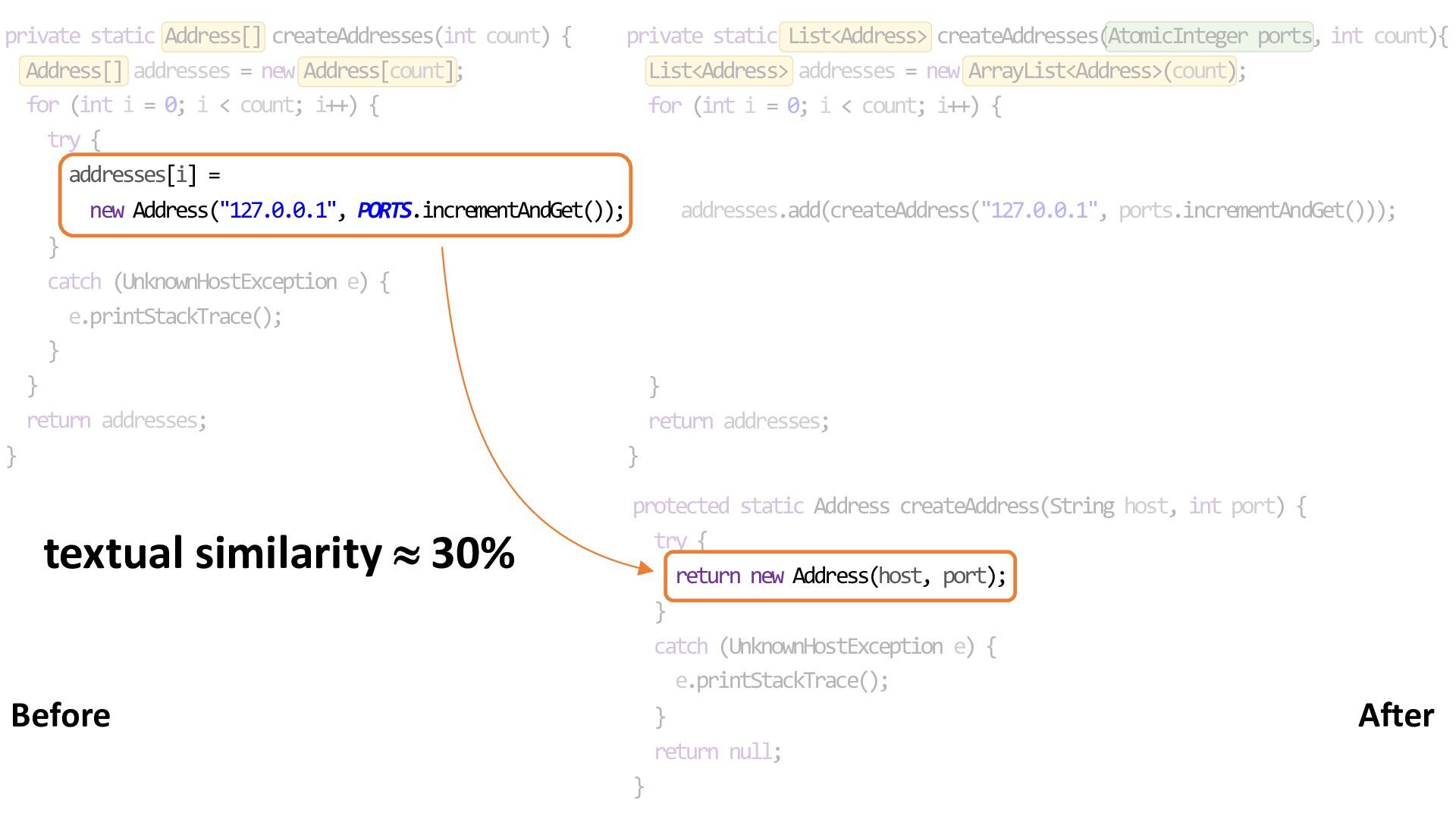
  16. protected static Address createAddress(String host, int port) { try {

    return new Address(host, port); } catch (UnknownHostException e) { e.printStackTrace(); } return null; } private static Address[] createAddresses(int count) { Address[] addresses = new Address[count]; for (int i = 0; i < count; i++) { try { addresses[i] = new Address("127.0.0.1", PORTS.incrementAndGet()); } catch (UnknownHostException e) { e.printStackTrace(); } } return addresses; } private static List<Address> createAddresses(AtomicInteger ports, int count){ List<Address> addresses = new ArrayList<Address>(count); for (int i = 0; i < count; i++) { addresses.add(createAddress("127.0.0.1", ports.incrementAndGet())); } return addresses; } After Before textual similarity » 30%
  17. private static Address[] createAddresses(int count) { Address[] addresses = new

    Address[count]; for (int i = 0; i < count; i++) { try { addresses[i] = new Address("127.0.0.1", PORTS.incrementAndGet()); } catch (UnknownHostException e) { e.printStackTrace(); } } return addresses; } private static List<Address> createAddresses(AtomicInteger ports, int count){ List<Address> addresses = new ArrayList<Address>(count); for (int i = 0; i < count; i++) { addresses.add(createAddress("127.0.0.1", ports.incrementAndGet())); } return addresses; } protected static Address createAddress(String host, int port) { try { return new Address(host, port); } catch (UnknownHostException e) { e.printStackTrace(); } return null; } After Before (1) Abstraction
  18. private static Address[] createAddresses(int count) { Address[] addresses = new

    Address[count]; for (int i = 0; i < count; i++) { try { addresses[i] = new Address("127.0.0.1", PORTS.incrementAndGet()); } catch (UnknownHostException e) { e.printStackTrace(); } } return addresses; } private static List<Address> createAddresses(AtomicInteger ports, int count){ List<Address> addresses = new ArrayList<Address>(count); for (int i = 0; i < count; i++) { addresses.add(createAddress("127.0.0.1", ports.incrementAndGet())); } return addresses; } protected static Address createAddress(String host, int port) { try { return new Address(host, port); } catch (UnknownHostException e) { e.printStackTrace(); } return null; } After Before (1) Abstraction
  19. private static Address[] createAddresses(int count) { Address[] addresses = new

    Address[count]; for (int i = 0; i < count; i++) { try { addresses[i] = new Address("127.0.0.1", PORTS.incrementAndGet()); } catch (UnknownHostException e) { e.printStackTrace(); } } return addresses; } private static List<Address> createAddresses(AtomicInteger ports, int count){ List<Address> addresses = new ArrayList<Address>(count); for (int i = 0; i < count; i++) { addresses.add(createAddress("127.0.0.1", ports.incrementAndGet())); } return addresses; } protected static Address createAddress(String host, int port) { try { return new Address(host, port); } catch (UnknownHostException e) { e.printStackTrace(); } return null; } After Before (2) Argumentization
  20. private static Address[] createAddresses(int count) { Address[] addresses = new

    Address[count]; for (int i = 0; i < count; i++) { try { addresses[i] = new Address("127.0.0.1", PORTS.incrementAndGet()); } catch (UnknownHostException e) { e.printStackTrace(); } } return addresses; } private static List<Address> createAddresses(AtomicInteger ports, int count){ List<Address> addresses = new ArrayList<Address>(count); for (int i = 0; i < count; i++) { addresses.add(createAddress("127.0.0.1", ports.incrementAndGet())); } return addresses; } protected static Address createAddress(String host, int port) { try { return new Address("127.0.0.1", ports.incrementAndGet()); } catch (UnknownHostException e) { e.printStackTrace(); } return null; } After Before (2) Argumentization
  21. private static Address[] createAddresses(int count) { Address[] addresses = new

    Address[count]; for (int i = 0; i < count; i++) { try { addresses[i] = new Address("127.0.0.1", PORTS.incrementAndGet()); } catch (UnknownHostException e) { e.printStackTrace(); } } return addresses; } private static List<Address> createAddresses(AtomicInteger ports, int count){ List<Address> addresses = new ArrayList<Address>(count); for (int i = 0; i < count; i++) { addresses.add(createAddress("127.0.0.1", ports.incrementAndGet())); } return addresses; } protected static Address createAddress(String host, int port) { try { return new Address("127.0.0.1", ports.incrementAndGet()); } catch (UnknownHostException e) { e.printStackTrace(); } return null; } After Before (3) AST Node Replacements
  22. private static Address[] createAddresses(int count) { Address[] addresses = new

    Address[count]; for (int i = 0; i < count; i++) { try { addresses[i] = new Address("127.0.0.1", PORTS.incrementAndGet()); } catch (UnknownHostException e) { e.printStackTrace(); } } return addresses; } private static List<Address> createAddresses(AtomicInteger ports, int count){ List<Address> addresses = new ArrayList<Address>(count); for (int i = 0; i < count; i++) { addresses.add(createAddress("127.0.0.1", ports.incrementAndGet())); } return addresses; } protected static Address createAddress(String host, int port) { try { return new Address("127.0.0.1", PORTS.incrementAndGet()); } catch (UnknownHostException e) { e.printStackTrace(); } return null; } After Before (3) AST Node Replacements
  23. private static Address[] createAddresses(int count) { Address[] addresses = new

    Address[count]; for (int i = 0; i < count; i++) { try { addresses[i] = new Address("127.0.0.1", PORTS.incrementAndGet()); } catch (UnknownHostException e) { e.printStackTrace(); } } return addresses; } private static List<Address> createAddresses(AtomicInteger ports, int count){ List<Address> addresses = new ArrayList<Address>(count); for (int i = 0; i < count; i++) { addresses.add(createAddress("127.0.0.1", ports.incrementAndGet())); } return addresses; } protected static Address createAddress(String host, int port) { try { return new Address("127.0.0.1", PORTS.incrementAndGet()); } catch (UnknownHostException e) { e.printStackTrace(); } return null; } After Before textual similarity = 100%
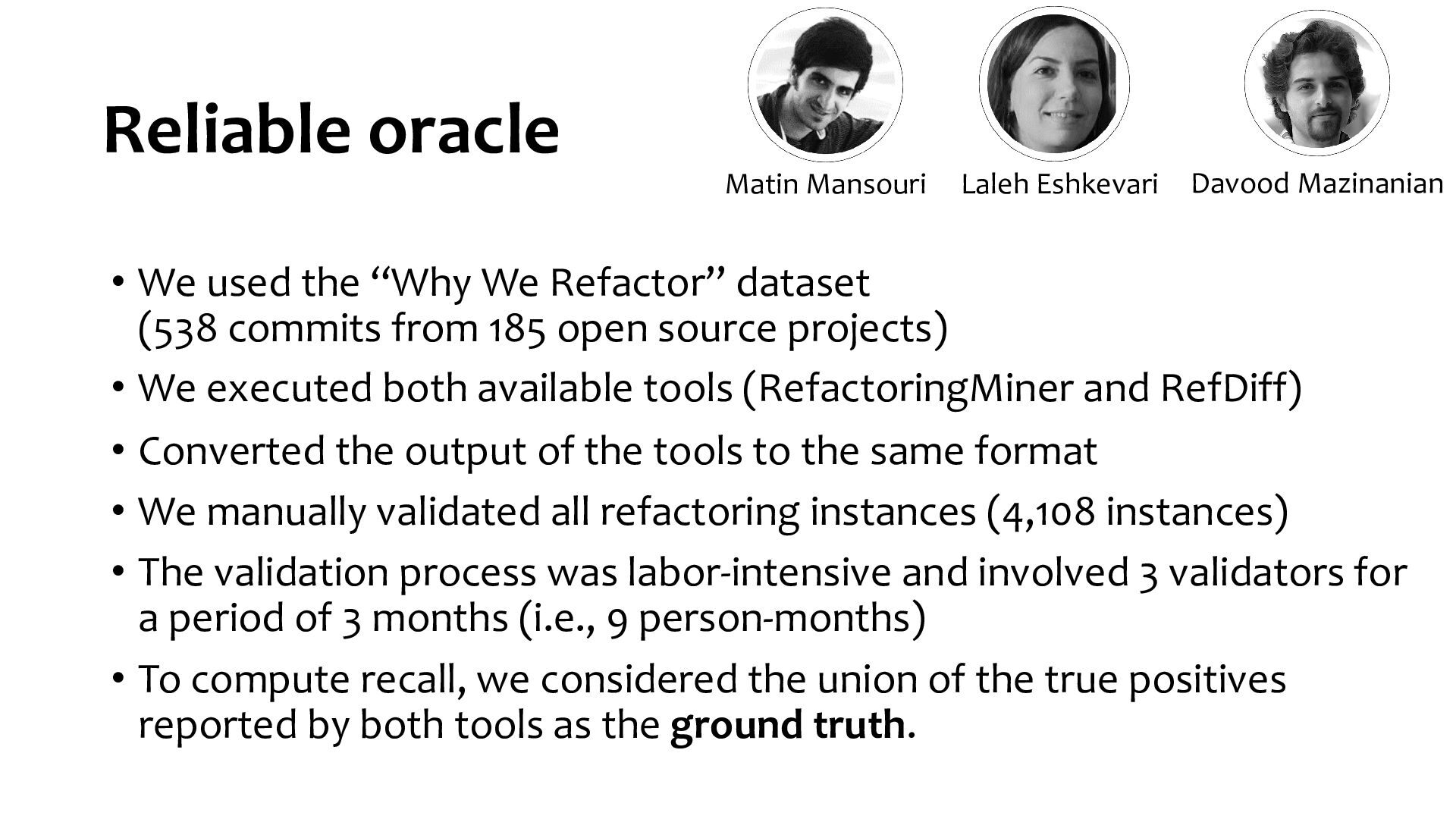
  24. Reliable oracle • We used the “Why We Refactor” dataset

    (538 commits from 185 open source projects) • We executed both available tools (RefactoringMiner and RefDiff) • Converted the output of the tools to the same format • We manually validated all refactoring instances (4,108 instances) • The validation process was labor-intensive and involved 3 validators for a period of 3 months (i.e., 9 person-months) • To compute recall, we considered the union of the true positives reported by both tools as the ground truth. Matin Mansouri Laleh Eshkevari Davood Mazinanian
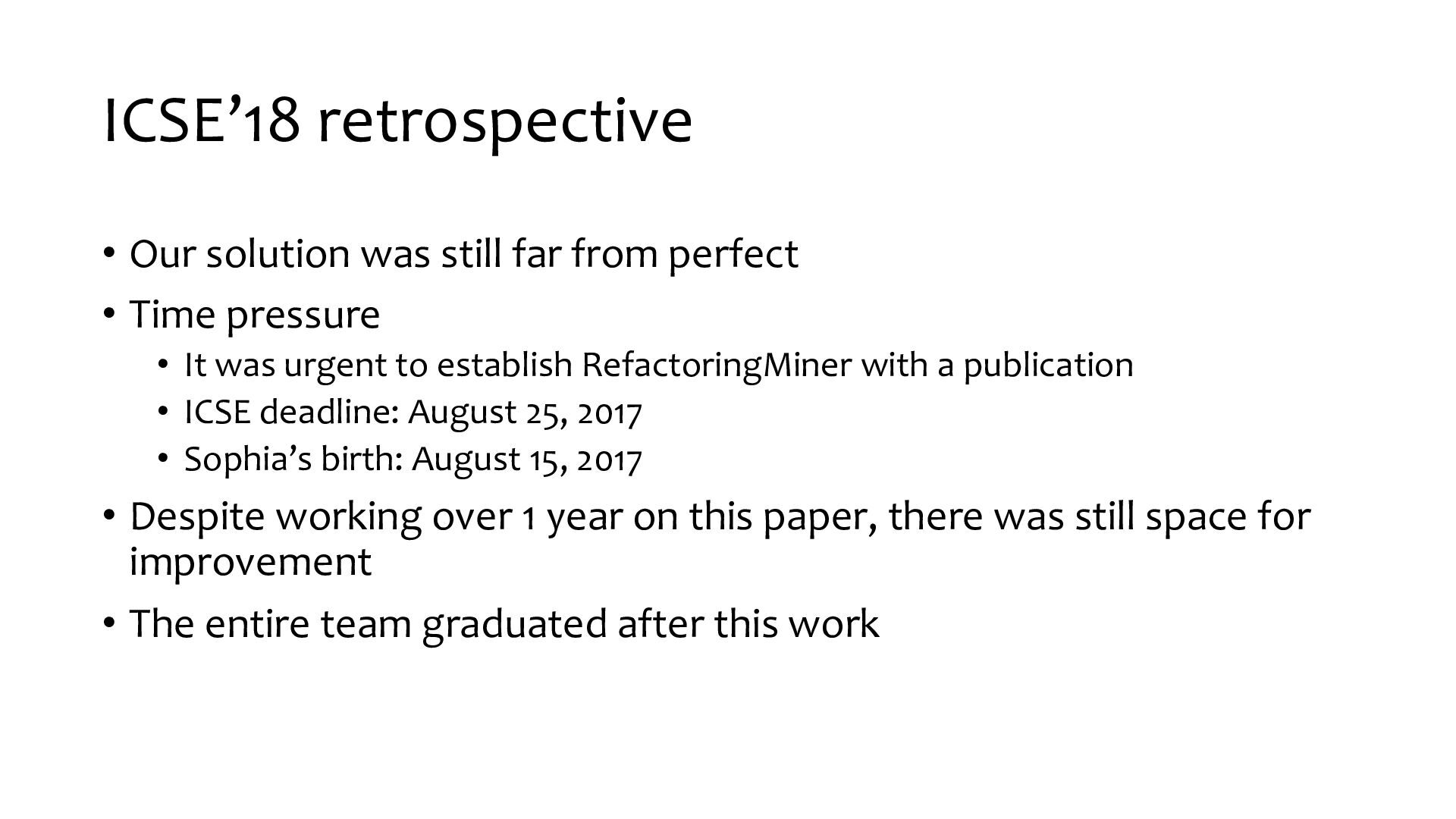
  25. ICSE’18 retrospective • Our solution was still far from perfect

    • Time pressure • It was urgent to establish RefactoringMiner with a publication • ICSE deadline: August 25, 2017 • Sophia’s birth: August 15, 2017 • Despite working over 1 year on this paper, there was still space for improvement • The entire team graduated after this work
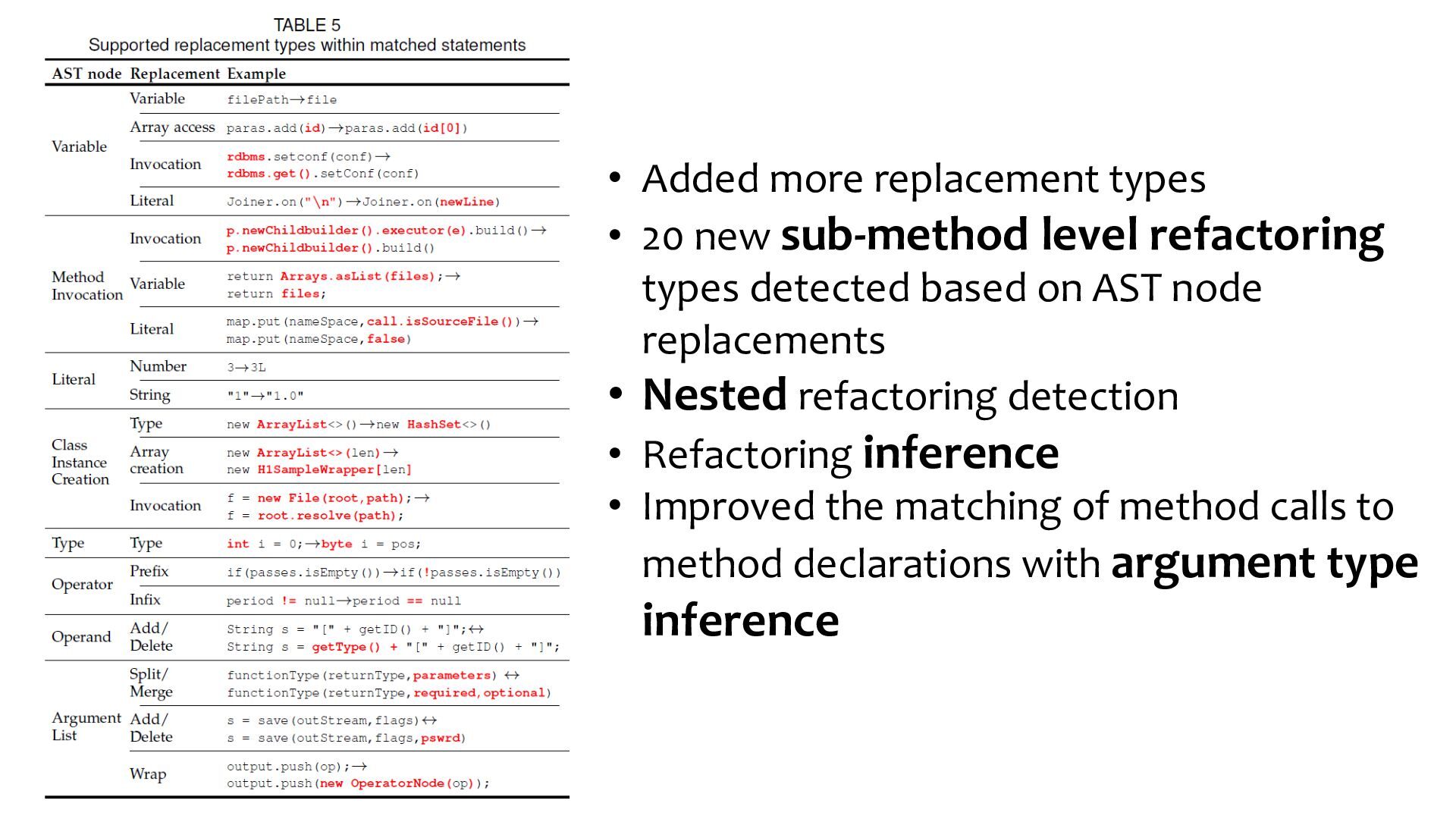
  26. • Added more replacement types • 20 new sub-method level

    refactoring types detected based on AST node replacements • Nested refactoring detection • Refactoring inference • Improved the matching of method calls to method declarations with argument type inference
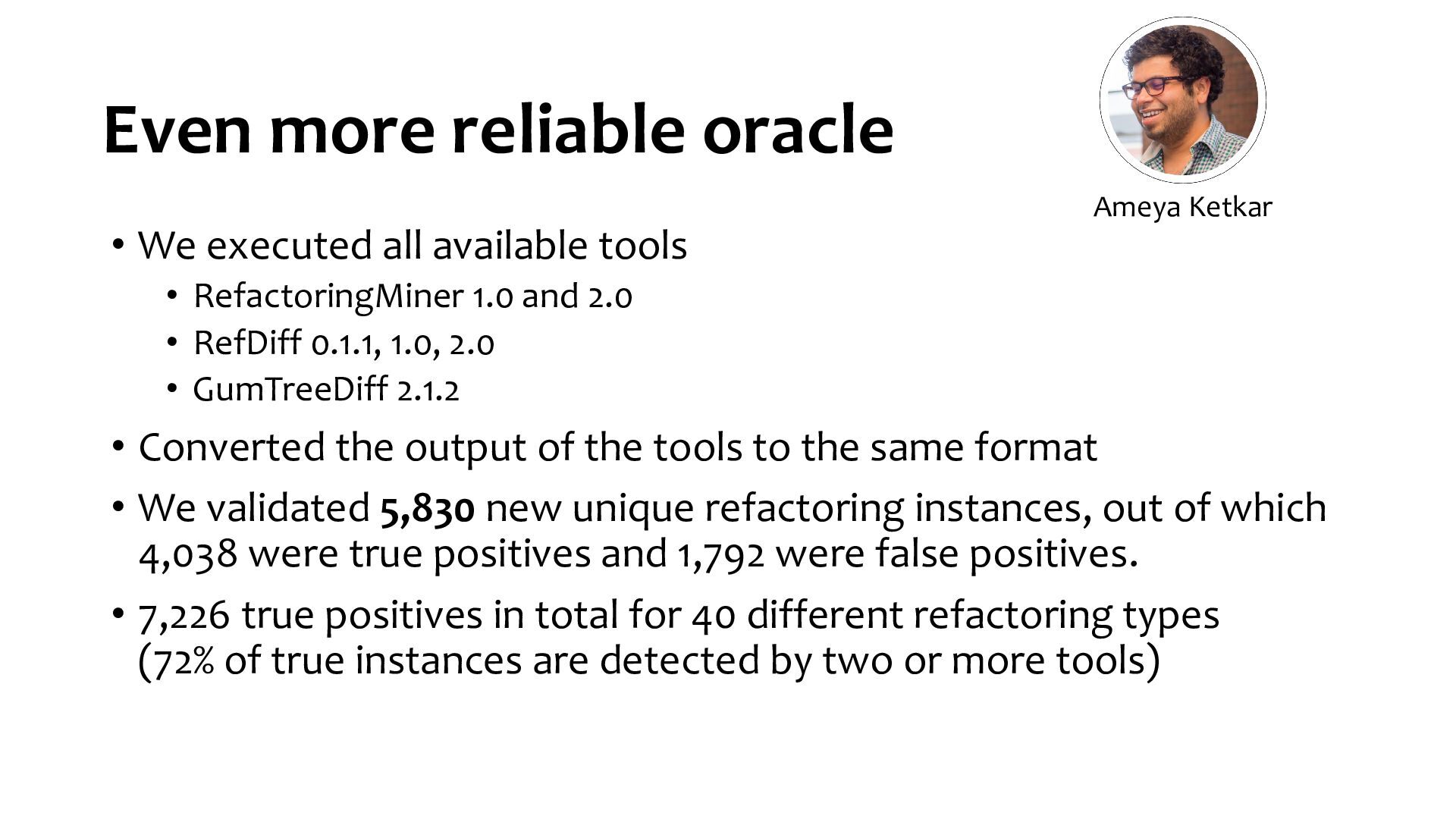
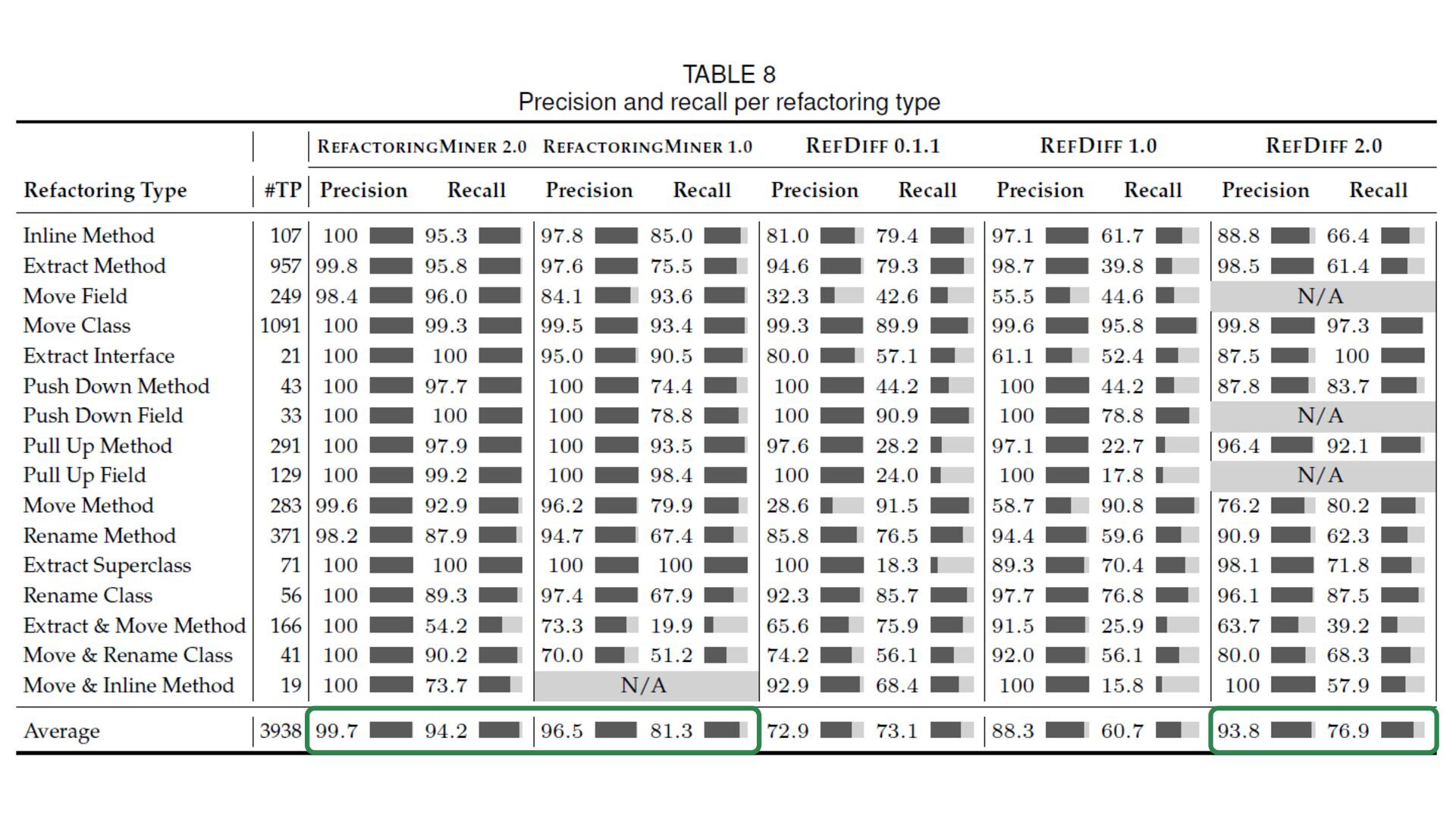
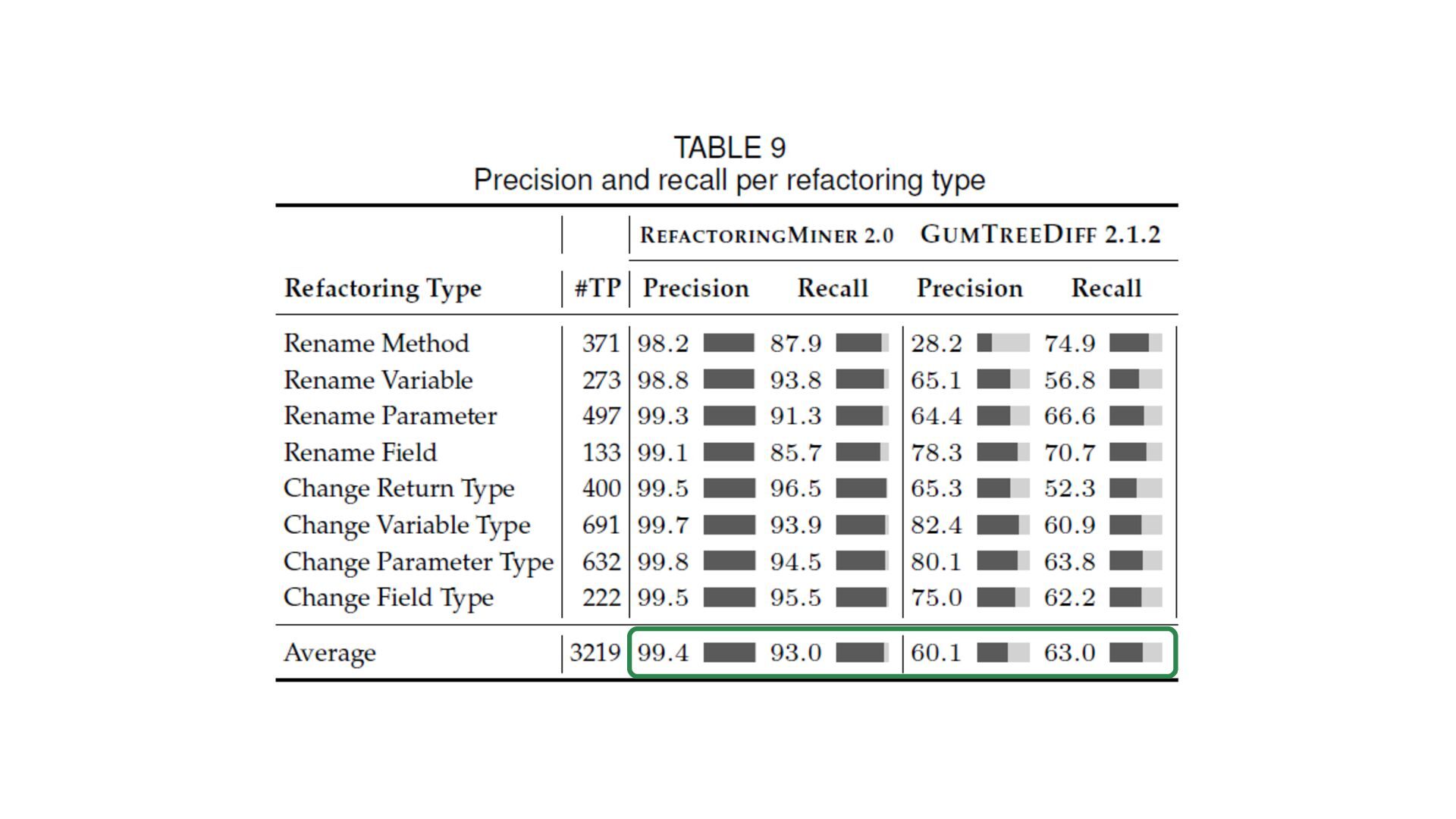
  27. Even more reliable oracle • We executed all available tools

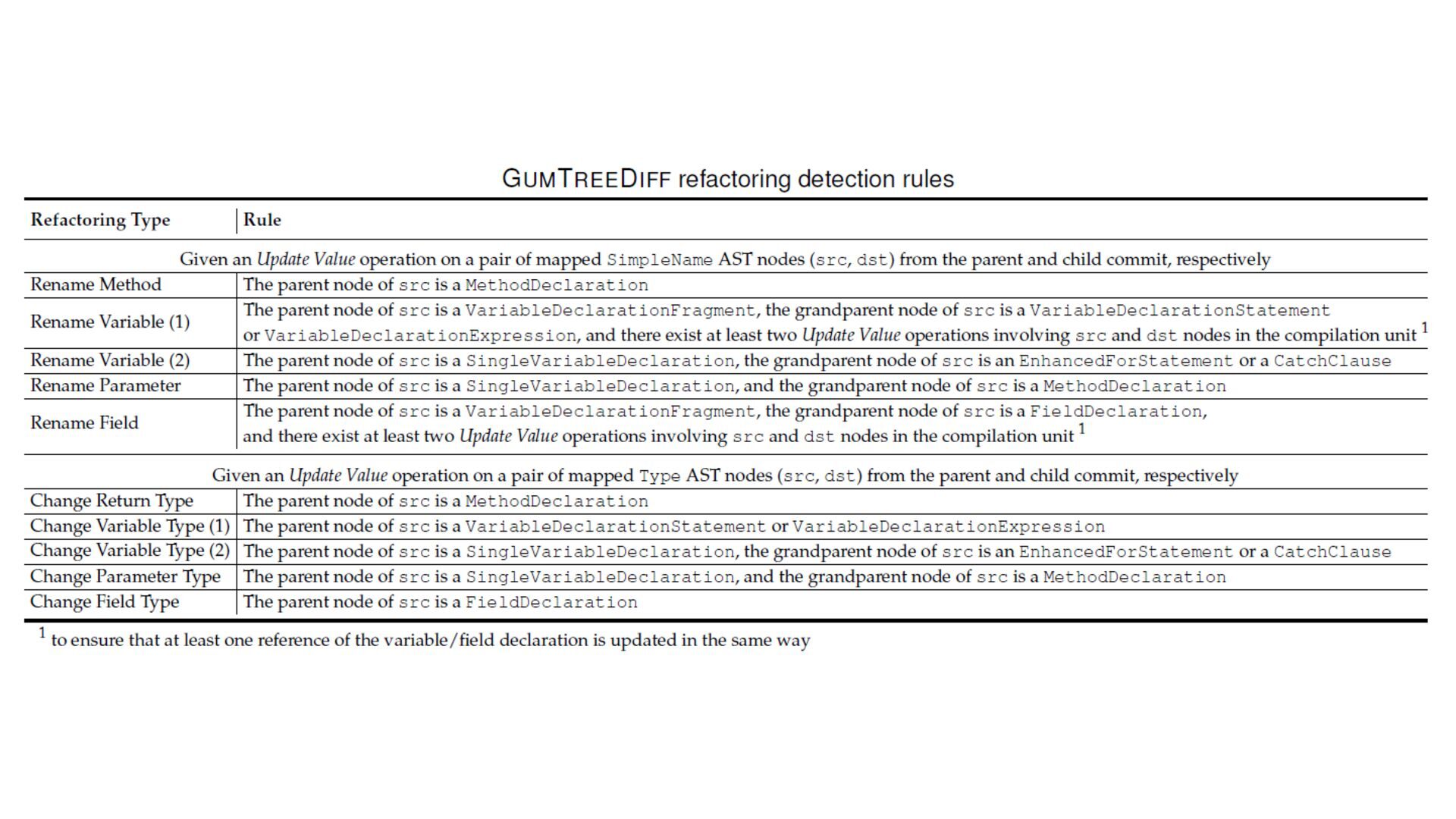
    • RefactoringMiner 1.0 and 2.0 • RefDiff 0.1.1, 1.0, 2.0 • GumTreeDiff 2.1.2 • Converted the output of the tools to the same format • We validated 5,830 new unique refactoring instances, out of which 4,038 were true positives and 1,792 were false positives. • 7,226 true positives in total for 40 different refactoring types (72% of true instances are detected by two or more tools) Ameya Ketkar
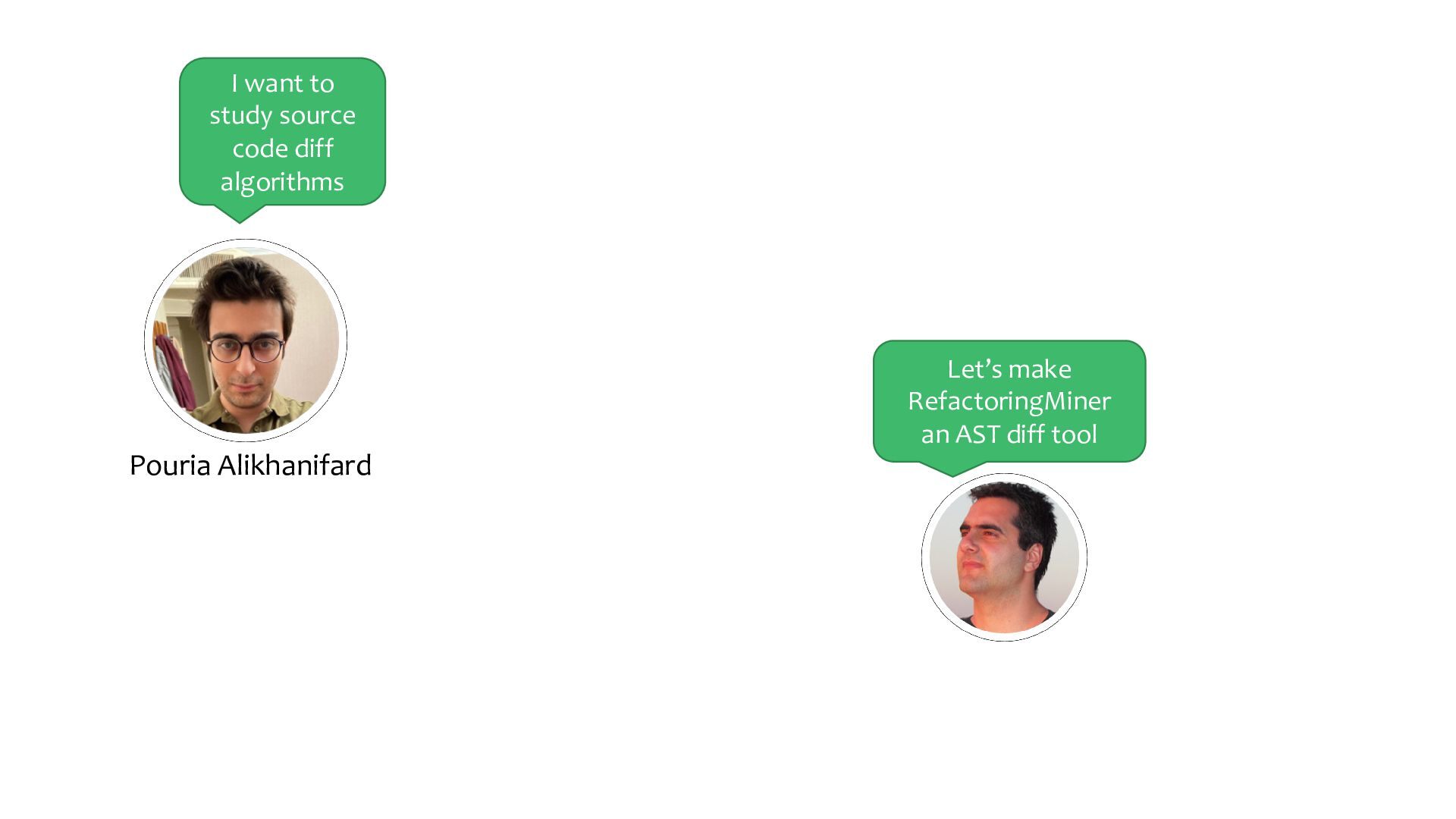
  28. I want to study source code diff algorithms Let’s make

    RefactoringMiner an AST diff tool Pouria Alikhanifard
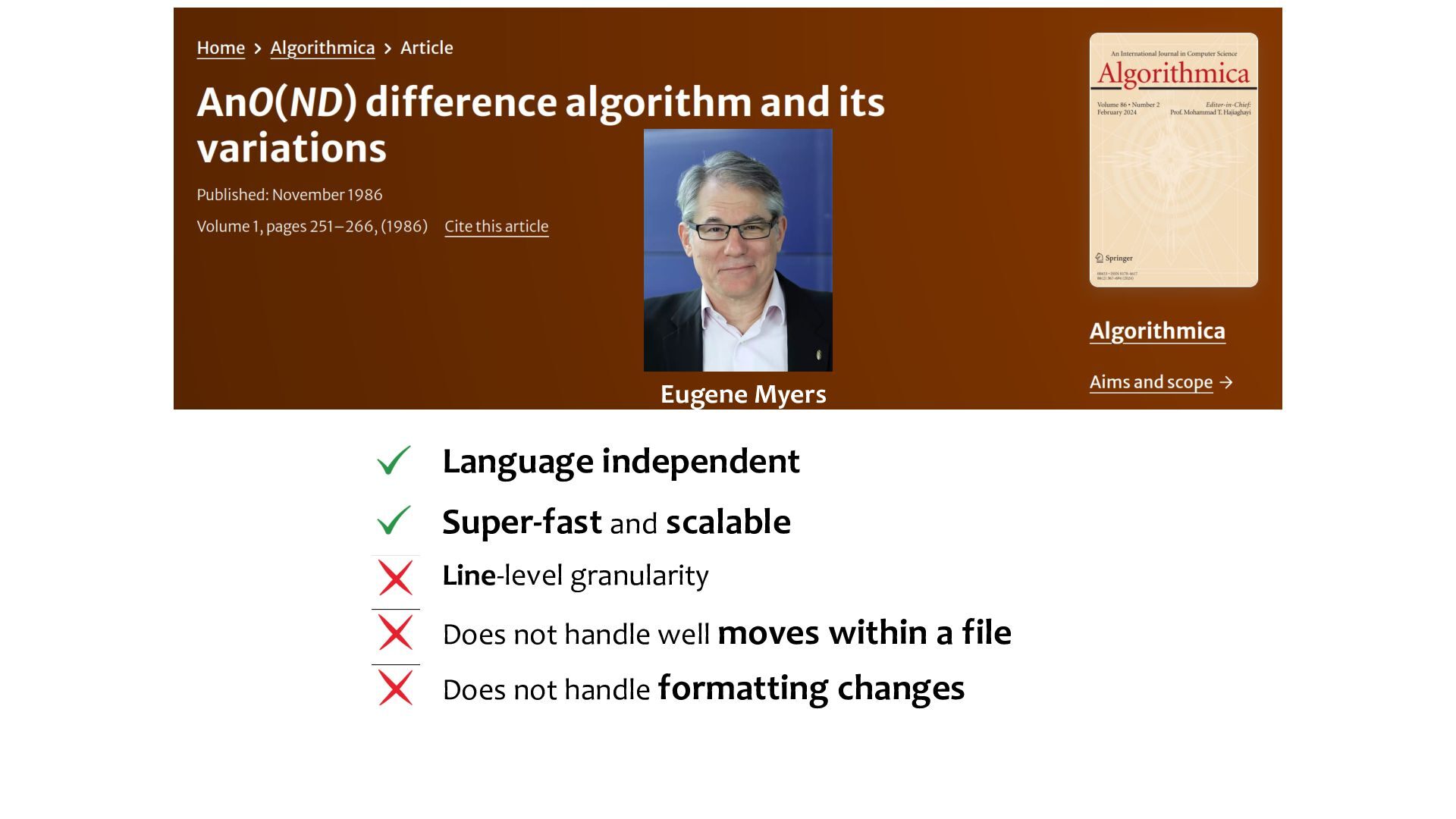
  29. Eugene Myers Language independent Super-fast and scalable Line-level granularity Does

    not handle well moves within a file Does not handle formatting changes
  30. Encyclopedia 3000: The picture shows humans, known as “software engineers”

    using source code diff tools to perform a “code review” in the year 2026.
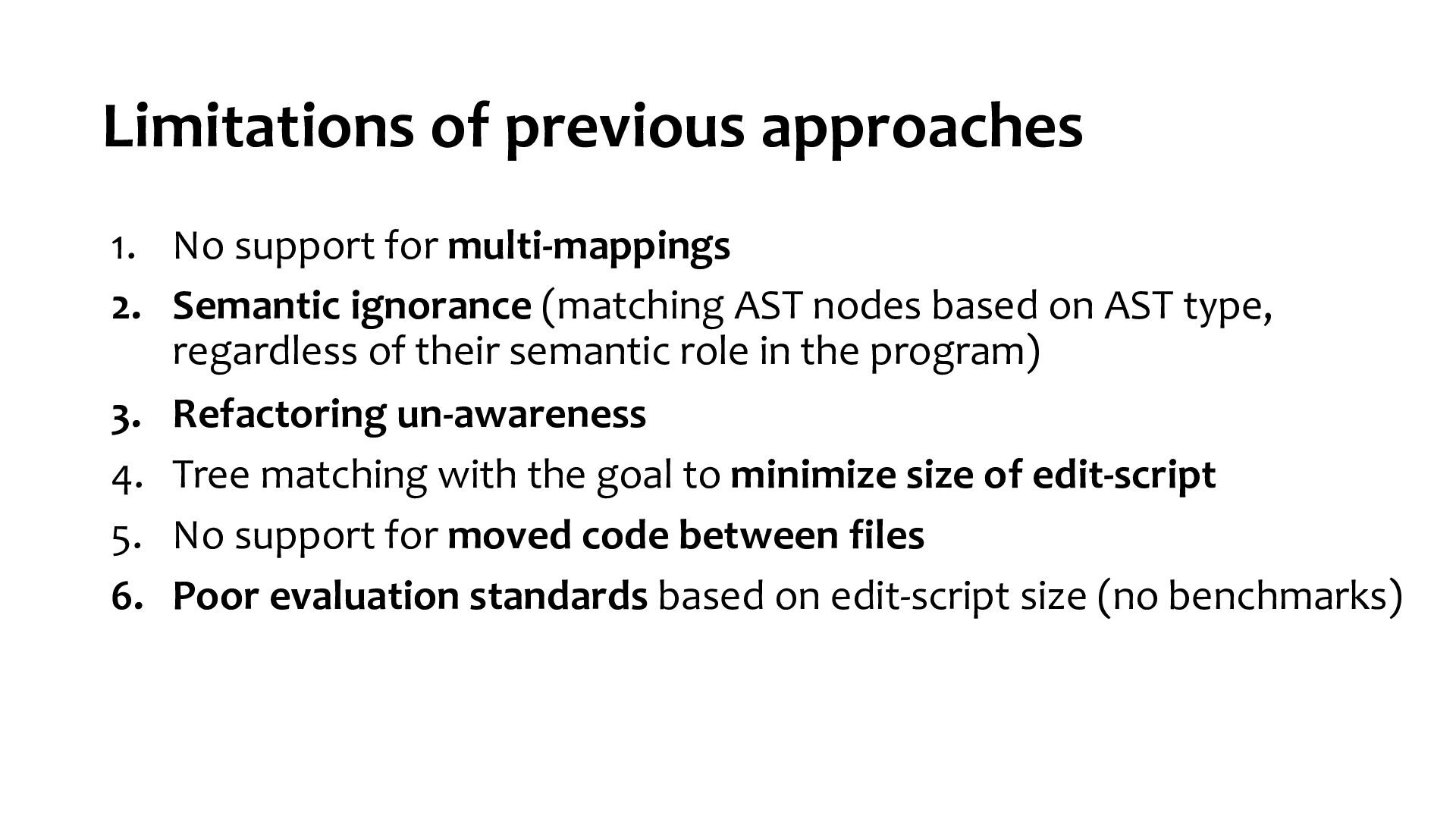
  31. Limitations of previous approaches 1. No support for multi-mappings 2.

    Semantic ignorance (matching AST nodes based on AST type, regardless of their semantic role in the program) 3. Refactoring un-awareness 4. Tree matching with the goal to minimize size of edit-script 5. No support for moved code between files 6. Poor evaluation standards based on edit-script size (no benchmarks)
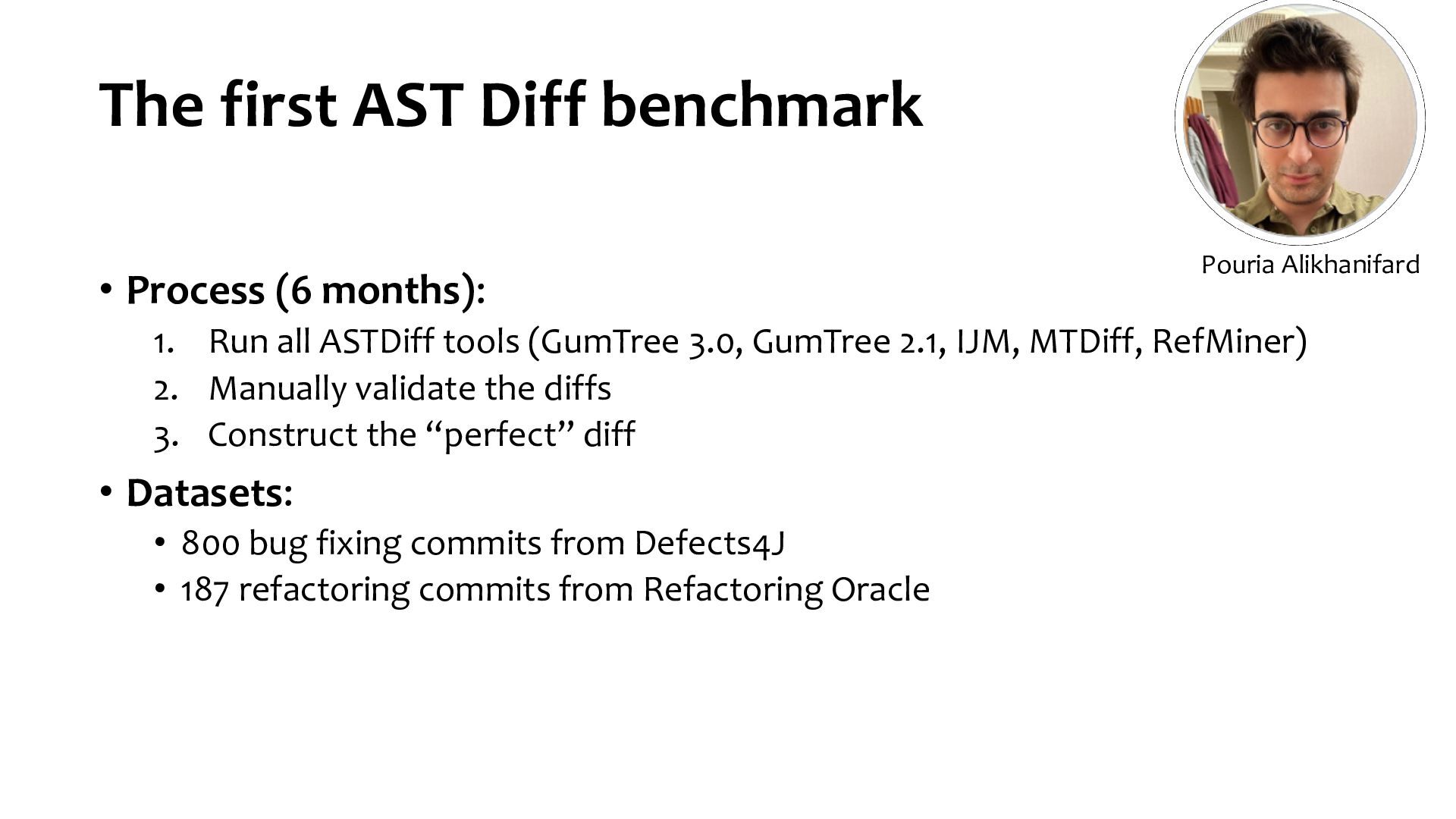
  32. The first AST Diff benchmark • Process (6 months): 1.

    Run all ASTDiff tools (GumTree 3.0, GumTree 2.1, IJM, MTDiff, RefMiner) 2. Manually validate the diffs 3. Construct the “perfect” diff • Datasets: • 800 bug fixing commits from Defects4J • 187 refactoring commits from Refactoring Oracle Pouria Alikhanifard
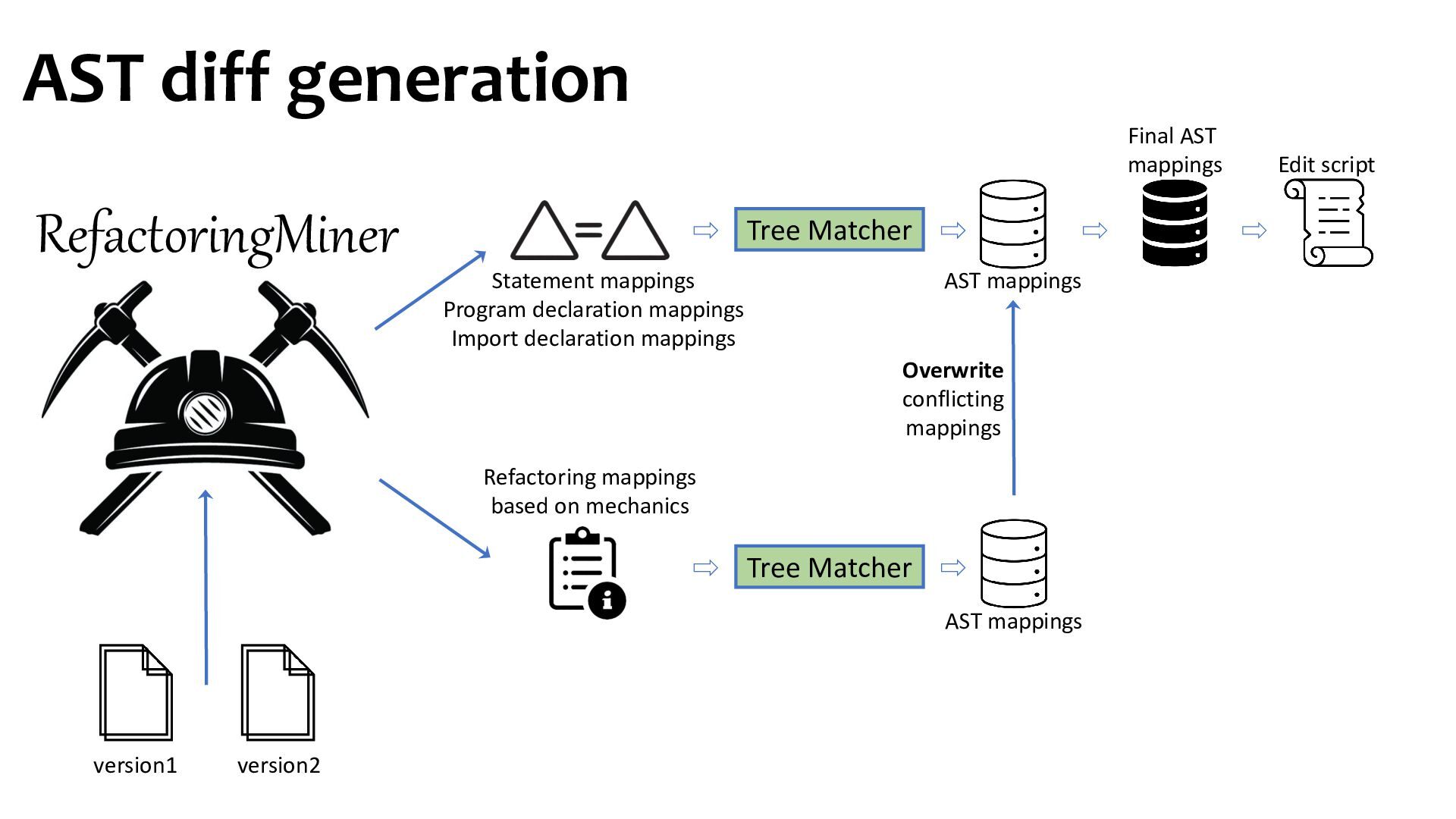
  33. RefactoringMiner Statement mappings Program declaration mappings Import declaration mappings Refactoring

    mappings based on mechanics Tree Matcher Tree Matcher Overwrite conflicting mappings AST mappings AST mappings Final AST mappings Edit script version1 version2 AST diff generation
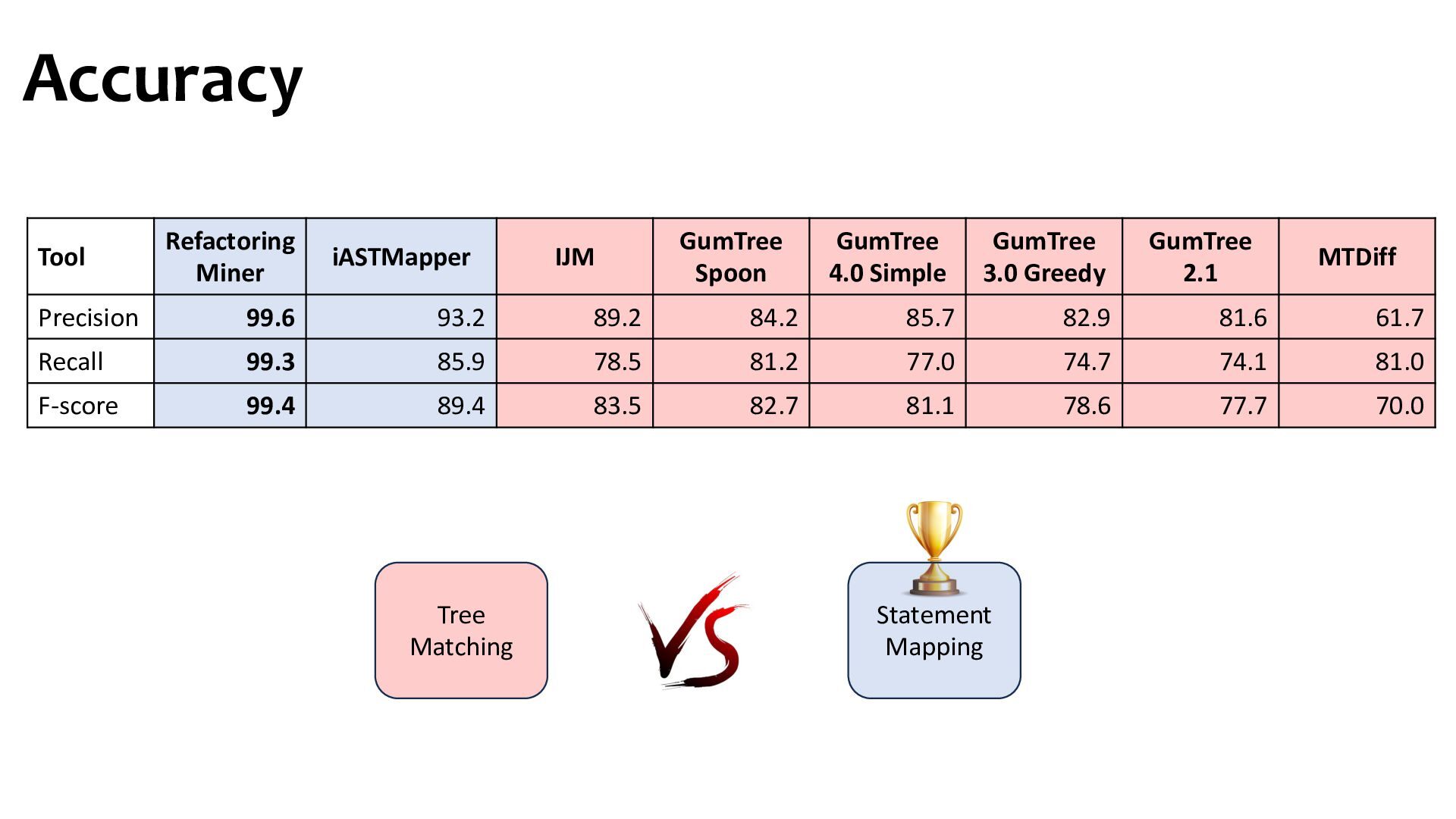
  34. Tool Refactoring Miner iASTMapper IJM GumTree Spoon GumTree 4.0 Simple

    GumTree 3.0 Greedy GumTree 2.1 MTDiff Precision 99.6 93.2 89.2 84.2 85.7 82.9 81.6 61.7 Recall 99.3 85.9 78.5 81.2 77.0 74.7 74.1 81.0 F-score 99.4 89.4 83.5 82.7 81.1 78.6 77.7 70.0 Accuracy Tree Matching Statement Mapping
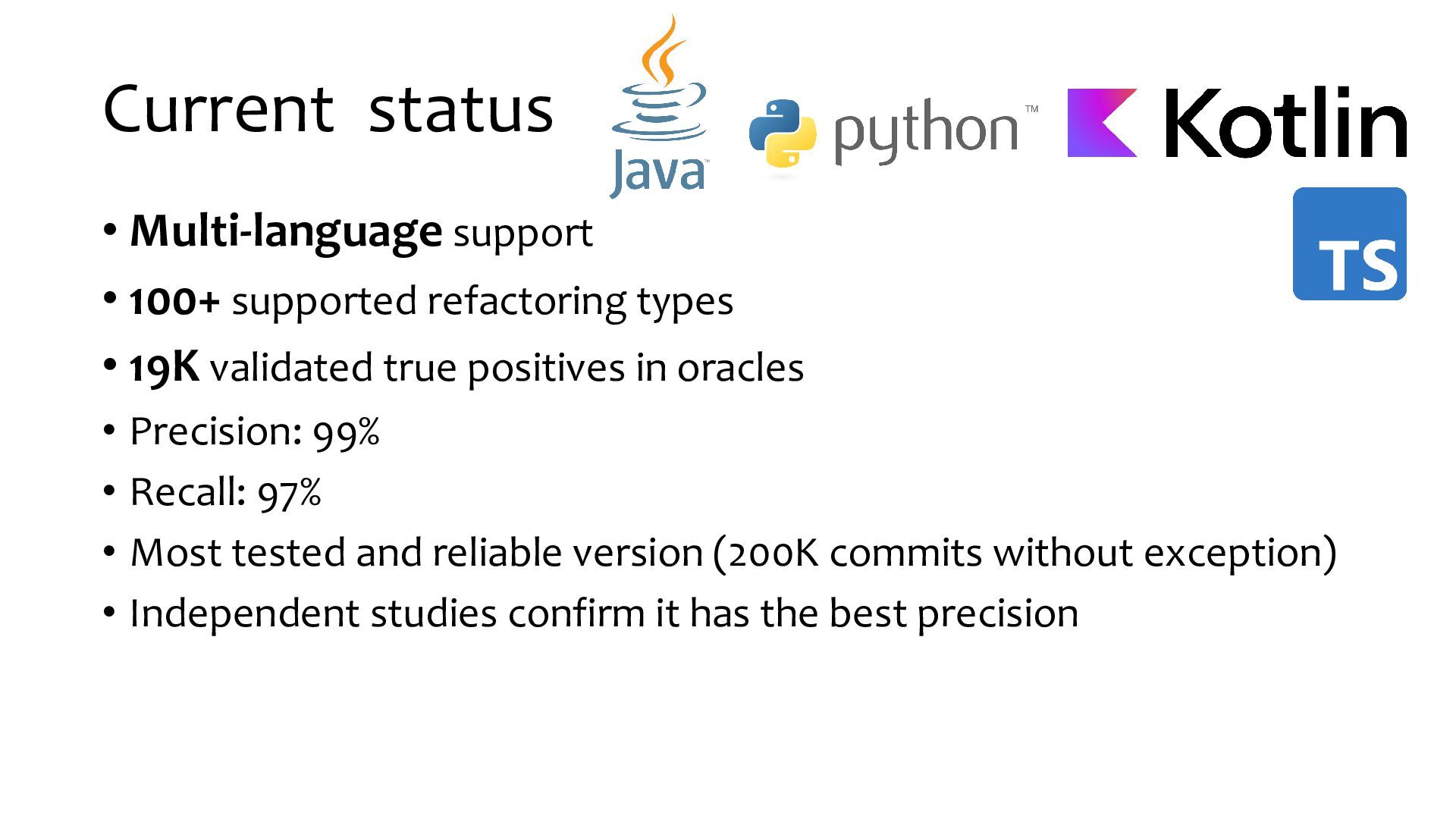
  35. Current status • Multi-language support • 100+ supported refactoring types

    • 19K validated true positives in oracles • Precision: 99% • Recall: 97% • Most tested and reliable version (200K commits without exception) • Independent studies confirm it has the best precision
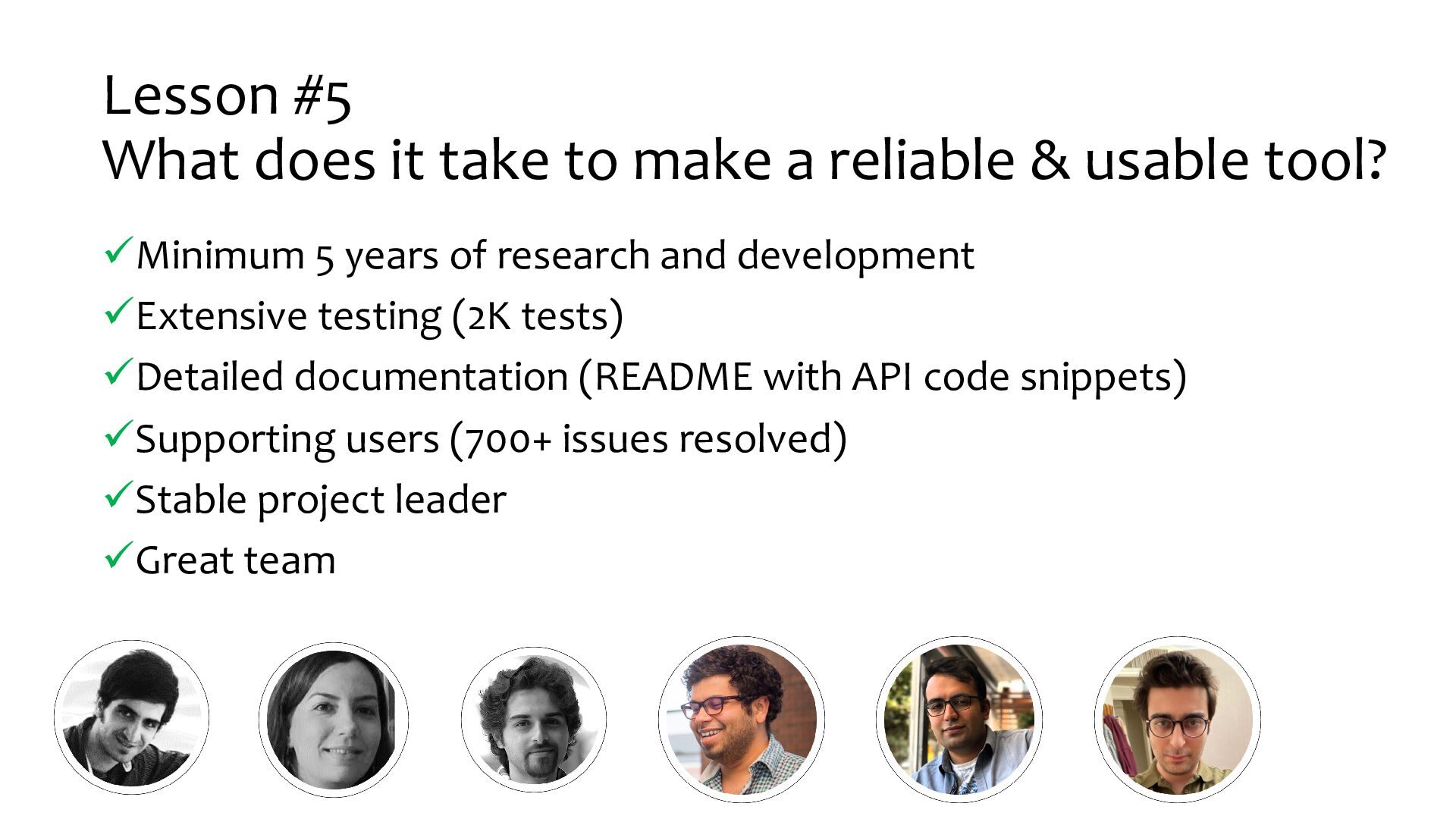
  36. Lesson #5 What does it take to make a reliable

    & usable tool? üMinimum 5 years of research and development üExtensive testing (2K tests) üDetailed documentation (README with API code snippets) üSupporting users (700+ issues resolved) üStable project leader üGreat team
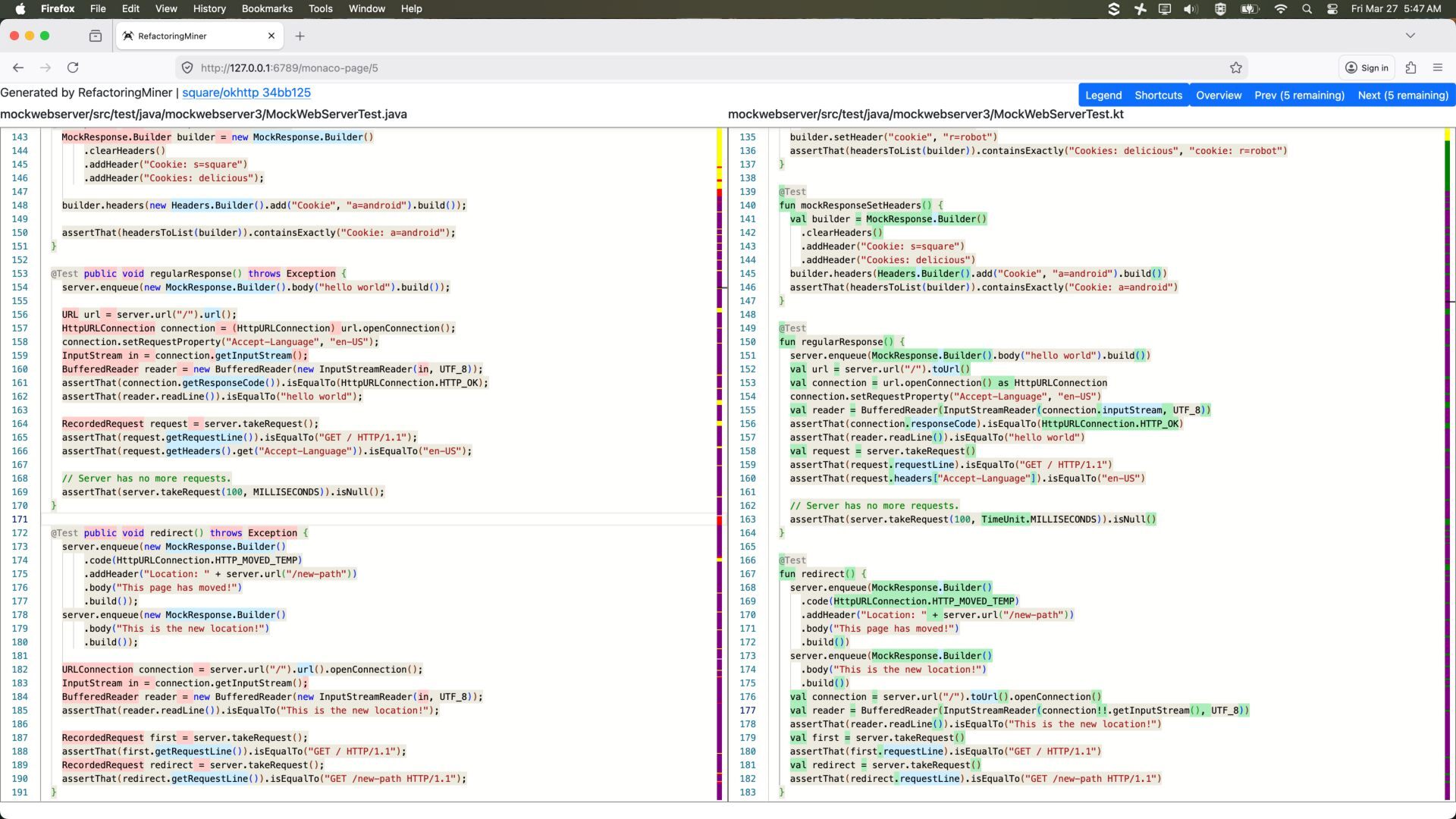
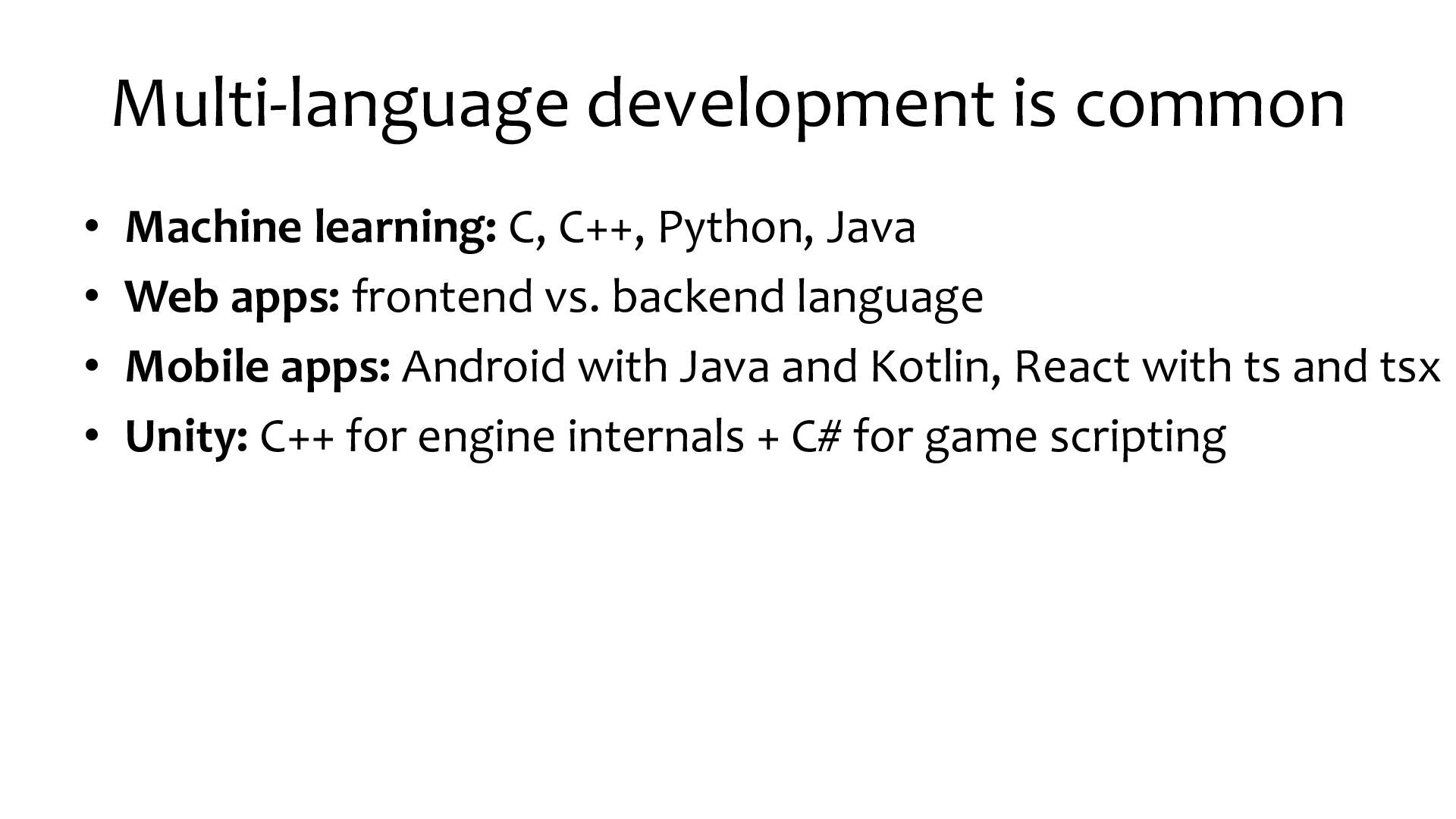
  37. Multi-language development is common • Machine learning: C, C++, Python,

    Java • Web apps: frontend vs. backend language • Mobile apps: Android with Java and Kotlin, React with ts and tsx • Unity: C++ for engine internals + C# for game scripting
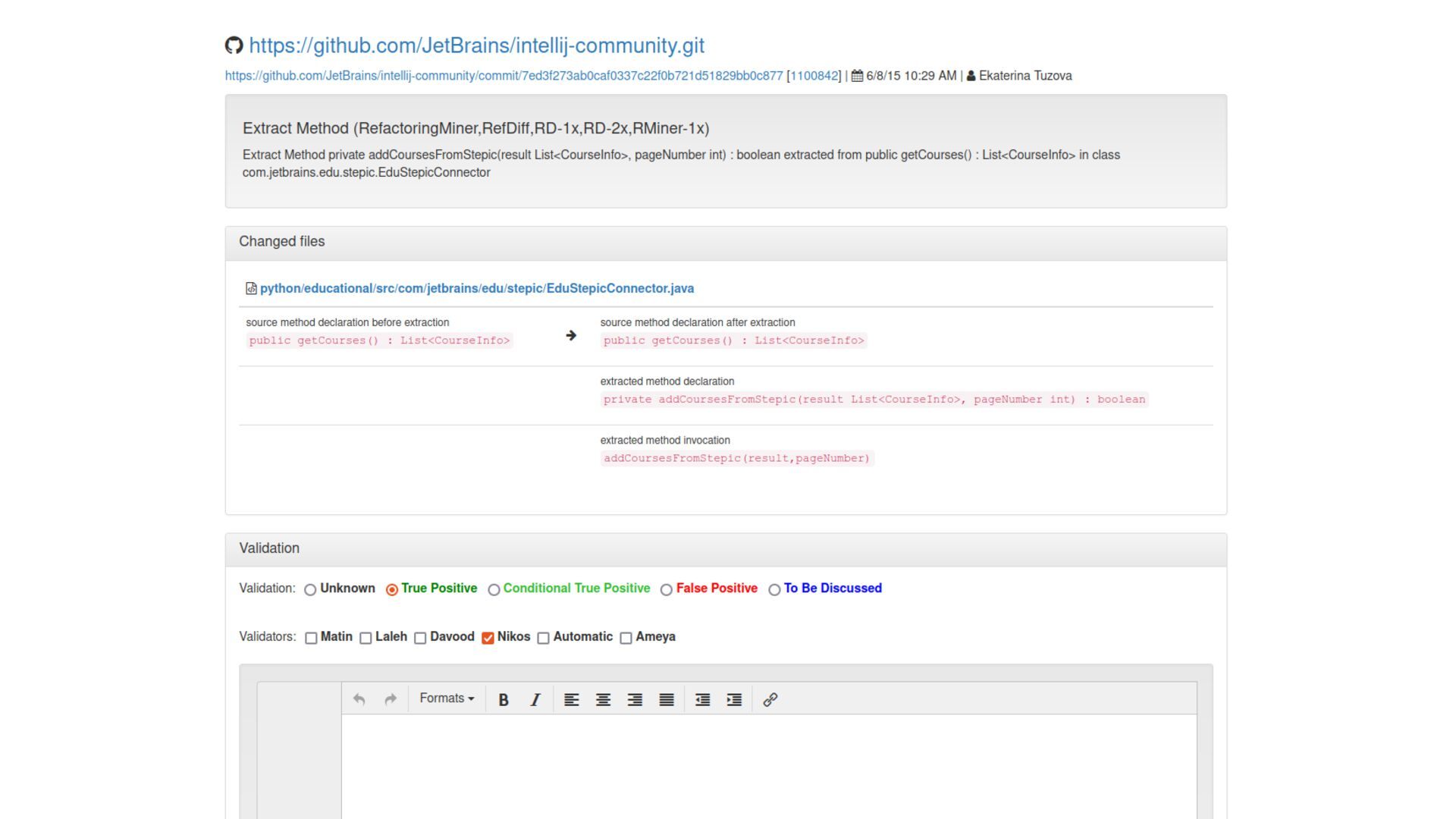
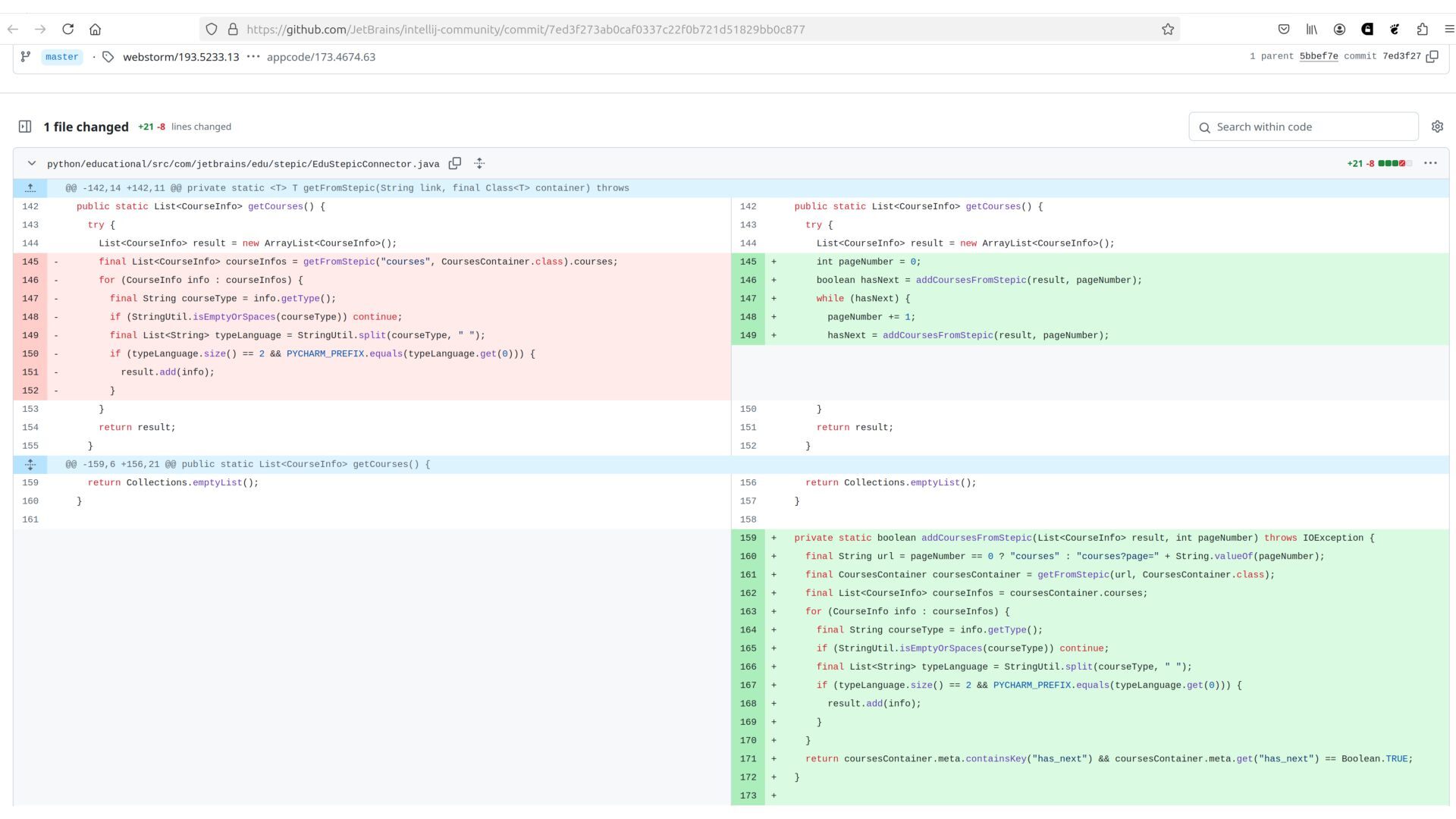
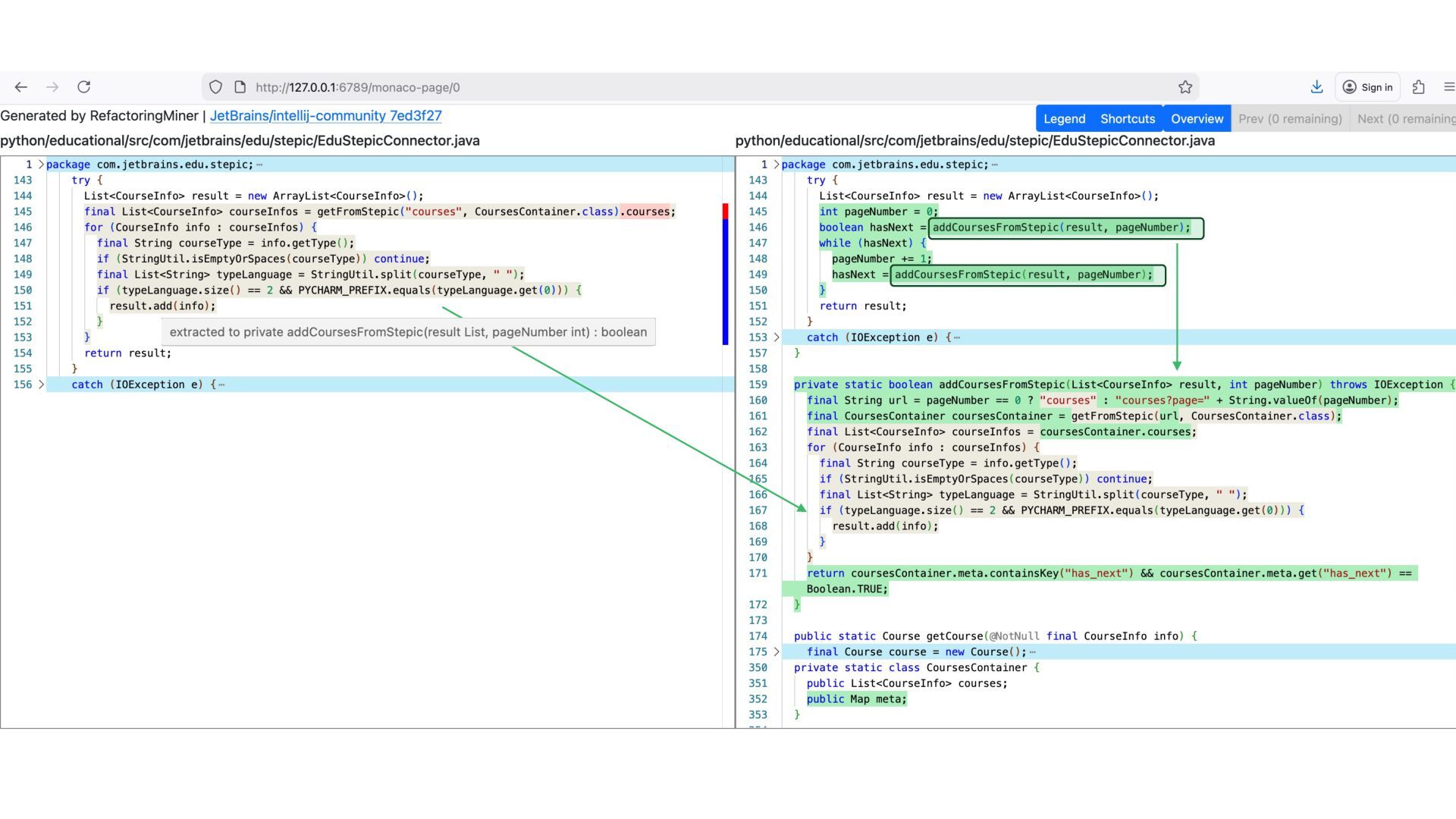
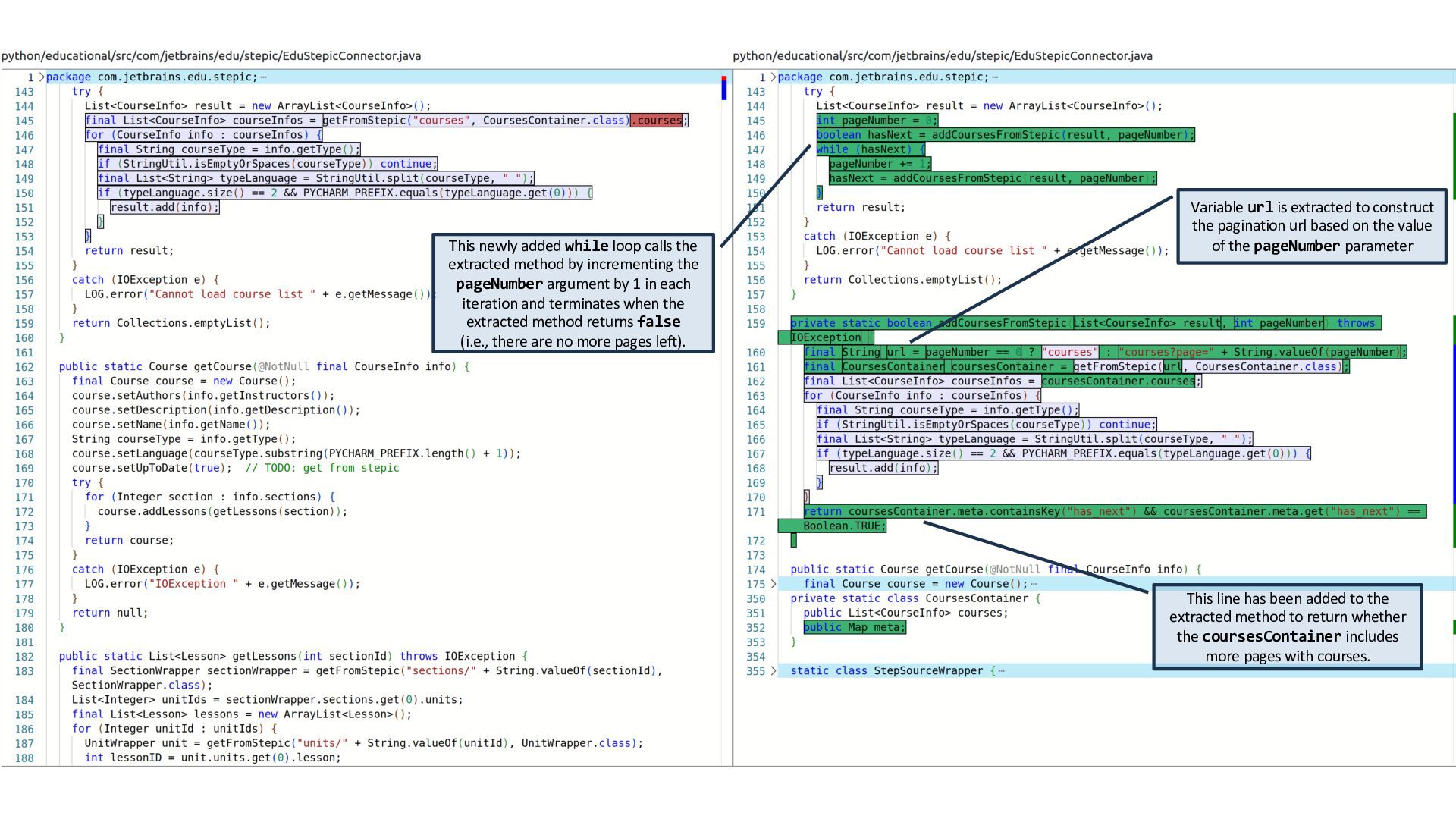
  38. Variable url is extracted to construct the pagination url based

    on the value of the pageNumber parameter This line has been added to the extracted method to return whether the coursesContainer includes more pages with courses. This newly added while loop calls the extracted method by incrementing the pageNumber argument by 1 in each iteration and terminates when the extracted method returns false (i.e., there are no more pages left).
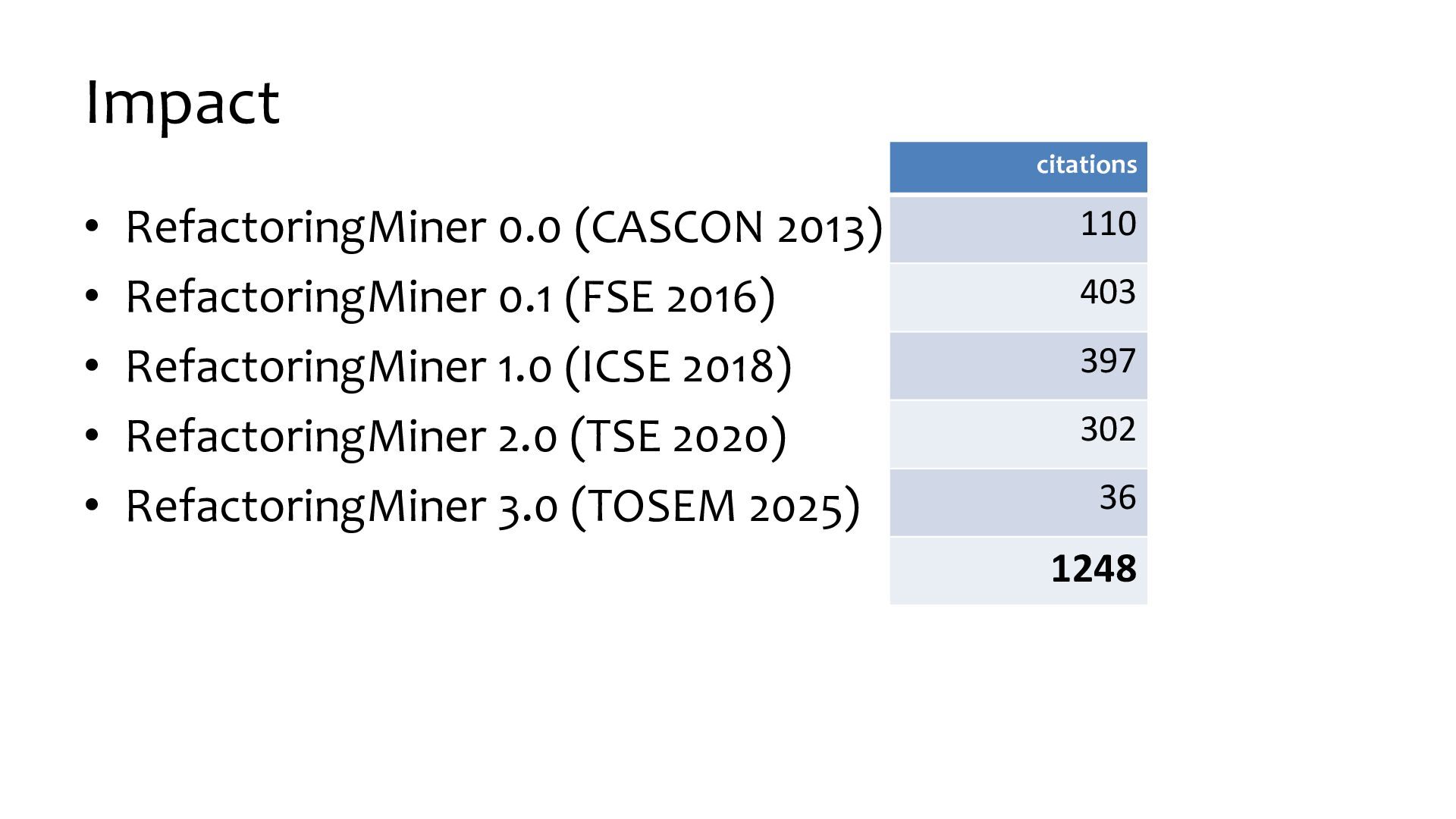
  39. Impact • RefactoringMiner 0.0 (CASCON 2013) • RefactoringMiner 0.1 (FSE

    2016) • RefactoringMiner 1.0 (ICSE 2018) • RefactoringMiner 2.0 (TSE 2020) • RefactoringMiner 3.0 (TOSEM 2025) citations 110 403 397 302 36 1248