Upgrade to Pro — share decks privately, control downloads, hide ads and more …

Made to Serve: The Tragic Corruption of America...

Sponsored · Your Podcast. Everywhere. Effortlessly. Share. Educate. Inspire. Entertain. You do you. We'll handle the rest.
Avatar for UWGB UWGB
February 17, 2016

Made to Serve: The Tragic Corruption of America's Founding Values

“Life, Liberty, and the pursuit of Happiness” were key values according to our country’s founders. So what would they think, then, of our 24/7 work schedules, the outsized value we place upon work and material consumption today, and the fear that drives many to acquiesce to organizational demands that run counter to their own values and needs? Have our individual rights and freedoms been sacrificed to the organizational value system\

These were a few of the questions explored by Austin E. Cofrin School of Business Professor Lucy Arendt on Wednesday, February 17, 2016 to a packed house of UW-Green Bay students, faculty members, staff and community members. One of her areas of expertise lies in understanding how leaders within organizations make their decisions as well as the consequences of those decisions, on both the organization and the individuals who work within it. Her lecture, title “Made to Serve: The Tragic corruption of America’s Founding Values,” spoke to a trend she says she has seen through her research on the subversion of individual rights and freedoms to organizational goals, including profit.

Arendt’s lecture was the fourth of six in a series featuring UW-Green Bay professors giving capstone lectures on topics in their area. The Last Lecture Series was created as part of UW-Green Bay’s 50th anniversary. Arendt’s lecture was also the first in the series to be filmed by PBS for the University Place program. When production is complete in a few months, Arendt’s lecture will be featured on The Wisconsin Channel of PBS as well as located in the online University Place lectures archive. UW-Green Bay will provide links to the lecture at that time.

Avatar for UWGB

UWGB

February 17, 2016
Tweet

Other Decks in Business

Transcript

  1. Thank Yous  My loving and demanding family  My

    motivating mentors, especially John Harris, Daniel Alesch, and Tim Sewall  My hardworking and inquisitive students, past and present  Sue Mattison, Mary Baranek, & Ashley Folcik – the best Dean’s crew  Tracy Heaser from Advancement and the Academics Subcommittee of the 50th Anniversary Planning Committee  My inspiring “Last Lecture” faculty colleagues  My many extraordinary faculty and staff colleagues  Everyone who’s ever talked to me about their organization and their boss
  2. My Goals  To share a way of thinking about
    modern organizations that has intrigued me for about 25 years  To stimulate reflection on the role of modern organizations in our lives  To provoke questioning of what is and what could be  To grapple with what it means to be an engaged human being  To expose the damage caused to individuals and society by the modern organization
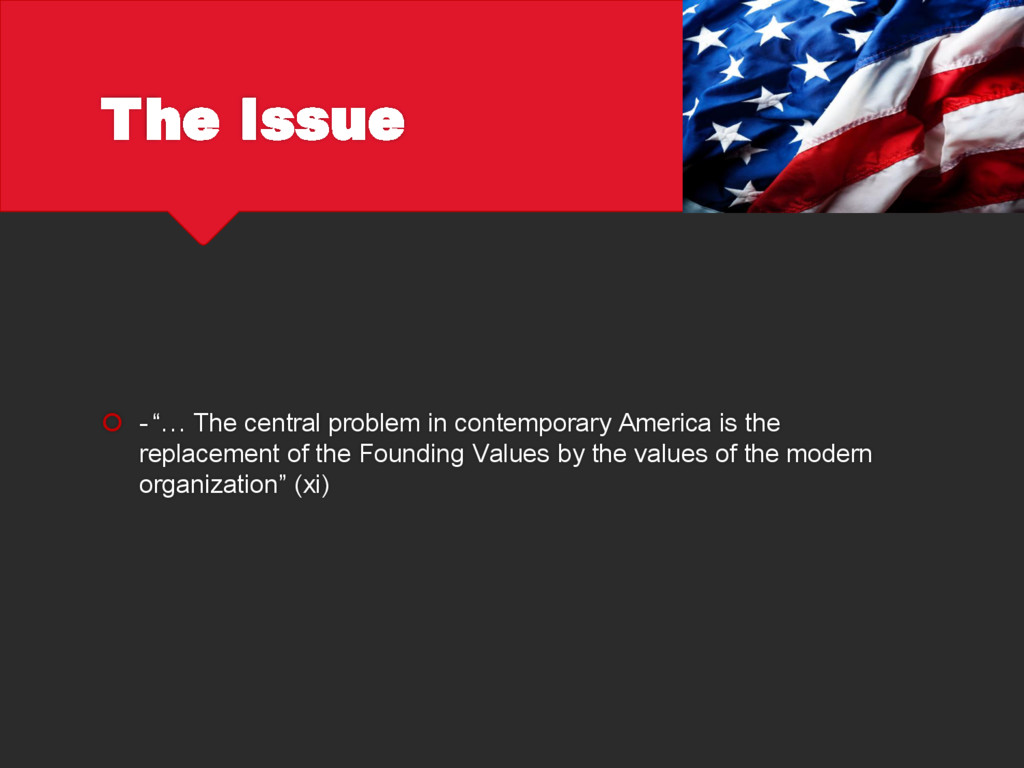
  3. The Issue  - “… The central problem in contemporary

    America is the replacement of the Founding Values by the values of the modern organization” (xi)
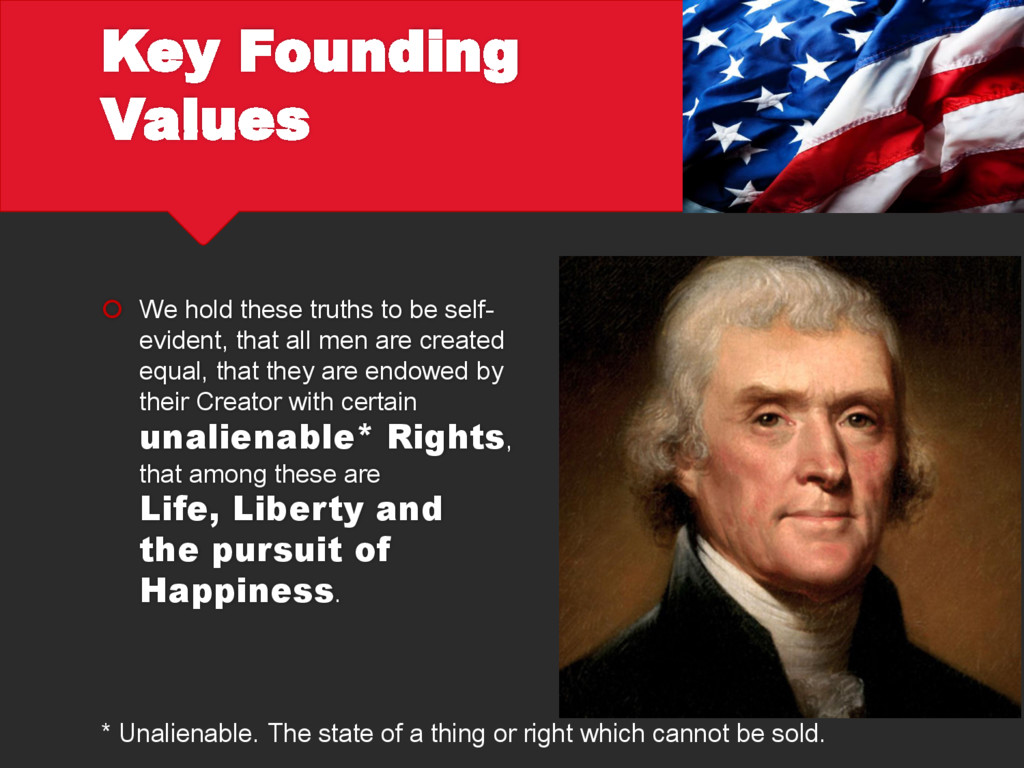
  4. Key Founding Values  We hold these truths to be

    self- evident, that all men are created equal, that they are endowed by their Creator with certain unalienable* Rights, that among these are Life, Liberty and the pursuit of Happiness. * Unalienable. The state of a thing or right which cannot be sold.
  5. Liberty  “Natural liberty is the right which nature gives

    to all mankind of disposing of their persons and property after the manner they may judge most consonant to their happiness, on condition of their acting within the limits of the law of nature, and so as not to interfere with an equal exercise of the same rights by other” (Burlam. Nat. Law, c. 3, § 15)  From Dictionary.com:  Freedom from arbitrary or despotic government or control.  Freedom from external or foreign rule; independence.  Freedom from control, interference, obligation, restriction, hampering conditions, etc.; power or right of doing, thinking, speaking, etc., according to choice.  Freedom from captivity, confinement, or physical restraint  Permission granted to a sailor, especially in the navy, to go ashore.
  6. “Employee Wishes He Had Enough Job Security To Voice Opinion”

    News in Brief December 3, 2014 Vol 50 Issue 48 http://www.theonion.com/article/employee-wishes-he-had-enough-job-security-to-voic-37576
  7. Who Wins?  Who wins when people are afraid to

    share their thoughts at work?  Who wins when people are compelled to engage in emotional and physical labor that may be unrelated to positive individual and organizational outcomes?  Who wins when people are seen as replaceable means to an end rather than as having value in and of themselves?
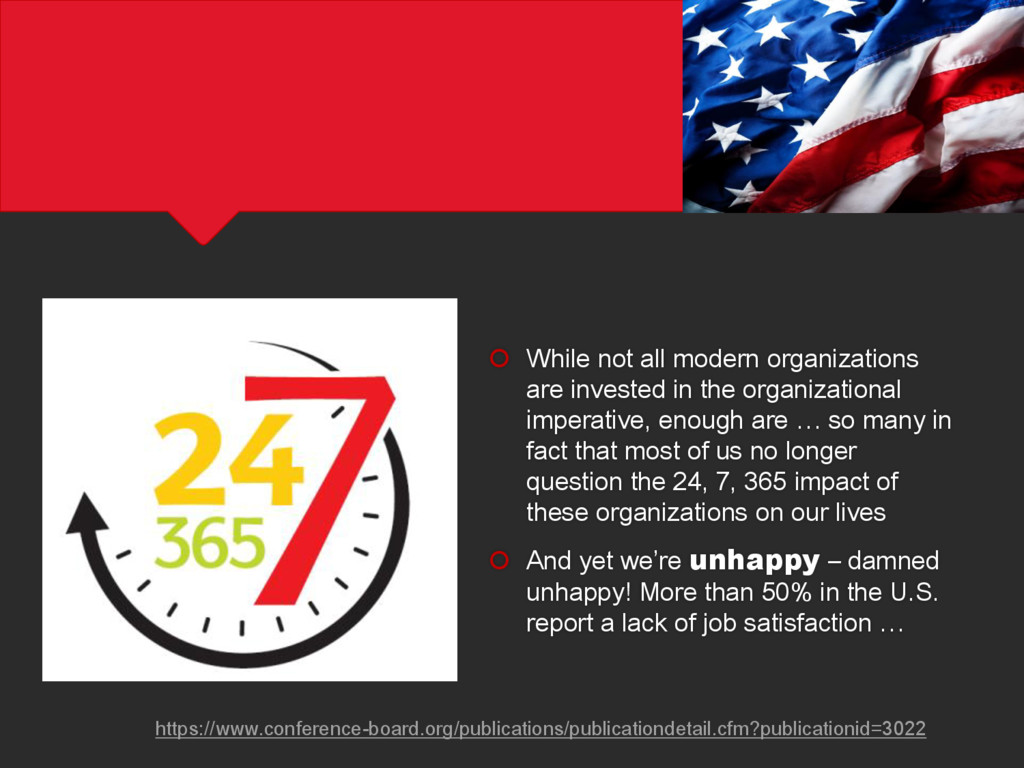
  8.  While not all modern organizations are invested in the

    organizational imperative, enough are … so many in fact that most of us no longer question the 24, 7, 365 impact of these organizations on our lives  And yet we’re unhappy – damned unhappy! More than 50% in the U.S. report a lack of job satisfaction … https://www.conference-board.org/publications/publicationdetail.cfm?publicationid=3022
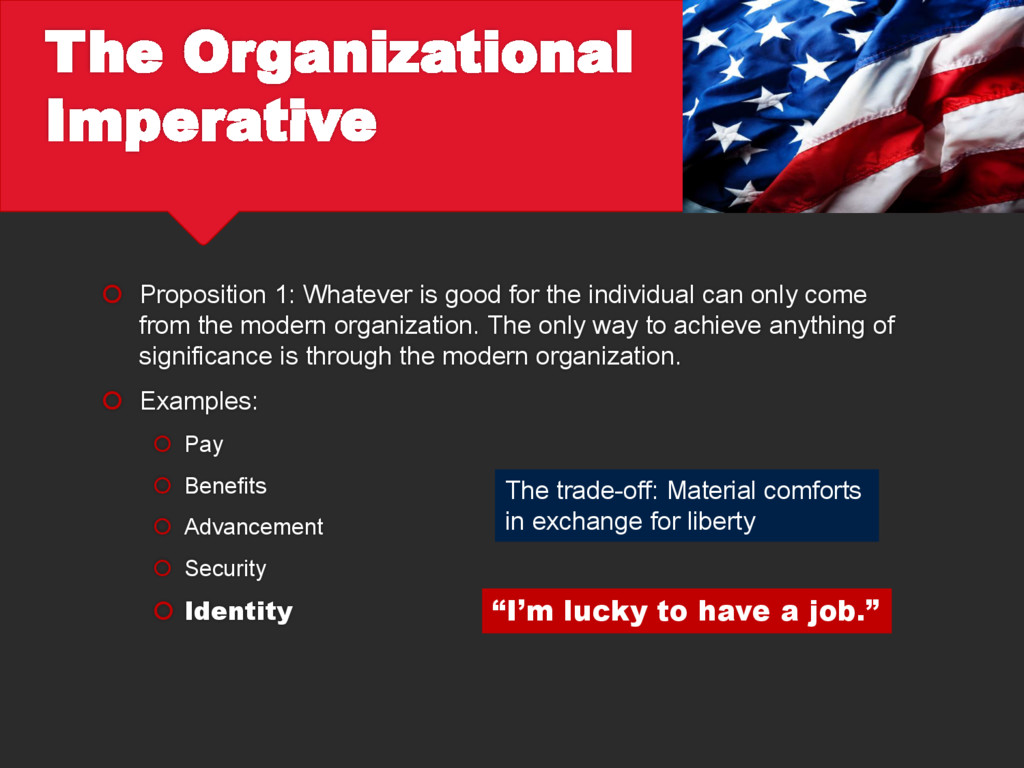
  9. The Organizational Imperative  Proposition 1: Whatever is good for

    the individual can only come from the modern organization. The only way to achieve anything of significance is through the modern organization.  Examples:  Pay  Benefits  Advancement  Security  Identity The trade-off: Material comforts in exchange for liberty “I’m lucky to have a job.”
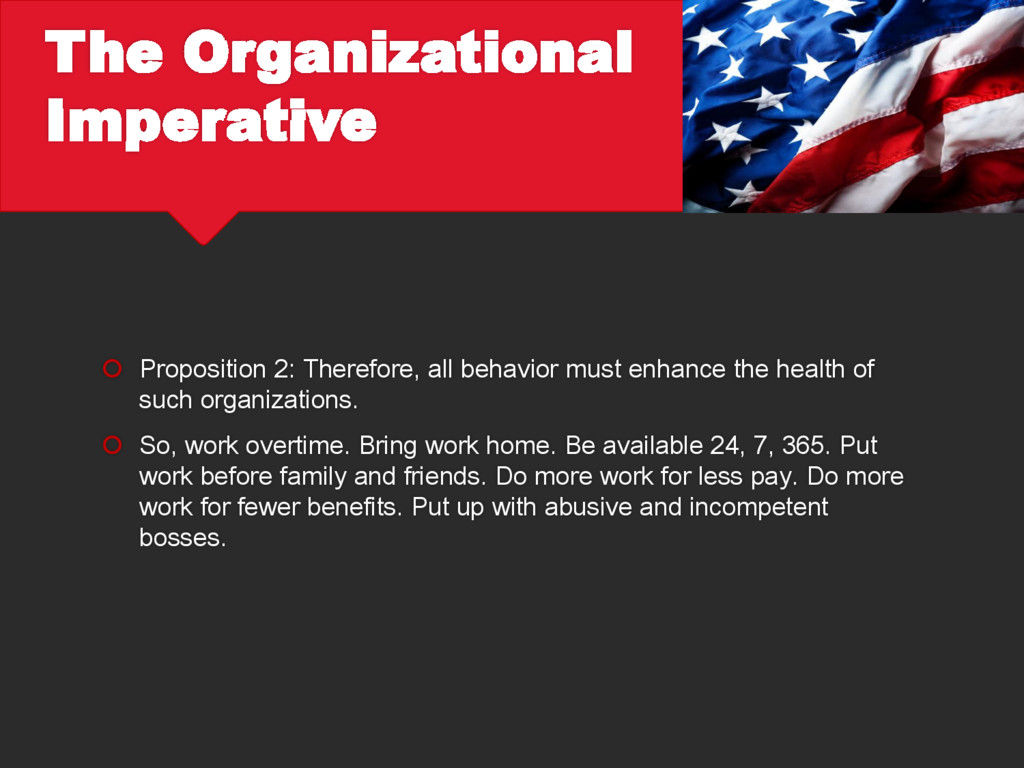
  10. The Organizational Imperative  Proposition 2: Therefore, all behavior must

    enhance the health of such organizations.  So, work overtime. Bring work home. Be available 24, 7, 365. Put work before family and friends. Do more work for less pay. Do more work for fewer benefits. Put up with abusive and incompetent bosses.
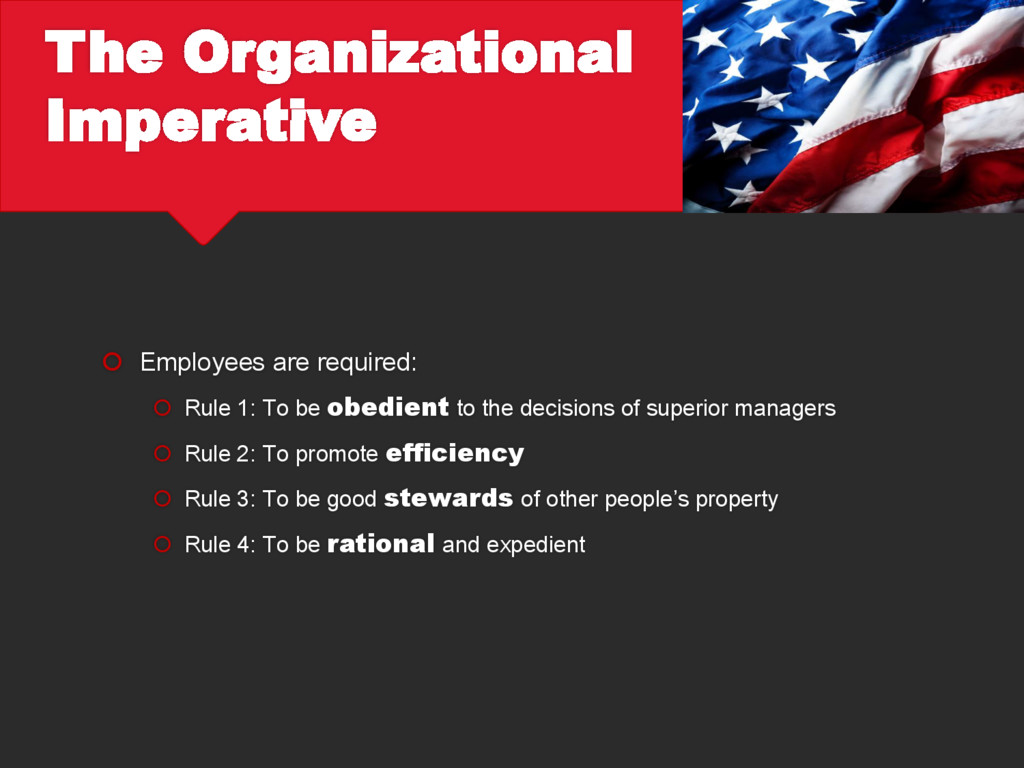
  11. The Organizational Imperative  Employees are required:  Rule 1:

    To be obedient to the decisions of superior managers  Rule 2: To promote efficiency  Rule 3: To be good stewards of other people’s property  Rule 4: To be rational and expedient
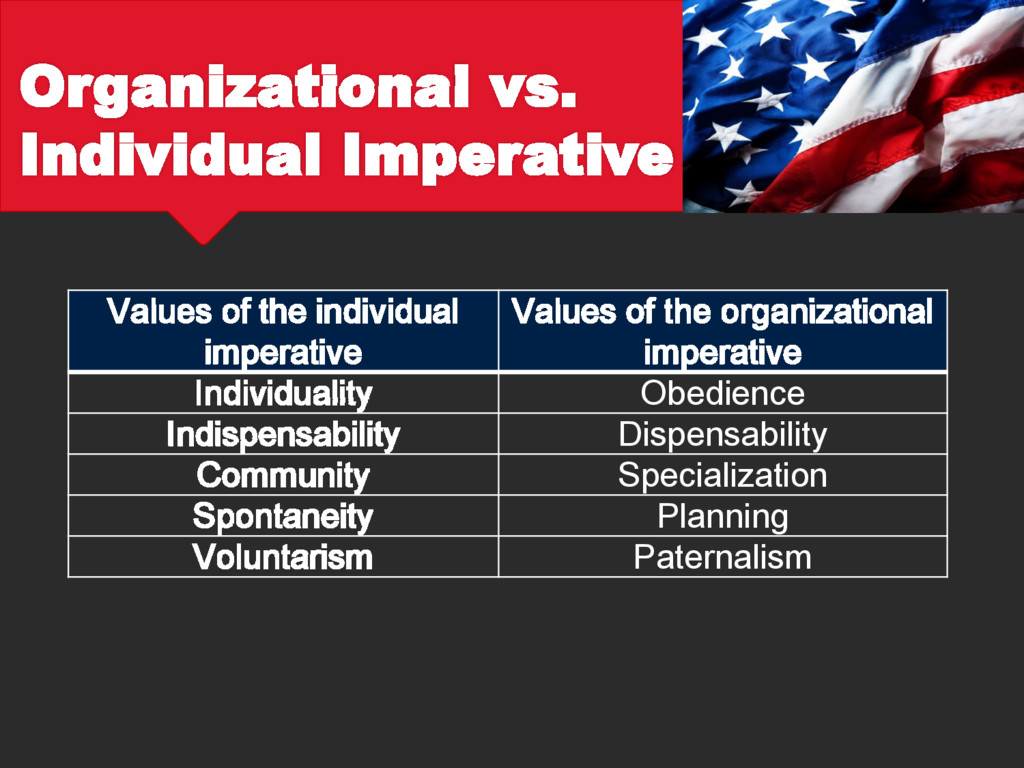
  12. Organizational vs. Individual Imperative Values of the individual imperative Values

    of the organizational imperative Individuality Obedience Indispensability Dispensability Community Specialization Spontaneity Planning Voluntarism Paternalism
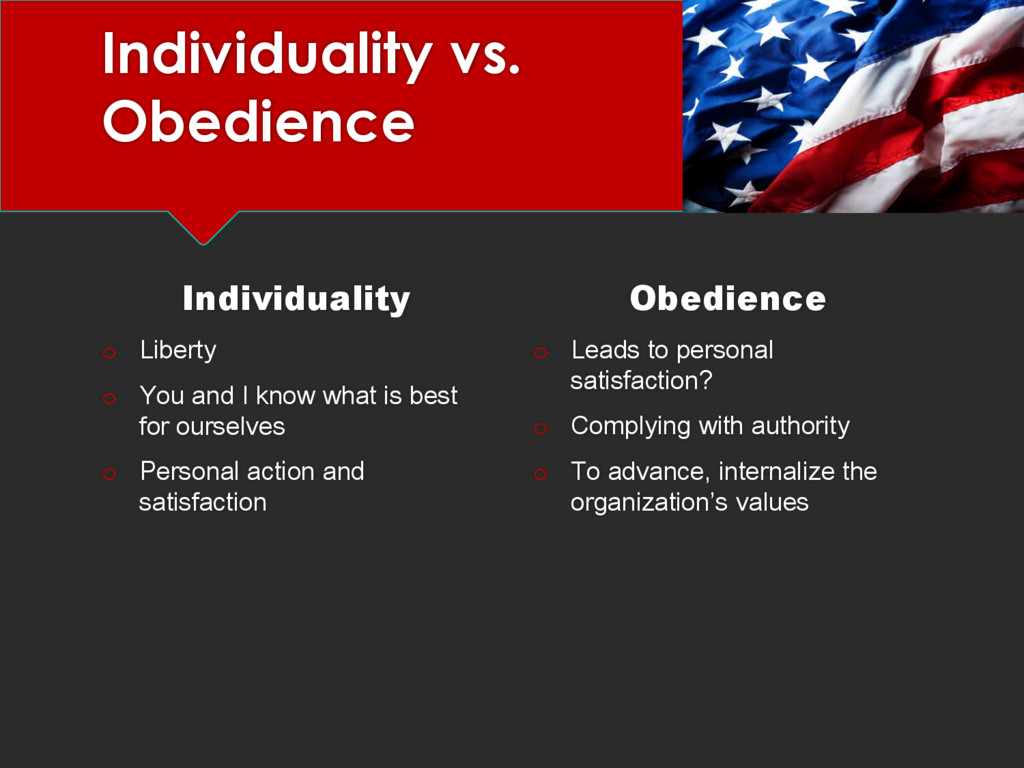
  13. Individuality vs. Obedience Individuality o Liberty o You and I

    know what is best for ourselves o Personal action and satisfaction Obedience o Leads to personal satisfaction? o Complying with authority o To advance, internalize the organization’s values
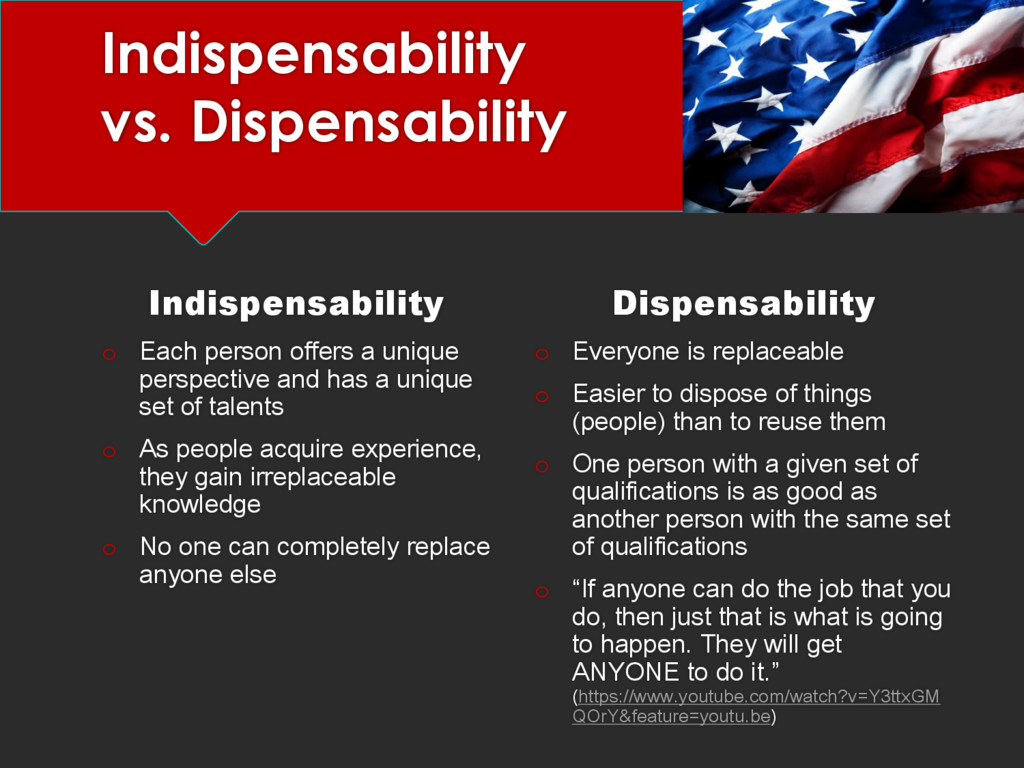
  14. Indispensability vs. Dispensability Indispensability o Each person offers a unique

    perspective and has a unique set of talents o As people acquire experience, they gain irreplaceable knowledge o No one can completely replace anyone else Dispensability o Everyone is replaceable o Easier to dispose of things (people) than to reuse them o One person with a given set of qualifications is as good as another person with the same set of qualifications o “If anyone can do the job that you do, then just that is what is going to happen. They will get ANYONE to do it.” (https://www.youtube.com/watch?v=Y3ttxGM QOrY&feature=youtu.be)
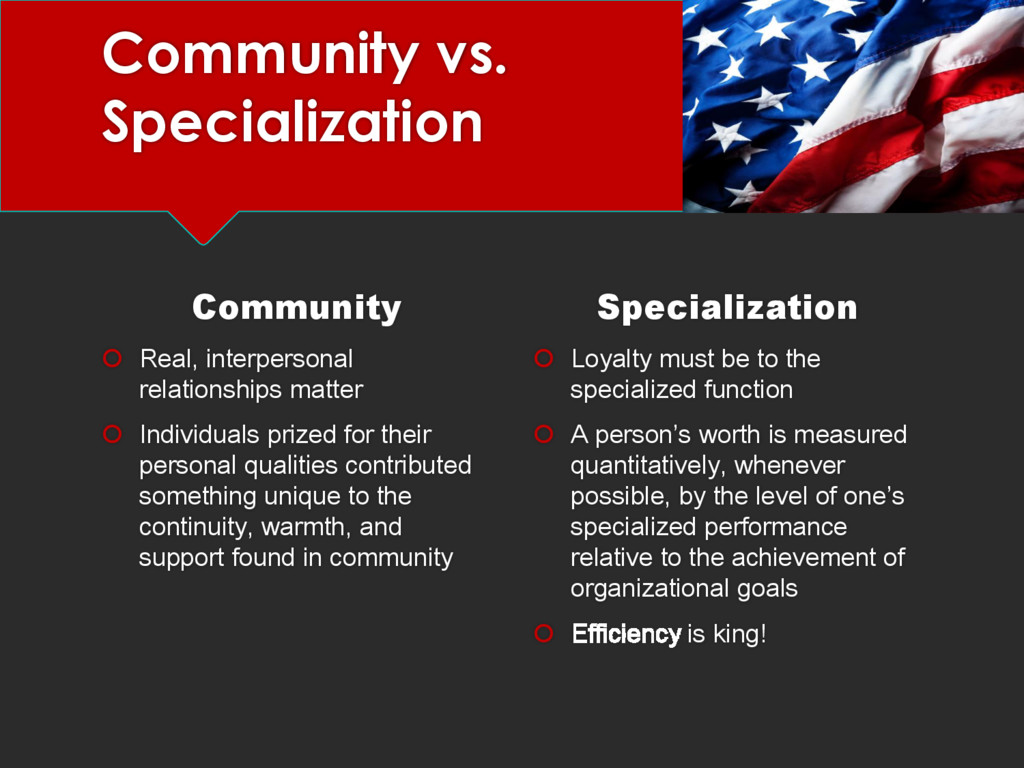
  15. Community vs. Specialization Community  Real, interpersonal relationships matter 

    Individuals prized for their personal qualities contributed something unique to the continuity, warmth, and support found in community Specialization  Loyalty must be to the specialized function  A person’s worth is measured quantitatively, whenever possible, by the level of one’s specialized performance relative to the achievement of organizational goals  Efficiency is king!
  16.  Carrier Air Conditioner (part of United Technologies) Moving 1,400

    Jobs to México (Feb 2016)  https://www.youtube.com/watch?v=Y3ttxGMQOrY&feature=youtu.be  “This is strictly a business decision.” “It is important that you understand …” “We still have a job to do …” “This was an extremely difficult decision.”
  17. Spontaneity vs. Planning Spontaneity  Serious problems require spontaneous, creative

    action  Serendipity  Interdependent, complex relationships that we might not be able to tease apart Planning  Systematic, informed projections  Eliminating guesswork  Prediction and CONTROL
  18. Voluntarism vs. Paternalism Voluntarism  Combining voluntarily into interest groups

    to engage in collective action  A compromise between individualism and collectivism Paternalism  The benevolent concern of management for the welfare of their employee “children” – making decisions and doing what is “best” for the employees – without giving them rights  In exchange, employees owe their loyalty
  19. The Organizational Imperative  “The organizational imperative that has displaced

    the Founding Values is now the central part of a new, well-entrenched system of American values. Obedience is essential to organizational discipline, dispensability is necessary for organizational change, specialization is required for organizational efficiency, planning is needed to reduce organizational uncertainty, and paternalism is the psychological justification for management’s dominion over the work force” (60)
  20. All Aboard the Belief Train  We believe in the

    decency of managerial intention.  We believe in the job over all else.  We believe in the vocationalization of education.
  21. The Individual Imperative  “The corrective (to the organizational imperative)

    is an ethical individualism, based upon the Founding Values” (162)
  22. The Individual Imperative  Proposition 1: All individuals have the

    natural right to actualize the potentials of their unique selves throughout the stages of their lives.
  23. The Individual Imperative  Proposition 2: The primary justification of

    any organization is the extent to which it promotes the actualization of those individual potentials. “There (is) a sanctity to each individual’s life” (163)
  24. The Individual Imperative  All individuals have the civic obligation

    to realize their full potentials  All individuals have the civic obligation to promote human diversity  All individuals have the civic obligation to reject all forms of human instrumentalism  All individuals have the civic obligation to dissent when any individual, institution or organization abridges the Founding Values
  25. The Individual Imperative  The organization of the Individual Imperative

     Organization size  Social enclaves  Organizational governance and justice  Moral discourse
  26. The Individual Imperative  Creating an organization that enables the

    “actualization of all our individual potentials”  Herman Miller  W. L. Gore & Associates  Virgin
  27. A Way Forward  What is the University’s role in

    reminding society about our unalienable rights to Life, Liberty, and the pursuit of Happiness – both when we’re “on” and when we’re “off” the clock?  Active practitioner?  Role model?  Educator?
  28. A Way Forward  Is there value in returning to

    our shared governance roots as they were understood and exercised in the past?  If we believe that the collective brain power of all our stakeholders has value, how do we make sure that all voices are at the decision making table?  How do we balance growth and alternative delivery methods with creating community and enabling individual realization of potential?  How do we ensure that the liberal arts – and a focus on moral truths – are infused in all programs of study?
  29. Back in my day … Photo Courtesy of the UWGB

    Archives, Deb Anderson and her rockin’ staff
  30. 36.09(5)  The original text: “(5) STUDENTS. The students of

    each institution or campus subject to the responsibilities and powers of the board, the president, the chancellor and the faculty shall be active participants in the immediate governance of and policy development for such institutions. As such, students shall have primary responsibility for the formulation and review of policies concerning student life, services and interests. Students in consultation with the chancellor and subject to the final confirmation of the board shall have the responsibility for the disposition of those student fees which constitute substantial support for campus student activities . The students of each institution or campus shall have the right to organize themselves in a manner they determine and to select their representatives to participate in institutional governance.”
  31.  Current text: “(5) STUDENTS. The students of each institution

    or campus subject to the responsibilities and powers of the board, the president, the chancellor, and the faculty shall have primary responsibility for advising the chancellor regarding the formulation and review of policies concerning student life, services, and interests. Students in consultation with the chancellor and subject to the final confirmation of the board shall have the responsibility for the disposition of those student fees which constitute substantial support for campus student activities. The students of each institution or campus shall have the right to organize themselves in a manner they determine and to select their representatives to participate in institutional governance.”
  32. 36.09(4)  The original text: “FACULTY. The faculty of each

    institution, subject to the responsibilities and powers of the board, the president and the chancellor of such institution, shall be vested with responsibility for the immediate governance of such institution and shall actively participate in institutional policy development. As such, the faculty shall have the primary responsibility for academic and educational activities and faculty personnel matters. The faculty of each institution shall have the right to determine their own faculty organizational structure and to select representatives to participate in institutional governance
  33.  Current text: “(4) FACULTY. The faculty of each institution,

    subject to the responsibilities and powers of the board, the president, and the chancellor of such institution, shall have the primary responsibility for advising the chancellor regarding academic and educational activities and faculty personnel matters. The faculty of each institution shall have the right to determine their own faculty organizational structure and to select representatives to participate in institutional governance, except that the faculty of each institution shall ensure that faculty in academic disciplines related to science, technology, engineering, and mathematics are adequately represented in the faculty organizational structure.”
  34. A Way Forward  Recognize the organizational imperative for what

    it is and what it does  Use our collective voices to rebel against / resist the organizational imperative  Support initiatives and organizations that align with the individual imperative
  35. Source  William G. Scott & David J. Hart (1991).

    Organizational Values in America. New Brunswick, NJ: Transaction Publishers.