Upgrade to Pro — share decks privately, control downloads, hide ads and more …

Rustの画像処理でSIMDを使ってみる

Sponsored · Your Podcast. Everywhere. Effortlessly. Share. Educate. Inspire. Entertain. You do you. We'll handle the rest.

 Rustの画像処理でSIMDを使ってみる

Avatar for fmy (FUJINAKA Fumiya)

fmy (FUJINAKA Fumiya)

June 08, 2023
Tweet

Other Decks in Technology

Transcript

  1. 自己紹介 fmy twitter: @fmy4159 仕事: 家族型ロボットを作っている at GROOVE X 趣味:

    GStreamer とかJetson を触っている Qiita:Rust でGStreamer Plugin を書く Qiita:Jetson のカメラドライバを書く
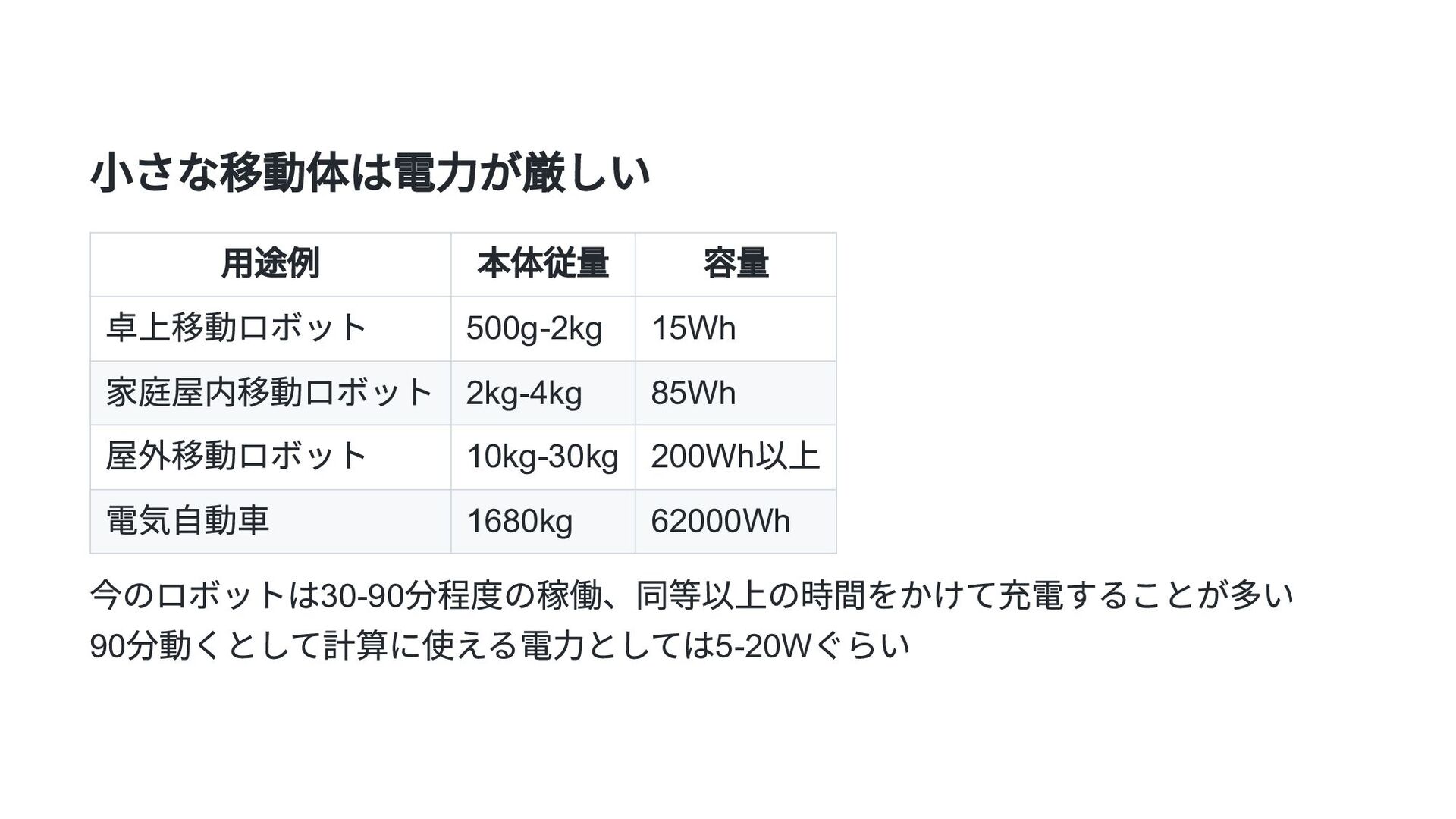
  2. 小さな移動体は電力が厳しい 用途例 本体従量 容量 卓上移動ロボット 500g-2kg 15Wh 家庭屋内移動ロボット 2kg-4kg 85Wh

    屋外移動ロボット 10kg-30kg 200Wh 以上 電気自動車 1680kg 62000Wh 今のロボットは30-90 分程度の稼働、同等以上の時間をかけて充電することが多い 90 分動くとして計算に使える電力としては5-20W ぐらい
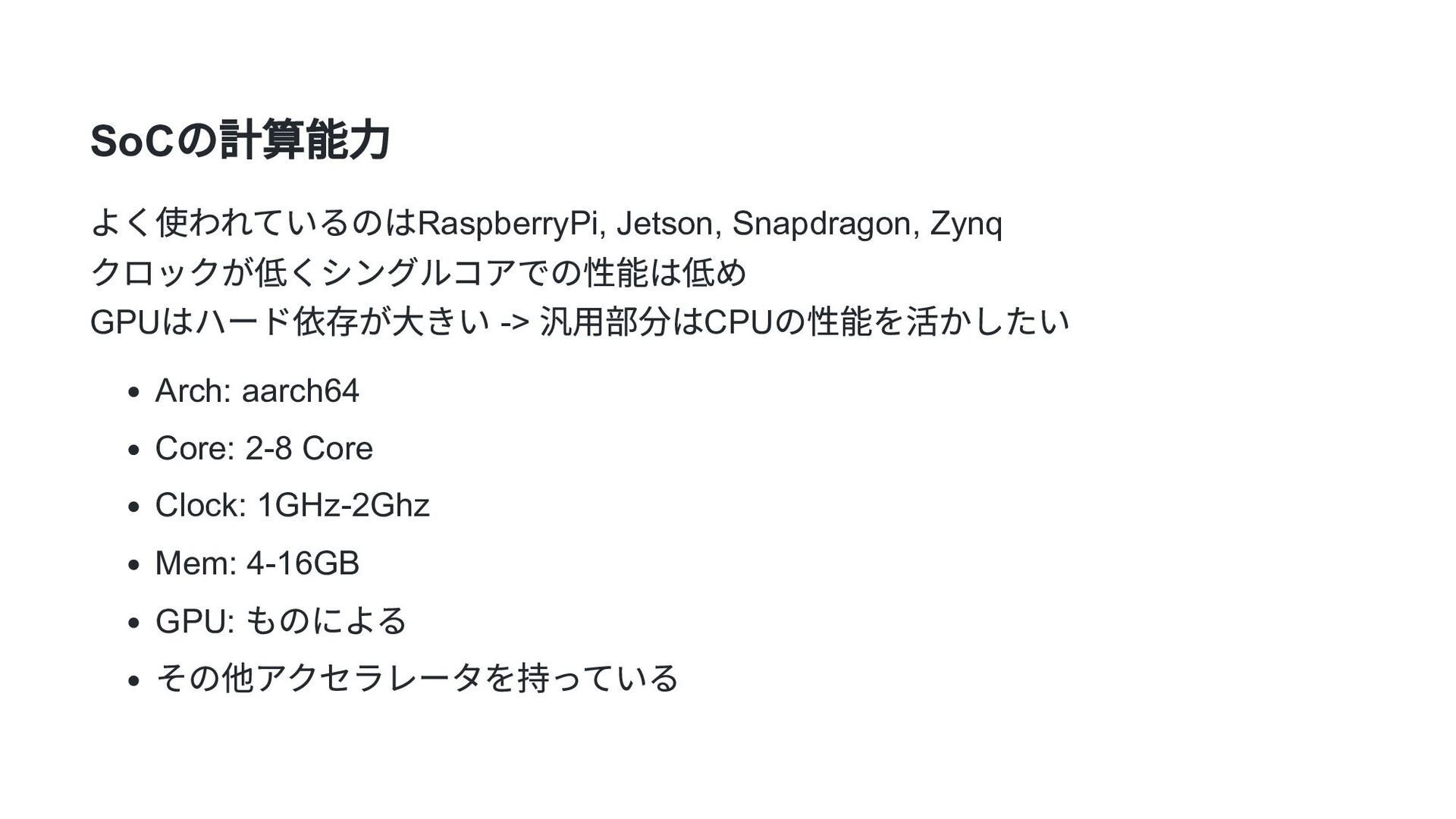
  3. SoC の計算能力 よく使われているのはRaspberryPi, Jetson, Snapdragon, Zynq クロックが低くシングルコアでの性能は低め GPU はハード依存が大きい ->

    汎用部分はCPU の性能を活かしたい Arch: aarch64 Core: 2-8 Core Clock: 1GHz-2Ghz Mem: 4-16GB GPU: ものによる その他アクセラレータを持っている
  4. ナイーブな実装 u8 単位でシフトして上書きする pub fn t16_to_raw16_u8(buf: &mut [u8]) { for

    i in 0..buf.len() / 2 { let i: usize = i * 2; buf[i] = buf[i] >> 4 | buf[i+1] << 4; buf[i+1] >>= 4; } }
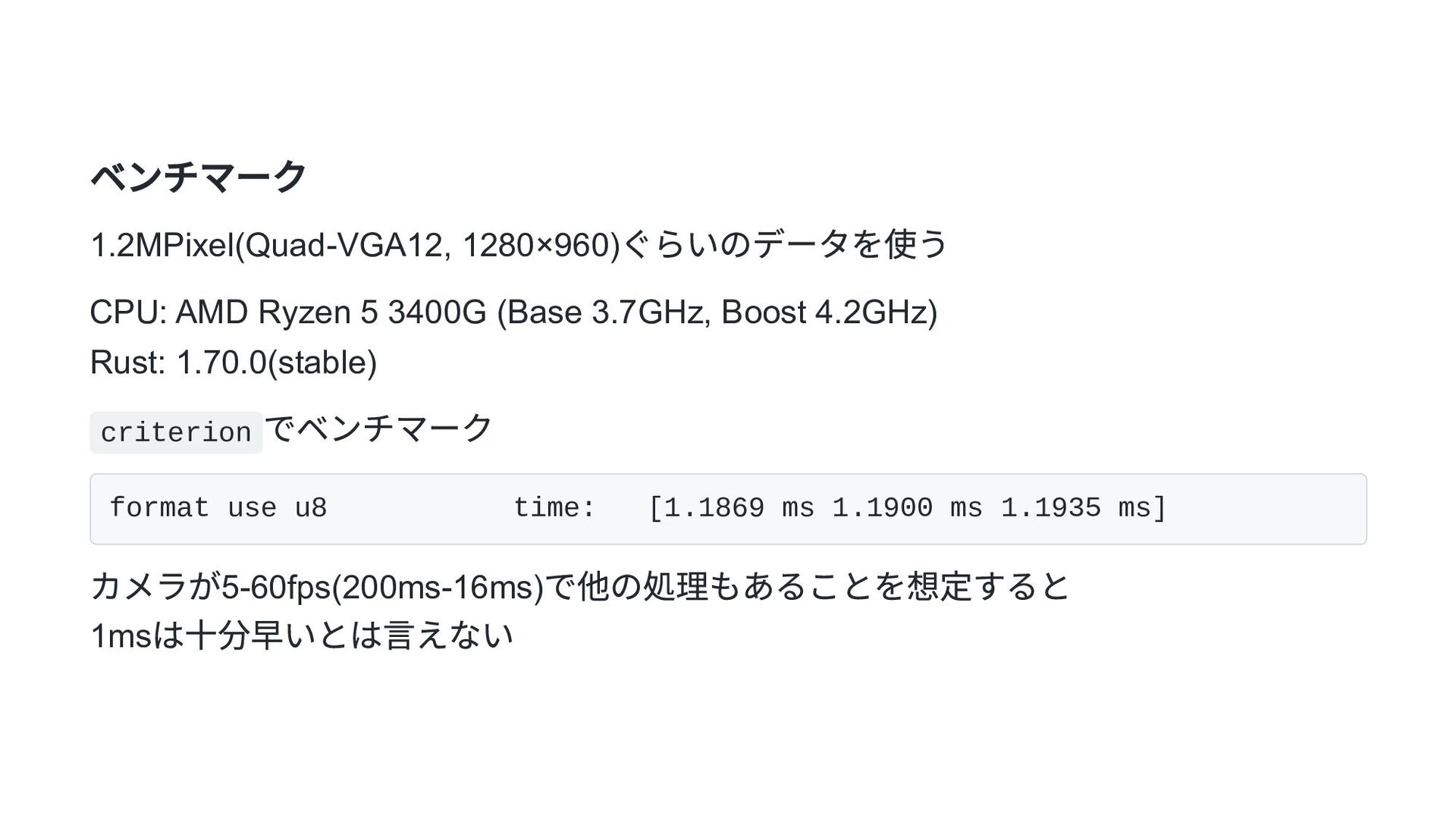
  5. ベンチマーク 1.2MPixel(Quad-VGA12, 1280×960) ぐらいのデータを使う CPU: AMD Ryzen 5 3400G (Base

    3.7GHz, Boost 4.2GHz) Rust: 1.70.0(stable) criterion でベンチマーク format use u8 time: [1.1869 ms 1.1900 ms 1.1935 ms] カメラが5-60fps(200ms-16ms) で他の処理もあることを想定すると 1ms は十分早いとは言えない
  6. u8 アセンブリ .LBB6_2: lea rcx, [rax - 1] cmp rcx,

    rsi jae .LBB6_7 cmp rax, rsi jae .LBB6_6 # for ループ抜け movzx r9d, byte ptr [rdi + rax - 1] # 読み出し movzx ecx, byte ptr [rdi + rax] shr r9b, 4 mov edx, ecx shl dl, 4 or dl, r9b # 下位8bit mov byte ptr [rdi + rax - 1], dl # 書き込み shr cl, 4 # 上位8bit mov byte ptr [rdi + rax], cl # 書き込み add rax, 2 dec r8 jne .LBB6_2
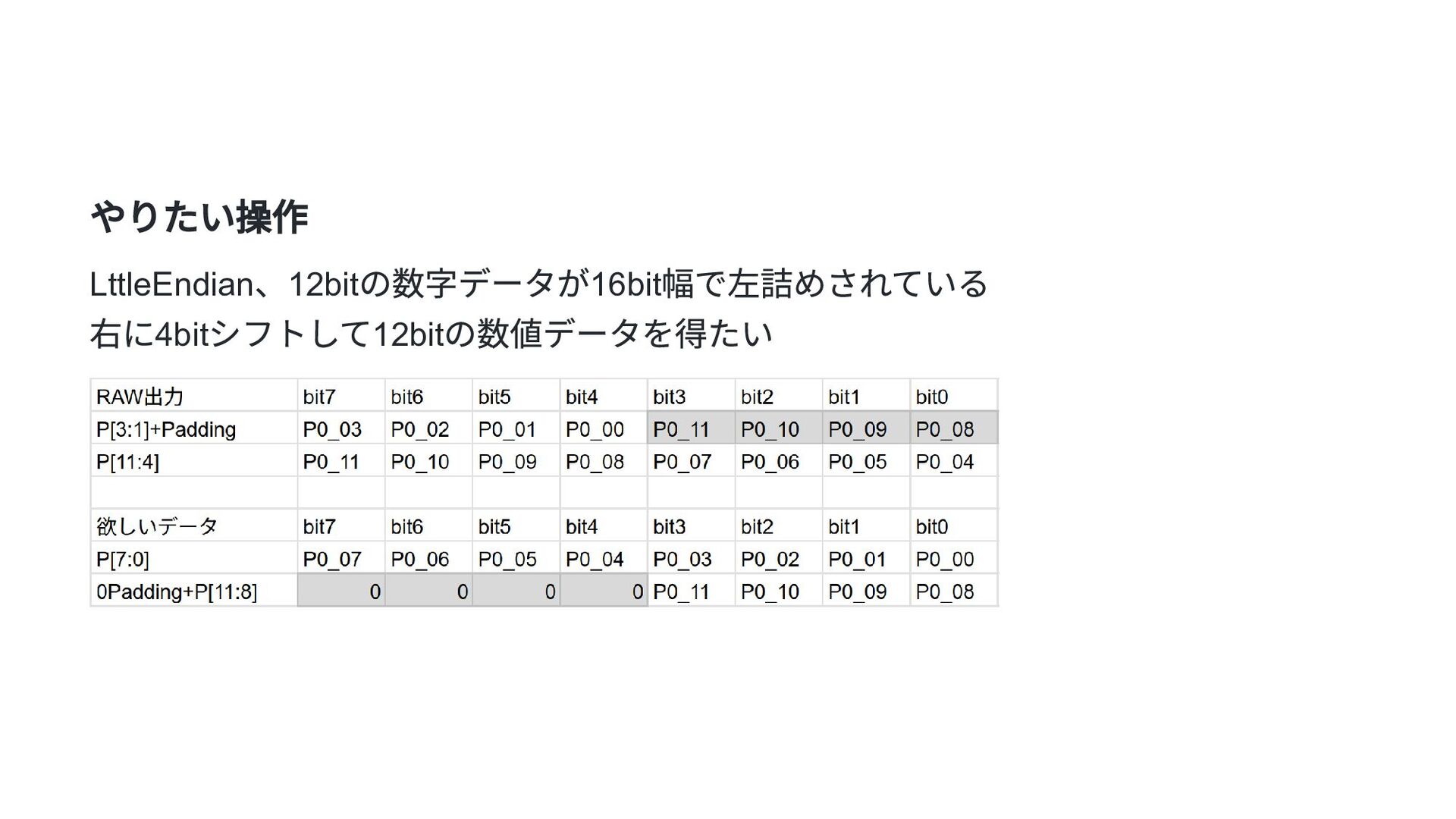
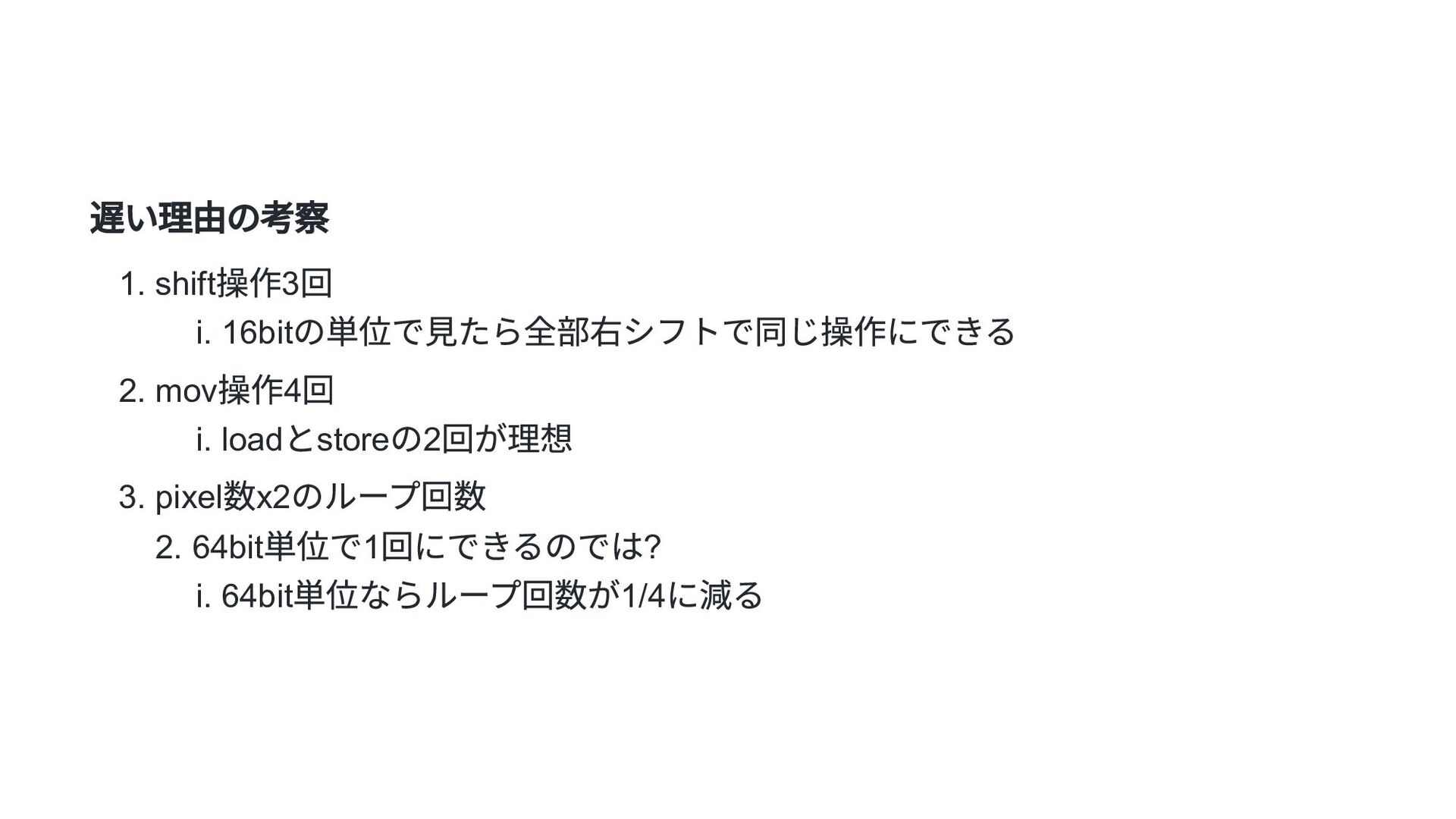
  7. 遅い理由の考察 1. shift 操作3 回 i. 16bit の単位で見たら全部右シフトで同じ操作にできる 2. mov

    操作4 回 i. load とstore の2 回が理想 3. pixel 数x2 のループ回数 2. 64bit 単位で1 回にできるのでは? i. 64bit 単位ならループ回数が1/4 に減る
  8. u64 実装 pub fn t16_to_raw16_u64(buf: &mut [u8]) { for i

    in 0..buf.len() / 8 { let i: usize = i * 8; let mut a = LittleEndian::read_u64(&buf[i..i + 8]); *x = (*x & 0xfff0fff0fff0fff0) >> 4; LittleEndian::write_u64(&mut buf[i..i + 8], a); } } byteorder を使ってu64 として操作する
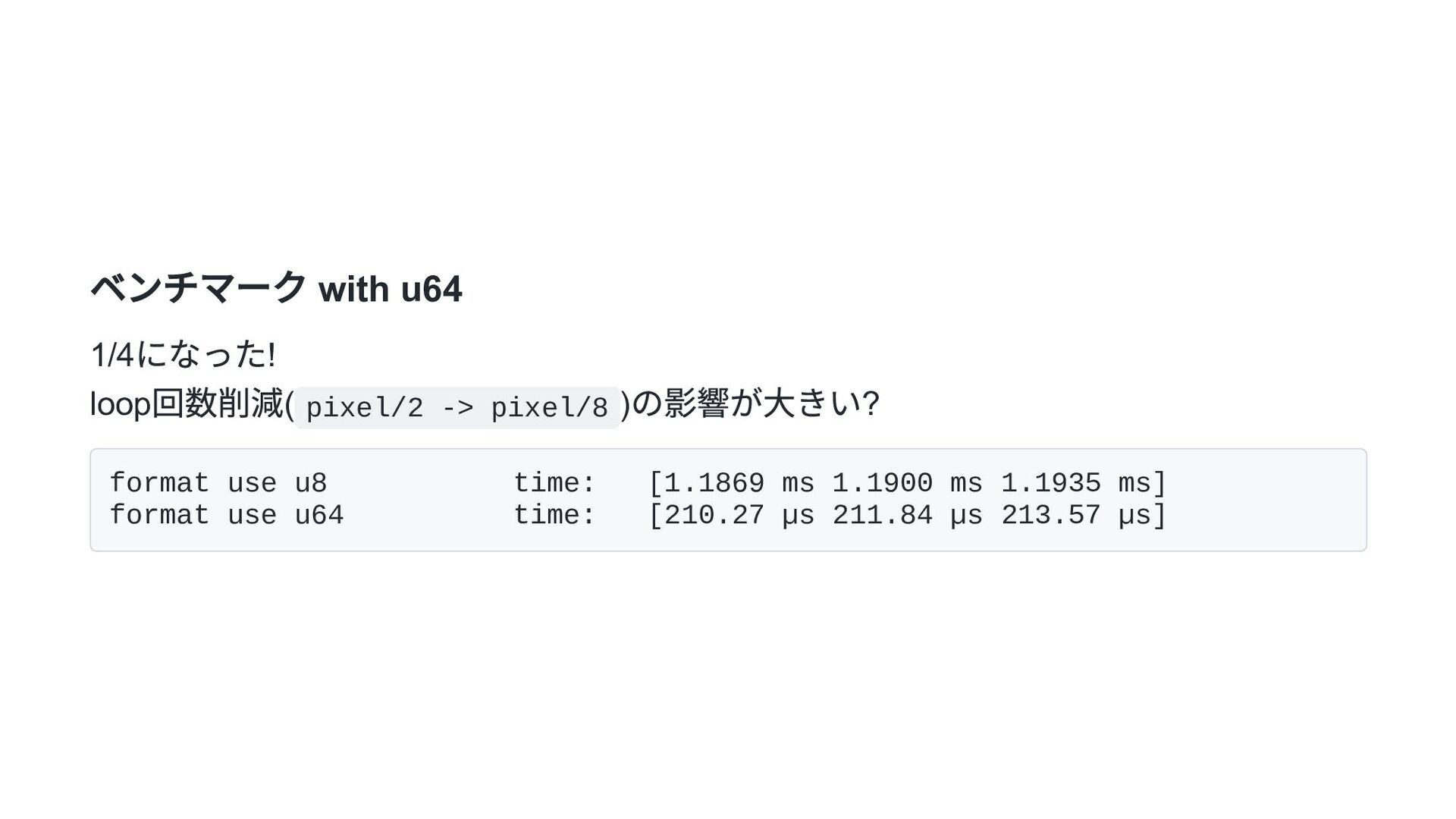
  9. ベンチマーク with u64 1/4 になった! loop 回数削減( pixel/2 -> pixel/8

    ) の影響が大きい? format use u8 time: [1.1869 ms 1.1900 ms 1.1935 ms] format use u64 time: [210.27 µs 211.84 µs 213.57 µs]
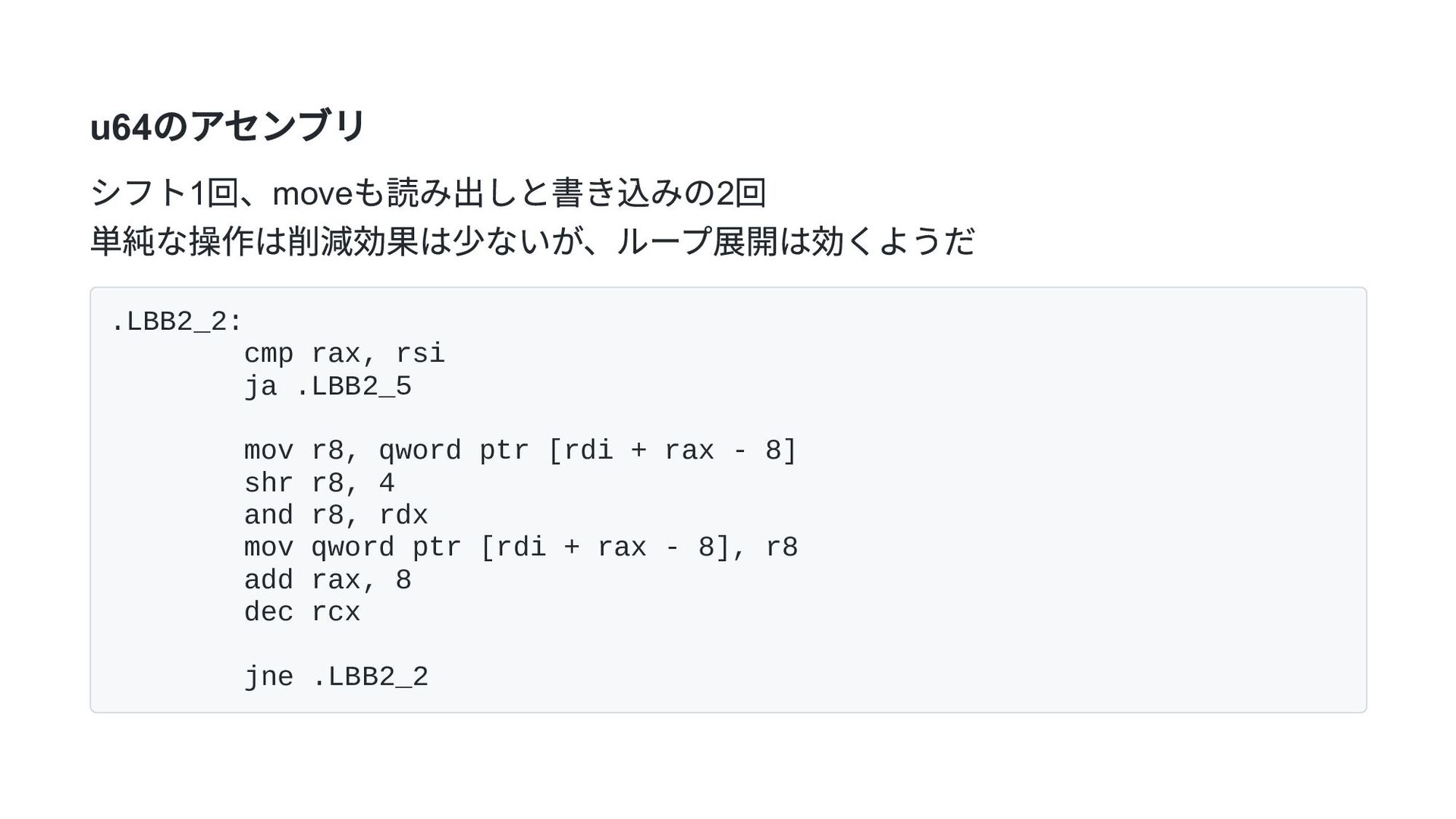
  10. u64 のアセンブリ シフト1 回、move も読み出しと書き込みの2 回 単純な操作は削減効果は少ないが、ループ展開は効くようだ .LBB2_2: cmp rax,

    rsi ja .LBB2_5 mov r8, qword ptr [rdi + rax - 8] shr r8, 4 and r8, rdx mov qword ptr [rdi + rax - 8], r8 add rax, 8 dec rcx jne .LBB2_2
  11. u128 Rust にはu128 がプリミティブとして用意されている。 これはどうなる? pub fn t16_to_raw16_u128(buf: &mut [u8])

    { for i in 0..buf.len() / 16 { let i: usize = i * 16; let mut a = LittleEndian::read_u128(&buf[i..i + 16]); a = (a & 0xfff0fff0fff0fff0fff0fff0fff0fff0) >> 4; LittleEndian::write_u128(&mut buf[i..i + 16], a); } }
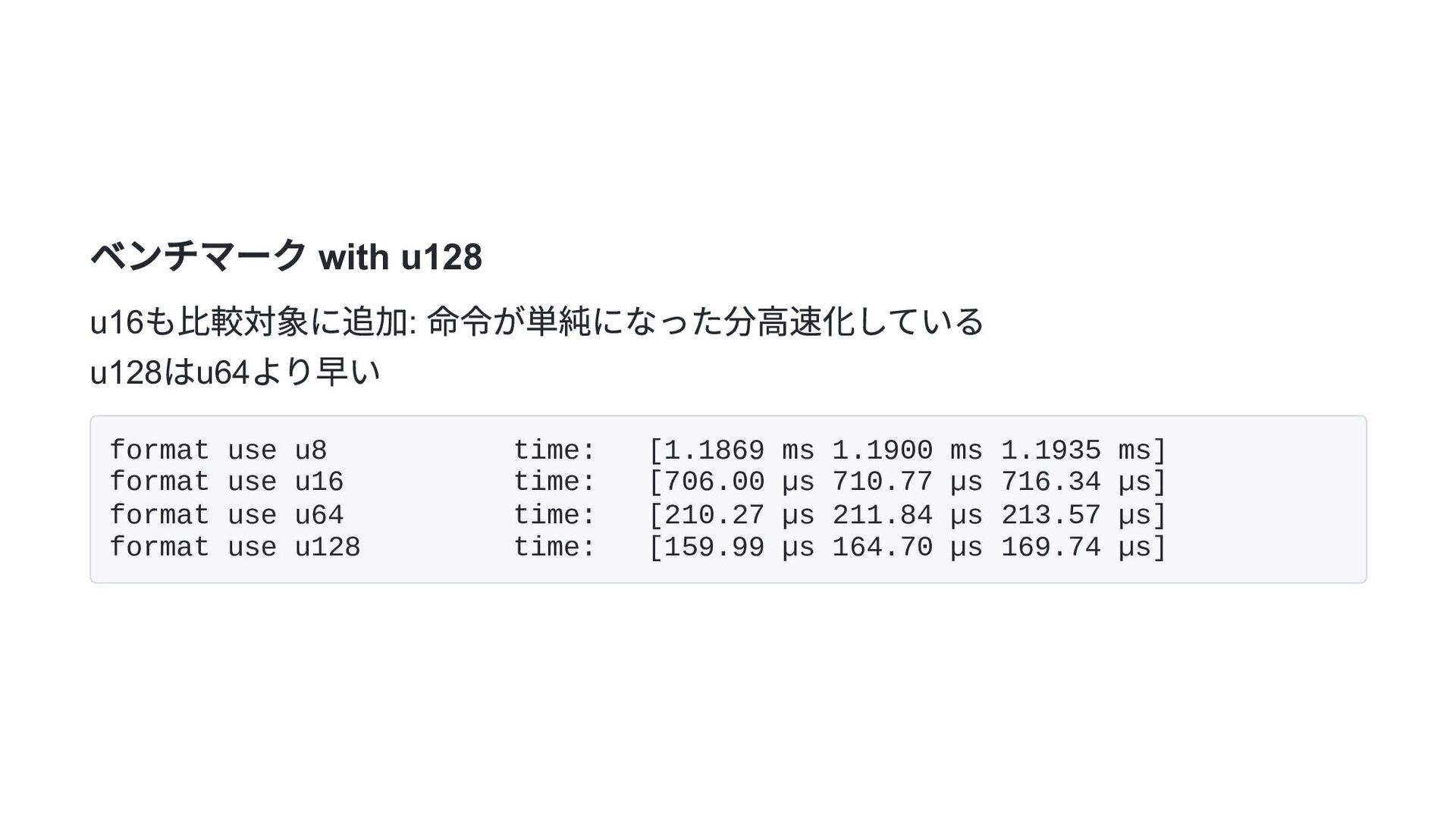
  12. ベンチマーク with u128 u16 も比較対象に追加: 命令が単純になった分高速化している u128 はu64 より早い format

    use u8 time: [1.1869 ms 1.1900 ms 1.1935 ms] format use u16 time: [706.00 µs 710.77 µs 716.34 µs] format use u64 time: [210.27 µs 211.84 µs 213.57 µs] format use u128 time: [159.99 µs 164.70 µs 169.74 µs]
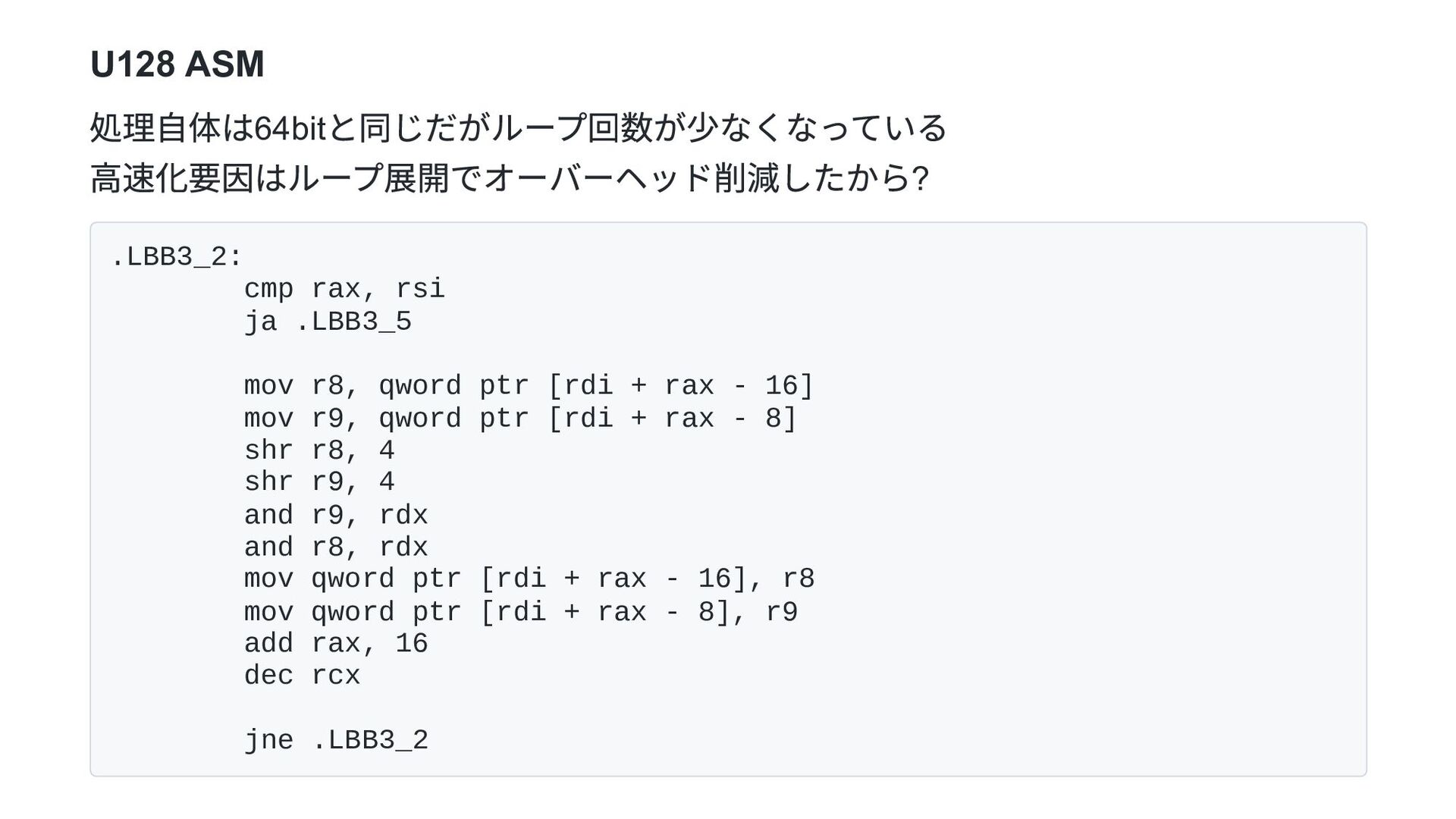
  13. U128 ASM 処理自体は64bit と同じだがループ回数が少なくなっている 高速化要因はループ展開でオーバーヘッド削減したから? .LBB3_2: cmp rax, rsi ja

    .LBB3_5 mov r8, qword ptr [rdi + rax - 16] mov r9, qword ptr [rdi + rax - 8] shr r8, 4 shr r9, 4 and r9, rdx and r8, rdx mov qword ptr [rdi + rax - 16], r8 mov qword ptr [rdi + rax - 8], r9 add rax, 16 dec rcx jne .LBB3_2
  14. SSE2 /// # Safety #[target_feature(enable = "sse2")] #[cfg(any(target_arch = "x86",

    target_arch = "x86_64"))] pub unsafe fn t16_to_raw16_unroll_128(buf: &mut [u8]) { #[cfg(target_arch = "x86")] use std::arch::x86::*; #[cfg(target_arch = "x86_64")] use std::arch::x86_64::*; #[allow(overflowing_literals)] let shift4 = _mm_setr_epi16(4, 0, 0, 0, 0, 0, 0, 0); for i in 0..buf.len() / 16 { let i: usize = i * 16; let invec = _mm_loadu_si128(buf.as_ptr().add(i) as *const _); let shifted = _mm_srl_epi16(invec, shift4); // 論理右シフト _mm_storeu_si128(buf.as_mut_ptr().add(i) as *mut _, shifted); } }
  15. AVX2 /// # Safety #[target_feature(enable = "avx2")] #[cfg(any(target_arch = "x86",

    target_arch = "x86_64"))] pub unsafe fn t16_to_raw16_unroll_256(buf: &mut [u8]) { #[cfg(target_arch = "x86")] use std::arch::x86::*; #[cfg(target_arch = "x86_64")] use std::arch::x86_64::*; #[allow(overflowing_literals)] let shift4 = _mm_setr_epi16(4, 0, 0, 0, 0, 0, 0, 0); for i in 0..buf.len() / 32 { let i: usize = i * 32; let invec = _mm256_loadu_si256(buf.as_ptr().add(i) as *const _); let shifted = _mm256_srl_epi16(invec, shift4); // 論理右シフト _mm256_storeu_si256(buf.as_mut_ptr().add(i) as *mut _, shifted); } }
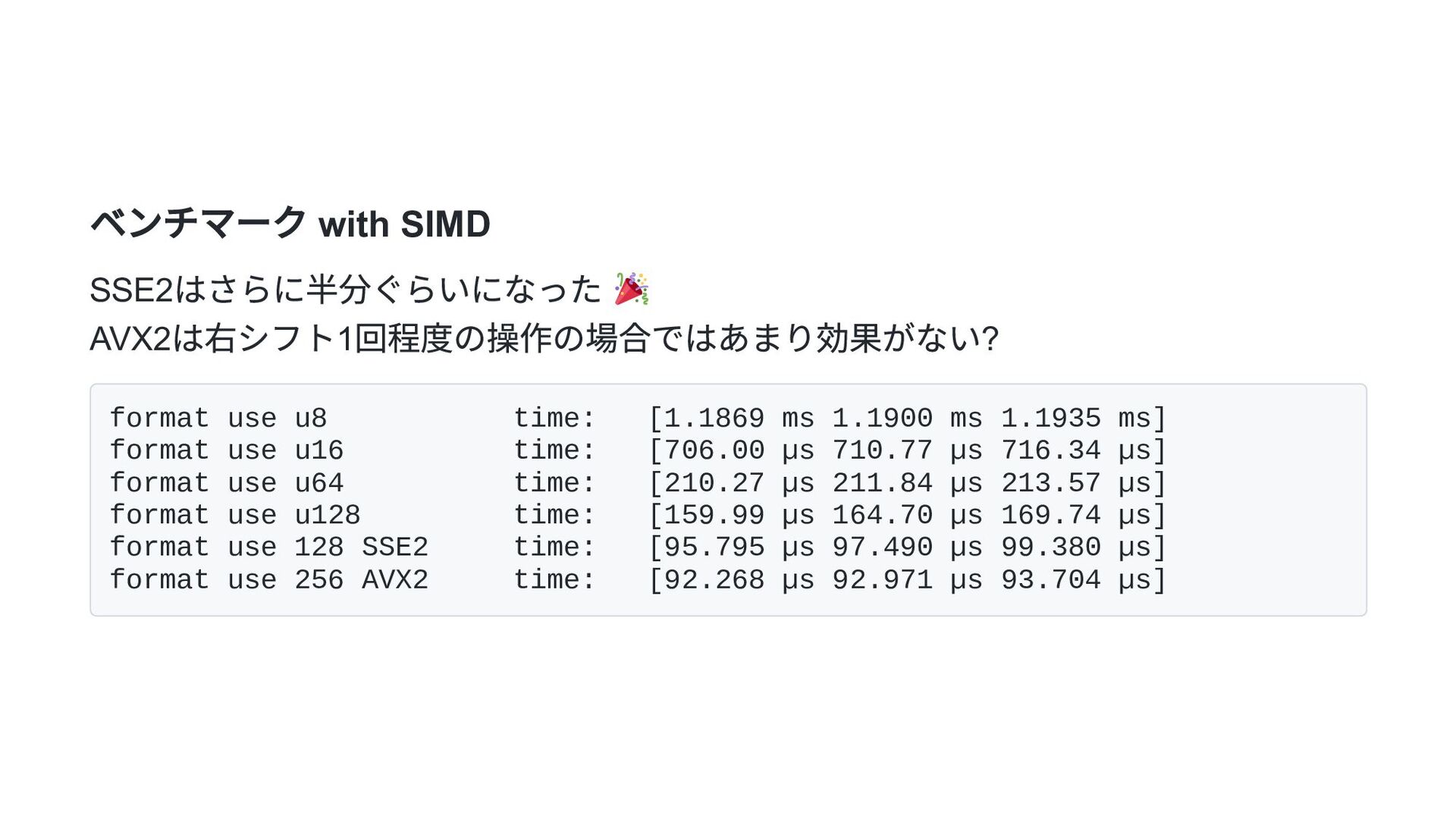
  16. ベンチマーク with SIMD SSE2 はさらに半分ぐらいになった AVX2 は右シフト1 回程度の操作の場合ではあまり効果がない? format use

    u8 time: [1.1869 ms 1.1900 ms 1.1935 ms] format use u16 time: [706.00 µs 710.77 µs 716.34 µs] format use u64 time: [210.27 µs 211.84 µs 213.57 µs] format use u128 time: [159.99 µs 164.70 µs 169.74 µs] format use 128 SSE2 time: [95.795 µs 97.490 µs 99.380 µs] format use 256 AVX2 time: [92.268 µs 92.971 µs 93.704 µs]
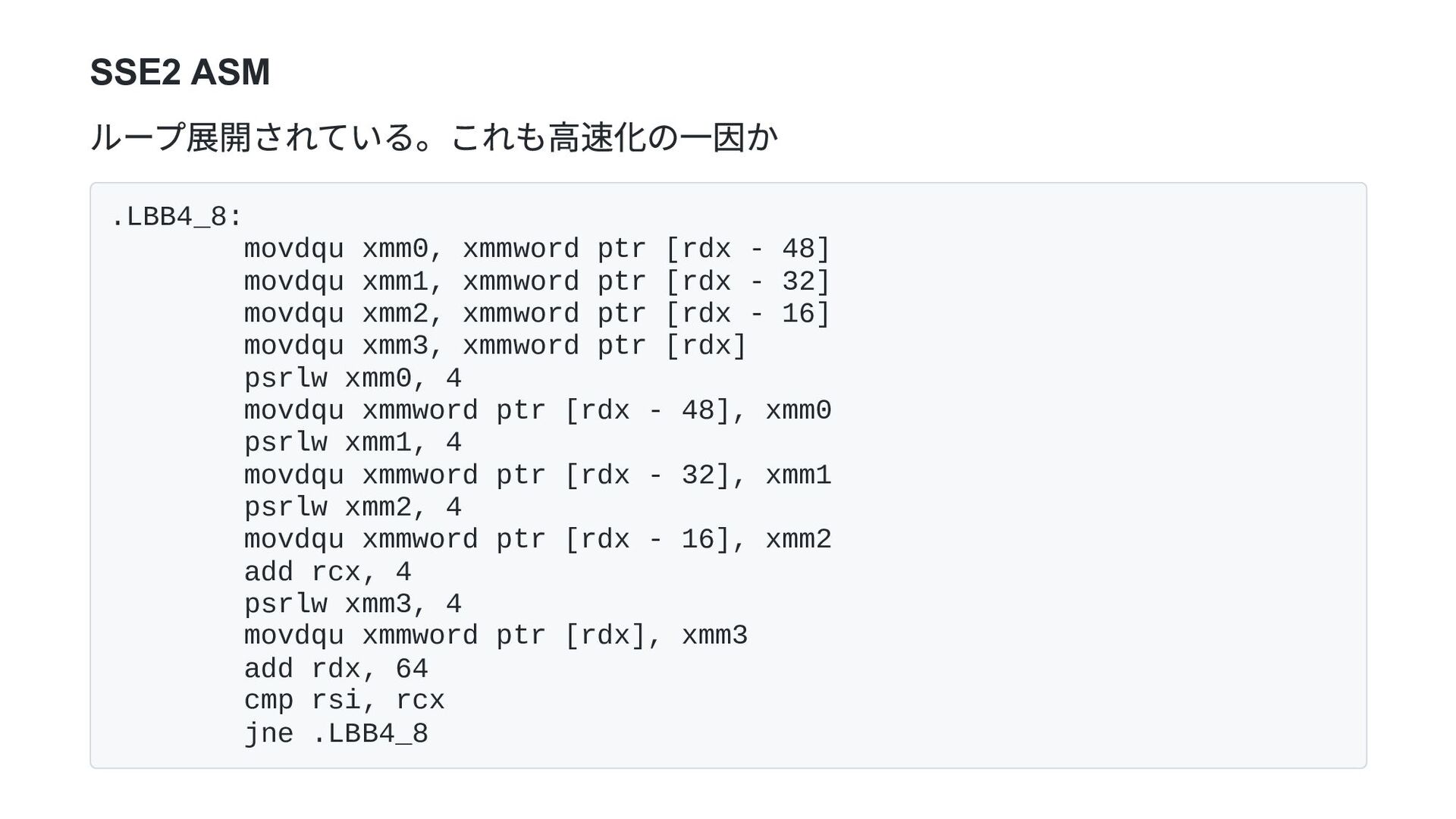
  17. SSE2 ASM ループ展開されている。これも高速化の一因か .LBB4_8: movdqu xmm0, xmmword ptr [rdx -

    48] movdqu xmm1, xmmword ptr [rdx - 32] movdqu xmm2, xmmword ptr [rdx - 16] movdqu xmm3, xmmword ptr [rdx] psrlw xmm0, 4 movdqu xmmword ptr [rdx - 48], xmm0 psrlw xmm1, 4 movdqu xmmword ptr [rdx - 32], xmm1 psrlw xmm2, 4 movdqu xmmword ptr [rdx - 16], xmm2 add rcx, 4 psrlw xmm3, 4 movdqu xmmword ptr [rdx], xmm3 add rdx, 64 cmp rsi, rcx jne .LBB4_8
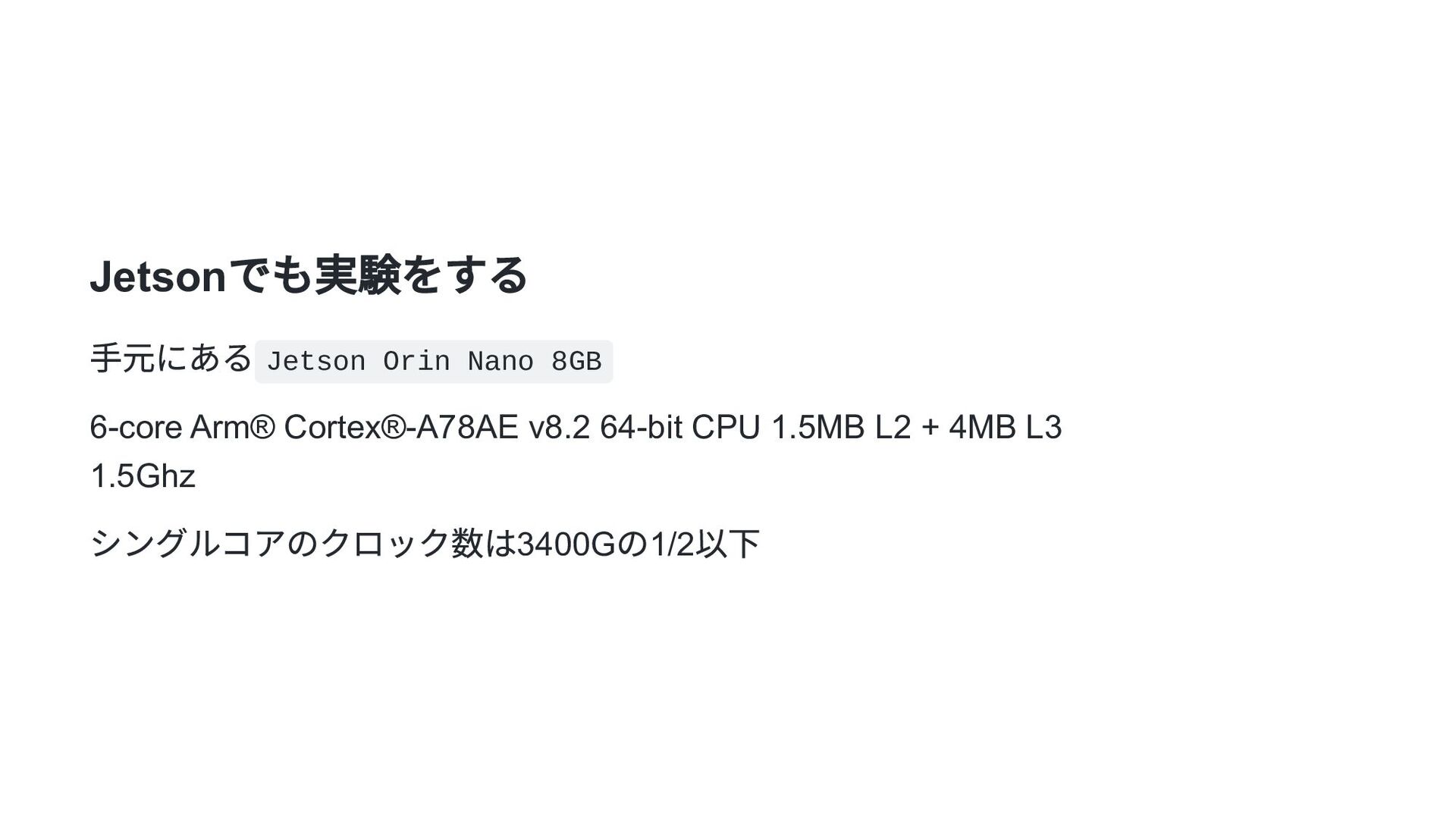
  18. Jetson でも実験をする 手元にある Jetson Orin Nano 8GB 6-core Arm® Cortex®-A78AE

    v8.2 64-bit CPU 1.5MB L2 + 4MB L3 1.5Ghz シングルコアのクロック数は3400G の1/2 以下
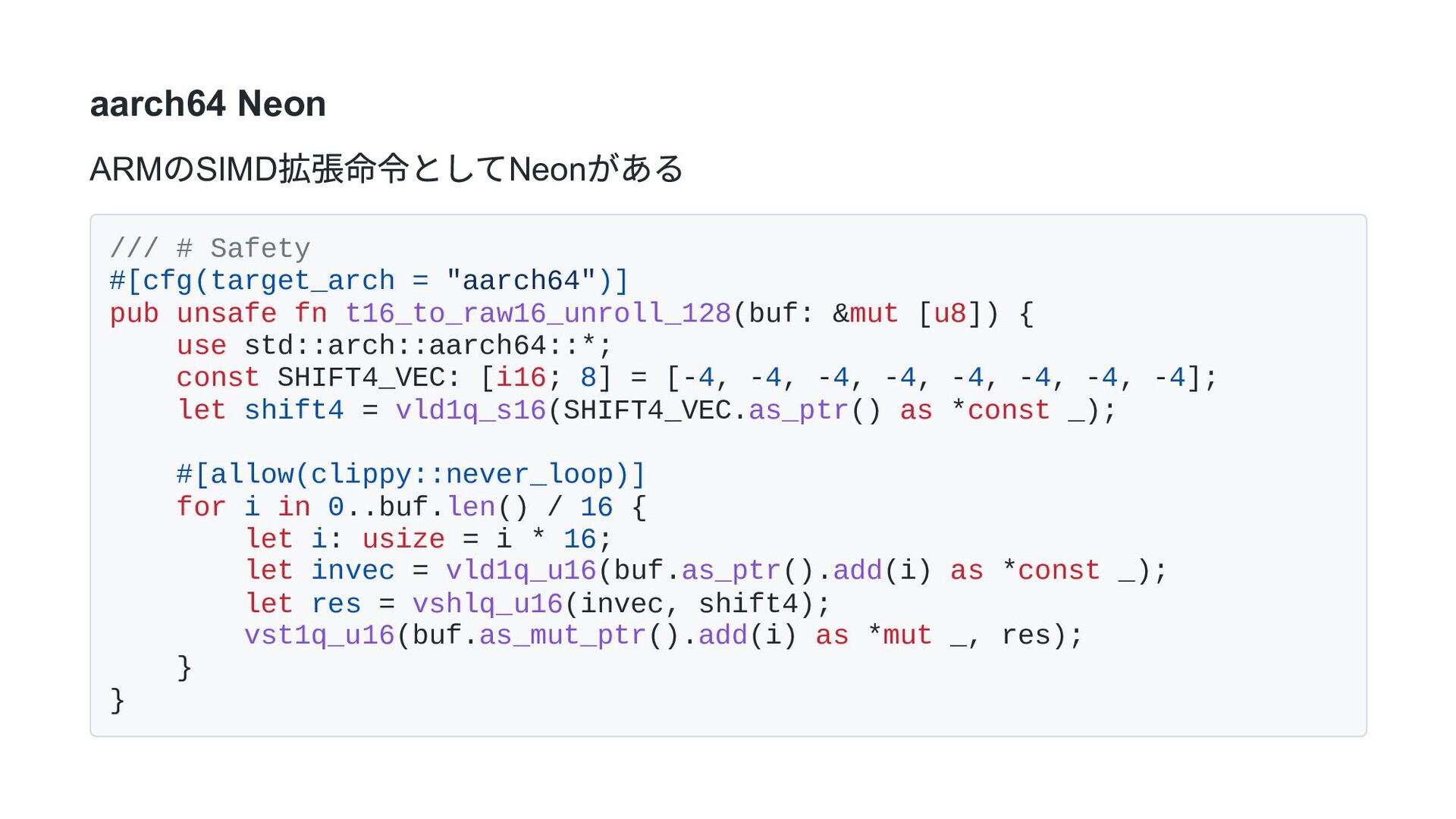
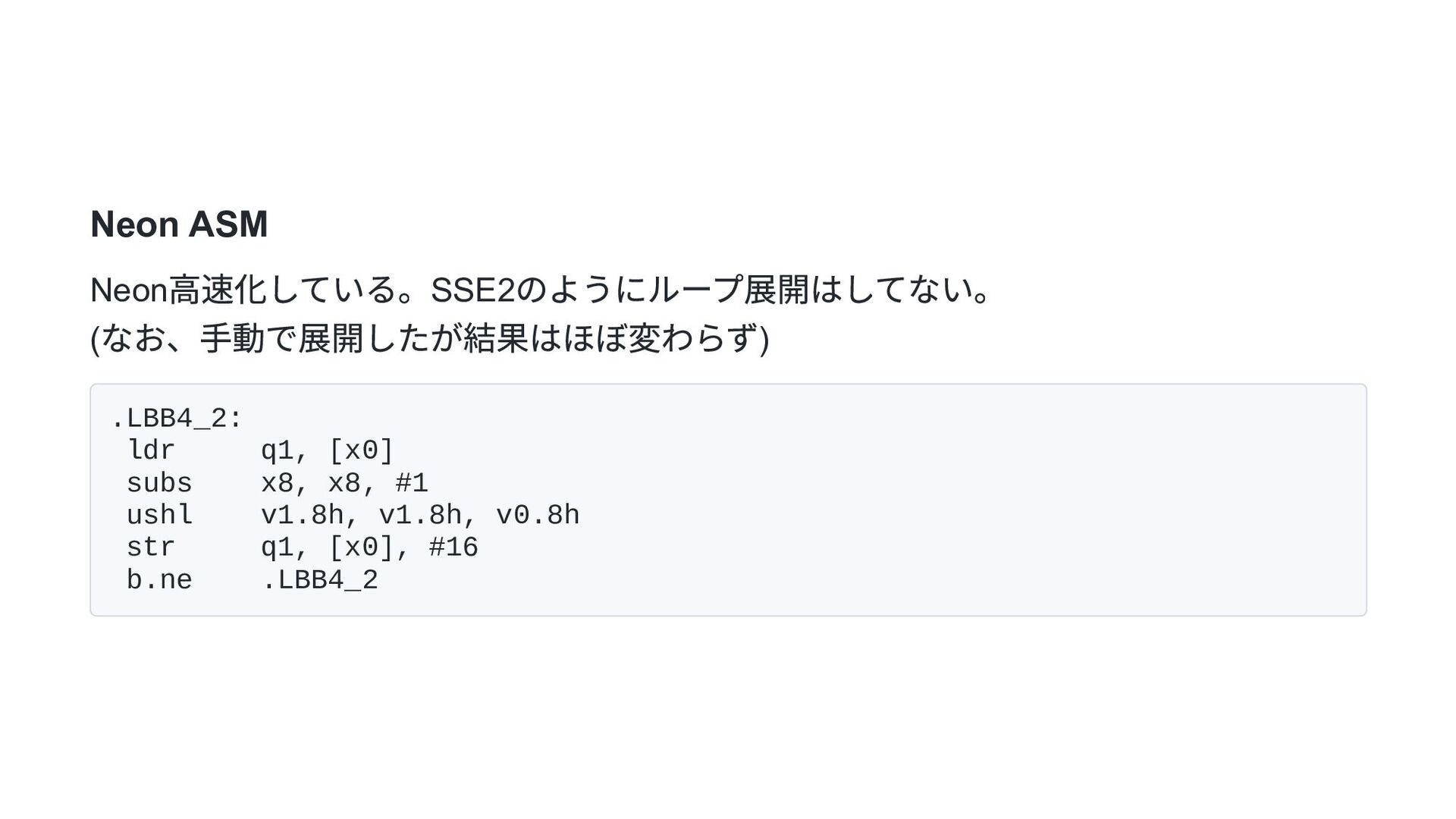
  19. aarch64 Neon ARM のSIMD 拡張命令としてNeon がある /// # Safety #[cfg(target_arch

    = "aarch64")] pub unsafe fn t16_to_raw16_unroll_128(buf: &mut [u8]) { use std::arch::aarch64::*; const SHIFT4_VEC: [i16; 8] = [-4, -4, -4, -4, -4, -4, -4, -4]; let shift4 = vld1q_s16(SHIFT4_VEC.as_ptr() as *const _); #[allow(clippy::never_loop)] for i in 0..buf.len() / 16 { let i: usize = i * 16; let invec = vld1q_u16(buf.as_ptr().add(i) as *const _); let res = vshlq_u16(invec, shift4); vst1q_u16(buf.as_mut_ptr().add(i) as *mut _, res); } }
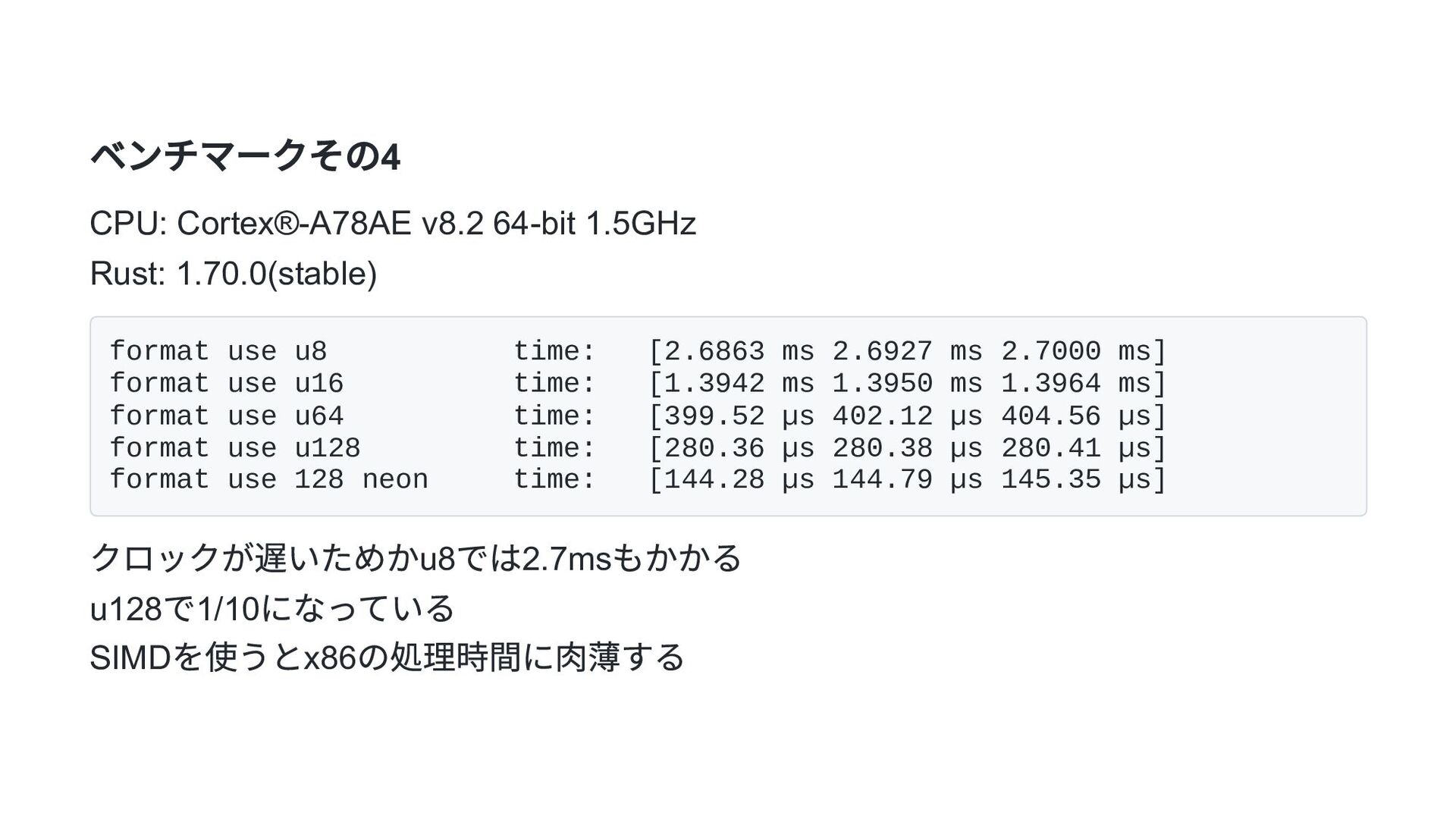
  20. ベンチマークその4 CPU: Cortex®-A78AE v8.2 64-bit 1.5GHz Rust: 1.70.0(stable) format use

    u8 time: [2.6863 ms 2.6927 ms 2.7000 ms] format use u16 time: [1.3942 ms 1.3950 ms 1.3964 ms] format use u64 time: [399.52 µs 402.12 µs 404.56 µs] format use u128 time: [280.36 µs 280.38 µs 280.41 µs] format use 128 neon time: [144.28 µs 144.79 µs 145.35 µs] クロックが遅いためかu8 では2.7ms もかかる u128 で1/10 になっている SIMD を使うとx86 の処理時間に肉薄する
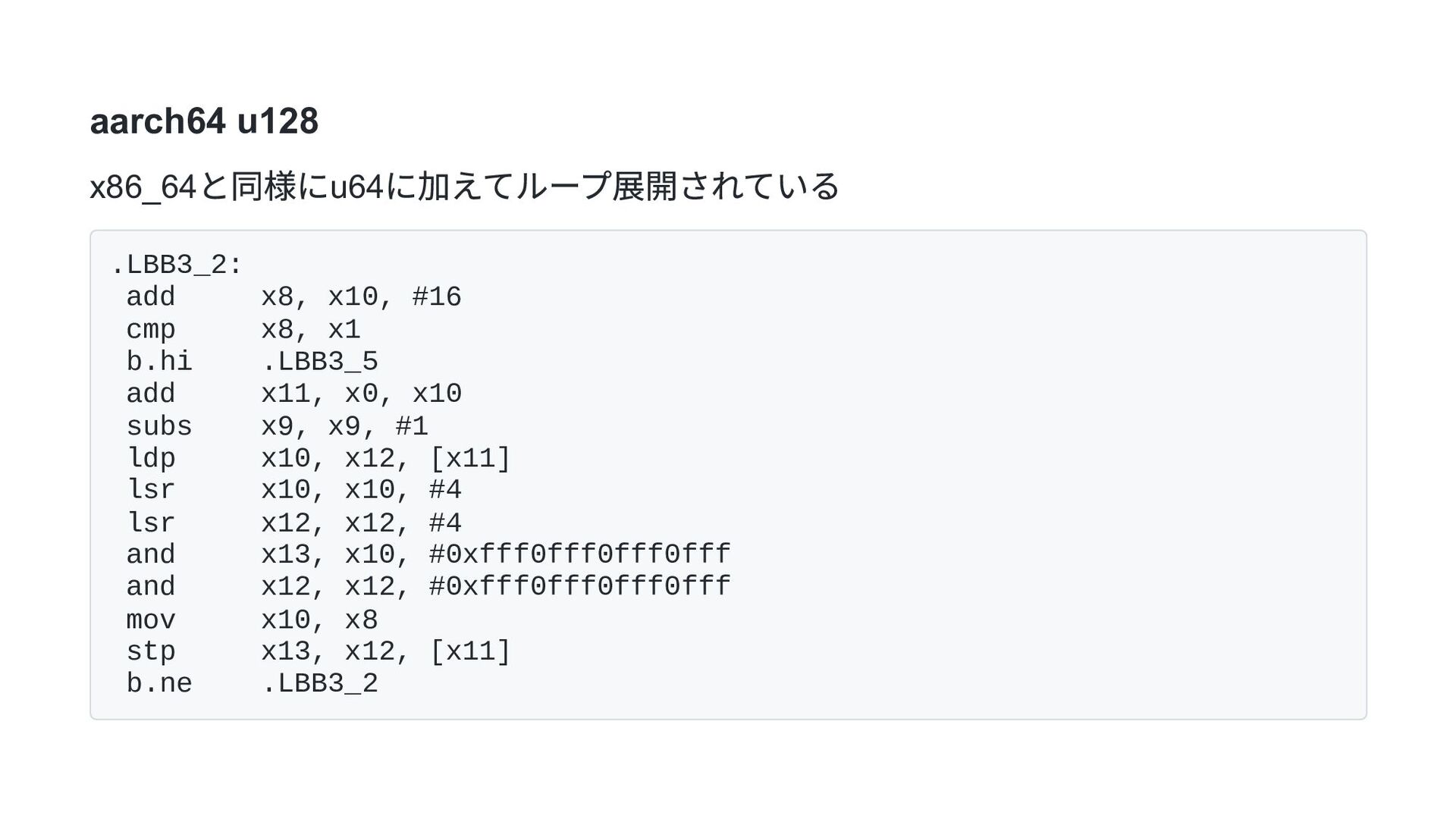
  21. aarch64 u128 x86_64 と同様にu64 に加えてループ展開されている .LBB3_2: add x8, x10, #16

    cmp x8, x1 b.hi .LBB3_5 add x11, x0, x10 subs x9, x9, #1 ldp x10, x12, [x11] lsr x10, x10, #4 lsr x12, x12, #4 and x13, x10, #0xfff0fff0fff0fff and x12, x12, #0xfff0fff0fff0fff mov x10, x8 stp x13, x12, [x11] b.ne .LBB3_2
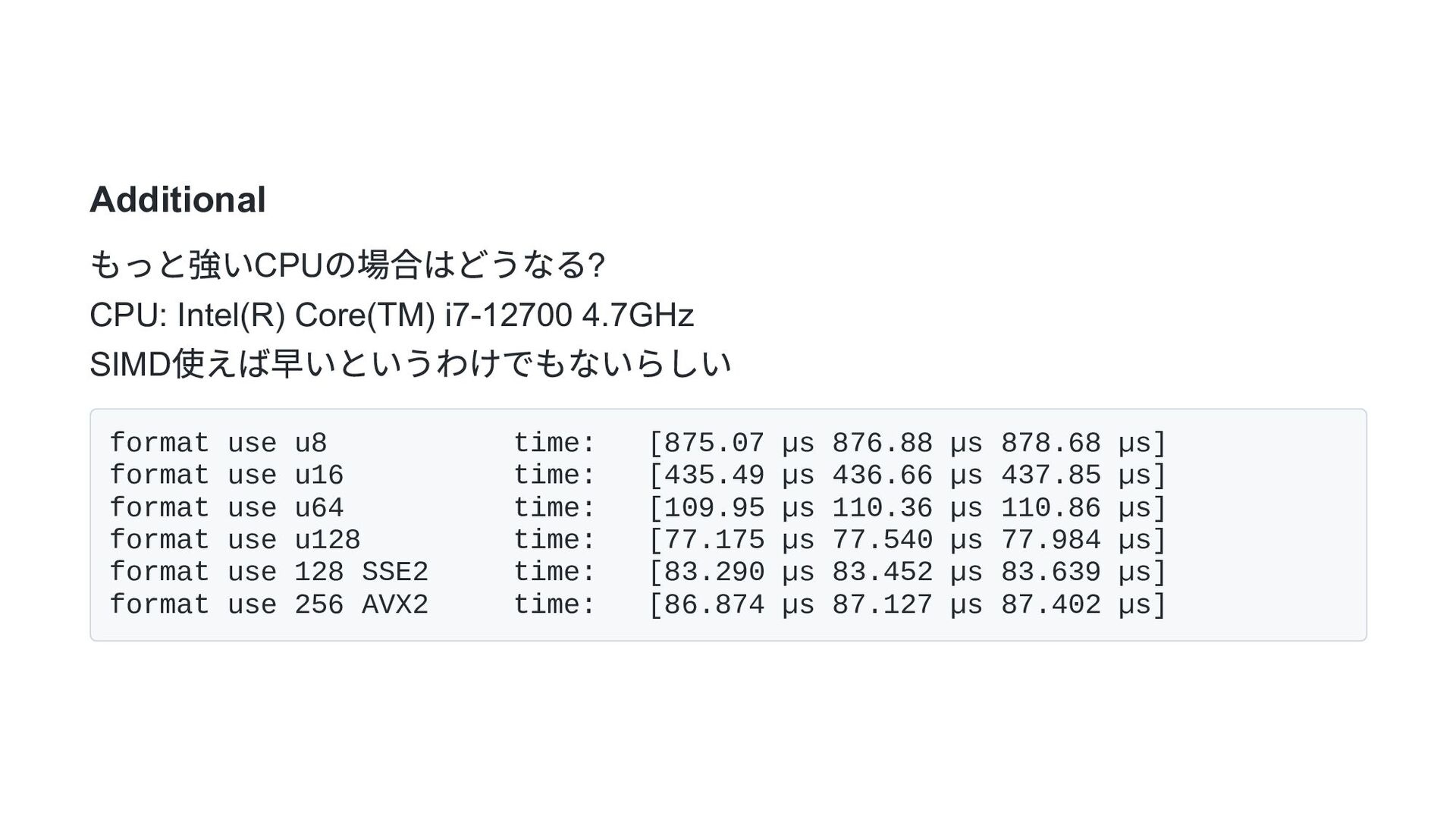
  22. Additional もっと強いCPU の場合はどうなる? CPU: Intel(R) Core(TM) i7-12700 4.7GHz SIMD 使えば早いというわけでもないらしい

    format use u8 time: [875.07 µs 876.88 µs 878.68 µs] format use u16 time: [435.49 µs 436.66 µs 437.85 µs] format use u64 time: [109.95 µs 110.36 µs 110.86 µs] format use u128 time: [77.175 µs 77.540 µs 77.984 µs] format use 128 SSE2 time: [83.290 µs 83.452 µs 83.639 µs] format use 256 AVX2 time: [86.874 µs 87.127 µs 87.402 µs]
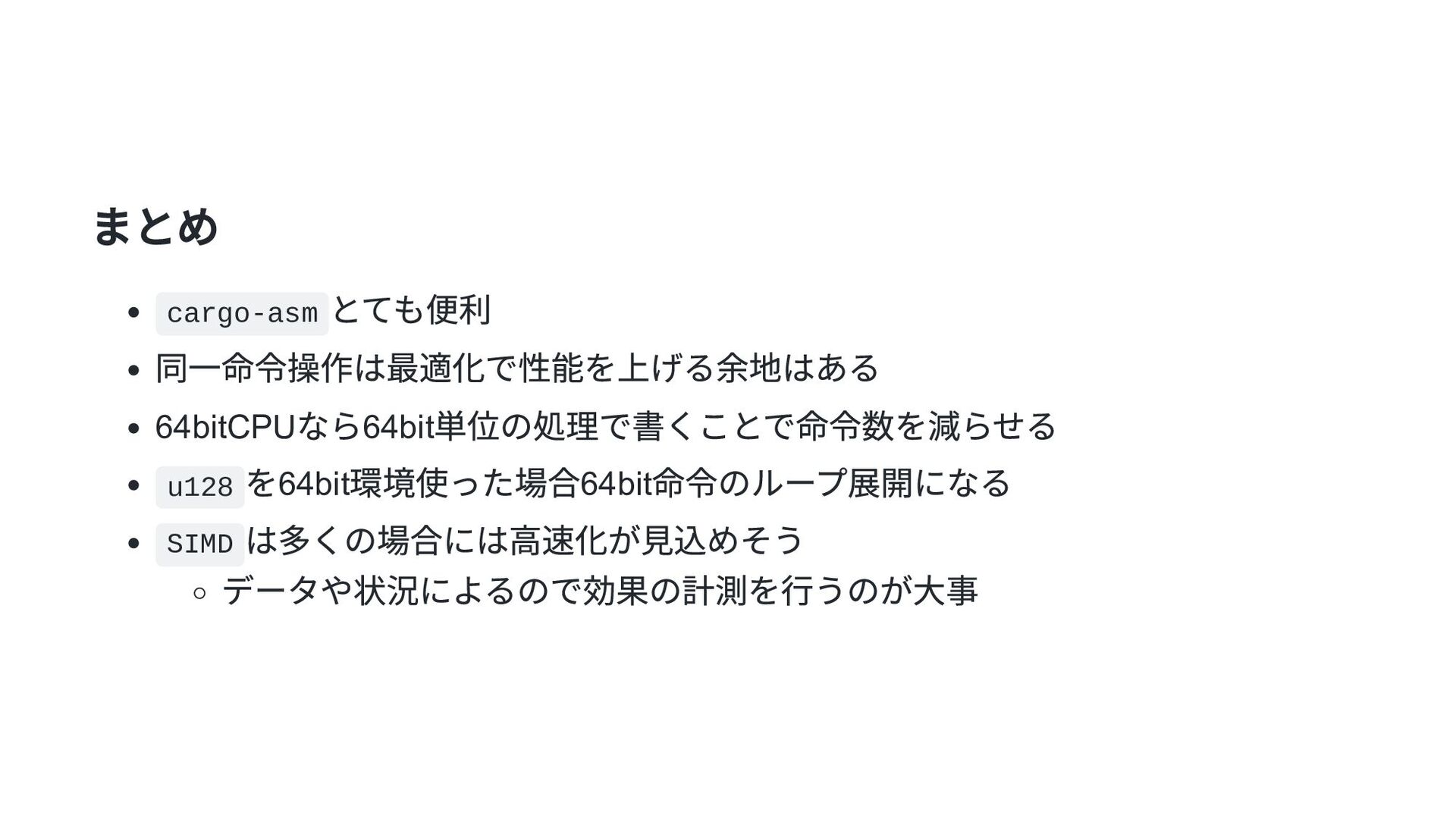
  23. まとめ cargo-asm とても便利 同一命令操作は最適化で性能を上げる余地はある 64bitCPU なら64bit 単位の処理で書くことで命令数を減らせる u128 を64bit 環境使った場合64bit

    命令のループ展開になる SIMD は多くの場合には高速化が見込めそう データや状況によるので効果の計測を行うのが大事