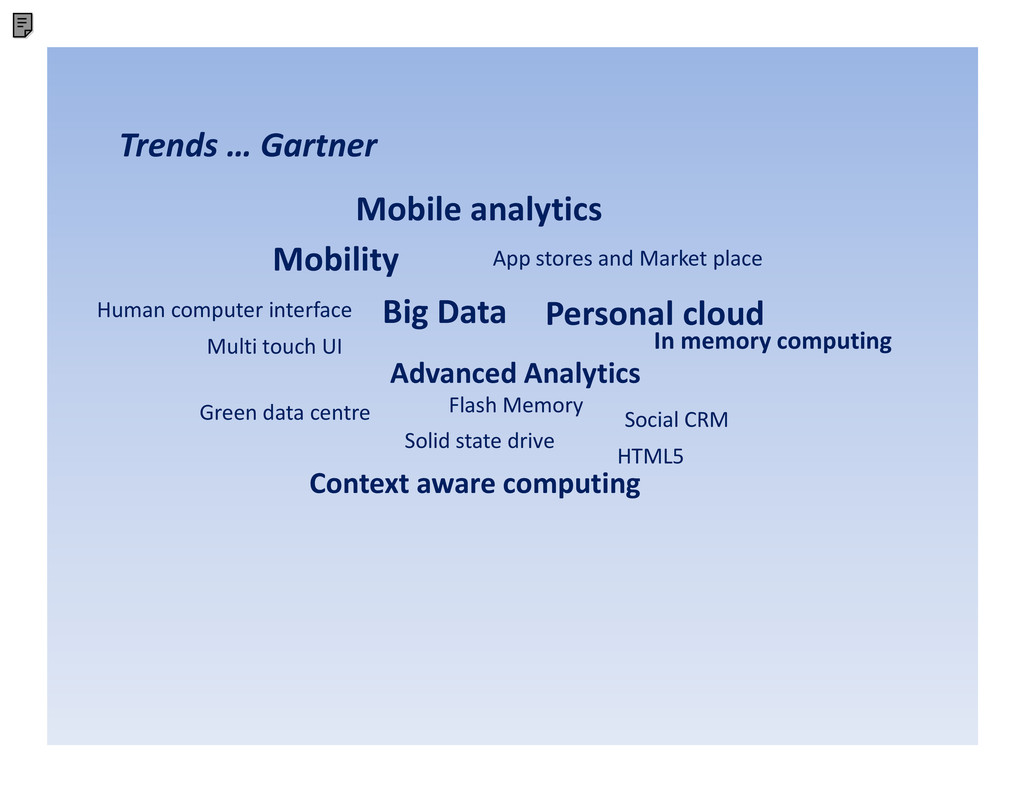
computer interface App stores and Market place Advanced Analytics In memory computing Flash Memory Mobile analytics Big Data Context aware computing Green data centre Solid state drive Flash Memory HTML5 Social CRM
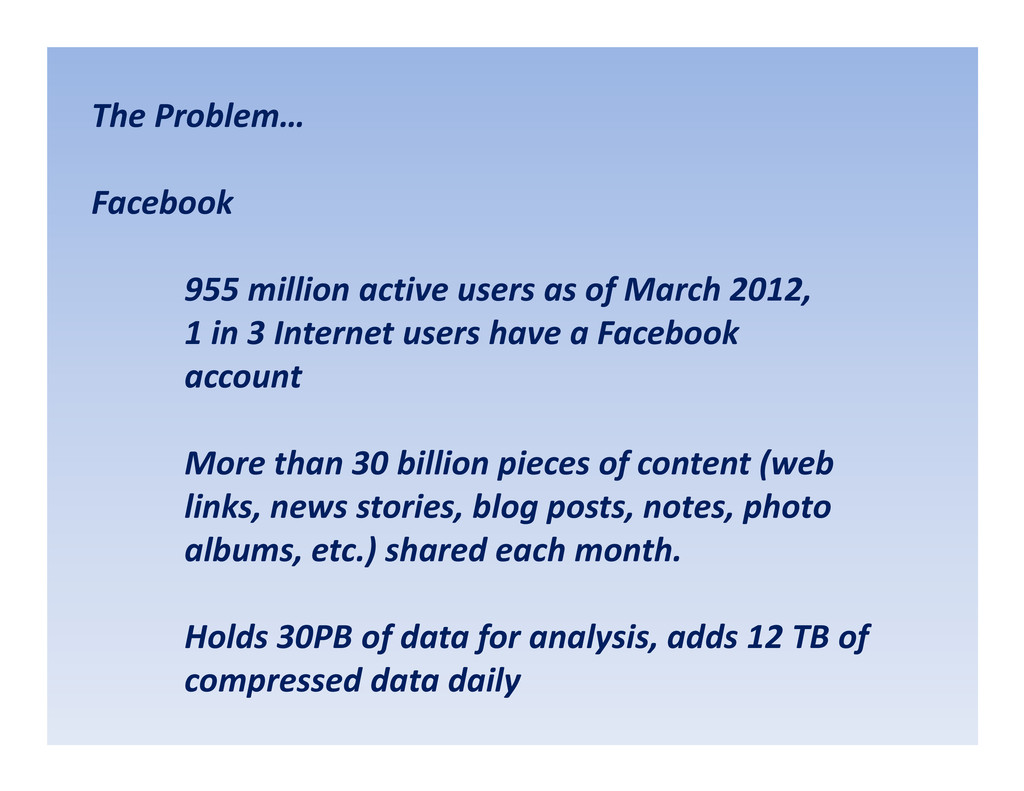
2012, 1 in 3 Internet users have a Facebook account More than 30 billion pieces of content (web links, news stories, blog posts, notes, photo albums, etc.) shared each month. Holds 30PB of data for analysis, adds 12 TB of compressed data daily
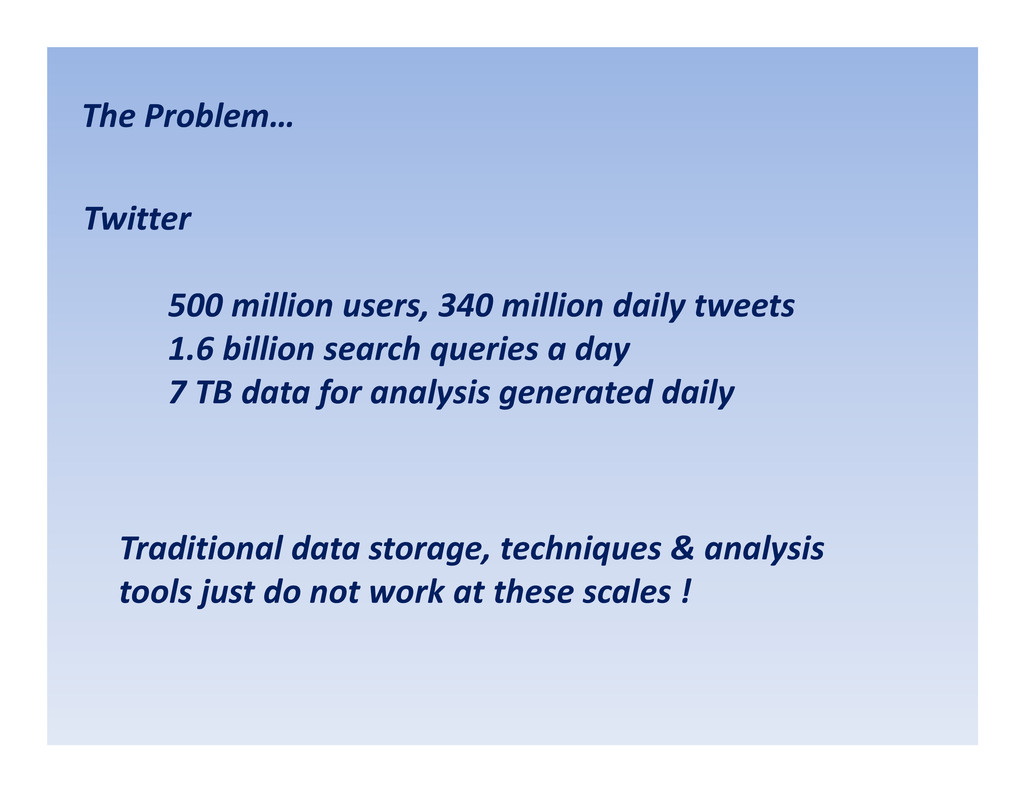
search queries a day 7 TB data for analysis generated daily The Problem… 7 TB data for analysis generated daily Traditional data storage, techniques & analysis tools just do not work at these scales !
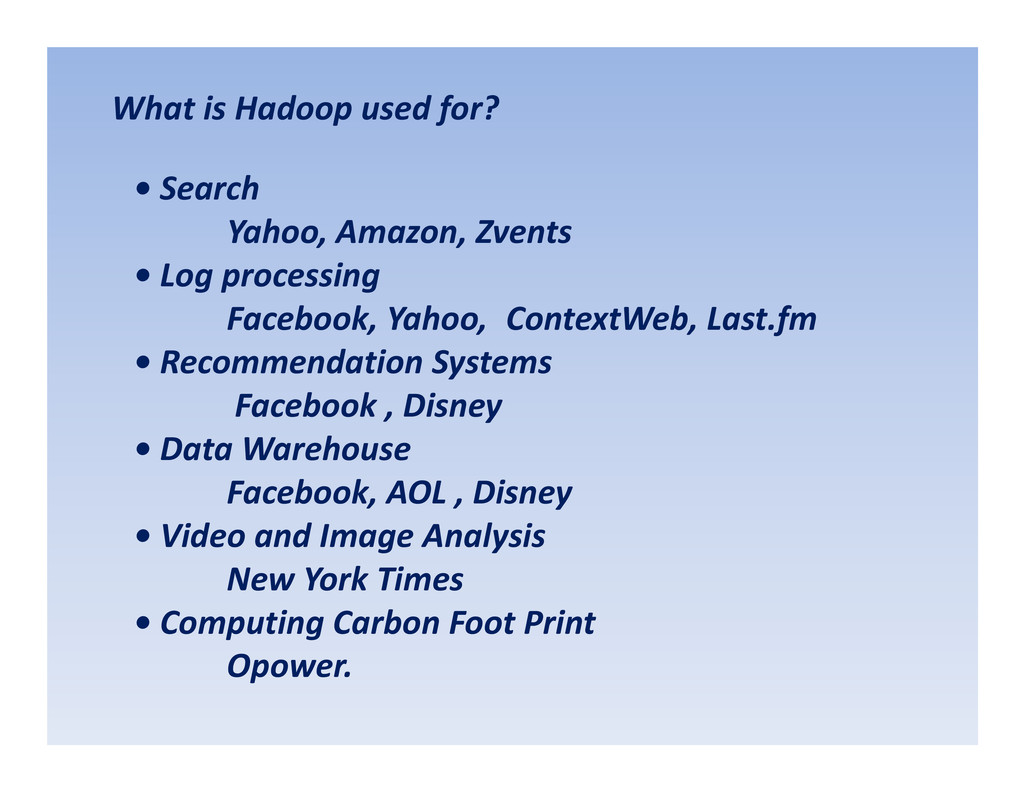
ContextWeb, Last.fm • Recommendation Systems Facebook , Disney What is Hadoop used for? Facebook , Disney • Data Warehouse Facebook, AOL , Disney • Video and Image Analysis New York Times • Computing Carbon Foot Print Opower.
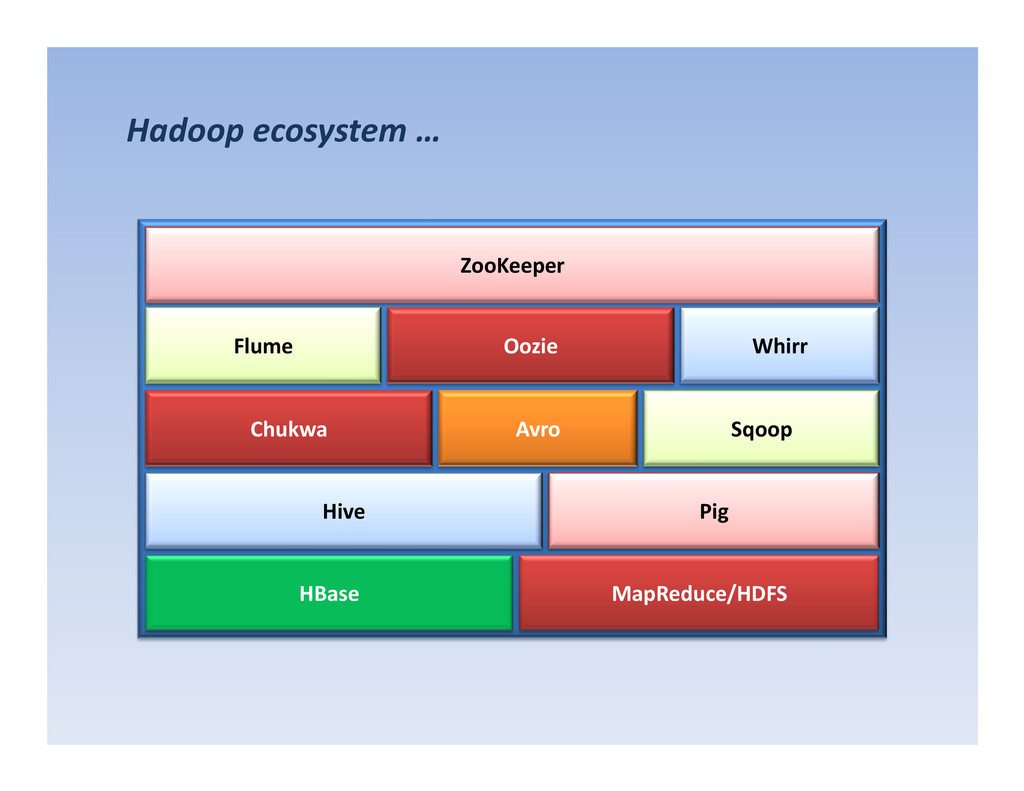
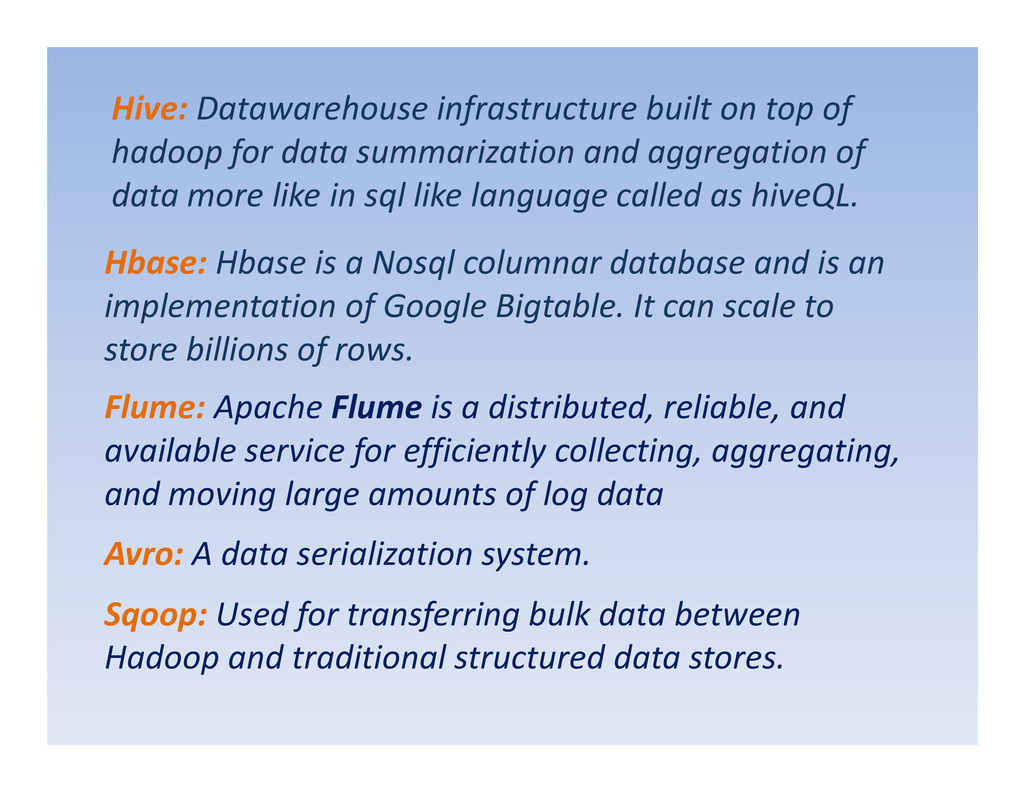
summarization and aggregation of data more like in sql like language called as hiveQL. Hbase: Hbase is a Nosql columnar database and is an implementation of Google Bigtable. It can scale to store billions of rows. Flume: Apache Flume is a distributed, reliable, and Flume: Apache Flume is a distributed, reliable, and available service for efficiently collecting, aggregating, and moving large amounts of log data Avro: A data serialization system. Sqoop: Used for transferring bulk data between Hadoop and traditional structured data stores.
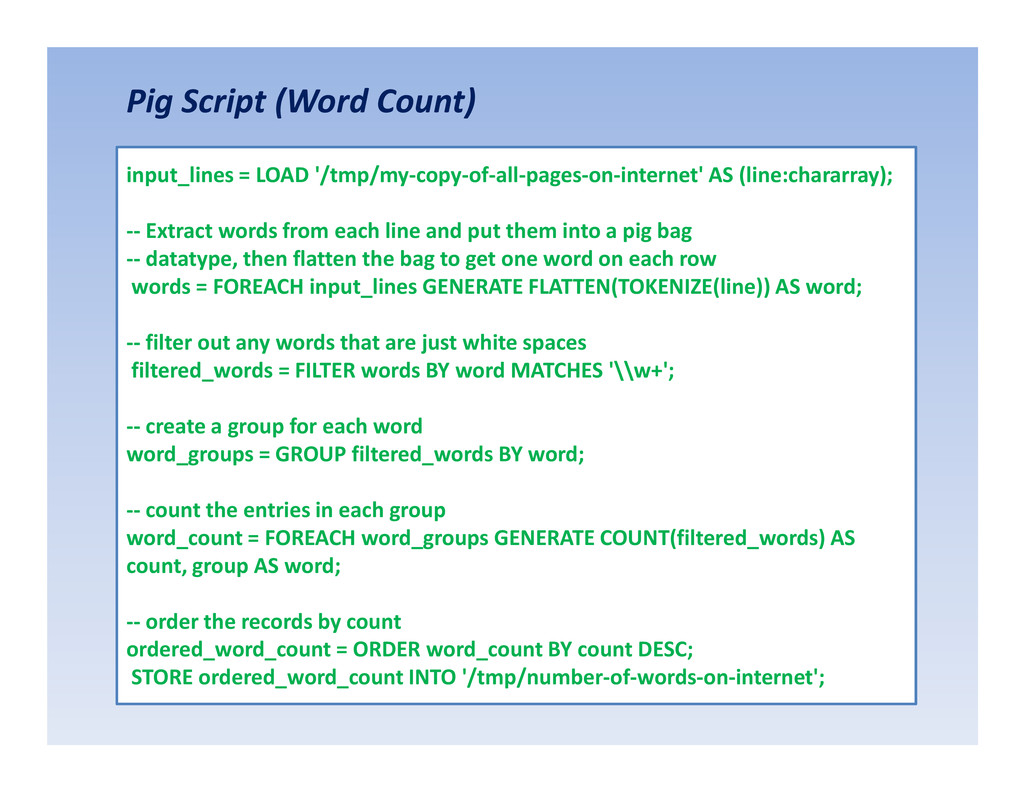
-- Extract words from each line and put them into a pig bag -- datatype, then flatten the bag to get one word on each row words = FOREACH input_lines GENERATE FLATTEN(TOKENIZE(line)) AS word; -- filter out any words that are just white spaces filtered_words = FILTER words BY word MATCHES '\\w+'; -- create a group for each word word_groups = GROUP filtered_words BY word; -- count the entries in each group word_count = FOREACH word_groups GENERATE COUNT(filtered_words) AS count, group AS word; -- order the records by count ordered_word_count = ORDER word_count BY count DESC; STORE ordered_word_count INTO '/tmp/number-of-words-on-internet';
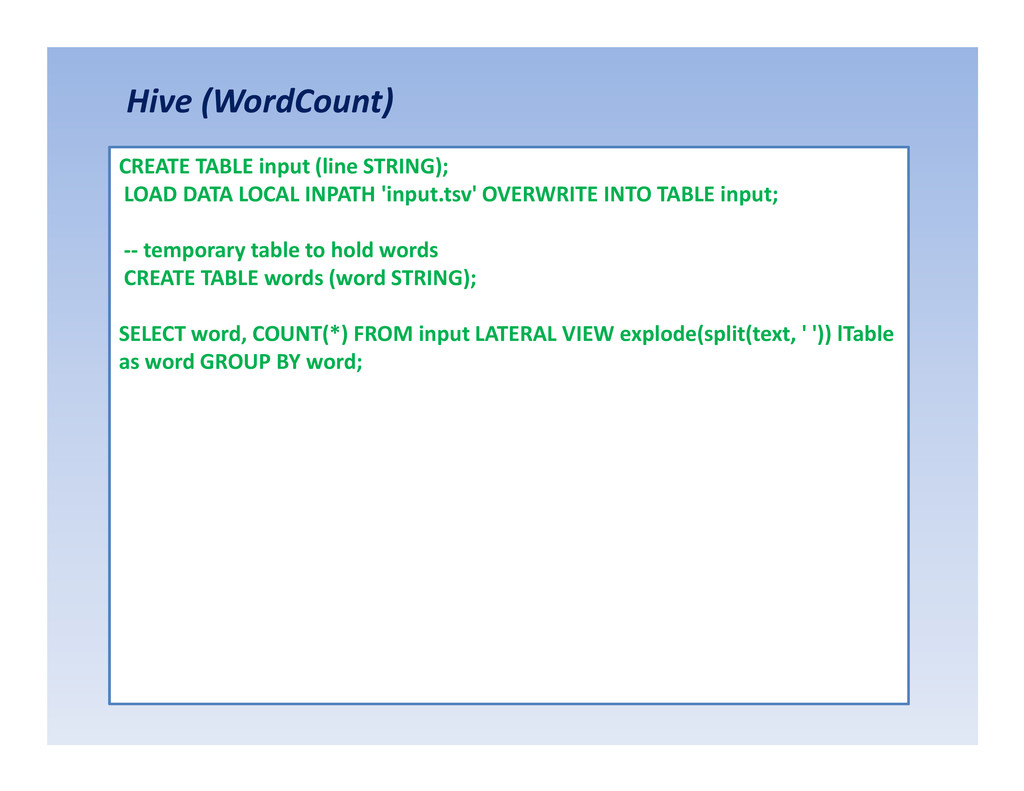
INPATH 'input.tsv' OVERWRITE INTO TABLE input; -- temporary table to hold words CREATE TABLE words (word STRING); SELECT word, COUNT(*) FROM input LATERAL VIEW explode(split(text, ' ')) lTable as word GROUP BY word;
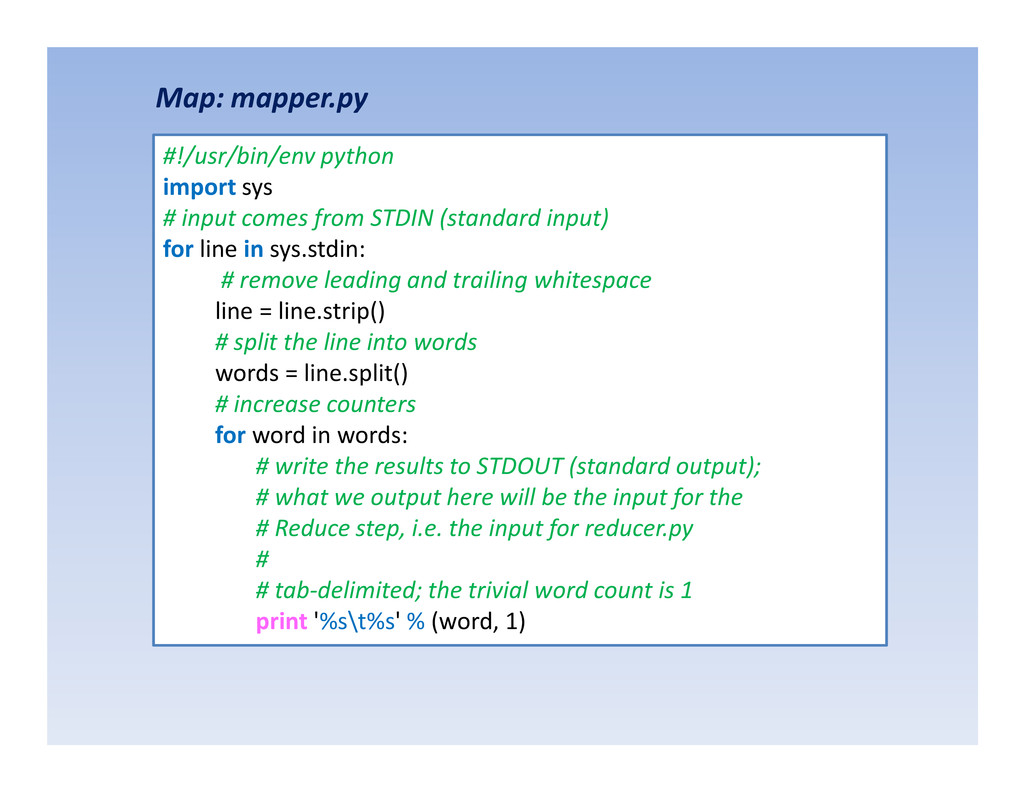
input) for line in sys.stdin: # remove leading and trailing whitespace line = line.strip() # split the line into words words = line.split() # increase counters Map: mapper.py # increase counters for word in words: # write the results to STDOUT (standard output); # what we output here will be the input for the # Reduce step, i.e. the input for reducer.py # # tab-delimited; the trivial word count is 1 print '%s\t%s' % (word, 1)
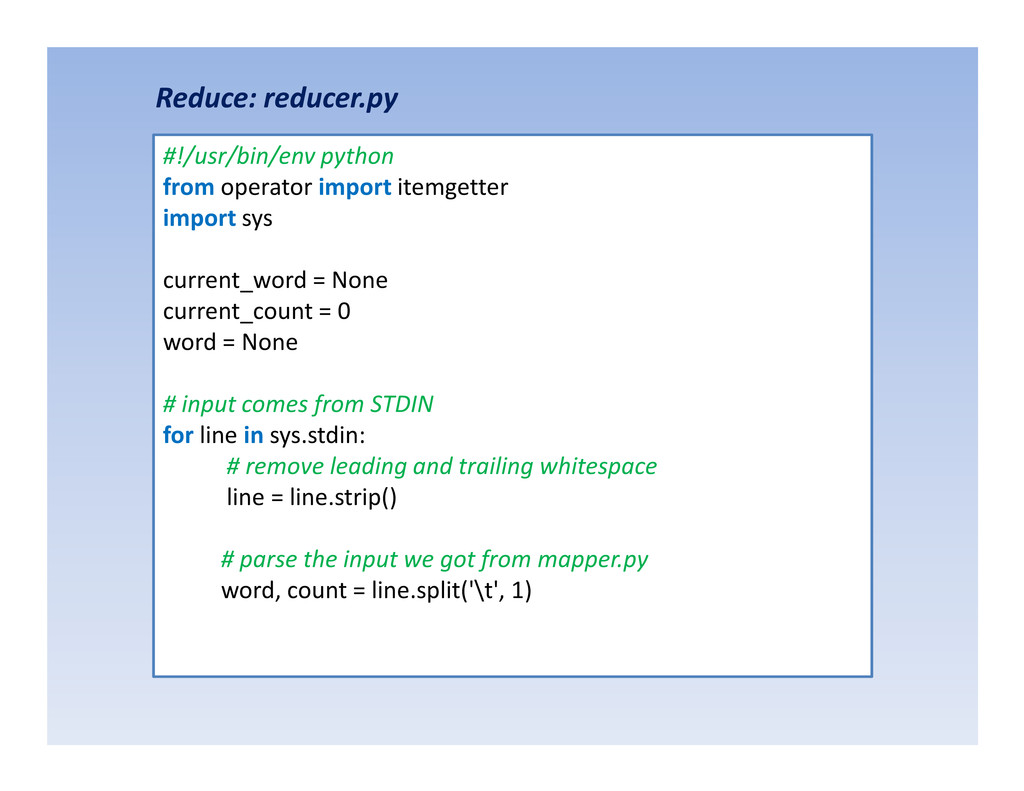
None current_count = 0 word = None # input comes from STDIN Reduce: reducer.py # input comes from STDIN for line in sys.stdin: # remove leading and trailing whitespace line = line.strip() # parse the input we got from mapper.py word, count = line.split('\t', 1)
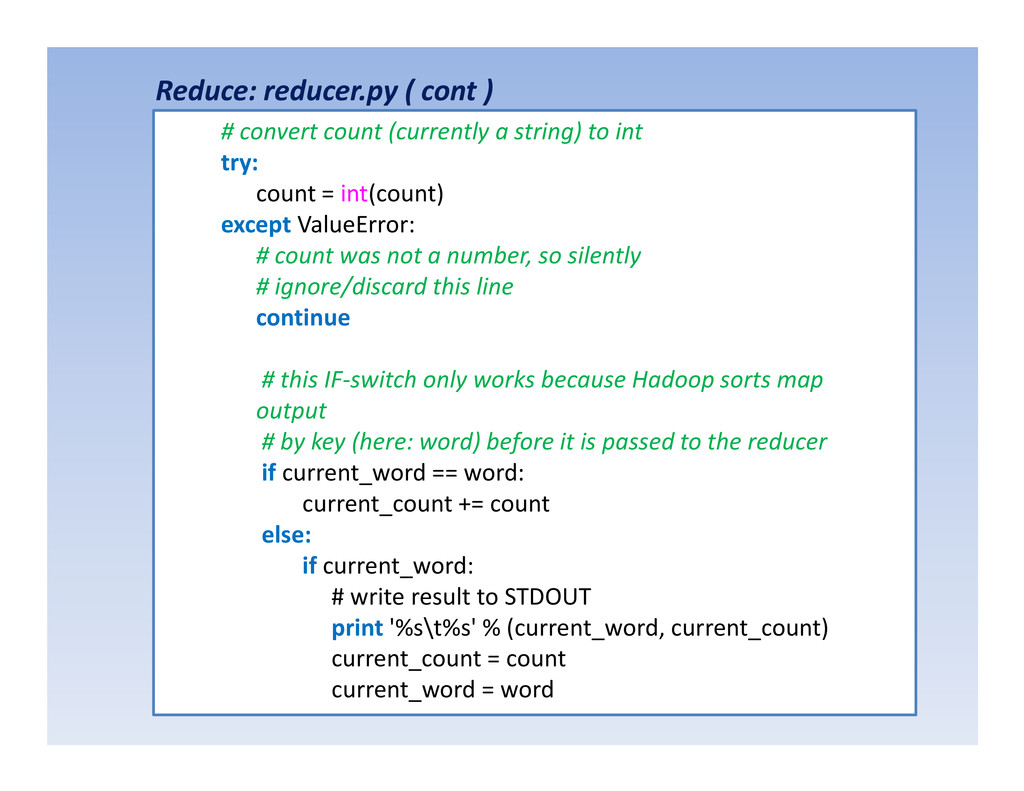
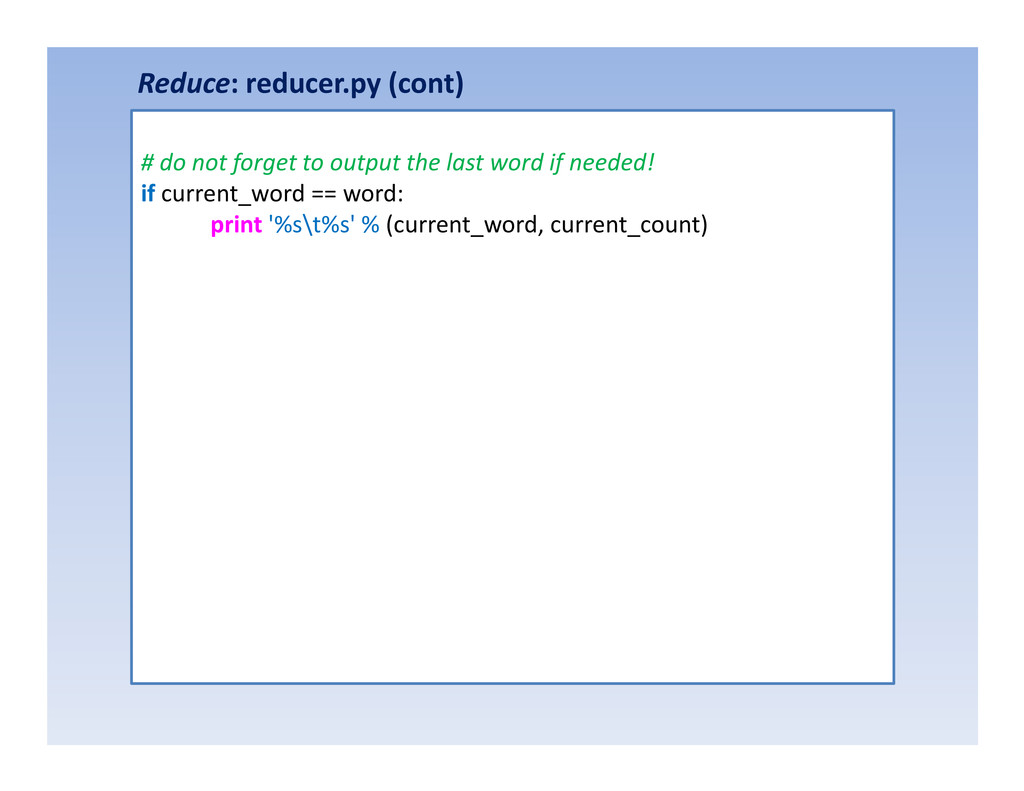
= int(count) except ValueError: # count was not a number, so silently # ignore/discard this line continue # this IF-switch only works because Hadoop sorts map output Reduce: reducer.py ( cont ) output # by key (here: word) before it is passed to the reducer if current_word == word: current_count += count else: if current_word: # write result to STDOUT print '%s\t%s' % (current_word, current_count) current_count = count current_word = word


 kairim0
 mhrtech
 occhi
 rfdnxbro
 kenichiodo
 grimoh
 takanorip
 jozono
 kash1064
 ezaki
 tetsuya28
 4o1sobblue
 brettharned
 techseoconnect
 aleyda
 mojombo
 inesmontani
 apolaine
 garrettdimon
 marktimemedia
 mayatellez
 nonsquared
 jct