Upgrade to Pro — share decks privately, control downloads, hide ads and more …

PLANT PATHOLOGY (BACTERIAL , VIRAL )

PLANT PATHOLOGY (BACTERIAL , VIRAL )

Bacterial diseases are plant diseases caused by pathogenic bacteria. These bacteria invade plant tissues through natural openings such as stomata, hydathodes, lenticels, or through wounds. They multiply rapidly under warm and humid conditions and interfere with normal plant growth and development.
Bacterial diseases affect various parts of plants including leaves, stems, fruits, roots and vascular tissues. Common symptoms include leaf spots, blights, wilting, cankers, galls, rots and chlorosis. These diseases can reduce crop yield, quality and market value, causing significant economic losses.
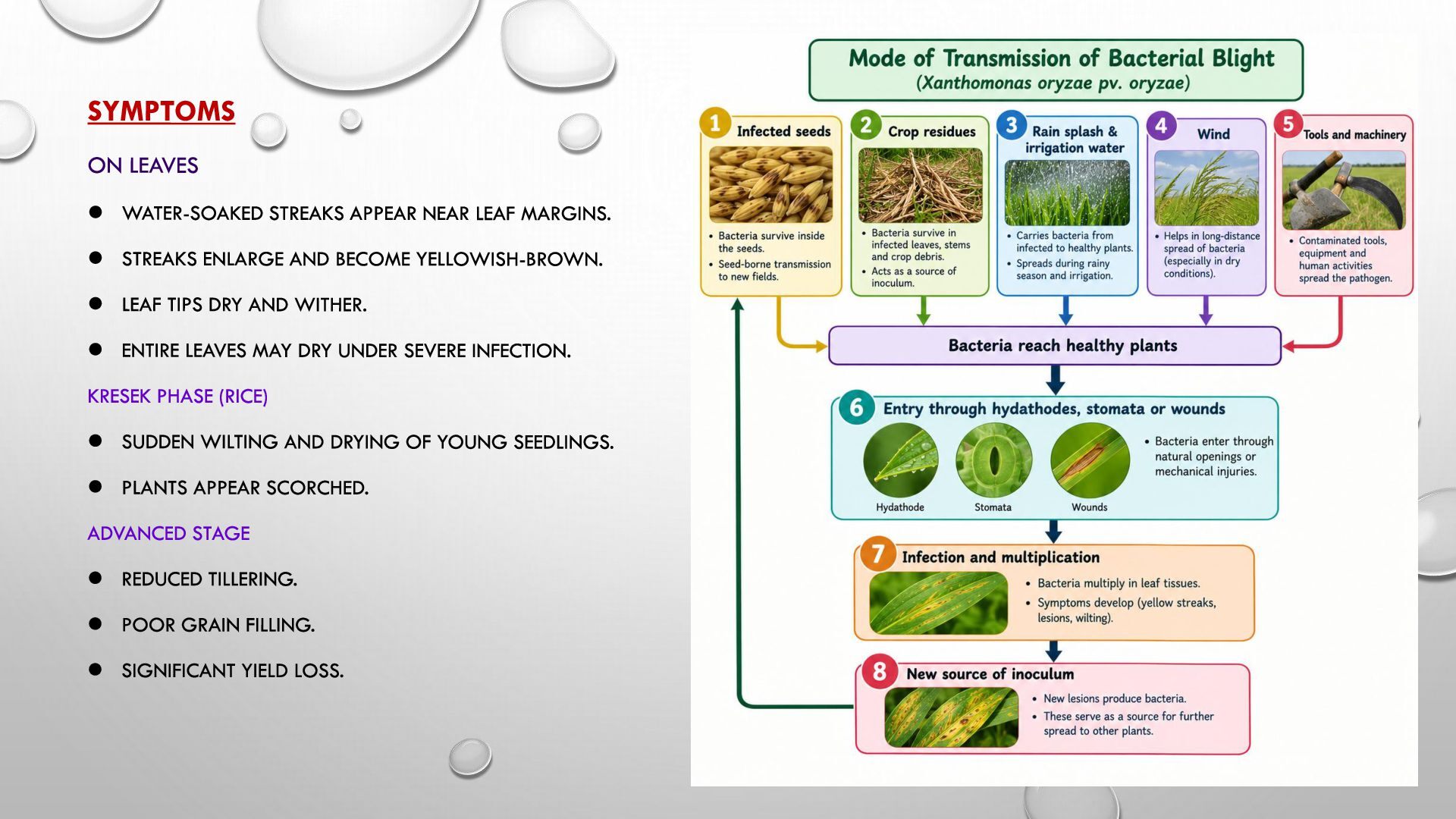
The spread of bacterial pathogens occurs through infected seeds, planting materials, rain splash, irrigation water, insects, contaminated tools and human activities
Characteristics of Bacterial Plant Diseases
Caused by pathogenic bacteria.
Favored by high humidity and moderate temperatures.
Spread through water, wind, insects and contaminated equipment.
Produce symptoms such as cankers, blights, wilts and leaf spots.
Cause severe yield and quality losses in crops.
Examples
Citrus Canker – Xanthomonas citri
Bacterial Blight – Xanthomonas spp.

Avatar for Dr. Vimal Priya Subramanian

Dr. Vimal Priya Subramanian

October 12, 2026

More Decks by Dr. Vimal Priya Subramanian

Other Decks in Education

Transcript

  1. PLANT PATHOLOGY (BACTERIAL , VIRAL ) Submitted by NAME: K

    . SELVA MOULISHA ROLL NUMBER:P26BO012 CLASS :I M.Sc Botany Submitted to Dr. S.VIMAL PRIYA M.Sc.,PGDBD., Ph.D Assistant Professor, Department of Botany BHARATHIYAR ARTS AND SCIENCE COLLEGE FOR WOMEN (AUTONOMOUS), DEVIYAKURICHI, SALEM. DATE: 03.10.2026
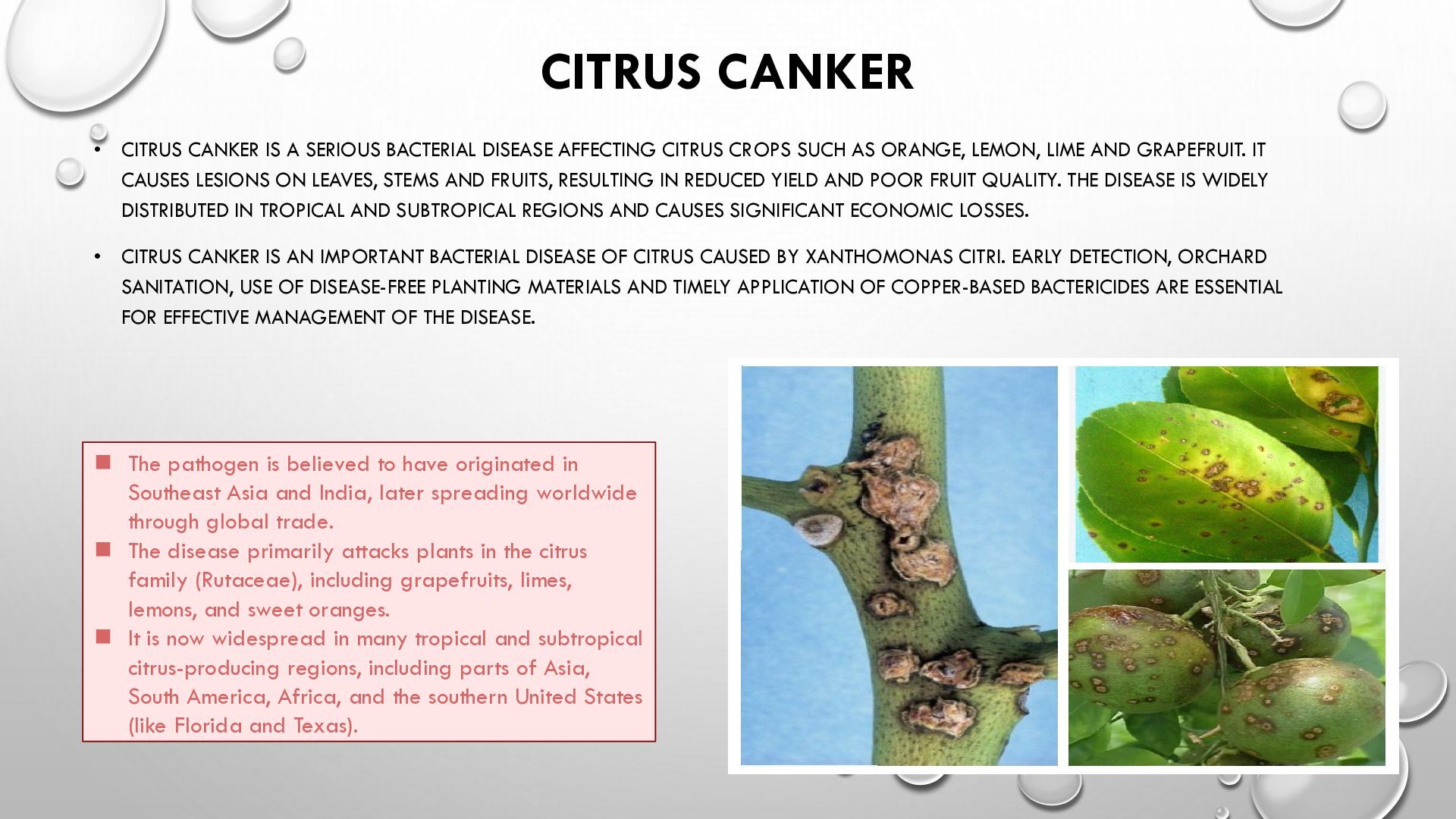
  2. CITRUS CANKER • CITRUS CANKER IS A SERIOUS BACTERIAL DISEASE

    AFFECTING CITRUS CROPS SUCH AS ORANGE, LEMON, LIME AND GRAPEFRUIT. IT CAUSES LESIONS ON LEAVES, STEMS AND FRUITS, RESULTING IN REDUCED YIELD AND POOR FRUIT QUALITY. THE DISEASE IS WIDELY DISTRIBUTED IN TROPICAL AND SUBTROPICAL REGIONS AND CAUSES SIGNIFICANT ECONOMIC LOSSES. • CITRUS CANKER IS AN IMPORTANT BACTERIAL DISEASE OF CITRUS CAUSED BY XANTHOMONAS CITRI. EARLY DETECTION, ORCHARD SANITATION, USE OF DISEASE-FREE PLANTING MATERIALS AND TIMELY APPLICATION OF COPPER-BASED BACTERICIDES ARE ESSENTIAL FOR EFFECTIVE MANAGEMENT OF THE DISEASE.  The pathogen is believed to have originated in Southeast Asia and India, later spreading worldwide through global trade.  The disease primarily attacks plants in the citrus family (Rutaceae), including grapefruits, limes, lemons, and sweet oranges.  It is now widespread in many tropical and subtropical citrus-producing regions, including parts of Asia, South America, Africa, and the southern United States (like Florida and Texas).
  3. Symptoms On Leaves Small water-soaked spots appear on leaves. Spots

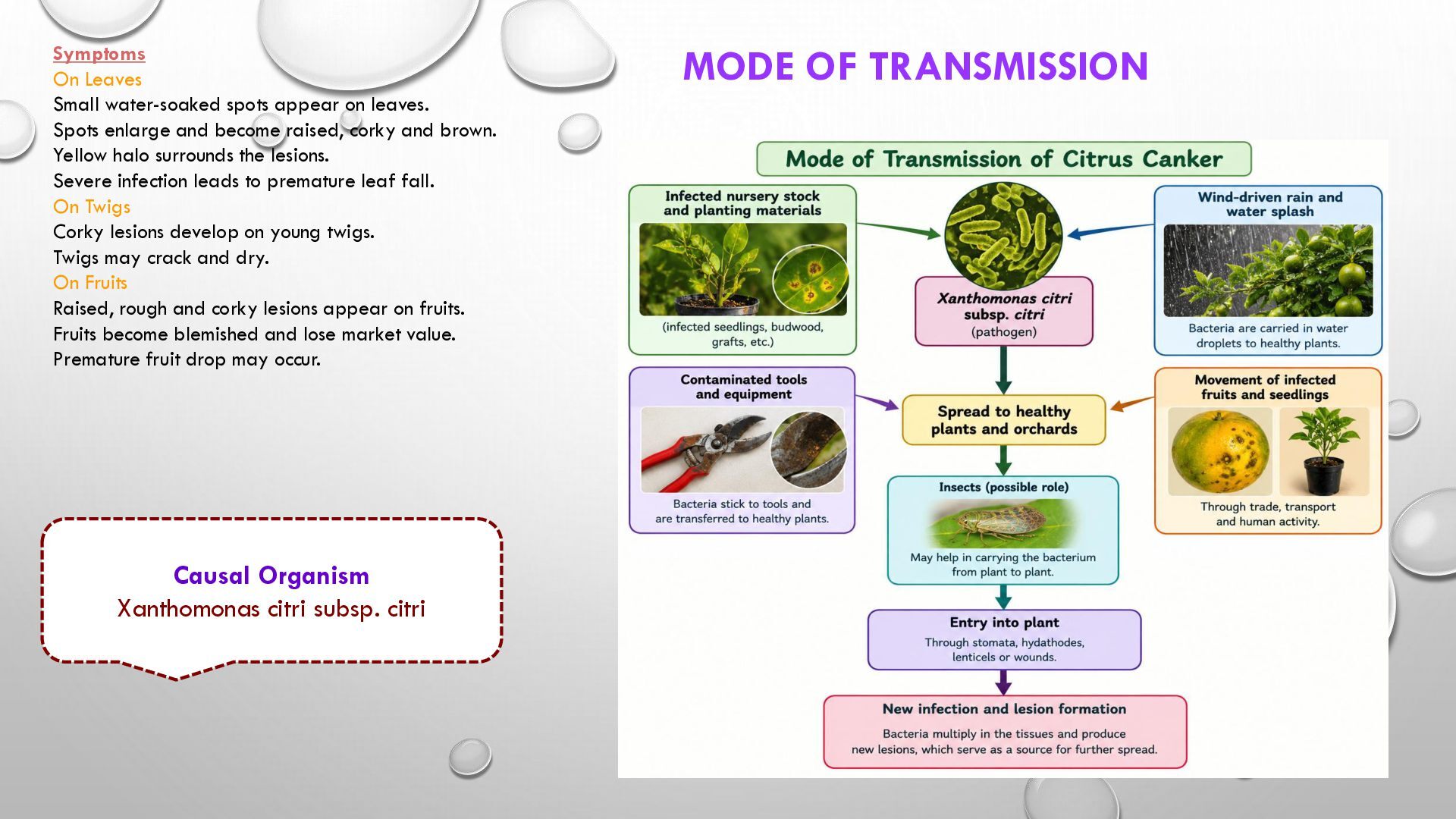
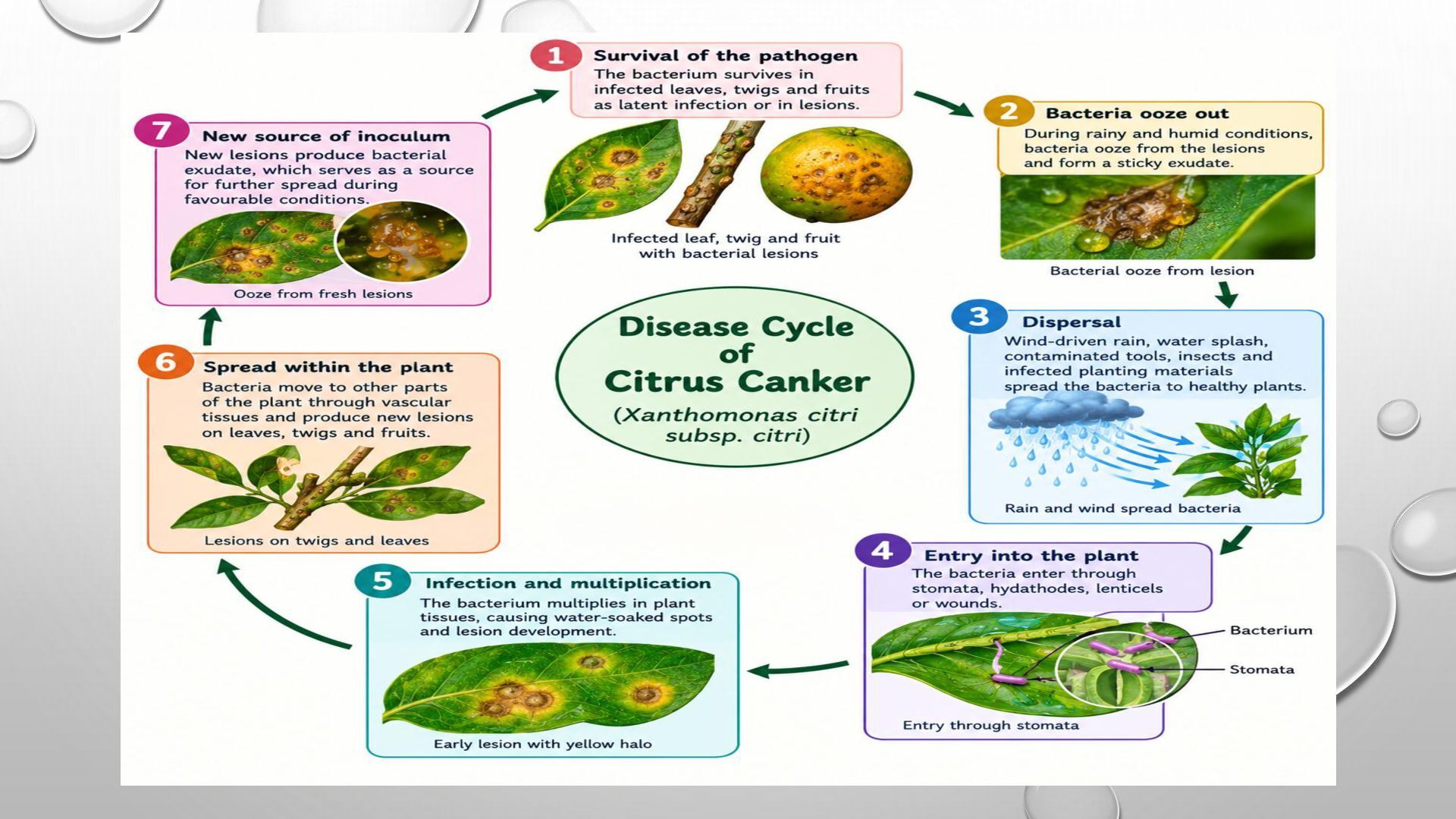
    enlarge and become raised, corky and brown. Yellow halo surrounds the lesions. Severe infection leads to premature leaf fall. On Twigs Corky lesions develop on young twigs. Twigs may crack and dry. On Fruits Raised, rough and corky lesions appear on fruits. Fruits become blemished and lose market value. Premature fruit drop may occur. Causal Organism Xanthomonas citri subsp. citri MODE OF TRANSMISSION
  4. Disease Management and Control Cultural Methods  Use disease-free nursery

    plants.  Remove and destroy infected plant parts.  Maintain orchard sanitation.  Establish windbreaks around orchards. Chemical Control  Spray Bordeaux mixture (1%).  Apply copper oxychloride or other copper-based bactericides.  Repeat sprays during rainy seasons. Resistant Varieties  Cultivate tolerant or resistant citrus varieties whenever available.  Quarantine Measures  Restrict movement of infected planting materials.  Follow plant quarantine regulations. Economic Importance  Causes severe reduction in fruit yield.  Lowers fruit quality and market value.  Leads to premature leaf and fruit drop.  Increases production costs due to control measures.  Causes major economic losses in citrus-growing regions.
  5. BACTERIAL BLIGHT  Bacterial blight is an important bacterial disease

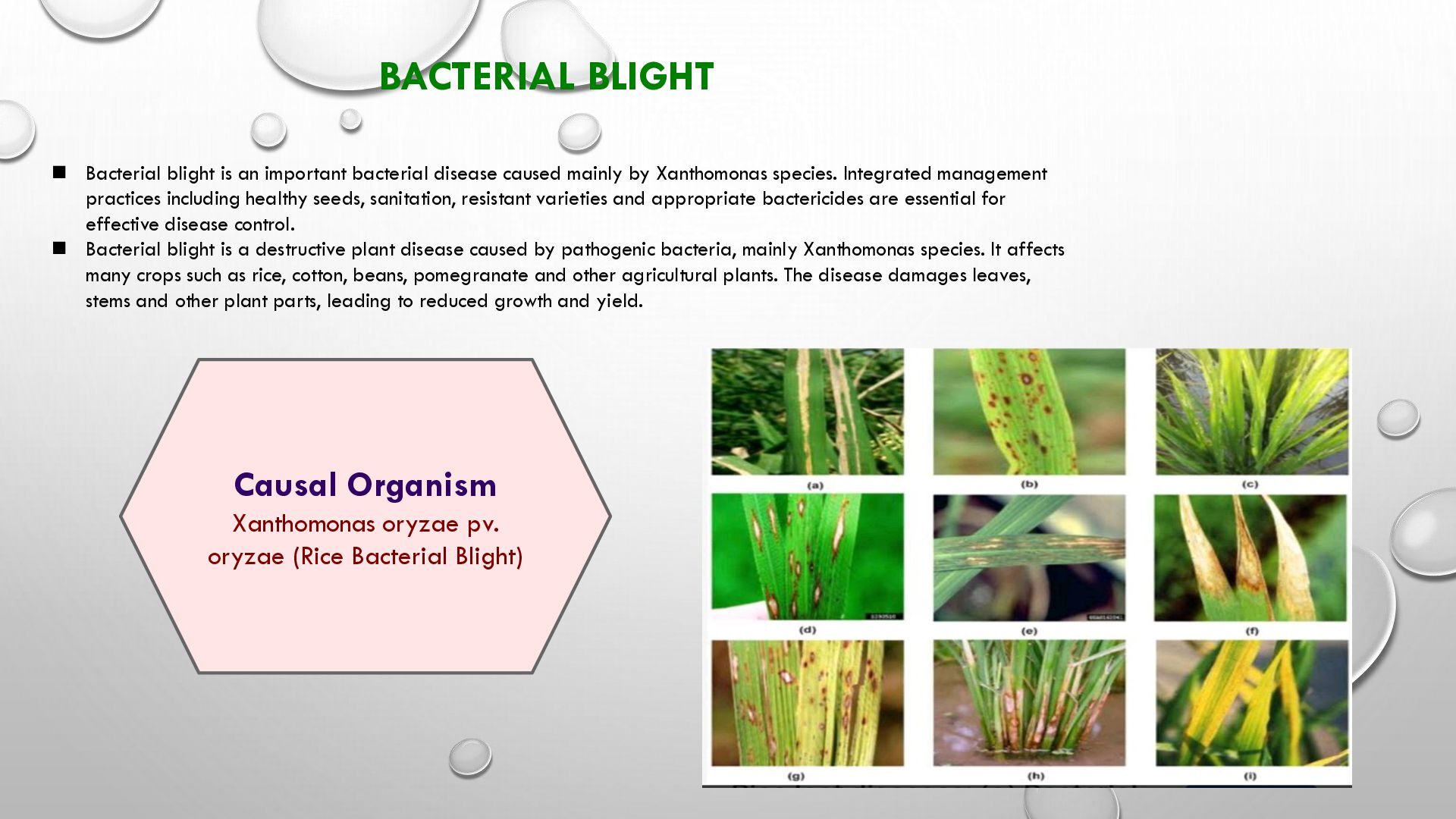
    caused mainly by Xanthomonas species. Integrated management practices including healthy seeds, sanitation, resistant varieties and appropriate bactericides are essential for effective disease control.  Bacterial blight is a destructive plant disease caused by pathogenic bacteria, mainly Xanthomonas species. It affects many crops such as rice, cotton, beans, pomegranate and other agricultural plants. The disease damages leaves, stems and other plant parts, leading to reduced growth and yield. Causal Organism Xanthomonas oryzae pv. oryzae (Rice Bacterial Blight)
  6. Disease Management and Control Cultural Control    

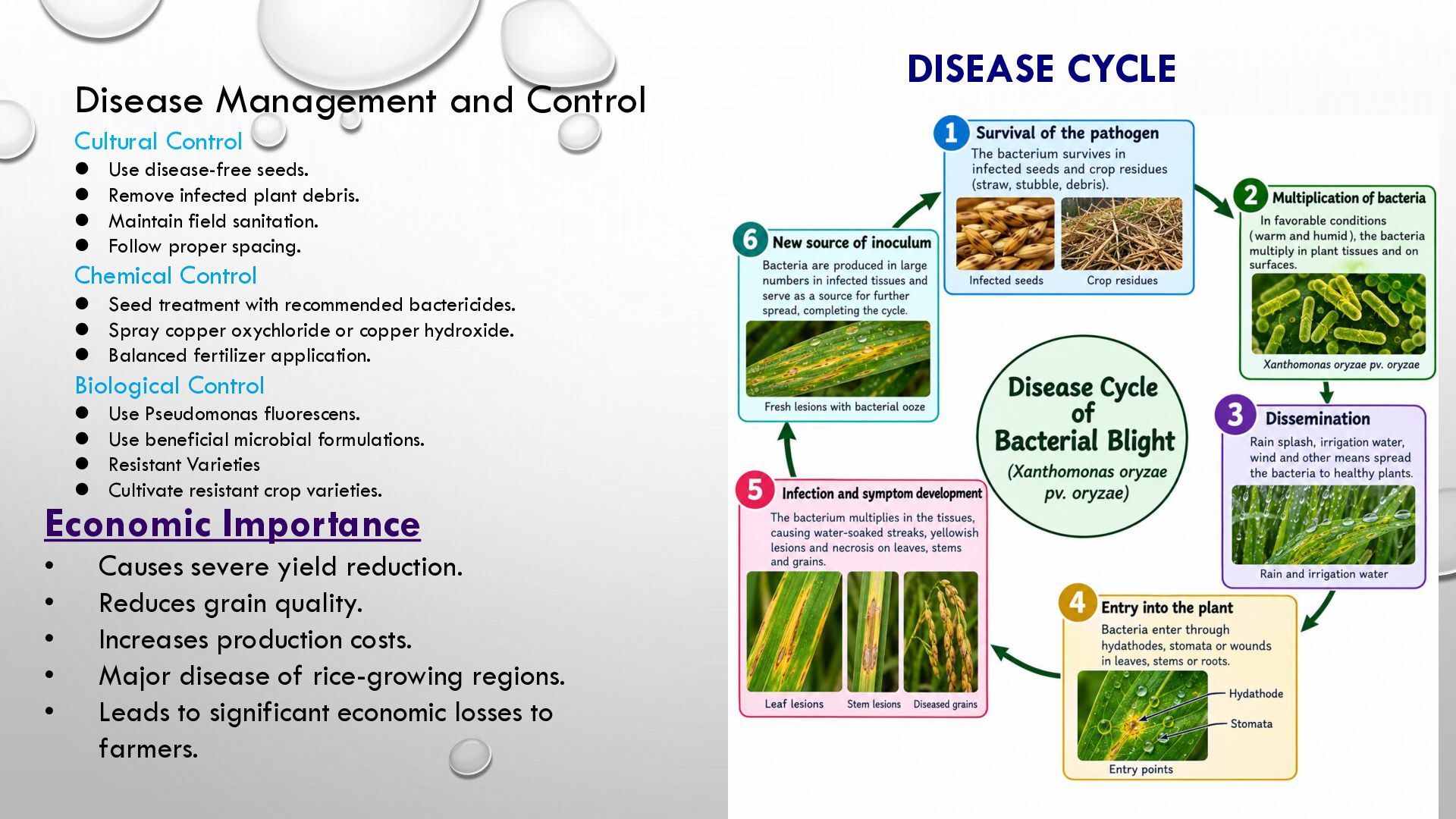
    Use disease-free seeds. Remove infected plant debris. Maintain field sanitation. Follow proper spacing. Chemical Control  Seed treatment with recommended bactericides.  Spray copper oxychloride or copper hydroxide.  Balanced fertilizer application. Biological Control     Use Pseudomonas fluorescens. Use beneficial microbial formulations. Resistant Varieties Cultivate resistant crop varieties. Economic Importance • • • • • Causes severe yield reduction. Reduces grain quality. Increases production costs. Major disease of rice-growing regions. Leads to significant economic losses to farmers. DISEASE CYCLE
  7. VIRAL DISEASE ① VIRAL DISEASES ARE PLANT DISEASES CAUSED BY

    VIRUSES, WHICH ARE EXTREMELY SMALL INFECTIOUS AGENTS THAT CAN MULTIPLY ONLY INSIDE LIVING PLANT CELLS. PLANT VIRUSES INFECT A WIDE RANGE OF CROPS, VEGETABLES, FRUITS, AND ORNAMENTAL PLANTS, CAUSING SIGNIFICANT LOSSES IN YIELD AND QUALITY. ② COMMON SYMPTOMS OF VIRAL DISEASES INCLUDE MOSAIC PATTERNS ON LEAVES, CHLOROSIS (YELLOWING), LEAF CURLING, VEIN CLEARING, STUNTED GROWTH, REDUCED FLOWERING, MALFORMED FRUITS, AND OVERALL DECLINE IN PLANT VIGOR. ③ PLANT VIRUSES ARE COMMONLY TRANSMITTED THROUGH INSECT VECTORS SUCH AS APHIDS, WHITEFLIES, LEAFHOPPERS, AND THRIPS. THEY CAN ALSO SPREAD THROUGH INFECTED SEEDS, VEGETATIVE PROPAGATION MATERIALS, CONTAMINATED TOOLS, AND MECHANICAL CONTACT BETWEEN PLANTS. ④ UNLIKE FUNGI AND BACTERIA, VIRUSES DO NOT HAVE A CELLULAR STRUCTURE AND CANNOT SURVIVE OR REPRODUCE INDEPENDENTLY. AFTER ENTERING A PLANT, THEY MULTIPLY WITHIN THE HOST CELLS AND INTERFERE WITH NORMAL PHYSIOLOGICAL PROCESSES, RESULTING IN DISEASE SYMPTOMS. Examples of important viral diseases include:      Tobacco Mosaic Disease (TMV) Potato Spindle Tuber Disease Banana Bunchy Top Disease Papaya Ring Spot Disease Tomato Leaf Curl Disease
  8. TOBACCO MOSAIC VIRUS TOBACCO MOSAIC DISEASE IS ONE OF THE

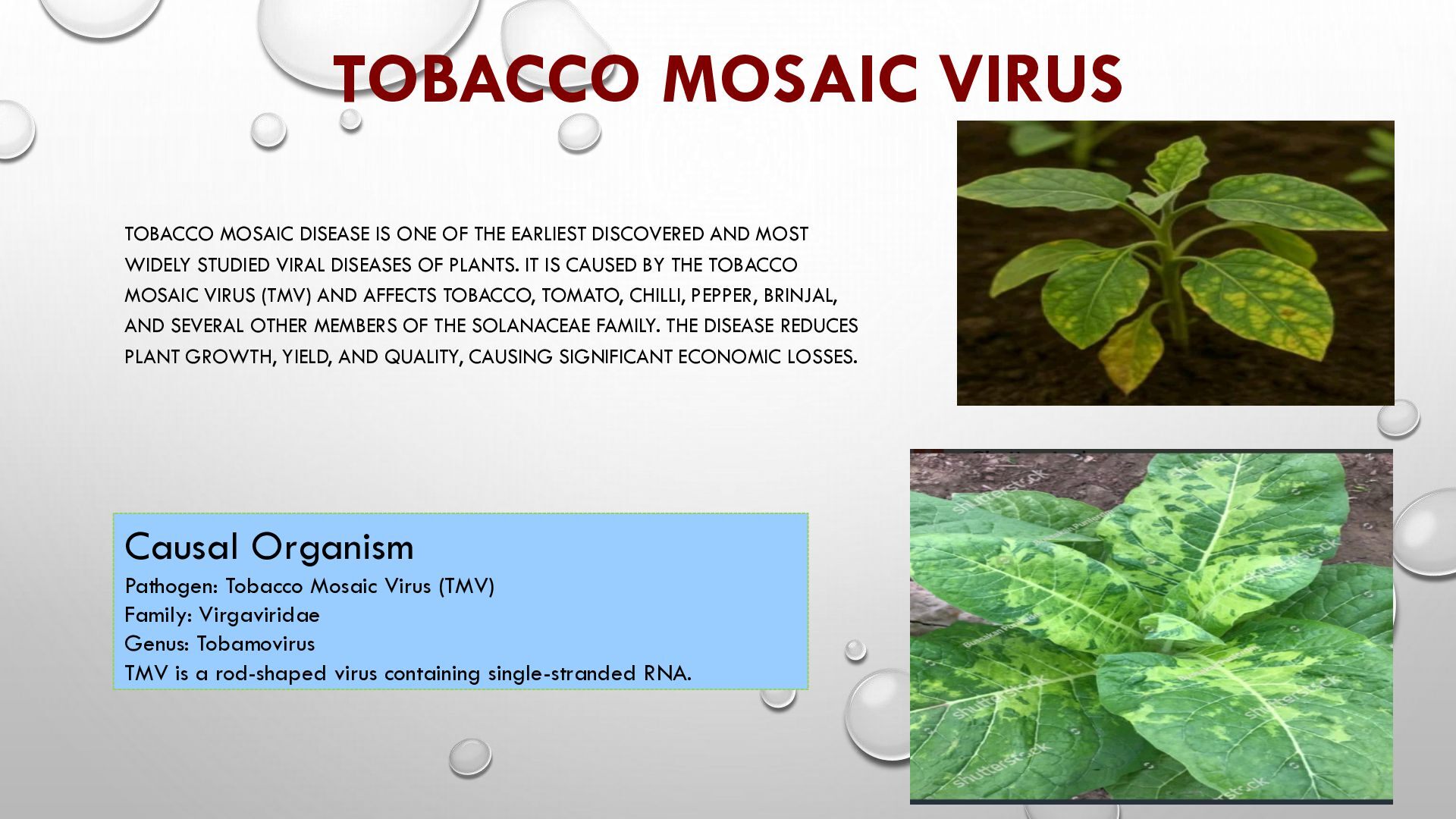
    EARLIEST DISCOVERED AND MOST WIDELY STUDIED VIRAL DISEASES OF PLANTS. IT IS CAUSED BY THE TOBACCO MOSAIC VIRUS (TMV) AND AFFECTS TOBACCO, TOMATO, CHILLI, PEPPER, BRINJAL, AND SEVERAL OTHER MEMBERS OF THE SOLANACEAE FAMILY. THE DISEASE REDUCES PLANT GROWTH, YIELD, AND QUALITY, CAUSING SIGNIFICANT ECONOMIC LOSSES. Causal Organism Pathogen: Tobacco Mosaic Virus (TMV) Family: Virgaviridae Genus: Tobamovirus TMV is a rod-shaped virus containing single-stranded RNA.
  9. SYMPTOMS ON LEAVES LIGHT AND DARK GREEN MOTTLING (MOSAIC PATTERN)

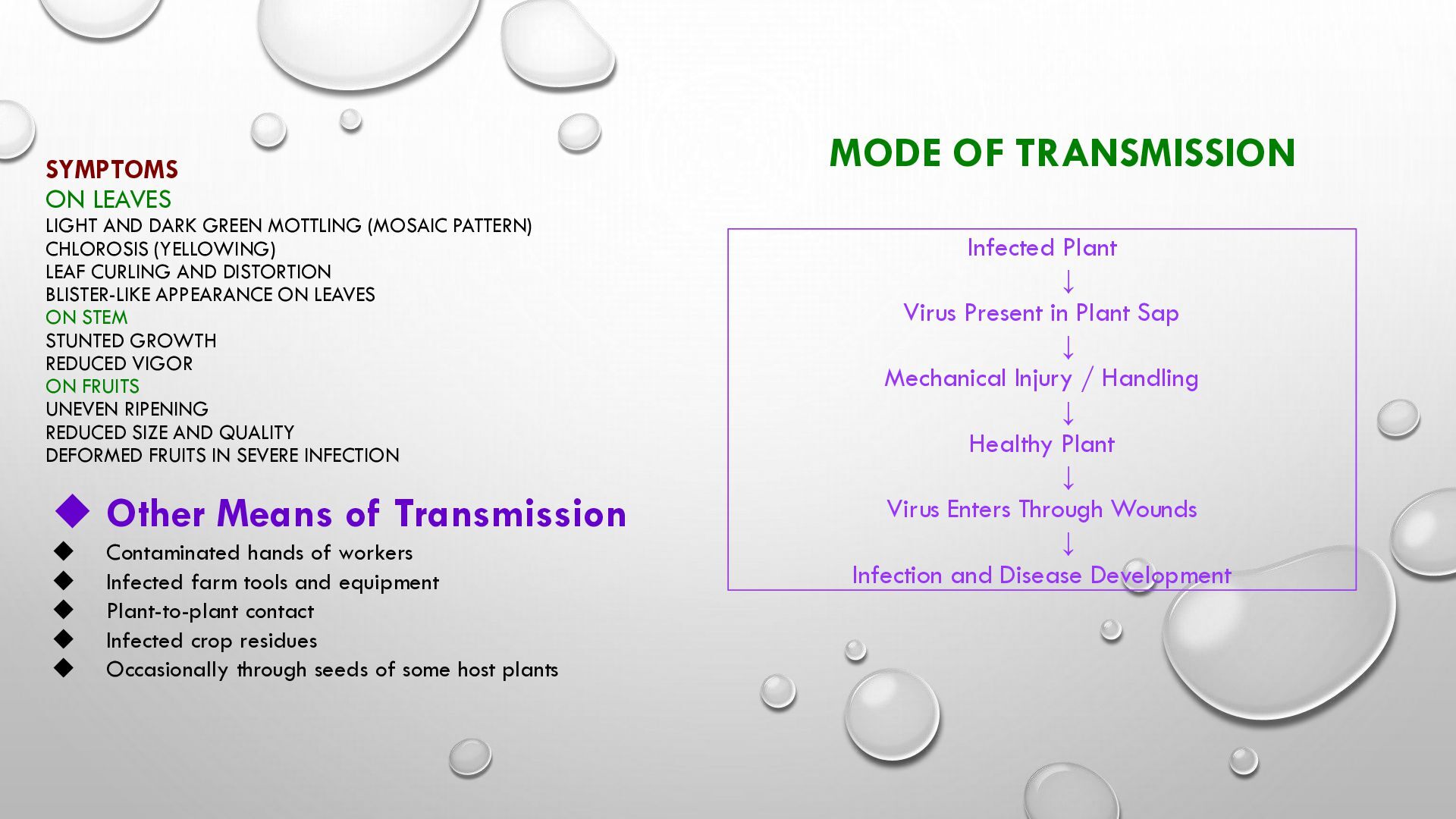
    CHLOROSIS (YELLOWING) LEAF CURLING AND DISTORTION BLISTER-LIKE APPEARANCE ON LEAVES ON STEM STUNTED GROWTH REDUCED VIGOR ON FRUITS UNEVEN RIPENING REDUCED SIZE AND QUALITY DEFORMED FRUITS IN SEVERE INFECTION  Other Means of Transmission      Contaminated hands of workers Infected farm tools and equipment Plant-to-plant contact Infected crop residues Occasionally through seeds of some host plants MODE OF TRANSMISSION Infected Plant ↓ Virus Present in Plant Sap ↓ Mechanical Injury / Handling ↓ Healthy Plant ↓ Virus Enters Through Wounds ↓ Infection and Disease Development
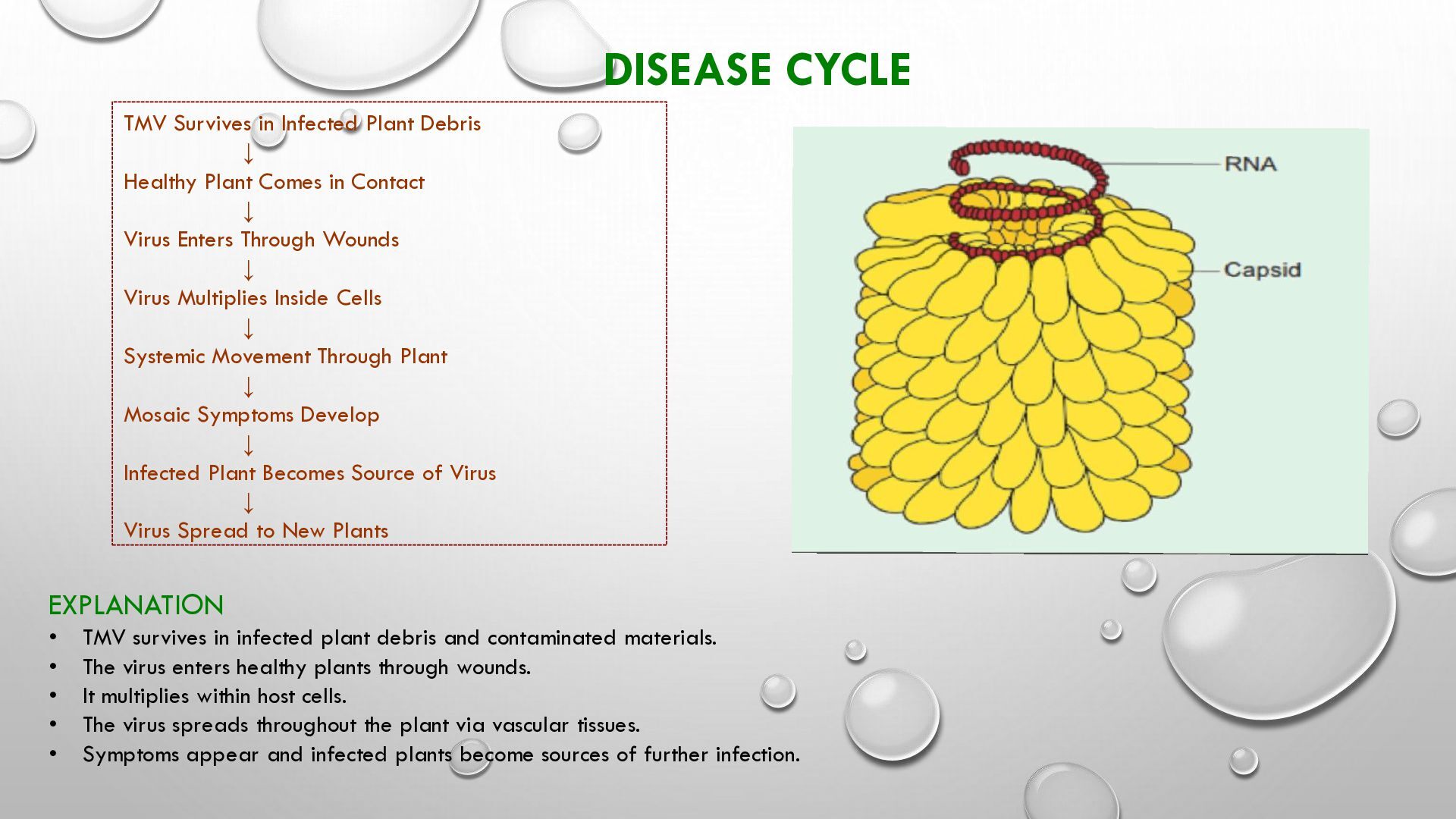
  10. DISEASE CYCLE TMV Survives in Infected Plant Debris ↓ Healthy

    Plant Comes in Contact ↓ Virus Enters Through Wounds ↓ Virus Multiplies Inside Cells ↓ Systemic Movement Through Plant ↓ Mosaic Symptoms Develop ↓ Infected Plant Becomes Source of Virus ↓ Virus Spread to New Plants EXPLANATION • • • • • TMV survives in infected plant debris and contaminated materials. The virus enters healthy plants through wounds. It multiplies within host cells. The virus spreads throughout the plant via vascular tissues. Symptoms appear and infected plants become sources of further infection.
  11. Disease Management and Control Cultural Methods • • • •

    Use virus-free seeds and seedlings. Remove and destroy infected plants. Avoid handling plants when wet. Maintain field sanitation. Mechanical Control • • • • Disinfect tools regularly. Wash hands after handling infected plants. Host Resistance Grow resistant or tolerant varieties whenever available. Crop Management • • • • Remove weeds that may serve as virus reservoirs. Practice crop rotation. Seed Treatment Use certified disease-free seeds.
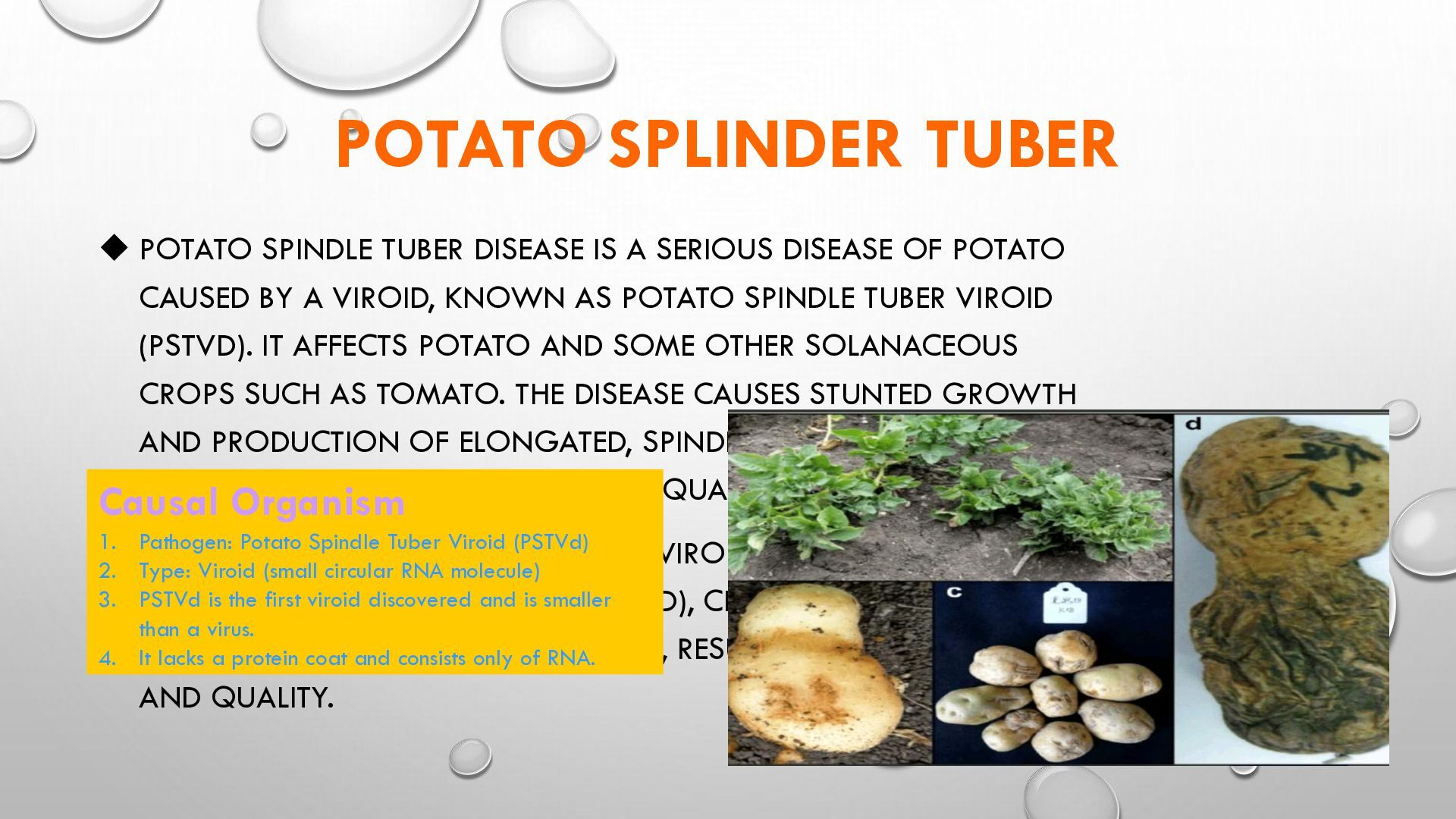
  12. POTATO SPLINDER TUBER  POTATO SPINDLE TUBER DISEASE IS A

    SERIOUS DISEASE OF POTATO CAUSED BY A VIROID, KNOWN AS POTATO SPINDLE TUBER VIROID (PSTVD). IT AFFECTS POTATO AND SOME OTHER SOLANACEOUS CROPS SUCH AS TOMATO. THE DISEASE CAUSES STUNTED GROWTH AND PRODUCTION OF ELONGATED, SPINDLE-SHAPED TUBERS, LEADING TO SIGNIFICANT YIELD AND QUALITY LOSSES. Causal Organism 1. Pathogen: Potato Spindle Tuber Viroid (PSTVd)  POTATO SPINDLE TUBER DISEASE IS A VIROID DISEASE CAUSED BY 2. Type: Viroid (small circular RNA molecule) 3. POTATO PSTVd is the SPINDLE first viroid discovered and is smaller TUBER VIROID (PSTVD), CHARACTERIZED BY STUNTED than a virus. ANDcoat SPINDLE-SHAPED TUBERS, RESULTING IN REDUCED YIELD 4. PLANTS It lacks a protein and consists only of RNA. AND QUALITY.
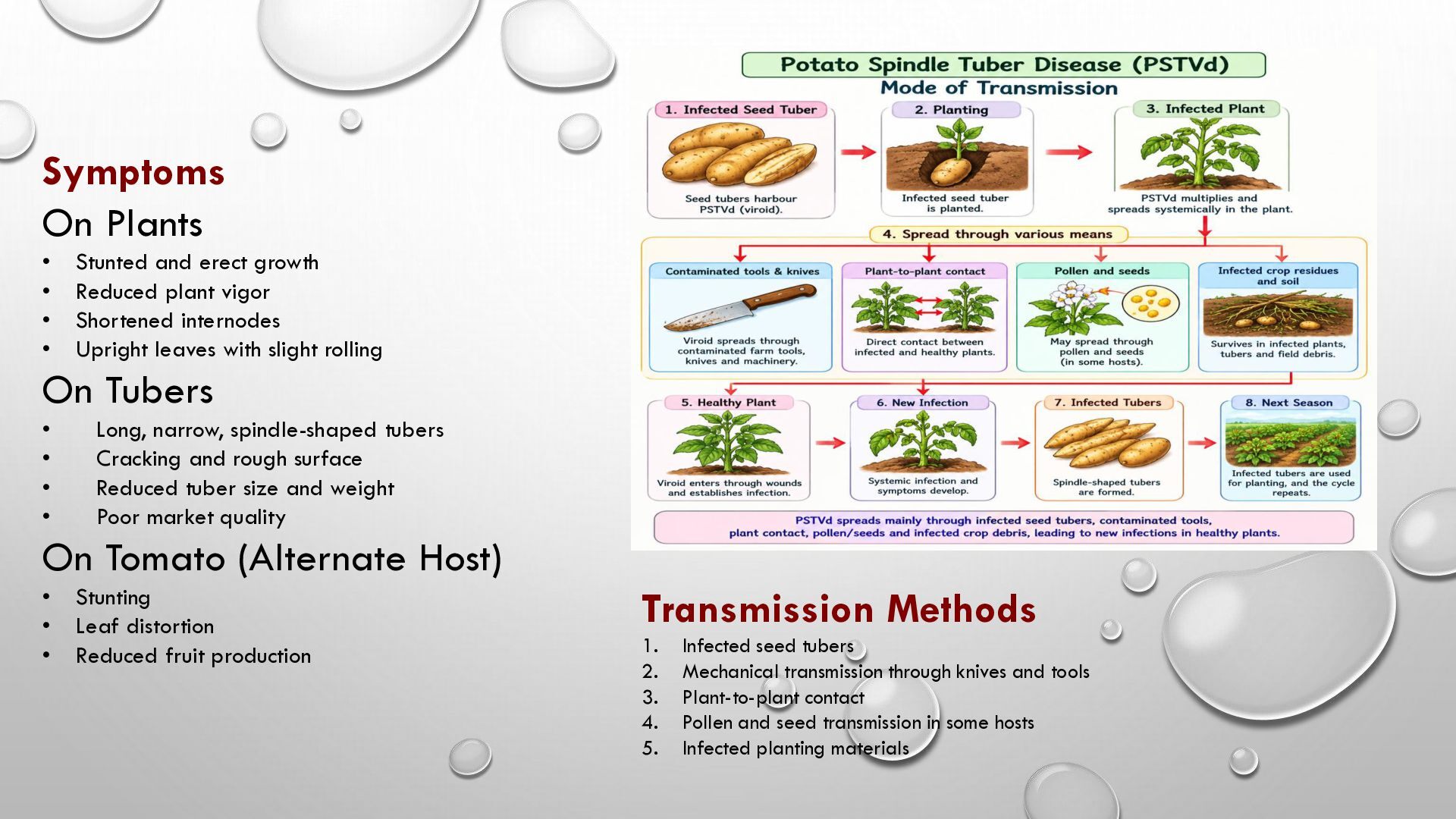
  13. Symptoms On Plants • • • • Stunted and erect

    growth Reduced plant vigor Shortened internodes Upright leaves with slight rolling On Tubers • • • • Long, narrow, spindle-shaped tubers Cracking and rough surface Reduced tuber size and weight Poor market quality On Tomato (Alternate Host) • • • Stunting Leaf distortion Reduced fruit production Transmission Methods 1. 2. 3. 4. 5. Infected seed tubers Mechanical transmission through knives and tools Plant-to-plant contact Pollen and seed transmission in some hosts Infected planting materials
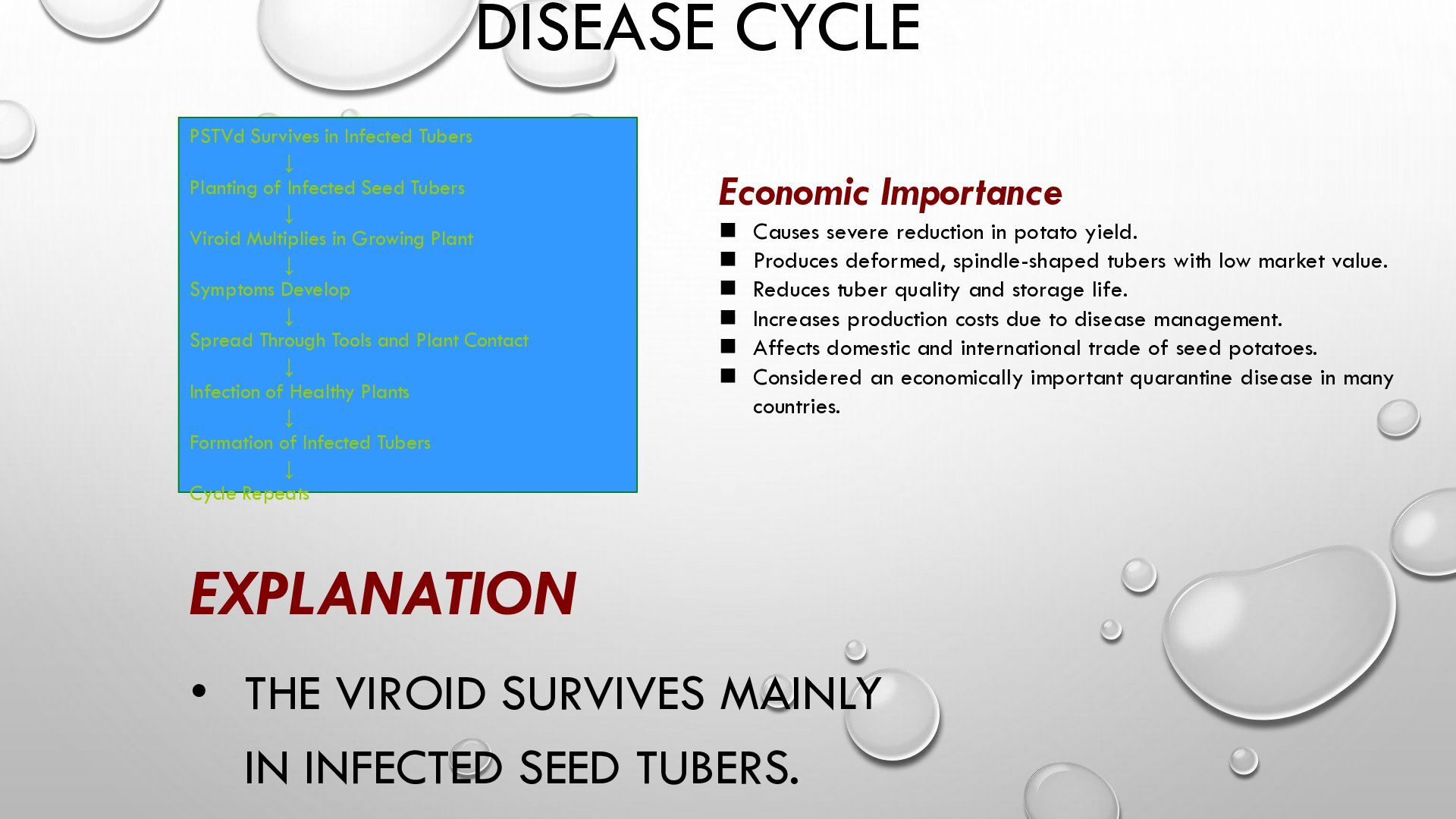
  14. DISEASE CYCLE PSTVd Survives in Infected Tubers ↓ Planting of

    Infected Seed Tubers ↓ Viroid Multiplies in Growing Plant ↓ Symptoms Develop ↓ Spread Through Tools and Plant Contact ↓ Infection of Healthy Plants ↓ Formation of Infected Tubers ↓ Cycle Repeats Economic Importance  Causes severe reduction in potato yield.  Produces deformed, spindle-shaped tubers with low market value.  Reduces tuber quality and storage life.  Increases production costs due to disease management.  Affects domestic and international trade of seed potatoes.  Considered an economically important quarantine disease in many countries. EXPLANATION • THE VIROID SURVIVES MAINLY IN INFECTED SEED TUBERS.
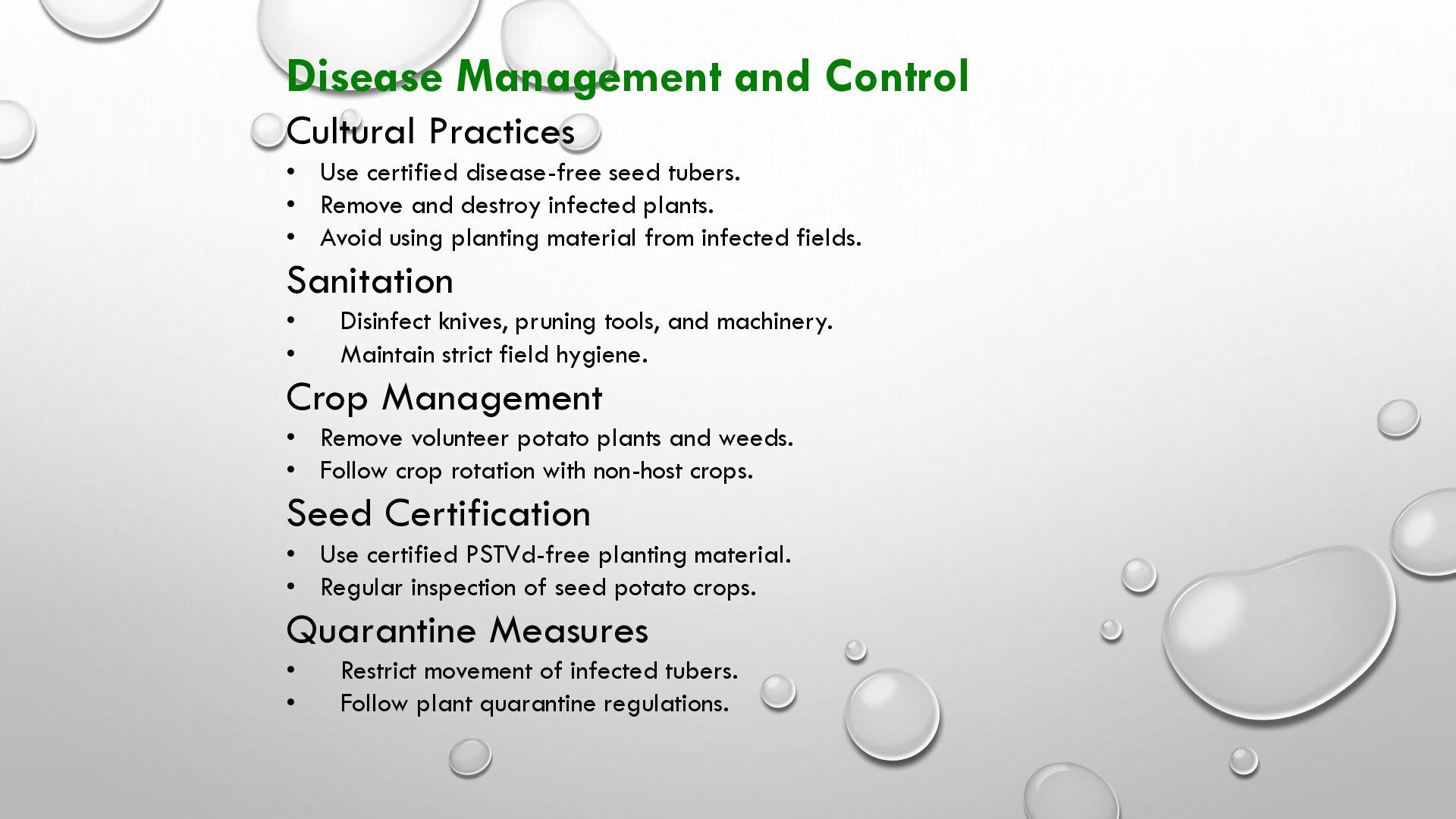
  15. Disease Management and Control Cultural Practices • Use certified disease-free

    seed tubers. • Remove and destroy infected plants. • Avoid using planting material from infected fields. Sanitation • • Disinfect knives, pruning tools, and machinery. Maintain strict field hygiene. Crop Management • Remove volunteer potato plants and weeds. • Follow crop rotation with non-host crops. Seed Certification • Use certified PSTVd-free planting material. • Regular inspection of seed potato crops. Quarantine Measures • • Restrict movement of infected tubers. Follow plant quarantine regulations.
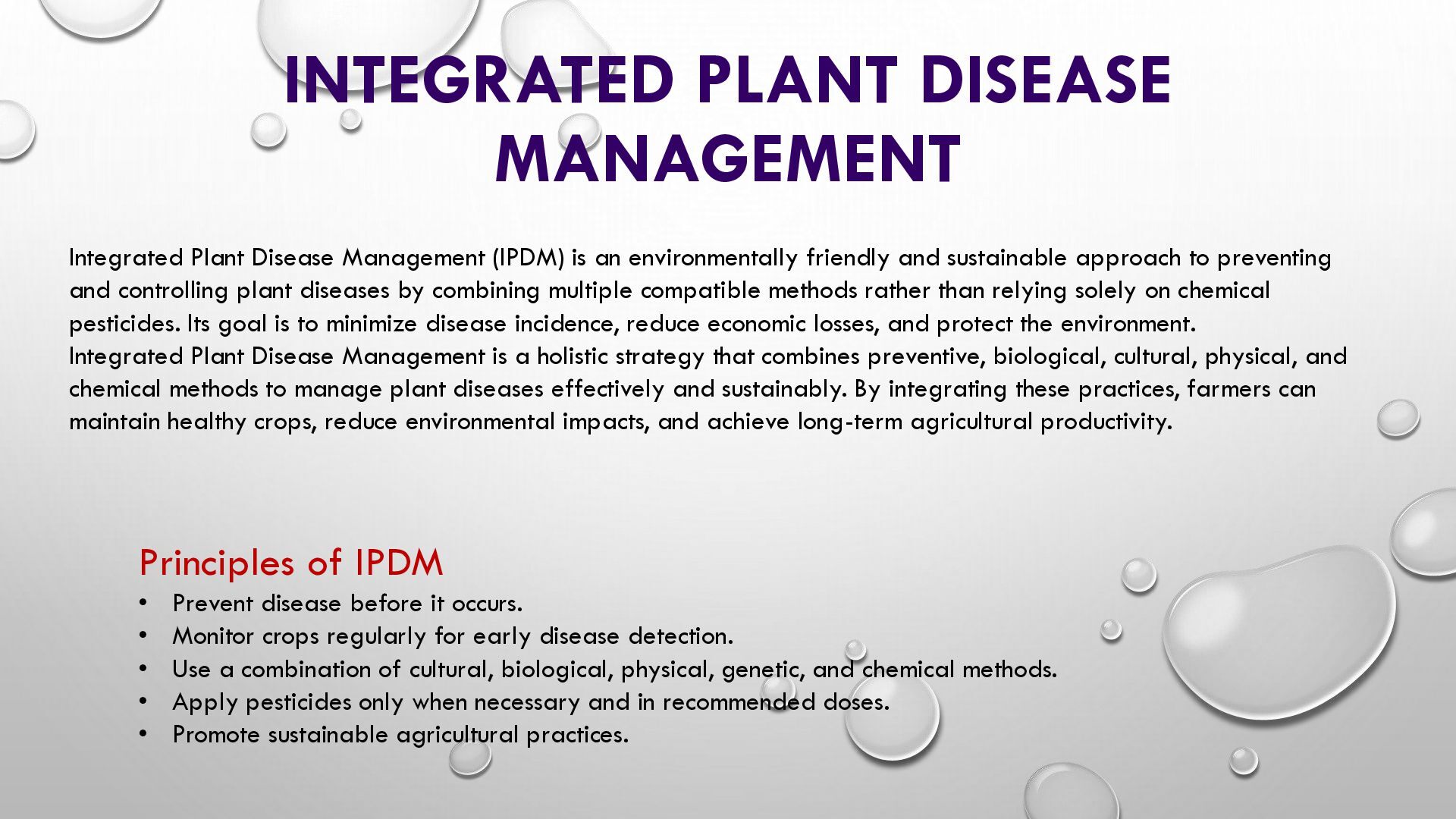
  16. INTEGRATED PLANT DISEASE MANAGEMENT Integrated Plant Disease Management (IPDM) is

    an environmentally friendly and sustainable approach to preventing and controlling plant diseases by combining multiple compatible methods rather than relying solely on chemical pesticides. Its goal is to minimize disease incidence, reduce economic losses, and protect the environment. Integrated Plant Disease Management is a holistic strategy that combines preventive, biological, cultural, physical, and chemical methods to manage plant diseases effectively and sustainably. By integrating these practices, farmers can maintain healthy crops, reduce environmental impacts, and achieve long-term agricultural productivity. Principles of IPDM • • • • • Prevent disease before it occurs. Monitor crops regularly for early disease detection. Use a combination of cultural, biological, physical, genetic, and chemical methods. Apply pesticides only when necessary and in recommended doses. Promote sustainable agricultural practices.
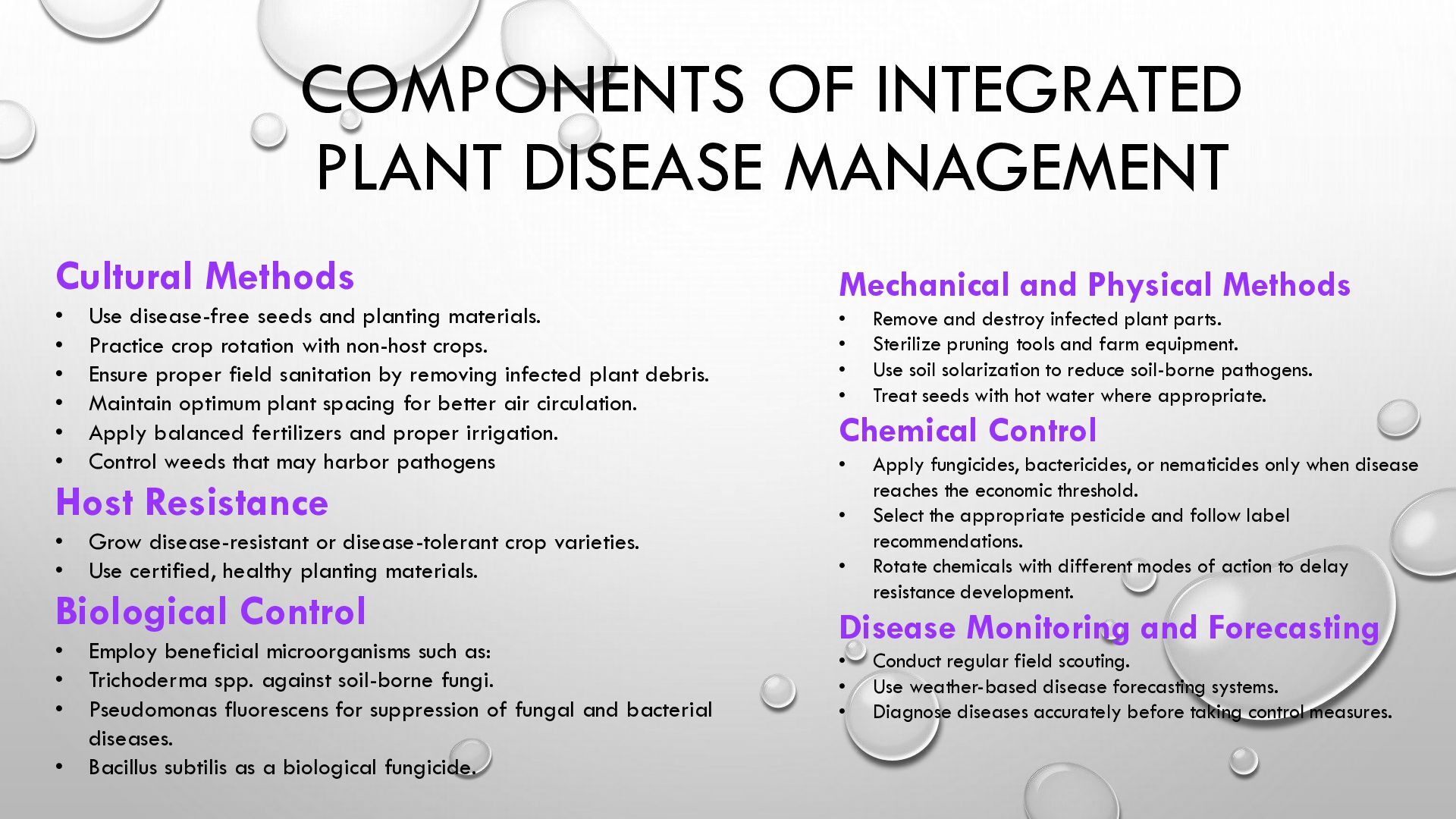
  17. COMPONENTS OF INTEGRATED PLANT DISEASE MANAGEMENT Cultural Methods • •

    • • • • Use disease-free seeds and planting materials. Practice crop rotation with non-host crops. Ensure proper field sanitation by removing infected plant debris. Maintain optimum plant spacing for better air circulation. Apply balanced fertilizers and proper irrigation. Control weeds that may harbor pathogens Mechanical and Physical Methods • • • • Chemical Control • Host Resistance • • • • Grow disease-resistant or disease-tolerant crop varieties. Use certified, healthy planting materials. Biological Control • • • • Employ beneficial microorganisms such as: Trichoderma spp. against soil-borne fungi. Pseudomonas fluorescens for suppression of fungal and bacterial diseases. Bacillus subtilis as a biological fungicide. Remove and destroy infected plant parts. Sterilize pruning tools and farm equipment. Use soil solarization to reduce soil-borne pathogens. Treat seeds with hot water where appropriate. Apply fungicides, bactericides, or nematicides only when disease reaches the economic threshold. Select the appropriate pesticide and follow label recommendations. Rotate chemicals with different modes of action to delay resistance development. Disease Monitoring and Forecasting • • • Conduct regular field scouting. Use weather-based disease forecasting systems. Diagnose diseases accurately before taking control measures.
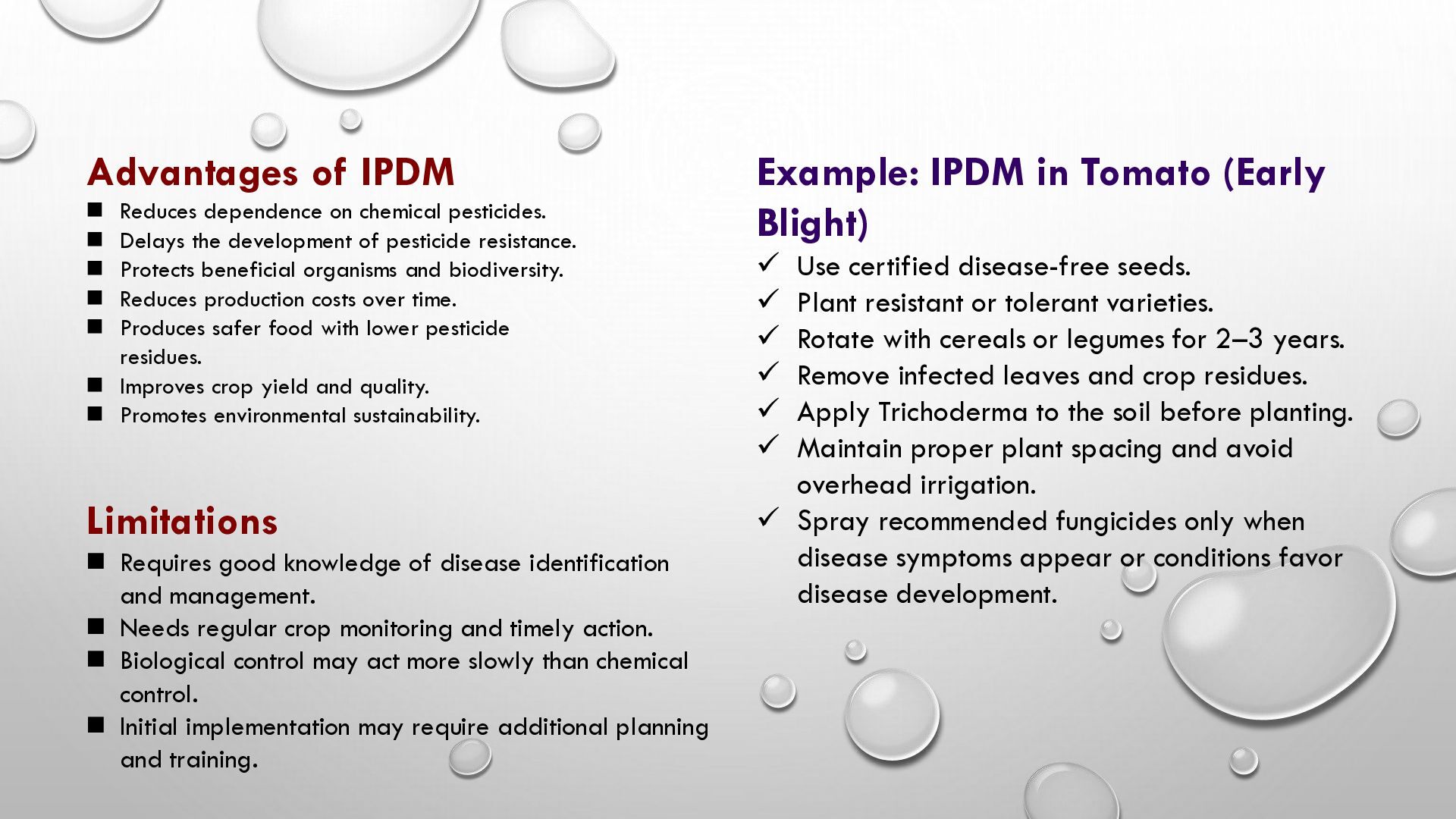
  18. Advantages of IPDM  Reduces dependence on chemical pesticides. 

    Delays the development of pesticide resistance.  Protects beneficial organisms and biodiversity.  Reduces production costs over time.  Produces safer food with lower pesticide residues.  Improves crop yield and quality.  Promotes environmental sustainability. Limitations  Requires good knowledge of disease identification and management.  Needs regular crop monitoring and timely action.  Biological control may act more slowly than chemical control.  Initial implementation may require additional planning and training. Example: IPDM in Tomato (Early Blight)  Use certified disease-free seeds.  Plant resistant or tolerant varieties.  Rotate with cereals or legumes for 2–3 years.  Remove infected leaves and crop residues.  Apply Trichoderma to the soil before planting.  Maintain proper plant spacing and avoid overhead irrigation.  Spray recommended fungicides only when disease symptoms appear or conditions favor disease development.
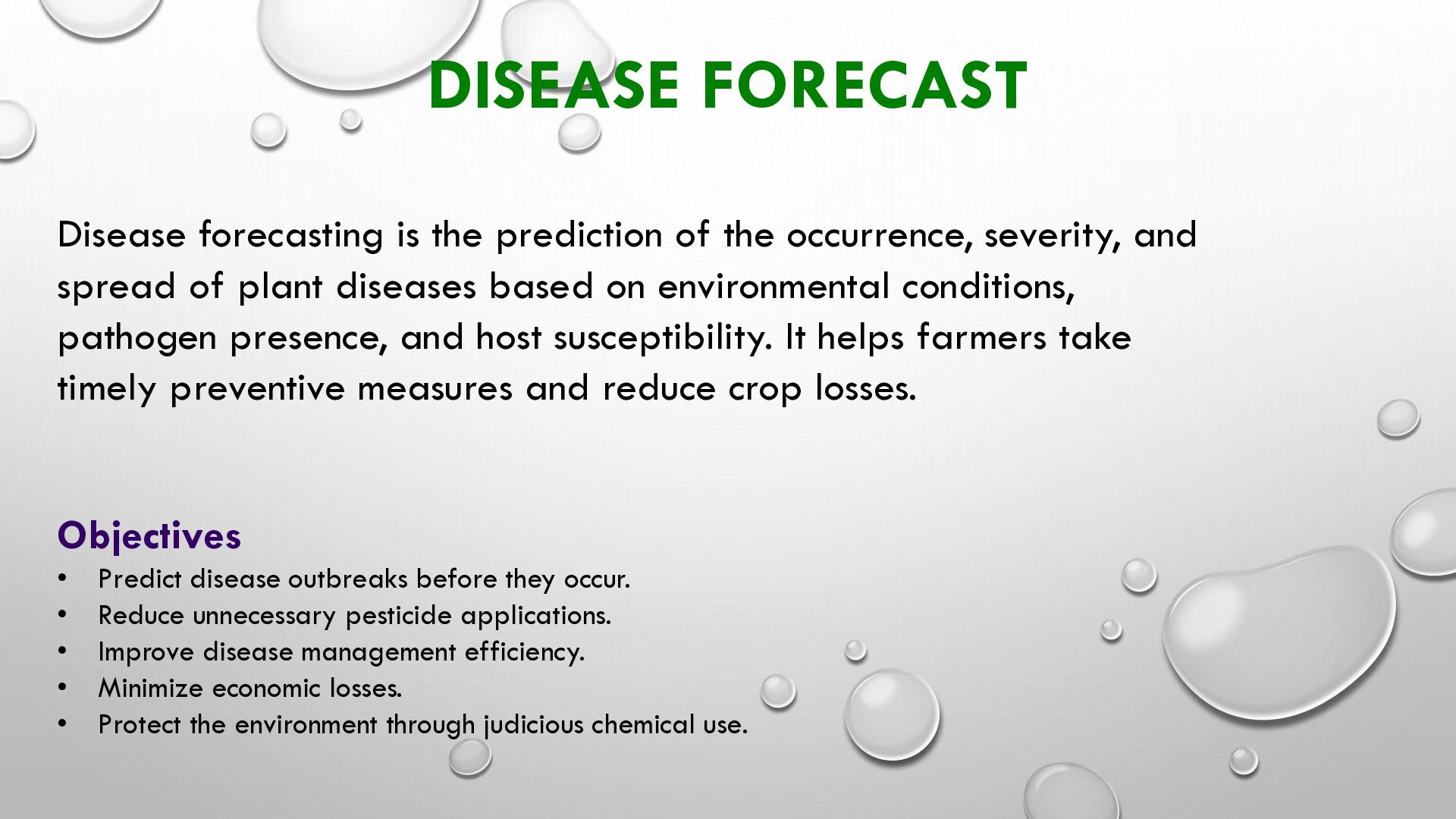
  19. DISEASE FORECAST Disease forecasting is the prediction of the occurrence,

    severity, and spread of plant diseases based on environmental conditions, pathogen presence, and host susceptibility. It helps farmers take timely preventive measures and reduce crop losses. Objectives • • • • • Predict disease outbreaks before they occur. Reduce unnecessary pesticide applications. Improve disease management efficiency. Minimize economic losses. Protect the environment through judicious chemical use.
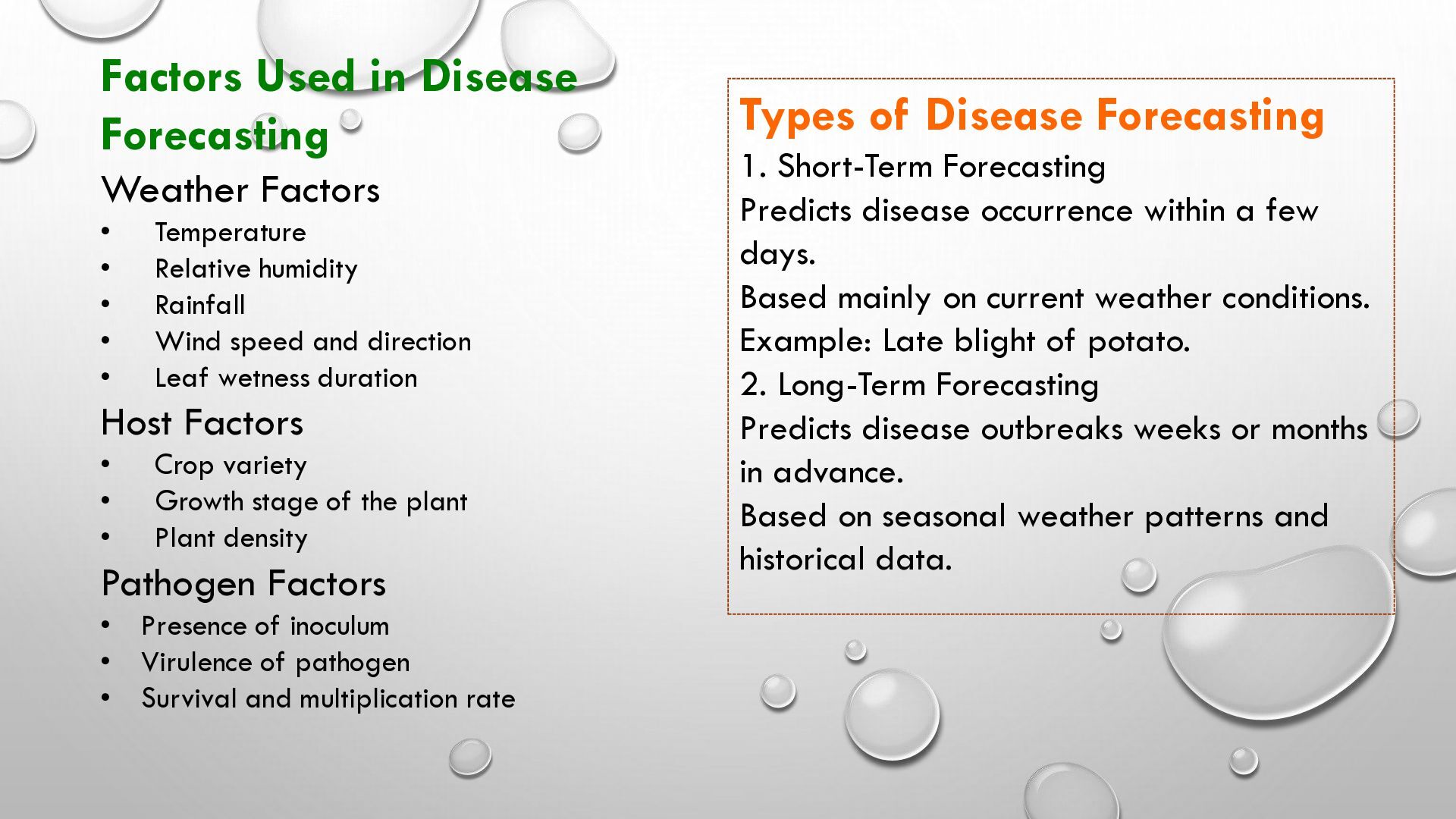
  20. Factors Used in Disease Forecasting Weather Factors • • •

    • • Temperature Relative humidity Rainfall Wind speed and direction Leaf wetness duration Host Factors • • • Crop variety Growth stage of the plant Plant density Pathogen Factors • Presence of inoculum • Virulence of pathogen • Survival and multiplication rate Types of Disease Forecasting 1. Short-Term Forecasting Predicts disease occurrence within a few days. Based mainly on current weather conditions. Example: Late blight of potato. 2. Long-Term Forecasting Predicts disease outbreaks weeks or months in advance. Based on seasonal weather patterns and historical data.
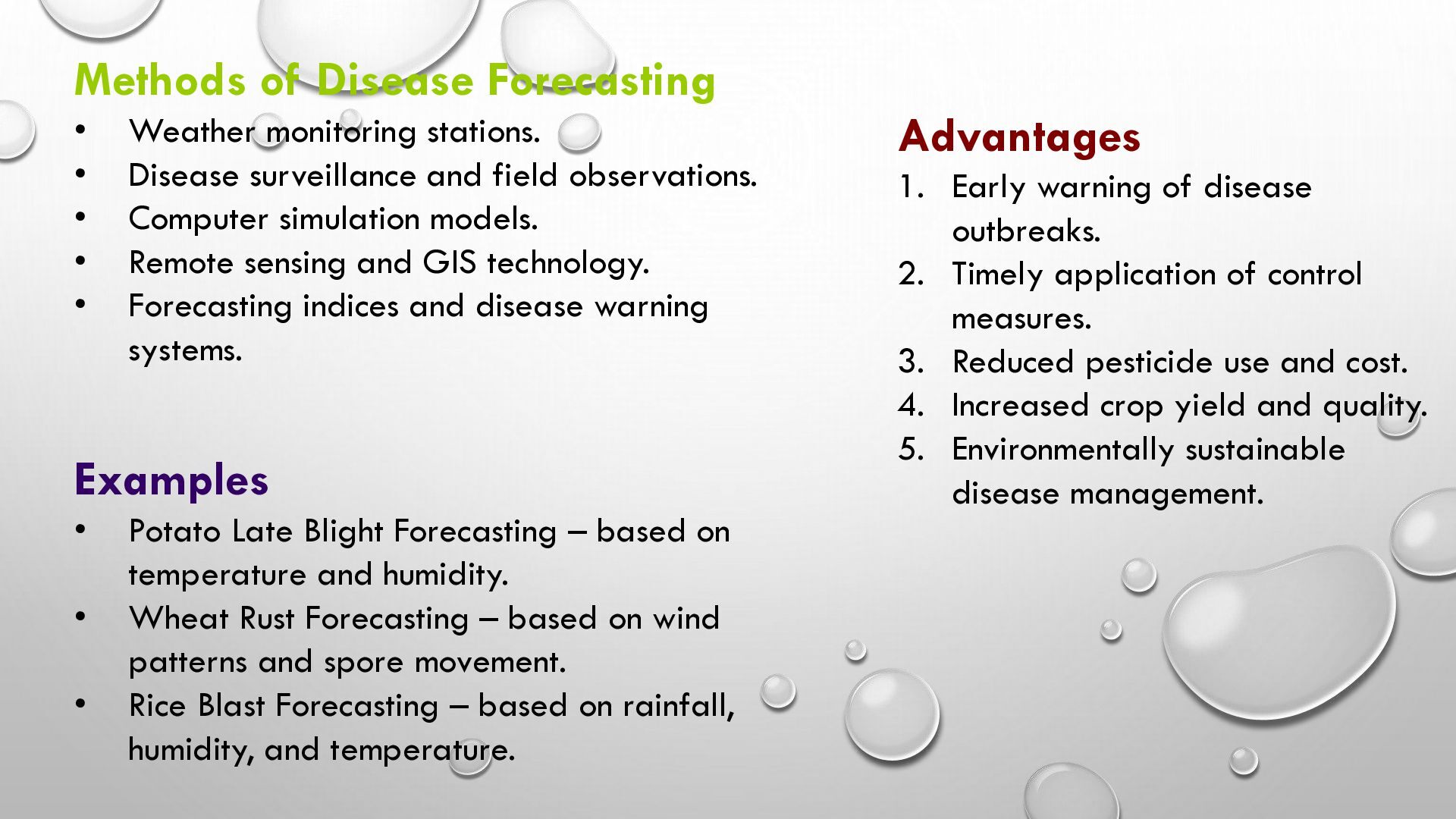
  21. Methods of Disease Forecasting • • • • • Weather

    monitoring stations. Disease surveillance and field observations. Computer simulation models. Remote sensing and GIS technology. Forecasting indices and disease warning systems. Examples • • • Potato Late Blight Forecasting – based on temperature and humidity. Wheat Rust Forecasting – based on wind patterns and spore movement. Rice Blast Forecasting – based on rainfall, humidity, and temperature. Advantages 1. Early warning of disease outbreaks. 2. Timely application of control measures. 3. Reduced pesticide use and cost. 4. Increased crop yield and quality. 5. Environmentally sustainable disease management.
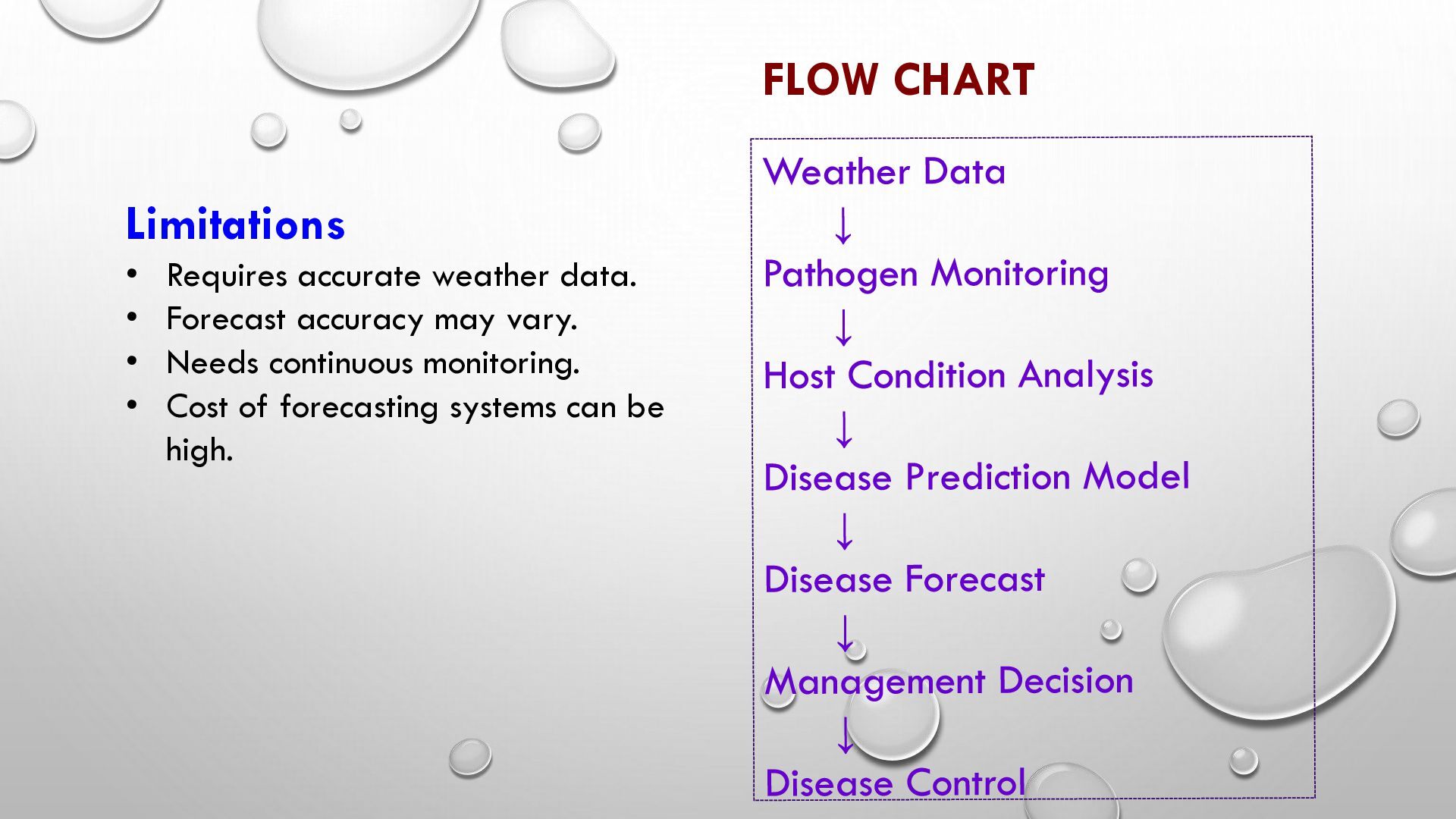
  22. FLOW CHART Limitations • • • • Requires accurate weather

    data. Forecast accuracy may vary. Needs continuous monitoring. Cost of forecasting systems can be high.