Nisbet Research Fellow Advanced Processor Technologies (APT) Group Andy Nisbet School of Computer Science, University of Manchester, UK [email protected]
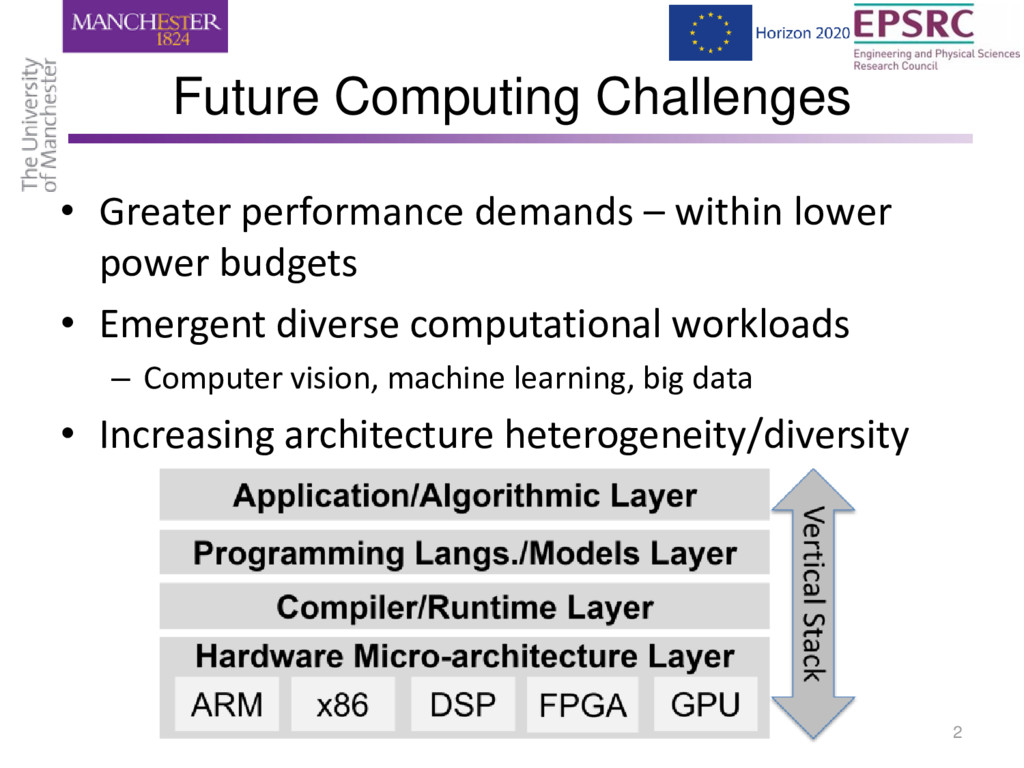
power budgets • Emergent diverse computational workloads – Computer vision, machine learning, big data • Increasing architecture heterogeneity/diversity 2
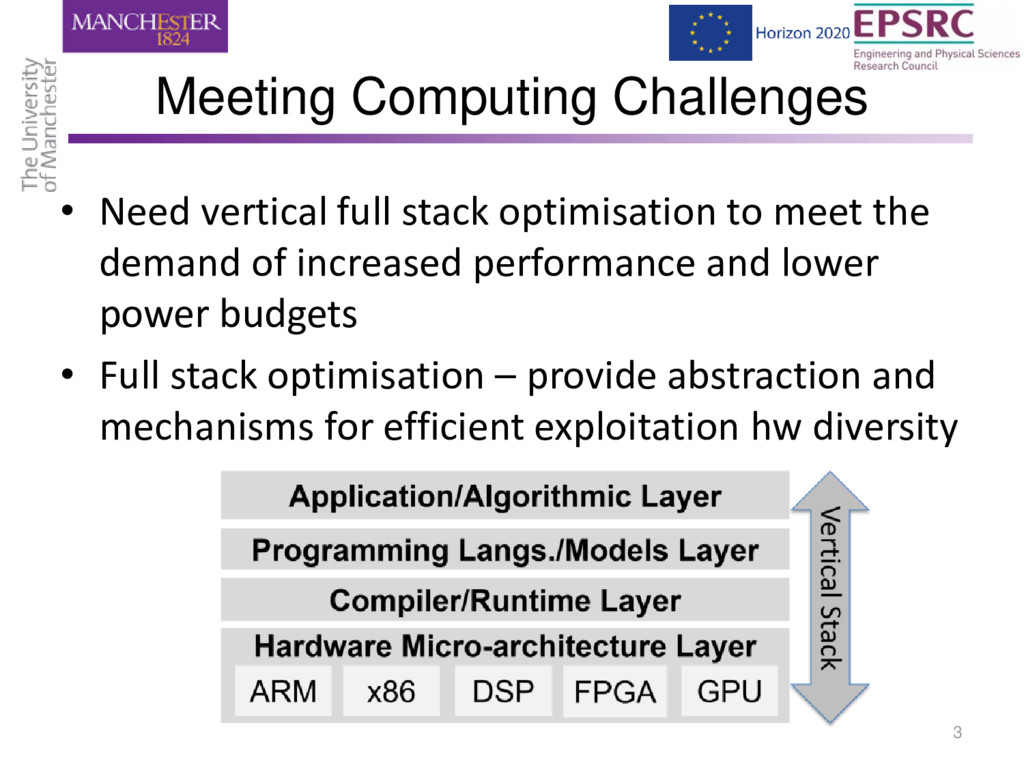
meet the demand of increased performance and lower power budgets • Full stack optimisation – provide abstraction and mechanisms for efficient exploitation hw diversity 3
doesn’t work ATM with heterogeneous diversity! • We need abstractions & mechanisms to enable efficient exploitation of diversity • We need tools to help identify/find “vertical stack” optimisation opportunities • We need codesign (modify/develop sw/hw) to evaluate different sw/hw co-operations to optimise for these opportunities 5
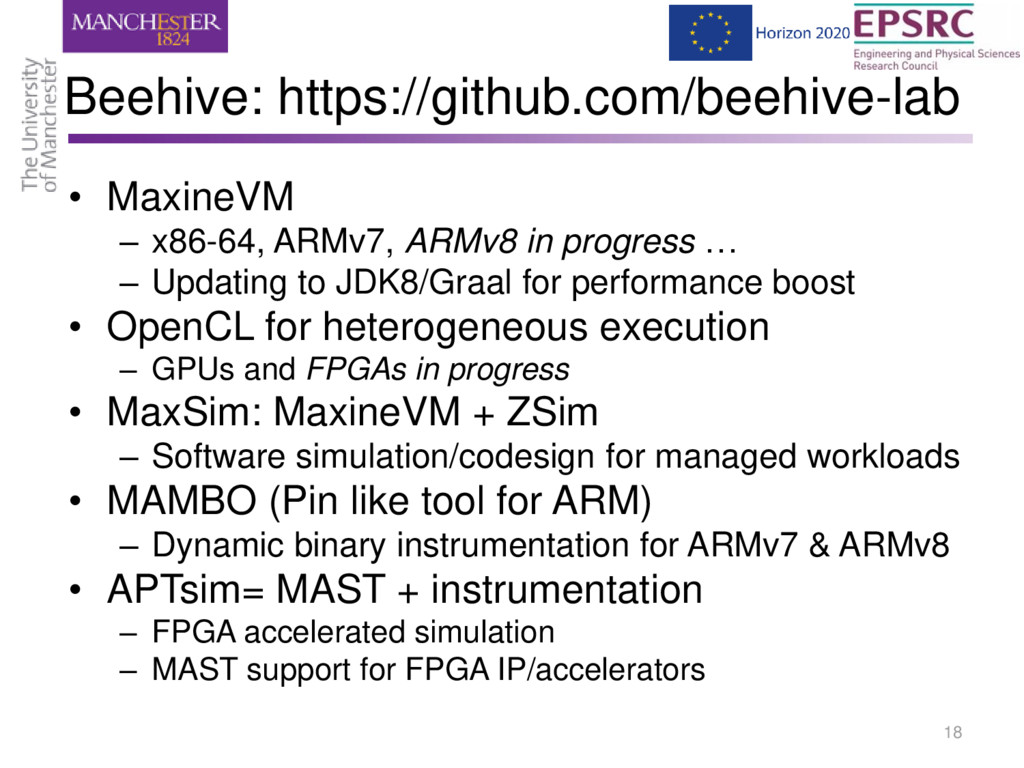
stack exploitation routes • Tools to make it feasible to identify optimisation opportunities – simulation/profiling • To prototype and implement solutions – Full stack solutions, from application down to hardware – BeeHive will reduce the level of expert knowledge required to perform full stack optimisation • To investigate co-design tradeoffs between hardware versus software solutions • https://github.com/beehive-lab 6
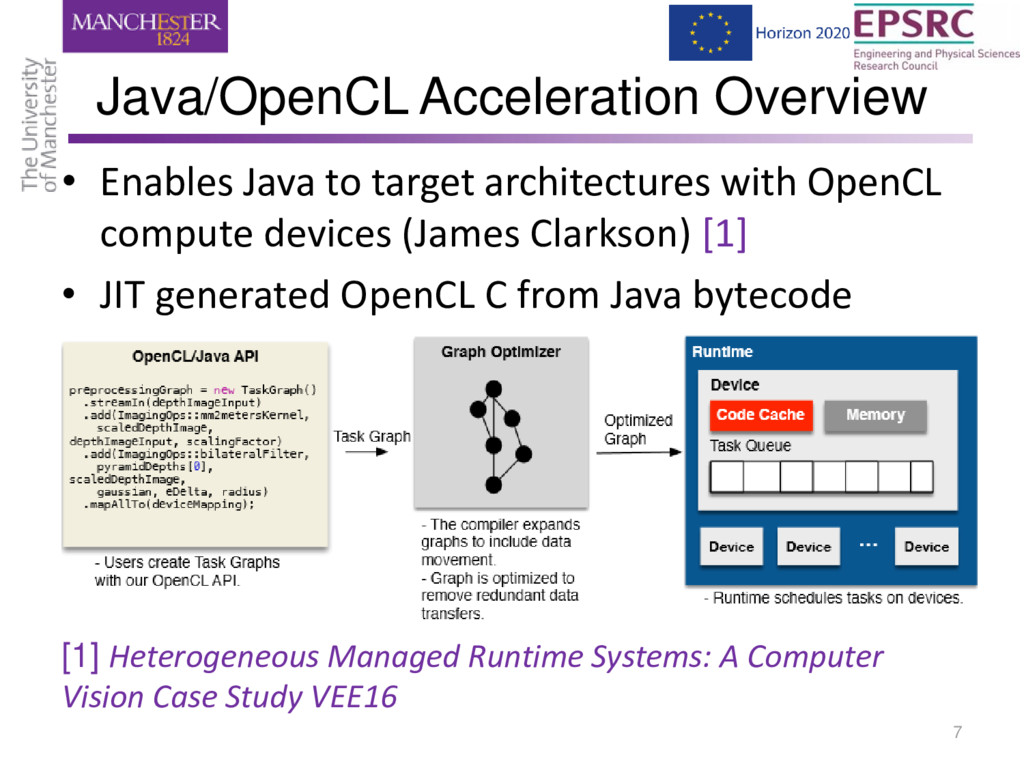
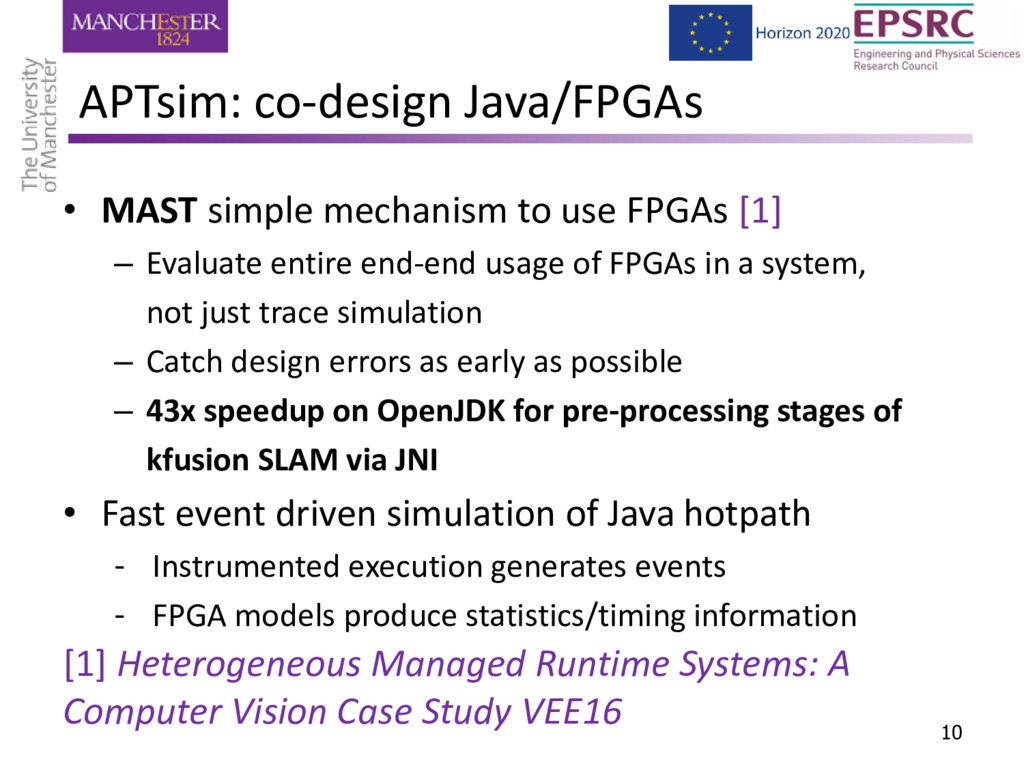
FPGAs [1] ‒ Evaluate entire end-end usage of FPGAs in a system, not just trace simulation ‒ Catch design errors as early as possible ‒ 43x speedup on OpenJDK for pre-processing stages of kfusion SLAM via JNI • Fast event driven simulation of Java hotpath - Instrumented execution generates events - FPGA models produce statistics/timing information [1] Heterogeneous Managed Runtime Systems: A Computer Vision Case Study VEE16 MAST the scaling and bilateral filter pre-processing stages
that enables easy exploitation of FPGA resources • Acceleration • Simulation [2] The potential of dynamic binary modification and CPU/FPGA SoCs for simulation FCCM17
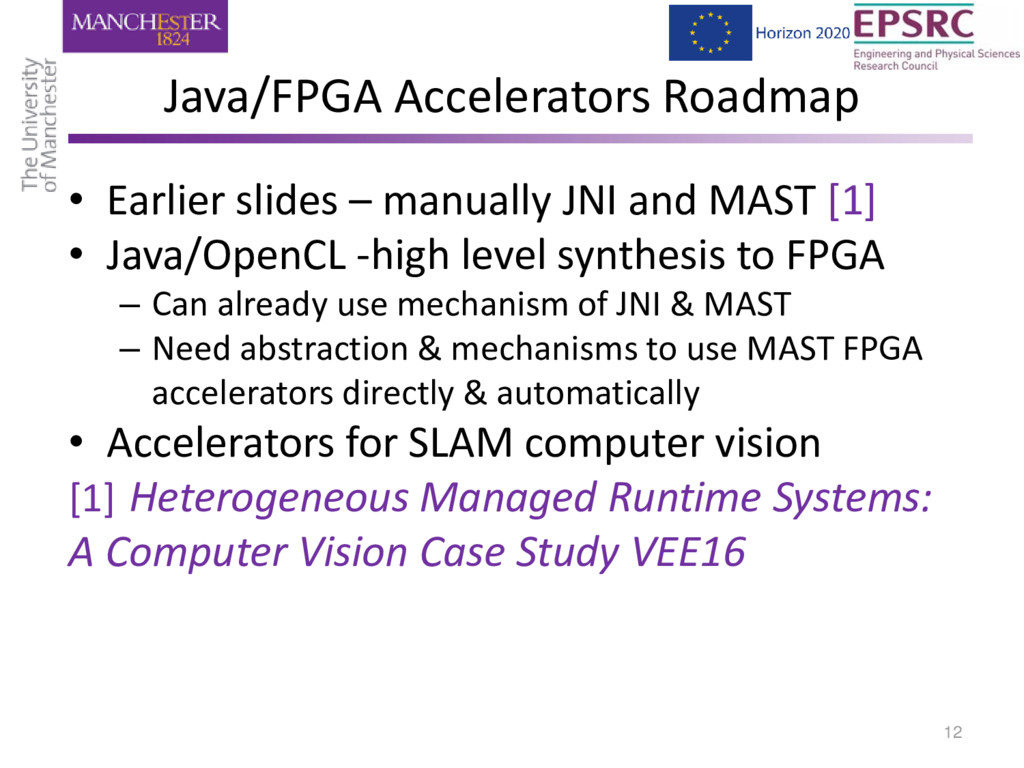
MAST [1] • Java/OpenCL -high level synthesis to FPGA – Can already use mechanism of JNI & MAST – Need abstraction & mechanisms to use MAST FPGA accelerators directly & automatically • Accelerators for SLAM computer vision [1] Heterogeneous Managed Runtime Systems: A Computer Vision Case Study VEE16 12
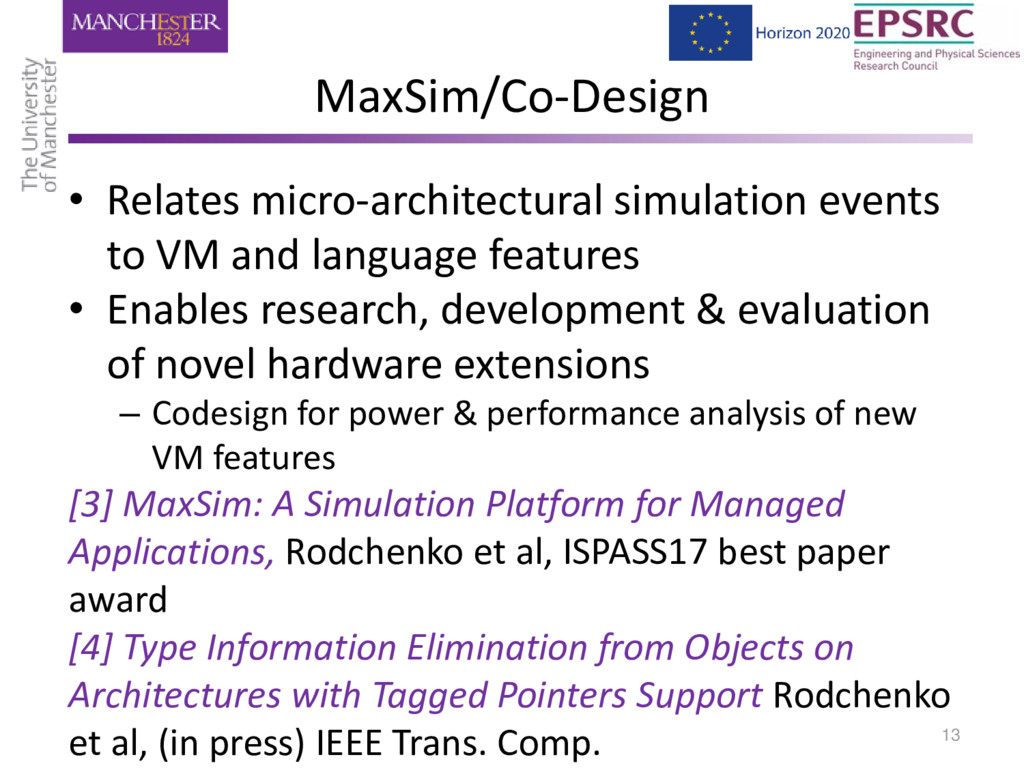
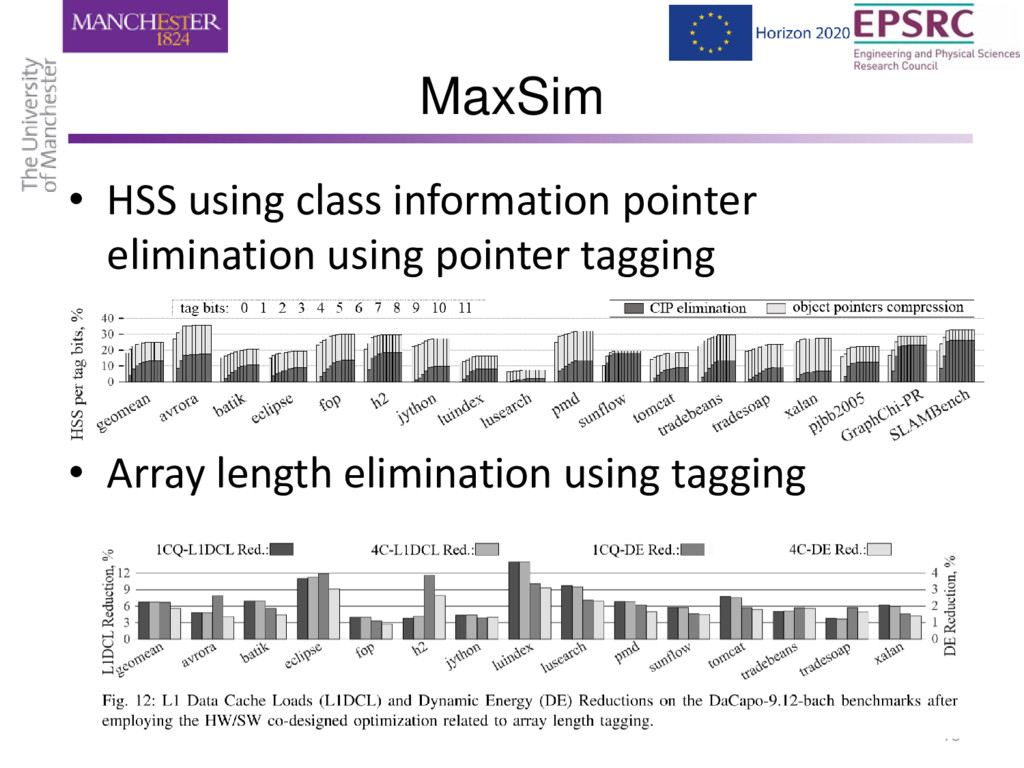
features • Enables research, development & evaluation of novel hardware extensions – Codesign for power & performance analysis of new VM features [3] MaxSim: A Simulation Platform for Managed Applications, Rodchenko et al, ISPASS17 best paper award [4] Type Information Elimination from Objects on Architectures with Tagged Pointers Support Rodchenko et al, (in press) IEEE Trans. Comp. 13
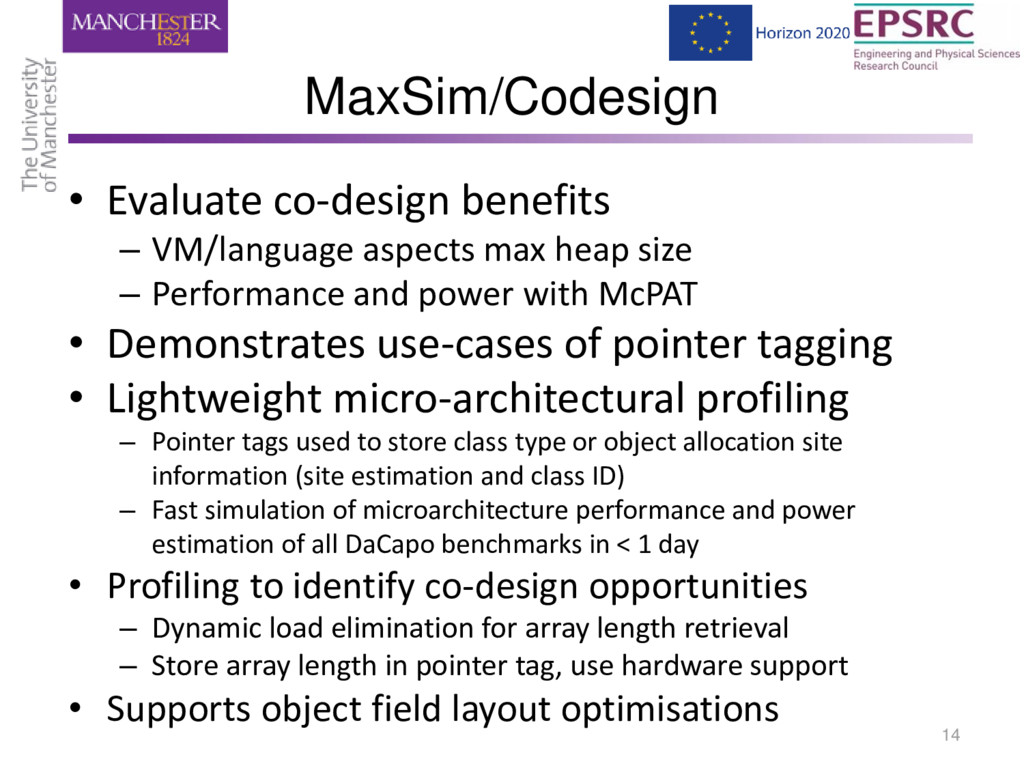
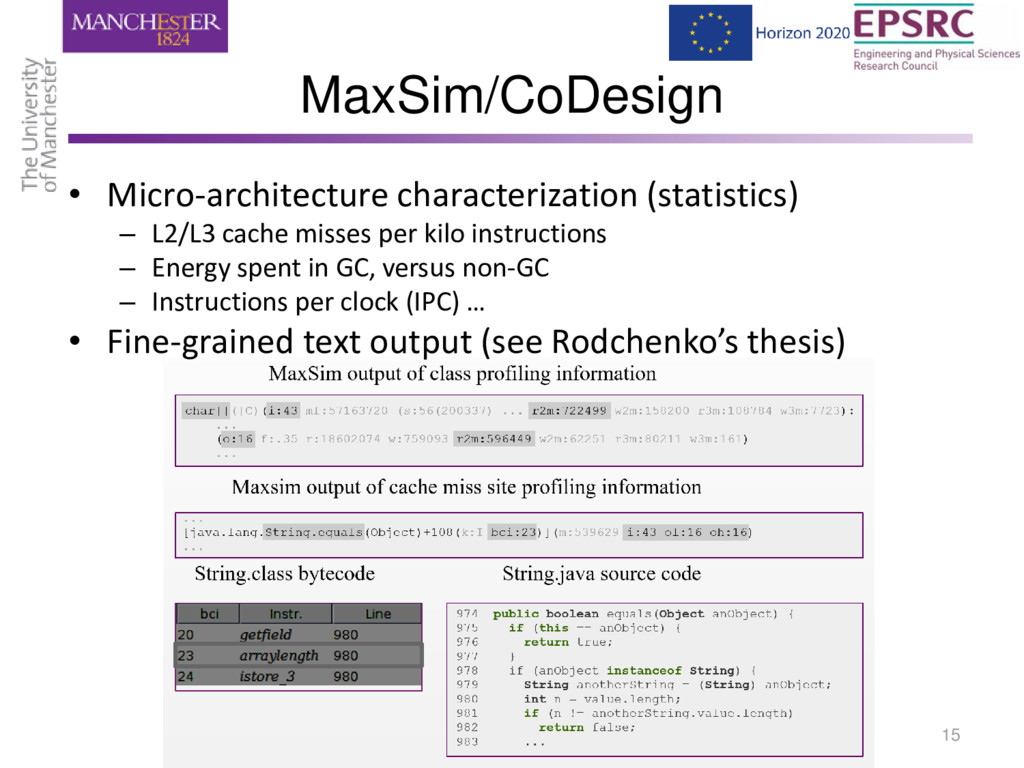
size – Performance and power with McPAT • Demonstrates use-cases of pointer tagging • Lightweight micro-architectural profiling – Pointer tags used to store class type or object allocation site information (site estimation and class ID) – Fast simulation of microarchitecture performance and power estimation of all DaCapo benchmarks in < 1 day • Profiling to identify co-design opportunities – Dynamic load elimination for array length retrieval – Store array length in pointer tag, use hardware support • Supports object field layout optimisations 14
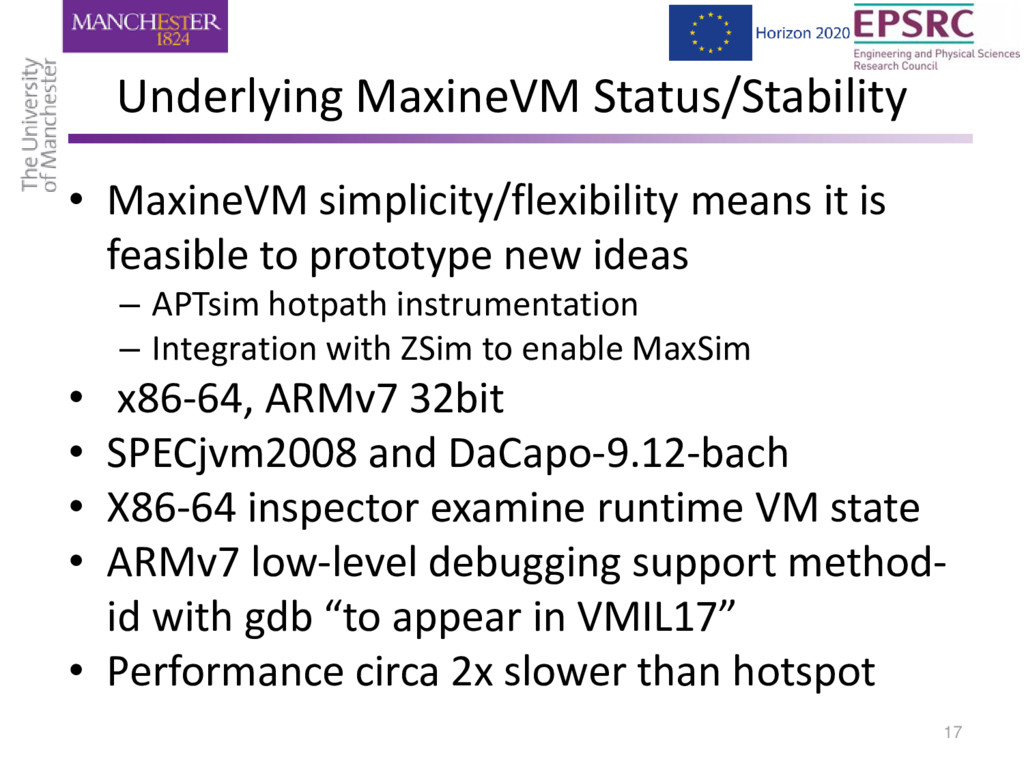
to prototype new ideas – APTsim hotpath instrumentation – Integration with ZSim to enable MaxSim • x86-64, ARMv7 32bit • SPECjvm2008 and DaCapo-9.12-bach • X86-64 inspector examine runtime VM state • ARMv7 low-level debugging support method- id with gdb “to appear in VMIL17” • Performance circa 2x slower than hotspot 17
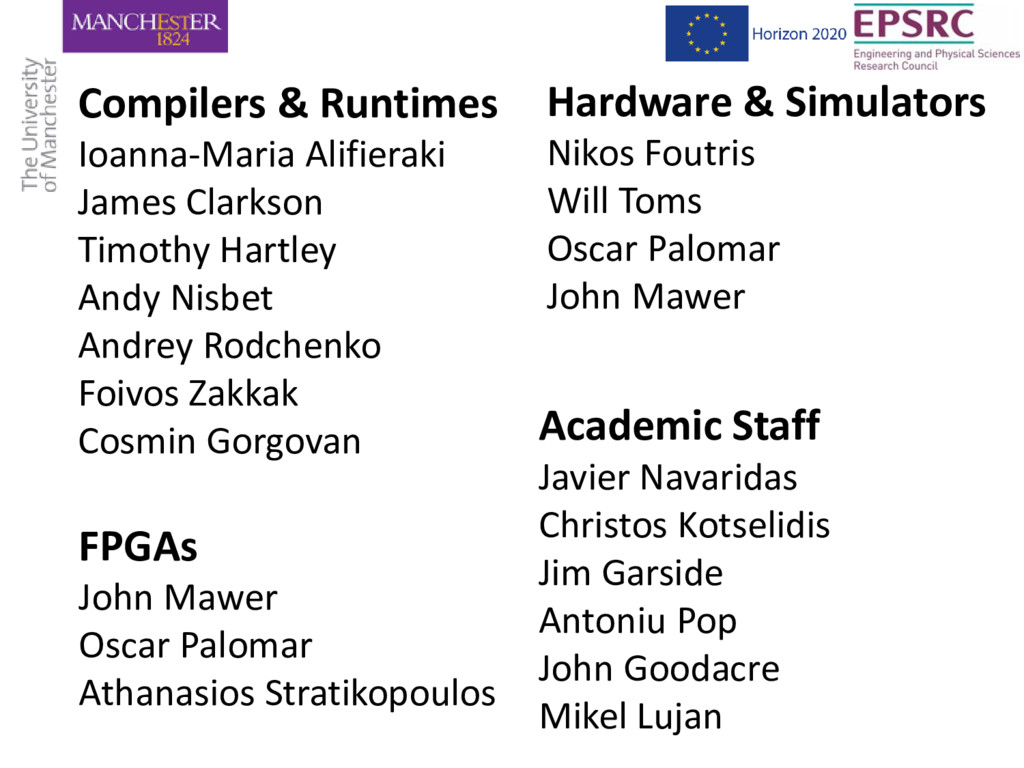
Nisbet Andrey Rodchenko Foivos Zakkak Cosmin Gorgovan Hardware & Simulators Nikos Foutris Will Toms Oscar Palomar John Mawer Academic Staff Javier Navaridas Christos Kotselidis Jim Garside Antoniu Pop John Goodacre Mikel Lujan FPGAs John Mawer Oscar Palomar Athanasios Stratikopoulos


 vmm
vmm
 doratex
 terazawa
 coderdojojapan
 juanmartin2026
 yoshimura_datam
 bvr7352
 cbtlibrary
 ytapples613
 akiraasano
 hiragahh
 pawan_pharm
 bryan
bryan
 ks91
ks91
 cassininazir
 chrislema
 jdejongh
 kimpetersen
 thekraken
 skipperchong
 palkan
 vanstee
 aarron
 davidcarrasco
![APTsim: Hw/Sw Codesign (See [2]) 11 MAST is the glue](https://files.speakerdeck.com/presentations/c9a4c69fa89348dc917238827613923f/slide_10.jpg)