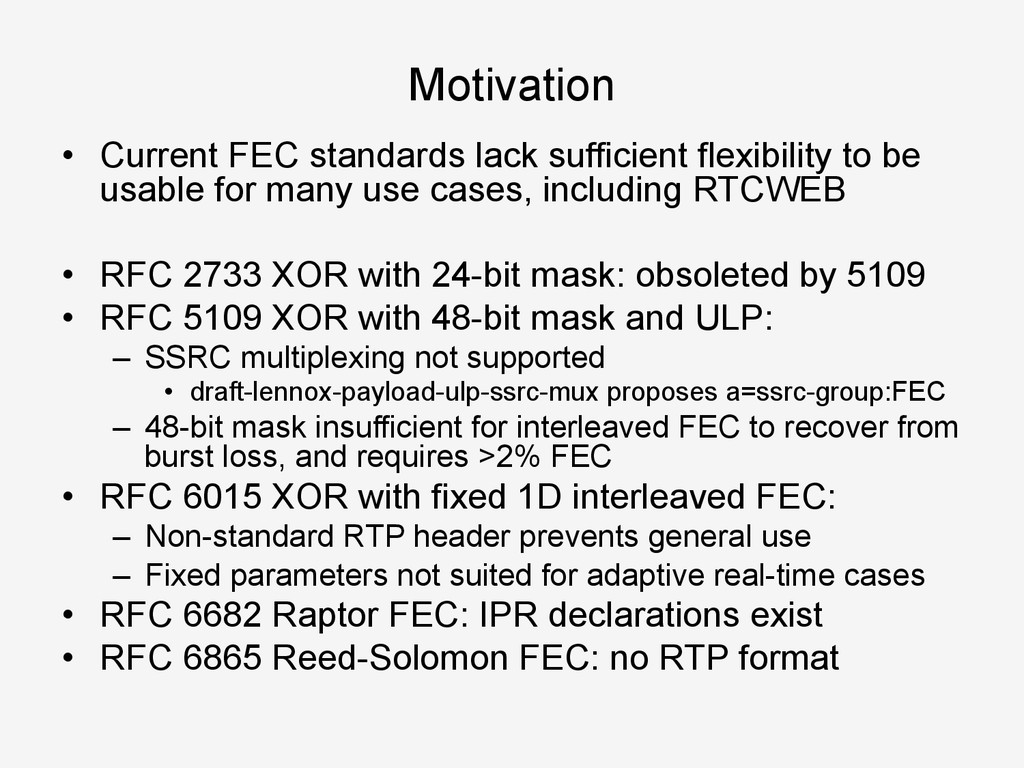
usable for many use cases, including RTCWEB • RFC 2733 XOR with 24-bit mask: obsoleted by 5109 • RFC 5109 XOR with 48-bit mask and ULP: – SSRC multiplexing not supported • draft-lennox-payload-ulp-ssrc-mux proposes a=ssrc-group:FEC – 48-bit mask insufficient for interleaved FEC to recover from burst loss, and requires >2% FEC • RFC 6015 XOR with fixed 1D interleaved FEC: – Non-standard RTP header prevents general use – Fixed parameters not suited for adaptive real-time cases • RFC 6682 Raptor FEC: IPR declarations exist • RFC 6865 Reed-Solomon FEC: no RTP format
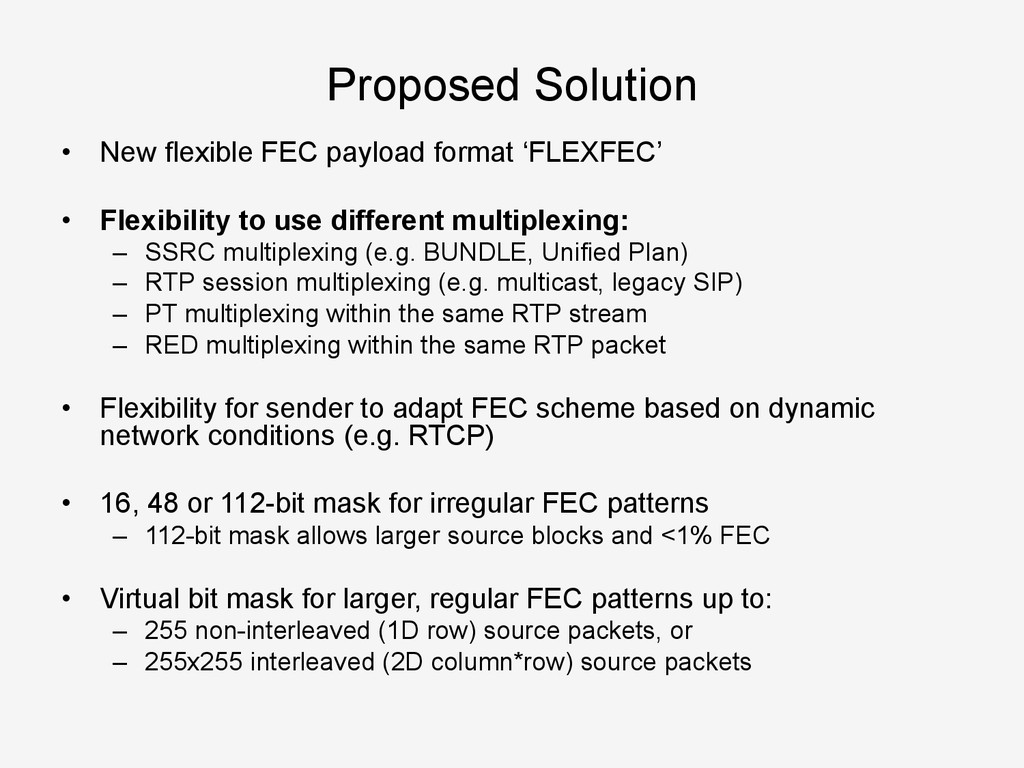
Flexibility to use different multiplexing: – SSRC multiplexing (e.g. BUNDLE, Unified Plan) – RTP session multiplexing (e.g. multicast, legacy SIP) – PT multiplexing within the same RTP stream – RED multiplexing within the same RTP packet • Flexibility for sender to adapt FEC scheme based on dynamic network conditions (e.g. RTCP) • 16, 48 or 112-bit mask for irregular FEC patterns – 112-bit mask allows larger source blocks and <1% FEC • Virtual bit mask for larger, regular FEC patterns up to: – 255 non-interleaved (1D row) source packets, or – 255x255 interleaved (2D column*row) source packets
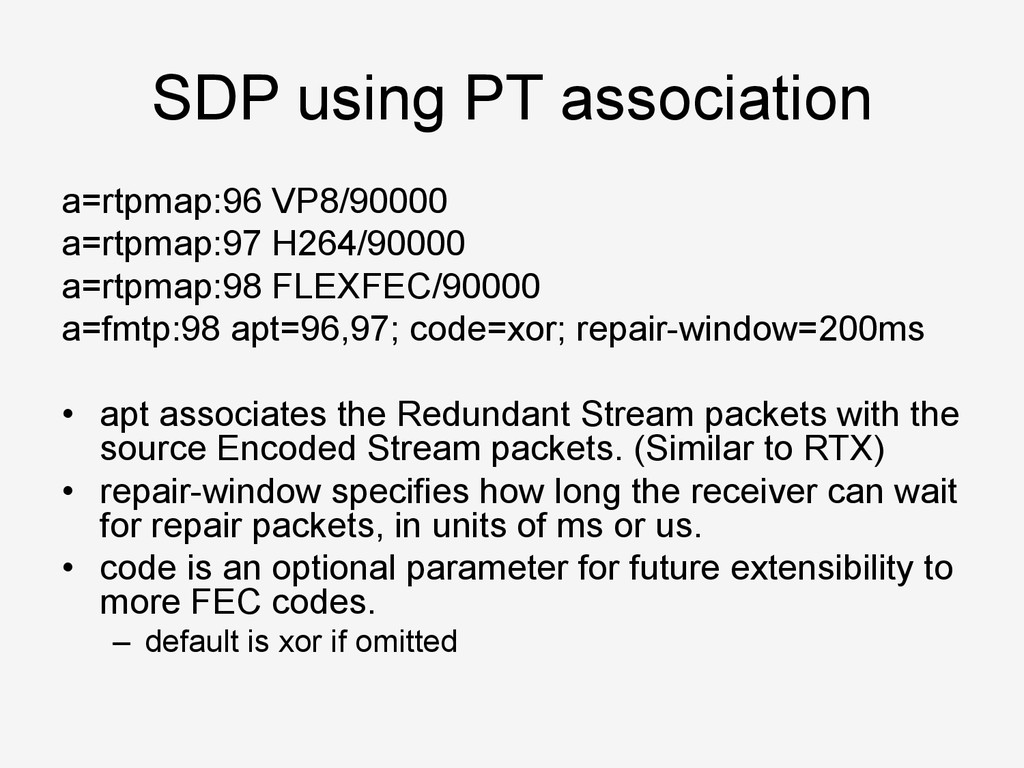
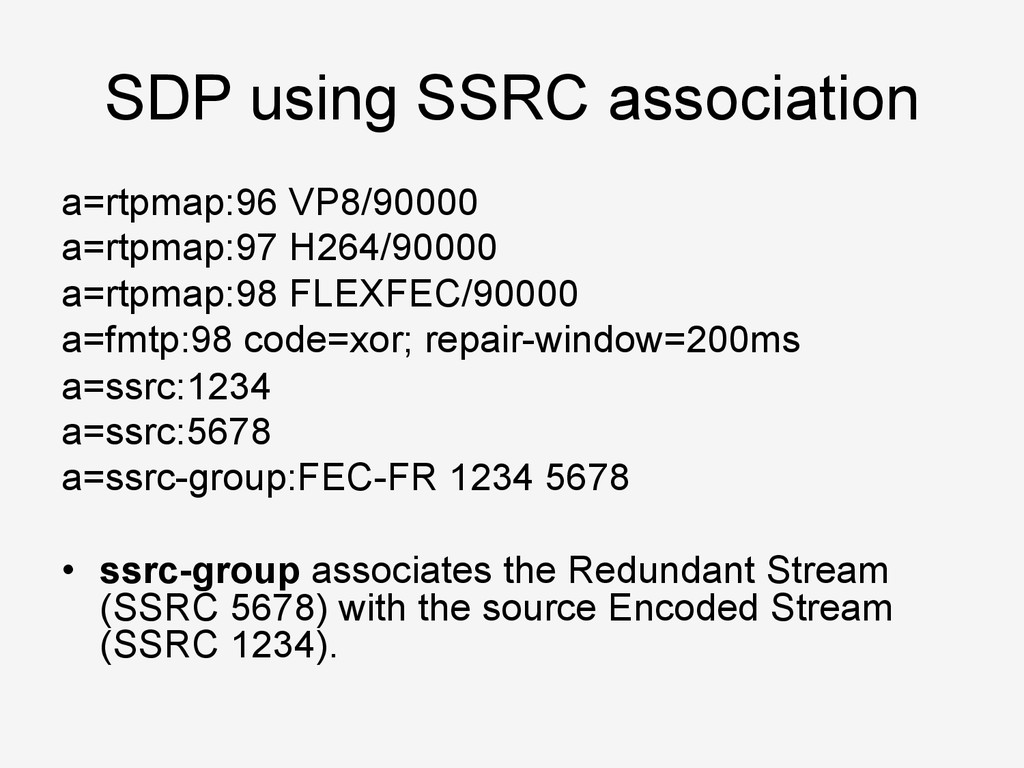
a=fmtp:98 apt=96,97; code=xor; repair-window=200ms • apt associates the Redundant Stream packets with the source Encoded Stream packets. (Similar to RTX) • repair-window specifies how long the receiver can wait for repair packets, in units of ms or us. • code is an optional parameter for future extensibility to more FEC codes. – default is xor if omitted


 vr000m
 x5gtrn
 occhi
occhi
 kakehashi
 tsukina_7mochi
 k1style
 ykanoh
 keio_smilab
 sansantech
 takmin
 taketakekaho
 yug1224
 gree_tech
 uxyall
 techseoconnect
 mlcsv
mlcsv
 ks91
ks91
 nmsamuel
 konakalab
 tessaabrams
 marcduiker
 rkendrick25
 lauravandoore
 jcasabona
 jmmastey