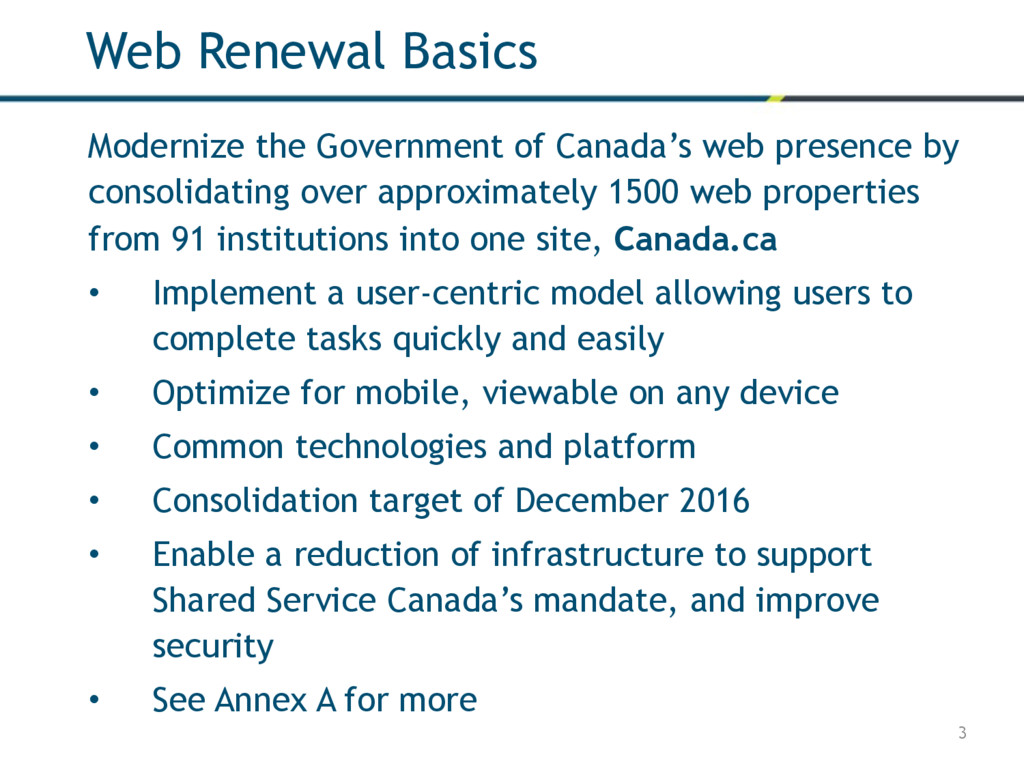
presence by consolidating over approximately 1500 web properties from 91 institutions into one site, Canada.ca • Implement a user-centric model allowing users to complete tasks quickly and easily • Optimize for mobile, viewable on any device • Common technologies and platform • Consolidation target of December 2016 • Enable a reduction of infrastructure to support Shared Service Canada’s mandate, and improve security • See Annex A for more
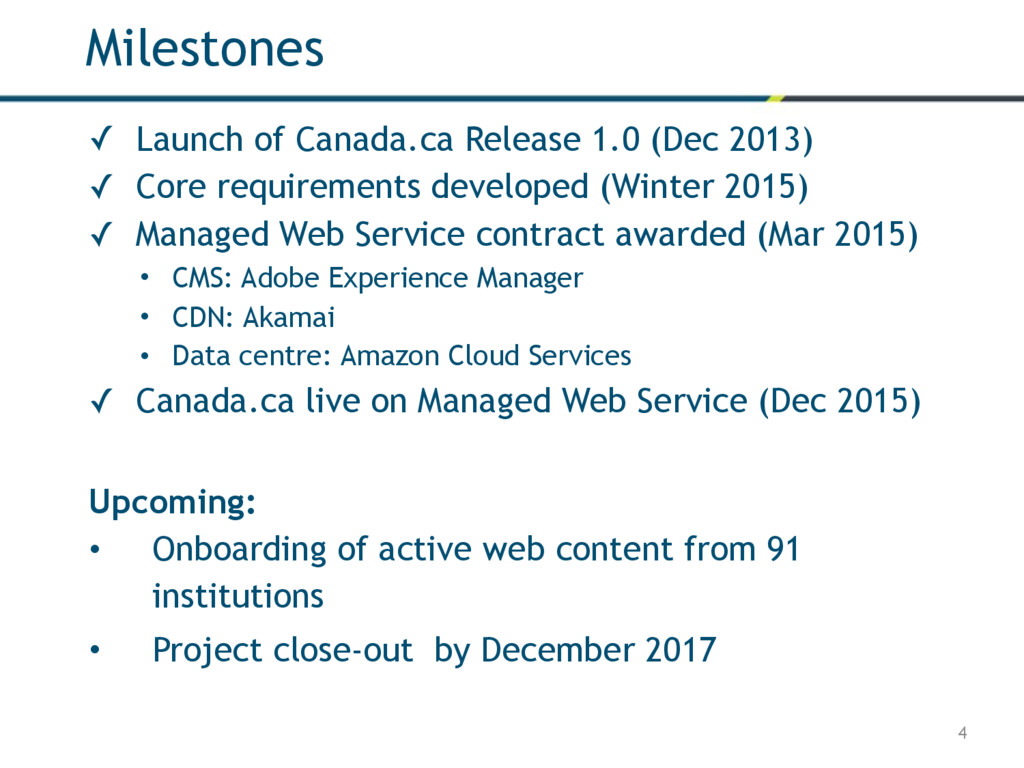
Core requirements developed (Winter 2015) ✓ Managed Web Service contract awarded (Mar 2015) • CMS: Adobe Experience Manager • CDN: Akamai • Data centre: Amazon Cloud Services ✓ Canada.ca live on Managed Web Service (Dec 2015) Upcoming: • Onboarding of active web content from 91 institutions • Project close-out by December 2017 Milestones
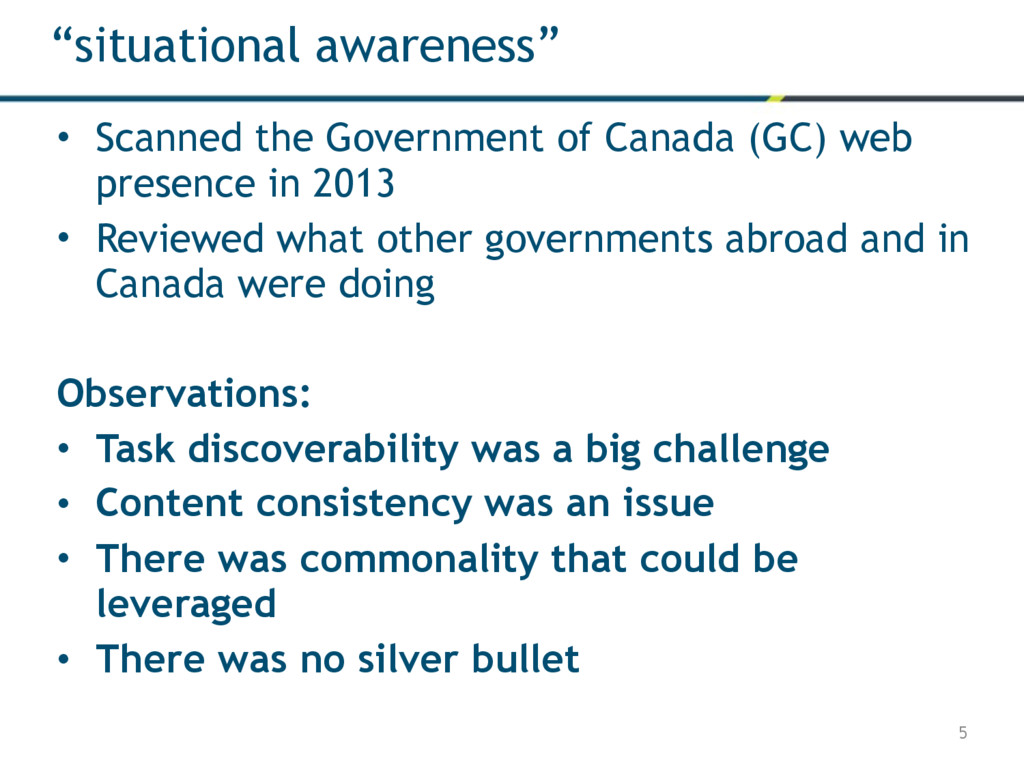
in 2013 • Reviewed what other governments abroad and in Canada were doing Observations: • Task discoverability was a big challenge • Content consistency was an issue • There was commonality that could be leveraged • There was no silver bullet “situational awareness”
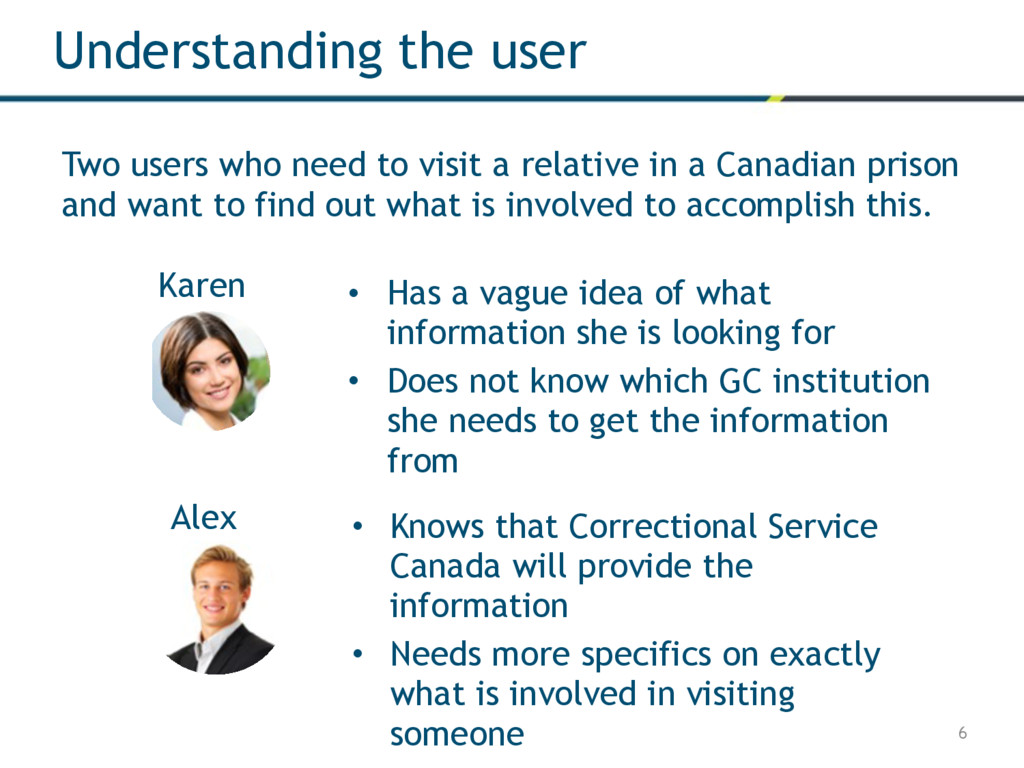
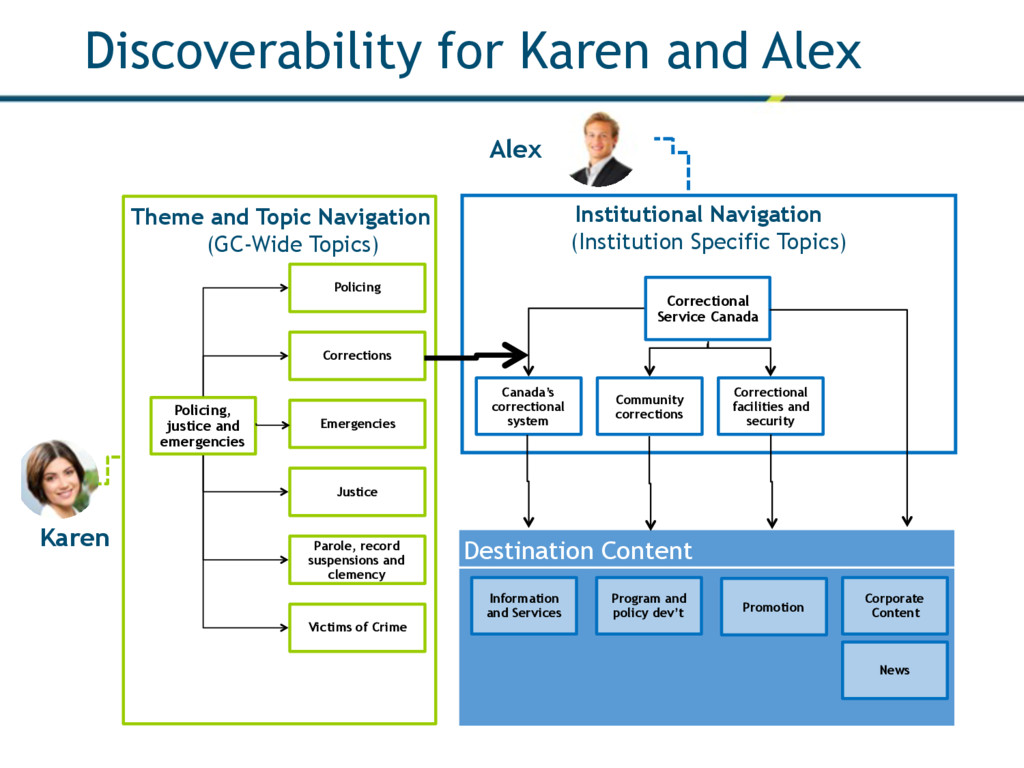
a relative in a Canadian prison and want to find out what is involved to accomplish this. Karen • Has a vague idea of what information she is looking for • Does not know which GC institution she needs to get the information from Alex • Knows that Correctional Service Canada will provide the information • Needs more specifics on exactly what is involved in visiting someone
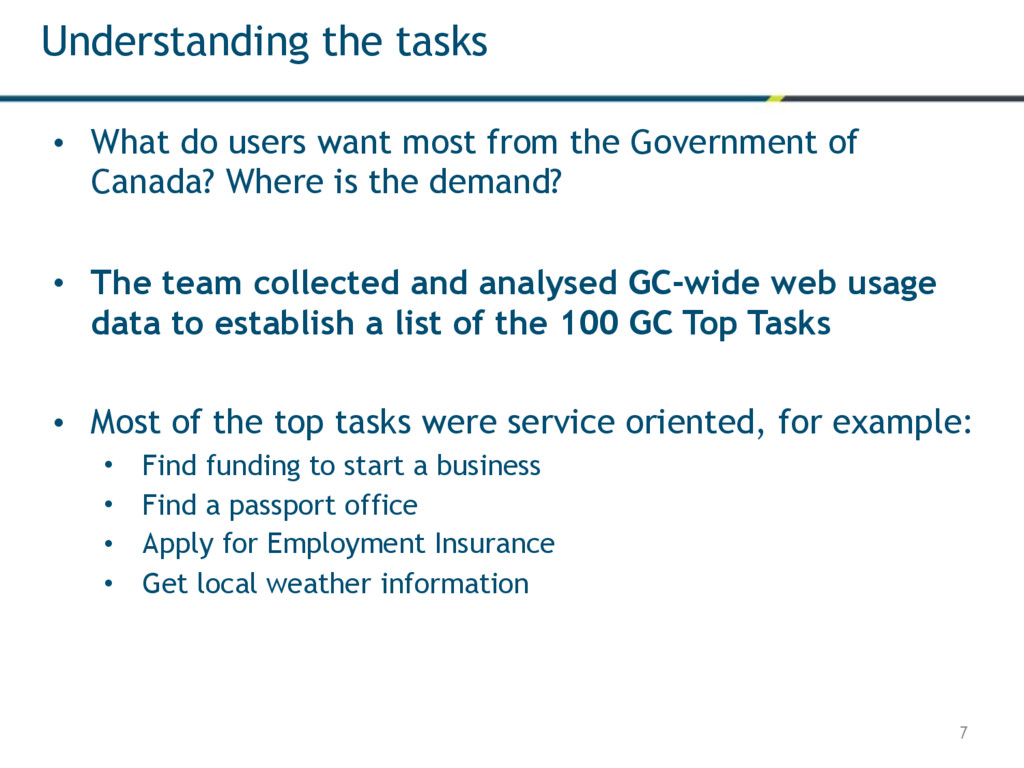
of Canada? Where is the demand? • The team collected and analysed GC-wide web usage data to establish a list of the 100 GC Top Tasks • Most of the top tasks were service oriented, for example: • Find funding to start a business • Find a passport office • Apply for Employment Insurance • Get local weather information Understanding the tasks
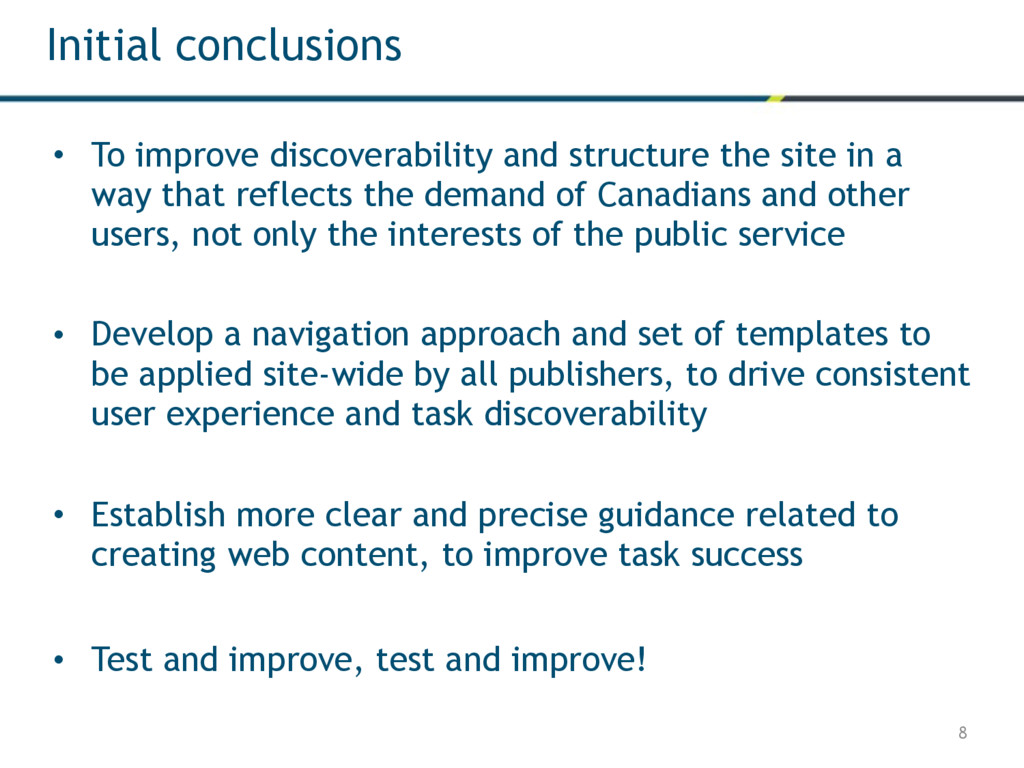
a way that reflects the demand of Canadians and other users, not only the interests of the public service • Develop a navigation approach and set of templates to be applied site-wide by all publishers, to drive consistent user experience and task discoverability • Establish more clear and precise guidance related to creating web content, to improve task success • Test and improve, test and improve! Initial conclusions
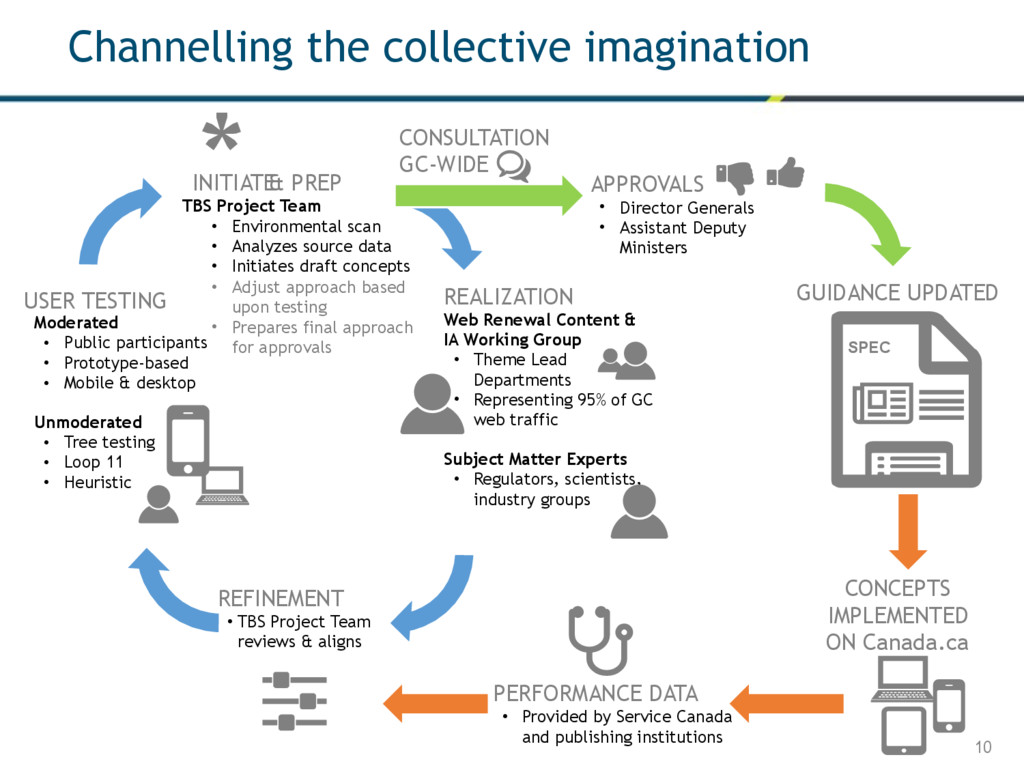
participants • Prototype-based • Mobile & desktop Unmoderated • Tree testing • Loop 11 • Heuristic GUIDANCE UPDATED • Adjust approach based upon testing • Prepares final approach for approvals & PREP APPROVALS • Director Generals • Assistant Deputy Ministers REFINEMENT • TBS Project Team reviews & aligns REALIZATION Web Renewal Content & IA Working Group • Theme Lead Departments • Representing 95% of GC web traffic Subject Matter Experts • Regulators, scientists, industry groups CONCEPTS IMPLEMENTED ON Canada.ca SPEC PERFORMANCE DATA • Provided by Service Canada and publishing institutions INITIATE TBS Project Team • Environmental scan • Analyzes source data • Initiates draft concepts CONSULTATION GC-WIDE *
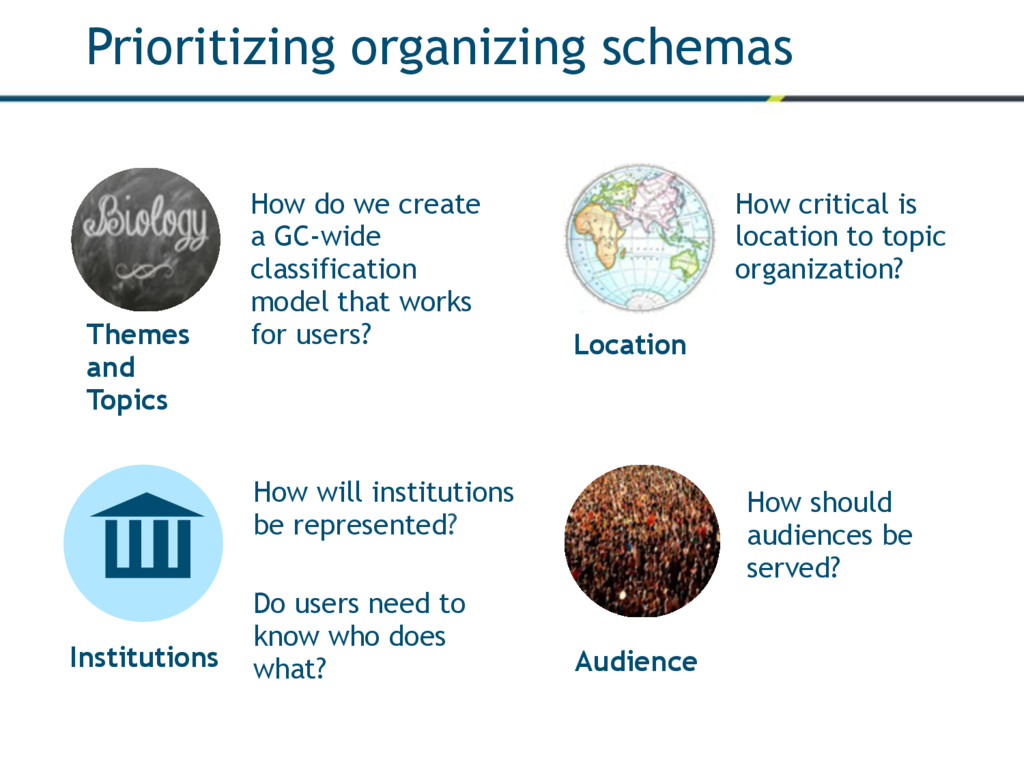
topic organization? How should audiences be served? Themes and Topics How do we create a GC-wide classification model that works for users? Institutions How will institutions be represented? Do users need to know who does what?
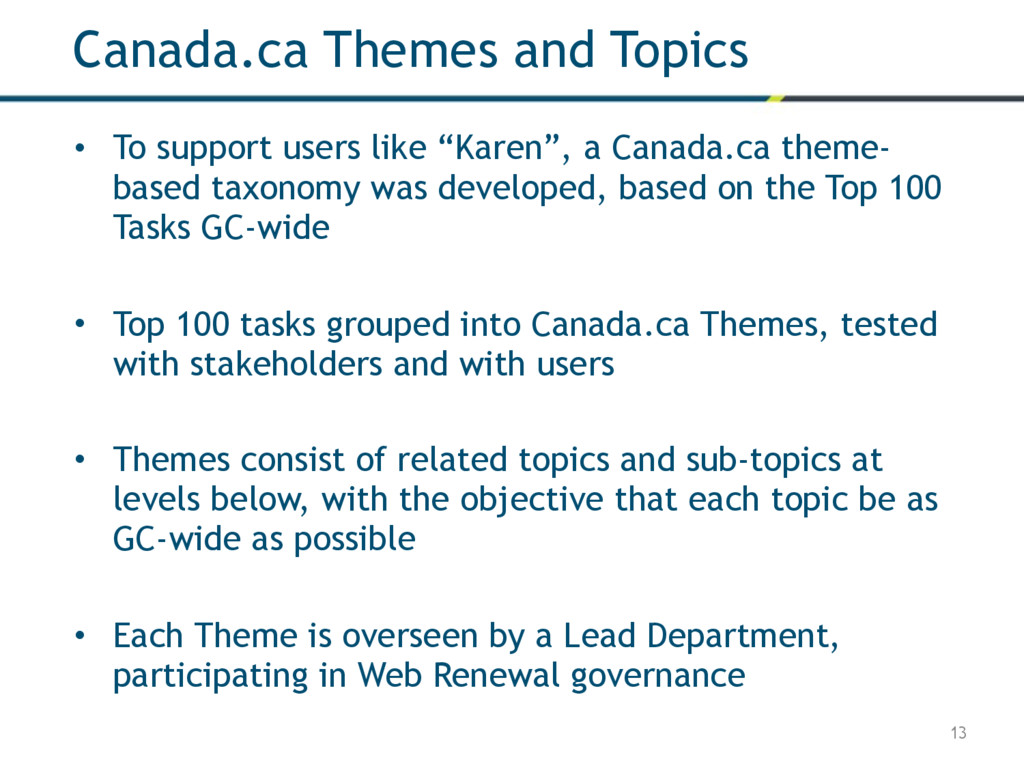
“Karen”, a Canada.ca theme- based taxonomy was developed, based on the Top 100 Tasks GC-wide • Top 100 tasks grouped into Canada.ca Themes, tested with stakeholders and with users • Themes consist of related topics and sub-topics at levels below, with the objective that each topic be as GC-wide as possible • Each Theme is overseen by a Lead Department, participating in Web Renewal governance
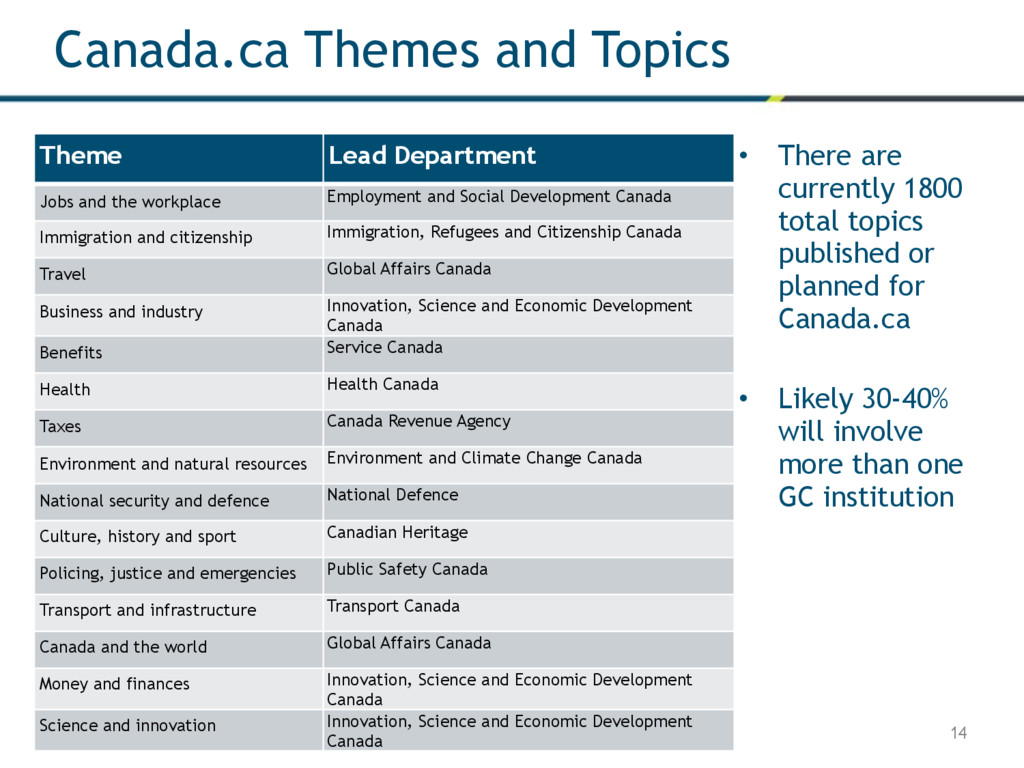
total topics published or planned for Canada.ca • Likely 30-40% will involve more than one GC institution Theme Lead Department Jobs and the workplace Employment and Social Development Canada Immigration and citizenship Immigration, Refugees and Citizenship Canada Travel Global Affairs Canada Business and industry Innovation, Science and Economic Development Canada Benefits Service Canada Health Health Canada Taxes Canada Revenue Agency Environment and natural resources Environment and Climate Change Canada National security and defence National Defence Culture, history and sport Canadian Heritage Policing, justice and emergencies Public Safety Canada Transport and infrastructure Transport Canada Canada and the world Global Affairs Canada Money and finances Innovation, Science and Economic Development Canada Science and innovation Innovation, Science and Economic Development Canada
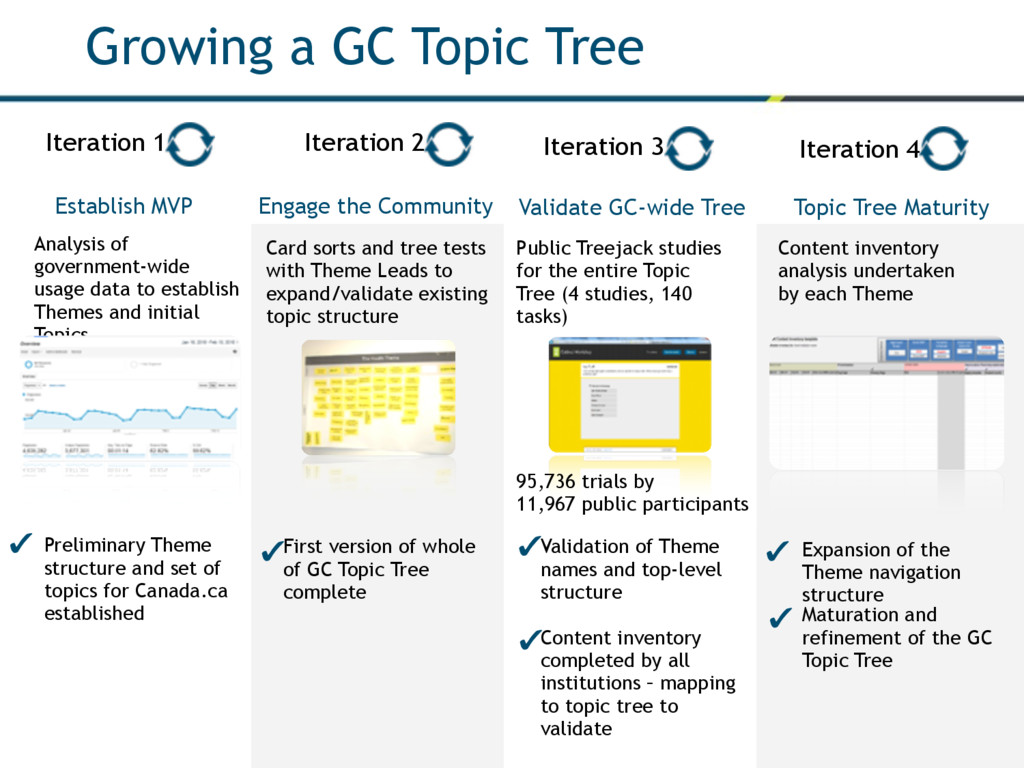
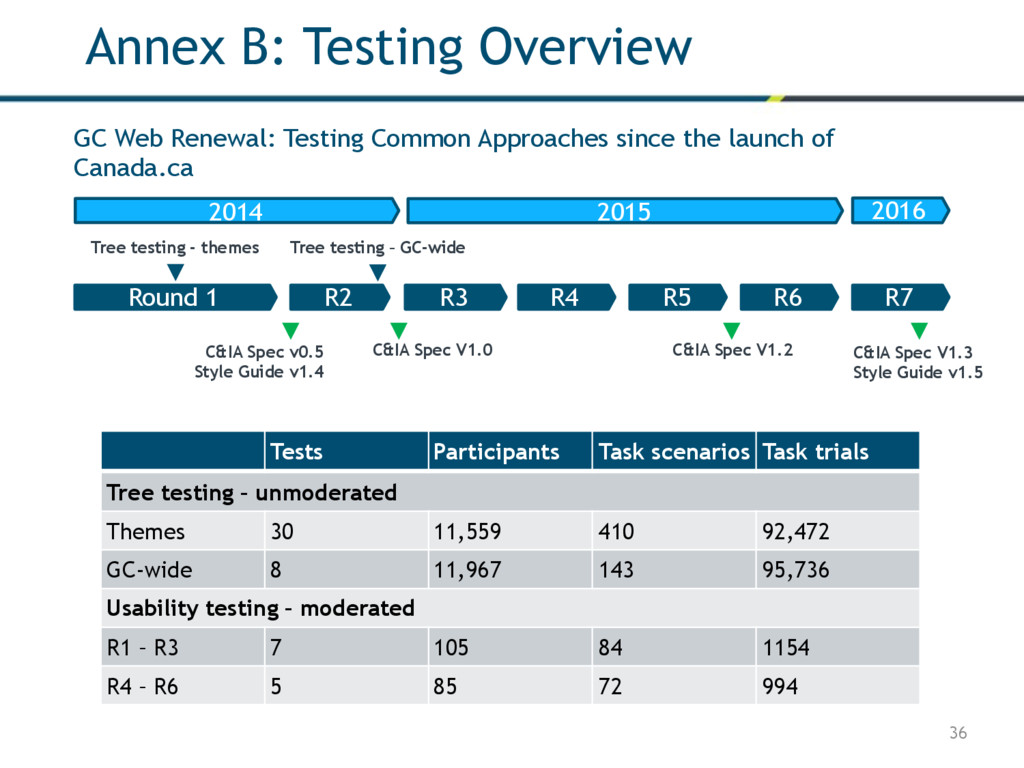
GC Topic Tree complete Establish MVP Engage the Community Card sorts and tree tests with Theme Leads to expand/validate existing topic structure Validate GC-wide Tree Topic Tree Maturity Validation of Theme names and top-level structure Content inventory completed by all institutions – mapping to topic tree to validate Expansion of the Theme navigation structure Preliminary Theme structure and set of topics for Canada.ca established Content inventory analysis undertaken by each Theme Public Treejack studies for the entire Topic Tree (4 studies, 140 tasks) 95,736 trials by 11,967 public participants Analysis of government-wide usage data to establish Themes and initial Topics Iteration 1 Iteration 2 Iteration 3 Iteration 4 Maturation and refinement of the GC Topic Tree
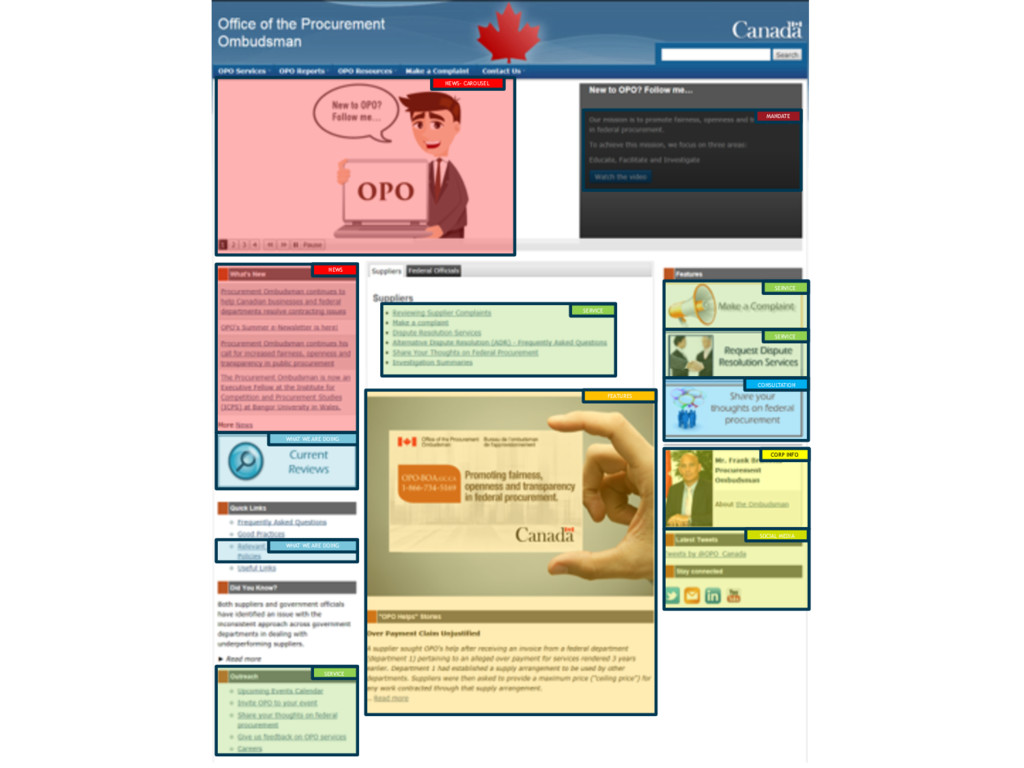
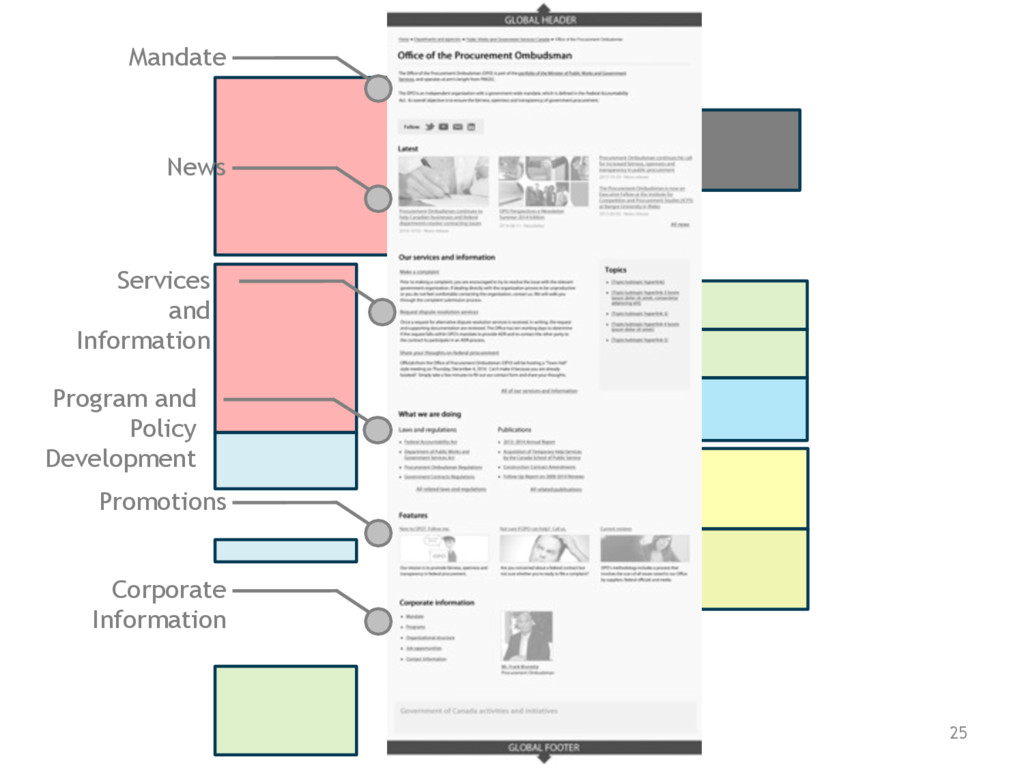
Corrections Emergencies Justice Victims of Crime Parole, record suspensions and clemency Theme and Topic Navigation (GC-Wide Topics) Correctional Service Canada Canada’s correctional system Community corrections Correctional facilities and security Institutional Navigation (Institution Specific Topics) Destination Content Karen Alex Corporate Content Information and Services Program and policy dev’t News Promotion
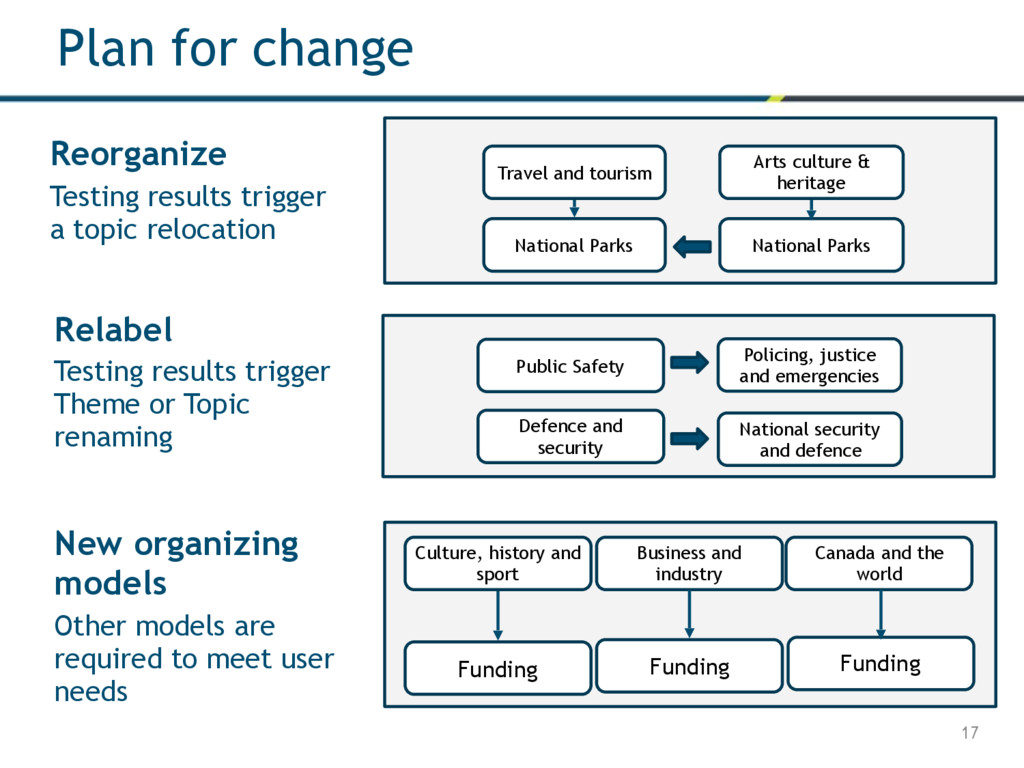
Testing results trigger Theme or Topic renaming National security and defence Policing, justice and emergencies National Parks Arts culture & heritage National Parks Travel and tourism Reorganize Testing results trigger a topic relocation New organizing models Other models are required to meet user needs Funding Culture, history and sport Business and industry Canada and the world Funding Funding
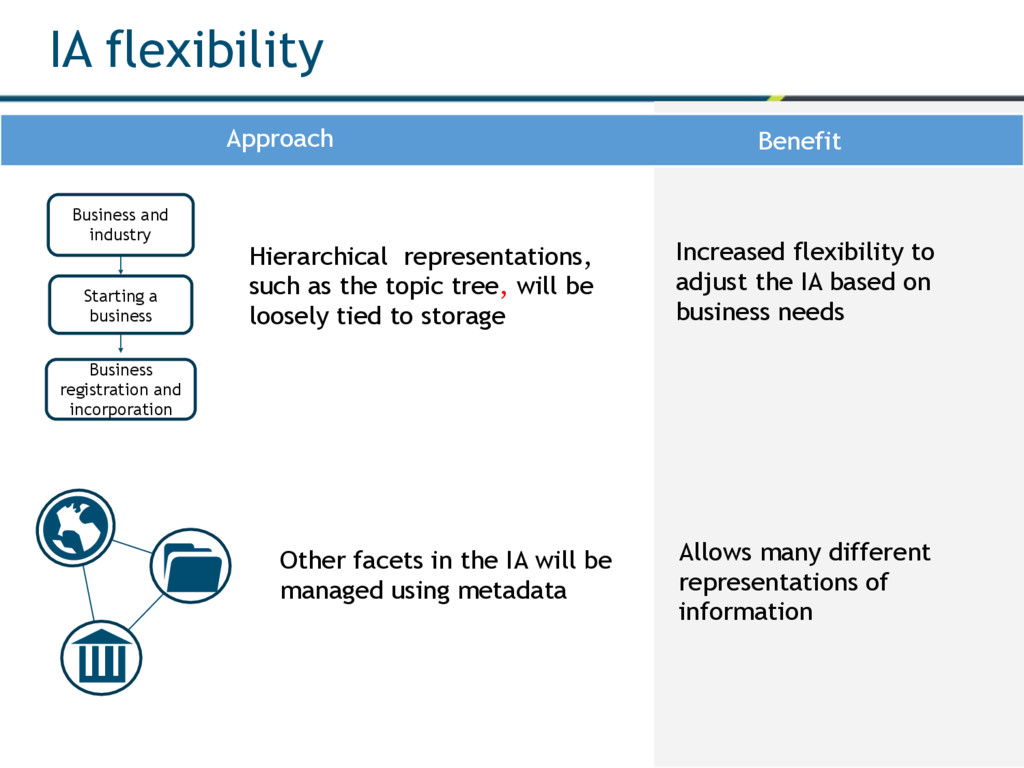
and incorporation Hierarchical representations, such as the topic tree, will be loosely tied to storage Other facets in the IA will be managed using metadata Increased flexibility to adjust the IA based on business needs Allows many different representations of information Approach Benefit
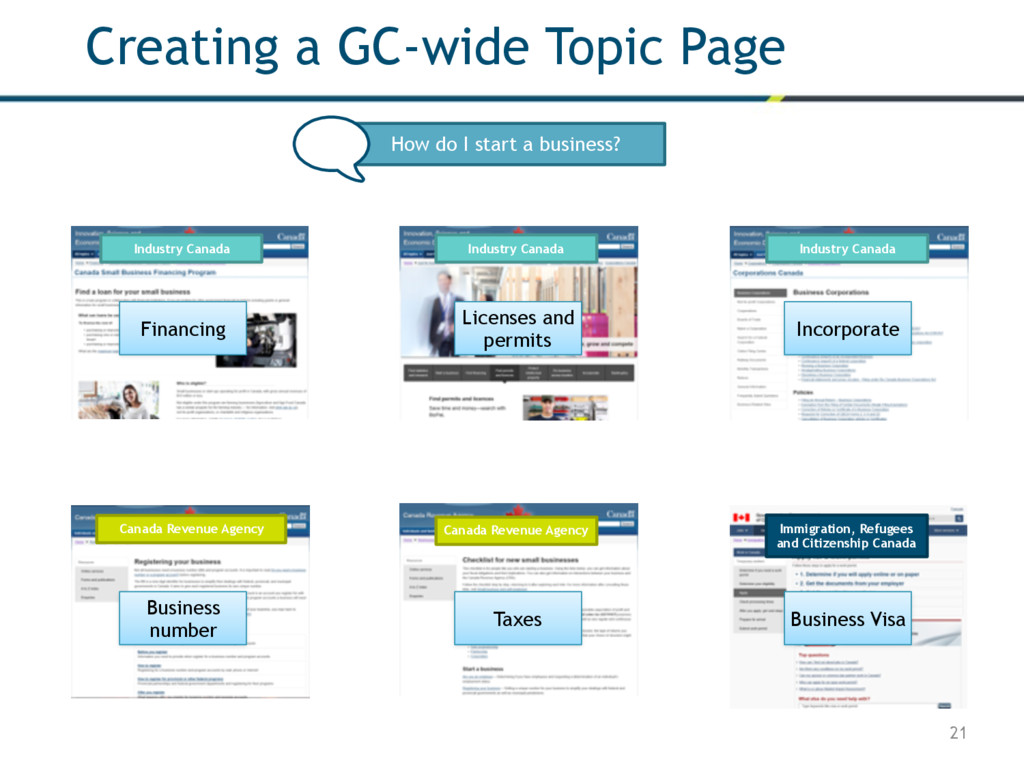
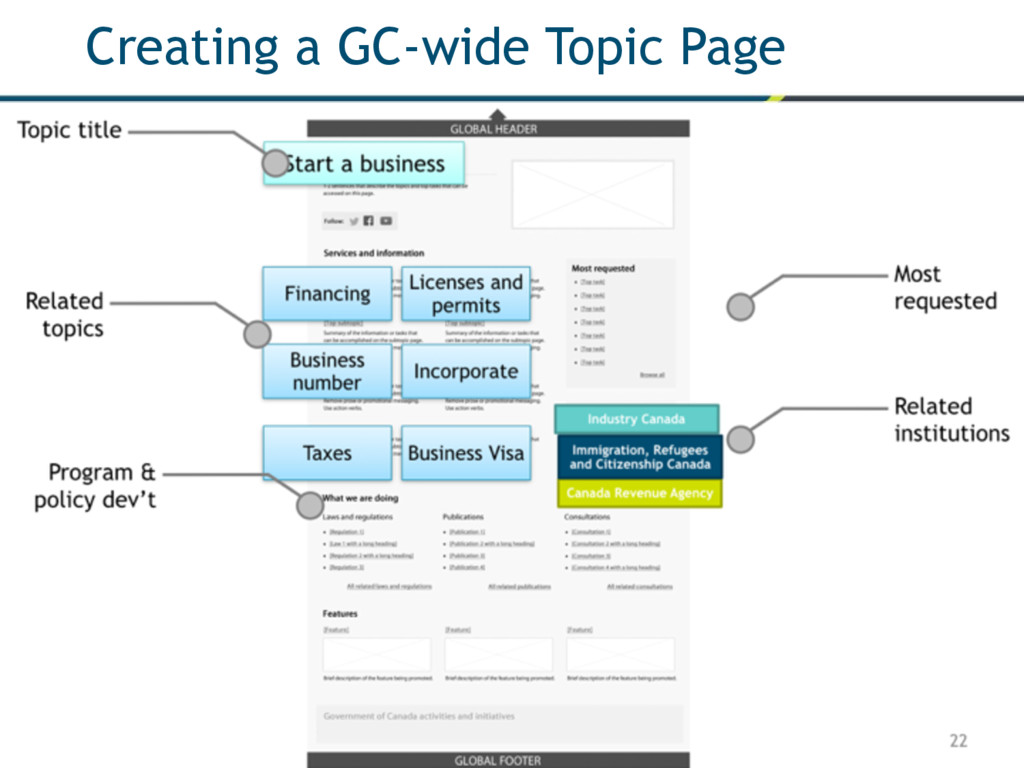
Incorporate Business number Taxes Business Visa How do I start a business? Industry Canada Industry Canada Industry Canada Canada Revenue Agency Canada Revenue Agency Immigration, Refugees and Citizenship Canada
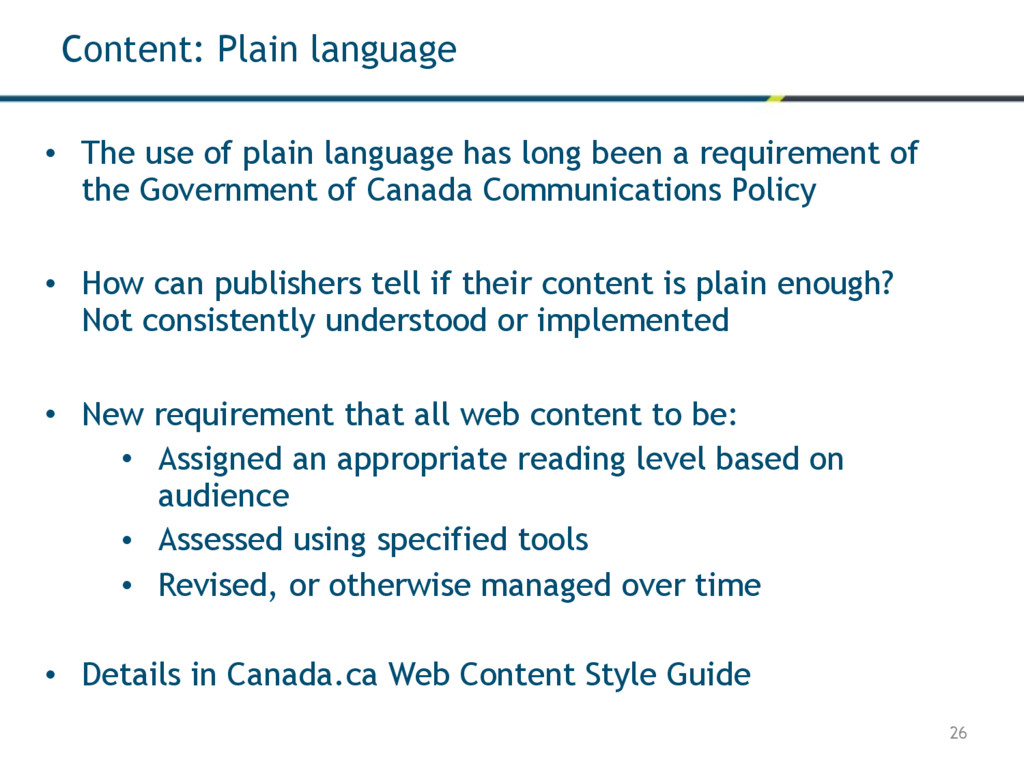
a requirement of the Government of Canada Communications Policy • How can publishers tell if their content is plain enough? Not consistently understood or implemented • New requirement that all web content to be: • Assigned an appropriate reading level based on audience • Assessed using specified tools • Revised, or otherwise managed over time • Details in Canada.ca Web Content Style Guide Content: Plain language
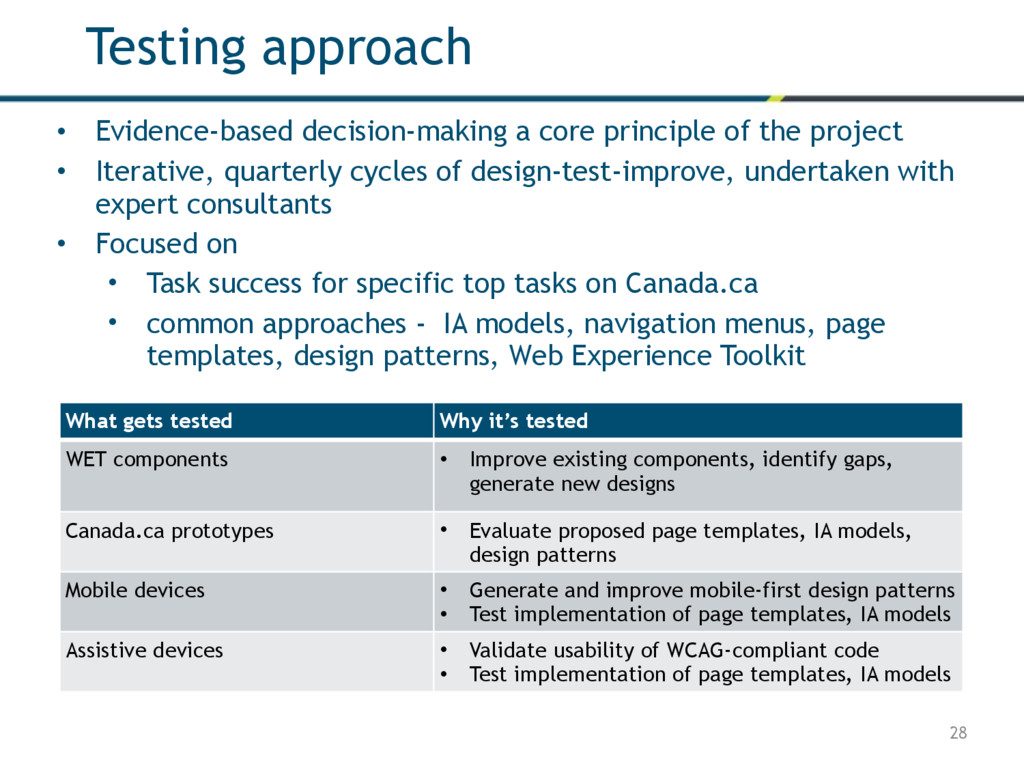
the project • Iterative, quarterly cycles of design-test-improve, undertaken with expert consultants • Focused on • Task success for specific top tasks on Canada.ca • common approaches - IA models, navigation menus, page templates, design patterns, Web Experience Toolkit What gets tested Why it’s tested WET components • Improve existing components, identify gaps, generate new designs Canada.ca prototypes • Evaluate proposed page templates, IA models, design patterns Mobile devices • Generate and improve mobile-first design patterns • Test implementation of page templates, IA models Assistive devices • Validate usability of WCAG-compliant code • Test implementation of page templates, IA models
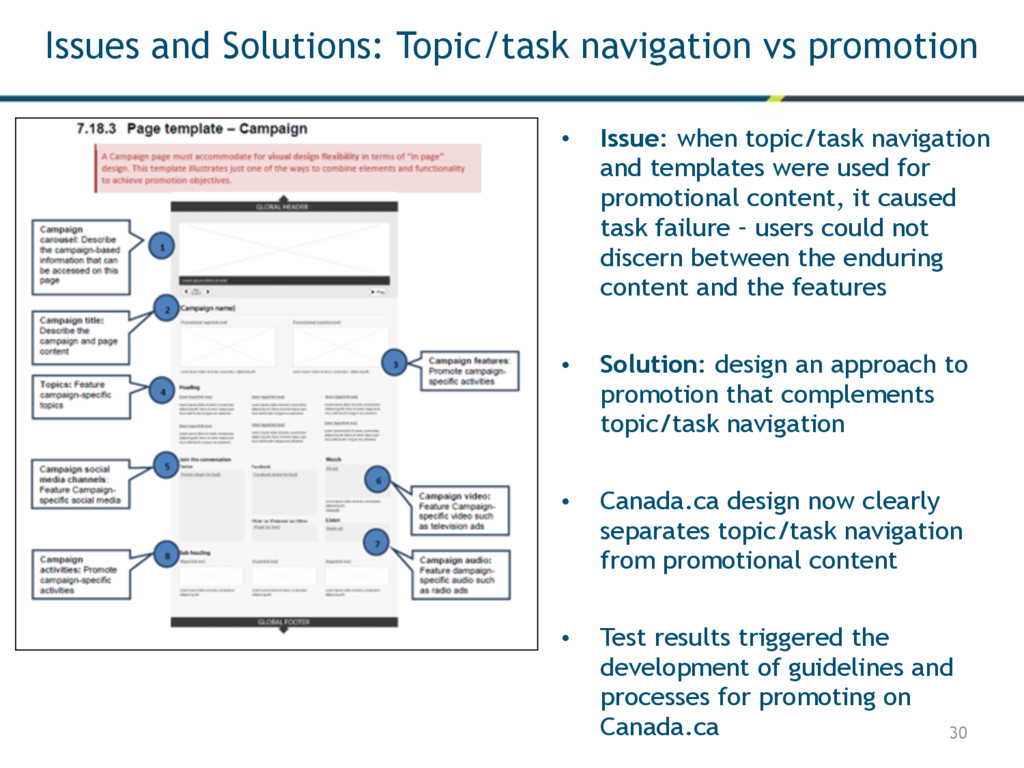
when topic/task navigation and templates were used for promotional content, it caused task failure – users could not discern between the enduring content and the features • Solution: design an approach to promotion that complements topic/task navigation • Canada.ca design now clearly separates topic/task navigation from promotional content • Test results triggered the development of guidelines and processes for promoting on Canada.ca
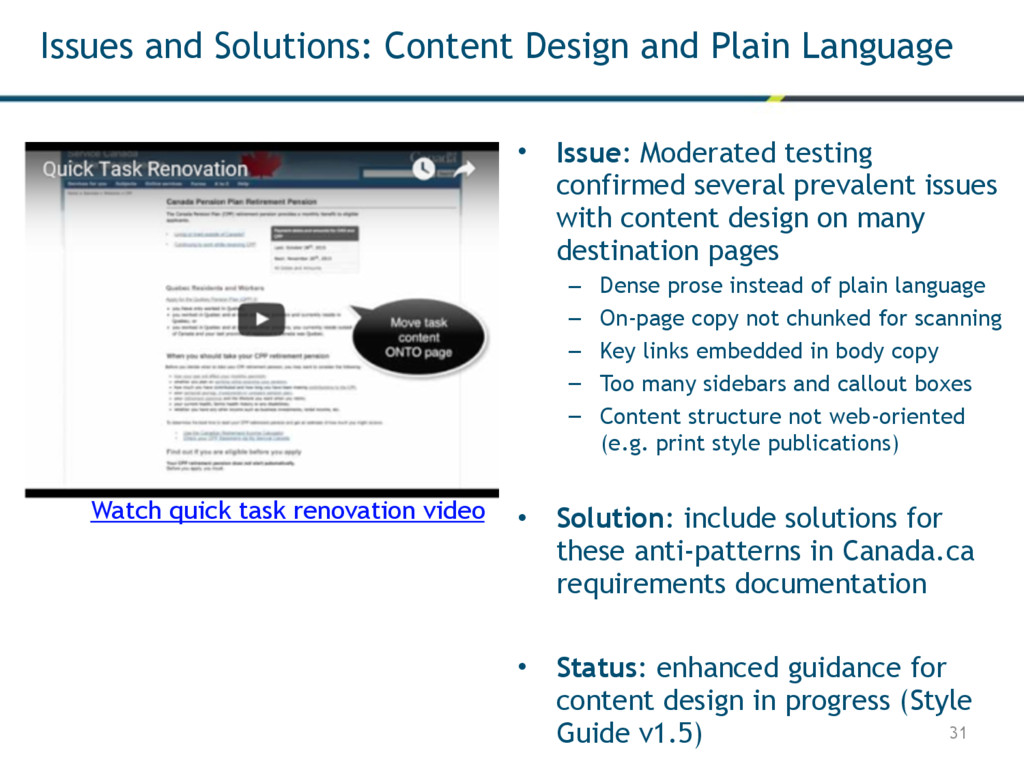
Issue: Moderated testing confirmed several prevalent issues with content design on many destination pages – Dense prose instead of plain language – On-page copy not chunked for scanning – Key links embedded in body copy – Too many sidebars and callout boxes – Content structure not web-oriented (e.g. print style publications) • Solution: include solutions for these anti-patterns in Canada.ca requirements documentation • Status: enhanced guidance for content design in progress (Style Guide v1.5) Watch quick task renovation video
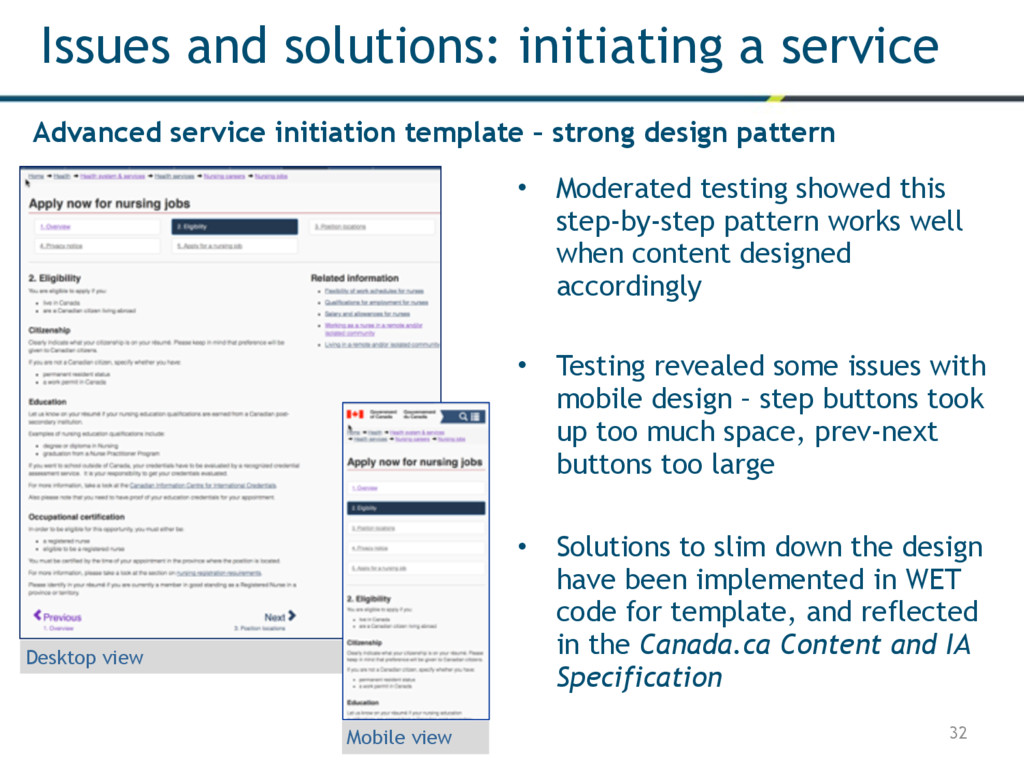
service initiation template – strong design pattern • Moderated testing showed this step-by-step pattern works well when content designed accordingly • Testing revealed some issues with mobile design – step buttons took up too much space, prev-next buttons too large • Solutions to slim down the design have been implemented in WET code for template, and reflected in the Canada.ca Content and IA Specification Mobile view
Departments to mature the topic tree. Opportunities to: • flatten it, make it more consistent • encourage the ongoing development of GC-wide topics, with partners • Finalize templates, ensure the guidance is well understood by the GC publishing community, and implementation is successful on MWS • Establish framework for more clear and direct oversight of plain language publishing • Build usability testing capacity within GC institutions • Online testing tools that are inexpensive, simple to implement, deliver actionable, task-oriented results • Methodology that will enable GC institutions to deliver measurable results on Canada.ca
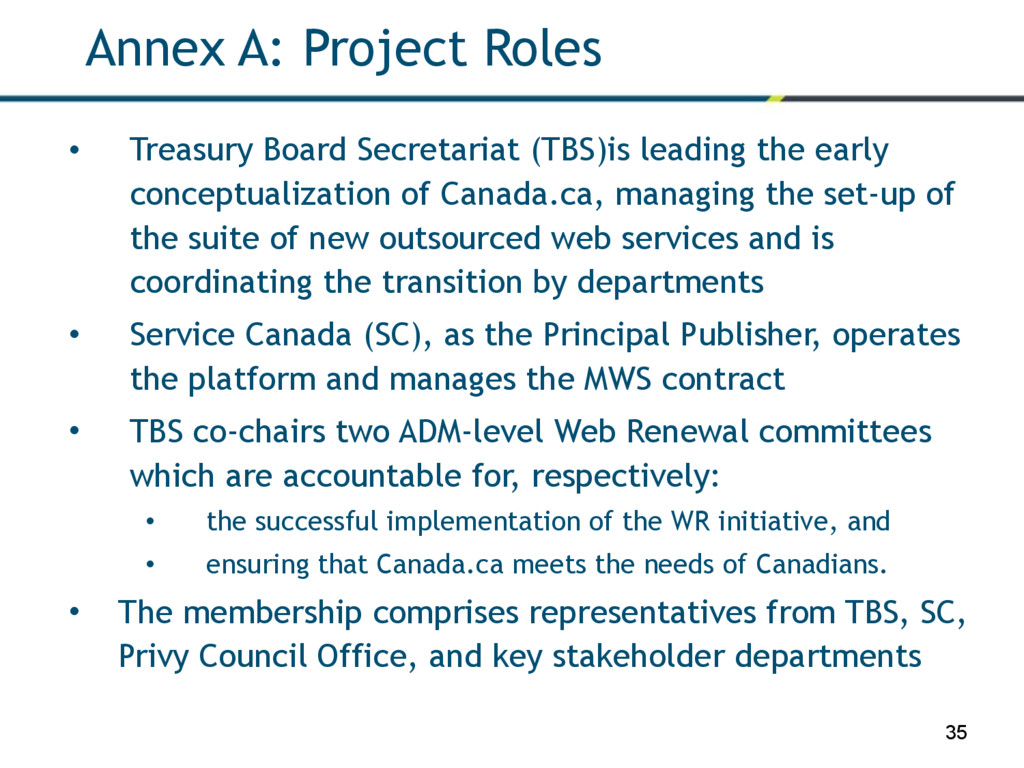
of Canada.ca, managing the set-up of the suite of new outsourced web services and is coordinating the transition by departments • Service Canada (SC), as the Principal Publisher, operates the platform and manages the MWS contract • TBS co-chairs two ADM-level Web Renewal committees which are accountable for, respectively: • the successful implementation of the WR initiative, and • ensuring that Canada.ca meets the needs of Canadians. • The membership comprises representatives from TBS, SC, Privy Council Office, and key stakeholder departments Annex A: Project Roles
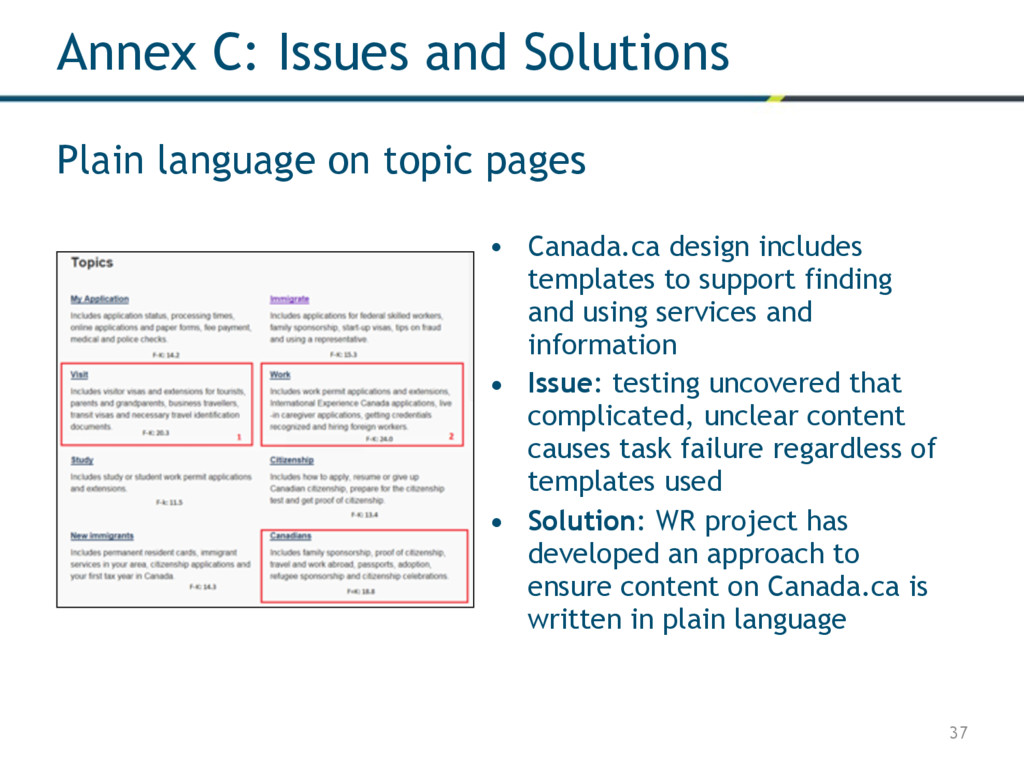
templates to support finding and using services and information • Issue: testing uncovered that complicated, unclear content causes task failure regardless of templates used • Solution: WR project has developed an approach to ensure content on Canada.ca is written in plain language Annex C: Issues and Solutions
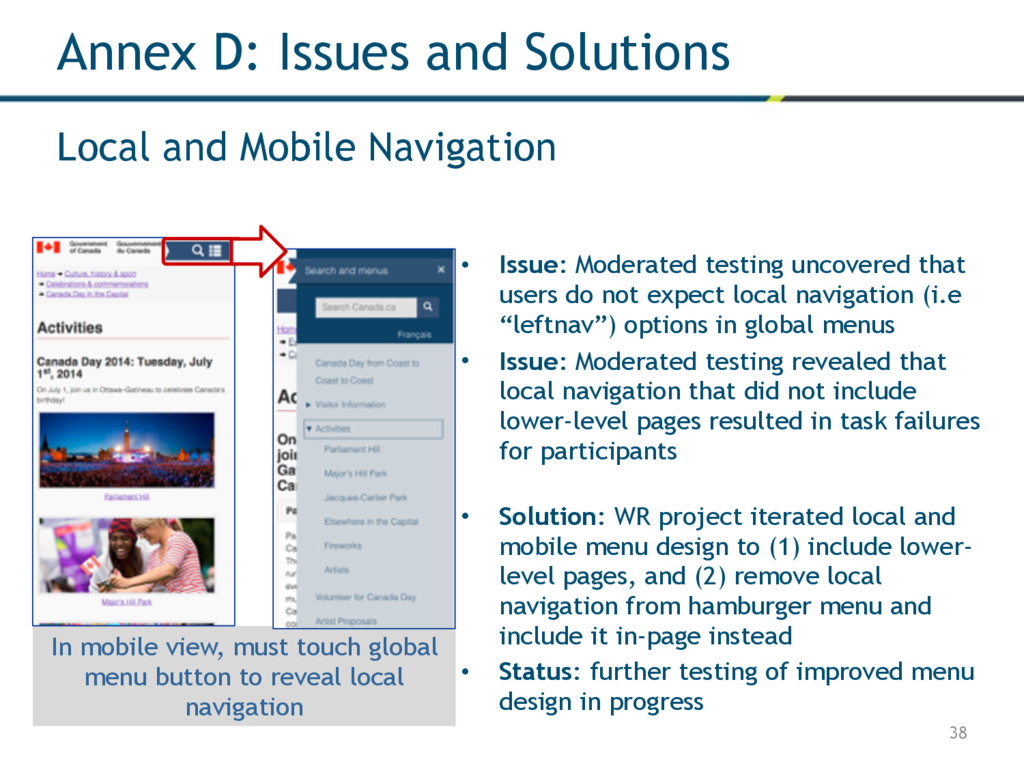
that users do not expect local navigation (i.e “leftnav”) options in global menus • Issue: Moderated testing revealed that local navigation that did not include lower-level pages resulted in task failures for participants • Solution: WR project iterated local and mobile menu design to (1) include lower- level pages, and (2) remove local navigation from hamburger menu and include it in-page instead • Status: further testing of improved menu design in progress In mobile view, must touch global menu button to reveal local navigation Annex D: Issues and Solutions
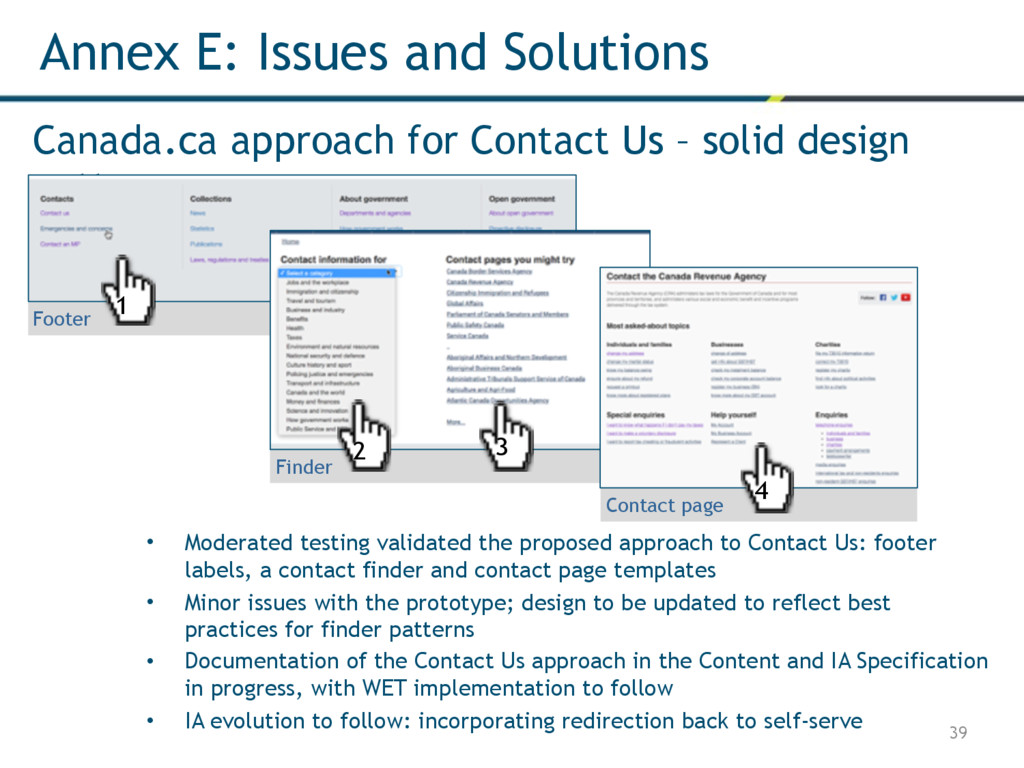
Canada.ca approach for Contact Us – solid design pattern • Moderated testing validated the proposed approach to Contact Us: footer labels, a contact finder and contact page templates • Minor issues with the prototype; design to be updated to reflect best practices for finder patterns • Documentation of the Contact Us approach in the Content and IA Specification in progress, with WET implementation to follow • IA evolution to follow: incorporating redirection back to self-serve 1 2 3 4

 Your Podcast. Everywhere. Effortlessly.


 wiadott
 mza
mza
 rkaga
rkaga
 panda_program
 marktimemedia
 varn
varn
 brettharned
 tammyeverts
 mfonobong
 takai
takai
 reverentgeek
 honzajavorek
 sugarenia