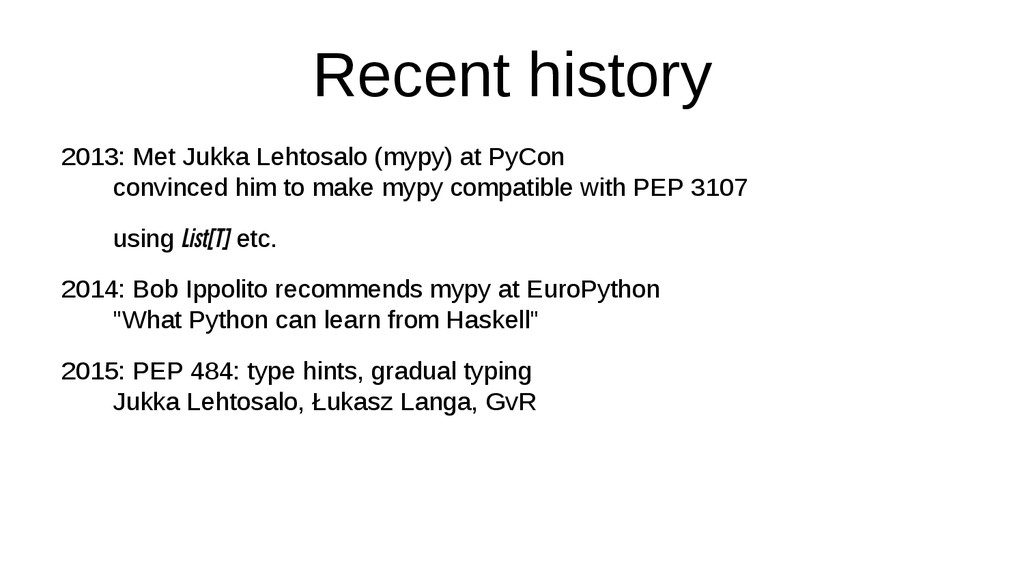
him to make mypy compatible with PEP 3107 using List[T] etc. 2014: Bob Ippolito recommends mypy at EuroPython "What Python can learn from Haskell" 2015: PEP 484: type hints, gradual typing Jukka Lehtosalo, Łukasz Langa, GvR
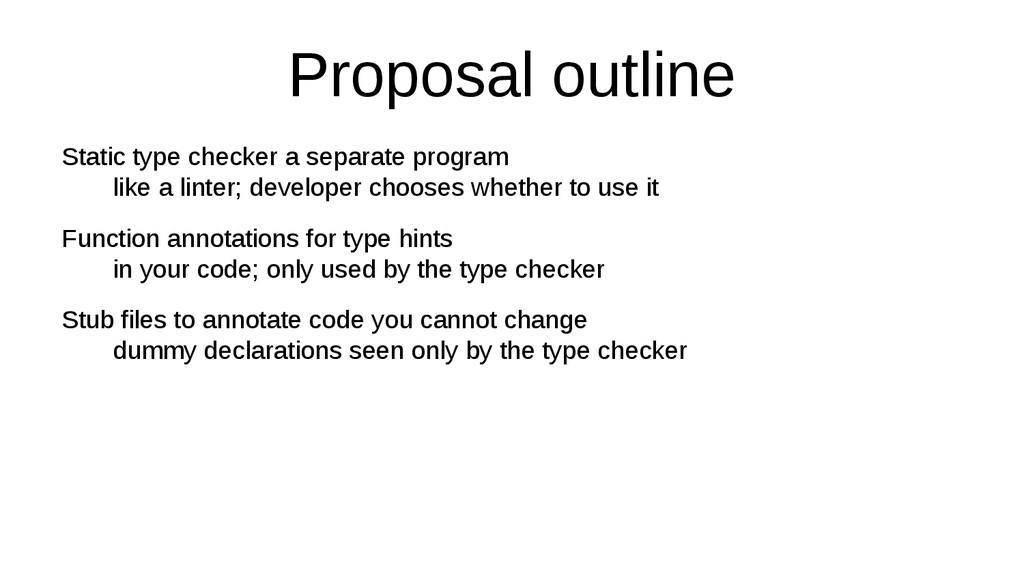
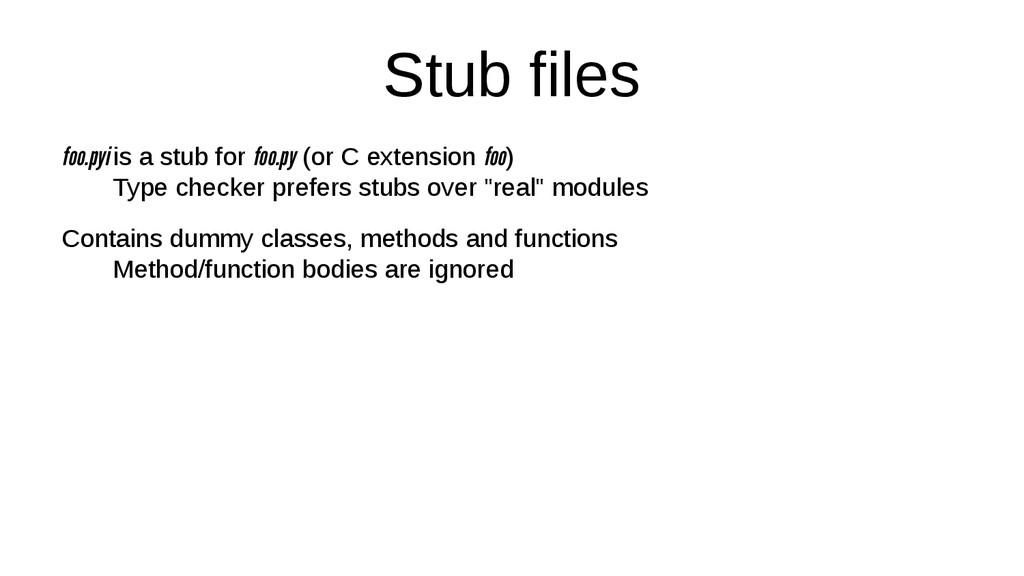
linter; developer chooses whether to use it Function annotations for type hints in your code; only used by the type checker Stub files to annotate code you cannot change dummy declarations seen only by the type checker
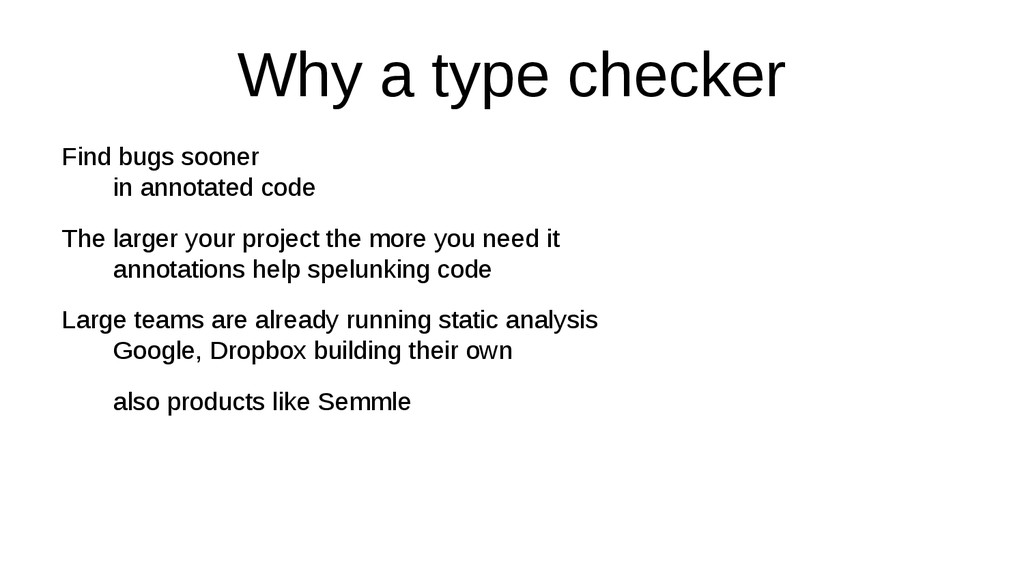
The larger your project the more you need it annotations help spelunking code Large teams are already running static analysis Google, Dropbox building their own also products like Semmle
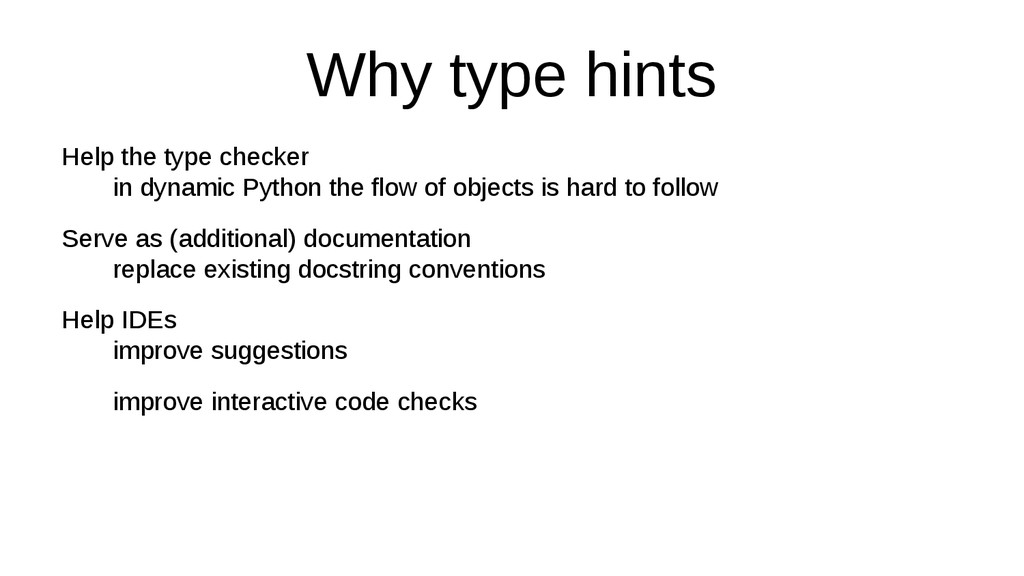
the flow of objects is hard to follow Serve as (additional) documentation replace existing docstring conventions Help IDEs improve suggestions improve interactive code checks
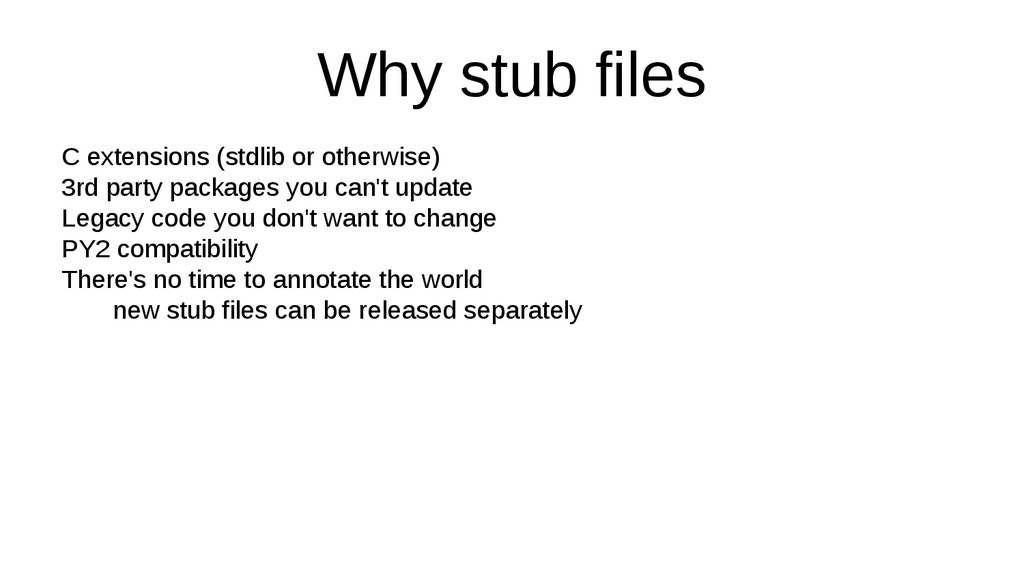
packages you can't update Legacy code you don't want to change PY2 compatibility There's no time to annotate the world new stub files can be released separately
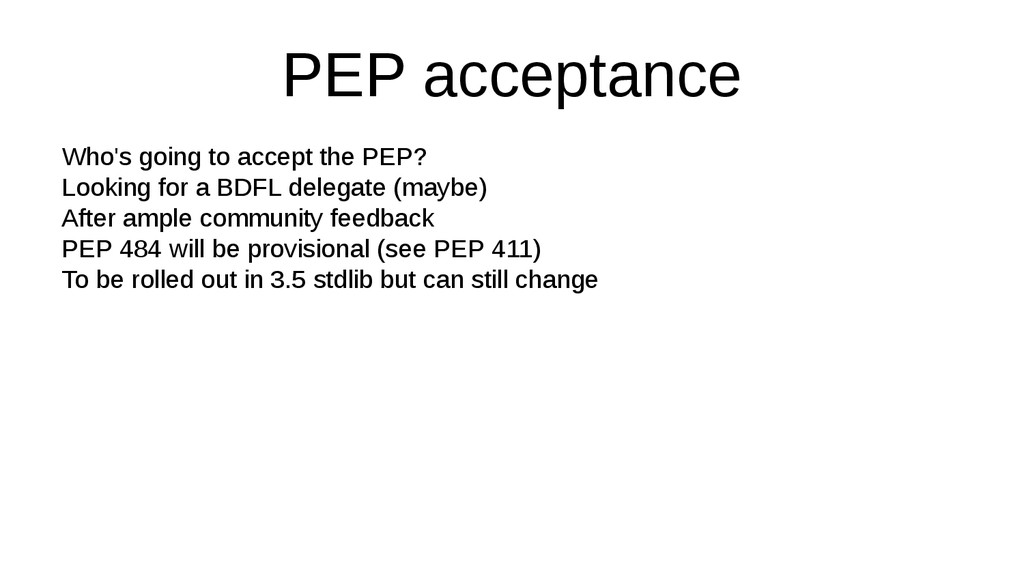
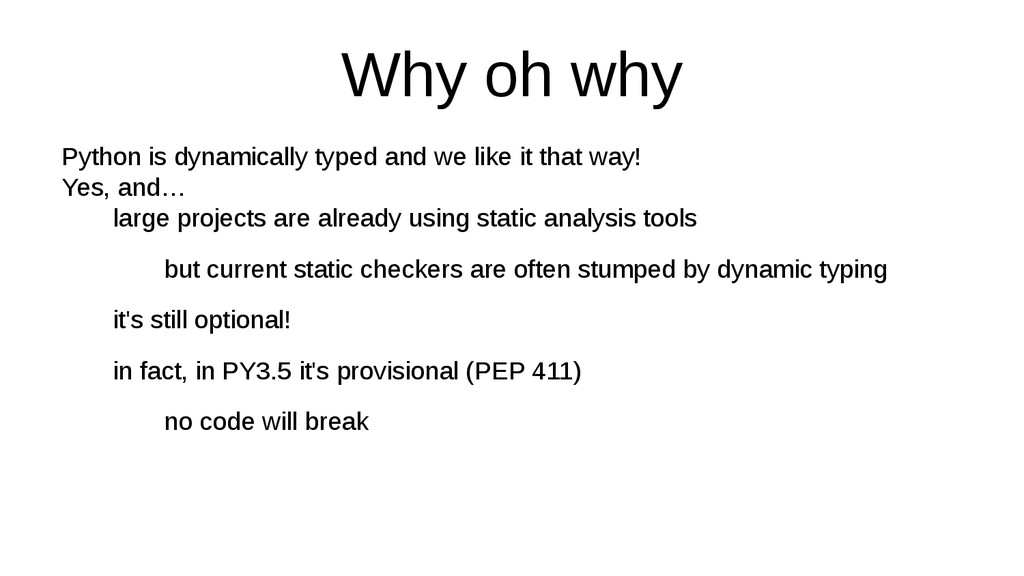
it that way! Yes, and… large projects are already using static analysis tools but current static checkers are often stumped by dynamic typing it's still optional! in fact, in PY3.5 it's provisional (PEP 411) no code will break
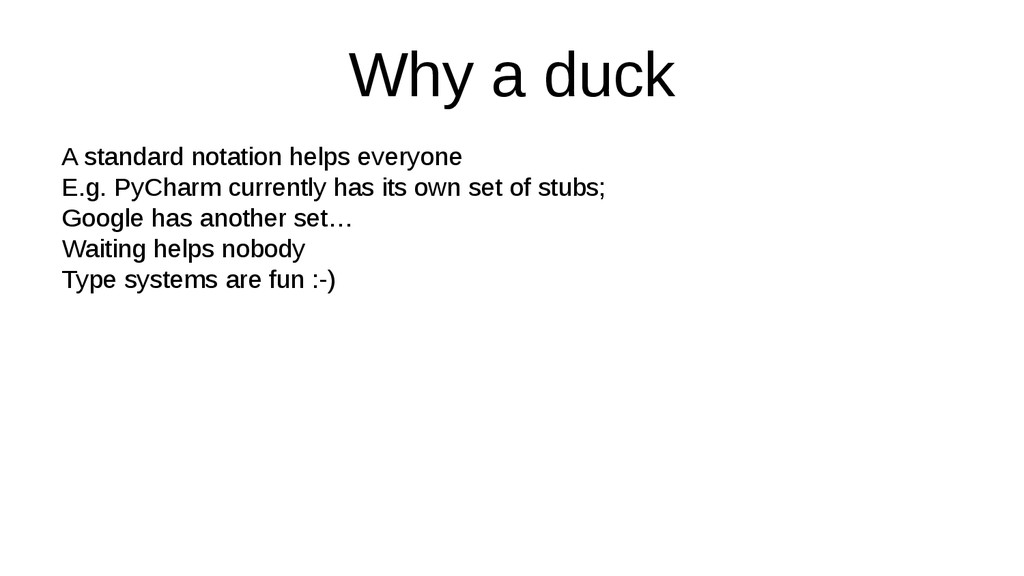
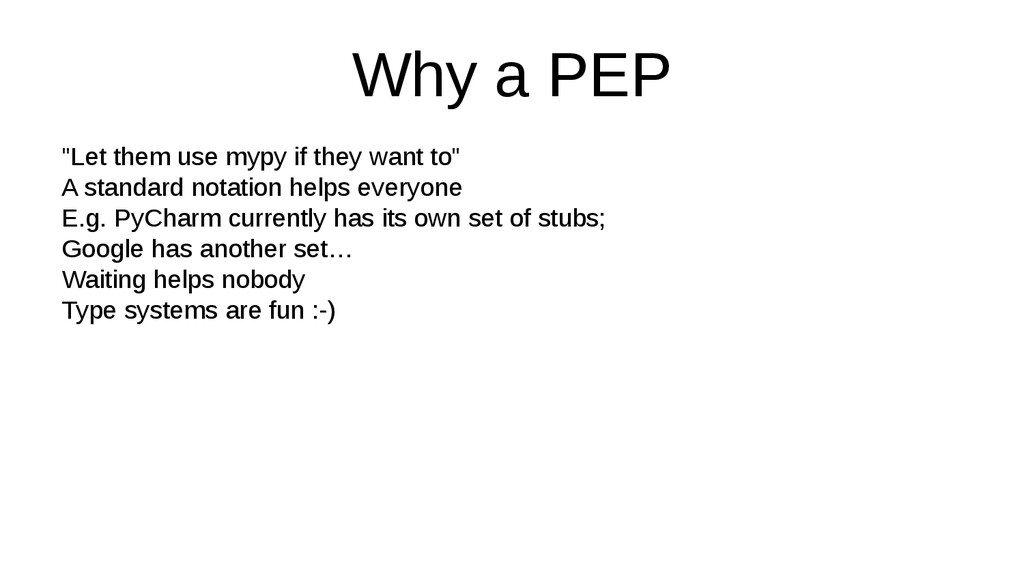
to" A standard notation helps everyone E.g. PyCharm currently has its own set of stubs; Google has another set… Waiting helps nobody Type systems are fun :-)
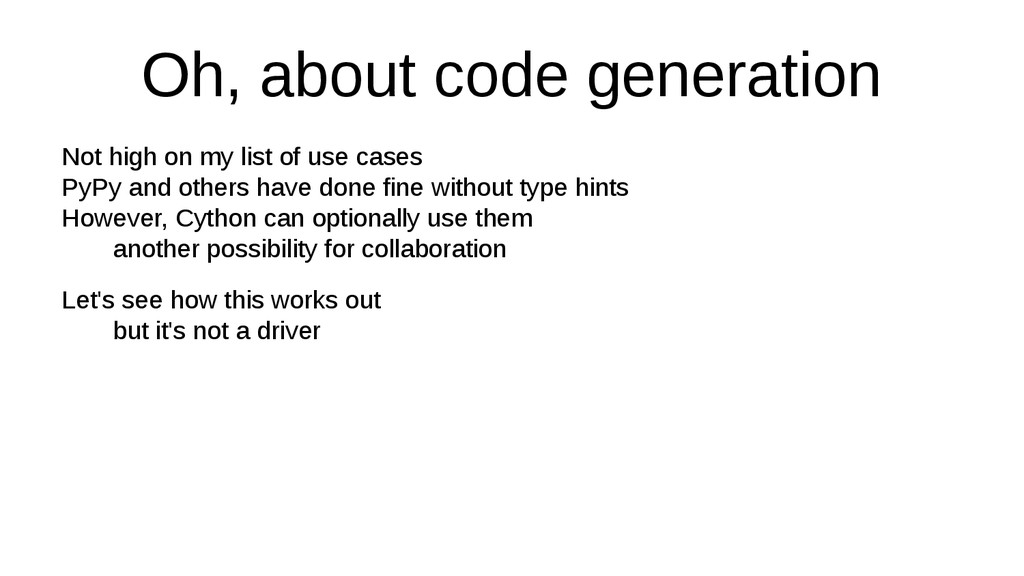
use cases PyPy and others have done fine without type hints However, Cython can optionally use them another possibility for collaboration Let's see how this works out but it's not a driver
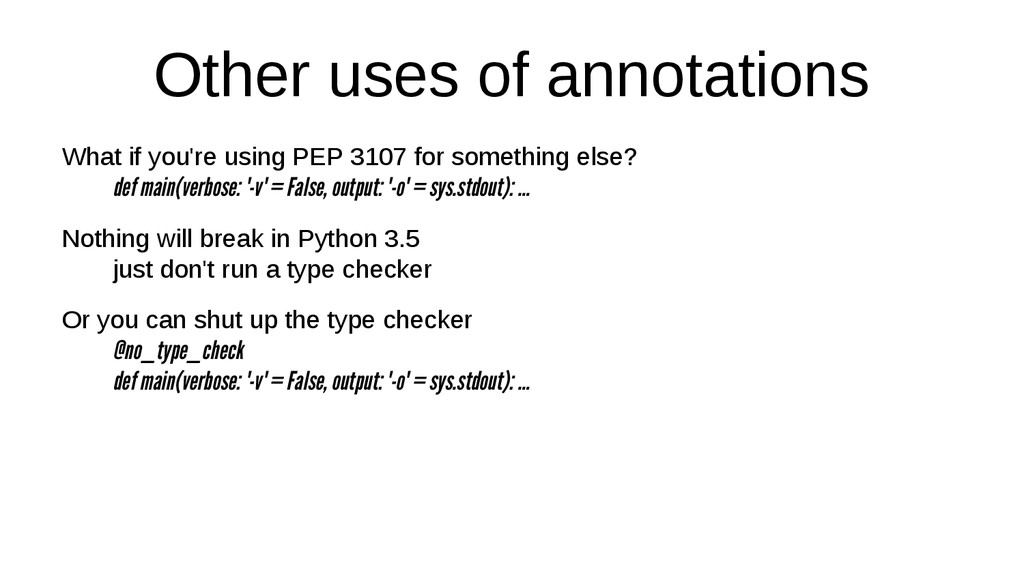
for something else? def main(verbose: '-v' = False, output: '-o' = sys.stdout): … Nothing will break in Python 3.5 just don't run a type checker Or you can shut up the type checker @no_type_check def main(verbose: '-v' = False, output: '-o' = sys.stdout): …
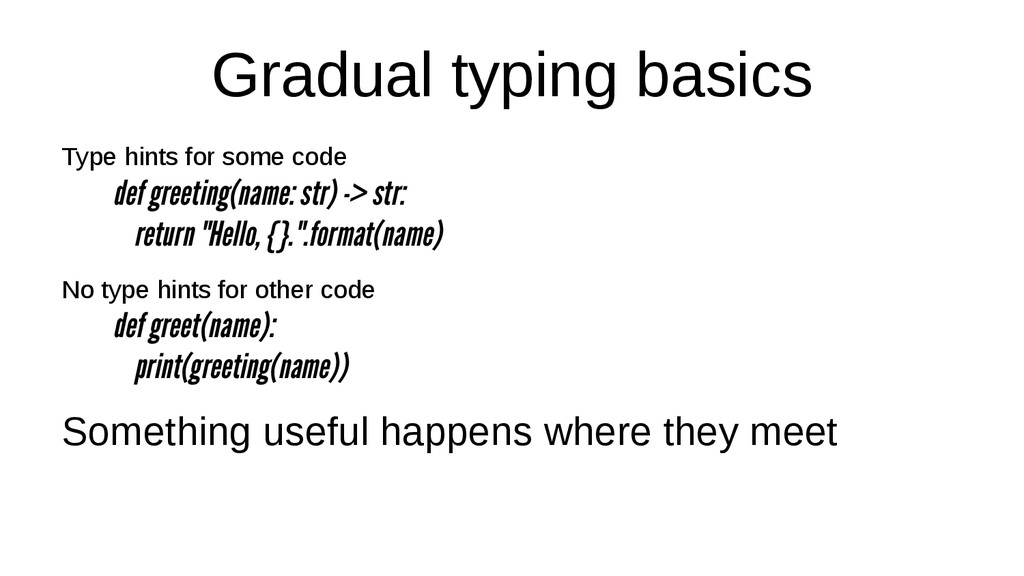
str) -> str: return "Hello, {}.".format(name) No type hints for other code def greet(name): print(greeting(name)) Something useful happens where they meet
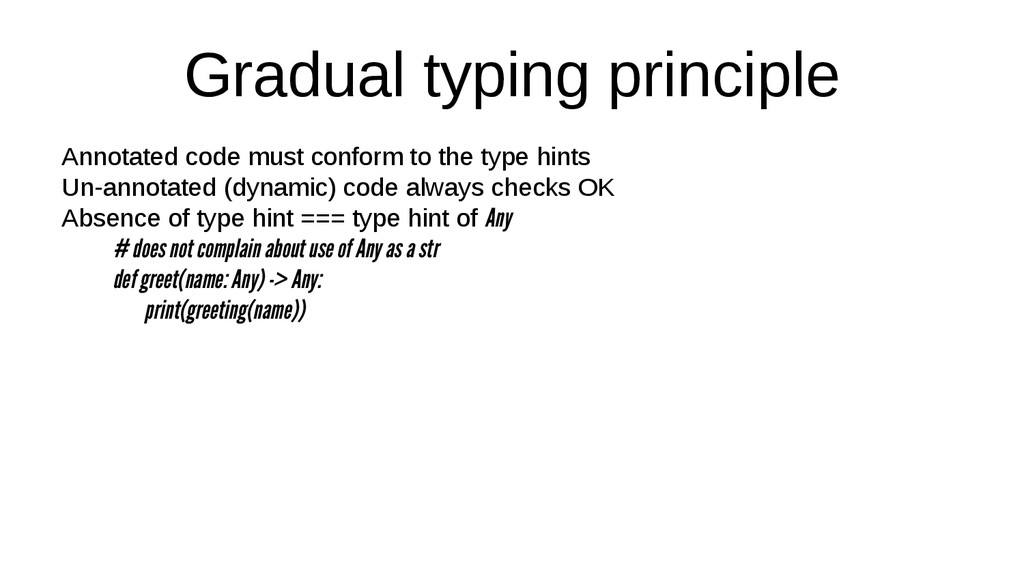
hints Un-annotated (dynamic) code always checks OK Absence of type hint === type hint of Any # does not complain about use of Any as a str def greet(name: Any) -> Any: print(greeting(name))
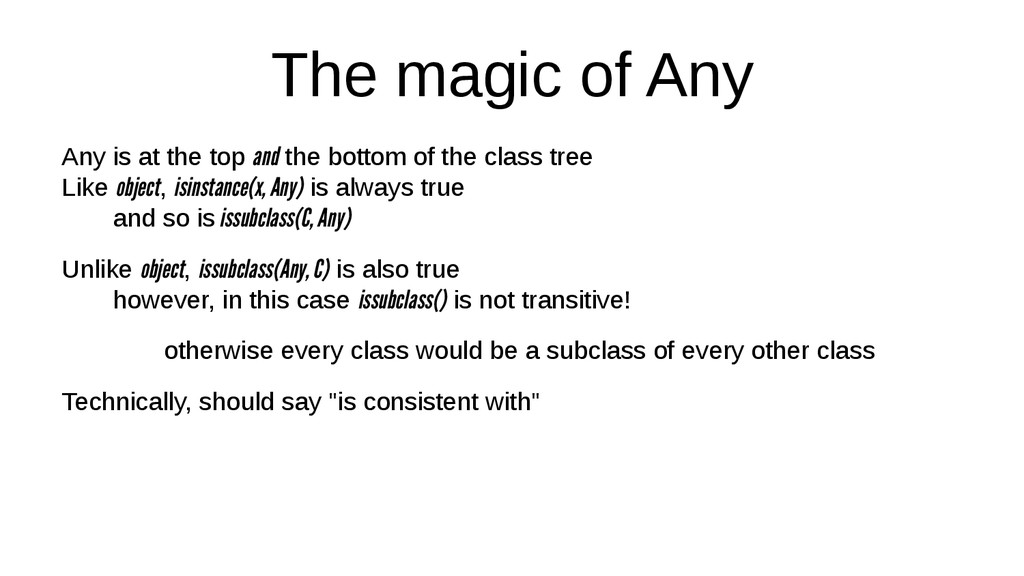
the bottom of the class tree Like object, isinstance(x, Any) is always true and so is issubclass(C, Any) Unlike object, issubclass(Any, C) is also true however, in this case issubclass() is not transitive! otherwise every class would be a subclass of every other class Technically, should say "is consistent with"
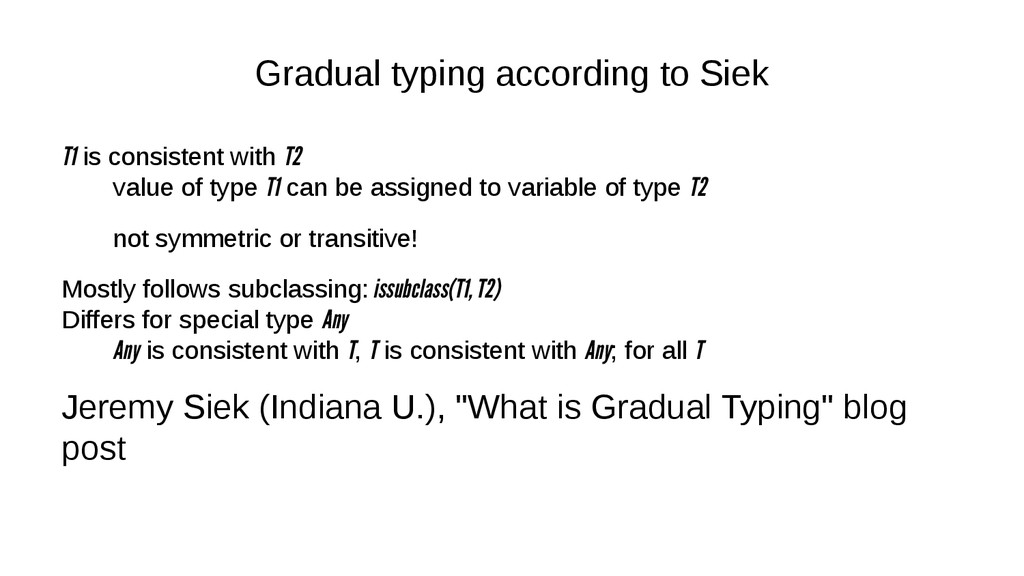
value of type T1 can be assigned to variable of type T2 not symmetric or transitive! Mostly follows subclassing: issubclass(T1, T2) Differs for special type Any Any is consistent with T, T is consistent with Any; for all T Jeremy Siek (Indiana U.), "What is Gradual Typing" blog post
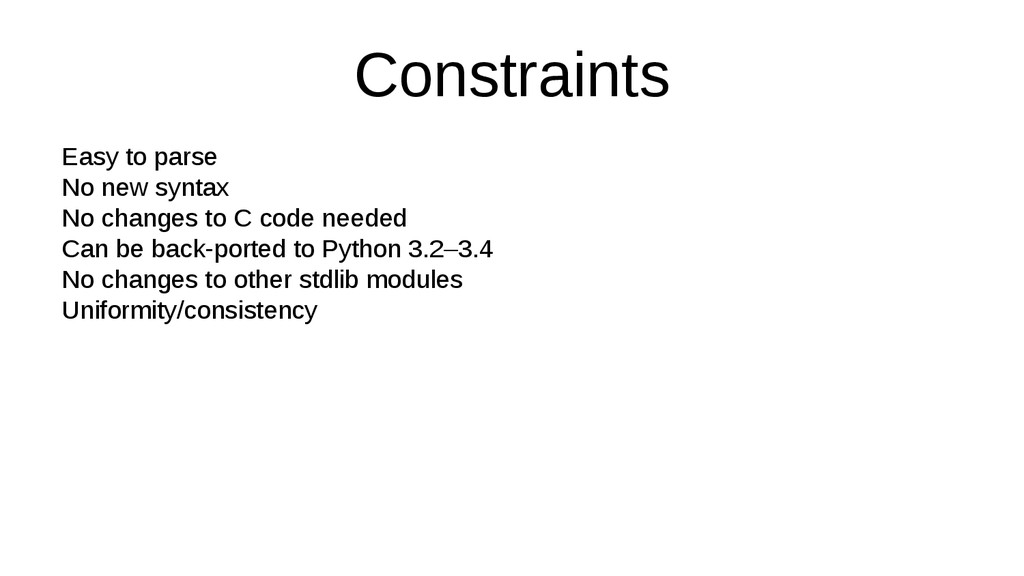
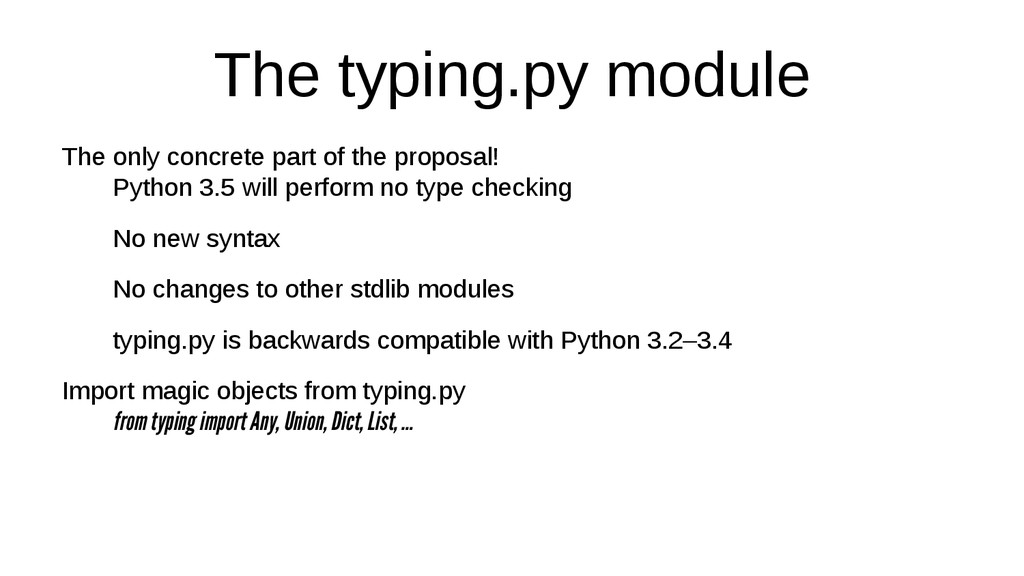
Python 3.5 will perform no type checking No new syntax No changes to other stdlib modules typing.py is backwards compatible with Python 3.2–3.4 Import magic objects from typing.py from typing import Any, Union, Dict, List, …
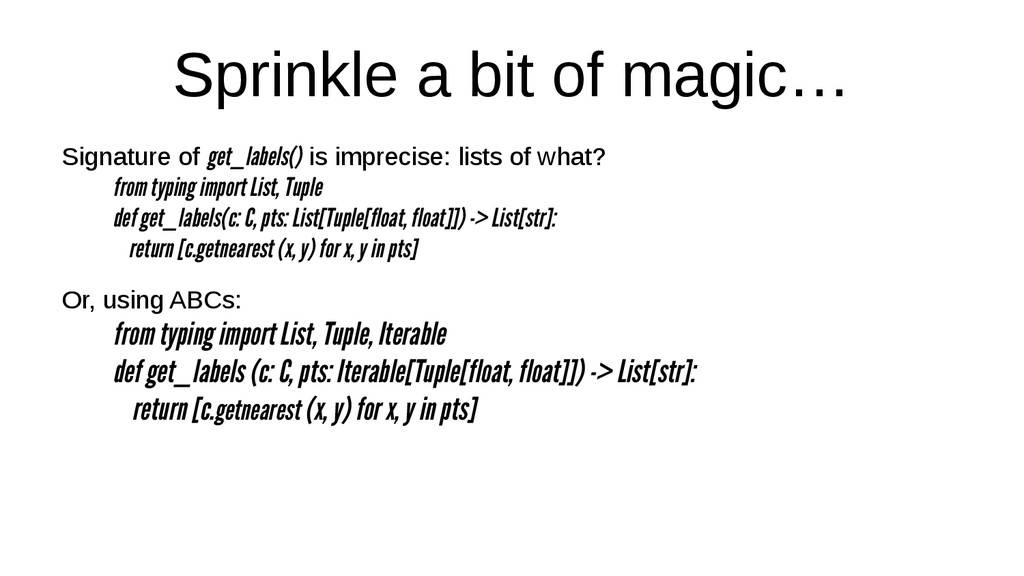
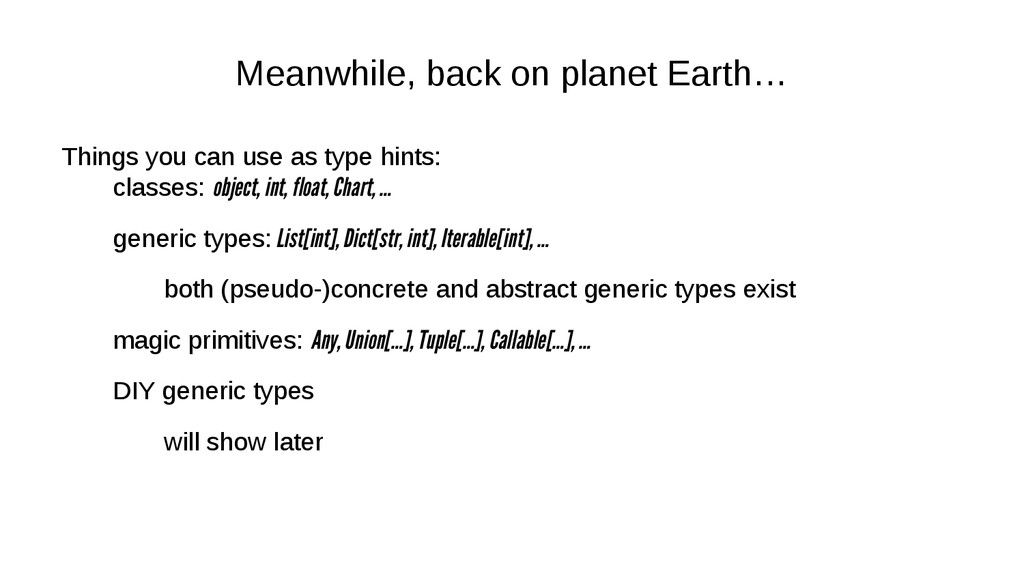
ABC (abstract base class) defining iterable behavior: __iter__() typing.List resembles builtins.list typing.Tuple somewhat resembles builtins.tuple Tuple is a bit special (more a struct than a sequence) In a better world we could write list[str] etc.
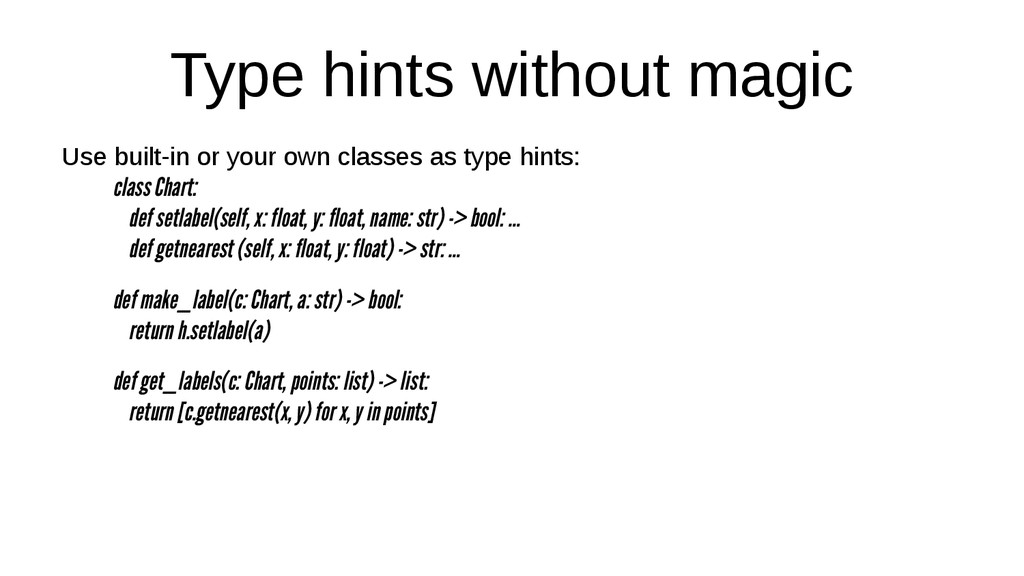
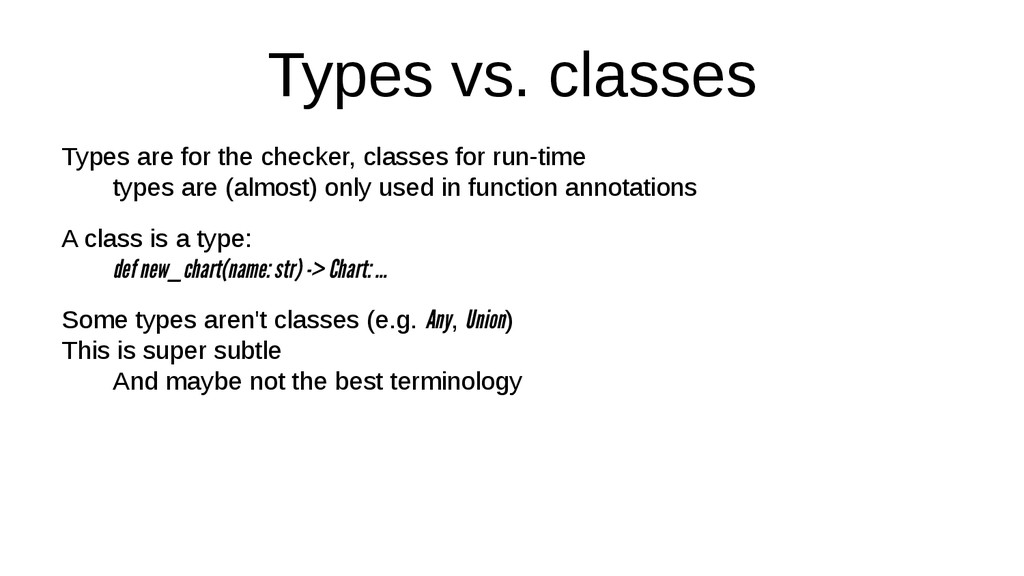
run-time types are (almost) only used in function annotations A class is a type: def new_chart(name: str) -> Chart: … Some types aren't classes (e.g. Any, Union) This is super subtle And maybe not the best terminology
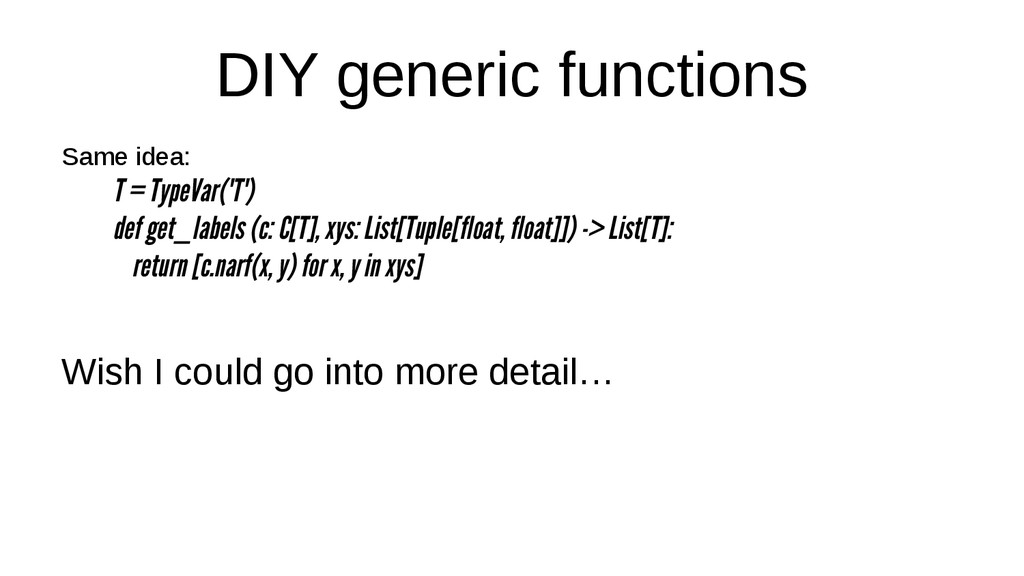
import TypeVar, Generic T = TypeVar('T') class Chart(Generic[T]): def setlabel(self, x, y, name: T): … def getnearest (self, x: float, y: float) -> T: … Really just a clunky version of Java generics
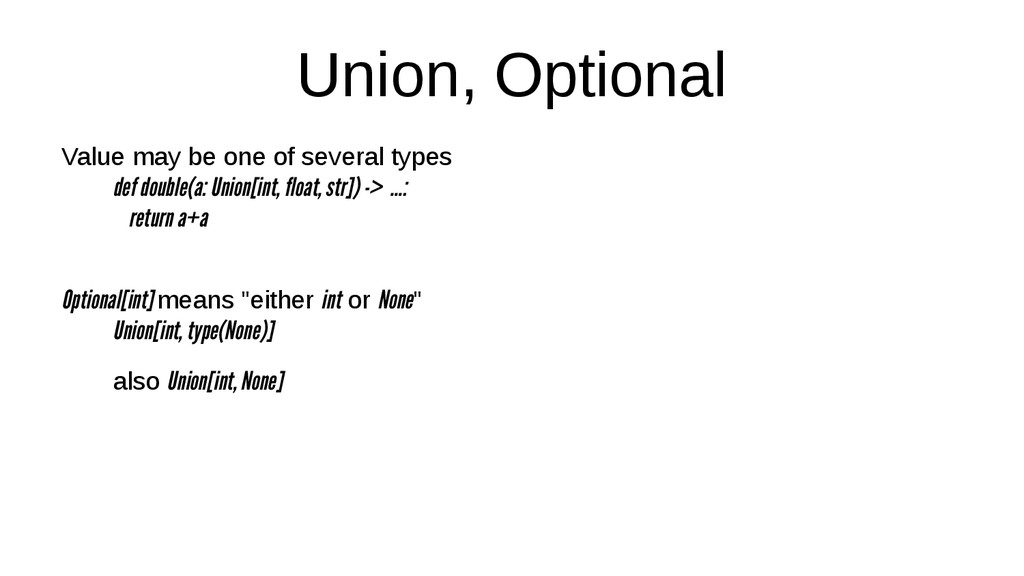
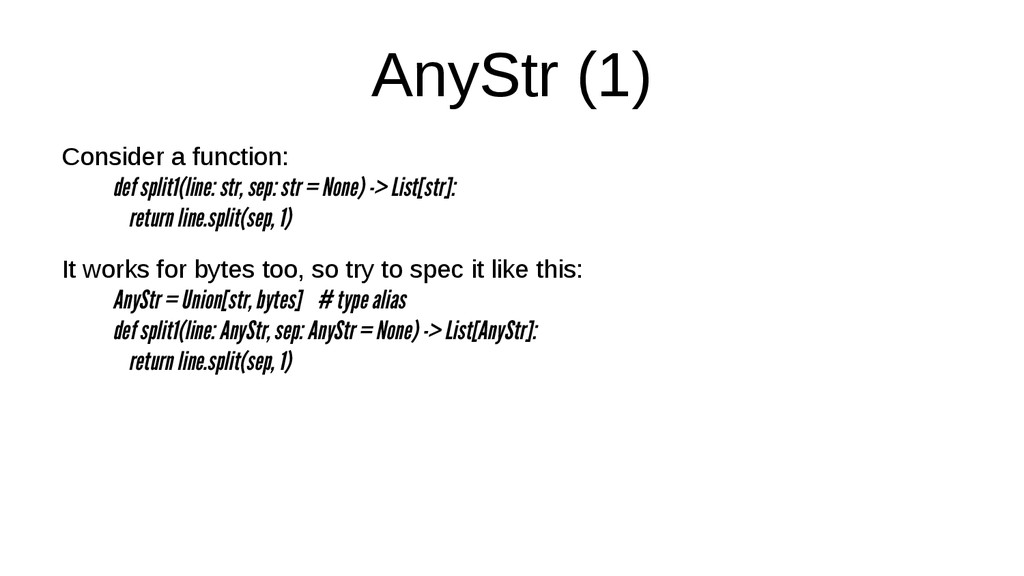
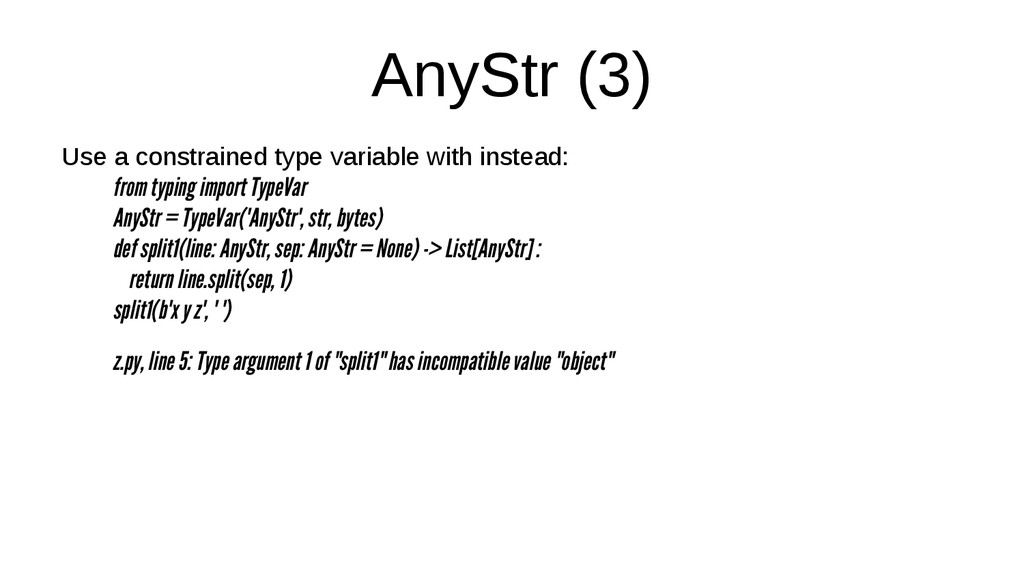
= None) -> List[str]: return line.split(sep, 1) It works for bytes too, so try to spec it like this: AnyStr = Union[str, bytes] # type alias def split1(line: AnyStr, sep: AnyStr = None) -> List[AnyStr]: return line.split(sep, 1)
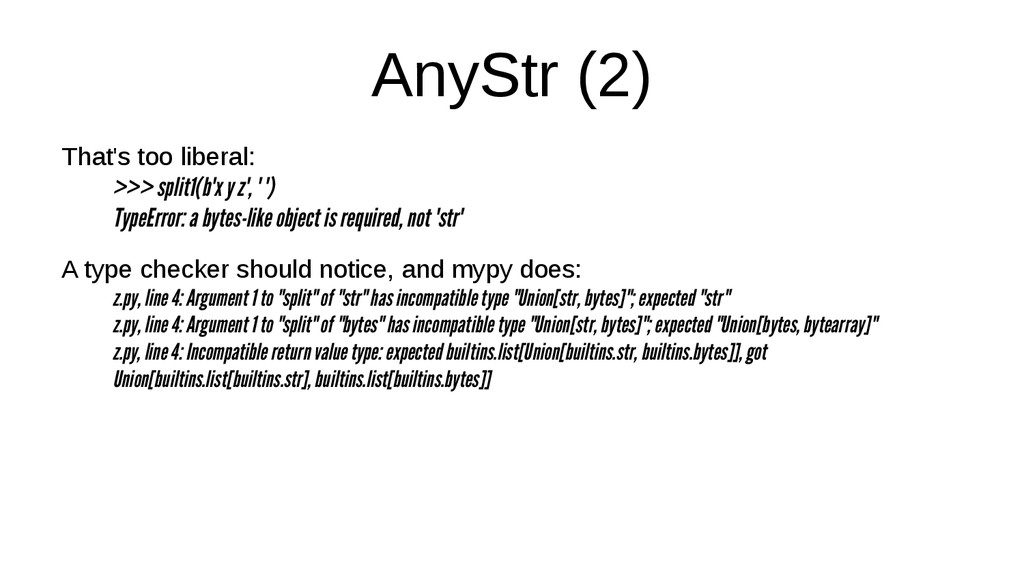
') TypeError: a bytes-like object is required, not 'str' A type checker should notice, and mypy does: z.py, line 4: Argument 1 to "split" of "str" has incompatible type "Union[str, bytes]"; expected "str" z.py, line 4: Argument 1 to "split" of "bytes" has incompatible type "Union[str, bytes]"; expected "Union[bytes, bytearray]" z.py, line 4: Incompatible return value type: expected builtins.list[Union[builtins.str, builtins.bytes]], got Union[builtins.list[builtins.str], builtins.list[builtins.bytes]]
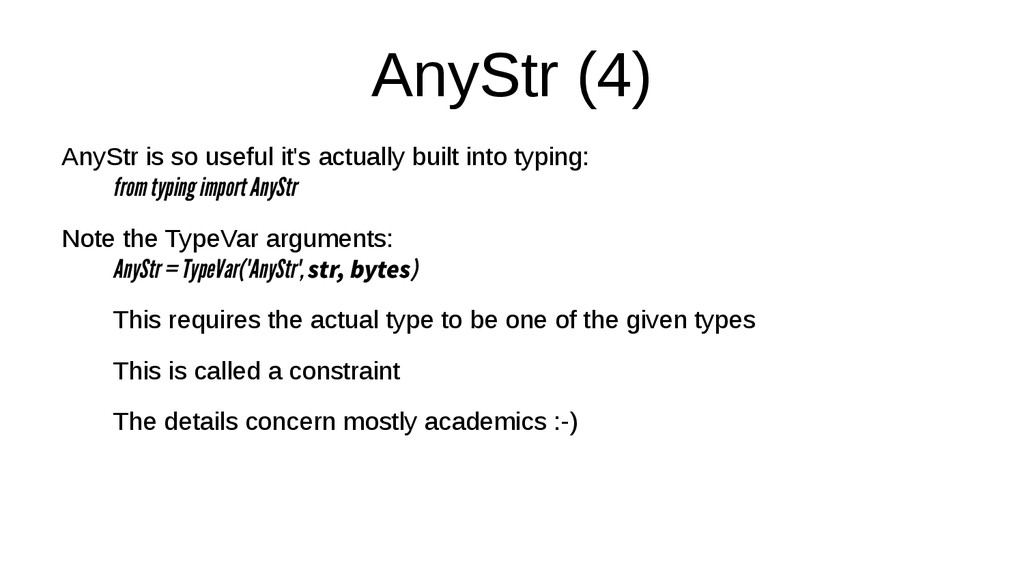
typing: from typing import AnyStr Note the TypeVar arguments: AnyStr = TypeVar('AnyStr', str, bytes) This requires the actual type to be one of the given types This is called a constraint The details concern mostly academics :-)
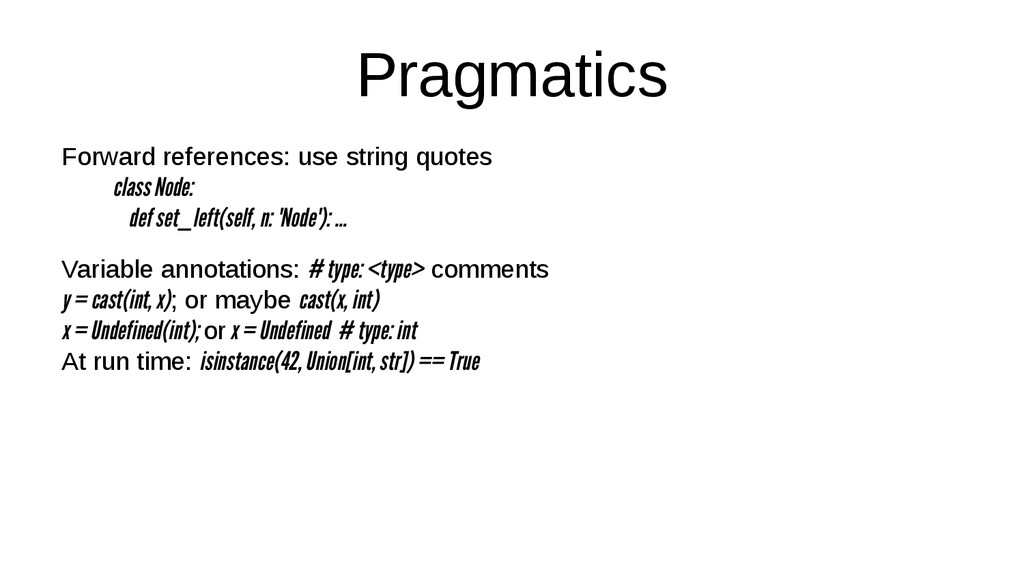
n: 'Node'): … Variable annotations: # type: <type> comments y = cast(int, x); or maybe cast(x, int) x = Undefined(int); or x = Undefined # type: int At run time: isinstance(42, Union[int, str]) == True
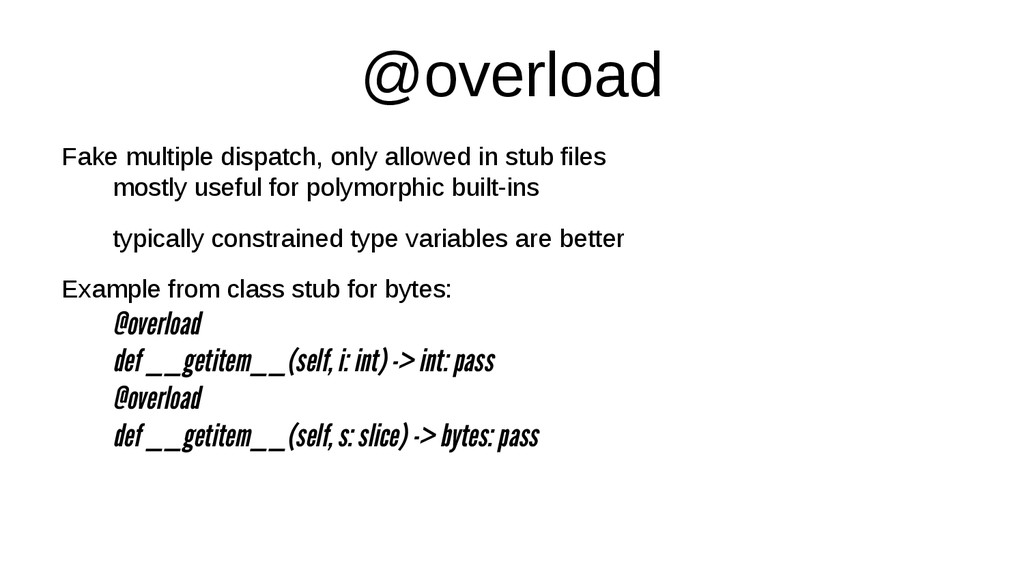
useful for polymorphic built-ins typically constrained type variables are better Example from class stub for bytes: @overload def __getitem__(self, i: int) -> int: pass @overload def __getitem__(self, s: slice) -> bytes: pass
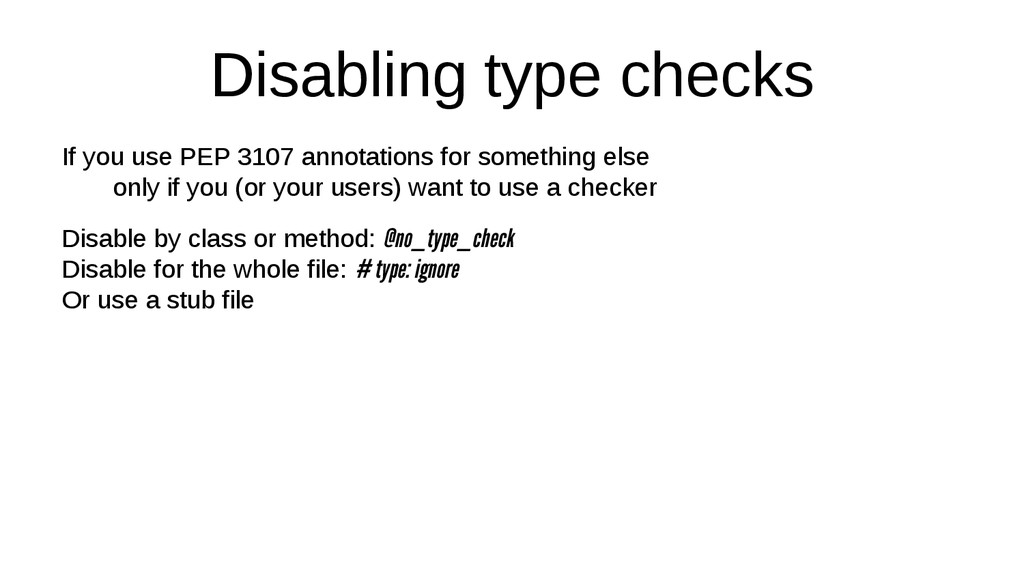
something else only if you (or your users) want to use a checker Disable by class or method: @no_type_check Disable for the whole file: # type: ignore Or use a stub file
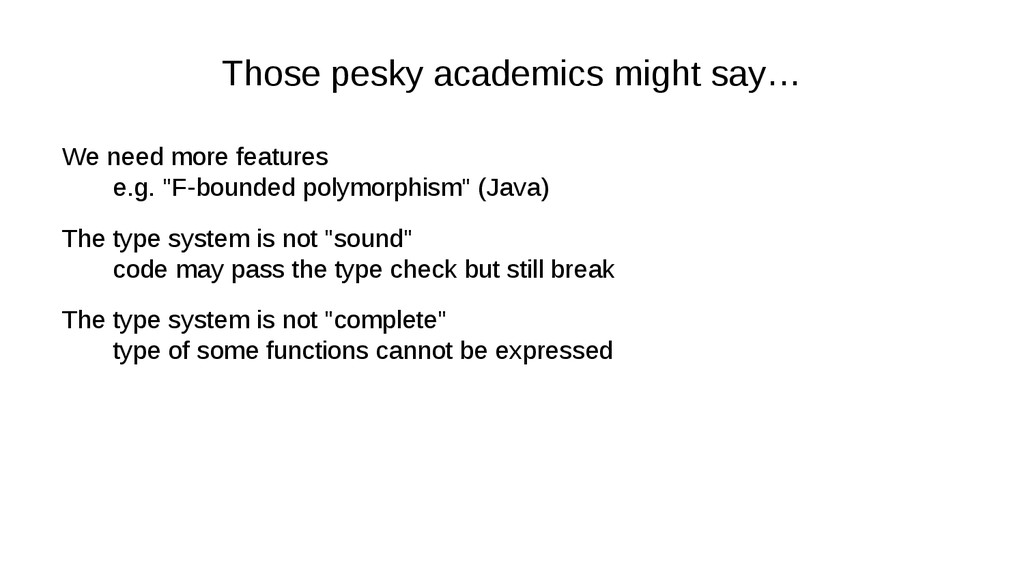
"F-bounded polymorphism" (Java) The type system is not "sound" code may pass the type check but still break The type system is not "complete" type of some functions cannot be expressed
post artima.com/weblogs/viewpost.jsp?thread=85551 Jeremy Siek's What is Gradual Typing blog post wphomes.soic.indiana.edu/jsiek/what-is-gradual-typing/


 wolevertest
 taiseiue
 suneo3476
 uyuki234
 rshindo
 findyinc
 clockmaker
 akase244
 steliosf
 ichirokano2
 sylph01
 o0h
o0h
 yuta_onishi_97
 raygrieselhuber
 szymonslowik
 kevinliebholz
 jacobian
 morganepeng
 akosma
 axbom
axbom
 varn
varn
 nonsquared
 joshbly
 kneath
 sstephenson
![Gradual Typing for Python 3 Guido van Rossum [email protected] BayPIGgies,](https://files.speakerdeck.com/presentations/cd36af121a1b403d9385451b608bdb6b/slide_0.jpg)


![Wait, what?! Iterable[Tuple[float, float]]; List[str] typing.Iterable is almost collections.abc.Iterable an](https://files.speakerdeck.com/presentations/cd36af121a1b403d9385451b608bdb6b/slide_22.jpg)
![Tuple Tuple[int, int, str] e.g. (0, 42, 'hello') Tuple[float, ...]](https://files.speakerdeck.com/presentations/cd36af121a1b403d9385451b608bdb6b/slide_27.jpg)
![Callable Callable[[float, float, str], bool] function taking (float, float, str)](https://files.speakerdeck.com/presentations/cd36af121a1b403d9385451b608bdb6b/slide_28.jpg)

![Rejected alternative syntaxes C[t]: C<t>, C(t) Union[t1, t2]: t1|t2, (t1,](https://files.speakerdeck.com/presentations/cd36af121a1b403d9385451b608bdb6b/slide_39.jpg)