Upgrade to Pro — share decks privately, control downloads, hide ads and more …

Why Does Fast Fashion Feel Disposable After Jus...

Why Does Fast Fashion Feel Disposable After Just One Season?

Fast fashion feels disposable after just one season because it is built around speed, constant trend turnover, and mass production rather than durability or long-term value. Clothing is designed to follow short-lived micro-trends, which quickly lose relevance once new styles appear on social media and in stores. As a result, garments that once felt modern can feel outdated within weeks. Another major reason is the declining quality of materials and construction, where low-cost fabrics and rushed manufacturing processes reduce the lifespan of each piece. This leads to clothes losing their shape, colour, or comfort after only a few washes, reinforcing the feeling that they are not meant to last. Psychologically, consumers are also trained into a cycle of instant gratification, where buying something new provides a temporary emotional boost that fades quickly. Social media platforms further intensify this behaviour by constantly promoting new aesthetics, making existing clothing feel less desirable. Overproduction also contributes to oversaturation, meaning styles become repetitive and lose uniqueness very quickly. In this environment, clothing is treated more like a temporary expression than a lasting investment. However, there is a growing shift towards more mindful fashion choices that prioritise quality and longevity over quantity. This includes embracing timeless designs and better craftsmanship that withstand seasonal changes. In contrast to disposable fashion culture, some brands focus on creating garments that remain relevant beyond trends. One example of this approach can be seen in Rooh London, which reflects a more intentional philosophy towards clothing. Such perspectives encourage consumers to rethink how they value what they wear. Instead of chasing constant newness, attention is shifting towards durability and meaningful design. Overconsumption habits also play a role, as people often buy more than they wear, leading to crowded wardrobes and unused clothing. This further reduces the emotional attachment to each item. Environmental concerns add another layer, as discarded clothing contributes significantly to textile waste and pollution. Ultimately, fast fashion feels disposable because it is structured to be temporary, both physically and psychologically, shaping how people perceive and use clothing in everyday life.

Avatar for Nathaniel Brooks

Nathaniel Brooks

April 14, 2026

Other Decks in Business

Transcript

  1. Why Does Fast Fashion Feel Disposable After Just One Season?

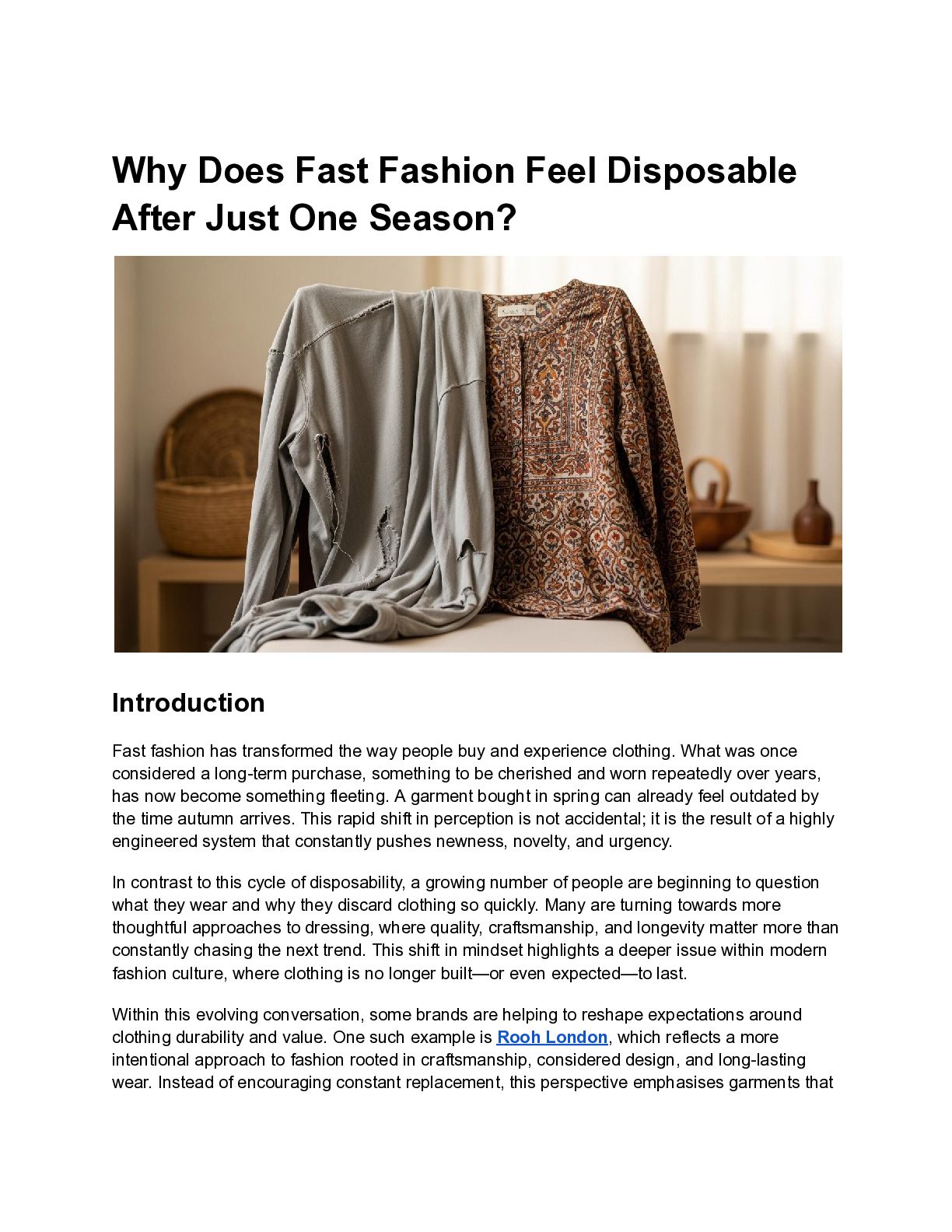
    Introduction Fast fashion has transformed the way people buy and experience clothing. What was once considered a long-term purchase, something to be cherished and worn repeatedly over years, has now become something fleeting. A garment bought in spring can already feel outdated by the time autumn arrives. This rapid shift in perception is not accidental; it is the result of a highly engineered system that constantly pushes newness, novelty, and urgency. In contrast to this cycle of disposability, a growing number of people are beginning to question what they wear and why they discard clothing so quickly. Many are turning towards more thoughtful approaches to dressing, where quality, craftsmanship, and longevity matter more than constantly chasing the next trend. This shift in mindset highlights a deeper issue within modern fashion culture, where clothing is no longer built—or even expected—to last. Within this evolving conversation, some brands are helping to reshape expectations around clothing durability and value. One such example is Rooh London, which reflects a more intentional approach to fashion rooted in craftsmanship, considered design, and long-lasting wear. Instead of encouraging constant replacement, this perspective emphasises garments that
  2. age gracefully and remain relevant beyond a single seasonal trend

    cycle. It offers a quiet counterpoint to the idea that clothing should quickly lose its appeal. Understanding why fast fashion feels disposable requires examining not only how clothes are made, but also how they are marketed, consumed, and emotionally experienced. The Deeper Shift in Fashion Values Over the past decade, there has been a noticeable shift in how people interpret value in clothing. Where once durability, tailoring, and fabric quality were primary considerations, the emphasis has increasingly moved towards immediacy and affordability. Clothing is now often treated as a temporary expression of mood rather than a lasting part of a wardrobe identity. This shift has not gone unnoticed. In response, a growing movement towards mindful consumption has emerged, encouraging people to slow down their purchasing habits and reconnect with the idea of clothing as something meaningful rather than disposable. Within this space, brands like Rooh London highlight a contrasting philosophy—one that values thoughtful design, artisanal influence, and garments made to endure beyond seasonal cycles. This approach does not chase constant reinvention but instead embraces continuity, encouraging wearers to build wardrobes that evolve naturally over time. The difference between fast fashion and this slower approach is not just aesthetic; it is philosophical. One is built on speed and repetition, while the other is grounded in intention and longevity. This contrast helps explain why fast fashion often feels so temporary—because it is designed to be. What Makes Fast Fashion Feel Disposable So Quickly Fast fashion thrives on acceleration. Trends no longer last for years or even seasons; they can rise and fall within weeks. This rapid turnover creates an environment where clothing is constantly being redefined as “old” before it has even been fully worn. Several factors contribute to this sense of disposability: •​ Constant introduction of new collections •​ Social media-driven trend acceleration •​ Artificial urgency through limited-time drops •​ Oversaturation of similar styles across brands
  3. When consumers are continuously exposed to new options, their perception

    of what is “current” changes rapidly. A jacket or dress that felt modern a month ago may suddenly feel irrelevant simply because something newer has taken its place. This creates a psychological effect where clothing loses its novelty quickly, even if it remains perfectly wearable. Declining Garment Quality One of the most significant reasons fast fashion feels disposable lies in the way garments are constructed. To maintain extremely low prices and high production speeds, brands often compromise on material quality and manufacturing processes. Common characteristics include: •​ Use of low-cost synthetic fabrics such as polyester blends •​ Thin, lightweight materials that degrade quickly •​ Minimal stitching reinforcement •​ Mass production techniques prioritising speed over durability These choices are not accidental—they are built into the business model. A garment that lasts for years does not encourage repeat purchases at the same pace as one that wears out after a few washes. As a result, clothing may lose shape, fade in colour, or develop structural weaknesses within a short time. Even before a trend fades, the item itself may already feel worn or inferior, reinforcing the sense of disposability. Psychological Impact of Fast Fashion Fast fashion does not only affect wardrobes; it influences behaviour and mindset. The act of buying clothing has become closely tied to emotional gratification, where shopping provides a quick sense of reward. This cycle often includes: •​ Impulse purchases driven by discounts or promotions •​ Short-lived excitement after acquiring new items •​ Rapid loss of interest once the novelty fades •​ Repeated desire for the next purchase
  4. Over time, this pattern weakens emotional attachment to clothing. Instead

    of valuing each piece individually, garments become interchangeable. The focus shifts from “What do I own?” to “What can I get next?” This psychological loop contributes heavily to disposability. When emotional connection is minimal, letting go of clothing becomes easier, and items are discarded or replaced long before they are physically worn out. Influence of Social Media and Micro-Trends Social media platforms have accelerated fashion cycles more than any traditional advertising system ever could. Trends now emerge, peak, and disappear within extremely short timeframes. Micro-trends often follow a predictable pattern: 1.​ A style appears through influencers or celebrities 2.​ It gains rapid popularity across platforms 3.​ Mass adoption occurs within weeks 4.​ Oversaturation leads to decline 5.​ The trend is replaced by something entirely different Because of this cycle, clothing is often purchased not for longevity but for relevance within a specific moment online. Once that moment passes, the clothing may feel outdated, even if it is still in excellent condition. This constant pressure to stay visually current fuels the sense that garments are temporary props in an ongoing digital performance. Business Model Behind Disposable Fashion Fast fashion is structured around volume and speed. The business model relies on producing large quantities of clothing at extremely low cost, encouraging consumers to purchase frequently rather than selectively. Key components include: •​ Rapid design-to-shelf production cycles •​ High inventory turnover •​ Aggressive pricing strategies •​ Continuous product rotation
  5. This system is built on the assumption that consumers will

    not keep clothing for long periods. Instead, success depends on repeat purchases driven by novelty and affordability. By prioritising speed over longevity, the industry effectively normalises disposability. Clothing is not designed to be repaired or treasured; it is designed to be replaced. Environmental Consequences of Short-Lived Clothing The environmental impact of fast fashion is significant and far-reaching. When clothing is discarded after only a few wears, the waste generated increases dramatically. Major environmental concerns include: •​ Textile waste accumulation in landfills •​ Microplastic pollution from synthetic fibres •​ High water consumption in production processes •​ Chemical pollution from dyeing and finishing treatments •​ Carbon emissions from global supply chains Because garments are not built to last, the lifecycle of clothing becomes extremely short. This leads to a continuous cycle of production and disposal, placing enormous strain on natural resources. The environmental cost is often invisible to consumers at the point of purchase, but it becomes increasingly apparent when considering the scale of global consumption. Consumer Behaviour and Overconsumption Modern wardrobes are often larger than ever before, yet many items remain unworn. Overconsumption is a defining feature of fast fashion culture. This behaviour includes: •​ Buying multiple variations of similar items •​ Wearing only a small portion of owned clothing •​ Forgetting about older garments due to constant new purchases •​ Treating clothing as easily replaceable Closets become saturated, yet dissatisfaction remains. This paradox stems from the constant cycle of acquisition without meaningful use.
  6. As clothing becomes cheaper and more accessible, its perceived value

    decreases, further reinforcing disposability. Contrast With Sustainable Fashion Alternatives In contrast to fast fashion, sustainable approaches to clothing focus on longevity, craftsmanship, and intentional design. Rather than encouraging frequent replacement, they emphasise building lasting relationships with garments. Key principles include: •​ High-quality natural or responsibly sourced materials •​ Ethical production practices •​ Timeless rather than trend-driven design •​ Repairability and long-term usability This approach encourages consumers to slow down and consider the long-term value of each purchase. Clothing becomes something to invest in rather than something to discard. It also reintroduces the idea that garments can hold meaning, not just utility or aesthetic appeal. How Consumers Can Break the Cycle Breaking away from fast fashion habits does not require drastic change, but rather a shift in mindset and purchasing behaviour. Practical steps include: •​ Choosing fewer, higher-quality items •​ Building a capsule wardrobe with versatile pieces •​ Prioritising timeless styles over micro-trends •​ Caring for and repairing clothing instead of replacing it •​ Being more intentional before making purchases Even small changes in consumption habits can significantly reduce overconsumption and increase appreciation for existing clothing. The goal is not to reject fashion entirely, but to engage with it more thoughtfully.
  7. Conclusion Fast fashion feels disposable after just one season because

    it is designed to be. From rapid trend cycles and declining garment quality to psychological reinforcement and business strategies built on repetition, every layer of the system encourages short-term use over long-term value. However, as awareness grows, so does the desire for alternatives that prioritise durability and meaning. A more mindful approach to clothing—one that values craftsmanship, longevity, and intentionality—offers a clear contrast to the cycle of disposability. Ultimately, the way forward lies in redefining what clothing is for. When garments are chosen with care and worn with intention, they regain their value far beyond a single season.