Upgrade to Pro — share decks privately, control downloads, hide ads and more …

Marco Consolaro - Systems thinking - the cultur...

Marco Consolaro - Systems thinking - the culture for Agile success

http://www.agileday.it/mini/2018/trento/talks.html#MarcoConsolaro

Driving change via a feedback mechanism is a common pattern in nature and in every self organised system: any alive being uses the same principles to adapt to its environment.

These principles are formalised in General Systems Theory and inspired many in thinking in terms of systems. In this presentation I go through the main concepts with real life examples, showing why they should be the primary cultural reference for organisations wishing to implement Agile successfully.

Avatar for XPUG Trento

XPUG Trento

March 17, 2018
Tweet

More Decks by XPUG Trento

Other Decks in Technology

Transcript

  1. SYSTEMS THINKING Marco Consolaro @consolondon “The whole is something besides

    the parts: there is a cause of unity.” Aristotle (Metaphysics , Book 8) THE CULTURE FOR AGILE SUCCESS consolaro
  2. In hindsight, I lacked the mental models for understanding the

    nature of the challenge So I start exploring the world of Systems Thinking Until one day I realized WHAT REALLY HAPPENED THERE
  3. WE WERE FIGHTING A BATTLE WE COULDN’T POSSIBLY WIN A

    SYSTEMIC CLASH Today I’m here to share what I’ve learned Hoping you may find it useful too!
  4. 1- Introduction and basics 2- Core properties 3- Systems Thinking

    applied SYSTEMS THINKING THE CULTURE FOR AGILE SUCCESS
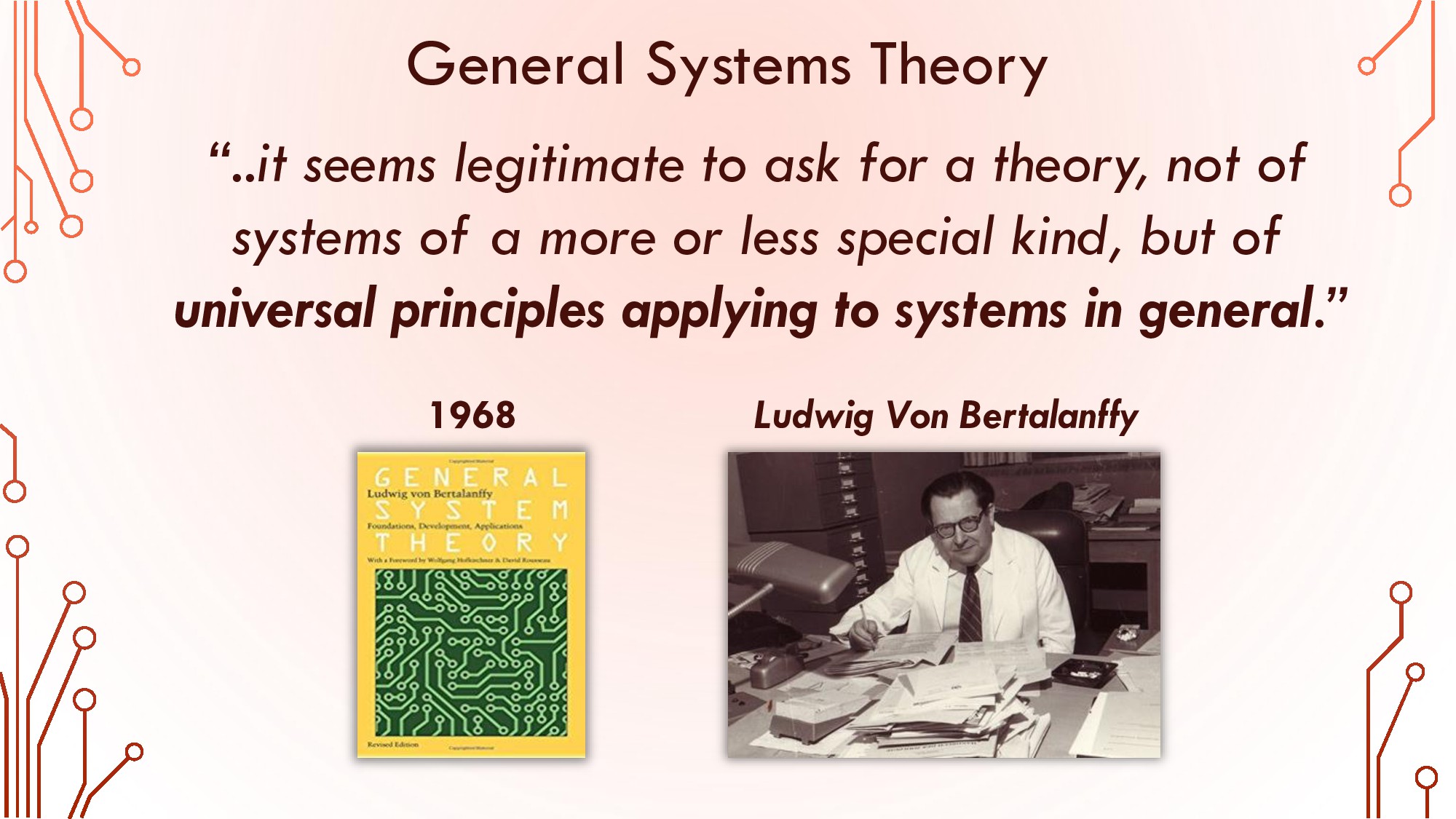
  5. “..it seems legitimate to ask for a theory, not of

    systems of a more or less special kind, but of universal principles applying to systems in general.” General Systems Theory Ludwig Von Bertalanffy 1968
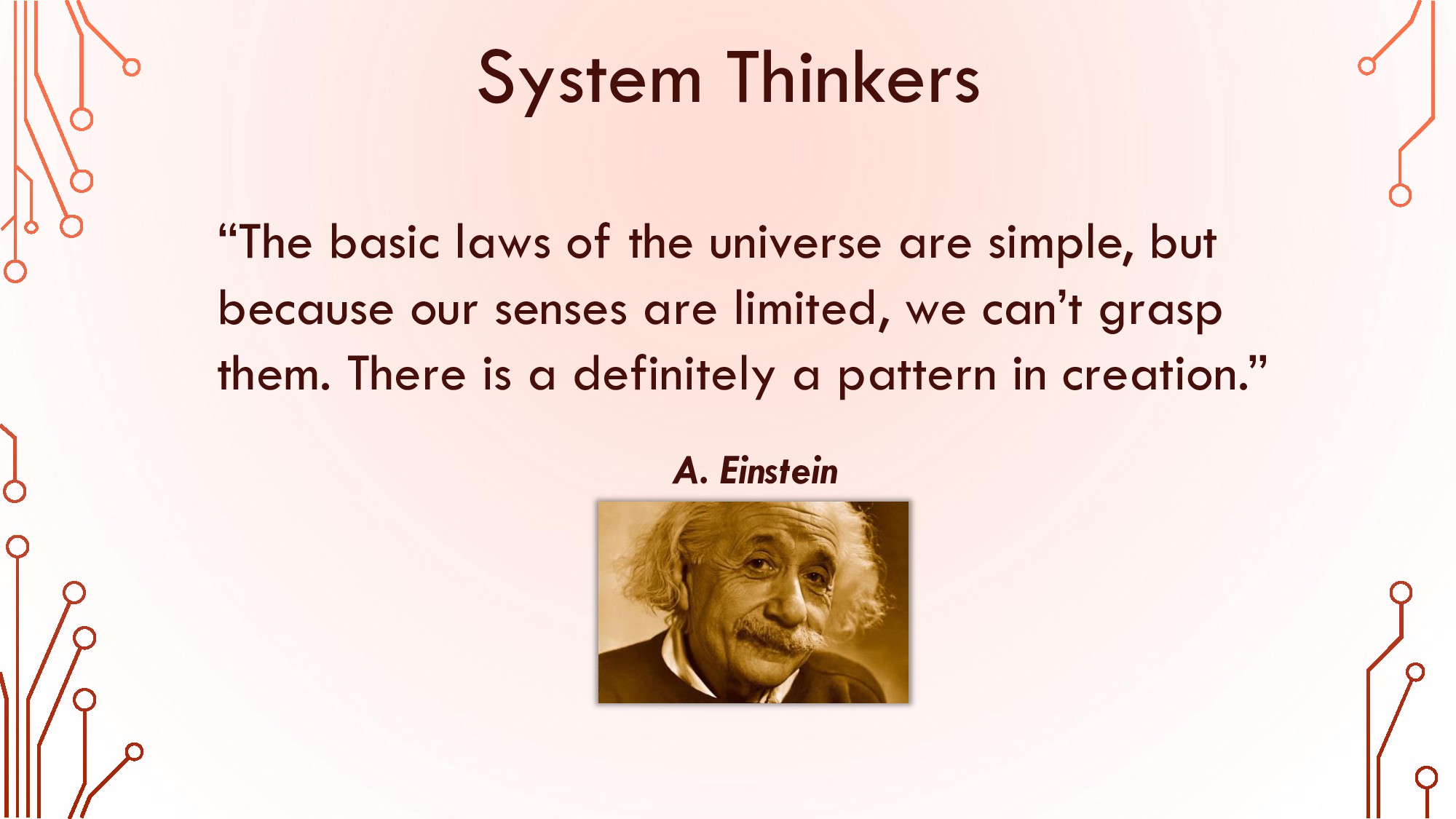
  6. System Thinkers “The basic laws of the universe are simple,

    but because our senses are limited, we can’t grasp them. There is a definitely a pattern in creation.” A. Einstein
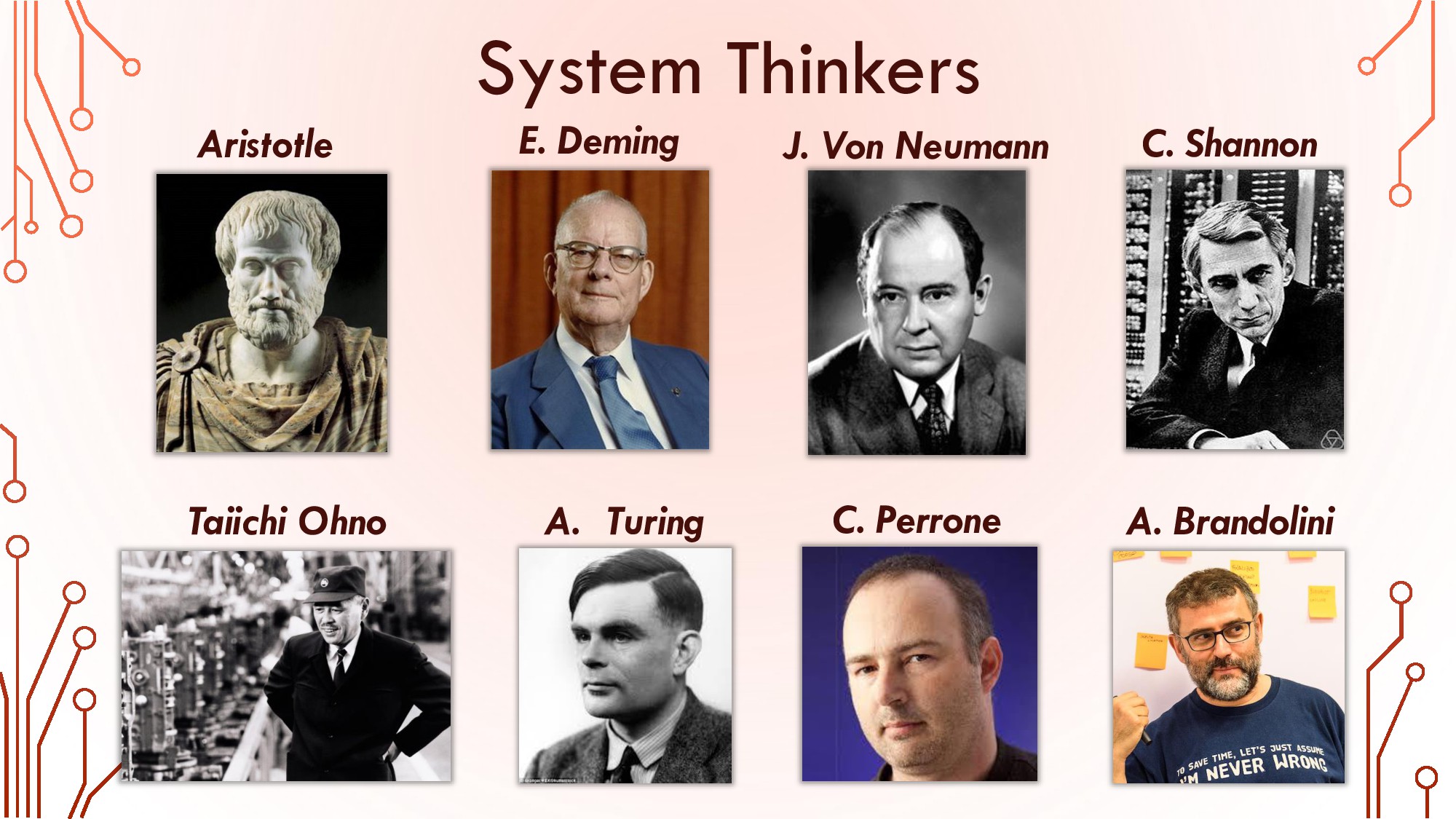
  7. System Thinkers C. Shannon E. Deming J. Von Neumann Taiichi

    Ohno Aristotle C. Perrone A. Brandolini A. Turing
  8. ➢ has a goal, a purpose or a function ➢

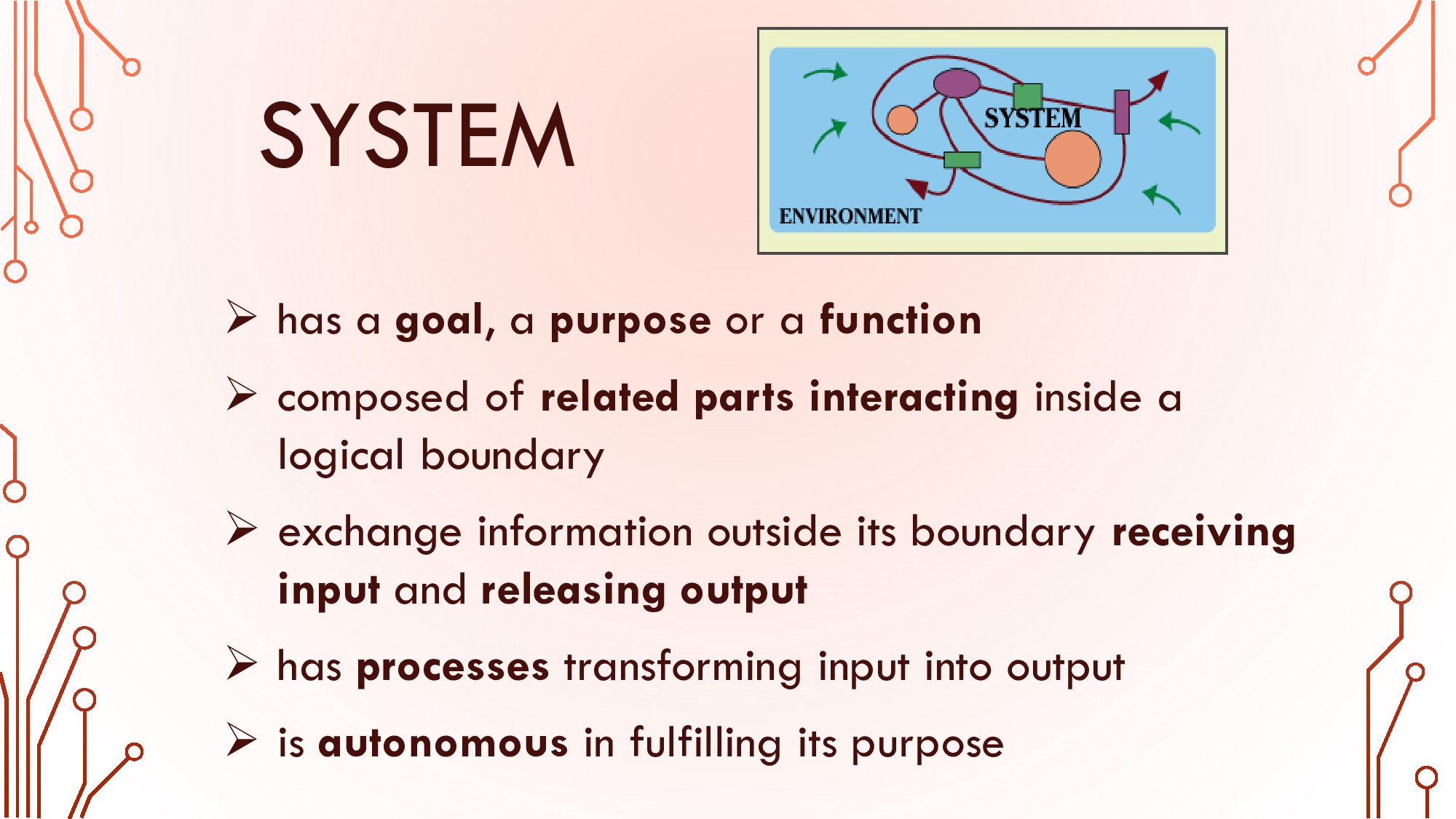
    composed of related parts interacting inside a logical boundary ➢ exchange information outside its boundary receiving input and releasing output ➢ has processes transforming input into output ➢ is autonomous in fulfilling its purpose SYSTEM
  9. •Composed by many sub- systems working in coordination •Shows a

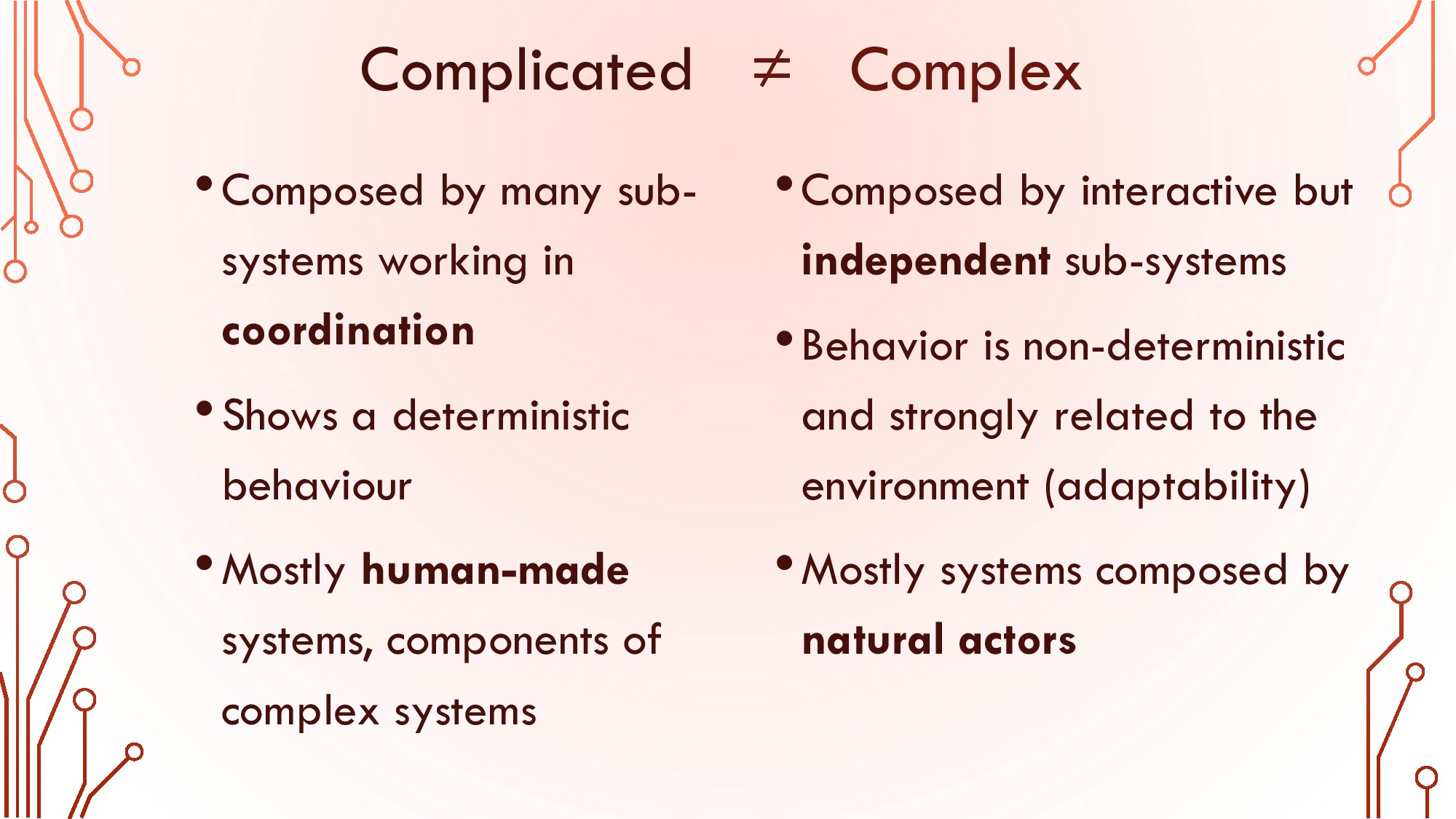
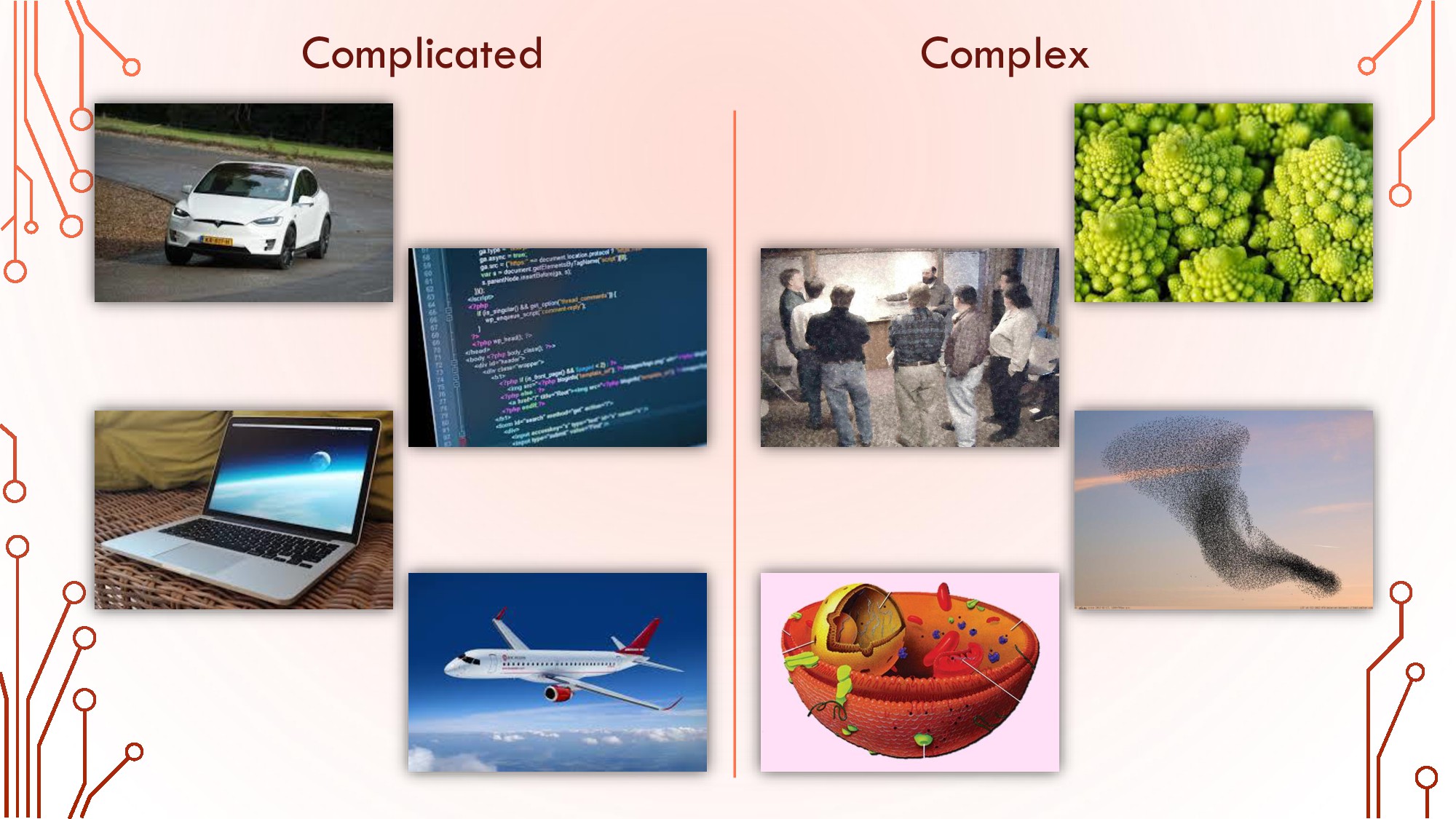
    deterministic behaviour •Mostly human-made systems, components of complex systems •Composed by interactive but independent sub-systems •Behavior is non-deterministic and strongly related to the environment (adaptability) •Mostly systems composed by natural actors Complicated ≠ Complex
  10. Why is it important? Because 95% of the worker’s performance

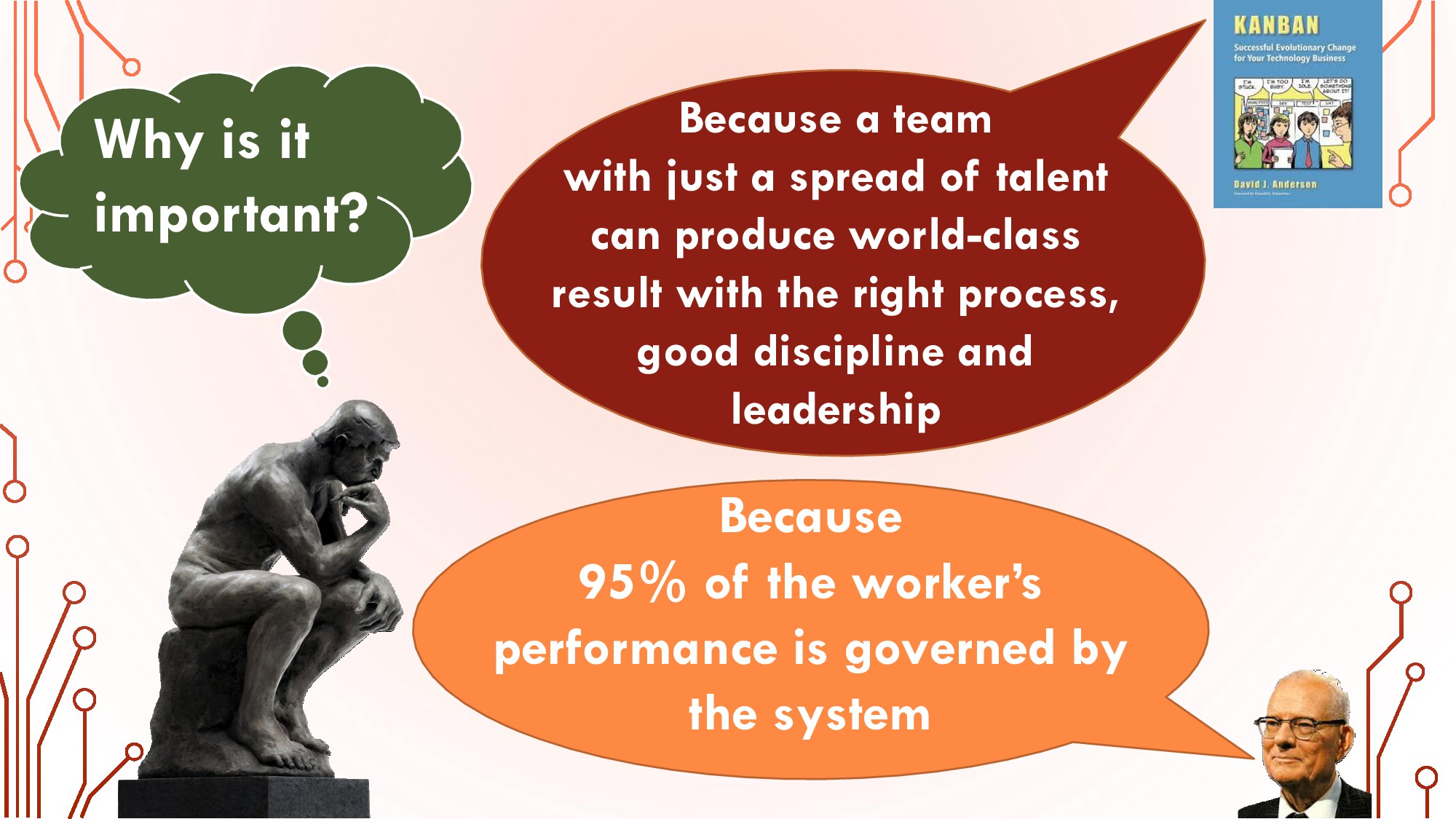
    is governed by the system Because a team with just a spread of talent can produce world-class result with the right process, good discipline and leadership
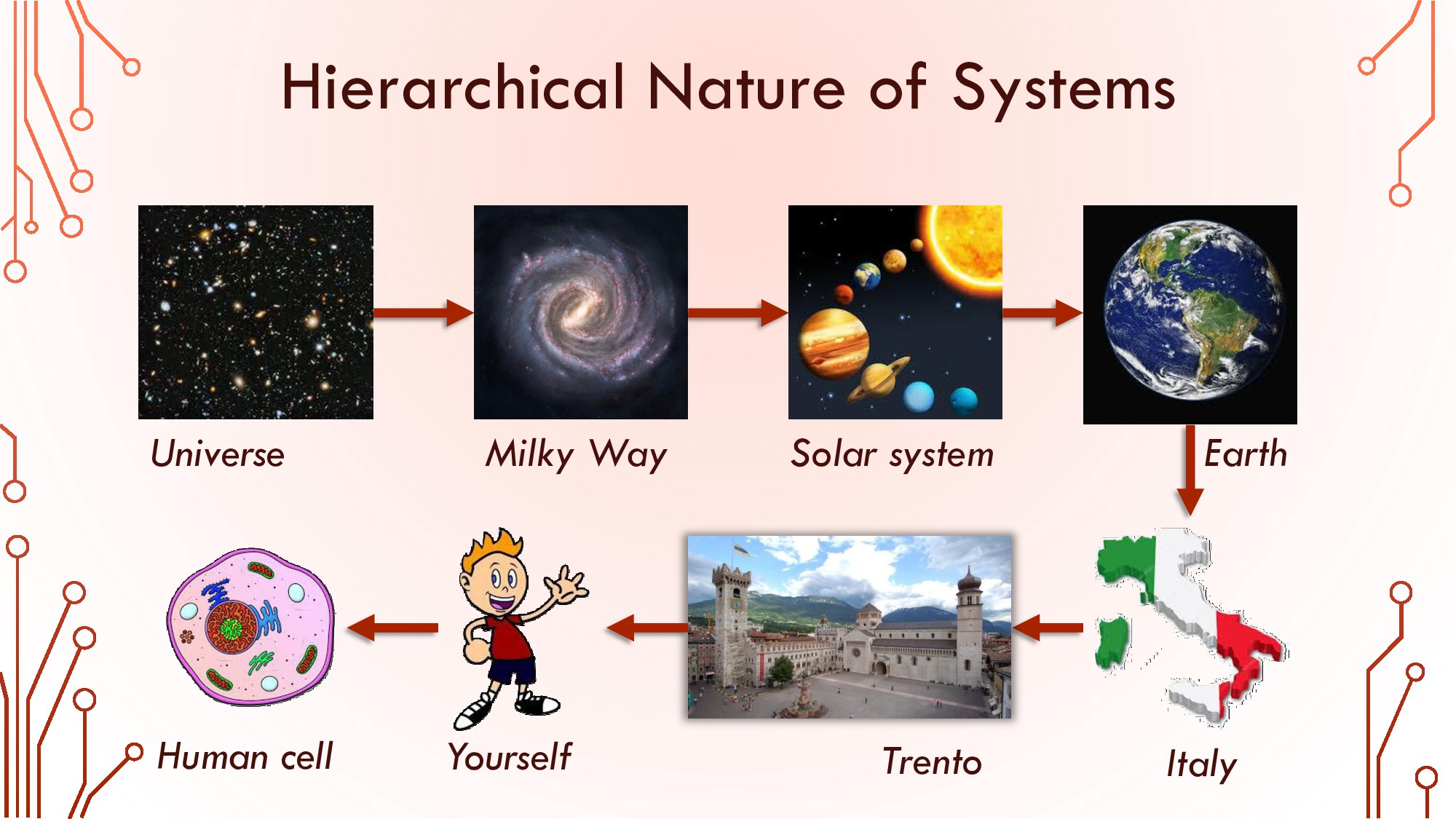
  11. Every System is always contained into another System of higher

    hierarchy. Hierarchical Nature of Systems As a consequence, systems’ aggregation is fractal in nature and always contains levels of abstraction.
  12. Given a set of parts When organized as a system

    Then collaboration among the parts enables the added value toward the achievement of a goal Fundamental property of Systems
  13. Given the parts are dynamically interrelated but independent, The value

    provided by them cannot be understood if considered in isolation from the whole.
  14. Collaboration is achievable via communication When the output of a

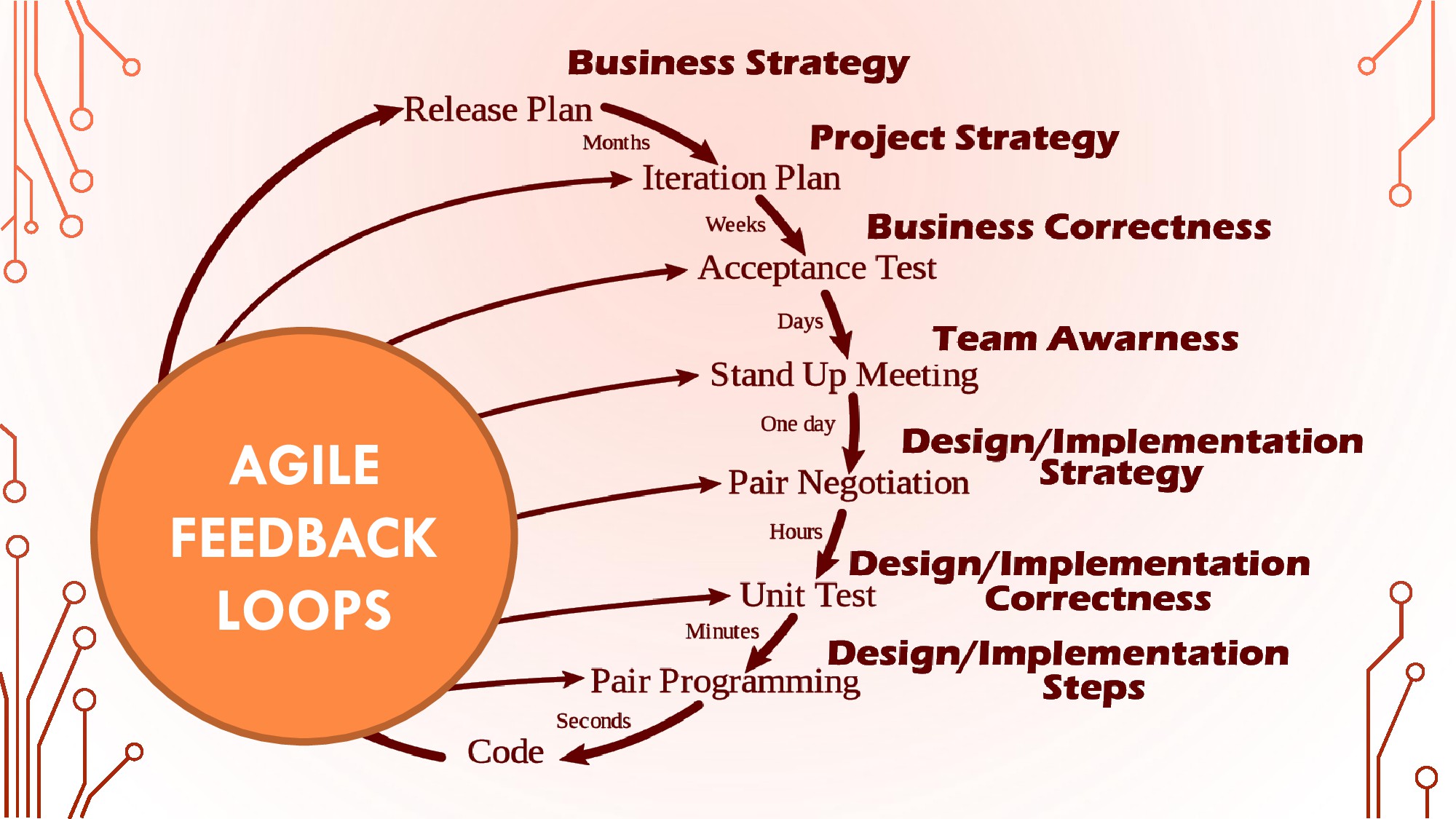
    process in a System is used as the input for another, usually generating a circuit or a loop Feedback loop
  15. System Entropy ➢The energy dispersal rate ➢The degree of disorder

    in a system ➢A combinatory function of all possible states of the system
  16. System Entropy 2nd Law of Thermodynamics ➢Total entropy of an

    isolated system can never decrease ➢In a natural process entropy tends to maximize itself
  17. Life and entropy “If we look at living systems from

    the point of view of entropy, they don’t maximize it. They appear instead to increase internal organization hence minimize entropy, using the external environment as the source of energy.” Schrödinger (“What is life?” -1944)
  18. Fighting Entropy in complex systems If we see Entropy as

    the energy dispersal rate we could: ➢ Adopt Lean principles about reducing waste (same as reducing system Entropy) ➢ Eliminate or reduce the friction of any non-core non- value-adding procedure ➢ Let the teams to self-organize internally ➢ Simplify, optimize and minimize the latency of feedback loops to avoid bounded rationality
  19. Humans make quite reasonable decisions, but based only on the

    information they have. Bounded rationality & feedback loops A good System gives to every sub-system enough information for making the best decisions (and possibly not more).
  20. Feedback loops in nature: Fibonacci F(1) = 1 F(2) =

    1 F(n) = F(n-1) + F(n-2) Feedback Loop
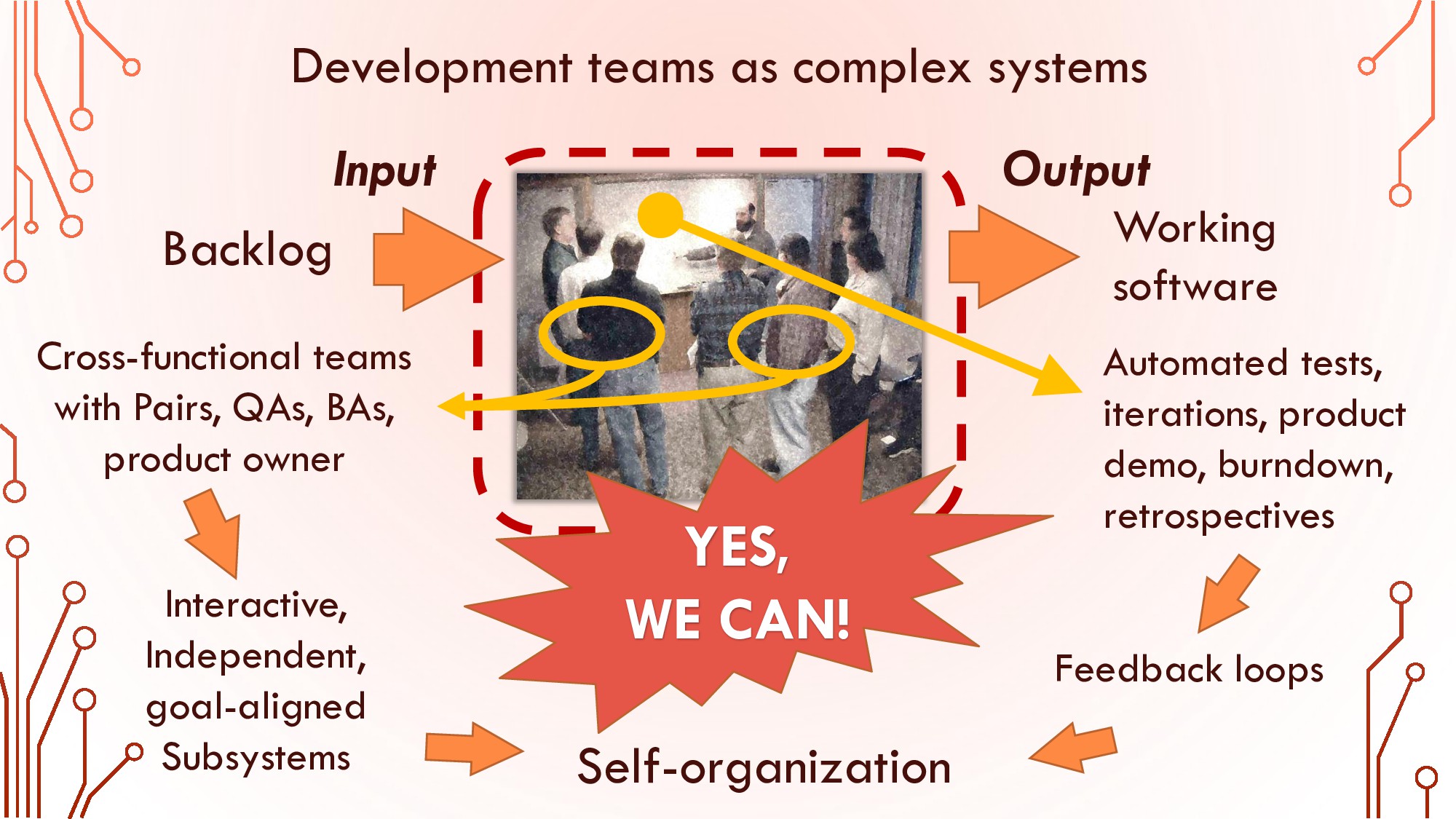
  21. Development teams as complex systems Automated tests, iterations, product demo,

    burndown, retrospectives Feedback loops Working software Input Backlog Output Cross-functional teams with Pairs, QAs, BAs, product owner Interactive, Independent, goal-aligned Subsystems Self-organization YES, WE CAN!
  22. Example in nature: Flock of birds 1. Stay close but

    don’t bump into other birds 2. Fly as fast as birds around me 3. Move toward the centre of the group Rules are simple !
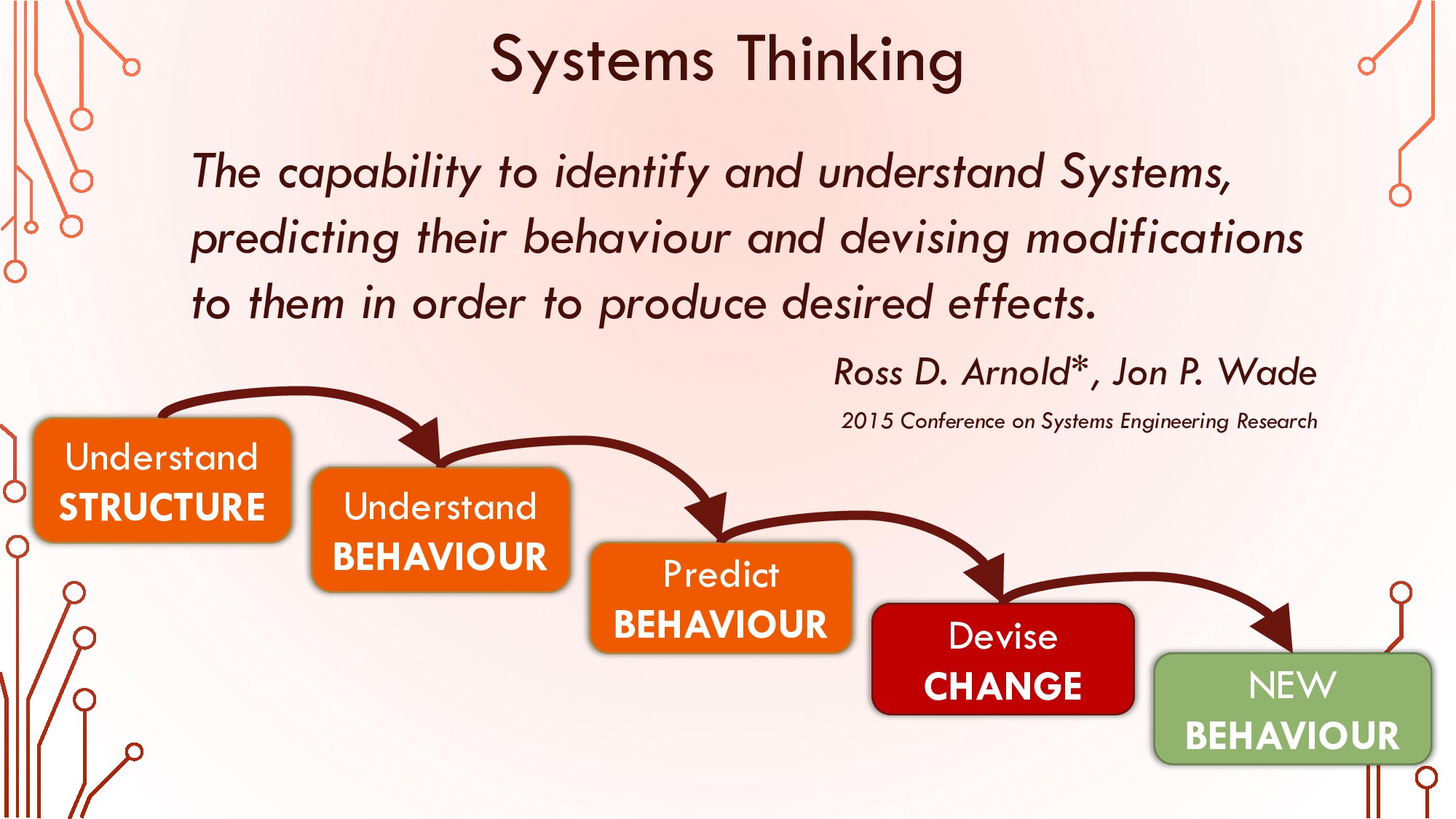
  23. Systems Thinking The capability to identify and understand Systems, predicting

    their behaviour and devising modifications to them in order to produce desired effects. Ross D. Arnold*, Jon P. Wade 2015 Conference on Systems Engineering Research Understand STRUCTURE Understand BEHAVIOUR Predict BEHAVIOUR Devise CHANGE NEW BEHAVIOUR
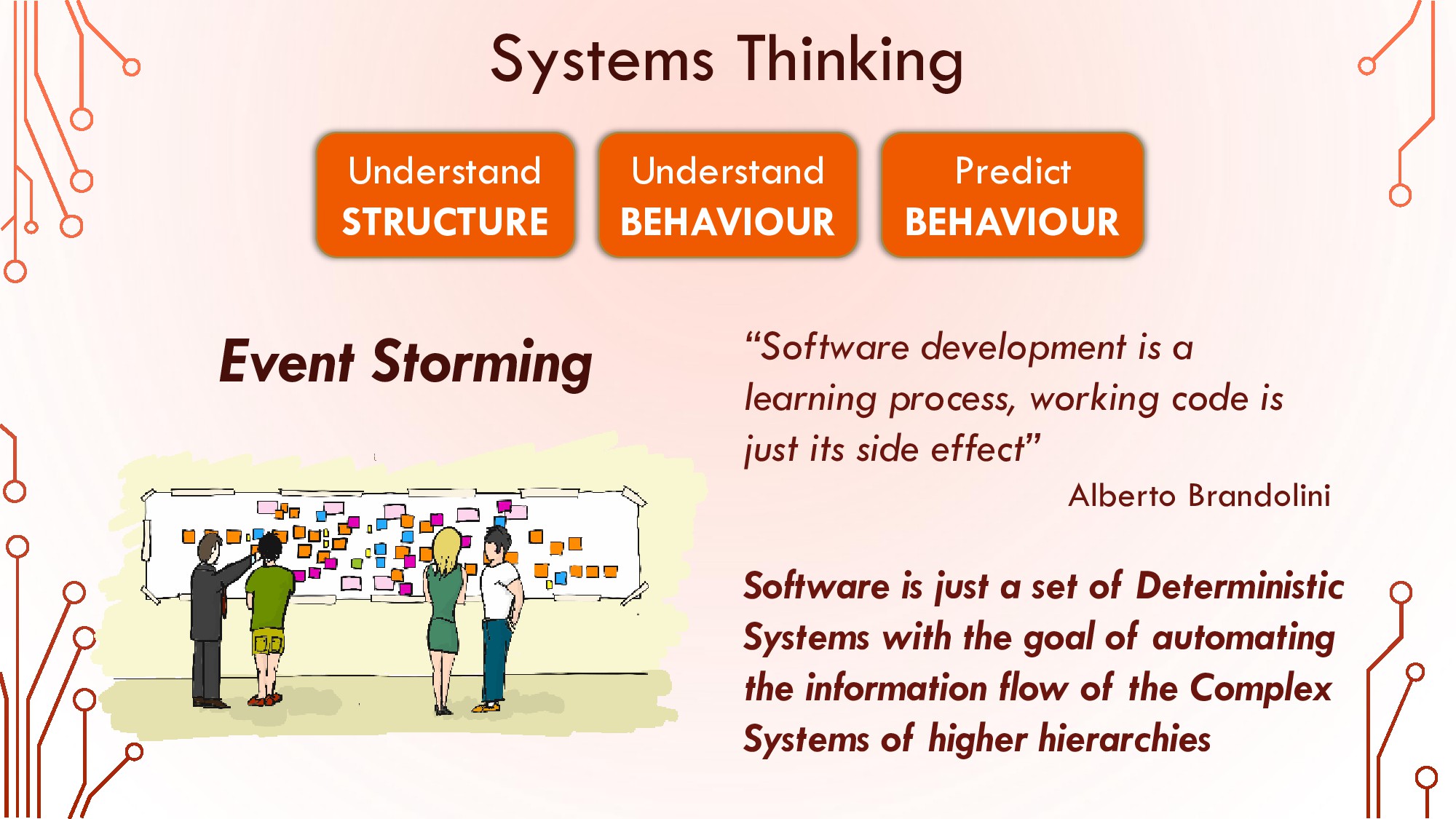
  24. Systems Thinking Understand STRUCTURE Understand BEHAVIOUR Predict BEHAVIOUR Event Storming

    “Software development is a learning process, working code is just its side effect” Alberto Brandolini Software is just a set of Deterministic Systems with the goal of automating the information flow of the Complex Systems of higher hierarchies
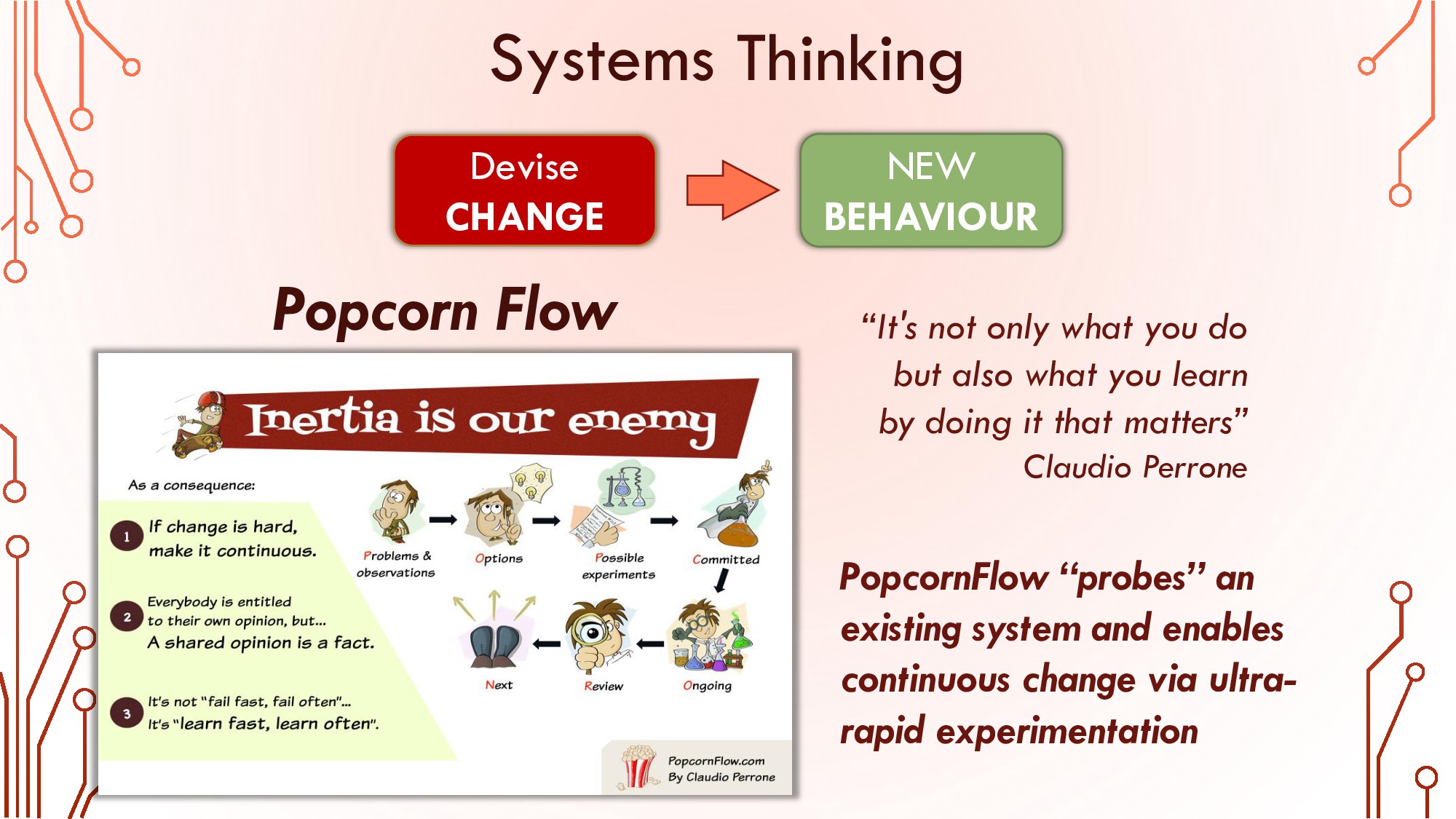
  25. Systems Thinking Popcorn Flow Devise CHANGE NEW BEHAVIOUR “It's not

    only what you do but also what you learn by doing it that matters” Claudio Perrone PopcornFlow “probes” an existing system and enables continuous change via ultra- rapid experimentation
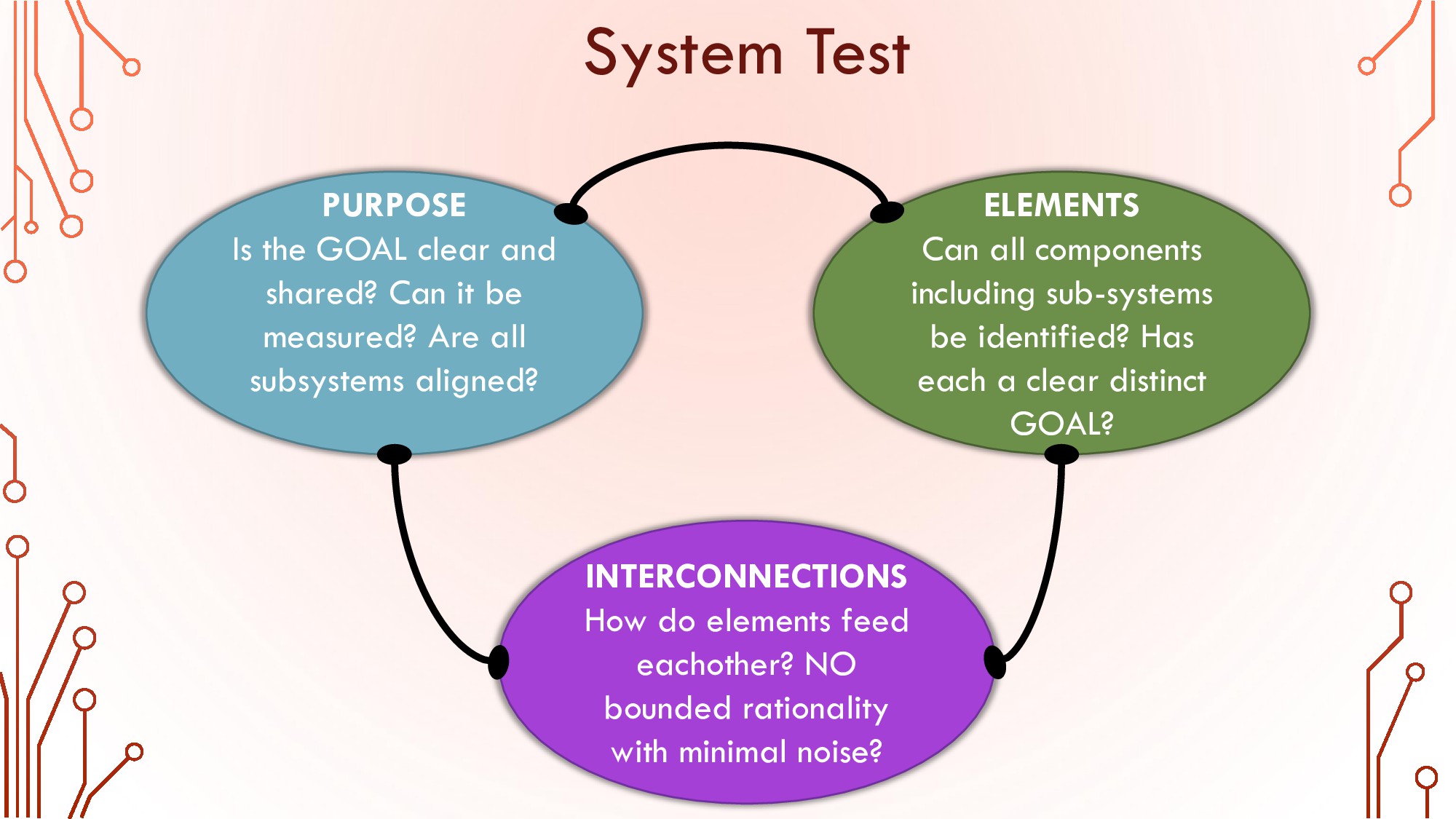
  26. System Test PURPOSE Is the GOAL clear and shared? Can

    it be measured? Are all subsystems aligned? ELEMENTS Can all components including sub-systems be identified? Has each a clear distinct GOAL? INTERCONNECTIONS How do elements feed eachother? NO bounded rationality with minimal noise?
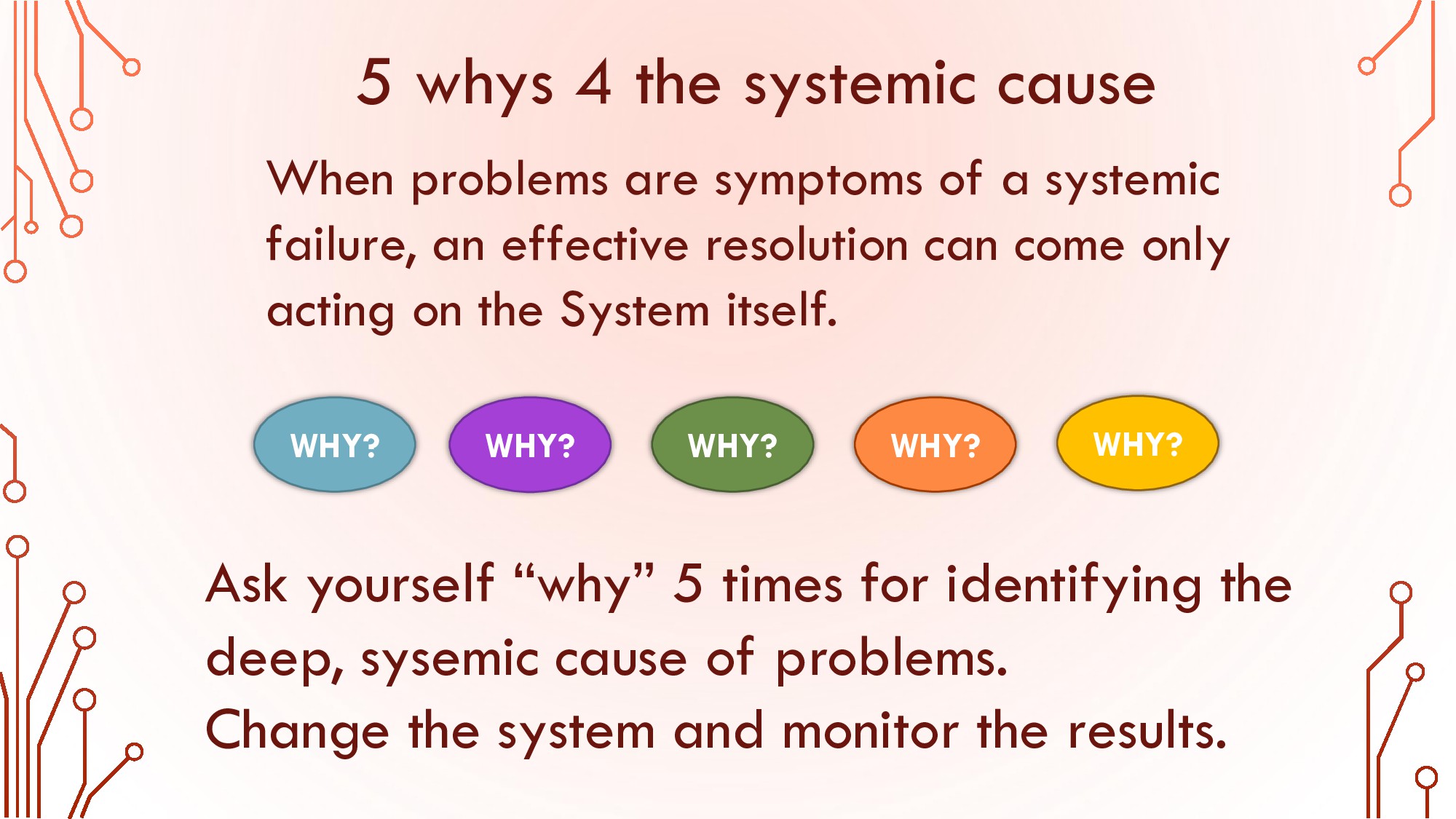
  27. When problems are symptoms of a systemic failure, an effective

    resolution can come only acting on the System itself. 5 whys 4 the systemic cause WHY? WHY? WHY? WHY? WHY? Ask yourself “why” 5 times for identifying the deep, sysemic cause of problems. Change the system and monitor the results.
  28. Build projects around motivated individuals. Give them the environment and

    support they need, and trust them to get the job done. The Human component Agile Manifesto (5th Agile Principle)
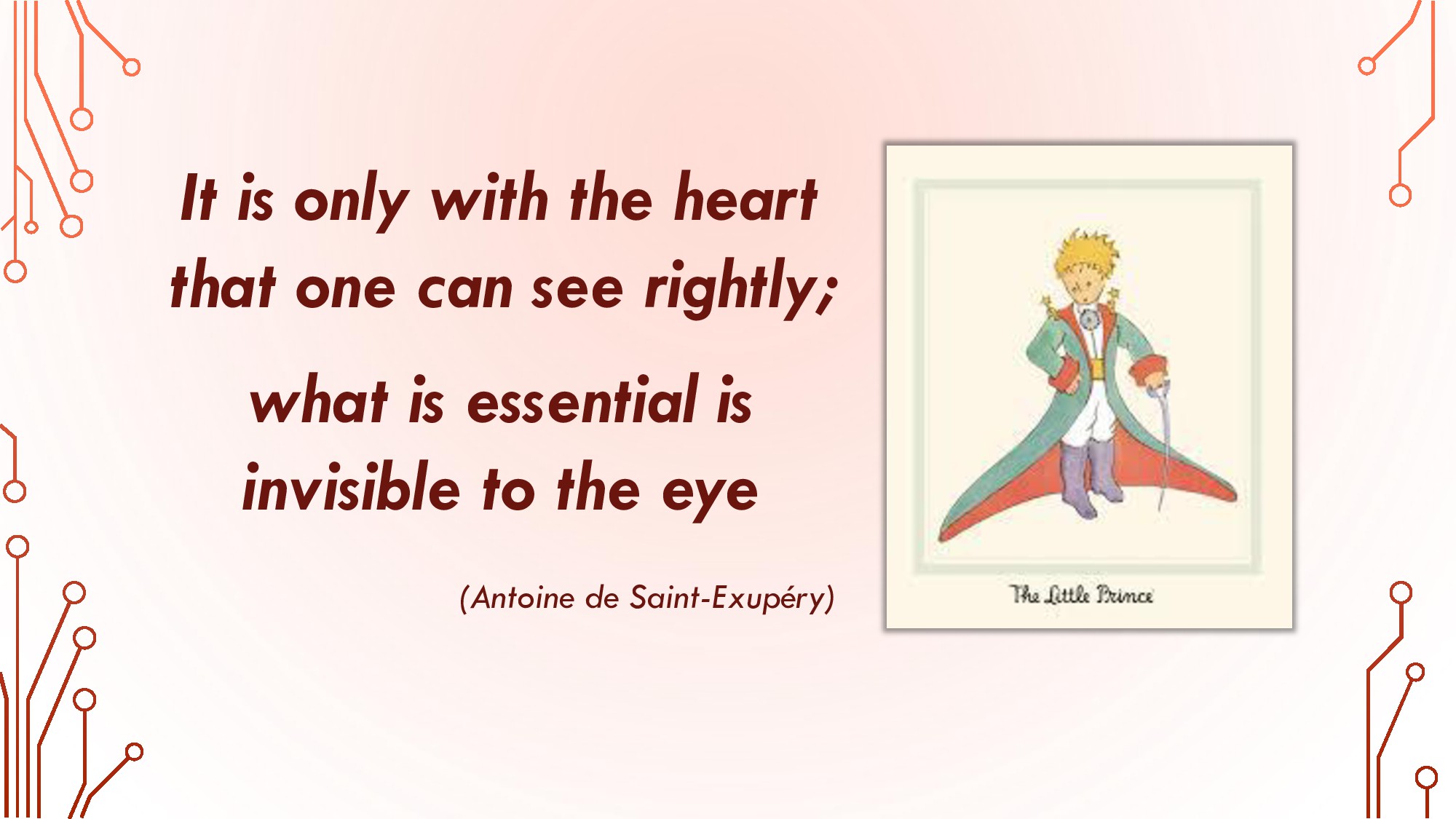
  29. It is only with the heart that one can see

    rightly; what is essential is invisible to the eye (Antoine de Saint-Exupéry)
  30. @consolondon THANK YOU ! consolaro “The greatest waste of all

    is failing to use the abilities of people, to learn about their frustrations and about the contributions that they are eager to make.” Edwards Deming