Dissecting and Reconstructing Ruby Syntactic St...
Sponsored
·
 Your Podcast. Everywhere. Effortlessly.
Share. Educate. Inspire. Entertain. You do you. We'll handle the rest.
→
Your Podcast. Everywhere. Effortlessly.
Share. Educate. Inspire. Entertain. You do you. We'll handle the rest.
→

Share
Embed
Dissecting and Reconstructing Ruby Syntactic Structures
RubyKaigi 2025 「Dissecting and Reconstructing Ruby Syntactic Structures」の発表スライド
https://rubykaigi.org/2025/ #rubykaigi

ydah
April 17, 2025
Transcript
96 slides
-
Dissecting and Reconstructing RubySyntacticStructures @ydah / Yudai Takada RubyKaigi 2025ʔMatsuyama,
Ehime Ehime Prefectural Convention Hall 17 April 2025 -
"Dissecting and Reconstructing Ruby Syntactic Structures" ʔ @ydah Software engineer
@ x.com/@ydah_ github.com/@ydah https://ydah.net/ Yudai Takada / ydah "Dissecting and Reconstructing Ruby Syntactic Structures" ʔ @ydah -
"Dissecting and Reconstructing Ruby Syntactic Structures" ʔ @ydah "Dissecting and
Reconstructing Ruby Syntactic Structures" ʔ @ydah Drinks Sponsor -
"Dissecting and Reconstructing Ruby Syntactic Structures" ʔ @ydah "Dissecting and
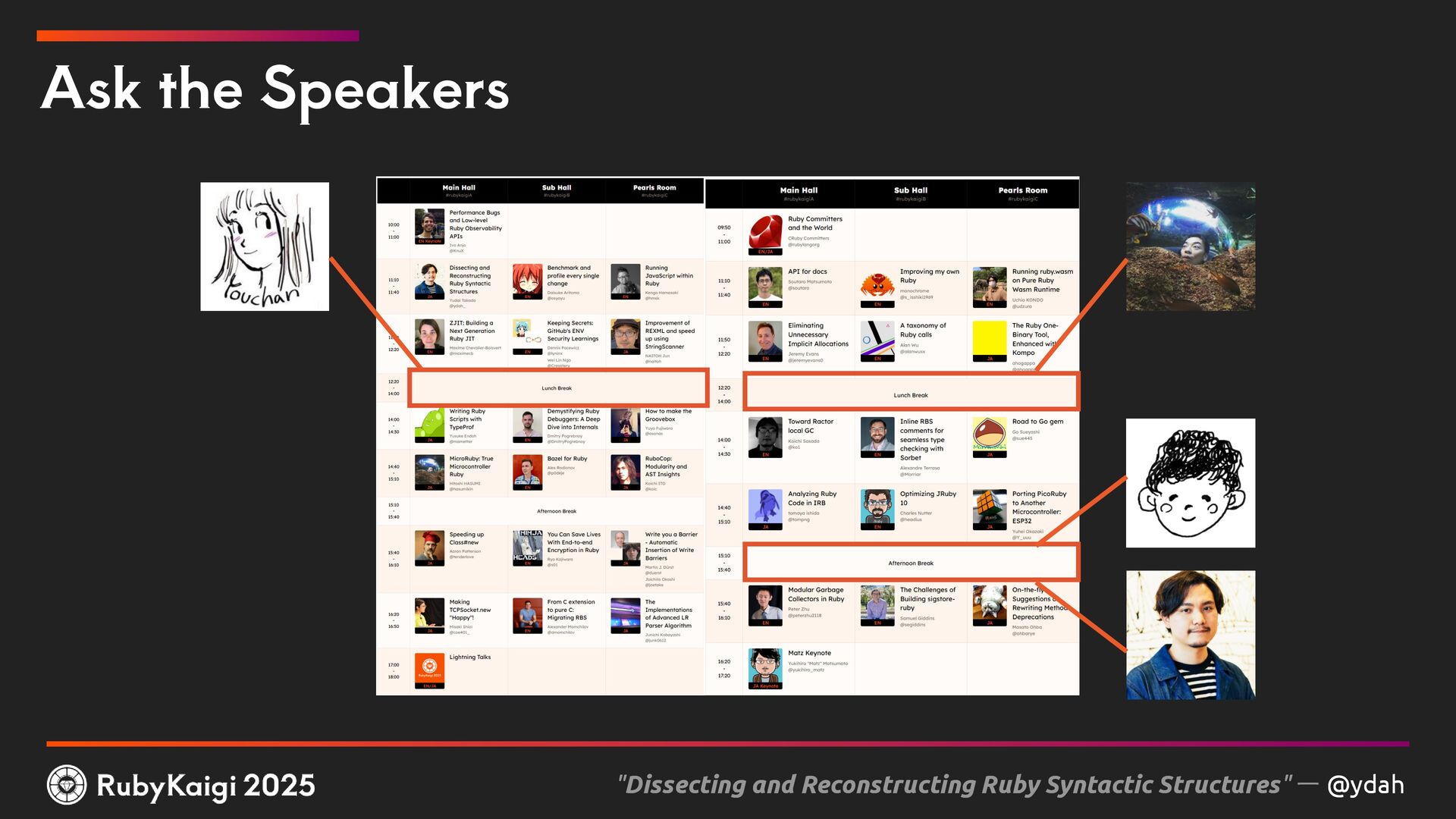
Reconstructing Ruby Syntactic Structures" ʔ @ydah Ask the Speakers -
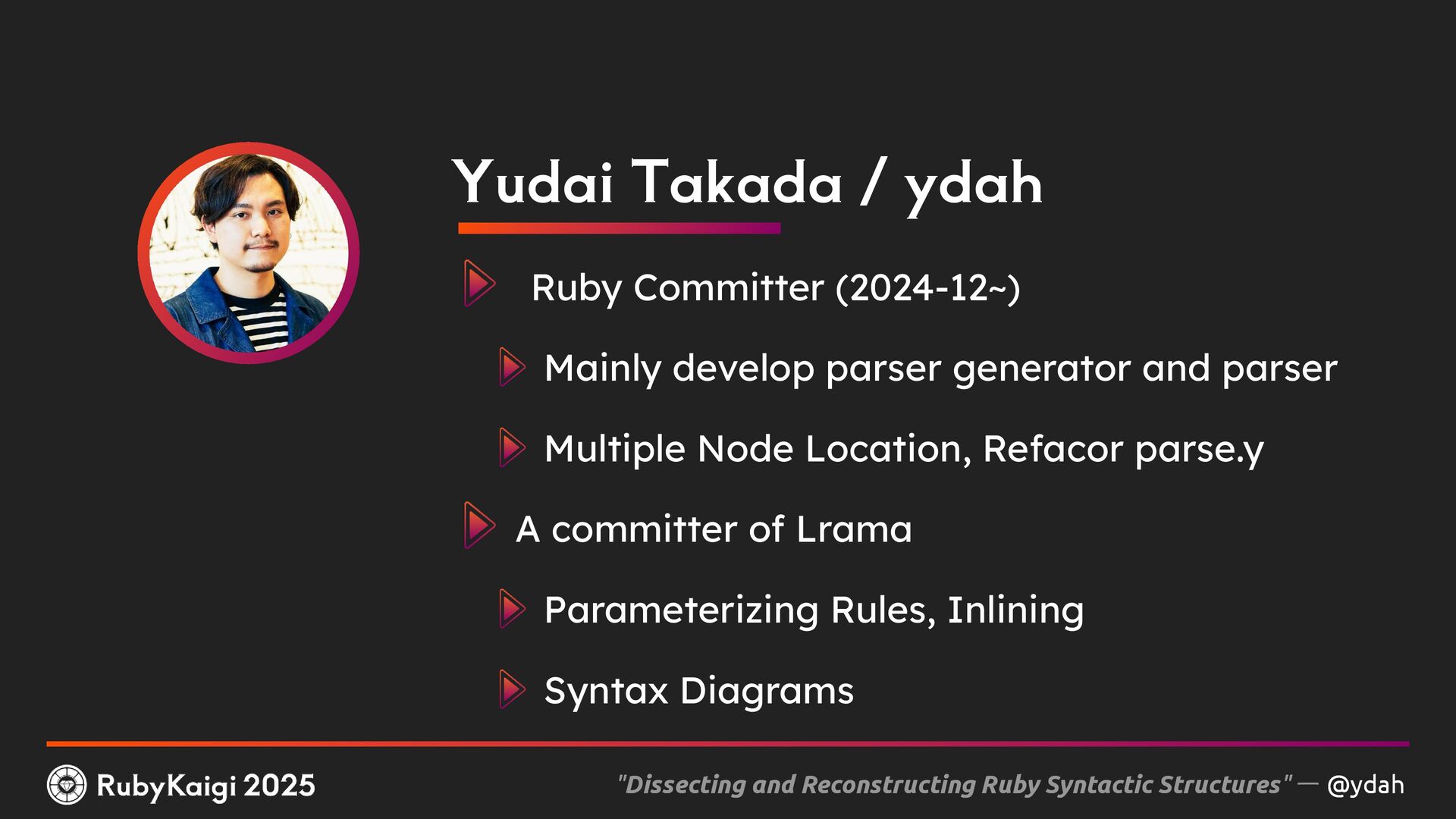
"Dissecting and Reconstructing Ruby Syntactic Structures" ʔ @ydah Ruby Committer
(2024-12~) Mainly develop parser generator and parser Multiple Node Location, Refacor parse.y A committer of Lrama Parameterizing Rules, Inlining Syntax Diagrams Yudai Takada / ydah "Dissecting and Reconstructing Ruby Syntactic Structures" ʔ @ydah -
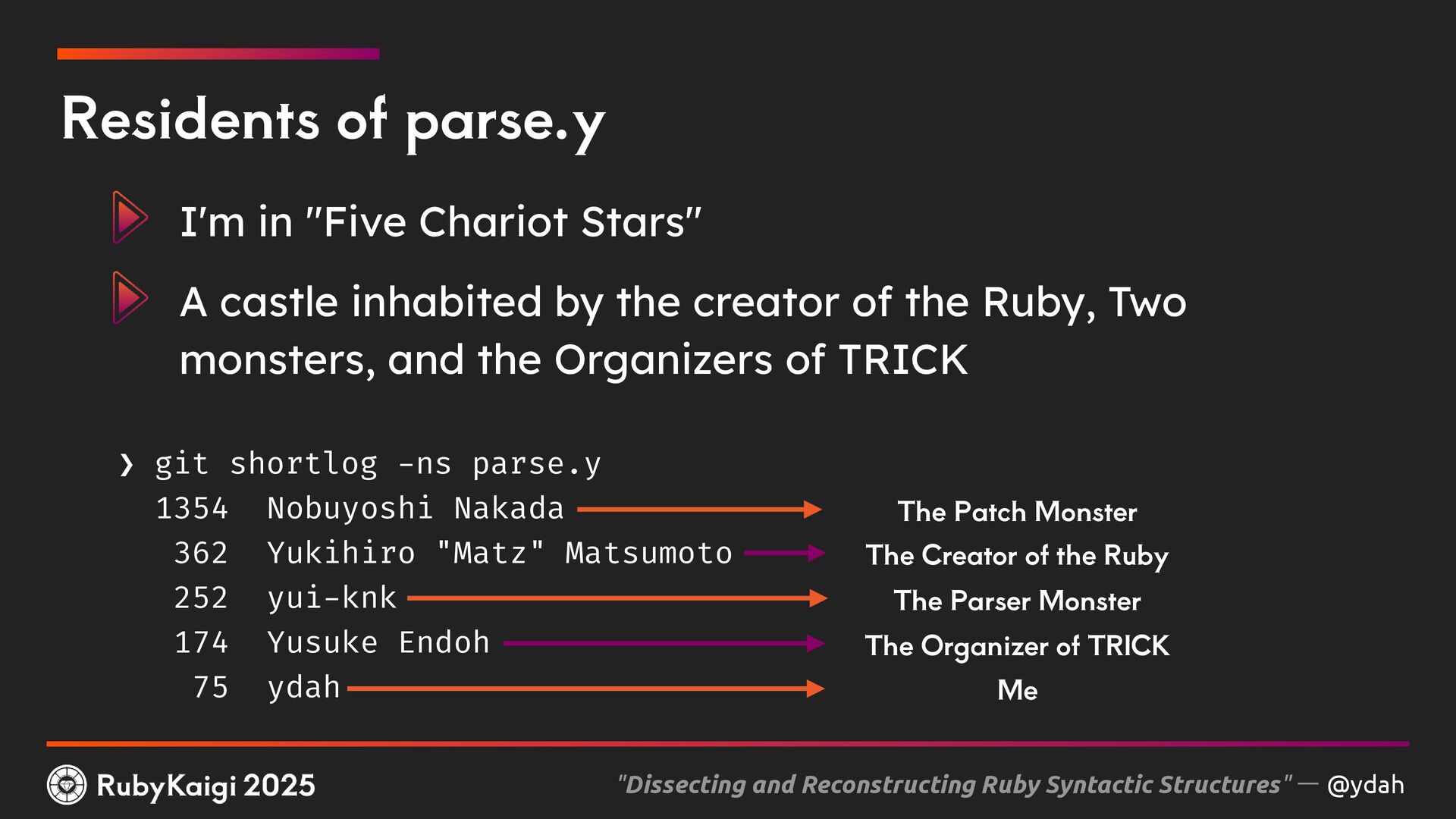
"Dissecting and Reconstructing Ruby Syntactic Structures" ʔ @ydah I'm in
"Five Chariot Stars" A castle inhabited by the creator of the Ruby, Two monsters, and the Organizers of TRICK Residents of parse.y ❯ git shortlog - ns parse.y 1354 Nobuyoshi Nakada 362 Yukihiro "Matz" Matsumoto 252 yui - knk 174 Yusuke Endoh 75 ydah The Patch Monster The Creator of the Ruby The Parser Monster The Organizer of TRICK Me -
KansaiRubyKaigi08 Kyoto Pontocho Kaburenjo Theater 2025-06-28(Sat) @shimbaco / @pocke RubyKansai,
Kyoto.rb, Kobe.rb, AKASHI.rb, RubyMaizuru Kyobashi.rb, Ruby Tuesday, Shinosaka.rb, naniwa.rb Unsolicited Ads -
CFP IS NOW LIVE!! Submit your talk by May 7th
Unsolicited Ads -
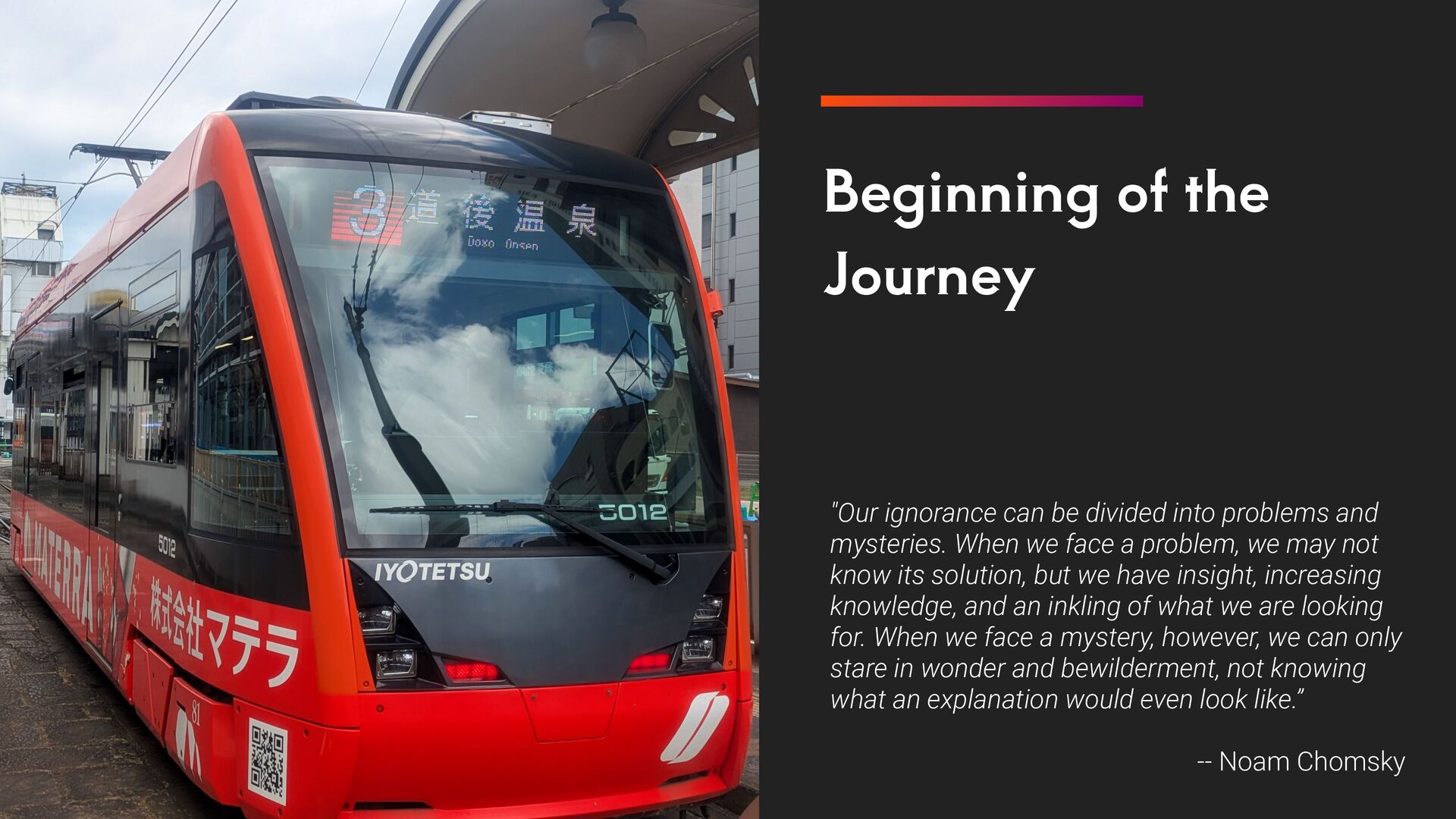
Beginning of the Journey "Our ignorance can be divided into
problems and mysteries. When we face a problem, we may not know its solution, but we have insight, increasing knowledge, and an inkling of what we are looking for. When we face a mystery, however, we can only stare in wonder and bewilderment, not knowing what an explanation would even look like.” -- Noam Chomsky -
"Dissecting and Reconstructing Ruby Syntactic Structures" ʔ @ydah What is
Grammar Structure? -
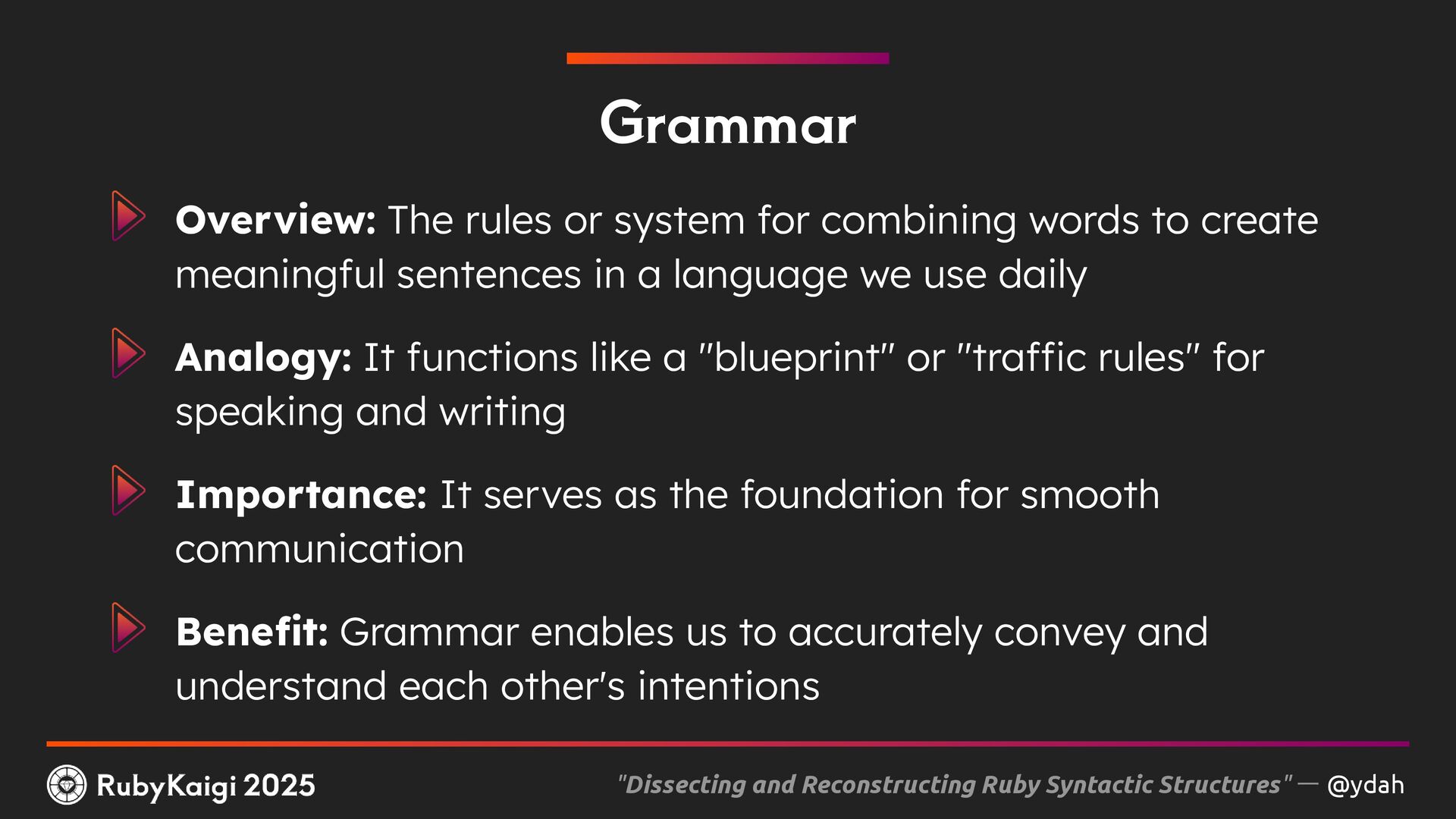
"Dissecting and Reconstructing Ruby Syntactic Structures" ʔ @ydah Grammar Overview:
The rules or system for combining words to create meaningful sentences in a language we use daily Analogy: It functions like a "blueprint" or "tra ff i c rules" for speaking and writing Importance: It serves as the foundation for smooth communication Bene fi t: Grammar enables us to accurately convey and understand each other's intentions -
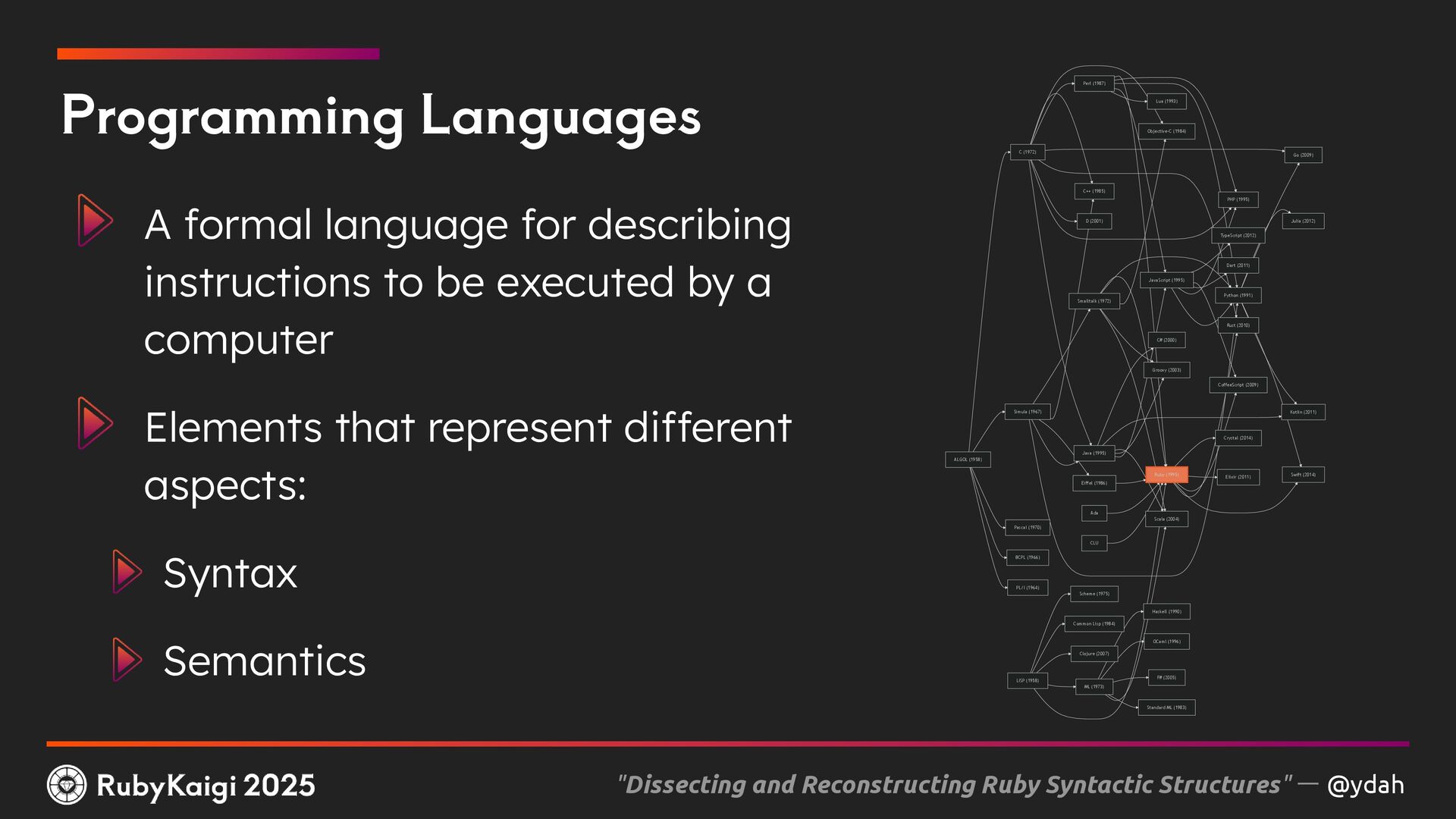
"Dissecting and Reconstructing Ruby Syntactic Structures" ʔ @ydah Programming Languages
A formal language for describing instructions to be executed by a computer Elements that represent di ff erent aspects: Syntax Semantics ALGOL (1958) C (1972) Simula (1967) Pascal (1970) BCPL (1966) PL/I (1964) LISP (1958) Scheme (1975) Common Lisp (1984) Clojure (2007) ML (1973) Ruby (1995) Smalltalk (1972) C++ (1985) Eiffel (1986) Java (1995) Python (1991) Objective-C (1984) Groovy (2003) Scala (2004) Perl (1987) Go (2009) Rust (2010) D (2001) PHP (1995) JavaScript (1995) Lua (1993) Ada Haskell (1990) OCaml (1996) F# (2005) Standard ML (1983) C# (2000) Kotlin (2011) Crystal (2014) Elixir (2011) CoffeeScript (2009) Swift (2014) TypeScript (2012) Dart (2011) Julia (2012) CLU -
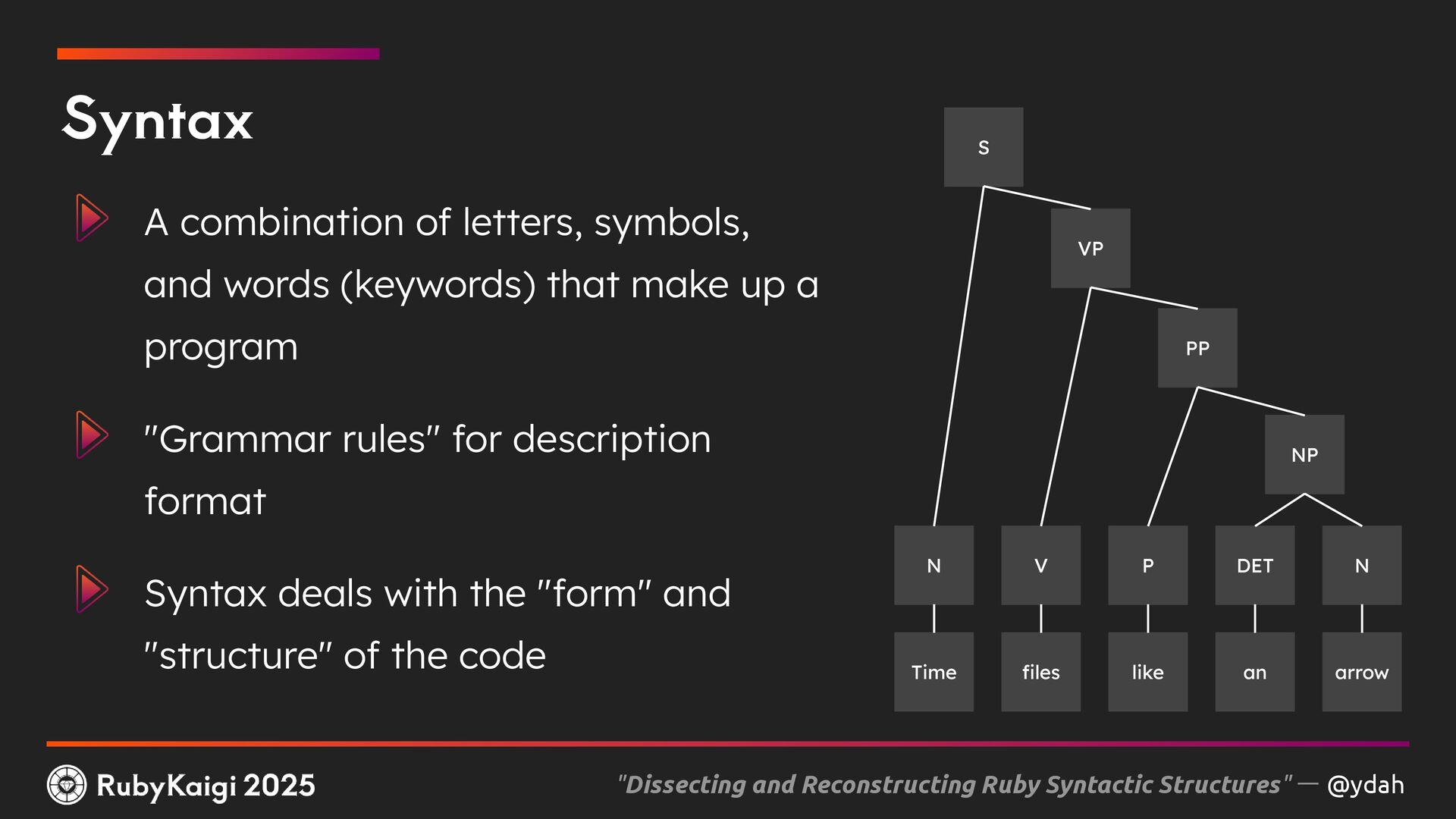
"Dissecting and Reconstructing Ruby Syntactic Structures" ʔ @ydah Syntax A
combination of letters, symbols, and words (keywords) that make up a program "Grammar rules" for description format Syntax deals with the "form" and "structure" of the code -
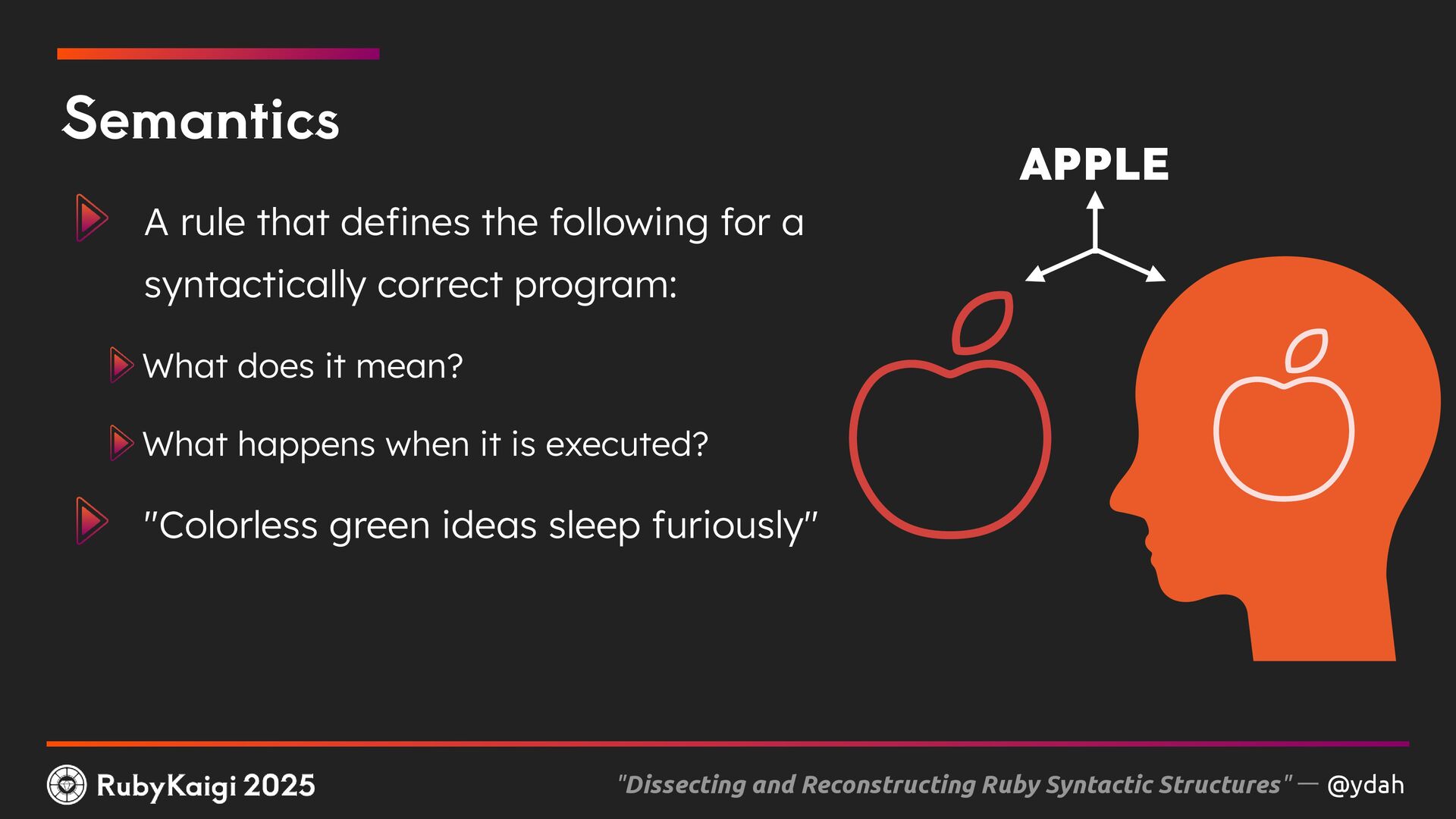
"Dissecting and Reconstructing Ruby Syntactic Structures" ʔ @ydah A rule
that de fi nes the following for a syntactically correct program: What does it mean? What happens when it is executed? "Colorless green ideas sleep furiously" Semantics APPLE -
"Dissecting and Reconstructing Ruby Syntactic Structures" ʔ @ydah Syntactic Structures
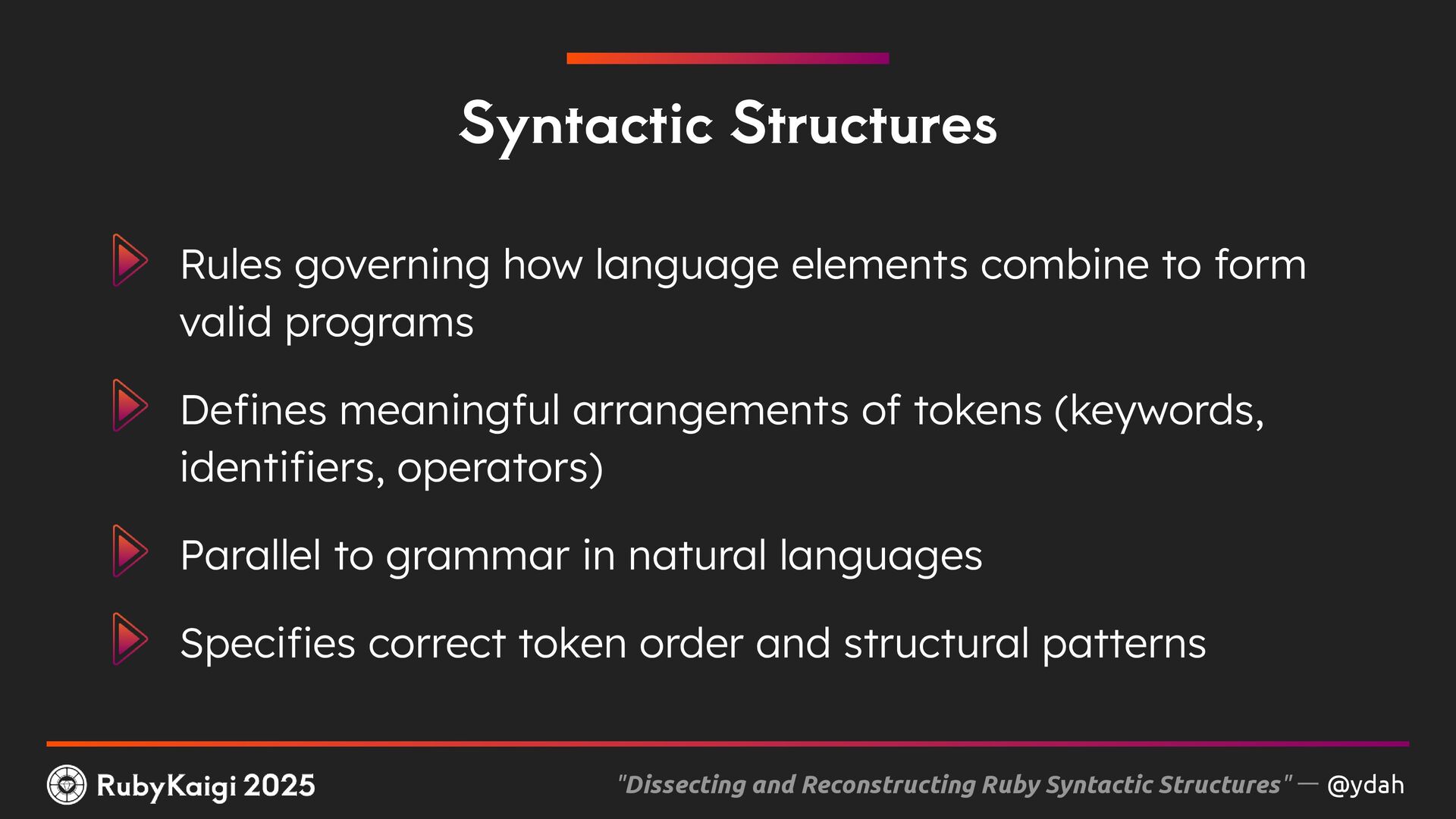
Rules governing how language elements combine to form valid programs De fi nes meaningful arrangements of tokens (keywords, identi fi ers, operators) Parallel to grammar in natural languages Speci fi es correct token order and structural patterns -
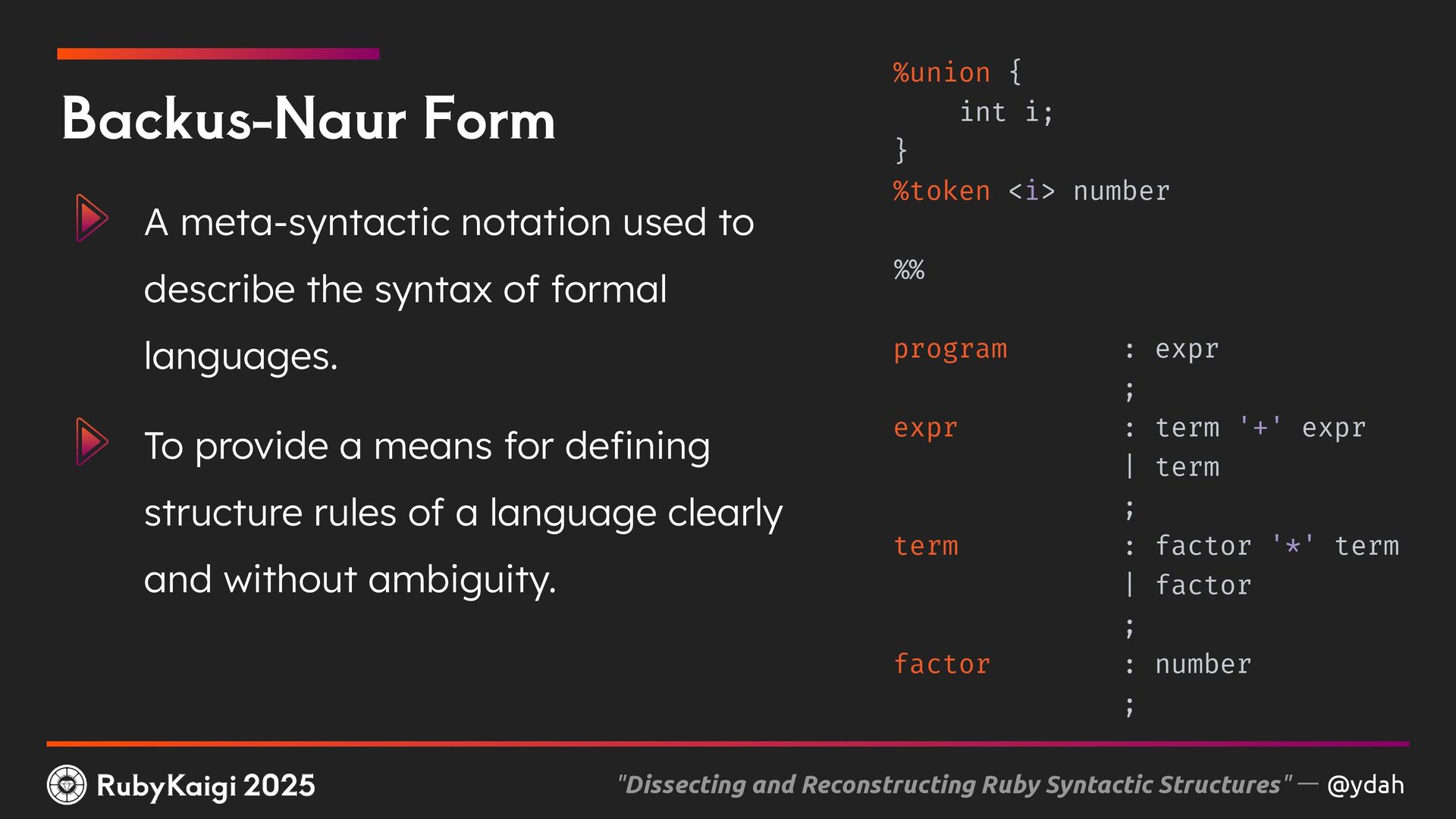
"Dissecting and Reconstructing Ruby Syntactic Structures" ʔ @ydah Backus-Naur Form
A meta-syntactic notation used to describe the syntax of formal languages. To provide a means for de fi ning structure rules of a language clearly and without ambiguity. %union { int i; } %token <i> number % % program : expr ; expr : term '+' expr | term ; term : factor '*' term | factor ; factor : number ; -
Ruby Grammar Structure "Language is the most massive and inclusive
art we know, a mountainous and anonymous work of unconscious generations." --Edward Sapir -
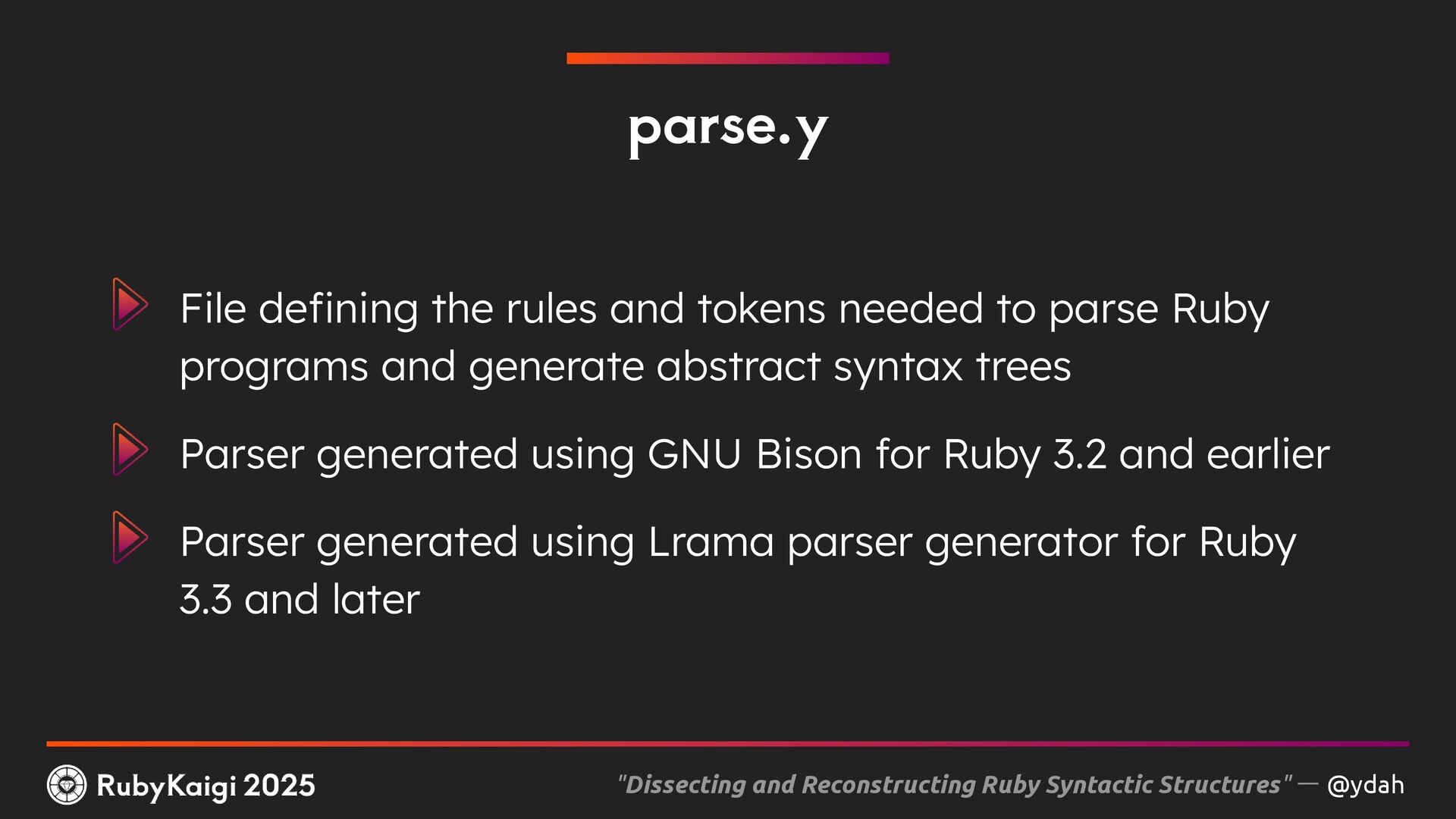
"Dissecting and Reconstructing Ruby Syntactic Structures" ʔ @ydah parse.y File
de fi ning the rules and tokens needed to parse Ruby programs and generate abstract syntax trees Parser generated using GNU Bison for Ruby 3.2 and earlier Parser generated using Lrama parser generator for Ruby 3.3 and later -
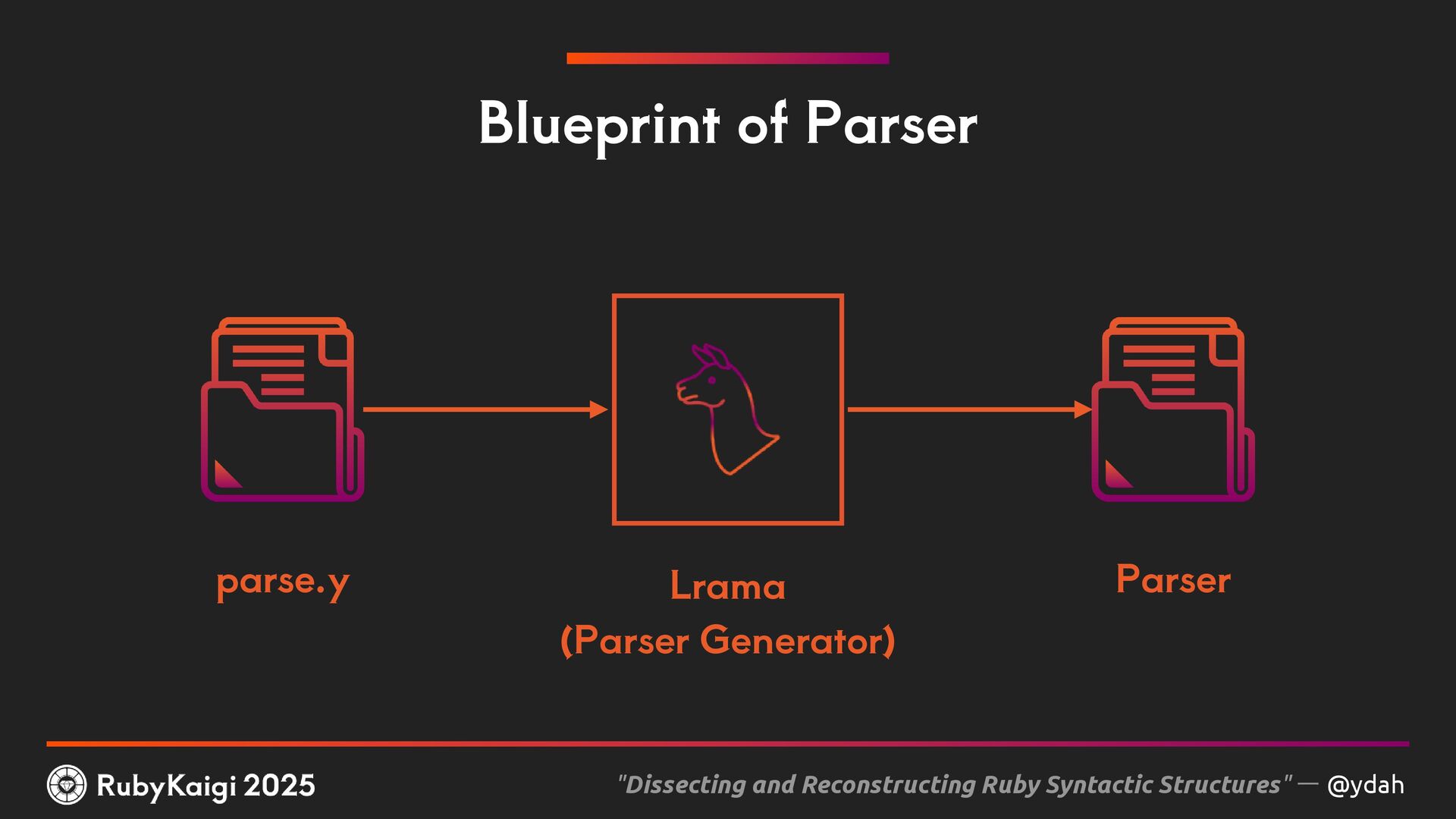
"Dissecting and Reconstructing Ruby Syntactic Structures" ʔ @ydah Blueprint of
Parser Lrama (Parser Generator) parse.y Parser -
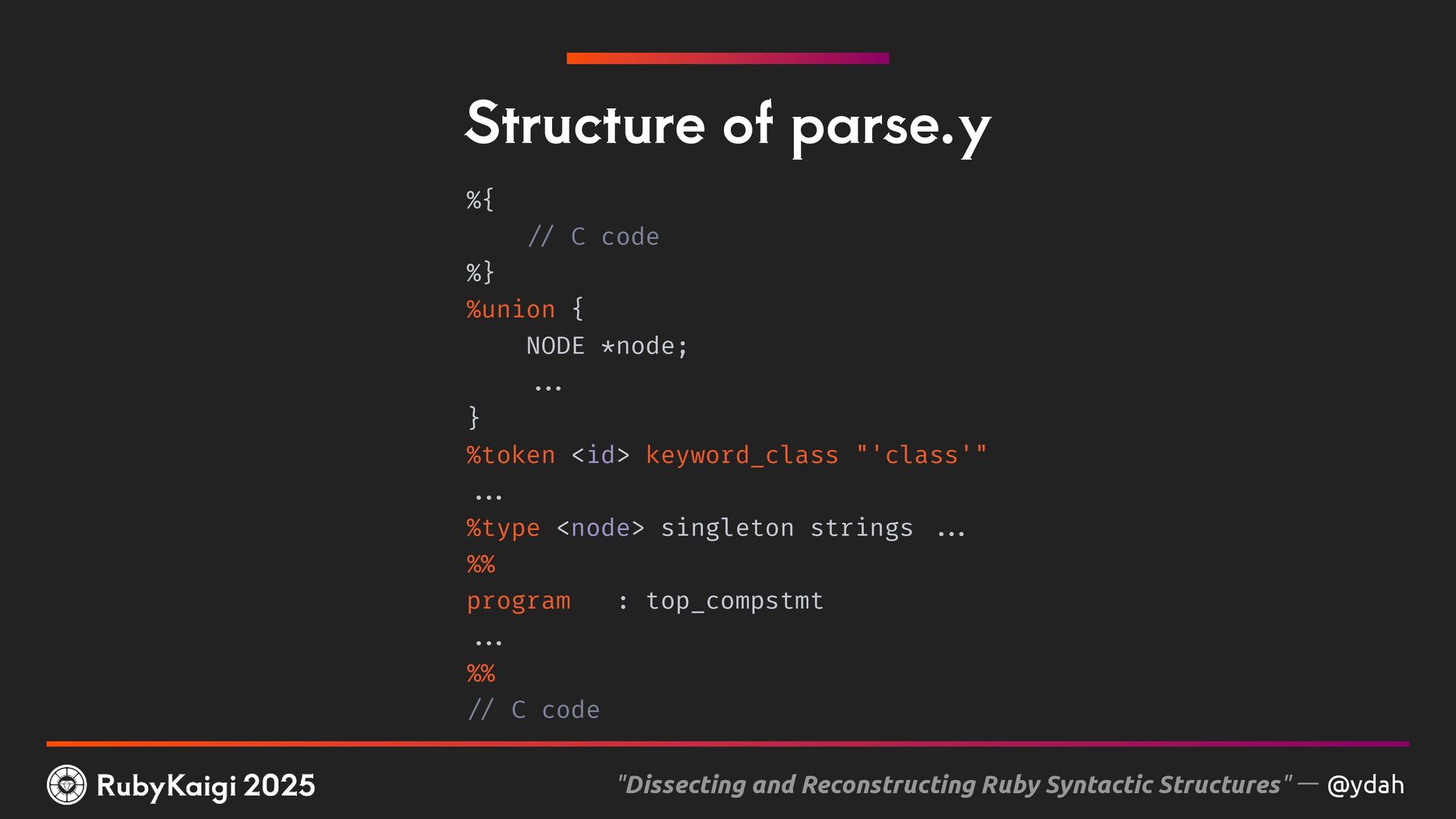
"Dissecting and Reconstructing Ruby Syntactic Structures" ʔ @ydah Structure of
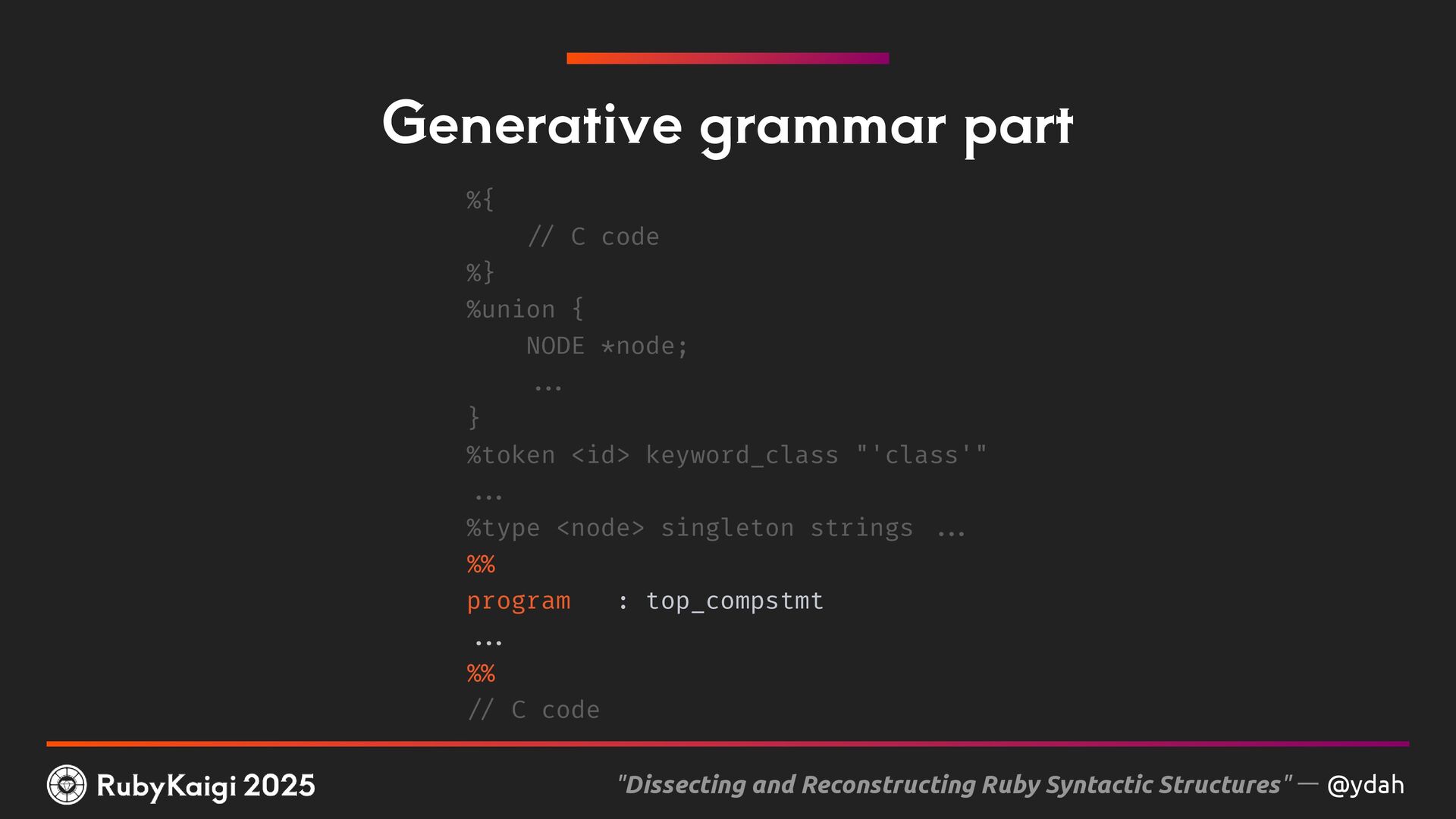
parse.y %{ / / C code %} %union { NODE * node; . . . } %token <id> keywo r d_class "'class'" . . . %type <node> singleton st r ings . . . % % p r og r am : top_compstmt . . . % % / / C code -
"Dissecting and Reconstructing Ruby Syntactic Structures" ʔ @ydah Generative grammar
part %{ / / C code %} %union { NODE * node; . . . } %token <id> keywo r d_class "'class'" . . . %type <node> singleton st r ings . . . % % p r og r am : top_compstmt . . . % % / / C code -
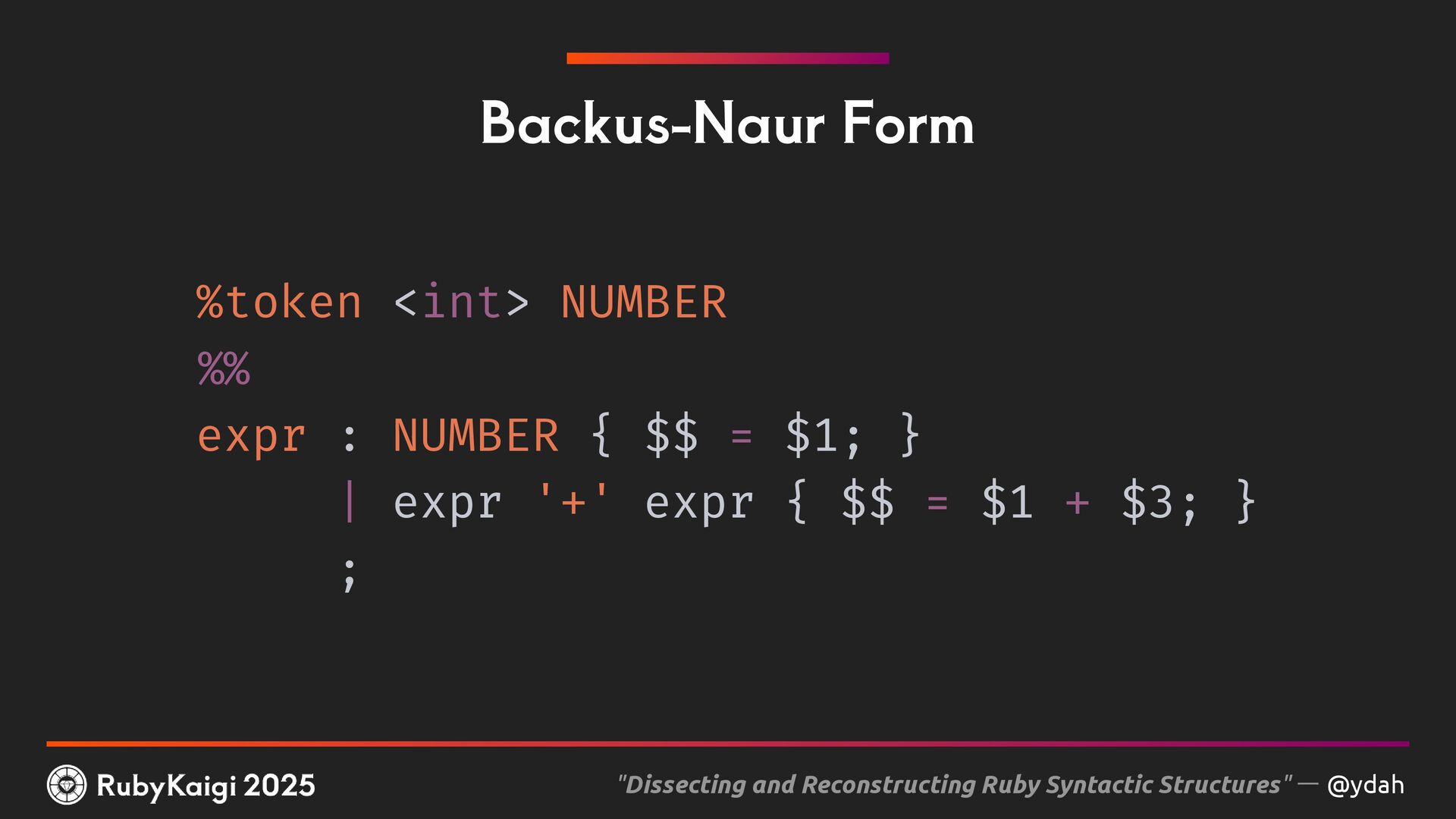
"Dissecting and Reconstructing Ruby Syntactic Structures" ʔ @ydah %token <int>
NUMBER % % expr : NUMBER { $$ = $1; } | expr '+' expr { $$ = $1 + $3; } ; Backus-Naur Form -
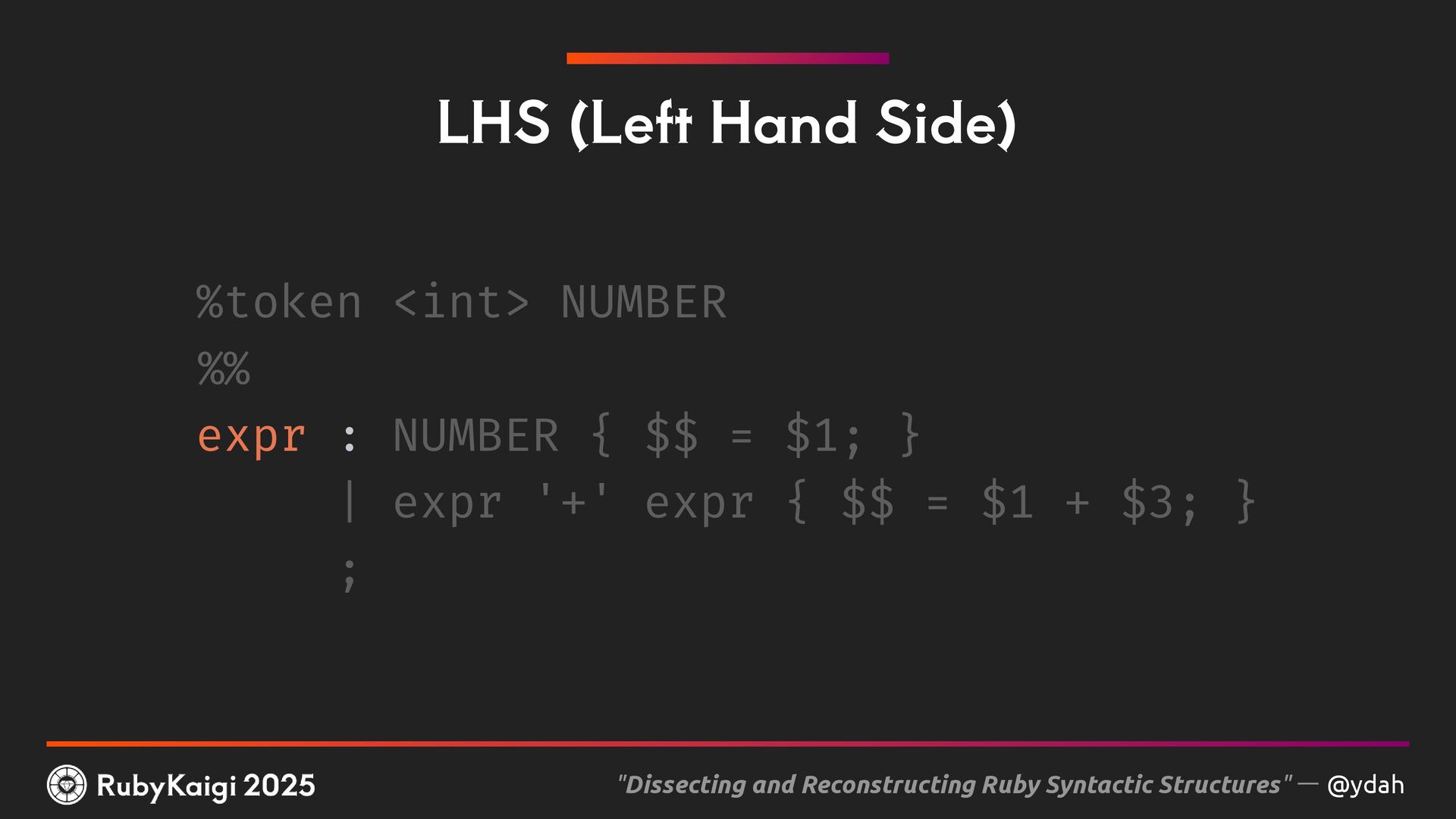
"Dissecting and Reconstructing Ruby Syntactic Structures" ʔ @ydah %token <int>
NUMBER % % expr : NUMBER { $$ = $1; } | expr '+' expr { $$ = $1 + $3; } ; LHS (Left Hand Side) -
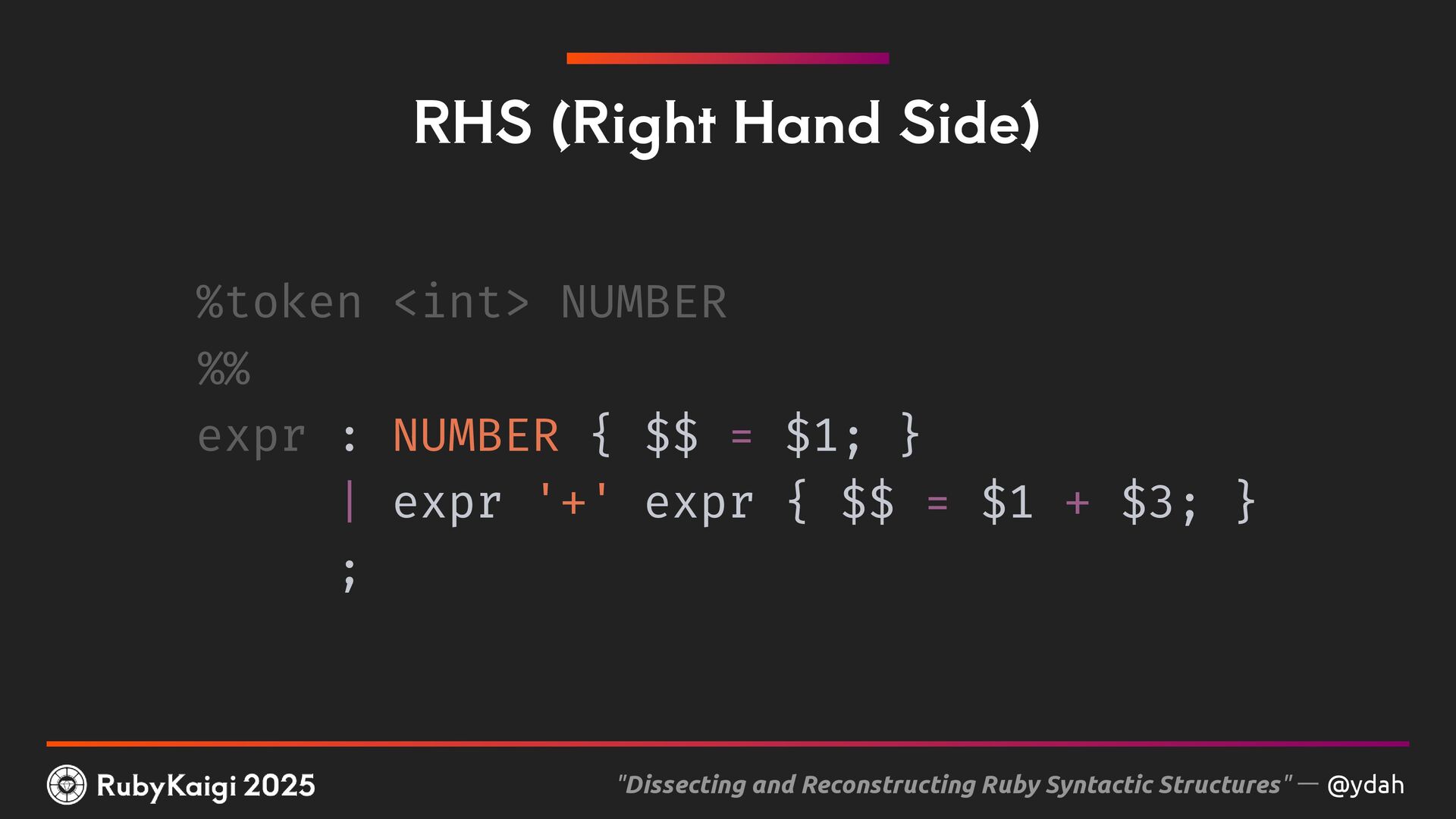
"Dissecting and Reconstructing Ruby Syntactic Structures" ʔ @ydah %token <int>
NUMBER % % expr : NUMBER { $$ = $1; } | expr '+' expr { $$ = $1 + $3; } ; RHS (Right Hand Side) -
"Dissecting and Reconstructing Ruby Syntactic Structures" ʔ @ydah %token <int>
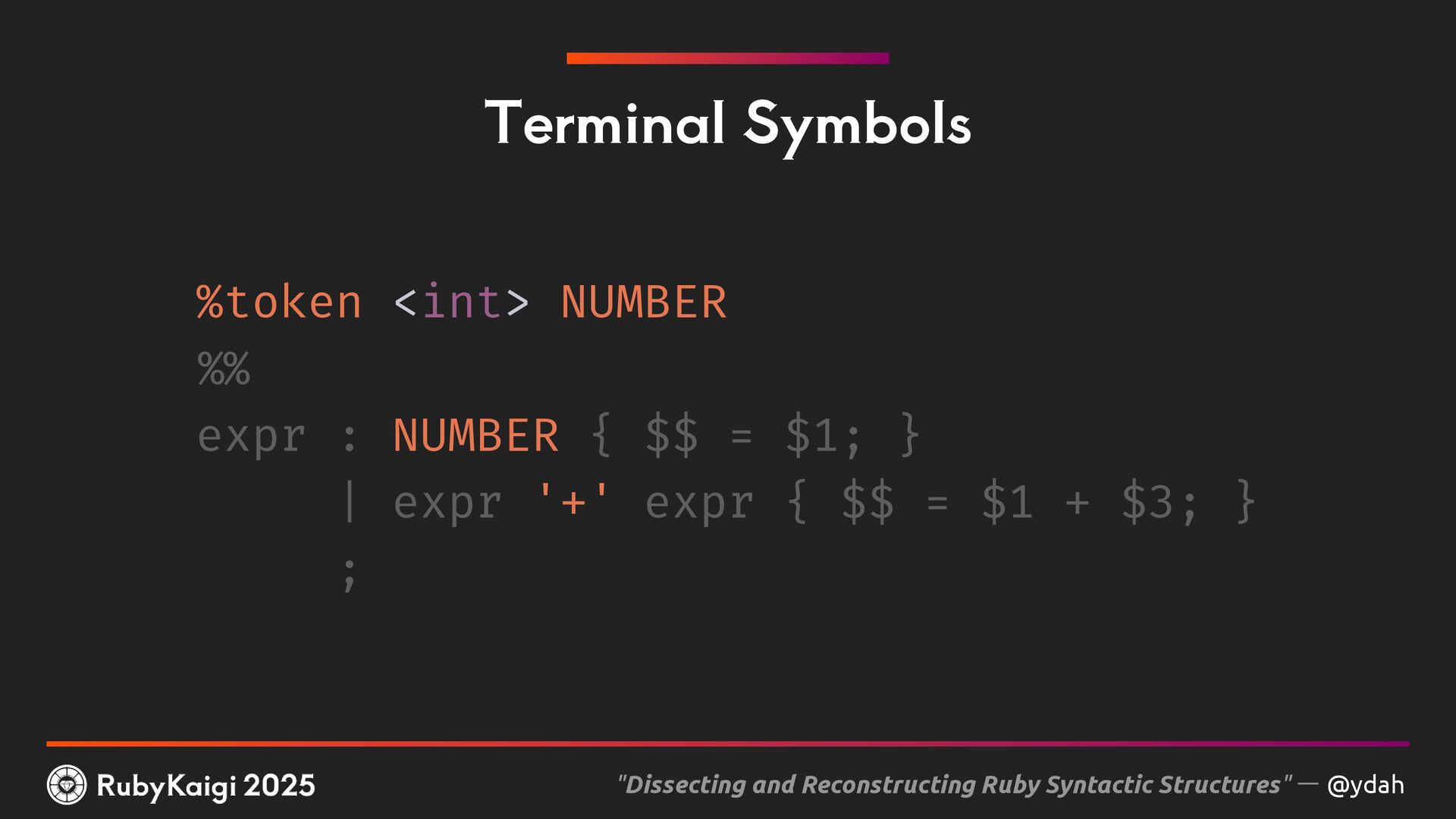
NUMBER % % expr : NUMBER { $$ = $1; } | expr '+' expr { $$ = $1 + $3; } ; Terminal Symbols -
"Dissecting and Reconstructing Ruby Syntactic Structures" ʔ @ydah %token <int>
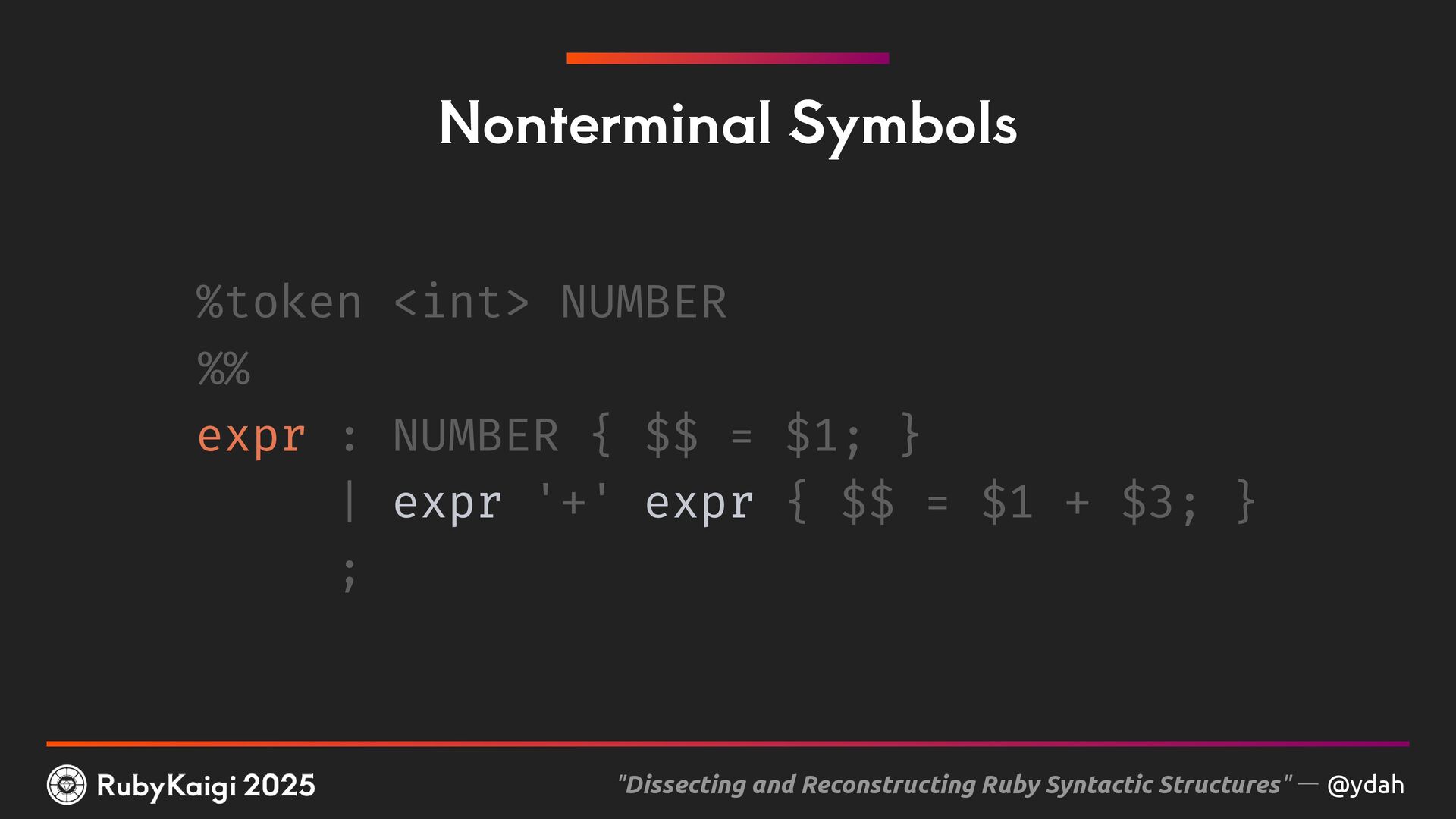
NUMBER % % expr : NUMBER { $$ = $1; } | expr '+' expr { $$ = $1 + $3; } ; Nonterminal Symbols -
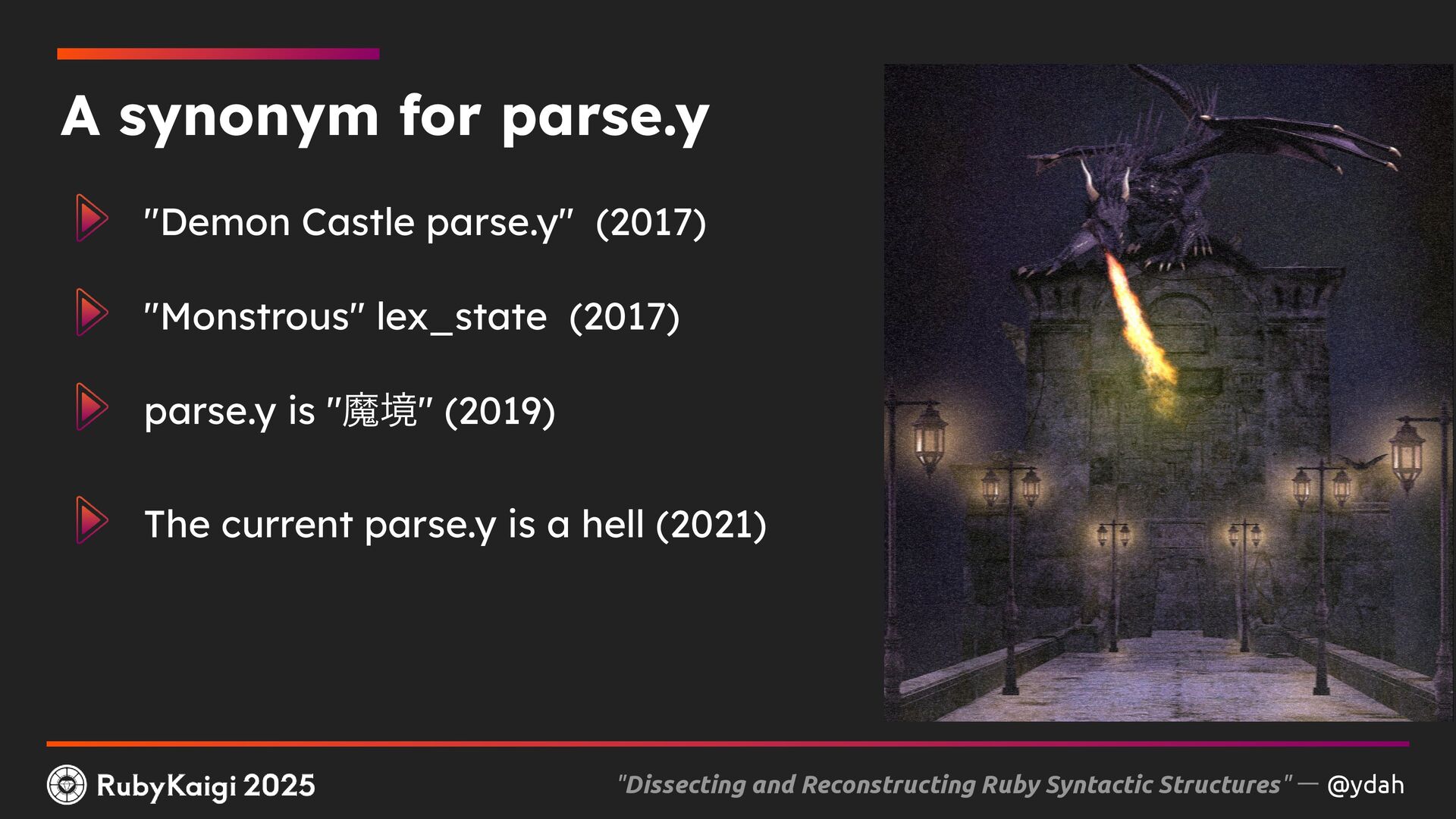
"Dissecting and Reconstructing Ruby Syntactic Structures" ʔ @ydah A synonym
for parse.y "Demon Castle parse.y" (2017) "Monstrous" lex_state (2017) parse.y is "ຐڥ" (2019) The current parse.y is a hell (2021) -
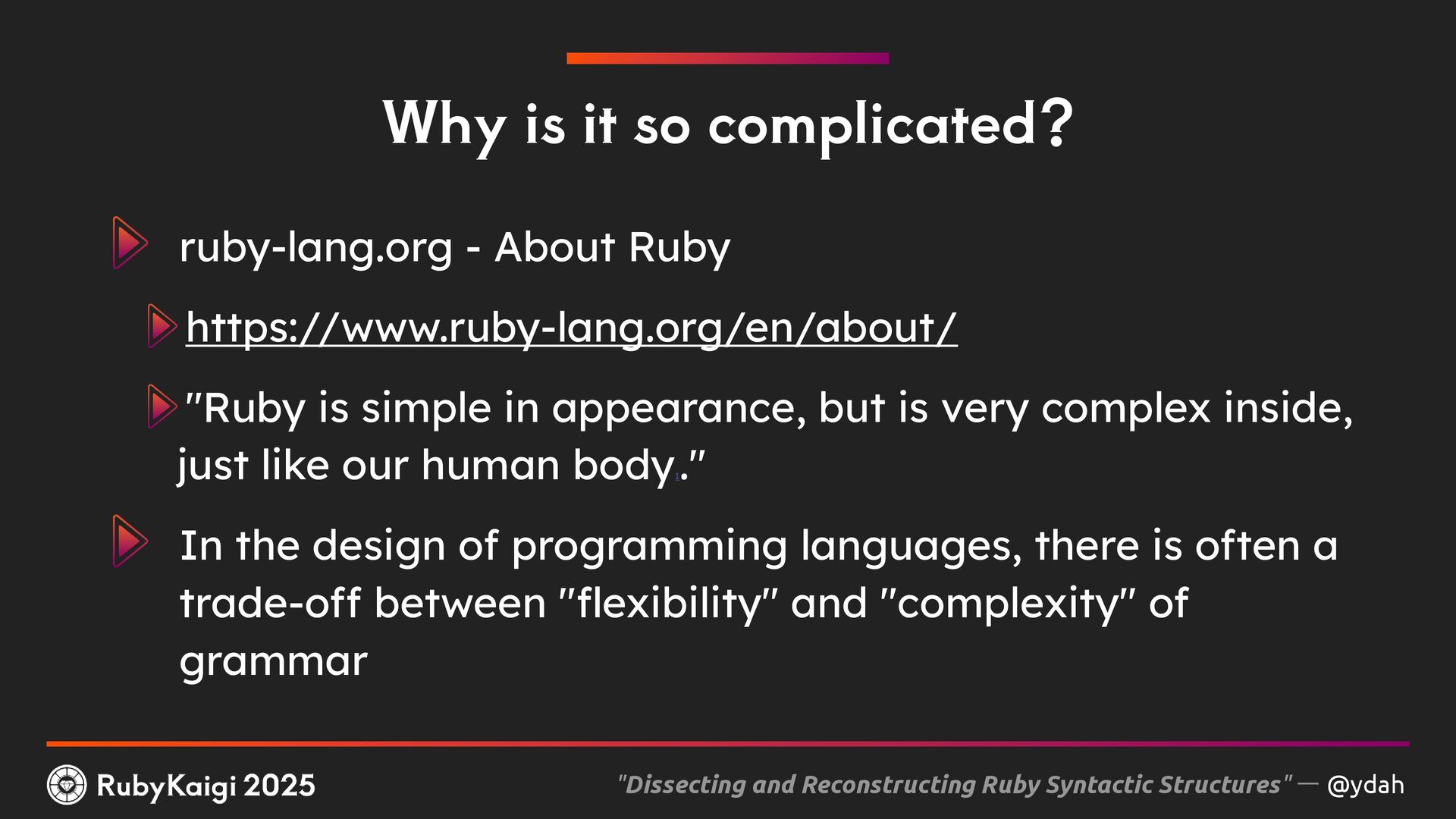
"Dissecting and Reconstructing Ruby Syntactic Structures" ʔ @ydah Why is
it so complicated? ruby-lang.org - About Ruby https://www.ruby-lang.org/en/about/ "Ruby is simple in appearance, but is very complex inside, just like our human body 1 ." In the design of programming languages, there is often a trade-o ff between " fl exibility" and "complexity" of grammar -
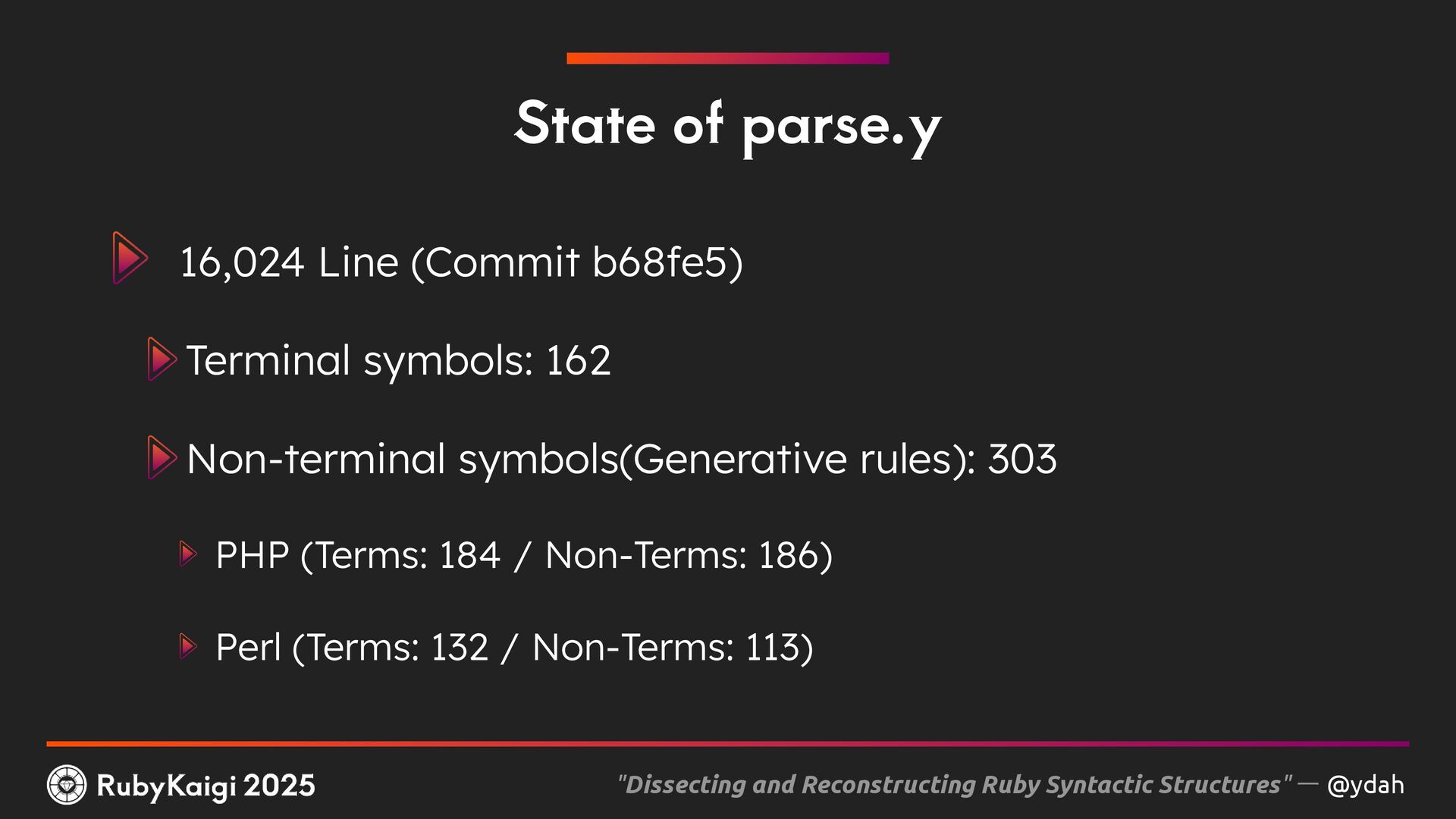
"Dissecting and Reconstructing Ruby Syntactic Structures" ʔ @ydah State of
parse.y 16,024 Line (Commit b68fe5) Terminal symbols: 162 Non-terminal symbols(Generative rules): 303 PHP (Terms: 184 / Non-Terms: 186) Perl (Terms: 132 / Non-Terms: 113) -
Dissecting Ruby Syntactic Structures "A special kind of beauty exists
which is born in language, of language, and for language." -- Gaston Bachelard -
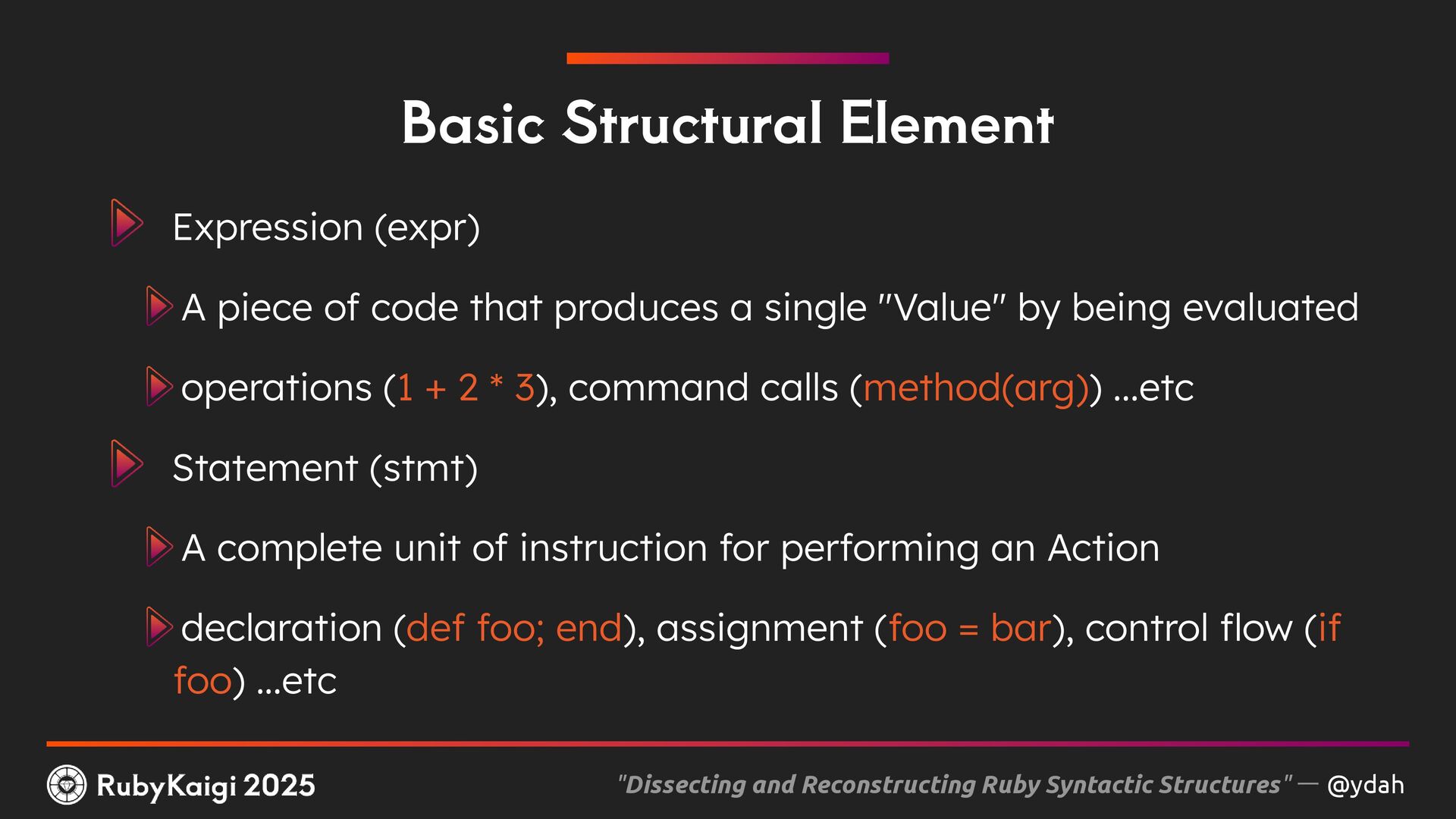
"Dissecting and Reconstructing Ruby Syntactic Structures" ʔ @ydah Basic Structural
Element Expression (expr) A piece of code that produces a single "Value" by being evaluated operations (1 + 2 * 3), command calls (method(arg)) ...etc Statement (stmt) A complete unit of instruction for performing an Action declaration (def foo; end), assignment (foo = bar), control fl ow (if foo) ...etc -
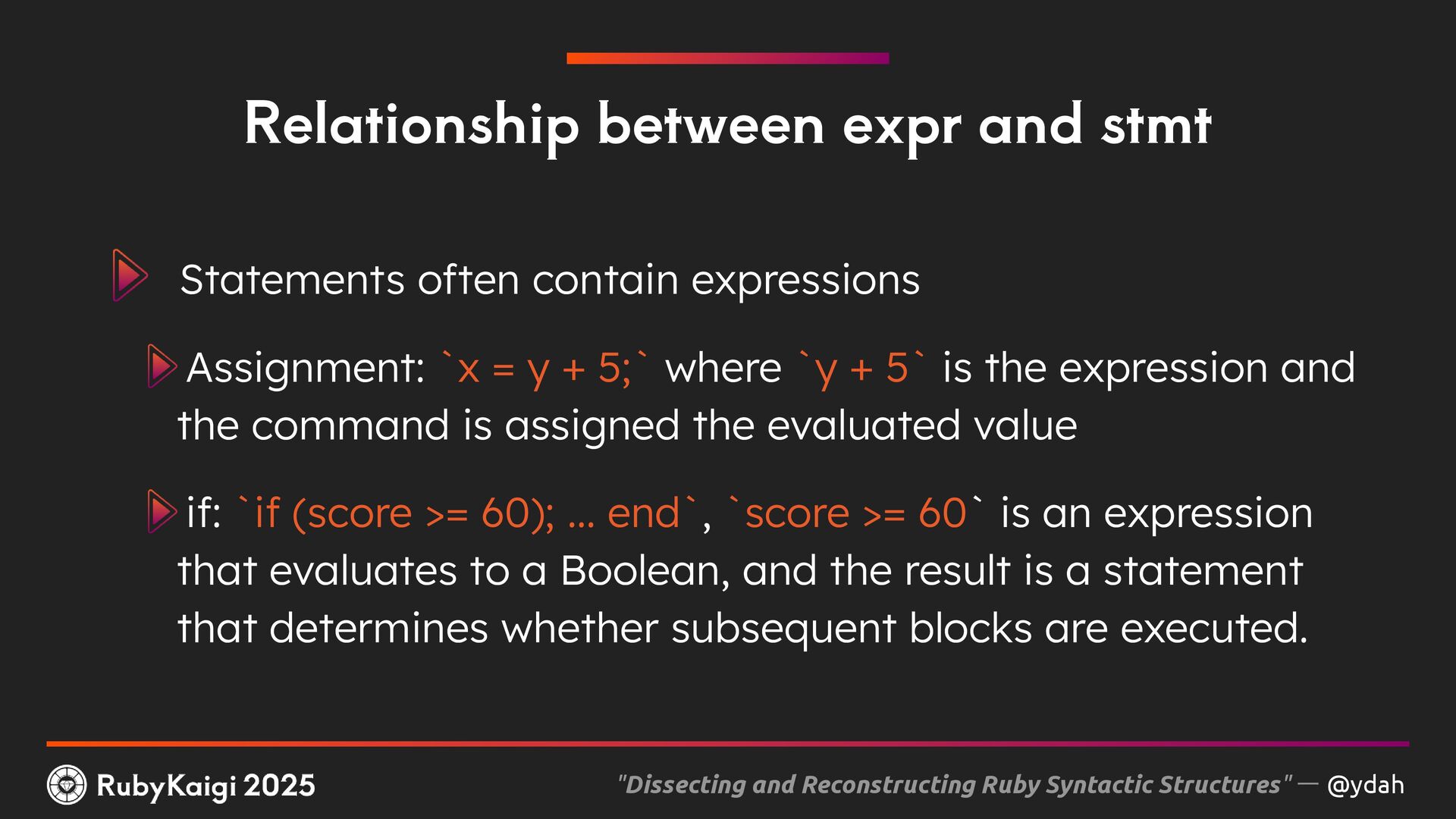
"Dissecting and Reconstructing Ruby Syntactic Structures" ʔ @ydah Relationship between
expr and stmt Statements often contain expressions Assignment: `x = y + 5;` where `y + 5` is the expression and the command is assigned the evaluated value if: `if (score >= 60); ... end`, `score >= 60` is an expression that evaluates to a Boolean, and the result is a statement that determines whether subsequent blocks are executed. -
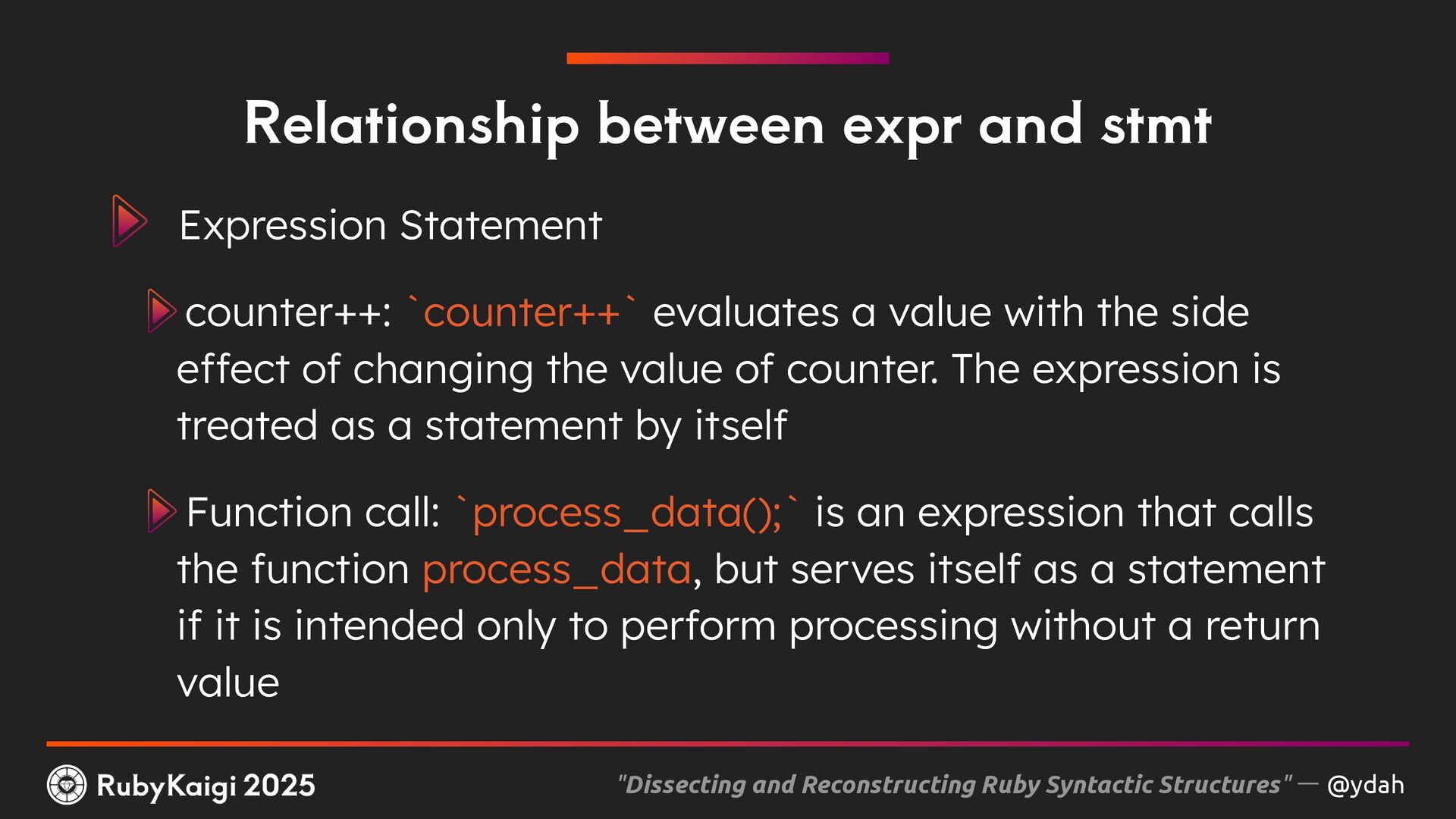
"Dissecting and Reconstructing Ruby Syntactic Structures" ʔ @ydah Relationship between
expr and stmt Expression Statement counter++: `counter++` evaluates a value with the side e ff ect of changing the value of counter. The expression is treated as a statement by itself Function call: `process_data();` is an expression that calls the function process_data, but serves itself as a statement if it is intended only to perform processing without a return value -
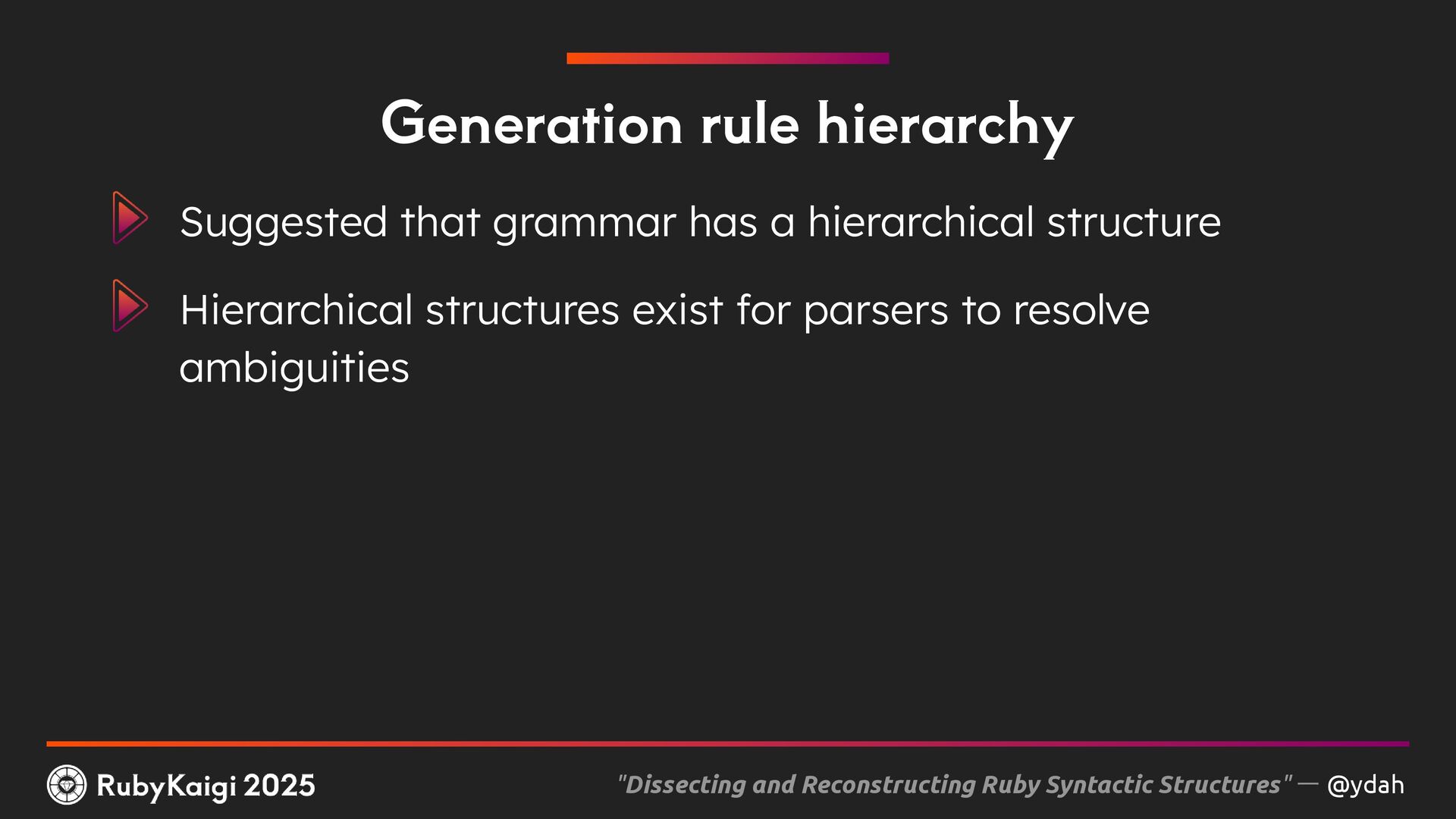
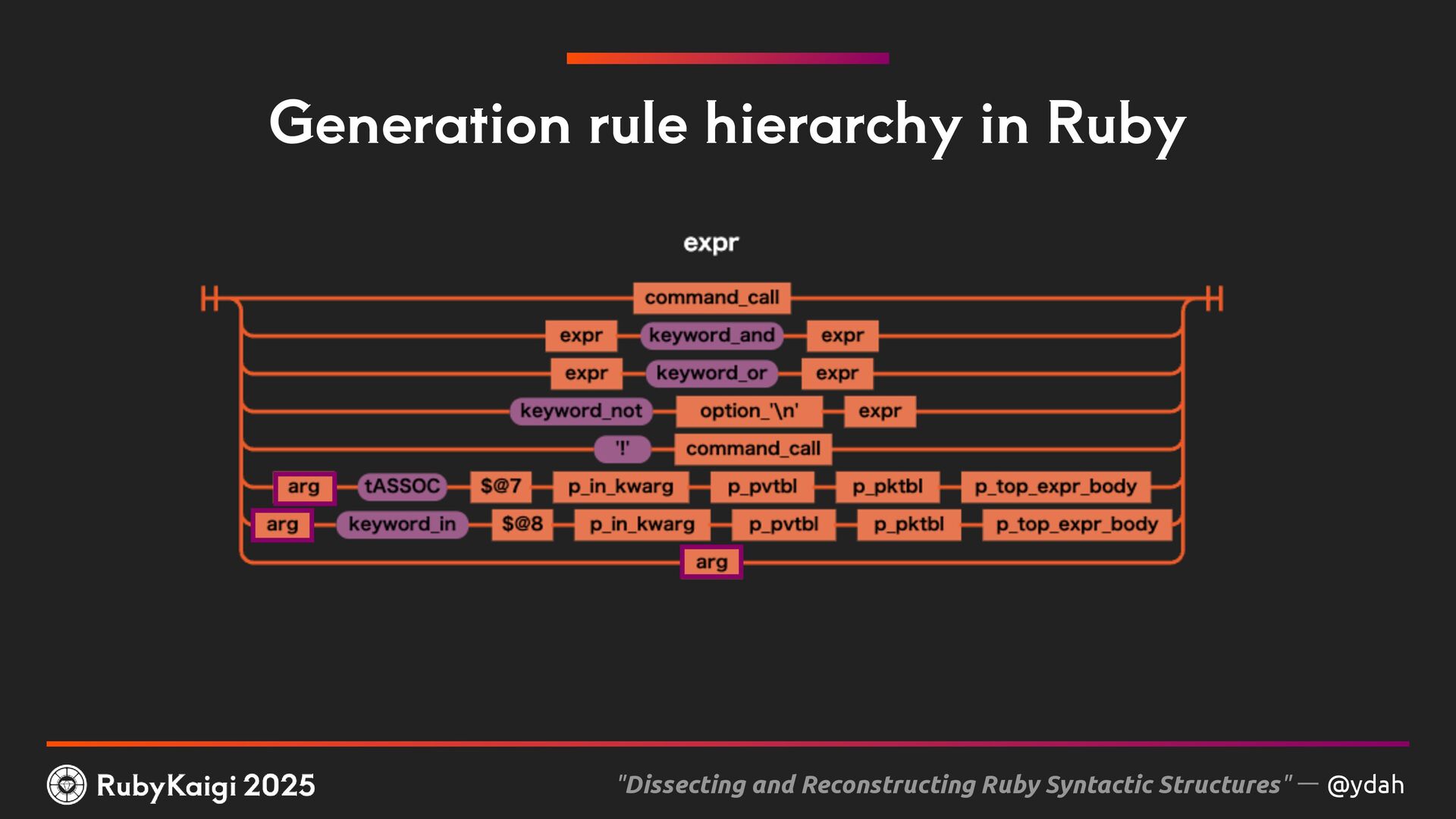
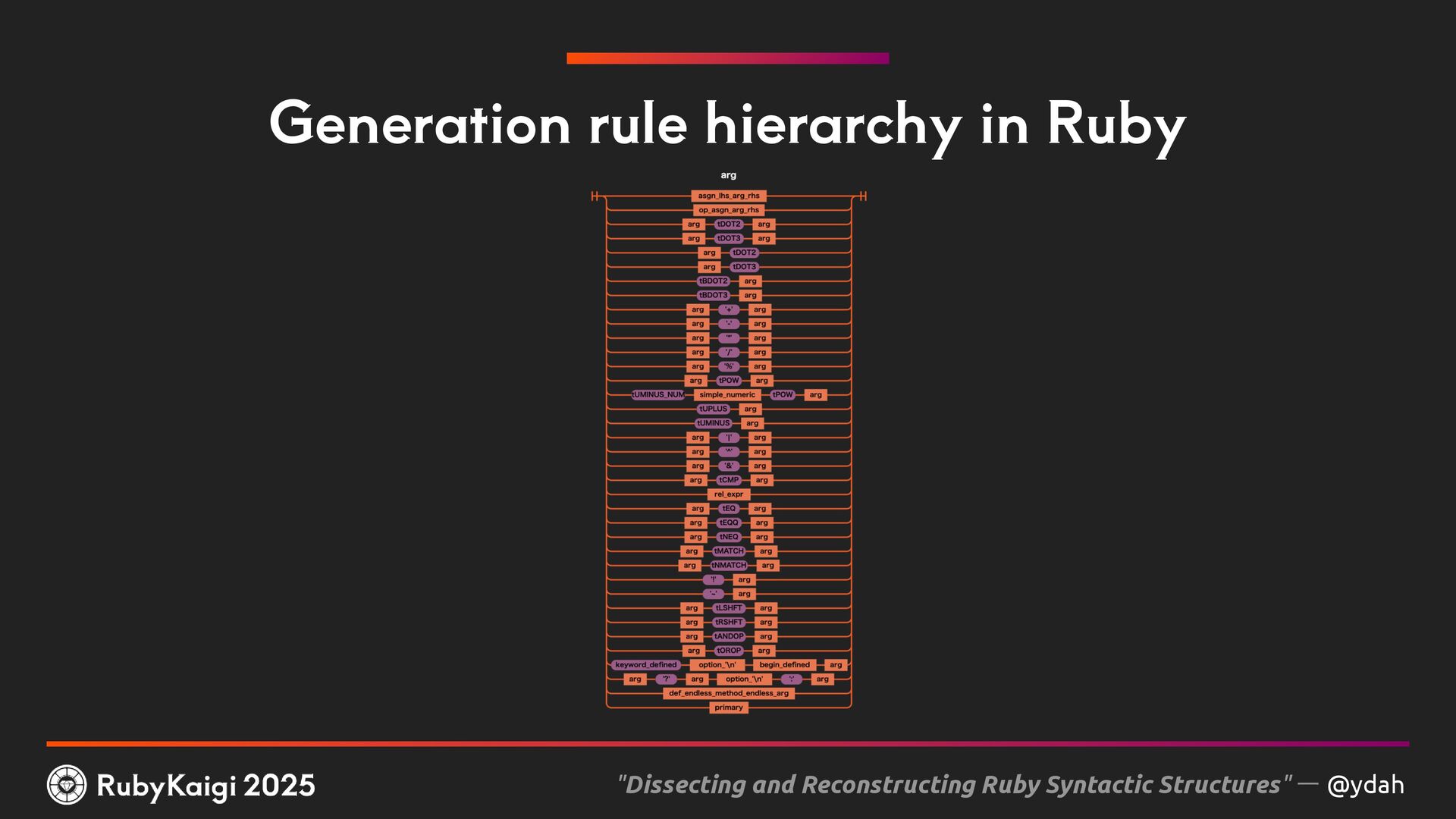
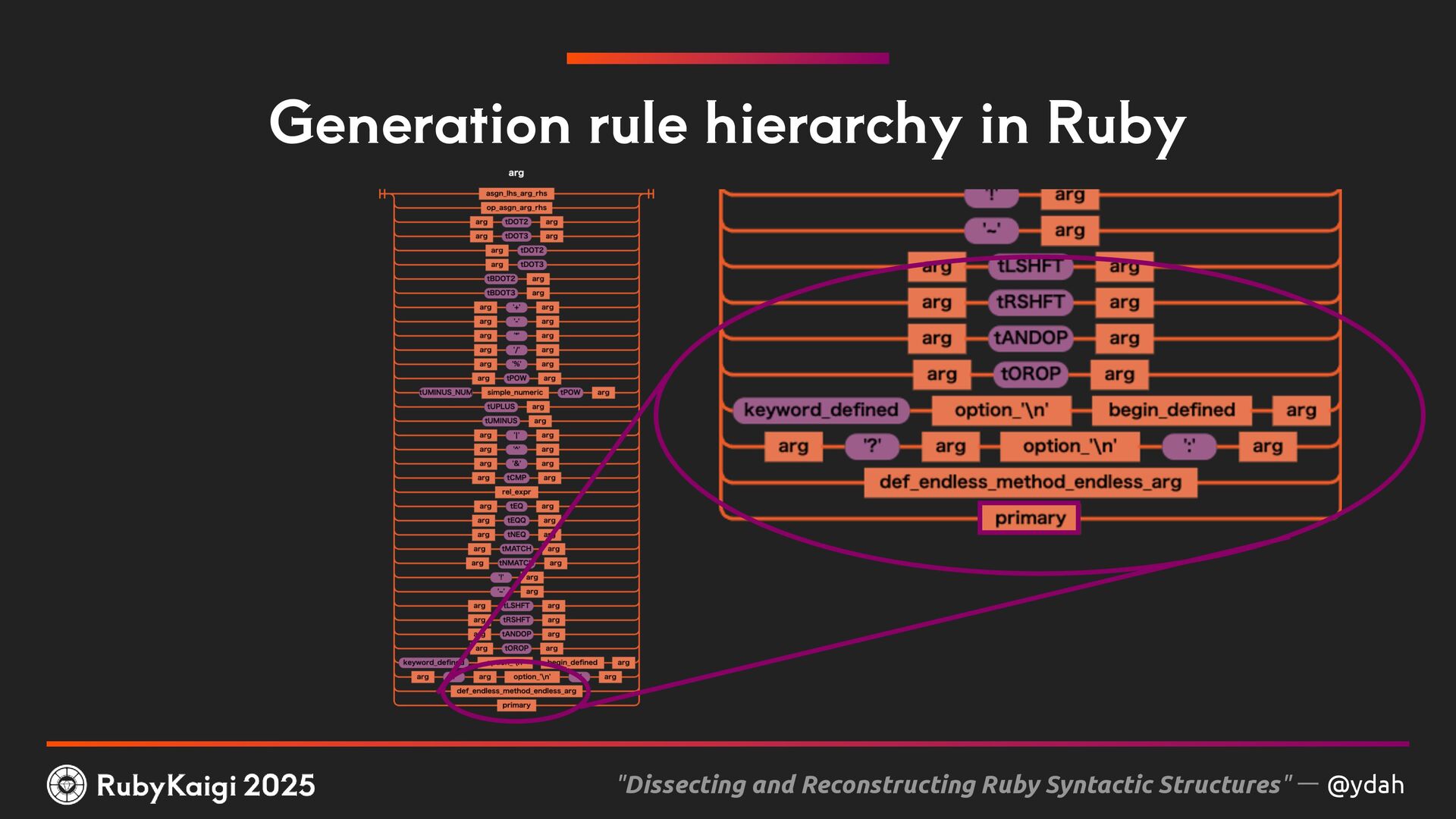
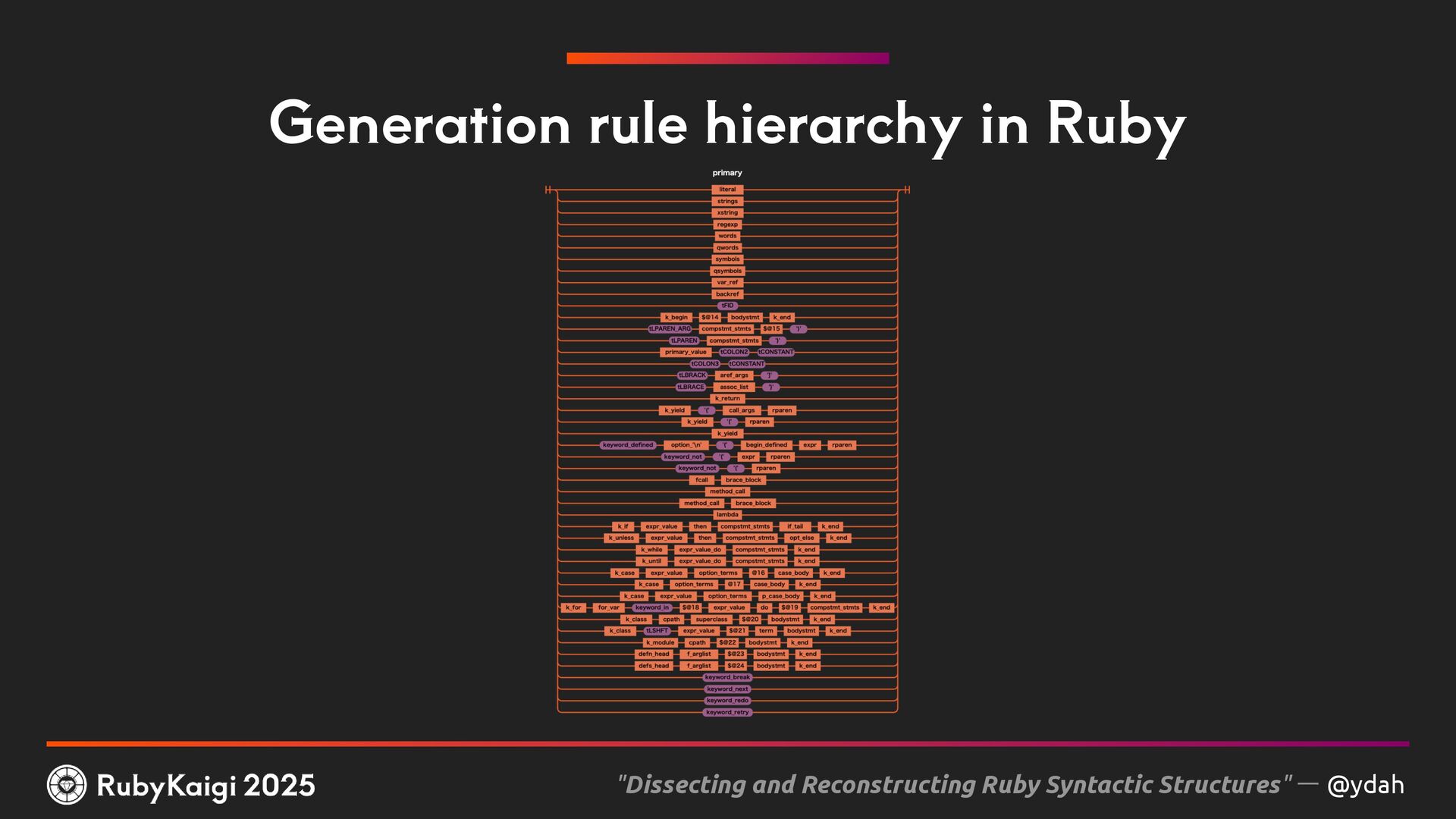
"Dissecting and Reconstructing Ruby Syntactic Structures" ʔ @ydah Generation rule
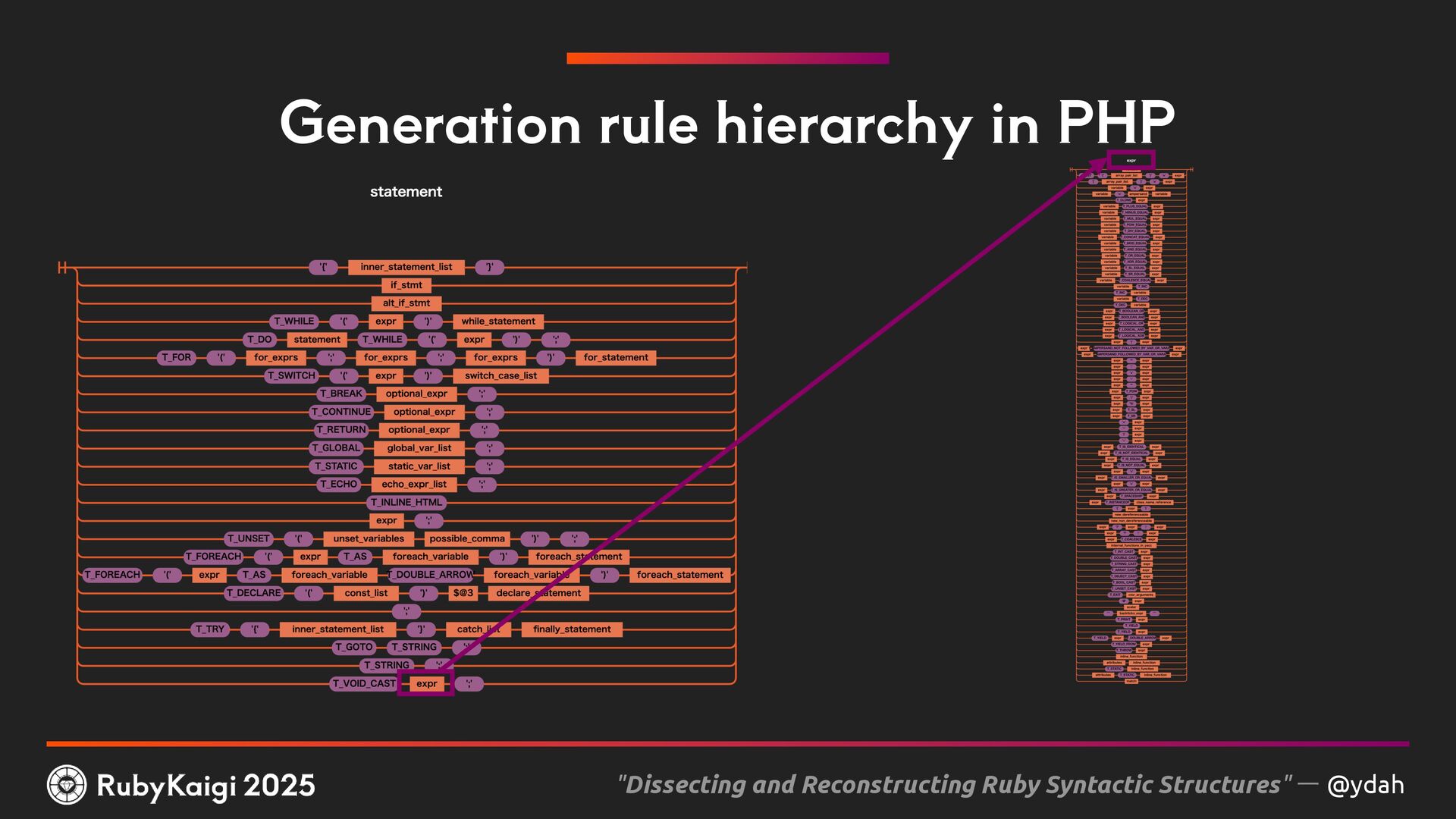
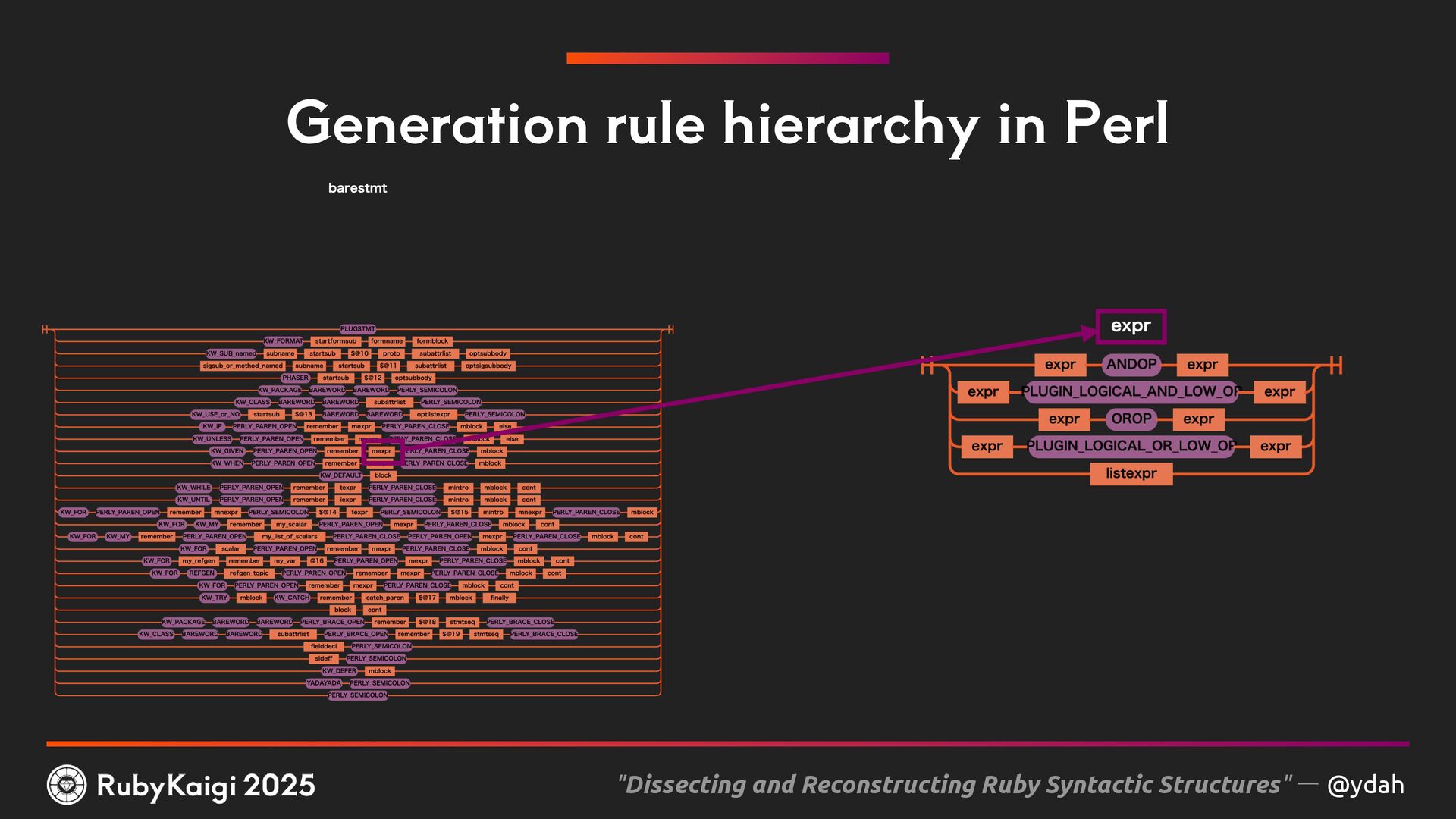
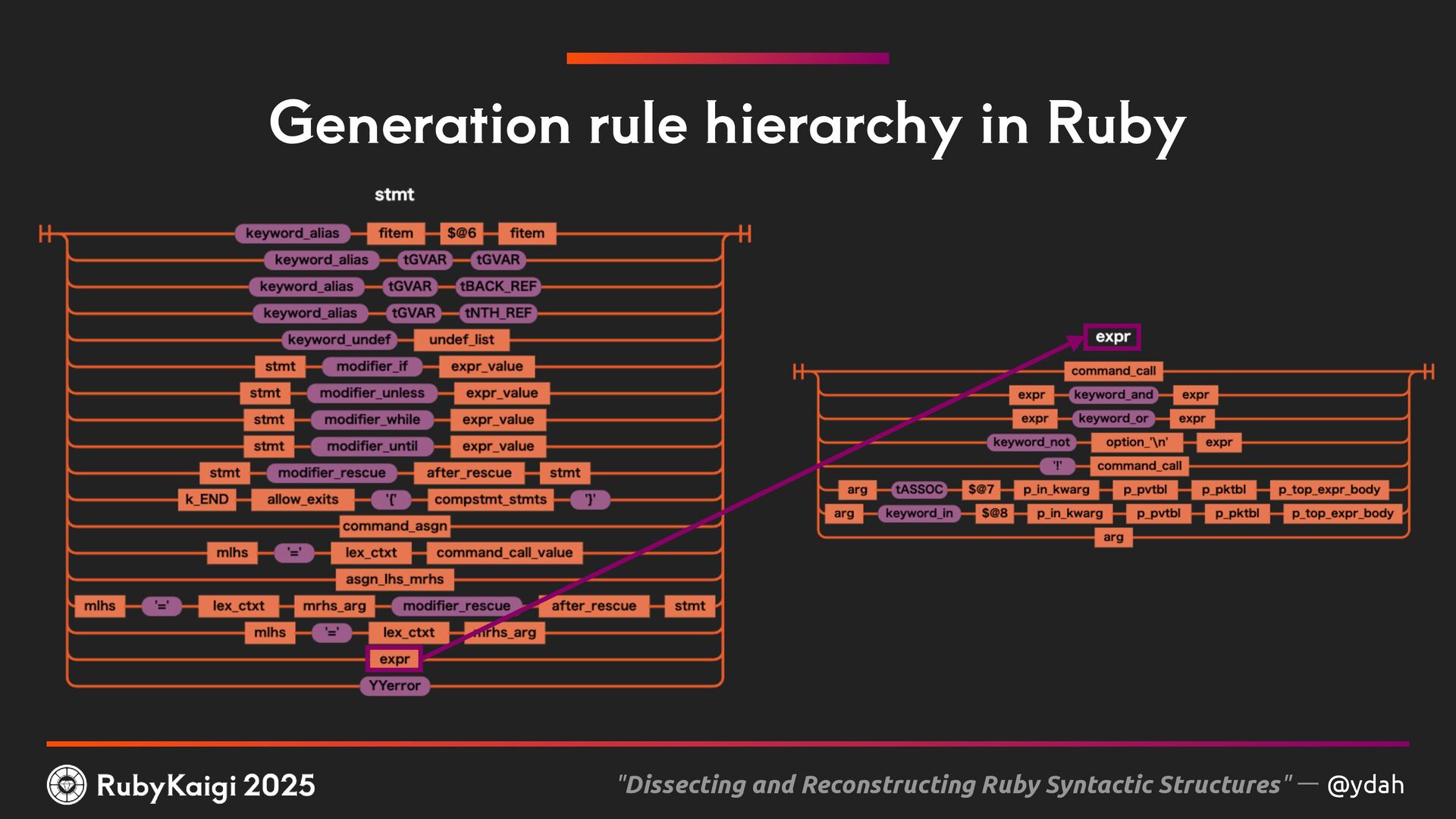
hierarchy Suggested that grammar has a hierarchical structure Hierarchical structures exist for parsers to resolve ambiguities -
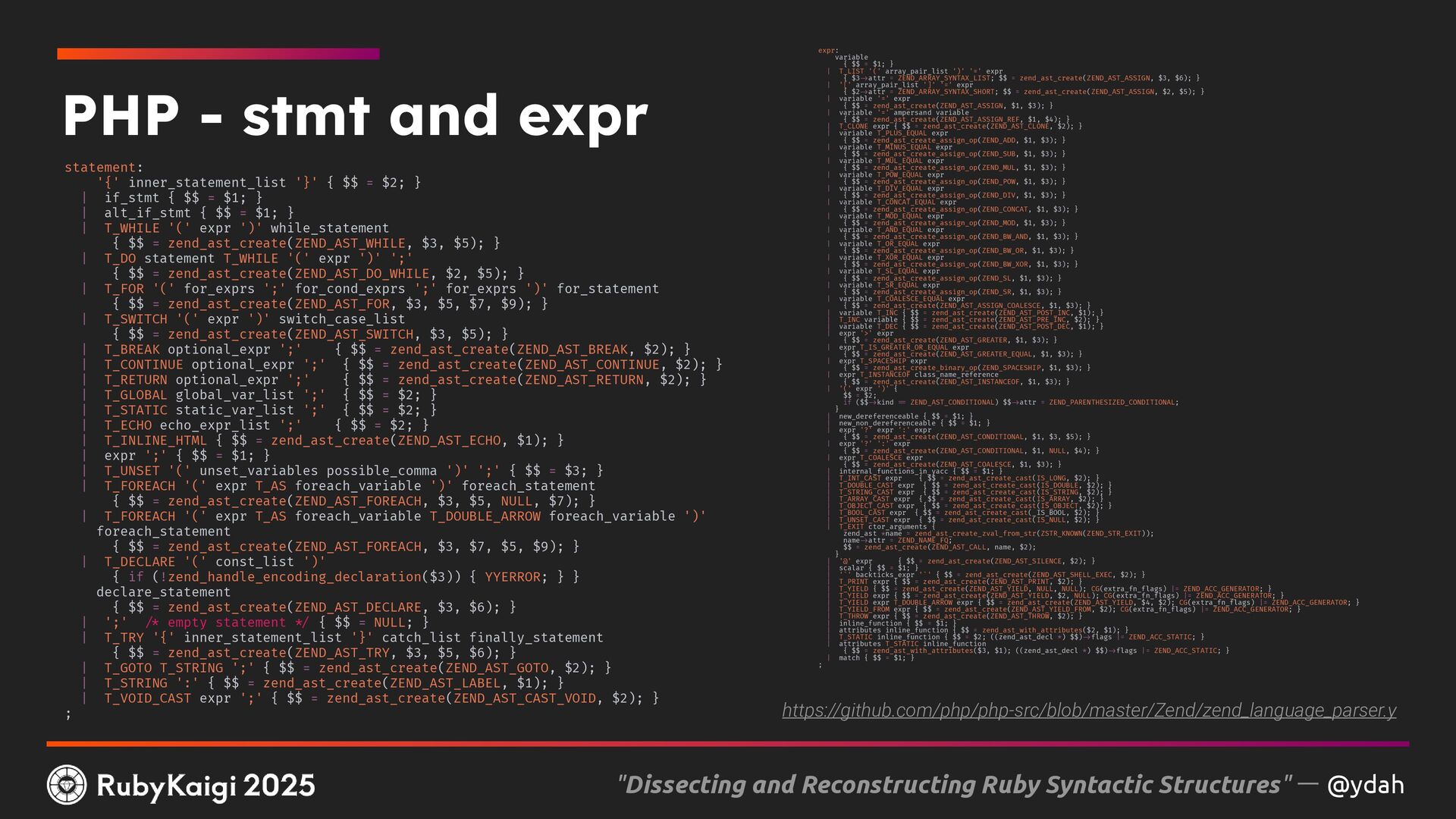
"Dissecting and Reconstructing Ruby Syntactic Structures" ʔ @ydah PHP -
stmt and expr https://github.com/php/php-src/blob/master/Zend/zend_language_parser.y statement: '{' inner_statement_list '}' { $$ = $2; } | if_stmt { $$ = $1; } | alt_if_stmt { $$ = $1; } | T_WHILE '(' expr ')' while_statement { $$ = zend_ast_create(ZEND_AST_WHILE, $3, $5); } | T_DO statement T_WHILE '(' expr ')' ';' { $$ = zend_ast_create(ZEND_AST_DO_WHILE, $2, $5); } | T_FOR '(' for_exprs ';' for_cond_exprs ';' for_exprs ')' for_statement { $$ = zend_ast_create(ZEND_AST_FOR, $3, $5, $7, $9); } | T_SWITCH '(' expr ')' switch_case_list { $$ = zend_ast_create(ZEND_AST_SWITCH, $3, $5); } | T_BREAK optional_expr ';' { $$ = zend_ast_create(ZEND_AST_BREAK, $2); } | T_CONTINUE optional_expr ';' { $$ = zend_ast_create(ZEND_AST_CONTINUE, $2); } | T_RETURN optional_expr ';' { $$ = zend_ast_create(ZEND_AST_RETURN, $2); } | T_GLOBAL global_var_list ';' { $$ = $2; } | T_STATIC static_var_list ';' { $$ = $2; } | T_ECHO echo_expr_list ';' { $$ = $2; } | T_INLINE_HTML { $$ = zend_ast_create(ZEND_AST_ECHO, $1); } | expr ';' { $$ = $1; } | T_UNSET '(' unset_variables possible_comma ')' ';' { $$ = $3; } | T_FOREACH '(' expr T_AS foreach_variable ')' foreach_statement { $$ = zend_ast_create(ZEND_AST_FOREACH, $3, $5, NULL, $7); } | T_FOREACH '(' expr T_AS foreach_variable T_DOUBLE_ARROW foreach_variable ')' foreach_statement { $$ = zend_ast_create(ZEND_AST_FOREACH, $3, $7, $5, $9); } | T_DECLARE '(' const_list ')' { if (!zend_handle_encoding_declaration($3)) { YYERROR; } } declare_statement { $$ = zend_ast_create(ZEND_AST_DECLARE, $3, $6); } | ';' / * empty statement * / { $$ = NULL; } | T_TRY '{' inner_statement_list '}' catch_list f i nally_statement { $$ = zend_ast_create(ZEND_AST_TRY, $3, $5, $6); } | T_GOTO T_STRING ';' { $$ = zend_ast_create(ZEND_AST_GOTO, $2); } | T_STRING ':' { $$ = zend_ast_create(ZEND_AST_LABEL, $1); } | T_VOID_CAST expr ';' { $$ = zend_ast_create(ZEND_AST_CAST_VOID, $2); } ; expr: variable { $$ = $1; } | T_LIST '(' array_pair_list ')' '=' expr { $3 - > attr = ZEND_ARRAY_SYNTAX_LIST; $$ = zend_ast_create(ZEND_AST_ASSIGN, $3, $6); } | '[' array_pair_list ']' '=' expr { $2 - > attr = ZEND_ARRAY_SYNTAX_SHORT; $$ = zend_ast_create(ZEND_AST_ASSIGN, $2, $5); } | variable '=' expr { $$ = zend_ast_create(ZEND_AST_ASSIGN, $1, $3); } | variable '=' ampersand variable { $$ = zend_ast_create(ZEND_AST_ASSIGN_REF, $1, $4); } | T_CLONE expr { $$ = zend_ast_create(ZEND_AST_CLONE, $2); } | variable T_PLUS_EQUAL expr { $$ = zend_ast_create_assign_op(ZEND_ADD, $1, $3); } | variable T_MINUS_EQUAL expr { $$ = zend_ast_create_assign_op(ZEND_SUB, $1, $3); } | variable T_MUL_EQUAL expr { $$ = zend_ast_create_assign_op(ZEND_MUL, $1, $3); } | variable T_POW_EQUAL expr { $$ = zend_ast_create_assign_op(ZEND_POW, $1, $3); } | variable T_DIV_EQUAL expr { $$ = zend_ast_create_assign_op(ZEND_DIV, $1, $3); } | variable T_CONCAT_EQUAL expr { $$ = zend_ast_create_assign_op(ZEND_CONCAT, $1, $3); } | variable T_MOD_EQUAL expr { $$ = zend_ast_create_assign_op(ZEND_MOD, $1, $3); } | variable T_AND_EQUAL expr { $$ = zend_ast_create_assign_op(ZEND_BW_AND, $1, $3); } | variable T_OR_EQUAL expr { $$ = zend_ast_create_assign_op(ZEND_BW_OR, $1, $3); } | variable T_XOR_EQUAL expr { $$ = zend_ast_create_assign_op(ZEND_BW_XOR, $1, $3); } | variable T_SL_EQUAL expr { $$ = zend_ast_create_assign_op(ZEND_SL, $1, $3); } | variable T_SR_EQUAL expr { $$ = zend_ast_create_assign_op(ZEND_SR, $1, $3); } | variable T_COALESCE_EQUAL expr { $$ = zend_ast_create(ZEND_AST_ASSIGN_COALESCE, $1, $3); } | variable T_INC { $$ = zend_ast_create(ZEND_AST_POST_INC, $1); } | T_INC variable { $$ = zend_ast_create(ZEND_AST_PRE_INC, $2); } | variable T_DEC { $$ = zend_ast_create(ZEND_AST_POST_DEC, $1); } | expr '>' expr { $$ = zend_ast_create(ZEND_AST_GREATER, $1, $3); } | expr T_IS_GREATER_OR_EQUAL expr { $$ = zend_ast_create(ZEND_AST_GREATER_EQUAL, $1, $3); } | expr T_SPACESHIP expr { $$ = zend_ast_create_binary_op(ZEND_SPACESHIP, $1, $3); } | expr T_INSTANCEOF class_name_reference { $$ = zend_ast_create(ZEND_AST_INSTANCEOF, $1, $3); } | '(' expr ')' { $$ = $2; if ($$ - > kind = = ZEND_AST_CONDITIONAL) $$ - > attr = ZEND_PARENTHESIZED_CONDITIONAL; } | new_dereferenceable { $$ = $1; } | new_non_dereferenceable { $$ = $1; } | expr '?' expr ':' expr { $$ = zend_ast_create(ZEND_AST_CONDITIONAL, $1, $3, $5); } | expr '?' ':' expr { $$ = zend_ast_create(ZEND_AST_CONDITIONAL, $1, NULL, $4); } | expr T_COALESCE expr { $$ = zend_ast_create(ZEND_AST_COALESCE, $1, $3); } | internal_functions_in_yacc { $$ = $1; } | T_INT_CAST expr { $$ = zend_ast_create_cast(IS_LONG, $2); } | T_DOUBLE_CAST expr { $$ = zend_ast_create_cast(IS_DOUBLE, $2); } | T_STRING_CAST expr { $$ = zend_ast_create_cast(IS_STRING, $2); } | T_ARRAY_CAST expr { $$ = zend_ast_create_cast(IS_ARRAY, $2); } | T_OBJECT_CAST expr { $$ = zend_ast_create_cast(IS_OBJECT, $2); } | T_BOOL_CAST expr { $$ = zend_ast_create_cast(_IS_BOOL, $2); } | T_UNSET_CAST expr { $$ = zend_ast_create_cast(IS_NULL, $2); } | T_EXIT ctor_arguments { zend_ast * name = zend_ast_create_zval_from_str(ZSTR_KNOWN(ZEND_STR_EXIT)); name - > attr = ZEND_NAME_FQ; $$ = zend_ast_create(ZEND_AST_CALL, name, $2); } | '@' expr { $$ = zend_ast_create(ZEND_AST_SILENCE, $2); } | scalar { $$ = $1; } | '`' backticks_expr '`' { $$ = zend_ast_create(ZEND_AST_SHELL_EXEC, $2); } | T_PRINT expr { $$ = zend_ast_create(ZEND_AST_PRINT, $2); } | T_YIELD { $$ = zend_ast_create(ZEND_AST_YIELD, NULL, NULL); CG(extra_fn_flags) |= ZEND_ACC_GENERATOR; } | T_YIELD expr { $$ = zend_ast_create(ZEND_AST_YIELD, $2, NULL); CG(extra_fn_flags) |= ZEND_ACC_GENERATOR; } | T_YIELD expr T_DOUBLE_ARROW expr { $$ = zend_ast_create(ZEND_AST_YIELD, $4, $2); CG(extra_fn_flags) |= ZEND_ACC_GENERATOR; } | T_YIELD_FROM expr { $$ = zend_ast_create(ZEND_AST_YIELD_FROM, $2); CG(extra_fn_flags) |= ZEND_ACC_GENERATOR; } | T_THROW expr { $$ = zend_ast_create(ZEND_AST_THROW, $2); } | inline_function { $$ = $1; } | attributes inline_function { $$ = zend_ast_with_attributes($2, $1); } | T_STATIC inline_function { $$ = $2; ((zend_ast_decl *) $$) - > flags |= ZEND_ACC_STATIC; } | attributes T_STATIC inline_function { $$ = zend_ast_with_attributes($3, $1); ((zend_ast_decl *) $$) - > flags |= ZEND_ACC_STATIC; } | match { $$ = $1; } ; -
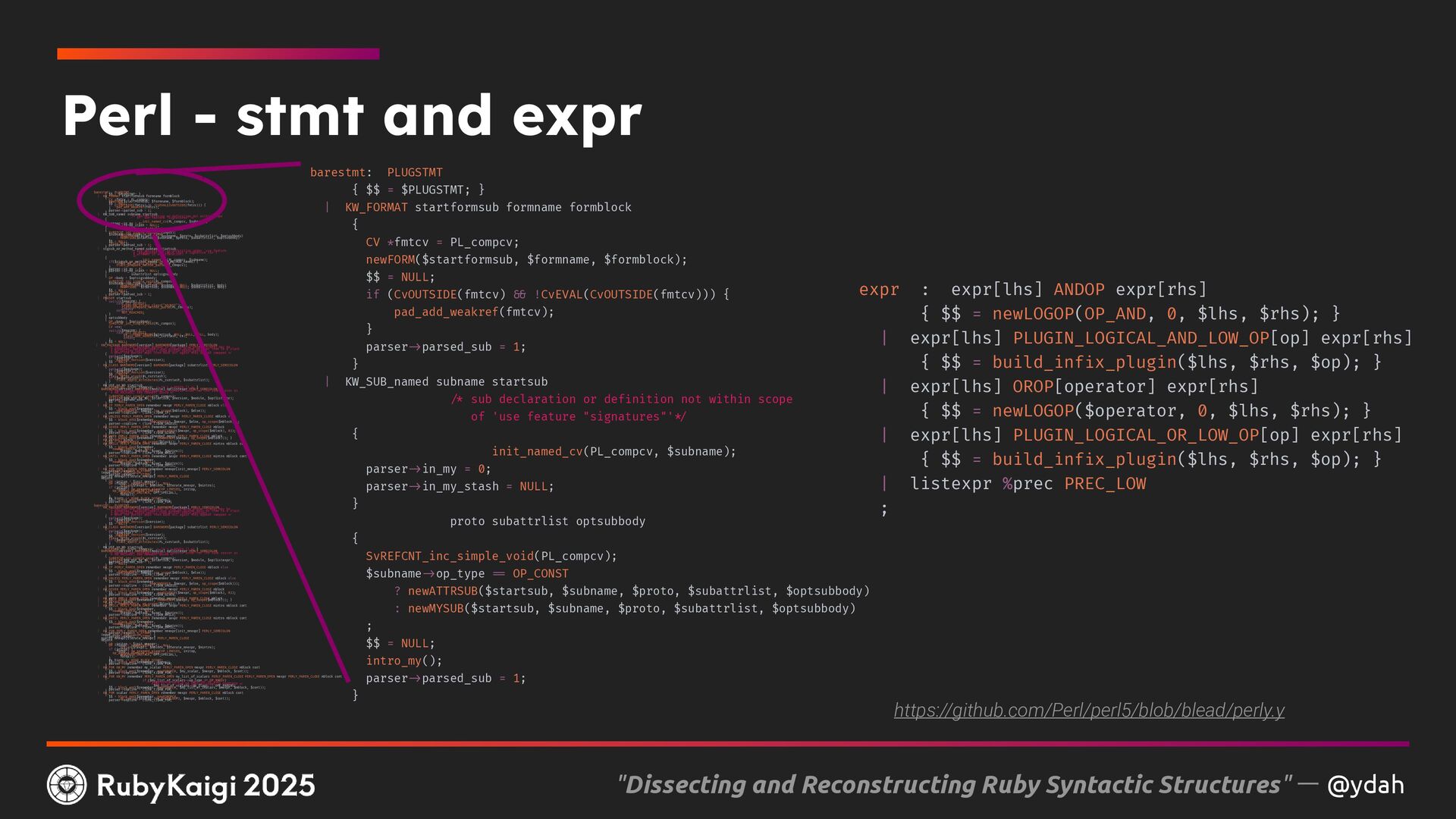
"Dissecting and Reconstructing Ruby Syntactic Structures" ʔ @ydah Perl -
stmt and expr https://github.com/Perl/perl5/blob/blead/perly.y barestmt: PLUGSTMT { $$ = $PLUGSTMT; } | KW_FORMAT startformsub formname formblock { CV * fmtcv = PL_compcv; newFORM($startformsub, $formname, $formblock); $$ = NULL; if (CvOUTSIDE(fmtcv) & & !CvEVAL(CvOUTSIDE(fmtcv))) { pad_add_weakref(fmtcv); } parser - > parsed_sub = 1; } | KW_SUB_named subname startsub / * sub declaration or def i nition not within scope of 'use feature "signatures"' * / { init_named_cv(PL_compcv, $subname); parser - > in_my = 0; parser - > in_my_stash = NULL; } proto subattrlist optsubbody { SvREFCNT_inc_simple_void(PL_compcv); $subname - > op_type = = OP_CONST ? newATTRSUB($startsub, $subname, $proto, $subattrlist, $optsubbody) : newMYSUB($startsub, $subname, $proto, $subattrlist, $optsubbody) ; $$ = NULL; intro_my(); parser - > parsed_sub = 1; } | sigsub_or_method_named subname startsub / * sub declaration or def i nition under 'use feature * "signatures"'. (Note that a signature isn't * allowed in a declaration) * / { init_named_cv(PL_compcv, $subname); if($sigsub_or_method_named = = KW_METHOD_named) { croak_kw_unless_class("method"); class_prepare_method_parse(PL_compcv); } parser - > in_my = 0; parser - > in_my_stash = NULL; } subattrlist optsigsubbody { OP * body = $optsigsubbody; SvREFCNT_inc_simple_void(PL_compcv); $subname - > op_type = = OP_CONST ? newATTRSUB($startsub, $subname, NULL, $subattrlist, body) : newMYSUB( $startsub, $subname, NULL, $subattrlist, body) ; $$ = NULL; intro_my(); parser - > parsed_sub = 1; } | PHASER startsub { switch($PHASER) { case KEY_ADJUST : croak_kw_unless_class("ADJUST"); class_prepare_method_parse(PL_compcv); break; default: NOT_REACHED; } } optsubbody { OP * body = $optsubbody; SvREFCNT_inc_simple_void(PL_compcv); CV * cv; switch($PHASER) { case KEY_ADJUST : cv = newATTRSUB($startsub, NULL, NULL, NULL, body); class_add_ADJUST(PL_curstash, cv); break; } $$ = NULL; } | KW_PACKAGE BAREWORD[version] BAREWORD[package] PERLY_SEMICOLON / * version and package appear in the reverse order to what may be * expected, because toke.c has already pushed both of them to a stack * by calling force_next() from within force_version(). * When the parser pops them back out again they appear swapped * / { package($package); if ($version) package_version($version); $$ = NULL; } | KW_CLASS BAREWORD[version] BAREWORD[package] subattrlist PERLY_SEMICOLON { package($package); if ($version) package_version($version); $$ = NULL; class_setup_stash(PL_curstash); if ($subattrlist) { class_apply_attributes(PL_curstash, $subattrlist); } } | KW_USE_or_NO startsub { CvSPECIAL_on(PL_compcv); / * It's a BEGIN {} * / } BAREWORD[version] BAREWORD[module] optlistexpr PERLY_SEMICOLON / * version and package appear in reverse order for the same reason as * KW_PACKAGE; see comment above * / { SvREFCNT_inc_simple_void(PL_compcv); utilize($KW_USE_or_NO, $startsub, $version, $module, $optlistexpr); parser - > parsed_sub = 1; $$ = NULL; } | KW_IF PERLY_PAREN_OPEN remember mexpr PERLY_PAREN_CLOSE mblock else { $$ = block_end($remember, newCONDOP(0, $mexpr, op_scope($mblock), $else)); parser - > copline = (line_t)$KW_IF; } | KW_UNLESS PERLY_PAREN_OPEN remember mexpr PERLY_PAREN_CLOSE mblock else { $$ = block_end($remember, newCONDOP(0, $mexpr, $else, op_scope($mblock))); parser - > copline = (line_t)$KW_UNLESS; } | KW_GIVEN PERLY_PAREN_OPEN remember mexpr PERLY_PAREN_CLOSE mblock { $$ = block_end($remember, newGIVENOP($mexpr, op_scope($mblock), 0)); parser - > copline = (line_t)$KW_GIVEN; } | KW_WHEN PERLY_PAREN_OPEN remember mexpr PERLY_PAREN_CLOSE mblock { $$ = block_end($remember, newWHENOP($mexpr, op_scope($mblock))); } | KW_DEFAULT block { $$ = newWHENOP(0, op_scope($block)); } | KW_WHILE PERLY_PAREN_OPEN remember texpr PERLY_PAREN_CLOSE mintro mblock cont { $$ = block_end($remember, newWHILEOP(0, 1, NULL, $texpr, $mblock, $cont, $mintro)); parser - > copline = (line_t)$KW_WHILE; } | KW_UNTIL PERLY_PAREN_OPEN remember iexpr PERLY_PAREN_CLOSE mintro mblock cont { $$ = block_end($remember, newWHILEOP(0, 1, NULL, $iexpr, $mblock, $cont, $mintro)); parser - > copline = (line_t)$KW_UNTIL; } | KW_FOR PERLY_PAREN_OPEN remember mnexpr[init_mnexpr] PERLY_SEMICOLON { parser - > expect = XTERM; } texpr PERLY_SEMICOLON { parser - > expect = XTERM; } mintro mnexpr[iterate_mnexpr] PERLY_PAREN_CLOSE mblock { OP * initop = $init_mnexpr; OP * forop = newWHILEOP(0, 1, NULL, scalar($texpr), $mblock, $iterate_mnexpr, $mintro); if (initop) { forop = op_prepend_elem(OP_LINESEQ, initop, op_append_elem(OP_LINESEQ, newOP(OP_UNSTACK, OPf_SPECIAL), forop)); } PL_hints |= HINT_BLOCK_SCOPE; $$ = block_end($remember, forop); parser - > copline = (line_t)$KW_FOR; } barestmt: PLUGSTMT | KW_PACKAGE BAREWORD[version] BAREWORD[package] PERLY_SEMICOLON / * version and package appear in the reverse order to what may be * expected, because toke.c has already pushed both of them to a stack * by calling force_next() from within force_version(). * When the parser pops them back out again they appear swapped * / { package($package); if ($version) package_version($version); $$ = NULL; } | KW_CLASS BAREWORD[version] BAREWORD[package] subattrlist PERLY_SEMICOLON { package($package); if ($version) package_version($version); $$ = NULL; class_setup_stash(PL_curstash); if ($subattrlist) { class_apply_attributes(PL_curstash, $subattrlist); } } | KW_USE_or_NO startsub { CvSPECIAL_on(PL_compcv); / * It's a BEGIN {} * / } BAREWORD[version] BAREWORD[module] optlistexpr PERLY_SEMICOLON / * version and package appear in reverse order for the same reason as * KW_PACKAGE; see comment above * / { SvREFCNT_inc_simple_void(PL_compcv); utilize($KW_USE_or_NO, $startsub, $version, $module, $optlistexpr); parser - > parsed_sub = 1; $$ = NULL; } | KW_IF PERLY_PAREN_OPEN remember mexpr PERLY_PAREN_CLOSE mblock else { $$ = block_end($remember, newCONDOP(0, $mexpr, op_scope($mblock), $else)); parser - > copline = (line_t)$KW_IF; } | KW_UNLESS PERLY_PAREN_OPEN remember mexpr PERLY_PAREN_CLOSE mblock else { $$ = block_end($remember, newCONDOP(0, $mexpr, $else, op_scope($mblock))); parser - > copline = (line_t)$KW_UNLESS; } | KW_GIVEN PERLY_PAREN_OPEN remember mexpr PERLY_PAREN_CLOSE mblock { $$ = block_end($remember, newGIVENOP($mexpr, op_scope($mblock), 0)); parser - > copline = (line_t)$KW_GIVEN; } | KW_WHEN PERLY_PAREN_OPEN remember mexpr PERLY_PAREN_CLOSE mblock { $$ = block_end($remember, newWHENOP($mexpr, op_scope($mblock))); } | KW_DEFAULT block { $$ = newWHENOP(0, op_scope($block)); } | KW_WHILE PERLY_PAREN_OPEN remember texpr PERLY_PAREN_CLOSE mintro mblock cont { $$ = block_end($remember, newWHILEOP(0, 1, NULL, $texpr, $mblock, $cont, $mintro)); parser - > copline = (line_t)$KW_WHILE; } | KW_UNTIL PERLY_PAREN_OPEN remember iexpr PERLY_PAREN_CLOSE mintro mblock cont { $$ = block_end($remember, newWHILEOP(0, 1, NULL, $iexpr, $mblock, $cont, $mintro)); parser - > copline = (line_t)$KW_UNTIL; } | KW_FOR PERLY_PAREN_OPEN remember mnexpr[init_mnexpr] PERLY_SEMICOLON { parser - > expect = XTERM; } texpr PERLY_SEMICOLON { parser - > expect = XTERM; } mintro mnexpr[iterate_mnexpr] PERLY_PAREN_CLOSE mblock { OP * initop = $init_mnexpr; OP * forop = newWHILEOP(0, 1, NULL, scalar($texpr), $mblock, $iterate_mnexpr, $mintro); if (initop) { forop = op_prepend_elem(OP_LINESEQ, initop, op_append_elem(OP_LINESEQ, newOP(OP_UNSTACK, OPf_SPECIAL), forop)); } PL_hints |= HINT_BLOCK_SCOPE; $$ = block_end($remember, forop); parser - > copline = (line_t)$KW_FOR; } | KW_FOR KW_MY remember my_scalar PERLY_PAREN_OPEN mexpr PERLY_PAREN_CLOSE mblock cont { $$ = block_end($remember, newFOROP(0, $my_scalar, $mexpr, $mblock, $cont)); parser - > copline = (line_t)$KW_FOR; } | KW_FOR KW_MY remember PERLY_PAREN_OPEN my_list_of_scalars PERLY_PAREN_CLOSE PERLY_PAREN_OPEN mexpr PERLY_PAREN_CLOSE mblock cont { if ($my_list_of_scalars - > op_type = = OP_PADSV) / * degenerate case of 1 var: for my ($x) .... F l ag it so it can be special - cased in newFOROP * / $my_list_of_scalars - > op_flags |= OPf_PARENS; $$ = block_end($remember, newFOROP(0, $my_list_of_scalars, $mexpr, $mblock, $cont)); parser - > copline = (line_t)$KW_FOR; } | KW_FOR scalar PERLY_PAREN_OPEN remember mexpr PERLY_PAREN_CLOSE mblock cont { $$ = block_end($remember, newFOROP(0, op_lvalue($scalar, OP_ENTERLOOP), $mexpr, $mblock, $cont)); parser - > copline = (line_t)$KW_FOR; barestmt: PLUGSTMT { $$ = $PLUGSTMT; } | KW_FORMAT startformsub formname formblock { CV * fmtcv = PL_compcv; newFORM($startformsub, $formname, $formblock); $$ = NULL; if (CvOUTSIDE(fmtcv) & & !CvEVAL(CvOUTSIDE(fmtcv))) { pad_add_weakref(fmtcv); } parser - > parsed_sub = 1; } | KW_SUB_named subname startsub / * sub declaration or def i nition not within scope of 'use feature "signatures"' * / { init_named_cv(PL_compcv, $subname); parser - > in_my = 0; parser - > in_my_stash = NULL; } proto subattrlist optsubbody { SvREFCNT_inc_simple_void(PL_compcv); $subname - > op_type = = OP_CONST ? newATTRSUB($startsub, $subname, $proto, $subattrlist, $optsubbody) : newMYSUB($startsub, $subname, $proto, $subattrlist, $optsubbody) ; $$ = NULL; intro_my(); parser - > parsed_sub = 1; } expr : expr[lhs] ANDOP expr[rhs] { $$ = newLOGOP(OP_AND, 0, $lhs, $rhs); } | expr[lhs] PLUGIN_LOGICAL_AND_LOW_OP[op] expr[rhs] { $$ = build_inf i x_plugin($lhs, $rhs, $op); } | expr[lhs] OROP[operator] expr[rhs] { $$ = newLOGOP($operator, 0, $lhs, $rhs); } | expr[lhs] PLUGIN_LOGICAL_OR_LOW_OP[op] expr[rhs] { $$ = build_inf i x_plugin($lhs, $rhs, $op); } | listexpr %prec PREC_LOW ; -
"Dissecting and Reconstructing Ruby Syntactic Structures" ʔ @ydah Ruby -
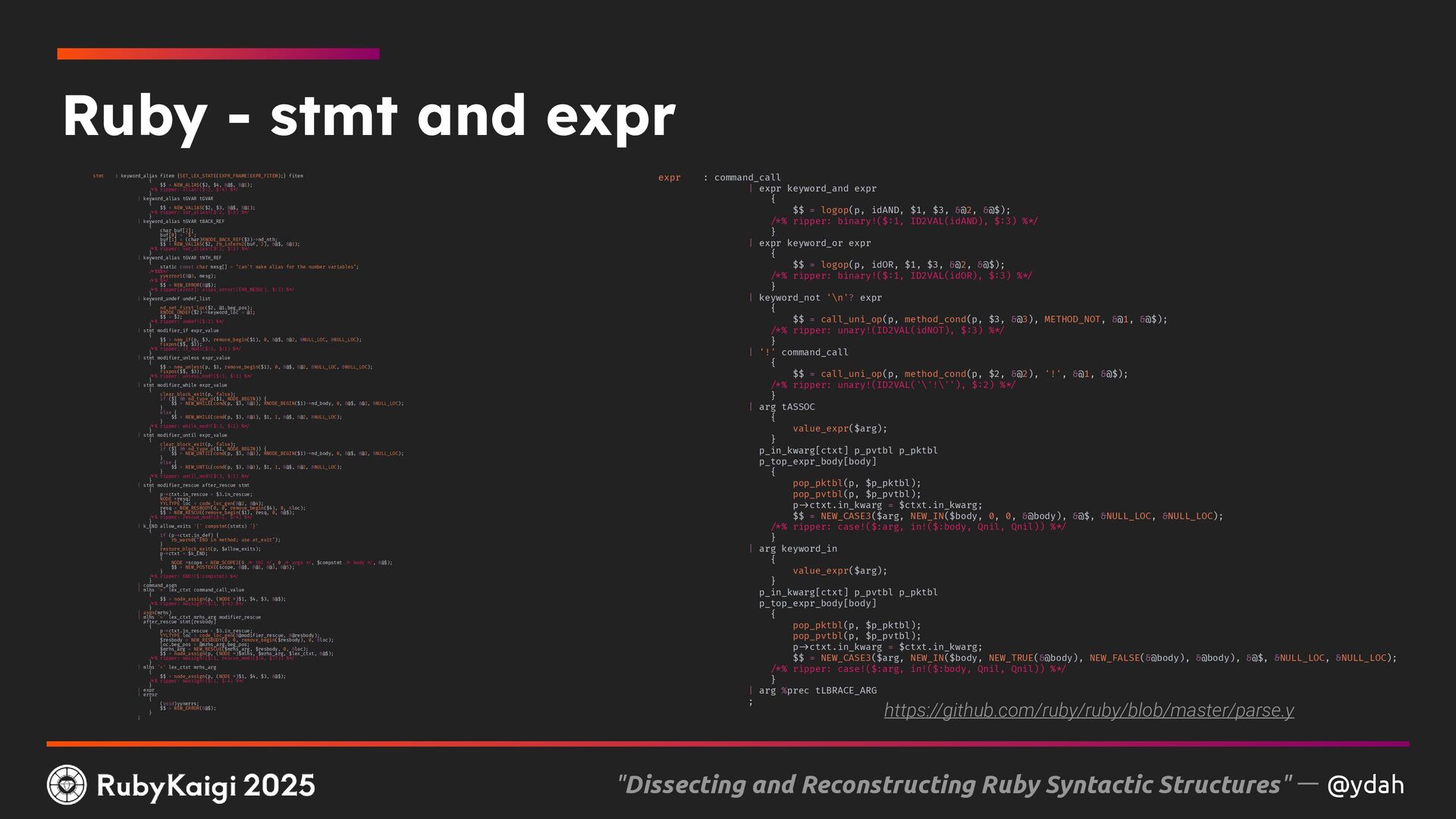
stmt and expr https://github.com/ruby/ruby/blob/master/parse.y stmt : keyword_alias f i tem {SET_LEX_STATE(EXPR_FNAME|EXPR_FITEM);} f i tem { $$ = NEW_ALIAS($2, $4, &@$, &@1); / * % ripper: alias!($ : 2, $ : 4) % * / } | keyword_alias tGVAR tGVAR { $$ = NEW_VALIAS($2, $3, &@$, &@1); / * % ripper: var_alias!($ : 2, $ : 3) % * / } | keyword_alias tGVAR tBACK_REF { char buf[2]; buf[0] = '$'; buf[1] = (char)RNODE_BACK_REF($3) - > nd_nth; $$ = NEW_VALIAS($2, rb_intern2(buf, 2), &@$, &@1); / * % ripper: var_alias!($ : 2, $ : 3) % * / } | keyword_alias tGVAR tNTH_REF { static const char mesg[] = "can't make alias for the number variables"; / * %%% * / yyerror1(&@3, mesg); / * % % * / $$ = NEW_ERROR(&@$); / * % ripper[error] : alias_error!(ERR_MESG(), $ : 3) % * / } | keyword_undef undef_list { nd_set_f i rst_loc($2, @1.beg_pos); RNODE_UNDEF($2) - > keyword_loc = @1; $$ = $2; / * % ripper: undef!($ : 2) % * / } | stmt modif i er_if expr_value { $$ = new_if(p, $3, remove_begin($1), 0, &@$, &@2, &NULL_LOC, &NULL_LOC); f i xpos($$, $3); / * % ripper: if_mod!($ : 3, $ : 1) % * / } | stmt modif i er_unless expr_value { $$ = new_unless(p, $3, remove_begin($1), 0, &@$, &@2, &NULL_LOC, &NULL_LOC); f i xpos($$, $3); / * % ripper: unless_mod!($ : 3, $ : 1) % * / } | stmt modif i er_while expr_value { clear_block_exit(p, false); if ($1 & & nd_type_p($1, NODE_BEGIN)) { $$ = NEW_WHILE(cond(p, $3, &@3), RNODE_BEGIN($1) - > nd_body, 0, &@$, &@2, &NULL_LOC); } else { $$ = NEW_WHILE(cond(p, $3, &@3), $1, 1, &@$, &@2, &NULL_LOC); } / * % ripper: while_mod!($ : 3, $ : 1) % * / } | stmt modif i er_until expr_value { clear_block_exit(p, false); if ($1 & & nd_type_p($1, NODE_BEGIN)) { $$ = NEW_UNTIL(cond(p, $3, &@3), RNODE_BEGIN($1) - > nd_body, 0, &@$, &@2, &NULL_LOC); } else { $$ = NEW_UNTIL(cond(p, $3, &@3), $1, 1, &@$, &@2, &NULL_LOC); } / * % ripper: until_mod!($ : 3, $ : 1) % * / } | stmt modif i er_rescue after_rescue stmt { p - > ctxt.in_rescue = $3.in_rescue; NODE * resq; YYLTYPE loc = code_loc_gen(&@2, &@4); resq = NEW_RESBODY(0, 0, remove_begin($4), 0, &loc); $$ = NEW_RESCUE(remove_begin($1), resq, 0, &@$); / * % ripper: rescue_mod!($ : 1, $ : 4) % * / } | k_END allow_exits '{' compstmt(stmts) '}' { if (p - > ctxt.in_def) { rb_warn0("END in method; use at_exit"); } restore_block_exit(p, $allow_exits); p - > ctxt = $k_END; { NODE * scope = NEW_SCOPE2(0 / * tbl * / , 0 / * args * / , $compstmt / * body * / , &@$); $$ = NEW_POSTEXE(scope, &@$, &@1, &@3, &@5); } / * % ripper: END!($:compstmt) % * / } | command_asgn | mlhs '=' lex_ctxt command_call_value { $$ = node_assign(p, (NODE *)$1, $4, $3, &@$); / * % ripper: massign!($ : 1, $ : 4) % * / } | asgn(mrhs) | mlhs '=' lex_ctxt mrhs_arg modif i er_rescue after_rescue stmt[resbody] { p - > ctxt.in_rescue = $3.in_rescue; YYLTYPE loc = code_loc_gen(&@modif i er_rescue, &@resbody); $resbody = NEW_RESBODY(0, 0, remove_begin($resbody), 0, &loc); loc.beg_pos = @mrhs_arg.beg_pos; $mrhs_arg = NEW_RESCUE($mrhs_arg, $resbody, 0, &loc); $$ = node_assign(p, (NODE *)$mlhs, $mrhs_arg, $lex_ctxt, &@$); / * % ripper: massign!($ : 1, rescue_mod!($ : 4, $ : 7)) % * / } | mlhs '=' lex_ctxt mrhs_arg { $$ = node_assign(p, (NODE *)$1, $4, $3, &@$); / * % ripper: massign!($ : 1, $ : 4) % * / } | expr | error { (void)yynerrs; $$ = NEW_ERROR(&@$); } ; expr : command_call | expr keyword_and expr { $$ = logop(p, idAND, $1, $3, &@2, &@$); / * % ripper: binary!($ : 1, ID2VAL(idAND), $ : 3) % * / } | expr keyword_or expr { $$ = logop(p, idOR, $1, $3, &@2, &@$); / * % ripper: binary!($ : 1, ID2VAL(idOR), $ : 3) % * / } | keyword_not '\n'? expr { $$ = call_uni_op(p, method_cond(p, $3, &@3), METHOD_NOT, &@1, &@$); / * % ripper: unary!(ID2VAL(idNOT), $ : 3) % * / } | '!' command_call { $$ = call_uni_op(p, method_cond(p, $2, &@2), '!', &@1, &@$); / * % ripper: unary!(ID2VAL('\'!\''), $ : 2) % * / } | arg tASSOC { value_expr($arg); } p_in_kwarg[ctxt] p_pvtbl p_pktbl p_top_expr_body[body] { pop_pktbl(p, $p_pktbl); pop_pvtbl(p, $p_pvtbl); p - > ctxt.in_kwarg = $ctxt.in_kwarg; $$ = NEW_CASE3($arg, NEW_IN($body, 0, 0, &@body), &@$, &NULL_LOC, &NULL_LOC); / * % ripper: case!($:arg, in!($:body, Qnil, Qnil)) % * / } | arg keyword_in { value_expr($arg); } p_in_kwarg[ctxt] p_pvtbl p_pktbl p_top_expr_body[body] { pop_pktbl(p, $p_pktbl); pop_pvtbl(p, $p_pvtbl); p - > ctxt.in_kwarg = $ctxt.in_kwarg; $$ = NEW_CASE3($arg, NEW_IN($body, NEW_TRUE(&@body), NEW_FALSE(&@body), &@body), &@$, &NULL_LOC, &NULL_LOC); / * % ripper: case!($:arg, in!($:body, Qnil, Qnil)) % * / } | arg %prec tLBRACE_ARG ; -
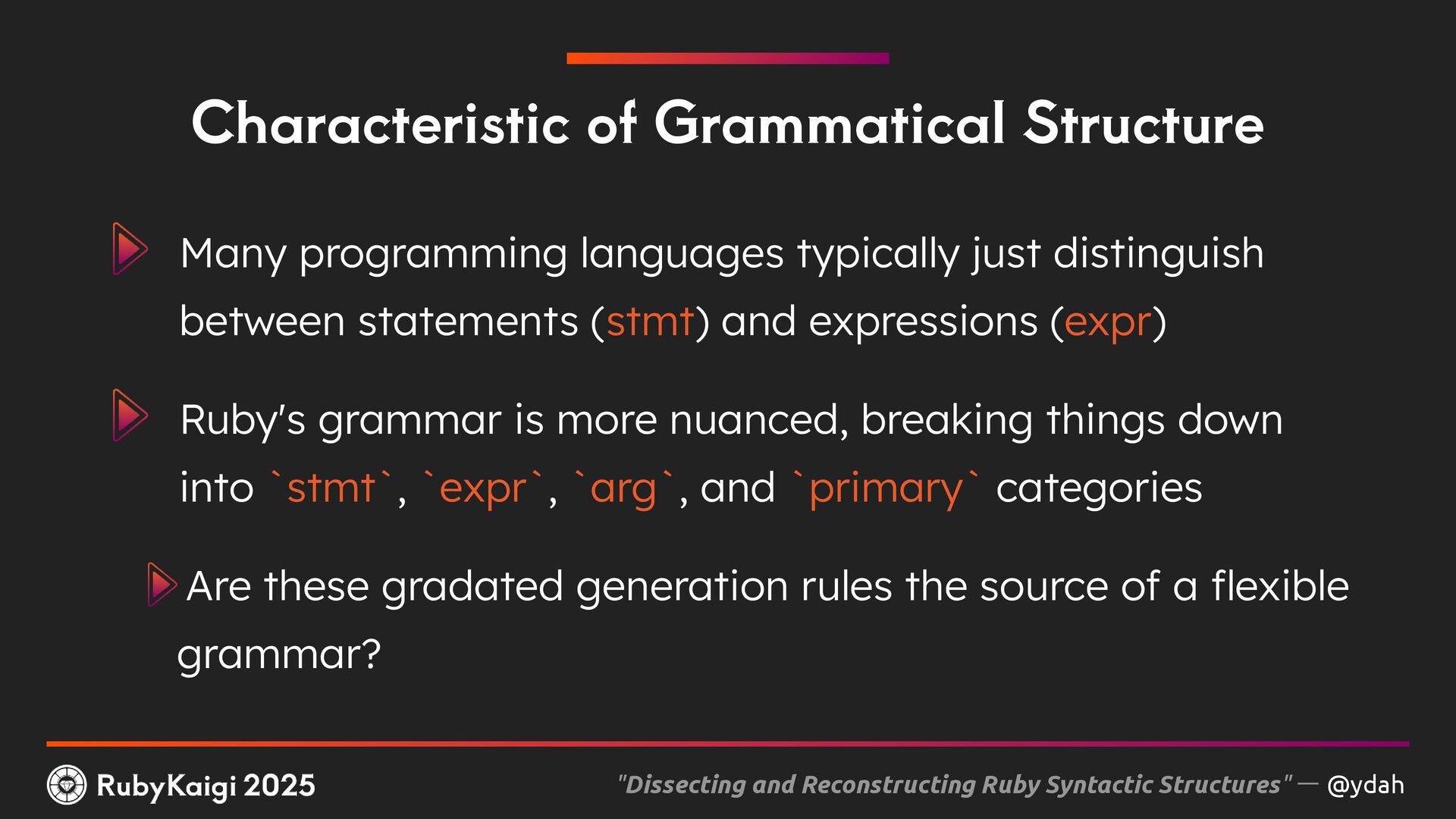
"Dissecting and Reconstructing Ruby Syntactic Structures" ʔ @ydah Characteristic of
Grammatical Structure Many programming languages typically just distinguish between statements (stmt) and expressions (expr) Ruby's grammar is more nuanced, breaking things down into `stmt`, `expr`, `arg`, and `primary` categories Are these gradated generation rules the source of a fl exible grammar? -
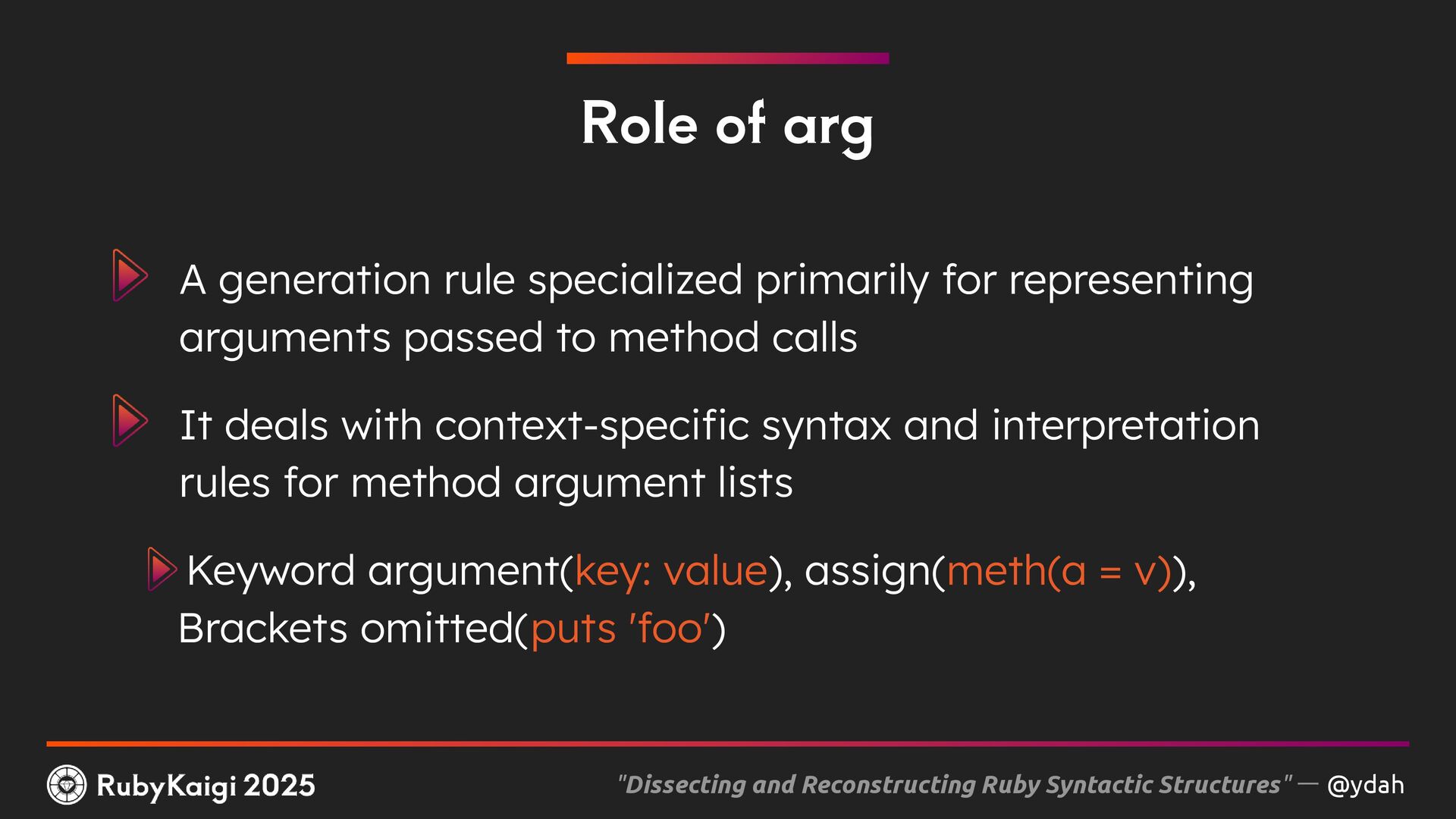
"Dissecting and Reconstructing Ruby Syntactic Structures" ʔ @ydah Role of
arg A generation rule specialized primarily for representing arguments passed to method calls It deals with context-speci fi c syntax and interpretation rules for method argument lists Keyword argument(key: value), assign(meth(a = v)), Brackets omitted(puts 'foo') -
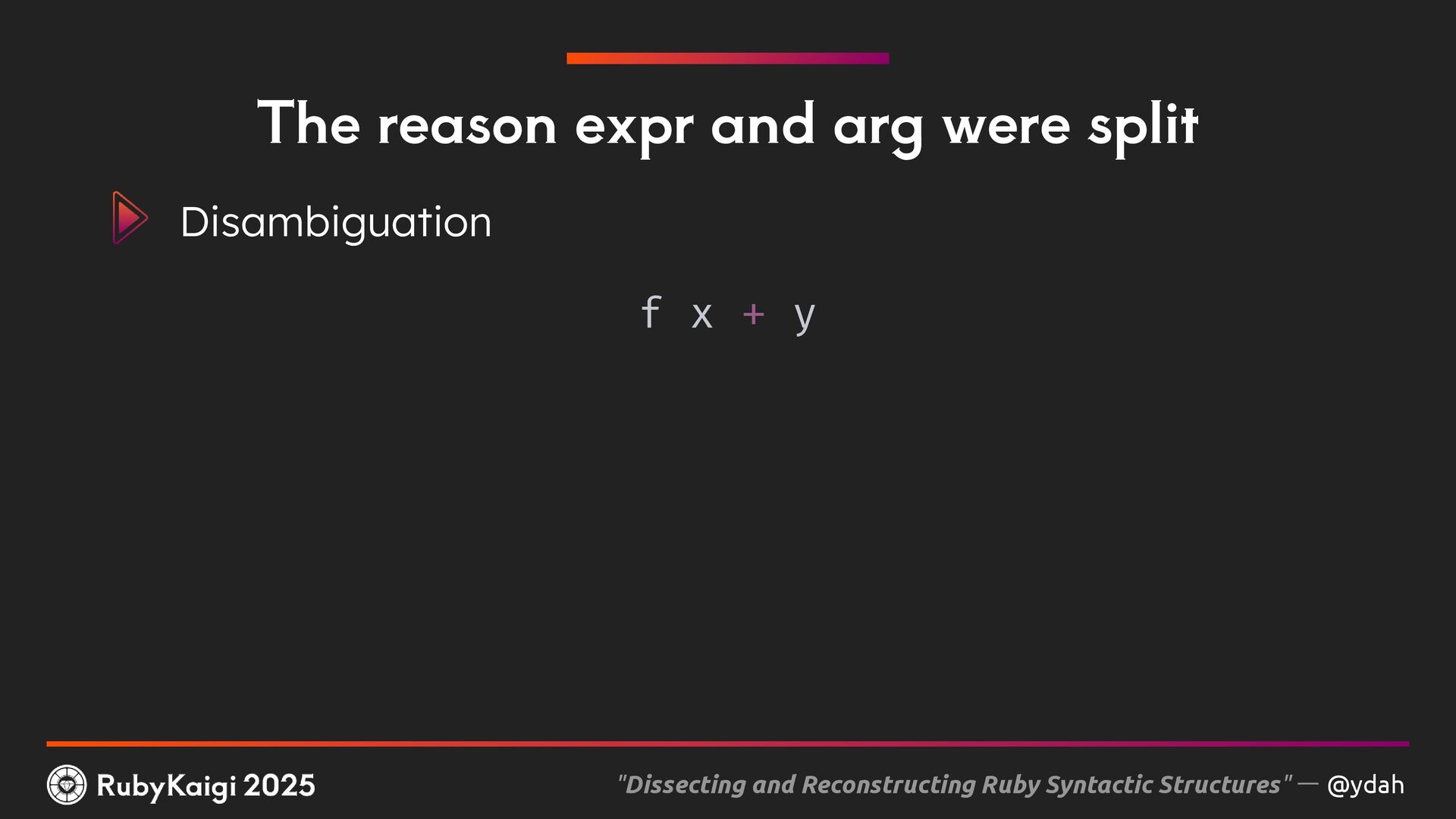
"Dissecting and Reconstructing Ruby Syntactic Structures" ʔ @ydah The reason
expr and arg were split Disambiguation f x + y -
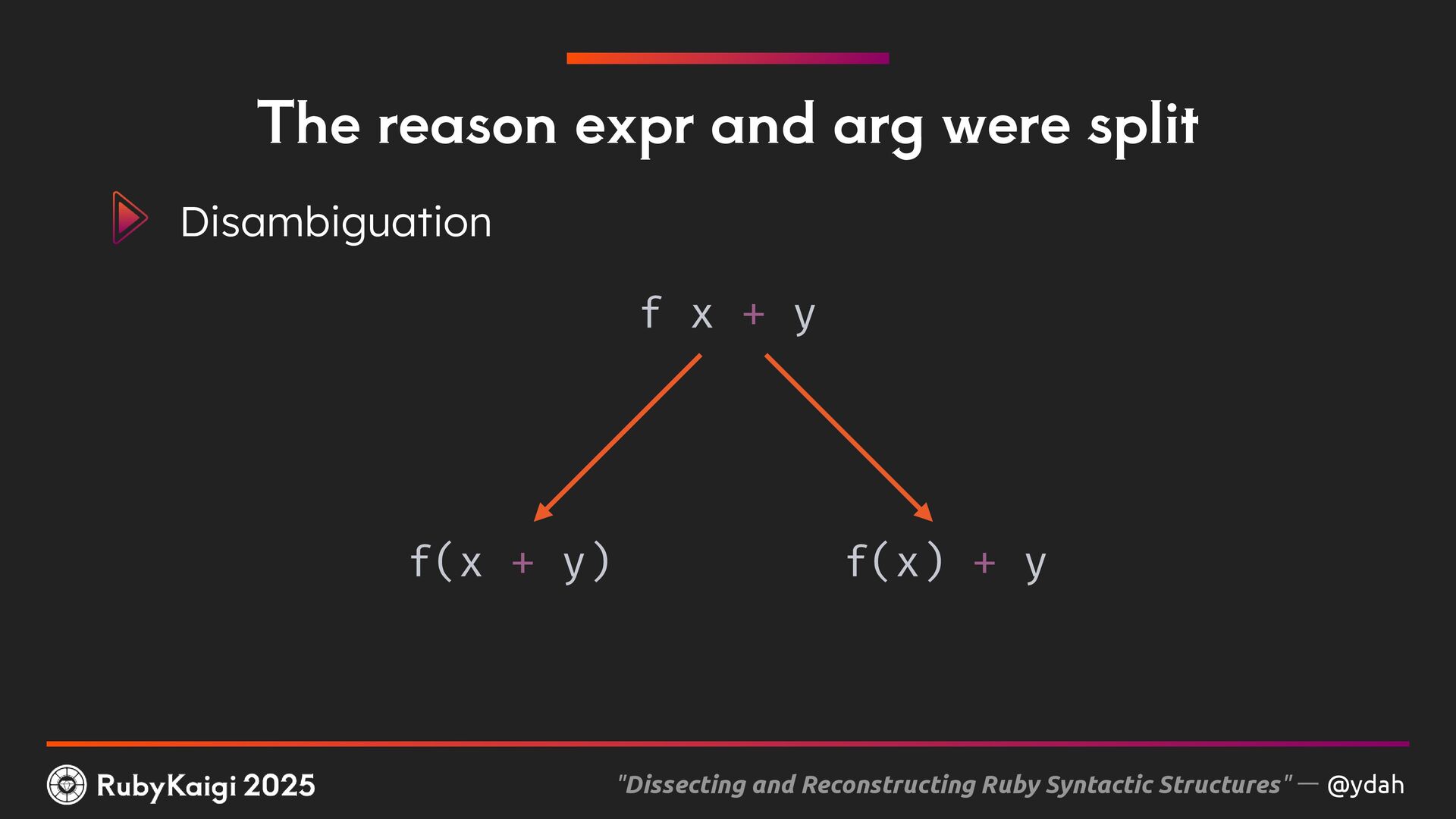
"Dissecting and Reconstructing Ruby Syntactic Structures" ʔ @ydah The reason
expr and arg were split Disambiguation f x + y f(x + y) f(x) + y -
"Dissecting and Reconstructing Ruby Syntactic Structures" ʔ @ydah The reason
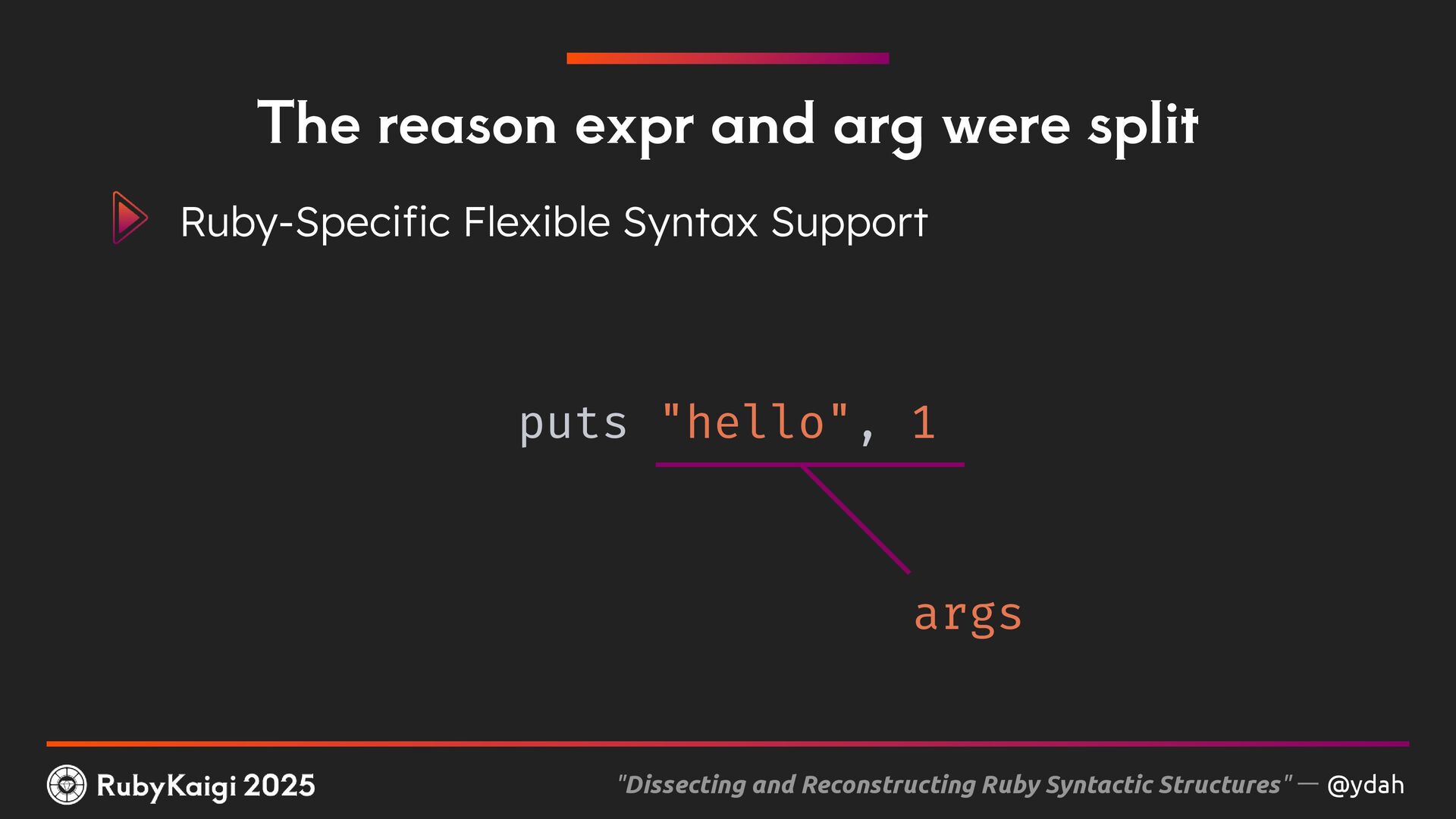
expr and arg were split Ruby-Speci fi c Flexible Syntax Support puts "hello", 1 args -
"Dissecting and Reconstructing Ruby Syntactic Structures" ʔ @ydah Role of
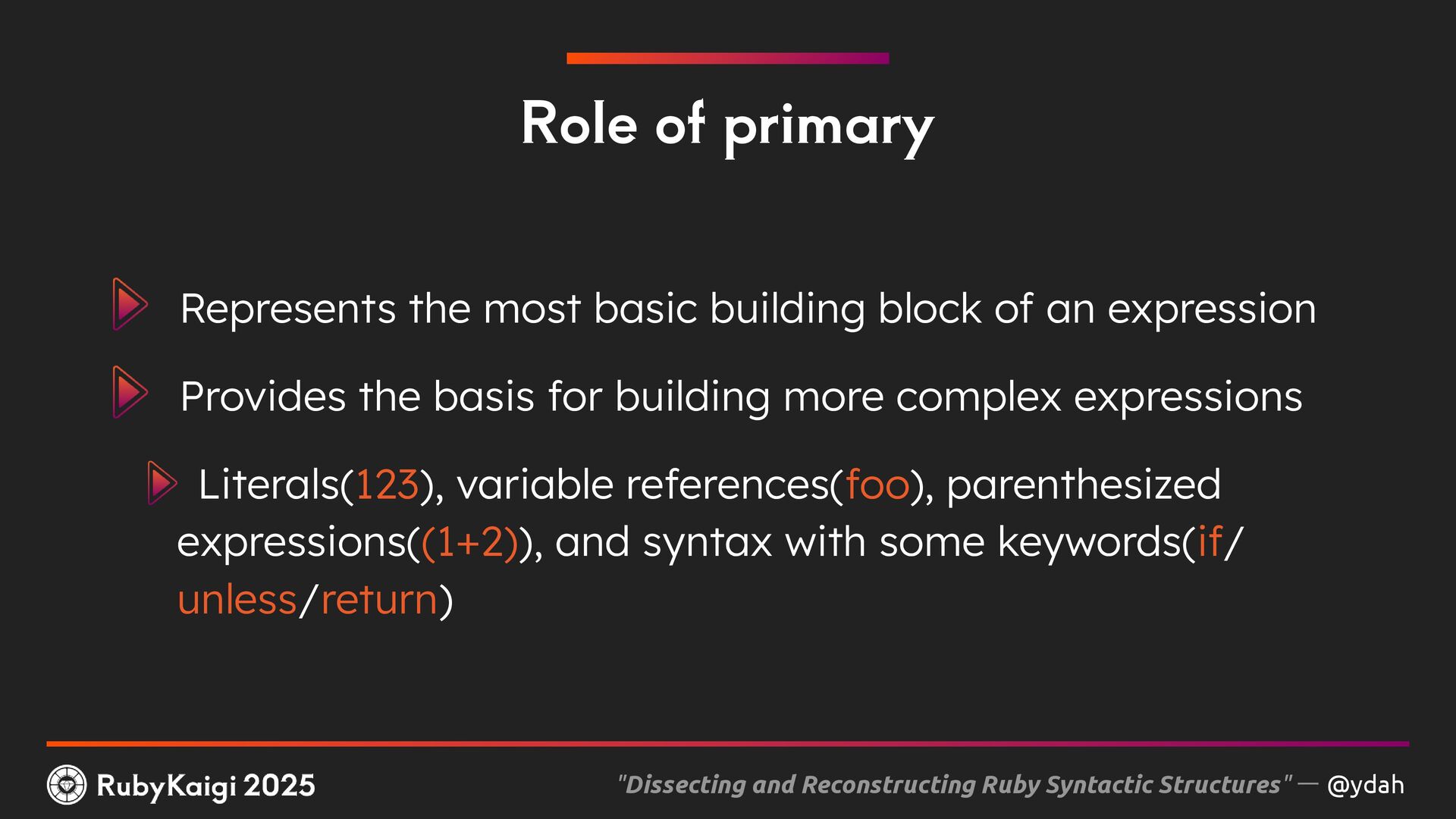
primary Represents the most basic building block of an expression Provides the basis for building more complex expressions Literals(123), variable references(foo), parenthesized expressions((1+2)), and syntax with some keywords(if/ unless/return) -
"Dissecting and Reconstructing Ruby Syntactic Structures" ʔ @ydah The reason
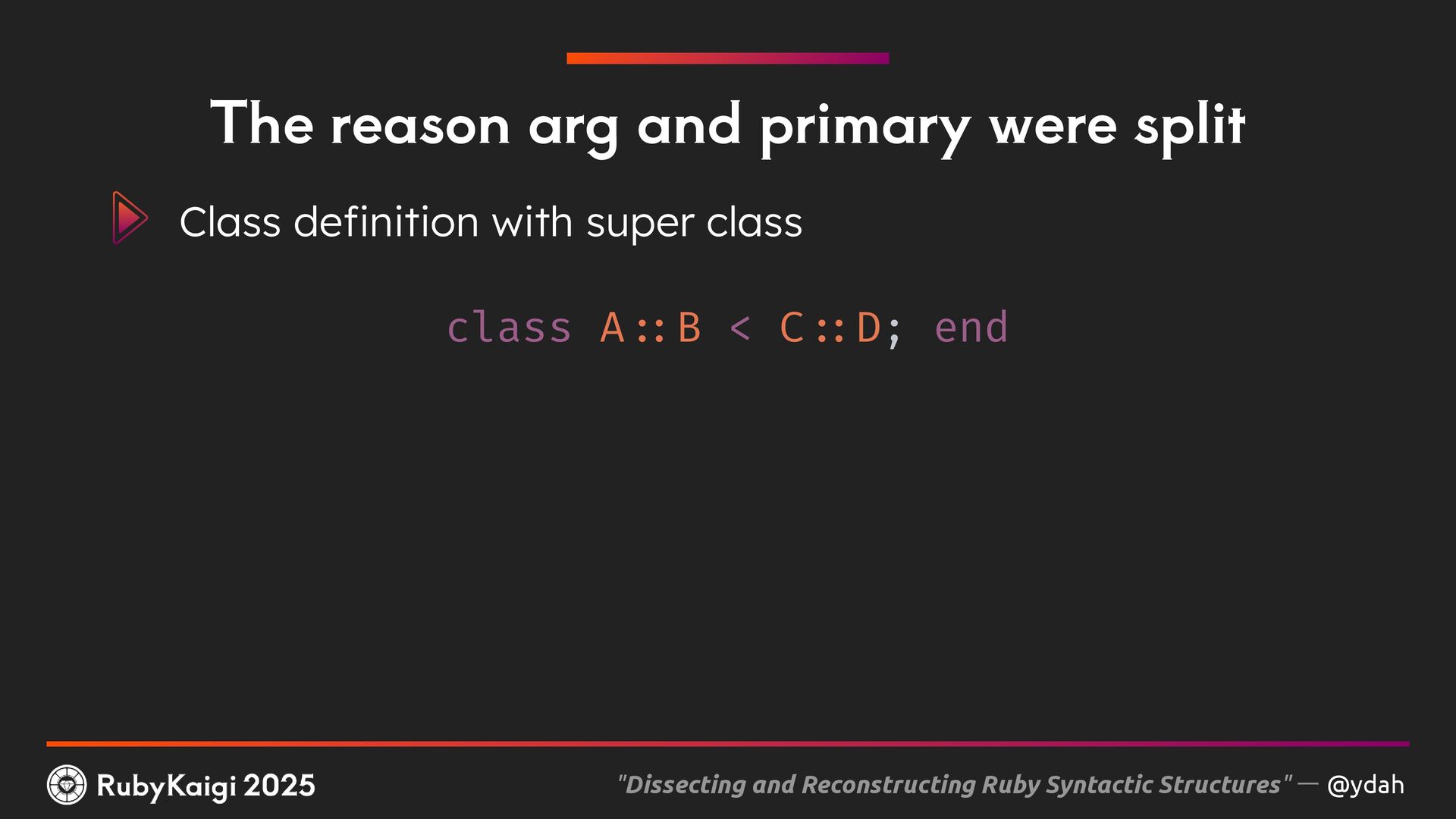
arg and primary were split Class de fi nition with super class class A : : B < C : : D; end -
"Dissecting and Reconstructing Ruby Syntactic Structures" ʔ @ydah The reason
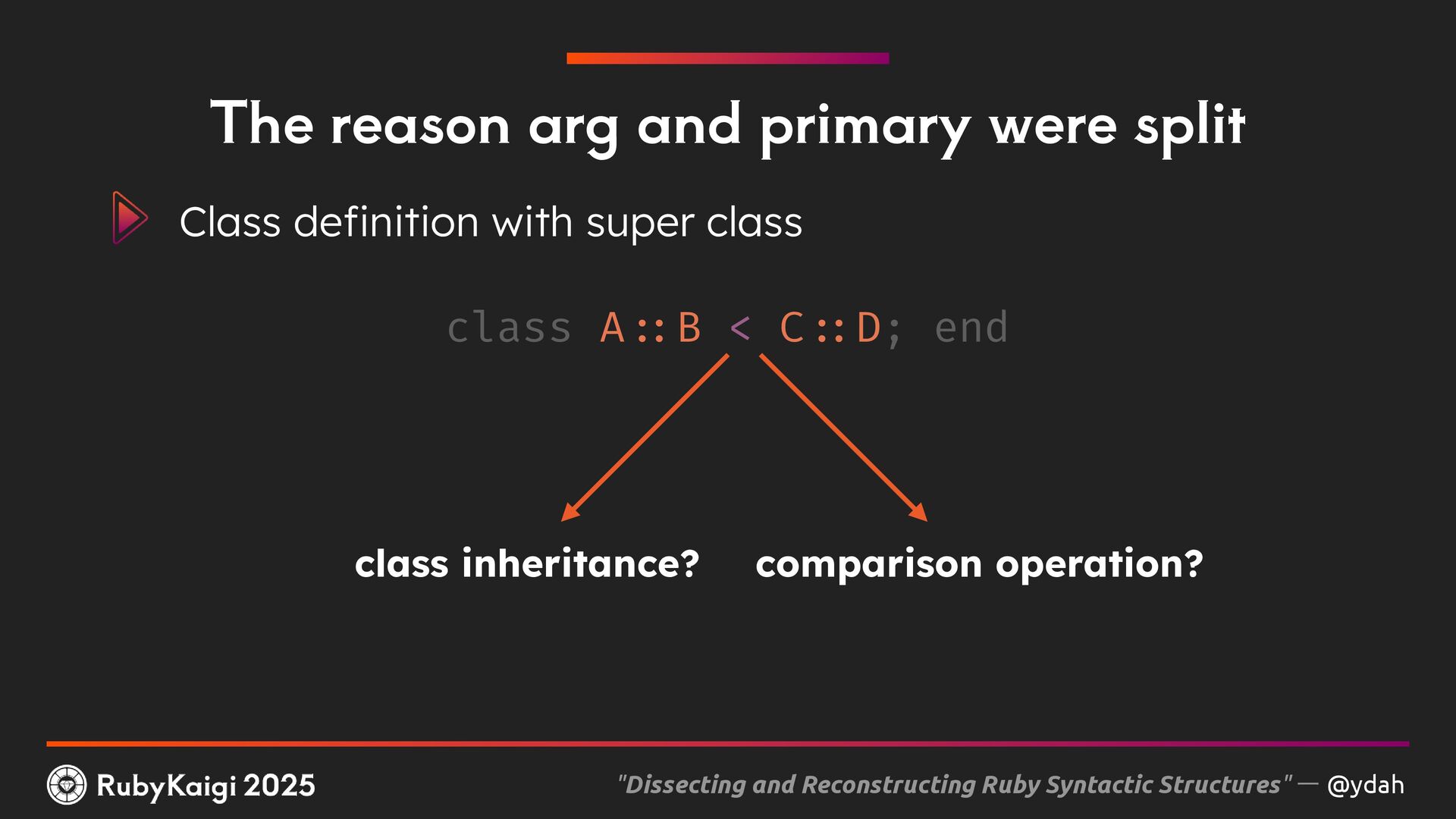
arg and primary were split Class de fi nition with super class class A : : B < C : : D; end class inheritance? comparison operation? -
"Dissecting and Reconstructing Ruby Syntactic Structures" ʔ @ydah The reason
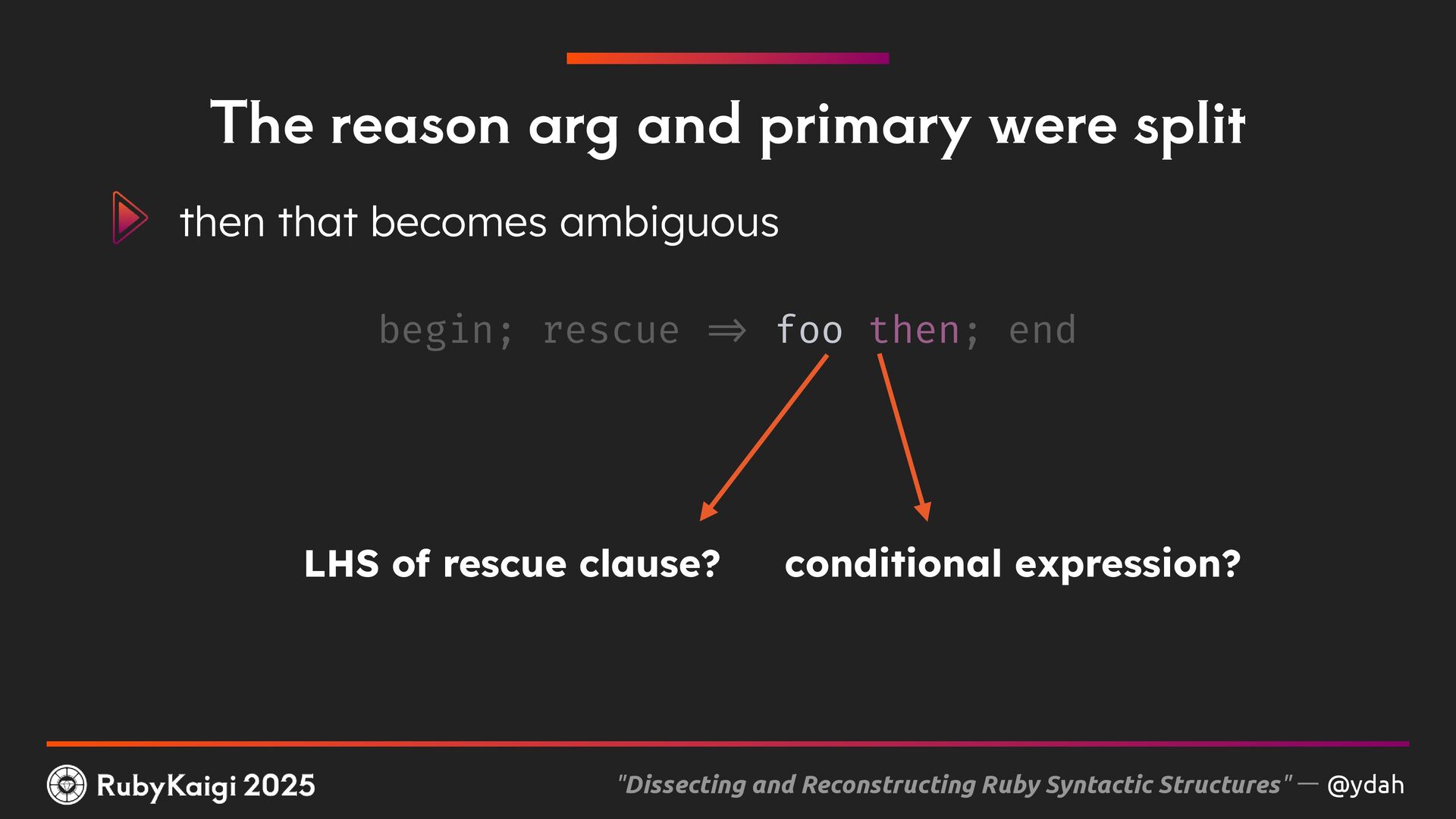
arg and primary were split then that becomes ambiguous begin; rescue = > foo then; end -
"Dissecting and Reconstructing Ruby Syntactic Structures" ʔ @ydah The reason
arg and primary were split then that becomes ambiguous begin; rescue = > foo then; end LHS of rescue clause? conditional expression? -
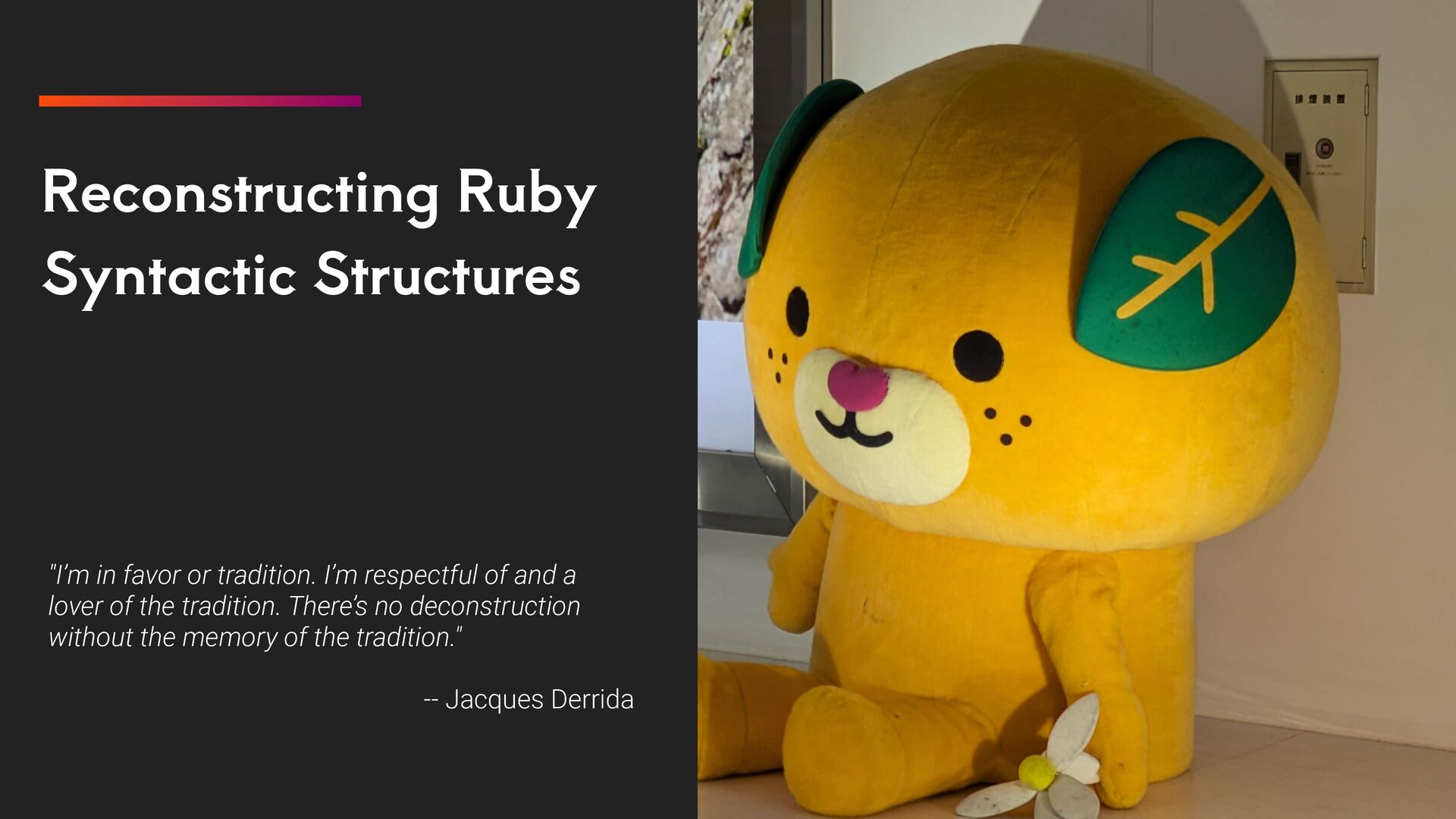
Reconstructing Ruby Syntactic Structures "I’m in favor or tradition. I’m
respectful of and a lover of the tradition. There’s no deconstruction without the memory of the tradition." -- Jacques Derrida -
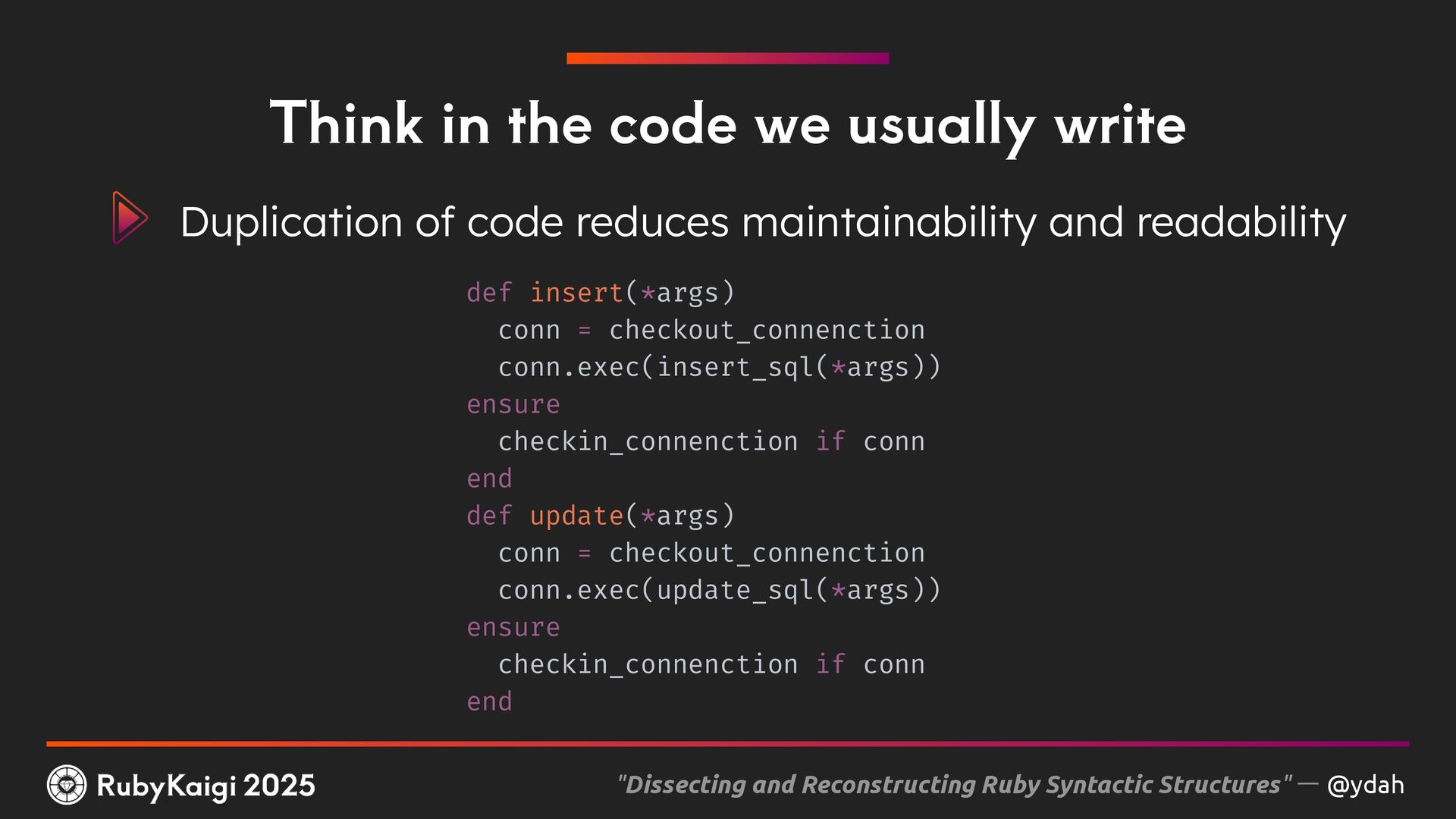
"Dissecting and Reconstructing Ruby Syntactic Structures" ʔ @ydah Think in
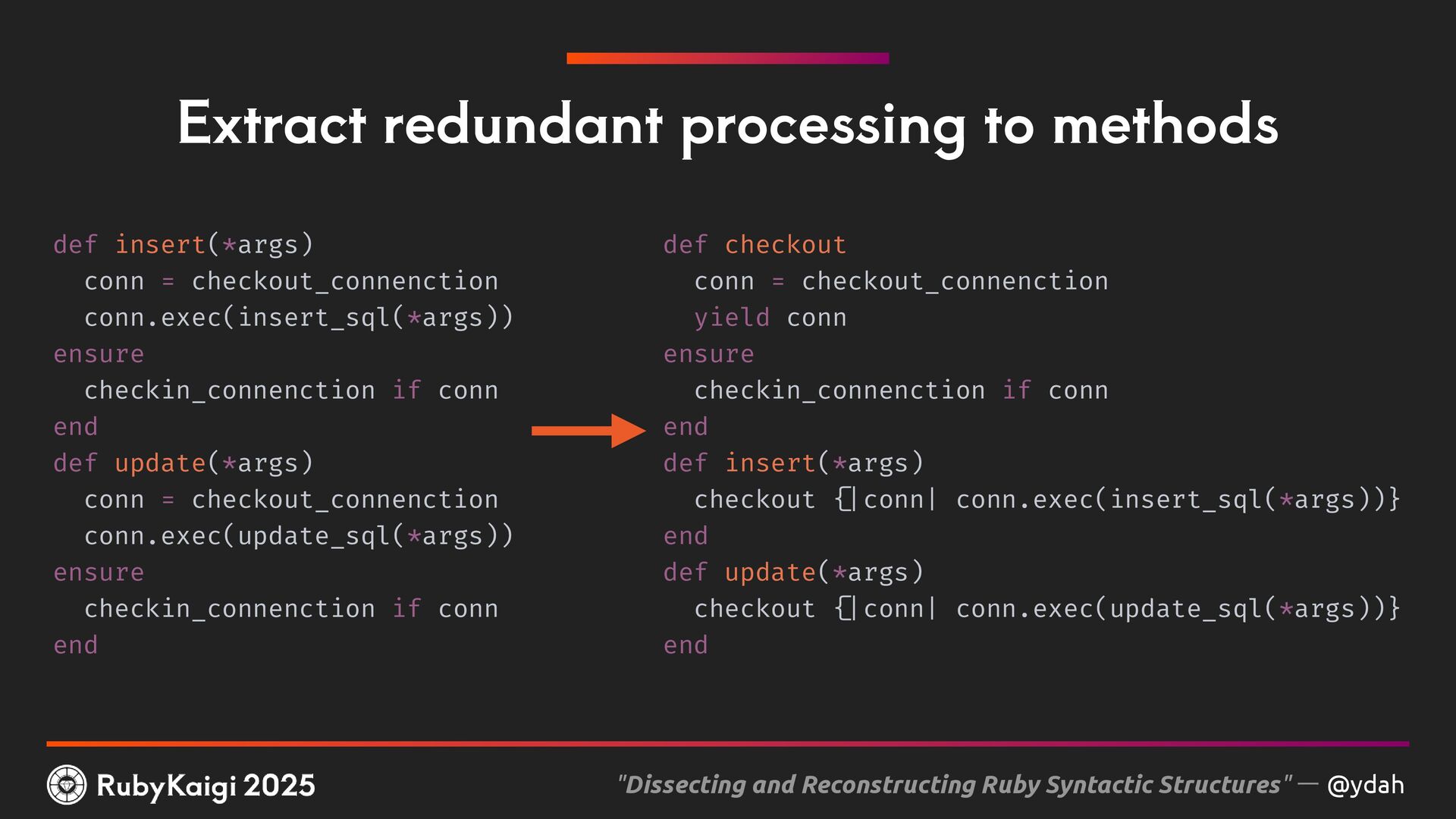
the code we usually write Duplication of code reduces maintainability and readability def insert(*args) conn = checkout_connenction conn.exec(insert_sql(*args)) ensure checkin_connenction if conn end def update(*args) conn = checkout_connenction conn.exec(update_sql(*args)) ensure checkin_connenction if conn end -
"Dissecting and Reconstructing Ruby Syntactic Structures" ʔ @ydah Extract redundant
processing to methods def insert(*args) conn = checkout_connenction conn.exec(insert_sql(*args)) ensure checkin_connenction if conn end def update(*args) conn = checkout_connenction conn.exec(update_sql(*args)) ensure checkin_connenction if conn end def checkout conn = checkout_connenction yield conn ensure checkin_connenction if conn end def insert(*args) checkout { | conn| conn.exec(insert_sql(*args))} end def update(*args) checkout { | conn| conn.exec(update_sql(*args))} end -
"Dissecting and Reconstructing Ruby Syntactic Structures" ʔ @ydah Find the
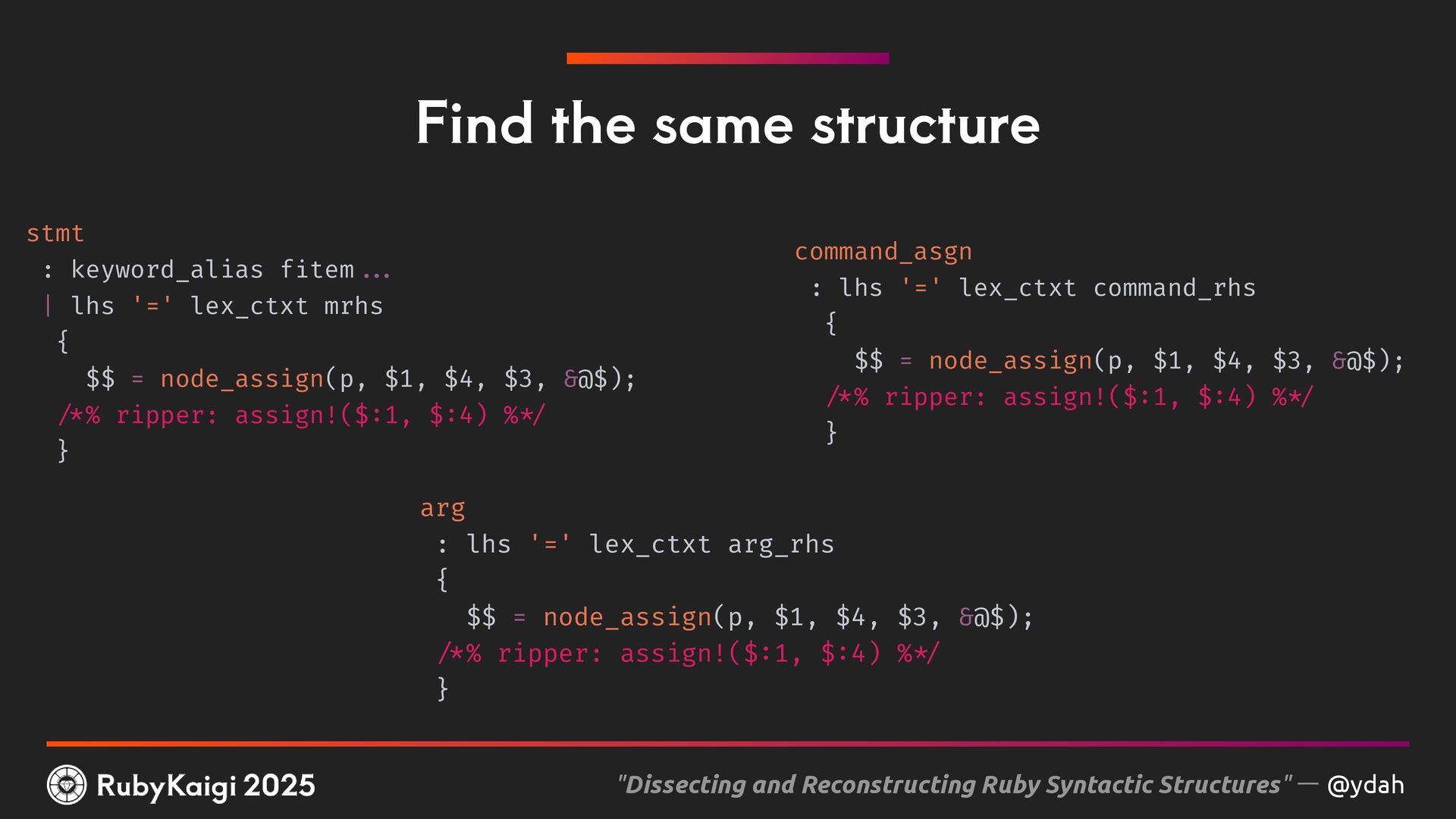
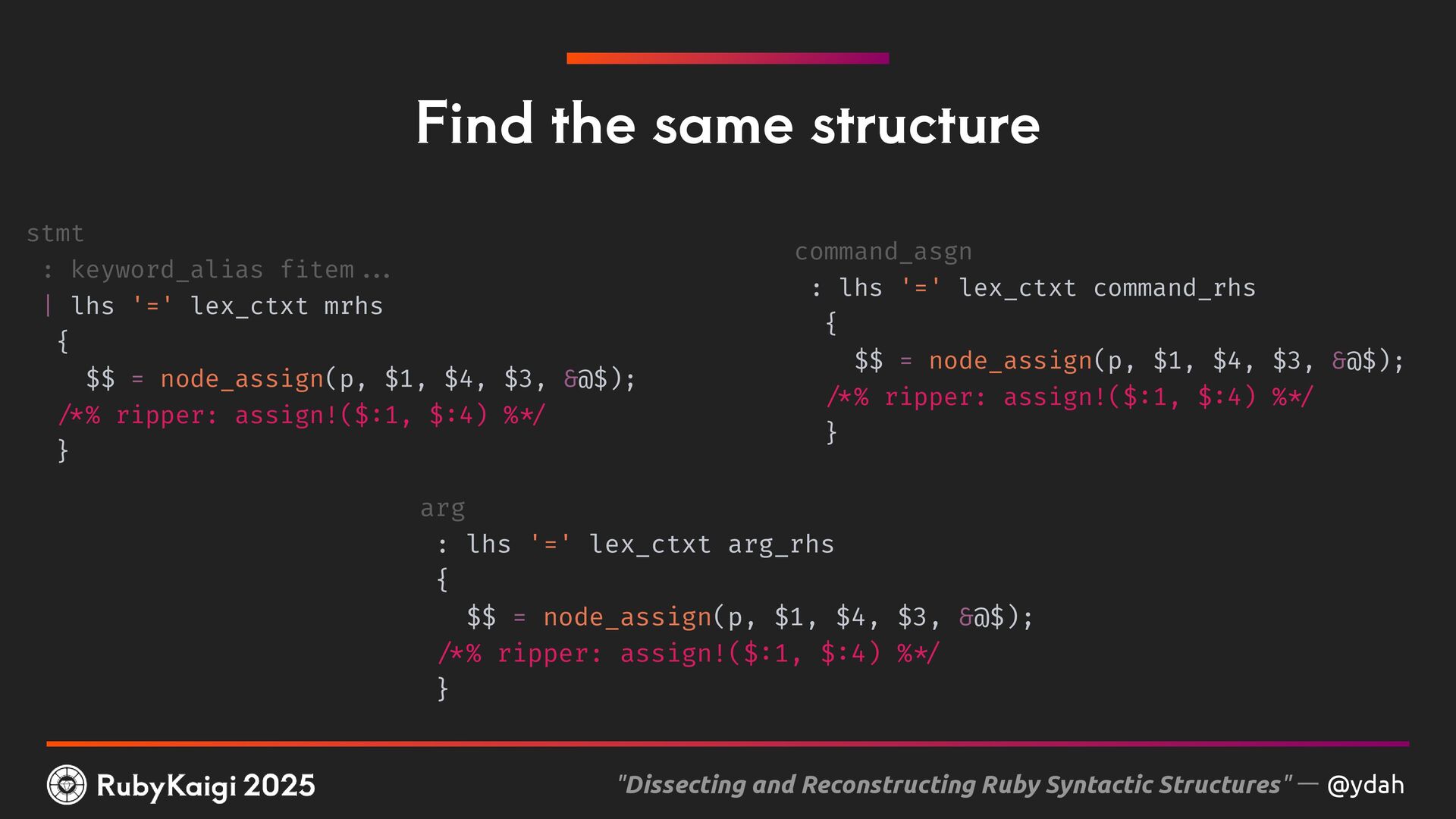
same structure stmt : keyword_alias f i tem . . . | lhs '=' lex_ctxt mrhs { $$ = node_assign(p, $1, $4, $3, &@$); / * % ripper: assign!($ : 1, $ : 4) % * / } command_asgn : lhs '=' lex_ctxt command_rhs { $$ = node_assign(p, $1, $4, $3, &@$); / * % ripper: assign!($ : 1, $ : 4) % * / } arg : lhs '=' lex_ctxt arg_rhs { $$ = node_assign(p, $1, $4, $3, &@$); / * % ripper: assign!($ : 1, $ : 4) % * / } -
"Dissecting and Reconstructing Ruby Syntactic Structures" ʔ @ydah Extract the
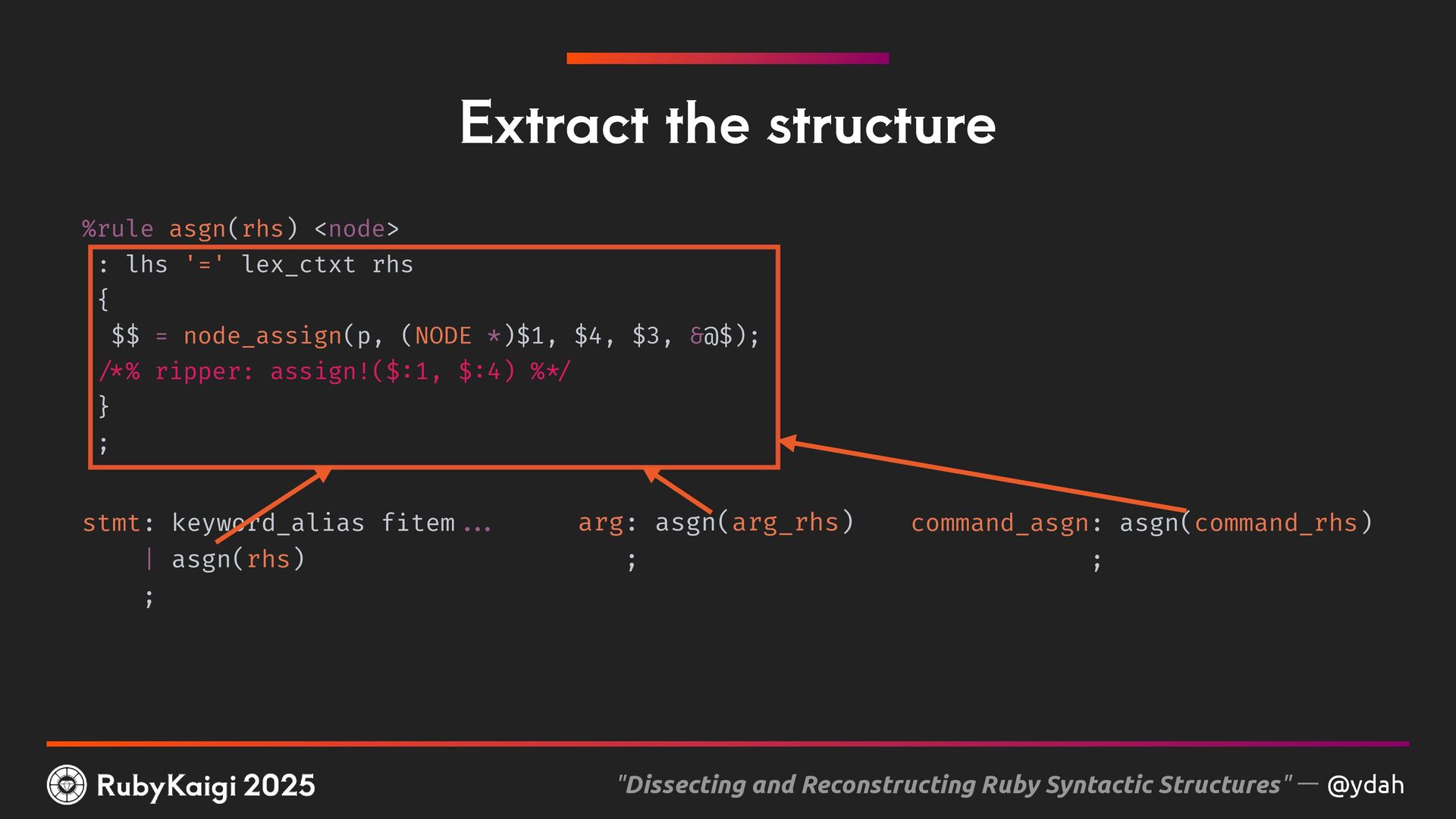
structure %rule asgn(rhs) <node> : lhs '=' lex_ctxt rhs { $$ = node_assign(p, (NODE *)$1, $4, $3, &@$); / * % ripper: assign!($ : 1, $ : 4) % * / } ; stmt: keyword_alias f i tem . . . | asgn(rhs) ; command_asgn: asgn(command_rhs) ; arg: asgn(arg_rhs) ; -
"Dissecting and Reconstructing Ruby Syntactic Structures" ʔ @ydah Structuring power
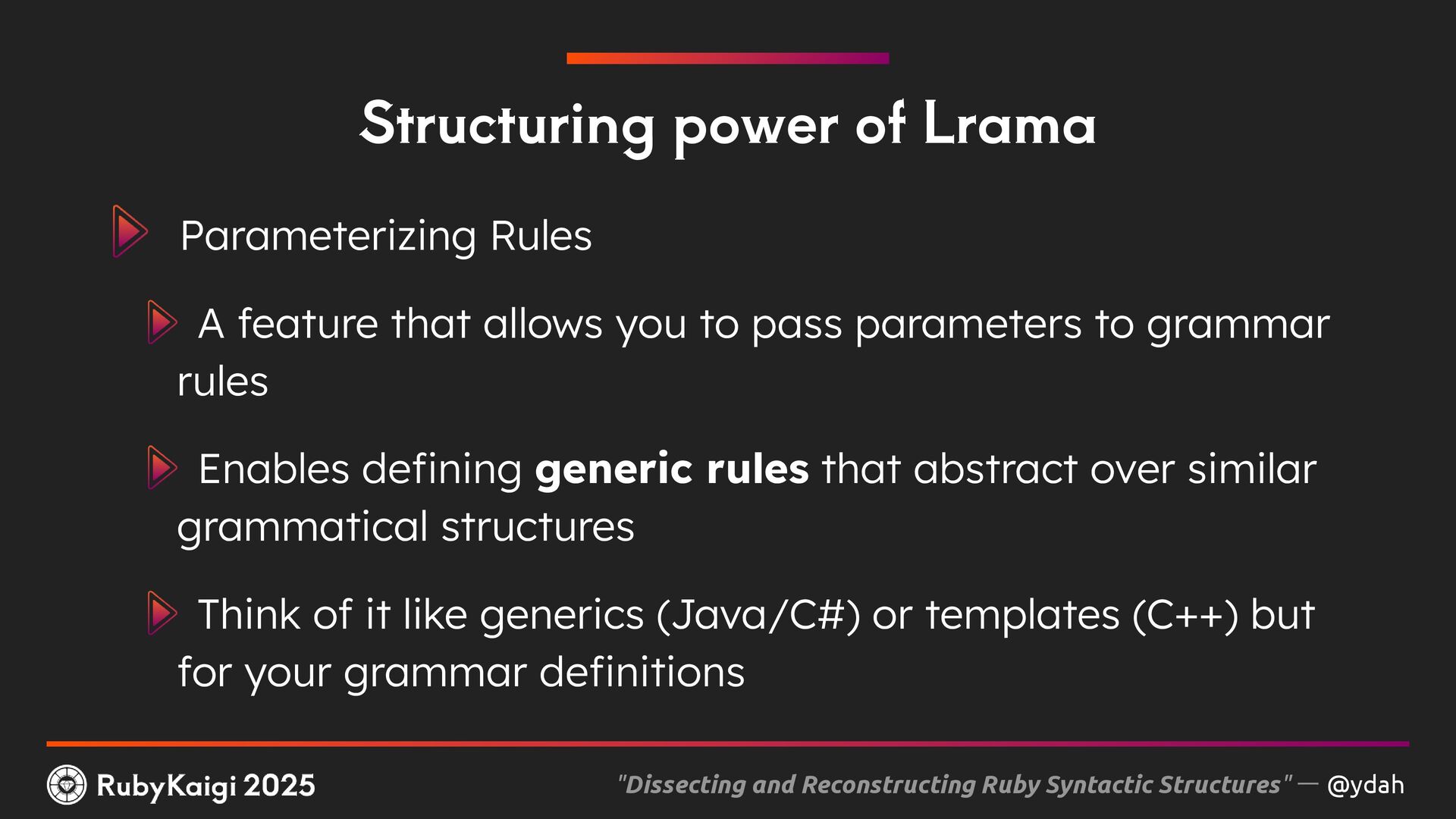
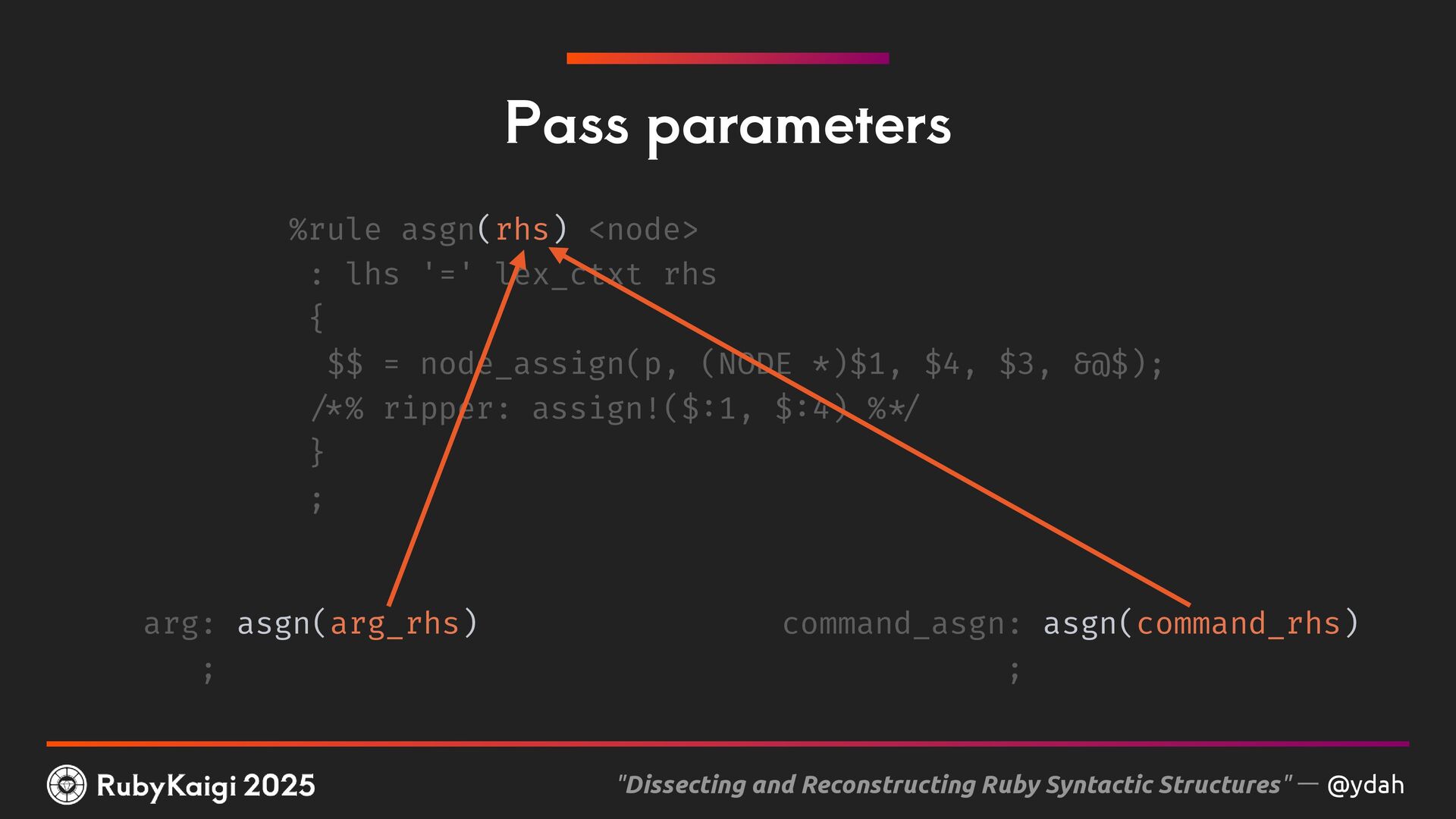
of Lrama Parameterizing Rules A feature that allows you to pass parameters to grammar rules Enables de fi ning generic rules that abstract over similar grammatical structures Think of it like generics (Java/C#) or templates (C++) but for your grammar de fi nitions -
"Dissecting and Reconstructing Ruby Syntactic Structures" ʔ @ydah Basic Syntax
%rule asgn(rhs) <node> : lhs '=' lex_ctxt rhs { $$ = node_assign(p, (NODE *)$1, $4, $3, &@$); / * % ripper: assign!($ : 1, $ : 4) % * / } ; command_asgn: asgn(command_rhs) ; arg: asgn(arg_rhs) ; -
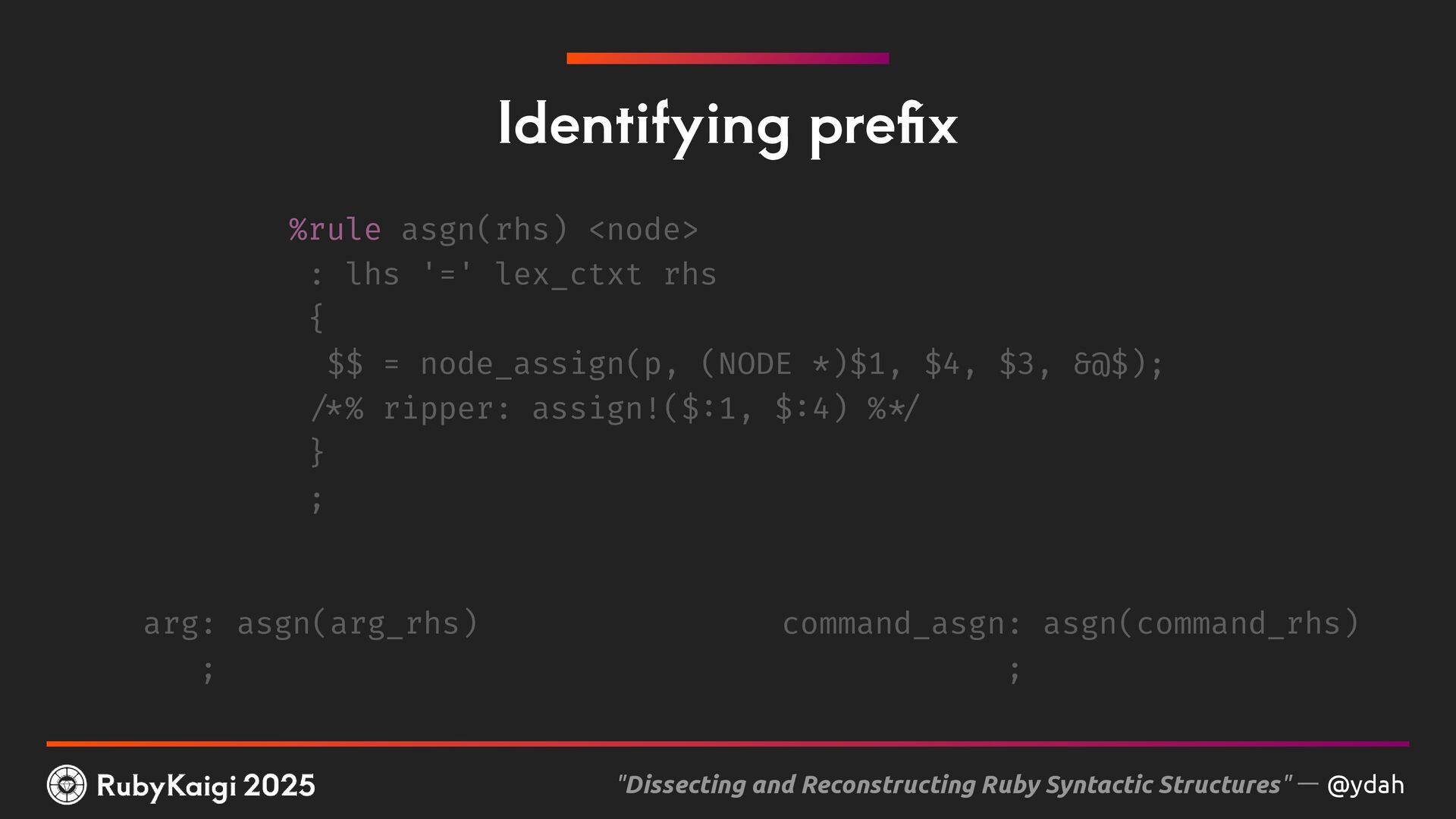
"Dissecting and Reconstructing Ruby Syntactic Structures" ʔ @ydah %rule asgn(rhs)
<node> : lhs '=' lex_ctxt rhs { $$ = node_assign(p, (NODE *)$1, $4, $3, &@$); / * % ripper: assign!($ : 1, $ : 4) % * / } ; Identifying pre fi x command_asgn: asgn(command_rhs) ; arg: asgn(arg_rhs) ; -
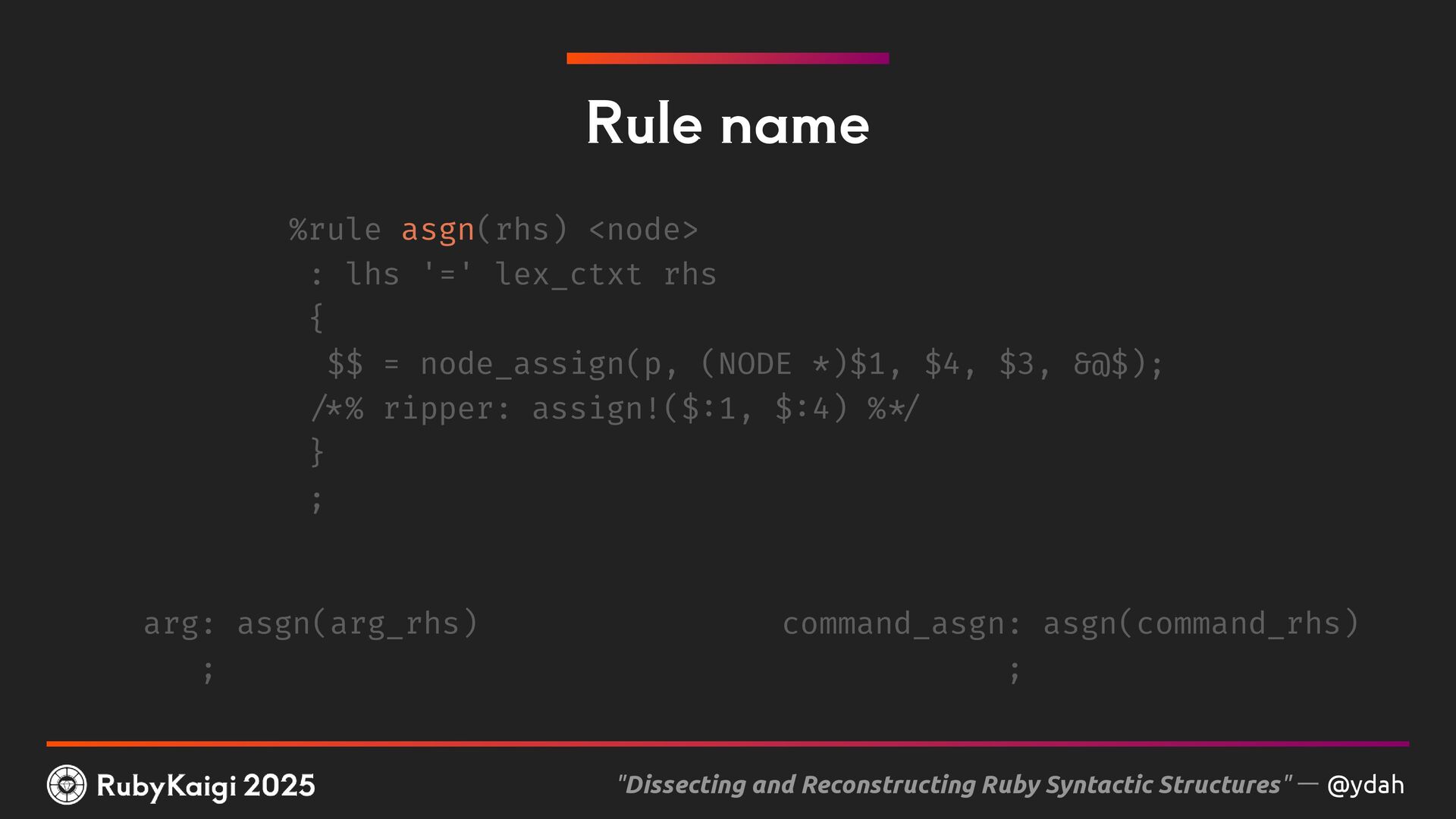
"Dissecting and Reconstructing Ruby Syntactic Structures" ʔ @ydah %rule asgn(rhs)
<node> : lhs '=' lex_ctxt rhs { $$ = node_assign(p, (NODE *)$1, $4, $3, &@$); / * % ripper: assign!($ : 1, $ : 4) % * / } ; Rule name command_asgn: asgn(command_rhs) ; arg: asgn(arg_rhs) ; -
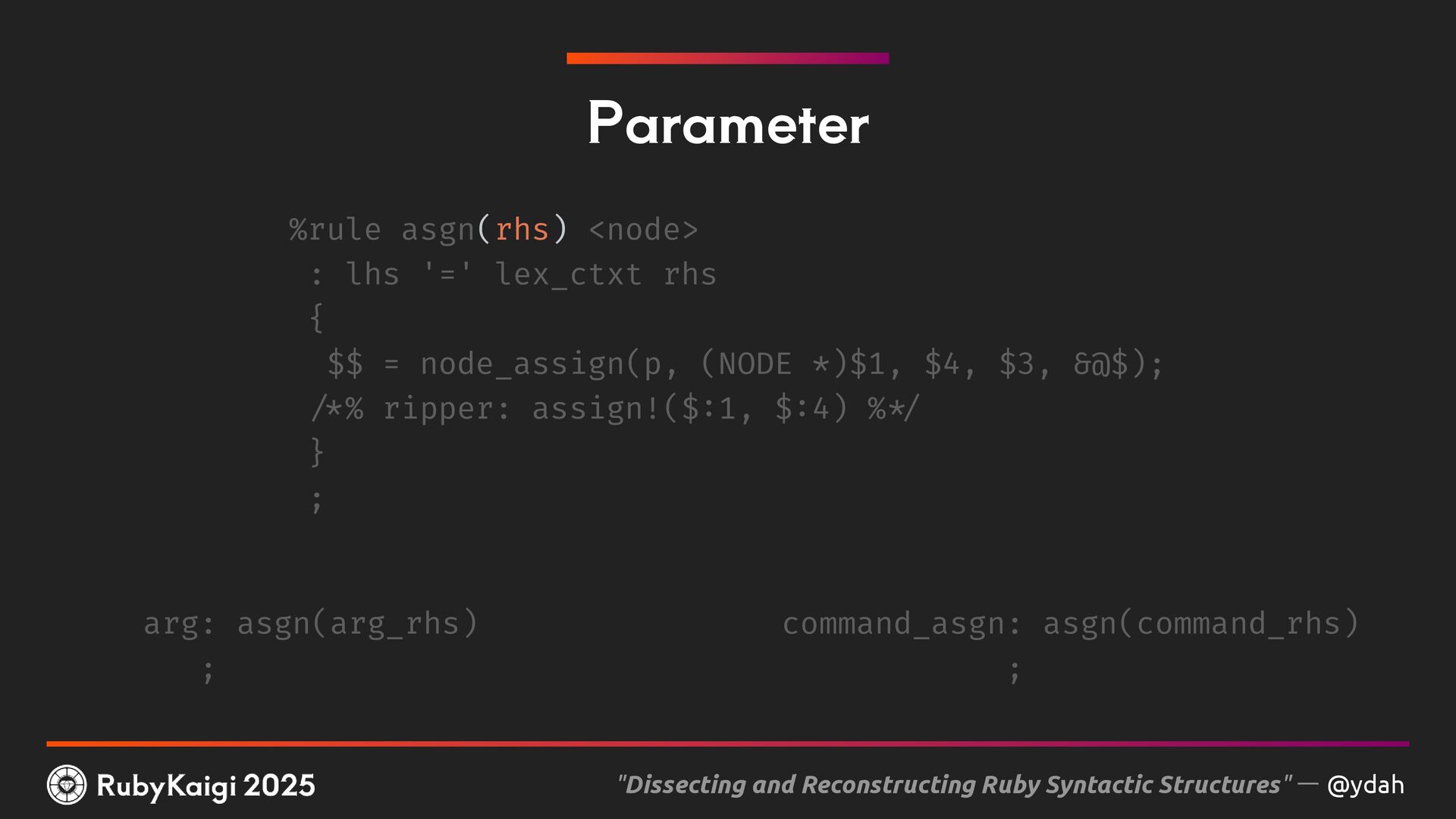
"Dissecting and Reconstructing Ruby Syntactic Structures" ʔ @ydah %rule asgn(rhs)
<node> : lhs '=' lex_ctxt rhs { $$ = node_assign(p, (NODE *)$1, $4, $3, &@$); / * % ripper: assign!($ : 1, $ : 4) % * / } ; Parameter command_asgn: asgn(command_rhs) ; arg: asgn(arg_rhs) ; -
"Dissecting and Reconstructing Ruby Syntactic Structures" ʔ @ydah Pass parameters
%rule asgn(rhs) <node> : lhs '=' lex_ctxt rhs { $$ = node_assign(p, (NODE *)$1, $4, $3, &@$); / * % ripper: assign!($ : 1, $ : 4) % * / } ; arg: asgn(arg_rhs) ; command_asgn: asgn(command_rhs) ; -
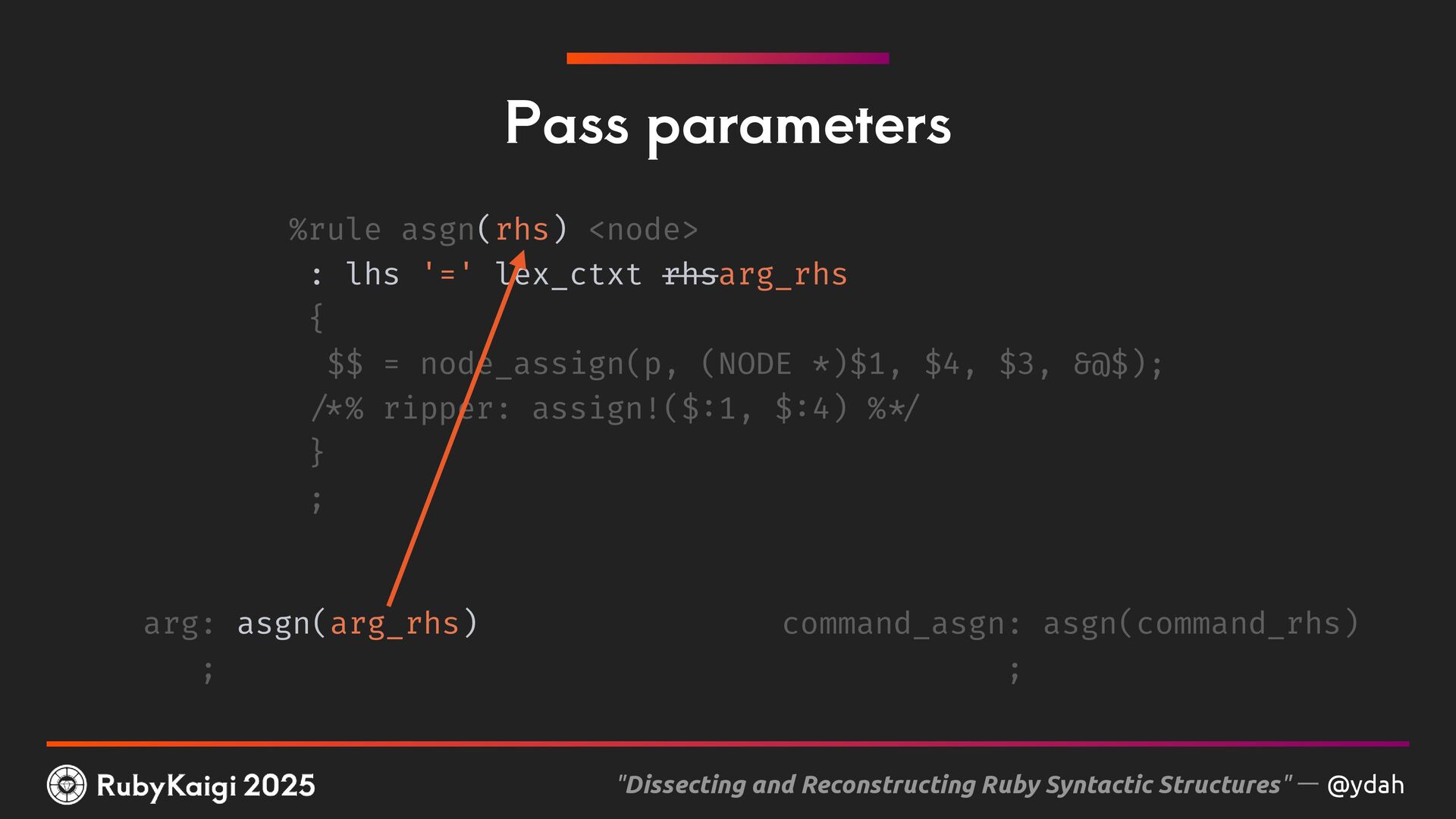
"Dissecting and Reconstructing Ruby Syntactic Structures" ʔ @ydah Pass parameters
%rule asgn(rhs) <node> : lhs '=' lex_ctxt rhsarg_rhs { $$ = node_assign(p, (NODE *)$1, $4, $3, &@$); / * % ripper: assign!($ : 1, $ : 4) % * / } ; command_asgn: asgn(command_rhs) ; arg: asgn(arg_rhs) ; -
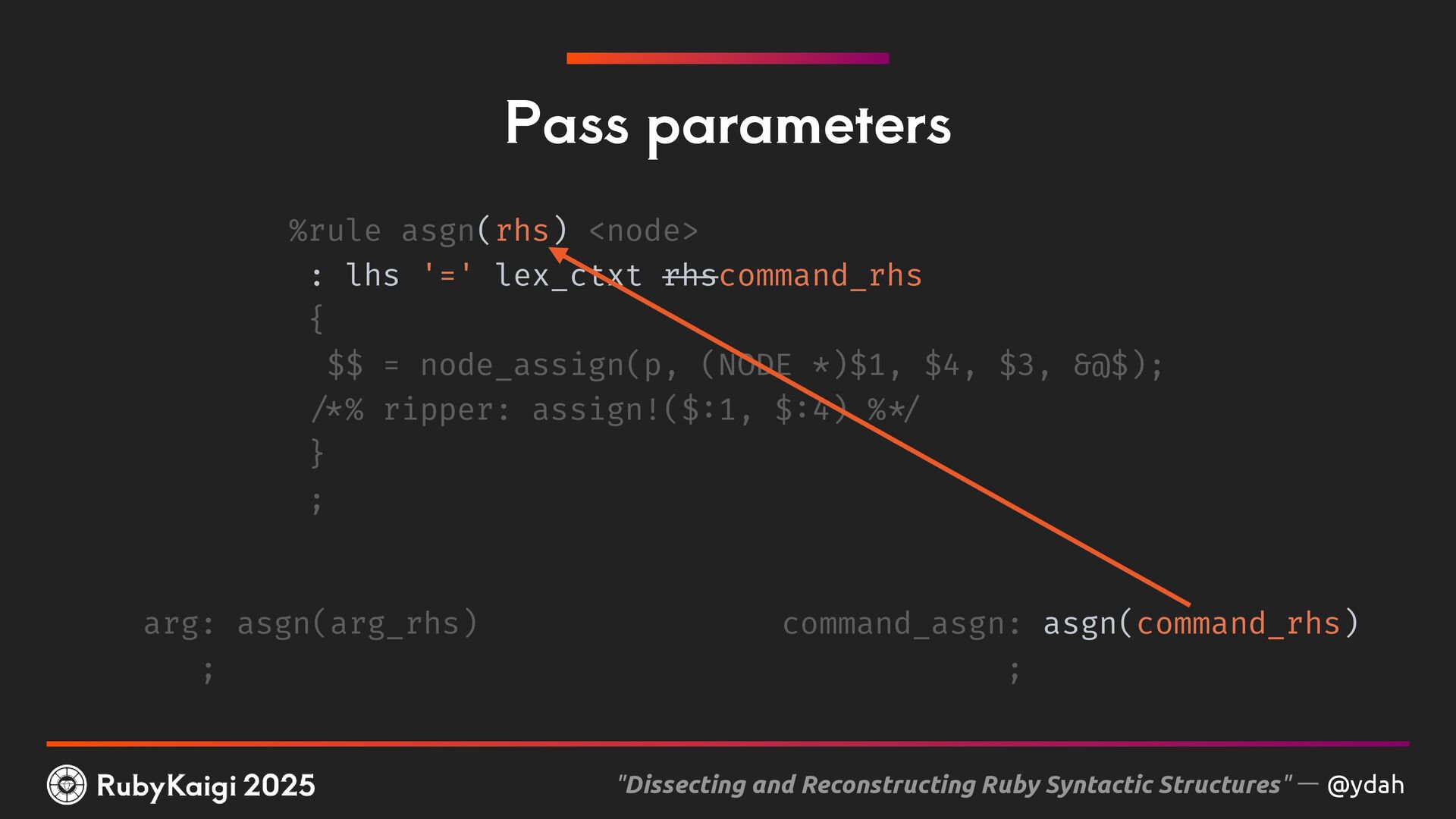
"Dissecting and Reconstructing Ruby Syntactic Structures" ʔ @ydah Pass parameters
%rule asgn(rhs) <node> : lhs '=' lex_ctxt rhscommand_rhs { $$ = node_assign(p, (NODE *)$1, $4, $3, &@$); / * % ripper: assign!($ : 1, $ : 4) % * / } ; command_asgn: asgn(command_rhs) ; arg: asgn(arg_rhs) ; -
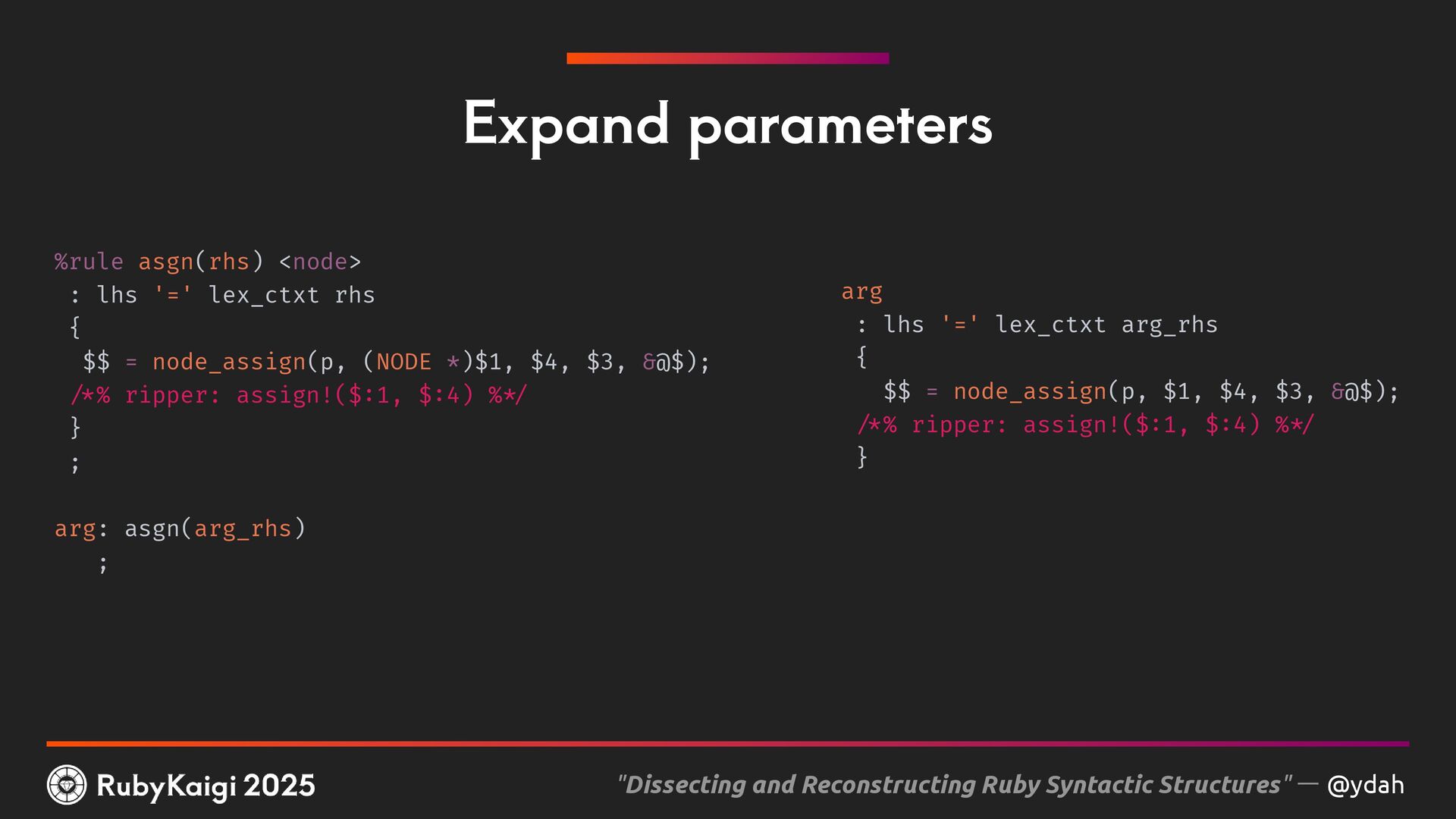
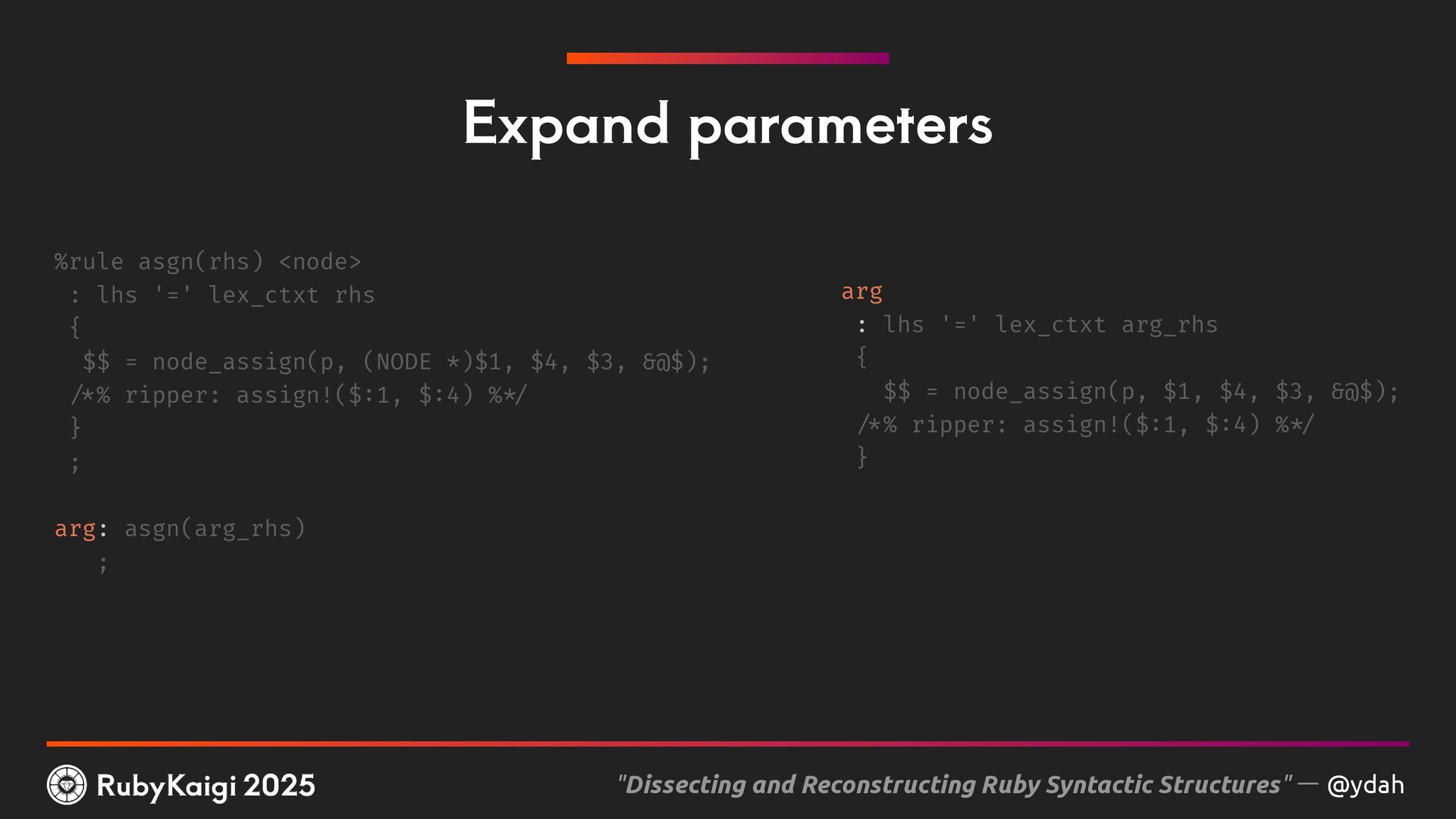
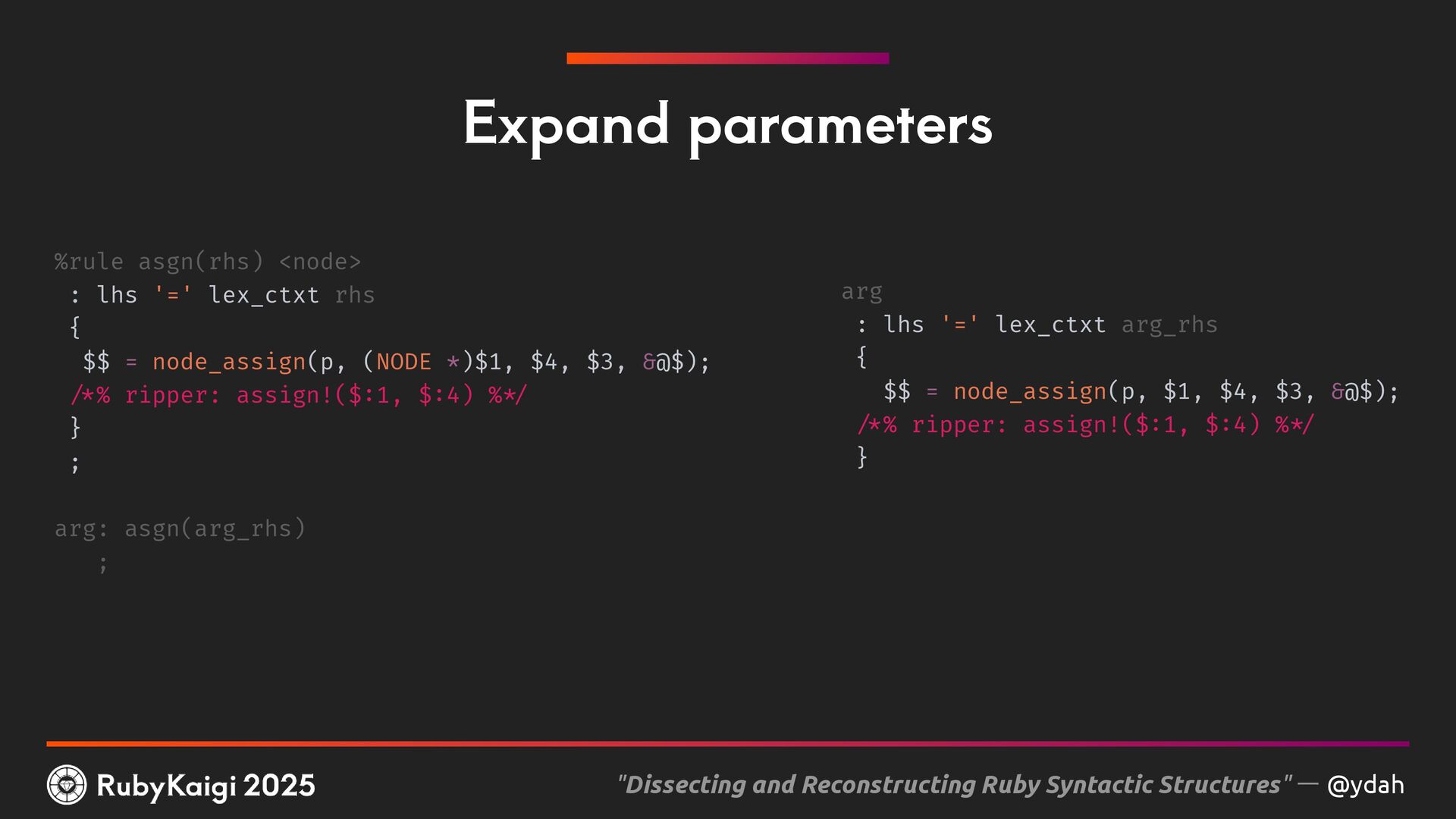
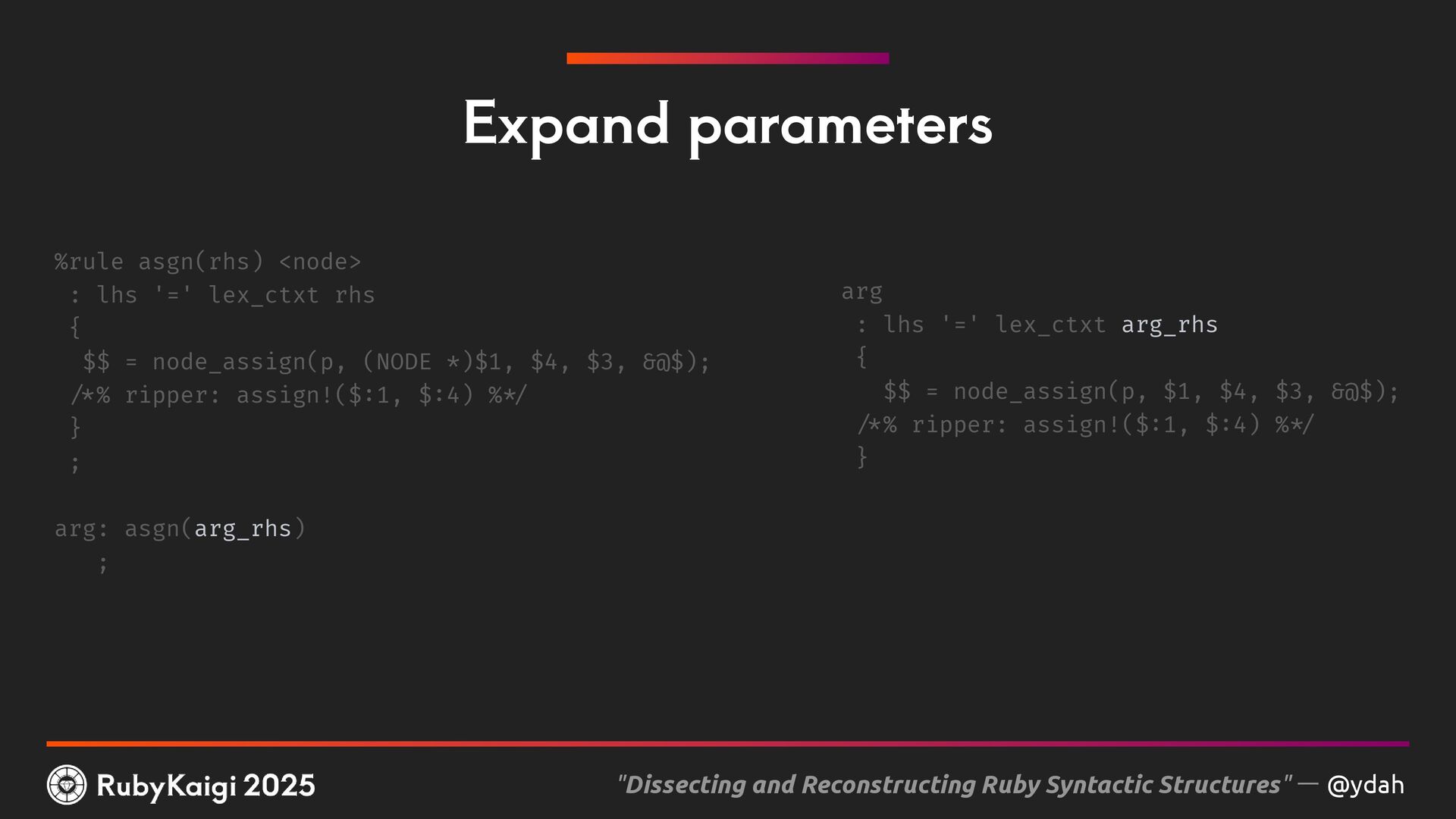
"Dissecting and Reconstructing Ruby Syntactic Structures" ʔ @ydah Expand parameters
%rule asgn(rhs) <node> : lhs '=' lex_ctxt rhs { $$ = node_assign(p, (NODE *)$1, $4, $3, &@$); / * % ripper: assign!($ : 1, $ : 4) % * / } ; arg: asgn(arg_rhs) ; arg : lhs '=' lex_ctxt arg_rhs { $$ = node_assign(p, $1, $4, $3, &@$); / * % ripper: assign!($ : 1, $ : 4) % * / } -
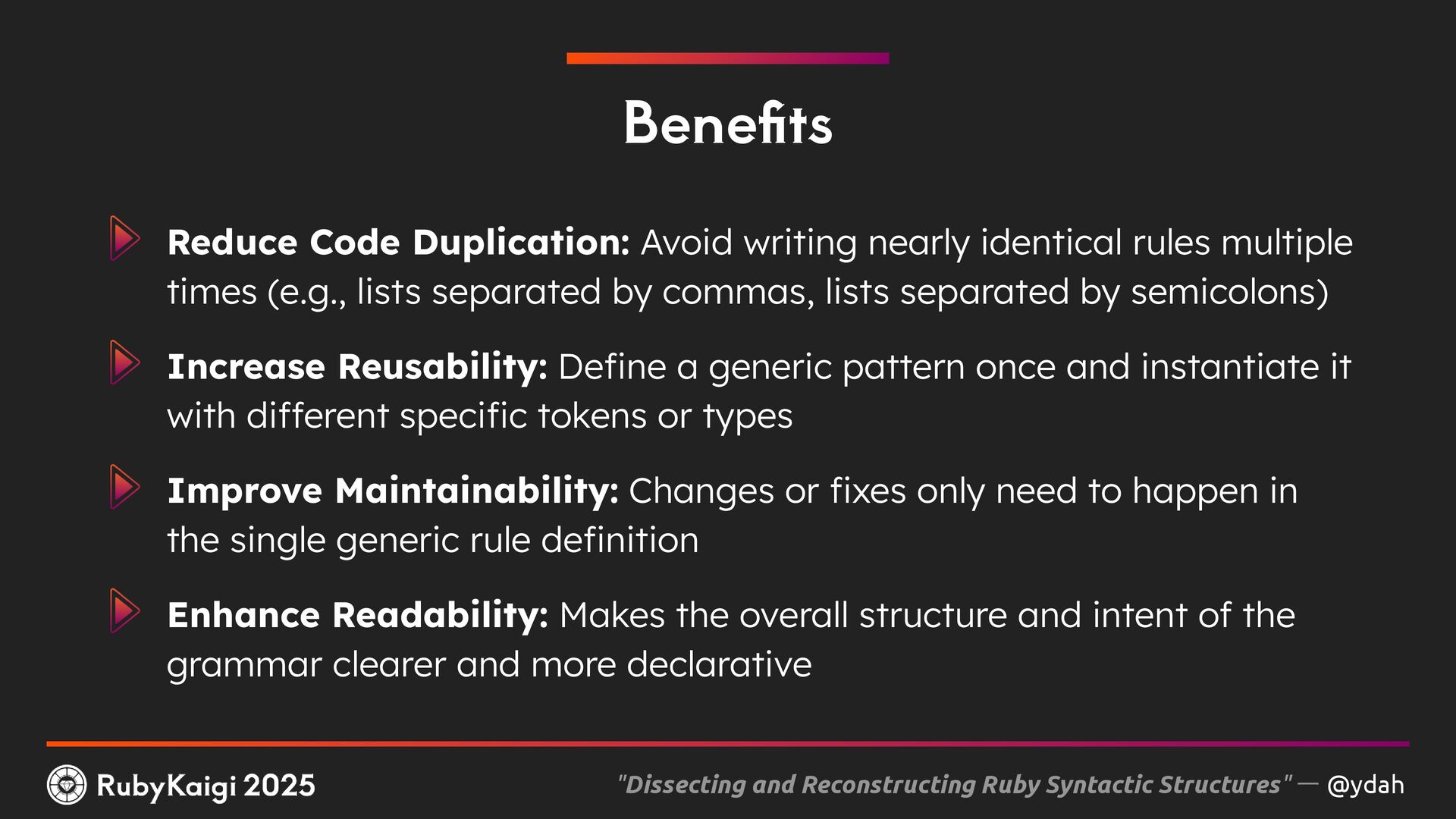
"Dissecting and Reconstructing Ruby Syntactic Structures" ʔ @ydah Bene fi
ts Reduce Code Duplication: Avoid writing nearly identical rules multiple times (e.g., lists separated by commas, lists separated by semicolons) Increase Reusability: De fi ne a generic pattern once and instantiate it with di ff erent speci fi c tokens or types Improve Maintainability: Changes or fi xes only need to happen in the single generic rule de fi nition Enhance Readability: Makes the overall structure and intent of the grammar clearer and more declarative -
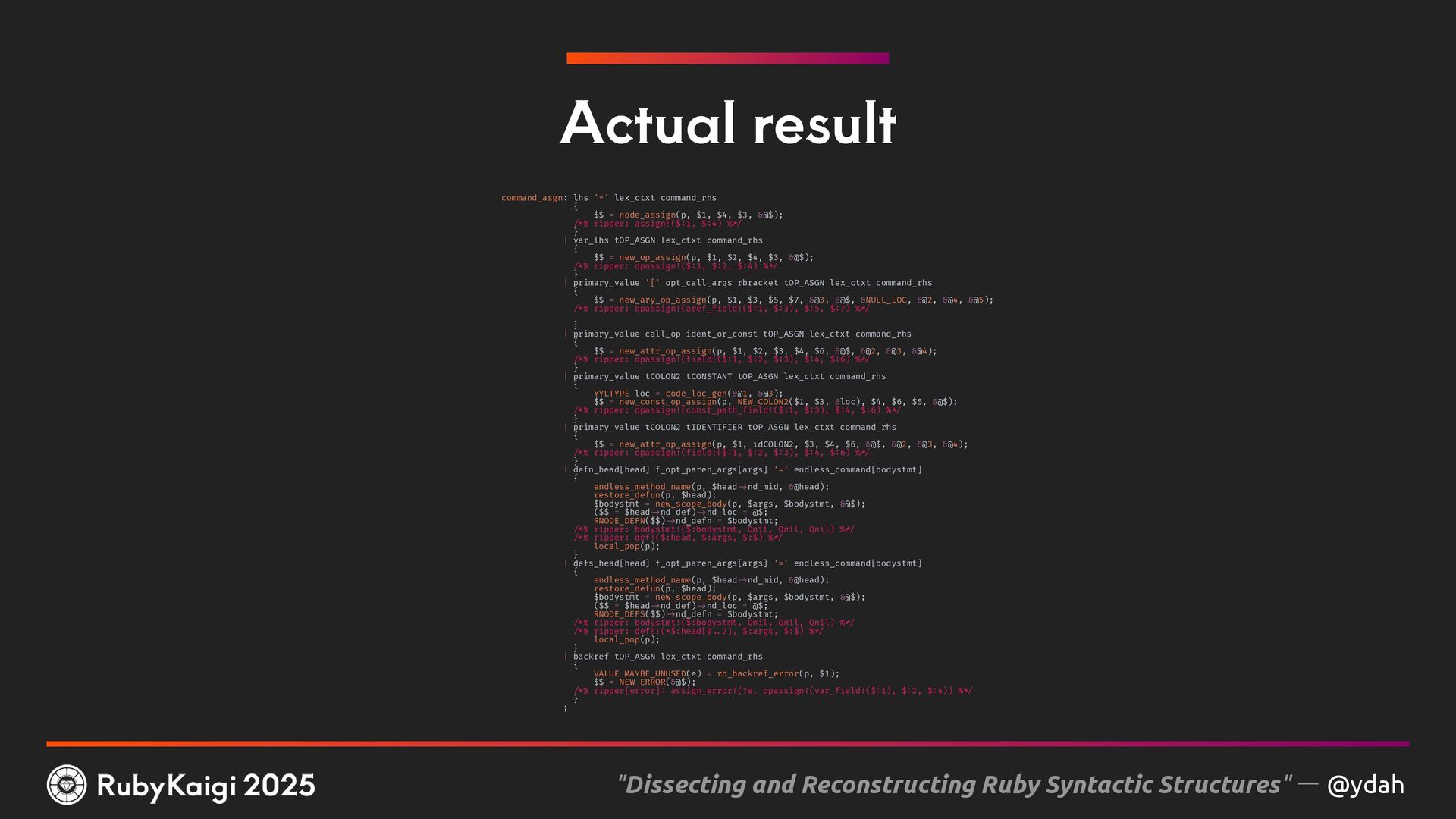
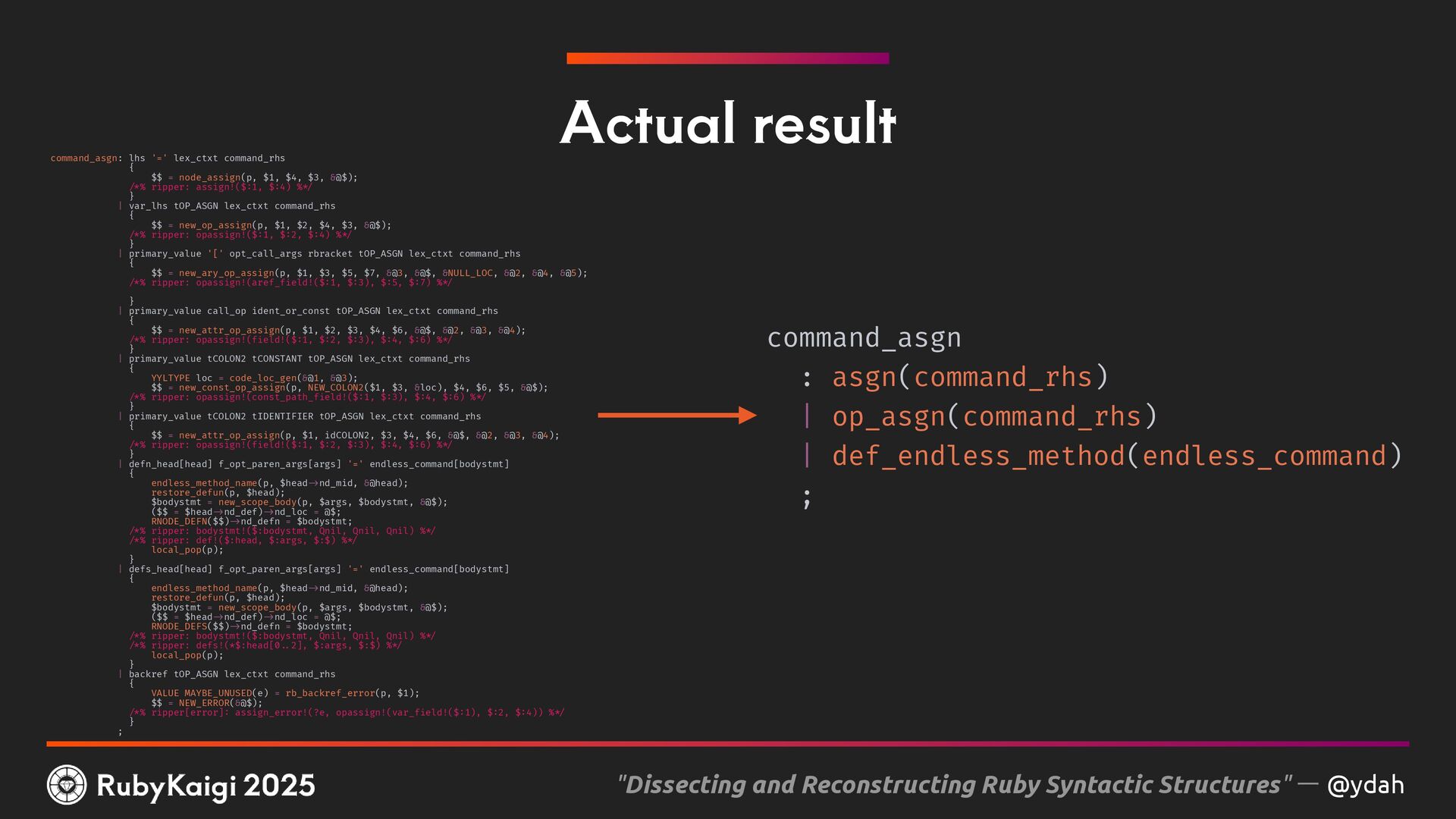
"Dissecting and Reconstructing Ruby Syntactic Structures" ʔ @ydah Actual result
command_asgn: lhs '=' lex_ctxt command_rhs { $$ = node_assign(p, $1, $4, $3, &@$); / * % ripper: assign!($ : 1, $ : 4) % * / } | var_lhs tOP_ASGN lex_ctxt command_rhs { $$ = new_op_assign(p, $1, $2, $4, $3, &@$); / * % ripper: opassign!($ : 1, $ : 2, $ : 4) % * / } | primary_value '[' opt_call_args rbracket tOP_ASGN lex_ctxt command_rhs { $$ = new_ary_op_assign(p, $1, $3, $5, $7, &@3, &@$, &NULL_LOC, &@2, &@4, &@5); / * % ripper: opassign!(aref_f i eld!($ : 1, $ : 3), $ : 5, $ : 7) % * / } | primary_value call_op ident_or_const tOP_ASGN lex_ctxt command_rhs { $$ = new_attr_op_assign(p, $1, $2, $3, $4, $6, &@$, &@2, &@3, &@4); / * % ripper: opassign!(f i eld!($ : 1, $ : 2, $ : 3), $ : 4, $ : 6) % * / } | primary_value tCOLON2 tCONSTANT tOP_ASGN lex_ctxt command_rhs { YYLTYPE loc = code_loc_gen(&@1, &@3); $$ = new_const_op_assign(p, NEW_COLON2($1, $3, &loc), $4, $6, $5, &@$); / * % ripper: opassign!(const_path_f i eld!($ : 1, $ : 3), $ : 4, $ : 6) % * / } | primary_value tCOLON2 tIDENTIFIER tOP_ASGN lex_ctxt command_rhs { $$ = new_attr_op_assign(p, $1, idCOLON2, $3, $4, $6, &@$, &@2, &@3, &@4); / * % ripper: opassign!(f i eld!($ : 1, $ : 2, $ : 3), $ : 4, $ : 6) % * / } | defn_head[head] f_opt_paren_args[args] '=' endless_command[bodystmt] { endless_method_name(p, $head - > nd_mid, &@head); restore_defun(p, $head); $bodystmt = new_scope_body(p, $args, $bodystmt, &@$); ($$ = $head - > nd_def) - > nd_loc = @$; RNODE_DEFN($$) - > nd_defn = $bodystmt; / * % ripper: bodystmt!($:bodystmt, Qnil, Qnil, Qnil) % * / / * % ripper: def!($:head, $:args, $:$) % * / local_pop(p); } | defs_head[head] f_opt_paren_args[args] '=' endless_command[bodystmt] { endless_method_name(p, $head - > nd_mid, &@head); restore_defun(p, $head); $bodystmt = new_scope_body(p, $args, $bodystmt, &@$); ($$ = $head - > nd_def) - > nd_loc = @$; RNODE_DEFS($$) - > nd_defn = $bodystmt; / * % ripper: bodystmt!($:bodystmt, Qnil, Qnil, Qnil) % * / / * % ripper: defs!(*$:head[0 . . 2], $:args, $:$) % * / local_pop(p); } | backref tOP_ASGN lex_ctxt command_rhs { VALUE MAYBE_UNUSED(e) = rb_backref_error(p, $1); $$ = NEW_ERROR(&@$); / * % ripper[error] : assign_error!(?e, opassign!(var_f i eld!($ : 1), $ : 2, $ : 4)) % * / } ; -
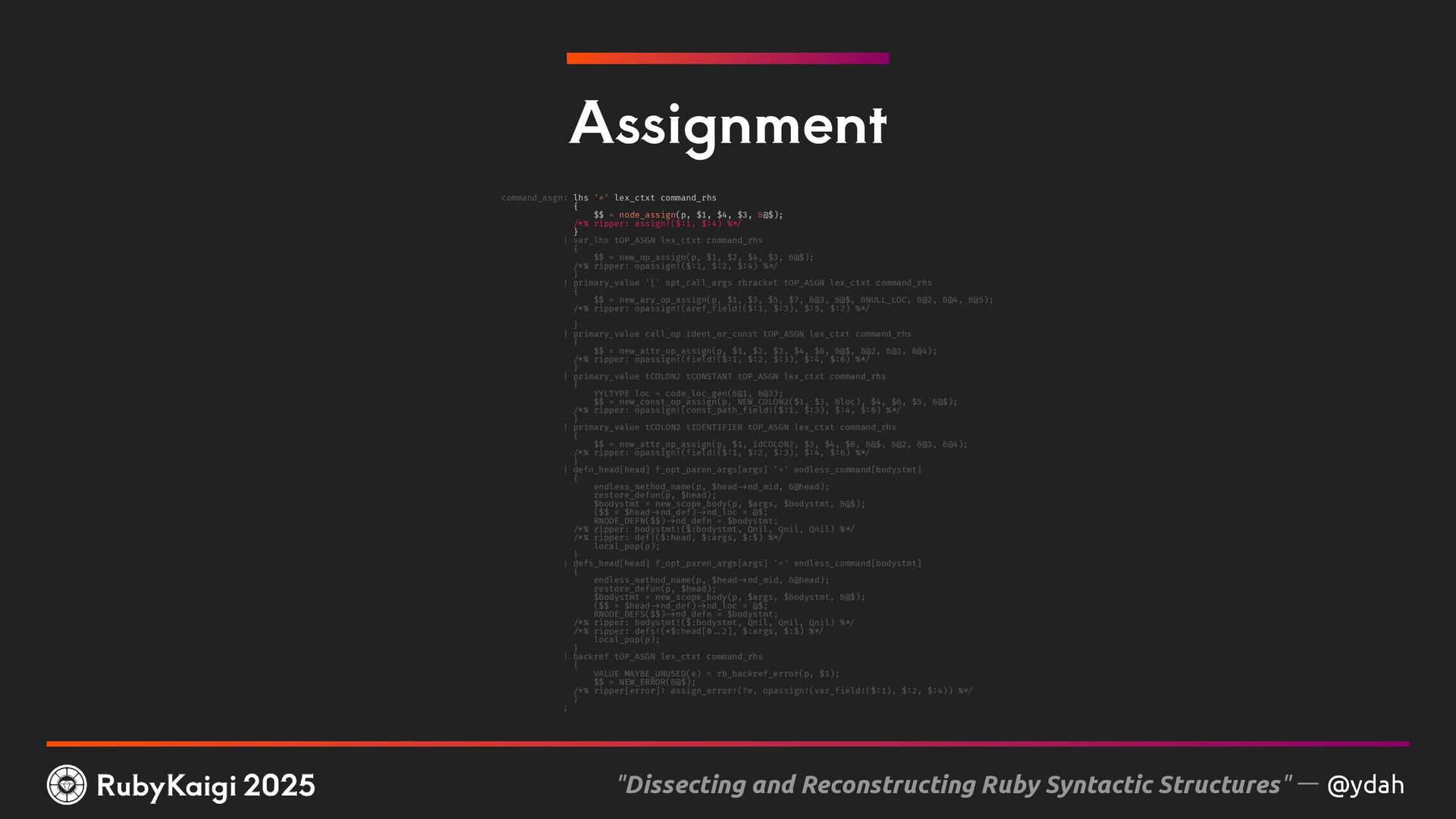
"Dissecting and Reconstructing Ruby Syntactic Structures" ʔ @ydah Assignment command_asgn:
lhs '=' lex_ctxt command_rhs { $$ = node_assign(p, $1, $4, $3, &@$); / * % ripper: assign!($ : 1, $ : 4) % * / } | var_lhs tOP_ASGN lex_ctxt command_rhs { $$ = new_op_assign(p, $1, $2, $4, $3, &@$); / * % ripper: opassign!($ : 1, $ : 2, $ : 4) % * / } | primary_value '[' opt_call_args rbracket tOP_ASGN lex_ctxt command_rhs { $$ = new_ary_op_assign(p, $1, $3, $5, $7, &@3, &@$, &NULL_LOC, &@2, &@4, &@5); / * % ripper: opassign!(aref_f i eld!($ : 1, $ : 3), $ : 5, $ : 7) % * / } | primary_value call_op ident_or_const tOP_ASGN lex_ctxt command_rhs { $$ = new_attr_op_assign(p, $1, $2, $3, $4, $6, &@$, &@2, &@3, &@4); / * % ripper: opassign!(f i eld!($ : 1, $ : 2, $ : 3), $ : 4, $ : 6) % * / } | primary_value tCOLON2 tCONSTANT tOP_ASGN lex_ctxt command_rhs { YYLTYPE loc = code_loc_gen(&@1, &@3); $$ = new_const_op_assign(p, NEW_COLON2($1, $3, &loc), $4, $6, $5, &@$); / * % ripper: opassign!(const_path_f i eld!($ : 1, $ : 3), $ : 4, $ : 6) % * / } | primary_value tCOLON2 tIDENTIFIER tOP_ASGN lex_ctxt command_rhs { $$ = new_attr_op_assign(p, $1, idCOLON2, $3, $4, $6, &@$, &@2, &@3, &@4); / * % ripper: opassign!(f i eld!($ : 1, $ : 2, $ : 3), $ : 4, $ : 6) % * / } | defn_head[head] f_opt_paren_args[args] '=' endless_command[bodystmt] { endless_method_name(p, $head - > nd_mid, &@head); restore_defun(p, $head); $bodystmt = new_scope_body(p, $args, $bodystmt, &@$); ($$ = $head - > nd_def) - > nd_loc = @$; RNODE_DEFN($$) - > nd_defn = $bodystmt; / * % ripper: bodystmt!($:bodystmt, Qnil, Qnil, Qnil) % * / / * % ripper: def!($:head, $:args, $:$) % * / local_pop(p); } | defs_head[head] f_opt_paren_args[args] '=' endless_command[bodystmt] { endless_method_name(p, $head - > nd_mid, &@head); restore_defun(p, $head); $bodystmt = new_scope_body(p, $args, $bodystmt, &@$); ($$ = $head - > nd_def) - > nd_loc = @$; RNODE_DEFS($$) - > nd_defn = $bodystmt; / * % ripper: bodystmt!($:bodystmt, Qnil, Qnil, Qnil) % * / / * % ripper: defs!(*$:head[0 . . 2], $:args, $:$) % * / local_pop(p); } | backref tOP_ASGN lex_ctxt command_rhs { VALUE MAYBE_UNUSED(e) = rb_backref_error(p, $1); $$ = NEW_ERROR(&@$); / * % ripper[error] : assign_error!(?e, opassign!(var_f i eld!($ : 1), $ : 2, $ : 4)) % * / } ; -
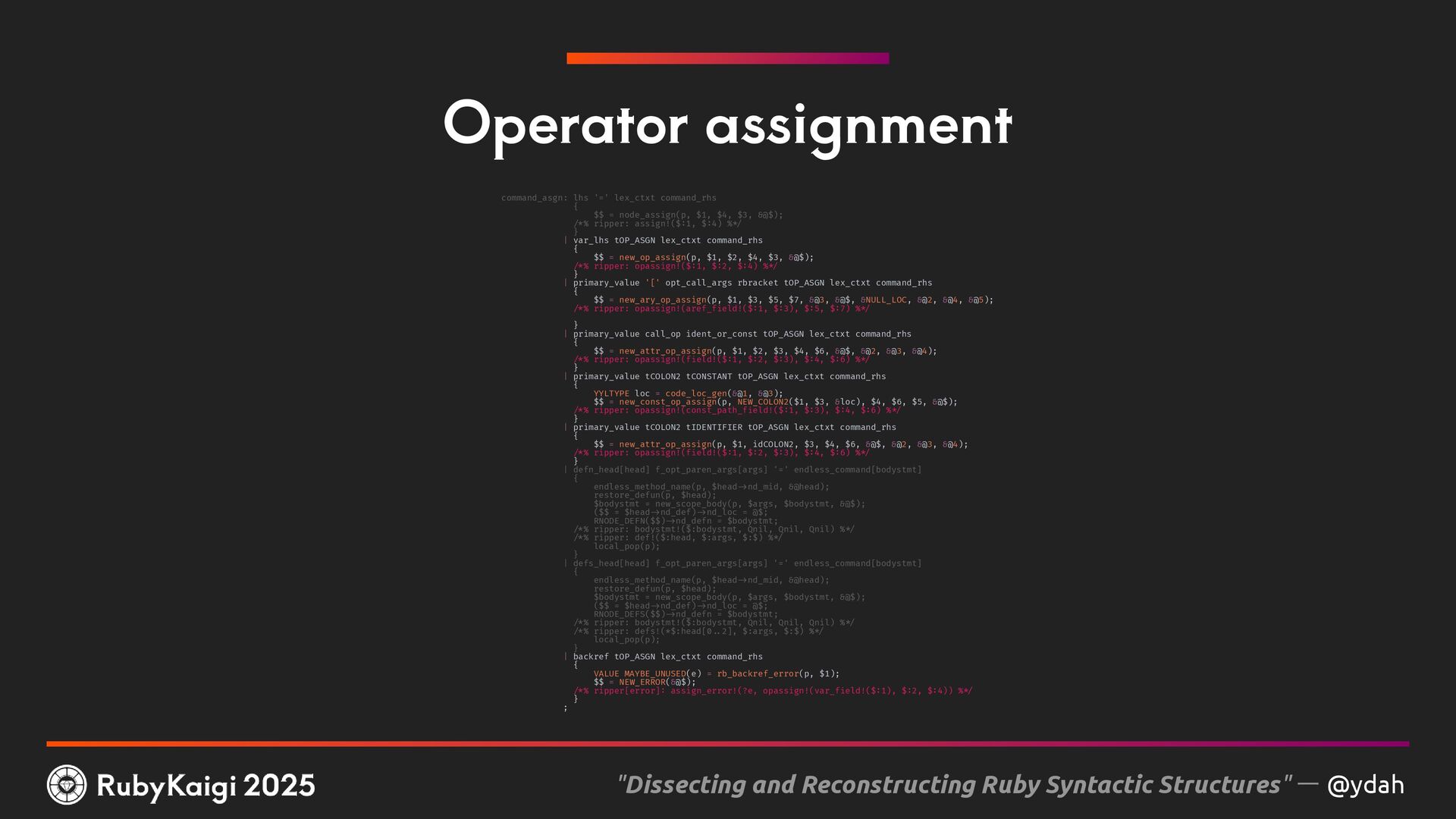
"Dissecting and Reconstructing Ruby Syntactic Structures" ʔ @ydah Operator assignment
command_asgn: lhs '=' lex_ctxt command_rhs { $$ = node_assign(p, $1, $4, $3, &@$); / * % ripper: assign!($ : 1, $ : 4) % * / } | var_lhs tOP_ASGN lex_ctxt command_rhs { $$ = new_op_assign(p, $1, $2, $4, $3, &@$); / * % ripper: opassign!($ : 1, $ : 2, $ : 4) % * / } | primary_value '[' opt_call_args rbracket tOP_ASGN lex_ctxt command_rhs { $$ = new_ary_op_assign(p, $1, $3, $5, $7, &@3, &@$, &NULL_LOC, &@2, &@4, &@5); / * % ripper: opassign!(aref_f i eld!($ : 1, $ : 3), $ : 5, $ : 7) % * / } | primary_value call_op ident_or_const tOP_ASGN lex_ctxt command_rhs { $$ = new_attr_op_assign(p, $1, $2, $3, $4, $6, &@$, &@2, &@3, &@4); / * % ripper: opassign!(f i eld!($ : 1, $ : 2, $ : 3), $ : 4, $ : 6) % * / } | primary_value tCOLON2 tCONSTANT tOP_ASGN lex_ctxt command_rhs { YYLTYPE loc = code_loc_gen(&@1, &@3); $$ = new_const_op_assign(p, NEW_COLON2($1, $3, &loc), $4, $6, $5, &@$); / * % ripper: opassign!(const_path_f i eld!($ : 1, $ : 3), $ : 4, $ : 6) % * / } | primary_value tCOLON2 tIDENTIFIER tOP_ASGN lex_ctxt command_rhs { $$ = new_attr_op_assign(p, $1, idCOLON2, $3, $4, $6, &@$, &@2, &@3, &@4); / * % ripper: opassign!(f i eld!($ : 1, $ : 2, $ : 3), $ : 4, $ : 6) % * / } | defn_head[head] f_opt_paren_args[args] '=' endless_command[bodystmt] { endless_method_name(p, $head - > nd_mid, &@head); restore_defun(p, $head); $bodystmt = new_scope_body(p, $args, $bodystmt, &@$); ($$ = $head - > nd_def) - > nd_loc = @$; RNODE_DEFN($$) - > nd_defn = $bodystmt; / * % ripper: bodystmt!($:bodystmt, Qnil, Qnil, Qnil) % * / / * % ripper: def!($:head, $:args, $:$) % * / local_pop(p); } | defs_head[head] f_opt_paren_args[args] '=' endless_command[bodystmt] { endless_method_name(p, $head - > nd_mid, &@head); restore_defun(p, $head); $bodystmt = new_scope_body(p, $args, $bodystmt, &@$); ($$ = $head - > nd_def) - > nd_loc = @$; RNODE_DEFS($$) - > nd_defn = $bodystmt; / * % ripper: bodystmt!($:bodystmt, Qnil, Qnil, Qnil) % * / / * % ripper: defs!(*$:head[0 . . 2], $:args, $:$) % * / local_pop(p); } | backref tOP_ASGN lex_ctxt command_rhs { VALUE MAYBE_UNUSED(e) = rb_backref_error(p, $1); $$ = NEW_ERROR(&@$); / * % ripper[error] : assign_error!(?e, opassign!(var_f i eld!($ : 1), $ : 2, $ : 4)) % * / } ; -
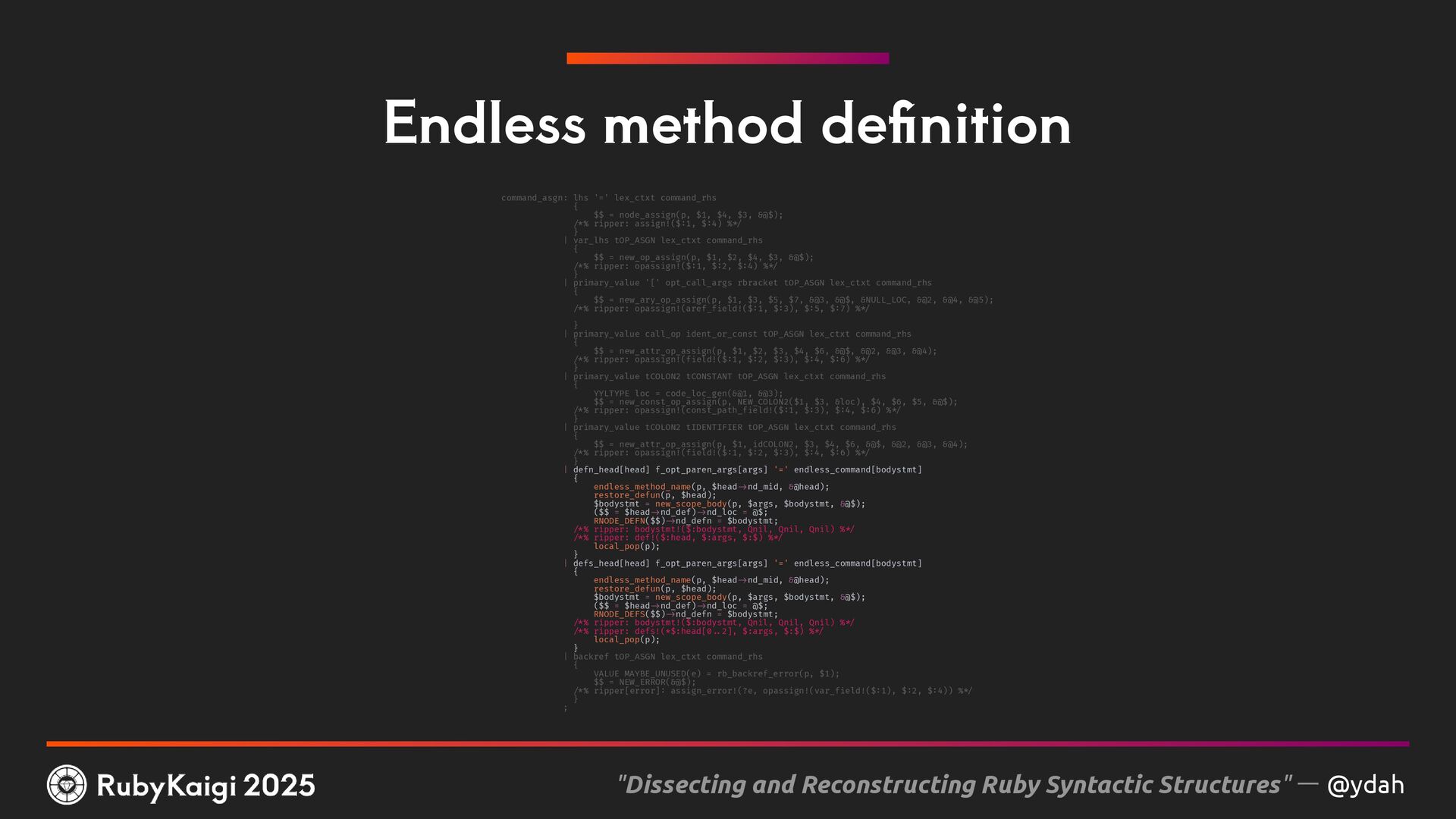
"Dissecting and Reconstructing Ruby Syntactic Structures" ʔ @ydah Endless method
de fi nition command_asgn: lhs '=' lex_ctxt command_rhs { $$ = node_assign(p, $1, $4, $3, &@$); / * % ripper: assign!($ : 1, $ : 4) % * / } | var_lhs tOP_ASGN lex_ctxt command_rhs { $$ = new_op_assign(p, $1, $2, $4, $3, &@$); / * % ripper: opassign!($ : 1, $ : 2, $ : 4) % * / } | primary_value '[' opt_call_args rbracket tOP_ASGN lex_ctxt command_rhs { $$ = new_ary_op_assign(p, $1, $3, $5, $7, &@3, &@$, &NULL_LOC, &@2, &@4, &@5); / * % ripper: opassign!(aref_f i eld!($ : 1, $ : 3), $ : 5, $ : 7) % * / } | primary_value call_op ident_or_const tOP_ASGN lex_ctxt command_rhs { $$ = new_attr_op_assign(p, $1, $2, $3, $4, $6, &@$, &@2, &@3, &@4); / * % ripper: opassign!(f i eld!($ : 1, $ : 2, $ : 3), $ : 4, $ : 6) % * / } | primary_value tCOLON2 tCONSTANT tOP_ASGN lex_ctxt command_rhs { YYLTYPE loc = code_loc_gen(&@1, &@3); $$ = new_const_op_assign(p, NEW_COLON2($1, $3, &loc), $4, $6, $5, &@$); / * % ripper: opassign!(const_path_f i eld!($ : 1, $ : 3), $ : 4, $ : 6) % * / } | primary_value tCOLON2 tIDENTIFIER tOP_ASGN lex_ctxt command_rhs { $$ = new_attr_op_assign(p, $1, idCOLON2, $3, $4, $6, &@$, &@2, &@3, &@4); / * % ripper: opassign!(f i eld!($ : 1, $ : 2, $ : 3), $ : 4, $ : 6) % * / } | defn_head[head] f_opt_paren_args[args] '=' endless_command[bodystmt] { endless_method_name(p, $head - > nd_mid, &@head); restore_defun(p, $head); $bodystmt = new_scope_body(p, $args, $bodystmt, &@$); ($$ = $head - > nd_def) - > nd_loc = @$; RNODE_DEFN($$) - > nd_defn = $bodystmt; / * % ripper: bodystmt!($:bodystmt, Qnil, Qnil, Qnil) % * / / * % ripper: def!($:head, $:args, $:$) % * / local_pop(p); } | defs_head[head] f_opt_paren_args[args] '=' endless_command[bodystmt] { endless_method_name(p, $head - > nd_mid, &@head); restore_defun(p, $head); $bodystmt = new_scope_body(p, $args, $bodystmt, &@$); ($$ = $head - > nd_def) - > nd_loc = @$; RNODE_DEFS($$) - > nd_defn = $bodystmt; / * % ripper: bodystmt!($:bodystmt, Qnil, Qnil, Qnil) % * / / * % ripper: defs!(*$:head[0 . . 2], $:args, $:$) % * / local_pop(p); } | backref tOP_ASGN lex_ctxt command_rhs { VALUE MAYBE_UNUSED(e) = rb_backref_error(p, $1); $$ = NEW_ERROR(&@$); / * % ripper[error] : assign_error!(?e, opassign!(var_f i eld!($ : 1), $ : 2, $ : 4)) % * / } ; -
"Dissecting and Reconstructing Ruby Syntactic Structures" ʔ @ydah Actual result
command_asgn : asgn(command_rhs) | op_asgn(command_rhs) | def_endless_method(endless_command) ; command_asgn: lhs '=' lex_ctxt command_rhs { $$ = node_assign(p, $1, $4, $3, &@$); / * % ripper: assign!($ : 1, $ : 4) % * / } | var_lhs tOP_ASGN lex_ctxt command_rhs { $$ = new_op_assign(p, $1, $2, $4, $3, &@$); / * % ripper: opassign!($ : 1, $ : 2, $ : 4) % * / } | primary_value '[' opt_call_args rbracket tOP_ASGN lex_ctxt command_rhs { $$ = new_ary_op_assign(p, $1, $3, $5, $7, &@3, &@$, &NULL_LOC, &@2, &@4, &@5); / * % ripper: opassign!(aref_f i eld!($ : 1, $ : 3), $ : 5, $ : 7) % * / } | primary_value call_op ident_or_const tOP_ASGN lex_ctxt command_rhs { $$ = new_attr_op_assign(p, $1, $2, $3, $4, $6, &@$, &@2, &@3, &@4); / * % ripper: opassign!(f i eld!($ : 1, $ : 2, $ : 3), $ : 4, $ : 6) % * / } | primary_value tCOLON2 tCONSTANT tOP_ASGN lex_ctxt command_rhs { YYLTYPE loc = code_loc_gen(&@1, &@3); $$ = new_const_op_assign(p, NEW_COLON2($1, $3, &loc), $4, $6, $5, &@$); / * % ripper: opassign!(const_path_f i eld!($ : 1, $ : 3), $ : 4, $ : 6) % * / } | primary_value tCOLON2 tIDENTIFIER tOP_ASGN lex_ctxt command_rhs { $$ = new_attr_op_assign(p, $1, idCOLON2, $3, $4, $6, &@$, &@2, &@3, &@4); / * % ripper: opassign!(f i eld!($ : 1, $ : 2, $ : 3), $ : 4, $ : 6) % * / } | defn_head[head] f_opt_paren_args[args] '=' endless_command[bodystmt] { endless_method_name(p, $head - > nd_mid, &@head); restore_defun(p, $head); $bodystmt = new_scope_body(p, $args, $bodystmt, &@$); ($$ = $head - > nd_def) - > nd_loc = @$; RNODE_DEFN($$) - > nd_defn = $bodystmt; / * % ripper: bodystmt!($:bodystmt, Qnil, Qnil, Qnil) % * / / * % ripper: def!($:head, $:args, $:$) % * / local_pop(p); } | defs_head[head] f_opt_paren_args[args] '=' endless_command[bodystmt] { endless_method_name(p, $head - > nd_mid, &@head); restore_defun(p, $head); $bodystmt = new_scope_body(p, $args, $bodystmt, &@$); ($$ = $head - > nd_def) - > nd_loc = @$; RNODE_DEFS($$) - > nd_defn = $bodystmt; / * % ripper: bodystmt!($:bodystmt, Qnil, Qnil, Qnil) % * / / * % ripper: defs!(*$:head[0 . . 2], $:args, $:$) % * / local_pop(p); } | backref tOP_ASGN lex_ctxt command_rhs { VALUE MAYBE_UNUSED(e) = rb_backref_error(p, $1); $$ = NEW_ERROR(&@$); / * % ripper[error] : assign_error!(?e, opassign!(var_f i eld!($ : 1), $ : 2, $ : 4)) % * / } ; -
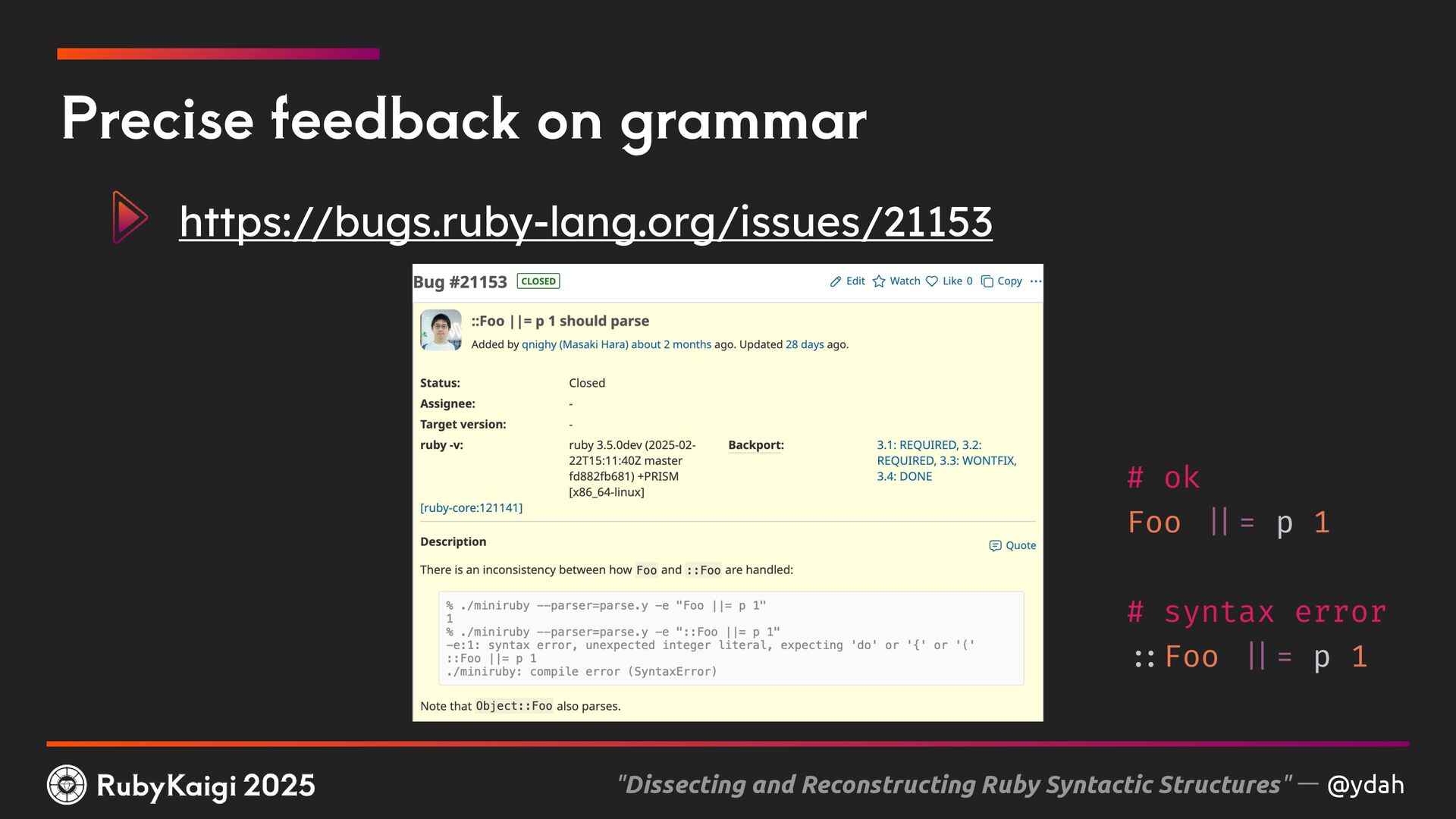
"Dissecting and Reconstructing Ruby Syntactic Structures" ʔ @ydah https://bugs.ruby-lang.org/issues/21153 Precise
feedback on grammar # ok Foo | | = p 1 # syntax error : : Foo | | = p 1 -
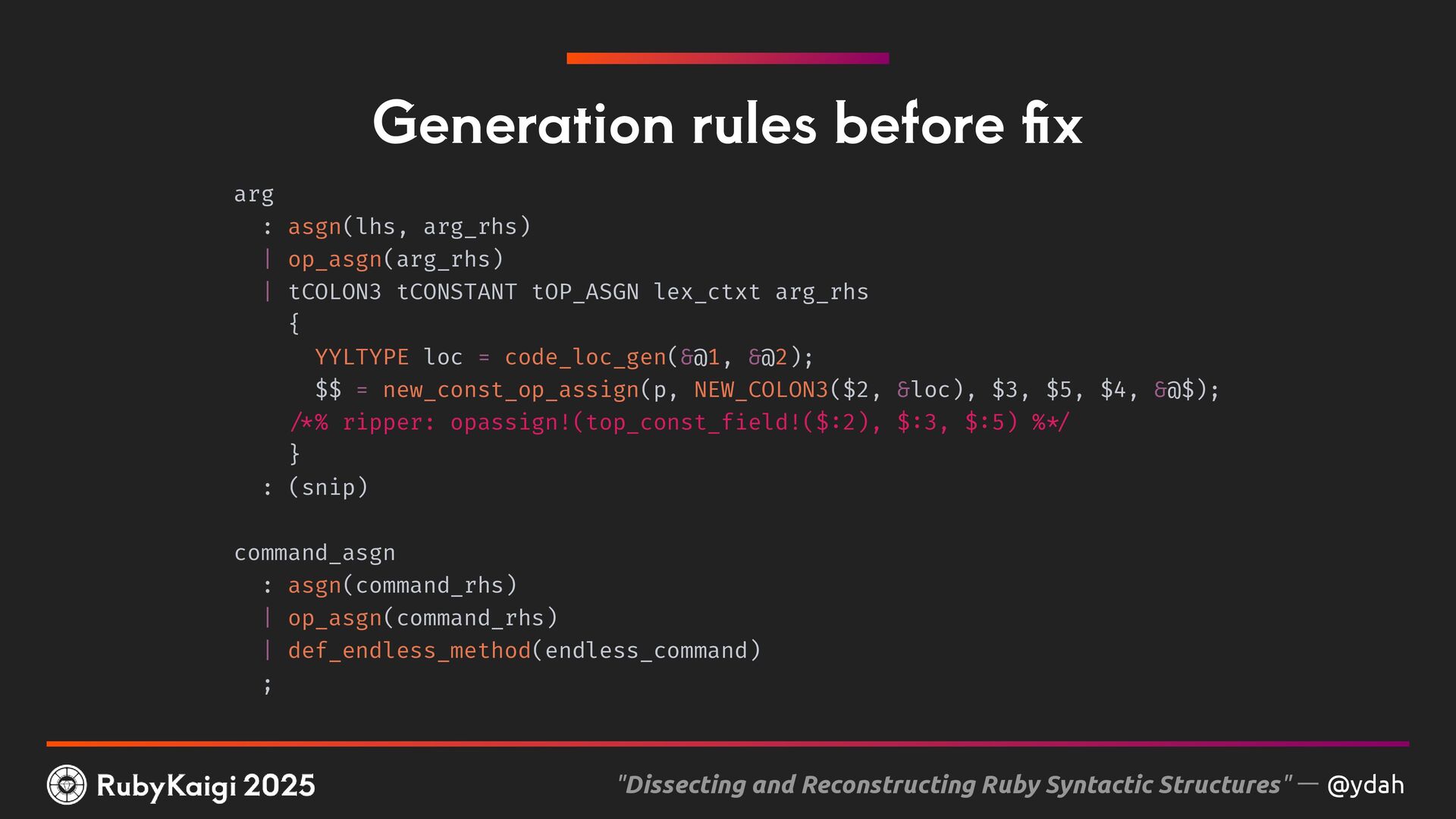
"Dissecting and Reconstructing Ruby Syntactic Structures" ʔ @ydah Generation rules
before fi x arg : asgn(lhs, arg_rhs) | op_asgn(arg_rhs) | tCOLON3 tCONSTANT tOP_ASGN lex_ctxt arg_rhs { YYLTYPE loc = code_loc_gen(&@1, &@2); $$ = new_const_op_assign(p, NEW_COLON3($2, &loc), $3, $5, $4, &@$); / * % ripper: opassign!(top_const_f i eld!($ : 2), $ : 3, $ : 5) % * / } : (snip) command_asgn : asgn(command_rhs) | op_asgn(command_rhs) | def_endless_method(endless_command) ; -
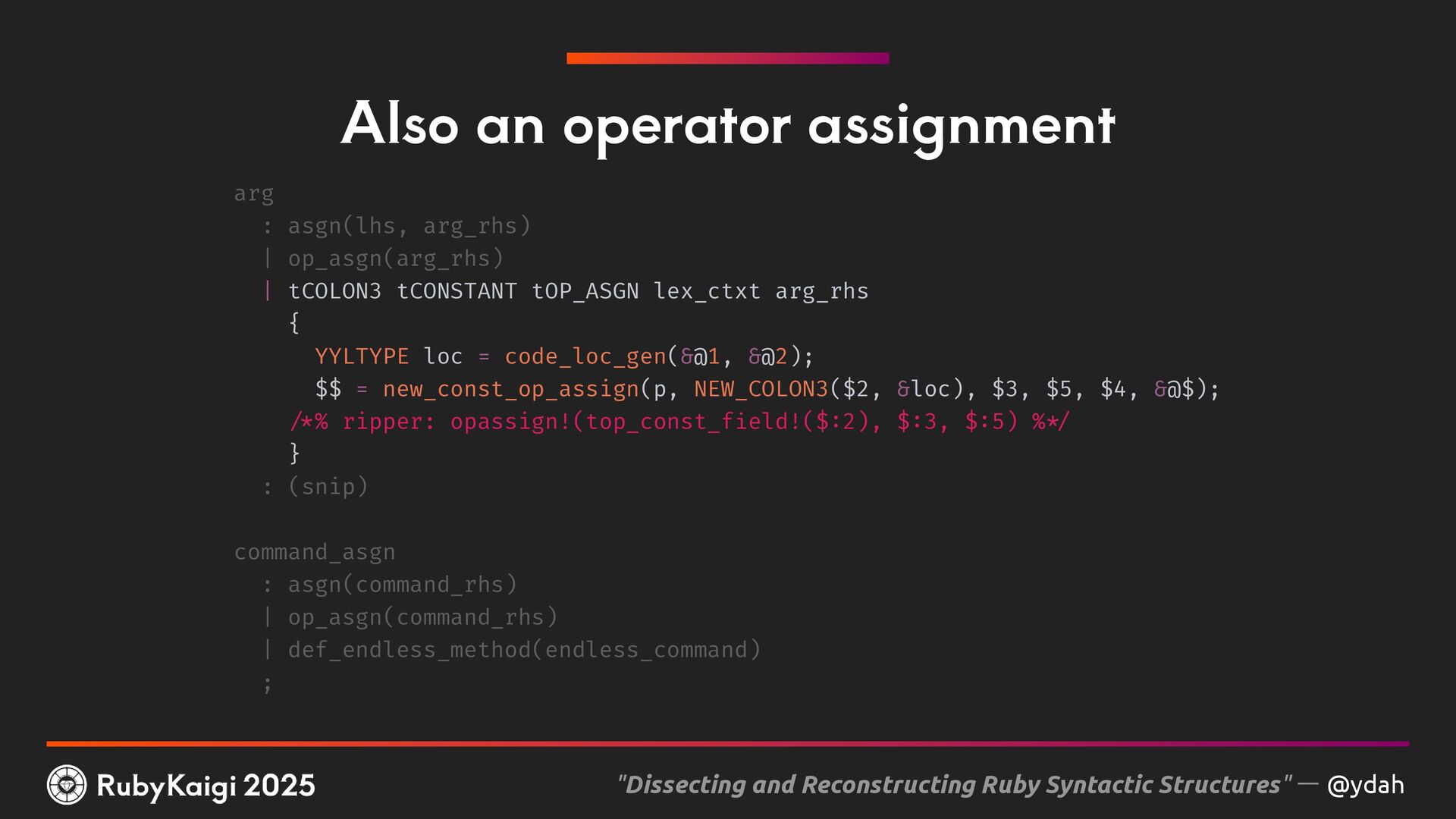
"Dissecting and Reconstructing Ruby Syntactic Structures" ʔ @ydah Also an
operator assignment arg : asgn(lhs, arg_rhs) | op_asgn(arg_rhs) | tCOLON3 tCONSTANT tOP_ASGN lex_ctxt arg_rhs { YYLTYPE loc = code_loc_gen(&@1, &@2); $$ = new_const_op_assign(p, NEW_COLON3($2, &loc), $3, $5, $4, &@$); / * % ripper: opassign!(top_const_f i eld!($ : 2), $ : 3, $ : 5) % * / } : (snip) command_asgn : asgn(command_rhs) | op_asgn(command_rhs) | def_endless_method(endless_command) ; -
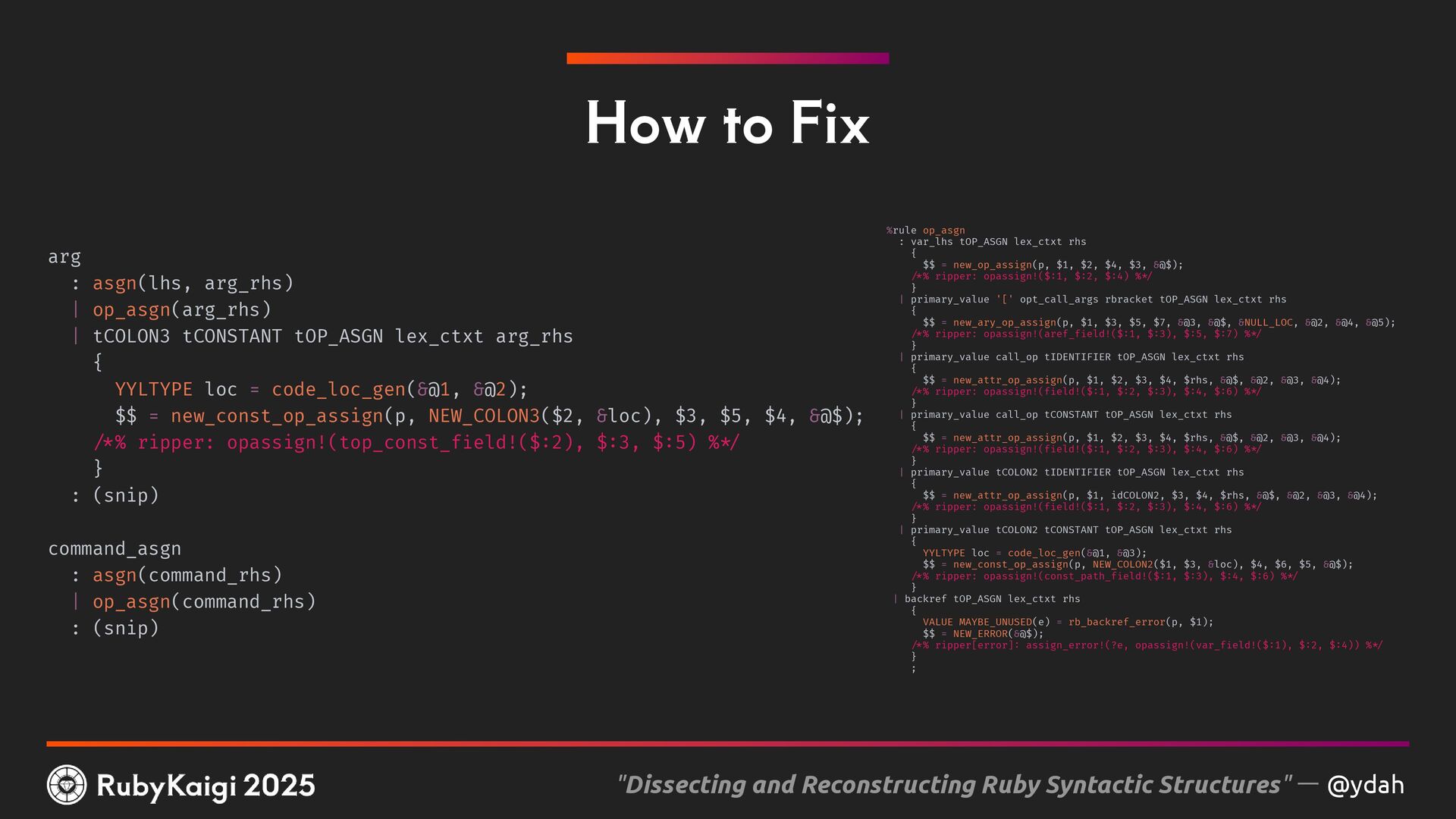
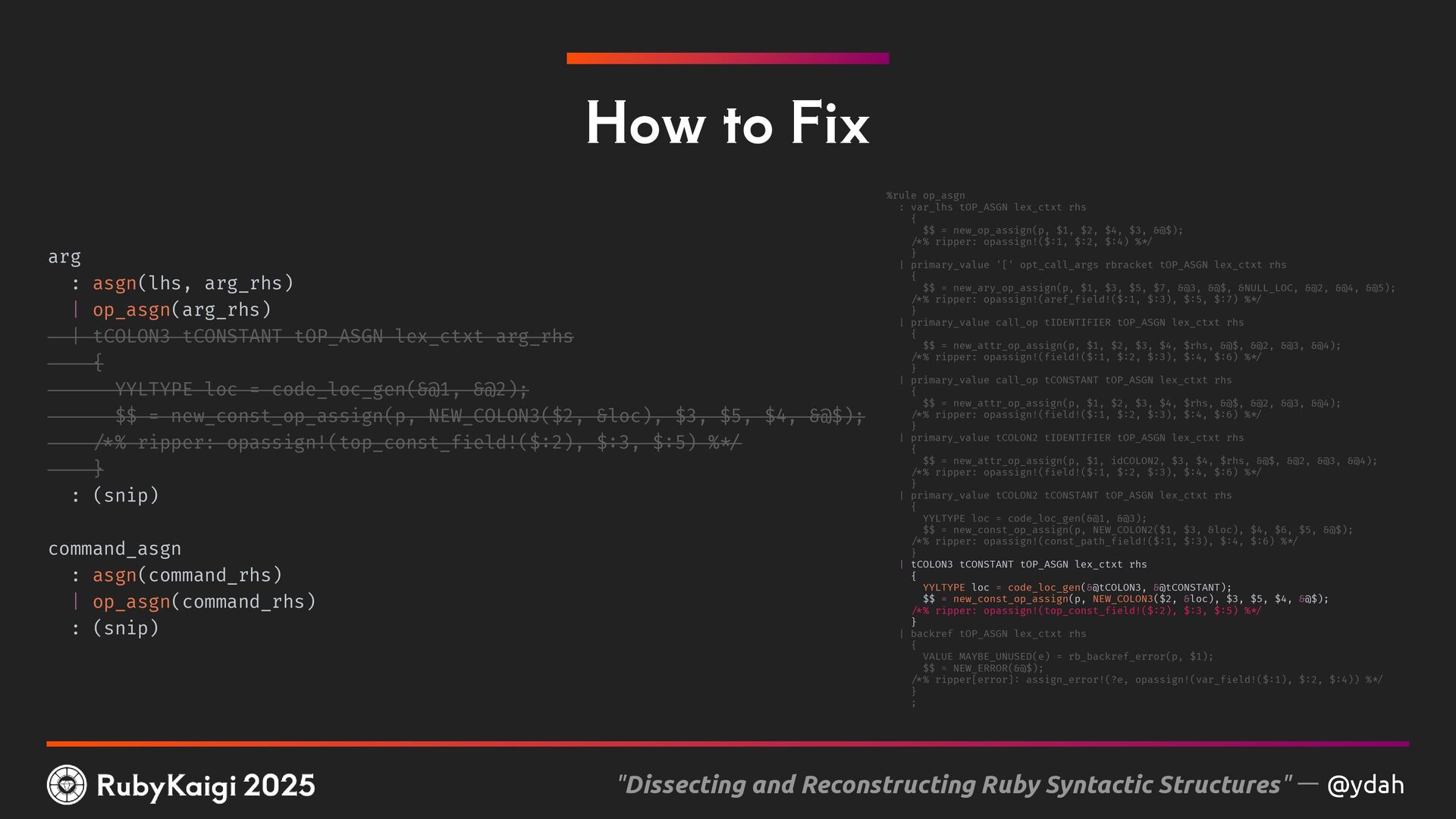
"Dissecting and Reconstructing Ruby Syntactic Structures" ʔ @ydah How to
Fix %rule op_asgn : var_lhs tOP_ASGN lex_ctxt rhs { $$ = new_op_assign(p, $1, $2, $4, $3, &@$); / * % ripper: opassign!($ : 1, $ : 2, $ : 4) % * / } | primary_value '[' opt_call_args rbracket tOP_ASGN lex_ctxt rhs { $$ = new_ary_op_assign(p, $1, $3, $5, $7, &@3, &@$, &NULL_LOC, &@2, &@4, &@5); / * % ripper: opassign!(aref_f i eld!($ : 1, $ : 3), $ : 5, $ : 7) % * / } | primary_value call_op tIDENTIFIER tOP_ASGN lex_ctxt rhs { $$ = new_attr_op_assign(p, $1, $2, $3, $4, $rhs, &@$, &@2, &@3, &@4); / * % ripper: opassign!(f i eld!($ : 1, $ : 2, $ : 3), $ : 4, $ : 6) % * / } | primary_value call_op tCONSTANT tOP_ASGN lex_ctxt rhs { $$ = new_attr_op_assign(p, $1, $2, $3, $4, $rhs, &@$, &@2, &@3, &@4); / * % ripper: opassign!(f i eld!($ : 1, $ : 2, $ : 3), $ : 4, $ : 6) % * / } | primary_value tCOLON2 tIDENTIFIER tOP_ASGN lex_ctxt rhs { $$ = new_attr_op_assign(p, $1, idCOLON2, $3, $4, $rhs, &@$, &@2, &@3, &@4); / * % ripper: opassign!(f i eld!($ : 1, $ : 2, $ : 3), $ : 4, $ : 6) % * / } | primary_value tCOLON2 tCONSTANT tOP_ASGN lex_ctxt rhs { YYLTYPE loc = code_loc_gen(&@1, &@3); $$ = new_const_op_assign(p, NEW_COLON2($1, $3, &loc), $4, $6, $5, &@$); / * % ripper: opassign!(const_path_f i eld!($ : 1, $ : 3), $ : 4, $ : 6) % * / } | backref tOP_ASGN lex_ctxt rhs { VALUE MAYBE_UNUSED(e) = rb_backref_error(p, $1); $$ = NEW_ERROR(&@$); / * % ripper[error] : assign_error!(?e, opassign!(var_f i eld!($ : 1), $ : 2, $ : 4)) % * / } ; arg : asgn(lhs, arg_rhs) | op_asgn(arg_rhs) | tCOLON3 tCONSTANT tOP_ASGN lex_ctxt arg_rhs { YYLTYPE loc = code_loc_gen(&@1, &@2); $$ = new_const_op_assign(p, NEW_COLON3($2, &loc), $3, $5, $4, &@$); / * % ripper: opassign!(top_const_f i eld!($ : 2), $ : 3, $ : 5) % * / } : (snip) command_asgn : asgn(command_rhs) | op_asgn(command_rhs) : (snip) -
"Dissecting and Reconstructing Ruby Syntactic Structures" ʔ @ydah How to
Fix %rule op_asgn : var_lhs tOP_ASGN lex_ctxt rhs { $$ = new_op_assign(p, $1, $2, $4, $3, &@$); / * % ripper: opassign!($ : 1, $ : 2, $ : 4) % * / } | primary_value '[' opt_call_args rbracket tOP_ASGN lex_ctxt rhs { $$ = new_ary_op_assign(p, $1, $3, $5, $7, &@3, &@$, &NULL_LOC, &@2, &@4, &@5); / * % ripper: opassign!(aref_f i eld!($ : 1, $ : 3), $ : 5, $ : 7) % * / } | primary_value call_op tIDENTIFIER tOP_ASGN lex_ctxt rhs { $$ = new_attr_op_assign(p, $1, $2, $3, $4, $rhs, &@$, &@2, &@3, &@4); / * % ripper: opassign!(f i eld!($ : 1, $ : 2, $ : 3), $ : 4, $ : 6) % * / } | primary_value call_op tCONSTANT tOP_ASGN lex_ctxt rhs { $$ = new_attr_op_assign(p, $1, $2, $3, $4, $rhs, &@$, &@2, &@3, &@4); / * % ripper: opassign!(f i eld!($ : 1, $ : 2, $ : 3), $ : 4, $ : 6) % * / } | primary_value tCOLON2 tIDENTIFIER tOP_ASGN lex_ctxt rhs { $$ = new_attr_op_assign(p, $1, idCOLON2, $3, $4, $rhs, &@$, &@2, &@3, &@4); / * % ripper: opassign!(f i eld!($ : 1, $ : 2, $ : 3), $ : 4, $ : 6) % * / } | primary_value tCOLON2 tCONSTANT tOP_ASGN lex_ctxt rhs { YYLTYPE loc = code_loc_gen(&@1, &@3); $$ = new_const_op_assign(p, NEW_COLON2($1, $3, &loc), $4, $6, $5, &@$); / * % ripper: opassign!(const_path_f i eld!($ : 1, $ : 3), $ : 4, $ : 6) % * / } | tCOLON3 tCONSTANT tOP_ASGN lex_ctxt rhs { YYLTYPE loc = code_loc_gen(&@tCOLON3, &@tCONSTANT); $$ = new_const_op_assign(p, NEW_COLON3($2, &loc), $3, $5, $4, &@$); / * % ripper: opassign!(top_const_f i eld!($ : 2), $ : 3, $ : 5) % * / } | backref tOP_ASGN lex_ctxt rhs { VALUE MAYBE_UNUSED(e) = rb_backref_error(p, $1); $$ = NEW_ERROR(&@$); / * % ripper[error] : assign_error!(?e, opassign!(var_f i eld!($ : 1), $ : 2, $ : 4)) % * / } ; arg : asgn(lhs, arg_rhs) | op_asgn(arg_rhs) | tCOLON3 tCONSTANT tOP_ASGN lex_ctxt arg_rhs { YYLTYPE loc = code_loc_gen(&@1, &@2); $$ = new_const_op_assign(p, NEW_COLON3($2, &loc), $3, $5, $4, &@$); / * % ripper: opassign!(top_const_f i eld!($ : 2), $ : 3, $ : 5) % * / } : (snip) command_asgn : asgn(command_rhs) | op_asgn(command_rhs) : (snip) -
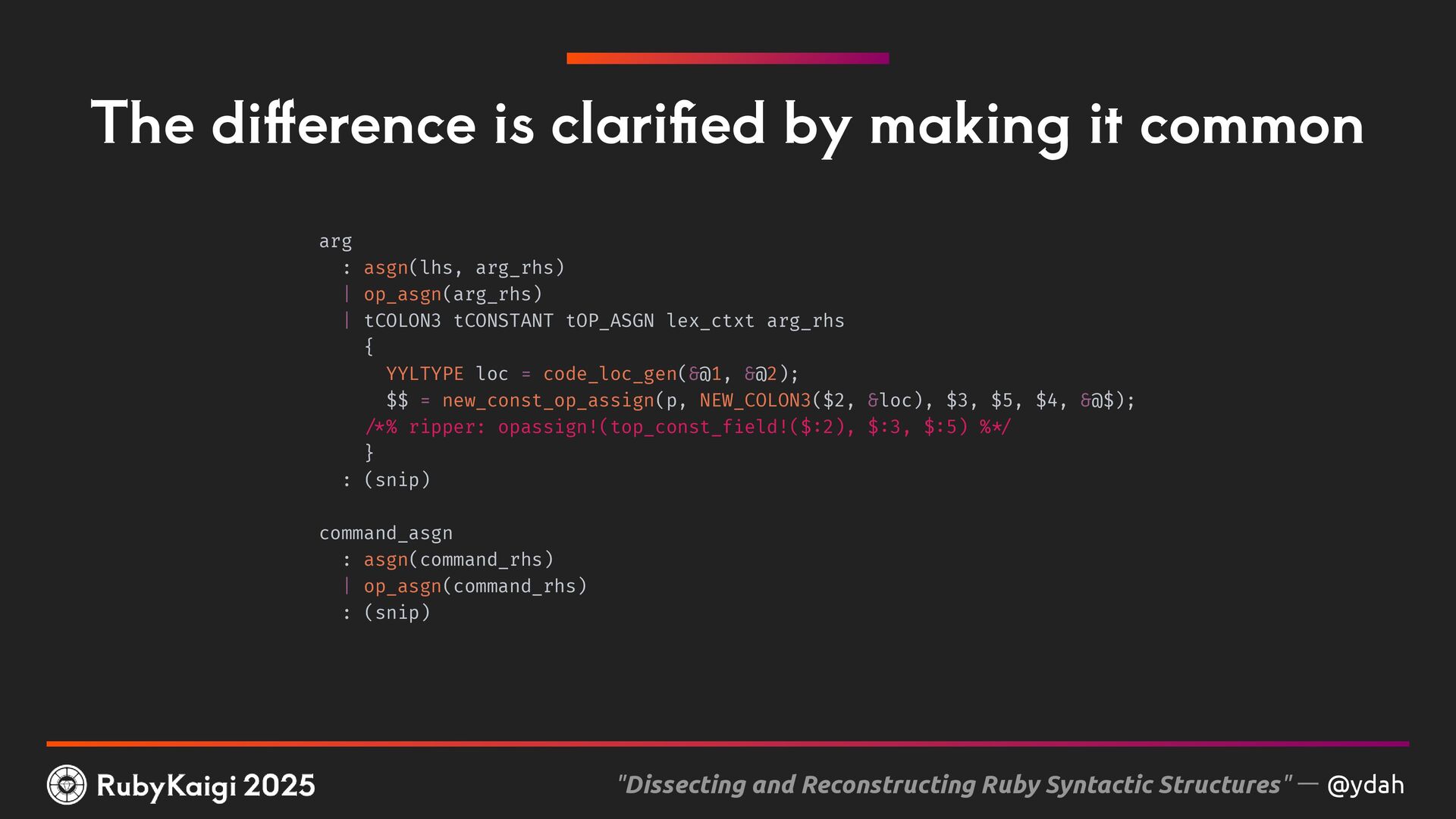
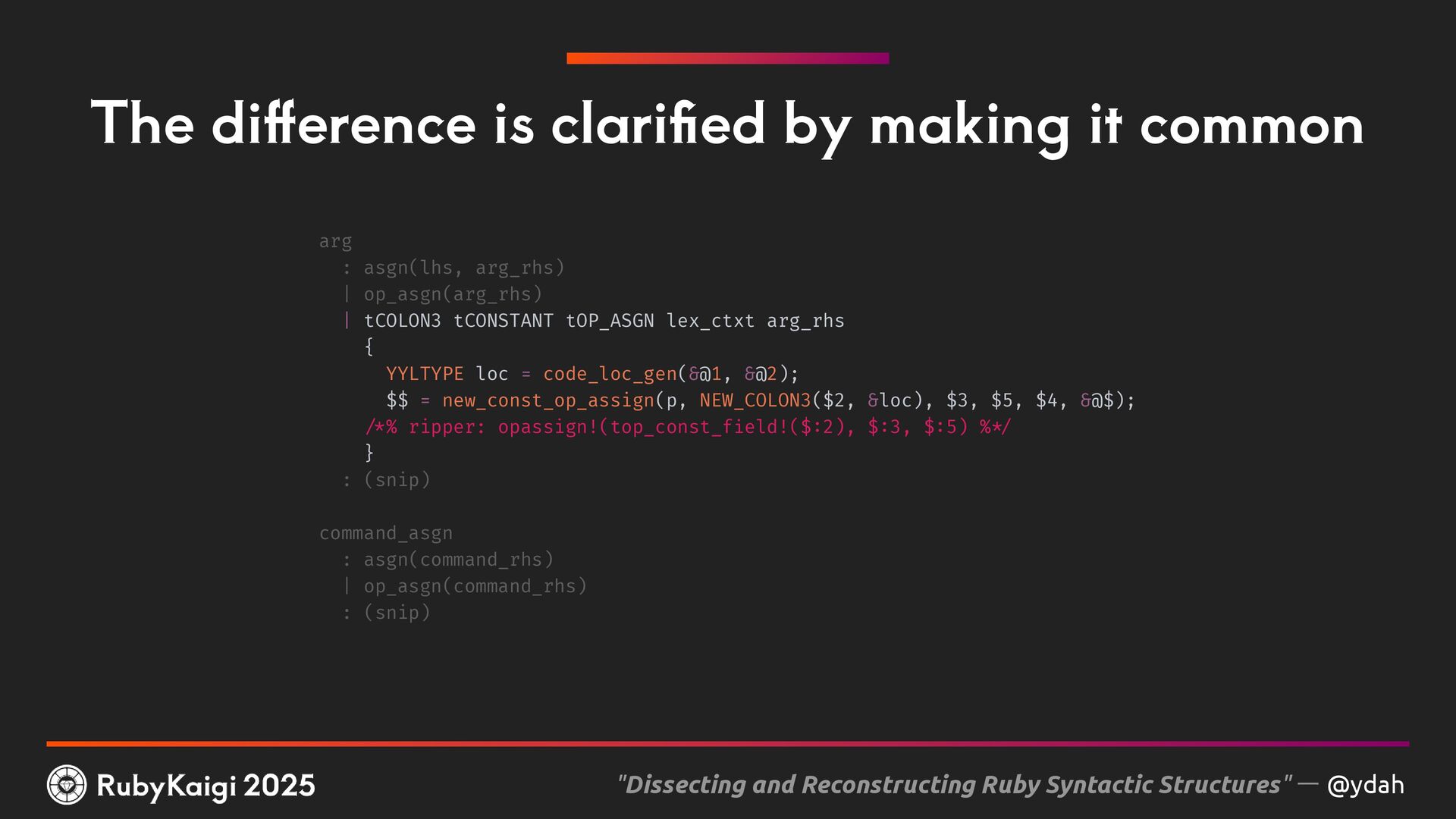
"Dissecting and Reconstructing Ruby Syntactic Structures" ʔ @ydah The di
ff erence is clari fi ed by making it common arg : asgn(lhs, arg_rhs) | op_asgn(arg_rhs) | tCOLON3 tCONSTANT tOP_ASGN lex_ctxt arg_rhs { YYLTYPE loc = code_loc_gen(&@1, &@2); $$ = new_const_op_assign(p, NEW_COLON3($2, &loc), $3, $5, $4, &@$); / * % ripper: opassign!(top_const_f i eld!($ : 2), $ : 3, $ : 5) % * / } : (snip) command_asgn : asgn(command_rhs) | op_asgn(command_rhs) : (snip) -
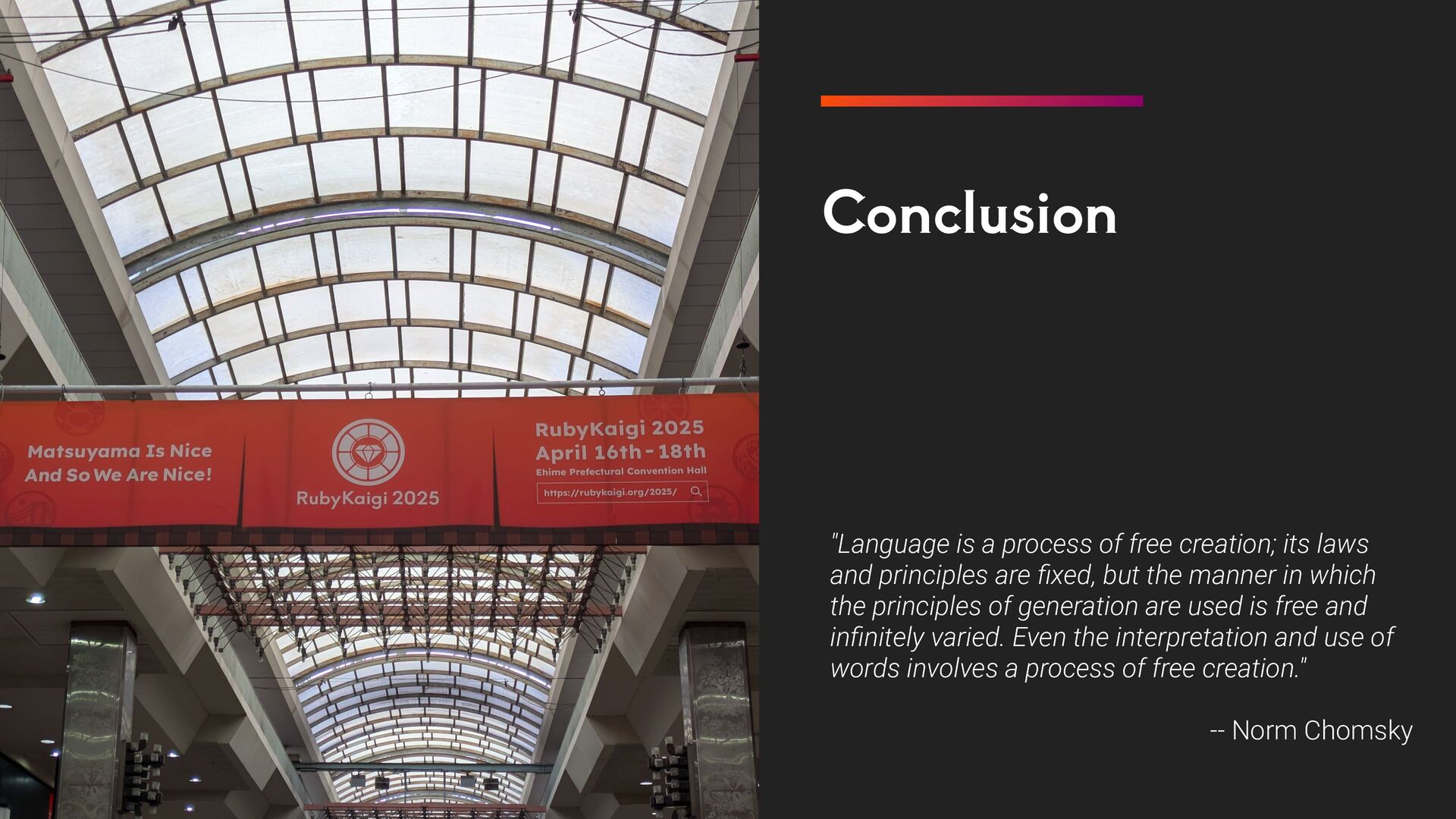
Conclusion "Language is a process of free creation; its laws
and principles are fi xed, but the manner in which the principles of generation are used is free and in fi nitely varied. Even the interpretation and use of words involves a process of free creation." -- Norm Chomsky -
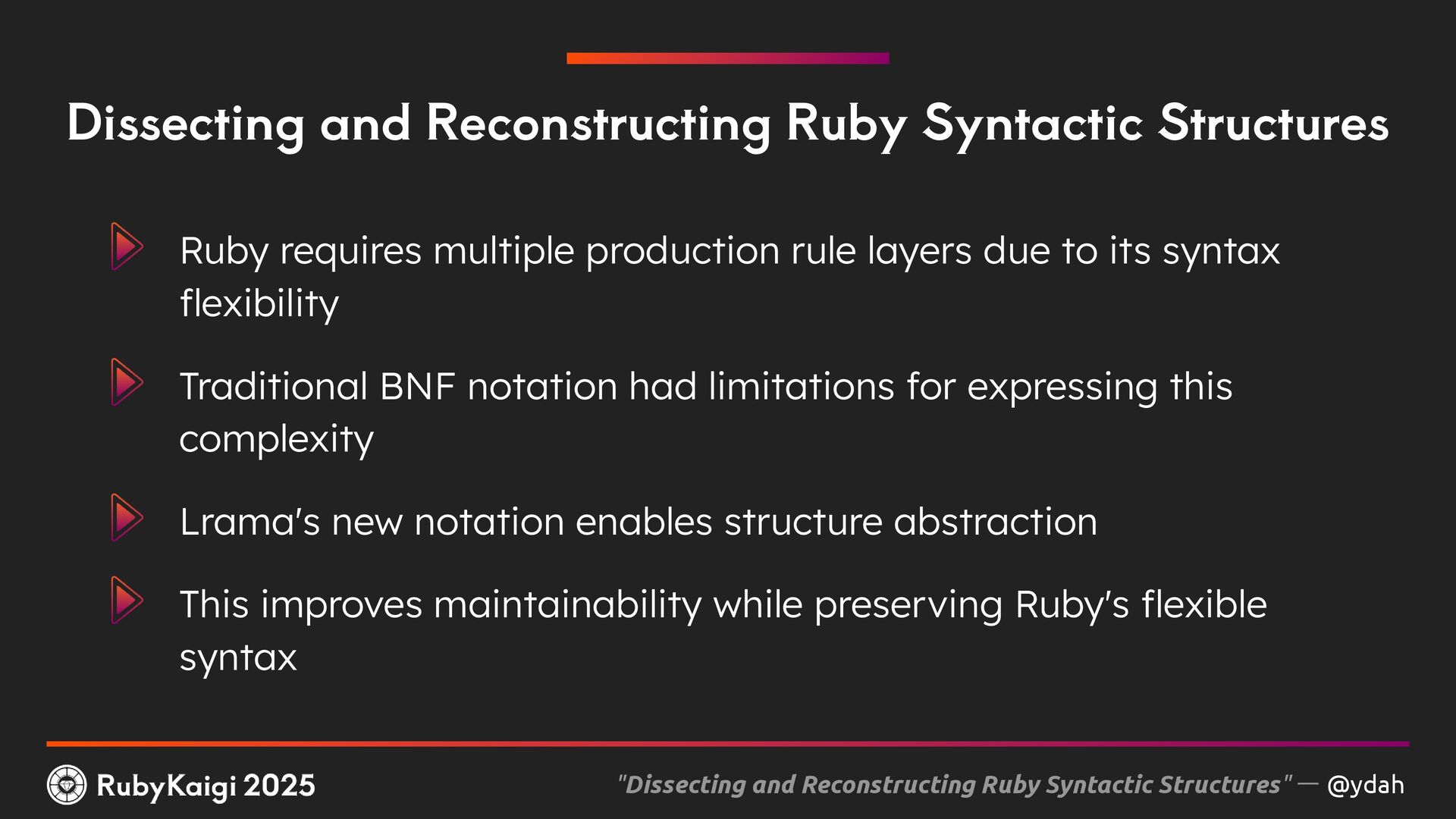
"Dissecting and Reconstructing Ruby Syntactic Structures" ʔ @ydah Dissecting and
Reconstructing Ruby Syntactic Structures Ruby requires multiple production rule layers due to its syntax fl exibility Traditional BNF notation had limitations for expressing this complexity Lrama's new notation enables structure abstraction This improves maintainability while preserving Ruby's fl exible syntax -
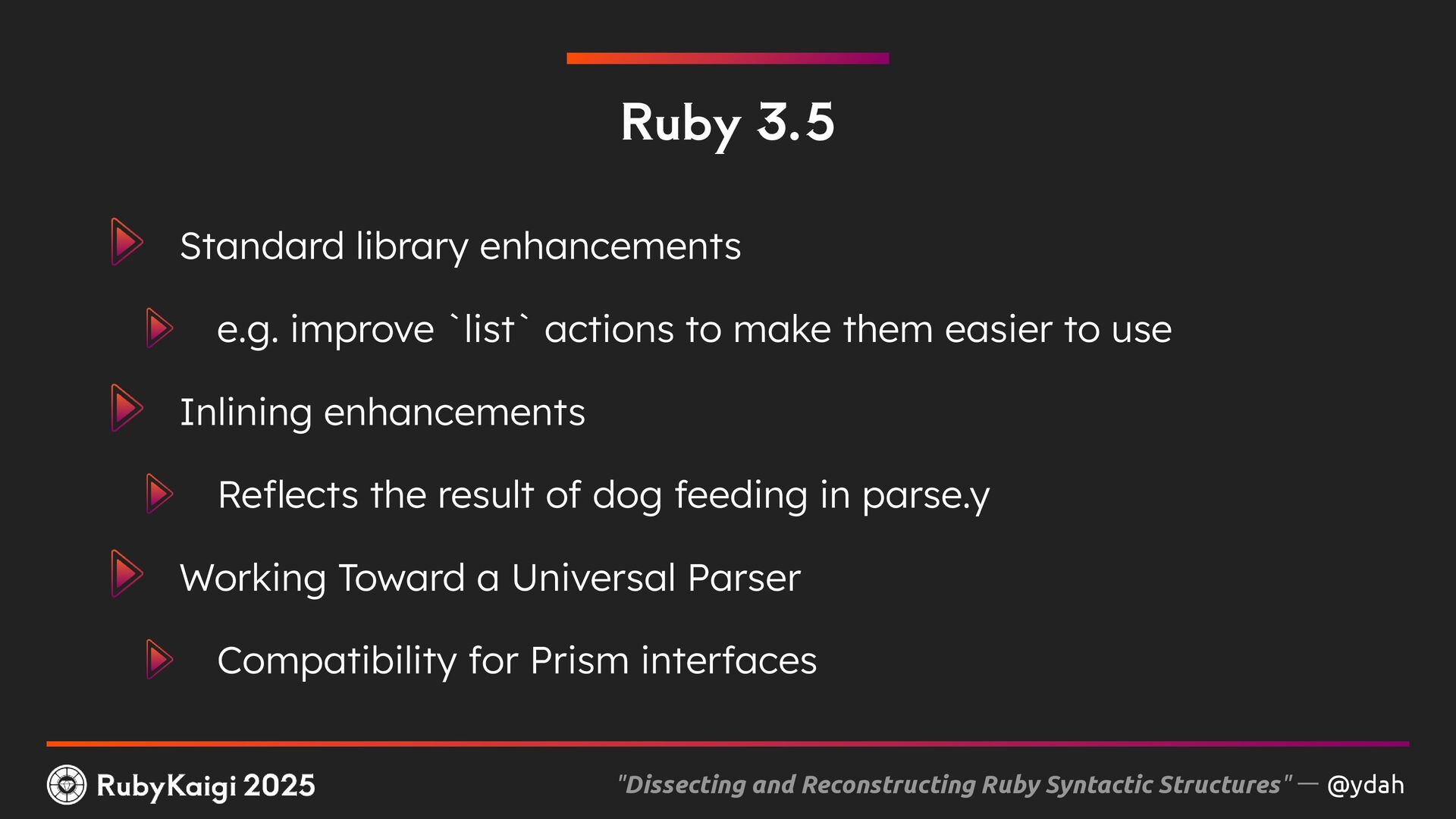
"Dissecting and Reconstructing Ruby Syntactic Structures" ʔ @ydah Ruby 3.5
Standard library enhancements e.g. improve `list` actions to make them easier to use Inlining enhancements Re fl ects the result of dog feeding in parse.y Working Toward a Universal Parser Compatibility for Prism interfaces -
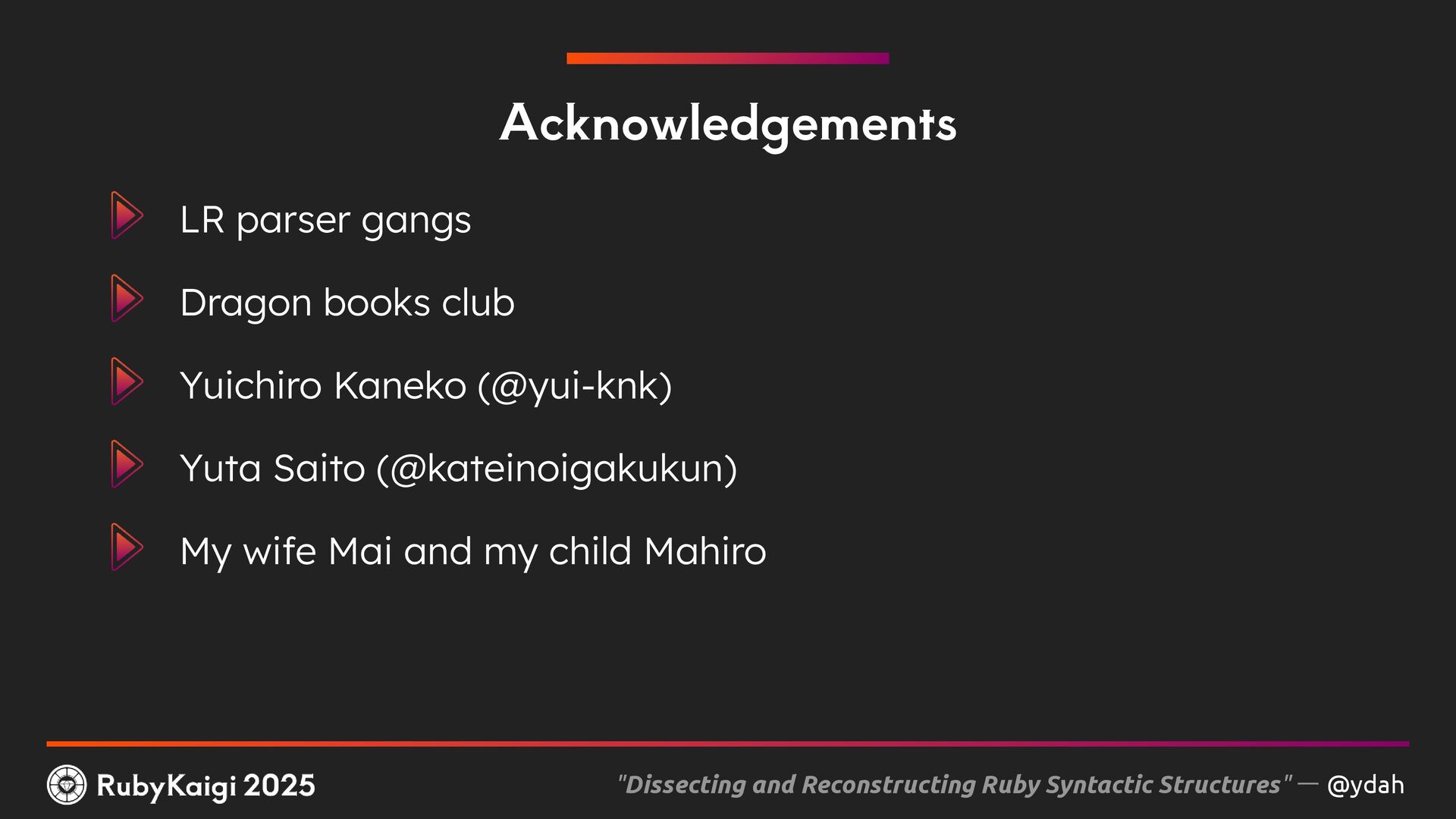
"Dissecting and Reconstructing Ruby Syntactic Structures" ʔ @ydah Acknowledgements LR
parser gangs Dragon books club Yuichiro Kaneko (@yui-knk) Yuta Saito (@kateinoigakukun) My wife Mai and my child Mahiro -
"Dissecting and Reconstructing Ruby Syntactic Structures" ʔ @ydah Stargaze at
github.com/ruby/lrama 96
 ydah
 nnaka2992
 takateeen_knj
 mtaka1222
 ickx
 dayeon
 nasum
 biwakonbu
 a_okui
 manfredsteyer
 izawa
 sodainc
 barnbarn
 jeffersonlam
 philnash
 inesmontani
 cargoodrich
 katarinadahlin
 trishagee
 sabderemane
 csswizardry
 ipullrank
 tammielis
 chriscoyier
 tammyeverts