Upgrade to Pro — share decks privately, control downloads, hide ads and more …

Seedance 2.5 vs MiniMax H3: Which Is Worth Payi...

Avatar for xi yo xi yo
September 30, 2026

Seedance 2.5 vs MiniMax H3: Which Is Worth Paying For? Three Samples Compared

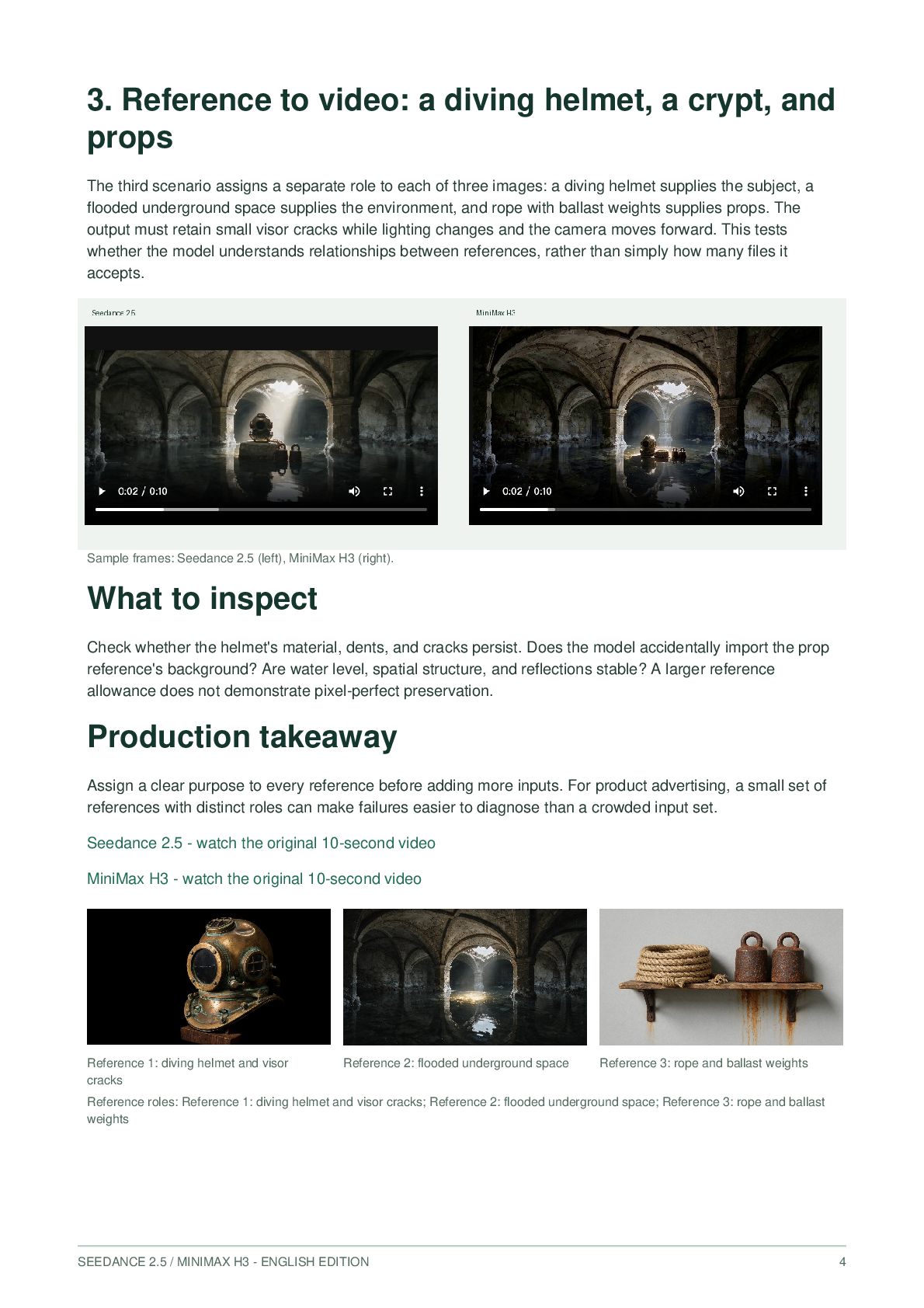
A production-focused comparison of Seedance 2.5 and MiniMax H3 using three public fal sample pairs: a wool coat on a turntable, a rescue swimmer in heavy seas, and a diving helmet assembled from three references. This six-page English PDF includes five reference images, three comparison frames, and clickable original video links. It discusses duration, resolution, reference control, and cost with the source benchmark limitations clearly stated.

Explore Seedance 2.5: https://seedance2-5.co/

Source: https://fal.ai/learn/devs/seedance-2-5-vs-minimax-h3

Avatar for xi yo

xi yo

September 30, 2026

More Decks by xi yo

Other Decks in Technology

Transcript

  1. 2026 / AI VIDEO PRODUCTION Seedance 2.5 vs MiniMax H3:

    Which Is Worth Paying For? Three Samples Compared Choosing an AI video model is now a production decision: how long must a shot last, how many references does it need, and what does a failed attempt cost? Seedance 2.5 and MiniMax H3 offer different combinations. This comparison uses fal's published samples to examine product advertising, complex action, and control with multiple references. How to read these samples This article summarizes fal's public comparison; it is not a separate benchmark that we generated ourselves. Every source sample lasts 10 seconds. Seedance 2.5 uses 1080p, while H3 uses 4K with prompt expansion enabled. Prompts are broadly the same, with reference labels adjusted to each model's syntax. The samples illustrate output differences, but they do not establish a ranking under identical resolution and processing conditions. H3 is the model discussed here; H3 Max requires its own capability and latency tests. Original comparison and media: fal Specifications at a glance Dimension Seedance 2.5 MiniMax H3 Shot duration 4-30 seconds 5-15 seconds Output resolution 480p / 720p / 1080p 480p / 768p; upscaled 2K / 4K Reference limits 30 images, 10 videos, 10 audio files; 50 files total 9 images, 3 videos, 3 audio files; 12 files total Audio and video Joint generation; audio can be disabled Native stereo; the source endpoint exposes no audio-off switch Billing Video tokens Output duration and resolution The specifications below follow the endpoints documented in fal's comparison. H3's 2K and 4K outputs are upscaled from a 768p base result, rather than native 2K. A larger delivery format does not automatically mean more accurate motion or more stable product details. SEEDANCE 2.5 / MINIMAX H3 - ENGLISH EDITION 1
  2. 1. Image to video: a wool coat on a turntable

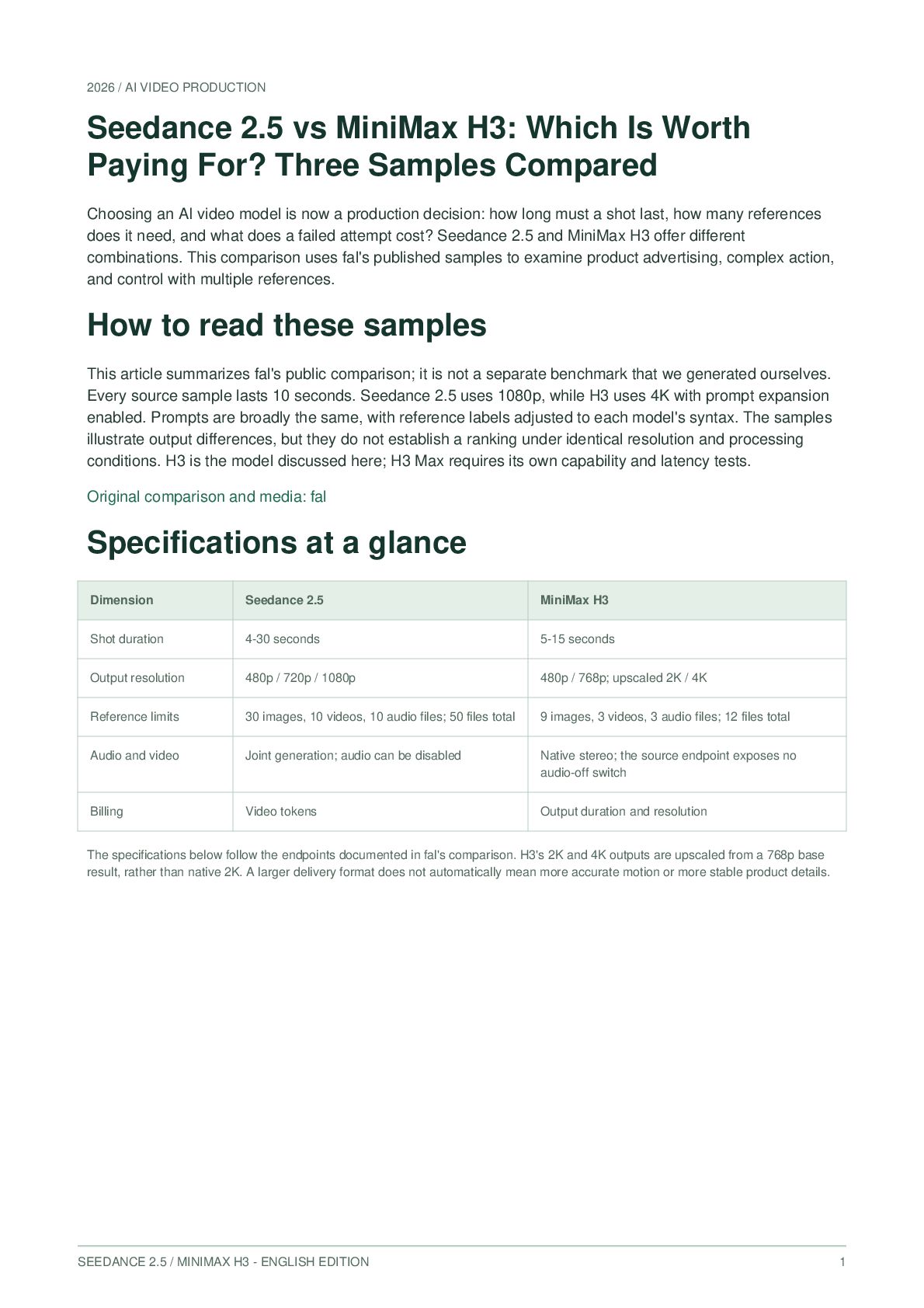
    Product video must preserve the item's appearance as well as look polished. The source uses first and last frames of a wool coat on a mannequin. The turntable rotates and stops while studio lighting changes. This is relevant to ecommerce displays, fashion ads, and rotating product shots. Sample frames: Seedance 2.5 (left), MiniMax H3 (right). What to inspect Watch whether the folds carry weight and settle naturally when motion stops. Check for distortion in the belt, hem, and stand, and whether the final orientation matches the last frame. Listen to the relationship between turntable noise, fabric, and room tone. More output pixels alone do not prove that a model is better for fashion advertising. Production takeaway Evaluate appearance preservation, the motion sequence, and the final frame separately. For a fixed-length product shot, compare acceptance rates before calculating the cost per usable clip. Seedance 2.5 - watch the original 10-second video MiniMax H3 - watch the original 10-second video First frame: coat, mannequin, and turntable Last frame: changed orientation and lighting Reference roles: First frame: coat, mannequin, and turntable; Last frame: changed orientation and lighting SEEDANCE 2.5 / MINIMAX H3 - ENGLISH EDITION 2
  3. 2. Text to video: a rescue swimmer in heavy seas

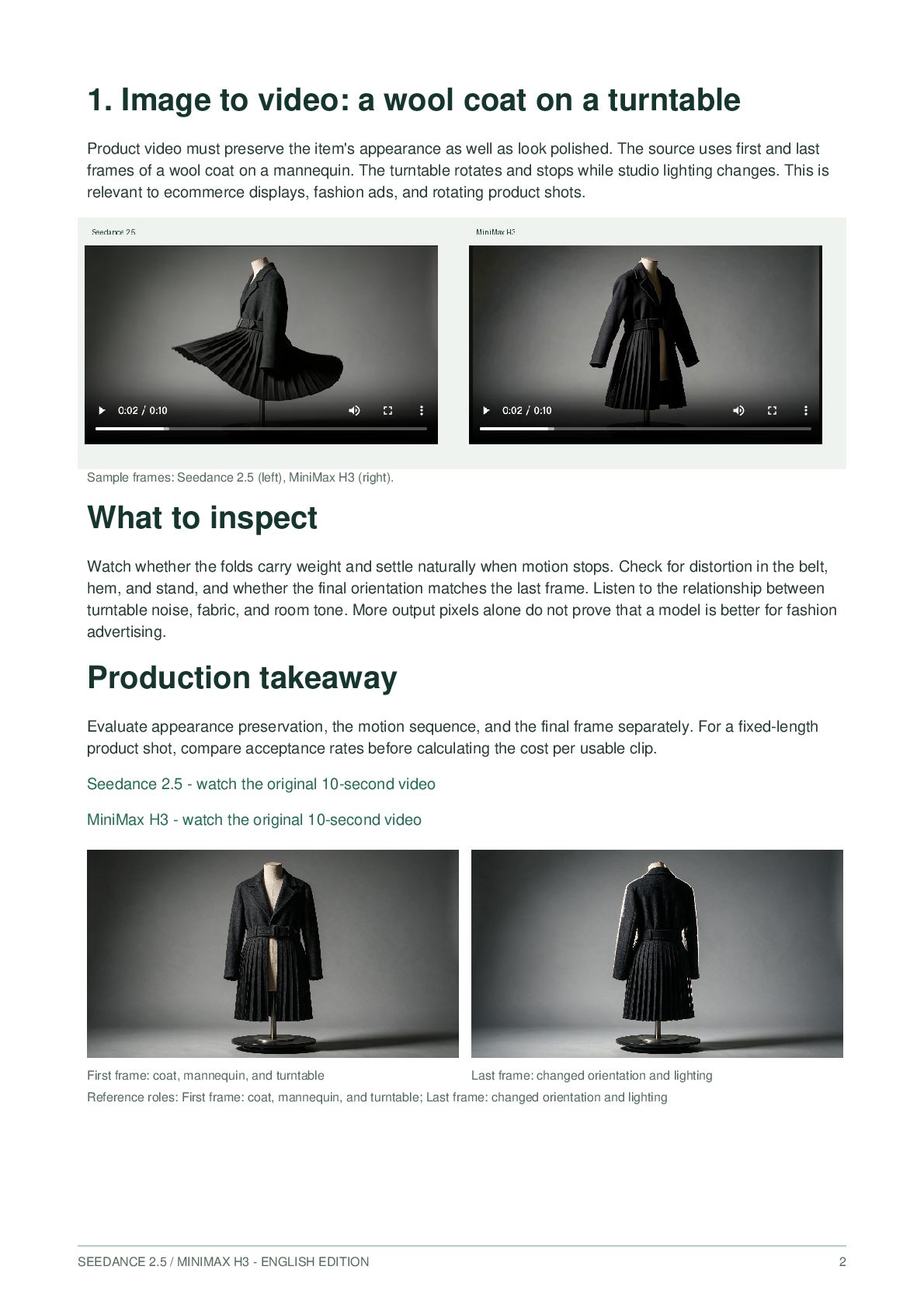
    The source's action scene follows a helicopter hovering over rough water, a rescue swimmer jumping into the sea, and the swimmer resurfacing and moving toward a target. The person, aircraft, waves, and camera must maintain plausible relationships. This makes timing and physical errors easier to spot than a scene focused only on fast camera movement. Sample frames: Seedance 2.5 (left), MiniMax H3 (right). What to inspect Check the continuity of the jump, water entry, and resurfacing. Does the camera follow the subject? Are rotor wash and surface changes plausible? Look for intersecting bodies, sudden position changes, and shifting proportions. Sound should correspond to visible action, rather than merely provide engine noise. Production takeaway These samples last only 10 seconds and do not validate Seedance's behavior across a 30-second shot. Projects requiring a continuous shot longer than 15 seconds need tests at their actual delivery length. For shorter clips, compare retries and usefulness in an edit. Seedance 2.5 - watch the original 10-second video MiniMax H3 - watch the original 10-second video Text-to-video scenario; no reference image input. SEEDANCE 2.5 / MINIMAX H3 - ENGLISH EDITION 3
  4. 3. Reference to video: a diving helmet, a crypt, and

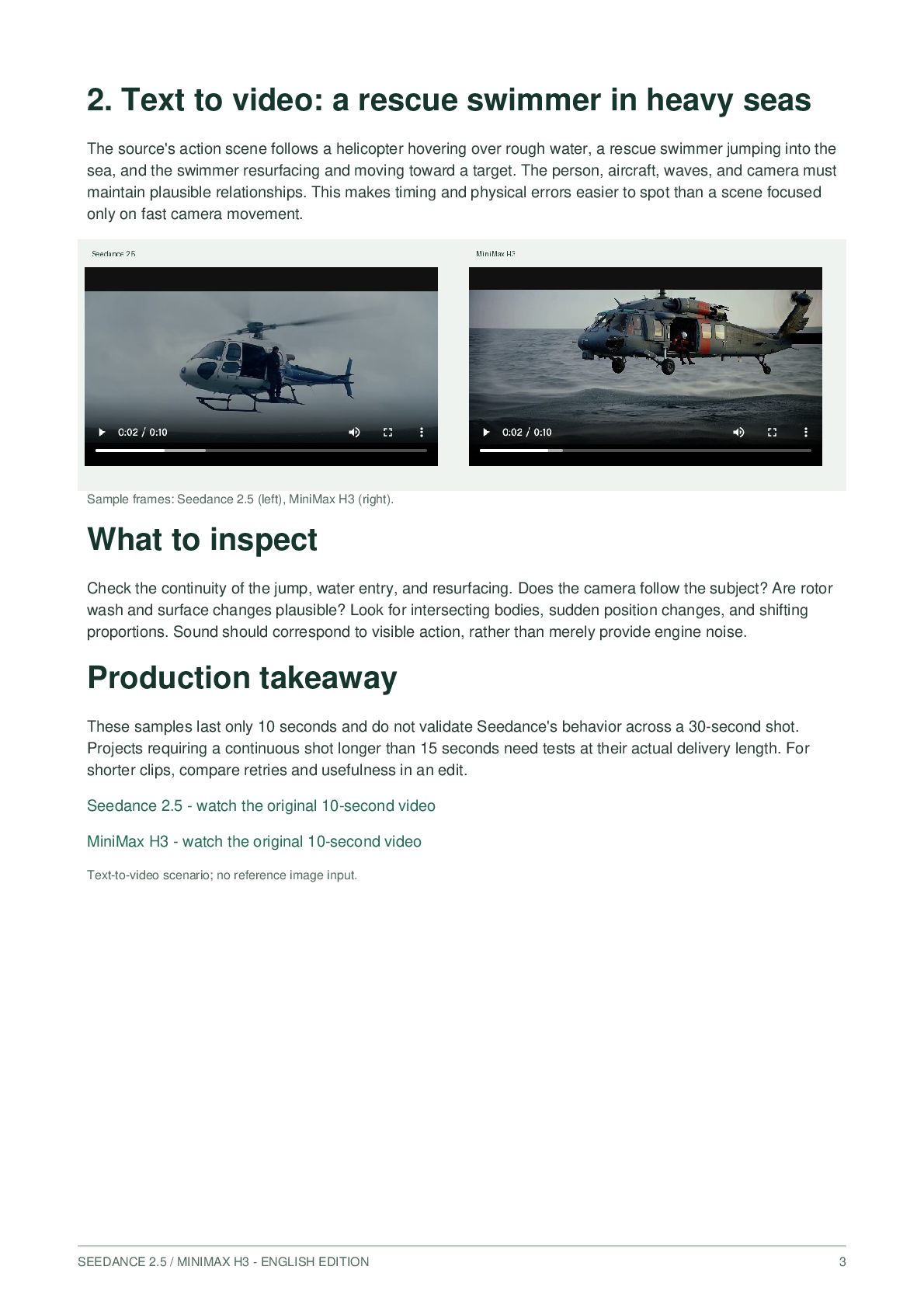
    props The third scenario assigns a separate role to each of three images: a diving helmet supplies the subject, a flooded underground space supplies the environment, and rope with ballast weights supplies props. The output must retain small visor cracks while lighting changes and the camera moves forward. This tests whether the model understands relationships between references, rather than simply how many files it accepts. Sample frames: Seedance 2.5 (left), MiniMax H3 (right). What to inspect Check whether the helmet's material, dents, and cracks persist. Does the model accidentally import the prop reference's background? Are water level, spatial structure, and reflections stable? A larger reference allowance does not demonstrate pixel-perfect preservation. Production takeaway Assign a clear purpose to every reference before adding more inputs. For product advertising, a small set of references with distinct roles can make failures easier to diagnose than a crowded input set. Seedance 2.5 - watch the original 10-second video MiniMax H3 - watch the original 10-second video Reference 1: diving helmet and visor cracks Reference 2: flooded underground space Reference 3: rope and ballast weights Reference roles: Reference 1: diving helmet and visor cracks; Reference 2: flooded underground space; Reference 3: rope and ballast weights SEEDANCE 2.5 / MINIMAX H3 - ENGLISH EDITION 4
  5. Cost: measure deliverables, not requests According to the fal prices

    recorded in the source on August 16, 2026, a 10-second H3 clip costs $0.80 at 768p, $1.30 at 2K, and $1.60 at 4K. A 10-second Seedance 2.5 clip at 720p is approximately $4.62. These are different output tiers: use them as budget starting points, not as a comparison at identical quality or a current price quote. For ordinary text-to-video and image-to-video requests, H3's per-second billing is straightforward to estimate. Reference generation also requires checking input charges. The source records additional charges for H3 reference images beyond its free allowance, while reference video duration contributes to Seedance's token calculation. Verify the chosen endpoint's live pricing before integration. Cost per deliverable clip = (generation fees + retry fees + human review and postproduction costs) / number of accepted clips. A cheaper request that needs repeated regeneration may cost more than an expensive request that passes once. A longer generation window creates business value only when it actually reduces stitching, continuity repairs, and review work. Engineering: validate before dividing roles Use the same business assets, duration, aspect ratio, and acceptance criteria. Generate multiple runs with each model, recording response time, acceptance rate, fees, and postproduction time. Save prompts, reference order, and endpoint parameters so that differences can be explained in the next round. - Batch short clips: test whether H3's price advantage survives your acceptance criteria. - Continuous shots beyond 15 seconds: test Seedance 2.5 first, checking identity, space, and sound in the later part of the shot. - Complex reference sets: organize inputs by purpose and verify product details individually. - Low latency: evaluate H3 Max separately; do not transfer its speed claims to H3. SEEDANCE 2.5 / MINIMAX H3 - ENGLISH EDITION 5
  6. Which model should you try first? If delivery requires longer

    individual shots or a larger reference set, Seedance 2.5 is a sensible first test. If you mainly produce short clips and budget or high-resolution delivery matters most, start by evaluating H3. Choose using your own acceptance rate and finished-clip cost, rather than one impressive output. A combined workflow can explore ideas with cheaper short shots, then choose the final model based on duration and reference requirements. Recheck the result after switching models: a switch does not guarantee that every visual detail and movement will survive. Put the comparison to work To explore Seedance creation further, start with Seedance 2.5, prepare real product images and explicit delivery requirements, and assess output quality alongside usage cost. Explore Seedance 2.5 Source and limitations Prepared September 30, 2026. Reference images and six sample videos come from fal's original comparison and were not regenerated. Watch the linked original clips and listen to each audio track. Seedance 2.5 vs. MiniMax H3: What's The Difference? - fal Videos remain accessible through the clickable links in this PDF. Static frames illustrate the three scenarios; they do not establish a matched-resolution benchmark. SEEDANCE 2.5 / MINIMAX H3 - ENGLISH EDITION 6