computers, especially the internet • Security - protection of a person, building, organization, or country against threats such as crime or attacks by foreign countries • Cyber security is the practice of defending computers, servers, mobile devices, electronic systems, networks, and data from malicious attacks. It's also known as information technology security or electronic information security. The term applies in a variety of contexts, from business to mobile computing,. • Data, Digital Signature 2020-08-01 (C) A STEP: TOWARDS CHANGE 5
Nepal started in 1993 in a venture of the Royal Nepal Academy of Science and Technology (RONAST) and Mercantile Office System (MOS). • Cyber security is important because government, military, corporate, financial, and medical organizations collect, process, and store unprecedented amounts of data on computers and other devices. 2020-08-01 (C) A STEP: TOWARDS CHANGE 7
network from intruders, whether targeted attackers or opportunistic malware • Application security - keeping software and devices free of threats. A compromised application could provide access to the data its designed to protect. Successful security begins in the design stage, well before a program or device is deployed. • Information security - protects the integrity and privacy of data, both in storage and in transit. (C) A STEP: TOWARDS CHANGE 2020-08-01 8
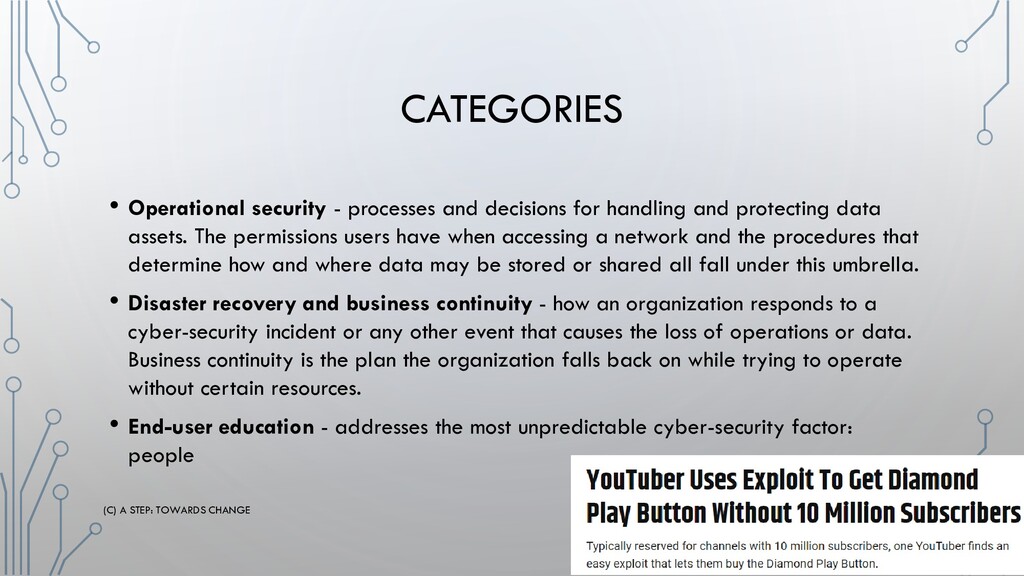
and protecting data assets. The permissions users have when accessing a network and the procedures that determine how and where data may be stored or shared all fall under this umbrella. • Disaster recovery and business continuity - how an organization responds to a cyber-security incident or any other event that causes the loss of operations or data. Business continuity is the plan the organization falls back on while trying to operate without certain resources. • End-user education - addresses the most unpredictable cyber-security factor: people (C) A STEP: TOWARDS CHANGE 2020-08-01 9
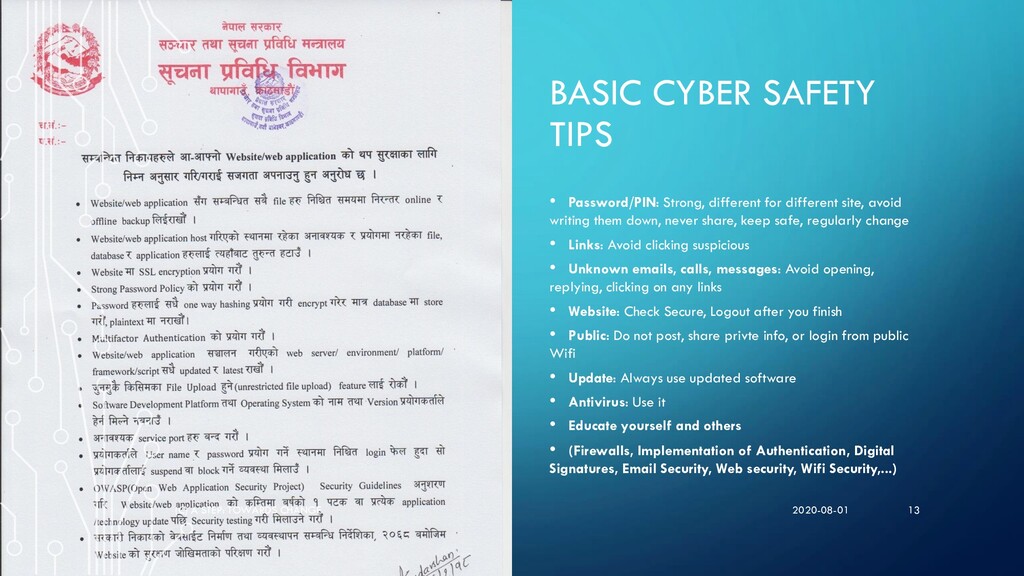
site, avoid writing them down, never share, keep safe, regularly change • Links: Avoid clicking suspicious • Unknown emails, calls, messages: Avoid opening, replying, clicking on any links • Website: Check Secure, Logout after you finish • Public: Do not post, share privte info, or login from public Wifi • Update: Always use updated software • Antivirus: Use it • Educate yourself and others • (Firewalls, Implementation of Authentication, Digital Signatures, Email Security, Web security, Wifi Security,...) (C) A STEP: TOWARDS CHANGE 2020-08-01 13
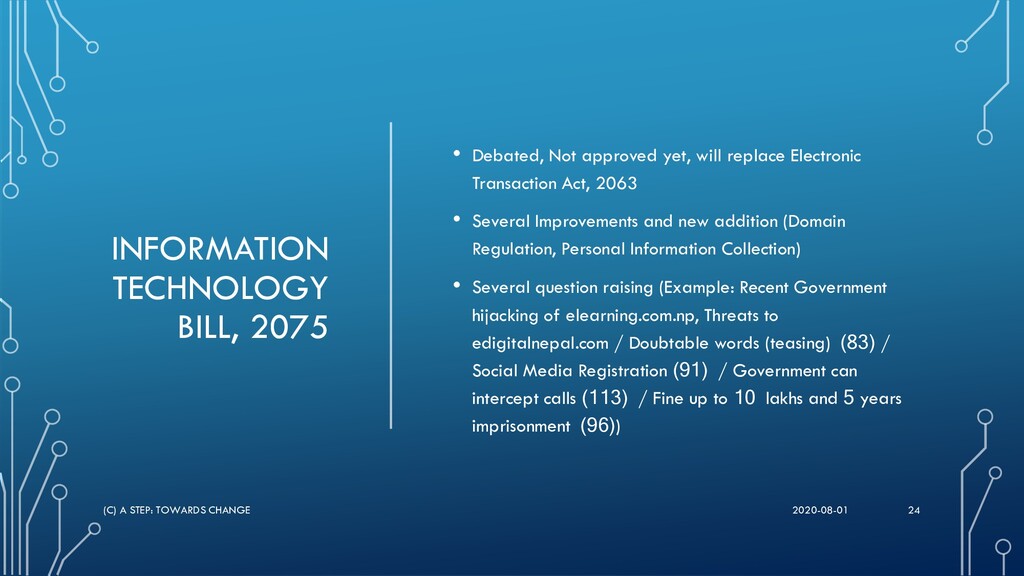
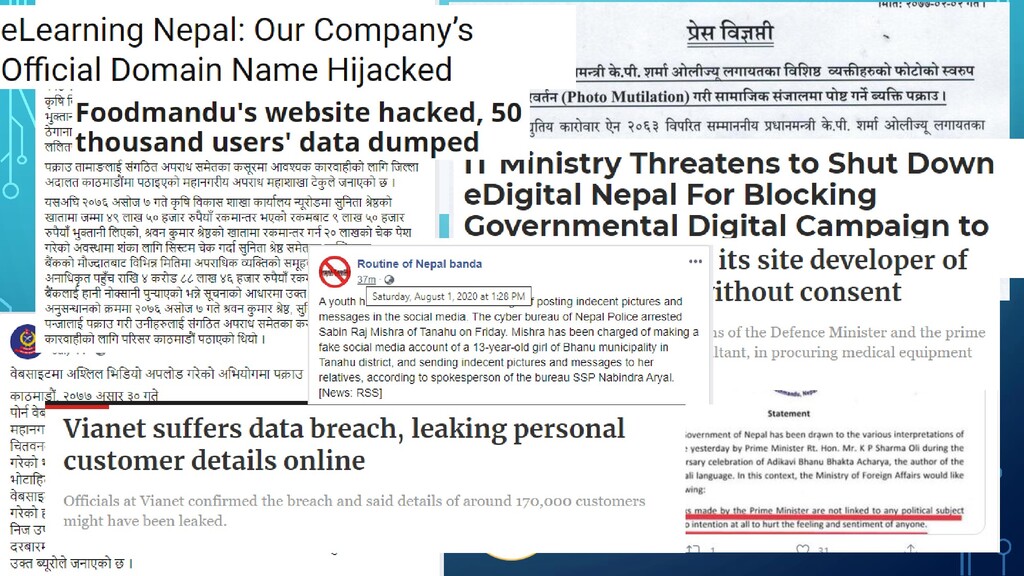
replace Electronic Transaction Act, 2063 • Several Improvements and new addition (Domain Regulation, Personal Information Collection) • Several question raising (Example: Recent Government hijacking of elearning.com.np, Threats to edigitalnepal.com / Doubtable words (teasing) (83) / Social Media Registration (91) / Government can intercept calls (113) / Fine up to 10 lakhs and 5 years imprisonment (96)) (C) A STEP: TOWARDS CHANGE 2020-08-01 24


 juanmartin2026
 moriyuya
 ainischool
 terasawat
 pawan_pharm
 kaityo256
 frievea
 soudai
 yoshimura_datam
 signer
 robintux
 aleyda
 gurzu
 addyosmani
 aemeredith
 katarinadahlin
 katiecoart
 cassininazir
 kneath
 tammyeverts
 uxyall
 notwaldorf
 axbom
![मुलुकी अपराध संहहर्ा, २०७४ • @@$= of}g b'Jo{jxf/ ug{ gx'g]](https://files.speakerdeck.com/presentations/bcb564a5cde744e5a3681d6b912b4a2a/slide_14.jpg)
![मुलुकी अपराध संहहर्ा, २०७४ • #)#= Ifltk"lt{ e/fO{ lbg' kg]{](https://files.speakerdeck.com/presentations/bcb564a5cde744e5a3681d6b912b4a2a/slide_15.jpg)
![ववद्युर्ीय (इलेक्ट्रोननक) कारोबार ऐन, २०६३ • $$= sDKo'6/ ;|f]t ;Í]tsf]](https://files.speakerdeck.com/presentations/bcb564a5cde744e5a3681d6b912b4a2a/slide_17.jpg)
![ववद्युर्ीय (इलेक्ट्रोननक) कारोबार ऐन, २०६३ • $*= uf]kgLotf eË ug]{](https://files.speakerdeck.com/presentations/bcb564a5cde744e5a3681d6b912b4a2a/slide_18.jpg)
![ववद्युर्ीय (इलेक्ट्रोननक) कारोबार ऐन, २०६३ • %@= sDKo'6/ hfn;fhL ug]{](https://files.speakerdeck.com/presentations/bcb564a5cde744e5a3681d6b912b4a2a/slide_19.jpg)
![ववद्युर्ीय (इलेक्ट्रोननक) कारोबार ऐन, २०६३ • %^= hkmt ug]{ •](https://files.speakerdeck.com/presentations/bcb564a5cde744e5a3681d6b912b4a2a/slide_20.jpg)
![ववद्युर्ीय (इलेक्ट्रोननक) कारोबार ऐन, २०६३ • &$= ph'/ ug]{ xbDofb](https://files.speakerdeck.com/presentations/bcb564a5cde744e5a3681d6b912b4a2a/slide_21.jpg)