Upgrade to Pro — share decks privately, control downloads, hide ads and more …

AI Search Citation Factors Impacting Local Heal...

Sponsored · Your Podcast. Everywhere. Effortlessly. Share. Educate. Inspire. Entertain. You do you. We'll handle the rest.

AI Search Citation Factors Impacting Local Health Practices Visibility in 2026

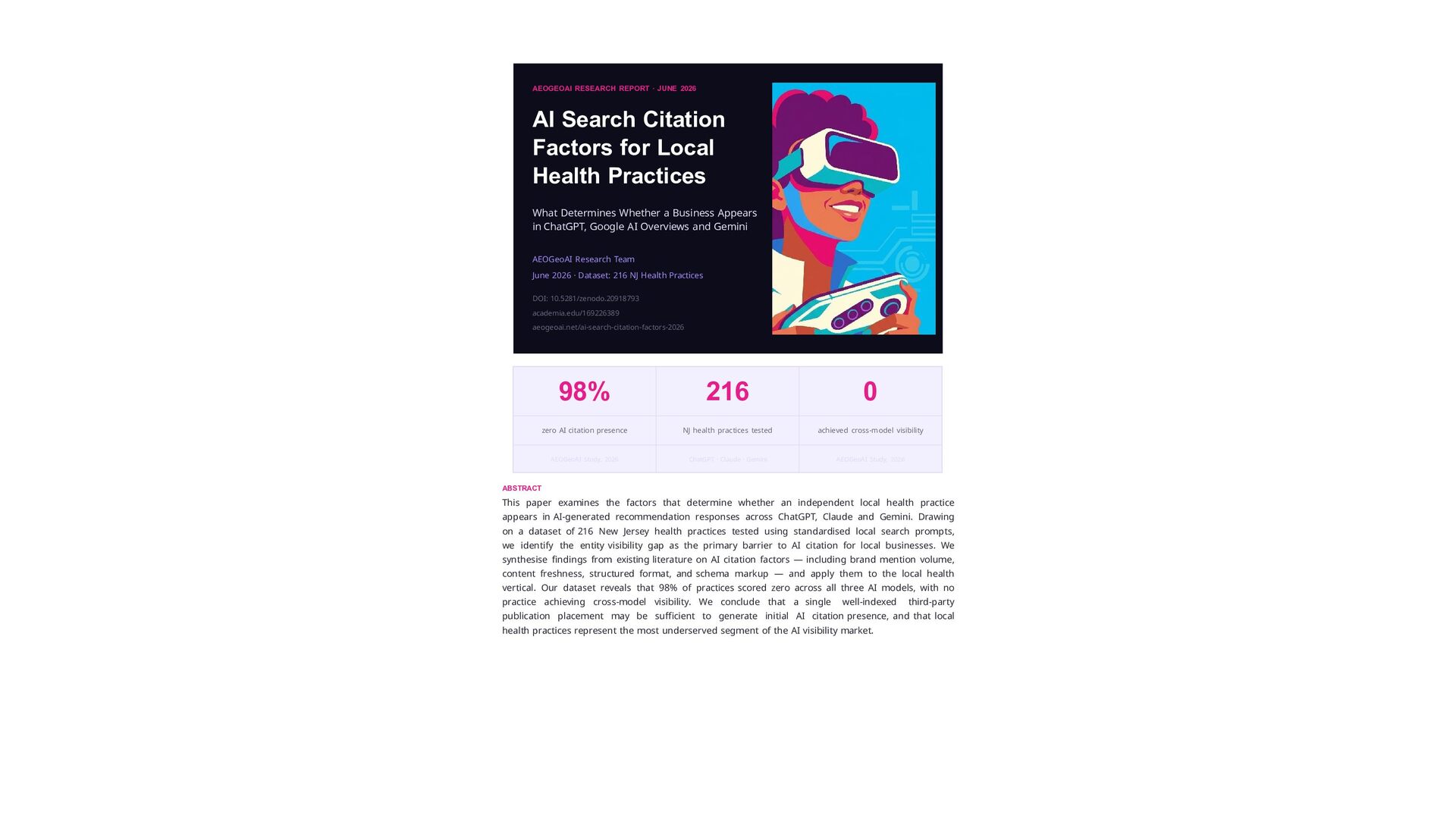
Study of factors influencing AI citation presence (Canonical https://aeogeoai.net/ai-search-citation-factors-2026 ) for 216 New Jersey health practices across ChatGPT, Claude, and Gemini, revealing a significant visibility gap and strategies for improving AI-driven local health business discovery.

What Determines Whether a Business Appears in ChatGPT, Google AI Overviews and Gemini?

AEOGeoAI Research Team June 2026 · Dataset: 216 NJ Health Practices

DOI: 10.5281/zenodo.20918793 https://aeogeoai.net/ai-search-citation-factors-2026

ABSTRACT This paper examines the factors that determine whether an independent local health practice appears in AI-generated recommendation responses across ChatGPT, Claude and Gemini. Drawing on a dataset of 216 New Jersey health practices tested using standardized local search prompts, we identify the entity visibility gap as the primary barrier to AI citation for local businesses.

We synthesize findings from existing literature on AI citation factors - including brand mention volume, content freshness, structured format, and schema markup - and apply them to the local health vertical. Our dataset reveals that 98% of practices scored zero across all three AI models, with no practice achieving cross-model visibility. We conclude that a single well-indexed third-party publication placement may be sufficient to generate initial AI citation presence, and that local health practices represent the most underserved segment of the AI visibility market.

Avatar for AEOGeoAI Research Team

AEOGeoAI Research Team

July 10, 2026

Transcript

  1. AEOGEOAI RESEARCH REPORT · JUNE 2026 AI Search Citation Factors

    for Local Health Practices What Determines Whether a Business Appears in ChatGPT, Google AI Overviews and Gemini AEOGeoAI Research Team June 2026 · Dataset: 216 NJ Health Practices DOI: 10.5281/zenodo.20918793 academia.edu/169226389 aeogeoai.net/ai-search-citation-factors-2026 98% 216 0 zero AI citation presence NJ health practices tested achieved cross-model visibility AEOGeoAI Study, 2026 ChatGPT · Claude · Gemini AEOGeoAI Study, 2026 ABSTRACT This paper examines the factors that determine whether an independent local health practice appears in AI-generated recommendation responses across ChatGPT, Claude and Gemini. Drawing on a dataset of 216 New Jersey health practices tested using standardised local search prompts, we identify the entity visibility gap as the primary barrier to AI citation for local businesses. We synthesise findings from existing literature on AI citation factors — including brand mention volume, content freshness, structured format, and schema markup — and apply them to the local health vertical. Our dataset reveals that 98% of practices scored zero across all three AI models, with no practice achieving cross-model visibility. We conclude that a single well-indexed third-party publication placement may be sufficient to generate initial AI citation presence, and that local health practices represent the most underserved segment of the AI visibility market.
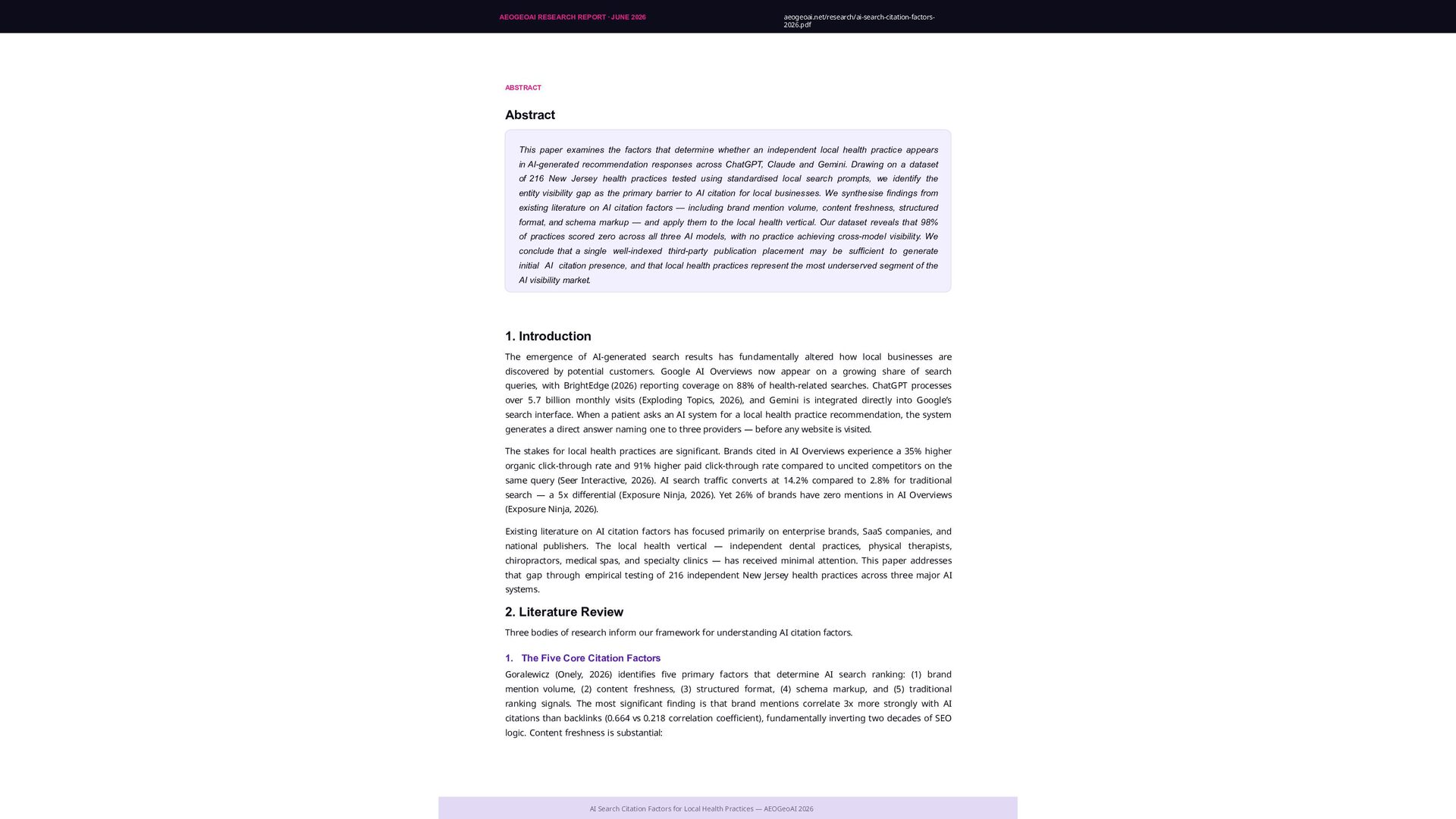
  2. AEOGEOAI RESEARCH REPORT · JUNE 2026 aeogeoai.net/research/ai-search-citation-factors- 2026.pdf ABSTRACT Abstract

    This paper examines the factors that determine whether an independent local health practice appears in AI-generated recommendation responses across ChatGPT, Claude and Gemini. Drawing on a dataset of 216 New Jersey health practices tested using standardised local search prompts, we identify the entity visibility gap as the primary barrier to AI citation for local businesses. We synthesise findings from existing literature on AI citation factors — including brand mention volume, content freshness, structured format, and schema markup — and apply them to the local health vertical. Our dataset reveals that 98% of practices scored zero across all three AI models, with no practice achieving cross-model visibility. We conclude that a single well-indexed third-party publication placement may be sufficient to generate initial AI citation presence, and that local health practices represent the most underserved segment of the AI visibility market. AI Search Citation Factors for Local Health Practices — AEOGeoAI 2026 1. Introduction The emergence of AI-generated search results has fundamentally altered how local businesses are discovered by potential customers. Google AI Overviews now appear on a growing share of search queries, with BrightEdge (2026) reporting coverage on 88% of health-related searches. ChatGPT processes over 5.7 billion monthly visits (Exploding Topics, 2026), and Gemini is integrated directly into Google’s search interface. When a patient asks an AI system for a local health practice recommendation, the system generates a direct answer naming one to three providers — before any website is visited. The stakes for local health practices are significant. Brands cited in AI Overviews experience a 35% higher organic click-through rate and 91% higher paid click-through rate compared to uncited competitors on the same query (Seer Interactive, 2026). AI search traffic converts at 14.2% compared to 2.8% for traditional search — a 5x differential (Exposure Ninja, 2026). Yet 26% of brands have zero mentions in AI Overviews (Exposure Ninja, 2026). Existing literature on AI citation factors has focused primarily on enterprise brands, SaaS companies, and national publishers. The local health vertical — independent dental practices, physical therapists, chiropractors, medical spas, and specialty clinics — has received minimal attention. This paper addresses that gap through empirical testing of 216 independent New Jersey health practices across three major AI systems. 2. Literature Review Three bodies of research inform our framework for understanding AI citation factors. 1. The Five Core Citation Factors Goralewicz (Onely, 2026) identifies five primary factors that determine AI search ranking: (1) brand mention volume, (2) content freshness, (3) structured format, (4) schema markup, and (5) traditional ranking signals. The most significant finding is that brand mentions correlate 3x more strongly with AI citations than backlinks (0.664 vs 0.218 correlation coefficient), fundamentally inverting two decades of SEO logic. Content freshness is substantial:
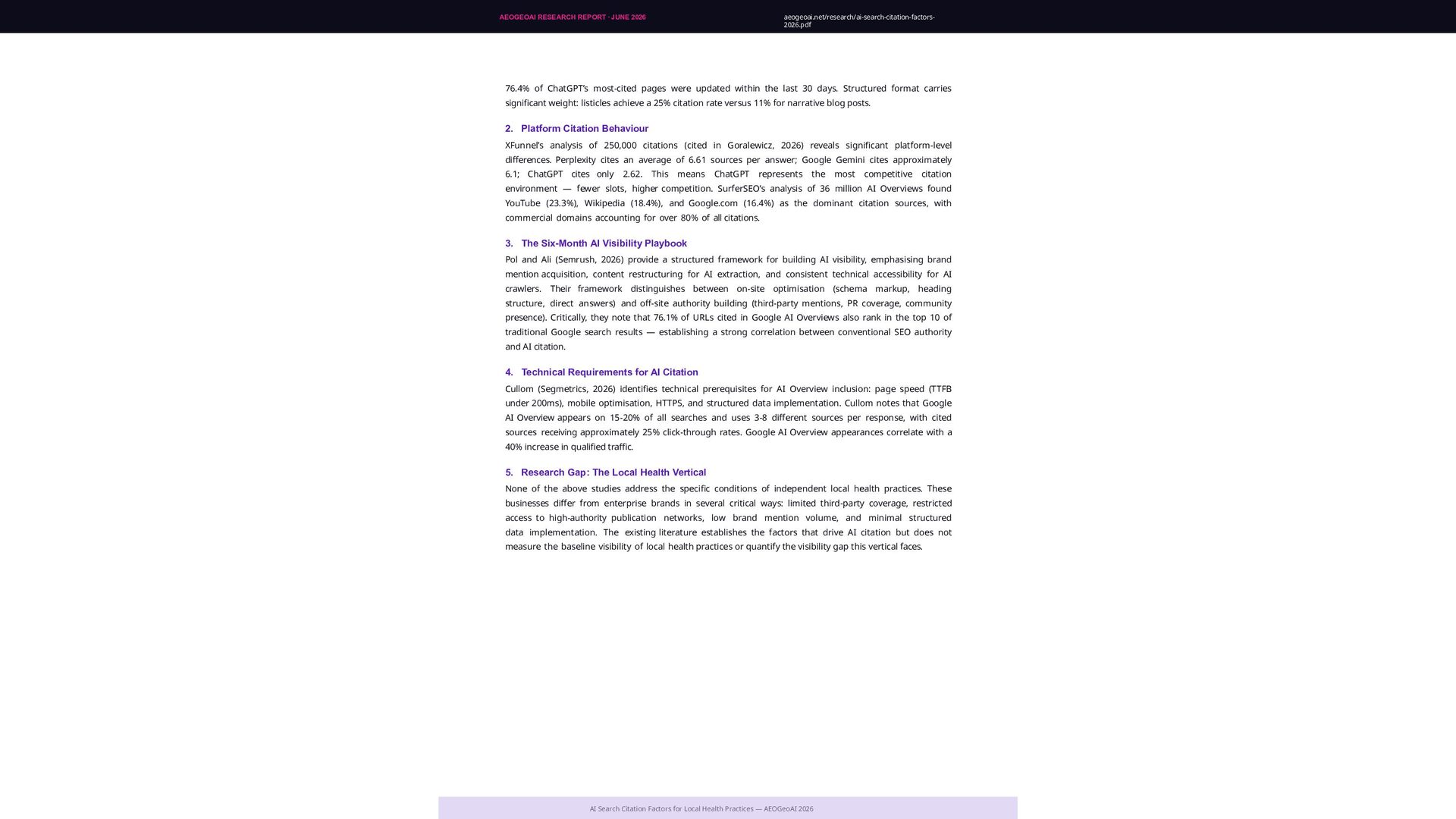
  3. AEOGEOAI RESEARCH REPORT · JUNE 2026 aeogeoai.net/research/ai-search-citation-factors- 2026.pdf 76.4% of

    ChatGPT’s most-cited pages were updated within the last 30 days. Structured format carries significant weight: listicles achieve a 25% citation rate versus 11% for narrative blog posts. 2. Platform Citation Behaviour XFunnel’s analysis of 250,000 citations (cited in Goralewicz, 2026) reveals significant platform-level differences. Perplexity cites an average of 6.61 sources per answer; Google Gemini cites approximately 6.1; ChatGPT cites only 2.62. This means ChatGPT represents the most competitive citation environment — fewer slots, higher competition. SurferSEO’s analysis of 36 million AI Overviews found YouTube (23.3%), Wikipedia (18.4%), and Google.com (16.4%) as the dominant citation sources, with commercial domains accounting for over 80% of all citations. 3. The Six-Month AI Visibility Playbook Pol and Ali (Semrush, 2026) provide a structured framework for building AI visibility, emphasising brand mention acquisition, content restructuring for AI extraction, and consistent technical accessibility for AI crawlers. Their framework distinguishes between on-site optimisation (schema markup, heading structure, direct answers) and off-site authority building (third-party mentions, PR coverage, community presence). Critically, they note that 76.1% of URLs cited in Google AI Overviews also rank in the top 10 of traditional Google search results — establishing a strong correlation between conventional SEO authority and AI citation. 4. Technical Requirements for AI Citation Cullom (Segmetrics, 2026) identifies technical prerequisites for AI Overview inclusion: page speed (TTFB under 200ms), mobile optimisation, HTTPS, and structured data implementation. Cullom notes that Google AI Overview appears on 15-20% of all searches and uses 3-8 different sources per response, with cited sources receiving approximately 25% click-through rates. Google AI Overview appearances correlate with a 40% increase in qualified traffic. 5. Research Gap: The Local Health Vertical None of the above studies address the specific conditions of independent local health practices. These businesses differ from enterprise brands in several critical ways: limited third-party coverage, restricted access to high-authority publication networks, low brand mention volume, and minimal structured data implementation. The existing literature establishes the factors that drive AI citation but does not measure the baseline visibility of local health practices or quantify the visibility gap this vertical faces. AI Search Citation Factors for Local Health Practices — AEOGeoAI 2026
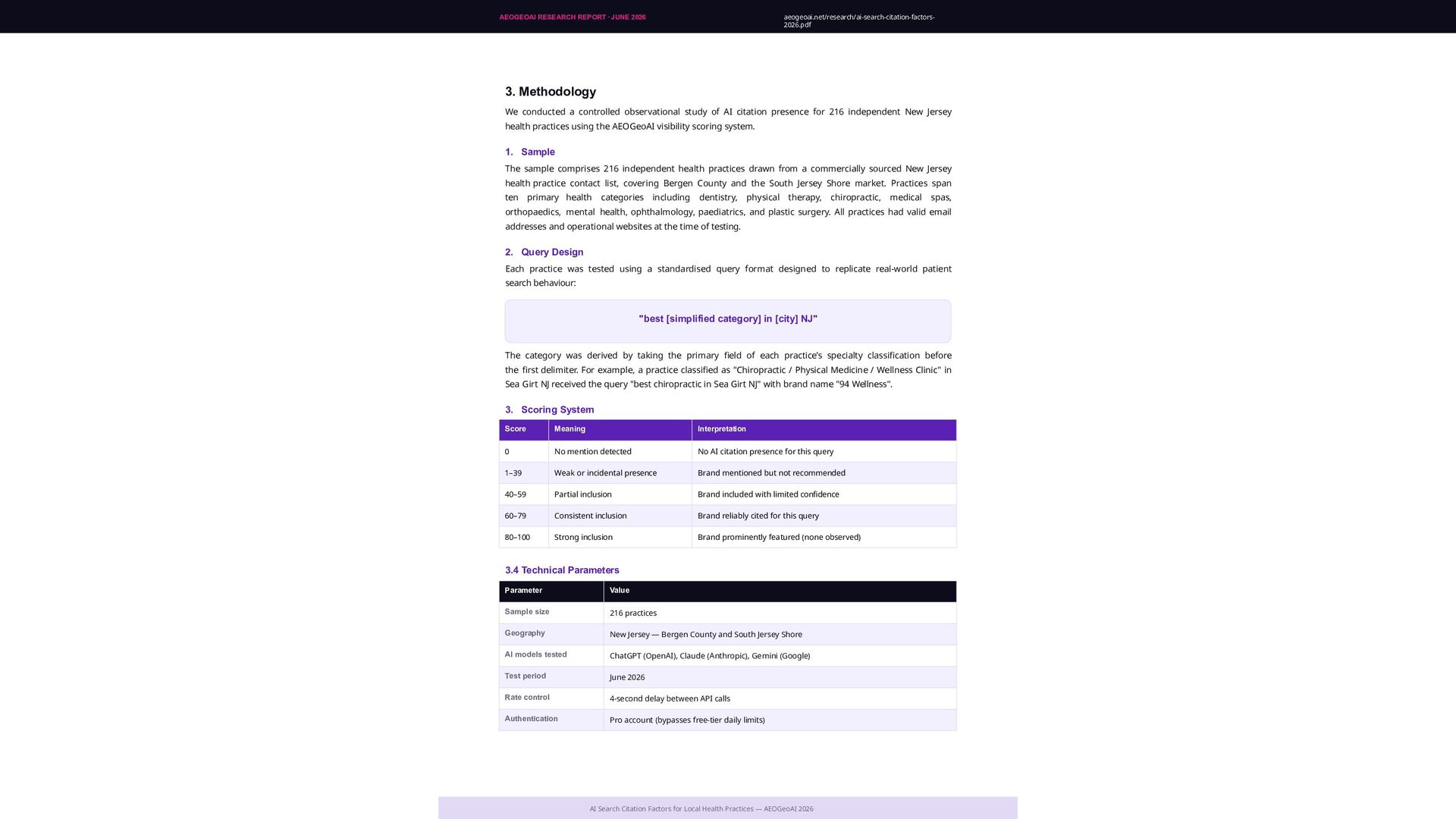
  4. AEOGEOAI RESEARCH REPORT · JUNE 2026 aeogeoai.net/research/ai-search-citation-factors- 2026.pdf 3. Methodology

    We conducted a controlled observational study of AI citation presence for 216 independent New Jersey health practices using the AEOGeoAI visibility scoring system. 1. Sample The sample comprises 216 independent health practices drawn from a commercially sourced New Jersey health practice contact list, covering Bergen County and the South Jersey Shore market. Practices span ten primary health categories including dentistry, physical therapy, chiropractic, medical spas, orthopaedics, mental health, ophthalmology, paediatrics, and plastic surgery. All practices had valid email addresses and operational websites at the time of testing. 2. Query Design Each practice was tested using a standardised query format designed to replicate real-world patient search behaviour: "best [simplified category] in [city] NJ" The category was derived by taking the primary field of each practice’s specialty classification before the first delimiter. For example, a practice classified as "Chiropractic / Physical Medicine / Wellness Clinic" in Sea Girt NJ received the query "best chiropractic in Sea Girt NJ" with brand name "94 Wellness". 3. Scoring System AI Search Citation Factors for Local Health Practices — AEOGeoAI 2026 Score Meaning Interpretation 0 No mention detected No AI citation presence for this query 1–39 Weak or incidental presence Brand mentioned but not recommended 40–59 Partial inclusion Brand included with limited confidence 60–79 Consistent inclusion Brand reliably cited for this query 80–100 Strong inclusion Brand prominently featured (none observed) 3.4 Technical Parameters Parameter Value Sample size 216 practices Geography New Jersey — Bergen County and South Jersey Shore AI models tested ChatGPT (OpenAI), Claude (Anthropic), Gemini (Google) Test period June 2026 Rate control 4-second delay between API calls Authentication Pro account (bypasses free-tier daily limits)
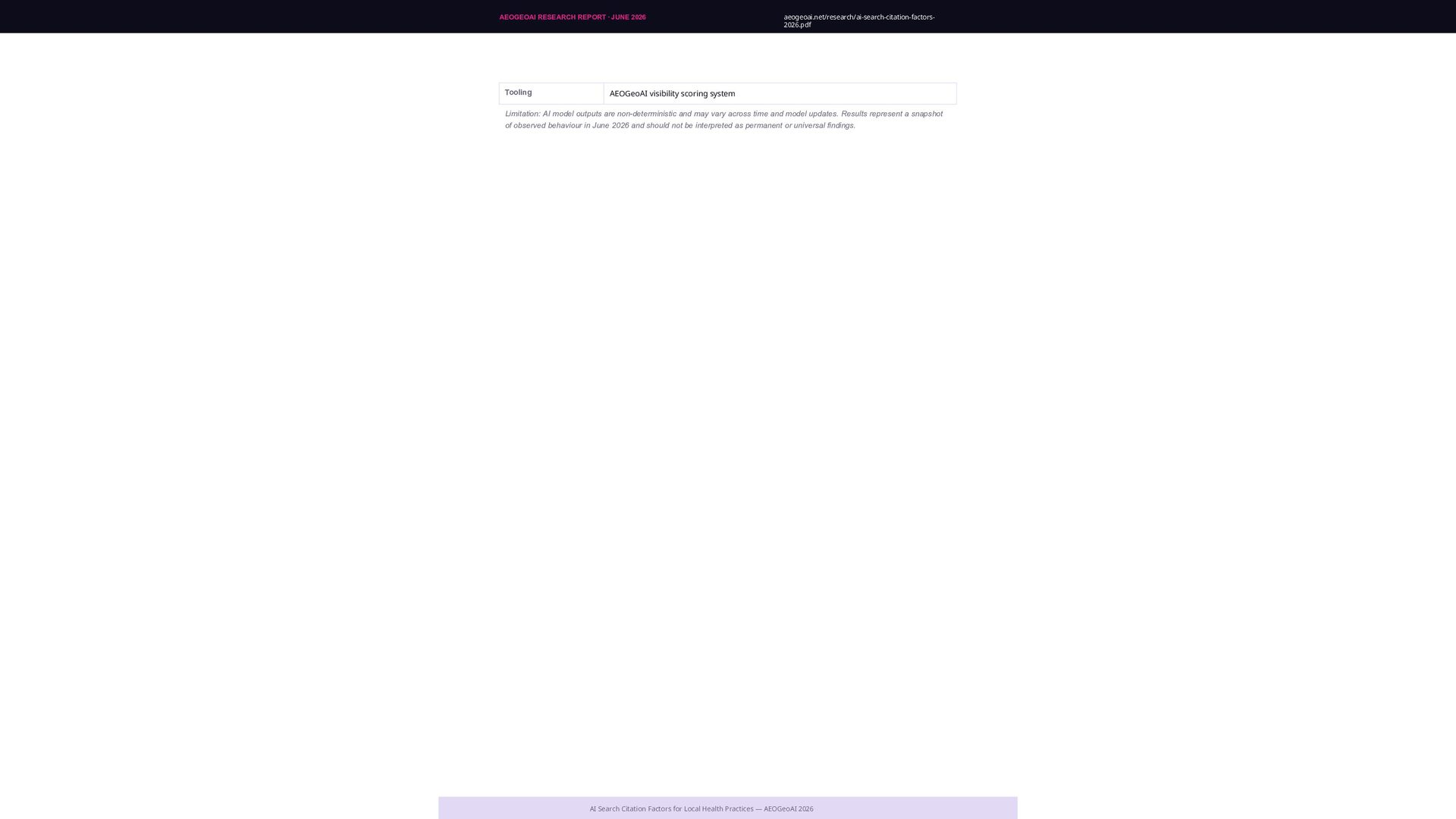
  5. AEOGEOAI RESEARCH REPORT · JUNE 2026 aeogeoai.net/research/ai-search-citation-factors- 2026.pdf Tooling AEOGeoAI

    visibility scoring system AI Search Citation Factors for Local Health Practices — AEOGeoAI 2026 Limitation: AI model outputs are non-deterministic and may vary across time and model updates. Results represent a snapshot of observed behaviour in June 2026 and should not be interpreted as permanent or universal findings.
  6. AEOGEOAI RESEARCH REPORT · JUNE 2026 aeogeoai.net/research/ai-search-citation-factors- 2026.pdf 4. Findings

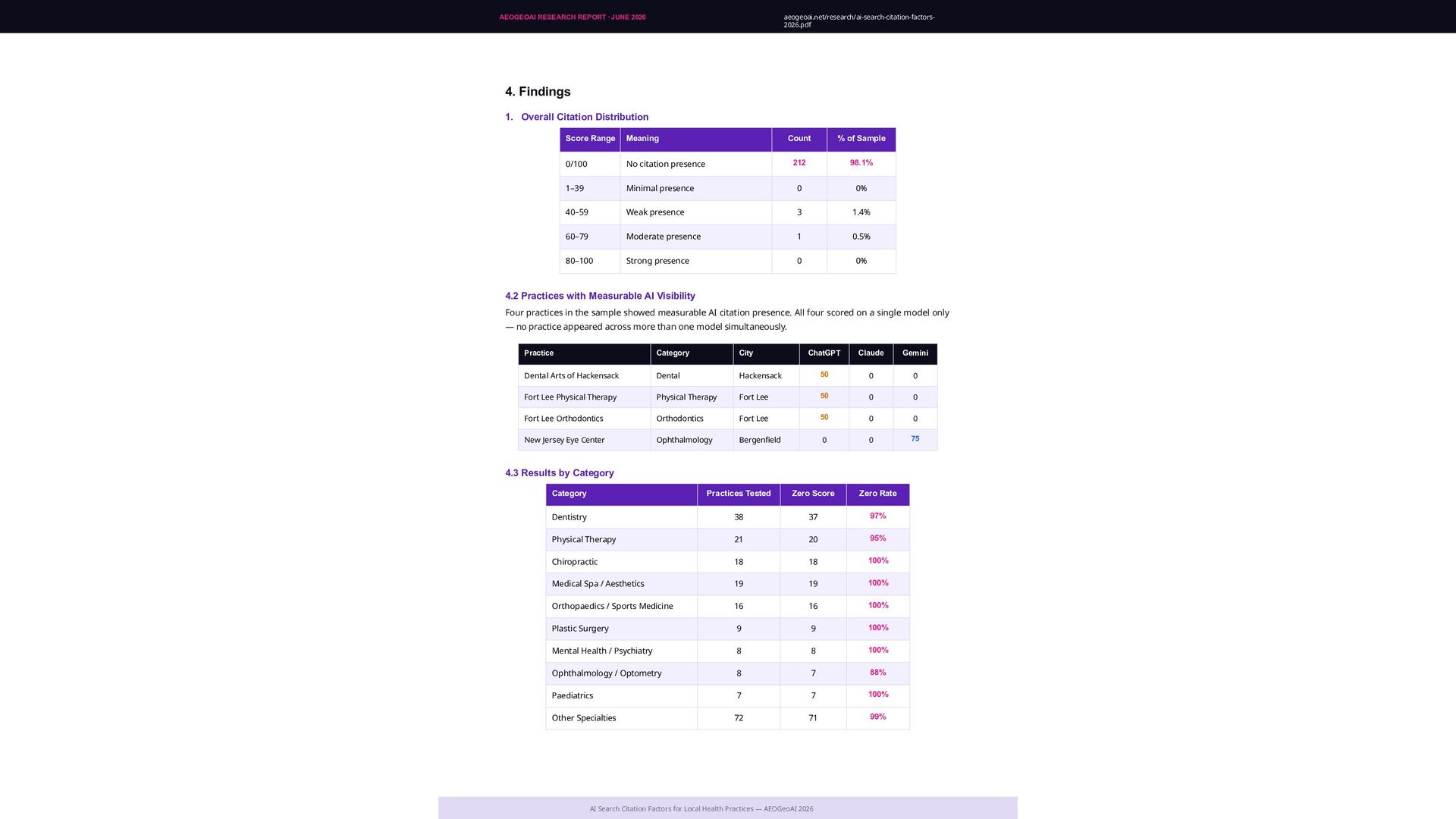
    1. Overall Citation Distribution AI Search Citation Factors for Local Health Practices — AEOGeoAI 2026 Score Range Meaning Count % of Sample 0/100 No citation presence 212 98.1% 1–39 Minimal presence 0 0% 40–59 Weak presence 3 1.4% 60–79 Moderate presence 1 0.5% 80–100 Strong presence 0 0% 4.2 Practices with Measurable AI Visibility Four practices in the sample showed measurable AI citation presence. All four scored on a single model only — no practice appeared across more than one model simultaneously. Practice Category City ChatGPT Claude Gemini Dental Arts of Hackensack Dental Hackensack 50 0 0 Fort Lee Physical Therapy Physical Therapy Fort Lee 50 0 0 Fort Lee Orthodontics Orthodontics Fort Lee 50 0 0 New Jersey Eye Center Ophthalmology Bergenfield 0 0 75 4.3 Results by Category Category Practices Tested Zero Score Zero Rate Dentistry 38 37 97% Physical Therapy 21 20 95% Chiropractic 18 18 100% Medical Spa / Aesthetics 19 19 100% Orthopaedics / Sports Medicine 16 16 100% Plastic Surgery 9 9 100% Mental Health / Psychiatry 8 8 100% Ophthalmology / Optometry 8 7 88% Paediatrics 7 7 100% Other Specialties 72 71 99%
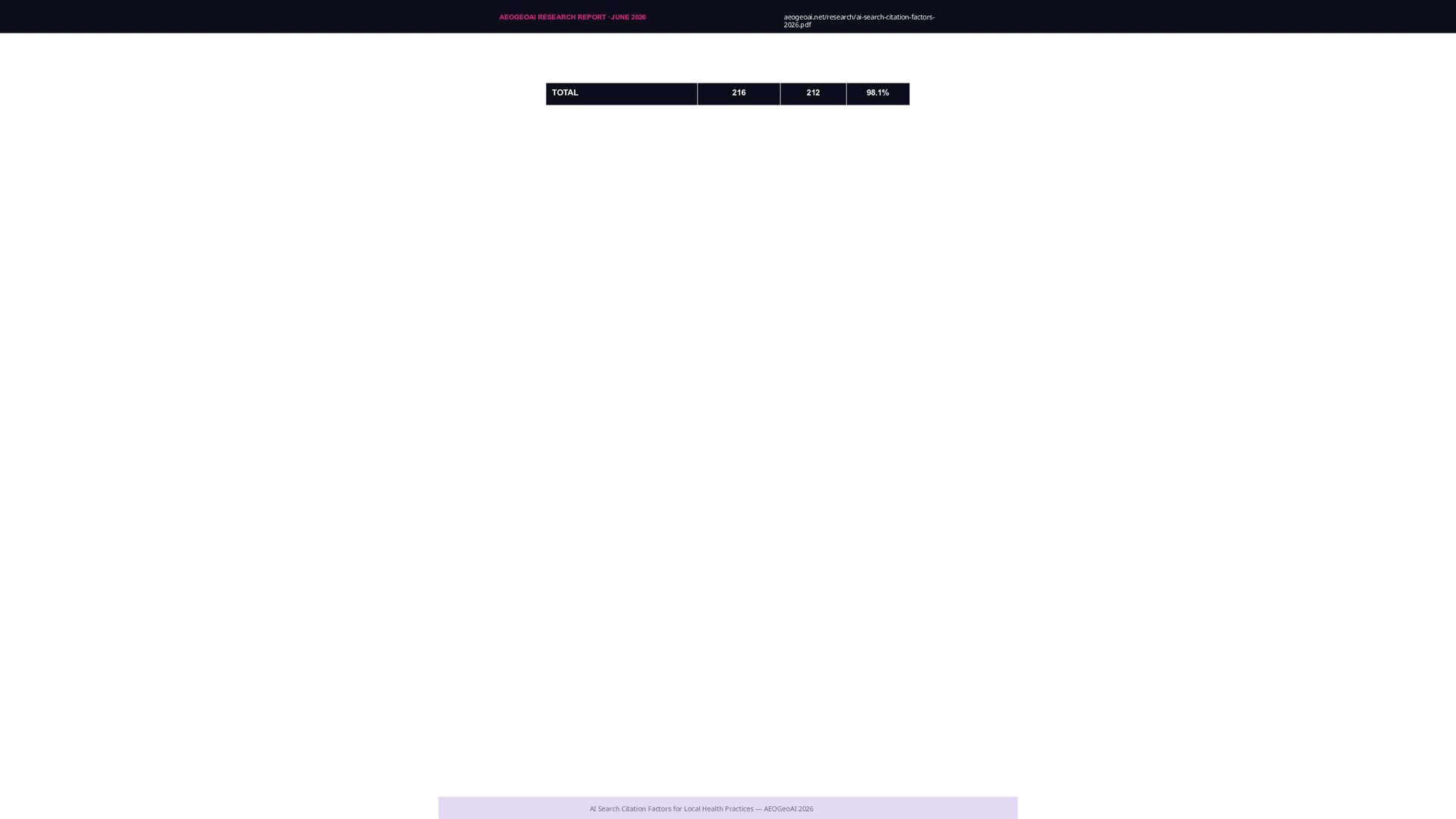
  7. AEOGEOAI RESEARCH REPORT · JUNE 2026 aeogeoai.net/research/ai-search-citation-factors- 2026.pdf TOTAL 216

    212 98.1% AI Search Citation Factors for Local Health Practices — AEOGeoAI 2026
  8. AEOGEOAI RESEARCH REPORT · JUNE 2026 aeogeoai.net/research/ai-search-citation-factors- 2026.pdf 5. Analysis

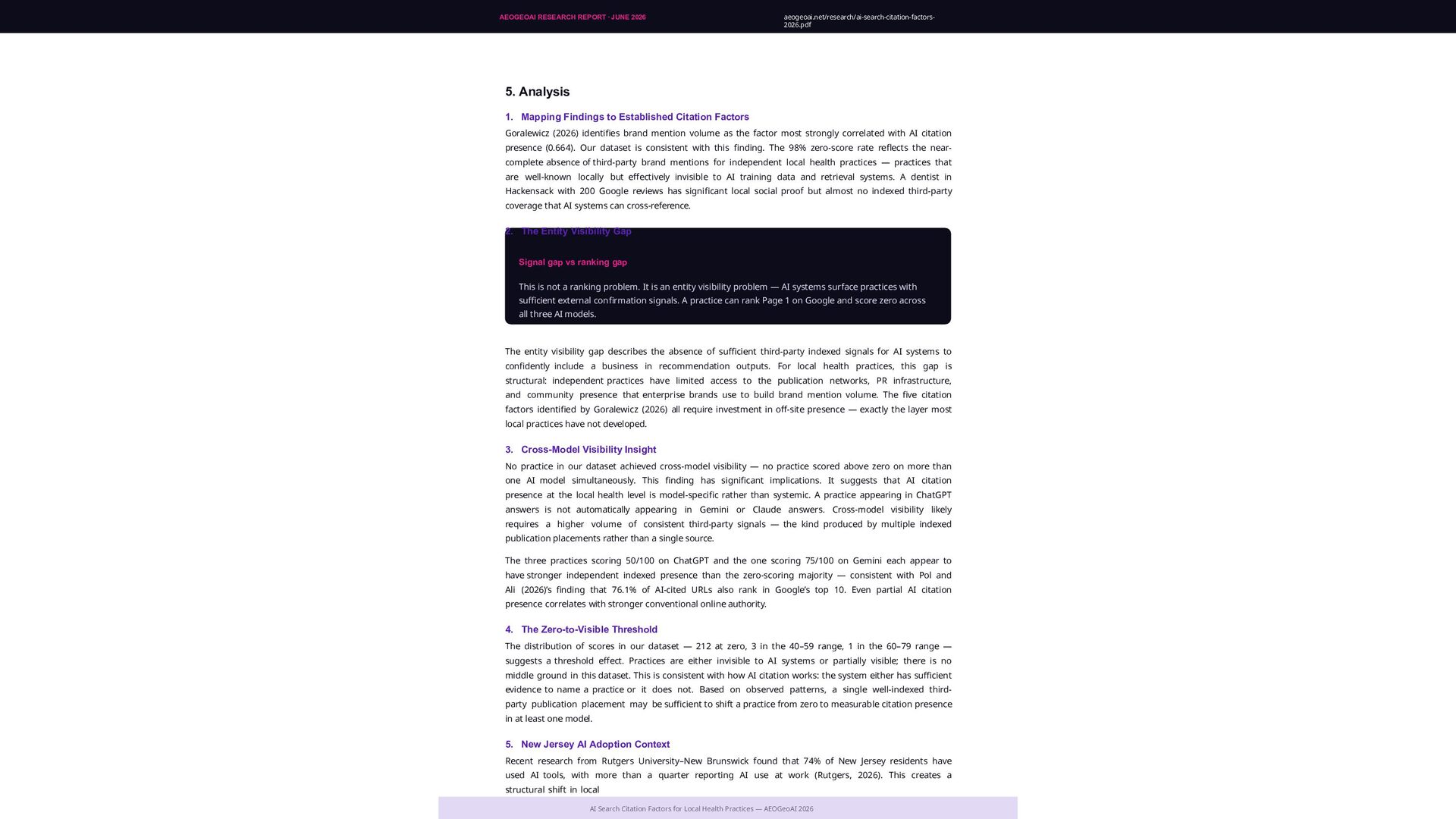
    1. Mapping Findings to Established Citation Factors Goralewicz (2026) identifies brand mention volume as the factor most strongly correlated with AI citation presence (0.664). Our dataset is consistent with this finding. The 98% zero-score rate reflects the near- complete absence of third-party brand mentions for independent local health practices — practices that are well-known locally but effectively invisible to AI training data and retrieval systems. A dentist in Hackensack with 200 Google reviews has significant local social proof but almost no indexed third-party coverage that AI systems can cross-reference. 2. The Entity Visibility Gap Signal gap vs ranking gap This is not a ranking problem. It is an entity visibility problem — AI systems surface practices with sufficient external confirmation signals. A practice can rank Page 1 on Google and score zero across all three AI models. The entity visibility gap describes the absence of sufficient third-party indexed signals for AI systems to confidently include a business in recommendation outputs. For local health practices, this gap is structural: independent practices have limited access to the publication networks, PR infrastructure, and community presence that enterprise brands use to build brand mention volume. The five citation factors identified by Goralewicz (2026) all require investment in off-site presence — exactly the layer most local practices have not developed. 3. Cross-Model Visibility Insight No practice in our dataset achieved cross-model visibility — no practice scored above zero on more than one AI model simultaneously. This finding has significant implications. It suggests that AI citation presence at the local health level is model-specific rather than systemic. A practice appearing in ChatGPT answers is not automatically appearing in Gemini or Claude answers. Cross-model visibility likely requires a higher volume of consistent third-party signals — the kind produced by multiple indexed publication placements rather than a single source. The three practices scoring 50/100 on ChatGPT and the one scoring 75/100 on Gemini each appear to have stronger independent indexed presence than the zero-scoring majority — consistent with Pol and Ali (2026)’s finding that 76.1% of AI-cited URLs also rank in Google’s top 10. Even partial AI citation presence correlates with stronger conventional online authority. 4. The Zero-to-Visible Threshold The distribution of scores in our dataset — 212 at zero, 3 in the 40–59 range, 1 in the 60–79 range — suggests a threshold effect. Practices are either invisible to AI systems or partially visible; there is no middle ground in this dataset. This is consistent with how AI citation works: the system either has sufficient evidence to name a practice or it does not. Based on observed patterns, a single well-indexed third- party publication placement may be sufficient to shift a practice from zero to measurable citation presence in at least one model. 5. New Jersey AI Adoption Context Recent research from Rutgers University–New Brunswick found that 74% of New Jersey residents have used AI tools, with more than a quarter reporting AI use at work (Rutgers, 2026). This creates a structural shift in local AI Search Citation Factors for Local Health Practices — AEOGeoAI 2026
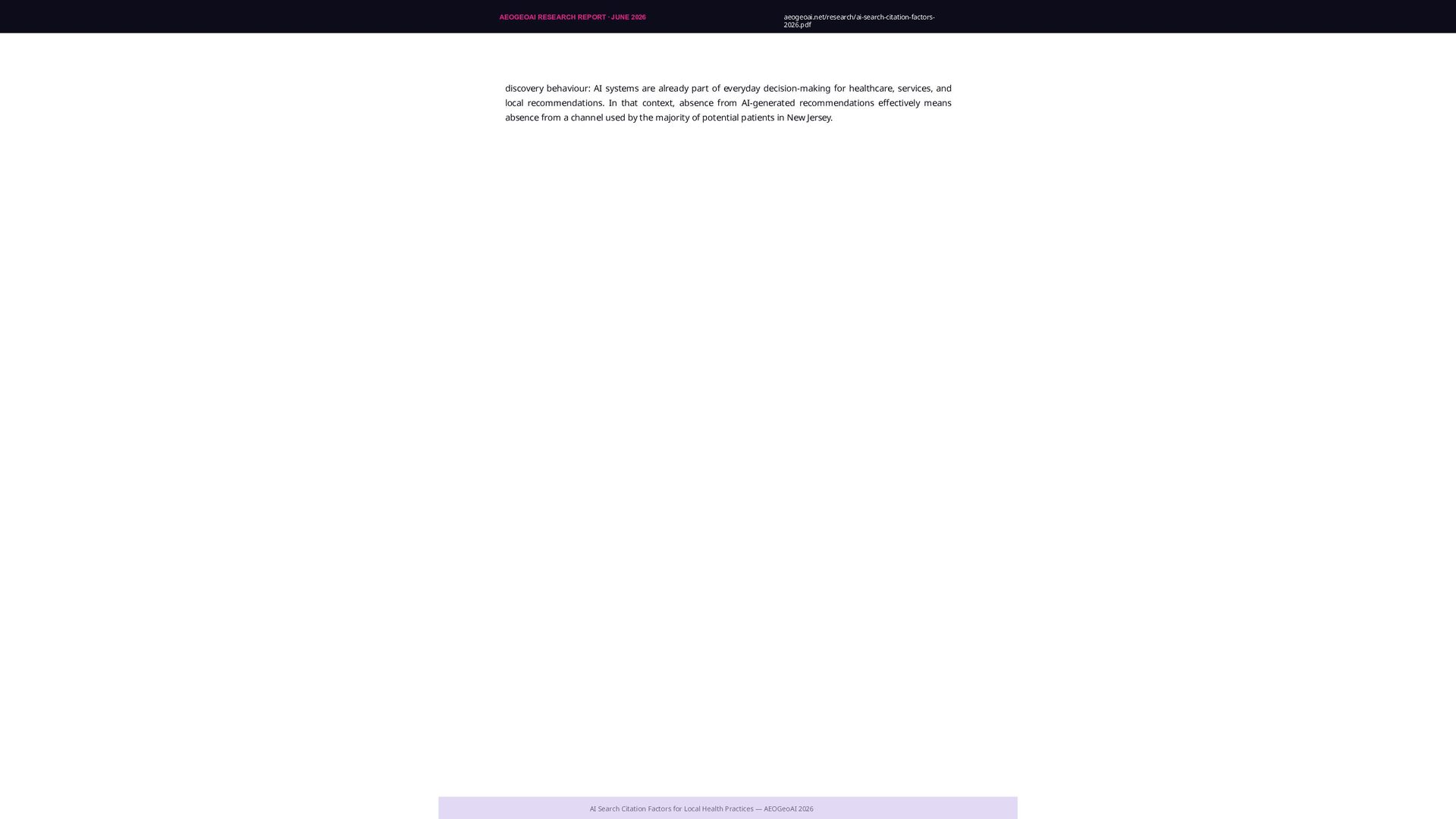
  9. AEOGEOAI RESEARCH REPORT · JUNE 2026 aeogeoai.net/research/ai-search-citation-factors- 2026.pdf discovery behaviour:

    AI systems are already part of everyday decision-making for healthcare, services, and local recommendations. In that context, absence from AI-generated recommendations effectively means absence from a channel used by the majority of potential patients in New Jersey. AI Search Citation Factors for Local Health Practices — AEOGeoAI 2026
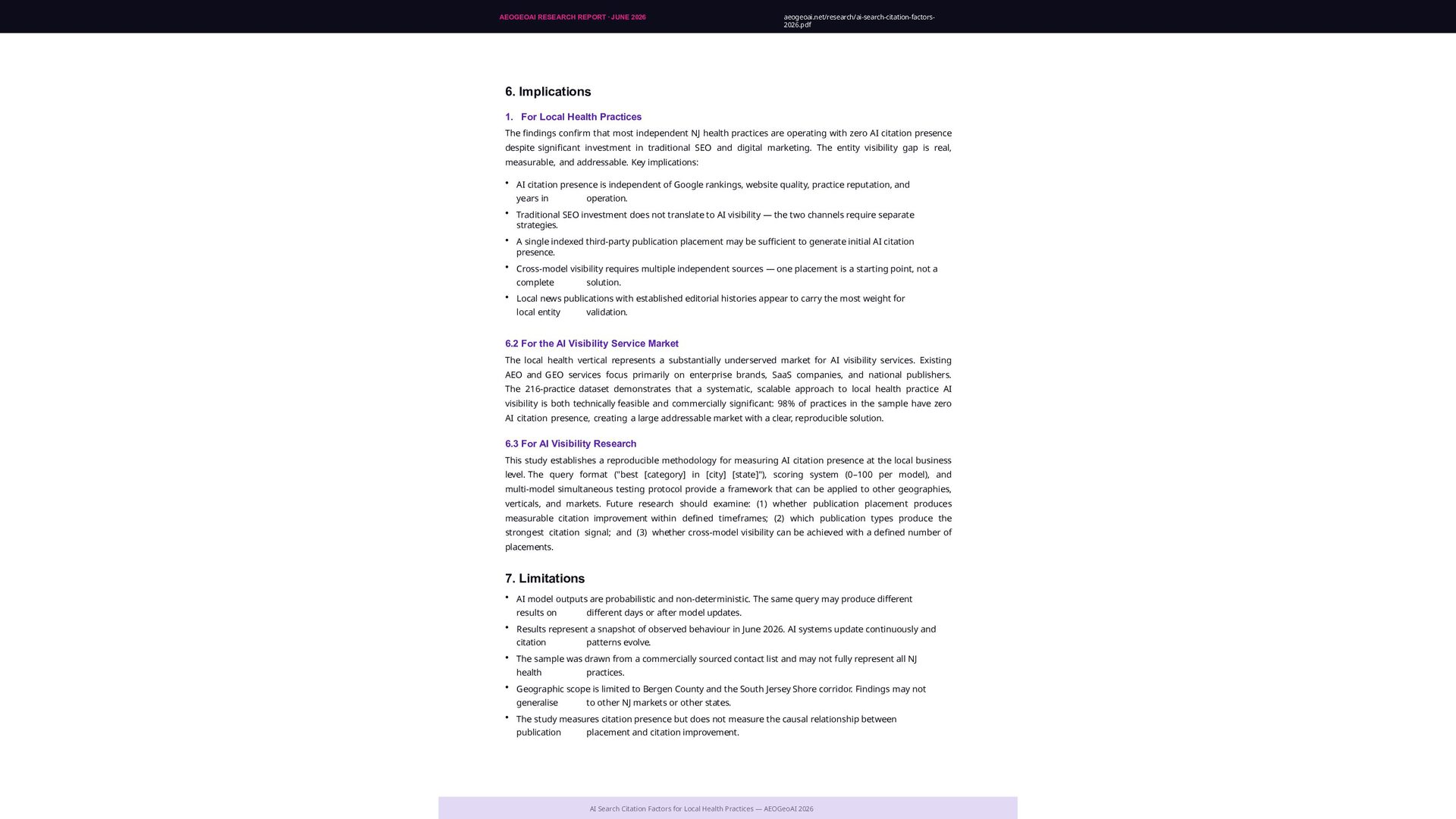
  10. AEOGEOAI RESEARCH REPORT · JUNE 2026 aeogeoai.net/research/ai-search-citation-factors- 2026.pdf 6. Implications

    1. For Local Health Practices The findings confirm that most independent NJ health practices are operating with zero AI citation presence despite significant investment in traditional SEO and digital marketing. The entity visibility gap is real, measurable, and addressable. Key implications: • AI citation presence is independent of Google rankings, website quality, practice reputation, and years in operation. • Traditional SEO investment does not translate to AI visibility — the two channels require separate strategies. • A single indexed third-party publication placement may be sufficient to generate initial AI citation presence. • Cross-model visibility requires multiple independent sources — one placement is a starting point, not a complete solution. • Local news publications with established editorial histories appear to carry the most weight for local entity validation. 6.2 For the AI Visibility Service Market The local health vertical represents a substantially underserved market for AI visibility services. Existing AEO and GEO services focus primarily on enterprise brands, SaaS companies, and national publishers. The 216-practice dataset demonstrates that a systematic, scalable approach to local health practice AI visibility is both technically feasible and commercially significant: 98% of practices in the sample have zero AI citation presence, creating a large addressable market with a clear, reproducible solution. 6.3 For AI Visibility Research This study establishes a reproducible methodology for measuring AI citation presence at the local business level. The query format ("best [category] in [city] [state]"), scoring system (0–100 per model), and multi-model simultaneous testing protocol provide a framework that can be applied to other geographies, verticals, and markets. Future research should examine: (1) whether publication placement produces measurable citation improvement within defined timeframes; (2) which publication types produce the strongest citation signal; and (3) whether cross-model visibility can be achieved with a defined number of placements. 7. Limitations • AI model outputs are probabilistic and non-deterministic. The same query may produce different results on different days or after model updates. • Results represent a snapshot of observed behaviour in June 2026. AI systems update continuously and citation patterns evolve. • The sample was drawn from a commercially sourced contact list and may not fully represent all NJ health practices. • Geographic scope is limited to Bergen County and the South Jersey Shore corridor. Findings may not generalise to other NJ markets or other states. • The study measures citation presence but does not measure the causal relationship between publication placement and citation improvement. AI Search Citation Factors for Local Health Practices — AEOGeoAI 2026
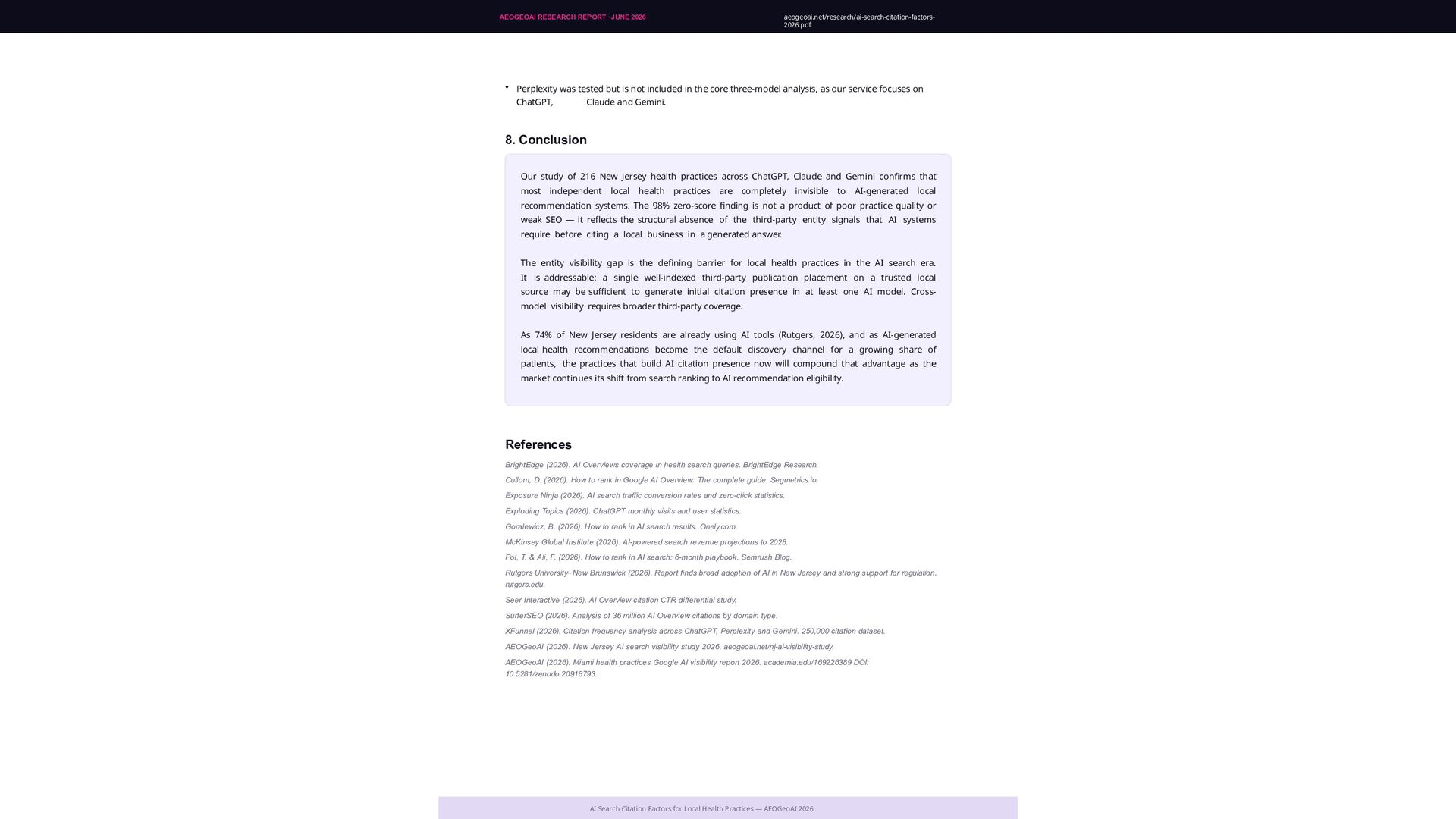
  11. AEOGEOAI RESEARCH REPORT · JUNE 2026 aeogeoai.net/research/ai-search-citation-factors- 2026.pdf • Perplexity

    was tested but is not included in the core three-model analysis, as our service focuses on ChatGPT, Claude and Gemini. 8. Conclusion Our study of 216 New Jersey health practices across ChatGPT, Claude and Gemini confirms that most independent local health practices are completely invisible to AI-generated local recommendation systems. The 98% zero-score finding is not a product of poor practice quality or weak SEO — it reflects the structural absence of the third-party entity signals that AI systems require before citing a local business in a generated answer. The entity visibility gap is the defining barrier for local health practices in the AI search era. It is addressable: a single well-indexed third-party publication placement on a trusted local source may be sufficient to generate initial citation presence in at least one AI model. Cross- model visibility requires broader third-party coverage. As 74% of New Jersey residents are already using AI tools (Rutgers, 2026), and as AI-generated local health recommendations become the default discovery channel for a growing share of patients, the practices that build AI citation presence now will compound that advantage as the market continues its shift from search ranking to AI recommendation eligibility. AI Search Citation Factors for Local Health Practices — AEOGeoAI 2026 References BrightEdge (2026). AI Overviews coverage in health search queries. BrightEdge Research. Cullom, D. (2026). How to rank in Google AI Overview: The complete guide. Segmetrics.io. Exposure Ninja (2026). AI search traffic conversion rates and zero-click statistics. Exploding Topics (2026). ChatGPT monthly visits and user statistics. Goralewicz, B. (2026). How to rank in AI search results. Onely.com. McKinsey Global Institute (2026). AI-powered search revenue projections to 2028. Pol, T. & Ali, F. (2026). How to rank in AI search: 6-month playbook. Semrush Blog. Rutgers University–New Brunswick (2026). Report finds broad adoption of AI in New Jersey and strong support for regulation. rutgers.edu. Seer Interactive (2026). AI Overview citation CTR differential study. SurferSEO (2026). Analysis of 36 million AI Overview citations by domain type. XFunnel (2026). Citation frequency analysis across ChatGPT, Perplexity and Gemini. 250,000 citation dataset. AEOGeoAI (2026). New Jersey AI search visibility study 2026. aeogeoai.net/nj-ai-visibility-study. AEOGeoAI (2026). Miami health practices Google AI visibility report 2026. academia.edu/169226389 DOI: 10.5281/zenodo.20918793.
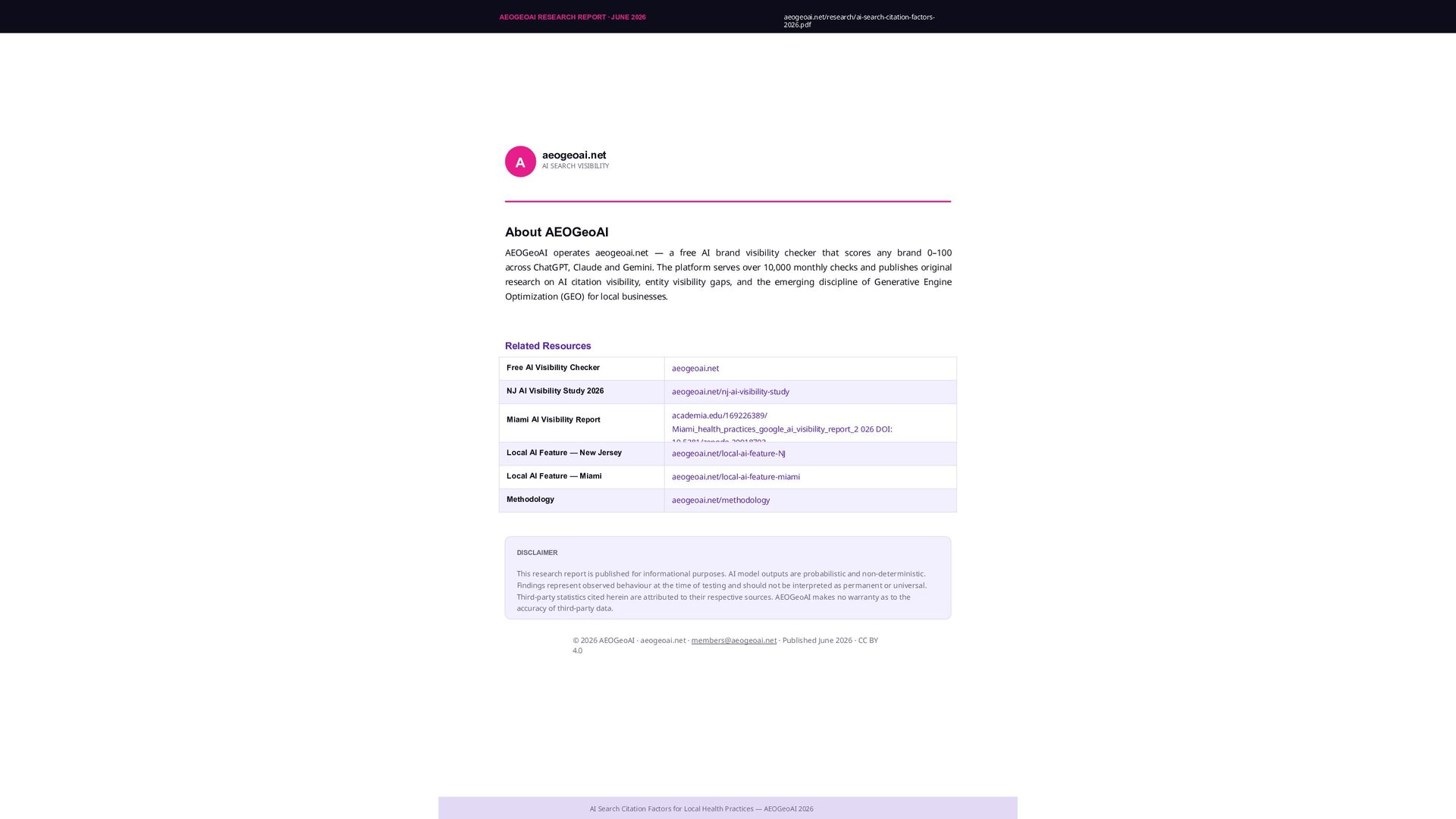
  12. AEOGEOAI RESEARCH REPORT · JUNE 2026 aeogeoai.net/research/ai-search-citation-factors- 2026.pdf A aeogeoai.net

    AI SEARCH VISIBILITY About AEOGeoAI AEOGeoAI operates aeogeoai.net — a free AI brand visibility checker that scores any brand 0–100 across ChatGPT, Claude and Gemini. The platform serves over 10,000 monthly checks and publishes original research on AI citation visibility, entity visibility gaps, and the emerging discipline of Generative Engine Optimization (GEO) for local businesses. Related Resources Free AI Visibility Checker aeogeoai.net NJ AI Visibility Study 2026 aeogeoai.net/nj-ai-visibility-study Miami AI Visibility Report academia.edu/169226389/ Miami_health_practices_google_ai_visibility_report_2 026 DOI: 10.5281/zenodo.20918793 Local AI Feature — New Jersey aeogeoai.net/local-ai-feature-NJ Local AI Feature — Miami aeogeoai.net/local-ai-feature-miami Methodology aeogeoai.net/methodology DISCLAIMER This research report is published for informational purposes. AI model outputs are probabilistic and non-deterministic. Findings represent observed behaviour at the time of testing and should not be interpreted as permanent or universal. Third-party statistics cited herein are attributed to their respective sources. AEOGeoAI makes no warranty as to the accuracy of third-party data. AI Search Citation Factors for Local Health Practices — AEOGeoAI 2026 © 2026 AEOGeoAI · aeogeoai.net · [email protected] · Published June 2026 · CC BY 4.0