Upgrade to Pro — share decks privately, control downloads, hide ads and more …

How Google AI and ChatGPT Transform Patient Dis...

Sponsored · Your Podcast. Everywhere. Effortlessly. Share. Educate. Inspire. Entertain. You do you. We'll handle the rest.

How Google AI and ChatGPT Transform Patient Discovery in Miami Health Practices

Analysis of AI citation visibility's impact on Miami health practices (canonical: https://aeogeoai.net/miami-ai-visibility-study), highlighting the shift in patient discovery through Google AI Overviews, AI Mode, and ChatGPT, and proposing strategies for improving AI-driven local search presence.

How Google AI Overviews, Google AI Mode, and ChatGPT Are Reshaping Patient Discovery in Miami-Dade

AEOGeoAI Research Team June 2026 · Miami-Dade County, FL DOI: 10.5281/zenodo.20918793 https://aeogeoai.net/research

Avatar for AEOGeoAI Research Team

AEOGeoAI Research Team

July 10, 2026

More Decks by AEOGeoAI Research Team

Other Decks in Research

Transcript

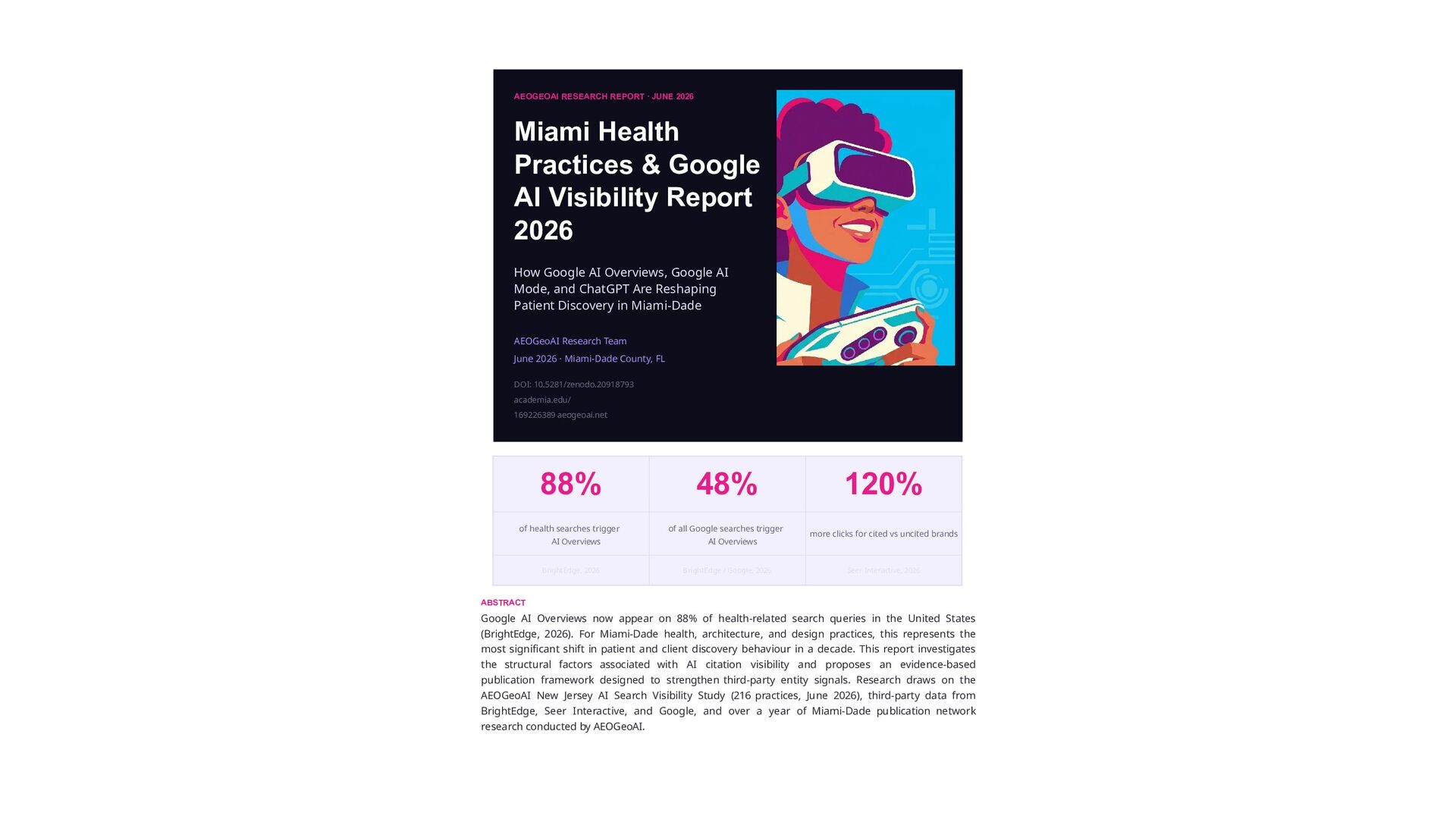
  1. AEOGEOAI RESEARCH REPORT · JUNE 2026 Miami Health Practices &

    Google AI Visibility Report 2026 How Google AI Overviews, Google AI Mode, and ChatGPT Are Reshaping Patient Discovery in Miami-Dade AEOGeoAI Research Team June 2026 · Miami-Dade County, FL DOI: 10.5281/zenodo.20918793 academia.edu/ 169226389 aeogeoai.net 88% 48% 120% of health searches trigger AI Overviews of all Google searches trigger AI Overviews more clicks for cited vs uncited brands BrightEdge, 2026 BrightEdge / Google, 2026 Seer Interactive, 2026 ABSTRACT Google AI Overviews now appear on 88% of health-related search queries in the United States (BrightEdge, 2026). For Miami-Dade health, architecture, and design practices, this represents the most significant shift in patient and client discovery behaviour in a decade. This report investigates the structural factors associated with AI citation visibility and proposes an evidence-based publication framework designed to strengthen third-party entity signals. Research draws on the AEOGeoAI New Jersey AI Search Visibility Study (216 practices, June 2026), third-party data from BrightEdge, Seer Interactive, and Google, and over a year of Miami-Dade publication network research conducted by AEOGeoAI.
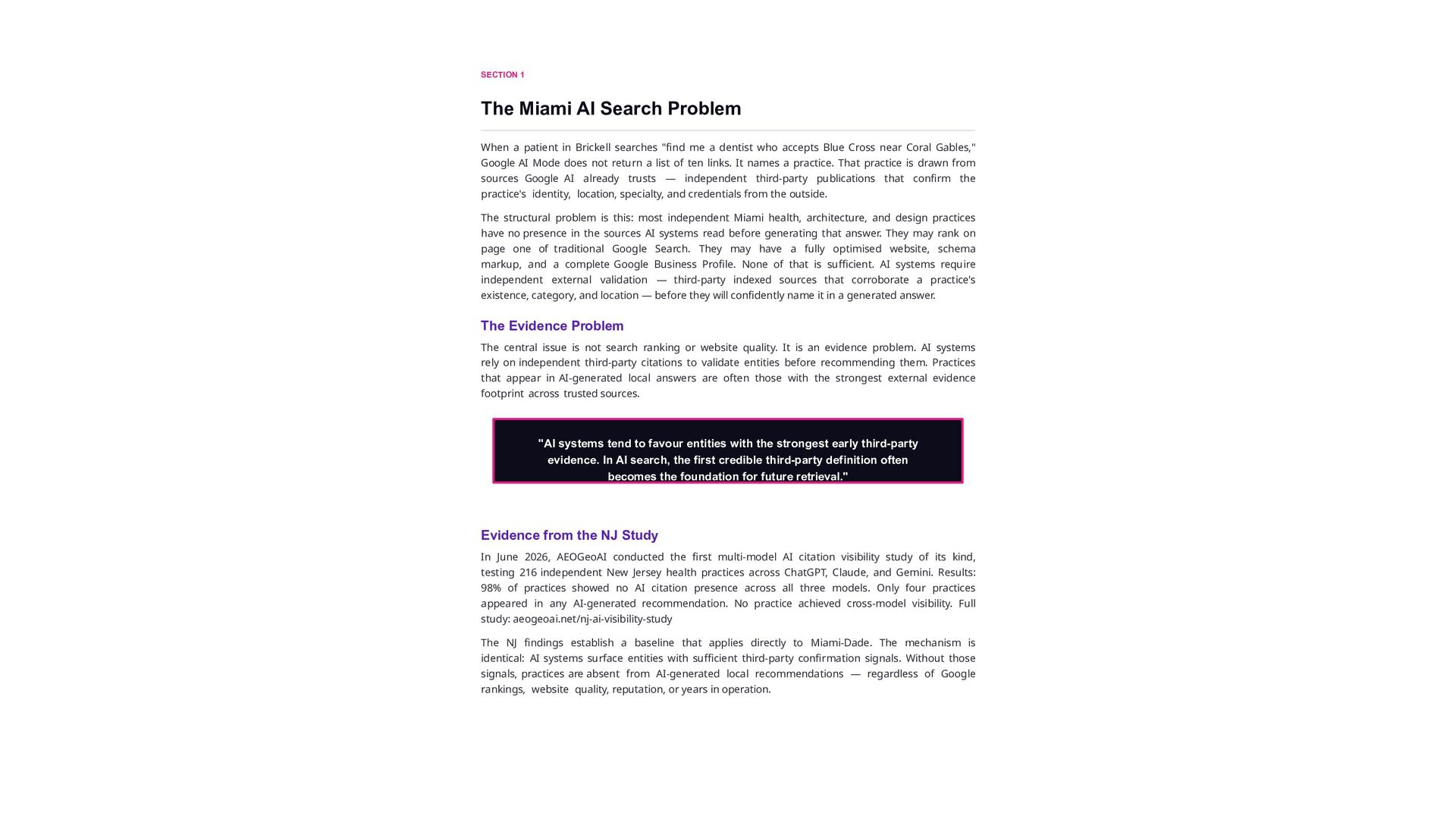
  2. SECTION 1 The Miami AI Search Problem When a patient

    in Brickell searches "find me a dentist who accepts Blue Cross near Coral Gables," Google AI Mode does not return a list of ten links. It names a practice. That practice is drawn from sources Google AI already trusts — independent third-party publications that confirm the practice's identity, location, specialty, and credentials from the outside. The structural problem is this: most independent Miami health, architecture, and design practices have no presence in the sources AI systems read before generating that answer. They may rank on page one of traditional Google Search. They may have a fully optimised website, schema markup, and a complete Google Business Profile. None of that is sufficient. AI systems require independent external validation — third-party indexed sources that corroborate a practice's existence, category, and location — before they will confidently name it in a generated answer. The Evidence Problem The central issue is not search ranking or website quality. It is an evidence problem. AI systems rely on independent third-party citations to validate entities before recommending them. Practices that appear in AI-generated local answers are often those with the strongest external evidence footprint across trusted sources. "AI systems tend to favour entities with the strongest early third-party evidence. In AI search, the first credible third-party definition often becomes the foundation for future retrieval." Evidence from the NJ Study In June 2026, AEOGeoAI conducted the first multi-model AI citation visibility study of its kind, testing 216 independent New Jersey health practices across ChatGPT, Claude, and Gemini. Results: 98% of practices showed no AI citation presence across all three models. Only four practices appeared in any AI-generated recommendation. No practice achieved cross-model visibility. Full study: aeogeoai.net/nj-ai-visibility-study The NJ findings establish a baseline that applies directly to Miami-Dade. The mechanism is identical: AI systems surface entities with sufficient third-party confirmation signals. Without those signals, practices are absent from AI-generated local recommendations — regardless of Google rankings, website quality, reputation, or years in operation.
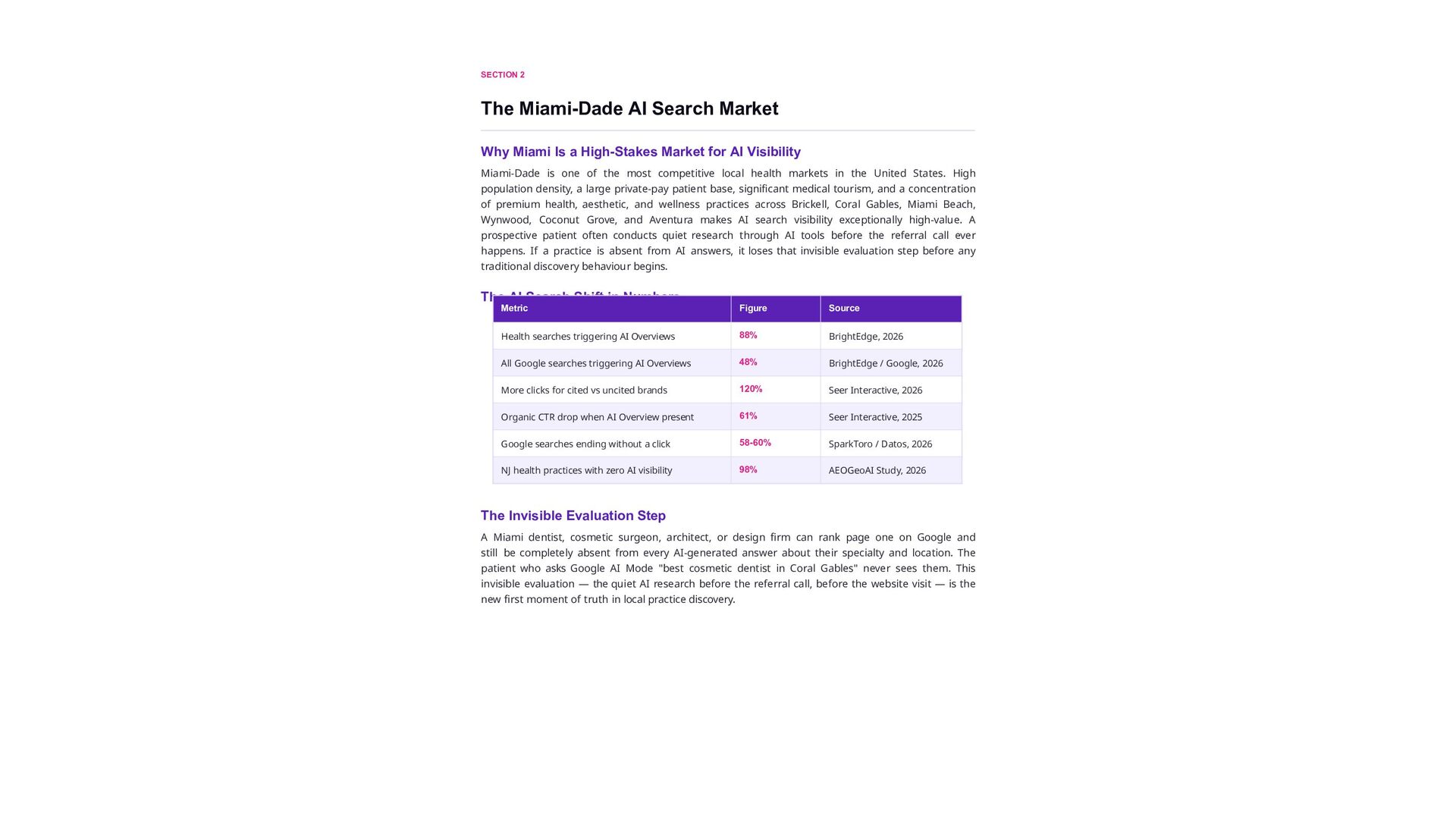
  3. SECTION 2 The Miami-Dade AI Search Market Why Miami Is

    a High-Stakes Market for AI Visibility Miami-Dade is one of the most competitive local health markets in the United States. High population density, a large private-pay patient base, significant medical tourism, and a concentration of premium health, aesthetic, and wellness practices across Brickell, Coral Gables, Miami Beach, Wynwood, Coconut Grove, and Aventura makes AI search visibility exceptionally high-value. A prospective patient often conducts quiet research through AI tools before the referral call ever happens. If a practice is absent from AI answers, it loses that invisible evaluation step before any traditional discovery behaviour begins. The AI Search Shift in Numbers Metric Figure Source Health searches triggering AI Overviews 88% BrightEdge, 2026 All Google searches triggering AI Overviews 48% BrightEdge / Google, 2026 More clicks for cited vs uncited brands 120% Seer Interactive, 2026 Organic CTR drop when AI Overview present 61% Seer Interactive, 2025 Google searches ending without a click 58-60% SparkToro / Datos, 2026 NJ health practices with zero AI visibility 98% AEOGeoAI Study, 2026 The Invisible Evaluation Step A Miami dentist, cosmetic surgeon, architect, or design firm can rank page one on Google and still be completely absent from every AI-generated answer about their specialty and location. The patient who asks Google AI Mode "best cosmetic dentist in Coral Gables" never sees them. This invisible evaluation — the quiet AI research before the referral call, before the website visit — is the new first moment of truth in local practice discovery.
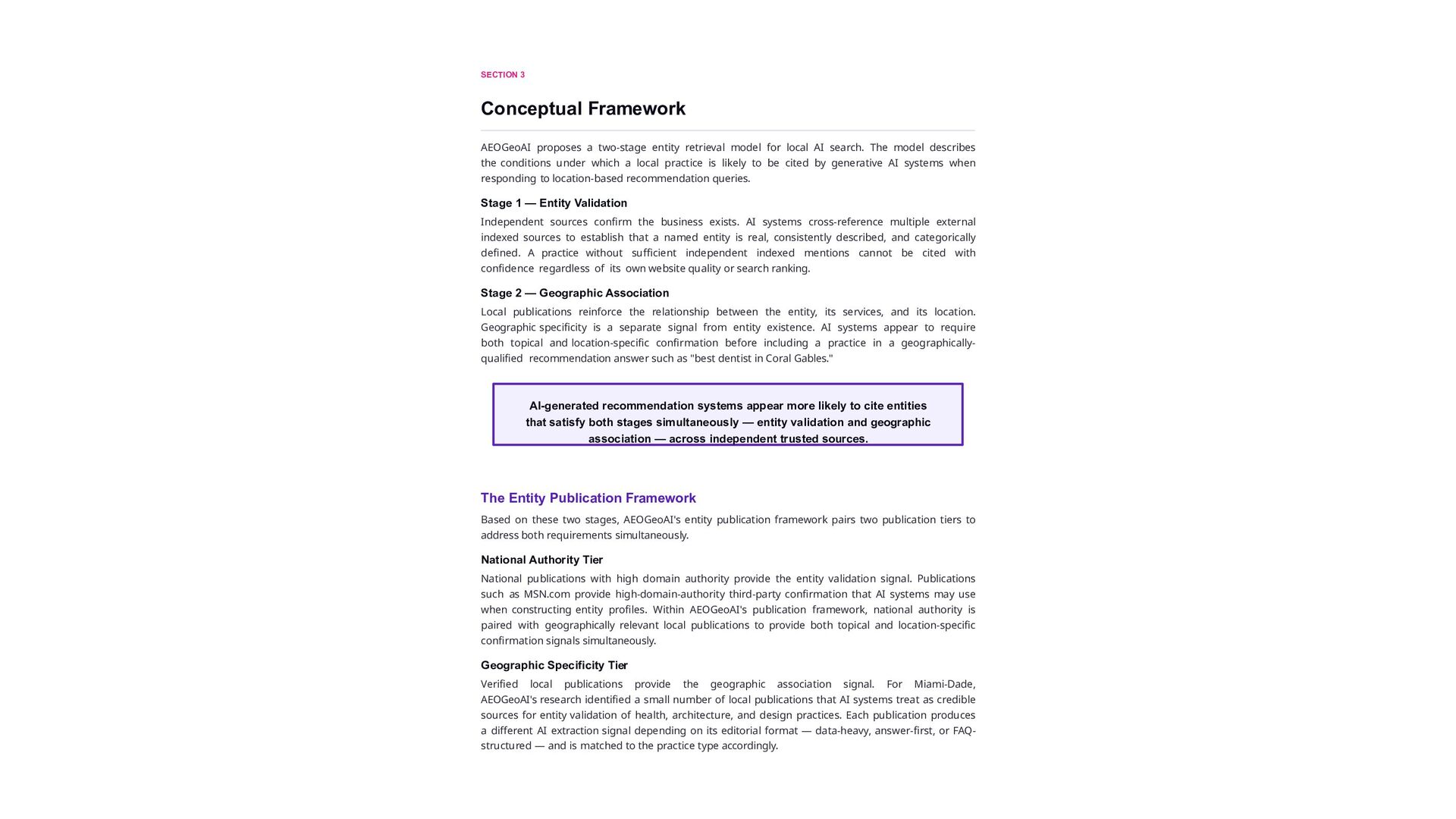
  4. SECTION 3 Conceptual Framework AEOGeoAI proposes a two-stage entity retrieval

    model for local AI search. The model describes the conditions under which a local practice is likely to be cited by generative AI systems when responding to location-based recommendation queries. Stage 1 — Entity Validation Independent sources confirm the business exists. AI systems cross-reference multiple external indexed sources to establish that a named entity is real, consistently described, and categorically defined. A practice without sufficient independent indexed mentions cannot be cited with confidence regardless of its own website quality or search ranking. Stage 2 — Geographic Association Local publications reinforce the relationship between the entity, its services, and its location. Geographic specificity is a separate signal from entity existence. AI systems appear to require both topical and location-specific confirmation before including a practice in a geographically- qualified recommendation answer such as "best dentist in Coral Gables." AI-generated recommendation systems appear more likely to cite entities that satisfy both stages simultaneously — entity validation and geographic association — across independent trusted sources. The Entity Publication Framework Based on these two stages, AEOGeoAI's entity publication framework pairs two publication tiers to address both requirements simultaneously. National Authority Tier National publications with high domain authority provide the entity validation signal. Publications such as MSN.com provide high-domain-authority third-party confirmation that AI systems may use when constructing entity profiles. Within AEOGeoAI's publication framework, national authority is paired with geographically relevant local publications to provide both topical and location-specific confirmation signals simultaneously. Geographic Specificity Tier Verified local publications provide the geographic association signal. For Miami-Dade, AEOGeoAI's research identified a small number of local publications that AI systems treat as credible sources for entity validation of health, architecture, and design practices. Each publication produces a different AI extraction signal depending on its editorial format — data-heavy, answer-first, or FAQ- structured — and is matched to the practice type accordingly.
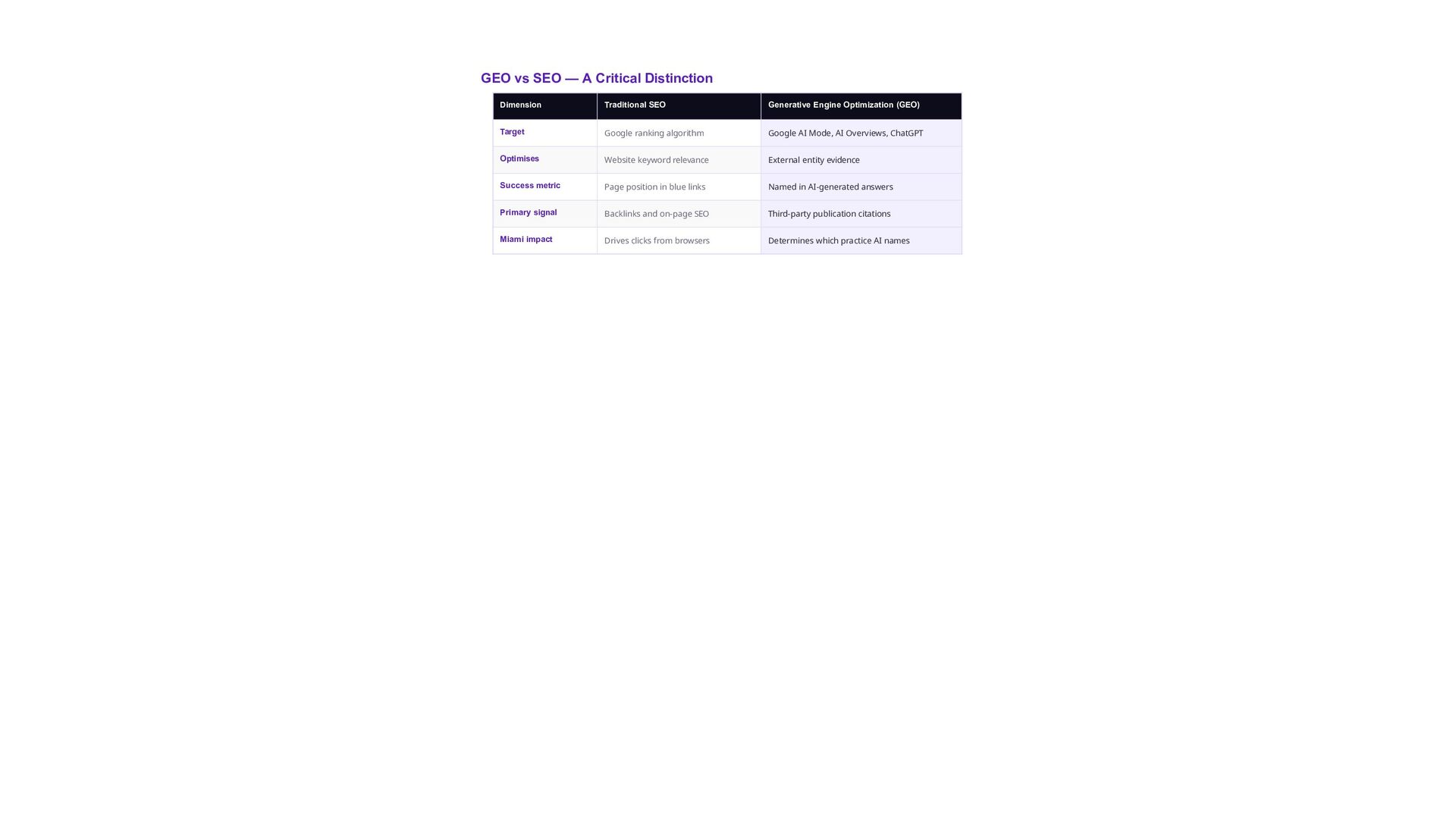
  5. GEO vs SEO — A Critical Distinction Dimension Traditional SEO

    Generative Engine Optimization (GEO) Target Google ranking algorithm Google AI Mode, AI Overviews, ChatGPT Optimises Website keyword relevance External entity evidence Success metric Page position in blue links Named in AI-generated answers Primary signal Backlinks and on-page SEO Third-party publication citations Miami impact Drives clicks from browsers Determines which practice AI names
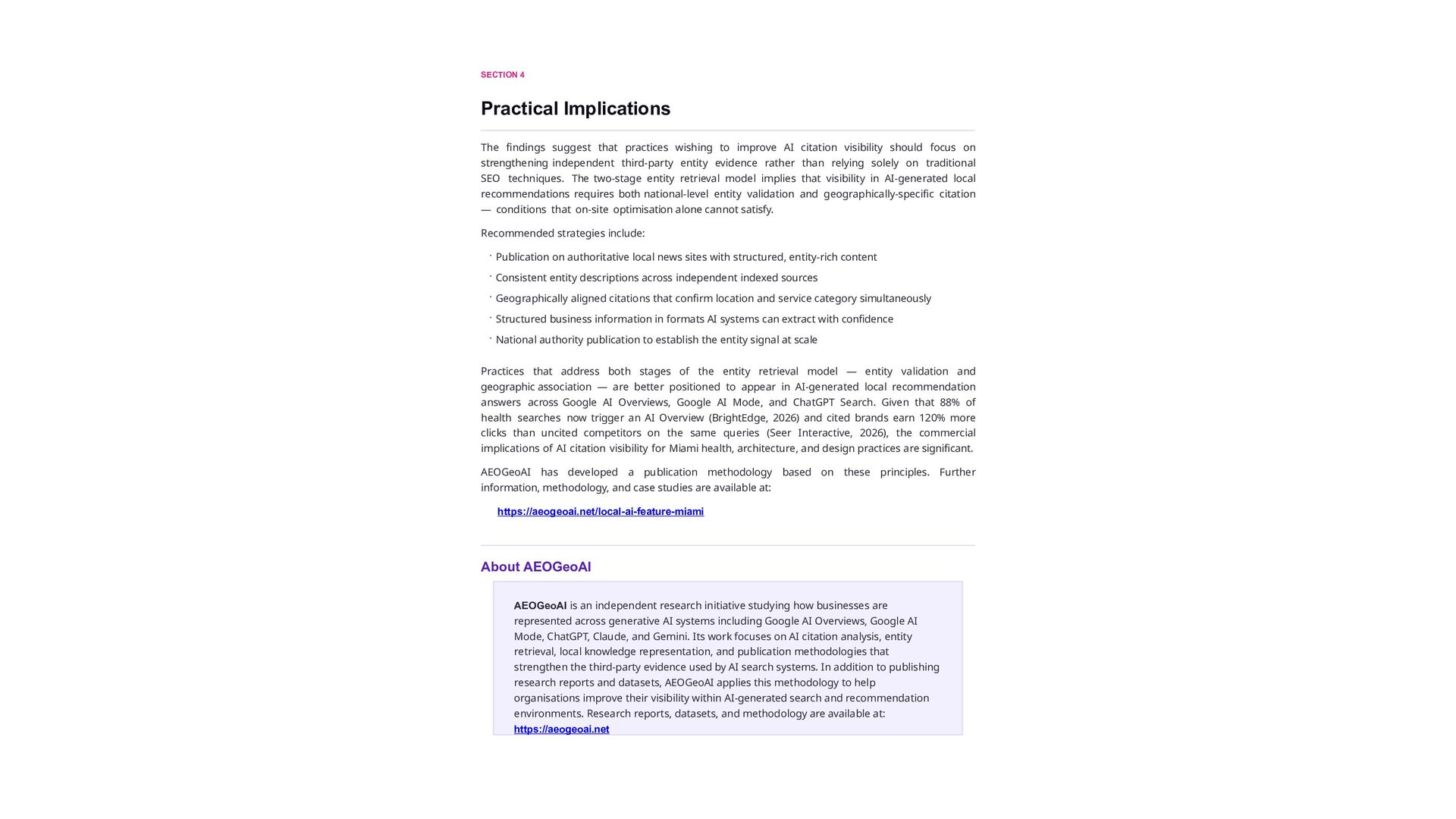
  6. SECTION 4 Practical Implications The findings suggest that practices wishing

    to improve AI citation visibility should focus on strengthening independent third-party entity evidence rather than relying solely on traditional SEO techniques. The two-stage entity retrieval model implies that visibility in AI-generated local recommendations requires both national-level entity validation and geographically-specific citation — conditions that on-site optimisation alone cannot satisfy. Recommended strategies include: · Publication on authoritative local news sites with structured, entity-rich content · Consistent entity descriptions across independent indexed sources · Geographically aligned citations that confirm location and service category simultaneously · Structured business information in formats AI systems can extract with confidence · National authority publication to establish the entity signal at scale Practices that address both stages of the entity retrieval model — entity validation and geographic association — are better positioned to appear in AI-generated local recommendation answers across Google AI Overviews, Google AI Mode, and ChatGPT Search. Given that 88% of health searches now trigger an AI Overview (BrightEdge, 2026) and cited brands earn 120% more clicks than uncited competitors on the same queries (Seer Interactive, 2026), the commercial implications of AI citation visibility for Miami health, architecture, and design practices are significant. AEOGeoAI has developed a publication methodology based on these principles. Further information, methodology, and case studies are available at: https://aeogeoai.net/local-ai-feature-miami About AEOGeoAI AEOGeoAI is an independent research initiative studying how businesses are represented across generative AI systems including Google AI Overviews, Google AI Mode, ChatGPT, Claude, and Gemini. Its work focuses on AI citation analysis, entity retrieval, local knowledge representation, and publication methodologies that strengthen the third-party evidence used by AI search systems. In addition to publishing research reports and datasets, AEOGeoAI applies this methodology to help organisations improve their visibility within AI-generated search and recommendation environments. Research reports, datasets, and methodology are available at: https://aeogeoai.net
  7. DOI: 10.5281/zenodo.20918793 · academia.edu/169226389 · Data sources: BrightEdge Generative Parser

    (February 2026), Seer Interactive longitudinal study (April 2026), Google public disclosures (2026), SparkToro/Datos (2026), AEOGeoAI NJ AI Search Visibility Study (June 2026). Contact: [email protected]