Upgrade to Pro — share decks privately, control downloads, hide ads and more …

Swarm Telepathy (SwaT): Architecture, Training,...

Swarm Telepathy (SwaT): Architecture, Training, Evidence and Audit Questions

A 30-slide technical reading of Swarm Telepathy: Prefill-Free KV-Cache Transfer Across Families.

Explains prefill/decode and KV caches, directed pair-specific mappers, layer groups and self/cross-attention, character-span alignment and causal masks, sequential MSE/NLL training, sliding-window layers, and Attention Matching compaction. Separates communication experiments from receiver re-prefill comparisons, and covers vision and Chinese transfer, comparisons with prior methods, counterexamples and limitations.

AgentCollusion audit proposals are explicitly separated from the paper results. No independent replication has been performed.

Primary paper: Alabdulkareem et al. (2026), arXiv:2610.15095v1
https://arxiv.org/html/2610.15095v1
Author code: https://github.com/Ar-Kareem/SwaT

Japanese slides: https://speakerdeck.com/agentcollusion/ai-no-terepashi-swat-o-ronbun-kara-yomu-shikumi-hikaku-jouken-kansa-heno-toi
Japanese article: https://agentcollusion.ai/news/swarm-telepathy-kv-cache-audit
Japanese video: https://youtu.be/gZW9pQEdEZM

Kotaro OKUYAMA / AgentCollusion
https://agentcollusion.ai/

AgentCollusion

October 29, 2026

Transcript

30 slides
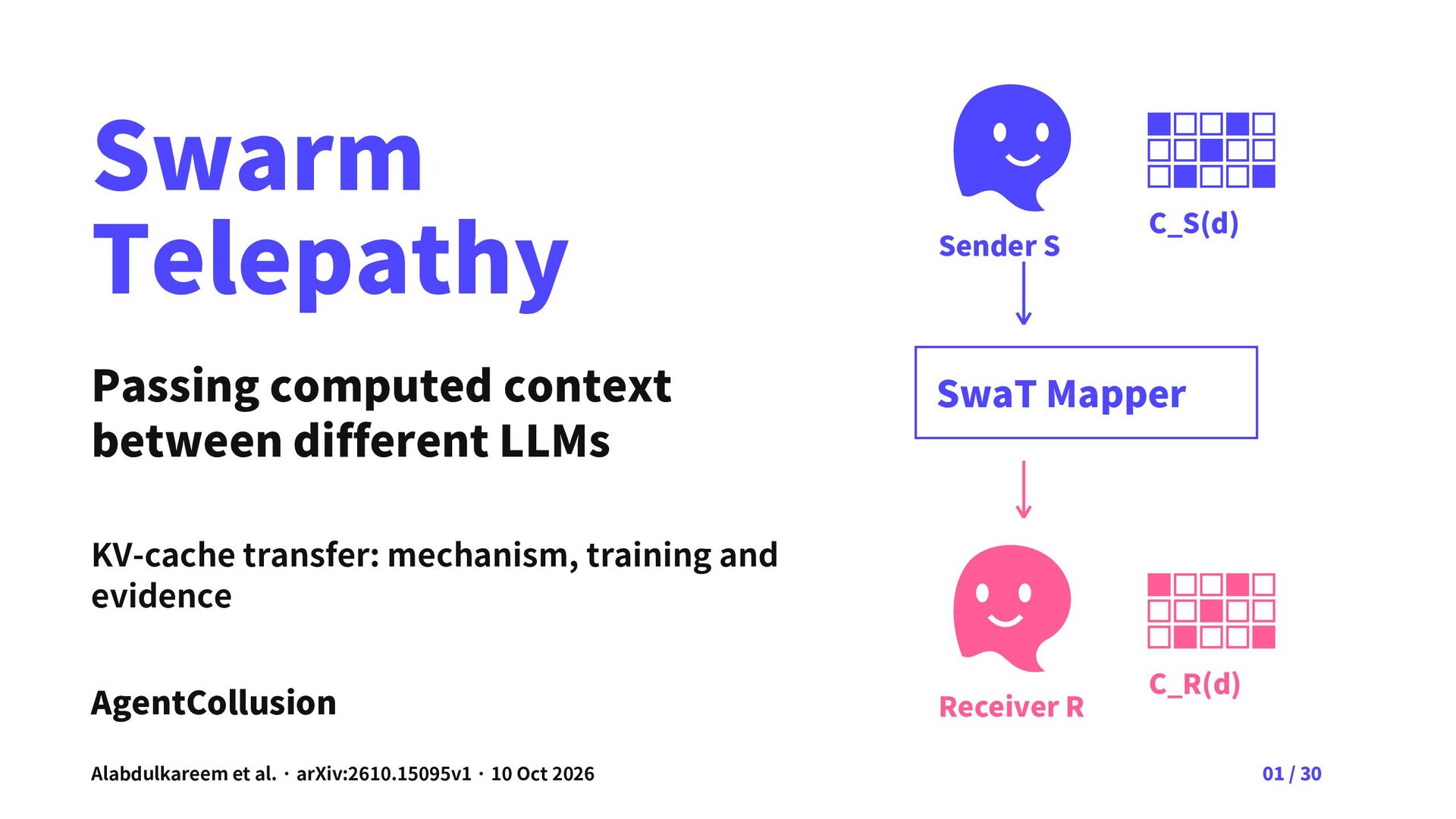
  1. Swarm Telepathy Passing computed context between different LLMs Sender S

    C_S(d) SwaT Mapper KV-cache transfer: mechanism, training and evidence AgentCollusion Alabdulkareem et al. · arXiv:2610.15095v1 · 10 Oct 2026 Receiver R C_R(d) 01 / 30
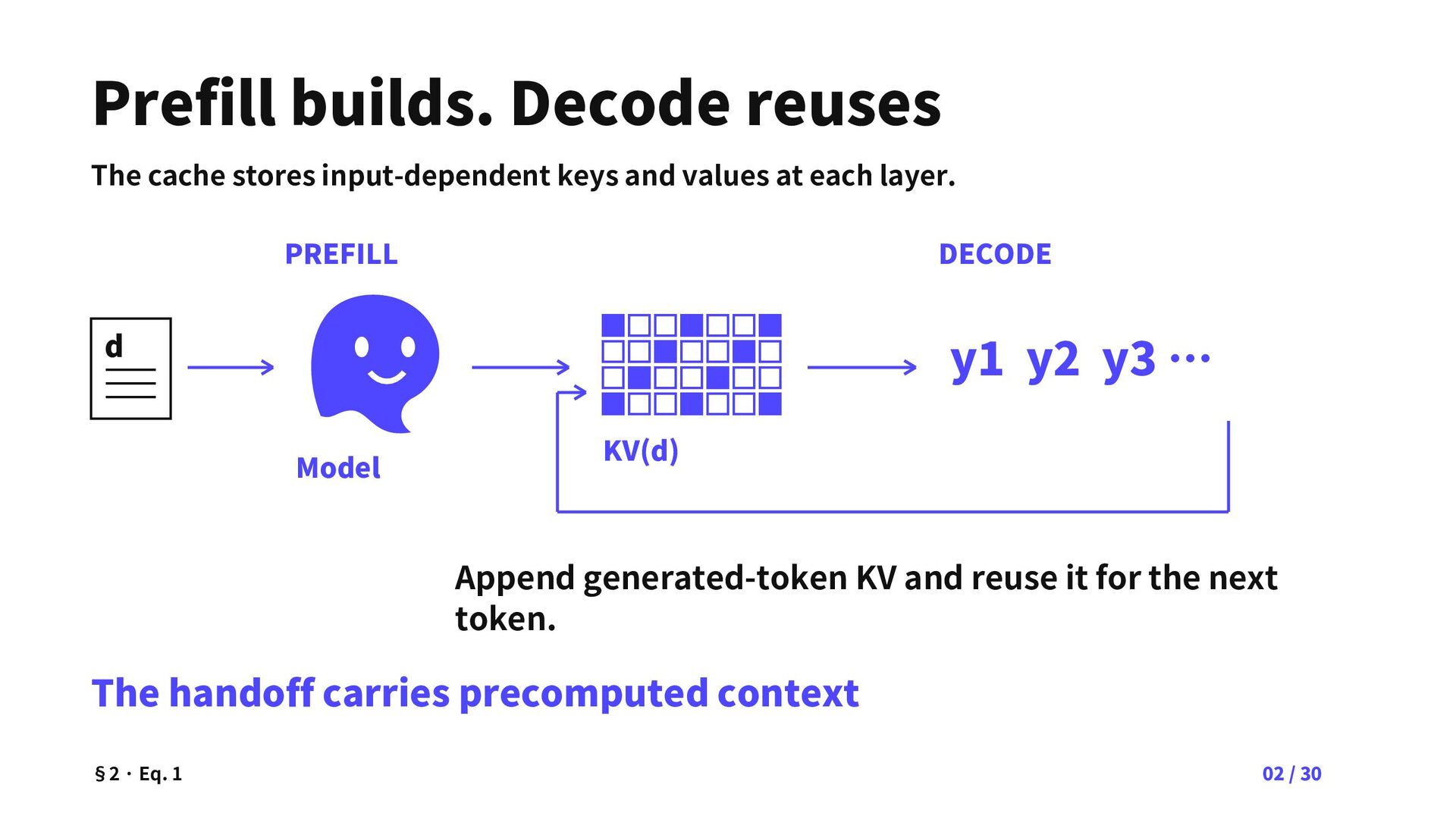
  2. Prefill builds. Decode reuses The cache stores input-dependent keys and

    values at each layer. PREFILL DECODE d y1 y2 y3 … Model KV(d) Append generated-token KV and reuse it for the next token. The handoff carries precomputed context §2 · Eq. 1 02 / 30
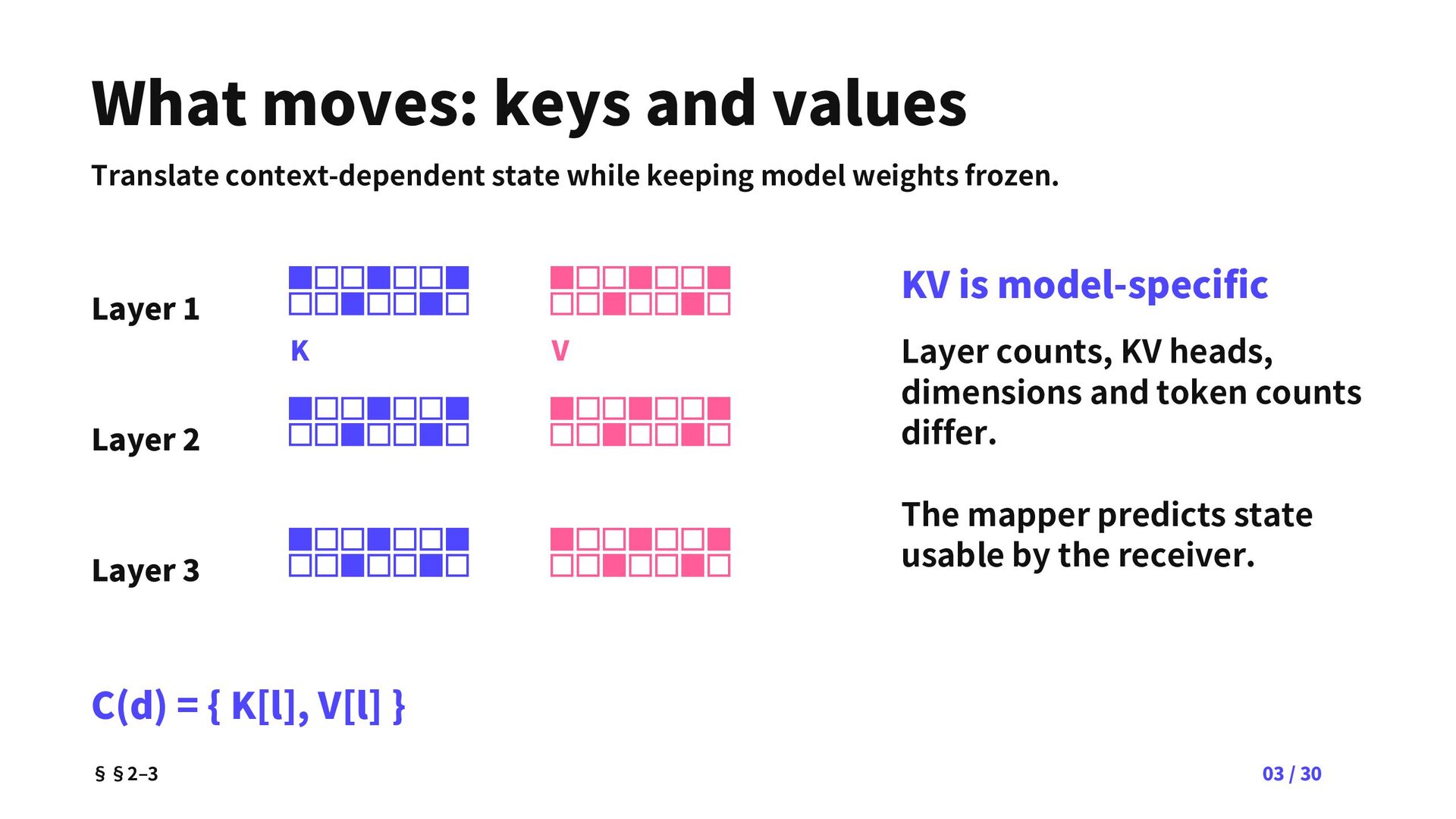
  3. What moves: keys and values Translate context-dependent state while keeping

    model weights frozen. KV is model-specific Layer 1 Layer 2 Layer counts, KV heads, dimensions and token counts differ. Layer 3 The mapper predicts state usable by the receiver. K V C(d) = { K[l], V[l] } §§2–3 03 / 30
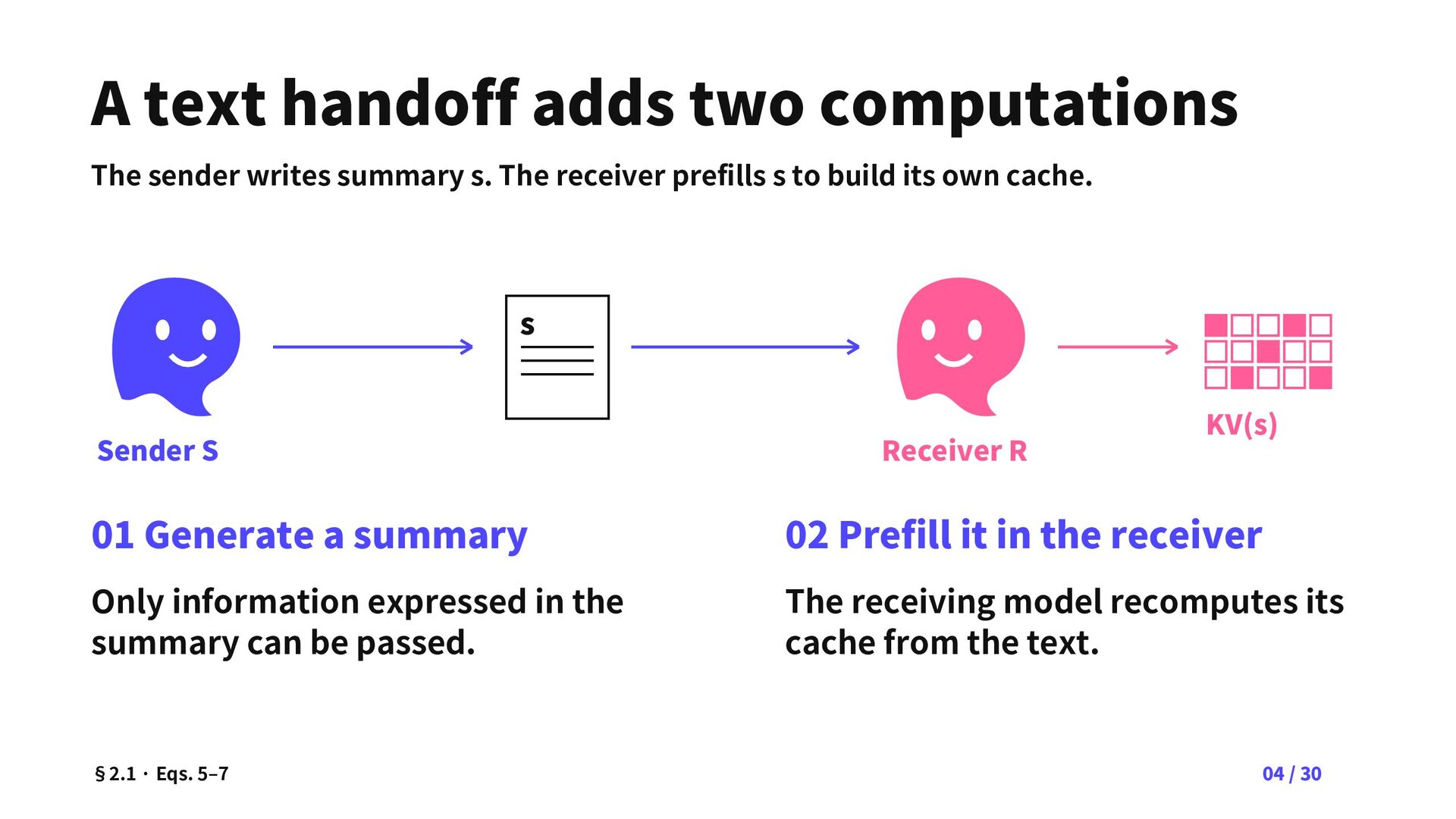
  4. A text handoff adds two computations The sender writes summary

    s. The receiver prefills s to build its own cache. s Sender S Receiver R KV(s) 01 Generate a summary 02 Prefill it in the receiver Only information expressed in the summary can be passed. The receiving model recomputes its cache from the text. §2.1 · Eqs. 5–7 04 / 30
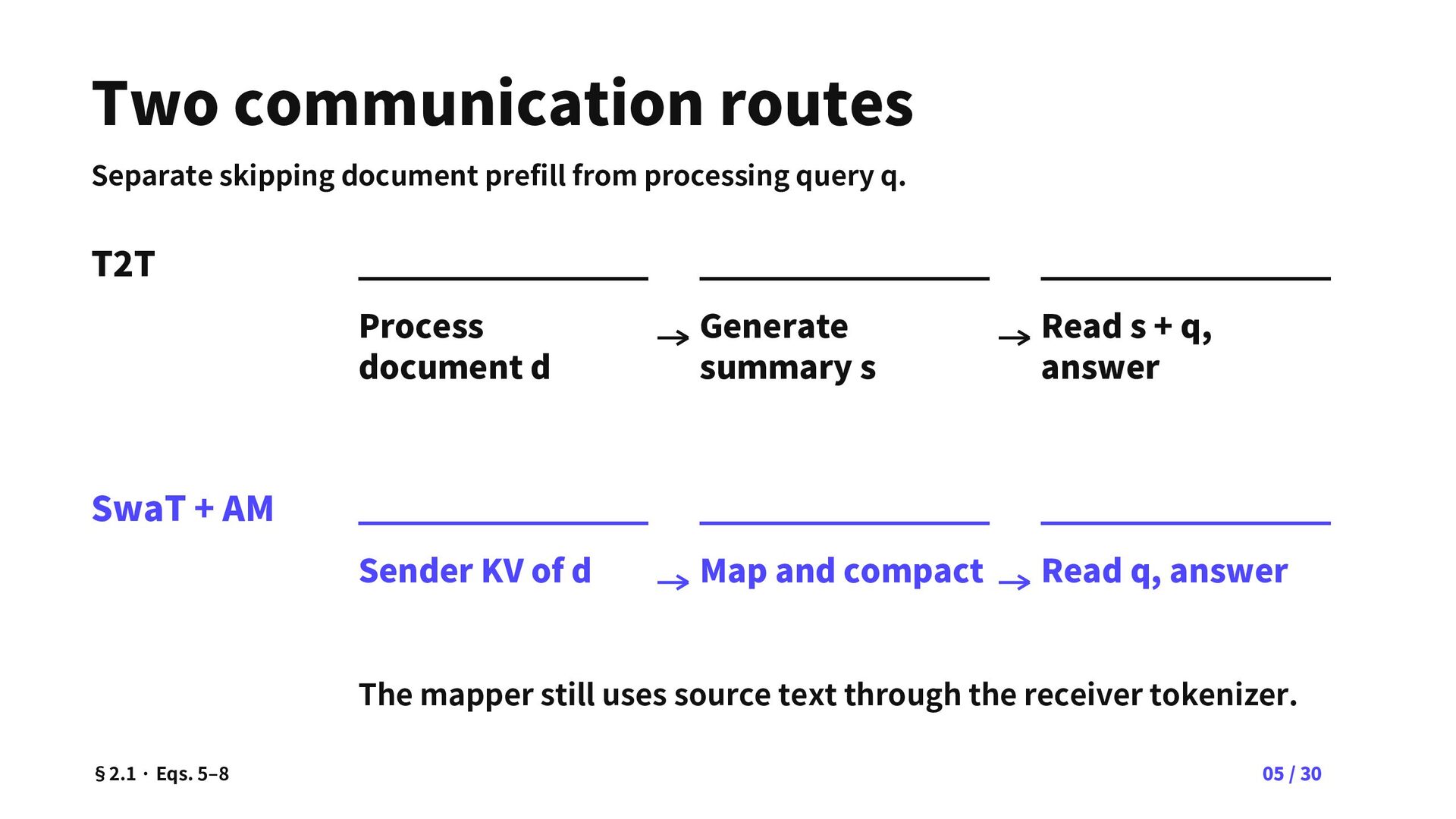
  5. Two communication routes Separate skipping document prefill from processing query

    q. T2T Process document d Generate summary s Read s + q, answer Sender KV of d Map and compact Read q, answer SwaT + AM The mapper still uses source text through the receiver tokenizer. §2.1 · Eqs. 5–8 05 / 30
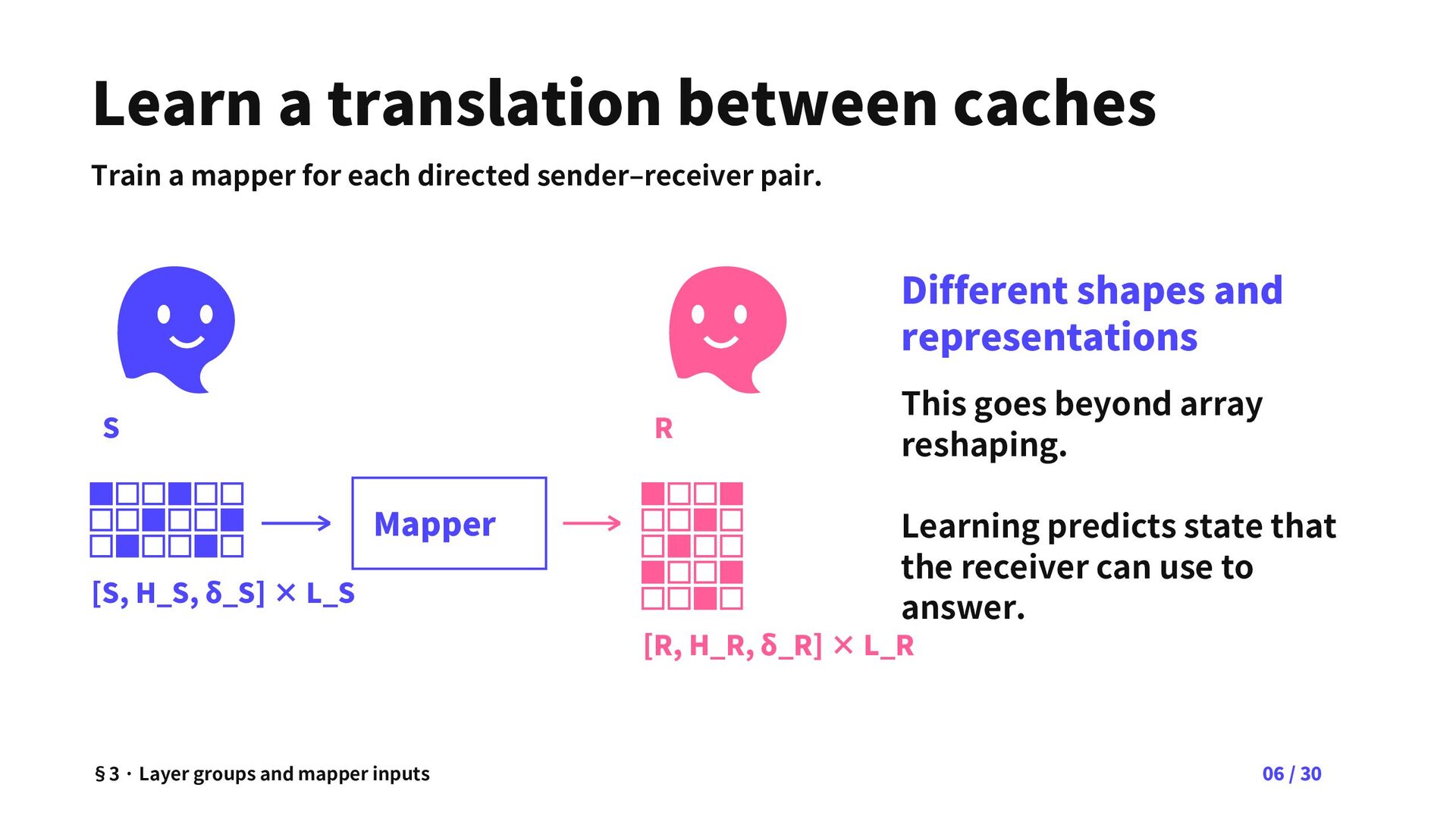
  6. Learn a translation between caches Train a mapper for each

    directed sender–receiver pair. Different shapes and representations S R Mapper [S, H_S, δ_S] × L_S This goes beyond array reshaping. Learning predicts state that the receiver can use to answer. [R, H_R, δ_R] × L_R §3 · Layer groups and mapper inputs 06 / 30
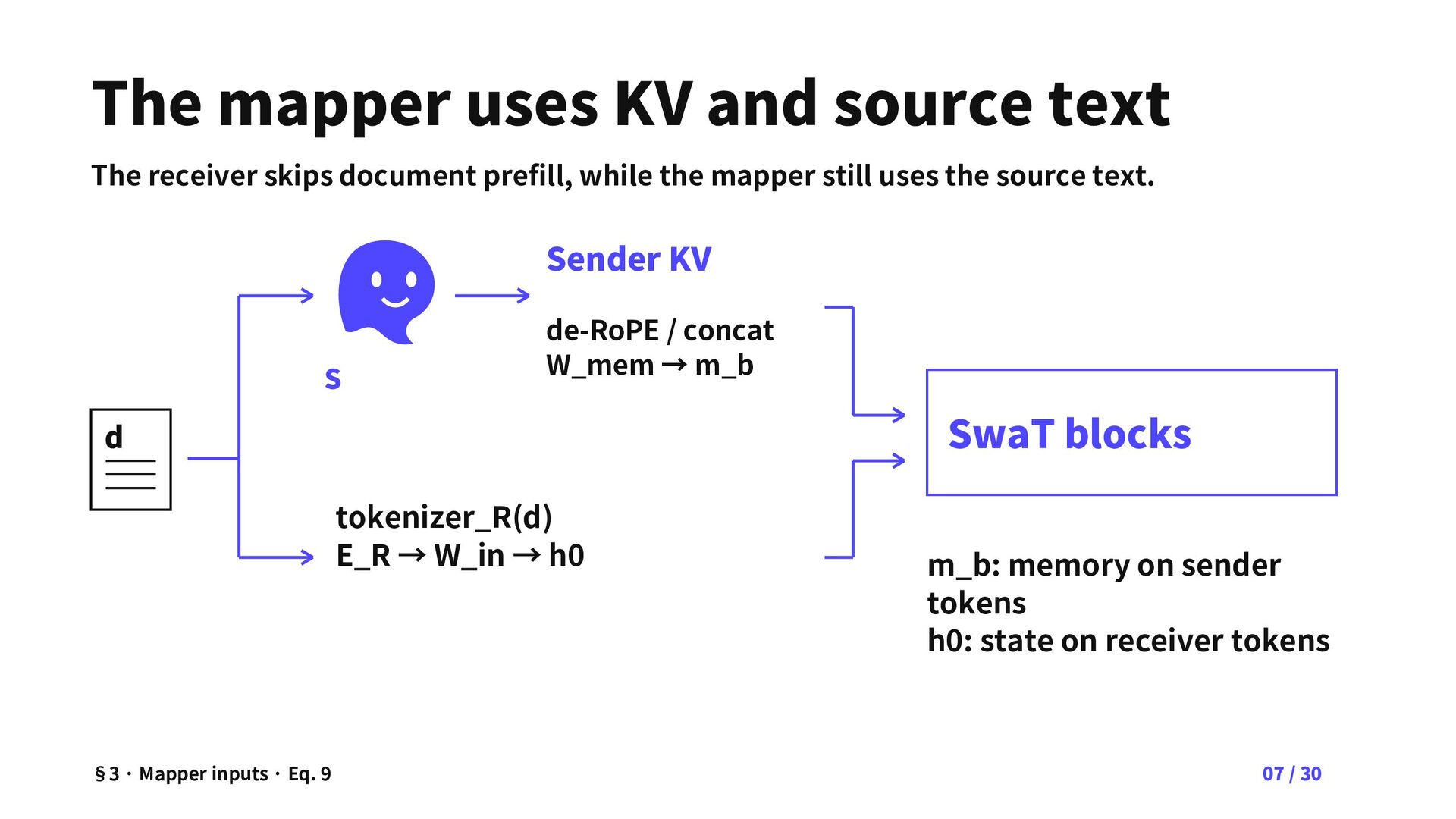
  7. The mapper uses KV and source text The receiver skips

    document prefill, while the mapper still uses the source text. Sender KV S de-RoPE / concat W_mem → m_b SwaT blocks d tokenizer_R(d) E_R → W_in → h0 §3 · Mapper inputs · Eq. 9 m_b: memory on sender tokens h0: state on receiver tokens 07 / 30
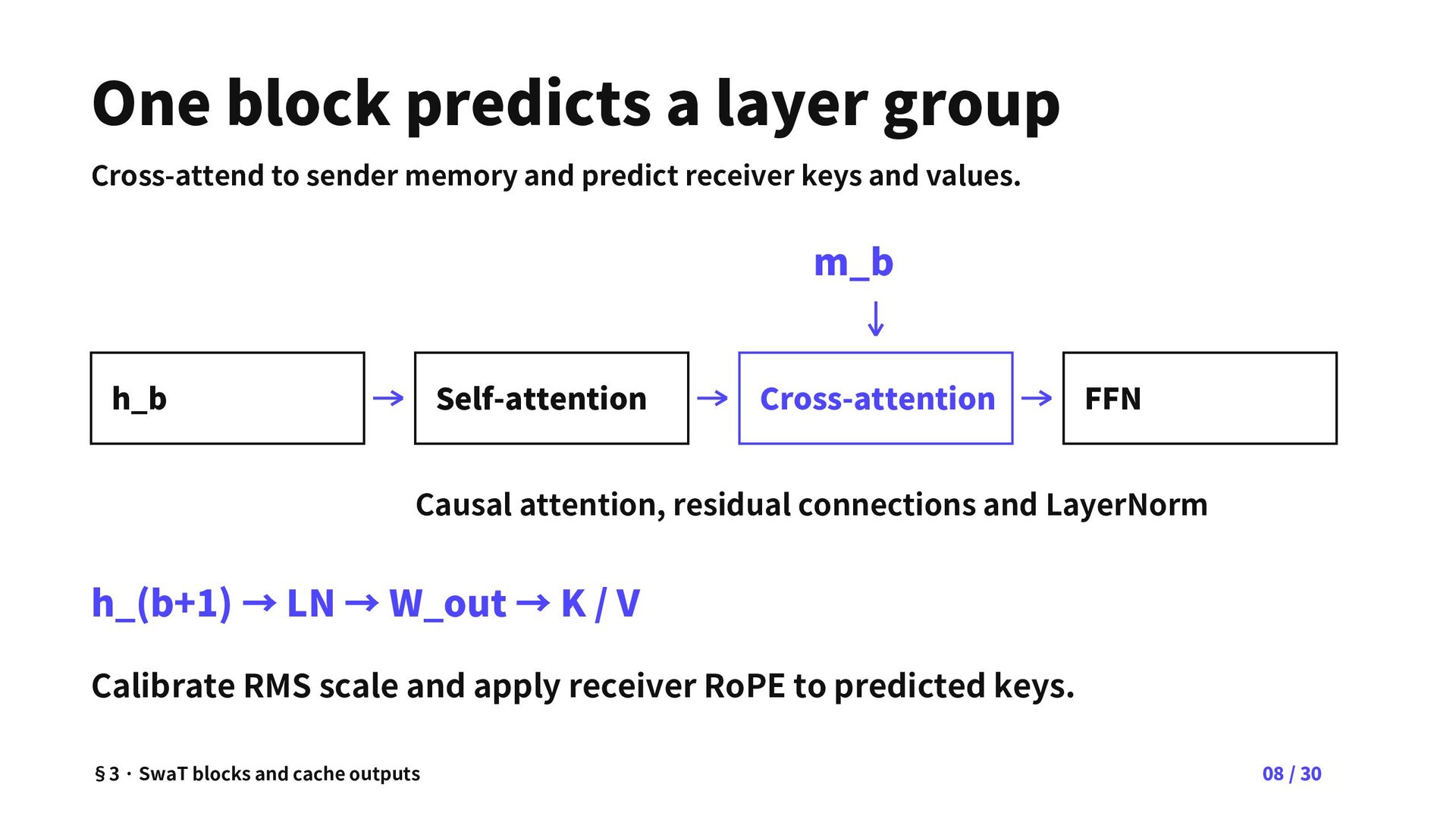
  8. One block predicts a layer group Cross-attend to sender memory

    and predict receiver keys and values. m_b h_b Self-attention Cross-attention FFN Causal attention, residual connections and LayerNorm h_(b+1) → LN → W_out → K / V Calibrate RMS scale and apply receiver RoPE to predicted keys. §3 · SwaT blocks and cache outputs 08 / 30
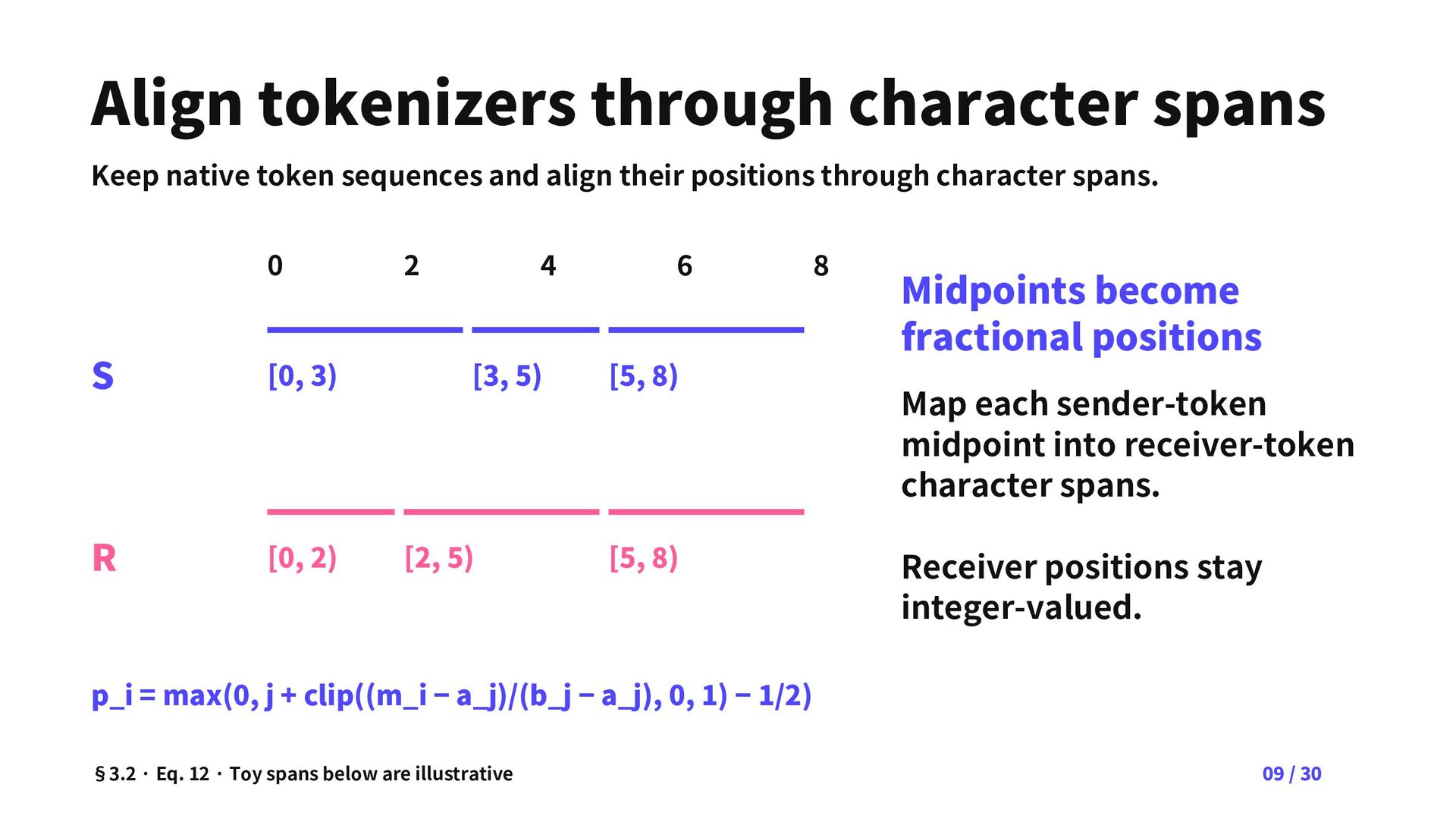
  9. Align tokenizers through character spans Keep native token sequences and

    align their positions through character spans. 0 S [0, 3) R [0, 2) 2 4 6 [3, 5) [5, 8) [2, 5) [5, 8) 8 Midpoints become fractional positions Map each sender-token midpoint into receiver-token character spans. Receiver positions stay integer-valued. p_i = max(0, j + clip((m_i − a_j)/(b_j − a_j), 0, 1) − 1/2) §3.2 · Eq. 12 · Toy spans below are illustrative 09 / 30
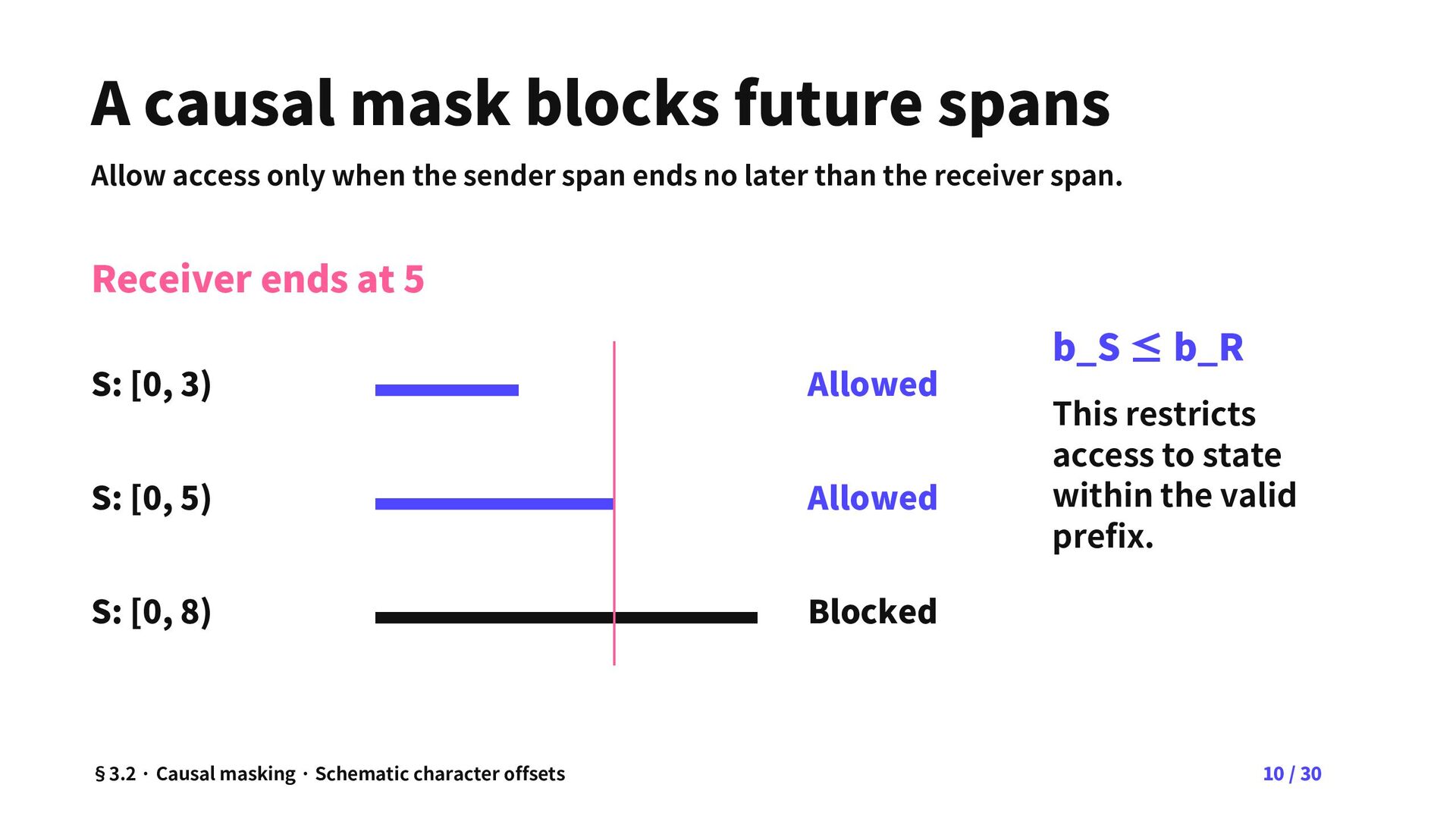
  10. A causal mask blocks future spans Allow access only when

    the sender span ends no later than the receiver span. Receiver ends at 5 b_S ≤ b_R S: [0, 3) Allowed S: [0, 5) Allowed S: [0, 8) Blocked §3.2 · Causal masking · Schematic character offsets This restricts access to state within the valid prefix. 10 / 30
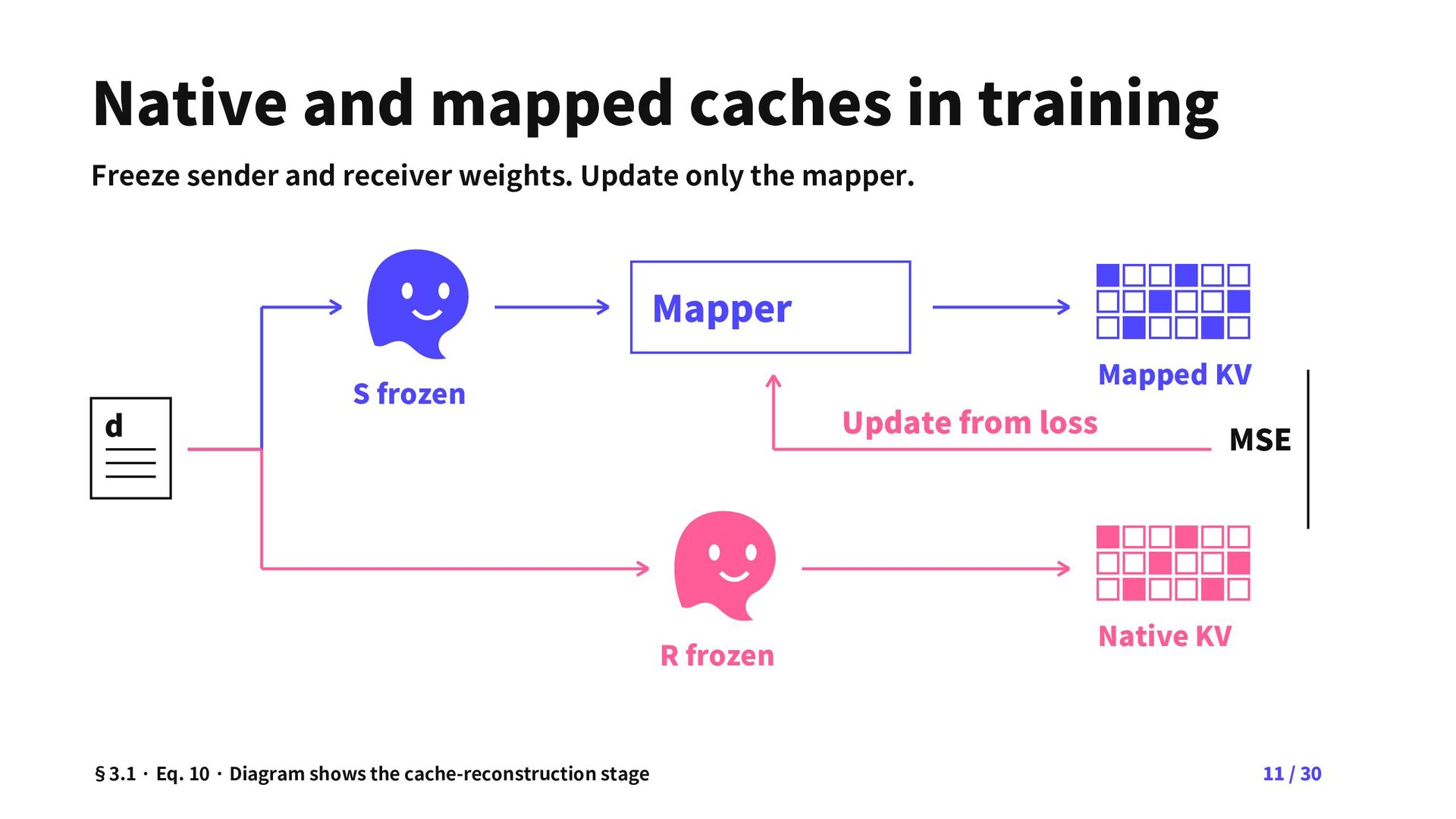
  11. Native and mapped caches in training Freeze sender and receiver

    weights. Update only the mapper. Mapper Mapped KV S frozen Update from loss d R frozen §3.1 · Eq. 10 · Diagram shows the cache-reconstruction stage MSE Native KV 11 / 30
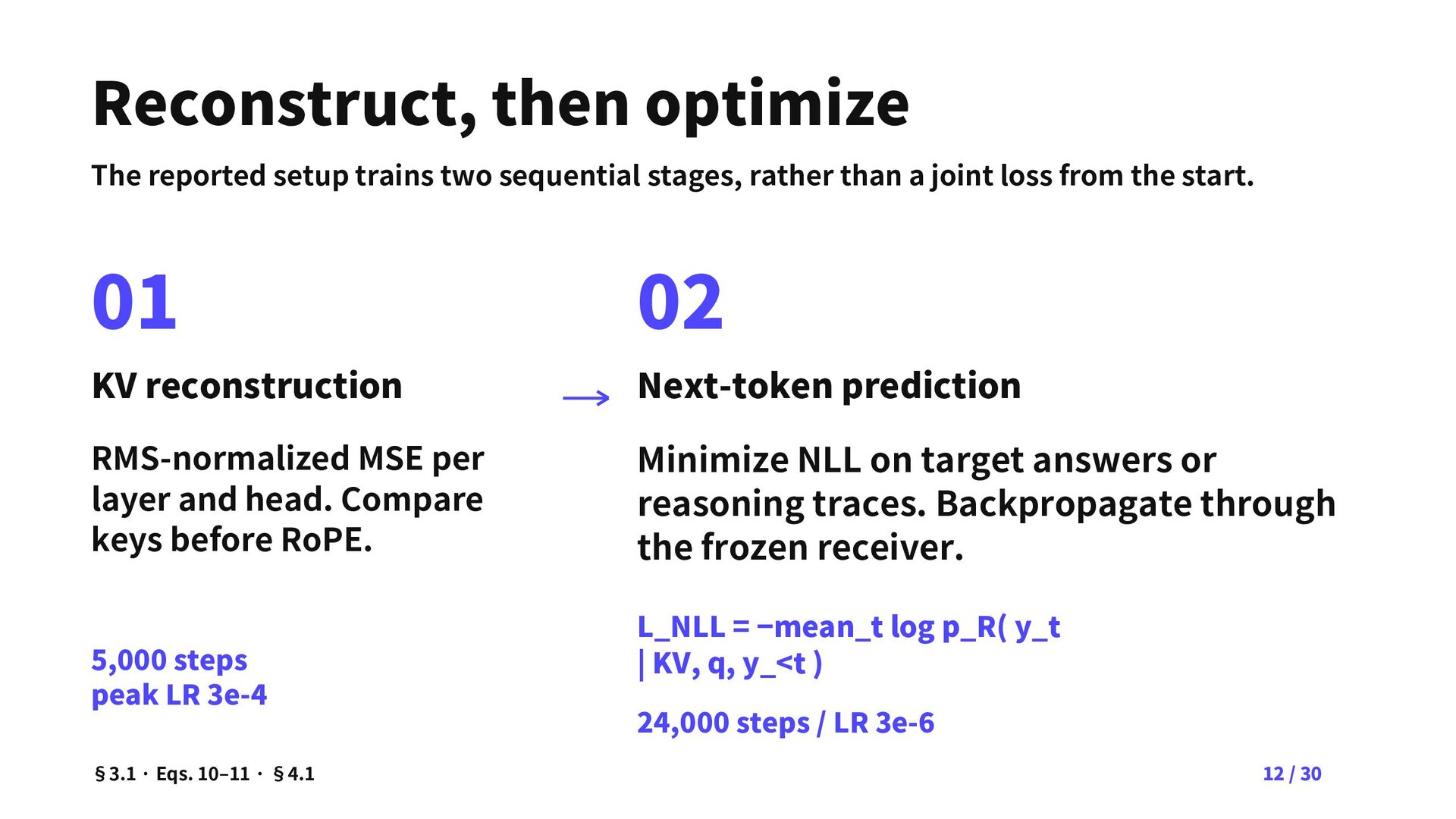
  12. Reconstruct, then optimize The reported setup trains two sequential stages,

    rather than a joint loss from the start. 01 02 KV reconstruction Next-token prediction RMS-normalized MSE per layer and head. Compare keys before RoPE. Minimize NLL on target answers or reasoning traces. Backpropagate through the frozen receiver. 5,000 steps peak LR 3e-4 L_NLL = −mean_t log p_R( y_t | KV, q, y_<t ) 24,000 steps / LR 3e-6 §3.1 · Eqs. 10–11 · §4.1 12 / 30
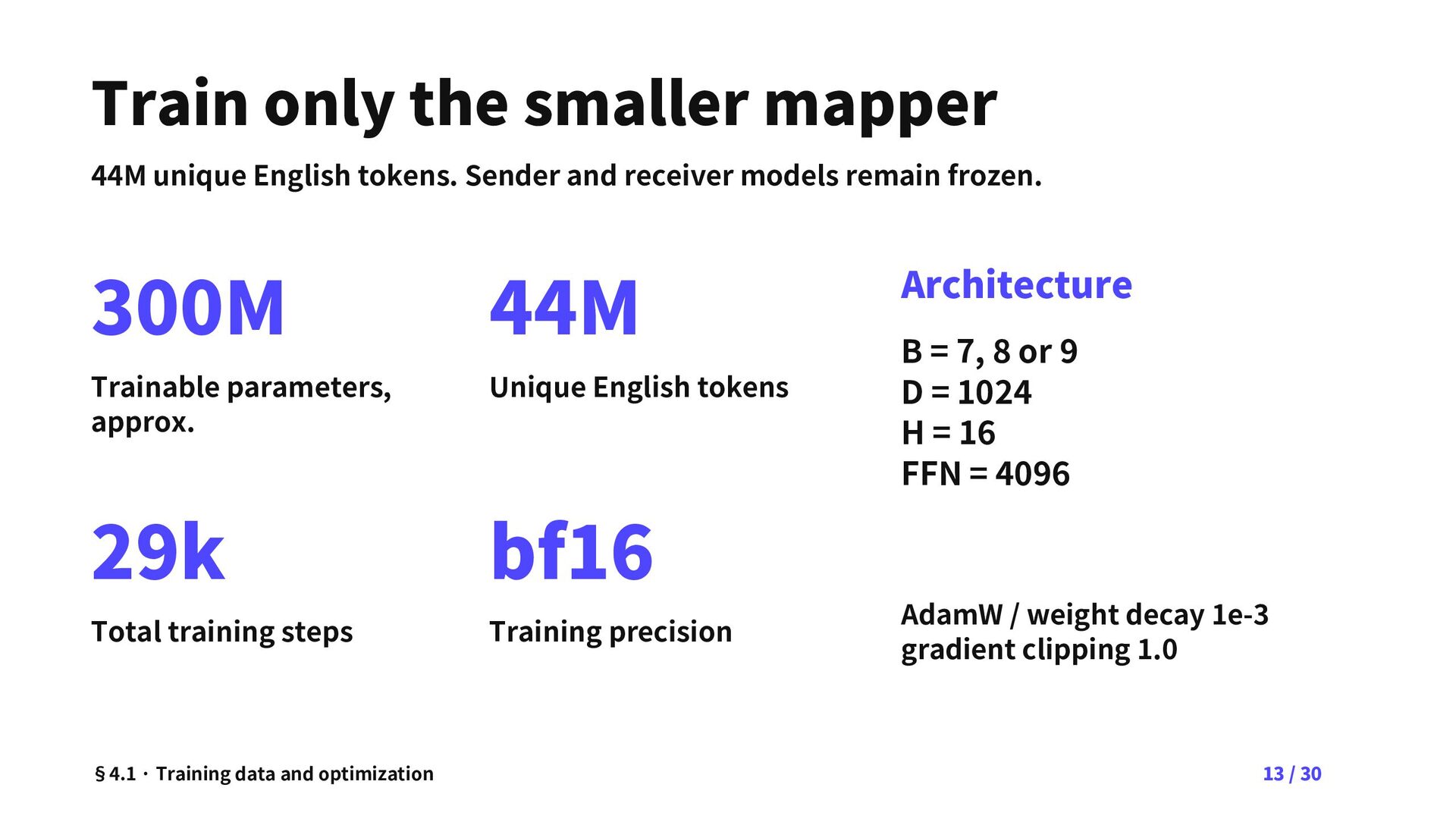
  13. Train only the smaller mapper 44M unique English tokens. Sender

    and receiver models remain frozen. 300M 44M Trainable parameters, approx. Unique English tokens 29k bf16 Total training steps §4.1 · Training data and optimization Training precision Architecture B = 7, 8 or 9 D = 1024 H = 16 FFN = 4096 AdamW / weight decay 1e-3 gradient clipping 1.0 13 / 30
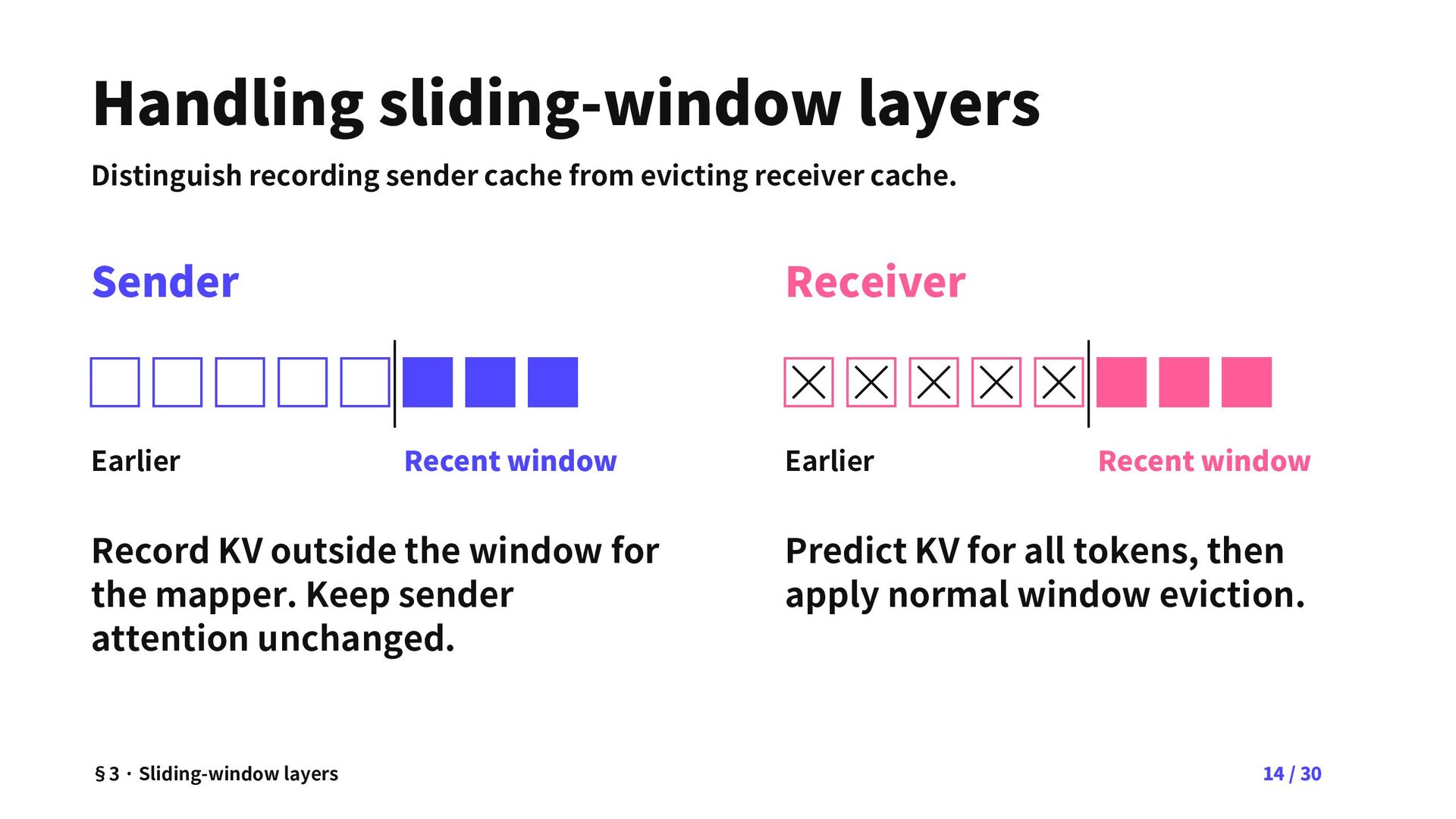
  14. Handling sliding-window layers Distinguish recording sender cache from evicting receiver

    cache. Sender Earlier Receiver Recent window Record KV outside the window for the mapper. Keep sender attention unchanged. §3 · Sliding-window layers Earlier Recent window Predict KV for all tokens, then apply normal window eviction. 14 / 30
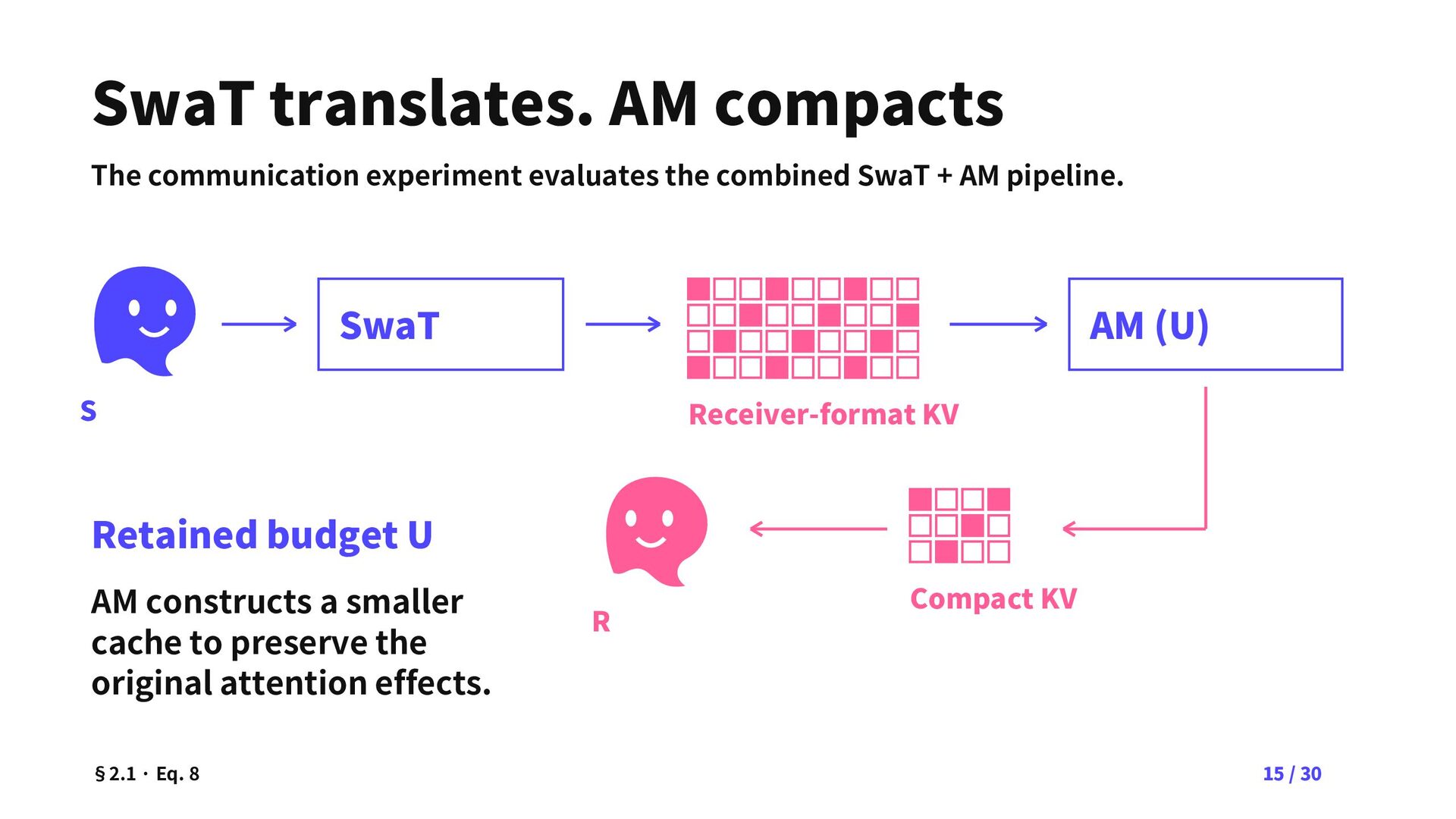
  15. SwaT translates. AM compacts The communication experiment evaluates the combined

    SwaT + AM pipeline. SwaT AM (U) S Receiver-format KV Retained budget U AM constructs a smaller cache to preserve the original attention effects. §2.1 · Eq. 8 R Compact KV 15 / 30
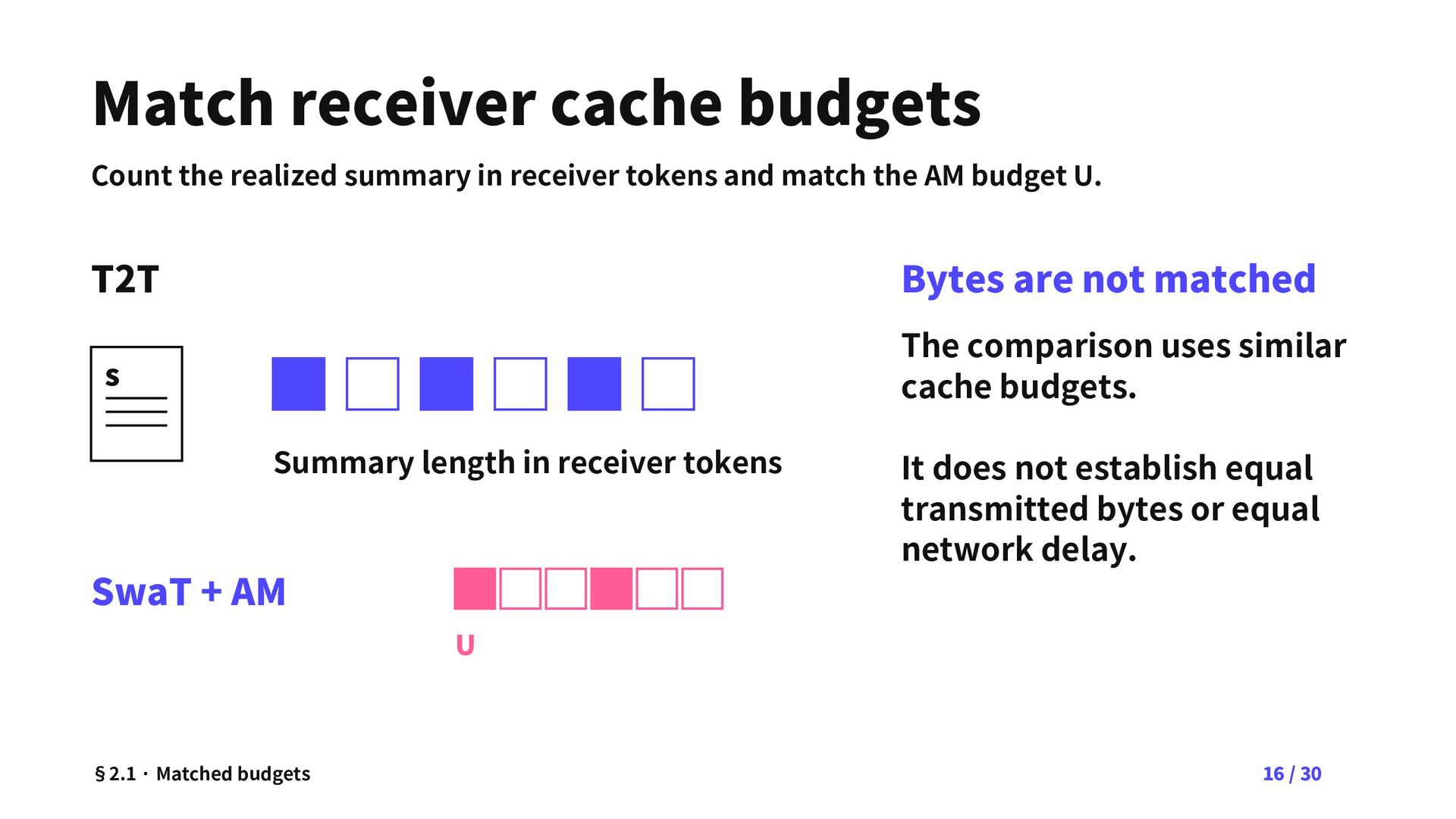
  16. Match receiver cache budgets Count the realized summary in receiver

    tokens and match the AM budget U. T2T Bytes are not matched s The comparison uses similar cache budgets. Summary length in receiver tokens It does not establish equal transmitted bytes or equal network delay. SwaT + AM U §2.1 · Matched budgets 16 / 30
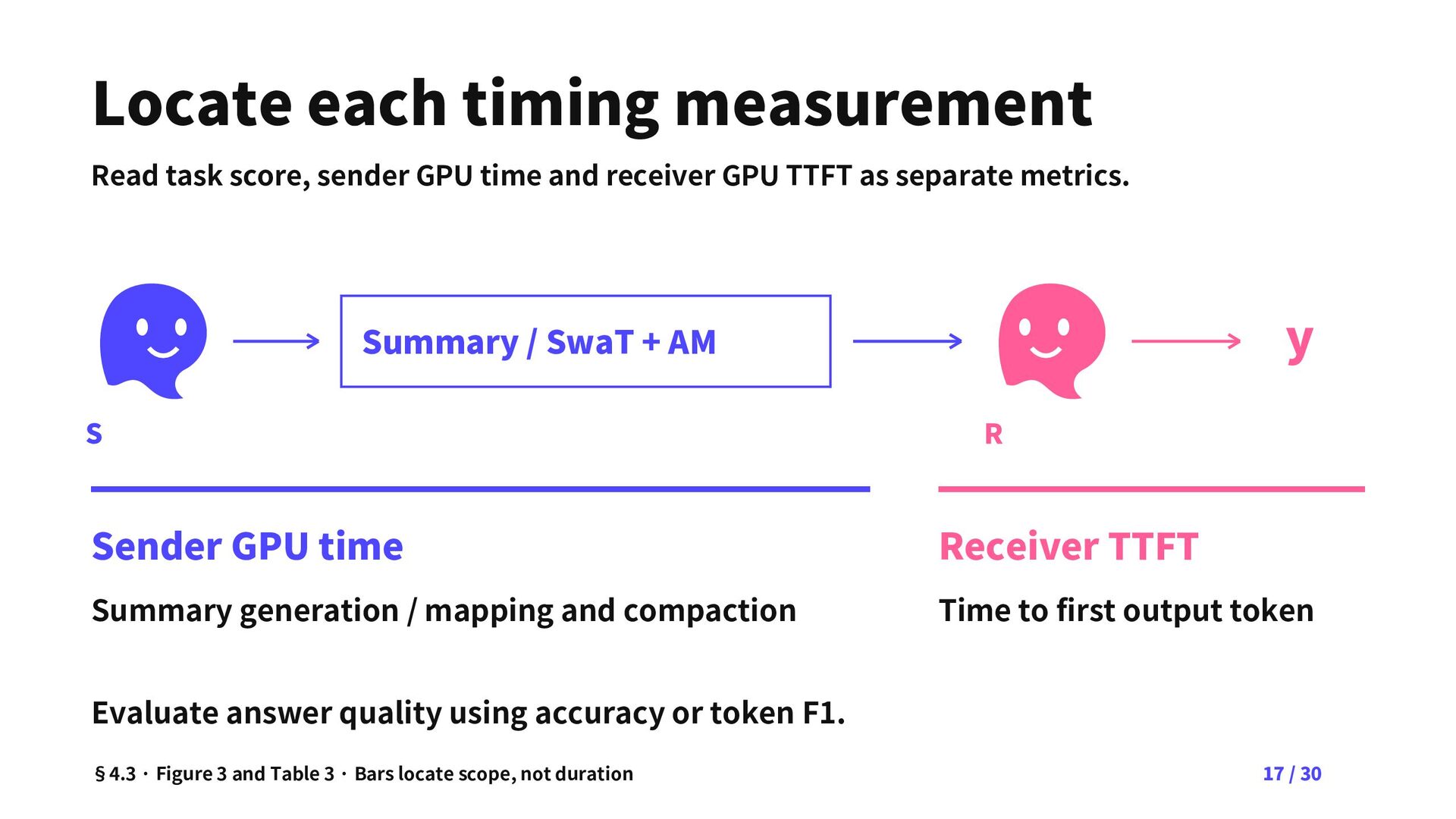
  17. Locate each timing measurement Read task score, sender GPU time

    and receiver GPU TTFT as separate metrics. y Summary / SwaT + AM S R Sender GPU time Receiver TTFT Summary generation / mapping and compaction Time to first output token Evaluate answer quality using accuracy or token F1. §4.3 · Figure 3 and Table 3 · Bars locate scope, not duration 17 / 30
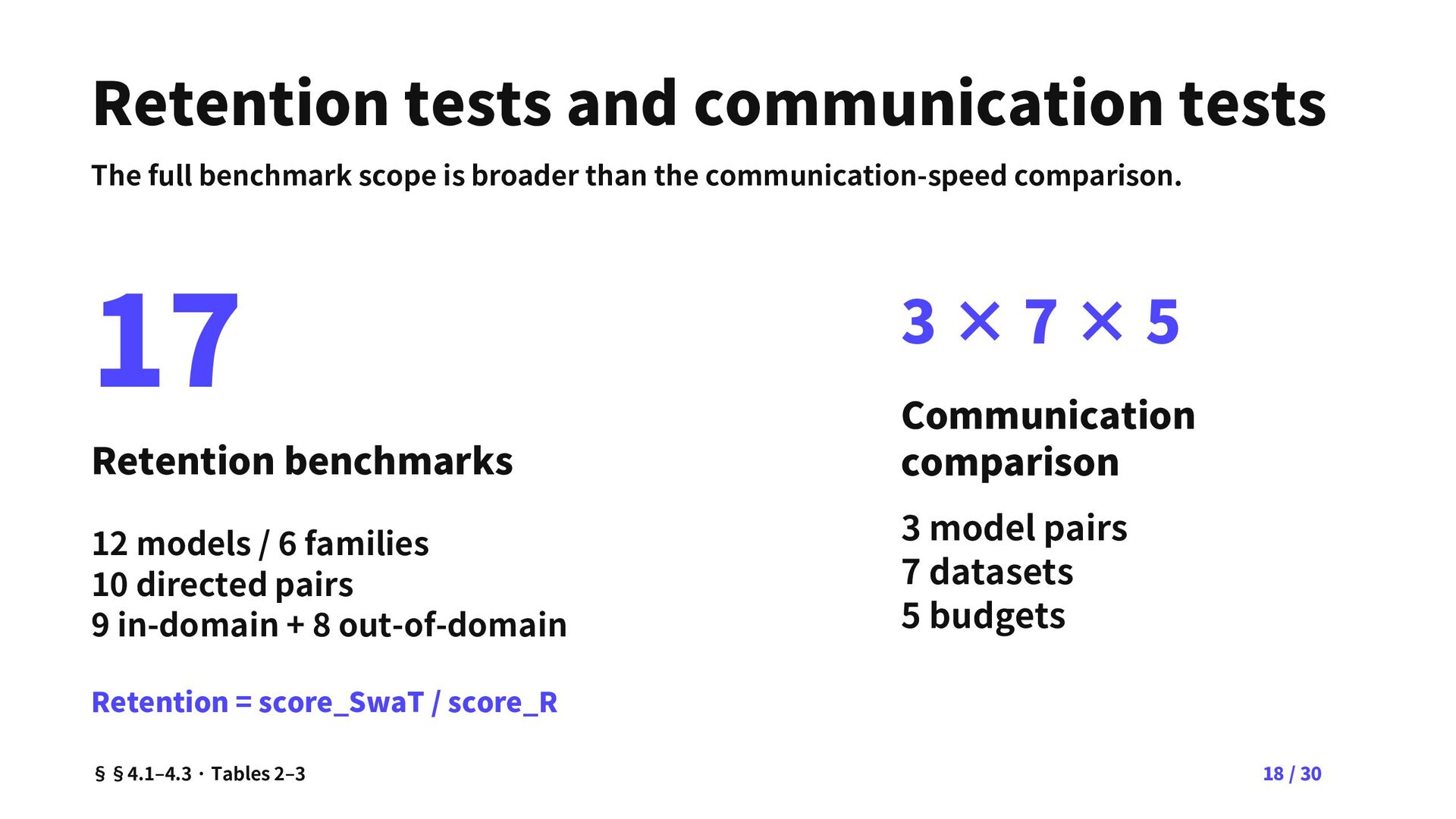
  18. Retention tests and communication tests The full benchmark scope is

    broader than the communication-speed comparison. 17 3×7×5 Retention benchmarks Communication comparison 12 models / 6 families 10 directed pairs 9 in-domain + 8 out-of-domain 3 model pairs 7 datasets 5 budgets Retention = score_SwaT / score_R §§4.1–4.3 · Tables 2–3 18 / 30
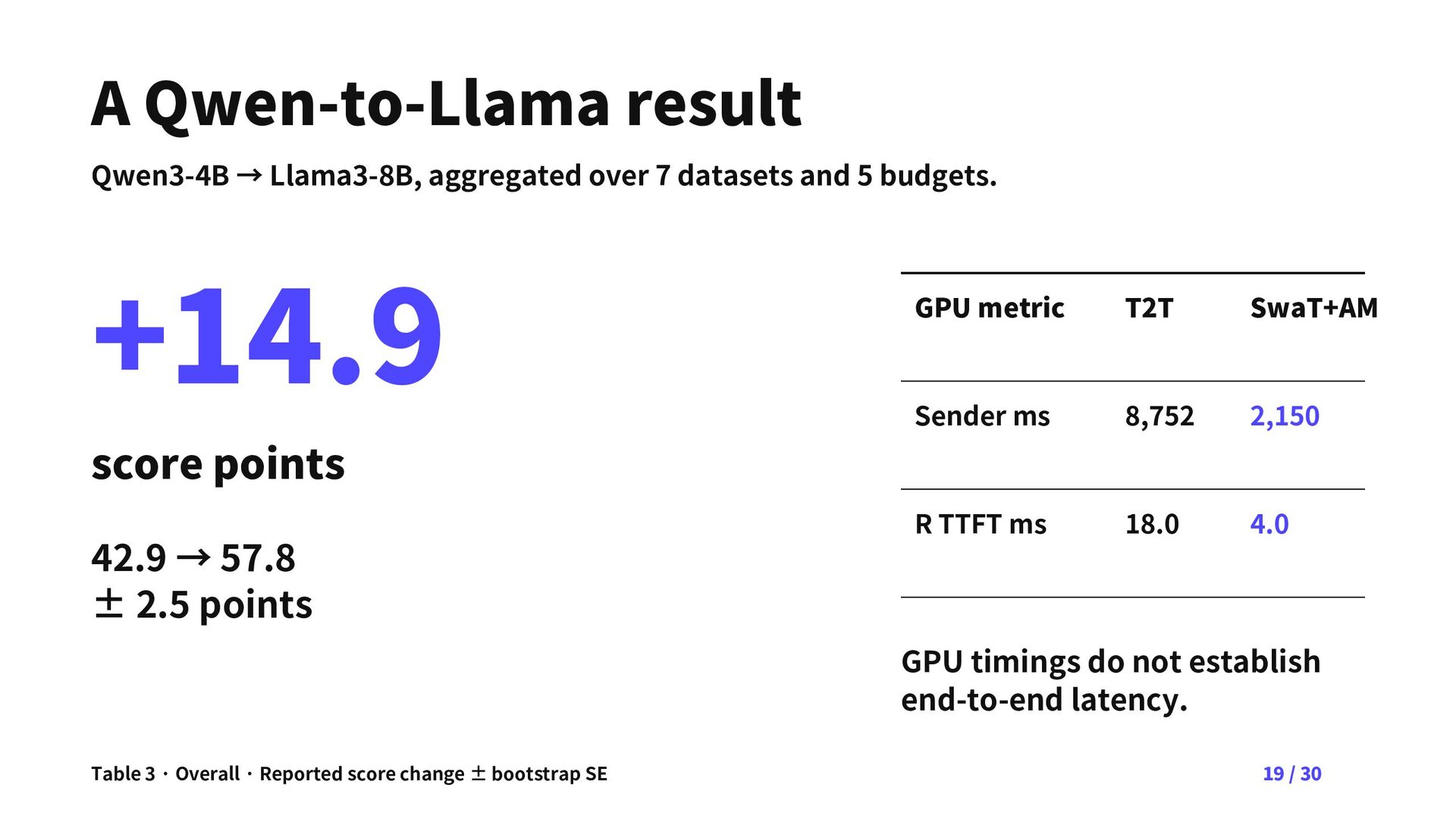
  19. A Qwen-to-Llama result Qwen3-4B → Llama3-8B, aggregated over 7 datasets

    and 5 budgets. +14.9 GPU metric T2T SwaT+AM Sender ms 8,752 2,150 R TTFT ms 18.0 4.0 score points 42.9 → 57.8 ± 2.5 points GPU timings do not establish end-to-end latency. Table 3 · Overall · Reported score change ± bootstrap SE 19 / 30
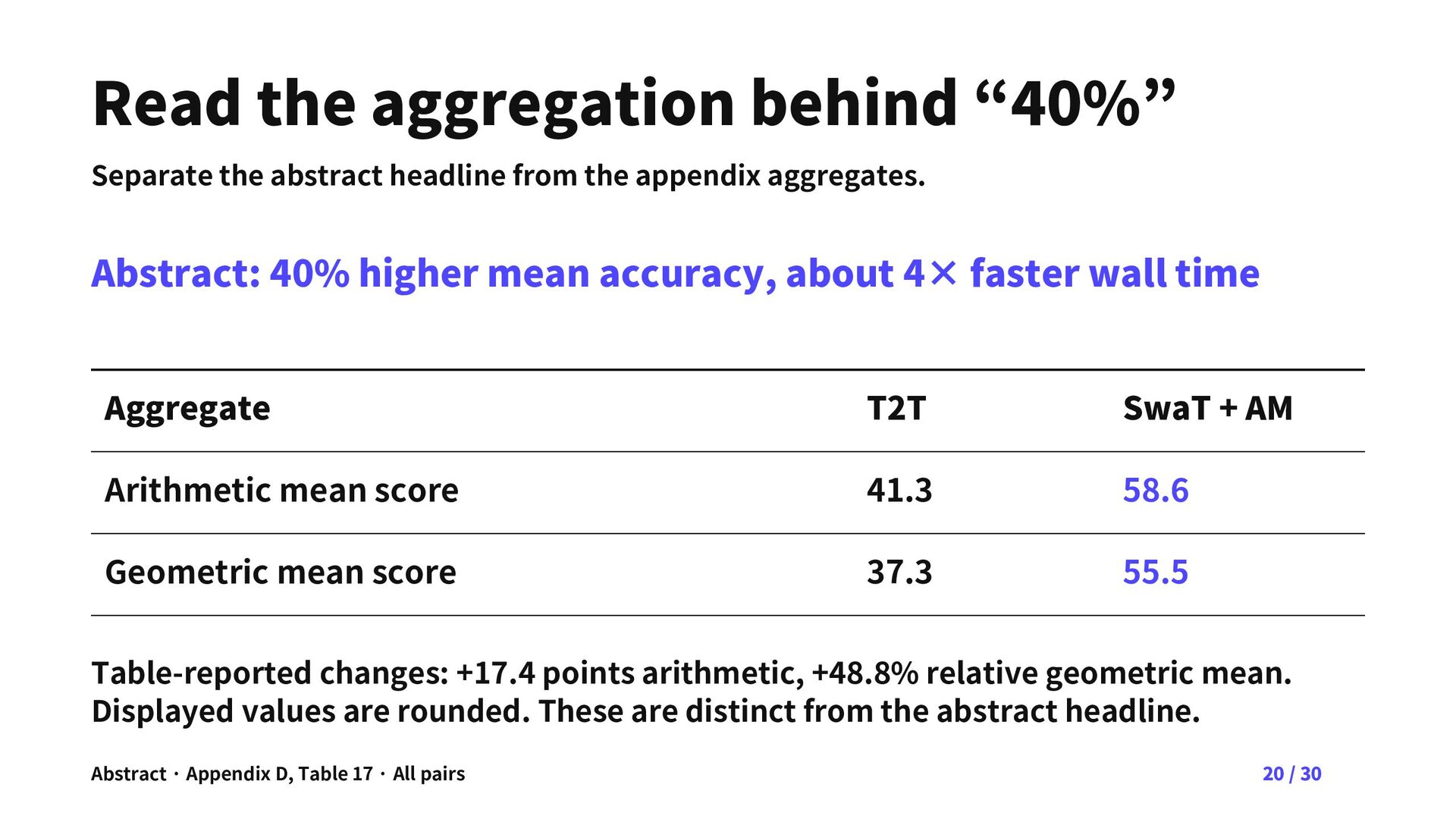
  20. Read the aggregation behind “40%” Separate the abstract headline from

    the appendix aggregates. Abstract: 40% higher mean accuracy, about 4× faster wall time Aggregate T2T SwaT + AM Arithmetic mean score 41.3 58.6 Geometric mean score 37.3 55.5 Table-reported changes: +17.4 points arithmetic, +48.8% relative geometric mean. Displayed values are rounded. These are distinct from the abstract headline. Abstract · Appendix D, Table 17 · All pairs 20 / 30
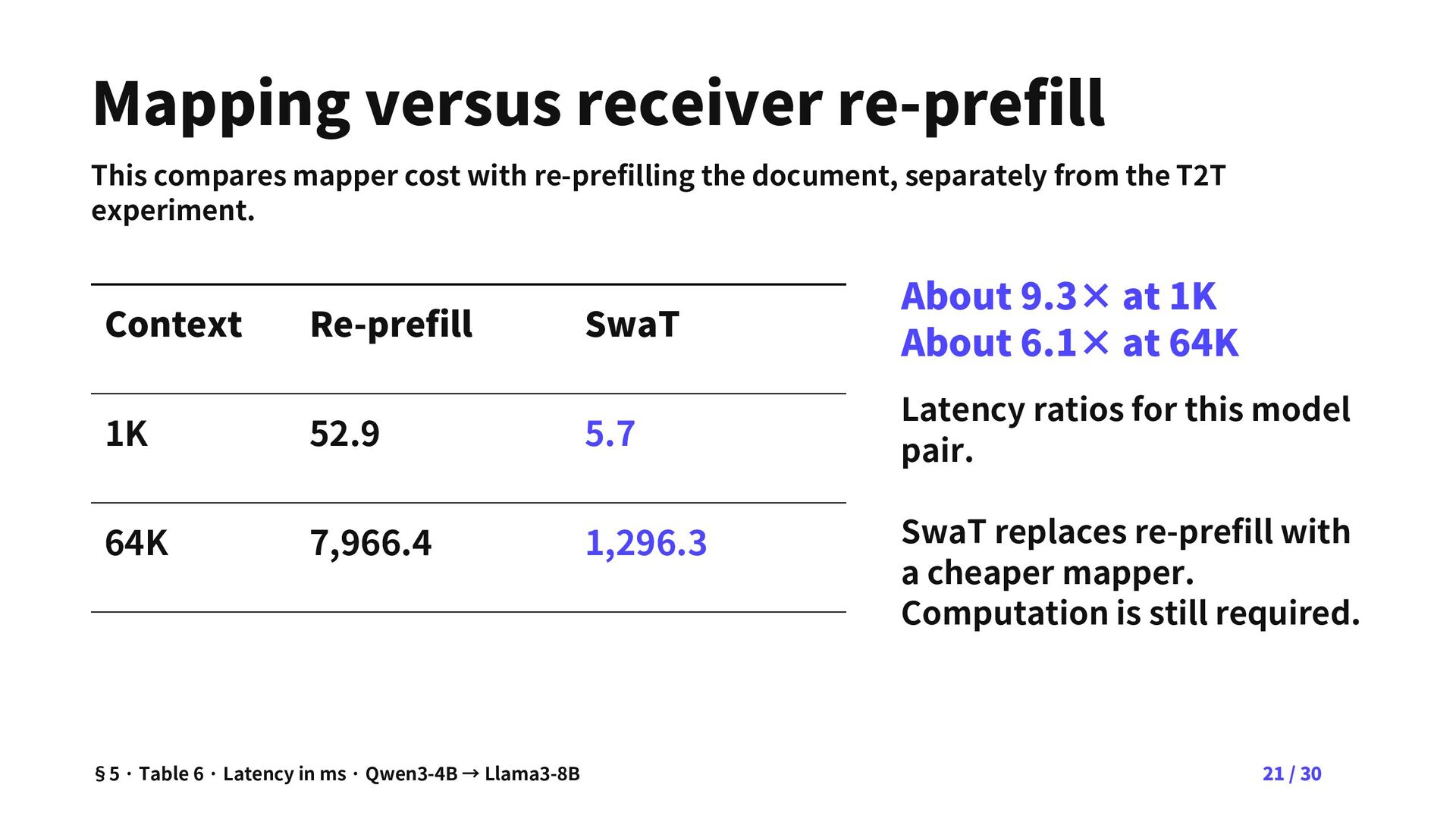
  21. Mapping versus receiver re-prefill This compares mapper cost with re-prefilling

    the document, separately from the T2T experiment. Context Re-prefill SwaT About 9.3× at 1K About 6.1× at 64K Latency ratios for this model pair. 1K 52.9 5.7 64K 7,966.4 1,296.3 §5 · Table 6 · Latency in ms · Qwen3-4B → Llama3-8B SwaT replaces re-prefill with a cheaper mapper. Computation is still required. 21 / 30
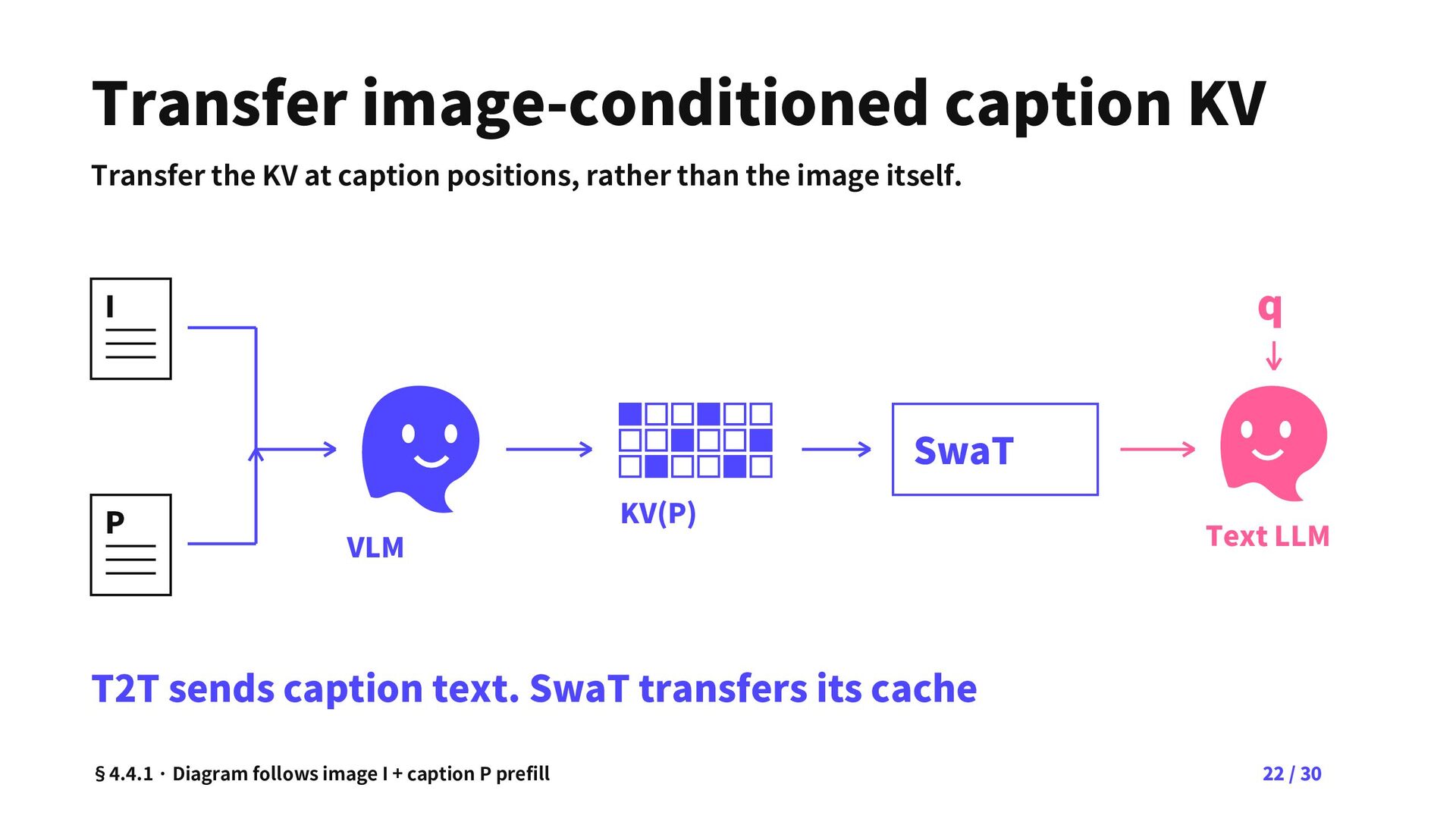
  22. Transfer image-conditioned caption KV Transfer the KV at caption positions,

    rather than the image itself. q I SwaT P KV(P) VLM Text LLM T2T sends caption text. SwaT transfers its cache §4.4.1 · Diagram follows image I + caption P prefill 22 / 30
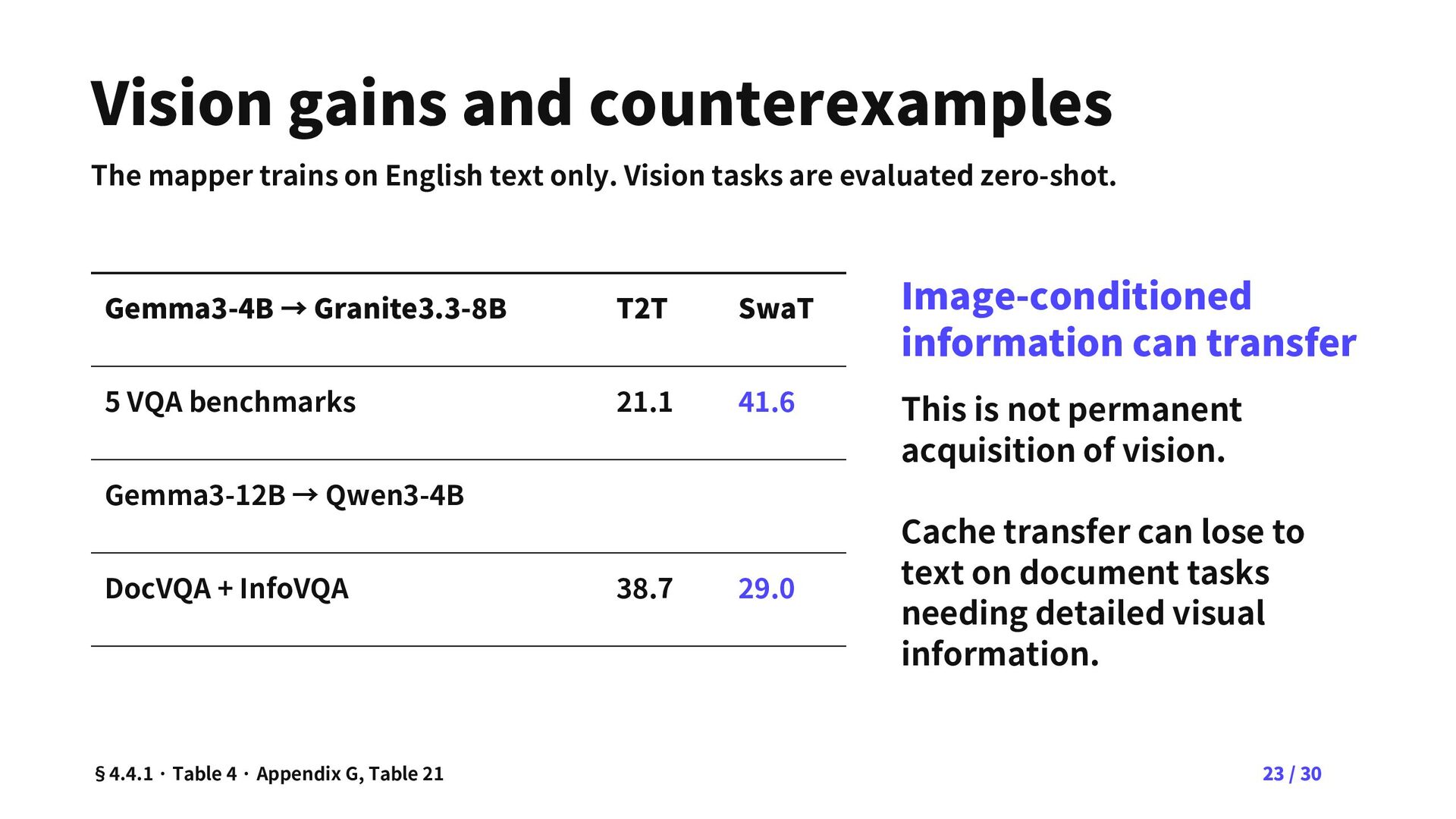
  23. Vision gains and counterexamples The mapper trains on English text

    only. Vision tasks are evaluated zero-shot. Gemma3-4B → Granite3.3-8B T2T SwaT 5 VQA benchmarks 21.1 41.6 Image-conditioned information can transfer This is not permanent acquisition of vision. Gemma3-12B → Qwen3-4B DocVQA + InfoVQA §4.4.1 · Table 4 · Appendix G, Table 21 38.7 29.0 Cache transfer can lose to text on document tasks needing detailed visual information. 23 / 30
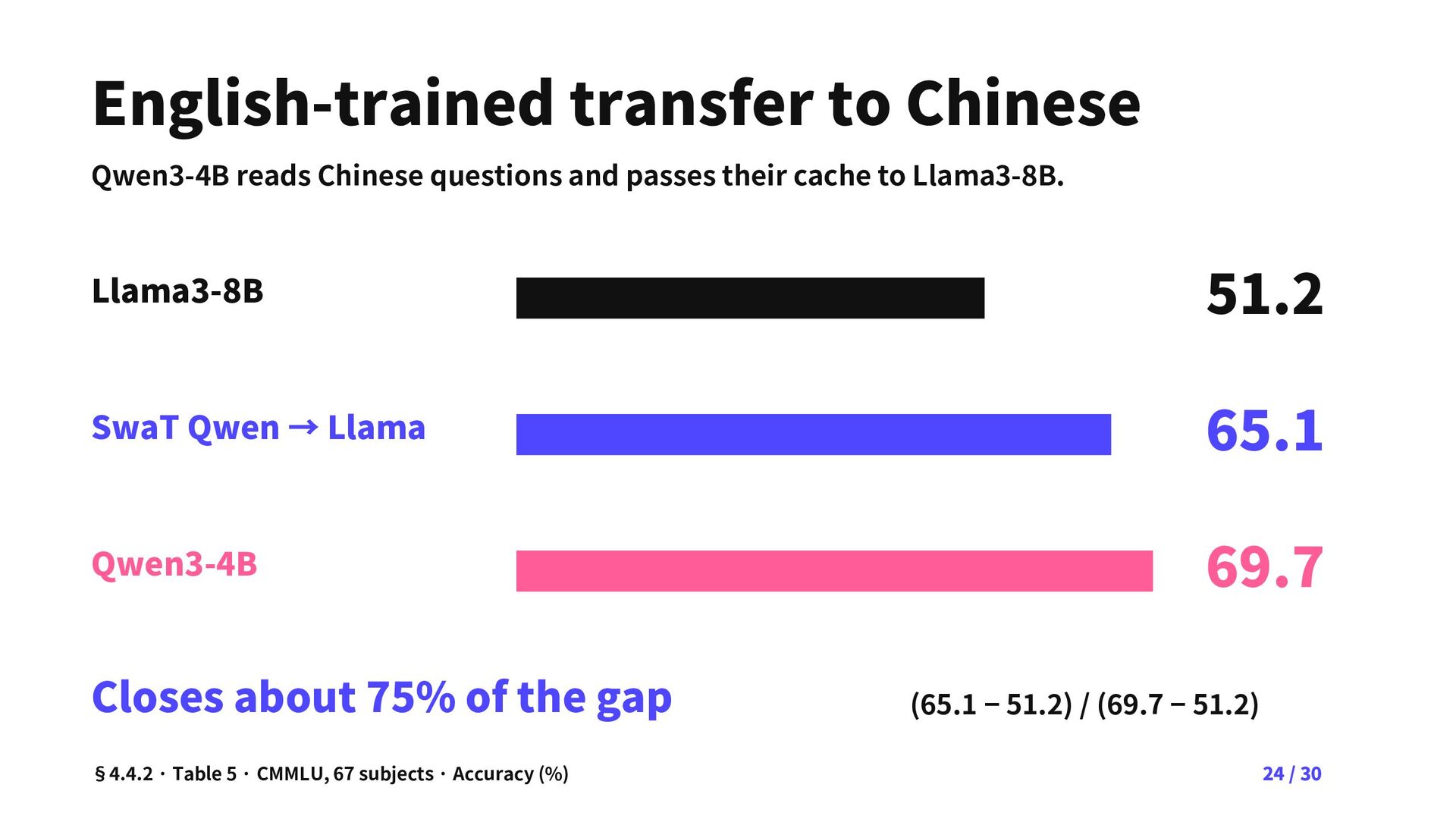
  24. English-trained transfer to Chinese Qwen3-4B reads Chinese questions and passes

    their cache to Llama3-8B. Llama3-8B 51.2 SwaT Qwen → Llama 65.1 Qwen3-4B 69.7 Closes about 75% of the gap §4.4.2 · Table 5 · CMMLU, 67 subjects · Accuracy (%) (65.1 − 51.2) / (69.7 − 51.2) 24 / 30
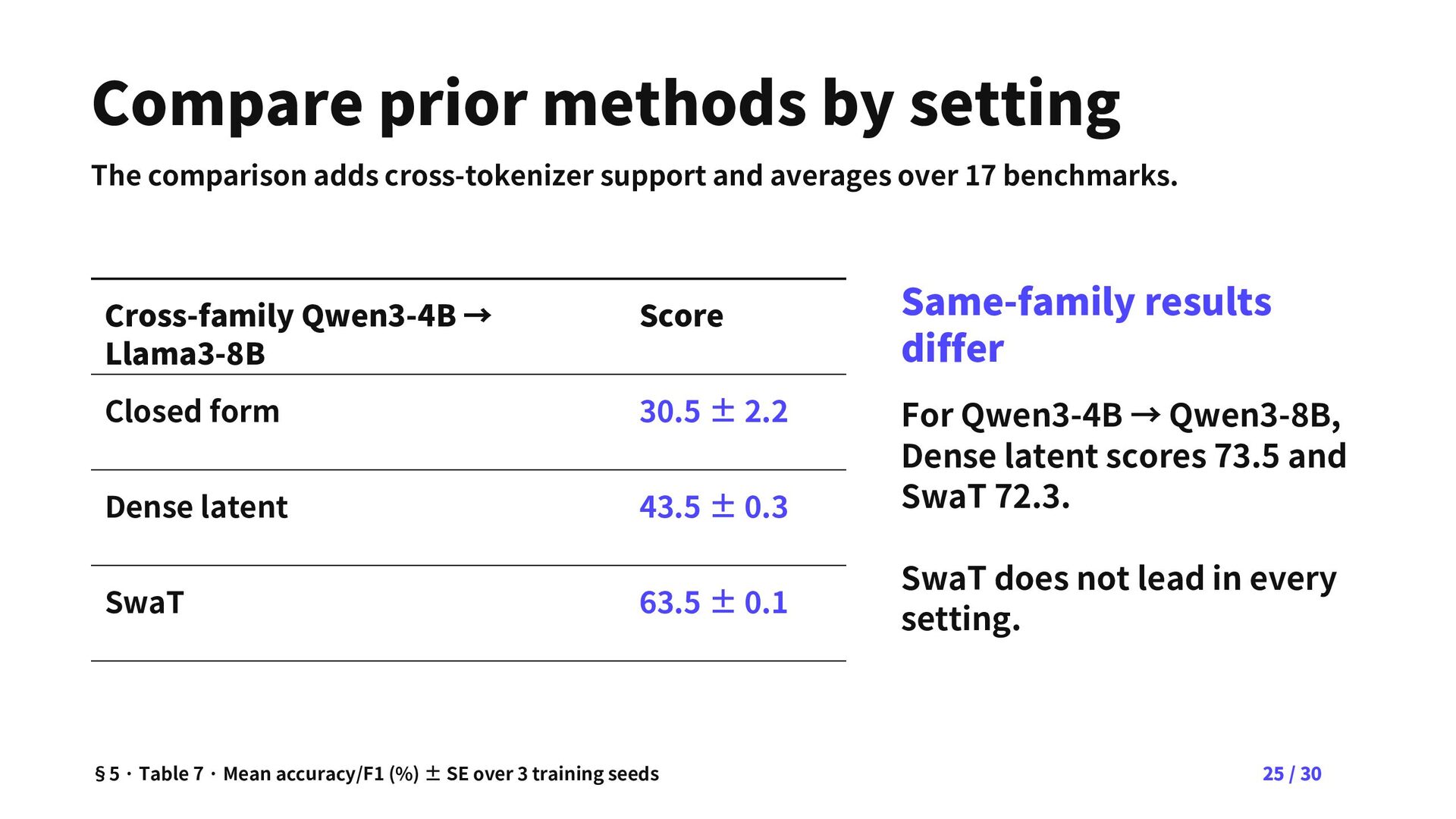
  25. Compare prior methods by setting The comparison adds cross-tokenizer support

    and averages over 17 benchmarks. Cross-family Qwen3-4B → Llama3-8B Score Closed form 30.5 ± 2.2 Dense latent 43.5 ± 0.3 SwaT 63.5 ± 0.1 §5 · Table 7 · Mean accuracy/F1 (%) ± SE over 3 training seeds Same-family results differ For Qwen3-4B → Qwen3-8B, Dense latent scores 73.5 and SwaT 72.3. SwaT does not lead in every setting. 25 / 30
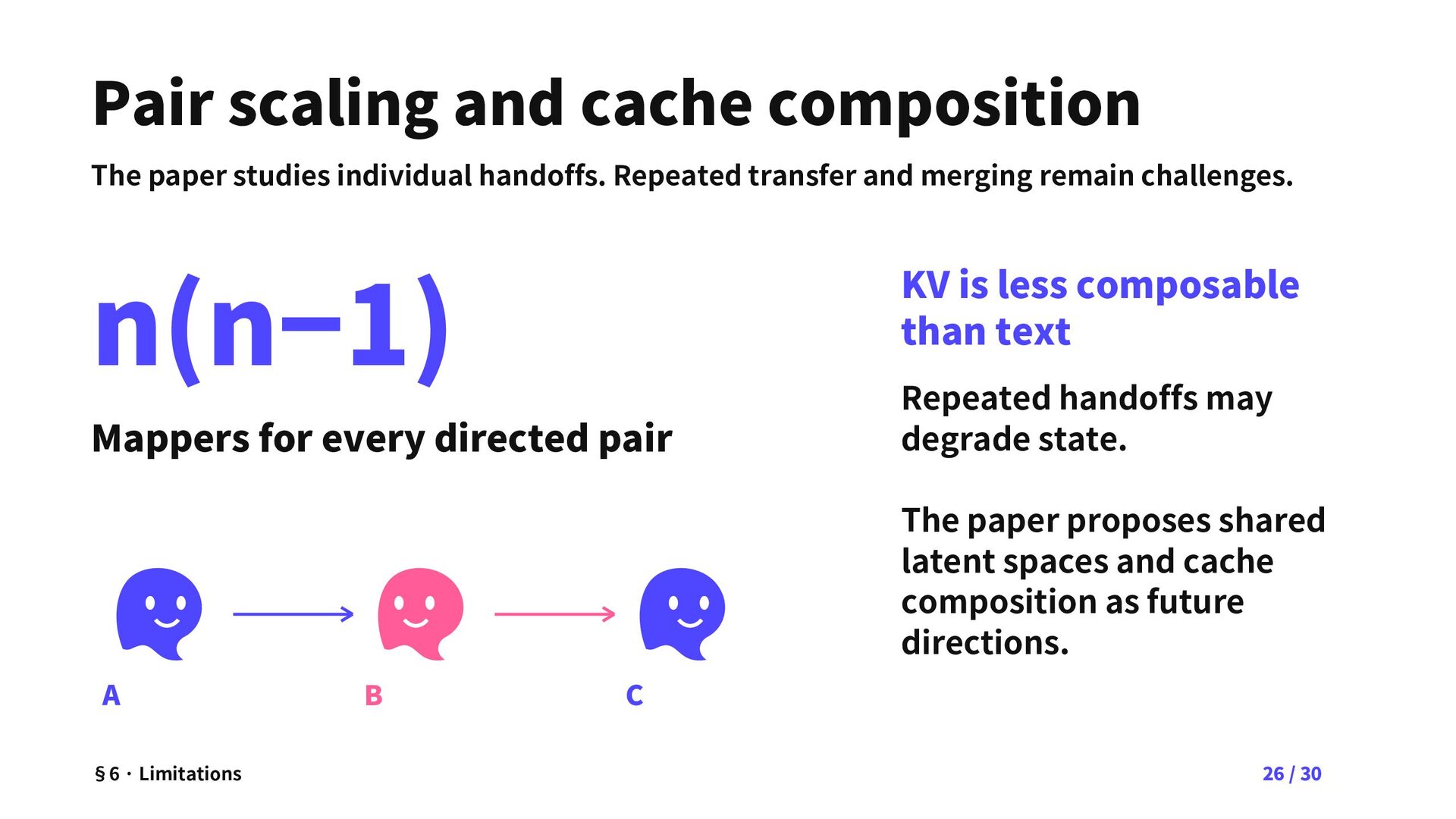
  26. Pair scaling and cache composition The paper studies individual handoffs.

    Repeated transfer and merging remain challenges. KV is less composable than text n(n−1) Mappers for every directed pair Repeated handoffs may degrade state. The paper proposes shared latent spaces and cache composition as future directions. A §6 · Limitations B C 26 / 30
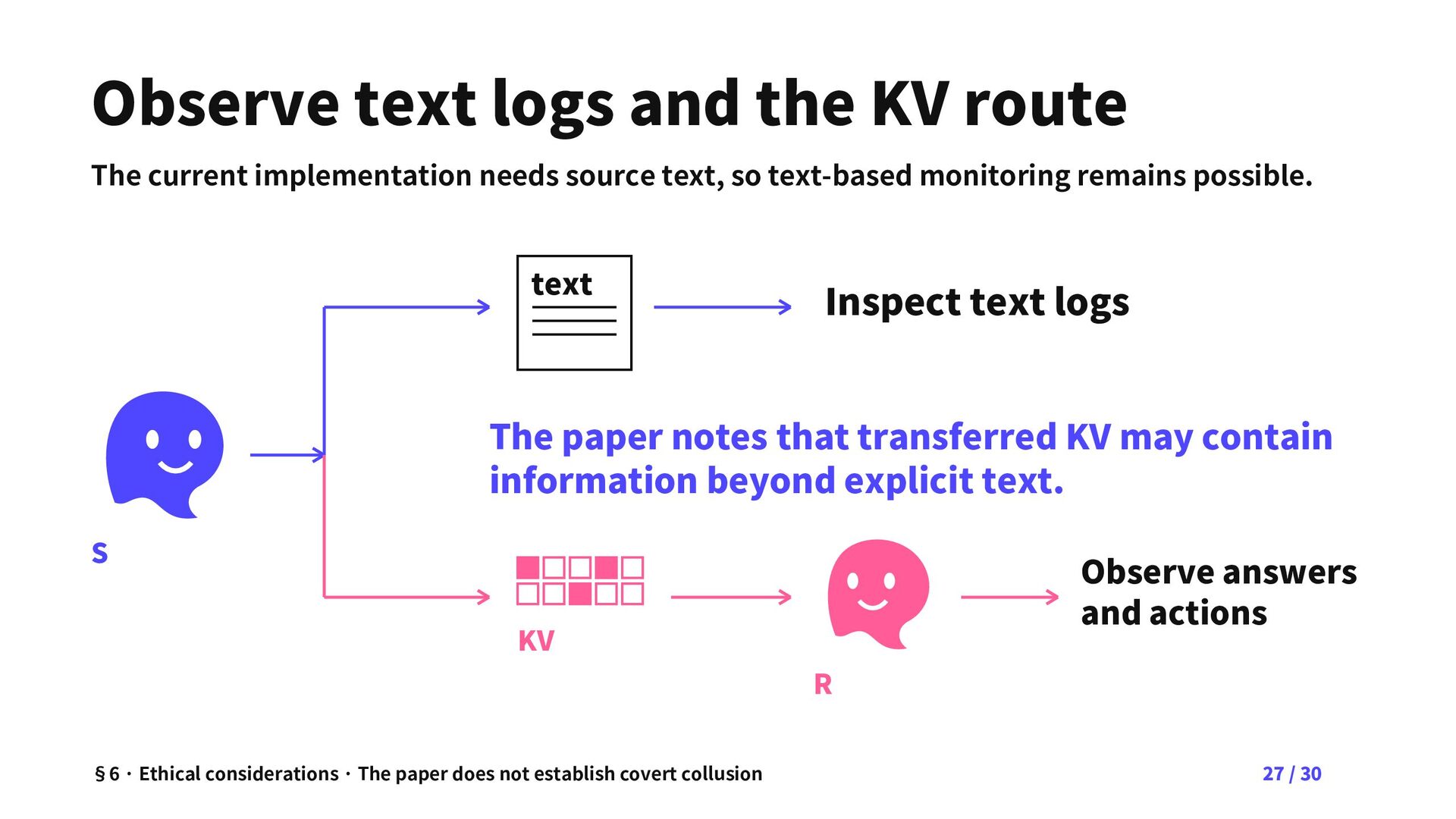
  27. Observe text logs and the KV route The current implementation

    needs source text, so text-based monitoring remains possible. text Inspect text logs The paper notes that transferred KV may contain information beyond explicit text. S Observe answers and actions KV R §6 · Ethical considerations · The paper does not establish covert collusion 27 / 30
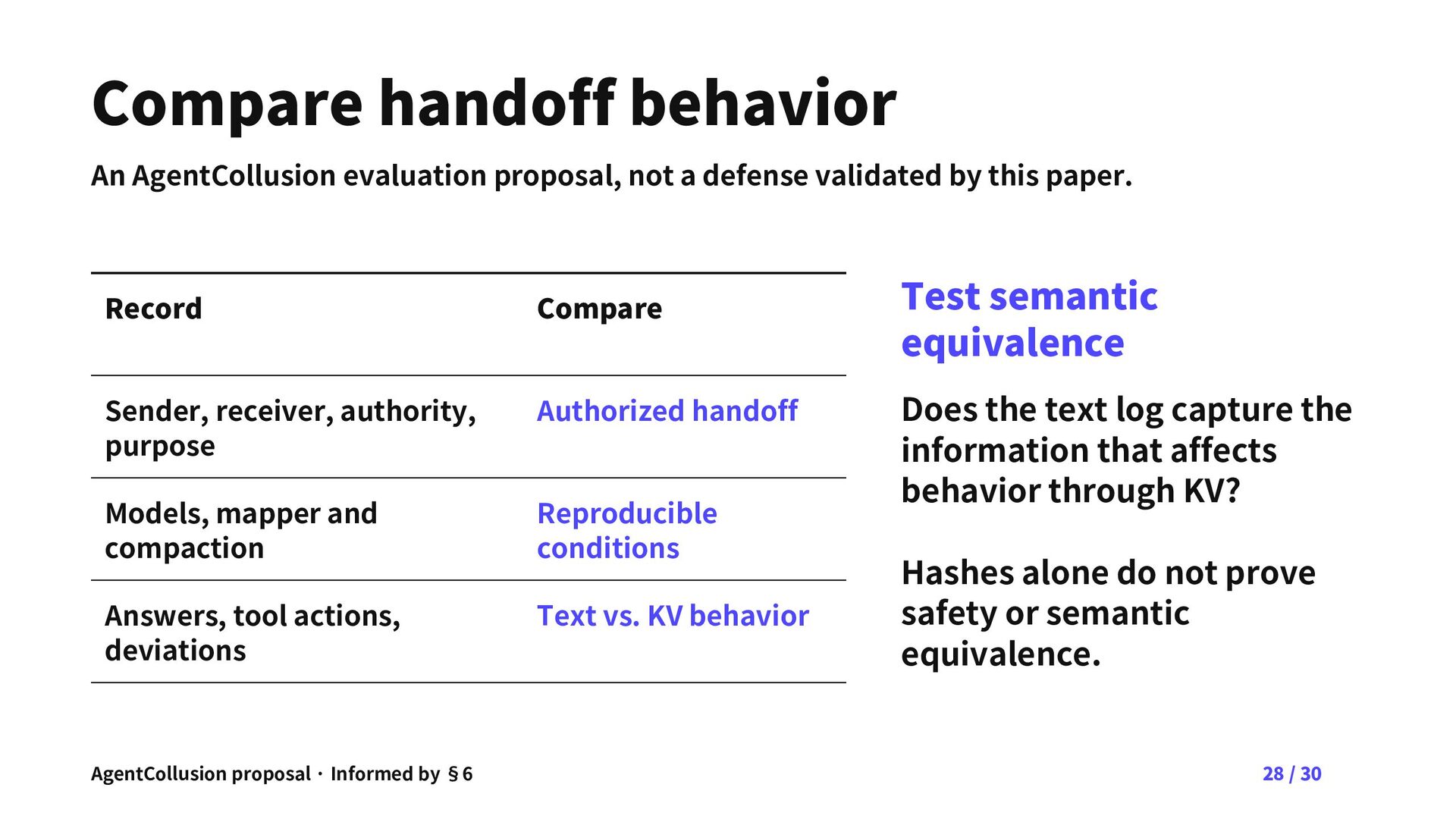
  28. Compare handoff behavior An AgentCollusion evaluation proposal, not a defense

    validated by this paper. Record Compare Sender, receiver, authority, purpose Authorized handoff Models, mapper and compaction Reproducible conditions Answers, tool actions, deviations Text vs. KV behavior AgentCollusion proposal · Informed by §6 Test semantic equivalence Does the text log capture the information that affects behavior through KV? Hashes alone do not prove safety or semantic equivalence. 28 / 30
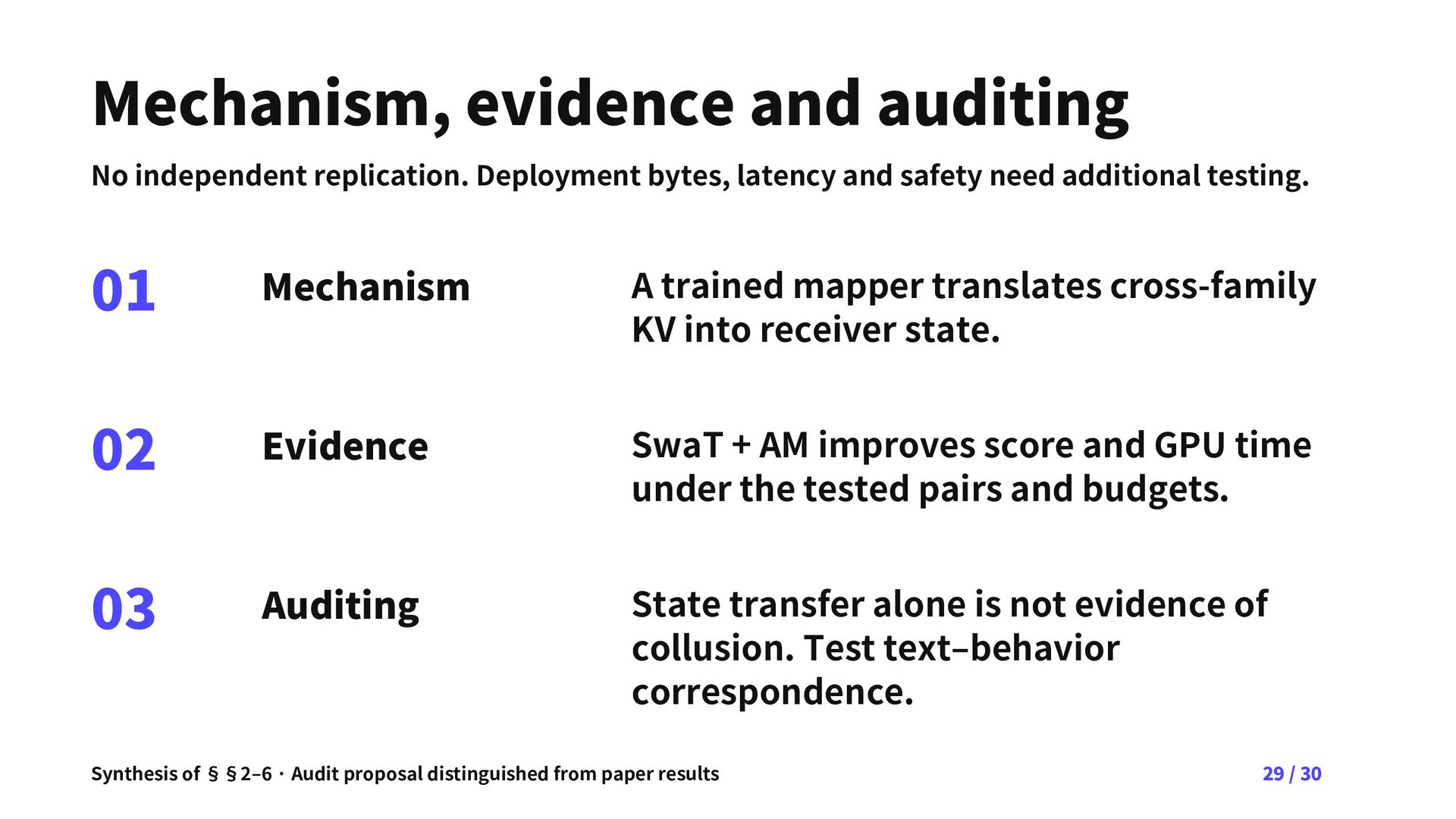
  29. Mechanism, evidence and auditing No independent replication. Deployment bytes, latency

    and safety need additional testing. 01 Mechanism A trained mapper translates cross-family KV into receiver state. 02 Evidence SwaT + AM improves score and GPU time under the tested pairs and budgets. 03 Auditing State transfer alone is not evidence of collusion. Test text–behavior correspondence. Synthesis of §§2–6 · Audit proposal distinguished from paper results 29 / 30
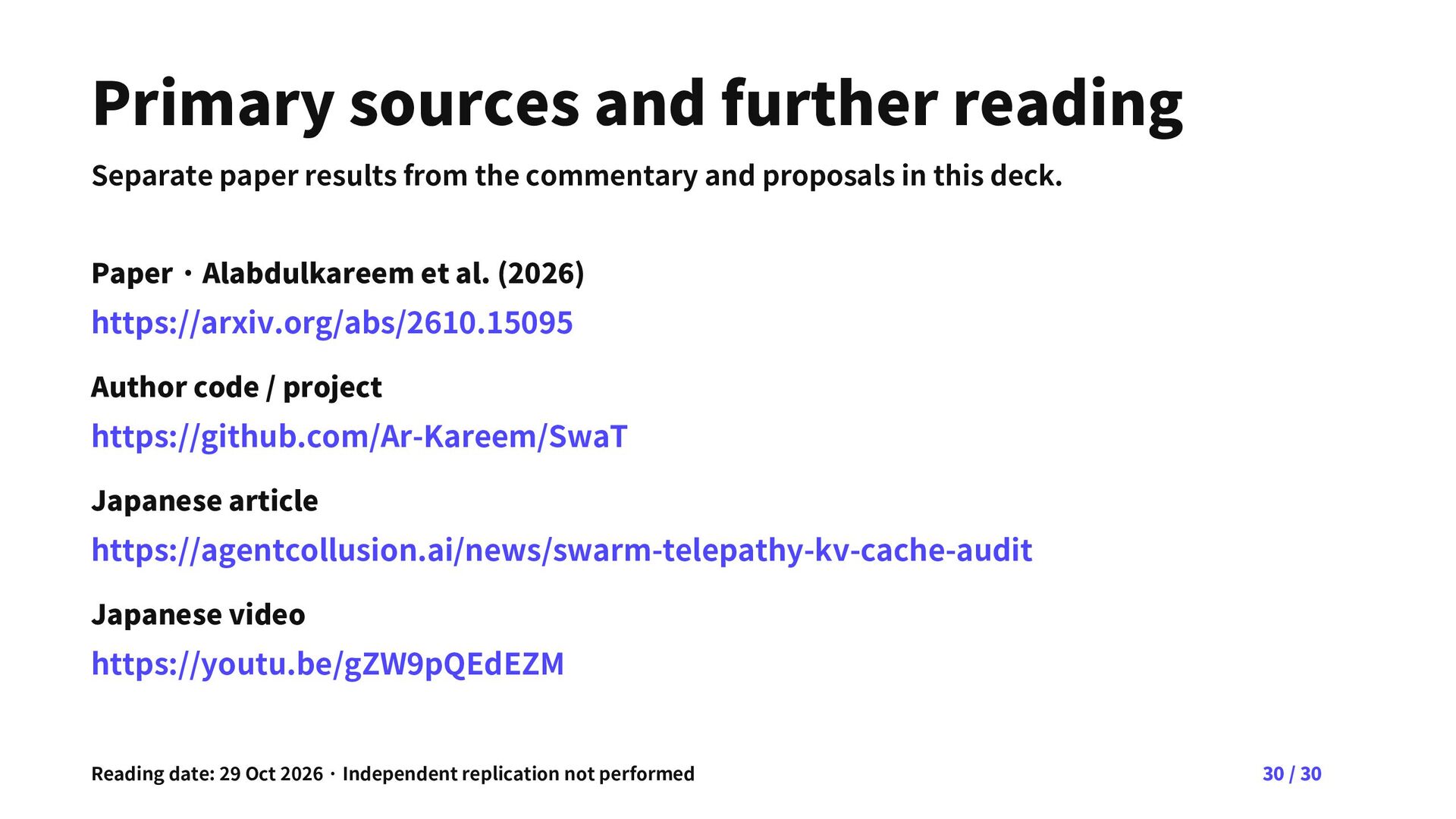
  30. Primary sources and further reading Separate paper results from the

    commentary and proposals in this deck. Paper · Alabdulkareem et al. (2026) https://arxiv.org/abs/2610.15095 Author code / project https://github.com/Ar-Kareem/SwaT Japanese article https://agentcollusion.ai/news/swarm-telepathy-kv-cache-audit Japanese video https://youtu.be/gZW9pQEdEZM Reading date: 29 Oct 2026 · Independent replication not performed 30 / 30

More Decks by AgentCollusion

Other Decks in Research