technique where a target population is divided into naturally occurring groups called clusters. • Primary Unit: The sampling unit is the entire cluster (group), not individual students or teachers. • Main Purpose: Solves logistical challenges when studying large, geographically dispersed educational populations.
where a large group (the population) is divided into smaller naturally existing groups called clusters. Researchers then randomly choose a few of these clusters to study.
cluster should be a mini-representation of the overall population (heterogeneous internally). • Between-Cluster Variance: Clusters should look as similar to each other as possible (homogeneous externally). • Randomization: Clusters must be selected using random sampling methods to maintain scientific validity.
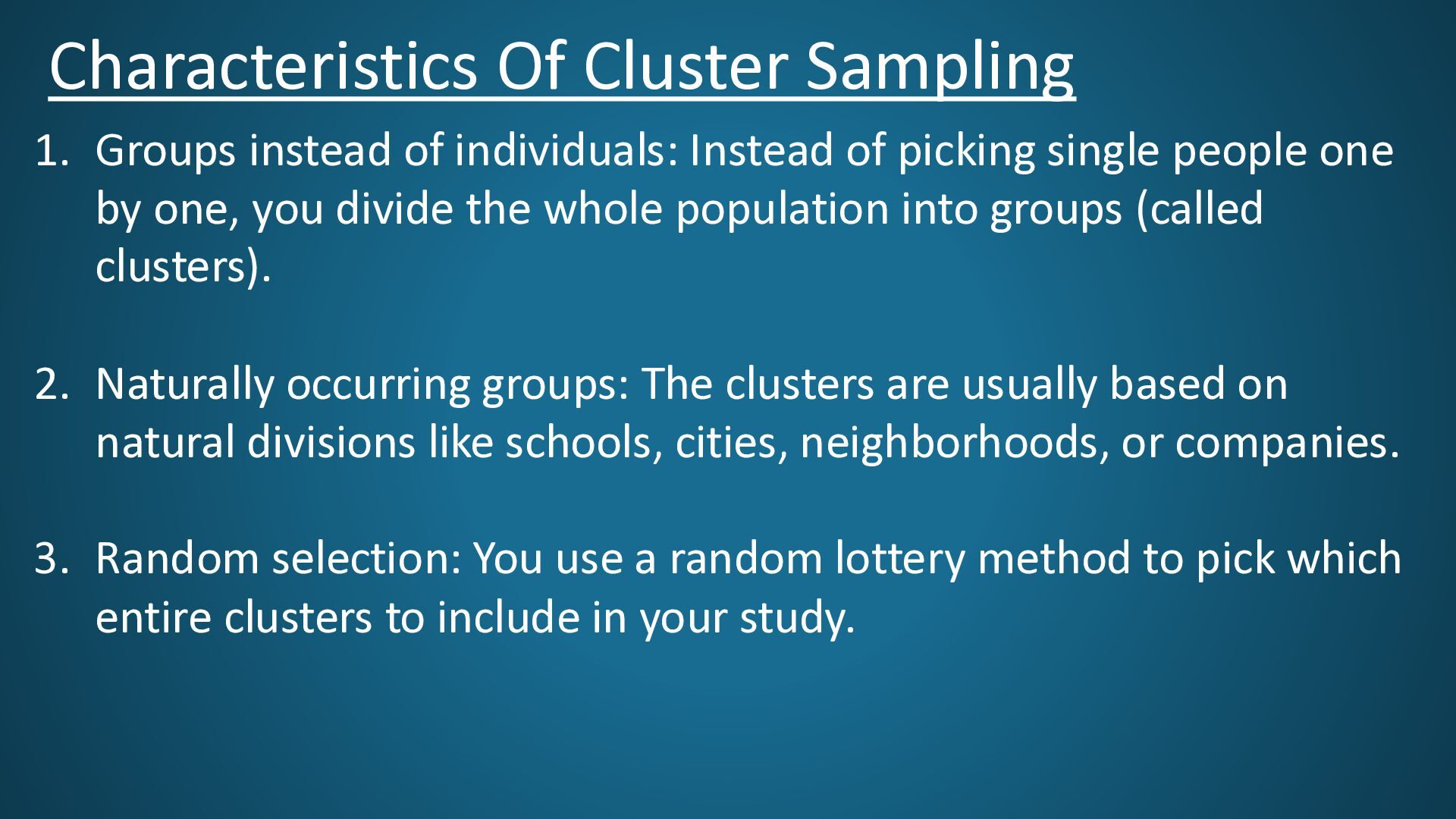
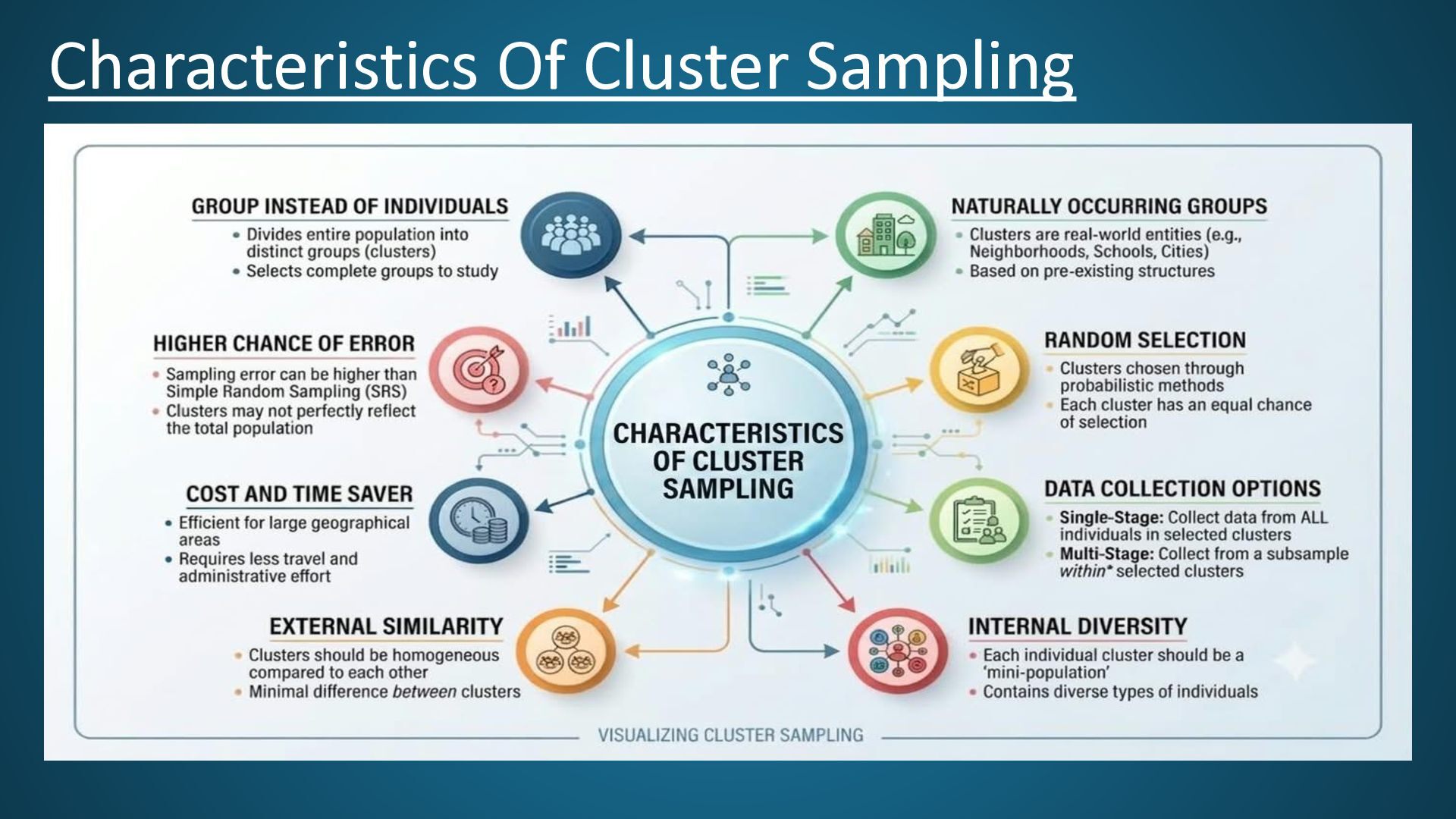
of picking single people one by one, you divide the whole population into groups (called clusters). 2. Naturally occurring groups: The clusters are usually based on natural divisions like schools, cities, neighborhoods, or companies. 3. Random selection: You use a random lottery method to pick which entire clusters to include in your study.
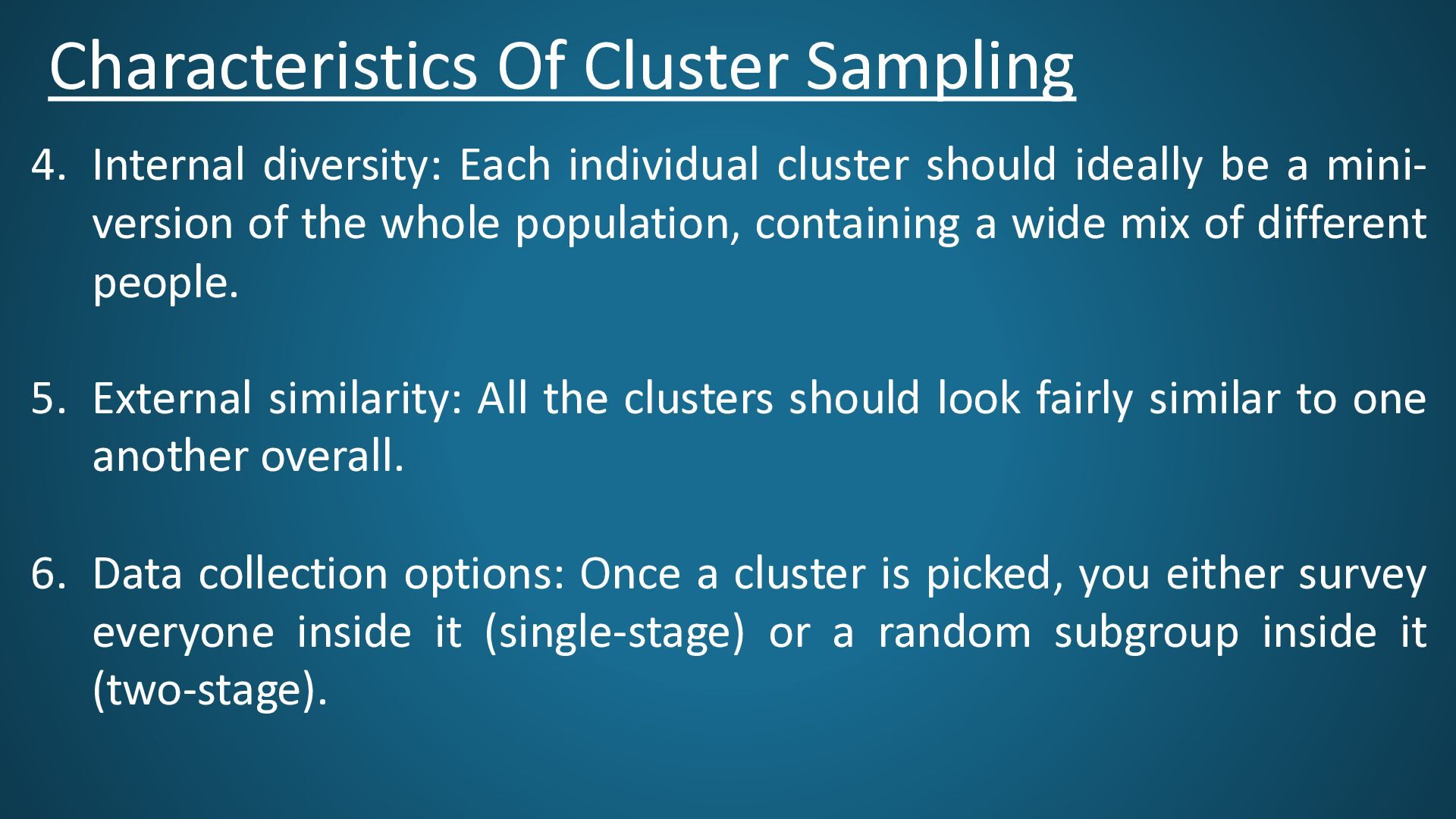
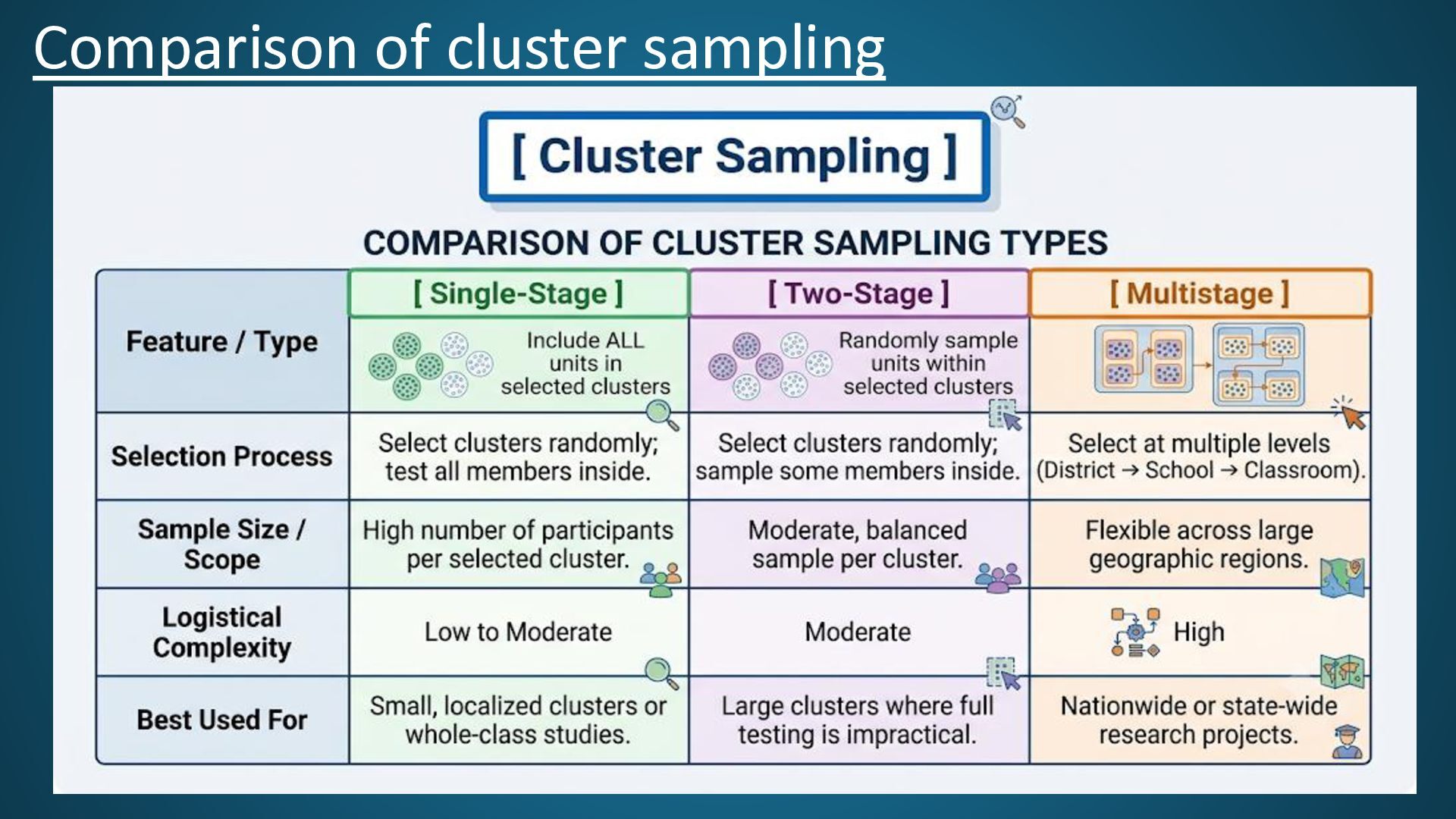
should ideally be a miniversion of the whole population, containing a wide mix of different people. 5. External similarity: All the clusters should look fairly similar to one another overall. 6. Data collection options: Once a cluster is picked, you either survey everyone inside it (single-stage) or a random subgroup inside it (two-stage).
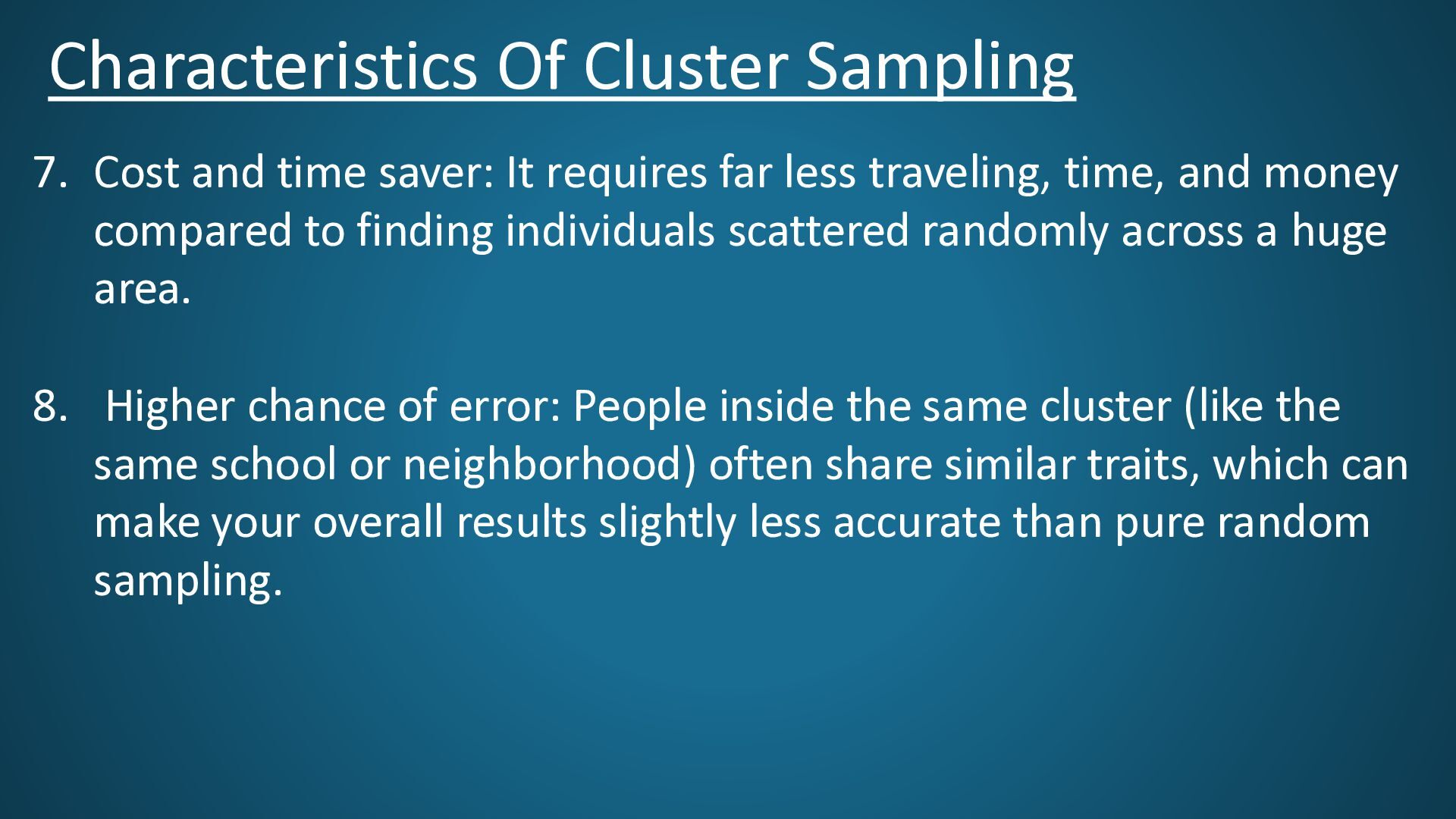
requires far less traveling, time, and money compared to finding individuals scattered randomly across a huge area. 8. Higher chance of error: People inside the same cluster (like the same school or neighborhood) often share similar traits, which can make your overall results slightly less accurate than pure random sampling.
total survey expenditure by grouping interviews/assessments within localized geographical areas or existing organizations. 2.Optimize Logistics & Time Efficiency: Streamline field movement and administrative effort when studying large, widely scattered populations. 3.Study Hard-to-Reach Populations: Enable structured sampling when a complete list of every single individual in the target population is unavailable.
behaviors, or outcomes within naturally existing units (e.g., classrooms, neighborhoods, or hospital wards). 5.Enable Multi-Stage Research Design: Structure complex multistep studies where primary sampling units (clusters) are selected before individual respondents.
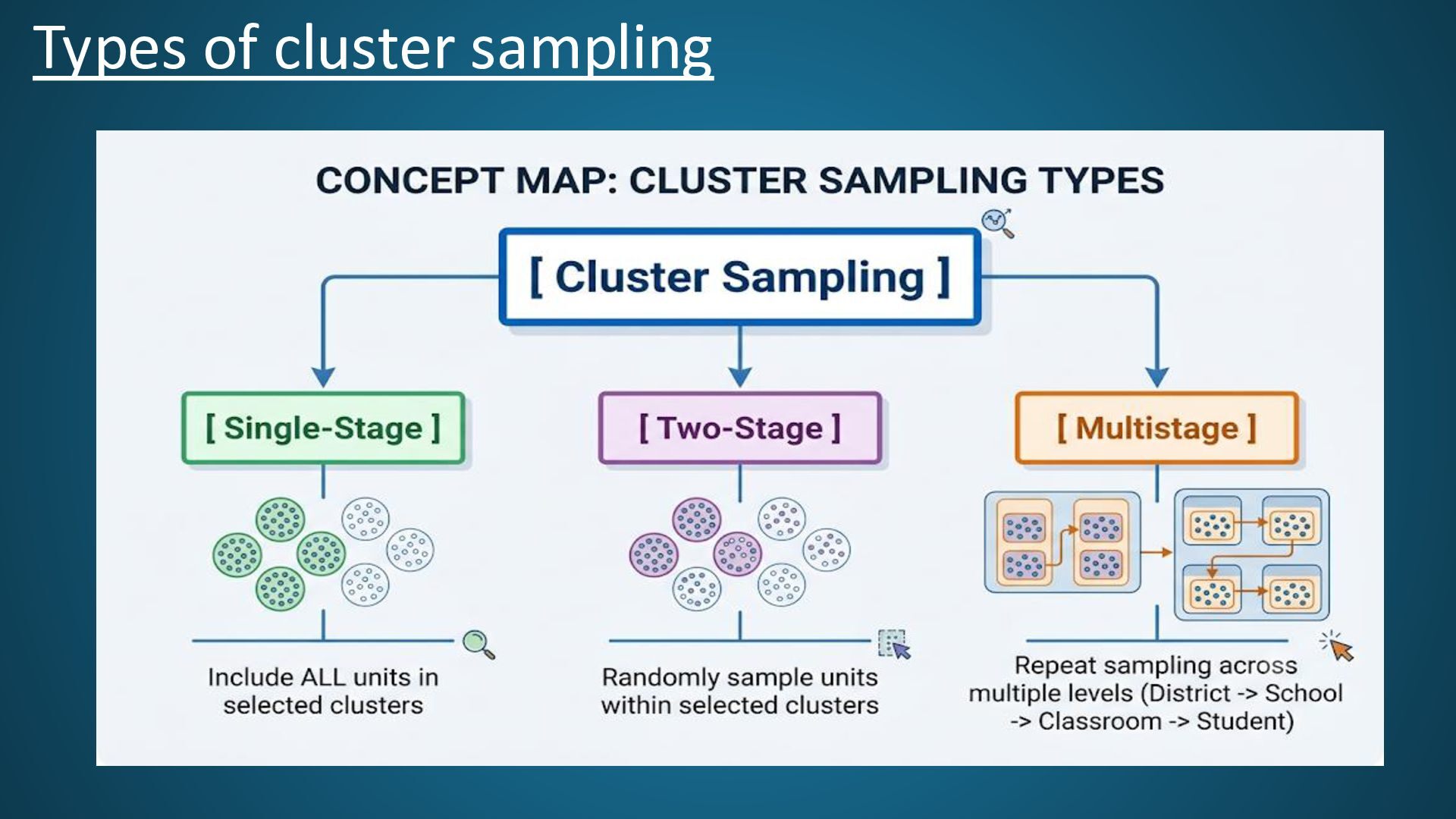
Include all units in selected clusters 2. Two-Stage Cluster Sampling Randomly sample units within selected clusters 3. Multistage Cluster Sampling Repeat sampling across multiple levels (District → School → Classroom)
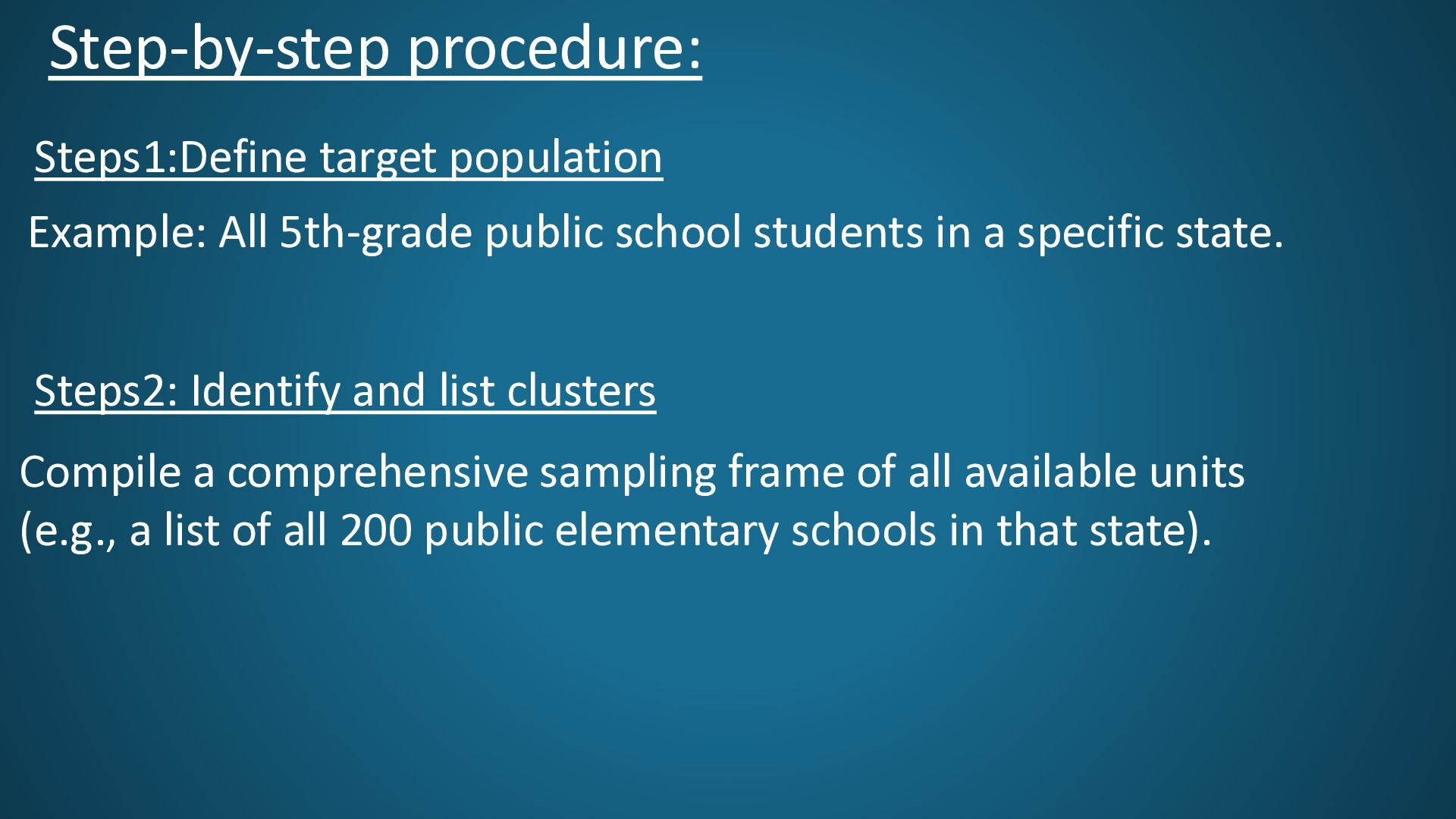
students in a specific state. Steps2: Identify and list clusters Compile a comprehensive sampling frame of all available units (e.g., a list of all 200 public elementary schools in that state).
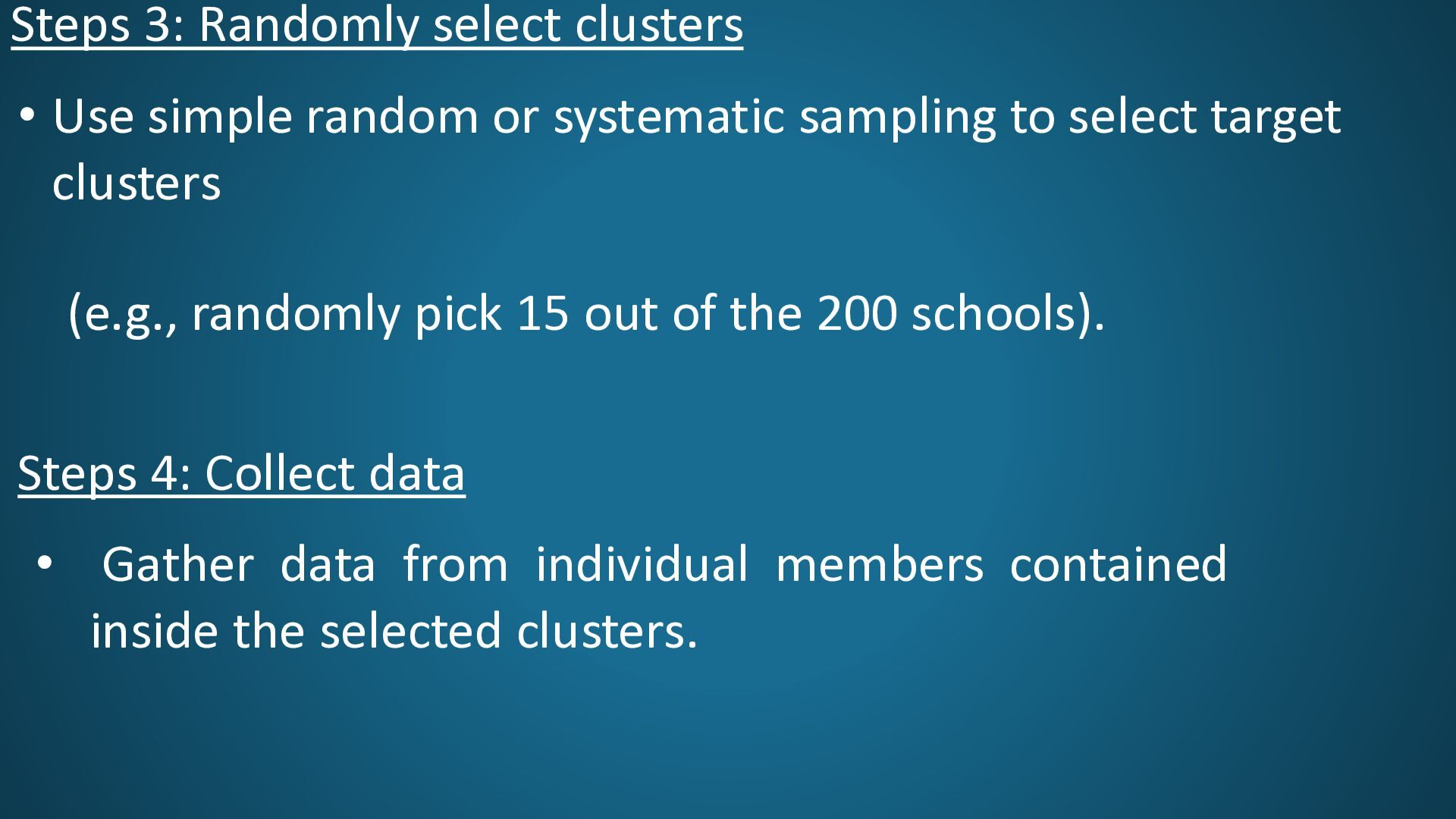
systematic sampling to select target clusters (e.g., randomly pick 15 out of the 200 schools). Steps 4: Collect data • Gather data from individual members contained inside the selected clusters.
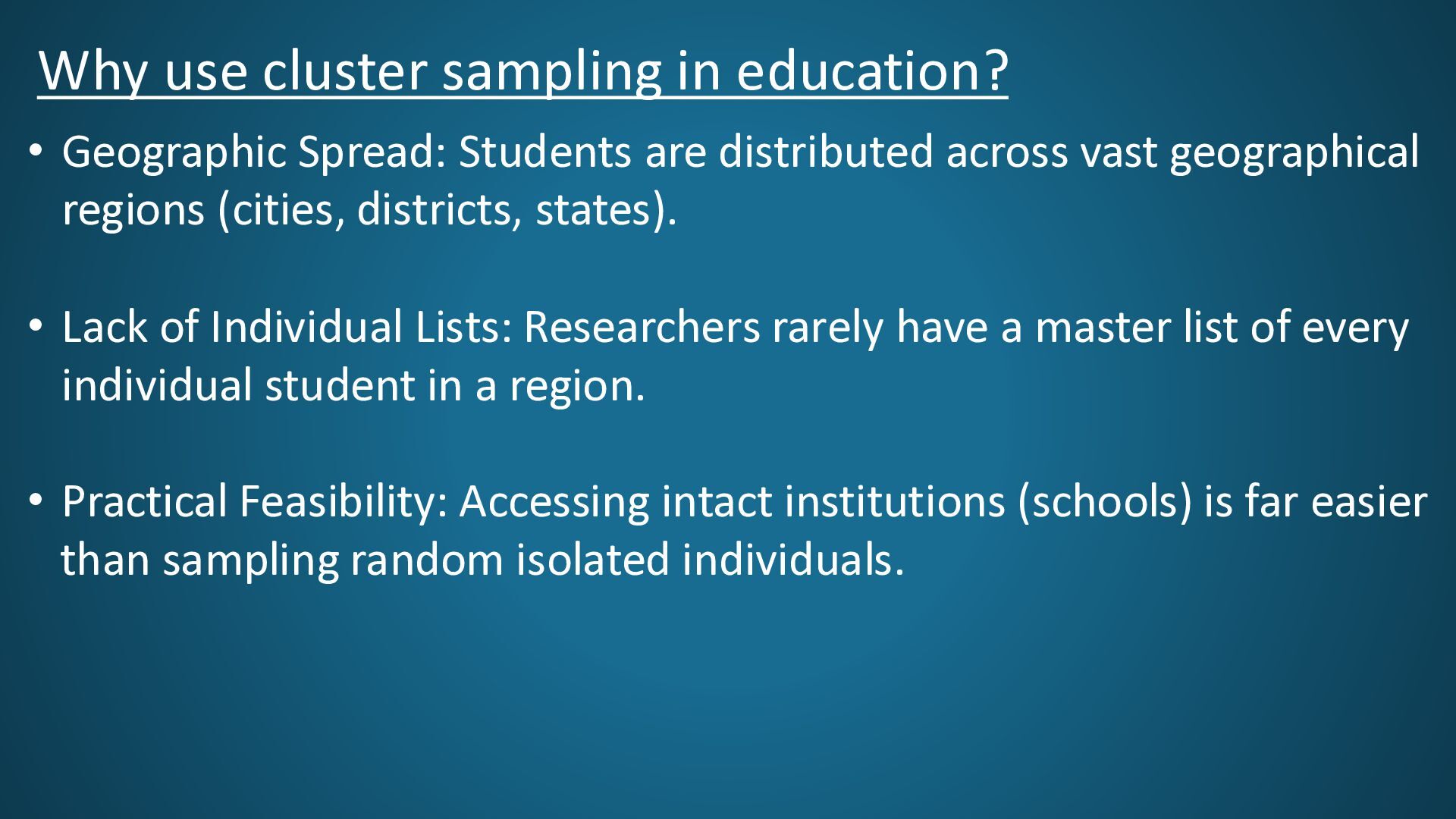
are distributed across vast geographical regions (cities, districts, states). • Lack of Individual Lists: Researchers rarely have a master list of every individual student in a region. • Practical Feasibility: Accessing intact institutions (schools) is far easier than sampling random isolated individuals.
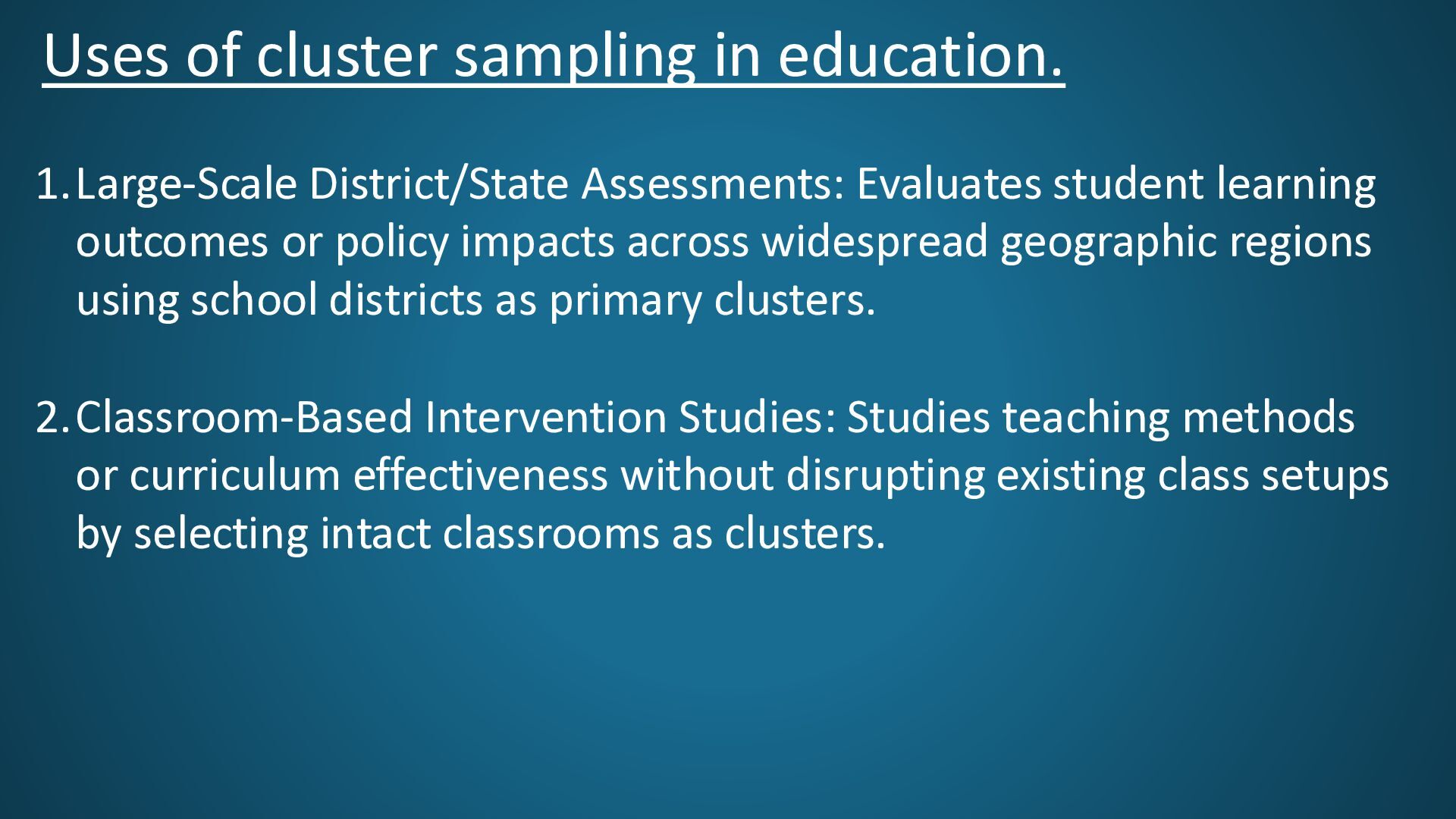
student learning outcomes or policy impacts across widespread geographic regions using school districts as primary clusters. 2.Classroom-Based Intervention Studies: Studies teaching methods or curriculum effectiveness without disrupting existing class setups by selecting intact classrooms as clusters.
Allows researchers to conduct population-wide educational surveys when individual student sampling frames are unavailable. 4. Evaluating School Management Systems: Compares administrative models, resource allocation, or infrastructure across different types of educational institutions.
multiple communities. • Individual Schools: Public, private, or charter school buildings. • Classrooms: Specific section groupings (e.g., all 8th-grade Science classrooms). • Geographical Zones: Urban, suburban, and rural school clusters.
work: School leaders use cluster sampling to test new teaching ideas in whole schools instead of picking single students. This saves a lot of time and makes organizing the test much easier for administrators.
school supplies: It helps leaders find out what different school areas need, like books, teachers, or equipment. By visiting a few full groups instead of scattered individuals, they save money on travel and work.
official rules: Inspectors use it to check safety and education standards across whole chosen districts. This lets them review how entire areas are doing without needing a huge list of every single child.
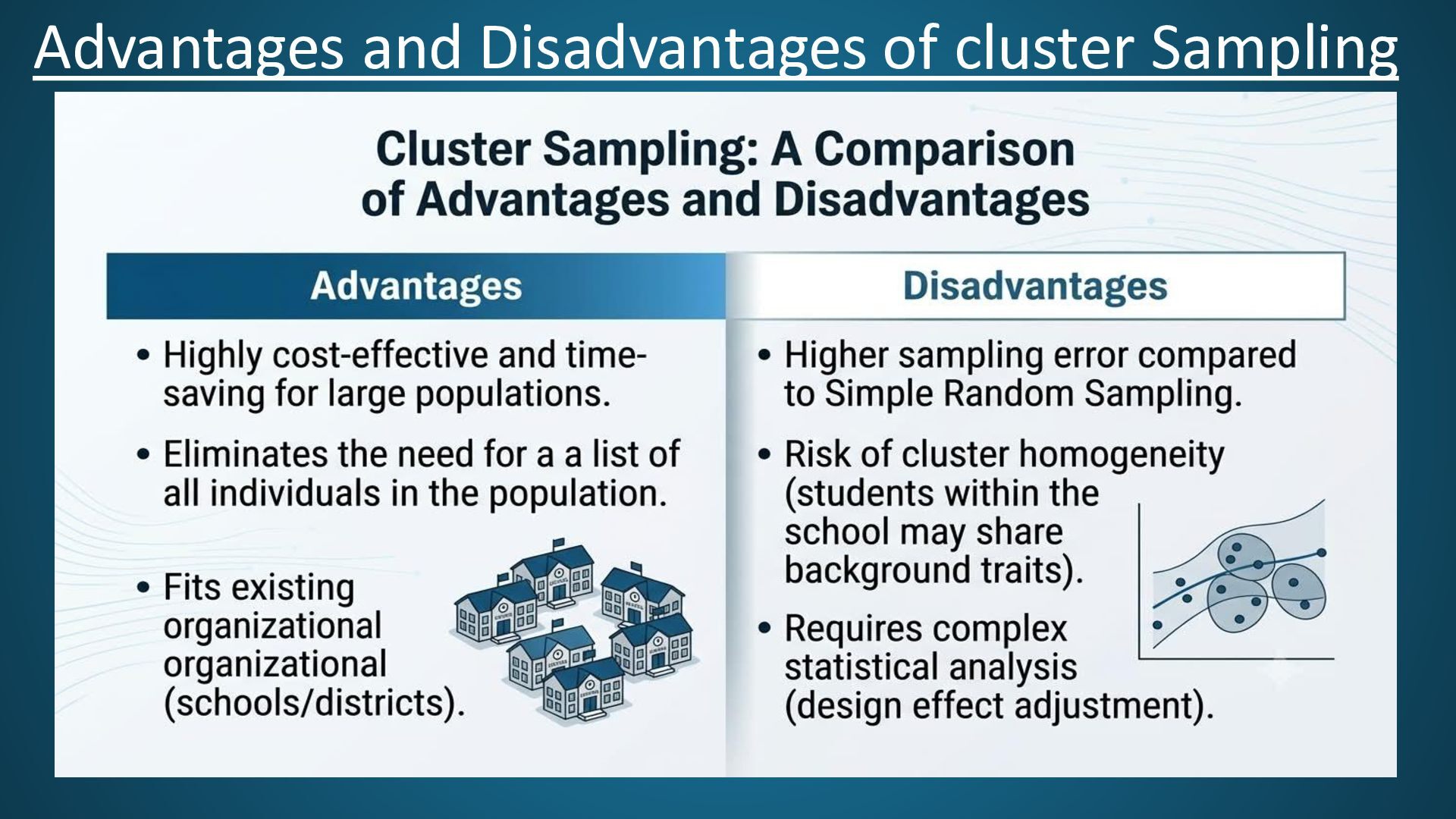
for large populations. • Eliminates the need for a list of all individuals in the population. • Fits existing organizational structures (schools/districts).
to Simple Random Sampling. • Risk of cluster homogeneity (students within the same school may share similar background traits). • Requires complex statistical analysis (design effect adjustment).
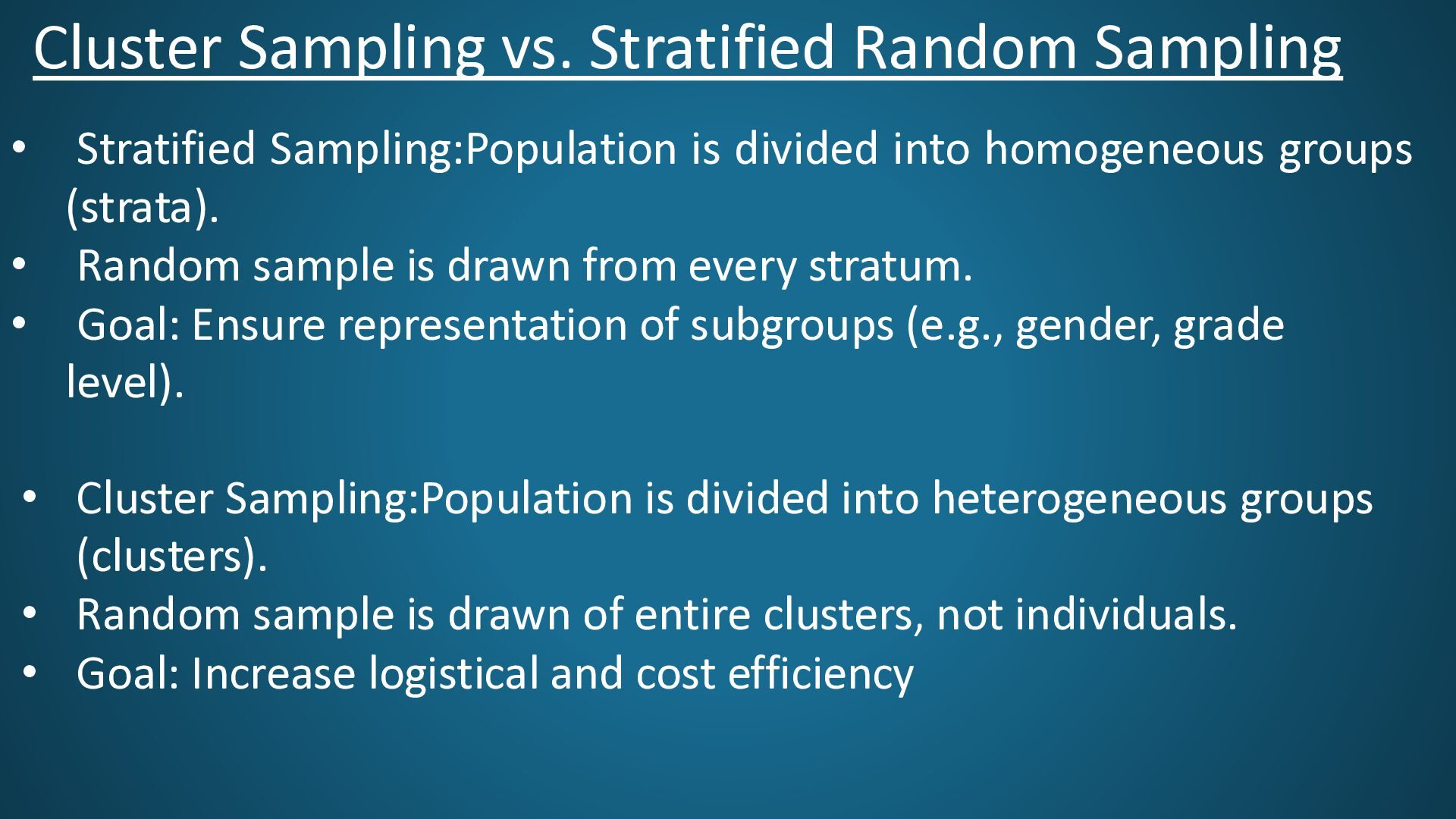
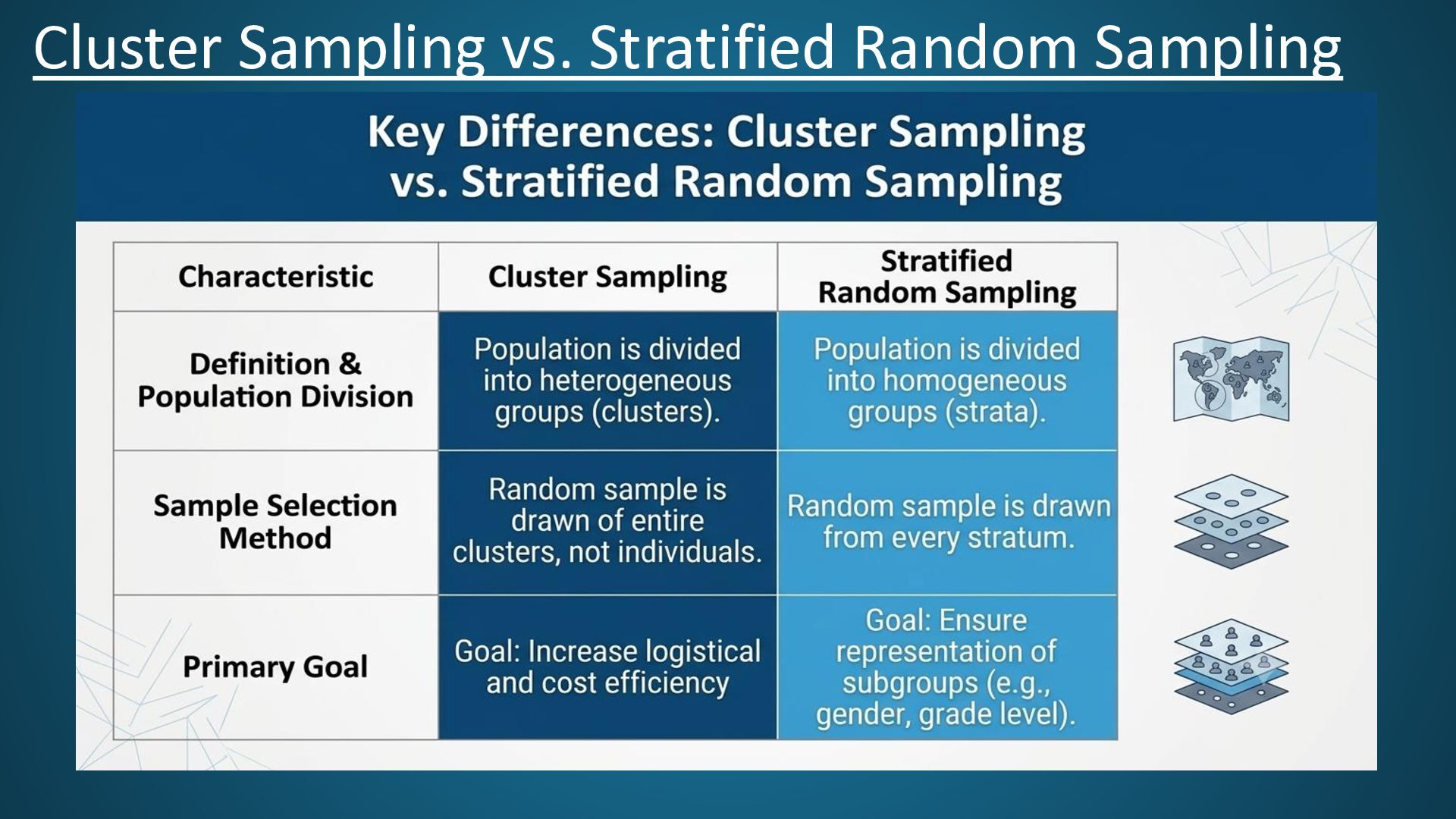
divided into homogeneous groups (strata). • Random sample is drawn from every stratum. • Goal: Ensure representation of subgroups (e.g., gender, grade level). • Cluster Sampling:Population is divided into heterogeneous groups (clusters). • Random sample is drawn of entire clusters, not individuals. • Goal: Increase logistical and cost efficiency
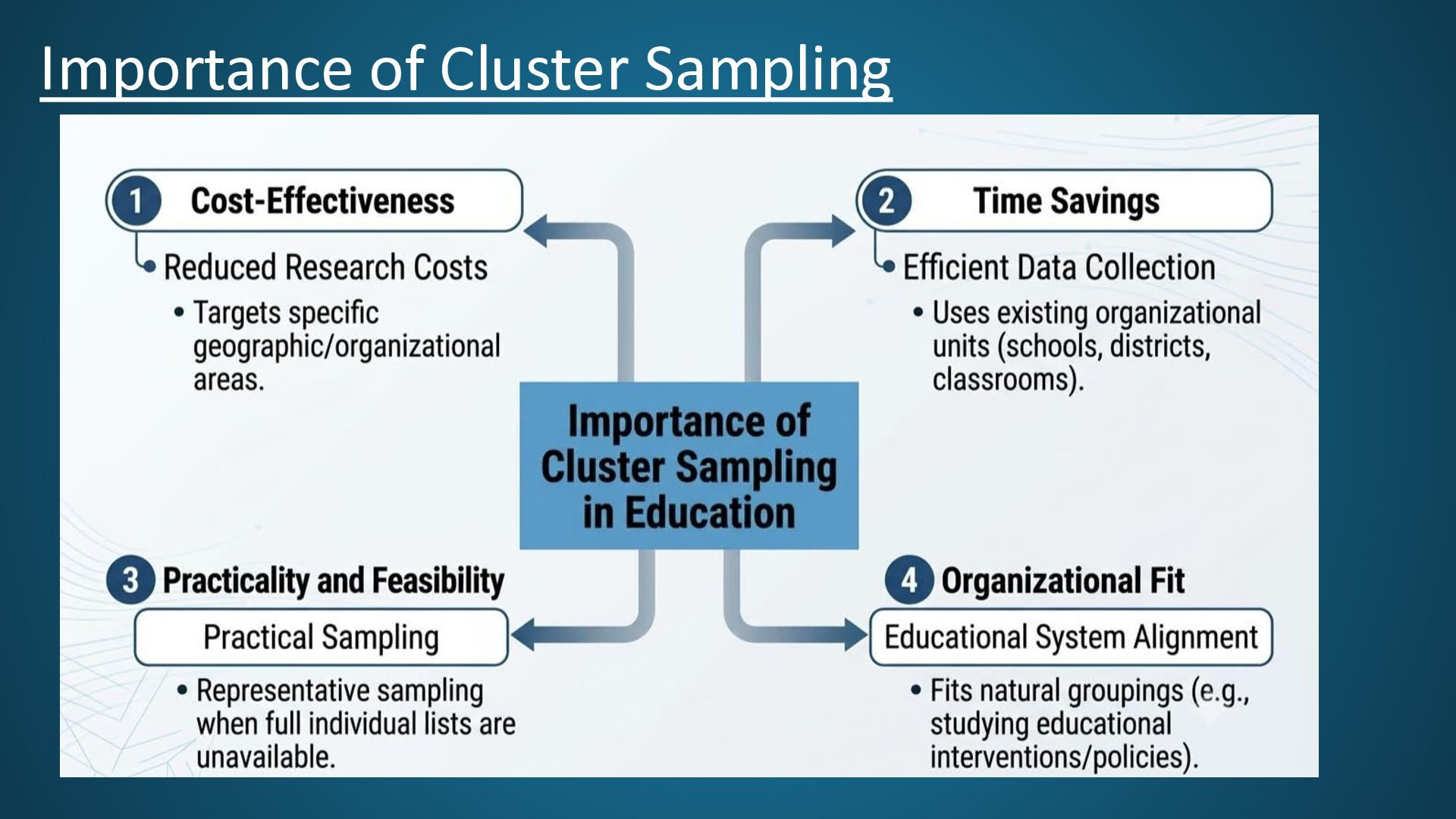
reduce the cost of research by focusing on a specific geographic area or organizational structure. This makes it particularly relevant for educational research, which often operates on limited budgets.
organizational units (such as schools, districts, or classrooms), cluster sampling can save considerable time compared to other methods that require compiling exhaustive lists of individual students
is difficult or impossible to obtain a complete list of individual students, cluster sampling provides a practical way to collect a representative sample.
large educational systems by selecting entire groups, like schools or classrooms, instead of individual students. • This approach saves significant time and money while working naturally within existing school structures. • However, it requires careful statistical adjustments because students within the same group often share similar characteristics.


 aisw77
 hiola
 cbtlibrary
 yasslab
 rashwhitman
 ainischool
 juanmartin2026
 arnoknobbe
 akiraasano
 bvr7352
 madhuri28
 baltimoreniso
 dougneiner
 kneath
 codingconduct
 inesmontani
 tammyeverts
 nonsquared
 reverentgeek
 addyosmani
 maggiecrowley
 marcduiker
 marktimemedia
 skipperchong