Upgrade to Pro — share decks privately, control downloads, hide ads and more …

enechainが挑む、AIエージェントと共に進めるScheduled Queryからdbtへの移行

Avatar for Aki Zhou Aki Zhou
December 19, 2025

enechainが挑む、AIエージェントと共に進めるScheduled Queryからdbtへの移行

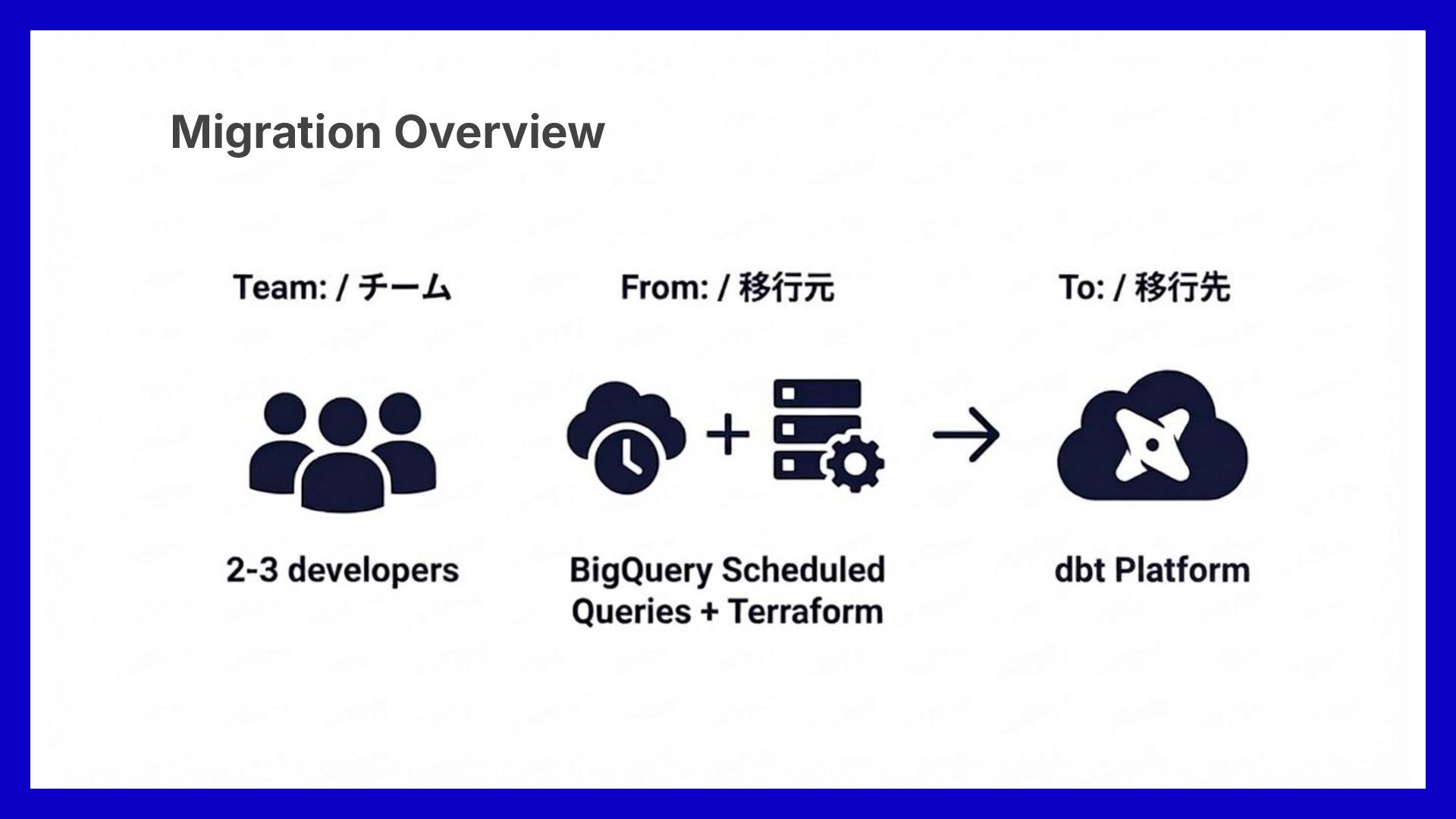
enechainでは、既存のBigQuery Scheduled Queryで構築された処理をdbtへ移行するにあたり、AIエージェントを積極的に活用しています。
dbt導入の過渡期ならではの制約がある中で、スタートアップの少人数チームがどのようにAIを活用しながら作業を進め、品質を担保しているか、メタデータが十分に揃っていない環境でAIを扱う際の工夫や取り組みついて紹介いたします。

Avatar for Aki Zhou

Aki Zhou

December 19, 2025
Tweet

Other Decks in Technology

Transcript

  1. Table of contents 1. Challenge 2. Context Engineering 3. Workflow

    as Structure 4. Additional Enhancements 5. Next Steps Agenda
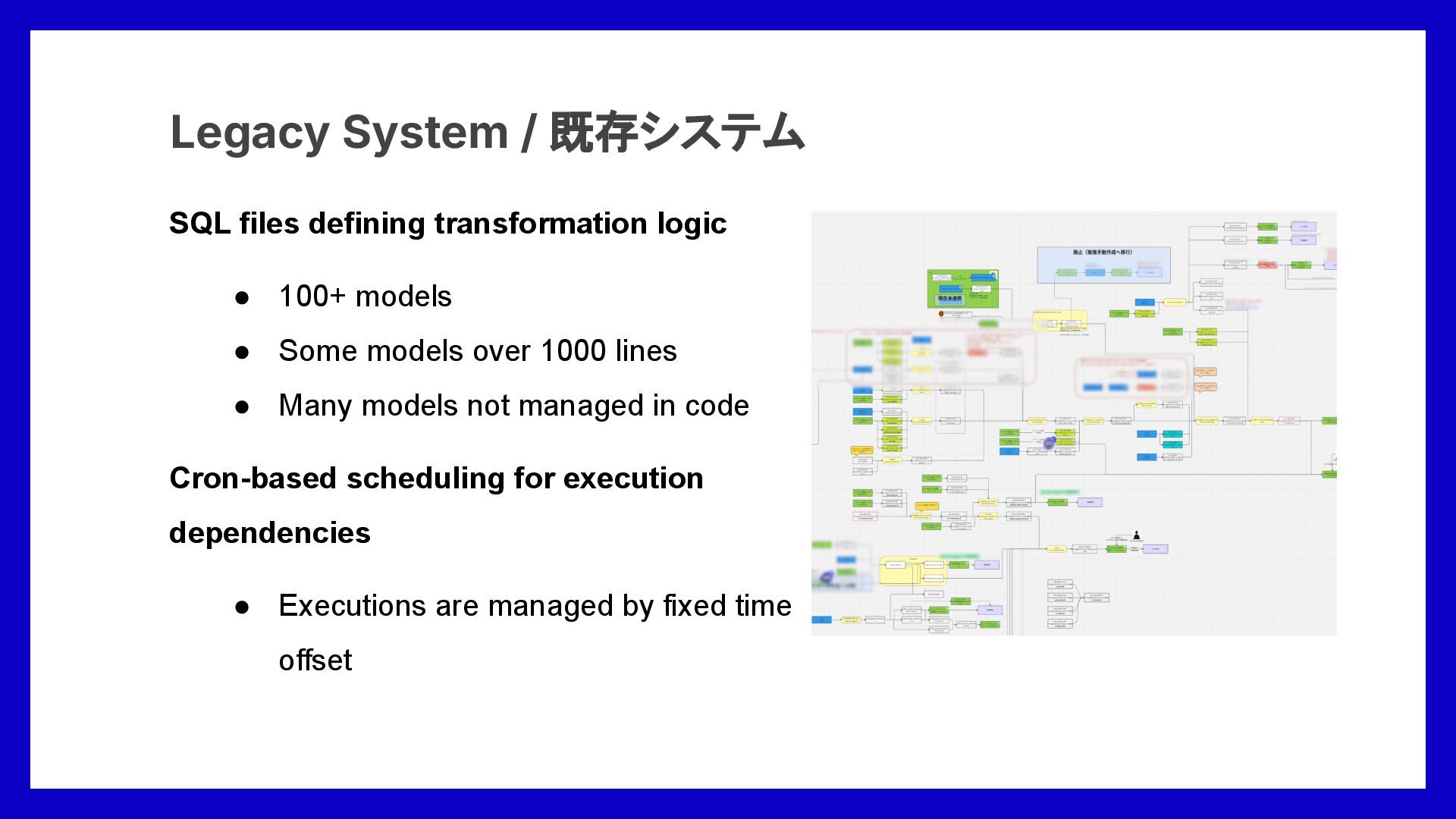
  2. Legacy System / 既存システム SQL files defining transformation logic •

    100+ models • Some models over 1000 lines • Many models not managed in code Cron-based scheduling for execution dependencies • Executions are managed by fixed time offset
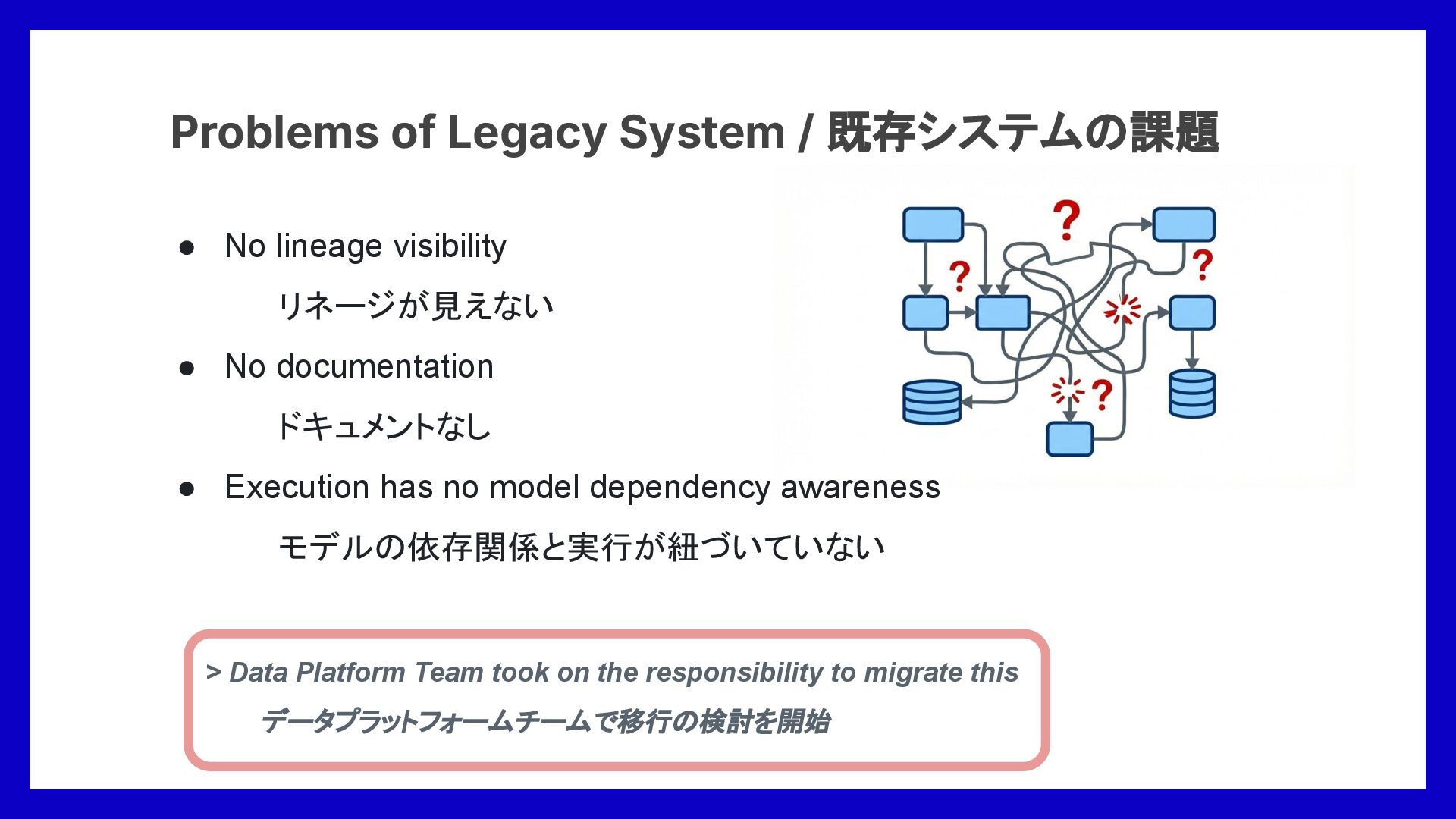
  3. Problems of Legacy System / 既存システム 課題 > Data Platform

    Team took on the responsibility to migrate this データプラットフォームチームで移行 検討を開始 • No lineage visibility リネージが見えない • No documentation ドキュメントなし • Execution has no model dependency awareness モデル 依存関係と実行が紐づいていない
  4. Migration Challenge / 移行する上で 課題 Ideal Reality Well documented models

    ドキュメント化済み Limited documentation ドキュメント不足 Well shared business logic ロジック共有済み Tribal knowledge ロジック属人的 Schema/columns described スキーマ定義等あり No metadata メタデータなし The existing system contains many complex, person-dependent models built by few analysts 既存システム 少人数 データアナリストが多様な要件に対応する中で構築されたため、 属人性が高い複雑なモデルが多数あった
  5. 1. Industry standard — already used internally 業界標準、社内でも既にdbt Coreを一部利用 2.

    Lineage visibility — understand data flow リネージ 可視化 3. Modularity — ref(), source(), macros モジュール性 4. Wide compatibility — DWH + BI tools 様々なDWH・BIツールと 互換性 Why dbt?
  6. Why dbt Platform? 1. Small team — no resource for

    infrastructure setup and maintenance 少人数チーム — インフラ構築・メンテする余裕がない 2. dbt Catalog — documentation interface out of the box ドキュメント機能が充実している 3. Semantic Layer — centralized metrics メトリクス 一元管理 4. dbt Mesh — cross-project collaboration プロジェクト間連携が可能
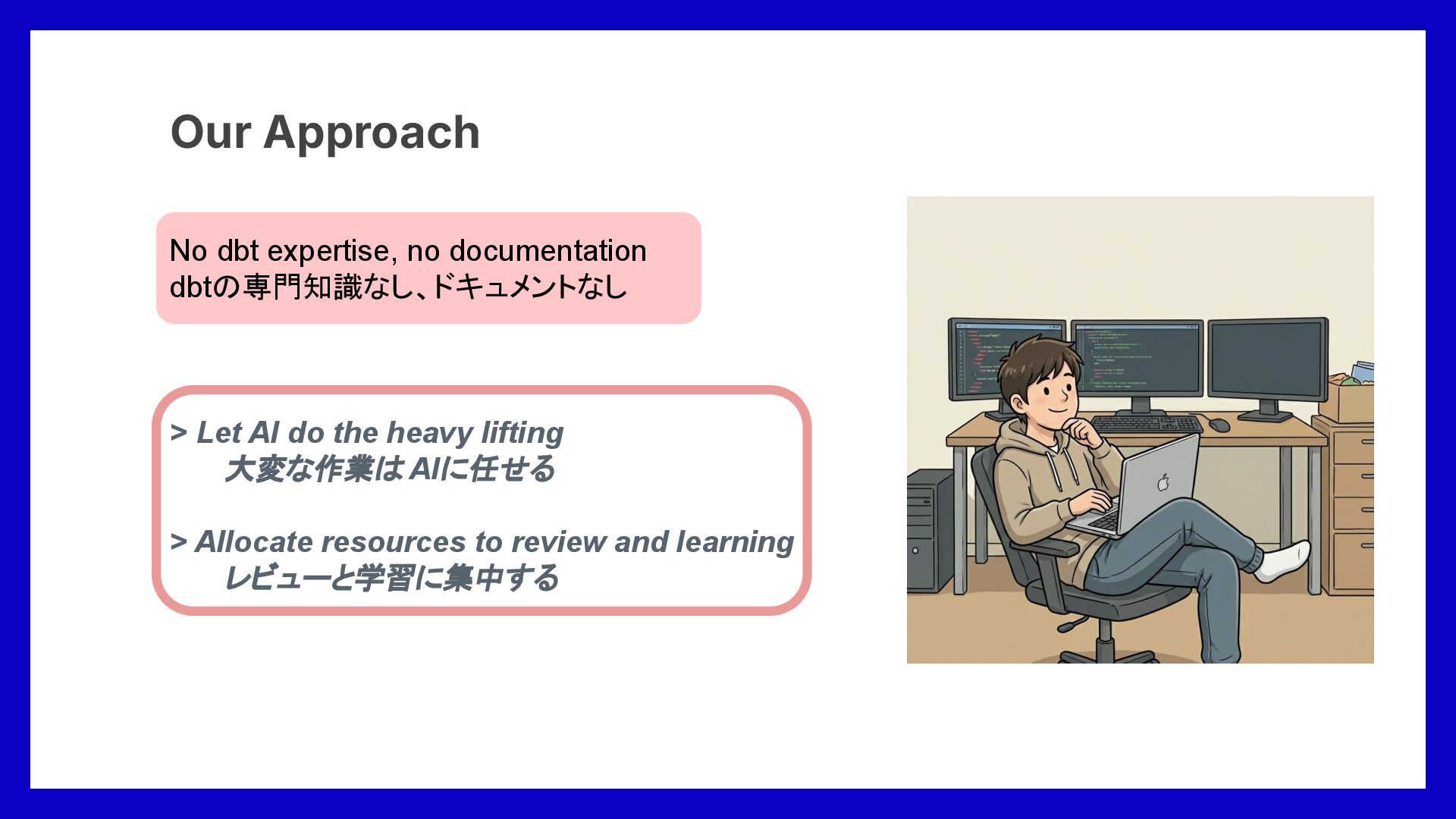
  7. No dbt expertise, no documentation dbt 専門知識なし、ドキュメントなし > Let AI

    do the heavy lifting 大変な作業 AIに任せる > Allocate resources to review and learning レビューと学習に集中する Our Approach
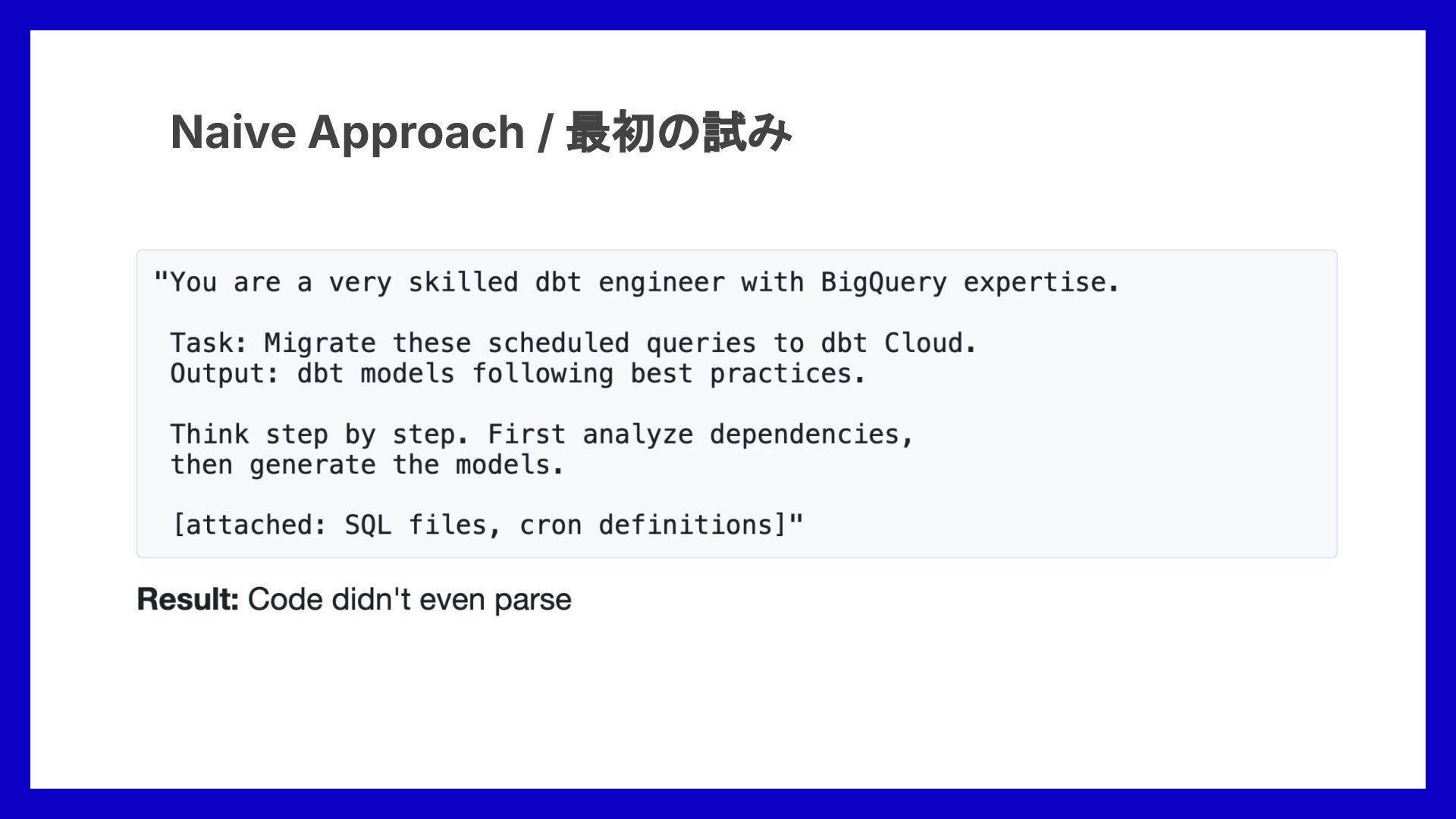
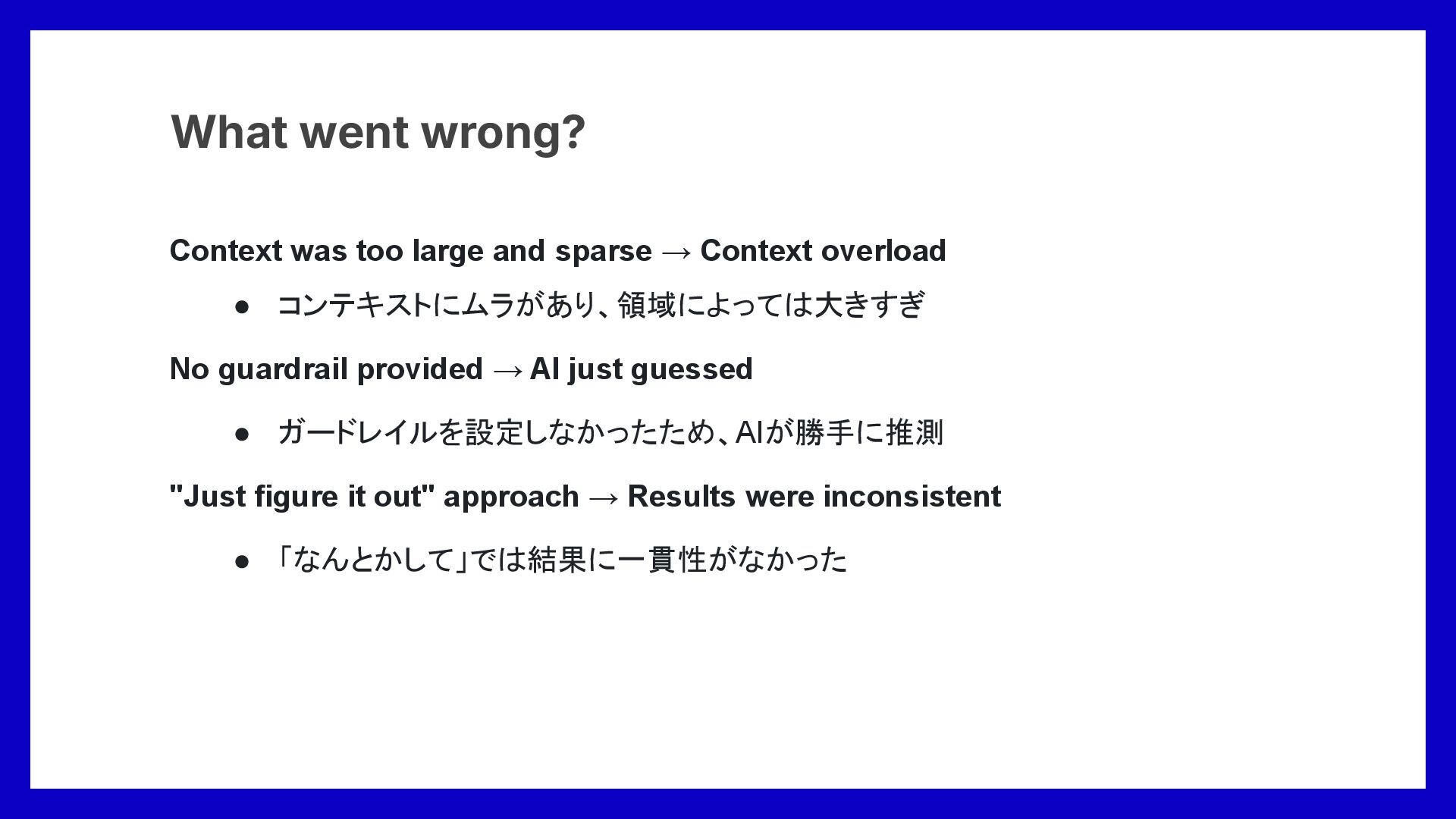
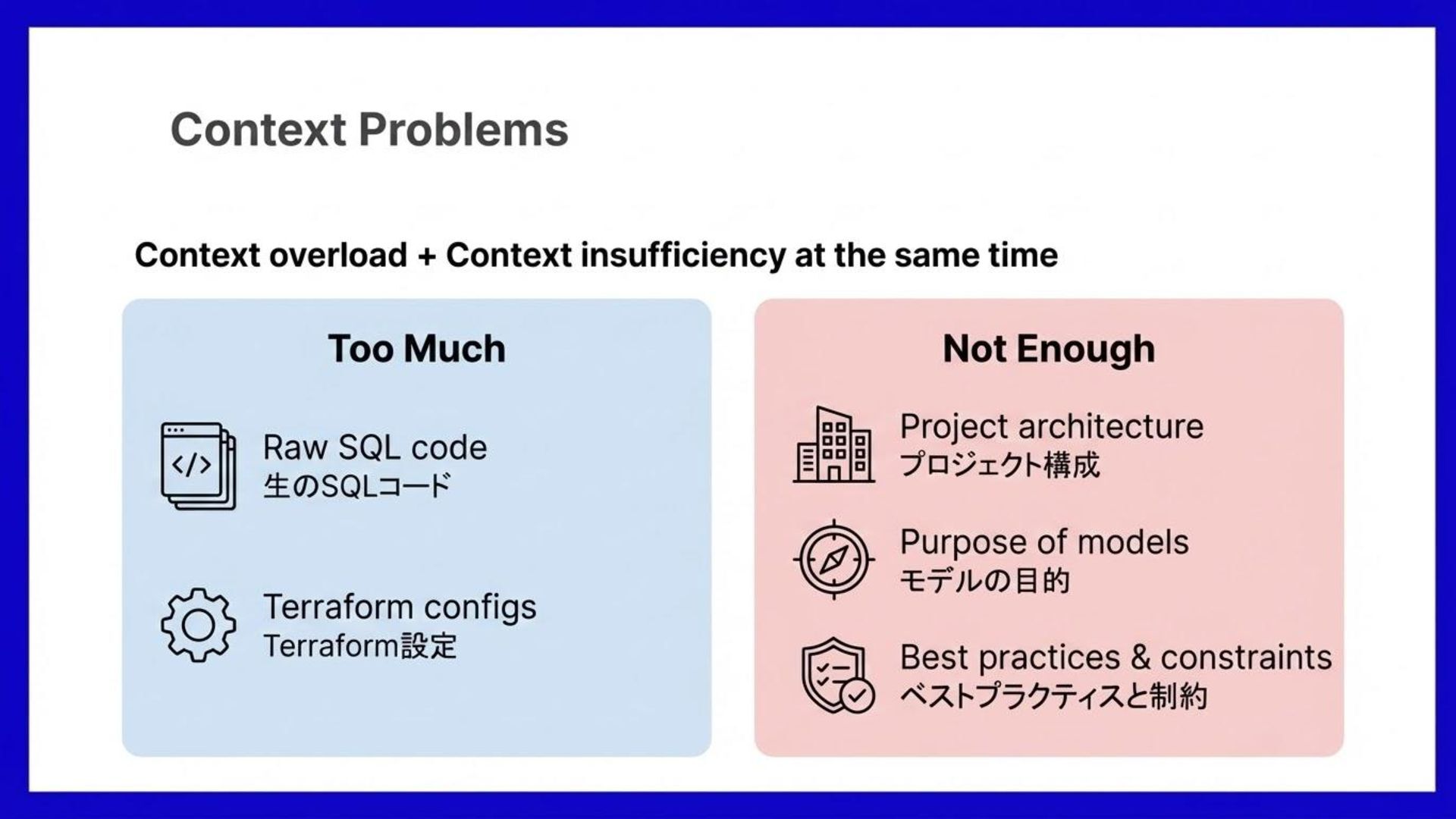
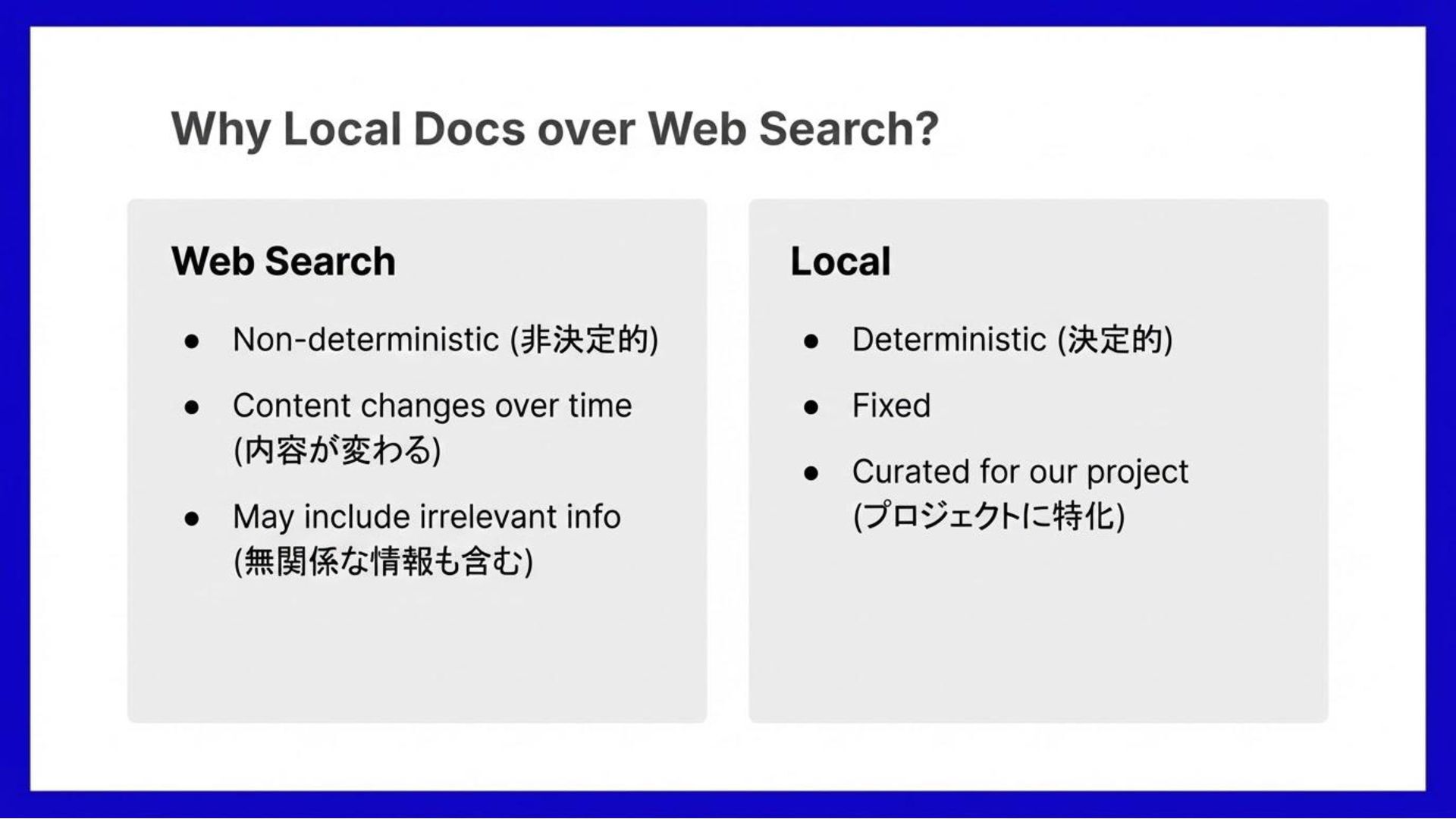
  8. Context was too large and sparse → Context overload •

    コンテキストにムラがあり、領域によって 大きすぎ No guardrail provided → AI just guessed • ガードレイルを設定しなかったため、AIが勝手に推測 "Just figure it out" approach → Results were inconsistent • 「なんとかして」で 結果に一貫性がなかった What went wrong?
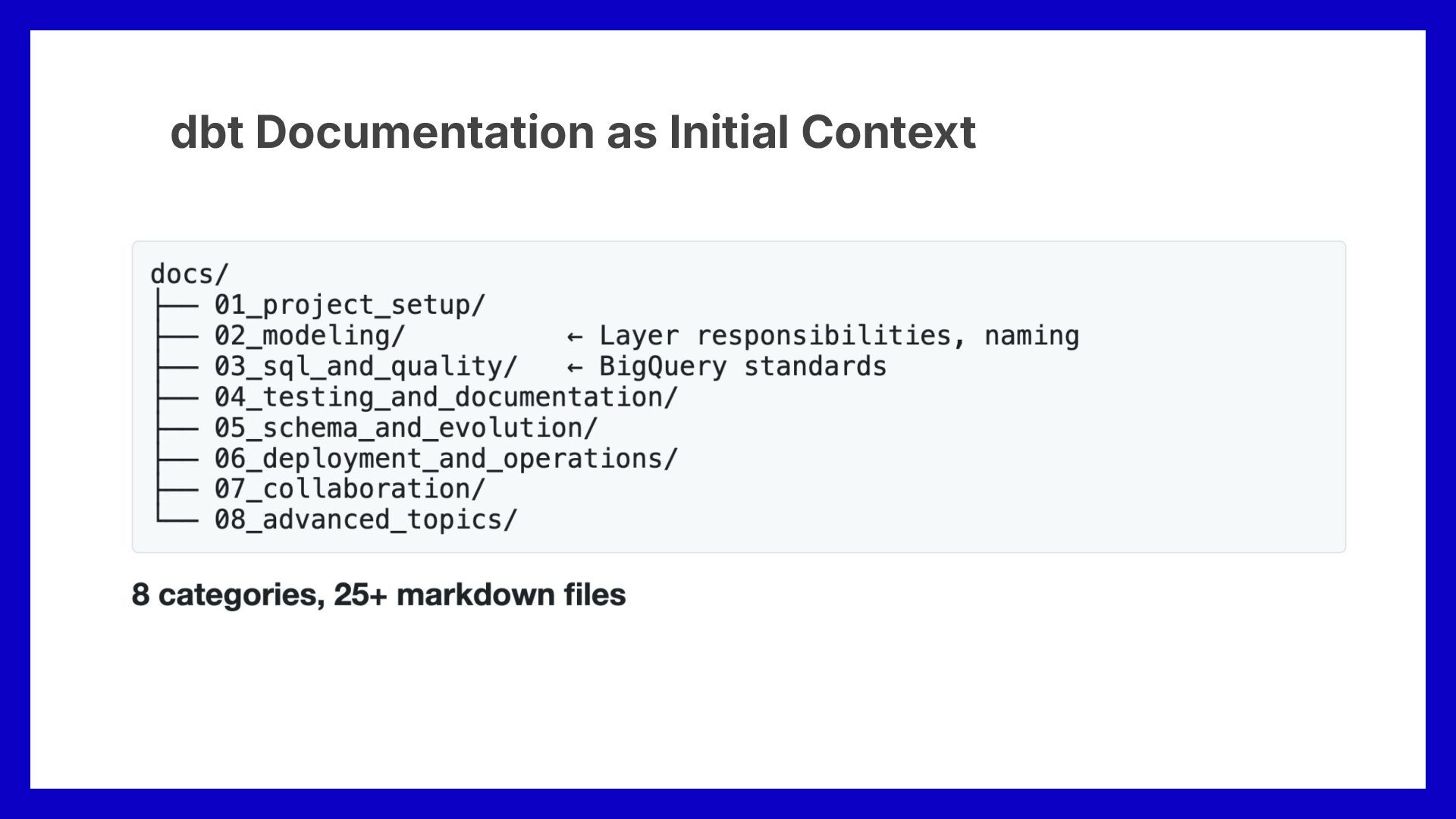
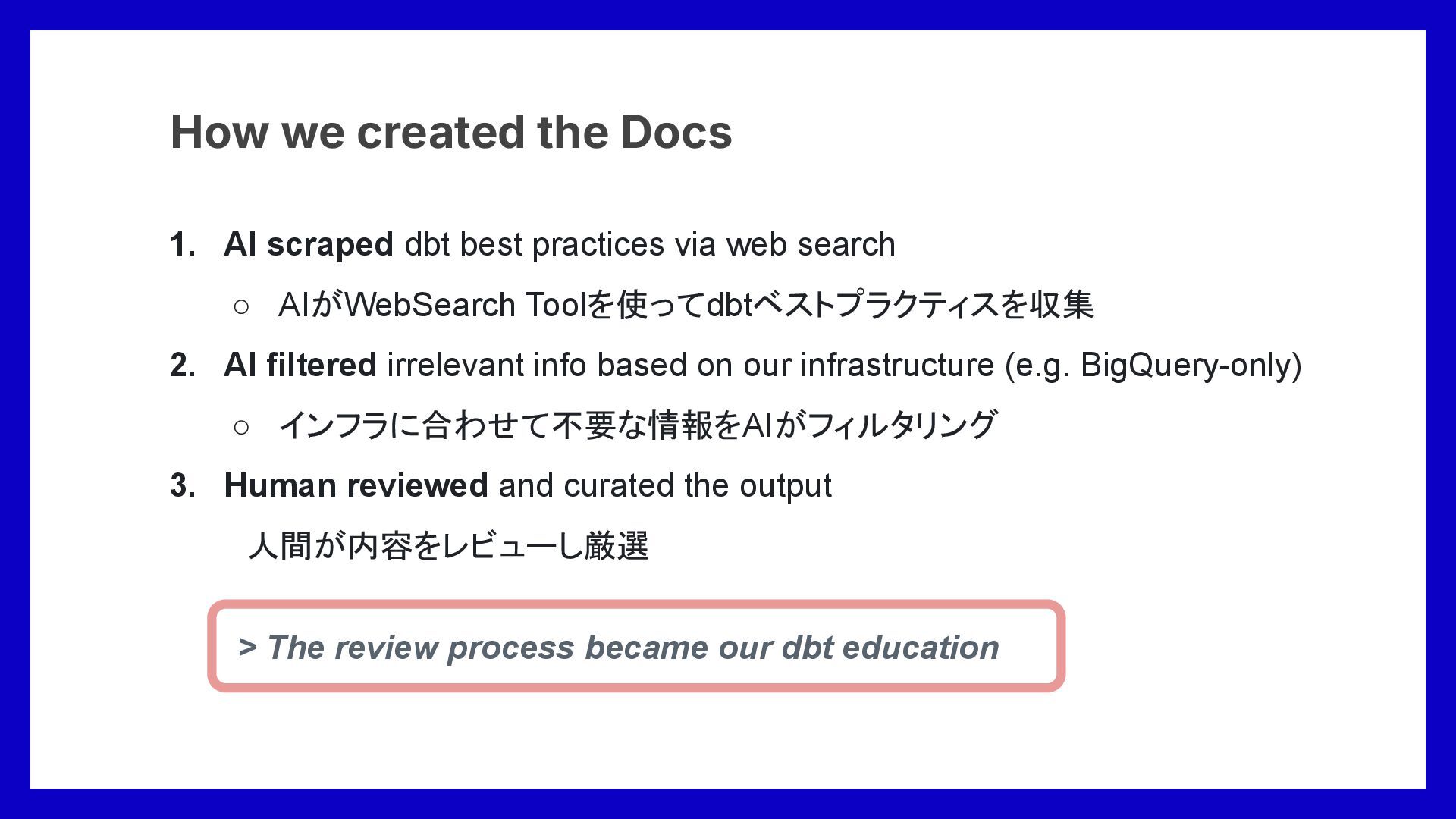
  9. 1. AI scraped dbt best practices via web search ◦

    AIがWebSearch Toolを使ってdbtベストプラクティスを収集 2. AI filtered irrelevant info based on our infrastructure (e.g. BigQuery-only) ◦ インフラに合わせて不要な情報をAIがフィルタリング 3. Human reviewed and curated the output  人間が内容をレビューし厳選 How we created the Docs > The review process became our dbt education
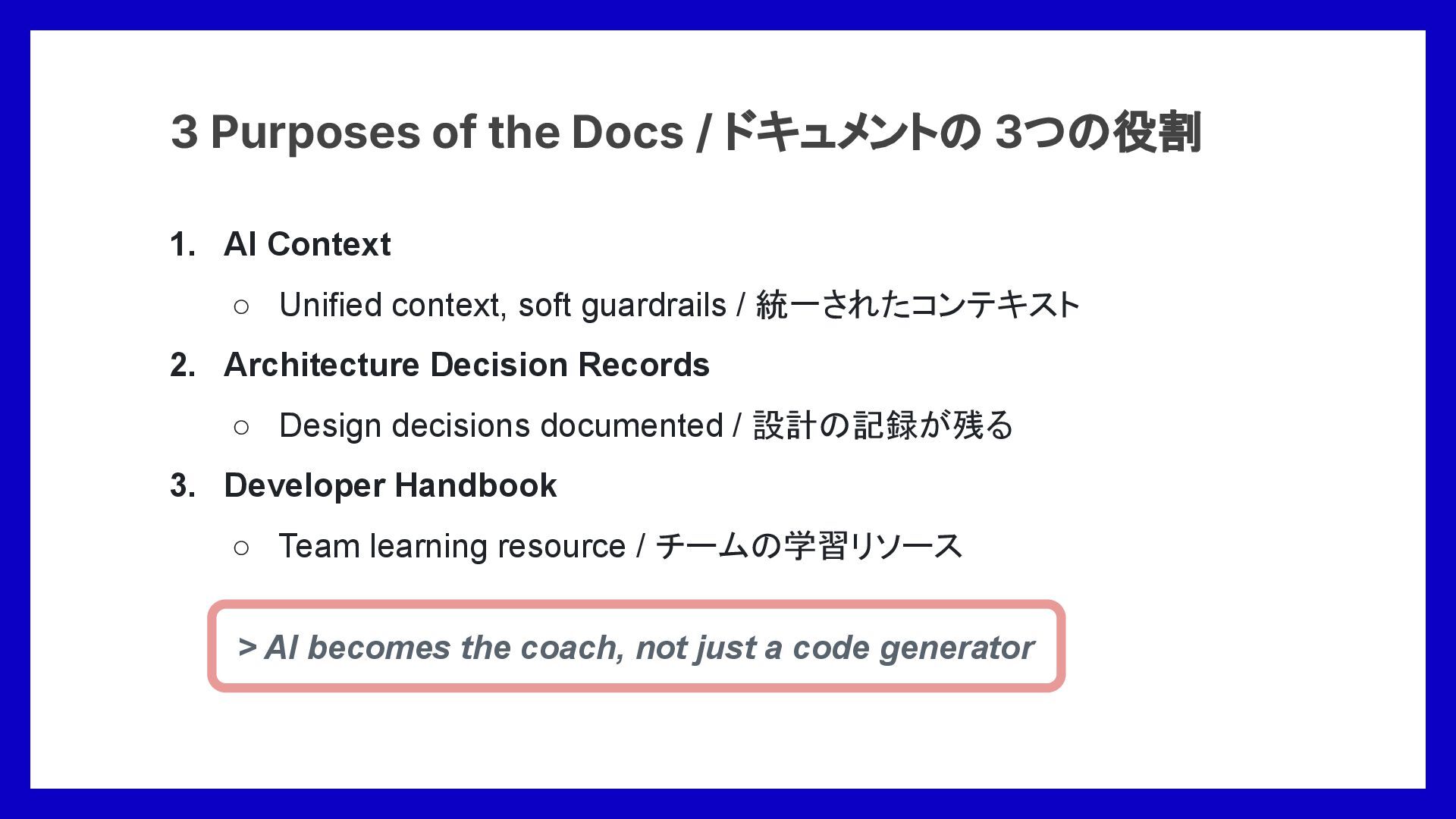
  10. 1. AI Context ◦ Unified context, soft guardrails / 統一されたコンテキスト

    2. Architecture Decision Records ◦ Design decisions documented / 設計 記録が残る 3. Developer Handbook ◦ Team learning resource / チーム 学習リソース 3 Purposes of the Docs / ドキュメント 3つ 役割 > AI becomes the coach, not just a code generator
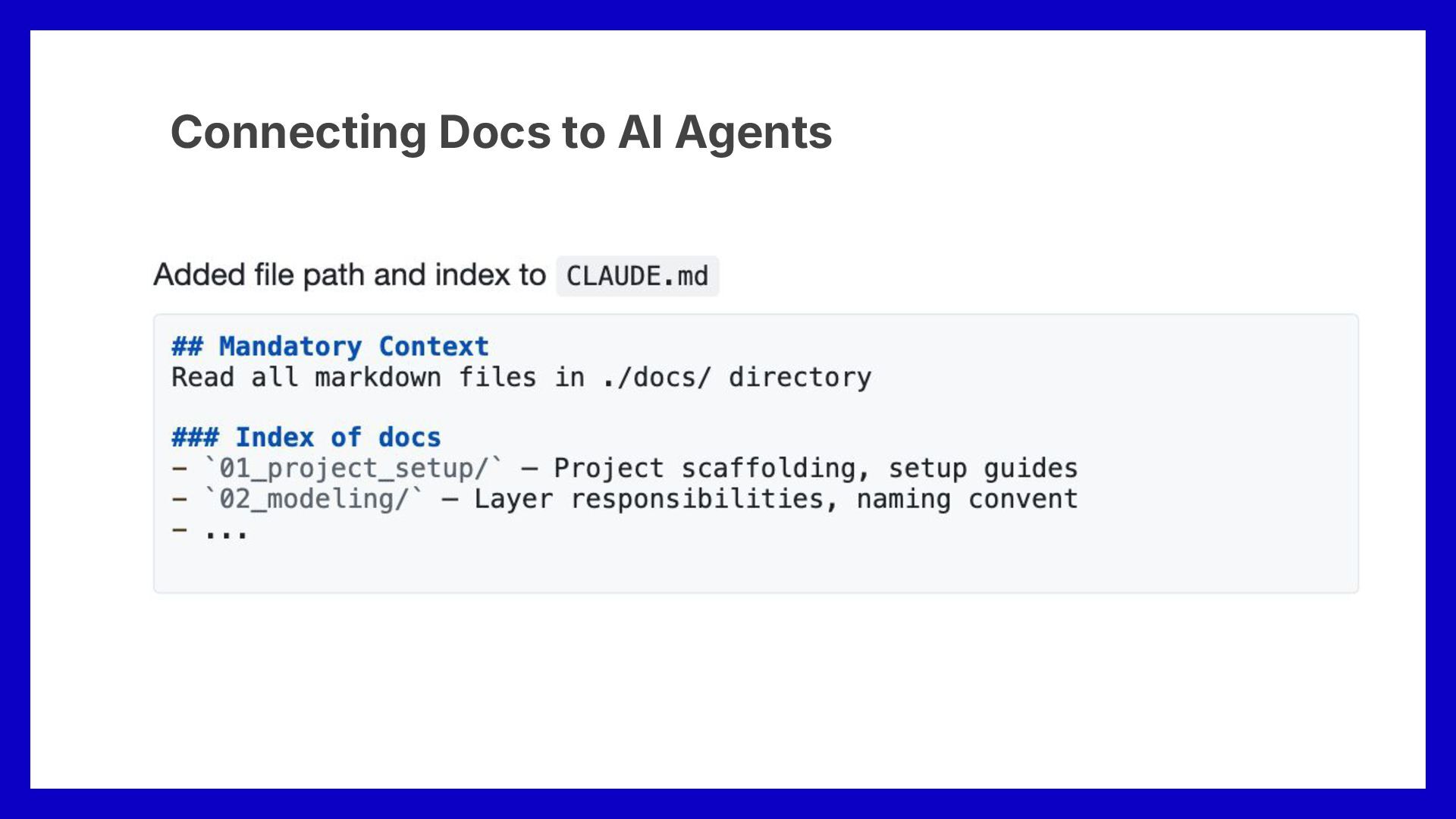
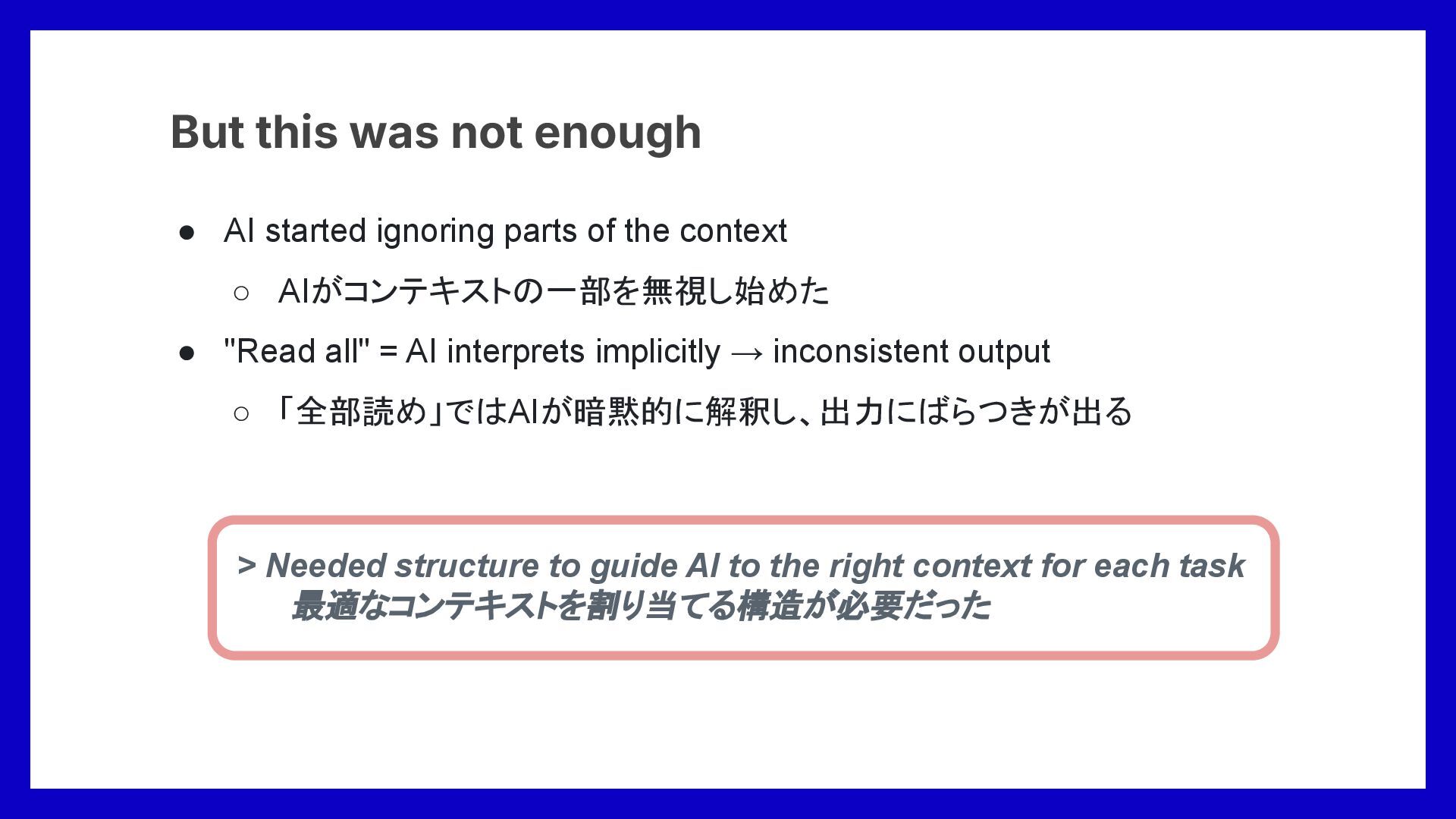
  11. • AI started ignoring parts of the context ◦ AIがコンテキスト

    一部を無視し始めた • "Read all" = AI interprets implicitly → inconsistent output ◦ 「全部読め」で AIが暗黙的に解釈し、出力に らつきが出る But this was not enough > Needed structure to guide AI to the right context for each task 最適なコンテキストを割り当てる構造が必要だった
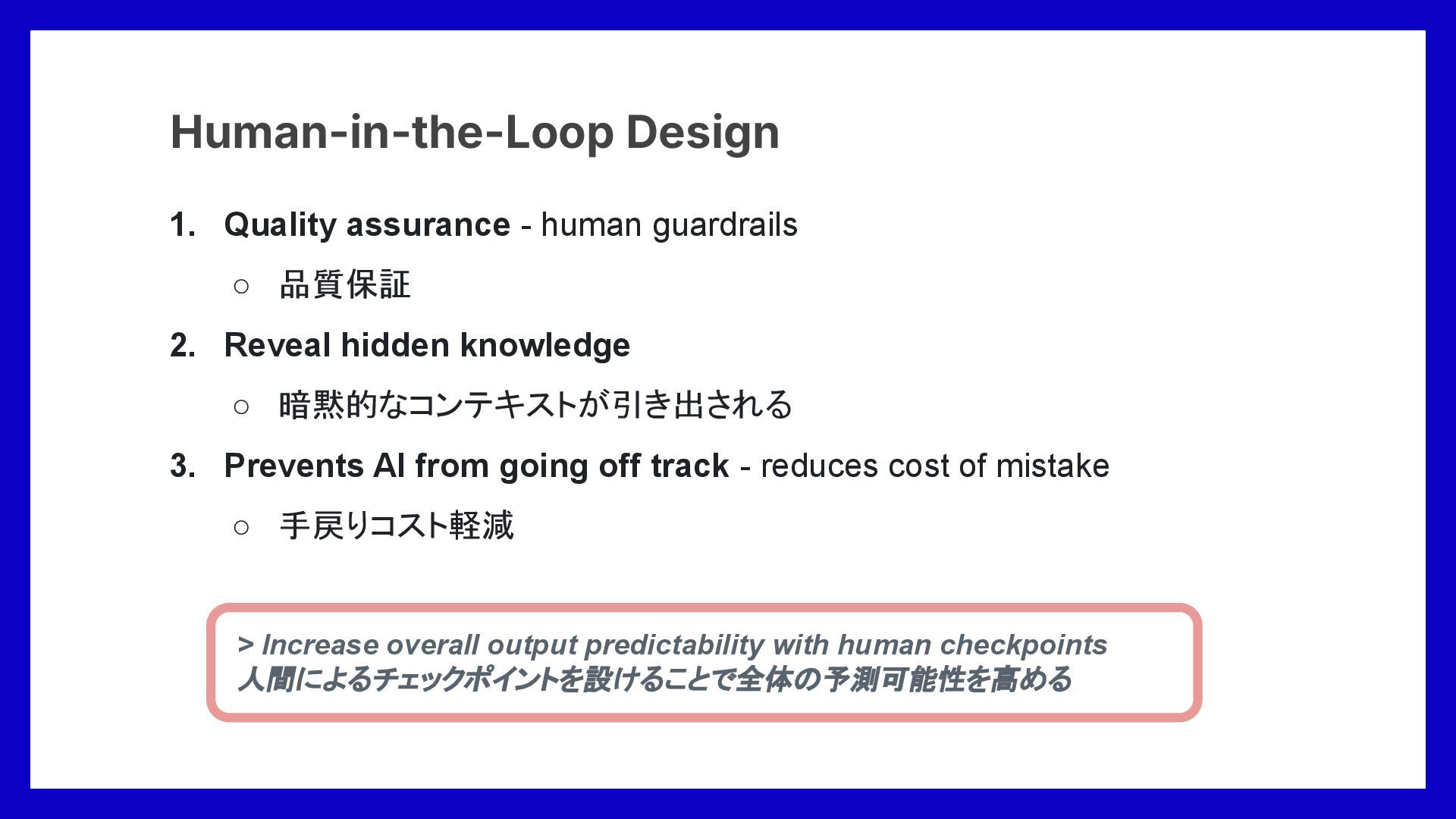
  12. 1. Quality assurance - human guardrails ◦ 品質保証 2. Reveal

    hidden knowledge ◦ 暗黙的なコンテキストが引き出される 3. Prevents AI from going off track - reduces cost of mistake ◦ 手戻りコスト軽減 Human-in-the-Loop Design > Increase overall output predictability with human checkpoints 人間によるチェックポイントを設けることで全体 予測可能性を高める
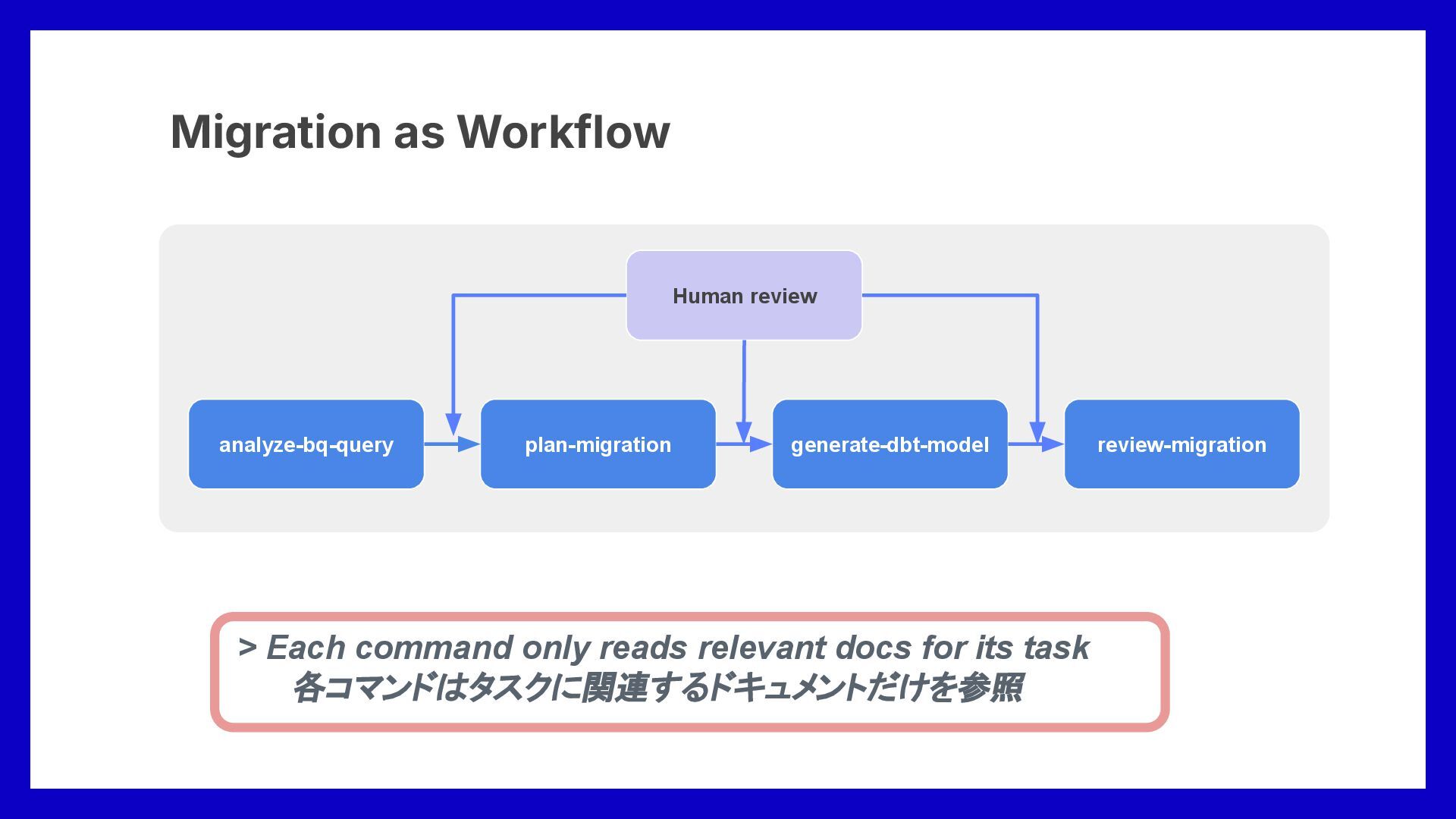
  13. Migration as Workflow analyze-bq-query Human review generate-dbt-model plan-migration review-migration >

    Each command only reads relevant docs for its task 各コマンド タスクに関連するドキュメントだけを参照
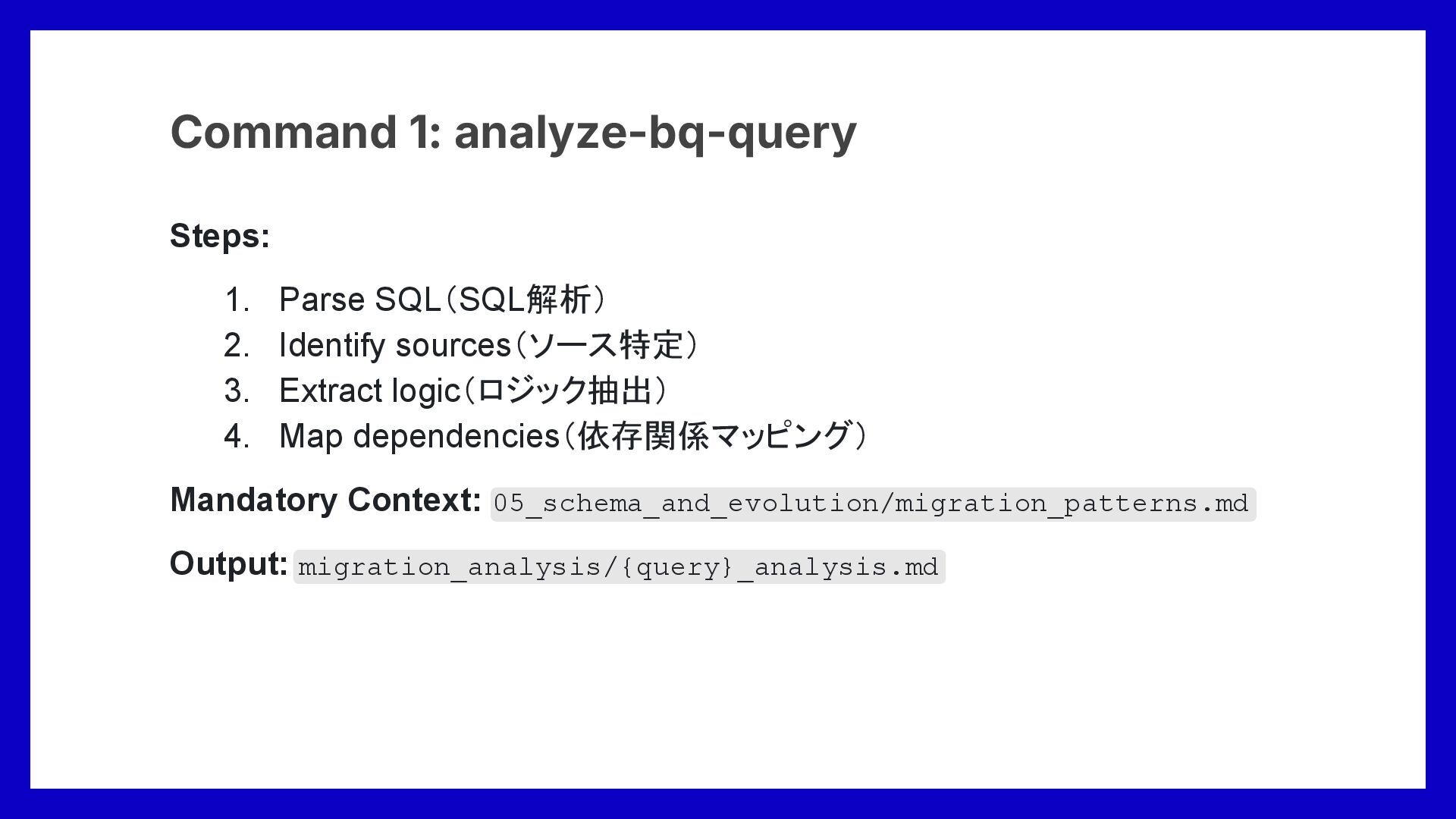
  14. Command 1: analyze-bq-query Steps: 1. Parse SQL(SQL解析) 2. Identify sources(ソース特定)

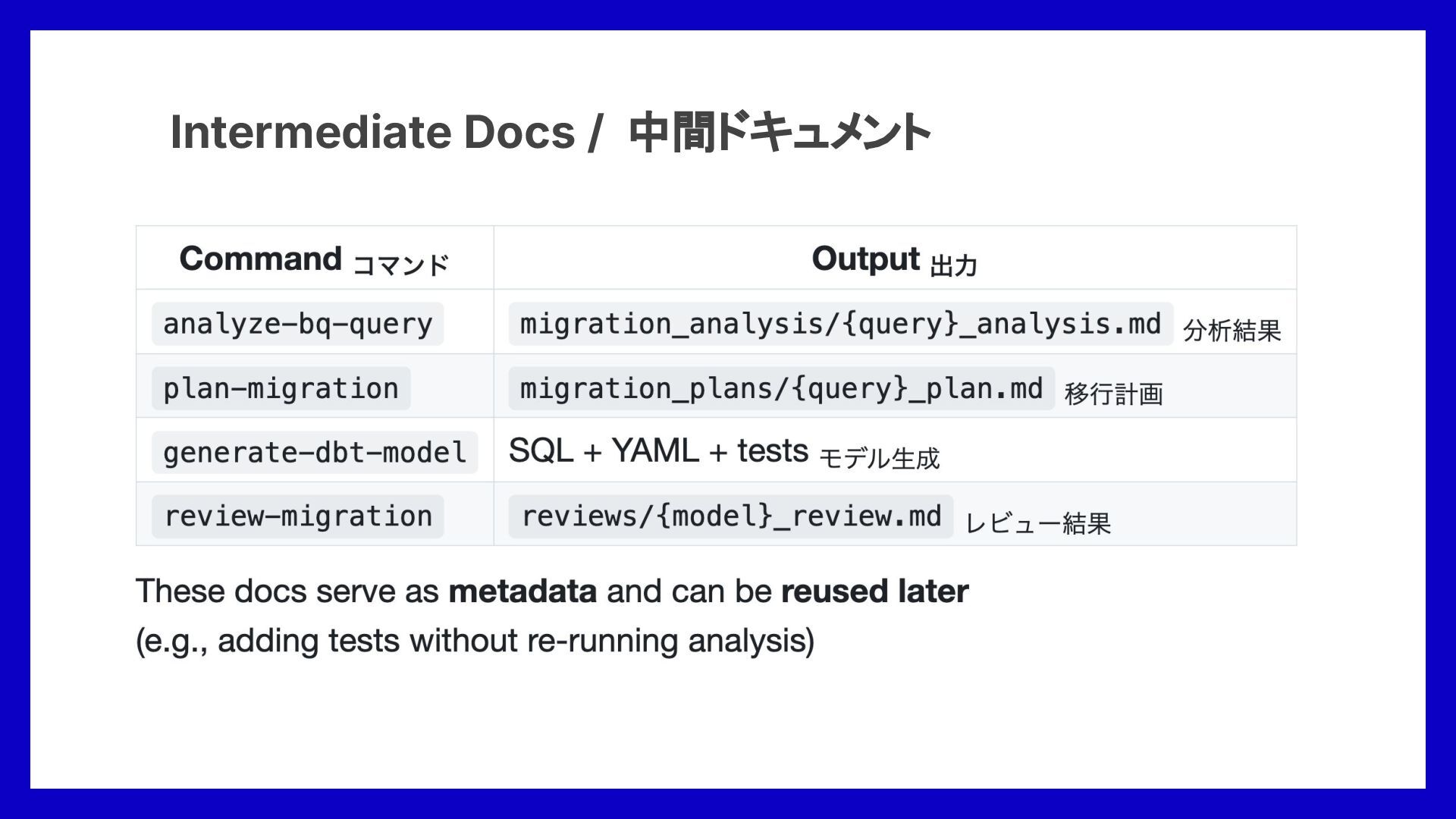
    3. Extract logic(ロジック抽出) 4. Map dependencies(依存関係マッピング) Mandatory Context: 05_schema_and_evolution/migration_patterns.md Output: migration_analysis/{query}_analysis.md
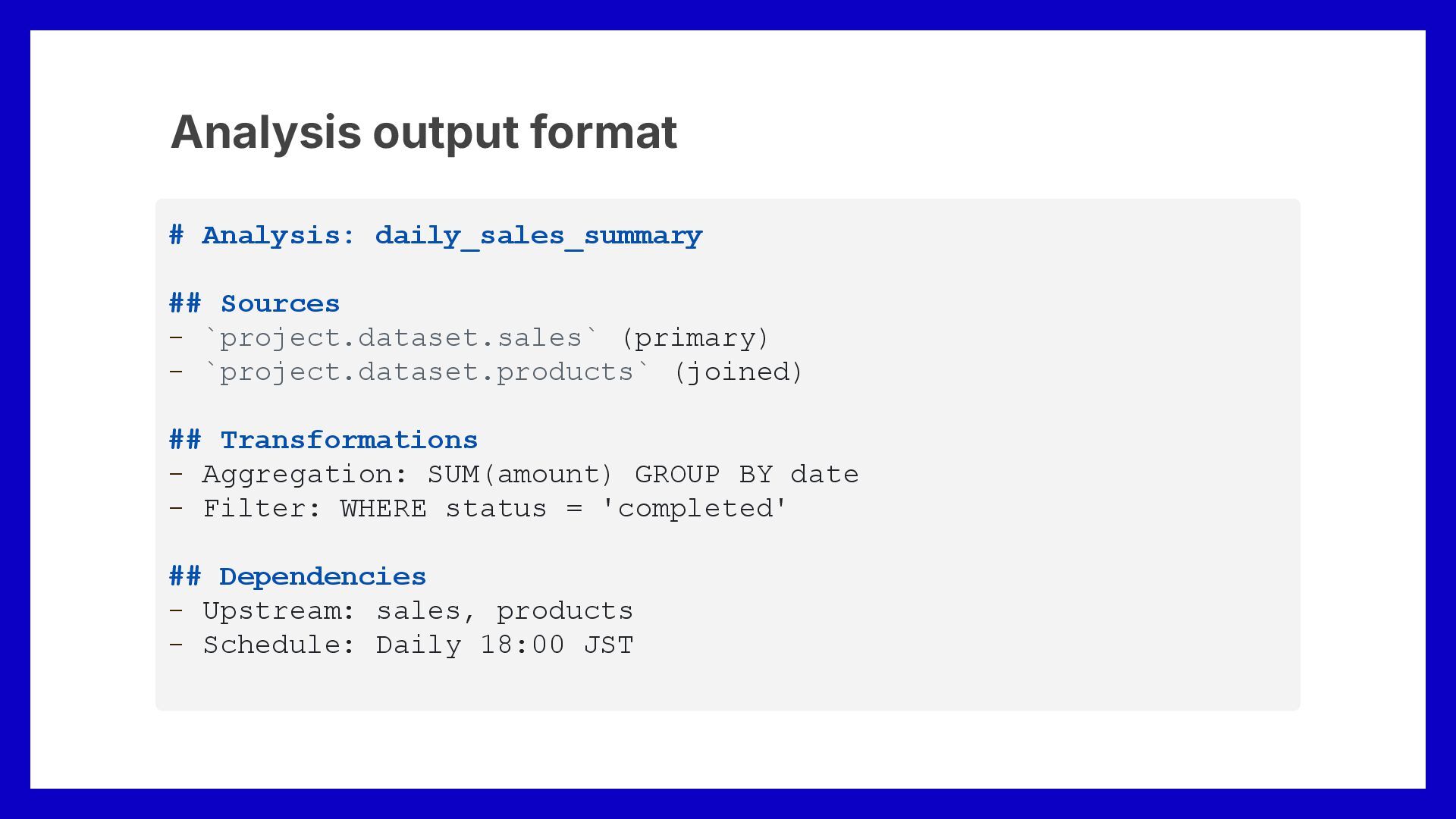
  15. # Analysis: daily_sales_summary ## Sources - `project.dataset.sales` (primary) - `project.dataset.products`

    (joined) ## Transformations - Aggregation: SUM(amount) GROUP BY date - Filter: WHERE status = 'completed' ## Dependencies - Upstream: sales, products - Schedule: Daily 18:00 JST Analysis output format
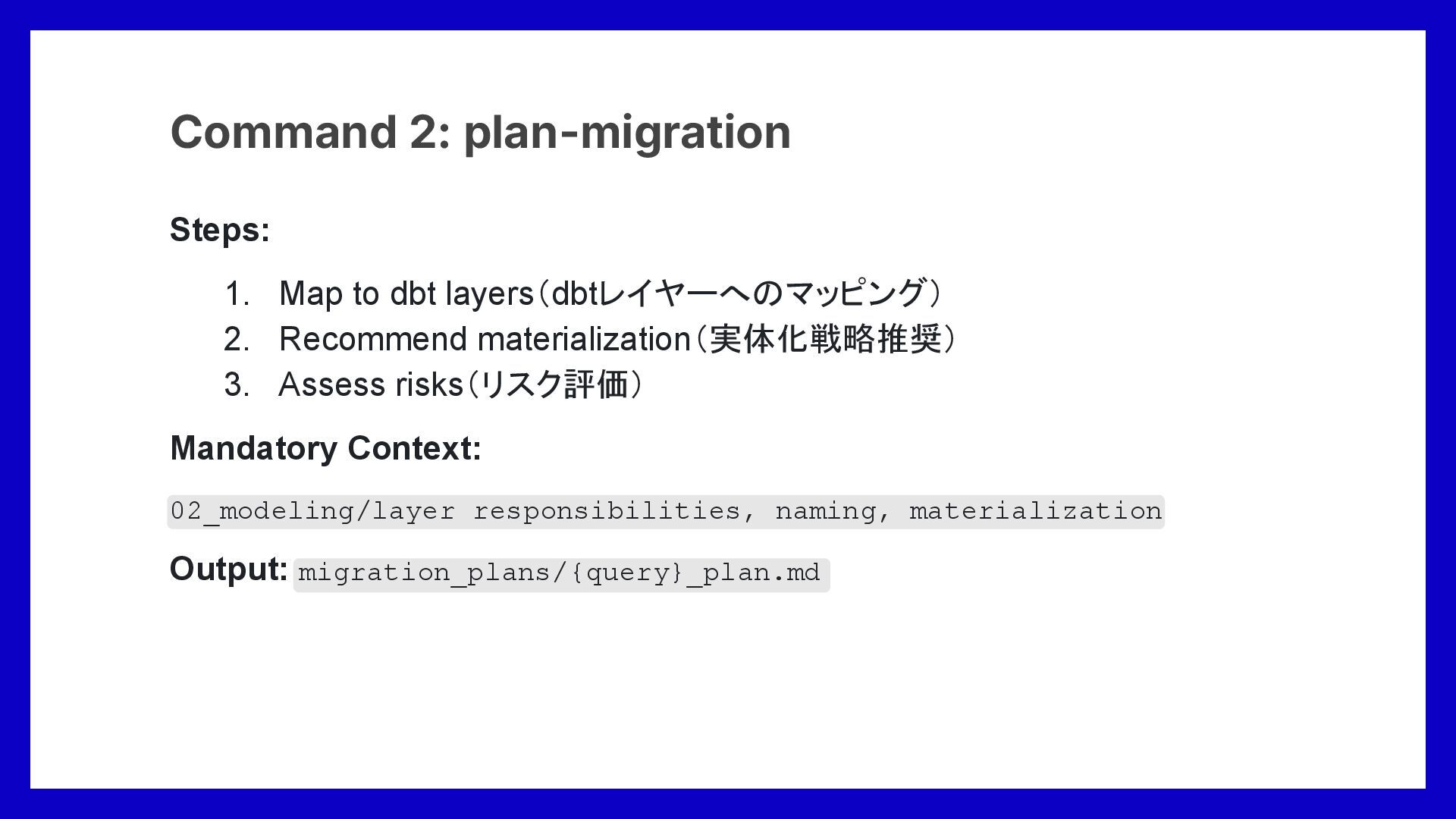
  16. Command 2: plan-migration Steps: 1. Map to dbt layers(dbtレイヤーへ マッピング)

    2. Recommend materialization(実体化戦略推奨) 3. Assess risks(リスク評価) Mandatory Context: 02_modeling/layer responsibilities, naming, materialization Output: migration_plans/{query}_plan.md
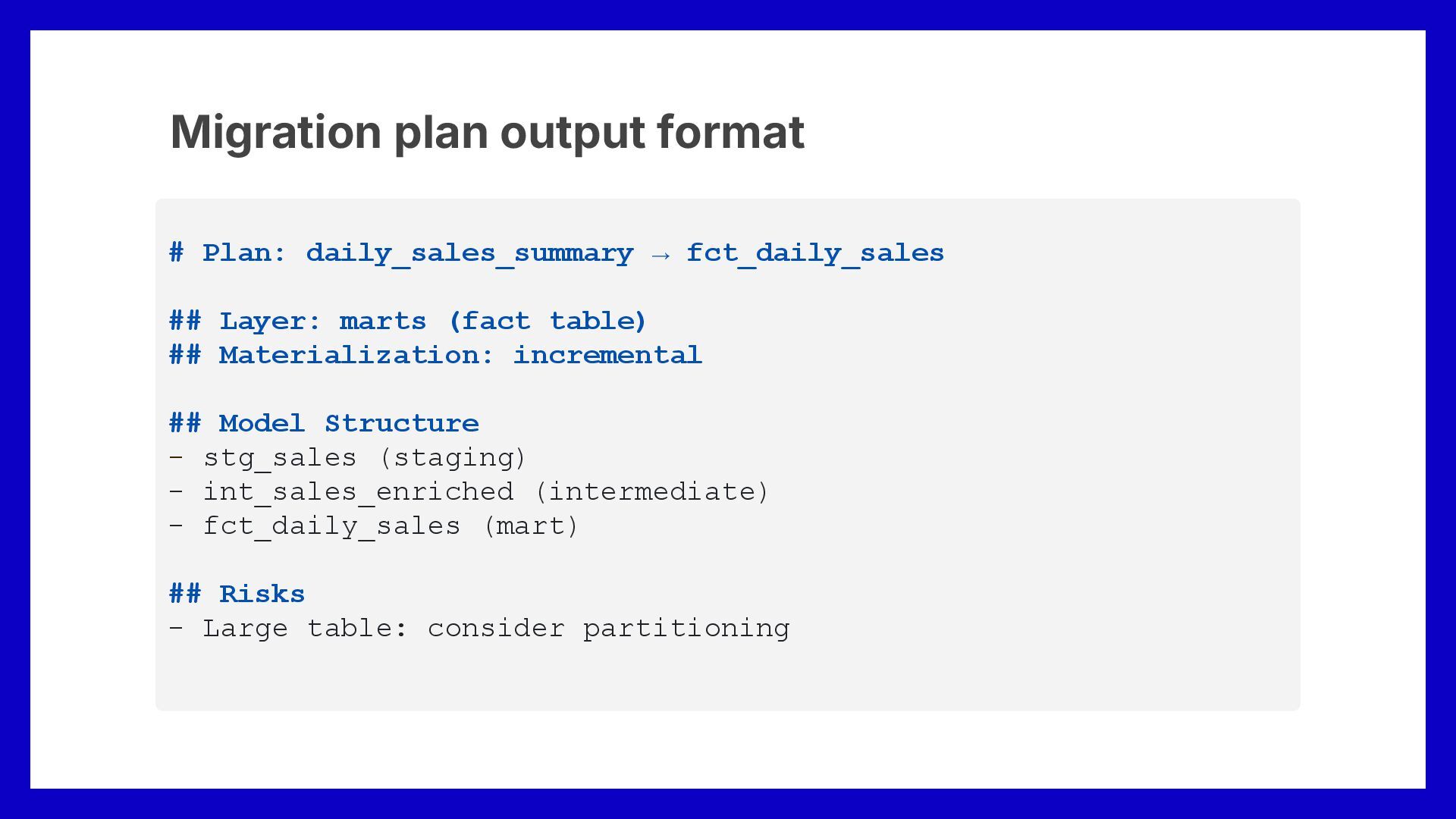
  17. # Plan: daily_sales_summary → fct_daily_sales ## Layer: marts (fact table)

    ## Materialization: incremental ## Model Structure - stg_sales (staging) - int_sales_enriched (intermediate) - fct_daily_sales (mart) ## Risks - Large table: consider partitioning Migration plan output format
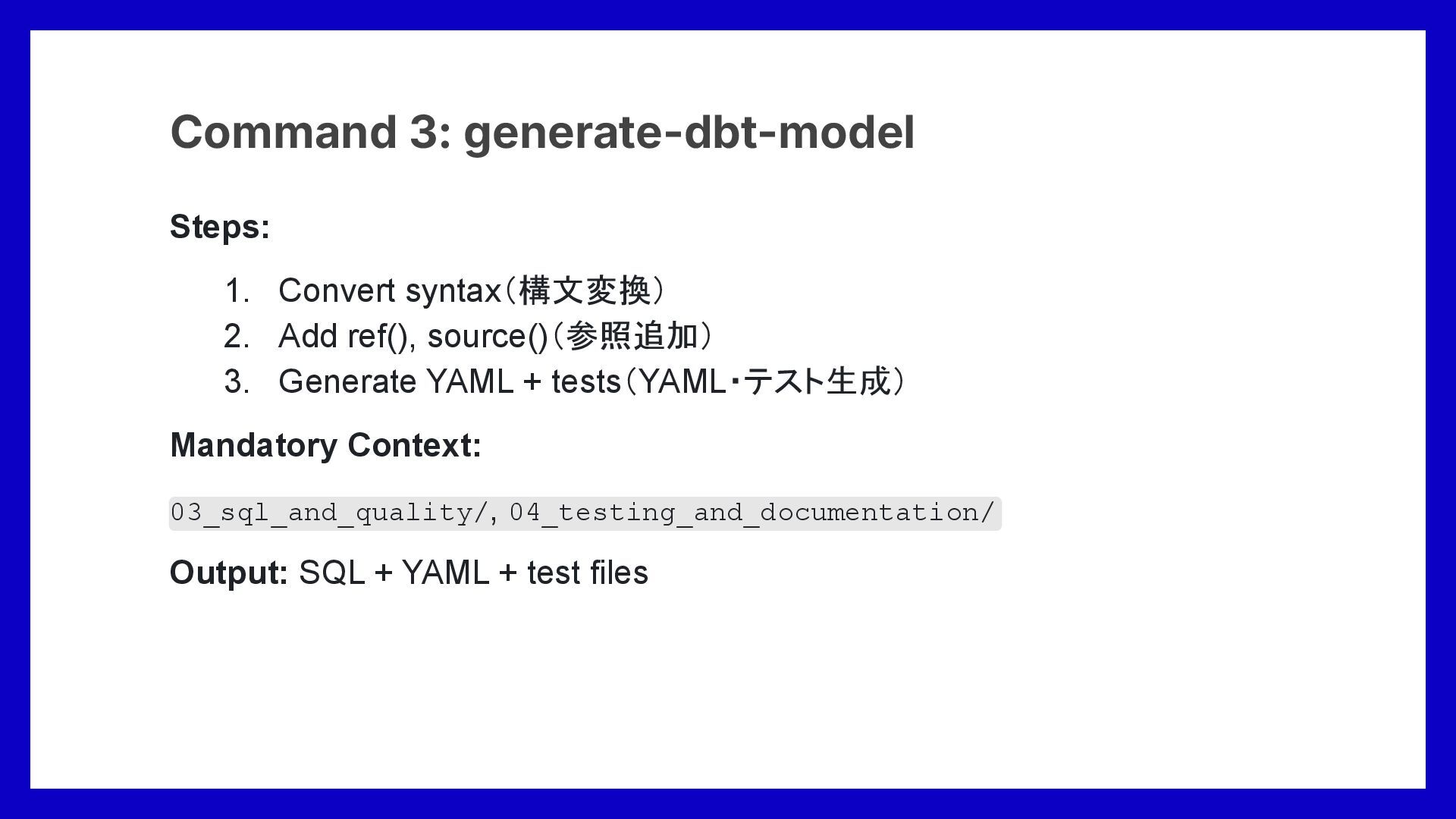
  18. Command 3: generate-dbt-model Steps: 1. Convert syntax(構文変換) 2. Add ref(),

    source()(参照追加) 3. Generate YAML + tests(YAML・テスト生成) Mandatory Context: 03_sql_and_quality/, 04_testing_and_documentation/ Output: SQL + YAML + test files
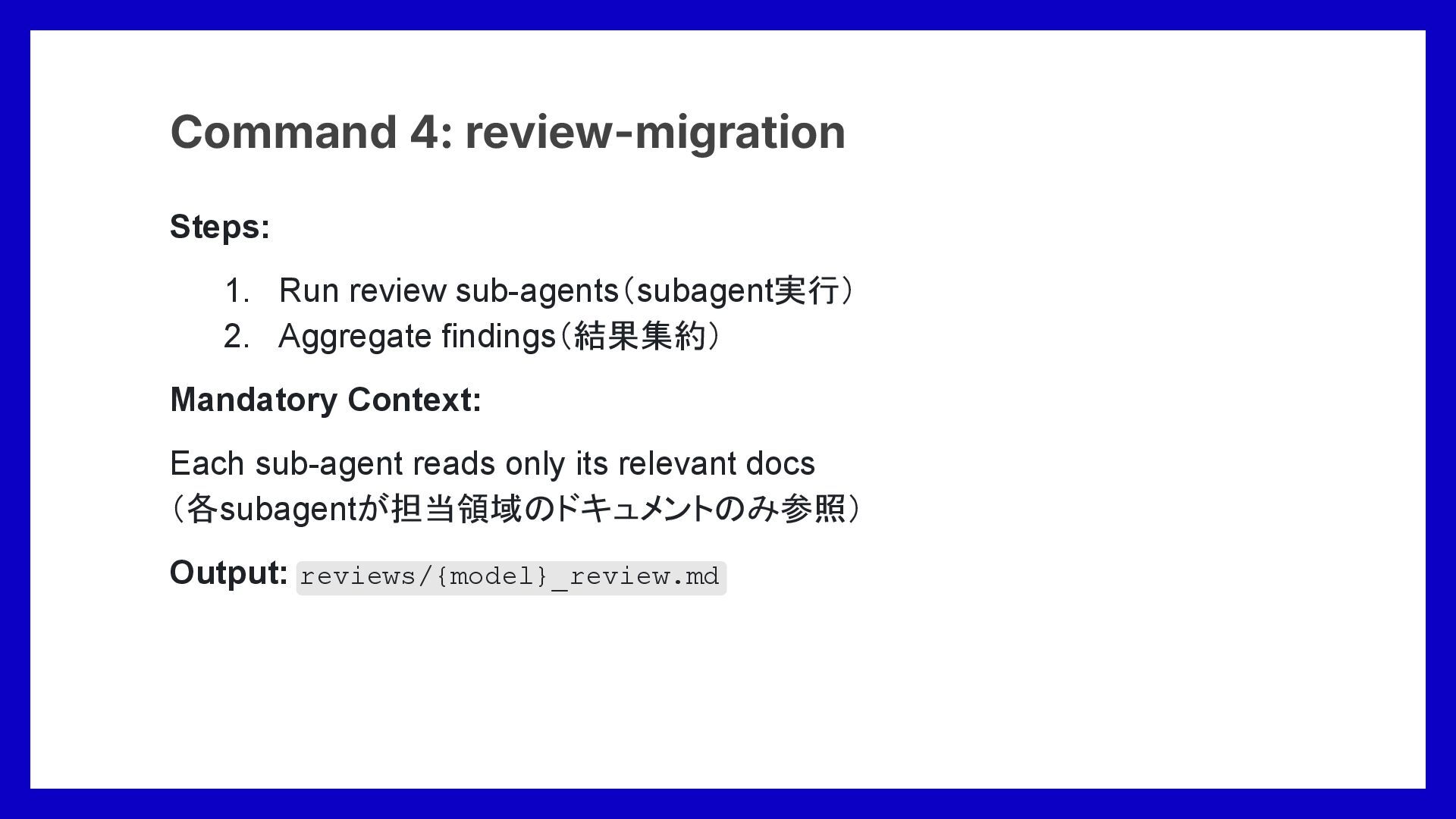
  19. Command 4: review-migration Steps: 1. Run review sub-agents(subagent実行) 2. Aggregate

    findings(結果集約) Mandatory Context: Each sub-agent reads only its relevant docs (各subagentが担当領域 ドキュメント み参照) Output: reviews/{model}_review.md
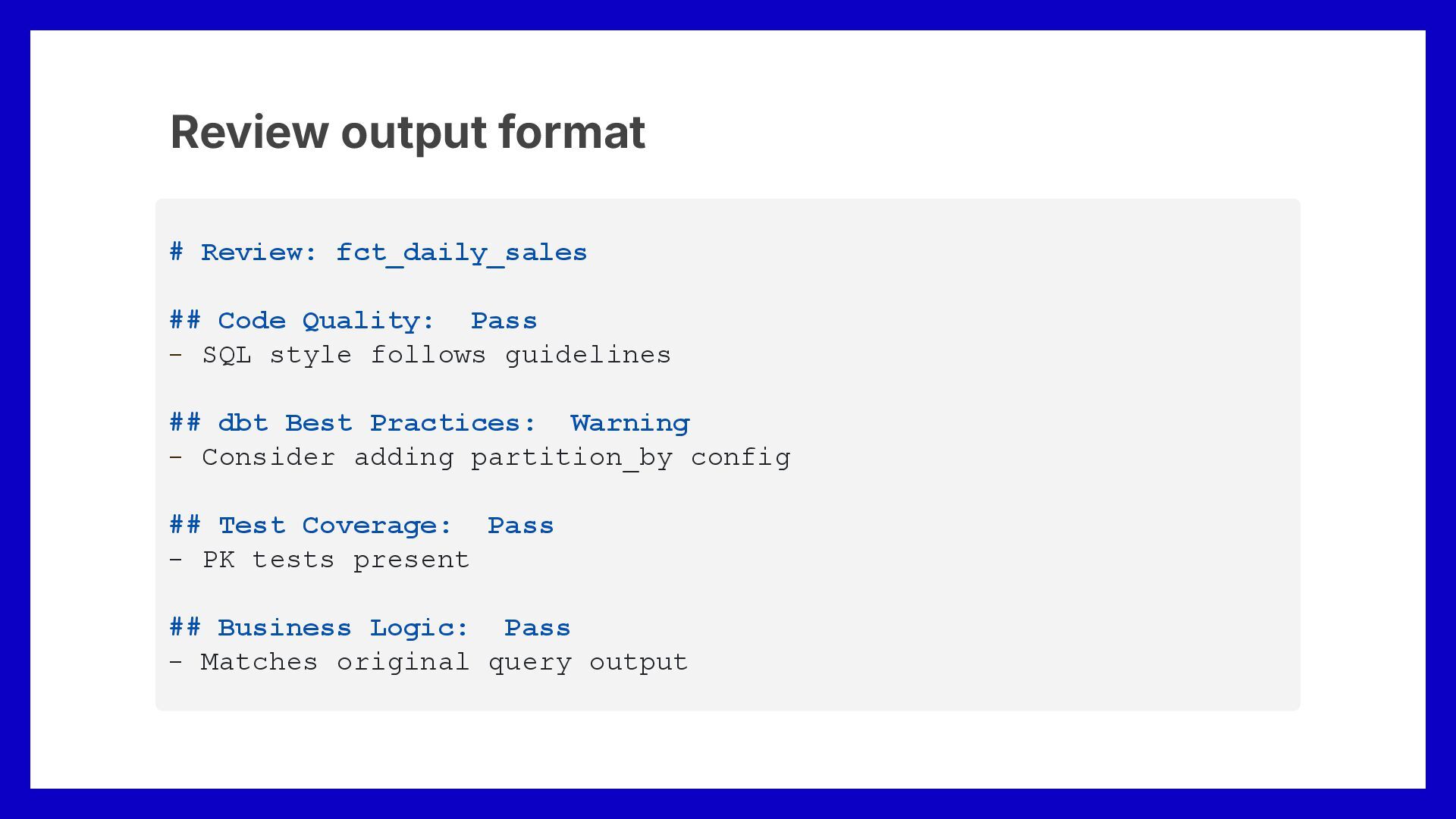
  20. # Review: fct_daily_sales ## Code Quality: Pass - SQL style

    follows guidelines ## dbt Best Practices: Warning - Consider adding partition_by config ## Test Coverage: Pass - PK tests present ## Business Logic: Pass - Matches original query output Review output format
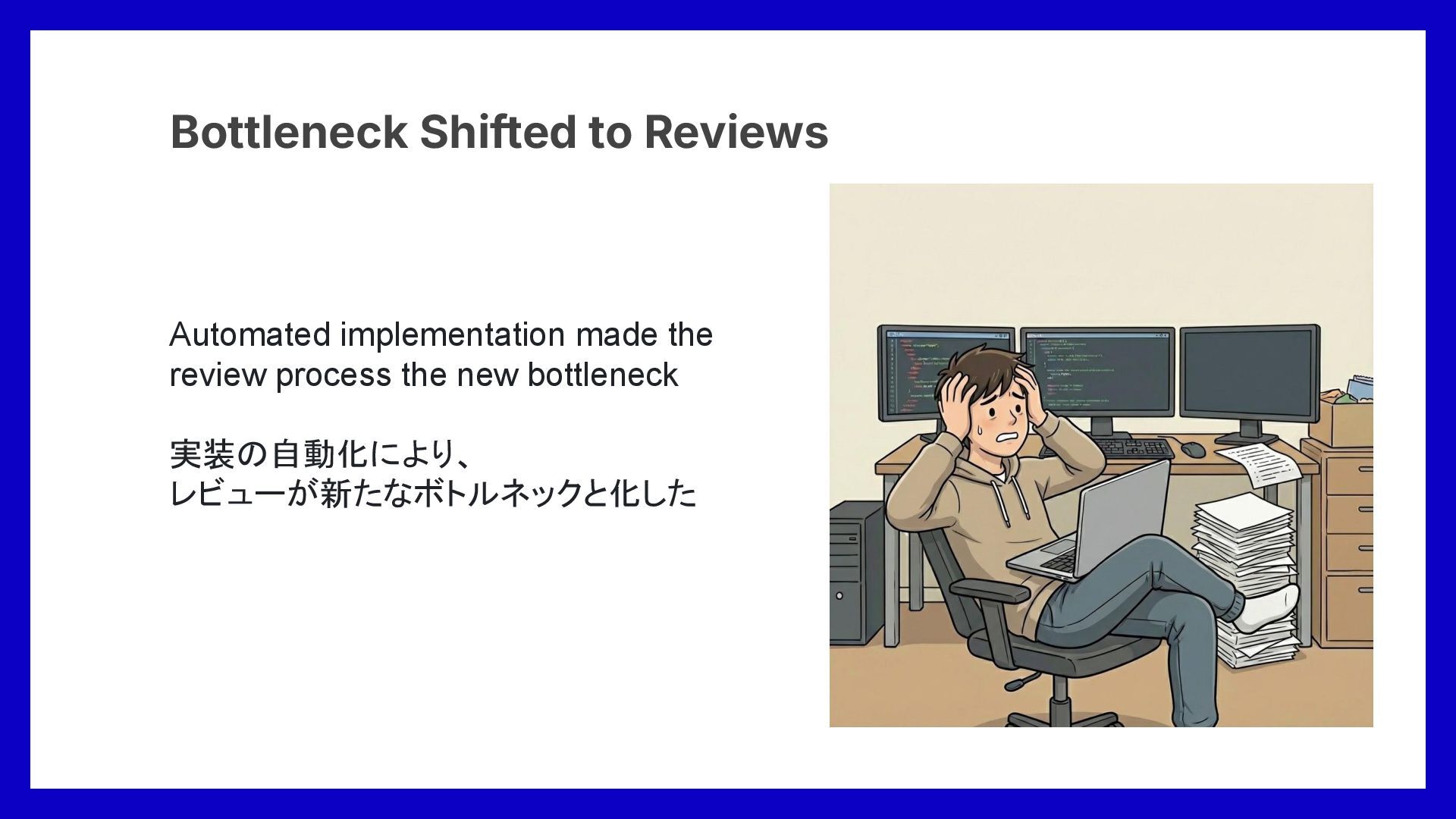
  21. Automated implementation made the review process the new bottleneck 実装

    自動化により、 レビューが新たなボトルネックと化した Bottleneck Shifted to Reviews
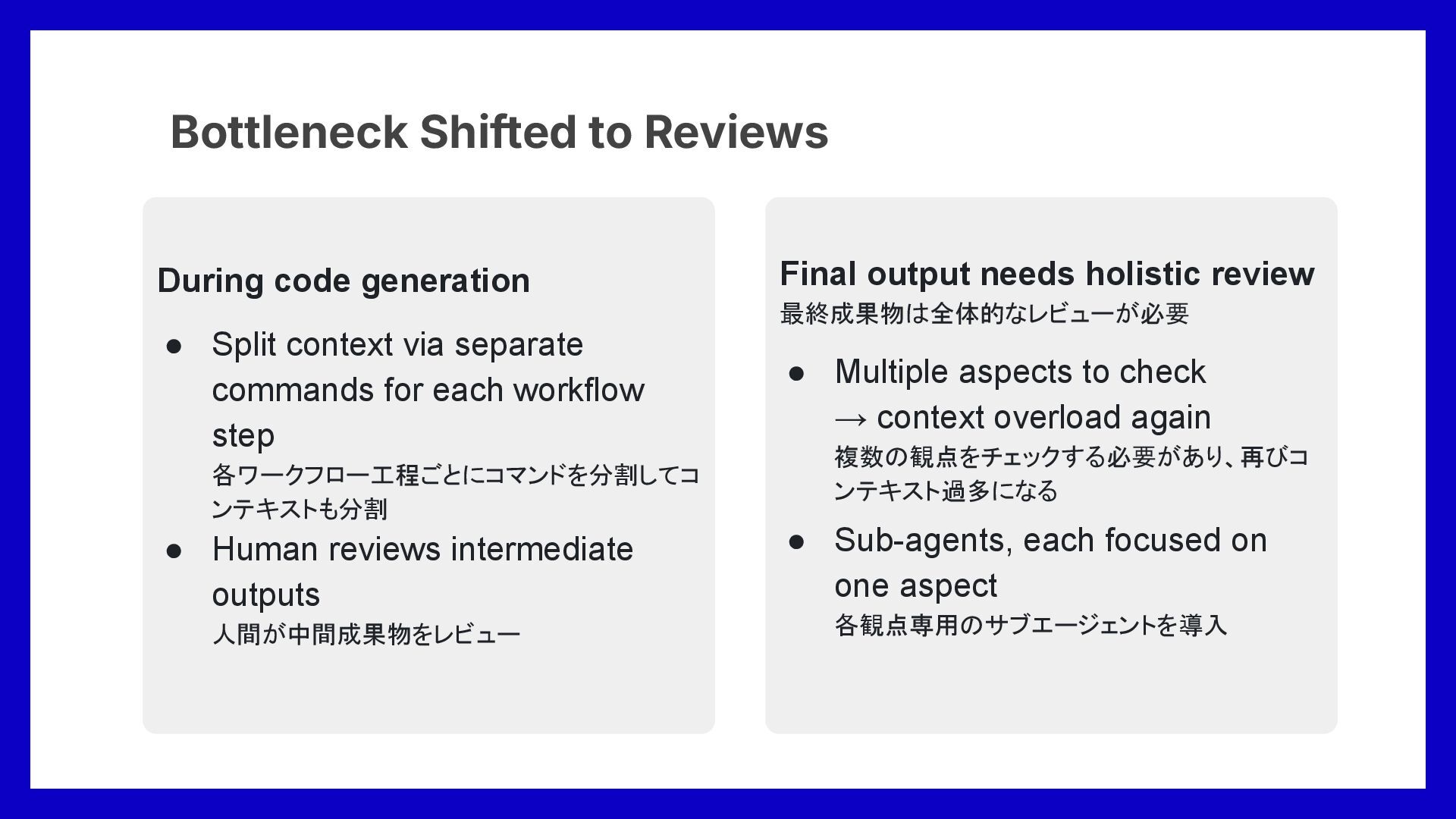
  22. Bottleneck Shifted to Reviews During code generation • Split context

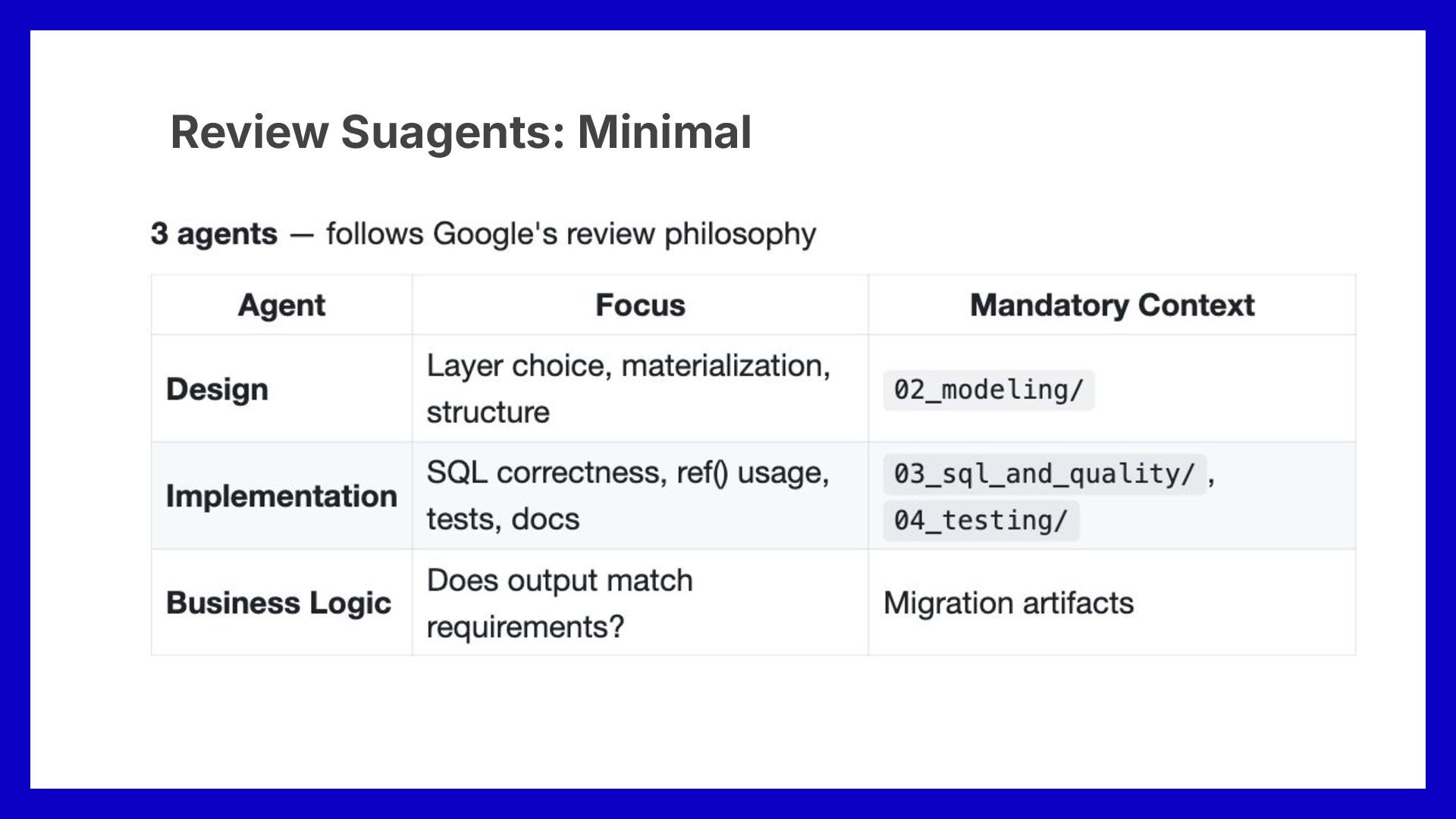
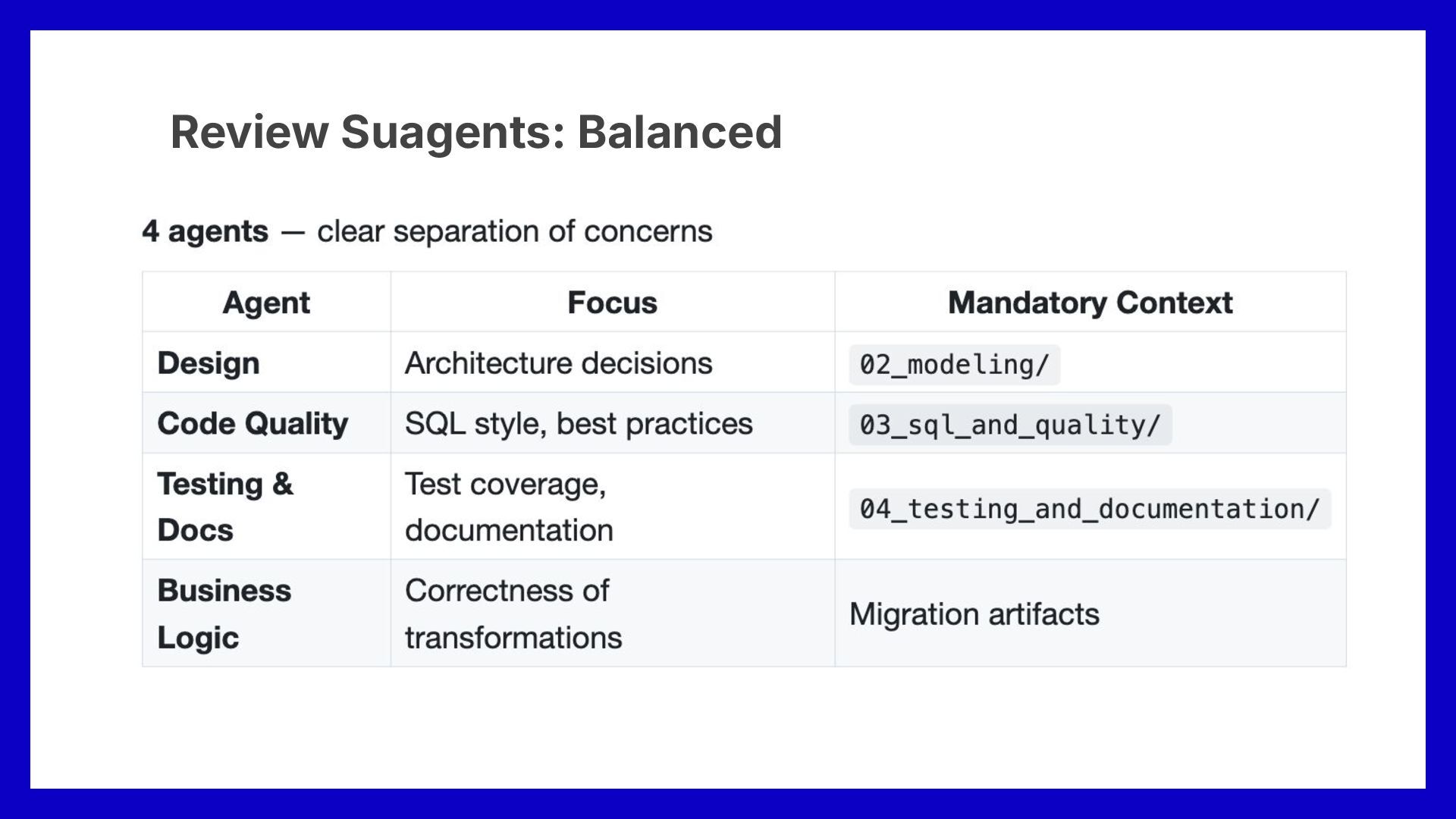
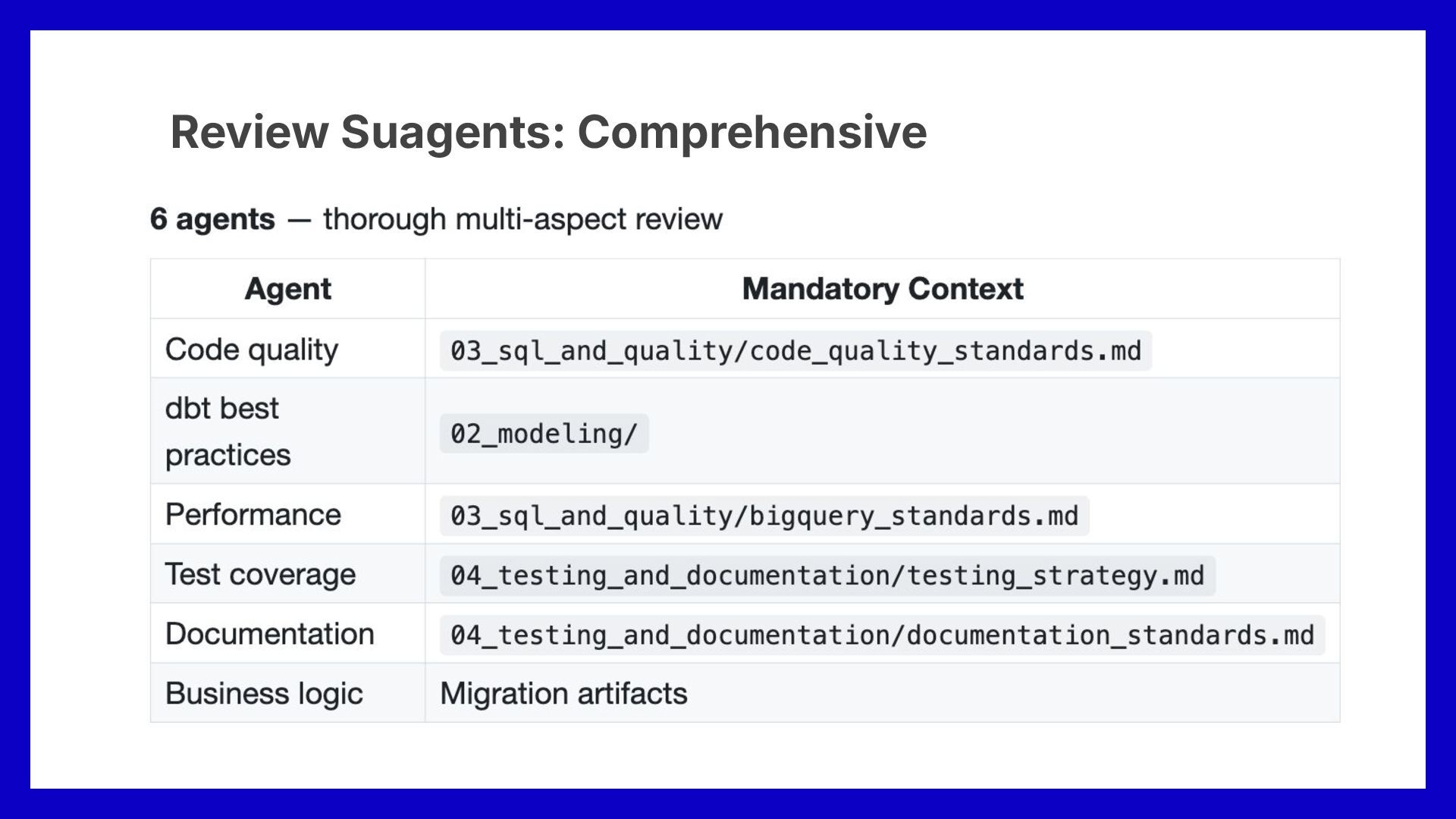
    via separate commands for each workflow step 各ワークフロー工程ごとにコマンドを分割してコ ンテキストも分割 • Human reviews intermediate outputs 人間が中間成果物をレビュー Final output needs holistic review 最終成果物 全体的なレビューが必要 • Multiple aspects to check → context overload again 複数 観点をチェックする必要があり、再びコ ンテキスト過多になる • Sub-agents, each focused on one aspect 各観点専用 サブエージェントを導入
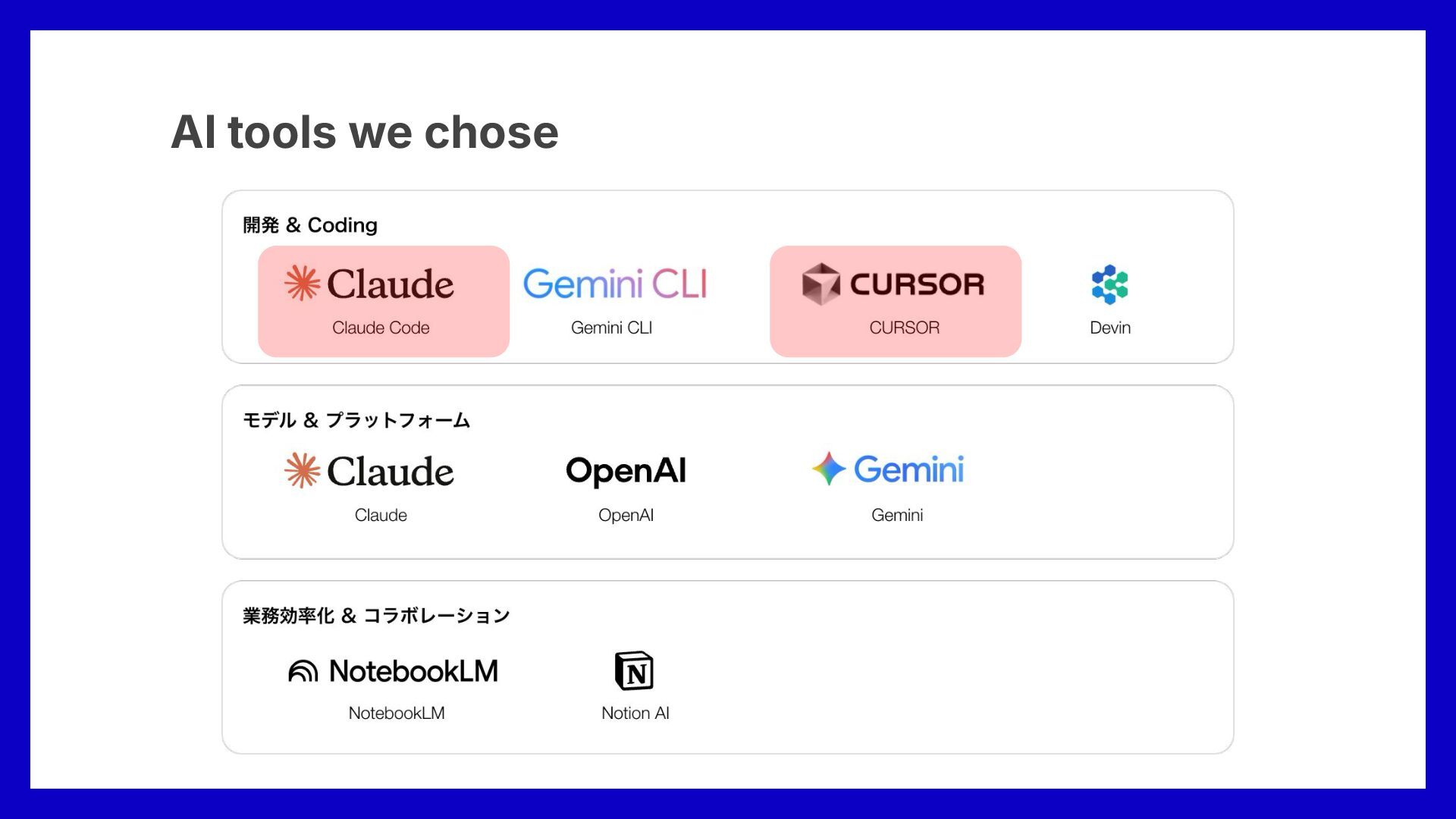
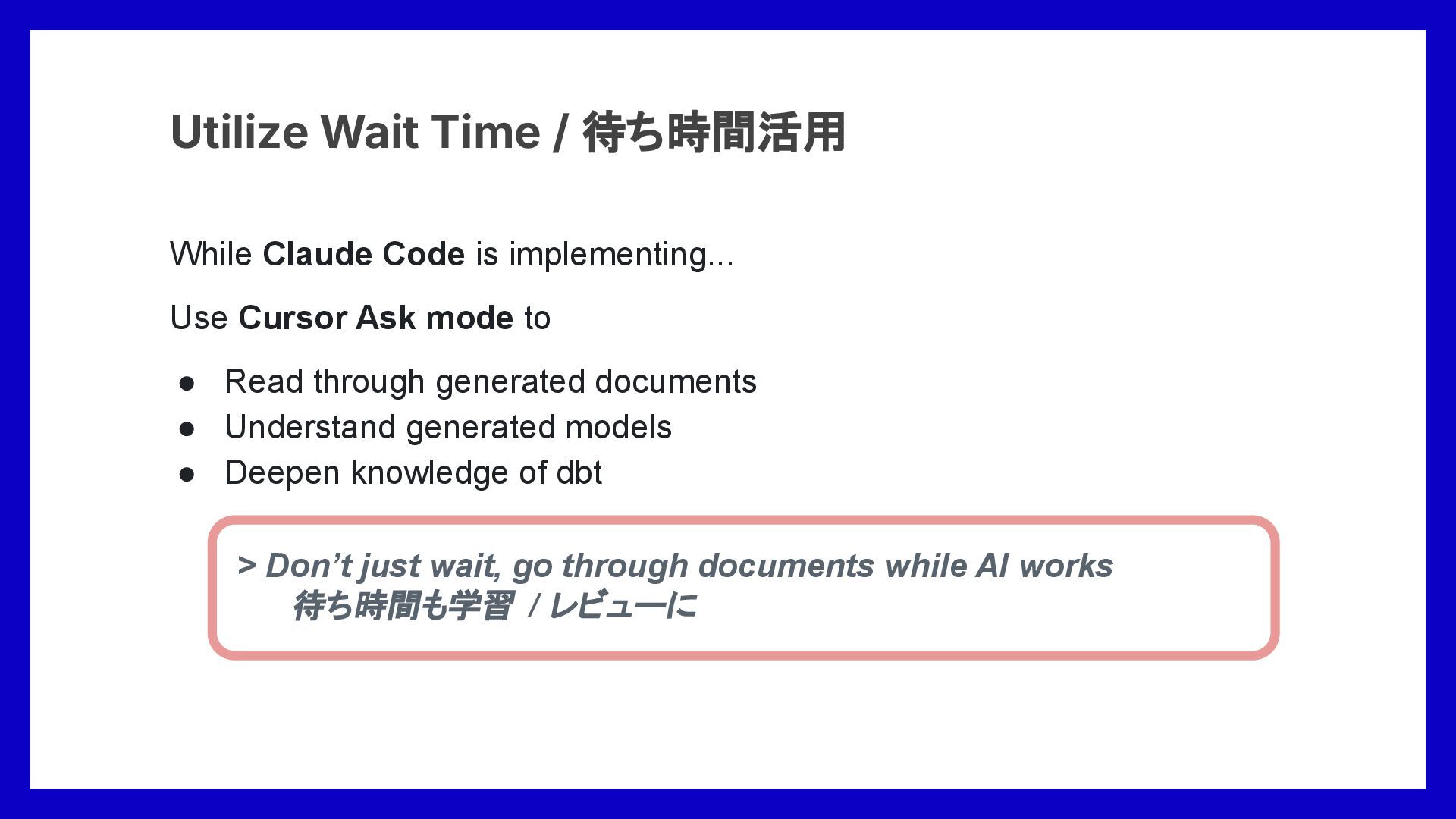
  23. While Claude Code is implementing... Use Cursor Ask mode to

    • Read through generated documents • Understand generated models • Deepen knowledge of dbt > Don’t just wait, go through documents while AI works 待ち時間も学習 / レビューに Utilize Wait Time / 待ち時間活用
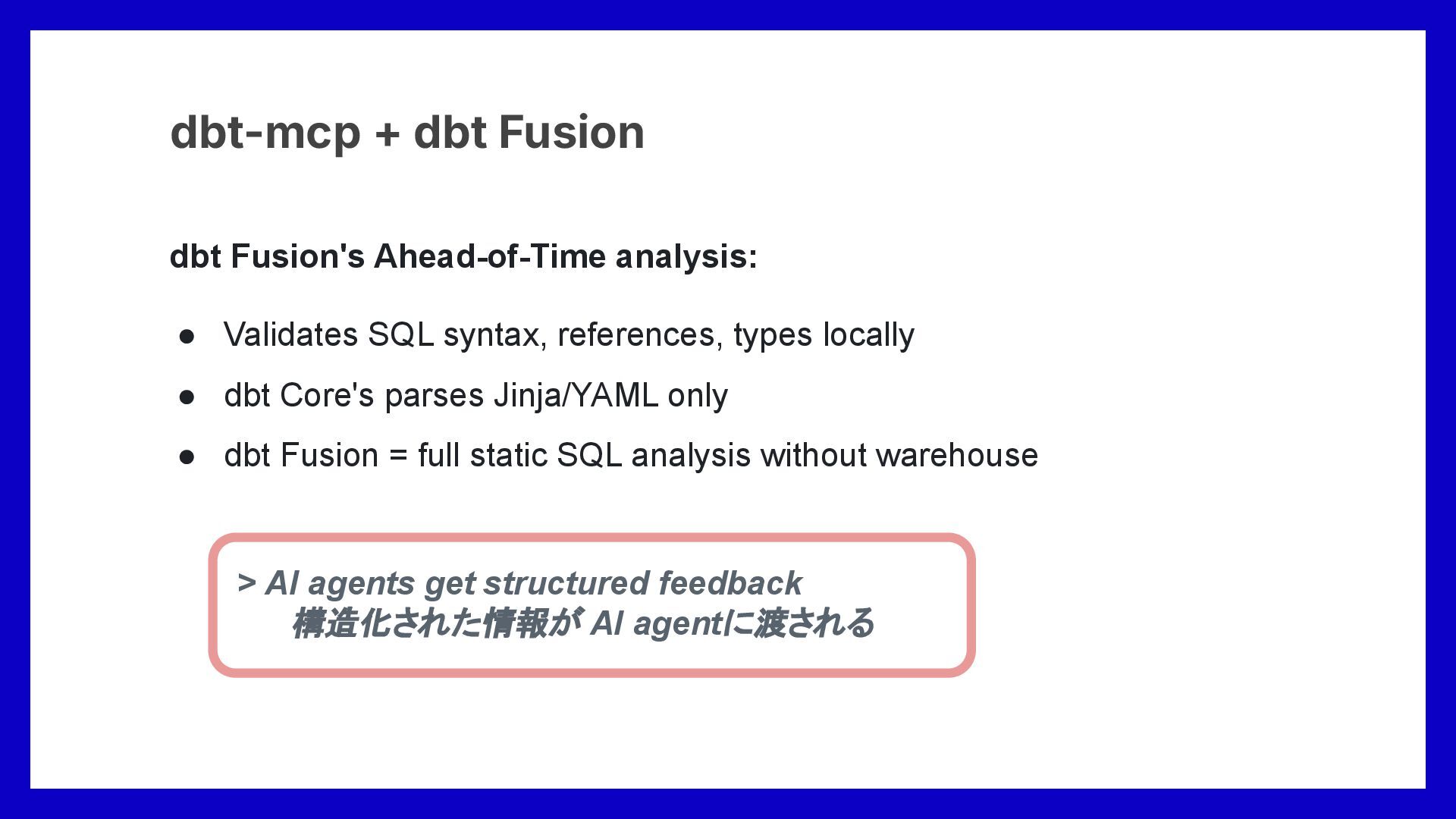
  24. dbt Fusion's Ahead-of-Time analysis: • Validates SQL syntax, references, types

    locally • dbt Core's parses Jinja/YAML only • dbt Fusion = full static SQL analysis without warehouse dbt-mcp + dbt Fusion > AI agents get structured feedback 構造化された情報が AI agentに渡される
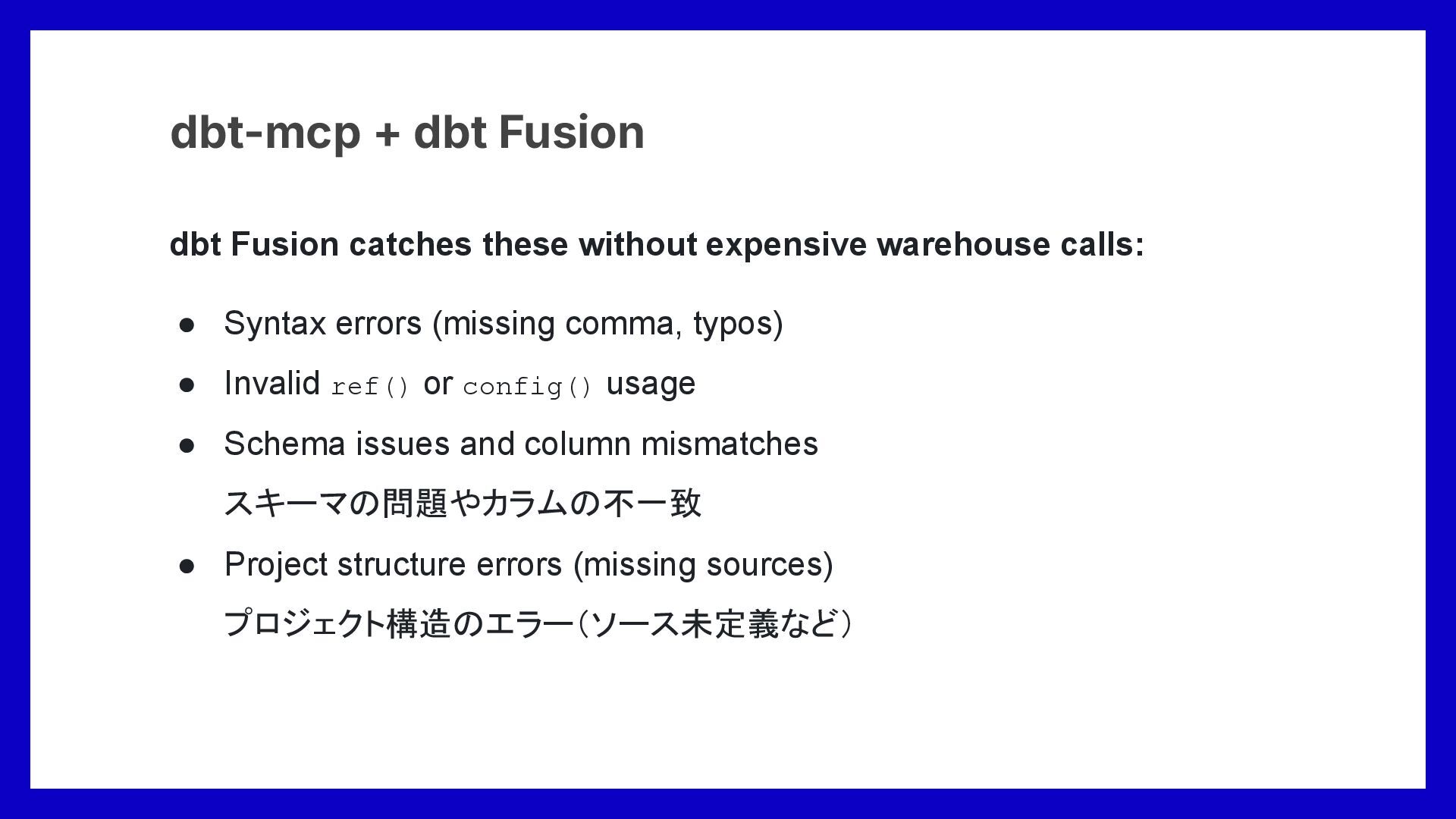
  25. dbt Fusion catches these without expensive warehouse calls: • Syntax

    errors (missing comma, typos) • Invalid ref() or config() usage • Schema issues and column mismatches スキーマ 問題やカラム 不一致 • Project structure errors (missing sources) プロジェクト構造 エラー(ソース未定義など) dbt-mcp + dbt Fusion
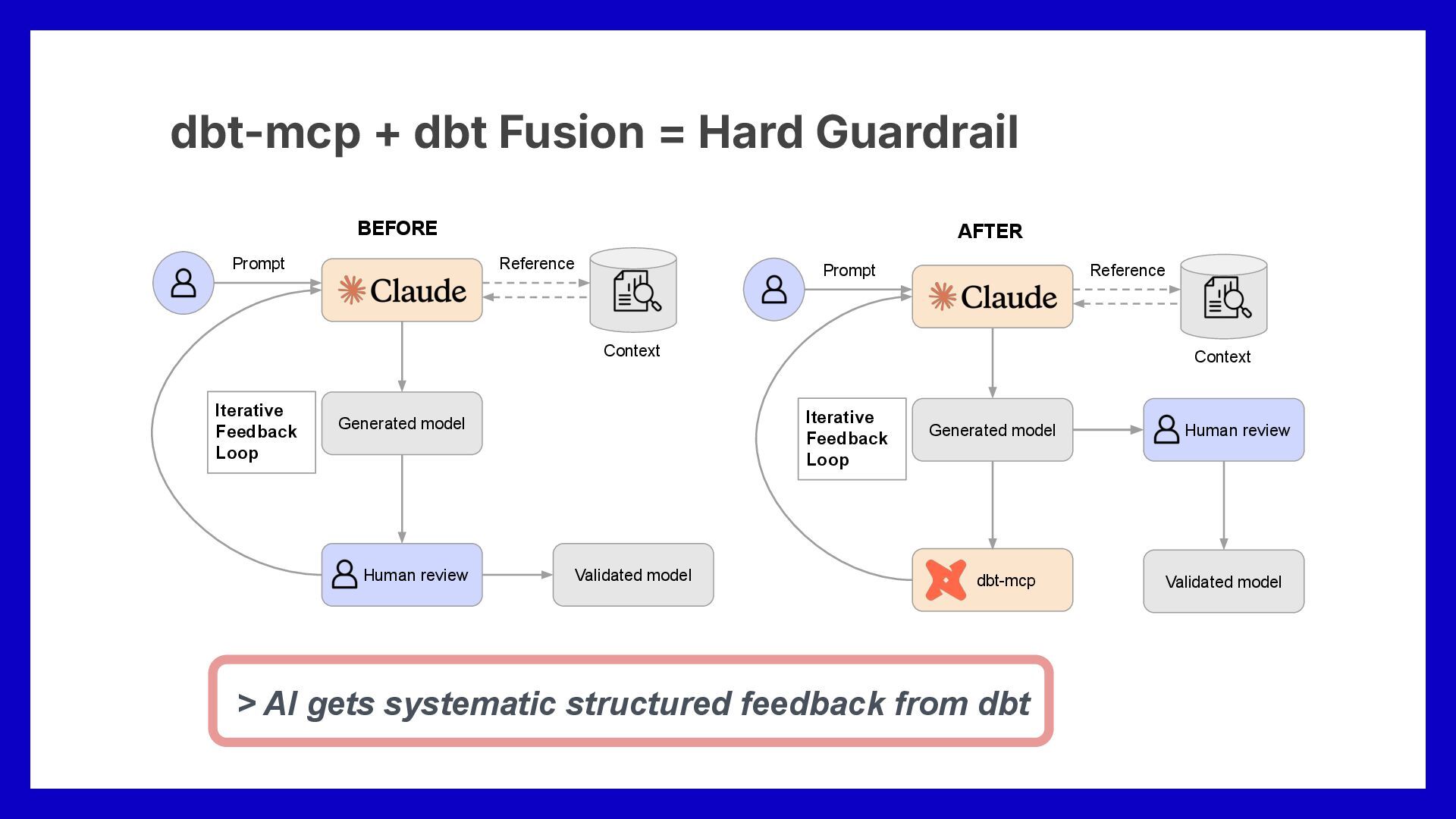
  26. AI gets systematic feedback from dbt engine: • Errors caught

    before human even sees the output 人間が見る前にエラーをキャッチ • No need to run models to find out they don't work モデルを実行して動かないと気づく必要がない dbt-mcp + dbt Fusion = Hard Guardrail Generated model Human review Context Iterative Feedback Loop Prompt Reference Validated model dbt-mcp Generated model Context Iterative Feedback Loop Prompt Reference Validated model Human review > AI gets systematic structured feedback from dbt BEFORE AFTER
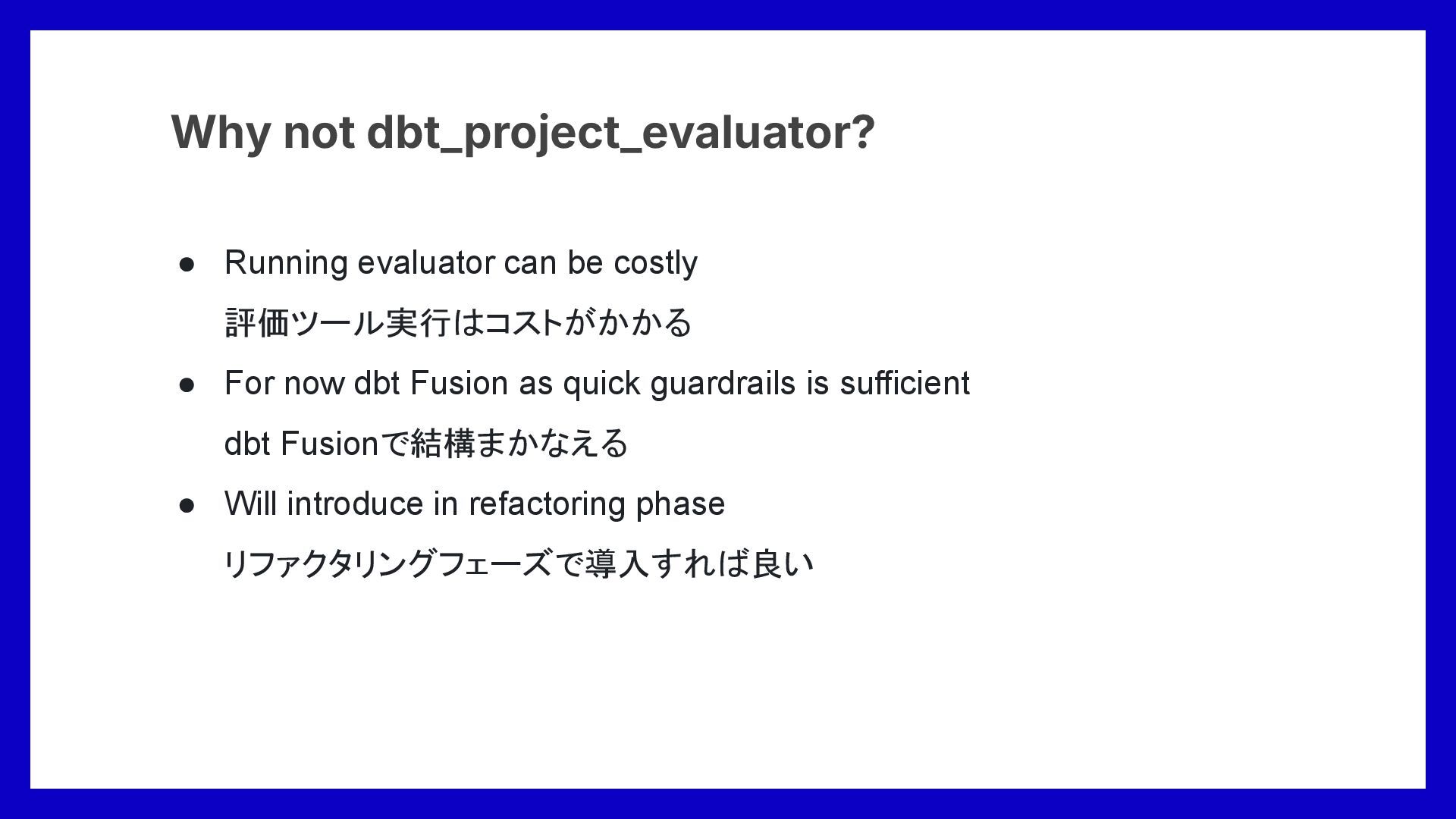
  27. • Running evaluator can be costly 評価ツール実行 コストがかかる • For

    now dbt Fusion as quick guardrails is sufficient dbt Fusionで結構まかなえる • Will introduce in refactoring phase リファクタリングフェーズで導入すれ 良い Why not dbt_project_evaluator?
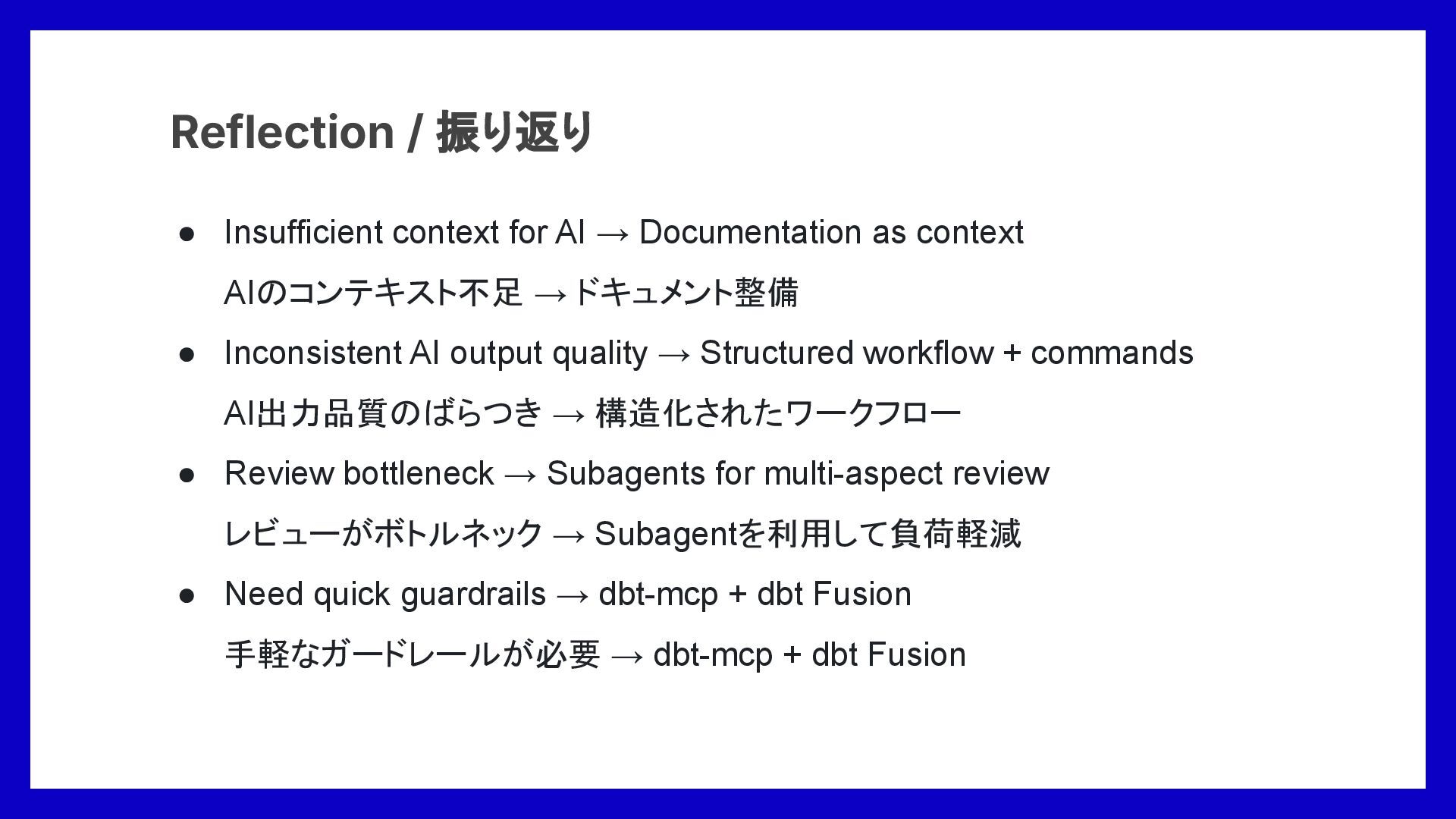
  28. • Insufficient context for AI → Documentation as context AI
    コンテキスト不足 → ドキュメント整備 • Inconsistent AI output quality → Structured workflow + commands AI出力品質 らつき → 構造化されたワークフロー • Review bottleneck → Subagents for multi-aspect review レビューがボトルネック → Subagentを利用して負荷軽減 • Need quick guardrails → dbt-mcp + dbt Fusion 手軽なガードレールが必要 → dbt-mcp + dbt Fusion Reflection / 振り返り
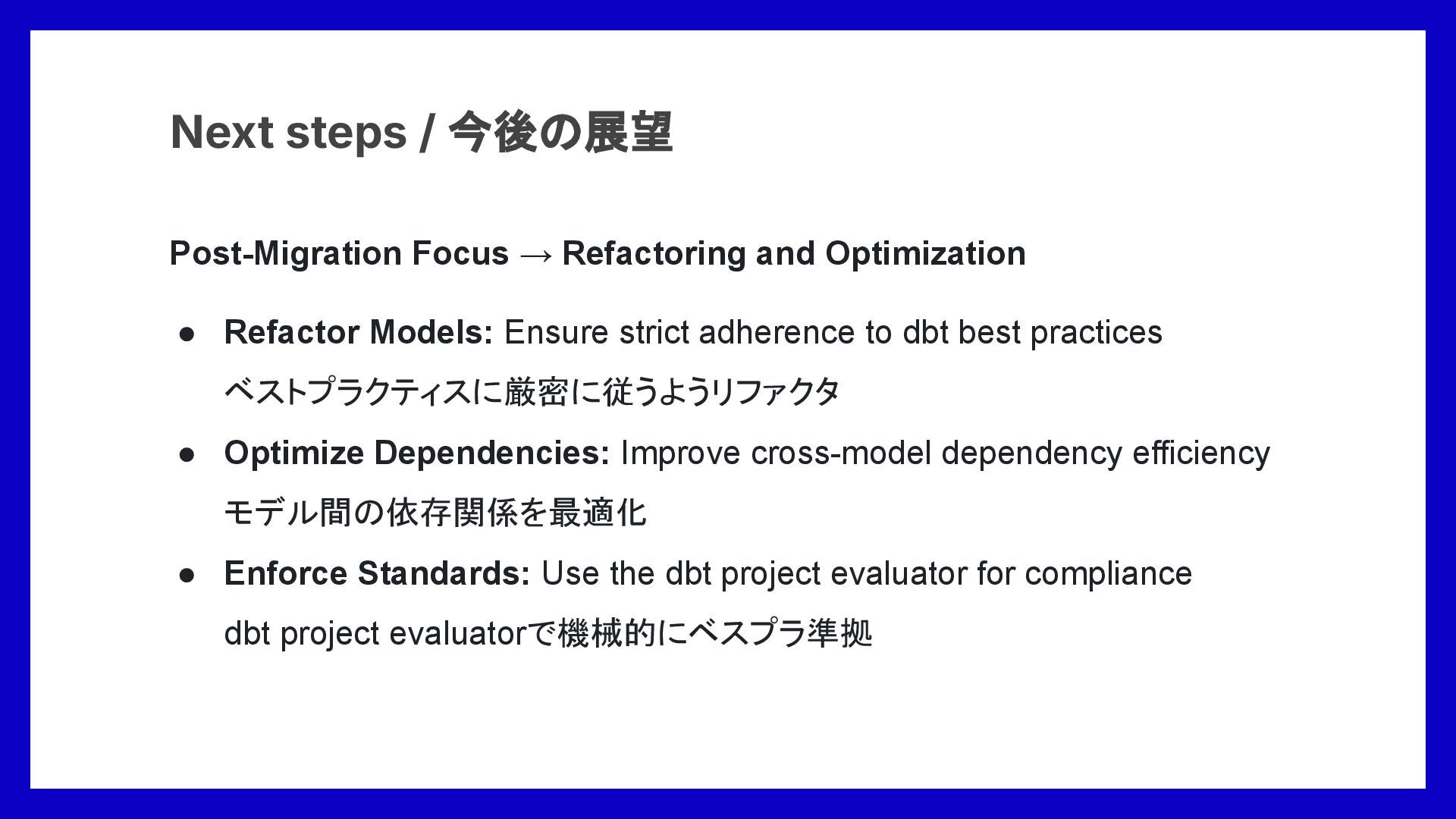
  29. Post-Migration Focus → Refactoring and Optimization • Refactor Models: Ensure

    strict adherence to dbt best practices ベストプラクティスに厳密に従うようリファクタ • Optimize Dependencies: Improve cross-model dependency efficiency モデル間 依存関係を最適化 • Enforce Standards: Use the dbt project evaluator for compliance dbt project evaluatorで機械的にベスプラ準拠 Next steps / 今後 展望
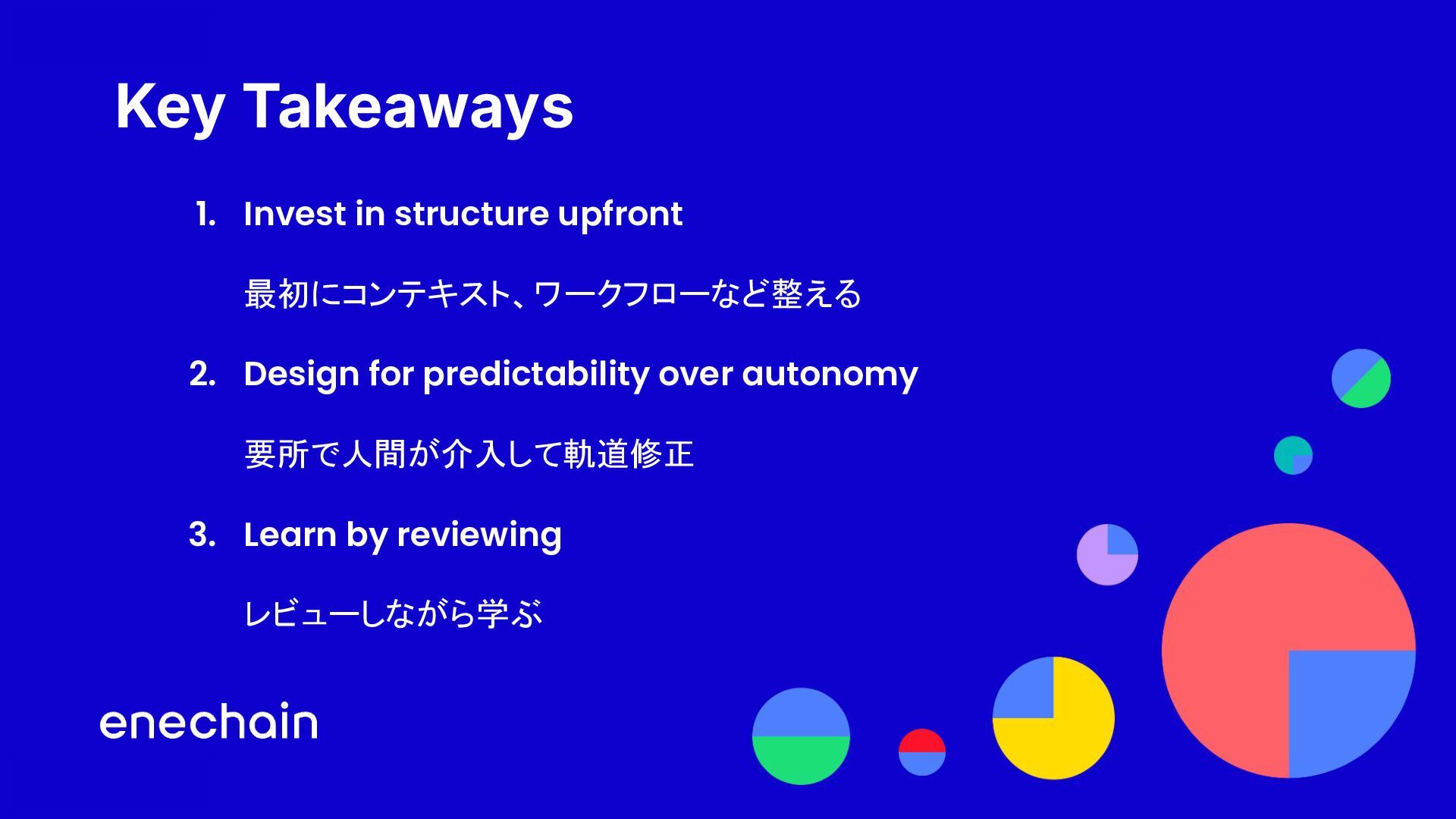
  30. Table of contents 1. Invest in structure upfront 最初にコンテキスト、ワークフローなど整える 2.

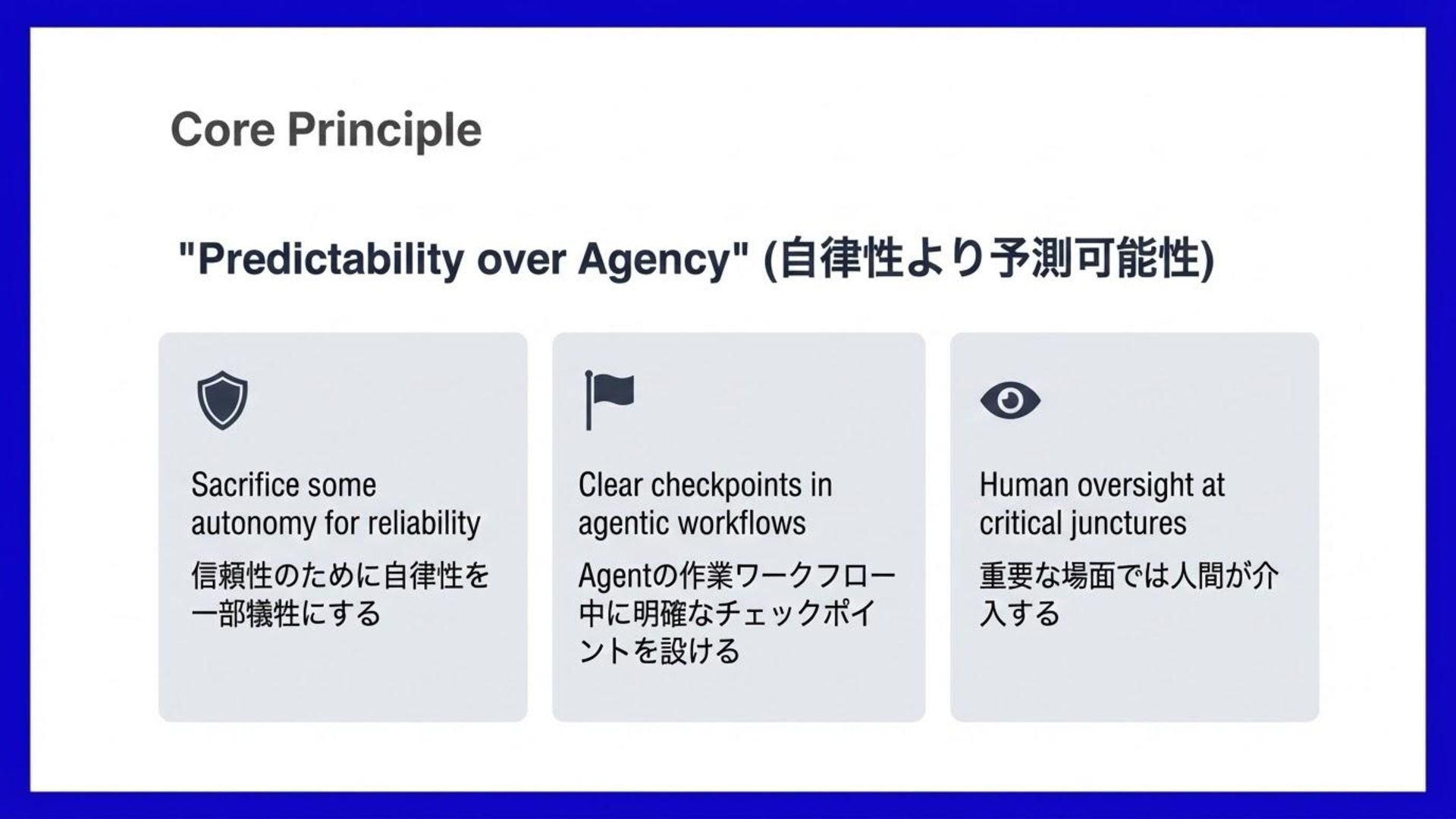
    Design for predictability over autonomy 要所で人間が介入して軌道修正 3. Learn by reviewing レビューしながら学ぶ Key Takeaways
  31. 5 2