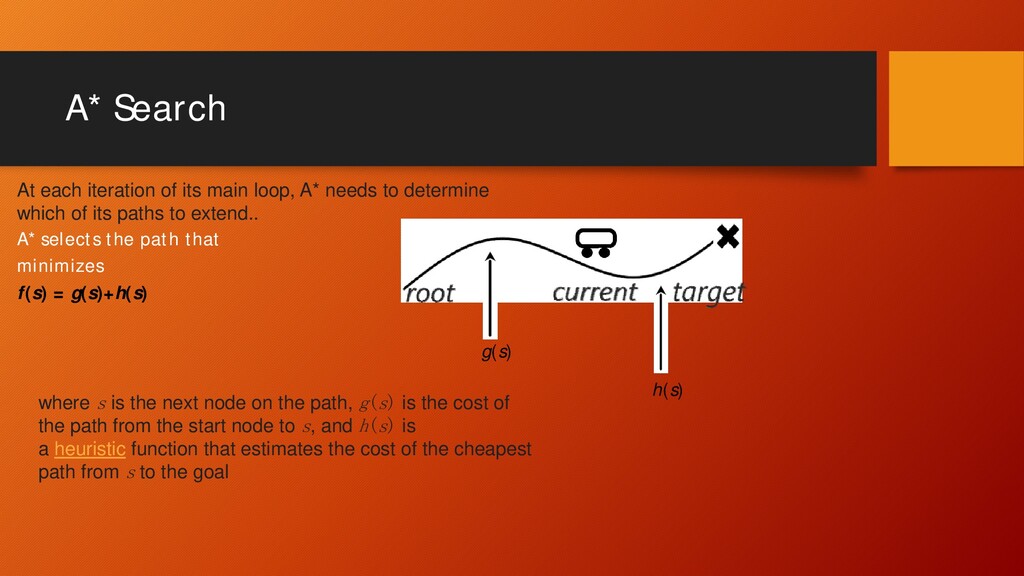
g(s)+h(s) g(s) h(s) where s is the next node on the path, g(s) is the cost of the path from the start node to s, and h(s) is a heuristic function that estimates the cost of the cheapest path from s to the goal At each iteration of its main loop, A* needs to determine which of its paths to extend..
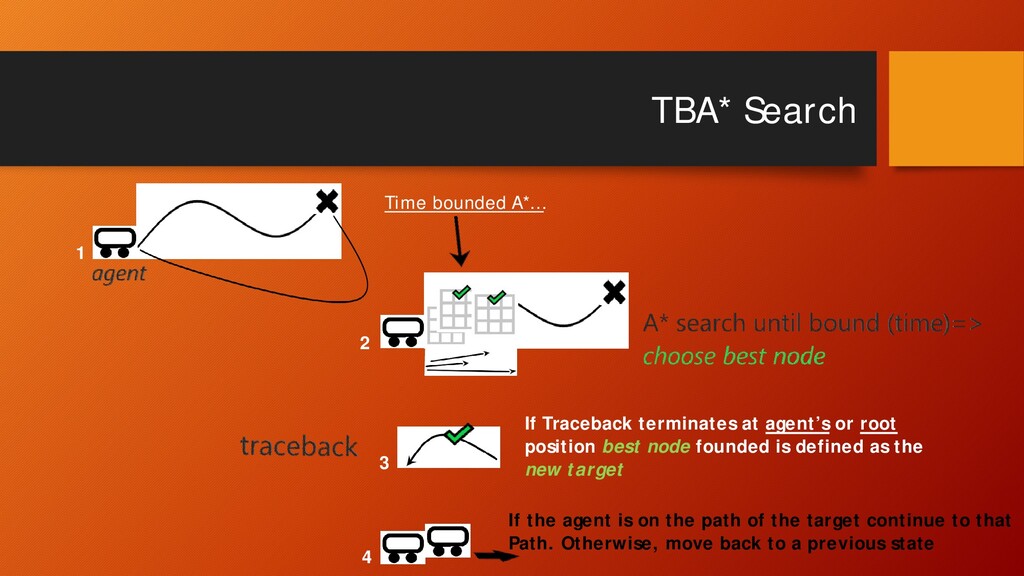
best node founded is defined as the new target If the agent is on the path of the target continue to that Path. Otherwise, move back to a previous state Time bounded A*… 2 1 3 4
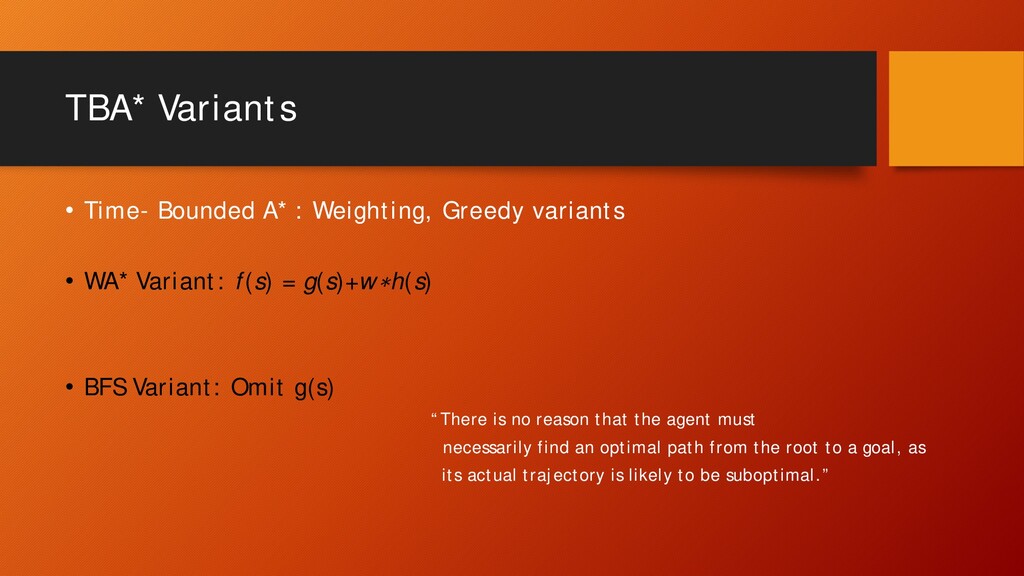
• WA* Variant: f(s) = g(s)+w∗h(s) • BFS Variant: Omit g(s) “There is no reason that the agent must necessarily find an optimal path from the root to a goal, as its actual trajectory is likely to be suboptimal.”
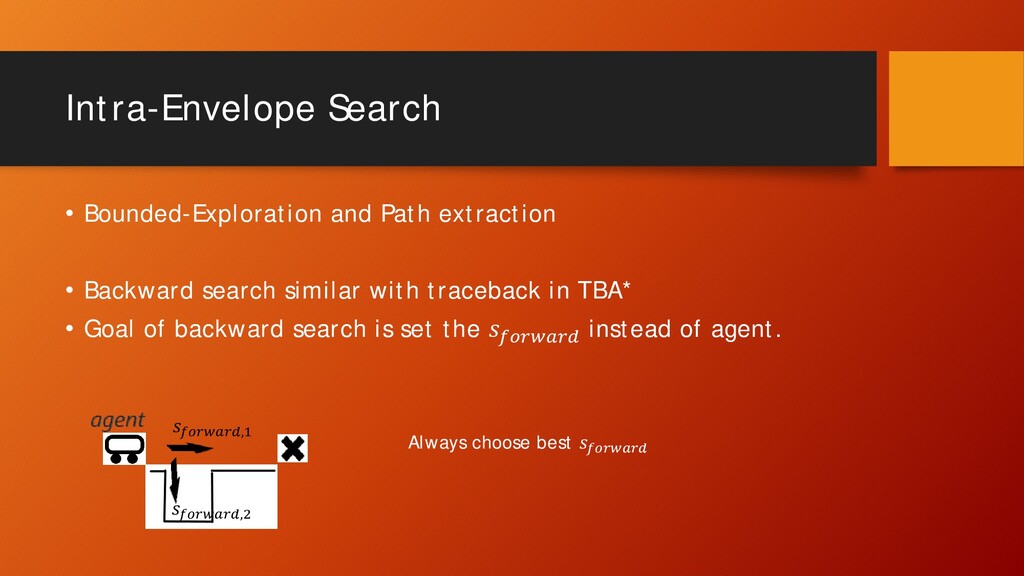
path extraction in the increasingly less relevant root node, I-ES is very effective at navigating dense graphs via shortcuts when new target nodes are selected. • I-ES spends computation on its extra intra-envelope search instead of continuing to expand the frontier with all available time
highly-connected domains like grid pathfinding where shortcuts were easily extracted, although it did not provide any advantage in more sparsely- connected state spaces such as racetrack.
Search for Reversible and Non-reversible Search Graphs, C. Hernandez, J.A.Baier and R.Asin, Journal of Artificial Intelligence Research, 2016 • TBA*: Time-Bounded A*, Y.Bjornsson, V.Bulitko and N.Sturtevant, Proceedings of the 21st International Joint Conference on Artificial Intelligence, Pasadena, California, USA, July 11-17, 2009 • A-star search algorithm: A-Star Search algorithm with step-by-step code, B.Roy, 2019


 sishi2026
 rikkabotan7
 izumiyama_lab
 satai
 mikimhk
 institutdelelevage
 fkske
 naok615
 addyosmani
 baasie
 palkan
 apolaine
 oripsolob
 axbom
 retrage
 chrislema
 tammyeverts
 codingconduct
 paigeccino
 auna