Upgrade to Pro — share decks privately, control downloads, hide ads and more …

How Creators Can Save Time with Instagram, Face...

Avatar for Alden Clark Alden Clark
September 17, 2026

How Creators Can Save Time with Instagram, Facebook, and YouTube Auto-Posting

AI-powered social media tools can reduce repetitive publishing work by helping creators prepare and distribute content across multiple platforms. Tools such as Xelta AI can be used to streamline social-media workflows and simplify Instagram content publishing.

Avatar for Alden Clark

Alden Clark

September 17, 2026

Other Decks in Technology

Transcript

  1. THE MODERN SOCIAL PUBLISHING WORKFLOW From One Idea to Every

    Channel A practical field guide to content processing, metadata, automation, scheduling, and live-event operations across modern social platforms. By Alden Clark
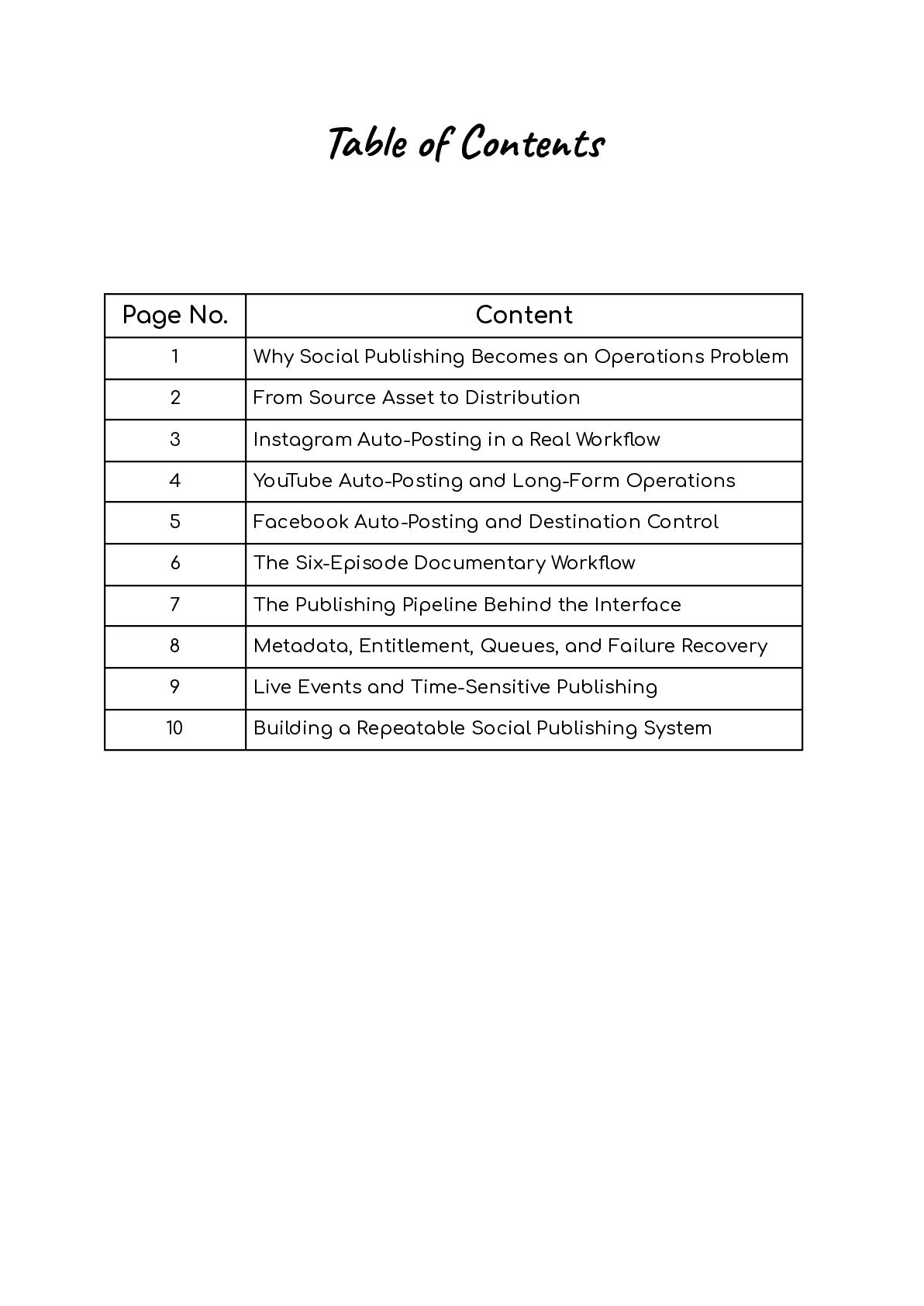
  2. Table of Contents Page No. Content 1 Why Social Publishing

    Becomes an Operations Problem 2 From Source Asset to Distribution 3 Instagram Auto-Posting in a Real Workflow 4 YouTube Auto-Posting and Long-Form Operations 5 Facebook Auto-Posting and Destination Control 6 The Six-Episode Documentary Workflow 7 The Publishing Pipeline Behind the Interface 8 Metadata, Entitlement, Queues, and Failure Recovery 9 Live Events and Time-Sensitive Publishing 10 Building a Repeatable Social Publishing System
  3. About This Publication Social publishing is often described as if

    it were a simple sequence: make something, upload it, and press publish. That description misses the work that surrounds the button. Once a creator is producing regularly, distribution becomes an operational system involving files, versions, metadata, permissions, schedules, queues, and people. This publication looks at that system from the operator's side. Instead of treating automation as a collection of features, it follows what actually has to happen between a finished piece of content and a successful post. The examples use Instagram, YouTube, and Facebook because their publishing workflows expose different parts of the same problem. The goal is practical clarity. A reader should be able to picture the workflow, identify where manual effort accumulates, and understand why a centralized publishing process can reduce repetitive work without taking editorial control away from the creator. Xelta AI's Socialverse is mentioned as one example of a platform-oriented approach to organizing social publishing. The references are placed in context rather than presented as standalone promotional blocks.
  4. Why Social Publishing Becomes an Operations Problem A creator can

    finish a video in an afternoon and still have hours of publishing work left. The finished file may need a long-form upload, a vertical cut, a thumbnail, a caption, a description, a scheduled time, and a destination-specific version of the message. The difficulty appears when the same work is repeated every day. One dashboard contains the Instagram schedule, another contains YouTube uploads, and a third holds Facebook publishing. The creative team may know the campaign as one story, while the tools see three separate streams of activity. That split creates small operational risks. A post can be scheduled with yesterday's caption. A video can be uploaded without the intended thumbnail. A campaign can launch on one channel while another destination is still waiting for approval. None of these problems requires a sophisticated technical failure; they usually come from disconnected steps. Thinking in terms of a workflow changes the question. Instead of asking whether a platform has an auto-publish button, an operator asks whether the source asset, metadata, destination, schedule, permission state, and final result can remain connected from beginning to end. That is the broader territory covered by Xelta AI Socialverse. A centralized social publishing layer can act as the place where distribution is organized, while the individual platforms remain the destinations. Operational example: A weekly creator publishes one interview, three short clips, and two image posts. The content calendar treats these as one campaign. The publishing workflow treats them as six jobs with different destinations and schedules. That distinction keeps the campaign unified without forcing every platform to receive identical material.
  5. From Source Asset to Distribution A reliable publishing workflow starts

    before the social platform is opened. The source asset first needs to be identified, processed, and associated with the information that will travel with it. Content processing is where the physical media is prepared. A master video may generate a compressed version, a vertical crop, a teaser, or a thumbnail. Each derivative should remain traceable to the original. Otherwise, a team can easily schedule the wrong cut simply because several files have similar names. Metadata is the second layer. Titles, descriptions, captions, tags, visibility settings, destination accounts, and scheduled times should be treated as structured publishing information rather than notes copied between browser tabs. Entitlement is the access check. The system needs to know whether the connected account or destination is still authorized to perform the action. Permissions can change independently of the content calendar, so authorization is part of normal operations rather than a one-time setup task. After validation, the job can enter a queue. A queue gives the operator a durable record of what is waiting, what is being processed, what succeeded, and what needs intervention. It also separates the timing of creative work from the timing of platform actions. A useful mental model is: source → processing → metadata validation → entitlement → queue → platform action → result Each stage has a different failure mode, which makes troubleshooting much faster than treating publishing as one opaque action.
  6. Instagram Auto-Posting in a Real Workflow Instagram is often the

    destination for the most frequent stream of short-form material. That makes repetitive preparation especially visible. A creator may have several clips from one recording, each with its own caption, publishing time, and campaign role. The workflow begins by keeping the media and publishing record together. The record can identify the destination account, media type, caption, planned release, and current status. Once the job is ready, it can move into the schedule rather than being recreated manually at publication time. For teams exploring Instagram auto-posting, this distinction matters. Automation is not simply about sending a file to Instagram. The useful unit is the complete publishing job: the correct asset, the correct text, the correct destination, and the correct time. Example: A six-minute tutorial produces four vertical clips. The first clip introduces the problem, the second demonstrates the workflow, the third shows a common mistake, and the fourth gives the result. Each clip is scheduled several days apart. Because the jobs remain linked to the same source tutorial, the operator can see the series as one campaign while managing each release independently. That structure also helps with failure recovery. If one clip is rejected or fails to publish, the operator can address that job without rebuilding the other three. The campaign stays intact while the individual publishing state is corrected. Good automation leaves editorial decisions visible. The creator still decides which clip goes first and what message accompanies it. The system handles the repetitive execution around that decision.
  7. YouTube Auto-Posting and Long-Form Operations YouTube has a different operational

    rhythm. Long-form videos are often uploaded ahead of release, reviewed while private or scheduled, and supported by a larger metadata package than a short social post. From an operator's perspective, the video file is only one part of the publishing record. The title, description, thumbnail, visibility state, release time, and target channel need to stay associated with the upload throughout its lifecycle. A useful queue might distinguish between ready, processing, scheduled, published, and needs attention. Those states make the work visible. A failed upload is no longer a vague problem; it is a specific item that can be investigated. For teams evaluating YouTube auto-posting, the practical question is how much repetitive channel management can be removed while keeping the publishing record understandable. Operator example: A documentary team finishes three episodes before the first episode is released. Each episode has its own thumbnail, description, and date. The team can prepare the next episodes while the publishing schedule remains fixed. If an upload needs to be retried, the operator works on that job rather than reopening the entire production checklist. Long-form publishing also demonstrates why automation benefits from state tracking. A system that remembers where each upload is in the process gives the operator room to work on the next piece instead of constantly checking whether the previous one finished.
  8. Facebook Auto-Posting and Destination Control Facebook adds another destination to

    the distribution system, but the important operational issue is not simply another upload button. It is destination control. The publishing workflow needs to know exactly which page or managed destination is receiving the content. A centralized record helps prevent a common mistake: reusing campaign material without preserving the destination-specific copy. The same underlying story can support several posts, but each post should retain its own audience context and publishing state. That is where Facebook auto-posting fits into a wider workflow. Facebook can be handled as one destination inside the campaign rather than as a separate daily routine that has to be reconstructed from scratch. Example: A behind-the-scenes production video is prepared from one source recording. YouTube receives the longer version, Instagram receives a short vertical excerpt, and Facebook receives a post written for the page audience. The assets share a source but have separate publishing records. That separation is useful when changes are required. If the Facebook copy needs to change, the operator can edit the Facebook job without accidentally modifying the YouTube description or Instagram caption. The broader principle is simple: reuse the content idea, not necessarily the exact output. A good publishing workflow preserves the campaign relationship while allowing each destination to be packaged appropriately.
  9. The Six-Episode Documentary Workflow A six-episode documentary is a useful

    stress test for a publishing system because it creates enough material to expose weaknesses in manual coordination. Imagine a small production team releasing one episode every two weeks. Each episode produces a master film, a trailer, several vertical excerpts, still images, captions, metadata, thumbnails, and promotional posts. The team wants the full episode on YouTube, selected excerpts on Instagram, and supporting updates on Facebook. Step 1 — Ingest. The master episode and derivatives are stored with clear names and relationships. A clip should point back to episode four rather than existing as an unexplained file in a shared folder. Step 2 — Process. Video derivatives are prepared for their intended destinations. The team checks dimensions, duration, audio, and file readiness before scheduling. Step 3 — Metadata. Titles, descriptions, captions, dates, tags, and destination-specific copy are prepared. Missing fields are caught before jobs enter the publishing queue. Step 4 — Entitlement. The operator verifies that connected accounts still have permission to publish. This is especially important when a batch of scheduled work is prepared days in advance. Step 5 — Queue. Each release receives its own schedule and state. Episode six can be prepared while episode five is being promoted. Step 6 — Monitor. After publication, the team checks the outcome. A missing clip or failed upload becomes a visible operational item rather than an unnoticed gap. After six episodes, these controls are no longer small conveniences. They form the operating memory of the production, allowing the team to focus on storytelling while the distribution process remains organized.
  10. The Publishing Pipeline Behind the Interface The interface may show

    a simple list of scheduled posts. Underneath, a reliable system has to keep track of relationships between assets, metadata, destinations, credentials, timing, and outcomes. Asset relationships. One source can produce many derivatives. Keeping those relationships means an operator can answer where a clip came from and which campaign it belongs to without opening multiple folders. Processing state. A file that is still being transcoded is not ready to publish. Separating processing from publishing prevents incomplete media from entering the queue. Metadata validation. Validation catches problems while they are still cheap to fix. An empty title or incorrect date should be resolved before the platform receives the request. Entitlement. Authorization is an operational dependency. When a connection expires, the correct response is different from a media-processing failure. The system should make that distinction visible. Queue management. Queues control order and timing. They also provide a place to hold jobs that need a retry or human review. Result logging. The operator needs a record of what actually happened. 'Scheduled' and 'published' are not the same state, and a successful API request does not necessarily mean the campaign is complete. The point is not to make the workflow unnecessarily complex. It is to give each important transition a clear state so that people can intervene without guessing.
  11. Metadata, Entitlement, Queues, and Failure Recovery These four concepts are

    where a publishing workflow starts to behave like an operating system for content rather than a collection of shortcuts. Metadata describes what should happen. It can include titles, captions, descriptions, tags, timestamps, thumbnails, visibility, and destination information. Keeping these fields structured reduces copy-and-paste errors. Entitlement describes whether the requested action is permitted. A connected account can be valid one week and require reauthorization the next. The publishing calendar should not have to be rebuilt simply because access needs attention. Queues control when work is attempted. They also create a durable record. If ten jobs are scheduled for the same campaign, the operator can see which ones are waiting and which ones have already completed. Failure recovery separates recoverable problems from content problems. A temporary connection issue may deserve a retry. A missing permission may require reauthorization. Invalid metadata needs editing. Treating all three as the same error makes the system harder to operate. Idempotency is another practical concern. If an action times out after the platform has already accepted it, blindly retrying can create a duplicate. A job identifier and completion record help the system decide whether the requested action has already happened. These mechanisms are mostly invisible to an audience. They matter to the person responsible for keeping a publishing calendar moving without surprises.
  12. Live Events and Time-Sensitive Publishing Live publishing changes the tolerance

    for delay. A scheduled post can often wait for a retry. A live event may have a narrow start window, active viewers, and no practical opportunity to move the work to tomorrow. An operator preparing a live event needs to verify the destination, entitlement, event metadata, media path, schedule, and monitoring plan. The checklist is not bureaucracy; it is a way to move predictable checks earlier, before the audience arrives. Status visibility becomes especially important. If the event has not started because an account lacks permission, the operator needs that information immediately. If the media path is healthy but the destination is unavailable, the response is different. Live-event handling also illustrates why generic automation is not enough. The workflow must understand timing. A retry that is harmless for a scheduled post may be inappropriate during a live broadcast. Example: A documentary team schedules a live discussion after episode three. The recording team prepares the event metadata in advance, verifies the destination, and keeps an operator watching the publishing state during the start window. If an entitlement problem appears, it can be addressed before the event begins rather than discovered after viewers are waiting. The broader lesson is that automation should make intervention easier, not hide it. The operator needs enough information to know when the automated path is working and when human action is required.
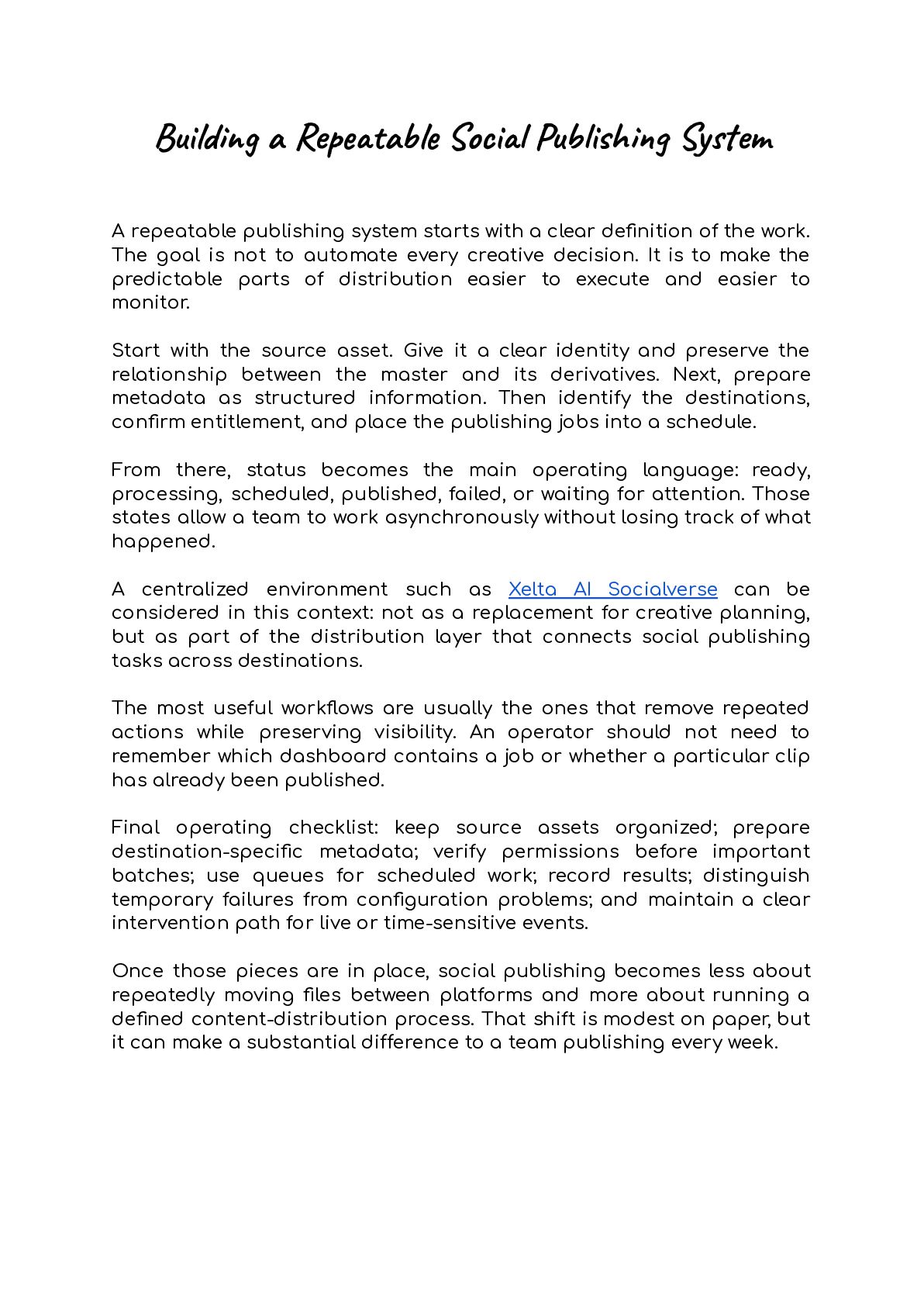
  13. Building a Repeatable Social Publishing System A repeatable publishing system

    starts with a clear definition of the work. The goal is not to automate every creative decision. It is to make the predictable parts of distribution easier to execute and easier to monitor. Start with the source asset. Give it a clear identity and preserve the relationship between the master and its derivatives. Next, prepare metadata as structured information. Then identify the destinations, confirm entitlement, and place the publishing jobs into a schedule. From there, status becomes the main operating language: ready, processing, scheduled, published, failed, or waiting for attention. Those states allow a team to work asynchronously without losing track of what happened. A centralized environment such as Xelta AI Socialverse can be considered in this context: not as a replacement for creative planning, but as part of the distribution layer that connects social publishing tasks across destinations. The most useful workflows are usually the ones that remove repeated actions while preserving visibility. An operator should not need to remember which dashboard contains a job or whether a particular clip has already been published. Final operating checklist: keep source assets organized; prepare destination-specific metadata; verify permissions before important batches; use queues for scheduled work; record results; distinguish temporary failures from configuration problems; and maintain a clear intervention path for live or time-sensitive events. Once those pieces are in place, social publishing becomes less about repeatedly moving files between platforms and more about running a defined content-distribution process. That shift is modest on paper, but it can make a substantial difference to a team publishing every week.
  14. About the Author Alden Clark Alden Clark writes about AI-assisted

    content creation, social media workflows, and the practical systems creators use to turn digital content into repeatable publishing operations. His work focuses on the point where creative production meets everyday tooling: preparing media, organizing publishing information, reducing repetitive platform work, and making complex workflows easier for creators to operate. This publication reflects that practical perspective. Rather than treating automation as a shortcut that removes human involvement, it examines the operational details that help creators maintain control while reducing repetitive distribution work.