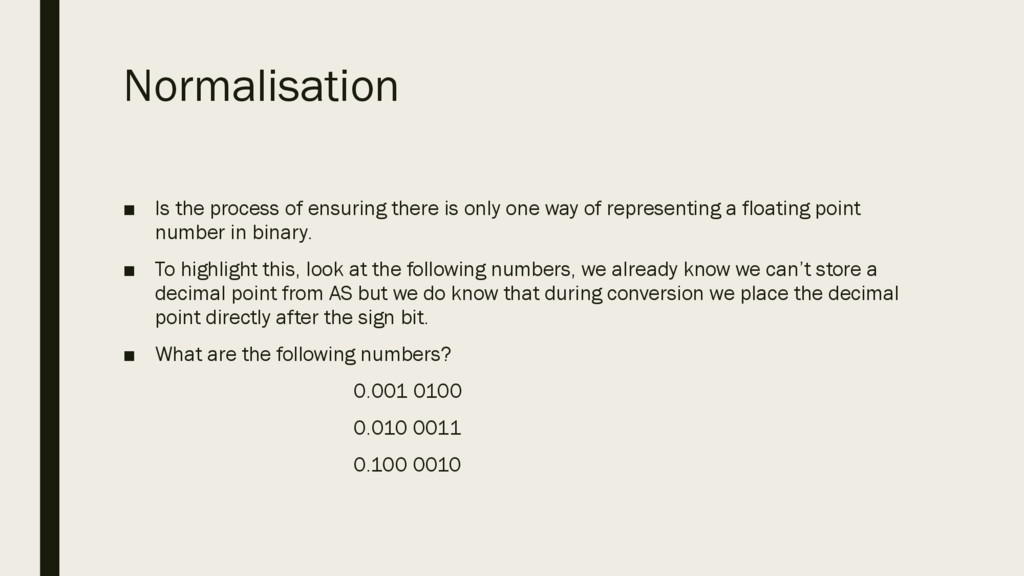
one way of representing a floating point number in binary. ▪ To highlight this, look at the following numbers, we already know we can’t store a decimal point from AS but we do know that during conversion we place the decimal point directly after the sign bit. ▪ What are the following numbers? 0.001 0100 0.010 0011 0.100 0010
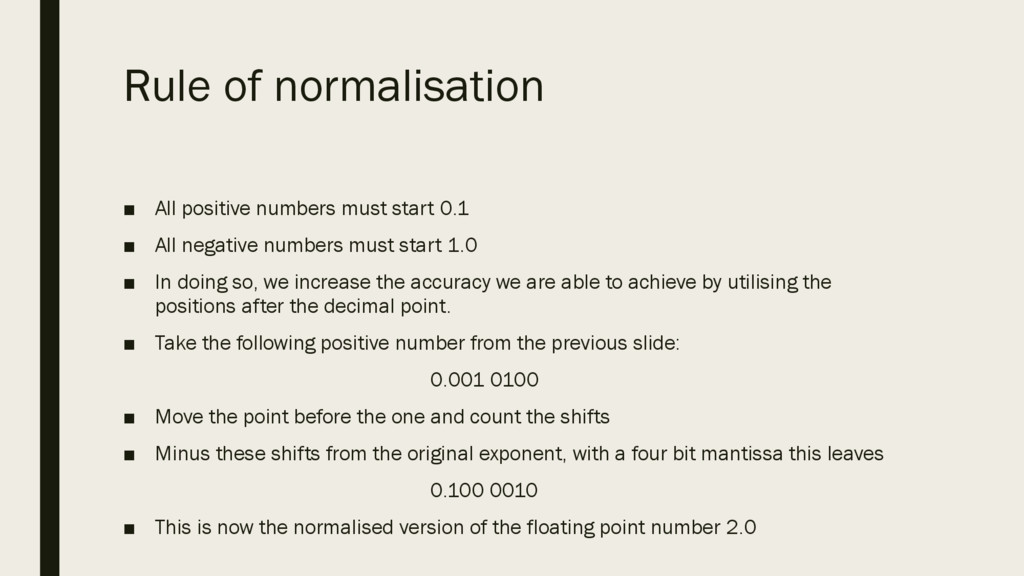
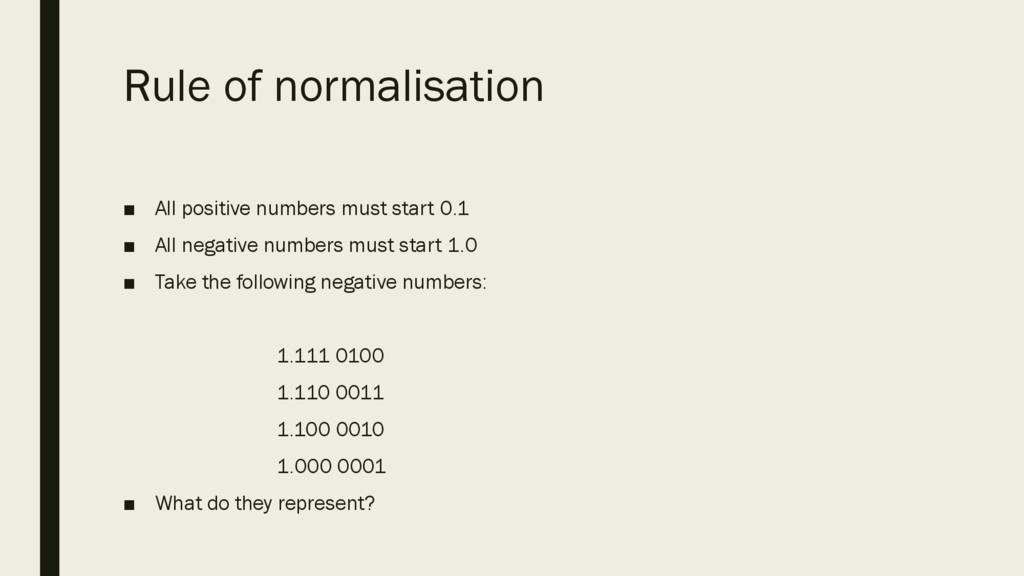
▪ All negative numbers must start 1.0 ▪ In doing so, we increase the accuracy we are able to achieve by utilising the positions after the decimal point. ▪ Take the following positive number from the previous slide: 0.001 0100 ▪ Move the point before the one and count the shifts ▪ Minus these shifts from the original exponent, with a four bit mantissa this leaves 0.100 0010 ▪ This is now the normalised version of the floating point number 2.0


 allenheard
 cbtlibrary
 doratex
 signer
 soudai
 jdbedics
 juanmartin2026
 akiraasano
 hiola
hiola
 jakevdp
 katarinadahlin
 rakko
rakko
 aarron
 lauravandoore
 wjessup
.jpg) cargoodrich
cargoodrich
 lemiorhan
 cassininazir
 aleyda
 mfonobong