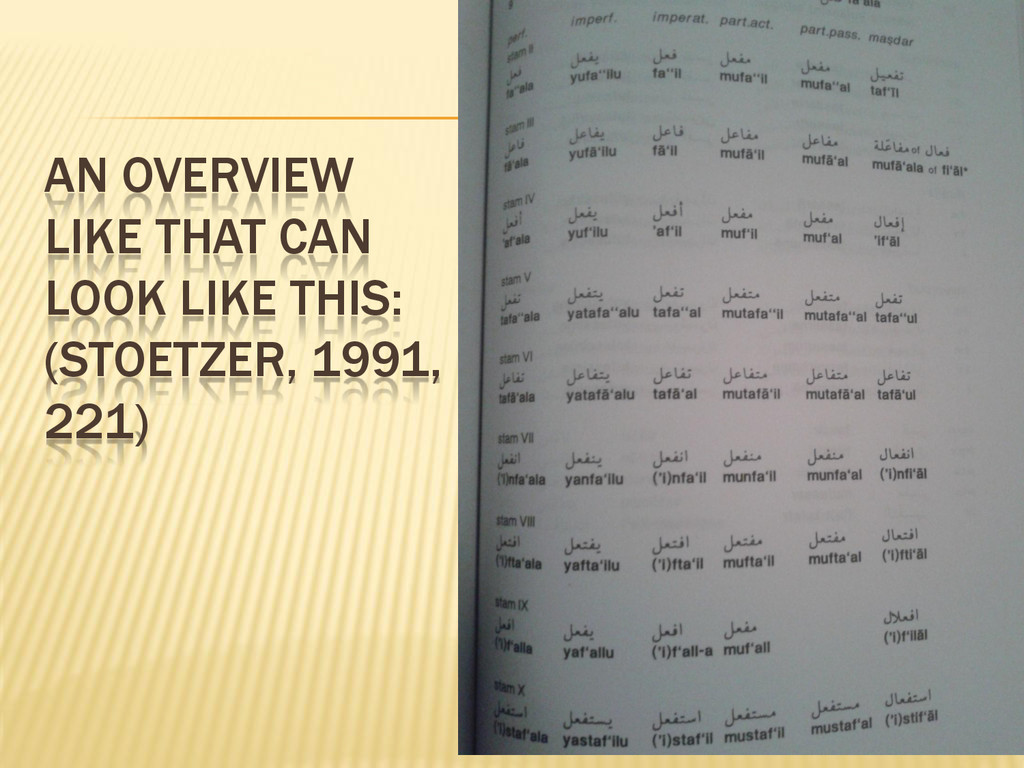
verbs, gives an overview how these forms look in the perfect tense imperfect tense Imperative Active participle Passive participle Masdar (verbal noun)
past tense: used to indicate something that occured in the past (he studied) Imperfect / present tense: in Arabic it is used to indicate something that occurs in the present When you have memorized the third person male singular form of the perfect and imperfect in the different stem forms, you should be able to make the other forms (person, gender and number) using the pre- and/or suffixed of the perfect or imperfect from the previous levels of this course.
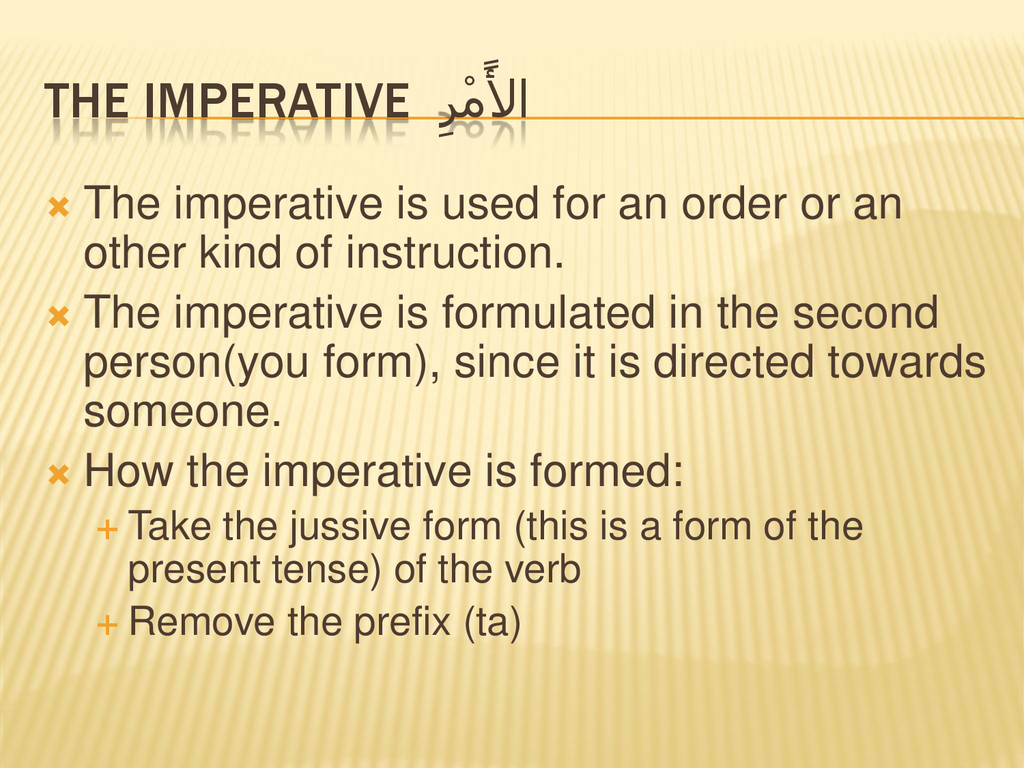
order or an other kind of instruction. The imperative is formulated in the second person(you form), since it is directed towards someone. How the imperative is formed: Take the jussive form (this is a form of the present tense) of the verb Remove the prefix (ta)
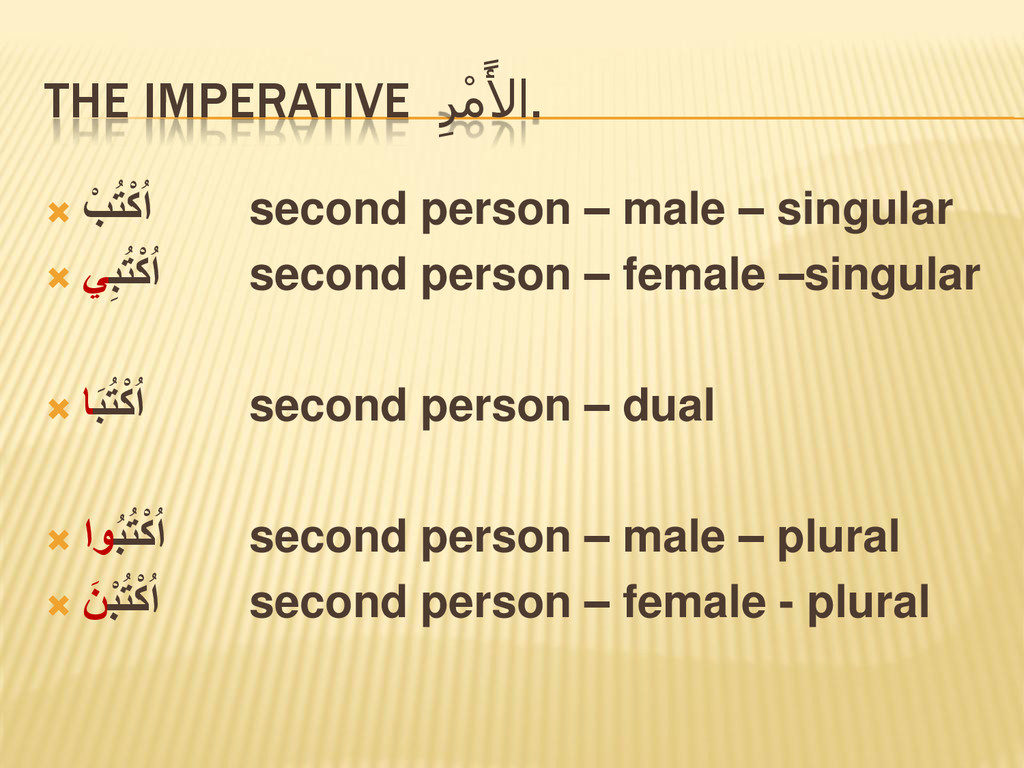
singular ْ بُتْكُا ي second person – female –singular ْ بُتْكُا ا second person – dual ْ ُبُتْكُا او second person – male – plural ْ ْبُتْكُا ْ ن second person – female - plural
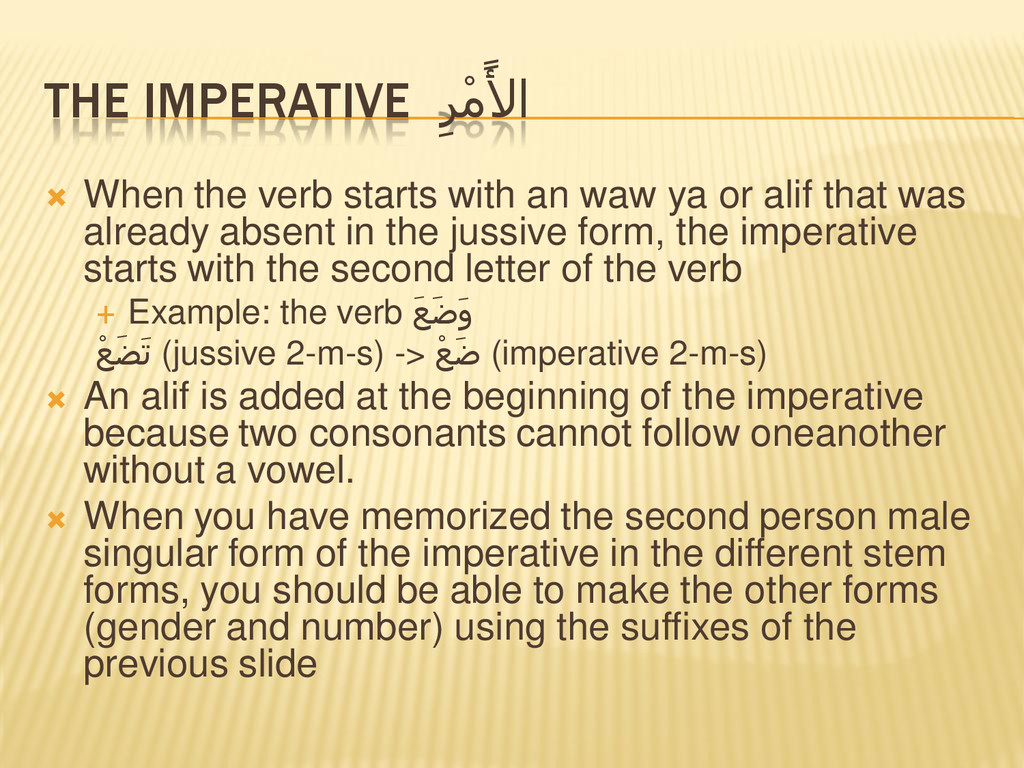
waw ya or alif that was already absent in the jussive form, the imperative starts with the second letter of the verb Example: the verb َعَضَو ْعَضَت (jussive 2-m-s) -> ْعَض (imperative 2-m-s) An alif is added at the beginning of the imperative because two consonants cannot follow oneanother without a vowel. When you have memorized the second person male singular form of the imperative in the different stem forms, you should be able to make the other forms (gender and number) using the suffixes of the previous slide
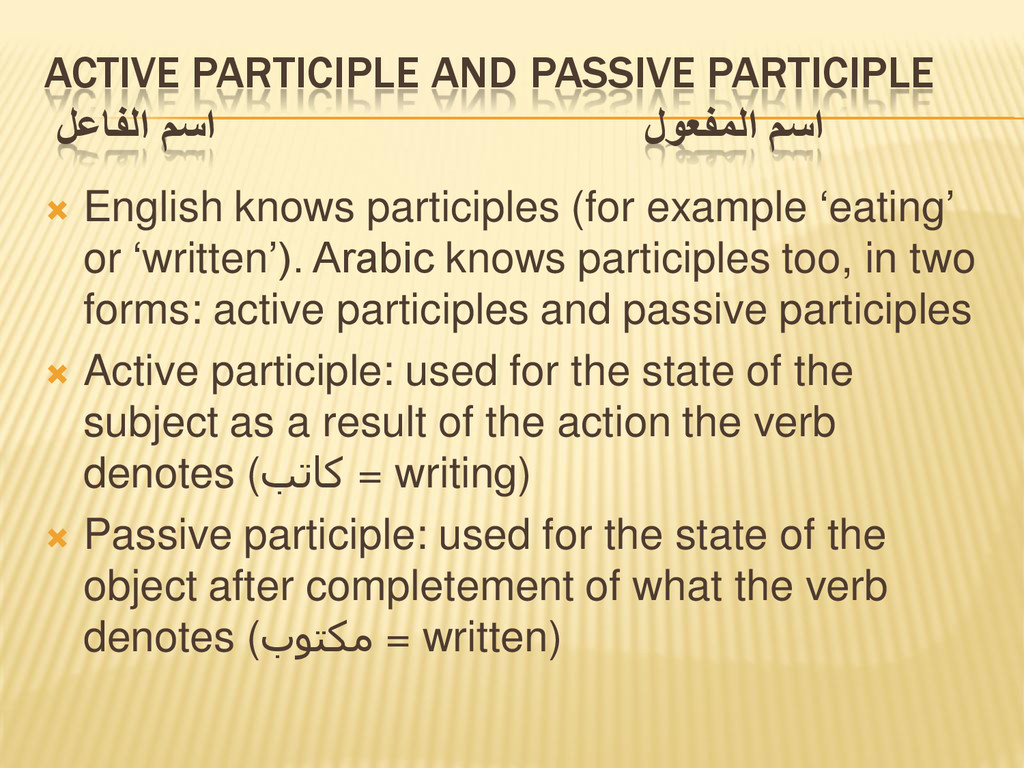
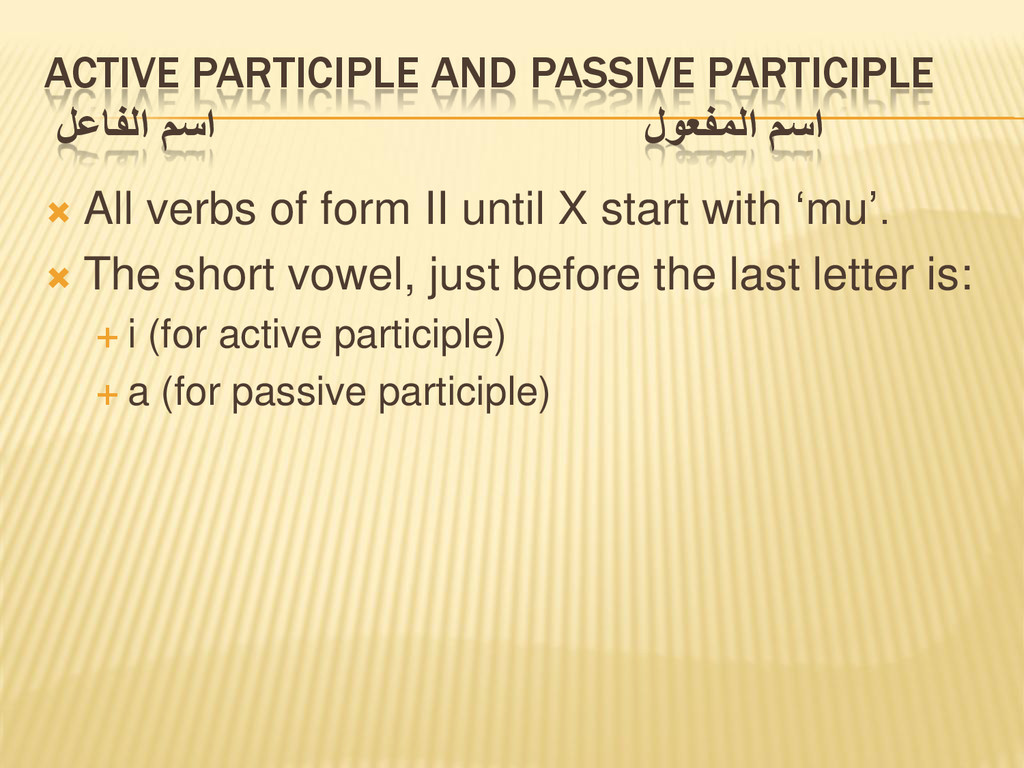
participles (for example ‘eating’ or ‘written’). Arabic knows participles too, in two forms: active participles and passive participles Active participle: used for the state of the subject as a result of the action the verb denotes (بتاك = writing) Passive participle: used for the state of the object after completement of what the verb denotes (بوتكم = written)
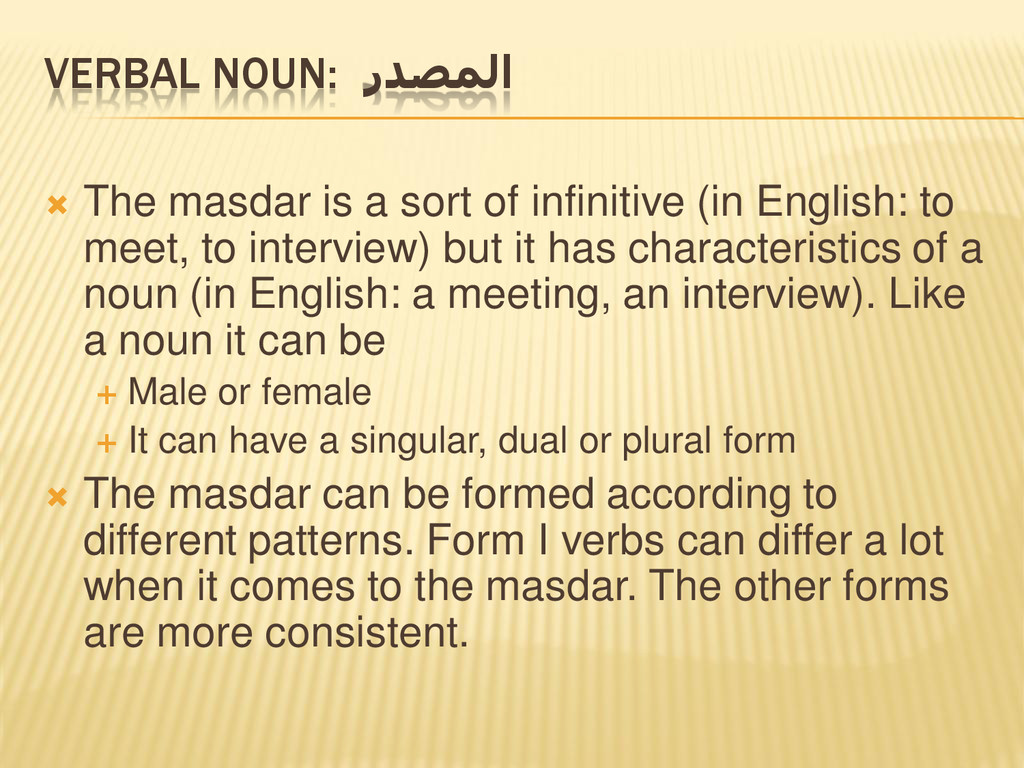
infinitive (in English: to meet, to interview) but it has characteristics of a noun (in English: a meeting, an interview). Like a noun it can be Male or female It can have a singular, dual or plural form The masdar can be formed according to different patterns. Form I verbs can differ a lot when it comes to the masdar. The other forms are more consistent.
handboek voor het modern standaard Arabisch. Garant. Holes, C. (2004). Modern Arabic. Georgetown University Press. Stoetzer, W. F. G. J. (1991). Arabische grammatica in schema's en regels. Coutinho.


 amber89
 axbom
axbom
 tmiket
 charlesmeaden
 apolaine
 destraynor
 holman
 aleyda
 madoxten
 katarinadahlin
 erikaheidi