Upgrade to Pro — share decks privately, control downloads, hide ads and more …

Embodied Carbon - The Blindspot of the Building...

Avatar for Anthony Pak Anthony Pak
October 26, 2019

Embodied Carbon - The Blindspot of the Building Industry (Priopta)

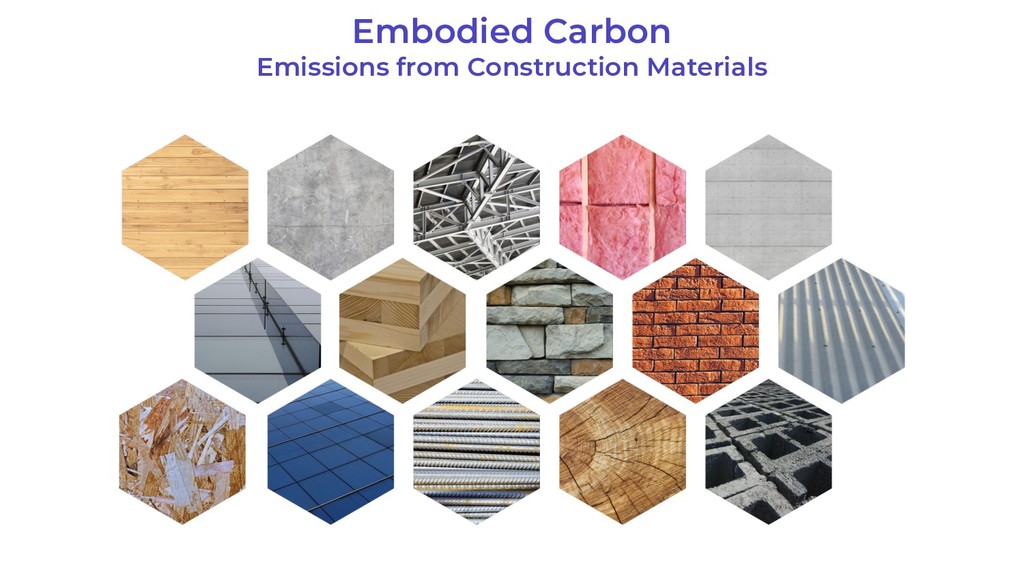
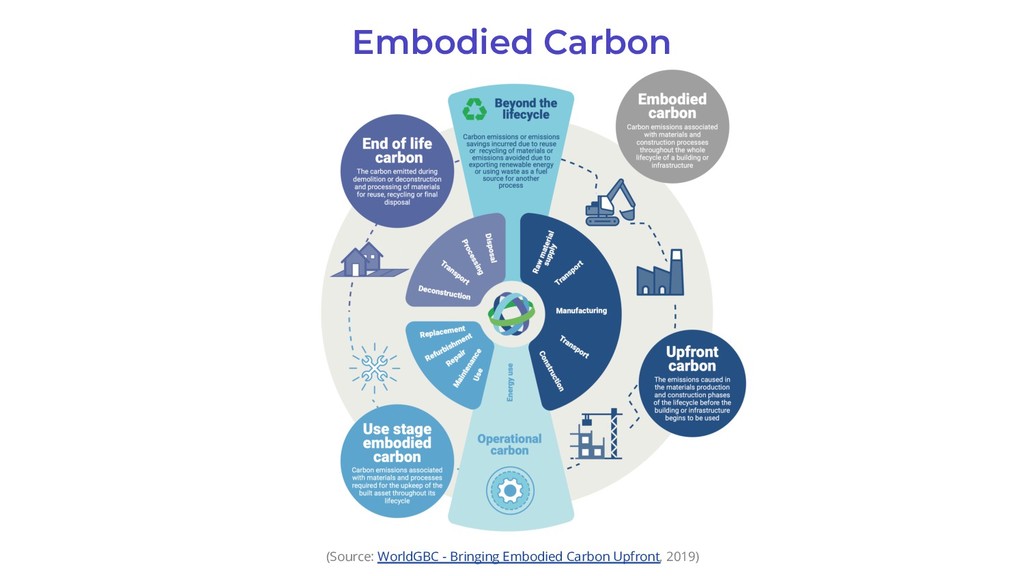
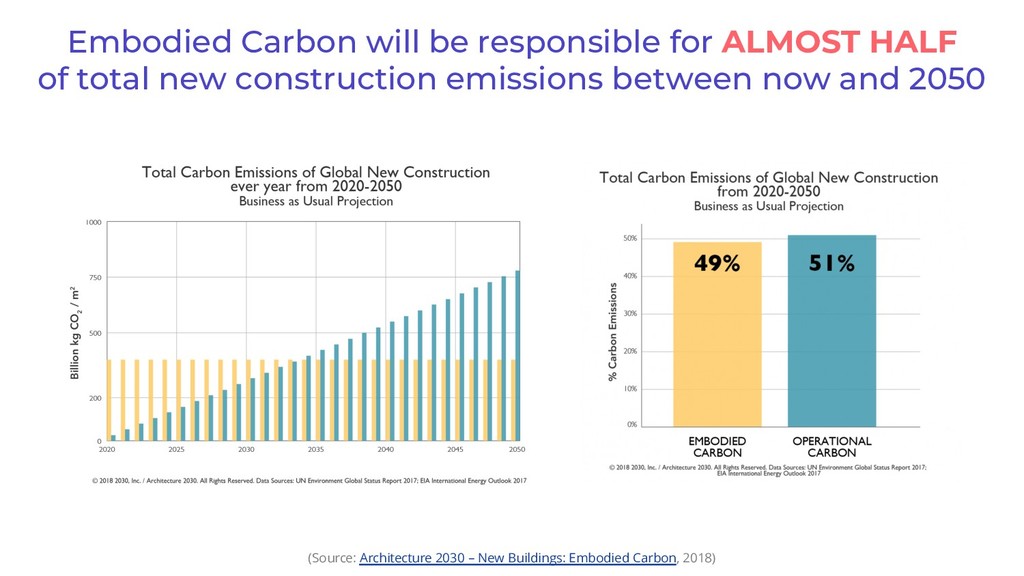
The building industry often ignores Embodied Carbon, even though it will account for almost half of the total new construction emissions globally between now and 2050. This presentation provides an overview of Embodied Carbon in the Building Industry, including:
* Why Embodied Carbon Matters
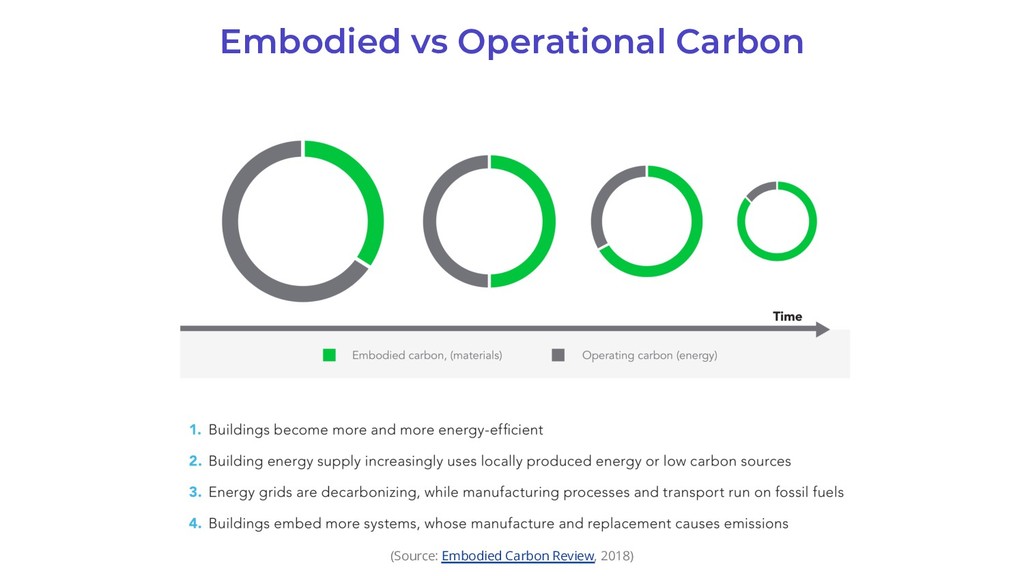
* Scale of Embodied Carbon vs Operational Carbon
* Relevant Policies and Standards
* Building LCA Software Tools
* Design Strategies to Reduce Embodied Carbon of Key Materials (concrete, steel, wood, insulation)

Avatar for Anthony Pak

Anthony Pak

October 26, 2019

Other Decks in Business

Transcript

  1. Outline Why Embodied Carbon Matters Measuring Embodied Carbon Policies &

    Standards LCA Software Tools Design Strategies for Reducing Embodied Carbon (Concrete, Steel, Wood, Insulation) Q&A / Discussion
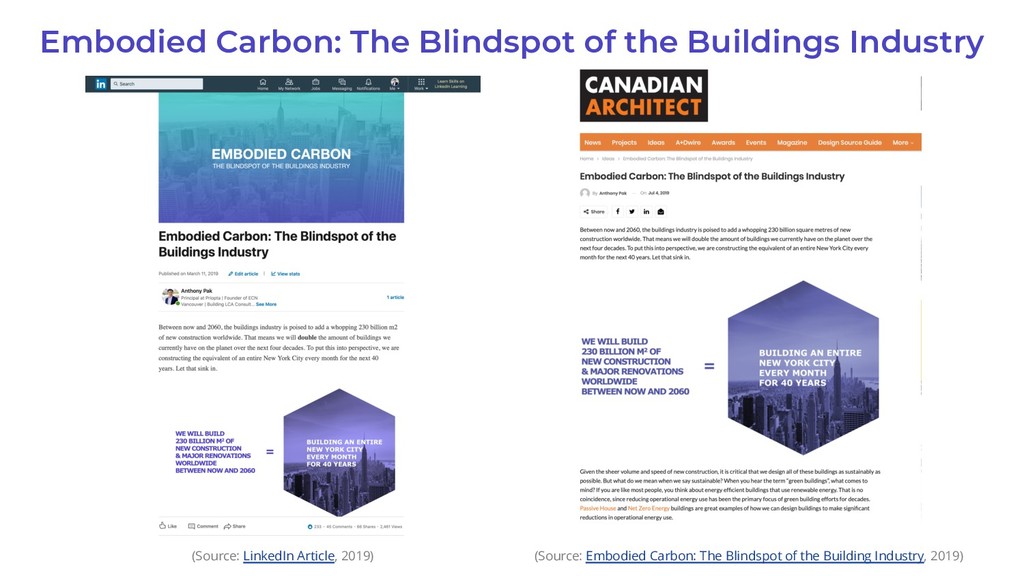
  2. Embodied Carbon: The Blindspot of the Buildings Industry (Source: Embodied

    Carbon: The Blindspot of the Building Industry, 2019) (Source: LinkedIn Article, 2019)
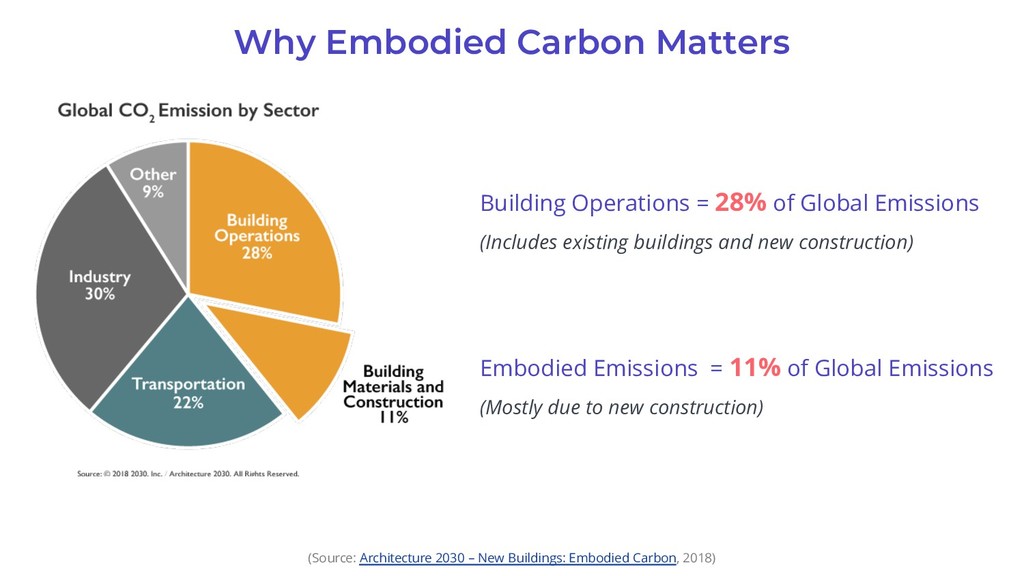
  3. Building Operations = 28% of Global Emissions (Includes existing buildings

    and new construction) Embodied Emissions = 11% of Global Emissions (Mostly due to new construction) Why Embodied Carbon Matters (Source: Architecture 2030 – New Buildings: Embodied Carbon, 2018)
  4. Embodied Carbon will be responsible for ALMOST HALF of total

    new construction emissions between now and 2050 (Source: Architecture 2030 – New Buildings: Embodied Carbon, 2018)
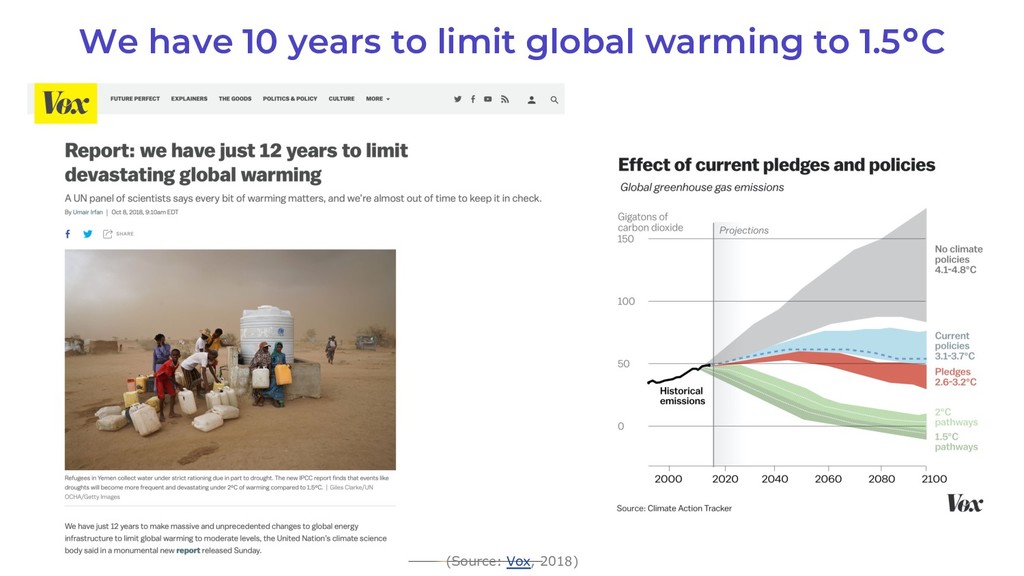
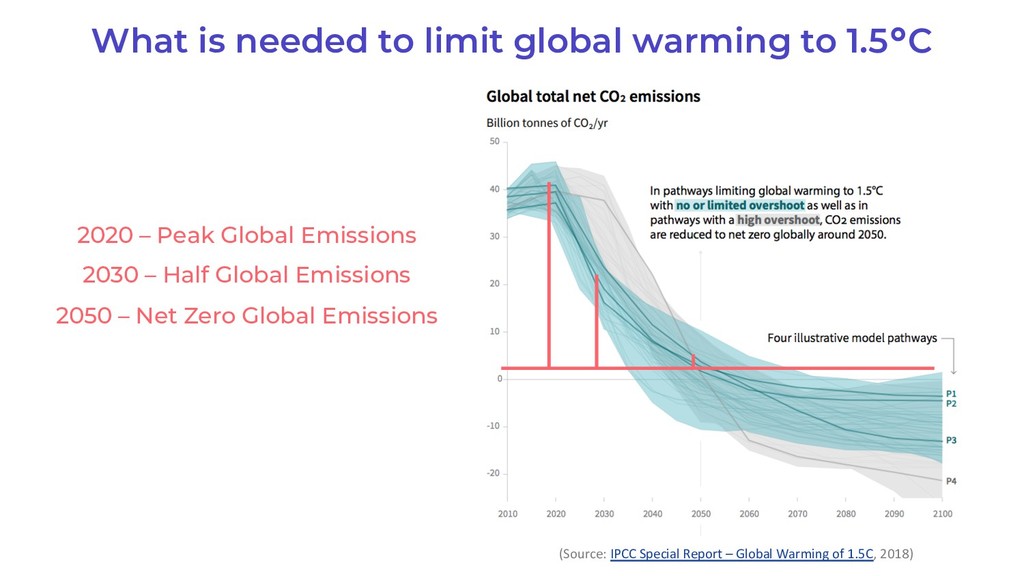
  5. 2020 – Peak Global Emissions 2030 – Half Global Emissions

    2050 – Net Zero Global Emissions What is needed to limit global warming to 1.5°C (Source: IPCC Special Report – Global Warming of 1.5C, 2018)
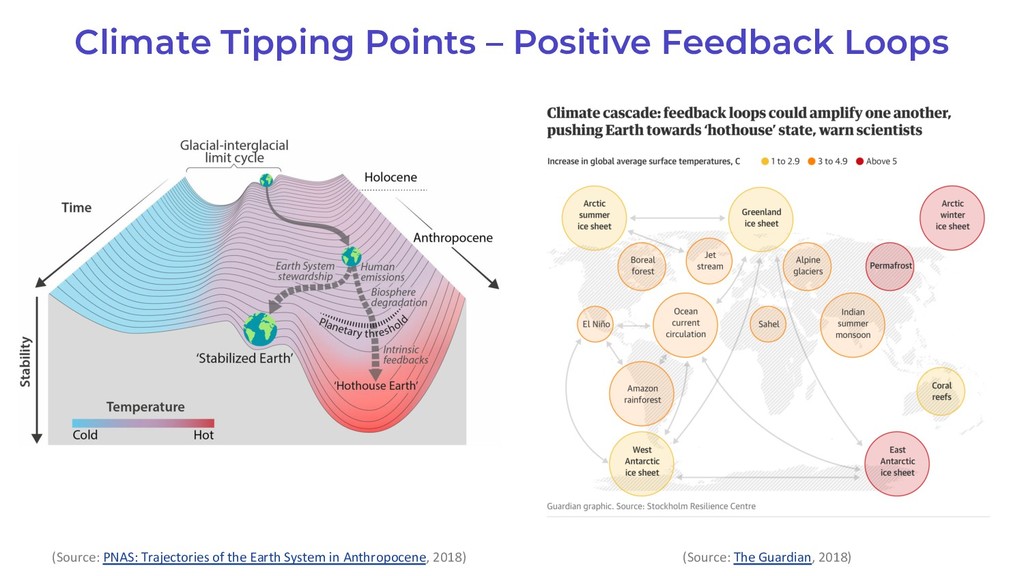
  6. Climate Tipping Points – Positive Feedback Loops (Source: PNAS: Trajectories

    of the Earth System in Anthropocene, 2018) (Source: The Guardian, 2018)
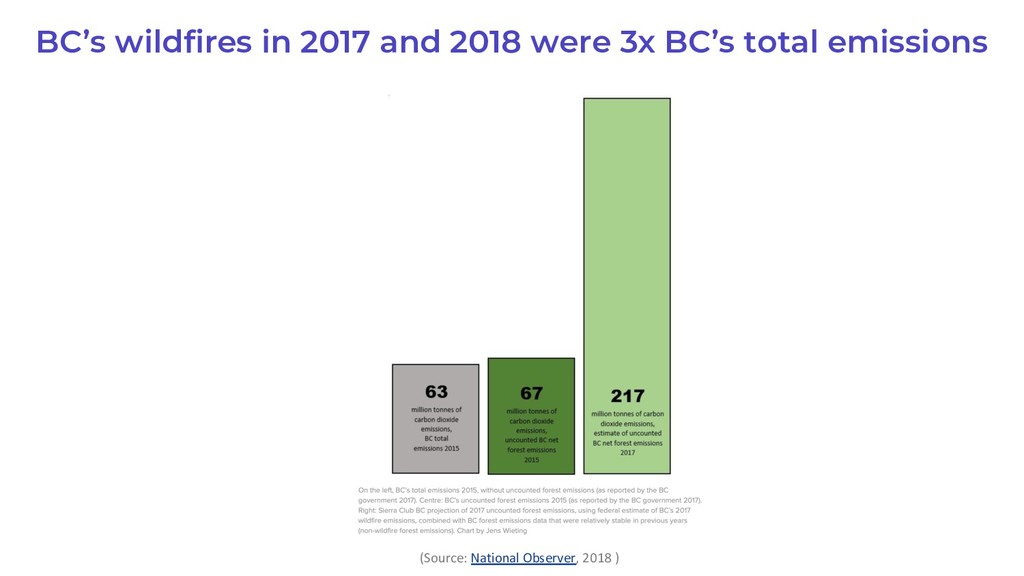
  7. BC’s wildfires in 2017 and 2018 were 3x BC’s total

    emissions (Source: National Observer, 2018 )
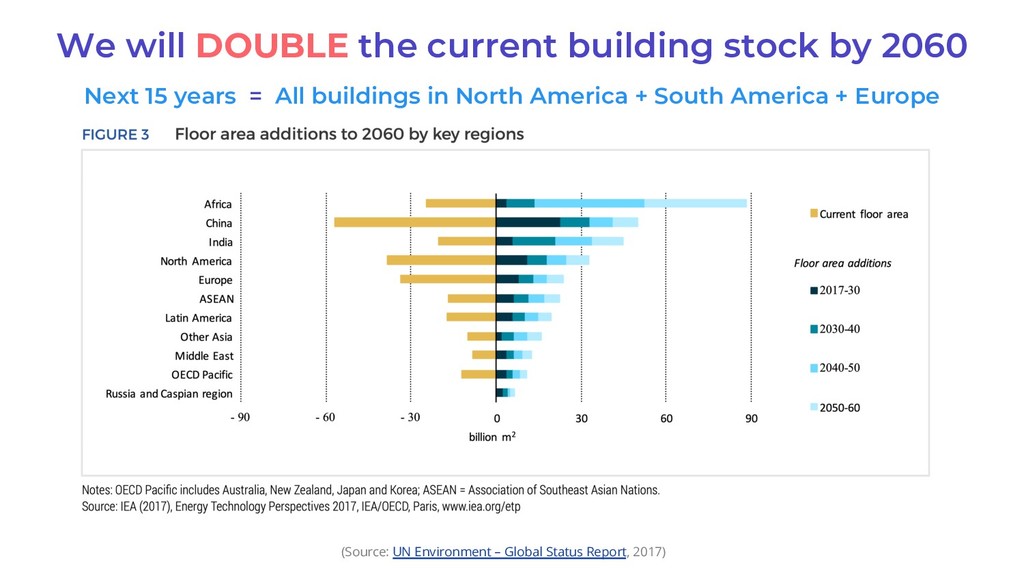
  8. We will DOUBLE the current building stock by 2060 Next

    15 years = All buildings in North America + South America + Europe (Source: UN Environment – Global Status Report, 2017)
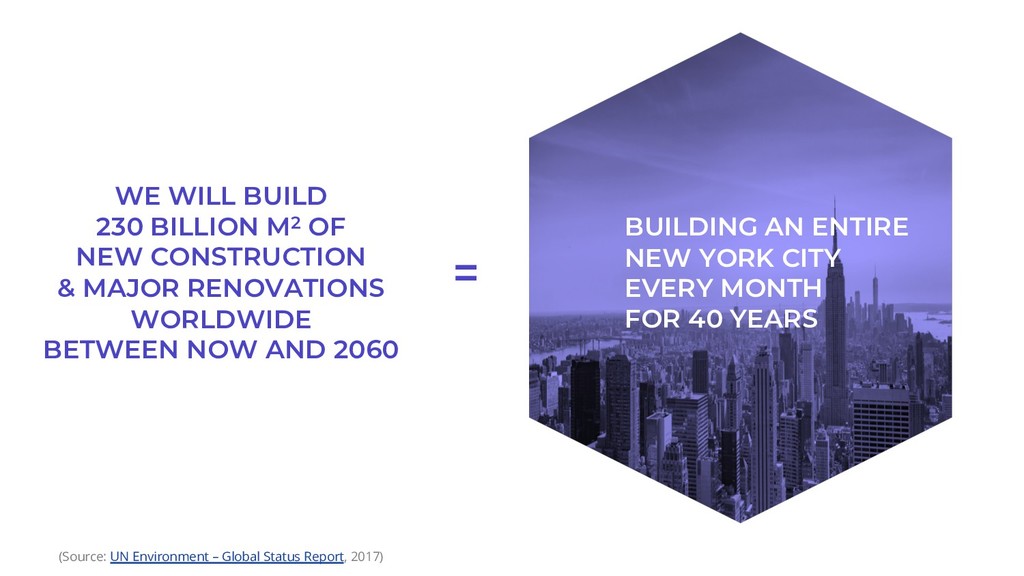
  9. WE WILL BUILD 230 BILLION M2 OF NEW CONSTRUCTION &

    MAJOR RENOVATIONS WORLDWIDE BETWEEN NOW AND 2060 BUILDING AN ENTIRE NEW YORK CITY EVERY MONTH FOR 40 YEARS = (Source: UN Environment – Global Status Report, 2017)
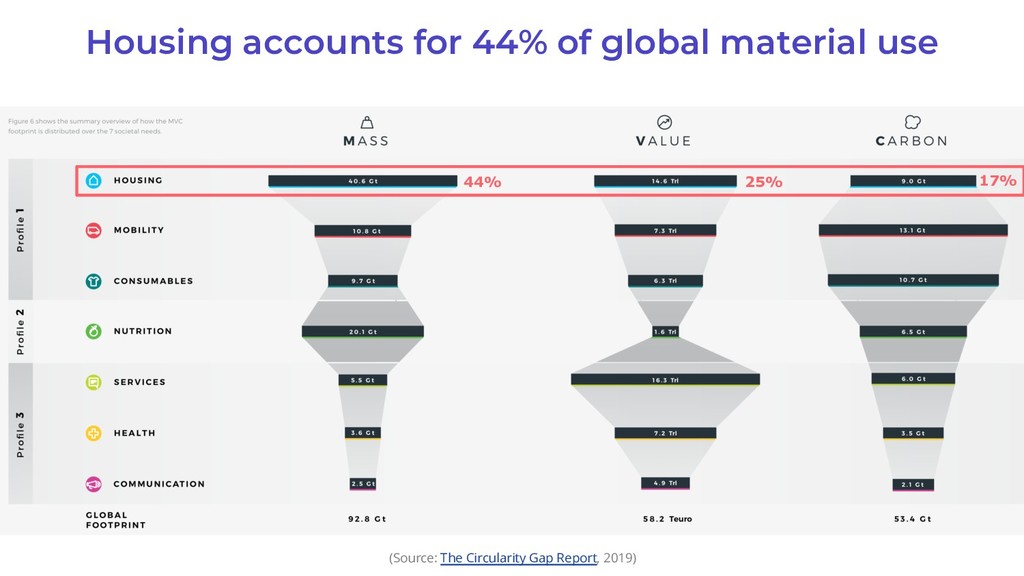
  10. Housing accounts for 44% of global material use 44% 25%

    17% (Source: The Circularity Gap Report, 2019)
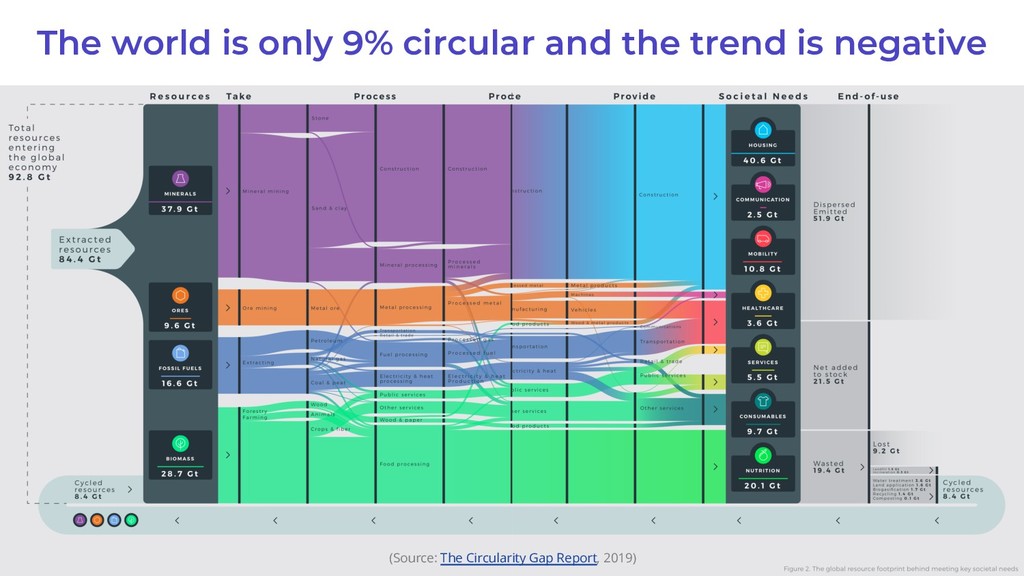
  11. The world is only 9% circular and the trend is

    negative (Source: The Circularity Gap Report, 2019)
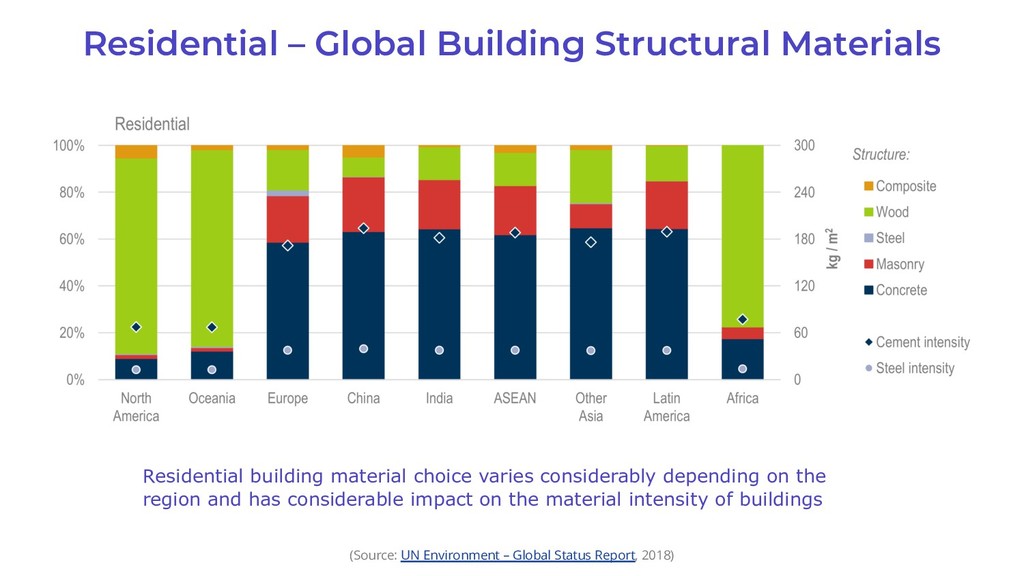
  12. Residential – Global Building Structural Materials Residential building material choice

    varies considerably depending on the region and has considerable impact on the material intensity of buildings (Source: UN Environment – Global Status Report, 2018)
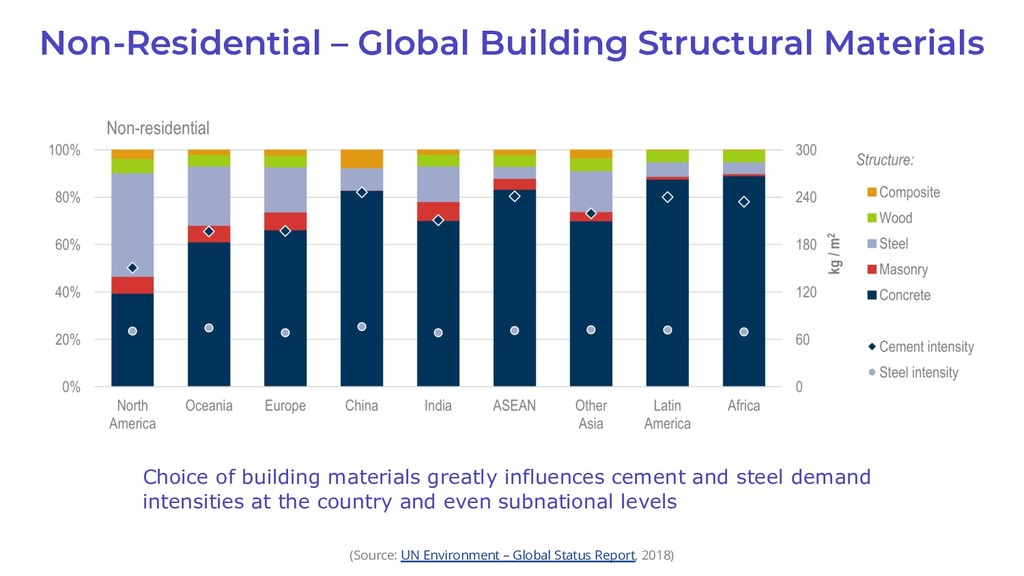
  13. Non-Residential – Global Building Structural Materials Choice of building materials

    greatly influences cement and steel demand intensities at the country and even subnational levels (Source: UN Environment – Global Status Report, 2018)
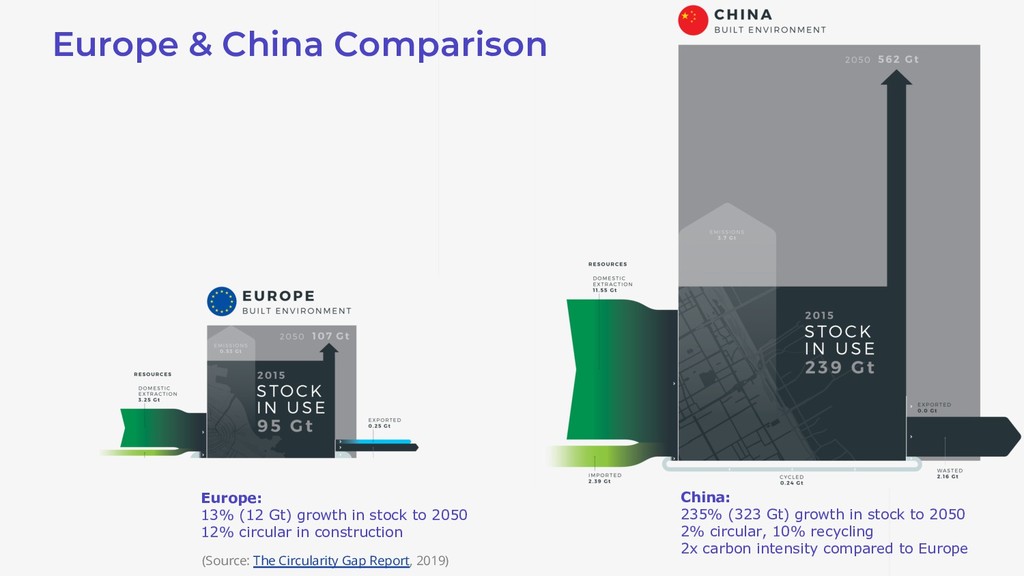
  14. Europe: 13% (12 Gt) growth in stock to 2050 12%

    circular in construction China: 235% (323 Gt) growth in stock to 2050 2% circular, 10% recycling 2x carbon intensity compared to Europe Europe & China Comparison (Source: The Circularity Gap Report, 2019)
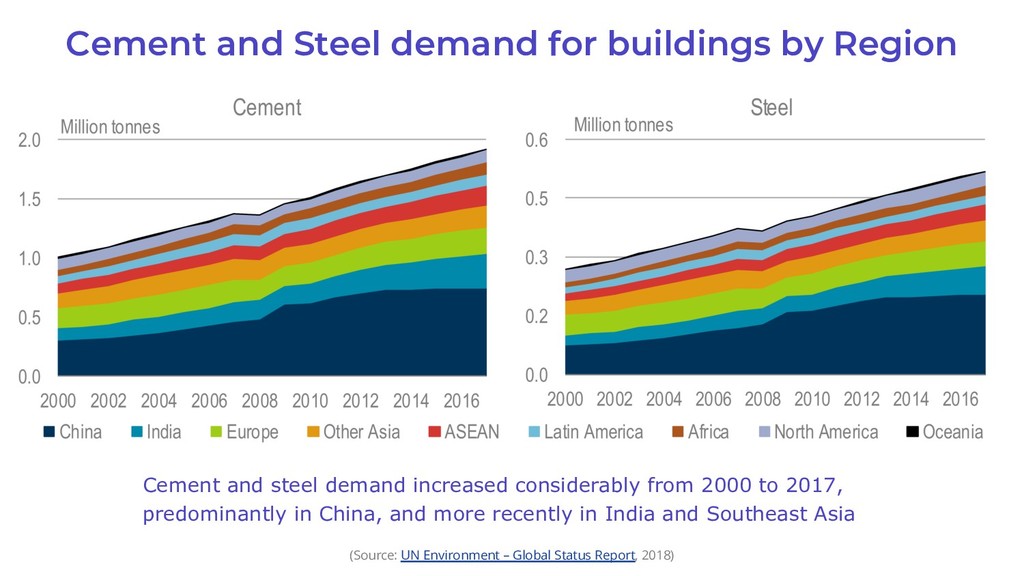
  15. Cement and Steel demand for buildings by Region Cement and

    steel demand increased considerably from 2000 to 2017, predominantly in China, and more recently in India and Southeast Asia (Source: UN Environment – Global Status Report, 2018)
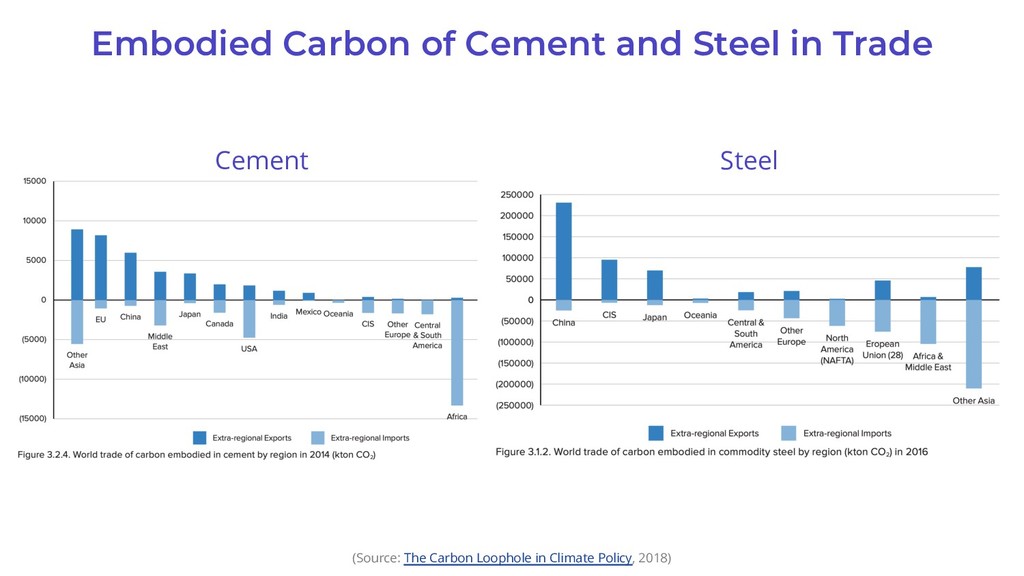
  16. Embodied Carbon of Cement and Steel in Trade Cement Steel

    (Source: The Carbon Loophole in Climate Policy, 2018)
  17. Embodied Carbon: 10 - 70% of Lifetime Impact (Source: Athena

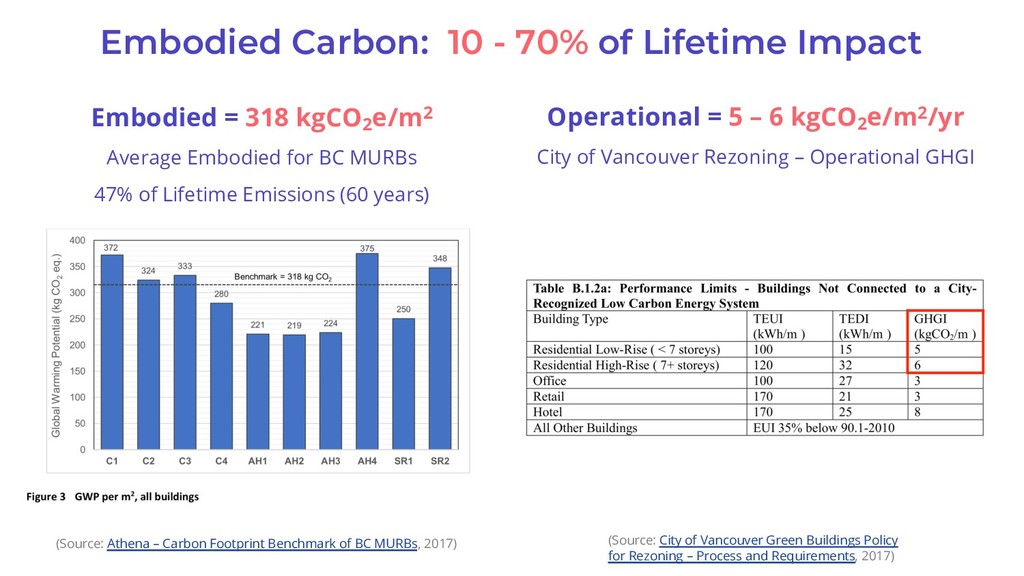
    – Carbon Footprint Benchmark of BC MURBs, 2017) Embodied = 318 kgCO2 e/m2 Average Embodied for BC MURBs 47% of Lifetime Emissions (60 years) Operational = 5 – 6 kgCO2 e/m2/yr City of Vancouver Rezoning – Operational GHGI (Source: City of Vancouver Green Buildings Policy for Rezoning – Process and Requirements, 2017)
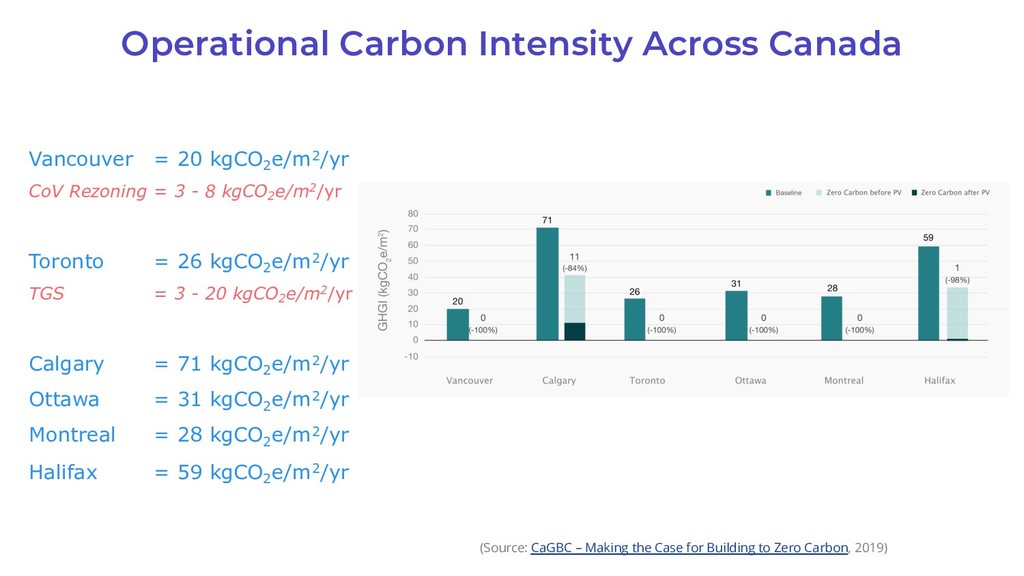
  18. Operational Carbon Intensity Across Canada Vancouver CoV Rezoning Toronto TGS

    Calgary Ottawa Montreal Halifax = 20 kgCO2 e/m2/yr = 3 - 8 kgCO2 e/m2/yr = 26 kgCO2 e/m2/yr = 3 - 20 kgCO2 e/m2/yr = 71 kgCO2 e/m2/yr = 31 kgCO2 e/m2/yr = 28 kgCO2 e/m2/yr = 59 kgCO2 e/m2/yr (Source: CaGBC – Making the Case for Building to Zero Carbon, 2019)
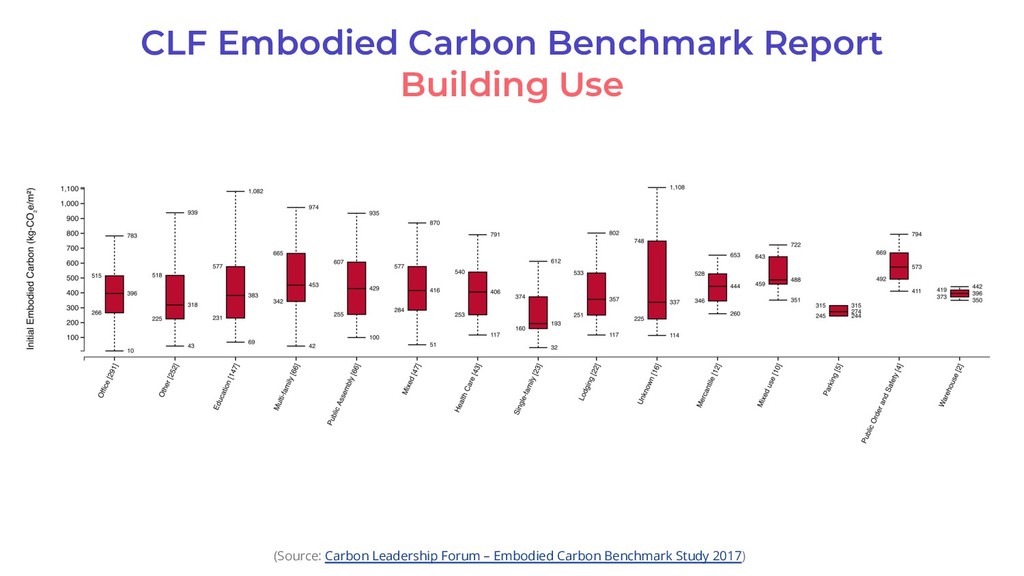
  19. (Source: Carbon Leadership Forum – Embodied Carbon Benchmark Study 2017)

    CLF Embodied Carbon Benchmark Report Building Program
  20. CLF Embodied Carbon Benchmark Report Number of Storeys (Source: Carbon

    Leadership Forum – Embodied Carbon Benchmark Study 2017)
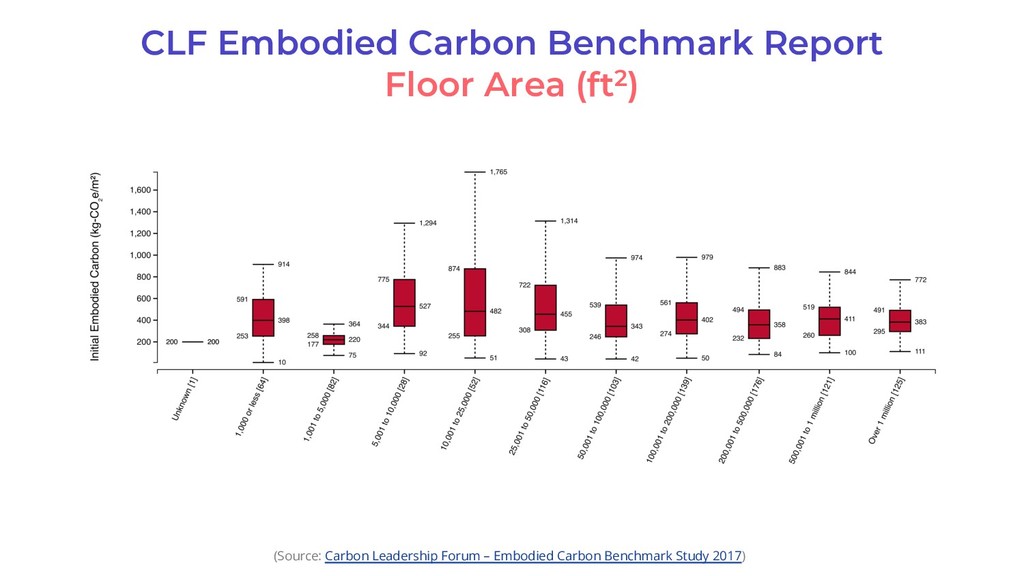
  21. CLF Embodied Carbon Benchmark Report Floor Area (ft2) (Source: Carbon

    Leadership Forum – Embodied Carbon Benchmark Study 2017)
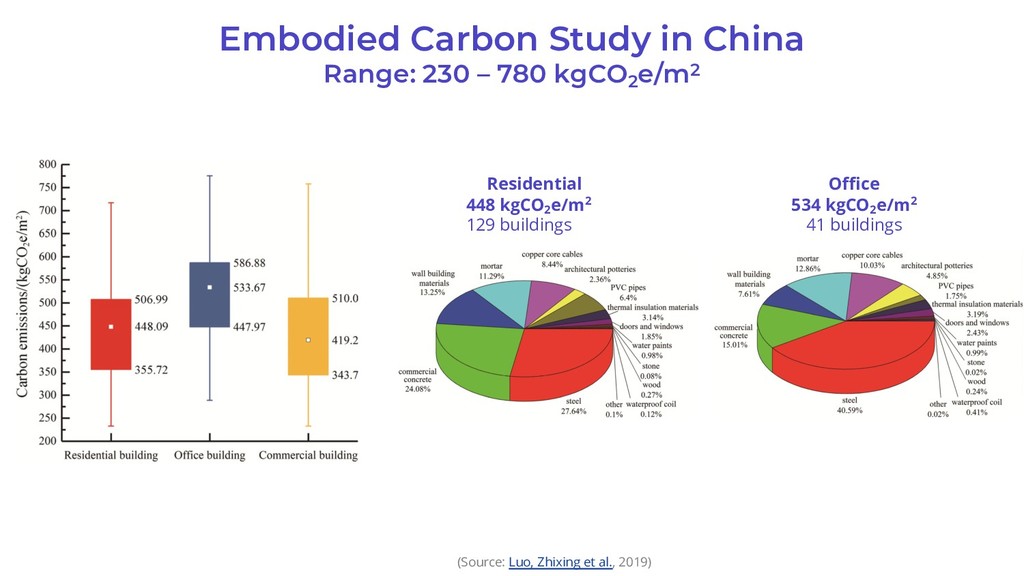
  22. Embodied Carbon Study in China Range: 230 – 780 kgCO2

    e/m2 (Source: Luo, Zhixing et al., 2019) Residential 448 kgCO2 e/m2 129 buildings Office 534 kgCO2 e/m2 41 buildings
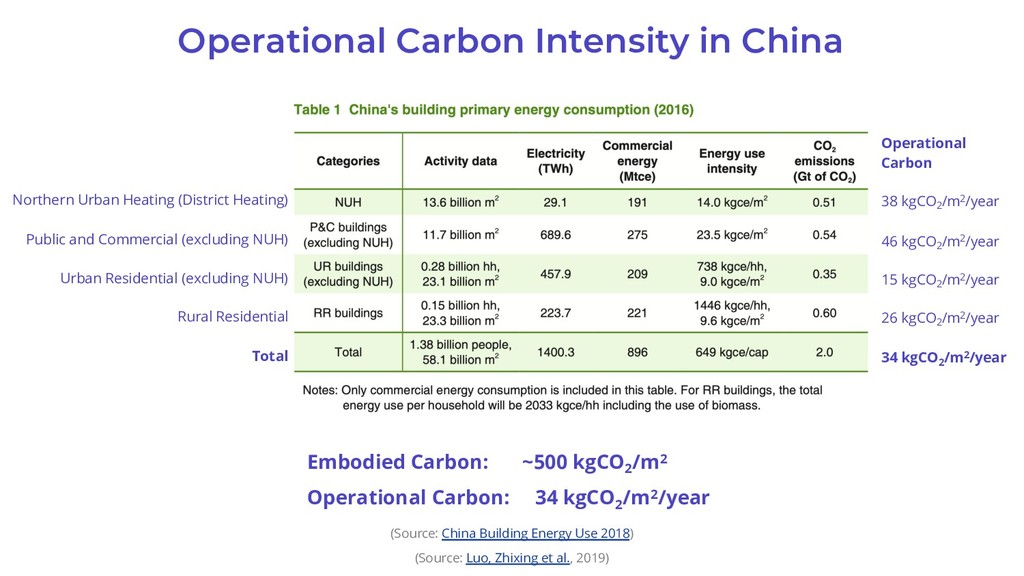
  23. (Source: Luo, Zhixing et al., 2019) Operational Carbon 38 kgCO2

    /m2/year 46 kgCO2 /m2/year 15 kgCO2 /m2/year 26 kgCO2 /m2/year 34 kgCO2 /m2/year Northern Urban Heating (District Heating) Public and Commercial (excluding NUH) Urban Residential (excluding NUH) Rural Residential Total Operational Carbon Intensity in China Embodied Carbon: ~500 kgCO2 /m2 Operational Carbon: 34 kgCO2 /m2/year (Source: China Building Energy Use 2018)
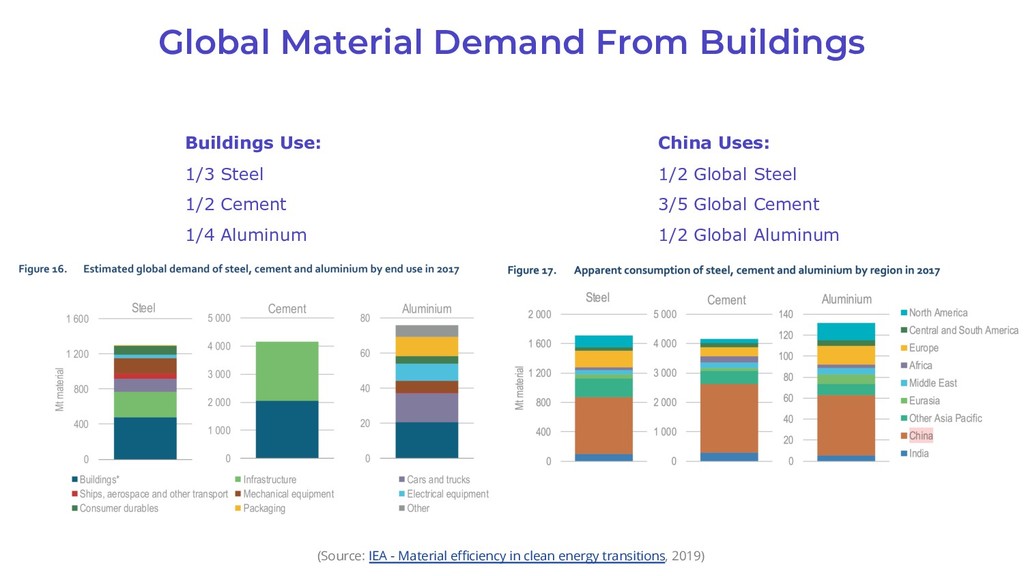
  24. Global Material Demand From Buildings Buildings Use: 1/3 Steel 1/2

    Cement 1/4 Aluminum China Uses: 1/2 Global Steel 3/5 Global Cement 1/2 Global Aluminum (Source: IEA - Material efficiency in clean energy transitions, 2019)
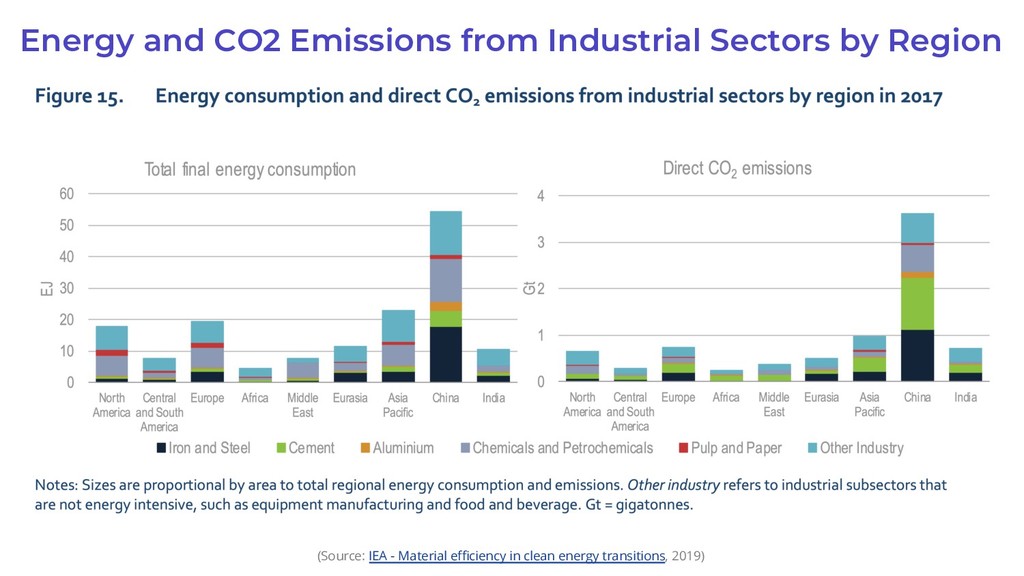
  25. Energy and CO2 Emissions from Industrial Sectors by Region (Source:

    IEA - Material efficiency in clean energy transitions, 2019)
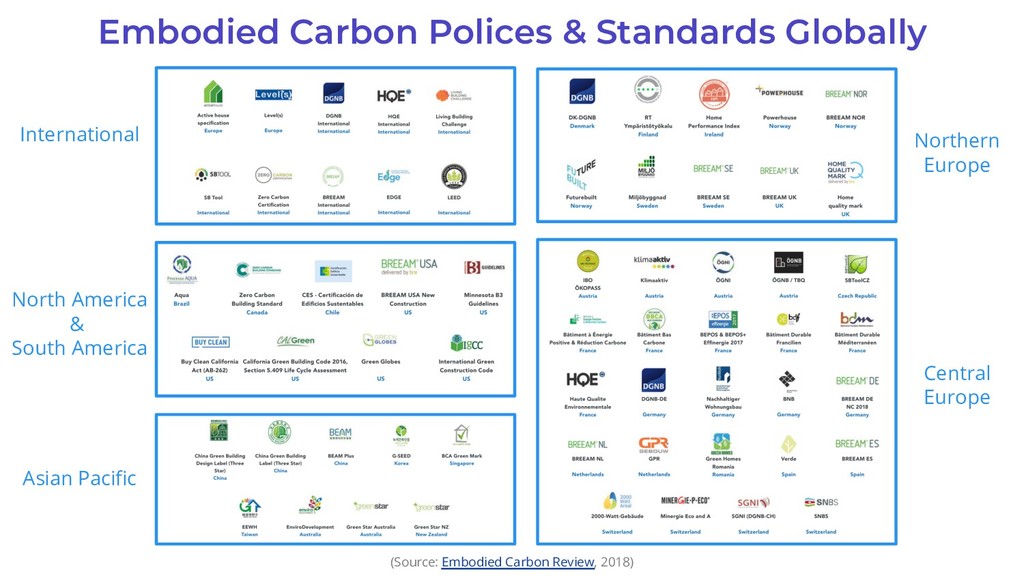
  26. Embodied Carbon Polices & Standards Globally International North America &

    South America Asian Pacific Northern Europe Central Europe (Source: Embodied Carbon Review, 2018)
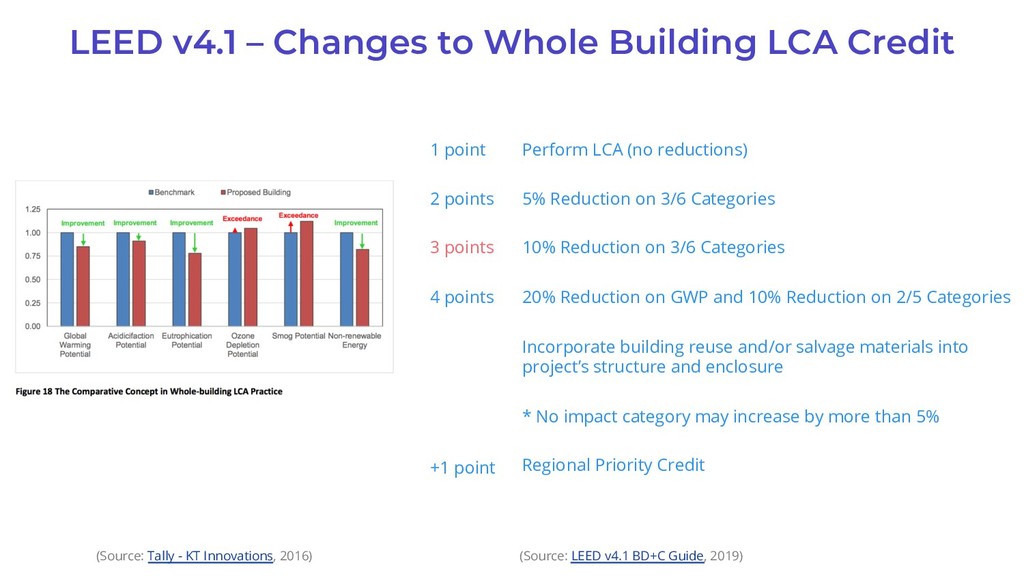
  27. Perform LCA (no reductions) 5% Reduction on 3/6 Categories 10%

    Reduction on 3/6 Categories 20% Reduction on GWP and 10% Reduction on 2/5 Categories Incorporate building reuse and/or salvage materials into project’s structure and enclosure * No impact category may increase by more than 5% Regional Priority Credit LEED v4.1 – Changes to Whole Building LCA Credit 1 point 2 points 3 points 4 points +1 point (Source: Tally - KT Innovations, 2016) (Source: LEED v4.1 BD+C Guide, 2019)
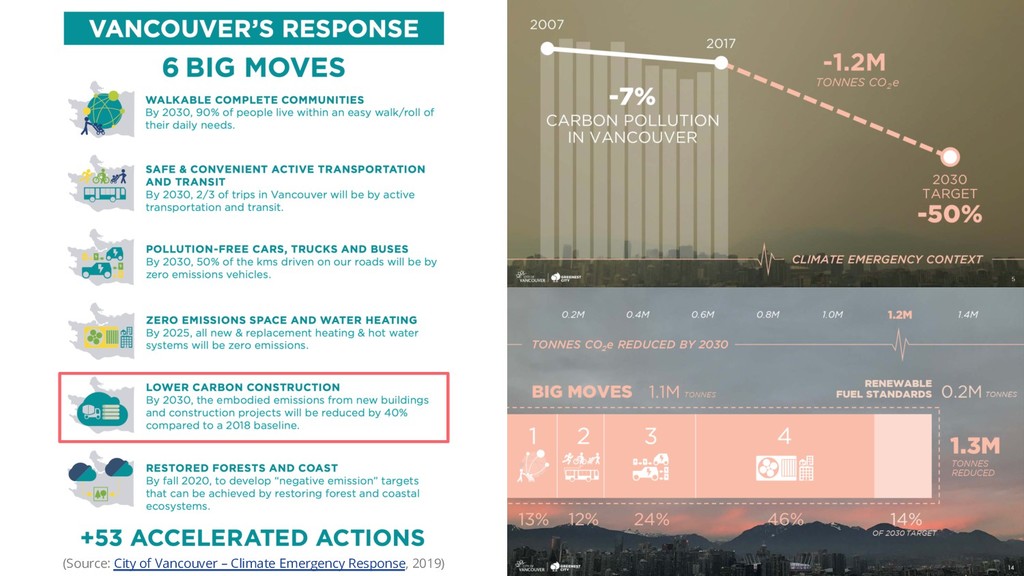
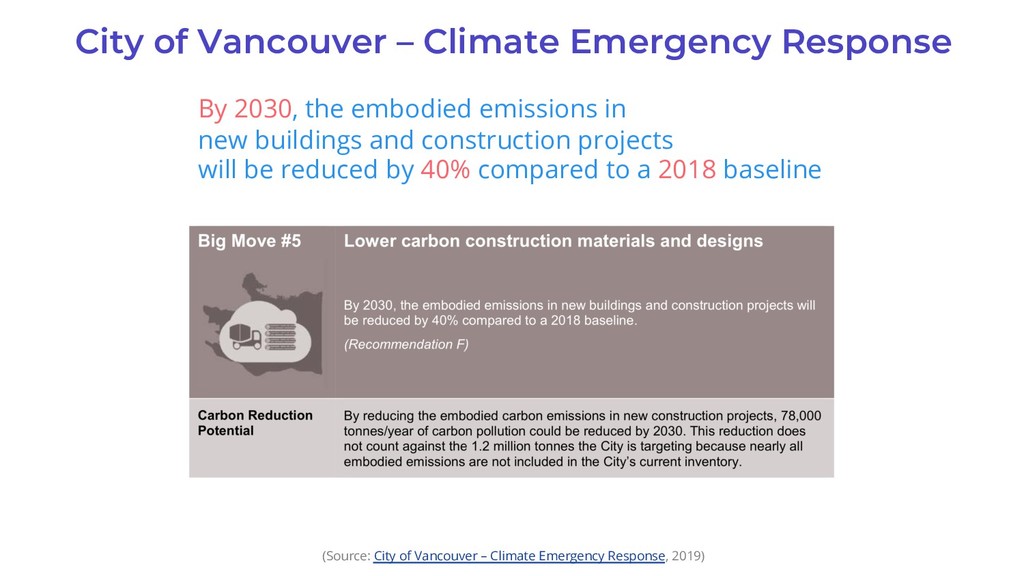
  28. City of Vancouver – Climate Emergency Response By 2030, the

    embodied emissions in new buildings and construction projects will be reduced by 40% compared to a 2018 baseline (Source: City of Vancouver – Climate Emergency Response, 2019)
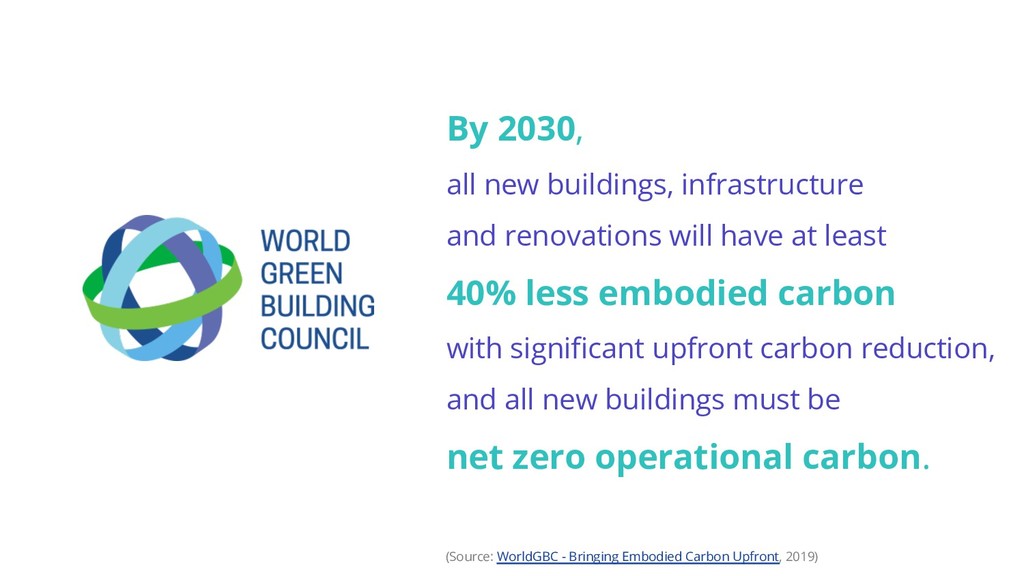
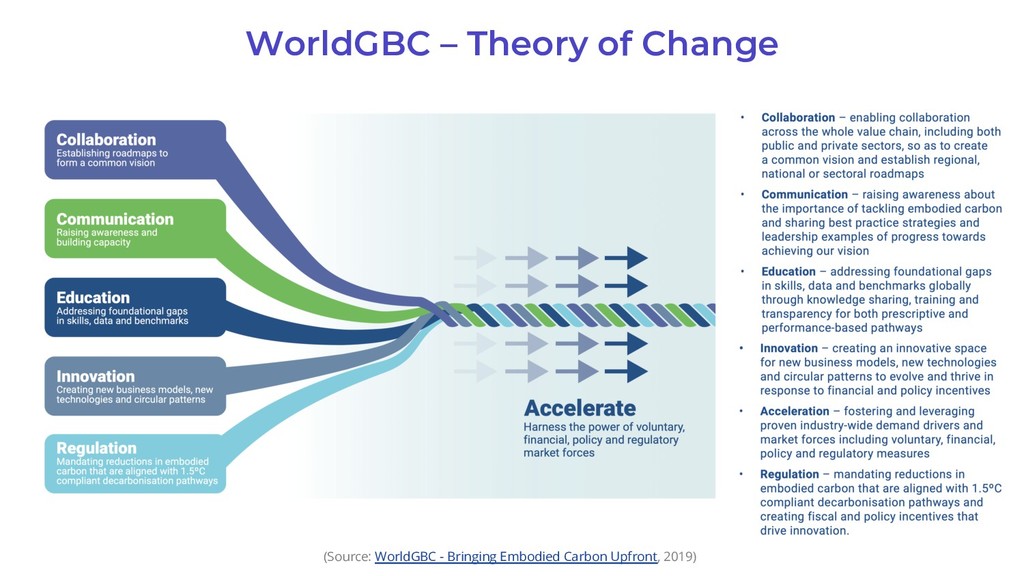
  29. By 2030, all new buildings, infrastructure and renovations will have

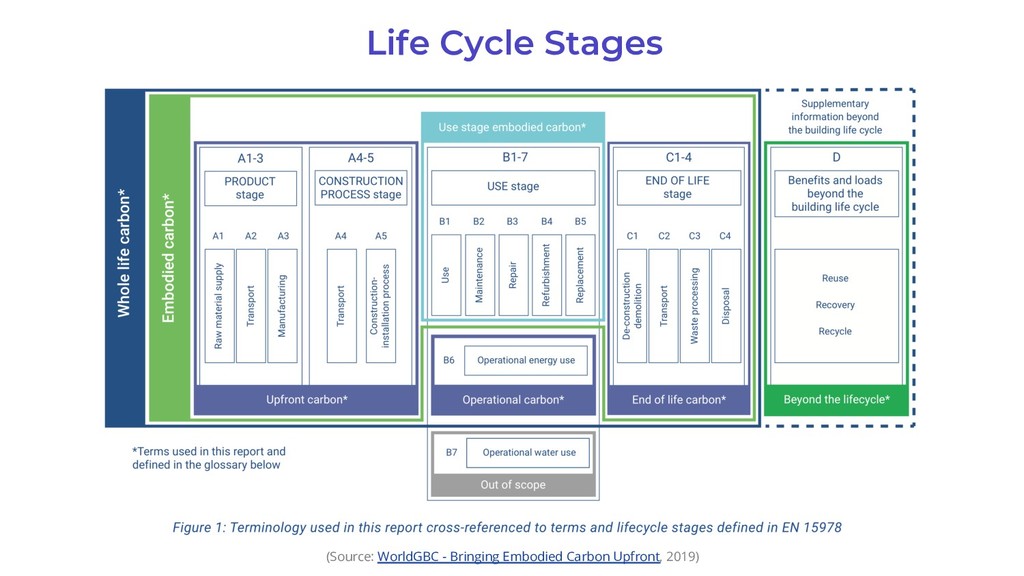
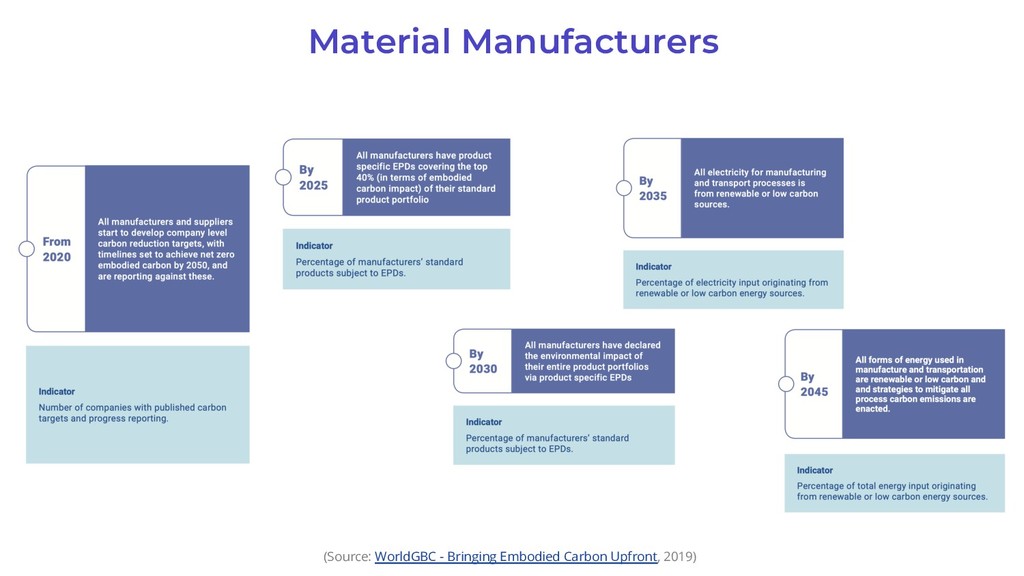
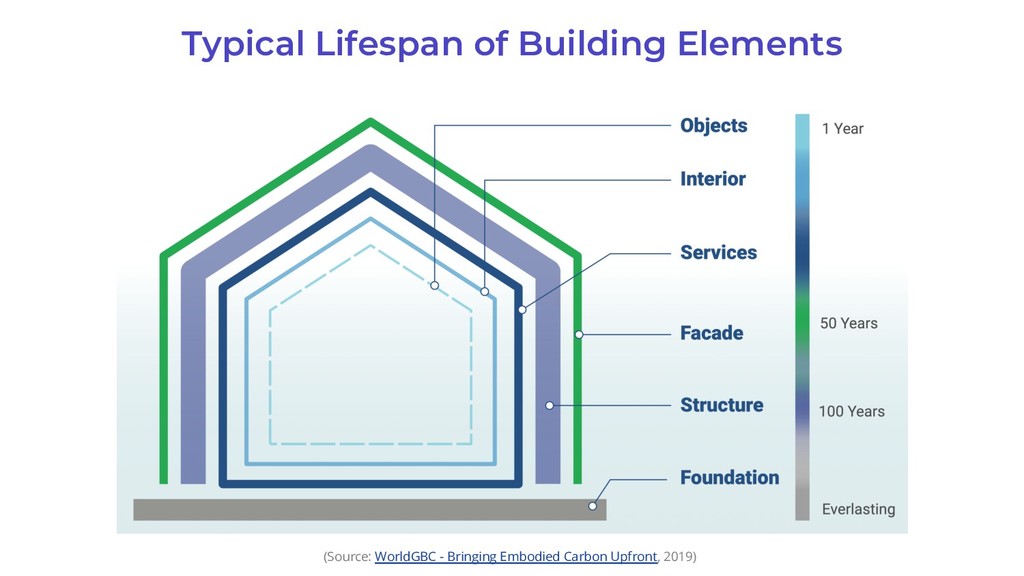
    at least 40% less embodied carbon with significant upfront carbon reduction, and all new buildings must be net zero operational carbon. (Source: WorldGBC - Bringing Embodied Carbon Upfront, 2019)
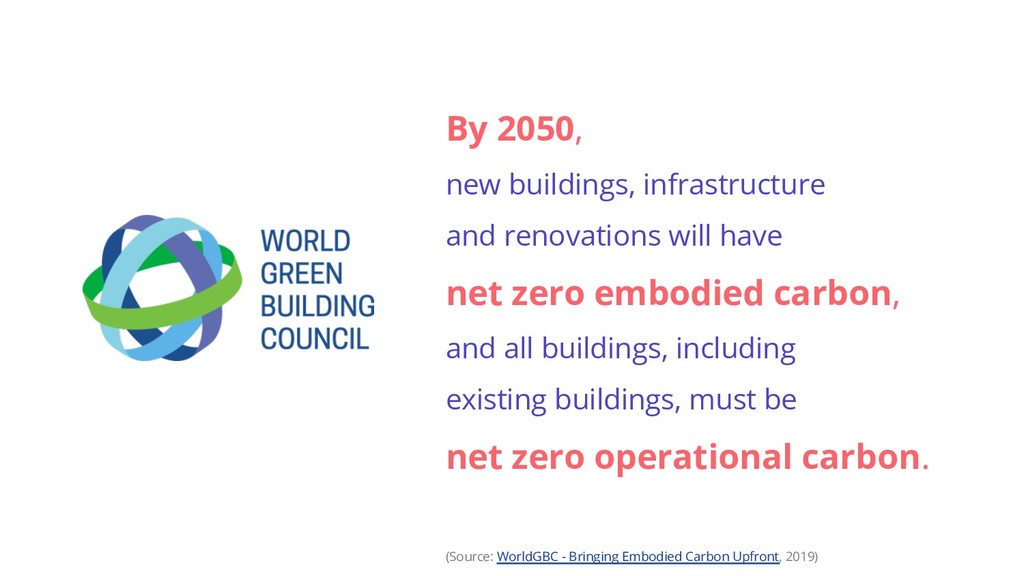
  30. By 2050, new buildings, infrastructure and renovations will have net

    zero embodied carbon, and all buildings, including existing buildings, must be net zero operational carbon. (Source: WorldGBC - Bringing Embodied Carbon Upfront, 2019)
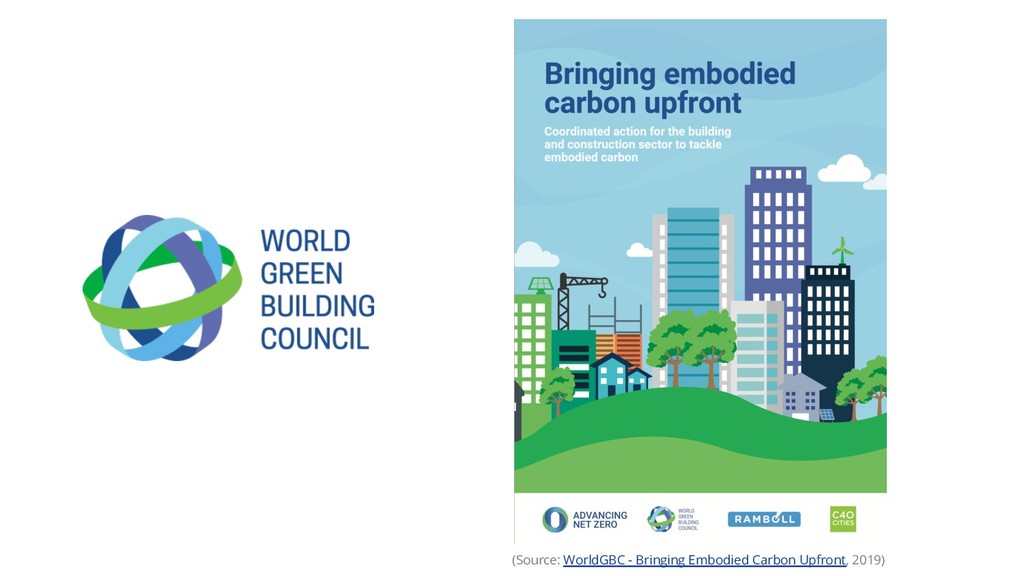
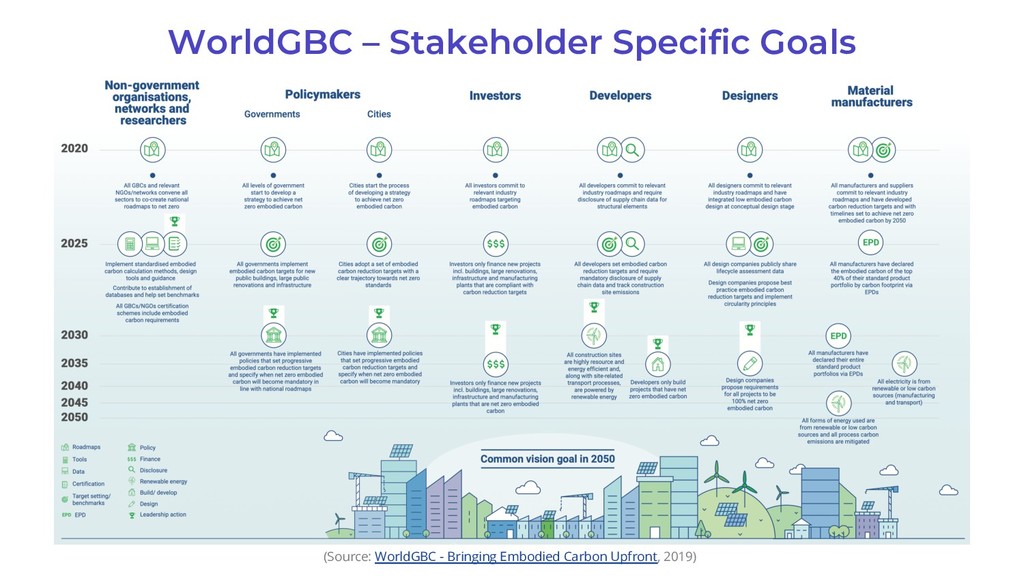
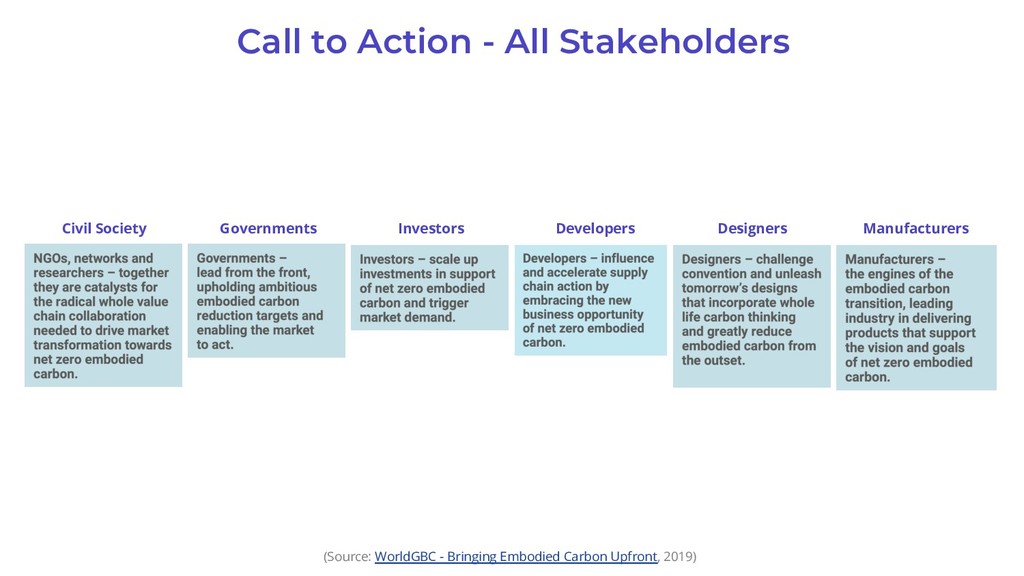
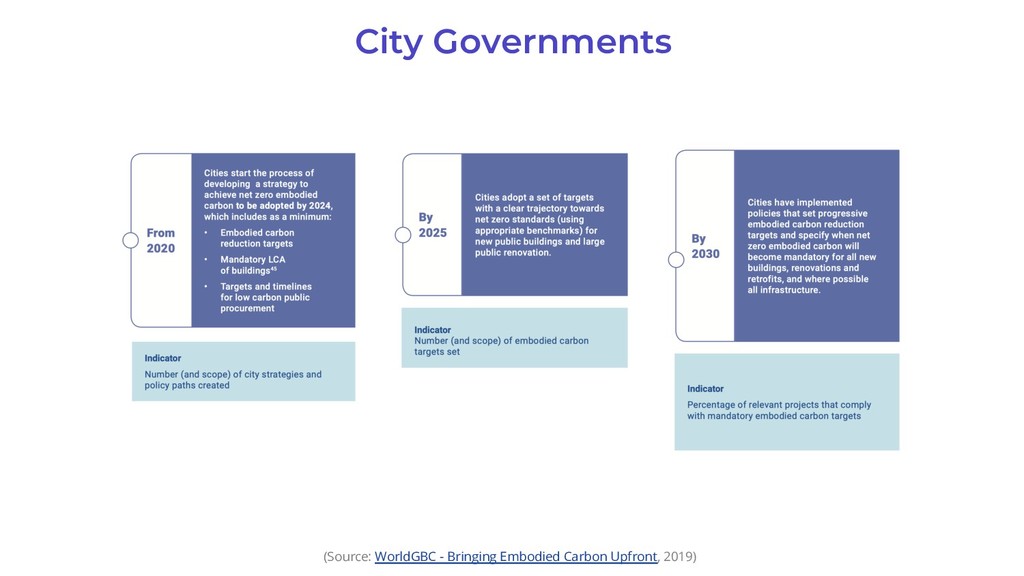
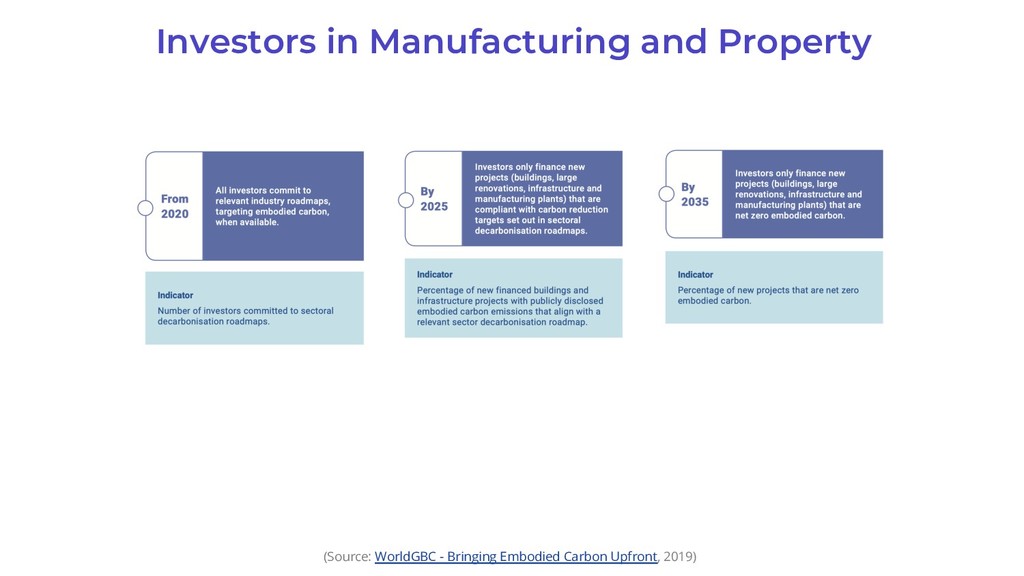
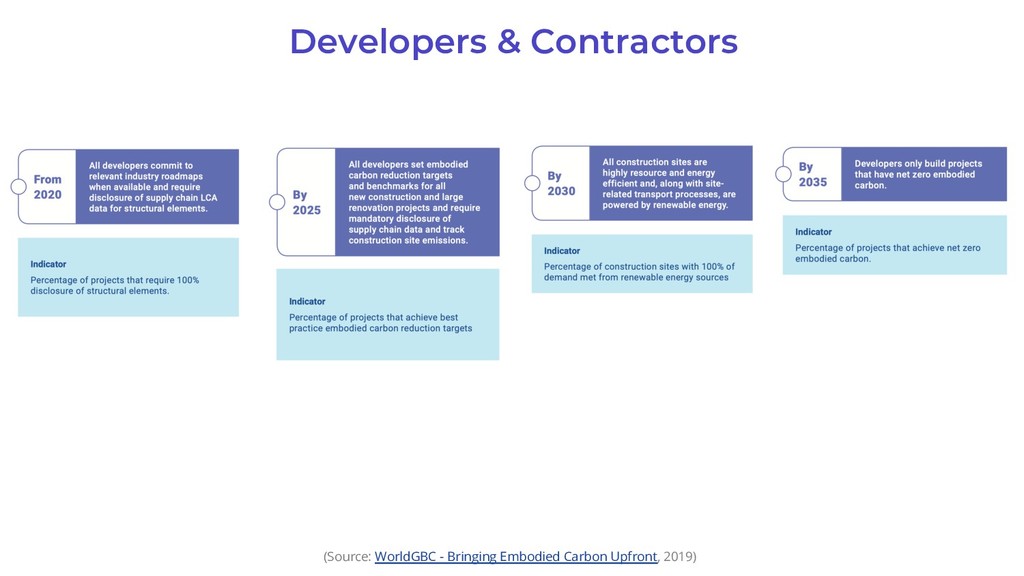
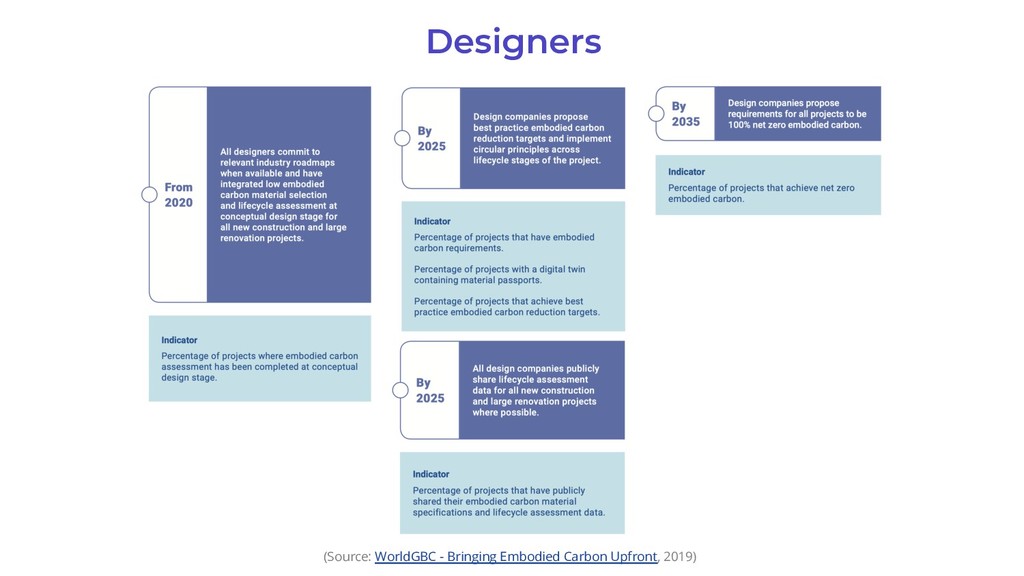
  31. Call to Action - All Stakeholders Civil Society Governments Investors

    Developers Designers Manufacturers (Source: WorldGBC - Bringing Embodied Carbon Upfront, 2019)
  32. Athena Impact Estimator (IE4B) Tally One Click LCA 1. Software

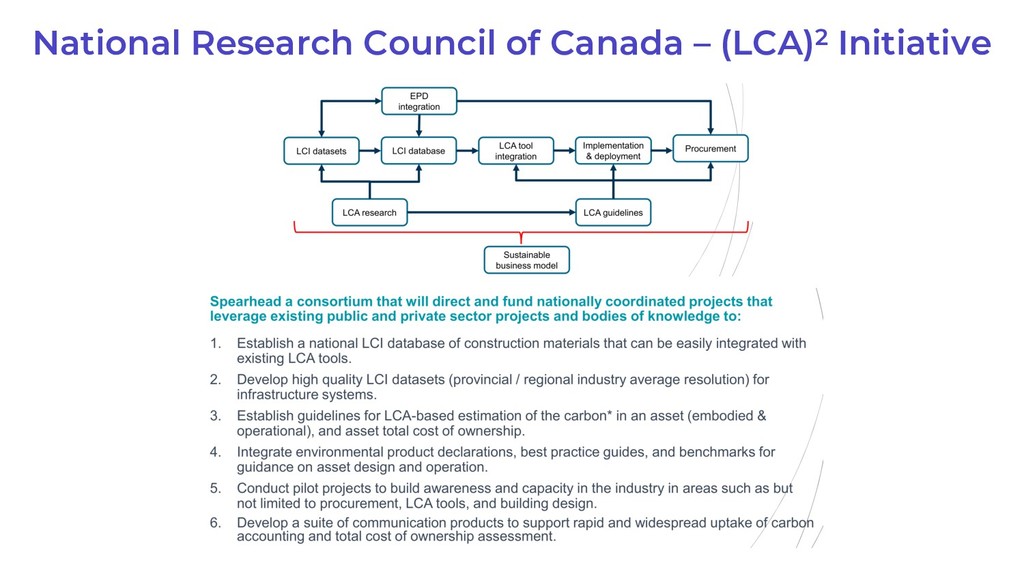
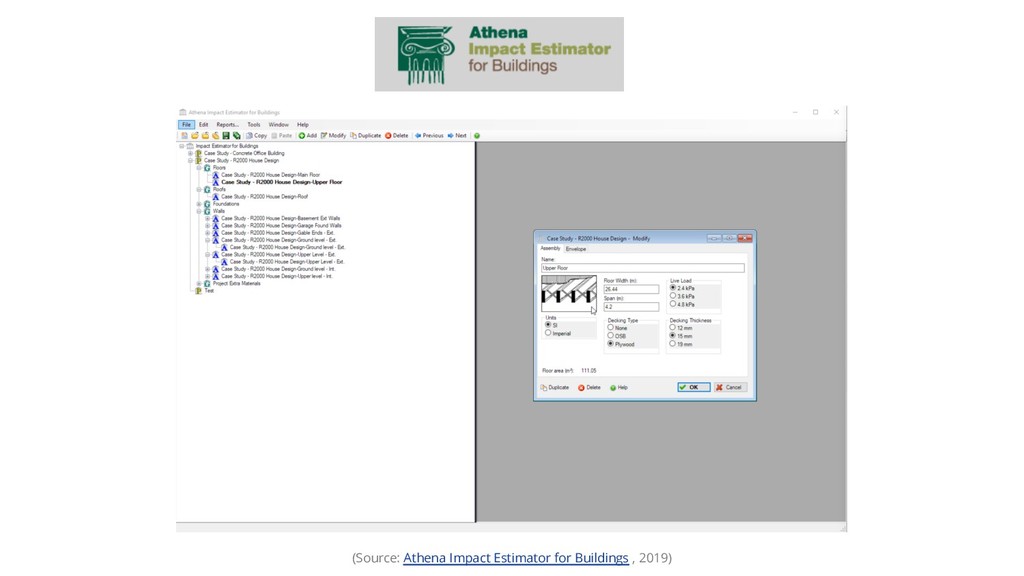
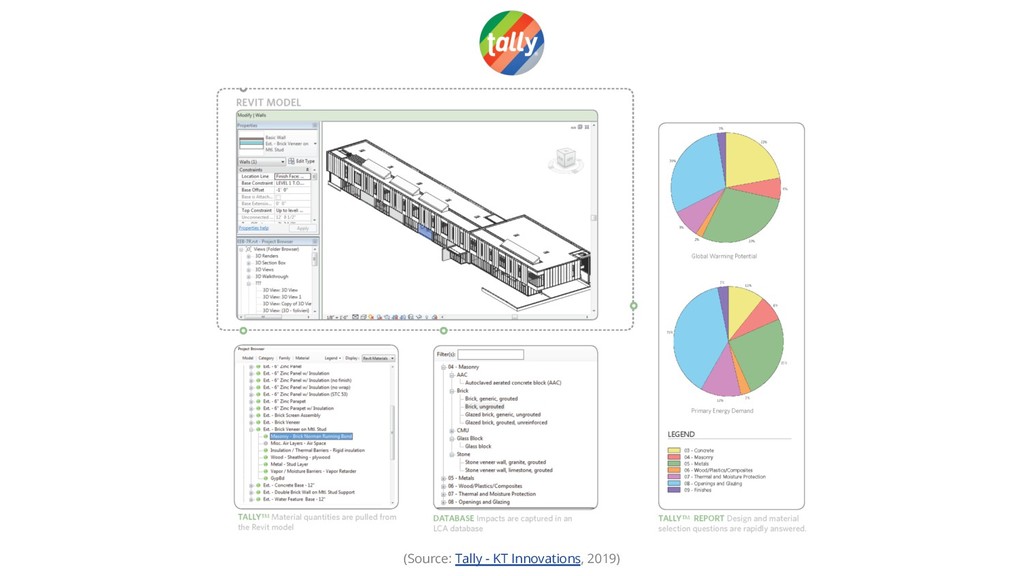
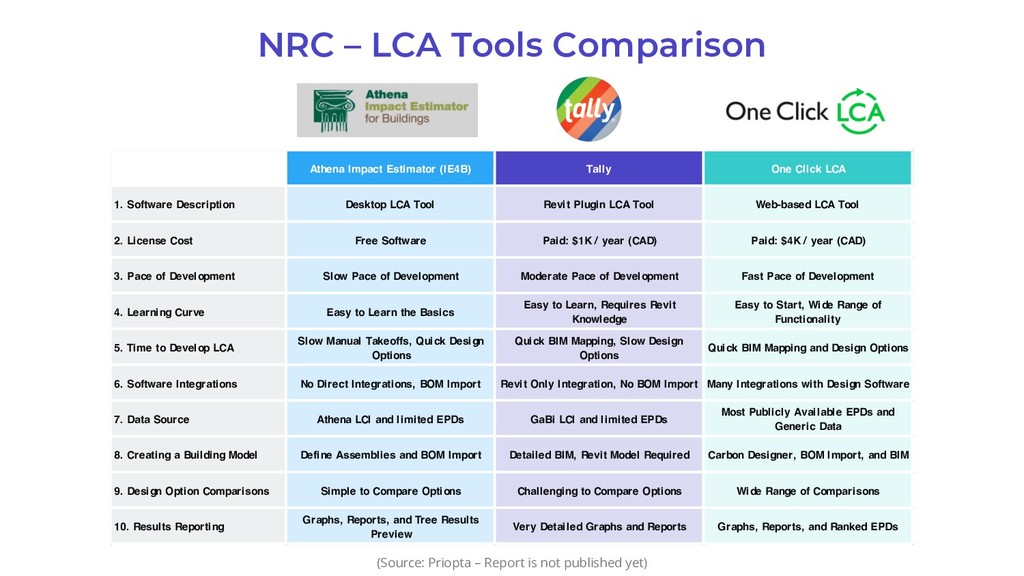
    Description Desktop LCA Tool Revit Plugin LCA Tool Web-based LCA Tool 2. License Cost Free Software Paid: $1K / year (CAD) Paid: $4K / year (CAD) 3. Pace of Development Slow Pace of Development Moderate Pace of Development Fast Pace of Development 4. Learning Curve Easy to Learn the Basics Easy to Learn, Requires Revit Knowledge Easy to Start, Wide Range of Functionality 5. Time to Develop LCA Slow Manual Takeoffs, Quick Design Options Quick BIM Mapping, Slow Design Options Quick BIM Mapping and Design Options 6. Software Integrations No Direct Integrations, BOM Import Revit Only Integration, No BOM Import Many Integrations with Design Software 7. Data Source Athena LCI and limited EPDs GaBi LCI and limited EPDs Most Publicly Available EPDs and Generic Data 8. Creating a Building Model Define Assemblies and BOM Import Detailed BIM, Revit Model Required Carbon Designer, BOM Import, and BIM 9. Design Option Comparisons Simple to Compare Options Challenging to Compare Options Wide Range of Comparisons 10. Results Reporting Graphs, Reports, and Tree Results Preview Very Detailed Graphs and Reports Graphs, Reports, and Ranked EPDs NRC – LCA Tools Comparison (Source: Priopta – Report is not published yet)
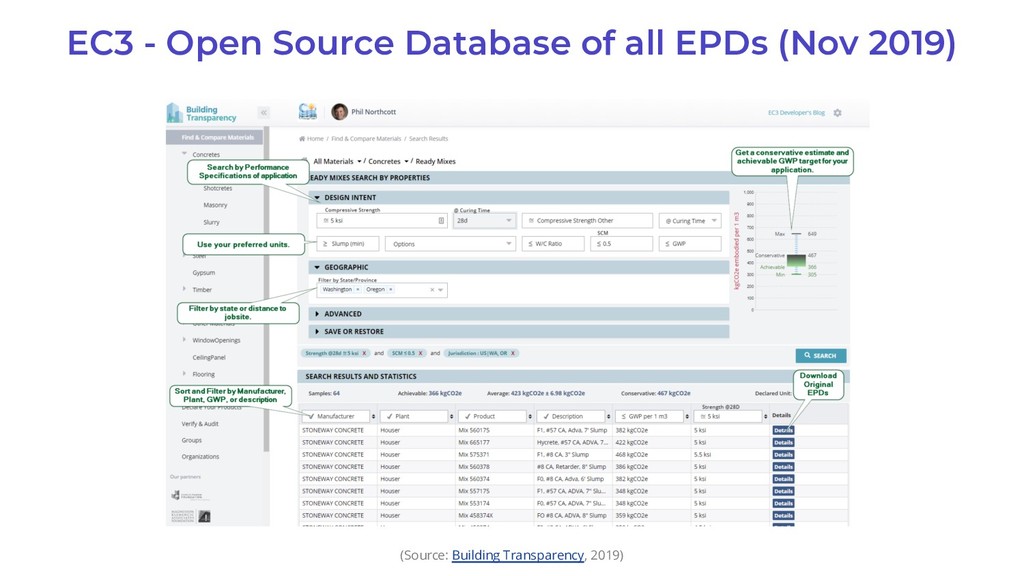
  33. EC3 - Open Source Database of all EPDs (Nov 2019)

    (Source: Building Transparency, 2019)
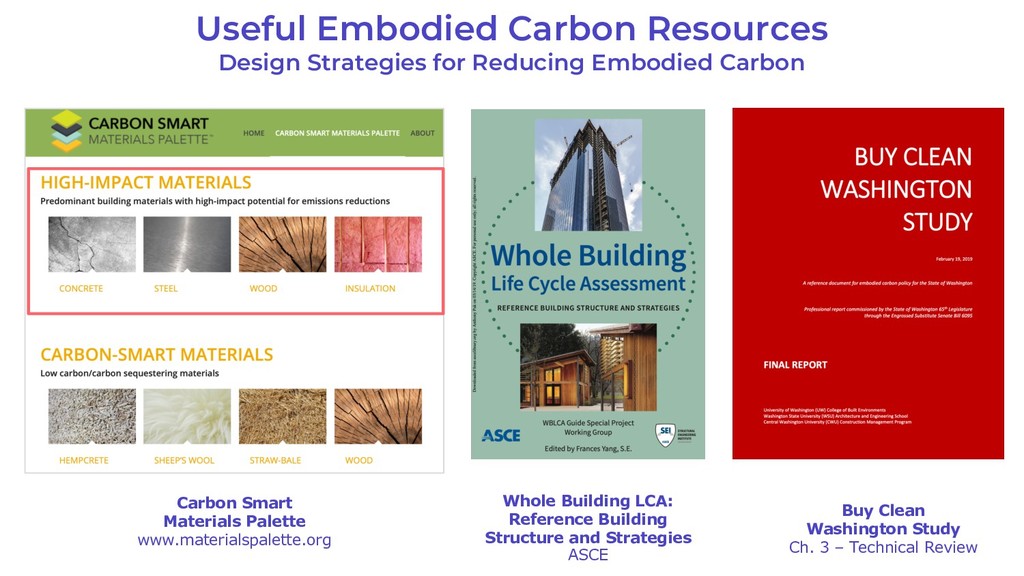
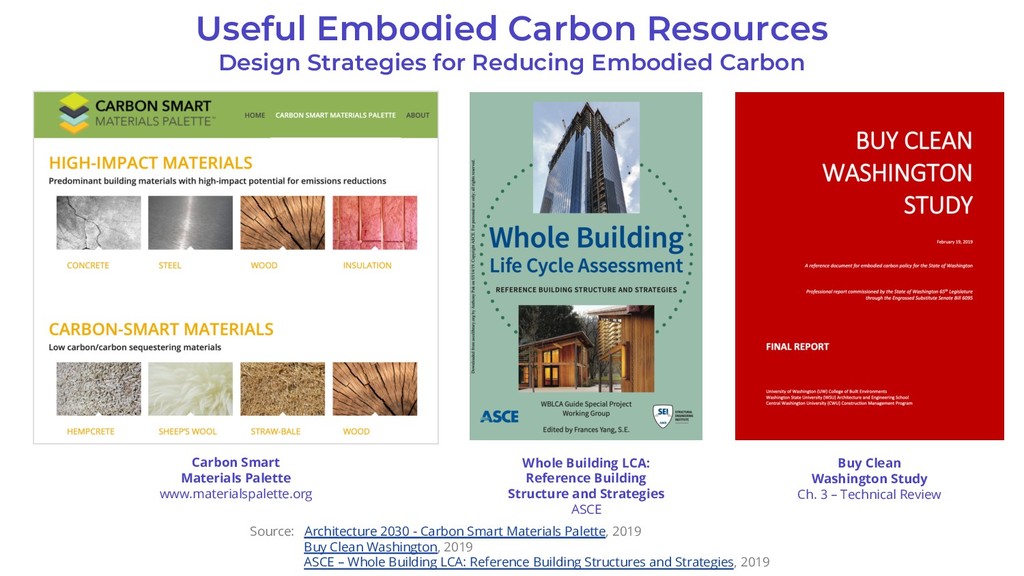
  34. Useful Embodied Carbon Resources Design Strategies for Reducing Embodied Carbon

    Carbon Smart Materials Palette www.materialspalette.org Whole Building LCA: Reference Building Structure and Strategies ASCE Buy Clean Washington Study Ch. 3 – Technical Review
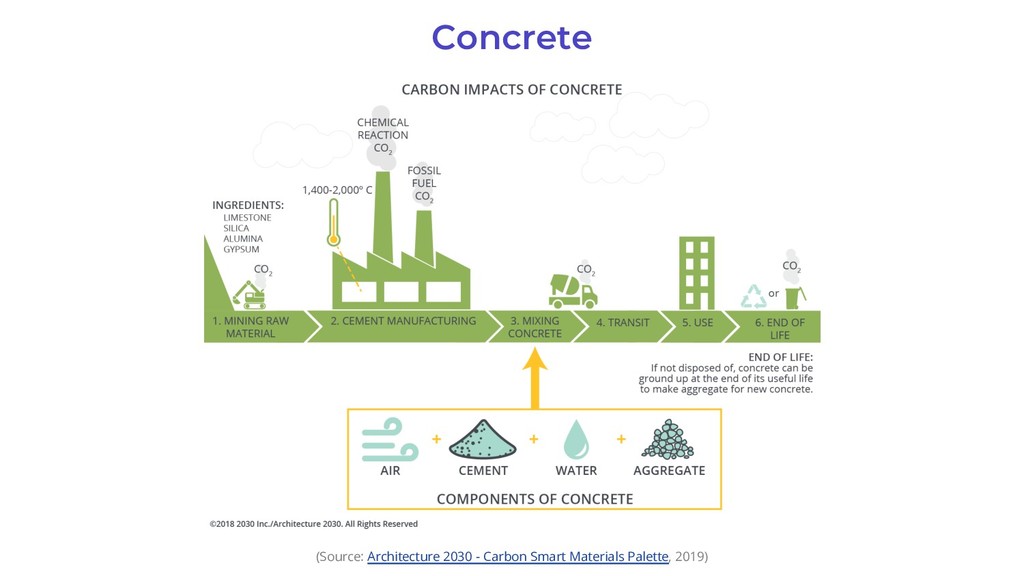
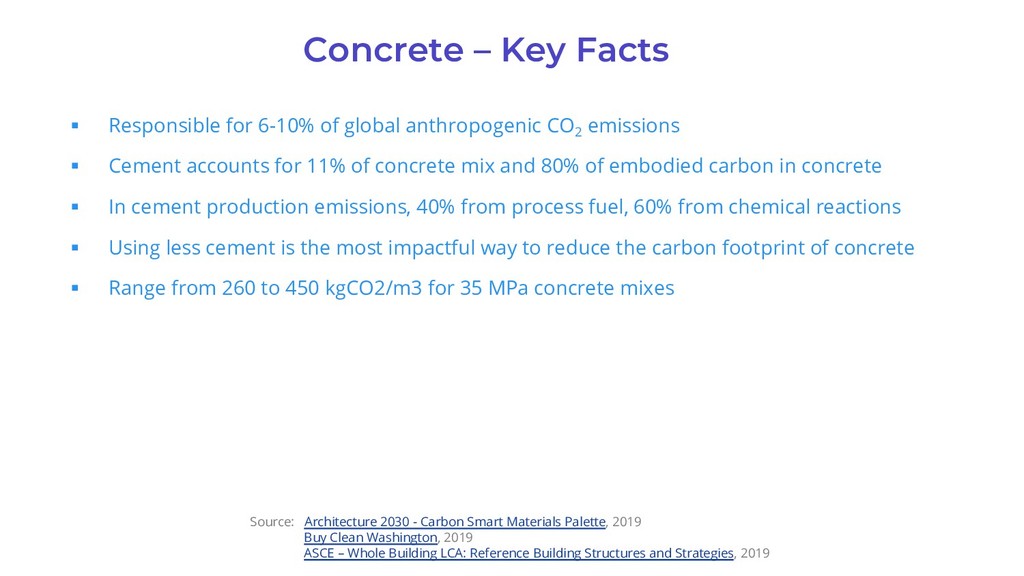
  35. Concrete – Key Facts § Responsible for 6-10% of global

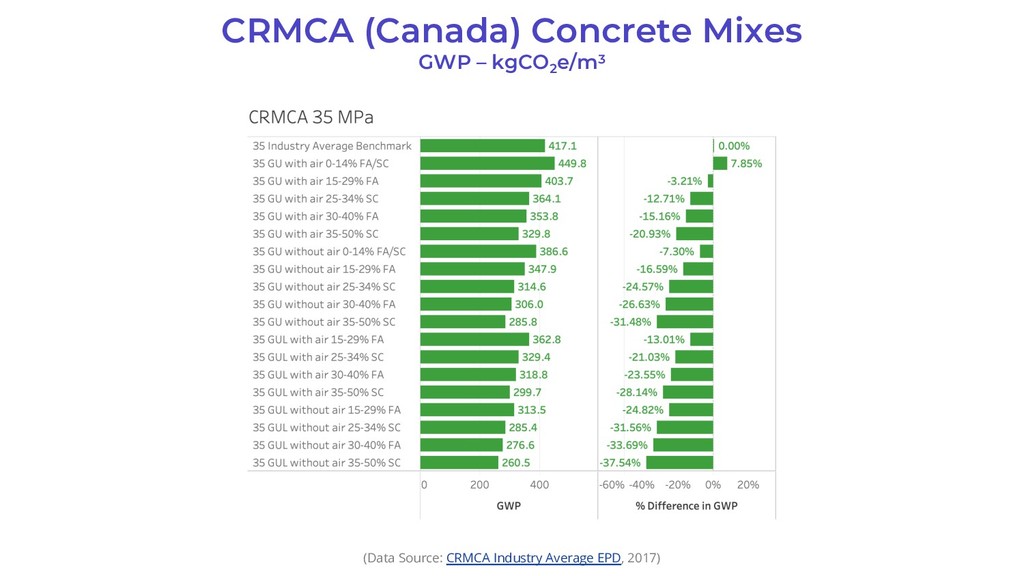
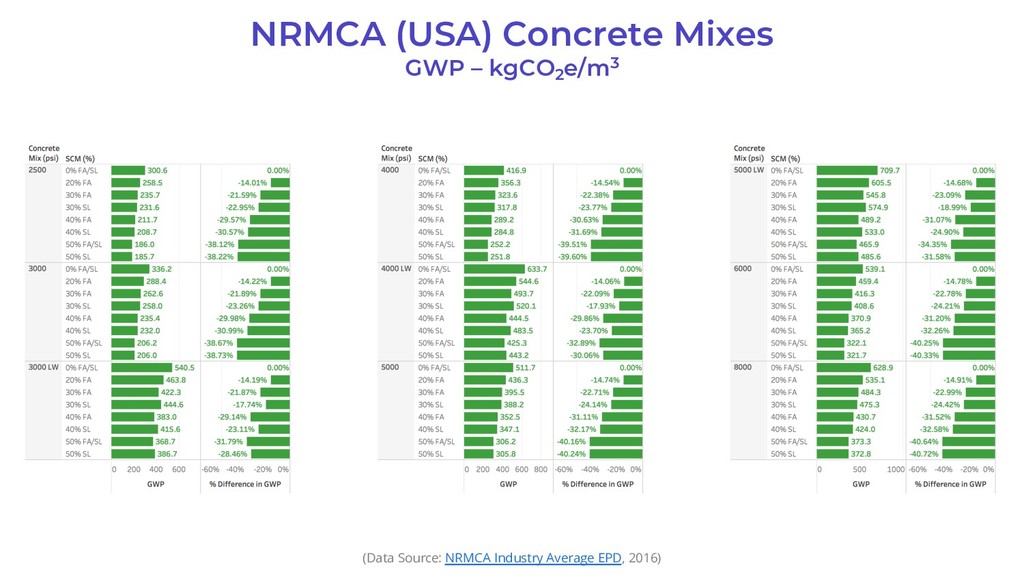
    anthropogenic CO2 emissions § Cement accounts for 11% of concrete mix and 80% of embodied carbon in concrete § In cement production emissions, 40% from process fuel, 60% from chemical reactions § Using less cement is the most impactful way to reduce the carbon footprint of concrete § Range from 260 to 450 kgCO2/m3 for 35 MPa concrete mixes Source: Architecture 2030 - Carbon Smart Materials Palette, 2019 Buy Clean Washington, 2019 ASCE – Whole Building LCA: Reference Building Structures and Strategies, 2019
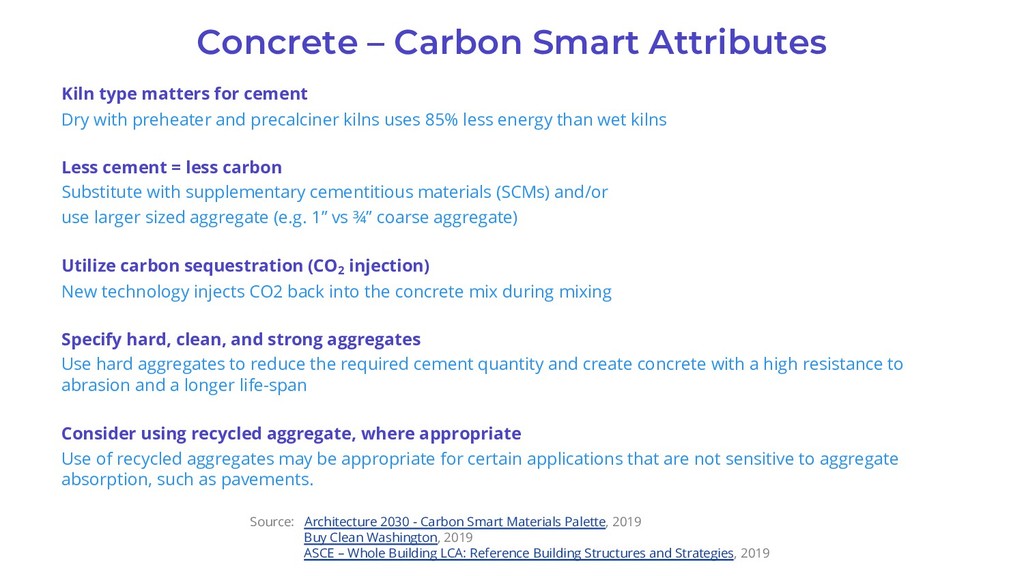
  36. Concrete – Carbon Smart Attributes Kiln type matters for cement

    Dry with preheater and precalciner kilns uses 85% less energy than wet kilns Less cement = less carbon Substitute with supplementary cementitious materials (SCMs) and/or use larger sized aggregate (e.g. 1” vs ¾” coarse aggregate) Utilize carbon sequestration (CO2 injection) New technology injects CO2 back into the concrete mix during mixing Specify hard, clean, and strong aggregates Use hard aggregates to reduce the required cement quantity and create concrete with a high resistance to abrasion and a longer life-span Consider using recycled aggregate, where appropriate Use of recycled aggregates may be appropriate for certain applications that are not sensitive to aggregate absorption, such as pavements. Source: Architecture 2030 - Carbon Smart Materials Palette, 2019 Buy Clean Washington, 2019 ASCE – Whole Building LCA: Reference Building Structures and Strategies, 2019
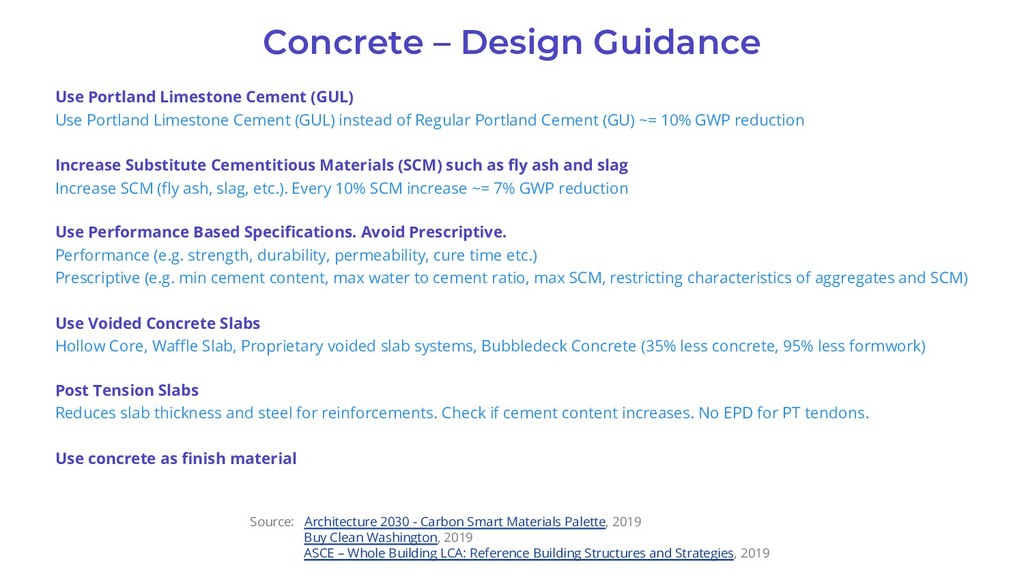
  37. Concrete – Design Guidance Use Portland Limestone Cement (GUL) Use

    Portland Limestone Cement (GUL) instead of Regular Portland Cement (GU) ~= 10% GWP reduction Increase Substitute Cementitious Materials (SCM) such as fly ash and slag Increase SCM (fly ash, slag, etc.). Every 10% SCM increase ~= 7% GWP reduction Use Performance Based Specifications. Avoid Prescriptive. Performance (e.g. strength, durability, permeability, cure time etc.) Prescriptive (e.g. min cement content, max water to cement ratio, max SCM, restricting characteristics of aggregates and SCM) Use Voided Concrete Slabs Hollow Core, Waffle Slab, Proprietary voided slab systems, Bubbledeck Concrete (35% less concrete, 95% less formwork) Post Tension Slabs Reduces slab thickness and steel for reinforcements. Check if cement content increases. No EPD for PT tendons. Use concrete as finish material Source: Architecture 2030 - Carbon Smart Materials Palette, 2019 Buy Clean Washington, 2019 ASCE – Whole Building LCA: Reference Building Structures and Strategies, 2019
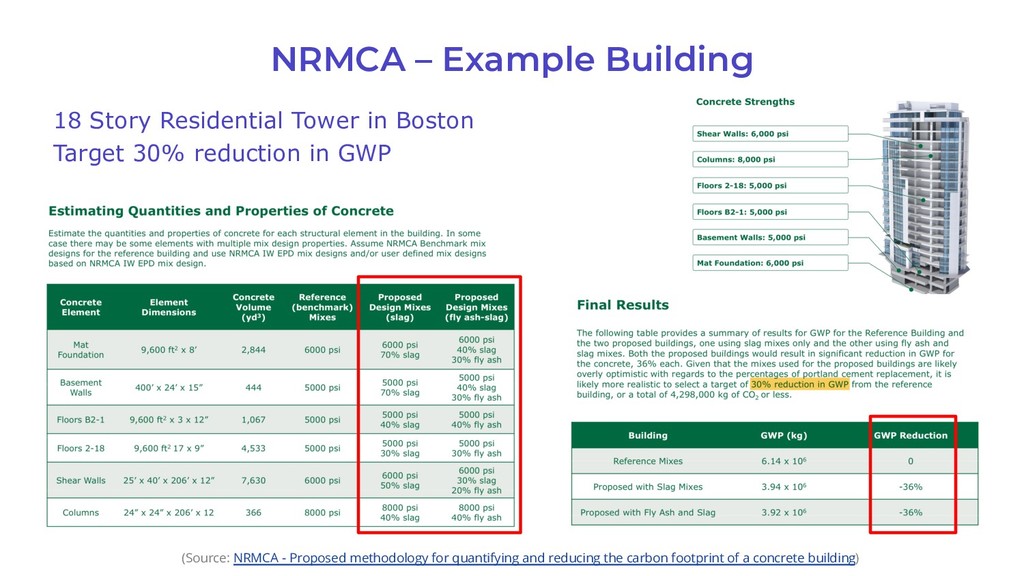
  38. NRMCA – Example Building 18 Story Residential Tower in Boston

    Target 30% reduction in GWP (Source: NRMCA - Proposed methodology for quantifying and reducing the carbon footprint of a concrete building)
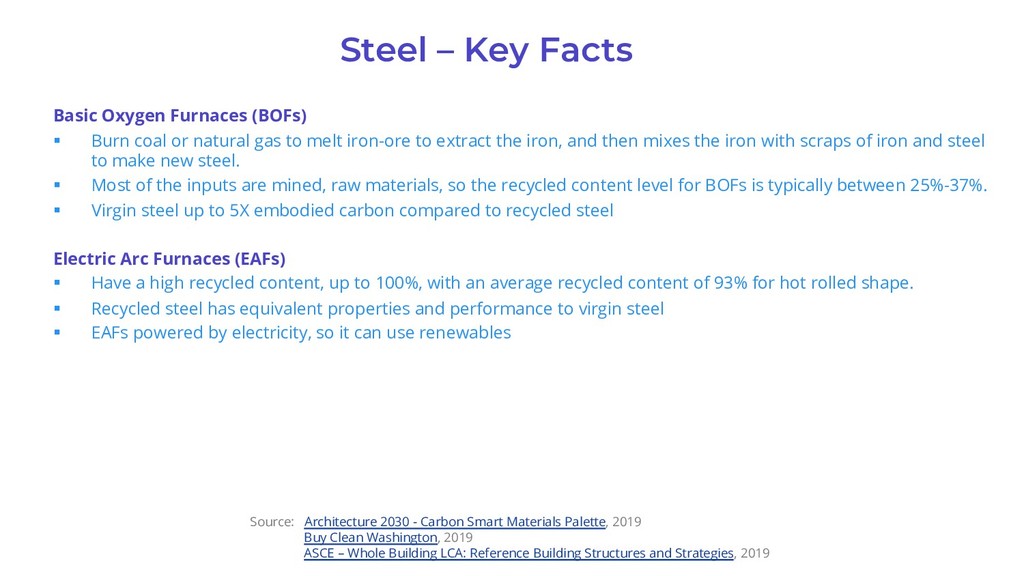
  39. Steel – Key Facts Basic Oxygen Furnaces (BOFs) § Burn

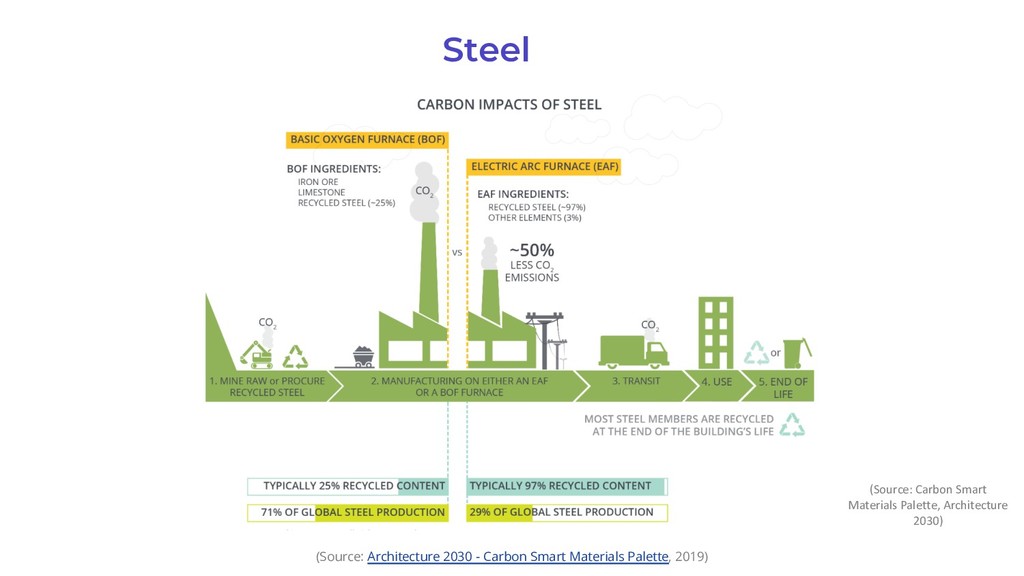
    coal or natural gas to melt iron-ore to extract the iron, and then mixes the iron with scraps of iron and steel to make new steel. § Most of the inputs are mined, raw materials, so the recycled content level for BOFs is typically between 25%-37%. § Virgin steel up to 5X embodied carbon compared to recycled steel Electric Arc Furnaces (EAFs) § Have a high recycled content, up to 100%, with an average recycled content of 93% for hot rolled shape. § Recycled steel has equivalent properties and performance to virgin steel § EAFs powered by electricity, so it can use renewables Source: Architecture 2030 - Carbon Smart Materials Palette, 2019 Buy Clean Washington, 2019 ASCE – Whole Building LCA: Reference Building Structures and Strategies, 2019
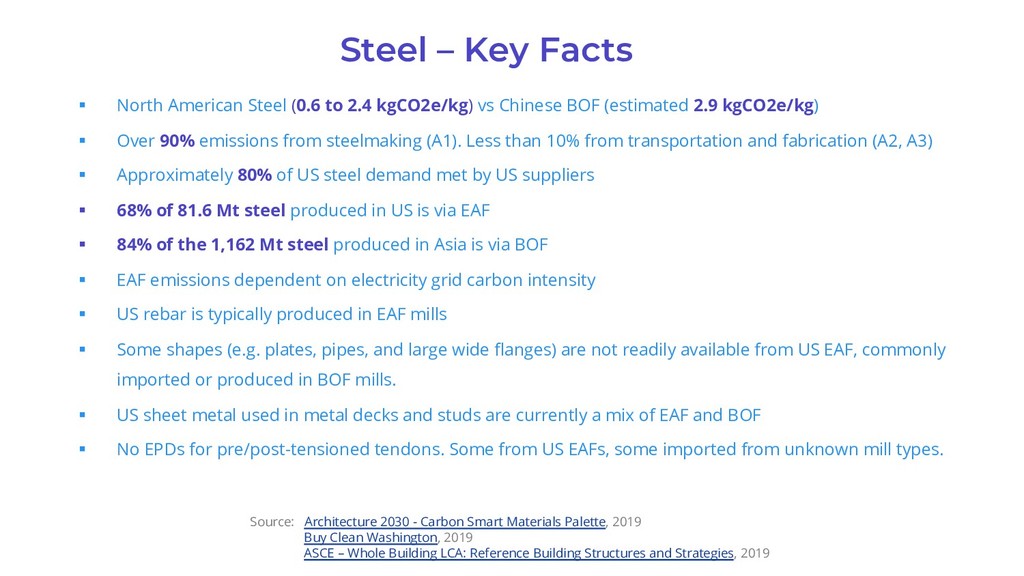
  40. § North American Steel (0.6 to 2.4 kgCO2e/kg) vs Chinese

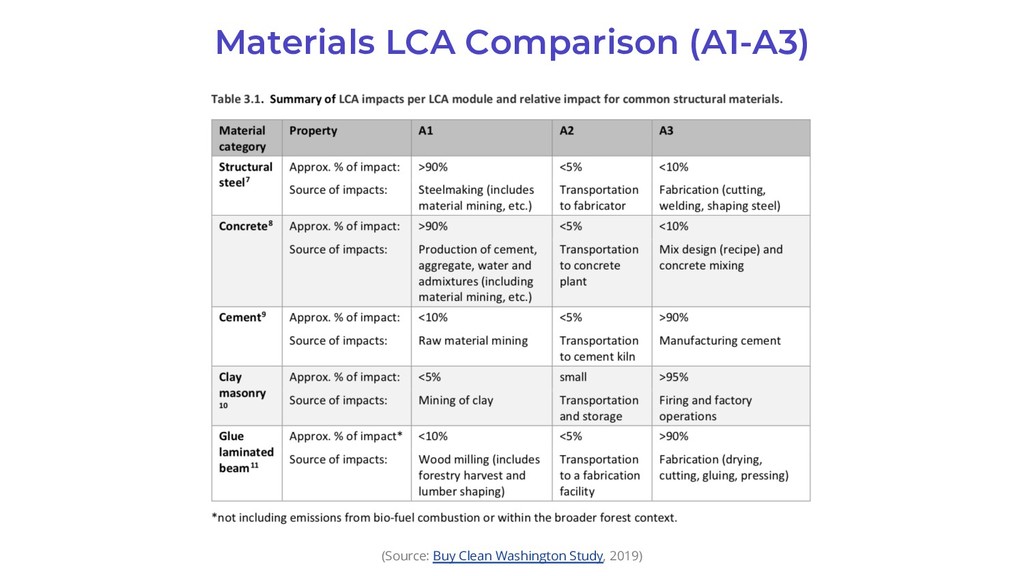
    BOF (estimated 2.9 kgCO2e/kg) § Over 90% emissions from steelmaking (A1). Less than 10% from transportation and fabrication (A2, A3) § Approximately 80% of US steel demand met by US suppliers § 68% of 81.6 Mt steel produced in US is via EAF § 84% of the 1,162 Mt steel produced in Asia is via BOF § EAF emissions dependent on electricity grid carbon intensity § US rebar is typically produced in EAF mills § Some shapes (e.g. plates, pipes, and large wide flanges) are not readily available from US EAF, commonly imported or produced in BOF mills. § US sheet metal used in metal decks and studs are currently a mix of EAF and BOF § No EPDs for pre/post-tensioned tendons. Some from US EAFs, some imported from unknown mill types. Steel – Key Facts Source: Architecture 2030 - Carbon Smart Materials Palette, 2019 Buy Clean Washington, 2019 ASCE – Whole Building LCA: Reference Building Structures and Strategies, 2019
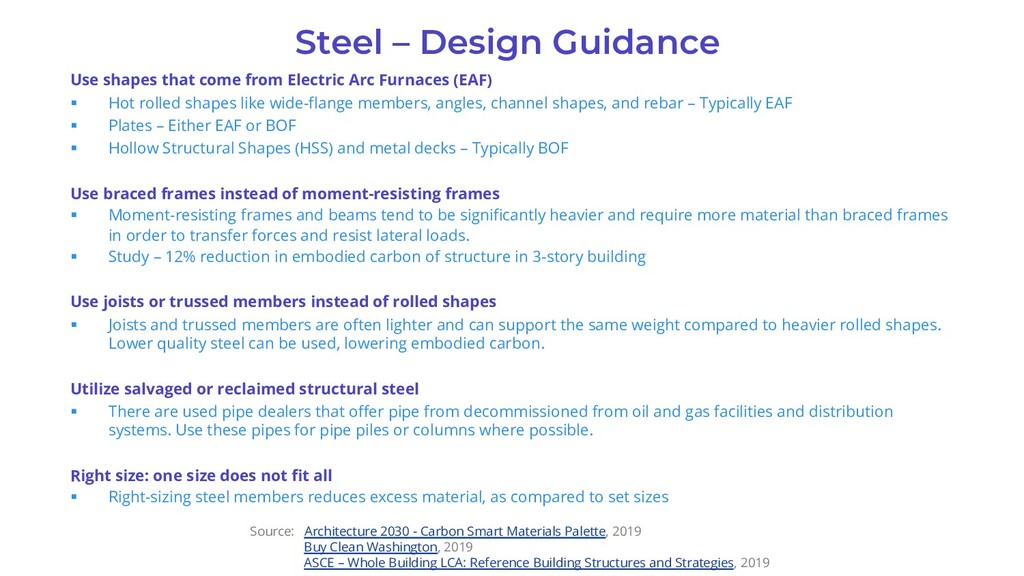
  41. Steel – Design Guidance Use shapes that come from Electric

    Arc Furnaces (EAF) § Hot rolled shapes like wide-flange members, angles, channel shapes, and rebar – Typically EAF § Plates – Either EAF or BOF § Hollow Structural Shapes (HSS) and metal decks – Typically BOF Use braced frames instead of moment-resisting frames § Moment-resisting frames and beams tend to be significantly heavier and require more material than braced frames in order to transfer forces and resist lateral loads. § Study – 12% reduction in embodied carbon of structure in 3-story building Use joists or trussed members instead of rolled shapes § Joists and trussed members are often lighter and can support the same weight compared to heavier rolled shapes. Lower quality steel can be used, lowering embodied carbon. Utilize salvaged or reclaimed structural steel § There are used pipe dealers that offer pipe from decommissioned from oil and gas facilities and distribution systems. Use these pipes for pipe piles or columns where possible. Right size: one size does not fit all § Right-sizing steel members reduces excess material, as compared to set sizes Source: Architecture 2030 - Carbon Smart Materials Palette, 2019 Buy Clean Washington, 2019 ASCE – Whole Building LCA: Reference Building Structures and Strategies, 2019
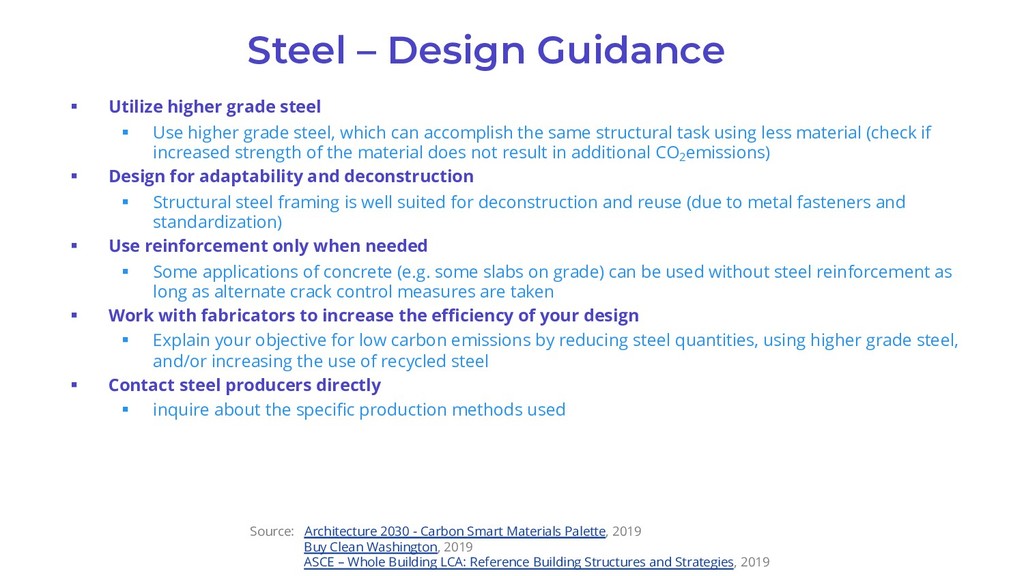
  42. Steel – Design Guidance § Utilize higher grade steel §

    Use higher grade steel, which can accomplish the same structural task using less material (check if increased strength of the material does not result in additional CO2 emissions) § Design for adaptability and deconstruction § Structural steel framing is well suited for deconstruction and reuse (due to metal fasteners and standardization) § Use reinforcement only when needed § Some applications of concrete (e.g. some slabs on grade) can be used without steel reinforcement as long as alternate crack control measures are taken § Work with fabricators to increase the efficiency of your design § Explain your objective for low carbon emissions by reducing steel quantities, using higher grade steel, and/or increasing the use of recycled steel § Contact steel producers directly § inquire about the specific production methods used Source: Architecture 2030 - Carbon Smart Materials Palette, 2019 Buy Clean Washington, 2019 ASCE – Whole Building LCA: Reference Building Structures and Strategies, 2019
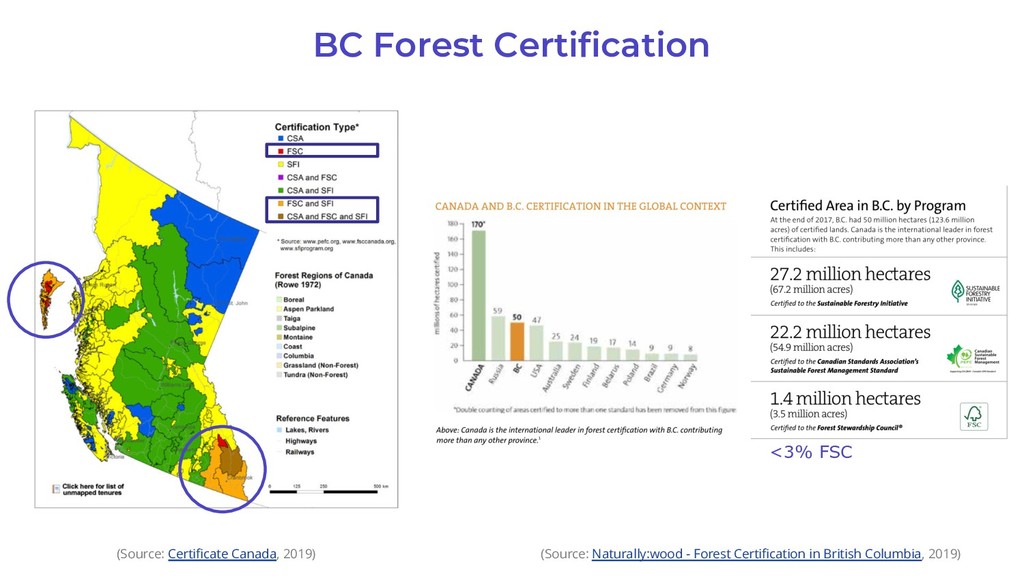
  43. BC Forest Certification <3% FSC (Source: Certificate Canada, 2019) (Source:

    Naturally:wood - Forest Certification in British Columbia, 2019)
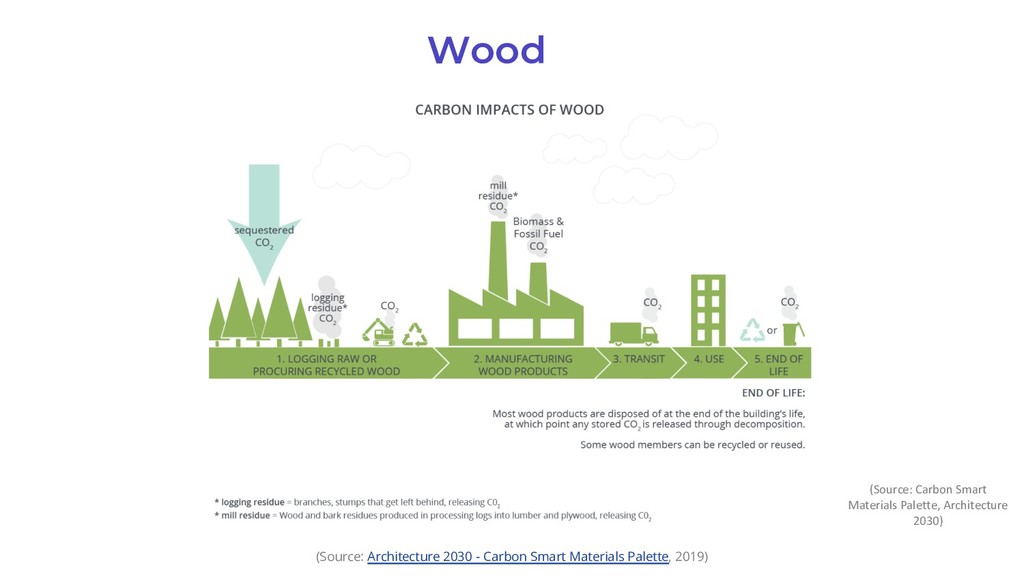
  44. Wood – Key Facts § Specifying wood from sustainably managed

    forests helps ensure that the trees we harvest are replaced, so our forests maintain a consistent level of carbon sequestration. § Forestry practices vary significantly based on region, species, and forest type. Different woods have different performance characteristics and grow in different climates. § Current LCA practice treats all forest management practices the same, using national data for forest management and harvest. § Using reclaimed wood and wood from sustainably managed forests are the best ways to reduce embodied carbon emissions from wood. § About 20% of anthropogenic greenhouse gas emissions are due to deforestation and forest degradation § Global timber harvesting causes us to lose 32 million acres (13 million hectares) of forest each year, or about 60 acres per minute. § Hardwood is not commonly used as a structural materials Source: Architecture 2030 - Carbon Smart Materials Palette, 2019 Buy Clean Washington, 2019 ASCE – Whole Building LCA: Reference Building Structures and Strategies, 2019
  45. Wood – Carbon Smart Attributes Only specify timber from sustainably

    managed forests § Among other attributes, sustainably managed forests establish protected areas and conserve biodiversity, have a management plan and harvest accordingly, replant trees to replace the harvested trees, and use reduced-impact logging techniques, all of which reduce the embodied carbon impact of the timber. Don’t specify wood harvested from old growth forests Harvesting old growth forests and rainforests greatly disturbs the ground, releasing much of the sequestered carbon in soil. Additionally, old growth forests and rainforests provide diverse habitats for a wide range of species that have developed over multiple decades or centuries. Specify reclaimed wood products Use reclaimed, salvaged, or recycled wood products whenever possible to prolong its carbon storage. Specify fast growing wood Fast-growing trees store carbon faster than slow-growing trees Source: Architecture 2030 - Carbon Smart Materials Palette, 2019 Buy Clean Washington, 2019 ASCE – Whole Building LCA: Reference Building Structures and Strategies, 2019
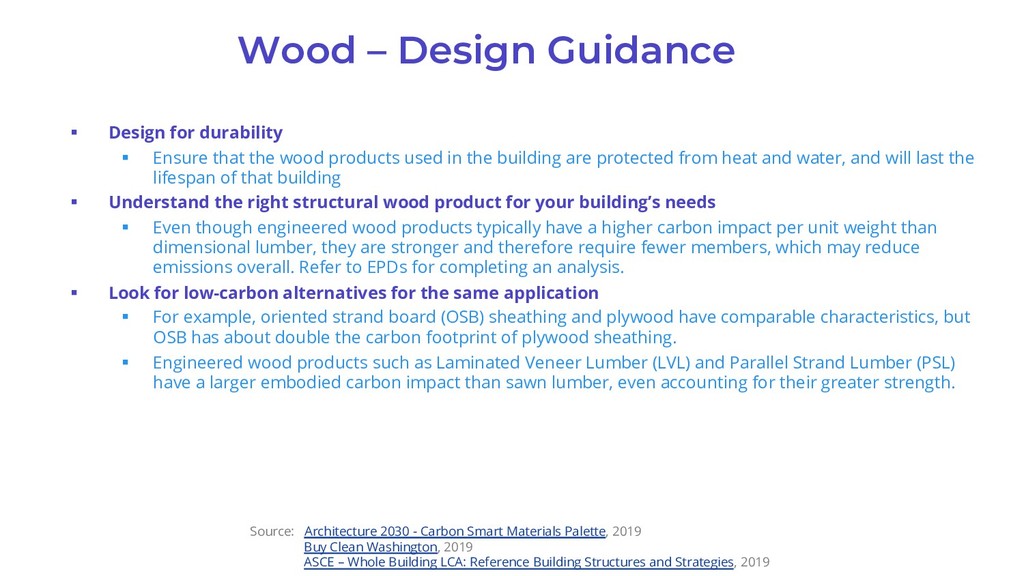
  46. Wood – Design Guidance § Design for durability § Ensure

    that the wood products used in the building are protected from heat and water, and will last the lifespan of that building § Understand the right structural wood product for your building’s needs § Even though engineered wood products typically have a higher carbon impact per unit weight than dimensional lumber, they are stronger and therefore require fewer members, which may reduce emissions overall. Refer to EPDs for completing an analysis. § Look for low-carbon alternatives for the same application § For example, oriented strand board (OSB) sheathing and plywood have comparable characteristics, but OSB has about double the carbon footprint of plywood sheathing. § Engineered wood products such as Laminated Veneer Lumber (LVL) and Parallel Strand Lumber (PSL) have a larger embodied carbon impact than sawn lumber, even accounting for their greater strength. Source: Architecture 2030 - Carbon Smart Materials Palette, 2019 Buy Clean Washington, 2019 ASCE – Whole Building LCA: Reference Building Structures and Strategies, 2019
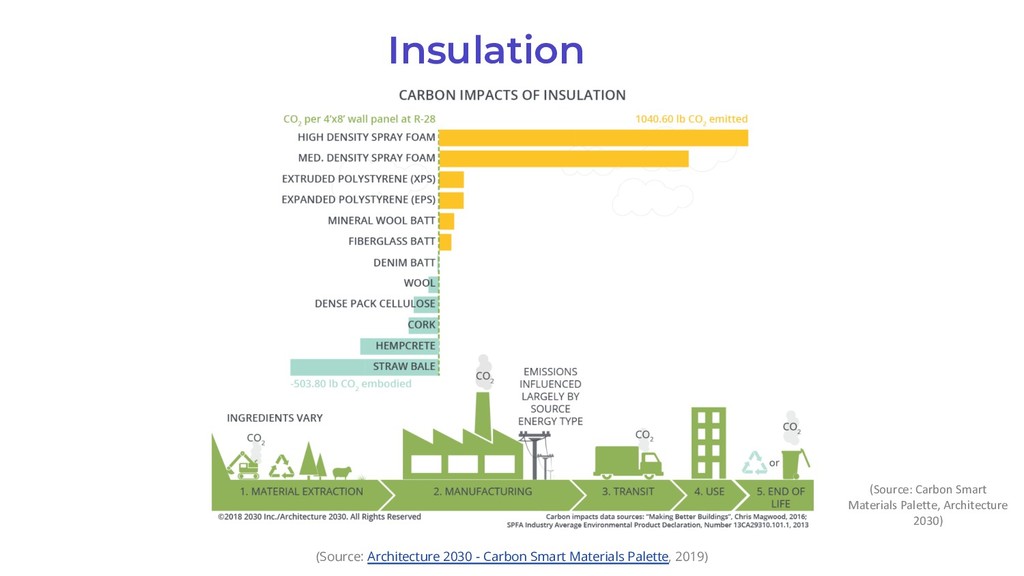
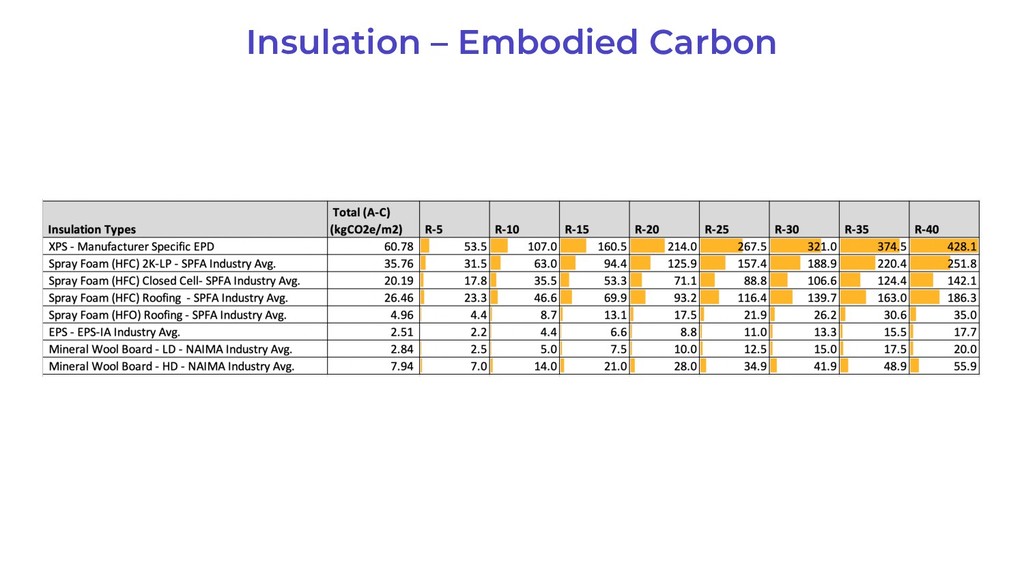
  47. Insulation – Key Facts § Insulation choices greatly affect the

    carbon footprint of the building in terms of embodied carbon and operational carbon emissions. § Insulation can be either a significant contributor to the embodied carbon footprint of the building, or a carbon sink, depending on the choice of materials used. § When selecting insulation, operational performance considerations (thermal performance, climatic requirements, air leakage rates, moisture resistance) should be balanced with embodied carbon targets. § Using natural materials and blown-in applications are the best way to reduce the embodied carbon of insulation. Source: Architecture 2030 - Carbon Smart Materials Palette, 2019 Buy Clean Washington, 2019 ASCE – Whole Building LCA: Reference Building Structures and Strategies, 2019
  48. Insulation – Carbon Smart Applications § Specify insulation materials that

    naturally sequester carbon § Materials such as wood, straw, clay-straw, hemp, cork, and sheep’s wool naturally sequester carbon and store if over their useful life. § Specify blown-in insulation instead of rigid and spray foams insulation § Blown-in fiberglass and cellulose insulation have a significantly lower embodied carbon impact than rigid insulation and spray foams. § Using high density blown-in (non-foam) insulation (over 3.5 pcf) can help minimize thermal bridging, minimize embodied carbon, and improve the operational performance and lifespan of a building. § Avoid Extruded Polystyrene (XPS), Expanded Polystyrene (EPS), Spray Foam, Polyisocyanurate (Polyiso), and Structurally Insulated Panel Systems (SIPS) with foam insulation, where climate allows § All of the insulations listed above are petroleum-based products that require significant energy to manufacture resulting in a high-embodied carbon footprint. Where climate and project requirements allow, specify lower carbon alternatives. Source: Architecture 2030 - Carbon Smart Materials Palette, 2019 Buy Clean Washington, 2019 ASCE – Whole Building LCA: Reference Building Structures and Strategies, 2019
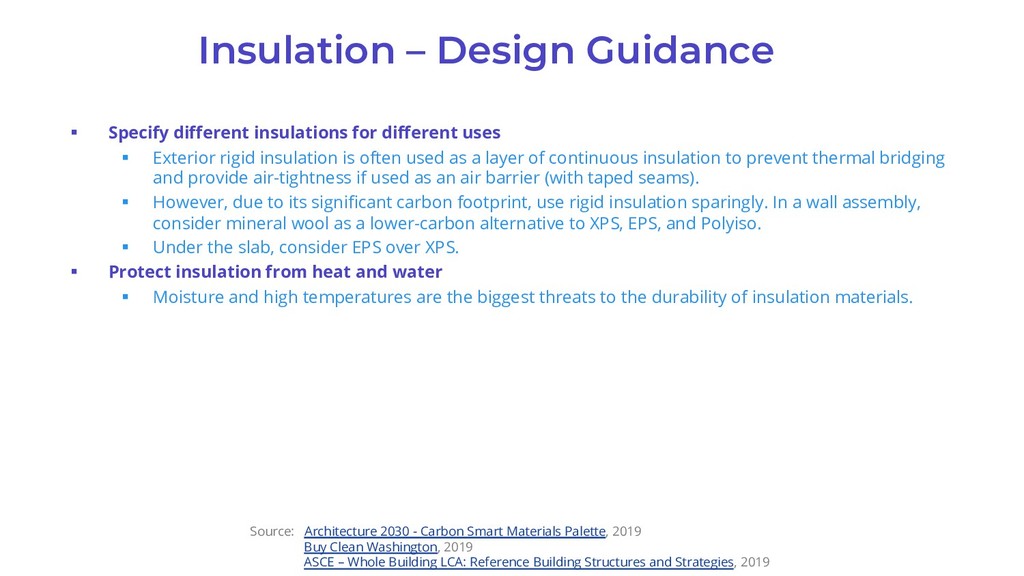
  49. Insulation – Design Guidance § Specify different insulations for different

    uses § Exterior rigid insulation is often used as a layer of continuous insulation to prevent thermal bridging and provide air-tightness if used as an air barrier (with taped seams). § However, due to its significant carbon footprint, use rigid insulation sparingly. In a wall assembly, consider mineral wool as a lower-carbon alternative to XPS, EPS, and Polyiso. § Under the slab, consider EPS over XPS. § Protect insulation from heat and water § Moisture and high temperatures are the biggest threats to the durability of insulation materials. Source: Architecture 2030 - Carbon Smart Materials Palette, 2019 Buy Clean Washington, 2019 ASCE – Whole Building LCA: Reference Building Structures and Strategies, 2019
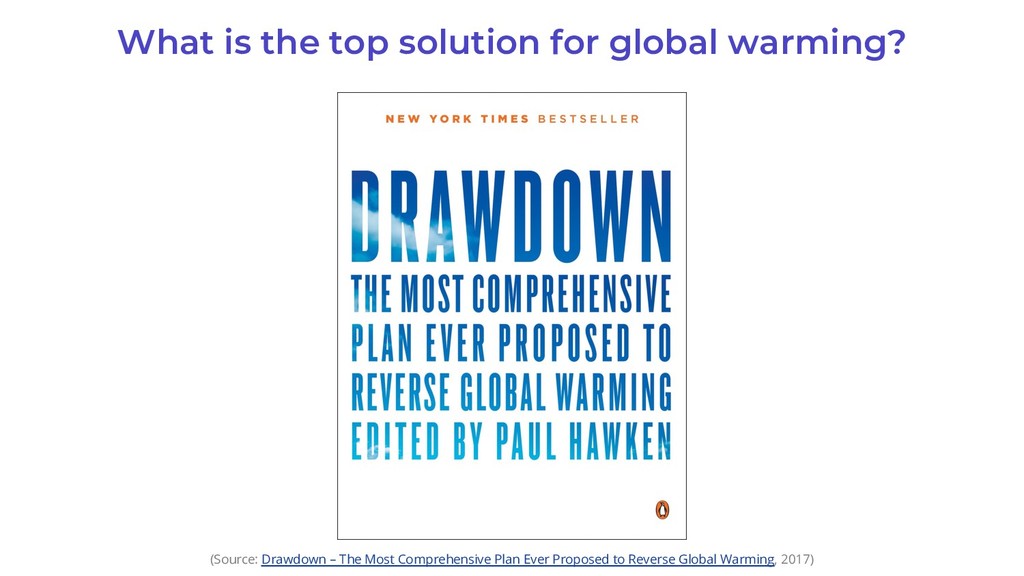
  50. What is the top solution for global warming? (Source: Drawdown

    – The Most Comprehensive Plan Ever Proposed to Reverse Global Warming, 2017)
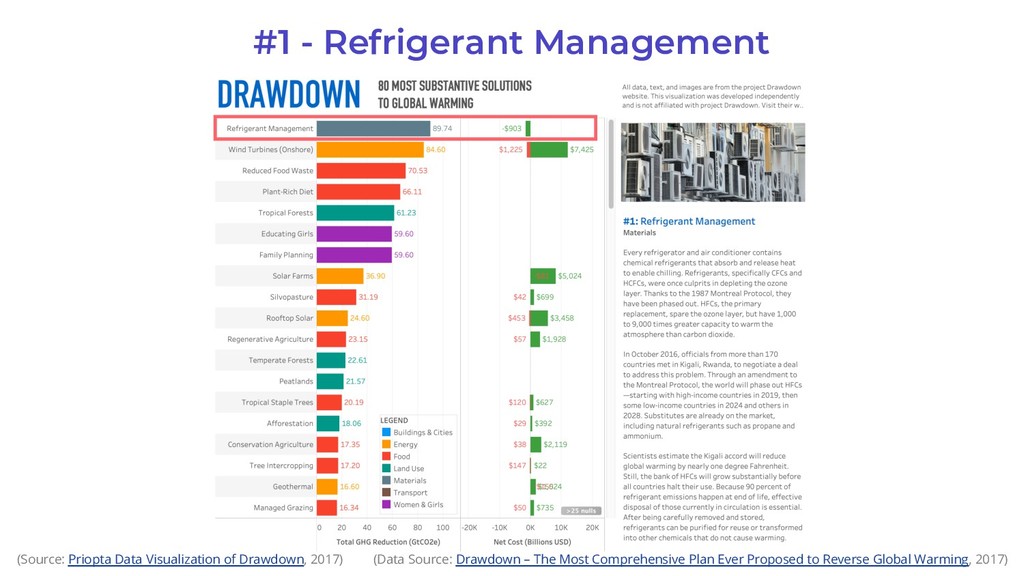
  51. #1 - Refrigerant Management (Source: Priopta Data Visualization of Drawdown,

    2017) (Data Source: Drawdown – The Most Comprehensive Plan Ever Proposed to Reverse Global Warming, 2017)
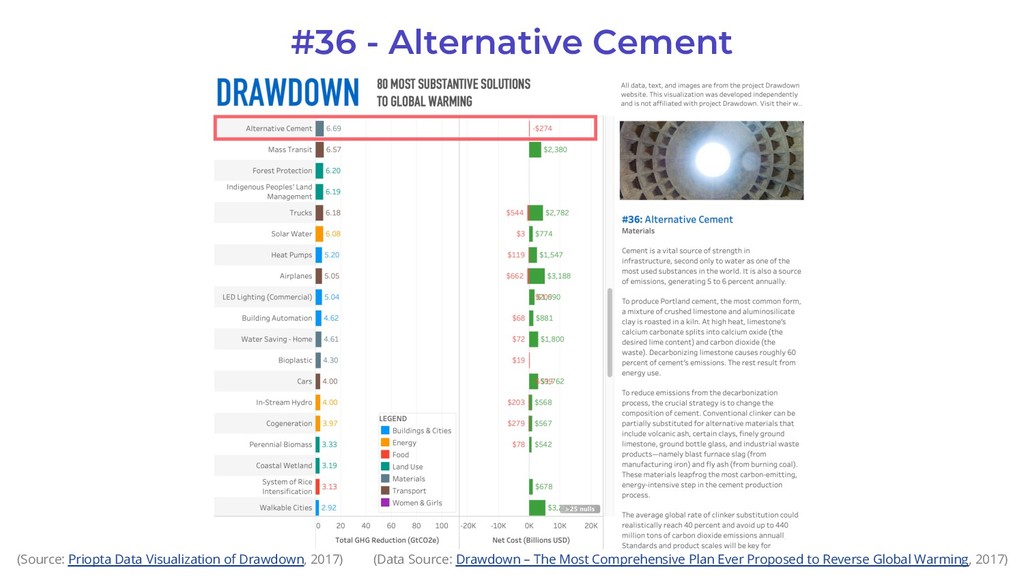
  52. #36 - Alternative Cement (Source: Priopta Data Visualization of Drawdown,

    2017) (Data Source: Drawdown – The Most Comprehensive Plan Ever Proposed to Reverse Global Warming, 2017)
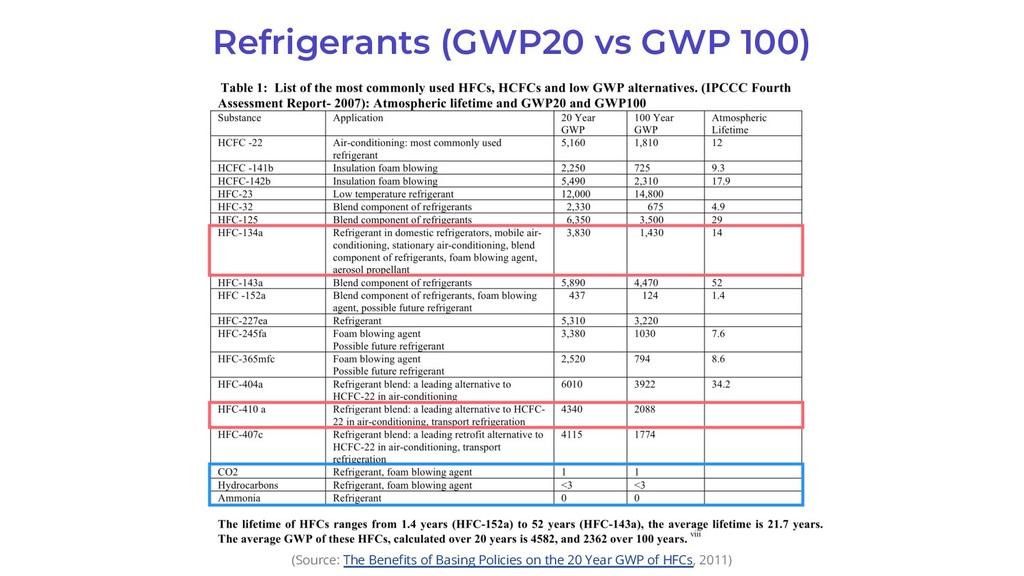
  53. Refrigerants (GWP20 vs GWP 100) (Source: The Benefits of Basing

    Policies on the 20 Year GWP of HFCs, 2011)
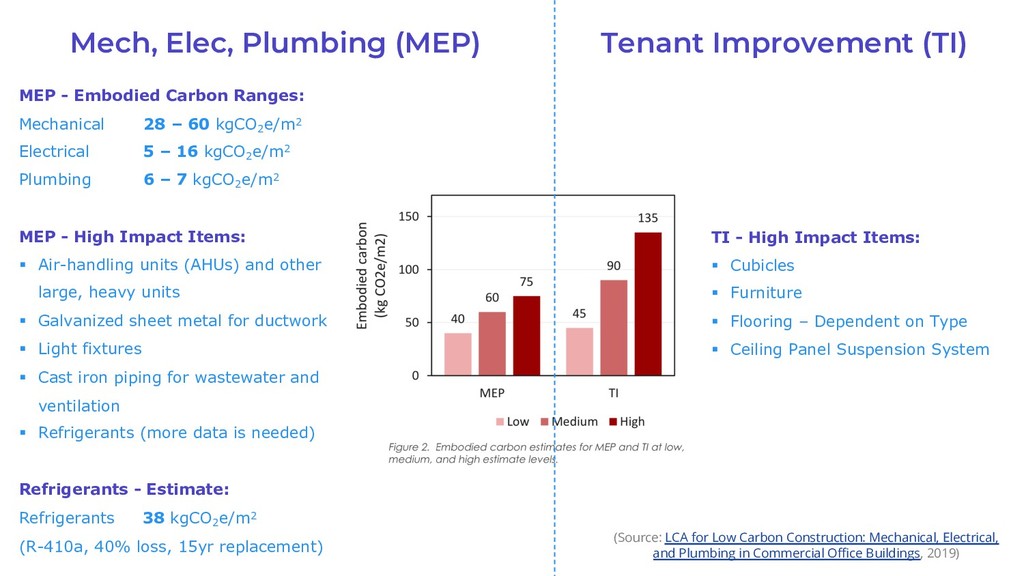
  54. Mech, Elec, Plumbing (MEP) MEP - Embodied Carbon Ranges: Mechanical

    28 – 60 kgCO2 e/m2 Electrical 5 – 16 kgCO2 e/m2 Plumbing 6 – 7 kgCO2 e/m2 MEP - High Impact Items: § Air-handling units (AHUs) and other large, heavy units § Galvanized sheet metal for ductwork § Light fixtures § Cast iron piping for wastewater and ventilation § Refrigerants (more data is needed) Refrigerants - Estimate: Refrigerants 38 kgCO2 e/m2 (R-410a, 40% loss, 15yr replacement) TI - High Impact Items: § Cubicles § Furniture § Flooring – Dependent on Type § Ceiling Panel Suspension System Tenant Improvement (TI) (Source: LCA for Low Carbon Construction: Mechanical, Electrical, and Plumbing in Commercial Office Buildings, 2019)
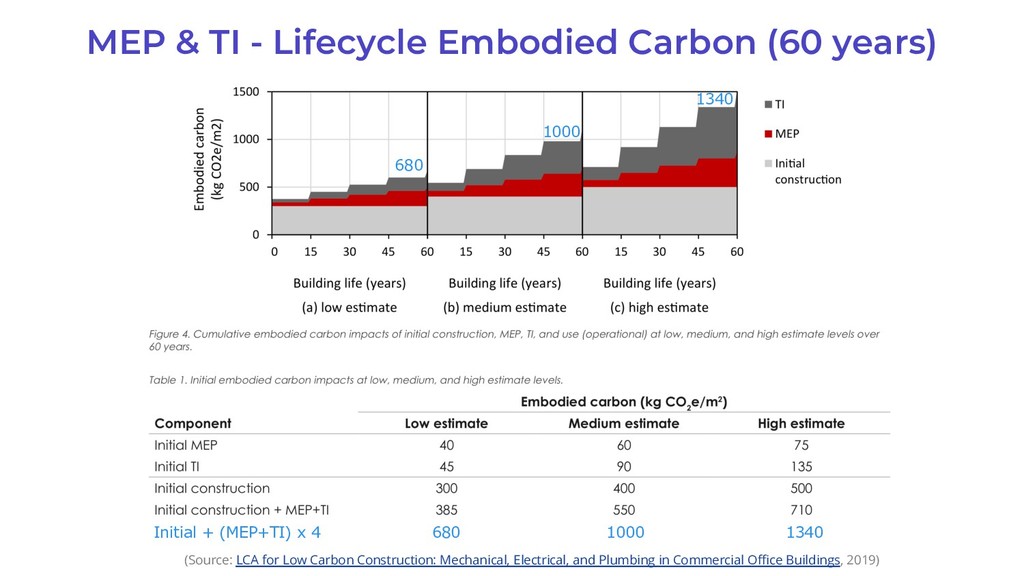
  55. MEP & TI - Lifecycle Embodied Carbon (60 years) 680

    1000 1340 Initial + (MEP+TI) x 4 680 1000 1340 (Source: LCA for Low Carbon Construction: Mechanical, Electrical, and Plumbing in Commercial Office Buildings, 2019)
  56. Useful Embodied Carbon Resources Design Strategies for Reducing Embodied Carbon

    Carbon Smart Materials Palette www.materialspalette.org Whole Building LCA: Reference Building Structure and Strategies ASCE Buy Clean Washington Study Ch. 3 – Technical Review Source: Architecture 2030 - Carbon Smart Materials Palette, 2019 Buy Clean Washington, 2019 ASCE – Whole Building LCA: Reference Building Structures and Strategies, 2019
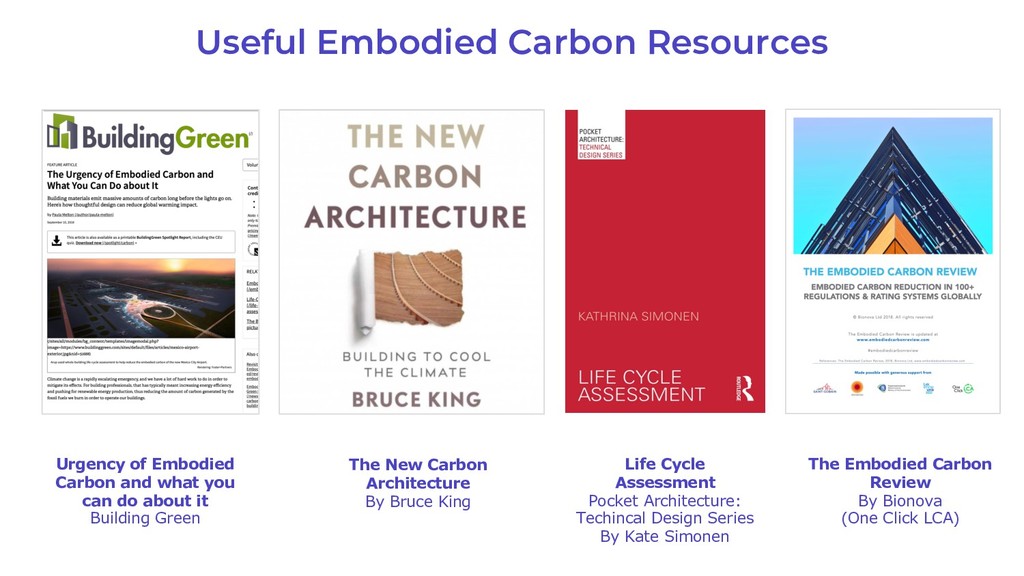
  57. Useful Embodied Carbon Resources Urgency of Embodied Carbon and what

    you can do about it Building Green The New Carbon Architecture By Bruce King Life Cycle Assessment Pocket Architecture: Techincal Design Series By Kate Simonen The Embodied Carbon Review By Bionova (One Click LCA)
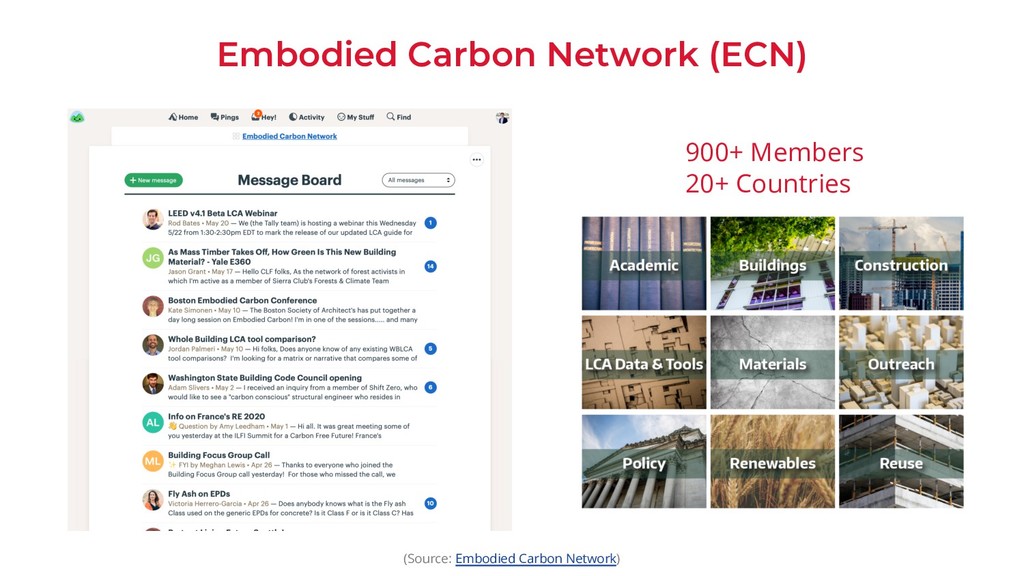
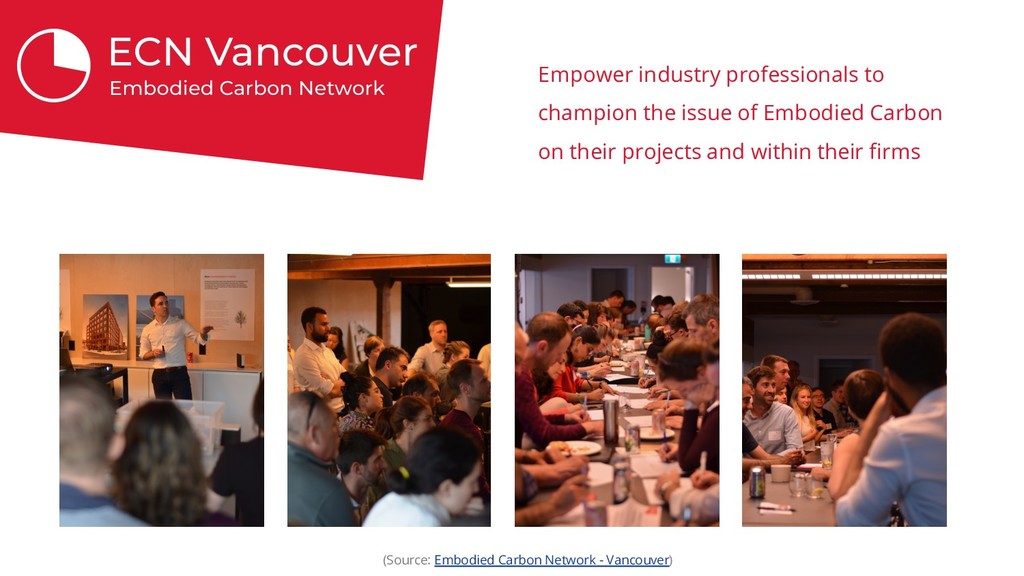
  58. Empower industry professionals to champion the issue of Embodied Carbon

    on their projects and within their firms (Source: Embodied Carbon Network - Vancouver)
  59. Industry Professionals: Architects Structural Engineers Sustainability Consultants Energy Modelers LCA

    Consultants Developers Policy Makers Materials Industry Manufacturers / Suppliers (Source: Embodied Carbon Network - Vancouver)
  60. References Architecture 2030. (2018). New Buildings: Embodied Carbon. Retrieved January

    15, 2019, from Architecture2030: https://architecture2030.org/new-buildings-embodied/ Architecture 2030. (2018). Why The Building Sector? Retrieved 02 15, 2019, from Architecture 2030: https://architecture2030.org/buildings_problem_why/ Architecture 2030. (2019). Carbon Smart Materials Palette. Retrieved 07 20, 2019, from Materials Palette: https://materialspalette.org/palette/ Athena Sustainable Materials Institute. (2019). Athena Impact Estimator for Buildings. Retrieved 02 20, 2019, from Athena Sustainable Materials Institute: http://www.athenasmi.org/our-software-data/impact-estimator/ Bionova Ltd. (2018). Embodied Carbon Review 2018. Bionova Ltd. Bionova Ltd. (2019). One Click LCA. Retrieved 02 20, 2019, from One Click LCA: https://www.oneclicklca.com Bowick , M., & O'Connor, J. (2017). Carbon Footprint Benchmarking of BC Multi-Unit Residential Buildings. Ottawa: Athena Sustainable Materials Institute. Building Energy Research Center of Tsinghua University. (2018). China Building Energy Use 2018. Building Transparency. (2019). Embodied Carbon Construction Calculator (EC3) Tool. Retrieved 02 25, 2019, from Building Transparency: https://buildingtransparency.org Canada Green Building Council. (2019). Making The Case For Building To Zero Carbon. Ottawa: Canada Green Building Council. Certificate Canada. (2019). Certificate Canada. Ottawa: Forest Products Association of Canada (FPAC). Circle Economy. (2019). The Circularity Gap Report 2019. The Platform for Accelerating the Circular Economy . City of Vancouver - Planning, Urban Design and Sustainability Department. (2017). Green Buildings Policy for Rezoning - Process and Requirements. Vancouver: City of Vancouver. City of Vancouver - Planning, Urban Design and Sustainability Department and Engineering Department. (2019). Climate Emergency Response. Vancouver: City of Vancouver. Greenpeace. (2011). The Benefits of Basing Policies on the 20 Year GWP of HFCs. Hawken, P. (2017). Drawdown: The Most Comprehensive Plan Ever Proposed to Reverse Global Warming. Penguin Books. International Energy Agency. (2019). Material efficiency in clean energy transitions. IPCC. (2007). Fourth Assessment Report. Geneva: Intergovernmental Panel on Climate Change.
  61. References IPCC. (2018). Global Warming of 1.5°C. Geneva: Intergovernmental Panel

    on Climate Change. Irfan, U. (2018, October 08). Report: we have just 12 years to limit devastating global warming. Vox. KGM & Associates and Global Efficiency Intelligence. (2018). The Carbon Loophole In Climate Policy: Quantifying the Embodied Carbon in Traded Products. ClimateWorks Foundation. King, B. (2017). The New Carbon Architecture: Building to Cool the Climate. New Society Publishers. Luo, Z., Cang, Y., Zhang, N., Yang, L., & Liu, J. (2019, July). A Quantitative Process-Based Inventory Study on Material Embodied Carbon Emissions of Residential, Office, and Commercial Buildings in China. Journal of Thermal Science. Melton, P. (2018, October). The Urgency of Embodied Carbon and What You Can Do about It. Retrieved from Building Green: https://www.buildinggreen.com/feature/urgency- embodied-carbon-and-what-you-can-do-about-it National Ready Mix Concrete Association. (2018). Proposed methodology for quantifying and reducing the carbon footprint of a concrete building. Silver Spring: National Ready Mix Concrete Association. National Ready Mix Concrete Association. (2016). Sustainability - NRMCA EPD Program. Retrieved 03 10, 2019, from National Ready Mix Concrete Association: https://www.nrmca.org/sustainability/EPDProgram/ Naturally:wood. (2019). Forest Certification in British Columbia. Vancouver: Naturally:wood. One Click LCA. (2018). Carbon Heroes Benchmark Program for 1000 buildings. Retrieved 01 20, 2019, from One Click LCA: https://www.oneclicklca.com/construction/carbonheroes/ ORI INC. (2019). Ori Raises $20 Million To Scale Solutions For Modern Urban Living. Retrieved 09 09, 2019, from Ori Living: https://oriliving.com/pressrelease952019 Pak, A. (2017, September). Drawdown - Dashboard. Retrieved from Tableau Public: https://public.tableau.com/profile/anthony.pak#!/vizhome/Drawdown/Drawdown Pak, A. (2017, July 4). Embodied Carbon: The Blindspot of the Buildings Industry. Retrieved from Canadian Architect: https://www.canadianarchitect.com/embodied-carbon-the- blindspot-of-the-buildings-industry/ Rodriguez, B., Lee, H., Huang, M., & Simonen, K. (2018). Life Cycle Assessment (LCA) for Low Carbon Construction: Mechanical, Electrical, and Plumbing in Commercial Office Buildings. The Carbon Leadership Forum. Simonen, K. (2014). Life Cycle Assessment (Vol. Pocket Architecture: Technical Design Series). Routledge.
  62. References Steffen, W., Rockström, J., Richardson, K., Lenton, T. M.,
    & Folke, C. (2018). Trajectories of the Earth System in the Anthropocene. PNAS, 8252-8259. Tally - KT Innovations. (2019). Tally - Know Your Impact. Retrieved 02 03, 2019, from Tally: https://choosetally.com/ The Carbon Leadership Forum. (2017). Embodied Carbon Benchmark Study. Retrieved January 16, 2019, from Carbon Leadership Forum: http://www.carbonleadershipforum.org/projects/embodied-carbon-benchmark-study/ The Carbon Leadership Forum. (2018). Life Cycle Assessment of Buildings: A Practice Guide. Seattle: The Carbon Leadership Forum. U.S. Green Building Council. (2019). LEED v4.1 Building Design and Construction. Washington D.C.: U.S. Green Building Council. UN Environment Programme and International Energy Agency. (2017). Global Status Report 2017 - Towards a zero-emission, efficient, and resilient buildings and construction sector. Nairobi: United Nations Environment Programme. UN Environment Programme and International Energy Agency. (2018). Global Status Report 2018 - Towards a zero-emission, efficient and resilient buildings and construction sector. Nairobi: United Nations Environment Programme. University of Washington (UW) College of Built Environments. (2019). Buy Clean Washington Study. Seattle: University of Washington (UW) College of Built Environments. Watts, J. (2018, August 7). Domino-effect of climate events could move Earth into a ‘hothouse’ state. The Guardian. WBLCA Guide Special Project Working Group of the Sustainability Committee of the Structural Engineering Institute of ASCE. (2018). Whole Building Life Cycle Assessment: Reference Building Structure and Strategies. Reston: American Society of Civil Engineers. Wieting, J. (2018, November 30). The secret in B.C.'s forests. National Observer. World Green Building Council. (2019). Bringing Embodied Carbon Upfront.