Upgrade to Pro — share decks privately, control downloads, hide ads and more …

Global Collaborative Robots Market, Segment Ana...

Global Collaborative Robots Market, Segment Analysis, Company Share Insights, Market Dynamics and Recent Developments – Forecast to 2030

Apelo Consulting has released a report on Global Collaborative Robots Market, Segment Analysis, Company Share Insights, Market Dynamics and Recent Developments – Forecast to 2030.

The global collaborative robot market was valued at USD 2,146.4 Million in 2024, and is projected to reach USD 11,641.7 Million by 2030. Collaborative robots are robots designed to work safely alongside humans in a shared workspace. The use of collaborative robots cuts downtime, streamlines production processes, and allows for unfettered human-robot collaboration. Automotive, electronics, and logistics sectors are increasingly adopting collaborative robots to perform repetitive tasks and allow human workers to focus on higher-value operations. This shift enhances throughput while ensuring consistent quality and lowering operational costs.

Companies are seeking cost-effective and flexible automation solutions to increase productivity and reduce human errors. Collaborative robots offer a higher return on investment (ROI) than traditional industrial robots, making them attractive for businesses of all sizes. The lower upfront costs associated with cobots, along with their ease of programming and deployment, allow companies to quickly realize financial benefits. This factor is particularly appealing for small and medium-sized enterprises (SMEs). Moreover, the growing labor shortages in different industries is necessitating top companies to increase and improve automation solutions to keep productivity levels up. Collaborative robots are filling this void by carrying out labor-intensive tasks with accuracy, which in turn minimizes reliance on human labor and providing accurate output. With increasing labor shortages, particularly in developed countries, demand for collaborative robots is likely to increase.

For more details, please visit: https://apeloconsulting.com/product/global-collaborative-robots-market-segment-analysis-company-share-insights-market-dynamics-and-recent-developments-forecast-to-2030/

Avatar for ApeloConsulting

ApeloConsulting

October 01, 2025
Tweet

More Decks by ApeloConsulting

Other Decks in Technology

Transcript

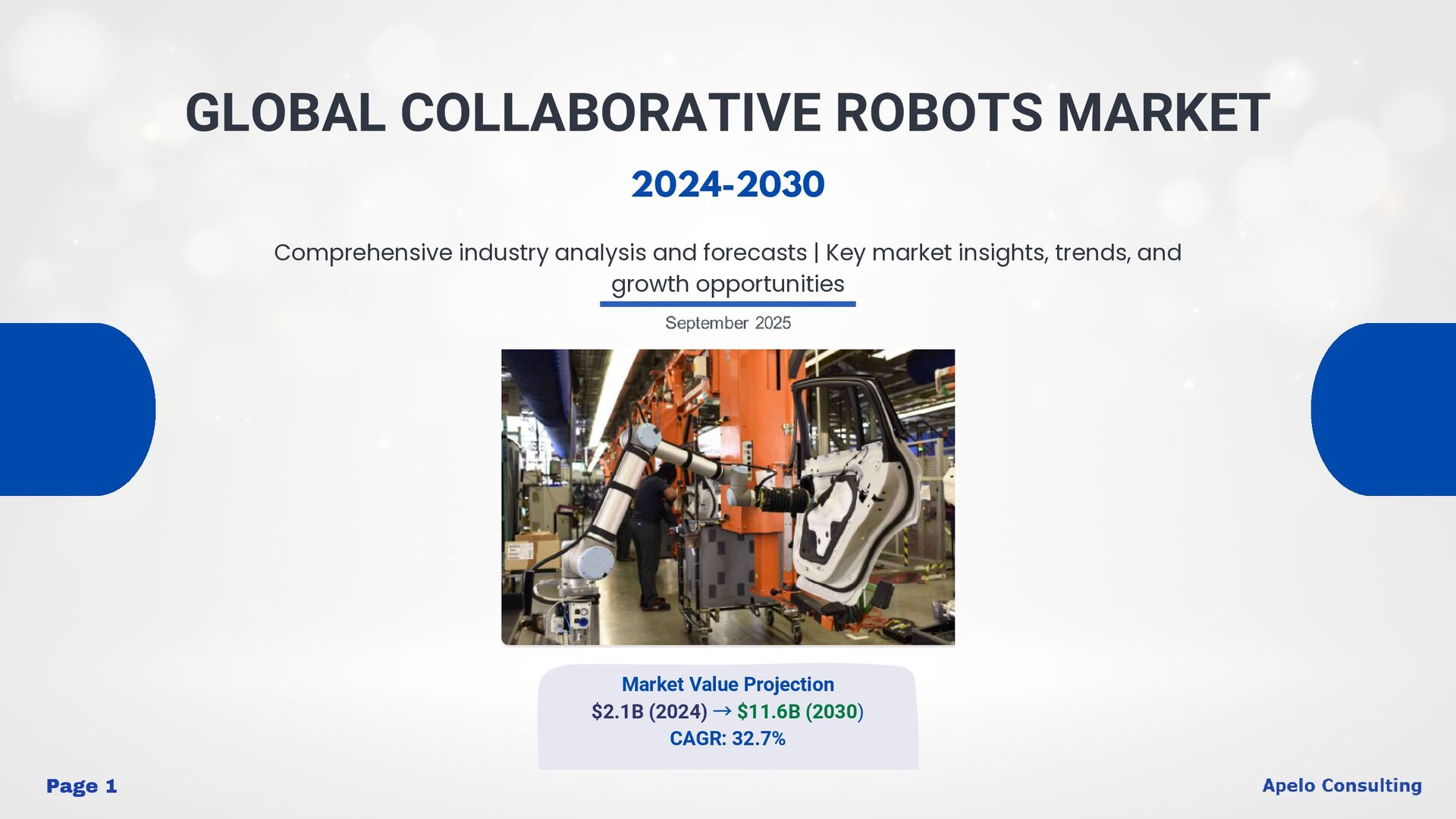
  1. 2024-2030 GLOBAL COLLABORATIVE ROBOTS MARKET Comprehensive industry analysis and forecasts

    | Key market insights, trends, and growth opportunities Market Value Projection $2.1B (2024) → $11.6B (2030) CAGR: 32.7% Page 1
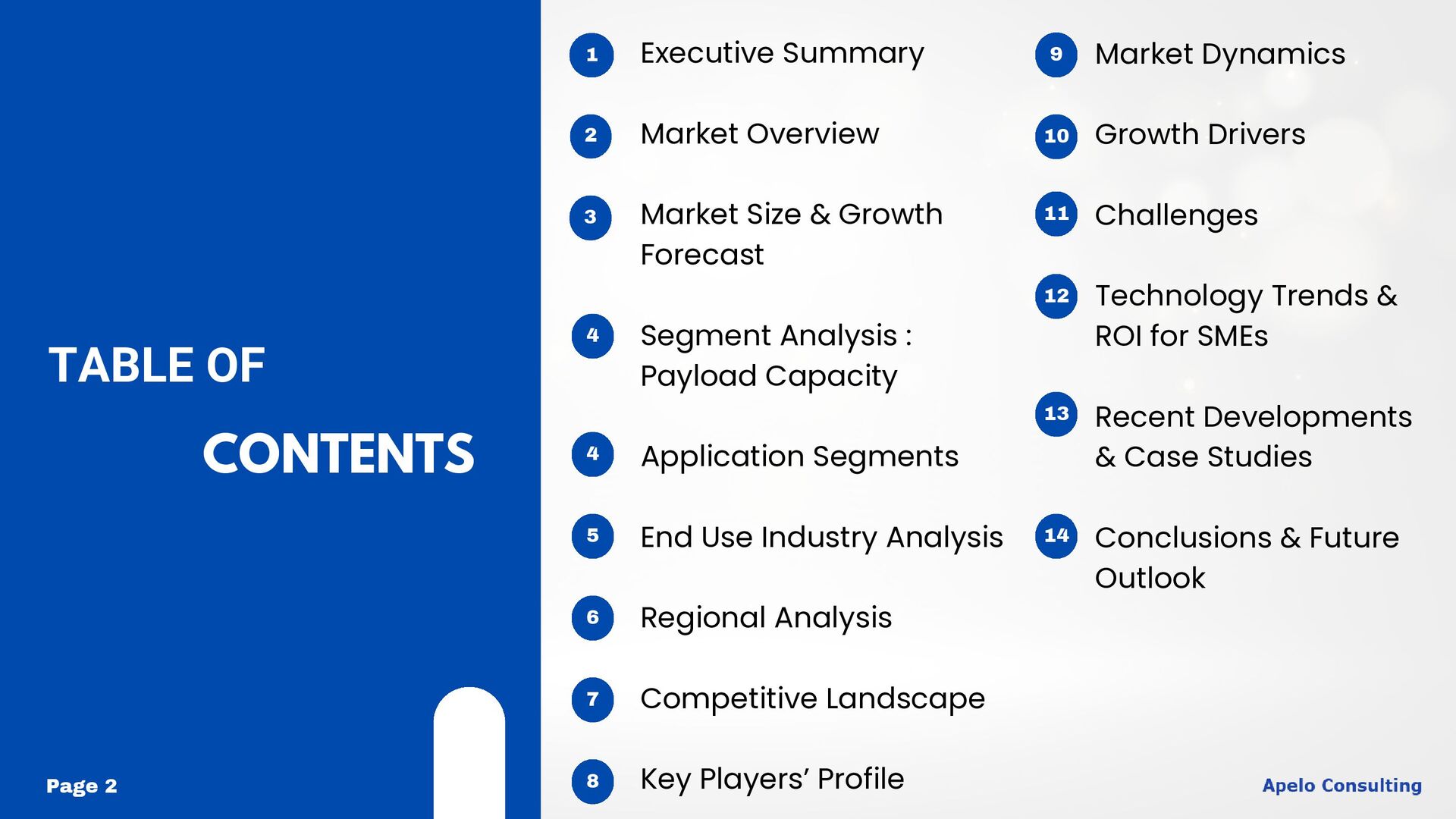
  2. CONTENTS TABLE OF Executive Summary Market Overview Market Size &

    Growth Forecast Segment Analysis : Payload Capacity Application Segments End Use Industry Analysis Regional Analysis Competitive Landscape Key Players’ Profile 1 Market Dynamics Growth Drivers Challenges Technology Trends & ROI for SMEs Recent Developments & Case Studies Conclusions & Future Outlook 2 3 4 4 5 6 7 8 9 10 11 12 13 14 Page 2
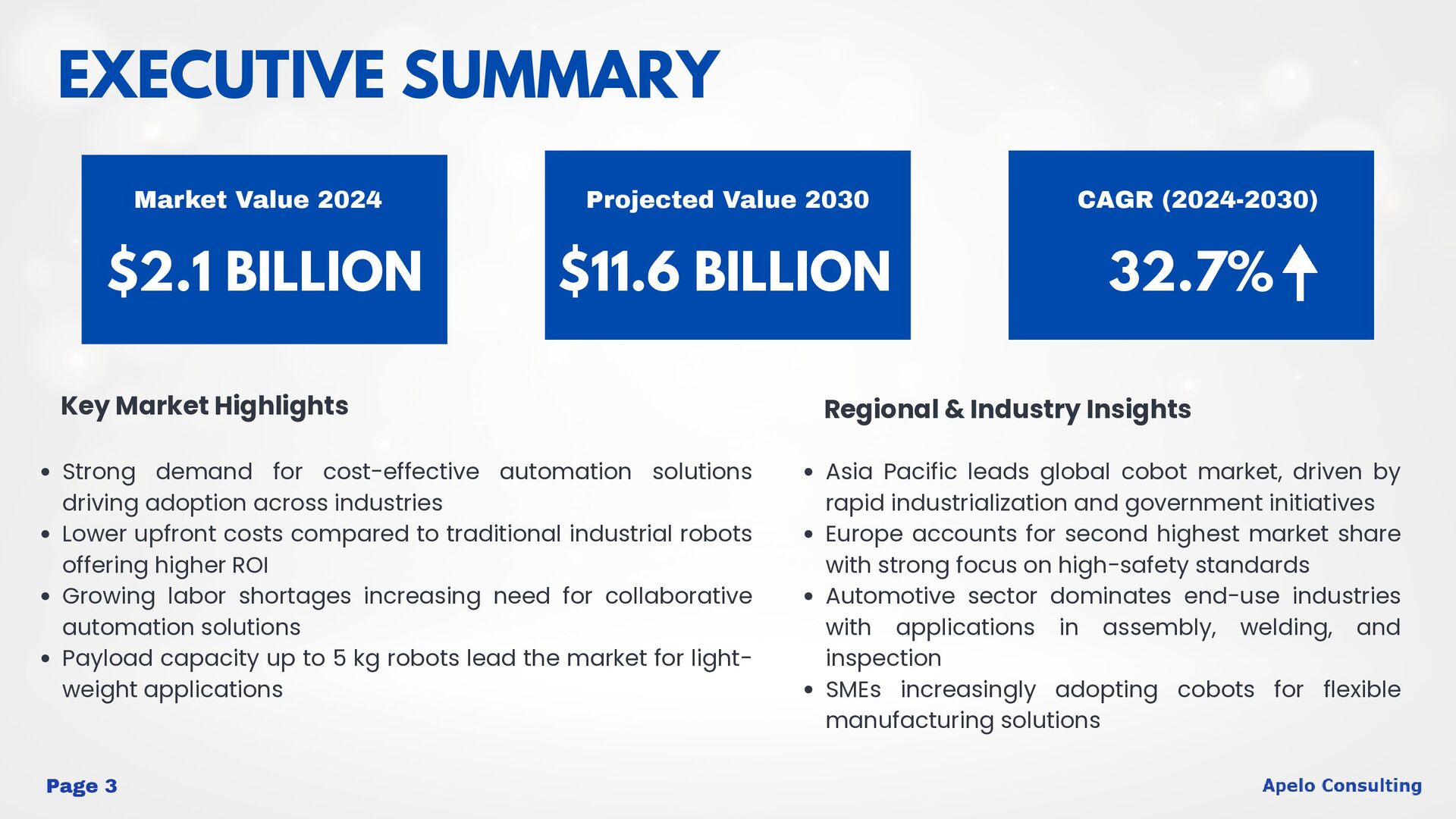
  3. EXECUTIVE SUMMARY Key Market Highlights $2.1 BILLION $11.6 BILLION 32.7%

    Strong demand for cost-effective automation solutions driving adoption across industries Lower upfront costs compared to traditional industrial robots offering higher ROI Growing labor shortages increasing need for collaborative automation solutions Payload capacity up to 5 kg robots lead the market for light- weight applications Asia Pacific leads global cobot market, driven by rapid industrialization and government initiatives Europe accounts for second highest market share with strong focus on high-safety standards Automotive sector dominates end-use industries with applications in assembly, welding, and inspection SMEs increasingly adopting cobots for flexible manufacturing solutions Market Value 2024 Projected Value 2030 CAGR (2024-2030) Regional & Industry Insights Page 3
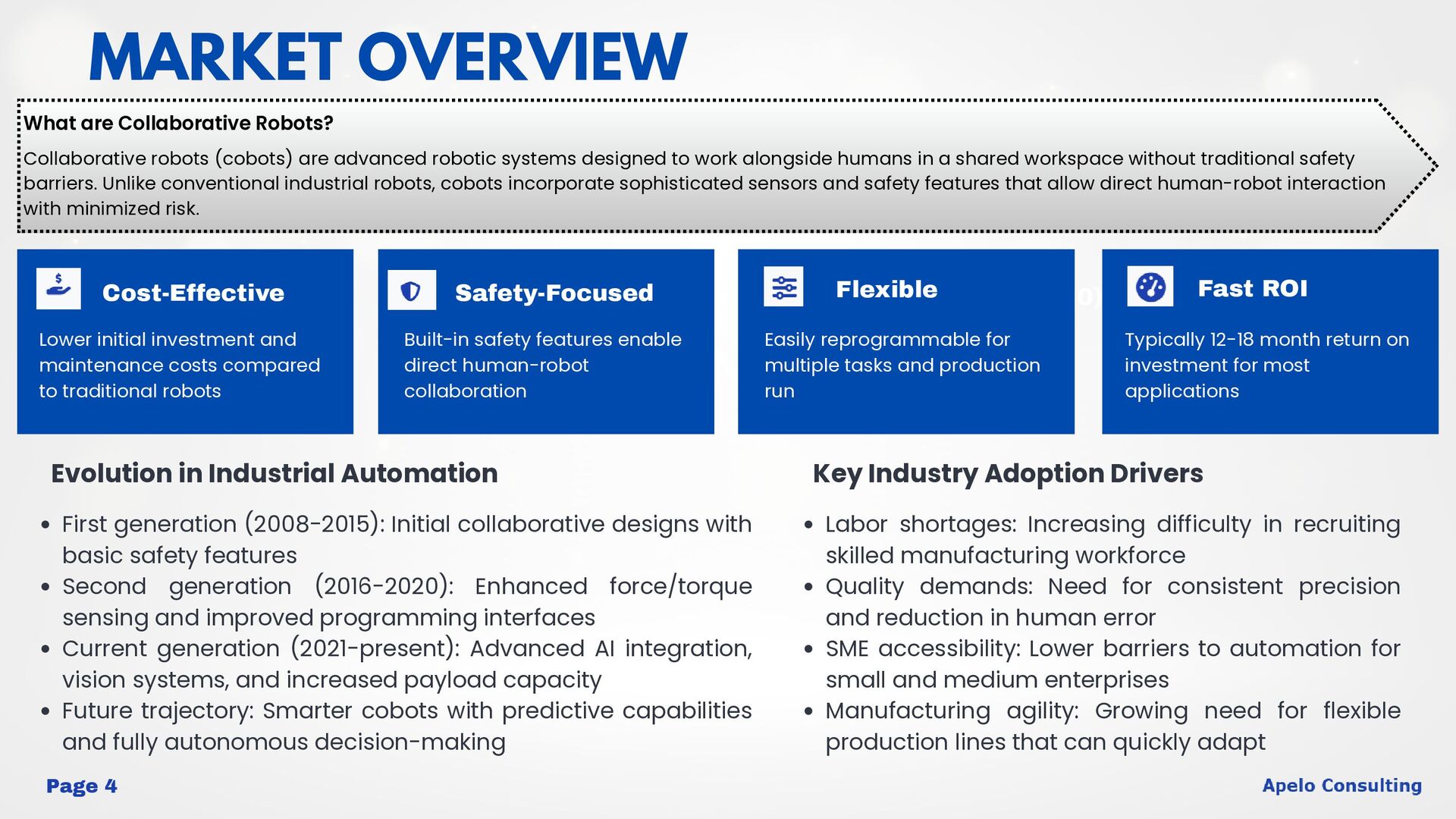
  4. $11.6 BILLION 32.7% Projected Value 2030 CAGR (2024-2030) What are

    Collaborative Robots? Collaborative robots (cobots) are advanced robotic systems designed to work alongside humans in a shared workspace without traditional safety barriers. Unlike conventional industrial robots, cobots incorporate sophisticated sensors and safety features that allow direct human-robot interaction with minimized risk. MARKET OVERVIEW Evolution in Industrial Automation First generation (2008-2015): Initial collaborative designs with basic safety features Second generation (2016-2020): Enhanced force/torque sensing and improved programming interfaces Current generation (2021-present): Advanced AI integration, vision systems, and increased payload capacity Future trajectory: Smarter cobots with predictive capabilities and fully autonomous decision-making Labor shortages: Increasing difficulty in recruiting skilled manufacturing workforce Quality demands: Need for consistent precision and reduction in human error SME accessibility: Lower barriers to automation for small and medium enterprises Manufacturing agility: Growing need for flexible production lines that can quickly adapt Cost-Effective Key Industry Adoption Drivers Page 4 Safety-Focused Flexible Fast ROI Lower initial investment and maintenance costs compared to traditional robots Built-in safety features enable direct human-robot collaboration Easily reprogrammable for multiple tasks and production run Typically 12-18 month return on investment for most applications
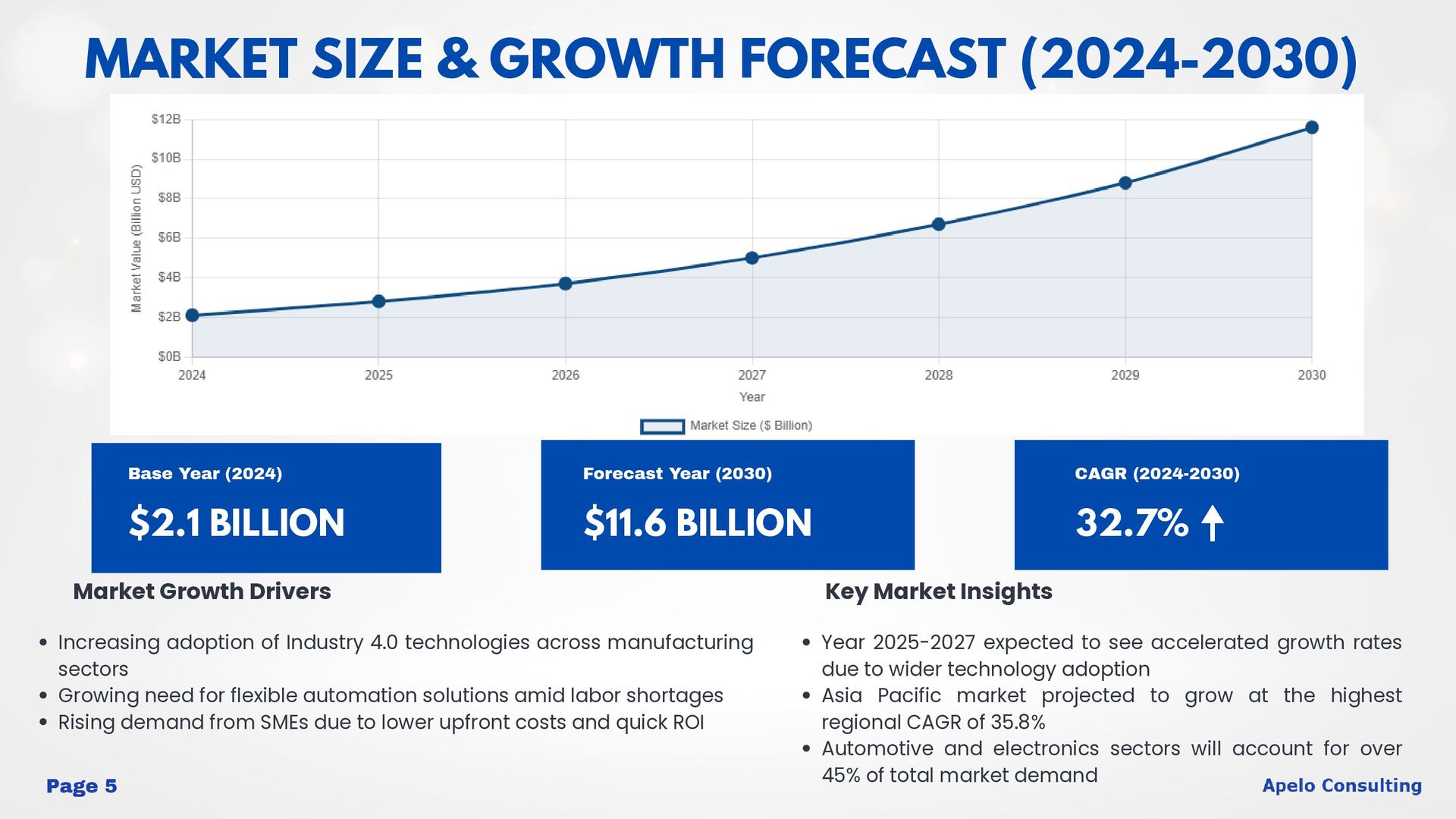
  5. MARKET SIZE & GROWTH FORECAST (2024-2030) Market Growth Drivers Increasing

    adoption of Industry 4.0 technologies across manufacturing sectors Growing need for flexible automation solutions amid labor shortages Rising demand from SMEs due to lower upfront costs and quick ROI Year 2025-2027 expected to see accelerated growth rates due to wider technology adoption Asia Pacific market projected to grow at the highest regional CAGR of 35.8% Automotive and electronics sectors will account for over 45% of total market demand Key Market Insights Page 5 $2.1 BILLION $11.6 BILLION 32.7% Base Year (2024) Forecast Year (2030) CAGR (2024-2030)
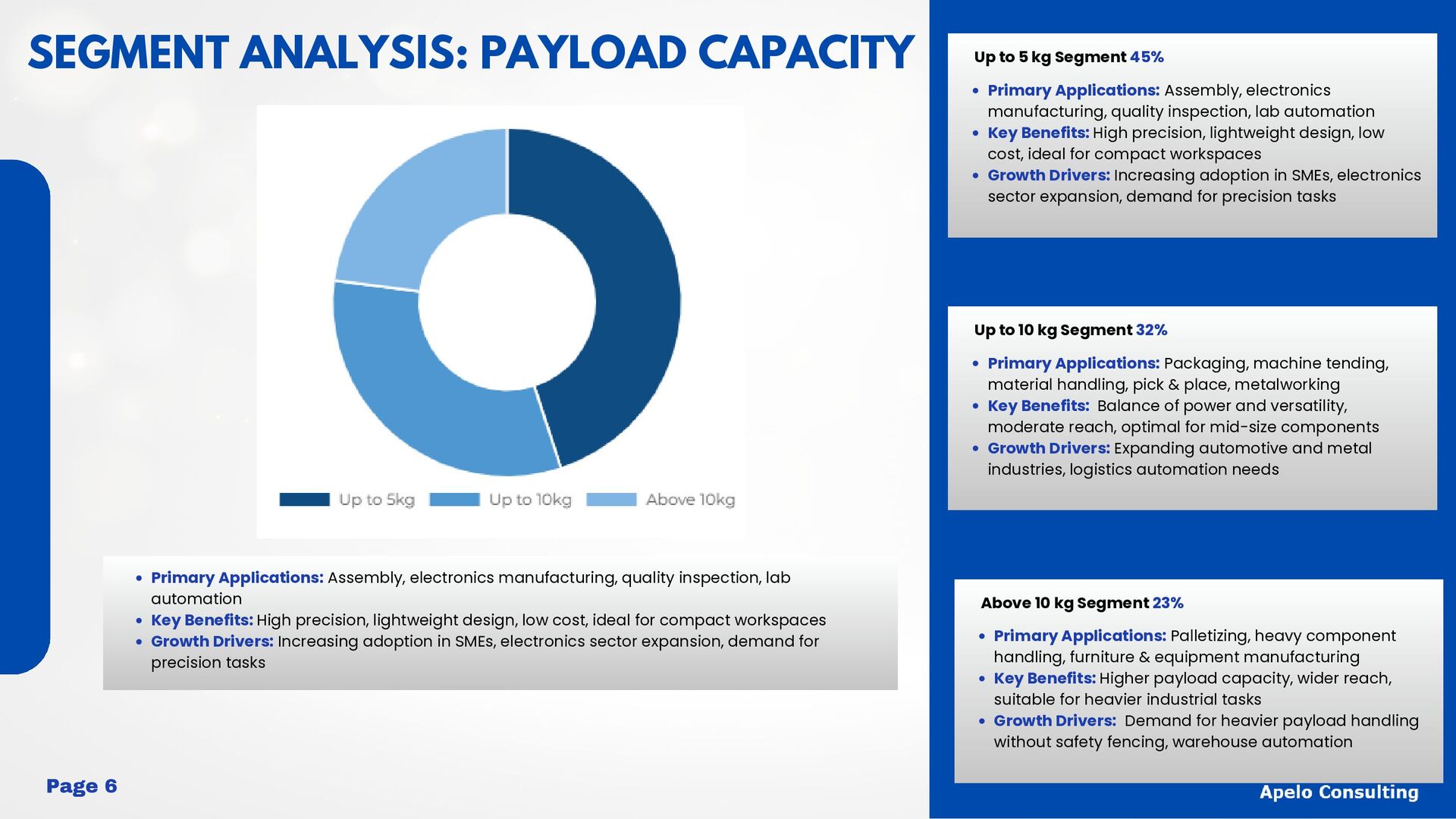
  6. Primary Applications: Assembly, electronics manufacturing, quality inspection, lab automation Key

    Benefits: High precision, lightweight design, low cost, ideal for compact workspaces Growth Drivers: Increasing adoption in SMEs, electronics sector expansion, demand for precision tasks SEGMENT ANALYSIS: PAYLOAD CAPACITY Up to 5 kg Segment 45% Primary Applications: Packaging, machine tending, material handling, pick & place, metalworking Key Benefits: Balance of power and versatility, moderate reach, optimal for mid-size components Growth Drivers: Expanding automotive and metal industries, logistics automation needs Up to 10 kg Segment 32% Primary Applications: Palletizing, heavy component handling, furniture & equipment manufacturing Key Benefits: Higher payload capacity, wider reach, suitable for heavier industrial tasks Growth Drivers: Demand for heavier payload handling without safety fencing, warehouse automation Above 10 kg Segment 23% Primary Applications: Assembly, electronics manufacturing, quality inspection, lab automation Key Benefits: High precision, lightweight design, low cost, ideal for compact workspaces Growth Drivers: Increasing adoption in SMEs, electronics sector expansion, demand for precision tasks Page 6
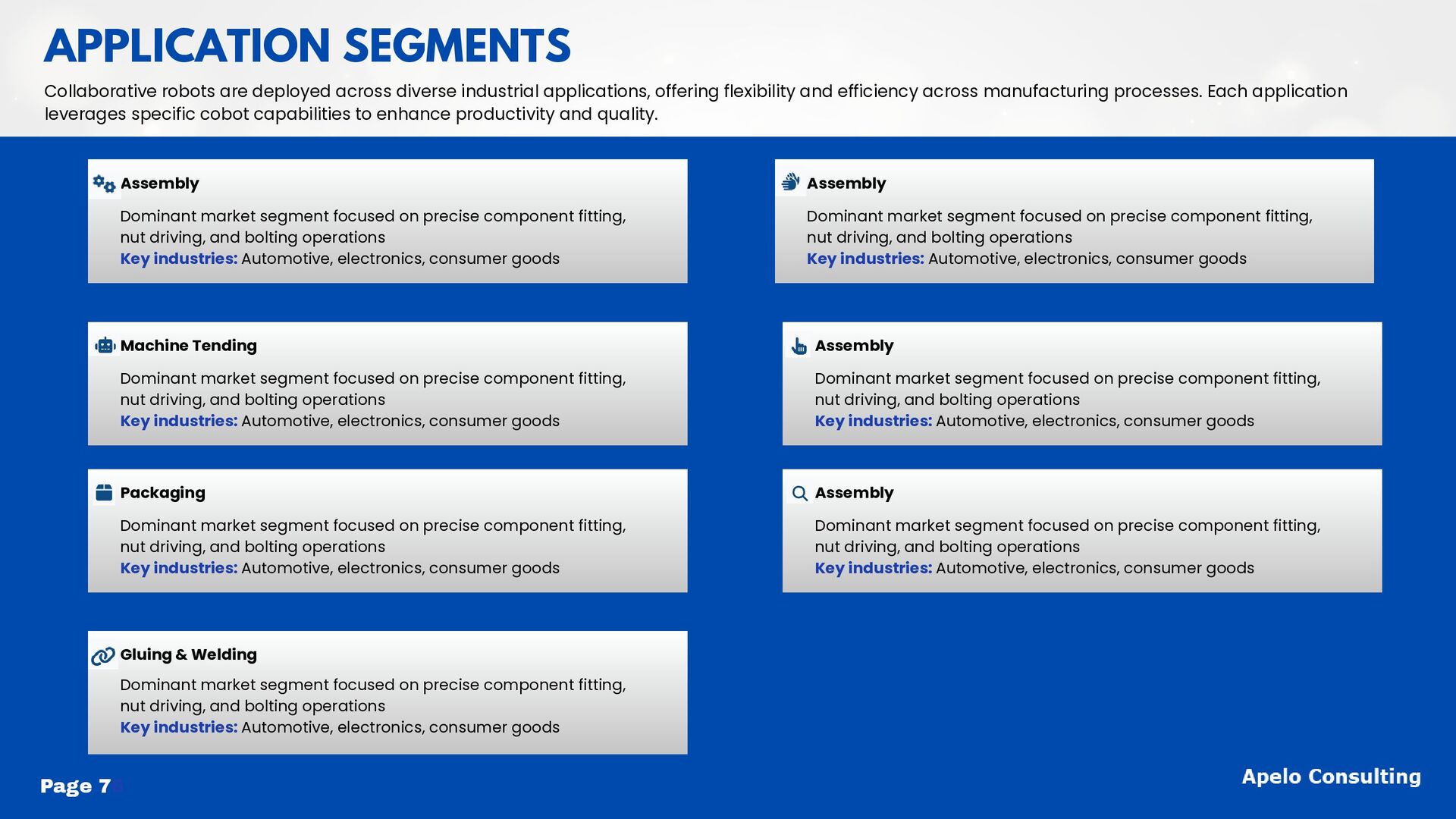
  7. Assembly APPLICATION SEGMENTS Page 76 Dominant market segment focused on

    precise component fitting, nut driving, and bolting operations Key industries: Automotive, electronics, consumer goods Dominant market segment focused on precise component fitting, nut driving, and bolting operations Key industries: Automotive, electronics, consumer goods Machine Tending Dominant market segment focused on precise component fitting, nut driving, and bolting operations Key industries: Automotive, electronics, consumer goods Packaging Dominant market segment focused on precise component fitting, nut driving, and bolting operations Key industries: Automotive, electronics, consumer goods Gluing & Welding Dominant market segment focused on precise component fitting, nut driving, and bolting operations Key industries: Automotive, electronics, consumer goods Assembly Dominant market segment focused on precise component fitting, nut driving, and bolting operations Key industries: Automotive, electronics, consumer goods Assembly Dominant market segment focused on precise component fitting, nut driving, and bolting operations Key industries: Automotive, electronics, consumer goods Assembly Collaborative robots are deployed across diverse industrial applications, offering flexibility and efficiency across manufacturing processes. Each application leverages specific cobot capabilities to enhance productivity and quality.
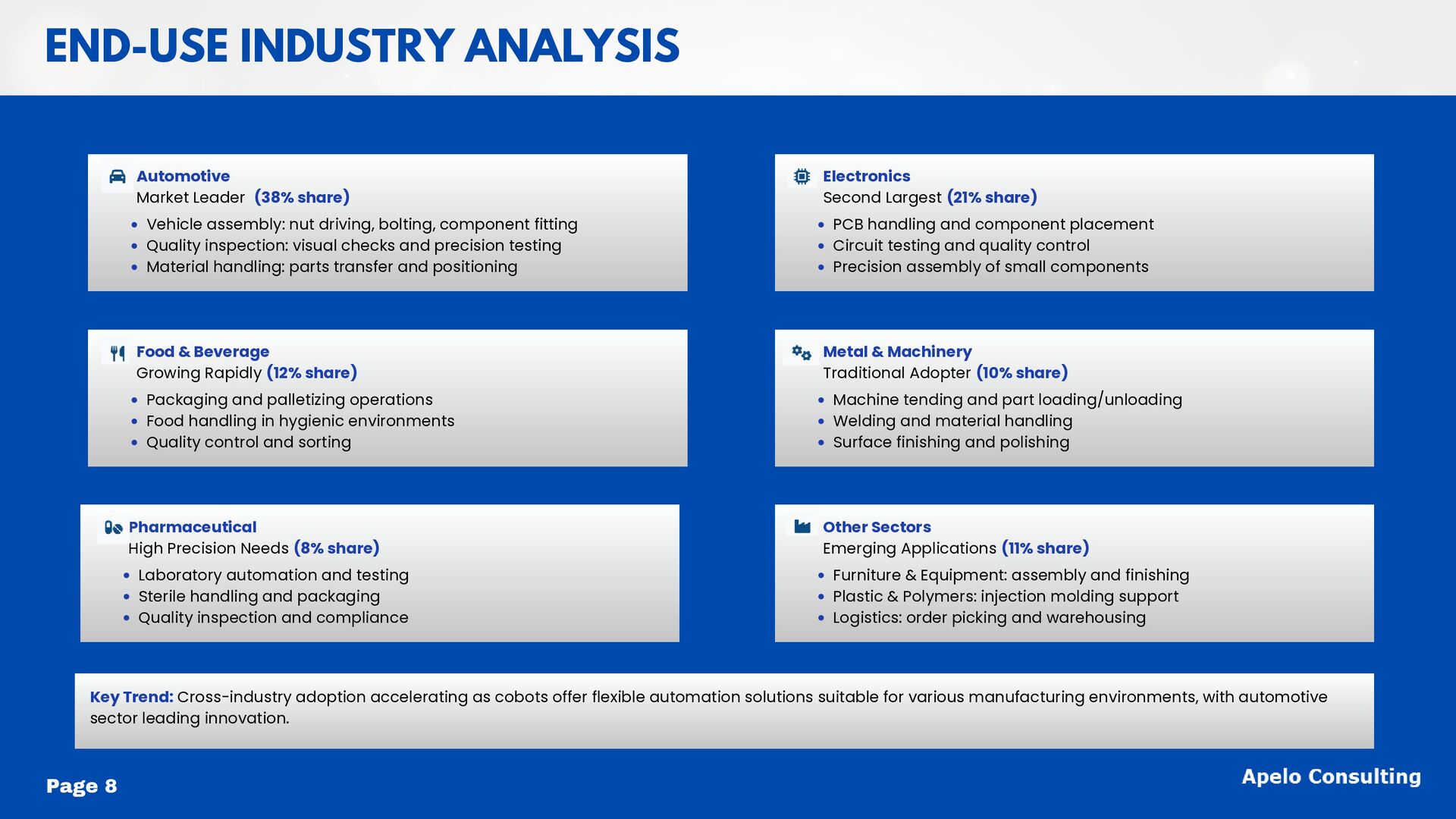
  8. Pharmaceutical High Precision Needs (8% share) END-USE INDUSTRY ANALYSIS Page

    8 Laboratory automation and testing Sterile handling and packaging Quality inspection and compliance Key Trend: Cross-industry adoption accelerating as cobots offer flexible automation solutions suitable for various manufacturing environments, with automotive sector leading innovation. Furniture & Equipment: assembly and finishing Plastic & Polymers: injection molding support Logistics: order picking and warehousing Other Sectors Emerging Applications (11% share) Packaging and palletizing operations Food handling in hygienic environments Quality control and sorting Food & Beverage Growing Rapidly (12% share) Machine tending and part loading/unloading Welding and material handling Surface finishing and polishing Metal & Machinery Traditional Adopter (10% share) Vehicle assembly: nut driving, bolting, component fitting Quality inspection: visual checks and precision testing Material handling: parts transfer and positioning Automotive Market Leader (38% share) PCB handling and component placement Circuit testing and quality control Precision assembly of small components Electronics Second Largest (21% share)
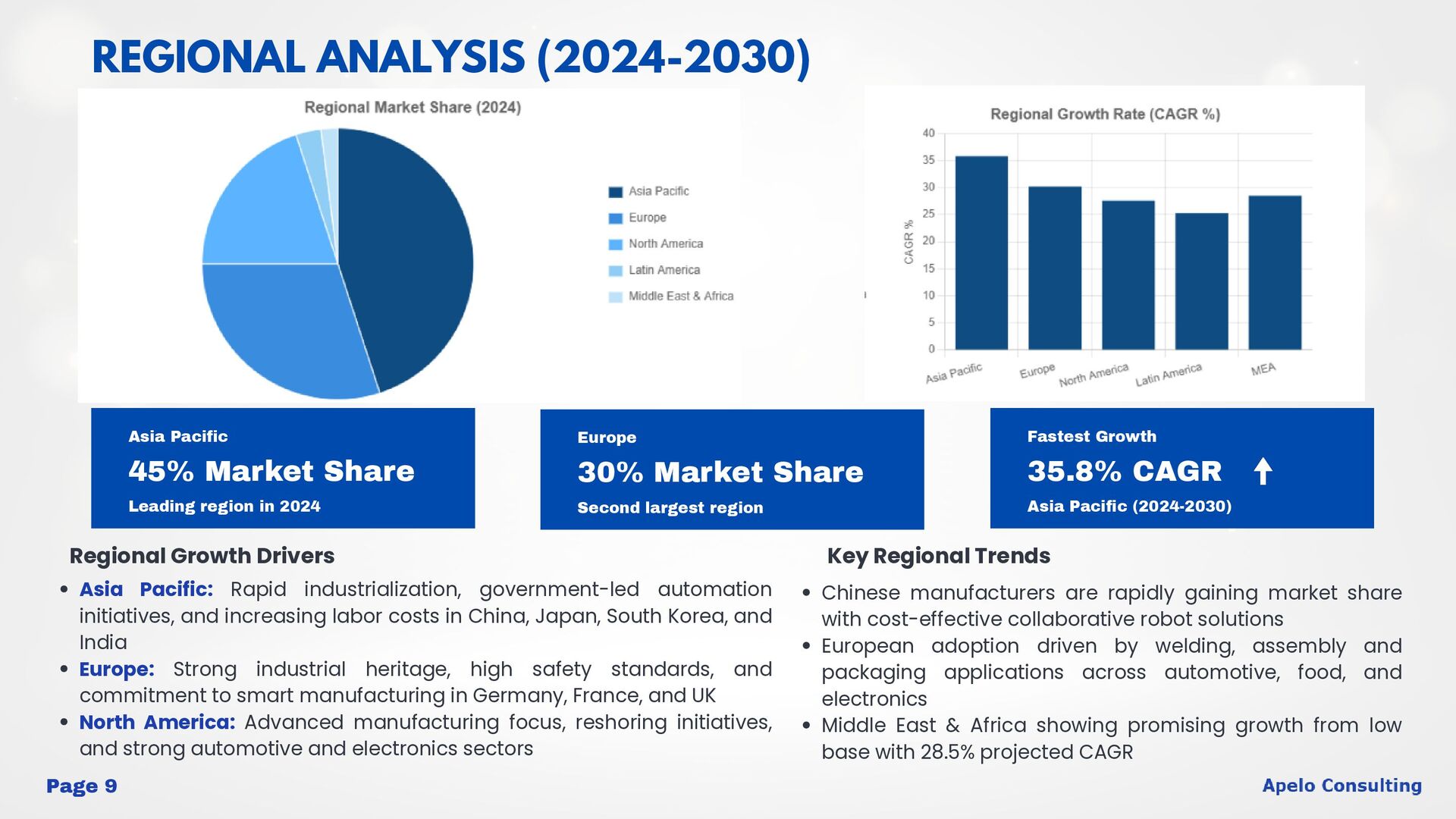
  9. 32.7% $11.6 BILLION Forecast Year (2030) CAGR (2024-2030) 35.8% CAGR

    REGIONAL ANALYSIS (2024-2030) Regional Growth Drivers Asia Pacific: Rapid industrialization, government-led automation initiatives, and increasing labor costs in China, Japan, South Korea, and India Europe: Strong industrial heritage, high safety standards, and commitment to smart manufacturing in Germany, France, and UK North America: Advanced manufacturing focus, reshoring initiatives, and strong automotive and electronics sectors Chinese manufacturers are rapidly gaining market share with cost-effective collaborative robot solutions European adoption driven by welding, assembly and packaging applications across automotive, food, and electronics Middle East & Africa showing promising growth from low base with 28.5% projected CAGR Key Regional Trends Page 9 Asia Pacific Leading region in 2024 45% Market Share Europe Second largest region 30% Market Share Fastest Growth Asia Pacific (2024-2030)
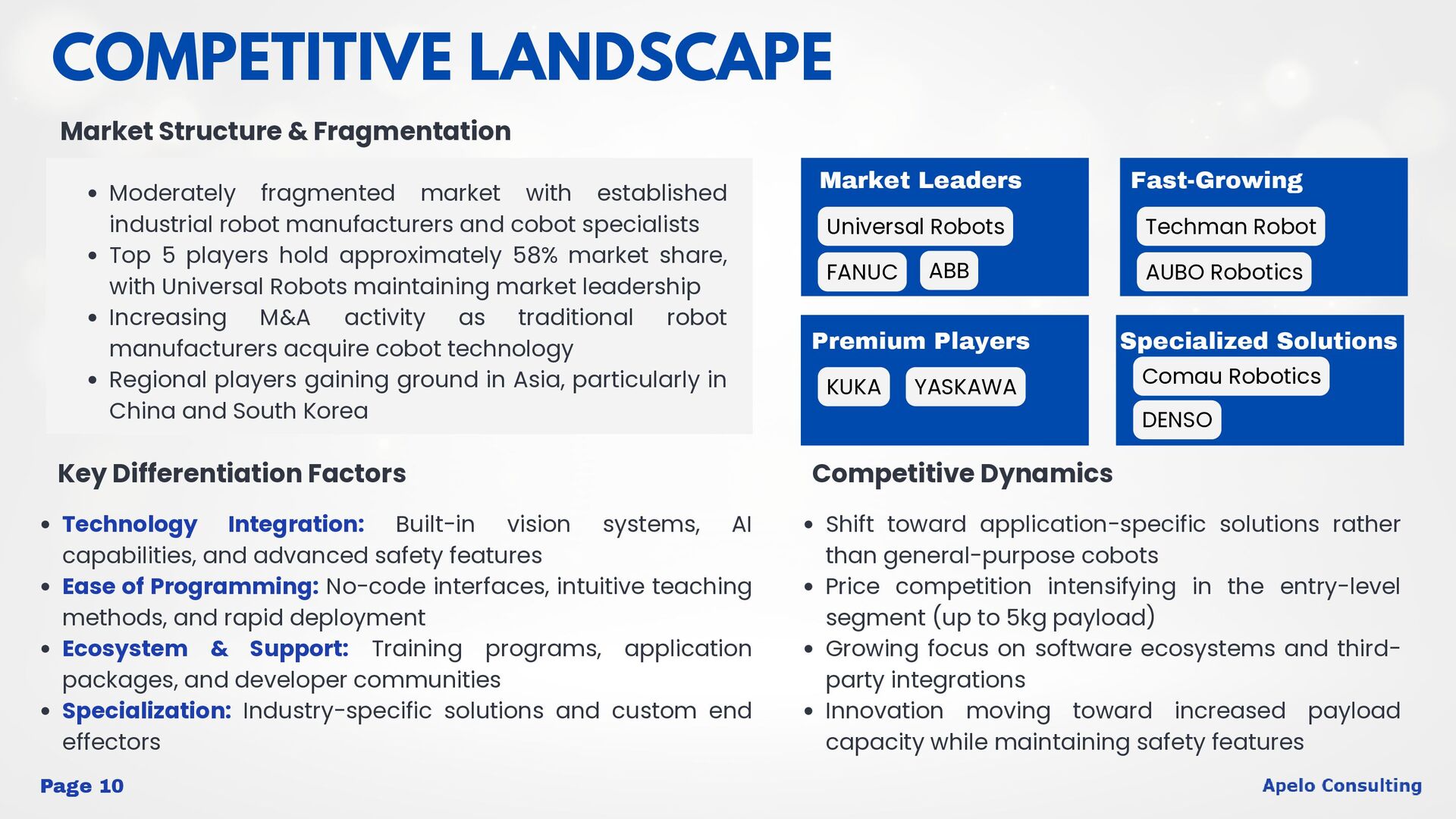
  10. COMPETITIVE LANDSCAPE Key Differentiation Factors Technology Integration: Built-in vision systems,

    AI capabilities, and advanced safety features Ease of Programming: No-code interfaces, intuitive teaching methods, and rapid deployment Ecosystem & Support: Training programs, application packages, and developer communities Specialization: Industry-specific solutions and custom end effectors Shift toward application-specific solutions rather than general-purpose cobots Price competition intensifying in the entry-level segment (up to 5kg payload) Growing focus on software ecosystems and third- party integrations Innovation moving toward increased payload capacity while maintaining safety features Competitive Dynamics Page 10 Premium Players KUKA Market Structure & Fragmentation YASKAWA Specialized Solutions DENSO Comau Robotics Market Leaders Universal Robots ABB Fast-Growing Techman Robot AUBO Robotics FANUC Moderately fragmented market with established industrial robot manufacturers and cobot specialists Top 5 players hold approximately 58% market share, with Universal Robots maintaining market leadership Increasing M&A activity as traditional robot manufacturers acquire cobot technology Regional players gaining ground in Asia, particularly in China and South Korea
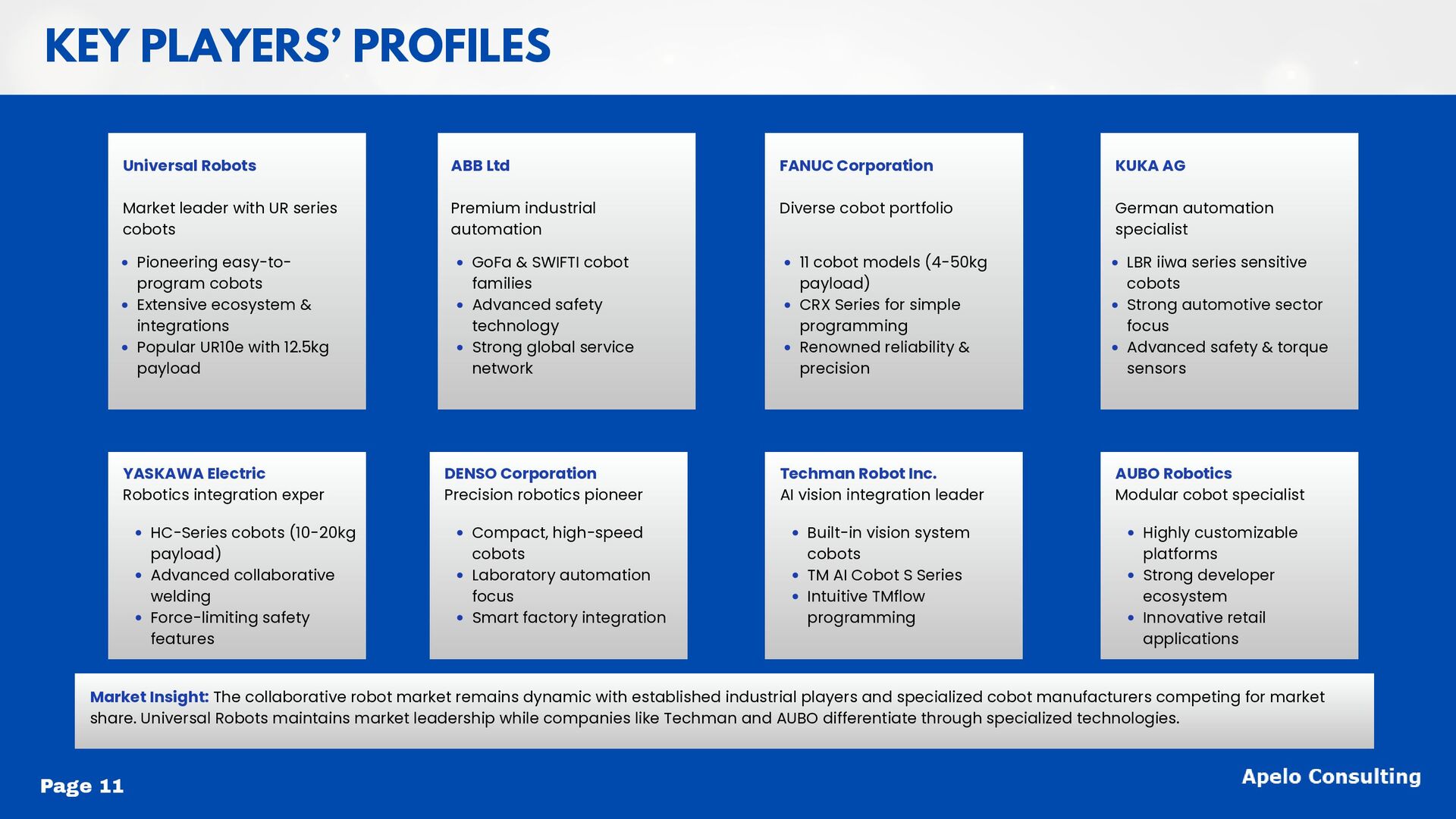
  11. KEY PLAYERS’ PROFILES Page 11 HC-Series cobots (10-20kg payload) Advanced

    collaborative welding Force-limiting safety features YASKAWA Electric Robotics integration exper Market Insight: The collaborative robot market remains dynamic with established industrial players and specialized cobot manufacturers competing for market share. Universal Robots maintains market leadership while companies like Techman and AUBO differentiate through specialized technologies. Compact, high-speed cobots Laboratory automation focus Smart factory integration DENSO Corporation Precision robotics pioneer Built-in vision system cobots TM AI Cobot S Series Intuitive TMflow programming Techman Robot Inc. AI vision integration leader Highly customizable platforms Strong developer ecosystem Innovative retail applications AUBO Robotics Modular cobot specialist Pioneering easy-to- program cobots Extensive ecosystem & integrations Popular UR10e with 12.5kg payload Universal Robots Market leader with UR series cobots GoFa & SWIFTI cobot families Advanced safety technology Strong global service network ABB Ltd Premium industrial automation 11 cobot models (4-50kg payload) CRX Series for simple programming Renowned reliability & precision FANUC Corporation Diverse cobot portfolio LBR iiwa series sensitive cobots Strong automotive sector focus Advanced safety & torque sensors KUKA AG German automation specialist
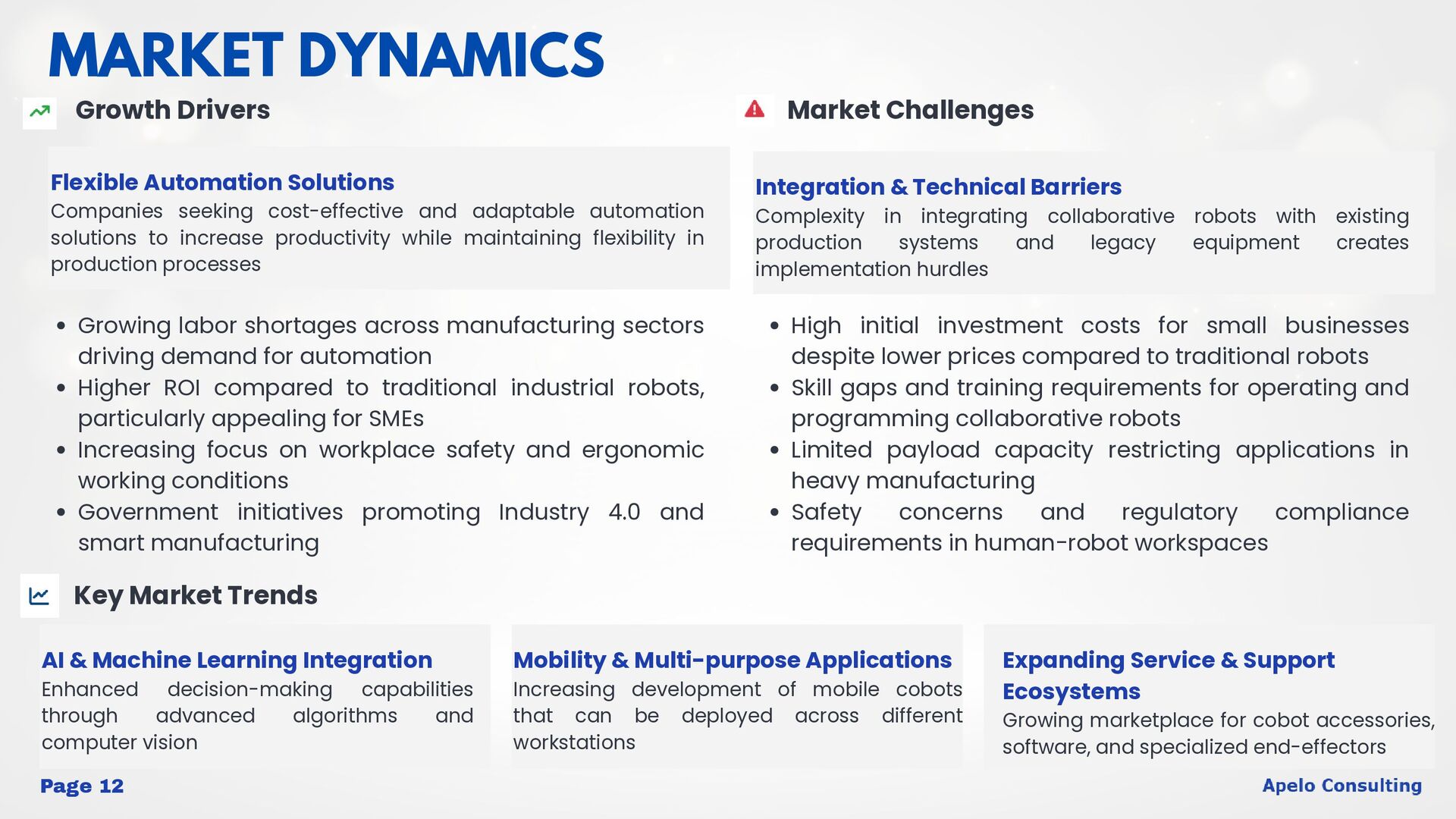
  12. MARKET DYNAMICS High initial investment costs for small businesses despite

    lower prices compared to traditional robots Skill gaps and training requirements for operating and programming collaborative robots Limited payload capacity restricting applications in heavy manufacturing Safety concerns and regulatory compliance requirements in human-robot workspaces Page 12 Growth Drivers Growing labor shortages across manufacturing sectors driving demand for automation Higher ROI compared to traditional industrial robots, particularly appealing for SMEs Increasing focus on workplace safety and ergonomic working conditions Government initiatives promoting Industry 4.0 and smart manufacturing Flexible Automation Solutions Companies seeking cost-effective and adaptable automation solutions to increase productivity while maintaining flexibility in production processes Market Challenges Integration & Technical Barriers Complexity in integrating collaborative robots with existing production systems and legacy equipment creates implementation hurdles Key Market Trends AI & Machine Learning Integration Enhanced decision-making capabilities through advanced algorithms and computer vision Mobility & Multi-purpose Applications Increasing development of mobile cobots that can be deployed across different workstations Expanding Service & Support Ecosystems Growing marketplace for cobot accessories, software, and specialized end-effectors
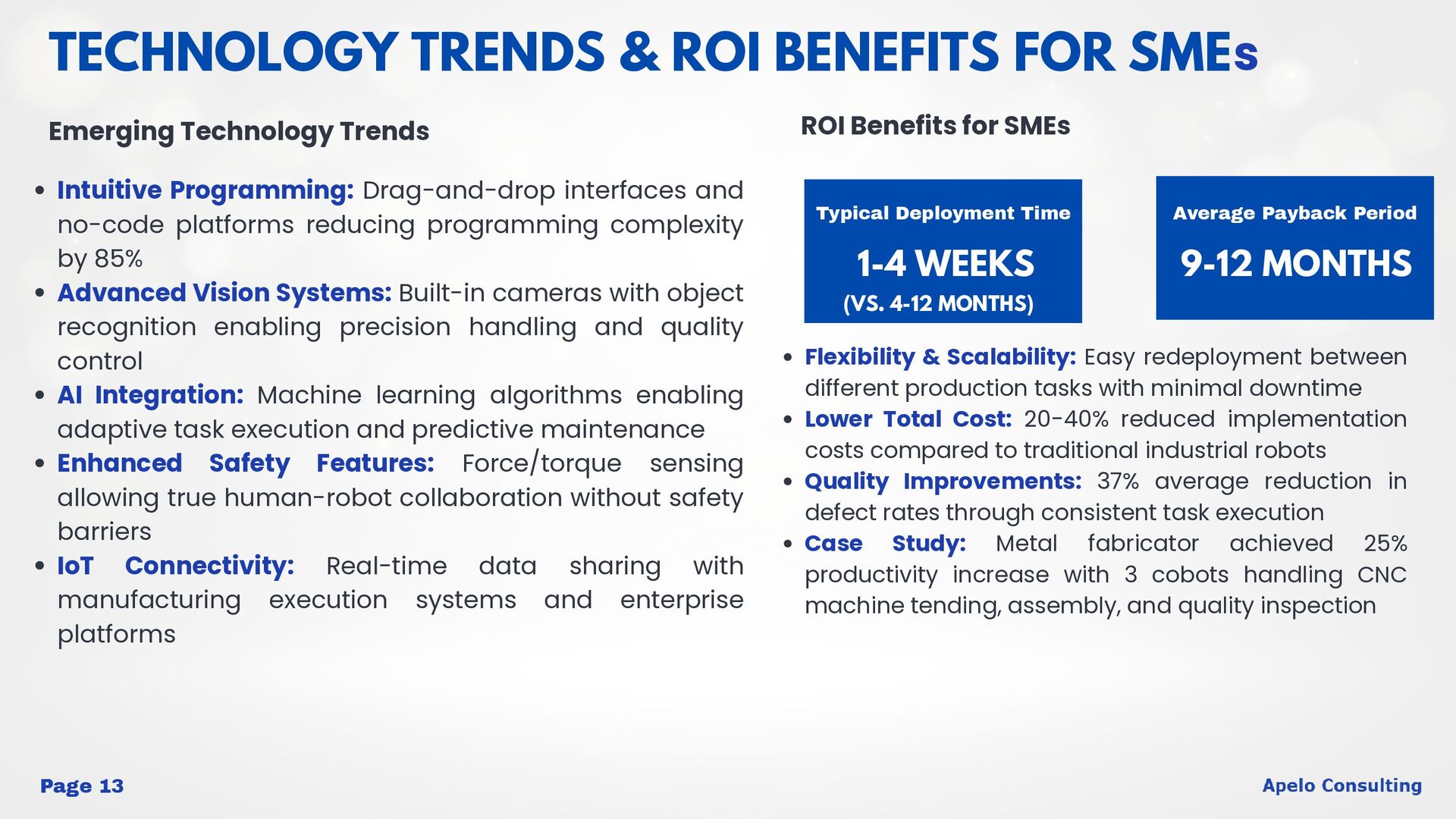
  13. TECHNOLOGY TRENDS & ROI BENEFITS FOR SME Intuitive Programming: Drag-and-drop

    interfaces and no-code platforms reducing programming complexity by 85% Advanced Vision Systems: Built-in cameras with object recognition enabling precision handling and quality control AI Integration: Machine learning algorithms enabling adaptive task execution and predictive maintenance Enhanced Safety Features: Force/torque sensing allowing true human-robot collaboration without safety barriers IoT Connectivity: Real-time data sharing with manufacturing execution systems and enterprise platforms Page 13 Emerging Technology Trends ROI Benefits for SMEs Flexibility & Scalability: Easy redeployment between different production tasks with minimal downtime Lower Total Cost: 20-40% reduced implementation costs compared to traditional industrial robots Quality Improvements: 37% average reduction in defect rates through consistent task execution Case Study: Metal fabricator achieved 25% productivity increase with 3 cobots handling CNC machine tending, assembly, and quality inspection 1-4 WEEKS Typical Deployment Time Average Payback Period (VS. 4-12 MONTHS) 9-12 MONTHS s
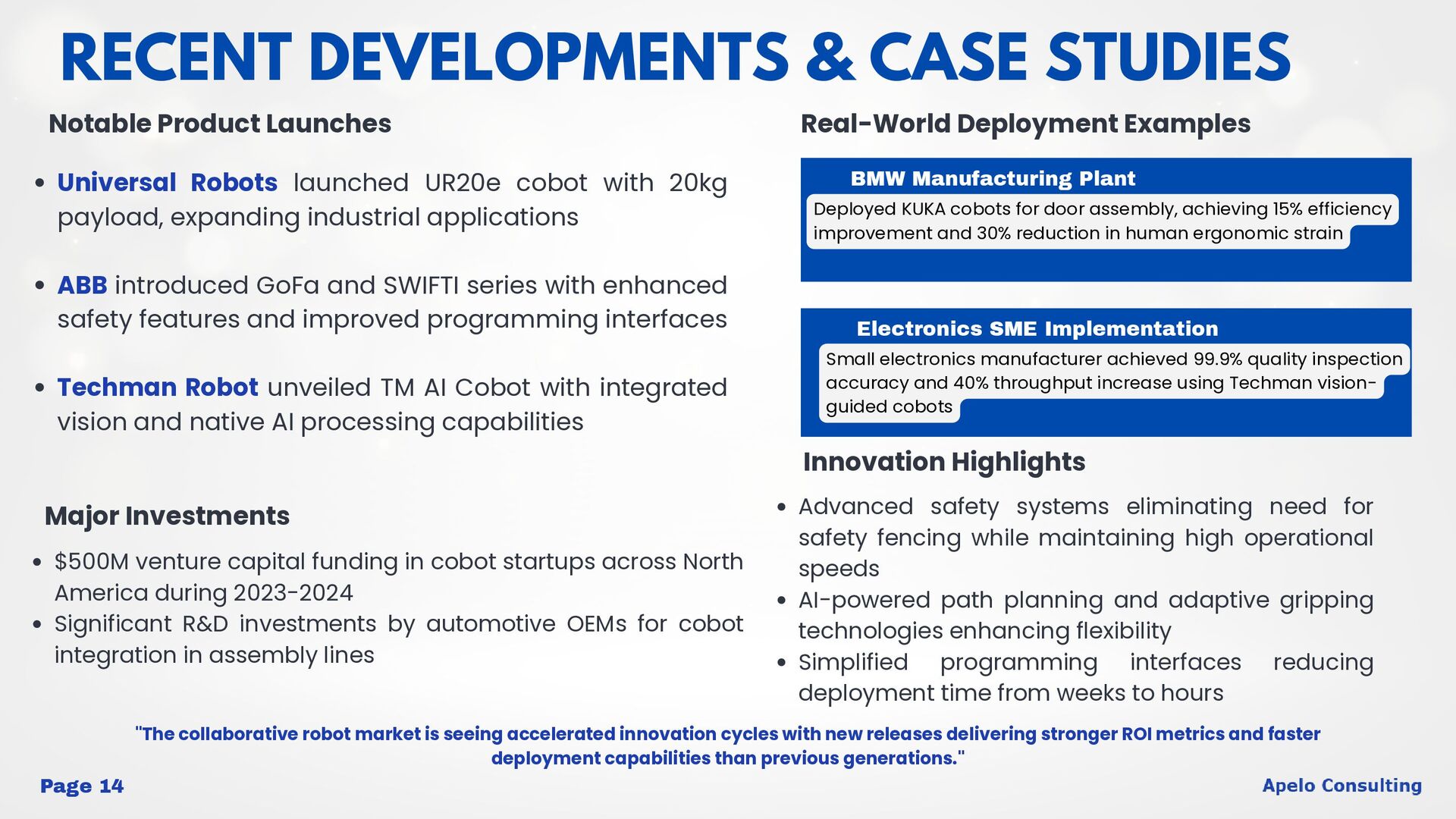
  14. RECENT DEVELOPMENTS & CASE STUDIES Major Investments Universal Robots launched

    UR20e cobot with 20kg payload, expanding industrial applications ABB introduced GoFa and SWIFTI series with enhanced safety features and improved programming interfaces Techman Robot unveiled TM AI Cobot with integrated vision and native AI processing capabilities Advanced safety systems eliminating need for safety fencing while maintaining high operational speeds AI-powered path planning and adaptive gripping technologies enhancing flexibility Simplified programming interfaces reducing deployment time from weeks to hours Innovation Highlights Page 14 Notable Product Launches BMW Manufacturing Plant Deployed KUKA cobots for door assembly, achieving 15% efficiency improvement and 30% reduction in human ergonomic strain $500M venture capital funding in cobot startups across North America during 2023-2024 Significant R&D investments by automotive OEMs for cobot integration in assembly lines Real-World Deployment Examples Electronics SME Implementation Small electronics manufacturer achieved 99.9% quality inspection accuracy and 40% throughput increase using Techman vision- guided cobots "The collaborative robot market is seeing accelerated innovation cycles with new releases delivering stronger ROI metrics and faster deployment capabilities than previous generations."
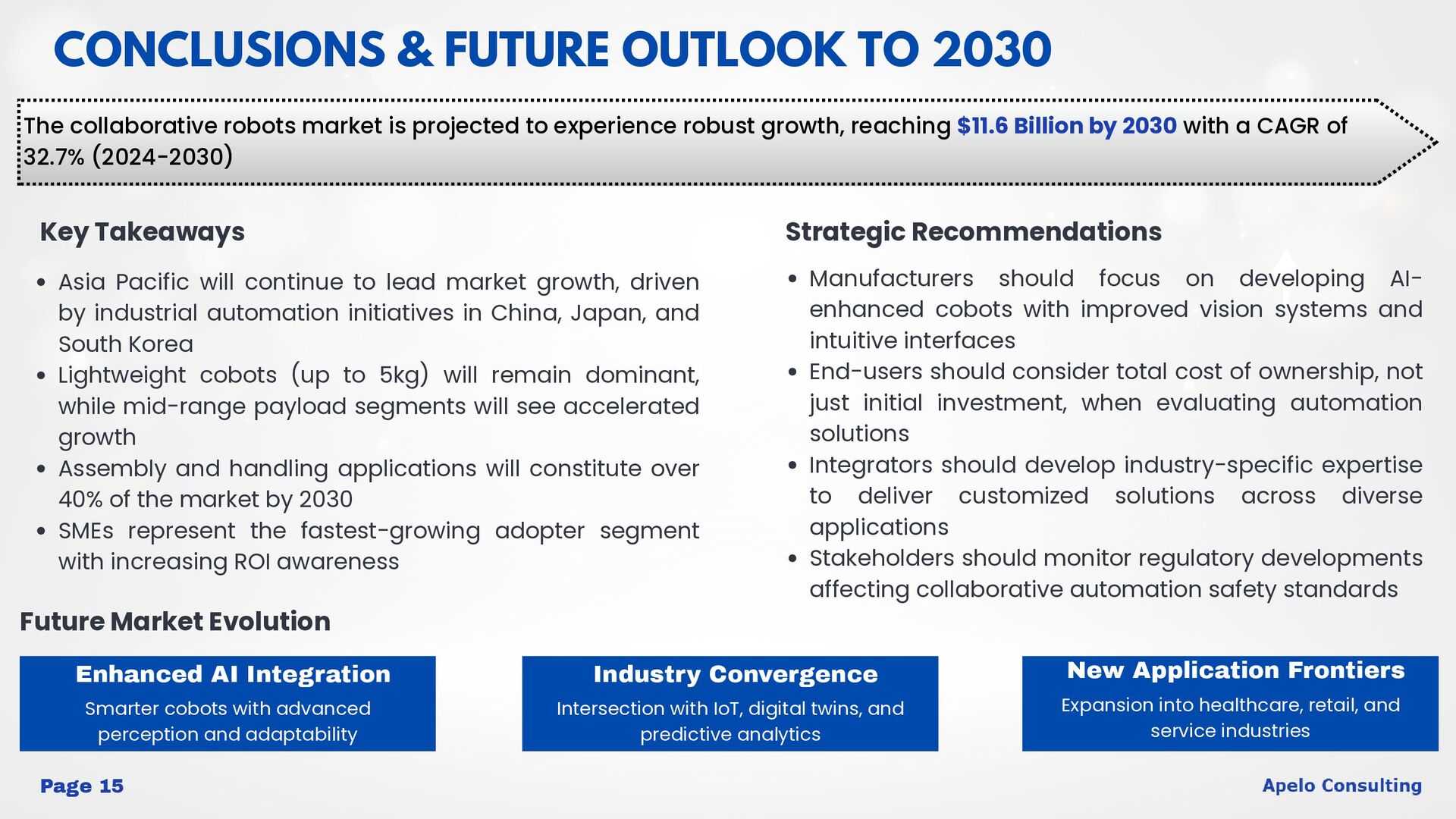
  15. The collaborative robots market is projected to experience robust growth,

    reaching $11.6 Billion by 2030 with a CAGR of 32.7% (2024-2030) CONCLUSIONS & FUTURE OUTLOOK TO 2030 Key Takeaways Asia Pacific will continue to lead market growth, driven by industrial automation initiatives in China, Japan, and South Korea Lightweight cobots (up to 5kg) will remain dominant, while mid-range payload segments will see accelerated growth Assembly and handling applications will constitute over 40% of the market by 2030 SMEs represent the fastest-growing adopter segment with increasing ROI awareness Manufacturers should focus on developing AI- enhanced cobots with improved vision systems and intuitive interfaces End-users should consider total cost of ownership, not just initial investment, when evaluating automation solutions Integrators should develop industry-specific expertise to deliver customized solutions across diverse applications Stakeholders should monitor regulatory developments affecting collaborative automation safety standards Strategic Recommendations Page 15 Future Market Evolution Enhanced AI Integration Smarter cobots with advanced perception and adaptability Industry Convergence Intersection with IoT, digital twins, and predictive analytics New Application Frontiers Expansion into healthcare, retail, and service industries