Best Cloud Migration Company in India: What Actually Matters
Choose the Best Cloud Migration Company in India for secure workload migration, reduced downtime, infrastructure modernization, and long-term cloud cost management.
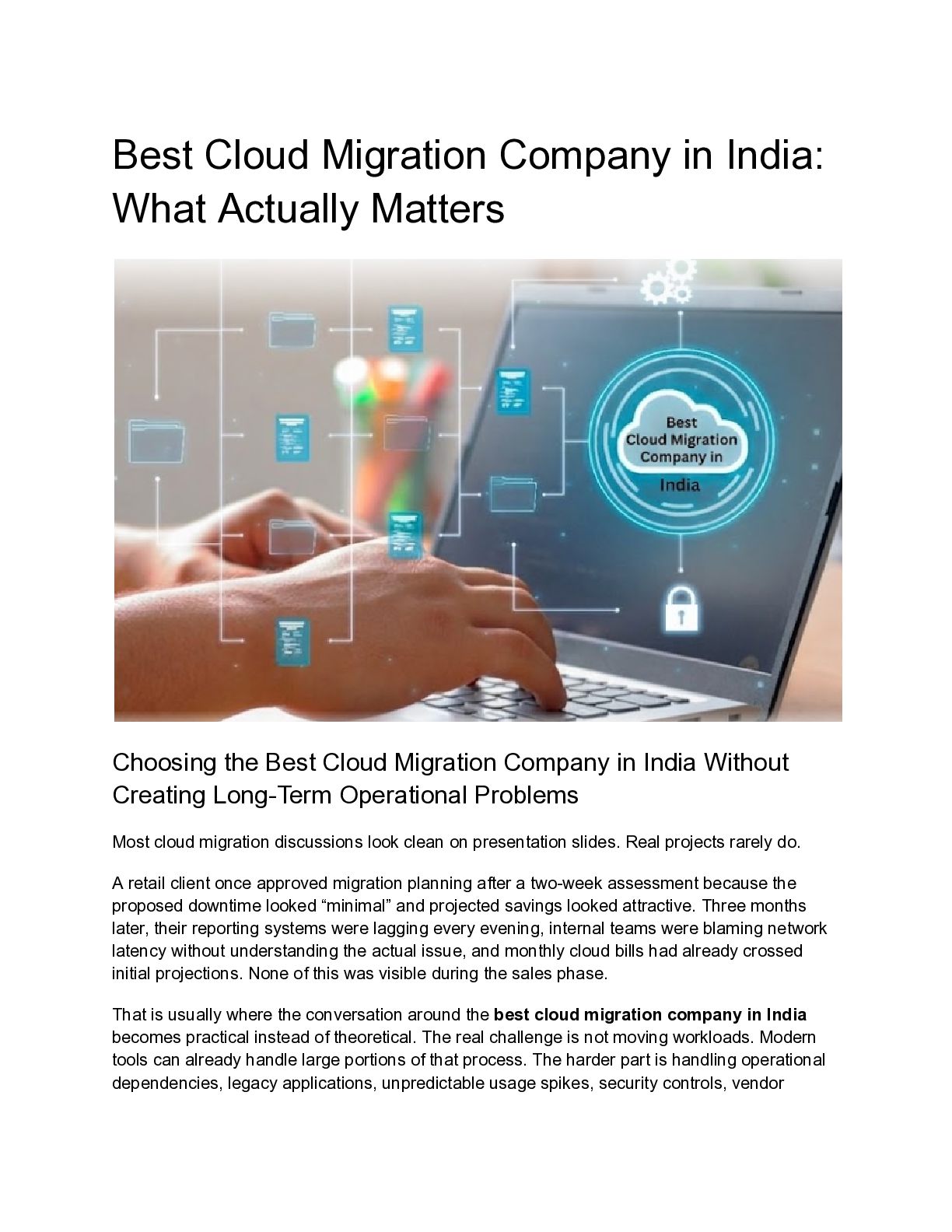
the Best Cloud Migration Company in India Without Creating Long-Term Operational Problems Most cloud migration discussions look clean on presentation slides. Real projects rarely do. A retail client once approved migration planning after a two-week assessment because the proposed downtime looked “minimal” and projected savings looked attractive. Three months later, their reporting systems were lagging every evening, internal teams were blaming network latency without understanding the actual issue, and monthly cloud bills had already crossed initial projections. None of this was visible during the sales phase. That is usually where the conversation around the best cloud migration company in India becomes practical instead of theoretical. The real challenge is not moving workloads. Modern tools can already handle large portions of that process. The harder part is handling operational dependencies, legacy applications, unpredictable usage spikes, security controls, vendor
more expensive than the old infrastructure. Many organizations searching for the best cloud migration company in India focus heavily on migration speed. Experienced teams pay more attention to operational survivability after the migration is complete because that is where costs, failures, and business pressure usually begin accumulating quietly. Why Cloud Migration Projects Look Easier During Planning Than During Execution Most migration timelines look reasonable until real execution begins. During assessment workshops, applications are often categorized too broadly. Teams label systems as “low-risk,” “lift-and-shift compatible,” or “non-critical” without fully understanding hidden dependencies. Then production traffic exposes gaps that nobody documented properly. This is common in older enterprises where infrastructure knowledge sits with a few individuals instead of being operationally documented. The problem becomes worse when organizations pursue aggressive modernization too early. Many companies investing in AWS cloud modernization services India try to containerize, redesign architecture, optimize security, modernize databases, and reduce infrastructure costs simultaneously. Technically possible. Operationally dangerous. One thing many teams underestimate is how difficult internal coordination becomes during migration windows. Infrastructure teams may be ready, but application owners delay approvals. Compliance teams suddenly request additional logging controls. Vendors supporting legacy software may refuse responsibility once workloads move to cloud infrastructure. These issues do not appear in migration estimates, but they slow projects significantly. I have seen organizations select the best cloud migration company in India based mostly on proposal pricing, only to discover later that migration support excluded monitoring, optimization, backup redesign, or post-cutover troubleshooting. The migration was technically completed, but operational ownership became fragmented immediately afterward. That usually turns into a long support problem instead of a successful transformation. Cloud Migration Without Downtime Is Possible, But Operationally Expensive The phrase “cloud migration without downtime” sounds straightforward until transaction-heavy workloads are involved.
systems, healthcare platforms, logistics operations, and customer-facing transactional systems usually cannot. Maintaining continuity while synchronizing live production data introduces a completely different level of operational pressure. This is where experienced migration teams behave differently from presentation-focused vendors. They spend more time analyzing synchronization behavior, rollback planning, database replication lag, traffic routing, DNS propagation timing, and failback procedures than discussing dashboards or architecture diagrams. Because once production traffic shifts, small mistakes become visible immediately. Direct answer: Organizations expecting true cloud migration without downtime should expect higher implementation complexity, longer testing cycles, and increased temporary infrastructure costs during transition periods. In reality, downtime-free migration often requires parallel infrastructure environments running simultaneously for weeks. That affects budgets quickly. Especially in large-scale environments. A few operational realities companies usually ignore: • Database synchronization becomes unstable under inconsistent transaction loads • Legacy applications often fail under cloud-native networking conditions • Rollback planning is rarely tested properly before production cutover • Temporary dual-environment costs can become surprisingly high • Monitoring gaps usually appear after traffic routing changes The best cloud migration company in India is usually not the one promising the fastest migration timeline. It is the one willing to slow the project down when operational risk becomes unacceptable. That distinction matters more than most procurement teams initially realize. The Real Story Behind AWS Cloud Migration Cost in India Discussions around AWS cloud migration cost in India are often misleading because organizations compare infrastructure pricing instead of operational behavior. Initial cloud bills can look lower during proof-of-concept stages because workloads are lightly optimized and usage patterns remain controlled. Production environments behave differently. Storage growth accelerates, monitoring expands, backup retention increases, API calls rise, and temporary testing environments remain active longer than expected.
worked on looked financially efficient during the first quarter. By the second quarter, observability tooling, backup replication, managed database services, outbound bandwidth charges, and security logging had collectively become a larger expense category than anticipated compute usage itself. This happens frequently because cloud cost estimation models are often based on ideal infrastructure assumptions rather than operational realities. The best cloud migration company in India usually spends more time discussing long-term cost governance than migration itself. That conversation is less attractive during sales discussions, but it becomes critical later. There is another issue many organizations fail to recognize early. Cloud waste becomes operationally invisible surprisingly fast. Unused snapshots accumulate. Development environments stay active continuously. Storage lifecycle policies remain unconfigured. Teams overprovision resources to avoid performance complaints. Nobody notices immediately because billing is fragmented across services. Direct answer: The biggest contributor to unexpected aws cloud migration cost in india is usually poor post-migration operational governance, not the migration process itself. That is why mature teams implement financial monitoring controls early instead of treating optimization as a later activity. Why Cloud Modernization Services India Often Create New Operational Dependencies Modernization sounds attractive because legacy infrastructure creates genuine operational problems. But modernization also introduces new dependencies that many organizations are not prepared to manage internally. This is especially visible in projects involving Kubernetes, serverless workloads, infrastructure-as-code automation, and distributed observability systems. The technical deployment itself is often manageable. Long-term operational ownership is harder. Organizations purchasing cloud modernization services india sometimes assume internal teams will naturally adapt after implementation. That rarely happens smoothly without significant operational restructuring. Existing teams may have strong infrastructure experience but limited cloud-native troubleshooting capability. Then small incidents start taking much longer to resolve.
technically advanced, but operational confidence decreases. Engineers hesitate to modify deployments because environments are heavily automated. Troubleshooting requires understanding multiple interconnected services instead of isolated systems. Vendor dependency quietly increases because internal teams are uncomfortable managing highly abstracted architectures independently. This becomes particularly risky when modernization decisions are driven primarily by trend adoption instead of operational fit. Not every workload benefits equally from aggressive modernization. Some applications perform perfectly well with controlled infrastructure optimization rather than full architectural redesign. Experienced consultants usually recognize this earlier. Less experienced vendors often push modernization depth beyond practical business requirements because it increases project scope. The best cloud migration company in India is often the one willing to recommend partial modernization instead of full architectural reinvention. That sounds less impressive in presentations. Operationally, it is often the more responsible decision. Vendor Selection Problems Most Companies Realize Too Late Many organizations searching for the best cloud migration company in India evaluate technical certifications heavily while underestimating operational behavior. Certifications matter. Real operational maturity matters more. A migration partner may have excellent cloud partnerships and still struggle with escalation management, documentation quality, communication discipline, or production incident handling. Those weaknesses only become visible during high-pressure implementation phases. One thing experienced buyers eventually learn is that migration projects expose organizational behavior very quickly. Especially under pressure. Some vendors disappear after deployment. Others provide support, but only through ticket queues disconnected from business urgency. Some automate aggressively without ensuring internal teams understand what has actually changed operationally. Direct answer: The safest migration partners are usually the ones willing to challenge unrealistic timelines,
detail before contracts are signed. That level of operational honesty is uncommon because it slows procurement conversations. But it usually prevents larger problems later. The best cloud migration company in India is rarely identified by presentation quality alone. The better indicator is how they discuss failure scenarios, rollback conditions, monitoring responsibilities, escalation ownership, and long-term operational governance. Experienced teams spend more time talking about recovery than marketing teams are comfortable with. That is usually a good sign. Conclusion A lot of organizations still treat migration as a technical milestone instead of an operational transition. That is probably the biggest recurring mistake in this space. Infrastructure can be migrated relatively quickly now. Stable long-term operations cannot. The companies that handle cloud adoption well usually move more slowly during planning, document more aggressively, test rollback paths seriously, and avoid unnecessary modernization complexity during early phases. Meanwhile, organizations chasing aggressive transformation timelines often spend the next year stabilizing systems nobody fully understands internally. The next few years will likely make this problem more visible because cloud environments are becoming operationally denser, not simpler. AI workloads, distributed applications, compliance demands, and observability tooling are increasing architectural complexity across the board. The practical takeaway is fairly simple. If a migration proposal looks unusually fast, unusually cheap, and operationally effortless, somebody probably ignored an important problem that production environments will eventually expose. FAQs 1. How much does AWS cloud migration cost in India typically increase after deployment? Ans. Initial infrastructure estimates often exclude monitoring, backup retention, bandwidth usage, logging, security tooling, and temporary parallel environments. Real operational costs usually become clearer after production workloads stabilize for a few months.
Ans. Yes, but only with careful synchronization planning, replication management, rollback testing, and temporary infrastructure duplication. Zero-downtime migration usually increases both implementation complexity and short-term costs. 3. How do companies choose the best cloud migration company in India? Ans. Experienced organizations evaluate operational maturity, escalation handling, post-migration support quality, and risk transparency instead of focusing only on certifications or pricing proposals. 4. Why do cloud modernization projects fail operationally after deployment? Ans. Many teams modernize infrastructure faster than internal operational capability evolves. The technology works, but troubleshooting, ownership, and maintenance become difficult without proper operational adaptation. 5. Are AWS Cloud Modernization Services India suitable for all workloads? Ans. No. Some legacy systems benefit from targeted optimization instead of full modernization. Over-engineering architecture can increase operational dependency and maintenance complexity unnecessarily. 6. What is the biggest hidden risk after cloud migration? Ans. Operational governance. Resource sprawl, inconsistent monitoring, poor cost visibility, and fragmented ownership usually create bigger long-term problems than the migration activity itself.


 yazm
 satoshi7
 shuta13
 riyaamemiya
 grimoh
 nttcom
 yahonda
 occhi
 onk
 yut0naga1_fa
 greenmidori
 shogo4131
 cassininazir
 rabernat
 codingconduct
 baasie
 csswizardry
 tammyeverts
 helmedeiros
 takai
 geoffreycrofte
 addyosmani
 mza