Share
Embed

Transcript
129 slides
-
Aleksander Jaworski - Android Developer @ FootballCo - Blog akjaw.com
(Kotlin Multiplatform and Testing) - Twitter @akjaworski1 -
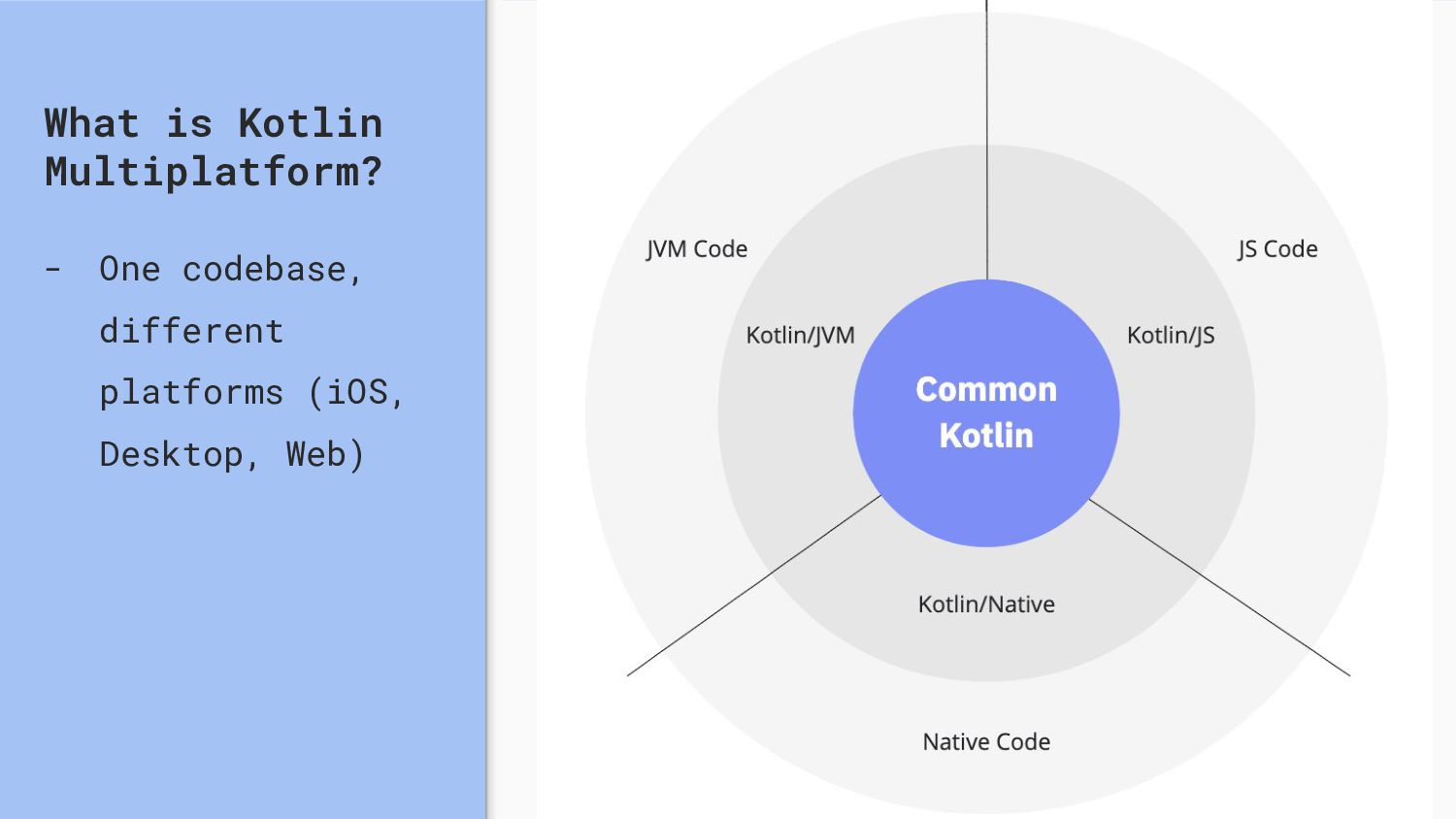
What is Kotlin Multiplatform? - One codebase, different platforms (iOS,
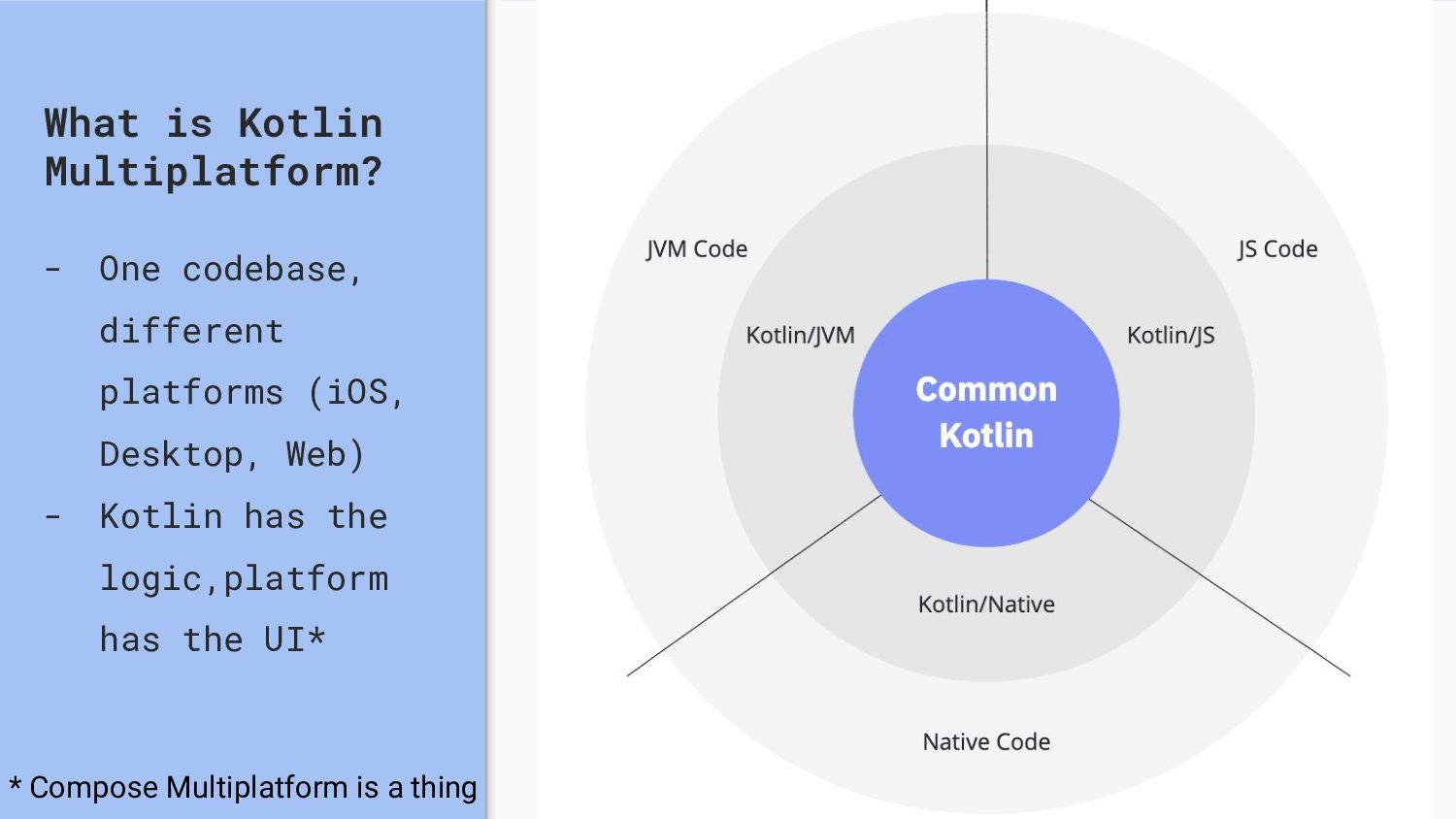
Desktop, Web) - Kotlin has the logic,platform has the UI* * Compose Multiplatform is a thing -
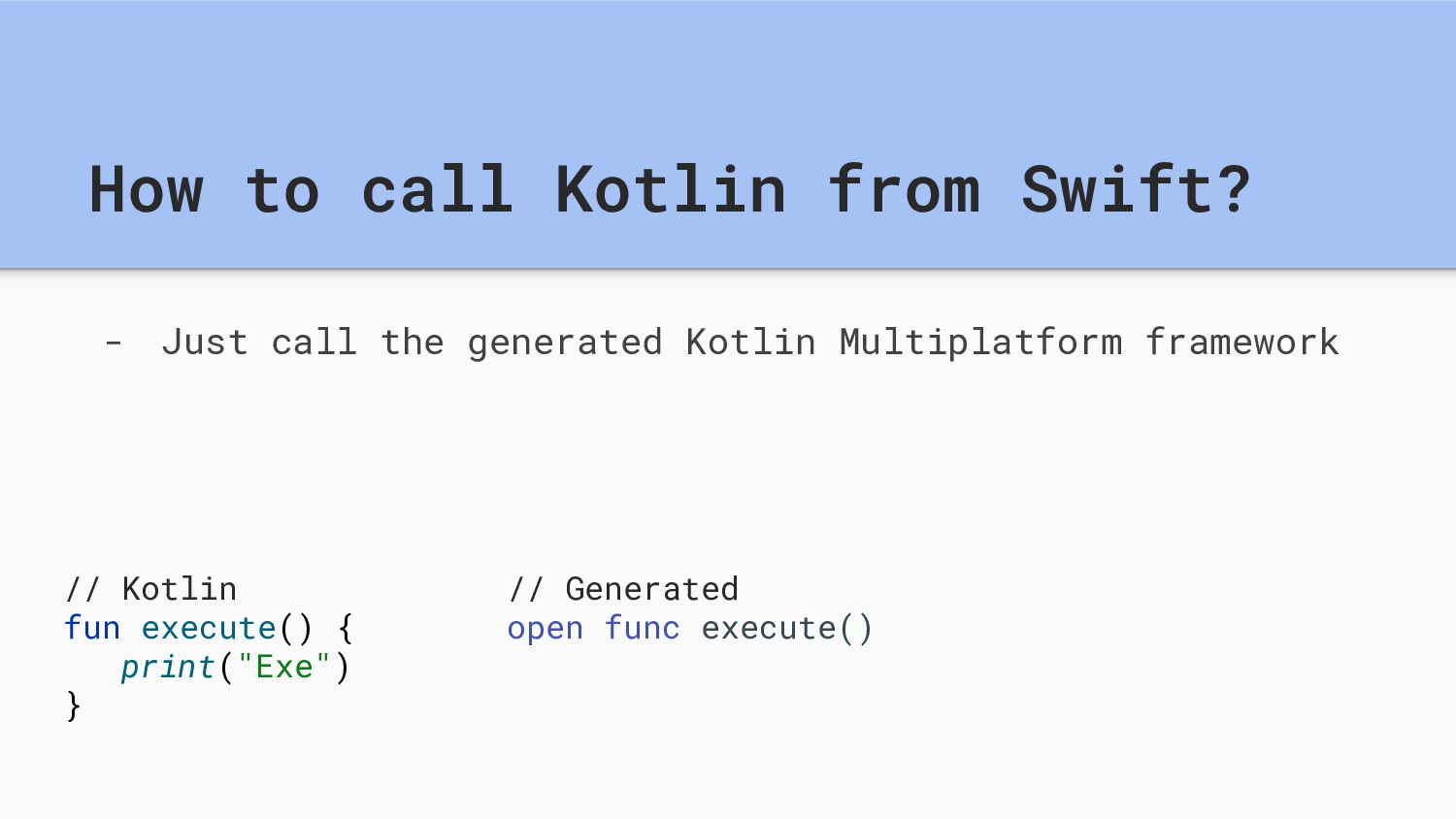
How to call Kotlin from Swift? - Just call the
generated Kotlin Multiplatform framework -
How to call Kotlin from Swift? // Kotlin fun execute()
{ print("Exe") } - Just call the generated Kotlin Multiplatform framework -
How to call Kotlin from Swift? // Kotlin fun execute()
{ print("Exe") } // Generated open func execute() - Just call the generated Kotlin Multiplatform framework -
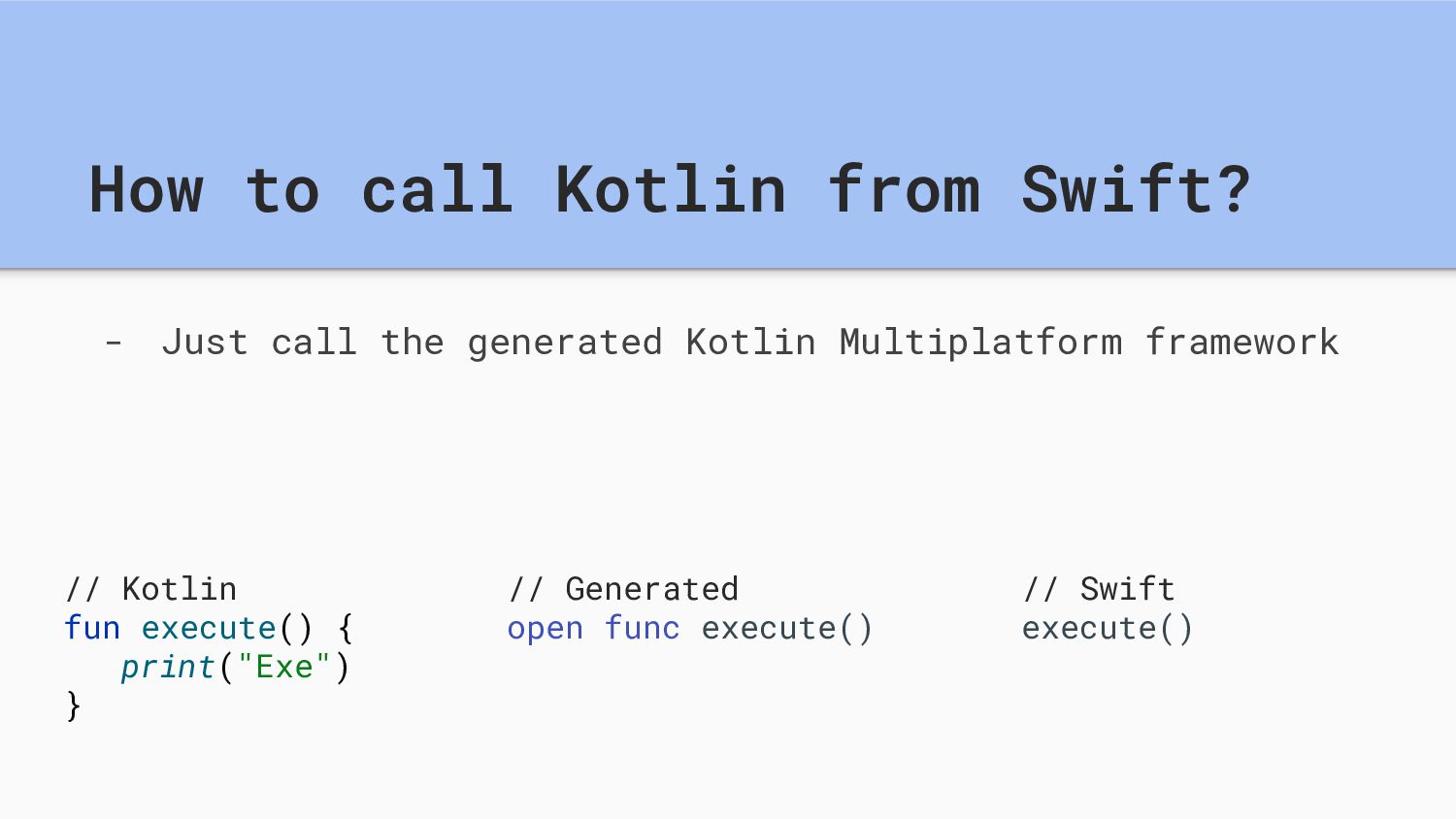
How to call Kotlin from Swift? // Kotlin fun execute()
{ print("Exe") } // Generated open func execute() // Swift execute() - Just call the generated Kotlin Multiplatform framework -
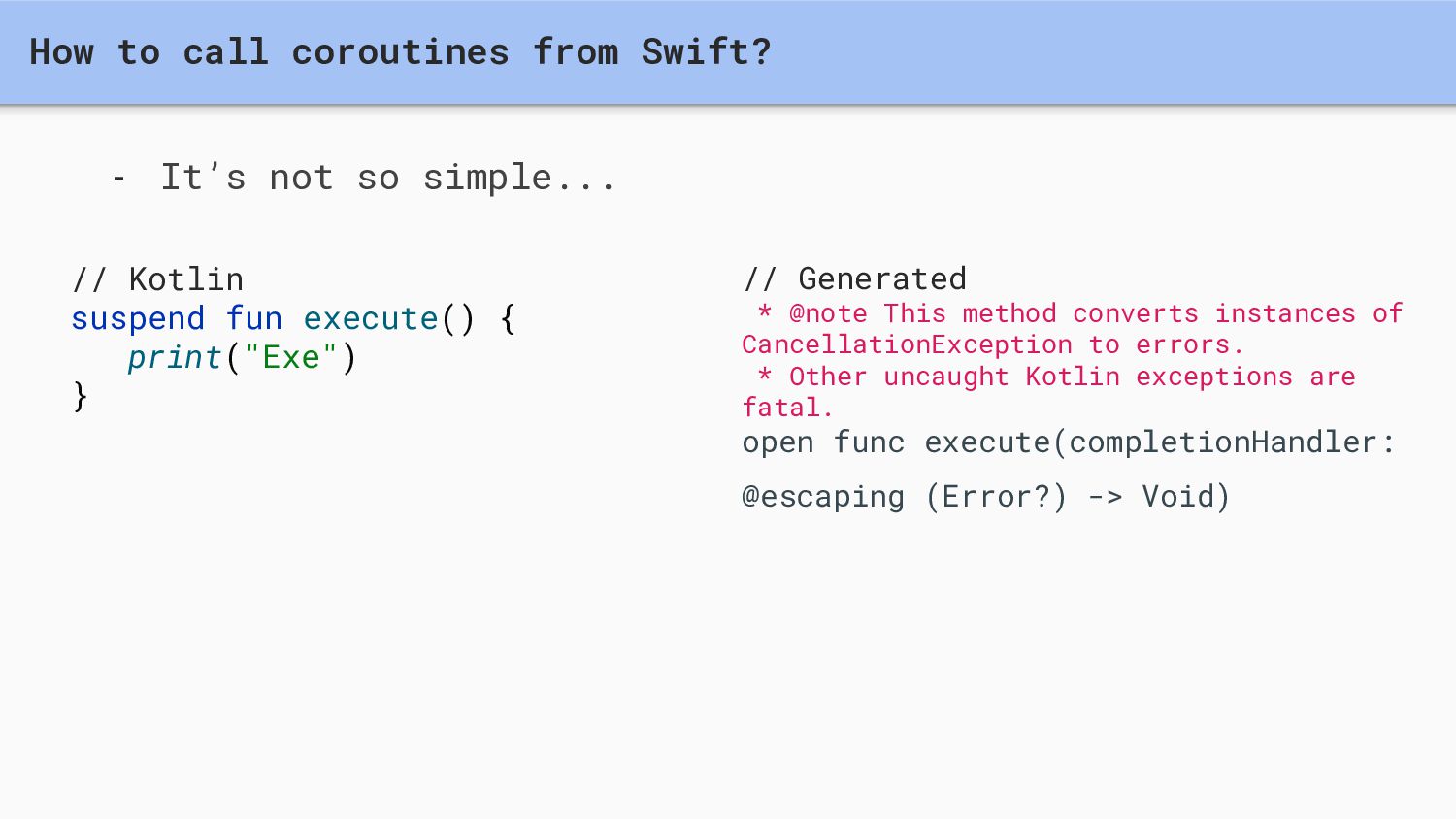
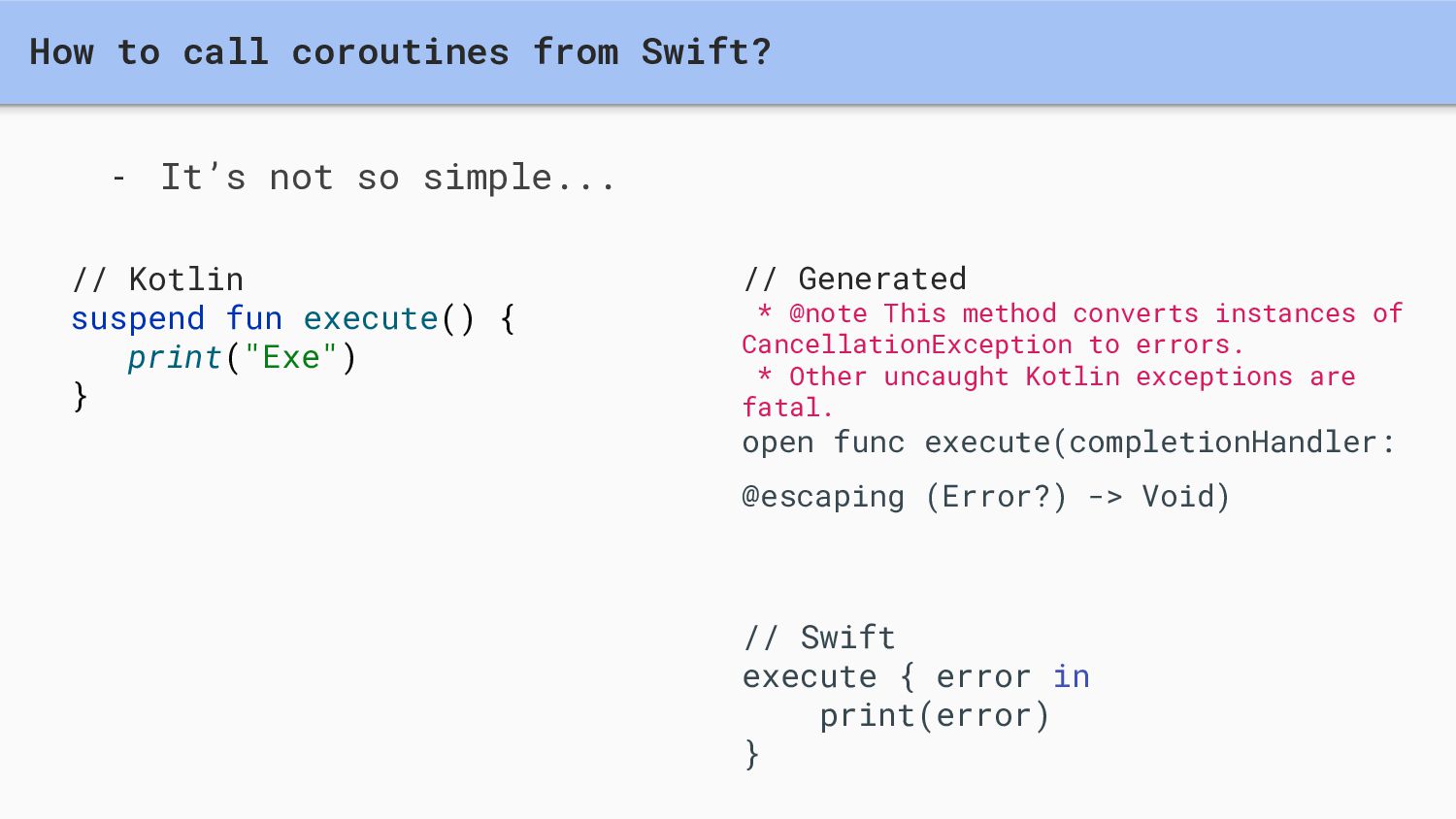
// Kotlin suspend fun execute() { print("Exe") } How to
call coroutines from Swift? - It’s not so simple... -
// Generated * @note This method converts instances of CancellationException
to errors. * Other uncaught Kotlin exceptions are fatal. open func execute(completionHandler: @escaping (Error?) -> Void) // Kotlin suspend fun execute() { print("Exe") } How to call coroutines from Swift? - It’s not so simple... -
// Kotlin suspend fun execute() { print("Exe") } // Swift
execute { error in print(error) } // Generated * @note This method converts instances of CancellationException to errors. * Other uncaught Kotlin exceptions are fatal. open func execute(completionHandler: @escaping (Error?) -> Void) How to call coroutines from Swift? - It’s not so simple... -
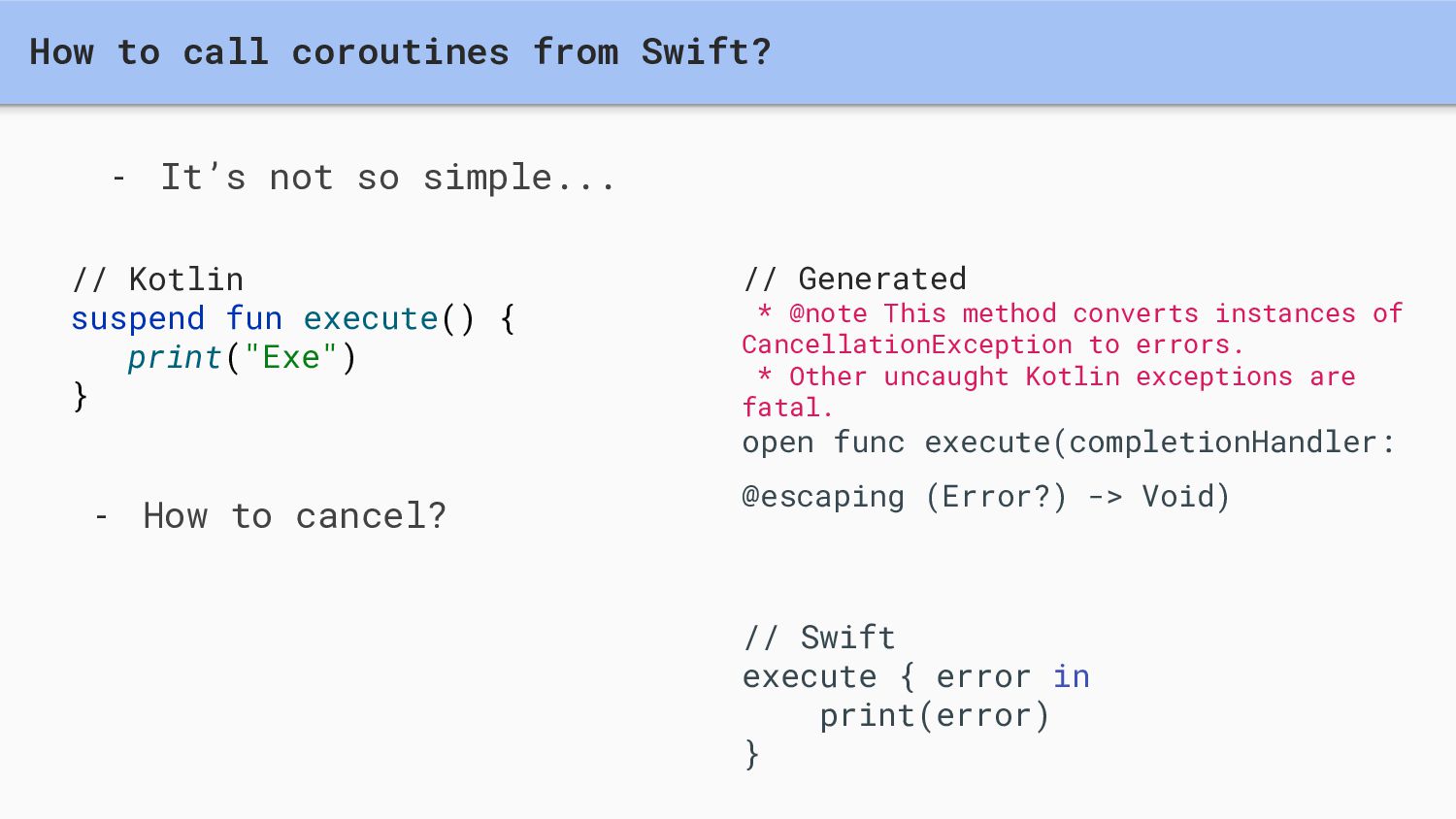
// Generated * @note This method converts instances of CancellationException
to errors. * Other uncaught Kotlin exceptions are fatal. open func execute(completionHandler: @escaping (Error?) -> Void) // Kotlin suspend fun execute() { print("Exe") } How to call coroutines from Swift? - It’s not so simple... - How to cancel? // Swift execute { error in print(error) } -
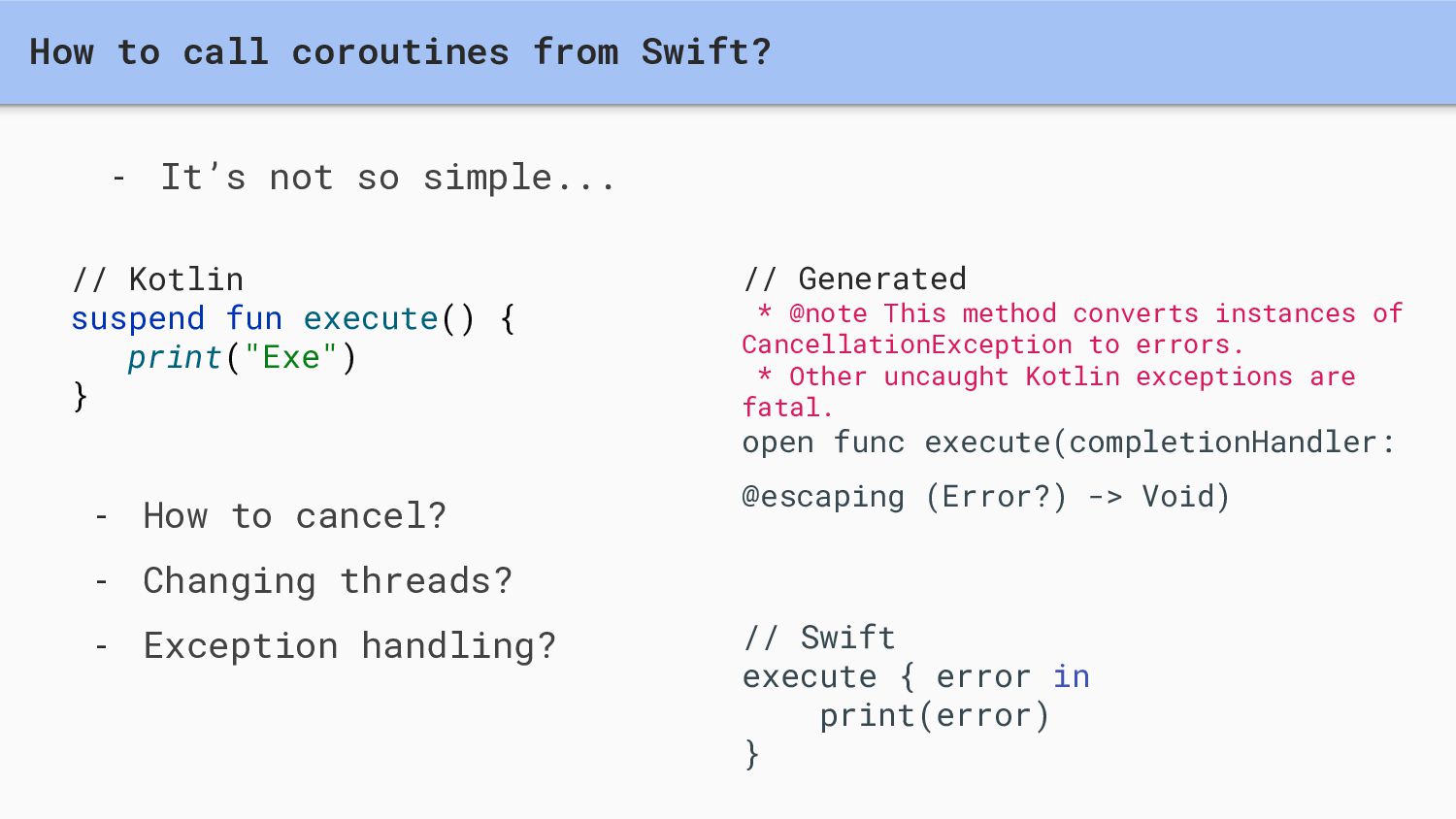
// Generated * @note This method converts instances of CancellationException
to errors. * Other uncaught Kotlin exceptions are fatal. open func execute(completionHandler: @escaping (Error?) -> Void) How to call coroutines from Swift? - It’s not so simple... - How to cancel? - Changing threads? // Kotlin suspend fun execute() { print("Exe") } // Swift execute { error in print(error) } -
- How to cancel? - Changing threads? - Exception handling?
// Generated * @note This method converts instances of CancellationException to errors. * Other uncaught Kotlin exceptions are fatal. open func execute(completionHandler: @escaping (Error?) -> Void) How to call coroutines from Swift? - It’s not so simple... // Kotlin suspend fun execute() { print("Exe") } // Swift execute { error in print(error) } -
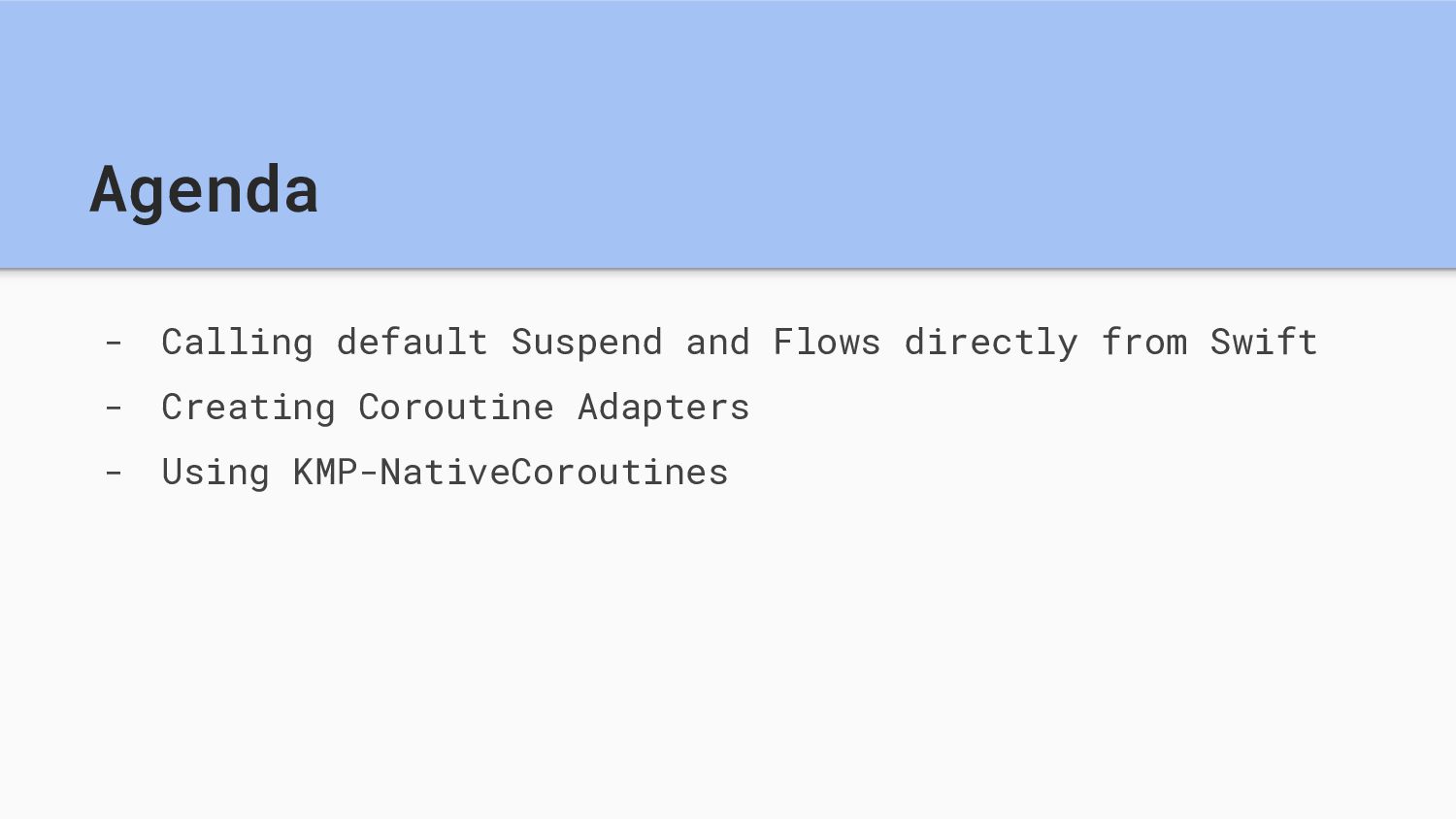
Agenda - Calling default Suspend and Flows directly from Swift
- Creating Coroutine Adapters - Using KMP-NativeCoroutines -
Agenda - Calling default Suspend and Flows directly from Swift
- Creating Coroutine Adapters - Using KMP-NativeCoroutines - Exception Handling - Cancellation -
Agenda - Calling default Suspend and Flows directly from Swift
- Creating Coroutine Adapters - Using KMP-NativeCoroutines - Exception Handling - Cancellation - SwiftUI integrations* -
Why am I talking about this? - It’s important -
When trying out Kotlin Multiplatform, we have to convince the iOS team - The biggest hurdles come when connecting Swift and Kotlin - This talk tries to address both these issues -
Why am I talking about this? - It’s important -
When trying out Kotlin Multiplatform, we have to convince the iOS team - The biggest hurdles come when connecting Swift and Kotlin - This talk tries to address both these issues -
Why am I talking about this? - It’s important -
When trying out Kotlin Multiplatform, we have to convince the iOS team - One of the biggest hurdles come when connecting Swift and Kotlin -
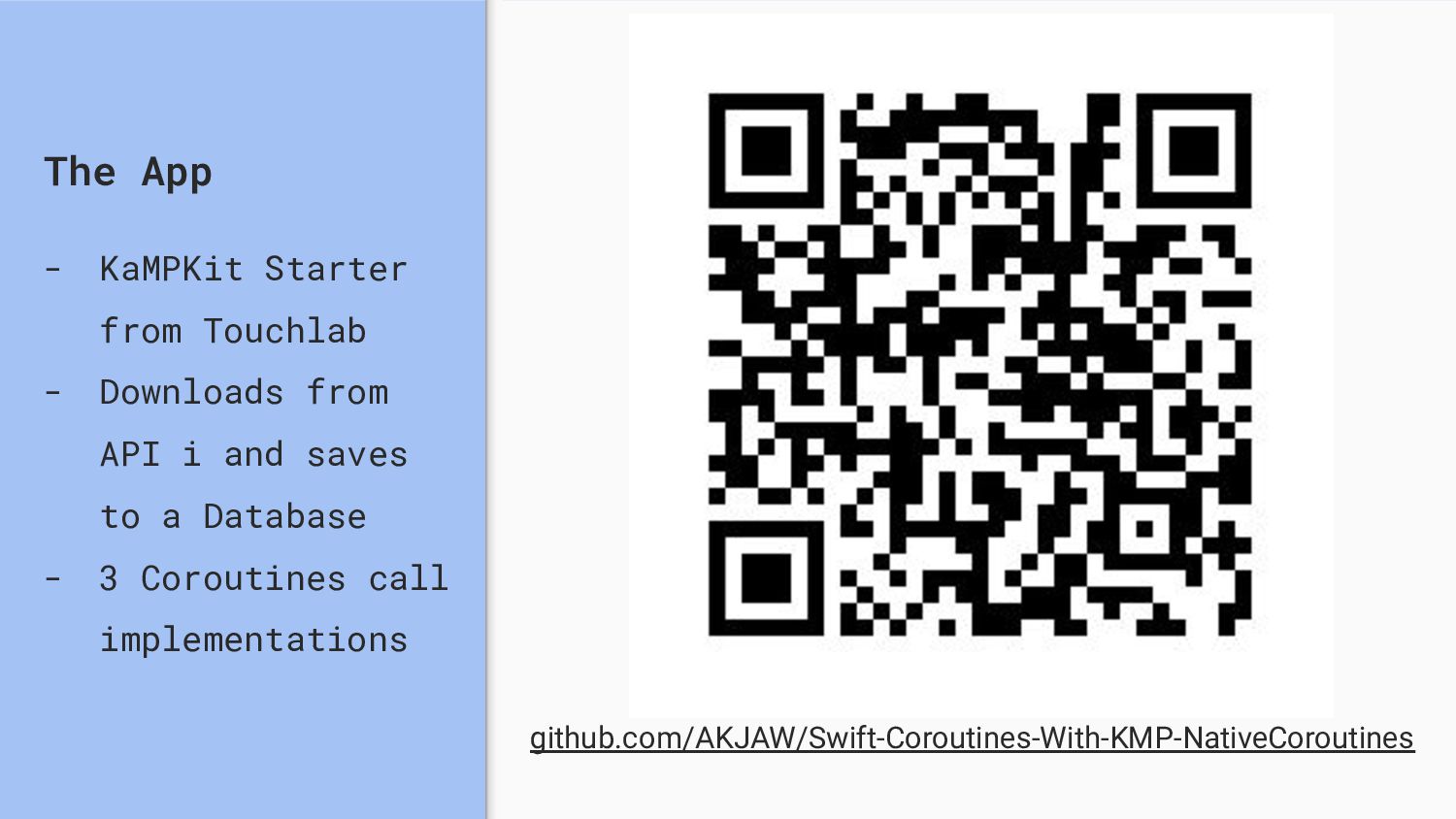
The App - KaMPKit Starter from Touchlab - Downloads from
API i and saves to a Database - 3 Coroutines call implementations -
github.com/AKJAW/Swift-Coroutines-With-KMP-NativeCoroutines - KaMPKit Starter from Touchlab - Downloads from API
i and saves to a Database - 3 Coroutines call implementations The App -
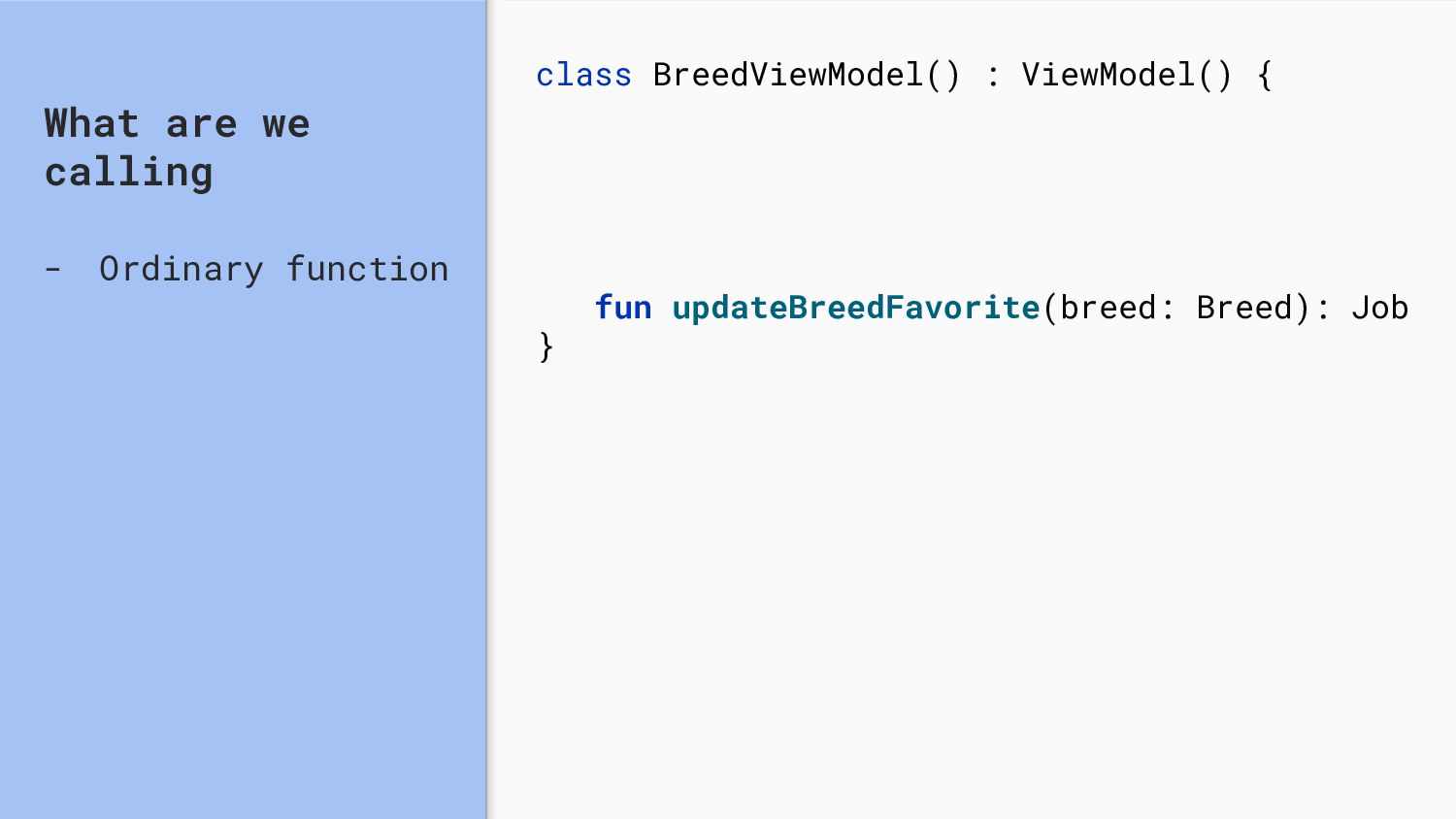
What are we calling - Ordinary function class BreedViewModel() :
ViewModel() { val breedState: StateFlow<BreedViewState> suspend fun refreshBreeds(): Boolean fun updateBreedFavorite(breed: Breed): Job } -
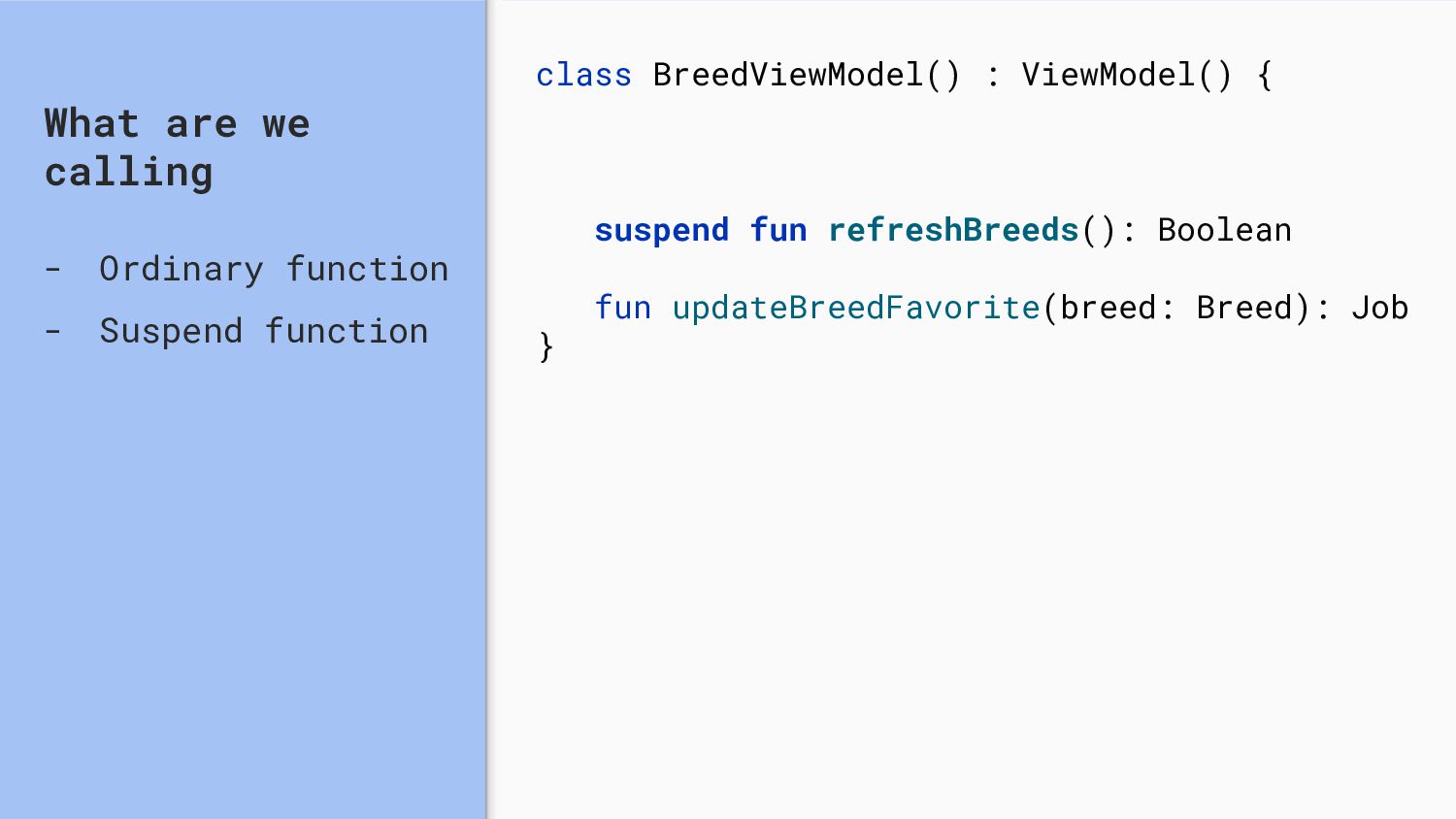
What are we calling - Ordinary function - Suspend function
class BreedViewModel() : ViewModel() { val breedState: StateFlow<BreedViewState> suspend fun refreshBreeds(): Boolean fun updateBreedFavorite(breed: Breed): Job } -
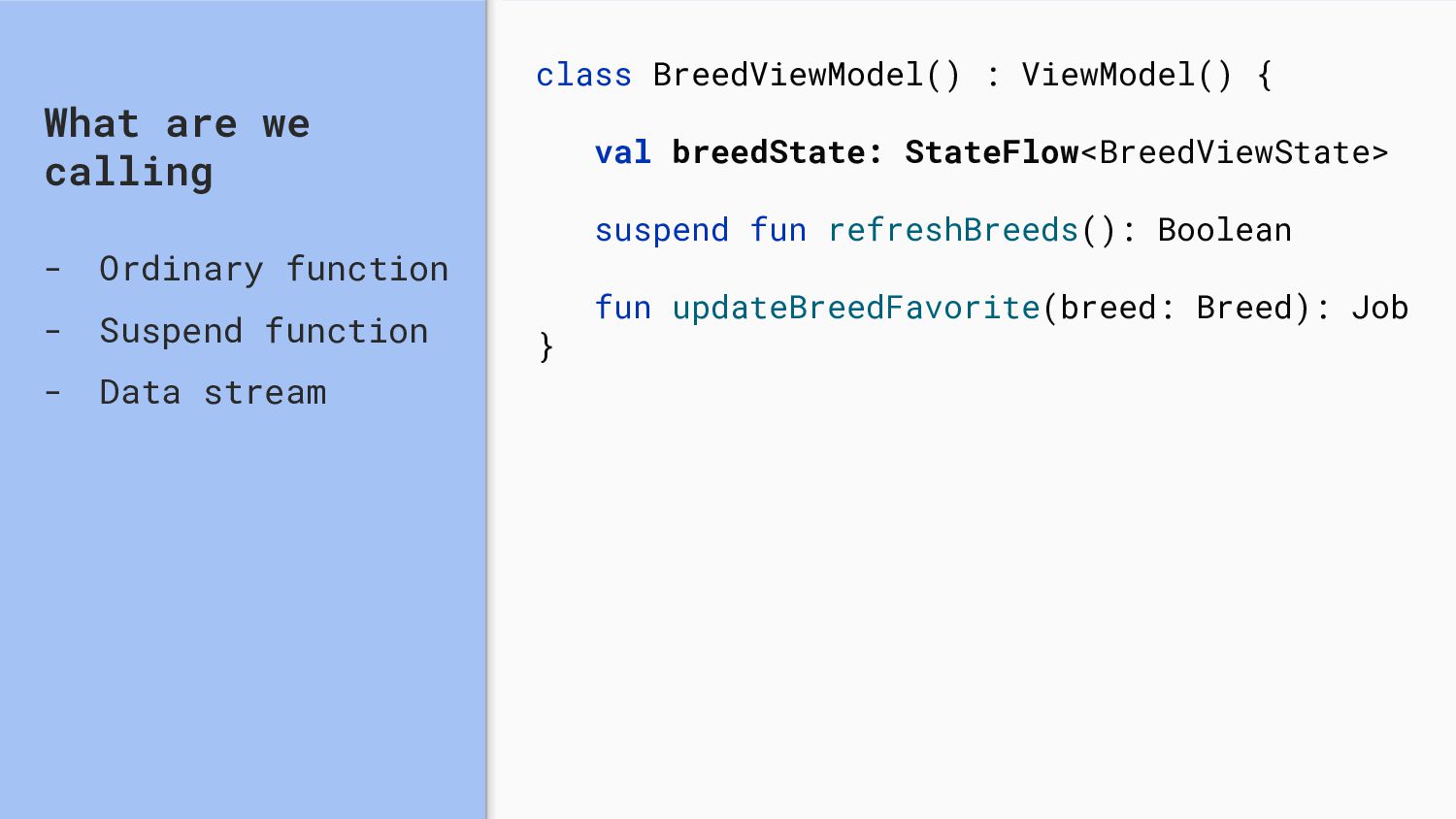
What are we calling - Ordinary function - Suspend function
- Data stream class BreedViewModel() : ViewModel() { val breedState: StateFlow<BreedViewState> suspend fun refreshBreeds(): Boolean fun updateBreedFavorite(breed: Breed): Job } -
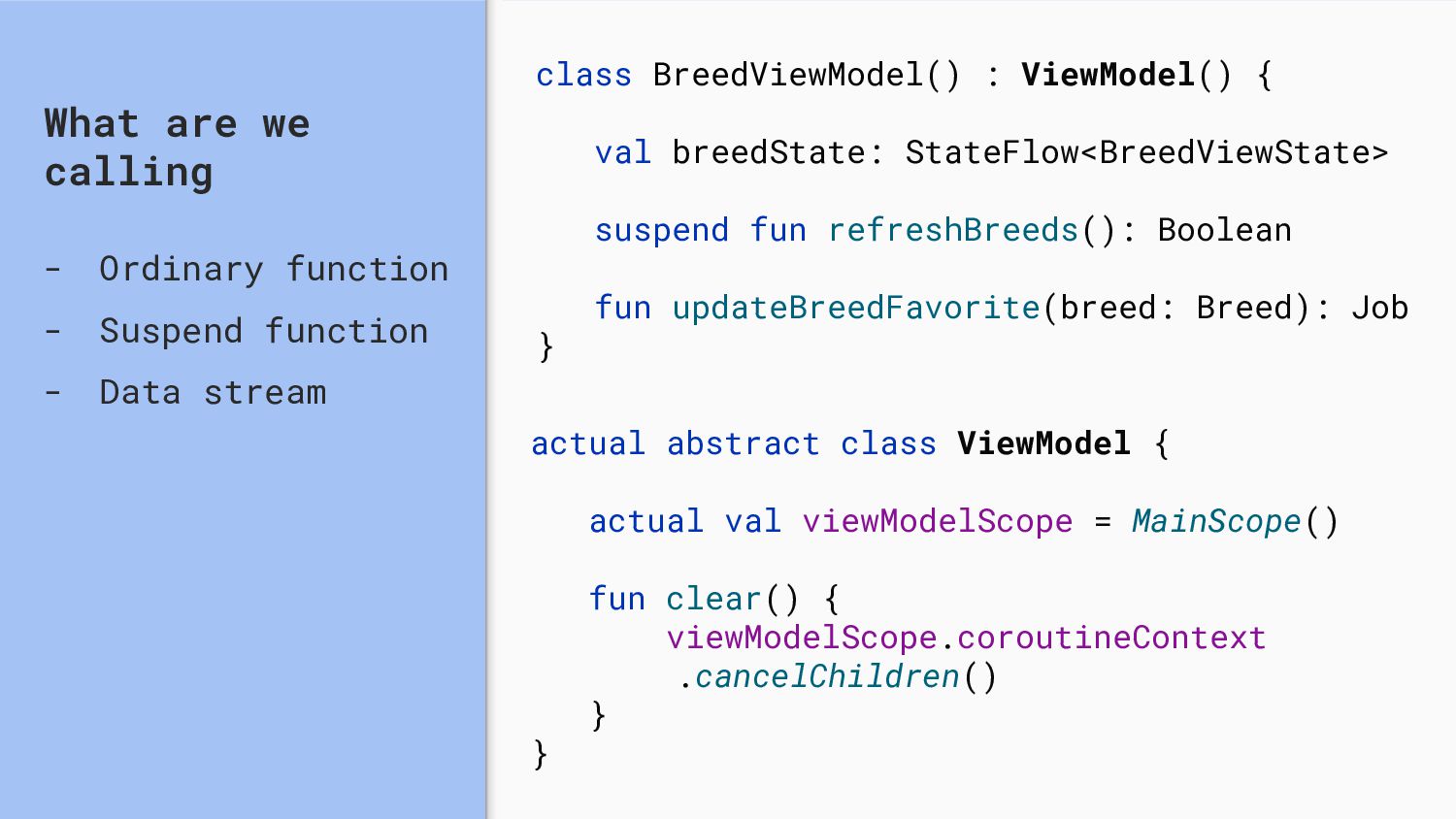
actual abstract class ViewModel { actual val viewModelScope = MainScope()
fun clear() { viewModelScope.coroutineContext .cancelChildren() } } class BreedViewModel() : ViewModel() { val breedState: StateFlow<BreedViewState> suspend fun refreshBreeds(): Boolean fun updateBreedFavorite(breed: Breed): Job } What are we calling - Ordinary function - Suspend function - Data stream -
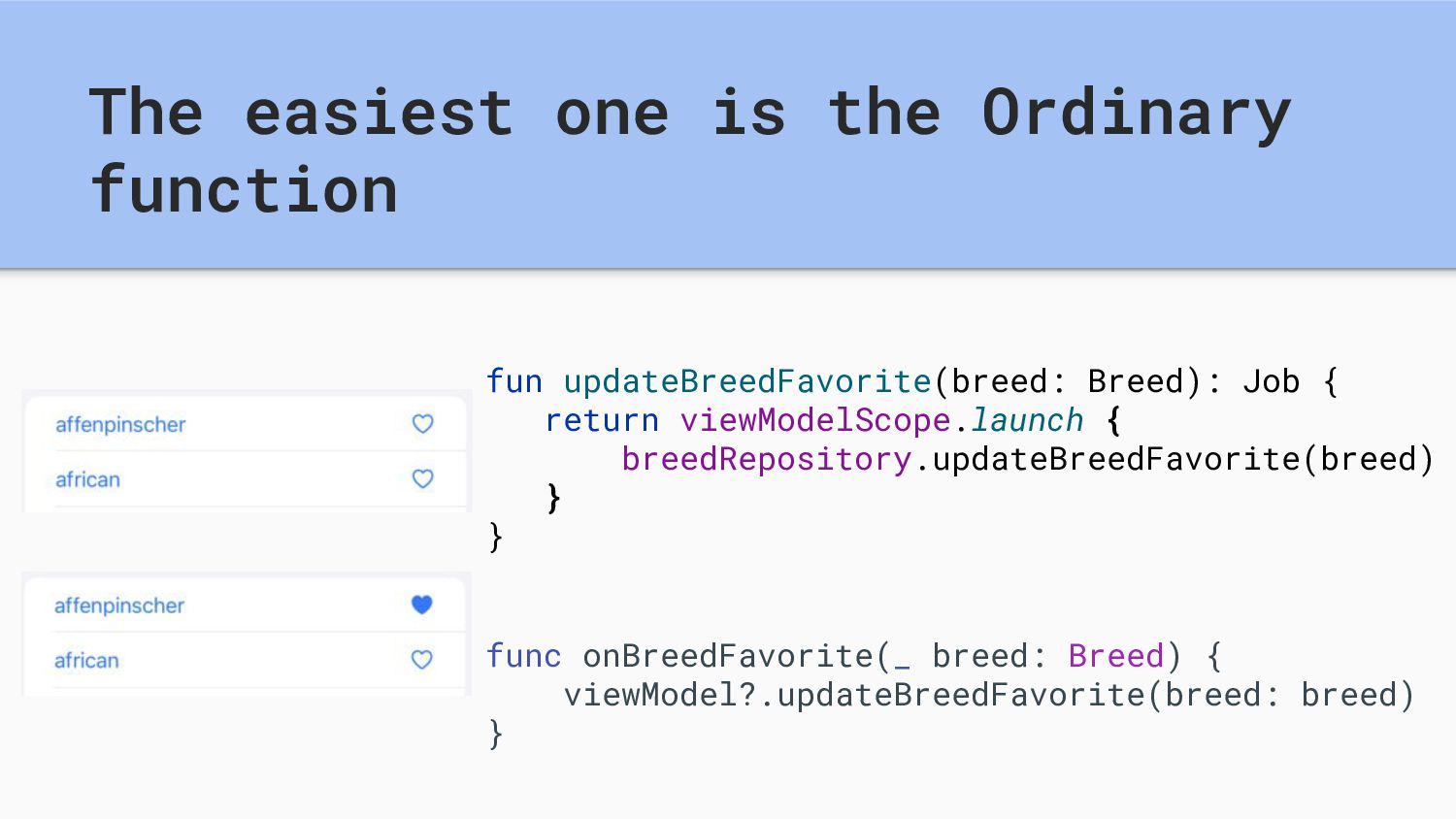
The easiest one is the Ordinary function fun updateBreedFavorite(breed: Breed):
Job { return viewModelScope.launch { breedRepository.updateBreedFavorite(breed) } } -
func onBreedFavorite(_ breed: Breed) { viewModel?.updateBreedFavorite(breed: breed) } The easiest
one is the Ordinary function fun updateBreedFavorite(breed: Breed): Job { return viewModelScope.launch { breedRepository.updateBreedFavorite(breed) } } -
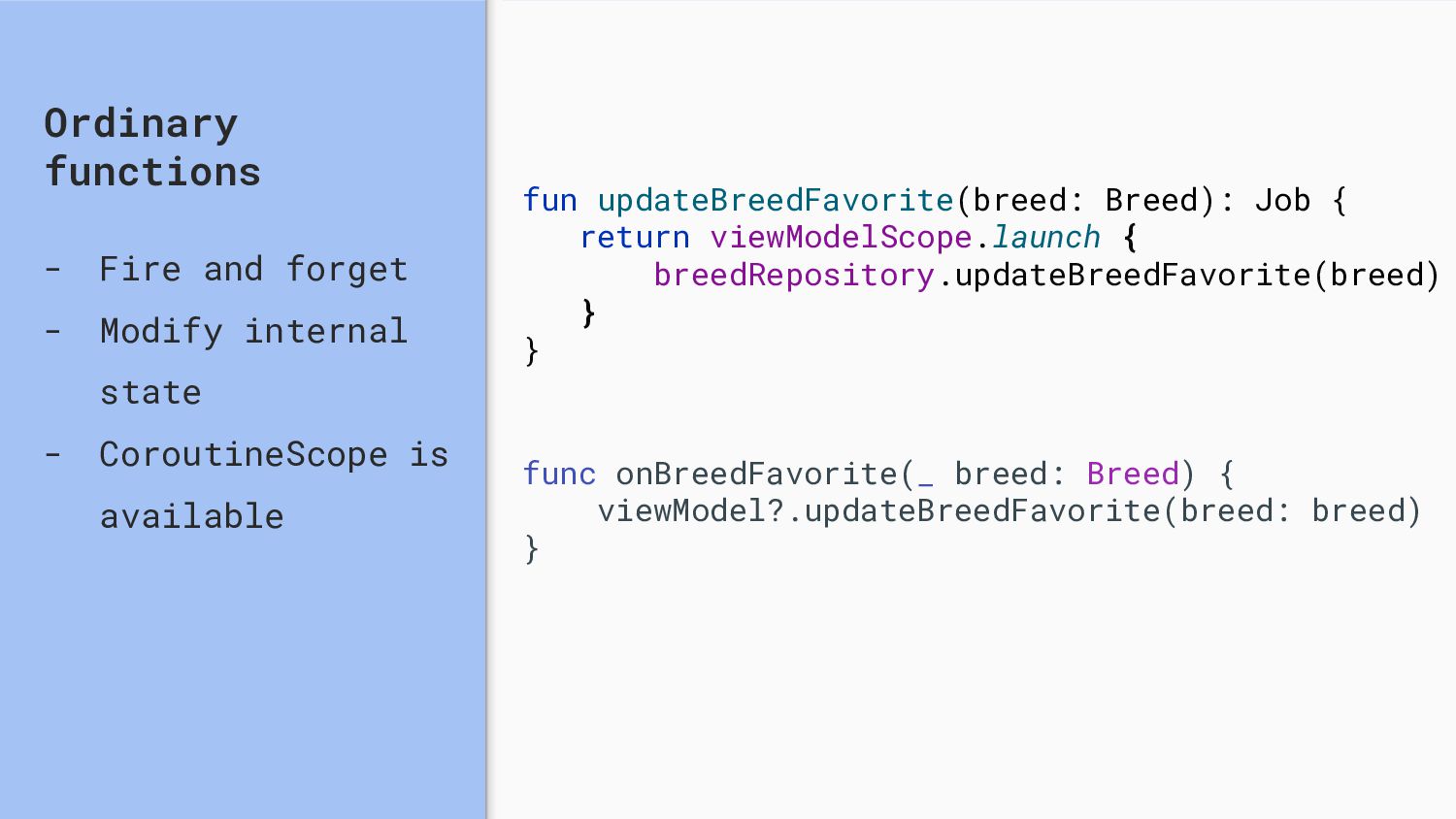
Ordinary functions - Fire and forget - Modify internal state
- CoroutineScope is available fun updateBreedFavorite(breed: Breed): Job { return viewModelScope.launch { breedRepository.updateBreedFavorite(breed) } } func onBreedFavorite(_ breed: Breed) { viewModel?.updateBreedFavorite(breed: breed) } -
- Default generated framework - Manual Adaptera / Wrapper -
KMP-NativeCoroutines Plugin Suspending functions in Swift -
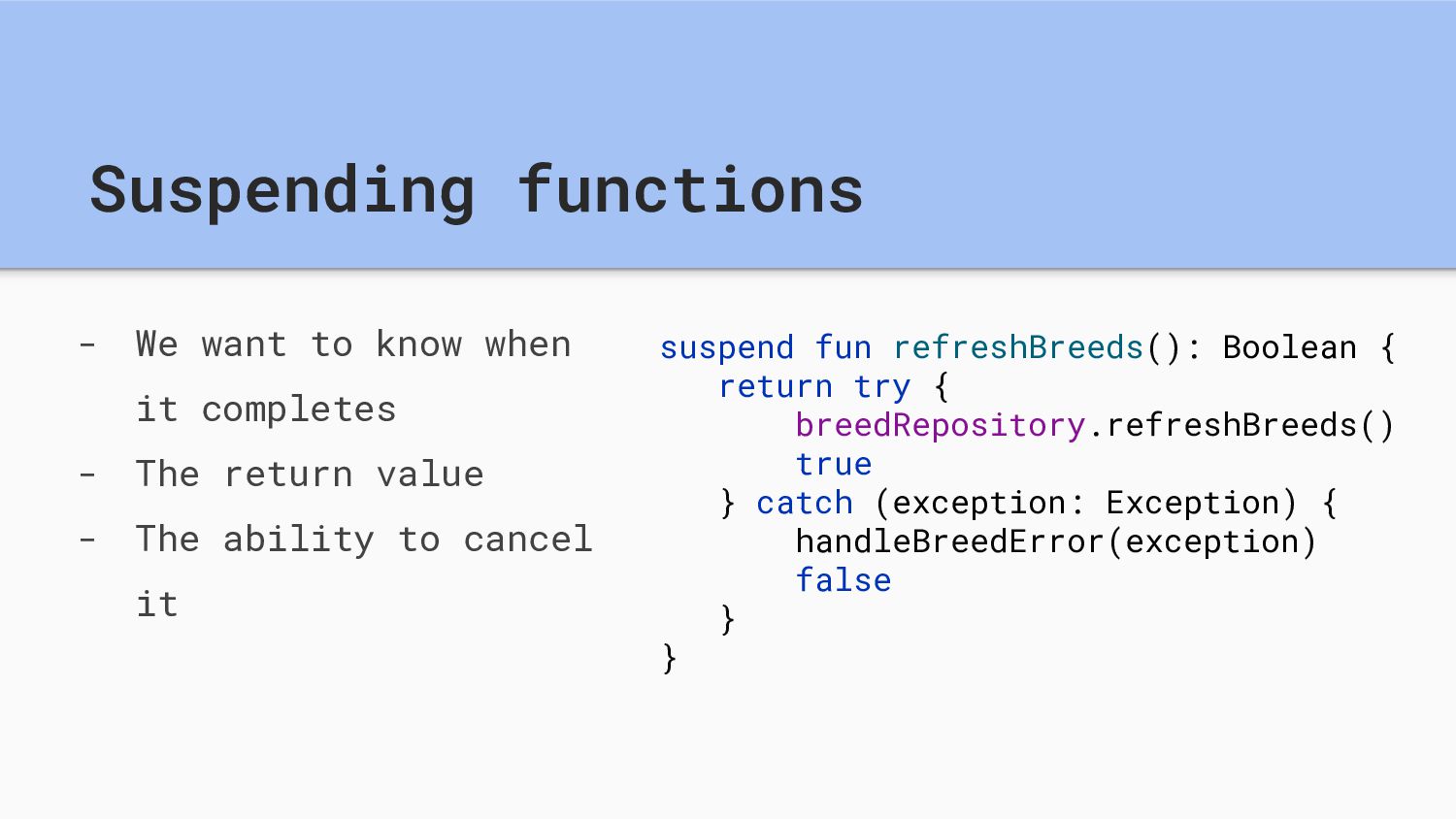
Suspending functions - We want to know when it completes
- The return value - The ability to cancel it -
suspend fun refreshBreeds(): Boolean { return try { breedRepository.refreshBreeds() true
} catch (exception: Exception) { handleBreedError(exception) false } } Suspending functions - We want to know when it completes - The return value - The ability to cancel it -
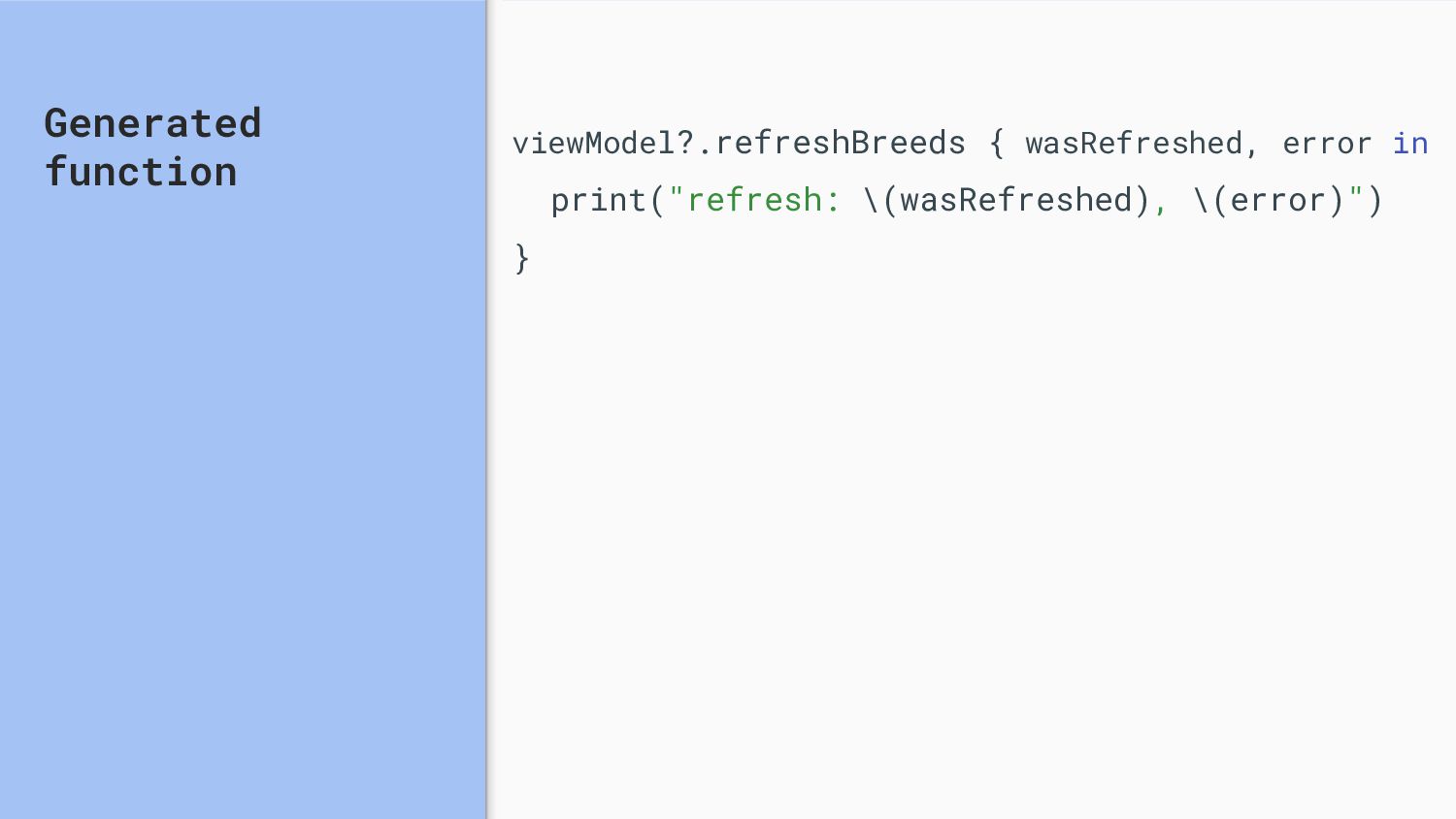
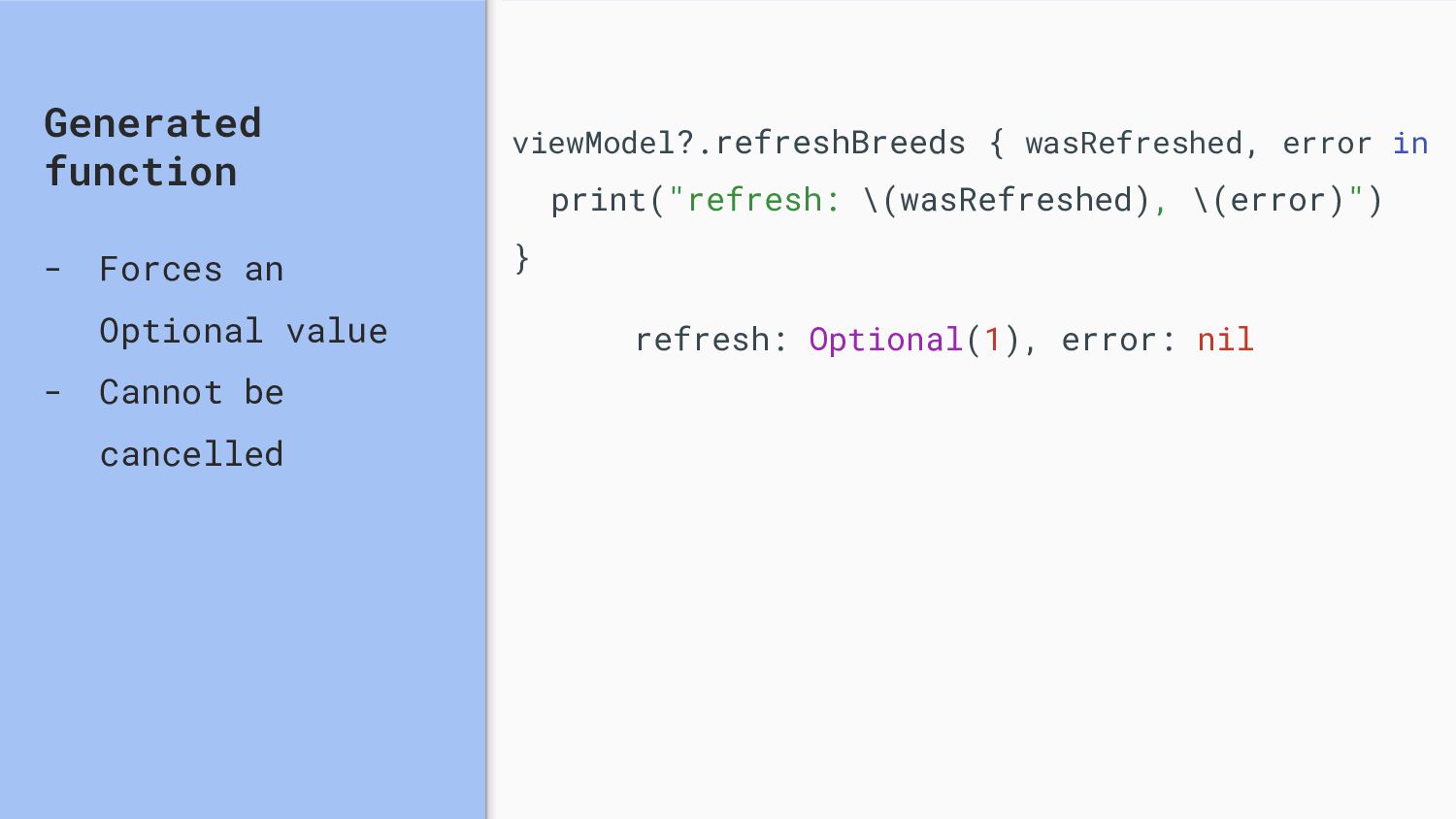
Generated function - Forces an Optional value - Cannot be
cancelled viewModel?.refreshBreeds { wasRefreshed, error in print("refresh: \(wasRefreshed), \(error)") } refresh: Optional(1), error: nil -
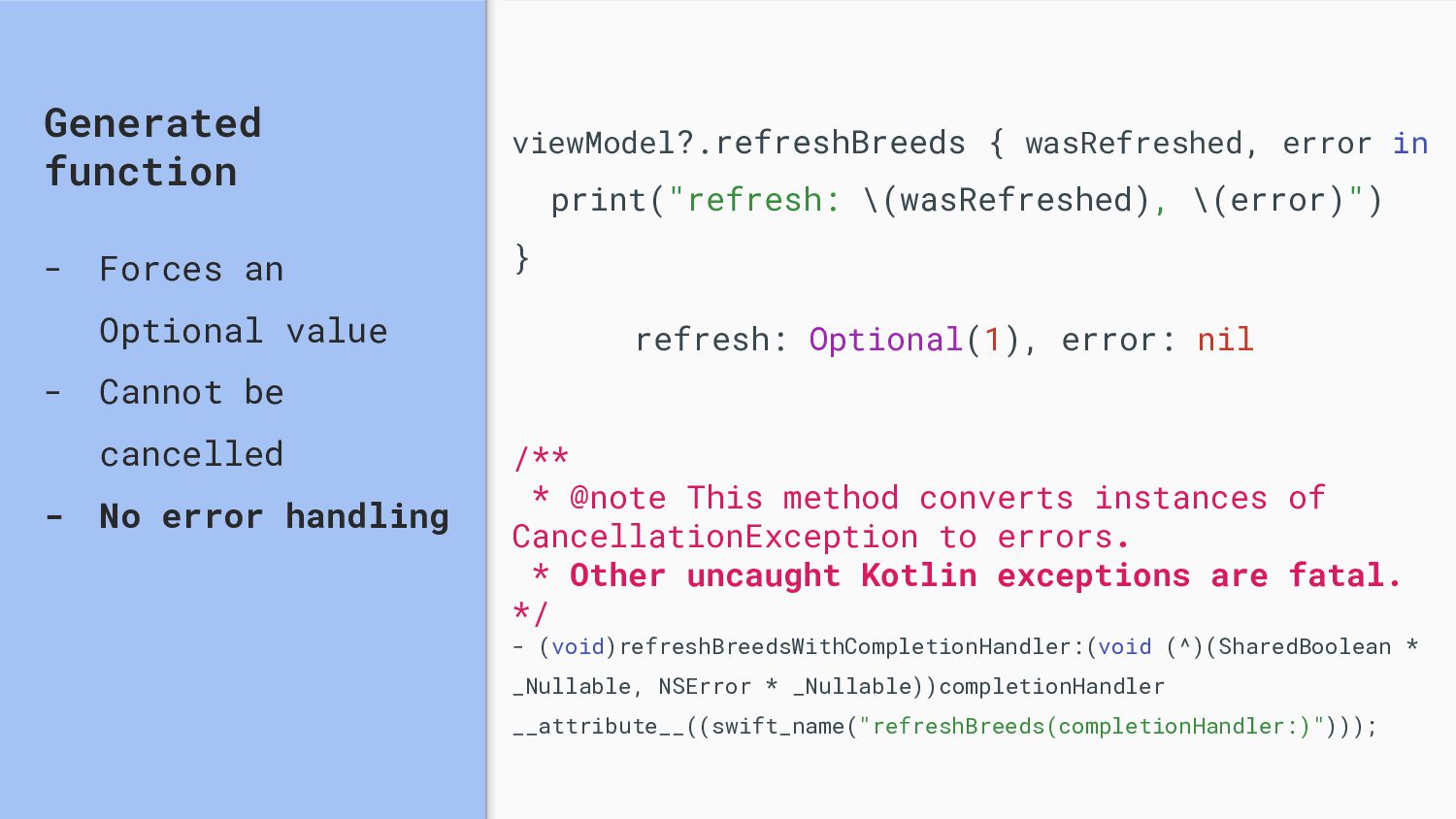
/** * @note This method converts instances of CancellationException to
errors. * Other uncaught Kotlin exceptions are fatal. */ - (void)refreshBreedsWithCompletionHandler:(void (^)(SharedBoolean * _Nullable, NSError * _Nullable))completionHandler __attribute__((swift_name("refreshBreeds(completionHandler:)"))); Generated function - Forces an Optional value - Cannot be cancelled - No error handling viewModel?.refreshBreeds { wasRefreshed, error in print("refresh: \(wasRefreshed), \(error)") } refresh: Optional(1), error: nil -
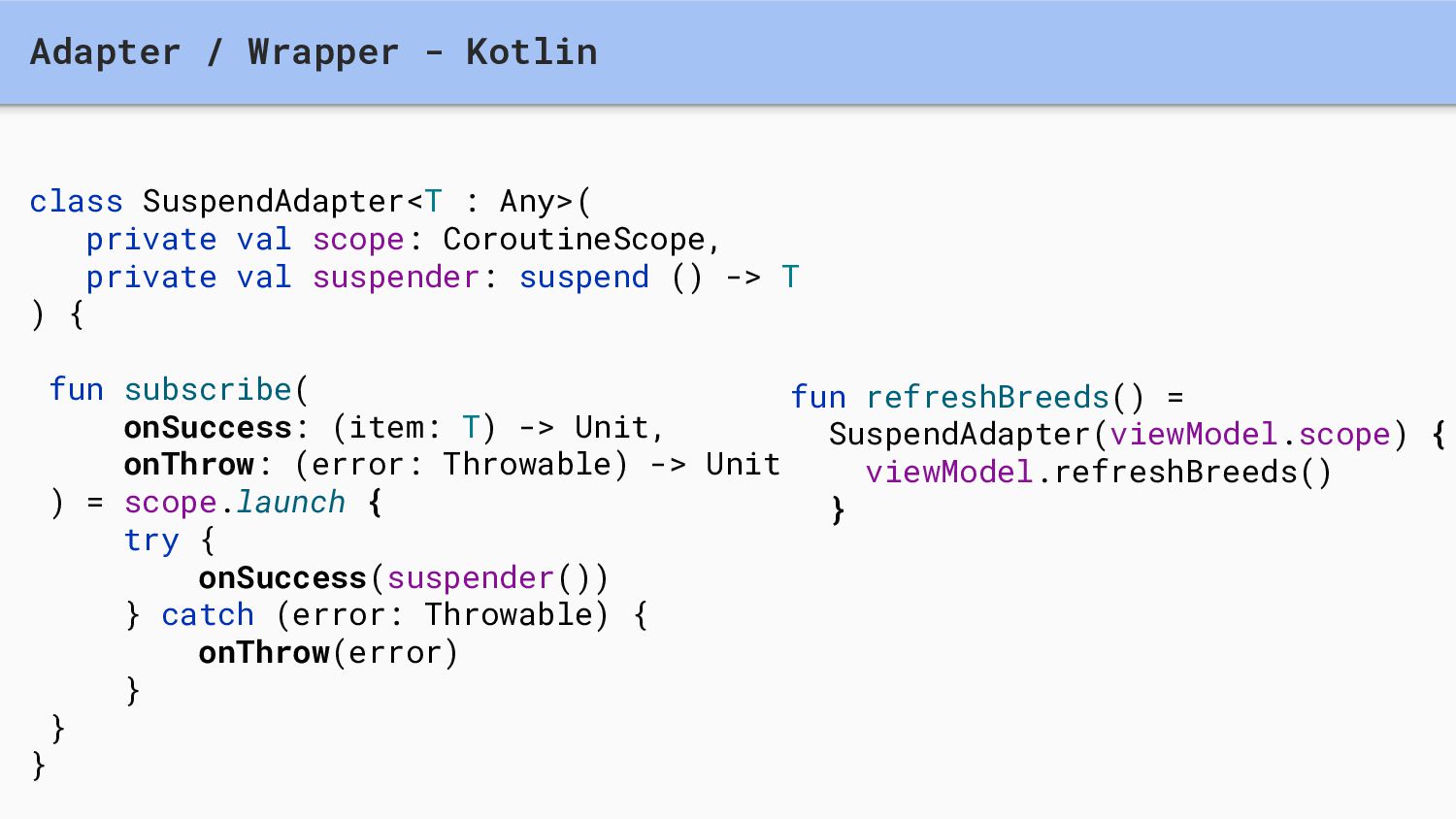
Adapter / Wrapper - Kotlin class SuspendAdapter<T : Any>( private
val scope: CoroutineScope, private val suspender: suspend () -> T ) { fun subscribe( onSuccess: (item: T) -> Unit, onThrow: (error: Throwable) -> Unit ) = scope.launch { try { onSuccess(suspender()) } catch (error: Throwable) { onThrow(error) } } } -
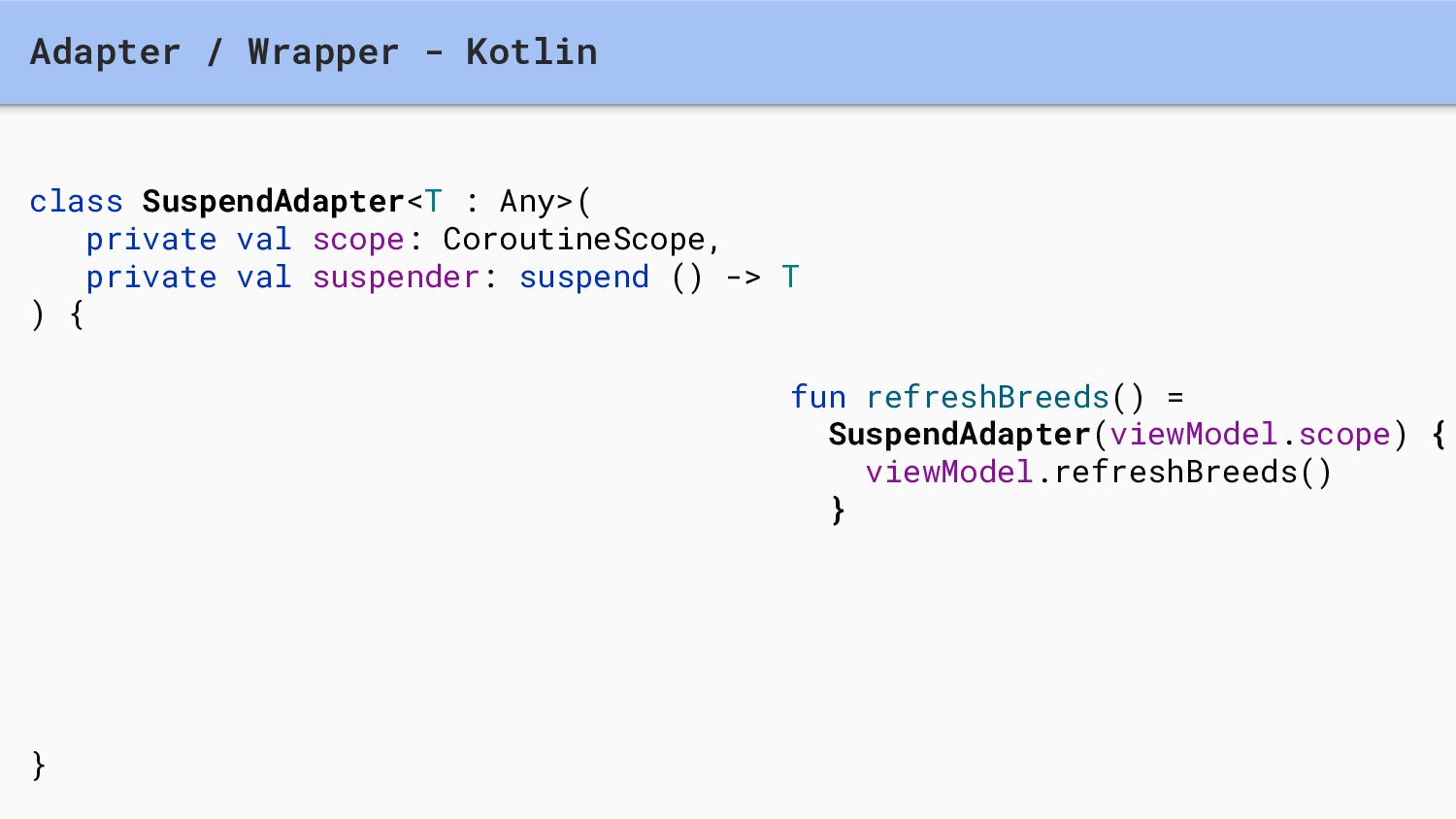
Adapter / Wrapper - Kotlin fun refreshBreeds() = SuspendAdapter(viewModel.scope) {
viewModel.refreshBreeds() } class SuspendAdapter<T : Any>( private val scope: CoroutineScope, private val suspender: suspend () -> T ) { fun subscribe( onSuccess: (item: T) -> Unit, onThrow: (error: Throwable) -> Unit ) = scope.launch { try { onSuccess(suspender()) } catch (error: Throwable) { onThrow(error) } } } -
Adapter / Wrapper - Kotlin class SuspendAdapter<T : Any>( private
val scope: CoroutineScope, private val suspender: suspend () -> T ) { fun subscribe( onSuccess: (item: T) -> Unit, onThrow: (error: Throwable) -> Unit ) = scope.launch { try { onSuccess(suspender()) } catch (error: Throwable) { onThrow(error) } } } fun refreshBreeds() = SuspendAdapter(viewModel.scope) { viewModel.refreshBreeds() } -
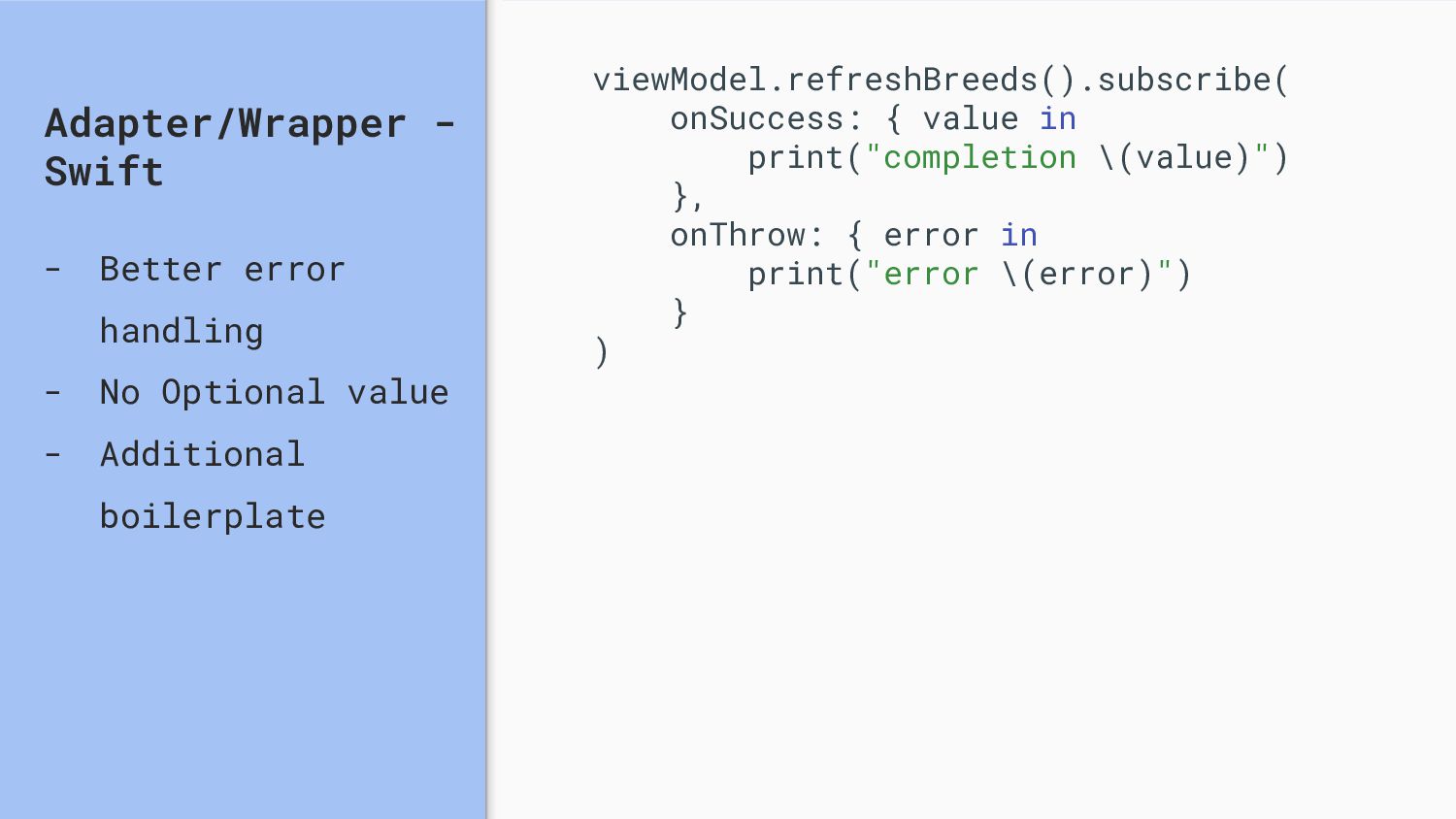
Adapter/Wrapper - Swift viewModel.refreshBreeds().subscribe( onSuccess: { value in print("completion \(value)")
}, onThrow: { error in print("error \(error)") } ) - Better error handling - No Optional value - Additional boilerplate -
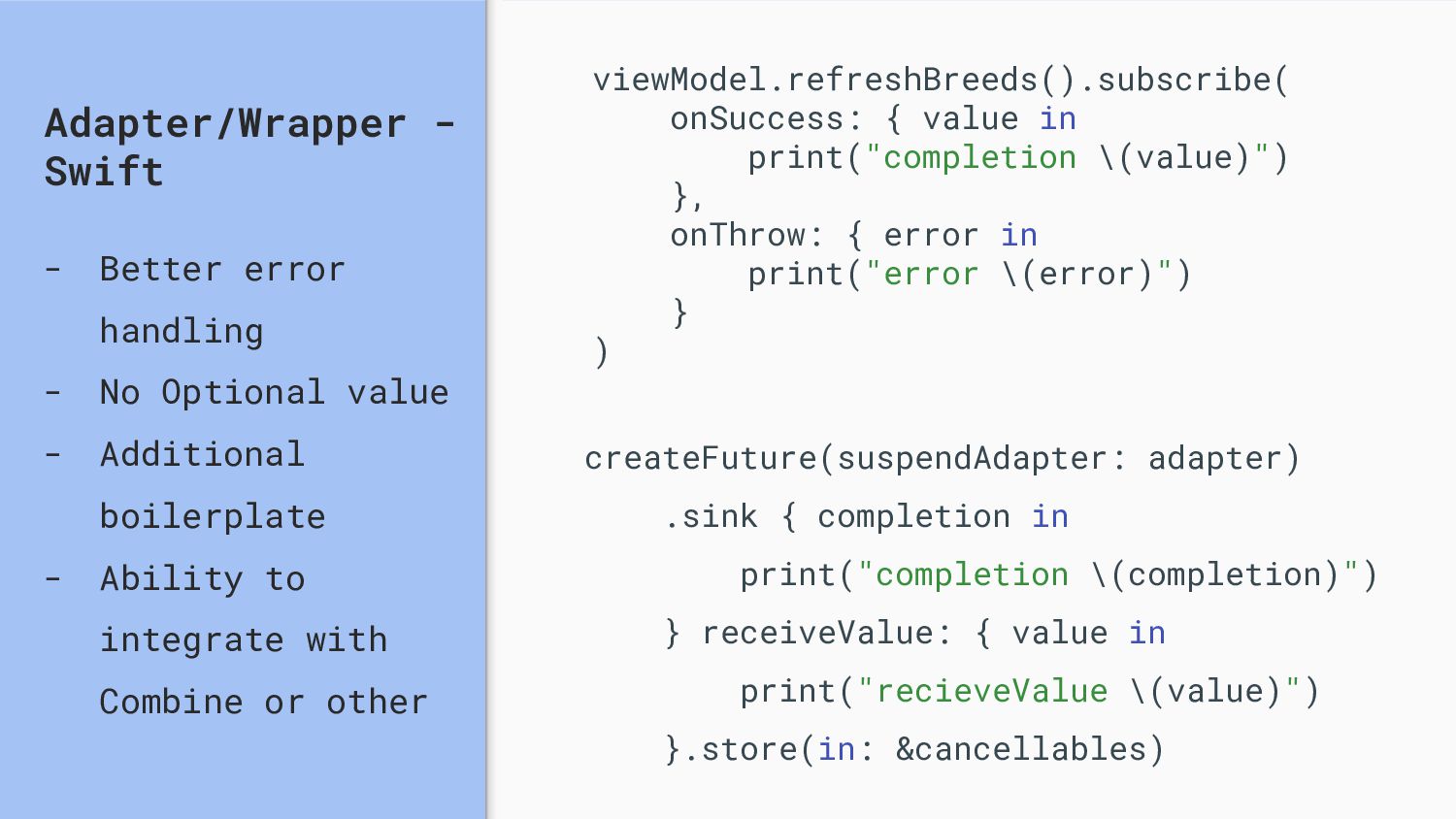
Adapter/Wrapper - Swift - Better error handling - No Optional
value - Additional boilerplate - Ability to integrate with Combine or other viewModel.refreshBreeds().subscribe( onSuccess: { value in print("completion \(value)") }, onThrow: { error in print("error \(error)") } ) createFuture(suspendAdapter: adapter) .sink { completion in print("completion \(completion)") } receiveValue: { value in print("recieveValue \(value)") }.store(in: &cancellables) -
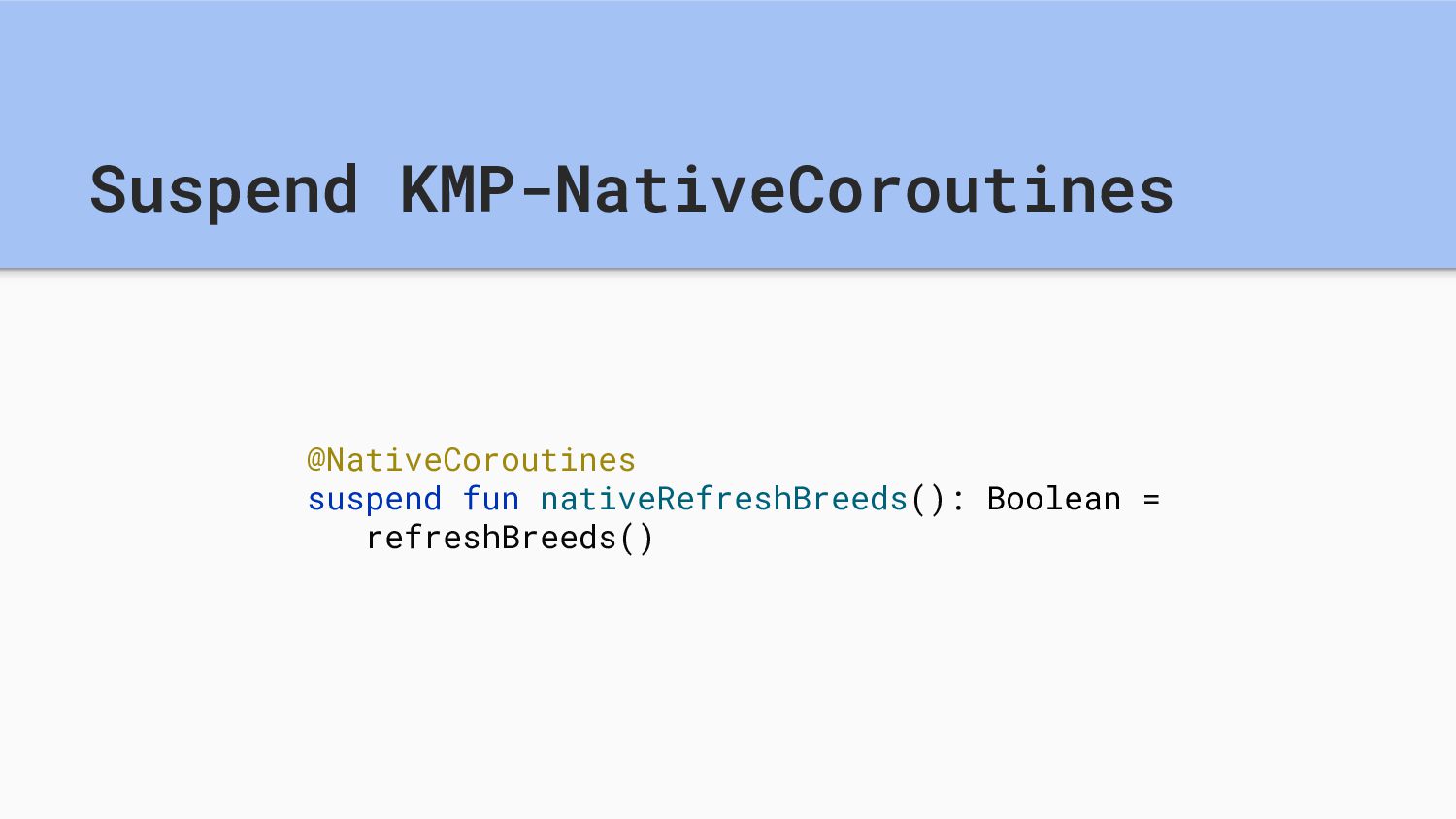
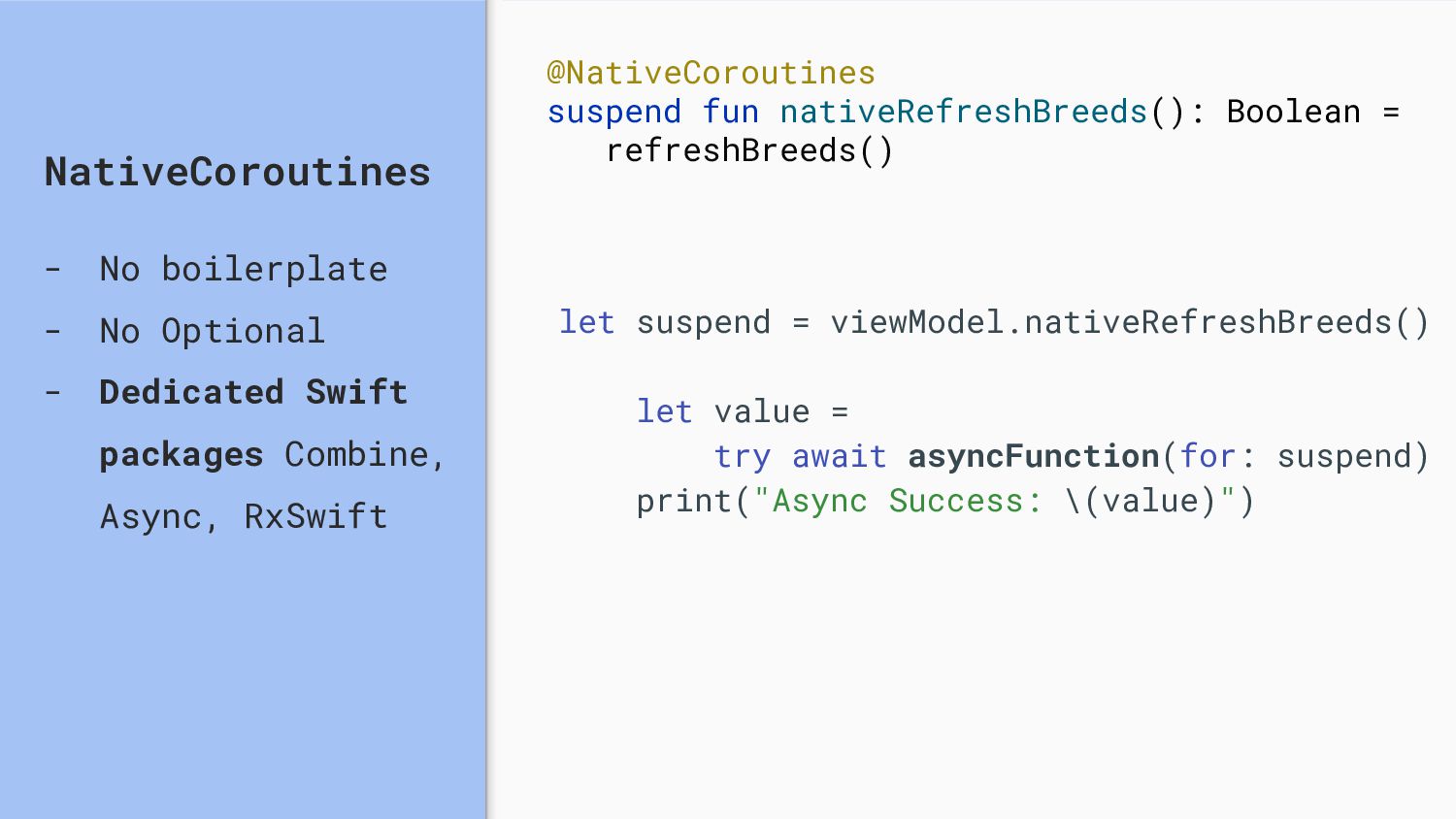
NativeCoroutines - No boilerplate - No Optional - Dedicated Swift
packages Combine, Async, RxSwift func refresh() async { let suspend = viewModel.nativeRefreshBreeds() do { let value = try await asyncFunction(for: suspend) print("Async Success: \(value)") } catch { print("Async Failed with error: \(error)") } } @NativeCoroutines suspend fun nativeRefreshBreeds(): Boolean = refreshBreeds() -
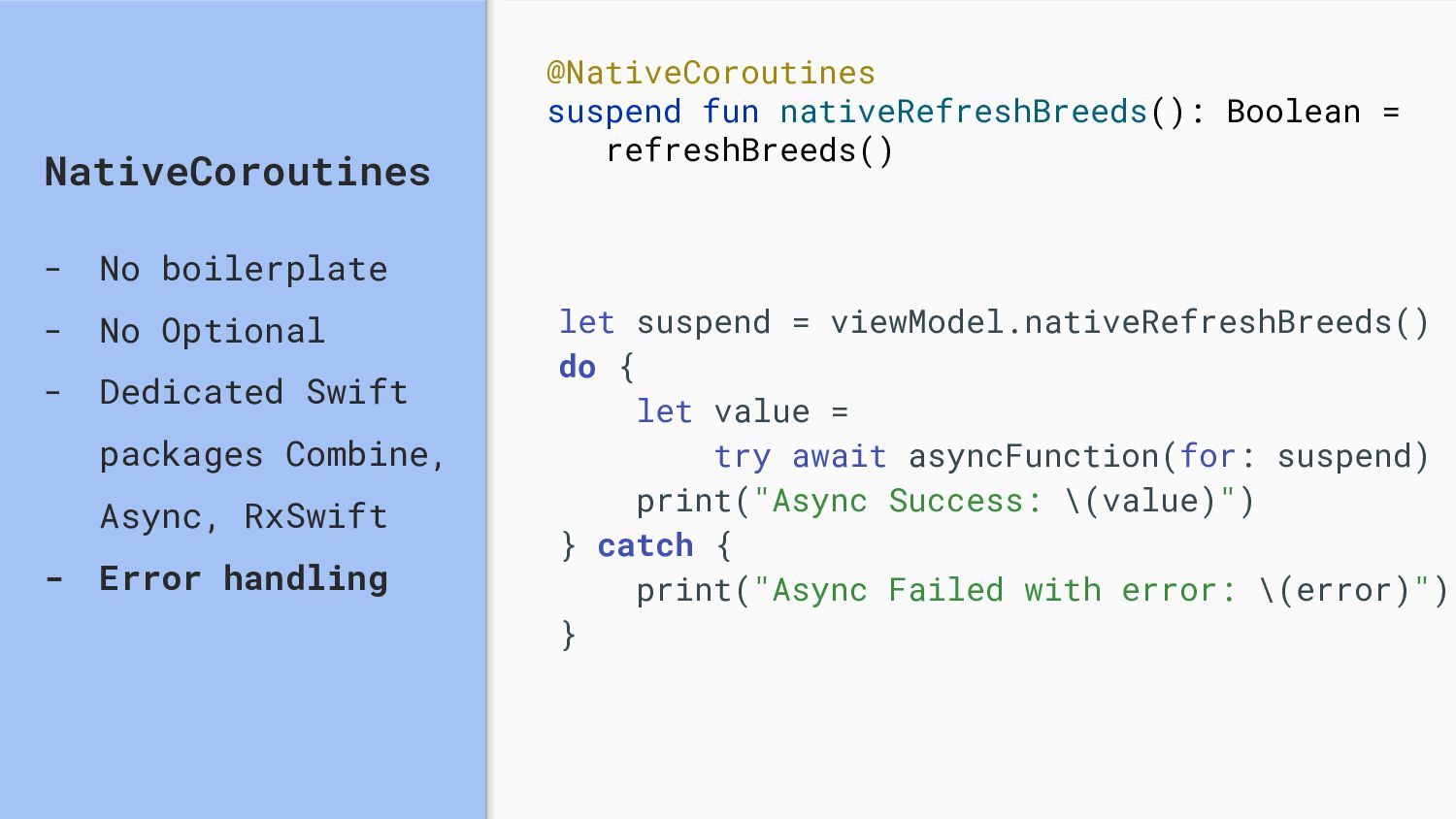
NativeCoroutines - No boilerplate - No Optional - Dedicated Swift
packages Combine, Async, RxSwift - Error handling func refresh() async { let suspend = viewModel.nativeRefreshBreeds() do { let value = try await asyncFunction(for: suspend) print("Async Success: \(value)") } catch { print("Async Failed with error: \(error)") } } @NativeCoroutines suspend fun nativeRefreshBreeds(): Boolean = refreshBreeds() -
NativeCoroutines - No boilerplate - No Optional - Dedicated Swift
packages Combine, Async, RxSwift - Error handling - Automatic cancelling func refresh() async { let suspend = viewModel.nativeRefreshBreeds() do { let value = try await asyncFunction(for: suspend) print("Async Success: \(value)") } catch { print("Async Failed with error: \(error)") } } @NativeCoroutines suspend fun nativeRefreshBreeds(): Boolean = refreshBreeds() -
NativeCoroutines - asyncFunction func refresh() async { let suspend =
viewModel.nativeRefreshBreeds() do { let value = try await asyncFunction(for: suspend) print("Async Success: \(value)") } catch { print("Async Failed with error: \(error)") } } -
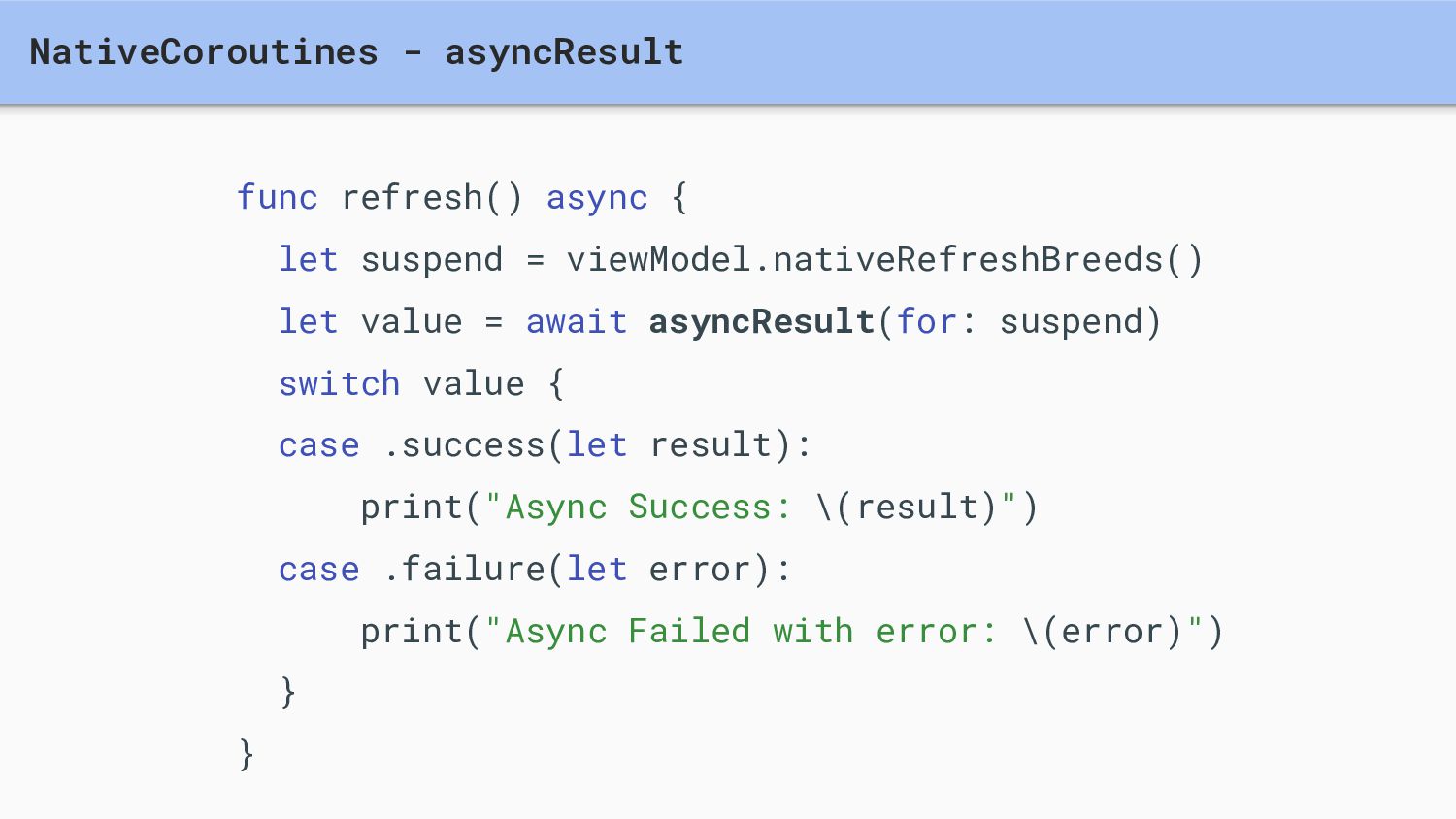
NativeCoroutines - asyncResult func refresh() async { let suspend =
viewModel.nativeRefreshBreeds() let value = await asyncResult(for: suspend) switch value { case .success(let result): print("Async Success: \(result)") case .failure(let error): print("Async Failed with error: \(error)") } } -
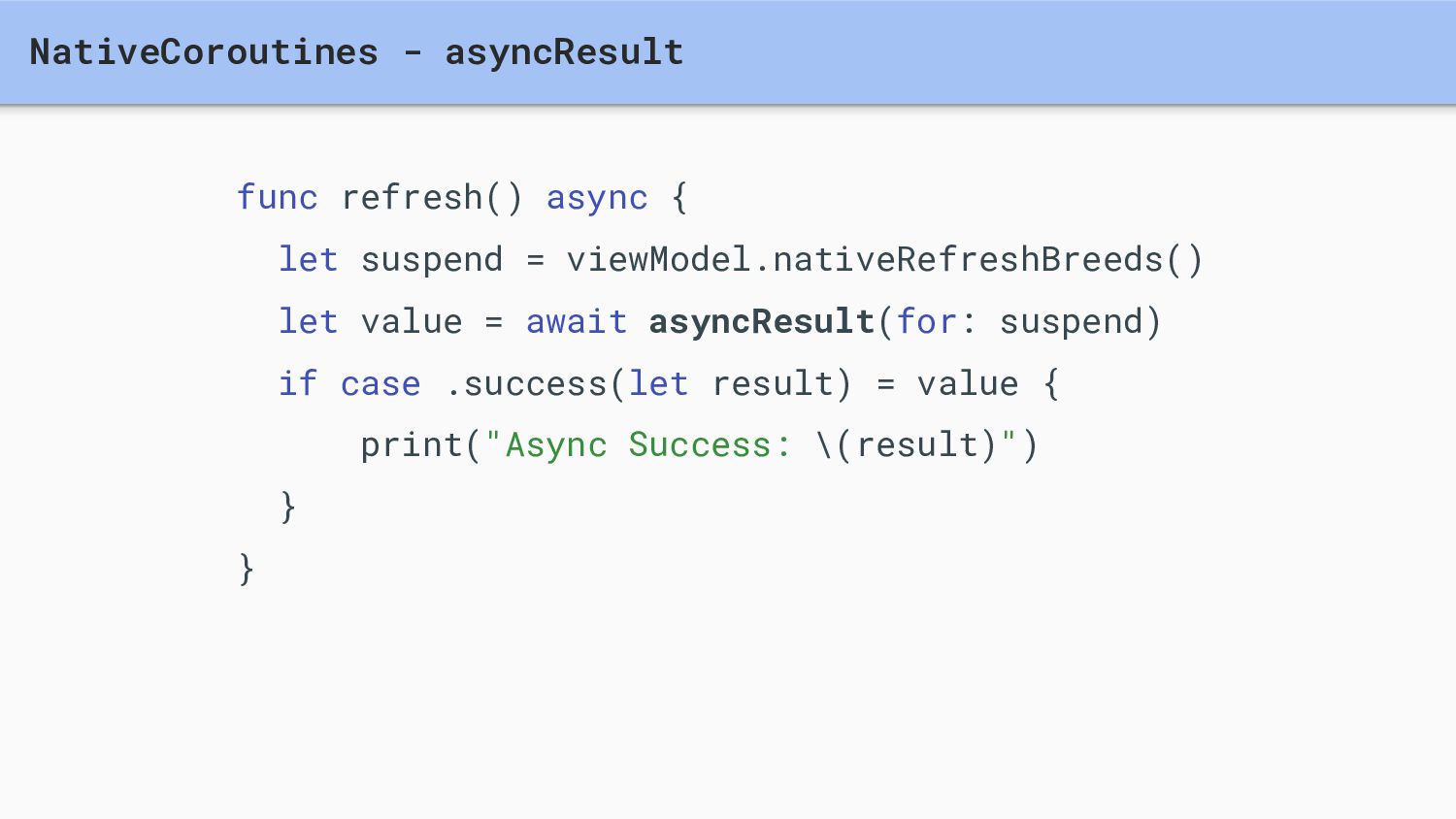
NativeCoroutines - asyncResult func refresh() async { let suspend =
viewModel.nativeRefreshBreeds() let value = await asyncResult(for: suspend) if case .success(let result) = value { print("Async Success: \(result)") } } -
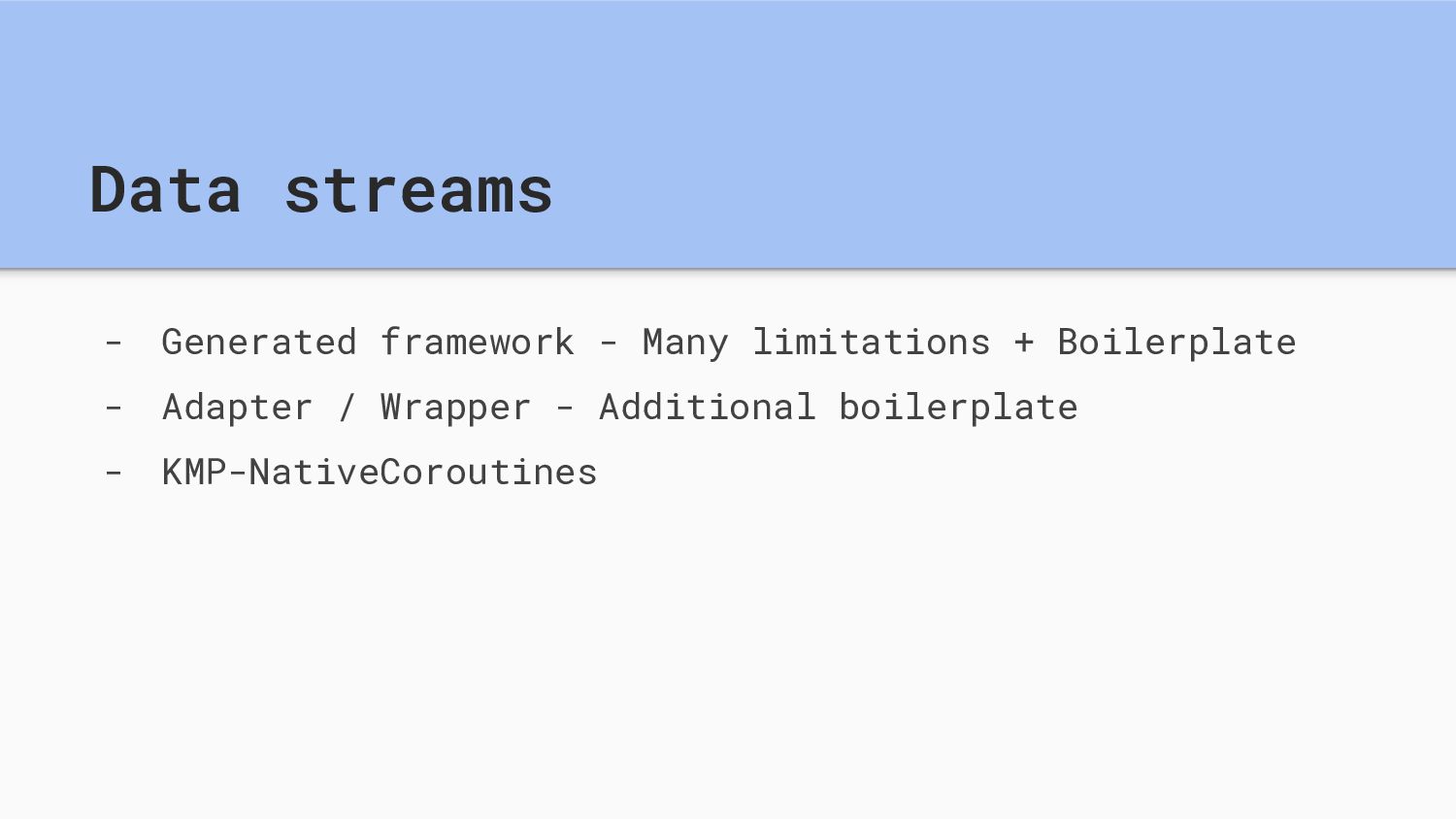
Data streams - Generated framework - Many limitations + Boilerplate
- Adapter / Wrapper - Additional boilerplate - KMP-NativeCoroutines -
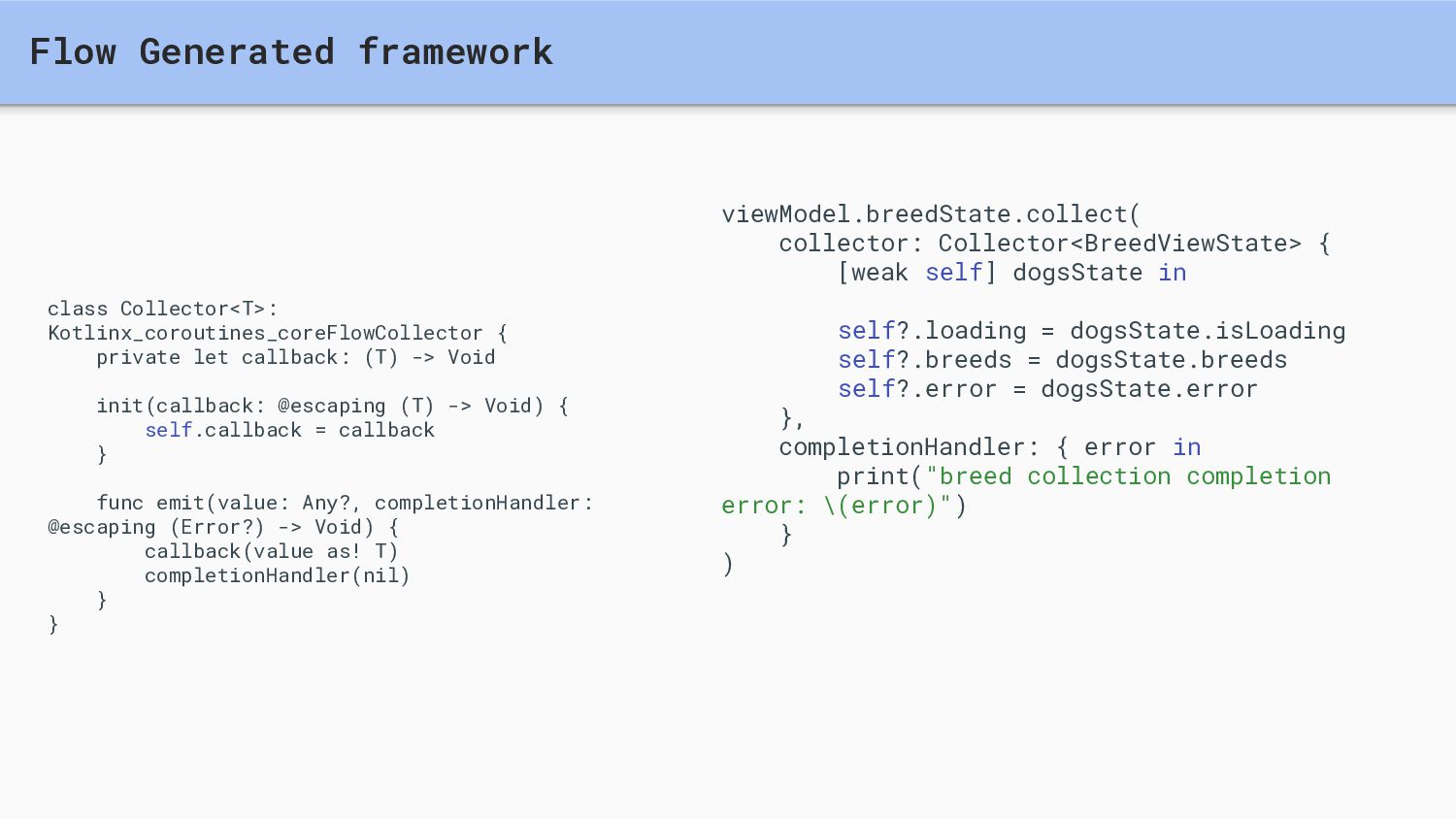
Flow Generated framework class Collector<T>: Kotlinx_coroutines_coreFlowCollector { private let callback:
(T) -> Void init(callback: @escaping (T) -> Void) { self.callback = callback } func emit(value: Any?, completionHandler: @escaping (Error?) -> Void) { callback(value as! T) completionHandler(nil) } } -
Flow Generated framework class Collector<T>: Kotlinx_coroutines_coreFlowCollector { private let callback:
(T) -> Void init(callback: @escaping (T) -> Void) { self.callback = callback } func emit(value: Any?, completionHandler: @escaping (Error?) -> Void) { callback(value as! T) completionHandler(nil) } } viewModel.breedState.collect( collector: Collector<BreedViewState> { [weak self] dogsState in self?.loading = dogsState.isLoading self?.breeds = dogsState.breeds self?.error = dogsState.error }, completionHandler: { error in print("breed collection completion error: \(error)") } ) -
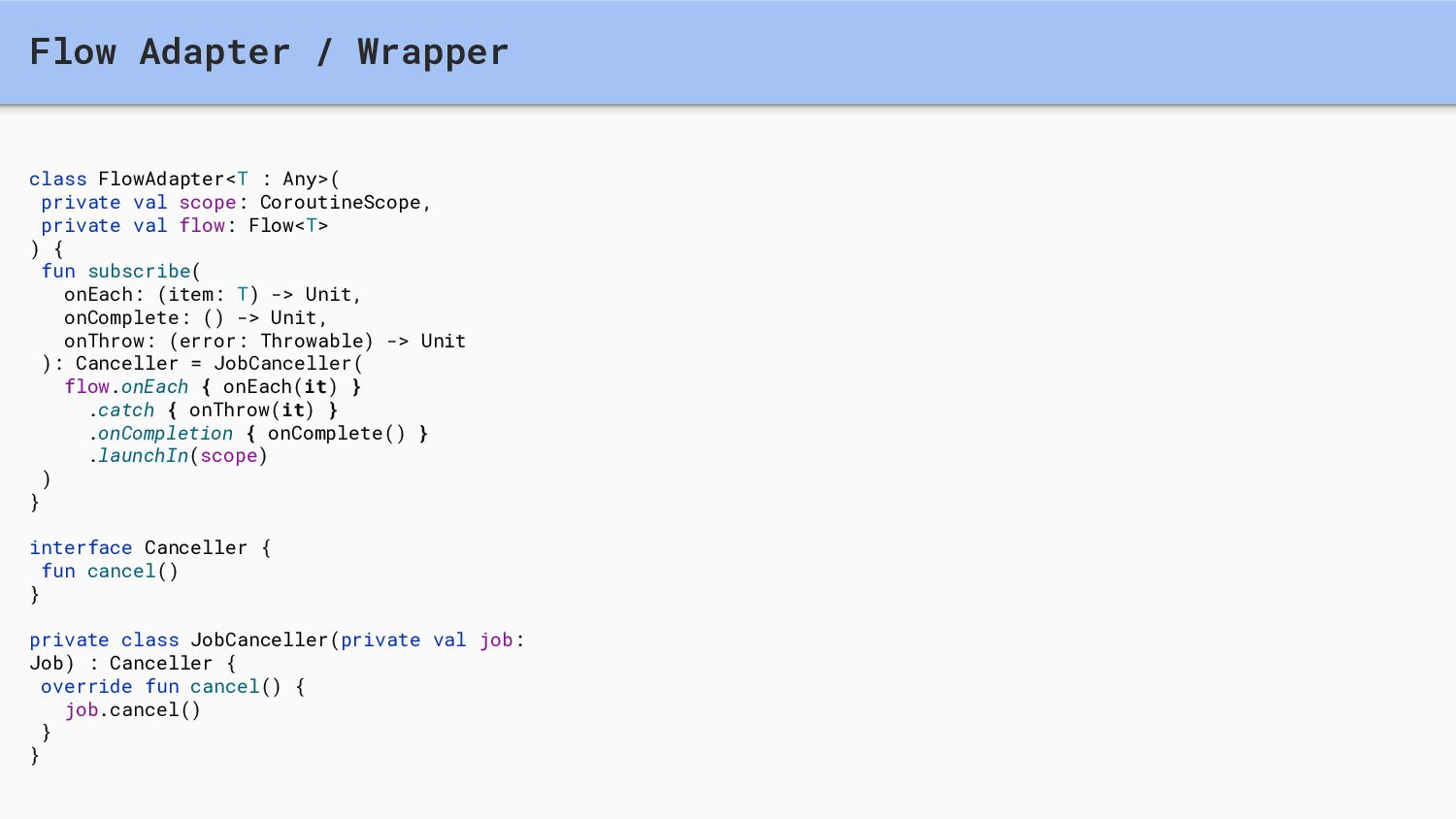
Flow Adapter / Wrapper class FlowAdapter<T : Any>( private val
scope: CoroutineScope, private val flow: Flow<T> ) { fun subscribe( onEach: (item: T) -> Unit, onComplete: () -> Unit, onThrow: (error: Throwable) -> Unit ): Canceller = JobCanceller( flow.onEach { onEach(it) } .catch { onThrow(it) } .onCompletion { onComplete() } .launchIn(scope) ) } interface Canceller { fun cancel() } private class JobCanceller(private val job: Job) : Canceller { override fun cancel() { job.cancel() } } -
Flow Adapter / Wrapper class FlowAdapter<T : Any>( private val
scope: CoroutineScope, private val flow: Flow<T> ) { fun subscribe( onEach: (item: T) -> Unit, onComplete: () -> Unit, onThrow: (error: Throwable) -> Unit ): Canceller = JobCanceller( flow.onEach { onEach(it) } .catch { onThrow(it) } .onCompletion { onComplete() } .launchIn(scope) ) } interface Canceller { fun cancel() } private class JobCanceller(private val job: Job) : Canceller { override fun cancel() { job.cancel() } } viewModel.breeds.subscribe( onEach: { [weak self] dogsState in self?.loading = dogsState.isLoading self?.breeds = dogsState.breeds self?.error = dogsState.error }, onComplete: { print("Subscription end") }, onThrow: { error in print("Subscription error: \(error)") } ) -
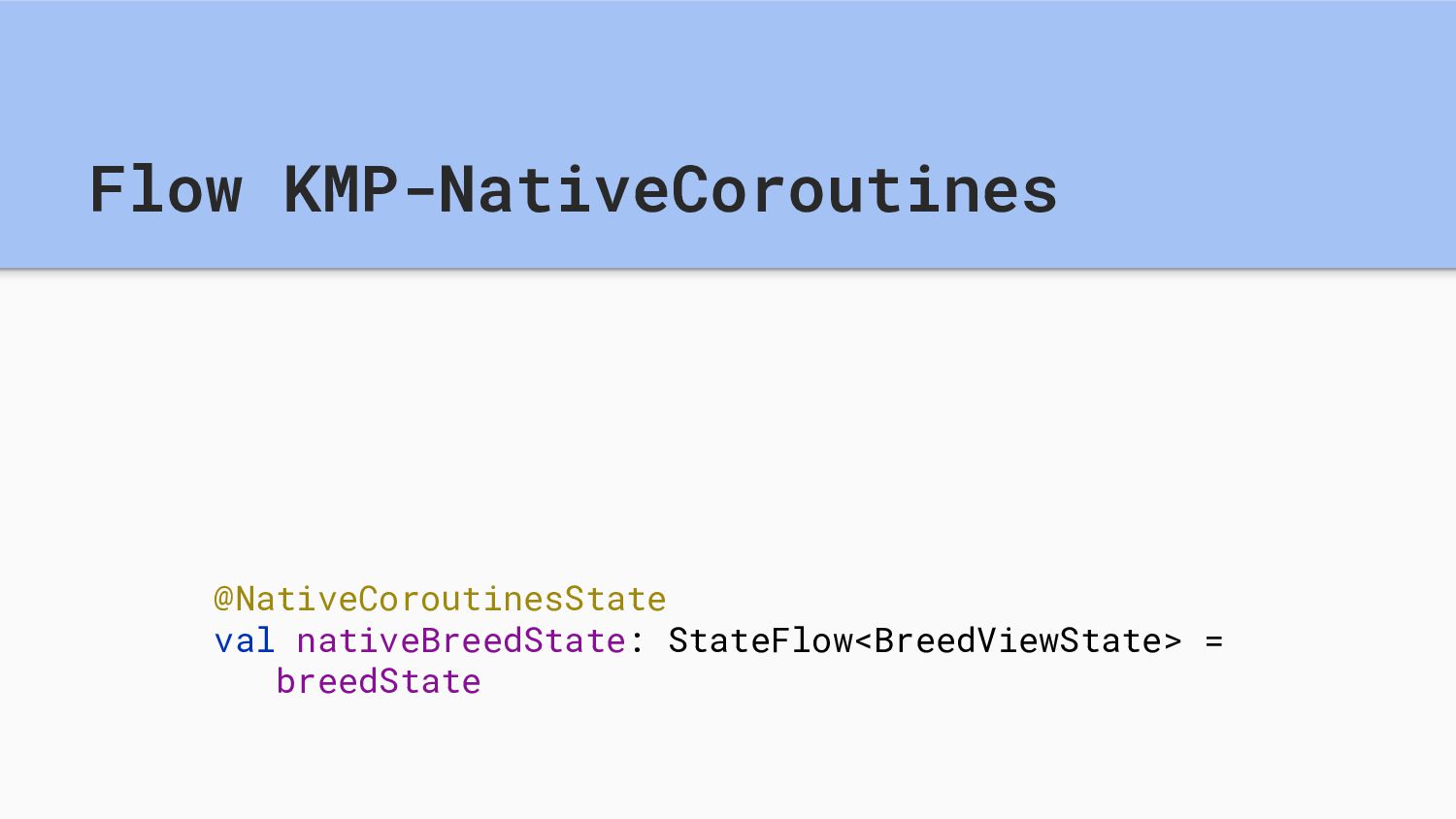
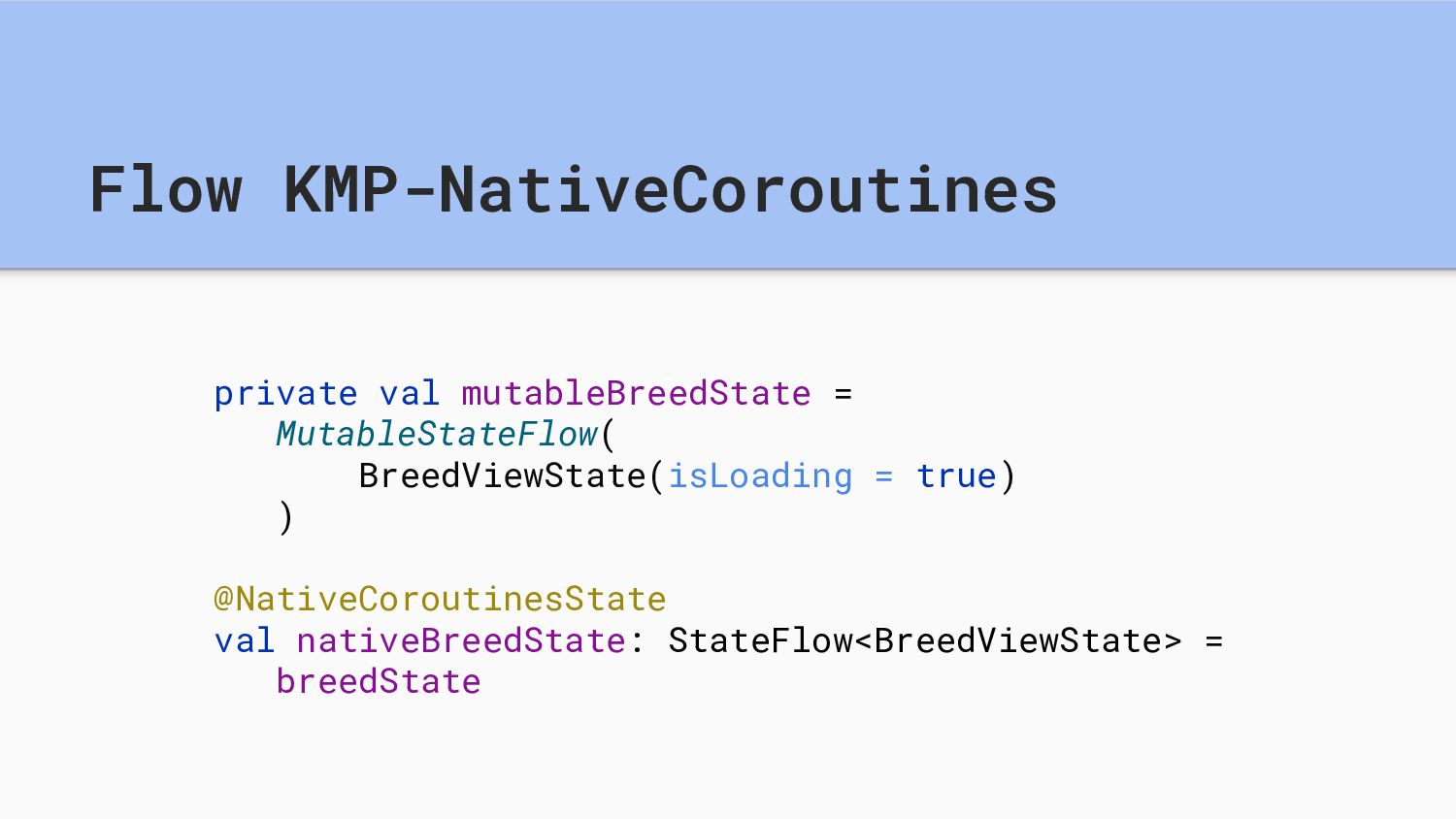
Flow KMP-NativeCoroutines private val mutableBreedState = MutableStateFlow( BreedViewState(isLoading = true)
) @NativeCoroutinesState val nativeBreedState: StateFlow<BreedViewState> = breedState -
Flow KMP-NativeCoroutines private val mutableBreedState = MutableStateFlow( BreedViewState(isLoading = true)
) @NativeCoroutinesState val nativeBreedState: StateFlow<BreedViewState> = breedState -
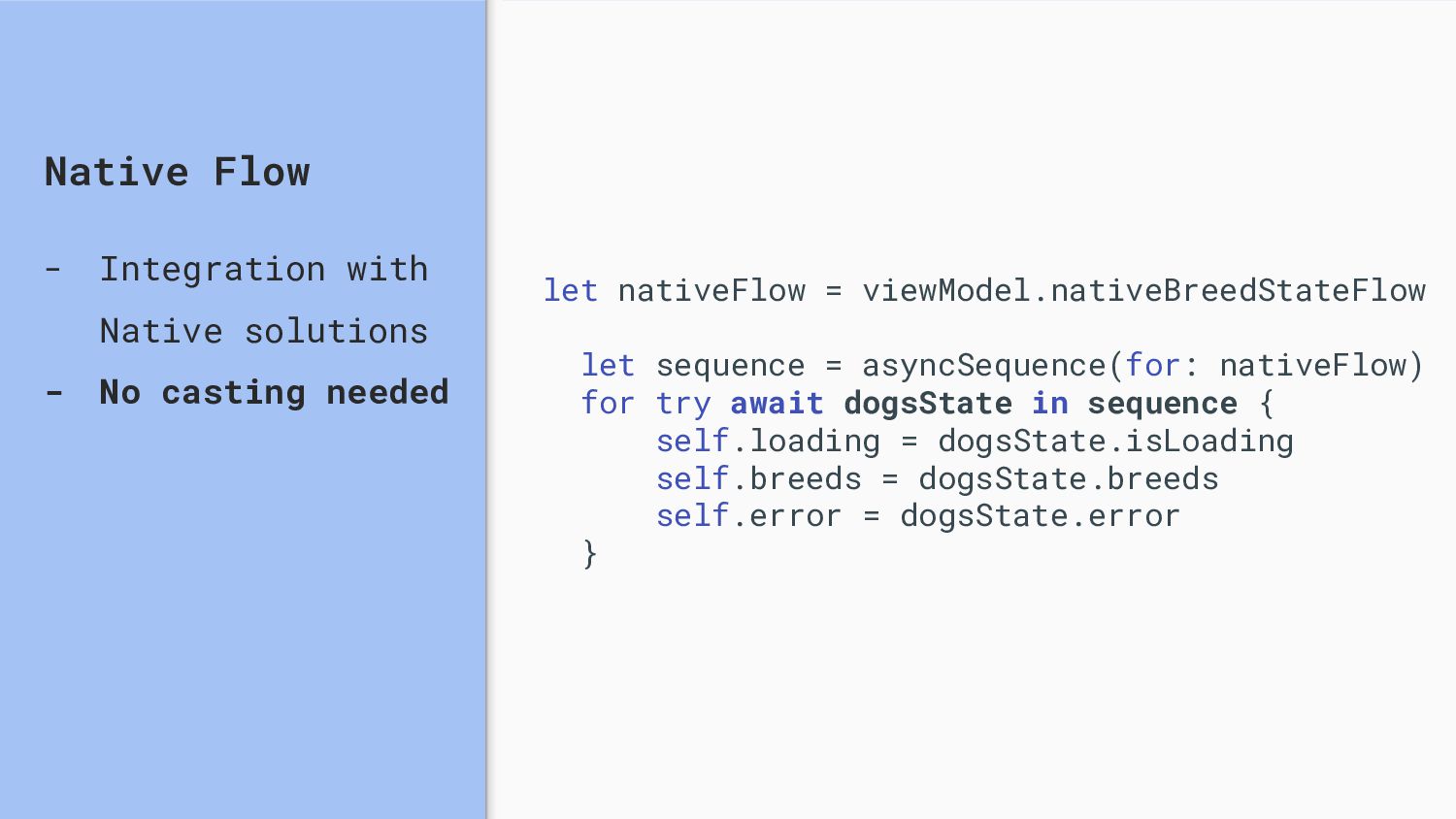
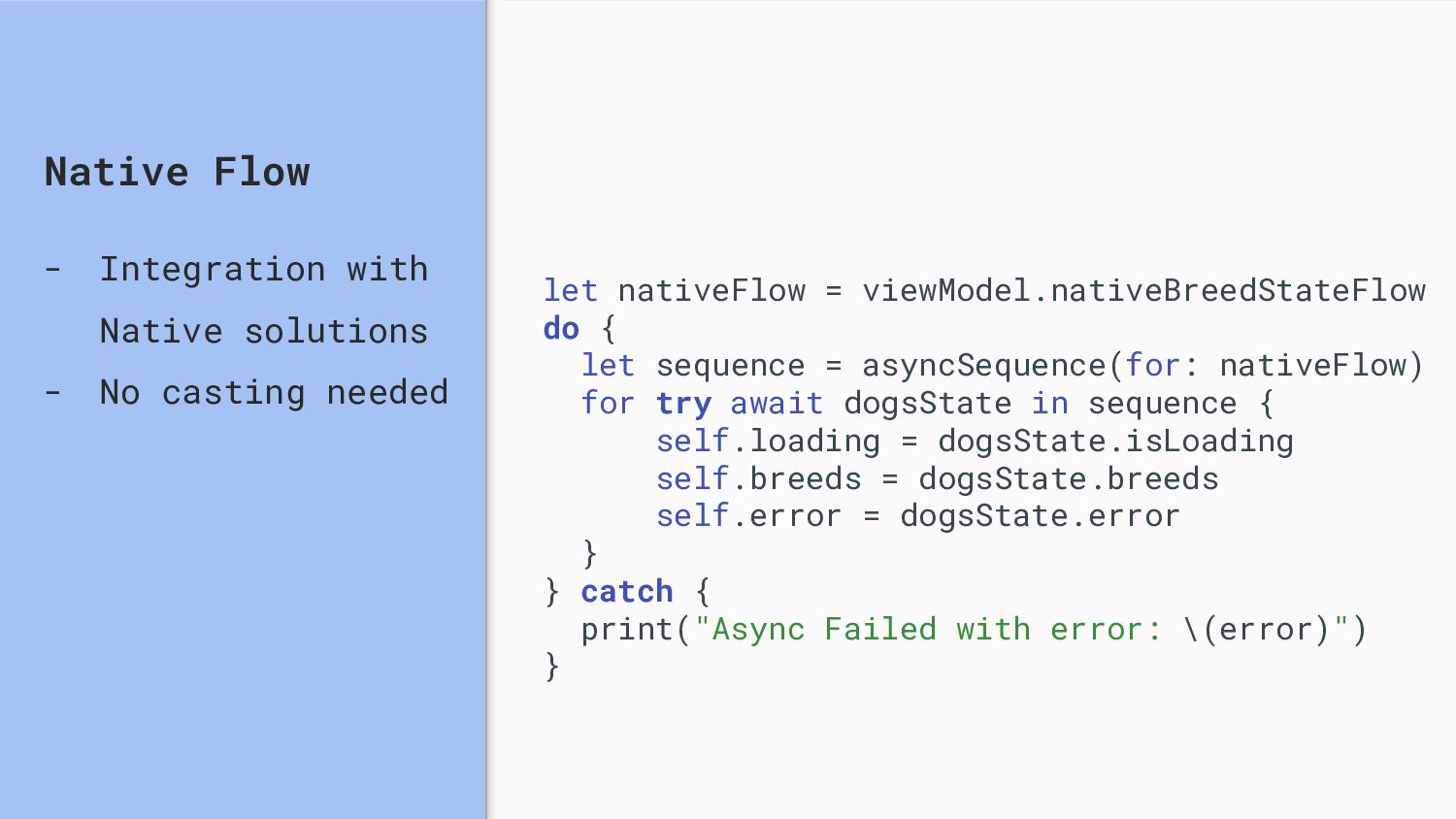
Native Flow - Integration with Native solutions func activate() async
{ let nativeFlow = viewModel.nativeBreedStateFlow do { let sequence = asyncSequence(for: nativeFlow) for try await dogsState in sequence { self.loading = dogsState.isLoading self.breeds = dogsState.breeds self.error = dogsState.error } } catch { print("Async Failed with error: \(error)") } } -
Native Flow - Integration with Native solutions - No casting
needed func activate() async { let nativeFlow = viewModel.nativeBreedStateFlow do { let sequence = asyncSequence(for: nativeFlow) for try await dogsState in sequence { self.loading = dogsState.isLoading self.breeds = dogsState.breeds self.error = dogsState.error } } catch { print("Async Failed with error: \(error)") } } -
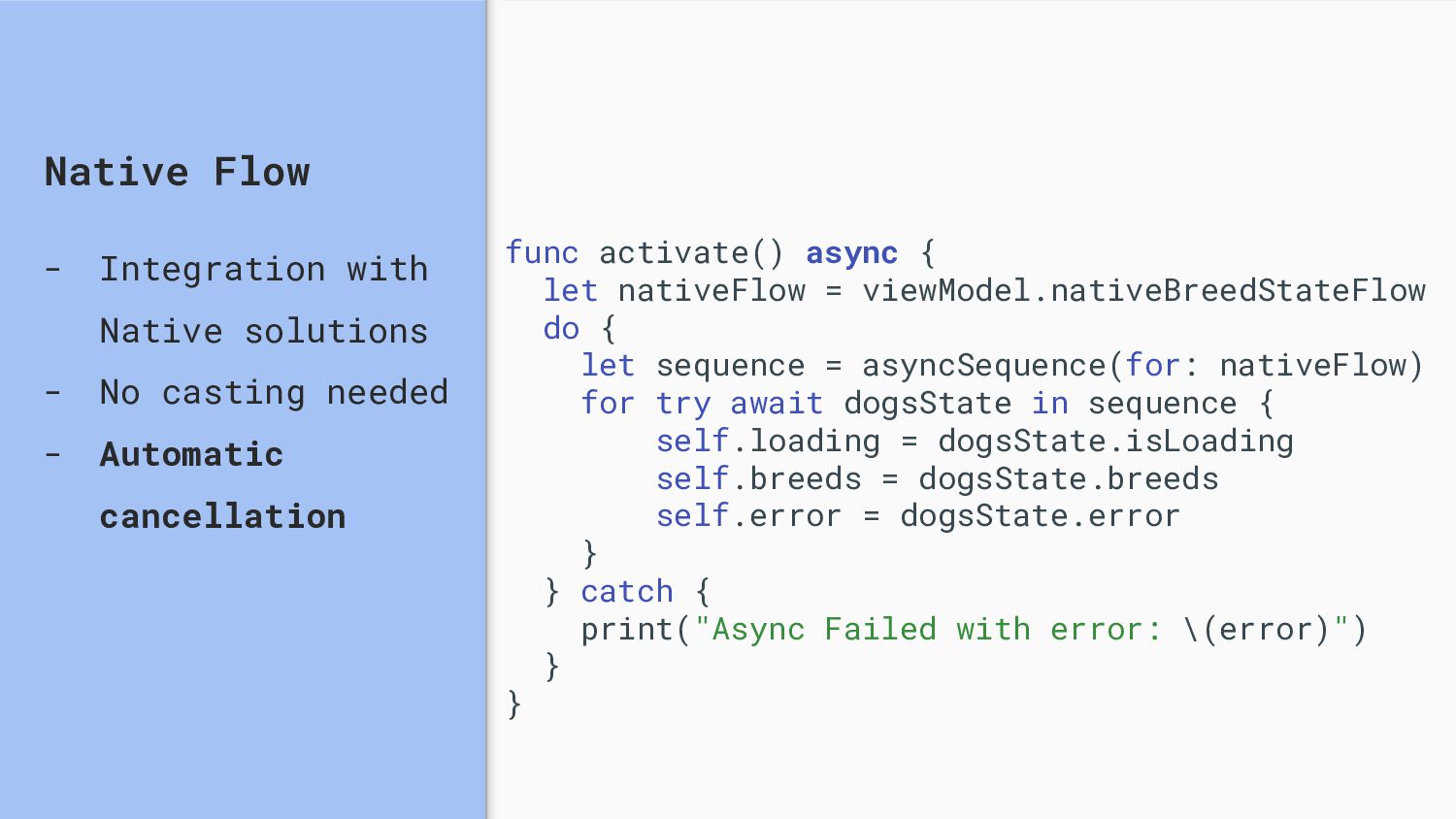
Native Flow - Integration with Native solutions - No casting
needed - Automatic cancellation func activate() async { let nativeFlow = viewModel.nativeBreedStateFlow do { let sequence = asyncSequence(for: nativeFlow) for try await dogsState in sequence { self.loading = dogsState.isLoading self.breeds = dogsState.breeds self.error = dogsState.error } } catch { print("Async Failed with error: \(error)") } } -
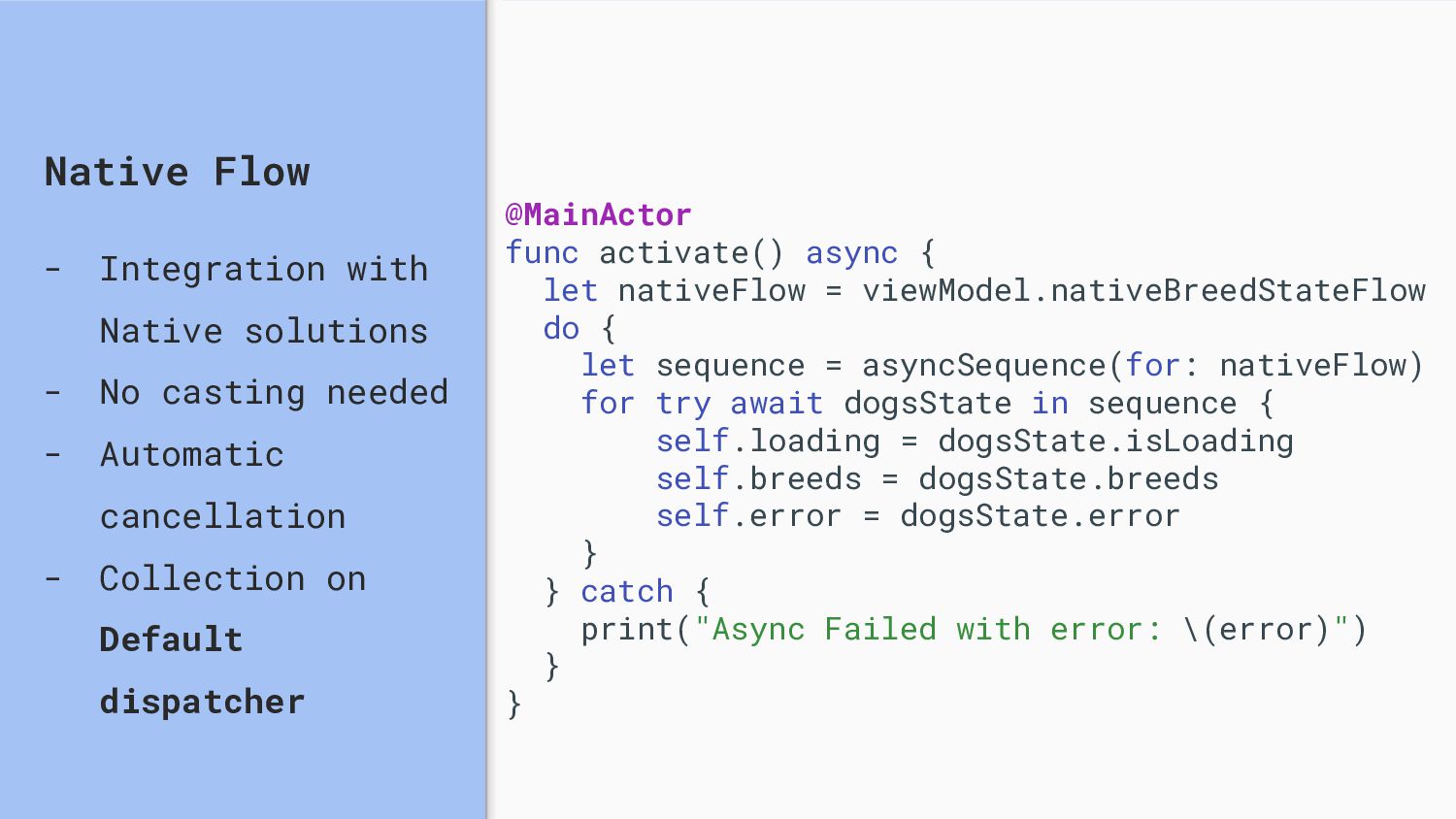
Native Flow - Integration with Native solutions - No casting
needed - Automatic cancellation - Collection on Default dispatcher @MainActor func activate() async { let nativeFlow = viewModel.nativeBreedStateFlow do { let sequence = asyncSequence(for: nativeFlow) for try await dogsState in sequence { self.loading = dogsState.isLoading self.breeds = dogsState.breeds self.error = dogsState.error } } catch { print("Async Failed with error: \(error)") } } -
Controlling the Scope - Ability to cancel directly from Kotlin
- Specify which thread should the suspension happen @NativeCoroutineScope actual val viewModelScope = MainScope() -
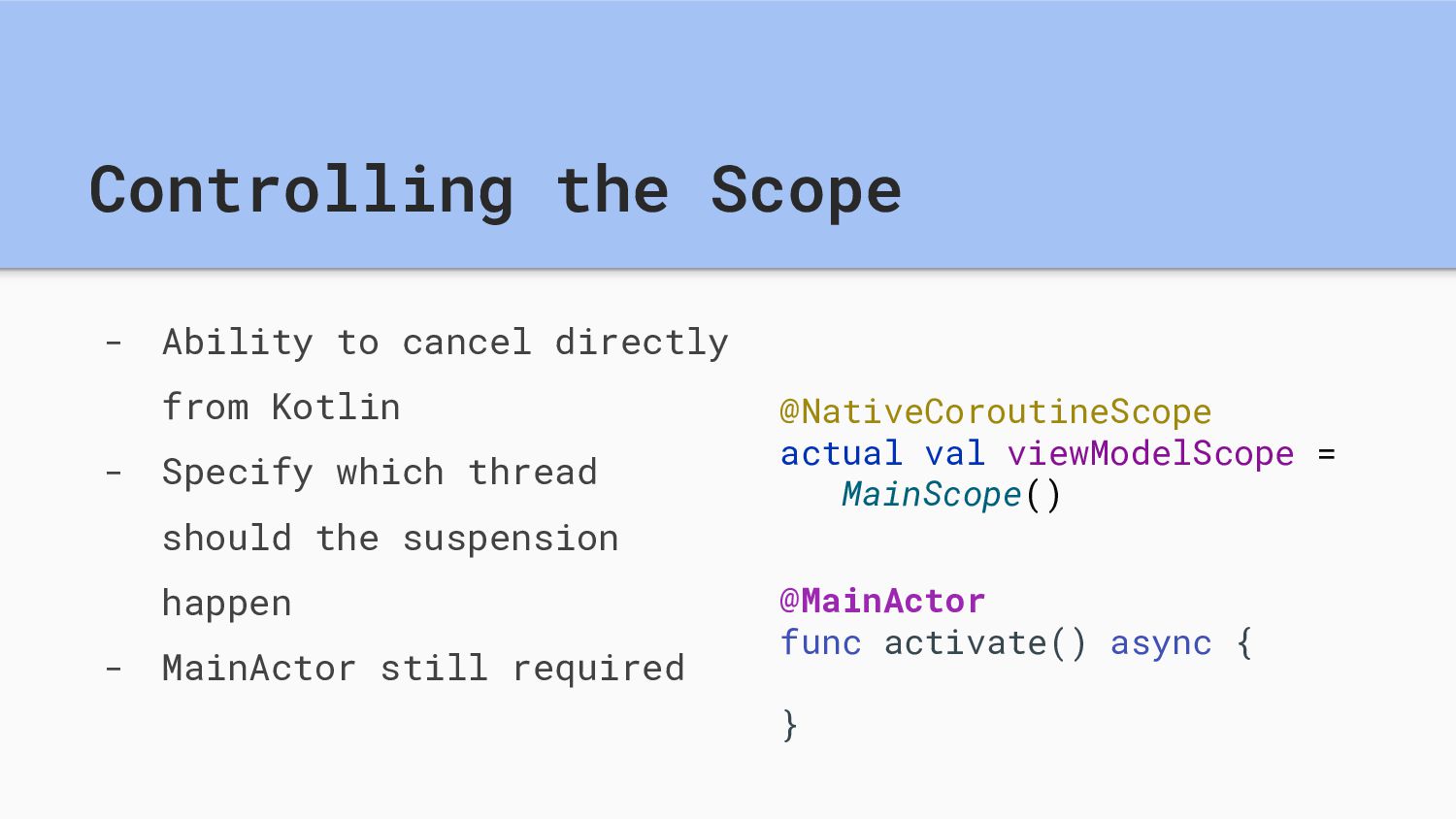
Controlling the Scope - Ability to cancel directly from Kotlin
- Specify which thread should the suspension happen - MainActor still required @NativeCoroutineScope actual val viewModelScope = MainScope() @MainActor func activate() async { } -
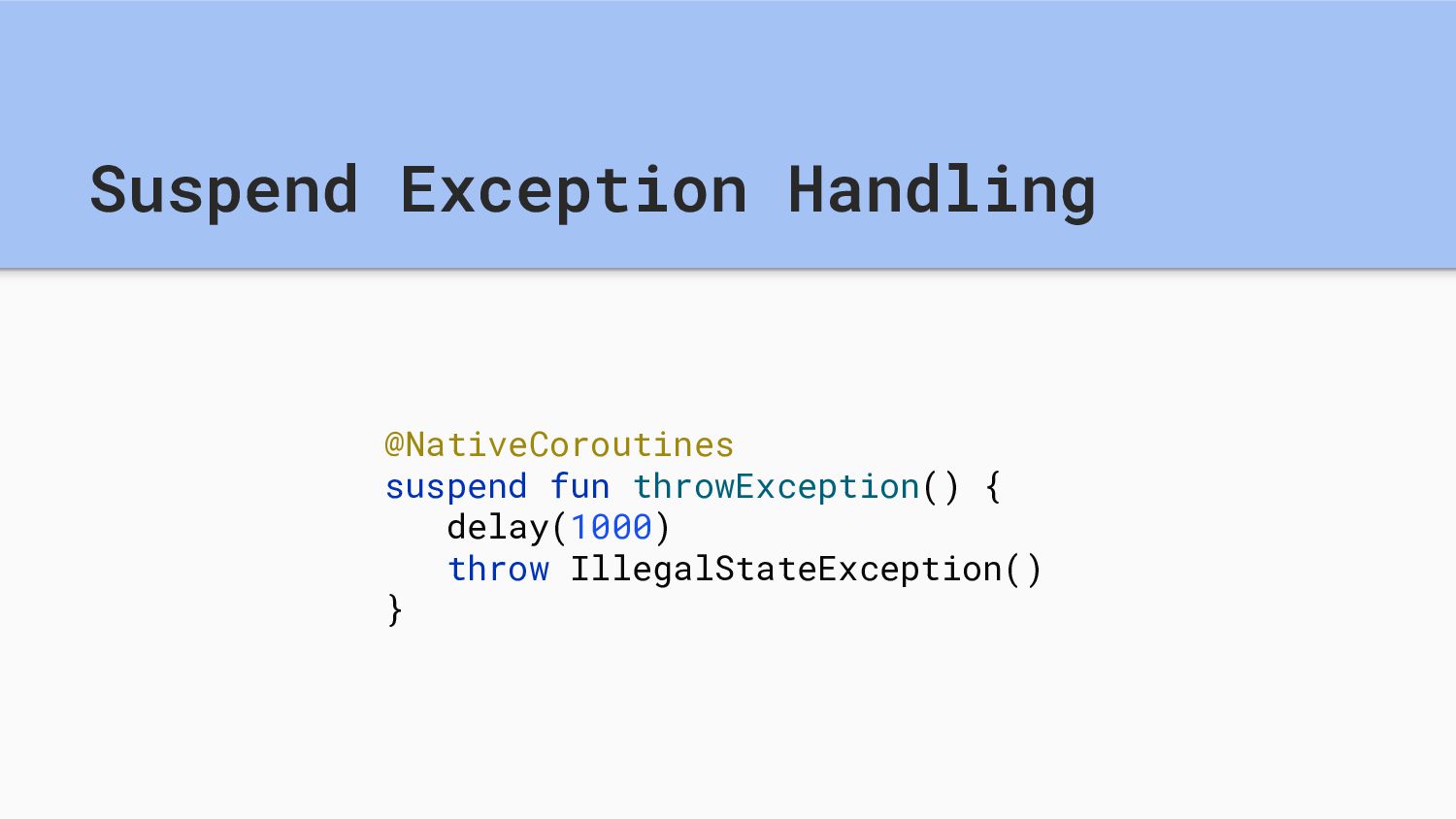
Suspend Exception Handling @NativeCoroutines suspend fun throwException() { delay(1000) throw
IllegalStateException() } -
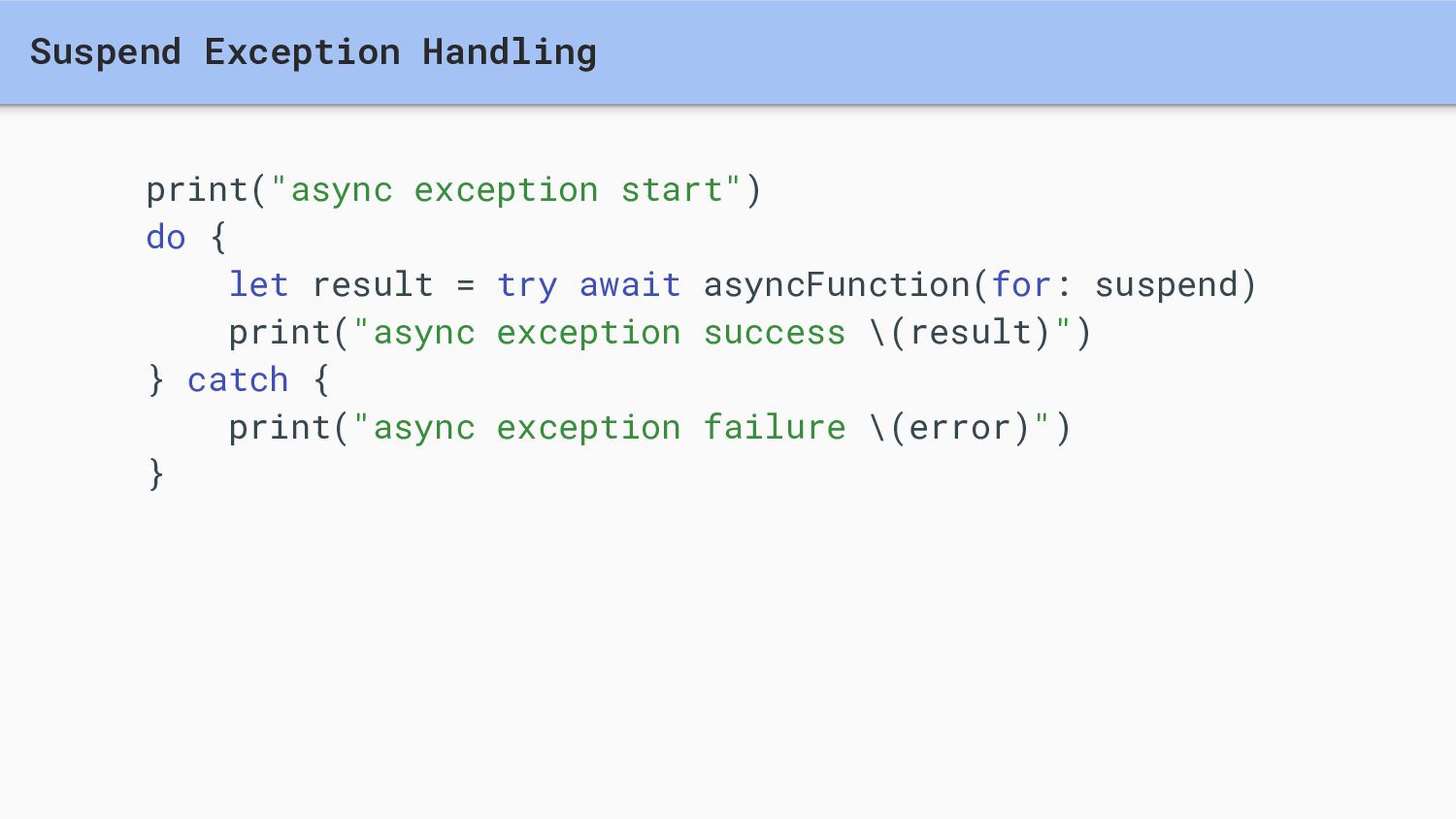
Suspend Exception Handling print("async exception start") do { let result
= try await asyncFunction(for: suspend) print("async exception success \(result)") } catch { print("async exception failure \(error)") } -
Suspend Exception Handling 18:07:03 async exception start 18:07:04 async exception
failure (ErrorDomain=KotlinExcepton Code=0 "(null)" UserInfo={KotlinException=kotlin.IllegalStateException}) print("async exception start") do { let result = try await asyncFunction(for: suspend) print("async exception success \(result)") } catch { print("async exception failure \(error)") } -
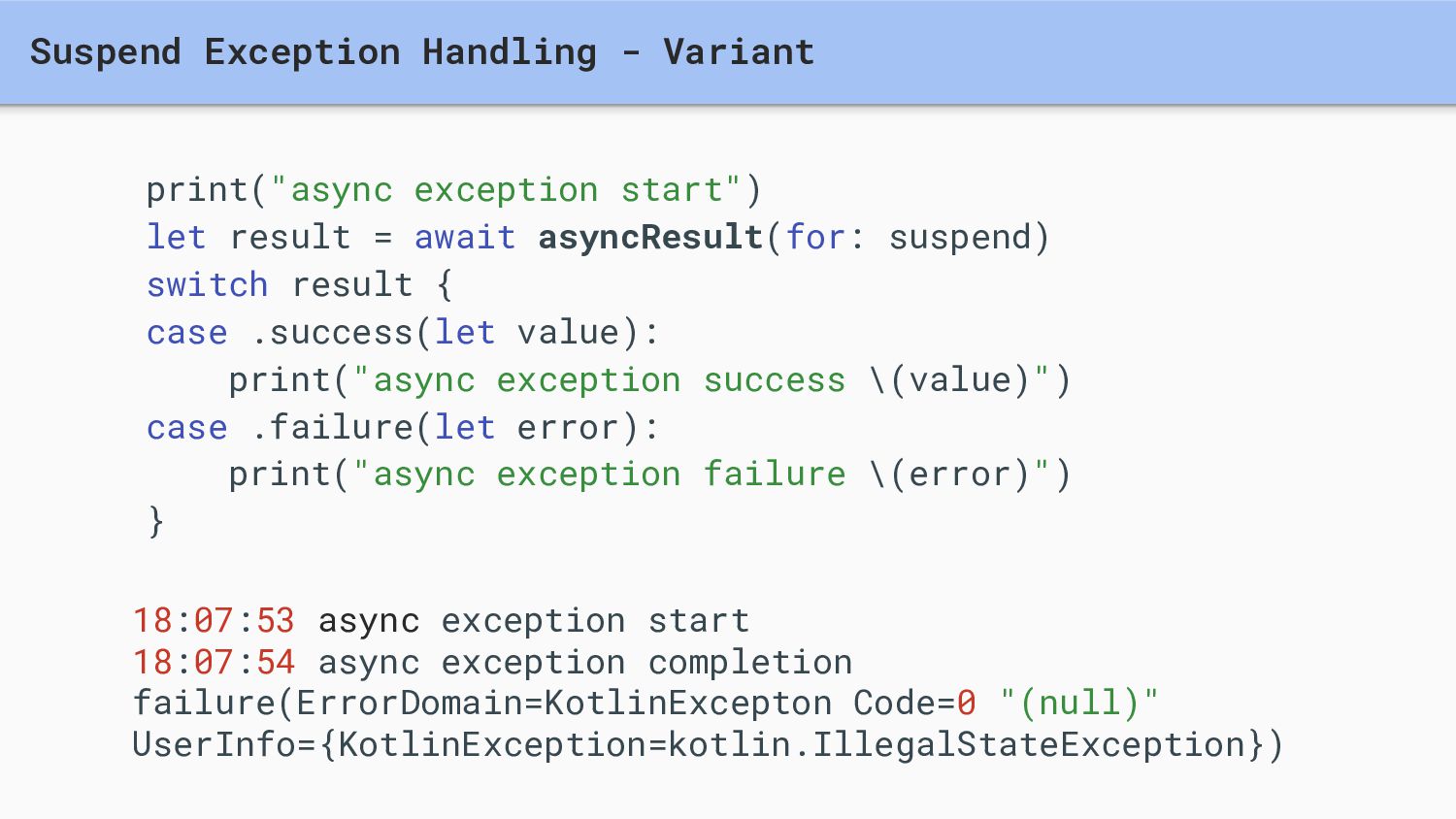
Suspend Exception Handling - Variant 18:07:53 async exception start 18:07:54
async exception completion failure(ErrorDomain=KotlinExcepton Code=0 "(null)" UserInfo={KotlinException=kotlin.IllegalStateException}) print("async exception start") let result = await asyncResult(for: suspend) switch result { case .success(let value): print("async exception success \(value)") case .failure(let error): print("async exception failure \(error)") } -
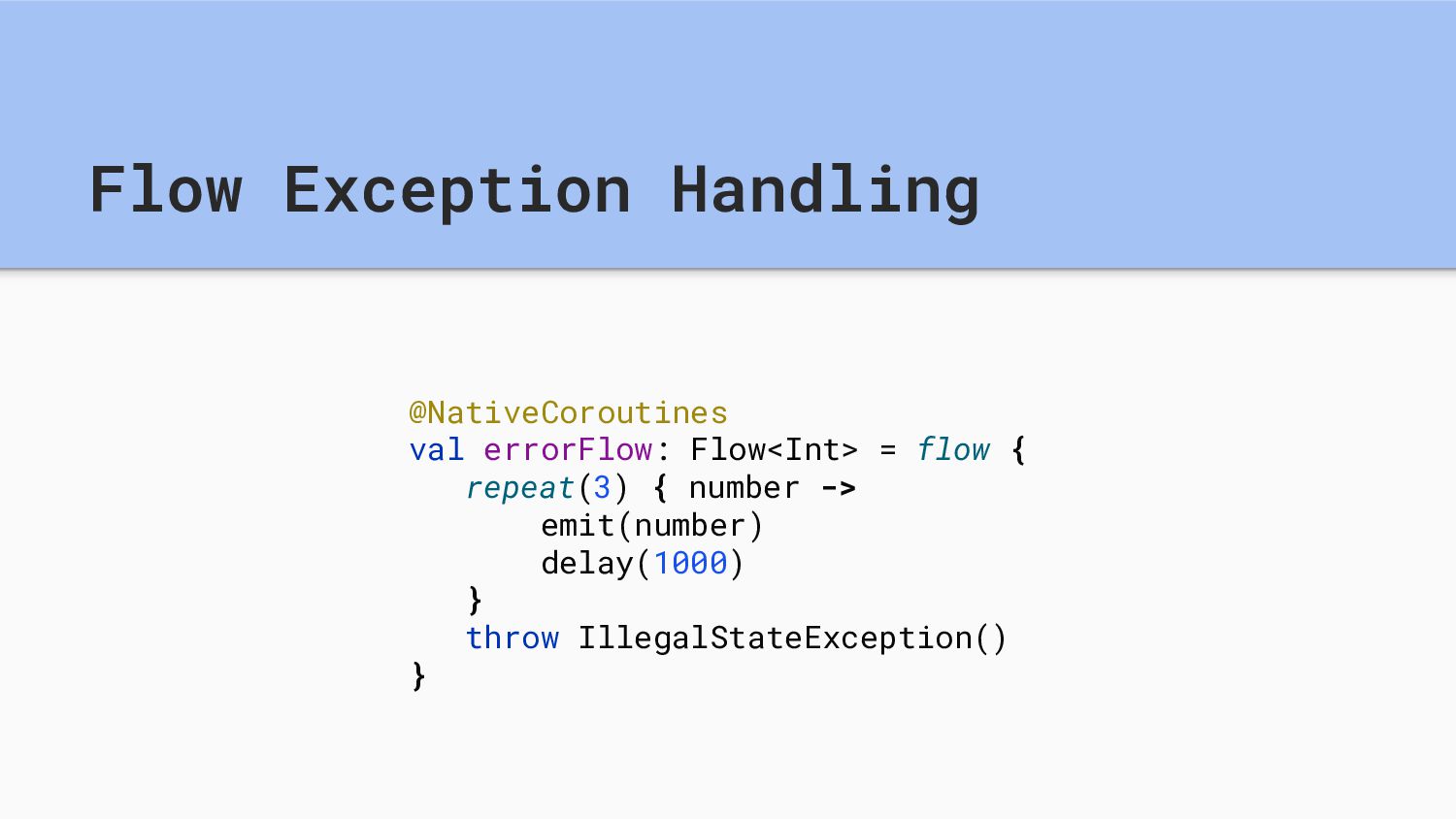
Flow Exception Handling @NativeCoroutines val errorFlow: Flow<Int> = flow {
repeat(3) { number -> emit(number) delay(1000) } throw IllegalStateException() } -
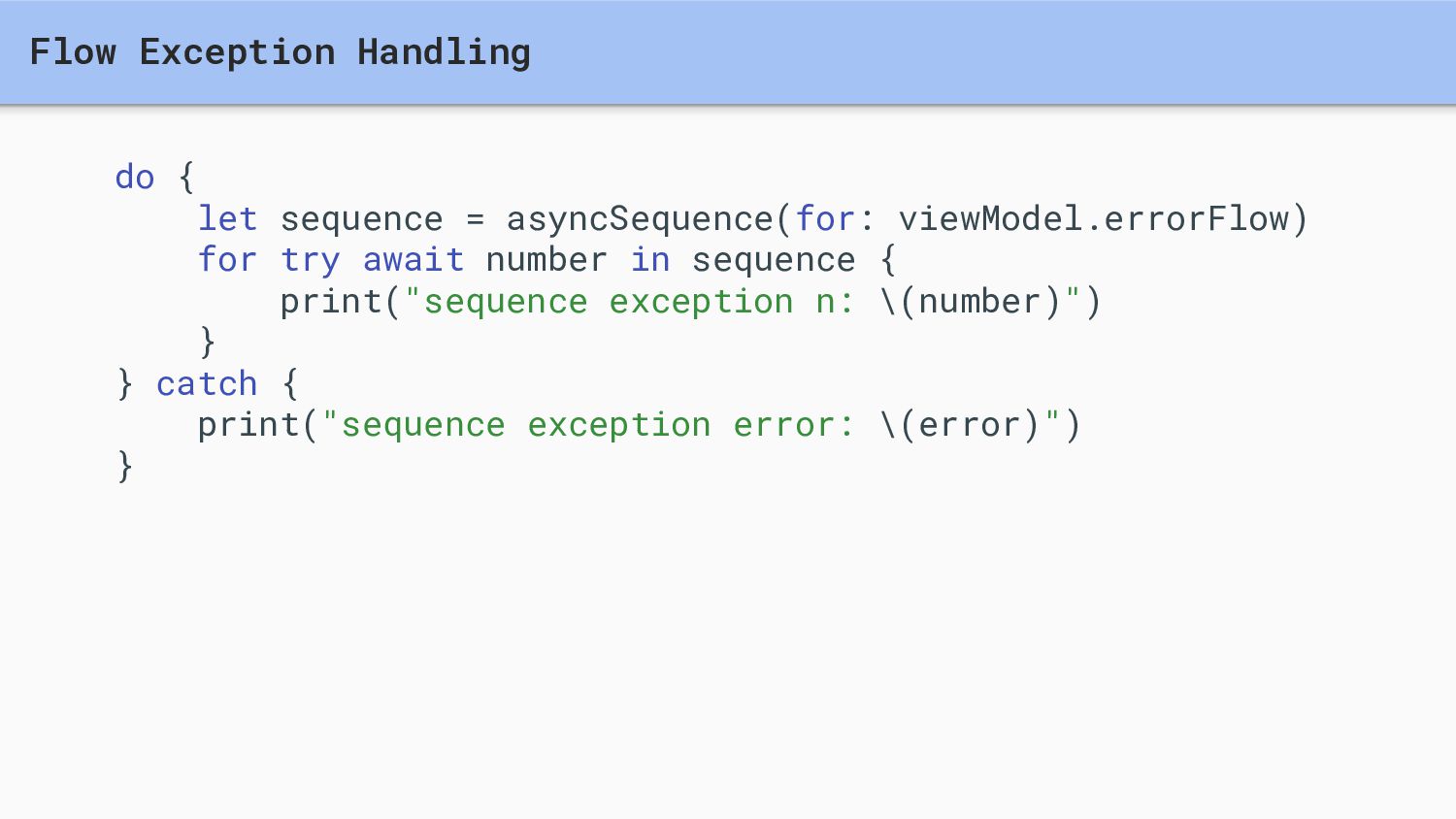
Flow Exception Handling do { let sequence = asyncSequence(for: viewModel.errorFlow)
for try await number in sequence { print("sequence exception n: \(number)") } } catch { print("sequence exception error: \(error)") } -
Flow Exception Handling 2023-06-28 18:14:24 sequence exception number 0 2023-06-28
18:14:25 sequence exception number 1 2023-06-28 18:14:26 sequence exception number 2 2023-06-28 18:14:27 sequence exception error (Error Domain=KotlinException Code=0 "(null)" UserInfo={KotlinException=kotlin.IllegalStateException}) do { let sequence = asyncSequence(for: viewModel.errorFlow) for try await number in sequence { print("sequence exception n: \(number)") } } catch { print("sequence exception error: \(error)") } -
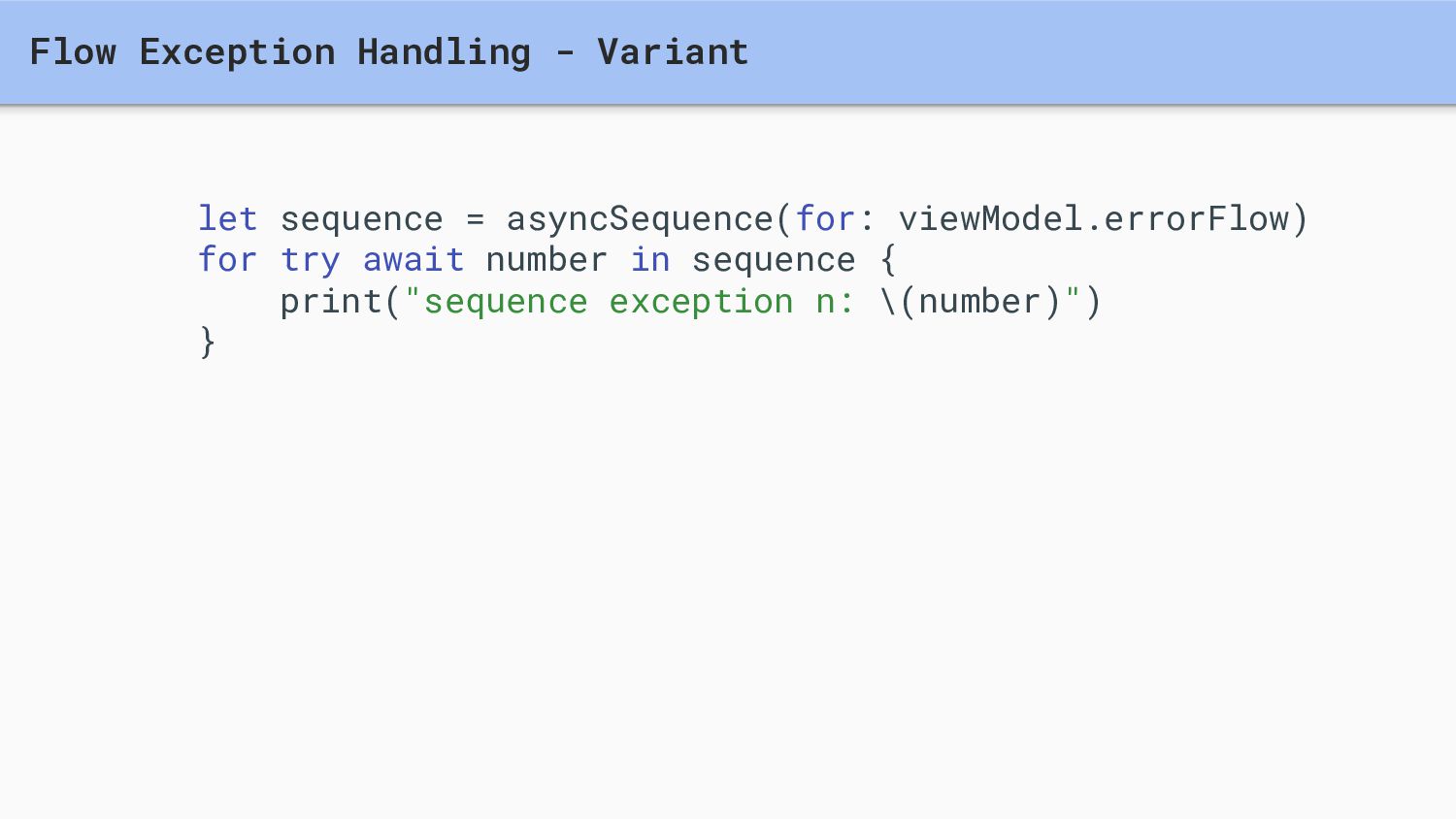
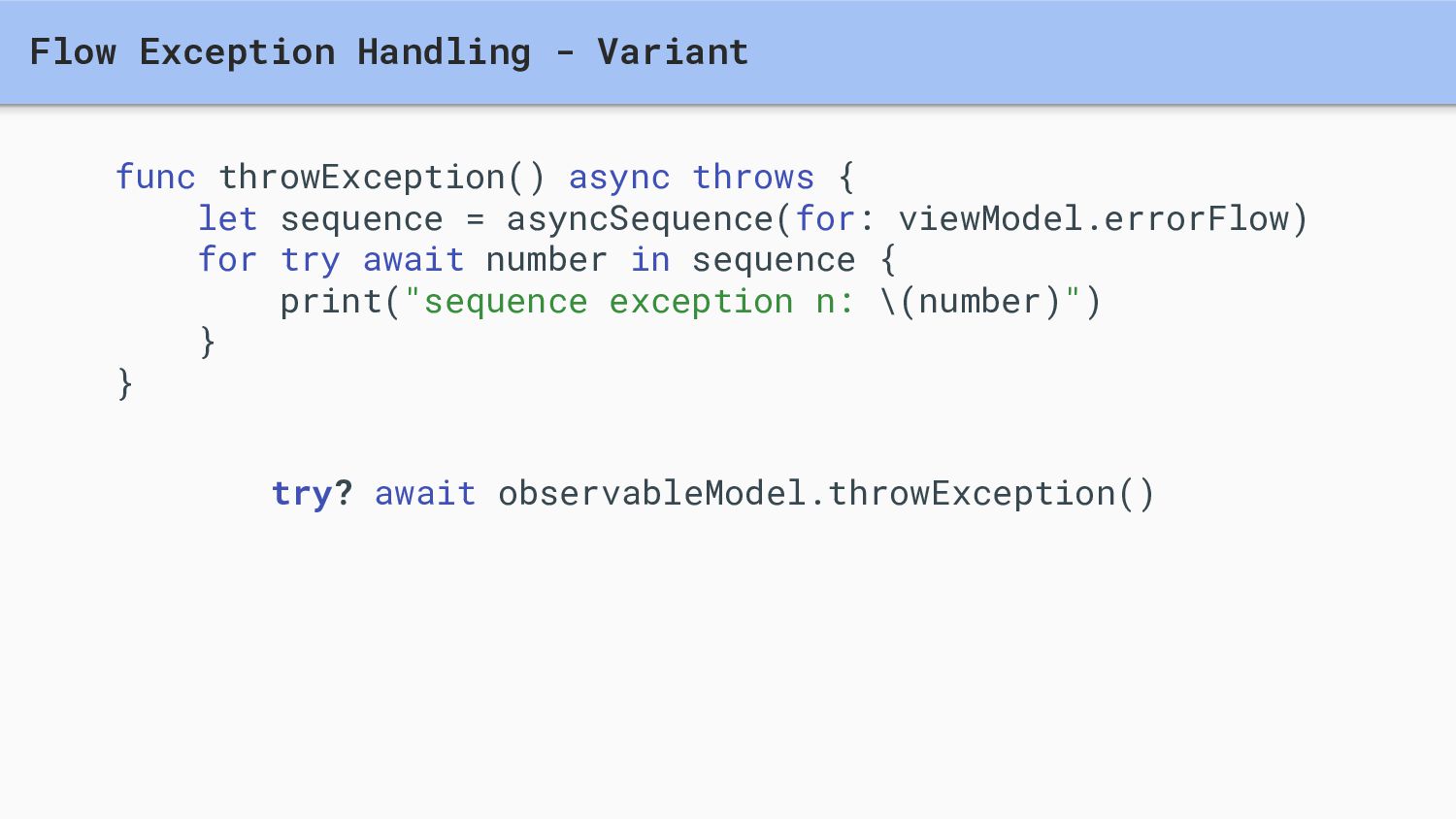
Flow Exception Handling - Variant func throwException() async throws {
let sequence = asyncSequence(for: viewModel.errorFlow) for try await number in sequence { print("sequence exception n: \(number)") } } -
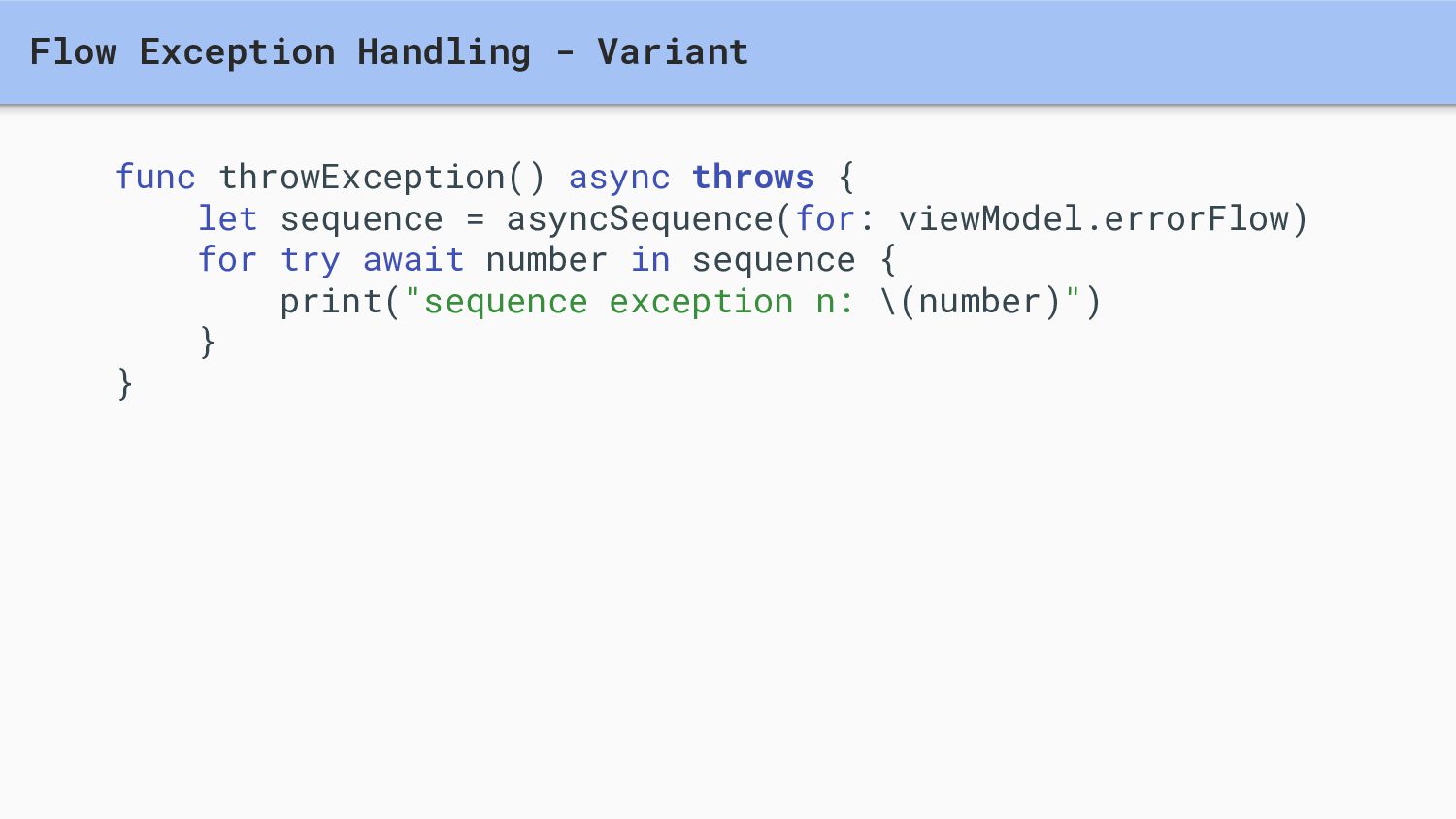
Flow Exception Handling - Variant func throwException() async throws {
let sequence = asyncSequence(for: viewModel.errorFlow) for try await number in sequence { print("sequence exception n: \(number)") } } -
Flow Exception Handling - Variant func throwException() async throws {
let sequence = asyncSequence(for: viewModel.errorFlow) for try await number in sequence { print("sequence exception n: \(number)") } } try? await observableModel.throwException() -
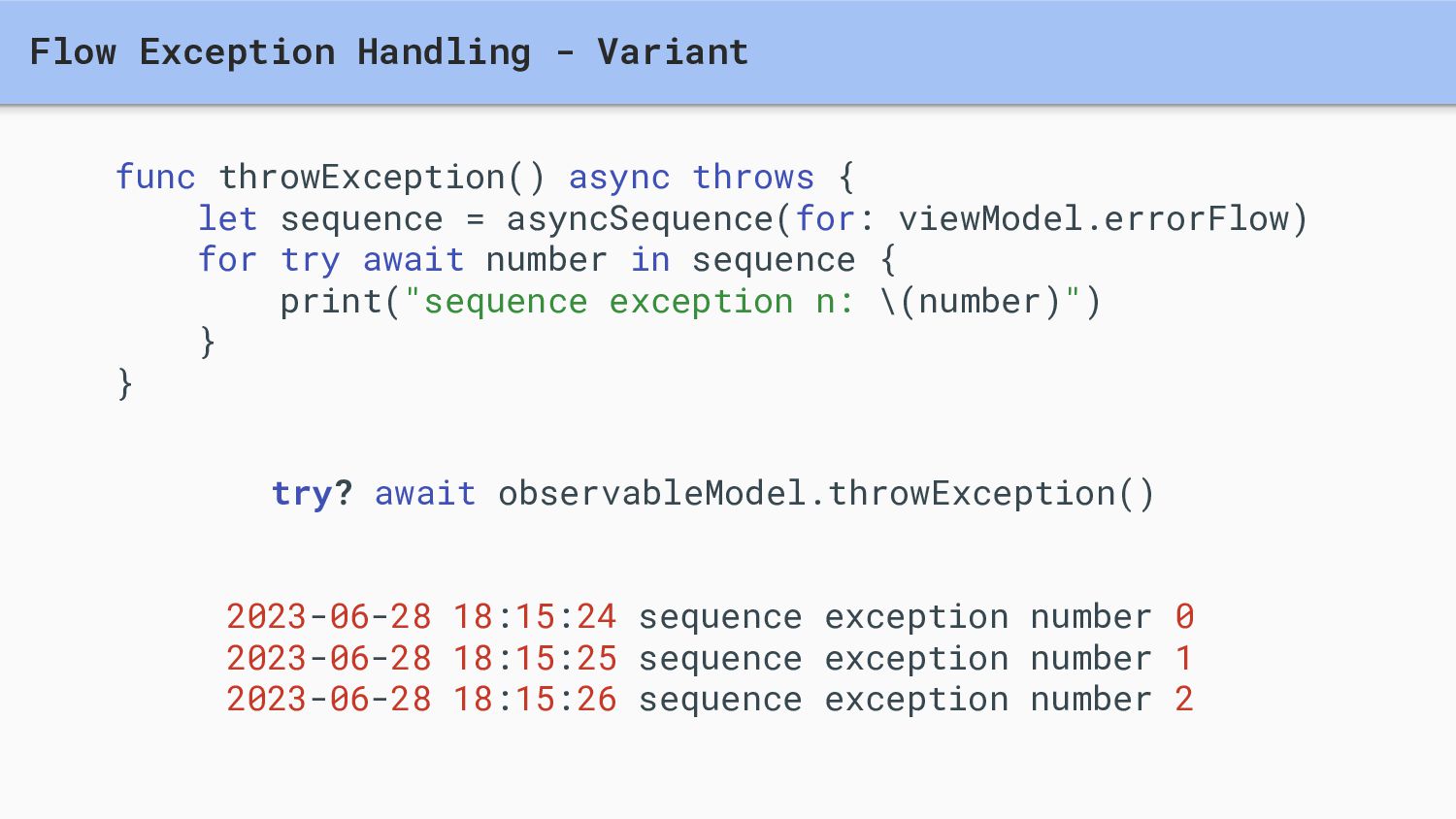
Flow Exception Handling - Variant 2023-06-28 18:15:24 sequence exception number
0 2023-06-28 18:15:25 sequence exception number 1 2023-06-28 18:15:26 sequence exception number 2 func throwException() async throws { let sequence = asyncSequence(for: viewModel.errorFlow) for try await number in sequence { print("sequence exception n: \(number)") } } try? await observableModel.throwException() -
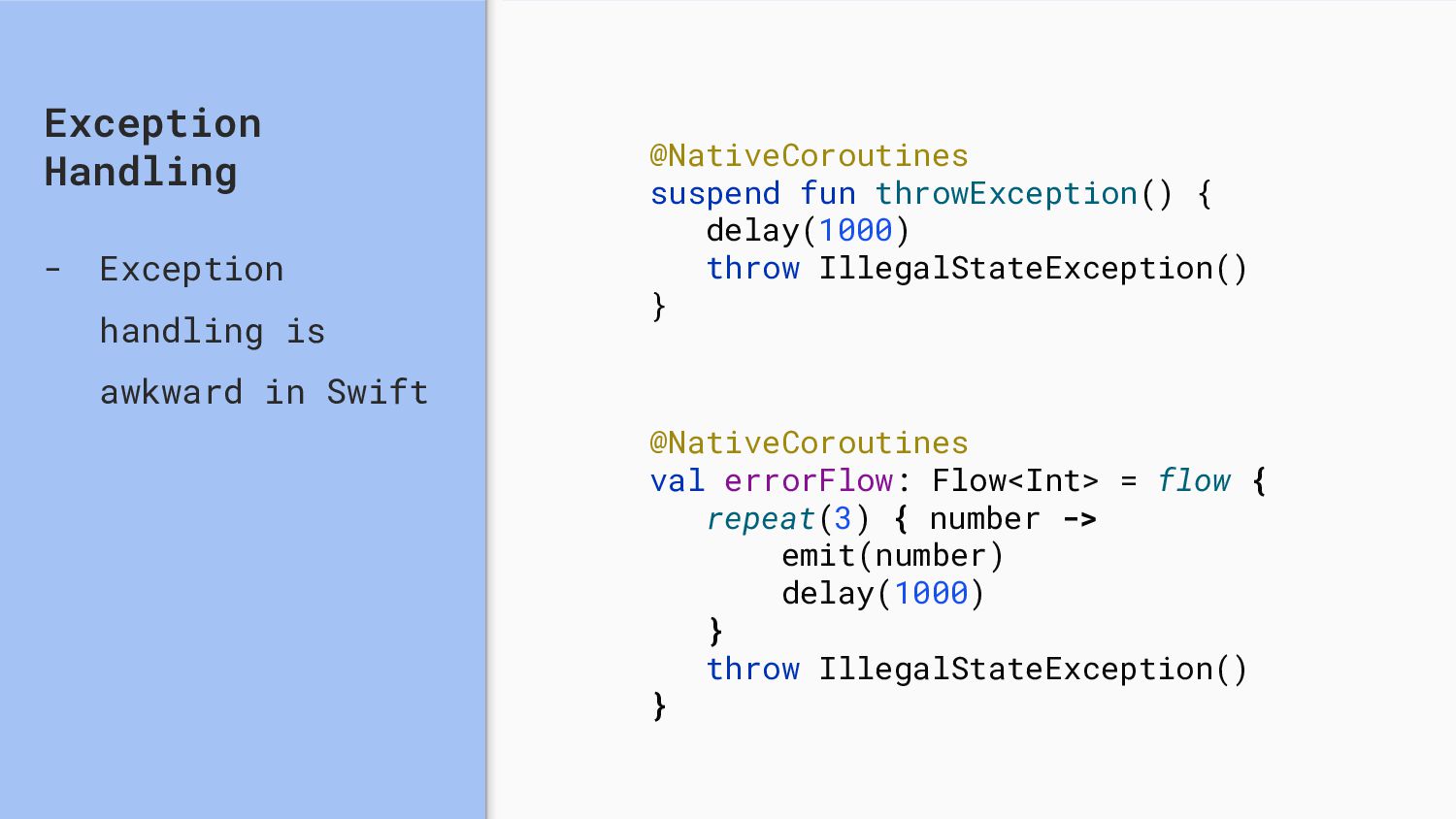
Exception Handling - Exception handling is awkward in Swift @NativeCoroutines
suspend fun throwException() { delay(1000) throw IllegalStateException() } @NativeCoroutines val errorFlow: Flow<Int> = flow { repeat(3) { number -> emit(number) delay(1000) } throw IllegalStateException() } -
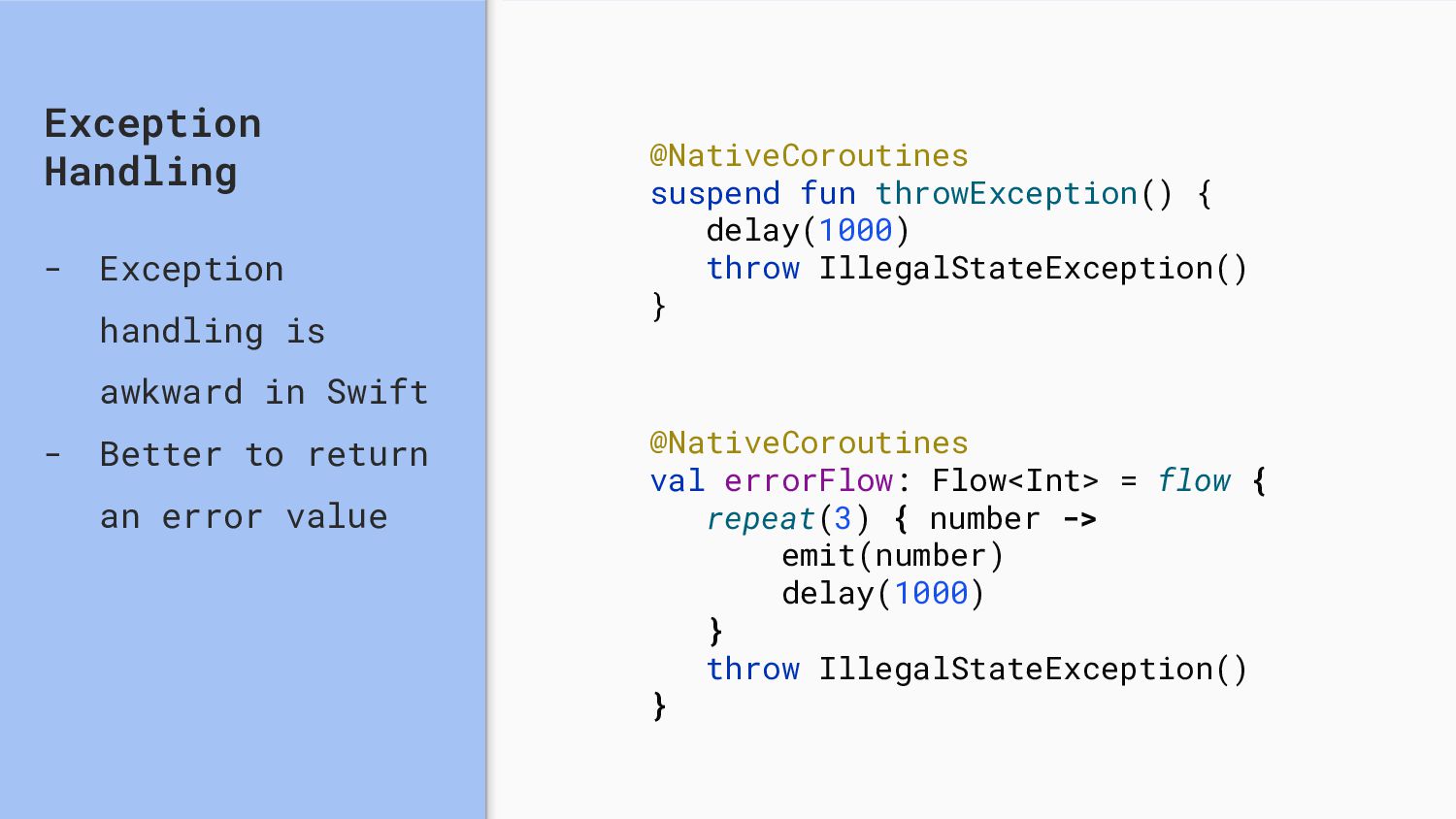
Exception Handling - Exception handling is awkward in Swift -
Better to return an error value @NativeCoroutines suspend fun throwException() { delay(1000) throw IllegalStateException() } @NativeCoroutines val errorFlow: Flow<Int> = flow { repeat(3) { number -> emit(number) delay(1000) } throw IllegalStateException() } -
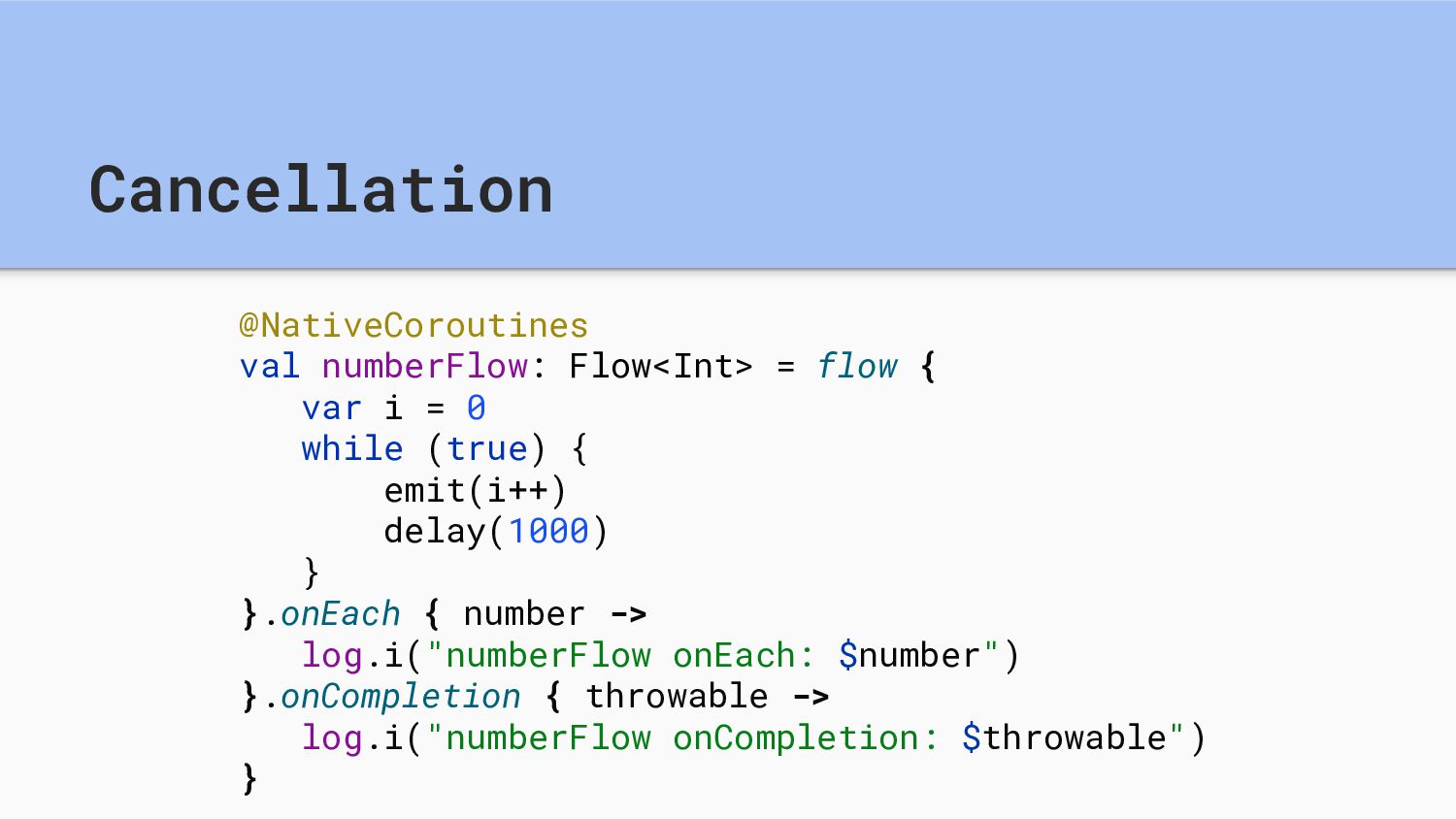
Cancellation @NativeCoroutines val numberFlow: Flow<Int> = flow { var i
= 0 while (true) { emit(i++) delay(1000) } }.onEach { number -> log.i("numberFlow onEach: $number") }.onCompletion { throwable -> log.i("numberFlow onCompletion: $throwable") } -
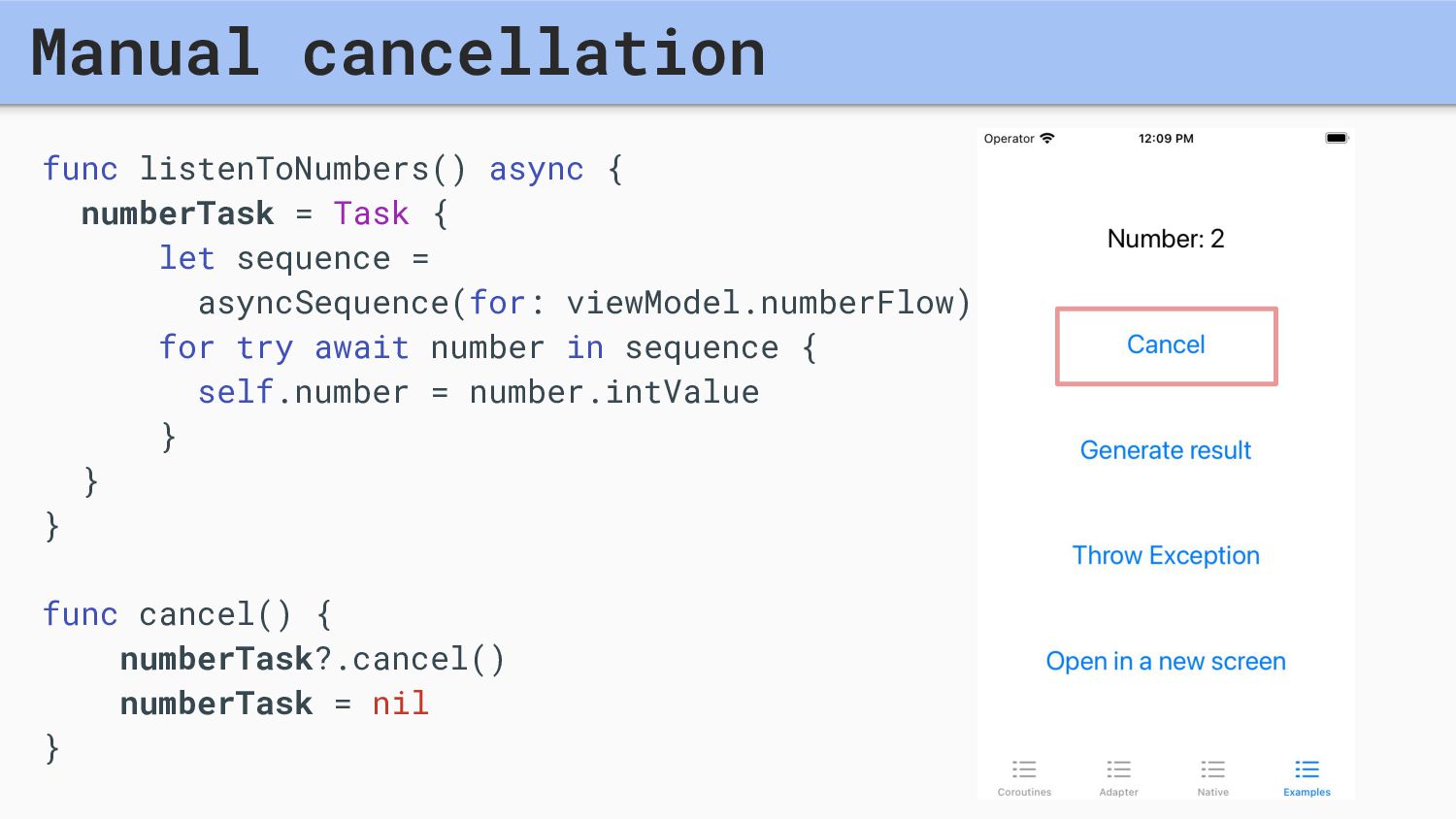
Manual cancellation func listenToNumbers() async { numberTask = Task {
let sequence = asyncSequence(for: viewModel.numberFlow) for try await number in sequence { self.number = number.intValue } } } -
Manual cancellation func cancel() { numberTask?.cancel() numberTask = nil }
func listenToNumbers() async { numberTask = Task { let sequence = asyncSequence(for: viewModel.numberFlow) for try await number in sequence { self.number = number.intValue } } } -
Manual cancellation func cancel() { numberTask?.cancel() numberTask = nil }
func listenToNumbers() async { numberTask = Task { let sequence = asyncSequence(for: viewModel.numberFlow) for try await number in sequence { self.number = number.intValue } } } 2023-06-30 12:21:30 numberFlow onEach: 0 2023-06-30 12:21:31 numberFlow onEach: 1 2023-06-30 12:21:32 numberFlow onEach: 2 2023-06-30 12:21:33 numberFlow onCompletion: kotlinx.coroutines.JobCancellationException: … -
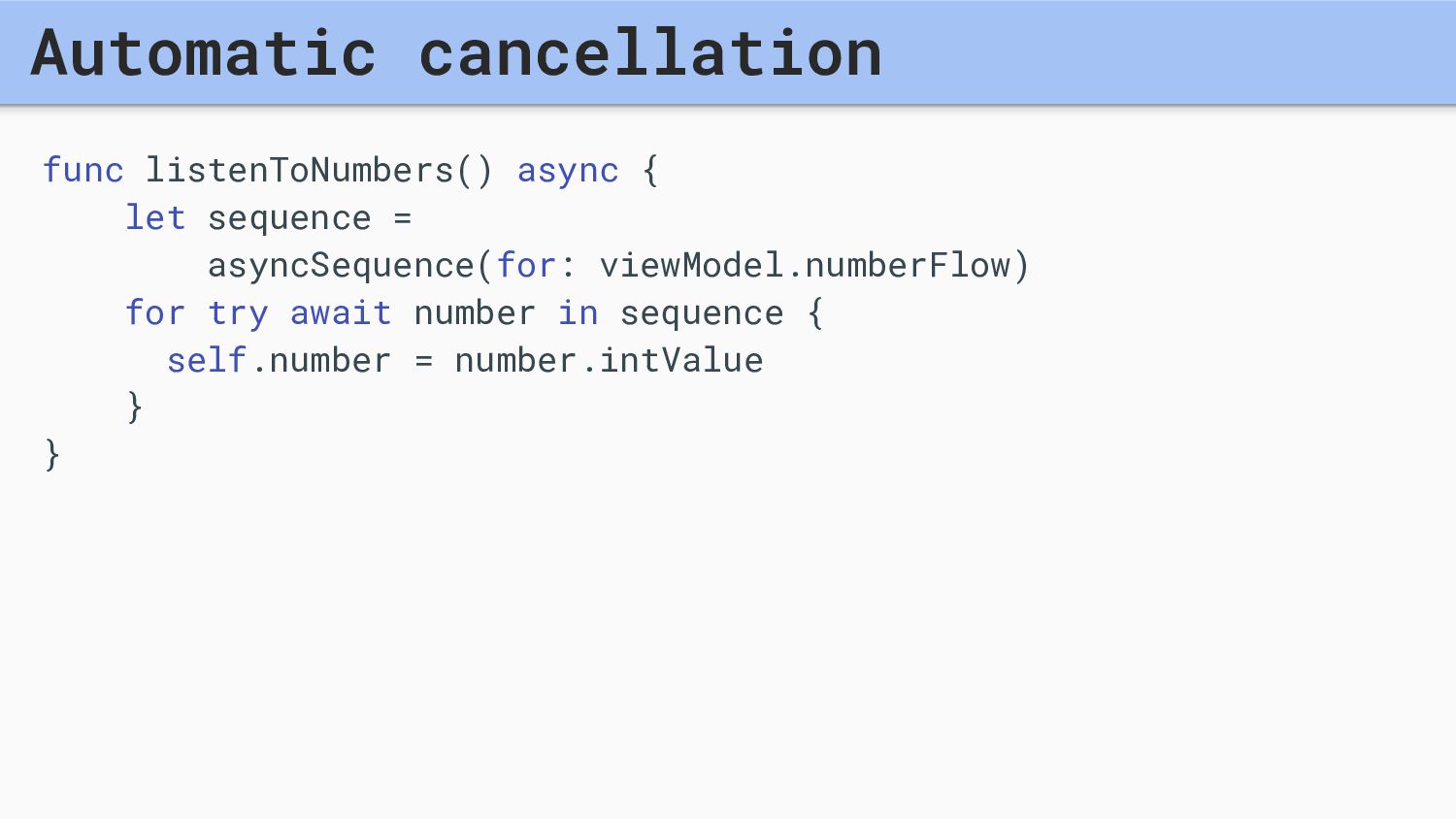
Automatic cancellation func listenToNumbers() async { let sequence = asyncSequence(for:
viewModel.numberFlow) for try await number in sequence { self.number = number.intValue } } -
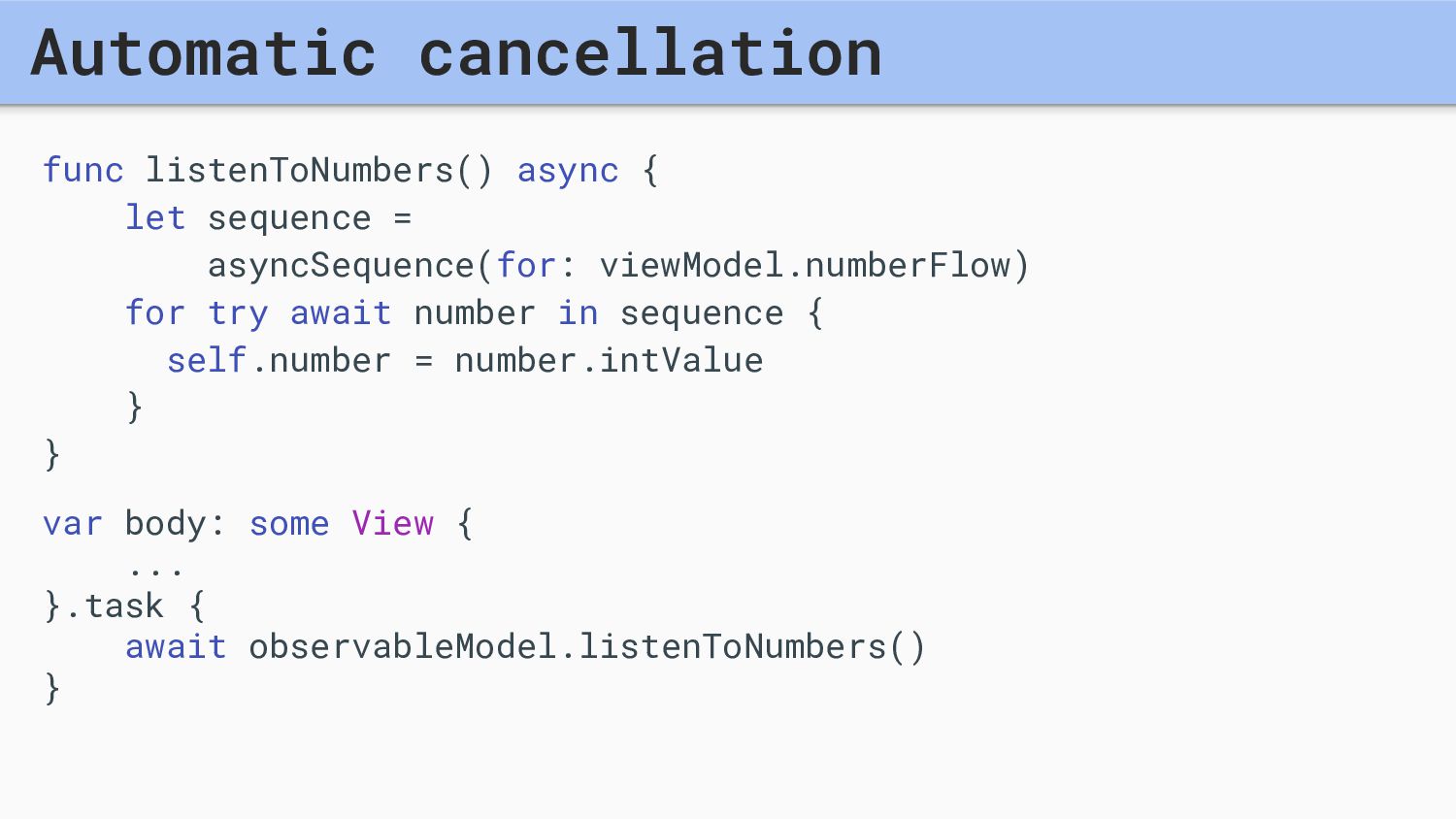
Automatic cancellation var body: some View { ... }.task {
await observableModel.listenToNumbers() } func listenToNumbers() async { let sequence = asyncSequence(for: viewModel.numberFlow) for try await number in sequence { self.number = number.intValue } } -
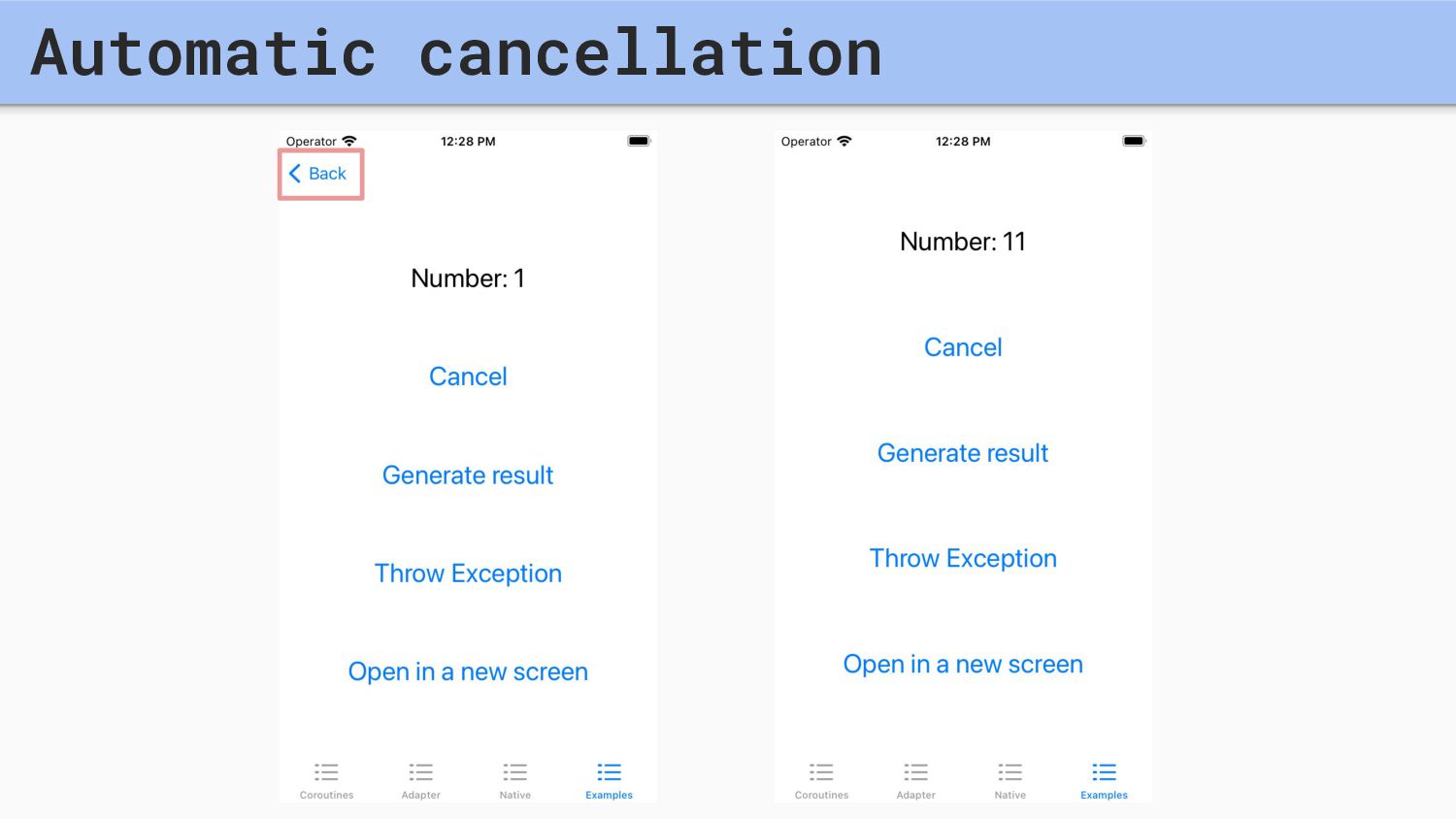
Automatic cancellation var body: some View { ... }.task {
await observableModel .listenToNumbers() } func listenToNumbers() async { let sequence = asyncSequence(for: viewModel.numberFlow) for try await number in sequence { self.number = number.intValue } } 2023-03-24 12:28:13 init 0x00006000024be000 2023-03-24 12:28:13 numberFlow onEach: 0 2023-03-24 12:28:14 numberFlow onEach: 1 2023-03-24 12:28:15 numberFlow onEach: 2 2023-03-24 12:28:16 numberFlow onEach: 3 2023-03-24 12:28:16 deinit 0x00006000024be000 2023-03-24 12:28:16 numberFlow onCompletion: kotlinx.coroutines.JobCancellationException: ... -
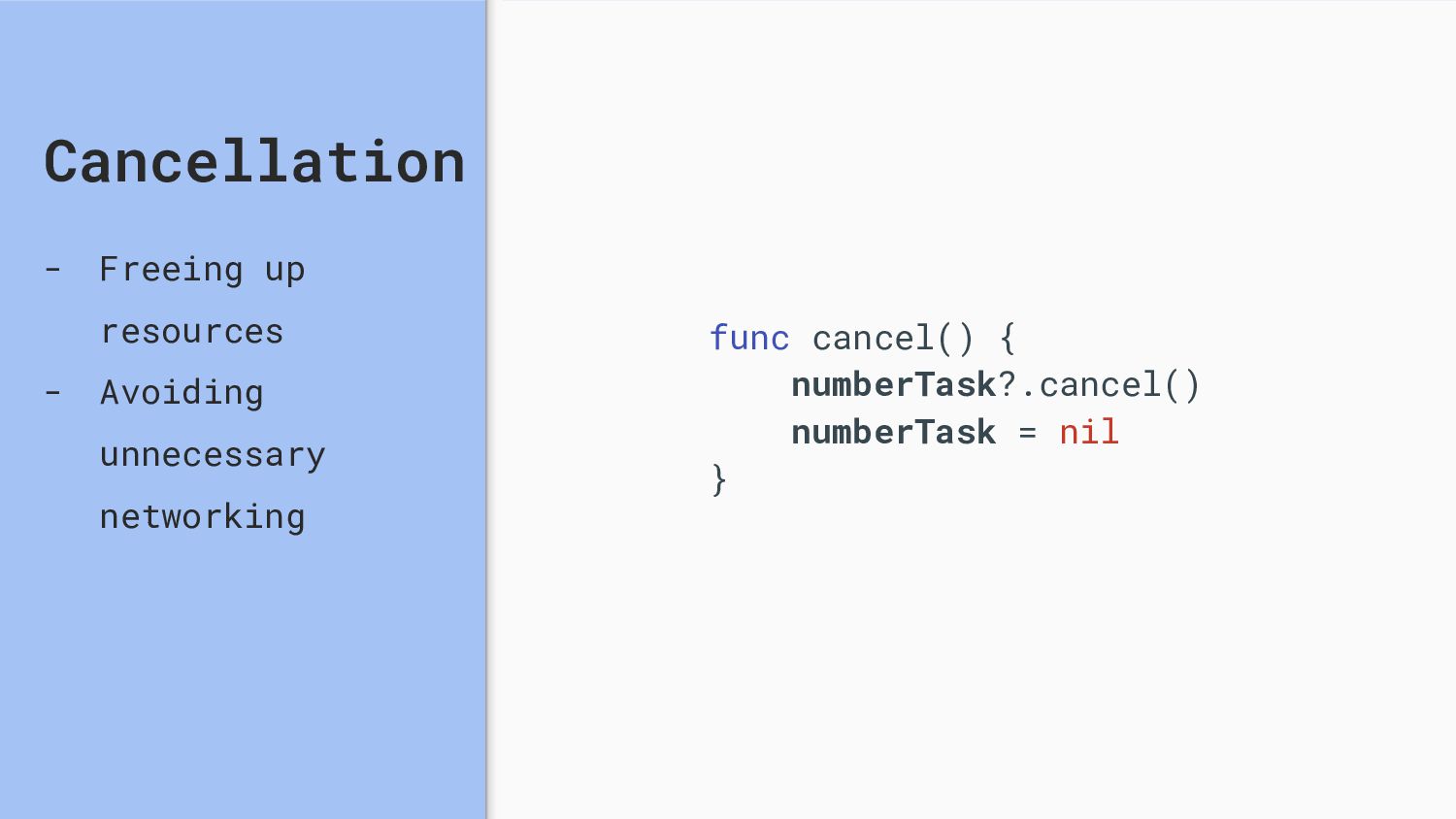
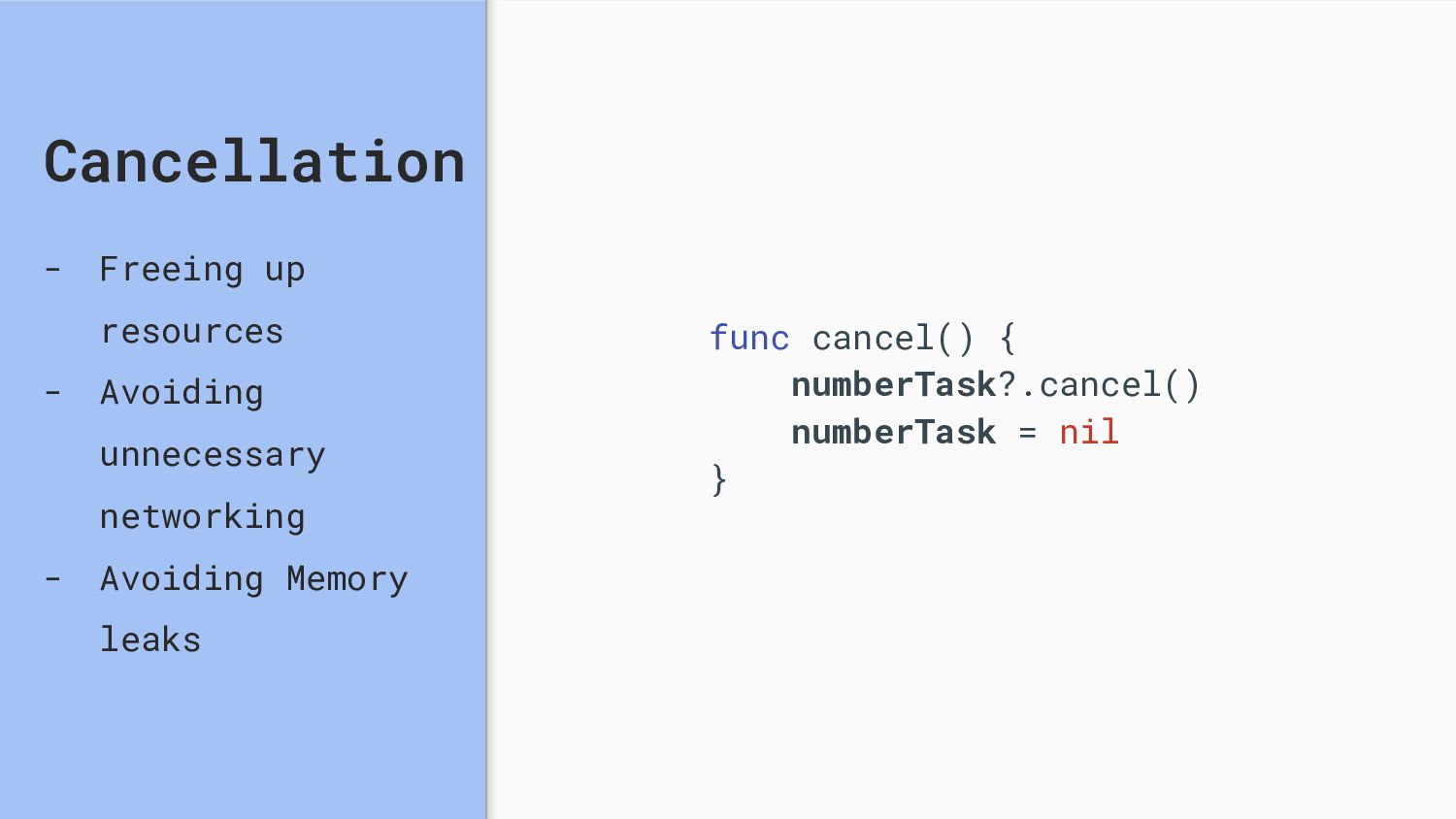
Cancellation - Freeing up resources - Avoiding unnecessary networking func
cancel() { numberTask?.cancel() numberTask = nil } -
Cancellation - Freeing up resources - Avoiding unnecessary networking -
Avoiding Memory leaks func cancel() { numberTask?.cancel() numberTask = nil } -
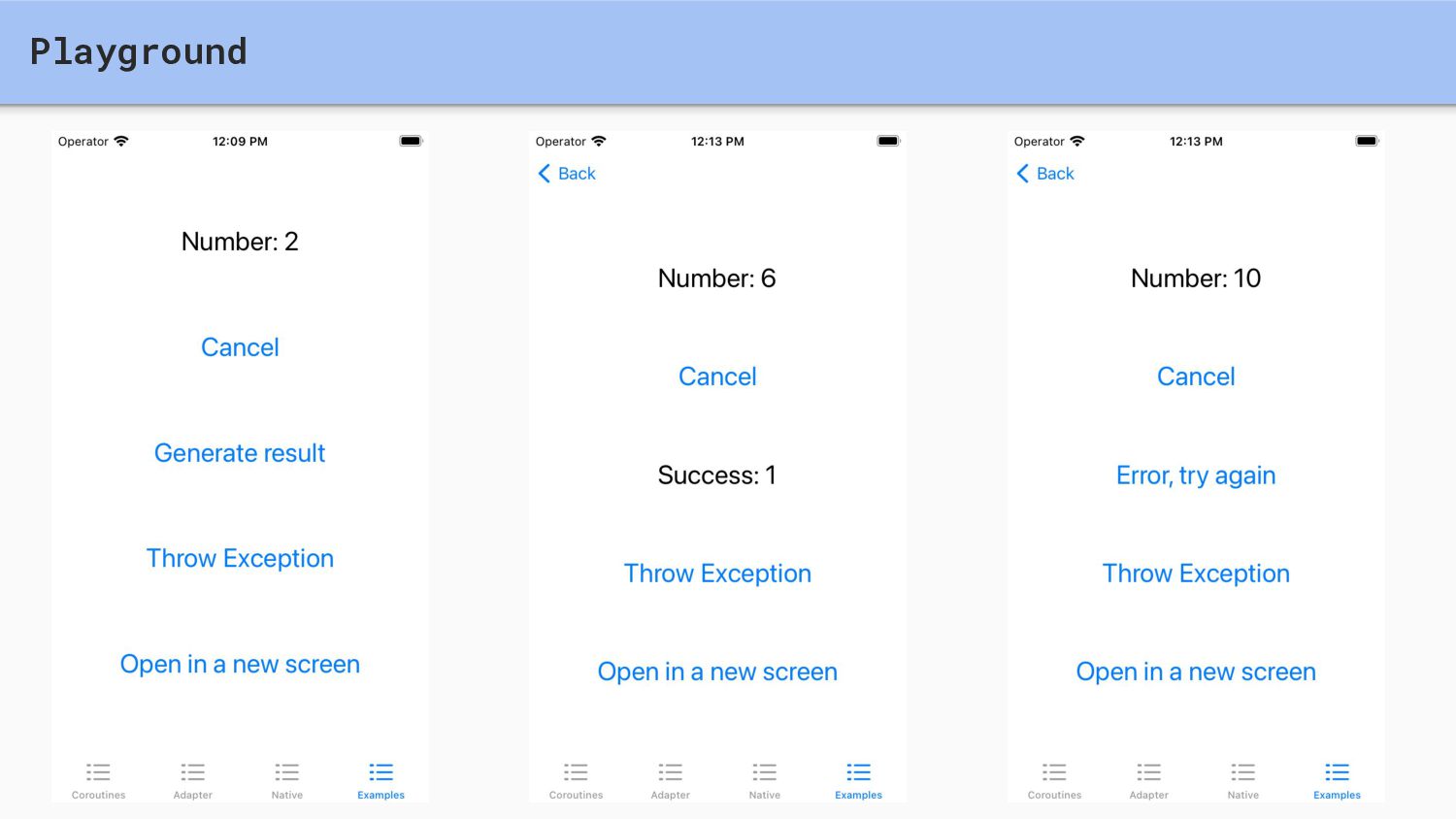
SwiftUI Integration - Async await - ObservableObject - @Published -
@StateObject / @ObservedObject -
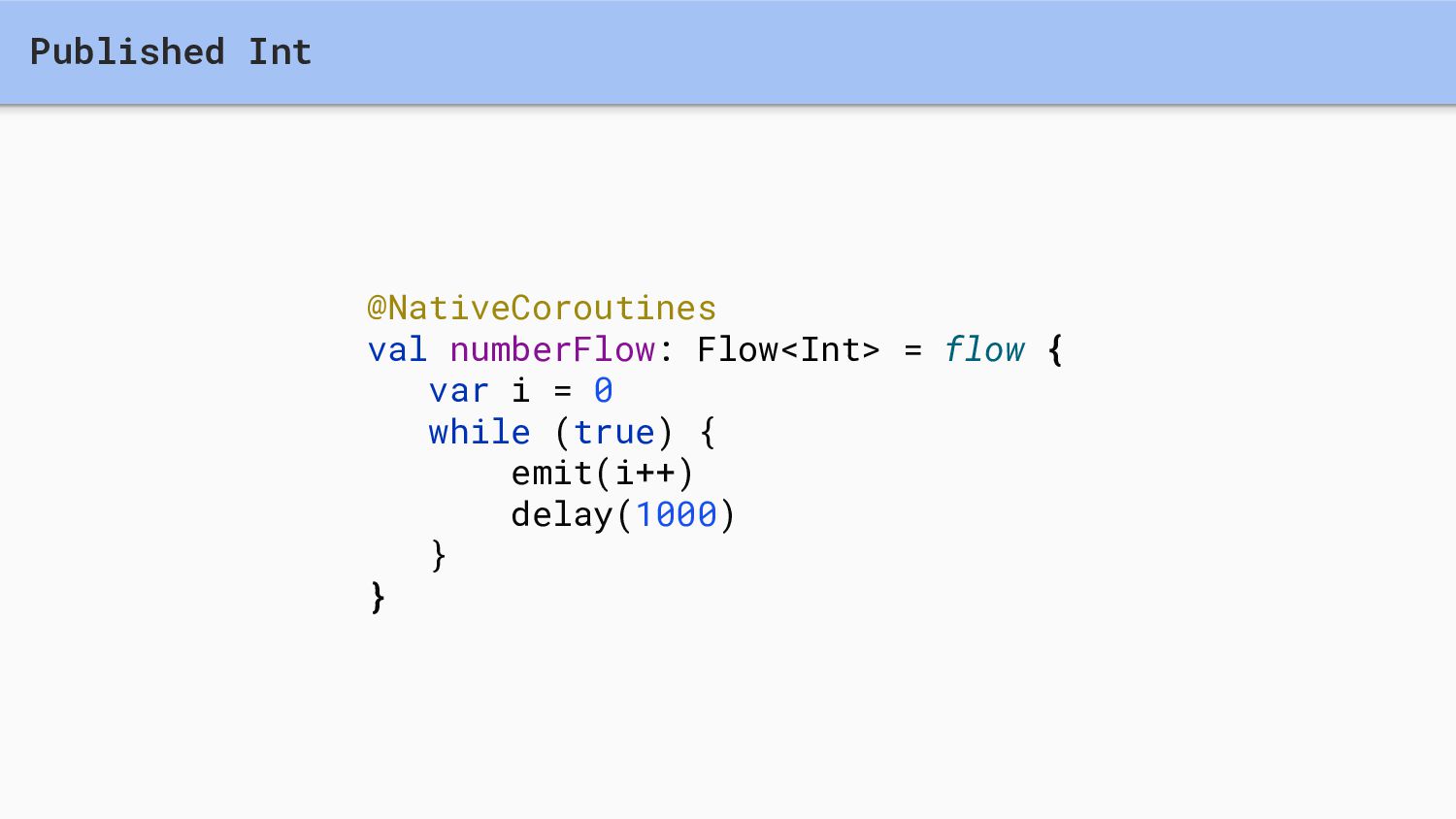
Published Int @NativeCoroutines val numberFlow: Flow<Int> = flow { var
i = 0 while (true) { emit(i++) delay(1000) } } -
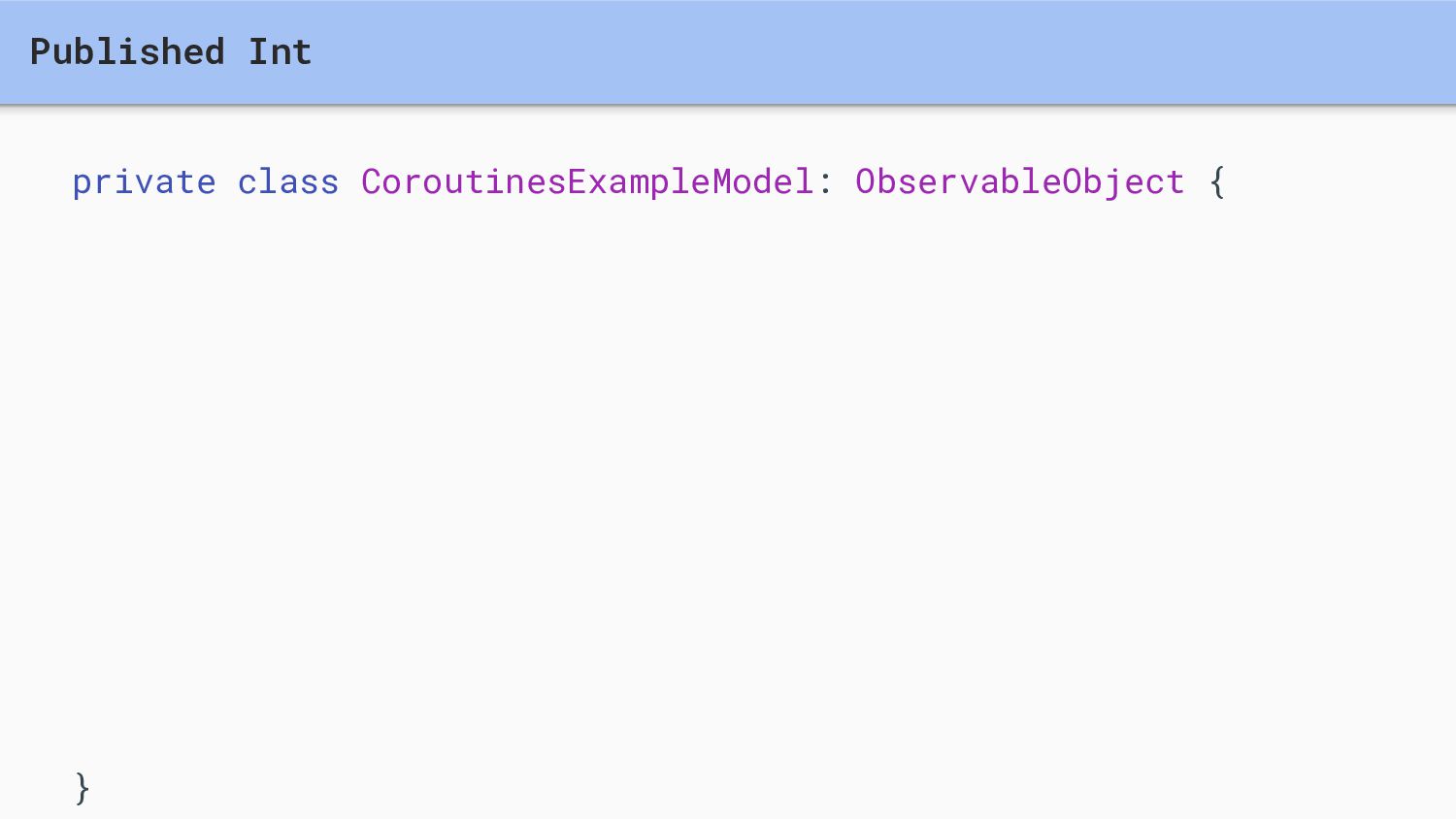
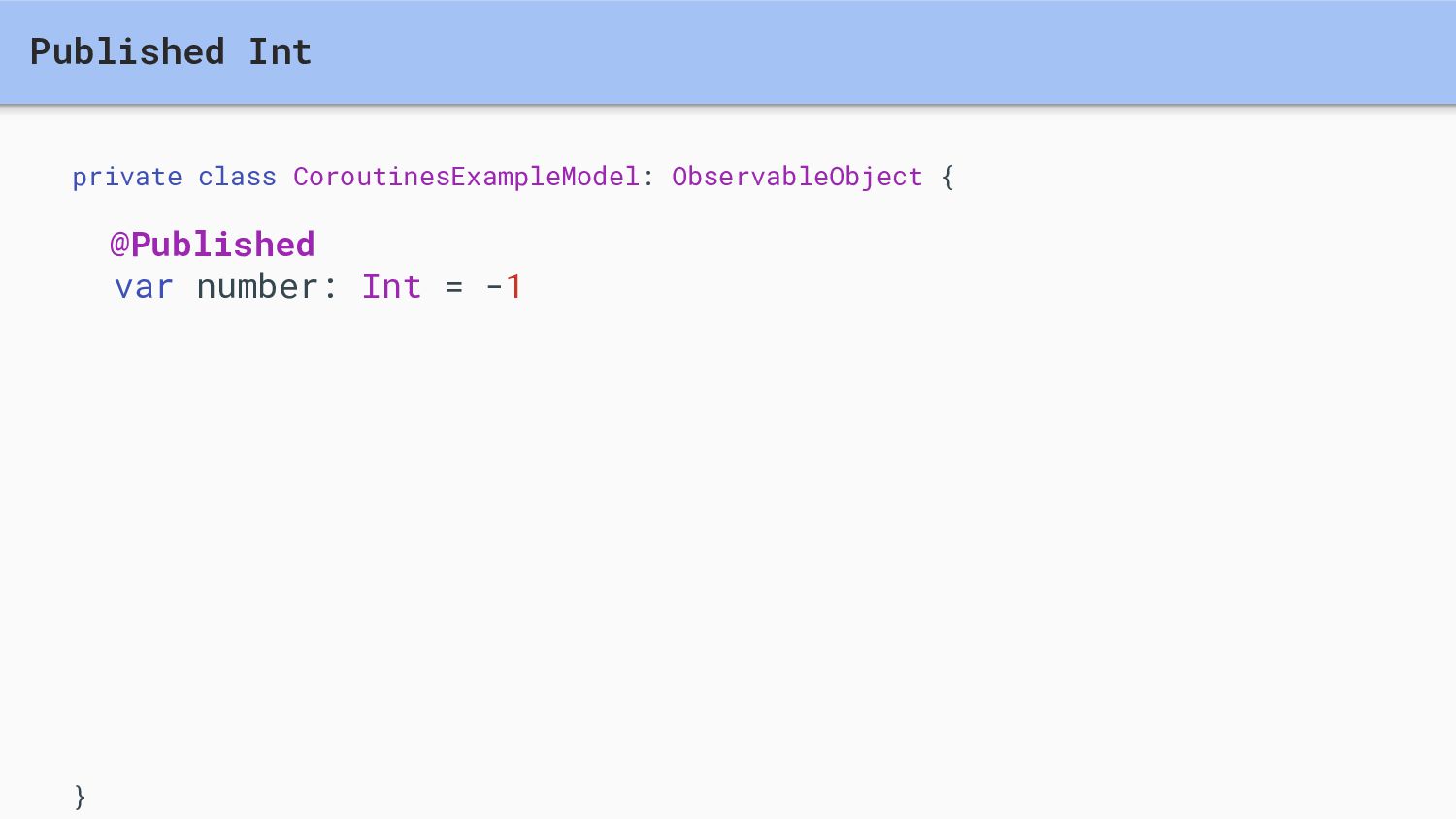
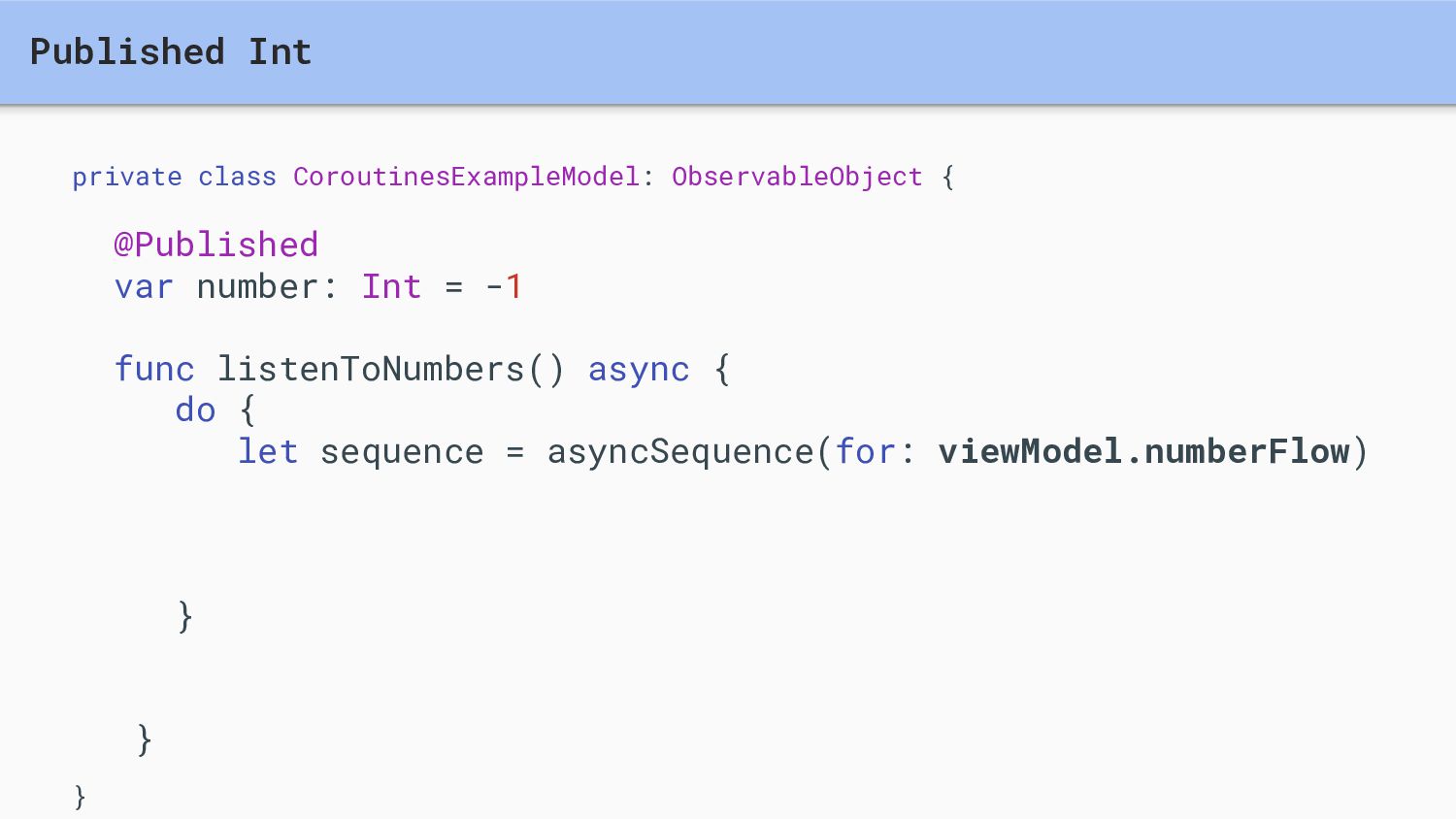
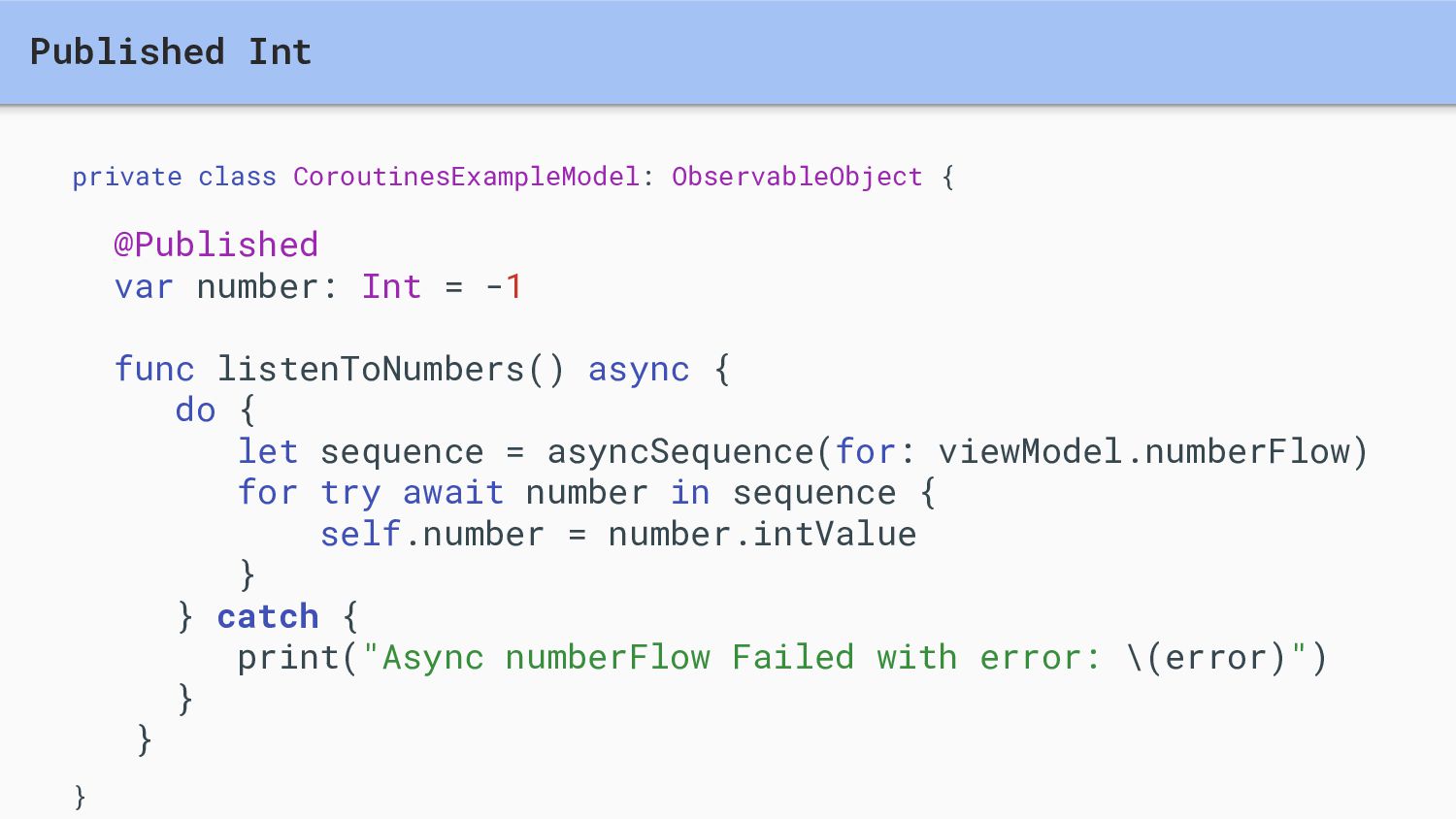
Published Int private class CoroutinesExampleModel: ObservableObject { @Published var number:
Int = -1 func listenToNumbers() async { do { let sequence = asyncSequence(for: viewModel.numberFlow) for try await number in sequence { self.number = number.intValue } } catch { print("Async numberFlow Failed with error: \(error)") } } } -
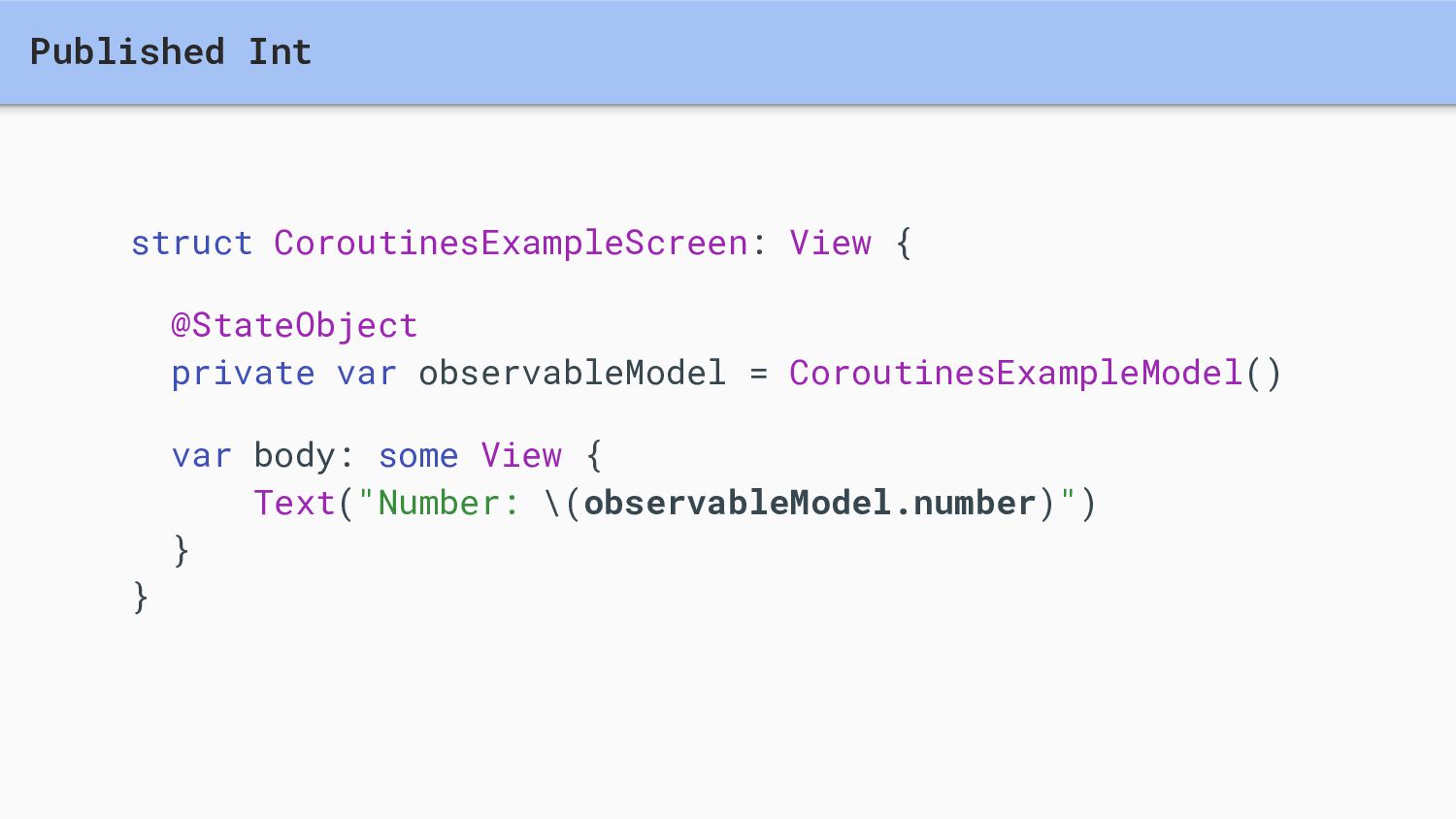
Published Int struct CoroutinesExampleScreen: View { @StateObject private var observableModel
= CoroutinesExampleModel() var body: some View { Text("Number: \(observableModel.number)") } } -
Published Int struct CoroutinesExampleScreen: View { @StateObject private var observableModel
= CoroutinesExampleModel() var body: some View { Text("Number: \(observableModel.number)") } } -
Published Int struct CoroutinesExampleScreen: View { @StateObject private var observableModel
= CoroutinesExampleModel() var body: some View { Text("Number: \(observableModel.number)") } } -
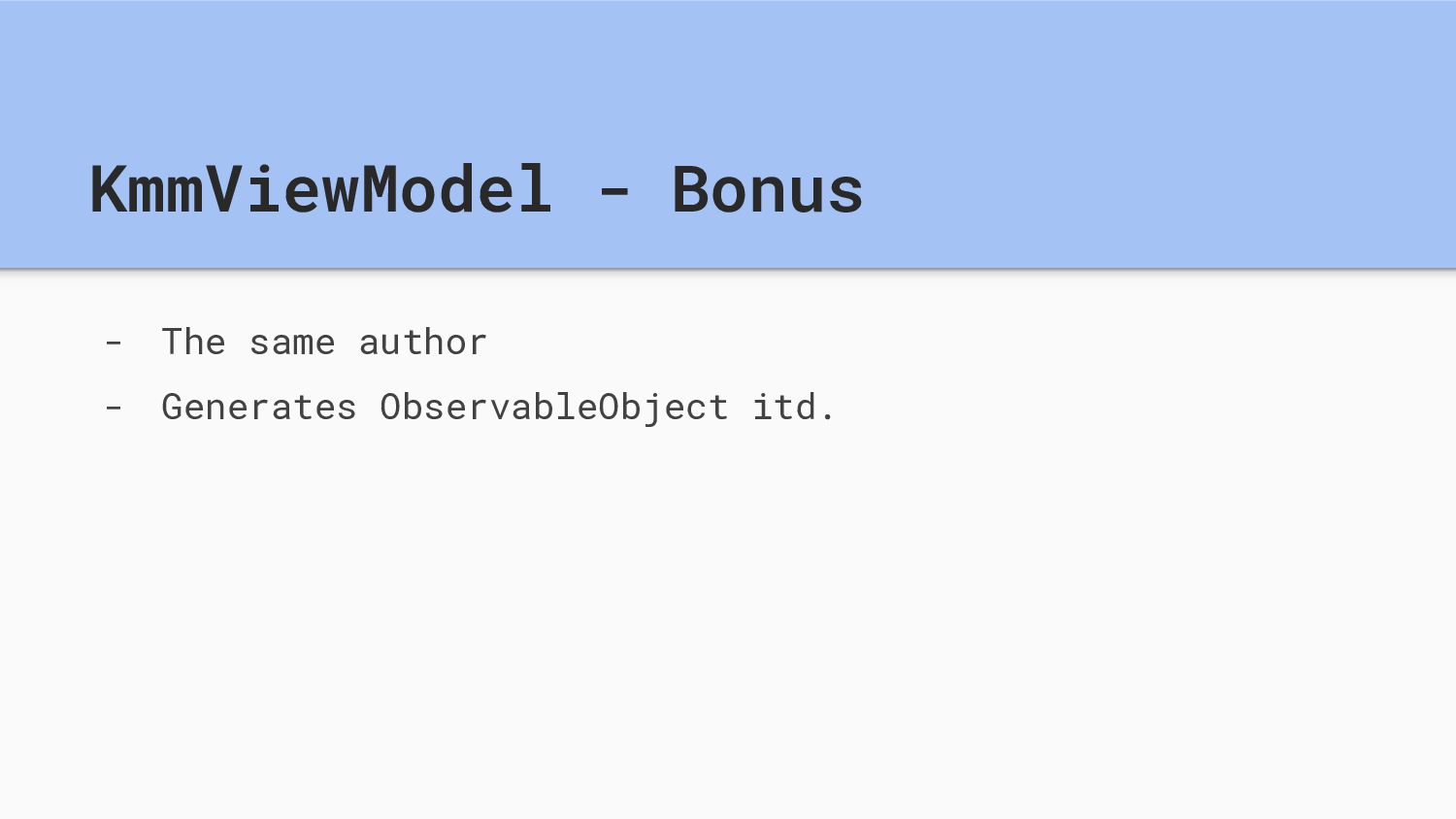
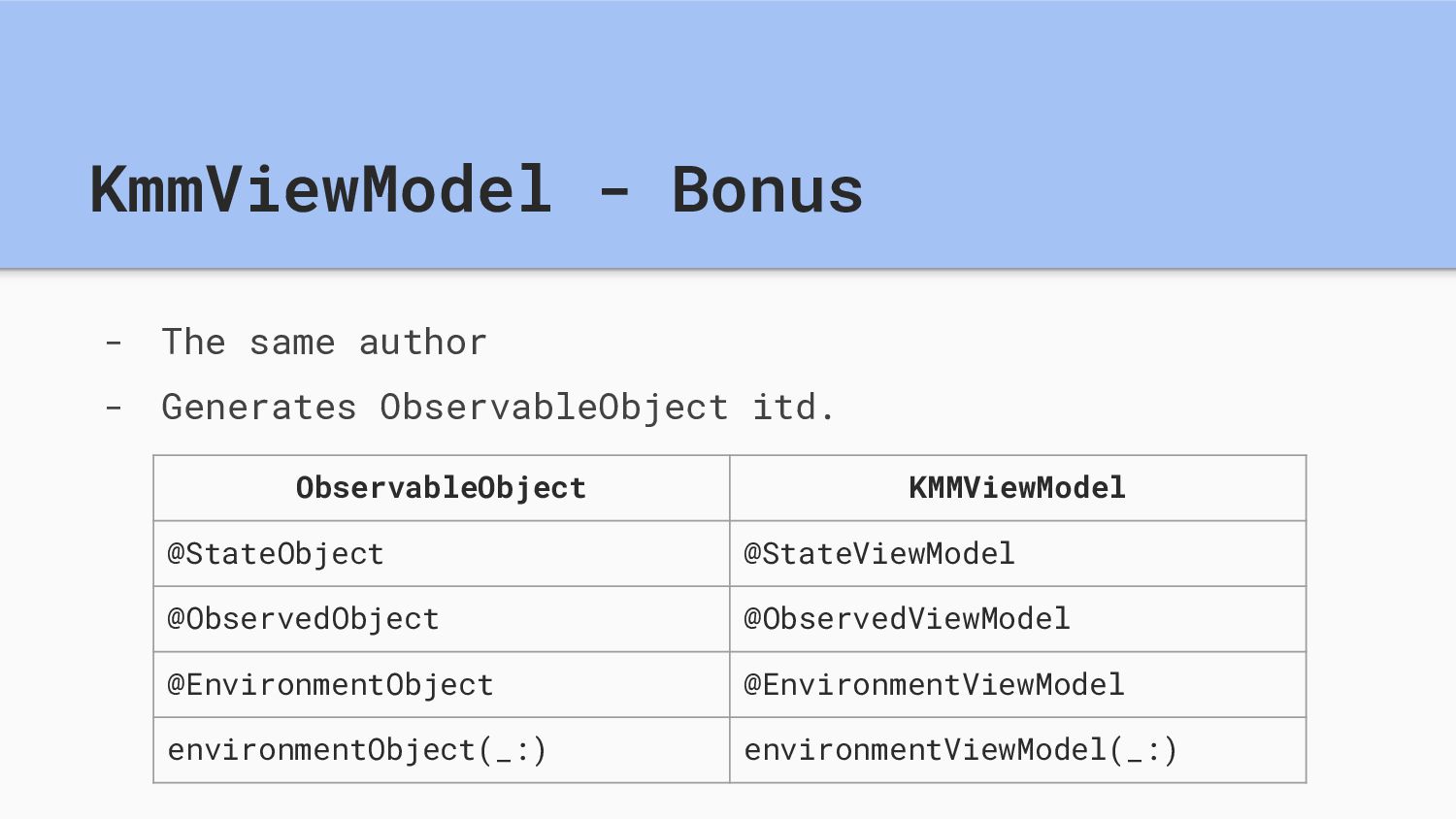
KmmViewModel - Bonus ObservableObject KMMViewModel @StateObject @StateViewModel @ObservedObject @ObservedViewModel @EnvironmentObject
@EnvironmentViewModel environmentObject(_:) environmentViewModel(_:) - The same author - Generates ObservableObject itd. -
What we’ve learned - How to call Suspend and Flow
from swift using different approaches -
What we’ve learned - How to call Suspend and Flow
from swift using different approaches - How Kotlin Exceptions can affect the iOS App and how to handle them -
What we’ve learned - How to call Suspend and Flow
from swift using different approaches - How Kotlin Exceptions can affect the iOS App and how to handle then - Why Cancelling coroutines is a good idea and how to do it from Swift -
What we’ve learned - How to call Suspend and Flow
from swift using different approaches - How Kotlin Exceptions can affect the iOS App and how to handle then - Why Cancelling coroutines is a good idea and how to do it from Swift - Integrating KMP-NativeCoroutines with SwiftUi* -
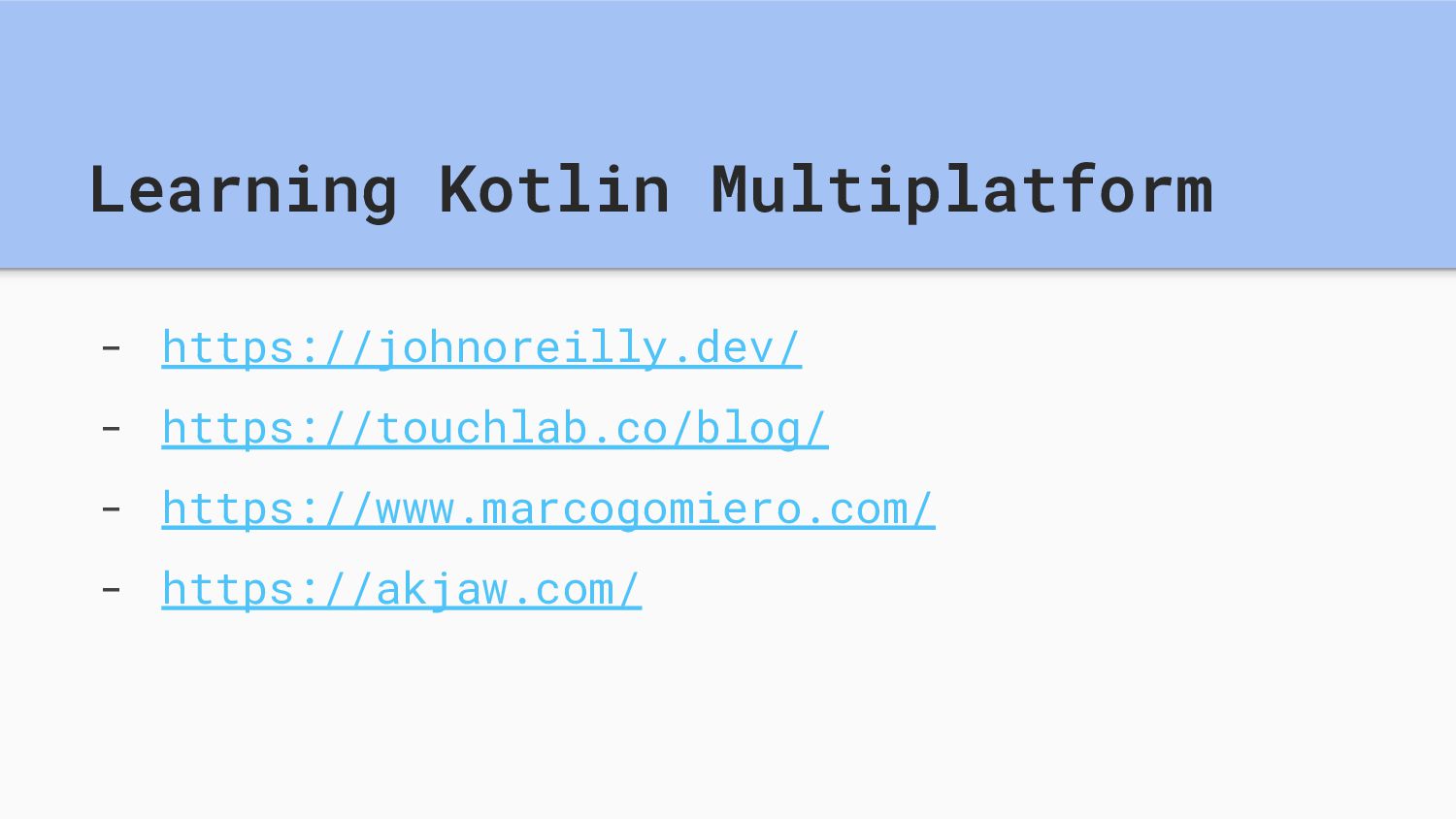
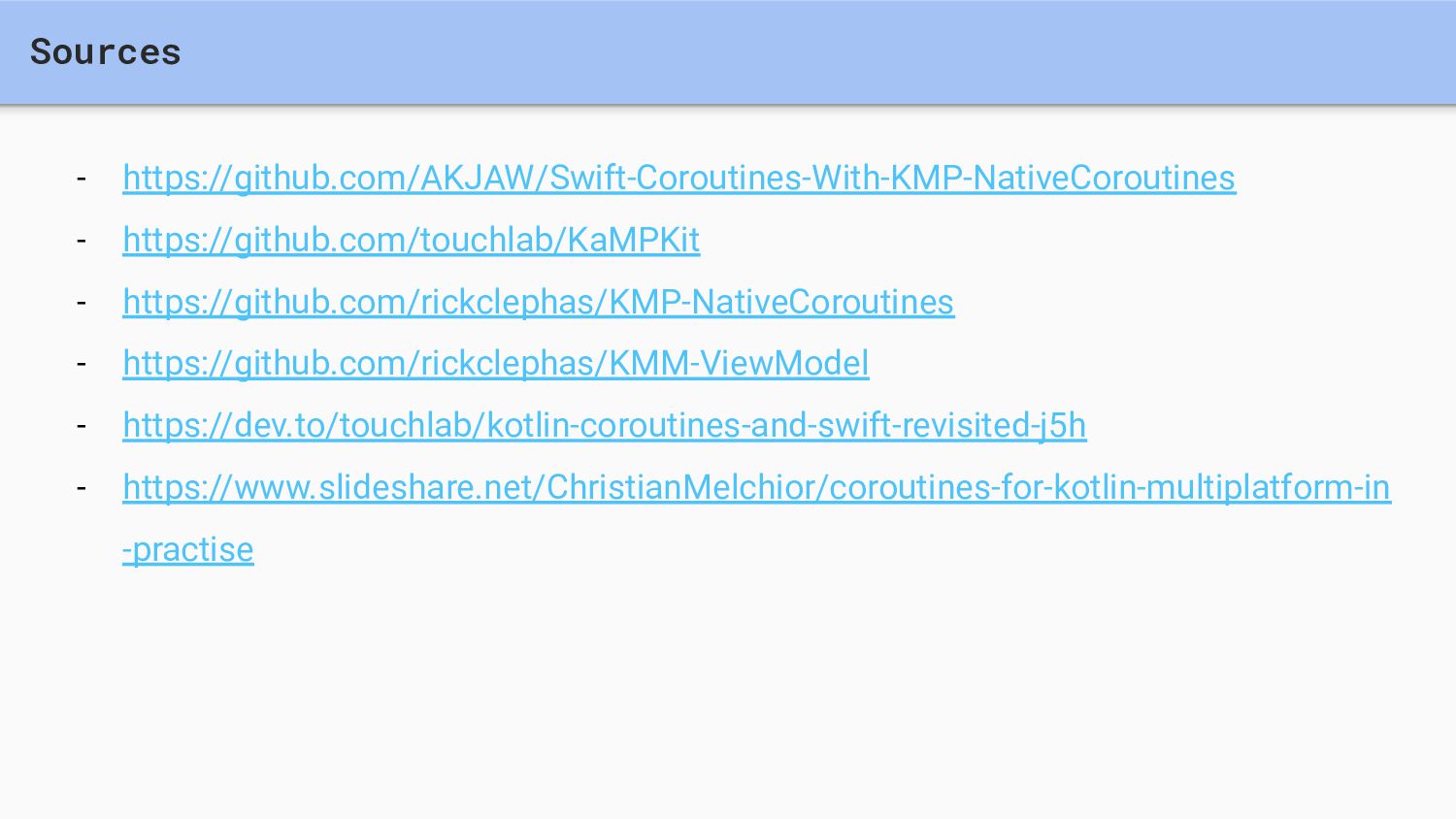
Sources - https://github.com/AKJAW/Swift-Coroutines-With-KMP-NativeCoroutines - https://github.com/touchlab/KaMPKit - https://github.com/rickclephas/KMP-NativeCoroutines - https://github.com/rickclephas/KMM-ViewModel -
https://dev.to/touchlab/kotlin-coroutines-and-swift-revisited-j5h - https://www.slideshare.net/ChristianMelchior/coroutines-for-kotlin-multiplatform-in -practise
 awkjaw
 ivargrimstad
 j5ik2o
 naruogram
 akihisaikeda
 seosoft
 sodainc
 3saito
 yosuke_furukawa
 bicstone
 vivion
 takai
 richargh
 marcoroth
 samanthasiow
 vanstee
 aleyda
 tanoku
 honnibal
 ryanjones
 portentint
 ks91
 cassininazir
 lauravandoore
 inesmontani