Upgrade to Pro — share decks privately, control downloads, hide ads and more …

Amazon Inventory Prep: A Warehouse Readiness Pl...

Amazon Inventory Prep: A Warehouse Readiness Playbook Before FBA Release

This practical warehouse-readiness playbook explains how sellers and logistics teams can organize inventory before products enter the final Amazon-bound shipment process. The Amazon inventory prep framework covers receiving records, inventory statuses, quantity and condition reconciliation, controlled batch preparation, carton readiness, exception handling, and final release checks. It is designed to help teams keep physical inventory aligned with working records while preventing questionable or unresolved units from entering completed shipments. The guide also outlines questions businesses should clarify when using a third-party logistics provider for receiving, preparation, storage, inventory handling, and outbound coordination.

Avatar for Conner Logistics Inc.

Conner Logistics Inc.

September 29, 2026

Other Decks in Business

Transcript

  1. PRACTICAL PLANNING GUIDE Amazon Inventory Prep: A Warehouse Readiness Playbook

    Before FBA Release A planning-focused guide for receiving, organizing, documenting, and releasing inventory before an Amazon-bound shipment leaves the warehouse. Primary topic: Amazon inventory prep Prepared as an educational logistics resource for ecommerce operators, inventory teams, and businesses evaluating outside fulfillment support. Conner Logistics Inc. 3PL management, FBA preparation and fulfillment, warehousing, order fulfillment, inventory handling, and transportation support. Somerset, Kentucky is presented by the company as its primary hub, with additional West Coast operations. Conner Logistics Inc. | Educational resource Page 1
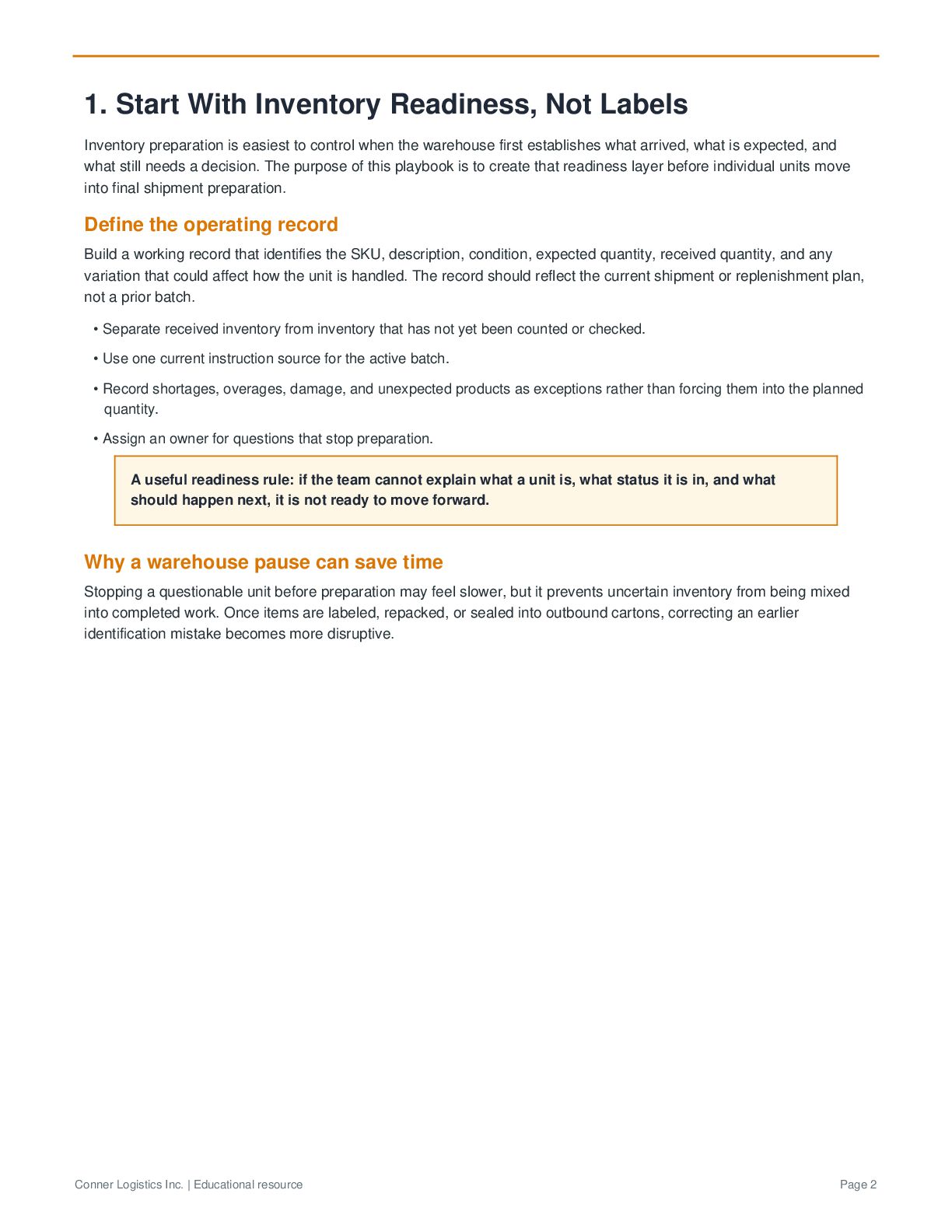
  2. 1. Start With Inventory Readiness, Not Labels Inventory preparation is

    easiest to control when the warehouse first establishes what arrived, what is expected, and what still needs a decision. The purpose of this playbook is to create that readiness layer before individual units move into final shipment preparation. Define the operating record Build a working record that identifies the SKU, description, condition, expected quantity, received quantity, and any variation that could affect how the unit is handled. The record should reflect the current shipment or replenishment plan, not a prior batch. • Separate received inventory from inventory that has not yet been counted or checked. • Use one current instruction source for the active batch. • Record shortages, overages, damage, and unexpected products as exceptions rather than forcing them into the planned quantity. • Assign an owner for questions that stop preparation. A useful readiness rule: if the team cannot explain what a unit is, what status it is in, and what should happen next, it is not ready to move forward. Why a warehouse pause can save time Stopping a questionable unit before preparation may feel slower, but it prevents uncertain inventory from being mixed into completed work. Once items are labeled, repacked, or sealed into outbound cartons, correcting an earlier identification mistake becomes more disruptive. Conner Logistics Inc. | Educational resource Page 2
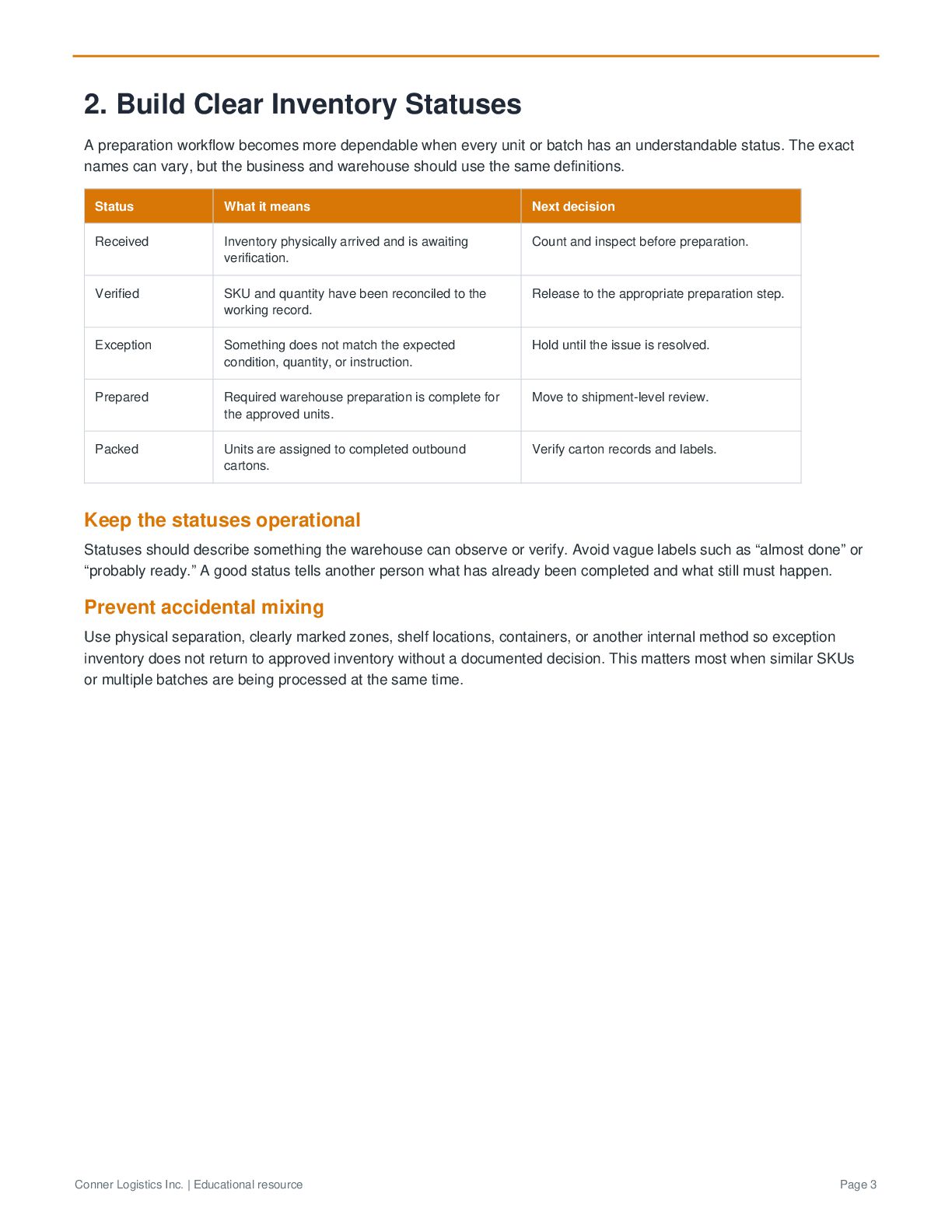
  3. 2. Build Clear Inventory Statuses A preparation workflow becomes more

    dependable when every unit or batch has an understandable status. The exact names can vary, but the business and warehouse should use the same definitions. Status What it means Next decision Received Inventory physically arrived and is awaiting verification. Count and inspect before preparation. Verified SKU and quantity have been reconciled to the working record. Release to the appropriate preparation step. Exception Something does not match the expected condition, quantity, or instruction. Hold until the issue is resolved. Prepared Required warehouse preparation is complete for the approved units. Move to shipment-level review. Packed Units are assigned to completed outbound cartons. Verify carton records and labels. Keep the statuses operational Statuses should describe something the warehouse can observe or verify. Avoid vague labels such as “almost done” or “probably ready.” A good status tells another person what has already been completed and what still must happen. Prevent accidental mixing Use physical separation, clearly marked zones, shelf locations, containers, or another internal method so exception inventory does not return to approved inventory without a documented decision. This matters most when similar SKUs or multiple batches are being processed at the same time. Conner Logistics Inc. | Educational resource Page 3
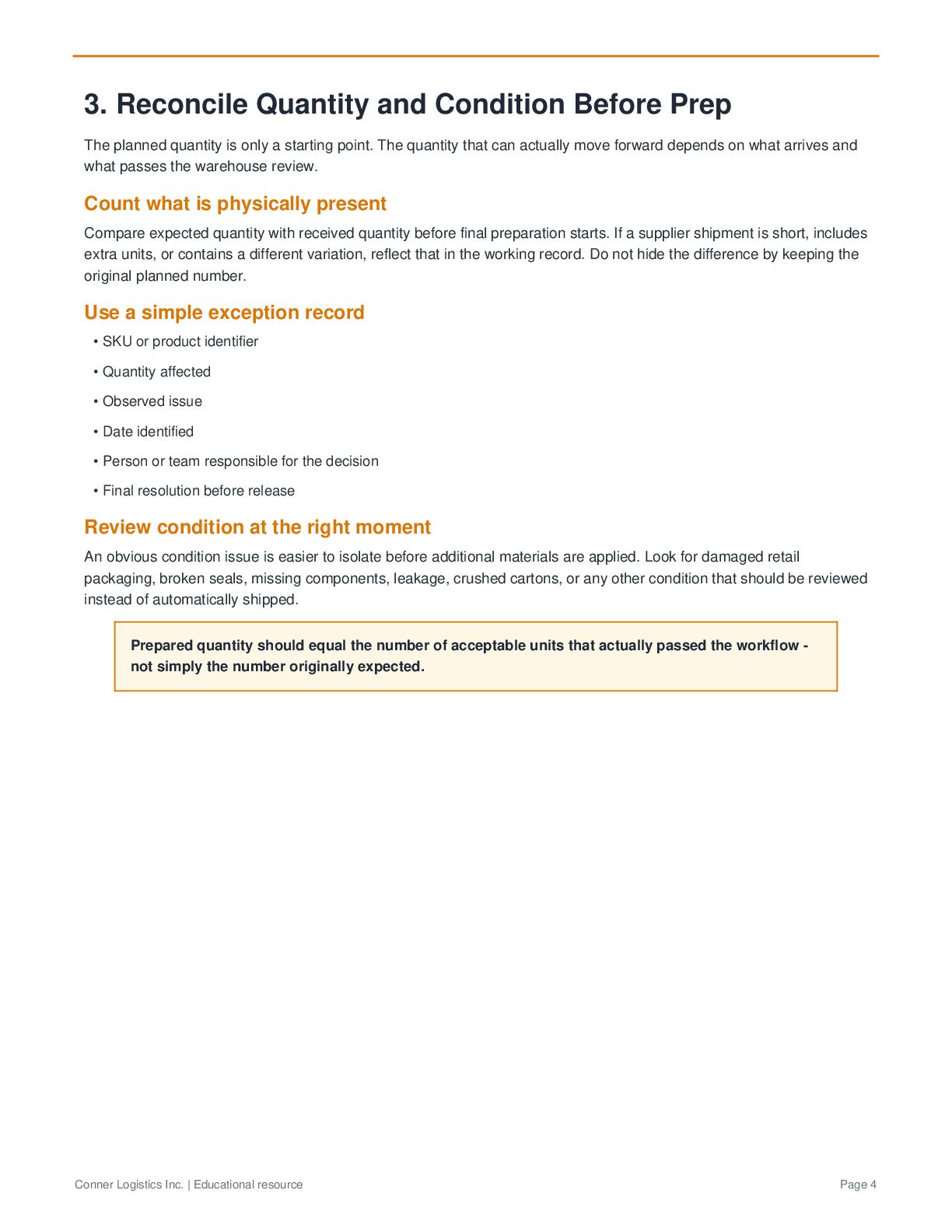
  4. 3. Reconcile Quantity and Condition Before Prep The planned quantity

    is only a starting point. The quantity that can actually move forward depends on what arrives and what passes the warehouse review. Count what is physically present Compare expected quantity with received quantity before final preparation starts. If a supplier shipment is short, includes extra units, or contains a different variation, reflect that in the working record. Do not hide the difference by keeping the original planned number. Use a simple exception record • SKU or product identifier • Quantity affected • Observed issue • Date identified • Person or team responsible for the decision • Final resolution before release Review condition at the right moment An obvious condition issue is easier to isolate before additional materials are applied. Look for damaged retail packaging, broken seals, missing components, leakage, crushed cartons, or any other condition that should be reviewed instead of automatically shipped. Prepared quantity should equal the number of acceptable units that actually passed the workflow not simply the number originally expected. Conner Logistics Inc. | Educational resource Page 4
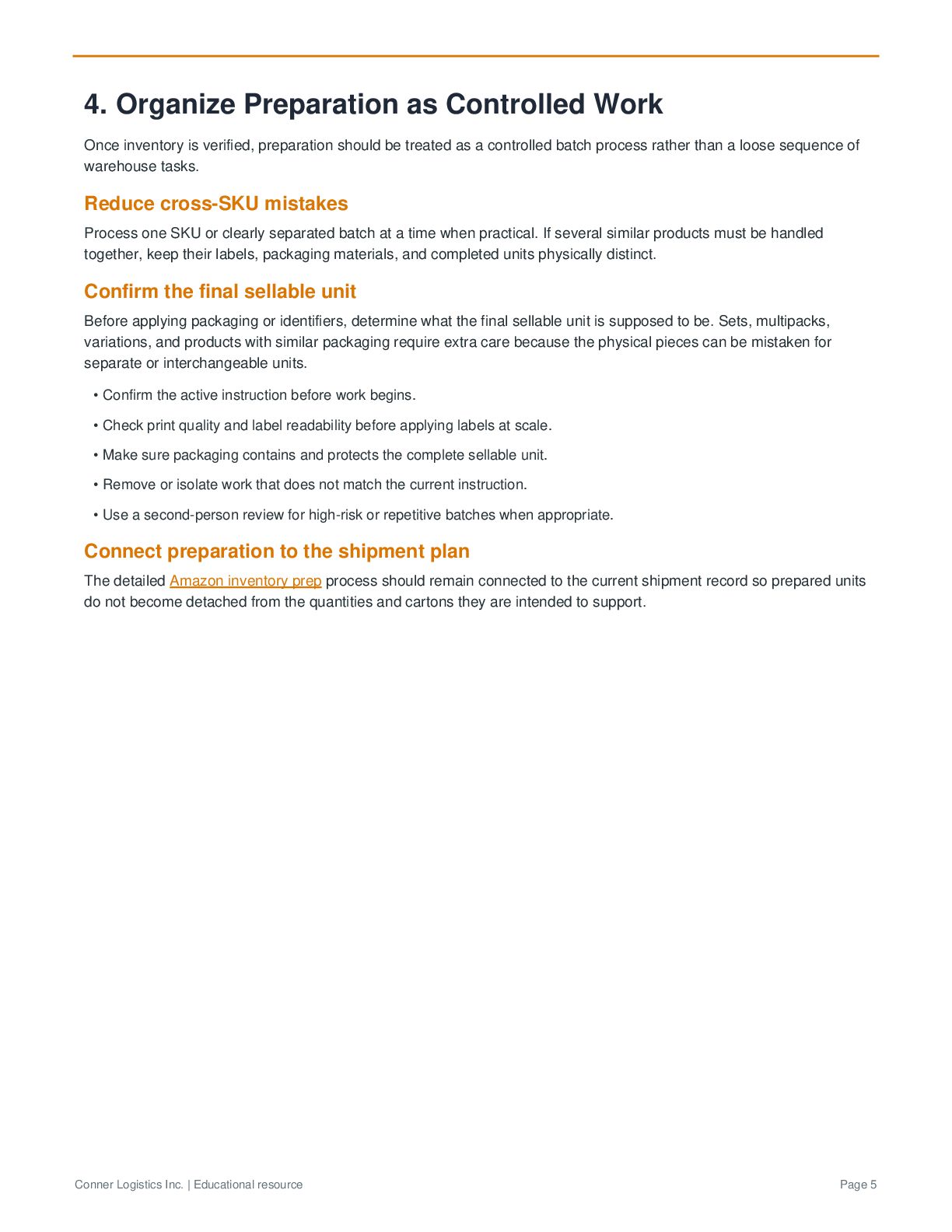
  5. 4. Organize Preparation as Controlled Work Once inventory is verified,

    preparation should be treated as a controlled batch process rather than a loose sequence of warehouse tasks. Reduce cross-SKU mistakes Process one SKU or clearly separated batch at a time when practical. If several similar products must be handled together, keep their labels, packaging materials, and completed units physically distinct. Confirm the final sellable unit Before applying packaging or identifiers, determine what the final sellable unit is supposed to be. Sets, multipacks, variations, and products with similar packaging require extra care because the physical pieces can be mistaken for separate or interchangeable units. • Confirm the active instruction before work begins. • Check print quality and label readability before applying labels at scale. • Make sure packaging contains and protects the complete sellable unit. • Remove or isolate work that does not match the current instruction. • Use a second-person review for high-risk or repetitive batches when appropriate. Connect preparation to the shipment plan The detailed Amazon inventory prep process should remain connected to the current shipment record so prepared units do not become detached from the quantities and cartons they are intended to support. Conner Logistics Inc. | Educational resource Page 5
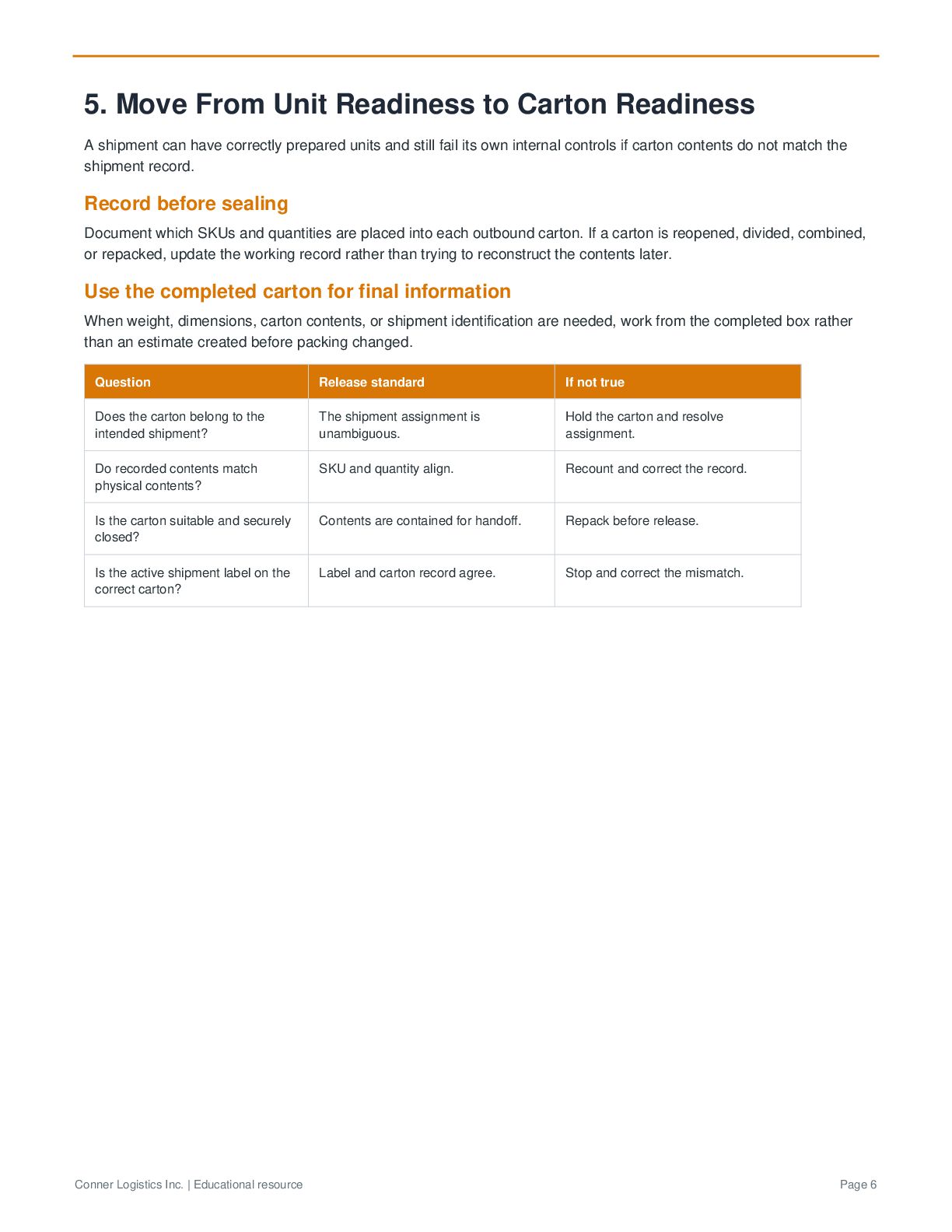
  6. 5. Move From Unit Readiness to Carton Readiness A shipment

    can have correctly prepared units and still fail its own internal controls if carton contents do not match the shipment record. Record before sealing Document which SKUs and quantities are placed into each outbound carton. If a carton is reopened, divided, combined, or repacked, update the working record rather than trying to reconstruct the contents later. Use the completed carton for final information When weight, dimensions, carton contents, or shipment identification are needed, work from the completed box rather than an estimate created before packing changed. Question Release standard If not true Does the carton belong to the intended shipment? The shipment assignment is unambiguous. Hold the carton and resolve assignment. Do recorded contents match physical contents? SKU and quantity align. Recount and correct the record. Is the carton suitable and securely closed? Contents are contained for handoff. Repack before release. Is the active shipment label on the correct carton? Label and carton record agree. Stop and correct the mismatch. Conner Logistics Inc. | Educational resource Page 6
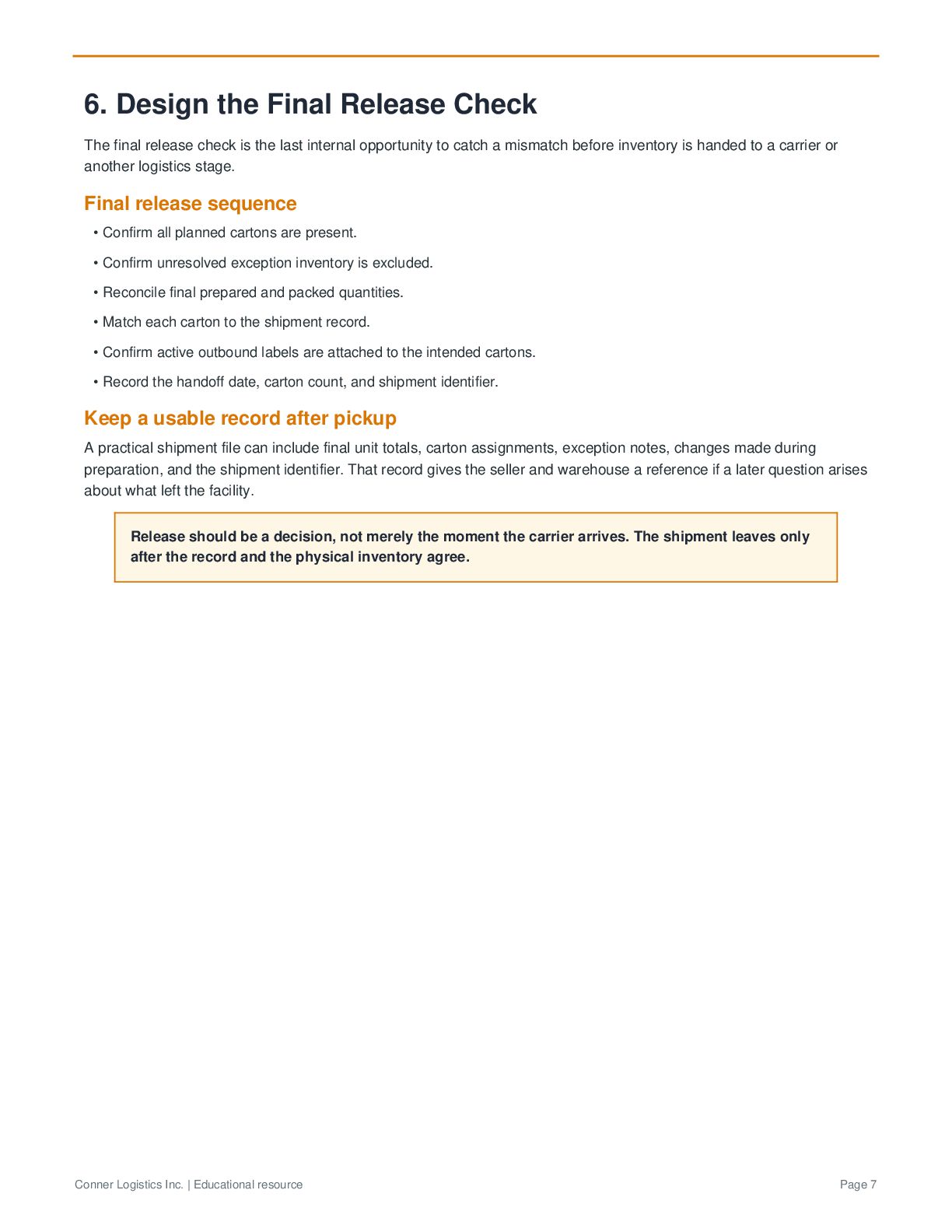
  7. 6. Design the Final Release Check The final release check

    is the last internal opportunity to catch a mismatch before inventory is handed to a carrier or another logistics stage. Final release sequence • Confirm all planned cartons are present. • Confirm unresolved exception inventory is excluded. • Reconcile final prepared and packed quantities. • Match each carton to the shipment record. • Confirm active outbound labels are attached to the intended cartons. • Record the handoff date, carton count, and shipment identifier. Keep a usable record after pickup A practical shipment file can include final unit totals, carton assignments, exception notes, changes made during preparation, and the shipment identifier. That record gives the seller and warehouse a reference if a later question arises about what left the facility. Release should be a decision, not merely the moment the carrier arrives. The shipment leaves only after the record and the physical inventory agree. Conner Logistics Inc. | Educational resource Page 7
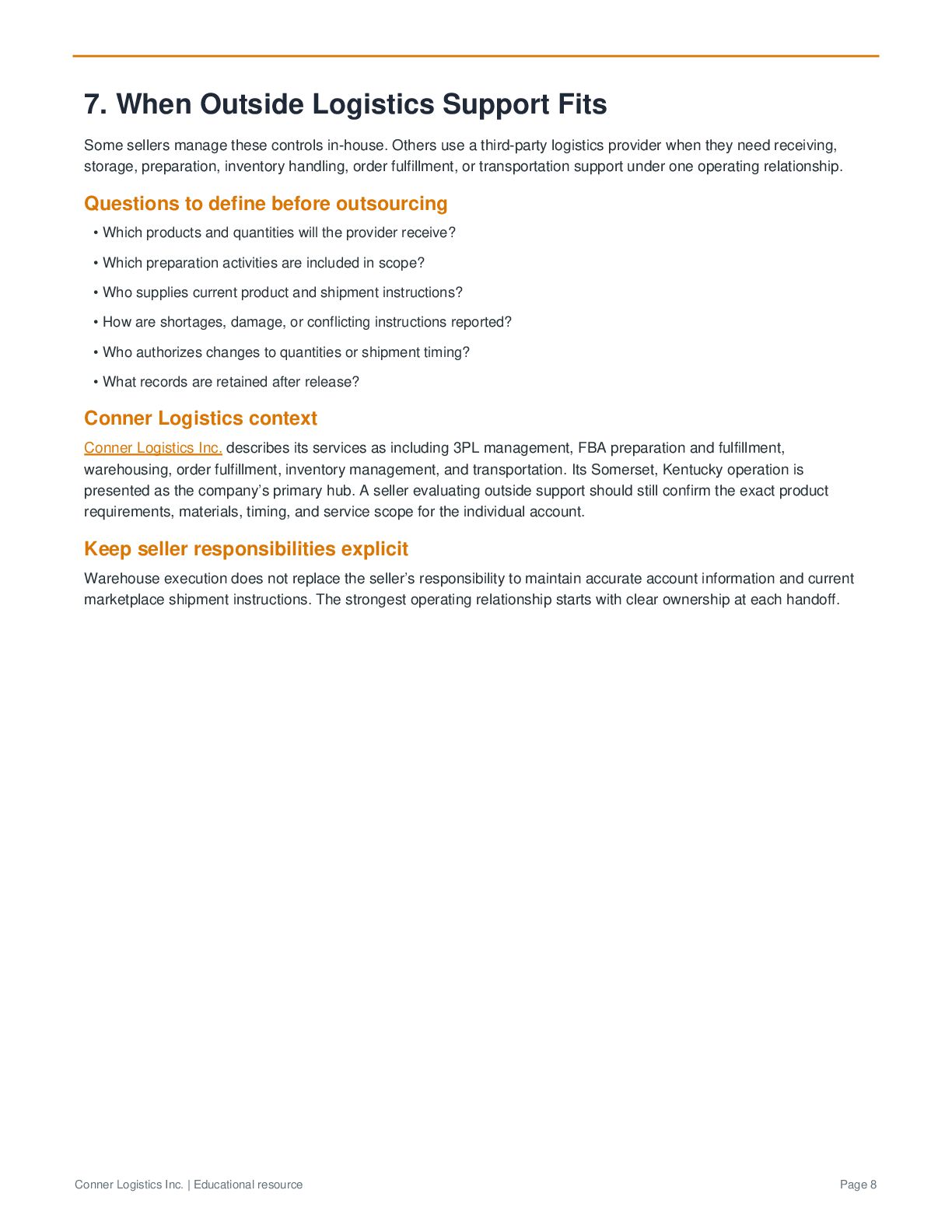
  8. 7. When Outside Logistics Support Fits Some sellers manage these

    controls in-house. Others use a third-party logistics provider when they need receiving, storage, preparation, inventory handling, order fulfillment, or transportation support under one operating relationship. Questions to define before outsourcing • Which products and quantities will the provider receive? • Which preparation activities are included in scope? • Who supplies current product and shipment instructions? • How are shortages, damage, or conflicting instructions reported? • Who authorizes changes to quantities or shipment timing? • What records are retained after release? Conner Logistics context Conner Logistics Inc. describes its services as including 3PL management, FBA preparation and fulfillment, warehousing, order fulfillment, inventory management, and transportation. Its Somerset, Kentucky operation is presented as the company’s primary hub. A seller evaluating outside support should still confirm the exact product requirements, materials, timing, and service scope for the individual account. Keep seller responsibilities explicit Warehouse execution does not replace the seller’s responsibility to maintain accurate account information and current marketplace shipment instructions. The strongest operating relationship starts with clear ownership at each handoff. Conner Logistics Inc. | Educational resource Page 8
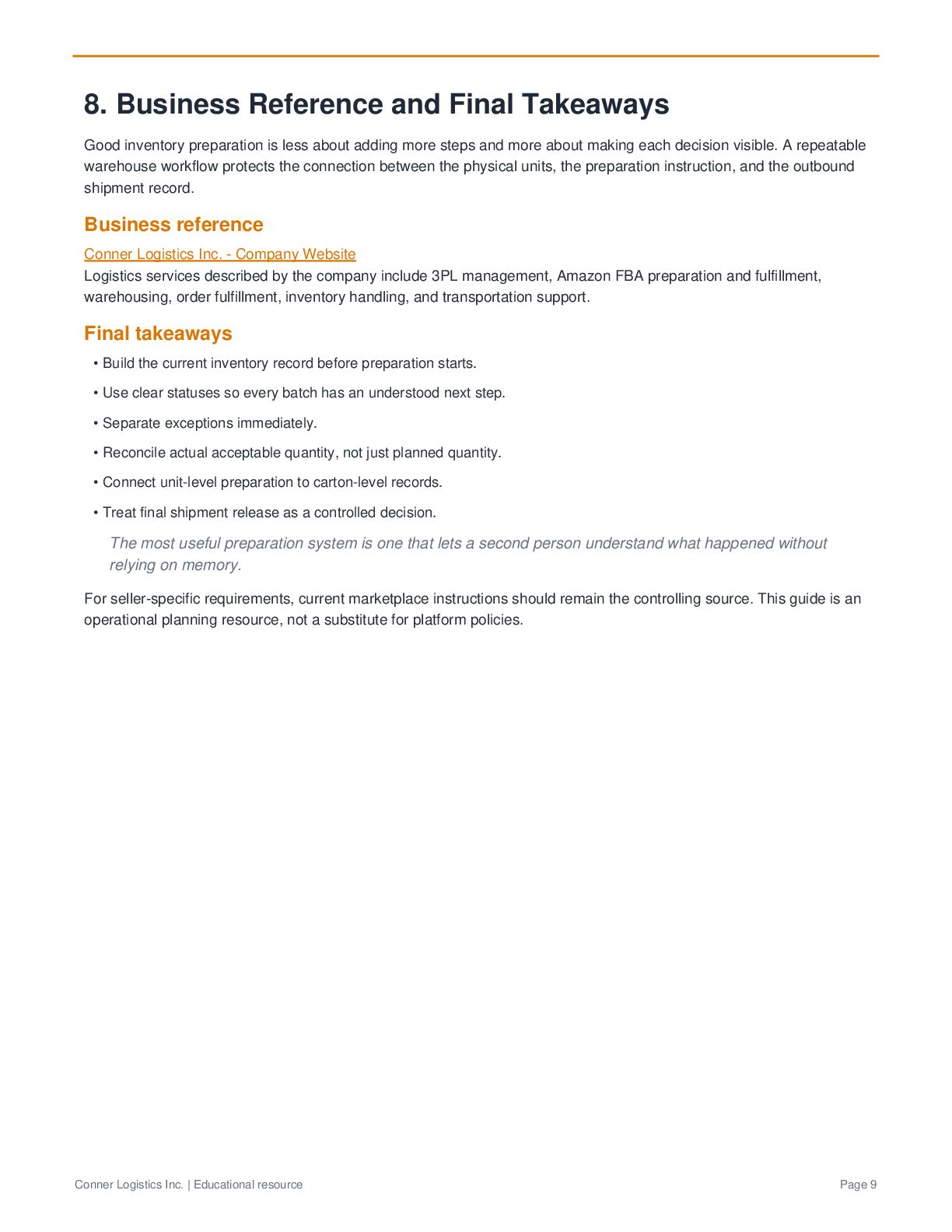
  9. 8. Business Reference and Final Takeaways Good inventory preparation is

    less about adding more steps and more about making each decision visible. A repeatable warehouse workflow protects the connection between the physical units, the preparation instruction, and the outbound shipment record. Business reference Conner Logistics Inc. - Company Website Logistics services described by the company include 3PL management, Amazon FBA preparation and fulfillment, warehousing, order fulfillment, inventory handling, and transportation support. Final takeaways • Build the current inventory record before preparation starts. • Use clear statuses so every batch has an understood next step. • Separate exceptions immediately. • Reconcile actual acceptable quantity, not just planned quantity. • Connect unit-level preparation to carton-level records. • Treat final shipment release as a controlled decision. The most useful preparation system is one that lets a second person understand what happened without relying on memory. For seller-specific requirements, current marketplace instructions should remain the controlling source. This guide is an operational planning resource, not a substitute for platform policies. Conner Logistics Inc. | Educational resource Page 9