ensure the approach to embedding social value through procurement / commissioning is inclusive, transparent and evidence based. Working collaboratively we will be co-creating and refining the programme and supporting workstreams on an ongoing basis. We will share and publish all documents and output and they will be free to use for all. We encourage differing views and approaches as part of establishing an evidence base for best practices.
Sector is approximately £280B All parts of the public sector, e.g. Central Government, Devolved Administrations, Education, Local Government, NHS and Third Sector Suppliers and supplier network Look to best practice approaches within the UK and internationally Legislation, policy, processes, standards and measurement
created by organisations or sectors by ensuring procurement and commissioning reflect the organisations social value priorities into the functions strategic approach, policies and operations CfC will provide direction in how to position, plan, operate, and provide for the creation of greater social value by organisations CfC brings together buyers, suppliers, policy makers, commissioners, practitioners, academics and other interested stakeholders to create a comprehensive understanding of social value and how to implement best practices
value that can be embedded throughout an organisation from organisational strategy all the way down to detailed commissioning and procurement practices. This approach will provide a framework for organisations to successfully: • Provide clarity on organisational intent around social value; • Connect their organisational and functional strategies to their operations; • Identify their key social value goals and integrate these into their organisational activity; • Design their commissioning and procurement activity around their social value goals; • Ensure effective measurement and reporting, and • Provide a route for continuous improvement and decision making. This will include a set of guides, case studies, templates and tools which will support the practical implementation of the methodologies: in effect a ‘Toolkit’.
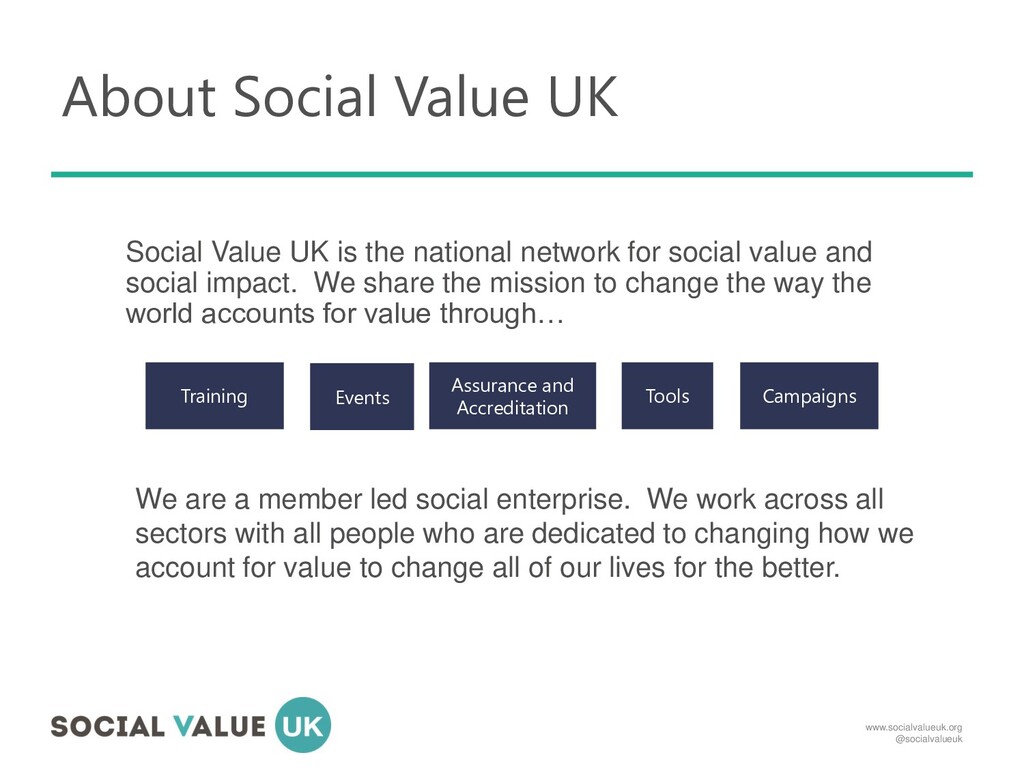
the national network for social value and social impact. We share the mission to change the way the world accounts for value through… We are a member led social enterprise. We work across all sectors with all people who are dedicated to changing how we account for value to change all of our lives for the better. Training Events Assurance and Accreditation Tools Campaigns
accounts for value Improve well-being Reduce Inequality + environmental degradation Social Value UK advocate for a principles based approach to accounting for value with people at the heart and centre. Our mission is based on Principles, People, Practice, and Power.
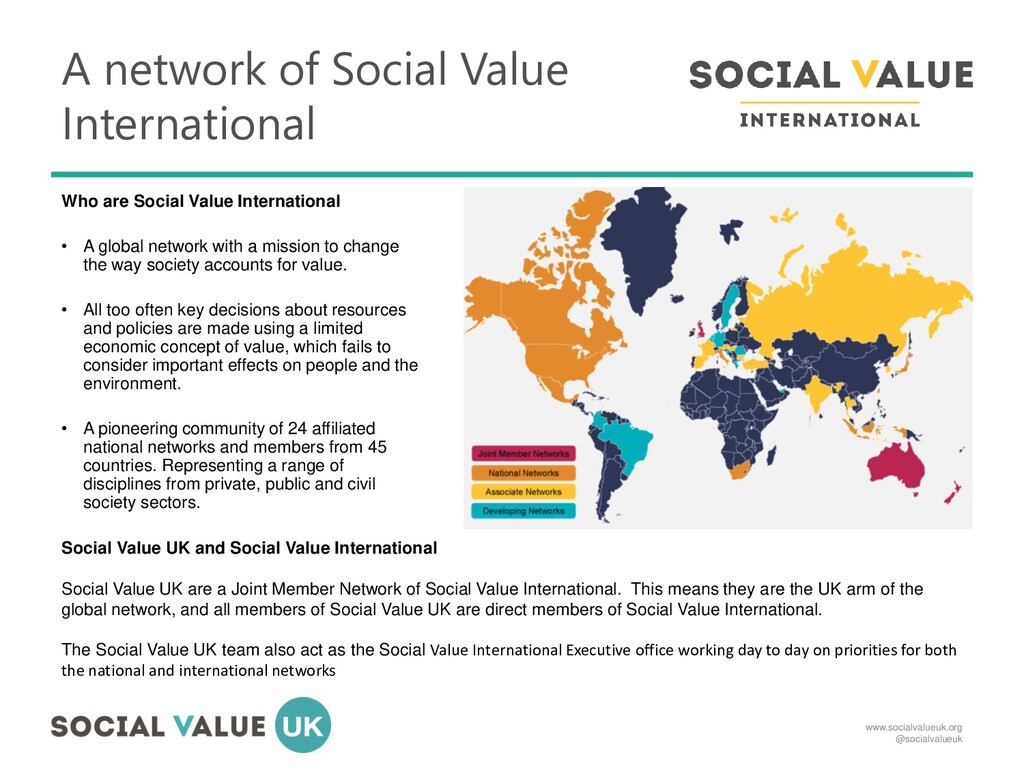
Social Value International • A global network with a mission to change the way society accounts for value. • All too often key decisions about resources and policies are made using a limited economic concept of value, which fails to consider important effects on people and the environment. • A pioneering community of 24 affiliated national networks and members from 45 countries. Representing a range of disciplines from private, public and civil society sectors. Social Value UK and Social Value International Social Value UK are a Joint Member Network of Social Value International. This means they are the UK arm of the global network, and all members of Social Value UK are direct members of Social Value International. The Social Value UK team also act as the Social Value International Executive office working day to day on priorities for both the national and international networks
▪ Work collaboratively and inclusively across the membership ▪ Be open and transparent about commercial interests and any conflicts of interest ▪ Respect other members and their starting point on social value journey ▪ Use clear language to make content accessible to all ▪ Be innovative and bold in our solutions ▪ Support the Social Value Principles and SVI assurance and accreditation services
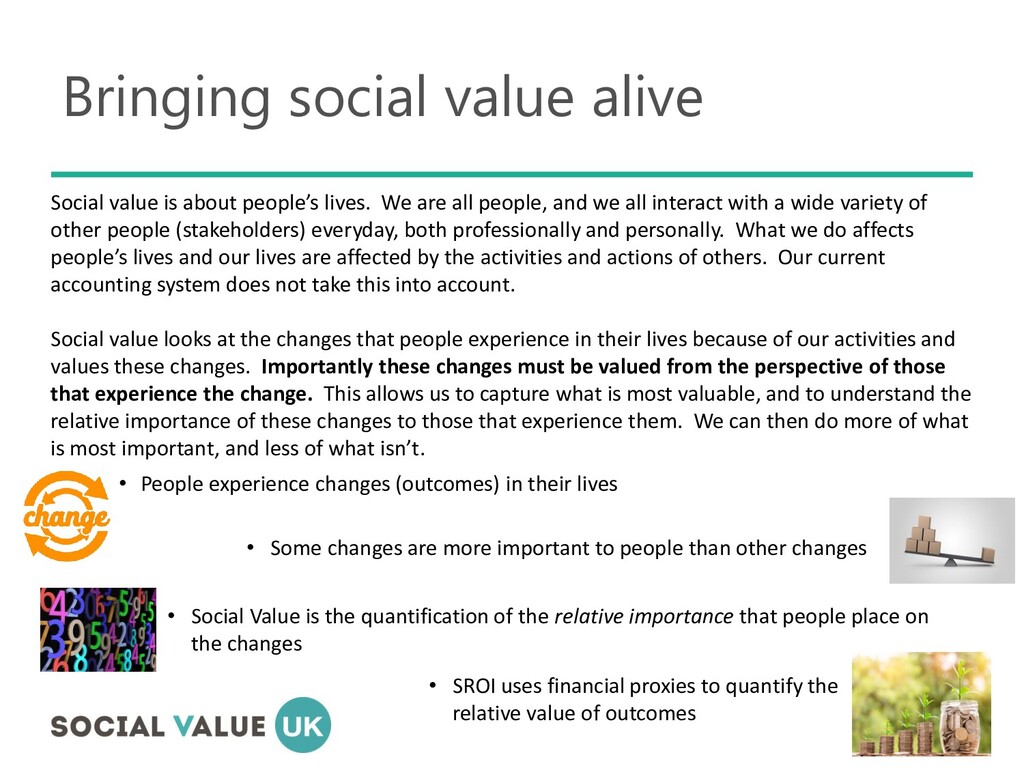
(outcomes) in their lives • Some changes are more important to people than other changes • Social Value is the quantification of the relative importance that people place on the changes • SROI uses financial proxies to quantify the relative value of outcomes Social value is about people’s lives. We are all people, and we all interact with a wide variety of other people (stakeholders) everyday, both professionally and personally. What we do affects people’s lives and our lives are affected by the activities and actions of others. Our current accounting system does not take this into account. Social value looks at the changes that people experience in their lives because of our activities and values these changes. Importantly these changes must be valued from the perspective of those that experience the change. This allows us to capture what is most valuable, and to understand the relative importance of these changes to those that experience them. We can then do more of what is most important, and less of what isn’t.
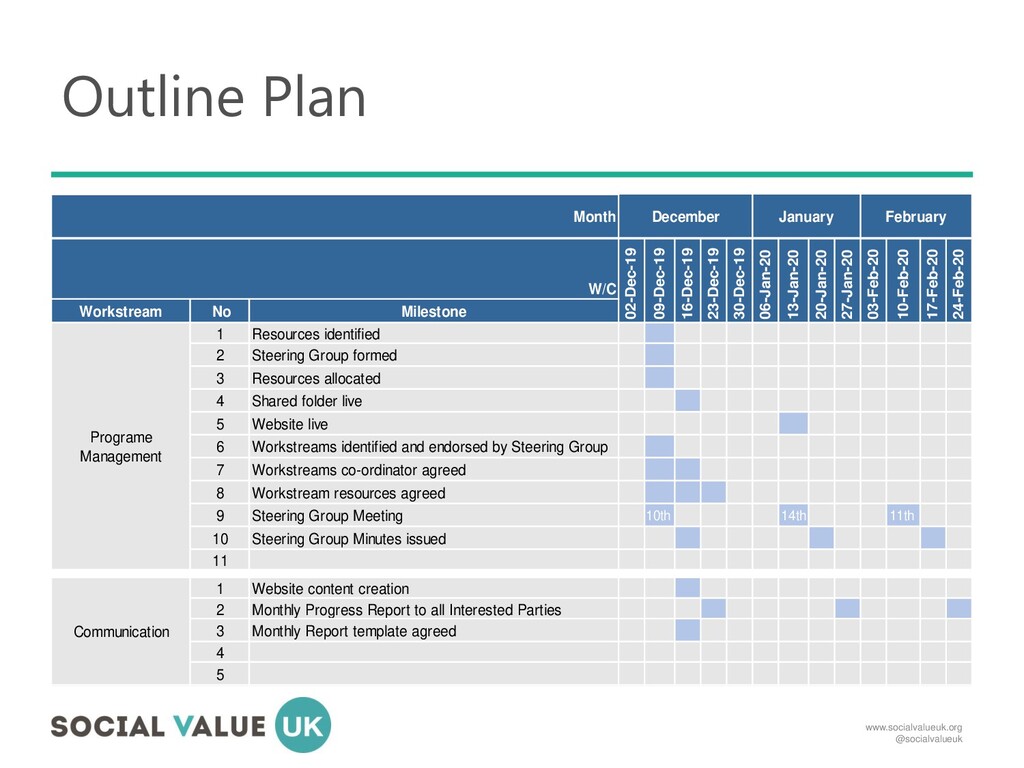
• We have created some very basic and simple workstream documents to use as a guide • We has developed some templates around case studies, others will follow as needed • Created shared documents folders • We believe that each workstream area will develop at differing rates, although we think an initial focus would be collating areas of current best practice, case studies and guidance • At regular intervals we will work with workstream leads to coordinate approaches and minimise overlap • Refine the approach to workstream management over time
and Commissioning Best Practice and Methodology 2 Social and Environmental Strategic Priorities to Implementation 3 International Approaches to Creating Social Value 4 Social Value in Construction & Infrastructure 5 Social Value in Services 6 Social Value Standards and Assurance 7 Social Value Measurement and Impact 8 Social Value Training and Capability Development 9 Communication SVUK
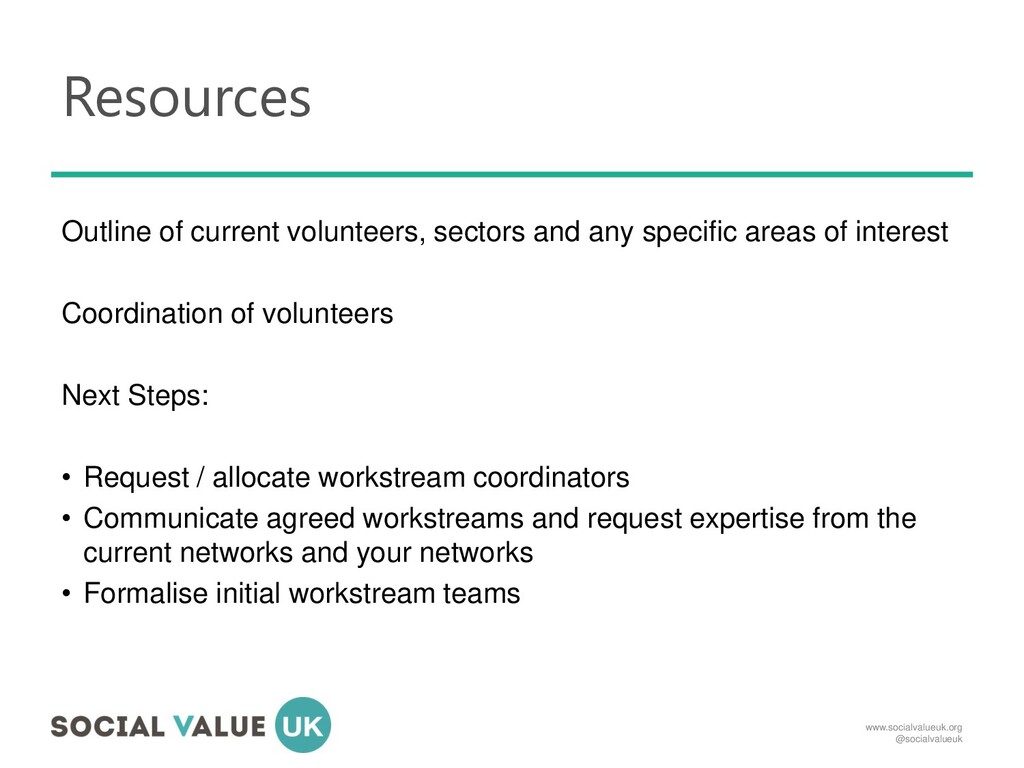
specific areas of interest Coordination of volunteers Next Steps: • Request / allocate workstream coordinators • Communicate agreed workstreams and request expertise from the current networks and your networks • Formalise initial workstream teams


 contractforchange
 yasslab
 yoshikikonishi_
 pokotyamu
 neuroenergia
 nakasonejusetsu
 hr1nursing
 c0rp_mdm
 kazumakitao
 gatechnologies
 hubbleinc
 mercari_inc
 kinsofficial
 mlcsv
 bkeepers
 aleyda
 techseoconnect
 samanthasiow
 szymonslowik
 morganepeng
 quramy
 mraible
 portentint
 rakko
 marktimemedia