Upgrade to PRO for Only $50/Yearโ€”Limited-Time Offer! ๐Ÿ”ฅ

Type Theory as a Formal Basis of Natural Langua...

Type Theory as a Formal Basis of Natural Languageย Semantics

An invited talk at Yanaka Lab on May 21, 2025.

Avatar for Daiki Matsuoka

Daiki Matsuoka

May 25, 2025
Tweet

Other Decks in Research

Transcript

  1. Type Theory as a Formal Basis of Natural Language Semantics

    Daiki Matsuoka (Yanaka Lab, D1) Invited Talk (May 21, 2025)
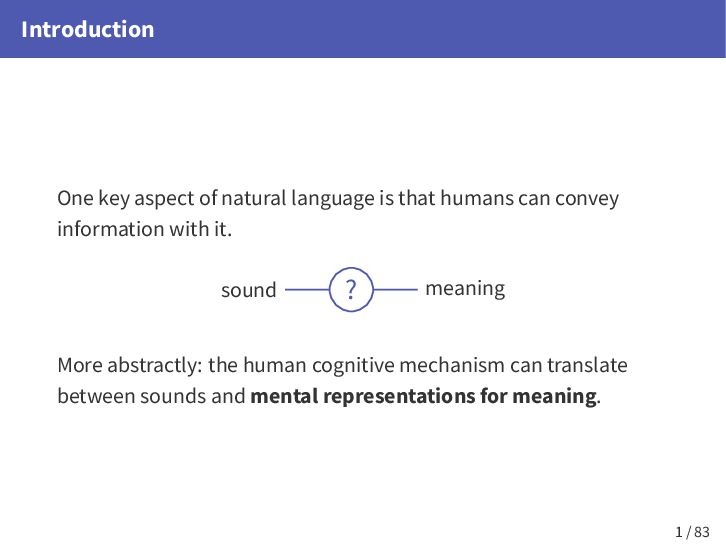
  2. Introduction One key aspect of natural language is that humans

    can convey information with it. sound ? meaning More abstractly: the human cognitive mechanism can translate between sounds and mental representations for meaning. 1 / 83
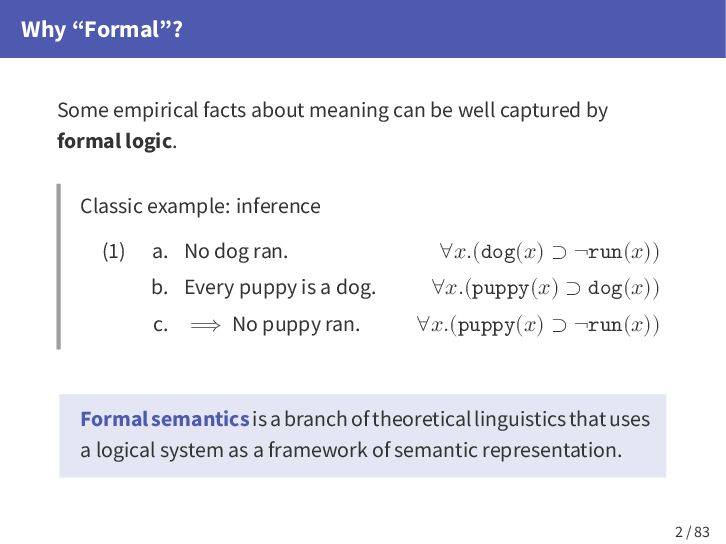
  3. Why โ€œFormalโ€? Some empirical facts about meaning can be well

    captured by formal logic. Classic example: inference (1) a. No dog ran. โˆ€๐‘ฅ.(dog(๐‘ฅ) โŠƒ ยฌrun(๐‘ฅ)) b. Every puppy is a dog. โˆ€๐‘ฅ.(puppy(๐‘ฅ) โŠƒ dog(๐‘ฅ)) c. โŸน No puppy ran. โˆ€๐‘ฅ.(puppy(๐‘ฅ) โŠƒ ยฌrun(๐‘ฅ)) Formalsemanticsisabranchoftheoreticallinguisticsthatuses a logical system as a framework of semantic representation. 2 / 83
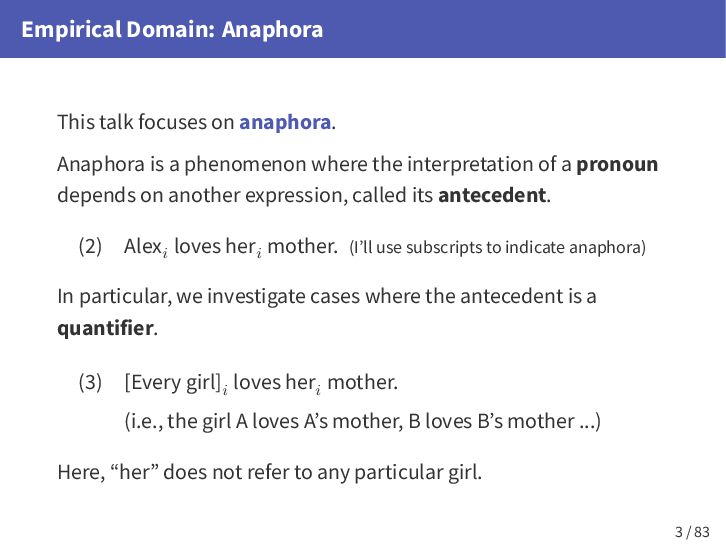
  4. Empirical Domain: Anaphora This talk focuses on anaphora. Anaphora is

    a phenomenon where the interpretation of a pronoun depends on another expression, called its antecedent. (2) Alex๐‘– loves her๐‘– mother. (Iโ€™ll use subscripts to indicate anaphora) In particular, we investigate cases where the antecedent is a quantifier. (3) [Every girl]๐‘– loves her๐‘– mother. (i.e., the girl A loves Aโ€™s mother, B loves Bโ€™s mother ...) Here, โ€œherโ€ does not refer to any particular girl. 3 / 83
  5. Empirical Domain: Anaphora [contd.] The anaphoric interpretation of (3) can

    be easily expressed with a logical formula. (3) [Every girl]๐‘– loves her๐‘– mother. โ‡ โˆ€๐‘ฅ.(girl(๐‘ฅ) โŠƒ love(๐‘ฅ, mother(๐‘ฅ))) This phenomenon is called bound variable anaphora. โ€ข The bound variable interpretation seems to be adequately captured by logical formulas. โ€ข However, natural language shows some differences from the standard first-order logic ... 4 / 83
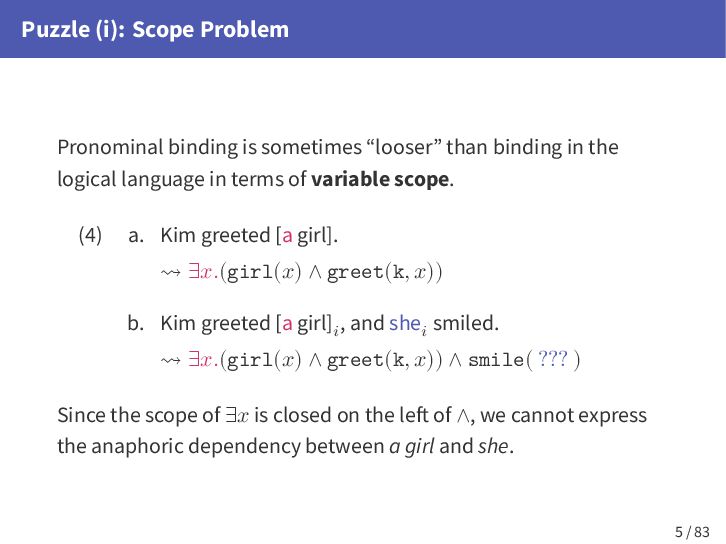
  6. Puzzle (i): Scope Problem Pronominal binding is sometimes โ€œlooserโ€ than

    binding in the logical language in terms of variable scope. (4) a. Kim greeted [a girl]. โ‡ โˆƒ๐‘ฅ.(girl(๐‘ฅ) โˆง greet(k, ๐‘ฅ)) b. Kim greeted [a girl]๐‘– , and she๐‘– smiled. โ‡ โˆƒ๐‘ฅ.(girl(๐‘ฅ) โˆง greet(k, ๐‘ฅ)) โˆง smile( ??? ) Since the scope of โˆƒ๐‘ฅ is closed on the left of โˆง, we cannot express the anaphoric dependency between a girl and she. 5 / 83
  7. Puzzle (i): Scope Problem [contd.] Although one might think of

    โ€œextendingโ€ the effect of a girl to the second sentence, things are not so simple ... Quantifiers in certain environments are inaccessible from outside (Groenendijk & Stokhof, 1991).1 (5) a. *Kim greeted [{every/no} girl]๐‘– , and she๐‘– smiled. b. If Kim buys [a book]๐‘– , she reads it๐‘– through. *It๐‘– is long. Q. How can we formally account for inter-sentential variable binding? 1Here, I use the asterisk * to indicate the unacceptability of the interpretation indicated by the subscripts, not the sentence itself. 6 / 83
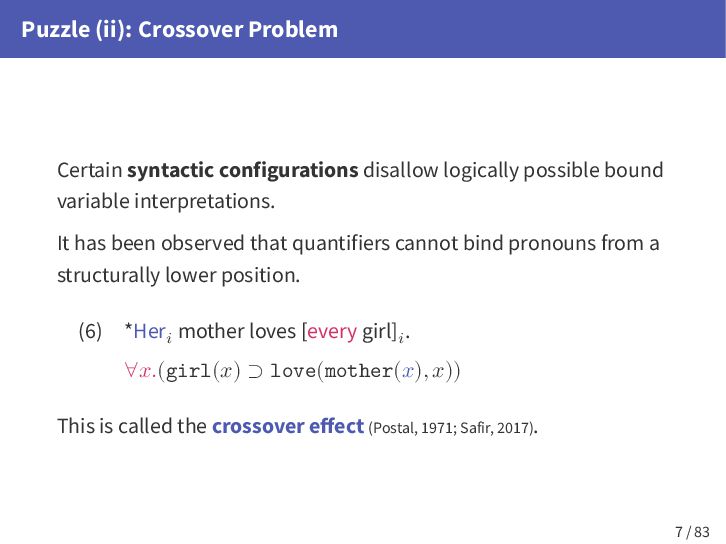
  8. Puzzle (ii): Crossover Problem Certain syntactic configurations disallow logically possible

    bound variable interpretations. It has been observed that quantifiers cannot bind pronouns from a structurally lower position. (6) *Her๐‘– mother loves [every girl]๐‘– . โˆ€๐‘ฅ.(girl(๐‘ฅ) โŠƒ love(mother(๐‘ฅ), ๐‘ฅ)) This is called the crossover effect (Postal, 1971; Safir, 2017). 7 / 83
  9. Puzzle (ii): Crossover Problem [contd.] N.B. in principle, the subject

    can be in the scope of the object quantifier. (7) Alex loves every girl. โ‡ โˆ€๐‘ฅ.(girl(๐‘ฅ) โŠƒ love(a, ๐‘ฅ)) Q. How can we constrain the bound variable interpretation in line with the crossover effect? 8 / 83
  10. Outline of This Talk Thistalkdescribeshowtypetheorycanbeusedasaframework of semantic representation. โ€ข Concretely,

    I will introduce a theory called Dependent Type Semantics (DTS) (Bekki, 2014; Bekki & Mineshima, 2017). โ€ข DTS provides a type-theoretical account of bound variable interpretations. โ€ข If time permits, we will see how the DTS-based analysis is extended to a phenomenon called presupposition. 9 / 83
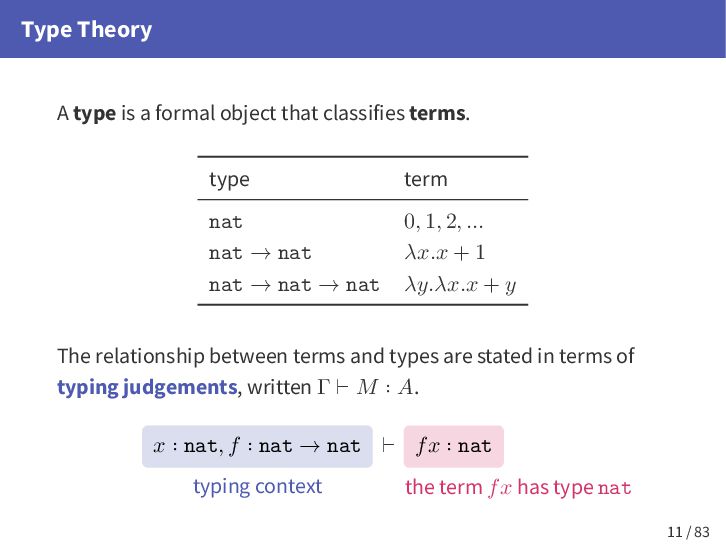
  11. Type Theory A type is a formal object that classifies

    terms. type term nat 0, 1, 2, ... nat โ†’ nat ๐œ†๐‘ฅ.๐‘ฅ + 1 nat โ†’ nat โ†’ nat ๐œ†๐‘ฆ.๐œ†๐‘ฅ.๐‘ฅ + ๐‘ฆ The relationship between terms and types are stated in terms of typing judgements, written ฮ“ โŠข ๐‘€ โˆถ ๐ด. typing context ๐‘ฅ โˆถ nat, ๐‘“ โˆถ nat โ†’ nat โŠข the term ๐‘“๐‘ฅ has type nat ๐‘“๐‘ฅ โˆถ nat 11 / 83
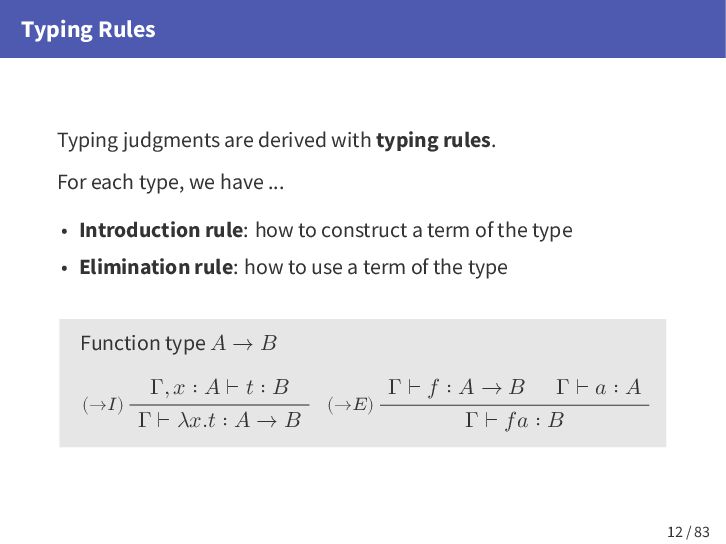
  12. Typing Rules Typing judgments are derived with typing rules. For

    each type, we have ... โ€ข Introduction rule: how to construct a term of the type โ€ข Elimination rule: how to use a term of the type Function type ๐ด โ†’ ๐ต ฮ“, ๐‘ฅ โˆถ ๐ด โŠข ๐‘ก โˆถ ๐ต (โ†’๐ผ) ฮ“ โŠข ๐œ†๐‘ฅ.๐‘ก โˆถ ๐ด โ†’ ๐ต ฮ“ โŠข ๐‘“ โˆถ ๐ด โ†’ ๐ต ฮ“ โŠข ๐‘Ž โˆถ ๐ด (โ†’๐ธ) ฮ“ โŠข ๐‘“๐‘Ž โˆถ ๐ต 12 / 83
  13. Typing Rules [contd.] Product type ๐ด ร— ๐ต ฮ“ โŠข

    ๐‘Ž โˆถ ๐ด ฮ“ โŠข ๐‘ โˆถ ๐ต (ร—๐ผ) ฮ“ โŠข โŸจ๐‘Ž, ๐‘โŸฉ โˆถ ๐ด ร— ๐ต ฮ“ โŠข ๐‘ก โˆถ ๐ด ร— ๐ต (ร—๐ธ 1 ) ฮ“ โŠข ๐œ‹1 ๐‘ก โˆถ ๐ด ฮ“ โŠข ๐‘ก โˆถ ๐ด ร— ๐ต (ร—๐ธ 2 ) ฮ“ โŠข ๐œ‹2 ๐‘ก โˆถ ๐ต We also have structural rules, which specify how to manipulate the typing context. (var) (๐‘ฅ โˆถ ๐ด โˆˆ ฮ“) ฮ“ โŠข ๐‘ฅ โˆถ ๐ด 13 / 83
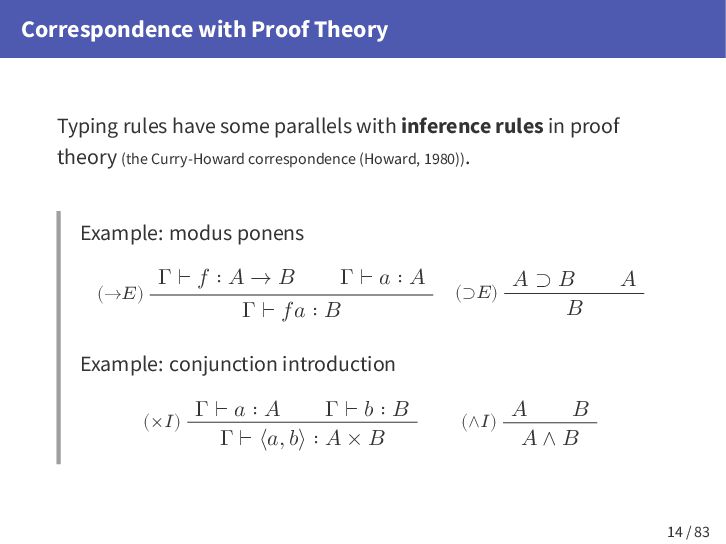
  14. Correspondence with Proof Theory Typing rules have some parallels with

    inference rules in proof theory (the Curry-Howard correspondence (Howard, 1980)). Example: modus ponens ฮ“ โŠข ๐‘“ โˆถ ๐ด โ†’ ๐ต ฮ“ โŠข ๐‘Ž โˆถ ๐ด (โ†’๐ธ) ฮ“ โŠข ๐‘“๐‘Ž โˆถ ๐ต ๐ด โŠƒ ๐ต ๐ด (โŠƒ๐ธ) ๐ต Example: conjunction introduction ฮ“ โŠข ๐‘Ž โˆถ ๐ด ฮ“ โŠข ๐‘ โˆถ ๐ต (ร—๐ผ) ฮ“ โŠข โŸจ๐‘Ž, ๐‘โŸฉ โˆถ ๐ด ร— ๐ต ๐ด ๐ต (โˆง๐ผ) ๐ด โˆง ๐ต 14 / 83
  15. Correspondence with Proof Theory [contd.] A bit deeper intuition โ€ฆ

    (called the Brouwer-Heyting-Kolmogorov interpretation) A proof of ๐ด โŠƒ ๐ต is, essentially, a method (โ‰ƒ function) that turns any given proof of ๐ด into a proof of ๐ต. ๐ด ๐ต โ€ข ๐‘Ž โ€ข๐‘1 โ€ข๐‘2 ๐‘“1 ๐‘“2 15 / 83
  16. Correspondence with Proof Theory [contd.] Likewise, a proof of ๐ด

    โˆง ๐ต can be viewed as a pair of a proof of ๐ด and a proof of ๐ต. ๐ด ๐ต โ€ข ๐‘Ž โ€ข๐‘1 โ€ข๐‘2 โŸจ๐‘Ž, ๐‘1 โŸฉ โŸจ๐‘Ž, ๐‘2 โŸฉ 16 / 83
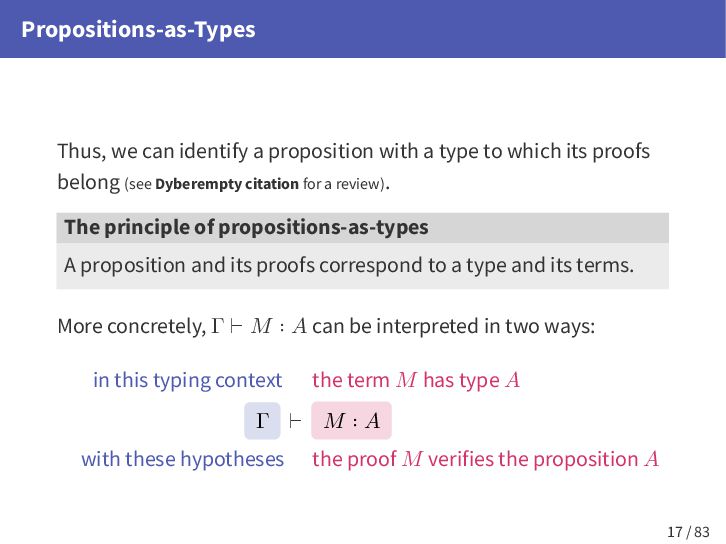
  17. Propositions-as-Types Thus, we can identify a proposition with a type

    to which its proofs belong (see Dyberempty citation for a review). The principle of propositions-as-types A proposition and its proofs correspond to a type and its terms. More concretely, ฮ“ โŠข ๐‘€ โˆถ ๐ด can be interpreted in two ways: in this typing context with these hypotheses ฮ“ โŠข the term ๐‘€ has type ๐ด the proof ๐‘€ verifies the proposition ๐ด ๐‘€ โˆถ ๐ด 17 / 83
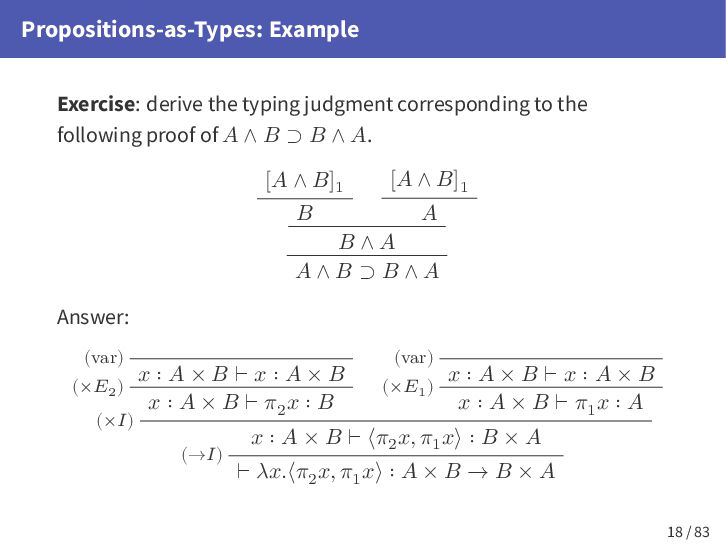
  18. Propositions-as-Types: Example Exercise: derive the typing judgment corresponding to the

    following proof of ๐ด โˆง ๐ต โŠƒ ๐ต โˆง ๐ด. [๐ด โˆง ๐ต]1 ๐ต [๐ด โˆง ๐ต]1 ๐ด ๐ต โˆง ๐ด ๐ด โˆง ๐ต โŠƒ ๐ต โˆง ๐ด Answer: (var) ๐‘ฅ โˆถ ๐ด ร— ๐ต โŠข ๐‘ฅ โˆถ ๐ด ร— ๐ต (ร—๐ธ 2 ) ๐‘ฅ โˆถ ๐ด ร— ๐ต โŠข ๐œ‹2 ๐‘ฅ โˆถ ๐ต (var) ๐‘ฅ โˆถ ๐ด ร— ๐ต โŠข ๐‘ฅ โˆถ ๐ด ร— ๐ต (ร—๐ธ 1 ) ๐‘ฅ โˆถ ๐ด ร— ๐ต โŠข ๐œ‹1 ๐‘ฅ โˆถ ๐ด (ร—๐ผ) ๐‘ฅ โˆถ ๐ด ร— ๐ต โŠข โŸจ๐œ‹2 ๐‘ฅ, ๐œ‹1 ๐‘ฅโŸฉ โˆถ ๐ต ร— ๐ด (โ†’๐ผ) โŠข ๐œ†๐‘ฅ.โŸจ๐œ‹2 ๐‘ฅ, ๐œ‹1 ๐‘ฅโŸฉ โˆถ ๐ด ร— ๐ต โ†’ ๐ต ร— ๐ด 18 / 83
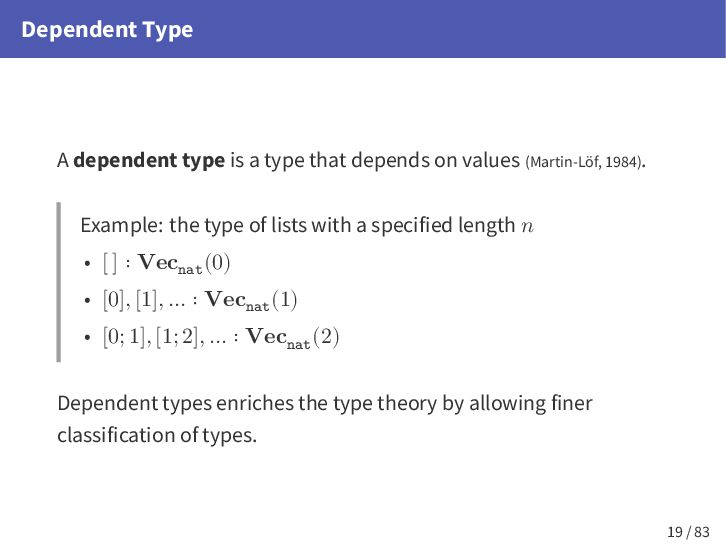
  19. Dependent Type A dependent type is a type that depends

    on values (Martin-Lรถf, 1984). Example: the type of lists with a specified length ๐‘› โ€ข [ ] โˆถ Vec nat (0) โ€ข [0], [1], ... โˆถ Vec nat (1) โ€ข [0; 1], [1; 2], ... โˆถ Vec nat (2) Dependent types enriches the type theory by allowing finer classification of types. 19 / 83
  20. Dependent Type [contd.] With dependent types, we can generalize functions

    and pairs. Example: the function that returns a vector filled with zeros. โ€ข zeros(0) = [ ] โˆถ Vec nat (0) โ€ข zeros(1) = [0] โˆถ Vec nat (1) โ€ข zeros(2) = [0; 0] โˆถ Vec nat (2) The type of zeros is (๐‘› โˆถ nat) โ†’ Vec nat (๐‘›). Here, the codomain of the function varies with the argument. This type of dependency will be important later ... 20 / 83
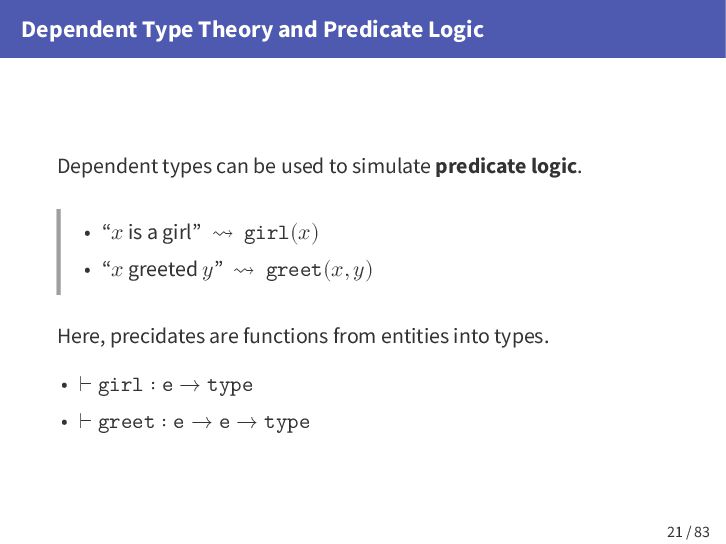
  21. Dependent Type Theory and Predicate Logic Dependent types can be

    used to simulate predicate logic. โ€ข โ€œ๐‘ฅ is a girlโ€ โ‡ girl(๐‘ฅ) โ€ข โ€œ๐‘ฅ greeted ๐‘ฆโ€ โ‡ greet(๐‘ฅ, ๐‘ฆ) Here, precidates are functions from entities into types. โ€ข โŠข girl โˆถ e โ†’ type โ€ข โŠข greet โˆถ e โ†’ e โ†’ type 21 / 83
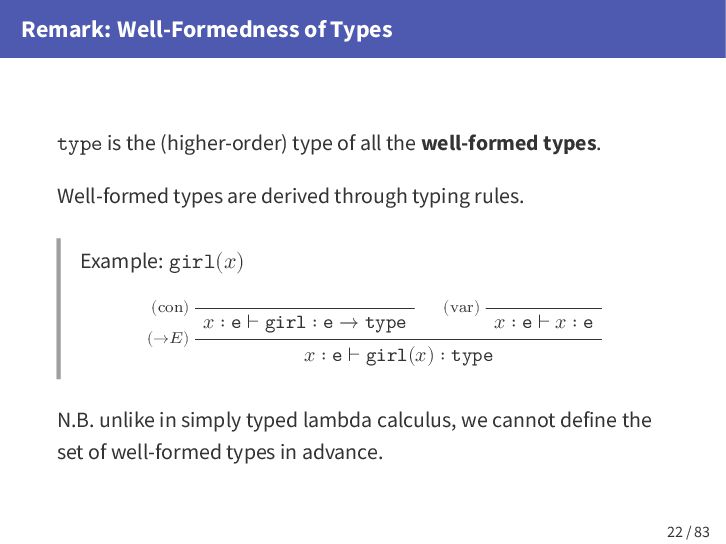
  22. Remark: Well-Formedness of Types type is the (higher-order) type of

    all the well-formed types. Well-formed types are derived through typing rules. Example: girl(๐‘ฅ) (con) ๐‘ฅ โˆถ e โŠข girl โˆถ e โ†’ type (var) ๐‘ฅ โˆถ e โŠข ๐‘ฅ โˆถ e (โ†’๐ธ) ๐‘ฅ โˆถ e โŠข girl(๐‘ฅ) โˆถ type N.B. unlike in simply typed lambda calculus, we cannot define the set of well-formed types in advance. 22 / 83
  23. Remark: Well-Formedness of Types [contd.] What does well-formedness mean linguistically?

    A well-formed type corresponds to a proposition that makes sense in the current context. Example: if ๐‘ฅ โˆถ e is not in ฮ“, then ฮ“ โŠฌ girl(๐‘ฅ) โˆถ type Analogously, if there is nothing in the context referred to by ๐‘ฅ, girl(๐‘ฅ) does not make sense (neither true nor false). Thus, this notion is related to the notion of felicity of an utterance (i.e., whether the utterance is pragmatically appropriate). 23 / 83
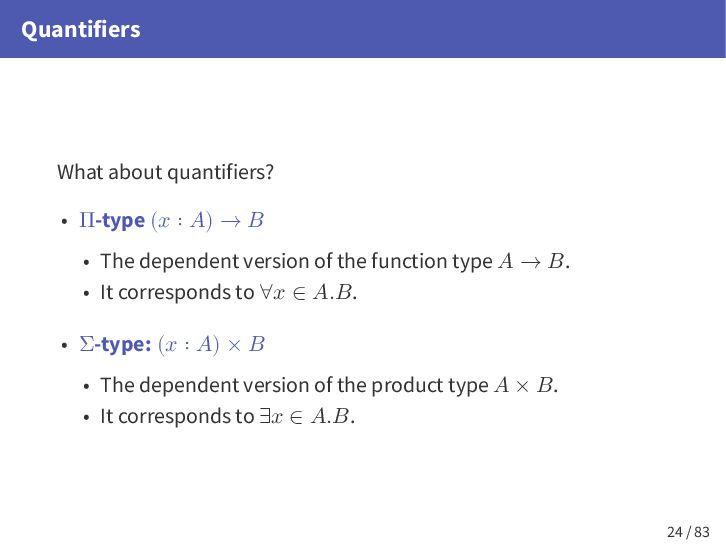
  24. Quantifiers What about quantifiers? โ€ข ฮ -type (๐‘ฅ โˆถ ๐ด) โ†’

    ๐ต โ€ข The dependent version of the function type ๐ด โ†’ ๐ต. โ€ข It corresponds to โˆ€๐‘ฅ โˆˆ ๐ด.๐ต. โ€ข ฮฃ-type: (๐‘ฅ โˆถ ๐ด) ร— ๐ต โ€ข The dependent version of the product type ๐ด ร— ๐ต. โ€ข It corresponds to โˆƒ๐‘ฅ โˆˆ ๐ด.๐ต. 24 / 83
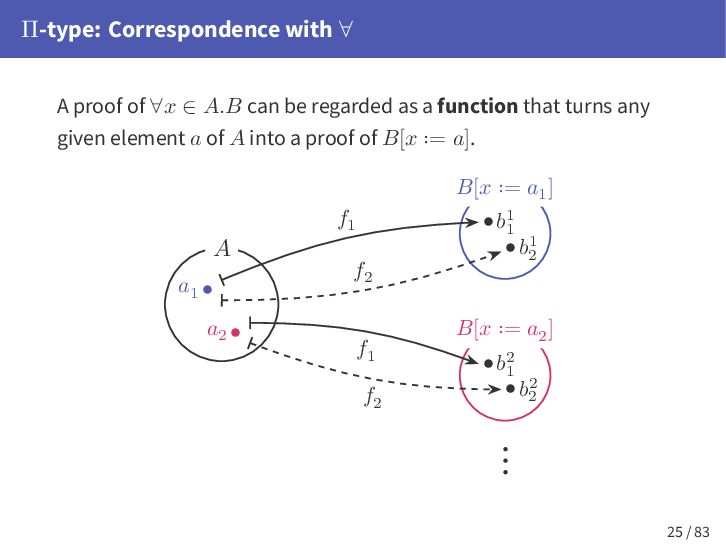
  25. ฮ -type: Correspondence with โˆ€ A proof of โˆ€๐‘ฅ โˆˆ ๐ด.๐ต

    can be regarded as a function that turns any given element ๐‘Ž of ๐ด into a proof of ๐ต[๐‘ฅ โˆถ= ๐‘Ž]. ๐ด ๐ต[๐‘ฅ โˆถ= ๐‘Ž1 ] ๐ต[๐‘ฅ โˆถ= ๐‘Ž2 ] โ‹ฎ โ€ข ๐‘Ž1 โ€ข ๐‘Ž2 โ€ข๐‘1 1 โ€ข๐‘1 2 โ€ข๐‘2 1 โ€ข๐‘2 2 ๐‘“1 ๐‘“2 ๐‘“1 ๐‘“2 25 / 83
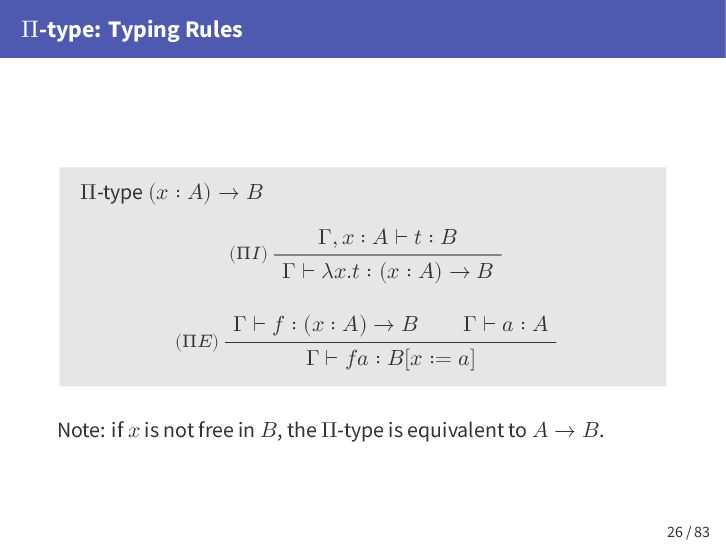
  26. ฮ -type: Typing Rules ฮ -type (๐‘ฅ โˆถ ๐ด) โ†’ ๐ต ฮ“,

    ๐‘ฅ โˆถ ๐ด โŠข ๐‘ก โˆถ ๐ต (ฮ ๐ผ) ฮ“ โŠข ๐œ†๐‘ฅ.๐‘ก โˆถ (๐‘ฅ โˆถ ๐ด) โ†’ ๐ต ฮ“ โŠข ๐‘“ โˆถ (๐‘ฅ โˆถ ๐ด) โ†’ ๐ต ฮ“ โŠข ๐‘Ž โˆถ ๐ด (ฮ ๐ธ) ฮ“ โŠข ๐‘“๐‘Ž โˆถ ๐ต[๐‘ฅ โˆถ= ๐‘Ž] Note: if ๐‘ฅ is not free in ๐ต, the ฮ -type is equivalent to ๐ด โ†’ ๐ต. 26 / 83
  27. ฮ -type: Typing Rules [contd.] In addition to the intro/elim rules,

    we have the formation rule, specifying the well-formedness condition. ฮ“ โŠข ๐ด โˆถ type ฮ“, ๐‘ฅ โˆถ ๐ด โŠข ๐ต โˆถ type (ฮ ๐น) ฮ“ โŠข (๐‘ฅ โˆถ ๐ด) โ†’ ๐ต โˆถ type Crucially, the well-formedness of ๐ต can depend on ๐‘ฅ โˆถ ๐ด for the whole ฮ -type to be well-formed. 27 / 83
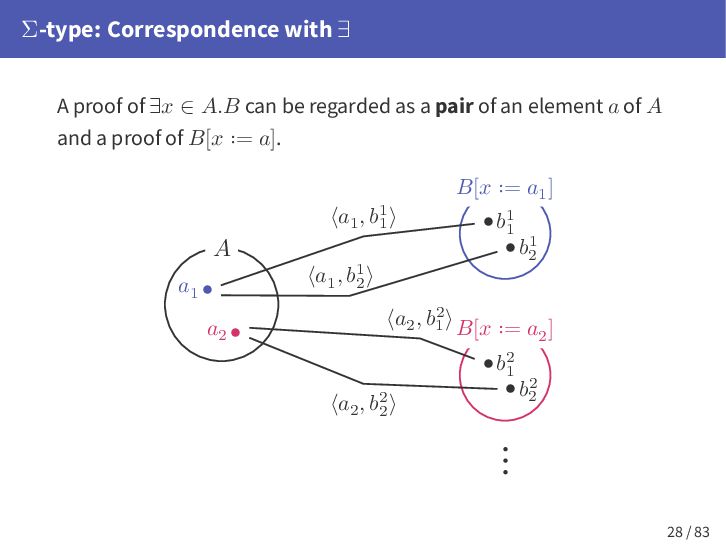
  28. ฮฃ-type: Correspondence with โˆƒ A proof of โˆƒ๐‘ฅ โˆˆ ๐ด.๐ต

    can be regarded as a pair of an element ๐‘Ž of ๐ด and a proof of ๐ต[๐‘ฅ โˆถ= ๐‘Ž]. ๐ด ๐ต[๐‘ฅ โˆถ= ๐‘Ž1 ] ๐ต[๐‘ฅ โˆถ= ๐‘Ž2 ] โ‹ฎ โ€ข ๐‘Ž1 โ€ข ๐‘Ž2 โ€ข๐‘1 1 โ€ข๐‘1 2 โ€ข๐‘2 1 โ€ข๐‘2 2 โŸจ๐‘Ž1 , ๐‘1 1 โŸฉ โŸจ๐‘Ž1 , ๐‘1 2 โŸฉ โŸจ๐‘Ž2 , ๐‘2 1 โŸฉ โŸจ๐‘Ž2 , ๐‘2 2 โŸฉ 28 / 83
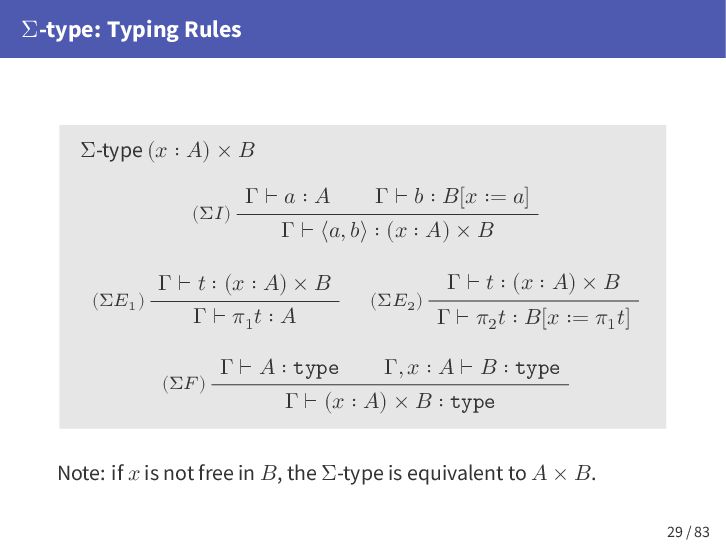
  29. ฮฃ-type: Typing Rules ฮฃ-type (๐‘ฅ โˆถ ๐ด) ร— ๐ต ฮ“

    โŠข ๐‘Ž โˆถ ๐ด ฮ“ โŠข ๐‘ โˆถ ๐ต[๐‘ฅ โˆถ= ๐‘Ž] (ฮฃ๐ผ) ฮ“ โŠข โŸจ๐‘Ž, ๐‘โŸฉ โˆถ (๐‘ฅ โˆถ ๐ด) ร— ๐ต ฮ“ โŠข ๐‘ก โˆถ (๐‘ฅ โˆถ ๐ด) ร— ๐ต (ฮฃ๐ธ 1 ) ฮ“ โŠข ๐œ‹1 ๐‘ก โˆถ ๐ด ฮ“ โŠข ๐‘ก โˆถ (๐‘ฅ โˆถ ๐ด) ร— ๐ต (ฮฃ๐ธ 2 ) ฮ“ โŠข ๐œ‹2 ๐‘ก โˆถ ๐ต[๐‘ฅ โˆถ= ๐œ‹1 ๐‘ก] ฮ“ โŠข ๐ด โˆถ type ฮ“, ๐‘ฅ โˆถ ๐ด โŠข ๐ต โˆถ type (ฮฃ๐น) ฮ“ โŠข (๐‘ฅ โˆถ ๐ด) ร— ๐ต โˆถ type Note: if ๐‘ฅ is not free in ๐ต, the ฮฃ-type is equivalent to ๐ด ร— ๐ต. 29 / 83
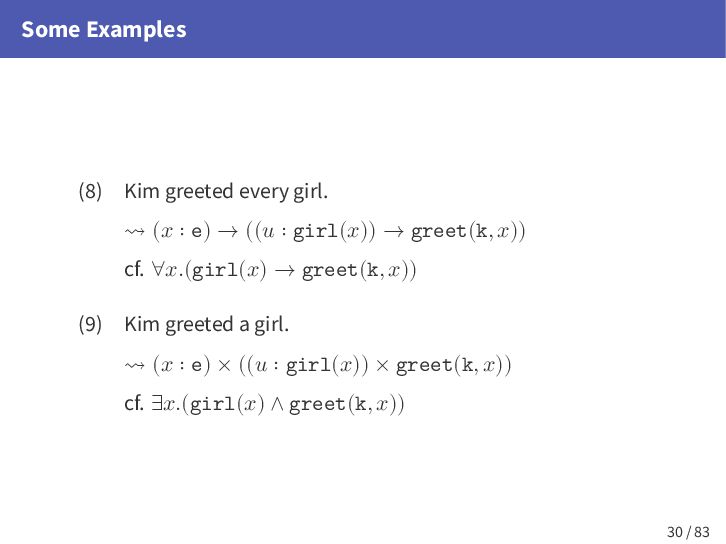
  30. Some Examples (8) Kim greeted every girl. โ‡ (๐‘ฅ โˆถ

    e) โ†’ ((๐‘ข โˆถ girl(๐‘ฅ)) โ†’ greet(k, ๐‘ฅ)) cf. โˆ€๐‘ฅ.(girl(๐‘ฅ) โ†’ greet(k, ๐‘ฅ)) (9) Kim greeted a girl. โ‡ (๐‘ฅ โˆถ e) ร— ((๐‘ข โˆถ girl(๐‘ฅ)) ร— greet(k, ๐‘ฅ)) cf. โˆƒ๐‘ฅ.(girl(๐‘ฅ) โˆง greet(k, ๐‘ฅ)) 30 / 83
  31. ฮ -type and ฮฃ-type: Example Exercise: derive the typing judgment corresponding

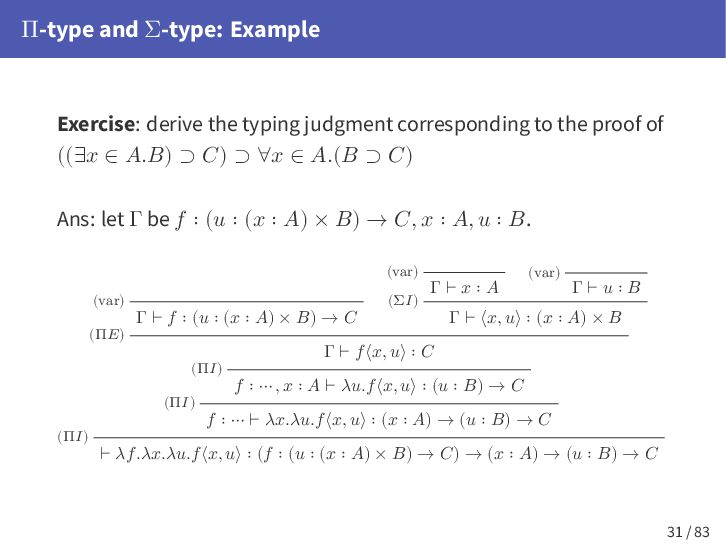
    to the proof of ((โˆƒ๐‘ฅ โˆˆ ๐ด.๐ต) โŠƒ ๐ถ) โŠƒ โˆ€๐‘ฅ โˆˆ ๐ด.(๐ต โŠƒ ๐ถ) Ans: let ฮ“ be ๐‘“ โˆถ (๐‘ข โˆถ (๐‘ฅ โˆถ ๐ด) ร— ๐ต) โ†’ ๐ถ, ๐‘ฅ โˆถ ๐ด, ๐‘ข โˆถ ๐ต. (var) ฮ“ โŠข ๐‘“ โˆถ (๐‘ข โˆถ (๐‘ฅ โˆถ ๐ด) ร— ๐ต) โ†’ ๐ถ (var) ฮ“ โŠข ๐‘ฅ โˆถ ๐ด (var) ฮ“ โŠข ๐‘ข โˆถ ๐ต (ฮฃ๐ผ) ฮ“ โŠข โŸจ๐‘ฅ, ๐‘ขโŸฉ โˆถ (๐‘ฅ โˆถ ๐ด) ร— ๐ต (ฮ ๐ธ) ฮ“ โŠข ๐‘“โŸจ๐‘ฅ, ๐‘ขโŸฉ โˆถ ๐ถ (ฮ ๐ผ) ๐‘“ โˆถ โ‹ฏ , ๐‘ฅ โˆถ ๐ด โŠข ๐œ†๐‘ข.๐‘“โŸจ๐‘ฅ, ๐‘ขโŸฉ โˆถ (๐‘ข โˆถ ๐ต) โ†’ ๐ถ (ฮ ๐ผ) ๐‘“ โˆถ โ‹ฏ โŠข ๐œ†๐‘ฅ.๐œ†๐‘ข.๐‘“โŸจ๐‘ฅ, ๐‘ขโŸฉ โˆถ (๐‘ฅ โˆถ ๐ด) โ†’ (๐‘ข โˆถ ๐ต) โ†’ ๐ถ (ฮ ๐ผ) โŠข ๐œ†๐‘“.๐œ†๐‘ฅ.๐œ†๐‘ข.๐‘“โŸจ๐‘ฅ, ๐‘ขโŸฉ โˆถ (๐‘“ โˆถ (๐‘ข โˆถ (๐‘ฅ โˆถ ๐ด) ร— ๐ต) โ†’ ๐ถ) โ†’ (๐‘ฅ โˆถ ๐ด) โ†’ (๐‘ข โˆถ ๐ต) โ†’ ๐ถ 31 / 83
  32. Remark: Box Notation For readability, we use a box-like notation

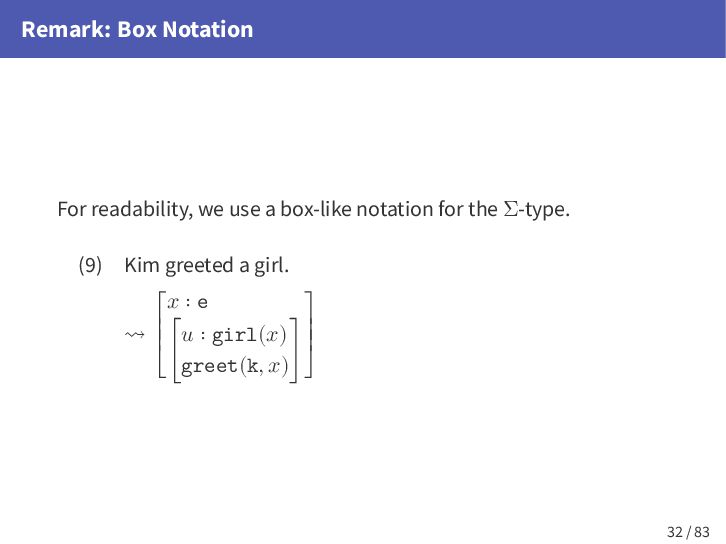
    for the ฮฃ-type. (9) Kim greeted a girl. โ‡ โŽก โŽข โŽข โŽฃ ๐‘ฅ โˆถ e [ ๐‘ข โˆถ girl(๐‘ฅ) greet(k, ๐‘ฅ) ] โŽค โŽฅ โŽฅ โŽฆ 32 / 83
  33. Representing Inter-Sentential Anaphora Now we are ready to represent inter-sentential

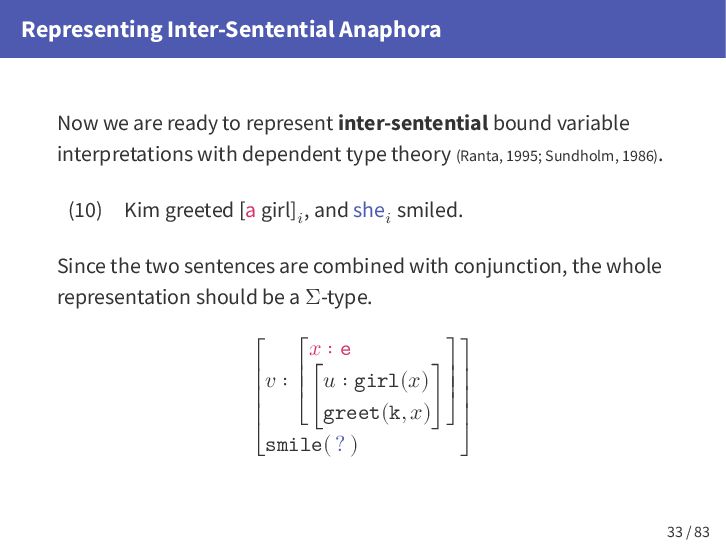
    bound variable interpretations with dependent type theory (Ranta, 1995; Sundholm, 1986). (10) Kim greeted [a girl]๐‘– , and she๐‘– smiled. Since the two sentences are combined with conjunction, the whole representation should be a ฮฃ-type. โŽก โŽข โŽข โŽข โŽฃ ๐‘ฃ โˆถ โŽก โŽข โŽข โŽฃ ๐‘ฅ โˆถ e [ ๐‘ข โˆถ girl(๐‘ฅ) greet(k, ๐‘ฅ) ] โŽค โŽฅ โŽฅ โŽฆ smile( ? ) โŽค โŽฅ โŽฅ โŽฅ โŽฆ 33 / 83
  34. Representing Inter-Sentential Anaphora [contd.] We can use ๐œ‹1 to represent

    the anaphoric interpretation! โŽก โŽข โŽข โŽข โŽข โŽฃ ๐‘ฃ โˆถ โŽก โŽข โŽข โŽฃ ๐‘ฅ โˆถ e [ ๐‘ข โˆถ girl(๐‘ฅ) greet(๐‘ฅ) ] โŽค โŽฅ โŽฅ โŽฆ smile( ๐œ‹1 ๐‘ฃ ) โŽค โŽฅ โŽฅ โŽฅ โŽฅ โŽฆ โ€ข ๐‘ฃ ranges over the proofs of Kim greeted a girl, which should have the form โŸจ๐‘ฅ, โŸจ๐‘1 , ๐‘2 โŸฉโŸฉ. โ€ข The crucial point is that we view conjunction as an existential quantification of the proofs of the first conjunct. 34 / 83
  35. Representing Inter-Sentential Anaphora [contd.] The same strategy does not apply

    to the universal quantifier. (11) *Kim greeted [every girl]๐‘– , and she๐‘– smiled. โ‡ [ ๐‘ฃ โˆถ (๐‘ฅ โˆถ e) โ†’ (๐‘ข โˆถ girl(๐‘ฅ)) โ†’ greet(๐‘ฅ) smile( ? ) ] โ€ข The typing rules of the ฮ -type do not allow us to access ๐‘ฅ โˆถ ๐ด via ๐‘ฃ โˆถ (๐‘ฅ โˆถ ๐ด) โ†’ ๐ต. โ€ข Thus, we can correctly predict the bound variable interpretation in (11). (we will give a more formal account later ...) 35 / 83
  36. Representing Inter-Sentential Anaphora [contd.] Another case: (12) a. If Kim

    recommends [a book]๐‘– , Alex reads it๐‘– . โ‡ โŽ› โŽœ โŽœ โŽœ โŽ ๐‘ฃ โˆถ โŽก โŽข โŽข โŽฃ ๐‘ฅ โˆถ e [ ๐‘ข โˆถ book recommend(k, ๐‘ฅ) ] โŽค โŽฅ โŽฅ โŽฆ โŽž โŽŸ โŽŸ โŽŸ โŽ  โ†’ read(a, ๐œ‹1 ๐‘ฃ ) b. *It๐‘– is interesting. (It is impossible to refer to ๐‘ฅ โˆถ e from outside.) 36 / 83
  37. Interim Summary So far, we have seen โ€ฆ โ€ข The

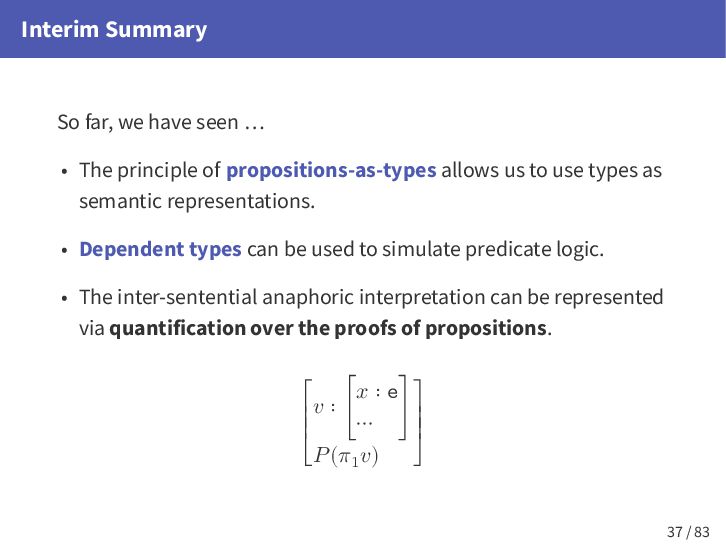
    principle of propositions-as-types allows us to use types as semantic representations. โ€ข Dependent types can be used to simulate predicate logic. โ€ข The inter-sentential anaphoric interpretation can be represented via quantification over the proofs of propositions. โŽก โŽข โŽข โŽฃ ๐‘ฃ โˆถ [ ๐‘ฅ โˆถ e โ‹ฏ ] ๐‘ƒ(๐œ‹1 ๐‘ฃ) โŽค โŽฅ โŽฅ โŽฆ 37 / 83
  38. Interim Summary [contd.] However, it remains to see how to

    systematically derive those representations ... โ€ข For example, how did the term ๐œ‹1 ๐‘ฃ come about? โ€ข We cannot simply stipulate that she is translated into ๐œ‹1 ๐‘ฃ, since its specific content is context-dependent. Q. How can we determine the representation for pronouns based on the contextual information? 38 / 83
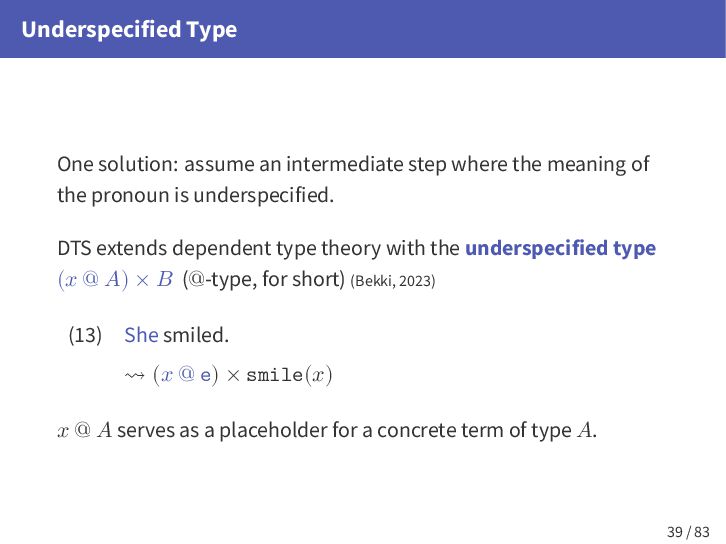
  39. Underspecified Type One solution: assume an intermediate step where the

    meaning of the pronoun is underspecified. DTS extends dependent type theory with the underspecified type (๐‘ฅ @ ๐ด) ร— ๐ต (@-type, for short) (Bekki, 2023) (13) She smiled. โ‡ (๐‘ฅ @ e) ร— smile(๐‘ฅ) ๐‘ฅ @ ๐ด serves as a placeholder for a concrete term of type ๐ด. 39 / 83
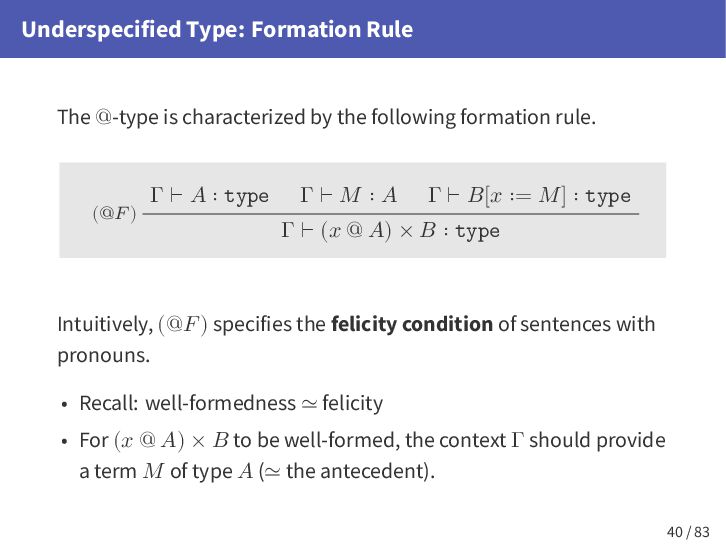
  40. Underspecified Type: Formation Rule The @-type is characterized by the

    following formation rule. ฮ“ โŠข ๐ด โˆถ type ฮ“ โŠข ๐‘€ โˆถ ๐ด ฮ“ โŠข ๐ต[๐‘ฅ โˆถ= ๐‘€] โˆถ type (@๐น) ฮ“ โŠข (๐‘ฅ @ ๐ด) ร— ๐ต โˆถ type Intuitively, (@๐น) specifies the felicity condition of sentences with pronouns. โ€ข Recall: well-formedness โ‰ƒ felicity โ€ข For (๐‘ฅ @ ๐ด) ร— ๐ต to be well-formed, the context ฮ“ should provide a term ๐‘€ of type ๐ด (โ‰ƒ the antecedent). 40 / 83
  41. Underspecified Type: Example (14) [Context: Kim greeted a student.] She

    smiled. Assuming that the typing context contains ๐‘ฃ โˆถ (๐‘ฅ โˆถ e) ร— (โ‹ฏ), we can derive the following. (con) ฮ“ โŠข e โˆถ type (var) ฮ“ โŠข ๐‘ฃ โˆถ [ ๐‘ฅ โˆถ e [โ‹ฏ] ] (ฮฃ๐ธ1 ) ฮ“ โŠข ๐œ‹1 ๐‘ฃ โˆถ e โ‹ฎ ฮ“ โŠข smile(๐œ‹1 ๐‘ฃ) โˆถ type (@๐น) ฮ“ โŠข (๐‘ฅ @ e) ร— smile(๐‘ฅ) โˆถ type 41 / 83
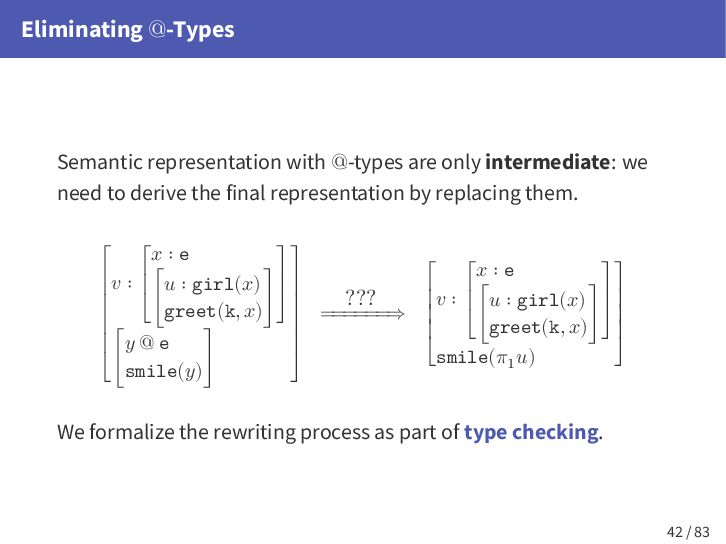
  42. Eliminating @-Types Semantic representation with @-types are only intermediate: we

    need to derive the final representation by replacing them. โŽก โŽข โŽข โŽข โŽข โŽฃ ๐‘ฃ โˆถ โŽก โŽข โŽฃ ๐‘ฅ โˆถ e [ ๐‘ข โˆถ girl(๐‘ฅ) greet(k, ๐‘ฅ) ] โŽค โŽฅ โŽฆ [ ๐‘ฆ @ e smile(๐‘ฆ) ] โŽค โŽฅ โŽฅ โŽฅ โŽฅ โŽฆ ??? = = = = = = โ‡’ โŽก โŽข โŽข โŽข โŽฃ ๐‘ฃ โˆถ โŽก โŽข โŽฃ ๐‘ฅ โˆถ e [ ๐‘ข โˆถ girl(๐‘ฅ) greet(k, ๐‘ฅ) ] โŽค โŽฅ โŽฆ smile(๐œ‹1 ๐‘ข) โŽค โŽฅ โŽฅ โŽฅ โŽฆ We formalize the rewriting process as part of type checking. 42 / 83
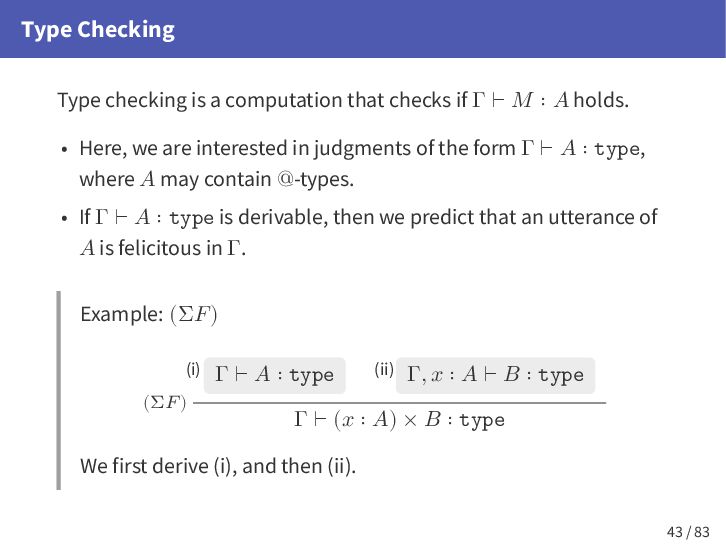
  43. Type Checking Type checking is a computation that checks if

    ฮ“ โŠข ๐‘€ โˆถ ๐ด holds. โ€ข Here, we are interested in judgments of the form ฮ“ โŠข ๐ด โˆถ type, where ๐ด may contain @-types. โ€ข If ฮ“ โŠข ๐ด โˆถ type is derivable, then we predict that an utterance of ๐ด is felicitous in ฮ“. Example: (ฮฃ๐น) (i) ฮ“ โŠข ๐ด โˆถ type (ii) ฮ“, ๐‘ฅ โˆถ ๐ด โŠข ๐ต โˆถ type (ฮฃ๐น) ฮ“ โŠข (๐‘ฅ โˆถ ๐ด) ร— ๐ต โˆถ type We first derive (i), and then (ii). 43 / 83
  44. Type Checking [contd.] Idea: we type check and eliminate the

    @-type at the same time. (i) ฮ“ โŠข ๐ด โˆถ type (ii) ฮ“ โŠข ๐‘€ โˆถ ๐ด (iii) ฮ“ โŠข ๐ต[๐‘ฅ โˆถ= ๐‘€] โˆถ type (@๐น) ฮ“ โŠข (๐‘ฅ @ ๐ด) ร— ๐ต โˆถ type We derive (i), (ii), and (iii), and then return (iii) as the result. We can visualize the process as shown below. ฮ“ โŠข (๐‘ฅ @ ๐ด) ร— ๐ต โˆถ type ฮ“ โŠข ๐ต[๐‘ฅ โˆถ= ๐‘€] โˆถ type type checking ๐‘ฅ @ ๐ด ๐‘ฅ โˆถ= ๐‘€ proof search ฮ“ โŠข โˆถ ๐ด 44 / 83
  45. Type Checking [contd.] Remark: the type checking process is now

    non-deterministic, since there can be more than one potential antecedent. Example: ฮ“ โ‰ก ๐‘ฅ โˆถ e, ๐‘ฆ โˆถ e and ๐ด โ‰ก (๐‘ง @ e) ร— ๐‘ƒ๐‘ง ฮ“ โŠข (๐‘ง @ e) ร— ๐‘ƒ๐‘ง โˆถ type ฮ“ โŠข ๐‘ƒ๐‘ฅ โˆถ type ฮ“ โŠข ๐‘ƒ๐‘ฆ โˆถ type ๐‘ง @ e ๐‘ง โˆถ= ๐‘ฆ ๐‘ง โˆถ= ๐‘ฅ ฮ“ โŠข โˆถ e 45 / 83
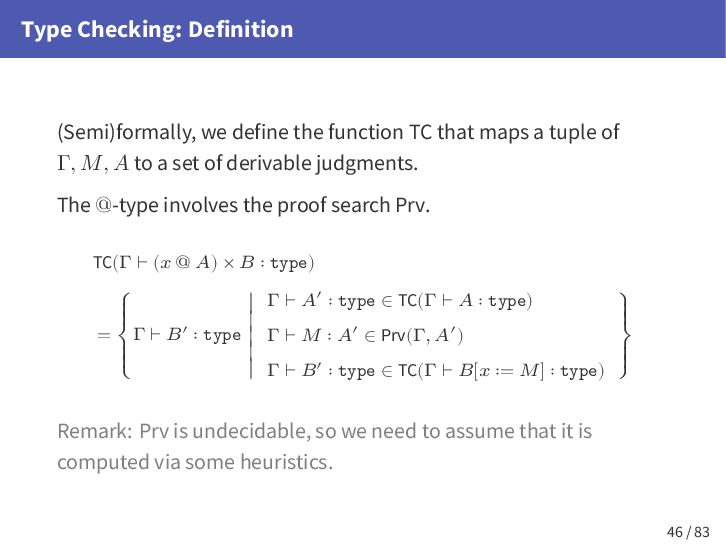
  46. Type Checking: Definition (Semi)formally, we define the function TC that

    maps a tuple of ฮ“, ๐‘€, ๐ด to a set of derivable judgments. The @-type involves the proof search Prv. TC(ฮ“ โŠข (๐‘ฅ @ ๐ด) ร— ๐ต โˆถ type) = โŽง { { โŽจ { { โŽฉ ฮ“ โŠข ๐ตโ€ฒ โˆถ type โˆฃ โˆฃ โˆฃ โˆฃ โˆฃ ฮ“ โŠข ๐ดโ€ฒ โˆถ type โˆˆ TC(ฮ“ โŠข ๐ด โˆถ type) ฮ“ โŠข ๐‘€ โˆถ ๐ดโ€ฒ โˆˆ Prv(ฮ“, ๐ดโ€ฒ) ฮ“ โŠข ๐ตโ€ฒ โˆถ type โˆˆ TC(ฮ“ โŠข ๐ต[๐‘ฅ โˆถ= ๐‘€] โˆถ type) โŽซ } } โŽฌ } } โŽญ Remark: Prv is undecidable, so we need to assume that it is computed via some heuristics. 46 / 83
  47. Type Checking: Definition [contd.] Other rules propagate the non-deterministic results.

    Example: (ฮฃ๐น) TC(ฮ“ โŠข (๐‘ฅ โˆถ ๐ด) ร— ๐ต โˆถ type) = โŽง { โŽจ { โŽฉ ฮ“ โŠข (๐‘ฅ โˆถ ๐ดโ€ฒ) ร— ๐ตโ€ฒ โˆถ type โˆฃ ฮ“ โŠข ๐ดโ€ฒ โˆถ type โˆˆ TC(ฮ“ โŠข ๐ด โˆถ type) ฮ“, ๐‘ฅ โˆถ ๐ดโ€ฒ โŠข ๐ตโ€ฒ โˆถ type โˆˆ TC(ฮ“, ๐‘ฅ โˆถ ๐ดโ€ฒ โŠข ๐ต โˆถ type) โŽซ } โŽฌ } โŽญ Intuition: eliminate the @-types in ๐ด and ๐ต (which then result in ๐ดโ€ฒ and ๐ตโ€ฒ) and โ€œreconstructโ€ them into a ฮฃ-type. 47 / 83
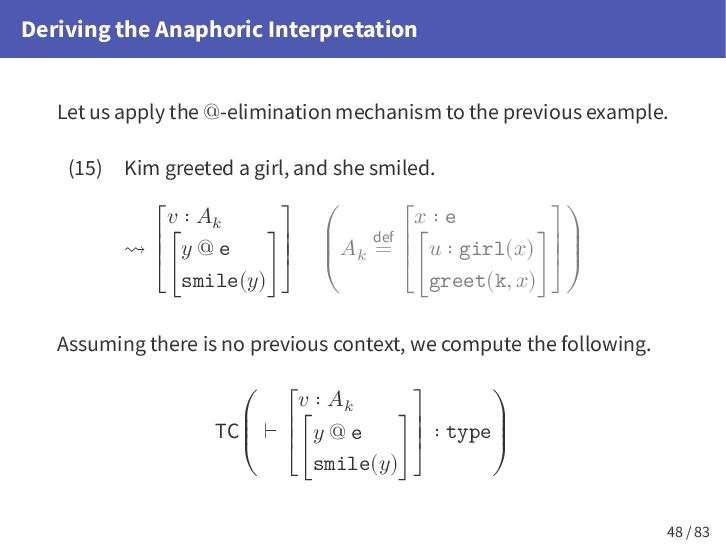
  48. Deriving the Anaphoric Interpretation Let us apply the @-elimination mechanism

    to the previous example. (15) Kim greeted a girl, and she smiled. โ‡ โŽก โŽข โŽข โŽฃ ๐‘ฃ โˆถ ๐ด๐‘˜ [ ๐‘ฆ @ e smile(๐‘ฆ) ] โŽค โŽฅ โŽฅ โŽฆ โŽ› โŽœ โŽœ โŽœ โŽ ๐ด๐‘˜ def = โŽก โŽข โŽข โŽฃ ๐‘ฅ โˆถ e [ ๐‘ข โˆถ girl(๐‘ฅ) greet(k, ๐‘ฅ) ] โŽค โŽฅ โŽฅ โŽฆ โŽž โŽŸ โŽŸ โŽŸ โŽ  Assuming there is no previous context, we compute the following. TC โŽ› โŽœ โŽœ โŽœ โŽ โŠข โŽก โŽข โŽข โŽฃ ๐‘ฃ โˆถ ๐ด๐‘˜ [ ๐‘ฆ @ e smile(๐‘ฆ) ] โŽค โŽฅ โŽฅ โŽฆ โˆถ type โŽž โŽŸ โŽŸ โŽŸ โŽ  48 / 83
  49. Deriving the Anaphoric Interpretation [contd.] (i) Check the 1st conjunct:

    TC( โŠข ๐ด๐‘˜ โˆถ type) โ€ข trivial: { โŠข ๐ด๐‘˜ โˆถ type} (ii) Check the 2nd conjunct: TC(๐‘ฃ โˆถ ๐ด๐‘˜ โŠข (๐‘ฆ @ e) ร— smile(๐‘ฆ) โˆถ type) (i) TC(๐‘ฃ โˆถ ๐ด๐‘˜ โŠข e โˆถ type) (trivial) (ii) Proof search: Prv(๐‘ฃ โˆถ ๐ด๐‘˜ , e) = {๐‘ฃ โˆถ ๐ด๐‘˜ โŠข ๐œ‹1 ๐‘ฃ โˆถ e} (iii) TC(๐‘ฃ โˆถ ๐ด๐‘˜ โŠข smile(๐œ‹1 ๐‘ฃ) โˆถ type) (trivial) As a result, we obtain { โŠข [ ๐‘ฃ โˆถ ๐ด๐‘˜ smile(๐œ‹1 ๐‘ฃ) ] โˆถ type}. 49 / 83
  50. Deriving the Anaphoric Interpretation [contd.] Crucially, we can use the

    local variable ๐‘ฃ โˆถ ๐ด๐‘˜ in the proof search (as the well-formedness of ๐ต can depend on ๐‘ฅ โˆถ ๐ด in (๐‘ฅ โˆถ ๐ด) ร— ๐ต). โŠข โŽก โŽข โŽข โŽฃ ๐‘ฃ โˆถ ๐ด๐‘˜ [ ๐‘ฆ @ e smile(๐‘ฆ) ] โŽค โŽฅ โŽฅ โŽฆ โˆถ type โŠข [ ๐‘ฃ โˆถ ๐ด๐‘˜ smile(๐œ‹1 ๐‘ฃ) ] โˆถ type type checking ๐‘ฆ @ e ๐‘ฆ โˆถ= ๐œ‹1 ๐‘ฃ ๐‘ฃ โˆถ ๐ด๐‘˜ โŠข โˆถ e We will refer to a typing context with local variables (here, ๐‘ฃ โˆถ ๐ด๐‘˜ ) as a local typing context. 50 / 83
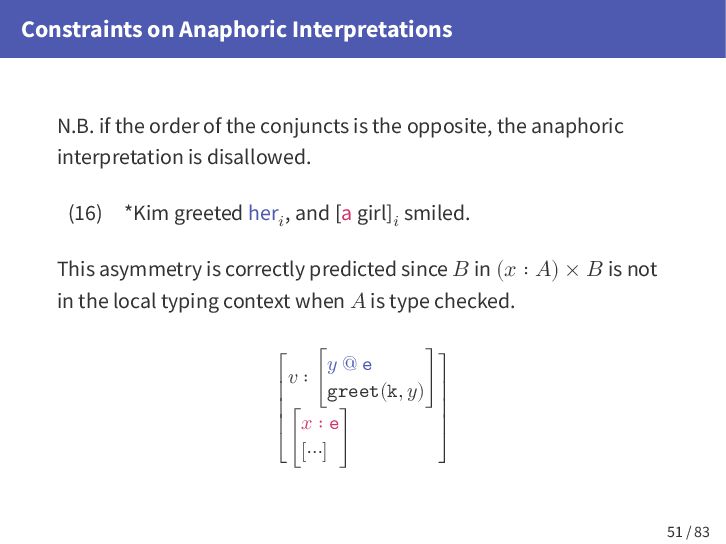
  51. Constraints on Anaphoric Interpretations N.B. if the order of the

    conjuncts is the opposite, the anaphoric interpretation is disallowed. (16) *Kim greeted her๐‘– , and [a girl]๐‘– smiled. This asymmetry is correctly predicted since ๐ต in (๐‘ฅ โˆถ ๐ด) ร— ๐ต is not in the local typing context when ๐ด is type checked. โŽก โŽข โŽข โŽข โŽฃ ๐‘ฃ โˆถ [ ๐‘ฆ @ e greet(k, ๐‘ฆ) ] [ ๐‘ฅ โˆถ e [โ‹ฏ] ] โŽค โŽฅ โŽฅ โŽฅ โŽฆ 51 / 83
  52. Constraints on Anaphoric Interpretations [contd.] We can account for the

    unavailability of inter-sentential anaphora as failure of the proof search. (11) *Kim greeted [every girl]๐‘– , and she๐‘– smiled. ๐‘ฃ โˆถ (๐‘ฅ โˆถ e) โ†’ (๐‘ข โˆถ girl(๐‘ฅ)) โ†’ greet(k, ๐‘ฅ) โŠข ??? โˆถ e In summary ... DTS identifies the availability of anaphora with the proof con- structability in the local typing context. 52 / 83
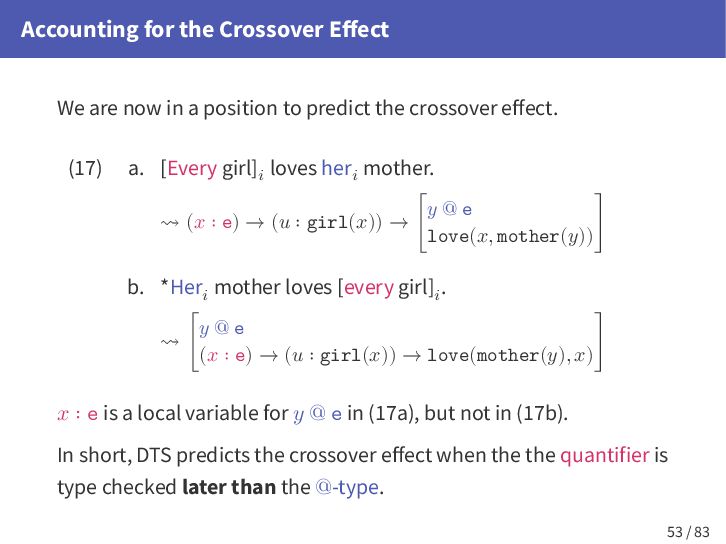
  53. Accounting for the Crossover Effect We are now in a

    position to predict the crossover effect. (17) a. [Every girl]๐‘– loves her๐‘– mother. โ‡ (๐‘ฅ โˆถ e) โ†’ (๐‘ข โˆถ girl(๐‘ฅ)) โ†’ [ ๐‘ฆ @ e love(๐‘ฅ, mother(๐‘ฆ)) ] b. *Her๐‘– mother loves [every girl]๐‘– . โ‡ [ ๐‘ฆ @ e (๐‘ฅ โˆถ e) โ†’ (๐‘ข โˆถ girl(๐‘ฅ)) โ†’ love(mother(๐‘ฆ), ๐‘ฅ) ] ๐‘ฅ โˆถ e is a local variable for ๐‘ฆ @ e in (17a), but not in (17b). In short, DTS predicts the crossover effect when the the quantifier is type checked later than the @-type. 53 / 83
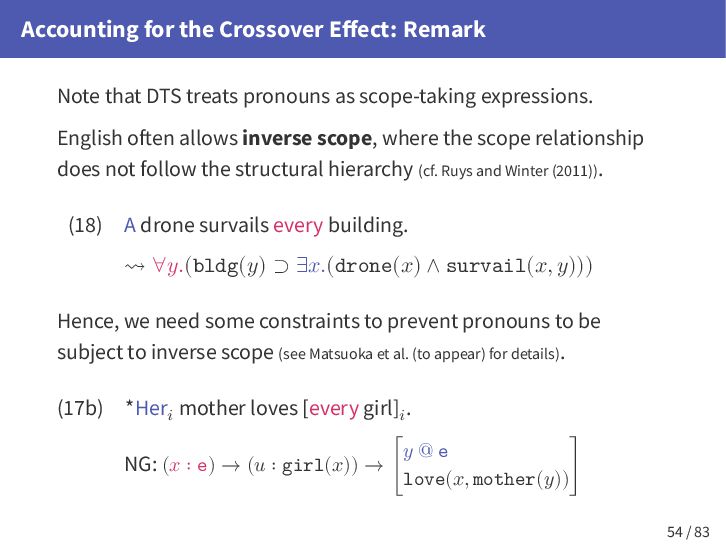
  54. Accounting for the Crossover Effect: Remark Note that DTS treats

    pronouns as scope-taking expressions. English often allows inverse scope, where the scope relationship does not follow the structural hierarchy (cf. Ruys and Winter (2011)). (18) A drone survails every building. โ‡ โˆ€๐‘ฆ.(bldg(๐‘ฆ) โŠƒ โˆƒ๐‘ฅ.(drone(๐‘ฅ) โˆง survail(๐‘ฅ, ๐‘ฆ))) Hence, we need some constraints to prevent pronouns to be subject to inverse scope (see Matsuoka et al. (to appear) for details). (17b) *Her๐‘– mother loves [every girl]๐‘– . NG: (๐‘ฅ โˆถ e) โ†’ (๐‘ข โˆถ girl(๐‘ฅ)) โ†’ [ ๐‘ฆ @ e love(๐‘ฅ, mother(๐‘ฆ)) ] 54 / 83
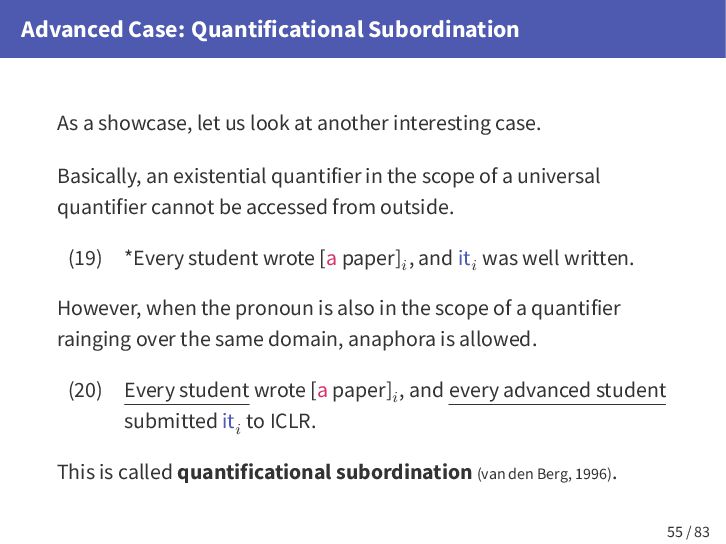
  55. Advanced Case: Quantificational Subordination As a showcase, let us look

    at another interesting case. Basically, an existential quantifier in the scope of a universal quantifier cannot be accessed from outside. (19) *Every student wrote [a paper]๐‘– , and it๐‘– was well written. However, when the pronoun is also in the scope of a quantifier rainging over the same domain, anaphora is allowed. (20) Every student wrote [a paper]๐‘– , and every advanced student submitted it๐‘– to ICLR. This is called quantificational subordination (van den Berg, 1996). 55 / 83
  56. Advanced Case: Quantificational Subordination [contd.] In DTS, quantificational subordination can

    be accounted for as proof construction with a function (Tanaka, 2021). โŽก โŽข โŽข โŽข โŽข โŽฃ ๐‘“ โˆถ (๐‘ฅ โˆถ e) โ†’ (๐‘ข โˆถ student(๐‘ฅ)) โ†’ โŽก โŽข โŽฃ ๐‘ฆ โˆถ e [ ๐‘ฃ โˆถ paper(๐‘ฆ) write(๐‘ฅ, ๐‘ฆ) ] โŽค โŽฅ โŽฆ (๐‘ฅ โˆถ e) โ†’ (๐‘ขโ€ฒ โˆถ [ ๐‘ข โˆถ student(๐‘ฅ) advanced(๐‘ฅ) ]) โ†’ [ ๐‘ง @ e submit(๐‘ฅ, ๐‘ง) ] โŽค โŽฅ โŽฅ โŽฅ โŽฅ โŽฆ The result of proof search: ๐‘“ โˆถ (๐‘ฅ โˆถ e) โ†’ โ‹ฏ , ๐‘ฅ โˆถ e, ๐‘ขโ€ฒ โˆถ [ ๐‘ข โˆถ student(๐‘ฅ) โ‹ฏ ] โŠข ๐œ‹1 ((๐‘“๐‘ฅ)(๐œ‹1 ๐‘ขโ€ฒ)) โˆถ e 56 / 83
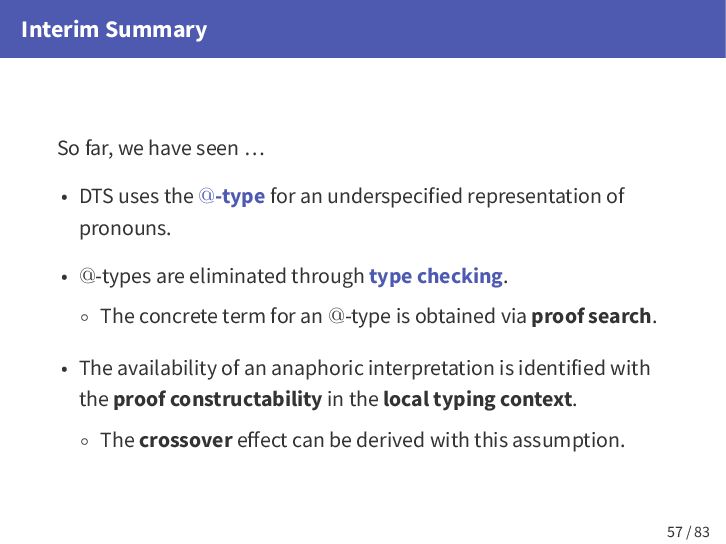
  57. Interim Summary So far, we have seen โ€ฆ โ€ข DTS

    uses the @-type for an underspecified representation of pronouns. โ€ข @-types are eliminated through type checking. โˆ˜ The concrete term for an @-type is obtained via proof search. โ€ข The availability of an anaphoric interpretation is identified with the proof constructability in the local typing context. โˆ˜ The crossover effect can be derived with this assumption. 57 / 83
  58. Interim Summary [contd.] We have only considered the type e

    for the ๐ด in (๐‘ฅ @ ๐ด) ร— ๐ต. Can it be otherwise? Yes, and it leads to an explanation of another phenomenon, called presupposition, which we turn to next. 58 / 83
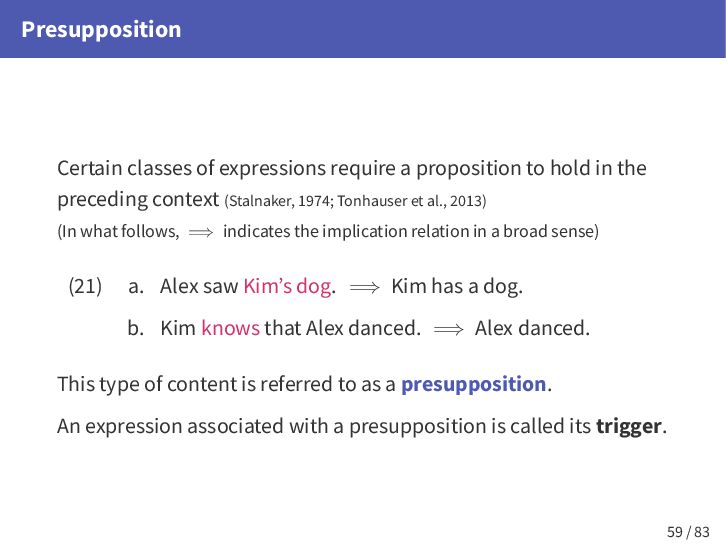
  59. Presupposition Certain classes of expressions require a proposition to hold

    in the preceding context (Stalnaker, 1974; Tonhauser et al., 2013) (In what follows, โŸน indicates the implication relation in a broad sense) (21) a. Alex saw Kimโ€™s dog. โŸน Kim has a dog. b. Kim knows that Alex danced. โŸน Alex danced. This type of content is referred to as a presupposition. An expression associated with a presupposition is called its trigger. 59 / 83
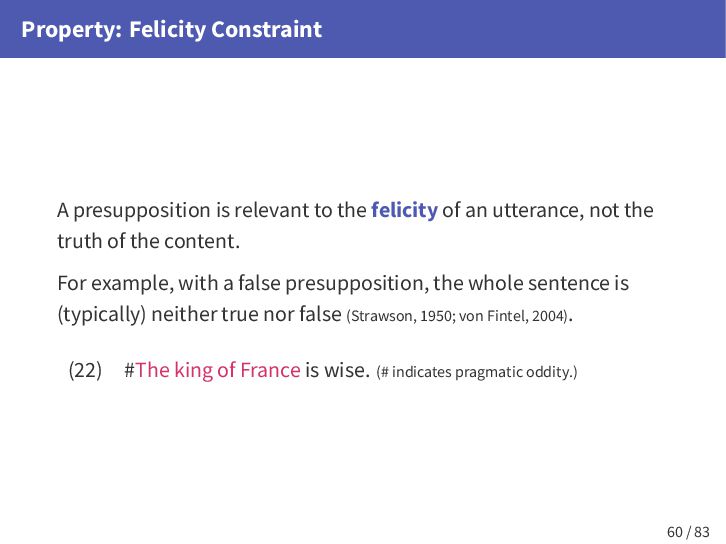
  60. Property: Felicity Constraint A presupposition is relevant to the felicity

    of an utterance, not the truth of the content. For example, with a false presupposition, the whole sentence is (typically) neither true nor false (Strawson, 1950; von Fintel, 2004). (22) #The king of France is wise. (# indicates pragmatic oddity.) 60 / 83
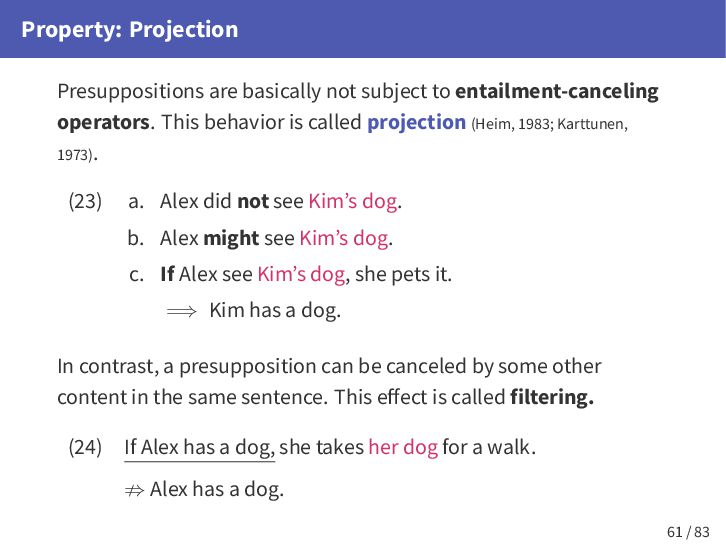
  61. Property: Projection Presuppositions are basically not subject to entailment-canceling operators.

    This behavior is called projection (Heim, 1983; Karttunen, 1973). (23) a. Alex did not see Kimโ€™s dog. b. Alex might see Kimโ€™s dog. c. If Alex see Kimโ€™s dog, she pets it. โŸน Kim has a dog. In contrast, a presupposition can be canceled by some other content in the same sentence. This effect is called filtering. (24) If Alex has a dog, she takes her dog for a walk. โ‡ Alex has a dog. 61 / 83
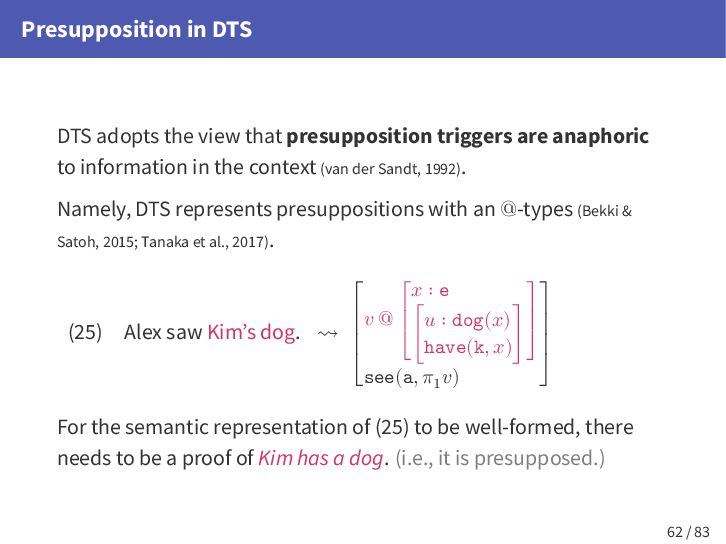
  62. Presupposition in DTS DTS adopts the view that presupposition triggers

    are anaphoric to information in the context (van der Sandt, 1992). Namely, DTS represents presuppositions with an @-types (Bekki & Satoh, 2015; Tanaka et al., 2017). (25) Alex saw Kimโ€™s dog. โ‡ โŽก โŽข โŽข โŽฃ ๐‘ฃ @ โŽก โŽข โŽฃ ๐‘ฅ โˆถ e [ ๐‘ข โˆถ dog(๐‘ฅ) have(k, ๐‘ฅ) ] โŽค โŽฅ โŽฆ see(a, ๐œ‹1 ๐‘ฃ) โŽค โŽฅ โŽฅ โŽฆ For the semantic representation of (25) to be well-formed, there needs to be a proof of Kim has a dog. (i.e., it is presupposed.) 62 / 83
  63. Presupposition in DTS [contd.] Projection can be predicted because the

    well-formedness condition of the @-type is inherited to a more complex type. Example: negation (cf. (23a)) ฮ“ โŠข (๐‘ฅ @ ๐ด) ร— ๐ต โˆถ type โ‹ฏ (ฮ ๐น) ฮ“ โŠข (๐‘ข โˆถ (๐‘ฅ @ ๐ด) ร— ๐ต) โ†’ โŠฅ โˆถ type To complete the type checking of the whole ฮ -type, we anyway need to perform proof search for ๐ด. 63 / 83
  64. Presupposition in DTS [contd.] The filtering effect can be viewed

    as a result of proof search. (24) If Alex has a dog, she takes her dog for a walk. โ‡ โŽ› โŽœ โŽœ โŽœ โŽ ๐‘ฃโ€ฒ โˆถ โŽก โŽข โŽข โŽฃ ๐‘ฅ โˆถ e [ ๐‘ข โˆถ dog(๐‘ฅ) have(a, ๐‘ฅ) ] โŽค โŽฅ โŽฅ โŽฆ โŽž โŽŸ โŽŸ โŽŸ โŽ  โ†’ โŽก โŽข โŽข โŽข โŽฃ ๐‘ฃ @ โŽก โŽข โŽข โŽฃ ๐‘ฅ โˆถ e [ ๐‘ข โˆถ dog(๐‘ฅ) have(a, ๐‘ฅ) ] โŽค โŽฅ โŽฅ โŽฆ takeWalk(a, ๐œ‹ 1 ๐‘ฃ) โŽค โŽฅ โŽฅ โŽฅ โŽฆ The proof search here returns ๐‘ฃโ€ฒ for ๐‘ฃ @ [โ‹ฏ]. Hence, the preceding context does not have to entail Kim has a dog. 64 / 83
  65. Accommodation Even when a presupposition is not in the context,

    the hearer can usually understand the utterance. (26) [Context: the hearer does not know much about the speakerโ€™s personal information] My sister is coming to lunch tomorrow. In such cases, the hearer updates their prior belief to include the presupposed content. This process is called accommodation (Lewis, 1979; von Fintel, 2008). 65 / 83
  66. Accommodation [contd.] Then, how can we model accommodation in DTS?

    Previous studies assume the following operation (in line with other frameworks (e.g., Beaver (2001) and van der Sandt (1992))). Accommodation If proof search ฮ“ โŠข โˆถ ๐ด fails during the type checking of ๐ด, add ๐‘ฅ โˆถ ๐ด to the typing context and rerun the type checking. However, this type of โ€œadd-and-rerunโ€ strategy faces a problem ... 66 / 83
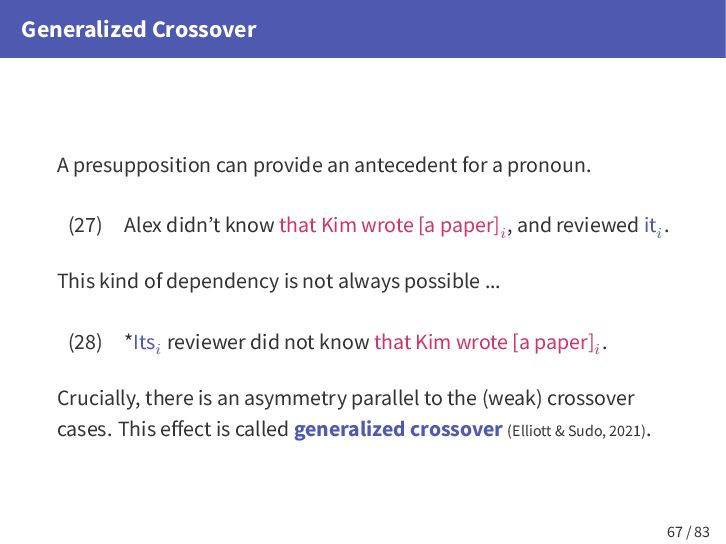
  67. Generalized Crossover A presupposition can provide an antecedent for a

    pronoun. (27) Alex didnโ€™t know that Kim wrote [a paper]๐‘– , and reviewed it๐‘– . This kind of dependency is not always possible ... (28) *Its๐‘– reviewer did not know that Kim wrote [a paper]๐‘– . Crucially, there is an asymmetry parallel to the (weak) crossover cases. This effect is called generalized crossover (Elliott & Sudo, 2021). 67 / 83
  68. Generalized Crossover [contd.] If we add the presupposed content and

    rerun the type checking, it allows its to access a paper in (28)! โ€ข Initial state: ฮ“ โŠข (๐‘ฆ @ e) ร— ((๐‘ฃ @ ๐ด๐‘˜ ) ร— โ‹ฏ) โˆถ type โ€ข Accommodation for ๐‘ฃ: ฮ“ โ†ฆ ฮ“, ๐‘ฃ โˆถ ๐ด๐‘˜ โ€ข Rerun: ฮ“, ๐‘ฃ โˆถ ๐ด๐‘˜ โŠข (๐‘ฆ @ e) ร— โ‹ฏ โˆถ type Problem: the scope relation between the @-types is ignored. โ€ข The same applies to other theories of presupposition as well. โ€ข Furthermore, no previous account of crossover can account for why quantifiers and presuppositions show similar behavior. 68 / 83
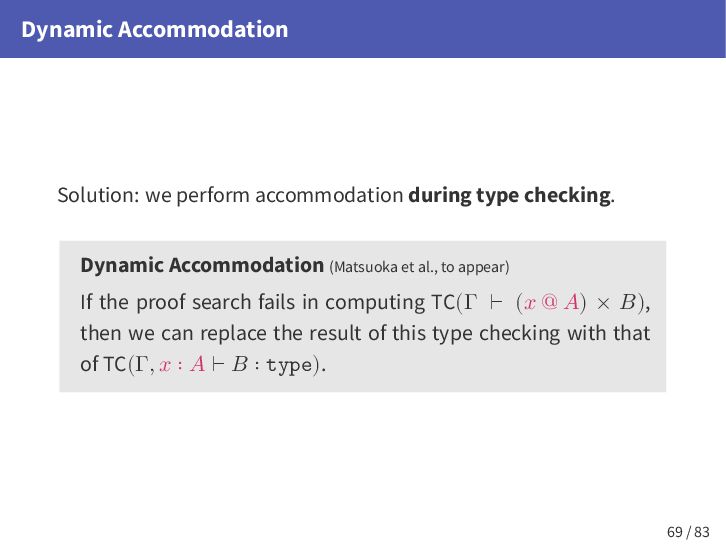
  69. Dynamic Accommodation Solution: we perform accommodation during type checking. Dynamic

    Accommodation (Matsuoka et al., to appear) If the proof search fails in computing TC(ฮ“ โŠข (๐‘ฅ @ ๐ด) ร— ๐ต), then we can replace the result of this type checking with that of TC(ฮ“, ๐‘ฅ โˆถ ๐ด โŠข ๐ต โˆถ type). 69 / 83
  70. Dynamic Accommodation [contd.] (29) Alex did not know that Kim

    wrote a paper. โ‡ ยฌ [ ๐‘ข @ ๐ด๐‘˜ know(a, ๐ด๐‘˜ ) ] โŽ› โŽœ โŽœ โŽœ โŽ ๐ด๐‘˜ def = โŽก โŽข โŽฃ ๐‘ฅ โˆถ e [ ๐‘ข โˆถ paper(๐‘ฅ) write(k, ๐‘ฅ) ] โŽค โŽฅ โŽฆ โŽž โŽŸ โŽŸ โŽŸ โŽ  In the type checking, ๐‘ข โˆถ ๐ด๐‘˜ is added to the typing context. โŠข ยฌ [ ๐‘ข @ ๐ด๐‘˜ know(a, ๐ด๐‘˜ ) ] โˆถ type ๐‘ข โˆถ ๐ด๐‘˜ โŠข ยฌknow(a, ๐ด๐‘˜ ) โˆถ type type checking ๐‘ข @ ๐ด๐‘˜ (accomm.) โŠข โˆถ ๐ด๐‘˜ 70 / 83
  71. Dynamic Accommodation [contd.] The accommodated content can be accessed from

    a subsequent proof search. (27) Alex didnโ€™t know that Kim wrote [a paper]๐‘– , and reviewed it๐‘– . โŠข โŽก โŽข โŽข โŽข โŽฃ ๐‘ค โˆถ ยฌ [ ๐‘ฃ @ ๐ด๐‘˜ know(a, ๐ด๐‘˜ ) ] [ ๐‘ฆ @+ e review(a, ๐‘ฆ) ] โŽค โŽฅ โŽฅ โŽฅ โŽฆ โˆถ type ๐‘ฃ โˆถ ๐ด๐‘˜ โŠข [ ๐‘ค โˆถ ยฌknow(a, ๐ด๐‘˜ ) review(a, ๐œ‹1 ๐‘ฃ) ] โˆถ type type checking ๐‘ฃ @ ๐ด๐‘˜ (accomm.) โŠข โˆถ ๐ด๐‘˜ ๐‘ฆ @+ e ๐‘ฆ โˆถ= ๐œ‹1 ๐‘ฃ ๐‘ฃ โˆถ ๐ด๐‘˜ , ๐‘ค โˆถ ยฌknow(a, ๐ด๐‘˜ ) โŠข โˆถ e 71 / 83
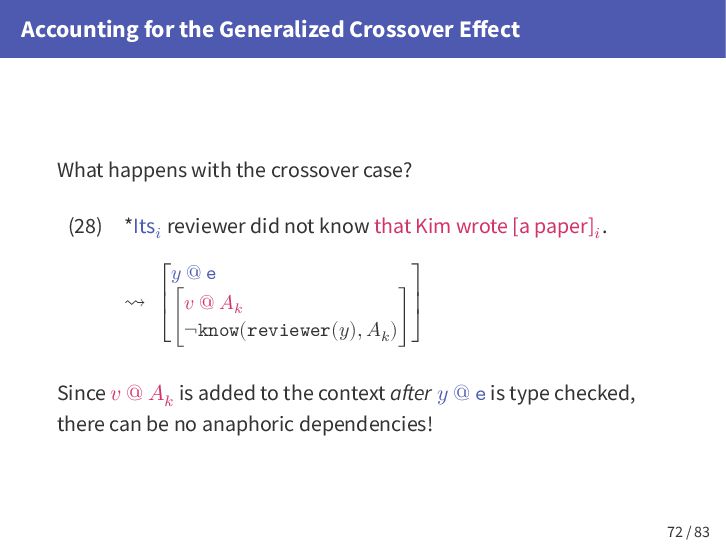
  72. Accounting for the Generalized Crossover Effect What happens with the

    crossover case? (28) *Its๐‘– reviewer did not know that Kim wrote [a paper]๐‘– . โ‡ โŽก โŽข โŽฃ ๐‘ฆ @ e [ ๐‘ฃ @ ๐ด๐‘˜ ยฌknow(reviewer(๐‘ฆ), ๐ด๐‘˜ ) ] โŽค โŽฅ โŽฆ Since ๐‘ฃ @ ๐ด๐‘˜ is added to the context after ๐‘ฆ @ e is type checked, there can be no anaphoric dependencies! 72 / 83
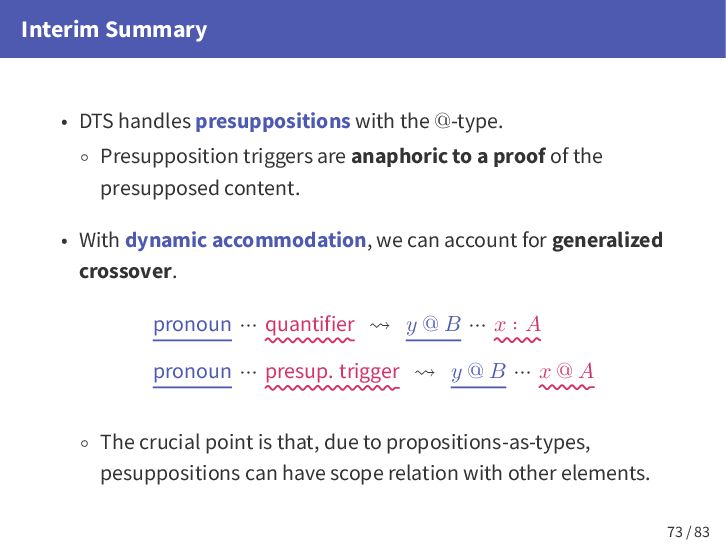
  73. Interim Summary โ€ข DTS handles presuppositions with the @-type. โˆ˜

    Presupposition triggers are anaphoric to a proof of the presupposed content. โ€ข With dynamic accommodation, we can account for generalized crossover. pronoun โ‹ฏ quantifier โ‡ ๐‘ฆ @ ๐ต โ‹ฏ ๐‘ฅ โˆถ ๐ด pronoun โ‹ฏ presup. trigger โ‡ ๐‘ฆ @ ๐ต โ‹ฏ ๐‘ฅ @ ๐ด โˆ˜ The crucial point is that, due to propositions-as-types, pesuppositions can have scope relation with other elements. 73 / 83
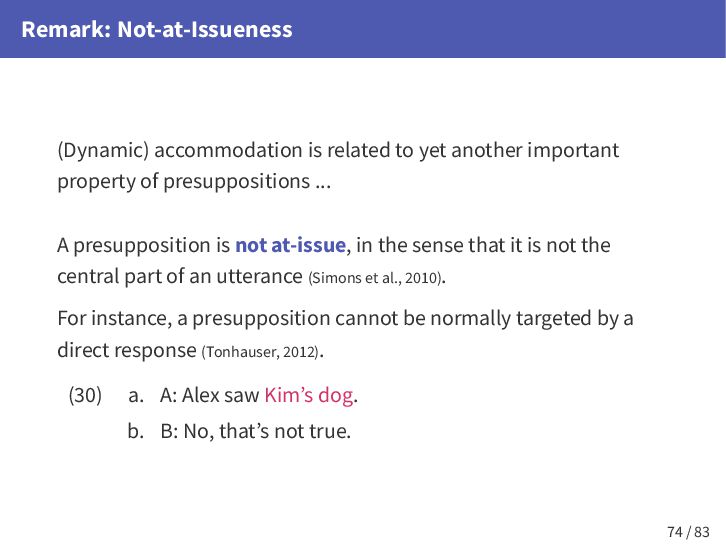
  74. Remark: Not-at-Issueness (Dynamic) accommodation is related to yet another important

    property of presuppositions ... A presupposition is not at-issue, in the sense that it is not the central part of an utterance (Simons et al., 2010). For instance, a presupposition cannot be normally targeted by a direct response (Tonhauser, 2012). (30) a. A: Alex saw Kimโ€™s dog. b. B: No, thatโ€™s not true. 74 / 83
  75. Remark: At-Issueness [contd.] Due to accommodation, type checking can extend

    the typing context (as well as rewrite the semantic representation). โ€ข Type checking is a process that determines the utterance content. โ€ข The content added to the context duruing this process does not count as the โ€œcentral messageโ€ of the utterance (Matsuoka et al., 2024). ฮ“ โŠข ๐ด โˆถ type ฮ“, not-at-issue ฮ” โŠข at-issue ๐ดโ€ฒ โˆถ type ฮ“, ฮ”, ๐‘ฅ โˆถ ๐ดโ€ฒ (i) type checking (ii) addition 75 / 83
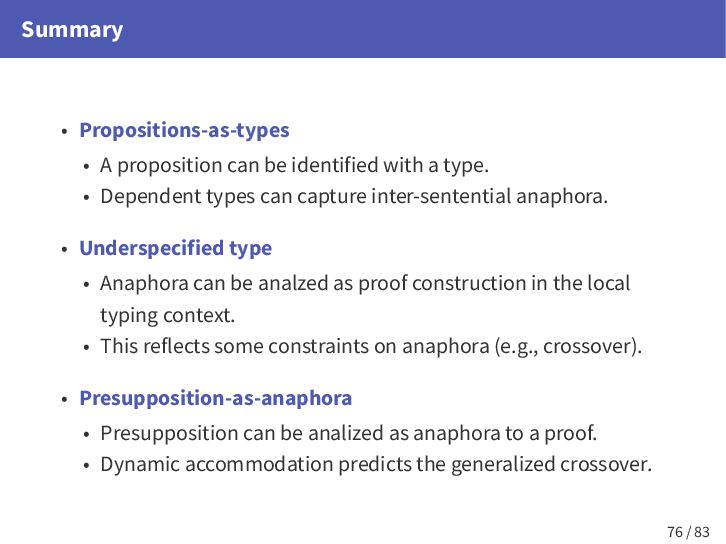
  76. Summary โ€ข Propositions-as-types โ€ข A proposition can be identified with

    a type. โ€ข Dependent types can capture inter-sentential anaphora. โ€ข Underspecified type โ€ข Anaphora can be analzed as proof construction in the local typing context. โ€ข This reflects some constraints on anaphora (e.g., crossover). โ€ข Presupposition-as-anaphora โ€ข Presupposition can be analized as anaphora to a proof. โ€ข Dynamic accommodation predicts the generalized crossover. 76 / 83
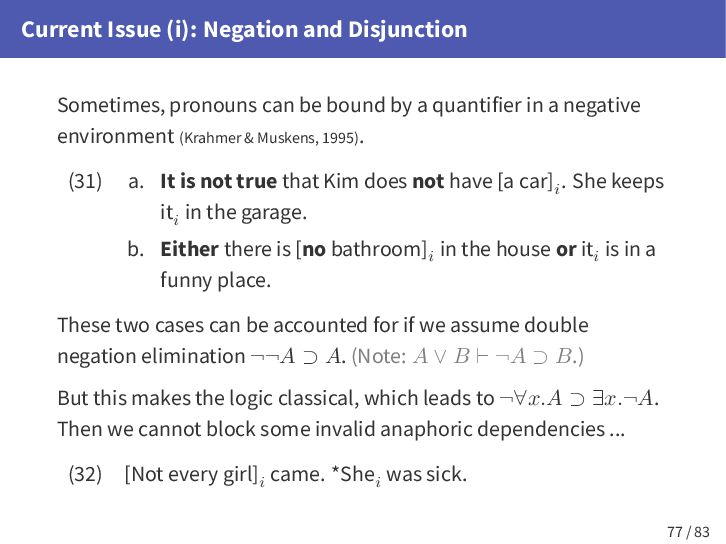
  77. Current Issue (i): Negation and Disjunction Sometimes, pronouns can be

    bound by a quantifier in a negative environment (Krahmer & Muskens, 1995). (31) a. It is not true that Kim does not have [a car]๐‘– . She keeps it๐‘– in the garage. b. Either there is [no bathroom]๐‘– in the house or it๐‘– is in a funny place. These two cases can be accounted for if we assume double negation elimination ยฌยฌ๐ด โŠƒ ๐ด. (Note: ๐ด โˆจ ๐ต โŠข ยฌ๐ด โŠƒ ๐ต.) But this makes the logic classical, which leads to ยฌโˆ€๐‘ฅ.๐ด โŠƒ โˆƒ๐‘ฅ.ยฌ๐ด. Then we cannot block some invalid anaphoric dependencies ... (32) [Not every girl]๐‘– came. *She๐‘– was sick. 77 / 83
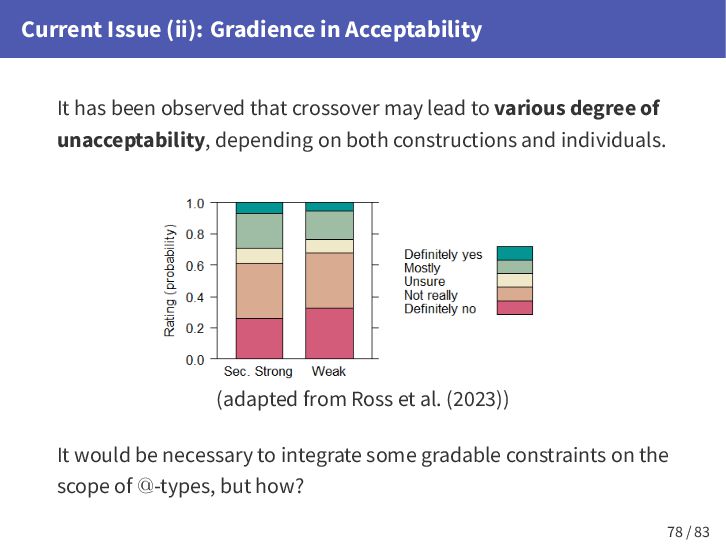
  78. Current Issue (ii): Gradience in Acceptability It has been observed

    that crossover may lead to various degree of unacceptability, depending on both constructions and individuals. (adapted from Ross et al. (2023)) It would be necessary to integrate some gradable constraints on the scope of @-types, but how? 78 / 83
  79. References i Beaver, D. (2001). Presupposition and assertion in dynamic

    semantics. CSLI Publications. Bekki, D. (2014). Representing anaphora with dependent types. In N. Asher & S. Soloviev (Eds.), Logical Aspects of Computational Linguistics (pp. 14โ€“29). Springer Berlin Heidelberg. Bekki, D. (2023). A proof-theoretic analysis of weak crossover. In K. Yada, Y. Takama, K. Mineshima, & K. Satoh (Eds.), New Frontiers in Artificial Intelligence (pp. 228โ€“241). Springer Nature Switzerland. https://doi.org/10.1007/978-3-031-36190-6\_16 Bekki, D., & Mineshima, K. (2017). Context-passing and underspecification in dependent type semantics. In S. Chatzikyriakidis & Z. Luo (Eds.), Modern Perspectives in Type-Theoretical Semantics (pp. 11โ€“41). Springer International Publishing. https://doi.org/10.1007/978-3-319-50422-3\_2 Bekki, D., & Satoh, M. (2015). Calculating projections via type checking. In R. Cooper (Ed.), ESSLLI proceedings of the TYTLES workshop on Type Theory and Lexical Semantics. Elliott, P. D., & Sudo, Y. (2021). Generalised Crossover. Semantics and Linguistic Theory, 30, 396โ€“408. https://doi.org/10.3765/salt.v30i0.4841 Groenendijk, J., & Stokhof, M. (1991). Dynamic predicate logic. Linguistics and Philosophy, 14(1), 39โ€“100. https://doi.org/10.1007/BF00628304 79 / 83
  80. References ii Heim, I. (1983). On the projection problem for

    presuppositions. Proceedings of the Second West Coast Conference on Formal Linguistics, 114โ€“125. Howard, W. A. (1980). The formulae-as-types notion of construction. In H. Curry, H. B., S. J. Roger, & P. Jonathan (Eds.), To H. B. Curry: Essays on Combinatory Logic, Lambda Calculus, and Formalism. Academic Press. Karttunen, L. (1973). Presuppositions of compound sentences. Linguistic Inquiry, 4(2), 169โ€“193. Krahmer, E., & Muskens, R. (1995). Negation and disjunction in discourse representation theory. Journal of Semantics, 12(4), 357โ€“376. https://doi.org/10.1093/jos/12.4.357 Lewis, D. (1979). Scorekeeping in a language game. Journal of Philosophical Logic, 8(1), 339โ€“359. https://doi.org/10.1007/BF00258436 Martin-Lรถf, P. (1984). Intuitionistic type theory [Notes by Giovanni Sambin of a series of lectures given in Padua, June 1980]. Bibliopolis. 80 / 83
  81. References iii Matsuoka, D., Bekki, D., & Yanaka, H. (2024).

    Appositive projection as implicit context extension in dependent type semantics. In D. Bekki, K. Mineshima, & E. McCready (Eds.), Logic and Engineering of Natural Language Semantics (pp. 224โ€“243). Springer Nature Switzerland. https://doi.org/10.1007/978-3-031-60878-0_13 Matsuoka, D., Bekki, D., & Yanaka, H. (to appear). A propositions-as-types approach to the generalised crossover effect. Proceedings of Sinn und Bedeutung, 29. Postal, P. (1971). Cross-Over Phenomena. Holt, Rinehart; Winston. Ranta, A. (1995). Type-Theoretical Grammar. Oxford University Press. https://doi.org/10.1093/oso/9780198538578.001.0001 Ross, H., Chierchia, G., & Davidson, K. (2023). Quantifying weak and strong crossover for wh-crossover and proper names. Proceedings of Sinn und Bedeutung, 27, 535โ€“553. https://doi.org/10.18148/sub/2023.v27.1085 Ruys, E., & Winter, Y. (2011). Quantifier scope in formal linguistics. In D. M. Gabbay & F. Guenthner (Eds.), Handbook of philosophical logic: Volume 16 (pp. 159โ€“225). Springer Netherlands. https://doi.org/10.1007/978-94-007-0479-4_3 Safir, K. (2017). Weak crossover. In The Wiley Blackwell Companion to Syntax, Second Edition (pp. 1โ€“40). John Wiley & Sons, Ltd. https://doi.org/10.1002/9781118358733.wbsyncom090 81 / 83
  82. References iv Simons, M., Tonhauser, J., Beaver, D., & Roberts,

    C. (2010). What projects and why. Semantics and Linguistic Theory, 20, 309โ€“327. https://doi.org/10.3765/salt.v20i0.2584 Stalnaker, R. (1974). Pragmatic presuppositions. In Semantics and philosophy (pp. 197โ€“214). New York University Press. Strawson, P. F. (1950). On referring. Mind, 59(235), 320โ€“344. Sundholm, G. (1986). Proof theory and meaning. In D. Gabbay & F. Guenthner (Eds.), Handbook of philosophical logic: Volume iii: Alternatives in classical logic (pp. 471โ€“506). Springer Netherlands. https://doi.org/10.1007/978-94-009-5203-4_8 Tanaka, R. (2021). Natural language quantification and dependent types [Doctoral dissertation, Ochanomizu University]. Tanaka, R., Mineshima, K., & Bekki, D. (2017). Factivity and presupposition in dependent type semantics. Journal of Language Modelling, 5(2), 385โ€“420. https://doi.org/10.15398/jlm.v5i2.153 Tonhauser, J. (2012). Diagnosing (not-)at-issue content. Proceedings of Semantics of Under-represented Languages of the Americas 6. Tonhauser, J., Beaver, D., Roberts, C., & Simons, M. (2013). Toward a taxonomy of projective content. Language, 89(1), 66โ€“109. https://doi.org/10.1353/lan.2013.0001 82 / 83
  83. References v van den Berg, M. (1996). Some aspects of

    the internal structure of discourse: The dynamics of nominal anaphora [Doctoral dissertation, University of Amsterdam]. van der Sandt, R. (1992). Presupposition Projection as Anaphora Resolution. Journal of Semantics, 9(4), 333โ€“377. https://doi.org/10.1093/jos/9.4.333 von Fintel, K. (2004). Would you believe it? The king of france is back! (Presuppositions and truth-value intuitions). In Descriptions and Beyond. Oxford University Press. https://doi.org/10.1093/oso/9780199270514.003.009 von Fintel, K. (2008). What is presupposition accommodation, again? Philosophical Perspectives, 22(1), 137โ€“170. https://doi.org/10.1111/j.1520-8583.2008.00144.x 83 / 83