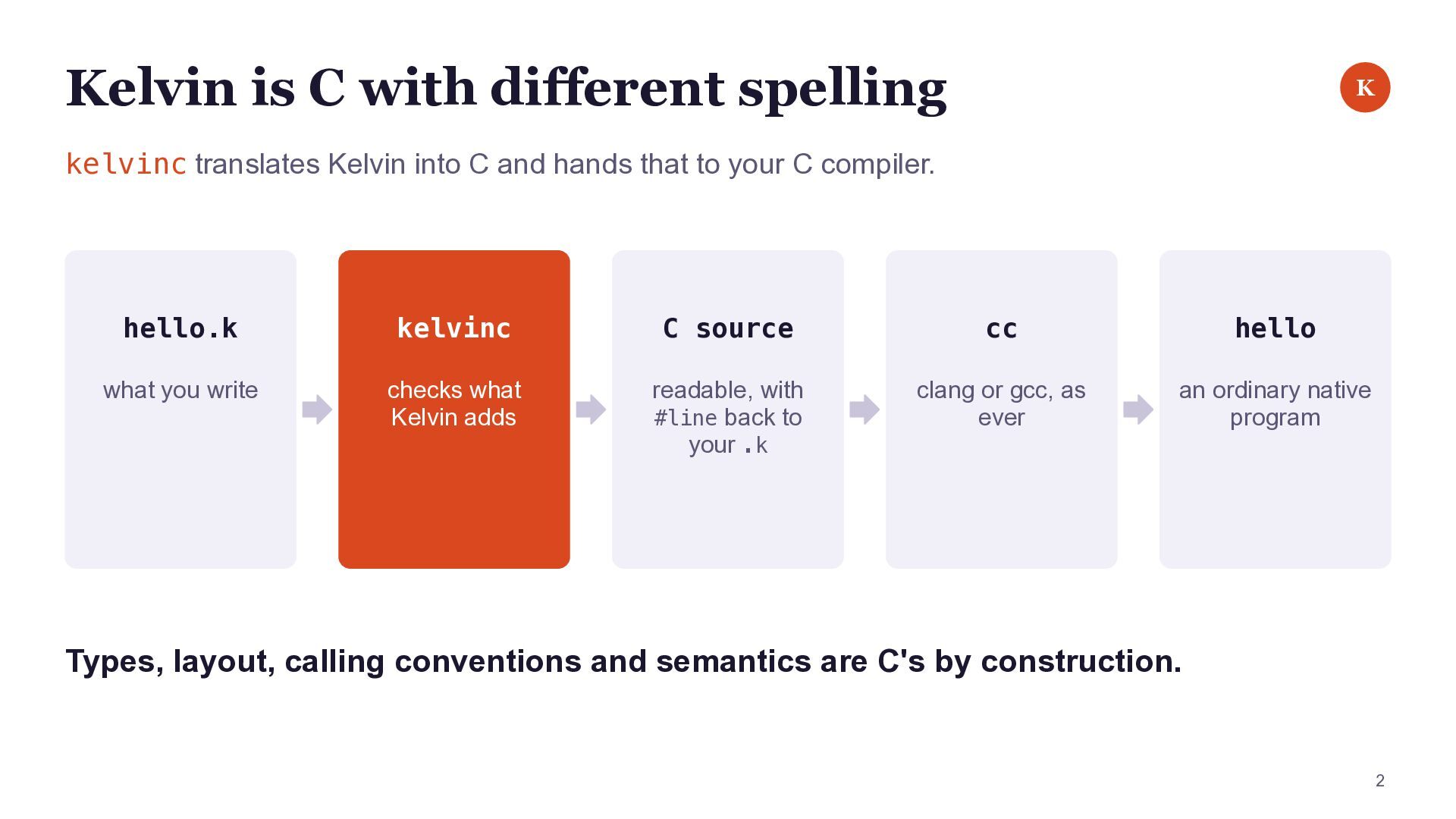
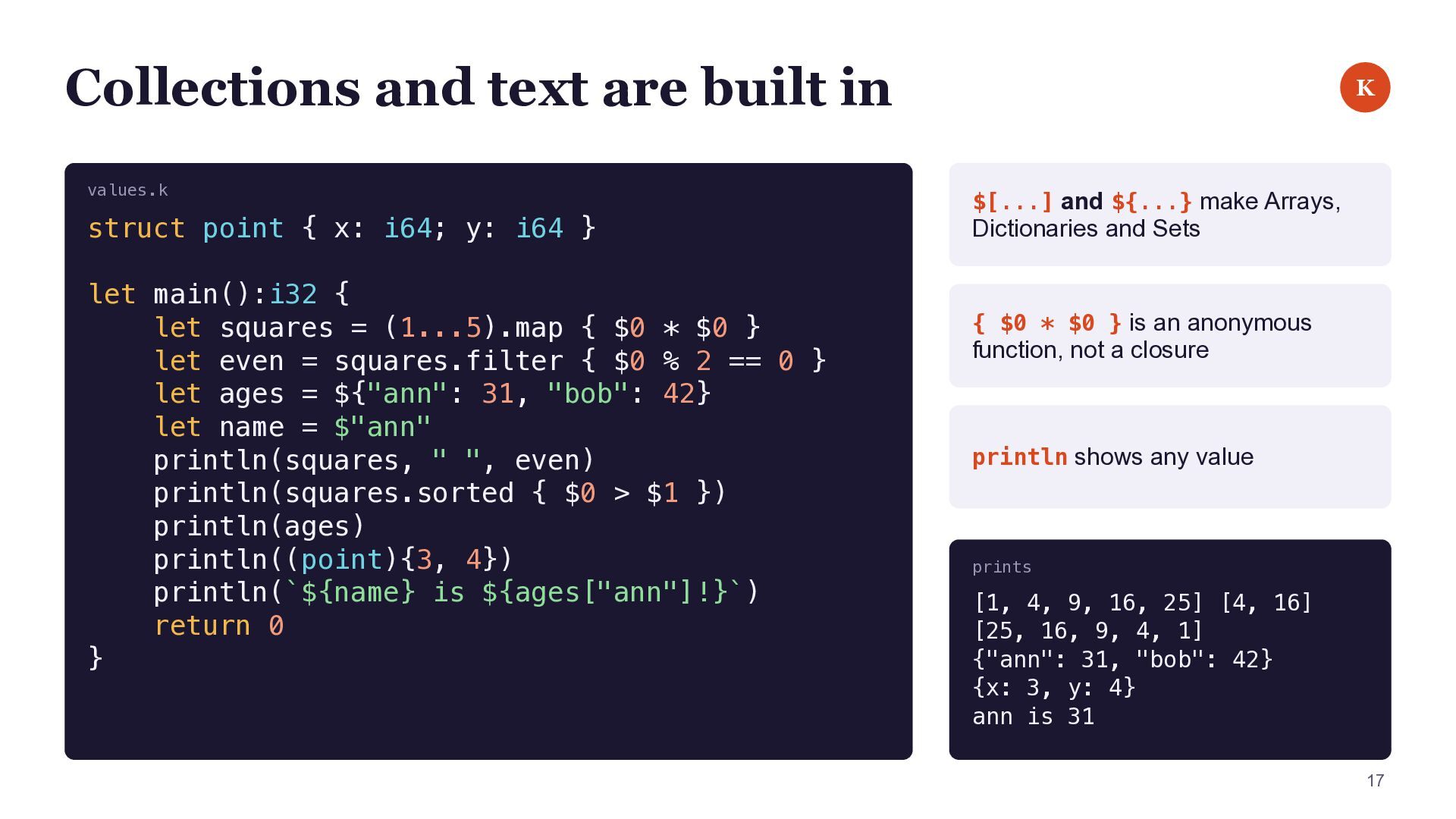
into C and hands that to your C compiler. hello.k kelvinc C source cc hello what you write checks what Kelvin adds readable, with #line back to your .k clang or gcc, as ever an ordinary native program Types, layout, calling conventions and semantics are C's by construction. 2
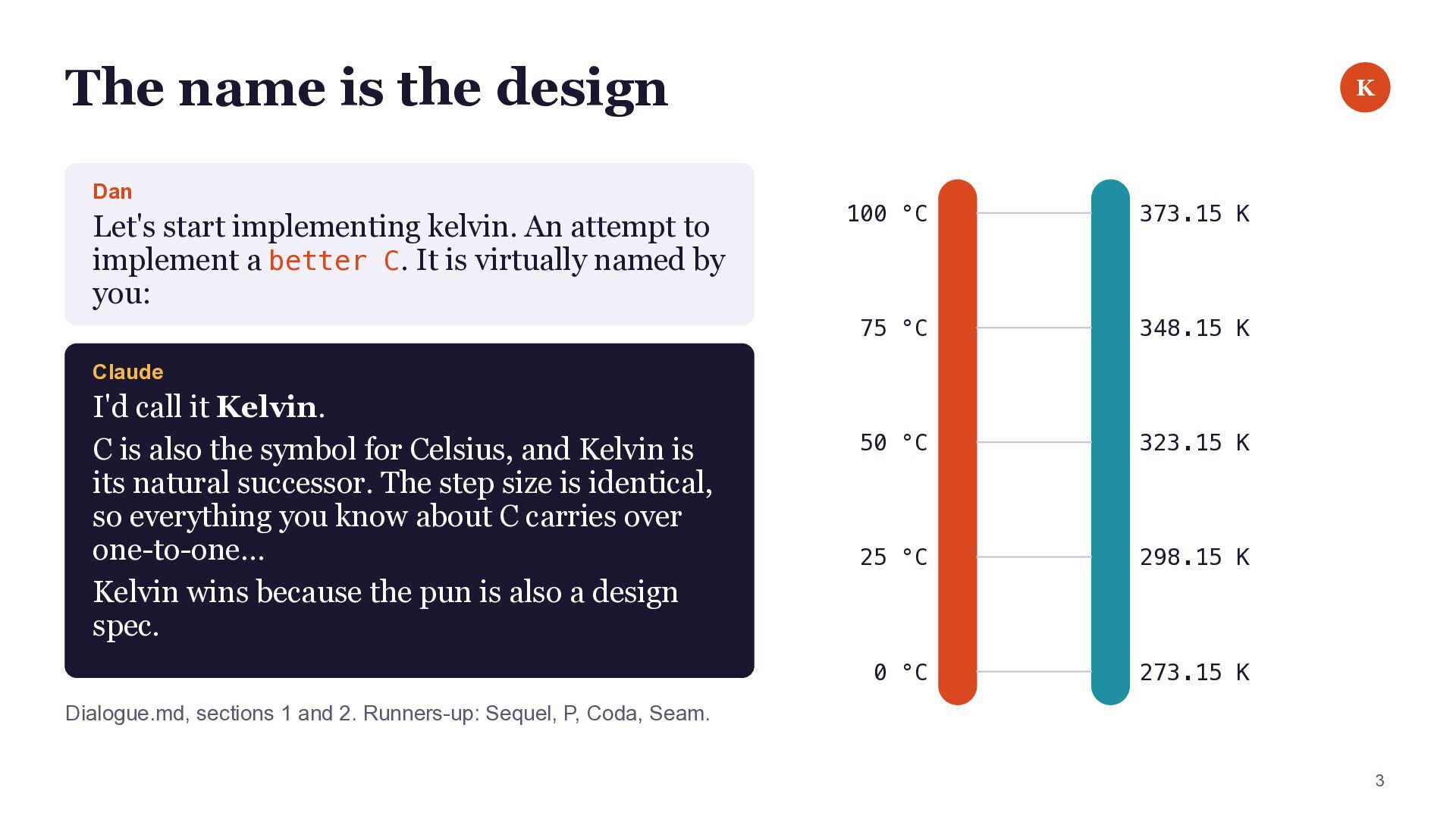
An attempt to implement a better C. It is virtually named by you: K 100 °C 373.15 K 75 °C 348.15 K 50 °C 323.15 K 25 °C 298.15 K 0 °C 273.15 K Claude I'd call it Kelvin. C is also the symbol for Celsius, and Kelvin is its natural successor. The step size is identical, so everything you know about C carries over one-to-one… Kelvin wins because the pun is also a design spec. Dialogue.md, sections 1 and 2. Runners-up: Sequel, P, Coda, Seam. 3
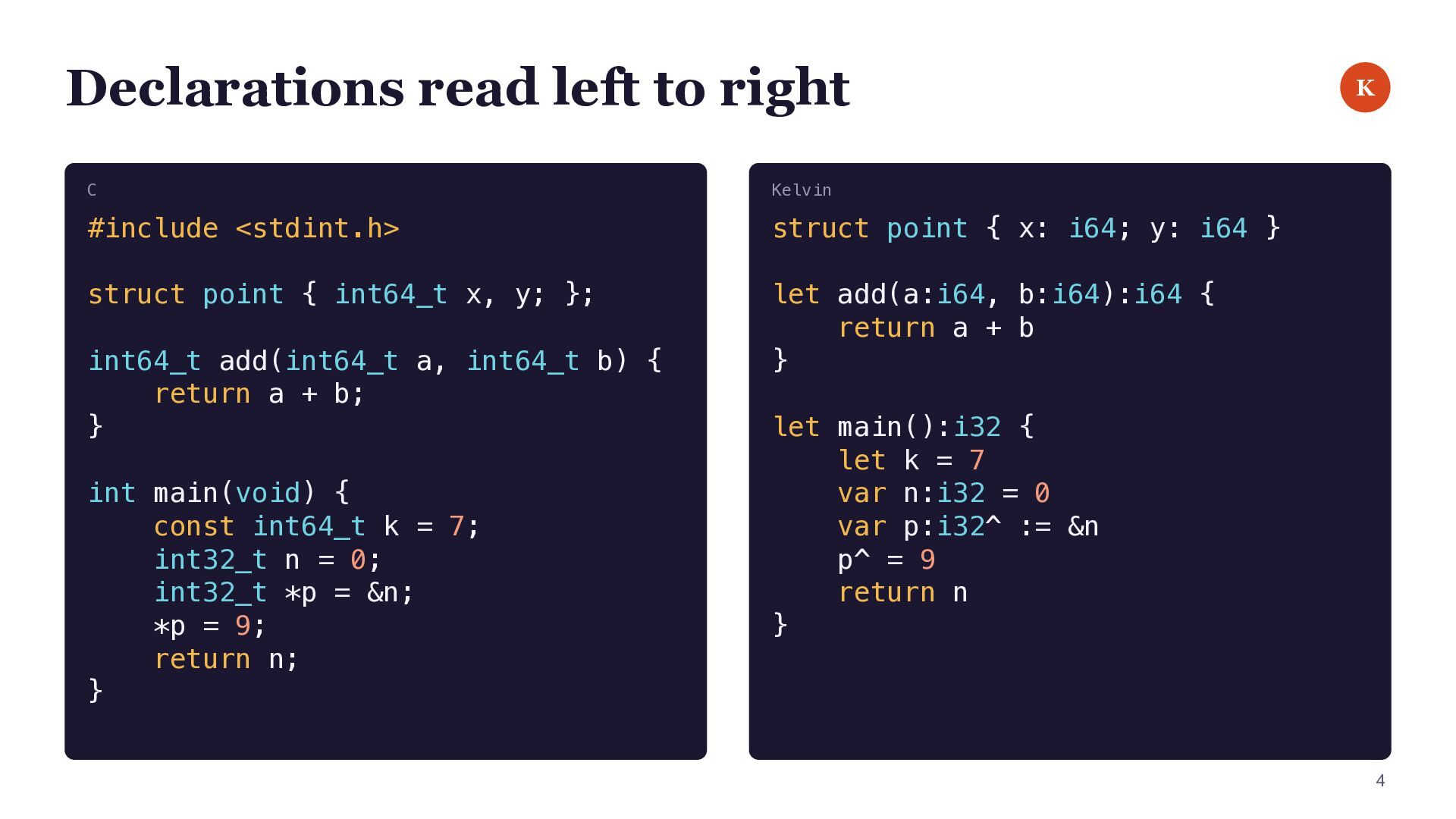
point { x: i64; y: i64 } struct point { int64_t x, y; }; let add(a:i64, b:i64):i64 { return a + b } int64_t add(int64_t a, int64_t b) { return a + b; } int main(void) { const int64_t k = 7; int32_t n = 0; int32_t *p = &n; *p = 9; return n; } K let main():i32 { let k = 7 var n:i32 = 0 var p:i32^ := &n p^ = 9 return n } 4
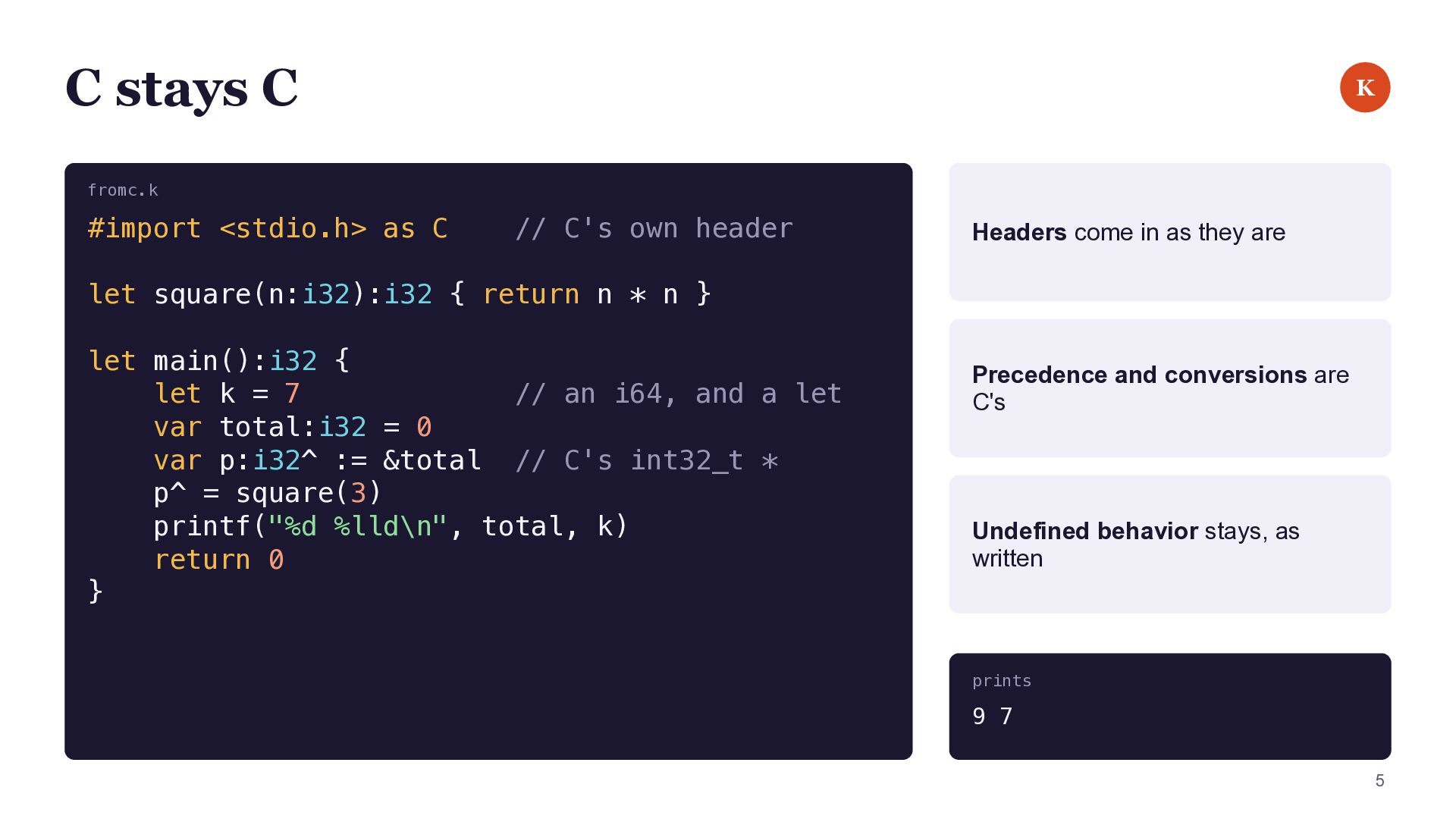
C's own header Headers come in as they are let square(n:i32):i32 { return n * n } let main():i32 { let k = 7 // an i64, and a let var total:i32 = 0 var p:i32^ := &total // C's int32_t * p^ = square(3) printf("%d %lld\n", total, k) return 0 } Precedence and conversions are C's Undefined behavior stays, as written prints 9 7 5
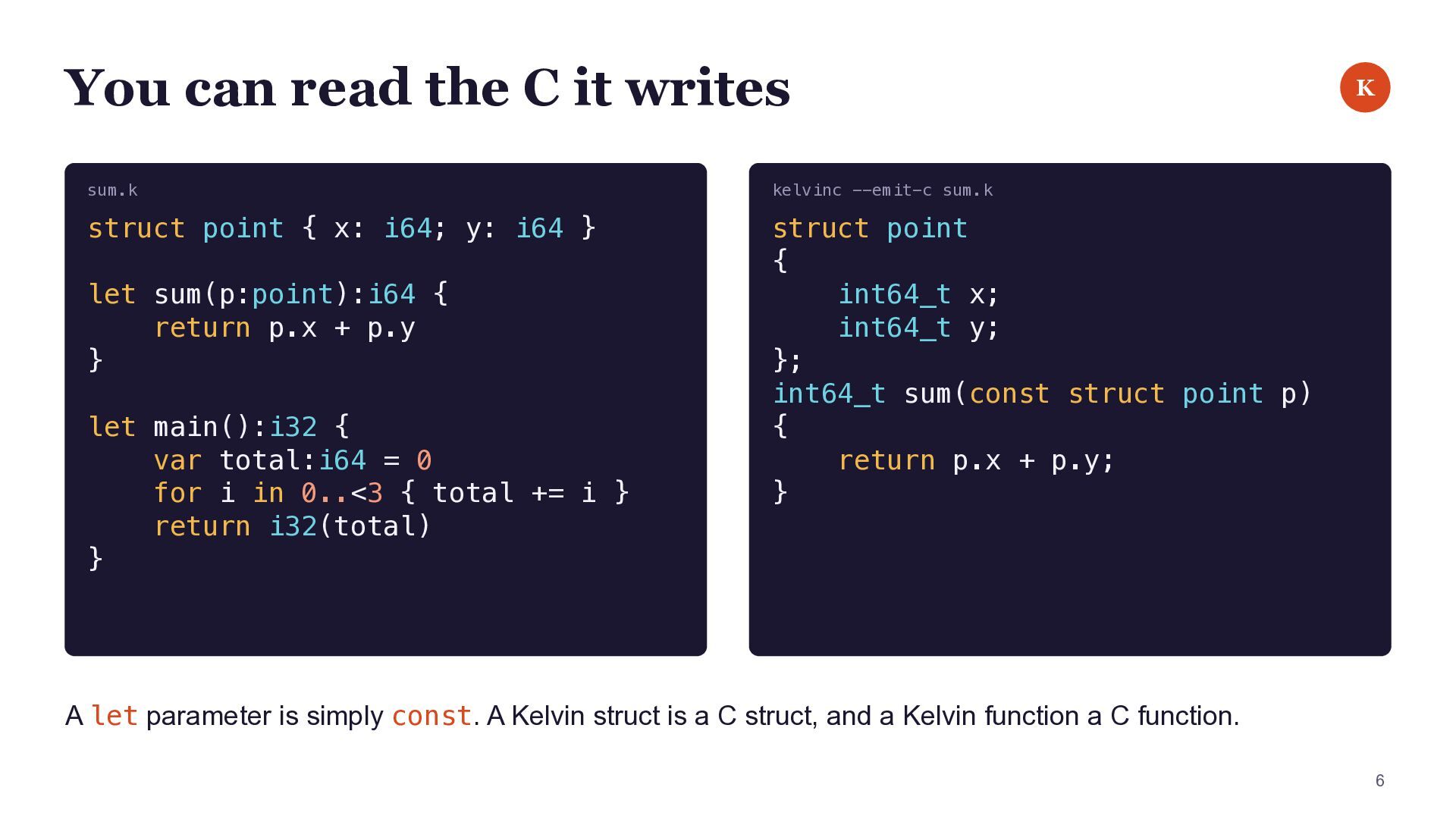
sum.k struct point { x: i64; y: i64 } struct point { int64_t x; int64_t y; }; int64_t sum(const struct point p) { return p.x + p.y; } let sum(p:point):i64 { return p.x + p.y } let main():i32 { var total:i64 = 0 for i in 0..<3 { total += i } return i32(total) } K A let parameter is simply const. A Kelvin struct is a C struct, and a Kelvin function a C function. 6
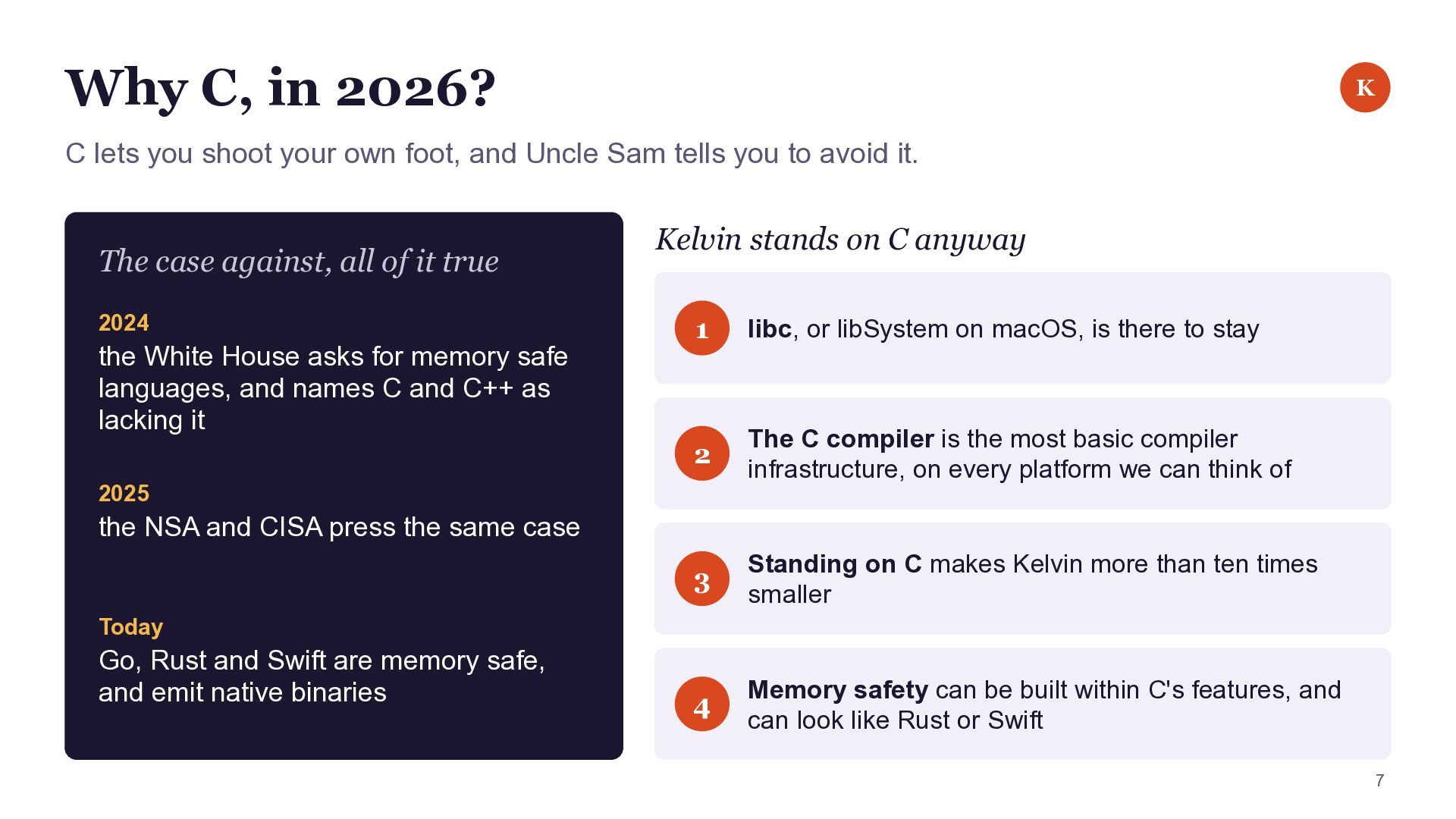
own foot, and Uncle Sam tells you to avoid it. The case against, all of it true 2024 the White House asks for memory safe languages, and names C and C++ as lacking it Kelvin stands on C anyway 1 libc, or libSystem on macOS, is there to stay 2 The C compiler is the most basic compiler infrastructure, on every platform we can think of 3 Standing on C makes Kelvin more than ten times smaller 4 Memory safety can be built within C's features, and can look like Rust or Swift 2025 the NSA and CISA press the same case Today Go, Rust and Swift are memory safe, and emit native binaries 7
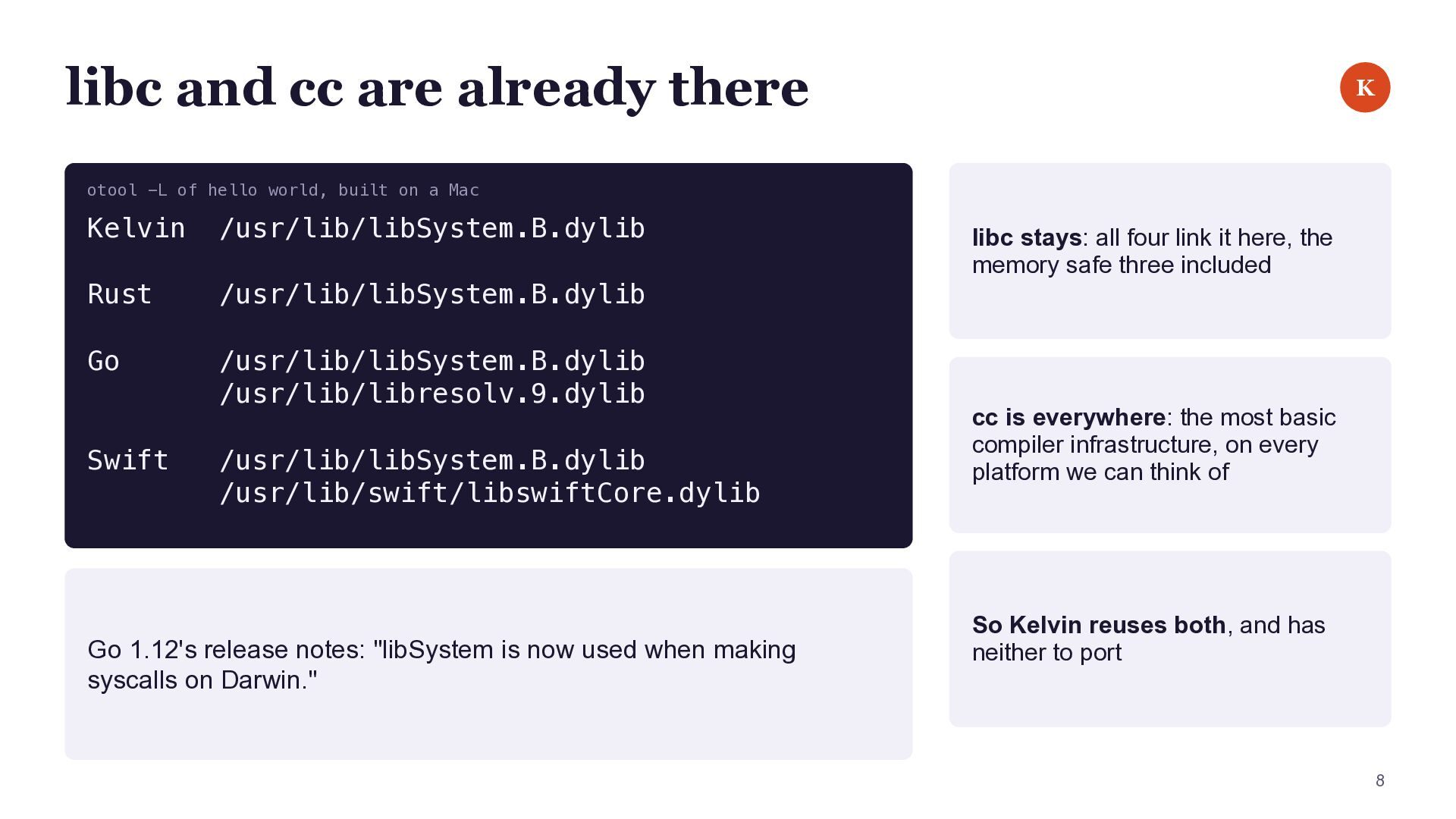
hello world, built on a Mac Kelvin /usr/lib/libSystem.B.dylib Rust /usr/lib/libSystem.B.dylib Go /usr/lib/libSystem.B.dylib /usr/lib/libresolv.9.dylib Swift /usr/lib/libSystem.B.dylib /usr/lib/swift/libswiftCore.dylib Go 1.12's release notes: "libSystem is now used when making syscalls on Darwin." libc stays: all four link it here, the memory safe three included cc is everywhere: the most basic compiler infrastructure, on every platform we can think of So Kelvin reuses both, and has neither to port 8
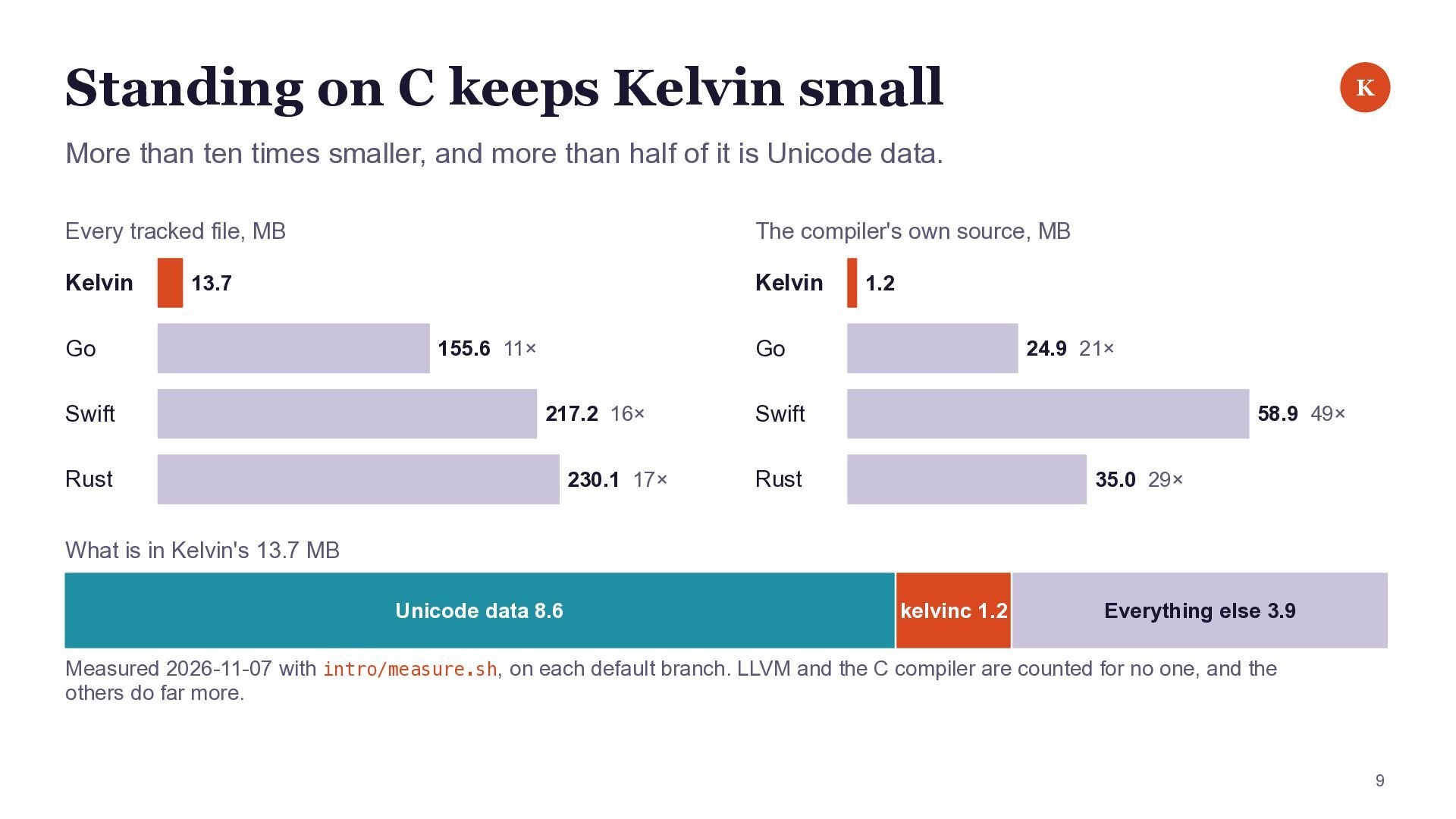
times smaller, and more than half of it is Unicode data. Every tracked file, MB The compiler's own source, MB Kelvin Kelvin 13.7 Go Swift 1.2 Go 155.6 11× 217.2 16× Rust 230.1 17× 24.9 21× Swift 58.9 49× Rust 35.0 29× What is in Kelvin's 13.7 MB Unicode data 8.6 kelvinc 1.2 Everything else 3.9 Measured 2026-11-07 with intro/measure.sh, on each default branch. LLVM and the C compiler are counted for no one, and the others do far more. 9
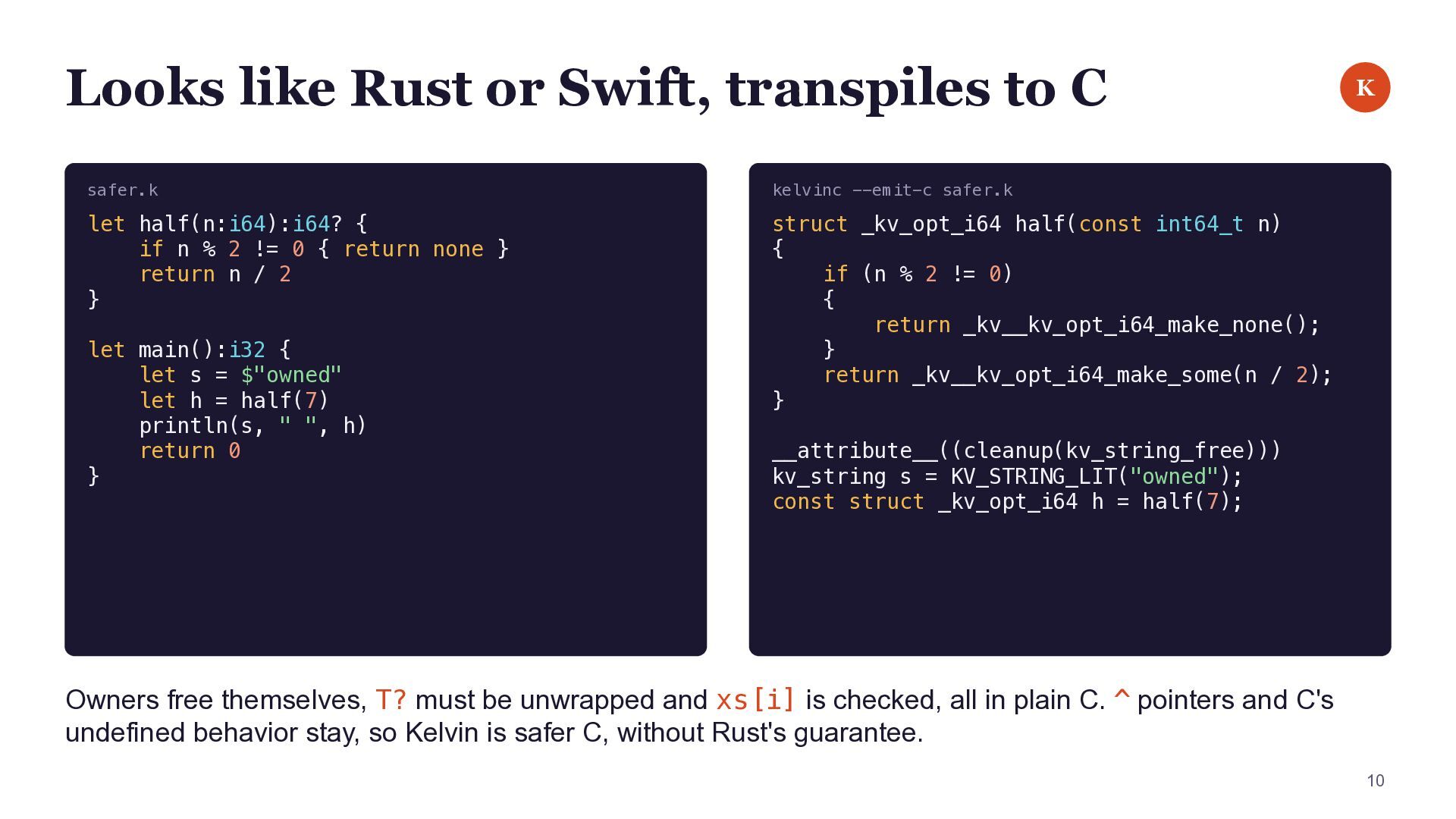
--emit-c safer.k let half(n:i64):i64? { if n % 2 != 0 { return none } return n / 2 } struct _kv_opt_i64 half(const int64_t n) { if (n % 2 != 0) { return _kv__kv_opt_i64_make_none(); } return _kv__kv_opt_i64_make_some(n / 2); } let main():i32 { let s = $"owned" let h = half(7) println(s, " ", h) return 0 } K __attribute__((cleanup(kv_string_free))) kv_string s = KV_STRING_LIT("owned"); const struct _kv_opt_i64 h = half(7); Owners free themselves, T? must be unwrapped and xs[i] is checked, all in plain C. ^ pointers and C's undefined behavior stay, so Kelvin is safer C, without Rust's guarantee. 10
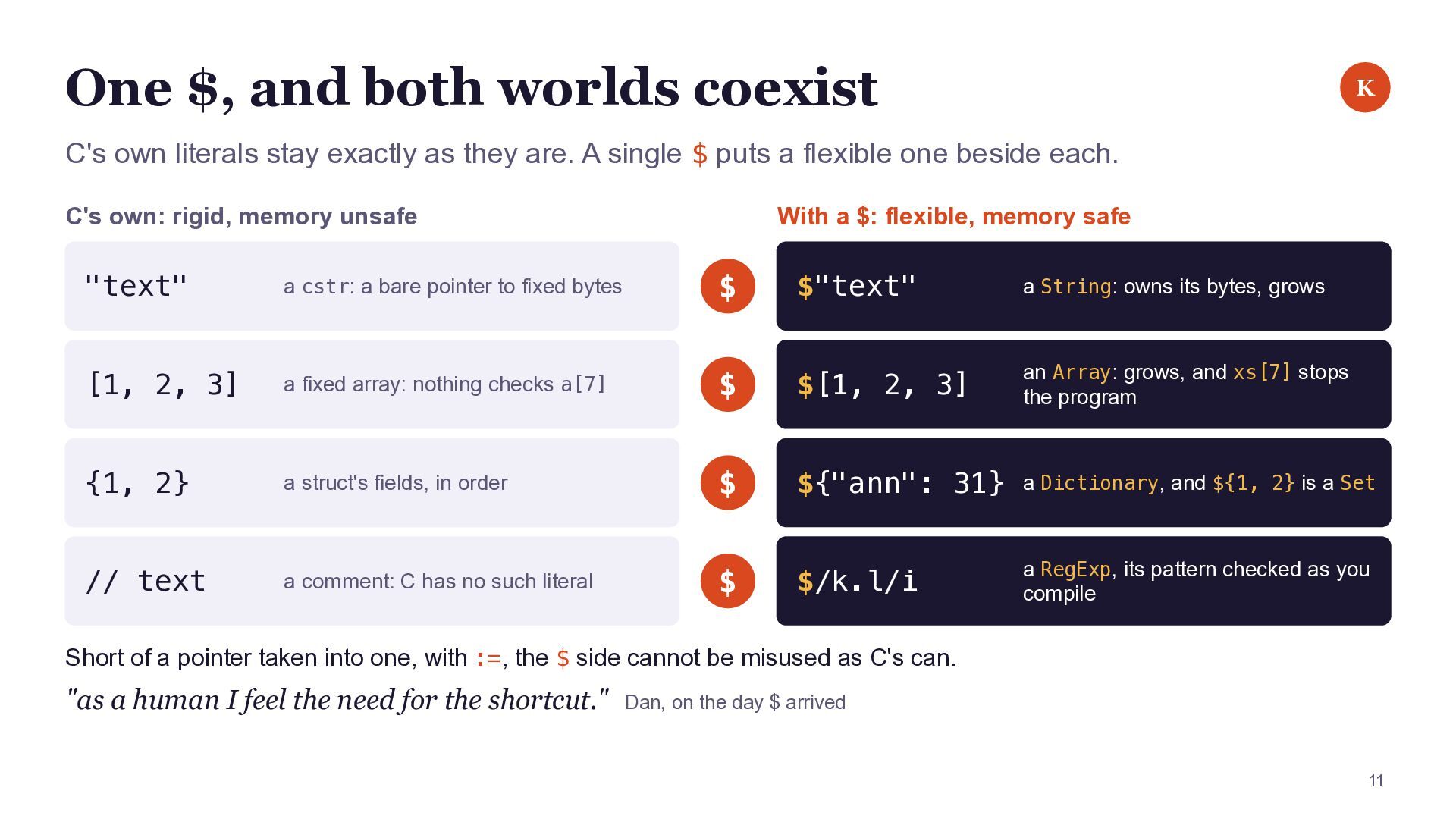
stay exactly as they are. A single $ puts a flexible one beside each. C's own: rigid, memory unsafe With a $: flexible, memory safe "text" a cstr: a bare pointer to fixed bytes $ $"text" a String: owns its bytes, grows [1, 2, 3] a fixed array: nothing checks a[7] $ $[1, 2, 3] an Array: grows, and xs[7] stops the program {1, 2} a struct's fields, in order $ ${"ann": 31} a Dictionary, and ${1, 2} is a Set // text a comment: C has no such literal $ $/k.l/i a RegExp, its pattern checked as you compile Short of a pointer taken into one, with :=, the $ side cannot be misused as C's can. "as a human I feel the need for the shortcut." Dan, on the day $ arrived 11
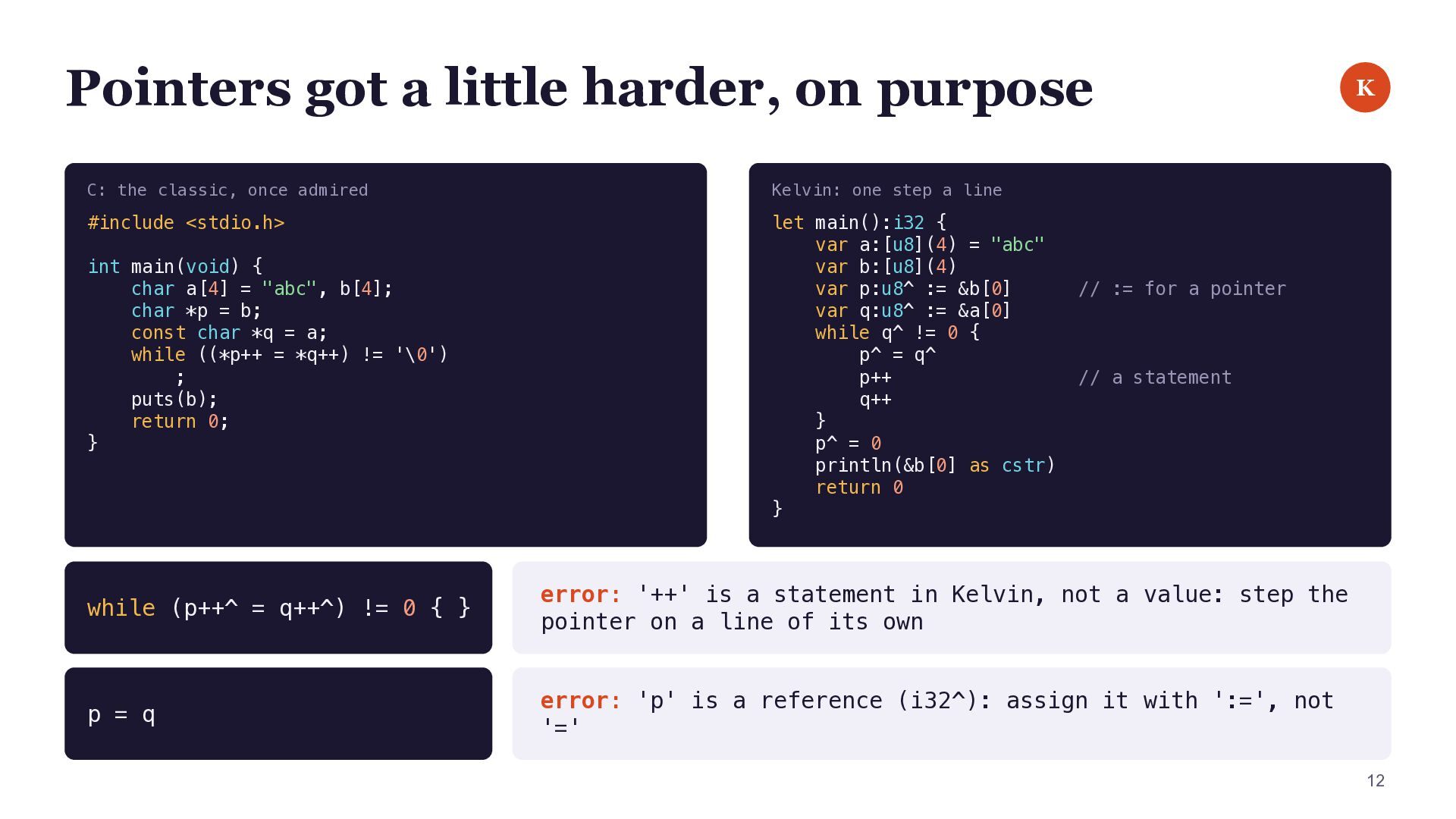
once admired Kelvin: one step a line #include <stdio.h> let main():i32 { var a:[u8](4) = "abc" var b:[u8](4) var p:u8^ := &b[0] var q:u8^ := &a[0] while q^ != 0 { p^ = q^ p++ q++ } p^ = 0 println(&b[0] as cstr) return 0 } int main(void) { char a[4] = "abc", b[4]; char *p = b; const char *q = a; while ((*p++ = *q++) != '\0') ; puts(b); return 0; } K // := for a pointer // a statement while (p++^ = q++^) != 0 { } error: '++' is a statement in Kelvin, not a value: step the pointer on a line of its own p = q error: 'p' is a reference (i32^): assign it with ':=', not '=' 12
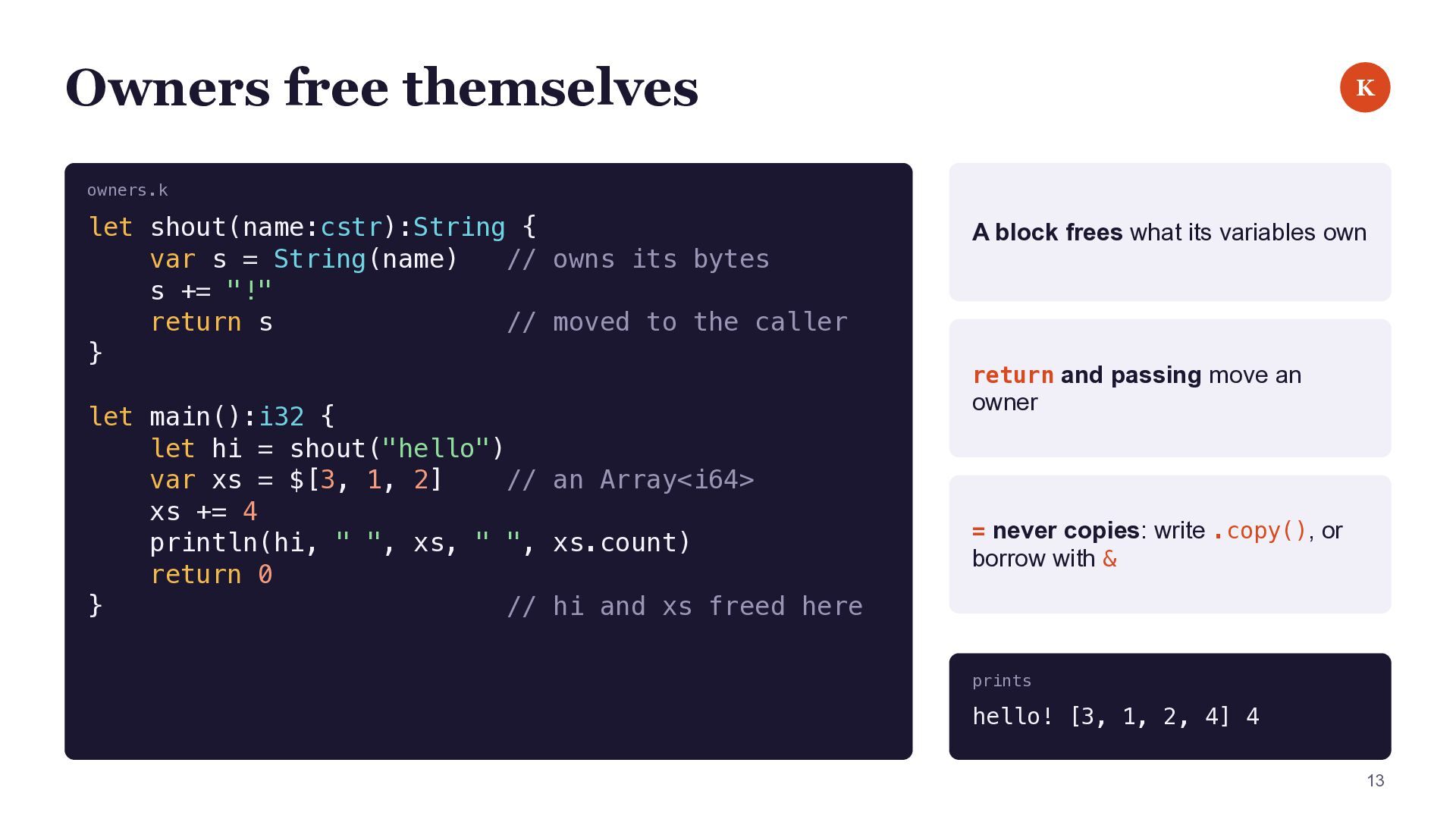
= String(name) // owns its bytes s += "!" return s // moved to the caller } let main():i32 { let hi = shout("hello") var xs = $[3, 1, 2] // an Array<i64> xs += 4 println(hi, " ", xs, " ", xs.count) return 0 } // hi and xs freed here A block frees what its variables own return and passing move an owner = never copies: write .copy(), or borrow with & prints hello! [3, 1, 2, 4] 4 13
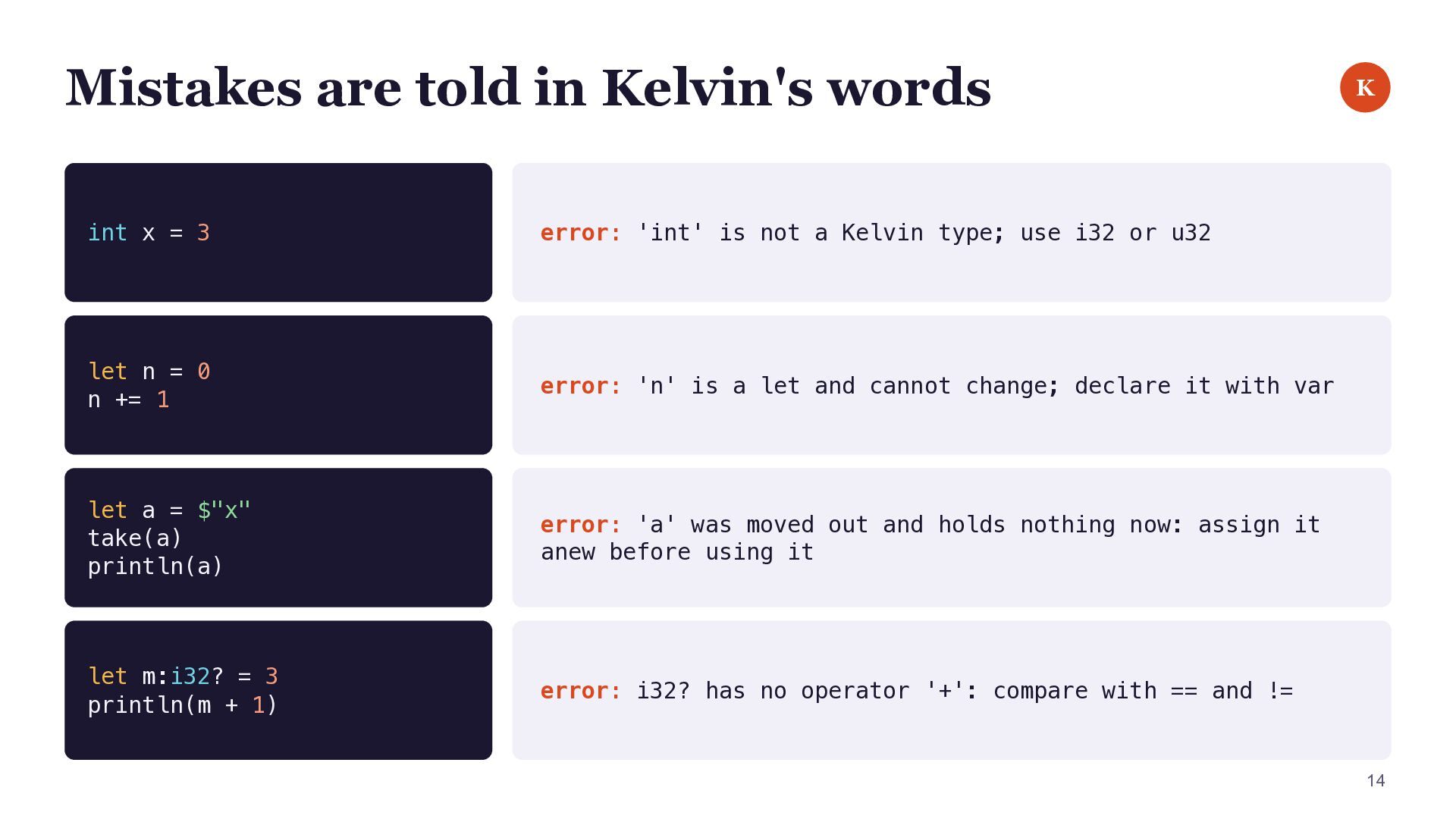
error: 'int' is not a Kelvin type; use i32 or u32 let n = 0 n += 1 error: 'n' is a let and cannot change; declare it with var let a = $"x" take(a) println(a) error: 'a' was moved out and holds nothing now: assign it anew before using it let m:i32? = 3 println(m + 1) error: i32? has no operator '+': compare with == and != K 14
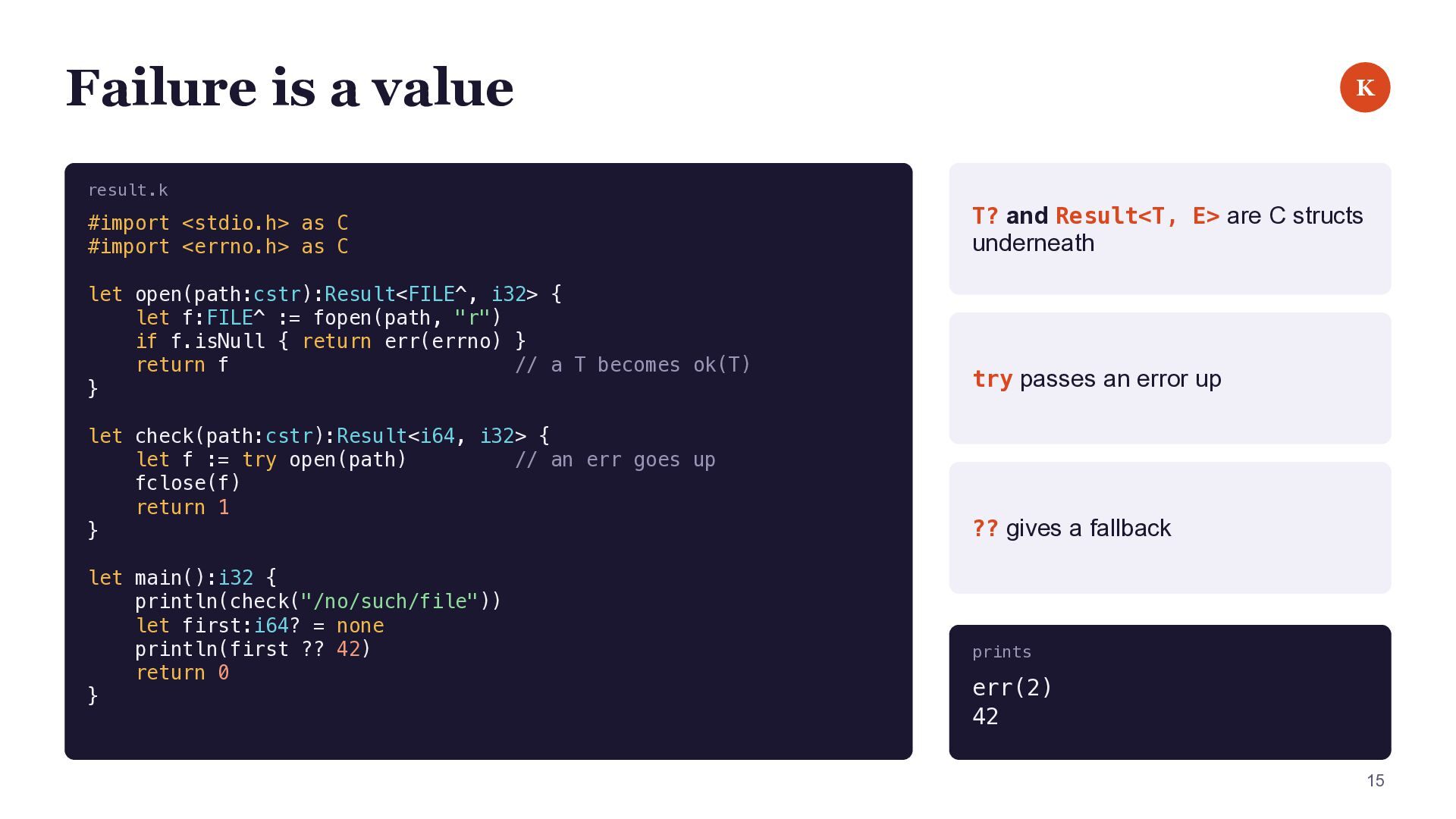
#import <errno.h> as C T? and Result<T, E> are C structs underneath let open(path:cstr):Result<FILE^, i32> { let f:FILE^ := fopen(path, "r") if f.isNull { return err(errno) } return f // a T becomes ok(T) } try passes an error up let check(path:cstr):Result<i64, i32> { let f := try open(path) // an err goes up fclose(f) return 1 } ?? gives a fallback let main():i32 { println(check("/no/such/file")) let first:i64? = none println(first ?? 42) return 0 } prints err(2) 42 15
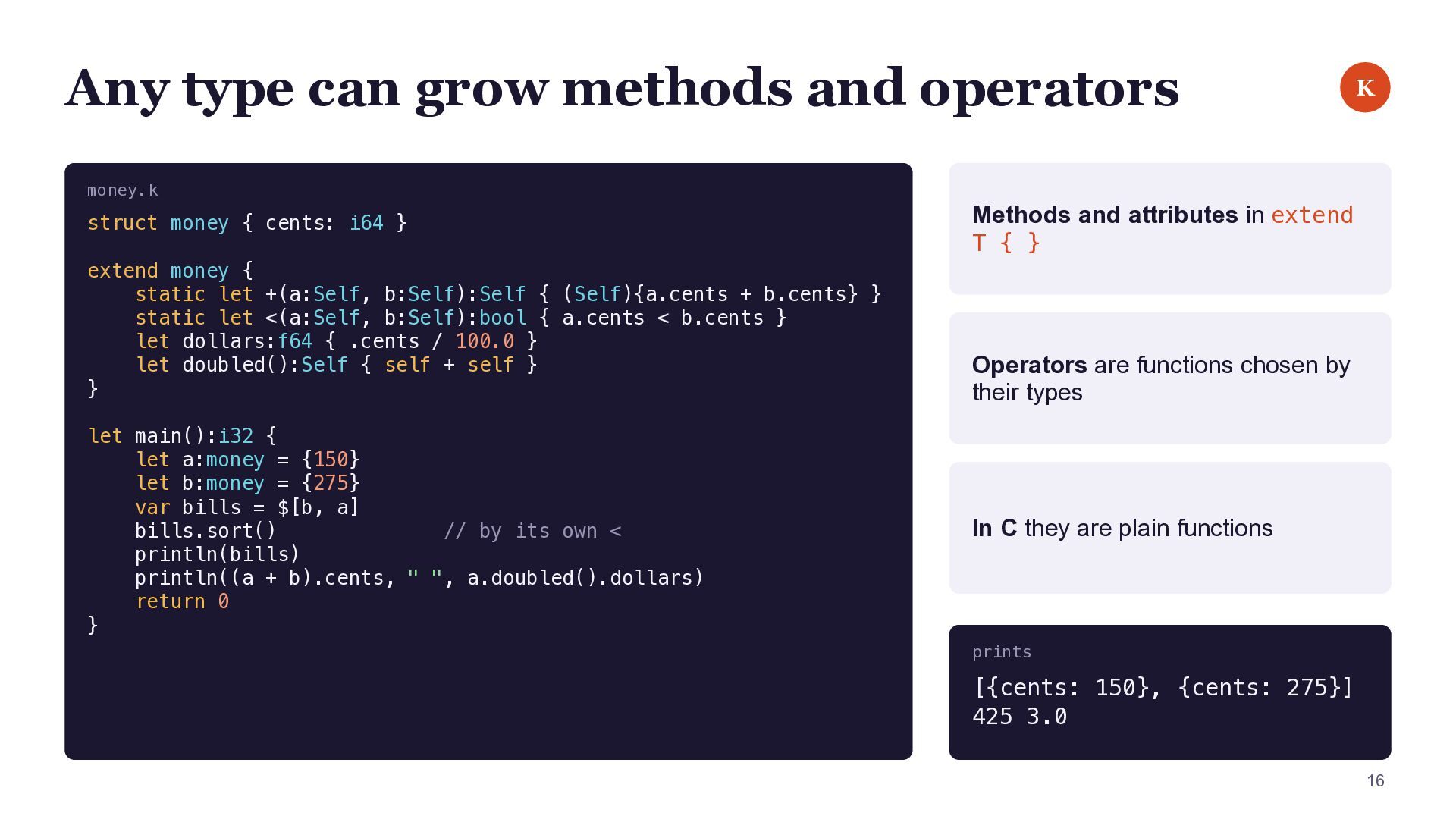
money { cents: i64 } Methods and attributes in extend extend money { static let +(a:Self, b:Self):Self { (Self){a.cents + b.cents} } static let <(a:Self, b:Self):bool { a.cents < b.cents } let dollars:f64 { .cents / 100.0 } let doubled():Self { self + self } } Operators are functions chosen by their types let main():i32 { let a:money = {150} let b:money = {275} var bills = $[b, a] bills.sort() // by its own < println(bills) println((a + b).cents, " ", a.doubled().dollars) return 0 } T { } In C they are plain functions prints [{cents: 150}, {cents: 275}] 425 3.0 16
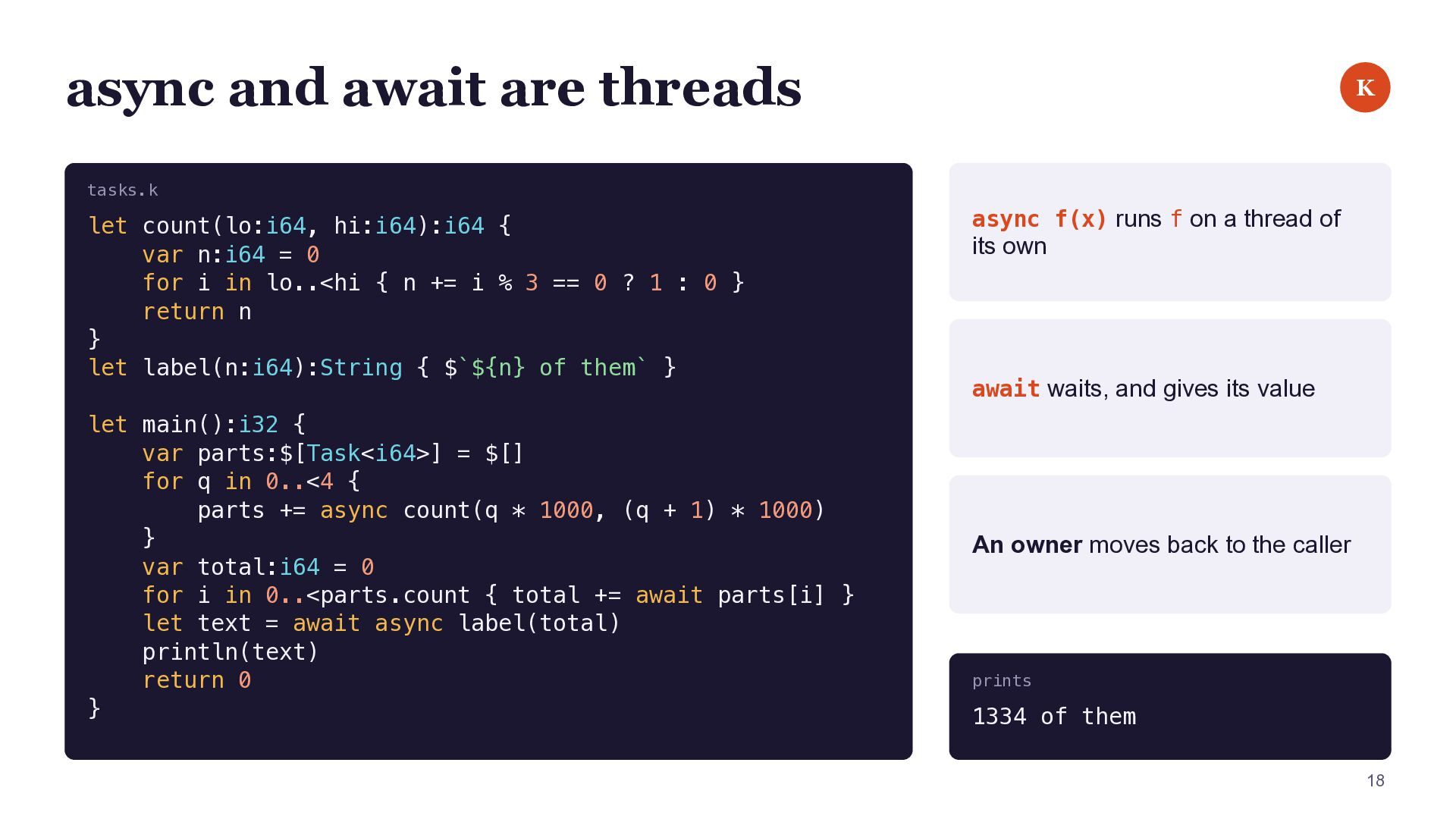
{ var n:i64 = 0 for i in lo..<hi { n += i % 3 == 0 ? 1 : 0 } return n } let label(n:i64):String { $`${n} of them` } let main():i32 { var parts:$[Task<i64>] = $[] for q in 0..<4 { parts += async count(q * 1000, (q + 1) * 1000) } var total:i64 = 0 for i in 0..<parts.count { total += await parts[i] } let text = await async label(total) println(text) return 0 } async f(x) runs f on a thread of its own await waits, and gives its value An owner moves back to the caller prints 1334 of them 18
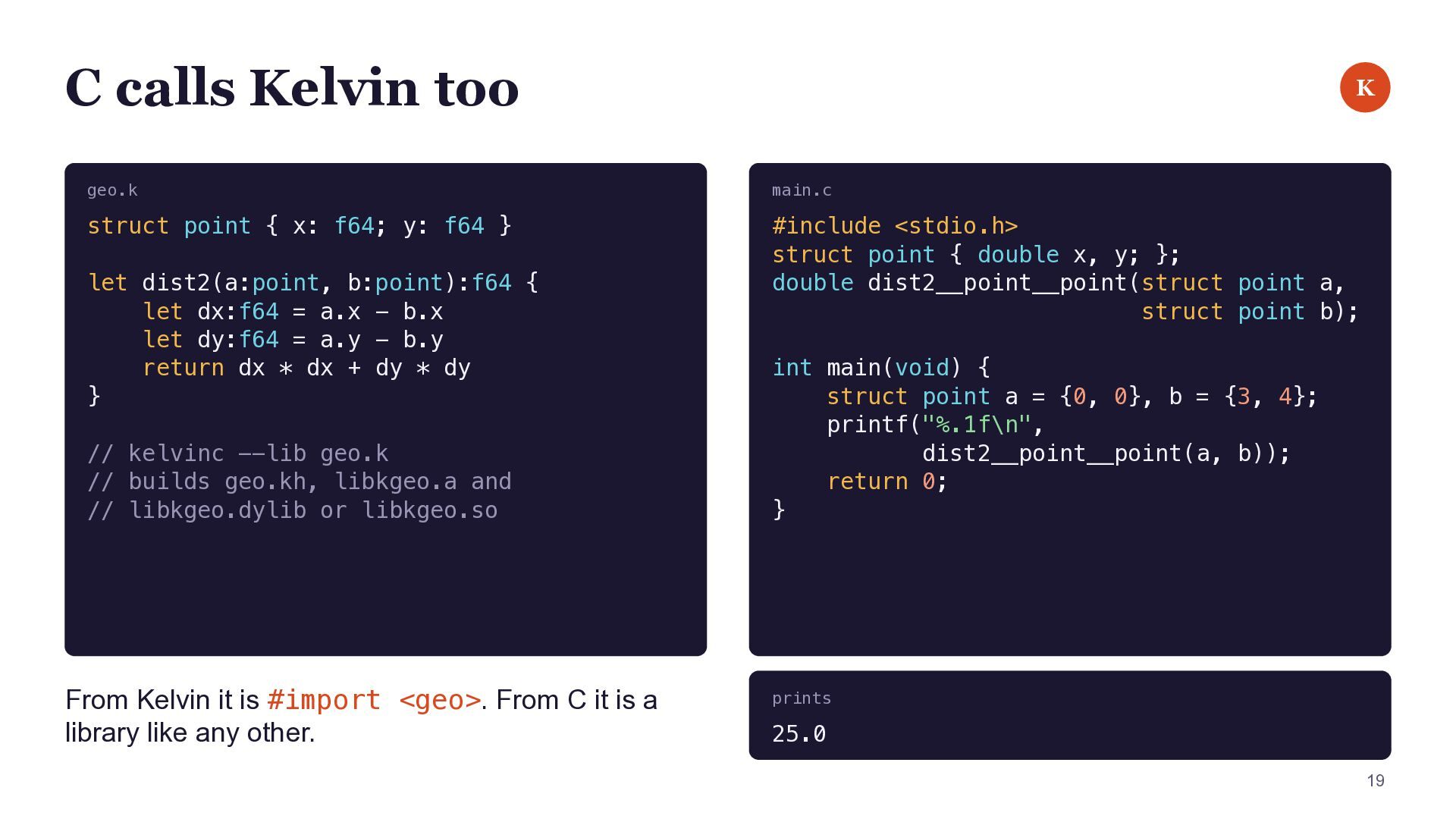
x: f64; y: f64 } #include <stdio.h> struct point { double x, y; }; double dist2__point__point(struct point a, struct point b); let dist2(a:point, b:point):f64 { let dx:f64 = a.x - b.x let dy:f64 = a.y - b.y return dx * dx + dy * dy } // kelvinc --lib geo.k // builds geo.kh, libkgeo.a and // libkgeo.dylib or libkgeo.so From Kelvin it is #import <geo>. From C it is a library like any other. int main(void) { struct point a = {0, 0}, b = {3, 4}; printf("%.1f\n", dist2__point__point(a, b)); return 0; } prints 25.0 19
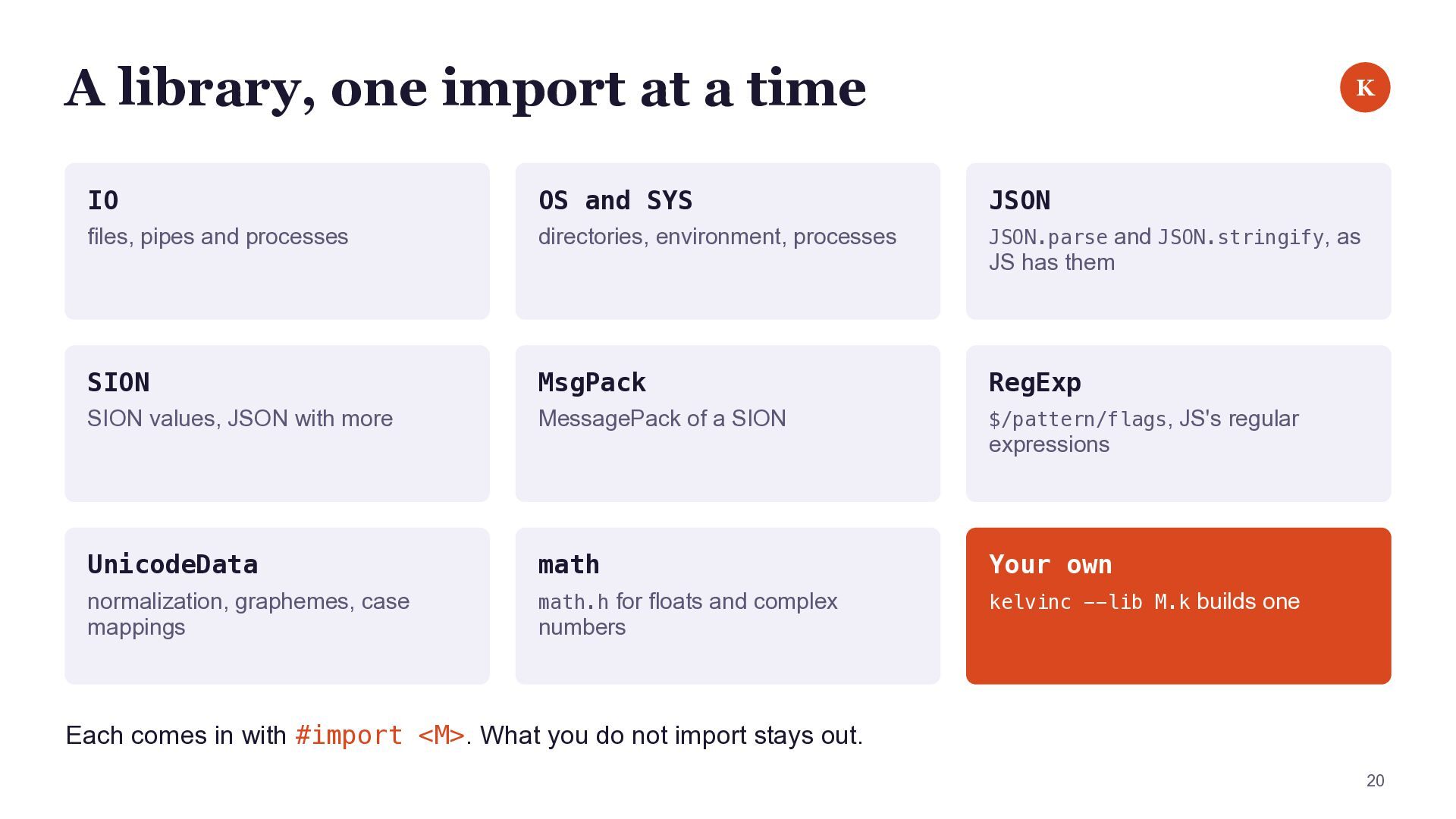
and SYS JSON files, pipes and processes directories, environment, processes JSON.parse and JSON.stringify, as JS has them SION MsgPack RegExp SION values, JSON with more MessagePack of a SION $/pattern/flags, JS's regular expressions UnicodeData math Your own normalization, graphemes, case mappings math.h for floats and complex kelvinc --lib M.k builds one numbers Each comes in with #import <M>. What you do not import stays out. 20
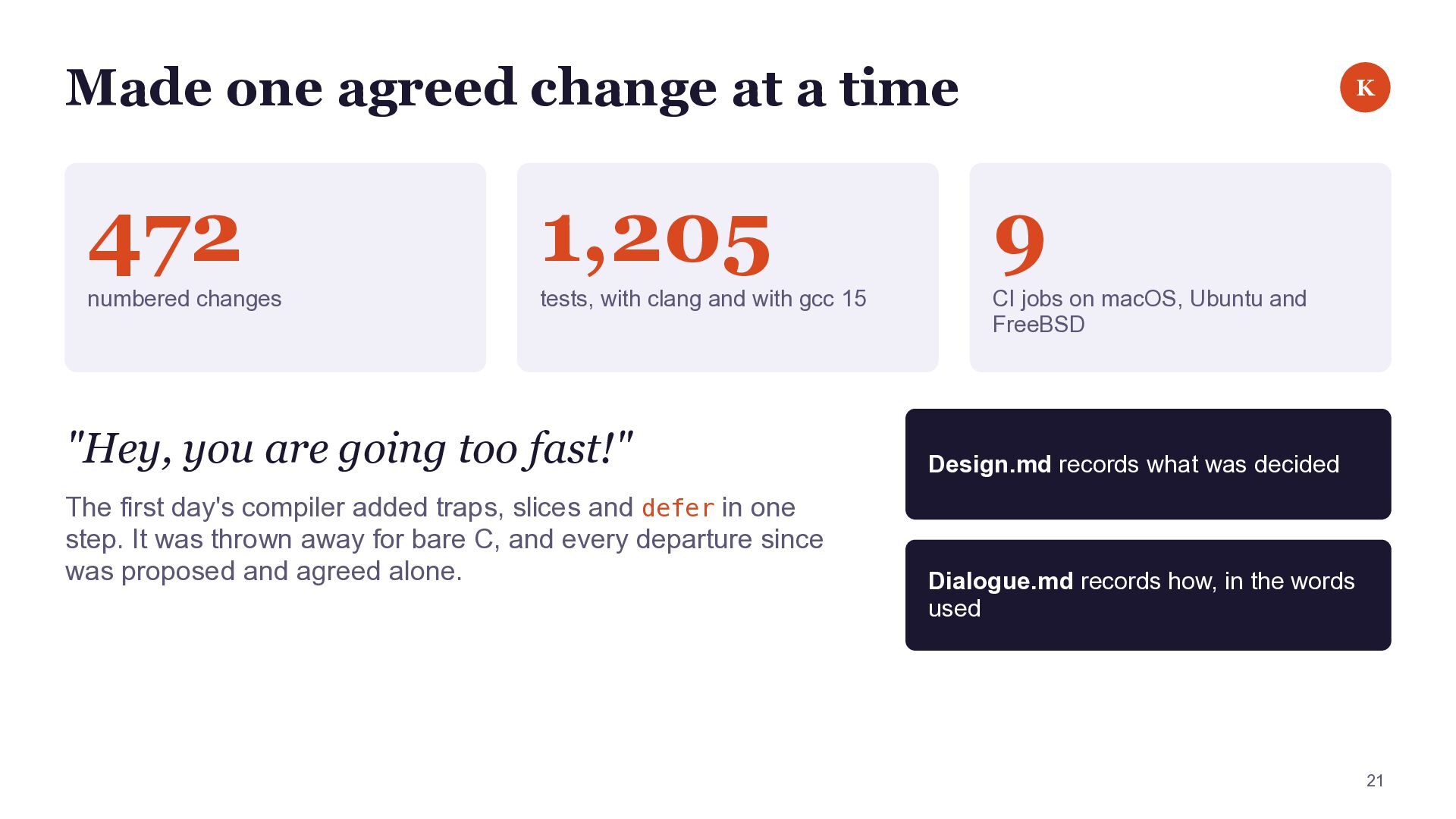
9 numbered changes tests, with clang and with gcc 15 CI jobs on macOS, Ubuntu and FreeBSD "Hey, you are going too fast!" The first day's compiler added traps, slices and defer in one step. It was thrown away for bare C, and every departure since was proposed and agreed alone. Design.md records what was decided Dialogue.md records how, in the words used 21
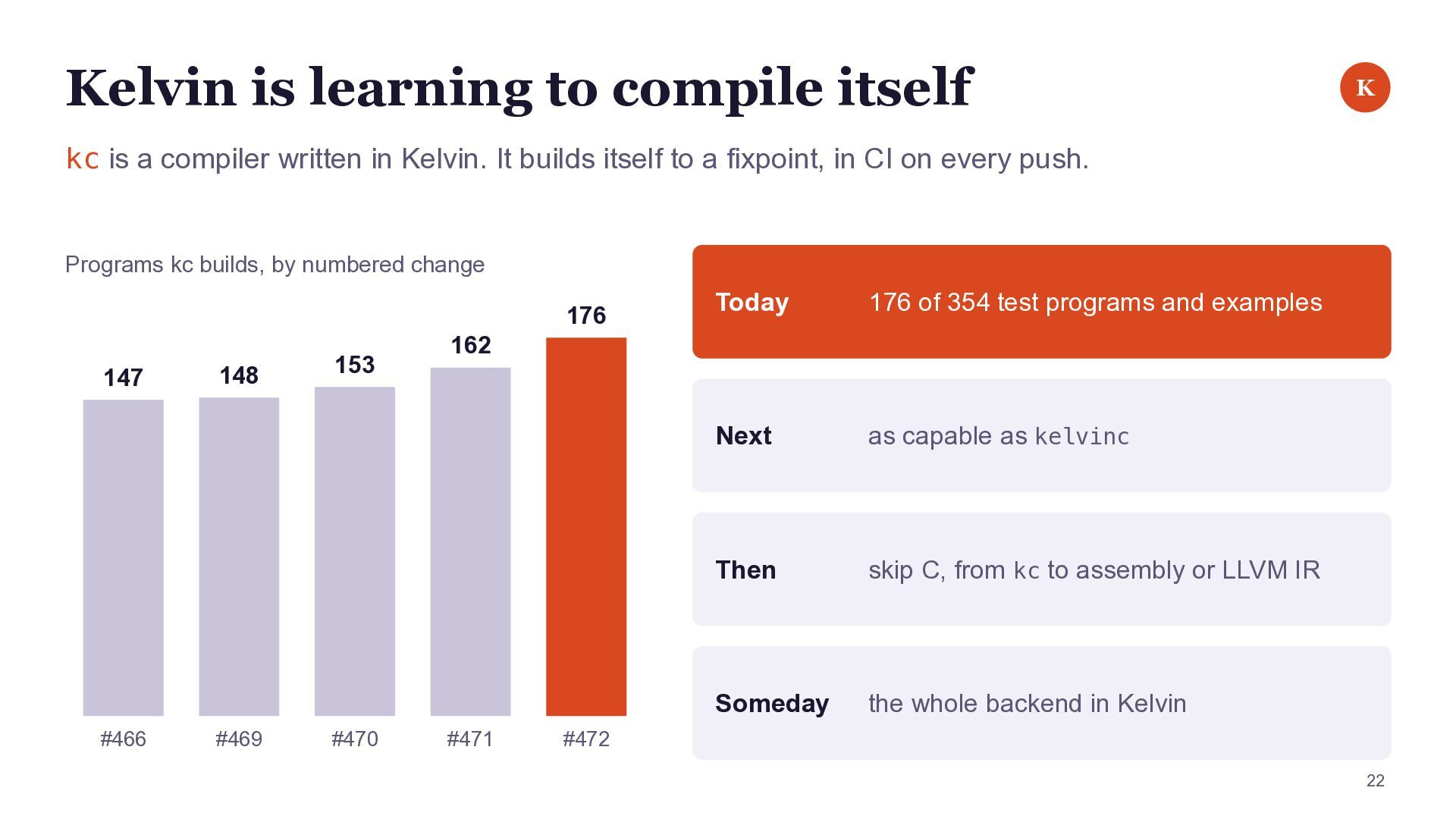
compiler written in Kelvin. It builds itself to a fixpoint, in CI on every push. Programs kc builds, by numbered change 176 147 #466 148 #469 153 #470 Today 176 of 354 test programs and examples Next as capable as kelvinc Then skip C, from kc to assembly or LLVM IR Someday the whole backend in Kelvin 162 #471 #472 22
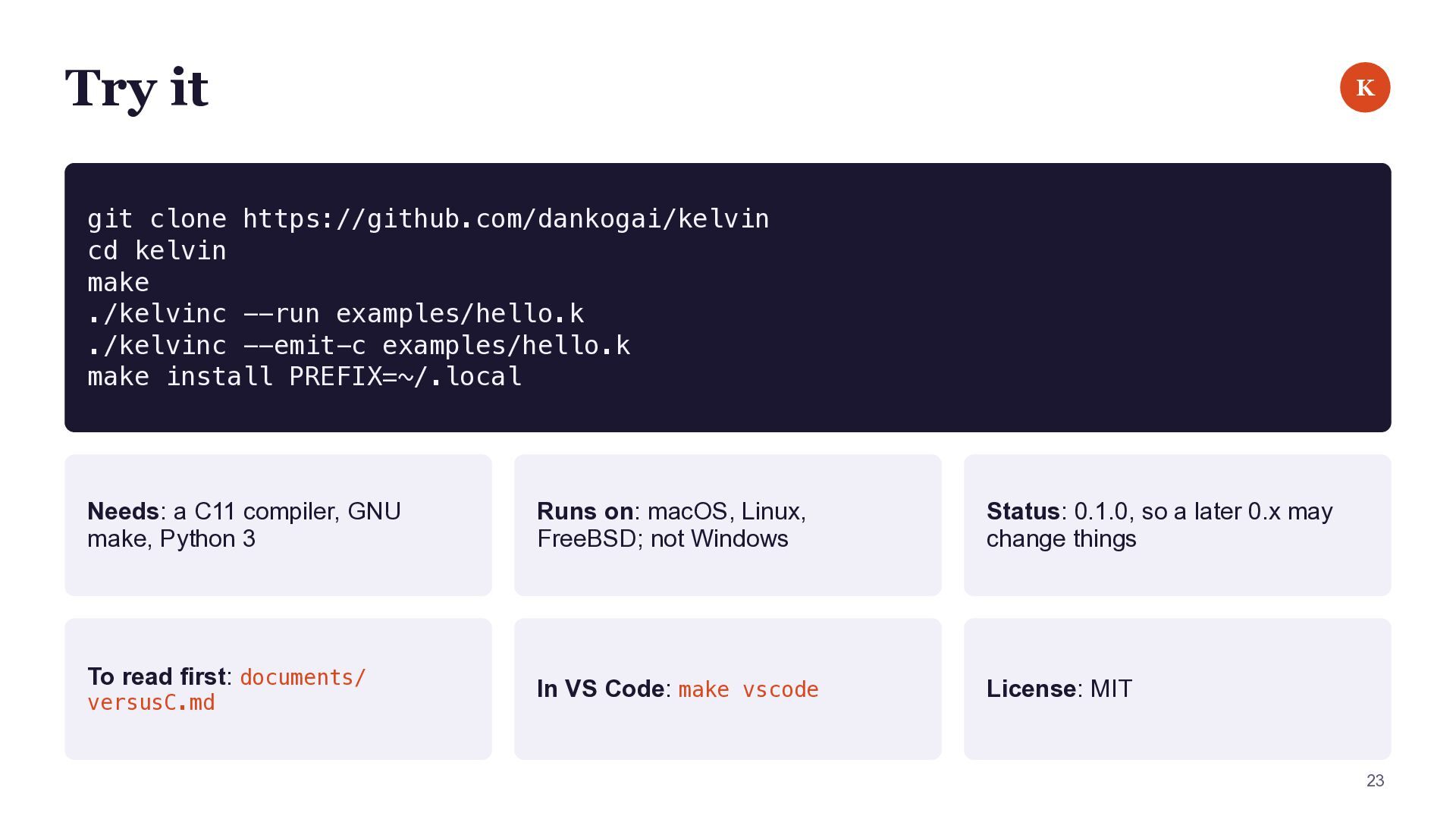
--run examples/hello.k ./kelvinc --emit-c examples/hello.k make install PREFIX=~/.local Needs: a C11 compiler, GNU make, Python 3 To read first: documents/ versusC.md Runs on: macOS, Linux, FreeBSD; not Windows Status: 0.1.0, so a later 0.x may change things In VS Code: make vscode License: MIT 23


 dankogai
 siroemk
 vivion
 marcoroth
 l2hyunwoo
 ryunen344
 yosuke_furukawa
 rkaga
 yukikurage
 akihisaikeda
 shihochan
 mitohato14
 kmkim
 letsgokoyo
 palkan
 addyosmani
 andyhume
 aleyda
 jakevdp
 axbom
 mza
 tmiket
 tammyeverts
 lemiorhan