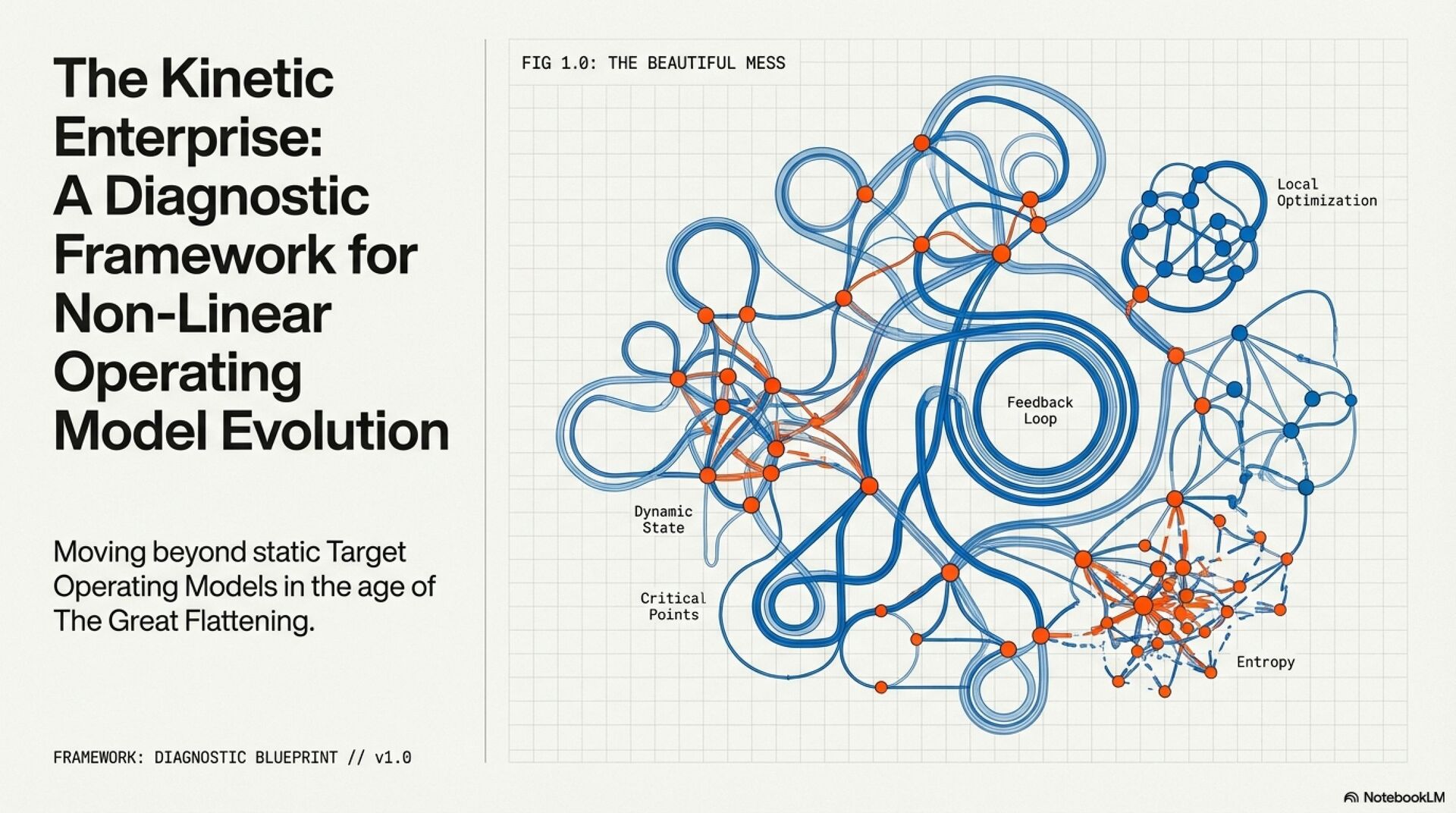
This deck reframes operating model evolution as a diagnostic problem, not a maturity journey. It argues that in the age of AI and fast feedback, the “comfortable buffer” between intent and execution disappears, so linear org charts and stage based maturity models stop explaining reality. 
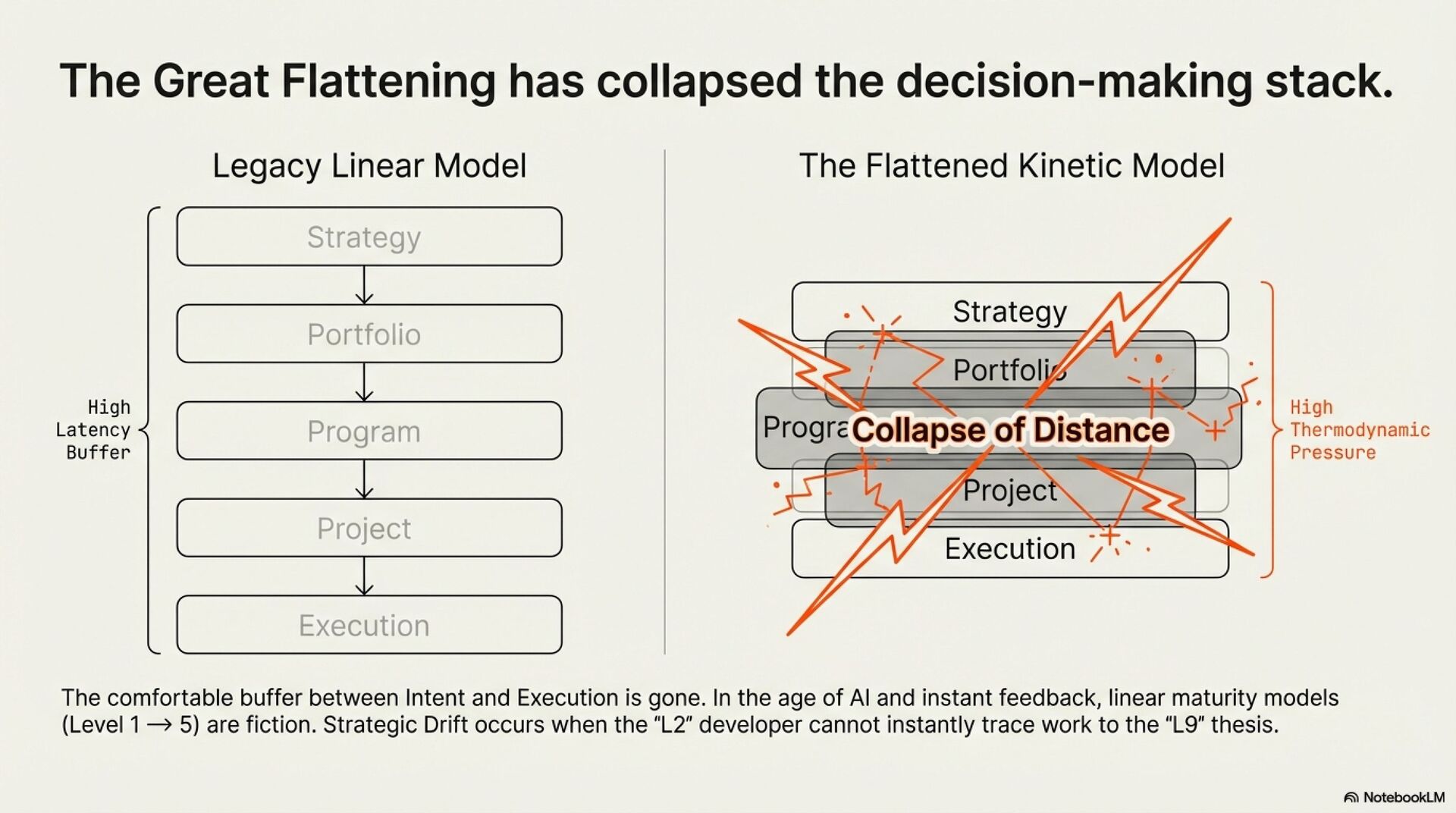
1) The Great Flattening compresses the decision stack
• The deck contrasts a legacy linear stack (strategy, portfolio, program, project, execution) with a flattened kinetic model where distance collapses, and “thermodynamic pressure” rises when alignment breaks. Page 2. 
• The practical implication is that strategic drift becomes normal unless teams can trace day to day work back to strategy, quickly and credibly. 
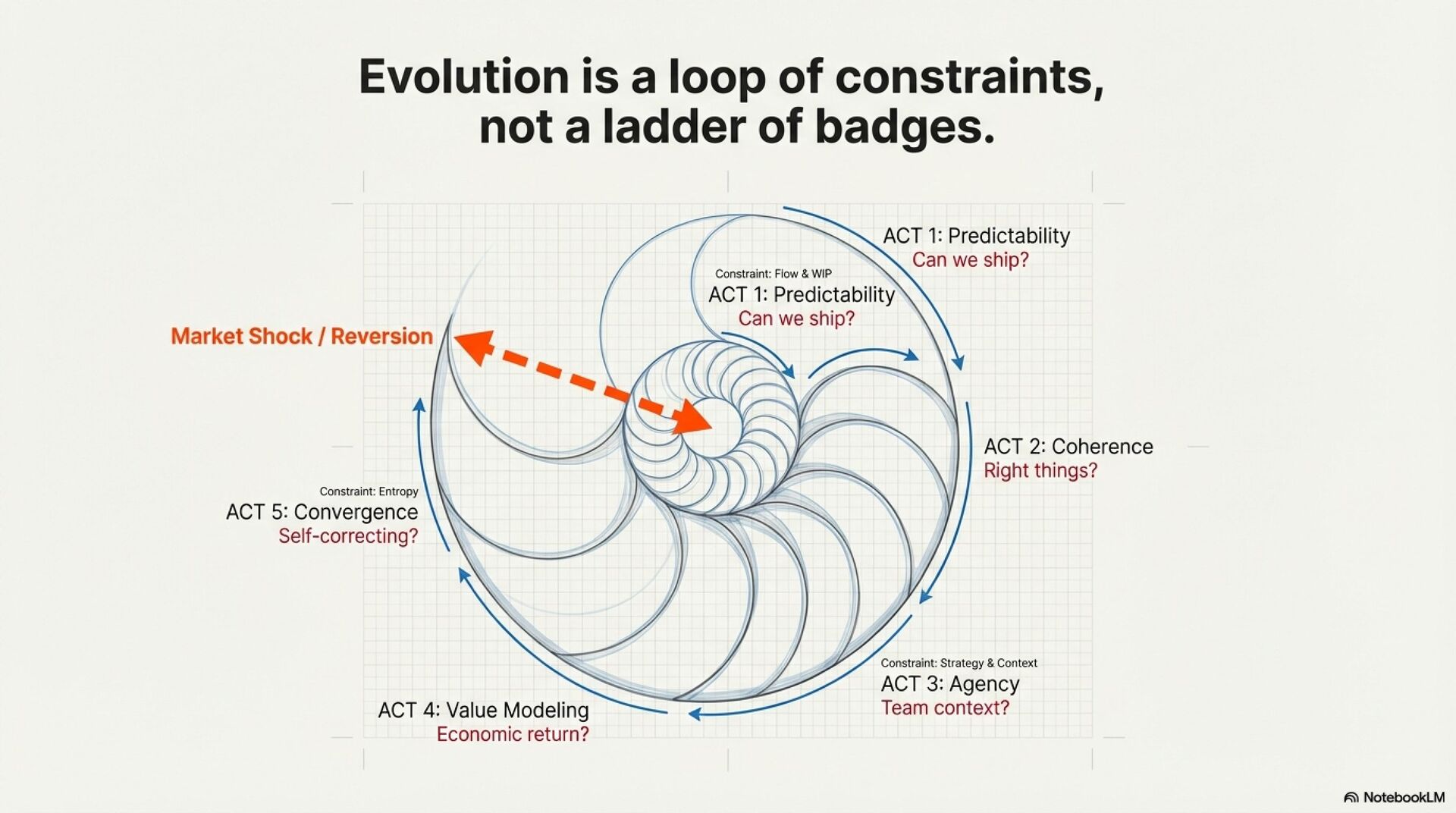
2) Evolution is a loop of constraints, not a ladder
• Operating model change is presented as recursive loops, not sequential badges. The “Five Acts” act as constraint loops that can coexist across domains, predictability, coherence, agency, value modeling, convergence. Page 3. 
• Market shocks can regress the system, so resilience depends on the quality of the diagnostic loop, not on claiming a maturity level. 
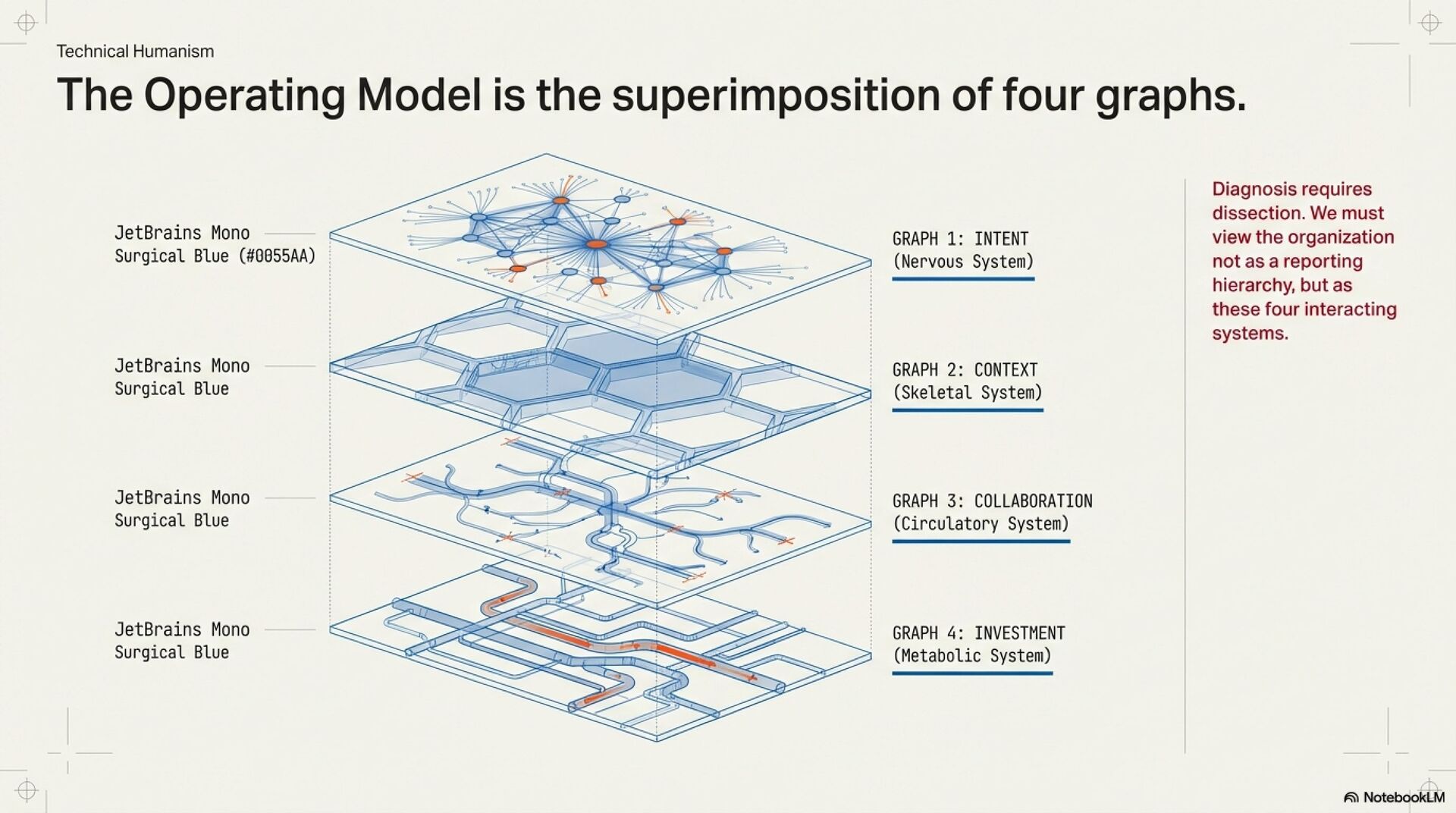
3) The operating model is the superimposition of four graphs
The core thesis is that your operating model is best understood as four interacting graphs, each mapped to a body system metaphor. Page 4. 
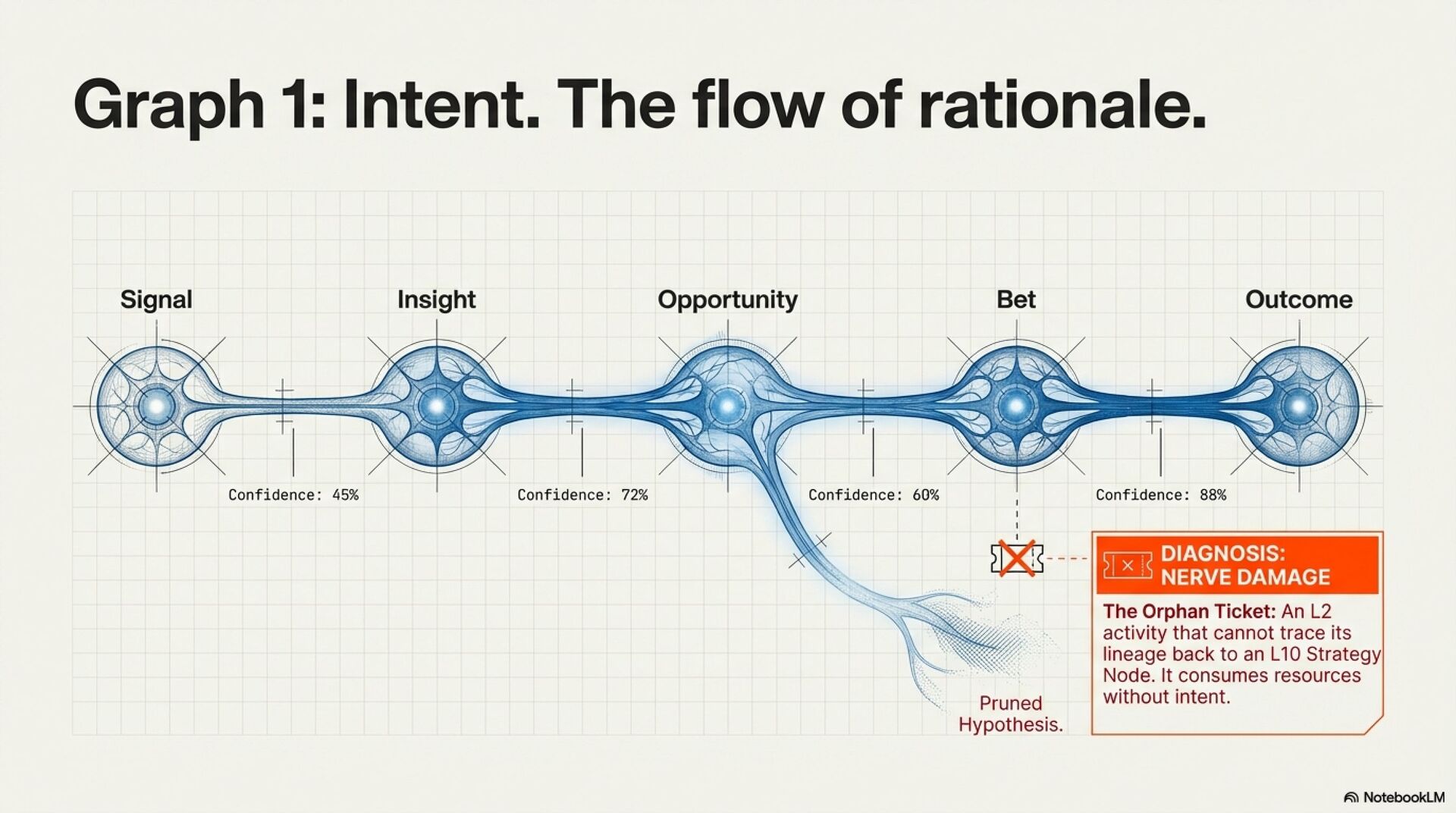
• Graph 1, Intent (nervous system), the flow of rationale from signal to insight to opportunity to bet to outcome, with confidence along the chain. “Zombie” work shows up as activity that cannot trace back to a strategic node, it consumes resources without intent. Page 5. 
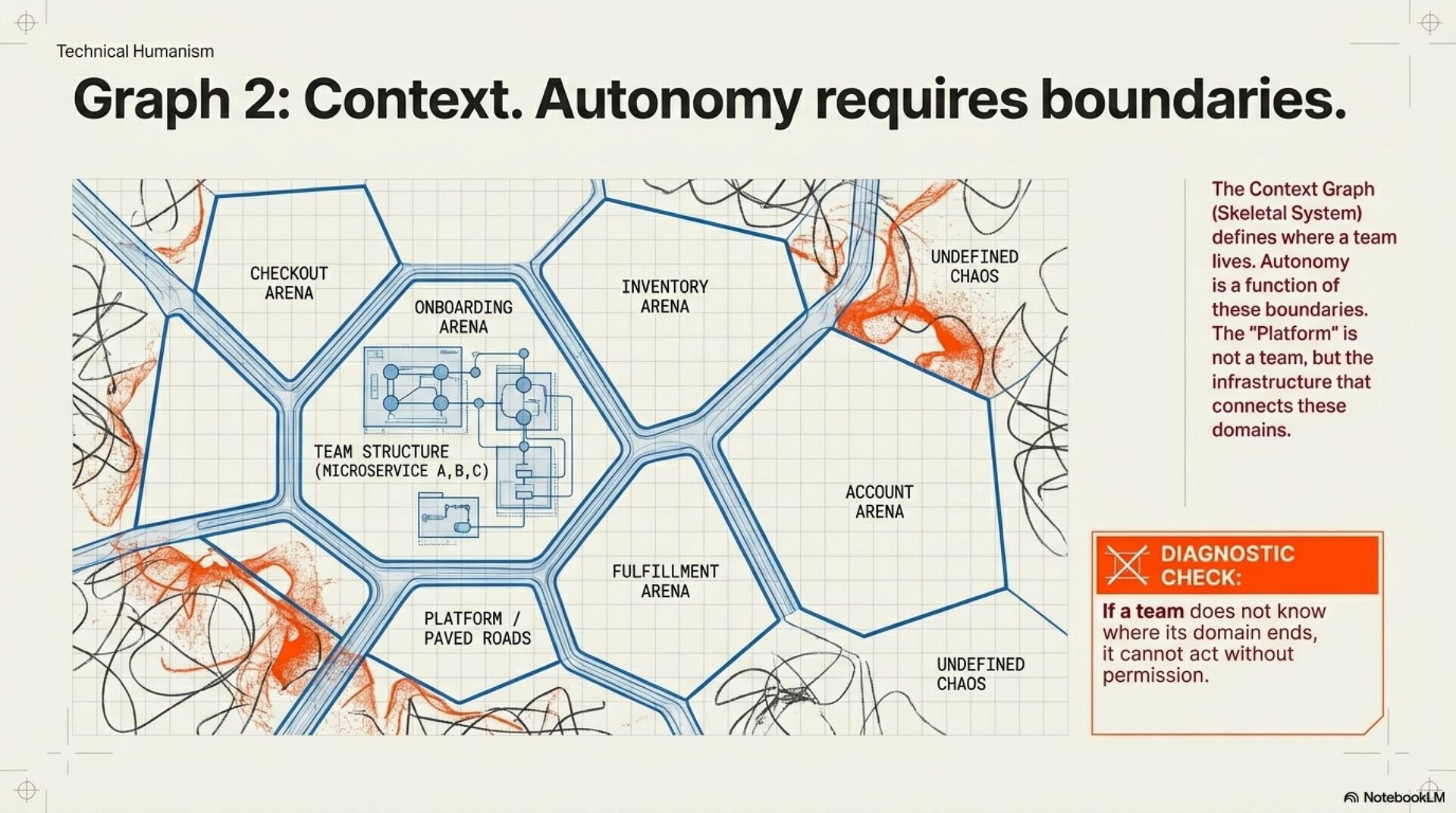
• Graph 2, Context (skeletal system), autonomy requires boundaries. Teams need explicit domain seams and platform connections, otherwise “undefined chaos” expands and teams act without permission or clarity. Page 6. 
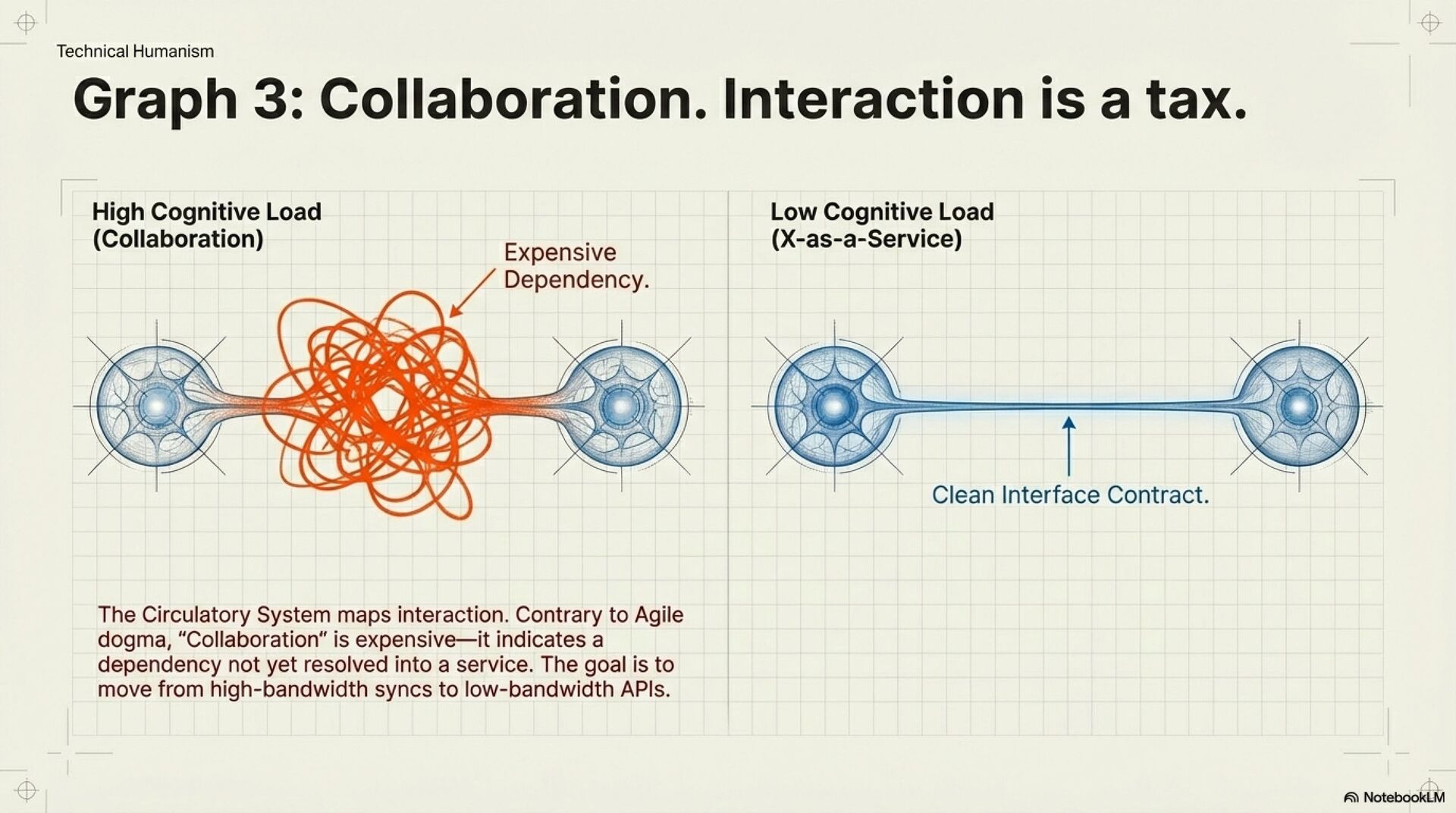
• Graph 3, Collaboration (circulatory system), interaction is a tax. The goal is to convert expensive dependency knots into clean interface contracts, shifting from meetings and syncs to APIs and services. Page 7. 
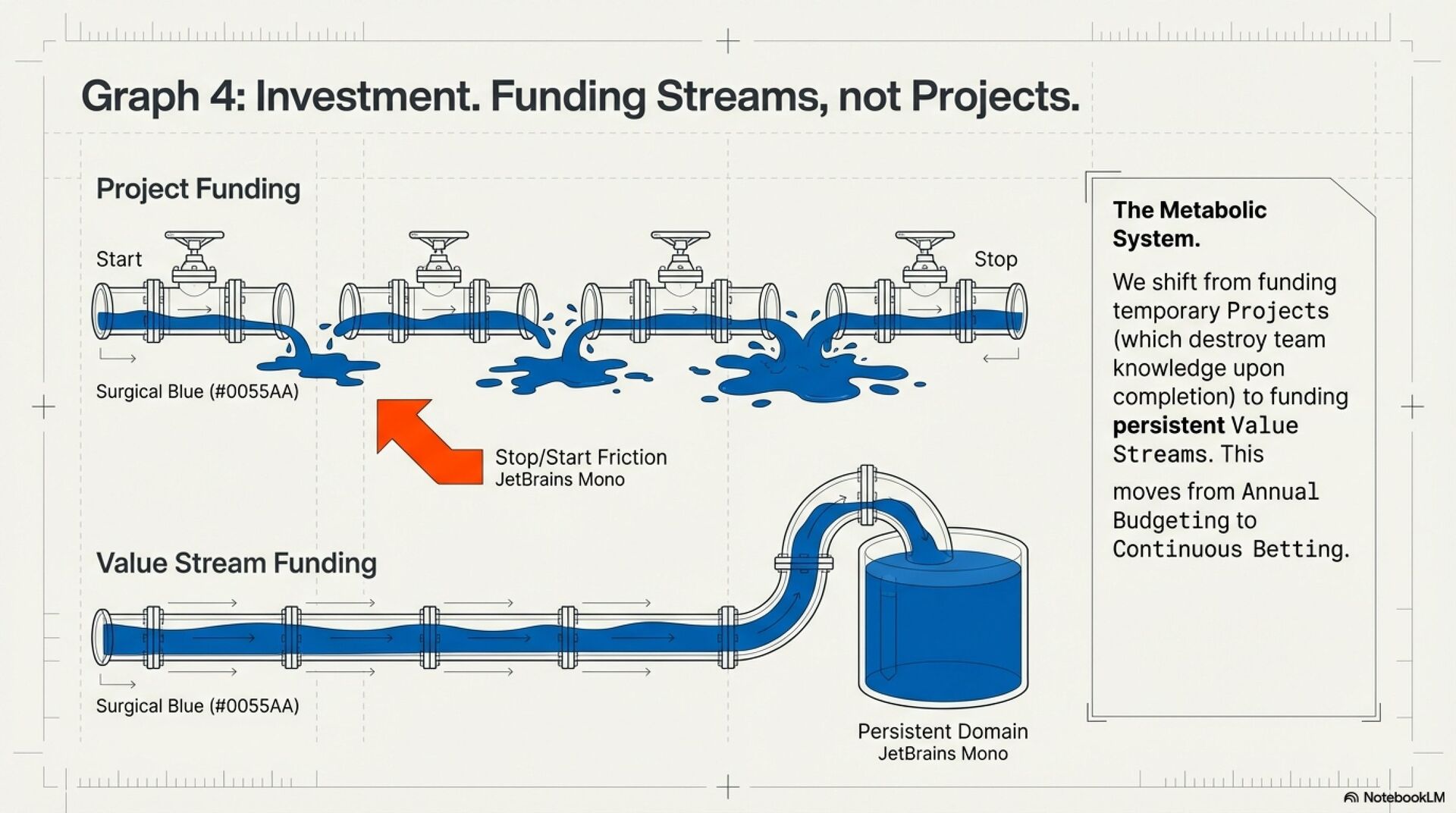
• Graph 4, Investment (metabolic system), fund streams not projects. Project funding creates stop start friction and destroys learned context, value stream funding preserves a persistent domain and enables continuous betting. Page 8. 
4) The translation layer connects strategy to execution (L0 to L10)
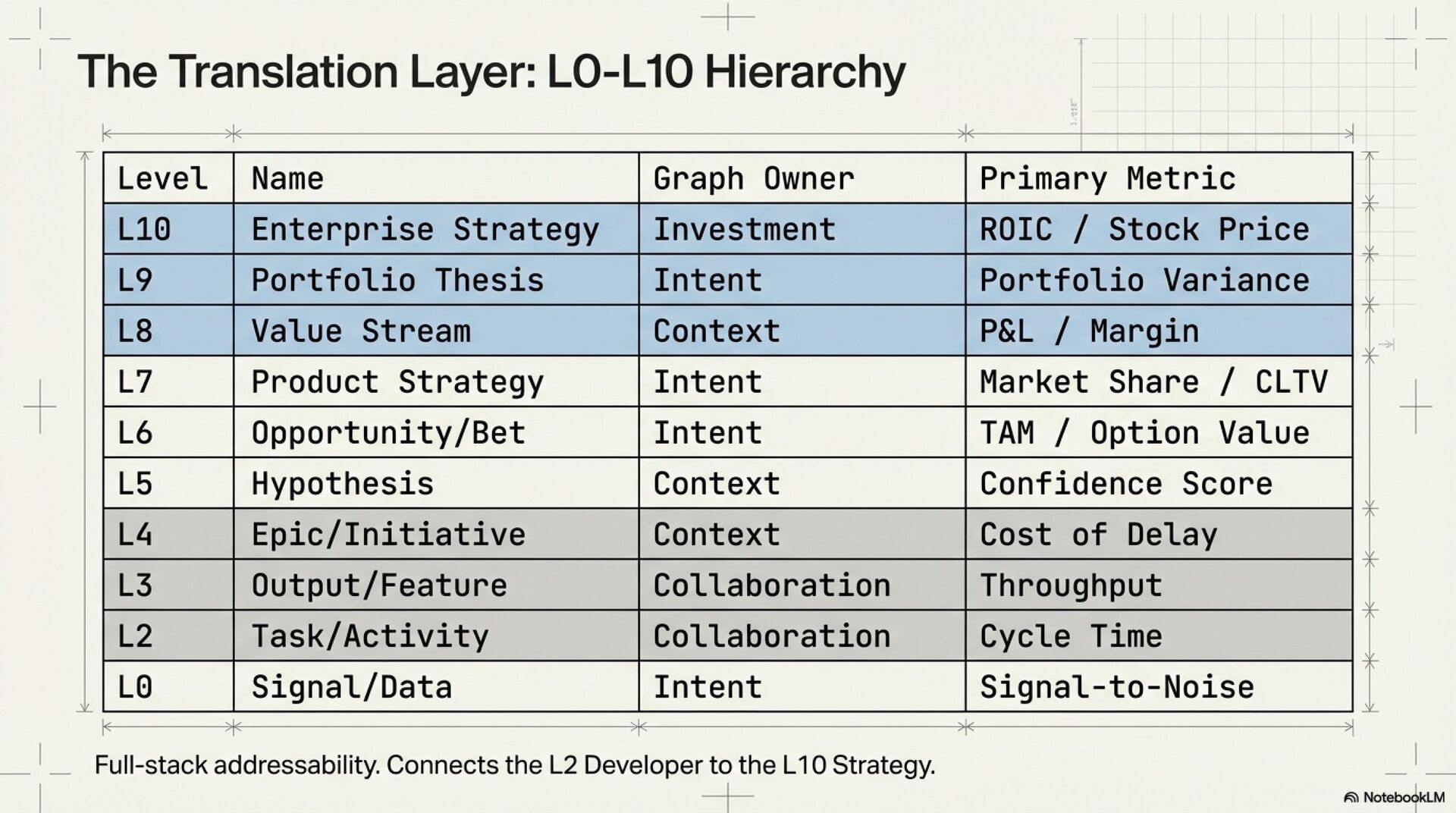
• A hierarchy maps levels from L0 signals and data up to L10 enterprise strategy, assigning each level a primary “graph owner” and metric. The point is full stack addressability, connecting an L2 developer to the L10 strategy without hand waving. Page 9. 
5) Autonomy is earned via a trust ladder and an interface contract
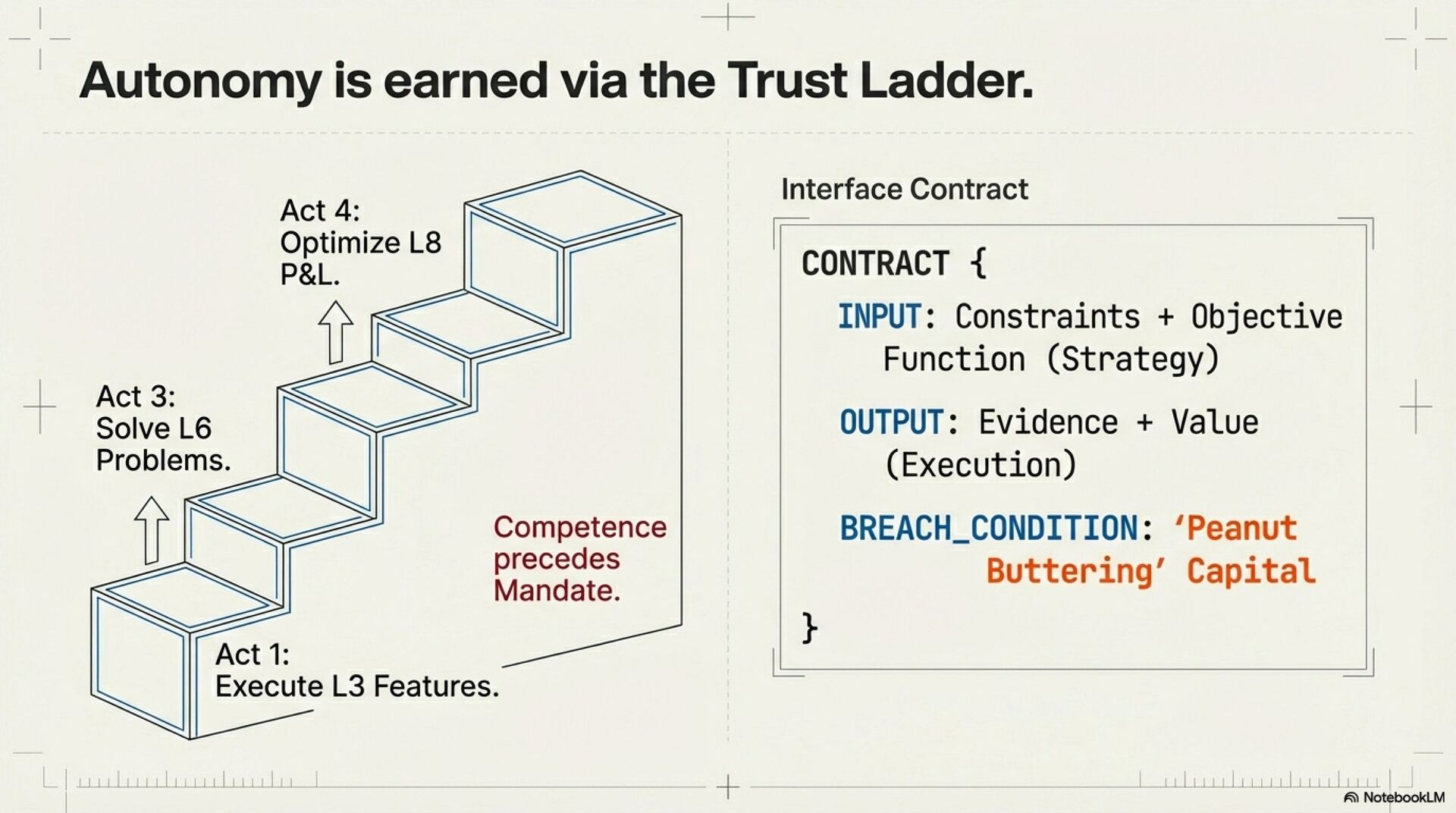
• The deck positions autonomy as competence plus mandate, earned across acts, from executing features, to solving higher level problems, to optimizing P&L. Page 10. 
• It frames the strategy execution interface as a contract: inputs are constraints plus objective function, outputs are evidence plus value, breach conditions trigger capital discipline. Page 10. 
6) Speak the CFO’s language, treat work as options
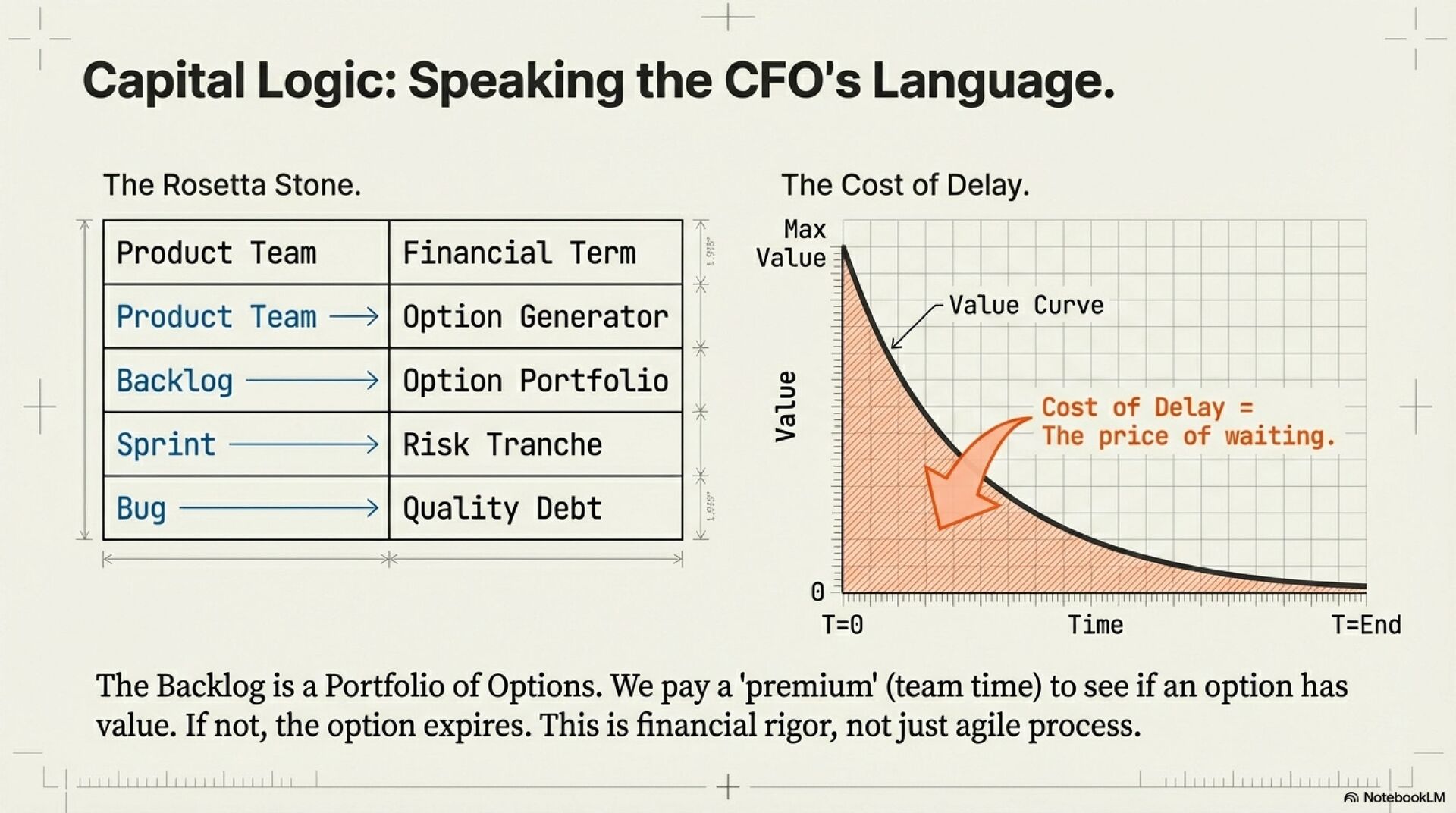
• It provides a translation dictionary, backlog as option portfolio, sprint as risk tranche, bugs as quality debt, product teams as option generators, anchored by cost of delay as “the price of waiting.” Page 11. 
7) You cannot fix the org chart without fixing the code
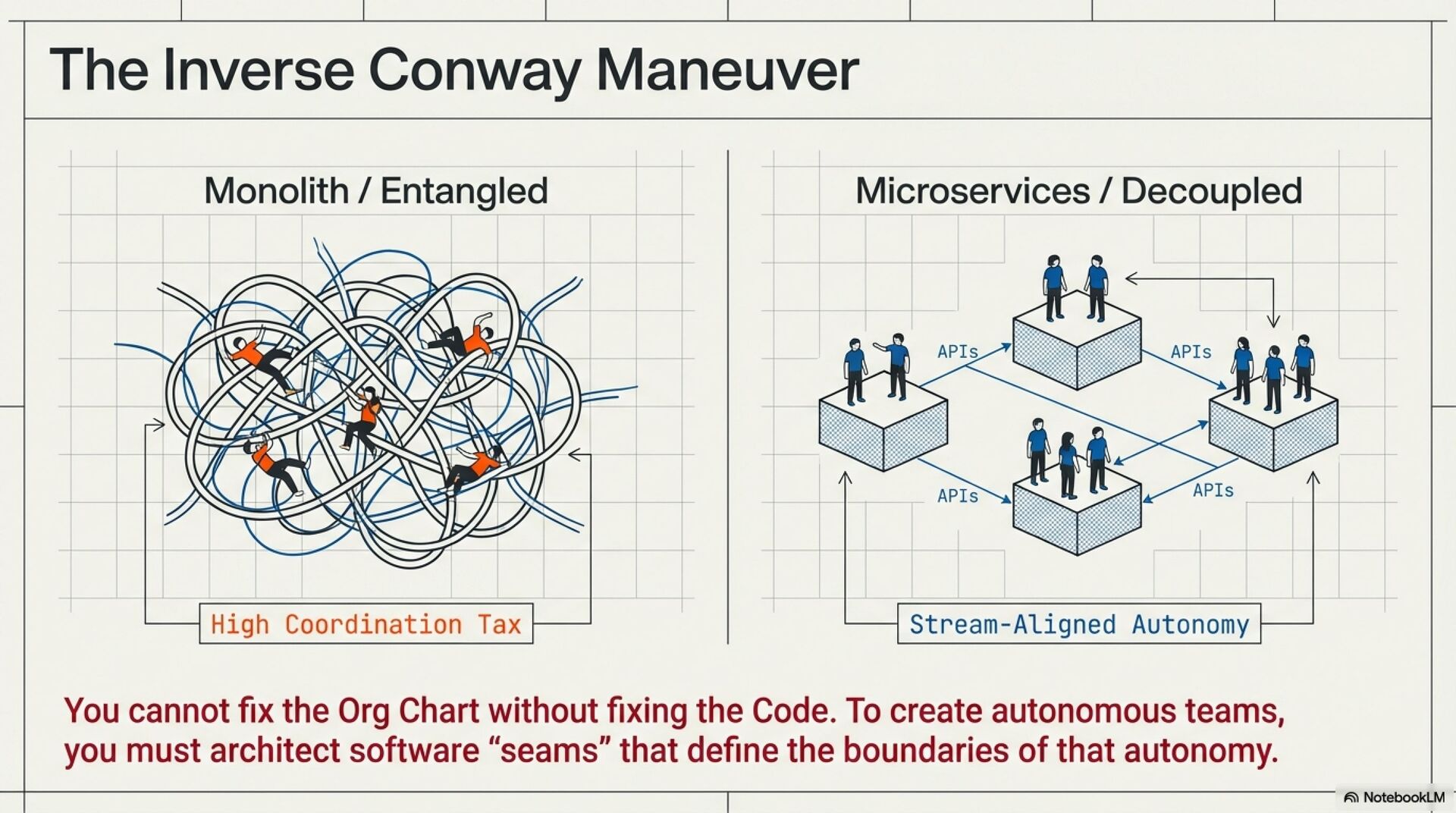
• The “inverse Conway maneuver” slide shows that high coordination tax in a tangled monolith cannot be solved by reorganizing, you need software seams and APIs that define autonomous boundaries. Page 12. 
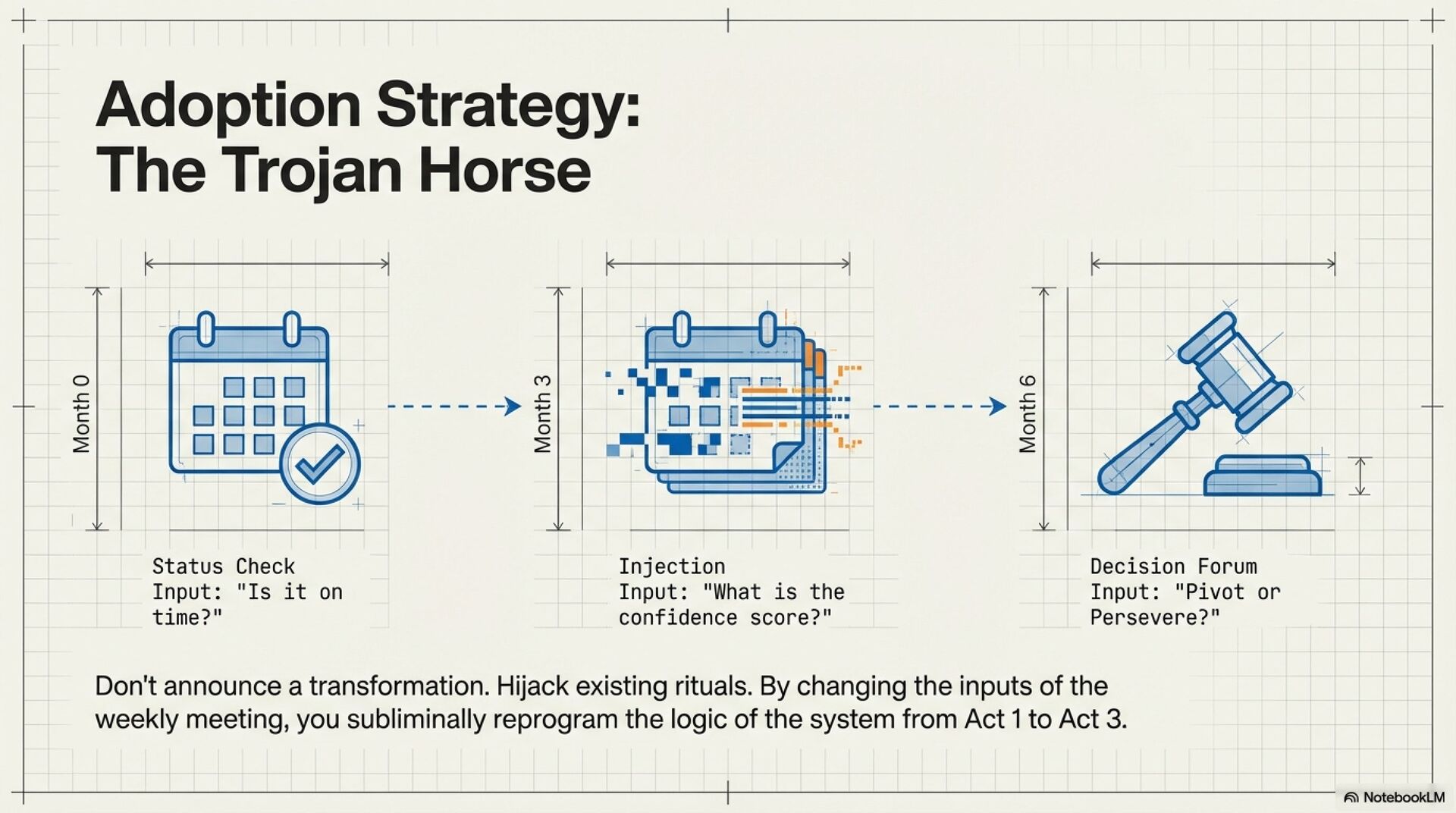
8) Adoption strategy, use a Trojan horse, not a grand transformation
• Instead of announcing change, the deck proposes hijacking existing rituals: start with status checks, inject better diagnostic inputs (for example confidence), then mature into real decision forums (pivot or persevere). Page 13. 
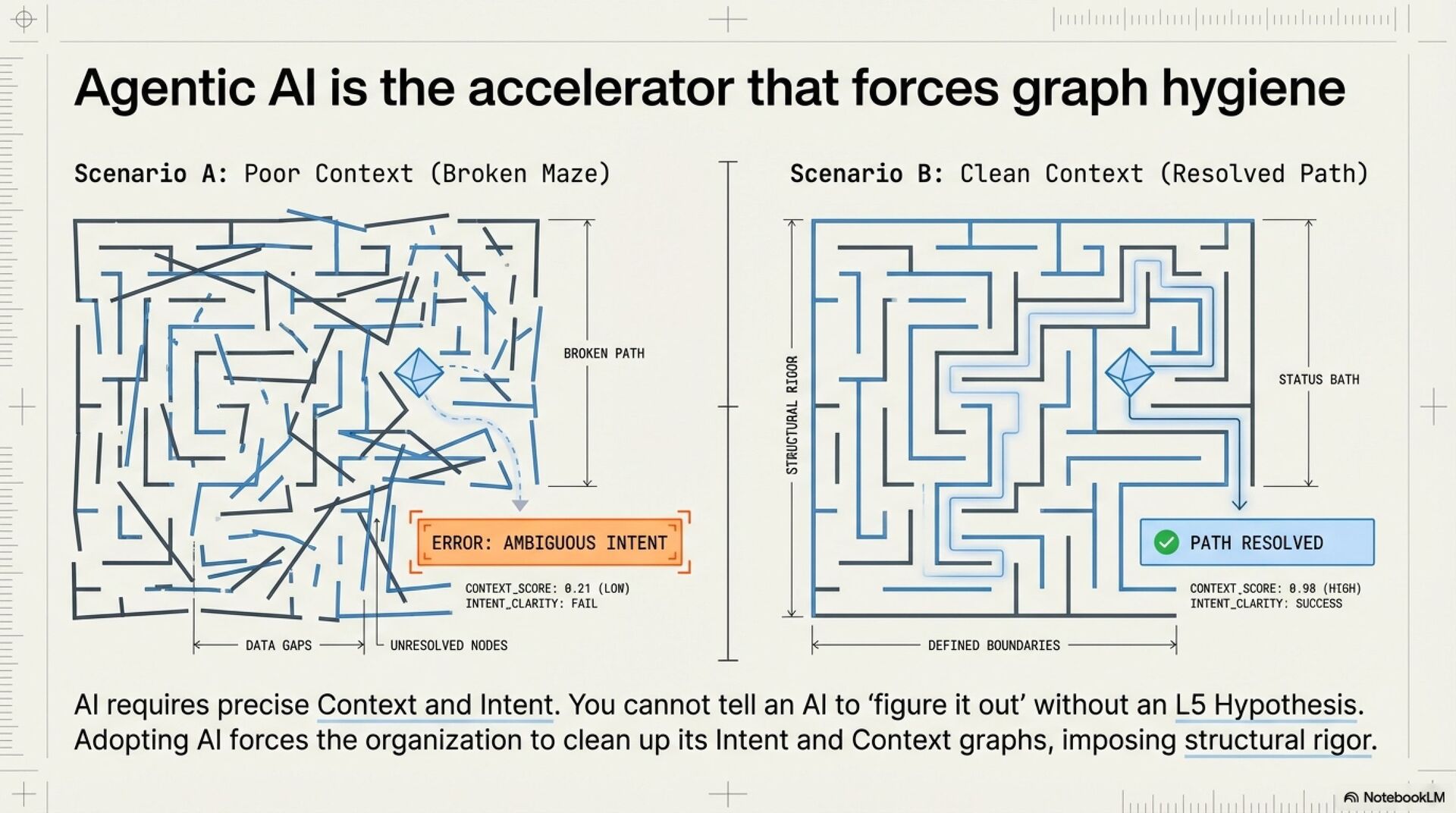
9) Agentic AI forces “graph hygiene”
• The deck closes with a simple claim: agentic systems fail in messy context and ambiguous intent, and succeed when boundaries, nodes, and paths are clean. AI becomes the accelerator that makes weak graphs painfully visible. Page 14. 
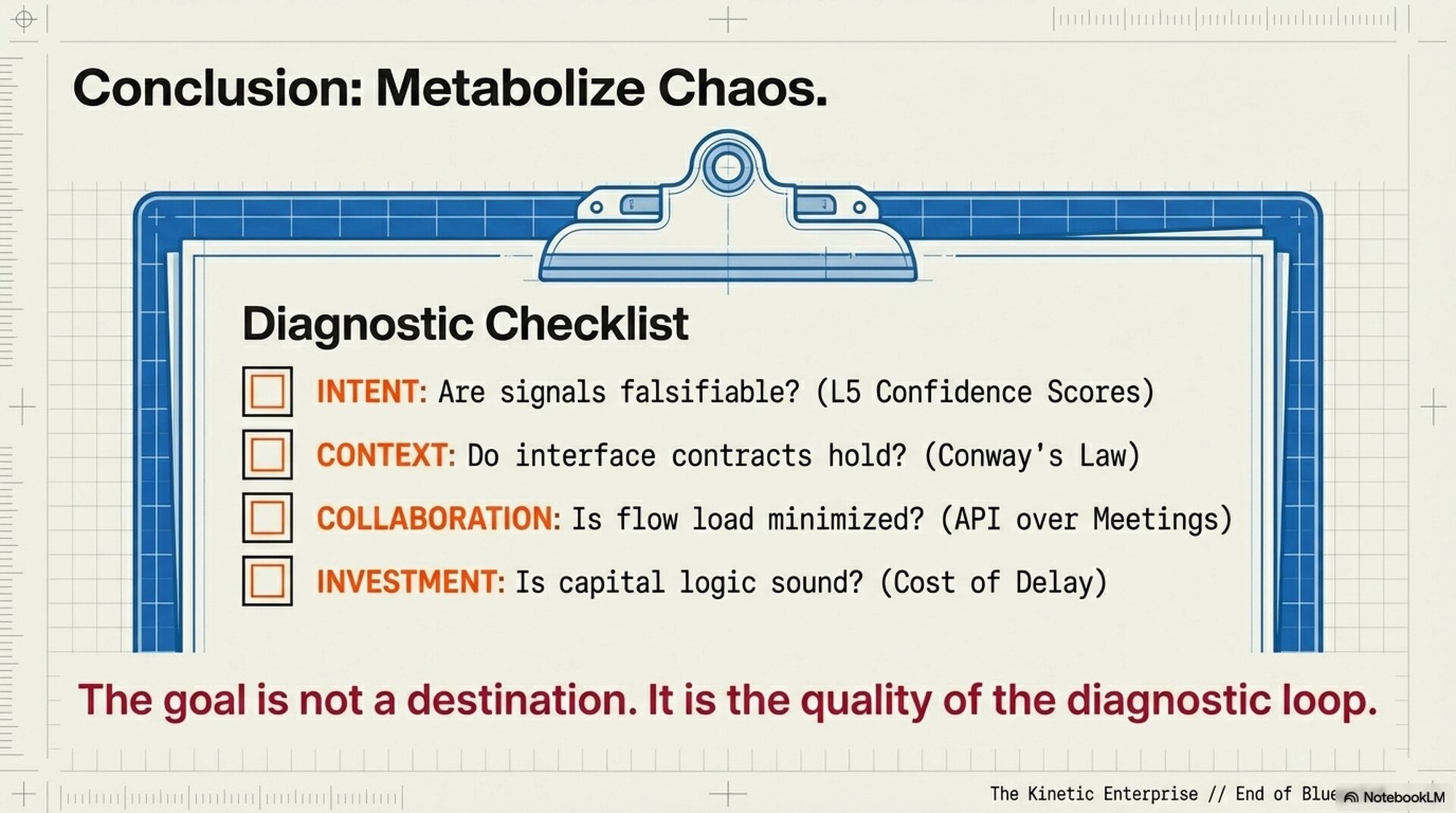
10) Conclusion, metabolize chaos with a diagnostic checklist
The final slide presents a checklist across the four graphs, intent falsifiability, context and interface integrity, collaboration and flow load, and investment logic via cost of delay. The goal is not a destination, it is the quality of the diagnostic loop. Page 15. 


 djimit123
 shumei_ito
 taketakekaho
 makocchi
 takanorip
 sansantech
 willnet
 tokuty
 yazm
yazm
 kash1064
 pfn
pfn
 genda
genda
 yu23ki14
 hannesfritz
 axbom
axbom
 tammyeverts
 portentint
 charlesmeaden
 skipperchong
 marktimemedia
 chrislema
 notwaldorf
 sachag
 jonoalderson
 colly
colly