L Combining rotation to the current strength protocols The Game-ready Knee addresses the lateral strength deficits found after traditional rehabilitation; resulting in a superior training effect for getting your athletes back in the game. Measuring function in knee rehab is often based on a linear evaluation; structured in a predictable environment. The game-ready knee protocol will get athletes prepared for the unpredictable and ready to perform without restriction. Controlling eccentric force is the key to staying injury-free for sports performance. Risk factors that can lead to knee injuries • Asymmetry in hip rotation • Core instability • Increased external tibial rotation The Game-ready protocol includes: Assessments for knee, hip and core Range of motion assessments are a good indicator of muscle inhibition and weakness. Isometrics to facilitate Neuromuscular Reeducation The goal of neuromuscular reeducation is not hypertrophy as with traditional training but rather to improve the ability of the muscle to contract and timing of the muscle contraction. Rotational stabilization Frontal plane stability and strength is emphasized. Movement Reeducation for putting it all together Standing Firm® allows you to reproduce rotational movement in a closed kinetic chain while monitoring correct alignment
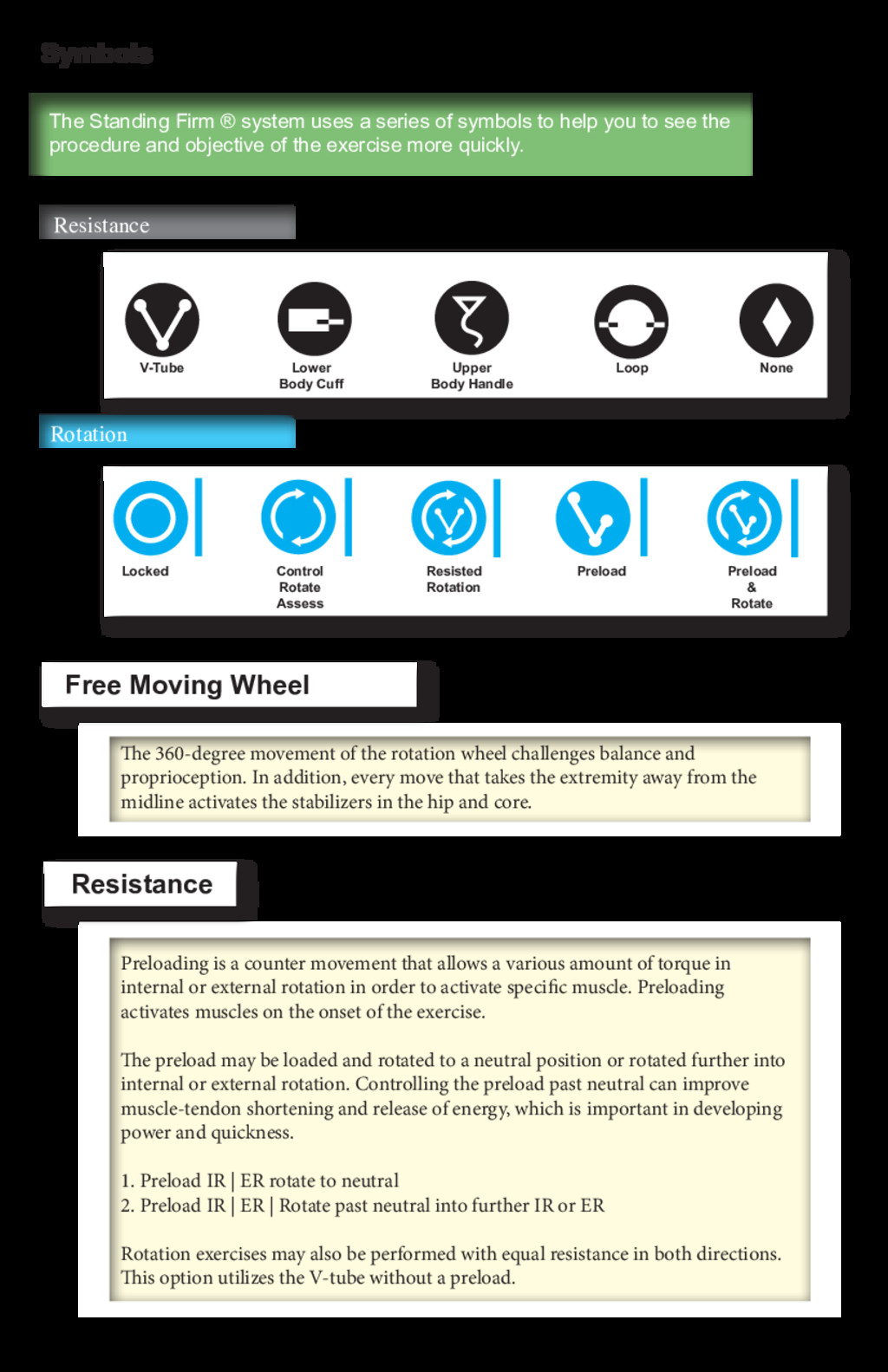
symbols to help you to see the procedure and objective of the exercise more quickly. The 360-degree movement of the rotation wheel challenges balance and proprioception. In addition, every move that takes the extremity away from the midline activates the stabilizers in the hip and core. Preloading is a counter movement that allows a various amount of torque in internal or external rotation in order to activate specific muscle. Preloading activates muscles on the onset of the exercise. The preload may be loaded and rotated to a neutral position or rotated further into internal or external rotation. Controlling the preload past neutral can improve muscle-tendon shortening and release of energy, which is important in developing power and quickness. 1. Preload IR | ER rotate to neutral 2. Preload IR | ER | Rotate past neutral into further IR or ER Rotation exercises may also be performed with equal resistance in both directions. This option utilizes the V-tube without a preload. Rotation Resistance Free Moving Wheel Resistance V-Tube Lower Body Cuff Upper Body Handle Loop None Locked Preload Preload & Rotate Resisted Rotation Control Rotate Assess
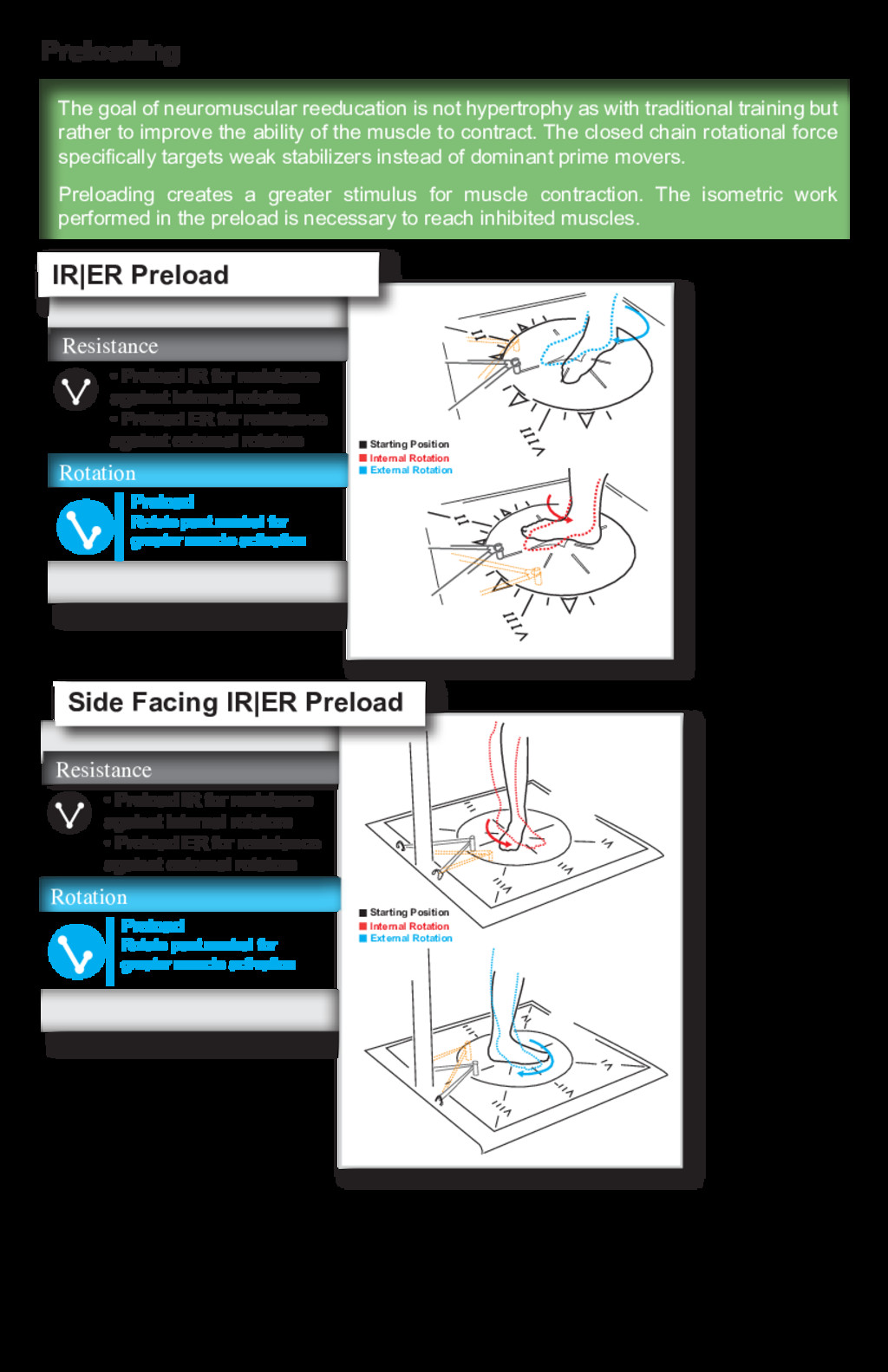
with traditional training but rather to improve the ability of the muscle to contract. The closed chain rotational force specifically targets weak stabilizers instead of dominant prime movers. Preloading creates a greater stimulus for muscle contraction. The isometric work performed in the preload is necessary to reach inhibited muscles. IR|ER Preload Resistance • Preload IR for resistance against internal rotators • Preload ER for resistance against external rotators Resistance • Preload IR for resistance against internal rotators • Preload ER for resistance against external rotators Starting Position Internal Rotation External Rotation Side Facing IR|ER Preload Rotation Preload Rotate past neutral for greater muscle activation Starting Position Internal Rotation External Rotation Rotation Preload Rotate past neutral for greater muscle activation
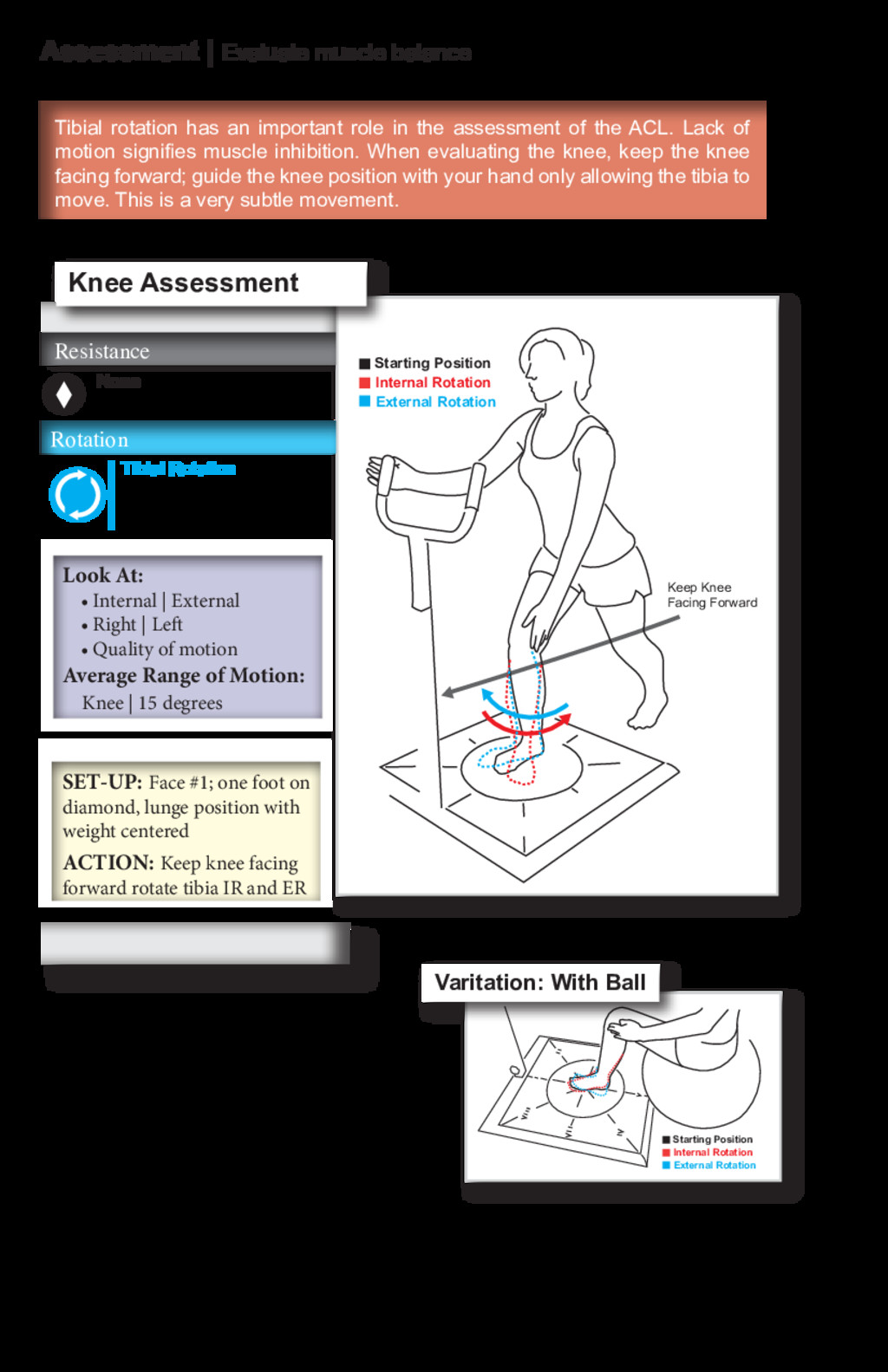
| Left • Quality of motion Average Range of Motion: Knee | 15 degrees Tibial rotation has an important role in the assessment of the ACL. Lack of motion signifies muscle inhibition. When evaluating the knee, keep the knee facing forward; guide the knee position with your hand only allowing the tibia to move. This is a very subtle movement. SET-UP: Face #1; one foot on diamond, lunge position with weight centered ACTION: Keep knee facing forward rotate tibia IR and ER Assessment | Evaluate muscle balance Tibial Rotation Rotation Keep Knee Facing Forward Starting Position Internal Rotation External Rotation Knee Assessment Starting Position Internal Rotation External Rotation Varitation: With Ball
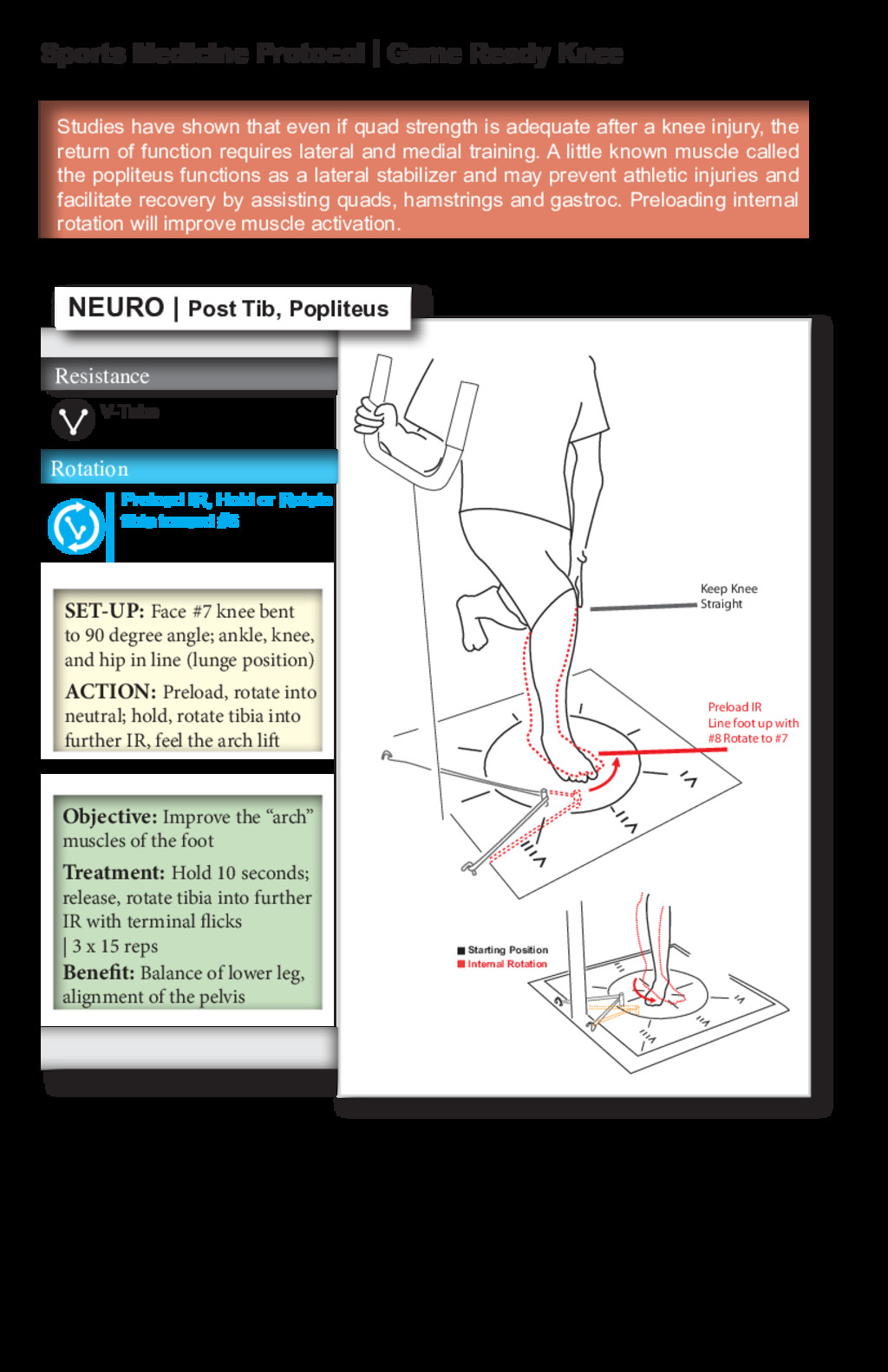
Face #7 knee bent to 90 degree angle; ankle, knee, and hip in line (lunge position) ACTION: Preload, rotate into neutral; hold, rotate tibia into further IR, feel the arch lift Objective: Improve the “arch” muscles of the foot Treatment: Hold 10 seconds; release, rotate tibia into further IR with terminal flicks | 3 x 15 reps Benefit: Balance of lower leg, alignment of the pelvis NEURO | Post Tib, Popliteus Preload IR, Hold or Rotate tibia toward #6 V-Tube Studies have shown that even if quad strength is adequate after a knee injury, the return of function requires lateral and medial training. A little known muscle called the popliteus functions as a lateral stabilizer and may prevent athletic injuries and facilitate recovery by assisting quads, hamstrings and gastroc. Preloading internal rotation will improve muscle activation. Keep Knee Straight Preload IR Line foot up with #8 Rotate to #7 Starting Position Internal Rotation
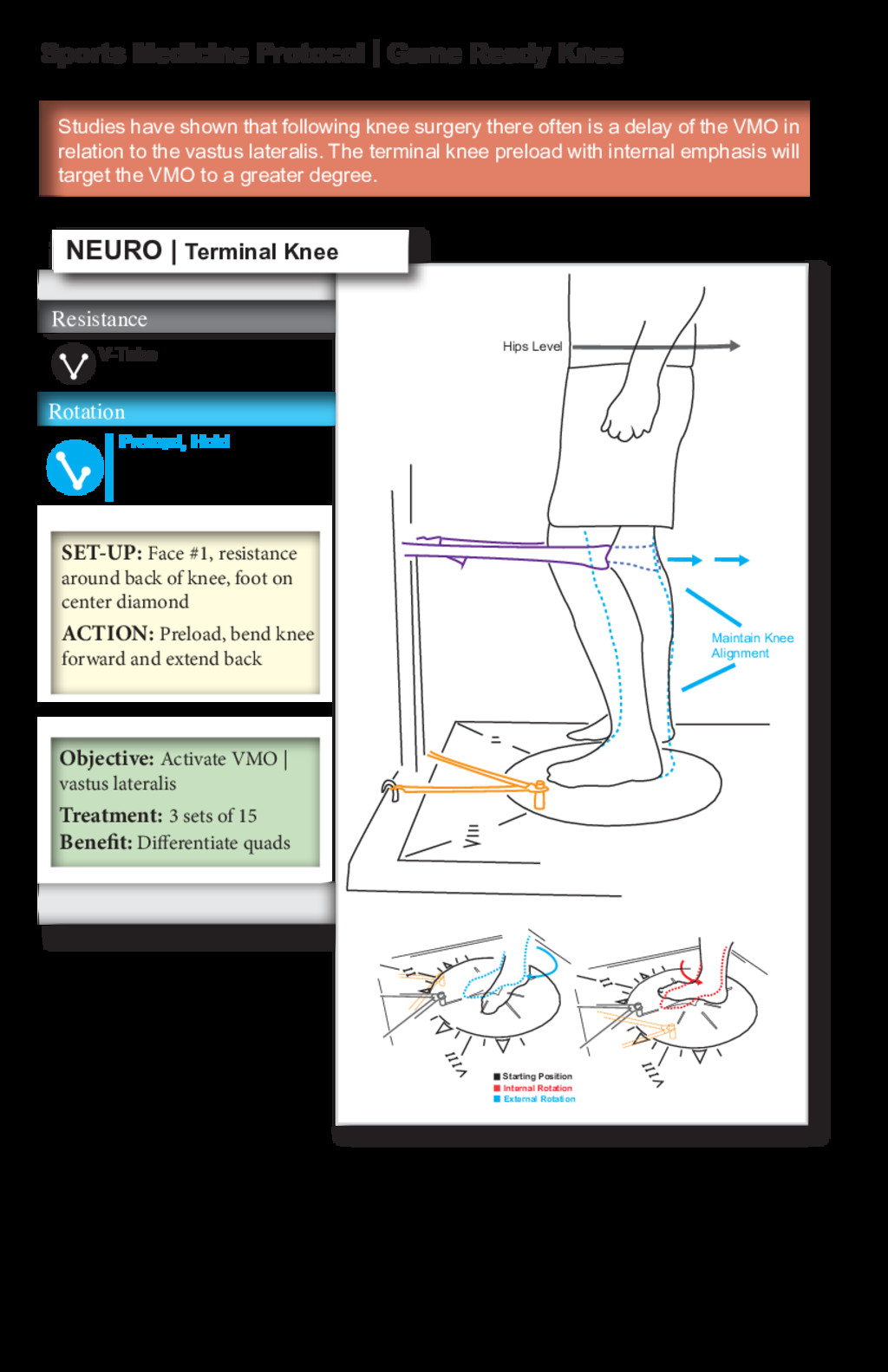
Face #1, resistance around back of knee, foot on center diamond ACTION: Preload, bend knee forward and extend back Objective: Activate VMO | vastus lateralis Treatment: 3 sets of 15 Benefit: Differentiate quads NEURO | Terminal Knee Preload, Hold V-Tube Studies have shown that following knee surgery there often is a delay of the VMO in relation to the vastus lateralis. The terminal knee preload with internal emphasis will target the VMO to a greater degree. Hips Level Maintain Knee Alignment Starting Position Internal Rotation External Rotation
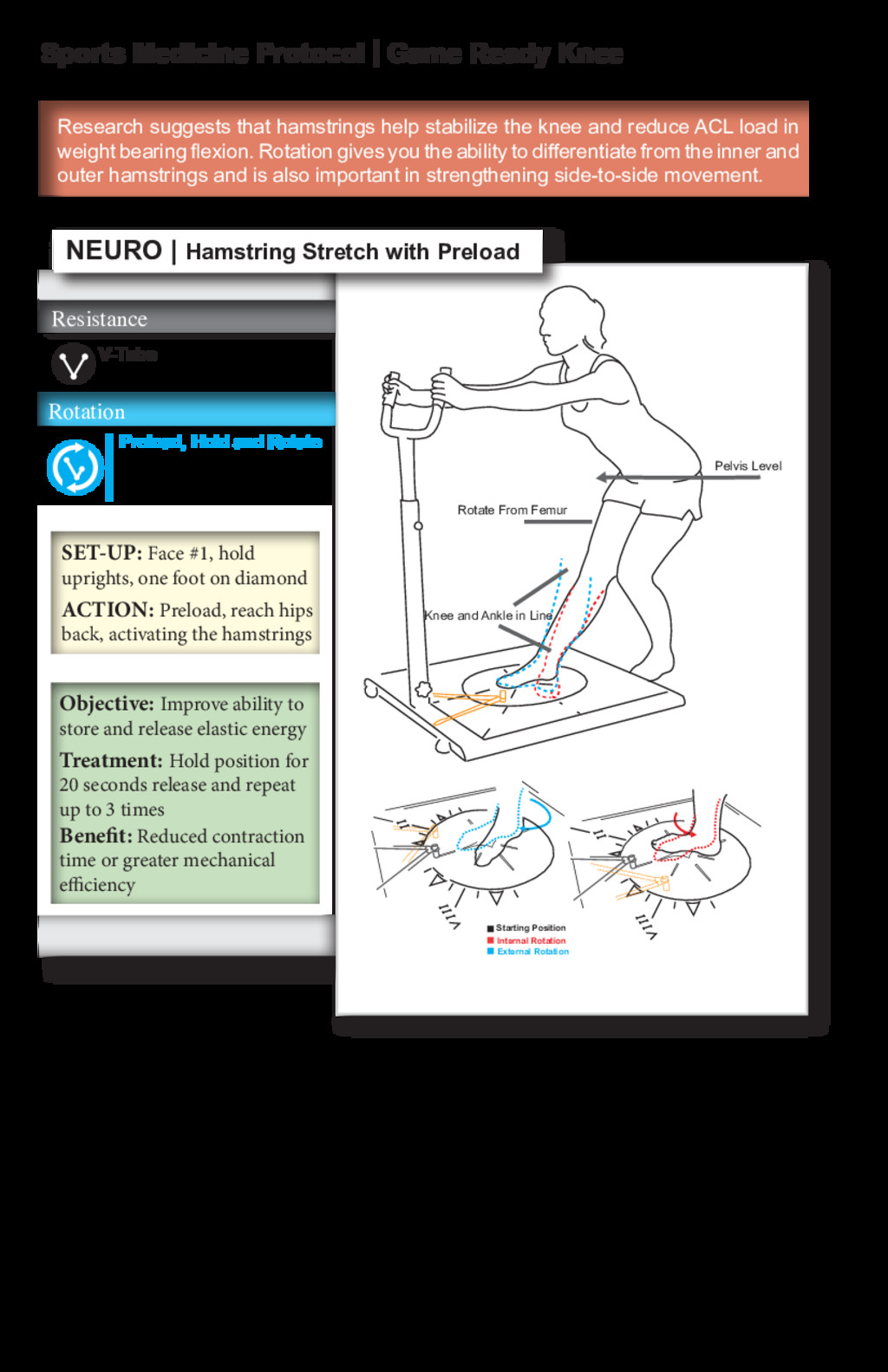
Face #1, hold uprights, one foot on diamond ACTION: Preload, reach hips back, activating the hamstrings Objective: Improve ability to store and release elastic energy Treatment: Hold position for 20 seconds release and repeat up to 3 times Benefit: Reduced contraction time or greater mechanical efficiency NEURO | Hamstring Stretch with Preload Preload, Hold and Rotate V-Tube Research suggests that hamstrings help stabilize the knee and reduce ACL load in weight bearing flexion. Rotation gives you the ability to differentiate from the inner and outer hamstrings and is also important in strengthening side-to-side movement. Pelvis Level Rotate From Femur Knee and Ankle in Line Starting Position Internal Rotation External Rotation
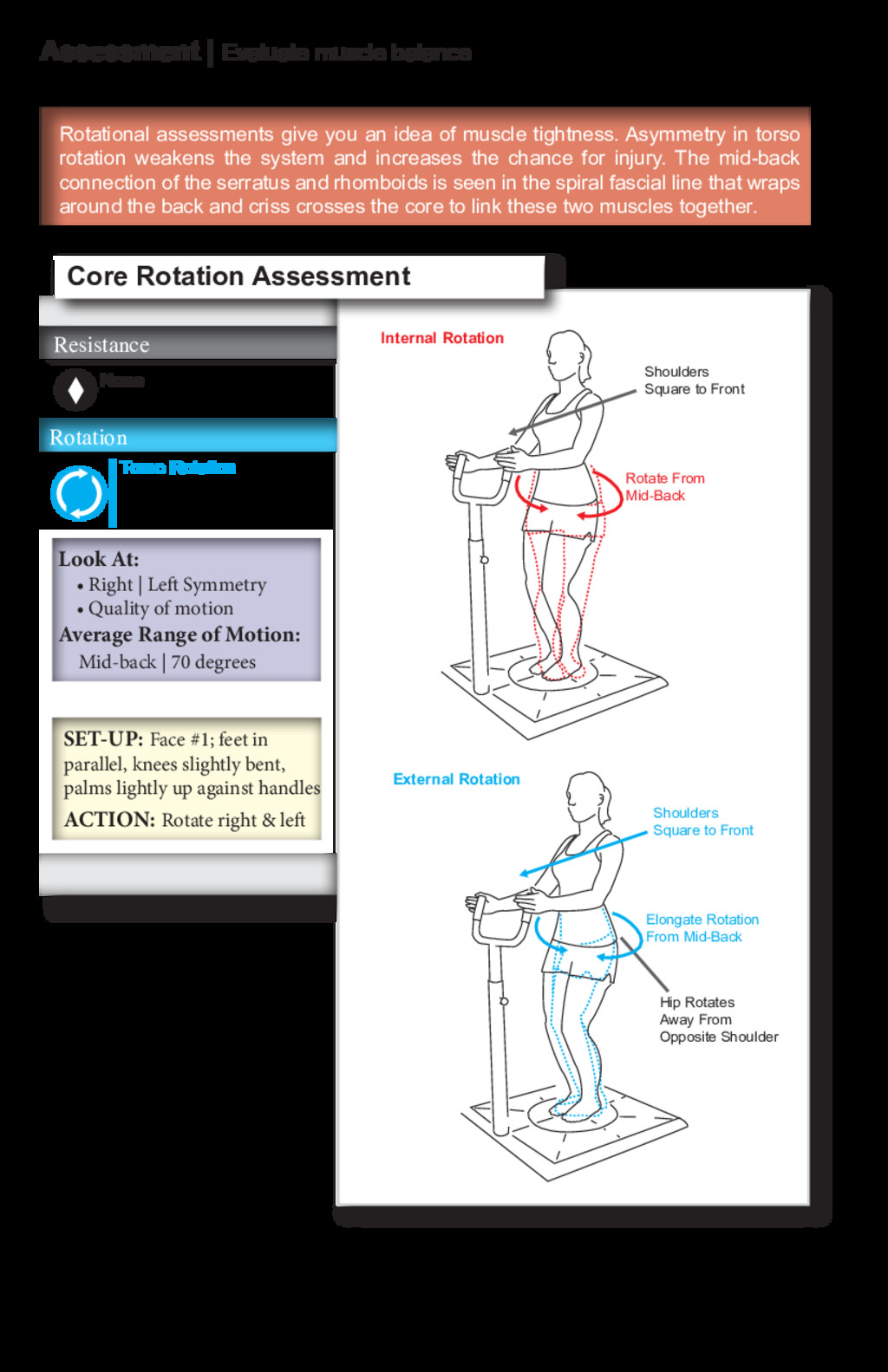
feet in parallel, knees slightly bent, palms lightly up against handles ACTION: Rotate right & left Core Rotation Assessment Torso Rotation None Rotational assessments give you an idea of muscle tightness. Asymmetry in torso rotation weakens the system and increases the chance for injury. The mid-back connection of the serratus and rhomboids is seen in the spiral fascial line that wraps around the back and criss crosses the core to link these two muscles together. Look At: • Right | Left Symmetry • Quality of motion Average Range of Motion: Mid-back | 70 degrees Internal Rotation External Rotation Rotate From Mid-Back Elongate Rotation From Mid-Back Hip Rotates Away From Opposite Shoulder Shoulders Square to Front Shoulders Square to Front
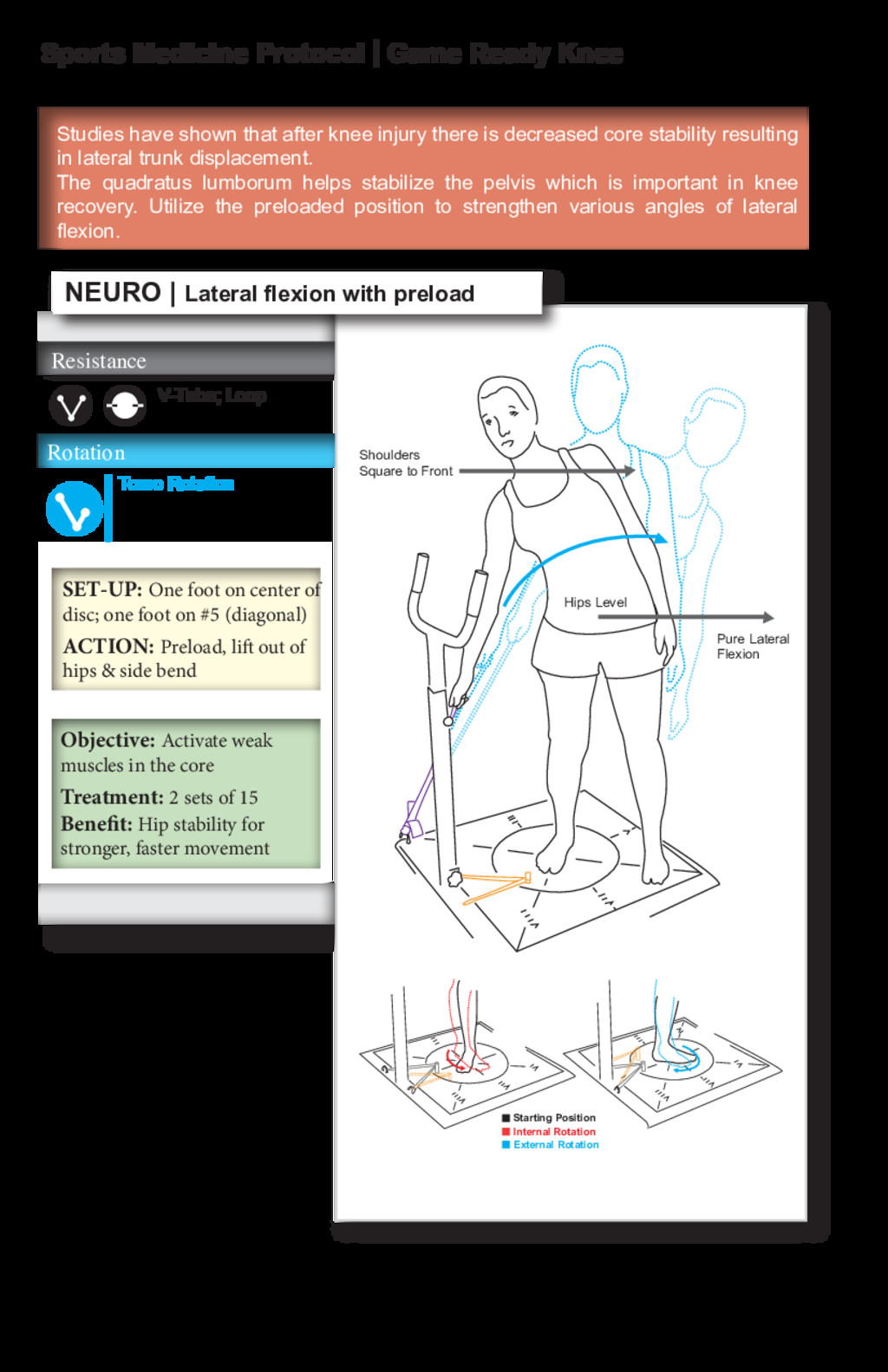
| Lateral flexion with preload Torso Rotation V-Tube; Loop Studies have shown that after knee injury there is decreased core stability resulting in lateral trunk displacement. The quadratus lumborum helps stabilize the pelvis which is important in knee recovery. Utilize the preloaded position to strengthen various angles of lateral flexion. SET-UP: One foot on center of disc; one foot on #5 (diagonal) ACTION: Preload, lift out of hips & side bend Objective: Activate weak muscles in the core Treatment: 2 sets of 15 Benefit: Hip stability for stronger, faster movement Shoulders Square to Front Hips Level Pure Lateral Flexion Starting Position Internal Rotation External Rotation
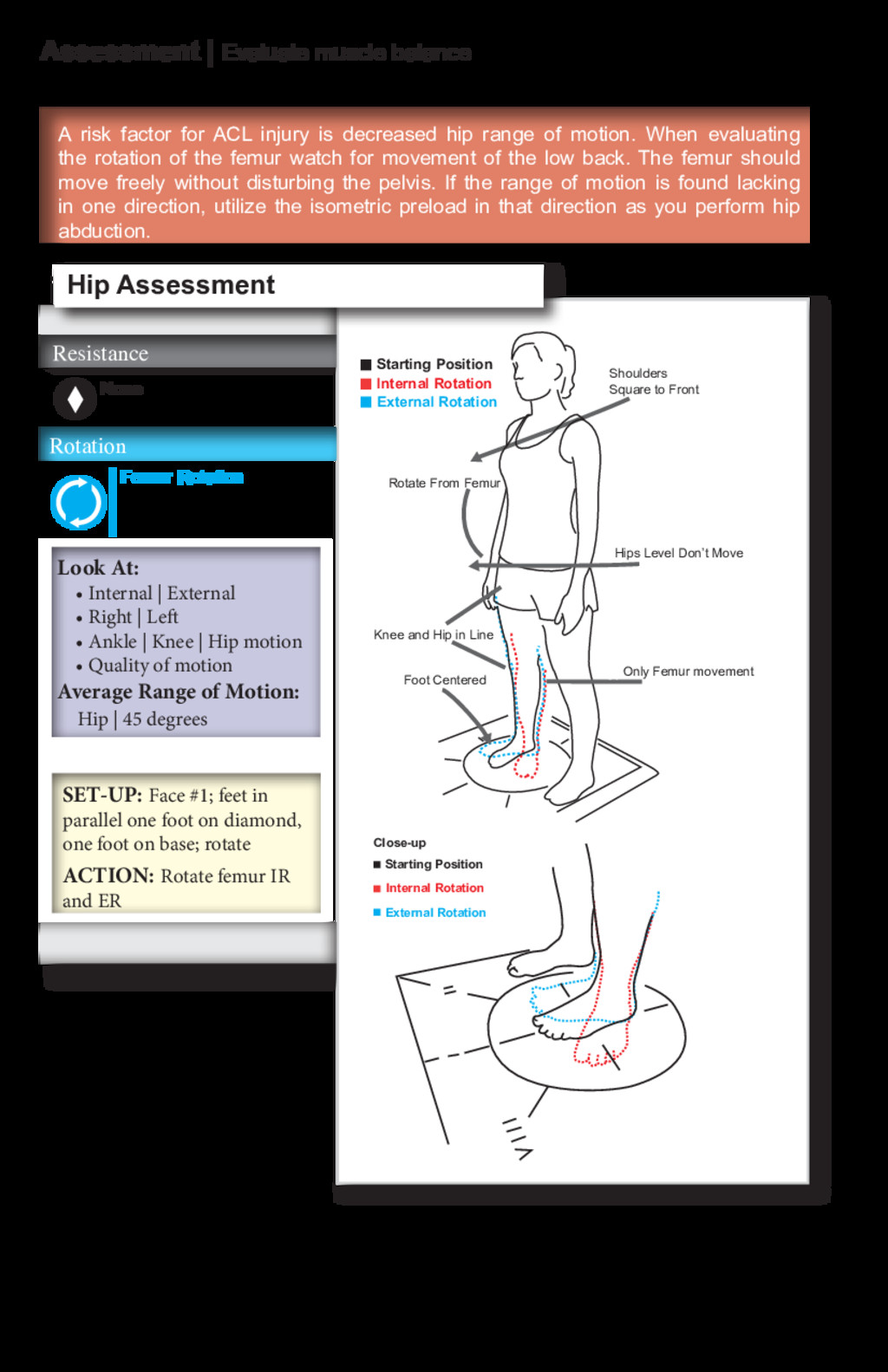
feet in parallel one foot on diamond, one foot on base; rotate ACTION: Rotate femur IR and ER Hip Assessment Femur Rotation None A risk factor for ACL injury is decreased hip range of motion. When evaluating the rotation of the femur watch for movement of the low back. The femur should move freely without disturbing the pelvis. If the range of motion is found lacking in one direction, utilize the isometric preload in that direction as you perform hip abduction. Look At: • Internal | External • Right | Left • Ankle | Knee | Hip motion • Quality of motion Average Range of Motion: Hip | 45 degrees Shoulders Square to Front Foot Centered Hips Level Don’t Move Only Femur movement Knee and Hip in Line Rotate From Femur Starting Position Internal Rotation External Rotation Internal Rotation Starting Position External Rotation Close-up
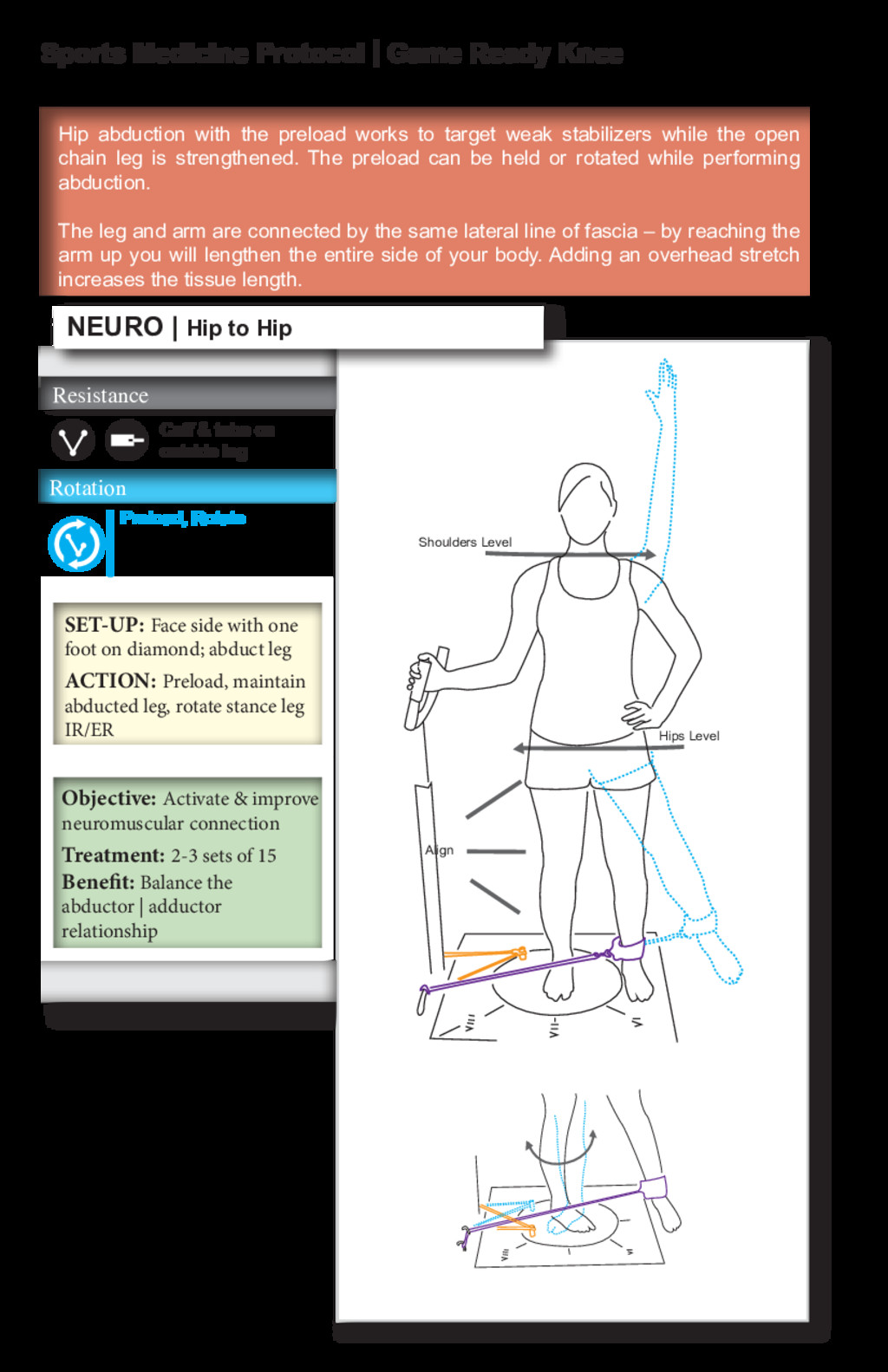
| Hip to Hip Preload, Rotate Cuff & tube on outside leg Hip abduction with the preload works to target weak stabilizers while the open chain leg is strengthened. The preload can be held or rotated while performing abduction. The leg and arm are connected by the same lateral line of fascia – by reaching the arm up you will lengthen the entire side of your body. Adding an overhead stretch increases the tissue length. SET-UP: Face side with one foot on diamond; abduct leg ACTION: Preload, maintain abducted leg, rotate stance leg IR/ER Objective: Activate & improve neuromuscular connection Treatment: 2-3 sets of 15 Benefit: Balance the abductor | adductor relationship Shoulders Level Hips Level Align
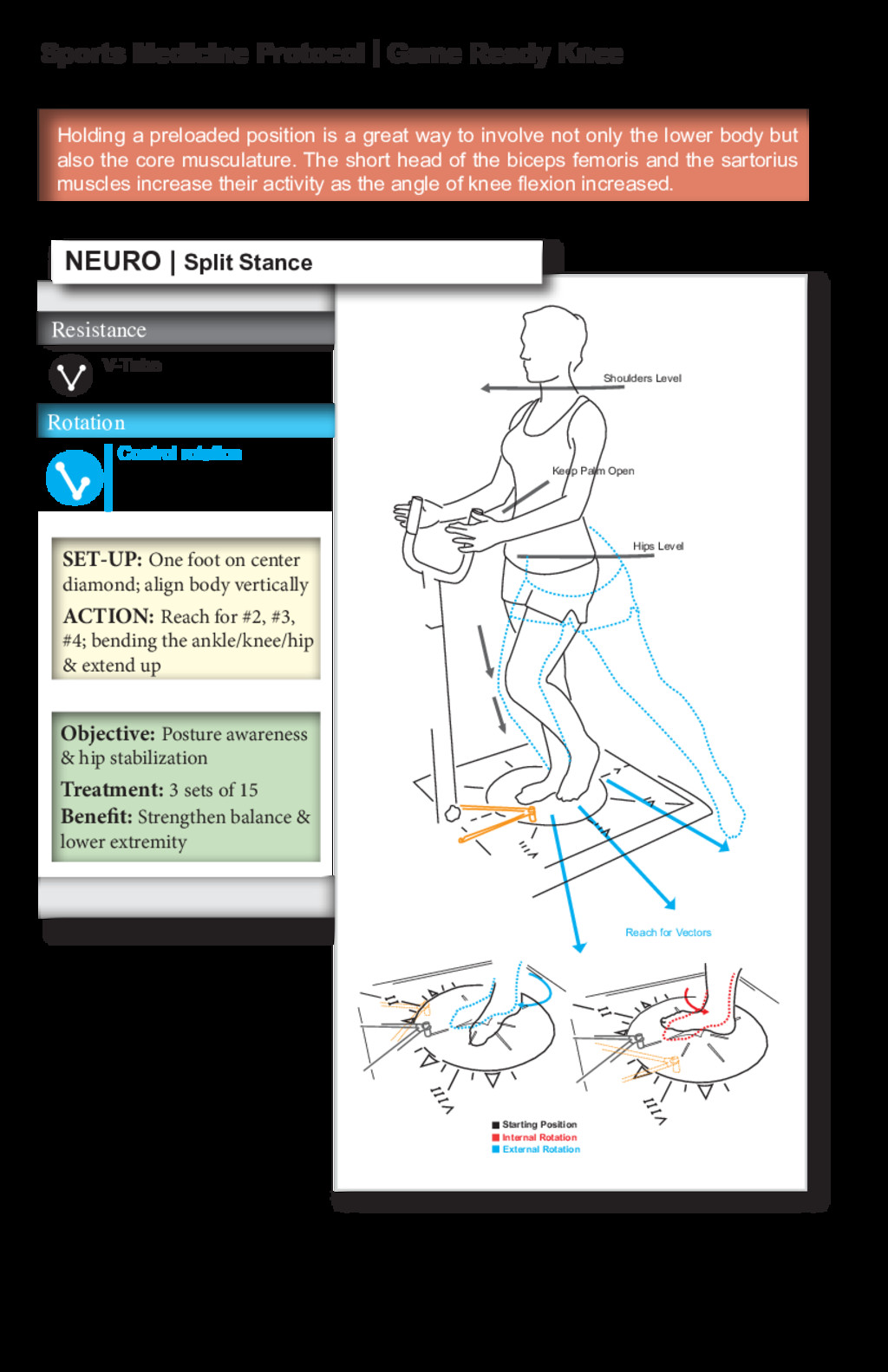
| Split Stance Control rotation V-Tube Holding a preloaded position is a great way to involve not only the lower body but also the core musculature. The short head of the biceps femoris and the sartorius muscles increase their activity as the angle of knee flexion increased. SET-UP: One foot on center diamond; align body vertically ACTION: Reach for #2, #3, #4; bending the ankle/knee/hip & extend up Objective: Posture awareness & hip stabilization Treatment: 3 sets of 15 Benefit: Strengthen balance & lower extremity Reach for Vectors Hips Level Shoulders Level Keep Palm Open Starting Position Internal Rotation External Rotation
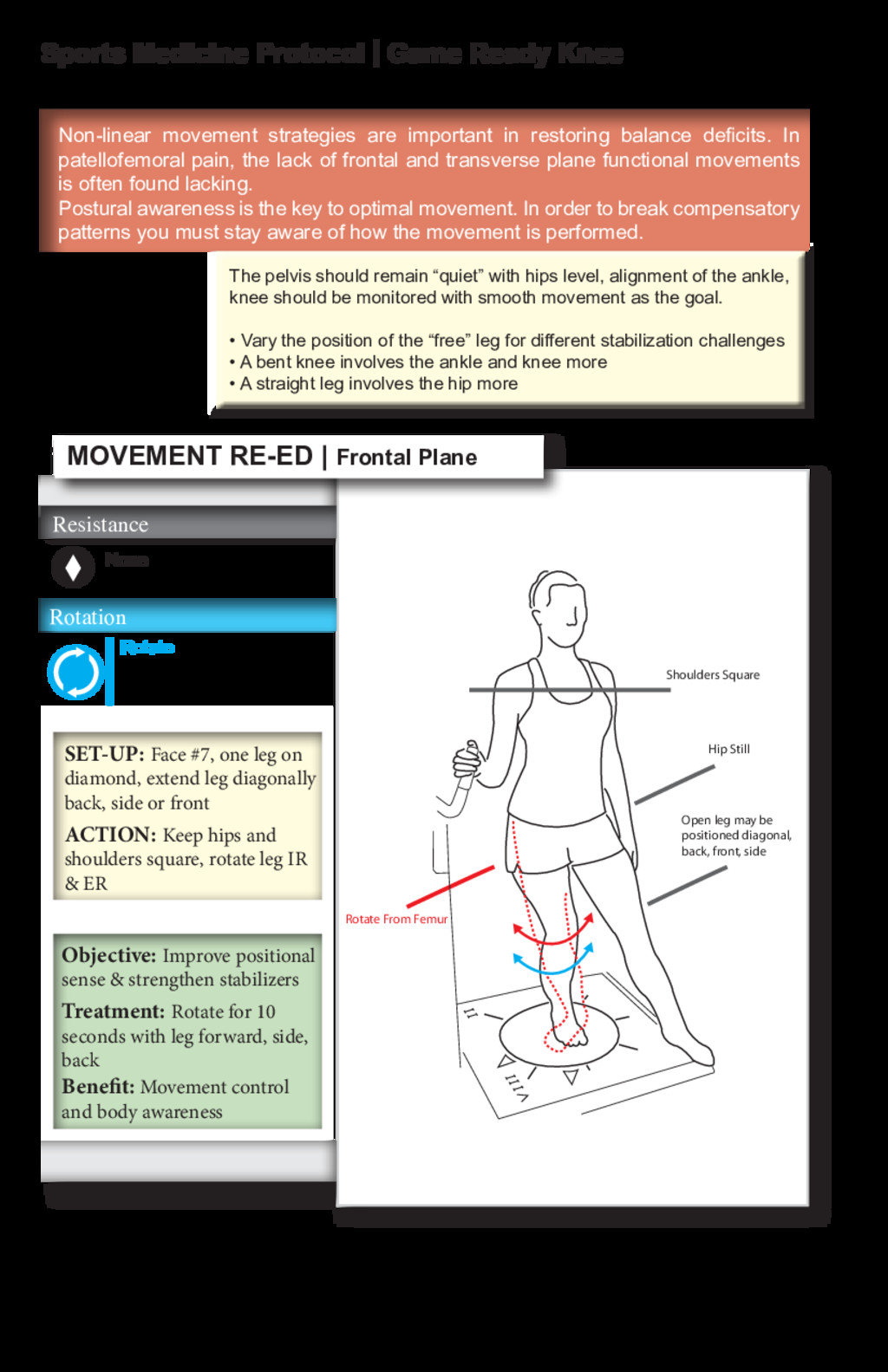
remain “quiet” with hips level, alignment of the ankle, knee should be monitored with smooth movement as the goal. • Vary the position of the “free” leg for different stabilization challenges • A bent knee involves the ankle and knee more • A straight leg involves the hip more Resistance Rotation MOVEMENT RE-ED | Frontal Plane Rotate None Non-linear movement strategies are important in restoring balance deficits. In patellofemoral pain, the lack of frontal and transverse plane functional movements is often found lacking. Postural awareness is the key to optimal movement. In order to break compensatory patterns you must stay aware of how the movement is performed. SET-UP: Face #7, one leg on diamond, extend leg diagonally back, side or front ACTION: Keep hips and shoulders square, rotate leg IR & ER Objective: Improve positional sense & strengthen stabilizers Treatment: Rotate for 10 seconds with leg forward, side, back Benefit: Movement control and body awareness Shoulders Square Hip Still Open leg may be positioned diagonal, back, front, side Rotate From Femur


 donnasnow
 terazawa
 signer
 jdbedics
 ainischool
 frievea
 ytapples613
 masakiokuda
 bvr7352
 pawan_pharm
 kentaroy47
 axbom
axbom
 codingconduct
 427marketing
 retrage
 michielstock
 aleyda
 jct
jct
 tmiket
 addyosmani
 afnizarnur
 chriscoyier